EP3439728B1 - Vorrichtung zur wirkstofffreisetzung - Google Patents
Vorrichtung zur wirkstofffreisetzung Download PDFInfo
- Publication number
- EP3439728B1 EP3439728B1 EP17778793.4A EP17778793A EP3439728B1 EP 3439728 B1 EP3439728 B1 EP 3439728B1 EP 17778793 A EP17778793 A EP 17778793A EP 3439728 B1 EP3439728 B1 EP 3439728B1
- Authority
- EP
- European Patent Office
- Prior art keywords
- balloon
- bladder
- core
- wall
- drug
- Prior art date
- Legal status (The legal status is an assumption and is not a legal conclusion. Google has not performed a legal analysis and makes no representation as to the accuracy of the status listed.)
- Active
Links
Images


Classifications
-
- A—HUMAN NECESSITIES
- A61—MEDICAL OR VETERINARY SCIENCE; HYGIENE
- A61M—DEVICES FOR INTRODUCING MEDIA INTO, OR ONTO, THE BODY; DEVICES FOR TRANSDUCING BODY MEDIA OR FOR TAKING MEDIA FROM THE BODY; DEVICES FOR PRODUCING OR ENDING SLEEP OR STUPOR
- A61M25/00—Catheters; Hollow probes
- A61M25/10—Balloon catheters
- A61M25/1002—Balloon catheters characterised by balloon shape
-
- A—HUMAN NECESSITIES
- A61—MEDICAL OR VETERINARY SCIENCE; HYGIENE
- A61M—DEVICES FOR INTRODUCING MEDIA INTO, OR ONTO, THE BODY; DEVICES FOR TRANSDUCING BODY MEDIA OR FOR TAKING MEDIA FROM THE BODY; DEVICES FOR PRODUCING OR ENDING SLEEP OR STUPOR
- A61M25/00—Catheters; Hollow probes
- A61M25/10—Balloon catheters
-
- A—HUMAN NECESSITIES
- A61—MEDICAL OR VETERINARY SCIENCE; HYGIENE
- A61M—DEVICES FOR INTRODUCING MEDIA INTO, OR ONTO, THE BODY; DEVICES FOR TRANSDUCING BODY MEDIA OR FOR TAKING MEDIA FROM THE BODY; DEVICES FOR PRODUCING OR ENDING SLEEP OR STUPOR
- A61M25/00—Catheters; Hollow probes
- A61M25/10—Balloon catheters
- A61M25/1018—Balloon inflating or inflation-control devices
- A61M25/10184—Means for controlling or monitoring inflation or deflation
- A61M25/10185—Valves
- A61M25/10186—One-way valves
-
- A—HUMAN NECESSITIES
- A61—MEDICAL OR VETERINARY SCIENCE; HYGIENE
- A61M—DEVICES FOR INTRODUCING MEDIA INTO, OR ONTO, THE BODY; DEVICES FOR TRANSDUCING BODY MEDIA OR FOR TAKING MEDIA FROM THE BODY; DEVICES FOR PRODUCING OR ENDING SLEEP OR STUPOR
- A61M31/00—Devices for introducing or retaining media, e.g. remedies, in cavities of the body
- A61M31/002—Devices for releasing a drug at a continuous and controlled rate for a prolonged period of time
-
- A—HUMAN NECESSITIES
- A61—MEDICAL OR VETERINARY SCIENCE; HYGIENE
- A61M—DEVICES FOR INTRODUCING MEDIA INTO, OR ONTO, THE BODY; DEVICES FOR TRANSDUCING BODY MEDIA OR FOR TAKING MEDIA FROM THE BODY; DEVICES FOR PRODUCING OR ENDING SLEEP OR STUPOR
- A61M25/00—Catheters; Hollow probes
- A61M25/10—Balloon catheters
- A61M25/1011—Multiple balloon catheters
- A61M2025/1013—Multiple balloon catheters with concentrically mounted balloons, e.g. being independently inflatable
-
- A—HUMAN NECESSITIES
- A61—MEDICAL OR VETERINARY SCIENCE; HYGIENE
- A61M—DEVICES FOR INTRODUCING MEDIA INTO, OR ONTO, THE BODY; DEVICES FOR TRANSDUCING BODY MEDIA OR FOR TAKING MEDIA FROM THE BODY; DEVICES FOR PRODUCING OR ENDING SLEEP OR STUPOR
- A61M25/00—Catheters; Hollow probes
- A61M25/10—Balloon catheters
- A61M2025/1043—Balloon catheters with special features or adapted for special applications
- A61M2025/105—Balloon catheters with special features or adapted for special applications having a balloon suitable for drug delivery, e.g. by using holes for delivery, drug coating or membranes
-
- A—HUMAN NECESSITIES
- A61—MEDICAL OR VETERINARY SCIENCE; HYGIENE
- A61M—DEVICES FOR INTRODUCING MEDIA INTO, OR ONTO, THE BODY; DEVICES FOR TRANSDUCING BODY MEDIA OR FOR TAKING MEDIA FROM THE BODY; DEVICES FOR PRODUCING OR ENDING SLEEP OR STUPOR
- A61M25/00—Catheters; Hollow probes
- A61M25/10—Balloon catheters
- A61M2025/1043—Balloon catheters with special features or adapted for special applications
- A61M2025/1054—Balloon catheters with special features or adapted for special applications having detachable or disposable balloons
-
- A—HUMAN NECESSITIES
- A61—MEDICAL OR VETERINARY SCIENCE; HYGIENE
- A61M—DEVICES FOR INTRODUCING MEDIA INTO, OR ONTO, THE BODY; DEVICES FOR TRANSDUCING BODY MEDIA OR FOR TAKING MEDIA FROM THE BODY; DEVICES FOR PRODUCING OR ENDING SLEEP OR STUPOR
- A61M2205/00—General characteristics of the apparatus
- A61M2205/02—General characteristics of the apparatus characterised by a particular materials
- A61M2205/0216—Materials providing elastic properties, e.g. for facilitating deformation and avoid breaking
-
- A—HUMAN NECESSITIES
- A61—MEDICAL OR VETERINARY SCIENCE; HYGIENE
- A61M—DEVICES FOR INTRODUCING MEDIA INTO, OR ONTO, THE BODY; DEVICES FOR TRANSDUCING BODY MEDIA OR FOR TAKING MEDIA FROM THE BODY; DEVICES FOR PRODUCING OR ENDING SLEEP OR STUPOR
- A61M2205/00—General characteristics of the apparatus
- A61M2205/02—General characteristics of the apparatus characterised by a particular materials
- A61M2205/0272—Electro-active or magneto-active materials
- A61M2205/0288—Electro-rheological or magneto-rheological materials
-
- A—HUMAN NECESSITIES
- A61—MEDICAL OR VETERINARY SCIENCE; HYGIENE
- A61M—DEVICES FOR INTRODUCING MEDIA INTO, OR ONTO, THE BODY; DEVICES FOR TRANSDUCING BODY MEDIA OR FOR TAKING MEDIA FROM THE BODY; DEVICES FOR PRODUCING OR ENDING SLEEP OR STUPOR
- A61M2210/00—Anatomical parts of the body
- A61M2210/10—Trunk
- A61M2210/1078—Urinary tract
- A61M2210/1085—Bladder
Definitions
- the present invention is directed to drug delivery devices in body cavities, and in particular for drug delivery in the bladder.
- US 5,993,473 describes an expandable device with a fillant delivery tube 18' and an expandable body 16'.
- the expandable body may be slightly taut while in a non-expanded configuration where the tip of the tube contacts the interior surface of the expandable body.
- the field of targeted, site-specific, controlled drug delivery is developing rapidly.
- the primary advantage of this targeting is the delivery of drugs directly at the diseased site, which allows for high local doses to be administered without exceeding the systemic toxicity level of the drug, as well as providing effective drug doses by continuous and constant drug delivery lasting from several days to several months and, maintaining therapeutic levels of the drug at the target site.
- the exact targeted release ensures efficiency and allows controlled release of mono- and combination therapies. This is especially important for drugs, which are usually administered orally orintravenously, which after losing to systemic metabolism, a large portion of the administered drug fails to reach their target, or reaches the target in low therapeutic concentrations. Additionally, these orally or intravenouslyadministered drugs typically result in various systemic side effects.
- One reason for focusing on the bladder is that it is easily accessed through the urethra.
- Contemporary bladder intravesical treatments involve repeated bladder instillations of a diluted drug which can be kept in the bladder for about 2 hours and then drained from the bladder.
- Drug transport in bladder tissues is a function of time and its distance from the bladder cavity.
- the bladder wall is divided into two sections, the urothelium (mucosa) that is not blood-perfused, and the submucosal and muscle layers of the bladder that contain blood vessels and lymphatics.
- Transport of a drug from the urine in the bladder across the urothelium which is about 200 ⁇ m thick and made from about 7-10 cell layers occurs by diffusion across this single homogeneous barrier.
- the second barrier for drug transport is the submucosa and superficial muscle which has a porous structure, 200-4,000 ⁇ m thick and the drug is absorbed through its blood vessels.
- the drug concentration in this layer declines by about 50%, depending on the amount of blood vessels which increase in deeper tissue layers.
- Another determinant in drug penetration through the urothelium is the size of the drug molecule and its lipophilicity, the smaller the lipophilic drug molecule, the higher its systemic absorption.
- drug includes drugs, chemo- or immunotherapeutic agents, medicines, natural compositions, pharmaceutical compositions, nutroceutical compositions, or any substance such as cells or viruses used to treat or otherwise cause an effect in the mammalian body.
- the present invention in some embodiments, is directed to a device for drug delivery into the bladder.
- the urinary bladder is easily accessed through the urethra.
- the bladder inner lining, the urothelium limits therate of absorption of molecules into the systemic circulation. For most small-molecule drugs, less than 5% of the dose is absorbed into the systemic circulation which is important especially with drugs related to cancer (De Bruijn E. A. et al., Song D. et al). Based in these characteristics, the urothelium is showing promise in retaining pharmacologically active agents for extended periods of time.
- the therapeutic agents can be delivered in effective concentrations.
- the rationale for intravesical therapy is to maximize the exposure of the drugs to attack the diseases at the level of the urothelium or immediately beneath it, and prevent or reduce systemic dispersion of the drugs.
- Embodiments of the present invention are also directed to drug delivery directly to the urothelium to treat urge urinary incontinence (UI)due to overactive bladder.
- UI urinary incontinence
- This is the most common type of UI in the elderly population.
- Urge incontinence is characterized by abrupt urgency, frequency and nocturia not related to the anatomical capacity of the bladder or deficient sphincters.
- the volume of leakage may be small or large.
- the prevalence of UI is difficult to measure, due to under-reporting.
- studies conducted in the US and other parts of the world appear to show that a significant number of people suffer from the disorder.
- Interstitial cystitis which is often called "painful bladder” is a chronic bladder problem. It most often affects women and can have a long-lasting impact on the quality of life. It causes a chronic pelvic pain and in some patients the bladder pressure may cause the patient to empty his or herbladder over tentimes a day to relieve their pain and pressure. In women, this pain expands to the genitals and causes pain during sexual intercourse. In men, pain can expand to the external genital organs, and the perineum, and also may cause painful orgasms or pains after sex in the genital organs. There is alsoa burning feeling during urination. All these patients have a bladder inflammation and up to 10% may have ulcerations in their bladder.
- IC IC ⁇ IC ⁇ IC ⁇ IC ⁇ ⁇ ⁇ ⁇ ⁇ ⁇ ⁇ ⁇ ⁇ ⁇ ⁇ ⁇ ⁇ ⁇ ⁇ ⁇ ⁇ ⁇ ⁇ ⁇ ⁇ ⁇ ⁇ ⁇ ⁇ ⁇ ⁇ ⁇ ⁇ ⁇ ⁇ ⁇ ⁇ ⁇ ⁇ ⁇ ⁇ ⁇ ⁇ ⁇ ⁇ ⁇ ⁇ ⁇ ⁇ ⁇ ⁇ ⁇ ⁇ ⁇ ⁇ ⁇ ⁇ ⁇ ⁇ ⁇ ⁇ ⁇ ⁇ ⁇ ⁇ ⁇ ⁇ ⁇ ⁇ ⁇ ⁇ ⁇ ⁇ ⁇ ⁇ ⁇ ⁇ ⁇ ⁇ ⁇ ⁇ ⁇ ⁇ ⁇ ⁇ ⁇ ⁇ ⁇ ⁇ ⁇ ⁇ ⁇ ⁇ ⁇ ⁇ ⁇ ⁇ ⁇ ⁇ ⁇ ⁇ ⁇ ⁇ ⁇ ⁇ ⁇ ⁇ ⁇ ⁇ ⁇ ⁇ ⁇ ⁇ ⁇ ⁇ ⁇ ⁇ ⁇ ⁇ ⁇ ⁇ ⁇
- IC oral medications
- DMSO intravesical instillations
- heparin heparin
- lidocaine fullgurations
- Embodiments of the present invention are also directed to drug delivery directly to the urothelium to treat bladder cancer, and in particular, superficial bladder cancer.
- Bladder cancer is the fifth most common cancer in the United States, with an estimated 67,160 newly diagnosed cases and 13,750 deaths in the United States in 2007.
- the standard treatment for patients with superficial bladder cancer is surgical transurethral resection (TUR) of tumors, with an 80% early success rate.
- TUR transurethral resection
- nearly 70% of these patients will develop tumor recurrence, with 25% showing progression to muscle-invading disease, within 5 years after TUR (Schenk-Braat E.A., and Bangma C.H.).
- Intravesical chemotherapy, clinical hyperthermia and immunotherapy are widely used as adjuvant therapies after TUR, to prevent recurrence and progression of superficial disease.
- Thermotherapy alone or combined with chemotherapy or radiotherapy are additional options.
- certain body tissues are exposed to temperatures of 43.5-44°C to damage or kill cancer cells or make them more sensitive to certain chemotherapeutic drugs and irradiation.
- Clinical hyperthermia combined with intravesical chemotherapyor radiotherapy isknown to enhance the effects of thermotherapy(Lammers, R. J. M. et al.).
- the present invention includes the delivery to the urothelium of intravesical chemotherapeutic agents for reduction of superficial bladder tumor reoccurrence.
- chemotherapeutic agents may beused in addition to TUR, and include, for example, mitomycin C (MMC), doxorubicin, epirubicin, thiotepa, ethoglucid, valrubicin, cisplatin, gemcitabine, suramin or their combinations.
- MMC mitomycin C
- doxorubicin doxorubicin
- epirubicin thiotepa
- ethoglucid ethoglucid
- valrubicin cisplatin
- gemcitabine gemcitabine
- suramin gemcitabine
- CiS carcinoma in situ
- the present invention includes the delivery to the urothelium of immunomodulating Agents such as Bacille Calmette-Guérin (BCG) and immunoregulators such as interferons (IFN), interleukin-2 (IL-2), interleukin-12 (IL-12), tumor necrosis factor (TNF), keyhole limpet hemocyanin (KLH) and rubratin have activity in BCG-refractory patients.
- BCG Bacille Calmette-Guérin
- immunoregulators such as interferons (IFN), interleukin-2 (IL-2), interleukin-12 (IL-12), tumor necrosis factor (TNF), keyhole limpet hemocyanin (KLH) and rubratin have activity in BCG-refractory patients.
- IFN interferons
- IL-2 interleukin-2
- IL-12 interleukin-12
- TNF tumor necrosis factor
- KLH keyhole limpet hemocyanin
- rubratin have activity in BCG-refractory
- Embodiments of the present invention are also directed to drug delivery directly to the urothelium to treat chronic bladder infections.
- the present invention provides antibiotics, such as low-cost antibiotics, antibiotics which are too toxic for systemic use, and an antiseptics.
- Embodiments of the present invention are directed to intravesical devices, comprising a balloon made of silicone or other elastic and permeable materials.
- the devices may float on the urine, or sink in the urine.
- the permeability of the balloon material can be modified either during its production or by drilling micro-holes of predetermined sizes and numbers. Floating of the balloon in the bladder tends to allow prolongation the residence time of the drug much more than the presently known bladder instillations of 2-3 hours, and releases either water and/or oil soluble drugs or agents through its walls atconstant and predetermined rates and for predetermined time periods.
- the device can remain in the bladder for up to 90 days or more.
- the balloon is either removed or replaced with a new one when the drug is depleted.
- the devices of the present invention are used to deliver chemo- or immunotherapeutic agents, anti-cholinergics, non-steroidal anti-inflammatory drugs, antibiotics alone or in combinations, antiseptics to the bladder, specifically the urothelium.
- chemo- or immunotherapeutic agents anti-cholinergics, non-steroidal anti-inflammatory drugs, antibiotics alone or in combinations, antiseptics to the bladder, specifically the urothelium.
- Drugs which are water or oil soluble can be combined and released from the same balloon.
- Combinations of different oils, air or gasses with oil/s can be used for allowing floatability with the oil used also as a matrix for dissolving and also for carrying therapeutic agents.
- the devices are insertable and removable non-surgically, for example, in an outpatient or clinical setting.
- the insertion and removal of the device can be done by physicians, nurses and other trained medical personnel.
- the device insertion and retrieval instruments include, for example those described in US Patent Application Publication No. US 2010/0016834 A1 . These devices are advantageous as they do not require any endoscopic manipulation in their operation. Another alternative is the use of an endoscope for the insertion or retrieval of the device.
- the present invention provides a medical device for insertion into a body cavity comprising:
- the core may be made from a rigid or semi-rigid material.
- the core may be hollow.
- the wall of the balloon may form a fluid impervious seal with the core.
- the device may further comprise one or more magnetic elements.
- the magnetic elements may be embedded in the wall of the balloon.
- the balloon may further comprise one or more additional lumens.
- the device of the invention may be adapted for insertion into a urinary bladder.
- the invention provides a system comprising:
- the present invention provides a device for delivery into a body cavity, such as the urinary bladder, of such compounds as drugs, therapeutic agents, neutriceuticals, collectively referred to herein as "drugs"
- the device includes an inflatable balloon that serves as a reservoir for a solution or suspension containing a drug for controlled sustained release.
- the wall of the balloon is made from an elastic permeable material that allows diffusion of molecules through the wall of the balloon.
- the device may include a balloon-in-balloon configuration where the balloons can be inflatable alone or in combination.
- the wall of the outer balloon is made from an elastic material that allows diffusion of molecules through the wall of the outer balloon and serves as a reservoir for holding a drug for controlled sustained release, by diffusing through the walls of the outer balloon.
- the inner balloon is designed to be inflated with a substance to impart to the system a desired specific gravity.
- the inner balloon may be filled with air, gas or oil for buoyancy of the system in urine.
- the substances After inflating the balloon with a solution or suspension containing the substances and inserting the device into the body cavity, the substances are released by diffusion through the wall of the system into the cavity.
- the device is inserted into the body cavity and may be subsequently removed from the body cavity.
- the device can be inserted and removed from the bladder, via the urethra, in both males and females.
- the device is preferably delivered into the body cavity in an empty state.
- the balloon is inflated with a solution or suspension containing the substance or substances to be released into the urine.
- the substances to be released may be dissolved or suspended, for example, in water or oil. Oils that can be used include, for example, silicon oils, vegetable oils or mineral oils such as Superla Light mineral oil from Chevron Corp.
- the inflated balloon may be left in the body cavity for long periods of time.
- the device can be removed when the treatment cycle is completed or the drug reservoir/s is depleted, and if necessary, replaced with a new device.
- the balloon can be inflated with numerous drugs to be delivered to the cavity separately or in combination, for example, in effective amounts, for the treatment of various disorders, such as interstitial cystitis, overactive bladder/urge incontinence, superficial bladder tumors and chronic bladder infections.
- the device of the invention may be deployed in the body cavity in a single insertion. After its insertion, by loading sustained and other controlled release drug solutions, the balloon can remain in the cavity for long time periods, making it suitable for long term treatments, instead of, for example, the contemporary trans-urethral instillations necessitating repeated catheterizations, which heighten the risks of urethral injuries and urinary tract infections.
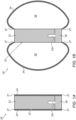
- FIGS. 1A, and 1B show a device 20, for drug delivery in accordance with one embodiment of the present invention.
- the device 20 is shown in FIG. 1A in its empty configuration of the device and in Fig. 1b in an inflated configuration.
- the device 20 includes an inner core 22 formed from a rigid material and an elastic skin or wall 24 to be inflated to form a balloon.
- the wall 24 attaches to the core 22, around the edges 27of the core 22, the attachment being such that a fluid impervious seal, against fluids, such as air, liquid, oil, and the like, is formed.
- the balloon 24 is made from an elastic material that allows diffusion though the wall of the balloon of the substances to be released.
- One suitable material for the wall 24 is a type of silicone material known commercially as ELASTOSIL ® LR 3003 from Wacker Chemie AG. This material is also punctureable by standard medical needles, such that the devices 20 can be deflated, directly though the lumen 28 if necessary, as detailed below.
- the thickness and permeability of the balloon wall 24 can be modified during its production process. Even in the empty configuration ( Fig. 1a ), the material of the wall of the balloon is somewhat stretched so that the ball of the balloon is tightly applied to the surface of the inner core 22.
- the core 22 contains a magnetic material 23 and a valve26.
- the valve 26 is designed for piercing by a needle or a needle-like tip at the end of an inserting device, in order to introduce into the balloon of the device 20a solution or suspension.
- the valve 26 may be a self-sealing valve, any one-way valve, such as a duckbill valve or a ball valve.
- the magnetic material 23 includes a slot 23x through which the solution or suspension passes before entering between the wall 24 of the balloon and the surface of the core 22 to inflate and form the balloon 8. The solution or suspension enters between the wall of the balloon 24 and the core 22 causing the material of the wall of the balloon to expand until the balloon acquires its desired configuration ( Fig. 1B ).
- the wall of the balloon 24 Since the wall of the balloon 24 is initially stretched in the empty configuration of the device, the wall of the balloon will be stretched regardless of the amount of fluid introduced into the balloon. Thus, a given device may be used to contain a selectable amount of fluid over a range of volumes. The elasticity of the wall of the balloon allows the balloon to spontaneously contract as fluid leaves the lumen 28 of the balloon.
- the device can expand to, a spherical shape (as shown in Fig. 1B ) or a substantially spherical shape.
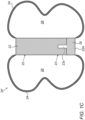
- FIG. 1C shows a device 20' of the invention in which the inflated balloon has a "dimpled surface", in order to increase the surface area of the balloon and enhance the rate of release of the drugs.
- the balloon wall 24 is made from an elastic material that allows drugs to permeate or diffuse through the wall 24.
- drugs diffusing though the wall 24 are released into the urine and contact the urothelium of the bladder, so that the drug is locally administered.
- the shape of the expanded balloon can be spherical ( Fig. 1b ), ovoid, flattened or multifaceted.
- the inner cavity or lumen 28 of the balloon can be divided into two or more cavities or lumens.
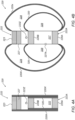
- the balloon can also be formed of separate 28, 28' lumens, or otherwise segregated lumens, as shown, for example, by the balloon devices220, 220' of FIGS. 4A and 4B , respectively.
- the balloon can be filled with oil and one or more oil soluble drugs.
- the oil provides buoyancy as well as a drug carrying matrix.
- the balloon can be inflated with a combination of oil and water/saline, the water/saline containing one or more water soluble drugs.
- the oil part is for buoyancy but can also contain oil soluble drugs. The proportions of oil and water depend on the weight of the balloon, enough to give the balloon sufficient buoyancy in urine.
- the balloon may have a positive buoyancy for allowing floating (its weight less than the buoyant force) or a neutral buoyancy for allowing "hovering" (its weight equal to the buoyant force).
- buoyancy of the balloon devices 2 reduces contact between the balloon and the trigone region of the bladder which is rich in sensory nerve ends and is situated near the base of the bladder. Should the balloon device have negative buoyancy, it will sink to the bottom of the bladder, contacting the trigone region possibly causing irritation and pain.
- the device is such that during normal use, it may contact the bladder inner surface. At the end of urination, a part of the device may contact the trigone region. Buoyancy of the device allows the device to float on the urine as urine accumulates in the bladder, reducing further irritation.
- FIGS. 2A and 2B show balloon devices 20, 20' with filled lumens 28, for example, with one or more drug solutions, buoyancy agents, gases and the like.
- the filling has expanded the balloon device 20, and along with balloon
- FIG. 2 shows the device20after being inflated with a combination of an aqueous solution or suspension of one or more drugs and an oil-based solution or suspension of one or more drugs.
- the aqueous solution 54 separates from the oil based solution 52 in the lumen 28.
- Two different drugs may be delivered from the balloon device 20, one from the water based solution 54 and one from the oil based solution 52, with the oil based solution also providing buoyancy to the device 20.
- gases such as air, can be also be inserted into the lumen 28. These gases provide buoyancy to the device20.
- FIG. 3A shows an alternative balloon device 120, in accordance with another embodiment of the invention comprising central hollow cylindrical core 123 made from a rigid or semi-rigid material that may be a permeable material.
- the core 123 surrounds a channel 121passing through the device 120, and a valve 126, similar to valve 26 detailed above for the device 20that is positioned in the wall of the core 123.
- All other components of the balloon device 120 are the same or similar to those for the balloon device 20, as described above, and accordingly, have the same reference numerals increased by "100".
- the device 120 may not contain a magnetic element, in which case it can be removed from the bladder using endoscopic grasping forceps.
- the magnetic elements for the device 120 may be, for example, incorporated or embedded in the wall 124 of the balloon 120 as ferromagnetic particles 140 or strips, as shown in FIG. 3B . These particles 140 are typically added (impregnated/embedded into the wall 124) during balloon production. As another alternative, ferromagnetic particles 142 can be injected into the lumen 128 (dry or in solution), for example, as shown in FIG. 3C .
- FIGs. 4A and 4B show a balloon device 220 in accordance with another embodiment of the invention.
- the balloon device is formed of an outer balloon 220x whose interior includes a separate balloon 320, within the lumen 228 of the outer balloon 220x,.
- components which are the same or similar to those for the device 20', as described above, and as shown, and accordingly, have the same element numbers increased by "200", for the outer balloon 220x, and increased by "300" for the inner balloon 320.
- the device 220 has a core 222.
- the device 220 is shown in Figs. 4A with B with both balloons 220x and 320 in non-inflated states in an empty configuration, and in Fig. 4B in an inflated configuration.
- the walls of the two balloons are made from an elastic material that is somewhat stretched prior to filling of the balloons, so that the balloons are tightly applied to the surface of the core 222 in the empty or non-inflated state ( Fig. 4A ).
- the core 222 includes two valves 226a, 226b (e.g., self-sealing valves similar to valves 26 detailed above) at the ends of the core 222.
- the first valve 226a is at an end 222a of the core 222.
- the core 222 includes openings 227a into the inner lumen 328 of the inner balloon, as accessed through the valve 226a. Materials (substances), such as liquids, oil, water, and gases, are injected into the lumen 328 (via the openings 227a of the tube 227) through the valve 226a to expand it.
- the core 222 may include magnetic elements 223, as explained above with reference to the device 20 shown in Fig. 1 .
- the dual lumens 228, 328 may be such that one lumen 228 serves asa reservoir for a water based solution with drugs, and the lumen 328 serves asa reservoir for the oil based solution, without drugs, the oil-based solution providing buoyancy to the balloon device 220.
- the components of the lumens 228, 328 may be switched, if desired. Gases, such as air, may also be added in the amounts desired, into one or both lumens 228, 328, for buoyancy of the balloons 220, 220'.
- both balloons 220x, 320 can be inflated separately by using the same needle inserted first through the first valve 226a for filling the inner lumen 328, and then moving through the second valve, to inflate the outer lumen 228.
- the needle, through which the material is inserted into each lumen 228, 328, can be the same, but the syringe attached to the needle is changed to inject different materials to each separate lumen 328, 228.
- the device of the invention can be inserted into the bladder and removed from the bladder, for example by the instrument disclosed in US Patent Application Publication No. US 2010/0016834 A1 .
- intravesical drug delivery can be improved by prolonging the total drug exposure and by enhancing the delivery of agents to bladder tissues by enhancing bladder mucosa permeability by intravesical hyperthermia.
- a permeability enhancing chemical such as dimethyl sulfoxide (DMSO) into the drug carrying matrix may promote the penetration of water-soluble or lipophilic drugs.
- DMSO dimethyl sulfoxide
- the device may include an externally commanded heating element for increasing the urine temperature to 40-45°C for increasing the urothelial permeability to the drugs.
- the device may include a pressure sensor for detecting bladder pressures.
- a command or signal may be given to the heating element to start heating, to increase the urine temperature, as detailed above for increasing the urothelial permeability.
- the balloon 20 can be used for other intracavitary or regional treatments such as intra-gastric, intra-peritoneal and intra-thecal applications, without or with slight modifications.
- the balloon was expanded by injection of 10 ml of the oily solution into the balloon.
- the balloon was expanded by injection of 16 ml of the oily solution into the balloon. 2 groups and a series of 3 experiments using lidocaine dissolved in oil were performed. The results were as follows:
- the present invention while shown for human use, is also suitable for animal use.
- the balloons are shown and described for use in the bladder, this is exemplary, as the balloons and their methods of use, as per the invention, may be used in all areas of the human or animal body.
- a compound or “at least one compound” may include a plurality of compounds, including mixtures thereof.
Landscapes
- Health & Medical Sciences (AREA)
- Heart & Thoracic Surgery (AREA)
- Life Sciences & Earth Sciences (AREA)
- Engineering & Computer Science (AREA)
- General Health & Medical Sciences (AREA)
- Veterinary Medicine (AREA)
- Public Health (AREA)
- Anesthesiology (AREA)
- Biomedical Technology (AREA)
- Hematology (AREA)
- Animal Behavior & Ethology (AREA)
- Pulmonology (AREA)
- Biophysics (AREA)
- Child & Adolescent Psychology (AREA)
- Chemical & Material Sciences (AREA)
- Bioinformatics & Cheminformatics (AREA)
- Medicinal Chemistry (AREA)
- Medicines That Contain Protein Lipid Enzymes And Other Medicines (AREA)
- Medicinal Preparation (AREA)
- Pharmaceuticals Containing Other Organic And Inorganic Compounds (AREA)
- Media Introduction/Drainage Providing Device (AREA)
- Infusion, Injection, And Reservoir Apparatuses (AREA)
Claims (9)
- Eine medizinische Vorrichtung (20) zum Einführen in eine Körperhöhle, umfassend• einen Kern (22);• einen expandierbaren Ballon, der den Kern (22) umgibt, wobei der Ballon eine Wand (24) aus einem elastischen, permeablen Material aufweist, und• ein Ventil (26), das konfiguriert ist, um die Einführung eines oder mehrerer Fluide zwischen der Wand des Ballons und der Oberfläche des Kerns zu ermöglichen;dadurch gekennzeichnet, dass
der Ballon eine entleerte Konfiguration und eine inflatierte Konfiguration aufweist, wobei die Ballonwand (24) in der entleerten Konfiguration gedehnt und an eine Oberfläche des Kerns (22) angelegt ist, und der Ballon in der inflatierten Konfiguration ein Lumen aufweist. - Die Vorrichtung gemäß Anspruch 1, wobei der Kern (22) aus einem starren oder halbstarren Material hergestellt ist.
- Die Vorrichtung gemäß einem der vorhergehenden Ansprüche, wobei die Wand (24) des Ballons eine flüssigkeitsundurchlässige Dichtung mit dem Kern (22) bildet.
- Die Vorrichtung nach einem der vorhergehenden Ansprüche weiter umfassend ein oder mehrere magnetische Elemente (23).
- Die Vorrichtung nach Anspruch 4, wobei die magnetischen Elemente (823) in die Wand (24) des Ballons eingebettet sind.
- Die Vorrichtung gemäß einem der vorhergehenden Ansprüche, wobei der Ballon weiter ein oder mehrere zusätzliche Lumen (28, 28') umfasst.
- Die Vorrichtung gemäß einem der vorhergehenden Ansprüche, angepasst zum Einführen in eine Harnblase.
- Die Vorrichtung gemäß einem der vorhergehenden Ansprüche, wobei der Kern (22) hohl ist.
- Ein System umfassend:(a) die implantierbare medizinische Vorrichtung (20) gemäß Anspruch 1:(b) ein oder mehrere Instrumente ausgewählt aus einem Einführungsinstrument zum Einführen der Vorrichtung in die Körperhöhle und einem Entnahmeinstrument zum Entnehmen der Vorrichtung aus der Körperhöhle.
Applications Claiming Priority (2)
| Application Number | Priority Date | Filing Date | Title |
|---|---|---|---|
| US201662317657P | 2016-04-04 | 2016-04-04 | |
| PCT/IL2017/050409 WO2017175222A1 (en) | 2016-04-04 | 2017-04-04 | Drug delivery apparatus and method |
Publications (3)
| Publication Number | Publication Date |
|---|---|
| EP3439728A1 EP3439728A1 (de) | 2019-02-13 |
| EP3439728A4 EP3439728A4 (de) | 2019-12-04 |
| EP3439728B1 true EP3439728B1 (de) | 2025-02-19 |
Family
ID=60001012
Family Applications (1)
| Application Number | Title | Priority Date | Filing Date |
|---|---|---|---|
| EP17778793.4A Active EP3439728B1 (de) | 2016-04-04 | 2017-04-04 | Vorrichtung zur wirkstofffreisetzung |
Country Status (5)
| Country | Link |
|---|---|
| US (1) | US20190151625A1 (de) |
| EP (1) | EP3439728B1 (de) |
| JP (1) | JP2019510607A (de) |
| CN (1) | CN110267703B (de) |
| WO (1) | WO2017175222A1 (de) |
Families Citing this family (1)
| Publication number | Priority date | Publication date | Assignee | Title |
|---|---|---|---|---|
| EP3902501A4 (de) * | 2018-12-24 | 2022-11-30 | Innoventions Ltd | Intravesikuläre vorrichtung zur kontrolle von harninkontinenz |
Citations (1)
| Publication number | Priority date | Publication date | Assignee | Title |
|---|---|---|---|---|
| US5993473A (en) * | 1997-11-19 | 1999-11-30 | Chan; Yung C. | Expandable body device for the gastric cavity and method |
Family Cites Families (14)
| Publication number | Priority date | Publication date | Assignee | Title |
|---|---|---|---|---|
| US4364392A (en) * | 1980-12-04 | 1982-12-21 | Wisconsin Alumni Research Foundation | Detachable balloon catheter |
| US5213576A (en) * | 1991-06-11 | 1993-05-25 | Cordis Corporation | Therapeutic porous balloon catheter |
| US5569184A (en) * | 1992-04-29 | 1996-10-29 | Cardiovascular Dynamics, Inc. | Delivery and balloon dilatation catheter and method of using |
| US6267747B1 (en) * | 1998-05-11 | 2001-07-31 | Cardeon Corporation | Aortic catheter with porous aortic root balloon and methods for inducing cardioplegic arrest |
| US6293923B1 (en) * | 1999-03-15 | 2001-09-25 | Innoventions, Inc. | Intravesicular balloon |
| US6796960B2 (en) * | 2001-05-04 | 2004-09-28 | Wit Ip Corporation | Low thermal resistance elastic sleeves for medical device balloons |
| US6949125B2 (en) * | 2002-04-16 | 2005-09-27 | Boston Scientific Scimed, Inc. | Ureteral stent with end-effector and related methods |
| US7048714B2 (en) * | 2002-10-30 | 2006-05-23 | Biorest Ltd. | Drug eluting medical device with an expandable portion for drug release |
| IL152630A (en) * | 2002-11-04 | 2010-11-30 | Innoventions Ltd | The device is implanted |
| US9044571B2 (en) * | 2006-01-25 | 2015-06-02 | Leonard Pinchuk | Stretch valve balloon catheter and methods for producing and using same |
| US10039907B2 (en) * | 2008-04-14 | 2018-08-07 | Innoventions Ltd. | Device, system, and method for releasing substances in a body cavity |
| US9333327B2 (en) * | 2009-04-24 | 2016-05-10 | Entellus Medical, Inc. | Methods and devices for paranasal sinus drug delivery |
| US9730726B2 (en) * | 2011-10-07 | 2017-08-15 | W. L. Gore & Associates, Inc. | Balloon assemblies having controllably variable topographies |
| CN103656836B (zh) * | 2012-09-19 | 2015-10-14 | 复旦大学附属华山医院 | 磁兼容性不可脱乳胶球囊导管 |
-
2017
- 2017-04-04 WO PCT/IL2017/050409 patent/WO2017175222A1/en not_active Ceased
- 2017-04-04 JP JP2019502297A patent/JP2019510607A/ja active Pending
- 2017-04-04 CN CN201780034512.1A patent/CN110267703B/zh active Active
- 2017-04-04 EP EP17778793.4A patent/EP3439728B1/de active Active
- 2017-04-04 US US16/091,165 patent/US20190151625A1/en not_active Abandoned
Patent Citations (1)
| Publication number | Priority date | Publication date | Assignee | Title |
|---|---|---|---|---|
| US5993473A (en) * | 1997-11-19 | 1999-11-30 | Chan; Yung C. | Expandable body device for the gastric cavity and method |
Also Published As
| Publication number | Publication date |
|---|---|
| CN110267703B (zh) | 2022-05-24 |
| WO2017175222A1 (en) | 2017-10-12 |
| US20190151625A1 (en) | 2019-05-23 |
| CN110267703A (zh) | 2019-09-20 |
| EP3439728A1 (de) | 2019-02-13 |
| EP3439728A4 (de) | 2019-12-04 |
| JP2019510607A (ja) | 2019-04-18 |
Similar Documents
| Publication | Publication Date | Title |
|---|---|---|
| US6200257B1 (en) | Catheter with permeable hydrogel membrane | |
| US8962011B2 (en) | Process and intra-cervical device for the local release of drugs in the local-regional treatment of cervical cancer | |
| KR101794899B1 (ko) | 남성 비뇨생식기 및 주위 조직을 치료하는 방법 및 체내이식형 약물 전달 장치 | |
| Palugan et al. | Intravesical drug delivery approaches for improved therapy of urinary bladder diseases | |
| ES2367407T3 (es) | Procedimiento y equipo para la administración de braquiterapia a un sujeto. | |
| US20130165772A1 (en) | Microneedle devices and uses thereof | |
| KR102338079B1 (ko) | 젬시타빈으로 방광암을 치료하기 위한 약물 전달 시스템 및 방법 | |
| ES3040840T3 (en) | System for ultrasonic bladder therapeutic agent delivery | |
| JPH07500523A (ja) | ポリマー・マトリックス薬剤配給装置および方法 | |
| FR2756493A1 (fr) | Dispositif d'administration locale de formulations solides ou semi-solides | |
| JPH10506297A (ja) | 人または動物の体内の天然管腔または通路内における障害の選択的な細胞整復処置のための治療デバイス | |
| CN113040895A (zh) | 治疗多种疾病的化学消融和方法 | |
| CN112236188A (zh) | 球囊导管 | |
| WO2014143898A1 (en) | Systems, devices, and methods for treating a pulmonary disorder with an agent | |
| Gossner et al. | A new long-range through-the-scope balloon applicator for photodynamic therapy in the esophagus and cardia | |
| US9555218B2 (en) | Methods and systems for treatment of a bladder | |
| CN114082085A (zh) | 一种预扩式双层药物灌注球囊扩张导管 | |
| US20190151625A1 (en) | Drug delivery apparatus and method | |
| CN1917920A (zh) | 药物洗脱近接治疗方法和装置 | |
| Eckstein | Cutaneous ureterostomy | |
| Stewart et al. | Current perspectives on palliative therapy in cancer of the bladder | |
| Wani et al. | Potential of different types of microneedles in diagnosis and treatment of cancer | |
| HK40040797A (en) | Balloon catheter | |
| CN103096873B (zh) | 在人女性生殖系统的子宫颈中用于治疗子宫颈癌和/或用于预防肿瘤形成的治疗剂、包含所述治疗剂的组合物、可植入装置和方法 | |
| Zhang et al. | Efficacy and safety of 1470nm Diode Laser Enucleation of the Prostate in patients with benign prostatic hyperplasia on continuous oral anticoagulant or antiplatelet therapy |
Legal Events
| Date | Code | Title | Description |
|---|---|---|---|
| STAA | Information on the status of an ep patent application or granted ep patent |
Free format text: STATUS: THE INTERNATIONAL PUBLICATION HAS BEEN MADE |
|
| PUAI | Public reference made under article 153(3) epc to a published international application that has entered the european phase |
Free format text: ORIGINAL CODE: 0009012 |
|
| STAA | Information on the status of an ep patent application or granted ep patent |
Free format text: STATUS: REQUEST FOR EXAMINATION WAS MADE |
|
| 17P | Request for examination filed |
Effective date: 20181103 |
|
| AK | Designated contracting states |
Kind code of ref document: A1 Designated state(s): AL AT BE BG CH CY CZ DE DK EE ES FI FR GB GR HR HU IE IS IT LI LT LU LV MC MK MT NL NO PL PT RO RS SE SI SK SM TR |
|
| AX | Request for extension of the european patent |
Extension state: BA ME |
|
| DAV | Request for validation of the european patent (deleted) | ||
| DAX | Request for extension of the european patent (deleted) | ||
| A4 | Supplementary search report drawn up and despatched |
Effective date: 20191106 |
|
| RIC1 | Information provided on ipc code assigned before grant |
Ipc: A61M 31/00 20060101AFI20191030BHEP Ipc: A61M 25/10 20130101ALI20191030BHEP |
|
| STAA | Information on the status of an ep patent application or granted ep patent |
Free format text: STATUS: EXAMINATION IS IN PROGRESS |
|
| 17Q | First examination report despatched |
Effective date: 20240219 |
|
| GRAP | Despatch of communication of intention to grant a patent |
Free format text: ORIGINAL CODE: EPIDOSNIGR1 |
|
| STAA | Information on the status of an ep patent application or granted ep patent |
Free format text: STATUS: GRANT OF PATENT IS INTENDED |
|
| RIC1 | Information provided on ipc code assigned before grant |
Ipc: A61M 25/10 20130101ALN20240906BHEP Ipc: A61M 31/00 20060101AFI20240906BHEP |
|
| INTG | Intention to grant announced |
Effective date: 20240918 |
|
| GRAS | Grant fee paid |
Free format text: ORIGINAL CODE: EPIDOSNIGR3 |
|
| GRAA | (expected) grant |
Free format text: ORIGINAL CODE: 0009210 |
|
| STAA | Information on the status of an ep patent application or granted ep patent |
Free format text: STATUS: THE PATENT HAS BEEN GRANTED |
|
| AK | Designated contracting states |
Kind code of ref document: B1 Designated state(s): AL AT BE BG CH CY CZ DE DK EE ES FI FR GB GR HR HU IE IS IT LI LT LU LV MC MK MT NL NO PL PT RO RS SE SI SK SM TR |
|
| REG | Reference to a national code |
Ref country code: GB Ref legal event code: FG4D |
|
| REG | Reference to a national code |
Ref country code: CH Ref legal event code: EP |
|
| REG | Reference to a national code |
Ref country code: IE Ref legal event code: FG4D |
|
| REG | Reference to a national code |
Ref country code: DE Ref legal event code: R096 Ref document number: 602017087863 Country of ref document: DE |
|
| REG | Reference to a national code |
Ref country code: NL Ref legal event code: MP Effective date: 20250219 |
|
| PG25 | Lapsed in a contracting state [announced via postgrant information from national office to epo] |
Ref country code: RS Free format text: LAPSE BECAUSE OF FAILURE TO SUBMIT A TRANSLATION OF THE DESCRIPTION OR TO PAY THE FEE WITHIN THE PRESCRIBED TIME-LIMIT Effective date: 20250519 |
|
| PG25 | Lapsed in a contracting state [announced via postgrant information from national office to epo] |
Ref country code: FI Free format text: LAPSE BECAUSE OF FAILURE TO SUBMIT A TRANSLATION OF THE DESCRIPTION OR TO PAY THE FEE WITHIN THE PRESCRIBED TIME-LIMIT Effective date: 20250219 |
|
| PG25 | Lapsed in a contracting state [announced via postgrant information from national office to epo] |
Ref country code: PL Free format text: LAPSE BECAUSE OF FAILURE TO SUBMIT A TRANSLATION OF THE DESCRIPTION OR TO PAY THE FEE WITHIN THE PRESCRIBED TIME-LIMIT Effective date: 20250219 |
|
| PG25 | Lapsed in a contracting state [announced via postgrant information from national office to epo] |
Ref country code: ES Free format text: LAPSE BECAUSE OF FAILURE TO SUBMIT A TRANSLATION OF THE DESCRIPTION OR TO PAY THE FEE WITHIN THE PRESCRIBED TIME-LIMIT Effective date: 20250219 |
|
| REG | Reference to a national code |
Ref country code: LT Ref legal event code: MG9D |
|
| PG25 | Lapsed in a contracting state [announced via postgrant information from national office to epo] |
Ref country code: IS Free format text: LAPSE BECAUSE OF FAILURE TO SUBMIT A TRANSLATION OF THE DESCRIPTION OR TO PAY THE FEE WITHIN THE PRESCRIBED TIME-LIMIT Effective date: 20250619 Ref country code: NO Free format text: LAPSE BECAUSE OF FAILURE TO SUBMIT A TRANSLATION OF THE DESCRIPTION OR TO PAY THE FEE WITHIN THE PRESCRIBED TIME-LIMIT Effective date: 20250519 |
|
| PG25 | Lapsed in a contracting state [announced via postgrant information from national office to epo] |
Ref country code: NL Free format text: LAPSE BECAUSE OF FAILURE TO SUBMIT A TRANSLATION OF THE DESCRIPTION OR TO PAY THE FEE WITHIN THE PRESCRIBED TIME-LIMIT Effective date: 20250219 |
|
| PG25 | Lapsed in a contracting state [announced via postgrant information from national office to epo] |
Ref country code: HR Free format text: LAPSE BECAUSE OF FAILURE TO SUBMIT A TRANSLATION OF THE DESCRIPTION OR TO PAY THE FEE WITHIN THE PRESCRIBED TIME-LIMIT Effective date: 20250219 |
|
| PG25 | Lapsed in a contracting state [announced via postgrant information from national office to epo] |
Ref country code: LV Free format text: LAPSE BECAUSE OF FAILURE TO SUBMIT A TRANSLATION OF THE DESCRIPTION OR TO PAY THE FEE WITHIN THE PRESCRIBED TIME-LIMIT Effective date: 20250219 Ref country code: PT Free format text: LAPSE BECAUSE OF FAILURE TO SUBMIT A TRANSLATION OF THE DESCRIPTION OR TO PAY THE FEE WITHIN THE PRESCRIBED TIME-LIMIT Effective date: 20250620 |
|
| PG25 | Lapsed in a contracting state [announced via postgrant information from national office to epo] |
Ref country code: BG Free format text: LAPSE BECAUSE OF FAILURE TO SUBMIT A TRANSLATION OF THE DESCRIPTION OR TO PAY THE FEE WITHIN THE PRESCRIBED TIME-LIMIT Effective date: 20250219 Ref country code: GR Free format text: LAPSE BECAUSE OF FAILURE TO SUBMIT A TRANSLATION OF THE DESCRIPTION OR TO PAY THE FEE WITHIN THE PRESCRIBED TIME-LIMIT Effective date: 20250520 |
|
| REG | Reference to a national code |
Ref country code: AT Ref legal event code: MK05 Ref document number: 1767740 Country of ref document: AT Kind code of ref document: T Effective date: 20250219 |
|
| PG25 | Lapsed in a contracting state [announced via postgrant information from national office to epo] |
Ref country code: SE Free format text: LAPSE BECAUSE OF FAILURE TO SUBMIT A TRANSLATION OF THE DESCRIPTION OR TO PAY THE FEE WITHIN THE PRESCRIBED TIME-LIMIT Effective date: 20250219 |
|
| PG25 | Lapsed in a contracting state [announced via postgrant information from national office to epo] |
Ref country code: SM Free format text: LAPSE BECAUSE OF FAILURE TO SUBMIT A TRANSLATION OF THE DESCRIPTION OR TO PAY THE FEE WITHIN THE PRESCRIBED TIME-LIMIT Effective date: 20250219 |
|
| PG25 | Lapsed in a contracting state [announced via postgrant information from national office to epo] |
Ref country code: DK Free format text: LAPSE BECAUSE OF FAILURE TO SUBMIT A TRANSLATION OF THE DESCRIPTION OR TO PAY THE FEE WITHIN THE PRESCRIBED TIME-LIMIT Effective date: 20250219 |
|
| PGFP | Annual fee paid to national office [announced via postgrant information from national office to epo] |
Ref country code: DE Payment date: 20250820 Year of fee payment: 9 |
|
| PGFP | Annual fee paid to national office [announced via postgrant information from national office to epo] |
Ref country code: TR Payment date: 20250808 Year of fee payment: 9 Ref country code: IT Payment date: 20250825 Year of fee payment: 9 |
|
| PGFP | Annual fee paid to national office [announced via postgrant information from national office to epo] |
Ref country code: GB Payment date: 20250820 Year of fee payment: 9 |
|
| PG25 | Lapsed in a contracting state [announced via postgrant information from national office to epo] |
Ref country code: AT Free format text: LAPSE BECAUSE OF FAILURE TO SUBMIT A TRANSLATION OF THE DESCRIPTION OR TO PAY THE FEE WITHIN THE PRESCRIBED TIME-LIMIT Effective date: 20250219 |
|
| PGFP | Annual fee paid to national office [announced via postgrant information from national office to epo] |
Ref country code: FR Payment date: 20250828 Year of fee payment: 9 |
|
| PGFP | Annual fee paid to national office [announced via postgrant information from national office to epo] |
Ref country code: CH Payment date: 20250813 Year of fee payment: 9 |
|
| PG25 | Lapsed in a contracting state [announced via postgrant information from national office to epo] |
Ref country code: CZ Free format text: LAPSE BECAUSE OF FAILURE TO SUBMIT A TRANSLATION OF THE DESCRIPTION OR TO PAY THE FEE WITHIN THE PRESCRIBED TIME-LIMIT Effective date: 20250219 Ref country code: EE Free format text: LAPSE BECAUSE OF FAILURE TO SUBMIT A TRANSLATION OF THE DESCRIPTION OR TO PAY THE FEE WITHIN THE PRESCRIBED TIME-LIMIT Effective date: 20250219 |
|
| PG25 | Lapsed in a contracting state [announced via postgrant information from national office to epo] |
Ref country code: RO Free format text: LAPSE BECAUSE OF FAILURE TO SUBMIT A TRANSLATION OF THE DESCRIPTION OR TO PAY THE FEE WITHIN THE PRESCRIBED TIME-LIMIT Effective date: 20250219 |
|
| PG25 | Lapsed in a contracting state [announced via postgrant information from national office to epo] |
Ref country code: SK Free format text: LAPSE BECAUSE OF FAILURE TO SUBMIT A TRANSLATION OF THE DESCRIPTION OR TO PAY THE FEE WITHIN THE PRESCRIBED TIME-LIMIT Effective date: 20250219 |
|
| REG | Reference to a national code |
Ref country code: DE Ref legal event code: R097 Ref document number: 602017087863 Country of ref document: DE |
|
| PG25 | Lapsed in a contracting state [announced via postgrant information from national office to epo] |
Ref country code: LU Free format text: LAPSE BECAUSE OF NON-PAYMENT OF DUE FEES Effective date: 20250404 |
|
| PG25 | Lapsed in a contracting state [announced via postgrant information from national office to epo] |
Ref country code: MC Free format text: LAPSE BECAUSE OF FAILURE TO SUBMIT A TRANSLATION OF THE DESCRIPTION OR TO PAY THE FEE WITHIN THE PRESCRIBED TIME-LIMIT Effective date: 20250219 |
|
| PLBE | No opposition filed within time limit |
Free format text: ORIGINAL CODE: 0009261 |
|
| STAA | Information on the status of an ep patent application or granted ep patent |
Free format text: STATUS: NO OPPOSITION FILED WITHIN TIME LIMIT |
|
| REG | Reference to a national code |
Ref country code: BE Ref legal event code: MM Effective date: 20250430 |
|
| REG | Reference to a national code |
Ref country code: CH Ref legal event code: L10 Free format text: ST27 STATUS EVENT CODE: U-0-0-L10-L00 (AS PROVIDED BY THE NATIONAL OFFICE) Effective date: 20251231 |
|
| PG25 | Lapsed in a contracting state [announced via postgrant information from national office to epo] |
Ref country code: BE Free format text: LAPSE BECAUSE OF NON-PAYMENT OF DUE FEES Effective date: 20250430 |
|
| 26N | No opposition filed |
Effective date: 20251120 |
|
| PG25 | Lapsed in a contracting state [announced via postgrant information from national office to epo] |
Ref country code: IE Free format text: LAPSE BECAUSE OF NON-PAYMENT OF DUE FEES Effective date: 20250404 |
|
| REG | Reference to a national code |
Ref country code: CH Ref legal event code: U11 Free format text: ST27 STATUS EVENT CODE: U-0-0-U10-U11 (AS PROVIDED BY THE NATIONAL OFFICE) Effective date: 20260501 |