EP3436096B1 - Schmierende beschichtung für medizinische vorrichtung - Google Patents
Schmierende beschichtung für medizinische vorrichtung Download PDFInfo
- Publication number
- EP3436096B1 EP3436096B1 EP17716425.8A EP17716425A EP3436096B1 EP 3436096 B1 EP3436096 B1 EP 3436096B1 EP 17716425 A EP17716425 A EP 17716425A EP 3436096 B1 EP3436096 B1 EP 3436096B1
- Authority
- EP
- European Patent Office
- Prior art keywords
- polymer
- medical device
- coating
- range
- amount
- Prior art date
- Legal status (The legal status is an assumption and is not a legal conclusion. Google has not performed a legal analysis and makes no representation as to the accuracy of the status listed.)
- Active
Links
Images


Classifications
-
- A—HUMAN NECESSITIES
- A61—MEDICAL OR VETERINARY SCIENCE; HYGIENE
- A61L—METHODS OR APPARATUS FOR STERILISING MATERIALS OR OBJECTS IN GENERAL; DISINFECTION, STERILISATION OR DEODORISATION OF AIR; CHEMICAL ASPECTS OF BANDAGES, DRESSINGS, ABSORBENT PADS OR SURGICAL ARTICLES; MATERIALS FOR BANDAGES, DRESSINGS, ABSORBENT PADS OR SURGICAL ARTICLES
- A61L29/00—Materials for catheters, medical tubing, cannulae, or endoscopes or for coating catheters
- A61L29/08—Materials for coatings
- A61L29/085—Macromolecular materials
-
- A—HUMAN NECESSITIES
- A61—MEDICAL OR VETERINARY SCIENCE; HYGIENE
- A61L—METHODS OR APPARATUS FOR STERILISING MATERIALS OR OBJECTS IN GENERAL; DISINFECTION, STERILISATION OR DEODORISATION OF AIR; CHEMICAL ASPECTS OF BANDAGES, DRESSINGS, ABSORBENT PADS OR SURGICAL ARTICLES; MATERIALS FOR BANDAGES, DRESSINGS, ABSORBENT PADS OR SURGICAL ARTICLES
- A61L29/00—Materials for catheters, medical tubing, cannulae, or endoscopes or for coating catheters
- A61L29/14—Materials characterised by their function or physical properties, e.g. lubricating compositions
-
- A—HUMAN NECESSITIES
- A61—MEDICAL OR VETERINARY SCIENCE; HYGIENE
- A61L—METHODS OR APPARATUS FOR STERILISING MATERIALS OR OBJECTS IN GENERAL; DISINFECTION, STERILISATION OR DEODORISATION OF AIR; CHEMICAL ASPECTS OF BANDAGES, DRESSINGS, ABSORBENT PADS OR SURGICAL ARTICLES; MATERIALS FOR BANDAGES, DRESSINGS, ABSORBENT PADS OR SURGICAL ARTICLES
- A61L2400/00—Materials characterised by their function or physical properties
- A61L2400/10—Materials for lubricating medical devices
-
- A—HUMAN NECESSITIES
- A61—MEDICAL OR VETERINARY SCIENCE; HYGIENE
- A61L—METHODS OR APPARATUS FOR STERILISING MATERIALS OR OBJECTS IN GENERAL; DISINFECTION, STERILISATION OR DEODORISATION OF AIR; CHEMICAL ASPECTS OF BANDAGES, DRESSINGS, ABSORBENT PADS OR SURGICAL ARTICLES; MATERIALS FOR BANDAGES, DRESSINGS, ABSORBENT PADS OR SURGICAL ARTICLES
- A61L2420/00—Materials or methods for coatings medical devices
- A61L2420/02—Methods for coating medical devices
Definitions
- Medical devices include, amongst others, those that are chronically implanted, devices that are transitorily implanted, and those that not implanted at all. Many types of medical devices are enhanced by reducing the friction between the device and the environment that surrounds the medical device, particularly during insertion of a device.
- One example is catheters that are inserted, at least transitorily, into the body of a subject. Reduction of friction can lead to enhanced patient comfort, procedural ease for the care provider, reduced chances for infection, as well as reduced tissue disruption, amongst other benefits.
- One approach to reducing the friction between a medical device and the environment surrounding the medical device is to apply a lubricious coating onto the medical device.
- the patent WO 2014/107670 A1 discloses a lubricious coating comprising: a first coated layer comprising a vinyl pyrrolidone polymer and photoreactive groups; and a second coated layer that is a top coating comprising an acrylic acid polymer.
- Embodiments of the invention are directed towards lubricious coatings for medical devices and methods of forming the coatings.
- the invention provides a medical device comprising a lubricious coating comprising: a coated layer comprising a first polymer that is an acrylic acid polymer, a second polymer that is an acrylamide copolymer comprising at least one aryl ketone photoreactive group, and a cross-linking agent comprising at least two aryl ketone photoreactive groups,wherein the coated layer is in contact with a medical device surface and there is no further primer layer present between the coated layer and the medical device surface and also configured to contact a patient in use, wherein the medical device surface does not comprise a substrate material selected from the group consisting of polyvinylpyrrolidone.
- the coating can include a third polymer that is different than the second polymer and is an acrylamide copolymer with at least one photo reactive group.
- the invention provides a method for forming a lubricious coating on a medical device comprising using a liquid coating composition comprising the first polymer, the second polymer, the cross-linking agent, and a third polymer that is different than the second polymer and is an acrylamide copolymer with at least one photo reactive group, wherein the liquid coating composition preferably has a pH of less than about 6, in the range of pH 2-6, or in the range of pH 3-5.
- the method for forming the lubricious coating can be done using a dip-coating method.
- the coating is performed in at a pH of less than about 6, such as about pH 5, which beneficially increases the viscosity of the coating composition and provides advantages.
- the coating can then be treated with UV light to activate the photoreactive groups to cause bonding and formation of the coating.
- the form coating may also optionally be treated with a bicarbonate solution to provide salt groups on the coated surface.
- the present disclosure provides a method (not part of the invention) for performing a medical procedure using the coated medical device, which comprises a step of inserting the coated medical device in a subject, wherein the lubricious coating reduces the friction associated with moving the device in a portion of the body.
- Coatings of the invention advantageously provide very good lubricity and a low amount of particulate release when exposed to an aqueous environment, which is very desirable for in vivo use.
- the coating can be present as a single coated layer on the device.
- the single layer can be described as the coating.
- the coating can be formed using a single coating composition.
- a coating composition can include the first polymer, second polymer, and crosslinking agent, wherein the coating composition is disposed on a device surface and treated to form the coating.
- the coated layer is in contact with a medical device surface and also configured to contact a patient in use.
- the coating of the disclosure includes an acrylic acid polymer (e.g., used as the "first polymer” in the coating composition).
- an "acrylic acid polymer” refers to polymers including acrylic acid monomeric units.
- the acrylic acid polymer can be an acrylic acid homopolymer or an acrylic acid copolymer including acrylic acid and one or more (e.g., two, three, four, five, etc.) other monomeric units that are different than acrylic acid.
- the acrylic acid in a poly(acrylic acid) copolymer, can be the primary monomer (molar quantity), such as present in an amount of greater than 50% (mol), 55% (mol) or greater, 60% (mol) or greater, 65% (mol) or greater, 70% (mol) or greater, 75% (mol) or greater, 80% (mol) or greater, 85% (mol) or greater, 90% (mol) or greater, 92.5% (mol) or greater, 95% (mol) or greater, 97.5% (mol) or 99 % (mol) or greater.
- the primary monomer such as present in an amount of greater than 50% (mol), 55% (mol) or greater, 60% (mol) or greater, 65% (mol) or greater, 70% (mol) or greater, 75% (mol) or greater, 80% (mol) or greater, 85% (mol) or greater, 90% (mol) or greater, 92.5% (mol) or greater, 95% (mol) or greater, 97.5% (mol) or 99 % (mol) or greater.
- acrylic acid is present in the copolymer in the range of about 75% (mol) to about 99.99% (mol), about 85% (mol) to about 99.99% (mol), about 95% (mol) to about 99.99% (mol), or about 98% (mol) to about 99.99% (mol).
- some or all of the acrylic acid groups of the polymer are in salt form.
- the polymer can be partially or fully salted by adding a base salt to a polymer composition, such as sodium hydroxide or potassium hydroxide.
- An acrylic acid copolymer can include one or more co-monomers copolymerizable with acrylic acid.
- exemplary co-monomers that can be used to prepare an acrylic acid copolymer include those that have a carboxylic acid group, such as methacrylic acid, itaconic acid, monomethyl itaconic acid, maleic anhydride, fumaric acid, and crotonic acid, and salts thereof.
- exemplary co-monomers include sulfonic acid-group containing monomers such as acrylamido-2-methylpropanesulfonic acid (AMPS), 2-(meth)acrylamido-2-methylpropane sulfonic acid, vinyl sulfonic acid, 2-sulfoethyl methacrylate, and salts thereof.
- APMS acrylamido-2-methylpropanesulfonic acid
- 2-(meth)acrylamido-2-methylpropane sulfonic acid vinyl sulfonic acid
- 2-sulfoethyl methacrylate 2-sulfoethyl methacrylate
- Acrylic acid copolymers made from a combination of two or more different acid-group containing monomers can be used, or copolymers made from one or more acid-group containing monomers and one or more non-acid group containing monomers can be used.
- Acrylic acid copolymers can include random copolymers, block copolymers,
- carboxylic acid-containing monomers that can be used to prepare acrylic acid group-containing copolymers include styrene and maleic anhydride copolymerized to produce styrene-maleic anhydride copolymer (PSMA).
- PSMA styrene-maleic anhydride copolymer
- the acrylic acid polymer may optionally be described with reference to its pH.
- the acrylic acid polymer may have a pH in the range of about 1 to about 5, about 1.2 to about 5, about 1.5 to about 5, about 2.5 to about 5, about 2.75 to about 4.5, or about 3 to about 4.25.
- the acrylic acid polymer can have an average molecular weight of 150 kDa or greater. In yet other embodiments the acrylic acid polymer can have an average molecular weight of 500 kDa or greater, 750 kDa or greater, or 1000 kDa or greater, such as in the range of about 1000 kDa to about 2500 kDa, about 1000 kDa to about 2000 kDa, or about 1000 kDa to about 2000 kDa,.
- the acrylic acid polymer is prepared by free radical polymerization of acrylic acid at (e.g, about a 0.8 M concentration) in deionized water.
- a concentrated base such as NaOH is added to the acrylic acid solution.
- an initiator such as ammonium persulfate is added with stirring.
- the polymerization solution can be degassed with nitrogen and stirred for hours (e.g., 12-24 hours) at an elevated temperature (e.g., greater than 50°C).
- the polymer can then be polymerized against continuous flow deionized water using 12-14 K dialysis tubing, and then isolated by lyophilization.
- the coating also includes an acrylamide copolymer that has at least one photoreactive group (e.g., used as the "second polymer” in the coating composition).
- an "acrylamide polymer” refers to polymers including acrylamide or methacrylamide monomeric units, further including one or more pendent photoreactive groups from the acrylamide polymer backbone.
- the acrylamide copolymer can be an acrylamide homopolymer further modified to provide pendent photoreactive groups, or acrylamide co-polymer formed from the polymerization reaction of an acrylamide or methacrylamide monomer with one or more other comonomers, prepolymers, or mixtures thereof.
- acrylamide or methacrylamide in an acrylamide polymer, is the primary monomer (molar quantity), such as present in an amount of greater than 50% (mol), 55% (mol) or greater, 60% (mol) or greater, 65% (mol) or greater, 70% (mol) or greater, 75% (mol) or greater, 80% (mol) or greater, 85% (mol) or greater, 90% (mol) or greater in the copolymer.
- acrylamide or methacrylamide is present in the copolymer in the range of about 50% (mol) to about 99% (mol), about 75% (mol) to about 98% (mol), about 80% (mol) to about 97% (mol), or about 85% (mol) to about 95% (mol).
- the acrylamide polymer includes one or more comonomers that include an acid group.
- exemplary co-monomers with acid groups include sulfonic acid-group containing monomers such as acrylamido-2-methylpropanesulfonic acid (AMPS), 2-(meth)acrylamido-2-methylpropane sulfonic acid, vinyl sulfonic acid, 2-sulfoethyl methacrylate, and salts thereof, and monomers that include a carboxylic acid group, such as methacrylic acid, itaconic acid, monomethyl itaconic acid, maleic anhydride, fumaric acid, and crotonic acid, and salts thereof.
- AMPS acrylamido-2-methylpropanesulfonic acid
- 2-(meth)acrylamido-2-methylpropane sulfonic acid vinyl sulfonic acid
- 2-sulfoethyl methacrylate 2-sulfoethyl methacrylate, and
- an acid group-containing copolymer can be present in the acrylamide copolymer (second polymer) in an amount in the range of about 0.1% (mol) to about 20% (mol), about 0.5% (mol) to about 15% (mol), or about 1% (mol) to about 10% (mol).
- the acrylamide polymer includes one or more oxyalkylene monomers, or one or more segments of oxyalkylene polymer.
- the acrylamide polymer can include one or more ethylene oxide and/or propylene oxide units.
- the acrylamide polymer can be formed from an oxyalkylene prepolymer having one or more reactive chemistries that can allow it to be incorporated to form an acrylamide copolymer.
- the oxyalkylene segment can be based on an ethylene glycol polymer or oligomer having the structure HO-(CH 2 -CH 2 -O) n -H.
- n ranges from about 3 to about 150 and the number average molecular weight (Mn) of the poly(ethylene glycol) ranges from about 250 Da to about 40 kDa, more typically ranging from about 300 Da to about 20 kDa, from about 400 Da to about 10 kDa, from about 500 Da to about 5000 Da, or about 600 Da to about 1000 Da.
- An oxyalkylene polymer can be effectively derivatized to add polymerizable groups to produce oxyalkylene based pre-polymers. Polymerizable groups such as glycidyl acrylate, glycidyl methacrylate, or acrylic or methacrylic acid can be reacted with the terminal hydroxyl groups of these polymers to provide terminal polymerizable groups.
- alkylene oxide polymer-based prepolymers that can be used to form the acrylamide polymer include, poly(propylene glycol) 540 -diacrylate, poly(propylene glycol) 475 -dimethacrylate, poly(propylene glycol) 900 -diacrylate, poly(ethylene glycol) 250 -diacrylate, poly(ethylene glycol) 575 -diacrylate, poly(ethylene glycol) 550 -dimethacrylate, poly(ethylene glycol) 750 -dimethacrylate, poly(ethylene glycol) 700 -diacrylate, and poly(ethylene glycol) 1000 -diacrylate, poly(ethylene glycol) 2000 diacrylate, poly(ethylene glycol) 1000 monomethyl ether monomethacrylate, and poly(ethylene glycol) 500 monomethyl ether monomethacrylate.
- alkylene oxide polymer-based macromers are available from Sigma-Aldrich (St. Louis, MO) or Polysciences (Wa) 500 monomethyl
- oxyalkylene can be defined in terms of a molar amount in the polymer, or a weight percentage of the copolymer.
- an oxyalkylene prepolymer is reacted with other monomers to form the acrylamide copolymer, it can be convenient to describe the amount of oxyalkylene by a weight percentage in the copolymer.
- the oxyalkylene is present in an amount in the range of about 0.5% (wt) to about 25% (wt), about 2 % (wt) to about 20 % (wt), or about 5 % (wt) to about 15 % (wt).
- the acrylamide copolymer (second polymer) can also include a desired loading of photogroups.
- Reagents and methods for the preparation of an acrylamide copolymer with pendent photoreactive groups can be found in references such as U.S. Patent Nos. 4,979,959 ; 5,002,582 ; 5,263,992 ; 5,414,075 ; 5,512,329 ; and 5,637,460 .
- an acrylamide copolymer with photoreactive groups can be formed by the copolymerization of acrylamide, 1-vinyl-2-pyrrolidone, and N-(3-aminopropyl(meth)acrylamide), optionally with one or more other copolymers or prepolymers, such as an oxyalkylene prepolymer.
- the resulting copolymer then can be derivatized with an acyl chloride (such as, for example, 4-benzoylbenzoyl chloride) under Schotten-Baumann conditions. That is, the acyl chloride reacts with the amino group of the N-(3-aminopropyl) moiety of the copolymer.
- An amide is formed resulting in the attachment of the aryl ketone to the polymer.
- An acrylamide copolymer comprising a photoreactive group can also be prepared by copolymerizing acrylamide (and optionally with one or more other copolymers or prepolymers) with a monomer derivatized with a photoreactive group.
- exemplary monomer derivatives include aryl ketone derivatives of hydrophilic free radically polymerizable monomers such as acrylamide, methacrylamide and AMPS.
- One exemplary methacrylamide-based monomer with a pendent photoreactive groups is N-[3-(4-benzoylbenzamido) propyl]methacrylamide (BBA-APMA), the synthesis which is described in Examples 1-3 of U.S. Patent No.
- the second polymer comprises acrylamide-2-acrylamido-2-methylpropanesulfonate (AMPS)- and poly(ethylene glycol)-containing subunits, and further comprises pendent photogroups, as described herein.
- AMPS acrylamide-2-acrylamido-2-methylpropanesulfonate
- poly(ethylene glycol)-containing subunits and further comprises pendent photogroups, as described herein.
- the coating also includes a third polymer that is different than the first and second polymers.
- the third polymer can be another acrylamide copolymer, which also optionally can include photoreactive groups.
- the third polymer is an acrylamide copolymer comprising pendent photoreactive groups, but that does not include an oxyalkylene segment.
- the third polymer is an acrylamide copolymer, wherein acrylamide or methacrylamide is the primary monomer (molar quantity), such as present in an amount of greater than 50% (mol), 55% (mol) or greater, 60% (mol) or greater, 65% (mol) or greater, 70% (mol) or greater, 75% (mol) or greater, 80% (mol) or greater, 85% (mol) or greater, 90% (mol) or greater in the copolymer.
- acrylamide or methacrylamide is present in the third polymer in the range of about 50% (mol) to about 99% (mol), about 75% (mol) to about 97% (mol), about 80% (mol) to about 100% (mol), or about 98% (mol) to about 100% (mol).
- An exemplary third copolymer can be prepared by copolymerizing acrylamide, (e.g., 95-99% mol) with APMA (e.g., 1-5% mol) to form an acrylamide-APMA copolymer, and then reacting with an excess of 4-benzoylbenzoyl chloride in chloroform to provide pendent photoreactive groups.
- acrylamide e.g., 95-99% mol
- APMA e.g., 1-5% mol
- the coating can include other biocompatible polymers.
- biocompatible polymers can be used as the optional third polymer, or can be used as fourth, fifth, etc. polymer.
- Exemplary biocompatible include those that contain ether groups such as poly(ethylene oxide) (PEO), poly(propylene oxide) (PPO), poly(propylene glycol) (PPG) poly(vinyl methyl ether), polymeric alcohols such as poly(vinyl alcohol) (PVA), poly(2-hydroxyehtylacrylate) (PHEA) and poly(2-hydroxyethyl vinyl ether) PHEVE), poly(2-ethyl-2-oxazoline) (PEOX), poly(n-acetyliminoethylene) (PAIE) and water soluble polysaccharides such as methyl cellulose, hydroxypropylcellulose and hydroxyethylcellulose.
- PEO poly(ethylene oxide)
- PPO poly(propylene oxide)
- PPG poly(propylene glycol)
- PVC poly(viny
- the coating composition also includes a crosslinking agent having two or more photoreactive groups, which can react with the polymers in the composition, the device surface, or both.
- Suitable photoreactive groups include aryl ketones, such as acetophenone, benzophenone, anthraquinone, anthrone, quinone, and anthrone-like heterocycles.
- a crosslinking agent including a photoreactive group can be referred to as a photo-crosslinker or photoactivatable crosslinking agent.
- the photoactivatable crosslinking agent can be ionic, and can have good solubility in an aqueous composition. Thus, in some embodiments, at least one ionic photoactivatable crosslinking agent can be used to form the coating.
- the ionic crosslinking agent can include an acidic group or salt thereof, such as selected from sulfonic acids, carboxylic acids, phosphonic acids, salts thereof, and the like.
- exemplary counter ions include alkali, alkaline earths metals, ammonium, protonated amines, and the like.
- Exemplary ionic photoactivatable crosslinking agents include 4,5-bis(4-benzoylphenylmethyleneoxy) benzene-1,3-disulfonic acid or salt; 2,5-bis(4-benzoylphenylmethyleneoxy)benzene-1,4-disulfonic acid or salt; 2,5-bis(4-benzoylmethyleneoxy)benzene-1-sulfonic acid or salt; N,N-bis[2-(4-benzoylbenzyloxy)ethyl]-2-aminoethanesulfonic acid or salt, and the like. See U.S. Patent Nos. 6,077,698 (Swan et al. ), 6,278,018 (Swan ), 6,603,040 (Swan ) and 7,138,541 (Swan ).
- exemplary ionic photoactivatable crosslinking agents include ethylenebis(4-benzoylbenzyldimethylammonium) dibromide and hexamethylenebis(4-benzoylbenzyldimethylammonium) dibromide and the like. See U.S. Patent No. 5,714,360 (Swan et al. ).
- Crosslinking agents can include those having formula Photo 1 -LG-Photo 2 , wherein Photo 1 and Photo 2 independently represent at least one photoreactive group and LG represents a linking group comprising at least one silicon or at least one phosphorus atom.
- a degradable linking agent can include a covalent linkage between at least one photoreactive group and the linking group, wherein the covalent linkage between at least one photoreactive group and the linking group is interrupted by at least one heteroatom. See U.S. Patent No. 8,889,760 (Kurdyumov, et al. ).
- Crosslinking agents including at least two photoreactive groups can be used in association with coating embodiments of the disclosure. Exemplary crosslinking agents are described in U.S. Patent No. 8,889,760 .
- a crosslinking agent having a molecular weight of less than about 1500 kDa can be used in association with coating embodiments of the disclosure.
- the crosslinking agent can have a molecular weight of less than about 1200, 1100, 1000, 900, 800, 700, 600, 500, or 400.
- a crosslinking agent comprising a linking agent having formula Photo 1 -LG-Photo 2 can be used in association with coating embodiments of the disclosure.
- Photo 1 and Photo 2 independently represent at least one photoreactive group and LG represents a linking group comprising at least one silicon or at least one phosphorus atom, there is a covalent linkage between at least one photoreactive group and the linking group, wherein the covalent linkage between at least one photoreactive group and the linking group is interrupted by at least one heteroatom.
- device embodiments of the disclosure can be associated with a crosslinking agent comprising a linking agent having a formula selected from: wherein R1, R2, R8 and R9 are any substitution; R3, R4, R6 and R7 are alkyl, aryl, or a combination thereof; R5 is any substitution; and each X, independently, is O, N, Se, S, or alkyl, or a combination thereof; wherein R1 and R5 are any substitution; R2 and R4 can be any substitution, except OH; R3 can be alkyl, aryl, or a combination thereof; and X, independently, are O, N, Se, S, alkylene, or a combination thereof; wherein R1, R2, R4 and R5 are any substitution; R3 is any substitution; R6 and R7 are alkyl, aryl, or a combination thereof; and each X can independently be O, N, Se, S, alkylene, or a combination thereof; and
- the crosslinking agent can be bis(4-benzoylphenyl) phosphate.
- an ionic photoactivatable crosslinking agent having good solubility in an aqueous composition can be used in association with coating embodiments of the disclosure.
- Any suitable ionic photoactivatable crosslinking agent can be used.
- the ionic photoactivatable crosslinking agent is a compound of formula I: X 1 --Y--X 2 where Y is a radical containing at least one acidic group, basic group, or a salt of an acidic group or basic group.
- X 1 and X 2 are each independently a radical containing a latent photoreactive group.
- the photoreactive groups can be the same as those described herein. Spacers can also be part of X 1 or X 2 along with the latent photoreactive group.
- the latent photoreactive group includes an aryl ketone or a quinone.
- the radical Y in formula I provides the desired water solubility for the ionic photoactivatable crosslinking agent.
- the water solubility (at room temperature and optimal pH) is at least about 0.05 mg/mL. In some embodiments, the solubility is about 0.1 to about 10 mg/mL or about 1 to about 5 mg/mL.
- a compound of formula I can have a radical Y that contains a sulfonic acid or sulfonate group; X 1 and X 2 can contain photoreactive groups such as aryl ketones.
- Such compounds include 4,5-bis(4-benzoylphenylmethyleneoxy)benzene-1,3-disulfonic acid or salt; 2,5-bis(4-benzoylphenylmethyleneoxy)benzene-1,4-disulfonic acid or salt; 2,5-bis(4-benzoylmethyleneoxy)benzene-1-sulfonic acid or salt; N,N-bis[2-(4-benzoylbenzyloxy)ethyl]-2-aminoethanesulfonic acid or salt, and the like. See U.S. Pat. No. 6,278,018 .
- the counter ion of the salt can be, for example, ammonium or an alkali metal such as sodium, potassium, or lithium.
- Such photoactivatable crosslinking agents include ethylenebis(4-benzoylbenzyldimethylammonium) salt; hexamethylenebis (4-benzoylbenzyldimethylammonium) salt; 1,4-bis(4-benzoylbenzyl)-1,4-dimethylpiperazinediium) salt, bis(4-benzoylbenzyl)hexamethylenetetraminediium salt, bis[2-(4-benzoylbenzyldimethylammonio)ethyl]-4-benzoylbenzylmethylammonium salt; 4,4-bis(4-benzoylbenzyl)morpholinium salt; ethylenebis[(2-(4-benzoylbenzyldimethylammonio)ethyl)-4-benzoylbenzylmethylammonium] salt; and 1,1,4,4-tetrakis(4-benzoylbenzyl)piperzinediium salt. See U.S. Pat.
- the ionic photoactivatable crosslinking agent can be a compound having the formula: wherein X 1 includes a first photoreactive group; X 2 includes a second photoreactive group; Y includes a core molecule; Z includes at least one charged group; D 1 includes a first degradable linker; and D 2 includes a second degradable linker.
- Additional exemplary degradable ionic photoactivatable crosslinking agents are described in U.S. Patent Application Publication US 2011/0144373 (Swan et al. , "Water Soluble Degradable Crosslinker").
- a non-ionic photoactivatable crosslinking agent can be used.
- the non-ionic photoactivatable crosslinking agent has the formula XR 1 R 2 R 3 R 4 , where X is a chemical backbone, and R 1 , R 2 , R 3 , and R 4 are radicals that include a latent photoreactive group.
- Exemplary non-ionic crosslinking agents are described, for example, in U.S. Pat. Nos. 5,414,075 and 5,637,460 (Swan et al. , "Restrained Multifunctional Reagent for Surface Modification"). Chemically, the first and second photoreactive groups, and respective spacers, can be the same or different.
- the non-ionic photoactivatable crosslinking agent can be represented by the formula: PG 2 -LE 2 -X-LE 1 -PG 1 wherein PG 1 and PG 2 include, independently, one or more photoreactive groups, for example, an aryl ketone photoreactive group, including, but not limited to, aryl ketones such as acetophenone, benzophenone, anthraquinone, anthrone, anthrone-like heterocycles, their substituted derivatives or a combination thereof; LE 1 and LE 2 are, independently, linking elements, including, for example, segments that include urea, carbamate, or a combination thereof; and X represents a core molecule, which can be either polymeric or non-polymeric, including, but not limited to a hydrocarbon, including a hydrocarbon that is linear, branched, cyclic, or a combination thereof; aromatic, non-aromatic, or a combination thereof; monocyclic, polycyclic, carbocyclic,
- Exemplary non-ionic photoactivatable crosslinking agents can also include, for example, those described in U.S. Pat. Publication 2013/0143056 (Swan et al. , "Photo-Vinyl Primers/Crosslinkers").
- Exemplary crosslinking agents can include non-ionic photoactivatable crosslinking agents having the general formula R 1 - X - R 2 , wherein R 1 is a radical comprising a vinyl group, X is a radical comprising from about one to about twenty carbon atoms, and R 2 is a radical comprising a photoreactive group.
- a single photoactivatable crosslinking agent or any combination of photoactivatable crosslinking agents can be used in forming a coating associated with device embodiments of the disclosure.
- at least one nonionic crosslinking agent such as tetrakis(4-benzoylbenzyl ether) of pentaerythritol can be used with at least one ionic crosslinking agent.
- At least one non-ionic photoactivatable crosslinking agent can be used with at least one cationic photoactivatable crosslinking agent such as an ethylenebis(4-benzoylbenzyldimethylammonium) salt or at least one anionic photoactivatable crosslinking agent such as 4,5-bis(4-benzoyl-phenylmethyleneoxy)benzene-1,3-disulfonic acid or salt.
- at least one nonionic crosslinking agent can be used with at least one cationic crosslinking agent and at least one anionic crosslinking agent.
- a least one cationic crosslinking agent can be used with at least one anionic crosslinking agent but without a non-ionic crosslinking agent.
- crosslinking agents can include the crosslinking agents described in U.S. Pub. Pat. App. No. 2010/0274012 (to Guire et al .) and U.S. Pat. No. 7,772,393 (to Guire et al ).
- a coating associated with coating embodiments of the disclosure can include boron-containing linking agents such as boron-containing linking agents disclosed in U.S. Pat. Publication 2013/0302529 ("Boron-Containing Linking Agents;" Kurdyumov et al .).
- linking agents can include borate, borazine, or boronate groups and coatings and devices that incorporate such linking agents, along with related methods.
- the linking agent includes a compound having the structure (I): wherein R 1 is a radical comprising a photoreactive group; R 2 is selected from OH and a radical comprising a photoreactive group, an alkyl group and an aryl group; and R 3 is selected from OH and a radical comprising a photoreactive group.
- R 1 is a radical comprising a photoreactive group
- R 2 is selected from OH and a radical comprising a photoreactive group, an alkyl group and an aryl group
- R 3 is selected from OH and a radical comprising a photoreactive group.
- the bonds B-R 1 , B-R 2 and B-R 3 can be chosen independently to be interrupted by a heteroatom, such as O, N, S, or mixtures thereof.
- Additional agents for use with device embodiments herein can include stilbene-based reactive compounds including, but not limited to, those disclosed in U.S. Pat. No. 8,487,137, entitled, "Stilbene-Based Reactive Compounds, Polymeric Matrices Formed Therefrom, and Articles Visualizable by Fluorescence" by Kurdyumov et al.
- the first and second polymers constitute about 90% (wt) or greater, 95% (wt) or greater, 98% (wt) or greater, or 100% (wt) of the polymeric materials of the coating composition, or of the total solids of the coating composition.
- the first, second, and third polymers constitute about 90% (wt) or greater, 95% (wt) or greater, 98% (wt) or greater, or 100% (wt) of the polymeric materials of the coating composition, or of the total solids of the coating composition.
- the first polymer (acrylic acid polymer) is present in an amount in the range of about 20 to about 80 % (wt), of about 30 to about 70 % (wt), or about 40 to about 60 % (wt), of the solids components in the coating composition.
- the second polymer (acrylamide photopolymer) is present in an amount in the range of about 10 to about 60 % (wt), of about 20 to about 50 % (wt), or about 30 to about 40 % (wt) of the solids components in the coating composition.
- a coating solution is formed including the first polymer (acrylic acid polymer), second polymer (acrylamide photopolymer), the cross-linking agent, and optionally a third polymer (e.g., another acrylamide photopolymer that is different than the second polymer), in a solvent or mixture of solvents.
- the solvent for the coating composition can include water, an alcohol, or a mixture of water an alcohol.
- An exemplary alcohol is isopropyl alcohol (IPA).
- Exemplary mixtures of water to alcohol include those where the proportion of water to alcohol (vol:vol), such as IPA, is in the range of about 99:1 to about 95:5, in the range of about 95:5 to about 50:50, or in the range of about 90:10 to about 75:25.
- the pH of the solution is not greater than about 6, such as in the range of about 2 to about 6, or in the range of about 3 to about 5.
- the solution can be adjusted with a compound to provide the desired pH.
- the coating composition includes the acrylamide polymer, this can increase the viscosity of the composition providing coating advantages.
- a more viscous coating composition can improve the coating process and permit a lower concentration of solids materials (polymers and crosslinker) in the coating composition, which provides economic as well as processing advantages.
- the viscosity of the coating composition is about 15 mPa ⁇ s (15 centipoise, cP) or greater, such as in the range of about 17 mPa ⁇ s (17 cP) to about 200 mPa ⁇ s (200 cP).
- the coating solution can be applied to a substrate. Prior to application of the first coating solution to the substrate, one or more of many different pretreatment steps can be taken.
- the surface of the substrate can be cleaned. For example, the surface can be wiped or dipped into an alcohol such as isopropyl alcohol.
- the substrate can be put into a detergent solution such as a VALTRON solution and sonicated.
- a compound can be disposed on the surface of the substrate to act as a tie layer.
- the surface of the substrate can be sterilized.
- exemplary techniques can include drop coating, blade coating, dip coating, spray coating, and the like.
- the solution is applied by dip coating.
- a dip coating process can incudes steps of placing the substrate to be coated in the coating composition, letting the substrate sit (dwell) in the coating composition for a period of time, and then withdrawing the substrate from the coating composition.
- the dwell time can be very short, such as a second or seconds, or can be for longer periods of time, such as minutes.
- the speed of dip coating can vary.
- the substrate can be dipped into the coating solution and then withdrawn at a speed in the range of about 0.01 to about 10 cm/s, in the range of about 0.1 to about 4 cm/s, or in the range of about 0.5 to about 2 cm/s.
- actinic radiation such as UV radiation
- actinic radiation can be applied to activate photoreactive groups within the components of the coating solution forming the coating.
- Actinic radiation can be provided by any suitable light source that promotes activation of the photoreactive groups.
- Preferred light sources (such as those available from Dymax Corp.) provide UV irradiation in the range of 190 nm to 360 nm.
- An exemplary UV light source is a Dymax 2000-EC series UV flood lamp with a 400 Watt metal halide bulb.
- a suitable dose of radiation is in the range of from about 0.5 mW/cm 2 to about 2.0 mW/cm 2 .
- Exemplary irradiation times are in the range of seconds to several minutes, such as about 30 seconds to about 2 minutes.
- the coating solution can be dried, before or after application of the actinic radiation.
- some or all of the pendent acid groups from the acrylic acid polymer in the coating are converted to their corresponding salts. This can be accomplished after the coating is treated with UV light, and then by subjecting the coating to bicarbonate treatment. After the coating is treated with UV light it can be subjected to bicarbonate treatment. In an exemplary bicarbonate method the coated device is immersed in an aqueous sodium bicarbonate solution for a period of time and dried until complete. Materials and methods for bicarbonate treatment of coatings can be found in the commonly assigned U.S. Provisional Application Serial No. 62/272,440, entitled "Lubricious Coatings With Surface Salt Groups" filed December 29, 2015 .
- Substrates on which the coating can be formed can be partially or entirely fabricated from a metal, ceramic, glass, or the like, or a combination thereof.
- Substrates can include polymers such as polyurethanes and polyurethane copolymers, polyethylene, polyolefins, styrene-butadiene copolymers, polyisoprene, isobutylene-isoprene copolymers (butyl rubber), including halogenated butyl rubber, butadienestyrene-acrylonitrile copolymers, silicone polymers, fluorosilicone polymers, polycarbonates, polyamides, polyesters, polyvinyl chloride, polyether-polyester copolymers, polyether-polyamide copolymers, and the like.
- the substrate can be made of a single material, or a combination of materials.
- condensation polymers include, but are not limited to, nylons such as polycaprolactam, polylauryl lactam, polyhexamethylene adipamide, and polyhexamethylene dodecanediamide, and also polyurethanes, polycarbonates, polyamides, polysulfones, poly(ethylene terephthalate), polydimethylsiloxanes, and polyetherketone.
- the substrate includes a polymer selected from the group consisting of polyamide, polyimide, polyether block amide (PEBAX), polyether ether ketone (PEEK), high density polyethylene (HDPE), polyethylene, polyurethane, and polyethylene vinyl acetate.
- a polymer selected from the group consisting of polyamide, polyimide, polyether block amide (PEBAX), polyether ether ketone (PEEK), high density polyethylene (HDPE), polyethylene, polyurethane, and polyethylene vinyl acetate.
- Metals that can be used as substrates in medical articles include platinum, gold, or tungsten, as well as other metals such as rhenium, palladium, rhodium, ruthenium, titanium, nickel, and alloys of these metals, such as stainless steel, titanium/nickel, nitinol alloys, cobalt chrome alloys, non-ferrous alloys, and platinum/iridium alloys.
- One exemplary alloy is MP35.
- the methods and materials of the disclosure can be utilized to coat virtually any medical device for which it is desired to provide a lubricious coating on a surface.
- the coatings are particularly useful for medical articles that can be inserted into and moved within the body.
- the coating can be formed on many materials of the disclosure without requiring a primer layer, or requiring a separate top coat.
- the coating composition with the first polymer, second polymer, and crosslinking agent, and optional third polymer is in contact with a medical device surface and also configured to contact a patient in use.
- Exemplary medical articles include vascular implants and grafts, grafts, surgical devices; synthetic prostheses; vascular prosthesis including endoprosthesis, stent-graft, and endovascular-stent combinations; small diameter grafts, abdominal aortic aneurysm grafts; wound dressings and wound management device; hemostatic barriers; mesh and hernia plugs; patches, including uterine bleeding patches, atrial septic defect (ASD) patches, patent foramen ovale (PFO) patches, ventricular septal defect (VSD) patches, and other generic cardiac patches; ASD, PFO, and VSD closures; percutaneous closure devices, mitral valve repair devices; left atrial appendage filters; valve annuloplasty devices, catheters; central venous access catheters, vascular access catheters, abscess drainage catheters, drug infusion catheters, parenteral feeding catheters, intravenous catheters (e.g., treated with antithrombotic agents), stroke therapy catheters, blood pressure and stent graft
- the coating is formed on a catheter selected from the group consisting of urethral catheters, renal catheters, intravenous catheters, artificial lung catheters, blood pressure and stent graft catheters, atherectomy catheters, clot extraction catheters, percutaneous transluminal coronary angioplasty (PTCA) catheters, drug infusion catheters, angiographic catheters, neurological catheters such as neurovascular balloon catheters, thoracic cavity suction drainage catheters, electrophysiology catheters, stroke therapy catheters, abscess drainage catheters, central venous access catheters, hemodialysis catheters, and parental feeding catheters.
- a catheter selected from the group consisting of urethral catheters, renal catheters, intravenous catheters, artificial lung catheters, blood pressure and stent graft catheters, atherectomy catheters, clot extraction catheters, percutaneous transluminal coronary angioplasty (PTCA) catheters, drug infusion catheters, angiographic catheters, neurological catheters such as neurovascular balloon catheter
- the thickness of the coating can be in the range of about 100 nm to about 5.0 ⁇ m, about 250 nm to about 5.0 ⁇ m, about 250 nm to about 1.0 ⁇ m, or about 1.0 ⁇ m to about 5.0 ⁇ m.
- the thickness can be determined using one or more technique, like microscopic techniques such as scanning electron micrography (SEM) or atomic force microscopy (AFM).
- the coating can exhibit lubricity that may be observed as relative low friction. In some embodiments, the coating can be lubricious after exposure to water. The coating may exhibit lubricity of between 0 and 30 grams of force when wetted as measured by a vertical pinch test, such as that described below. In some embodiments, the coating may exhibit lubricity of less than about 20 grams of force when wetted. In some embodiments, the coating may exhibit lubricity of less than about 15 grams of force when wetted.
- the coating may be described in terms of durability of the lubricity.
- the lubricity may be retained over an extended period of time when the coating is exposed to frictional forces.
- lubricity may be maintained over a plurality of frictional testing cycles.
- the coating may exhibit a lubricity of between 0 and 30 grams of force when wetted for at least 10 consecutive testing cycles. In some embodiments, such as where at least 15 frictional test cycles are performed, the measured lubricity will increase no more than 30 % between the average of cycles 1-5 and the average of cycles 10-15 of the testing.
- the coating may exhibit a relatively low amount of particulate release when exposed to an aqueous environment.
- a medical device having a hydrophilic coating with low particulate levels is very desirable for in vivo use.
- a description of particulate levels can be based on a predetermined coating area and thickness.
- the particle counts are based on 600 mm 2 of coated surface having a coating thickness in the range of 500 nm to 10 ⁇ m.
- the particle count can be based on coating areas of greater or less than 600 mm 2 .
- the coating will generate less than 15,000 particles of greater than 10 microns in size in an aqueous environment.
- the coating will generate less than 10,000 particles of greater than 10 microns in size in an aqueous environment.
- the coating will generate less than 5,000 particles of greater than 10 microns in size in an aqueous environment.
- PA-BBA-AMPS-PEG N-Acetylated poly[acrylamide 93.6% -co-sodium-2-acrylamido-2-methylpropanesulfonate 4.9% -co-N-(3-(4-benzoylbenzamido)propyl) methacrylamide 0.9% ]-co-methoxy poly(ethylene glycol) 1000 monomethacrylate 0.6% (percentages are mole percents) was obtained (PA-BBA-AMPS-PEG). Reagents and methods for the preparation of PA-BBA-AMPS-PEG, and Photo-PA can be found in references such as U.S. Patent Nos. 4,979,959 ; 5,002,582 ; 5,263,992 ; 5,414,075 ; 5,512,329 ; and 5,637,460 .
- PAA Poly(acrylic acid) having an average molecular weight in the range of 1200 - 1800 kDa was used.
- Coating solution A coating solution was prepared by mixing together PAA at 5 g/L; PA-BBA-AMPS-PEG at 3.5 g/L; photo-PA at 1.5 g/L; BPP at 0.15 g/L in a solvent of 15% isopropyl alcohol and 85% water.
- Bicarbonate treatment A bicarbonate treatment solution was prepared with 0.1 M NaHCO 3 in water. Substrates were dipped in the aqueous sodium bicarbonate solution for five seconds and dried until complete.
- PEBAX ® tubes I.D. 0.018" O.D. 0.039"; 72D
- Pebax/Nylon catheters obtained from Medicine Lake Extrusion, Madison, MN
- Pebax/Nylon catheters obtained from Bavaria Medizin Technologie Argelsrieder Feld 8,D-82234, Weßling.
- Dip coating The coating solution was applied to the substrate using a dip coat method.
- the substrate was immersed in the base coat coating solution with a dwell time of 2 seconds.
- the substrate was then extracted from the solution at a speed of 1.2 cm/s.
- the base layer was then air dried for 2 minutes.
- Bicarbonate treatment The coating solution was applied to the substrate using a dip coat method. The substrate was immersed in the sodium bicarbonate solution with a dwell time of 5 seconds. The substrate was then extracted from the solution at a speed of 1.2 cm/s. The base layer was then air dried for at least 10 minutes.
- Friction (Lubricity) and Durability Testing Method The coated substrates of the examples were evaluated for lubricity/durability by friction measurements using a Vertical Pinch Method, as described in International Application Number WO 03/055611 with the following modifications.
- the coated substrate samples were hydrated in phosphate-buffered saline (PBS, pH 7.4) for ⁇ 1 minute and then inserted into the end of a rod holder, which was placed between the two jaws of a pinch tester and immersed in a cylinder of PBS.
- the jaws of the pinch tester were closed as the sample was pulled in a vertical direction for 10 cm at a travel rate of 1 cm/sec and opened when the coated sample was returned to the original position.
- Particulate Testing Method Testing of the particulates generated in aqueous solution for the examples herein was performed according to the following procedure. As a derivative of the procedures described in ASTM F2394, substrates were passed through a tortuous path in an aqueous solution described as follows. The distal portion of a 6 French guide catheter (Vista Brite Tip, Cordis) was cut off and discarded so that the catheter was 30 cm long. The guide catheter was inserted into the ASTM F2394-07 model. A hemostasis valve connector (Qosina) was attached to the guide catheter. The model was cleaned by flushing 120 mL Isoton (Becton, Dickinson, and Company) using a 60 mL syringe and discarding the flush.
- Isoton Becton, Dickinson, and Company
- a base line flush with 120mL Isoton was analyzed by light obscuration to determine background level of particulates.
- 90-cm tubes (1 mm diameter) with 20 cm coated were hydrated in Isoton for ⁇ 1 minute. The tubes were inserted into the guide catheter and advanced until the distal portion of the rod exited the model.
- a 120 mL flush with Isoton was performed and collected in a glass beaker. The collected Isoton was immediately analyzed by light obscuration for particulates ⁇ 10 microns. The tube was removed, and the model was cleaned with 120 ml Isoton and the next coated rod was tested.
Landscapes
- Health & Medical Sciences (AREA)
- Epidemiology (AREA)
- Life Sciences & Earth Sciences (AREA)
- Animal Behavior & Ethology (AREA)
- General Health & Medical Sciences (AREA)
- Public Health (AREA)
- Veterinary Medicine (AREA)
- Paints Or Removers (AREA)
- Materials For Medical Uses (AREA)
- Chemical & Material Sciences (AREA)
- Chemical Kinetics & Catalysis (AREA)
- Medicinal Chemistry (AREA)
- Polymers & Plastics (AREA)
- Organic Chemistry (AREA)
Claims (15)
- Medizinprodukt, umfassend mit einer gleitfähigen Beschichtung, umfassend:beschichtete Schicht, umfassend ein erstes Polymer, das ein Acrylsäurepolymer ist, ein zweites Polymer, das ein Acrylamid-Copolymer ist, das mindestens eine Arylketon-Photoreaktivgruppe umfasst, und ein Vernetzungsmittel, das mindestens zwei Arylketon-Photoreaktivgruppen umfasst,wobei die beschichtete Schicht in Kontakt mit einer Oberfläche eines Medizinprodukts steht und keine weitere Grundierungsschicht zwischen der beschichteten Schicht und der Oberfläche des Medizinprodukts vorhanden ist und auch so konfiguriert ist, dass sie einen Patienten im Gebrauch berührt, wobei die Oberfläche des Medizinprodukts kein Substratmaterial umfasst, das aus der Gruppe bestehend aus Polyvinylpyrrolidon ausgewählt ist.
- Medizinprodukt nach Anspruch 1, wobei das Acrylsäurepolymer ein durchschnittliches Molekulargewicht größer/gleich 150 kDa aufweist, oder wobei das Acrylsäurepolymer ein Acrylsäurehomopolymer ist.
- Medizinprodukt nach Anspruch 1, wobei das zweite Polymer Acrylamid-2-acrylamido-2-methylpropansulfonat (AMPS)- und Poly(ethylenglykol)-haltige Untereinheiten umfasst.
- Medizinprodukt nach Anspruch 1, ferner mit einem dritten Polymer, das sich von dem zweiten Polymer unterscheidet und ein Acrylamid-Copolymer mit mindestens einer photoreaktiven Gruppe ist.
- Medizinische Vorrichtung nach Anspruch 4, wobei das zweite Polymer, das dritte Polymer oder sowohl das zweite als auch das dritte Polymer in einer geringeren Menge als das erste vorhanden sind, oder wobei eine kombinierte Menge des zweiten und dritten Polymers ungefähr gleich der Menge des ersten Polymers ist.
- Medizinprodukt nach Anspruch 4, wobei das erste Polymer in einer Menge im Bereich von 30 bis 70 Gew.-%, das zweite Polymer in einer Menge im Bereich von 20 bis 50 Gew.-% und das dritte Polymer in einer Menge im Bereich von 5 bis 25 Gew.-% vorliegt, von Feststoffbestandteilen in der Beschichtung, wobei das erste Polymer vorzugsweise in einer Menge im Bereich von 40 bis 60 Gew.-%, das zweite Polymer in einer Menge im Bereich von 30 bis 40 Gew.-% und das dritte Polymer in einer Menge im Bereich von 10 bis 20 Gew.-% vorliegt, vorliegt, der Feststoffe in der Beschichtung.
- Medizinprodukt nach Anspruch 1, wobei das Vernetzungsmittel in einer Menge im Bereich von 0,1 bis 5 Gew.-%, von 0,5 bis 4 Gew.-% oder 0,75 bis 3 Gew.-% der Feststoffkomponenten in der Beschichtung vorhanden ist.
- Medizinprodukt nach einem der vorhergehenden Ansprüche, wobei das Vernetzungsmittel eine Verbindung einer Formel ist, ausgewählt aus:


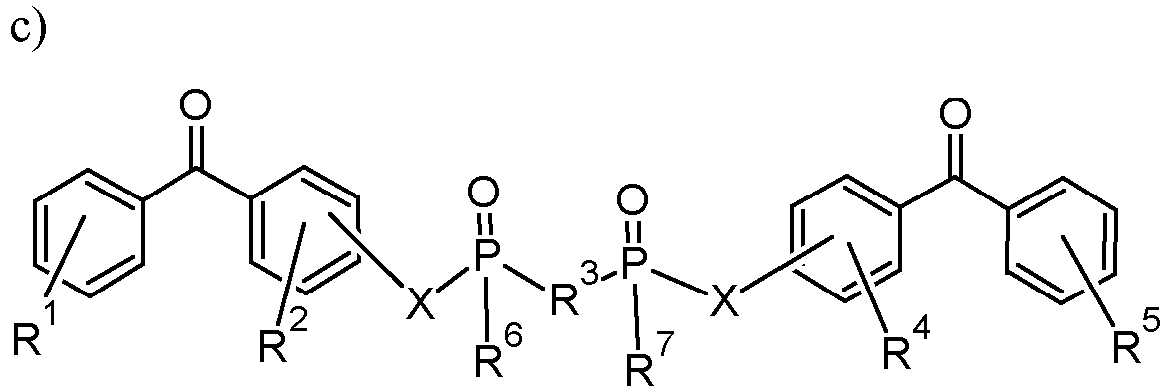

- Medizinprodukt nach einem der vorhergehenden Ansprüche, wobei die Oberfläche des Medizinprodukts ein Trägermaterial umfasst, das aus der Gruppe bestehend aus Polyamid, Polyimid, Polyetherblockamid (PEBAX), Polyetheretherketon (PEEK), Polyethylen hoher Dichte (HDPE), Polyethylen, Polyurethan oder Polyethylenvinylacetat ausgewählt ist.
- Medizinprodukt nach einem der vorhergehenden Ansprüche, umfassend einen Katheter.
- Medizinprodukt mit einem der vorhergehenden Ansprüche, das weniger als 3.000 Partikel größer als 10 Mikrometer freisetzt.
- Medizinprodukt eines der früheren Ansprüche zur Verwendung in einem Verfahren zur Behandlung eines Patienten, umfassend das Einführen der Vorrichtung in einen Patienten.
- Verfahren zum Formen der gleitfähigen Beschichtung auf dem Medizinprodukt nach Anspruch 1 bis 11, umfassend unter Verwendung einer flüssigen Beschichtungszusammensetzung, die das erste Polymer, das zweite Polymer, das Vernetzungsmittel und ein drittes Polymer umfasst, das sich von dem zweiten Polymer unterscheidet und ein Acrylamid-Copolymer mit mindestens einer photoreaktiven Gruppe ist, wobei die flüssige Beschichtungszusammensetzung vorzugsweise einen pH-Wert von weniger als etwa 6 aufweist, im Bereich von pH 2-6 oder im Bereich von pH 3-5.
- Verfahren nach Anspruch 13, wobei die flüssige Beschichtungszusammensetzung Wasser und einen Alkohol umfasst, wobei der Alkohol vorzugsweise in einer Menge im Bereich von 5 - 45 % (v/v) in der flüssigen Beschichtungszusammensetzung vorhanden ist.
- Verfahren nach Anspruch 13 oder 14, umfassend die Schritte a) Tauchen eines Medizinprodukts mit einer flüssigen Beschichtungszusammensetzung nach Anspruch 13 oder 14, b) zumindest teilweises Trocknen der Beschichtung und c) Bestrahlen der Beschichtung mit UV-Licht, wobei das Verfahren vorzugsweise weiterhin das Kontaktieren des beschichteten Medizinprodukts mit einer flüssigen Zusammensetzung umfasst, die Natriumbicarbonat umfasst.
Applications Claiming Priority (2)
| Application Number | Priority Date | Filing Date | Title |
|---|---|---|---|
| US201662316186P | 2016-03-31 | 2016-03-31 | |
| PCT/US2017/025079 WO2017173114A1 (en) | 2016-03-31 | 2017-03-30 | Lubricious coating for medical device |
Publications (3)
| Publication Number | Publication Date |
|---|---|
| EP3436096A1 EP3436096A1 (de) | 2019-02-06 |
| EP3436096B1 true EP3436096B1 (de) | 2025-04-16 |
| EP3436096C0 EP3436096C0 (de) | 2025-04-16 |
Family
ID=58503778
Family Applications (1)
| Application Number | Title | Priority Date | Filing Date |
|---|---|---|---|
| EP17716425.8A Active EP3436096B1 (de) | 2016-03-31 | 2017-03-30 | Schmierende beschichtung für medizinische vorrichtung |
Country Status (7)
| Country | Link |
|---|---|
| US (2) | US11278647B2 (de) |
| EP (1) | EP3436096B1 (de) |
| JP (2) | JP6947747B2 (de) |
| CN (1) | CN109195643A (de) |
| CA (1) | CA3018188A1 (de) |
| MX (1) | MX386870B (de) |
| WO (1) | WO2017173114A1 (de) |
Families Citing this family (12)
| Publication number | Priority date | Publication date | Assignee | Title |
|---|---|---|---|---|
| WO2011123441A1 (en) | 2010-03-30 | 2011-10-06 | Surmodics, Inc. | Degradable photo-crosslinker |
| US10315987B2 (en) | 2010-12-13 | 2019-06-11 | Surmodics, Inc. | Photo-crosslinker |
| US11000632B2 (en) | 2013-01-04 | 2021-05-11 | Surmodics, Inc. | Low particulate lubricious coating with vinyl pyrrolidone and acidic polymer-containing layers |
| US20220184342A1 (en) * | 2015-07-20 | 2022-06-16 | Roivios Limited | Coated Urinary Catheter or Ureteral Stent and Method |
| US12070531B2 (en) | 2017-08-17 | 2024-08-27 | Coloplast A/S | Polymeric coatings |
| CN114269401B (zh) * | 2019-08-21 | 2023-07-04 | 泰尔茂株式会社 | 医疗器械及其制造方法 |
| US12037560B2 (en) | 2019-10-21 | 2024-07-16 | Biocoat, Incorporated | UV cure topcoatings for medical devices |
| US11359156B2 (en) | 2019-10-21 | 2022-06-14 | Biocoat, Inc. | UV cure basecoatings for medical devices |
| WO2021081036A1 (en) * | 2019-10-21 | 2021-04-29 | Biocoat, Inc. | Uv cure coatings for medical devices |
| US12214146B2 (en) | 2019-12-11 | 2025-02-04 | Biocoat, Incorporated | Controlled release of a hydrophilic agent from a coated surface |
| CN118119593A (zh) | 2021-07-13 | 2024-05-31 | 生物涂层有限公司 | 多官能交联剂:化合物、组合物和其产物 |
| CN120500358A (zh) | 2022-11-10 | 2025-08-15 | 苏尔莫迪克斯公司 | 具有增强特性的用于医疗装置的含聚丙烯酸的润滑涂层 |
Family Cites Families (51)
| Publication number | Priority date | Publication date | Assignee | Title |
|---|---|---|---|---|
| US5512329A (en) | 1982-09-29 | 1996-04-30 | Bsi Corporation | Substrate surface preparation |
| US5002582A (en) | 1982-09-29 | 1991-03-26 | Bio-Metric Systems, Inc. | Preparation of polymeric surfaces via covalently attaching polymers |
| US5263992A (en) | 1986-10-17 | 1993-11-23 | Bio-Metric Systems, Inc. | Biocompatible device with covalently bonded biocompatible agent |
| US4979959A (en) | 1986-10-17 | 1990-12-25 | Bio-Metric Systems, Inc. | Biocompatible coating for solid surfaces |
| JPH0783761B2 (ja) * | 1990-10-04 | 1995-09-13 | テルモ株式会社 | 医療用具 |
| EP0479730B1 (de) | 1990-10-04 | 1995-04-19 | Schneider (Europe) Ag | Ballondilationskatheter |
| US5061424A (en) | 1991-01-22 | 1991-10-29 | Becton, Dickinson And Company | Method for applying a lubricious coating to an article |
| US5414075A (en) | 1992-11-06 | 1995-05-09 | Bsi Corporation | Restrained multifunctional reagent for surface modification |
| US5382234A (en) | 1993-04-08 | 1995-01-17 | Scimed Life Systems, Inc. | Over-the-wire balloon catheter |
| US5531715A (en) | 1993-05-12 | 1996-07-02 | Target Therapeutics, Inc. | Lubricious catheters |
| US5344402A (en) | 1993-06-30 | 1994-09-06 | Cardiovascular Dynamics, Inc. | Low profile perfusion catheter |
| AU2359395A (en) | 1994-04-20 | 1995-11-16 | Ronald J. Solar | Active perfusion dilatation catheter |
| US5667493A (en) | 1994-12-30 | 1997-09-16 | Janacek; Jaroslav | Dilation catheter |
| US5714360A (en) | 1995-11-03 | 1998-02-03 | Bsi Corporation | Photoactivatable water soluble cross-linking agents containing an onium group |
| JPH10110134A (ja) * | 1996-10-07 | 1998-04-28 | Toyobo Co Ltd | コーティング剤、易滑性医療用具およびその製造方法 |
| US5858653A (en) | 1997-09-30 | 1999-01-12 | Surmodics, Inc. | Reagent and method for attaching target molecules to a surface |
| US6517515B1 (en) | 1998-03-04 | 2003-02-11 | Scimed Life Systems, Inc. | Catheter having variable size guide wire lumen |
| US6007833A (en) | 1998-03-19 | 1999-12-28 | Surmodics, Inc. | Crosslinkable macromers bearing initiator groups |
| US6394995B1 (en) | 1998-05-15 | 2002-05-28 | X Technologies Inc. | Enhanced balloon dilatation system |
| US6818018B1 (en) * | 1998-08-14 | 2004-11-16 | Incept Llc | In situ polymerizable hydrogels |
| US6278018B1 (en) | 1999-12-14 | 2001-08-21 | Surmodics, Inc. | Surface coating agents |
| JP4834916B2 (ja) * | 2000-05-10 | 2011-12-14 | 東レ株式会社 | 表面処理プラスチック成形品 |
| US6428839B1 (en) * | 2000-06-02 | 2002-08-06 | Bausch & Lomb Incorporated | Surface treatment of medical device |
| US6623504B2 (en) | 2000-12-08 | 2003-09-23 | Scimed Life Systems, Inc. | Balloon catheter with radiopaque distal tip |
| WO2003035278A1 (en) * | 2001-10-25 | 2003-05-01 | Massachusetts Institute Of Technology | Method of depositing polyelectrolyte multilayers and articles coated thereby |
| US7348055B2 (en) | 2001-12-21 | 2008-03-25 | Surmodics, Inc. | Reagent and method for providing coatings on surfaces |
| US7772393B2 (en) | 2005-06-13 | 2010-08-10 | Innovative Surface Technologies, Inc. | Photochemical crosslinkers for polymer coatings and substrate tie-layer |
| JP5552690B2 (ja) | 2006-09-13 | 2014-07-16 | ディーエスエム アイピー アセッツ ビー.ブイ. | 被覆された医療装置 |
| US20080213334A1 (en) | 2006-09-29 | 2008-09-04 | Lockwood Nathan A | Polyelectrolyte media for bioactive agent delivery |
| MY148410A (en) * | 2007-02-28 | 2013-04-30 | Dsm Ip Assets Bv | Hydrophilic coating |
| WO2008104572A2 (en) | 2007-02-28 | 2008-09-04 | Dsm Ip Assets B.V. | Hydrophilic coating |
| US20120077049A1 (en) | 2007-08-06 | 2012-03-29 | Abbott Cardiovascular Systems, Inc. | Medical devices having a lubricious coating with a hydrophilic compound in an interlocking network |
| US20090123519A1 (en) * | 2007-11-12 | 2009-05-14 | Surmodics, Inc. | Swellable hydrogel matrix and methods |
| DK2252661T3 (en) | 2008-03-12 | 2017-01-16 | Dsm Ip Assets Bv | HYDROPHIL COATING |
| JP2012506478A (ja) | 2008-10-22 | 2012-03-15 | サーモディクス,インコーポレイティド | 膨潤性および生分解性を有するポリマーマトリクス並びにその製造方法 |
| US20110144373A1 (en) | 2009-12-10 | 2011-06-16 | Surmodics, Inc. | Water-soluble degradable photo-crosslinker |
| WO2011123441A1 (en) * | 2010-03-30 | 2011-10-06 | Surmodics, Inc. | Degradable photo-crosslinker |
| US10315987B2 (en) | 2010-12-13 | 2019-06-11 | Surmodics, Inc. | Photo-crosslinker |
| WO2012112624A2 (en) | 2011-02-15 | 2012-08-23 | Svaya Nanotechnologies, Inc. | Methods and materials for functional polyionic species and deposition thereof |
| US20130143056A1 (en) | 2011-06-08 | 2013-06-06 | Surmodics, Inc. | Photo-vinyl linking agents |
| US9321030B2 (en) | 2012-01-04 | 2016-04-26 | The Trustees Of The Stevens Institute Of Technology | Clay-containing thin films as carriers of absorbed molecules |
| CA2861314C (en) * | 2012-01-18 | 2021-03-16 | Surmodics, Inc. | Lubricious medical device coating with low particulates |
| EP2623215B1 (de) | 2012-02-01 | 2014-03-26 | Bioenergy Capital AG | Hydrophilierende Plasmabeschichtung |
| JP5763565B2 (ja) | 2012-02-02 | 2015-08-12 | 住友ゴム工業株式会社 | 表面改質方法及び表面改質弾性体 |
| WO2013151991A1 (en) * | 2012-04-02 | 2013-10-10 | Surmodics, Inc. | Hydrophilic polymeric coatings for medical articles with visualization moiety |
| WO2013166358A1 (en) | 2012-05-03 | 2013-11-07 | Indiana University Research And Technology Corporation | Surface coatings for biological implants and prostheses |
| US9410044B2 (en) | 2012-05-11 | 2016-08-09 | Surmodics, Inc. | Boron-containing linking agents |
| WO2013181498A1 (en) | 2012-06-01 | 2013-12-05 | Surmodics, Inc. | Apparatus and method for coating balloon catheters |
| US9629945B2 (en) * | 2012-12-12 | 2017-04-25 | Surmodics, Inc. | Stilbene-based reactive compounds, polymeric matrices formed therefrom, and articles visualizable by fluorescence |
| US11000632B2 (en) * | 2013-01-04 | 2021-05-11 | Surmodics, Inc. | Low particulate lubricious coating with vinyl pyrrolidone and acidic polymer-containing layers |
| WO2015029625A1 (ja) * | 2013-09-02 | 2015-03-05 | テルモ株式会社 | 医療用具およびその製造方法 |
-
2017
- 2017-03-30 EP EP17716425.8A patent/EP3436096B1/de active Active
- 2017-03-30 CN CN201780033572.1A patent/CN109195643A/zh active Pending
- 2017-03-30 CA CA3018188A patent/CA3018188A1/en active Pending
- 2017-03-30 WO PCT/US2017/025079 patent/WO2017173114A1/en not_active Ceased
- 2017-03-30 MX MX2018011806A patent/MX386870B/es unknown
- 2017-03-30 JP JP2018550686A patent/JP6947747B2/ja active Active
- 2017-03-30 US US15/474,601 patent/US11278647B2/en active Active
-
2021
- 2021-09-16 JP JP2021151329A patent/JP7224409B2/ja active Active
-
2022
- 2022-03-21 US US17/700,212 patent/US12472288B2/en active Active
Also Published As
| Publication number | Publication date |
|---|---|
| MX2018011806A (es) | 2019-02-07 |
| US12472288B2 (en) | 2025-11-18 |
| JP2021192838A (ja) | 2021-12-23 |
| US11278647B2 (en) | 2022-03-22 |
| MX386870B (es) | 2025-03-19 |
| EP3436096C0 (de) | 2025-04-16 |
| US20170281831A1 (en) | 2017-10-05 |
| JP7224409B2 (ja) | 2023-02-17 |
| CA3018188A1 (en) | 2017-10-05 |
| WO2017173114A1 (en) | 2017-10-05 |
| US20220211917A1 (en) | 2022-07-07 |
| CN109195643A (zh) | 2019-01-11 |
| EP3436096A1 (de) | 2019-02-06 |
| JP6947747B2 (ja) | 2021-10-13 |
| JP2019509843A (ja) | 2019-04-11 |
Similar Documents
| Publication | Publication Date | Title |
|---|---|---|
| US12472288B2 (en) | Lubricious coating for medical device | |
| US20240342345A1 (en) | Lubricious medical device coating with low particulates | |
| EP3397296B1 (de) | Gleitfähige beschichtungen mit oberflächensalzgruppen | |
| US8932694B2 (en) | Fluorinated polymers and lubricious coatings | |
| US11174447B2 (en) | Lubricious coatings with surface salt groups |
Legal Events
| Date | Code | Title | Description |
|---|---|---|---|
| STAA | Information on the status of an ep patent application or granted ep patent |
Free format text: STATUS: UNKNOWN |
|
| STAA | Information on the status of an ep patent application or granted ep patent |
Free format text: STATUS: THE INTERNATIONAL PUBLICATION HAS BEEN MADE |
|
| PUAI | Public reference made under article 153(3) epc to a published international application that has entered the european phase |
Free format text: ORIGINAL CODE: 0009012 |
|
| STAA | Information on the status of an ep patent application or granted ep patent |
Free format text: STATUS: REQUEST FOR EXAMINATION WAS MADE |
|
| 17P | Request for examination filed |
Effective date: 20181017 |
|
| AK | Designated contracting states |
Kind code of ref document: A1 Designated state(s): AL AT BE BG CH CY CZ DE DK EE ES FI FR GB GR HR HU IE IS IT LI LT LU LV MC MK MT NL NO PL PT RO RS SE SI SK SM TR |
|
| AX | Request for extension of the european patent |
Extension state: BA ME |
|
| DAV | Request for validation of the european patent (deleted) | ||
| DAX | Request for extension of the european patent (deleted) | ||
| STAA | Information on the status of an ep patent application or granted ep patent |
Free format text: STATUS: EXAMINATION IS IN PROGRESS |
|
| 17Q | First examination report despatched |
Effective date: 20200219 |
|
| GRAP | Despatch of communication of intention to grant a patent |
Free format text: ORIGINAL CODE: EPIDOSNIGR1 |
|
| STAA | Information on the status of an ep patent application or granted ep patent |
Free format text: STATUS: GRANT OF PATENT IS INTENDED |
|
| INTG | Intention to grant announced |
Effective date: 20241114 |
|
| GRAS | Grant fee paid |
Free format text: ORIGINAL CODE: EPIDOSNIGR3 |
|
| GRAA | (expected) grant |
Free format text: ORIGINAL CODE: 0009210 |
|
| STAA | Information on the status of an ep patent application or granted ep patent |
Free format text: STATUS: THE PATENT HAS BEEN GRANTED |
|
| AK | Designated contracting states |
Kind code of ref document: B1 Designated state(s): AL AT BE BG CH CY CZ DE DK EE ES FI FR GB GR HR HU IE IS IT LI LT LU LV MC MK MT NL NO PL PT RO RS SE SI SK SM TR |
|
| REG | Reference to a national code |
Ref country code: GB Ref legal event code: FG4D |
|
| REG | Reference to a national code |
Ref country code: CH Ref legal event code: EP |
|
| REG | Reference to a national code |
Ref country code: IE Ref legal event code: FG4D |
|
| REG | Reference to a national code |
Ref country code: DE Ref legal event code: R096 Ref document number: 602017088925 Country of ref document: DE |
|
| U01 | Request for unitary effect filed |
Effective date: 20250516 |
|
| U07 | Unitary effect registered |
Designated state(s): AT BE BG DE DK EE FI FR IT LT LU LV MT NL PT RO SE SI Effective date: 20250522 |
|
| PG25 | Lapsed in a contracting state [announced via postgrant information from national office to epo] |
Ref country code: ES Free format text: LAPSE BECAUSE OF FAILURE TO SUBMIT A TRANSLATION OF THE DESCRIPTION OR TO PAY THE FEE WITHIN THE PRESCRIBED TIME-LIMIT Effective date: 20250416 |
|
| PG25 | Lapsed in a contracting state [announced via postgrant information from national office to epo] |
Ref country code: NO Free format text: LAPSE BECAUSE OF FAILURE TO SUBMIT A TRANSLATION OF THE DESCRIPTION OR TO PAY THE FEE WITHIN THE PRESCRIBED TIME-LIMIT Effective date: 20250716 Ref country code: GR Free format text: LAPSE BECAUSE OF FAILURE TO SUBMIT A TRANSLATION OF THE DESCRIPTION OR TO PAY THE FEE WITHIN THE PRESCRIBED TIME-LIMIT Effective date: 20250717 |
|
| PG25 | Lapsed in a contracting state [announced via postgrant information from national office to epo] |
Ref country code: PL Free format text: LAPSE BECAUSE OF FAILURE TO SUBMIT A TRANSLATION OF THE DESCRIPTION OR TO PAY THE FEE WITHIN THE PRESCRIBED TIME-LIMIT Effective date: 20250416 |
|
| PG25 | Lapsed in a contracting state [announced via postgrant information from national office to epo] |
Ref country code: HR Free format text: LAPSE BECAUSE OF FAILURE TO SUBMIT A TRANSLATION OF THE DESCRIPTION OR TO PAY THE FEE WITHIN THE PRESCRIBED TIME-LIMIT Effective date: 20250416 |
|
| PG25 | Lapsed in a contracting state [announced via postgrant information from national office to epo] |
Ref country code: RS Free format text: LAPSE BECAUSE OF FAILURE TO SUBMIT A TRANSLATION OF THE DESCRIPTION OR TO PAY THE FEE WITHIN THE PRESCRIBED TIME-LIMIT Effective date: 20250716 |
|
| PG25 | Lapsed in a contracting state [announced via postgrant information from national office to epo] |
Ref country code: IS Free format text: LAPSE BECAUSE OF FAILURE TO SUBMIT A TRANSLATION OF THE DESCRIPTION OR TO PAY THE FEE WITHIN THE PRESCRIBED TIME-LIMIT Effective date: 20250816 |