EP3427291B1 - Chamber for degassing substrates - Google Patents
Chamber for degassing substrates Download PDFInfo
- Publication number
- EP3427291B1 EP3427291B1 EP16709913.4A EP16709913A EP3427291B1 EP 3427291 B1 EP3427291 B1 EP 3427291B1 EP 16709913 A EP16709913 A EP 16709913A EP 3427291 B1 EP3427291 B1 EP 3427291B1
- Authority
- EP
- European Patent Office
- Prior art keywords
- slit
- workpiece
- pockets
- chamber
- block
- Prior art date
- Legal status (The legal status is an assumption and is not a legal conclusion. Google has not performed a legal analysis and makes no representation as to the accuracy of the status listed.)
- Active
Links
Images









Classifications
-
- H—ELECTRICITY
- H10—SEMICONDUCTOR DEVICES; ELECTRIC SOLID-STATE DEVICES NOT OTHERWISE PROVIDED FOR
- H10P—GENERIC PROCESSES OR APPARATUS FOR THE MANUFACTURE OR TREATMENT OF DEVICES COVERED BY CLASS H10
- H10P72/00—Handling or holding of wafers, substrates or devices during manufacture or treatment thereof
- H10P72/04—Apparatus for manufacture or treatment
- H10P72/0431—Apparatus for thermal treatment
- H10P72/0434—Apparatus for thermal treatment mainly by convection
-
- F—MECHANICAL ENGINEERING; LIGHTING; HEATING; WEAPONS; BLASTING
- F27—FURNACES; KILNS; OVENS; RETORTS
- F27D—DETAILS OR ACCESSORIES OF FURNACES, KILNS, OVENS OR RETORTS, IN SO FAR AS THEY ARE OF KINDS OCCURRING IN MORE THAN ONE KIND OF FURNACE
- F27D5/00—Supports, screens or the like for the charge within the furnace
- F27D5/0037—Supports specially adapted for semi-conductors
-
- F—MECHANICAL ENGINEERING; LIGHTING; HEATING; WEAPONS; BLASTING
- F27—FURNACES; KILNS; OVENS; RETORTS
- F27D—DETAILS OR ACCESSORIES OF FURNACES, KILNS, OVENS OR RETORTS, IN SO FAR AS THEY ARE OF KINDS OCCURRING IN MORE THAN ONE KIND OF FURNACE
- F27D9/00—Cooling of furnaces or of charges therein
-
- H—ELECTRICITY
- H10—SEMICONDUCTOR DEVICES; ELECTRIC SOLID-STATE DEVICES NOT OTHERWISE PROVIDED FOR
- H10P—GENERIC PROCESSES OR APPARATUS FOR THE MANUFACTURE OR TREATMENT OF DEVICES COVERED BY CLASS H10
- H10P72/00—Handling or holding of wafers, substrates or devices during manufacture or treatment thereof
- H10P72/04—Apparatus for manufacture or treatment
- H10P72/0451—Apparatus for manufacturing or treating in a plurality of work-stations
- H10P72/0452—Apparatus for manufacturing or treating in a plurality of work-stations characterised by the layout of the process chambers
- H10P72/0458—Apparatus for manufacturing or treating in a plurality of work-stations characterised by the layout of the process chambers vertical arrangement
-
- H—ELECTRICITY
- H10—SEMICONDUCTOR DEVICES; ELECTRIC SOLID-STATE DEVICES NOT OTHERWISE PROVIDED FOR
- H10P—GENERIC PROCESSES OR APPARATUS FOR THE MANUFACTURE OR TREATMENT OF DEVICES COVERED BY CLASS H10
- H10P72/00—Handling or holding of wafers, substrates or devices during manufacture or treatment thereof
- H10P72/10—Handling or holding of wafers, substrates or devices during manufacture or treatment thereof using carriers specially adapted therefor, e.g. front opening unified pods [FOUP]
- H10P72/12—Vertical boat type carrier whereby the substrates are horizontally supported, e.g. comprising rod-shaped elements
-
- H—ELECTRICITY
- H10—SEMICONDUCTOR DEVICES; ELECTRIC SOLID-STATE DEVICES NOT OTHERWISE PROVIDED FOR
- H10P—GENERIC PROCESSES OR APPARATUS FOR THE MANUFACTURE OR TREATMENT OF DEVICES COVERED BY CLASS H10
- H10P72/00—Handling or holding of wafers, substrates or devices during manufacture or treatment thereof
- H10P72/10—Handling or holding of wafers, substrates or devices during manufacture or treatment thereof using carriers specially adapted therefor, e.g. front opening unified pods [FOUP]
- H10P72/12—Vertical boat type carrier whereby the substrates are horizontally supported, e.g. comprising rod-shaped elements
- H10P72/127—Vertical boat type carrier whereby the substrates are horizontally supported, e.g. comprising rod-shaped elements characterised by the substrate support
-
- C—CHEMISTRY; METALLURGY
- C23—COATING METALLIC MATERIAL; COATING MATERIAL WITH METALLIC MATERIAL; CHEMICAL SURFACE TREATMENT; DIFFUSION TREATMENT OF METALLIC MATERIAL; COATING BY VACUUM EVAPORATION, BY SPUTTERING, BY ION IMPLANTATION OR BY CHEMICAL VAPOUR DEPOSITION, IN GENERAL; INHIBITING CORROSION OF METALLIC MATERIAL OR INCRUSTATION IN GENERAL
- C23C—COATING METALLIC MATERIAL; COATING MATERIAL WITH METALLIC MATERIAL; SURFACE TREATMENT OF METALLIC MATERIAL BY DIFFUSION INTO THE SURFACE, BY CHEMICAL CONVERSION OR SUBSTITUTION; COATING BY VACUUM EVAPORATION, BY SPUTTERING, BY ION IMPLANTATION OR BY CHEMICAL VAPOUR DEPOSITION, IN GENERAL
- C23C14/00—Coating by vacuum evaporation, by sputtering or by ion implantation of the coating forming material
- C23C14/58—After-treatment
- C23C14/5806—Thermal treatment
-
- F—MECHANICAL ENGINEERING; LIGHTING; HEATING; WEAPONS; BLASTING
- F27—FURNACES; KILNS; OVENS; RETORTS
- F27D—DETAILS OR ACCESSORIES OF FURNACES, KILNS, OVENS OR RETORTS, IN SO FAR AS THEY ARE OF KINDS OCCURRING IN MORE THAN ONE KIND OF FURNACE
- F27D9/00—Cooling of furnaces or of charges therein
- F27D2009/007—Cooling of charges therein
Definitions
- Degassing means the removal of gases, especially (i) gases from evaporated liquids like water or (ii) vapors that result from sublimating materials adhering to surfaces or (iii), in vacuum technology, substances that are outgassing from (bulk) material as soon as the surrounding pressure falls below its vapor pressure.
- gases especially gases from evaporated liquids like water or (ii) vapors that result from sublimating materials adhering to surfaces or (iii), in vacuum technology, substances that are outgassing from (bulk) material as soon as the surrounding pressure falls below its vapor pressure.
- gases especially (i) gases from evaporated liquids like water or (ii) vapors that result from sublimating materials adhering to surfaces or (iii), in vacuum technology, substances that are outgassing from (bulk) material as soon as the surrounding pressure falls below its vapor pressure.
- vacuum sputter coating processes degassing is an important process step, since residual gases may result in deteriorated adhesion of deposited layers or
- sub atmospheric degassing takes place in an environment where the surrounding pressure can be lowered below atmospheric pressure.
- the workpieces are sheet-shaped, are shaped like a drum-skin in a frame, so-called Taiko's, are band or plateshaped. They all have a pair of two-dimensionally extended, parallel surfaces and a thickness D perpendicular to the addressed extended surfaces, for which there is valid: 0.01 mm ⁇ D ⁇ 5 mm .
- the workpieces may have structured or unstructured extended surfaces and may be one- or multi-layered.
- cooling down process step may be needed before further processing.
- a cooling down process step may be needed before further processing.
- the same considerations prevail as were addressed above with respect to a heating process step, thereby specifically for degassing.
- cooling down of workpieces e.g. of substrates
- a batch cooler as well acts as an intermediate storage for the workpieces.
- Some of the addressed workpieces e.g. substrates, like laminated substrates, polymer matrix substrates with embedded dies (fan-out), substrates on tape, epoxy-based substrates require extended degassing time prior to subsequent vacuum processing, like PVD.
- a degasser for highly outgassing substrates in a batch is enabling longer outgassing times without the need to sacrifice throughput in the following process sequences, which may be single substrate processes, like in a cluster tool.
- a more generalized objective is to propose a batch heat treatment chamber that is efficient and inexpensive in view of manufacturing, maintenance and operation.
- the solution according to the invention is a heater and/or cooler chamber for a batch of more than one of the addressed workpieces, having each a pair of parallel, two dimensionally extended surfaces and a thickness D of 0.01 mm ⁇ D ⁇ 5mm .
- Such chamber comprises a heat storage block, that may also be called chunk, made of a single metal part or of more than one thermally narrowly coupled metal parts.
- a heat storage block that may also be called chunk, made of a single metal part or of more than one thermally narrowly coupled metal parts.
- Such narrowly coupled metal parts behave in common thermally only negligibly different from a same one piece metal block or chunk.
- the metal may be e.g. aluminum or an alloy thereof.
- the block comprises more than one parallel slit-pockets stacked one upon the other, each dimensioned to accommodate one of the workpieces.
- Each slit-pocket extends along a slit-pocket plane E p , a geometric plane, which is a plane that cuts such slit-pocket in two parts, considered in cross section.
- the slit planes of the slit- pockets are mutually parallel.
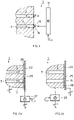
- a slit-plane E p is shown in Fig. 1 for a slit-pocket SP in a block B.
- the geometric plane E p is shown in dash-dotted lines and being intransparent.
- Each slit-pocket has a workpiece support for a workpiece. Especially because in some embodiments gas is flown along the workpiece in the slit-pockets, such workpiece supports are realized with surfaces providing a sufficiently high sliding friction with the workpiece surface. Such workpiece supports may be realized e.g. by short studs with respective surface characteristics or e.g. by pieces of O-ring countersunk in the bottom of the slit-pockets. Each slit-pocket has at least one workpiece handling opening.
- Each slit-pocket is tailored to surround a workpiece on its workpiece support in a non-contact, closely spaced manner. This is achieved under consideration of a possible un-plane shape of the workpieces, their thickness D and possible catenary of thin workpieces in that the height h of each of the slit-pockets perpendicular to the slit-pocket planes E p is 2 . 5mm ⁇ h ⁇ 50 mm .
- This height h prevails along at least 30% of the two-dimensional extent area, in Fig. 1 marked A, of the slit-pockets, parallel to the slit-pocket plane EP. Thereby a good heat exchange from the block to the workpiece or from the workpiece to the block is achieved.
- the addressed h-range is valid for at least 50% of the addressed area.
- This height h may be valid along an area which is up to 100% of the two-dimensional extent area of the slit-pockets parallel to slit-pocket planes. Nevertheless, cutouts for access of a handling robot arm below the workpieces may be provided as will be discussed later, e.g. in such cutouts the height of the slit-pockets may possibly not fall in the addressed range, or may even not be defined if such cutouts are through-cutouts.
- each slit-pocket is operatively connected to a door arrangement which controllably frees and covers the workpiece handling opening.
- the term "covering" as used in the present description and claims addresses that the respective door arrangement may close the workpiece handling opening in a gas-tight manner or may then still establish a gas leakage from the slit-pocket volume to the surrounding of the block or may just cover the workpiece handling opening with respect to the surrounding of the chamber, e.g. spaced from the workpiece handling opening.
- At least one heater and/or cooler interface to the block is provided, e.g. a thermally highly conductive surface- area whereat heater and/or cooler-means or -fluids may be brought in tight thermal contact with the block.
- the slit-pockets wherein the workpieces are heat treated are provided within the block, e.g. machined into the block.
- the block may be built by multiple metal parts thermally narrowly coupled. Such parts may be tailored drawer-like and stacked one upon the other. These parts are thermally narrowly coupled e.g. by tightening as a staple by means of tightening screws or screw-bolts through the entire staple.
- the block is a heat storage block, i.e. acts as a heat reservoir ensuring that, once thermal equilibrium has been reached in the block, the temperature in the slit-pockets is kept substantially constant. Freeing and covering of the workpiece handling openings as well as introducing workpieces of different temperatures into the slit-pockets has negligible effect on the thermal state of the block.
- the chamber comprises a heater and/or cooler arrangement which is provided in or along at least one distinct outer area of the block, such outer area of the block forms then the heater and/or cooler interface of the block.
- a heater and/or cooler arrangement is provided in or at distinct outer areas of the block which areas face each other.
- the block of the chamber becomes in fact interposed between a pair of heater and/or cooler arrangements which, in one embodiment, are extended along the respective surfaces of the block.
- the chamber comprises a gas feed line arrangement, which dispatches in at least some of the slit-pockets or in all of the slit-pockets.
- a gas may be flown over and along the workpieces in the respective slit-pockets.
- the chamber is a heater chamber, such gas may be pre-heated so as to shorten heating-up time for the workpieces.
- the heater chamber is a degassing chamber, the addressed gas flow, as a flushing gas flow, removes gas components, resulting from workpiece outgassing, out of the slit-pocket.
- the established gas flow may be precooled to improve workpiece cooling in the slit-pockets.
- the addressed pre-heating or pre-cooling of a gas flown through the gas feed line arrangement may be realized by separate specific gas heating and/or cooling arrangements or by the same heater and/or cooler arrangement provided for respectively heating or cooling of the entire block of the chamber.
- a flushing gas stream may be established through the slit-pockets.
- the slit-pockets may further be pressurized by a gas so as to improve heat transfer from the slit-pocket to the workpiece or vice versa.
- the latter is especially exploited when the heat treatment in the block is initiated in a vacuum atmosphere, i.e. workpieces are loaded into the slit-pockets in vacuum atmosphere. Nevertheless, in one embodiment such loading is performed at ambient pressure.
- the slit-pockets, or at least some of the slit-pockets are substantially gas-tight when the door arrangement covers the workpiece handling opening.
- each of the pockets or at least some of the pockets are then still provided with a gas outlet.
- Such a gas outlet is e.g. established whenever a gas is to be flown through the slit-pockets, e.g. as a flushing gas for degassing and is to be flown along the workpiece and out of the slit-pockets during thermal treatment.
- the door arrangement it is also possible to construct the door arrangement to be able to provide covering selectively i.e. in a gas-tight manner or leaky, e.g. by a respective construction and control of the door arrangement.
- At least some or all slit-pockets are mutually aligned and stacked in a direction perpendicular to the slit-pocket planes. In one embodiment at least some or all the at least one workpiece handling openings of the slit-pockets are as well mutually aligned considered in the addressed direction. Thereby handling of the workpieces to and from the respective slit-pockets by means of handling apparatus is significantly simplified.
- At least some of or all neighboring slit-pockets are thermally substantially decoupled:
- the thermal state of a slit-pocket is substantially uninfluenced by a neighboring slit-pocket which is unloaded from a heat-treated workpiece or loaded with a yet heat-untreated workpiece.
- the slit-pockets are mutually aligned in one direction perpendicular to the slit-pocket planes and neighboring slit-pockets are separated, perpendicular to the slit-pocket planes, by sections of the block which have a thickness d, considered in the direction perpendicular to the slit-pocket planes of 0.5 mm ⁇ d ⁇ 1 0mm .
- This thickness dimensioning prevails for at least 30% or, in one embodiment, for at least 50% of the extended surface area of the slit-pockets considered parallel to the slit-pocket planes.
- the thickness d of block material sections between neighboring slit-pockets defines significantly for the thermal decoupling between neighboring slit-pockets and for the heat flow along the sections towards or from the extended surfaces of the two adjacent workpieces.
- the smaller that this thickness is selected the worse is the thermal decoupling and heat flow between neighboring slit-pockets.
- the addressed thickness of block material As it is intended to minimize mutual thermal influence between neighboring slit-pockets, one would tailor the addressed thickness of block material as large as possible. Nevertheless and as rising the thickness increases thermal inertia of the addressed section of block material, which leads to increased timespans to reach thermal equilibrium, the addressed range of d is selected to provide an appropriate heat flow, acceptable thermal inertia and thermal decoupling between neighboring slit-pockets as well as an adequate number of slit-pockets in a block of predetermined extent.
- the slit-pockets comprise in their bottom surfaces one or more than one handler cutouts which are accessible from the at least workpiece handler opening of the slit-pockets.
- handler cutouts allow introducing and removing of at least one handling arm of a workpiece handler robot so as to deposit a yet untreated workpiece on the workpiece support or to remove a treated workpiece from the workpiece support and from the slit-pocket.
- Such cutouts may even be trough-cutouts if too much not restricting heat flow and deteriorating mutual thermal decoupling of neighboring slit-pockets.
- At least some of the slit-pockets, or all of the slit-pockets, comprise one single workpiece opening.
- the door arrangement is laid out to controllably cover and free at least one of the workpiece handling openings at the same time.
- the door arrangement is laid out to controllably cover and free at least one of the workpiece handling openings at the same time.
- more than one of the workpiece handling openings may be simultaneously freed or covered.
- the door arrangement is controllable or controlled to maintain all workpiece handling openings covered during a timespan. This is necessary if e.g. all the slit-pockets are loaded with respective workpieces and heat treatment is not yet terminated for any of these workpieces.
- the door arrangement may be realized in different manner.
- distinct door-flaps or sliders may be directly mounted to the block adjacent to each of the workpiece handling openings. All of the door-flaps or sliders may be individually opened and closed by one or more than one drives. By controlling the closing-status of the flaps one may establish whether closing is performed in a gas-tight manner or so that a gas flow out of the respective slit-pocket may be established.
- At least some or all of the at least one workpiece handling openings are mutually aligned in one direction along the block.
- the door arrangement is realized by a door plate with at least one door-workpiece-handling opening, DWHO.
- the door plate is controllably slidable along and relative to the block in the addressed direction.
- the at least one DWHO is thereby brought in and out of alignment with at least one of the aligned workpiece handling openings of the slit-pockets.
- more than one DWHO may simultaneously be freed and covered if, considered in the addressed direction, the spacing between DWHOs accords with the spacing between workpiece-handling openings of the slit-pockets. Even if latter is not the case, providing more than one DWHO shortens the sliding hubs of the door-plate relative to the block to bring a respective DWHO in alignment with a workpiece-handling opening of a slit-pocket.
- the door-plate is operationally connected to a plate-drive for the relative sliding.
- the block is operationally connected to a block-drive.
- the addressed door-plate may be realized in the latter case by a wall of a casing surrounding the block.
- Such plate as e.g. the addressed wall may be distant from the surface of the block with the workpiece handling openings, leaving an interspace there between.
- the DWHO in such plate or wall is equipped with a controllably driven flap or slider.
- the block also called chunk
- the block comprises two side faces, e.g. mutually parallel faces, as well as a front face between and linking the side faces.
- the heater and/or cooler arrangements are located at or in both of the addressed side faces whereas the at least one workpiece handling openings of the slit-pockets are provided in the front face.
- the chamber comprises a gas feed line arrangement which dispatches in at least some of the slit-pockets or in all of the slit-pockets.
- the gas feed line arrangement is operationally thermally connected to a gas heater and/or gas cooler arrangement which is located along a back-face of the block, opposite the addressed front-face.
- the slit-pockets extend transvers to the addressed side-faces as e.g. perpendicularly thereto.
- heat current flows along sections of the block between neighboring slit-pockets and thus parallel to the extended surfaces of workpieces on the respective workpiece supports.
- the addressed sections provide for a good heat transport between the heater/cooler arrangements and the workpieces.
- the block is located within a thermally isolating housing and is e.g. spaced from the isolating housing.
- the isolating housing bars heat flow between the block and the surrounding of the chamber.
- the door arrangement comprises one or more than one controllable DWHO in a wall of the isolating housing and opposite to the workpiece handling openings.
- the block is operatively coupled to a controllable block drive which is constructed to bring one or more than one of the workpiece handling openings into alignment with one or more than one DWHOs.
- a controllable block drive which is constructed to bring one or more than one of the workpiece handling openings into alignment with one or more than one DWHOs.
- the workpiece handling openings are ongoingly in flow communication with an interspace between the block and the isolating housing. Thereby and especially if a flushing gas flow is established along the slit-pockets, the gas flow enters in unhindered manner the addressed interspace.
- the addressed housing comprises a pump port to remove the gas from the interspace.
- the addressed gas flow prevents ongoingly cross-contamination of the slit-pockets through their open workpiece-handling openings and may additionally lower contamination of the interspace once a DWHO in the wall of the isolating housing is opened as by a controllably driven flap or slider. A part of such gas leaves the interspace through the open DWHO.
- the chamber according to the invention comprises a gas feed line arrangement dispatching in at least some of the slit-pockets opposite to one of the at least one workpiece handling openings.
- a controlled gas flow may be established all along the extended surfaces of the workpiece on the respective workpiece support.
- the resulting pressure within the addressed slit-pocket may also be controlled by tailoring and respectively controlling the door arrangement, in analogy to providing a controlled pressure stage or valve between the inside of the slit-pocket and the surrounding.
- the chamber according to the invention which again comprises gas feed line arrangement which dispatches in at least some or in all of the slit-pockets, there is provided a gas heater and/or gas cooler arrangement for the gas in the gas feedline arrangement.
- a gas heater and/or gas cooler arrangement for the gas in the gas feedline arrangement.
- the present invention is further directed to an apparatus which comprises a chamber according to the present invention and possibly according to one or more than one of the embodiments thereof described above.
- the chamber comprises a gas feed line arrangement dispatching in at least some or in all of the slit-pockets.
- the gas feed line is operationally connected to a pressurized gas source arrangement for at least one of dried air, of N2, of Ar, of He.
- the present invention is further directed to a workpiece treatment system which comprises a chamber or apparatus according to the present invention and possibly according to one or more than one of the embodiments thereof and as was addressed, with the following limitations:
- the workpiece treatment system further comprises:
- the slit-pockets, the workpiece holders of the magazine arrangement and preferably also a workpiece holder arrangement in the load-lock arrangement are all tailored to hold the workpieces with their extended surfaces along parallel planes.
- the handling robot is tailored and controlled to handle workpieces to and from the magazine arrangement, to and from the load-lock arrangement, to and from the chamber. This handling may be realized along one common plane.
- the overall system is most flexibly adaptable to different needs and the number of magazines as well as the overall structure of the vacuum treatment arrangement may flexibly be adapted.
- the addressed robot may further be exploited to handle workpieces to and from additional stations of the system, e.g. and for specific workpieces, an alignment station, wherein the position of the workpiece is properly set.
- Such alignment station may be part of the magazine arrangement to properly align the workpieces before that they are conveyed from the magazine arrangement to the chamber.
- system comprises a workpiece aligner station as was addressed above, which is also served by the robot.
- the chamber according to the invention is tailored as a cooling chamber, than, by the addressed system and as an example, the workpieces may be conveyed by the handling robot from the magazine arrangement, possibly with an aligner, to the vacuum treatment arrangement, form the vacuum treatment arrangement to the cooling chamber and from the cooling chamber back to the magazine arrangement.
- the thermally treated workpiece is removed through the workpiece handling opening of the slit-pocket (e) .
- the timespan during which the workpiece is thermally treated might be determined in situ e.g. by monitoring the temperature course of the workpieces e.g. by an arrangement of temperature sensors, in one variant of the method according to the invention, the timespan during which the addressed thermal treatment is to be performed in the slit-pockets is predetermined.
- a cycle of the addressed steps (a) to (e) is performed multiple times in different slit-pockets with a time lag between directly subsequent ones of the addressed cycles which time lag is shorter than a timespan for the thermal treatment.
- a workpiece is conveyed between the chamber according to the invention and a magazine arrangement as well as between the addressed chamber and a vacuum treatment arrangement for vacuum treating the workpiece as well as between the vacuum treatment arrangement and the addressed magazine arrangement.
- the workpieces are conveyed from the chamber tailored as a degasser chamber to the vacuum treatment arrangement, are treated in the vacuum treatment arrangement - possibly including a cooling step - and then conveyed from the vacuum treatment arrangement to the magazine arrangement.
- the addressed conveyings may be performed directly or via an intermediate station, e.g. an alignment station may be provided ahead loading fresh workpieces to the chamber, i.e. upstream or downstream the magazine arrangement or as a part of the magazine arrangement.
- untreated workpieces are first conveyed from the magazine arrangement directly or via a further station, as e.g. an aligner station, to the vacuum treatment arrangement.
- Vacuum treated workpieces are then conveyed to the chamber according to the invention tailored as a cooler chamber and from there conveyed to the magazine arrangement.
- cooling may also be necessary after the degassing step, e.g. in the vacuum treatment arrangement or between the chamber and the vacuum treatment arrangement.
- the addressed vacuum treatment arrangement communicates to ambient via a respective I/O-load-lock arrangement which may be realized by a distinct input (I) loadlock and a distinct output (O) loadlock or by a combined input and output loadlock.
- the addressed conveyings are performed by means of single workpiece conveyings.
- the chamber comprises a number n of slit-pockets but only a smaller number m thereof is used. This allows to flexibly adapt the overall handling of the chamber to specific needs thereby optimizing on one hand conveying path lengths to and or from the addressed chamber and additionally leaving the thermal state of the chamber as unaffected as possible by respectively loading and unloading of the slit- pockets.
- the steps (a) to (e) are directly subsequently performed in non-directly neighboring slit-pockets of the chamber.
- step (a) is first performed in every second slit-pocket considered in a first direction along the chamber, then the addressed direction is inversed and the addressed step (a) is subsequently performed in every remaining slit-pocket in such inverse direction.
- every second slit-pocket is unloaded in one propagation direction, then, at the end of the stack, the propagation direction is again inversed and the remaining slit-pockets are unloaded.
- one and the same slit pocket may be unloaded and reloaded before propagating to the next slit pocket.
- the gas establishing the addressed flow along the workpiece is preheated or precooled before the addressed flow of gas along the workpieces is established.
- the addressed flow of gas is exploited as a flushing gas flow so as to remove evaporated products from the slit-pockets.
- the chamber is provided within a thermally isolating housing.
- the slit-pockets are separated from ambient atmosphere surrounding the housing via at least one controllably closable and openable DWHO of the door arrangement and in the wall of the housing.
- the block of the chamber is controllably drivingly moved in the housing by a controlled drive so as to align a workpiece handling opening of the slit-pockets and the at least one DWHO in the wall of the housing.
- the workpiece handling openings of the slit-pocket may freely communicate with the interspace between the block and the isolating housing.
- a gas flow established through the slit-pockets prevents mutual contamination of the slit-pockets by degassed products.
- the DWHO in the wall of the isolating housing in fact establishes or bars flow communication between the interspace and the surrounding of the housing.
- the one or more than one DWHOs in the wall of the isolating housing are in a good embodiment equipped with respective flaps or sliders, driven in a controlled manner.
- Fig. 2 shows, most schematically and simplified, in a cross sectional representation, a part of a block 3 of a chamber 1 according to the invention.
- as shown in dashed lines at 5 of multiple metal parts, mutually biased so as to establish narrowest thermal coupling, e.g. by screws or screw bolts not shown in Fig. 2 .
- slit-pockets 7 are provided within single piece block 3 of a metal, as of aluminum or of an aluminum alloy, or of a block 3 construed .
- the slit-pockets are mutually parallel and extend along slit-pocket planes Ep.
- the slit-pocket planes Ep are parallel to the x/y plane of the coordinate system x/y/z.
- each slit-pocket 7 has workpiece-handling openings 11. Whereas, in the embodiment of Fig. 2 , each slit-pocket 7 has one single workpiece-handling opening 11, such workpiece-handling opening might additionally be provided at the end of the respective slit-pockets 7, opposite the workpiece-handling opening 11 shown.
- Fig. 3 to 5 most schematically and in a representation in analogy to that of Fig. 2 show examples of realizing the door arrangement 13 as of Fig. 2 .
- the door arrangement 13 comprises a slider (not shown) or a flap 15, pivotably or slidably (not shown) mounted to block 3.
- Each of the flaps 15 or sliders is driven by a drive unit 17, controlled as shown at control input C 17 .
- gas feed lines 19 discharge in at least some, normally in all slit-pockets 7.
- the gas feed lines 19 are operationally connected to a pressurized gas source as schematically shown at 21 of Fig. 2 .
- the flaps 15 or sliders in this embodiment, close the workpiece-handling openings 11 either in a gas-tight manner or in a leaky manner establishing a gas outlet for the gas flow F.
- a flap 15 or slider seals the workpiece-handling openings 11 in a gas-tight manner or only in a leaky manner may be set by the control of drive unit 17.
- the door arrangement 13 as of Fig. 2 is realized by a plate 23 and, as exemplified in Fig. 4a , one DWHO 25.
- the plate 23 is operationally connected to a plate drive 27, controlled at C 27 .
- the plate 23 is drivingly and controllably slid along a surface of block 3 so as to bring the DWHO 25 selectively in alignment with a workpiece-handling opening 11. Between plate 23 and block 3 a gap 28 is defined.
- Fig. 4b addresses a further embodiment.
- plate 23 with DWHO 25 is kept stationary whereas block 3 with the slit-pockets 7 is operationally connected to a block drive 29, controlled as schematically shown at C 29 .
- the block drive 29 the block 3 is slid along plate 23 to selectively bring the DWHO 25 in alignment with one of the workpiece-handling openings 11.
- the small interspace or gap 28 between the surface of block 3 and plate 23 provides for a gas flow passage from the slit-pockets 7 to the surrounding of the chamber 1.
- FIG. 5 again in a simplified and schematic representation in analogy to the representations of Figs. 3 and 4 , in fact departs from the embodiment according to Fig. 4b .It schematically shows an embodiment as practiced today.
- the plate 23 of Fig. 4b is realized by a wall 31 of an isolating housing 33 which is spaced from the surface of block 3 whereat the workpiece-handling openings 11 are provided.
- Block 3 is driven by block drive 29, controlled via C 29 , along wall 31 with the DWHO 35.
- a flap 37 or a slider is movably mounted to the wall 31 so as to close or free the DWHO 35.
- DWHO 35 and flap 37 or slider either covers the workpiece-handling openings 11 or frees such workpiece-handling openings 11 towards the surrounding atmosphere AT of the chamber 1.
- the flap 37 or slider is controllably driven by a drive 39 which is controlled as schematically shown via control input C 39 .
- the plate or wall may comprise more than one of the DWHO either to free more than one of the workpiece-handling openings 11 simultaneously or to optimize the hub which must be run by the respective plate or by the block to subsequently free workpiece-handling openings 11.
- a pumping port 41 to be operationally connected to a pump 43.
- This range of height h prevails for at least 30% or even for at least 50% of the overall surface areas of a slit-pocket 7 along the x/y plane which is parallel to slit-pocket plane Ep according to Fig. 1 .
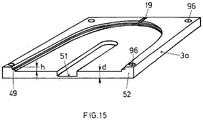
- the workpieces 50 as were addressed in the introductory part of the present description, are supported on workpiece supports 49 which, in the embodiment of Fig. 6 , are realized by pieces of O-ring material mounted along the bottom surface of the slit-pocket 7.
- the workpiece supports 49 may be constructed in a lot of different variants but it should be made sure that the surface of the workpiece supports which contact the workpieces 50 provide therewith enough friction to ensure stable support of the workpieces 50.
- the workpieces 50 have a thickness D within the range of: 0.01 mm ⁇ D ⁇ 5 mm .
- cutouts 51 may be worked in the bottom surface of the slit-pocket 7 in the bottom surface of the slit-pocket 7 so as to deposit or remove such workpiece 50.
- the sections 52 of the block 3 which separate, in z-direction, directly neighboring slit-pockets 7, are in fact significant with respect to heat flow HF there along, mutual thermal decoupling of neighboring slit-pockets 7, as well as duration for establishing a stable temperature throughout the block 3.
- these sections 52 should have a thickness d for which there is valid: 0.5 mm ⁇ d ⁇ 10 mm .
- This thickness range d shall prevail along at least 30% or even 50% of the extended surface area of the respective slit-pockets 7 along the slit-pocket plane Ep which is in Fig. 6 parallel to the x/y plane.
- the double arrow F represent the possibly established gas flow.
- Fig. 6b shows in a representation in analogy to that of Fig. 6a an embodiment in which the section 52 comprises cutouts 51, 51a including through-cutouts as shown at 51a. If the surface area covered by such through-cutouts 51a and their width is small enough they might not substantially negatively influence heat flow, mutual decoupling of directly neighboring slit-pockets 7 and dynamic thermal behavior of the entire block 3.
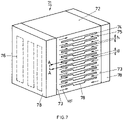
- FIG. 7 One embodiment of a batch degasser chamber 71 according to the present invention is shown in Figure 7 .
- the block of thermally well conductive metal 72 features a plurality of slit-pockets 74.
- the sections of the block located between two neighboring slit-pockets 2 are labelled 75.
- the slit-pockets 74 may be machined in a one piece block of the metal or the block 72 is, as was addressed in fig 2 at ref.nr.5, assembled from several parts thereby ensuring a thermal behavior of the resulting block 72 which is only negligibly different from a single piece meal block 72.
- the sections 75 accord with the sections 52 of Fig. 6 .
- the heating arrangements 78 are replaced by cooling arrangements with respective cooling elements, the surfaces 73 become cooler interfaces and the direction of heat flow HF is inversed.
- cutouts 78 should occupy less than 30% or less than 50% of the overall horizontal extent of slit-pocket 74.
- cutouts 78 may be only so deep that their areas contribute to that extent of slit-pocket 74 which fulfills the above mentioned range for the height h.
- the height h is accordingly adapted.
- the relation of prevailing workpiece shape and thickness and of the height h of the slit-pockets 74 is selected on one hand so as to optimize heat transfer between the top and bottom walls of the slit-pockets 74 and the workpiece, and, on the other hand, to allow a gas flow F along the extended surfaces of the workpieces 50, if such gas flow is desired.
- the prevailing shape of a workpiece 50 may be due to the workpiece having a certain sagging in the slit-pocket due to its proper weight.
- the chamber according to the invention shall be flexibly exploitable for differently tailored workpieces especially with respect to their thickness D and sagging characteristics.
- slit-pockets 7, 74 of block 3, 72 shall be mutually thermally decoupled as well as possible so that loading and removing a workpiece 50 to or from one of the slit-pockets 7, 74 does only negligibly influent the directly neighboring slit-pockets in which a workpiece 50 is heat-treated.
- the thermal intercoupling between neighboring slip-pockets 7, 74 is primarily defined by the thickness of sections 52 ( Fig. 6 ) or 75 ( Fig. 7 ) which mutually separates neighboring slit-pockets 7, 74.
- the thickness d is selected, as was already addressed, to be within the following range: 0.5 mm ⁇ d ⁇ 10 mm
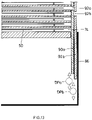
- Fig. 8 shows, simplified and schematically, an embodiment of the batch degasser chamber 1 according to the invention.
- the workpieces 50 to be heated are positioned on the workpiece supports 49, as on pins, inside the slit-pockets 74.
- Each of the slit-pockets 74 is preferably gas-supplied via a purge gas line 19 as of Fig. 2 , which may be equipped with a filter 80 to avoid particles.
- the purge gas line 19 may comprise a shallow gas cavity 81 with a length pg intended to preheat the purge- or flush-gas in the heated degasser block 72 before it enters the slit-pockets 74.
- the gas inlet is arranged preferably in the upper portion of the slit- pockets opposite the workpiece handling openings 11 since it is the goal to achieve a gas flow along the workpieces 50, especially along the top surfaces thereof, where outgassing is especially required.
- the batch degasser block 72 is positioned in a housing 86.
- This housing 86 may include an appropriate isolation 88 to avoid heat loss of the block 72.
- This concept of a fixed position of the block 72 inside the housing 86 is proposed for a workpiece loading robots with a transfer arm having a large hub or stroke of the vertical drive (z-drive).
- the maximum number of slit-pockets 74 of the degasser block 72 is then limited by the range of the vertical z-drive-stroke.
- Fig. 9a and 9b show a top view (a) and a horizontal cross section (b) through a slit-pocket 74 with a workpiece 50 placed on pins 49.
- the slit-pocket 74 is open to one side by the workpiece-handling opening 11 in order to allow loading and unloading the workpiece 50.
- On the opposite side the inner contour of the pocket is rounded to match the outer shape of a circular workpiece 50, here a wafer, and thus to enable a good heat transfer inside the block 72.
- the position of the pins 49 allows a safe operation of the workpiece 50 with the transfer arm 53.
- the inner contour of the slit-pocket 74 is just machined wide enough to take up the transfer arm 53 and the workpiece during transfer.
- a preheating gas cavity 81 can be a single straight line 83a or a network of distributed lines 83a, b, c.
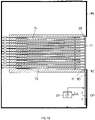
- a door plate 90 has a flat, plateshaped design of a size essentially twice the size of the front face of the block 72. It exhibits one DWHO 92 of approximately the same shape as the workpiece-handling opening 11, preferably arranged in the middle of the door plate 90 as shown in Figure 10 .
- the door plate 90 is vertically movable by the drive 27 in directions shown by arrow DP. Between the door plate 90 and the workpiece-handling opening 11 there is the gap 28. In Fig. 10 the door plate 90 is positioned with all slit-pockets 74 closed.
- FIG. 12 An alternative embodiment is shown in Figure 12 where the spacer sections 75 have such a thickness d that the DWHO 92 in the movable door plate 90 is covered by the front of the spacer sections 75 between two neighboring slit-pockets 74.
- This has advantages when operating the door plate 90 because there are many "fully closed between pockets" positions (one less than the number of slit-pockets 74).
- the drive(s) for the vertical displacement of the door plates or of the block may be arranged above or below the block and will thus not block any space where the loading and unloading operation takes place.
- the proposed chamber is preferably run at atmospheric pressure. However the basic ideas may also be applied for low pressure degassing. An effective conductive heat transfer is possible if the gas pressure is > 1kPa.
- a process sequence for a batch degasser according to the invention with n pockets may look like the following:
- a vacuum treatment arrangement 102 with a load-lock arrangement 104 separating vacuum atmosphere within the vacuum treatment arrangement from ambient atmosphere AA.
- the load-lock arrangement 104 comprises workpiece supports whereupon workpieces are supported parallel to workpieces on the respective supports in chamber 100. Workpieces in the magazine arrangement 106 as well are supported parallel to such workpieces in the load-lock arrangement 104 and chamber 100. In spite of the fact that these planes of workpiece support may be different planes, their mutual distance, vertical to such planes, is minimized up to all these planes forming a single plane.
- the chamber 100 according to Fig. 16 is realized as a degasser chamber 100 dg .
- the handling robot 108 of Fig. 16 is realized as handling robot 108' in ambient atmosphere AA and is constructed to convey single workpieces 50 to and from degasser chamber 100 dg .
- the vacuum treatment arrangement 102 of Fig. 16 is realized as a multi-station, single workpiece-treatment arrangement with a I/O load-lock 104' for workpiece input and output and a number of stations for single workpiece vacuum treatment.
- These stations may, for example, include a cooling station 111 for cooling workpieces 50 arriving from the degasser chamber 100 dg , which have to be further cooled down prior to subsequent vacuum processing.
- the processing direction for the workpieces 50 is indicated in Fig. 17 by the arrow Pr.
- the subsequent stations may further be etching stations, layer deposition stations as for PVD, reactive or nonreactive, for CVD plasma enhanced or non-plasma enhanced etc. as perfectly known to the skilled artisan.
- the magazine arrangement 106 comprises three discrete magazines and an aligner 114.
- the robot 108' conveys vacuum treated workpieces from load-lock 104' to an output-magazine and un-degassed workpieces from an input-magazine of the arrangement 106 to the degasser chamber 100 dg .
- the aligner 114 by which the addressed workpieces 50 are geometrically aligned. Because in this specific embodiment untreated workpieces are input in a magazine 106 a , then geometrically oriented in aligner 114 as addressed by the arrow (a) and are conveyed to the degasser chamber 100dg from the aligner 114 as shown by the arrow (b), it might be said that in fact the aligner 114 is part of the overall magazine arrangement 106. All the handling between all these stations and the chamber as provided in the system as shown, is performed solely by the robot 108'.
Landscapes
- Engineering & Computer Science (AREA)
- Mechanical Engineering (AREA)
- General Engineering & Computer Science (AREA)
- Container, Conveyance, Adherence, Positioning, Of Wafer (AREA)
- Tunnel Furnaces (AREA)
- Physical Vapour Deposition (AREA)
- Physical Deposition Of Substances That Are Components Of Semiconductor Devices (AREA)
- Vacuum Packaging (AREA)
Applications Claiming Priority (1)
| Application Number | Priority Date | Filing Date | Title |
|---|---|---|---|
| PCT/EP2016/054909 WO2017152958A1 (en) | 2016-03-08 | 2016-03-08 | Chamber for degassing substrates |
Publications (2)
| Publication Number | Publication Date |
|---|---|
| EP3427291A1 EP3427291A1 (en) | 2019-01-16 |
| EP3427291B1 true EP3427291B1 (en) | 2022-04-13 |
Family
ID=55527913
Family Applications (1)
| Application Number | Title | Priority Date | Filing Date |
|---|---|---|---|
| EP16709913.4A Active EP3427291B1 (en) | 2016-03-08 | 2016-03-08 | Chamber for degassing substrates |
Country Status (6)
| Country | Link |
|---|---|
| US (2) | US11776825B2 (enExample) |
| EP (1) | EP3427291B1 (enExample) |
| JP (1) | JP6800237B2 (enExample) |
| KR (1) | KR102345172B1 (enExample) |
| CN (1) | CN108780766B (enExample) |
| WO (1) | WO2017152958A1 (enExample) |
Families Citing this family (14)
| Publication number | Priority date | Publication date | Assignee | Title |
|---|---|---|---|---|
| US10998209B2 (en) | 2019-05-31 | 2021-05-04 | Applied Materials, Inc. | Substrate processing platforms including multiple processing chambers |
| US11901198B2 (en) * | 2019-07-12 | 2024-02-13 | Axcelis Technologies, Inc. | Toxic outgas control post process |
| KR102707382B1 (ko) * | 2020-06-10 | 2024-09-13 | 삼성전자주식회사 | 매거진 지지 장치 및 이를 포함하는 반도체 제조 장비 |
| US12080571B2 (en) | 2020-07-08 | 2024-09-03 | Applied Materials, Inc. | Substrate processing module and method of moving a workpiece |
| US11817331B2 (en) | 2020-07-27 | 2023-11-14 | Applied Materials, Inc. | Substrate holder replacement with protective disk during pasting process |
| US11749542B2 (en) | 2020-07-27 | 2023-09-05 | Applied Materials, Inc. | Apparatus, system, and method for non-contact temperature monitoring of substrate supports |
| US11747660B2 (en) * | 2020-07-28 | 2023-09-05 | HKC Corporation Limited | Degassing machine and degassing system |
| US11600507B2 (en) | 2020-09-09 | 2023-03-07 | Applied Materials, Inc. | Pedestal assembly for a substrate processing chamber |
| US11610799B2 (en) | 2020-09-18 | 2023-03-21 | Applied Materials, Inc. | Electrostatic chuck having a heating and chucking capabilities |
| US12195314B2 (en) | 2021-02-02 | 2025-01-14 | Applied Materials, Inc. | Cathode exchange mechanism to improve preventative maintenance time for cluster system |
| US11674227B2 (en) | 2021-02-03 | 2023-06-13 | Applied Materials, Inc. | Symmetric pump down mini-volume with laminar flow cavity gas injection for high and low pressure |
| US12002668B2 (en) | 2021-06-25 | 2024-06-04 | Applied Materials, Inc. | Thermal management hardware for uniform temperature control for enhanced bake-out for cluster tool |
| CN119465018B (zh) * | 2025-01-13 | 2025-04-18 | 上海陛通半导体能源科技股份有限公司 | 一种用于pvd设备的脱气腔 |
| CN119465019B (zh) * | 2025-01-13 | 2025-04-18 | 上海陛通半导体能源科技股份有限公司 | 一种半导体元器件高温脱气之后快速冷却装置 |
Citations (1)
| Publication number | Priority date | Publication date | Assignee | Title |
|---|---|---|---|---|
| US20150069043A1 (en) * | 2013-09-12 | 2015-03-12 | Applied Materials, Inc. | Anneal module for semiconductor wafers |
Family Cites Families (31)
| Publication number | Priority date | Publication date | Assignee | Title |
|---|---|---|---|---|
| US3656454A (en) | 1970-11-23 | 1972-04-18 | Air Reduction | Vacuum coating apparatus |
| US5607009A (en) | 1993-01-28 | 1997-03-04 | Applied Materials, Inc. | Method of heating and cooling large area substrates and apparatus therefor |
| US5793050A (en) * | 1996-02-16 | 1998-08-11 | Eaton Corporation | Ion implantation system for implanting workpieces |
| FR2747112B1 (fr) * | 1996-04-03 | 1998-05-07 | Commissariat Energie Atomique | Dispositif de transport d'objets plats et procede de transfert de ces objets entre ledit dispositif et une machine de traitement |
| US6602348B1 (en) * | 1996-09-17 | 2003-08-05 | Applied Materials, Inc. | Substrate cooldown chamber |
| US6460369B2 (en) | 1999-11-03 | 2002-10-08 | Applied Materials, Inc. | Consecutive deposition system |
| SG185822A1 (en) | 2000-02-01 | 2012-12-28 | Tokyo Electron Ltd | Substrate processing apparatus and substrate processing method |
| US6698718B2 (en) * | 2001-08-29 | 2004-03-02 | Wafermasters, Inc. | Rotary valve |
| JP4821074B2 (ja) | 2001-08-31 | 2011-11-24 | 東京エレクトロン株式会社 | 処理システム |
| US6497734B1 (en) | 2002-01-02 | 2002-12-24 | Novellus Systems, Inc. | Apparatus and method for enhanced degassing of semiconductor wafers for increased throughput |
| US7431585B2 (en) | 2002-01-24 | 2008-10-07 | Applied Materials, Inc. | Apparatus and method for heating substrates |
| JP4319434B2 (ja) * | 2003-03-11 | 2009-08-26 | 東京エレクトロン株式会社 | ゲートバルブ及び真空容器 |
| US7282097B2 (en) * | 2004-06-14 | 2007-10-16 | Applied Materials, Inc. | Slit valve door seal |
| KR20060033234A (ko) | 2004-10-14 | 2006-04-19 | 삼성전자주식회사 | 급속 열처리 장치 |
| WO2006055984A2 (en) | 2004-11-22 | 2006-05-26 | Applied Materials, Inc. | Substrate processing apparatus using a batch processing chamber |
| US20060127067A1 (en) | 2004-12-13 | 2006-06-15 | General Electric Company | Fast heating and cooling wafer handling assembly and method of manufacturing thereof |
| JP2006278531A (ja) * | 2005-03-28 | 2006-10-12 | Toshiba Corp | 工程管理システム、工程管理方法及び半導体装置の製造方法 |
| US7665951B2 (en) * | 2006-06-02 | 2010-02-23 | Applied Materials, Inc. | Multiple slot load lock chamber and method of operation |
| JP5795162B2 (ja) * | 2007-05-18 | 2015-10-14 | ブルックス オートメーション インコーポレイテッド | ロードロック高速排気および通気 |
| CN101620988A (zh) * | 2008-06-30 | 2010-01-06 | 佳能安内华股份有限公司 | 堆叠装载锁定室及包含其的衬底处理设备 |
| US8420981B2 (en) | 2009-11-13 | 2013-04-16 | Tel Nexx, Inc. | Apparatus for thermal processing with micro-environment |
| US20120220116A1 (en) | 2011-02-25 | 2012-08-30 | Applied Materials, Inc. | Dry Chemical Cleaning For Semiconductor Processing |
| US20120285621A1 (en) * | 2011-05-10 | 2012-11-15 | Applied Materials, Inc. | Semiconductor chamber apparatus for dielectric processing |
| KR101898677B1 (ko) * | 2012-04-30 | 2018-09-13 | 삼성전자주식회사 | 멀티 스택 큐어 시스템 및 그 운전 방법 |
| KR101224520B1 (ko) * | 2012-06-27 | 2013-01-22 | (주)이노시티 | 프로세스 챔버 |
| US20140273525A1 (en) | 2013-03-13 | 2014-09-18 | Intermolecular, Inc. | Atomic Layer Deposition of Reduced-Leakage Post-Transition Metal Oxide Films |
| TWI624897B (zh) * | 2013-03-15 | 2018-05-21 | Applied Materials, Inc. | 多位置批次負載鎖定裝置與系統,以及包括該裝置與系統的方法 |
| US9349620B2 (en) | 2014-07-09 | 2016-05-24 | Asm Ip Holdings B.V. | Apparatus and method for pre-baking substrate upstream of process chamber |
| CN106463435B (zh) * | 2014-12-11 | 2019-07-09 | 瑞士艾发科技 | 用于衬底脱气的室 |
| US10460922B2 (en) * | 2017-05-19 | 2019-10-29 | Applied Materials, Inc. | Method and apparatus for substrate transfer in a thermal treatment chamber |
| US10403552B1 (en) * | 2018-04-02 | 2019-09-03 | Varian Semiconductor Equipment Associates, Inc. | Replacement gate formation with angled etch and deposition |
-
2016
- 2016-03-08 EP EP16709913.4A patent/EP3427291B1/en active Active
- 2016-03-08 CN CN201680083323.9A patent/CN108780766B/zh active Active
- 2016-03-08 KR KR1020187029133A patent/KR102345172B1/ko active Active
- 2016-03-08 US US16/083,123 patent/US11776825B2/en active Active
- 2016-03-08 WO PCT/EP2016/054909 patent/WO2017152958A1/en not_active Ceased
- 2016-03-08 JP JP2018547428A patent/JP6800237B2/ja active Active
-
2023
- 2023-08-23 US US18/454,374 patent/US20230395402A1/en active Pending
Patent Citations (1)
| Publication number | Priority date | Publication date | Assignee | Title |
|---|---|---|---|---|
| US20150069043A1 (en) * | 2013-09-12 | 2015-03-12 | Applied Materials, Inc. | Anneal module for semiconductor wafers |
Also Published As
| Publication number | Publication date |
|---|---|
| KR20180123522A (ko) | 2018-11-16 |
| WO2017152958A1 (en) | 2017-09-14 |
| JP2019515484A (ja) | 2019-06-06 |
| CN108780766B (zh) | 2022-03-04 |
| JP6800237B2 (ja) | 2020-12-16 |
| KR102345172B1 (ko) | 2021-12-31 |
| US11776825B2 (en) | 2023-10-03 |
| US20230395402A1 (en) | 2023-12-07 |
| CN108780766A (zh) | 2018-11-09 |
| EP3427291A1 (en) | 2019-01-16 |
| US20190096715A1 (en) | 2019-03-28 |
Similar Documents
| Publication | Publication Date | Title |
|---|---|---|
| US20230395402A1 (en) | Chamber for degassing substrates | |
| US5607009A (en) | Method of heating and cooling large area substrates and apparatus therefor | |
| US6949143B1 (en) | Dual substrate loadlock process equipment | |
| US4405435A (en) | Apparatus for performing continuous treatment in vacuum | |
| JP5024179B2 (ja) | 真空装置の動作方法 | |
| JP2001135704A (ja) | 基板処理装置及び基板搬送用トレイの搬送制御方法 | |
| US20140060433A1 (en) | Gas exhaust for high volume, low cost system for epitaxial silicon deposition | |
| US10580671B2 (en) | Chamber for degassing substrates | |
| KR20070063930A (ko) | 프로세스 장치 | |
| TWI703637B (zh) | 熱處理腔室、包括該腔室之設備、工件處理系統及製造熱處理工件的方法 | |
| WO2010013333A1 (ja) | 真空装置及び真空処理方法 | |
| WO2018171908A1 (en) | Apparatus for loading a substrate in a vacuum processing system, system for processing a substrate, and method for loading a substrate | |
| JPH09148256A (ja) | 半導体製造方法および装置 |
Legal Events
| Date | Code | Title | Description |
|---|---|---|---|
| STAA | Information on the status of an ep patent application or granted ep patent |
Free format text: STATUS: THE INTERNATIONAL PUBLICATION HAS BEEN MADE |
|
| PUAI | Public reference made under article 153(3) epc to a published international application that has entered the european phase |
Free format text: ORIGINAL CODE: 0009012 |
|
| STAA | Information on the status of an ep patent application or granted ep patent |
Free format text: STATUS: REQUEST FOR EXAMINATION WAS MADE |
|
| 17P | Request for examination filed |
Effective date: 20180817 |
|
| AK | Designated contracting states |
Kind code of ref document: A1 Designated state(s): AL AT BE BG CH CY CZ DE DK EE ES FI FR GB GR HR HU IE IS IT LI LT LU LV MC MK MT NL NO PL PT RO RS SE SI SK SM TR |
|
| AX | Request for extension of the european patent |
Extension state: BA ME |
|
| DAV | Request for validation of the european patent (deleted) | ||
| DAX | Request for extension of the european patent (deleted) | ||
| REG | Reference to a national code |
Ref country code: DE Ref legal event code: R079 Ref document number: 602016071021 Country of ref document: DE Free format text: PREVIOUS MAIN CLASS: H01L0021670000 Ipc: F27D0005000000 |
|
| RIC1 | Information provided on ipc code assigned before grant |
Ipc: F27D 5/00 20060101AFI20210310BHEP Ipc: F27D 9/00 20060101ALI20210310BHEP Ipc: H01L 21/67 20060101ALI20210310BHEP Ipc: H01L 21/673 20060101ALI20210310BHEP |
|
| GRAP | Despatch of communication of intention to grant a patent |
Free format text: ORIGINAL CODE: EPIDOSNIGR1 |
|
| STAA | Information on the status of an ep patent application or granted ep patent |
Free format text: STATUS: GRANT OF PATENT IS INTENDED |
|
| INTG | Intention to grant announced |
Effective date: 20210503 |
|
| GRAJ | Information related to disapproval of communication of intention to grant by the applicant or resumption of examination proceedings by the epo deleted |
Free format text: ORIGINAL CODE: EPIDOSDIGR1 |
|
| STAA | Information on the status of an ep patent application or granted ep patent |
Free format text: STATUS: REQUEST FOR EXAMINATION WAS MADE |
|
| INTC | Intention to grant announced (deleted) | ||
| GRAP | Despatch of communication of intention to grant a patent |
Free format text: ORIGINAL CODE: EPIDOSNIGR1 |
|
| STAA | Information on the status of an ep patent application or granted ep patent |
Free format text: STATUS: GRANT OF PATENT IS INTENDED |
|
| INTG | Intention to grant announced |
Effective date: 20211029 |
|
| GRAS | Grant fee paid |
Free format text: ORIGINAL CODE: EPIDOSNIGR3 |
|
| GRAA | (expected) grant |
Free format text: ORIGINAL CODE: 0009210 |
|
| STAA | Information on the status of an ep patent application or granted ep patent |
Free format text: STATUS: THE PATENT HAS BEEN GRANTED |
|
| AK | Designated contracting states |
Kind code of ref document: B1 Designated state(s): AL AT BE BG CH CY CZ DE DK EE ES FI FR GB GR HR HU IE IS IT LI LT LU LV MC MK MT NL NO PL PT RO RS SE SI SK SM TR |
|
| REG | Reference to a national code |
Ref country code: GB Ref legal event code: FG4D |
|
| REG | Reference to a national code |
Ref country code: CH Ref legal event code: EP |
|
| REG | Reference to a national code |
Ref country code: DE Ref legal event code: R096 Ref document number: 602016071021 Country of ref document: DE |
|
| REG | Reference to a national code |
Ref country code: IE Ref legal event code: FG4D |
|
| REG | Reference to a national code |
Ref country code: AT Ref legal event code: REF Ref document number: 1483710 Country of ref document: AT Kind code of ref document: T Effective date: 20220515 |
|
| REG | Reference to a national code |
Ref country code: LT Ref legal event code: MG9D |
|
| REG | Reference to a national code |
Ref country code: NL Ref legal event code: MP Effective date: 20220413 |
|
| REG | Reference to a national code |
Ref country code: AT Ref legal event code: MK05 Ref document number: 1483710 Country of ref document: AT Kind code of ref document: T Effective date: 20220413 |
|
| PG25 | Lapsed in a contracting state [announced via postgrant information from national office to epo] |
Ref country code: NL Free format text: LAPSE BECAUSE OF FAILURE TO SUBMIT A TRANSLATION OF THE DESCRIPTION OR TO PAY THE FEE WITHIN THE PRESCRIBED TIME-LIMIT Effective date: 20220413 |
|
| PG25 | Lapsed in a contracting state [announced via postgrant information from national office to epo] |
Ref country code: SE Free format text: LAPSE BECAUSE OF FAILURE TO SUBMIT A TRANSLATION OF THE DESCRIPTION OR TO PAY THE FEE WITHIN THE PRESCRIBED TIME-LIMIT Effective date: 20220413 Ref country code: PT Free format text: LAPSE BECAUSE OF FAILURE TO SUBMIT A TRANSLATION OF THE DESCRIPTION OR TO PAY THE FEE WITHIN THE PRESCRIBED TIME-LIMIT Effective date: 20220816 Ref country code: NO Free format text: LAPSE BECAUSE OF FAILURE TO SUBMIT A TRANSLATION OF THE DESCRIPTION OR TO PAY THE FEE WITHIN THE PRESCRIBED TIME-LIMIT Effective date: 20220713 Ref country code: LT Free format text: LAPSE BECAUSE OF FAILURE TO SUBMIT A TRANSLATION OF THE DESCRIPTION OR TO PAY THE FEE WITHIN THE PRESCRIBED TIME-LIMIT Effective date: 20220413 Ref country code: HR Free format text: LAPSE BECAUSE OF FAILURE TO SUBMIT A TRANSLATION OF THE DESCRIPTION OR TO PAY THE FEE WITHIN THE PRESCRIBED TIME-LIMIT Effective date: 20220413 Ref country code: GR Free format text: LAPSE BECAUSE OF FAILURE TO SUBMIT A TRANSLATION OF THE DESCRIPTION OR TO PAY THE FEE WITHIN THE PRESCRIBED TIME-LIMIT Effective date: 20220714 Ref country code: FI Free format text: LAPSE BECAUSE OF FAILURE TO SUBMIT A TRANSLATION OF THE DESCRIPTION OR TO PAY THE FEE WITHIN THE PRESCRIBED TIME-LIMIT Effective date: 20220413 Ref country code: ES Free format text: LAPSE BECAUSE OF FAILURE TO SUBMIT A TRANSLATION OF THE DESCRIPTION OR TO PAY THE FEE WITHIN THE PRESCRIBED TIME-LIMIT Effective date: 20220413 Ref country code: BG Free format text: LAPSE BECAUSE OF FAILURE TO SUBMIT A TRANSLATION OF THE DESCRIPTION OR TO PAY THE FEE WITHIN THE PRESCRIBED TIME-LIMIT Effective date: 20220713 Ref country code: AT Free format text: LAPSE BECAUSE OF FAILURE TO SUBMIT A TRANSLATION OF THE DESCRIPTION OR TO PAY THE FEE WITHIN THE PRESCRIBED TIME-LIMIT Effective date: 20220413 |
|
| PG25 | Lapsed in a contracting state [announced via postgrant information from national office to epo] |
Ref country code: RS Free format text: LAPSE BECAUSE OF FAILURE TO SUBMIT A TRANSLATION OF THE DESCRIPTION OR TO PAY THE FEE WITHIN THE PRESCRIBED TIME-LIMIT Effective date: 20220413 Ref country code: PL Free format text: LAPSE BECAUSE OF FAILURE TO SUBMIT A TRANSLATION OF THE DESCRIPTION OR TO PAY THE FEE WITHIN THE PRESCRIBED TIME-LIMIT Effective date: 20220413 Ref country code: LV Free format text: LAPSE BECAUSE OF FAILURE TO SUBMIT A TRANSLATION OF THE DESCRIPTION OR TO PAY THE FEE WITHIN THE PRESCRIBED TIME-LIMIT Effective date: 20220413 Ref country code: IS Free format text: LAPSE BECAUSE OF FAILURE TO SUBMIT A TRANSLATION OF THE DESCRIPTION OR TO PAY THE FEE WITHIN THE PRESCRIBED TIME-LIMIT Effective date: 20220813 |
|
| REG | Reference to a national code |
Ref country code: DE Ref legal event code: R097 Ref document number: 602016071021 Country of ref document: DE |
|
| PG25 | Lapsed in a contracting state [announced via postgrant information from national office to epo] |
Ref country code: SM Free format text: LAPSE BECAUSE OF FAILURE TO SUBMIT A TRANSLATION OF THE DESCRIPTION OR TO PAY THE FEE WITHIN THE PRESCRIBED TIME-LIMIT Effective date: 20220413 Ref country code: SK Free format text: LAPSE BECAUSE OF FAILURE TO SUBMIT A TRANSLATION OF THE DESCRIPTION OR TO PAY THE FEE WITHIN THE PRESCRIBED TIME-LIMIT Effective date: 20220413 Ref country code: RO Free format text: LAPSE BECAUSE OF FAILURE TO SUBMIT A TRANSLATION OF THE DESCRIPTION OR TO PAY THE FEE WITHIN THE PRESCRIBED TIME-LIMIT Effective date: 20220413 Ref country code: EE Free format text: LAPSE BECAUSE OF FAILURE TO SUBMIT A TRANSLATION OF THE DESCRIPTION OR TO PAY THE FEE WITHIN THE PRESCRIBED TIME-LIMIT Effective date: 20220413 Ref country code: DK Free format text: LAPSE BECAUSE OF FAILURE TO SUBMIT A TRANSLATION OF THE DESCRIPTION OR TO PAY THE FEE WITHIN THE PRESCRIBED TIME-LIMIT Effective date: 20220413 Ref country code: CZ Free format text: LAPSE BECAUSE OF FAILURE TO SUBMIT A TRANSLATION OF THE DESCRIPTION OR TO PAY THE FEE WITHIN THE PRESCRIBED TIME-LIMIT Effective date: 20220413 |
|
| PLBE | No opposition filed within time limit |
Free format text: ORIGINAL CODE: 0009261 |
|
| STAA | Information on the status of an ep patent application or granted ep patent |
Free format text: STATUS: NO OPPOSITION FILED WITHIN TIME LIMIT |
|
| REG | Reference to a national code |
Ref country code: DE Ref legal event code: R082 Ref document number: 602016071021 Country of ref document: DE Representative=s name: SKM-IP SCHMID KRAUSS KUTTENKEULER MALESCHA SCH, DE |
|
| 26N | No opposition filed |
Effective date: 20230116 |
|
| PG25 | Lapsed in a contracting state [announced via postgrant information from national office to epo] |
Ref country code: AL Free format text: LAPSE BECAUSE OF FAILURE TO SUBMIT A TRANSLATION OF THE DESCRIPTION OR TO PAY THE FEE WITHIN THE PRESCRIBED TIME-LIMIT Effective date: 20220413 |
|
| PG25 | Lapsed in a contracting state [announced via postgrant information from national office to epo] |
Ref country code: SI Free format text: LAPSE BECAUSE OF FAILURE TO SUBMIT A TRANSLATION OF THE DESCRIPTION OR TO PAY THE FEE WITHIN THE PRESCRIBED TIME-LIMIT Effective date: 20220413 |
|
| P01 | Opt-out of the competence of the unified patent court (upc) registered |
Effective date: 20230526 |
|
| PG25 | Lapsed in a contracting state [announced via postgrant information from national office to epo] |
Ref country code: MC Free format text: LAPSE BECAUSE OF FAILURE TO SUBMIT A TRANSLATION OF THE DESCRIPTION OR TO PAY THE FEE WITHIN THE PRESCRIBED TIME-LIMIT Effective date: 20220413 |
|
| REG | Reference to a national code |
Ref country code: CH Ref legal event code: PL |
|
| GBPC | Gb: european patent ceased through non-payment of renewal fee |
Effective date: 20230308 |
|
| REG | Reference to a national code |
Ref country code: BE Ref legal event code: MM Effective date: 20230331 |
|
| PG25 | Lapsed in a contracting state [announced via postgrant information from national office to epo] |
Ref country code: LU Free format text: LAPSE BECAUSE OF NON-PAYMENT OF DUE FEES Effective date: 20230308 |
|
| REG | Reference to a national code |
Ref country code: IE Ref legal event code: MM4A |
|
| PG25 | Lapsed in a contracting state [announced via postgrant information from national office to epo] |
Ref country code: GB Free format text: LAPSE BECAUSE OF NON-PAYMENT OF DUE FEES Effective date: 20230308 |
|
| PG25 | Lapsed in a contracting state [announced via postgrant information from national office to epo] |
Ref country code: LI Free format text: LAPSE BECAUSE OF NON-PAYMENT OF DUE FEES Effective date: 20230331 Ref country code: IT Free format text: LAPSE BECAUSE OF FAILURE TO SUBMIT A TRANSLATION OF THE DESCRIPTION OR TO PAY THE FEE WITHIN THE PRESCRIBED TIME-LIMIT Effective date: 20220413 Ref country code: IE Free format text: LAPSE BECAUSE OF NON-PAYMENT OF DUE FEES Effective date: 20230308 Ref country code: GB Free format text: LAPSE BECAUSE OF NON-PAYMENT OF DUE FEES Effective date: 20230308 Ref country code: FR Free format text: LAPSE BECAUSE OF NON-PAYMENT OF DUE FEES Effective date: 20230331 Ref country code: CH Free format text: LAPSE BECAUSE OF NON-PAYMENT OF DUE FEES Effective date: 20230331 |
|
| PG25 | Lapsed in a contracting state [announced via postgrant information from national office to epo] |
Ref country code: BE Free format text: LAPSE BECAUSE OF NON-PAYMENT OF DUE FEES Effective date: 20230331 |
|
| PG25 | Lapsed in a contracting state [announced via postgrant information from national office to epo] |
Ref country code: BG Free format text: LAPSE BECAUSE OF FAILURE TO SUBMIT A TRANSLATION OF THE DESCRIPTION OR TO PAY THE FEE WITHIN THE PRESCRIBED TIME-LIMIT Effective date: 20220413 |
|
| PG25 | Lapsed in a contracting state [announced via postgrant information from national office to epo] |
Ref country code: BG Free format text: LAPSE BECAUSE OF FAILURE TO SUBMIT A TRANSLATION OF THE DESCRIPTION OR TO PAY THE FEE WITHIN THE PRESCRIBED TIME-LIMIT Effective date: 20220413 |
|
| PG25 | Lapsed in a contracting state [announced via postgrant information from national office to epo] |
Ref country code: CY Free format text: LAPSE BECAUSE OF FAILURE TO SUBMIT A TRANSLATION OF THE DESCRIPTION OR TO PAY THE FEE WITHIN THE PRESCRIBED TIME-LIMIT; INVALID AB INITIO Effective date: 20160308 |
|
| PG25 | Lapsed in a contracting state [announced via postgrant information from national office to epo] |
Ref country code: HU Free format text: LAPSE BECAUSE OF FAILURE TO SUBMIT A TRANSLATION OF THE DESCRIPTION OR TO PAY THE FEE WITHIN THE PRESCRIBED TIME-LIMIT; INVALID AB INITIO Effective date: 20160308 |
|
| PG25 | Lapsed in a contracting state [announced via postgrant information from national office to epo] |
Ref country code: TR Free format text: LAPSE BECAUSE OF FAILURE TO SUBMIT A TRANSLATION OF THE DESCRIPTION OR TO PAY THE FEE WITHIN THE PRESCRIBED TIME-LIMIT Effective date: 20220413 |
|
| PGFP | Annual fee paid to national office [announced via postgrant information from national office to epo] |
Ref country code: DE Payment date: 20260304 Year of fee payment: 11 |