EP3420131B1 - Rotierende trommel zur behandlung von faserstoff - Google Patents
Rotierende trommel zur behandlung von faserstoff Download PDFInfo
- Publication number
- EP3420131B1 EP3420131B1 EP17705139.8A EP17705139A EP3420131B1 EP 3420131 B1 EP3420131 B1 EP 3420131B1 EP 17705139 A EP17705139 A EP 17705139A EP 3420131 B1 EP3420131 B1 EP 3420131B1
- Authority
- EP
- European Patent Office
- Prior art keywords
- zone
- sorting
- rotating drum
- drying
- water
- Prior art date
- Legal status (The legal status is an assumption and is not a legal conclusion. Google has not performed a legal analysis and makes no representation as to the accuracy of the status listed.)
- Active
Links
Images

Classifications
-
- D—TEXTILES; PAPER
- D21—PAPER-MAKING; PRODUCTION OF CELLULOSE
- D21B—FIBROUS RAW MATERIALS OR THEIR MECHANICAL TREATMENT
- D21B1/00—Fibrous raw materials or their mechanical treatment
- D21B1/04—Fibrous raw materials or their mechanical treatment by dividing raw materials into small particles, e.g. fibres
- D21B1/12—Fibrous raw materials or their mechanical treatment by dividing raw materials into small particles, e.g. fibres by wet methods, by the use of steam
- D21B1/30—Defibrating by other means
- D21B1/32—Defibrating by other means of waste paper
-
- D—TEXTILES; PAPER
- D21—PAPER-MAKING; PRODUCTION OF CELLULOSE
- D21B—FIBROUS RAW MATERIALS OR THEIR MECHANICAL TREATMENT
- D21B1/00—Fibrous raw materials or their mechanical treatment
- D21B1/02—Pretreatment of the raw materials by chemical or physical means
- D21B1/026—Separating fibrous materials from waste
-
- D—TEXTILES; PAPER
- D21—PAPER-MAKING; PRODUCTION OF CELLULOSE
- D21B—FIBROUS RAW MATERIALS OR THEIR MECHANICAL TREATMENT
- D21B1/00—Fibrous raw materials or their mechanical treatment
- D21B1/04—Fibrous raw materials or their mechanical treatment by dividing raw materials into small particles, e.g. fibres
- D21B1/12—Fibrous raw materials or their mechanical treatment by dividing raw materials into small particles, e.g. fibres by wet methods, by the use of steam
- D21B1/30—Defibrating by other means
- D21B1/34—Kneading or mixing; Pulpers
- D21B1/345—Pulpers
-
- Y—GENERAL TAGGING OF NEW TECHNOLOGICAL DEVELOPMENTS; GENERAL TAGGING OF CROSS-SECTIONAL TECHNOLOGIES SPANNING OVER SEVERAL SECTIONS OF THE IPC; TECHNICAL SUBJECTS COVERED BY FORMER USPC CROSS-REFERENCE ART COLLECTIONS [XRACs] AND DIGESTS
- Y02—TECHNOLOGIES OR APPLICATIONS FOR MITIGATION OR ADAPTATION AGAINST CLIMATE CHANGE
- Y02W—CLIMATE CHANGE MITIGATION TECHNOLOGIES RELATED TO WASTEWATER TREATMENT OR WASTE MANAGEMENT
- Y02W30/00—Technologies for solid waste management
- Y02W30/50—Reuse, recycling or recovery technologies
- Y02W30/64—Paper recycling
Definitions
- the invention relates to a rotating drum for the treatment of pulp whose axis of rotation is inclined at most 30 ° to the horizontal, with a sorting zone, is fed into the water-mixed pulp and in which the drum is perforated, wherein a fine fraction flows through the perforation and a coarse fraction is rejected by this, followed by a drying zone for drying the coarse fraction at one end of the sorting zone.
- the dissolved pulp is then to be separated from waste. While the fines fraction the perforation, i. passes through the sorting holes, the coarse fraction is rejected with the debris and out of the drum.
- the resolution can also be done in separate drums or other devices.
- the DE 10 2012 219 708 A1 discloses a rotating drum for treating pulp having a dissolving zone and a sorting zone.
- Processes for the treatment of waste paper working with such or similar drums have the advantage of a particularly gentle dissolution, both as regards sensitive fiber types and sortable unwanted accompanying substances.
- the coarse fraction can be transported due to their high weight and the slipping on conveyor belts especially difficult.
- the object of the invention is therefore to improve the transportability of the coarse fraction.
- the object has been solved by the characterizing features of claim 1.
- the moisture content of the coarse fraction is reduced to such an extent that it can be transported much easier and, in particular, on conveyor belts, it is less prone to slipping.
- conveying elements are arranged in the drying zone on the inner wall of the drum, which convey water in the direction of the sorting zone.
- a boundary ring is arranged between the sorting zone and the drying zone in order to allow transport between the zones, but nevertheless to ensure a certain demarcation of the zones, and in order to reduce the moisture content of the coarse fraction are at the present between sorting and drying zone boundary ring Scoop strips arranged to return water from the drying zone into the sorting zone.
- a dissolving zone should follow at the end face of the sorting zone opposite the drying zone, into which the pulp is added and in which it is mixed with water to form a pulp suspension.
- the drum casing is not perforated in the area of the dissolving zone.
- the drum has in the dissolving and / or sorting zone on its inner wall one or more lifting strips without and / or with an axial conveying action.
- the return flow of the water from the drying zone into the sorting zone can also be assisted via openings in the delimiting ring present between the sorting and drying zones.
- conveying elements are arranged in the drying zone on the inner wall of the drum, which convey water in the direction of the sorting zone.
- the pulp density in the dissolution zone is about 18%, which is much too high for sorting. Since the pulp is too tough to pass through the perforation of the sorting zone, water should be sprayed in the area of the sorting zone from the outside and / or from the top of the drum.
- a collecting container for receiving the fine fraction and running on the surface of the drum water should be arranged below the sorting zone.
- the moisture content of the pulp suspension in the sorting zone can still be increased by supplying further dilution water in the form of a free dilution water jet.
- the free end face of the drying zone should have an outlet for the coarse fraction. This makes it possible to introduce the dilution water jet through the outlet for ease of construction.
- This dilution water jet should be guided as safely as possible past the falling coarse fraction within the drying zone.
- the axis of rotation of the drum should be as horizontal as possible or at most inclined by 30 ° to the horizontal.
- the cylindrical drum is normally mounted on rollers outside and is rotated by a drive in rotation, wherein the axis of rotation 3 is slightly inclined to the horizontal. This low inclination supports the transport towards the outlet 11.
- a dissolving zone 1 Adjacent to the left end face, a dissolving zone 1 with an inlet 13.
- the waste paper is mixed intensively with water, whereby comminution of the softened paper material occurs as a result of the lifting, sliding and falling movements.
- the feed of the pulp is usually via a fixed inlet hopper.
- the inclined to Rotationsache 3 inlet funnel is guided in the middle of the end face in the drum.
- the drum has accordingly FIG. 2 on the inside lifting strips 5 or similar Internals.
- Such installations are known in many forms and are tailored to the particular application.
- the fibrous suspension resulting from this dissolution has a consistency of approx. 18% and is therefore not suitable for sorting holes.
- this pulp suspension is diluted with water in a sorting zone 2 which adjoins the front of the dissolving zone 1.
- both zones 1,2 is usually carried out via a radially outer boundary ring 14 in the form of an annular plate, which has a stowage effect and forms a sump.
- the drum In contrast to the dissolution zone 1, the drum has a perforation in the region of the sorting zone 2, through which the fine fraction can escape to the outside.
- the usually larger impurities are rejected by this perforation and discharged in the form of a coarse fraction or the reject over the outlet 11 at the end face of the drum.
- a collecting container 10 for receiving the fine fraction.
- a spraying device 15 is arranged, which directs water to the perforation. This cleans the perforation and also leads to a further dilution of the pulp suspension within the sorting zone 2.
- the pulp suspension is additionally diluted with water, so that the fine fraction can easily pass through the perforation.
- the dilution water is supplied via a dilution water jet 12, which is directed through a nozzle 16 at the outlet 11 through the drying zone 4 into the sorting zone 2.
- the dilution water jet 12 can easily pass through the coarse fraction within the drying zone 4, the dilution water jet 12 runs, as in FIG. 2 to see, as far as possible past the falling reject.
- a drying zone 4 for drying the coarse fraction adjoins the front side opposite the dissolving zone 1.
- a boundary ring 6 is also arranged between the sorting zone 2 and the drying zone 4.
- this boundary ring 6 has on the side facing the drying zone 4 scoop strips 7 for returning water from the drying zone 4 on the limiting ring 6 away in the sorting zone 2.
- this limiting ring 6 may also have 8 breakthroughs.
- conveying elements 9 are mounted on the inner wall of the drum here as a spiral-shaped strip.
- Additional conveyor strips 17 on the inner wall support the transport of the coarse fraction in the direction of the outlet 11 at the end face of the drum or the free end face of the drying zone 4.
Landscapes
- Engineering & Computer Science (AREA)
- Mechanical Engineering (AREA)
- Life Sciences & Earth Sciences (AREA)
- Wood Science & Technology (AREA)
- Paper (AREA)
- Separation Of Solids By Using Liquids Or Pneumatic Power (AREA)
- Devices For Medical Bathing And Washing (AREA)
Description
- Die Erfindung betrifft eine rotierende Trommel zur Behandlung von Faserstoff, deren Rotationsachse höchstens 30° zur Horizontalen geneigt ist, mit einer Sortierzone, in die mit Wasser vermischter Faserstoff zugeführt wird und in der die Trommel perforiert ist, wobei eine Feinfraktion die Perforation durchströmt und eine Grobfraktion von dieser abgewiesen wird, wobei sich an eine Stirnseite der Sortierzone eine Trockenzone zur Trocknung der Grobfraktion anschließt.
- Mit Hilfe einer solchen, beispielsweise aus der
US 1 897 156 A bekannten Vorrichtung soll in vielen Fällen verschmutztes Altpapier mit Wasser vermischt, zerkleinert und sortiert werden. Hierzu wird in einer Auflösezone des meist liegenden Zylinders/Trommel das mit Wasser versetzte Altpapier durch Anheben, Rutschen und Fallen, bzw. Relativbewegungen der Stoffanteile zueinander, zerkleinert. - In der Sortierzone soll dann der gelöste Faserstoff von Unrat getrennt werden. Während die Feinfraktion die Perforation, d.h. die Sortieröffnungen passiert, wird die Grobfraktion mit dem Unrat abgewiesen und aus der Trommel geführt.
- Die Auflösung kann auch in separaten Trommeln oder anderen Vorrichtungen erfolgen.
- Die
DE 10 2012 219 708 A1 offenbart eine rotierende Trommel zur Behandlung von Faserstoff mit einer Auflösezone und einer Sortierzone. - Verfahren zur Behandlung von Altpapier, die mit solchen oder ähnlichen Trommeln arbeiten, haben den Vorteil einer besonders schonenden Auflösung, sowohl was empfindliche Fasersorten als auch sortierbar zu erhaltende, unerwünschte Begleitstoffe betrifft.
- Allerdings lässt sich die Grobfraktion wegen ihres hohen Gewichtes und der Rutschneigung insbesondere auf Förderbändern nur schwer weitertransportieren.
- Die Aufgabe der Erfindung ist es daher die Transportfähigkeit der Grobfraktion zu verbessern.
- Erfindungsgemäß wurde die Aufgabe durch die kennzeichnenden Merkmale des Anspruchs 1 gelöst. In der Trockenzone wird der Feuchtegehalt der Grobfraktion soweit gesenkt, dass sich diese wesentlich leichter weitertransportieren lässt und insbesondere auf Förderbändern weniger zum Rutschen neigt.
- Zur Trocknung der Grobfraktion sind in der Trockenzone an der Innenwand der Trommel Förderelemente angeordnet, welche Wasser in Richtung Sortierzone transportieren.
- Alternativ oder ergänzend ist zwischen der Sortierzone und der Trockenzone ein Begrenzungsring angeordnet, um einen Transport zwischen den Zonen zu ermöglichen, aber dennoch eine gewisse Abgrenzung der Zonen zu gewährleisten, und zwecks Senkung des Feuchtegehaltes der Grobfraktion sind an dem zwischen Sortier- und Trockenzone vorhandenen Begrenzungsring Schöpfleisten zur Rückführung von Wasser aus der Trockenzone in die Sortierzone angeordnet.
- Zur Vereinfachung der Konstruktion und zur Minimierung des Aufwandes sollte sich an der, der Trockenzone gegenüberliegenden Stirnseite der Sortierzone eine Auflösezone anschließen, in die der Faserstoff zugegeben und in der dieser zur Bildung einer Faserstoffsuspension mit Wasser vermischt wird.
- Der Mantel der Trommel ist im Bereich der Auflösezone nicht perforiert ausgeführt. Zur Unterstützung der Bewegung, insbesondere des Anhebens der Faserstoffsuspension besitzt die Trommel in der Auflöse- und/oder Sortierzone an ihrer Innenwand eine oder mehrere Hebeleisten ohne und/oder mit axialer Förderwirkung.
- Statt der Hebeleisten können aber beispielsweise auch Förderspiralen zum Einsatz kommen.
- Ergänzend kann der Rückfluss des Wassers von der Trockenzone in die Sortierzone auch über Durchbrüche im, zwischen der Sortier- und Trockenzone vorhandene Begrenzungsring unterstützt werden.
- Des Weiteren ist es zur Trocknung der Grobfraktion von Vorteil, wenn in der Trockenzone an der Innenwand der Trommel Förderelemente angeordnet sind, welche Wasser in Richtung Sortierzone transportieren.
- Die Stoffdichte in der Auflösezone liegt bei ca. 18%, was für die Sortierung viel zu hoch ist. Da der Faserstoff zu zäh ist, um die Perforation der Sortierzone zu passieren, sollte Wasser im Bereich der Sortierzone von außen und/oder von oben auf die Trommel gesprüht werden.
- Außerdem sollte unterhalb der Sortierzone ein Auffangbehälter zur Aufnahme der Feinfraktion sowie des auf der Oberfläche der Trommel ablaufenden Wassers angeordnet sein.
- Der Feuchtegehalt der Faserstoffsuspension in der Sortierzone kann noch über die Zuführung von weiterem Verdünnungswasser in Form eines freien Verdünnungswasserstrahls erhöht werden.
- Zur Realisierung eines einfachen und sicheren Abtransports der Grobfraktion sollte die freie Stirnseite der Trockenzone einen Auslass für die Grobfraktion besitzen. Dies ermöglicht es, den Verdünnungswasserstrahl zur Vereinfachung der Konstruktion über den Auslass einzuleiten.
- Dieser Verdünnungswasserstrahl sollte möglichst sicher an der fallenden Grobfraktion innerhalb der Trockenzone vorbei geführt werden.
- Außerdem sollte die Rotationsachse der Trommel möglichst waagerecht oder höchstens um 30° geneigt zur Waagerechten verlaufen.
- Nachfolgend soll die Erfindung an einem Ausführungsbeispiel näher erläutert werden.
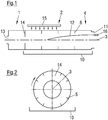
- In der beigefügten Zeichnung zeigt:
-
Figur 1 : einen schematischen Längsschnitt durch eine erfindungsgemäße Trommel; -
Figur 2 : einen Querschnitt durch die Sortierzone 2 der Trommel und -
Figur 3 : eine Innenansicht der Trockenzone 4. - Die zylindrische Trommel ist normalerweise außen auf Rollen gelagert und wird über einen Antrieb in Rotation versetzt, wobei die Rotationsachse 3 geringfügig geneigt zur Waagerechten verläuft. Diese geringe Neigung unterstützt den Transport in Richtung Auslass 11.
- Zur Auflösung des Altpapiers besitzt die Trommel gemäß
Figur 1 an die linke Stirnseite angrenzend eine Auflösezone 1 mit einem Einlass 13. In der Auflösezone 1 wird das Altpapier intensiv mit Wasser vermischt, wobei es infolge der Hebe-, Rutsch- und Fallbewegungen zu einer Zerkleinerung des aufgeweichten Papiermaterials kommt. - Die Zuführung des Faserstoffs erfolgt meist über einen feststehenden Einlauf-Trichter. Dabei wird der zur Rotationsache 3 geneigte Einlauf-Trichter in der Mitte der Stirnseite in die Trommel geführt.
- Um die Bewegung des Altpapiers sowie der dabei entstehenden Faserstoffsuspension zu unterstützen, besitzt die Trommel entsprechend
Figur 2 auf der Innenseite Hebeleisten 5 o.ä. Einbauten. Solche Einbauten sind in vielfältiger Form bekannt und werden auf den jeweiligen Verwendungszweck abgestimmt. - Die bei dieser Auflösung entstehende Faserstoffsuspension hat eine Stoffdichte von ca. 18% und ist somit für eine Lochsortierung nicht geeignet.
- Daher wird diese Faserstoffsuspension in einer sich stirnseitig an die Auflösezone 1 anschließenden Sortierzone 2 mit Wasser verdünnt.
- Die Abgrenzung beider Zonen 1,2 erfolgt meist über einen radial außen verlaufenden Begrenzungsring 14 in Form eines ringförmigen Bleches, welcher eine Stauwirkung hat und einen Sumpf bildet.
- Im Unterschied zur Auflösezone 1 hat die Trommel im Bereich der Sortierzone 2 eine Perforation, durch die die Feinfraktion nach außen gelangen kann.
- Die meist größeren Störstoffe werden von dieser Perforation abgewiesen und in Form einer Grobfraktion bzw. des Rejekts über den Auslass 11 an der Stirnseite der Trommel abgeführt.
- Unterhalb der Sortierzone 2 befindet sich ein Auffangbehälter 10 zur Aufnahme der Feinfraktion. Oberhalb der Sortierzone 2 ist eine Sprüheinrichtung 15 angeordnet, welche Wasser auf die Perforation richtet. Dies reinigt die Perforation und führt außerdem zu einer weiteren Verdünnung der Faserstoffsuspension innerhalb der Sortierzone 2.
- Allerdings gelangt hierbei nur etwa 50 bis 60% des aufgesprühten Wassers in die Sortierzone 2. Der andere Teil des Wassers läuft außen an der Trommel entlang in den Auffangbehälter 10.
- Um die Sortierzone 2 möglichst umfassend nutzen zu können, wird die Faserstoffsuspension zusätzlich mit Wasser verdünnt, so dass die Feinfraktion problemlos die Perforation passieren kann.
- Im Interesse einer einfachen Konstruktion erfolgt die Zuführung des Verdünnungswassers über einen Verdünnungswasserstrahl 12, der über eine Düse 16 am Auslass 11 durch die Trockenzone 4 in die Sortierzone 2 gerichtet ist.
- Damit der Verdünnungswasserstrahl 12 die Grobfraktion innerhalb der Trockenzone 4 problemlos passieren kann, läuft der Verdünnungswasserstrahl 12, wie in
Figur 2 zu sehen, möglichst am fallenden Rejekt vorbei. - Für eine ausreichende Durchmischung besitzt auch die Sortierzone 2 an der Innenseite Hebeleisten 5 o.ä.
- An die Sortierzone 2 schließt sich stirnseitig gegenüber der Auflösezone 1 eine Trockenzone 4 zur Trocknung der Grobfraktion an.
- Durch die Erhöhung des Trockengehaltes der Grobfraktion verringert sich nicht nur deren Gewicht sondern ebenso die Rutschneigung auf glatten Oberflächen, wie einem Förderband.
- Zur Abgrenzung der Zonen ist auch zwischen der Sortierzone 2 und der Trockenzone 4 ein Begrenzungsring 6 angeordnet.
- Wie in
Figur 3 zu erkennen, besitzt dieser Begrenzungsring 6 auf der, der Trockenzone 4 zugewandten Seite Schöpfleisten 7 zur Rückführung von Wasser aus der Trockenzone 4 über den Begrenzungsring 6 hinweg in die Sortierzone 2. Ergänzend kann dieser Begrenzungsring 6 auch Durchbrüche 8 aufweisen. - Um das Wasser innerhalb der Trockenzone 4 zur Sortierzone 2 hin zu fördern, sind an der Innenwand der Trommel Förderelemente 9 hier als spiralförmige Leiste angebracht.
- Zusätzliche Förderleisten 17 an der Innenwand unterstützen den Transport der Grobfraktion in Richtung Auslass 11 an der Stirnseite der Trommel bzw. der freien Stirnseite der Trockenzone 4.
Claims (8)
- Rotierende Trommel zur Behandlung von Faserstoff, deren Rotationsachse (3) höchstens 30° zur Horizontalen geneigt ist, mit einer Sortierzone (2), in die mit Wasser vermischter Faserstoff zugeführt wird und in der die Trommel perforiert ist, wobei eine Feinfraktion die Perforation durchströmt und eine Grobfraktion von dieser abgewiesen wird, wobei sich an eine Stirnseite der Sortierzone (2) eine Trockenzone (4) zur Trocknung der Grobfraktion anschließt, dadurch gekennzeichnet, dass in der Trockenzone (4) an der Innenwand der Trommel Förderelemente (9) angeordnet sind, welche Wasser in Richtung Sortierzone (2) transportieren und/oder zwischen der Sortierzone (2) und der Trockenzone (4) ein Begrenzungsring (6,14) angeordnet ist, an dem Schöpfleisten (7) zur Rückführung von Wasser aus der Trockenzone (4) in die Sortierzone (2) angeordnet sind.
- Rotierende Trommel nach Anspruch 1, dadurch gekennzeichnet, dass sich an der, der Trockenzone (4) gegenüberliegenden Stirnseite der Sortierzone (2) eine Auflösezone (1) anschließt, in die der Faserstoff zugegeben und in der dieser zur Bildung einer Faserstoffsuspension mit Wasser vermischt wird.
- Rotierende Trommel nach Anspruch 2, dadurch gekennzeichnet, dass die Trommel in der Auflöse- (1) und/oder Sortierzone (2) an ihrer Innenwand eine oder mehrere Hebeleisten (5) besitzt.
- Rotierende Trommel nach einem der vorhergehenden Ansprüche, dadurch gekennzeichnet, dass der zwischen Sortier- (2) und Trockenzone (4) vorhandene Begrenzungsring (6) Durchbrüche (8) aufweist.
- Rotierende Trommel nach einem der vorhergehenden Ansprüche, dadurch gekennzeichnet, dass Wasser im Bereich der Sortierzone (2) von außen und/oder von oben auf die Trommel gesprüht wird.
- Rotierende Trommel nach einem der vorhergehenden Ansprüche, dadurch gekennzeichnet, dass unterhalb der Sortierzone (2) ein Auffangbehälter (10) zur Aufnahme der Feinfraktion angeordnet ist.
- Rotierende Trommel nach einem der vorhergehenden Ansprüche, dadurch gekennzeichnet, dass die freie Stirnseite der Trockenzone (4) einen Auslass (11) für die Grobfraktion besitzt.
- Rotierende Trommel nach Anspruch 7, dadurch gekennzeichnet, dass ein Verdünnungswasserstrahl (12) über den Auslass (11) eingeführt wird.
Applications Claiming Priority (2)
| Application Number | Priority Date | Filing Date | Title |
|---|---|---|---|
| DE102016202978.9A DE102016202978A1 (de) | 2016-02-25 | 2016-02-25 | Rotierende Trommel |
| PCT/EP2017/053394 WO2017144322A1 (de) | 2016-02-25 | 2017-02-15 | Rotierende trommel zur behandlung von faserstoff |
Publications (2)
| Publication Number | Publication Date |
|---|---|
| EP3420131A1 EP3420131A1 (de) | 2019-01-02 |
| EP3420131B1 true EP3420131B1 (de) | 2019-09-11 |
Family
ID=58044089
Family Applications (1)
| Application Number | Title | Priority Date | Filing Date |
|---|---|---|---|
| EP17705139.8A Active EP3420131B1 (de) | 2016-02-25 | 2017-02-15 | Rotierende trommel zur behandlung von faserstoff |
Country Status (4)
| Country | Link |
|---|---|
| EP (1) | EP3420131B1 (de) |
| CN (1) | CN108603336B (de) |
| DE (1) | DE102016202978A1 (de) |
| WO (1) | WO2017144322A1 (de) |
Families Citing this family (1)
| Publication number | Priority date | Publication date | Assignee | Title |
|---|---|---|---|---|
| CN108442157B (zh) * | 2018-03-21 | 2021-09-14 | 安德里茨(中国)有限公司 | 转鼓碎浆机及其加水方法 |
Family Cites Families (5)
| Publication number | Priority date | Publication date | Assignee | Title |
|---|---|---|---|---|
| US1897156A (en) * | 1931-09-26 | 1933-02-14 | Harold D Wells | Pulp and dirt separator |
| GB1134611A (en) * | 1967-01-28 | 1968-11-27 | Australian Paper Manufacturers | Process and apparatus for cleaning and disintegrating fibrous materials |
| CN101215793A (zh) * | 2007-12-30 | 2008-07-09 | 李风宁 | 滚筒筛选碎浆机 |
| DE202012013187U1 (de) * | 2012-10-29 | 2015-04-29 | Voith Patent Gmbh | Rotierende Trommel |
| DE102015204460A1 (de) * | 2015-03-12 | 2016-09-15 | Voith Patent Gmbh | Altpapierauflösung |
-
2016
- 2016-02-25 DE DE102016202978.9A patent/DE102016202978A1/de not_active Withdrawn
-
2017
- 2017-02-15 WO PCT/EP2017/053394 patent/WO2017144322A1/de not_active Ceased
- 2017-02-15 CN CN201780009252.2A patent/CN108603336B/zh active Active
- 2017-02-15 EP EP17705139.8A patent/EP3420131B1/de active Active
Non-Patent Citations (1)
| Title |
|---|
| None * |
Also Published As
| Publication number | Publication date |
|---|---|
| EP3420131A1 (de) | 2019-01-02 |
| CN108603336B (zh) | 2020-01-03 |
| CN108603336A (zh) | 2018-09-28 |
| DE102016202978A1 (de) | 2017-08-31 |
| WO2017144322A1 (de) | 2017-08-31 |
Similar Documents
| Publication | Publication Date | Title |
|---|---|---|
| DE202012013187U1 (de) | Rotierende Trommel | |
| EP0898012A1 (de) | Verfahren und Vorrichtung zum Auflösen von Faserstoffen | |
| DE2753413A1 (de) | Vorrichtung zum aufbereiten einer fluessigkeitssuspension | |
| EP3268533B1 (de) | Altpapierauflösung | |
| WO2017144322A1 (de) | Rotierende trommel zur behandlung von faserstoff | |
| EP1170417A1 (de) | Verfahren zum Auflösen und Reinigen von störstoffhaltigem Altpapier | |
| AT516780A2 (de) | Vorrichtung zum Vorheizen eines zu dispergierenden Recycling-Faserstoffes | |
| DE2751084C2 (de) | Verfahren und Vorrichtung zum Aufbereiten von Altpapier | |
| DE3210385C2 (de) | Sortiertrommel | |
| EP3529414B1 (de) | Rotierende trommel zur behandlung von faserstoff | |
| AT16529U1 (de) | Rotierende Trommel | |
| DE3001448A1 (de) | Drucksortierer | |
| EP3347521B1 (de) | Rotierende trommel | |
| DE102016123419B4 (de) | Rotierende Trommel | |
| DE3221932A1 (de) | Anlage zur altpapieraufbereitung | |
| DE19841067C1 (de) | Vorrichtung zur Naßtrennung und -reinigung organischer und mineralischer Bestandteile aus Stoffgemischen | |
| CH556196A (de) | Fraktionieranlage fuer im luftstrom getragenes mahlgut. | |
| DE102015202310B3 (de) | Altpapierauflösung | |
| DE102015204455A1 (de) | Altpapierauflösung | |
| EP1130156A2 (de) | Vorrichtung zum Abtrennen von Störstoffen aus faserhaltigem Gut | |
| AT394062B (de) | Vorrichtung zur behandlung von feststoffaufschlaemmungen | |
| AT15869U1 (de) | Auflöse- und Sortiereinheit | |
| DE202016008448U1 (de) | Auflöse- und Sortiereinheit | |
| DE202017006921U1 (de) | Rotierende Trommel | |
| DE102023101252A1 (de) | Vorrichtung und Verfahren zur Entleerung eines liegenden Stofflösers |
Legal Events
| Date | Code | Title | Description |
|---|---|---|---|
| STAA | Information on the status of an ep patent application or granted ep patent |
Free format text: STATUS: UNKNOWN |
|
| STAA | Information on the status of an ep patent application or granted ep patent |
Free format text: STATUS: THE INTERNATIONAL PUBLICATION HAS BEEN MADE |
|
| PUAI | Public reference made under article 153(3) epc to a published international application that has entered the european phase |
Free format text: ORIGINAL CODE: 0009012 |
|
| STAA | Information on the status of an ep patent application or granted ep patent |
Free format text: STATUS: REQUEST FOR EXAMINATION WAS MADE |
|
| 17P | Request for examination filed |
Effective date: 20180925 |
|
| AK | Designated contracting states |
Kind code of ref document: A1 Designated state(s): AL AT BE BG CH CY CZ DE DK EE ES FI FR GB GR HR HU IE IS IT LI LT LU LV MC MK MT NL NO PL PT RO RS SE SI SK SM TR |
|
| AX | Request for extension of the european patent |
Extension state: BA ME |
|
| DAV | Request for validation of the european patent (deleted) | ||
| DAX | Request for extension of the european patent (deleted) | ||
| GRAP | Despatch of communication of intention to grant a patent |
Free format text: ORIGINAL CODE: EPIDOSNIGR1 |
|
| STAA | Information on the status of an ep patent application or granted ep patent |
Free format text: STATUS: GRANT OF PATENT IS INTENDED |
|
| INTG | Intention to grant announced |
Effective date: 20190619 |
|
| GRAS | Grant fee paid |
Free format text: ORIGINAL CODE: EPIDOSNIGR3 |
|
| GRAA | (expected) grant |
Free format text: ORIGINAL CODE: 0009210 |
|
| STAA | Information on the status of an ep patent application or granted ep patent |
Free format text: STATUS: THE PATENT HAS BEEN GRANTED |
|
| AK | Designated contracting states |
Kind code of ref document: B1 Designated state(s): AL AT BE BG CH CY CZ DE DK EE ES FI FR GB GR HR HU IE IS IT LI LT LU LV MC MK MT NL NO PL PT RO RS SE SI SK SM TR |
|
| REG | Reference to a national code |
Ref country code: GB Ref legal event code: FG4D Free format text: NOT ENGLISH |
|
| REG | Reference to a national code |
Ref country code: CH Ref legal event code: EP |
|
| REG | Reference to a national code |
Ref country code: AT Ref legal event code: REF Ref document number: 1178596 Country of ref document: AT Kind code of ref document: T Effective date: 20190915 |
|
| REG | Reference to a national code |
Ref country code: DE Ref legal event code: R096 Ref document number: 502017002287 Country of ref document: DE Ref country code: IE Ref legal event code: FG4D Free format text: LANGUAGE OF EP DOCUMENT: GERMAN |
|
| RAP2 | Party data changed (patent owner data changed or rights of a patent transferred) |
Owner name: VOITH PATENT GMBH |
|
| REG | Reference to a national code |
Ref country code: NL Ref legal event code: MP Effective date: 20190911 |
|
| REG | Reference to a national code |
Ref country code: LT Ref legal event code: MG4D |
|
| PG25 | Lapsed in a contracting state [announced via postgrant information from national office to epo] |
Ref country code: SE Free format text: LAPSE BECAUSE OF FAILURE TO SUBMIT A TRANSLATION OF THE DESCRIPTION OR TO PAY THE FEE WITHIN THE PRESCRIBED TIME-LIMIT Effective date: 20190911 Ref country code: HR Free format text: LAPSE BECAUSE OF FAILURE TO SUBMIT A TRANSLATION OF THE DESCRIPTION OR TO PAY THE FEE WITHIN THE PRESCRIBED TIME-LIMIT Effective date: 20190911 Ref country code: LT Free format text: LAPSE BECAUSE OF FAILURE TO SUBMIT A TRANSLATION OF THE DESCRIPTION OR TO PAY THE FEE WITHIN THE PRESCRIBED TIME-LIMIT Effective date: 20190911 Ref country code: NO Free format text: LAPSE BECAUSE OF FAILURE TO SUBMIT A TRANSLATION OF THE DESCRIPTION OR TO PAY THE FEE WITHIN THE PRESCRIBED TIME-LIMIT Effective date: 20191211 Ref country code: BG Free format text: LAPSE BECAUSE OF FAILURE TO SUBMIT A TRANSLATION OF THE DESCRIPTION OR TO PAY THE FEE WITHIN THE PRESCRIBED TIME-LIMIT Effective date: 20191211 |
|
| PG25 | Lapsed in a contracting state [announced via postgrant information from national office to epo] |
Ref country code: AL Free format text: LAPSE BECAUSE OF FAILURE TO SUBMIT A TRANSLATION OF THE DESCRIPTION OR TO PAY THE FEE WITHIN THE PRESCRIBED TIME-LIMIT Effective date: 20190911 Ref country code: ES Free format text: LAPSE BECAUSE OF FAILURE TO SUBMIT A TRANSLATION OF THE DESCRIPTION OR TO PAY THE FEE WITHIN THE PRESCRIBED TIME-LIMIT Effective date: 20190911 Ref country code: LV Free format text: LAPSE BECAUSE OF FAILURE TO SUBMIT A TRANSLATION OF THE DESCRIPTION OR TO PAY THE FEE WITHIN THE PRESCRIBED TIME-LIMIT Effective date: 20190911 Ref country code: RS Free format text: LAPSE BECAUSE OF FAILURE TO SUBMIT A TRANSLATION OF THE DESCRIPTION OR TO PAY THE FEE WITHIN THE PRESCRIBED TIME-LIMIT Effective date: 20190911 Ref country code: GR Free format text: LAPSE BECAUSE OF FAILURE TO SUBMIT A TRANSLATION OF THE DESCRIPTION OR TO PAY THE FEE WITHIN THE PRESCRIBED TIME-LIMIT Effective date: 20191212 |
|
| PG25 | Lapsed in a contracting state [announced via postgrant information from national office to epo] |
Ref country code: RO Free format text: LAPSE BECAUSE OF FAILURE TO SUBMIT A TRANSLATION OF THE DESCRIPTION OR TO PAY THE FEE WITHIN THE PRESCRIBED TIME-LIMIT Effective date: 20190911 Ref country code: IT Free format text: LAPSE BECAUSE OF FAILURE TO SUBMIT A TRANSLATION OF THE DESCRIPTION OR TO PAY THE FEE WITHIN THE PRESCRIBED TIME-LIMIT Effective date: 20190911 Ref country code: PL Free format text: LAPSE BECAUSE OF FAILURE TO SUBMIT A TRANSLATION OF THE DESCRIPTION OR TO PAY THE FEE WITHIN THE PRESCRIBED TIME-LIMIT Effective date: 20190911 Ref country code: NL Free format text: LAPSE BECAUSE OF FAILURE TO SUBMIT A TRANSLATION OF THE DESCRIPTION OR TO PAY THE FEE WITHIN THE PRESCRIBED TIME-LIMIT Effective date: 20190911 Ref country code: PT Free format text: LAPSE BECAUSE OF FAILURE TO SUBMIT A TRANSLATION OF THE DESCRIPTION OR TO PAY THE FEE WITHIN THE PRESCRIBED TIME-LIMIT Effective date: 20200113 Ref country code: EE Free format text: LAPSE BECAUSE OF FAILURE TO SUBMIT A TRANSLATION OF THE DESCRIPTION OR TO PAY THE FEE WITHIN THE PRESCRIBED TIME-LIMIT Effective date: 20190911 |
|
| PG25 | Lapsed in a contracting state [announced via postgrant information from national office to epo] |
Ref country code: CZ Free format text: LAPSE BECAUSE OF FAILURE TO SUBMIT A TRANSLATION OF THE DESCRIPTION OR TO PAY THE FEE WITHIN THE PRESCRIBED TIME-LIMIT Effective date: 20190911 Ref country code: IS Free format text: LAPSE BECAUSE OF FAILURE TO SUBMIT A TRANSLATION OF THE DESCRIPTION OR TO PAY THE FEE WITHIN THE PRESCRIBED TIME-LIMIT Effective date: 20200224 Ref country code: SK Free format text: LAPSE BECAUSE OF FAILURE TO SUBMIT A TRANSLATION OF THE DESCRIPTION OR TO PAY THE FEE WITHIN THE PRESCRIBED TIME-LIMIT Effective date: 20190911 Ref country code: SM Free format text: LAPSE BECAUSE OF FAILURE TO SUBMIT A TRANSLATION OF THE DESCRIPTION OR TO PAY THE FEE WITHIN THE PRESCRIBED TIME-LIMIT Effective date: 20190911 |
|
| REG | Reference to a national code |
Ref country code: DE Ref legal event code: R097 Ref document number: 502017002287 Country of ref document: DE |
|
| PLBE | No opposition filed within time limit |
Free format text: ORIGINAL CODE: 0009261 |
|
| STAA | Information on the status of an ep patent application or granted ep patent |
Free format text: STATUS: NO OPPOSITION FILED WITHIN TIME LIMIT |
|
| PG2D | Information on lapse in contracting state deleted |
Ref country code: IS |
|
| PG25 | Lapsed in a contracting state [announced via postgrant information from national office to epo] |
Ref country code: DK Free format text: LAPSE BECAUSE OF FAILURE TO SUBMIT A TRANSLATION OF THE DESCRIPTION OR TO PAY THE FEE WITHIN THE PRESCRIBED TIME-LIMIT Effective date: 20190911 Ref country code: IS Free format text: LAPSE BECAUSE OF FAILURE TO SUBMIT A TRANSLATION OF THE DESCRIPTION OR TO PAY THE FEE WITHIN THE PRESCRIBED TIME-LIMIT Effective date: 20200112 |
|
| 26N | No opposition filed |
Effective date: 20200615 |
|
| REG | Reference to a national code |
Ref country code: CH Ref legal event code: PL |
|
| REG | Reference to a national code |
Ref country code: BE Ref legal event code: MM Effective date: 20200229 |
|
| PG25 | Lapsed in a contracting state [announced via postgrant information from national office to epo] |
Ref country code: LU Free format text: LAPSE BECAUSE OF NON-PAYMENT OF DUE FEES Effective date: 20200215 Ref country code: MC Free format text: LAPSE BECAUSE OF FAILURE TO SUBMIT A TRANSLATION OF THE DESCRIPTION OR TO PAY THE FEE WITHIN THE PRESCRIBED TIME-LIMIT Effective date: 20190911 |
|
| PG25 | Lapsed in a contracting state [announced via postgrant information from national office to epo] |
Ref country code: LI Free format text: LAPSE BECAUSE OF NON-PAYMENT OF DUE FEES Effective date: 20200229 Ref country code: CH Free format text: LAPSE BECAUSE OF NON-PAYMENT OF DUE FEES Effective date: 20200229 |
|
| PG25 | Lapsed in a contracting state [announced via postgrant information from national office to epo] |
Ref country code: IE Free format text: LAPSE BECAUSE OF NON-PAYMENT OF DUE FEES Effective date: 20200215 |
|
| PG25 | Lapsed in a contracting state [announced via postgrant information from national office to epo] |
Ref country code: BE Free format text: LAPSE BECAUSE OF NON-PAYMENT OF DUE FEES Effective date: 20200229 |
|
| GBPC | Gb: european patent ceased through non-payment of renewal fee |
Effective date: 20210215 |
|
| PG25 | Lapsed in a contracting state [announced via postgrant information from national office to epo] |
Ref country code: GB Free format text: LAPSE BECAUSE OF NON-PAYMENT OF DUE FEES Effective date: 20210215 |
|
| PG25 | Lapsed in a contracting state [announced via postgrant information from national office to epo] |
Ref country code: TR Free format text: LAPSE BECAUSE OF FAILURE TO SUBMIT A TRANSLATION OF THE DESCRIPTION OR TO PAY THE FEE WITHIN THE PRESCRIBED TIME-LIMIT Effective date: 20190911 Ref country code: MT Free format text: LAPSE BECAUSE OF FAILURE TO SUBMIT A TRANSLATION OF THE DESCRIPTION OR TO PAY THE FEE WITHIN THE PRESCRIBED TIME-LIMIT Effective date: 20190911 Ref country code: CY Free format text: LAPSE BECAUSE OF FAILURE TO SUBMIT A TRANSLATION OF THE DESCRIPTION OR TO PAY THE FEE WITHIN THE PRESCRIBED TIME-LIMIT Effective date: 20190911 |
|
| PG25 | Lapsed in a contracting state [announced via postgrant information from national office to epo] |
Ref country code: MK Free format text: LAPSE BECAUSE OF FAILURE TO SUBMIT A TRANSLATION OF THE DESCRIPTION OR TO PAY THE FEE WITHIN THE PRESCRIBED TIME-LIMIT Effective date: 20190911 |
|
| P01 | Opt-out of the competence of the unified patent court (upc) registered |
Effective date: 20230613 |
|
| PG25 | Lapsed in a contracting state [announced via postgrant information from national office to epo] |
Ref country code: SI Free format text: LAPSE BECAUSE OF FAILURE TO SUBMIT A TRANSLATION OF THE DESCRIPTION OR TO PAY THE FEE WITHIN THE PRESCRIBED TIME-LIMIT Effective date: 20190911 |
|
| PGFP | Annual fee paid to national office [announced via postgrant information from national office to epo] |
Ref country code: FR Payment date: 20240221 Year of fee payment: 8 |
|
| PGFP | Annual fee paid to national office [announced via postgrant information from national office to epo] |
Ref country code: DE Payment date: 20250218 Year of fee payment: 9 |
|
| PGFP | Annual fee paid to national office [announced via postgrant information from national office to epo] |
Ref country code: FI Payment date: 20250220 Year of fee payment: 9 |
|
| PGFP | Annual fee paid to national office [announced via postgrant information from national office to epo] |
Ref country code: AT Payment date: 20250219 Year of fee payment: 9 |
|
| PG25 | Lapsed in a contracting state [announced via postgrant information from national office to epo] |
Ref country code: FR Free format text: LAPSE BECAUSE OF NON-PAYMENT OF DUE FEES Effective date: 20250228 |