EP3414765B1 - Vorrichtung und verfahren zur unterwasserreparatur eines lochs eines kernreaktorteils - Google Patents
Vorrichtung und verfahren zur unterwasserreparatur eines lochs eines kernreaktorteils Download PDFInfo
- Publication number
- EP3414765B1 EP3414765B1 EP17704758.6A EP17704758A EP3414765B1 EP 3414765 B1 EP3414765 B1 EP 3414765B1 EP 17704758 A EP17704758 A EP 17704758A EP 3414765 B1 EP3414765 B1 EP 3414765B1
- Authority
- EP
- European Patent Office
- Prior art keywords
- hole
- cutting tool
- cutting
- holder
- repair device
- Prior art date
- Legal status (The legal status is an assumption and is not a legal conclusion. Google has not performed a legal analysis and makes no representation as to the accuracy of the status listed.)
- Active
Links
Images


Classifications
-
- B—PERFORMING OPERATIONS; TRANSPORTING
- B23—MACHINE TOOLS; METAL-WORKING NOT OTHERWISE PROVIDED FOR
- B23D—PLANING; SLOTTING; SHEARING; BROACHING; SAWING; FILING; SCRAPING; LIKE OPERATIONS FOR WORKING METAL BY REMOVING MATERIAL, NOT OTHERWISE PROVIDED FOR
- B23D75/00—Reaming machines or reaming devices
-
- B—PERFORMING OPERATIONS; TRANSPORTING
- B23—MACHINE TOOLS; METAL-WORKING NOT OTHERWISE PROVIDED FOR
- B23D—PLANING; SLOTTING; SHEARING; BROACHING; SAWING; FILING; SCRAPING; LIKE OPERATIONS FOR WORKING METAL BY REMOVING MATERIAL, NOT OTHERWISE PROVIDED FOR
- B23D77/00—Reaming tools
- B23D77/14—Reamers for special use, e.g. for working cylinder ridges
-
- G—PHYSICS
- G21—NUCLEAR PHYSICS; NUCLEAR ENGINEERING
- G21C—NUCLEAR REACTORS
- G21C3/00—Reactor fuel elements and their assemblies; Selection of substances for use as reactor fuel elements
- G21C3/30—Assemblies of a number of fuel elements in the form of a rigid unit
- G21C3/32—Bundles of parallel pin-, rod-, or tube-shaped fuel elements
- G21C3/334—Assembling, maintenance or repair of the bundles
-
- B—PERFORMING OPERATIONS; TRANSPORTING
- B23—MACHINE TOOLS; METAL-WORKING NOT OTHERWISE PROVIDED FOR
- B23D—PLANING; SLOTTING; SHEARING; BROACHING; SAWING; FILING; SCRAPING; LIKE OPERATIONS FOR WORKING METAL BY REMOVING MATERIAL, NOT OTHERWISE PROVIDED FOR
- B23D2277/00—Reaming tools
- B23D2277/28—Chip collectors
-
- G—PHYSICS
- G21—NUCLEAR PHYSICS; NUCLEAR ENGINEERING
- G21C—NUCLEAR REACTORS
- G21C19/00—Arrangements for treating, for handling, or for facilitating the handling of, fuel or other materials which are used within the reactor, e.g. within its pressure vessel
- G21C19/02—Details of handling arrangements
-
- G—PHYSICS
- G21—NUCLEAR PHYSICS; NUCLEAR ENGINEERING
- G21C—NUCLEAR REACTORS
- G21C3/00—Reactor fuel elements and their assemblies; Selection of substances for use as reactor fuel elements
- G21C3/30—Assemblies of a number of fuel elements in the form of a rigid unit
- G21C3/32—Bundles of parallel pin-, rod-, or tube-shaped fuel elements
- G21C3/33—Supporting or hanging of elements in the bundle; Means forming part of the bundle for inserting it into, or removing it from, the core; Means for coupling adjacent bundles
- G21C3/3315—Upper nozzle
-
- G—PHYSICS
- G21—NUCLEAR PHYSICS; NUCLEAR ENGINEERING
- G21C—NUCLEAR REACTORS
- G21C5/00—Moderator or core structure; Selection of materials for use as moderator
- G21C5/02—Details
- G21C5/06—Means for locating or supporting fuel elements
-
- Y—GENERAL TAGGING OF NEW TECHNOLOGICAL DEVELOPMENTS; GENERAL TAGGING OF CROSS-SECTIONAL TECHNOLOGIES SPANNING OVER SEVERAL SECTIONS OF THE IPC; TECHNICAL SUBJECTS COVERED BY FORMER USPC CROSS-REFERENCE ART COLLECTIONS [XRACs] AND DIGESTS
- Y02—TECHNOLOGIES OR APPLICATIONS FOR MITIGATION OR ADAPTATION AGAINST CLIMATE CHANGE
- Y02E—REDUCTION OF GREENHOUSE GAS [GHG] EMISSIONS, RELATED TO ENERGY GENERATION, TRANSMISSION OR DISTRIBUTION
- Y02E30/00—Energy generation of nuclear origin
- Y02E30/30—Nuclear fission reactors
-
- Y—GENERAL TAGGING OF NEW TECHNOLOGICAL DEVELOPMENTS; GENERAL TAGGING OF CROSS-SECTIONAL TECHNOLOGIES SPANNING OVER SEVERAL SECTIONS OF THE IPC; TECHNICAL SUBJECTS COVERED BY FORMER USPC CROSS-REFERENCE ART COLLECTIONS [XRACs] AND DIGESTS
- Y10—TECHNICAL SUBJECTS COVERED BY FORMER USPC
- Y10T—TECHNICAL SUBJECTS COVERED BY FORMER US CLASSIFICATION
- Y10T408/00—Cutting by use of rotating axially moving tool
- Y10T408/50—Cutting by use of rotating axially moving tool with product handling or receiving means
Definitions
- the present invention relates to the field of underwater repair of a hole in a nuclear reactor part, in particular an upper end piece of a nuclear fuel assembly.
- a nuclear reactor comprises a reactor core formed of a plurality of nuclear fuel assemblies, arranged side by side between a lower core plate and an upper core plate.
- Each nuclear fuel assembly includes a bundle of nuclear fuel rods extending between a lower end cap, through which the nuclear fuel assembly rests on the lower core plate, and an upper end cap, through which the nuclear fuel assembly bears against the upper core plate.
- centering holes may be provided on the upper face of the upper nozzle and/or on the lower face of the lower nozzle of each nuclear fuel assembly.
- Each centering hole generally includes a cylindrical hole, blind or through, and a chamfer at the entrance to the centering hole.
- centering holes ensure the correct positioning of the upper part, respectively the lower part, of the nuclear fuel assemblies in the core of the reactor, in particular to ensure the passage of the coolant between the nuclear fuel assemblies, and the fall of the clusters allowing the reactivity of the reactor core to be controlled.
- centering holes also ensure the positioning and docking of equipment for handling nuclear fuel assemblies and clusters (nuclear fuel assembly loading machine for example) as well as equipment for working on nuclear fuel assemblies (replacement of a nuclear fuel rod for example).
- This damage may subsequently lead to the jamming of a centering pin in the centering hole.
- Such jamming occurring for example between a damaged centering hole and a pin of the upper core plate could lead to extraction of the nuclear fuel assembly from the core with the upper core plate when opening the reactor vessel for intervention on the core.
- Replacing a nozzle is a relatively lengthy procedure and can lead to damage to other parts of the assembly, such as the guide tubes extending between the upper nozzle and the lower nozzle and designed to receive rods from a control cluster or a fixed cluster in nuclear fuel assemblies for pressurized water reactors (or PWRs) or the connections between the guide tubes and the nozzle.
- a nozzle is a bulky and highly radioactive part requiring, when removed, specific storage and a suitable disposal method outside the normal cycle of treatment of irradiated nuclear fuel assemblies.
- JPH0366809A discloses a drilling device comprising a cutting tool having a suction channel extending within the cutting tool, a drive shaft for rotating the cutting tool, and a suction cannula.
- JP2013129031A discloses a machining device for machining a hole in a storage frame of nuclear fuel assemblies in a spent fuel pool, the machining device comprising a suction device.
- One of the aims of the invention is to propose a repair device allowing a simpler, more reliable and more economical repair, and presenting fewer risks.
- the invention provides a repair device according to claim 1.
- the invention also relates to a repair method according to claim 15.
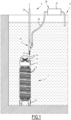
- a damaged nuclear fuel assembly 2 is placed under water in a pool 4 of a nuclear power plant for repair using a repair system 6.
- the nuclear fuel assembly 2 comprises a bundle of elongated nuclear fuel rods 8 extending between a lower end piece 10, intended to rest on a lower core plate of the reactor of the nuclear power plant, and an upper end piece 12, intended to bear against an upper core plate of the reactor of the nuclear power plant.
- the nuclear fuel assembly 2 is vertical, with the lower nozzle 10 located at the bottom and the upper nozzle 12 at the top.
- the upper end piece 12 comprises springs 14 provided to bear against the upper core plate so as to push the nuclear fuel assembly 2 downwards.
- the upper end piece 12 is provided with centering holes 16, each centering hole 16 being intended to receive a respective centering pin of the upper core plate in order to ensure precise absolute positioning of the upper end of the nuclear fuel assembly 2.
- the upper end piece 12 here has a square outline and comprises two centering holes 16 arranged in two diagonally opposite corners of the upper end piece 12. In another corner, the upper end piece 12 further comprises a keying hole 18 making it possible to ensure that the nuclear fuel assembly 2 is correctly oriented.
- the centering holes 16 are also used for docking equipment for handling the nuclear fuel assembly 2 or intervention equipment for carrying out interventions on the nuclear fuel assembly 2, for example the replacement of a nuclear fuel rod 8.
- the lower end piece 10 also includes centering holes (not shown) in two diagonally opposite corners, each of these centering holes being intended to facilitate the docking of the nuclear fuel assembly 2 on the lower core plate and to receive a respective centering pin of the lower core plate in order to ensure precise absolute positioning of the lower end of the nuclear fuel assembly 2.
- centering holes are also used for the docking of intervention equipment for carrying out interventions on the nuclear fuel assembly 2, for example for interventions requiring the prior turning of the nuclear fuel assembly 2.
- a centering hole 16 generally comprises an entry chamfer 16A and a circular, blind or through cylindrical hole 16B extending from the entry chamfer 16A.
- a damaged centering hole 16 may have material pushed out that forms a protrusion within the centering hole 16 and that may cause a centering pin to subsequently become stuck in the damaged centering hole 16.
- the repair system 6 comprises a repair device 20 adapted to repair underwater a damaged centering hole 16 of a nuclear fuel assembly 2, by machining the centering hole 16, more specifically by reboring the centering hole 16.
- the repair device 20 comprises a cutting tool for machining the internal surface of the damaged centering hole 16, more specifically a cutting tool 22 for reaming the centering hole 16.
- the repair device 20 is suitable for being submerged and can be operated remotely, for example using a handling pole 24.
- the repair system 6 further comprises a suction system 26 comprising a suction pipe 28 for sucking up the chips resulting from the machining and a suction and filtration device 30 for sucking up the chips and water, filtering the water to recover the chips, and discharging the filtrate into the pool 4.
- a suction system 26 comprising a suction pipe 28 for sucking up the chips resulting from the machining and a suction and filtration device 30 for sucking up the chips and water, filtering the water to recover the chips, and discharging the filtrate into the pool 4.
- the repair device 20 is arranged at one end of a handling pole 24 and submerged under water, the suction pipe 28 having one end connected to the repair device 20 and the other end connected to the suction and filtration device 30, for the suction of chips.
- the repair device 20 comprises a support 32, a cutting tool 22 connected to a drive shaft 34 carried by the support 32, the drive shaft 34 extending inside the support 32 to drive the cutting tool 22 in rotation, and a suction cannula 36 for sucking up chips generated by the cutting tool 22.
- the cutting tool 22 extends along a longitudinal axis L about which the cutting tool 22 is driven in rotation during machining.
- the cutting tool 22 has successively along the longitudinal axis L, a cutting part 40 for cutting material due to the rotational drive of the cutting tool 22, and a drive part 42 for the rotational drive of the cutting tool 22.
- the cutting tool 22 has a suction channel 44 extending inside the cutting tool 22 along the longitudinal axis L.
- the suction channel 44 has an inlet opening 46 provided in the cutting portion 40 and an outlet opening 48 provided in the drive portion 42.
- the outlet opening 48 opens into the interior of the support 32.
- the suction cannula 36 is connected to the support 32 so as to be in fluid communication with the outlet opening 48 of the suction channel 44.
- the drive portion 42 of the cutting tool 22 and the drive shaft 34 are configured to be rotationally connected about the longitudinal axis L.
- the drive shaft 34 here comprises a tubular lower part 50 provided with an axial recess 52 opening at the lower end of the drive shaft 34, and the drive part 42 is arranged at the lower end of the drive shaft 34 by being inserted into the axial recess 52.
- the drive portion 42 and the internal surface of the axial recess 52 have complementary reliefs allowing their connection in rotation around the longitudinal axis L.
- the drive portion 42 and the internal surface of the axial recess 52 here have complementary facets.
- the tubular lower portion 50 of the drive shaft 34 is provided with at least one lateral opening 54 to allow the passage of water between the interior of the axial recess 52 and the exterior of the drive shaft 34.
- the tubular lower part 50 of the drive shaft 34 here comprises several lateral openings 54.
- the lateral openings 54 are preferably distributed angularly uniformly over the circumference of the drive shaft 34.
- the axial recess 52 of the drive shaft 34 is blind. It is closed at its end opposite the lower end of the drive shaft 34, above the lateral opening 54 or the lateral openings 54.
- the support 32 comprises a suction chamber 56 crossed by the drive shaft 34, the lateral openings 54 of the drive shaft 34 opening into the suction chamber 56.
- the suction cannula 36 is connected to the support 32 at right angles to the suction chamber 56, so as to suck up the water loaded with chips coming from the suction channel 44 of the cutting tool 22 through the lateral openings 54.
- the support 32 and the drive shaft 34 have at least one rotational guide assembly 58 comprising a bearing 60 formed on the support 32 and a complementary transmission shaft 62 formed on the drive shaft 34, for the rotational guidance of the drive shaft 34 relative to the support 32.
- the support 32 and the drive shaft 34 here have two rotation guide assemblies 58 located on either side of the suction chamber 56.
- Each rotation guide assembly 58 provides sealing between the support 32 and the drive shaft 34. This ensures effective suction, by the suction cannula 36, of water and chips coming from the suction channel 44 via the suction chamber 56.
- the repair device 20 comprises at least one seal 63, for example an O-ring, arranged between a bearing 60 and the transmission shaft 62 to increase the sealing.
- the support 32 is provided with a connector 64 for connecting the support 32 to a manipulator, here a handling pole 24.
- the connector 64 here has a thread for screwing it to the handling pole 24.
- the end 34A of the drive shaft 34, opposite the cutting tool 22, is configured to be rotationally connected to another drive shaft.
- the driving is carried out manually by an operator or using a motor.
- the support 32 is here a support tube, the cutting tool 22 being arranged at one end of the support tube, and the drive shaft 34 extending inside the support tube, between the ends of the latter.
- the support 32 is thus of a shape similar to that of a handling pole 24 used in the pools of nuclear installations.
- the support 32 has a first end tubular section 32A, an intermediate tubular section 32B and a second end tubular section 32C.
- the intermediate tubular section 32B delimits the suction chamber 56.
- a guide assembly rotating 58 is located in the first end tubular section 32A and the other in the second end tubular section 32C.
- the suction cannula 36 is connected to the intermediate tubular section 32B.
- first end tubular section 32A, the intermediate tubular section 32B and the second end tubular section 32C are distinct and assembled end to end to form the support 32.
- the first end tubular section 32A is in the form of a sleeve fixed to the lower end of the intermediate tubular section 32B.
- the first lower tubular section 32A is for example fitted and force-fitted to one end of the intermediate tubular section 32B.
- the lower tubular section 32A and the intermediate tubular section 32B are made from a single piece of material.
- the suction cannula 36 is formed as a single piece of material with the intermediate tubular section 32B.
- the intermediate tubular section 32B and the suction cannula 36 are formed by a three-way tubular junction.
- the suction cannula 36 is separate from the intermediate tubular section 32B and assembled thereto, for example by welding.
- the repair device 20 has a stop surface 65 provided to come into contact with the part in which the hole to be reamed is formed, so as to limit the travel of the cutting tool 22 along the longitudinal axis L of the cutting tool 22.
- the stop surface 65 is here an annular radial surface surrounding the cutting tool 22 when the latter is mounted on the support 32.
- the repair device 20 here has a stop ring 66 mounted at the lower end of the support 32 and surrounding the cutting tool 22.
- the stop ring 66 is screwed onto a thread provided on the external surface of the lower end of the support 32.
- the stop surface 65 is the lower face of the stop ring 66.
- the cutting tool 22 is a reamer, that is to say a cutting tool adapted to ream a pre-existing hole.
- the cutting portion 40 of the reamer has at least one cutting tooth 70.
- the cutting portion 40 here has exactly one cutting tooth 70.
- the cutting portion 40 has several cutting teeth, preferably distributed uniformly over the circumference of the cutting portion 40. If several cutting teeth 70 are provided, preferably the cutting teeth 70 are of identical shape and each cutting tooth 70 is obtained by rotating another cutting tooth 70 about the longitudinal axis L.
- the cutting tooth 70 has a cutting edge 72.
- the cutting edge 72 is located at the junction between a cutting face 74 and a clearance face 76.
- the cutting face 74 is oriented towards the rear of the cutting edge 72 during rotation in the cutting direction of the cutting tool 22, while the flank face 76 is oriented towards the front of the cutting edge 72.
- the cutting edge 72 When viewed in a radial direction relative to the longitudinal axis L of the cutting tool 22, the cutting edge 72 is rectilinear. In other words, the cutting edge 72 is contained in a radial plane containing the longitudinal axis L of the reamer.
- the cutting tool 22 is configured to bore in a single operation the centering hole 16, i.e. the circular cylindrical hole 16B and the chamfer 16A provided at the entrance to the centering hole 16.
- the cutting edge 72 successively has an oblique portion to allow a progressive cutting attack, a rectilinear portion 72C parallel to the longitudinal axis L, an oblique portion 72A deviating from the longitudinal axis L, to bore the circular cylindrical hole 16B, a rectilinear portion 72D parallel to the longitudinal axis L, and an oblique portion 72B deviating from the longitudinal axis L, to machine the chamfer 16A provided at the entrance of the centering hole 16.
- the cutting portion 40 has a diameter progressively increasing from its free end, opposite the drive portion 42, towards the drive portion 42.
- the cutting part 40 has successively along the longitudinal axis L, from its free end towards the drive part 42, a guide end 80, a truncated guide section 82, a cutting truncated section 83, a cylindrical section, a cutting truncated section 84, a cylindrical section and a cutting truncated section 86.
- the guide tip 80 preferably has a conical or ogival shape.
- the guide tip 80 and the truncated guide section 82 allow the cutting tool 22 to be guided during its insertion into the centering hole 16 that is to be reamed.
- the cutting truncated section 83 allows a progressive cutting attack on the centering hole 16.
- the cutting truncated section 84 and the cutting truncated section 86 allow the cylindrical hole 16B and the chamfer 16A to be machined respectively.
- the cutting edge 72 extends along the cutting frustoconical section 83, the cylindrical section arranged after it, the cutting frustoconical section 84, the cylindrical section arranged after it and the cutting frustoconical section 86. More specifically, the oblique portion 72A extends over the cutting frustoconical section 84 and the oblique portion 72B extends over the cutting frustoconical section 86. The cutting edge 72 here also extends along a portion of the guiding frustoconical section 82.
- the cutting portion 40 has, on its cutting truncated section 84, at least one flat 88.
- the presence of at least one flat 88 makes it possible to reduce the contact surface between the cutting portion and the internal surface of the hole to be remachined, and thus to reduce the friction between the cutting tool 22 and the internal surface of the hole to be remachined.
- the cutting portion 40 comprises a plurality of flats 88 distributed around the circumference of the cutting frustoconical section 84.
- the cutting tooth 70 and the flats 88 are uniformly distributed around the circumference of the cutting frustoconical section 84.
- the cutting tooth 70 replaces a flat 88.
- the cutting edge 72 penetrates the material and chips are formed on the side of the clearance face 76.
- the inlet opening 46 of the suction channel 44 is formed along the flank face 76 of the cutting tooth 70.
- the inlet opening 46 is preferably located at the base of the flank face 76. Thus, the material removed by the cutting edge 72 slides along the flank face 76 and enters directly into the inlet opening 46 to be sucked therein.
- the inlet opening 46 is elongated along the longitudinal axis L. It preferably extends substantially over the entire length of the cutting tooth 70. This makes it possible to recover chips formed at any location along the cutting tooth 70.
- the suction channel 44 extends axially inside the cutting tool 22, from the inlet opening 46 to the outlet opening 48.
- the outlet opening 48 is here located at the axial end of the drive part 42 opposite the cutting part 40.
- the outlet opening 48 opens axially.
- the cutting tool 22 is made for example from a very hard and wear-resistant low-carbon stainless steel grade, for example AISI 440A or B steel according to the ASTM A276 standard or an X90CrMoV18 steel or even a steel known under the trade name M340 ISOPLAST ® .
- a very hard and wear-resistant low-carbon stainless steel grade for example AISI 440A or B steel according to the ASTM A276 standard or an X90CrMoV18 steel or even a steel known under the trade name M340 ISOPLAST ® .
- a method of repairing a centering hole 16 of an upper end piece 12 implemented using the repair device 20 is described below, with reference to the Figures 1 to 4 .
- the nuclear fuel assembly 2 having a damaged centering hole 16 is removed from the core of the nuclear reactor and placed in a pool 4 of the nuclear power plant.
- a cell for example a storage cell, a transfer cell or a cell of a descender.
- the nuclear fuel assembly 2 remains under water. Once the nuclear fuel assembly 2 is properly placed in the pool 4, the upper nozzle 12 of the nuclear fuel assembly 2 is located several meters below the free surface of the water, typically 3 to 5 meters.
- the support 32 of the repair device 20 is provided with a calibrated cutting tool 22, for example a reamer, the shape and dimensions of which, and in particular those of the cutting tooth 70, are adapted to those of the damaged centering hole 16, and the stop ring 66 is adjusted so as to machine the cylindrical hole 16B and the chamfer 16A located at the entrance to the centering hole 16 without exceeding the maximum design dimensions of the centering hole 16.
- a calibrated cutting tool 22 for example a reamer
- the support 32 of the repair device 20 is suspended from a lifting tool and the drive shaft 34 of the repair device 20 is connected to another drive shaft rising to the free surface of the pool 4.
- the lifting tool is for example a tubular handling pole 24, the other drive shaft extending inside the handling pole 24.
- the outlet of the suction cannula 36 is fluidically connected to the suction pipe 28 which is fluidically connected to the suction and filtration device 30.
- the repair device 20 is lowered into the pool 4 until initiating the insertion of the cutting tool 22 into the damaged centering hole 16.
- the suction and filtration device 30 is activated so as to suck fluid through the suction channel 44 of the cutting tool 22 and the suction pipe 28, to filter the sucked fluid and to discharge the filtrate into the pool 4.
- the cutting tool 22 is rotated, manually or by means of a motor, via the drive shaft 34, then the support 32 is gradually lowered to ream the damaged centering hole 16 and machine the chamfer 16A, until the stop surface 65 is in contact with the upper end piece 12 in which the centering hole 16 is formed.
- the chips generated by the cutting tool 22 are lifted by the flank face 76 and the cutting edge 72, and sucked up with water by the suction and filter device 30, successively through the inlet opening 46 of the suction channel 44, the suction channel 44, the outlet opening 48 of the suction channel 44, the axial recess 52 of the drive shaft 34, the lateral openings 54 of the drive shaft 34, the suction cannula 36 and the suction pipe 28.
- the sucked up chips are retained by the suction and filter device 30.
- the water from the pool 4 sucked up with the chips is discharged into the pool 4 at the outlet of the suction device and filtration 30.
- the recovered chips, which are radioactive, are then treated as radioactive waste.
- a centering hole 16 of an upper nozzle 12 of a nuclear fuel assembly 2 must be manufactured with strict manufacturing tolerances, to ensure precise positioning of the nuclear fuel assembly 2 in the core of the nuclear reactor.
- the dimensions of the cylindrical hole 16B and the chamfer 16A may be increased.
- the stop ring 66 is adjusted and the cutting tool 22 is chosen so as not to exceed the maximum envelope of the centering hole 16.
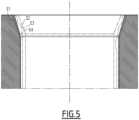
- a first fictitious envelope E1 and a second fictitious envelope E2 represent the envelopes of the cylindrical hole 16B and the chamfer 16A with respectively the maximum dimensions and the minimum design dimensions.
- a third envelope E3 represents the envelope of the damaged centering hole 16. Before damage, the third envelope E3 is located between the first envelope E1 and the second envelope E2. Given manufacturing tolerances, the third envelope E3 is generally not confused with the first envelope E1 or the second envelope E2.
- a fourth envelope E4 represents the envelope of the centering hole 16 remachined using the repair device 20.
- the fourth envelope E4 is located between the first envelope E1 and the third envelope E3.
- the remachined cylindrical hole 16B and the chamfer 16A have dimensions larger than those of the initial centering hole 16.
- the fourth envelope E4 corresponds to dimensions larger than those of the third envelope E3.
- the stop ring 66 is adjusted and the cutting tool 22 used for re-machining is calibrated and chosen so as not to exceed the maximum dimensions of the first envelope E1.
- the fourth envelope E4 corresponds to smaller dimensions than the first envelope E1.
- the cutting tool 22 is chosen to obtain, at the end of the machining, a cylindrical hole 16B and a chamfer 16A corresponding exactly to the maximum design dimensions. This makes it possible to ensure the erasing of the material projections due to the damage to the centering hole 16.
- the repair device is usable for underwater repair of other damaged holes in a nuclear power plant.
- the repair device is usable for repairing a keying hole of an upper core nozzle or a hole centering of a lower end piece of a nuclear fuel assembly, or of a core plate, for example a water distribution hole of a lower or upper core plate.
- the reamer can be replaced by another cutting tool, for example a milling cutter.
- a conical milling cutter can be used to remachine a damaged truncated cone chamfer, without remachine a circular cylindrical hole extending from the chamfer, if the cylindrical hole itself is not damaged.
- a conventional circular milling cutter can be used to remachine a circular cylindrical hole, without remachine the chamfer, if the chamfered hole itself is not damaged or if the damaged hole does not have an entry chamfer.
- a form milling cutter can be used to remachine both the chamfer and the circular cylindrical hole.
- the repair device is provided for a cutting tool comprising a suction channel between an inlet opening located in a cutting portion and an outlet opening provided on a drive portion of the cutting tool.
- the inlet opening is preferably similar to that of the reamer of the Figure 4 . It extends at the base of a cutting face of a cutting tooth, preferably being elongated and extending over substantially the entire length of the cutting tooth.
- a cutting tool may include one or more teeth, each tooth extending straight along the longitudinal axis of the cutting tool, obliquely to the cutting tool, or helically around the cutting tool.
- the repair device and method Thanks to the repair device and method, the repair of a hole in a nuclear reactor part by underwater re-machining is carried out quickly. Re-machining is easy, and generally easier and faster than replacing the part.
- repairing the part helps extend the life of the part. It avoids having to store and process the removed part which is highly radioactive.
- the repair device allows for reliable, precise machining, which allows the maximum design dimensions to be kept within. Of course, if it is not possible to re-machine the hole because the hole has already reached the maximum dimensions, the part must be replaced or it must be justified that exceeding the maximum design dimensions is acceptable.
- the repair device is simple and easy to use, decontaminate and transport from one nuclear site to another, depending on the interventions to be carried out. It can be used by an operator with rapid training.
- Remachining a centering hole is quicker to perform than replacing a nuclear fuel assembly top nozzle.
- the risk of damaging other parts of the nuclear fuel assembly is low.
- the calibrated reamer and the adjustment of the stop ring ensure that the remachined hole remains within the maximum dimensions predefined for the hole. Thus, it is not necessary to carry out a dimensional check of the damaged hole after reaming. A visual inspection of the appearance is sufficient to verify that the pushed-out material has been removed.
- Compliance with the maximum design dimensions ensures that the repaired upper end piece remains compatible with the elements of the nuclear installation that are required to cooperate with this centering hole, such as the centering pins of the upper core plate, the nuclear fuel assembly handling equipment and the nuclear fuel assembly intervention equipment.
- the repair device has a small footprint, particularly in its lower part carrying the cutting tool, so that the risk of damaging the springs of an upper end piece or a cluster received in the nuclear fuel assembly is low.
- the support in the form of a tube similar to a standard handling pole, is particularly compact and suitable for accessing the centering hole without risk of interference with the surrounding elements.
Landscapes
- Engineering & Computer Science (AREA)
- Physics & Mathematics (AREA)
- Plasma & Fusion (AREA)
- General Engineering & Computer Science (AREA)
- High Energy & Nuclear Physics (AREA)
- Mechanical Engineering (AREA)
- Monitoring And Testing Of Nuclear Reactors (AREA)
- Surgical Instruments (AREA)
- Turning (AREA)
- Perforating, Stamping-Out Or Severing By Means Other Than Cutting (AREA)
Claims (18)
- Vorrichtung zur Unterwasserreparatur eines Lochs in einem Kernreaktorteil durch Nachbearbeitung des Lochs, wobei die Reparaturvorrichtung angepasst ist, um eingetaucht zu werden, um ein Zentrierloch (16) eines oberen Endstücks (12) eines Kernbrennstoffbündels (2), ein Zentrierloch eines unteren Endstücks (10) eines Kernbrennstoffbündels (2), ein Codierloch (18) eines oberen Endstücks (12) eines Kernbrennstoffbündels (2), ein Loch einer unteren Kernplatte oder ein Loch einer oberen Kernplatte zu reparieren, die Reparaturvorrichtung umfassend einen Träger (32), ein Schneidwerkzeug (22), das von dem Träger (32) getragen wird und mindestens einen Schneidzahn (70) zum Nacharbeiten einer Innenfläche des Lochs besitzt, wobei das Schneidwerkzeug (22) einen Saugkanal (44) besitzt, der sich im Innern des Schneidwerkzeugs (22) zwischen mindestens einer Einlassöffnung (46), die entlang einer Freifläche (76) des Schneidzahns (70) gebildet ist, und mindestens einer Auslassöffnung (48) erstreckt, eine Antriebswelle (34), um das Schneidwerkzeug (22) in Drehung zu versetzen, wobei die Antriebswelle (34) von dem Träger (32) getragen wird, und eine Saugkanüle (36), die mit dem Träger (32) verbunden ist und fluidisch mit der Auslassöffnung (48) des Saugkanals (44) verbunden ist.
- Reparaturvorrichtung nach Anspruch 1, wobei das Schneidwerkzeug (22) einen Schneidabschnitt (40) und einen Antriebsabschnitt (42), der mit der Antriebswelle (34) verbunden ist, umfasst, die Auslassöffnung (48) in eine Aussparung der Antriebswelle (34) mündet, wobei die Antriebswelle (34) mindestens eine seitliche Öffnung (54) für den Durchgang eines Fluids aus dem Inneren der Aussparung nach außen besitzt, die Saugkanüle (36) an der seitlichen Öffnung (54) mit dem Träger (32) verbunden ist, um das Fluid durch die seitliche Öffnung (54) zu saugen.
- Reparaturvorrichtung nach Anspruch 1 oder 2, wobei der Träger (32) und die Antriebswelle (34) mindestens eine Drehführungsanordnung (58) umfassen, umfassend ein Lager (60), das an dem Träger (32) bereitgestellt ist, und eine an der Antriebswelle (34) bereitgestellte komplementäre Antriebswelle (62).
- Reparaturvorrichtung nach Anspruch 2 und 3 in Kombination, wobei der Träger (32) und die Antriebswelle (34) zwei Drehführungsanordnungen (58) umfassen, die sich entlang der Antriebswelle (34) auf beiden Seiten der oder jeder seitlichen Öffnung (54) befinden.
- Reparaturvorrichtung nach Anspruch 3 oder 4, wobei mindestens eine Drehführungsanordnung (58) die Dichtigkeit zwischen dem Träger (32) und der Antriebswelle (34) gewährleistet.
- Reparaturvorrichtung nach einem der vorherigen Ansprüche, wobei der Träger (32) ein Trägerrohr ist, das Schneidwerkzeug (22) an einem Ende des Trägers (32) angeordnet ist, wobei sich die Antriebswelle (34) im Innern des Trägers (32) zwischen den Enden des Trägers (32) erstreckt.
- Reparaturvorrichtung nach einem der vorherigen Ansprüche, wobei sich das Schneidwerkzeug (22) entlang einer Längsachse (L) erstreckt, wobei sich der Schneidzahn (70) im Wesentlichen geradlinig entlang der Längsachse (L) erstreckt.
- Reparaturvorrichtung nach einem der vorherigen Ansprüche, wobei die Einlassöffnung (46) des Saugkanals (44) an der Basis der Freifläche (76) des Schneidzahns (70) angeordnet ist.
- Reparaturvorrichtung nach einem der vorherigen Ansprüche, wobei die Einlassöffnung (46) des Saugkanals (44) entlang des Schneidzahns (70) verlängert ist.
- Reparaturvorrichtung nach einem der vorherigen Ansprüche, wobei das Schneidwerkzeug (22) eine Reibahle ist.
- Reparaturvorrichtung nach einem der vorherigen Ansprüche, wobei der Schneidzahn (70) einen Abschnitt zum Bearbeiten eines kreiszylindrischen Lochs (16B) und einen Abschnitt zum Bearbeiten einer kegelstumpfförmigen Fase (16A) am Eingang des kreiszylindrischen Lochs (16B) umfasst.
- Reparaturvorrichtung nach einem der vorherigen Ansprüche, wobei das Schneidwerkzeug (22) an einem Schneidabschnitt (40) des Schneidwerkzeugs (22), der den Schneidzahn (70) trägt, mindestens eine Abflachung (88) umfasst, die auf dem Umfang des Schneidabschnitts (40) in Bezug auf den Schneidzahn (70) versetzt ist.
- Reparaturvorrichtung nach einem der vorherigen Ansprüche, umfassend eine Anschlagfläche (65), die geeignet ist, um an dem Werkstück anzuliegen, in dem das zu reparierende Loch ausgebildet ist, um den Hub des Schneidwerkzeugs (22) in dem zu reparierenden Loch zu begrenzen.
- Reparaturvorrichtung nach einem der vorherigen Ansprüche, wobei das Schneidwerkzeug (22) zum Nachbohren eines Zentrierlochs (16) eines oberen Endstücks (12) eines Kernbrennstoffbündels (2), eines Codierlochs (18) eines oberen Endstücks (12) eines Kernbrennstoffbündels (2), eines Zentrierlochs eines unteren Endstücks (10) eines Kernbrennstoffbündels (2), eines Lochs einer unteren Kernplatte oder eines Lochs einer oberen Kernplatte ist.
- Verfahren zur Unterwasserreparatur eines beschädigten Lochs in einem Kernreaktorteil, wobei das Loch ein Zentrierloch (16) eines oberen Endstücks (12) eines Kernbrennstoffbündels (2), ein Zentrierloch eines unteren Endstücks (10) eines Kernbrennstoffbündels (2), ein Codierloch (18) eines oberen Endstücks (12) eines Kernbrennstoffbündels (2), ein Loch einer unteren Kernplatte oder ein Loch einer oberen Kernplatte ist, das Reparaturverfahren umfassend das Nachbearbeiten der Innenfläche des Lochs mit einer Reparaturvorrichtung (20), umfassend ein Schneidwerkzeug (22), das einen Saugkanal (44) besitzt, der sich innerhalb des Schneidwerkzeugs (22) zwischen mindestens einer Einlassöffnung (46), die entlang einer Freifläche (76) des Schneidzahns (70) gebildet ist, und mindestens einer Auslassöffnung (48), zum Absaugen von Spänen, die durch das Schneidwerkzeug (22) erzeugt werden, ohne maximale Bemessungsmaße des Lochs zu überschreiten.
- Reparaturverfahren nach Anspruch 15, wobei das Schneidwerkzeug (22) eine Reibahle ist.
- Reparaturverfahren nach Anspruch 15 oder 16, wobei die Auslassöffnung (48) in das Innere eines Trägers (32) mündet, der das Schneidwerkzeug (22) trägt, wobei eine Saugkanüle (36) mit dem Träger (32) verbunden ist, um die Späne abzusaugen.
- Reparaturverfahren nach Anspruch 17, wobei der Träger (32) in Form eines Trägerrohrs ist, das Schneidwerkzeug (22) an einem Ende des Trägers (32) angeordnet ist, die Reparaturvorrichtung (20) umfassend eine Antriebswelle (34) um das Schneidwerkzeug (22) in Drehung zu versetzen, wobei sich die Antriebswelle (34) im Innern des Trägers (32) erstreckt.
Applications Claiming Priority (2)
| Application Number | Priority Date | Filing Date | Title |
|---|---|---|---|
| FR1651167A FR3047836B1 (fr) | 2016-02-12 | 2016-02-12 | Dispositif et procede de reparation sous eau d'un trou d'une piece de reacteur nucleaire |
| PCT/EP2017/053081 WO2017137608A1 (fr) | 2016-02-12 | 2017-02-10 | Dispositif et procédé de réparation sous eau d'un trou d'une pièce de réacteur nucléaire |
Publications (2)
| Publication Number | Publication Date |
|---|---|
| EP3414765A1 EP3414765A1 (de) | 2018-12-19 |
| EP3414765B1 true EP3414765B1 (de) | 2024-10-16 |
Family
ID=55752547
Family Applications (1)
| Application Number | Title | Priority Date | Filing Date |
|---|---|---|---|
| EP17704758.6A Active EP3414765B1 (de) | 2016-02-12 | 2017-02-10 | Vorrichtung und verfahren zur unterwasserreparatur eines lochs eines kernreaktorteils |
Country Status (5)
| Country | Link |
|---|---|
| US (1) | US11037689B2 (de) |
| EP (1) | EP3414765B1 (de) |
| CN (1) | CN108701498A (de) |
| FR (1) | FR3047836B1 (de) |
| WO (1) | WO2017137608A1 (de) |
Families Citing this family (2)
| Publication number | Priority date | Publication date | Assignee | Title |
|---|---|---|---|---|
| FR3086790B1 (fr) * | 2018-09-27 | 2020-10-02 | Framatome Sa | Detrompeur pour embout de manutention d'element de reacteur nucleaire pour empecher la saisie par un outil de manutention d'assemblage de combustible nucleaire |
| CN117798645B (zh) * | 2023-12-11 | 2026-04-03 | 中核建中核燃料元件有限公司 | 一种压水堆六边形结构核燃料组件的组装和焊接方法 |
Citations (1)
| Publication number | Priority date | Publication date | Assignee | Title |
|---|---|---|---|---|
| JP2013129031A (ja) * | 2011-12-22 | 2013-07-04 | Mitsubishi Heavy Ind Ltd | 水中穴明け装置及び該装置を用いた水中リラッキング工法 |
Family Cites Families (15)
| Publication number | Priority date | Publication date | Assignee | Title |
|---|---|---|---|---|
| US2983989A (en) * | 1959-07-06 | 1961-05-16 | Charles E Frantz | Broaching and tube-installing apparatus |
| US3351143A (en) * | 1965-06-01 | 1967-11-07 | Alvin V Seibold | Concrete drill bit guide and dust remover |
| US4538944A (en) * | 1981-09-21 | 1985-09-03 | Hougen Everett D | Annular cutter |
| US4690593A (en) * | 1986-01-24 | 1987-09-01 | Westinghouse Electric Corp. | Tool for cutting locking cups from guide tube mounting screws in a nuclear reactor |
| DE3807224C1 (de) * | 1988-03-05 | 1989-04-20 | Mapal Fabrik Fuer Praezisionswerkzeuge Dr. Kress Kg, 7080 Aalen, De | |
| DE3826400A1 (de) * | 1988-08-03 | 1990-02-08 | Siemens Ag | Verfahren und vorrichtung zum auswechseln von bolzen an kerneinbauteilen von kernreaktoren |
| JPH0366509A (ja) * | 1989-08-01 | 1991-03-22 | Hideki Kubota | 穴加工装置 |
| US5687205A (en) * | 1995-09-15 | 1997-11-11 | General Electric Company | Underwater remote drilling tool and methods |
| US6132147A (en) * | 1998-12-29 | 2000-10-17 | General Electric Company | Apparatus and methods for drilling with capture of all process debris |
| FR2894375B1 (fr) * | 2005-12-06 | 2008-01-25 | Framatome Anp Sas | Procede et dispositif de prelevement d'une partie de gaine d'un crayon de combustible nucleaire. |
| WO2009006042A1 (en) * | 2007-06-29 | 2009-01-08 | Allied Machine & Engineering Corp. | Ejector drill system |
| US20120251256A1 (en) * | 2011-04-04 | 2012-10-04 | GM Global Technology Operations LLC | Cutting tool for control of surface roughness |
| JP5802893B2 (ja) * | 2011-05-18 | 2015-11-04 | Uht株式会社 | ドリル及びそれを用いた穿孔装置 |
| FR2975316B1 (fr) * | 2011-05-20 | 2014-05-09 | Airbus Operations Sas | Outil coupant optimise pour un usinage avec aspiration des copeaux |
| US9555480B2 (en) * | 2013-08-19 | 2017-01-31 | The Boeing Company | Fluid-fed vacuum cutters |
-
2016
- 2016-02-12 FR FR1651167A patent/FR3047836B1/fr active Active
-
2017
- 2017-02-10 US US16/075,420 patent/US11037689B2/en active Active
- 2017-02-10 CN CN201780009202.4A patent/CN108701498A/zh active Pending
- 2017-02-10 EP EP17704758.6A patent/EP3414765B1/de active Active
- 2017-02-10 WO PCT/EP2017/053081 patent/WO2017137608A1/fr not_active Ceased
Patent Citations (1)
| Publication number | Priority date | Publication date | Assignee | Title |
|---|---|---|---|---|
| JP2013129031A (ja) * | 2011-12-22 | 2013-07-04 | Mitsubishi Heavy Ind Ltd | 水中穴明け装置及び該装置を用いた水中リラッキング工法 |
Also Published As
| Publication number | Publication date |
|---|---|
| US11037689B2 (en) | 2021-06-15 |
| FR3047836A1 (fr) | 2017-08-18 |
| WO2017137608A1 (fr) | 2017-08-17 |
| US20190043627A1 (en) | 2019-02-07 |
| FR3047836B1 (fr) | 2019-05-24 |
| CN108701498A (zh) | 2018-10-23 |
| EP3414765A1 (de) | 2018-12-19 |
Similar Documents
| Publication | Publication Date | Title |
|---|---|---|
| FR2521763A1 (fr) | Appareil et procede pour enlever et remplacer des barres de combustible dans un assemblage combustible nucleaire | |
| EP1849541B1 (de) | Einrichtung zum sequenziellen Zuführen von Stangen in eine Werkzeugmaschine | |
| EP0181810B1 (de) | Verfahren und Vorrichtung zum Verdichten durch Hämmern eines in eine Rohrwand eingesetzten Dampfgeneratorrohres | |
| EP3414765B1 (de) | Vorrichtung und verfahren zur unterwasserreparatur eines lochs eines kernreaktorteils | |
| EP0158544A1 (de) | Verfahren zum Ersetzen einer Hülse im inneren einer Leitung und Vorrichtung zum Durchführen dieses Verfahrens | |
| EP2459350A1 (de) | Verfahren zur entfernung von festmontierten ringförmigen elementen in bohrungen, im besondereren blindbohrungen, von teilen | |
| FR2510800A1 (fr) | Procede et dispositif d'elimination d'espaces de fuite entre les cloisons entourant le coeur d'un reacteur nucleaire a eau sous pression | |
| EP4227035A1 (de) | Arbeitsschnittstellenzubehör, arbeitskit mit einem solchen zubehör, und reibrührschweissverfahren unter verwendung eines solchen kits | |
| EP1579461A1 (de) | Verfahren und vorrichtung zur herstellung von nicht verunreinigten mox-brennstäben | |
| EP2683524B1 (de) | Verfahren zur herstellung eines dampfturbinendeflektors | |
| FR2943834A1 (fr) | Dispositif et procede de retrait sous eau et a distance d'une vis gripee de fixation de deux elements, telle qu'une vis de fixation d'un tube-guide sur une plaque superieure des equipements internes superieurs d'un reacteur nucleaire. | |
| EP1072338A1 (de) | Verfahren und Vorrichtung zum entfernen von Nieten | |
| FR2609833A1 (fr) | Coeur d'un reacteur nucleaire et procede de chargement de ce coeur | |
| EP1722914A1 (de) | Verfahren und vorrichtung zur herstellung eines innengewindes durch automatische bearbeitung in einer bohrung | |
| FR2689297A1 (fr) | Procédé de démontage et de remplacement d'une manchette thermique d'une traversée d'un couvercle de cuve d'un réacteur nucléaire à eau sous pression et manchette thermique démontable de remplacement. | |
| FR3132723A1 (fr) | Tête de dragage de sédiments pour robot subaquatique | |
| EP3888828A1 (de) | Verfahren und anordnung zum abtrennen eines teilstücks eines kernreaktors | |
| FR2717943A1 (fr) | Procédé de remplacement d'une broche de centrage d'un assemblage combustible et broche de centrage. | |
| EP2065642A1 (de) | Verfahren zur Herstellung von Öffnungen in dem Mantel des Dampferzeugers eines Druckwasserreaktors | |
| FR2636771A1 (fr) | Dispositif et procede de recuperation et d'elimination de dechets radio-actifs sous eau dans une piscine | |
| FR2967086A1 (fr) | Outil rotatif de percage d'un trou dans une piece mecanique, dispositif et procede de percage associes | |
| FR2673032A1 (fr) | Procede et dispositif de remplacement d'une broche de centrage d'un assemblage combustible fixee sur la plaque superieure de cóoeur d'un reacteur nucleaire a eau sous pression. | |
| EP0391778A1 (de) | Vorrichtung zum Zentrieren eines Interventionsgerät in einem Dampferzeugerrohr | |
| FR2765028A1 (fr) | Procede et dispositif de rectification du profil d'un bouchon d'un crayon d'un assemblage de combustible d'un reacteur nucleaire | |
| FR2756631A1 (fr) | Procede et dispositif de prelevement d'un echantillon dans une paroi metallique et utilisation |
Legal Events
| Date | Code | Title | Description |
|---|---|---|---|
| STAA | Information on the status of an ep patent application or granted ep patent |
Free format text: STATUS: UNKNOWN |
|
| STAA | Information on the status of an ep patent application or granted ep patent |
Free format text: STATUS: THE INTERNATIONAL PUBLICATION HAS BEEN MADE |
|
| PUAI | Public reference made under article 153(3) epc to a published international application that has entered the european phase |
Free format text: ORIGINAL CODE: 0009012 |
|
| STAA | Information on the status of an ep patent application or granted ep patent |
Free format text: STATUS: REQUEST FOR EXAMINATION WAS MADE |
|
| 17P | Request for examination filed |
Effective date: 20180810 |
|
| AK | Designated contracting states |
Kind code of ref document: A1 Designated state(s): AL AT BE BG CH CY CZ DE DK EE ES FI FR GB GR HR HU IE IS IT LI LT LU LV MC MK MT NL NO PL PT RO RS SE SI SK SM TR |
|
| AX | Request for extension of the european patent |
Extension state: BA ME |
|
| DAV | Request for validation of the european patent (deleted) | ||
| DAX | Request for extension of the european patent (deleted) | ||
| STAA | Information on the status of an ep patent application or granted ep patent |
Free format text: STATUS: EXAMINATION IS IN PROGRESS |
|
| 17Q | First examination report despatched |
Effective date: 20190807 |
|
| REG | Reference to a national code |
Ref country code: DE Ref legal event code: R079 Free format text: PREVIOUS MAIN CLASS: G21C0003040000 Ipc: B23D0075000000 Ref country code: DE Ref legal event code: R079 Ref document number: 602017085511 Country of ref document: DE Free format text: PREVIOUS MAIN CLASS: G21C0003040000 Ipc: B23D0075000000 |
|
| GRAP | Despatch of communication of intention to grant a patent |
Free format text: ORIGINAL CODE: EPIDOSNIGR1 |
|
| STAA | Information on the status of an ep patent application or granted ep patent |
Free format text: STATUS: GRANT OF PATENT IS INTENDED |
|
| RIC1 | Information provided on ipc code assigned before grant |
Ipc: G21C 5/06 20060101ALI20240514BHEP Ipc: G21C 3/33 20060101ALI20240514BHEP Ipc: G21C 3/334 20060101ALI20240514BHEP Ipc: G21C 19/02 20060101ALI20240514BHEP Ipc: B23D 75/00 20060101AFI20240514BHEP |
|
| INTG | Intention to grant announced |
Effective date: 20240604 |
|
| GRAS | Grant fee paid |
Free format text: ORIGINAL CODE: EPIDOSNIGR3 |
|
| GRAA | (expected) grant |
Free format text: ORIGINAL CODE: 0009210 |
|
| STAA | Information on the status of an ep patent application or granted ep patent |
Free format text: STATUS: THE PATENT HAS BEEN GRANTED |
|
| AK | Designated contracting states |
Kind code of ref document: B1 Designated state(s): AL AT BE BG CH CY CZ DE DK EE ES FI FR GB GR HR HU IE IS IT LI LT LU LV MC MK MT NL NO PL PT RO RS SE SI SK SM TR |
|
| REG | Reference to a national code |
Ref country code: GB Ref legal event code: FG4D Free format text: NOT ENGLISH |
|
| REG | Reference to a national code |
Ref country code: CH Ref legal event code: EP |
|
| REG | Reference to a national code |
Ref country code: IE Ref legal event code: FG4D Free format text: LANGUAGE OF EP DOCUMENT: FRENCH |
|
| REG | Reference to a national code |
Ref country code: DE Ref legal event code: R096 Ref document number: 602017085511 Country of ref document: DE |
|
| REG | Reference to a national code |
Ref country code: LT Ref legal event code: MG9D |
|
| REG | Reference to a national code |
Ref country code: NL Ref legal event code: MP Effective date: 20241016 |
|
| REG | Reference to a national code |
Ref country code: AT Ref legal event code: MK05 Ref document number: 1732559 Country of ref document: AT Kind code of ref document: T Effective date: 20241016 |
|
| PG25 | Lapsed in a contracting state [announced via postgrant information from national office to epo] |
Ref country code: NL Free format text: LAPSE BECAUSE OF FAILURE TO SUBMIT A TRANSLATION OF THE DESCRIPTION OR TO PAY THE FEE WITHIN THE PRESCRIBED TIME-LIMIT Effective date: 20241016 |
|
| PG25 | Lapsed in a contracting state [announced via postgrant information from national office to epo] |
Ref country code: NL Free format text: LAPSE BECAUSE OF FAILURE TO SUBMIT A TRANSLATION OF THE DESCRIPTION OR TO PAY THE FEE WITHIN THE PRESCRIBED TIME-LIMIT Effective date: 20241016 |
|
| PG25 | Lapsed in a contracting state [announced via postgrant information from national office to epo] |
Ref country code: IS Free format text: LAPSE BECAUSE OF FAILURE TO SUBMIT A TRANSLATION OF THE DESCRIPTION OR TO PAY THE FEE WITHIN THE PRESCRIBED TIME-LIMIT Effective date: 20250216 Ref country code: HR Free format text: LAPSE BECAUSE OF FAILURE TO SUBMIT A TRANSLATION OF THE DESCRIPTION OR TO PAY THE FEE WITHIN THE PRESCRIBED TIME-LIMIT Effective date: 20241016 Ref country code: PT Free format text: LAPSE BECAUSE OF FAILURE TO SUBMIT A TRANSLATION OF THE DESCRIPTION OR TO PAY THE FEE WITHIN THE PRESCRIBED TIME-LIMIT Effective date: 20250217 |
|
| PG25 | Lapsed in a contracting state [announced via postgrant information from national office to epo] |
Ref country code: FI Free format text: LAPSE BECAUSE OF FAILURE TO SUBMIT A TRANSLATION OF THE DESCRIPTION OR TO PAY THE FEE WITHIN THE PRESCRIBED TIME-LIMIT Effective date: 20241016 |
|
| PG25 | Lapsed in a contracting state [announced via postgrant information from national office to epo] |
Ref country code: BG Free format text: LAPSE BECAUSE OF FAILURE TO SUBMIT A TRANSLATION OF THE DESCRIPTION OR TO PAY THE FEE WITHIN THE PRESCRIBED TIME-LIMIT Effective date: 20241016 |
|
| PG25 | Lapsed in a contracting state [announced via postgrant information from national office to epo] |
Ref country code: ES Free format text: LAPSE BECAUSE OF FAILURE TO SUBMIT A TRANSLATION OF THE DESCRIPTION OR TO PAY THE FEE WITHIN THE PRESCRIBED TIME-LIMIT Effective date: 20241016 |
|
| PG25 | Lapsed in a contracting state [announced via postgrant information from national office to epo] |
Ref country code: NO Free format text: LAPSE BECAUSE OF FAILURE TO SUBMIT A TRANSLATION OF THE DESCRIPTION OR TO PAY THE FEE WITHIN THE PRESCRIBED TIME-LIMIT Effective date: 20250116 |
|
| PG25 | Lapsed in a contracting state [announced via postgrant information from national office to epo] |
Ref country code: LV Free format text: LAPSE BECAUSE OF FAILURE TO SUBMIT A TRANSLATION OF THE DESCRIPTION OR TO PAY THE FEE WITHIN THE PRESCRIBED TIME-LIMIT Effective date: 20241016 Ref country code: AT Free format text: LAPSE BECAUSE OF FAILURE TO SUBMIT A TRANSLATION OF THE DESCRIPTION OR TO PAY THE FEE WITHIN THE PRESCRIBED TIME-LIMIT Effective date: 20241016 Ref country code: GR Free format text: LAPSE BECAUSE OF FAILURE TO SUBMIT A TRANSLATION OF THE DESCRIPTION OR TO PAY THE FEE WITHIN THE PRESCRIBED TIME-LIMIT Effective date: 20250117 |
|
| PG25 | Lapsed in a contracting state [announced via postgrant information from national office to epo] |
Ref country code: PL Free format text: LAPSE BECAUSE OF FAILURE TO SUBMIT A TRANSLATION OF THE DESCRIPTION OR TO PAY THE FEE WITHIN THE PRESCRIBED TIME-LIMIT Effective date: 20241016 |
|
| PG25 | Lapsed in a contracting state [announced via postgrant information from national office to epo] |
Ref country code: RS Free format text: LAPSE BECAUSE OF FAILURE TO SUBMIT A TRANSLATION OF THE DESCRIPTION OR TO PAY THE FEE WITHIN THE PRESCRIBED TIME-LIMIT Effective date: 20250116 |
|
| PG25 | Lapsed in a contracting state [announced via postgrant information from national office to epo] |
Ref country code: SM Free format text: LAPSE BECAUSE OF FAILURE TO SUBMIT A TRANSLATION OF THE DESCRIPTION OR TO PAY THE FEE WITHIN THE PRESCRIBED TIME-LIMIT Effective date: 20241016 |
|
| PG25 | Lapsed in a contracting state [announced via postgrant information from national office to epo] |
Ref country code: DK Free format text: LAPSE BECAUSE OF FAILURE TO SUBMIT A TRANSLATION OF THE DESCRIPTION OR TO PAY THE FEE WITHIN THE PRESCRIBED TIME-LIMIT Effective date: 20241016 |
|
| REG | Reference to a national code |
Ref country code: DE Ref legal event code: R097 Ref document number: 602017085511 Country of ref document: DE |
|
| PG25 | Lapsed in a contracting state [announced via postgrant information from national office to epo] |
Ref country code: EE Free format text: LAPSE BECAUSE OF FAILURE TO SUBMIT A TRANSLATION OF THE DESCRIPTION OR TO PAY THE FEE WITHIN THE PRESCRIBED TIME-LIMIT Effective date: 20241016 |
|
| PG25 | Lapsed in a contracting state [announced via postgrant information from national office to epo] |
Ref country code: RO Free format text: LAPSE BECAUSE OF FAILURE TO SUBMIT A TRANSLATION OF THE DESCRIPTION OR TO PAY THE FEE WITHIN THE PRESCRIBED TIME-LIMIT Effective date: 20241016 |
|
| PG25 | Lapsed in a contracting state [announced via postgrant information from national office to epo] |
Ref country code: SK Free format text: LAPSE BECAUSE OF FAILURE TO SUBMIT A TRANSLATION OF THE DESCRIPTION OR TO PAY THE FEE WITHIN THE PRESCRIBED TIME-LIMIT Effective date: 20241016 |
|
| PG25 | Lapsed in a contracting state [announced via postgrant information from national office to epo] |
Ref country code: IT Free format text: LAPSE BECAUSE OF FAILURE TO SUBMIT A TRANSLATION OF THE DESCRIPTION OR TO PAY THE FEE WITHIN THE PRESCRIBED TIME-LIMIT Effective date: 20241016 |
|
| PLBE | No opposition filed within time limit |
Free format text: ORIGINAL CODE: 0009261 |
|
| STAA | Information on the status of an ep patent application or granted ep patent |
Free format text: STATUS: NO OPPOSITION FILED WITHIN TIME LIMIT |
|
| REG | Reference to a national code |
Ref country code: DE Ref legal event code: R119 Ref document number: 602017085511 Country of ref document: DE |
|
| PG25 | Lapsed in a contracting state [announced via postgrant information from national office to epo] |
Ref country code: SE Free format text: LAPSE BECAUSE OF FAILURE TO SUBMIT A TRANSLATION OF THE DESCRIPTION OR TO PAY THE FEE WITHIN THE PRESCRIBED TIME-LIMIT Effective date: 20241016 |
|
| PG25 | Lapsed in a contracting state [announced via postgrant information from national office to epo] |
Ref country code: MC Free format text: LAPSE BECAUSE OF FAILURE TO SUBMIT A TRANSLATION OF THE DESCRIPTION OR TO PAY THE FEE WITHIN THE PRESCRIBED TIME-LIMIT Effective date: 20241016 |
|
| 26N | No opposition filed |
Effective date: 20250717 |
|
| REG | Reference to a national code |
Ref country code: CH Ref legal event code: PL |
|
| PG25 | Lapsed in a contracting state [announced via postgrant information from national office to epo] |
Ref country code: LU Free format text: LAPSE BECAUSE OF NON-PAYMENT OF DUE FEES Effective date: 20250210 |
|
| PG25 | Lapsed in a contracting state [announced via postgrant information from national office to epo] |
Ref country code: CH Free format text: LAPSE BECAUSE OF NON-PAYMENT OF DUE FEES Effective date: 20250228 |
|
| REG | Reference to a national code |
Ref country code: BE Ref legal event code: MM Effective date: 20250228 |
|
| PG25 | Lapsed in a contracting state [announced via postgrant information from national office to epo] |
Ref country code: DE Free format text: LAPSE BECAUSE OF NON-PAYMENT OF DUE FEES Effective date: 20250902 |
|
| PG25 | Lapsed in a contracting state [announced via postgrant information from national office to epo] |
Ref country code: BE Free format text: LAPSE BECAUSE OF NON-PAYMENT OF DUE FEES Effective date: 20250228 |
|
| PG25 | Lapsed in a contracting state [announced via postgrant information from national office to epo] |
Ref country code: IE Free format text: LAPSE BECAUSE OF NON-PAYMENT OF DUE FEES Effective date: 20250210 |
|
| PGFP | Annual fee paid to national office [announced via postgrant information from national office to epo] |
Ref country code: GB Payment date: 20260219 Year of fee payment: 10 |
|
| PGFP | Annual fee paid to national office [announced via postgrant information from national office to epo] |
Ref country code: FR Payment date: 20260227 Year of fee payment: 10 |
|
| PGFP | Annual fee paid to national office [announced via postgrant information from national office to epo] |
Ref country code: CZ Payment date: 20260130 Year of fee payment: 10 |