EP3411245B1 - Wert- oder sicherheitsprodukt, verfahren zum herstellen eines vorproduktes und verifikationsverfahren - Google Patents
Wert- oder sicherheitsprodukt, verfahren zum herstellen eines vorproduktes und verifikationsverfahren Download PDFInfo
- Publication number
- EP3411245B1 EP3411245B1 EP17703117.6A EP17703117A EP3411245B1 EP 3411245 B1 EP3411245 B1 EP 3411245B1 EP 17703117 A EP17703117 A EP 17703117A EP 3411245 B1 EP3411245 B1 EP 3411245B1
- Authority
- EP
- European Patent Office
- Prior art keywords
- security
- printing
- black
- printing ink
- product
- Prior art date
- Legal status (The legal status is an assumption and is not a legal conclusion. Google has not performed a legal analysis and makes no representation as to the accuracy of the status listed.)
- Active
Links
Images




Classifications
-
- B—PERFORMING OPERATIONS; TRANSPORTING
- B42—BOOKBINDING; ALBUMS; FILES; SPECIAL PRINTED MATTER
- B42D—BOOKS; BOOK COVERS; LOOSE LEAVES; PRINTED MATTER CHARACTERISED BY IDENTIFICATION OR SECURITY FEATURES; PRINTED MATTER OF SPECIAL FORMAT OR STYLE NOT OTHERWISE PROVIDED FOR; DEVICES FOR USE THEREWITH AND NOT OTHERWISE PROVIDED FOR; MOVABLE-STRIP WRITING OR READING APPARATUS
- B42D25/00—Information-bearing cards or sheet-like structures characterised by identification or security features; Manufacture thereof
- B42D25/20—Information-bearing cards or sheet-like structures characterised by identification or security features; Manufacture thereof characterised by a particular use or purpose
- B42D25/23—Identity cards
-
- B—PERFORMING OPERATIONS; TRANSPORTING
- B42—BOOKBINDING; ALBUMS; FILES; SPECIAL PRINTED MATTER
- B42D—BOOKS; BOOK COVERS; LOOSE LEAVES; PRINTED MATTER CHARACTERISED BY IDENTIFICATION OR SECURITY FEATURES; PRINTED MATTER OF SPECIAL FORMAT OR STYLE NOT OTHERWISE PROVIDED FOR; DEVICES FOR USE THEREWITH AND NOT OTHERWISE PROVIDED FOR; MOVABLE-STRIP WRITING OR READING APPARATUS
- B42D25/00—Information-bearing cards or sheet-like structures characterised by identification or security features; Manufacture thereof
- B42D25/20—Information-bearing cards or sheet-like structures characterised by identification or security features; Manufacture thereof characterised by a particular use or purpose
- B42D25/24—Passports
-
- B—PERFORMING OPERATIONS; TRANSPORTING
- B42—BOOKBINDING; ALBUMS; FILES; SPECIAL PRINTED MATTER
- B42D—BOOKS; BOOK COVERS; LOOSE LEAVES; PRINTED MATTER CHARACTERISED BY IDENTIFICATION OR SECURITY FEATURES; PRINTED MATTER OF SPECIAL FORMAT OR STYLE NOT OTHERWISE PROVIDED FOR; DEVICES FOR USE THEREWITH AND NOT OTHERWISE PROVIDED FOR; MOVABLE-STRIP WRITING OR READING APPARATUS
- B42D25/00—Information-bearing cards or sheet-like structures characterised by identification or security features; Manufacture thereof
- B42D25/20—Information-bearing cards or sheet-like structures characterised by identification or security features; Manufacture thereof characterised by a particular use or purpose
- B42D25/29—Securities; Bank notes
-
- B—PERFORMING OPERATIONS; TRANSPORTING
- B42—BOOKBINDING; ALBUMS; FILES; SPECIAL PRINTED MATTER
- B42D—BOOKS; BOOK COVERS; LOOSE LEAVES; PRINTED MATTER CHARACTERISED BY IDENTIFICATION OR SECURITY FEATURES; PRINTED MATTER OF SPECIAL FORMAT OR STYLE NOT OTHERWISE PROVIDED FOR; DEVICES FOR USE THEREWITH AND NOT OTHERWISE PROVIDED FOR; MOVABLE-STRIP WRITING OR READING APPARATUS
- B42D25/00—Information-bearing cards or sheet-like structures characterised by identification or security features; Manufacture thereof
- B42D25/30—Identification or security features, e.g. for preventing forgery
- B42D25/309—Photographs
-
- B—PERFORMING OPERATIONS; TRANSPORTING
- B42—BOOKBINDING; ALBUMS; FILES; SPECIAL PRINTED MATTER
- B42D—BOOKS; BOOK COVERS; LOOSE LEAVES; PRINTED MATTER CHARACTERISED BY IDENTIFICATION OR SECURITY FEATURES; PRINTED MATTER OF SPECIAL FORMAT OR STYLE NOT OTHERWISE PROVIDED FOR; DEVICES FOR USE THEREWITH AND NOT OTHERWISE PROVIDED FOR; MOVABLE-STRIP WRITING OR READING APPARATUS
- B42D25/00—Information-bearing cards or sheet-like structures characterised by identification or security features; Manufacture thereof
- B42D25/30—Identification or security features, e.g. for preventing forgery
- B42D25/36—Identification or security features, e.g. for preventing forgery comprising special materials
- B42D25/378—Special inks
- B42D25/382—Special inks absorbing or reflecting infrared light
-
- B—PERFORMING OPERATIONS; TRANSPORTING
- B42—BOOKBINDING; ALBUMS; FILES; SPECIAL PRINTED MATTER
- B42D—BOOKS; BOOK COVERS; LOOSE LEAVES; PRINTED MATTER CHARACTERISED BY IDENTIFICATION OR SECURITY FEATURES; PRINTED MATTER OF SPECIAL FORMAT OR STYLE NOT OTHERWISE PROVIDED FOR; DEVICES FOR USE THEREWITH AND NOT OTHERWISE PROVIDED FOR; MOVABLE-STRIP WRITING OR READING APPARATUS
- B42D25/00—Information-bearing cards or sheet-like structures characterised by identification or security features; Manufacture thereof
- B42D25/40—Manufacture
- B42D25/45—Associating two or more layers
- B42D25/455—Associating two or more layers using heat
-
- B—PERFORMING OPERATIONS; TRANSPORTING
- B42—BOOKBINDING; ALBUMS; FILES; SPECIAL PRINTED MATTER
- B42D—BOOKS; BOOK COVERS; LOOSE LEAVES; PRINTED MATTER CHARACTERISED BY IDENTIFICATION OR SECURITY FEATURES; PRINTED MATTER OF SPECIAL FORMAT OR STYLE NOT OTHERWISE PROVIDED FOR; DEVICES FOR USE THEREWITH AND NOT OTHERWISE PROVIDED FOR; MOVABLE-STRIP WRITING OR READING APPARATUS
- B42D25/00—Information-bearing cards or sheet-like structures characterised by identification or security features; Manufacture thereof
- B42D25/40—Manufacture
- B42D25/45—Associating two or more layers
- B42D25/46—Associating two or more layers using pressure
-
- G—PHYSICS
- G07—CHECKING-DEVICES
- G07D—HANDLING OF COINS OR VALUABLE PAPERS, e.g. TESTING, SORTING BY DENOMINATIONS, COUNTING, DISPENSING, CHANGING OR DEPOSITING
- G07D7/00—Testing specially adapted to determine the identity or genuineness of valuable papers or for segregating those which are unacceptable, e.g. banknotes that are alien to a currency
- G07D7/06—Testing specially adapted to determine the identity or genuineness of valuable papers or for segregating those which are unacceptable, e.g. banknotes that are alien to a currency using wave or particle radiation
- G07D7/12—Visible light, infrared or ultraviolet radiation
- G07D7/1205—Testing spectral properties
Definitions
- the present invention relates to a valuable or security product, for example an identification (ID) document, for example a passport, identity card or driver's license, or a means of payment, in particular a bank note.
- ID identification
- the invention is based on a valuable or security product that is formed by a product carrier on and / or in which there is a security print, the security print being formed with at least two printing inks that produce different color impressions and with at least one printing ink that appears black.
- the present invention also relates to a method for producing a preliminary product for a valuable or security product which is formed with a product carrier on and / or in which there is a security print.
- the invention is thus also based on a method that comprises the following process steps: providing a printing material, providing and printing the printing inks that produce the at least two different color impressions, and providing and printing the at least one printing ink that appears black, the security print being formed on the printing material .
- the present invention also relates to a method for verifying the authenticity of the valuable or security product.
- Valuable or security products in particular value or security documents, are used to verify the identity of a person, in particular when crossing a national border, or a thing or a claim, for example for payment of a sum of money or for the surrender of a product or the provision of a service. To this end, it must be ensured that the product cannot be imitated, falsified or adulterated, or only with considerable effort.
- the product therefore contains security features whose imitation is extremely difficult or even practically impossible. For example, like banknotes, the product is made of a material that is not readily available.
- security features can be created using special colors, for example luminescent or optically variable colors, optical elements such as holograms, tilt images, cinegraphic objects, lens or prism arrays, and also guilloches (with visible colors / inks or luminescent colors / inks), mottled fibers, security threads and others, be educated.
- special colors for example luminescent or optically variable colors, optical elements such as holograms, tilt images, cinegraphic objects, lens or prism arrays, and also guilloches (with visible colors / inks or luminescent colors / inks), mottled fibers, security threads and others, be educated.
- the security features used in the valuable or security products can only serve to prove the authenticity of the documents regardless of their type or their user.
- Individualizing, for example personalizing, security features also contain, in coded form or also in plain text, information about the type of document, about the user of this document and / or about an object to which the document is clearly assigned.
- Such information can be a portrait picture (photograph) of the user, his personal data, such as his name, birthday, place of birth, address, or a personal identifier, such as a membership number, or his signature.
- Another security feature that individualizes the valuable or security product can be, for example, a serial number of the product or the chassis number of a motor vehicle to which the product is assigned.
- a laminated security document which is in the form of a composite document which has at least one inner layer and at least two overlay films covering the inner layer.
- the inner layer contains a color light image with the face image of the document holder.
- the color light image is an exposed positive-positive silver color bleach photo emulsion.
- It is also known to produce the facial image of a person on an identity or security document using printing technology. This is followed in DE 199 06 388 A1 pointed out. This document relates to a method and a device for personalizing and verifying such documents.
- a security and / or value document with an individualizing security feature is for example in DE 10 2008 012 423 A1 specified.
- This document is designed as a polymer layer composite which is produced from several polymer layers by lamination and in which at least one individualizing information is stored by printing technology.
- the information is broken down in the composite into at least two print extracts, each of which includes part of the information.
- the at least two printouts are in at least two spaced planes arranged.
- a print image embodied by the information is broken down into pixels and each pixel is assigned to exactly one of the at least two print extracts. For example, the print can reproduce an image of the face.
- the printouts are printed on the polymer layers.
- luminescent colorants can be printed onto a polymer layer surface arranged below the printouts, so that white light is radiated over a large area upon UV excitation. The light is filtered through the image points of the print extracts arranged above, so that the information can preferably be seen in color when viewed from above.
- the security feature containing at least one luminescent means and at least one absorptive spectral filter means in and / or on a product carrier.
- the absorptive spectral filter means is used to filter luminescence radiation emanating from the at least one luminescence means.
- a method for producing a semi-finished product for a security document which has a high-resolution security print and which, when excited by UV in the visible wavelength range, produces a multicolored impression For this purpose, at least two color printing compositions are provided which, when printed, show colored luminescence in the visible wavelength range upon UV excitation, the at least two color printing compositions having different luminescence spectra in the printed state upon UV excitation, which produce different color impressions. Colored information components of the security print to be generated are printed with the color printing compositions.
- an absorber printing composition is provided which comprises a UV absorber which exhibits no luminescence in the visible wavelength range upon UV excitation. Black information components of the security print are printed with the absorber print composition.
- the document US 2014/022603 A1 discloses a method for verifying the authenticity of a security product. Furthermore, document discloses US 2013/142440 A1 another method for verifying the authenticity of a security product.
- the security feature should preferably be located in an inner product level that is secure against counterfeiting and / or falsification and / or copying.
- the present invention is also based on a further essential object of creating a security feature that can be implemented inexpensively, simply and quickly. Above all, there should be no costly material development, i.e.
- the security feature should be realizable with known substances and devices, for example printers. Furthermore, it should be ensured that a colored, in particular multicolored (colored) security feature can be produced without recalibrating the individual colors and printing all colors together, which are implemented, for example, by the existing color management for CMYK colors or RGB displays.
- the term, value or security product and in particular the term value or security document are mentioned in the description and claims of the present application, this includes, for example, a passport, identity card, driver's license or another ID card or an access control card, a vehicle registration document , Vehicle registration document, visa, check, means of payment, in particular a bank note, a check, bank, credit or cash card, customer card, health card, chip card, company ID, proof of authorization, membership card, gift or shopping voucher, waybill or other proof of authorization, tax code , Postage stamps, tickets, (game) tokens, adhesive labels (e.g. for product security) or another ID document.
- the product can be a smart card.
- the security or value document can be in ID 1, ID 2, ID 3 or in any other format, for example in booklet form, as in the case of a passport-like object.
- a valuable or security product is generally a laminate made up of several document layers, which are connected (fused) with one another over a large area under the influence of heat and under increased pressure. These products should meet the standardized requirements, for example in accordance with ISO 10373, ISO / IEC 7810, ISO 14443 in the version valid on the priority date of the present application.
- the product layers consist, for example, of a carrier material that is suitable for lamination.
- the term "valuable or security product" also includes patches, labels and the like which, as security elements, are components of documents and for this purpose are or are inextricably linked to the document carrier and form the security feature there.
- the valuable or security product can be formed from a polymer selected from a group comprising polycarbonate (PC), in particular bisphenol A polycarbonate, polyethylene terephthalate (PET), their derivatives, such as glycol-modified PET (PETG), polyethylene naphthalate (PEN), polyvinyl chloride (PVC), polyvinyl butyral (PVB), polymethyl methacrylate (PMMA), polyimide (PI), polyvinyl alcohol (PVA), polystyrene (PS), polyvinyl phenol (PVP), polypropylene (PP), polyethylene (PE), thermoplastic elastomers (TPE), in particular thermoplastic polyurethane (TPU), acrylonitrile-butadiene-styrene copolymer (ABS) and their derivatives, and / or paper and / or cardboard and / or glass and / or metal and / or ceramic.
- PC polycarbonate
- PET polyethylene terephthalate
- PET polyethylene terephthalate
- the product can also be made from several of these materials. It is preferably made of PC, PET and / or PVC.
- the polymers can be either filled or unfilled. In the latter case, they are preferably transparent or translucent. If the polymers are filled, they are opaque.
- the above information relates both to films to be joined together and to liquid formulations that are applied to a preliminary product, such as a protective or topcoat.
- the document is preferably produced from 3 to 12, preferably 4 to 10, films, preferably using a lamination process in which the films are fused to one another under the action of pressure and heat.
- the individual foils can consist of the same material or of different materials. Overlay layers formed in this way protect a security feature arranged underneath and / or give the document the required abrasion resistance.
- individualized and “individualizing” are used below, this is to be understood as a property of a value or security document, according to which the document can be assigned to a specific subject (person, animal, object).
- personalized and “personalizing” are used below, this is to be understood as the property of a valuable or security document, according to which the document can be assigned to a person. This property results from predetermined security features of the valuable or security products, preferably from the security printing according to the invention.
- luminescence insofar as the term “luminescence” is mentioned in the description and in the claims of the present application, this is to be understood as meaning fluorescence, phosphorescence, specifically with both a Stokes and an anti-Stokes shift. It is preferably to be understood as meaning photoluminescence. Furthermore, the luminescence can also be electroluminescence, for example.
- color pigment is used in the description and in the claims of the present application, it is to be understood as meaning a substance or a mixture of substances. This substance or substances show light absorption in the visible spectral range. In contrast to a dye, they are not chemically soluble in a printing ink and are in the form of separate particles.
- the valuable or security product is formed with a product carrier on and / or in which there is a security print.
- the security print is made with at least two different color impressions causing printing inks (hereinafter “colored printing inks”) and with at least one black-appearing printing ink (hereinafter “black printing ink”).
- at least one of the at least two colored printing inks and the at least one black printing ink each contain an IR (infrared) absorber.
- the value or security product is further defined by the features of the characterizing part of claim 1.
- At least one other of the at least two colored printing inks and the black printing ink contain no IR absorber. It is further preferred that at least one of the black printing inks, but very particularly preferably none of the colored printing inks, each contain at least one IR absorber.
- the object on which the present invention is based is also achieved, according to a second aspect, by the method defined in claim 9 for producing a preliminary product formed with a product carrier for the valuable or security product according to the invention.
- At least one of the black printing inks but very particularly preferably none of the colored printing inks, each contain at least one IR absorber.
- the object on which the present invention is based is also achieved, according to a third aspect, by the first method defined in claim 13 for verifying the authenticity of the valuable or security product according to the invention formed with the product carrier.
- the authenticity of the valuable or security product is verified by determining the correspondence of the security print recorded in the visible and IR spectral range with the first and second reference object in accordance with method steps (c) and (f). If they do not match, it is concluded that the valuable or security product has been counterfeited.
- two security features are generated in the security print, namely a first security feature of the security print that can be detected in the visible spectral range, for example when viewed under white light (visible radiation with a largely continuous spectrum with a color temperature of at least 2500 K), which is at least approximate to sunlight, and a second security feature of the security print that can be detected in the IR spectral range.
- These two print images preferably differ from one another.
- the first print image detectable with radiation in the visible spectral range can reproduce a person portrait
- the print image detectable with IR radiation is formed by several contrasting surfaces, parts of the person portrait being recognizable in some of these surfaces.
- the two print images preferably each code for one piece of information, these two pieces of information particularly preferably being different and possibly also being independent of one another.
- the first print image of the security print that can be detected in the visible spectral range is characterized by a multicolored representation, while the second print image that can be captured in the IR spectral range is identified by a monochrome representation corresponding to a shadow image. White light is therefore preferred for capturing the first print image in order to achieve natural color reproduction.
- Any desired IR radiation can be used for the printed image, monochromatic or polychromatic IR radiation, and in the latter case with any spectral distribution, as long as the IR radiation is at least partially absorbed by the IR absorber (s) and therefore a contrast generated in the security print.
- the print image of the security print that can be detected in the IR spectral range can be designed like a watermark. Because the IR absorbers are located in at least one of the printed black and / or colored printing inks, the first print image is also reproduced in the second print image. The second print image is accordingly embedded in the first print image.
- the security print can therefore contain in particular two nested print images which differ in the IR spectral range in terms of the area division into several image parts and of which the first can be detected in the visible spectral range and the second in the IR spectral range.
- the absorption of the at least one IR absorber which is preferably contained in the printed black parts of the security print, cannot be seen in the IR spectral range with the naked eye, so that a re-enactment of this security feature would fail based on the knowledge of its existence, if not a targeted one Checking for an IR absorption of the security print is carried out.
- the security feature that can be detected in the IR spectral range is accordingly hidden in the security feature that can be detected in the visible spectral range and therefore forms a second-level security feature.
- first stage detection in the visible spectral range
- second stage detection in the IR spectral range
- the print image that can be detected in the IR spectral range is also influenced by the first print image that can be detected in the visible spectral range, namely by the second print image being superimposed on the first Print image is created:
- the security print produced with the colored and black printing inks is formed in a simplest embodiment of the present invention with at least two colored printing inks differing in terms of their hue and a black printing ink, the latter containing at least one IR absorber.
- the color management system for controlling the printing process is set in this case in such a way that black components of the security print are simulated in IR-transparent image parts by overprinting the colored printing inks, while black components in IR-absorbing image parts are simulated with the black printing ink, which is the IR absorber contains, can be printed.
- the IR absorption can be detected in the IR-absorbing parts of the image, while no IR absorption takes place in the IR-transparent parts of the image.
- the spectral components of detectable electromagnetic radiation in the visible spectral range are in the wavelength range from 380 nm to 780 nm.
- IR radiation that is absorbed by the IR absorbers can be in the near infrared wavelength range (IR A range: 780 nm to 1400 nm ; IR B range: 1400 nm to 3000 nm), in the middle infrared wavelength range (3 ⁇ m to 50 ⁇ m) and basically also in the far infrared wavelength range (50 ⁇ m to 1000 ⁇ m).
- IR A range 780 nm to 1400 nm
- IR B range 1400 nm to 3000 nm
- Preference is given to using IR radiation in the near infrared wavelength range and, in this, particularly preferably in the IR A range.
- dyes and / or color pigments are typically used which alone (as a single substance) or as a mixture of several individual substances have a desired absorption spectrum so that the desired color effect occurs.
- Several colored printing inks are printed in order to produce a security print, for example three colored printing inks.
- the printing inks cyan, magenta and yellow used in the CMY color system are usually used to achieve a gamut.
- customary color management systems are used, with which, starting from these colored basic printing inks, the locally desired color tones in the printed image are reproduced by suitable mixing of the basic printing inks.
- the colored printing inks are printed, for example, in a raster process by targeted placement of printing dots in greater or lesser density and / or with variation of the dot size / amount of color, so that locally varying color tones and brightnesses result.
- CMY complementary metal-oxide-semiconductor
- other colored basic printing inks can of course also be used in other color systems.
- colored individual substances that can be used to formulate the colored printing inks Cartasol® Yellow K4 GL (trademark of Clariant AG), Cartasol® Red K-3B and Cartasol® Blue K5R are, for example, liquid. A single one of these substances can be contained in the colored printing inks. Alternatively, several such substances can be contained in a mixture.
- black dyes and / or color pigments for example carbon black
- carbon black can be used for the at least one black printing ink.
- a single one of these substances can be contained in the black printing ink.
- several such substances can be contained in a mixture.
- the in EP 1 790 701 A1 specified substances are used in the at least one black and / or colored printing ink.
- a single one of these substances can be contained in the black and / or colored printing ink. Alternatively, several such substances can be contained in a mixture.
- the aforementioned printing inks can contain the at least one IR absorber as a separate component.
- the aforementioned visible components of the printing inks namely the colored and / or black dyes and / or colored and / or black color pigments, can also themselves be IR absorbers.
- additional IR absorbers can also be contained; but their presence is not required. Insofar as reference is made above and below to IR absorbers contained in the printing inks, this therefore relates both to IR absorbers as separate components and to the case that the color or black components of the printing inks are themselves IR absorbers.
- the colored and black printing inks usually contain components of at least one binder as base materials, so that the rheological, chemical, reactive, wetting and other properties of the printing inks can be adjusted in a targeted manner.
- the compositions of these printing inks are well known.
- Color bases of commercially available colored and black printing inks can be used.
- oligomers and polymers can be used as the color base.
- polycarbonate polymers optionally mixed with solvents, are used for this purpose, especially when the printing material / product carrier on which the security print is created is also formed from a polycarbonate (or optionally polyethylene terephthalate).
- Any printing process can be used to create the security print.
- Digital printing methods are preferred, in particular the inkjet printing method, because with this method, flexibly varying motifs can be created so that individualizing, in particular personalizing, security prints can be generated.
- an offset or flexographic printing process can also be used.
- the security feature can be detected in the visible spectral range, for example by viewing it with the naked eye.
- the security feature in the visible spectral range can also be recorded by machine, for example with a recording device, for example a camera.
- a data processing device can be connected downstream of the recording device and process the print image recorded by this device.
- a photoelectric device can be used as the recording device, for example a device which typically has imaging optics and a CCD (charge-coupled device) assembly.
- the print image of the security print that can be recorded in the IR spectral range can only be recorded with a recording device, since the human eye is insensitive to IR radiation. This recording device must be sensitive to the electromagnetic radiation in the relevant spectral range.
- the recorded image can then be made visible on a display device, for example a screen, so that a human viewer can compare the image with a reference object and check whether it matches the reference object.
- a display device for example a screen
- the security print is formed with two black inks.
- a first of the two black printing inks preferably does not contain an IR absorber and a second of the two black printing inks contains at least one IR absorber.
- the black components of the security print can be produced in an IR-transparent image part using the first black printing ink, for example in the CMYK color system, without the inclusion of an IR absorber, and the black components in an IR-absorbing image part using the second black printing ink containing at least one IR-absorber.
- the printed black parts of the security print in the IR-transparent image part are therefore non-absorbent (transparent) when the security print is detected in the IR spectral range, so that the security print in this image part supplies the image information 'IR-transparent' in the IR spectral range.
- the printed black components in the IR-absorbing image part are absorbent (not transparent), so that they appear contrasting to the black and / or colored parts of the IR-transparent image part and the image information is IR-absorbing ' deliver.
- two different types of one of the colored printing inks can also be used, for example two types of cyan printing inks, one of these printing inks containing at least one IR absorber and the other not.
- the security print that can be detected in the visible spectral range is compared with a reference object, for example when looking at the face of the document owner if the security print is formed by the person's portrait.
- the security print is also compared with a reference object, in this case with a comparison motif that is specified for the design of the security print under IR detection conditions.
- One-bit information for authenticity detection can be implemented by embedding generic information in the security print, for example by dividing the primary motif into two image parts (IR-transparent image part, IR-absorbing image part), which in turn are arranged in the form of a motif, for example in Form of the layout of the valuable or security product.
- the black components and the color components in the two image parts preferably do not differ from one another and also not when white light is used as the detection radiation of the first print image. This is due to the fact that the absorption of the black or colored Printing inks with and without IR absorbers in the visible spectral range preferably do not distinguish.
- the security print can form a print image that can be detected in the IR spectral range, the division of the print image into at least two image parts encoding multi-bit information.
- the security print can be divided into at least two image parts arranged next to one another (IR-transparent image part, IR-absorbing image part), in which the respective portions of the black and / or colored printing ink are mixed with a first black and / or colored printing ink that does not have any IR- Contains absorber, or are printed with a second black and / or colored printing ink that contains IR absorbers.
- the security print can be divided into a large number of fields, for example into grid fields, very particularly preferably square or rectangular or other area-filling grid fields that are either with the at least one first black and / or colored printing ink that does not contain any IR absorber, or are printed with the at least one second black and / or colored printing ink that contains IR absorbers.
- a suitable arrangement of the fields creates multi-bit information that can be read out by recording the security pressure in the IR spectral range. This allows information to be stored in the security print that cannot be seen with the naked eye. This information can be in plain text or in coded form. It is preferred that personalized information is embedded in the first print image.
- the security print can contain, for example, a barcode (barcode, 2D code) that can be read in the IR spectral range.
- the multi-bit information can be used for the individualization, in particular personalization, of the valuable or security product according to the invention. Accordingly, each valuable or security product can differ from all others via this information, for example via personal data or data that individualizes the document itself, in particular a serial number. Alternatively, groups of valuable or security products can also be formed, for example relating to types of documents, such as the value of a banknote or the type of a passport, or groups of people. In any case, there is a set of several value or security products, each of which is distinguished by the different multi-bit information for which the security print encodes.
- the security print is also possible for the security print to be generated with more than two black and / or colored printing inks, for example with three or even more black and / or colored printing inks, with all black and / or colored printing inks, preferably except for one, each at least one IR absorber is included.
- the IR absorbers in the various black and / or colored printing inks preferably differ from one another, at least with regard to their chemical identity.
- the IR absorbers can absorb in different black and / or colored printing inks in different spectral ranges. This makes it possible to create additional print images with information that is stored independently of one another in the security print.
- Each of these print images can contain the information in the form of single-bit or multi-bit information, it being possible for the information stored in the different print images to differ from one another.
- the security print is also formed with at least one printing ink that is luminescent in the visible spectral range, the at least two colored printing inks absorbing luminescent radiation emanating from the at least one luminescent printing ink.
- a colored luminescence image is generated which, at least when the luminescence radiation is at least approximately white, has a color distribution that at least approximately corresponds to that that would have been produced with the colored printing inks alone (without luminescent printing inks). If the luminescence radiation is not white but colored, for example because certain spectral components appear proportionally more strongly than others, the security print is reproduced with a corresponding color cast when the luminescence is stimulated. Since the human eye adapts to different color temperatures, such a color cast is hardly perceived without the possibility of comparison.
- the colored printing inks cannot filter out any luminescent radiation that is not already present. Therefore, the pattern reproduction will appear dark in the areas in which a colored printing ink has a color in a spectral region in which no luminescent radiation is emitted.
- a desired (multi) colored motif can also be reproduced in several colors under the verification conditions for luminescent security features.
- the luminescent image of a motif is therefore already obtained with the aid of the design of a template, in particular a print template, which can be perceived under conventional lighting conditions with visible light.
- the luminescence radiation is very broadband in the visible spectral range, practically white luminescence light can be generated. This is achieved by additive color mixing using several broadband emitting luminescent substances, but also with several narrowband emitting luminescent substances or with a mixture of narrowband and broadband emitting luminescent substances.
- the authenticity of a valuable or security product designed according to this preferred development of the present invention is verified in that the security print is detected in the visible spectral range by exciting the at least one luminescent printing ink to luminescence.
- the luminescence of the luminescent printing inks can be generated by excitation in any spectral range, provided that the luminescent printing inks absorb the excitation radiation in the spectral range used.
- the luminescence is preferably generated by irradiation with UV (ultraviolet) radiation, particularly preferably with UV A radiation.
- excitation in the visible or IR spectral range is also possible.
- the luminescent printing inks and the IR absorber absorb at least partially in different spectral ranges, so that both Phenomena can be observed independently.
- the luminescent printing inks and the IR absorbers can be selected so that the former absorb only in the IR A range and are therefore excited to luminescence in this range, while the latter only absorb in the IR B range.
- a second-level feature is also created with regard to this embodiment of the present invention, so that taking into account the IR absorption by the IR absorber in the black printing inks, two different second-level features are implemented in one security print.
- the luminescent printing inks can contain, for example, the rare earth metal-containing substance Lumilux® Green CD 740 (trademark of Honeywell Specialty Chemicals Seelze GmbH) or the substance Paliosecure® yellow (trademark of BASF SE) as luminescent substances. Either a single one of these substances can be contained in the luminescent printing inks. Alternatively, several such substances can be contained in a mixture.
- the colored printing inks do not contain an IR absorber.
- the luminescent printing inks do not contain an IR absorber.
- At least one of the colored printing inks is designed not to emit any luminescence radiation in the visible spectral range, while at least one other of the colored printing inks luminesces in the visible spectral range under the excitation conditions for the at least one luminescent printing ink.
- This additional property can be achieved in that, in addition to one or more dyes and / or color pigments, the colored printing inks contain one or more brighteners that luminesce due to the excitation with electromagnetic radiation, or by having one or more dyes and / or Color pigments is formed which, in addition to absorption, also have luminescent properties.
- a first black printing color is formed with at least one black dye and a second black printing color is formed with at least one black color pigment.
- the printing inks containing the black dyes preferably contain no IR absorber, while those containing the color pigments containing printing inks contain at least one IR absorber. If appropriate, the color pigments themselves can also be IR-absorbing.
- the object on which the present invention is based is achieved according to a fourth aspect by the second method defined in claim 15 for verifying the authenticity of the valuable or security product according to the invention.
- the product carrier can be any substrate that is suitable as a preliminary product for the production of the valuable or security product according to the invention.
- the product carrier can be a polymer film.
- the product carrier can also be a composite of polymer films that are fused (laminated) with one another under the action of pressure and heat or that are glued to one another by means of suitable adhesion promoters. In this case, before the foils are connected, the security print has been printed on one of the polymer foils (the printing material).
- the valuable or security product may have final protective lacquer layers or protective films on the outside of the product carrier.
- other film materials for example made of glass, ceramic, metal, paper and / or cardboard, can also be used.
- the printing material / product carrier is made from polycarbonate films.
- the printing inks can preferably contain a polycarbonate-based binder.
- binders are for example in DE 10 2008 012 423 A1 specified.
- the security print is located in a plane inside the product carrier, so that manipulation of the security print is made considerably more difficult, especially if the printing material having the security print on at least one of its surfaces is fused with other foils.
- Such a monolithic composite can practically no longer be broken down without being destroyed.
- the valuable or security product can have at least one further security feature which is either individualizing or non-individualizing. Guilloches, watermarks, embossed prints, a security thread, microscript, tilt images, transparency register and the like come into consideration as further security features.
- the document can also contain electronic components, for example an RFID circuit with antenna and RFID microchip, electronic display elements, LEDs, touch-sensitive sensors and the like. The electronic components can be arranged hidden between two opaque layers of the document, for example.
- the value or security document 100 shown is an ID card, for example a credit card, which was produced, for example, by laminating several product layers made of polycarbonate.
- a value or security document it can be a sticker that can be applied to an object to certify authenticity.
- This ID card has on its upper side 101 shown here in information fields 102, 103, 104 various details about the cardholder, including a portrait of this cardholder in the information fields 103, 104.
- This information represents personalization information.
- the portrait image in the information field 103 is formed by a security print 200 according to the invention.
- the security print is formed using a printing process, for example an inkjet process.
- several printouts have been created and printed one on top of the other (not shown).
- the different printouts can be printed one after the other on the same surface in one print run with an inkjet printing process using the colored printing inks required for this and a black printing ink, which are applied by the corresponding print heads of the printer.
- the inkjet printer D can, for example, in addition to the print heads for the colored printing inks for cyan C, magenta M and yellow Y and the black printing ink K, be equipped with a further print head with which another black printing ink K + with IR absorbers is printed becomes.
- a suitable device for this is in Fig. 6 shown.
- the top of the card can be covered with an overlay layer made of an abrasion-resistant material, for example a PET protective film or a protective varnish (not shown).
- an abrasion-resistant material for example a PET protective film or a protective varnish (not shown).
- a product carrier 110 is provided on which the security print 200 according to the present invention is printed on one of its outer sides or in an inner plane ( Fig. 2 ).
- the security print 200 for example, several material layers 111, 112, 113, for example polymer films, particularly preferably polycarbonate films, can be connected to one another.
- a lamination process for example, in which the foils are fused together under the application of pressure and heat (P, Q), is used for this purpose.
- P, Q pressure and heat
- this is printed on an intermediate two further outer polymer films 111, 113 arranged middle polymer film 112, which forms a printing material for the printing inks, is generated.
- the colored and black printing inks are printed in the desired manner on one side of the central polymer film 112 before this is connected to the outer polymer films 111, 113.
- a monolithic composite has been created in which the original interfaces between the polymer films are no longer recognizable.
- the security print is located on an internal level in the composite.
- layers made of a different material can also be used and connected to one another.
- the valuable or security product 100 For the verification of the valuable or security product 100, this is on the one hand illuminated under normal lighting with an essentially white light source VIS ( Fig. 3a ).
- the portrait image 200 appears colored under these lighting conditions and naturally reproduces the image of the document owner.
- the valuable or security product is also examined under lighting conditions in which it is illuminated exclusively with IR radiation ( Figure 3b ). Furthermore, it can only be illuminated with UV excitation radiation ( Figure 3c ).
- An IR light source IR or a UV light source UV are used for this purpose.
- the former emits, for example, radiation of approx. 860 nm (near infrared, IR A range).
- the UV radiation source can, for example, emit radiation at 365 nm (near UV, UV A).
- IR radiation in the IR B range or in the middle or far IR range can in principle also be radiated, for example IR radiation in the IR B range or in the middle or far IR range and UV radiation in the middle (UV B) or far (UV C) UV range.
- UV radiation in the middle (UV B) or far (UV C) UV range.
- Suitable radiation sources are to be used for this purpose.
- a conventional recording device For the detection of the visible radiation in the case of illumination with visible radiation ( Fig. 3a ) and UV radiation, a conventional recording device can be used which is sensitive to this radiation and enables spatially resolved detection of the print image. Arrangements of imaging optics and, for example, a CCD device are suitable for this.
- a recording device sensitive to the irradiated IR radiation is used, which enables spatially resolved detection of the scattered radiation.
- the detection devices are in Figures 3a, 3b, 3c not shown.
- the IR absorbers are preferably in one of the black printing inks. In principle, however, they can also be in one or more of the colored printing inks or in one or more colored and one or more black printing inks. For the following explanations of the invention with reference to the figures, it is assumed that one or more IR absorbers are located in one of the black printing inks.
- IR absorbers in the black printing ink absorb the IR radiation, the radiation is not scattered on the surface areas of the printing material / product carrier 110 printed with this printing ink, so that these surface areas are detected as "dark" by a suitable detector, ie these Surface areas form a contrast to other surface areas in which this printing ink is not located.
- Figure 3b it is shown that a first black printing ink not containing the IR absorber is printed in IR-transparent image parts 220 and that a second black printing ink containing the IR absorber is printed in IR-absorbing image parts 230.
- the IR-transparent and IR-absorbing parts of the image are divided into a total of four fields, which together make up the total area of the security print.
- the security printing 200 can be implemented in various embodiments:
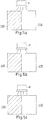
- Figure 4a becomes the motif to be created, for example the person portrait of Fig. 1 , printed with several colored printing inks, for example the printing inks cyan C, magenta M and yellow Y, according to the CMY color system. Since black portions of the motif in this embodiment should not be produced in all print image areas with a black printing ink, namely not in the IR-transparent image portions 220, these portions are simulated in these image portions by overprinting the three colored printing inks.
- FIG. 4a In the schematic representation of Figure 4a three colored areas 210, 210 ', 210 ′′ are shown, in each of which all three colored printing inks are printed, so that a dark color (more brown than black) is shown in these colored areas.
- the individual printing inks are applied, for example, with an inkjet printer Trap, the printing inks are applied in dots to the printing material / product carrier, for simplification the individual printing colors are drawn printed on top of each other.
- the printing inks will at least partially diffuse into the printing material or at least spread over its surface, so that the different printing inks mix with one another during printing and do not form separate layers.
- a black printing ink K + is additionally printed, which in addition to the black dyes / color pigments contained therein, for example soot, also contains at least one IR absorber.
- No black printing ink K + is imprinted in an IR-transparent image part 220, which is occupied by the right colored area 210 ′′ and the right partial area of the middle colored area 210 ′.
- FIG Figure 5a The top view of this embodiment not according to the invention, which results under illumination with an IR radiation source, is shown in FIG Figure 5a shown:
- the right (first) image part 220 no IR absorption takes place.
- the printing ink is therefore overall IR-transparent. In the absence of absorption of the IR radiation, this part of the image appears "bright", ie the IR radiation is reflected / scattered.
- the black printing ink K + in the left (second) image part 230 absorbs the irradiated IR radiation, so that this image part appears “dark”.
- Figure 4b becomes the motif to be created, for example the person portrait of Fig. 1 , with several colored printing inks, for example the printing inks cyan C, magenta M and yellow Y, and in the right (IR-transparent) image part 220 with a black printing ink K, which does not contain an IR absorber, and in the left (IR-absorbing ) Image part 230 printed with the black printing ink K + , which contains IR absorber, in accordance with the CMYK color system.
- three colored areas 210, 210 ', 210 ′′ are shown.
- the individual printing inks are applied, for example, with an inkjet printer. In this case, the printing inks are applied to the printing material / product carrier in colored dots.
- FIG Figure 5b The top view of this embodiment under illumination with an IR radiation source is shown in FIG Figure 5b shown:
- the black printing ink K does not contain any IR absorber.
- the print image in this area is overall IR-transparent. In the absence of absorption of the IR radiation, this part of the image appears "bright", ie the IR radiation is reflected / scattered.
- the black printing ink K + absorbs the irradiated IR radiation in the left (second, IR-absorbing) image part 230, so that this image part appears “dark”.
- a luminescent printing ink L is initially printed over the entire surface of the printing material / product carrier 110.
- This printing ink is preferably mixed from several luminescent substances which luminesce in different areas of the visible spectral range. As a result, when all of these luminescent substances are excited, a practically white luminescence is generated.
- the motif to be created is, for example, the person portrait of Fig.
- FIG Figure 5c Shown: In the right (IR-transparent) image part 220, there is no IR absorption, since the black printing ink K does not contain any IR absorber either.
- the print image is overall IR-transparent. In the absence of absorption of the IR radiation, this part of the image appears "bright", ie the IR radiation is reflected / scattered.
- the black printing ink K + in the left (IR-absorbing) image part 230 absorbs the irradiated IR radiation, so that this image part appears “dark”.
- the two image parts 220, 230 each appear unstructured “light” or “dark”.
- the density of the black printing inks K, K + in these image parts varies according to the black distribution in the printed motif. For example, if the in Fig. 1 If the person portrait shown in field 103 is printed, the distribution of the black printing ink is calculated with the color management system used and set according to the portrait to be printed.
- the result is a distribution of the “light” and “dark” color areas as in the person portrait, but limited to the IR-absorbing image part 230, while the security print is in the IR-transparent one Image part 220 is not printed with the black printing ink K + containing the IR absorbers but with the black printing ink K which does not contain the IR absorbers.
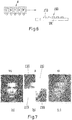
- a person portrait obtained when viewed with white light VIS which according to the third embodiment Figure 4c obtained by printing colored printing inks C, M, Y, black printing inks K, K + without or with an IR absorber and a layer of a luminescent printing ink L, in Figure 7a shown.
- the reproduction of the person portrait in the visible spectral range corresponds to the usual photographic reproduction.
- FIG. 7b The same security print 200, but when detected with IR radiation (near IR, IR A range: 860 nm), is in Figure 7b shown.
- IR radiation near IR, IR A range: 860 nm
- two image parts 220, 230 have been generated, each divided into two fields: an IR-transparent image part 220 is with the three colored printing inks C, M, Y, the black printing ink K without IR absorber and the luminescent printing ink printed so that the two fields thus formed appear "bright", ie these fields do not absorb the IR radiation and scatter it.
- the IR-absorbing image part 230 is printed with the three colored printing inks, the black printing ink K + with IR absorbers and the luminescent printing ink, so that the two fields thus formed appear "dark” because these fields absorb the IR radiation and therefore do not scatter.
- the density of the IR absorption varies according to the density of the printed black printing ink K + , so that the person's portrait can be recognized in this part of the image.
- the same security print 200 when detected with UV radiation (near UV, UV A radiation, 365 nm), is in Figure 7c shown.
- the person portrait is again recognizable.
- the color distribution of the portrait corresponds to that obtained when viewed under white light.
- the luminescent printing ink is preferably selected in such a way that it luminesces approximately white under UV excitation in the visible spectral range. This can be achieved in that the luminescent printing ink L contains several luminescent substances which have different luminescence spectra in the visible spectral range, which complement each other to form a white overall luminescence.
- the colored printing inks C, M, Y absorb the respective luminescence radiation in a spectrally selective manner, so that the complementary components of the luminescence radiation result in the luminescent printed image.
- the printed image corresponds with regard to the color distribution of the motif, therefore, that which is obtained when viewed without stimulation of the luminescent printing ink.
- FIG. 8a and 8b Further examples of printed images according to the invention, the reproduction of which is obtained under IR illumination, are given in Figures 8a and 8b shown:
- the person portrait in both examples is printed in the form of a security print 200 according to the present invention, namely for example with three colored printing inks C, M, Y, two black printing inks K, K + and one luminescent printing ink L.
- the two black printing inks differ in terms of the Presence of IR absorbers: the black printing ink K contains no IR absorber, while the black printing ink K + contains at least one IR absorber.
- the dye (s) or color pigment (s) in the printing ink K + can be IR-absorbing in the IR spectral range.
- the luminescent printing ink is preferably printed over the entire surface of the product carrier and, in the case of excitation, for example with UV radiation, emits luminescence in the visible spectral range. This can preferably be at least approximately white.
- the color components of the person portrait are printed with the three colored printing inks.
- the black portions of the respective person portrait are printed with the two black printing inks so that non-absorbing (transparent) fields of a first image part 220 and absorbing fields of a second image part 230 result in the IR spectral range.
- the transparent fields of the first image part are white in the respective representation, since the irradiated IR radiation is completely backscattered and detected by the detection device of the recording device.
- the absorbing fields of the second image part are black in the respective representation, since the irradiated IR radiation is more or less strongly absorbed by the IR absorbers depending on the density of the printed black parts.
- the absorbing fields and transparent fields result in the case of the example of Figure 8a a 2D barcode embedded in the primary image, which can be used to store multi-bit information, such as information about the document owner.
- the absorbing fields and transparent fields result in the case of the example of Figure 8b a graphic design with symbols that can represent one-bit information, if only the presence of these symbols is used as a basis for information.
- These symbols can, for example, represent generic information taken from the document layout.
- the embedded IR print image can serve as a watermark. If the 2D arrangement of these symbols is also taken into account as an additional variation option, this security feature also represents multi-bit information with which information, for example about the document owner, can be stored.
- FIG. 9 An enlarged representation of a security print 200 obtained with an ink jet printing process is shown.
- the security print has been produced with several colored printing inks, one of the colored printing inks being formed with dyes, while another of the colored printing inks is formed with color pigments. While the printing inks with dyes dissolve quickly after they hit the substrate / product carrier (see pressure point B), the printing inks with color pigments remain at the point of impact and therefore form sharply defined spots (see pressure point A).
- the printing dots formed by the printing inks with dyes are blurred.
- printing inks with dyes on the one hand and color pigments on the other hand can therefore be used for forensic verification of the authenticity of a valuable or security product: By determining whether certain printing inks form sharply defined or blurred spots, it can be determined whether the product is genuine.
Landscapes
- Health & Medical Sciences (AREA)
- Manufacturing & Machinery (AREA)
- Toxicology (AREA)
- Engineering & Computer Science (AREA)
- General Health & Medical Sciences (AREA)
- Physics & Mathematics (AREA)
- Accounting & Taxation (AREA)
- Spectroscopy & Molecular Physics (AREA)
- Finance (AREA)
- Business, Economics & Management (AREA)
- General Physics & Mathematics (AREA)
- Printing Methods (AREA)
- Credit Cards Or The Like (AREA)
Priority Applications (1)
| Application Number | Priority Date | Filing Date | Title |
|---|---|---|---|
| PL17703117T PL3411245T3 (pl) | 2016-02-04 | 2017-02-02 | Produkt wartościowy albo zabezpieczony, sposób wytwarzania półproduktu i sposób weryfikacji |
Applications Claiming Priority (2)
| Application Number | Priority Date | Filing Date | Title |
|---|---|---|---|
| DE102016201709.8A DE102016201709A1 (de) | 2016-02-04 | 2016-02-04 | Wert- oder Sicherheitsprodukt, Verfahren zum Herstellen eines Vorproduktes und Verifikationsverfahren |
| PCT/EP2017/052196 WO2017134130A1 (de) | 2016-02-04 | 2017-02-02 | Wert- oder sicherheitsprodukt, verfahren zum herstellen eines vorproduktes und verifikationsverfahren |
Publications (2)
| Publication Number | Publication Date |
|---|---|
| EP3411245A1 EP3411245A1 (de) | 2018-12-12 |
| EP3411245B1 true EP3411245B1 (de) | 2021-06-30 |
Family
ID=57963209
Family Applications (1)
| Application Number | Title | Priority Date | Filing Date |
|---|---|---|---|
| EP17703117.6A Active EP3411245B1 (de) | 2016-02-04 | 2017-02-02 | Wert- oder sicherheitsprodukt, verfahren zum herstellen eines vorproduktes und verifikationsverfahren |
Country Status (5)
| Country | Link |
|---|---|
| EP (1) | EP3411245B1 (pl) |
| DE (1) | DE102016201709A1 (pl) |
| ES (1) | ES2890978T3 (pl) |
| PL (1) | PL3411245T3 (pl) |
| WO (1) | WO2017134130A1 (pl) |
Cited By (1)
| Publication number | Priority date | Publication date | Assignee | Title |
|---|---|---|---|---|
| WO2026002334A1 (de) | 2024-06-26 | 2026-01-02 | Bundesdruckerei Gmbh | Sicherheitselement für ein sicherheits- oder wertdokument, verfahren zum herstellen und verfahren zum optischen auslesen eines sicherheitselements sowie sicherheits- oder wertdokument und verfahren zum prüfen |
Families Citing this family (17)
| Publication number | Priority date | Publication date | Assignee | Title |
|---|---|---|---|---|
| DE102017106721A1 (de) | 2017-03-29 | 2018-10-04 | Leonhard Kurz Stiftung & Co. Kg | Verfahren zum Herstellen einer Mehrschichtfolie und eine Mehrschichtfolie sowie ein Sicherheitselement und ein Sicherheitsdokument |
| DE102017004039B4 (de) * | 2017-04-26 | 2019-06-06 | Mühlbauer Gmbh & Co. Kg | Sicherheitseinlage für ein Ausweisdokument und Verfahren zur Herstellung einer Sicherheitseinlage für ein Ausweisdokument |
| DE102019000149A1 (de) | 2019-01-10 | 2020-07-16 | Mühlbauer Gmbh & Co. Kg | Sicherheitseinlage für ein Ausweisdokument mit transparentem Fenster |
| DE102019004229A1 (de) * | 2019-06-13 | 2020-12-17 | Giesecke+Devrient Currency Technology Gmbh | Sicherheitselement mit bei Beleuchtung mit elektromagnetischer Strahlung im infraroten Wellenlängenbereich unterschiedlichen Druckfarben |
| DE102019129491A1 (de) * | 2019-10-31 | 2021-05-06 | Bundesdruckerei Gmbh | Prüfung eines Sicherheitsdokuments auf Basis von Tröpfchenmorphologien |
| US20210237470A1 (en) * | 2020-01-17 | 2021-08-05 | Caliente LLC | System and method for producing an ultraviolet reflective photorealistic image |
| DE102021104128A1 (de) | 2020-03-19 | 2021-09-23 | Heidelberger Druckmaschinen Aktiengesellschaft | Druckoptimierte Sicherheitselemente |
| CN112622461A (zh) * | 2020-12-16 | 2021-04-09 | 福建长信纸业包装有限公司 | 一种柔性印刷人物面部颜色的优化控制方法 |
| DE102021002764A1 (de) * | 2021-05-27 | 2022-12-01 | Giesecke+Devrient Currency Technology Gmbh | Verfahren zur Herstellung einer lumineszenten Druckfarbe |
| DE102021004849A1 (de) * | 2021-09-24 | 2023-03-30 | Giesecke+Devrient Currency Technology Gmbh | Verfahren zum Herstellen eines Substrats mit einem Lumineszenzelement |
| DE102022107442B4 (de) | 2022-03-29 | 2023-11-02 | Bundesdruckerei Gmbh | Verfahren zur Überprüfung der Echtheit eines Wertdokuments |
| DE102022124432A1 (de) | 2022-09-22 | 2024-03-28 | Bundesdruckerei Gmbh | Verfahren zur Herstellung eines Sicherheitsmerkmals auf einem Trägersubstrat für Wert- und Sicherheitsdokumente |
| WO2024061899A2 (de) | 2022-09-22 | 2024-03-28 | Bundesdruckerei Gmbh | Verfahren zur herstellung eines sicherheitsmerkmals auf einem trägersubstrat für wert- oder sicherheitsdokumente |
| DE102022124431A1 (de) | 2022-09-22 | 2024-03-28 | Bundesdruckerei Gmbh | Verfahren zur Herstellung eines Sicherheitsmerkmals auf einem Trägersubstrat für Wert- oder Sicherheitsdokumente |
| DE102023112927A1 (de) | 2023-05-16 | 2024-11-21 | Bundesdruckerei Gmbh | Druckplattenkombination und Verfahren zu deren Herstellung, Sicherheitsdruck und Verfahren zu dessen Herstellung, Ausweis-, Wert- oder Sicherheitsdokument mit einem solchen Sicherheitsdruck und Verfahren zur Verifikation des Sicherheitsdrucks |
| DE102023131282B3 (de) | 2023-11-10 | 2025-02-06 | Bundesdruckerei Gmbh | Verfahren und Vorrichtung zum Prüfen eines Sicherheitselements für ein Sicherheitsdokument |
| DE102024118037A1 (de) | 2024-06-26 | 2025-12-31 | Bundesdruckerei Gmbh | Sicherheitselement für ein Sicherheits- oder Wertdokument, Verfahren zum Herstellen und Verfahren zum optischen Auslesen eines Sicherheitselements sowie Sicherheits- oder Wertdokument und Verfahren zum Prüfen |
Family Cites Families (19)
| Publication number | Priority date | Publication date | Assignee | Title |
|---|---|---|---|---|
| DE19906388A1 (de) | 1999-02-16 | 2000-08-24 | Bundesdruckerei Gmbh | Verfahren und Vorrichtung zur Personalisierung und Verifizierung von Identitäts- und Sicherheitsdokumenten sowie ein damit verwendbares Identitäts- und Sicherheitsdokument |
| CA2471457C (en) * | 2001-12-24 | 2011-08-02 | Digimarc Id Systems, Llc | Covert variable information on id documents and methods of making same |
| US7706565B2 (en) * | 2003-09-30 | 2010-04-27 | Digimarc Corporation | Multi-channel digital watermarking |
| EP1814744B1 (de) * | 2004-11-23 | 2012-08-08 | Constantia Hueck Folien GmbH & Co. KG | Fälschungssicheres identifikations- und authentizitätsmerkmal für verpackungsmaterialien und sicherheitsanwendungen |
| PT1790701E (pt) | 2005-11-25 | 2009-03-05 | Sicpa Holding Sa | Tinta para impressão em baixo relevo de absorção de ir |
| DE102007018450B4 (de) | 2007-04-19 | 2017-08-17 | Bundesdruckerei Gmbh | Laminiertes Sicherheitsdokument |
| US8019115B2 (en) * | 2007-04-25 | 2011-09-13 | Graphic Security Systems Corp. | Object authentication using a portable digital image acquisition device |
| US7852515B2 (en) * | 2007-06-05 | 2010-12-14 | Xerox Corporation | Infrared encoding for embedding multiple variable data information collocated in printed documents |
| US8455087B2 (en) * | 2007-06-05 | 2013-06-04 | Xerox Corporation | Infrared encoding of security elements using standard xerographic materials with distraction patterns |
| GB0714141D0 (en) * | 2007-07-19 | 2007-08-29 | Rue De Int Ltd | security device |
| DE102008012423A1 (de) | 2007-10-31 | 2009-05-07 | Bundesdruckerei Gmbh | Verfahren zur Herstellung eines Polymerschichtverbundes und Polymerschichtverbund mit farbigem Sicherheitsmerkmal |
| US8064102B1 (en) * | 2010-07-01 | 2011-11-22 | Xerox Corporation | Embedding frequency modulation infrared watermark in digital document |
| JP5071592B2 (ja) * | 2010-08-17 | 2012-11-14 | 貞宏 平山 | 印字された微小識別マークによる一般人が容易に出来る真贋判定方法 |
| US8941886B2 (en) * | 2012-06-19 | 2015-01-27 | Eastman Kodak Company | Spectral edge marking for steganography or watermarking |
| US8699089B2 (en) * | 2012-07-19 | 2014-04-15 | Xerox Corporation | Variable data image watermarking using infrared sequence structures in black separation |
| DE102012218053B4 (de) | 2012-10-02 | 2025-02-06 | Bundesdruckerei Gmbh | Sicherheitsmerkmal, das Sicherheitsmerkmal enthaltendes Wert- und/oder Sicherheitsprodukt sowie Verfahren zur Herstellung des Wert- und/oder Sicherheitsprodukts |
| JP6151063B2 (ja) * | 2013-04-01 | 2017-06-21 | 株式会社東芝 | 印刷物検査装置 |
| DE102013218861A1 (de) | 2013-09-19 | 2015-03-19 | Bundesdruckerei Gmbh | Halbzeug, Sicherheitsdokument und Verfahren zur Herstellung solcher mit einem UV-anregbaren Lumineszenzsicherheitsdruck |
| DE102015102045A1 (de) * | 2015-02-12 | 2016-08-18 | Bundesdruckerei Gmbh | Identifikationsdokument mit einem gedruckten Personenbild |
-
2016
- 2016-02-04 DE DE102016201709.8A patent/DE102016201709A1/de active Pending
-
2017
- 2017-02-02 WO PCT/EP2017/052196 patent/WO2017134130A1/de not_active Ceased
- 2017-02-02 ES ES17703117T patent/ES2890978T3/es active Active
- 2017-02-02 PL PL17703117T patent/PL3411245T3/pl unknown
- 2017-02-02 EP EP17703117.6A patent/EP3411245B1/de active Active
Cited By (1)
| Publication number | Priority date | Publication date | Assignee | Title |
|---|---|---|---|---|
| WO2026002334A1 (de) | 2024-06-26 | 2026-01-02 | Bundesdruckerei Gmbh | Sicherheitselement für ein sicherheits- oder wertdokument, verfahren zum herstellen und verfahren zum optischen auslesen eines sicherheitselements sowie sicherheits- oder wertdokument und verfahren zum prüfen |
Also Published As
| Publication number | Publication date |
|---|---|
| PL3411245T3 (pl) | 2022-01-24 |
| WO2017134130A1 (de) | 2017-08-10 |
| EP3411245A1 (de) | 2018-12-12 |
| DE102016201709A1 (de) | 2017-08-10 |
| ES2890978T3 (es) | 2022-01-25 |
Similar Documents
| Publication | Publication Date | Title |
|---|---|---|
| EP3411245B1 (de) | Wert- oder sicherheitsprodukt, verfahren zum herstellen eines vorproduktes und verifikationsverfahren | |
| EP2906430B1 (de) | Sicherheitsmerkmal für ein wert- und/oder sicherheitsprodukt mit farbverlaufsstruktur und das sicherheitsmerkmal aufweisendes wert- und/oder sicherheitsdokument | |
| EP3317114B1 (de) | Sicherheits- oder wertdokument mit einem lumineszenzmerkmal und verfahren zum prüfen der echtheit des sicherheits- oder wertdokuments | |
| DE102013200895B4 (de) | Wert- oder Sicherheitsprodukt sowie Verfahren zur Herstellung eines Sicherheitsmerkmals auf oder in dem Wert- oder Sicherheitsprodukt | |
| EP2643162B1 (de) | Wert- und/oder sicherheitsdokument und verfahren zu dessen herstellung | |
| DE102010062046A1 (de) | Wert- und/oder Sicherheitsdokument mit farbigem Durchsichtsicherheitsmerkmal und Verfahren zu dessen Herstellung | |
| EP2903835B1 (de) | Sicherheitsmerkmal und das sicherheitsmerkmal enthaltendes wert- und/oder sicherheitsprodukt | |
| DE102008030182B4 (de) | Wert- oder Sicherheitsdokument und Verfahren zum Bilden mindestens eines Sicherheitsmerkmals bei der Herstellung des Wert- oder Sicherheitsdokuments sowie Verfahren und Mittel zur Verifikation | |
| EP1703885B1 (de) | Sicherheitselement für sicherheitspapiere und wertdokumente | |
| DE102020133826A1 (de) | Verfahren zur Herstellung eines gedruckten Bildes auf einem Datenträger für ein Sicherheits- oder Wertdokument | |
| EP4051509B1 (de) | Prüfung eines sicherheitsdokuments auf basis von tröpfchenmorphologien | |
| EP3922473B1 (de) | Verfahren zur herstellung eines gedruckten lichtbildes auf einem datenträger für ein sicherheits- oder wertdokument | |
| EP3693181B1 (de) | Identifikationsdokument und verfahren zum herstellen eines identifikationsdokuments | |
| EP4470790A1 (de) | Druckplattenkombination und verfahren zu deren herstellung, sicherheitsdruck und verfahren zu dessen herstellung, ausweis-, wert- oder sicherheitsdokument mit einem solchen sicherheitsdruck und verfahren zur verifikation des sicherheitsdrucks |
Legal Events
| Date | Code | Title | Description |
|---|---|---|---|
| STAA | Information on the status of an ep patent application or granted ep patent |
Free format text: STATUS: UNKNOWN |
|
| STAA | Information on the status of an ep patent application or granted ep patent |
Free format text: STATUS: THE INTERNATIONAL PUBLICATION HAS BEEN MADE |
|
| PUAI | Public reference made under article 153(3) epc to a published international application that has entered the european phase |
Free format text: ORIGINAL CODE: 0009012 |
|
| STAA | Information on the status of an ep patent application or granted ep patent |
Free format text: STATUS: REQUEST FOR EXAMINATION WAS MADE |
|
| 17P | Request for examination filed |
Effective date: 20180820 |
|
| AK | Designated contracting states |
Kind code of ref document: A1 Designated state(s): AL AT BE BG CH CY CZ DE DK EE ES FI FR GB GR HR HU IE IS IT LI LT LU LV MC MK MT NL NO PL PT RO RS SE SI SK SM TR |
|
| AX | Request for extension of the european patent |
Extension state: BA ME |
|
| DAV | Request for validation of the european patent (deleted) | ||
| DAX | Request for extension of the european patent (deleted) | ||
| GRAP | Despatch of communication of intention to grant a patent |
Free format text: ORIGINAL CODE: EPIDOSNIGR1 |
|
| STAA | Information on the status of an ep patent application or granted ep patent |
Free format text: STATUS: GRANT OF PATENT IS INTENDED |
|
| INTG | Intention to grant announced |
Effective date: 20210121 |
|
| GRAS | Grant fee paid |
Free format text: ORIGINAL CODE: EPIDOSNIGR3 |
|
| GRAA | (expected) grant |
Free format text: ORIGINAL CODE: 0009210 |
|
| STAA | Information on the status of an ep patent application or granted ep patent |
Free format text: STATUS: THE PATENT HAS BEEN GRANTED |
|
| AK | Designated contracting states |
Kind code of ref document: B1 Designated state(s): AL AT BE BG CH CY CZ DE DK EE ES FI FR GB GR HR HU IE IS IT LI LT LU LV MC MK MT NL NO PL PT RO RS SE SI SK SM TR |
|
| REG | Reference to a national code |
Ref country code: CH Ref legal event code: EP |
|
| REG | Reference to a national code |
Ref country code: AT Ref legal event code: REF Ref document number: 1406012 Country of ref document: AT Kind code of ref document: T Effective date: 20210715 |
|
| REG | Reference to a national code |
Ref country code: DE Ref legal event code: R096 Ref document number: 502017010781 Country of ref document: DE |
|
| REG | Reference to a national code |
Ref country code: IE Ref legal event code: FG4D Free format text: LANGUAGE OF EP DOCUMENT: GERMAN |
|
| REG | Reference to a national code |
Ref country code: LT Ref legal event code: MG9D |
|
| PG25 | Lapsed in a contracting state [announced via postgrant information from national office to epo] |
Ref country code: HR Free format text: LAPSE BECAUSE OF FAILURE TO SUBMIT A TRANSLATION OF THE DESCRIPTION OR TO PAY THE FEE WITHIN THE PRESCRIBED TIME-LIMIT Effective date: 20210630 Ref country code: BG Free format text: LAPSE BECAUSE OF FAILURE TO SUBMIT A TRANSLATION OF THE DESCRIPTION OR TO PAY THE FEE WITHIN THE PRESCRIBED TIME-LIMIT Effective date: 20210930 Ref country code: FI Free format text: LAPSE BECAUSE OF FAILURE TO SUBMIT A TRANSLATION OF THE DESCRIPTION OR TO PAY THE FEE WITHIN THE PRESCRIBED TIME-LIMIT Effective date: 20210630 |
|
| PG25 | Lapsed in a contracting state [announced via postgrant information from national office to epo] |
Ref country code: GR Free format text: LAPSE BECAUSE OF FAILURE TO SUBMIT A TRANSLATION OF THE DESCRIPTION OR TO PAY THE FEE WITHIN THE PRESCRIBED TIME-LIMIT Effective date: 20211001 Ref country code: LV Free format text: LAPSE BECAUSE OF FAILURE TO SUBMIT A TRANSLATION OF THE DESCRIPTION OR TO PAY THE FEE WITHIN THE PRESCRIBED TIME-LIMIT Effective date: 20210630 Ref country code: NO Free format text: LAPSE BECAUSE OF FAILURE TO SUBMIT A TRANSLATION OF THE DESCRIPTION OR TO PAY THE FEE WITHIN THE PRESCRIBED TIME-LIMIT Effective date: 20210930 Ref country code: RS Free format text: LAPSE BECAUSE OF FAILURE TO SUBMIT A TRANSLATION OF THE DESCRIPTION OR TO PAY THE FEE WITHIN THE PRESCRIBED TIME-LIMIT Effective date: 20210630 Ref country code: SE Free format text: LAPSE BECAUSE OF FAILURE TO SUBMIT A TRANSLATION OF THE DESCRIPTION OR TO PAY THE FEE WITHIN THE PRESCRIBED TIME-LIMIT Effective date: 20210630 |
|
| REG | Reference to a national code |
Ref country code: NL Ref legal event code: FP |
|
| REG | Reference to a national code |
Ref country code: ES Ref legal event code: FG2A Ref document number: 2890978 Country of ref document: ES Kind code of ref document: T3 Effective date: 20220125 |
|
| PG25 | Lapsed in a contracting state [announced via postgrant information from national office to epo] |
Ref country code: CZ Free format text: LAPSE BECAUSE OF FAILURE TO SUBMIT A TRANSLATION OF THE DESCRIPTION OR TO PAY THE FEE WITHIN THE PRESCRIBED TIME-LIMIT Effective date: 20210630 Ref country code: EE Free format text: LAPSE BECAUSE OF FAILURE TO SUBMIT A TRANSLATION OF THE DESCRIPTION OR TO PAY THE FEE WITHIN THE PRESCRIBED TIME-LIMIT Effective date: 20210630 Ref country code: RO Free format text: LAPSE BECAUSE OF FAILURE TO SUBMIT A TRANSLATION OF THE DESCRIPTION OR TO PAY THE FEE WITHIN THE PRESCRIBED TIME-LIMIT Effective date: 20210630 Ref country code: PT Free format text: LAPSE BECAUSE OF FAILURE TO SUBMIT A TRANSLATION OF THE DESCRIPTION OR TO PAY THE FEE WITHIN THE PRESCRIBED TIME-LIMIT Effective date: 20211102 Ref country code: SK Free format text: LAPSE BECAUSE OF FAILURE TO SUBMIT A TRANSLATION OF THE DESCRIPTION OR TO PAY THE FEE WITHIN THE PRESCRIBED TIME-LIMIT Effective date: 20210630 Ref country code: SM Free format text: LAPSE BECAUSE OF FAILURE TO SUBMIT A TRANSLATION OF THE DESCRIPTION OR TO PAY THE FEE WITHIN THE PRESCRIBED TIME-LIMIT Effective date: 20210630 |
|
| REG | Reference to a national code |
Ref country code: DE Ref legal event code: R097 Ref document number: 502017010781 Country of ref document: DE |
|
| PG25 | Lapsed in a contracting state [announced via postgrant information from national office to epo] |
Ref country code: DK Free format text: LAPSE BECAUSE OF FAILURE TO SUBMIT A TRANSLATION OF THE DESCRIPTION OR TO PAY THE FEE WITHIN THE PRESCRIBED TIME-LIMIT Effective date: 20210630 |
|
| PLBE | No opposition filed within time limit |
Free format text: ORIGINAL CODE: 0009261 |
|
| STAA | Information on the status of an ep patent application or granted ep patent |
Free format text: STATUS: NO OPPOSITION FILED WITHIN TIME LIMIT |
|
| PG25 | Lapsed in a contracting state [announced via postgrant information from national office to epo] |
Ref country code: AL Free format text: LAPSE BECAUSE OF FAILURE TO SUBMIT A TRANSLATION OF THE DESCRIPTION OR TO PAY THE FEE WITHIN THE PRESCRIBED TIME-LIMIT Effective date: 20210630 |
|
| 26N | No opposition filed |
Effective date: 20220331 |
|
| PG25 | Lapsed in a contracting state [announced via postgrant information from national office to epo] |
Ref country code: MC Free format text: LAPSE BECAUSE OF FAILURE TO SUBMIT A TRANSLATION OF THE DESCRIPTION OR TO PAY THE FEE WITHIN THE PRESCRIBED TIME-LIMIT Effective date: 20210630 |
|
| REG | Reference to a national code |
Ref country code: BE Ref legal event code: MM Effective date: 20220228 |
|
| PG25 | Lapsed in a contracting state [announced via postgrant information from national office to epo] |
Ref country code: LU Free format text: LAPSE BECAUSE OF NON-PAYMENT OF DUE FEES Effective date: 20220202 |
|
| PG25 | Lapsed in a contracting state [announced via postgrant information from national office to epo] |
Ref country code: IE Free format text: LAPSE BECAUSE OF NON-PAYMENT OF DUE FEES Effective date: 20220202 |
|
| PG25 | Lapsed in a contracting state [announced via postgrant information from national office to epo] |
Ref country code: BE Free format text: LAPSE BECAUSE OF NON-PAYMENT OF DUE FEES Effective date: 20220228 |
|
| REG | Reference to a national code |
Ref country code: AT Ref legal event code: MM01 Ref document number: 1406012 Country of ref document: AT Kind code of ref document: T Effective date: 20220202 |
|
| PG25 | Lapsed in a contracting state [announced via postgrant information from national office to epo] |
Ref country code: LT Free format text: LAPSE BECAUSE OF FAILURE TO SUBMIT A TRANSLATION OF THE DESCRIPTION OR TO PAY THE FEE WITHIN THE PRESCRIBED TIME-LIMIT Effective date: 20210630 Ref country code: AT Free format text: LAPSE BECAUSE OF NON-PAYMENT OF DUE FEES Effective date: 20220202 |
|
| P01 | Opt-out of the competence of the unified patent court (upc) registered |
Effective date: 20230530 |
|
| PG25 | Lapsed in a contracting state [announced via postgrant information from national office to epo] |
Ref country code: HU Free format text: LAPSE BECAUSE OF FAILURE TO SUBMIT A TRANSLATION OF THE DESCRIPTION OR TO PAY THE FEE WITHIN THE PRESCRIBED TIME-LIMIT; INVALID AB INITIO Effective date: 20170202 |
|
| PG25 | Lapsed in a contracting state [announced via postgrant information from national office to epo] |
Ref country code: MK Free format text: LAPSE BECAUSE OF FAILURE TO SUBMIT A TRANSLATION OF THE DESCRIPTION OR TO PAY THE FEE WITHIN THE PRESCRIBED TIME-LIMIT Effective date: 20210630 Ref country code: CY Free format text: LAPSE BECAUSE OF FAILURE TO SUBMIT A TRANSLATION OF THE DESCRIPTION OR TO PAY THE FEE WITHIN THE PRESCRIBED TIME-LIMIT Effective date: 20210630 |
|
| PG25 | Lapsed in a contracting state [announced via postgrant information from national office to epo] |
Ref country code: MT Free format text: LAPSE BECAUSE OF FAILURE TO SUBMIT A TRANSLATION OF THE DESCRIPTION OR TO PAY THE FEE WITHIN THE PRESCRIBED TIME-LIMIT Effective date: 20210630 |
|
| PGFP | Annual fee paid to national office [announced via postgrant information from national office to epo] |
Ref country code: NL Payment date: 20250220 Year of fee payment: 9 |
|
| PGFP | Annual fee paid to national office [announced via postgrant information from national office to epo] |
Ref country code: DE Payment date: 20250218 Year of fee payment: 9 |
|
| PGFP | Annual fee paid to national office [announced via postgrant information from national office to epo] |
Ref country code: ES Payment date: 20250318 Year of fee payment: 9 |
|
| PGFP | Annual fee paid to national office [announced via postgrant information from national office to epo] |
Ref country code: CH Payment date: 20250301 Year of fee payment: 9 |
|
| PGFP | Annual fee paid to national office [announced via postgrant information from national office to epo] |
Ref country code: FR Payment date: 20250220 Year of fee payment: 9 Ref country code: PL Payment date: 20250120 Year of fee payment: 9 |
|
| PGFP | Annual fee paid to national office [announced via postgrant information from national office to epo] |
Ref country code: IT Payment date: 20250228 Year of fee payment: 9 Ref country code: GB Payment date: 20250220 Year of fee payment: 9 |
|
| PG25 | Lapsed in a contracting state [announced via postgrant information from national office to epo] |
Ref country code: TR Free format text: LAPSE BECAUSE OF FAILURE TO SUBMIT A TRANSLATION OF THE DESCRIPTION OR TO PAY THE FEE WITHIN THE PRESCRIBED TIME-LIMIT Effective date: 20210630 |