EP3404249A1 - Verbindungsanordnung für fluidleitungen - Google Patents
Verbindungsanordnung für fluidleitungen Download PDFInfo
- Publication number
- EP3404249A1 EP3404249A1 EP18157530.9A EP18157530A EP3404249A1 EP 3404249 A1 EP3404249 A1 EP 3404249A1 EP 18157530 A EP18157530 A EP 18157530A EP 3404249 A1 EP3404249 A1 EP 3404249A1
- Authority
- EP
- European Patent Office
- Prior art keywords
- support ribs
- flow
- fluid
- ribs
- support
- Prior art date
- Legal status (The legal status is an assumption and is not a legal conclusion. Google has not performed a legal analysis and makes no representation as to the accuracy of the status listed.)
- Withdrawn
Links
Images


Classifications
-
- F—MECHANICAL ENGINEERING; LIGHTING; HEATING; WEAPONS; BLASTING
- F16—ENGINEERING ELEMENTS AND UNITS; GENERAL MEASURES FOR PRODUCING AND MAINTAINING EFFECTIVE FUNCTIONING OF MACHINES OR INSTALLATIONS; THERMAL INSULATION IN GENERAL
- F16L—PIPES; JOINTS OR FITTINGS FOR PIPES; SUPPORTS FOR PIPES, CABLES OR PROTECTIVE TUBING; MEANS FOR THERMAL INSULATION IN GENERAL
- F16L33/00—Arrangements for connecting hoses to rigid members; Rigid hose-connectors, i.e. single members engaging both hoses
-
- F—MECHANICAL ENGINEERING; LIGHTING; HEATING; WEAPONS; BLASTING
- F02—COMBUSTION ENGINES; HOT-GAS OR COMBUSTION-PRODUCT ENGINE PLANTS
- F02B—INTERNAL-COMBUSTION PISTON ENGINES; COMBUSTION ENGINES IN GENERAL
- F02B31/00—Modifying induction systems for imparting a rotation to the charge in the cylinder
- F02B31/04—Modifying induction systems for imparting a rotation to the charge in the cylinder by means within the induction channel, e.g. deflectors
-
- F—MECHANICAL ENGINEERING; LIGHTING; HEATING; WEAPONS; BLASTING
- F02—COMBUSTION ENGINES; HOT-GAS OR COMBUSTION-PRODUCT ENGINE PLANTS
- F02M—SUPPLYING COMBUSTION ENGINES IN GENERAL WITH COMBUSTIBLE MIXTURES OR CONSTITUENTS THEREOF
- F02M35/00—Combustion-air cleaners, air intakes, intake silencers, or induction systems specially adapted for, or arranged on, internal-combustion engines
- F02M35/10—Air intakes; Induction systems
- F02M35/10091—Air intakes; Induction systems characterised by details of intake ducts: shapes; connections; arrangements
- F02M35/10144—Connections of intake ducts to each other or to another device
-
- F—MECHANICAL ENGINEERING; LIGHTING; HEATING; WEAPONS; BLASTING
- F02—COMBUSTION ENGINES; HOT-GAS OR COMBUSTION-PRODUCT ENGINE PLANTS
- F02M—SUPPLYING COMBUSTION ENGINES IN GENERAL WITH COMBUSTIBLE MIXTURES OR CONSTITUENTS THEREOF
- F02M35/00—Combustion-air cleaners, air intakes, intake silencers, or induction systems specially adapted for, or arranged on, internal-combustion engines
- F02M35/10—Air intakes; Induction systems
- F02M35/1015—Air intakes; Induction systems characterised by the engine type
- F02M35/10157—Supercharged engines
-
- F—MECHANICAL ENGINEERING; LIGHTING; HEATING; WEAPONS; BLASTING
- F02—COMBUSTION ENGINES; HOT-GAS OR COMBUSTION-PRODUCT ENGINE PLANTS
- F02M—SUPPLYING COMBUSTION ENGINES IN GENERAL WITH COMBUSTIBLE MIXTURES OR CONSTITUENTS THEREOF
- F02M35/00—Combustion-air cleaners, air intakes, intake silencers, or induction systems specially adapted for, or arranged on, internal-combustion engines
- F02M35/10—Air intakes; Induction systems
- F02M35/10242—Devices or means connected to or integrated into air intakes; Air intakes combined with other engine or vehicle parts
- F02M35/10262—Flow guides, obstructions, deflectors or the like
-
- F—MECHANICAL ENGINEERING; LIGHTING; HEATING; WEAPONS; BLASTING
- F02—COMBUSTION ENGINES; HOT-GAS OR COMBUSTION-PRODUCT ENGINE PLANTS
- F02M—SUPPLYING COMBUSTION ENGINES IN GENERAL WITH COMBUSTIBLE MIXTURES OR CONSTITUENTS THEREOF
- F02M35/00—Combustion-air cleaners, air intakes, intake silencers, or induction systems specially adapted for, or arranged on, internal-combustion engines
- F02M35/10—Air intakes; Induction systems
- F02M35/10314—Materials for intake systems
- F02M35/10321—Plastics; Composites; Rubbers
-
- Y—GENERAL TAGGING OF NEW TECHNOLOGICAL DEVELOPMENTS; GENERAL TAGGING OF CROSS-SECTIONAL TECHNOLOGIES SPANNING OVER SEVERAL SECTIONS OF THE IPC; TECHNICAL SUBJECTS COVERED BY FORMER USPC CROSS-REFERENCE ART COLLECTIONS [XRACs] AND DIGESTS
- Y02—TECHNOLOGIES OR APPLICATIONS FOR MITIGATION OR ADAPTATION AGAINST CLIMATE CHANGE
- Y02T—CLIMATE CHANGE MITIGATION TECHNOLOGIES RELATED TO TRANSPORTATION
- Y02T10/00—Road transport of goods or passengers
- Y02T10/10—Internal combustion engine [ICE] based vehicles
- Y02T10/12—Improving ICE efficiencies
Definitions
- the invention relates to a connection arrangement for fluid lines, comprising a connecting piece, support ribs and a charge air pipe.
- the end pieces are therefore usually reinforced with a metallic support sleeve. This sometimes causes considerable effort, since the tail of the charge air pipe must be loaded to a defined level in order to press the metal sleeve into the interior of the tube can. Since the thermal behavior of the plastics of the charge air tube and of the metal of the support sleeve are different, the sleeve must also be secured against falling out of the tube end. For this purpose, for example, the plastic can be melted again at the end of the pipe and pressed inwards. This creates a fall-out barrier.
- the support sleeve In addition to the high production costs, the support sleeve is also relatively heavy and expensive.
- a separate component at the relevant end of the blow-molded fluid line, which is firmly and tightly connected to the fluid line.
- a component can be designed, for example, as a plastic injection-molded sleeve with inner support ribs, which.
- the support ribs serve the radial reinforcement of the sleeve and lie in the media flow, so that an influence on the flow of the fluid flowing through the fluid conduit is unavoidable. For example, by friction welding with the fluid line is connectable.
- the invention has for its object to design the support ribs such that the flow of a fluid flowing through the fluid conduit can be influenced in a predetermined manner.
- This object is achieved in that the support ribs in their axial extent relative to the flow direction of a flowing fluid have an angle of attack, which is between 135 ° and 45 °.
- the support ribs have an angle of incidence which has different values over the radial extent of the support ribs.
- the support ribs have a cross-section which changes in the flow direction.
- the support ribs are curved in the flow direction.
- This embodiment is similar to a propeller. This rotation can be generated or influenced in the flowing fluid.
- the support ribs are distributed unevenly in the circumferential direction.
- the connecting piece is produced by plastic injection molding.
- Plastic injection molding is a cheaper and safer manufacturing process that allows for a variety of shapes and ensures high dimensional accuracy.
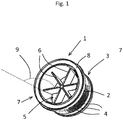
- the connecting piece once has a cylindrical base body 2, which has a plurality of grooves 4 on its outer circumferential surface 3.
- the grooves 4 serve to make the attachment of further, not shown here, fluid lines on the connecting piece safer.
- In its inner passage opening 5 has connecting piece 1 radially outwardly facing, quasi star-shaped support ribs 6.
- the support ribs 6 serve to stiffen the base body 2.
- At its first axial end 7, the connection piece 1 has a weld-on surface 8, which is arranged circumferentially around the first end 7 and is aligned axially flat.
- the support ribs 6 have an angle of attack 9 of 90 °.
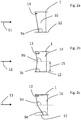
- Fig. 2a shows a support rib 10 as a schematic representation, which has in the flow direction 11 of a fluid flow, not shown, a flow angle 9a, which is greater than 90 °.
- the fluid flow or the flow direction of the fluid flow is symbolized here by the arrow 11, of the support sleeve 1 itself is here only a section shown in principle.
- the angle of incidence 9a is constant from an imaginary central axis 12 of the not shown flow to the radial end 13 of the support rib 10.
- a support rib 14 which has different flow angles 9b and 9c over the radial extent of the rib 14.
- the first angle of attack 9b is greater than 90 °, up to a predetermined radial distance 15 from the imaginary central axis 12 of the flow, not shown, the second angle of attack 9c is less than 90 °.
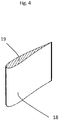
- a support rib 18 is shown in a partial longitudinal section.
- the support rib 18 has a wing-like contour 19, with which it is possible to influence the flow velocity of the flowing fluid to the support ribs 18 targeted.
- a support sleeve 1 is shown in principle in cross section, the support ribs 20 are distributed unevenly over the circumference of the flow cross section 21 of the support sleeve 1.
- the flow conditions in the support sleeve 1 can be influenced differently via their flow cross-section 21.
Landscapes
- Engineering & Computer Science (AREA)
- General Engineering & Computer Science (AREA)
- Mechanical Engineering (AREA)
- Chemical & Material Sciences (AREA)
- Combustion & Propulsion (AREA)
- Injection Moulding Of Plastics Or The Like (AREA)
Abstract
Description
- Die Erfindung betrifft eine Verbindungsanordnung für Fluidleitungen, aufweisend einen Anschlussstutzen, Stützrippen und ein Ladeluftrohr.
- Ladeluftrohre werden aufgrund der einfachen Herstellbarkeit und des geringen Gewichts heute oft als Blasformteil ausgeführt. Dabei sind auch geringe Wandstärken erreichbar.
- Problematisch sind diese geringen Wandstärken im Bereich der Anschlüsse, da die Festigkeit der Rohrwand meist nicht ausreicht, um weitere Fluidleitungen an das Rohr anzuschließen. Dies geschieht meist durch das Aufschieben eines Schlauches auf das Endstück des Ladeluftrohres und anschließender Verklemmung mit Spannhülsen oder Schellen. Ohne Verstärkung des Endes des Ladeluftrohres würde dieses bei der Verklemmung zusammengedrückt.
- Die Endstücke sind daher meist mit einer metallischen Stützhülse verstärkt. Dies verursacht teilweise erheblichen Aufwand, da das Endstück des Ladeluftrohres auf ein definiertes Maß aufgespielt werden muss, um die metallene Hülse in das Innere des Rohres einpressen zu können. Da das thermische Verhalten der Kunststoffe des Ladeluftrohres und des Metalles der Stützhülse unterschiedlich sind, muss die Hülse auch gegen ein herausfallen aus dem Rohrende gesichert sein. Dazu kann beispielsweise der Kunststoff am Rohrende nochmals aufgeschmolzen und nach innen gedrückt werden. So entsteht eine Herausfallsperre.
- Neben dem hohen Fertigungsaufwand ist die Stützhülse auch relativ schwer und teuer.
- Eine Möglichkeit, diese Problematik zu umgehen, ist, am betreffenden Ende der blasgeformten Fluidleitung ein separates Bauteil anzuordnen, welches mit der Fluidleitung fest und dicht verbindbar ist. Ein derartiges Bauteil kann beispielsweise als Kunststoff - Spritzguss - Hülse mit inneren Stützrippen ausgebildet sein, welches. Die Stützrippen dienen dabei der radialen Verstärkung der Hülse und liegen dabei im Medienstrom, so das ein Einfluss auf die Strömung des durch die Fluidleitung strömenden Fluids unvermeidbar ist. Beispielsweise durch Reibschweißen mit der Fluidleitung verbindbar ist.
- Der Erfindung liegt die Aufgabe zugrunde, die Stützrippen derart auszugestalten, dass die Strömung eines durch die Fluidleitung strömenden Fluids auf vorbestimmte Weise beeinflussbar ist.
- Diese Aufgabe wird dadurch gelöst, dass die Stützrippen in ihrer axialen Ausdehnung gegenüber der Strömungsrichtung eines strömenden Fluids einen Anströmwinkel aufweisen, der zwischen 135° und 45° liegt.
- In einer Weiterbildung der Erfindung weisen die Stützrippen einen Anströmwinkel auf, der über die radiale Ausdehnung der Stützrippen verschiedene Werte aufweist.
- Mittels dieses Anströmwinkel ist es möglich, die Verwirbelung des strömenden Fluids beim Auftreffen auf die Rippen gezielt zu beeinflussen. So sind beispielsweise unerwünschte Verwirbelungen verringerbar.
- In einer Weiterbildung der Erfindung weisen die Stützrippen einen in Strömungsrichtung sich ändernden Querschnitt auf.
- Durch diese Ausgestaltung ist es möglich, ähnlich wie bei einer Flugzeugtragfläche, im Fluidstrom Geschwindigkeitsgradienten zu erzeugen.
- In einer Weiterbildung der Erfindung sind die Stützrippen in Strömungsrichtung gekrümmt.
- Diese Ausführungsform ähnelt einem Propeller. Damit sind in dem strömenden Fluid Rotation erzeugbar oder beeinflussbar.
- In einer Weiterbildung der Erfindung sind die Stützrippen in Umfangsrichtung ungleichmäßig verteilt.
- Mit einer derartigen Anordnung lassen sich auch ungleichmäßig strömende Medien gut beeinflussen.
- In einer Weiterbildung der Erfindung ist der Anschlussstutzen durch Kunststoff-Spritzgießen hergestellt.
- Das Kunststoff-Spritzgießen ist ein günstiger und sicherer Herstellprozess, der vielfältige Formgebung ermöglicht und eine hohe Maßgenauigkeit gewährleistet.
- Anhand der Zeichnung wird ein Beispiel der Erfindung näher erläutert es zeigt
-
Fig. 1 einen Anschlussstutzen mit gleichmäßig verteilten Stützrippen und einem Anströmwinkel von 90°, -
Fig. 2a-2c prinzipielle Schnittdarstellungen von Anschlussstutzen mit unterschiedlichen Anströmwinkel der Stützrippen, -
Fig. 3 eine prinzipielle Darstellung eines Anschlussstutzens mit Propeller förmlich angeordneten Stützrippen, -
Fig. 4 einen Anschlussstutzen mit Stützrippen mit nicht konstantem Querschnitt und -
Fig. 5 eine prinzipielle Querschnittsdarstellung eines Anschlussstutzens mit ungleichmäßig verteilten Stützrippen. - In
Fig. 1 ist ein erfindungsgemäßer Anschlussstutzen 1 gezeigt. Der Anschlussstutzen 1 ist aus thermoplastischem Kunststoff im Spritzgussverfahren hergestellt. - Der Anschlussstutzen einst weist einen zylindrischen Grundkörper 2 auf, der auf seiner äußeren Mantelfläche 3 eine Mehrzahl von Rillen 4 aufweist. Die Rillen 4 dienen dazu, die Befestigung weiterer, hier nicht gezeigter Fluidleitungen auf dem Anschlussstutzen sicherer zu gestalten. In seiner inneren Durchlassöffnung 5 weist Anschlussstutzen 1 radial nach außen weisende, quasi sternförmig angeordnete Stützrippen 6 auf. Die Stützrippen 6 dienen der Versteifung des Grundkörpers 2. An seinem ersten axialen Ende 7 weist der Anschlussstutzen 1 eine Anschweißfläche 8 auf, die umlaufend um das erste Ende 7 herum angeordnet ist und axial plan ausgerichtet ist.
- Die Stützrippen 6 weisen einen Anströmwinkel 9 von 90° auf.
- In den
Figuren 2a-2c sind verschiedene Anordnungen von Stützrippen des Anschlussstutzens 1 gezeigt, wobei jeweils nur eine Stützrippen als Draufsicht gezeigt ist. -
Fig. 2a zeigt eine Stützrippe 10 als prinzipielle Darstellung, die in Strömungsrichtung 11 eines nicht gezeigten Fluidstroms einen Anströmwinkel 9a aufweist, der größer als 90° ist. Der Fluidstrom bzw. die Strömungsrichtung des Fluidstroms ist hier durch den Pfeil 11 symbolisiert, von der Stützhülse 1 selbst ist hier nur ein Ausschnitt prinzipiell dargestellt. Der Anströmwinkel 9a ist von einer imaginären Mittelachse 12 der nicht gezeichneten Strömung bis zum radialen Ende 13 der Stützrippe 10 konstant. - Durch einen Anströmwinkel 9a , der größer als 90° ist, ist die Aufprallcharakteristik der Strömung gegenüber Stützrippen mit senkrechten Stützrippen, d.h. mit Anströmwinkel 90°, verändert. Je flacher, also größer der Anströmwinkel 9a ist, desto weicher wird der Aufprall des Fluids auf die Stützrippen 10 sein.
- In
Fig. 2b ist eine Stützrippe 14 gezeigt, die über die radiale Ausdehnung der Rippe 14 verschiedene Anströmwinkel 9b und 9c aufweist. Am Außenrand der Rippe 14 ist der erste Anströmwinkel 9b größer als 90°, bis zu einem vorbestimmten radialen Abstand 15 von der imaginären Mittelachse 12 der nicht gezeigten Strömung ist der zweite Anströmwinkel 9c kleiner als 90°. - In
Fig. 2c ist eine Stützrippen 16 gezeigt, deren Anströmwinkel 9d und 9e beide größer sind als 90°, wobei der Anströmwinkel 9e größer ist, als der Anströmwinkel 9d. - Durch diese Anordnungen ist es möglich, Unterschiede bei der Strömungsgeschwindigkeit in den Außenbereichen der Strömung gegenüber dem Strömungszentrum zu berücksichtigen.
-
Fig. 3 zeigt einen Anschlussstutzen 1 mit propellerartig angeordneten Stützrippen 17. - Mit dieser Anordnung ist eine Rotation der Strömung einstellbar.
- In
Fig. 4 ist eine Stützrippe 18 in einem Teillängsschnitt gezeigt. Die Stützrippe 18 weist eine tragflügelähnliche Kontur 19 auf, mit der es möglich ist, die Strömungsgeschwindigkeit des strömenden Fluids an den Stützrippen 18 gezielt zu beeinflussen. - In
Fig. 5 ist eine Stützhülse 1 prinzipiell im Querschnitt gezeigt, deren Stützrippen 20 über den Umfang des Strömungsquerschnitts 21 der Stützhülse 1 ungleichmäßig verteilt sind. - Dadurch sind die Strömungsverhältnisse in der Stützhülse 1 über ihren Strömungsquerschnitt 21 unterschiedlich beeinflussbar.
-
- 1
- Anschlussstutzen
- 2
- Grundkörper des Anschlussstutzens 1
- 3
- Mantelfläche des Grundkörpers 2
- 4
- Rillen auf der Mantelfläche 3
- 5
- Durchlassöffnung des Anschlussstutzens 1
- 6, 10, 14, 16, 17, 18, 20
- Stützrippen
- 7
- Erstes axiales Ende des Anschlussstutzens 1
- 8
- Anschweissfläche
- 9, 9a - 9e
- Anströmwinkel
- 11
- Strömung, Strömungsrichtung
- 12
- imaginäre Mittelachse der Strömung 11
- 13
- radiales Ende der Stützrippen
- 15
- vorbestimmter radialer Abstand von der imaginären Mittelachse 12 der Strömung 11
- 19
- Kontur, Querschnitt der Stützrippen 18
- 21
- Strömungsquerschnitt der Stützhülse 1
Claims (6)
- Verbindungsanordnung für Fluidleitungen, aufweisend einen Anschlussstutzen (1), Stützrippen (6, 10, 14, 16, 17, 18, 20) und ein Ladeluftrohr, dadurch gekennzeichnet, dass die Stützrippen (6, 10, 14, 16, 17, 18, 20) in ihrer axialen Ausdehnung gegenüber der Strömungsrichtung (11) eines strömenden Fluids einen Anströmwinkel (9, 9a- 9e) aufweisen, der zwischen 135° und 45° liegt.
- Verbindungsanordnung nach Anspruch 1, dadurch gekennzeichnet, dass die Stützrippen (6, 10, 14, 16, 17, 18, 20) einen Anströmwinkel (9, 9a - 9e) aufweisen, der über die radiale Ausdehnung der Stützrippen (6, 10, 14, 16, 17, 18, 20) verschiedene Werte aufweist.
- Verbindungsanordnung nach Anspruch 1 oder 2, dadurch gekennzeichnet, dass die Stützrippen (6, 10, 14, 16, 17, 18, 20) einen in Strömungsrichtung (11) sich ändernden Querschnitt (19) aufweisen.
- Verbindungsanordnung nach mindestens einem der vorstehenden Ansprüche, dadurch gekennzeichnet, dass die Stützrippen (6, 10, 14, 16, 17, 18, 20) in Strömungsrichtung (11) gekrümmt sind.
- Verbindungsanordnung nach mindestens einem der vorstehenden Ansprüche, dadurch gekennzeichnet, dass die Stützrippen (6, 10, 14, 16, 17, 18, 20) in Umfangsrichtung ungleichmäßig verteilt sind.
- Verbindungsanordnung nach Anspruch 1, dadurch gekennzeichnet, dass der Anschlussstutzen (1) durch Kunststoff-Spritzgießen hergestellt ist.
Applications Claiming Priority (1)
| Application Number | Priority Date | Filing Date | Title |
|---|---|---|---|
| DE102017208439.1A DE102017208439A1 (de) | 2017-05-18 | 2017-05-18 | Verbindungsanordnung für Fluidleitungen |
Publications (1)
| Publication Number | Publication Date |
|---|---|
| EP3404249A1 true EP3404249A1 (de) | 2018-11-21 |
Family
ID=61249536
Family Applications (1)
| Application Number | Title | Priority Date | Filing Date |
|---|---|---|---|
| EP18157530.9A Withdrawn EP3404249A1 (de) | 2017-05-18 | 2018-02-20 | Verbindungsanordnung für fluidleitungen |
Country Status (2)
| Country | Link |
|---|---|
| EP (1) | EP3404249A1 (de) |
| DE (1) | DE102017208439A1 (de) |
Cited By (1)
| Publication number | Priority date | Publication date | Assignee | Title |
|---|---|---|---|---|
| EP3770416A1 (de) * | 2019-07-24 | 2021-01-27 | ContiTech MGW GmbH | Verbindungsanordnung für fluidleitungen |
Citations (6)
| Publication number | Priority date | Publication date | Assignee | Title |
|---|---|---|---|---|
| EP0212883A2 (de) * | 1985-08-02 | 1987-03-04 | John Derek Guest | Rohrkupplungen |
| EP0333949A1 (de) * | 1988-03-25 | 1989-09-27 | John Derek Guest | Rohrkupplung |
| US5685345A (en) * | 1995-12-21 | 1997-11-11 | Donaldson Company, Inc. | Reinforcing structure for conduit; and method |
| DE10305263A1 (de) * | 2002-02-07 | 2003-08-28 | Visteon Global Tech Inc | Lufteinlasssysteme und insbesondere auf ein Zurückhaltemittel bzw. eine Falle für Kohlenwasserstoffe |
| US20060278192A1 (en) * | 2005-05-23 | 2006-12-14 | Leo Now | Air horn for efficient fluid intake |
| DE102006050479B3 (de) * | 2006-10-20 | 2008-03-06 | Huang, Ching-Tung, Sinying | Anordnung zur Leistungserhöhung eines Kraftwagens in einer Luftleitung zwischen einem Leerlaufdrehzahlmotor und einer Drossel / einem Luftfilter |
-
2017
- 2017-05-18 DE DE102017208439.1A patent/DE102017208439A1/de not_active Withdrawn
-
2018
- 2018-02-20 EP EP18157530.9A patent/EP3404249A1/de not_active Withdrawn
Patent Citations (6)
| Publication number | Priority date | Publication date | Assignee | Title |
|---|---|---|---|---|
| EP0212883A2 (de) * | 1985-08-02 | 1987-03-04 | John Derek Guest | Rohrkupplungen |
| EP0333949A1 (de) * | 1988-03-25 | 1989-09-27 | John Derek Guest | Rohrkupplung |
| US5685345A (en) * | 1995-12-21 | 1997-11-11 | Donaldson Company, Inc. | Reinforcing structure for conduit; and method |
| DE10305263A1 (de) * | 2002-02-07 | 2003-08-28 | Visteon Global Tech Inc | Lufteinlasssysteme und insbesondere auf ein Zurückhaltemittel bzw. eine Falle für Kohlenwasserstoffe |
| US20060278192A1 (en) * | 2005-05-23 | 2006-12-14 | Leo Now | Air horn for efficient fluid intake |
| DE102006050479B3 (de) * | 2006-10-20 | 2008-03-06 | Huang, Ching-Tung, Sinying | Anordnung zur Leistungserhöhung eines Kraftwagens in einer Luftleitung zwischen einem Leerlaufdrehzahlmotor und einer Drossel / einem Luftfilter |
Cited By (1)
| Publication number | Priority date | Publication date | Assignee | Title |
|---|---|---|---|---|
| EP3770416A1 (de) * | 2019-07-24 | 2021-01-27 | ContiTech MGW GmbH | Verbindungsanordnung für fluidleitungen |
Also Published As
| Publication number | Publication date |
|---|---|
| DE102017208439A1 (de) | 2018-11-22 |
Similar Documents
| Publication | Publication Date | Title |
|---|---|---|
| AT401417B (de) | Schiebehülsen-verbindung für kunststoffrohre | |
| EP2616658B2 (de) | Fluidleitung mit resonator | |
| EP1835144A2 (de) | Anschluss für ein rohrförmiges Luftführungselement an einem Turbolader | |
| EP2330326B1 (de) | Rohrförmiges Bauteil | |
| DE2025416A1 (de) | Rohrkupplung | |
| EP3404305B1 (de) | Verbindungsanordnung für fluidleitungen | |
| EP3022430B1 (de) | Stützrohr, filterelement und filtersystem mit einem stützrohr sowie verfahren und vorrichtung zur herstellung des stützrohrs | |
| EP3404249A1 (de) | Verbindungsanordnung für fluidleitungen | |
| DE102012213275A1 (de) | Federbeinstützlager | |
| EP2083191B1 (de) | Lager | |
| EP2304305B1 (de) | Rohrreduzierstück aus einem kunststoffmaterial | |
| EP3404304A1 (de) | Verbindungsanordnung für fluidleitungen | |
| DE102020119002B3 (de) | Rohrmuffe | |
| DE102017119201A1 (de) | Steckverbinder und Rohrverbindung mit einem Steckverbinder | |
| DE2223417A1 (de) | Schraubverbindung mit dichtungsring | |
| DE102018222083A1 (de) | Quetschventil | |
| DE19536300C1 (de) | Wärmetauscher | |
| EP3130709B1 (de) | Schacht-grundkörper aus kunststoff für einen inspektions- bzw. revisions-schacht | |
| EP3770416B1 (de) | Verbindungsanordnung für fluidleitungen | |
| DE112018007857T5 (de) | Filtersatz, Montagesystem des Filtersatzes und Baugruppe der Flüssigkeitszuleitung | |
| EP4071393B1 (de) | Leitungsanordnung | |
| DE102008007018A1 (de) | Anschlussvorrichtung | |
| DE1136648B (de) | Filter- und Aufsatzrohre fuer Foerder- und Absenkbrunnen | |
| EP3968032A1 (de) | Vorrichtung zur montage mindestens eines stromleiters in einem sensor und stromsensor | |
| DE29510347U1 (de) | Gerollte Hülse |
Legal Events
| Date | Code | Title | Description |
|---|---|---|---|
| PUAI | Public reference made under article 153(3) epc to a published international application that has entered the european phase |
Free format text: ORIGINAL CODE: 0009012 |
|
| AK | Designated contracting states |
Kind code of ref document: A1 Designated state(s): AL AT BE BG CH CY CZ DE DK EE ES FI FR GB GR HR HU IE IS IT LI LT LU LV MC MK MT NL NO PL PT RO RS SE SI SK SM TR |
|
| AX | Request for extension of the european patent |
Extension state: BA ME |
|
| 17P | Request for examination filed |
Effective date: 20190521 |
|
| RBV | Designated contracting states (corrected) |
Designated state(s): AL AT BE BG CH CY CZ DE DK EE ES FI FR GB GR HR HU IE IS IT LI LT LU LV MC MK MT NL NO PL PT RO RS SE SI SK SM TR |
|
| 17Q | First examination report despatched |
Effective date: 20200224 |
|
| STAA | Information on the status of an ep patent application or granted ep patent |
Free format text: STATUS: THE APPLICATION IS DEEMED TO BE WITHDRAWN |
|
| 18D | Application deemed to be withdrawn |
Effective date: 20200707 |