EP3394030B2 - Compounds and compositions for intracellular delivery of agents - Google Patents
Compounds and compositions for intracellular delivery of agents Download PDFInfo
- Publication number
- EP3394030B2 EP3394030B2 EP16831870.7A EP16831870A EP3394030B2 EP 3394030 B2 EP3394030 B2 EP 3394030B2 EP 16831870 A EP16831870 A EP 16831870A EP 3394030 B2 EP3394030 B2 EP 3394030B2
- Authority
- EP
- European Patent Office
- Prior art keywords
- examples
- group
- alkyl
- compound
- nanoparticle composition
- Prior art date
- Legal status (The legal status is an assumption and is not a legal conclusion. Google has not performed a legal analysis and makes no representation as to the accuracy of the status listed.)
- Active
Links
Images





Classifications
-
- A—HUMAN NECESSITIES
- A61—MEDICAL OR VETERINARY SCIENCE; HYGIENE
- A61K—PREPARATIONS FOR MEDICAL, DENTAL OR TOILETRY PURPOSES
- A61K9/00—Medicinal preparations characterised by special physical form
- A61K9/48—Preparations in capsules, e.g. of gelatin, of chocolate
- A61K9/50—Microcapsules having a gas, liquid or semi-solid filling; Solid microparticles or pellets surrounded by a distinct coating layer, e.g. coated microspheres, coated drug crystals
- A61K9/51—Nanocapsules; Nanoparticles
- A61K9/5107—Excipients; Inactive ingredients
- A61K9/5123—Organic compounds, e.g. fats, sugars
-
- A—HUMAN NECESSITIES
- A61—MEDICAL OR VETERINARY SCIENCE; HYGIENE
- A61K—PREPARATIONS FOR MEDICAL, DENTAL OR TOILETRY PURPOSES
- A61K38/00—Medicinal preparations containing peptides
- A61K38/16—Peptides having more than 20 amino acids; Gastrins; Somatostatins; Melanotropins; Derivatives thereof
- A61K38/17—Peptides having more than 20 amino acids; Gastrins; Somatostatins; Melanotropins; Derivatives thereof from animals; from humans
- A61K38/18—Growth factors; Growth regulators
- A61K38/1808—Epidermal growth factor [EGF] urogastrone
-
- A—HUMAN NECESSITIES
- A61—MEDICAL OR VETERINARY SCIENCE; HYGIENE
- A61K—PREPARATIONS FOR MEDICAL, DENTAL OR TOILETRY PURPOSES
- A61K38/00—Medicinal preparations containing peptides
- A61K38/16—Peptides having more than 20 amino acids; Gastrins; Somatostatins; Melanotropins; Derivatives thereof
- A61K38/17—Peptides having more than 20 amino acids; Gastrins; Somatostatins; Melanotropins; Derivatives thereof from animals; from humans
- A61K38/18—Growth factors; Growth regulators
- A61K38/1816—Erythropoietin [EPO]
-
- A—HUMAN NECESSITIES
- A61—MEDICAL OR VETERINARY SCIENCE; HYGIENE
- A61K—PREPARATIONS FOR MEDICAL, DENTAL OR TOILETRY PURPOSES
- A61K47/00—Medicinal preparations characterised by the non-active ingredients used, e.g. carriers or inert additives; Targeting or modifying agents chemically bound to the active ingredient
- A61K47/06—Organic compounds, e.g. natural or synthetic hydrocarbons, polyolefins, mineral oil, petrolatum or ozokerite
- A61K47/22—Heterocyclic compounds, e.g. ascorbic acid, tocopherol or pyrrolidones
-
- A—HUMAN NECESSITIES
- A61—MEDICAL OR VETERINARY SCIENCE; HYGIENE
- A61K—PREPARATIONS FOR MEDICAL, DENTAL OR TOILETRY PURPOSES
- A61K48/00—Medicinal preparations containing genetic material which is inserted into cells of the living body to treat genetic diseases; Gene therapy
- A61K48/005—Medicinal preparations containing genetic material which is inserted into cells of the living body to treat genetic diseases; Gene therapy characterised by an aspect of the 'active' part of the composition delivered, i.e. the nucleic acid delivered
- A61K48/0058—Nucleic acids adapted for tissue specific expression, e.g. having tissue specific promoters as part of a contruct
-
- A—HUMAN NECESSITIES
- A61—MEDICAL OR VETERINARY SCIENCE; HYGIENE
- A61P—SPECIFIC THERAPEUTIC ACTIVITY OF CHEMICAL COMPOUNDS OR MEDICINAL PREPARATIONS
- A61P13/00—Drugs for disorders of the urinary system
- A61P13/12—Drugs for disorders of the urinary system of the kidneys
-
- A—HUMAN NECESSITIES
- A61—MEDICAL OR VETERINARY SCIENCE; HYGIENE
- A61P—SPECIFIC THERAPEUTIC ACTIVITY OF CHEMICAL COMPOUNDS OR MEDICINAL PREPARATIONS
- A61P25/00—Drugs for disorders of the nervous system
-
- A—HUMAN NECESSITIES
- A61—MEDICAL OR VETERINARY SCIENCE; HYGIENE
- A61P—SPECIFIC THERAPEUTIC ACTIVITY OF CHEMICAL COMPOUNDS OR MEDICINAL PREPARATIONS
- A61P3/00—Drugs for disorders of the metabolism
-
- A—HUMAN NECESSITIES
- A61—MEDICAL OR VETERINARY SCIENCE; HYGIENE
- A61P—SPECIFIC THERAPEUTIC ACTIVITY OF CHEMICAL COMPOUNDS OR MEDICINAL PREPARATIONS
- A61P3/00—Drugs for disorders of the metabolism
- A61P3/08—Drugs for disorders of the metabolism for glucose homeostasis
- A61P3/10—Drugs for disorders of the metabolism for glucose homeostasis for hyperglycaemia, e.g. antidiabetics
-
- A—HUMAN NECESSITIES
- A61—MEDICAL OR VETERINARY SCIENCE; HYGIENE
- A61P—SPECIFIC THERAPEUTIC ACTIVITY OF CHEMICAL COMPOUNDS OR MEDICINAL PREPARATIONS
- A61P31/00—Antiinfectives, i.e. antibiotics, antiseptics, chemotherapeutics
- A61P31/04—Antibacterial agents
-
- A—HUMAN NECESSITIES
- A61—MEDICAL OR VETERINARY SCIENCE; HYGIENE
- A61P—SPECIFIC THERAPEUTIC ACTIVITY OF CHEMICAL COMPOUNDS OR MEDICINAL PREPARATIONS
- A61P35/00—Antineoplastic agents
-
- A—HUMAN NECESSITIES
- A61—MEDICAL OR VETERINARY SCIENCE; HYGIENE
- A61P—SPECIFIC THERAPEUTIC ACTIVITY OF CHEMICAL COMPOUNDS OR MEDICINAL PREPARATIONS
- A61P37/00—Drugs for immunological or allergic disorders
- A61P37/02—Immunomodulators
-
- A—HUMAN NECESSITIES
- A61—MEDICAL OR VETERINARY SCIENCE; HYGIENE
- A61P—SPECIFIC THERAPEUTIC ACTIVITY OF CHEMICAL COMPOUNDS OR MEDICINAL PREPARATIONS
- A61P37/00—Drugs for immunological or allergic disorders
- A61P37/02—Immunomodulators
- A61P37/06—Immunosuppressants, e.g. drugs for graft rejection
-
- A—HUMAN NECESSITIES
- A61—MEDICAL OR VETERINARY SCIENCE; HYGIENE
- A61P—SPECIFIC THERAPEUTIC ACTIVITY OF CHEMICAL COMPOUNDS OR MEDICINAL PREPARATIONS
- A61P9/00—Drugs for disorders of the cardiovascular system
-
- C—CHEMISTRY; METALLURGY
- C07—ORGANIC CHEMISTRY
- C07D—HETEROCYCLIC COMPOUNDS
- C07D211/00—Heterocyclic compounds containing hydrogenated pyridine rings, not condensed with other rings
- C07D211/04—Heterocyclic compounds containing hydrogenated pyridine rings, not condensed with other rings with only hydrogen or carbon atoms directly attached to the ring nitrogen atom
- C07D211/06—Heterocyclic compounds containing hydrogenated pyridine rings, not condensed with other rings with only hydrogen or carbon atoms directly attached to the ring nitrogen atom having no double bonds between ring members or between ring members and non-ring members
- C07D211/08—Heterocyclic compounds containing hydrogenated pyridine rings, not condensed with other rings with only hydrogen or carbon atoms directly attached to the ring nitrogen atom having no double bonds between ring members or between ring members and non-ring members with hydrocarbon or substituted hydrocarbon radicals directly attached to ring carbon atoms
- C07D211/10—Heterocyclic compounds containing hydrogenated pyridine rings, not condensed with other rings with only hydrogen or carbon atoms directly attached to the ring nitrogen atom having no double bonds between ring members or between ring members and non-ring members with hydrocarbon or substituted hydrocarbon radicals directly attached to ring carbon atoms with radicals containing only carbon and hydrogen atoms attached to ring carbon atoms
- C07D211/14—Heterocyclic compounds containing hydrogenated pyridine rings, not condensed with other rings with only hydrogen or carbon atoms directly attached to the ring nitrogen atom having no double bonds between ring members or between ring members and non-ring members with hydrocarbon or substituted hydrocarbon radicals directly attached to ring carbon atoms with radicals containing only carbon and hydrogen atoms attached to ring carbon atoms with hydrocarbon or substituted hydrocarbon radicals attached to the ring nitrogen atom
-
- C—CHEMISTRY; METALLURGY
- C07—ORGANIC CHEMISTRY
- C07D—HETEROCYCLIC COMPOUNDS
- C07D211/00—Heterocyclic compounds containing hydrogenated pyridine rings, not condensed with other rings
- C07D211/04—Heterocyclic compounds containing hydrogenated pyridine rings, not condensed with other rings with only hydrogen or carbon atoms directly attached to the ring nitrogen atom
- C07D211/06—Heterocyclic compounds containing hydrogenated pyridine rings, not condensed with other rings with only hydrogen or carbon atoms directly attached to the ring nitrogen atom having no double bonds between ring members or between ring members and non-ring members
- C07D211/08—Heterocyclic compounds containing hydrogenated pyridine rings, not condensed with other rings with only hydrogen or carbon atoms directly attached to the ring nitrogen atom having no double bonds between ring members or between ring members and non-ring members with hydrocarbon or substituted hydrocarbon radicals directly attached to ring carbon atoms
- C07D211/10—Heterocyclic compounds containing hydrogenated pyridine rings, not condensed with other rings with only hydrogen or carbon atoms directly attached to the ring nitrogen atom having no double bonds between ring members or between ring members and non-ring members with hydrocarbon or substituted hydrocarbon radicals directly attached to ring carbon atoms with radicals containing only carbon and hydrogen atoms attached to ring carbon atoms
- C07D211/16—Heterocyclic compounds containing hydrogenated pyridine rings, not condensed with other rings with only hydrogen or carbon atoms directly attached to the ring nitrogen atom having no double bonds between ring members or between ring members and non-ring members with hydrocarbon or substituted hydrocarbon radicals directly attached to ring carbon atoms with radicals containing only carbon and hydrogen atoms attached to ring carbon atoms with acylated ring nitrogen atom
-
- C—CHEMISTRY; METALLURGY
- C07—ORGANIC CHEMISTRY
- C07D—HETEROCYCLIC COMPOUNDS
- C07D241/00—Heterocyclic compounds containing 1,4-diazine or hydrogenated 1,4-diazine rings
- C07D241/02—Heterocyclic compounds containing 1,4-diazine or hydrogenated 1,4-diazine rings not condensed with other rings
- C07D241/04—Heterocyclic compounds containing 1,4-diazine or hydrogenated 1,4-diazine rings not condensed with other rings having no double bonds between ring members or between ring members and non-ring members
-
- C—CHEMISTRY; METALLURGY
- C07—ORGANIC CHEMISTRY
- C07D—HETEROCYCLIC COMPOUNDS
- C07D295/00—Heterocyclic compounds containing polymethylene-imine rings with at least five ring members, 3-azabicyclo [3.2.2] nonane, piperazine, morpholine or thiomorpholine rings, having only hydrogen atoms directly attached to the ring carbon atoms
- C07D295/04—Heterocyclic compounds containing polymethylene-imine rings with at least five ring members, 3-azabicyclo [3.2.2] nonane, piperazine, morpholine or thiomorpholine rings, having only hydrogen atoms directly attached to the ring carbon atoms with substituted hydrocarbon radicals attached to ring nitrogen atoms
- C07D295/12—Heterocyclic compounds containing polymethylene-imine rings with at least five ring members, 3-azabicyclo [3.2.2] nonane, piperazine, morpholine or thiomorpholine rings, having only hydrogen atoms directly attached to the ring carbon atoms with substituted hydrocarbon radicals attached to ring nitrogen atoms substituted by singly or doubly bound nitrogen atoms
- C07D295/125—Heterocyclic compounds containing polymethylene-imine rings with at least five ring members, 3-azabicyclo [3.2.2] nonane, piperazine, morpholine or thiomorpholine rings, having only hydrogen atoms directly attached to the ring carbon atoms with substituted hydrocarbon radicals attached to ring nitrogen atoms substituted by singly or doubly bound nitrogen atoms with the ring nitrogen atoms and the substituent nitrogen atoms attached to the same carbon chain, which is not interrupted by carbocyclic rings
- C07D295/13—Heterocyclic compounds containing polymethylene-imine rings with at least five ring members, 3-azabicyclo [3.2.2] nonane, piperazine, morpholine or thiomorpholine rings, having only hydrogen atoms directly attached to the ring carbon atoms with substituted hydrocarbon radicals attached to ring nitrogen atoms substituted by singly or doubly bound nitrogen atoms with the ring nitrogen atoms and the substituent nitrogen atoms attached to the same carbon chain, which is not interrupted by carbocyclic rings to an acyclic saturated chain
-
- C—CHEMISTRY; METALLURGY
- C07—ORGANIC CHEMISTRY
- C07D—HETEROCYCLIC COMPOUNDS
- C07D295/00—Heterocyclic compounds containing polymethylene-imine rings with at least five ring members, 3-azabicyclo [3.2.2] nonane, piperazine, morpholine or thiomorpholine rings, having only hydrogen atoms directly attached to the ring carbon atoms
- C07D295/16—Heterocyclic compounds containing polymethylene-imine rings with at least five ring members, 3-azabicyclo [3.2.2] nonane, piperazine, morpholine or thiomorpholine rings, having only hydrogen atoms directly attached to the ring carbon atoms acylated on ring nitrogen atoms
- C07D295/18—Heterocyclic compounds containing polymethylene-imine rings with at least five ring members, 3-azabicyclo [3.2.2] nonane, piperazine, morpholine or thiomorpholine rings, having only hydrogen atoms directly attached to the ring carbon atoms acylated on ring nitrogen atoms by radicals derived from carboxylic acids, or sulfur or nitrogen analogues thereof
- C07D295/182—Radicals derived from carboxylic acids
- C07D295/185—Radicals derived from carboxylic acids from aliphatic carboxylic acids
-
- A—HUMAN NECESSITIES
- A61—MEDICAL OR VETERINARY SCIENCE; HYGIENE
- A61K—PREPARATIONS FOR MEDICAL, DENTAL OR TOILETRY PURPOSES
- A61K9/00—Medicinal preparations characterised by special physical form
- A61K9/10—Dispersions; Emulsions
- A61K9/127—Synthetic bilayered vehicles, e.g. liposomes or liposomes with cholesterol as the only non-phosphatidyl surfactant
-
- B—PERFORMING OPERATIONS; TRANSPORTING
- B82—NANOTECHNOLOGY
- B82Y—SPECIFIC USES OR APPLICATIONS OF NANOSTRUCTURES; MEASUREMENT OR ANALYSIS OF NANOSTRUCTURES; MANUFACTURE OR TREATMENT OF NANOSTRUCTURES
- B82Y5/00—Nanobiotechnology or nanomedicine, e.g. protein engineering or drug delivery
Definitions
- lipid nanoparticle compositions of the disclosure may include one or more cationic and/or ionizable amino lipids, phospholipids including polyunsaturated lipids, PEG lipids, structural lipids, and/or therapeutic and/or prophylactic agents in specific fractions.
- nucleic acids The effective targeted delivery of biologically active substances such as small molecule drugs, proteins, and nucleic acids represents a continuing medical challenge.
- nucleic acids the delivery of nucleic acids to cells is made difficult by the relative instability and low cell permeability of such species.
- Lipid-containing nanoparticle compositions, liposomes, and lipoplexes have proven effective as transport vehicles into cells and/or intracellular compartments for biologically active substances such as small molecule drugs, proteins, and nucleic acids.
- Such compositions generally include one or more "cationic" and/or amino (ionizable) lipids, phospholipids including polyunsaturated lipids, structural lipids (e.g., sterols), and/or lipids containing polyethylene glycol (PEG lipids).
- Cationic and/or ionizable lipids include, for example, amine-containing lipids that can be readily protonated. Though a variety of such lipid-containing nanoparticle compositions have been demonstrated, improvements in safety, efficacy, and specificity are still lacking.
- the present disclosure provides compounds and compositions and methods involving the same.
- the present invention provides compounds selected from: and salts thereof. Also disclosed are a compound having formula (I) or formula (Ib) or a salt or isomer thereof, wherein
- the compounds of formula (I) may include one or more of the following features when applicable.
- the compound is of any of formulae (Ia1)-(Ia6): or
- At least one of X 1 , X 2 , and X 3 is not -CH 2 -.
- X 1 is not -CH 2 -.
- at least one of X 1 , X 2 , and X 3 is -C(O)-.
- X 3 is a bond while each of X 1 and X 2 is not a bond. In some examples, none of X 1 , X 2 , and X 3 is a bond.
- R 1 and R 2 are the same. In certain examples, R 1 , R 2 , and R 3 are the same. In some examples, R 4 and R 5 are the same. In certain examples, R 1 , R 2 , R 3 , R 4 , and R 5 are the same.
- At least one of R 1 , R 2 , R 3 , R 4 , and R 5 is -R"MR'. In some examples, at most one of R 1 , R 2 , R 3 , R 4 , and R 5 is -R"MR'. For example, at least one of R 1 , R 2 , and R 3 may be -R"MR', and/or at least one of R 4 and R 5 is -R"MR'.
- at least one M is -C(O)O-. In some examples, each M is -C(O)O-. In some examples, at least one M is -OC(O)-.
- each M is -OC(O)- In some examples, at least one R" is C 3 alkyl. In certain examples, each R" is C 3 alkyl. In some examples, at least one R" is C 5 alkyl. In certain examples, each R" is C 5 alkyl. In some examples, at least one R" is C 6 alkyl. In certain examples, each R" is C 6 alkyl. In some examples, at least one R" is C 7 alkyl. In certain examples, each R" is C 7 alkyl. In some examples, at least one R' is C 5 alkyl. In certain examples, each R' is C 5 alkyl. In certain examples, each R' is C 5 alkyl. In other examples, at least one R' is C 1 alkyl. In certain examples, each R' is C 1 alkyl. In some examples, at least one R' is C 2 alkyl. In certain examples, each R' is C 2 alkyl.
- At least one of R 1 , R 2 , R 3 , R 4 , and R 5 is C 12 alkyl. In certain examples, each of R 1 , R 2 , R 3 , R 4 , and R 5 are C 12 alkyl.
- the compound is of formula (IIa):
- R 1 , R 2 , R 3 , R 4 , and R 5 are the same, and are not C 12 alkyl, C 18 alkyl, or C 18 alkenyl. In some examples, R 1 , R 2 , R 3 , R 4 , and R 5 are the same and are C 9 alkyl or C 14 alkyl.
- R 1 , R 2 , R 3 , R 4 , and R 5 are selected from C 6-20 alkenyl. In certain such examples, R 1 , R 2 , R 3 , R 4 , and R 5 have the same number of carbon atoms. In some examples, R 4 is selected from C 5-20 alkenyl. For example, R 4 may be C 12 alkenyl or C 18 alkenyl.
- At least one of R 1 , R 2 , R 3 , R 4 , and R 5 have a different number of carbon atoms than at least one other of R 1 , R 2 , R 3 , R 4 , and R 5 .
- R 1 , R 2 , and R 3 are selected from C 6-20 alkenyl, and R 4 and R 5 are selected from C 6-20 alkyl. In other examples, R 1 , R 2 , and R 3 are selected from C 6-20 alkyl, and R 4 and R 5 are selected from C 6-20 alkenyl. In some examples, R 1 , R 2 , and R 3 have the same number of carbon atoms, and/or R 4 and R 5 have the same number of carbon atoms. For example, R 1 , R 2 , and R 3 , or R 4 and R 5 , may have 6, 8, 9, 12, 14, or 18 carbon atoms.
- R 1 , R 2 , and R 3 , or R 4 and R 5 are C 18 alkenyl (e.g., linoleyl). In some examples, R 1 , R 2 , and R 3 , or R 4 and R 3 , are alkyl groups including 6, 8, 9, 12, or 14 carbon atoms.
- R 1 has a different number of carbon atoms than R 2 , R 3 , R 4 , and R 5 .
- R 3 has a different number of carbon atoms than R 1 , R 2 , R 4 , and R 5 .
- R 4 has a different number of carbon atoms than R 1 , R 2 , R 3 , and R 5 .
- the compounds of formula (III) may include one or more of the following features when applicable.
- the compound of formula (III) may be a compound of formula (IIIa):
- R 1 , R 2 , and R 3 may be independently selected from the group consisting of C 5-20 alkyl and C 5-20 alkenyl.
- R 1 , R 2 , and R 3 may be the same.
- R 1 , R 2 , and R 3 may be C 6 , C 9 , C 12 , or C 14 alkyl.
- R 1 , R 2 , and R 3 may be C 18 alkenyl.
- R 1 , R 2 , and R 3 may be linoleyl.
- At least one of X 1 and X 2 is not -CH2-.
- X 1 is not -CH 2 -.
- at least one of X 1 and X 2 is -C(O)-.
- the compound is a compound according to formula (Ib): or a salt or isomer thereof, in which
- the compounds of formula (Ib) may include one or more of the following features when applicable.
- R 1 and R 2 are the same. In certain examples, R 1 , R 2 , and R 3 are the same. In some examples, R 4 and R 5 are the same. In certain examples, R 1 , R 2 , R 3 , R 4 , and R 5 are the same.
- At least one of R 1 , R 2 , R 3 , R 4 , and R 5 is C 9-12 alkyl. In certain examples, each of R 1 , R 2 , R 3 , R 4 , and R 5 independently is C 9 , C 12 or C 14 alkyl. In certain examples, each of R 1 , R 2 , R 3 , R 4 , and R 5 is C 9 alkyl.
- a 6 is N and A 7 is N. In some examples, A 6 is CH and A 7 is N.
- X 4 is-CH 2 - and X 5 is -C(O)-. In some examples, X 4 and X 5 are -C(O)-.
- the compound has the formula (IV)
- R 1a is -(CH 2 ) na Q a , where Q a is selected from a heterocycle, -OR a , -O(CH 2 ) na N(R a ) 2 , -C(O)OR a , -OC(O)R a , -CX a 3 , -CX a 2 H, -CX a H 2 , -CN, -N(R a ) 2 , -C(O)N(R a ) 2 , -N(R a )C(O)R a , and -N(R a )S(O) 2 R a and each n a is independently selected from 1, 2, 3, 4, and 5;
- Q a is -OR a .
- R a is H.
- R a is -CH 3 .
- n a is 1. In other examples, n a is 2. In other examples, n a is 3. In other examples, n a is 4. In some examples, n a is 5.
- R3a includes 7 or fewer carbon atoms.
- Q a is -OR a .
- R a is H.
- R a is -CH 3 .
- n a is 1. In other examples, n a is 2. In other examples, n a is 3. In other examples, n a is 4. In some examples, n a is 5.
- R3a is an alkyl including 9, 12, 14, or 18 carbon atoms.
- R2a is C 18 alkenyl (e.g., linoleyl).
- the disclosure also provides a compound having the formula (17-I) or a salt or isomer thereof, wherein
- Q a is -OR a .
- R a is H.
- R a is -CH 3 .
- n a is 1. In other examples, n a is 2. In other examples, n a is 3. In other examples, n a is 4. In some examples, n a is 5.
- R2a and R3a are the same.
- R2a and/or R3a is C 14 alkyl.
- the disclosure also provides a compound having the formula (17-I) or a salt or isomer thereof, wherein
- R a is H. In other examples, R a is -CH3.
- n a is 1. In other examples, n a is 2. In other examples, n a is 3. In other examples, n a is 4. In some examples, n a is 5.
- R 1a is -(CH 2 ) 2 OCH 3 . In other examples, R 1a is -(CH 2 ) 2 OH.
- R2a is C 18 alkenyl (e.g., linoleyl).
- R3a is C 18 alkenyl (e.g., linoleyl).
- R2a and R3a are the same.
- the disclosure also provides a compound of formula (17-1) or a salt or isomer thereof, wherein
- Q a is -OR a .
- R a is H.
- R a is -CH 3 .
- n a is 1. In other examples, n a is 2. In other examples, n a is 3. In other examples, n a is 4. In some examples, n a is 5.
- Q a is -OR a and n a is selected from 2, 3, and 4.
- R 2a is C 9 alkyl. In other examples, R 2a is C 12 alkyl.
- R 2a and R 3a are the same.
- the disclosure also provides a compound having the formula (19-I), or a salt or isomer thereof, wherein
- W is not -CH 2 -. In particular such examples, W is -C(O)-.
- At least one of R2b and R3b is -R b "M b R b '. In certain examples, at least one M b is -C(O)O-. In some examples, at least one R b " is C 5 alkyl. In certain examples, at least one R b ' is C 5 alkyl.
- R2b and/or R3b are selected from the group consisting of C 1-20 alkyl.
- R2b and/or R3b may be alkyl groups including 9 or 12 carbon atoms.
- R2b and/or R3b are selected from the group consisting of C 2-20 alkenyl.
- R2b and/or R3b may be alkenyl groups including 18 carbon atoms (e.g., linoleyl groups).
- R2b and R3b are the same.
- R 1b is H, while in other examples, R 1b is selected from C 1-5 alkyl.
- R 1b may be C 1 alkyl.
- R 1b is -(CH 2 ) n Q b .
- Q b is a heterocycle such as a phenyl group.
- Q b may be a phenyl group with one or more substituents, as described herein.
- R 1b is C 12 alkyl.
- R2b and/or R3b are C 18 alkenyl (e.g., linoleyl).
- R2b and R3b are both linoleyl.
- R 1 is selected from the group consisting of -(CH 2 ) n c Q c , -(CH 2 ) n c CHQ c R c , -CHQ c R c , and -CQ c (R c ) 2 , where Q c is selected from a heterocycle, -O(CH2) n c N(R c ) 2 -C(O)OR c , - OC(O)R c , -CX c 3 , -CX c 2 H, -CX c H 2 , -CN, -C(O)N(R c ) 2 , -N(R c )C(O)R c , and -N(R c )S(O) 2 R c and each n is independently selected from 1, 2, 3, 4, and 5.
- R 1c is -(CH 2 ) n c Q c .
- Q c is selected from
- R 2c , R 3c , and R 4c is -R c "M c R c '.
- R 2c , R 3c , and/or R 4c may be -R c "M c R c '.
- at least one M c is -C(O)O-.
- each M c is -C(O)O-.
- at least one R c " is C 5 or C 7 alkyl.
- each R c " is C 5 alkyl. In other examples, each R c " is C 7 alkyl.
- At least one R c ' is C 5 , C 7 , or C 9 alkyl. In certain examples, each R c ' is C 5 alkyl. In other examples, each R c ' is C 7 alkyl. In other examples, each R c ' is C 9 alkyl. In some examples, R c ' is branched.
- R 2c , R 3c , and R 4c are selected from the group consisting of C 5-20 alkyl. In certain examples, R 2c , R 3c , and R 4c are C 12 alkyl.
- R 2c is selected from the group consisting of C 5-20 alkyl and C 5-20 alkenyl.
- R 2c may be C 12 alkyl.
- R 3c is selected from the group consisting of C 5-20 alkyl and C 5-20 alkenyl.
- R 3c may be C 6 , C 9 , or C 12 alkyl.
- R 4c is selected from the group consisting of C 5-20 alkyl and C 5-20 alkenyl.
- R 4c may be C 6 , C 9 , or C 12 alkyl.
- R 3c and R 4c are the same.
- the disclosure also provides a compound according to formula (20-1): or a salt or isomer thereof, wherein
- R 3c is C 14 alkyl.
- R 4c is C 14 alkyl.
- R 3c is C 18 alkenyl.
- R 3c may be linoleyl.
- R 4c is C 18 alkenyl.
- R 4c may be linoleyl.
- R 2c is C 12 alkyl. In other examples, R 2c is C 14 alkyl. In some examples, R 2c is C 18 alkenyl. For example, R 2c may be linoleyl.
- R 3c and R 4c are the same.
- R 1c is -(CH 2 ) n c Q c .
- Q c is -OR c .
- Q c may be -OH.
- n c is 2 or 3.
- the disclosure also provides a compound having formula (20-1): or a salt or isomer thereof, wherein
- R 2c is selected from the group consisting of C 1-11 alkyl and C 2-5 alkenyl.
- R 2c may be C 6 or C 9 alkyl.
- R 3c is selected from the group consisting of C 1-11 alkyl and C 2-5 alkenyl.
- R 3c may be C 6 or C 9 alkyl.
- R 3c is C 12 alkyl.
- R 2c is C 12 alkyl.
- R 4c is C 6 , C 9 , or C 12 alkyl.
- R 1c is -(CH 2 ) n c Q c .
- Q c is -OR c .
- R c is H.
- n c is 2 or 3.
- the disclosure also provides a compound according to formula (20-1): or a salt or isomer thereof, wherein
- R 2c is H. In other examples, R 2c is C 12 alkyl or alkenyl. In some examples, R 2c is C 14 alkyl. In other examples, R 2c is C 18 alkenyl. For example, R 2c may be linoleyl.
- R 1c is -(CH 2 ) n c Q c .
- Q c is -OR c .
- Q c may be OH.
- n c is 2, 3, or 4.
- the disclosure also provides compounds of formula (21-1): or salts or isomers thereof, wherein
- R3d and R4d are bound to the same carbon atom.
- R3d and R4d may be bound to a carbon atom adjacent to C ⁇ .
- R3d and R4d are not bound to a carbon atom adjacent to C ⁇ .
- R3d and R4d are bound to adjacent carbon atoms. In certain examples, one or both of R 3d and R 4d are bound to carbon atoms adjacent to C ⁇ .
- k is 0. In other examples, k is 1, 2, or 3.
- M d is absent.
- M d is selected from the group consisting of -C(O)O-, -OC(O)-, -C(O)N(R d ')-, -N(R d ')C(O)-, -C(O)-, -C(S)-, -C(S)S-, -SC(S)-, -CH(OH)-, -P(O)(OR d ')O-, and -S(O) 2 -.
- M d is -C(O)O-.
- n d is 1, 2, or 3.
- R 1d and/or R 2d are selected from C 1-5 alkyl. In certain examples, R 1d and/or R 2d are C 1 alkyl.
- R3d and/or R4d are selected from C 2-20 alkenyl.
- R 3d and/or R 4d are alkenyl groups including 17, 18, or 19 carbon atoms.
- R 3d and/or R 4d may be C 18 alkenyl groups (e.g., linoleyl).
- the invention provides a nanoparticle composition including a lipid component comprising a compound according to one of formulae (I) or (Ib) as described above.
- nanoparticle compositions including a lipid component comprising a compound according to one of formulae (Ia1)-(Ia6), (II), (IIa), (III), (IIIa), (IV), (17-1), (19-1), (19-II), and (20-1).
- the lipid component of the nanoparticle composition includes a phospholipid.
- a phospholipid of a nanoparticle composition includes a phospholipid moiety and one or more fatty acid moieties, one or more of which may be unsaturated.
- a nanoparticle composition may include a lipid according to formula (V) in which R p represents a phospholipid moiety and R 1 and R 2 represent unsaturated fatty acid moieties that may be the same or different.
- a phospholipid moiety may be selected from the non-limiting group consisting of phosphatidyl choline, phosphatidyl ethanolamine, phosphatidyl glycerol, phosphatidyl serine, phosphatidic acid, 2-lysophosphatidyl choline, and a sphingomyelin.
- a fatty acid moiety may be selected from the non-limiting group consisting of lauric acid, myristic acid, myristoleic acid, palmitic acid, palmitoleic acid, stearic acid, oleic acid, linoleic acid, alpha-linolenic acid, erucic acid, arachidic acid, arachidonic acid, phytanic acid, eicosapentaenoic acid, behenic acid, docosapentaenoic acid, and docosahexaenoic acid.
- a phospholipid is selected from the group consisting of 1,2-dilinoleoyl-sn-glycero-3-phosphocholine (DLPC), 1,2-dimyristoyl-sn-glycero-phosphocholine (DMPC), 1,2-dioleoyl-sn-glycero-3-phosphocholine (DOPC), 1,2-dipalmitoyl-sn-glycero-3-phosphocholine (DPPC), 1,2-distearoyl-sn-glycero-3-phosphocholine (DSPC), 1,2-diundecanoyl-sn-glycero-phosphocholine (DUPC), 1-palmitoyl-2-oleoyl-sn-glycero-3-phosphocholine (POPC), 1,2-di-O-octadecenyl-sn-glycero-3-phosphocholine (18:0 Diether PC), 1-oleoyl-2-cholesterylhemisuccin
- the lipid component of the nanoparticle composition includes a structural lipid.
- a structural lipid is selected from the group consisting of cholesterol, fecosterol, sitosterol, ergosterol, campesterol, stigmasterol, brassicasterol, tomatidine, ursolic acid, and alpha-tocopherol.
- the structural lipid is cholesterol.
- the lipid component of the nanoparticle composition includes a PEG lipid.
- the PEG lipid is selected from the group consisting of a PEG-modified phosphatidylethanolamine, a PEG-modified phosphatidic acid, a PEG-modified ceramide, a PEG-modified dialkylamine, a PEG-modified diacylglycerol, and a PEG-modified dialkylglycerol.
- the nanoparticle composition includes a lipid component comprising a compound according to one of formulae (I) or (Ib), a phospholipid (which may or may not be unsaturated), a PEG lipid, and a structural lipid. Also disclosed is nanoparticle composition includes a lipid component comprising a compound according to formulae (Ia1)-(Ia6), (II), (IIa), (III), (IIIa), (IV), (17-1), (19-1), (19-11), (20-1) and (21-1), a phospholipid (which may or may not be unsaturated), a PEG lipid, and a structural lipid.
- the lipid component of the nanoparticle composition includes about 30 mol % to about 60 mol % compound of one of formulae (I), (Ia1)-(Ia6), (Ib), (II), (IIa), (III), (IIIa), (IV), (17-1), (19-1), (19-II), (20-1) and (21-1), about 0 mol % to about 30 mol % phospholipid, about 18.5 mol % to about 48.5 mol % structural lipid, and about 0 mol % to about 10 mol % of PEG lipid.
- the lipid component of the nanoparticle composition includes about 30 mol % to about 45 mol % compound of one of formulae (I), (Ia1)-(Ia6), (Ib), (II), (IIa), (III), (IIIa), (IV), (17-1), (19-1), (19-II), (20-1) and (21-1), about 5 mol % to about 25 mol % phospholipid, about 30 mol % to about 40 mol % structural lipid, and about 0 mol % to about 10 mol % of PEG lipid.
- the lipid component of the nanoparticle composition includes about 35 mol % to about 55 mol % compound of one of formulae (I), (Ia1)-(Ia6), (Ib), (II), (IIa), (III), (IIIa), (IV), (17-I), (19-I), (19-II), (20-I) and (21-I), about 5 mol % to about 25 mol % phospholipid, about 30 mol % to about 40 mol % structural lipid, and about 0 mol % to about 10 mol % of PEG lipid.
- the lipid component includes about 50 mol % said compound, about 10 mol % phospholipid, about 38.5 mol % structural lipid, and about 1.5 mol % of PEG lipid. In other embodiments, the lipid component includes about 40 mol % said compound, about 20 mol % phospholipid, about 38.5 mol % structural lipid, and about 1.5 mol % of PEG lipid. In some of these embodiments, the phospholipid is DOPE, while in other embodiments the phospholipid is DSPC. In certain embodiments, the structural lipid is cholesterol. In certain embodiments, the PEG lipid is PEG-DMG. In any of the above, the total content of the lipid component may not exceed 100%.
- the nanoparticle composition includes more than one phospholipid, PEG lipid, structural lipid, or other lipid. In certain embodiments, the nanoparticle composition further includes a cationic and/or ionizable lipid such as an aminolipid.
- a cationic and/or ionizable lipid is selected from the group consisting of 3-(didodecylamino)-N1,N1,4-tridodecyl-1-piperazineethanamine (KL10), N1-[2-(didodecylamino)ethyl]-N1,N4,N4-tridodecyl-1,4-piperazinediethanamine (KL22), 14,25-ditridecyl-15,18,21,24-tetraaza-octatriacontane (KL25), 1,2-dilinoleyloxy-N,N-dimethylaminopropane (DLin-DMA), 2,2-dilinoleyl-4-dimethylaminomethyl-[1,3]-dioxolane (DLin-K-DMA), heptatriaconta-6,9,28,31-tetraen-19-yl 4-(dimethylamino
- the nanoparticle composition includes a therapeutic and/or prophylactic agent.
- the therapeutic and/or prophylactic agent may be selected from the group consisting of a protein, a small molecule drug, a cytotoxic agent, a radioactive ion, a chemotherapeutic agent, a vaccine, a compound that elicits an immune response, and/or a nucleic acid (such as a deoxyribonucleic acid or a ribonucleic acid).
- the therapeutic and/or prophylactic agent is a ribonucleic acid (RNA).
- RNA may be selected from the group consisting of a small interfering RNA (siRNA), an asymmetrical interfering RNA (aiRNA), a microRNA (miRNA), a Dicer-substrate RNA (dsRNA), a small hairpin RNA (shRNA), a messenger RNA (mRNA), and mixtures thereof.
- the therapeutic and/or prophylactic agent is a messenger RNA (mRNA).
- RNA of a nanoparticle composition may be naturally or non-naturally occurring and may include one or more of a stem loop, a chain terminating nucleoside, a polyA sequence, a polyadenylation signal, and/or a 5' cap structure.
- the nanoparticle composition includes more than one therapeutic and/or prophylactic agent, such as one or more RNAs.
- the therapeutic and/or prophylactic agents may be of the same or different types (e.g., two mRNAs, two siRNAs, one mRNA and one siRNA, one mRNA and one small molecule drug, etc.).
- the encapsulation efficiency of a therapeutic and/or prophylactic agent of a nanoparticle composition is at least 50%. In certain embodiments, the encapsulation efficiency is at least 80%. In certain embodiments, the encapsulation efficiency is greater than 90%.
- the wt/wt ratio of the lipid component to a therapeutic and/or prophylactic agent in the nanoparticle composition is from about 10:1 to about 60:1. In certain embodiments, the wt/wt ratio is about 20:1.
- the N:P ratio of the nanoparticle composition is from about 2:1 to about 30:1. In certain embodiments, the N:P ratio is from about 2:1 to about 8:1. In certain embodiments, the N:P ratio is from about 5:1 to about 8:1. For example, the N:P ratio may be about 5.0:1, about 5.5:1, about 5.67:1, about 6.0:1, about 6.5:1, or about 7.0:1.
- the mean size of a nanoparticle composition is from about 40 nm to about 150 nm. In certain embodiments, the mean size is from about 70 nm to about 100 nm. In one embodiment, the mean size may be about 80 to about 100 nm. In certain embodiments, the mean size may be about 80 nm. In other embodiments, the mean size may be about 100 nm.
- the polydispersity index of the nanoparticle composition is from about 0 to about 0.25 in certain embodiments. In certain embodiments, the polydispersity index is from about 0.10 to about 0.20.
- the nanoparticle composition has a zeta potential of about -10 mV to about +20 mV.
- the cell uptake of the compound or nanoparticle composition is LDLR-independent.
- the cell uptake of the compound or nanoparticle composition is LDLR-dependent.
- the cell uptake of the compound or nanoparticle composition is apoE-independent.
- the cell uptake of the compound or nanoparticle composition is apoE-dependent.
- the cell uptake of the compound or nanoparticle composition is LDLR-apoE-interaction independent.
- the cell uptake of the compound or nanoparticle composition is LDLR-apoE-interaction dependent.
- the production of the polypeptide is higher in mammalian hepatocytes than cells from a different tissue (e.g., spleen or kidney).
- the production of the polypeptide occurs substantively in mammalian hepatocytes (e.g., little or no production of the polypeptide in other cells, e.g., spleen cells or renal cells).
- the nanoparticle composition includes one or more other components including, but not limited to, one or more pharmaceutically acceptable excipients, small hydrophobic molecules, therapeutic and/or prophylactic agents, carbohydrates, polymers, permeability enhancing molecules, buffers, and surface altering agents.
- the disclosure features a pharmaceutical composition comprising a nanoparticle composition according to the preceding aspects and a pharmaceutically acceptable carrier.
- the pharmaceutical composition is refrigerated or frozen for storage and/or shipment (e.g., being stored at a temperature of 4 °C or lower, such as a temperature between about -150 °C and about 0 °C or between about -80 °C and about -20 °C (e.g., about -5 °C, -10 °C, -15 °C, -20 °C, -25 °C, -30 °C, -40 °C, -50 °C, -60 °C, -70 °C, -80 °C, -90 °C, -130 °C or -150 °C).
- the pharmaceutical composition is a solution that is refrigerated for storage and/or shipment at, for example, about -20° C, -30 °C, - 40 °C, -50 °C, -60 °C, -70 °C, or -80 °C.
- a method of delivering a therapeutic and/or prophylactic agent e.g., an mRNA
- a cell e.g., a mammalian cell
- This method includes the step of administering to a subject (e.g., a mammal, such as a human) a nanoparticle composition including (i) a lipid component including a phospholipid (such as a polyunsaturated lipid), a PEG lipid, a structural lipid, and a compound according to one of formulae (I), (Ia1)-(Ia6), (Ib), (II), (IIa), (III), (IIIa), (IV), (17-1), (19-1), (19-11), (20-1) and (21-1) and (ii) a therapeutic and/or prophylactic agent, in which administering involves contacting the cell with the nanoparticle composition, whereby the therapeutic and/or prophylactic agent is delivered to the cell.
- a lipid component including a phospholipid (such as a poly
- a method of producing a polypeptide of interest in a cell includes the step of contacting the cell with a nanoparticle composition including (i) a lipid component including a phospholipid (such as a polyunsaturated lipid), a PEG lipid, a structural lipid, and a compound according to one of formulae (I), (Ia1)-(Ia6), (Ib), (II), (IIa), (III), (IIIa), (IV), (17-I), (19-I), (19-II), (20-I) and (21-I) and (ii) an mRNA encoding the polypeptide of interest, whereby the mRNA is capable of being translated in the cell to produce the polypeptide.
- a lipid component including a phospholipid such as a polyunsaturated lipid
- PEG lipid such as a polyunsaturated lipid
- structural lipid such as a polyunsaturated lipid
- the invention provides a nanoparticle composition of the invention for use in a method of treating a disease or disorder in a mammal (e.g., a human) in need thereof.
- the method includes the step of administering to the mammal a therapeutically effective amount of the nanoparticle composition, e.g. a nanoparticle composition including (i) a lipid component including a phospholipid (such as a polyunsaturated lipid), a PEG lipid, a structural lipid, and a compound according to one of formulae (I) or (Ib), and (ii) a therapeutic and/or prophylactic agent (e.g., an mRNA).
- a lipid component including a phospholipid (such as a polyunsaturated lipid), a PEG lipid, a structural lipid, and a compound according to one of formulae (I) or (Ib)
- a therapeutic and/or prophylactic agent e.g., an mRNA
- the disease or disorder is characterized by dysfunctional or aberrant protein or polypeptide activity.
- the disease or disorder is selected from the group consisting of rare diseases, infectious diseases, cancer and proliferative diseases, genetic diseases (e.g., cystic fibrosis), autoimmune diseases, diabetes, neurodegenerative diseases, cardio- and reno-vascular diseases, and metabolic diseases.
- a method of delivering e.g., specifically delivering
- a therapeutic and/or prophylactic agent to a mammalian organ (e.g., a liver, spleen, lung, or femur).
- This method includes the step of administering to a subject (e.g., a mammal) a nanoparticle composition including (i) a lipid component including a phospholipid, a PEG lipid, a structural lipid, and a compound according to one of formulae (I), (Ia1)-(Ia6), (Ib), (II), (IIa), (III), (IIIa), (IV), (17-I), (19-I), (19-II), (20-I) and (21-I) and (ii) a therapeutic and/or prophylactic agent (e.g., an mRNA), in which administering involves contacting the cell with the nanoparticle composition, whereby the therapeutic and/or prophylactic agent is delivered to the organ such as liver.
- a method for the enhanced delivery of a therapeutic and/or prophylactic agent e.g., an mRNA
- a target tissue e.g., a liver, spleen, lung, or femur.
- This method includes administering to a subject (e.g., a mammal) a nanoparticle composition, the composition including (i) a lipid component including a compound according to one of formulae (I), (Ia1)-(Ia6), (Ib), (II), (IIa), (III), (IIIa), (IV), (17-1), (19-1), (19-11), (20-1) and (21-1), a phospholipid, a structural lipid, and a PEG lipid; and (ii) a therapeutic and/or prophylactic agent, the administering including contacting the target tissue with the nanoparticle composition, whereby the therapeutic and/or prophylactic agent is delivered to the target tissue.
- a therapeutic and/or prophylactic agent e.g., an mRNA
- the delivery may be enhanced as compared to a reference composition which comprises a reference lipid instead of a compound of one of formulae (I), (Ia1)-(Ia6), (Ib), (II), (IIa), (III), (IIIa), (IV), (17-I), (19-I), (19-II), (20-I) and (21-I).
- Also disclosed but not forming part of the invention is a method of lowering immunogenicity comprising introducing the nanoparticle composition of the disclosure into cells, wherein the nanoparticle composition reduces the induction of the cellular immune response of the cells to the nanoparticle composition, as compared to the induction of the cellular immune response in cells induced by a reference composition which comprises a reference lipid instead of a compound of one of formulae (I), (Ia1)-(Ia6), (Ib), (II), (IIa), (III), (IIIa), (IV), (17-I), (19-I), (19-II), (20-I) and (21-I).
- the cellular immune response is an innate immune response, an adaptive immune response, or both.
- a cell contacted in a method is in a mammal.
- a mammal may be, for example, a rodent, non-human primate, or a human.
- the mammal is a human.
- the mammal is LDLR-deficient, or apoE-deficient, or both.
- the mammal is not LDLR-deficient.
- the mammal is not apoE-deficient.
- the mammal is neither LDLR-deficient nor apoE-deficient.
- the mammal has an abnormal LDLR-apoE interaction.
- the mammal has a normal LDLR-apoE interaction.
- a therapeutic and/or prophylactic agent may be an mRNA.
- the therapeutic and/or prophylactic agent may be specifically delivered to a target tissue of interest (e.g., a mammalian liver, spleen, lung, or femur).
- a target tissue of interest e.g., a mammalian liver, spleen, lung, or femur.
- a polypeptide of interest may be specifically produced in a target cell or tissue of interest (e.g., a hepatocyte, a mammalian liver, spleen, lung, or femur), e.g., the production of polypeptide is substantively higher in the target cell or tissue than in a non-target cell/tissue.
- a target cell or tissue of interest e.g., a hepatocyte, a mammalian liver, spleen, lung, or femur
- the nanoparticle composition is administered intravenously, intramuscularly, intradermally, subcutaneously, intra-arterially, intra-tumor, or by inhalation.
- a dose of about 0.001 mg/kg to about 10 mg/kg of therapeutic and/or prophylactic agent (e.g., mRNA) is administered to a mammal in certain embodiments.
- the delivery (e.g., delivery efficiency) of the therapeutic and/or prophylactic agent to the mammalian cell is LDLR-independent. In some embodiments, the delivery of the therapeutic and/or prophylactic agent to the mammalian cell is LDLR-dependent. In some embodiments, the delivery of the therapeutic and/or prophylactic agent to the mammalian cell is apoE-independent. In some embodiments, the delivery of the therapeutic and/or prophylactic agent to the mammalian cell is apoE-dependent. In some embodiments, the delivery of the therapeutic and/or prophylactic agent to the mammalian cell is LDLR-apoE-interaction independent. In some embodiments, the delivery of the therapeutic and/or prophylactic agent to the mammalian cell is LDLR-apoE-interaction dependent.
- the production (e.g., yield) of the polypeptide of interest in the mammalian cell is LDLR-independent. In some embodiments, the production of the polypeptide of interest in the mammalian cell is LDLR-dependent. In some embodiments, the production of the polypeptide of interest in the mammalian cell is apoE-independent. In some embodiments, the production of the polypeptide of interest in the mammalian cell is apoE-dependent. In some embodiments, the production of the polypeptide of interest in the mammalian cell is LDLR-apoE-interaction independent. In some embodiments, the production of the polypeptide of interest in the mammalian cell is LDLR-apoE-interaction dependent.
- one or more nanoparticle compositions each including one or more therapeutic and/or prophylactic agents may be used in combination.
- one or more nanoparticle compositions each including one or more therapeutic and/or prophylactic agents may be simultaneously contacted with a cell or delivered to a mammalian cell or organ.
- the one or more nanoparticle compositions are contacted with a cell or delivered to a mammalian cell or organ at different times.
- one or more additional therapeutic and/or prophylactic agents or compounds may be used in combination with a nanoparticle composition including a therapeutic and/or prophylactic agent.
- an additional therapeutic and/or prophylactic agent or compound may be administered at or near the same time as a nanoparticle composition (e.g., within one hour).
- an additional therapeutic and/or prophylactic agent or compound may be administered before or after (e.g., one or more hours before or after) a nanoparticle composition as a pretreatment or post-treatment therapy.
- an additional therapeutic and/or prophylactic agent or compound is selected from the group consisting of an anti-inflammatory compound, a steroid (e.g., a corticosteroid), a statin, an estradiol, a BTK inhibitor, an S1P1 agonist, a glucocorticoid receptor modulator (GRM), or an anti-histamine.
- an additional therapeutic and/or prophylactic agent or compound is selected from the group consisting of dexamethasone, methotrexate, acetaminophen, an H1 receptor blocker, or an H2 receptor blocker.
- the disclosure relates to novel lipids and lipid nanoparticle compositions including a novel lipid.
- the disclosure also provides methods of delivering a therapeutic and/or prophylactic agent to a mammalian cell, specifically delivering a therapeutic and/or prophylactic agent to a mammalian organ, producing a polypeptide of interest in a mammalian cell, and treating a disease or disorder in a mammal in need thereof.
- a method of producing a polypeptide of interest in a cell involves contacting a nanoparticle composition comprising an mRNA with a mammalian cell, whereby the mRNA may be translated to produce the polypeptide of interest.
- a method of delivering a therapeutic and/or prophylactic agent to a mammalian cell or organ may involve administration of a nanoparticle composition including the therapeutic and/or prophylactic agent to a subject, in which the administration involves contacting the cell or organ with the composition, whereby the therapeutic and/or prophylactic agent is delivered to the cell or organ.
- the present disclosure provides lipids including a central piperazine moiety.
- the lipids described herein may be advantageously used in lipid nanoparticle compositions for the delivery of therapeutic and/or prophylactic agents to mammalian cells or organs.
- the lipids described herein have little or no immunogenicity.
- the lipid compound of any of formulae (I), (Ia1)-(Ia6), (Ib), (II), (IIa), (III), (IIIa), (IV), (17-1), (19-1), (19-11), (20-1) and (21-1) has a lower immunogenicity as compared to a reference lipid (e.g., MC3, KC2, or DLinDMA).
- a reference lipid e.g., MC3, KC2, or DLinDMA
- a formulation comprising a lipid disclosed herein and a therapeutic or prophylactic agent has an increased therapeutic index as compared to a corresponding formulation which comprises a reference lipid (e.g., MC3, KC2, or DLinDMA) and the same therapeutic or prophylactic agent.
- a reference lipid e.g., MC3, KC2, or DLinDMA
- Lipids of the present disclosure are compounds of formula (I) or formula (Ib), or salts or isomers thereof, wherein
- the compound is of any of formulae (Ia1)-(Ia6): or
- the compounds of Formula (I) or any of (lal)-(la6) include one or more of the following features when applicable. or
- ring A is
- ring A is
- ring A is
- ring A is
- ring A is or
- ring A is or wherein ring, in which the N atom is connected with X 2 .
- Z is CH 2 .
- Z is absent.
- At least one of A 1 and A 2 is N.
- each of A 1 and A 2 is N.
- each of A 1 and A 2 is CH.
- a 1 is N and A 2 is CH.
- a 1 is CH and A 2 is N.
- At least one of X 1 , X 2 , and X 3 is not -CH 2 -.
- X 1 is not -CH 2 -.
- at least one of X 1 , X 2 , and X 3 is -C(O)-.
- X 2 is -C(O)-, -C(O)O-, -OC(O)-, -C(O)-CH 2 -, -CH 2 -C(O)-, -C(O)O-CH 2 -, -OC(O)-CH 2 -, -CH 2 -C(O)O-, or -CH 2 -OC(O)-.
- X 3 is -C(O)-, -C(O)O-, -OC(O)-, -C(O)-CH 2 -, -CH 2 -C(O)-, -C(O)O-CH 2 -, -OC(O)-CH 2 -, -CH 2 -C(O)O-, or -CH 2 -OC(O)-.
- X 3 is -CH 2 -.
- X 3 is a bond or -(CH 2 ) 2 -.
- R 1 and R 2 are the same. In certain examples, R 1 , R 2 , and R 3 are the same. In some examples, R 4 and R 5 are the same. In certain examples, R 1 , R 2 , R 3 , R 4 , and R 5 are the same.
- At least one of R 1 , R 2 , R 3 , R 4 , and R 5 is -R"MR'. In some examples, at most one of R 1 , R 2 , R 3 , R 4 , and R 5 is -R"MR'. For example, at least one of R 1 , R 2 , and R 3 may be -R"MR', and/or at least one of R 4 and R 5 is -R"MR'.
- at least one M is -C(O)O-. In some examples, each M is -C(O)O-. In some examples, at least one M is -OC(O)-. In some examples, each M is -OC(O)-.
- At least one M is -OC(O)O-. In some examples, each M is -OC(O)O-. In some examples, at least one R" is C 3 alkyl. In certain examples, each R" is C 3 alkyl. In some examples, at least one R" is C 5 alkyl. In certain examples, each R" is C 5 alkyl. In some examples, at least one R" is C 6 alkyl. In certain examples, each R" is C 6 alkyl. In some examples, at least one R" is C 7 alkyl. In certain examples, each R" is C 7 alkyl. In some examples, at least one R' is C 5 alkyl. In certain examples, each R' is C 5 alkyl. In other examples, at least one R' is C 1 alkyl. In certain examples, each R' is C 1 alkyl. In some examples, at least one R' is C 2 alkyl. In certain examples, each R' is C 2 alkyl.
- At least one of R 1 , R 2 , R 3 , R 4 , and R 5 is C 12 alkyl. In certain examples, each of R 1 , R 2 , R 3 , R 4 , and R 5 are C 12 alkyl.
- the compound is selected from the group consisting of the following, with compounds 4-10, 42, 43, 49-52, 57-61, 63-66, 69, 70, 73, 80-85, 87-100, 102, 104, 106, 108, and 109 being compounds of the invention: and
- the compound is of formula (IIa):
- the compounds of Formula (II) or (IIa) include one or more of the following features when applicable.
- Z is CH 2
- Z is absent.
- At least one of A 1 and A 2 is N.
- each of A 1 and A 2 is N.
- each of A 1 and A 2 is CH.
- a 1 is N and A 2 is CH.
- a 1 is CH and A 2 is N.
- R 1 , R 2 , R 3 , R 4 , and R 5 are the same, and are not C 12 alkyl, C 18 alkyl, or C 18 alkenyl. In some examples, R 1 , R 2 , R 3 , R 4 , and R 5 are the same and are C 9 alkyl or C 14 alkyl.
- R 1 , R 2 , R 3 , R 4 , and R 5 are selected from C 6-20 alkenyl. In certain such examples, R 1 , R 2 , R 3 , R 4 , and R 5 have the same number of carbon atoms. In some examples, R 4 is selected from C 5-20 alkenyl. For example, R 4 may be C 12 alkenyl or C 18 alkenyl.
- At least one of R 1 , R 2 , R 3 , R 4 , and R 5 have a different number of carbon atoms than at least one other of R 1 , R 2 , R 3 , R 4 , and R 5 .
- R 1 , R 2 , and R 3 are selected from C 6-20 alkenyl, and R 4 and R 5 are selected from C 6-20 alkyl. In other examples, R 1 , R 2 , and R 3 are selected from C 6-20 alkyl, and R 4 and R 5 are selected from C 6-20 alkenyl. In some examples, R 1 , R 2 , and R 3 have the same number of carbon atoms, and/or R 4 and R 5 have the same number of carbon atoms. For example, R 1 , R 2 , and R 3 , or R 4 and R 5 , may have 6, 8, 9, 12, 14, or 18 carbon atoms.
- R 1 , R 2 , and R 3 , or R 4 and R 5 are C 18 alkenyl (e.g., linoleyl). In some examples, R 1 , R 2 , and R 3 , or R 4 and R 5 , are alkyl groups including 6, 8, 9, 12, or 14 carbon atoms.
- R 1 has a different number of carbon atoms than R 2 , R 3 , R 4 , and R 5 .
- R 3 has a different number of carbon atoms than R 1 , R 2 , R 4 , and R 5 .
- R 4 has a different number of carbon atoms than R 1 , R 2 , R 3 , and R 5 .
- the compound is selected from the group consisting of:
- lipid of the formula (II) or a salt or isomer thereof wherein
- the compound is of formula (IIIa):
- the compounds of Formula (III) or (IIIa) include one or more of the following features when applicable.
- Z is CH 2 .
- Z is absent.
- At least one of A 3 and A 4 is N or NH.
- a 3 is N and A 4 is NH.
- a 3 is N and A 4 is CH 2 .
- a 3 is CH and A 4 is NH.
- At least one of X 1 and X 2 is not -CH 2 -.
- X 1 is not -CH 2 -.
- at least one of X 1 and X 2 is -C(O)-.
- X 2 is -C(O)-, -C(O)O-, -OC(O)-, -C(O)-CH 2 -, -CH 2 -C(O)-, -C(O)O-CH 2 -, -OC(O)-CH 2 -, -CH 2 -C(O)O-, or -CH 2 -OC(O)-.
- R 1 , R 2 , and R 3 are independently selected from the group consisting of C 5-20 alkyl and C 5-20 alkenyl. In some examples, R 1 , R 2 , and R 3 are the same. In certain examples, R 1 , R 2 , and R 3 are C 6 , C 9 , C 12 , or C 14 alkyl. In other examples, R 1 , R 2 , and R 3 are C 18 alkenyl. For example, R 1 , R 2 , and R 3 may be linoleyl.
- the compound is selected from the group consisting of: and
- the invention provides a compound according to formula (Ib): or a salt or isomer thereof, in which
- R 1 , R 2 , R 3 , R 4 , and R 5 each are independently selected from the group consisting of C 6-20 alkyl and C 6-20 alkenyl.
- R 1 and R 2 are the same. In certain examples, R 1 , R 2 , and R 3 are the same. In some examples, R 4 and R 5 are the same. In certain examples, R 1 , R 2 , R 3 , R 4 , and R 5 are the same.
- At least one of R 1 , R 2 , R 3 , R 4 , and R 5 is C 9-12 alkyl. In certain examples, each of R 1 , R 2 , R 3 , R 4 , and R 5 independently is C 9 , C 12 or C 14 alkyl. In certain examples, each of R 1 , R 2 , R 3 , R 4 , and R 5 is C 9 alkyl.
- a 6 is N and A 7 is N. In some examples, A 6 is CH and A 7 is N.
- X 4 is-CH 2 - and X 5 is -C(O)-. In some examples, X 4 and X 5 are -C(O)-.
- At least one of X 4 and X 3 is not -CH 2 -, e.g., at least one of X 4 and X 5 is -C(O)-. In some examples, when A 6 is N and A 7 is N, at least one of R 1 , R 2 , R 3 , R 4 , and R 5 is -R"MR'.
- At least one of R 1 , R 2 , R 3 , R 4 , and R 5 is not -R"MR'.
- the compound is N-(2-aminoethyl)-2-aminoethyl-N-(2-aminoethyl)-2-aminoethyl-N-(2-aminoethyl)-2-aminoethyl-N-(2-aminoethyl)-2-aminoethyl-N-(2-aminoethyl)-2-aminoethyl-N-N-phenyl-N-(2-aminoethyl)-2-aminoethyl-N-(2-aminoethyl)-2-aminoethyl-N-(2-aminoethyl)-2-aminoethyl-N-(2-aminoethyl)-2-aminoethyl-N-(2-aminoethyl)-2-aminoethyl-N-(2-aminoethyl)-2-aminoethyl-N
- the compound has the formula (IV)
- the disclosure also provides a compound having the formula (17-1) or a salt or isomer thereof, wherein R 1a is -(CH 2 ) n a Q a , where Q a is selected from a heterocycle, -OR a , -O(CH 2 ) n aN(R a )2, -C(O)OR a , -OC(O)R a , -CX a 3 , -CX a 2 H, -CX a H 2 , -CN, -N(R a ) 2 , -C(O)N(R a ) 2 , -N(R a )C(O)R a , and -N(R a )S(O) 2 R a and each n a is independently selected from 1, 2, 3, 4, and 5;
- Q a is -OR a .
- R a is H.
- R a is -CH 3 .
- n a is 1. In other examples, n a is 2. In other examples, n is 3. In other examples, n a is 4. In some examples, n a is 5.
- R3a includes 7 or fewer carbon atoms.
- the compound is selected from the group consisting of: and
- the disclosure also provides a compound having the formula (17-I) or a salt or isomer thereof, wherein
- Q a is -OR a .
- R a is H.
- R a is -CH 3 .
- n a is 1. In other examples, n a is 2. In other examples, n a is 3. In other examples, n a is 4. In some examples, n a is 5.
- R 3a is an alkyl including 9, 12, 14, or 18 carbon atoms.
- R 2a is C 18 alkenyl (e.g., linoleyl).
- the compound is selected from the group consisting of: and
- the disclosure also provides a compound having the formula (17-1) or a salt or isomer thereof, wherein
- Q a is -OR a .
- R a is H.
- R a is -CH 3 .
- n a is 1. In other examples, n a is 2. In other examples, n a is 3. In other examples, n a is 4. In some examples, n a is 5.
- R 2a and R 3a are the same.
- R 2a and/or R 3a is C 14 alkyl.
- the compound is N-(2-aminoethyl)-2-aminoethyl-N-(2-aminoethyl)-2-aminoethyl-N-(2-aminoethyl)-2-aminoethyl-N-(2-aminoethyl)-2-aminoethyl-N-(2-aminoethyl)-2-aminoethyl
- the disclosure also provides a compound having the formula (17-1) or a salt or isomer thereof, wherein
- R a is H. In other examples, R a is -CH 3 .
- n a is 1. In other examples, n a is 2. In other examples, n a is 3. In other examples, n a is 4. In some examples, n a is 5.
- R 1a is -(CH 2 ) 2 OCH 3 . In other examples, R 1a is -(CH 2 ) 2 OH.
- R 2a is C 18 alkenyl (e.g., linoleyl). In certain examples, R 3a is C 18 alkenyl (e.g., linoleyl).
- R2a and R3a are the same.
- the compound is selected from the group consisting of and
- the disclosure also provides a compound of formula (17-1) or a salt or isomer thereof, wherein
- Q a is -OR a .
- R a is H.
- R a is -CH 3 .
- n a is 1. In other examples, n a is 2. In other examples, n is 3. In other examples, n a is 4. In some examples, n a is 5.
- Q a is -OR a and n a is selected from 2, 3, and 4.
- R 2a is C 9 alkyl. In other examples, R 2a is C 12 alkyl.
- R2a and R3a are the same.
- the compound is selected from the group consisting of: and
- the disclosure also provides a compound having the formula (19-1), or a salt or isomer thereof, wherein
- W is not -CH 2 -, e.g., W is -C(O)-.
- At least one of R 2b and R 3b is -R b "M b R b '. In certain examples, at least one M b is -C(O)O-. In some examples, at least one R b " is C 5 alkyl. In certain examples, at least one R b ' is C 5 alkyl.
- R 2b and/or R 3b are selected from the group consisting of C 1-20 alkyl.
- R 2b and/or R 3b may be alkyl groups including 9 or 12 carbon atoms.
- R 2b and/or R 3b are selected from the group consisting of C 2-20 alkenyl.
- R 2b and/or R 3b may be alkenyl groups including 18 carbon atoms (e.g., linoleyl groups).
- R 2b and R 3b are the same.
- R 1b is H, while in other examples, R 1b is selected from C 1-5 alkyl.
- R 1b may be C 1 alkyl.
- R 1b is -(CH 2 ) n Q b .
- Q b is a heterocycle such as a phenyl group.
- Q b may be a phenyl group with one or more substituents, as described herein.
- the compound is selected from the group consisting of: and
- lipids are compounds of formula (19-II) or a salt or isomer thereof, wherein
- R 1b is C 12 alkyl.
- R 2b and/or R 3b are C 18 alkenyl (e.g., linoleyl).
- R 2b and R 3b are both linoleyl.
- the compound is N-(2-aminoethyl)-2-aminoethyl-N-(2-aminoethyl)-2-aminoethyl-N-(2-aminoethyl)-2-aminoethyl-N-(2-aminoethyl)-2-aminoethyl-N-(2-aminoethyl)-2-aminoethyl
- Lipids may be compounds of formula (20-1), or a salt or isomer thereof, wherein
- R 1c is selected from the group consisting of -(CH 2 ) n c Q c , -(CH 2 ) n c CHQ c R c , -CHQ c R c , and -CQ c (R c ) 2 , where Q c is selected from a heterocycle, -O(CH 2 ) n c N(R c ) 2 , -C(O)OR c , -OC(O)R c , -CX c 3, -CX c 2 H, -CX c H 2 , -CN, -C(O)N(R c ) 2 , -N(R c )C(O)R c , and -N(R c )S(O) 2 R c and each n is independently selected from 1, 2, 3, 4, and 5.
- R 1c is -(CH 2 ) n c Q c .
- n c is 2.
- Q c is -C(O)OR c , where R c is, for example, H.
- R 2c , R 3c , and R 4c is -R c "M c R c '.
- R 2c , R 3c , and/or R 4c may be -R c "M c R c '.
- at least one M c is -C(O)O-.
- each M c is -C(O)O-.
- at least one R c " is C 5 or C 7 alkyl.
- each R c " is C 5 alkyl. In other examples, each R c " is C 7 alkyl.
- At least one R c ' is C 5 , C 7 , or C 9 alkyl. In certain examples, each R c ' is C 5 alkyl. In other examples, each R c ' is C 7 alkyl. In other examples, each R c ' is C 9 alkyl. In some examples, R c ' is branched.
- R 2c , R 3c , and R 4c are selected from the group consisting of C 5-20 alkyl. In certain examples, R 2c , R 3c , and R 4c are C 12 alkyl.
- R 2c is selected from the group consisting of C 5-20 alkyl and C 5-20 alkenyl.
- R 2c may be C 12 alkyl.
- R 3c is selected from the group consisting of C 5-20 alkyl and C 5-20 alkenyl.
- R 3c may be C 6 , C 9 , or C 12 alkyl.
- R 4c is selected from the group consisting of C 5-20 alkyl and C 5-20 alkenyl.
- R 4c may be C 6 , C 9 , or C 12 alkyl.
- R 3c and R 4c are the same.
- the compound is selected from the group consisting of: and
- the lipid is a compound according to formula (20-1) or a salt or isomer thereof, wherein
- R 3c is C 14 alkyl.
- R 4c is C 14 alkyl.
- R 3c is C 18 alkenyl.
- R 3c may be linoleyl.
- R 4c is C 18 alkenyl.
- R 4c may be linoleyl.
- R 2c is C 12 alkyl. In other examples, R 2c is C 14 alkyl. In some examples, R 2c is C 18 alkenyl. For example, R 2c may be linoleyl.
- R 3c and R 4c are the same.
- R 1c is -(CH 2 ) n c Q c .
- Q c is -OR c .
- Q c may be -OH.
- n c is 2 or 3.
- the compound is selected from the group consisting of: and
- the lipid is a compound having formula (20-1) or a salt or isomer thereof, wherein
- R 2c is selected from the group consisting of C 1-11 alkyl and C2- 5 alkenyl.
- R 2c may be C6 or C 9 alkyl.
- R 3c is selected from the group consisting of C 1-11 alkyl and C2- 5 alkenyl.
- R 3c may be C 6 or C 9 alkyl.
- R 3c is C 12 alkyl.
- R 2c is C 12 alkyl.
- R 4c is C 6 , C 9 , or C 12 alkyl.
- R 1c is -(CH 2 ) n c Q c .
- Q c is -OR c .
- R c is H.
- n c is 2 or 3.
- the compound is selected from the group consisting of: and
- the lipid is a compound according to formula (20-1) or a salt or isomer thereof, wherein
- R 2c is H. In other examples, R 2c is C 12 alkyl or alkenyl. In some examples, R 2c is C 14 alkyl. In other examples, R 2c is C 18 alkenyl. For example, R 2c may be linoleyl.
- R 1c is -(CH 2 ) n c Q c .
- Q c is -OR c .
- Q c may be OH.
- n c is 2, 3, or 4.
- the compound is selected from the group consisting of: and
- lipids may be compounds of formula (21-1), or a salt or isomer thereof, wherein
- R3d and R4d are bound to the same carbon atom.
- R3d and R4d may be bound to a carbon atom adjacent to C ⁇ .
- R3d and R4d are not bound to a carbon atom adjacent to C ⁇ .
- R 3d and R 4d are bound to adjacent carbon atoms. In certain examples, one or both of R 3d and R 4d are bound to carbon atoms adjacent to C ⁇ .
- k is 0. In other examples, k is 1, 2, or 3.
- M d is absent.
- M d is selected from the group consisting of-C(O)O-, -OC(O)-, -C(O)N(R d ')-, -N(R d ')C(O)-, -C(O)-, -C(S)-, -C(S)S-, -SC(S)-, -CH(OH)-, -P(O)(OR d ')O-, and -S(O) 2 -.
- M d is -C(O)O-.
- n d is 1, 2, or 3.
- R 1d and/or R 2d are selected from C 1-5 alkyl. In certain examples, R 1d and/or R 2d are C 1 alkyl.
- R3d and/or R4d are selected from C 2-20 alkenyl. In certain examples, R3d and/or R4d are alkenyl groups including 17, 18, or 19 carbon atoms. For example, R3d and/or R4d may be C 18 alkenyl groups (e.g., linoleyl).
- the compound is selected from the group consisting of: and
- alkyl or “alkyl group” means a linear or branched, saturated hydrocarbon including one or more carbon atoms (e.g., one, two, three, four, five, six, seven, eight, nine, ten, eleven, twelve, thirteen, fourteen, fifteen, sixteen, seventeen, eighteen, nineteen, twenty, or more carbon atoms), which is optionally substituted.
- C 1-24 alkyl means an optionally substituted linear or branched, saturated hydrocarbon including 1-24 carbon atoms.
- An alkyl group described herein refers to both unsubstituted and substituted alkyl group unless otherwise specified.
- alkenyl or “alkenyl group” means a linear or branched hydrocarbon including two or more carbon atoms (e.g., two, three, four, five, six, seven, eight, nine, ten, eleven, twelve, thirteen, fourteen, fifteen, sixteen, seventeen, eighteen, nineteen, twenty, or more carbon atoms) and at least one double bond, which is optionally substituted.
- C 2-24 alkenyl means an optionally substituted linear or branched hydrocarbon including 2 to 24 carbon atoms and at least one carbon-carbon double bond.
- An alkenyl group may include one, two, three, four, or more carbon-carbon double bonds.
- C 18 alkenyl may include one or more double bonds.
- a C 18 alkenyl group including two double bonds may be a linoleyl group.
- An alkenyl group described herein refers to both unsubstituted and substituted unless otherwise specified.
- Carbocycle or “carbocyclic group” means an optionally substituted mono- or multi-cyclic system including one or more rings of carbon atoms. Rings may be three, four, five, six, seven, eight, nine, ten, eleven, or twelve membered rings.
- the notation "C 3-6 carbocycle” means a carbocycle including a single ring having 3-6 carbon atoms. Carbocycles may include one or more carbon-carbon double or triple bonds and may be non-aromatic or aromatic (e.g., cycloalkyl or aryl groups).
- carbocycles include cyclopropyl, cyclopentyl, cyclohexyl, phenyl, naphthyl, and 1,2-dihydronaphthyl groups.
- Carbocycles described herein refers to both unsubstituted and substituted carbocycles unless otherwise specified.
- the term "cycloalkyl" as used herein means a non-aromatic carbocycle and may or may not include any double or triple bond. Unless otherwise specified, carbocycles described herein refers to both unsubstituted and substituted carbocycle groups, i.e., optionally substituted carbocycles.
- heterocycle or “heterocyclic group” means an optionally substituted mono- or multi-cyclic system including one or more rings, where at least one ring includes at least one heteroatom.
- Heteroatoms may be, for example, nitrogen, oxygen, or sulfur atoms. Rings may be three, four, five, six, seven, eight, nine, ten, eleven, or twelve membered rings.
- Heterocycles may include one or more double or triple bonds and may be non-aromatic or aromatic.
- heterocycles include imidazolyl, imidazolidinyl, oxazolyl, oxazolidinyl, thiazolyl, thiazolidinyl, pyrazolidinyl, pyrazolyl, isoxazolidinyl, isoxazolyl, isothiazolidinyl, isothiazolyl, morpholinyl, pyrrolyl, pyrrolidinyl, furyl, tetrahydrofuryl, thiophenyl, pyridinyl, piperidinyl, quinolyl, and isoquinolyl groups. Heterocycles may be optionally substituted.
- a "biodegradable group” is a group that may facilitate faster metabolism of a lipid in a mammalian entity.
- a biodegradable group may be selected from the group consisting of, but is not limited to, -C(O)O-, -OC(O)-, -C(O)N(R')-, -N(R')C(O)-, -C(O)-, -C(S)-, -C(S)S-, -SC(S)-, -CH(OH)-, -P(O)(OR')O-, -S(O) 2 -, an aryl group, and a heteroaryl group.
- an "aryl group” is a carbocyclic group including one or more aromatic rings. Examples of aryl groups include phenyl and naphthyl groups. As used herein, a "heteroaryl group” is a heterocyclic group including one or more aromatic rings. Examples of heteroaryl groups include pyrrolyl, furyl, thiophenyl, imidazolyl, oxazolyl, and thiazolyl. Aryl and heteroaryl groups may be optionally substituted. For example, each M, M b . M c , or M d can be independently selected from the non-limiting group consisting of phenyl, oxazole, and thiazole. In the formulae above, each M, M b , M c , or M d can be independently selected from the list of biodegradable groups above.
- Alkyl, alkenyl, and cyclyl (e.g., carbocyclyl and heterocyclyl) groups may be optionally substituted unless otherwise specified.
- R is an alkyl or alkenyl group, as defined herein.
- the substituent groups themselves may be further substituted with, for example, one, two, three, four, five, or six substituents as defined herein.
- a C 5-20 alkyl group may be further substituted with one, two, three, four, five, six, or more substituents as described herein.
- a lipid may have a positive or partial positive charge at physiological pH.
- Such lipids may be referred to as cationic or ionizable (amino)lipids.
- Lipids may be zwitterionic, i.e., neutral molecules having both a positive and a negative charge.
- the disclosure also features nanoparticle compositions comprising a lipid component comprising a compound according to one of formulae (I), (Ia1)-(Ia6), (Ib), (II), (IIa), (III), (IIIa), (IV), (17-1), (19-1), (19-11), (20-1) and (21-1) as described herein.
- the largest dimension of a nanoparticle composition is 1 ⁇ m or shorter (e.g., 1 ⁇ m, 900 nm, 800 nm, 700 nm, 600 nm, 500 nm, 400 nm, 300 nm, 200 nm, 175 nm, 150 nm, 125 nm, 100 nm, 75 nm, 50 nm, or shorter), e.g., when measured by dynamic light scattering (DLS), transmission electron microscopy, scanning electron microscopy, or another method.
- Nanoparticle compositions include, for example, lipid nanoparticles (LNPs), liposomes, lipid vesicles, and lipoplexes.
- nanoparticle compositions are vesicles including one or more lipid bilayers.
- a nanoparticle composition includes two or more concentric bilayers separated by aqueous compartments.
- Lipid bilayers may be functionalized and/or crosslinked to one another.
- Lipid bilayers may include one or more ligands, proteins, or channels.
- Nanoparticle compositions comprise a lipid component including at least one lipid, such as a compound according to one of formulae (I), (Ia1)-(Ia6), (Ib), (II), (IIa), (III), (IIIa), (IV), (17-1), (19-1), (19-11), (20-1) and (21-1), as described herein.
- a nanoparticle composition may include a lipid component including one of Compounds 1 through 88, Compounds 17-1 through 17-13, Compounds 19-1 through 19-6, Compounds 20-1 through 20-25 and Compounds 21-1 through 21-6.
- Nanoparticle compositions may also include a variety of other components.
- the lipid component of a nanoparticle composition may include one or more other lipids in addition to a lipid according to one of formulae (I), (Ia1)-(Ia6), (Ib), (II), (IIa), (III), (IIIa), (IV), (17-1), (19-1), (19-11), (20-1) and (21-1).
- a nanoparticle composition may include one or more cationic and/or ionizable lipids (e.g., lipids that may have a positive or partial positive charge at physiological pH) in addition to a lipid according to one of formulae (I), (Ia1)-(Ia6), (Ib), (II), (IIa), (III), (IIIa), (IV), (17-1), (19-I), (19-11), (20-1) and (21-1).
- lipids e.g., lipids that may have a positive or partial positive charge at physiological pH
- Cationic and/or ionizable lipids may be selected from the non-limiting group consisting of 3-(didodecylamino)-N1,N1,4-tridodecyl-1-piperazineethanamine (KL10), N1-[2-(didodecylamino)ethyl]-N1,N4,N4-tridodecyl-1,4-piperazinediethanamine (KL22), 14,25-ditridecyl-15,18,21,24-tetraaza-octatriacontane (KL25), 1,2-dilinoleyloxy-N,N-dimethylaminopropane (DLinDMA), 2,2-dilinoleyl-4-dimethylaminomethyl-[1,3]-dioxolane (DLin-K-DMA), heptatriaconta-6,9,28,3 1-tetraen-19-yl 4-(dimethylamino)but
- a cationic lipid may also be a lipid including a cyclic amine group. Additional cationic and/or ionizable lipids that are suitable for the formulations and methods disclosed herein include those described in WO2015199952 , WO2016176330 , and WO2015011633 .
- the lipid component of a nanoparticle composition may include one or more PEG or PEG-modified lipids. Such species may be alternately referred to as PEGylated lipids.
- a PEG lipid is a lipid modified with polyethylene glycol.
- a PEG lipid may be selected from the non-limiting group consisting of PEG-modified phosphatidylethanolamines, PEG-modified phosphatidic acids, PEG-modified ceramides, PEG-modified dialkylamines, PEG-modified diacylglycerols, PEG-modified dialkylglycerols, and mixtures thereof.
- a PEG lipid may be PEG-c-DOMG, PEG-DMG, PEG-DLPE, PEG-DMPE, PEG-DPPC, or a PEG-DSPE lipid.
- the lipid component of a nanoparticle composition may include one or more structural lipids.
- Structural lipids can be selected from the group consisting of, but are not limited to, cholesterol, fecosterol, sitosterol, ergosterol, campesterol, stigmasterol, brassicasterol, tomatidine, tomatine, ursolic acid, alpha-tocopherol, and mixtures thereof.
- the structural lipid is cholesterol.
- the structural lipid includes cholesterol and a corticosteroid (such as prednisolone, dexamethasone, prednisone, and hydrocortisone), or a combination thereof.
- the lipid component of a nanoparticle composition may include one or more phospholipids, such as one or more (poly)unsaturated lipids.
- Phospholipids may assemble into one or more lipid bilayers.
- phospholipids may include a phospholipid moiety and one or more fatty acid moieties.
- a phospholipid may be a lipid according to formula (V) in which R p represents a phospholipid moiety and R 1 and R 2 represent fatty acid moieties with or without unsaturation that may be the same or different.
- a phospholipid moiety may be selected from the non-limiting group consisting of phosphatidyl choline, phosphatidyl ethanolamine, phosphatidyl glycerol, phosphatidyl serine, phosphatidic acid, 2-lysophosphatidyl choline, and a sphingomyelin.
- a fatty acid moiety may be selected from the non-limiting group consisting of lauric acid, myristic acid, myristoleic acid, palmitic acid, palmitoleic acid, stearic acid, oleic acid, linoleic acid, alpha-linolenic acid, erucic acid, phytanic acid, arachidic acid, arachidonic acid, eicosapentaenoic acid, behenic acid, docosapentaenoic acid, and docosahexaenoic acid.
- Non-natural species including natural species with modifications and substitutions including branching, oxidation, cyclization, and alkynes are also contemplated.
- a phospholipid may be functionalized with or cross-linked to one or more alkynes (e.g., an alkenyl group in which one or more double bonds is replaced with a triple bond).
- alkynes e.g., an alkenyl group in which one or more double bonds is replaced with a triple bond.
- an alkyne group may undergo a copper-catalyzed cycloaddition upon exposure to an azide.
- Such reactions may be useful in functionalizing a lipid bilayer of a nanoparticle composition to facilitate membrane permeation or cellular recognition or in conjugating a nanoparticle composition to a useful component such as a targeting or imaging moiety (e.g., a dye).
- Phospholipids useful in the compositions and methods described herein may be selected from the non-limiting group consisting of 1,2-distearoyl- sn -glycero-3-phosphocholine (DSPC), 1,2-dioleoyl- sn -glycero-3-phosphoethanolamine (DOPE), 1,2-dilinoleoyl-sn-glycero-3-phosphocholine (DLPC), 1,2-dimyristoyl-sn-glycero-phosphocholine (DMPC), 1,2-dioleoyl-sn-glycero-3-phosphocholine (DOPC), 1,2-dipalmitoyl-sn-glycero-3-phosphocholine (DPPC), 1,2-diundecanoyl-sn-glycero-phosphocholine (DUPC), 1-palmitoyl-2-oleoyl-sn-glycero-3-phosphocholine (POPC), 1,2-di-O-octadecen
- a nanoparticle composition includes DSPC. In certain embodiments, a nanoparticle composition includes DOPE. In some embodiments, a nanoparticle composition includes both DSPC and DOPE.
- a nanoparticle composition that includes one or more lipids described herein may further include one or more adjuvants, e.g., Glucopyranosyl Lipid Adjuvant (GLA), CpG oligodeoxynucleotides (e.g., Class A or B), poly(I:C), aluminum hydroxide, and Pam3CSK4.
- GLA Glucopyranosyl Lipid Adjuvant
- CpG oligodeoxynucleotides e.g., Class A or B
- poly(I:C) poly(I:C)
- aluminum hydroxide e.g., aluminum hydroxide, and Pam3CSK4.
- Nanoparticle compositions may include one or more therapeutic and/or prophylactic agents.
- the disclosure features methods of delivering a therapeutic and/or prophylactic agent to a mammalian cell or organ, producing a polypeptide of interest in a mammalian cell, and treating a disease or disorder in a mammal in need thereof comprising administering to a mammal and/or contacting a mammalian cell with a nanoparticle composition including a therapeutic and/or prophylactic agent.
- Therapeutic and/or prophylactic agents include biologically active substances and are alternately referred to as "active agents.”
- a therapeutic and/or prophylactic agent may be a substance that, once delivered to a cell or organ, brings about a desirable change in the cell, organ, or other bodily tissue or system. Such species may be useful in the treatment of one or more diseases, disorders, or conditions.
- a therapeutic and/or prophylactic agent is a small molecule drug useful in the treatment of a particular disease, disorder, or condition.
- drugs useful in the nanoparticle compositions described herein include, but are not limited to, antineoplastic agents (e.g., vincristine, doxorubicin, mitoxantrone, camptothecin, cisplatin, bleomycin, cyclophosphamide, methotrexate, and streptozotocin), antitumor agents (e.g., actinomycin D, vincristine, vinblastine, cytosine arabinoside, anthracyclines, alkylating agents, platinum compounds, antimetabolites, and nucleoside analogs, such as methotrexate and purine and pyrimidine analogs), anti-infective agents, local anesthetics (e.g., dibucaine and chlorpromazine), beta-adrenergic blockers (e.g., propranolol, timolol, and labetalol), antihypertensive agents (e.g., clonidine
- a therapeutic and/or prophylactic agent is a cytotoxin, a radioactive ion, a chemotherapeutic, a vaccine, a compound that elicits an immune response, and/or another therapeutic and/or prophylactic agent.
- a cytotoxin or cytotoxic agent includes any agent that may be detrimental to cells.
- Examples include, but are not limited to, taxol, cytochalasin B, gramicidin D, ethidium bromide, emetine, mitomycin, etoposide, teniposide, vincristine, vinblastine, colchicine, doxorubicin, daunorubicin, dihydroxyanthracinedione, mitoxantrone, mithramycin, actinomycin D, 1-dehydrotestosterone, glucocorticoids, procaine, tetracaine, lidocaine, propranolol, puromycin, maytansinoids, e.g., maytansinol, rachelmycin (CC-1065), and analogs or homologs thereof.
- taxol cytochalasin B, gramicidin D, ethidium bromide, emetine, mitomycin, etoposide, teniposide, vincristine, vinblastine, colchicine,
- Radioactive ions include, but are not limited to iodine (e.g., iodine 125 or iodine 131), strontium 89, phosphorous, palladium, cesium, iridium, phosphate, cobalt, yttrium 90, samarium 153, and praseodymium.
- iodine e.g., iodine 125 or iodine 131
- strontium 89 phosphorous
- palladium cesium
- iridium phosphate
- cobalt yttrium 90
- samarium 153 samarium 153
- praseodymium praseodymium
- Vaccines include compounds and preparations that are capable of providing immunity against one or more conditions related to infectious diseases such as influenza, measles, human papillomavirus (HPV), rabies, meningitis, whooping cough, tetanus, plague, hepatitis, and tuberculosis and can include mRNAs encoding infectious disease derived antigens and/or epitopes.
- Vaccines also include compounds and preparations that direct an immune response against cancer cells and can include mRNAs encoding tumor cell derived antigens, epitopes, and/or neoepitopes.
- Compounds eliciting immune responses may include vaccines, corticosteroids (e.g., dexamethasone), and other species.
- a vaccine and/or a compound capable of eliciting an immune response is administered intramuscularly via a composition including a compound according to one of formulae (I), (Ia1)-(Ia6), (Ib), (II), (IIa), (III), (IIIa), (IV), (17-1), (19-1), (19-II), (20-I) and (21-1).
- Other therapeutic and/or prophylactic agents include, but are not limited to, antimetabolites (e.g., methotrexate, 6-mercaptopurine, 6-thioguanine, cytarabine, 5-fluorouracil, dacarbazine), alkylating agents (e.g., mechlorethamine, thiotepa chlorambucil, rachelmycin (CC-1065), melphalan, carmustine (BSNU), lomustine (CCNU), cyclophosphamide, busulfan, dibromomannitol, streptozotocin, mitomycin C, and cisdichlorodiamine platinum (II) (DDP) cisplatin), anthracyclines (e.g., daunorubicin (formerly daunomycin) and doxorubicin), antibiotics (e.g., dactinomycin (formerly actinomycin), bleomycin, mithramycin, and anthr
- a therapeutic and/or prophylactic agent is a protein.
- Therapeutic proteins useful in the nanoparticles of the disclosure include, but are not limited to, gentamycin, amikacin, insulin, erythropoietin (EPO), granulocyte-colony stimulating factor (G-CSF), granulocyte-macrophage colony stimulating factor (GM-CSF), Factor VIR, luteinizing hormone-releasing hormone (LHRH) analogs, interferons, heparin, Hepatitis B surface antigen, typhoid vaccine, and cholera vaccine.
- EPO erythropoietin
- G-CSF granulocyte-colony stimulating factor
- GM-CSF granulocyte-macrophage colony stimulating factor
- LHRH luteinizing hormone-releasing hormone
- a therapeutic and/or prophylactic agent is a polynucleotide or nucleic acid (e.g., ribonucleic acid or deoxyribonucleic acid).
- nucleic acid e.g., ribonucleic acid or deoxyribonucleic acid.
- polynucleotide in its broadest sense, includes any compound and/or substance that is or can be incorporated into an oligonucleotide chain.
- Exemplary polynucleotides for use in accordance with the present disclosure include, but are not limited to, one or more of deoxyribonucleic acid (DNA), ribonucleic acid (RNA) including messenger mRNA (mRNA), hybrids thereof, RNAi-inducing agents, RNAi agents, siRNAs, shRNAs, miRNAs, antisense RNAs, ribozymes, catalytic DNA, RNAs that induce triple helix formation, aptamers, vectors, etc.
- a therapeutic and/or prophylactic agent is an RNA.
- RNAs useful in the compositions and methods described herein can be selected from the group consisting of, but are not limited to, shortmers, antagomirs, antisense, ribozymes, small interfering RNA (siRNA), asymmetrical interfering RNA (aiRNA), microRNA (miRNA), Dicer-substrate RNA (dsRNA), small hairpin RNA (shRNA), transfer RNA (tRNA), messenger RNA (mRNA), and mixtures thereof.
- the RNA is an mRNA.
- a therapeutic and/or prophylactic agent is an mRNA.
- An mRNA may encode any polypeptide of interest, including any naturally or non-naturally occurring or otherwise modified polypeptide.
- a polypeptide encoded by an mRNA may be of any size and may have any secondary structure or activity.
- a polypeptide encoded by an mRNA may have a therapeutic effect when expressed in a cell.
- a therapeutic and/or prophylactic agent is an siRNA.
- An siRNA may be capable of selectively knocking down or down regulating expression of a gene of interest.
- an siRNA could be selected to silence a gene associated with a particular disease, disorder, or condition upon administration to a subject in need thereof of a nanoparticle composition including the siRNA.
- An siRNA may comprise a sequence that is complementary to an mRNA sequence that encodes a gene or protein of interest.
- the siRNA may be an immunomodulatory siRNA.
- a therapeutic and/or prophylactic agent is an shRNA or a vector or plasmid encoding the same.
- An shRNA may be produced inside a target cell upon delivery of an appropriate construct to the nucleus. Constructs and mechanisms relating to shRNA are well known in the relevant arts.
- Nucleic acids and polynucleotides useful in or suitable for the compounds and methods of the disclosure typically include a first region of linked nucleosides encoding a polypeptide of interest (e.g., a coding region), a first flanking region located at the 5'-terminus of the first region (e.g., a 5'-UTR), a second flanking region located at the 3'-terminus of the first region (e.g., a 3'-UTR), at least one 5'-cap region, and a 3'-stabilizing region.
- a nucleic acid or polynucleotide further includes a poly-A region or a Kozak sequence (e.g., in the 5'-UTR).
- polynucleotides may contain one or more intronic nucleotide sequences capable of being excised from the polynucleotide.
- a polynucleotide or nucleic acid e.g., an mRNA
- a polynucleotide or nucleic acid may include a 5' cap structure, a chain terminating nucleotide, a stem loop, a polyA sequence, and/or a polyadenylation signal. Any one of the regions of a nucleic acid may include one or more alternative components (e.g., an alternative nucleoside).
- the 3'-stabilizing region may contain an alternative nucleoside such as an L-nucleoside, an inverted thymidine, or a 2'-O-methyl nucleoside and/or the coding region, 5'-UTR, 3'-UTR, or cap region may include an alternative nucleoside such as a 5-substituted uridine (e.g., 5-methoxyuridine), a 1-substituted pseudouridine (e.g., 1-methyl-pseudouridine or 1-ethyl-pseudouridine), and/or a 5-substituted cytidine (e.g., 5-methyl-cytidine).
- a 5-substituted uridine e.g., 5-methoxyuridine
- a 1-substituted pseudouridine e.g., 1-methyl-pseudouridine or 1-ethyl-pseudouridine
- cytidine e
- the shortest length of a polynucleotide can be the length of the polynucleotide sequence that is sufficient to encode for a dipeptide. In another embodiment, the length of the polynucleotide sequence is sufficient to encode for a tripeptide. In another embodiment, the length of the polynucleotide sequence is sufficient to encode for a tetrapeptide. In another embodiment, the length of the polynucleotide sequence is sufficient to encode for a pentapeptide. In another embodiment, the length of the polynucleotide sequence is sufficient to encode for a hexapeptide. In another embodiment, the length of the polynucleotide sequence is sufficient to encode for a heptapeptide.
- the length of the polynucleotide sequence is sufficient to encode for an octapeptide. In another embodiment, the length of the polynucleotide sequence is sufficient to encode for a nonapeptide. In another embodiment, the length of the polynucleotide sequence is sufficient to encode for a decapeptide.
- dipeptides that the alternative polynucleotide sequences can encode for include, but are not limited to, carnosine and anserine.
- a polynucleotide is greater than 30 nucleotides in length. In another embodiment, the polynucleotide molecule is greater than 35 nucleotides in length. In another embodiment, the length is at least 40 nucleotides. In another embodiment, the length is at least 45 nucleotides. In another embodiment, the length is at least 55 nucleotides. In another embodiment, the length is at least 50 nucleotides. In another embodiment, the length is at least 60 nucleotides. In another embodiment, the length is at least 80 nucleotides. In another embodiment, the length is at least 90 nucleotides. In another embodiment, the length is at least 100 nucleotides.
- the length is at least 120 nucleotides. In another embodiment, the length is at least 140 nucleotides. In another embodiment, the length is at least 160 nucleotides. In another embodiment, the length is at least 180 nucleotides. In another embodiment, the length is at least 200 nucleotides. In another embodiment, the length is at least 250 nucleotides. In another embodiment, the length is at least 300 nucleotides. In another embodiment, the length is at least 350 nucleotides. In another embodiment, the length is at least 400 nucleotides. In another embodiment, the length is at least 450 nucleotides. In another embodiment, the length is at least 500 nucleotides.
- the length is at least 600 nucleotides. In another embodiment, the length is at least 700 nucleotides. In another embodiment, the length is at least 800 nucleotides. In another embodiment, the length is at least 900 nucleotides. In another embodiment, the length is at least 1000 nucleotides. In another embodiment, the length is at least 1100 nucleotides. In another embodiment, the length is at least 1200 nucleotides. In another embodiment, the length is at least 1300 nucleotides. In another embodiment, the length is at least 1400 nucleotides. In another embodiment, the length is at least 1500 nucleotides. In another embodiment, the length is at least 1600 nucleotides.
- the length is at least 1800 nucleotides. In another embodiment, the length is at least 2000 nucleotides. In another embodiment, the length is at least 2500 nucleotides. In another embodiment, the length is at least 3000 nucleotides. In another embodiment, the length is at least 4000 nucleotides. In another embodiment, the length is at least 5000 nucleotides, or greater than 5000 nucleotides.
- Nucleic acids and polynucleotides may include one or more naturally occurring components, including any of the canonical nucleotides A (adenosine), G (guanosine), C (cytosine), U (uridine), or T (thymidine).
- all or substantially all of the nucleotides comprising (a) the 5'-UTR, (b) the open reading frame (ORF), (c) the 3'-UTR, (d) the poly A tail, and any combination of (a, b, c, or d above) comprise naturally occurring canonical nucleotides A (adenosine), G (guanosine), C (cytosine), U (uridine), or T (thymidine).
- Nucleic acids and polynucleotides may include one or more alternative components, as described herein, which impart useful properties including increased stability and/or the lack of a substantial induction of the innate immune response of a cell into which the polynucleotide is introduced.
- an alternative polynucleotide or nucleic acid exhibits reduced degradation in a cell into which the polynucleotide or nucleic acid is introduced, relative to a corresponding unaltered polynucleotide or nucleic acid.
- These alternative species may enhance the efficiency of protein production, intracellular retention of the polynucleotides, and/or viability of contacted cells, as well as possess reduced immunogenicity.
- Polynucleotides and nucleic acids may be naturally or non-naturally occurring. Polynucleotides and nucleic acids may include one or more modified (e.g., altered or alternative) nucleobases, nucleosides, nucleotides, or combinations thereof.
- the nucleic acids and polynucleotides useful in the nanoparticle compositions described herein can include any useful modification or alteration, such as to the nucleobase, the sugar, or the internucleoside linkage (e.g., to a linking phosphate / to a phosphodiester linkage / to the phosphodiester backbone).
- alterations are present in each of the nucleobase, the sugar, and the internucleoside linkage.
- Alterations according to the present disclosure may be alterations of ribonucleic acids (RNAs) to deoxyribonucleic acids (DNAs), e.g., the substitution of the 2'-OH of the ribofuranosyl ring to 2'-H, threose nucleic acids (TNAs), glycol nucleic acids (GNAs), peptide nucleic acids (PNAs), locked nucleic acids (LNAs), or hybrids thereof. Additional alterations are described herein.
- Polynucleotides and nucleic acids may or may not be uniformly altered along the entire length of the molecule.
- one or more or all types of nucleotide e.g., purine or pyrimidine, or any one or more or all of A, G, U, C
- nucleotide may or may not be uniformly altered in a polynucleotide or nucleic acid, or in a given predetermined sequence region thereof.
- nucleotides X in a polynucleotide are altered, wherein X may any one of nucleotides A, G, U, C, or any one of the combinations A+G, A+U, A+C, G+U, G+C, U+C, A+G+U, A+G+C, G+U+C or A+G+C.
- nucleotide analogs or other alteration(s) may be located at any position(s) of a polynucleotide such that the function of the polynucleotide is not substantially decreased.
- An alteration may also be a 5'- or 3'-terminal alteration.
- the polynucleotide includes an alteration at the 3'-terminus.
- the polynucleotide may contain from about 1% to about 100% alternative nucleotides (either in relation to overall nucleotide content, or in relation to one or more types of nucleotide, i.e., any one or more of A, G, U or C) or any intervening percentage (e.g., from 1% to 20%, from 1% to 25%, from 1% to 50%, from 1% to 60%, from 1% to 70%, from 1% to 80%, from 1% to 90%, from 1% to 95%, from 10% to 20%, from 10% to 25%, from 10% to 50%, from 10% to 60%, from 10% to 70%, from 10% to 80%, from 10% to 90%, from 10% to 95%, from 10% to 100%, from 20% to 25%, from 20% to 50%, from 20% to 60%, from 20% to 70%, from 20% to 80%, from 20% to 90%, from 20% to 95%, from 20% to 100%, from 50% to 60%, from 50% to 70%, from 50% to 80%, from 50% to 90%, from 50% to 95%, from 50% to 100%, from
- Polynucleotides may contain at a minimum zero and at maximum 100% alternative nucleotides, or any intervening percentage, such as at least 5% alternative nucleotides, at least 10% alternative nucleotides, at least 25% alternative nucleotides, at least 50% alternative nucleotides, at least 80% alternative nucleotides, or at least 90% alternative nucleotides.
- polynucleotides may contain an alternative pyrimidine such as an alternative uracil or cytosine.
- At least 5%, at least 10%, at least 25%, at least 50%, at least 80%, at least 90% or 100% of the uracil in a polynucleotide is replaced with an alternative uracil (e.g., a 5-substituted uracil).
- the alternative uracil can be replaced by a compound having a single unique structure, or can be replaced by a plurality of compounds having different structures (e.g., 2, 3, 4 or more unique structures).
- cytosine in the polynucleotide is replaced with an alternative cytosine (e.g., a 5-substituted cytosine).
- the alternative cytosine can be replaced by a compound having a single unique structure, or can be replaced by a plurality of compounds having different structures (e.g., 2, 3, 4 or more unique structures).
- nucleic acids do not substantially induce an innate immune response of a cell into which the polynucleotide (e.g., mRNA) is introduced.
- a cell into which the polynucleotide e.g., mRNA
- features of an induced innate immune response include 1) increased expression of pro-inflammatory cytokines, 2) activation of intracellular PRRs (RIG-I, MDA5, etc., and/or 3) termination or reduction in protein translation.
- the nucleic acids can optionally include other agents (e.g., RNAi-inducing agents, RNAi agents, siRNAs, shRNAs, miRNAs, antisense RNAs, ribozymes, catalytic DNA, tRNA, RNAs that induce triple helix formation, aptamers, and vectors).
- the nucleic acids may include one or more messenger RNAs (mRNAs) having one or more alternative nucleoside or nucleotides (i.e., alternative mRNA molecules).
- a nucleic acid (e.g. mRNA) molecule, formula, composition or method associated therewith comprises one or more polynucleotides comprising features as described in WO2002/098443 , WO2003/051401 , WO2008/052770 , WO2009127230 , WO2006122828 , WO2008/083949 , WO2010088927 , WO2010/037539 , WO2004/004743 , WO2005/016376 , WO2006/024518 , WO2007/095976 , WO2008/014979 , WO2008/077592 , WO2009/030481 , WO2009/095226 , WO2011069586 , WO2011026641 , WO2011/144358 , WO2012019780 , WO2012013326 , WO2012089338 , WO2012113513 , WO2012116811 , WO
- the alternative nucleosides and nucleotides can include an alternative nucleobase.
- a nucleobase of a nucleic acid is an organic base such as a purine or pyrimidine or a derivative thereof.
- a nucleobase may be a canonical base (e.g., adenine, guanine, uracil, thymine, and cytosine). These nucleobases can be altered or wholly replaced to provide polynucleotide molecules having enhanced properties, e.g., increased stability such as resistance to nucleases.
- Non-canonical or modified bases may include, for example, one or more substitutions or modifications including but not limited to alkyl, aryl, halo, oxo, hydroxyl, alkyloxy, and/or thio substitutions; one or more fused or open rings; oxidation; and/or reduction.
- Alternative nucleotide base pairing encompasses not only the standard adenine-thymine, adenine-uracil, or guanine-cytosine base pairs, but also base pairs formed between nucleotides and/or alternative nucleotides including non-standard or alternative bases, wherein the arrangement of hydrogen bond donors and hydrogen bond acceptors permits hydrogen bonding between a non-standard base and a standard base or between two complementary non-standard base structures.
- non-standard base pairing is the base pairing between the alternative nucleotide inosine and adenine, cytosine, or uracil.
- the nucleobase is an alternative uracil.
- Exemplary nucleobases and nucleosides having an alternative uracil include pseudouridine ( ⁇ ), pyridin-4-one ribonucleoside, 5-aza-uracil, 6-aza-uracil, 2-thio-5-aza-uracil, 2-thio-uracil (s 2 U), 4-thio-uracil (s 4 U), 4-thio-pseudouridine, 2-thio-pseudouridine, 5-hydroxy-uracil (ho 5 U), 5-aminoallyl-uracil, 5-halo-uracil (e.g., 5-iodo-uracil or 5-bromo-uracil), 3-methyl-uracil (m 3 U), 5-methoxy-uracil (mo 5 U), uracil 5-oxyacetic acid (cmo 5 U), uracil 5-oxyacetic acid methyl ester (mcmo 5 U), 5-carboxymethyl
- the nucleobase is an alternative cytosine.
- Exemplary nucleobases and nucleosides having an alternative cytosine include 5-aza-cytosine, 6-aza-cytosine, pseudoisocytidine, 3-methyl-cytosine (m3C), N4-acetyl-cytosine (ac4C), 5-formyl-cytosine (f5C), N4-methyl-cytosine (m4C), 5-methyl-cytosine (m5C), 5-halo-cytosine (e.g., 5-iodo-cytosine), 5-hydroxymethyl-cytosine (hm5C), 1-methyl-pseudoisocytidine, pyrrolo-cytosine, pyrrolo-pseudoisocytidine, 2-thio-cytosine (s2C), 2-thio-5-methyl-cytosine, 4-thiopseudoisocytidine, 4-thio-1-methyl-pseudoisocy
- the nucleobase is an alternative adenine.
- Exemplary nucleobases and nucleosides having an alternative adenine include 2-amino-purine, 2,6-diaminopurine, 2-amino-6-halo-purine (e.g., 2-amino-6-chloro-purine), 6-halo-purine (e.g., 6-chloro-purine), 2-amino-6-methyl-purine, 8-azido-adenine, 7-deaza-adenine, 7-deaza-8-azaadenine, 7-deaza-2-amino-purine, 7-deaza-8-aza-2-amino-purine, 7-deaza-2,6-diaminopurine, 7-deaza-8-aza-2,6-diaminopurine, 1-methyl-adenine (m1A), 2-methyl-adenine (m2A), N6-methyl-adenine (m6A), 2-methylthio-N
- the nucleobase is an alternative guanine.
- Exemplary nucleobases and nucleosides having an alternative guanine include inosine (I), 1-methyl-inosine (m1I), wyosine (imG), methylwyosine (mimG), 4-demethyl-wyosine (imG-14), isowyosine (imG2), wybutosine (yW), peroxywybutosine (o2yW), hydroxywybutosine (OHyW), undermodified hydroxywybutosine (OHyW ⁇ ), 7-deaza-guanine, queuosine (Q), epoxyqueuosine (oQ), galactosyl-queuosine (galQ), mannosyl-queuosine (manQ), 7-cyano-7-deaza-guanine (preQ0), 7-aminomethyl-7-deaza-guanine (preQ1), arch
- the alternative nucleobase of a nucleotide can be independently a purine, a pyrimidine, a purine or pyrimidine analog.
- the nucleobase can be an alternative to adenine, cytosine, guanine, uracil, or hypoxanthine.
- the nucleobase can also include, for example, naturally-occurring and synthetic derivatives of a base, including pyrazolo[3,4-d]pyrimidines, 5-methylcytosine (5-me-C), 5-hydroxymethyl cytosine, xanthine, hypoxanthine, 2-aminoadenine, 6-methyl and other alkyl derivatives of adenine and guanine, 2-propyl and other alkyl derivatives of adenine and guanine, 2-thiouracil, 2-thiothymine and 2-thiocytosine, 5-propynyl uracil and cytosine, 6-azo uracil, cytosine and thymine, 5-uracil (pseudouracil), 4-thiouracil, 8-halo (e.g., 8-bromo), 8-amino, 8-thiol, 8-thioalkyl, 8-hydroxy and other 8-substituted adenines and
- each letter refers to the representative base and/or derivatives thereof, e.g., A includes adenine or adenine analogs, e.g., 7-deaza adenine).
- Nucleosides include a sugar molecule (e.g., a 5-carbon or 6-carbon sugar, such as pentose, ribose, arabinose, xylose, glucose, galactose, or a deoxy derivative thereof) in combination with a nucleobase, while nucleotides are nucleosides containing a nucleoside and a phosphate group or alternative group (e.g., boranophosphate, thiophosphate, selenophosphate, phosphonate, alkyl group, amidate, and glycerol).
- a sugar molecule e.g., a 5-carbon or 6-carbon sugar, such as pentose, ribose, arabinose, xylose, glucose, galactose, or a deoxy derivative thereof
- nucleotides are nucleosides containing a nucleoside and a phosphate group or alternative group (e.g., boranophosphate, thio
- a nucleoside or nucleotide may be a canonical species, e.g., a nucleoside or nucleotide including a canonical nucleobase, sugar, and, in the case of nucleotides, a phosphate group, or may be an alternative nucleoside or nucleotide including one or more alternative components.
- alternative nucleosides and nucleotides can be altered on the sugar of the nucleoside or nucleotide.
- the alternative nucleosides or nucleotides include the structure:
- RNA includes the sugar group ribose, which is a 5-membered ring having an oxygen.
- exemplary, non-limiting alternative nucleotides include replacement of the oxygen in ribose (e.g., with S, Se, or alkylene, such as methylene or ethylene); addition of a double bond (e.g., to replace ribose with cyclopentenyl or cyclohexenyl); ring contraction of ribose (e.g., to form a 4-membered ring of cyclobutane or oxetane); ring expansion of ribose (e.g., to form a 6- or 7-membered ring having an additional carbon or heteroatom, such as for anhydrohexitol, altritol, mannitol, cyclohexanyl, cyclohexenyl, and morpholino (that also has a phosphoramidate backbone)); multicyclic forms (
- the sugar group contains one or more carbons that possess the opposite stereochemical configuration of the corresponding carbon in ribose.
- a polynucleotide molecule can include nucleotides containing, e.g., arabinose or L-ribose, as the sugar.
- the polynucleotide includes at least one nucleoside wherein the sugar is L-ribose, 2'-O-methyl-ribose, 2'-fluoro-ribose, arabinose, hexitol, an LNA, or a PNA.
- nucleotides can be altered on the internucleoside linkage (e.g., phosphate backbone).
- phosphate backbone in the context of the polynucleotide backbone, the phrases “phosphate” and “phosphodiester” are used interchangeably.
- Backbone phosphate groups can be altered by replacing one or more of the oxygen atoms with a different substituent.
- the alternative nucleotides can include the wholesale replacement of an unaltered phosphate moiety with another internucleoside linkage as described herein.
- alternative phosphate groups include, but are not limited to, phosphorothioate, phosphoroselenates, boranophosphates, boranophosphate esters, hydrogen phosphonates, phosphoramidates, phosphorodiamidates, alkyl or aryl phosphonates, and phosphotriesters.
- Phosphorodithioates have both non-linking oxygens replaced by sulfur.
- the phosphate linker can also be altered by the replacement of a linking oxygen with nitrogen (bridged phosphoramidates), sulfur (bridged phosphorothioates), and carbon (bridged methylene-phosphonates).
- the alternative nucleosides and nucleotides can include the replacement of one or more of the non-bridging oxygens with a borane moiety (BH 3 ), sulfur (thio), methyl, ethyl, and/or methoxy.
- a borane moiety BH 3
- sulfur (thio) thio
- methyl ethyl
- methoxy e.g., methoxy of two non-bridging oxygens at the same position
- two non-bridging oxygens at the same position e.g., the alpha ( ⁇ ), beta ( ⁇ ) or gamma ( ⁇ ) position
- the replacement of one or more of the oxygen atoms at the ⁇ position of the phosphate moiety is provided to confer stability (such as against exonucleases and endonucleases) to RNA and DNA through the unnatural phosphorothioate backbone linkages.
- Phosphorothioate DNA and RNA have increased nuclease resistance and subsequently a longer half-life in a cellular environment.
- internucleoside linkages that may be employed according to the present disclosure, including internucleoside linkages which do not contain a phosphorous atom, are described herein.
- Polynucleotides may contain an internal ribosome entry site (IRES).
- IRES may act as the sole ribosome binding site, or may serve as one of multiple ribosome binding sites of an mRNA.
- a polynucleotide containing more than one functional ribosome binding site may encode several peptides or polypeptides that are translated independently by the ribosomes (e.g., multicistronic mRNA).
- a second translatable region is optionally provided.
- IRES sequences that can be used according to the present disclosure include without limitation, those from picornaviruses (e.g., FMDV), pest viruses (CFFV), polio viruses (PV), encephalomyocarditis viruses (ECMV), foot-and-mouth disease viruses (FMDV), hepatitis C viruses (HCV), classical swine fever viruses (CSFV), murine leukemia virus (MLV), simian immune deficiency viruses (SIV) or cricket paralysis viruses (CrPV).
- picornaviruses e.g., FMDV
- CFFV pest viruses
- PV polio viruses
- ECMV encephalomyocarditis viruses
- FMDV foot-and-mouth disease viruses
- HCV hepatitis C viruses
- CSFV classical swine fever viruses
- MLV murine leukemia virus
- SIV simian immune deficiency viruses
- CrPV cricket paralysis viruses
- a polynucleotide may include a 5'-cap structure.
- the 5'-cap structure of a polynucleotide is involved in nuclear export and increasing polynucleotide stability and binds the mRNA Cap Binding Protein (CBP), which is responsible for polynucleotide stability in the cell and translation competency through the association of CBP with poly-A binding protein to form the mature cyclic mRNA species.
- CBP mRNA Cap Binding Protein
- the cap further assists the removal of 5'-proximal introns removal during mRNA splicing.
- Endogenous polynucleotide molecules may be 5'-end capped generating a 5'-ppp-5'-triphosphate linkage between a terminal guanosine cap residue and the 5'-terminal transcribed sense nucleotide of the polynucleotide. This 5'-guanylate cap may then be methylated to generate an N7-methyl-guanylate residue.
- the ribose sugars of the terminal and/or anteterminal transcribed nucleotides of the 5' end of the polynucleotide may optionally also be 2'-O-methylated.
- 5'-decapping through hydrolysis and cleavage of the guanylate cap structure may target a polynucleotide molecule, such as an mRNA molecule, for degradation.
- Alterations to polynucleotides may generate a non-hydrolyzable cap structure preventing decapping and thus increasing polynucleotide half-life. Because cap structure hydrolysis requires cleavage of 5'-ppp-5' phosphorodiester linkages, alternative nucleotides may be used during the capping reaction. For example, a Vaccinia Capping Enzyme from New England Biolabs (Ipswich, MA) may be used with ⁇ -thio-guanosine nucleotides according to the manufacturer's instructions to create a phosphorothioate linkage in the 5'-ppp-5' cap. Additional alternative guanosine nucleotides may be used such as ⁇ -methyl-phosphonate and seleno-phosphate nucleotides.
- Additional alterations include, but are not limited to, 2'-O-methylation of the ribose sugars of 5'-terminal and/or 5'-anteterminal nucleotides of the polynucleotide (as mentioned above) on the 2'-hydroxy group of the sugar.
- Multiple distinct 5'-cap structures can be used to generate the 5'-cap of a polynucleotide, such as an mRNA molecule.
- 5'-Cap structures include those described in International Patent Publication Nos. WO2008127688 , WO 2008016473 , and WO 2011015347 .
- Cap analogs which herein are also referred to as synthetic cap analogs, chemical caps, chemical cap analogs, or structural or functional cap analogs, differ from natural (i.e., endogenous, wild-type, or physiological) 5'-caps in their chemical structure, while retaining cap function. Cap analogs may be chemically (i.e., non-enzymatically) or enzymatically synthesized and/linked to a polynucleotide.
- the Anti-Reverse Cap Analog (ARCA) cap contains two guanosines linked by a 5'-5'-triphosphate group, wherein one guanosine contains an N7-methyl group as well as a 3'-O-methyl group (i.e., N7,3'-O-dimethyl-guanosine-5'-triphosphate-5'-guanosine, m 7 G-3'mppp-G, which may equivalently be designated 3' O-Me-m7G(5')ppp(5')G).
- N7,3'-O-dimethyl-guanosine-5'-triphosphate-5'-guanosine, m 7 G-3'mppp-G which may equivalently be designated 3' O-Me-m7G(5')ppp(5')G).
- the 3'-O atom of the other, unaltered, guanosine becomes linked to the 5'-terminal nucleotide of the capped polynucleotide (e.g., an mRNA).
- the N7- and 3'-O-methlyated guanosine provides the terminal moiety of the capped polynucleotide (e.g., mRNA).
- mCAP which is similar to ARCA but has a 2'-O-methyl group on guanosine (i.e., N7,2'-O-dimethyl-guanosine-5'-triphosphate-5'-guanosine, m 7 Gm-ppp-G).
- a cap may be a dinucleotide cap analog.
- the dinucleotide cap analog may be modified at different phosphate positions with a boranophosphate group or a phophoroselenoate group such as the dinucleotide cap analogs described in US Patent No. 8,519,110 .
- a cap analog may be a N7-(4-chlorophenoxyethyl) substituted dinucleotide cap analog known in the art and/or described herein.
- Non-limiting examples of N7-(4-chlorophenoxyethyl) substituted dinucleotide cap analogs include a N7-(4-chlorophenoxyethyl)-G(5')ppp(5')G and a N7-(4-chlorophenoxyethyl)-m3'-OG(5')ppp(5')G cap analog (see, e.g., the various cap analogs and the methods of synthesizing cap analogs described in Kore et al. Bioorganic & Medicinal Chemistry 2013 21:4570-4574 ).
- a cap analog useful in the polynucleotides of the present disclosure is a 4-chloro/bromophenoxyethyl analog.
- cap analogs allow for the concomitant capping of a polynucleotide in an in vitro transcription reaction, up to 20% of transcripts remain uncapped. This, as well as the structural differences of a cap analog from endogenous 5'-cap structures of polynucleotides produced by the endogenous, cellular transcription machinery, may lead to reduced translational competency and reduced cellular stability.
- Alternative polynucleotides may also be capped post-transcriptionally, using enzymes, in order to generate more authentic 5'-cap structures.
- the phrase "more authentic” refers to a feature that closely mirrors or mimics, either structurally or functionally, an endogenous or wild type feature. That is, a "more authentic" feature is better representative of an endogenous, wild-type, natural or physiological cellular function, and/or structure as compared to synthetic features or analogs of the prior art, or which outperforms the corresponding endogenous, wild-type, natural, or physiological feature in one or more respects.
- Non-limiting examples of more authentic 5'-cap structures useful in the polynucleotides of the present disclosure are those which, among other things, have enhanced binding of cap binding proteins, increased half-life, reduced susceptibility to 5'-endonucleases, and/or reduced 5'-decapping, as compared to synthetic 5'-cap structures known in the art (or to a wild-type, natural or physiological 5'-cap structure).
- recombinant Vaccinia Virus Capping Enzyme and recombinant 2'-O-methyltransferase enzyme can create a canonical 5'-5'-triphosphate linkage between the 5'-terminal nucleotide of a polynucleotide and a guanosine cap nucleotide wherein the cap guanosine contains an N7-methylation and the 5'-terminal nucleotide of the polynucleotide contains a 2'-O-methyl.
- Cap1 structure Such a structure is termed the Cap1 structure.
- cap results in a higher translational-competency, cellular stability, and a reduced activation of cellular pro-inflammatory cytokines, as compared, e.g., to other 5' cap analog structures known in the art.
- Other exemplary cap structures include 7mG(5')ppp(5')N,pN2p (Cap 0), 7mG(5')ppp(5')NlmpNp (Cap 1), 7mG(5')-ppp(5')NlmpN2mp (Cap 2), and m(7)Gpppm(3)(6,6,2')Apm(2')Apm(2')Cpm(2)(3,2')Up (Cap 4).
- the alternative polynucleotides may be capped post-transcriptionally, and because this process is more efficient, nearly 100% of the alternative polynucleotides may be capped. This is in contrast to ⁇ 80% when a cap analog is linked to an polynucleotide in the course of an in vitro transcription reaction.
- 5'-terminal caps may include endogenous caps or cap analogs.
- a 5'-terminal cap may include a guanosine analog.
- Useful guanosine analogs include inosine, N1-methyl-guanosine, 2'-fluoro-guanosine, 7-deaza-guanosine, 8-oxo-guanosine, 2-amino-guanosine, LNA-guanosine, and 2-azido-guanosine.
- a polynucleotide contains a modified 5'-cap.
- a modification on the 5'-cap may increase the stability of polynucleotide, increase the half-life of the polynucleotide, and could increase the polynucleotide translational efficiency.
- the modified 5'-cap may include, but is not limited to, one or more of the following modifications: modification at the 2'- and/or 3'-position of a capped guanosine triphosphate (GTP), a replacement of the sugar ring oxygen (that produced the carbocyclic ring) with a methylene moiety (CH 2 ), a modification at the triphosphate bridge moiety of the cap structure, or a modification at the nucleobase (G) moiety.
- GTP capped guanosine triphosphate
- CH 2 methylene moiety
- G nucleobase
- a 5'-UTR may be provided as a flanking region to polynucleotides (e.g., mRNAs).
- a 5'-UTR may be homologous or heterologous to the coding region found in a polynucleotide.
- Multiple 5'-UTRs may be included in the flanking region and may be the same or of different sequences. Any portion of the flanking regions, including none, may be codon optimized and any may independently contain one or more different structural or chemical alterations, before and/or after codon optimization.
- each 5'-UTR (5'-UTR-005 to 5'-UTR 68511) is identified by its start and stop site relative to its native or wild type (homologous) transcript (ENST; the identifier used in the ENSEMBL database).
- 5'-UTRs which are heterologous to the coding region of an alternative polynucleotide (e.g., mRNA) may be engineered.
- the polynucleotides e.g., mRNA
- the polynucleotides may then be administered to cells, tissue or organisms and outcomes such as protein level, localization, and/or half-life may be measured to evaluate the beneficial effects the heterologous 5'-UTR may have on the alternative polynucleotides (mRNA).
- Variants of the 5'-UTRs may be utilized wherein one or more nucleotides are added or removed to the termini, including A, T, C or G.
- 5'-UTRs may also be codon-optimized, or altered in any manner described herein. 5' -UTRs, 3' -UTRs, and Translation Enhancer Elements (TEEs)
- the 5'-UTR of a polynucleotides may include at least one translation enhancer element.
- translation enhancer element refers to sequences that increase the amount of polypeptide or protein produced from a polynucleotide.
- the TEE may be located between the transcription promoter and the start codon.
- the polynucleotides (e.g., mRNA) with at least one TEE in the 5'-UTR may include a cap at the 5'-UTR. Further, at least one TEE may be located in the 5'-UTR of polynucleotides (e.g., mRNA) undergoing cap-dependent or cap-independent translation.
- TEEs are conserved elements in the UTR which can promote translational activity of a polynucleotide such as, but not limited to, cap-dependent or cap-independent translation.
- a polynucleotide such as, but not limited to, cap-dependent or cap-independent translation.
- the TEEs known may be in the 5'-leader of the Gtx homeodomain protein ( Chappell et al., Proc. Natl. Acad. Sci. USA 101:9590-9594, 2004 ).
- TEEs are disclosed in US Patent Publication Nos. 2009/0226470 and 2013/0177581 , International Patent Publication Nos. WO2009/075886 , WO2012/009644 , and WO1999/024595 , US Patent Nos. 6,310,197 and 6,849,405 .
- the TEE may be an internal ribosome entry site (IRES), HCV-IRES or an IRES element such as, but not limited to, those described in US Patent No. 7,468,275 , US Patent Publication Nos. 2007/0048776 and 2011/0124100 and International Patent Publication Nos. WO2007/025008 and WO2001/055369 .
- the IRES elements may include, but are not limited to, the Gtx sequences (e.g., Gtx9-nt, Gtx8-nt, Gtx7-nt) described by Chappell et al. (Proc. Natl. Acad. Sci. USA 101:9590-9594, 2004 ) and Zhou et al. (PNAS 102:6273-6278, 2005 ) and in US Patent Publication Nos. 2007/0048776 and 2011/0124100 and International Patent Publication No. WO2007/025008 .
- Gtx sequences e.g., Gtx
- Translational enhancer polynucleotides are polynucleotides which include one or more of the specific TEE exemplified herein and/or disclosed in the art (see e.g., U.S. Patent Nos. 6,310,197 , 6,849,405 , 7,456,273 , 7,183,395 , U.S. Patent Publication Nos. 20090/226470 , 2007/0048776 , 2011/0124100 , 2009/0093049 , 2013/0177581 , International Patent Publication Nos.
- WO2009/075886 WO2007/025008 , WO2012/009644 , WO2001/055371 , WO1999/024595 , and European Patent Nos. 2610341 and 2610340 ) or their variants, homologs or functional derivatives.
- One or multiple copies of a specific TEE can be present in a polynucleotide (e.g., mRNA).
- the TEEs in the translational enhancer polynucleotides can be organized in one or more sequence segments.
- a sequence segment can harbor one or more of the specific TEEs exemplified herein, with each TEE being present in one or more copies.
- multiple sequence segments When multiple sequence segments are present in a translational enhancer polynucleotide, they can be homogenous or heterogeneous. Thus, the multiple sequence segments in a translational enhancer polynucleotide can harbor identical or different types of the specific TEEs exemplified herein, identical or different number of copies of each of the specific TEEs, and/or identical or different organization of the TEEs within each sequence segment.
- a polynucleotide may include at least one TEE that is described in International Patent Publication Nos. WO1999/024595 , WO2012/009644 , WO2009/075886 , WO2007/025008 , WO1999/024595 , European Patent Publication Nos. 2610341 and 2610340 , US Patent Nos. 6,310,197 , 6,849,405 , 7,456,273 , 7,183,395 , and US Patent Publication Nos. 2009/0226470 , 2011/0124100 , 2007/0048776 , 2009/0093049 , and 2013/0177581 .
- the TEE may be located in the 5'-UTR of the polynucleotides (e.g., mRNA).
- a polynucleotide may include at least one TEE that has at least 50%, at least 55%, at least 60%, at least 65%, at least 70%, at least 75%, at least 80%, at least 85%, at least 90%, at least 95% or at least 99% identity with the TEEs described in US Patent Publication Nos. 2009/0226470 , 2007/0048776 , 2013/0177581 and 2011/0124100 , International Patent Publication Nos. WO1999/024595 , WO2012/009644 , WO2009/075886 and WO2007/025008 , European Patent Publication Nos. 2610341 and 2610340 , US Patent Nos. 6,310,197 , 6,849,405 , 7,456,273 , 7,183,395 .
- the 5'-UTR of a polynucleotide may include at least 1, at least 2, at least 3, at least 4, at least 5, at least 6, at least 7, at least 8, at least 9, at least 10, at least 11, at least 12, at least 13, at least 14, at least 15, at least 16, at least 17, at least 18 at least 19, at least 20, at least 21, at least 22, at least 23, at least 24, at least 25, at least 30, at least 35, at least 40, at least 45, at least 50, at least 55 or more than 60 TEE sequences.
- the TEE sequences in the 5'-UTR of a polynucleotide may be the same or different TEE sequences.
- the TEE sequences may be in a pattern such as ABABAB, AABBAABBAABB, or ABCABCABC, or variants thereof, repeated once, twice, or more than three times.
- each letter, A, B, or C represent a different TEE sequence at the nucleotide level.
- the 5'-UTR may include a spacer to separate two TEE sequences.
- the spacer may be a 15 nucleotide spacer and/or other spacers known in the art.
- the 5'-UTR may include a TEE sequence-spacer module repeated at least once, at least twice, at least 3 times, at least 4 times, at least 5 times, at least 6 times, at least 7 times, at least 8 times, at least 9 times, or more than 9 times in the 5'-UTR.
- the spacer separating two TEE sequences may include other sequences known in the art which may regulate the translation of the polynucleotides (e.g., mRNA) of the present disclosure such as, but not limited to, miR sequences (e.g., miR binding sites and miR seeds).
- miR sequences e.g., miR binding sites and miR seeds.
- each spacer used to separate two TEE sequences may include a different miR sequence or component of a miR sequence (e.g., miR seed sequence).
- the TEE in the 5'-UTR of a polynucleotide may include at least 5%, at least 10%, at least 15%, at least 20%, at least 25%, at least 30%, at least 35%, at least 40%, at least 45%, at least 50%, at least 55%, at least 60%, at least 65%, at least 70%, at least 75%, at least 80%, at least 85%, at least 90%, at least 95%, at least 99% or more than 99% of the TEE sequences disclosed in US Patent Publication Nos. 2009/0226470 , 2007/0048776 , 2013/0177581 and 2011/0124100 , International Patent Publication Nos.
- the TEE in the 5'-UTR of the polynucleotides (e.g., mRNA) of the present disclosure may include a 5-30 nucleotide fragment, a 5-25 nucleotide fragment, a 5-20 nucleotide fragment, a 5-15 nucleotide fragment, a 5-10 nucleotide fragment of the TEE sequences disclosed in US Patent Publication Nos. 2009/0226470 , 2007/0048776 , 2013/0177581 and 2011/0124100 , International Patent Publication Nos. WO1999/024595 , WO2012/009644 , WO2009/075886 and WO2007/025008 , European Patent Publication Nos. 2610341 and 2610340 , and US Patent Nos. 6,310,197 , 6,849,405 , 7,456,273 , and 7,183,395 .
- the TEE in the 5'-UTR of the polynucleotides (e.g., mRNA) of the present disclosure may include at least 5%, at least 10%, at least 15%, at least 20%, at least 25%, at least 30%, at least 35%, at least 40%, at least 45%, at least 50%, at least 55%, at least 60%, at least 65%, at least 70%, at least 75%, at least 80%, at least 85%, at least 90%, at least 95%, at least 99% or more than 99% of the TEE sequences disclosed in Chappell et al. (Proc. Natl. Acad. Sci. USA 101:9590-9594, 2004 ) and Zhou et al.
- the TEE in the 5'-UTR of the polynucleotides (e.g., mRNA) of the present disclosure may include a 5-30 nucleotide fragment, a 5-25 nucleotide fragment, a 5-20 nucleotide fragment, a 5-15 nucleotide fragment, a 5-10 nucleotide fragment of the TEE sequences disclosed in Chappell et al. (Proc. Natl.
- the TEE used in the 5'-UTR of a polynucleotide is an IRES sequence such as, but not limited to, those described in US Patent No. 7,468,275 and International Patent Publication No. WO2001/055369 .
- the TEEs used in the 5'-UTR of a polynucleotide may be identified by the methods described in US Patent Publication Nos. 2007/0048776 and 2011/0124100 and International Patent Publication Nos. WO2007/025008 and WO2012/009644 .
- the TEEs used in the 5'-UTR of a polynucleotide (e.g., mRNA) of the present disclosure may be a transcription regulatory element described in US Patent Nos. 7,456,273 and 7,183,395 , US Patent Publication No. 2009/0093049 , and International Publication No. WO2001/055371 .
- the transcription regulatory elements may be identified by methods known in the art, such as, but not limited to, the methods described in US Patent Nos. 7,456,273 and 7,183,395 , US Patent Publication No. 2009/0093049 , and International Publication No. WO2001/055371 .
- the TEE used in the 5'-UTR of a polynucleotide is a polynucleotide or portion thereof as described in US Patent Nos. 7,456,273 and 7,183,395 , US Patent Publication No. 2009/0093049 , and International Publication No. WO2001/055371 .
- the 5'-UTR including at least one TEE described herein may be incorporated in a monocistronic sequence such as, but not limited to, a vector system or a polynucleotide vector.
- a monocistronic sequence such as, but not limited to, a vector system or a polynucleotide vector.
- the vector systems and polynucleotide vectors may include those described in US Patent Nos. 7,456,273 and 7,183,395 , US Patent Publication Nos. 2007/0048776 , 2009/0093049 and 2011/0124100 , and International Patent Publication Nos. WO2007/025008 and WO2001/055371 .
- the TEEs described herein may be located in the 5'-UTR and/or the 3'-UTR of the polynucleotides (e.g., mRNA).
- the TEEs located in the 3'-UTR may be the same and/or different than the TEEs located in and/or described for incorporation in the 5'-UTR.
- the 3'-UTR of a polynucleotide may include at least 1, at least 2, at least 3, at least 4, at least 5, at least 6, at least 7, at least 8, at least 9, at least 10, at least 11, at least 12, at least 13, at least 14, at least 15, at least 16, at least 17, at least 18 at least 19, at least 20, at least 21, at least 22, at least 23, at least 24, at least 25, at least 30, at least 35, at least 40, at least 45, at least 50, at least 55 or more than 60 TEE sequences.
- the TEE sequences in the 3'-UTR of the polynucleotides (e.g., mRNA) of the present disclosure may be the same or different TEE sequences.
- the TEE sequences may be in a pattern such as ABABAB, AABBAABBAABB, or ABCABCABC, or variants thereof, repeated once, twice, or more than three times.
- each letter, A, B, or C represent a different TEE sequence at the nucleotide level.
- the 3'-UTR may include a spacer to separate two TEE sequences.
- the spacer may be a 15 nucleotide spacer and/or other spacers known in the art.
- the 3 '-UTR may include a TEE sequence-spacer module repeated at least once, at least twice, at least 3 times, at least 4 times, at least 5 times, at least 6 times, at least 7 times, at least 8 times, at least 9 times, or more than 9 times in the 3'-UTR.
- the spacer separating two TEE sequences may include other sequences known in the art which may regulate the translation of the polynucleotides (e.g., mRNA) of the present disclosure such as, but not limited to, miR sequences described herein (e.g., miR binding sites and miR seeds).
- miR sequences described herein e.g., miR binding sites and miR seeds.
- each spacer used to separate two TEE sequences may include a different miR sequence or component of a miR sequence (e.g., miR seed sequence).
- the incorporation of a miR sequence and/or a TEE sequence changes the shape of the stem loop region which may increase and/or decrease translation.
- a miR sequence and/or a TEE sequence changes the shape of the stem loop region which may increase and/or decrease translation.
- Polynucleotides may include a stem loop such as, but not limited to, a histone stem loop.
- the stem loop may be a nucleotide sequence that is about 25 or about 26 nucleotides in length such as, but not limited to, those as described in International Patent Publication No. WO2013/103659 .
- the histone stem loop may be located 3'-relative to the coding region (e.g., at the 3'-terminus of the coding region). As a non-limiting example, the stem loop may be located at the 3'-end of a polynucleotide described herein.
- a polynucleotide e.g., an mRNA
- includes more than one stem loop e.g., two stem loops. Examples of stem loop sequences are described in International Patent Publication Nos. WO2012/019780 and WO201502667 .
- a polynucleotide includes the stem loop sequence CAAAGGCTCTTTTCAGAGCCACCA (SEQ ID NO: 1).
- a polynucleotide includes the stem loop sequence CAAAGGCUCUUUUCAGAGCCACCA (SEQ ID NO: 2).
- a stem loop may be located in a second terminal region of a polynucleotide.
- the stem loop may be located within an untranslated region (e.g., 3'-UTR) in a second terminal region.
- a polynucleotide such as, but not limited to mRNA, which includes the histone stem loop may be stabilized by the addition of a 3'-stabilizing region (e.g., a 3'-stabilizing region including at least one chain terminating nucleoside).
- a 3'-stabilizing region e.g., a 3'-stabilizing region including at least one chain terminating nucleoside.
- the addition of at least one chain terminating nucleoside may slow the degradation of a polynucleotide and thus can increase the half-life of the polynucleotide.
- a polynucleotide such as, but not limited to mRNA, which includes the histone stem loop may be stabilized by an alteration to the 3 '-region of the polynucleotide that can prevent and/or inhibit the addition of oligio(U) (see e.g., International Patent Publication No. WO2013/103659 ).
- a polynucleotide such as, but not limited to mRNA, which includes the histone stem loop may be stabilized by the addition of an oligonucleotide that terminates in a 3'-deoxynucleoside, 2',3'-dideoxynucleoside 3'-O-methylnucleosides, 3'-O-ethylnucleosides, 3'-arabinosides, and other alternative nucleosides known in the art and/or described herein.
- the polynucleotides of the present disclosure may include a histone stem loop, a poly-A region, and/or a 5'-cap structure.
- the histone stem loop may be before and/or after the poly-A region.
- the polynucleotides including the histone stem loop and a poly-A region sequence may include a chain terminating nucleoside described herein.
- the polynucleotides of the present disclosure may include a histone stem loop and a 5'-cap structure.
- the 5'-cap structure may include, but is not limited to, those described herein and/or known in the art.
- the conserved stem loop region may include a miR sequence described herein.
- the stem loop region may include the seed sequence of a miR sequence described herein.
- the stem loop region may include a miR-122 seed sequence.
- the conserved stem loop region may include a miR sequence described herein and may also include a TEE sequence.
- the incorporation of a miR sequence and/or a TEE sequence changes the shape of the stem loop region which may increase and/or decrease translation.
- a miR sequence and/or a TEE sequence changes the shape of the stem loop region which may increase and/or decrease translation.
- Polynucleotides may include at least one histone stem-loop and a poly-A region or polyadenylation signal.
- Non-limiting examples of polynucleotide sequences encoding for at least one histone stem-loop and a poly-A region or a polyadenylation signal are described in International Patent Publication No. WO2013/120497 , WO2013/120629 , WO2013/120500 , WO2013/120627 , WO2013/120498 , WO2013/120626 , WO2013/120499 and WO2013/120628 .
- the polynucleotide encoding for a histone stem loop and a poly-A region or a polyadenylation signal may code for a pathogen antigen or fragment thereof such as the polynucleotide sequences described in International Patent Publication No WO2013/120499 and WO2013/120628 .
- the polynucleotide encoding for a histone stem loop and a poly-A region or a polyadenylation signal may code for a therapeutic protein such as the polynucleotide sequences described in International Patent Publication No WO2013/120497 and WO2013/120629 .
- the polynucleotide encoding for a histone stem loop and a poly-A region or a polyadenylation signal may code for a tumor antigen or fragment thereof such as the polynucleotide sequences described in International Patent Publication No WO2013/120500 and WO2013/120627 .
- the polynucleotide encoding for a histone stem loop and a poly-A region or a polyadenylation signal may code for a allergenic antigen or an autoimmune self-antigen such as the polynucleotide sequences described in International Patent Publication No WO2013/120498 and WO2013/120626 .
- a polynucleotide or nucleic acid may include a polyA sequence and/or polyadenylation signal.
- a polyA sequence may be comprised entirely or mostly of adenine nucleotides or analogs or derivatives thereof.
- a polyA sequence may be a tail located adjacent to a 3' untranslated region of a nucleic acid.
- poly-A region a long chain of adenosine nucleotides (poly-A region) is normally added to messenger RNA (mRNA) molecules to increase the stability of the molecule.
- mRNA messenger RNA
- poly-A polymerase adds a chain of adenosine nucleotides to the RNA.
- the process called polyadenylation, adds a poly-A region that is between 100 and 250 residues long.
- Unique poly-A region lengths may provide certain advantages to the alternative polynucleotides of the present disclosure.
- the length of a poly-A region of polynucleotides of the present disclosure is at least 30 nucleotides in length. In another embodiment, the poly-A region is at least 35 nucleotides in length. In another embodiment, the length is at least 40 nucleotides. In another embodiment, the length is at least 45 nucleotides. In another embodiment, the length is at least 55 nucleotides. In another embodiment, the length is at least 60 nucleotides. In another embodiment, the length is at least 70 nucleotides. In another embodiment, the length is at least 80 nucleotides. In another embodiment, the length is at least 90 nucleotides. In another embodiment, the length is at least 100 nucleotides.
- the length is at least 120 nucleotides. In another embodiment, the length is at least 140 nucleotides. In another embodiment, the length is at least 160 nucleotides. In another embodiment, the length is at least 180 nucleotides. In another embodiment, the length is at least 200 nucleotides. In another embodiment, the length is at least 250 nucleotides. In another embodiment, the length is at least 300 nucleotides. In another embodiment, the length is at least 350 nucleotides. In another embodiment, the length is at least 400 nucleotides. In another embodiment, the length is at least 450 nucleotides. In another embodiment, the length is at least 500 nucleotides.
- the length is at least 600 nucleotides. In another embodiment, the length is at least 700 nucleotides. In another embodiment, the length is at least 800 nucleotides. In another embodiment, the length is at least 900 nucleotides. In another embodiment, the length is at least 1000 nucleotides. In another embodiment, the length is at least 1100 nucleotides. In another embodiment, the length is at least 1200 nucleotides. In another embodiment, the length is at least 1300 nucleotides. In another embodiment, the length is at least 1400 nucleotides. In another embodiment, the length is at least 1500 nucleotides. In another embodiment, the length is at least 1600 nucleotides.
- the length is at least 1700 nucleotides. In another embodiment, the length is at least 1800 nucleotides. In another embodiment, the length is at least 1900 nucleotides. In another embodiment, the length is at least 2000 nucleotides. In another embodiment, the length is at least 2500 nucleotides. In another embodiment, the length is at least 3000 nucleotides.
- the poly-A region may be 80 nucleotides, 120 nucleotides, 160 nucleotides in length on an alternative polynucleotide molecule described herein.
- the poly-A region may be 20, 40, 80, 100, 120, 140 or 160 nucleotides in length on an alternative polynucleotide molecule described herein.
- the poly-A region is designed relative to the length of the overall alternative polynucleotide. This design may be based on the length of the coding region of the alternative polynucleotide, the length of a particular feature or region of the alternative polynucleotide (such as mRNA), or based on the length of the ultimate product expressed from the alternative polynucleotide.
- the poly-A region may be 10, 20, 30, 40, 50, 60, 70, 80, 90 or 100% greater in length than the additional feature.
- the poly-A region may also be designed as a fraction of the alternative polynucleotide to which it belongs.
- the poly-A region may be 10, 20, 30, 40, 50, 60, 70, 80, or 90% or more of the total length of the construct or the total length of the construct minus the poly-A region.
- engineered binding sites and/or the conjugation of polynucleotides (e.g., mRNA) for poly-A binding protein may be used to enhance expression.
- the engineered binding sites may be sensor sequences which can operate as binding sites for ligands of the local microenvironment of the polynucleotides (e.g., mRNA).
- the polynucleotides (e.g., mRNA) may include at least one engineered binding site to alter the binding affinity of poly-A binding protein (PABP) and analogs thereof. The incorporation of at least one engineered binding site may increase the binding affinity of the PABP and analogs thereof.
- PABP poly-A binding protein
- multiple distinct polynucleotides may be linked together to the PABP (poly-A binding protein) through the 3'-end using alternative nucleotides at the 3'-terminus of the poly-A region.
- Transfection experiments can be conducted in relevant cell lines at and protein production can be assayed by ELISA at 12 hours, 24 hours, 48 hours, 72 hours, and day 7 post-transfection. As a non-limiting example, the transfection experiments may be used to evaluate the effect on PABP or analogs thereof binding affinity as a result of the addition of at least one engineered binding site.
- a poly-A region may be used to modulate translation initiation. While not wishing to be bound by theory, the poly-A region recruits PABP which in turn can interact with translation initiation complex and thus may be essential for protein synthesis.
- a poly-A region may also be used in the present disclosure to protect against 3'-5'-exonuclease digestion.
- a polynucleotide may include a polyA-G quartet.
- the G-quartet is a cyclic hydrogen bonded array of four guanosine nucleotides that can be formed by G-rich sequences in both DNA and RNA.
- the G-quartet is incorporated at the end of the poly-A region.
- the resultant polynucleotides e.g., mRNA
- the polyA-G quartet results in protein production equivalent to at least 75% of that seen using a poly-A region of 120 nucleotides alone.
- a polynucleotide may include a poly-A region and may be stabilized by the addition of a 3'-stabilizing region.
- the polynucleotides (e.g., mRNA) with a poly-A region may further include a 5'-cap structure.
- a polynucleotide may include a poly-A-G quartet.
- the polynucleotides (e.g., mRNA) with a poly-A-G quartet may further include a 5'-cap structure.
- the 3'-stabilizing region which may be used to stabilize a polynucleotide (e.g., mRNA) including a poly-A region or poly-A-G quartet may be, but is not limited to, those described in International Patent Publication No. WO2013/103659 .
- the 3'-stabilizing region which may be used with the polynucleotides of the present disclosure include a chain termination nucleoside such as 3'-deoxyadenosine (cordycepin), 3'-deoxyuridine, 3'-deoxycytosine, 3'-deoxyguanosine, 3'-deoxythymine, 2',3'-dideoxynucleosides, such as 2',3'- dideoxyadenosine, 2',3'-dideoxyuridine, 2',3'-dideoxycytosine, 2',3'- dideoxyguanosine, 2',3'-dideoxythymine, a 2'-deoxynucleoside, or an O-methylnucleoside.
- a chain termination nucleoside such as 3'-deoxyadenosine (cordycepin), 3'-deoxyuridine, 3'-deoxycytosine, 3'-deoxyguanosine, 3'-
- a polynucleotide such as, but not limited to mRNA, which includes a polyA region or a poly-A-G quartet may be stabilized by an alteration to the 3'-region of the polynucleotide that can prevent and/or inhibit the addition of oligio(U) (see e.g., International Patent Publication No. WO2013/103659 ).
- a polynucleotide such as, but not limited to mRNA, which includes a poly-A region or a poly-A-G quartet may be stabilized by the addition of an oligonucleotide that terminates in a 3'-deoxynucleoside, 2',3'-dideoxynucleoside 3-O-methylnucleosides, 3'-O-ethylnucleosides, 3'-arabinosides, and other alternative nucleosides known in the art and/or described herein.
- a nucleic acid may include a chain terminating nucleoside.
- a chain terminating nucleoside may include those nucleosides deoxygenated at the 2' and/or 3' positions of their sugar group.
- Such species may include 3'-deoxyadenosine (cordycepin), 3'-deoxyuridine, 3'-deoxycytosine, 3'-deoxyguanosine, 3'-deoxythymine, and 2',3'-dideoxynucleosides, such as 2',3'-dideoxyadenosine, 2',3'-dideoxyuridine, 2',3'-dideoxycytosine, 2',3''dideoxyguanosine, and 2',3'-dideoxythymine.
- a nanoparticle composition may include one or more components in addition to those described in the preceding sections.
- a nanoparticle composition may include one or more small hydrophobic molecules such as a vitamin (e.g., vitamin A or vitamin E) or a sterol.
- Nanoparticle compositions may also include one or more permeability enhancer molecules, carbohydrates, polymers, surface altering agents, or other components.
- a permeability enhancer molecule may be a molecule described by U.S. patent application publication No. 2005/0222064 , for example.
- Carbohydrates may include simple sugars (e.g., glucose) and polysaccharides (e.g., glycogen and derivatives and analogs thereof).
- a polymer may be included in and/or used to encapsulate or partially encapsulate a nanoparticle composition.
- a polymer may be biodegradable and/or biocompatible.
- a polymer may be selected from, but is not limited to, polyamines, poly ethers, polyamides, polyesters, polycarbamates, polyureas, polycarbonates, polystyrenes, polyimides, polysulfones, polyurethanes, polyacetylenes, polyethylenes, polyethyleneimines, polyisocyanates, polyacrylates, polymethacrylates, polyacrylonitriles, and polyarylates.
- a polymer may include poly(caprolactone) (PCL), ethylene vinyl acetate polymer (EVA), poly(lactic acid) (PLA), poly(L-lactic acid) (PLLA), poly(glycolic acid) (PGA), poly(lactic acid-co-glycolic acid) (PLGA), poly(L-lactic acid-co-gly colic acid) (PLLGA), poly(D,L-lactide) (PDLA), poly(L-lactide) (PLLA), poly(D,L-lactide-co-caprolactone), poly(D,L-lactide-co-caprolactone-co-glycolide), poly(D,L-lactide-co-PEO-co-D,L-lactide), poly(D,L-lactide-co-PPO-co-D,L-lactide), polyalkyl cyanoacralate, polyurethane, poly-L-lysine (PLL), hydroxypropyl methacrylate (HP)
- Surface altering agents may include, but are not limited to, anionic proteins (e.g., bovine serum albumin), surfactants (e.g., cationic surfactants such as dimethyldioctadecyl-ammonium bromide), sugars or sugar derivatives (e.g., cyclodextrin), nucleic acids, polymers (e.g., heparin, polyethylene glycol, and poloxamer), mucolytic agents (e.g., acetylcysteine, mugwort, bromelain, papain, clerodendrum, bromhexine, carbocisteine, eprazinone, mesna, ambroxol, sobrerol, domiodol, letosteine, stepronin, tiopronin, gelsolin, thymosin ⁇ 4, dornase alfa, neltenexine, and erdosteine), and DNases (e.
- a nanoparticle composition may also comprise one or more functionalized lipids.
- a lipid may be functionalized with an alkyne group that, when exposed to an azide under appropriate reaction conditions, may undergo a cycloaddition reaction.
- a lipid bilayer may be functionalized in this fashion with one or more groups useful in facilitating membrane permeation, cellular recognition, or imaging.
- the surface of a nanoparticle composition may also be conjugated with one or more useful antibodies. Functional groups and conjugates useful in targeted cell delivery, imaging, and membrane permeation are well known in the art.
- nanoparticle compositions may include any substance useful in pharmaceutical compositions.
- the nanoparticle composition may include one or more pharmaceutically acceptable excipients or accessory ingredients such as, but not limited to, one or more solvents, dispersion media, diluents, dispersion aids, suspension aids, granulating aids, disintegrants, fillers, glidants, liquid vehicles, binders, surface active agents, isotonic agents, thickening or emulsifying agents, buffering agents, lubricating agents, oils, preservatives, and other species. Excipients such as waxes, butters, coloring agents, coating agents, flavorings, and perfuming agents may also be included. Pharmaceutically acceptable excipients are well known in the art (see for example Remington's The Science and Practice of Pharmacy, 21st Edition, A. R. Gennaro; Lippincott, Williams & Wilkins, Baltimore, MD, 2006 ).
- diluents may include, but are not limited to, calcium carbonate, sodium carbonate, calcium phosphate, dicalcium phosphate, calcium sulfate, calcium hydrogen phosphate, sodium phosphate lactose, sucrose, cellulose, microcrystalline cellulose, kaolin, mannitol, sorbitol, inositol, sodium chloride, dry starch, cornstarch, powdered sugar, and/or combinations thereof.
- Granulating and dispersing agents may be selected from the non-limiting list consisting of potato starch, corn starch, tapioca starch, sodium starch glycolate, clays, alginic acid, guar gum, citrus pulp, agar, bentonite, cellulose and wood products, natural sponge, cation-exchange resins, calcium carbonate, silicates, sodium carbonate, cross-linked poly(vinylpyrrolidone) (crospovidone), sodium carboxymethyl starch (sodium starch glycolate), carboxymethyl cellulose, cross-linked sodium carboxymethyl cellulose (croscarmellose), methylcellulose, pregelatinized starch (starch 1500), microcrystalline starch, water insoluble starch, calcium carboxymethyl cellulose, magnesium aluminum silicate (VEEGUM ® ), sodium lauryl sulfate, quaternary ammonium compounds, and/or combinations thereof.
- crospovidone cross-linked poly(vinylpyrrolidone)
- crospovidone sodium carb
- Surface active agents and/or emulsifiers may include, but are not limited to, natural emulsifiers (e.g. acacia, agar, alginic acid, sodium alginate, tragacanth, chondrux, cholesterol, xanthan, pectin, gelatin, egg yolk, casein, wool fat, cholesterol, wax, and lecithin), colloidal clays (e.g. bentonite [aluminum silicate] and VEEGUM ® [magnesium aluminum silicate]), long chain amino acid derivatives, high molecular weight alcohols (e.g.
- stearyl alcohol cetyl alcohol, oleyl alcohol, triacetin monostearate, ethylene glycol distearate, glyceryl monostearate, and propylene glycol monostearate, polyvinyl alcohol), carbomers (e.g. carboxy polymethylene, polyacrylic acid, acrylic acid polymer, and carboxyvinyl polymer), carrageenan, cellulosic derivatives (e.g. carboxymethylcellulose sodium, powdered cellulose, hydroxymethyl cellulose, hydroxypropyl cellulose, hydroxypropyl methylcellulose, methylcellulose), sorbitan fatty acid esters (e.g.
- polyoxyethylene monostearate [MYRJ ® 45], polyoxyethylene hydrogenated castor oil, polyethoxylated castor oil, polyoxymethylene stearate, and SOLUTOL ® ), sucrose fatty acid esters, polyethylene glycol fatty acid esters (e.g. CREMOPHOR ® ), polyoxyethylene ethers, (e.g.
- polyoxyethylene lauryl ether [BRIJ ® 30]), poly(vinyl-pyrrolidone), diethylene glycol monolaurate, triethanolamine oleate, sodium oleate, potassium oleate, ethyl oleate, oleic acid, ethyl laurate, sodium lauryl sulfate, PLURONIC ® F 68, POLOXAMER ® 188, cetrimonium bromide, cetylpyridinium chloride, benzalkonium chloride, docusate sodium, and/or combinations thereof.
- a binding agent may be starch (e.g. cornstarch and starch paste); gelatin; sugars (e.g. sucrose, glucose, dextrose, dextrin, molasses, lactose, lactitol, mannitol); natural and synthetic gums (e.g.
- acacia sodium alginate, extract of Irish moss, panwar gum, ghatti gum, mucilage of isapol husks, carboxymethylcellulose, methylcellulose, ethylcellulose, hydroxyethylcellulose, hydroxypropyl cellulose, hydroxypropyl methylcellulose, microcrystalline cellulose, cellulose acetate, poly(vinyl-pyrrolidone), magnesium aluminum silicate (VEEGUM ® ), and larch arabogalactan); alginates; polyethylene oxide; polyethylene glycol; inorganic calcium salts; silicic acid; polymethacrylates; waxes; water; alcohol; and combinations thereof, or any other suitable binding agent.
- preservatives may include, but are not limited to, antioxidants, chelating agents, antimicrobial preservatives, antifungal preservatives, alcohol preservatives, acidic preservatives, and/or other preservatives.
- antioxidants include, but are not limited to, alpha tocopherol, ascorbic acid, acorbyl palmitate, butylated hydroxyanisole, butylated hydroxytoluene, monothioglycerol, potassium metabisulfite, propionic acid, propyl gallate, sodium ascorbate, sodium bisulfite, sodium metabisulfite, and/or sodium sulfite.
- chelating agents include ethylenediaminetetraacetic acid (EDTA), citric acid monohydrate, disodium edetate, dipotassium edetate, edetic acid, fumaric acid, malic acid, phosphoric acid, sodium edetate, tartaric acid, and/or trisodium edetate.
- EDTA ethylenediaminetetraacetic acid
- citric acid monohydrate disodium edetate
- dipotassium edetate dipotassium edetate
- edetic acid fumaric acid, malic acid, phosphoric acid, sodium edetate, tartaric acid, and/or trisodium edetate.
- antimicrobial preservatives include, but are not limited to, benzalkonium chloride, benzethonium chloride, benzyl alcohol, bronopol, cetrimide, cetylpyridinium chloride, chlorhexidine, chlorobutanol, chlorocresol, chloroxylenol, cresol, ethyl alcohol, glycerin, hexetidine, imidurea, phenol, phenoxyethanol, phenylethyl alcohol, phenylmercuric nitrate, propylene glycol, and/or thimerosal.
- antifungal preservatives include, but are not limited to, butyl paraben, methyl paraben, ethyl paraben, propyl paraben, benzoic acid, hydroxybenzoic acid, potassium benzoate, potassium sorbate, sodium benzoate, sodium propionate, and/or sorbic acid.
- alcohol preservatives include, but are not limited to, ethanol, polyethylene glycol, benzyl alcohol, phenol, phenolic compounds, bisphenol, chlorobutanol, hydroxybenzoate, and/or phenylethyl alcohol.
- acidic preservatives include, but are not limited to, vitamin A, vitamin C, vitamin E, beta-carotene, citric acid, acetic acid, dehydroascorbic acid, ascorbic acid, sorbic acid, and/or phytic acid.
- preservatives include, but are not limited to, tocopherol, tocopherol acetate, deteroxime mesylate, cetrimide, butylated hydroxyanisole (BHA), butylated hydroxytoluene (BHT), ethylenediamine, sodium lauryl sulfate (SLS), sodium lauryl ether sulfate (SLES), sodium bisulfite, sodium metabisulfite, potassium sulfite, potassium metabisulfite, GLYDANT PLUS ® , PHENONIP ® , methylparaben, GERMALL ® 115, GERMABEN ® II, NEOLONE TM , KATHON TM , and/or EUXYL ® .
- buffering agents include, but are not limited to, citrate buffer solutions, acetate buffer solutions, phosphate buffer solutions, ammonium chloride, calcium carbonate, calcium chloride, calcium citrate, calcium glubionate, calcium gluceptate, calcium gluconate, d-gluconic acid, calcium glycerophosphate, calcium lactate, calcium lactobionate, propanoic acid, calcium levulinate, pentanoic acid, dibasic calcium phosphate, phosphoric acid, tribasic calcium phosphate, calcium hydroxide phosphate, potassium acetate, potassium chloride, potassium gluconate, potassium mixtures, dibasic potassium phosphate, monobasic potassium phosphate, potassium phosphate mixtures, sodium acetate, sodium bicarbonate, sodium chloride, sodium citrate, sodium lactate, dibasic sodium phosphate, monobasic sodium phosphate, sodium phosphate mixtures, tromethamine, amino-sulfonate buffers (e.g.
- HEPES magnesium hydroxide
- aluminum hydroxide alginic acid
- pyrogen-free water isotonic saline
- Ringer's solution ethyl alcohol
- Lubricating agents may selected from the non-limiting group consisting of magnesium stearate, calcium stearate, stearic acid, silica, talc, malt, glyceryl behenate, hydrogenated vegetable oils, polyethylene glycol, sodium benzoate, sodium acetate, sodium chloride, leucine, magnesium lauryl sulfate, sodium lauryl sulfate, and combinations thereof.
- oils include, but are not limited to, almond, apricot kernel, avocado, babassu, bergamot, black current seed, borage, cade, camomile, canola, caraway, carnauba, castor, cinnamon, cocoa butter, coconut, cod liver, coffee, corn, cotton seed, emu, eucalyptus, evening primrose, fish, flaxseed, geraniol, gourd, grape seed, hazel nut, hyssop, isopropyl myristate, jojoba, kukui nut, lavandin, lavender, lemon, litsea cubeba, macademia nut, mallow, mango seed, meadowfoam seed, mink, nutmeg, olive, orange, orange roughy, palm, palm kernel, peach kernel, peanut, poppy seed, pumpkin seed, rapeseed, rice bran, rosemary, safflower, sandalwood, sasquana, savoury
- Nanoparticle compositions may include a lipid component and one or more additional components, such as a therapeutic and/or prophylactic agent.
- a nanoparticle composition may be designed for one or more specific applications or targets.
- the elements of a nanoparticle composition may be selected based on a particular application or target, and/or based on the efficacy, toxicity, expense, ease of use, availability, or other feature of one or more elements.
- the particular formulation of a nanoparticle composition may be selected for a particular application or target according to, for example, the efficacy and toxicity of particular combinations of elements.
- the lipid component of a nanoparticle composition may include, for example, a lipid according to one of formulae (I), (Ia1)-(Ia6), (Ib), (II), (IIa), (III), (IIIa), (IV), (17-1), (19-1), (19-11), (20-1) and (21-1), a phospholipid (such as an unsaturated lipid, e.g., DOPE or DSPC), a PEG lipid, and a structural lipid.
- a phospholipid such as an unsaturated lipid, e.g., DOPE or DSPC
- PEG lipid e.g., PEG lipid
- the lipid component of a nanoparticle composition includes a lipid according to one of formulae (I), (Ia1)-(Ia6), (Ib), (II), (IIa), (III), (IIIa), (IV), (17-1), (19-1), (19-11), (20-1) and (21-1), a phospholipid, a PEG lipid, and a structural lipid.
- the lipid component of the nanoparticle composition includes about 30 mol % to about 60 mol % compound according to one of formulae (I), (Ia1)-(Ia6), (Ib), (II), (IIa), (III), (IIIa), (IV), (17-1), (19-1), (19-11), (20-1) and (21-1), about 0 mol % to about 30 mol % phospholipid, about 18.5 mol % to about 48.5 mol % structural lipid, and about 0 mol % to about 10 mol % of PEG lipid, provided that the total mol % does not exceed 100%.
- the lipid component of the nanoparticle composition includes about 35 mol % to about 55 mol % compound according to one of formulae (I), (Ia1)-(Ia6), (Ib), (II), (IIa), (III), (IIIa), (IV), (17-1), (19-1), (19-11), (20-1) and (21-1), about 5 mol % to about 25 mol % phospholipid, about 30 mol % to about 40 mol % structural lipid, and about 0 mol % to about 10 mol % of PEG lipid.
- the lipid component includes about 50 mol % said compound, about 10 mol % phospholipid, about 38.5 mol % structural lipid, and about 1.5 mol % of PEG lipid. In other embodiments, the lipid component includes about 40 mol % said compound, about 20 mol % phospholipid, about 38.5 mol % structural lipid, and about 1.5 mol % of PEG lipid. In some embodiments, the phospholipid may be DOPE or DSPC. In other embodiments, the PEG lipid may be PEG-DMG and/or the structural lipid may be cholesterol.
- Nanoparticle compositions may be designed for one or more specific applications or targets.
- a nanoparticle composition may be designed to deliver a therapeutic and/or prophylactic agent such as an RNA to a particular cell, tissue, organ, or system or group thereof in a mammal's body.
- Physiochemical properties of nanoparticle compositions may be altered in order to increase selectivity for particular bodily targets. For instance, particle sizes may be adjusted based on the fenestration sizes of different organs.
- the therapeutic and/or prophylactic agent included in a nanoparticle composition may also be selected based on the desired delivery target or targets.
- a therapeutic and/or prophylactic agent may be selected for a particular indication, condition, disease, or disorder and/or for delivery to a particular cell, tissue, organ, or system or group thereof (e.g., localized or specific delivery).
- a nanoparticle composition may include an mRNA encoding a polypeptide of interest capable of being translated within a cell to produce the polypeptide of interest.
- Such a composition may be designed to be specifically delivered to a particular organ.
- a composition may be designed to be specifically delivered to a mammalian liver.
- the amount of a therapeutic and/or prophylactic agent in a nanoparticle composition may depend on the size, composition, desired target and/or application, or other properties of the nanoparticle composition as well as on the properties of the therapeutic and/or prophylactic agent.
- the amount of an RNA useful in a nanoparticle composition may depend on the size, sequence, and other characteristics of the RNA.
- the relative amounts of a therapeutic and/or prophylactic agent and other elements (e.g., lipids) in a nanoparticle composition may also vary.
- the wt/wt ratio of the lipid component to a therapeutic and/or prophylactic agent in a nanoparticle composition may be from about 5:1 to about 60:1, such as 5:1, 6:1, 7:1, 8:1, 9:1, 10:1, 11:1, 12:1, 13:1, 14:1, 15:1, 16:1, 17:1, 18:1, 19:1, 20:1, 25:1, 30:1, 35:1, 40:1, 45:1, 50:1, and 60:1.
- the wt/wt ratio of the lipid component to a therapeutic and/or prophylactic agent may be from about 10:1 to about 40:1. In certain embodiments, the wt/wt ratio is about 20:1.
- the amount of a therapeutic and/or prophylactic agent in a nanoparticle composition may, for example, be measured using absorption spectroscopy (e.g., ultraviolet-visible spectroscopy).
- a nanoparticle composition includes one or more RNAs, and the one or more RNAs, lipids, and amounts thereof may be selected to provide a specific N:P ratio.
- the N:P ratio of the composition refers to the molar ratio of nitrogen atoms in one or more lipids to the number of phosphate groups in an RNA. In general, a lower N:P ratio is preferred.
- the one or more RNA, lipids, and amounts thereof may be selected to provide an N:P ratio from about 2:1 to about 30:1, such as 2:1, 3:1, 4:1, 5:1, 6:1, 7:1, 8:1, 9:1, 10:1, 12:1, 14:1, 16:1, 18:1, 20:1, 22:1, 24:1, 26:1, 28:1, or 30:1.
- the N:P ratio may be from about 2:1 to about 8:1. In other embodiments, the N:P ratio is from about 5:1 to about 8:1. For example, the N:P ratio may be about 5.0:1, about 5.5:1, about 5.67:1, about 6.0:1, about 6.5:1, or about 7.0:1. For example, the N:P ratio may be about 5.67:1.
- the characteristics of a nanoparticle composition may depend on the components thereof. For example, a nanoparticle composition including cholesterol as a structural lipid may have different characteristics than a nanoparticle composition that includes a different structural lipid. Similarly, the characteristics of a nanoparticle composition may depend on the absolute or relative amounts of its components. For instance, a nanoparticle composition including a higher molar fraction of a phospholipid may have different characteristics than a nanoparticle composition including a lower molar fraction of a phospholipid. Characteristics may also vary depending on the method and conditions of preparation of the nanoparticle composition.
- Nanoparticle compositions may be characterized by a variety of methods. For example, microscopy (e.g., transmission electron microscopy or scanning electron microscopy) may be used to examine the morphology and size distribution of a nanoparticle composition. Dynamic light scattering or potentiometry (e.g., potentiometric titrations) may be used to measure zeta potentials. Dynamic light scattering may also be utilized to determine particle sizes. Instruments such as the Zetasizer Nano ZS (Malvern Instruments Ltd, Malvern, Worcestershire, UK) may also be used to measure multiple characteristics of a nanoparticle composition, such as particle size, polydispersity index, and zeta potential.
- microscopy e.g., transmission electron microscopy or scanning electron microscopy
- Dynamic light scattering or potentiometry e.g., potentiometric titrations
- Dynamic light scattering may also be utilized to determine particle sizes.
- Instruments such as the Ze
- the mean size of a nanoparticle composition may be between 10s of nm and 100s of nm.
- the mean size may be from about 40 nm to about 150 nm, such as about 40 nm, 45 nm, 50 nm, 55 nm, 60 nm, 65 nm, 70 nm, 75 nm, 80 nm, 85 nm, 90 nm, 95 nm, 100 nm, 105 nm, 110 nm, 115 nm, 120 nm, 125 nm, 130 nm, 135 nm, 140 nm, 145 nm, or 150 nm.
- the mean size of a nanoparticle composition may be from about 50 nm to about 100 nm, from about 50 nm to about 90 nm, from about 50 nm to about 80 nm, from about 50 nm to about 70 nm, from about 50 nm to about 60 nm, from about 60 nm to about 100 nm, from about 60 nm to about 90 nm, from about 60 nm to about 80 nm, from about 60 nm to about 70 nm, from about 70 nm to about 100 nm, from about 70 nm to about 90 nm, from about 70 nm to about 80 nm, from about 80 nm to about 100 nm, from about 80 nm to about 90 nm, or from about 90 nm to about 100 nm.
- the mean size of a nanoparticle composition may be from about 70 nm to about 100 nm. In some embodiments, the mean size may be about 80
- a nanoparticle composition may be relatively homogenous.
- a polydispersity index may be used to indicate the homogeneity of a nanoparticle composition, e.g., the particle size distribution of the nanoparticle compositions.
- a small (e.g., less than 0.3) polydispersity index generally indicates a narrow particle size distribution.
- a nanoparticle composition may have a polydispersity index from about 0 to about 0.25, such as 0.01, 0.02, 0.03, 0.04, 0.05, 0.06, 0.07, 0.08, 0.09, 0.10, 0.11, 0.12, 0.13, 0.14, 0.15, 0.16, 0.17, 0.18, 0.19, 0.20, 0.21, 0.22, 0.23, 0.24, or 0.25.
- the polydispersity index of a nanoparticle composition may be from about 0.10 to about 0.20.
- the zeta potential of a nanoparticle composition may be used to indicate the electrokinetic potential of the composition.
- the zeta potential may describe the surface charge of a nanoparticle composition.
- Nanoparticle compositions with relatively low charges, positive or negative, are generally desirable, as more highly charged species may interact undesirably with cells, tissues, and other elements in the body.
- the zeta potential of a nanoparticle composition may be from about -10 mV to about +20 mV, from about -10 mV to about +15 mV, from about -10 mV to about +10 mV, from about -10 mV to about +5 mV, from about -10 mV to about 0 mV, from about -10 mV to about -5 mV, from about -5 mV to about +20 mV, from about -5 mV to about +15 mV, from about -5 mV to about +10 mV, from about -5 mV to about +5 mV, from about -5 mV to about 0 mV, from about 0 mV to about +20 mV, from about 0 mV to about +15 mV, from about 0 mV to about +10 mV, from about 0 mV to about +5 mV, from about 0 mV to about +20 mV
- the efficiency of encapsulation of a therapeutic and/or prophylactic agent describes the amount of therapeutic and/or prophylactic agent that is encapsulated or otherwise associated with a nanoparticle composition after preparation, relative to the initial amount provided.
- the encapsulation efficiency is desirably high (e.g., close to 100%).
- the encapsulation efficiency may be measured, for example, by comparing the amount of therapeutic and/or prophylactic agent in a solution containing the nanoparticle composition before and after breaking up the nanoparticle composition with one or more organic solvents or detergents. Fluorescence may be used to measure the amount of free therapeutic and/or prophylactic agent (e.g., RNA) in a solution.
- free therapeutic and/or prophylactic agent e.g., RNA
- the encapsulation efficiency of a therapeutic and/or prophylactic agent may be at least 50%, for example 50%, 55%, 60%, 65%, 70%, 75%, 80%, 85%, 90%, 91%, 92%, 93%, 94%, 95%, 96%, 97%, 98%, 99%, or 100%. In some embodiments, the encapsulation efficiency may be at least 80%. In certain embodiments, the encapsulation efficiency may be at least 90%.
- a nanoparticle composition may optionally comprise one or more coatings.
- a nanoparticle composition may be formulated in a capsule, film, or tablet having a coating.
- a capsule, film, or tablet including a composition described herein may have any useful size, tensile strength, hardness, or density.
- Nanoparticle compositions may be formulated in whole or in part as pharmaceutical compositions.
- Pharmaceutical compositions may include one or more nanoparticle compositions.
- a pharmaceutical composition may include one or more nanoparticle compositions including one or more different therapeutic and/or prophylactic agents.
- Pharmaceutical compositions may further include one or more pharmaceutically acceptable excipients or accessory ingredients such as those described herein.
- General guidelines for the formulation and manufacture of pharmaceutical compositions and agents are available, for example, in Remington's The Science and Practice of Pharmacy, 21st Edition, A. R. Gennaro; Lippincott, Williams & Wilkins, Baltimore, MD, 2006 .
- excipients and accessory ingredients may be used in any pharmaceutical composition, except insofar as any conventional excipient or accessory ingredient may be incompatible with one or more components of a nanoparticle composition.
- An excipient or accessory ingredient may be incompatible with a component of a nanoparticle composition if its combination with the component may result in any undesirable biological effect or otherwise deleterious effect.
- one or more excipients or accessory ingredients may make up greater than 50% of the total mass or volume of a pharmaceutical composition including a nanoparticle composition.
- the one or more excipients or accessory ingredients may make up 50%, 60%, 70%, 80%, 90%, or more of a pharmaceutical convention.
- a pharmaceutically acceptable excipient is at least 95%, at least 96%, at least 97%, at least 98%, at least 99%, or 100% pure.
- an excipient is approved for use in humans and for veterinary use.
- an excipient is approved by United States Food and Drug Administration.
- an excipient is pharmaceutical grade.
- an excipient meets the standards of the United States Pharmacopoeia (USP), the European Pharmacopoeia (EP), the British Pharmacopoeia, and/or the International Pharmacopoeia.
- a pharmaceutical composition may comprise between 0.1% and 100% (wt/wt) of one or more nanoparticle compositions.
- the nanoparticle compositions and/or pharmaceutical compositions of the disclosure are refrigerated or frozen for storage and/or shipment (e.g., being stored at a temperature of 4 °C or lower, such as a temperature between about -150 °C and about 0 °C or between about -80 °C and about -20 °C (e.g., about -5 °C, -10 °C, -15 °C, -20 °C, -25 °C, -30 °C, -40 °C, -50 °C, -60 °C, -70 °C, -80 °C, -90 °C, -130 °C or -150 °C).
- a temperature of 4 °C or lower such as a temperature between about -150 °C and about 0 °C or between about -80 °C and about -20 °C (e.g., about -5 °C, -10 °C, -15 °C,
- the pharmaceutical composition comprising a compound of any of Formulae (I)-(IV) is a solution that is refrigerated for storage and/or shipment at, for example, about -20 °C, -30 °C, - 40 °C, -50 °C, -60 °C, -70 °C, or -80 °C.
- the disclosure also relates to a method of increasing stability of the nanoparticle compositions and/or pharmaceutical compositions comprising a compound of any of formulae (I), (Ila1)-(Ia6), (Ib), (II), (IIa), (III), (IIIa), (IV), (17-I), (19-I), (19-II), (20-I) and (21-I) by storing the nanoparticle compositions and/or pharmaceutical compositions at a temperature of 4 °C or lower, such as a temperature between about -150 °C and about 0 °C or between about -80 °C and about -20 °C, e.g., about -5 °C, -10°C, -15 °C, -20°C, -25 °C, -30°C, -40 °C, -50°C, -60 °C, -70°C, -80 °C, -90°C, -130 °C or -150 °C).
- the nanoparticle compositions and/or pharmaceutical compositions disclosed herein are stable for about at least 1 week, at least 2 weeks, at least 3 weeks, at least 4 weeks, at least 5 weeks, at least 6 weeks, at least 1 month, at least 2 months, at least 4 months, at least 6 months, at least 8 months, at least 10 months, at least 12 months, at least 14 months, at least 16 months, at least 18 months, at least 20 months, at least 22 months, or at least 24 months, e.g., at a temperature of 4 °C or lower (e.g., between about 4 °C and -20 °C).
- the formulation is stabilized for at least 4 weeks at about 4 °C.
- the pharmaceutical composition of the disclosure comprises a nanoparticle composition disclosed herein and a pharmaceutically acceptable carrier selected from one or more of Tris, an acetate (e.g., sodium acetate), an citrate (e.g., sodium citrate), saline, PBS, and sucrose.
- a pharmaceutically acceptable carrier selected from one or more of Tris, an acetate (e.g., sodium acetate), an citrate (e.g., sodium citrate), saline, PBS, and sucrose.
- the pharmaceutical composition of the disclosure has a pH value between about 7 and 8 (e.g., 6.8, 6.9, 7.0, 7.1, 7.2, 7.3, 7.4, 7.5, 7.6, 7.7, 7.8, 7.9 or 8.0, or between 7.5 and 8 or between 7 and 7.8).
- a pharmaceutical composition of the disclosure comprises a nanoparticle composition disclosed herein, Tris, saline and sucrose, and has a pH of about 7.5-8, which is suitable for storage and/or shipment at, for example, about -20 °C.
- a pharmaceutical composition of the disclosure comprises a nanoparticle composition disclosed herein and PBS and has a pH of about 7-7.8, suitable for storage and/or shipment at, for example, about 4 °C or lower.
- Stability in the context of the present disclosure refers to the resistance of nanoparticle compositions and/or pharmaceutical compositions disclosed herein to chemical or physical changes (e.g., degradation, particle size change, aggregation, change in encapsulation, etc.) under given manufacturing, preparation, transportation, storage and/or in-use conditions, e.g., when stress is applied such as shear force, freeze/thaw stress, etc.
- chemical or physical changes e.g., degradation, particle size change, aggregation, change in encapsulation, etc.
- Nanoparticle compositions and/or pharmaceutical compositions including one or more nanoparticle compositions may be administered to any patient or subject, including those patients or subjects that may benefit from a therapeutic effect provided by the delivery of a therapeutic and/or prophylactic agent to one or more particular cells, tissues, organs, or systems or groups thereof, such as the renal system.
- a therapeutic and/or prophylactic agent to one or more particular cells, tissues, organs, or systems or groups thereof, such as the renal system.
- compositions suitable for administration to humans in order to render the compositions suitable for administration to various animals is well understood, and the ordinarily skilled veterinary pharmacologist can design and/or perform such modification with merely ordinary, if any, experimentation.
- Subjects to which administration of the compositions is contemplated include, but are not limited to, humans, other primates, and other mammals, including commercially relevant mammals such as cattle, pigs, hoses, sheep, cats, dogs, mice, and/or rats.
- a pharmaceutical composition including one or more nanoparticle compositions may be prepared by any method known or hereafter developed in the art of pharmacology. In general, such preparatory methods include bringing the active ingredient into association with an excipient and/or one or more other accessory ingredients, and then, if desirable or necessary, dividing, shaping, and/or packaging the product into a desired single- or multi-dose unit.
- a pharmaceutical composition in accordance with the present disclosure may be prepared, packaged, and/or sold in bulk, as a single unit dose, and/or as a plurality of single unit doses.
- a "unit dose" is discrete amount of the pharmaceutical composition comprising a predetermined amount of the active ingredient (e.g., nanoparticle composition).
- the amount of the active ingredient is generally equal to the dosage of the active ingredient which would be administered to a subject and/or a convenient fraction of such a dosage such as, for example, one-half or one-third of such a dosage.
- compositions may be prepared in a variety of forms suitable for a variety of routes and methods of administration.
- pharmaceutical compositions may be prepared in liquid dosage forms (e.g., emulsions, microemulsions, nanoemulsions, solutions, suspensions, syrups, and elixirs), injectable forms, solid dosage forms (e.g., capsules, tablets, pills, powders, and granules), dosage forms for topical and/or transdermal administration (e.g., ointments, pastes, creams, lotions, gels, powders, solutions, sprays, inhalants, and patches), suspensions, powders, and other forms.
- liquid dosage forms e.g., emulsions, microemulsions, nanoemulsions, solutions, suspensions, syrups, and elixirs
- injectable forms e.g., solid dosage forms (e.g., capsules, tablets, pills, powders, and granules)
- Liquid dosage forms for oral and parenteral administration include, but are not limited to, pharmaceutically acceptable emulsions, microemulsions, nanoemulsions, solutions, suspensions, syrups, and/or elixirs.
- liquid dosage forms may comprise inert diluents commonly used in the art such as, for example, water or other solvents, solubilizing agents and emulsifiers such as ethyl alcohol, isopropyl alcohol, ethyl carbonate, ethyl acetate, benzyl alcohol, benzyl benzoate, propylene glycol, 1,3-butylene glycol, dimethylformamide, oils (in particular, cottonseed, groundnut, corn, germ, olive, castor, and sesame oils), glycerol, tetrahydrofurfuryl alcohol, polyethylene glycols and fatty acid esters of sorbitan, and mixtures thereof.
- inert diluents commonly used in the art
- oral compositions can include additional therapeutic and/or prophylactic agents, additional agents such as wetting agents, emulsifying and suspending agents, sweetening, flavoring, and/or perfuming agents.
- additional agents such as wetting agents, emulsifying and suspending agents, sweetening, flavoring, and/or perfuming agents.
- solubilizing agents such as Cremophor ® , alcohols, oils, modified oils, glycols, polysorbates, cyclodextrins, polymers, and/or combinations thereof.
- Injectable preparations for example, sterile injectable aqueous or oleaginous suspensions may be formulated according to the known art using suitable dispersing agents, wetting agents, and/or suspending agents.
- Sterile injectable preparations may be sterile injectable solutions, suspensions, and/or emulsions in nontoxic parenterally acceptable diluents and/or solvents, for example, as a solution in 1,3-butanediol.
- the acceptable vehicles and solvents that may be employed are water, Ringer's solution, U.S.P., and isotonic sodium chloride solution.
- Sterile, fixed oils are conventionally employed as a solvent or suspending medium.
- any bland fixed oil can be employed including synthetic mono- or diglycerides.
- Fatty acids such as oleic acid can be used in the preparation of injectables.
- Injectable formulations can be sterilized, for example, by filtration through a bacterial-retaining filter, and/or by incorporating sterilizing agents in the form of sterile solid compositions which can be dissolved or dispersed in sterile water or other sterile injectable medium prior to use.
- the rate of drug release can be controlled.
- biodegradable polymers include poly(orthoesters) and poly (anhydrides). Depot injectable formulations are prepared by entrapping the drug in liposomes or microemulsions which are compatible with body tissues.
- compositions for rectal or vaginal administration are typically suppositories which can be prepared by mixing compositions with suitable non-irritating excipients such as cocoa butter, polyethylene glycol or a suppository wax which are solid at ambient temperature but liquid at body temperature and therefore melt in the rectum or vaginal cavity and release the active ingredient.
- suitable non-irritating excipients such as cocoa butter, polyethylene glycol or a suppository wax which are solid at ambient temperature but liquid at body temperature and therefore melt in the rectum or vaginal cavity and release the active ingredient.
- Solid dosage forms for oral administration include capsules, tablets, pills, films, powders, and granules.
- an active ingredient is mixed with at least one inert, pharmaceutically acceptable excipient such as sodium citrate or dicalcium phosphate and/or fillers or extenders (e.g. starches, lactose, sucrose, glucose, mannitol, and silicic acid), binders (e.g. carboxymethylcellulose, alginates, gelatin, polyvinylpyrrolidinone, sucrose, and acacia), humectants (e.g. glycerol), disintegrating agents (e.g.
- the dosage form may comprise buffering agents.
- solution retarding agents e.g. paraffin
- absorption accelerators e.g. quaternary ammonium compounds
- wetting agents e.g. cetyl alcohol and glycerol monostearate
- absorbents e.g. kaolin and bentonite clay, silicates
- lubricants e.g. talc, calcium stearate, magnesium stearate, solid polyethylene glycols, sodium lauryl sulfate
- the dosage form may comprise buffering agents.
- Solid compositions of a similar type may be employed as fillers in soft and hard-filled gelatin capsules using such excipients as lactose or milk sugar as well as high molecular weight polyethylene glycols and the like.
- Solid dosage forms of tablets, dragees, capsules, pills, and granules can be prepared with coatings and shells such as enteric coatings and other coatings well known in the pharmaceutical formulating art. They may optionally comprise opacifying agents and can be of a composition that they release the active ingredient(s) only, or preferentially, in a certain part of the intestinal tract, optionally, in a delayed manner. Examples of embedding compositions which can be used include polymeric substances and waxes.
- Solid compositions of a similar type may be employed as fillers in soft and hard-filled gelatin capsules using such excipients as lactose or milk sugar as well as high molecular weight polyethylene glycols and the like.
- Dosage forms for topical and/or transdermal administration of a composition may include ointments, pastes, creams, lotions, gels, powders, solutions, sprays, inhalants, and/or patches.
- an active ingredient is admixed under sterile conditions with a pharmaceutically acceptable excipient and/or any needed preservatives and/or buffers as may be required.
- the present disclosure contemplates the use of transdermal patches, which often have the added advantage of providing controlled delivery of a compound to the body.
- dosage forms may be prepared, for example, by dissolving and/or dispensing the compound in the proper medium.
- rate may be controlled by either providing a rate controlling membrane and/or by dispersing the compound in a polymer matrix and/or gel.
- Suitable devices for use in delivering intradermal pharmaceutical compositions described herein include short needle devices such as those described in U.S. Patents 4,886,499 ; 5,190,521 ; 5,328,483 ; 5,527,288 ; 4,270,537 ; 5,015,235 ; 5,141,496 ; and 5,417,662 .
- Intradermal compositions may be administered by devices which limit the effective penetration length of a needle into the skin, such as those described in PCT publication WO 99/34850 and functional equivalents thereof. Jet injection devices which deliver liquid compositions to the dermis via a liquid jet injector and/or via a needle which pierces the stratum corneum and produces a jet which reaches the dermis are suitable.
- Jet injection devices are described, for example, in U.S. Patents 5,480,381 ; 5,599,302 ; 5,334,144 ; 5,993,412 ; 5,649,912 ; 5,569,189 ; 5,704,911 ; 5,383,851 ; 5,893,397 ; 5,466,220 ; 5,339,163 ; 5,312,335 ; 5,503,627 ; 5,064,413 ; 5,520,639 ; 4,596,556 ; 4,790,824 ; 4,941,880 ; 4,940,460 ; and PCT publications WO 97/37705 and WO 97/13537 .
- Ballistic powder/particle delivery devices which use compressed gas to accelerate vaccine in powder form through the outer layers of the skin to the dermis are suitable.
- conventional syringes may be used in the classical mantoux method of intradermal administration.
- Formulations suitable for topical administration include, but are not limited to, liquid and/or semi liquid preparations such as liniments, lotions, oil in water and/or water in oil emulsions such as creams, ointments and/or pastes, and/or solutions and/or suspensions.
- Topically-administrable formulations may, for example, comprise from about 1% to about 10% (wt/wt) active ingredient, although the concentration of active ingredient may be as high as the solubility limit of the active ingredient in the solvent.
- Formulations for topical administration may further comprise one or more of the additional ingredients described herein.
- a pharmaceutical composition may be prepared, packaged, and/or sold in a formulation suitable for pulmonary administration via the buccal cavity.
- a formulation may comprise dry particles which comprise the active ingredient.
- Such compositions are conveniently in the form of dry powders for administration using a device comprising a dry powder reservoir to which a stream of propellant may be directed to disperse the powder and/or using a self propelling solvent/powder dispensing container such as a device comprising the active ingredient dissolved and/or suspended in a low-boiling propellant in a sealed container.
- Dry powder compositions may include a solid fine powder diluent such as sugar and are conveniently provided in a unit dose form.
- Low boiling propellants generally include liquid propellants having a boiling point of below 65 °F at atmospheric pressure. Generally the propellant may constitute 50% to 99.9% (wt/wt) of the composition, and active ingredient may constitute 0.1% to 20% (wt/wt) of the composition.
- a propellant may further comprise additional ingredients such as a liquid nonionic and/or solid anionic surfactant and/or a solid diluent (which may have a particle size of the same order as particles comprising the active ingredient).
- compositions formulated for pulmonary delivery may provide an active ingredient in the form of droplets of a solution and/or suspension.
- Such formulations may be prepared, packaged, and/or sold as aqueous and/or dilute alcoholic solutions and/or suspensions, optionally sterile, comprising active ingredient, and may conveniently be administered using any nebulization and/or atomization device.
- Such formulations may further comprise one or more additional ingredients including, but not limited to, a flavoring agent such as saccharin sodium, a volatile oil, a buffering agent, a surface active agent, and/or a preservative such as methylhydroxybenzoate.
- Droplets provided by this route of administration may have an average diameter in the range from about 1 nm to about 200 nm.
- Formulations described herein as being useful for pulmonary delivery are useful for intranasal delivery of a pharmaceutical composition.
- Another formulation suitable for intranasal administration is a coarse powder comprising the active ingredient and having an average particle from about 0.2 ⁇ m to 500 ⁇ m. Such a formulation is administered in the manner in which snuff is taken, i.e. by rapid inhalation through the nasal passage from a container of the powder held close to the nose.
- Formulations suitable for nasal administration may, for example, comprise from about as little as 0.1% (wt/wt) and as much as 100% (wt/wt) of active ingredient, and may comprise one or more of the additional ingredients described herein.
- a pharmaceutical composition may be prepared, packaged, and/or sold in a formulation suitable for buccal administration. Such formulations may, for example, be in the form of tablets and/or lozenges made using conventional methods, and may, for example, 0.1% to 20% (wt/wt) active ingredient, the balance comprising an orally dissolvable and/or degradable composition and, optionally, one or more of the additional ingredients described herein.
- formulations suitable for buccal administration may comprise a powder and/or an aerosolized and/or atomized solution and/or suspension comprising active ingredient.
- Such powdered, aerosolized, and/or aerosolized formulations when dispersed, may have an average particle and/or droplet size in the range from about 0.1 nm to about 200 nm, and may further comprise one or more of any additional ingredients described herein.
- a pharmaceutical composition may be prepared, packaged, and/or sold in a formulation suitable for ophthalmic administration.
- Such formulations may, for example, be in the form of eye drops including, for example, a 0.1/1.0% (wt/wt) solution and/or suspension of the active ingredient in an aqueous or oily liquid excipient.
- Such drops may further comprise buffering agents, salts, and/or one or more other of any additional ingredients described herein.
- Other ophthalmically-administrable formulations which are useful include those which comprise the active ingredient in microcrystalline form and/or in a liposomal preparation. Ear drops and/or eye drops are contemplated as being within the scope of this present disclosure.
- the present disclosure provides methods of producing a polypeptide of interest in a mammalian cell.
- Methods of producing polypeptides involve contacting a cell with a nanoparticle composition including an mRNA encoding the polypeptide of interest.
- the mRNA may be taken up and translated in the cell to produce the polypeptide of interest.
- the step of contacting a mammalian cell with a nanoparticle composition including an mRNA encoding a polypeptide of interest may be performed in vivo, ex vivo, in culture, or in vitro.
- the amount of nanoparticle composition contacted with a cell, and/or the amount of mRNA therein, may depend on the type of cell or tissue being contacted, the means of administration, the physiochemical characteristics of the nanoparticle composition and the mRNA (e.g., size, charge, and chemical composition) therein, and other factors.
- an effective amount of the nanoparticle composition will allow for efficient polypeptide production in the cell. Metrics for efficiency may include polypeptide translation (indicated by polypeptide expression), level of mRNA degradation, and immune response indicators.
- the step of contacting a nanoparticle composition including an mRNA with a cell may involve or cause transfection.
- a phospholipid including in the lipid component of a nanoparticle composition may facilitate transfection and/or increase transfection efficiency, for example, by interacting and/or fusing with a cellular or intracellular membrane. Transfection may allow for the translation of the mRNA within the cell.
- the nanoparticle compositions described herein may be used therapeutically.
- an mRNA included in a nanoparticle composition may encode a therapeutic polypeptide (e.g., in a translatable region) and produce the therapeutic polypeptide upon contacting and/or entry (e.g., transfection) into a cell.
- an mRNA included in a nanoparticle composition may encode a polypeptide that may improve or increase the immunity of a subject.
- an mRNA may encode a granulocyte-colony stimulating factor or trastuzumab.
- an mRNA included in a nanoparticle composition may encode a recombinant polypeptide that may replace one or more polypeptides that may be substantially absent in a cell contacted with the nanoparticle composition.
- the one or more substantially absent polypeptides may be lacking due to a genetic mutation of the encoding gene or a regulatory pathway thereof.
- a recombinant polypeptide produced by translation of the mRNA may antagonize the activity of an endogenous protein present in, on the surface of, or secreted from the cell.
- An antagonistic recombinant polypeptide may be desirable to combat deleterious effects caused by activities of the endogenous protein, such as altered activities or localization caused by mutation.
- a recombinant polypeptide produced by translation of the mRNA may indirectly or directly antagonize the activity of a biological moiety present in, on the surface of, or secreted from the cell.
- Antagonized biological moieties may include, but are not limited to, lipids (e.g., cholesterol), lipoproteins (e.g., low density lipoprotein), nucleic acids, carbohydrates, and small molecule toxins.
- Recombinant polypeptides produced by translation of the mRNA may be engineered for localization within the cell, such as within a specific compartment such as the nucleus, or may be engineered for secretion from the cell or for translocation to the plasma membrane of the cell.
- contacting a cell with a nanoparticle composition including an mRNA may reduce the innate immune response of a cell to an exogenous nucleic acid.
- a cell may be contacted with a first nanoparticle composition including a first amount of a first exogenous mRNA including a translatable region and the level of the innate immune response of the cell to the first exogenous mRNA may be determined.
- the cell may be contacted with a second composition including a second amount of the first exogenous mRNA, the second amount being a lesser amount of the first exogenous mRNA compared to the first amount.
- the second composition may include a first amount of a second exogenous mRNA that is different from the first exogenous mRNA.
- the steps of contacting the cell with the first and second compositions may be repeated one or more times. Additionally, efficiency of polypeptide production (e.g., translation) in the cell may be optionally determined, and the cell may be re-contacted with the first and/or second composition repeatedly until a target protein production efficiency is achieved.
- a method of producing a polypeptide of interest in a mammalian cell involves contacting the cell with a nanoparticle composition including (i) a lipid component including a phospholipid, a structural lipid, a PEG lipid, and a compound of one of formulae (I), (Ia1)-(Ia6), (Ib), (II), (IIa), (III), (IIIa), (IV), (17-I), (19-I), (19-II), (20-I) and (21-I), as described herein; and (ii) an mRNA encoding the polypeptide of interest, whereby the mRNA is capable of being translated in the cell to produce the polypeptide of interest.
- a nanoparticle composition including (i) a lipid component including a phospholipid, a structural lipid, a PEG lipid, and a compound of one of formulae (I), (Ia1)-(Ia6), (Ib), (II), (IIa), (III), (IIIa
- the present disclosure provides methods of delivering a therapeutic and/or prophylactic agent to a mammalian cell or organ.
- Delivery of a therapeutic and/or prophylactic agent to a cell involves administering a nanoparticle composition including the therapeutic and/or prophylactic agent to a subject, where administration of the composition involves contacting the cell with the composition.
- a protein, cytotoxic agent, radioactive ion, chemotherapeutic agent, or nucleic acid such as an RNA, e.g., mRNA
- RNA e.g., mRNA
- a translatable mRNA upon contacting a cell with the nanoparticle composition, a translatable mRNA may be translated in the cell to produce a polypeptide of interest.
- mRNAs that are substantially not translatable may also be delivered to cells.
- Substantially non-translatable mRNAs may be useful as vaccines and/or may sequester translational components of a cell to reduce expression of other species in the cell.
- a nanoparticle composition may target a particular type or class of cells (e.g., cells of a particular organ or system thereof).
- a nanoparticle composition including a therapeutic and/or prophylactic agent of interest may be specifically delivered to a mammalian liver, kidney, spleen, femur, or lung.
- Specific delivery to a particular class of cells, an organ, or a system or group thereof implies that a higher proportion of nanoparticle compositions including a therapeutic and/or prophylactic agent are delivered to the destination (e.g., tissue) of interest relative to other destinations, e.g., upon administration of a nanoparticle composition to a mammal.
- tissue of interest e.g., tissue of interest, such as a liver
- the tissue of interest is selected from the group consisting of a liver, kidney, a lung, a spleen, a femur, vascular endothelium in vessels (e.g., intra-coronary or intra-femoral) or kidney, and tumor tissue (e.g., via intratumoral injection).
- an mRNA that encodes a protein-binding partner (e.g., an antibody or functional fragment thereof, a scaffold protein, or a peptide) or a receptor on a cell surface may be included in a nanoparticle composition.
- An mRNA may additionally or instead be used to direct the synthesis and extracellular localization of lipids, carbohydrates, or other biological moieties.
- other therapeutic and/or prophylactic agents or elements (e.g., lipids or ligands) of a nanoparticle composition may be selected based on their affinity for particular receptors (e.g., low density lipoprotein receptors) such that a nanoparticle composition may more readily interact with a target cell population including the receptors.
- ligands may include, but are not limited to, members of a specific binding pair, antibodies, monoclonal antibodies, Fv fragments, single chain Fv (scFv) fragments, Fab' fragments, F(ab')2 fragments, single domain antibodies, camelized antibodies and fragments thereof, humanized antibodies and fragments thereof, and multivalent versions thereof; multivalent binding reagents including mono- or bi-specific antibodies such as disulfide stabilized Fv fragments, scFv tandems, diabodies, tridobdies, or tetrabodies; and aptamers, receptors, and fusion proteins.
- a ligand may be a surface-bound antibody, which can permit tuning of cell targeting specificity. This is especially useful since highly specific antibodies can be raised against an epitope of interest for the desired targeting site.
- multiple antibodies are expressed on the surface of a cell, and each antibody can have a different specificity for a desired target. Such approaches can increase the avidity and specificity of targeting interactions.
- a ligand can be selected, e.g., by a person skilled in the biological arts, based on the desired localization or function of the cell.
- an estrogen receptor ligand such as tamoxifen, can target cells to estrogen-dependent breast cancer cells that have an increased number of estrogen receptors on the cell surface.
- ligand/receptor interactions include CCR1 (e.g., for treatment of inflamed joint tissues or brain in rheumatoid arthritis, and/or multiple sclerosis), CCR7, CCR8 (e.g., targeting to lymph node tissue), CCR6, CCR9,CCR10 (e.g., to target to intestinal tissue), CCR4, CCR10 (e.g., for targeting to skin), CXCR4 (e.g., for general enhanced transmigration), HCELL (e.g., for treatment of inflammation and inflammatory disorders, bone marrow), Alpha4beta7 (e.g., for intestinal mucosa targeting), and VLA-4NCAM-1 (e.g., targeting to endothelium).
- any receptor involved in targeting e.g., cancer metastasis
- any receptor involved in targeting can be harnessed for use in the methods and compositions described herein.
- Targeted cells may include, but are not limited to, hepatocytes, epithelial cells, hematopoietic cells, epithelial cells, endothelial cells, lung cells, bone cells, stem cells, mesenchymal cells, neural cells, cardiac cells, adipocytes, vascular smooth muscle cells, cardiomyocytes, skeletal muscle cells, beta cells, pituitary cells, synovial lining cells, ovarian cells, testicular cells, fibroblasts, B cells, T cells, reticulocytes, leukocytes, granulocytes, and tumor cells.
- a nanoparticle composition may target hepatocytes.
- Apolipoproteins such as apolipoprotein E (apoE) have been shown to associate with neutral or near neutral lipid-containing nanoparticle compositions in the body, and are known to associate with receptors such as low-density lipoprotein receptors (LDLRs) found on the surface of hepatocytes. See, e.g., Akinc, A. et al., Mol. Ther. 2010, 18, 1357-1364 and Dong, Y. et al., PNAS 2014, 111, 3955-3960 .
- LDLRs low-density lipoprotein receptors
- a nanoparticle composition including a lipid component with a neutral or near neutral charge that is administered to a subject may acquire apoE in a subject's body and may subsequently deliver a therapeutic and/or prophylactic agent (e.g., an RNA) to hepatocytes including LDLRs in a targeted manner.
- a therapeutic and/or prophylactic agent e.g., an RNA
- cell uptake of a compound of one of formulae (I), (Ia1)-(Ia6), (Ib), (II), (IIa), (III), (IIIa), and (IV)as described herein or a nanoparticle composition comprising the compound may be dependent on levels and/or activities of LDLRs, or cell uptake of the nanoparticle composition is LDLR-dependent. For example, if the cell is LDLR-deficient (e.g., having an aberrant LDLR activity and/or an abnormally low level of LDLRs), the cell uptake of the compound or nanoparticle composition may decrease as compared to the uptake by a normal cell.
- LDLR-deficient e.g., having an aberrant LDLR activity and/or an abnormally low level of LDLRs
- cell uptake of a compound of one of formulae (I), (Ia1)-(Ia6), (Ib), (II), (IIa), (III), (IIIa), and (IV) as described herein or a nanoparticle composition comprising the compound may be independent on levels and/or activities of LDLRs, or cell uptake of the nanoparticle composition is LDLR-independent.
- the cell is LDLR-deficient (e.g., having an aberrant LDLR activity and/or an abnormally low level of LDLRs)
- the cell uptake of the compound or nanoparticle composition is substantively the same as the uptake by a normal cell.
- apoE-deficient e.g., having an aberrant apoE activity and/or an abnormally low level of apoE
- cell uptake of a compound of one of formulae (I), (Ia1)-(Ia6), (Ib), (II), (IIa), (III), (IIIa), and (IV) as described herein or a nanoparticle composition comprising the compound may be independent on levels and/or activities of apoE, or cell uptake of the nanoparticle composition is apoE-independent.
- the cell is apoE-deficient (e.g., having an aberrant apoE activity and/or an abnormally low level of apoE)
- the cell uptake of the compound or nanoparticle composition is substantively the same as the uptake by a normal cell.
- cell uptake of the compound or nanoparticle composition disclosed herein may be both LDLR-dependent and apoE-dependent.
- cell uptake of the compound or nanoparticle composition disclosed herein may be dependent on the interaction of LDLR and apoE. For example, if the interaction of LDLR and apoE is abnormal (e.g., leading to an abnormally low level of downstream signaling), the cell uptake of the compound or nanoparticle composition may decrease as compared to the uptake by a normal cell.
- cell uptake of the compound or nanoparticle composition disclosed herein may be both LDLR-independent and apoE-independent.
- cell uptake of the compound or nanoparticle composition disclosed herein may be independent on the interaction of LDLR and apoE.
- the interaction of LDLR and apoE is abnormal (e.g., leading to an abnormally low level of downstream signaling)
- the cell uptake of the compound or nanoparticle composition is substantively the same as the uptake by a normal cell.
- the apoE is apoE3.
- a method of delivering a therapeutic and/or prophylactic agent to a mammalian cell involves administering to a subject a nanoparticle composition including (i) a lipid component including a phospholipid, a structural lipid, a PEG lipid, and a compound of one of formulae (I), (Ia1)-(Ia6), (Ib), (II), (IIa), (III), (IIIa), (IV), (17-I), (19-I), (19-II), (20-I) and (21-I), as described herein; and (ii) a therapeutic and/or prophylactic agent (e.g., an mRNA), where administering involves contacting the cell with the nanoparticle composition, whereby the therapeutic and/or prophylactic agent is delivered to the cell.
- a therapeutic and/or prophylactic agent e.g., an mRNA
- a method of specifically delivering a therapeutic and/or prophylactic agent to a mammalian organ involves administering to a mammal a nanoparticle composition including (i) a lipid component including a phospholipid, a structural lipid, a PEG lipid, and a compound of one of formulae (I), (Ia1)-(Ia6), (Ib), (II), (IIa), (III), (IIIa), (IV), (17-I), (19-I), (19-II), (20-I) and (21-I), as described herein; and (ii) a therapeutic and/or prophylactic agent (e.g., an mRNA), where administering involves contacting the mammalian organ with the nanoparticle composition, whereby the therapeutic and/or prophylactic agent is delivered to the organ.
- a therapeutic and/or prophylactic agent e.g., an mRNA
- the delivery efficiency of the therapeutic and/or prophylactic agent is LDLR-independent or apoE-independent, or both. In certain embodiments, the delivery efficiency of the therapeutic and/or prophylactic agent is LDLR-dependent or apoE-dependent, or both. In certain embodiments, the delivery efficiency of the therapeutic and/or prophylactic agent is independent of LDLR-apoE interaction. In certain embodiments, the delivery efficiency of the therapeutic and/or prophylactic agent is dependent on LDLR-apoE interaction.
- Nanoparticle compositions may be useful for treating a disease, disorder, or condition.
- such compositions may be useful in treating a disease, disorder, or condition characterized by missing or aberrant protein or polypeptide activity.
- a nanoparticle composition comprising an mRNA encoding a missing or aberrant polypeptide may be administered or delivered to a cell. Subsequent translation of the mRNA may produce the polypeptide, thereby reducing or eliminating an issue caused by the absence of or aberrant activity caused by the polypeptide. Because translation may occur rapidly, the methods and compositions may be useful in the treatment of acute diseases, disorders, or conditions such as sepsis, stroke, and myocardial infarction.
- a therapeutic and/or prophylactic agent included in a nanoparticle composition may also be capable of altering the rate of transcription of a given species, thereby affecting gene expression.
- Diseases, disorders, and/or conditions characterized by dysfunctional or aberrant protein or polypeptide activity for which a composition may be administered include, but are not limited to, rare diseases, infectious diseases (as both vaccines and therapeutics), cancer and proliferative diseases, genetic diseases (e.g., cystic fibrosis), autoimmune diseases, diabetes, neurodegenerative diseases, cardio- and reno-vascular diseases, and metabolic diseases. Multiple diseases, disorders, and/or conditions may be characterized by missing (or substantially diminished such that proper protein function does not occur) protein activity. Such proteins may not be present, or they may be essentially non-functional.
- a specific example of a dysfunctional protein is the missense mutation variants of the cystic fibrosis transmembrane conductance regulator (CFTR) gene, which produce a dysfunctional protein variant of CFTR protein, which causes cystic fibrosis.
- the present disclosure provides a method for treating such diseases, disorders, and/or conditions in a subject by administering a nanoparticle composition including an RNA and a lipid component including a lipid according to one of formulae (I), (Ia1)-(Ia6), (Ib), (II), (IIa), (III), (IIIa), (IV), (17-I), (19-I), (19-II), (20-I) and (21-I), a phospholipid (optionally unsaturated), a PEG lipid, and a structural lipid, wherein the RNA may be an mRNA encoding a polypeptide that antagonizes or otherwise overcomes an aberrant protein activity present in the cell of the subject.
- a method of treating a disease or disorder in a mammal in need involves administering to the mammal a therapeutically effective amount of a nanoparticle composition including (i) a lipid component including a phospholipid, a structural lipid, a PEG lipid, and a compound of formula (I), (Ia1)-(Ia6), (Ib), (II), (IIa), (III), (IIIa), (IV), (17-I), (19-I), (19-II), or (20-I), as described herein; and (ii) a therapeutic and/or prophylactic agent (e.g., an mRNA).
- a lipid component including a phospholipid, a structural lipid, a PEG lipid, and a compound of formula (I), (Ia1)-(Ia6), (Ib), (II), (IIa), (III), (IIIa), (IV), (17-I), (19-I), (19-II), or (20-I), as described herein; and (i
- compositions, or imaging, diagnostic, or prophylactic compositions thereof may be administered to a subject using any reasonable amount and any route of administration effective for preventing, treating, diagnosing, or imaging a disease, disorder, and/or condition and/or any other purpose.
- the specific amount administered to a given subject may vary depending on the species, age, and general condition of the subject; the purpose of the administration; the particular composition; the mode of administration; and the like.
- compositions in accordance with the present disclosure may be formulated in dosage unit form for ease of administration and uniformity of dosage. It will be understood, however, that the total daily usage of a composition of the present disclosure will be decided by an attending physician within the scope of sound medical judgment.
- the specific therapeutically effective, prophylactically effective, or otherwise appropriate dose level (e.g., for imaging) for any particular patient will depend upon a variety of factors including the severity and identify of a disorder being treated, if any; the one or more therapeutic and/or prophylactic agents employed; the specific composition employed; the age, body weight, general health, sex, and diet of the patient; the time of administration, route of administration, and rate of excretion of the specific pharmaceutical composition employed; the duration of the treatment; drugs used in combination or coincidental with the specific pharmaceutical composition employed; and like factors well known in the medical arts.
- compositions, including prophylactic, diagnostic, or imaging compositions including one or more nanoparticle compositions described herein are administered by one or more of a variety of routes, including oral, intravenous, intramuscular, intra-arterial, intramedullary, intrathecal, subcutaneous, intraventricular, trans- or intra-dermal, interdermal, rectal, intravaginal, intraperitoneal, intraocular, subretinal, intravitreal, topical (e.g.
- a composition may be administered intravenously, intramuscularly, intradermally, intra-arterially, intratumorally, subcutaneously, intraocular, subretinal, intravitreal, or by inhalation.
- the present disclosure encompasses the delivery or administration of compositions by any appropriate route taking into consideration likely advances in the sciences of drug delivery.
- the most appropriate route of administration will depend upon a variety of factors including the nature of the nanoparticle composition including one or more therapeutic and/or prophylactic agents (e.g., its stability in various bodily environments such as the bloodstream and gastrointestinal tract), the condition of the patient (e.g., whether the patient is able to tolerate particular routes of administration), etc.
- compositions in accordance with the present disclosure may be administered at dosage levels sufficient to deliver from about 0.0001 mg/kg to about 10 mg/kg, from about 0.001 mg/kg to about 10 mg/kg, from about 0.005 mg/kg to about 10 mg/kg, from about 0.01 mg/kg to about 10 mg/kg, from about 0.05 mg/kg to about 10 mg/kg, from about 0.1 mg/kg to about 10 mg/kg, from about 1 mg/kg to about 10 mg/kg, from about 2 mg/kg to about 10 mg/kg, from about 5 mg/kg to about 10 mg/kg, from about 0.0001 mg/kg to about 5 mg/kg, from about 0.001 mg/kg to about 5 mg/kg, from about 0.005 mg/kg to about 5 mg/kg, from about 0.01 mg/kg to about 5 mg/kg, from about 0.05 mg/kg to about 5 mg/kg, from about 0.1 mg/kg to about 5 mg/kg, from about 1 mg/kg to about 5 mg/kg, from about 2 mg/kg
- a dose of about 0.001 mg/kg to about 10 mg/kg of a therapeutic and/or prophylactic agent (e.g., mRNA) of a nanoparticle composition may be administered.
- a dose of about 0.005 mg/kg to about 2.5 mg/kg of a therapeutic and/or prophylactic agent may be administered.
- a dose of about 0.1 mg/kg to about 1 mg/kg may be administered.
- a dose of about 0.05 mg/kg to about 0.25 mg/kg may be administered.
- a dose may be administered one or more times per day, in the same or a different amount, to obtain a desired level of mRNA expression and/or therapeutic, diagnostic, prophylactic, or imaging effect.
- the desired dosage may be delivered, for example, three times a day, two times a day, once a day, every other day, every third day, every week, every two weeks, every three weeks, or every four weeks.
- the desired dosage may be delivered using multiple administrations (e.g., two, three, four, five, six, seven, eight, nine, ten, eleven, twelve, thirteen, fourteen, or more administrations).
- a single dose may be administered, for example, prior to or after a surgical procedure or in the instance of an acute disease, disorder, or condition.
- Nanoparticle compositions including one or more therapeutic and/or prophylactic agents may be used in combination with one or more other therapeutic, prophylactic, diagnostic, or imaging agents.
- combination with it is not intended to imply that the agents must be administered at the same time and/or formulated for delivery together, although these methods of delivery are within the scope of the present disclosure.
- one or more nanoparticle compositions including one or more different therapeutic and/or prophylactic agents may be administered in combination.
- Compositions can be administered concurrently with, prior to, or subsequent to, one or more other desired therapeutics or medical procedures. In general, each agent will be administered at a dose and/or on a time schedule determined for that agent.
- the present disclosure encompasses the delivery of compositions, or imaging, diagnostic, or prophylactic compositions thereof in combination with agents that improve their bioavailability, reduce and/or modify their metabolism, inhibit their excretion, and/or modify their distribution within the body.
- therapeutically, prophylactically, diagnostically, or imaging active agents utilized in combination may be administered together in a single composition or administered separately in different compositions.
- agents utilized in combination will be utilized at levels that do not exceed the levels at which they are utilized individually.
- the levels utilized in combination may be lower than those utilized individually.
- the particular combination of therapies (therapeutics or procedures) to employ in a combination regimen will take into account compatibility of the desired therapeutics and/or procedures and the desired therapeutic effect to be achieved. It will also be appreciated that the therapies employed may achieve a desired effect for the same disorder (for example, a composition useful for treating cancer may be administered concurrently with a chemotherapeutic agent), or they may achieve different effects (e.g., control of any adverse effects, such as infusion related reactions).
- a nanoparticle composition may be used in combination with an agent to increase the effectiveness and/or therapeutic window of the composition.
- an agent may be, for example, an anti-inflammatory compound, a steroid (e.g., a corticosteroid), a statin, an estradiol, a BTK inhibitor, an S1P1 agonist, a glucocorticoid receptor modulator (GRM), or an anti-histamine.
- a nanoparticle composition may be used in combination with dexamethasone, methotrexate, acetaminophen, an H1 receptor blocker, or an H2 receptor blocker.
- a method of treating a subject in need thereof or of delivering a therapeutic and/or prophylactic agent to a subject may involve pre-treating the subject with one or more agents prior to administering a nanoparticle composition.
- a subject may be pre-treated with a useful amount (e.g., 10 mg, 20 mg, 30 mg, 40 mg, 50 mg, 60 mg, 70 mg, 80 mg, 90 mg, 100 mg, or any other useful amount) of dexamethasone, methotrexate, acetaminophen, an H1 receptor blocker, or an H2 receptor blocker.
- Pre-treatment may occur 24 or fewer hours (e.g., 24 hours, 20 hours, 16 hours, 12 hours, 8 hours, 4 hours, 2 hours, 1 hour, 50 minutes, 40 minutes, 30 minutes, 20 minutes, or 10 minutes) before administration of the nanoparticle composition and may occur one, two, or more times in, for example, increasing dosage amounts.
- the subject in need thereof is LDLR-deficient or apoE-deficient or both. In certain embodiments, the subject in need thereof is not LDLR-deficient or has normal LDLR levels and/or activities. In certain embodiments, the subject in need thereof is not apoE-deficient or has normal apoE levels and/or activities. In certain embodiments, the subject in need thereof has an abnormal interaction of LDLR and apoE. In certain embodiments, the subject in need thereof has a normal interaction of LDLR and apoE.
- the term “approximately” or “about” refers to a range of values that fall within 25%, 20%, 19%, 18%, 17%, 16%, 15%, 14%, 13%, 12%, 11%, 10%, 9%, 8%, 7%, 6%, 5%, 4%, 3%, 2%, 1%, or less in either direction (greater than or less than) of the stated reference value unless otherwise stated or otherwise evident from the context (except where such number would exceed 100% of a possible value).
- a nanoparticle composition including a lipid component having about 40% of a given compound may include 30-50% of the compound.
- isotopes refers to atoms having the same atomic number but different mass numbers resulting from a different number of neutrons in the nuclei.
- isotopes of hydrogen include tritium and deuterium.
- a compound, salt, or complex of the present disclosure can be prepared in combination with solvent or water molecules to form solvates and hydrates by routine methods.
- contacting means establishing a physical connection between two or more entities.
- contacting a mammalian cell with a nanoparticle composition means that the mammalian cell and a nanoparticle are made to share a physical connection.
- Methods of contacting cells with external entities both in vivo and ex vivo are well known in the biological arts.
- contacting a nanoparticle composition and a mammalian cell disposed within a mammal may be performed by varied routes of administration (e.g., intravenous, intramuscular, intradermal, and subcutaneous) and may involve varied amounts of nanoparticle compositions.
- routes of administration e.g., intravenous, intramuscular, intradermal, and subcutaneous
- more than one mammalian cell may be contacted by a nanoparticle composition.
- Delivering means providing an entity to a destination.
- delivering a therapeutic and/or prophylactic agent to a subject may involve administering a nanoparticle composition including the therapeutic and/or prophylactic agent to the subject (e.g., by an intravenous, intramuscular, intradermal, or subcutaneous route).
- Administration of a nanoparticle composition to a mammal or mammalian cell may involve contacting one or more cells with the nanoparticle composition.
- enhanced delivery means delivery of more (e.g., at least 1.5 fold more, at least 2-fold more, at least 3-fold more, at least 4-fold more, at least 5-fold more, at least 6-fold more, at least 7-fold more, at least 8-fold more, at least 9-fold more, at least 10-fold more) of a therapeutic and/or prophylactic agent by a nanoparticle to a target tissue of interest (e.g., mammalian liver) compared to the level of delivery of a therapeutic and/or prophylactic agent by a control nanoparticle to a target tissue of interest (e.g., MC3, KC2, or DLinDMA).
- a target tissue of interest e.g., mammalian liver
- a control nanoparticle to a target tissue of interest e.g., MC3, KC2, or DLinDMA
- the level of delivery of a nanoparticle to a particular tissue may be measured by comparing the amount of protein produced in a tissue to the weight of said tissue, comparing the amount of therapeutic and/or prophylactic agent in a tissue to the weight of said tissue, comparing the amount of protein produced in a tissue to the amount of total protein in said tissue, or comparing the amount of therapeutic and/or prophylactic agent in a tissue to the amount of total therapeutic and/or prophylactic agent in said tissue.
- a surrogate such as an animal model (e.g., a rat model).
- the term “specific delivery,” “specifically deliver,” or “specifically delivering” means delivery of more (e.g., at least 1.5 fold more, at least 2-fold more, at least 3-fold more, at least 4-fold more, at least 5-fold more, at least 6-fold more, at least 7-fold more, at least 8-fold more, at least 9-fold more, at least 10-fold more) of a therapeutic and/or prophylactic agent by a nanoparticle to a target tissue of interest (e.g., mammalian liver) compared to an off-target tissue (e.g., mammalian spleen).
- a target tissue of interest e.g., mammalian liver
- an off-target tissue e.g., mammalian spleen
- the level of delivery of a nanoparticle to a particular tissue may be measured by comparing the amount of protein produced in a tissue to the weight of said tissue, comparing the amount of therapeutic and/or prophylactic agent in a tissue to the weight of said tissue, comparing the amount of protein produced in a tissue to the amount of total protein in said tissue, or comparing the amount of therapeutic and/or prophylactic agent in a tissue to the amount of total therapeutic and/or prophylactic agent in said tissue.
- a therapeutic and/or prophylactic agent is specifically provided to a mammalian kidney as compared to the liver and spleen if 1.5, 2-fold, 3-fold, 5-fold, 10-fold, 15 fold, or 20 fold more therapeutic and/or prophylactic agent per 1 g of tissue is delivered to a kidney compared to that delivered to the liver or spleen following systemic administration of the therapeutic and/or prophylactic agent.
- a surrogate such as an animal model (e.g., a rat model).
- Encapsulation efficiency refers to the amount of a therapeutic and/or prophylactic agent that becomes part of a nanoparticle composition, relative to the initial total amount of therapeutic and/or prophylactic agent used in the preparation of a nanoparticle composition. For example, if 97 mg of therapeutic and/or prophylactic agent are encapsulated in a nanoparticle composition out of a total 100 mg of therapeutic and/or prophylactic agent initially provided to the composition, the encapsulation efficiency may be given as 97%. As used herein, “encapsulation” may refer to complete, substantial, or partial enclosure, confinement, surrounding, or encasement.
- expression refers to translation of an mRNA into a polypeptide or protein and/or post-translational modification of a polypeptide or protein.
- in vitro refers to events that occur in an artificial environment, e.g., in a test tube or reaction vessel, in cell culture, in a Petri dish, etc., rather than within an organism (e.g., animal, plant, or microbe).
- in vivo refers to events that occur within an organism (e.g., animal, plant, or microbe or cell or tissue thereof).
- Ex vivo refers to events that occur outside of an organism (e.g., animal, plant, or microbe or cell or tissue thereof). Ex vivo events may take place in an environment minimally altered from a natural (e.g., in vivo) environment.
- Isomer means any geometric isomer, tautomer, zwitterion, stereoisomer, enantiomer, or diastereomer of a compound.
- Compounds may include one or more chiral centers and/or double bonds and may thus exist as stereoisomers, such as double-bond isomers (i.e., geometric E/Z isomers) or diastereomers (e.g., enantiomers (i.e., (+) or (-)) or cis / trans isomers).
- the present disclosure encompasses any and all isomers of the compounds described herein, including stereomerically pure forms (e.g., geometrically pure, enantiomerically pure, or diastereomerically pure) and enantiomeric and stereoisomeric mixtures, e.g., racemates. Enantiomeric and stereomeric mixtures of compounds and means of resolving them into their component enantiomers or stereoisomers are well-known.
- lipid component is that component of a nanoparticle composition that includes one or more lipids.
- the lipid component may include one or more cationic/ionizable, PEGylated, structural, or other lipids, such as phospholipids.
- Linker is a moiety connecting two moieties, for example, the connection between two nucleosides of a cap species.
- a linker may include one or more groups including but not limited to phosphate groups (e.g., phosphates, boranophosphates, thiophosphates, selenophosphates, and phosphonates), alkyl groups, amidates, or glycerols.
- phosphate groups e.g., phosphates, boranophosphates, thiophosphates, selenophosphates, and phosphonates
- alkyl groups e.g., phosphates, boranophosphates, thiophosphates, selenophosphates, and phosphonates
- alkyl groups e.g., phosphates, boranophosphates, thiophosphates, selenophosphates, and phosphonates
- alkyl groups e.g., phosphates
- Methods of administration may include intravenous, intramuscular, intradermal, subcutaneous, or other methods of delivering a composition to a subject.
- a method of administration may be selected to target delivery (e.g., to specifically deliver) to a specific region or system of a body.
- RNA may be a modified RNA. That is, an RNA may include one or more nucleobases, nucleosides, nucleotides, or linkers that are non-naturally occurring.
- a “modified” species may also be referred to herein as an "altered” species. Species may be modified or altered chemically, structurally, or functionally. For example, a modified nucleobase species may include one or more substitutions that are not naturally occurring.
- N:P ratio is the molar ratio of ionizable (in the physiological pH range) nitrogen atoms in a lipid to phosphate groups in an RNA, e.g., in a nanoparticle composition including a lipid component and an RNA.
- Nanoparticle composition is a composition comprising one or more lipids. Nanoparticle compositions are typically sized on the order of micrometers or smaller and may include a lipid bilayer. Nanoparticle compositions encompass lipid nanoparticles (LNPs), liposomes (e.g., lipid vesicles), and lipoplexes. For example, a nanoparticle composition may be a liposome having a lipid bilayer with a diameter of 500 nm or less.
- LNPs lipid nanoparticles
- liposomes e.g., lipid vesicles
- lipoplexes e.g., lipoplexes.
- a nanoparticle composition may be a liposome having a lipid bilayer with a diameter of 500 nm or less.
- Naturally occurring means existing in nature without artificial aid.
- patient refers to a subject who may seek or be in need of treatment, requires treatment, is receiving treatment, will receive treatment, or a subject who is under care by a trained professional for a particular disease or condition.
- PEG lipid As used herein, a "PEG lipid” or “PEGylated lipid” refers to a lipid comprising a polyethylene glycol component.
- pharmaceutically acceptable is used herein to refer to those compounds, materials, compositions, and/or dosage forms which are, within the scope of sound medical judgment, suitable for use in contact with the tissues of human beings and animals without excessive toxicity, irritation, allergic response, or other problem or complication, commensurate with a reasonable benefit/risk ratio.
- compositions described herein refers to any ingredient other than the compounds described herein (for example, a vehicle capable of suspending, complexing, or dissolving the active compound) and having the properties of being substantially nontoxic and non-inflammatory in a patient.
- Excipients may include, for example: anti-adherents, antioxidants, binders, coatings, compression aids, disintegrants, dyes (colors), emollients, emulsifiers, fillers (diluents), film formers or coatings, flavors, fragrances, glidants (flow enhancers), lubricants, preservatives, printing inks, sorbents, suspending or dispersing agents, sweeteners, and waters of hydration.
- anti-adherents antioxidants, binders, coatings, compression aids, disintegrants, dyes (colors), emollients, emulsifiers, fillers (diluents), film formers or coatings, flavors, fragrances, glidants (flow enhancers), lubricants, preservatives, printing inks, sorbents, suspending or dispersing agents, sweeteners, and waters of hydration.
- excipients include, but are not limited to: butylated hydroxytoluene (BHT), calcium carbonate, calcium phosphate (dibasic), calcium stearate, croscarmellose, crosslinked polyvinyl pyrrolidone, citric acid, crospovidone, cysteine, ethylcellulose, gelatin, hydroxypropyl cellulose, hydroxypropyl methylcellulose, lactose, magnesium stearate, maltitol, mannitol, methionine, methylcellulose, methyl paraben, microcrystalline cellulose, polyethylene glycol, polyvinyl pyrrolidone, povidone, pregelatinized starch, propyl paraben, retinyl palmitate, shellac, silicon dioxide, sodium carboxymethyl cellulose, sodium citrate, sodium starch glycolate, sorbitol, starch (corn), stearic acid, sucrose, talc, titanium dioxide, vitamin A, vitamin E (alpha-
- the structural formula of the compound represents a certain isomer for convenience in some cases, but the present disclosure includes all isomers, such as geometrical isomers, optical isomers based on an asymmetrical carbon, stereoisomers, tautomers, and the like, it being understood that not all isomers may have the same level of activity.
- a crystal polymorphism may be present for the compounds represented by the formula. It is noted that any crystal form, crystal form mixture, or anhydride or hydrate thereof is included in the scope of the present disclosure.
- crystal polymorphs means crystal structures in which a compound (or a salt or solvate thereof) can crystallize in different crystal packing arrangements, all of which have the same elemental composition. Different crystal forms usually have different X-ray diffraction patterns, infrared spectral, melting points, density hardness, crystal shape, optical and electrical properties, stability and solubility. Recrystallization solvent, rate of crystallization, storage temperature, and other factors may cause one crystal form to dominate. Crystal polymorphs of the compounds can be prepared by crystallization under different conditions.
- compositions may also include salts of one or more compounds.
- Salts may be pharmaceutically acceptable salts.
- pharmaceutically acceptable salts refers to derivatives of the disclosed compounds wherein the parent compound is altered by converting an existing acid or base moiety to its salt form (e.g., by reacting a free base group with a suitable organic acid).
- examples of pharmaceutically acceptable salts include, but are not limited to, mineral or organic acid salts of basic residues such as amines; alkali or organic salts of acidic residues such as carboxylic acids; and the like.
- Representative acid addition salts include acetate, adipate, alginate, ascorbate, aspartate, benzenesulfonate, benzoate, bisulfate, borate, butyrate, camphorate, camphorsulfonate, citrate, cyclopentanepropionate, digluconate, dodecylsulfate, ethanesulfonate, fumarate, glucoheptonate, glycerophosphate, hemisulfate, heptonate, hexanoate, hydrobromide, hydrochloride, hydroiodide, 2-hydroxy-ethanesulfonate, lactobionate, lactate, laurate, lauryl sulfate, malate, maleate, malonate, methanesulfonate, 2-naphthalenesulfonate, nicotinate, nitrate, oleate, oxalate, palmitate, pamoate, pe
- alkali or alkaline earth metal salts include sodium, lithium, potassium, calcium, magnesium, and the like, as well as nontoxic ammonium, quaternary ammonium, and amine cations, including, but not limited to ammonium, tetramethylammonium, tetraethylammonium, methylamine, dimethylamine, trimethylamine, triethylamine, ethylamine, and the like.
- the pharmaceutically acceptable salts of the present disclosure include the conventional non-toxic salts of the parent compound formed, for example, from non-toxic inorganic or organic acids.
- the pharmaceutically acceptable salts of the present disclosure can be synthesized from the parent compound which contains a basic or acidic moiety by conventional chemical methods.
- such salts can be prepared by reacting the free acid or base forms of these compounds with a stoichiometric amount of the appropriate base or acid in water or in an organic solvent, or in a mixture of the two; generally, nonaqueous media like ether, ethyl acetate, ethanol, isopropanol, or acetonitrile are preferred.
- nonaqueous media like ether, ethyl acetate, ethanol, isopropanol, or acetonitrile are preferred.
- Lists of suitable salts are found in Remington's Pharmaceutical Sciences, 17th ed., Mack Publishing Company, Easton, Pa., 1985, p. 1418 , Pharmaceutical Salts: Properties, Selection, and Use, P.H. Stahl and C.G. Wermuth (eds.), Wiley-VCH, 2008 , and Berge et al., Journal of Pharmaceutical Science, 66, 1-19 (1977 ).
- a "phospholipid” is a lipid that includes a phosphate moiety and one or more carbon chains, such as unsaturated fatty acid chains.
- a phospholipid may include one or more multiple (e.g., double or triple) bonds (e.g., one or more unsaturations).
- Particular phospholipids may facilitate fusion to a membrane.
- a cationic phospholipid may interact with one or more negatively charged phospholipids of a membrane (e.g., a cellular or intracellular membrane). Fusion of a phospholipid to a membrane may allow one or more elements of a lipid-containing composition to pass through the membrane permitting, e.g., delivery of the one or more elements to a cell.
- Polydispersity index is a ratio that describes the homogeneity of the particle size distribution of a system. A small value, e.g., less than 0.3, indicates a narrow particle size distribution.
- Polypeptide As used herein, the term “polypeptide” or “polypeptide of interest” refers to a polymer of amino acid residues typically joined by peptide bonds that can be produced naturally (e.g., isolated or purified) or synthetically.
- RNA refers to a ribonucleic acid that may be naturally or non-naturally occurring.
- an RNA may include modified and/or non-naturally occurring components such as one or more nucleobases, nucleosides, nucleotides, or linkers.
- An RNA may include a cap structure, a chain terminating nucleoside, a stem loop, a polyA sequence, and/or a polyadenylation signal.
- An RNA may have a nucleotide sequence encoding a polypeptide of interest.
- an RNA may be a messenger RNA (mRNA).
- RNAs may be selected from the non-liming group consisting of small interfering RNA (siRNA), asymmetrical interfering RNA (aiRNA), microRNA (miRNA), Dicer-substrate RNA (dsRNA), small hairpin RNA (shRNA), mRNA, and mixtures thereof.
- siRNA small interfering RNA
- aiRNA asymmetrical interfering RNA
- miRNA microRNA
- dsRNA Dicer-substrate RNA
- shRNA small hairpin RNA
- mRNA small hairpin RNA
- Single unit dose is a dose of any therapeutic administered in one dose/at one time/single route/single point of contact, i.e., single administration event.
- split dose As used herein, a “split dose” is the division of single unit dose or total daily dose into two or more doses.
- Total daily dose As used herein, a "total daily dose” is an amount given or prescribed in 24 hour period. It may be administered as a single unit dose.
- Size As used herein, “size” or “mean size” in the context of nanoparticle compositions refers to the mean diameter of a nanoparticle composition.
- subject refers to any organism to which a composition in accordance with the disclosure may be administered, e.g., for experimental, diagnostic, prophylactic, and/or therapeutic purposes.
- Typical subjects include animals (e.g., mammals such as mice, rats, rabbits, non-human primates, and humans) and/or plants.
- Targeted cells refers to any one or more cells of interest.
- the cells may be found in vitro, in vivo, in situ, or in the tissue or organ of an organism.
- the organism may be an animal, preferably a mammal, more preferably a human and most preferably a patient.
- Target tissue refers to any one or more tissue types of interest in which the delivery of a therapeutic and/or prophylactic agent would result in a desired biological and/or pharmacological effect.
- target tissues of interest include specific tissues, organs, and systems or groups thereof.
- a target tissue may be a kidney, a lung, a spleen, vascular endothelium in vessels (e.g., intra-coronary or intra-femoral), or tumor tissue (e.g., via intratumoral injection).
- An “off-target tissue” refers to any one or more tissue types in which the expression of the encoded protein does not result in a desired biological and/or pharmacological effect.
- off-target tissues may include the liver and the spleen.
- Therapeutic and/or prophylactic agent refers to any agent that, when administered to a subject, has a therapeutic and/or diagnostic effect and/or elicits a desired biological and/or pharmacological effect.
- prophylactic agent refers to any agent that, when administered to a subject, has a prophylactic effect.
- Therapeutic and/or prophylactic agents are also referred to as "actives" or “active agents.” Such agents include, but are not limited to, cytotoxins, radioactive ions, chemotherapeutic agents, small molecule drugs, proteins, and nucleic acids.
- therapeutically effective amount means an amount of an agent to be delivered (e.g., nucleic acid, drug, composition, therapeutic agent, diagnostic agent, prophylactic agent, etc.) that is sufficient, when administered to a subject suffering from or susceptible to an infection, disease, disorder, and/or condition, to treat, improve symptoms of, diagnose, prevent, and/or delay the onset of the infection, disease, disorder, and/or condition.
- an agent to be delivered e.g., nucleic acid, drug, composition, therapeutic agent, diagnostic agent, prophylactic agent, etc.
- Transfection refers to the introduction of a species (e.g., an RNA) into a cell. Transfection may occur, for example, in vitro, ex vivo, or in vivo.
- a species e.g., an RNA
- treating refers to partially or completely alleviating, ameliorating, improving, relieving, delaying onset of, inhibiting progression of, reducing severity of, and/or reducing incidence of one or more symptoms or features of a particular infection, disease, disorder, and/or condition.
- treating cancer may refer to inhibiting survival, growth, and/or spread of a tumor.
- Treatment may be administered to a subject who does not exhibit signs of a disease, disorder, and/or condition and/or to a subject who exhibits only early signs of a disease, disorder, and/or condition for the purpose of decreasing the risk of developing pathology associated with the disease, disorder, and/or condition.
- Zeta potential is the electrokinetic potential of a lipid e.g., in a particle composition.
- articles such as “a,” “an,” and “the” may mean one or more than one unless indicated to the contrary or otherwise evident from the context. Claims or descriptions that include “or” between one or more members of a group are considered satisfied if one, more than one, or all of the group members are present in, employed in, or otherwise relevant to a given product or process unless indicated to the contrary or otherwise evident from the context.
- the disclosure includes embodiments in which exactly one member of the group is present in, employed in, or otherwise relevant to a given product or process.
- the disclosure includes embodiments in which more than one, or all, of the group members are present in, employed in, or otherwise relevant to a given product or process.
- the expressions "one or more of A, B, or C,” “one or more A, B, or C,” “one or more of A, B, and C,” “one or more A, B, and C", “selected from A, B, and C,” “selected from the group consisting of A, B, and C,” and the like are used interchangeably and all refer to a selection from a group consisting of A, B, and /or C, i.e., one or more As, one or more Bs, one or more Cs, or any combination thereof, unless otherwise specified.
- compositions are described as having, including, or comprising specific components, it is contemplated that compositions also consist essentially of, or consist of, the recited components.
- methods or processes are described as having, including, or comprising specific process steps, the processes also consist essentially of, or consist of, the recited processing steps.
- order of steps or order for performing certain actions is immaterial so long as the invention remains operable. Moreover, two or more steps or actions can be conducted simultaneously.
- the synthetic processes of the disclosure can tolerate a wide variety of functional groups, therefore various substituted starting materials can be used.
- the processes generally provide the desired final compound at or near the end of the overall process, although it may be desirable in certain instances to further convert the compound to a pharmaceutically acceptable salt thereof.
- protecting groups may require protection from the reaction conditions via the use of protecting groups.
- Protecting groups may also be used to differentiate similar functional groups in molecules.
- a list of protecting groups and how to introduce and remove these groups can be found in Greene, T.W., Wuts, P.G. M., Protective Groups in Organic Synthesis, 3rd edition, John Wiley & Sons: New York, 1999 .
- Preferred protecting groups include, but are not limited to:
- Bromoalkane ( I-6 ) is reacted with ethanol-1-amine under alkaline conditions (e.g. K 2 CO 3 ) and in the presence of a catalyst, e.g. KI in an appropriate solvent (e.g. acetonitrile), to form 2-(dialkylamino)ethanol ( I-9 ), which is converted to N -(2-chloroethyl)- N -alkylalkan-1-amine ( I-10 ) using a suitable reagent, e.g. mesylchloride in the presence of a base, e.g. triethylamine, and an appropriate solvent, e.g. DCM.
- a catalyst e.g. KI
- an appropriate solvent e.g. acetonitrile
- methyl alkylglycinate ( I-8 ), obtained according to (b) and N -(2-chloroethyl)- N -alkylalkan-1-amine ( I-10 ) obtained according to (c) are coupled in the presence of a base, e.g.K 2 CO 3 and a nucleophilic catalyst, e.g. KI in an appropriate solvent (e.g. acetonitrile), to form the methyl glycinate intermediate ( I-11 ), which is then hydrolized using lithium hydroxide in an appropriate solvent, e.g. tetrahydrofuran (THF), to yield the lithium glycinate compound ( I-12 ).
- a base e.g.K 2 CO 3
- a nucleophilic catalyst e.g. KI
- an appropriate solvent e.g. acetonitrile
- the deprotection step can take place in an organic solvent, e.g. dichloromethane (DCM)
- DCM dichloromethane
- tert-Butyl 2-bromoacetate ( II-4 ) is reacted with 1,2-diamino ethane, in an appropriate solvent, e.g. DCM to yield tert-butyl (2-aminoethyl)glycinate ( II-5 ) which is coupled with bromoalkane in the presence of a base, e.g. K 2 CO 3 and a nucleophilic catalyst, e.g. KI in an appropriate solvent, e.g.
- a base e.g. K 2 CO 3
- a nucleophilic catalyst e.g. KI in an appropriate solvent, e.g.
- intermediates for the synthesis of certain compounds of the disclosure may be obtained by alkylating the amino group of tert-butyl 4-(2-aminoethyl)piperidine-1-carboxylate. Similar reactions can be performed with a different starting material such as or
- Example 1 Synthesis of compounds according to one of formulae (I), (Ia1)-(Ia6), (Ib), (II), (IIa), (III), (IIIa), (IV), (17-I), (19-I), (19-II), (20-I) and (21-1).
- Step 1 tert -Butyl 4-(2-(dodecylamino)ethyl)piperazine-1-carboxylate
- Step 2 tert -Butyl 4-(2-(2-(didodecylamino)- N -dodecylacetamido)ethyl)piperazine-1-carboxylate
- tert -butyl 4-(2-(2-(didodecylamino)-N-dodecylacetamido)ethyl)plperazine-1-carboxylate was synthesized from tert -butyl 4-(2-(dodecylamino)ethyl)piperazine-1-carboxylate (100 mg, 0.25 mmol), lithium didodecylglycine (0.10 g, 0.25 mmol), propylphosphonic acid anhydride (50% EtOAc solution, 0.45 mL, 0.75 mmol), and i -Pr 2 EtN (0.044 mL, 0.25 mmol) in THF (2 mL). Yield (0.12 g, 63%).
- Step 3 2-(Didodecylamino)- N -dodecyl- N -(2-(piperazin-1-yl)ethyl)acetamide
- Step 4 Compound 1: 2-(Didodecylamino)- N -(2-(4-(2-(didodecylamino)ethyl)piperazin-1-yl)ethyl)- N -dodecylacetamide
- Step 1 tert -Butyl 4-(2-(didodecylamino)ethyl)piperazme-1-carboxylate
- Step 2 N -Dodecyl- N -(2-(piperazin-1-yl)ethyl)dodecan-1-amine
- N -dodecyl- N -(2-(piperazin-1-yl)ethyl)dodecan-1-amine was synthesized from tert -butyl 4-(2-(didodecylamino)ethyl)piperazine-1-carboxylate (0.92 g, 1.63 mmol), TFA (6.2 mL, 82 mmol) in 6 mL DCM to afford 490 mg for 65% yield.
- UPLC/ELSD: RT 2.10 min.
- Step 3 Compound 2: 2-((2-(Didodecylamino)ethyl)(dodecyl)amino)-1-(4-(2-(didodecylamino)ethyl)piperazin-1-yl)ethan-1-one
- tert -butyl 4-(2-((2-(didodecylamino)ethyl)(dodecyl)amino)ethyl)piperazine-1-carboxylate was synthesized from tert -butyl 4-(2-(dodecylamino)ethyl)piperazine-1-carboxylate (700 mg, 1.76 mmol), N -(2-chloroethyl)- N -dodecyldodecan-1-amine (806 mg, 1.93 mmol), K 2 CO 3 (486 mg, 3.52 mmol), and KI (29 mg, 0.176 mmol) in THF (15 mL). Yield (683 mg, 50%).
- Step 2 N 1 ,N 1 , N 2 -Tridodecyl- N 2 -(2-(piperazin-1-yl)ethyl)ethane-1,2-diamine
- N 1 , N 1 , N 2 -tridodecyl- N 2 -(2-(piperazin-1-yl)ethyl)ethane-1,2-diamine was synthesized from tert -butyl 4-(2-((2-(didodecylamino)ethyl)(dodecyl)amino)ethyl)piperazine-1-carboxylate (683 mg, 0.879 mmol), and TFA (3.4 mL, 43.9 mmol) in DCM (3.4 mL). Yield (595 mg, 99%).
- methyl dinonylglycinate was synthesized from glycine methyl ester hydrochloride (5.0 g, 39.8 mmol), triethylamine (8.3 mL, 59.7 mmol), 95% nonanal (15.0 g, 99.6 mmol), sodium triacetoxyborohydride (21.1 g, 99.6 mmol), and acetic acid (5.7 mL, 99.6 mmol) in DCE (50 mL). Yield (3.5 g, 26%).
- Step 3 tert -Butyl 4-(dinonylglycyl)piperazine-1-carboxylate
- tert -butyl 4-(dinonylglycyl)piperazine-1-carboxylate was synthesized from lithium dinonylglycinate (2.0 g, 6.00 mmol), 1-boc-piperazine (1.23 g, 6.58 mmol), i -Pr 2 EtN (2.3 mL, 13.2 mmol), and propylphosphonic acid anhydride (50% EtOAc solution, 10.7 mL, 17.9 mmol). Yield (824 mg, 28%).
- Step 5 Methyl N -( tert -butoxycarbonyl)- N -nonylglycinate
- methyl nonylglycinate was synthesized from methyl N- ( tert- butoxycarbonyl)- N -nonylglycinate (3.32 g, 10.5 mmol) and TFA (16 mL, 210 mmol) in DCM (16 mL). Yield (2.23 g, 98%).
- Step 7 Methyl N -(2-(dinonylamino)ethyl)-N-nonylglycinate
- Step 8 N -(2-(Dinonylamino)ethyl)- N -nonylglycine
- N -(2-(dinonylamino)ethyl)- N -nonylglycine was synthesized from methyl N -(2-(dinonylamino)ethyl)- N -nonylglycinate (958 mg, 1.88 mmol), and 1M LiOH (10 mL, 10 mmol) in THF (10 mL). Yield (514 mg, 55%).
- UPLC/ELSD: RT 2.75 min.
- Step 9 Compound 4: 2-(Dinonylamino)-1-(4-( N -(2-(dinonylamino)ethy1)- N -nonylglycyl)piperazin-1-yl)ethan-1-one
- Step 1 Methyl N -(2-(dinonylamino)ethyl)- N -dodecylglycinate
- Step 2 N -(2-(Dinonylamino)ethyl)- N -dodecylglycine
- N -(2-(dinonylamino)ethyl)- N -dodecylglycine was synthesized from methyl N -(2-(dinonylamino)ethyl)- N -dodecylglycinate (385 mg, 0.696 mmol), and 1M LiOH (3.5 mL, 3.5 mmol) in THF (3.5 mL). Yield (225 mg, 60%).
- Step 2 N -(2-(Didodecylamino)ethyl)- N -nonylglycine
- N -(2-(didodecylamino)ethyl)- N -nonylglycine was synthesized from methyl N -(2-(didodecylamino)ethyl)- N -nonylglycinate (460 mg, 0.773 mmol), and 1M LiOH (3.9 mL, 3.9 mmol) in THF (3.9 mL). Yield (323 mg, 72%).
- Step 2 Lithium didodecylglycinate
- Step 3 tert -Butyl 4-(didodecylglycyl)piperazine-1-carboxylate
- Step 5 Methyl N -( tert -butoxycarbonyl)- N -dodecylglycinate
- Step 8 N -(2-Chloroethyl)- N -dodecyldodecan-1-amine
- N -(2-chloroethyl)- N -dodecyldodecan-1-amine was synthesized from2-(didodecylamino)ethan-1-ol (3.87 g, 9.73 mmol), triethylamine (1.76 mL, 12.6 mmol), and methanesulfonyl chloride (0.941 mL, 12.2 mmol) in DCM (50 mL). Yield (1.92 g, 47%).
- Step 9 Methyl N -(2-(didodecylamino)ethyl)- N -dodecylglycinate
- Step 10 N -(2-(Didodecylamino)ethyl)- N -dodecylglycine
- Step 11 Compound 11: 2-(Didodecylamino)-1-(4-( N -(2-(didodecylamino)ethyl)- N -dodecylglycyl)piperazin-1-yl)ethan-1-one
- Methyl dodecylglycinate (3.4 g, 13.2 mmol) was dissolved in 2 mL THF under N 2 atmosphere and the reaction flask was allowed to cool in an ice bath. To the solution LiAlH 4 (0.55 g, 14.5 mmol) was slowly added. The reaction was allowed to stir at the same temperature for 1 h. After this time the reaction was quenched by the subsequent addition of 0.55 mL H 2 O, 0.55 mL 10% NaOH and then 1.65 mL of H 2 O. The reaction was then filtered and the filtrate was concentrated in vacuo. The crude material was purified via silica gel chromatography (0-20% MeOH in DCM, with 1% NaOH) to afford the desired alcohol (1.9 g, 8.28 mmol, 63% yield).
- pentyl 6-((2-chloroethyl)(dodecyl)amino)hexanoate was synthesized from pentyl 6-(dodecyl(2-hydroxyethyl)amino)hexanoate (300 mg, 0.73 mmol), methanesulfonyl chloride (0.062 mL, 0.80 mmol) and triethylamine (0.13 mL, 1.3 mmol) in 2 mL DCM to afford 285 mg of the desired product (66%).
- Step 5 Compound 12: Pentyl 6-((2-(4-(2-((2-(didodecylamino)ethyl)(dodecyl)amino)ethyl)piperazin-1-yl)ethyl)(dodecyl)amino)hexanoate
- Step 2 N -(2-Chloroethyl)- N -tetradecyltetradecan-1-amine
- N -(2-chloroethyl)- N -tetradecyltetradecan-1-amine was synthesized from 2-(ditetradecylamino)ethan-1-ol (10g, 22.0 mmol), triethylamine (4.0 mL, 28.6 mmol), and methanesulfonyl chloride (2.75 mL, 27.5 mmol) in DCM (110 mL). Crude material was carried onto next step without purification. Yield (10.2 g, 98%).
- Step 3 tert -Butyl 4-(2-(tetradecylamino)ethyl)piperazine-1-carboxylate
- Step 4 tert-Butyl 4-(2-((2-(ditetradecylamino)ethyl)(tetradecyl)amino)ethyl)piperazine-1-carboxylate
- tert -butyl 4-(2-((2-(ditetradecylamino)ethyl)(tetradecyl)amino)ethyl)piperazine-1-carboxylate was synthesized from tert -butyl 4-(2-(tetradecylamino)ethyl)piperazine-1-carboxylate (700 mg, 1.64 mmol), N -(2-chloroethyl)- N -tetradecyltetradecan-1-amine (1.01 g, 2.14 mmol), K 2 CO 3 (455 mg, 3.29 mmol), and KI (27 mg, 0.164 mmol) in THF (15 mL). Yield (740 mg, 52%).
- Step 5 N 1 -(2-(Piperazin-1-yl)ethyl)- N 1 , N 2 , N 2 -tritetradecylethane-1,2-diamine
- Step 6 Compound 13: Pentyl 6-((2-(4-(2-((2-(ditetradecylamino)ethyl)(tetradecyl)amino)ethyl)piperazin-1-yl)ethyl)(dodecyl)amino)hexanoate
- dipentyl 6,6'-((2-hydroxyethyl)azanediyl)dihexanoate was synthesized from pentyl 6-bromohexanoate (0.50 g, 1.89 mmol), ethanolamine (0.052 mL, 0.86 mmol), K 2 CO 3 (0.52 g, 3.77 mmol) and KI (14 mg, 0.098 mmol) in 4 mL MeCN to provide 234 mg (55%).
- Step 2 Dipentyl 6,6'-((2-chloroethyl)azanediyl)dihexanoate
- dipentyl 6,6'-((2-chloroethyl)azanediyl)dihexanoate was synthesized from dipentyl 6,6'-((2-hydroxyethyl)azanediyl)dihexanoate (124 mg, 0.29 mmol), methanesulfonyl chloride (0.025 mL, 0.32 mmol) and triethylamine (0.060 mL, 0.44 mmol) in 1.5 mL DCM to provide 84 mg (65%).
- Step 3 Compound 14: Dipentyl 6,6'-((2-(4-(2-((2-(didodecylamino)ethyl)(dodecyl)amino)ethyl)piperazin-1-yl)ethyl)azanediyl)dihexanoate
- dipentyl 6,6'-((2-(4-(2-((2-(didodecylamino)ethyl)(dodecyl)amino)ethyl)piperazin-1-yl)ethyl)azanediyl)dihexanoate was synthesized from N 1 , N 1 , N 2 -tridodecyl- N 2 -(2-(piperazin-1-yl)ethyl)ethane-1,2-diamine (105 mg, 0.16 mmol), dipentyl 6,6'-((2-chloroethyl)azanediyl)dihexanoate (84 mg, 0.19 mmol) and K 2 CO 3 (22 mg, 0.16 mmol) in 1 mL MeCN. Yield (53 mg, 0.049 mmol, 30%).
- Step 4 Compound 15: Methyl 12-((2-(4-(2-((2-(didodecylamino)ethyl)(dodecyl)amino)ethyl)piperazin-1-yl)ethyl)(dodecyl)amino)dodecanoate
- Step 1 Dimethyl 12,12'-((2-hydroxyethyl)azanediyl)didodecanoate
- Step 2 Dimethyl 12,12'-((2-chloroethyl)azanediyl)didodecanoate
- dimethyl 12,12'-((2-chloroethyl)azanediyl)didodecanoate was synthesized from dimethyl 12,12'-((2-hydroxyethyl)azanediyl)didodecanoate (518 mg, 1.07 mmol), triethylamine (0.193 mL, 1.39 mmol), and methanesulfonyl chloride (0.103 mL, 1.33 mmol) in DCM (5.5mL). Yield (376 mg, 70%).
- Step 3 Compound 16: Dimethyl 12,12'-((2-(4-(2-((2-(didodecylamino)ethyl)(dodecyl)amino)ethyl)piperazin-1-yl)ethyl)azanediyl)didodecanoate
Landscapes
- Health & Medical Sciences (AREA)
- Chemical & Material Sciences (AREA)
- Organic Chemistry (AREA)
- Life Sciences & Earth Sciences (AREA)
- Engineering & Computer Science (AREA)
- Animal Behavior & Ethology (AREA)
- Medicinal Chemistry (AREA)
- Pharmacology & Pharmacy (AREA)
- General Health & Medical Sciences (AREA)
- Public Health (AREA)
- Veterinary Medicine (AREA)
- Bioinformatics & Cheminformatics (AREA)
- Chemical Kinetics & Catalysis (AREA)
- General Chemical & Material Sciences (AREA)
- Immunology (AREA)
- Nuclear Medicine, Radiotherapy & Molecular Imaging (AREA)
- Epidemiology (AREA)
- Gastroenterology & Hepatology (AREA)
- Zoology (AREA)
- Proteomics, Peptides & Aminoacids (AREA)
- Diabetes (AREA)
- Biomedical Technology (AREA)
- Hematology (AREA)
- Obesity (AREA)
- Optics & Photonics (AREA)
- Nanotechnology (AREA)
- Physics & Mathematics (AREA)
- Biotechnology (AREA)
- Biochemistry (AREA)
- Oil, Petroleum & Natural Gas (AREA)
- Genetics & Genomics (AREA)
- Molecular Biology (AREA)
- Heart & Thoracic Surgery (AREA)
- Urology & Nephrology (AREA)
- Neurosurgery (AREA)
- Neurology (AREA)
- Cardiology (AREA)
- Transplantation (AREA)
- Oncology (AREA)
- Communicable Diseases (AREA)
Description
- This application claims priority to, and the benefit of,
U.S. Provisional Application Nos. 62/271,160, filed December 22, 2015 62/271,179, filed December 22, 2015 62/271,137, filed December 22, 2015 62/271,200, filed December 22, 2015 62/271,146, filed December 22, 2015 62/338,474, filed May 18, 2016 62/413,345, filed October 26, 2016 - The present disclosure provides compounds, compositions comprising such compounds, and methods involving lipid nanoparticle compositions to deliver one or more therapeutic and/or prophylactic agents to and/or produce polypeptides in mammalian cells or organs. In addition to an amino lipid, lipid nanoparticle compositions of the disclosure may include one or more cationic and/or ionizable amino lipids, phospholipids including polyunsaturated lipids, PEG lipids, structural lipids, and/or therapeutic and/or prophylactic agents in specific fractions.
- The effective targeted delivery of biologically active substances such as small molecule drugs, proteins, and nucleic acids represents a continuing medical challenge. In particular, the delivery of nucleic acids to cells is made difficult by the relative instability and low cell permeability of such species. Thus, there exists a need to develop methods and compositions to facilitate the delivery of therapeutic and/or prophylactic agents such as nucleic acids to cells.
- Lipid-containing nanoparticle compositions, liposomes, and lipoplexes have proven effective as transport vehicles into cells and/or intracellular compartments for biologically active substances such as small molecule drugs, proteins, and nucleic acids. Such compositions generally include one or more "cationic" and/or amino (ionizable) lipids, phospholipids including polyunsaturated lipids, structural lipids (e.g., sterols), and/or lipids containing polyethylene glycol (PEG lipids). Cationic and/or ionizable lipids include, for example, amine-containing lipids that can be readily protonated. Though a variety of such lipid-containing nanoparticle compositions have been demonstrated, improvements in safety, efficacy, and specificity are still lacking.
- The present disclosure provides compounds and compositions and methods involving the same.
- The present invention provides compounds selected from:


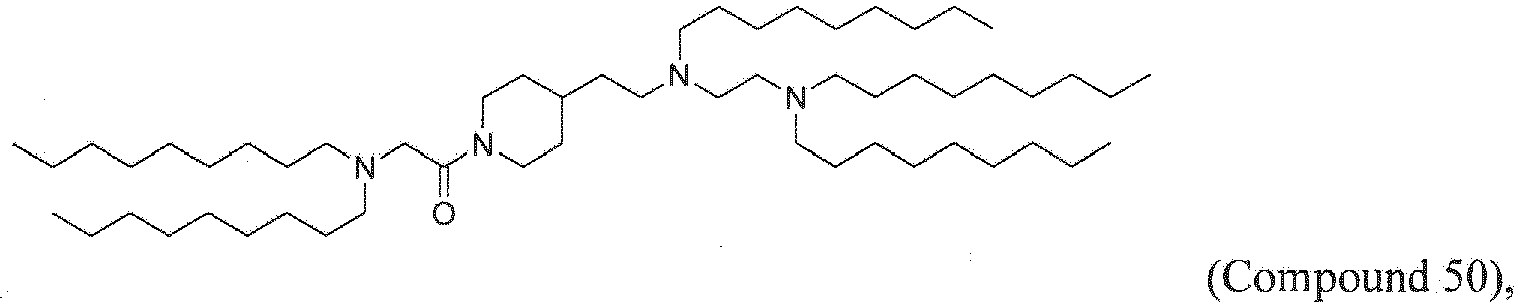




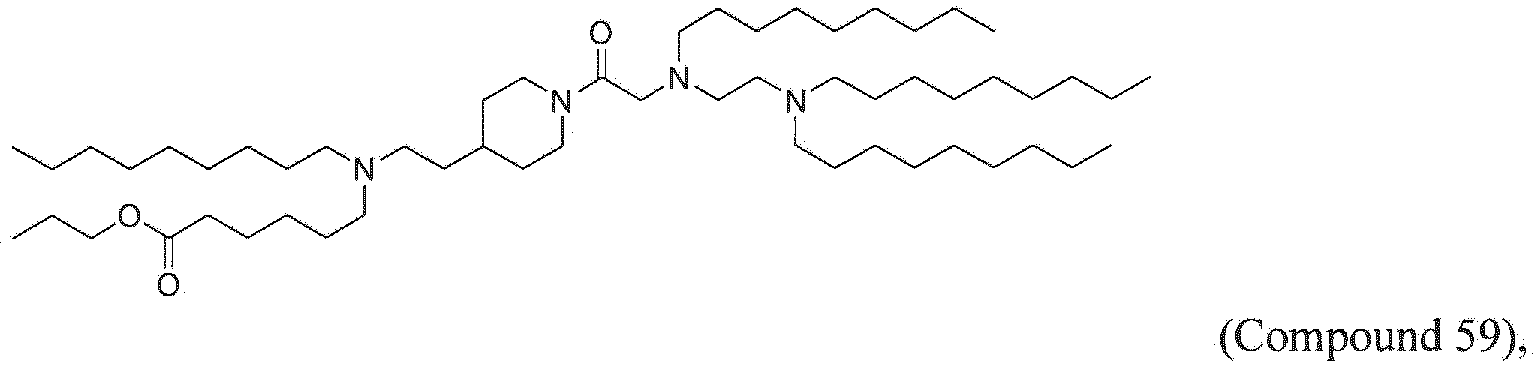

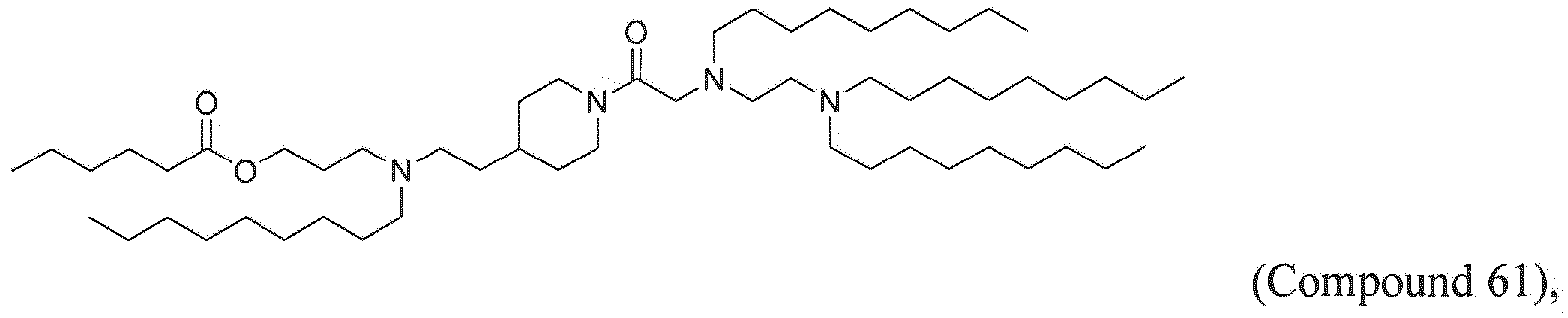
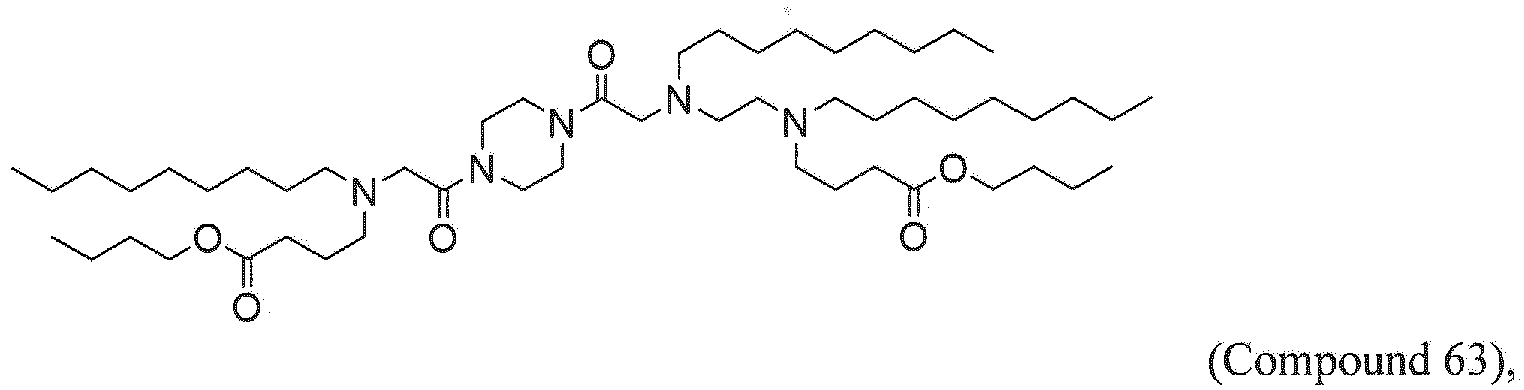


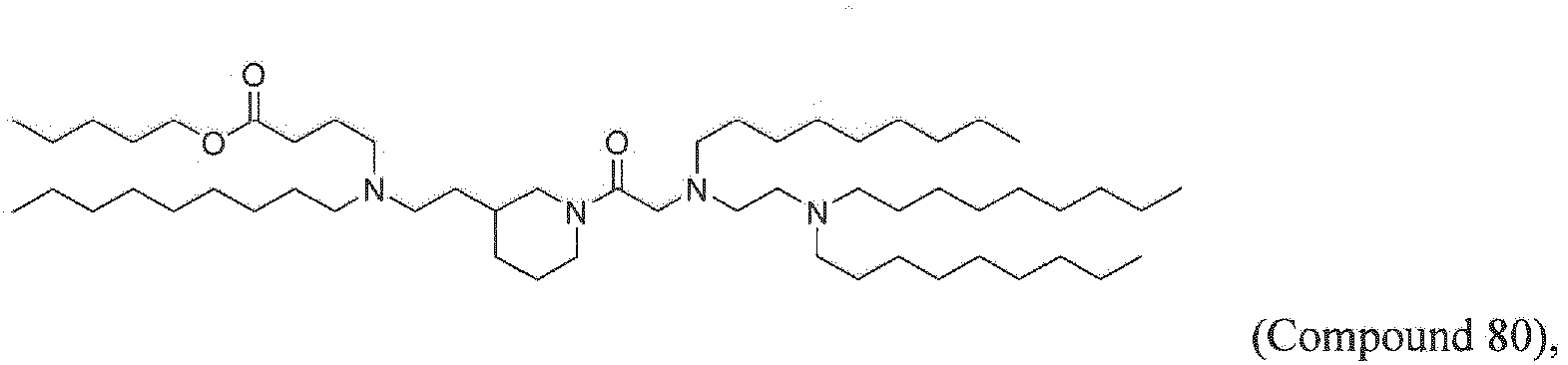













- ring A is

- t is 1 or 2;
- A1 and A2 are each independently selected from CH or N;
- A6 and A7 are each independently selected from CH or N, wherein at least one of A6 and A7 is N;
- Z is CH2 or absent wherein when Z is CH2, the dashed lines (1) and (2) each represent a single bond; and when Z is absent, the dashed lines (1) and (2) are both absent;
- R1, R2, R3, R4, and R5 are independently selected from the group consisting of C5-20 alkyl, C5-20 alkenyl, -R"MR', -R*YR", -YR", and -R*OR";
- each M is independently selected from the group consisting of -C(O)O-, -OC(O)-, -OC(O)O-, -C(O)N(R')-, -N(R')C(O)-, -C(O)-, -C(S)-, -C(S)S-, -SC(S)-, -CH(OH)-, -P(O)(OR')O-, -S(O)2-, an aryl group, and a heteroaryl group; wherein when the compound is of formula (Ib), then M is not -OC(O)O-;
- X1, X2, and X3 are independently selected from the group consisting of a bond, -CH2-, -(CH2)2-, -CHR-, -CHY-, -C(O)-, -C(O)O-, -OC(O)-, -C(O)-CH2-, -CH2-C(O)-, -C(O)O-CH2-, -OC(O)-CH2-, -CH2-C(O)O-, -CH2-OC(O)-, -CH(OH)-, -C(S)-, and -CH(SH)-;
- X4 and X5 are independently selected from the group consisting of -CH2-, -(CH2)2-, -CHR-, -CHY-, -C(O)-, -C(O)O-, -OC(O)-, -C(O)-CH2-, -CH2-C(O)-, -C(O)O-CH2-, -OC(O)-CH2-, -CH2-C(O)O-, -CH2-OC(O)-, -CH(OH)-, -C(S)-, and -CH(SH)-;
- each Y is independently a C3-6 carbocycle;
- each R* is independently selected from the group consisting of C1-12 alkyl and C2-12 alkenyl;
- each R is independently selected from the group consisting of C1-3 alkyl and a C3-6 carbocycle;
- each R' is independently selected from the group consisting of C1-12 alkyl, C2-12 alkenyl, and H; and
- each R" is independently selected from the group consisting of C3-12 alkyl and C3-12 alkenyl,
- wherein when the compound is of formula (I), and when ring A is

- i) at least one of X1, X2, and X3 is not -CH2-; and/or
- ii) at least one of R1, R2, R3, R4, and R5 is -R"MR';
and

- at least one of A1 and A2 is N,
- R1, R2, R3, R4 and R5 are independently selected from the group consisting of C6-20 alkyl and C6-20 alkenyl, and
- when ring A is

- i) R1, R2, R3, R4, and R5 are the same, wherein R1 is not C12 alkyl, C18 alkyl, or C18 alkenyl;
- ii) only one of R1, R2, R3, R4 and R5 is selected from C6-20 alkenyl;
- iii) at least one of R1, R2, R3, R4, and R5 have a different number of carbon atoms than at least one other of R1, R2, R3, R4, and R5;
- iv) R1, R2, and R3 are selected from C6-20 alkenyl, and R4 and R5 are selected from C6-20 alkyl; or
- v) R1, R2, and R3 are selected from C6-20 alkyl, and R4 and R5 are selected from C6-20 alkenyl.
- The compounds of formula (I) may include one or more of the following features when applicable.
- In some examples, the compound is of any of formulae (Ia1)-(Ia6):


- In some examples, at least one of X1, X2, and X3 is not -CH2-. For example, in certain examples, X1 is not -CH2-. In some examples, at least one of X1, X2, and X3 is -C(O)-. In some examples, X3 is a bond while each of X1 and X2 is not a bond. In some examples, none of X1, X2, and X3 is a bond.
- In some examples, R1 and R2 are the same. In certain examples, R1, R2, and R3 are the same. In some examples, R4 and R5 are the same. In certain examples, R1, R2, R3, R4, and R5 are the same.
- In some examples, at least one of R1, R2, R3, R4, and R5 is -R"MR'. In some examples, at most one of R1, R2, R3, R4, and R5 is -R"MR'. For example, at least one of R1, R2, and R3 may be -R"MR', and/or at least one of R4 and R5 is -R"MR'. In certain examples, at least one M is -C(O)O-. In some examples, each M is -C(O)O-. In some examples, at least one M is -OC(O)-. In some examples, each M is -OC(O)- In some examples, at least one R" is C3 alkyl. In certain examples, each R" is C3 alkyl. In some examples, at least one R" is C5 alkyl. In certain examples, each R" is C5 alkyl. In some examples, at least one R" is C6 alkyl. In certain examples, each R" is C6 alkyl. In some examples, at least one R" is C7 alkyl. In certain examples, each R" is C7 alkyl. In some examples, at least one R' is C5 alkyl. In certain examples, each R' is C5 alkyl. In other examples, at least one R' is C1 alkyl. In certain examples, each R' is C1 alkyl. In some examples, at least one R' is C2 alkyl. In certain examples, each R' is C2 alkyl.
- In some examples, at least one of R1, R2, R3, R4, and R5 is C12 alkyl. In certain examples, each of R1, R2, R3, R4, and R5 are C12 alkyl.
- In some examples, the compound is of formula (IIa):

- In some examples, R1, R2, R3, R4, and R5 are the same, and are not C12 alkyl, C18 alkyl, or C18 alkenyl. In some examples, R1, R2, R3, R4, and R5 are the same and are C9 alkyl or C14 alkyl.
- In some examples, only one of R1, R2, R3, R4, and R5 is selected from C6-20 alkenyl. In certain such examples, R1, R2, R3, R4, and R5 have the same number of carbon atoms. In some examples, R4 is selected from C5-20 alkenyl. For example, R4 may be C12 alkenyl or C18 alkenyl.
- In some examples, at least one of R1, R2, R3, R4, and R5 have a different number of carbon atoms than at least one other of R1, R2, R3, R4, and R5.
- In certain examples, R1, R2, and R3 are selected from C6-20 alkenyl, and R4 and R5 are selected from C6-20 alkyl. In other examples, R1, R2, and R3 are selected from C6-20 alkyl, and R4 and R5 are selected from C6-20 alkenyl. In some examples, R1, R2, and R3 have the same number of carbon atoms, and/or R4 and R5 have the same number of carbon atoms. For example, R1, R2, and R3, or R4 and R5, may have 6, 8, 9, 12, 14, or 18 carbon atoms. In some examples, R1, R2, and R3, or R4 and R5, are C18 alkenyl (e.g., linoleyl). In some examples, R1, R2, and R3, or R4 and R3, are alkyl groups including 6, 8, 9, 12, or 14 carbon atoms.
- In some examples, R1 has a different number of carbon atoms than R2, R3, R4, and R5. In other examples, R3 has a different number of carbon atoms than R1, R2, R4, and R5. In further examples, R4 has a different number of carbon atoms than R1, R2, R3, and R5.
- Also disclosed is a compound having formula (II):

- A1 and A2 are each independently selected from CH or N and at least one of A1 and A2 is N;
- Z is CH2 or absent wherein when Z is CH2, the dashed lines (1) and (2) each represent a single bond; and when Z is absent, the dashed lines (1) and (2) are both absent;
- R1, R2, R3, R4, and R5 are independently selected from the group consisting of C6-20 alkyl and C6-20 alkenyl;
- wherein when ring A is

- i) R1, R2, R3, R4, and R5 are the same, wherein R1 is not C12 alkyl, C18 alkyl, or C18 alkenyl;
- ii) only one of R1, R2, R3, R4, and R5 is selected from C6-20 alkenyl;
- iii) at least one of R1, R2, R3, R4, and R5 have a different number of carbon atoms than at least one other of R1, R2, R3, R4, and R5;
- iv) R1, R2, and R3 are selected from C6-20 alkenyl, and R4 and R5 are selected from C6-20 alkyl; or
- v) R1, R2, and R3 are selected from C6-20 alkyl, and R4 and R5 are selected from C6-20 alkenyl.
- Also disclosed is a compound according to formula (III):

- A3 is CH or N;
- A4 is CH2 or NH; and at least one of A3 and A4 is N or NH;
- Z is CH2 or absent wherein when Z is CH2, the dashed lines (1) and (2) each represent a single bond; and when Z is absent, the dashed lines (1) and (2) are both absent;
- R1, R2, and R3 are independently selected from the group consisting of C5-20 alkyl, C5-20 alkenyl, -R"MR', -R∗YR", -YR", and -R∗OR";
- each M is independently selected from -C(O)O-, -OC(O)-, -C(O)N(R')-, -N(R')C(O)-, -C(O)-, -C(S)-, -C(S)S-, -SC(S)-, -CH(OH) -, -P(O)(OR')O-, -S(O)2-, an aryl group, and a heteroaryl group;
- X1 and X2 are independently selected from the group consisting of -CH2-, -(CH2)2-, -CHR-, -CHY-, -C(O)-, -C(O)O-, -OC(O)-, -C(O)-CH2-, -CH2-C(O)-, -C(O)O-CH2-, -OC(O)-CH2-, -CH2-C(O)O-, -CH2-OC(O)-, -CH(OH)-, -C(S)-, and -CH(SH)-;
- each Y is independently a C3-6 carbocycle;
- each R∗ is independently selected from the group consisting of C1-12 alkyl and C2-12 alkenyl;
- each R is independently selected from the group consisting of C1-3 alkyl and a C3-6 carbocycle;
- each R' is independently selected from the group consisting of C1-12 alkyl, C2-12 alkenyl, and H; and
- each R" is independently selected from the group consisting of C3-12 alkyl and C3-12 alkenyl.
- The compounds of formula (III) may include one or more of the following features when applicable.
- The compound of formula (III) may be a compound of formula (IIIa):
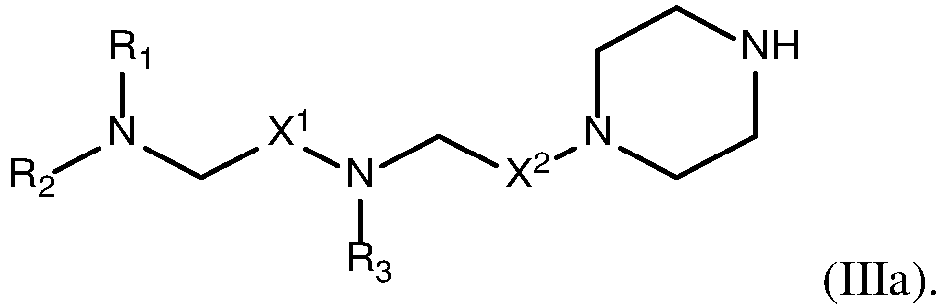
- R1, R2, and R3 may be independently selected from the group consisting of C5-20 alkyl and C5-20 alkenyl. R1, R2, and R3 may be the same. R1, R2, and R3 may be C6, C9, C12, or C14 alkyl. R1, R2, and R3 may be C18 alkenyl. For example, R1, R2, and R3 may be linoleyl.
- In some examples, at least one of X1 and X2 is not -CH2-. For example, in certain cases, X1 is not -CH2-. In some cases, at least one of X1 and X2 is -C(O)-.
- In some examples, the compound is a compound according to formula (Ib):

- A6 and A7 are each independently selected from CH or N, wherein at least one of A6 and A7 is N;
- Z is CH2 or absent wherein when Z is CH2, the dashed lines (1) and (2) each represent a single bond; and when Z is absent, the dashed lines (1) and (2) are both absent;
- X4 and X5 are independently selected from the group consisting of -CH2-, -(CH2)2-, -CHR-, -CHY-, -C(O)-, -C(O)O-, -OC(O)-, -C(O)-CH2-, -CH2-C(O)-, -C(O)O-CH2-, -OC(O)-CH2-, -CH2-C(O)O-, -CH2-OC(O)-, -CH(OH)-, -C(S)-, and -CH(SH)-;
- R1, R2, R3, R4, and R5 each are independently selected from the group consisting of C5-20 alkyl and C5-20 alkenyl, -R"MR', -R*YR", -YR", and -R*OR";
- each M is independently selected from the group consisting of -C(O)O-, -OC(O)-, -C(O)N(R')-, -N(R')C(O)-, -C(O)-, -C(S)-, -C(S)S-, -SC(S)-, -CH(OH)-, -P(O)(OR')O-, -S(O)2-, an aryl group, and a heteroaryl group;
- each Y is independently a C3-6 carbocycle;
- each R∗ is independently selected from the group consisting of C1-12 alkyl and C2-12 alkenyl;
- each R is independently selected from the group consisting of C1-3 alkyl and a C3-6 carbocycle;
- each R' is independently selected from the group consisting of C1-12 alkyl, C2-12 alkenyl, and H; and
- each R" is independently selected from the group consisting of C3-12 alkyl and C3-12 alkenyl.
- The compounds of formula (Ib) may include one or more of the following features when applicable.
- In some examples, R1 and R2 are the same. In certain examples, R1, R2, and R3 are the same. In some examples, R4 and R5 are the same. In certain examples, R1, R2, R3, R4, and R5 are the same.
- In some examples, at least one of R1, R2, R3, R4, and R5 is C9-12 alkyl. In certain examples, each of R1, R2, R3, R4, and R5 independently is C9, C12 or C14 alkyl. In certain examples, each of R1, R2, R3, R4, and R5 is C9 alkyl.
- In some examples, A6 is N and A7 is N. In some examples, A6 is CH and A7 is N.
- In some examples, X4 is-CH2- and X5 is -C(O)-. In some examples, X4 and X5 are -C(O)-.
- In an example, the compound has the formula (IV)

- Also disclosed is a compound having the formula (17-1):

- R2a and R3a are each independently selected from the group consisting of C3-24 alkyl, C3-24 alkenyl, -Ra*YaRa", -YaRa", and -Ra*ORa";
- each Ya is independently a C3-6 carbocycle;
- each Ra* is independently selected from the group consisting of C1-12 alkyl and C1-12 alkenyl;
- each Xa is independently selected from the group consisting of F, Cl, Br, and I;
- each Ra is independently selected from the group consisting of C1-3 alkyl, C2-3 alkenyl, and H; and
- each Ra" is selected from the group consisting of C3-12 alkyl and C3-12 alkenyl;
- wherein R2a includes 7 or fewer carbon atoms.
- In some examples, Qa is -ORa. In certain examples, Ra is H. In other examples, Ra is -CH3.
- In some examples, na is 1. In other examples, na is 2. In other examples, na is 3. In other examples, na is 4. In some examples, na is 5.
- In some examples, R3a includes 7 or fewer carbon atoms.
- Also disclosed herein is a compound having the formula (17-I)

- R1a is -(CH2)naQa, where Qa is selected from a heterocycle, -ORa, -O(CH2)naN(Ra)2, - C(O)ORa, -OC(O)Ra, -CXa 3, -CXa 2H, -CXaH2, -CN, -N(Ra)2, -C(O)N(Ra)2, -N(Ra)C(O)Ra, and -N(Ra)S(O)2Ra and each na is independently selected from 1, 2, 3, 4, and 5;
- each Xa is independently selected from the group consisting of F, Cl, Br, and I;
- R2a is selected from the group consisting of C8-24 alkenyl;
- R3a is selected from the group consisting of C8-24 alkyl; and
- each Ra is independently selected from the group consisting of C1-3 alkyl, C2-3 alkenyl, and H.
- In some examples, Qa is -ORa. In certain examples, Ra is H. In other examples, Ra is -CH3.
- In some examples, na is 1. In other examples, na is 2. In other examples, na is 3. In other examples, na is 4. In some examples, na is 5.
- In some examples, R3a is an alkyl including 9, 12, 14, or 18 carbon atoms.
- In some examples, R2a is C18 alkenyl (e.g., linoleyl).
- The disclosure also provides a compound having the formula (17-I)

- R1a is -(CH2)naQa, where Qa is selected from a heterocycle, -ORa, -O(CH2)naN(Ra)2, - C(O)ORa, -OC(O)Ra, -CXa 3, -CXa 2H, -CXaH2, -CN, -N(Ra)2, -C(O)N(Ra)2, -N(R)C(O)Ra, and -N(Ra)S(O)2Ra and each na is independently selected from 1, 2, 3, 4, and 5;
- each Xa is independently selected from the group consisting of F, Cl, Br, and I;
- R2a is selected from the group consisting of C13-20 alkyl;
- R3a is selected from the group consisting of C8-20 alkyl; and
- each Ra is independently selected from the group consisting of C1-3 alkyl, C2-3 alkenyl, and H.
- In some examples, Qa is -ORa. In certain examples, Ra is H. In other examples, Ra is -CH3.
- In some examples, na is 1. In other examples, na is 2. In other examples, na is 3. In other examples, na is 4. In some examples, na is 5.
- In some examples, R2a and R3a are the same.
- In some examples, R2a and/or R3a is C14 alkyl.
- The disclosure also provides a compound having the formula (17-I)

- R1a is -(CH2)naQa, where Qa is -ORa, Ra is selected from the group consisting of C1-3 alkyl, C2-3 alkenyl, and H, and na is selected from 1, 2, 3, 4, and 5; and
- R2a and R3a are each independently selected from the group consisting of C8-20 alkenyl, wherein
- i) Ra is selected from the group consisting of C1-3 alkyl and C2-3 alkenyl; or
- ii) R1a is -(CH2)2OH, and R2a and R3a each include one or fewer double bonds.
- In some examples, Ra is H. In other examples, Ra is -CH3.
- In some examples, na is 1. In other examples, na is 2. In other examples, na is 3. In other examples, na is 4. In some examples, na is 5.
- In certain examples, R1a is -(CH2)2OCH3. In other examples, R1a is -(CH2)2OH.
- In some examples, R2a is C18 alkenyl (e.g., linoleyl). In certain examples, R3a is C18 alkenyl (e.g., linoleyl).
- In some examples, R2a and R3a are the same.
- The disclosure also provides a compound of formula (17-1)

- R1a is -(CH2)naQa, where Qa is selected from a heterocycle, -ORa, -O(CH2)naN(Ra)2, - C(O)ORa, -OC(O)Ra, -CXa 3, -CXa 2H, -CXaH2, -CN, -N(Ra)2, -C(O)N(Ra)2, -N(Ra)C(O)Ra, and -N(Ra)S(O)2Ra and each na is independently selected from 1, 2, 3, 4, and 5;
- each Xa is independently selected from the group consisting of F, Cl, Br, and I;
- R2a is selected from the group consisting of C8-12 alkyl;
- R3a is selected from the group consisting of C8-20 alkyl; and
- each Ra is independently selected from the group consisting of C1-3 alkyl, C2-3 alkenyl, and H.
- In some examples, Qa is -ORa. In certain examples, Ra is H. In other examples, Ra is -CH3.
- In some examples, na is 1. In other examples, na is 2. In other examples, na is 3. In other examples, na is 4. In some examples, na is 5.
- In certain examples, Qa is -ORa and na is selected from 2, 3, and 4.
- In some examples, R2a is C9 alkyl. In other examples, R2a is C12 alkyl.
- In some examples, R2a and R3a are the same.
- The disclosure also provides a compound having the formula (19-I),

- R1b is selected from the group consisting of H, C1-5 alkyl, C2-5 alkenyl, -Rb"MbRb', a C3-6 carbocycle, -(CH2)nQb, and -(CH2)nCHQbRb, where Qb is selected from a heterocycle, -ORb, - O(CH2)nN(Rb)2, -C(O)ORb, -OC(O)Rb, -CXb 3, -CXb 2H, -CXbH2, -CN, -N(Rb)2, -C(O)N(Rb)2, -N(Rb)C(O)Rb, and -N(Rb)S(O)2Rb and each n is independently selected from 1, 2, 3, 4, and 5;
- R2b and R3b are independently selected from the group consisting of C1-20 alkyl, C2-20 alkenyl, -Rb"MRb', -Rb∗YRb", -YRb", and -Rb∗ORb";
- each Mb is independently selected from the group consisting of -C(O)O-, -OC(O)-, -C(O)N(Rb')-, -N(Rb')C(O)-, -C(O)-, -C(S)-, -C(S)S-, -SC(S)-, -CH(OH)-, -P(O)(ORb')O-, -S(O)2-, an aryl group, and a heteroaryl group;
- W is selected from the group consisting of -CH2-, -CHRb-, -C(O)-, -CH(OH)-, -C(S)-, and -CH(SH)-;
- each Xb is independently selected from the group consisting of F, Cl, Br, and I;
- each Yb is independently a C3-6 carbocycle;
- each Rb∗ is independently selected from the group consisting of C1-12 alkyl and C1-12 alkenyl;
- each Rb is independently selected from the group consisting of C1-3 alkyl, a C3-6 carbocycle, C2-3 alkenyl, and H;
- each Rb' is independently selected from the group consisting of C1-12 alkyl, C2-12 alkenyl, and H; and
- each Rb" is independently selected from the group consisting of C3-12 alkyl and C3-12 alkenyl.
- In some examples, W is not -CH2-. In particular such examples, W is -C(O)-.
- In some examples, at least one of R2b and R3b is -Rb"MbRb'. In certain examples, at least one Mb is -C(O)O-. In some examples, at least one Rb" is C5 alkyl. In certain examples, at least one Rb' is C5 alkyl.
- In some examples, R2b and/or R3b are selected from the group consisting of C1-20 alkyl. For example, R2b and/or R3b may be alkyl groups including 9 or 12 carbon atoms. In other examples, R2b and/or R3b are selected from the group consisting of C2-20 alkenyl. For example, R2b and/or R3b may be alkenyl groups including 18 carbon atoms (e.g., linoleyl groups). In certain examples, R2b and R3b are the same.
- In some examples, R1b is H, while in other examples, R1b is selected from C1-5 alkyl. For example, R1b may be C1 alkyl.
- In certain examples, R1b is -(CH2)nQb. In such examples, Qb is a heterocycle such as a phenyl group. For example, Qb may be a phenyl group with one or more substituents, as described herein.
- Also disclosed herein are compounds of formula (19-11):
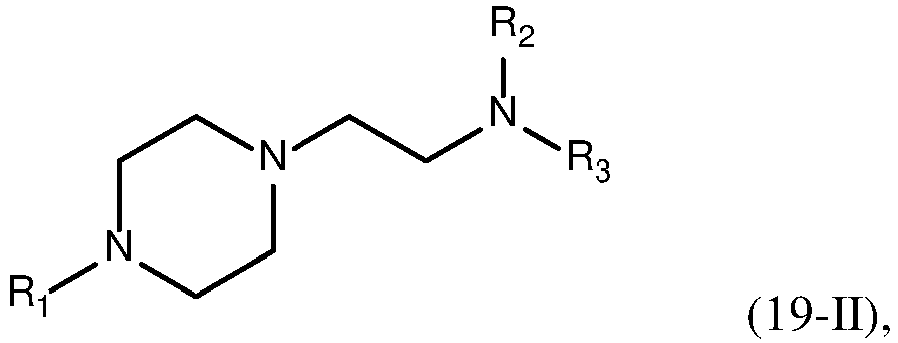
- R1b is selected from the group consisting of C6-20 alkyl; and
- R2b and R3b are independently selected from the group consisting of C6-20 alkenyl.
- In particular examples, R1b is C12 alkyl.
- In some examples, R2b and/or R3b are C18 alkenyl (e.g., linoleyl).
- In certain examples, R2b and R3b are both linoleyl.
- Also disclosed herein are compounds of formula (20-1):

- R1c is selected from the group consisting of a C3-6 carbocycle, -(CH2)ncQc, -(CH2)n
c CHQcRc, -CHQcRc, and -CQc (Rc)2, where Qc is selected from a heterocycle, -ORc, -O(CH2)nc N(Rc)2, -C(O)ORc, -OC(O)Rc, -CXc 3, -CXc 2H, -CXcH2, -CN, -N(Rc)2, -C(O)N(Rc)2, -N(Rc)C(O)Rc, and -N(Rc)S(O)2Rc and each nc is independently selected from 1, 2, 3, 4, and 5; - R2c, R3c, and R4c are independently selected from the group consisting of C1-20 alkyl, C2-20 alkenyl, -Rc"McRc', -Rc∗YcRc", -YcRc", and -Rc∗ORc";
- each Mc is independently selected from the group consisting of -C(O)O-, -OC(O)-, -C(O)N(Rc')-, -N(Rc')C(O)-, -C(O)-, -C(S)-, -C(S)S-, -SC(S)-, -CH(OH)-, -P(O)(OR')O-, -S(O)2-, an aryl group, and a heteroaryl group;
- each Xc is independently selected from the group consisting of F, Cl, Br, and I;
- each Yc is independently a C3-6 carbocycle;
- each Rc∗ is independently selected from the group consisting of C1-12 alkyl and C1-12 alkenyl;
- each Rc is independently selected from the group consisting of C1-3 alkyl, C2-3 alkenyl, and H;
- each Rc' is independently selected from the group consisting of C1-12 alkyl, C2-12 alkenyl, and H; and
- each Rc" is independently selected from the group consisting of C3-12 alkyl and C3-12 alkenyl,
- wherein
- i) R1c is selected from the group consisting of a C3-6 carbocycle, -(CH2)n
c Qc, -(CH2)nc CHQcRc, -CHQcRc, and -CQc(Rc)2, where Qc is selected from a heterocycle, -O(CH2)nc N(Rc)2, -C(O)ORc, - OC(O)Rc, -CXc 3, -CXc 2H, -CXcH2, -C(O)N(Rc)2, -N(Rc)C(O)Rc, and -N(Rc)S(O)2Rc and each nc is independently selected from 1, 2, 3, 4, and 5; and/or - ii) at least one of R2c, R3c, and R4c is -Rc"McRc'.
- i) R1c is selected from the group consisting of a C3-6 carbocycle, -(CH2)n
- In some examples, R1 is selected from the group consisting of -(CH2)n
c Qc, -(CH2)nc CHQcRc, -CHQcRc, and -CQc(Rc)2, where Qc is selected from a heterocycle, -O(CH2)nc N(Rc)2 -C(O)ORc, - OC(O)Rc, -CXc 3, -CXc 2H, -CXcH2, -CN, -C(O)N(Rc)2, -N(Rc)C(O)Rc, and -N(Rc)S(O)2Rc and each n is independently selected from 1, 2, 3, 4, and 5. In certain examples, R1c is -(CH2)n cQc. In some examples, is 2. In some examples, Qc is -C(O)ORc, where Rc is, for example, H. - In some examples, at least one of R2c, R3c, and R4c is -Rc"McRc'. For example, R2c, R3c, and/or R4c may be -Rc"McRc'. In some examples, at least one Mc is -C(O)O-. In certain examples, each Mc is -C(O)O-. In some examples, at least one Rc" is C5 or C7 alkyl. In certain examples, each Rc" is C5 alkyl. In other examples, each Rc" is C7 alkyl. In some examples, at least one Rc' is C5, C7, or C9 alkyl. In certain examples, each Rc' is C5 alkyl. In other examples, each Rc' is C7 alkyl. In other examples, each Rc' is C9 alkyl. In some examples, Rc' is branched.
- In some examples, R2c, R3c, and R4c are selected from the group consisting of C5-20 alkyl. In certain examples, R2c, R3c, and R4c are C12 alkyl.
- In some examples, R2c is selected from the group consisting of C5-20 alkyl and C5-20 alkenyl. For example, R2c may be C12 alkyl.
- In some examples, R3c is selected from the group consisting of C5-20 alkyl and C5-20 alkenyl. For example, R3c may be C6, C9, or C12 alkyl.
- In some examples, R4c is selected from the group consisting of C5-20 alkyl and C5-20 alkenyl. For example, R4c may be C6, C9, or C12 alkyl.
- In some examples, R3c and R4c are the same.
- The disclosure also provides a compound according to formula (20-1):

- R1 is selected from the group consisting of -(CH2)n cQc, -(CH2)n cCHQcRc, -CHQcRc, and -CQc(Rc)2, where Qc is selected from -ORc, -CN, and -N(Rc)2, and nc is selected from 1, 2, 3, 4, and 5;
- R2c and R3c are independently selected from the group consisting of C6-20 alkyl and C6-20 alkenyl;
- R4c is selected from the group consisting of C13-20 alkyl and C5-20 alkenyl; and
- each Rc is independently selected from the group consisting of C1-3 alkyl, C2-3 alkenyl, and H.
- In some examples, R3c is C14 alkyl.
- In some examples, R4c is C14 alkyl.
- In some examples, R3c is C18 alkenyl. For example, R3c may be linoleyl.
- In some examples, R4c is C18 alkenyl. For example, R4c may be linoleyl.
- In some examples, R2c is C12 alkyl. In other examples, R2c is C14 alkyl. In some examples, R2c is C18 alkenyl. For example, R2c may be linoleyl.
- In some examples, R3c and R4c are the same.
- In some examples, R1c is -(CH2)n
c Qc. In some examples, Qc is -ORc. For example, Qc may be -OH. In some examples, nc is 2 or 3. - The disclosure also provides a compound having formula (20-1):
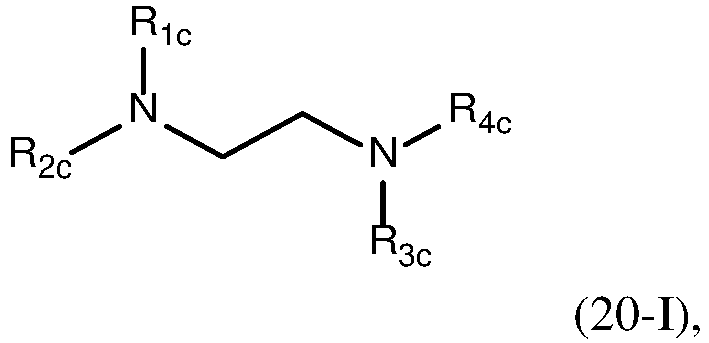
- R1 is selected from the group consisting of -(CH2)n
c Qc, -(CH2)nc CHQcRc, -CHQcRc, and -CQc (Rc)2, where Qc is selected from -ORc, -CN, and -N(Rc)2, and nc is selected from 1, 2, 3, 4, and 5; - R2c, R3c, and R4c are independently selected from the group consisting of C6-20 alkyl and C6-20 alkenyl; and
- each Rc is independently selected from the group consisting of C1-3 alkyl, C2-3 alkenyl, and H;
- wherein
- i) R2c is selected from the group consisting of C1-11 alkyl and C2-5 alkenyl, and/or
- ii) R3c is selected from the group consisting of C1-11 alkyl and C2-5 alkenyl.
- In some examples, R2c is selected from the group consisting of C1-11 alkyl and C2-5 alkenyl. For example, R2c may be C6 or C9 alkyl.
- In some examples, R3c is selected from the group consisting of C1-11 alkyl and C2-5 alkenyl. For example, R3c may be C6 or C9 alkyl.
- In some examples, R3c is C12 alkyl.
- In some examples, R2c is C12 alkyl.
- In some examples, R4c is C6, C9, or C12 alkyl.
- In some examples, R1c is -(CH2)n cQc. In certain examples, Qc is -ORc. In some examples, Rc is H. In some examples, nc is 2 or 3.
- The disclosure also provides a compound according to formula (20-1):

- R1c is selected from the group consisting of -(CH2)n
c Qc, -(CH2)nc CHQcRc, -CHQcRc, and -CQc(Rc)2, where Qc is selected from -ORc, -CN, and -N(Rc)2, and nc is selected from 1, 2, 3, 4, and 5; - R2c is selected from the group consisting of H, C12-20 alkyl, and C6-20 alkenyl;
- R3c and R4c are C12 alkyl; and
- each Rc is independently selected from the group consisting of C1-3 alkyl, C2-3 alkenyl, and H.
- In some examples, R2c is H. In other examples, R2c is C12 alkyl or alkenyl. In some examples, R2c is C14 alkyl. In other examples, R2c is C18 alkenyl. For example, R2c may be linoleyl.
- In some examples, R1c is -(CH2)n cQc. In certain examples, Qc is -ORc. For example, Qc may be OH. In some examples, nc is 2, 3, or 4.
- The disclosure also provides compounds of formula (21-1):

- R1d and R2d are independently selected from the group consisting of H, C1-5 alkyl, and C2-5 alkenyl;
- nd is selected from 1, 2, 3, 4, and 5;
- k is selected from 0, 1, 2, and 3;
- R3d and R4d are independently selected from the group consisting of C1-20 alkyl, C2-20 alkenyl,
- -Rd"MdRd', -Rd∗YdRd", -YdRd", and -Rd∗ORd";
- each Md is independently selected from the group consisting of -C(O)O-, -OC(O)-, -C(O)N(Rd')-, -N(Rd')C(O)-, -C(O)-, -C(S)-, -C(S)S-, -SC(S)-, -CH(OH)-, -P(O)(ORd')O-, and -S(O)2-, or is absent;
- each Rd' is independently selected from the group consisting of C1-12 alkyl, C2-12 alkenyl, and H; each Yd is independently a C3-6 carbocycle;
- each Rd∗ is independently selected from the group consisting of C1-12 alkyl and C1-12 alkenyl;
- each Rd' is independently selected from the group consisting of C1-12 alkyl, C2-12 alkenyl, and H; and
- each Rd" is independently selected from the group consisting of C3-12 alkyl and C3-12 alkenyl,
- wherein R3d and R4d are bound to either i) the same carbon atom or ii) adjacent carbon atoms.
- In some examples, R3d and R4d are bound to the same carbon atom. For example, R3d and R4d may be bound to a carbon atom adjacent to C∗. In certain examples, R3d and R4d are not bound to a carbon atom adjacent to C∗.
- In other examples, R3d and R4d are bound to adjacent carbon atoms. In certain examples, one or both of R3d and R4d are bound to carbon atoms adjacent to C∗.
- In some examples, k is 0. In other examples, k is 1, 2, or 3.
- In certain examples, Md is absent. In other examples, Md is selected from the group consisting
of -C(O)O-, -OC(O)-, -C(O)N(Rd')-, -N(Rd')C(O)-, -C(O)-, -C(S)-, -C(S)S-, -SC(S)-, -CH(OH)-, -P(O)(ORd')O-, and -S(O)2-. In particular such examples, Md is -C(O)O-. - In some examples, nd is 1, 2, or 3.
- In some examples, R1d and/or R2d are selected from C1-5 alkyl. In certain examples, R1d and/or R2d are C1 alkyl.
- In certain examples, R3d and/or R4d are selected from C2-20 alkenyl. In certain examples, R3d and/or R4d are alkenyl groups including 17, 18, or 19 carbon atoms. For example, R3d and/or R4d may be C18 alkenyl groups (e.g., linoleyl).
- In a further aspect, the invention provides a nanoparticle composition including a lipid component comprising a compound according to one of formulae (I) or (Ib) as described above. Also disclosed are nanoparticle compositions including a lipid component comprising a compound according to one of formulae (Ia1)-(Ia6), (II), (IIa), (III), (IIIa), (IV), (17-1), (19-1), (19-II), and (20-1). In some embodiments, the lipid component of the nanoparticle composition includes a phospholipid. In certain embodiments, a phospholipid of a nanoparticle composition includes a phospholipid moiety and one or more fatty acid moieties, one or more of which may be unsaturated. For example, a nanoparticle composition may include a lipid according to formula (V)

- A phospholipid moiety may be selected from the non-limiting group consisting of phosphatidyl choline, phosphatidyl ethanolamine, phosphatidyl glycerol, phosphatidyl serine, phosphatidic acid, 2-lysophosphatidyl choline, and a sphingomyelin. A fatty acid moiety may be selected from the non-limiting group consisting of lauric acid, myristic acid, myristoleic acid, palmitic acid, palmitoleic acid, stearic acid, oleic acid, linoleic acid, alpha-linolenic acid, erucic acid, arachidic acid, arachidonic acid, phytanic acid, eicosapentaenoic acid, behenic acid, docosapentaenoic acid, and docosahexaenoic acid. For example, in certain embodiments, a phospholipid is selected from the group consisting of 1,2-dilinoleoyl-sn-glycero-3-phosphocholine (DLPC), 1,2-dimyristoyl-sn-glycero-phosphocholine (DMPC), 1,2-dioleoyl-sn-glycero-3-phosphocholine (DOPC), 1,2-dipalmitoyl-sn-glycero-3-phosphocholine (DPPC), 1,2-distearoyl-sn-glycero-3-phosphocholine (DSPC), 1,2-diundecanoyl-sn-glycero-phosphocholine (DUPC), 1-palmitoyl-2-oleoyl-sn-glycero-3-phosphocholine (POPC), 1,2-di-O-octadecenyl-sn-glycero-3-phosphocholine (18:0 Diether PC), 1-oleoyl-2-cholesterylhemisuccinoyl-sn-glycero-3-phosphocholine (OChemsPC), 1-hexadecyl-sn-glycero-3-phosphocholine (C16 Lyso PC), 1,2-dilinolenoyl-sn-glycero-3-phosphocholine, 1,2-diarachidonoyl-sn-glycero-3-phosphocholine, 1,2-didocosahexaenoyl-sn-glycero-3-phosphocholine,1,2-dioleoyl-sn-glycero-3-phosphoethanol amine (DOPE), 1,2-diphytanoyl-sn-glycero-3-phosphoethanolamine (ME 16.0 PE), 1,2-distearoyl-sn-glycero-3-phosphoethanolamine, 1,2-dilinoleoyl-sn-glycero-3-phosphoethanolamine, 1,2-dilinolenoyl-sn-glycero-3-phosphoethanolamine, 1,2-diarachidonoyl-sn-glycero-3-phosphoethanolamine, 1,2-didocosahexaenoyl-sn-glycero-3-phosphoethanolamine, 1,2-dioleoyl-sn-glycero-3-phospho-rac-(1-glycerol) sodium salt (DOPG), and sphingomyelin. In certain embodiments, the phospholipid is DOPE. In other embodiments, the phospholipid is DSPC. Non-natural species including natural species with modifications and substitutions including branching, oxidation, cyclization, and alkynes are also contemplated.
- In some embodiments, the lipid component of the nanoparticle composition includes a structural lipid. In certain embodiments, a structural lipid is selected from the group consisting of cholesterol, fecosterol, sitosterol, ergosterol, campesterol, stigmasterol, brassicasterol, tomatidine, ursolic acid, and alpha-tocopherol. In certain embodiments, the structural lipid is cholesterol.
- In some embodiments, the lipid component of the nanoparticle composition includes a PEG lipid. In certain embodiments, the PEG lipid is selected from the group consisting of a PEG-modified phosphatidylethanolamine, a PEG-modified phosphatidic acid, a PEG-modified ceramide, a PEG-modified dialkylamine, a PEG-modified diacylglycerol, and a PEG-modified dialkylglycerol.
- In some embodiments, the nanoparticle composition includes a lipid component comprising a compound according to one of formulae (I) or (Ib), a phospholipid (which may or may not be unsaturated), a PEG lipid, and a structural lipid. Also disclosed is nanoparticle composition includes a lipid component comprising a compound according to formulae (Ia1)-(Ia6), (II), (IIa), (III), (IIIa), (IV), (17-1), (19-1), (19-11), (20-1) and (21-1), a phospholipid (which may or may not be unsaturated), a PEG lipid, and a structural lipid. In certain embodiments, the lipid component of the nanoparticle composition includes about 30 mol % to about 60 mol % compound of one of formulae (I), (Ia1)-(Ia6), (Ib), (II), (IIa), (III), (IIIa), (IV), (17-1), (19-1), (19-II), (20-1) and (21-1), about 0 mol % to about 30 mol % phospholipid, about 18.5 mol % to about 48.5 mol % structural lipid, and about 0 mol % to about 10 mol % of PEG lipid. In some embodiments, the lipid component of the nanoparticle composition includes about 30 mol % to about 45 mol % compound of one of formulae (I), (Ia1)-(Ia6), (Ib), (II), (IIa), (III), (IIIa), (IV), (17-1), (19-1), (19-II), (20-1) and (21-1), about 5 mol % to about 25 mol % phospholipid, about 30 mol % to about 40 mol % structural lipid, and about 0 mol % to about 10 mol % of PEG lipid. In some embodiments, the lipid component of the nanoparticle composition includes about 35 mol % to about 55 mol % compound of one of formulae (I), (Ia1)-(Ia6), (Ib), (II), (IIa), (III), (IIIa), (IV), (17-I), (19-I), (19-II), (20-I) and (21-I), about 5 mol % to about 25 mol % phospholipid, about 30 mol % to about 40 mol % structural lipid, and about 0 mol % to about 10 mol % of PEG lipid. In certain embodiments, the lipid component includes about 50 mol % said compound, about 10 mol % phospholipid, about 38.5 mol % structural lipid, and about 1.5 mol % of PEG lipid. In other embodiments, the lipid component includes about 40 mol % said compound, about 20 mol % phospholipid, about 38.5 mol % structural lipid, and about 1.5 mol % of PEG lipid. In some of these embodiments, the phospholipid is DOPE, while in other embodiments the phospholipid is DSPC. In certain embodiments, the structural lipid is cholesterol. In certain embodiments, the PEG lipid is PEG-DMG. In any of the above, the total content of the lipid component may not exceed 100%.
- In some embodiments, the nanoparticle composition includes more than one phospholipid, PEG lipid, structural lipid, or other lipid. In certain embodiments, the nanoparticle composition further includes a cationic and/or ionizable lipid such as an aminolipid. In certain embodiments, a cationic and/or ionizable lipid is selected from the group consisting of 3-(didodecylamino)-N1,N1,4-tridodecyl-1-piperazineethanamine (KL10), N1-[2-(didodecylamino)ethyl]-N1,N4,N4-tridodecyl-1,4-piperazinediethanamine (KL22), 14,25-ditridecyl-15,18,21,24-tetraaza-octatriacontane (KL25), 1,2-dilinoleyloxy-N,N-dimethylaminopropane (DLin-DMA), 2,2-dilinoleyl-4-dimethylaminomethyl-[1,3]-dioxolane (DLin-K-DMA), heptatriaconta-6,9,28,31-tetraen-19-yl 4-(dimethylamino)butanoate (DLin-MC3-DMA or MC3), 2,2-dilinoleyl-4-(2-dimethylaminoethyl)-[1,3]-dioxolane (DLin-KC2-DMA), 1,2-dioleyloxy-N,N-dimethylaminopropane (DODMA), 2-({8-[(3β)-cholest-5-en-3-yloxy]octyl}oxy)-N,N-dimethyl-3-[(9Z,12Z)-octadeca-9,12-dien-1-y loxy]propan-1-amine (Octyl-CLinDMA), (2R)-2-({8-[(3β)-cholest-5-en-3-yloxy]octyl}oxy)-N,N-dimethyl-3-[(9Z,12Z)-octadeca-9,12-die n-1-yloxy]propan-1-amine (Octyl-CLinDMA (2R)), (2S)-2-({8-[(3β)-cholest-5-en-3-yloxy]octyl}oxy)-N,N-dimethyl-3-[(9Z,12Z)-octadeca-9,12-die n-1-yloxy]propan-1-amine (Octyl-CLinDMA (2S)), (12Z, 15Z)-N,N-dimethyl-2-nonylhenicosa-12,15-dien-1-amine, and N,N-dimethyl-1-{(1S,2R)-2-octylcyclopropyl}heptadecan-8-amine.
- In some embodiments, the nanoparticle composition includes a therapeutic and/or prophylactic agent. In certain embodiments, the therapeutic and/or prophylactic agent may be selected from the group consisting of a protein, a small molecule drug, a cytotoxic agent, a radioactive ion, a chemotherapeutic agent, a vaccine, a compound that elicits an immune response, and/or a nucleic acid (such as a deoxyribonucleic acid or a ribonucleic acid). In certain embodiments, the therapeutic and/or prophylactic agent is a ribonucleic acid (RNA). An RNA may be selected from the group consisting of a small interfering RNA (siRNA), an asymmetrical interfering RNA (aiRNA), a microRNA (miRNA), a Dicer-substrate RNA (dsRNA), a small hairpin RNA (shRNA), a messenger RNA (mRNA), and mixtures thereof. In certain embodiments, the therapeutic and/or prophylactic agent is a messenger RNA (mRNA). An RNA of a nanoparticle composition may be naturally or non-naturally occurring and may include one or more of a stem loop, a chain terminating nucleoside, a polyA sequence, a polyadenylation signal, and/or a 5' cap structure.
- In some embodiments, the nanoparticle composition includes more than one therapeutic and/or prophylactic agent, such as one or more RNAs. The therapeutic and/or prophylactic agents may be of the same or different types (e.g., two mRNAs, two siRNAs, one mRNA and one siRNA, one mRNA and one small molecule drug, etc.).
- In some embodiments, the encapsulation efficiency of a therapeutic and/or prophylactic agent of a nanoparticle composition is at least 50%. In certain embodiments, the encapsulation efficiency is at least 80%. In certain embodiments, the encapsulation efficiency is greater than 90%.
- In some embodiments, the wt/wt ratio of the lipid component to a therapeutic and/or prophylactic agent in the nanoparticle composition is from about 10:1 to about 60:1. In certain embodiments, the wt/wt ratio is about 20:1.
- In some embodiments, the N:P ratio of the nanoparticle composition is from about 2:1 to about 30:1. In certain embodiments, the N:P ratio is from about 2:1 to about 8:1. In certain embodiments, the N:P ratio is from about 5:1 to about 8:1. For example, the N:P ratio may be about 5.0:1, about 5.5:1, about 5.67:1, about 6.0:1, about 6.5:1, or about 7.0:1. In some embodiments, the mean size of a nanoparticle composition is from about 40 nm to about 150 nm. In certain embodiments, the mean size is from about 70 nm to about 100 nm. In one embodiment, the mean size may be about 80 to about 100 nm. In certain embodiments, the mean size may be about 80 nm. In other embodiments, the mean size may be about 100 nm.
- The polydispersity index of the nanoparticle composition is from about 0 to about 0.25 in certain embodiments. In certain embodiments, the polydispersity index is from about 0.10 to about 0.20.
- In some embodiments, the nanoparticle composition has a zeta potential of about -10 mV to about +20 mV.
- In some embodiments, upon contacting the compound according to one of formulae (I), (Ia1)-(Ia6), (Ib), (II), (IIa), (III), (IIIa), and (IV) (e.g., any of Compounds 1-109) or a nanoparticle composition thereof with a mammalian cell, the cell uptake of the compound or nanoparticle composition is LDLR-independent. In some embodiments, the cell uptake of the compound or nanoparticle composition is LDLR-dependent. In some embodiments, the cell uptake of the compound or nanoparticle composition is apoE-independent. In some embodiments, the cell uptake of the compound or nanoparticle composition is apoE-dependent. In some embodiments, the cell uptake of the compound or nanoparticle composition is LDLR-apoE-interaction independent. In some embodiments, the cell uptake of the compound or nanoparticle composition is LDLR-apoE-interaction dependent.
- In some embodiments, upon contacting the compound according to one of formulae (I), (Ia1)-(Ia6), (Ib), (II), (IIa), (III), (IIIa), and (IV) (e.g., any of Compounds 1-109) or the nanoparticle composition thereof with a mammalian cell to produce a polypeptide, the production of the polypeptide is higher in mammalian hepatocytes than cells from a different tissue (e.g., spleen or kidney).
- In some embodiments, upon contacting the compound according to one of formulae (I), (Ia1)-(Ia6), (Ib), (II), (IIa), (III), (IIIa), and (IV) (e.g., any of Compounds 1-109) or the nanoparticle composition thereof with a mammalian cell to produce a polypeptide, the production of the polypeptide occurs substantively in mammalian hepatocytes (e.g., little or no production of the polypeptide in other cells, e.g., spleen cells or renal cells).
- In some embodiments, the nanoparticle composition includes one or more other components including, but not limited to, one or more pharmaceutically acceptable excipients, small hydrophobic molecules, therapeutic and/or prophylactic agents, carbohydrates, polymers, permeability enhancing molecules, buffers, and surface altering agents.
- In yet another aspect, the disclosure features a pharmaceutical composition comprising a nanoparticle composition according to the preceding aspects and a pharmaceutically acceptable carrier. For example, the pharmaceutical composition is refrigerated or frozen for storage and/or shipment (e.g., being stored at a temperature of 4 °C or lower, such as a temperature between about -150 °C and about 0 °C or between about -80 °C and about -20 °C (e.g., about -5 °C, -10 °C, -15 °C, -20 °C, -25 °C, -30 °C, -40 °C, -50 °C, -60 °C, -70 °C, -80 °C, -90 °C, -130 °C or -150 °C). For example, the pharmaceutical composition is a solution that is refrigerated for storage and/or shipment at, for example, about -20° C, -30 °C, - 40 °C, -50 °C, -60 °C, -70 °C, or -80 °C.
- Also disclosed but not forming part of the invention is a method of delivering a therapeutic and/or prophylactic agent (e.g., an mRNA) to a cell (e.g., a mammalian cell). This method includes the step of administering to a subject (e.g., a mammal, such as a human) a nanoparticle composition including (i) a lipid component including a phospholipid (such as a polyunsaturated lipid), a PEG lipid, a structural lipid, and a compound according to one of formulae (I), (Ia1)-(Ia6), (Ib), (II), (IIa), (III), (IIIa), (IV), (17-1), (19-1), (19-11), (20-1) and (21-1) and (ii) a therapeutic and/or prophylactic agent, in which administering involves contacting the cell with the nanoparticle composition, whereby the therapeutic and/or prophylactic agent is delivered to the cell.
- Also disclosed is a method of producing a polypeptide of interest in a cell (e.g., a mammalian cell). The method includes the step of contacting the cell with a nanoparticle composition including (i) a lipid component including a phospholipid (such as a polyunsaturated lipid), a PEG lipid, a structural lipid, and a compound according to one of formulae (I), (Ia1)-(Ia6), (Ib), (II), (IIa), (III), (IIIa), (IV), (17-I), (19-I), (19-II), (20-I) and (21-I) and (ii) an mRNA encoding the polypeptide of interest, whereby the mRNA is capable of being translated in the cell to produce the polypeptide.
- In yet another aspect, the invention provides a nanoparticle composition of the invention for use in a method of treating a disease or disorder in a mammal (e.g., a human) in need thereof. The method includes the step of administering to the mammal a therapeutically effective amount of the nanoparticle composition, e.g. a nanoparticle composition including (i) a lipid component including a phospholipid (such as a polyunsaturated lipid), a PEG lipid, a structural lipid, and a compound according to one of formulae (I) or (Ib), and (ii) a therapeutic and/or prophylactic agent (e.g., an mRNA). Also disclosed are examples of such a method where the compound is according to one of formulae (Ia1)-(Ia6), (II), (III), (IIIa), (IV), (17-1), (19-1), (19-11), (20-1) and (21-1). In some embodiments, the disease or disorder is characterized by dysfunctional or aberrant protein or polypeptide activity. For example, the disease or disorder is selected from the group consisting of rare diseases, infectious diseases, cancer and proliferative diseases, genetic diseases (e.g., cystic fibrosis), autoimmune diseases, diabetes, neurodegenerative diseases, cardio- and reno-vascular diseases, and metabolic diseases.
- Also disclosed is a method of delivering (e.g., specifically delivering) a therapeutic and/or prophylactic agent to a mammalian organ (e.g., a liver, spleen, lung, or femur). This method includes the step of administering to a subject (e.g., a mammal) a nanoparticle composition including (i) a lipid component including a phospholipid, a PEG lipid, a structural lipid, and a compound according to one of formulae (I), (Ia1)-(Ia6), (Ib), (II), (IIa), (III), (IIIa), (IV), (17-I), (19-I), (19-II), (20-I) and (21-I) and (ii) a therapeutic and/or prophylactic agent (e.g., an mRNA), in which administering involves contacting the cell with the nanoparticle composition, whereby the therapeutic and/or prophylactic agent is delivered to the organ such as liver.
- Also disclosed is a method for the enhanced delivery of a therapeutic and/or prophylactic agent (e.g., an mRNA) to a target tissue (e.g., a liver, spleen, lung, or femur). This method includes administering to a subject (e.g., a mammal) a nanoparticle composition, the composition including (i) a lipid component including a compound according to one of formulae (I), (Ia1)-(Ia6), (Ib), (II), (IIa), (III), (IIIa), (IV), (17-1), (19-1), (19-11), (20-1) and (21-1), a phospholipid, a structural lipid, and a PEG lipid; and (ii) a therapeutic and/or prophylactic agent, the administering including contacting the target tissue with the nanoparticle composition, whereby the therapeutic and/or prophylactic agent is delivered to the target tissue. The delivery may be enhanced as compared to a reference composition which comprises a reference lipid instead of a compound of one of formulae (I), (Ia1)-(Ia6), (Ib), (II), (IIa), (III), (IIIa), (IV), (17-I), (19-I), (19-II), (20-I) and (21-I).
- Also disclosed but not forming part of the invention is a method of lowering immunogenicity comprising introducing the nanoparticle composition of the disclosure into cells, wherein the nanoparticle composition reduces the induction of the cellular immune response of the cells to the nanoparticle composition, as compared to the induction of the cellular immune response in cells induced by a reference composition which comprises a reference lipid instead of a compound of one of formulae (I), (Ia1)-(Ia6), (Ib), (II), (IIa), (III), (IIIa), (IV), (17-I), (19-I), (19-II), (20-I) and (21-I). For example, the cellular immune response is an innate immune response, an adaptive immune response, or both.
- In certain embodiments of the above aspects, a cell contacted in a method is in a mammal.
- In any of the preceding aspects, a mammal may be, for example, a rodent, non-human primate, or a human. In certain embodiments, the mammal is a human. In certain embodiments, the mammal is LDLR-deficient, or apoE-deficient, or both. In certain embodiments, the mammal is not LDLR-deficient. In certain embodiments, the mammal is not apoE-deficient. In certain embodiments, the mammal is neither LDLR-deficient nor apoE-deficient. In certain embodiments, the mammal has an abnormal LDLR-apoE interaction. In certain embodiments, the mammal has a normal LDLR-apoE interaction.
- In any of the preceding aspects, a therapeutic and/or prophylactic agent may be an mRNA.
- In some embodiments of the above methods, the therapeutic and/or prophylactic agent may be specifically delivered to a target tissue of interest (e.g., a mammalian liver, spleen, lung, or femur).
- In some embodiments of the above methods, a polypeptide of interest may be specifically produced in a target cell or tissue of interest (e.g., a hepatocyte, a mammalian liver, spleen, lung, or femur), e.g., the production of polypeptide is substantively higher in the target cell or tissue than in a non-target cell/tissue.
- In some embodiments, the nanoparticle composition is administered intravenously, intramuscularly, intradermally, subcutaneously, intra-arterially, intra-tumor, or by inhalation. A dose of about 0.001 mg/kg to about 10 mg/kg of therapeutic and/or prophylactic agent (e.g., mRNA) is administered to a mammal in certain embodiments.
- In any of the preceding aspects, in some embodiments, the delivery (e.g., delivery efficiency) of the therapeutic and/or prophylactic agent to the mammalian cell is LDLR-independent. In some embodiments, the delivery of the therapeutic and/or prophylactic agent to the mammalian cell is LDLR-dependent. In some embodiments, the delivery of the therapeutic and/or prophylactic agent to the mammalian cell is apoE-independent. In some embodiments, the delivery of the therapeutic and/or prophylactic agent to the mammalian cell is apoE-dependent. In some embodiments, the delivery of the therapeutic and/or prophylactic agent to the mammalian cell is LDLR-apoE-interaction independent. In some embodiments, the delivery of the therapeutic and/or prophylactic agent to the mammalian cell is LDLR-apoE-interaction dependent.
- In any of the preceding aspects, in some embodiments, the production (e.g., yield) of the polypeptide of interest in the mammalian cell is LDLR-independent. In some embodiments, the production of the polypeptide of interest in the mammalian cell is LDLR-dependent. In some embodiments, the production of the polypeptide of interest in the mammalian cell is apoE-independent. In some embodiments, the production of the polypeptide of interest in the mammalian cell is apoE-dependent. In some embodiments, the production of the polypeptide of interest in the mammalian cell is LDLR-apoE-interaction independent. In some embodiments, the production of the polypeptide of interest in the mammalian cell is LDLR-apoE-interaction dependent.
- In the preceding aspects, one or more nanoparticle compositions each including one or more therapeutic and/or prophylactic agents may be used in combination. In some embodiments, one or more nanoparticle compositions each including one or more therapeutic and/or prophylactic agents may be simultaneously contacted with a cell or delivered to a mammalian cell or organ. In other embodiments, the one or more nanoparticle compositions are contacted with a cell or delivered to a mammalian cell or organ at different times.
- In the preceding aspects, one or more additional therapeutic and/or prophylactic agents or compounds may be used in combination with a nanoparticle composition including a therapeutic and/or prophylactic agent. In some embodiments, an additional therapeutic and/or prophylactic agent or compound may be administered at or near the same time as a nanoparticle composition (e.g., within one hour). In other embodiments, an additional therapeutic and/or prophylactic agent or compound may be administered before or after (e.g., one or more hours before or after) a nanoparticle composition as a pretreatment or post-treatment therapy. In some embodiments, an additional therapeutic and/or prophylactic agent or compound is selected from the group consisting of an anti-inflammatory compound, a steroid (e.g., a corticosteroid), a statin, an estradiol, a BTK inhibitor, an S1P1 agonist, a glucocorticoid receptor modulator (GRM), or an anti-histamine. In certain embodiments, an additional therapeutic and/or prophylactic agent or compound is selected from the group consisting of dexamethasone, methotrexate, acetaminophen, an H1 receptor blocker, or an H2 receptor blocker.
- The skilled artisan will understand that the drawings primarily are for illustrative purposes and are not intended to limit the scope of the inventive subject matter described herein. The drawings are not necessarily to scale; in some instances, various aspects of the inventive subject matter disclosed herein may be shown exaggerated or enlarged in the drawings to facilitate an understanding of different features. In the drawings, like reference characters generally refer to like features (e.g., functionally similar and/or structurally similar elements).
- The above and further features will be more clearly appreciated from the following detailed description when taken in conjunction with the accompanying drawings.
-
Figure 1 is a pair of graphs comparing luciferase expression levels in mice (whole body) after administration of nanoparticle compositions containing compounds of the disclosure over time. -
Figure 2 is a graph summarizing luciferase expression levels at 3 h after administration of nanoparticle compositions containing compounds of the disclosure. Total light flux values were acquired via body luminescent imaging (BLI) 3 h after administration. In this Figure, the numbers 1-12 refer to the compositions containing Compounds 42-52 and MC3 respectively. -
Figure 3 is a graph summarizing luciferase expression levels at 6 hr after administration of nanoparticle compositions containing compounds of the disclosure. Total light flux values were acquired via BLI 6 h after administration. In this Figure, the numbers 1-12 refer to the compositions containing Compounds 42-52 and MC3 respectively. -
Figure 4 is graph summarizing luciferase expression levels at 24 h after administration of nanoparticle compositions containing compounds of the disclosure. Total light flux values were acquired via BLI 24 h after administration. In this Figure, the numbers 1-12 refer to the compositions containing Compounds 42-52 and MC3 respectively. -
Figure 5 is graph summarizing expression levels of luciferase inmouse liver 6 hours after administration of nanoparticle compositions including compounds of the disclosure. In this Figure, the numbers 1-12 refer to the compositions containing Compounds 42-52 and MC3 respectively. -
Figure 6 is a graph summarizing expression levels of luciferase inmouse lungs 6 hours after administration of nanoparticle compositions including compounds of the disclosure. In this Figure, the numbers 1-12 refer to the compositions containing Compounds 42-52 and MC3 respectively. -
Figure 7 is a graph summarizing expression levels of luciferase inmouse spleen 6 hours after administration of nanoparticle compositions including compounds of the disclosure. In this Figure, the numbers 1-12 refer to the compositions containing Compounds 42-52 and MC3 respectively. -
Figure 8 is a pair of graphs illustrating hEPO expression levels in rats dosed with compounds of the disclosure as compared to with KL22, showing that KL22 and its chain length derivatives (previously showing improved protein expression in mice), do not express hEPO in rats. PBS (phosphate buffered saline) is used as control. Graph A compares the hEPO concentration after administration of nanoparticle compositions containing Compound 23,Compound 11, KL22, and MC3 at 2 mpk, i.v. administration.Compound 11 LNP showed hEPO expression comparable to MC3 and improved tolerability as compared to KL22. Graph B illustrates the results of a dose responsestudy using Compound 20, KL22, and MC3 at dose of 0.2, 0.5 and 1 mpk. KL22 and Compound 23 were shown to be toxic at the 2 mg/kg dose. In Graph A, the numbers 1-5 refer to compositions containing the following: 1: Compound 23, 2:Compound 11, 3: KL22; 4: MC3; 5: PBS. In Graph B, the numbers 1-9 refer to compositions containing the following: 1:Compound 20, 0.2 mpk; 2:Compound 20, 0.5 mpk; 3:Compound -
Figure 9 is a pair of graphs illustrating performance ofCompound 11 as an LDLr independent lipid. Graph A is a bar graph showing expression of luciferase induced by administration of nanoparticlecompositions including Compound 11 at dosages of 0.05 mpk, 0.25 mpk, and 0.5 mpk to LDLR -/- knockout and wild-type mice. Graph B shows LDL-c levels in LDLR knockout mice after administration of a control mRNA, i.e., non-translating Factor IX ("NT-FIX") and various compositions comprising mRNAs encoding the LDL receptor in mice, with KL22 at 0.5 mpk, or withCompound 11 at 0.5 and 1 mpk. LDL-c levels in mice were found to drop with nanoparticlecomposition containing Compound 11. -
Figure 10 is a graph showing hEPO levels in non-human primates up to -50 h after administration of a nanoparticlecomposition containing Compound 4, compared to a composition containing MC3. TheCompound 4 LNP demonstrated 3-fold expression of hEPO compared to MC3, establishingCompound 4 as an LDLr independent lipid that translates to higher species. -
Figure 11 is a pair of images comparing the results of a mouse liver immunohistochemistry (IHC) using mRNA expressing green fluorescent protein (GFP) after administration of nanoparticlecompositions containing Compound 4 and MC3. Graph A shows CD-1 mouse liver cells after administration of GFP mRNA in a MC3 LNP, 6h after intravenous administration at a dose of 0.5 mpk. GFP mRNA Protein expression from the MC3 LNP composition was observed in both hepatocytes and Kupffer cells. Graph B shows LDLR knockout mouse liver cells after administration of GFP mRNA in aCompound 4 LNP, 8h after intravenous administration at a dose of 0.5 mpk. In contrast to MC3, theLNP containing Compound 4 appears to show less protein expression in Kupffer cells. -
Figure 12 is a set of graphs illustrating hEPO expression levels in CD-1 mice dosed with compounds of the disclosure, compared to MC3. PBS is used as control. Graph A shows the hEPO concentration 3 h after administration of the nanoparticle compositions. Graph B shows the hEPO concentration 6 h after administration of the nanoparticle compositions. Graph C shows the hEPO concentration 24 h after administration of the nanoparticle compositions. In graphs A-C numbers 1-14 refer to compositions containing the following: 1: Compound 73, 2:Compound 80, 3: Compound 70; 4: Compound 81; 5: Compound 69; 6: Compound 82; 7: Compound 83; 8: Compound 62; 9: Compound 84; 10: Compound 85; 11: Compound 86; 12: Compound 87; 13: MC3; 14: PBS. -
Figure 13 is a graph showing hEPO levels (pg/mL) in CD-1 mice up to -25 h after administration of a nanoparticle composition containing compounds of the disclosure, compared to a composition containing MC3. Numbers 1-13 refer to compositions containing the following: 1: Compound 73, 2:Compound 80, 3: Compound 70; 4: Compound 81; 5: Compound 69; 6: Compound 82; 7: Compound 83; 8: Compound 62; 9: Compound 84; 10: Compound 85; 11: Compound 86; 12: Compound 87; 13: MC3. -
Figure 14 is a pair of graphs showing percentages of activated B-cells in the spleens of CD-1 mice dosed with compounds of the disclosure, compared to MC3, and compared to mice not having received any treatment (naive test subject). PBS is used as control. Graph A shows the percentage of CD19+ cells. Graph B shows the percentage of CD19+ CD69+ CD86+ cells. Numbers 1-13 refer to compositions containing the following: 1: Compound 73, 2:Compound 80, 3: Compound 70; 4: Compound 81; 5: Compound 69; 6: Compound 82; 7: Compound 83; 8: Compound 62; 9: Compound 84; 10: Compound 85; 11: Compound 86; 12: Compound 87; 13: MC3; 14: PBS; 15: treatment naive subject. -
Figure 15 is a graph summarizing luciferase expression levels at 6 h after administration of nanoparticle compositions containing compounds of the disclosure to CD-1 mice at a dose of 0.5 mpk. Total light flux values were acquired via body luminescent imaging (BLI) 6 h after administration. In this Figure, the numbers 1-7 and 10 refer to the compositions containing Compounds 4-10 and MC3 respectively. -
Figure 16 is a graph showing GFP levels in the livers of LDLR knockout mice at 30 min to 24 h after intravenous administration of an eGFP RNA in a lipidcomposition containing Compound 4. The liver GFP levels were determined via IHC. The square markers represent the number of GFP positive cells following administration of a dose of 0.1 mpk of the composition. The circular markers represent the number of GFP positive cells following administration of a dose of 0.5 mpk of the composition. -
Figure 17 is a pair of graphs showing the ApoE dependence of luciferase ("Luc") expression following administration of a composition containing Luc mRNA andCompound 4 to mice at a dose 0.5 mpk. The expression following administration of a composition containing Luc mRNA and MC3 is presented for comparison. Graph A shows the total flux in the liver 6h after administration. The % change in Luc expression in livers of ApoE knockout vs. wild-type mice (i.e., (WT mean expression-KO mean expression)/WT mean expression]∗ 100%) was 91.9 % forCompound 4 and 97.5 % for MC3. Graph B shows the total flux in the spleen 6h after administration. The % change in expression in spleens of ApoE knockout vs. wild-type mice was 4.34 % forCompound 4 and 72.2 % for MC3. Numbers 1-4 refer to the following: 1:Composition containing Compound 4, administered to ApoE knockout mice; 2:Composition containing Compound 4, administered to wild-type mice; 3: Composition containing MC3, administered to ApoE knockout mice; 4: Composition containing MC3, administered to wild-type mice. -
Figure 18 is a pair of graphs showing the effect of acomposition containing Compound 4 on liver enzymes. The composition was administered to rats at 0.1 mpk and 1 mpk. The effects of MC3 are shown for comparison. PBS is used as a control. Graph A shows the effect on aspartate aminotransferase (AST). Graph B shows the effect on alanine aminotransferase (ALT). -
Figure 19 is a set of graphs showing immune cell activation by acomposition containing Compound 4. The effects of MC3 are shown for comparison. PBS (phosphate buffered saline) is used as control. Compositions were administered to rats at 0.1 mpk or 1 mpk. Graph A shows the effect on activation of neutrophil. Graph B shows the effect on activation of lymphocytes. Graph C shows the effect on activation of monocytes. Numbers 1-5 in Graphs A-C refer to the following: 1:Compound 4, 0.1 mpk; 2:Compound 4; 1 mpk; 3: MC3, 0.1 mpk 4: MC3, 1 mpk; 5: PBS. -
Figure 20 is a graph showing the expression of Stefin A Quadruple Mutant-Tracy (SQT) protein in mouse liver determined via FLAG IHC at different time points following intravenous administration of various nanoparticle compositions comprising SQT mRNA and lipids disclosed herein. Numbers 1-11 in the figure refer to the following: 1: 0 h, PBS; 2: 0 h,Compound 4; 3: 0.5 h,Compound 4; 4: 4 h,Compound 4; 5: 8 h,Compound 4; 6: 24 h,Compound 4; 7: 0 h, MC3; 8: 0.5 h, MC3; 9: 4 h, MC3; 10: 8 h, MC3; 11: 24 h, MC3. - The disclosure relates to novel lipids and lipid nanoparticle compositions including a novel lipid. The disclosure also provides methods of delivering a therapeutic and/or prophylactic agent to a mammalian cell, specifically delivering a therapeutic and/or prophylactic agent to a mammalian organ, producing a polypeptide of interest in a mammalian cell, and treating a disease or disorder in a mammal in need thereof. For example, a method of producing a polypeptide of interest in a cell involves contacting a nanoparticle composition comprising an mRNA with a mammalian cell, whereby the mRNA may be translated to produce the polypeptide of interest. A method of delivering a therapeutic and/or prophylactic agent to a mammalian cell or organ may involve administration of a nanoparticle composition including the therapeutic and/or prophylactic agent to a subject, in which the administration involves contacting the cell or organ with the composition, whereby the therapeutic and/or prophylactic agent is delivered to the cell or organ.
- The present disclosure provides lipids including a central piperazine moiety. The lipids described herein may be advantageously used in lipid nanoparticle compositions for the delivery of therapeutic and/or prophylactic agents to mammalian cells or organs. For example, the lipids described herein have little or no immunogenicity. For example, the lipid compound of any of formulae (I), (Ia1)-(Ia6), (Ib), (II), (IIa), (III), (IIIa), (IV), (17-1), (19-1), (19-11), (20-1) and (21-1) has a lower immunogenicity as compared to a reference lipid (e.g., MC3, KC2, or DLinDMA). For example, a formulation comprising a lipid disclosed herein and a therapeutic or prophylactic agent has an increased therapeutic index as compared to a corresponding formulation which comprises a reference lipid (e.g., MC3, KC2, or DLinDMA) and the same therapeutic or prophylactic agent.
- Lipids of the present disclosure are compounds of formula (I) or formula (Ib),


- ring A is

- t is 1 or 2;
- A1 and A2 are each independently selected from CH or N;
- A6 and A7 are each independently selected from CH or N, wherein at least one of A6 and A7 is N;
- Z is CH2 or absent wherein when Z is CH2, the dashed lines (1) and (2) each represent a single bond; and when Z is absent, the dashed lines (1) and (2) are both absent;
- R1, R2, R3, R4, and R5 are independently selected from the group consisting of C5-20 alkyl, C5-20 alkenyl, -R"MR', -R*YR", -YR", and -R*OR";
- each M is independently selected from the group consisting of -C(O)O-, -OC(O)-, -OC(O)O-, -C(O)N(R')-, -N(R')C(O)-, -C(O)-, -C(S)-, -C(S)S-, -SC(S)-, -CH(OH)-, -P(O)(OR')O-, -S(O)2-, an aryl group, and a heteroaryl group; wherein when the compound is of formula (Ib), then M is not -OC(O)O-;
- X1, X2, and X3 are independently selected from the group consisting of a bond, -CH2-, -(CH2)2-, -CHR-, -CHY-, -C(O)-, -C(O)O-, -OC(O)-, -C(O)-CH2-, -CH2-C(O)-, -C(O)O-CH2-, -OC(O)-CH2-, -CH2-C(O)O-, -CH2-OC(O)-, -CH(OH)-, -C(S)-, and -CH(SH)-;
- X4 and X5 are independently selected from the group consisting of -CH2-, -(CH2)2-, -CHR-, -CHY-, -C(O)-, -C(O)O-, -OC(O)-, -C(O)-CH2-, -CH2-C(O)-, -C(O)O-CH2-, -OC(O)-CH2-, -CH2-C(O)O-, -CH2-OC(O)-, -CH(OH)-, -C(S)-, and -CH(SH)-;
- each Y is independently a C3-6 carbocycle;
- each R* is independently selected from the group consisting of C1-12 alkyl and C2-12 alkenyl;
- each R is independently selected from the group consisting of C13 alkyl and a C3-6 carbocycle;
- each R' is independently selected from the group consisting of C1-12 alkyl, C2-12 alkenyl, and H; and
- each R" is independently selected from the group consisting of C3-12 alkyl and C3-12 alkenyl,
- wherein when ring A is

- i) at least one of X1, X2, and X3 is not -CH2-; and/or
- ii) at least one of R1, R2, R3, R4, and R5 is -R"MR';
or

- at least one of A1 and A2 is N,
- R1, R2, R3, R4 and R5 are independently selected from the group consisting of C6-20 alkyl and C6-20 alkenyl, and
- when ring A is

- i) R1, R2, R3, R4, and R5 are the same, wherein R1 is not C12 alkyl, C18 alkyl, or C18 alkenyl;
- ii) only one of R1, R2, R3, R4 and R5 is selected from C6-20 alkenyl;
- iii) at least one of R1, R2, R3, R4, and R5 have a different number of carbon atoms than at least one other of R1, R2, R3, R4, and R5;
- iv) R1, R2, and R3 are selected from C6-20 alkenyl, and R4 and R5 are selected from C6-20 alkyl; or
- v) R1, R2, and R3 are selected from C6-20 alkyl, and R4 and R5 are selected from C6-20 alkenyl.
- In some examples, the compound is of any of formulae (Ia1)-(Ia6):


- The compounds of Formula (I) or any of (lal)-(la6) include one or more of the following features when applicable. or
- In some examples, ring A is

- In some examples, ring A is

- In some examples, ring A is

- In some examples, ring A is
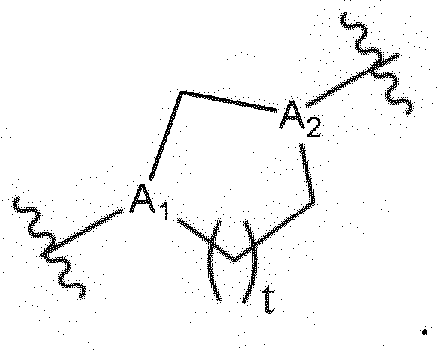
- In some examples, ring A is


- In some examples, ring A is


- In some examples, Z is CH2,
- In some examples, Z is absent.
- In some examples, at least one of A1 and A2 is N.
- In some examples, each of A1 and A2 is N.
- In some examples, each of A1 and A2 is CH.
- In some examples, A1 is N and A2 is CH.
- In some examples, A1 is CH and A2 is N.
- In some examples, at least one of X1, X2, and X3 is not -CH2-. For example, in certain examples, X1 is not -CH2-. In some examples, at least one of X1, X2, and X3 is -C(O)-.
- In some examples, X2 is -C(O)-, -C(O)O-, -OC(O)-, -C(O)-CH2-, -CH2-C(O)-, -C(O)O-CH2-, -OC(O)-CH2-, -CH2-C(O)O-, or -CH2-OC(O)-.
- In some examples, X3 is -C(O)-, -C(O)O-, -OC(O)-, -C(O)-CH2-, -CH2-C(O)-, -C(O)O-CH2-, -OC(O)-CH2-, -CH2-C(O)O-, or -CH2-OC(O)-. In other examples, X3 is -CH2-.
- In some examples, X3 is a bond or -(CH2)2-.
- In some examples, R1 and R2 are the same. In certain examples, R1, R2, and R3 are the same. In some examples, R4 and R5 are the same. In certain examples, R1, R2, R3, R4, and R5 are the same.
- In some examples, at least one of R1, R2, R3, R4, and R5 is -R"MR'. In some examples, at most one of R1, R2, R3, R4, and R5 is -R"MR'. For example, at least one of R1, R2, and R3 may be -R"MR', and/or at least one of R4 and R5 is -R"MR'. In certain examples, at least one M is -C(O)O-. In some examples, each M is -C(O)O-. In some examples, at least one M is -OC(O)-. In some examples, each M is -OC(O)-. In some examples, at least one M is -OC(O)O-. In some examples, each M is -OC(O)O-. In some examples, at least one R" is C3 alkyl. In certain examples, each R" is C3 alkyl. In some examples, at least one R" is C5 alkyl. In certain examples, each R" is C5 alkyl. In some examples, at least one R" is C6 alkyl. In certain examples, each R" is C6 alkyl. In some examples, at least one R" is C7 alkyl. In certain examples, each R" is C7 alkyl. In some examples, at least one R' is C5 alkyl. In certain examples, each R' is C5 alkyl. In other examples, at least one R' is C1 alkyl. In certain examples, each R' is C1 alkyl. In some examples, at least one R' is C2 alkyl. In certain examples, each R' is C2 alkyl.
- In some examples, at least one of R1, R2, R3, R4, and R5 is C12 alkyl. In certain examples, each of R1, R2, R3, R4, and R5 are C12 alkyl.
- In certain embodiments and examples, the compound is selected from the group consisting of the following, with compounds 4-10, 42, 43, 49-52, 57-61, 63-66, 69, 70, 73, 80-85, 87-100, 102, 104, 106, 108, and 109 being compounds of the invention:










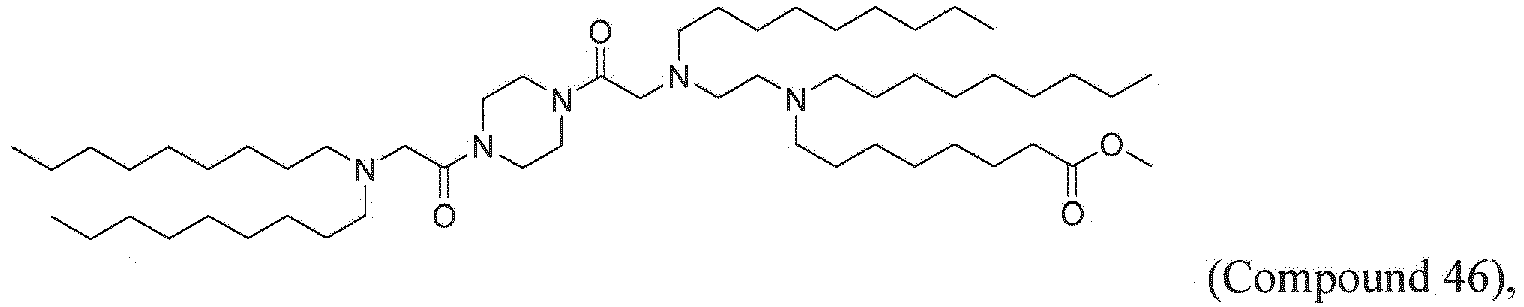








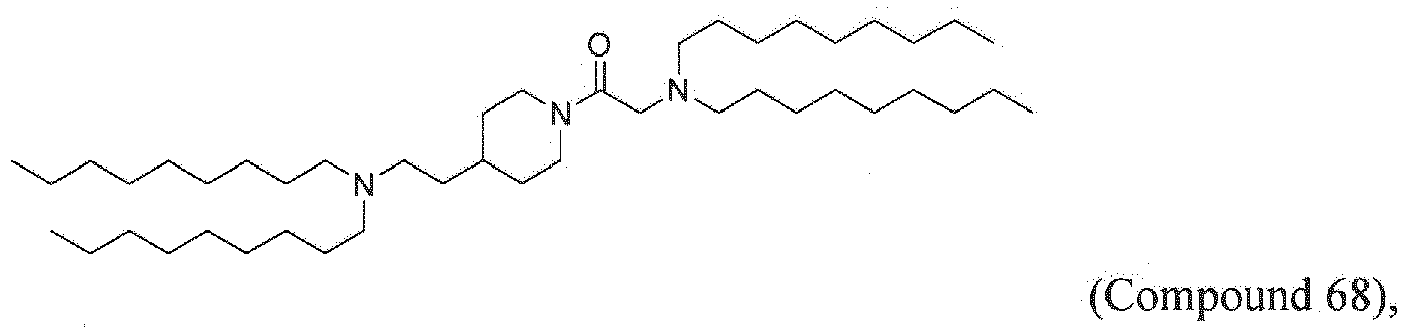


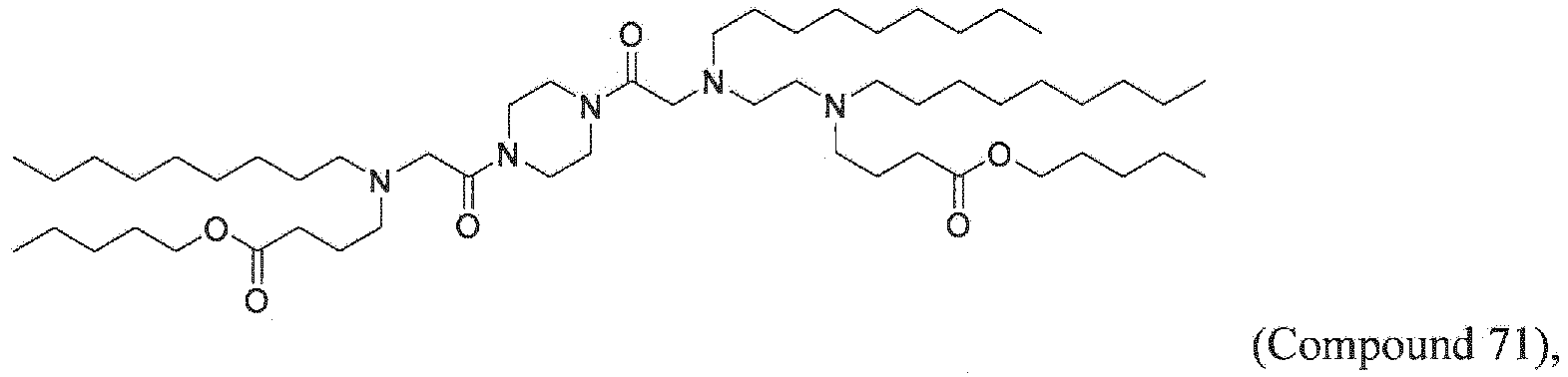





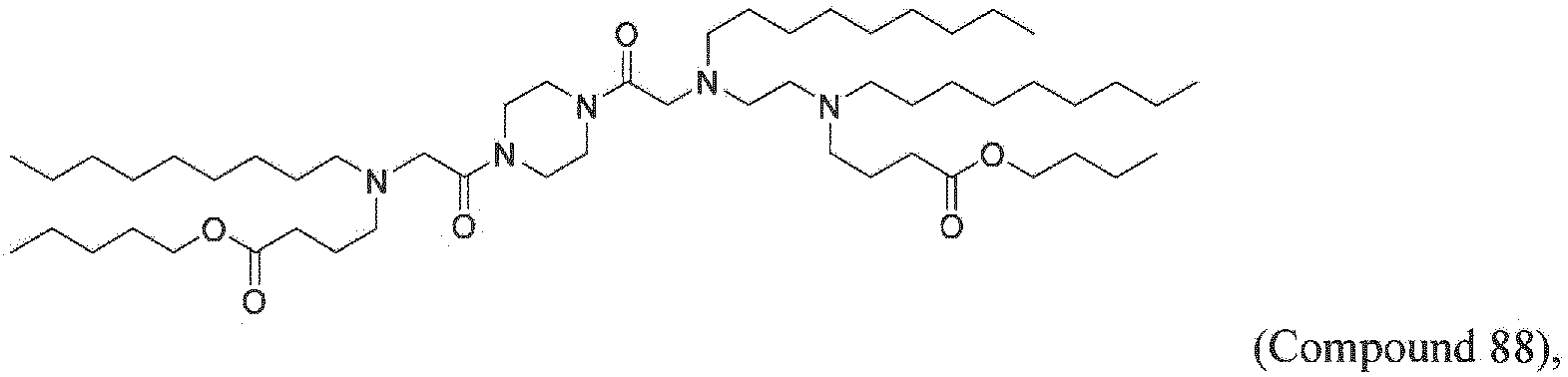









- In some examples, the compound is of formula (IIa):

- The compounds of Formula (II) or (IIa) include one or more of the following features when applicable.
- In some examples, Z is CH2
- In some examples, Z is absent.
- In some examples, at least one of A1 and A2 is N.
- In some examples, each of A1 and A2 is N.
- In some examples, each of A1 and A2 is CH.
- In some examples, A1 is N and A2 is CH.
- In some examples, A1 is CH and A2 is N.
- In some examples, R1, R2, R3, R4, and R5 are the same, and are not C12 alkyl, C18 alkyl, or C18 alkenyl. In some examples, R1, R2, R3, R4, and R5 are the same and are C9 alkyl or C14 alkyl.
- In some examples, only one of R1, R2, R3, R4, and R5 is selected from C6-20 alkenyl. In certain such examples, R1, R2, R3, R4, and R5 have the same number of carbon atoms. In some examples, R4 is selected from C5-20 alkenyl. For example, R4 may be C12 alkenyl or C18 alkenyl.
- In some examples, at least one of R1, R2, R3, R4, and R5 have a different number of carbon atoms than at least one other of R1, R2, R3, R4, and R5.
- In certain examples, R1, R2, and R3 are selected from C6-20 alkenyl, and R4 and R5 are selected from C6-20 alkyl. In other examples, R1, R2, and R3 are selected from C6-20 alkyl, and R4 and R5 are selected from C6-20 alkenyl. In some examples, R1, R2, and R3 have the same number of carbon atoms, and/or R4 and R5 have the same number of carbon atoms. For example, R1, R2, and R3, or R4 and R5, may have 6, 8, 9, 12, 14, or 18 carbon atoms. In some examples, R1, R2, and R3, or R4 and R5, are C18 alkenyl (e.g., linoleyl). In some examples, R1, R2, and R3, or R4 and R5, are alkyl groups including 6, 8, 9, 12, or 14 carbon atoms.
- In some examples, R1 has a different number of carbon atoms than R2, R3, R4, and R5. In other examples, R3 has a different number of carbon atoms than R1, R2, R4, and R5. In further examples, R4 has a different number of carbon atoms than R1, R2, R3, and R5.
- In some examples, the compound is selected from the group consisting of:


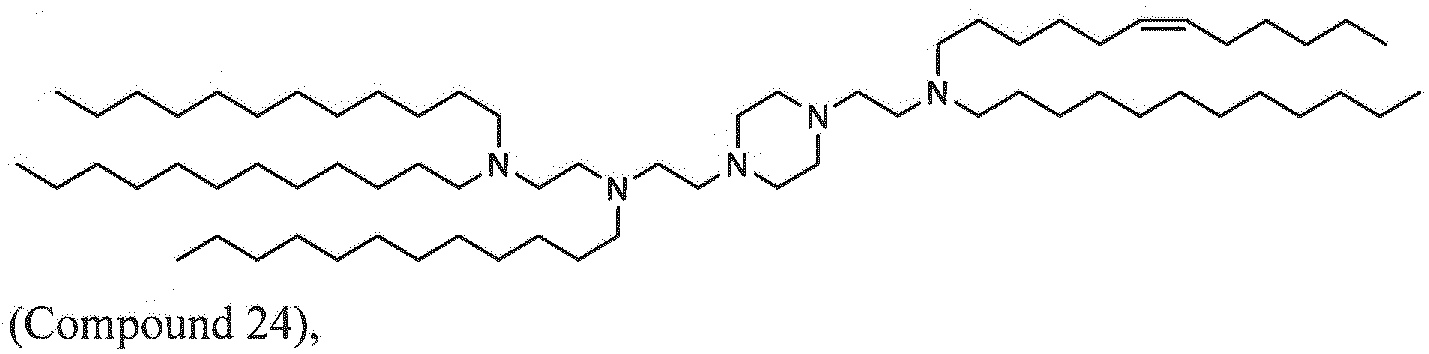


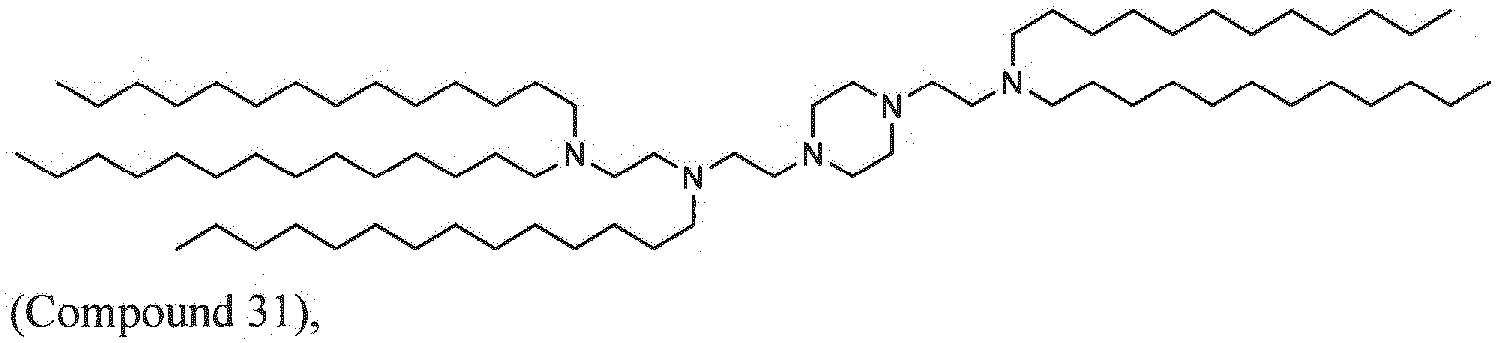
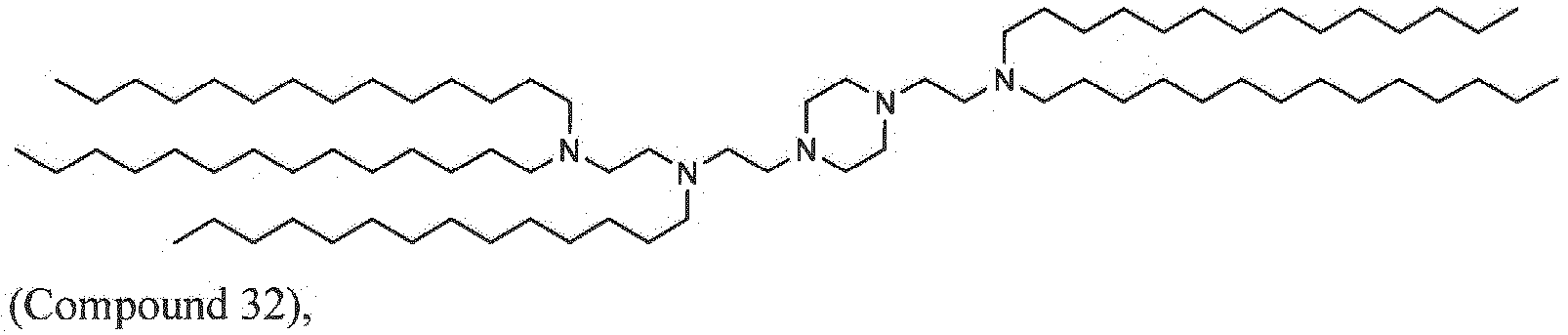


- Also described herein is a lipid of the formula (II)

- A1 and A2 are each independently selected from CH or N and at least one of A1 and A2 is N;
- Z is CH2 or absent wherein when Z is CH2, the dashed lines (1) and (2) each represent a single bond; and when Z is absent, the dashed lines (1) and (2) are both absent;
- R1, R2, R3, R4, and R5 are independently selected from the group consisting of C6-20 alkyl and C6-20 alkenyl;
- wherein when ring A is
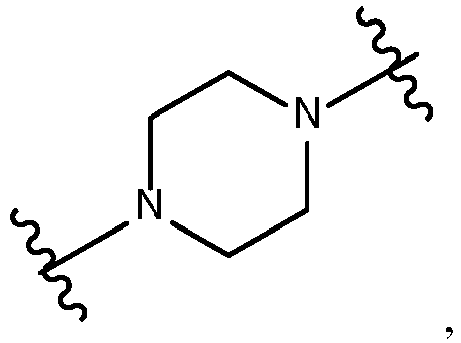
- i) R1, R2, R3, R4, and R5 are the same, wherein R1 is not C12 alkyl, C18 alkyl, or C18 alkenyl;
- ii) only one of R1, R2, R3, R4, and R5 is selected from C6-20 alkenyl;
- iii) at least one of R1, R2, R3, R4, and R5 have a different number of carbon atoms than at least one other of R1, R2, R3, R4, and R5;
- iv) R1, R2, and R3 are selected from C6-20 alkenyl, and R4 and R5 are selected from C6-20 alkyl; or
- v) R1, R2, and R3 are selected from C6-20 alkyl, and R4 and R5 are selected from C6-20 alkenyl.
- Also described is a compound of the formula (III)

- A3 is CH or N;
- A4 is CH2 or NH; and at least one of A3 and A4 is N or NH;
- Z is CH2 or absent wherein when Z is CH2, the dashed lines (1) and (2) each represent a single bond; and when Z is absent, the dashed lines (1) and (2) are both absent;
- R1, R2, and R3 are independently selected from the group consisting of C5-20 alkyl, C5-20 alkenyl, -R"MR', -R∗YR", -YR", and -R∗OR";
- each M is independently selected from -C(O)O-, -OC(O)-, -C(O)N(R')-, -N(R')C(O)-, -C(O)-, -C(S)-, -C(S)S-, -SC(S)-, -CH(OH) -, -P(O)(OR')O-, -S(O)2-, an aryl group, and a heteroaryl group;
- X1 and X2 are independently selected from the group consisting of -CH2-, -(CH2)2-, -CHR-, -CHY-, -C(O)-, -C(O)O-, -OC(O)-, -C(O)-CH2-, -CH2-C(O)-, -C(O)O-CH2-, -OC(O)-CH2-, -CH2-C(O)O-, -CH2-OC(O)-, -CH(OH)-, -C(S)-, and -CH(SH)-;
- each Y is independently a C3-6 carbocycle;
- each R∗ is independently selected from the group consisting of C1-12 alkyl and C2-12 alkenyl;
- each R is independently selected from the group consisting of C1-3 alkyl and a C3-6 carbocycle;
- each R' is independently selected from the group consisting of C1-12 alkyl, C2-12 alkenyl, and H; and
- each R" is independently selected from the group consisting of C3-12 alkyl and C3-12 alkenyl.
- In some examples, the compound is of formula (IIIa):

- The compounds of Formula (III) or (IIIa) include one or more of the following features when applicable.
- In some examples, Z is CH2.
- In some examples, Z is absent.
- In some examples, at least one of A3 and A4 is N or NH.
- In some examples, A3 is N and A4 is NH.
- In some examples, A3 is N and A4 is CH2.
- In some examples, A3 is CH and A4 is NH.
- In some examples, at least one of X1 and X2 is not -CH2-. For example, in certain examples, X1 is not -CH2-. In some examples, at least one of X1 and X2 is -C(O)-.
- In some examples, X2 is -C(O)-, -C(O)O-, -OC(O)-, -C(O)-CH2-, -CH2-C(O)-, -C(O)O-CH2-, -OC(O)-CH2-, -CH2-C(O)O-, or -CH2-OC(O)-.
- In some examples, R1, R2, and R3 are independently selected from the group consisting of C5-20 alkyl and C5-20 alkenyl. In some examples, R1, R2, and R3 are the same. In certain examples, R1, R2, and R3 are C6, C9, C12, or C14 alkyl. In other examples, R1, R2, and R3 are C18 alkenyl. For example, R1, R2, and R3 may be linoleyl.
- In some examples, the compound is selected from the group consisting of:





- In another example, the invention provides a compound according to formula (Ib):
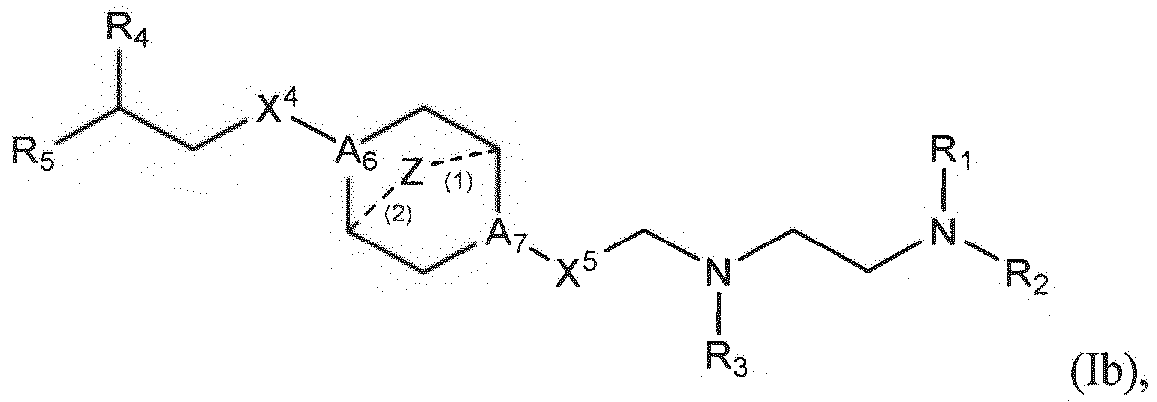
- A6 and A7 are each independently selected from CH or N, wherein at least one of A6 and A7 is N;
- Z is CH2 or absent wherein when Z is CH2, the dashed lines (1) and (2) each represent a single bond; and when Z is absent, the dashed lines (1) and (2) are both absent;
- X4 and X5 are independently selected from the group consisting of -CH2-, -(CH2)2-, -CHR-, -CHY-, -C(O)-, -C(O)O-, -OC(O)-, -C(O)-CH2-, -CH2-C(O)-, -C(O)O-CH2-, -OC(O)-CH2-, -CH2-C(O)O-, -CH2-OC(O)-, -CH(OH)-, -C(S)-, and -CH(SH)-;
- R1, R2, R3, R4, and R5 each are independently selected from the group consisting of C5-20 alkyl, C5-20 alkenyl, -R"MR', -R∗YR", -YR", and -R∗OR";
- each M is independently selected from the group consisting of -C(O)O-, -OC(O)-, -C(O)N(R')-, -N(R')C(O)-, -C(O)-, -C(S)-, -C(S)S-, -SC(S)-, -CH(OH)-, -P(O)(OR')O-, -S(O)2-, an aryl group, and a heteroaryl group;
- each Y is independently a C3-6 carbocycle;
- each R∗ is independently selected from the group consisting of C1-12 alkyl and C2-12 alkenyl;
- each R is independently selected from the group consisting of C1-3 alkyl and a C3-6 carbocycle;
- each R' is independently selected from the group consisting of C1-12 alkyl, C2-12 alkenyl, and H; and
- each R" is independently selected from the group consisting of C3-12 alkyl and C3-12 alkenyl.
- In some examples, R1, R2, R3, R4, and R5 each are independently selected from the group consisting of C6-20 alkyl and C6-20 alkenyl.
- In some examples, R1 and R2 are the same. In certain examples, R1, R2, and R3 are the same. In some examples, R4 and R5 are the same. In certain examples, R1, R2, R3, R4, and R5 are the same.
- In some examples, at least one of R1, R2, R3, R4, and R5 is C9-12 alkyl. In certain examples, each of R1, R2, R3, R4, and R5 independently is C9, C12 or C14 alkyl. In certain examples, each of R1, R2, R3, R4, and R5 is C9 alkyl.
- In some examples, A6 is N and A7 is N. In some examples, A6 is CH and A7 is N.
- In some examples, X4 is-CH2- and X5 is -C(O)-. In some examples, X4 and X5 are -C(O)-.
- In some examples, when A6 is N and A7 is N, at least one of X4 and X3 is not -CH2-, e.g., at least one of X4 and X5 is -C(O)-. In some examples, when A6 is N and A7 is N, at least one of R1, R2, R3, R4, and R5 is -R"MR'.
- In some examples, at least one of R1, R2, R3, R4, and R5 is not -R"MR'.
- In some embodiments, the compound is

- In an example, the compound has the formula (IV)

- The disclosure also provides a compound having the formula (17-1)

- R2a and R3a are each independently selected from the group consisting of C3-24 alkyl, C3-24 alkenyl, -Ra∗YaRa", -YaRa", and -Ra∗ORa";
- each Ya is independently a C3-6 carbocycle;
- each Ra∗ is independently selected from the group consisting of C1-12 alkyl and C1-12 alkenyl;
- each Xa is independently selected from the group consisting of F, Cl, Br, and I;
- each Ra is independently selected from the group consisting of C1-3 alkyl, C2-3 alkenyl, and H; and
- each Ra" is selected from the group consisting of C3-12 alkyl and C3-12 alkenyl;
- wherein R2a includes 7 or fewer carbon atoms.
- In some examples, Qa is -ORa. In certain examples, Ra is H. In other examples, Ra is -CH3.
- In some examples, na is 1. In other examples, na is 2. In other examples, n is 3. In other examples, na is 4. In some examples, na is 5.
- In some examples, R3a includes 7 or fewer carbon atoms.
- In some examples, the compound is selected from the group consisting of:


- The disclosure also provides a compound having the formula (17-I)
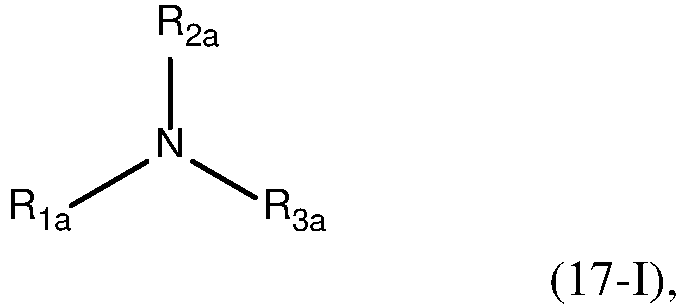
- R1a is -(CH2)n aQa, where Qa is selected from a heterocycle, -ORa, -O(CH2)naN(Ra)2, - C(O)ORa, -OC(O)Ra, -CXa 3, -CXa 2H, -CXaH2, -CN, -N(Ra)2, -C(O)N(Ra)2, -N(Ra)C(O)Ra, and -N(Ra)S(O)2Ra and each na is independently selected from 1, 2, 3, 4, and 5;
- each Xa is independently selected from the group consisting of F, Cl, Br, and I;
- R2a is selected from the group consisting of C8-24 alkenyl;
- R3a is selected from the group consisting of C8-24 alkyl; and
- each R is independently selected from the group consisting of C1-3 alkyl, C2-3 alkenyl, and H.
- In some examples, Qa is -ORa. In certain examples, Ra is H. In other examples, Ra is -CH3.
- In some examples, na is 1. In other examples, na is 2. In other examples, na is 3. In other examples, na is 4. In some examples, na is 5.
- In some examples, R3a is an alkyl including 9, 12, 14, or 18 carbon atoms.
- In some examples, R2a is C18 alkenyl (e.g., linoleyl).
- In some examples, the compound is selected from the group consisting of:


- The disclosure also provides a compound having the formula (17-1)

- R1a is -(CH2)n aQa, where Qa is selected from a heterocycle, -ORa, -O(CH2)naN(Ra)2, - C(O)ORa, -OC(O)Ra, -CXa 3, -CXa 2H, -CXaH2, -CN, -N(Ra)2, -C(O)N(Ra)2, -N(Ra)C(O)Ra, and -N(Ra)S(O)2Ra and each na is independently selected from 1, 2, 3, 4, and 5;
- each Xa is independently selected from the group consisting of F, Cl, Br, and I;
- R2a is selected from the group consisting of C13-20 alkyl;
- R3a is selected from the group consisting of C8-20 alkyl; and
- each Ra is independently selected from the group consisting of C1-3 alkyl, C2-3 alkenyl, and H.
- In some examples, Qa is -ORa. In certain examples, Ra is H. In other examples, Ra is -CH3.
- In some examples, na is 1. In other examples, na is 2. In other examples, na is 3. In other examples, na is 4. In some examples, na is 5.
- In some examples, R2a and R3a are the same.
- In some examples, R2a and/or R3a is C14 alkyl.
- In some examples, the compound is

- The disclosure also provides a compound having the formula (17-1)

- R1a is -(CH2)n aQa, where Qa is -ORa, Ra is selected from the group consisting of C1-3 alkyl, C2-3 alkenyl, and H, and na is selected from 1, 2, 3, 4, and 5; and
- R2a and R3a are each independently selected from the group consisting of C8-20 alkenyl, wherein
- iii) Ra is selected from the group consisting of C1-3 alkyl and C2-3 alkenyl; or
- iv) R1a is -(CH2)2OH, and R2a and R3a each include one or fewer double bonds.
- In some examples, Ra is H. In other examples, Ra is -CH3.
- In some examples, na is 1. In other examples, na is 2. In other examples, na is 3. In other examples, na is 4. In some examples, na is 5.
- In certain examples, R1a is -(CH2)2OCH3. In other examples, R1a is -(CH2)2OH.
- In some examples, R2a is C18 alkenyl (e.g., linoleyl). In certain examples, R3a is C18 alkenyl (e.g., linoleyl).
- In some examples, R2a and R3a are the same.
- In some examples, the compound is selected from the group consisting of


- The disclosure also provides a compound of formula (17-1)

- R1 is -(CH2)n aQa, where Qa is selected from a heterocycle, -ORa, -O(CH2)naN(Ra)2, - C(O)ORa, -OC(O)Ra, -CXa 3, -CXa 2H, -CXaH2, -CN, -N(Ra)2, -C(O)N(Ra)2, -N(Ra)C(O)Ra, and -N(Ra)S(O)2Ra and each na is independently selected from 1, 2, 3, 4, and 5;
- each Xa is independently selected from the group consisting of F, Cl, Br, and I;
- R2a is selected from the group consisting of C8-12 alkyl;
- R3a is selected from the group consisting of C8-20 alkyl; and
- each Ra is independently selected from the group consisting of C1-3 alkyl, C2-3 alkenyl, and H.
- In some examples, Qa is -ORa. In certain examples, Ra is H. In other examples, Ra is -CH3.
- In some examples, na is 1. In other examples, na is 2. In other examples, n is 3. In other examples, na is 4. In some examples, na is 5.
- In certain examples, Qa is -ORa and na is selected from 2, 3, and 4.
- In some examples, R2a is C9 alkyl. In other examples, R2a is C12 alkyl.
- In some examples, R2a and R3a are the same.
- In some examples, the compound is selected from the group consisting of:



- The disclosure also provides a compound having the formula (19-1),

- R1b is selected from the group consisting of H, C1-5 alkyl, C2-5 alkenyl, -Rb"MbRb', a C3-6 carbocycle, -(CH2)nQb, and -(CH2)nCHQbRb, where Qb is selected from a heterocycle, -ORb, -O(CH2)nN(Rb)2, -C(O)ORb, -OC(O)Rb, -CXb 3, -CXb 2H, -CXbH2, -CN, -N(Rb)2, -C(O)N(Rb)2, -N(Rb)C(O)Rb, and -N(Rb)S(O)2Rb and each n is independently selected from 1, 2, 3, 4, and 5;
- R2b and R3b are independently selected from the group consisting of C1-20 alkyl, C2-20 alkenyl, -Rb"MRb', -Rb∗YRb", -YRb", and -Rb∗ORb";
- each Mb is independently selected from the group consisting of -C(O)O-, -OC(O)-, -C(O)N(Rb')-, -N(Rb')C(O)-, -C(O)-, -C(S)-, -C(S)S-, -SC(S)-, -CH(OH)-, -P(O)(ORb')O-, -S(O)2-, an aryl group, and a heteroaryl group;
- W is selected from the group consisting of -CH2-, -CHRb-, -C(O)-, -CH(OH)-, -C(S)-, and -CH(SH)-;
- each Xb is independently selected from the group consisting of F, Cl, Br, and I;
- each Yb is independently a C3-6 carbocycle;
- each Rb∗ is independently selected from the group consisting of C1-12 alkyl and C1-12 alkenyl;
- each Rb is independently selected from the group consisting of C1-3 alkyl, a C3-6 carbocycle, C2-3 alkenyl, and H;
- each Rb' is independently selected from the group consisting of C1-12 alkyl, C2-12 alkenyl, and H; and
- each Rb" is independently selected from the group consisting of C3-12 alkyl and C3-12 alkenyl.
- In some examples, W is not -CH2-, e.g., W is -C(O)-.
- In some examples, at least one of R2b and R3b is -Rb"MbRb'. In certain examples, at least one Mb is -C(O)O-. In some examples, at least one Rb" is C5 alkyl. In certain examples, at least one Rb' is C5 alkyl.
- In some examples, R2b and/or R3b are selected from the group consisting of C1-20 alkyl. For example, R2b and/or R3b may be alkyl groups including 9 or 12 carbon atoms. In other examples, R2b and/or R3b are selected from the group consisting of C2-20 alkenyl. For example, R2b and/or R3b may be alkenyl groups including 18 carbon atoms (e.g., linoleyl groups). In certain examples, R2b and R3b are the same.
- In some examples, R1b is H, while in other examples, R1b is selected from C1-5 alkyl. For example, R1b may be C1 alkyl.
- In certain examples, R1b is -(CH2)nQb. In such examples, Qb is a heterocycle such as a phenyl group. For example, Qb may be a phenyl group with one or more substituents, as described herein.
- In certain examples, the compound is selected from the group consisting of:


- In other examples, lipids are compounds of formula (19-II)

- R1b is selected from the group consisting of C6-20 alkyl; and
- R2b and R3b are independently selected from the group consisting of C6-20 alkenyl.
- In particular examples, R1b is C12 alkyl.
- In some examples, R2b and/or R3b are C18 alkenyl (e.g., linoleyl).
- In certain examples, R2b and R3b are both linoleyl.
- In one examples, the compound is

- Lipids may be compounds of formula (20-1),

- R1c, is selected from the group consisting of a C3-6 carbocycle, -(CH2)n
c Qc, -(CH2)nc CHQcRc, -CHQcRc, and -CQc (Rc)2, where Qc is selected from a heterocycle, -ORc, -O(CH2)nc N(Rc)2, -C(O)ORc, - OC(O)Rc, -CXc 3, -CXc 2H, -CXcH2, -CN, -N(Rc)2, -C(O)N(Rc)2, -N(Rc)C(O)Rc, and -N(Rc)S(O)2Rc and each nc is independently selected from 1, 2, 3, 4, and 5; - R2c, R3c, and R4c are independently selected from the group consisting of C1-20 alkyl, C2-20 alkenyl, -Rc"McRc', -Rc∗YcRc", -YcRc", and -Rc∗ORc";
- each Mc is independently selected from the group consisting of -C(O)O-, -OC(O)-, -C(O)N(Rc')-, -N(Rc')C(O)-, -C(O)-, -C(S)-, -C(S)S-, -SC(S)-, -CH(OH)-, -P(O)(ORc')O-, -S(O)2-, an aryl group, and a heteroaryl group;
- each Xc is independently selected from the group consisting of F, Cl, Br, and I;
- each Yc is independently a C3-6 carbocycle;
- each Rc∗ is independently selected from the group consisting of C1-12 alkyl and C1-12 alkenyl;
- each Rc is independently selected from the group consisting of C1-3 alkyl, C2-3 alkenyl, and H;
- each Rc' is independently selected from the group consisting of C1-12 alkyl, C2-12 alkenyl, and H; and
- each Rc" is independently selected from the group consisting of C3-12 alkyl and C3-12 alkenyl,
- wherein
- i) R1c is selected from the group consisting of a C3-6 carbocycle, -(CH2)n
c Qc, -(CH2)nc CHQcRc, -CHQcRc, and -CQC(RC)2, where Qc is selected from a heterocycle, -O(CH2)nc N(Rc)2, -C(O)ORc, -OC(O)Rc, -CXc 3, -CXc 2H, -CXcH2, -C(O)N(Rc)2, -N(Rc)C(O)Rc, and -N(Rc)S(O)2Rc and each nc is independently selected from 1, 2, 3, 4, and 5; and/or - ii) at least one of R2c, R3c, and R4c is -Rc"McRc'.
- i) R1c is selected from the group consisting of a C3-6 carbocycle, -(CH2)n
- In some examples, R1c is selected from the group consisting of -(CH2)n cQc, -(CH2)n
c CHQcRc, -CHQcRc, and -CQc(Rc)2, where Qc is selected from a heterocycle, -O(CH2)nc N(Rc)2, -C(O)ORc, -OC(O)Rc, -CX c3, -CXc 2H, -CXcH2, -CN, -C(O)N(Rc)2, -N(Rc)C(O)Rc, and -N(Rc)S(O)2Rc and each n is independently selected from 1, 2, 3, 4, and 5. In certain examples, R1c is -(CH2)nc Qc. In some examples, nc is 2. In some examples, Qc is -C(O)ORc, where Rc is, for example, H. - In some examples, at least one of R2c, R3c, and R4c is -Rc"McRc'. For example, R2c, R3c, and/or R4c may be -Rc"McRc'. In some examples, at least one Mc is -C(O)O-. In certain examples, each Mc is -C(O)O-. In some examples, at least one Rc" is C5 or C7 alkyl. In certain examples, each Rc" is C5 alkyl. In other examples, each Rc" is C7 alkyl. In some examples, at least one Rc' is C5, C7, or C9 alkyl. In certain examples, each Rc' is C5 alkyl. In other examples, each Rc' is C7 alkyl. In other examples, each Rc' is C9 alkyl. In some examples, Rc' is branched.
- In some examples, R2c, R3c, and R4c are selected from the group consisting of C5-20 alkyl. In certain examples, R2c, R3c, and R4c are C12 alkyl.
- In some examples, R2c is selected from the group consisting of C5-20 alkyl and C5-20 alkenyl. For example, R2c may be C12 alkyl.
- In some examples, R3c is selected from the group consisting of C5-20 alkyl and C5-20 alkenyl. For example, R3c may be C6, C9, or C12 alkyl.
- In some examples, R4c is selected from the group consisting of C5-20 alkyl and C5-20 alkenyl. For example, R4c may be C6, C9, or C12 alkyl.
- In some examples, R3c and R4c are the same.
- In some examples, the compound is selected from the group consisting of:


- In other examples, the lipid is a compound according to formula (20-1)

- R1c is selected from the group consisting of -(CH2)n
c Qc, -(CH2)nc CHQcRc, -CHQcRc, and -CQc(Rc)2, where Qc is selected from -ORc, -CN, and -N(Rc)2, and nc is selected from 1, 2, 3, 4, and 5; - R2c and R3c are independently selected from the group consisting of C6-20 alkyl and C6-20 alkenyl;
- R4c is selected from the group consisting of C13-20 alkyl and C5-20 alkenyl; and
- each Rc is independently selected from the group consisting of C1-3 alkyl, C2-3 alkenyl, and H.
- In some examples, R3c is C14 alkyl.
- In some examples, R4c is C14 alkyl.
- In some examples, R3c is C18 alkenyl. For example, R3c may be linoleyl.
- In some examples, R4c is C18 alkenyl. For example, R4c may be linoleyl.
- In some examples, R2c is C12 alkyl. In other examples, R2c is C14 alkyl. In some examples, R2c is C18 alkenyl. For example, R2c may be linoleyl.
- In some examples, R3c and R4c are the same.
- In some examples, R1c is -(CH2)n
c Qc. In some examples, Qc is -ORc. For example, Qc may be -OH. In some examples, nc is 2 or 3. - In some examples, the compound is selected from the group consisting of:


- In other examples, the lipid is a compound having formula (20-1)

- R1c is selected from the group consisting of -(CH2)n
c Qc, -(CH2)nc CHQcRc, -CHQcRc, and -CQc (Rc)2, where Qc is selected from -ORc, -CN, and -N(Rc)2, and nc is selected from 1, 2, 3, 4, and 5; - R2c, R3c, and R4c are independently selected from the group consisting of C6-20 alkyl and C6-20 alkenyl; and
- each Rc is independently selected from the group consisting of C1-3 alkyl, C2-3 alkenyl, and H;
- wherein
- i) R2c is selected from the group consisting of C1-11 alkyl and C2-5 alkenyl, and/or
- ii) R3c is selected from the group consisting of C1-11 alkyl and C2-5 alkenyl.
- In some examples, R2c is selected from the group consisting of C1-11 alkyl and C2-5 alkenyl. For example, R2c may be C6 or C9 alkyl.
- In some examples, R3c is selected from the group consisting of C1-11 alkyl and C2-5 alkenyl. For example, R3c may be C6 or C9 alkyl.
- In some examples, R3c is C12 alkyl.
- In some examples, R2c is C12 alkyl.
- In some examples, R4c is C6, C9, or C12 alkyl.
- In some examples, R1c is -(CH2)n cQc. In certain examples, Qc is -ORc. In some examples, Rc is H. In some examples, nc is 2 or 3.
- In some examples, the compound is selected from the group consisting of:



- In other examples, the lipid is a compound according to formula (20-1)

- R1c is selected from the group consisting of -(CH2)n
c Qc, -(CH2)nc CHQcRc, -CHQcRc, and -CQc(Rc)2, where Qc is selected from -ORc, -CN, and -N(Rc)2, and nc is selected from 1, 2, 3, 4, and 5; - R2c is selected from the group consisting of H, C12-20 alkyl, and C6-20 alkenyl;
- R3c and R4c are C12 alkyl; and
- each Rc is independently selected from the group consisting of C1-3 alkyl, C2-3 alkenyl, and H.
- In some examples, R2c is H. In other examples, R2c is C12 alkyl or alkenyl. In some examples, R2c is C14 alkyl. In other examples, R2c is C18 alkenyl. For example, R2c may be linoleyl.
- In some examples, R1c is -(CH2)n cQc. In certain examples, Qc is -ORc. For example, Qc may be OH. In some examples, nc is 2, 3, or 4.
- In some examples, the compound is selected from the group consisting of:






- In another example, lipids may be compounds of formula (21-1),

- R1d and R2d are independently selected from the group consisting of H, C1-5 alkyl, and C2-5 alkenyl;
- nd is selected from 1, 2, 3, 4, and 5;
- k is selected from 0, 1, 2, and 3;
- R3d and R4d are independently selected from the group consisting of C1-20 alkyl, C2-20 alkenyl, -Rd"MdRd', -Rd∗YdRd", -YdRd", and -Rd∗ORd";
- each Md is independently selected from the group consisting of -C(O)O-, -OC(O)-, -C(O)N(Rd')-, -N(Rd')C(O)-, -C(O)-, -C(S)-, -C(S)S-, -SC(S)-, -CH(OH)-, -P(O)(ORd')O-, and -S(O)2-, or is absent;
- each Rd' is independently selected from the group consisting of C1-12 alkyl, C2-12 alkenyl, and H; each Yd is independently a C3-6 carbocycle;
- each Rd∗ is independently selected from the group consisting of C1-12 alkyl and C1-12 alkenyl;
- each Rd' is independently selected from the group consisting of C1-12 alkyl, C2-12 alkenyl, and H; and
- each Rd" is independently selected from the group consisting of C3-12 alkyl and C3-12 alkenyl,
- wherein R3d and R4d are bound to either i) the same carbon atom or ii) adjacent carbon atoms.
- In some examples, R3d and R4d are bound to the same carbon atom. For example, R3d and R4d may be bound to a carbon atom adjacent to C∗. In certain examples, R3d and R4d are not bound to a carbon atom adjacent to C∗.
- In other examples, R3d and R4d are bound to adjacent carbon atoms. In certain examples, one or both of R3d and R4d are bound to carbon atoms adjacent to C∗.
- In some examples, k is 0. In other examples, k is 1, 2, or 3.
- In certain examples, Md is absent. In other examples, Md is selected from the group consisting of-C(O)O-, -OC(O)-, -C(O)N(Rd')-, -N(Rd')C(O)-, -C(O)-, -C(S)-, -C(S)S-, -SC(S)-, -CH(OH)-, -P(O)(ORd')O-, and -S(O)2-. In particular such examples, Md is -C(O)O-.
- In some examples, nd is 1, 2, or 3.
- In some examples, R1d and/or R2d are selected from C1-5 alkyl. In certain examples, R1d and/or R2d are C1 alkyl.
- In certain examples, R3d and/or R4d are selected from C2-20 alkenyl. In certain examples, R3d and/or R4d are alkenyl groups including 17, 18, or 19 carbon atoms. For example, R3d and/or R4d may be C18 alkenyl groups (e.g., linoleyl).
- In certain examples, the compound is selected from the group consisting of:


- As used herein, the term "alkyl" or "alkyl group" means a linear or branched, saturated hydrocarbon including one or more carbon atoms (e.g., one, two, three, four, five, six, seven, eight, nine, ten, eleven, twelve, thirteen, fourteen, fifteen, sixteen, seventeen, eighteen, nineteen, twenty, or more carbon atoms), which is optionally substituted. For example, the notation "C1-24 alkyl" means an optionally substituted linear or branched, saturated hydrocarbon including 1-24 carbon atoms. An alkyl group described herein refers to both unsubstituted and substituted alkyl group unless otherwise specified.
- As used herein, the term "alkenyl" or "alkenyl group" means a linear or branched hydrocarbon including two or more carbon atoms (e.g., two, three, four, five, six, seven, eight, nine, ten, eleven, twelve, thirteen, fourteen, fifteen, sixteen, seventeen, eighteen, nineteen, twenty, or more carbon atoms) and at least one double bond, which is optionally substituted. The notation "C2-24 alkenyl" means an optionally substituted linear or branched hydrocarbon including 2 to 24 carbon atoms and at least one carbon-carbon double bond. An alkenyl group may include one, two, three, four, or more carbon-carbon double bonds. For example, C18 alkenyl may include one or more double bonds. A C18 alkenyl group including two double bonds may be a linoleyl group. An alkenyl group described herein refers to both unsubstituted and substituted unless otherwise specified.
- As used herein, the term "carbocycle" or "carbocyclic group" means an optionally substituted mono- or multi-cyclic system including one or more rings of carbon atoms. Rings may be three, four, five, six, seven, eight, nine, ten, eleven, or twelve membered rings. The notation "C3-6 carbocycle" means a carbocycle including a single ring having 3-6 carbon atoms. Carbocycles may include one or more carbon-carbon double or triple bonds and may be non-aromatic or aromatic (e.g., cycloalkyl or aryl groups). Examples of carbocycles include cyclopropyl, cyclopentyl, cyclohexyl, phenyl, naphthyl, and 1,2-dihydronaphthyl groups. Carbocycles described herein refers to both unsubstituted and substituted carbocycles unless otherwise specified. The term "cycloalkyl" as used herein means a non-aromatic carbocycle and may or may not include any double or triple bond. Unless otherwise specified, carbocycles described herein refers to both unsubstituted and substituted carbocycle groups, i.e., optionally substituted carbocycles.
- As used herein, the term "heterocycle" or "heterocyclic group" means an optionally substituted mono- or multi-cyclic system including one or more rings, where at least one ring includes at least one heteroatom. Heteroatoms may be, for example, nitrogen, oxygen, or sulfur atoms. Rings may be three, four, five, six, seven, eight, nine, ten, eleven, or twelve membered rings. Heterocycles may include one or more double or triple bonds and may be non-aromatic or aromatic. Examples of heterocycles include imidazolyl, imidazolidinyl, oxazolyl, oxazolidinyl, thiazolyl, thiazolidinyl, pyrazolidinyl, pyrazolyl, isoxazolidinyl, isoxazolyl, isothiazolidinyl, isothiazolyl, morpholinyl, pyrrolyl, pyrrolidinyl, furyl, tetrahydrofuryl, thiophenyl, pyridinyl, piperidinyl, quinolyl, and isoquinolyl groups. Heterocycles may be optionally substituted.
- As used herein, a "biodegradable group" is a group that may facilitate faster metabolism of a lipid in a mammalian entity. A biodegradable group may be selected from the group consisting of, but is not limited to, -C(O)O-, -OC(O)-, -C(O)N(R')-, -N(R')C(O)-, -C(O)-, -C(S)-, -C(S)S-, -SC(S)-, -CH(OH)-, -P(O)(OR')O-, -S(O)2-, an aryl group, and a heteroaryl group. As used herein, an "aryl group" is a carbocyclic group including one or more aromatic rings. Examples of aryl groups include phenyl and naphthyl groups. As used herein, a "heteroaryl group" is a heterocyclic group including one or more aromatic rings. Examples of heteroaryl groups include pyrrolyl, furyl, thiophenyl, imidazolyl, oxazolyl, and thiazolyl. Aryl and heteroaryl groups may be optionally substituted. For example, each M, Mb. Mc, or Md can be independently selected from the non-limiting group consisting of phenyl, oxazole, and thiazole. In the formulae above, each M, Mb, Mc, or Md can be independently selected from the list of biodegradable groups above.
- Alkyl, alkenyl, and cyclyl (e.g., carbocyclyl and heterocyclyl) groups may be optionally substituted unless otherwise specified. Optional substituents may be selected from the group consisting of, but are not limited to, a halogen atom (e.g., a chloride, bromide, fluoride, or iodide group), a carboxylic acid (e.g., -C(O)OH), an alcohol (e.g., a hydroxyl, -OH), an ester (e.g., -C(O)OR or -OC(O)R), an aldehyde (e.g.,-C(O)H), a carbonyl (e.g., -C(O)R, alternatively represented by C=O), an acyl halide (e.g.,-C(O)X, in which X is a halide selected from bromide, fluoride, chloride, and iodide), a carbonate (e.g., -OC(O)OR), an alkoxy (e.g., -OR), an acetal (e.g.,-C(OR)2R"", in which each OR are alkoxy groups that can be the same or different and R"" is an alkyl or alkenyl group), a phosphate (e.g., P(O)4 3-), a thiol (e.g., -SH), a sulfoxide (e.g., -S(O)R), a sulfinic acid (e.g., -S(O)OH), a sulfonic acid (e.g., -S(O)2OH), a thial (e.g., -C(S)H), a sulfate (e.g., S(O)4 2-), a sulfonyl (e.g., -S(O)2-), an amide (e.g., -C(O)NR2, or -N(R)C(O)R), an azido (e.g., -N3), a nitro (e.g., -NO2), a cyano (e.g., -CN), an isocyano (e.g., -NC), an acyloxy (e.g.,-OC(O)R), an amino (e.g., -NR2, -NRH, or -NH2), a carbamoyl (e.g., -OC(O)NR2, -OC(O)NRH, or -OC(O)NH2), a sulfonamide (e.g., -S(O)2NR2, -S(O)2NRH, -S(O)2NH2, -N(R)S(O)2R, -N(H)S(O)2R, -N(R)S(O)2H, or -N(H)S(O)2H), a cyclyl (e.g., carbocyclyl or heterocyclyl) group, an alkyl group, and an alkenyl group. In any of the preceding, R is an alkyl or alkenyl group, as defined herein. In some examples, the substituent groups themselves may be further substituted with, for example, one, two, three, four, five, or six substituents as defined herein. For example, a C5-20 alkyl group may be further substituted with one, two, three, four, five, six, or more substituents as described herein.
- An amine moiety of a lipid according to one of formulae (I), (Ia1)-(Ia6), (Ib), (II), (IIa), (III), (IIIa), (IV), (17-1), (19-1), (19-11), (20-1) and (21-1) may be protonated at a physiological pH. Thus, a lipid may have a positive or partial positive charge at physiological pH. Such lipids may be referred to as cationic or ionizable (amino)lipids. Lipids may be zwitterionic, i.e., neutral molecules having both a positive and a negative charge.
- The disclosure also features nanoparticle compositions comprising a lipid component comprising a compound according to one of formulae (I), (Ia1)-(Ia6), (Ib), (II), (IIa), (III), (IIIa), (IV), (17-1), (19-1), (19-11), (20-1) and (21-1) as described herein. In some embodiments, the largest dimension of a nanoparticle composition is 1 µm or shorter (e.g., 1 µm, 900 nm, 800 nm, 700 nm, 600 nm, 500 nm, 400 nm, 300 nm, 200 nm, 175 nm, 150 nm, 125 nm, 100 nm, 75 nm, 50 nm, or shorter), e.g., when measured by dynamic light scattering (DLS), transmission electron microscopy, scanning electron microscopy, or another method. Nanoparticle compositions include, for example, lipid nanoparticles (LNPs), liposomes, lipid vesicles, and lipoplexes. In some embodiments, nanoparticle compositions are vesicles including one or more lipid bilayers. In certain embodiments, a nanoparticle composition includes two or more concentric bilayers separated by aqueous compartments. Lipid bilayers may be functionalized and/or crosslinked to one another. Lipid bilayers may include one or more ligands, proteins, or channels.
- Nanoparticle compositions comprise a lipid component including at least one lipid, such as a compound according to one of formulae (I), (Ia1)-(Ia6), (Ib), (II), (IIa), (III), (IIIa), (IV), (17-1), (19-1), (19-11), (20-1) and (21-1), as described herein. For example, in some embodiments, a nanoparticle composition may include a lipid component including one of
Compounds 1 through 88, Compounds 17-1 through 17-13, Compounds 19-1 through 19-6, Compounds 20-1 through 20-25 and Compounds 21-1 through 21-6. Nanoparticle compositions may also include a variety of other components. For example, the lipid component of a nanoparticle composition may include one or more other lipids in addition to a lipid according to one of formulae (I), (Ia1)-(Ia6), (Ib), (II), (IIa), (III), (IIIa), (IV), (17-1), (19-1), (19-11), (20-1) and (21-1). - A nanoparticle composition may include one or more cationic and/or ionizable lipids (e.g., lipids that may have a positive or partial positive charge at physiological pH) in addition to a lipid according to one of formulae (I), (Ia1)-(Ia6), (Ib), (II), (IIa), (III), (IIIa), (IV), (17-1), (19-I), (19-11), (20-1) and (21-1). Cationic and/or ionizable lipids may be selected from the non-limiting group consisting of 3-(didodecylamino)-N1,N1,4-tridodecyl-1-piperazineethanamine (KL10), N1-[2-(didodecylamino)ethyl]-N1,N4,N4-tridodecyl-1,4-piperazinediethanamine (KL22), 14,25-ditridecyl-15,18,21,24-tetraaza-octatriacontane (KL25), 1,2-dilinoleyloxy-N,N-dimethylaminopropane (DLinDMA), 2,2-dilinoleyl-4-dimethylaminomethyl-[1,3]-dioxolane (DLin-K-DMA), heptatriaconta-6,9,28,3 1-tetraen-19-yl 4-(dimethylamino)butanoate (DLin-MC3-DMA), 2,2-dilinoleyl-4-(2-dimethylaminoethyl)-[1,3]-dioxolane (DLin-KC2-DMA), 1,2-dioleyloxy-N,N-dimethylaminopropane (DODMA), 2-({8-[(3β)-cholest-5-en-3-yloxy]octyl}oxy)-N,N-dimethyl-3-[(9Z,12Z)-octadeca-9,12-dien-1-y loxy]propan-1-amine (Octyl-CLinDMA), (2R)-2-({8-[(3β)-cholest-5-en-3-yloxy]octyl}oxy)-N,N-dimethyl-3-[(9Z,12Z)-octadeca-9,12-die n-1-yloxy]propan-1-amine (Octyl-CLinDMA (2R)), (2S)-2-({8-[(3β)-cholest-5-en-3-yloxy]octyl}oxy)-N,N-dimethyl-3-[(9Z,12Z)-octadeca-9,12-die n-1-yloxy]propan-1-amine (Octyl-CLinDMA (2S)),

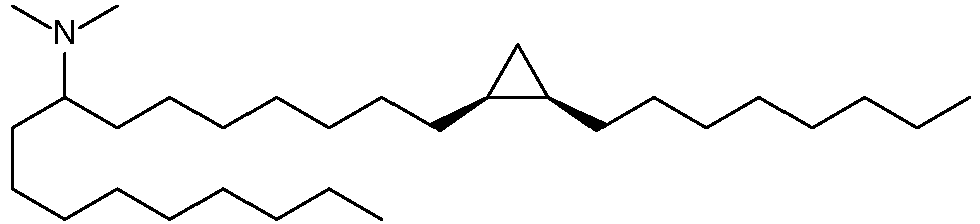
- In addition to these, a cationic lipid may also be a lipid including a cyclic amine group. Additional cationic and/or ionizable lipids that are suitable for the formulations and methods disclosed herein include those described in
WO2015199952 ,WO2016176330 , andWO2015011633 . - The lipid component of a nanoparticle composition may include one or more PEG or PEG-modified lipids. Such species may be alternately referred to as PEGylated lipids. A PEG lipid is a lipid modified with polyethylene glycol. A PEG lipid may be selected from the non-limiting group consisting of PEG-modified phosphatidylethanolamines, PEG-modified phosphatidic acids, PEG-modified ceramides, PEG-modified dialkylamines, PEG-modified diacylglycerols, PEG-modified dialkylglycerols, and mixtures thereof. For example, a PEG lipid may be PEG-c-DOMG, PEG-DMG, PEG-DLPE, PEG-DMPE, PEG-DPPC, or a PEG-DSPE lipid.
- The lipid component of a nanoparticle composition may include one or more structural lipids. Structural lipids can be selected from the group consisting of, but are not limited to, cholesterol, fecosterol, sitosterol, ergosterol, campesterol, stigmasterol, brassicasterol, tomatidine, tomatine, ursolic acid, alpha-tocopherol, and mixtures thereof. In certain embodiments, the structural lipid is cholesterol. In some embodiments, the structural lipid includes cholesterol and a corticosteroid (such as prednisolone, dexamethasone, prednisone, and hydrocortisone), or a combination thereof.
- The lipid component of a nanoparticle composition may include one or more phospholipids, such as one or more (poly)unsaturated lipids. Phospholipids may assemble into one or more lipid bilayers. In general, phospholipids may include a phospholipid moiety and one or more fatty acid moieties. For example, a phospholipid may be a lipid according to formula (V)

- Phospholipids useful in the compositions and methods described herein may be selected from the non-limiting group consisting of 1,2-distearoyl-sn-glycero-3-phosphocholine (DSPC), 1,2-dioleoyl-sn-glycero-3-phosphoethanolamine (DOPE), 1,2-dilinoleoyl-sn-glycero-3-phosphocholine (DLPC), 1,2-dimyristoyl-sn-glycero-phosphocholine (DMPC), 1,2-dioleoyl-sn-glycero-3-phosphocholine (DOPC), 1,2-dipalmitoyl-sn-glycero-3-phosphocholine (DPPC), 1,2-diundecanoyl-sn-glycero-phosphocholine (DUPC), 1-palmitoyl-2-oleoyl-sn-glycero-3-phosphocholine (POPC), 1,2-di-O-octadecenyl-sn-glycero-3-phosphocholine (18:0 Diether PC), 1-oleoyl-2-cholesterylhemisuccinoyl-sn-glycero-3-phosphocholine (OChemsPC), 1-hexadecyl-sn-glycero-3-phosphocholine (C16 Lyso PC), 1,2-dilinolenoyl-sn-glycero-3-phosphocholine, 1,2-diarachidonoyl-sn-glycero-3-phosphocholine, 1,2-didocosahexaenoyl-sn-glycero-3-phosphocholine, 1,2-diphytanoyl-sn-glycero-3-phosphoethanolamine (ME 16.0 PE), 1,2-distearoy1-sn-glycero-3-phosphoethanolamine, 1,2-dilinoleoy1-sn-glycero-3-phosphoethanolamine, 1,2-dilinolenoy1-sn-glycero-3-phosphoethanolamine, 1,2-diarachidonoyl-sn-glycero-3-phosphoethanolamine, 1,2-didocosahexaenoyl-sn-glycero-3-phosphoethanolamine, 1,2-dioleoyl-sn-glycero-3-phospho-rac-(1-glycerol) sodium salt (DOPG), and sphingomyelin.
- In certain embodiments, a nanoparticle composition includes DSPC. In certain embodiments, a nanoparticle composition includes DOPE. In some embodiments, a nanoparticle composition includes both DSPC and DOPE.
- In some embodiments, a nanoparticle composition that includes one or more lipids described herein may further include one or more adjuvants, e.g., Glucopyranosyl Lipid Adjuvant (GLA), CpG oligodeoxynucleotides (e.g., Class A or B), poly(I:C), aluminum hydroxide, and Pam3CSK4.
- Nanoparticle compositions may include one or more therapeutic and/or prophylactic agents. The disclosure features methods of delivering a therapeutic and/or prophylactic agent to a mammalian cell or organ, producing a polypeptide of interest in a mammalian cell, and treating a disease or disorder in a mammal in need thereof comprising administering to a mammal and/or contacting a mammalian cell with a nanoparticle composition including a therapeutic and/or prophylactic agent.
- Therapeutic and/or prophylactic agents include biologically active substances and are alternately referred to as "active agents." A therapeutic and/or prophylactic agent may be a substance that, once delivered to a cell or organ, brings about a desirable change in the cell, organ, or other bodily tissue or system. Such species may be useful in the treatment of one or more diseases, disorders, or conditions. In some embodiments, a therapeutic and/or prophylactic agent is a small molecule drug useful in the treatment of a particular disease, disorder, or condition. Examples of drugs useful in the nanoparticle compositions described herein include, but are not limited to, antineoplastic agents (e.g., vincristine, doxorubicin, mitoxantrone, camptothecin, cisplatin, bleomycin, cyclophosphamide, methotrexate, and streptozotocin), antitumor agents (e.g., actinomycin D, vincristine, vinblastine, cytosine arabinoside, anthracyclines, alkylating agents, platinum compounds, antimetabolites, and nucleoside analogs, such as methotrexate and purine and pyrimidine analogs), anti-infective agents, local anesthetics (e.g., dibucaine and chlorpromazine), beta-adrenergic blockers (e.g., propranolol, timolol, and labetalol), antihypertensive agents (e.g., clonidine and hydralazine), anti-depressants (e.g., imipramine, amitriptyline, and doxepin), anti-convulsants (e.g., phenytoin), antihistamines (e.g., diphenhydramine, chlorpheniramine, and promethazine), antibiotic/antibacterial agents (e.g., gentamycin, ciprofloxacin, and cefoxitin), antifungal agents (e.g., miconazole, terconazole, econazole, isoconazole, butaconazole, clotrimazole, itraconazole, nystatin, naftifine, and amphotericin B), antiparasitic agents, hormones, hormone antagonists, immunomodulators, neurotransmitter antagonists, antiglaucoma agents, vitamins, narcotics, and imaging agents.
- In some embodiments, a therapeutic and/or prophylactic agent is a cytotoxin, a radioactive ion, a chemotherapeutic, a vaccine, a compound that elicits an immune response, and/or another therapeutic and/or prophylactic agent. A cytotoxin or cytotoxic agent includes any agent that may be detrimental to cells. Examples include, but are not limited to, taxol, cytochalasin B, gramicidin D, ethidium bromide, emetine, mitomycin, etoposide, teniposide, vincristine, vinblastine, colchicine, doxorubicin, daunorubicin, dihydroxyanthracinedione, mitoxantrone, mithramycin, actinomycin D, 1-dehydrotestosterone, glucocorticoids, procaine, tetracaine, lidocaine, propranolol, puromycin, maytansinoids, e.g., maytansinol, rachelmycin (CC-1065), and analogs or homologs thereof. Radioactive ions include, but are not limited to iodine (e.g., iodine 125 or iodine 131), strontium 89, phosphorous, palladium, cesium, iridium, phosphate, cobalt,
yttrium 90, samarium 153, and praseodymium. Vaccines include compounds and preparations that are capable of providing immunity against one or more conditions related to infectious diseases such as influenza, measles, human papillomavirus (HPV), rabies, meningitis, whooping cough, tetanus, plague, hepatitis, and tuberculosis and can include mRNAs encoding infectious disease derived antigens and/or epitopes. Vaccines also include compounds and preparations that direct an immune response against cancer cells and can include mRNAs encoding tumor cell derived antigens, epitopes, and/or neoepitopes. Compounds eliciting immune responses may include vaccines, corticosteroids (e.g., dexamethasone), and other species. In some embodiments, a vaccine and/or a compound capable of eliciting an immune response is administered intramuscularly via a composition including a compound according to one of formulae (I), (Ia1)-(Ia6), (Ib), (II), (IIa), (III), (IIIa), (IV), (17-1), (19-1), (19-II), (20-I) and (21-1). Other therapeutic and/or prophylactic agents include, but are not limited to, antimetabolites (e.g., methotrexate, 6-mercaptopurine, 6-thioguanine, cytarabine, 5-fluorouracil, dacarbazine), alkylating agents (e.g., mechlorethamine, thiotepa chlorambucil, rachelmycin (CC-1065), melphalan, carmustine (BSNU), lomustine (CCNU), cyclophosphamide, busulfan, dibromomannitol, streptozotocin, mitomycin C, and cisdichlorodiamine platinum (II) (DDP) cisplatin), anthracyclines (e.g., daunorubicin (formerly daunomycin) and doxorubicin), antibiotics (e.g., dactinomycin (formerly actinomycin), bleomycin, mithramycin, and anthramycin (AMC)), and anti-mitotic agents (e.g., vincristine, vinblastine, taxol and maytansinoids). - In other embodiments, a therapeutic and/or prophylactic agent is a protein. Therapeutic proteins useful in the nanoparticles of the disclosure include, but are not limited to, gentamycin, amikacin, insulin, erythropoietin (EPO), granulocyte-colony stimulating factor (G-CSF), granulocyte-macrophage colony stimulating factor (GM-CSF), Factor VIR, luteinizing hormone-releasing hormone (LHRH) analogs, interferons, heparin, Hepatitis B surface antigen, typhoid vaccine, and cholera vaccine.
- In some embodiments, a therapeutic and/or prophylactic agent is a polynucleotide or nucleic acid (e.g., ribonucleic acid or deoxyribonucleic acid). The term "polynucleotide," in its broadest sense, includes any compound and/or substance that is or can be incorporated into an oligonucleotide chain. Exemplary polynucleotides for use in accordance with the present disclosure include, but are not limited to, one or more of deoxyribonucleic acid (DNA), ribonucleic acid (RNA) including messenger mRNA (mRNA), hybrids thereof, RNAi-inducing agents, RNAi agents, siRNAs, shRNAs, miRNAs, antisense RNAs, ribozymes, catalytic DNA, RNAs that induce triple helix formation, aptamers, vectors, etc. In certain embodiments, a therapeutic and/or prophylactic agent is an RNA. RNAs useful in the compositions and methods described herein can be selected from the group consisting of, but are not limited to, shortmers, antagomirs, antisense, ribozymes, small interfering RNA (siRNA), asymmetrical interfering RNA (aiRNA), microRNA (miRNA), Dicer-substrate RNA (dsRNA), small hairpin RNA (shRNA), transfer RNA (tRNA), messenger RNA (mRNA), and mixtures thereof. In certain embodiments, the RNA is an mRNA.
- In certain embodiments, a therapeutic and/or prophylactic agent is an mRNA. An mRNA may encode any polypeptide of interest, including any naturally or non-naturally occurring or otherwise modified polypeptide. A polypeptide encoded by an mRNA may be of any size and may have any secondary structure or activity. In some embodiments, a polypeptide encoded by an mRNA may have a therapeutic effect when expressed in a cell.
- In other embodiments, a therapeutic and/or prophylactic agent is an siRNA. An siRNA may be capable of selectively knocking down or down regulating expression of a gene of interest. For example, an siRNA could be selected to silence a gene associated with a particular disease, disorder, or condition upon administration to a subject in need thereof of a nanoparticle composition including the siRNA. An siRNA may comprise a sequence that is complementary to an mRNA sequence that encodes a gene or protein of interest. In some embodiments, the siRNA may be an immunomodulatory siRNA.
- In some embodiments, a therapeutic and/or prophylactic agent is an shRNA or a vector or plasmid encoding the same. An shRNA may be produced inside a target cell upon delivery of an appropriate construct to the nucleus. Constructs and mechanisms relating to shRNA are well known in the relevant arts.
- Nucleic acids and polynucleotides useful in or suitable for the compounds and methods of the disclosure typically include a first region of linked nucleosides encoding a polypeptide of interest (e.g., a coding region), a first flanking region located at the 5'-terminus of the first region (e.g., a 5'-UTR), a second flanking region located at the 3'-terminus of the first region (e.g., a 3'-UTR), at least one 5'-cap region, and a 3'-stabilizing region. In some embodiments, a nucleic acid or polynucleotide further includes a poly-A region or a Kozak sequence (e.g., in the 5'-UTR). In some cases, polynucleotides may contain one or more intronic nucleotide sequences capable of being excised from the polynucleotide. In some embodiments, a polynucleotide or nucleic acid (e.g., an mRNA) may include a 5' cap structure, a chain terminating nucleotide, a stem loop, a polyA sequence, and/or a polyadenylation signal. Any one of the regions of a nucleic acid may include one or more alternative components (e.g., an alternative nucleoside). For example, the 3'-stabilizing region may contain an alternative nucleoside such as an L-nucleoside, an inverted thymidine, or a 2'-O-methyl nucleoside and/or the coding region, 5'-UTR, 3'-UTR, or cap region may include an alternative nucleoside such as a 5-substituted uridine (e.g., 5-methoxyuridine), a 1-substituted pseudouridine (e.g., 1-methyl-pseudouridine or 1-ethyl-pseudouridine), and/or a 5-substituted cytidine (e.g., 5-methyl-cytidine).
- Generally, the shortest length of a polynucleotide can be the length of the polynucleotide sequence that is sufficient to encode for a dipeptide. In another embodiment, the length of the polynucleotide sequence is sufficient to encode for a tripeptide. In another embodiment, the length of the polynucleotide sequence is sufficient to encode for a tetrapeptide. In another embodiment, the length of the polynucleotide sequence is sufficient to encode for a pentapeptide. In another embodiment, the length of the polynucleotide sequence is sufficient to encode for a hexapeptide. In another embodiment, the length of the polynucleotide sequence is sufficient to encode for a heptapeptide. In another embodiment, the length of the polynucleotide sequence is sufficient to encode for an octapeptide. In another embodiment, the length of the polynucleotide sequence is sufficient to encode for a nonapeptide. In another embodiment, the length of the polynucleotide sequence is sufficient to encode for a decapeptide.
- Examples of dipeptides that the alternative polynucleotide sequences can encode for include, but are not limited to, carnosine and anserine.
- In some cases, a polynucleotide is greater than 30 nucleotides in length. In another embodiment, the polynucleotide molecule is greater than 35 nucleotides in length. In another embodiment, the length is at least 40 nucleotides. In another embodiment, the length is at least 45 nucleotides. In another embodiment, the length is at least 55 nucleotides. In another embodiment, the length is at least 50 nucleotides. In another embodiment, the length is at least 60 nucleotides. In another embodiment, the length is at least 80 nucleotides. In another embodiment, the length is at least 90 nucleotides. In another embodiment, the length is at least 100 nucleotides. In another embodiment, the length is at least 120 nucleotides. In another embodiment, the length is at least 140 nucleotides. In another embodiment, the length is at least 160 nucleotides. In another embodiment, the length is at least 180 nucleotides. In another embodiment, the length is at least 200 nucleotides. In another embodiment, the length is at least 250 nucleotides. In another embodiment, the length is at least 300 nucleotides. In another embodiment, the length is at least 350 nucleotides. In another embodiment, the length is at least 400 nucleotides. In another embodiment, the length is at least 450 nucleotides. In another embodiment, the length is at least 500 nucleotides. In another embodiment, the length is at least 600 nucleotides. In another embodiment, the length is at least 700 nucleotides. In another embodiment, the length is at least 800 nucleotides. In another embodiment, the length is at least 900 nucleotides. In another embodiment, the length is at least 1000 nucleotides. In another embodiment, the length is at least 1100 nucleotides. In another embodiment, the length is at least 1200 nucleotides. In another embodiment, the length is at least 1300 nucleotides. In another embodiment, the length is at least 1400 nucleotides. In another embodiment, the length is at least 1500 nucleotides. In another embodiment, the length is at least 1600 nucleotides. In another embodiment, the length is at least 1800 nucleotides. In another embodiment, the length is at least 2000 nucleotides. In another embodiment, the length is at least 2500 nucleotides. In another embodiment, the length is at least 3000 nucleotides. In another embodiment, the length is at least 4000 nucleotides. In another embodiment, the length is at least 5000 nucleotides, or greater than 5000 nucleotides.
- Nucleic acids and polynucleotides may include one or more naturally occurring components, including any of the canonical nucleotides A (adenosine), G (guanosine), C (cytosine), U (uridine), or T (thymidine). In one embodiment, all or substantially all of the nucleotides comprising (a) the 5'-UTR, (b) the open reading frame (ORF), (c) the 3'-UTR, (d) the poly A tail, and any combination of (a, b, c, or d above) comprise naturally occurring canonical nucleotides A (adenosine), G (guanosine), C (cytosine), U (uridine), or T (thymidine).
- Nucleic acids and polynucleotides may include one or more alternative components, as described herein, which impart useful properties including increased stability and/or the lack of a substantial induction of the innate immune response of a cell into which the polynucleotide is introduced. For example, an alternative polynucleotide or nucleic acid exhibits reduced degradation in a cell into which the polynucleotide or nucleic acid is introduced, relative to a corresponding unaltered polynucleotide or nucleic acid. These alternative species may enhance the efficiency of protein production, intracellular retention of the polynucleotides, and/or viability of contacted cells, as well as possess reduced immunogenicity.
- Polynucleotides and nucleic acids may be naturally or non-naturally occurring. Polynucleotides and nucleic acids may include one or more modified (e.g., altered or alternative) nucleobases, nucleosides, nucleotides, or combinations thereof. The nucleic acids and polynucleotides useful in the nanoparticle compositions described herein can include any useful modification or alteration, such as to the nucleobase, the sugar, or the internucleoside linkage (e.g., to a linking phosphate / to a phosphodiester linkage / to the phosphodiester backbone). In certain embodiments, alterations (e.g., one or more alterations) are present in each of the nucleobase, the sugar, and the internucleoside linkage. Alterations according to the present disclosure may be alterations of ribonucleic acids (RNAs) to deoxyribonucleic acids (DNAs), e.g., the substitution of the 2'-OH of the ribofuranosyl ring to 2'-H, threose nucleic acids (TNAs), glycol nucleic acids (GNAs), peptide nucleic acids (PNAs), locked nucleic acids (LNAs), or hybrids thereof. Additional alterations are described herein.
- Polynucleotides and nucleic acids may or may not be uniformly altered along the entire length of the molecule. For example, one or more or all types of nucleotide (e.g., purine or pyrimidine, or any one or more or all of A, G, U, C) may or may not be uniformly altered in a polynucleotide or nucleic acid, or in a given predetermined sequence region thereof. In some instances, all nucleotides X in a polynucleotide (or in a given sequence region thereof) are altered, wherein X may any one of nucleotides A, G, U, C, or any one of the combinations A+G, A+U, A+C, G+U, G+C, U+C, A+G+U, A+G+C, G+U+C or A+G+C.
- Different sugar alterations and/or internucleoside linkages (e.g., backbone structures) may exist at various positions in a polynucleotide. One of ordinary skill in the art will appreciate that the nucleotide analogs or other alteration(s) may be located at any position(s) of a polynucleotide such that the function of the polynucleotide is not substantially decreased. An alteration may also be a 5'- or 3'-terminal alteration. In some embodiments, the polynucleotide includes an alteration at the 3'-terminus. The polynucleotide may contain from about 1% to about 100% alternative nucleotides (either in relation to overall nucleotide content, or in relation to one or more types of nucleotide, i.e., any one or more of A, G, U or C) or any intervening percentage (e.g., from 1% to 20%, from 1% to 25%, from 1% to 50%, from 1% to 60%, from 1% to 70%, from 1% to 80%, from 1% to 90%, from 1% to 95%, from 10% to 20%, from 10% to 25%, from 10% to 50%, from 10% to 60%, from 10% to 70%, from 10% to 80%, from 10% to 90%, from 10% to 95%, from 10% to 100%, from 20% to 25%, from 20% to 50%, from 20% to 60%, from 20% to 70%, from 20% to 80%, from 20% to 90%, from 20% to 95%, from 20% to 100%, from 50% to 60%, from 50% to 70%, from 50% to 80%, from 50% to 90%, from 50% to 95%, from 50% to 100%, from 70% to 80%, from 70% to 90%, from 70% to 95%, from 70% to 100%, from 80% to 90%, from 80% to 95%, from 80% to 100%, from 90% to 95%, from 90% to 100%, and from 95% to 100%). It will be understood that any remaining percentage is accounted for by the presence of a canonical nucleotide (e.g., A, G, U, or C).
- Polynucleotides may contain at a minimum zero and at maximum 100% alternative nucleotides, or any intervening percentage, such as at least 5% alternative nucleotides, at least 10% alternative nucleotides, at least 25% alternative nucleotides, at least 50% alternative nucleotides, at least 80% alternative nucleotides, or at least 90% alternative nucleotides. For example, polynucleotides may contain an alternative pyrimidine such as an alternative uracil or cytosine. In some embodiments, at least 5%, at least 10%, at least 25%, at least 50%, at least 80%, at least 90% or 100% of the uracil in a polynucleotide is replaced with an alternative uracil (e.g., a 5-substituted uracil). The alternative uracil can be replaced by a compound having a single unique structure, or can be replaced by a plurality of compounds having different structures (e.g., 2, 3, 4 or more unique structures). In some instances, at least 5%, at least 10%, at least 25%, at least 50%, at least 80%, at least 90% or 100% of the cytosine in the polynucleotide is replaced with an alternative cytosine (e.g., a 5-substituted cytosine). The alternative cytosine can be replaced by a compound having a single unique structure, or can be replaced by a plurality of compounds having different structures (e.g., 2, 3, 4 or more unique structures).
- In some instances, nucleic acids do not substantially induce an innate immune response of a cell into which the polynucleotide (e.g., mRNA) is introduced. Features of an induced innate immune response include 1) increased expression of pro-inflammatory cytokines, 2) activation of intracellular PRRs (RIG-I, MDA5, etc., and/or 3) termination or reduction in protein translation.
- The nucleic acids can optionally include other agents (e.g., RNAi-inducing agents, RNAi agents, siRNAs, shRNAs, miRNAs, antisense RNAs, ribozymes, catalytic DNA, tRNA, RNAs that induce triple helix formation, aptamers, and vectors). In some embodiments, the nucleic acids may include one or more messenger RNAs (mRNAs) having one or more alternative nucleoside or nucleotides (i.e., alternative mRNA molecules).
- In some embodiments, a nucleic acid (e.g. mRNA) molecule, formula, composition or method associated therewith comprises one or more polynucleotides comprising features as described in
WO2002/098443 ,WO2003/051401 ,WO2008/052770 ,WO2009127230 ,WO2006122828 ,WO2008/083949 ,WO2010088927 ,WO2010/037539 ,WO2004/004743 ,WO2005/016376 ,WO2006/024518 ,WO2007/095976 ,WO2008/014979 ,WO2008/077592 ,WO2009/030481 ,WO2009/095226 ,WO2011069586 ,WO2011026641 ,WO2011/144358 ,WO2012019780 ,WO2012013326 ,WO2012089338 ,WO2012113513 ,WO2012116811 ,WO2012116810 ,WO2013113502 ,WO2013113501 ,WO2013113736 ,WO2013143698 ,WO2013143699 ,WO2013143700 ,WO2013/120626 ,WO2013120627 ,WO2013120628 ,WO2013120629 ,WO2013174409 ,WO2014127917 ,WO2015/024669 ,WO2015/024668 ,WO2015/024667 ,WO2015/024665 ,WO2015/024666 ,WO2015/024664 ,WO2015101415 ,WO2015101414 ,WO2015024667 ,WO2015062738 ,WO2015101416 . - The alternative nucleosides and nucleotides can include an alternative nucleobase. A nucleobase of a nucleic acid is an organic base such as a purine or pyrimidine or a derivative thereof. A nucleobase may be a canonical base (e.g., adenine, guanine, uracil, thymine, and cytosine). These nucleobases can be altered or wholly replaced to provide polynucleotide molecules having enhanced properties, e.g., increased stability such as resistance to nucleases. Non-canonical or modified bases may include, for example, one or more substitutions or modifications including but not limited to alkyl, aryl, halo, oxo, hydroxyl, alkyloxy, and/or thio substitutions; one or more fused or open rings; oxidation; and/or reduction.
- Alternative nucleotide base pairing encompasses not only the standard adenine-thymine, adenine-uracil, or guanine-cytosine base pairs, but also base pairs formed between nucleotides and/or alternative nucleotides including non-standard or alternative bases, wherein the arrangement of hydrogen bond donors and hydrogen bond acceptors permits hydrogen bonding between a non-standard base and a standard base or between two complementary non-standard base structures. One example of such non-standard base pairing is the base pairing between the alternative nucleotide inosine and adenine, cytosine, or uracil.
- In some embodiments, the nucleobase is an alternative uracil. Exemplary nucleobases and nucleosides having an alternative uracil include pseudouridine (ψ), pyridin-4-one ribonucleoside, 5-aza-uracil, 6-aza-uracil, 2-thio-5-aza-uracil, 2-thio-uracil (s2U), 4-thio-uracil (s4U), 4-thio-pseudouridine, 2-thio-pseudouridine, 5-hydroxy-uracil (ho5U), 5-aminoallyl-uracil, 5-halo-uracil (e.g., 5-iodo-uracil or 5-bromo-uracil), 3-methyl-uracil (m3U), 5-methoxy-uracil (mo5U), uracil 5-oxyacetic acid (cmo5U), uracil 5-oxyacetic acid methyl ester (mcmo5U), 5-carboxymethyl-uracil (cm5U), 1-carboxymethyl-pseudouridine, 5-carboxyhydroxymethyl-uracil (chm5U), 5-carboxyhydroxymethyl-uracil methyl ester (mchm5U), 5-methoxycarbonylmethyl-uracil (mcm5U), 5-methoxycarbonylmethyl-2-thio-uracil (mcm5s2U), 5-aminomethyl-2-thio-uracil (nm5s2U), 5-methylaminomethyl-uracil (mnm5U), 5-methylaminomethyl-2-thio-uracil (mnm5s2U), 5-methylaminomethyl-2-seleno-uracil (mnm5se2U), 5-carbamoylmethyl-uracil (ncm5U), 5-carboxymethylaminomethyl-uracil (cmnm5U), 5-carboxymethylaminomethyl-2-thio-uracil (cmnm5s2U), 5-propynyl-uracil, 1-propynyl-pseudouracil, 5-taurinomethyl-uracil (τm5U), 1-taurinomethyl-pseudouridine, 5-taurinomethyl-2-thio-uracil(τm5s2U), 1-taurinomethyl-4-thio-pseudouridine, 5-methyl-uracil (m5U, i.e., having the nucleobase deoxythymine), 1-methyl-pseudouridine (m1ψ, 1-ethyl-pseudouridine (Et1ψ), 5-methyl-2-thio-uracil (m5s2U), 1-methyl-4-thio-pseudouridine (m1s4ψ), 4-thio-1-methyl-pseudouridine, 3-methyl-pseudouridine (m3ψ), 2-thio-1-methyl-pseudouridine, 1-methyl-1-deaza-pseudouridine, 2-thio-1-methyl-1-deaza-pseudouridine, dihydrouracil (D), dihydropseudouridine, 5,6-dihydrouracil, 5-methyl-dihydrouracil (m5D), 2-thio-dihydrouracil, 2-thio-dihydropseudouridine, 2-methoxy-uracil, 2-methoxy-4-thio-uracil, 4-methoxy-pseudouridine, 4-methoxy-2-thio-pseudouridine, N1-methyl-pseudouridine, 3-(3-amino-3-carboxypropyl)uracil (acp3U), 1-methyl-3-(3-amino-3-carboxypropyl)pseudouridine (acp3ψ), 5-(isopentenylaminomethyl)uracil (inm5U), 5-(isopentenylaminomethyl)-2-thio-uracil (inm5s2U), 5,2'-O-dimethyl-uridine (m5Um), 2-thio-2'-O_methyl-uridine (s2Um), 5-methoxycarbonylmethyl-2'-O-methyl-uridine (mcm5Um), 5-carbamoylmethyl-2'-O-methyl-uridine (ncm5Um), 5-carboxymethylaminomethyl-2'-O-methyl-uridine (cmnm5Um), 3,2'-O-dimethyl-uridine (m3Um), and 5-(isopentenylaminomethyl)-2'-O-methyl-uridine (inm5Um), 1-thio-uracil, deoxythymidine, 5-(2-carbomethoxyvinyl)-uracil, 5-(carbamoylhydroxymethyl)-uracil, 5-carbamoylmethyl-2-thio-uracil, 5-carboxymethyl-2-thiouracil, 5-cyanomethyl-uracil, 5-methoxy-2-thio-uracil, and 5-[3-(1-E-propenylamino)]uracil.
- In some embodiments, the nucleobase is an alternative cytosine. Exemplary nucleobases and nucleosides having an alternative cytosine include 5-aza-cytosine, 6-aza-cytosine, pseudoisocytidine, 3-methyl-cytosine (m3C), N4-acetyl-cytosine (ac4C), 5-formyl-cytosine (f5C), N4-methyl-cytosine (m4C), 5-methyl-cytosine (m5C), 5-halo-cytosine (e.g., 5-iodo-cytosine), 5-hydroxymethyl-cytosine (hm5C), 1-methyl-pseudoisocytidine, pyrrolo-cytosine, pyrrolo-pseudoisocytidine, 2-thio-cytosine (s2C), 2-thio-5-methyl-cytosine, 4-thiopseudoisocytidine, 4-thio-1-methyl-pseudoisocytidine, 4-thio-1-methyl-1-deazapseudoisocytidine, 1-methyl-1-deaza-pseudoisocytidine, zebularine, 5-aza-zebularine, 5-methyl-zebularine, 5-aza-2-thio-zebularine, 2-thio-zebularine, 2-methoxy-cytosine, 2-methoxy-5-methyl-cytosine, 4-methoxy-pseudoisocytidine, 4-methoxy-1-methyl-pseudoisocytidine, lysidine (k2C), 5,2'-O-dimethyl-cytidine (m5Cm), N4-acetyl-2'-O-methyl-cytidine (ac4Cm), N4,2'-O-dimethyl-cytidine (m4Cm), 5-formyl-2'-O-methyl-cytidine (f5Cm), N4,N4,2'-O-trimethyl-cytidine (m42Cm), 1-thio-cytosine, 5-hydroxy-cytosine, 5-(3-azidopropyl)-cytosine, and 5-(2-azidoethyl)-cytosine.
- In some embodiments, the nucleobase is an alternative adenine. Exemplary nucleobases and nucleosides having an alternative adenine include 2-amino-purine, 2,6-diaminopurine, 2-amino-6-halo-purine (e.g., 2-amino-6-chloro-purine), 6-halo-purine (e.g., 6-chloro-purine), 2-amino-6-methyl-purine, 8-azido-adenine, 7-deaza-adenine, 7-deaza-8-azaadenine, 7-deaza-2-amino-purine, 7-deaza-8-aza-2-amino-purine, 7-deaza-2,6-diaminopurine, 7-deaza-8-aza-2,6-diaminopurine, 1-methyl-adenine (m1A), 2-methyl-adenine (m2A), N6-methyl-adenine (m6A), 2-methylthio-N6-methyl-adenine (ms2m6A), N6-isopentenyl-adenine (i6A), 2-methylthio-N6-isopentenyl-adenine (ms2i6A), N6-(cis-hydroxyisopentenyl)adenine (io6A), 2-methylthio-N6-(cis-hydroxyisopentenyl)adenine (ms2io6A), N6-glycinylcarbamoyl-adenine (g6A), N6-threonylcarbamoyl-adenine (t6A), N6-methyl-N6-threonylcarbamoyl-adenine (m6t6A), 2-methylthio-N6-threonylcarbamoyl-adenine (ms2g6A), N6,N6-dimethyl-adenine (m62A), N6-hydroxynorvalylcarbamoyl-adenine (hn6A), 2-methylthio-N6-hydroxynorvalylcarbamoyl-adenine (ms2hn6A), N6-acetyl-adenine (ac6A), 7-methyl-adenine, 2-methylthio-adenine, 2-methoxy-adenine, N6,2'-O-dimethyl-adenosine (m6Am), N6,N6,2'-O-trimethyl-adenosine (m62Am), 1,2'-O-dimethyl-adenosine (m1Am), 2-amino-N6-methyl-purine, 1-thio-adenine, 8-azido-adenine, N6-(19-amino-pentaoxanonadecyl)-adenine, 2,8-dimethyl-adenine, N6-formyl-adenine, and N6-hydroxymethyl-adenine.
- In some embodiments, the nucleobase is an alternative guanine. Exemplary nucleobases and nucleosides having an alternative guanine include inosine (I), 1-methyl-inosine (m1I), wyosine (imG), methylwyosine (mimG), 4-demethyl-wyosine (imG-14), isowyosine (imG2), wybutosine (yW), peroxywybutosine (o2yW), hydroxywybutosine (OHyW), undermodified hydroxywybutosine (OHyW∗), 7-deaza-guanine, queuosine (Q), epoxyqueuosine (oQ), galactosyl-queuosine (galQ), mannosyl-queuosine (manQ), 7-cyano-7-deaza-guanine (preQ0), 7-aminomethyl-7-deaza-guanine (preQ1), archaeosine (G+), 7-deaza-8-aza-guanine, 6-thio-guanine, 6-thio-7-deaza-guanine, 6-thio-7-deaza-8-aza-guanine, 7-methyl-guanine (m7G), 6-thio-7-methyl-guanine, 7-methyl-inosine, 6-methoxy-guanine, 1-methyl-guanine (m1G), N2-methyl-guanine (m2G), N2,N2-dimethyl-guanine (m22G), N2,7-dimethyl-guanine (m2,7G), N2, N2,7-dimethyl-guanine (m2,2,7G), 8-oxo-guanine, 7-methyl-8-oxo-guanine, 1-methyl-6-thioguanine, N2-methyl-6-thio-guanine, N2,N2-dimethyl-6-thio-guanine, N2-methyl-2'-O-methyl-guanosine (m2Gm), N2,N2-dimethyl-2'-O-methyl-guanosine (m22Gm), 1-methyl-2'-O-methyl-guanosine (m1Gm), N2,7-dimethyl-2'-O-methyl-guanosine (m2,7Gm), 2'-O-methyl-inosine (Im), 1,2'-O-dimethyl-inosine (m1Im), 1-thio-guanine, and O-6-methyl-guanine.
- The alternative nucleobase of a nucleotide can be independently a purine, a pyrimidine, a purine or pyrimidine analog. For example, the nucleobase can be an alternative to adenine, cytosine, guanine, uracil, or hypoxanthine. In another embodiment, the nucleobase can also include, for example, naturally-occurring and synthetic derivatives of a base, including pyrazolo[3,4-d]pyrimidines, 5-methylcytosine (5-me-C), 5-hydroxymethyl cytosine, xanthine, hypoxanthine, 2-aminoadenine, 6-methyl and other alkyl derivatives of adenine and guanine, 2-propyl and other alkyl derivatives of adenine and guanine, 2-thiouracil, 2-thiothymine and 2-thiocytosine, 5-propynyl uracil and cytosine, 6-azo uracil, cytosine and thymine, 5-uracil (pseudouracil), 4-thiouracil, 8-halo (e.g., 8-bromo), 8-amino, 8-thiol, 8-thioalkyl, 8-hydroxy and other 8-substituted adenines and guanines, 5-halo particularly 5-bromo, 5-trifluoromethyl and other 5-substituted uracils and cytosines, 7-methylguanine and 7-methyladenine, 8-azaguanine and 8-azaadenine, deazaguanine, 7-deazaguanine, 3-deazaguanine, deazaadenine, 7-deazaadenine, 3-deazaadenine, pyrazolo[3,4-d]pyrimidine, imidazo[1,5-a]1,3,5 triazinones, 9-deazapurines, imidazo[4,5-d]pyrazines, thiazolo[4,5-d]pyrimidines, pyrazin-2-ones, 1,2,4-triazine, pyridazine; or 1,3,5 triazine. When the nucleotides are depicted using the shorthand A, G, C, T or U, each letter refers to the representative base and/or derivatives thereof, e.g., A includes adenine or adenine analogs, e.g., 7-deaza adenine).
- Nucleosides include a sugar molecule (e.g., a 5-carbon or 6-carbon sugar, such as pentose, ribose, arabinose, xylose, glucose, galactose, or a deoxy derivative thereof) in combination with a nucleobase, while nucleotides are nucleosides containing a nucleoside and a phosphate group or alternative group (e.g., boranophosphate, thiophosphate, selenophosphate, phosphonate, alkyl group, amidate, and glycerol). A nucleoside or nucleotide may be a canonical species, e.g., a nucleoside or nucleotide including a canonical nucleobase, sugar, and, in the case of nucleotides, a phosphate group, or may be an alternative nucleoside or nucleotide including one or more alternative components. For example, alternative nucleosides and nucleotides can be altered on the sugar of the nucleoside or nucleotide. In some embodiments, the alternative nucleosides or nucleotides include the structure:


- In each of the Formulae VI, VII, VIII, and IX,
- each of m and n is independently, an integer from 0 to 5,
- each of U and U' independently, is O, S, N(RU)nu, or C(RU)nu, wherein nu is an integer from 0 to 2 and each RU is, independently, H, halo, or optionally substituted alkyl;
- each of R1', R2', R1", R2", R1, R2, R3, R4, and R5 is, independently, if present, H, halo, hydroxy, thiol, optionally substituted alkyl, optionally substituted alkoxy, optionally substituted alkenyloxy, optionally substituted alkynyloxy, optionally substituted aminoalkoxy, optionally substituted alkoxyalkoxy, optionally substituted hydroxyalkoxy, optionally substituted amino, azido, optionally substituted aryl, optionally substituted aminoalkyl, optionally substituted aminoalkenyl, optionally substituted aminoalkynyl, or absent; wherein the combination of R3 with one or more of R1', R1", R2', R2", or R5 (e.g., the combination of R1' and R3, the combination of R1" and R3, the combination of R2' and R3, the combination of R2" and R3, or the combination of R5 and R3) can join together to form optionally substituted alkylene or optionally substituted heteroalkylene and, taken together with the carbons to which they are attached, provide an optionally substituted heterocyclyl (e.g., a bicyclic, tricyclic, or tetracyclic heterocyclyl); wherein the combination of R5 with one or more of R1', R1", R2', or R2" (e.g., the combination of R1' and R5, the combination of R1" and R5, the combination of R2' and R5, or the combination of R2" and R5) can join together to form optionally substituted alkylene or optionally substituted heteroalkylene and, taken together with the carbons to which they are attached, provide an optionally substituted heterocyclyl (e.g., a bicyclic, tricyclic, or tetracyclic heterocyclyl); and wherein the combination of R4 and one or more of R1', R1", R2', R2", R3, or R5 can join together to form optionally substituted alkylene or optionally substituted heteroalkylene and, taken together with the carbons to which they are attached, provide an optionally substituted heterocyclyl (e.g., a bicyclic, tricyclic, or tetracyclic heterocyclyl); each of m' and m" is, independently, an integer from 0 to 3 (e.g., from 0 to 2, from 0 to 1, from 1 to 3, or from 1 to 2);
- each of Y1, Y2, and Y3, is, independently, O, S, Se, -NRN1-, optionally substituted alkylene, or optionally substituted heteroalkylene, wherein RN1 is H, optionally substituted alkyl, optionally substituted alkenyl, optionally substituted alkynyl, optionally substituted aryl, or absent;
- each Y4 is, independently, H, hydroxy, thiol, boranyl, optionally substituted alkyl, optionally substituted alkenyl, optionally substituted alkynyl, optionally substituted alkoxy, optionally substituted alkenyloxy, optionally substituted alkynyloxy, optionally substituted thioalkoxy, optionally substituted alkoxyalkoxy, or optionally substituted amino;
- each Y5 is, independently, O, S, Se, optionally substituted alkylene (e.g., methylene), or optionally substituted heteroalkylene; and
- B is a nucleobase, either modified or unmodified.In some embodiments, the 2'-hydroxy group (OH) can be modified or replaced with a number of different substituents. Exemplary substitutions at the 2'-position include, but are not limited to, H, azido, halo (e.g., fluoro), optionally substituted C1-6 alkyl (e.g., methyl); optionally substituted C1-6 alkoxy (e.g., methoxy or ethoxy); optionally substituted C6-10 aryloxy; optionally substituted C3-8 cycloalkyl; optionally substituted C6-10 aryl-C1-6 alkoxy, optionally substituted C1-12 (heterocyclyl)oxy; a sugar (e.g., ribose, pentose, or any described herein); a polyethyleneglycol (PEG), - O(CH2CH2O)nCH2CH2OR, where R is H or optionally substituted alkyl, and n is an integer from 0 to 20 (e.g., from 0 to 4, from 0 to 8, from 0 to 10, from 0 to 16, from 1 to 4, from 1 to 8, from 1 to 10, from 1 to 16, from 1 to 20, from 2 to 4, from 2 to 8, from 2 to 10, from 2 to 16, from 2 to 20, from 4 to 8, from 4 to 10, from 4 to 16, and from 4 to 20); "locked" nucleic acids (LNA) in which the 2'-hydroxy is connected by a C1-6 alkylene or C1-6 heteroalkylene bridge to the 4'-carbon of the same ribose sugar, where exemplary bridges included methylene, propylene, ether, or amino bridges; aminoalkyl, as defined herein; aminoalkoxy, as defined herein; amino as defined herein; and amino acid, as defined herein.
- Generally, RNA includes the sugar group ribose, which is a 5-membered ring having an oxygen. Exemplary, non-limiting alternative nucleotides include replacement of the oxygen in ribose (e.g., with S, Se, or alkylene, such as methylene or ethylene); addition of a double bond (e.g., to replace ribose with cyclopentenyl or cyclohexenyl); ring contraction of ribose (e.g., to form a 4-membered ring of cyclobutane or oxetane); ring expansion of ribose (e.g., to form a 6- or 7-membered ring having an additional carbon or heteroatom, such as for anhydrohexitol, altritol, mannitol, cyclohexanyl, cyclohexenyl, and morpholino (that also has a phosphoramidate backbone)); multicyclic forms (e.g., tricyclo and "unlocked" forms, such as glycol nucleic acid (GNA) (e.g., R-GNA or S-GNA, where ribose is replaced by glycol units attached to phosphodiester bonds), threose nucleic acid (TNA, where ribose is replace with α-L-threofuranosyl-(3'→2')), and peptide nucleic acid (PNA, where 2-amino-ethyl-glycine linkages replace the ribose and phosphodiester backbone).
- In some embodiments, the sugar group contains one or more carbons that possess the opposite stereochemical configuration of the corresponding carbon in ribose. Thus, a polynucleotide molecule can include nucleotides containing, e.g., arabinose or L-ribose, as the sugar.
- In some embodiments, the polynucleotide includes at least one nucleoside wherein the sugar is L-ribose, 2'-O-methyl-ribose, 2'-fluoro-ribose, arabinose, hexitol, an LNA, or a PNA.
- Alternative nucleotides can be altered on the internucleoside linkage (e.g., phosphate backbone). Herein, in the context of the polynucleotide backbone, the phrases "phosphate" and "phosphodiester" are used interchangeably. Backbone phosphate groups can be altered by replacing one or more of the oxygen atoms with a different substituent.
- The alternative nucleotides can include the wholesale replacement of an unaltered phosphate moiety with another internucleoside linkage as described herein. Examples of alternative phosphate groups include, but are not limited to, phosphorothioate, phosphoroselenates, boranophosphates, boranophosphate esters, hydrogen phosphonates, phosphoramidates, phosphorodiamidates, alkyl or aryl phosphonates, and phosphotriesters. Phosphorodithioates have both non-linking oxygens replaced by sulfur. The phosphate linker can also be altered by the replacement of a linking oxygen with nitrogen (bridged phosphoramidates), sulfur (bridged phosphorothioates), and carbon (bridged methylene-phosphonates).
- The alternative nucleosides and nucleotides can include the replacement of one or more of the non-bridging oxygens with a borane moiety (BH3), sulfur (thio), methyl, ethyl, and/or methoxy. As a non-limiting example, two non-bridging oxygens at the same position (e.g., the alpha (α), beta (β) or gamma (γ) position) can be replaced with a sulfur (thio) and a methoxy.
- The replacement of one or more of the oxygen atoms at the α position of the phosphate moiety (e.g., α-thio phosphate) is provided to confer stability (such as against exonucleases and endonucleases) to RNA and DNA through the unnatural phosphorothioate backbone linkages. Phosphorothioate DNA and RNA have increased nuclease resistance and subsequently a longer half-life in a cellular environment.
- Other internucleoside linkages that may be employed according to the present disclosure, including internucleoside linkages which do not contain a phosphorous atom, are described herein.
- Polynucleotides may contain an internal ribosome entry site (IRES). An IRES may act as the sole ribosome binding site, or may serve as one of multiple ribosome binding sites of an mRNA. A polynucleotide containing more than one functional ribosome binding site may encode several peptides or polypeptides that are translated independently by the ribosomes (e.g., multicistronic mRNA). When polynucleotides are provided with an IRES, further optionally provided is a second translatable region. Examples of IRES sequences that can be used according to the present disclosure include without limitation, those from picornaviruses (e.g., FMDV), pest viruses (CFFV), polio viruses (PV), encephalomyocarditis viruses (ECMV), foot-and-mouth disease viruses (FMDV), hepatitis C viruses (HCV), classical swine fever viruses (CSFV), murine leukemia virus (MLV), simian immune deficiency viruses (SIV) or cricket paralysis viruses (CrPV).
- A polynucleotide (e.g., an mRNA) may include a 5'-cap structure. The 5'-cap structure of a polynucleotide is involved in nuclear export and increasing polynucleotide stability and binds the mRNA Cap Binding Protein (CBP), which is responsible for polynucleotide stability in the cell and translation competency through the association of CBP with poly-A binding protein to form the mature cyclic mRNA species. The cap further assists the removal of 5'-proximal introns removal during mRNA splicing.
- Endogenous polynucleotide molecules may be 5'-end capped generating a 5'-ppp-5'-triphosphate linkage between a terminal guanosine cap residue and the 5'-terminal transcribed sense nucleotide of the polynucleotide. This 5'-guanylate cap may then be methylated to generate an N7-methyl-guanylate residue. The ribose sugars of the terminal and/or anteterminal transcribed nucleotides of the 5' end of the polynucleotide may optionally also be 2'-O-methylated. 5'-decapping through hydrolysis and cleavage of the guanylate cap structure may target a polynucleotide molecule, such as an mRNA molecule, for degradation.
- Alterations to polynucleotides may generate a non-hydrolyzable cap structure preventing decapping and thus increasing polynucleotide half-life. Because cap structure hydrolysis requires cleavage of 5'-ppp-5' phosphorodiester linkages, alternative nucleotides may be used during the capping reaction. For example, a Vaccinia Capping Enzyme from New England Biolabs (Ipswich, MA) may be used with α-thio-guanosine nucleotides according to the manufacturer's instructions to create a phosphorothioate linkage in the 5'-ppp-5' cap. Additional alternative guanosine nucleotides may be used such as α-methyl-phosphonate and seleno-phosphate nucleotides.
- Additional alterations include, but are not limited to, 2'-O-methylation of the ribose sugars of 5'-terminal and/or 5'-anteterminal nucleotides of the polynucleotide (as mentioned above) on the 2'-hydroxy group of the sugar. Multiple distinct 5'-cap structures can be used to generate the 5'-cap of a polynucleotide, such as an mRNA molecule.
- 5'-Cap structures include those described in International Patent Publication Nos.
WO2008127688 ,WO 2008016473 , andWO 2011015347 . - Cap analogs, which herein are also referred to as synthetic cap analogs, chemical caps, chemical cap analogs, or structural or functional cap analogs, differ from natural (i.e., endogenous, wild-type, or physiological) 5'-caps in their chemical structure, while retaining cap function. Cap analogs may be chemically (i.e., non-enzymatically) or enzymatically synthesized and/linked to a polynucleotide.
- For example, the Anti-Reverse Cap Analog (ARCA) cap contains two guanosines linked by a 5'-5'-triphosphate group, wherein one guanosine contains an N7-methyl group as well as a 3'-O-methyl group (i.e., N7,3'-O-dimethyl-guanosine-5'-triphosphate-5'-guanosine, m7G-3'mppp-G, which may equivalently be designated 3' O-Me-m7G(5')ppp(5')G). The 3'-O atom of the other, unaltered, guanosine becomes linked to the 5'-terminal nucleotide of the capped polynucleotide (e.g., an mRNA). The N7- and 3'-O-methlyated guanosine provides the terminal moiety of the capped polynucleotide (e.g., mRNA).
- Another exemplary cap is mCAP, which is similar to ARCA but has a 2'-O-methyl group on guanosine (i.e., N7,2'-O-dimethyl-guanosine-5'-triphosphate-5'-guanosine, m7Gm-ppp-G).
- A cap may be a dinucleotide cap analog. As a non-limiting example, the dinucleotide cap analog may be modified at different phosphate positions with a boranophosphate group or a phophoroselenoate group such as the dinucleotide cap analogs described in
US Patent No. 8,519,110 . - Alternatively, a cap analog may be a N7-(4-chlorophenoxyethyl) substituted dinucleotide cap analog known in the art and/or described herein. Non-limiting examples of N7-(4-chlorophenoxyethyl) substituted dinucleotide cap analogs include a N7-(4-chlorophenoxyethyl)-G(5')ppp(5')G and a N7-(4-chlorophenoxyethyl)-m3'-OG(5')ppp(5')G cap analog (see, e.g., the various cap analogs and the methods of synthesizing cap analogs described in Kore et al. Bioorganic & Medicinal Chemistry 2013 21:4570-4574). In other instances, a cap analog useful in the polynucleotides of the present disclosure is a 4-chloro/bromophenoxyethyl analog.
- While cap analogs allow for the concomitant capping of a polynucleotide in an in vitro transcription reaction, up to 20% of transcripts remain uncapped. This, as well as the structural differences of a cap analog from endogenous 5'-cap structures of polynucleotides produced by the endogenous, cellular transcription machinery, may lead to reduced translational competency and reduced cellular stability.
- Alternative polynucleotides may also be capped post-transcriptionally, using enzymes, in order to generate more authentic 5'-cap structures. As used herein, the phrase "more authentic" refers to a feature that closely mirrors or mimics, either structurally or functionally, an endogenous or wild type feature. That is, a "more authentic" feature is better representative of an endogenous, wild-type, natural or physiological cellular function, and/or structure as compared to synthetic features or analogs of the prior art, or which outperforms the corresponding endogenous, wild-type, natural, or physiological feature in one or more respects. Non-limiting examples of more authentic 5'-cap structures useful in the polynucleotides of the present disclosure are those which, among other things, have enhanced binding of cap binding proteins, increased half-life, reduced susceptibility to 5'-endonucleases, and/or reduced 5'-decapping, as compared to synthetic 5'-cap structures known in the art (or to a wild-type, natural or physiological 5'-cap structure). For example, recombinant Vaccinia Virus Capping Enzyme and recombinant 2'-O-methyltransferase enzyme can create a canonical 5'-5'-triphosphate linkage between the 5'-terminal nucleotide of a polynucleotide and a guanosine cap nucleotide wherein the cap guanosine contains an N7-methylation and the 5'-terminal nucleotide of the polynucleotide contains a 2'-O-methyl. Such a structure is termed the Cap1 structure. This cap results in a higher translational-competency, cellular stability, and a reduced activation of cellular pro-inflammatory cytokines, as compared, e.g., to other 5' cap analog structures known in the art. Other exemplary cap structures include 7mG(5')ppp(5')N,pN2p (Cap 0), 7mG(5')ppp(5')NlmpNp (Cap 1), 7mG(5')-ppp(5')NlmpN2mp (Cap 2), and m(7)Gpppm(3)(6,6,2')Apm(2')Apm(2')Cpm(2)(3,2')Up (Cap 4).
- Because the alternative polynucleotides may be capped post-transcriptionally, and because this process is more efficient, nearly 100% of the alternative polynucleotides may be capped. This is in contrast to ~80% when a cap analog is linked to an polynucleotide in the course of an in vitro transcription reaction.
- 5'-terminal caps may include endogenous caps or cap analogs. A 5'-terminal cap may include a guanosine analog. Useful guanosine analogs include inosine, N1-methyl-guanosine, 2'-fluoro-guanosine, 7-deaza-guanosine, 8-oxo-guanosine, 2-amino-guanosine, LNA-guanosine, and 2-azido-guanosine.
- In some cases, a polynucleotide contains a modified 5'-cap. A modification on the 5'-cap may increase the stability of polynucleotide, increase the half-life of the polynucleotide, and could increase the polynucleotide translational efficiency. The modified 5'-cap may include, but is not limited to, one or more of the following modifications: modification at the 2'- and/or 3'-position of a capped guanosine triphosphate (GTP), a replacement of the sugar ring oxygen (that produced the carbocyclic ring) with a methylene moiety (CH2), a modification at the triphosphate bridge moiety of the cap structure, or a modification at the nucleobase (G) moiety.
- A 5'-UTR may be provided as a flanking region to polynucleotides (e.g., mRNAs). A 5'-UTR may be homologous or heterologous to the coding region found in a polynucleotide. Multiple 5'-UTRs may be included in the flanking region and may be the same or of different sequences. Any portion of the flanking regions, including none, may be codon optimized and any may independently contain one or more different structural or chemical alterations, before and/or after codon optimization.
- Shown in Table 21 in
US Provisional Application No 61/775,509US Provisional Application No. 61/829,372 - To alter one or more properties of a polynucleotide (e.g., mRNA), 5'-UTRs which are heterologous to the coding region of an alternative polynucleotide (e.g., mRNA) may be engineered. The polynucleotides (e.g., mRNA) may then be administered to cells, tissue or organisms and outcomes such as protein level, localization, and/or half-life may be measured to evaluate the beneficial effects the heterologous 5'-UTR may have on the alternative polynucleotides (mRNA). Variants of the 5'-UTRs may be utilized wherein one or more nucleotides are added or removed to the termini, including A, T, C or G. 5'-UTRs may also be codon-optimized, or altered in any manner described herein.
5'-UTRs, 3'-UTRs, and Translation Enhancer Elements (TEEs) - The 5'-UTR of a polynucleotides (e.g., mRNA) may include at least one translation enhancer element. The term "translational enhancer element" refers to sequences that increase the amount of polypeptide or protein produced from a polynucleotide. As a non-limiting example, the TEE may be located between the transcription promoter and the start codon. The polynucleotides (e.g., mRNA) with at least one TEE in the 5'-UTR may include a cap at the 5'-UTR. Further, at least one TEE may be located in the 5'-UTR of polynucleotides (e.g., mRNA) undergoing cap-dependent or cap-independent translation.
- In one aspect, TEEs are conserved elements in the UTR which can promote translational activity of a polynucleotide such as, but not limited to, cap-dependent or cap-independent translation. The conservation of these sequences has been previously shown by Panek et al. (Nucleic Acids Research, 2013, 1-10) across 14 species including humans.
- In one non-limiting example, the TEEs known may be in the 5'-leader of the Gtx homeodomain protein (Chappell et al., Proc. Natl. Acad. Sci. USA 101:9590-9594, 2004).
- In another non-limiting example, TEEs are disclosed in
US Patent Publication Nos. 2009/0226470 and2013/0177581 ,International Patent Publication Nos. WO2009/075886 ,WO2012/009644 , andWO1999/024595 ,US Patent Nos. 6,310,197 and6,849,405 . - In yet another non-limiting example, the TEE may be an internal ribosome entry site (IRES), HCV-IRES or an IRES element such as, but not limited to, those described in
US Patent No. 7,468,275 ,US Patent Publication Nos. 2007/0048776 and2011/0124100 andInternational Patent Publication Nos. WO2007/025008 andWO2001/055369 . The IRES elements may include, but are not limited to, the Gtx sequences (e.g., Gtx9-nt, Gtx8-nt, Gtx7-nt) described by Chappell et al. (Proc. Natl. Acad. Sci. USA 101:9590-9594, 2004) and Zhou et al. (PNAS 102:6273-6278, 2005) and inUS Patent Publication Nos. 2007/0048776 and2011/0124100 and International Patent Publication No.WO2007/025008 . - "Translational enhancer polynucleotides" are polynucleotides which include one or more of the specific TEE exemplified herein and/or disclosed in the art (see e.g.,
U.S. Patent Nos. 6,310,197 ,6,849,405 ,7,456,273 ,7,183,395 ,U.S. Patent Publication Nos. 20090/226470 ,2007/0048776 ,2011/0124100 ,2009/0093049 ,2013/0177581 ,International Patent Publication Nos. WO2009/075886 ,WO2007/025008 ,WO2012/009644 ,WO2001/055371 ,WO1999/024595 , andEuropean Patent Nos. 2610341 and2610340 ) or their variants, homologs or functional derivatives. One or multiple copies of a specific TEE can be present in a polynucleotide (e.g., mRNA). The TEEs in the translational enhancer polynucleotides can be organized in one or more sequence segments. A sequence segment can harbor one or more of the specific TEEs exemplified herein, with each TEE being present in one or more copies. When multiple sequence segments are present in a translational enhancer polynucleotide, they can be homogenous or heterogeneous. Thus, the multiple sequence segments in a translational enhancer polynucleotide can harbor identical or different types of the specific TEEs exemplified herein, identical or different number of copies of each of the specific TEEs, and/or identical or different organization of the TEEs within each sequence segment. - A polynucleotide (e.g., mRNA) may include at least one TEE that is described in
International Patent Publication Nos. WO1999/024595 ,WO2012/009644 ,WO2009/075886 ,WO2007/025008 ,WO1999/024595 , European Patent Publication Nos.2610341 and2610340 ,US Patent Nos. 6,310,197 ,6,849,405 ,7,456,273 ,7,183,395 , andUS Patent Publication Nos. 2009/0226470 ,2011/0124100 ,2007/0048776 ,2009/0093049 , and2013/0177581 . The TEE may be located in the 5'-UTR of the polynucleotides (e.g., mRNA). - A polynucleotide (e.g., mRNA) may include at least one TEE that has at least 50%, at least 55%, at least 60%, at least 65%, at least 70%, at least 75%, at least 80%, at least 85%, at least 90%, at least 95% or at least 99% identity with the TEEs described in
US Patent Publication Nos. 2009/0226470 ,2007/0048776 ,2013/0177581 and2011/0124100 ,International Patent Publication Nos. WO1999/024595 ,WO2012/009644 ,WO2009/075886 andWO2007/025008 , European Patent Publication Nos.2610341 and2610340 ,US Patent Nos. 6,310,197 ,6,849,405 ,7,456,273 ,7,183,395 . - The 5'-UTR of a polynucleotide (e.g., mRNA) may include at least 1, at least 2, at least 3, at least 4, at least 5, at least 6, at least 7, at least 8, at least 9, at least 10, at least 11, at least 12, at least 13, at least 14, at least 15, at least 16, at least 17, at least 18 at least 19, at least 20, at least 21, at least 22, at least 23, at least 24, at least 25, at least 30, at least 35, at least 40, at least 45, at least 50, at least 55 or more than 60 TEE sequences. The TEE sequences in the 5'-UTR of a polynucleotide (e.g., mRNA) may be the same or different TEE sequences. The TEE sequences may be in a pattern such as ABABAB, AABBAABBAABB, or ABCABCABC, or variants thereof, repeated once, twice, or more than three times. In these patterns, each letter, A, B, or C represent a different TEE sequence at the nucleotide level.
- In some cases, the 5'-UTR may include a spacer to separate two TEE sequences. As a non-limiting example, the spacer may be a 15 nucleotide spacer and/or other spacers known in the art. As another non-limiting example, the 5'-UTR may include a TEE sequence-spacer module repeated at least once, at least twice, at least 3 times, at least 4 times, at least 5 times, at least 6 times, at least 7 times, at least 8 times, at least 9 times, or more than 9 times in the 5'-UTR.
- In other instances, the spacer separating two TEE sequences may include other sequences known in the art which may regulate the translation of the polynucleotides (e.g., mRNA) of the present disclosure such as, but not limited to, miR sequences (e.g., miR binding sites and miR seeds). As a non-limiting example, each spacer used to separate two TEE sequences may include a different miR sequence or component of a miR sequence (e.g., miR seed sequence).
- In some instances, the TEE in the 5'-UTR of a polynucleotide (e.g., mRNA) may include at least 5%, at least 10%, at least 15%, at least 20%, at least 25%, at least 30%, at least 35%, at least 40%, at least 45%, at least 50%, at least 55%, at least 60%, at least 65%, at least 70%, at least 75%, at least 80%, at least 85%, at least 90%, at least 95%, at least 99% or more than 99% of the TEE sequences disclosed in
US Patent Publication Nos. 2009/0226470 ,2007/0048776 ,2013/0177581 and2011/0124100 ,International Patent Publication Nos. WO1999/024595 ,WO2012/009644 ,WO2009/075886 andWO2007/025008 , European Patent Publication Nos.2610341 and2610340 , andUS Patent Nos. 6,310,197 ,6,849,405 ,7,456,273 , and7,183,395 . In another embodiment, the TEE in the 5'-UTR of the polynucleotides (e.g., mRNA) of the present disclosure may include a 5-30 nucleotide fragment, a 5-25 nucleotide fragment, a 5-20 nucleotide fragment, a 5-15 nucleotide fragment, a 5-10 nucleotide fragment of the TEE sequences disclosed inUS Patent Publication Nos. 2009/0226470 ,2007/0048776 ,2013/0177581 and2011/0124100 ,International Patent Publication Nos. WO1999/024595 ,WO2012/009644 ,WO2009/075886 andWO2007/025008 , European Patent Publication Nos.2610341 and2610340 , andUS Patent Nos. 6,310,197 ,6,849,405 ,7,456,273 , and7,183,395 . - In certain cases, the TEE in the 5'-UTR of the polynucleotides (e.g., mRNA) of the present disclosure may include at least 5%, at least 10%, at least 15%, at least 20%, at least 25%, at least 30%, at least 35%, at least 40%, at least 45%, at least 50%, at least 55%, at least 60%, at least 65%, at least 70%, at least 75%, at least 80%, at least 85%, at least 90%, at least 95%, at least 99% or more than 99% of the TEE sequences disclosed in Chappell et al. (Proc. Natl. Acad. Sci. USA 101:9590-9594, 2004) and Zhou et al. (PNAS 102:6273-6278, 2005), in Supplemental Table 1 and in Supplemental Table 2 disclosed by Wellensiek et al (Genome-wide profiling of human cap-independent translation-enhancing elements, Nature Methods, 2013; DOI:10.1038/NMETH.2522). In another embodiment, the TEE in the 5'-UTR of the polynucleotides (e.g., mRNA) of the present disclosure may include a 5-30 nucleotide fragment, a 5-25 nucleotide fragment, a 5-20 nucleotide fragment, a 5-15 nucleotide fragment, a 5-10 nucleotide fragment of the TEE sequences disclosed in Chappell et al. (Proc. Natl. Acad. Sci. USA 101:9590-9594, 2004) and Zhou et al. (PNAS 102:6273-6278, 2005), in Supplemental Table 1 and in Supplemental Table 2 disclosed by Wellensiek et al (Genome-wide profiling of human cap-independent translation-enhancing elements, Nature Methods, 2013; DOI:10.1038/NMETH.2522).
- In some cases, the TEE used in the 5'-UTR of a polynucleotide (e.g., mRNA) is an IRES sequence such as, but not limited to, those described in
US Patent No. 7,468,275 and International Patent Publication No.WO2001/055369 . - In some instances, the TEEs used in the 5'-UTR of a polynucleotide (e.g., mRNA) may be identified by the methods described in
US Patent Publication Nos. 2007/0048776 and2011/0124100 and International Patent Publication Nos.WO2007/025008 andWO2012/009644 . - In some cases, the TEEs used in the 5'-UTR of a polynucleotide (e.g., mRNA) of the present disclosure may be a transcription regulatory element described in
US Patent Nos. 7,456,273 and7,183,395 ,US Patent Publication No. 2009/0093049 , andInternational Publication No. WO2001/055371 . The transcription regulatory elements may be identified by methods known in the art, such as, but not limited to, the methods described inUS Patent Nos. 7,456,273 and7,183,395 ,US Patent Publication No. 2009/0093049 , and International Publication No.WO2001/055371 . - In yet other instances, the TEE used in the 5'-UTR of a polynucleotide (e.g., mRNA) is a polynucleotide or portion thereof as described in
US Patent Nos. 7,456,273 and7,183,395 ,US Patent Publication No. 2009/0093049 , and International Publication No.WO2001/055371 . - The 5'-UTR including at least one TEE described herein may be incorporated in a monocistronic sequence such as, but not limited to, a vector system or a polynucleotide vector. As a non-limiting example, the vector systems and polynucleotide vectors may include those described in
US Patent Nos. 7,456,273 and7,183,395 ,US Patent Publication Nos. 2007/0048776 ,2009/0093049 and2011/0124100 , andInternational Patent Publication Nos. WO2007/025008 andWO2001/055371 . - The TEEs described herein may be located in the 5'-UTR and/or the 3'-UTR of the polynucleotides (e.g., mRNA). The TEEs located in the 3'-UTR may be the same and/or different than the TEEs located in and/or described for incorporation in the 5'-UTR.
- In some cases, the 3'-UTR of a polynucleotide (e.g., mRNA) may include at least 1, at least 2, at least 3, at least 4, at least 5, at least 6, at least 7, at least 8, at least 9, at least 10, at least 11, at least 12, at least 13, at least 14, at least 15, at least 16, at least 17, at least 18 at least 19, at least 20, at least 21, at least 22, at least 23, at least 24, at least 25, at least 30, at least 35, at least 40, at least 45, at least 50, at least 55 or more than 60 TEE sequences. The TEE sequences in the 3'-UTR of the polynucleotides (e.g., mRNA) of the present disclosure may be the same or different TEE sequences. The TEE sequences may be in a pattern such as ABABAB, AABBAABBAABB, or ABCABCABC, or variants thereof, repeated once, twice, or more than three times. In these patterns, each letter, A, B, or C represent a different TEE sequence at the nucleotide level.
- In one instance, the 3'-UTR may include a spacer to separate two TEE sequences. As a non-limiting example, the spacer may be a 15 nucleotide spacer and/or other spacers known in the art. As another non-limiting example, the 3 '-UTR may include a TEE sequence-spacer module repeated at least once, at least twice, at least 3 times, at least 4 times, at least 5 times, at least 6 times, at least 7 times, at least 8 times, at least 9 times, or more than 9 times in the 3'-UTR.
- In other cases, the spacer separating two TEE sequences may include other sequences known in the art which may regulate the translation of the polynucleotides (e.g., mRNA) of the present disclosure such as, but not limited to, miR sequences described herein (e.g., miR binding sites and miR seeds). As a non-limiting example, each spacer used to separate two TEE sequences may include a different miR sequence or component of a miR sequence (e.g., miR seed sequence).
- In yet other cases, the incorporation of a miR sequence and/or a TEE sequence changes the shape of the stem loop region which may increase and/or decrease translation. (see e.g., Kedde et al. A Pumilio-induced RNA structure switch in p27-3'UTR controls miR-221 and miR-22 accessibility. Nature Cell Biology. 2010).
- Polynucleotides (e.g., mRNAs) may include a stem loop such as, but not limited to, a histone stem loop. The stem loop may be a nucleotide sequence that is about 25 or about 26 nucleotides in length such as, but not limited to, those as described in
International Patent Publication No. WO2013/103659 . The histone stem loop may be located 3'-relative to the coding region (e.g., at the 3'-terminus of the coding region). As a non-limiting example, the stem loop may be located at the 3'-end of a polynucleotide described herein. In some cases, a polynucleotide (e.g., an mRNA) includes more than one stem loop (e.g., two stem loops). Examples of stem loop sequences are described inInternational Patent Publication Nos. WO2012/019780 andWO201502667 - A stem loop may be located in a second terminal region of a polynucleotide. As a non-limiting example, the stem loop may be located within an untranslated region (e.g., 3'-UTR) in a second terminal region.
- In some cases, a polynucleotide such as, but not limited to mRNA, which includes the histone stem loop may be stabilized by the addition of a 3'-stabilizing region (e.g., a 3'-stabilizing region including at least one chain terminating nucleoside). Not wishing to be bound by theory, the addition of at least one chain terminating nucleoside may slow the degradation of a polynucleotide and thus can increase the half-life of the polynucleotide.
- In other cases, a polynucleotide such as, but not limited to mRNA, which includes the histone stem loop may be stabilized by an alteration to the 3 '-region of the polynucleotide that can prevent and/or inhibit the addition of oligio(U) (see e.g.,
International Patent Publication No. WO2013/103659 ). - In yet other cases, a polynucleotide such as, but not limited to mRNA, which includes the histone stem loop may be stabilized by the addition of an oligonucleotide that terminates in a 3'-deoxynucleoside, 2',3'-dideoxynucleoside 3'-O-methylnucleosides, 3'-O-ethylnucleosides, 3'-arabinosides, and other alternative nucleosides known in the art and/or described herein.
- In some instances, the polynucleotides of the present disclosure may include a histone stem loop, a poly-A region, and/or a 5'-cap structure. The histone stem loop may be before and/or after the poly-A region. The polynucleotides including the histone stem loop and a poly-A region sequence may include a chain terminating nucleoside described herein.
- In other instances, the polynucleotides of the present disclosure may include a histone stem loop and a 5'-cap structure. The 5'-cap structure may include, but is not limited to, those described herein and/or known in the art.
- In some cases, the conserved stem loop region may include a miR sequence described herein. As a non-limiting example, the stem loop region may include the seed sequence of a miR sequence described herein. In another non-limiting example, the stem loop region may include a miR-122 seed sequence.
- In certain instances, the conserved stem loop region may include a miR sequence described herein and may also include a TEE sequence.
- In some cases, the incorporation of a miR sequence and/or a TEE sequence changes the shape of the stem loop region which may increase and/or decrease translation. (see e.g., Kedde et al. A Pumilio-induced RNA structure switch in p27-3'UTR controls miR-221 and miR-22 accessibility. Nature Cell Biology. 2010).
- Polynucleotides may include at least one histone stem-loop and a poly-A region or polyadenylation signal. Non-limiting examples of polynucleotide sequences encoding for at least one histone stem-loop and a poly-A region or a polyadenylation signal are described in
International Patent Publication No. WO2013/120497 ,WO2013/120629 ,WO2013/120500 ,WO2013/120627 ,WO2013/120498 ,WO2013/120626 ,WO2013/120499 andWO2013/120628 . In certain cases, the polynucleotide encoding for a histone stem loop and a poly-A region or a polyadenylation signal may code for a pathogen antigen or fragment thereof such as the polynucleotide sequences described inInternational Patent Publication No WO2013/120499 andWO2013/120628 . In other cases, the polynucleotide encoding for a histone stem loop and a poly-A region or a polyadenylation signal may code for a therapeutic protein such as the polynucleotide sequences described inInternational Patent Publication No WO2013/120497 andWO2013/120629 . In some cases, the polynucleotide encoding for a histone stem loop and a poly-A region or a polyadenylation signal may code for a tumor antigen or fragment thereof such as the polynucleotide sequences described inInternational Patent Publication No WO2013/120500 andWO2013/120627 . In other cases, the polynucleotide encoding for a histone stem loop and a poly-A region or a polyadenylation signal may code for a allergenic antigen or an autoimmune self-antigen such as the polynucleotide sequences described inInternational Patent Publication No WO2013/120498 andWO2013/120626 . - A polynucleotide or nucleic acid (e.g., an mRNA) may include a polyA sequence and/or polyadenylation signal. A polyA sequence may be comprised entirely or mostly of adenine nucleotides or analogs or derivatives thereof. A polyA sequence may be a tail located adjacent to a 3' untranslated region of a nucleic acid.
- During RNA processing, a long chain of adenosine nucleotides (poly-A region) is normally added to messenger RNA (mRNA) molecules to increase the stability of the molecule. Immediately after transcription, the 3'-end of the transcript is cleaved to free a 3'-hydroxy. Then poly-A polymerase adds a chain of adenosine nucleotides to the RNA. The process, called polyadenylation, adds a poly-A region that is between 100 and 250 residues long.
- Unique poly-A region lengths may provide certain advantages to the alternative polynucleotides of the present disclosure.
- Generally, the length of a poly-A region of polynucleotides of the present disclosure is at least 30 nucleotides in length. In another embodiment, the poly-A region is at least 35 nucleotides in length. In another embodiment, the length is at least 40 nucleotides. In another embodiment, the length is at least 45 nucleotides. In another embodiment, the length is at least 55 nucleotides. In another embodiment, the length is at least 60 nucleotides. In another embodiment, the length is at least 70 nucleotides. In another embodiment, the length is at least 80 nucleotides. In another embodiment, the length is at least 90 nucleotides. In another embodiment, the length is at least 100 nucleotides. In another embodiment, the length is at least 120 nucleotides. In another embodiment, the length is at least 140 nucleotides. In another embodiment, the length is at least 160 nucleotides. In another embodiment, the length is at least 180 nucleotides. In another embodiment, the length is at least 200 nucleotides. In another embodiment, the length is at least 250 nucleotides. In another embodiment, the length is at least 300 nucleotides. In another embodiment, the length is at least 350 nucleotides. In another embodiment, the length is at least 400 nucleotides. In another embodiment, the length is at least 450 nucleotides. In another embodiment, the length is at least 500 nucleotides. In another embodiment, the length is at least 600 nucleotides. In another embodiment, the length is at least 700 nucleotides. In another embodiment, the length is at least 800 nucleotides. In another embodiment, the length is at least 900 nucleotides. In another embodiment, the length is at least 1000 nucleotides. In another embodiment, the length is at least 1100 nucleotides. In another embodiment, the length is at least 1200 nucleotides. In another embodiment, the length is at least 1300 nucleotides. In another embodiment, the length is at least 1400 nucleotides. In another embodiment, the length is at least 1500 nucleotides. In another embodiment, the length is at least 1600 nucleotides. In another embodiment, the length is at least 1700 nucleotides. In another embodiment, the length is at least 1800 nucleotides. In another embodiment, the length is at least 1900 nucleotides. In another embodiment, the length is at least 2000 nucleotides. In another embodiment, the length is at least 2500 nucleotides. In another embodiment, the length is at least 3000 nucleotides.
- In some instances, the poly-A region may be 80 nucleotides, 120 nucleotides, 160 nucleotides in length on an alternative polynucleotide molecule described herein.
- In other instances, the poly-A region may be 20, 40, 80, 100, 120, 140 or 160 nucleotides in length on an alternative polynucleotide molecule described herein.
- In some cases, the poly-A region is designed relative to the length of the overall alternative polynucleotide. This design may be based on the length of the coding region of the alternative polynucleotide, the length of a particular feature or region of the alternative polynucleotide (such as mRNA), or based on the length of the ultimate product expressed from the alternative polynucleotide. When relative to any feature of the alternative polynucleotide (e.g., other than the mRNA portion which includes the poly-A region) the poly-A region may be 10, 20, 30, 40, 50, 60, 70, 80, 90 or 100% greater in length than the additional feature. The poly-A region may also be designed as a fraction of the alternative polynucleotide to which it belongs. In this context, the poly-A region may be 10, 20, 30, 40, 50, 60, 70, 80, or 90% or more of the total length of the construct or the total length of the construct minus the poly-A region.
- In certain cases, engineered binding sites and/or the conjugation of polynucleotides (e.g., mRNA) for poly-A binding protein may be used to enhance expression. The engineered binding sites may be sensor sequences which can operate as binding sites for ligands of the local microenvironment of the polynucleotides (e.g., mRNA). As a non-limiting example, the polynucleotides (e.g., mRNA) may include at least one engineered binding site to alter the binding affinity of poly-A binding protein (PABP) and analogs thereof. The incorporation of at least one engineered binding site may increase the binding affinity of the PABP and analogs thereof.
- Additionally, multiple distinct polynucleotides (e.g., mRNA) may be linked together to the PABP (poly-A binding protein) through the 3'-end using alternative nucleotides at the 3'-terminus of the poly-A region. Transfection experiments can be conducted in relevant cell lines at and protein production can be assayed by ELISA at 12 hours, 24 hours, 48 hours, 72 hours, and
day 7 post-transfection. As a non-limiting example, the transfection experiments may be used to evaluate the effect on PABP or analogs thereof binding affinity as a result of the addition of at least one engineered binding site. - In certain cases, a poly-A region may be used to modulate translation initiation. While not wishing to be bound by theory, the poly-A region recruits PABP which in turn can interact with translation initiation complex and thus may be essential for protein synthesis.
- In some cases, a poly-A region may also be used in the present disclosure to protect against 3'-5'-exonuclease digestion.
- In some instances, a polynucleotide (e.g., mRNA) may include a polyA-G Quartet. The G-quartet is a cyclic hydrogen bonded array of four guanosine nucleotides that can be formed by G-rich sequences in both DNA and RNA. In this embodiment, the G-quartet is incorporated at the end of the poly-A region. The resultant polynucleotides (e.g., mRNA) may be assayed for stability, protein production and other parameters including half-life at various time points. It has been discovered that the polyA-G quartet results in protein production equivalent to at least 75% of that seen using a poly-A region of 120 nucleotides alone.
- In some cases, a polynucleotide (e.g., mRNA) may include a poly-A region and may be stabilized by the addition of a 3'-stabilizing region. The polynucleotides (e.g., mRNA) with a poly-A region may further include a 5'-cap structure.
- In other cases, a polynucleotide (e.g., mRNA) may include a poly-A-G Quartet. The polynucleotides (e.g., mRNA) with a poly-A-G Quartet may further include a 5'-cap structure.
- In some cases, the 3'-stabilizing region which may be used to stabilize a polynucleotide (e.g., mRNA) including a poly-A region or poly-A-G Quartet may be, but is not limited to, those described in
International Patent Publication No. WO2013/103659 . In other cases, the 3'-stabilizing region which may be used with the polynucleotides of the present disclosure include a chain termination nucleoside such as 3'-deoxyadenosine (cordycepin), 3'-deoxyuridine, 3'-deoxycytosine, 3'-deoxyguanosine, 3'-deoxythymine, 2',3'-dideoxynucleosides, such as 2',3'- dideoxyadenosine, 2',3'-dideoxyuridine, 2',3'-dideoxycytosine, 2',3'- dideoxyguanosine, 2',3'-dideoxythymine, a 2'-deoxynucleoside, or an O-methylnucleoside. - In other cases, a polynucleotide such as, but not limited to mRNA, which includes a polyA region or a poly-A-G Quartet may be stabilized by an alteration to the 3'-region of the polynucleotide that can prevent and/or inhibit the addition of oligio(U) (see e.g.,
International Patent Publication No. WO2013/103659 ). - In yet other instances, a polynucleotide such as, but not limited to mRNA, which includes a poly-A region or a poly-A-G Quartet may be stabilized by the addition of an oligonucleotide that terminates in a 3'-deoxynucleoside, 2',3'-dideoxynucleoside 3-O-methylnucleosides, 3'-O-ethylnucleosides, 3'-arabinosides, and other alternative nucleosides known in the art and/or described herein.
- A nucleic acid may include a chain terminating nucleoside. For example, a chain terminating nucleoside may include those nucleosides deoxygenated at the 2' and/or 3' positions of their sugar group. Such species may include 3'-deoxyadenosine (cordycepin), 3'-deoxyuridine, 3'-deoxycytosine, 3'-deoxyguanosine, 3'-deoxythymine, and 2',3'-dideoxynucleosides, such as 2',3'-dideoxyadenosine, 2',3'-dideoxyuridine, 2',3'-dideoxycytosine, 2',3''dideoxyguanosine, and 2',3'-dideoxythymine.
- A nanoparticle composition may include one or more components in addition to those described in the preceding sections. For example, a nanoparticle composition may include one or more small hydrophobic molecules such as a vitamin (e.g., vitamin A or vitamin E) or a sterol.
- Nanoparticle compositions may also include one or more permeability enhancer molecules, carbohydrates, polymers, surface altering agents, or other components. A permeability enhancer molecule may be a molecule described by
U.S. patent application publication No. 2005/0222064 , for example. Carbohydrates may include simple sugars (e.g., glucose) and polysaccharides (e.g., glycogen and derivatives and analogs thereof). - A polymer may be included in and/or used to encapsulate or partially encapsulate a nanoparticle composition. A polymer may be biodegradable and/or biocompatible. A polymer may be selected from, but is not limited to, polyamines, poly ethers, polyamides, polyesters, polycarbamates, polyureas, polycarbonates, polystyrenes, polyimides, polysulfones, polyurethanes, polyacetylenes, polyethylenes, polyethyleneimines, polyisocyanates, polyacrylates, polymethacrylates, polyacrylonitriles, and polyarylates. For example, a polymer may include poly(caprolactone) (PCL), ethylene vinyl acetate polymer (EVA), poly(lactic acid) (PLA), poly(L-lactic acid) (PLLA), poly(glycolic acid) (PGA), poly(lactic acid-co-glycolic acid) (PLGA), poly(L-lactic acid-co-gly colic acid) (PLLGA), poly(D,L-lactide) (PDLA), poly(L-lactide) (PLLA), poly(D,L-lactide-co-caprolactone), poly(D,L-lactide-co-caprolactone-co-glycolide), poly(D,L-lactide-co-PEO-co-D,L-lactide), poly(D,L-lactide-co-PPO-co-D,L-lactide), polyalkyl cyanoacralate, polyurethane, poly-L-lysine (PLL), hydroxypropyl methacrylate (HPMA), polyethyleneglycol, poly-L-glutamic acid, poly(hydroxy acids), polyanhydrides, polyorthoesters, poly(ester amides), polyamides, poly(ester ethers), polycarbonates, polyalkylenes such as polyethylene and polypropylene, polyalkylene glycols such as poly(ethylene glycol) (PEG), polyalkylene oxides (PEO), polyalkylene terephthalates such as poly(ethylene terephthalate), polyvinyl alcohols (PVA), polyvinyl ethers, polyvinyl esters such as poly(vinyl acetate), polyvinyl halides such as poly(vinyl chloride) (PVC), polyvinylpyrrolidone (PVP), polysiloxanes, polystyrene (PS), polyurethanes, derivatized celluloses such as alkyl celluloses, hydroxyalkyl celluloses, cellulose ethers, cellulose esters, nitro celluloses, hydroxypropylcellulose, carboxymethylcellulose, polymers of acrylic acids, such as poly(methyl(meth)acrylate) (PMMA), poly(ethyl(meth)acrylate), poly(butyl(meth)acrylate), poly(isobutyl(meth)acrylate), poly(hexyl(meth)acrylate), poly(isodecyl(meth)acrylate), poly(lauryl(meth)acrylate), poly(phenyl(meth)acrylate), poly(methyl acrylate), poly(isopropyl acrylate), poly(isobutyl acrylate), poly(octadecyl acrylate) and copolymers and mixtures thereof, polydioxanone and its copolymers, polyhydroxyalkanoates, polypropylene fumarate, polyoxymethylene, poloxamers, polyoxamines, poly(ortho)esters, poly(butyric acid), poly(valeric acid), poly(lactide-cocaprolactone), trimethylene carbonate, poly(N-acryloylmorpholine) (PAcM), poly(2-methyl-2-oxazoline) (PMOX), poly(2-ethyl-2-oxazoline) (PEOZ), and polyglycerol.
- Surface altering agents may include, but are not limited to, anionic proteins (e.g., bovine serum albumin), surfactants (e.g., cationic surfactants such as dimethyldioctadecyl-ammonium bromide), sugars or sugar derivatives (e.g., cyclodextrin), nucleic acids, polymers (e.g., heparin, polyethylene glycol, and poloxamer), mucolytic agents (e.g., acetylcysteine, mugwort, bromelain, papain, clerodendrum, bromhexine, carbocisteine, eprazinone, mesna, ambroxol, sobrerol, domiodol, letosteine, stepronin, tiopronin, gelsolin, thymosin β4, dornase alfa, neltenexine, and erdosteine), and DNases (e.g., rhDNase). A surface altering agent may be disposed within a nanoparticle and/or on the surface of a nanoparticle composition (e.g., by coating, adsorption, covalent linkage, or other process).
- A nanoparticle composition may also comprise one or more functionalized lipids. For example, a lipid may be functionalized with an alkyne group that, when exposed to an azide under appropriate reaction conditions, may undergo a cycloaddition reaction. In particular, a lipid bilayer may be functionalized in this fashion with one or more groups useful in facilitating membrane permeation, cellular recognition, or imaging. The surface of a nanoparticle composition may also be conjugated with one or more useful antibodies. Functional groups and conjugates useful in targeted cell delivery, imaging, and membrane permeation are well known in the art.
- In addition to these components, nanoparticle compositions may include any substance useful in pharmaceutical compositions. For example, the nanoparticle composition may include one or more pharmaceutically acceptable excipients or accessory ingredients such as, but not limited to, one or more solvents, dispersion media, diluents, dispersion aids, suspension aids, granulating aids, disintegrants, fillers, glidants, liquid vehicles, binders, surface active agents, isotonic agents, thickening or emulsifying agents, buffering agents, lubricating agents, oils, preservatives, and other species. Excipients such as waxes, butters, coloring agents, coating agents, flavorings, and perfuming agents may also be included. Pharmaceutically acceptable excipients are well known in the art (see for example Remington's The Science and Practice of Pharmacy, 21st Edition, A. R. Gennaro; Lippincott, Williams & Wilkins, Baltimore, MD, 2006).
- Examples of diluents may include, but are not limited to, calcium carbonate, sodium carbonate, calcium phosphate, dicalcium phosphate, calcium sulfate, calcium hydrogen phosphate, sodium phosphate lactose, sucrose, cellulose, microcrystalline cellulose, kaolin, mannitol, sorbitol, inositol, sodium chloride, dry starch, cornstarch, powdered sugar, and/or combinations thereof. Granulating and dispersing agents may be selected from the non-limiting list consisting of potato starch, corn starch, tapioca starch, sodium starch glycolate, clays, alginic acid, guar gum, citrus pulp, agar, bentonite, cellulose and wood products, natural sponge, cation-exchange resins, calcium carbonate, silicates, sodium carbonate, cross-linked poly(vinylpyrrolidone) (crospovidone), sodium carboxymethyl starch (sodium starch glycolate), carboxymethyl cellulose, cross-linked sodium carboxymethyl cellulose (croscarmellose), methylcellulose, pregelatinized starch (starch 1500), microcrystalline starch, water insoluble starch, calcium carboxymethyl cellulose, magnesium aluminum silicate (VEEGUM®), sodium lauryl sulfate, quaternary ammonium compounds, and/or combinations thereof.
- Surface active agents and/or emulsifiers may include, but are not limited to, natural emulsifiers (e.g. acacia, agar, alginic acid, sodium alginate, tragacanth, chondrux, cholesterol, xanthan, pectin, gelatin, egg yolk, casein, wool fat, cholesterol, wax, and lecithin), colloidal clays (e.g. bentonite [aluminum silicate] and VEEGUM® [magnesium aluminum silicate]), long chain amino acid derivatives, high molecular weight alcohols (e.g. stearyl alcohol, cetyl alcohol, oleyl alcohol, triacetin monostearate, ethylene glycol distearate, glyceryl monostearate, and propylene glycol monostearate, polyvinyl alcohol), carbomers (e.g. carboxy polymethylene, polyacrylic acid, acrylic acid polymer, and carboxyvinyl polymer), carrageenan, cellulosic derivatives (e.g. carboxymethylcellulose sodium, powdered cellulose, hydroxymethyl cellulose, hydroxypropyl cellulose, hydroxypropyl methylcellulose, methylcellulose), sorbitan fatty acid esters (e.g. polyoxyethylene sorbitan monolaurate [TWEEN®20], polyoxyethylene sorbitan [TWEEN® 60], polyoxyethylene sorbitan monooleate [TWEEN®80], sorbitan monopalmitate [SPAN®40], sorbitan monostearate [SPAN®60], sorbitan tristearate [SPAN®65], glyceryl monooleate, sorbitan monooleate [SPAN®80]), polyoxyethylene esters (e.g. polyoxyethylene monostearate [MYRJ® 45], polyoxyethylene hydrogenated castor oil, polyethoxylated castor oil, polyoxymethylene stearate, and SOLUTOL®), sucrose fatty acid esters, polyethylene glycol fatty acid esters (e.g. CREMOPHOR®), polyoxyethylene ethers, (e.g. polyoxyethylene lauryl ether [BRIJ® 30]), poly(vinyl-pyrrolidone), diethylene glycol monolaurate, triethanolamine oleate, sodium oleate, potassium oleate, ethyl oleate, oleic acid, ethyl laurate, sodium lauryl sulfate, PLURONIC®F 68, POLOXAMER® 188, cetrimonium bromide, cetylpyridinium chloride, benzalkonium chloride, docusate sodium, and/or combinations thereof.
- A binding agent may be starch (e.g. cornstarch and starch paste); gelatin; sugars (e.g. sucrose, glucose, dextrose, dextrin, molasses, lactose, lactitol, mannitol); natural and synthetic gums (e.g. acacia, sodium alginate, extract of Irish moss, panwar gum, ghatti gum, mucilage of isapol husks, carboxymethylcellulose, methylcellulose, ethylcellulose, hydroxyethylcellulose, hydroxypropyl cellulose, hydroxypropyl methylcellulose, microcrystalline cellulose, cellulose acetate, poly(vinyl-pyrrolidone), magnesium aluminum silicate (VEEGUM®), and larch arabogalactan); alginates; polyethylene oxide; polyethylene glycol; inorganic calcium salts; silicic acid; polymethacrylates; waxes; water; alcohol; and combinations thereof, or any other suitable binding agent.
- Examples of preservatives may include, but are not limited to, antioxidants, chelating agents, antimicrobial preservatives, antifungal preservatives, alcohol preservatives, acidic preservatives, and/or other preservatives. Examples of antioxidants include, but are not limited to, alpha tocopherol, ascorbic acid, acorbyl palmitate, butylated hydroxyanisole, butylated hydroxytoluene, monothioglycerol, potassium metabisulfite, propionic acid, propyl gallate, sodium ascorbate, sodium bisulfite, sodium metabisulfite, and/or sodium sulfite. Examples of chelating agents include ethylenediaminetetraacetic acid (EDTA), citric acid monohydrate, disodium edetate, dipotassium edetate, edetic acid, fumaric acid, malic acid, phosphoric acid, sodium edetate, tartaric acid, and/or trisodium edetate. Examples of antimicrobial preservatives include, but are not limited to, benzalkonium chloride, benzethonium chloride, benzyl alcohol, bronopol, cetrimide, cetylpyridinium chloride, chlorhexidine, chlorobutanol, chlorocresol, chloroxylenol, cresol, ethyl alcohol, glycerin, hexetidine, imidurea, phenol, phenoxyethanol, phenylethyl alcohol, phenylmercuric nitrate, propylene glycol, and/or thimerosal. Examples of antifungal preservatives include, but are not limited to, butyl paraben, methyl paraben, ethyl paraben, propyl paraben, benzoic acid, hydroxybenzoic acid, potassium benzoate, potassium sorbate, sodium benzoate, sodium propionate, and/or sorbic acid. Examples of alcohol preservatives include, but are not limited to, ethanol, polyethylene glycol, benzyl alcohol, phenol, phenolic compounds, bisphenol, chlorobutanol, hydroxybenzoate, and/or phenylethyl alcohol. Examples of acidic preservatives include, but are not limited to, vitamin A, vitamin C, vitamin E, beta-carotene, citric acid, acetic acid, dehydroascorbic acid, ascorbic acid, sorbic acid, and/or phytic acid. Other preservatives include, but are not limited to, tocopherol, tocopherol acetate, deteroxime mesylate, cetrimide, butylated hydroxyanisole (BHA), butylated hydroxytoluene (BHT), ethylenediamine, sodium lauryl sulfate (SLS), sodium lauryl ether sulfate (SLES), sodium bisulfite, sodium metabisulfite, potassium sulfite, potassium metabisulfite, GLYDANT PLUS®, PHENONIP®, methylparaben, GERMALL® 115, GERMABEN®II, NEOLONE™, KATHON™, and/or EUXYL®.
- Examples of buffering agents include, but are not limited to, citrate buffer solutions, acetate buffer solutions, phosphate buffer solutions, ammonium chloride, calcium carbonate, calcium chloride, calcium citrate, calcium glubionate, calcium gluceptate, calcium gluconate, d-gluconic acid, calcium glycerophosphate, calcium lactate, calcium lactobionate, propanoic acid, calcium levulinate, pentanoic acid, dibasic calcium phosphate, phosphoric acid, tribasic calcium phosphate, calcium hydroxide phosphate, potassium acetate, potassium chloride, potassium gluconate, potassium mixtures, dibasic potassium phosphate, monobasic potassium phosphate, potassium phosphate mixtures, sodium acetate, sodium bicarbonate, sodium chloride, sodium citrate, sodium lactate, dibasic sodium phosphate, monobasic sodium phosphate, sodium phosphate mixtures, tromethamine, amino-sulfonate buffers (e.g. HEPES), magnesium hydroxide, aluminum hydroxide, alginic acid, pyrogen-free water, isotonic saline, Ringer's solution, ethyl alcohol, and/or combinations thereof. Lubricating agents may selected from the non-limiting group consisting of magnesium stearate, calcium stearate, stearic acid, silica, talc, malt, glyceryl behenate, hydrogenated vegetable oils, polyethylene glycol, sodium benzoate, sodium acetate, sodium chloride, leucine, magnesium lauryl sulfate, sodium lauryl sulfate, and combinations thereof.
- Examples of oils include, but are not limited to, almond, apricot kernel, avocado, babassu, bergamot, black current seed, borage, cade, camomile, canola, caraway, carnauba, castor, cinnamon, cocoa butter, coconut, cod liver, coffee, corn, cotton seed, emu, eucalyptus, evening primrose, fish, flaxseed, geraniol, gourd, grape seed, hazel nut, hyssop, isopropyl myristate, jojoba, kukui nut, lavandin, lavender, lemon, litsea cubeba, macademia nut, mallow, mango seed, meadowfoam seed, mink, nutmeg, olive, orange, orange roughy, palm, palm kernel, peach kernel, peanut, poppy seed, pumpkin seed, rapeseed, rice bran, rosemary, safflower, sandalwood, sasquana, savoury, sea buckthorn, sesame, shea butter, silicone, soybean, sunflower, tea tree, thistle, tsubaki, vetiver, walnut, and wheat germ oils as well as butyl stearate, caprylic triglyceride, capric triglyceride, cyclomethicone, diethyl sebacate, dimethicone 360, simethicone, isopropyl myristate, mineral oil, octyldodecanol, oleyl alcohol, silicone oil, and/or combinations thereof.
- Nanoparticle compositions may include a lipid component and one or more additional components, such as a therapeutic and/or prophylactic agent. A nanoparticle composition may be designed for one or more specific applications or targets. The elements of a nanoparticle composition may be selected based on a particular application or target, and/or based on the efficacy, toxicity, expense, ease of use, availability, or other feature of one or more elements. Similarly, the particular formulation of a nanoparticle composition may be selected for a particular application or target according to, for example, the efficacy and toxicity of particular combinations of elements.
- The lipid component of a nanoparticle composition may include, for example, a lipid according to one of formulae (I), (Ia1)-(Ia6), (Ib), (II), (IIa), (III), (IIIa), (IV), (17-1), (19-1), (19-11), (20-1) and (21-1), a phospholipid (such as an unsaturated lipid, e.g., DOPE or DSPC), a PEG lipid, and a structural lipid. The elements of the lipid component may be provided in specific fractions.
- In some embodiments, the lipid component of a nanoparticle composition includes a lipid according to one of formulae (I), (Ia1)-(Ia6), (Ib), (II), (IIa), (III), (IIIa), (IV), (17-1), (19-1), (19-11), (20-1) and (21-1), a phospholipid, a PEG lipid, and a structural lipid. In certain embodiments, the lipid component of the nanoparticle composition includes about 30 mol % to about 60 mol % compound according to one of formulae (I), (Ia1)-(Ia6), (Ib), (II), (IIa), (III), (IIIa), (IV), (17-1), (19-1), (19-11), (20-1) and (21-1), about 0 mol % to about 30 mol % phospholipid, about 18.5 mol % to about 48.5 mol % structural lipid, and about 0 mol % to about 10 mol % of PEG lipid, provided that the total mol % does not exceed 100%. In some embodiments, the lipid component of the nanoparticle composition includes about 35 mol % to about 55 mol % compound according to one of formulae (I), (Ia1)-(Ia6), (Ib), (II), (IIa), (III), (IIIa), (IV), (17-1), (19-1), (19-11), (20-1) and (21-1), about 5 mol % to about 25 mol % phospholipid, about 30 mol % to about 40 mol % structural lipid, and about 0 mol % to about 10 mol % of PEG lipid. In certain embodiments, the lipid component includes about 50 mol % said compound, about 10 mol % phospholipid, about 38.5 mol % structural lipid, and about 1.5 mol % of PEG lipid. In other embodiments, the lipid component includes about 40 mol % said compound, about 20 mol % phospholipid, about 38.5 mol % structural lipid, and about 1.5 mol % of PEG lipid. In some embodiments, the phospholipid may be DOPE or DSPC. In other embodiments, the PEG lipid may be PEG-DMG and/or the structural lipid may be cholesterol.
- Nanoparticle compositions may be designed for one or more specific applications or targets. For example, a nanoparticle composition may be designed to deliver a therapeutic and/or prophylactic agent such as an RNA to a particular cell, tissue, organ, or system or group thereof in a mammal's body. Physiochemical properties of nanoparticle compositions may be altered in order to increase selectivity for particular bodily targets. For instance, particle sizes may be adjusted based on the fenestration sizes of different organs. The therapeutic and/or prophylactic agent included in a nanoparticle composition may also be selected based on the desired delivery target or targets. For example, a therapeutic and/or prophylactic agent may be selected for a particular indication, condition, disease, or disorder and/or for delivery to a particular cell, tissue, organ, or system or group thereof (e.g., localized or specific delivery). In certain embodiments, a nanoparticle composition may include an mRNA encoding a polypeptide of interest capable of being translated within a cell to produce the polypeptide of interest. Such a composition may be designed to be specifically delivered to a particular organ. In certain embodiments, a composition may be designed to be specifically delivered to a mammalian liver.
- The amount of a therapeutic and/or prophylactic agent in a nanoparticle composition may depend on the size, composition, desired target and/or application, or other properties of the nanoparticle composition as well as on the properties of the therapeutic and/or prophylactic agent. For example, the amount of an RNA useful in a nanoparticle composition may depend on the size, sequence, and other characteristics of the RNA. The relative amounts of a therapeutic and/or prophylactic agent and other elements (e.g., lipids) in a nanoparticle composition may also vary. In some embodiments, the wt/wt ratio of the lipid component to a therapeutic and/or prophylactic agent in a nanoparticle composition may be from about 5:1 to about 60:1, such as 5:1, 6:1, 7:1, 8:1, 9:1, 10:1, 11:1, 12:1, 13:1, 14:1, 15:1, 16:1, 17:1, 18:1, 19:1, 20:1, 25:1, 30:1, 35:1, 40:1, 45:1, 50:1, and 60:1. For example, the wt/wt ratio of the lipid component to a therapeutic and/or prophylactic agent may be from about 10:1 to about 40:1. In certain embodiments, the wt/wt ratio is about 20:1. The amount of a therapeutic and/or prophylactic agent in a nanoparticle composition may, for example, be measured using absorption spectroscopy (e.g., ultraviolet-visible spectroscopy).
- In some embodiments, a nanoparticle composition includes one or more RNAs, and the one or more RNAs, lipids, and amounts thereof may be selected to provide a specific N:P ratio. The N:P ratio of the composition refers to the molar ratio of nitrogen atoms in one or more lipids to the number of phosphate groups in an RNA. In general, a lower N:P ratio is preferred. The one or more RNA, lipids, and amounts thereof may be selected to provide an N:P ratio from about 2:1 to about 30:1, such as 2:1, 3:1, 4:1, 5:1, 6:1, 7:1, 8:1, 9:1, 10:1, 12:1, 14:1, 16:1, 18:1, 20:1, 22:1, 24:1, 26:1, 28:1, or 30:1. In certain embodiments, the N:P ratio may be from about 2:1 to about 8:1. In other embodiments, the N:P ratio is from about 5:1 to about 8:1. For example, the N:P ratio may be about 5.0:1, about 5.5:1, about 5.67:1, about 6.0:1, about 6.5:1, or about 7.0:1. For example, the N:P ratio may be about 5.67:1.
- The characteristics of a nanoparticle composition may depend on the components thereof. For example, a nanoparticle composition including cholesterol as a structural lipid may have different characteristics than a nanoparticle composition that includes a different structural lipid. Similarly, the characteristics of a nanoparticle composition may depend on the absolute or relative amounts of its components. For instance, a nanoparticle composition including a higher molar fraction of a phospholipid may have different characteristics than a nanoparticle composition including a lower molar fraction of a phospholipid. Characteristics may also vary depending on the method and conditions of preparation of the nanoparticle composition.
- Nanoparticle compositions may be characterized by a variety of methods. For example, microscopy (e.g., transmission electron microscopy or scanning electron microscopy) may be used to examine the morphology and size distribution of a nanoparticle composition. Dynamic light scattering or potentiometry (e.g., potentiometric titrations) may be used to measure zeta potentials. Dynamic light scattering may also be utilized to determine particle sizes. Instruments such as the Zetasizer Nano ZS (Malvern Instruments Ltd, Malvern, Worcestershire, UK) may also be used to measure multiple characteristics of a nanoparticle composition, such as particle size, polydispersity index, and zeta potential.
- The mean size of a nanoparticle composition may be between 10s of nm and 100s of nm. For example, the mean size may be from about 40 nm to about 150 nm, such as about 40 nm, 45 nm, 50 nm, 55 nm, 60 nm, 65 nm, 70 nm, 75 nm, 80 nm, 85 nm, 90 nm, 95 nm, 100 nm, 105 nm, 110 nm, 115 nm, 120 nm, 125 nm, 130 nm, 135 nm, 140 nm, 145 nm, or 150 nm. In some embodiments, the mean size of a nanoparticle composition may be from about 50 nm to about 100 nm, from about 50 nm to about 90 nm, from about 50 nm to about 80 nm, from about 50 nm to about 70 nm, from about 50 nm to about 60 nm, from about 60 nm to about 100 nm, from about 60 nm to about 90 nm, from about 60 nm to about 80 nm, from about 60 nm to about 70 nm, from about 70 nm to about 100 nm, from about 70 nm to about 90 nm, from about 70 nm to about 80 nm, from about 80 nm to about 100 nm, from about 80 nm to about 90 nm, or from about 90 nm to about 100 nm. In certain embodiments, the mean size of a nanoparticle composition may be from about 70 nm to about 100 nm. In some embodiments, the mean size may be about 80 nm. In other embodiments, the mean size may be about 100 nm.
- A nanoparticle composition may be relatively homogenous. A polydispersity index may be used to indicate the homogeneity of a nanoparticle composition, e.g., the particle size distribution of the nanoparticle compositions. A small (e.g., less than 0.3) polydispersity index generally indicates a narrow particle size distribution. A nanoparticle composition may have a polydispersity index from about 0 to about 0.25, such as 0.01, 0.02, 0.03, 0.04, 0.05, 0.06, 0.07, 0.08, 0.09, 0.10, 0.11, 0.12, 0.13, 0.14, 0.15, 0.16, 0.17, 0.18, 0.19, 0.20, 0.21, 0.22, 0.23, 0.24, or 0.25. In some embodiments, the polydispersity index of a nanoparticle composition may be from about 0.10 to about 0.20.
- The zeta potential of a nanoparticle composition may be used to indicate the electrokinetic potential of the composition. For example, the zeta potential may describe the surface charge of a nanoparticle composition. Nanoparticle compositions with relatively low charges, positive or negative, are generally desirable, as more highly charged species may interact undesirably with cells, tissues, and other elements in the body. In some embodiments, the zeta potential of a nanoparticle composition may be from about -10 mV to about +20 mV, from about -10 mV to about +15 mV, from about -10 mV to about +10 mV, from about -10 mV to about +5 mV, from about -10 mV to about 0 mV, from about -10 mV to about -5 mV, from about -5 mV to about +20 mV, from about -5 mV to about +15 mV, from about -5 mV to about +10 mV, from about -5 mV to about +5 mV, from about -5 mV to about 0 mV, from about 0 mV to about +20 mV, from about 0 mV to about +15 mV, from about 0 mV to about +10 mV, from about 0 mV to about +5 mV, from about +5 mV to about +20 mV, from about +5 mV to about +15 mV, or from about +5 mV to about +10 mV.
- The efficiency of encapsulation of a therapeutic and/or prophylactic agent describes the amount of therapeutic and/or prophylactic agent that is encapsulated or otherwise associated with a nanoparticle composition after preparation, relative to the initial amount provided. The encapsulation efficiency is desirably high (e.g., close to 100%). The encapsulation efficiency may be measured, for example, by comparing the amount of therapeutic and/or prophylactic agent in a solution containing the nanoparticle composition before and after breaking up the nanoparticle composition with one or more organic solvents or detergents. Fluorescence may be used to measure the amount of free therapeutic and/or prophylactic agent (e.g., RNA) in a solution. For the nanoparticle compositions described herein, the encapsulation efficiency of a therapeutic and/or prophylactic agent may be at least 50%, for example 50%, 55%, 60%, 65%, 70%, 75%, 80%, 85%, 90%, 91%, 92%, 93%, 94%, 95%, 96%, 97%, 98%, 99%, or 100%. In some embodiments, the encapsulation efficiency may be at least 80%. In certain embodiments, the encapsulation efficiency may be at least 90%.
- A nanoparticle composition may optionally comprise one or more coatings. For example, a nanoparticle composition may be formulated in a capsule, film, or tablet having a coating. A capsule, film, or tablet including a composition described herein may have any useful size, tensile strength, hardness, or density.
- Nanoparticle compositions may be formulated in whole or in part as pharmaceutical compositions. Pharmaceutical compositions may include one or more nanoparticle compositions. For example, a pharmaceutical composition may include one or more nanoparticle compositions including one or more different therapeutic and/or prophylactic agents. Pharmaceutical compositions may further include one or more pharmaceutically acceptable excipients or accessory ingredients such as those described herein. General guidelines for the formulation and manufacture of pharmaceutical compositions and agents are available, for example, in Remington's The Science and Practice of Pharmacy, 21st Edition, A. R. Gennaro; Lippincott, Williams & Wilkins, Baltimore, MD, 2006. Conventional excipients and accessory ingredients may be used in any pharmaceutical composition, except insofar as any conventional excipient or accessory ingredient may be incompatible with one or more components of a nanoparticle composition. An excipient or accessory ingredient may be incompatible with a component of a nanoparticle composition if its combination with the component may result in any undesirable biological effect or otherwise deleterious effect.
- In some embodiments, one or more excipients or accessory ingredients may make up greater than 50% of the total mass or volume of a pharmaceutical composition including a nanoparticle composition. For example, the one or more excipients or accessory ingredients may make up 50%, 60%, 70%, 80%, 90%, or more of a pharmaceutical convention. In some embodiments, a pharmaceutically acceptable excipient is at least 95%, at least 96%, at least 97%, at least 98%, at least 99%, or 100% pure. In some embodiments, an excipient is approved for use in humans and for veterinary use. In some embodiments, an excipient is approved by United States Food and Drug Administration. In some embodiments, an excipient is pharmaceutical grade. In some embodiments, an excipient meets the standards of the United States Pharmacopoeia (USP), the European Pharmacopoeia (EP), the British Pharmacopoeia, and/or the International Pharmacopoeia.
- Relative amounts of the one or more nanoparticle compositions, the one or more pharmaceutically acceptable excipients, and/or any additional ingredients in a pharmaceutical composition in accordance with the present disclosure will vary, depending upon the identity, size, and/or condition of the subject treated and further depending upon the route by which the composition is to be administered. By way of example, a pharmaceutical composition may comprise between 0.1% and 100% (wt/wt) of one or more nanoparticle compositions.
- In certain embodiments, the nanoparticle compositions and/or pharmaceutical compositions of the disclosure are refrigerated or frozen for storage and/or shipment (e.g., being stored at a temperature of 4 °C or lower, such as a temperature between about -150 °C and about 0 °C or between about -80 °C and about -20 °C (e.g., about -5 °C, -10 °C, -15 °C, -20 °C, -25 °C, -30 °C, -40 °C, -50 °C, -60 °C, -70 °C, -80 °C, -90 °C, -130 °C or -150 °C). For example, the pharmaceutical composition comprising a compound of any of Formulae (I)-(IV) is a solution that is refrigerated for storage and/or shipment at, for example, about -20 °C, -30 °C, - 40 °C, -50 °C, -60 °C, -70 °C, or -80 °C. In certain embodiments, the disclosure also relates to a method of increasing stability of the nanoparticle compositions and/or pharmaceutical compositions comprising a compound of any of formulae (I), (Ila1)-(Ia6), (Ib), (II), (IIa), (III), (IIIa), (IV), (17-I), (19-I), (19-II), (20-I) and (21-I) by storing the nanoparticle compositions and/or pharmaceutical compositions at a temperature of 4 °C or lower, such as a temperature between about -150 °C and about 0 °C or between about -80 °C and about -20 °C, e.g., about -5 °C, -10°C, -15 °C, -20°C, -25 °C, -30°C, -40 °C, -50°C, -60 °C, -70°C, -80 °C, -90°C, -130 °C or -150 °C). For example, the nanoparticle compositions and/or pharmaceutical compositions disclosed herein are stable for about at least 1 week, at least 2 weeks, at least 3 weeks, at least 4 weeks, at least 5 weeks, at least 6 weeks, at least 1 month, at least 2 months, at least 4 months, at least 6 months, at least 8 months, at least 10 months, at least 12 months, at least 14 months, at least 16 months, at least 18 months, at least 20 months, at least 22 months, or at least 24 months, e.g., at a temperature of 4 °C or lower (e.g., between about 4 °C and -20 °C). In one embodiment, the formulation is stabilized for at least 4 weeks at about 4 °C. In certain embodiments, the pharmaceutical composition of the disclosure comprises a nanoparticle composition disclosed herein and a pharmaceutically acceptable carrier selected from one or more of Tris, an acetate (e.g., sodium acetate), an citrate (e.g., sodium citrate), saline, PBS, and sucrose. In certain embodiments, the pharmaceutical composition of the disclosure has a pH value between about 7 and 8 (e.g., 6.8, 6.9, 7.0, 7.1, 7.2, 7.3, 7.4, 7.5, 7.6, 7.7, 7.8, 7.9 or 8.0, or between 7.5 and 8 or between 7 and 7.8). For example, a pharmaceutical composition of the disclosure comprises a nanoparticle composition disclosed herein, Tris, saline and sucrose, and has a pH of about 7.5-8, which is suitable for storage and/or shipment at, for example, about -20 °C. For example, a pharmaceutical composition of the disclosure comprises a nanoparticle composition disclosed herein and PBS and has a pH of about 7-7.8, suitable for storage and/or shipment at, for example, about 4 °C or lower. "Stability," "stabilized," and "stable" in the context of the present disclosure refers to the resistance of nanoparticle compositions and/or pharmaceutical compositions disclosed herein to chemical or physical changes (e.g., degradation, particle size change, aggregation, change in encapsulation, etc.) under given manufacturing, preparation, transportation, storage and/or in-use conditions, e.g., when stress is applied such as shear force, freeze/thaw stress, etc.
- Nanoparticle compositions and/or pharmaceutical compositions including one or more nanoparticle compositions may be administered to any patient or subject, including those patients or subjects that may benefit from a therapeutic effect provided by the delivery of a therapeutic and/or prophylactic agent to one or more particular cells, tissues, organs, or systems or groups thereof, such as the renal system. Although the descriptions provided herein of nanoparticle compositions and pharmaceutical compositions including nanoparticle compositions are principally directed to compositions which are suitable for administration to humans, it will be understood by the skilled artisan that such compositions are generally suitable for administration to any other mammal. Modification of compositions suitable for administration to humans in order to render the compositions suitable for administration to various animals is well understood, and the ordinarily skilled veterinary pharmacologist can design and/or perform such modification with merely ordinary, if any, experimentation. Subjects to which administration of the compositions is contemplated include, but are not limited to, humans, other primates, and other mammals, including commercially relevant mammals such as cattle, pigs, hoses, sheep, cats, dogs, mice, and/or rats.
- A pharmaceutical composition including one or more nanoparticle compositions may be prepared by any method known or hereafter developed in the art of pharmacology. In general, such preparatory methods include bringing the active ingredient into association with an excipient and/or one or more other accessory ingredients, and then, if desirable or necessary, dividing, shaping, and/or packaging the product into a desired single- or multi-dose unit.
- A pharmaceutical composition in accordance with the present disclosure may be prepared, packaged, and/or sold in bulk, as a single unit dose, and/or as a plurality of single unit doses. As used herein, a "unit dose" is discrete amount of the pharmaceutical composition comprising a predetermined amount of the active ingredient (e.g., nanoparticle composition). The amount of the active ingredient is generally equal to the dosage of the active ingredient which would be administered to a subject and/or a convenient fraction of such a dosage such as, for example, one-half or one-third of such a dosage.
- Pharmaceutical compositions may be prepared in a variety of forms suitable for a variety of routes and methods of administration. For example, pharmaceutical compositions may be prepared in liquid dosage forms (e.g., emulsions, microemulsions, nanoemulsions, solutions, suspensions, syrups, and elixirs), injectable forms, solid dosage forms (e.g., capsules, tablets, pills, powders, and granules), dosage forms for topical and/or transdermal administration (e.g., ointments, pastes, creams, lotions, gels, powders, solutions, sprays, inhalants, and patches), suspensions, powders, and other forms.
- Liquid dosage forms for oral and parenteral administration include, but are not limited to, pharmaceutically acceptable emulsions, microemulsions, nanoemulsions, solutions, suspensions, syrups, and/or elixirs. In addition to active ingredients, liquid dosage forms may comprise inert diluents commonly used in the art such as, for example, water or other solvents, solubilizing agents and emulsifiers such as ethyl alcohol, isopropyl alcohol, ethyl carbonate, ethyl acetate, benzyl alcohol, benzyl benzoate, propylene glycol, 1,3-butylene glycol, dimethylformamide, oils (in particular, cottonseed, groundnut, corn, germ, olive, castor, and sesame oils), glycerol, tetrahydrofurfuryl alcohol, polyethylene glycols and fatty acid esters of sorbitan, and mixtures thereof. Besides inert diluents, oral compositions can include additional therapeutic and/or prophylactic agents, additional agents such as wetting agents, emulsifying and suspending agents, sweetening, flavoring, and/or perfuming agents. In certain embodiments for parenteral administration, compositions are mixed with solubilizing agents such as Cremophor®, alcohols, oils, modified oils, glycols, polysorbates, cyclodextrins, polymers, and/or combinations thereof.
- Injectable preparations, for example, sterile injectable aqueous or oleaginous suspensions may be formulated according to the known art using suitable dispersing agents, wetting agents, and/or suspending agents. Sterile injectable preparations may be sterile injectable solutions, suspensions, and/or emulsions in nontoxic parenterally acceptable diluents and/or solvents, for example, as a solution in 1,3-butanediol. Among the acceptable vehicles and solvents that may be employed are water, Ringer's solution, U.S.P., and isotonic sodium chloride solution. Sterile, fixed oils are conventionally employed as a solvent or suspending medium. For this purpose any bland fixed oil can be employed including synthetic mono- or diglycerides. Fatty acids such as oleic acid can be used in the preparation of injectables.
- Injectable formulations can be sterilized, for example, by filtration through a bacterial-retaining filter, and/or by incorporating sterilizing agents in the form of sterile solid compositions which can be dissolved or dispersed in sterile water or other sterile injectable medium prior to use.
- In order to prolong the effect of an active ingredient, it is often desirable to slow the absorption of the active ingredient from subcutaneous or intramuscular injection. This may be accomplished by the use of a liquid suspension of crystalline or amorphous material with poor water solubility. The rate of absorption of the drug then depends upon its rate of dissolution which, in turn, may depend upon crystal size and crystalline form. Alternatively, delayed absorption of a parenterally administered drug form is accomplished by dissolving or suspending the drug in an oil vehicle. Injectable depot forms are made by forming microencapsulated matrices of the drug in biodegradable polymers such as polylactide-polyglycolide. Depending upon the ratio of drug to polymer and the nature of the particular polymer employed, the rate of drug release can be controlled. Examples of other biodegradable polymers include poly(orthoesters) and poly (anhydrides). Depot injectable formulations are prepared by entrapping the drug in liposomes or microemulsions which are compatible with body tissues.
- Compositions for rectal or vaginal administration are typically suppositories which can be prepared by mixing compositions with suitable non-irritating excipients such as cocoa butter, polyethylene glycol or a suppository wax which are solid at ambient temperature but liquid at body temperature and therefore melt in the rectum or vaginal cavity and release the active ingredient.
- Solid dosage forms for oral administration include capsules, tablets, pills, films, powders, and granules. In such solid dosage forms, an active ingredient is mixed with at least one inert, pharmaceutically acceptable excipient such as sodium citrate or dicalcium phosphate and/or fillers or extenders (e.g. starches, lactose, sucrose, glucose, mannitol, and silicic acid), binders (e.g. carboxymethylcellulose, alginates, gelatin, polyvinylpyrrolidinone, sucrose, and acacia), humectants (e.g. glycerol), disintegrating agents (e.g. agar, calcium carbonate, potato or tapioca starch, alginic acid, certain silicates, and sodium carbonate), solution retarding agents (e.g. paraffin), absorption accelerators (e.g. quaternary ammonium compounds), wetting agents (e.g. cetyl alcohol and glycerol monostearate), absorbents (e.g. kaolin and bentonite clay, silicates), and lubricants (e.g. talc, calcium stearate, magnesium stearate, solid polyethylene glycols, sodium lauryl sulfate), and mixtures thereof. In the case of capsules, tablets and pills, the dosage form may comprise buffering agents.
- Solid compositions of a similar type may be employed as fillers in soft and hard-filled gelatin capsules using such excipients as lactose or milk sugar as well as high molecular weight polyethylene glycols and the like. Solid dosage forms of tablets, dragees, capsules, pills, and granules can be prepared with coatings and shells such as enteric coatings and other coatings well known in the pharmaceutical formulating art. They may optionally comprise opacifying agents and can be of a composition that they release the active ingredient(s) only, or preferentially, in a certain part of the intestinal tract, optionally, in a delayed manner. Examples of embedding compositions which can be used include polymeric substances and waxes. Solid compositions of a similar type may be employed as fillers in soft and hard-filled gelatin capsules using such excipients as lactose or milk sugar as well as high molecular weight polyethylene glycols and the like.
- Dosage forms for topical and/or transdermal administration of a composition may include ointments, pastes, creams, lotions, gels, powders, solutions, sprays, inhalants, and/or patches. Generally, an active ingredient is admixed under sterile conditions with a pharmaceutically acceptable excipient and/or any needed preservatives and/or buffers as may be required. Additionally, the present disclosure contemplates the use of transdermal patches, which often have the added advantage of providing controlled delivery of a compound to the body. Such dosage forms may be prepared, for example, by dissolving and/or dispensing the compound in the proper medium. Alternatively or additionally, rate may be controlled by either providing a rate controlling membrane and/or by dispersing the compound in a polymer matrix and/or gel.
- Suitable devices for use in delivering intradermal pharmaceutical compositions described herein include short needle devices such as those described in
U.S. Patents 4,886,499 ;5,190,521 ;5,328,483 ;5,527,288 ;4,270,537 ;5,015,235 ;5,141,496 ; and5,417,662 . Intradermal compositions may be administered by devices which limit the effective penetration length of a needle into the skin, such as those described inPCT publication WO 99/34850 U.S. Patents 5,480,381 ;5,599,302 ;5,334,144 ;5,993,412 ;5,649,912 ;5,569,189 ;5,704,911 ;5,383,851 ;5,893,397 ;5,466,220 ;5,339,163 ;5,312,335 ;5,503,627 ;5,064,413 ;5,520,639 ;4,596,556 ;4,790,824 ;4,941,880 ;4,940,460 ; andPCT publications WO 97/37705 WO 97/13537 - Formulations suitable for topical administration include, but are not limited to, liquid and/or semi liquid preparations such as liniments, lotions, oil in water and/or water in oil emulsions such as creams, ointments and/or pastes, and/or solutions and/or suspensions. Topically-administrable formulations may, for example, comprise from about 1% to about 10% (wt/wt) active ingredient, although the concentration of active ingredient may be as high as the solubility limit of the active ingredient in the solvent. Formulations for topical administration may further comprise one or more of the additional ingredients described herein.
- A pharmaceutical composition may be prepared, packaged, and/or sold in a formulation suitable for pulmonary administration via the buccal cavity. Such a formulation may comprise dry particles which comprise the active ingredient. Such compositions are conveniently in the form of dry powders for administration using a device comprising a dry powder reservoir to which a stream of propellant may be directed to disperse the powder and/or using a self propelling solvent/powder dispensing container such as a device comprising the active ingredient dissolved and/or suspended in a low-boiling propellant in a sealed container. Dry powder compositions may include a solid fine powder diluent such as sugar and are conveniently provided in a unit dose form.
- Low boiling propellants generally include liquid propellants having a boiling point of below 65 °F at atmospheric pressure. Generally the propellant may constitute 50% to 99.9% (wt/wt) of the composition, and active ingredient may constitute 0.1% to 20% (wt/wt) of the composition. A propellant may further comprise additional ingredients such as a liquid nonionic and/or solid anionic surfactant and/or a solid diluent (which may have a particle size of the same order as particles comprising the active ingredient).
- Pharmaceutical compositions formulated for pulmonary delivery may provide an active ingredient in the form of droplets of a solution and/or suspension. Such formulations may be prepared, packaged, and/or sold as aqueous and/or dilute alcoholic solutions and/or suspensions, optionally sterile, comprising active ingredient, and may conveniently be administered using any nebulization and/or atomization device. Such formulations may further comprise one or more additional ingredients including, but not limited to, a flavoring agent such as saccharin sodium, a volatile oil, a buffering agent, a surface active agent, and/or a preservative such as methylhydroxybenzoate. Droplets provided by this route of administration may have an average diameter in the range from about 1 nm to about 200 nm.
- Formulations described herein as being useful for pulmonary delivery are useful for intranasal delivery of a pharmaceutical composition. Another formulation suitable for intranasal administration is a coarse powder comprising the active ingredient and having an average particle from about 0.2 µm to 500 µm. Such a formulation is administered in the manner in which snuff is taken, i.e. by rapid inhalation through the nasal passage from a container of the powder held close to the nose.
- Formulations suitable for nasal administration may, for example, comprise from about as little as 0.1% (wt/wt) and as much as 100% (wt/wt) of active ingredient, and may comprise one or more of the additional ingredients described herein. A pharmaceutical composition may be prepared, packaged, and/or sold in a formulation suitable for buccal administration. Such formulations may, for example, be in the form of tablets and/or lozenges made using conventional methods, and may, for example, 0.1% to 20% (wt/wt) active ingredient, the balance comprising an orally dissolvable and/or degradable composition and, optionally, one or more of the additional ingredients described herein. Alternately, formulations suitable for buccal administration may comprise a powder and/or an aerosolized and/or atomized solution and/or suspension comprising active ingredient. Such powdered, aerosolized, and/or aerosolized formulations, when dispersed, may have an average particle and/or droplet size in the range from about 0.1 nm to about 200 nm, and may further comprise one or more of any additional ingredients described herein.
- A pharmaceutical composition may be prepared, packaged, and/or sold in a formulation suitable for ophthalmic administration. Such formulations may, for example, be in the form of eye drops including, for example, a 0.1/1.0% (wt/wt) solution and/or suspension of the active ingredient in an aqueous or oily liquid excipient. Such drops may further comprise buffering agents, salts, and/or one or more other of any additional ingredients described herein. Other ophthalmically-administrable formulations which are useful include those which comprise the active ingredient in microcrystalline form and/or in a liposomal preparation. Ear drops and/or eye drops are contemplated as being within the scope of this present disclosure.
- The present disclosure provides methods of producing a polypeptide of interest in a mammalian cell. Methods of producing polypeptides involve contacting a cell with a nanoparticle composition including an mRNA encoding the polypeptide of interest. Upon contacting the cell with the nanoparticle composition, the mRNA may be taken up and translated in the cell to produce the polypeptide of interest.
- In general, the step of contacting a mammalian cell with a nanoparticle composition including an mRNA encoding a polypeptide of interest may be performed in vivo, ex vivo, in culture, or in vitro. The amount of nanoparticle composition contacted with a cell, and/or the amount of mRNA therein, may depend on the type of cell or tissue being contacted, the means of administration, the physiochemical characteristics of the nanoparticle composition and the mRNA (e.g., size, charge, and chemical composition) therein, and other factors. In general, an effective amount of the nanoparticle composition will allow for efficient polypeptide production in the cell. Metrics for efficiency may include polypeptide translation (indicated by polypeptide expression), level of mRNA degradation, and immune response indicators.
- The step of contacting a nanoparticle composition including an mRNA with a cell may involve or cause transfection. A phospholipid including in the lipid component of a nanoparticle composition may facilitate transfection and/or increase transfection efficiency, for example, by interacting and/or fusing with a cellular or intracellular membrane. Transfection may allow for the translation of the mRNA within the cell.
- In some embodiments, the nanoparticle compositions described herein may be used therapeutically. For example, an mRNA included in a nanoparticle composition may encode a therapeutic polypeptide (e.g., in a translatable region) and produce the therapeutic polypeptide upon contacting and/or entry (e.g., transfection) into a cell. In other embodiments, an mRNA included in a nanoparticle composition may encode a polypeptide that may improve or increase the immunity of a subject. For example, an mRNA may encode a granulocyte-colony stimulating factor or trastuzumab.
- In certain embodiments, an mRNA included in a nanoparticle composition may encode a recombinant polypeptide that may replace one or more polypeptides that may be substantially absent in a cell contacted with the nanoparticle composition. The one or more substantially absent polypeptides may be lacking due to a genetic mutation of the encoding gene or a regulatory pathway thereof. Alternatively, a recombinant polypeptide produced by translation of the mRNA may antagonize the activity of an endogenous protein present in, on the surface of, or secreted from the cell. An antagonistic recombinant polypeptide may be desirable to combat deleterious effects caused by activities of the endogenous protein, such as altered activities or localization caused by mutation. In another alternative, a recombinant polypeptide produced by translation of the mRNA may indirectly or directly antagonize the activity of a biological moiety present in, on the surface of, or secreted from the cell. Antagonized biological moieties may include, but are not limited to, lipids (e.g., cholesterol), lipoproteins (e.g., low density lipoprotein), nucleic acids, carbohydrates, and small molecule toxins. Recombinant polypeptides produced by translation of the mRNA may be engineered for localization within the cell, such as within a specific compartment such as the nucleus, or may be engineered for secretion from the cell or for translocation to the plasma membrane of the cell.
- In some embodiments, contacting a cell with a nanoparticle composition including an mRNA may reduce the innate immune response of a cell to an exogenous nucleic acid. A cell may be contacted with a first nanoparticle composition including a first amount of a first exogenous mRNA including a translatable region and the level of the innate immune response of the cell to the first exogenous mRNA may be determined. Subsequently, the cell may be contacted with a second composition including a second amount of the first exogenous mRNA, the second amount being a lesser amount of the first exogenous mRNA compared to the first amount. Alternatively, the second composition may include a first amount of a second exogenous mRNA that is different from the first exogenous mRNA. The steps of contacting the cell with the first and second compositions may be repeated one or more times. Additionally, efficiency of polypeptide production (e.g., translation) in the cell may be optionally determined, and the cell may be re-contacted with the first and/or second composition repeatedly until a target protein production efficiency is achieved.
- In some embodiments, a method of producing a polypeptide of interest in a mammalian cell involves contacting the cell with a nanoparticle composition including (i) a lipid component including a phospholipid, a structural lipid, a PEG lipid, and a compound of one of formulae (I), (Ia1)-(Ia6), (Ib), (II), (IIa), (III), (IIIa), (IV), (17-I), (19-I), (19-II), (20-I) and (21-I), as described herein; and (ii) an mRNA encoding the polypeptide of interest, whereby the mRNA is capable of being translated in the cell to produce the polypeptide of interest.
- The present disclosure provides methods of delivering a therapeutic and/or prophylactic agent to a mammalian cell or organ. Delivery of a therapeutic and/or prophylactic agent to a cell involves administering a nanoparticle composition including the therapeutic and/or prophylactic agent to a subject, where administration of the composition involves contacting the cell with the composition. For example, a protein, cytotoxic agent, radioactive ion, chemotherapeutic agent, or nucleic acid (such as an RNA, e.g., mRNA) may be delivered to a cell or organ. In the instance that a therapeutic and/or prophylactic agent is an mRNA, upon contacting a cell with the nanoparticle composition, a translatable mRNA may be translated in the cell to produce a polypeptide of interest. However, mRNAs that are substantially not translatable may also be delivered to cells. Substantially non-translatable mRNAs may be useful as vaccines and/or may sequester translational components of a cell to reduce expression of other species in the cell.
- In some embodiments, a nanoparticle composition may target a particular type or class of cells (e.g., cells of a particular organ or system thereof). For example, a nanoparticle composition including a therapeutic and/or prophylactic agent of interest may be specifically delivered to a mammalian liver, kidney, spleen, femur, or lung. Specific delivery to a particular class of cells, an organ, or a system or group thereof implies that a higher proportion of nanoparticle compositions including a therapeutic and/or prophylactic agent are delivered to the destination (e.g., tissue) of interest relative to other destinations, e.g., upon administration of a nanoparticle composition to a mammal. In some embodiments, specific delivery may result in a greater than 2 fold, 5 fold, 10 fold, 15 fold, or 20 fold increase in the amount of therapeutic and/or prophylactic agent per 1 g of tissue of the targeted destination (e.g., tissue of interest, such as a liver) as compared to another destination (e.g., the spleen). In certain embodiments, the tissue of interest is selected from the group consisting of a liver, kidney, a lung, a spleen, a femur, vascular endothelium in vessels (e.g., intra-coronary or intra-femoral) or kidney, and tumor tissue (e.g., via intratumoral injection).
- As another example of targeted or specific delivery, an mRNA that encodes a protein-binding partner (e.g., an antibody or functional fragment thereof, a scaffold protein, or a peptide) or a receptor on a cell surface may be included in a nanoparticle composition. An mRNA may additionally or instead be used to direct the synthesis and extracellular localization of lipids, carbohydrates, or other biological moieties. Alternatively, other therapeutic and/or prophylactic agents or elements (e.g., lipids or ligands) of a nanoparticle composition may be selected based on their affinity for particular receptors (e.g., low density lipoprotein receptors) such that a nanoparticle composition may more readily interact with a target cell population including the receptors. For example, ligands may include, but are not limited to, members of a specific binding pair, antibodies, monoclonal antibodies, Fv fragments, single chain Fv (scFv) fragments, Fab' fragments, F(ab')2 fragments, single domain antibodies, camelized antibodies and fragments thereof, humanized antibodies and fragments thereof, and multivalent versions thereof; multivalent binding reagents including mono- or bi-specific antibodies such as disulfide stabilized Fv fragments, scFv tandems, diabodies, tridobdies, or tetrabodies; and aptamers, receptors, and fusion proteins.
- In some embodiments, a ligand may be a surface-bound antibody, which can permit tuning of cell targeting specificity. This is especially useful since highly specific antibodies can be raised against an epitope of interest for the desired targeting site. In one embodiment, multiple antibodies are expressed on the surface of a cell, and each antibody can have a different specificity for a desired target. Such approaches can increase the avidity and specificity of targeting interactions.
- A ligand can be selected, e.g., by a person skilled in the biological arts, based on the desired localization or function of the cell. For example an estrogen receptor ligand, such as tamoxifen, can target cells to estrogen-dependent breast cancer cells that have an increased number of estrogen receptors on the cell surface. Other non-limiting examples of ligand/receptor interactions include CCR1 (e.g., for treatment of inflamed joint tissues or brain in rheumatoid arthritis, and/or multiple sclerosis), CCR7, CCR8 (e.g., targeting to lymph node tissue), CCR6, CCR9,CCR10 (e.g., to target to intestinal tissue), CCR4, CCR10 (e.g., for targeting to skin), CXCR4 (e.g., for general enhanced transmigration), HCELL (e.g., for treatment of inflammation and inflammatory disorders, bone marrow), Alpha4beta7 (e.g., for intestinal mucosa targeting), and VLA-4NCAM-1 (e.g., targeting to endothelium). In general, any receptor involved in targeting (e.g., cancer metastasis) can be harnessed for use in the methods and compositions described herein.
- Targeted cells may include, but are not limited to, hepatocytes, epithelial cells, hematopoietic cells, epithelial cells, endothelial cells, lung cells, bone cells, stem cells, mesenchymal cells, neural cells, cardiac cells, adipocytes, vascular smooth muscle cells, cardiomyocytes, skeletal muscle cells, beta cells, pituitary cells, synovial lining cells, ovarian cells, testicular cells, fibroblasts, B cells, T cells, reticulocytes, leukocytes, granulocytes, and tumor cells.
- In certain embodiments, a nanoparticle composition may target hepatocytes. Apolipoproteins such as apolipoprotein E (apoE) have been shown to associate with neutral or near neutral lipid-containing nanoparticle compositions in the body, and are known to associate with receptors such as low-density lipoprotein receptors (LDLRs) found on the surface of hepatocytes. See, e.g., Akinc, A. et al., Mol. Ther. 2010, 18, 1357-1364 and Dong, Y. et al., PNAS 2014, 111, 3955-3960. Thus, a nanoparticle composition including a lipid component with a neutral or near neutral charge that is administered to a subject may acquire apoE in a subject's body and may subsequently deliver a therapeutic and/or prophylactic agent (e.g., an RNA) to hepatocytes including LDLRs in a targeted manner.
- In certain embodiments, cell uptake of a compound of one of formulae (I), (Ia1)-(Ia6), (Ib), (II), (IIa), (III), (IIIa), and (IV)as described herein or a nanoparticle composition comprising the compound may be dependent on levels and/or activities of LDLRs, or cell uptake of the nanoparticle composition is LDLR-dependent. For example, if the cell is LDLR-deficient (e.g., having an aberrant LDLR activity and/or an abnormally low level of LDLRs), the cell uptake of the compound or nanoparticle composition may decrease as compared to the uptake by a normal cell.
- In certain embodiments, cell uptake of a compound of one of formulae (I), (Ia1)-(Ia6), (Ib), (II), (IIa), (III), (IIIa), and (IV) as described herein or a nanoparticle composition comprising the compound may be independent on levels and/or activities of LDLRs, or cell uptake of the nanoparticle composition is LDLR-independent. For example, if the cell is LDLR-deficient (e.g., having an aberrant LDLR activity and/or an abnormally low level of LDLRs), the cell uptake of the compound or nanoparticle composition is substantively the same as the uptake by a normal cell.
- In certain embodiments, cell uptake of a compound of one of formulae (I), (Ia1)-(Ia6), (Ib), (II), (IIa), (III), (IIIa), and (IV)= as described herein or a nanoparticle composition comprising the compound may be dependent on levels and/or activities of apoE, or cell uptake of the nanoparticle composition is apoE-dependent. For example, if the cell is apoE-deficient (e.g., having an aberrant apoE activity and/or an abnormally low level of apoE), the cell uptake of the compound or nanoparticle composition may decrease as compared to the uptake by a normal cell.
- In certain embodiments, cell uptake of a compound of one of formulae (I), (Ia1)-(Ia6), (Ib), (II), (IIa), (III), (IIIa), and (IV) as described herein or a nanoparticle composition comprising the compound may be independent on levels and/or activities of apoE, or cell uptake of the nanoparticle composition is apoE-independent. For example, if the cell is apoE-deficient (e.g., having an aberrant apoE activity and/or an abnormally low level of apoE), the cell uptake of the compound or nanoparticle composition is substantively the same as the uptake by a normal cell.
- In certain embodiments, cell uptake of the compound or nanoparticle composition disclosed herein may be both LDLR-dependent and apoE-dependent.
- In certain embodiments, cell uptake of the compound or nanoparticle composition disclosed herein may be dependent on the interaction of LDLR and apoE. For example, if the interaction of LDLR and apoE is abnormal (e.g., leading to an abnormally low level of downstream signaling), the cell uptake of the compound or nanoparticle composition may decrease as compared to the uptake by a normal cell.
- In certain embodiments, cell uptake of the compound or nanoparticle composition disclosed herein may be both LDLR-independent and apoE-independent.
- In certain embodiments, cell uptake of the compound or nanoparticle composition disclosed herein may be independent on the interaction of LDLR and apoE. For example, if the interaction of LDLR and apoE is abnormal (e.g., leading to an abnormally low level of downstream signaling), the cell uptake of the compound or nanoparticle composition is substantively the same as the uptake by a normal cell.
- In certain embodiments, the apoE is apoE3.
- In some embodiments, a method of delivering a therapeutic and/or prophylactic agent to a mammalian cell involves administering to a subject a nanoparticle composition including (i) a lipid component including a phospholipid, a structural lipid, a PEG lipid, and a compound of one of formulae (I), (Ia1)-(Ia6), (Ib), (II), (IIa), (III), (IIIa), (IV), (17-I), (19-I), (19-II), (20-I) and (21-I), as described herein; and (ii) a therapeutic and/or prophylactic agent (e.g., an mRNA), where administering involves contacting the cell with the nanoparticle composition, whereby the therapeutic and/or prophylactic agent is delivered to the cell.
- In further embodiments, a method of specifically delivering a therapeutic and/or prophylactic agent to a mammalian organ involves administering to a mammal a nanoparticle composition including (i) a lipid component including a phospholipid, a structural lipid, a PEG lipid, and a compound of one of formulae (I), (Ia1)-(Ia6), (Ib), (II), (IIa), (III), (IIIa), (IV), (17-I), (19-I), (19-II), (20-I) and (21-I), as described herein; and (ii) a therapeutic and/or prophylactic agent (e.g., an mRNA), where administering involves contacting the mammalian organ with the nanoparticle composition, whereby the therapeutic and/or prophylactic agent is delivered to the organ.
- In certain embodiments, the delivery efficiency of the therapeutic and/or prophylactic agent is LDLR-independent or apoE-independent, or both. In certain embodiments, the delivery efficiency of the therapeutic and/or prophylactic agent is LDLR-dependent or apoE-dependent, or both. In certain embodiments, the delivery efficiency of the therapeutic and/or prophylactic agent is independent of LDLR-apoE interaction. In certain embodiments, the delivery efficiency of the therapeutic and/or prophylactic agent is dependent on LDLR-apoE interaction.
- Nanoparticle compositions may be useful for treating a disease, disorder, or condition. In particular, such compositions may be useful in treating a disease, disorder, or condition characterized by missing or aberrant protein or polypeptide activity. For example, a nanoparticle composition comprising an mRNA encoding a missing or aberrant polypeptide may be administered or delivered to a cell. Subsequent translation of the mRNA may produce the polypeptide, thereby reducing or eliminating an issue caused by the absence of or aberrant activity caused by the polypeptide. Because translation may occur rapidly, the methods and compositions may be useful in the treatment of acute diseases, disorders, or conditions such as sepsis, stroke, and myocardial infarction. A therapeutic and/or prophylactic agent included in a nanoparticle composition may also be capable of altering the rate of transcription of a given species, thereby affecting gene expression.
- Diseases, disorders, and/or conditions characterized by dysfunctional or aberrant protein or polypeptide activity for which a composition may be administered include, but are not limited to, rare diseases, infectious diseases (as both vaccines and therapeutics), cancer and proliferative diseases, genetic diseases (e.g., cystic fibrosis), autoimmune diseases, diabetes, neurodegenerative diseases, cardio- and reno-vascular diseases, and metabolic diseases. Multiple diseases, disorders, and/or conditions may be characterized by missing (or substantially diminished such that proper protein function does not occur) protein activity. Such proteins may not be present, or they may be essentially non-functional. A specific example of a dysfunctional protein is the missense mutation variants of the cystic fibrosis transmembrane conductance regulator (CFTR) gene, which produce a dysfunctional protein variant of CFTR protein, which causes cystic fibrosis. The present disclosure provides a method for treating such diseases, disorders, and/or conditions in a subject by administering a nanoparticle composition including an RNA and a lipid component including a lipid according to one of formulae (I), (Ia1)-(Ia6), (Ib), (II), (IIa), (III), (IIIa), (IV), (17-I), (19-I), (19-II), (20-I) and (21-I), a phospholipid (optionally unsaturated), a PEG lipid, and a structural lipid, wherein the RNA may be an mRNA encoding a polypeptide that antagonizes or otherwise overcomes an aberrant protein activity present in the cell of the subject.
- In some embodiments, a method of treating a disease or disorder in a mammal in need involves administering to the mammal a therapeutically effective amount of a nanoparticle composition including (i) a lipid component including a phospholipid, a structural lipid, a PEG lipid, and a compound of formula (I), (Ia1)-(Ia6), (Ib), (II), (IIa), (III), (IIIa), (IV), (17-I), (19-I), (19-II), or (20-I), as described herein; and (ii) a therapeutic and/or prophylactic agent (e.g., an mRNA).
- The disclosure provides methods involving administering nanoparticle compositions including one or more therapeutic and/or prophylactic agents and pharmaceutical compositions including the same. The terms therapeutic and prophylactic can be used interchangeably herein with respect to features and embodiments of the present disclosure. Therapeutic compositions, or imaging, diagnostic, or prophylactic compositions thereof, may be administered to a subject using any reasonable amount and any route of administration effective for preventing, treating, diagnosing, or imaging a disease, disorder, and/or condition and/or any other purpose. The specific amount administered to a given subject may vary depending on the species, age, and general condition of the subject; the purpose of the administration; the particular composition; the mode of administration; and the like. Compositions in accordance with the present disclosure may be formulated in dosage unit form for ease of administration and uniformity of dosage. It will be understood, however, that the total daily usage of a composition of the present disclosure will be decided by an attending physician within the scope of sound medical judgment. The specific therapeutically effective, prophylactically effective, or otherwise appropriate dose level (e.g., for imaging) for any particular patient will depend upon a variety of factors including the severity and identify of a disorder being treated, if any; the one or more therapeutic and/or prophylactic agents employed; the specific composition employed; the age, body weight, general health, sex, and diet of the patient; the time of administration, route of administration, and rate of excretion of the specific pharmaceutical composition employed; the duration of the treatment; drugs used in combination or coincidental with the specific pharmaceutical composition employed; and like factors well known in the medical arts.
- A nanoparticle composition including one or more therapeutic and/or prophylactic agents may be administered by any route. In some embodiments, compositions, including prophylactic, diagnostic, or imaging compositions including one or more nanoparticle compositions described herein, are administered by one or more of a variety of routes, including oral, intravenous, intramuscular, intra-arterial, intramedullary, intrathecal, subcutaneous, intraventricular, trans- or intra-dermal, interdermal, rectal, intravaginal, intraperitoneal, intraocular, subretinal, intravitreal, topical (e.g. by powders, ointments, creams, gels, lotions, and/or drops), mucosal, nasal, buccal, enteral, vitreal, intratumoral, sublingual, intranasal; by intratracheal instillation, bronchial instillation, and/or inhalation; as an oral spray and/or powder, nasal spray, and/or aerosol, and/or through a portal vein catheter. In some embodiments, a composition may be administered intravenously, intramuscularly, intradermally, intra-arterially, intratumorally, subcutaneously, intraocular, subretinal, intravitreal, or by inhalation. However, the present disclosure encompasses the delivery or administration of compositions by any appropriate route taking into consideration likely advances in the sciences of drug delivery. In general, the most appropriate route of administration will depend upon a variety of factors including the nature of the nanoparticle composition including one or more therapeutic and/or prophylactic agents (e.g., its stability in various bodily environments such as the bloodstream and gastrointestinal tract), the condition of the patient (e.g., whether the patient is able to tolerate particular routes of administration), etc.
- In certain embodiments, compositions in accordance with the present disclosure may be administered at dosage levels sufficient to deliver from about 0.0001 mg/kg to about 10 mg/kg, from about 0.001 mg/kg to about 10 mg/kg, from about 0.005 mg/kg to about 10 mg/kg, from about 0.01 mg/kg to about 10 mg/kg, from about 0.05 mg/kg to about 10 mg/kg, from about 0.1 mg/kg to about 10 mg/kg, from about 1 mg/kg to about 10 mg/kg, from about 2 mg/kg to about 10 mg/kg, from about 5 mg/kg to about 10 mg/kg, from about 0.0001 mg/kg to about 5 mg/kg, from about 0.001 mg/kg to about 5 mg/kg, from about 0.005 mg/kg to about 5 mg/kg, from about 0.01 mg/kg to about 5 mg/kg, from about 0.05 mg/kg to about 5 mg/kg, from about 0.1 mg/kg to about 5 mg/kg, from about 1 mg/kg to about 5 mg/kg, from about 2 mg/kg to about 5 mg/kg, from about 0.0001 mg/kg to about 2.5 mg/kg, from about 0.001 mg/kg to about 2.5 mg/kg, from about 0.005 mg/kg to about 2.5 mg/kg, from about 0.01 mg/kg to about 2.5 mg/kg, from about 0.05 mg/kg to about 2.5 mg/kg, from about 0.1 mg/kg to about 2.5 mg/kg, from about 1 mg/kg to about 2.5 mg/kg, from about 2 mg/kg to about 2.5 mg/kg, from about 0.0001 mg/kg to about 1 mg/kg, from about 0.001 mg/kg to about 1 mg/kg, from about 0.005 mg/kg to about 1 mg/kg, from about 0.01 mg/kg to about 1 mg/kg, from about 0.05 mg/kg to about 1 mg/kg, from about 0.1 mg/kg to about 1 mg/kg, from about 0.0001 mg/kg to about 0.25 mg/kg, from about 0.001 mg/kg to about 0.25 mg/kg, from about 0.005 mg/kg to about 0.25 mg/kg, from about 0.01 mg/kg to about 0.25 mg/kg, from about 0.05 mg/kg to about 0.25 mg/kg, or from about 0.1 mg/kg to about 0.25 mg/kg of a therapeutic and/or prophylactic agent (e.g., an mRNA) in a given dose, where a dose of 1 mg/kg (mpk) provides 1 mg of a therapeutic and/or prophylactic agent per 1 kg of subject body weight. In certain embodiments, a dose of about 0.001 mg/kg to about 10 mg/kg of a therapeutic and/or prophylactic agent (e.g., mRNA) of a nanoparticle composition may be administered. In other embodiments, a dose of about 0.005 mg/kg to about 2.5 mg/kg of a therapeutic and/or prophylactic agent may be administered. In certain embodiments, a dose of about 0.1 mg/kg to about 1 mg/kg may be administered. In other embodiments, a dose of about 0.05 mg/kg to about 0.25 mg/kg may be administered. A dose may be administered one or more times per day, in the same or a different amount, to obtain a desired level of mRNA expression and/or therapeutic, diagnostic, prophylactic, or imaging effect. The desired dosage may be delivered, for example, three times a day, two times a day, once a day, every other day, every third day, every week, every two weeks, every three weeks, or every four weeks. In certain embodiments, the desired dosage may be delivered using multiple administrations (e.g., two, three, four, five, six, seven, eight, nine, ten, eleven, twelve, thirteen, fourteen, or more administrations). In some embodiments, a single dose may be administered, for example, prior to or after a surgical procedure or in the instance of an acute disease, disorder, or condition.
- Nanoparticle compositions including one or more therapeutic and/or prophylactic agents may be used in combination with one or more other therapeutic, prophylactic, diagnostic, or imaging agents. By "in combination with," it is not intended to imply that the agents must be administered at the same time and/or formulated for delivery together, although these methods of delivery are within the scope of the present disclosure. For example, one or more nanoparticle compositions including one or more different therapeutic and/or prophylactic agents may be administered in combination. Compositions can be administered concurrently with, prior to, or subsequent to, one or more other desired therapeutics or medical procedures. In general, each agent will be administered at a dose and/or on a time schedule determined for that agent. In some embodiments, the present disclosure encompasses the delivery of compositions, or imaging, diagnostic, or prophylactic compositions thereof in combination with agents that improve their bioavailability, reduce and/or modify their metabolism, inhibit their excretion, and/or modify their distribution within the body.
- It will further be appreciated that therapeutically, prophylactically, diagnostically, or imaging active agents utilized in combination may be administered together in a single composition or administered separately in different compositions. In general, it is expected that agents utilized in combination will be utilized at levels that do not exceed the levels at which they are utilized individually. In some embodiments, the levels utilized in combination may be lower than those utilized individually.
- The particular combination of therapies (therapeutics or procedures) to employ in a combination regimen will take into account compatibility of the desired therapeutics and/or procedures and the desired therapeutic effect to be achieved. It will also be appreciated that the therapies employed may achieve a desired effect for the same disorder (for example, a composition useful for treating cancer may be administered concurrently with a chemotherapeutic agent), or they may achieve different effects (e.g., control of any adverse effects, such as infusion related reactions).
- A nanoparticle composition may be used in combination with an agent to increase the effectiveness and/or therapeutic window of the composition. Such an agent may be, for example, an anti-inflammatory compound, a steroid (e.g., a corticosteroid), a statin, an estradiol, a BTK inhibitor, an S1P1 agonist, a glucocorticoid receptor modulator (GRM), or an anti-histamine. In some embodiments, a nanoparticle composition may be used in combination with dexamethasone, methotrexate, acetaminophen, an H1 receptor blocker, or an H2 receptor blocker. In certain embodiments, a method of treating a subject in need thereof or of delivering a therapeutic and/or prophylactic agent to a subject (e.g., a mammal) may involve pre-treating the subject with one or more agents prior to administering a nanoparticle composition. For example, a subject may be pre-treated with a useful amount (e.g., 10 mg, 20 mg, 30 mg, 40 mg, 50 mg, 60 mg, 70 mg, 80 mg, 90 mg, 100 mg, or any other useful amount) of dexamethasone, methotrexate, acetaminophen, an H1 receptor blocker, or an H2 receptor blocker. Pre-treatment may occur 24 or fewer hours (e.g., 24 hours, 20 hours, 16 hours, 12 hours, 8 hours, 4 hours, 2 hours, 1 hour, 50 minutes, 40 minutes, 30 minutes, 20 minutes, or 10 minutes) before administration of the nanoparticle composition and may occur one, two, or more times in, for example, increasing dosage amounts.
- In any method or use described herein, in certain embodiments, the subject in need thereof is LDLR-deficient or apoE-deficient or both. In certain embodiments, the subject in need thereof is not LDLR-deficient or has normal LDLR levels and/or activities. In certain embodiments, the subject in need thereof is not apoE-deficient or has normal apoE levels and/or activities. In certain embodiments, the subject in need thereof has an abnormal interaction of LDLR and apoE. In certain embodiments, the subject in need thereof has a normal interaction of LDLR and apoE.
- About, Approximately: As used herein, the terms "approximately" and "about," as applied to one or more values of interest, refer to a value that is similar to a stated reference value. In certain embodiments, the term "approximately" or "about" refers to a range of values that fall within 25%, 20%, 19%, 18%, 17%, 16%, 15%, 14%, 13%, 12%, 11%, 10%, 9%, 8%, 7%, 6%, 5%, 4%, 3%, 2%, 1%, or less in either direction (greater than or less than) of the stated reference value unless otherwise stated or otherwise evident from the context (except where such number would exceed 100% of a possible value). For example, when used in the context of an amount of a given compound in a lipid component of a nanoparticle composition, "about" may mean +/- 10% of the recited value. For instance, a nanoparticle composition including a lipid component having about 40% of a given compound may include 30-50% of the compound.
- Compound: As used herein, the term "compound," is meant to include all isomers and isotopes of the structure depicted. "Isotopes" refers to atoms having the same atomic number but different mass numbers resulting from a different number of neutrons in the nuclei. For example, isotopes of hydrogen include tritium and deuterium. Further, a compound, salt, or complex of the present disclosure can be prepared in combination with solvent or water molecules to form solvates and hydrates by routine methods.
- Contacting: As used herein, the term "contacting" means establishing a physical connection between two or more entities. For example, contacting a mammalian cell with a nanoparticle composition means that the mammalian cell and a nanoparticle are made to share a physical connection. Methods of contacting cells with external entities both in vivo and ex vivo are well known in the biological arts. For example, contacting a nanoparticle composition and a mammalian cell disposed within a mammal may be performed by varied routes of administration (e.g., intravenous, intramuscular, intradermal, and subcutaneous) and may involve varied amounts of nanoparticle compositions. Moreover, more than one mammalian cell may be contacted by a nanoparticle composition.
- Delivering: As used herein, the term "delivering" means providing an entity to a destination. For example, delivering a therapeutic and/or prophylactic agent to a subject may involve administering a nanoparticle composition including the therapeutic and/or prophylactic agent to the subject (e.g., by an intravenous, intramuscular, intradermal, or subcutaneous route). Administration of a nanoparticle composition to a mammal or mammalian cell may involve contacting one or more cells with the nanoparticle composition.
- Enhanced delivery: As used herein, the term "enhanced delivery" means delivery of more (e.g., at least 1.5 fold more, at least 2-fold more, at least 3-fold more, at least 4-fold more, at least 5-fold more, at least 6-fold more, at least 7-fold more, at least 8-fold more, at least 9-fold more, at least 10-fold more) of a therapeutic and/or prophylactic agent by a nanoparticle to a target tissue of interest (e.g., mammalian liver) compared to the level of delivery of a therapeutic and/or prophylactic agent by a control nanoparticle to a target tissue of interest (e.g., MC3, KC2, or DLinDMA). The level of delivery of a nanoparticle to a particular tissue may be measured by comparing the amount of protein produced in a tissue to the weight of said tissue, comparing the amount of therapeutic and/or prophylactic agent in a tissue to the weight of said tissue, comparing the amount of protein produced in a tissue to the amount of total protein in said tissue, or comparing the amount of therapeutic and/or prophylactic agent in a tissue to the amount of total therapeutic and/or prophylactic agent in said tissue. It will be understood that the enhanced delivery of a nanoparticle to a target tissue need not be determined in a subject being treated, it may be determined in a surrogate such as an animal model (e.g., a rat model).
- Specific delivery: As used herein, the term "specific delivery," "specifically deliver," or "specifically delivering" means delivery of more (e.g., at least 1.5 fold more, at least 2-fold more, at least 3-fold more, at least 4-fold more, at least 5-fold more, at least 6-fold more, at least 7-fold more, at least 8-fold more, at least 9-fold more, at least 10-fold more) of a therapeutic and/or prophylactic agent by a nanoparticle to a target tissue of interest (e.g., mammalian liver) compared to an off-target tissue (e.g., mammalian spleen). The level of delivery of a nanoparticle to a particular tissue may be measured by comparing the amount of protein produced in a tissue to the weight of said tissue, comparing the amount of therapeutic and/or prophylactic agent in a tissue to the weight of said tissue, comparing the amount of protein produced in a tissue to the amount of total protein in said tissue, or comparing the amount of therapeutic and/or prophylactic agent in a tissue to the amount of total therapeutic and/or prophylactic agent in said tissue. For example, for renovascular targeting, a therapeutic and/or prophylactic agent is specifically provided to a mammalian kidney as compared to the liver and spleen if 1.5, 2-fold, 3-fold, 5-fold, 10-fold, 15 fold, or 20 fold more therapeutic and/or prophylactic agent per 1 g of tissue is delivered to a kidney compared to that delivered to the liver or spleen following systemic administration of the therapeutic and/or prophylactic agent. It will be understood that the ability of a nanoparticle to specifically deliver to a target tissue need not be determined in a subject being treated, it may be determined in a surrogate such as an animal model (e.g., a rat model).
- Encapsulation efficiency: As used herein, "encapsulation efficiency" refers to the amount of a therapeutic and/or prophylactic agent that becomes part of a nanoparticle composition, relative to the initial total amount of therapeutic and/or prophylactic agent used in the preparation of a nanoparticle composition. For example, if 97 mg of therapeutic and/or prophylactic agent are encapsulated in a nanoparticle composition out of a total 100 mg of therapeutic and/or prophylactic agent initially provided to the composition, the encapsulation efficiency may be given as 97%. As used herein, "encapsulation" may refer to complete, substantial, or partial enclosure, confinement, surrounding, or encasement.
- Expression: As used herein, "expression" of a nucleic acid sequence refers to translation of an mRNA into a polypeptide or protein and/or post-translational modification of a polypeptide or protein.
- In vitro: As used herein, the term "in vitro" refers to events that occur in an artificial environment, e.g., in a test tube or reaction vessel, in cell culture, in a Petri dish, etc., rather than within an organism (e.g., animal, plant, or microbe).
- In vivo: As used herein, the term "in vivo" refers to events that occur within an organism (e.g., animal, plant, or microbe or cell or tissue thereof).
- Ex vivo: As used herein, the term "ex vivo" refers to events that occur outside of an organism (e.g., animal, plant, or microbe or cell or tissue thereof). Ex vivo events may take place in an environment minimally altered from a natural (e.g., in vivo) environment.
- Isomer: As used herein, the term "isomer" means any geometric isomer, tautomer, zwitterion, stereoisomer, enantiomer, or diastereomer of a compound. Compounds may include one or more chiral centers and/or double bonds and may thus exist as stereoisomers, such as double-bond isomers (i.e., geometric E/Z isomers) or diastereomers (e.g., enantiomers (i.e., (+) or (-)) or cis/trans isomers). The present disclosure encompasses any and all isomers of the compounds described herein, including stereomerically pure forms (e.g., geometrically pure, enantiomerically pure, or diastereomerically pure) and enantiomeric and stereoisomeric mixtures, e.g., racemates. Enantiomeric and stereomeric mixtures of compounds and means of resolving them into their component enantiomers or stereoisomers are well-known.
- Lipid component: As used herein, a "lipid component" is that component of a nanoparticle composition that includes one or more lipids. For example, the lipid component may include one or more cationic/ionizable, PEGylated, structural, or other lipids, such as phospholipids.
- Linker: As used herein, a "linker" is a moiety connecting two moieties, for example, the connection between two nucleosides of a cap species. A linker may include one or more groups including but not limited to phosphate groups (e.g., phosphates, boranophosphates, thiophosphates, selenophosphates, and phosphonates), alkyl groups, amidates, or glycerols. For example, two nucleosides of a cap analog may be linked at their 5' positions by a triphosphate group or by a chain including two phosphate moieties and a boranophosphate moiety.
- Methods of administration: As used herein, "methods of administration" may include intravenous, intramuscular, intradermal, subcutaneous, or other methods of delivering a composition to a subject. A method of administration may be selected to target delivery (e.g., to specifically deliver) to a specific region or system of a body.
- Modified: As used herein, "modified" means non-natural. For example, an RNA may be a modified RNA. That is, an RNA may include one or more nucleobases, nucleosides, nucleotides, or linkers that are non-naturally occurring. A "modified" species may also be referred to herein as an "altered" species. Species may be modified or altered chemically, structurally, or functionally. For example, a modified nucleobase species may include one or more substitutions that are not naturally occurring.
- N:P ratio: As used herein, the "N:P ratio" is the molar ratio of ionizable (in the physiological pH range) nitrogen atoms in a lipid to phosphate groups in an RNA, e.g., in a nanoparticle composition including a lipid component and an RNA.
- Nanoparticle composition: As used herein, a "nanoparticle composition" is a composition comprising one or more lipids. Nanoparticle compositions are typically sized on the order of micrometers or smaller and may include a lipid bilayer. Nanoparticle compositions encompass lipid nanoparticles (LNPs), liposomes (e.g., lipid vesicles), and lipoplexes. For example, a nanoparticle composition may be a liposome having a lipid bilayer with a diameter of 500 nm or less.
- Naturally occurring: As used herein, "naturally occurring" means existing in nature without artificial aid.
- Patient: As used herein, "patient" refers to a subject who may seek or be in need of treatment, requires treatment, is receiving treatment, will receive treatment, or a subject who is under care by a trained professional for a particular disease or condition.
- PEG lipid: As used herein, a "PEG lipid" or "PEGylated lipid" refers to a lipid comprising a polyethylene glycol component.
- Pharmaceutically acceptable: The phrase "pharmaceutically acceptable" is used herein to refer to those compounds, materials, compositions, and/or dosage forms which are, within the scope of sound medical judgment, suitable for use in contact with the tissues of human beings and animals without excessive toxicity, irritation, allergic response, or other problem or complication, commensurate with a reasonable benefit/risk ratio.
- Pharmaceutically acceptable excipient: The phrase "pharmaceutically acceptable excipient," as used herein, refers to any ingredient other than the compounds described herein (for example, a vehicle capable of suspending, complexing, or dissolving the active compound) and having the properties of being substantially nontoxic and non-inflammatory in a patient. Excipients may include, for example: anti-adherents, antioxidants, binders, coatings, compression aids, disintegrants, dyes (colors), emollients, emulsifiers, fillers (diluents), film formers or coatings, flavors, fragrances, glidants (flow enhancers), lubricants, preservatives, printing inks, sorbents, suspending or dispersing agents, sweeteners, and waters of hydration. Exemplary excipients include, but are not limited to: butylated hydroxytoluene (BHT), calcium carbonate, calcium phosphate (dibasic), calcium stearate, croscarmellose, crosslinked polyvinyl pyrrolidone, citric acid, crospovidone, cysteine, ethylcellulose, gelatin, hydroxypropyl cellulose, hydroxypropyl methylcellulose, lactose, magnesium stearate, maltitol, mannitol, methionine, methylcellulose, methyl paraben, microcrystalline cellulose, polyethylene glycol, polyvinyl pyrrolidone, povidone, pregelatinized starch, propyl paraben, retinyl palmitate, shellac, silicon dioxide, sodium carboxymethyl cellulose, sodium citrate, sodium starch glycolate, sorbitol, starch (corn), stearic acid, sucrose, talc, titanium dioxide, vitamin A, vitamin E (alpha-tocopherol), vitamin C, xylitol, and other species disclosed herein.
- In the present specification, the structural formula of the compound represents a certain isomer for convenience in some cases, but the present disclosure includes all isomers, such as geometrical isomers, optical isomers based on an asymmetrical carbon, stereoisomers, tautomers, and the like, it being understood that not all isomers may have the same level of activity. In addition, a crystal polymorphism may be present for the compounds represented by the formula. It is noted that any crystal form, crystal form mixture, or anhydride or hydrate thereof is included in the scope of the present disclosure.
- The term "crystal polymorphs", "polymorphs" or "crystal forms" means crystal structures in which a compound (or a salt or solvate thereof) can crystallize in different crystal packing arrangements, all of which have the same elemental composition. Different crystal forms usually have different X-ray diffraction patterns, infrared spectral, melting points, density hardness, crystal shape, optical and electrical properties, stability and solubility. Recrystallization solvent, rate of crystallization, storage temperature, and other factors may cause one crystal form to dominate. Crystal polymorphs of the compounds can be prepared by crystallization under different conditions.
- Pharmaceutically acceptable salts: Compositions may also include salts of one or more compounds. Salts may be pharmaceutically acceptable salts. As used herein, "pharmaceutically acceptable salts" refers to derivatives of the disclosed compounds wherein the parent compound is altered by converting an existing acid or base moiety to its salt form (e.g., by reacting a free base group with a suitable organic acid). Examples of pharmaceutically acceptable salts include, but are not limited to, mineral or organic acid salts of basic residues such as amines; alkali or organic salts of acidic residues such as carboxylic acids; and the like. Representative acid addition salts include acetate, adipate, alginate, ascorbate, aspartate, benzenesulfonate, benzoate, bisulfate, borate, butyrate, camphorate, camphorsulfonate, citrate, cyclopentanepropionate, digluconate, dodecylsulfate, ethanesulfonate, fumarate, glucoheptonate, glycerophosphate, hemisulfate, heptonate, hexanoate, hydrobromide, hydrochloride, hydroiodide, 2-hydroxy-ethanesulfonate, lactobionate, lactate, laurate, lauryl sulfate, malate, maleate, malonate, methanesulfonate, 2-naphthalenesulfonate, nicotinate, nitrate, oleate, oxalate, palmitate, pamoate, pectinate, persulfate, 3-phenylpropionate, phosphate, picrate, pivalate, propionate, stearate, succinate, sulfate, tartrate, thiocyanate, toluenesulfonate, undecanoate, valerate salts, and the like. Representative alkali or alkaline earth metal salts include sodium, lithium, potassium, calcium, magnesium, and the like, as well as nontoxic ammonium, quaternary ammonium, and amine cations, including, but not limited to ammonium, tetramethylammonium, tetraethylammonium, methylamine, dimethylamine, trimethylamine, triethylamine, ethylamine, and the like. The pharmaceutically acceptable salts of the present disclosure include the conventional non-toxic salts of the parent compound formed, for example, from non-toxic inorganic or organic acids. The pharmaceutically acceptable salts of the present disclosure can be synthesized from the parent compound which contains a basic or acidic moiety by conventional chemical methods. Generally, such salts can be prepared by reacting the free acid or base forms of these compounds with a stoichiometric amount of the appropriate base or acid in water or in an organic solvent, or in a mixture of the two; generally, nonaqueous media like ether, ethyl acetate, ethanol, isopropanol, or acetonitrile are preferred. Lists of suitable salts are found in Remington's Pharmaceutical Sciences, 17th ed., Mack Publishing Company, Easton, Pa., 1985, p. 1418, Pharmaceutical Salts: Properties, Selection, and Use, P.H. Stahl and C.G. Wermuth (eds.), Wiley-VCH, 2008, and Berge et al., Journal of Pharmaceutical Science, 66, 1-19 (1977).
- Phospholipid: As used herein, a "phospholipid" is a lipid that includes a phosphate moiety and one or more carbon chains, such as unsaturated fatty acid chains. A phospholipid may include one or more multiple (e.g., double or triple) bonds (e.g., one or more unsaturations). Particular phospholipids may facilitate fusion to a membrane. For example, a cationic phospholipid may interact with one or more negatively charged phospholipids of a membrane (e.g., a cellular or intracellular membrane). Fusion of a phospholipid to a membrane may allow one or more elements of a lipid-containing composition to pass through the membrane permitting, e.g., delivery of the one or more elements to a cell.
- Polydispersity index: As used herein, the "polydispersity index" is a ratio that describes the homogeneity of the particle size distribution of a system. A small value, e.g., less than 0.3, indicates a narrow particle size distribution.
- Polypeptide: As used herein, the term "polypeptide" or "polypeptide of interest" refers to a polymer of amino acid residues typically joined by peptide bonds that can be produced naturally (e.g., isolated or purified) or synthetically.
- RNA: As used herein, an "RNA" refers to a ribonucleic acid that may be naturally or non-naturally occurring. For example, an RNA may include modified and/or non-naturally occurring components such as one or more nucleobases, nucleosides, nucleotides, or linkers. An RNA may include a cap structure, a chain terminating nucleoside, a stem loop, a polyA sequence, and/or a polyadenylation signal. An RNA may have a nucleotide sequence encoding a polypeptide of interest. For example, an RNA may be a messenger RNA (mRNA). Translation of an mRNA encoding a particular polypeptide, for example, in vivo translation of an mRNA inside a mammalian cell, may produce the encoded polypeptide. RNAs may be selected from the non-liming group consisting of small interfering RNA (siRNA), asymmetrical interfering RNA (aiRNA), microRNA (miRNA), Dicer-substrate RNA (dsRNA), small hairpin RNA (shRNA), mRNA, and mixtures thereof.
- Single unit dose: As used herein, a "single unit dose" is a dose of any therapeutic administered in one dose/at one time/single route/single point of contact, i.e., single administration event.
- Split dose: As used herein, a "split dose" is the division of single unit dose or total daily dose into two or more doses.
- Total daily dose: As used herein, a "total daily dose" is an amount given or prescribed in 24 hour period. It may be administered as a single unit dose.
- Size: As used herein, "size" or "mean size" in the context of nanoparticle compositions refers to the mean diameter of a nanoparticle composition.
- Subject: As used herein, the term "subject" or "patient" refers to any organism to which a composition in accordance with the disclosure may be administered, e.g., for experimental, diagnostic, prophylactic, and/or therapeutic purposes. Typical subjects include animals (e.g., mammals such as mice, rats, rabbits, non-human primates, and humans) and/or plants.
- Targeted cells: As used herein, "targeted cells" refers to any one or more cells of interest. The cells may be found in vitro, in vivo, in situ, or in the tissue or organ of an organism. The organism may be an animal, preferably a mammal, more preferably a human and most preferably a patient.
- Target tissue: As used herein "target tissue" refers to any one or more tissue types of interest in which the delivery of a therapeutic and/or prophylactic agent would result in a desired biological and/or pharmacological effect. Examples of target tissues of interest include specific tissues, organs, and systems or groups thereof. In particular applications, a target tissue may be a kidney, a lung, a spleen, vascular endothelium in vessels (e.g., intra-coronary or intra-femoral), or tumor tissue (e.g., via intratumoral injection). An "off-target tissue" refers to any one or more tissue types in which the expression of the encoded protein does not result in a desired biological and/or pharmacological effect. In particular applications, off-target tissues may include the liver and the spleen.
- Therapeutic and/or prophylactic agent: The term "therapeutic agent" refers to any agent that, when administered to a subject, has a therapeutic and/or diagnostic effect and/or elicits a desired biological and/or pharmacological effect. The term "prophylactic agent" refers to any agent that, when administered to a subject, has a prophylactic effect. Therapeutic and/or prophylactic agents are also referred to as "actives" or "active agents." Such agents include, but are not limited to, cytotoxins, radioactive ions, chemotherapeutic agents, small molecule drugs, proteins, and nucleic acids.
- Therapeutically effective amount: As used herein, the term "therapeutically effective amount" means an amount of an agent to be delivered (e.g., nucleic acid, drug, composition, therapeutic agent, diagnostic agent, prophylactic agent, etc.) that is sufficient, when administered to a subject suffering from or susceptible to an infection, disease, disorder, and/or condition, to treat, improve symptoms of, diagnose, prevent, and/or delay the onset of the infection, disease, disorder, and/or condition.
- Transfection: As used herein, "transfection" refers to the introduction of a species (e.g., an RNA) into a cell. Transfection may occur, for example, in vitro, ex vivo, or in vivo.
- Treating: As used herein, the term "treating" refers to partially or completely alleviating, ameliorating, improving, relieving, delaying onset of, inhibiting progression of, reducing severity of, and/or reducing incidence of one or more symptoms or features of a particular infection, disease, disorder, and/or condition. For example, "treating" cancer may refer to inhibiting survival, growth, and/or spread of a tumor. Treatment may be administered to a subject who does not exhibit signs of a disease, disorder, and/or condition and/or to a subject who exhibits only early signs of a disease, disorder, and/or condition for the purpose of decreasing the risk of developing pathology associated with the disease, disorder, and/or condition.
- Zeta potential: As used herein, the "zeta potential" is the electrokinetic potential of a lipid e.g., in a particle composition.
- Those skilled in the art will recognize, or be able to ascertain using no more than routine experimentation, many equivalents to the specific embodiments in accordance with the present disclosure. The scope of the present disclosure is not intended to be limited to the above Description, but rather is as set forth in the appended claims.
- In the claims, articles such as "a," "an," and "the" may mean one or more than one unless indicated to the contrary or otherwise evident from the context. Claims or descriptions that include "or" between one or more members of a group are considered satisfied if one, more than one, or all of the group members are present in, employed in, or otherwise relevant to a given product or process unless indicated to the contrary or otherwise evident from the context. The disclosure includes embodiments in which exactly one member of the group is present in, employed in, or otherwise relevant to a given product or process. The disclosure includes embodiments in which more than one, or all, of the group members are present in, employed in, or otherwise relevant to a given product or process. As used herein, the expressions "one or more of A, B, or C," "one or more A, B, or C," "one or more of A, B, and C," "one or more A, B, and C", "selected from A, B, and C," "selected from the group consisting of A, B, and C," and the like are used interchangeably and all refer to a selection from a group consisting of A, B, and /or C, i.e., one or more As, one or more Bs, one or more Cs, or any combination thereof, unless otherwise specified.
- It is also noted that the term "comprising" is intended to be open and permits but does not require the inclusion of additional elements or steps. When the term "comprising" is used herein, the terms "consisting essentially of' and "consisting of' are thus also encompassed and disclosed. Throughout the description, where compositions are described as having, including, or comprising specific components, it is contemplated that compositions also consist essentially of, or consist of, the recited components. Similarly, where methods or processes are described as having, including, or comprising specific process steps, the processes also consist essentially of, or consist of, the recited processing steps. Further, it should be understood that the order of steps or order for performing certain actions is immaterial so long as the invention remains operable. Moreover, two or more steps or actions can be conducted simultaneously.
- Where ranges are given, endpoints are included. Furthermore, it is to be understood that unless otherwise indicated or otherwise evident from the context and understanding of one of ordinary skill in the art, values that are expressed as ranges can assume any specific value or sub-range within the stated ranges in different embodiments of the disclosure, to the tenth of the unit of the lower limit of the range, unless the context clearly dictates otherwise.
- The synthetic processes of the disclosure can tolerate a wide variety of functional groups, therefore various substituted starting materials can be used. The processes generally provide the desired final compound at or near the end of the overall process, although it may be desirable in certain instances to further convert the compound to a pharmaceutically acceptable salt thereof.
- Compounds of the present disclosure can be prepared in a variety of ways using commercially available starting materials, compounds known in the literature, or from readily prepared intermediates, by employing standard synthetic methods and procedures either known to those skilled in the art, or which will be apparent to the skilled artisan in light of the teachings herein. Standard synthetic methods and procedures for the preparation of organic molecules and functional group transformations and manipulations can be obtained from the relevant scientific literature or from standard textbooks in the field. Although not limited to any one or several sources, classic texts such as Smith, M. B., March, J., March's Advanced Organic Chemistry: Reactions, Mechanisms, and Structure, 5th edition, John Wiley & Sons: New York, 2001; Greene, T.W., Wuts, P.G. M., Protective Groups in Organic Synthesis, 3rd edition, John Wiley & Sons: New York, 1999; R. Larock, Comprehensive Organic Transformations, VCH Publishers (1989); L. Fieser and M. Fieser, Fieser and Fieser's Reagents for Organic Synthesis, John Wiley and Sons (1994); and L. Paquette, ed., Encyclopedia of Reagents for Organic Synthesis, John Wiley and Sons (1995) are useful and recognized reference textbooks of organic synthesis known to those in the art. The following descriptions of synthetic methods are designed to illustrate, but not to limit, general procedures for the preparation of compounds of the present disclosure.
- The compounds of this disclosure having any of the formulae described herein may be prepared according to the procedures illustrated in Schemes 1-3 below, from commercially available starting materials or starting materials which can be prepared using literature procedures. The variables in the Schemes (e.g., R1, R2, R3, R4, and R5) are as defined herein, e.g., R1, R2, R3, R4, and R5 are each independently alkyl. One of ordinary skill in the art will note that, during the reaction sequences and synthetic schemes described herein, the order of certain steps may be changed, such as the introduction and removal of protecting groups.
- One of ordinary skill in the art will recognize that certain groups may require protection from the reaction conditions via the use of protecting groups. Protecting groups may also be used to differentiate similar functional groups in molecules. A list of protecting groups and how to introduce and remove these groups can be found in Greene, T.W., Wuts, P.G. M., Protective Groups in Organic Synthesis, 3rd edition, John Wiley & Sons: New York, 1999. Preferred protecting groups include, but are not limited to:
- For a hydroxyl moiety: TBS, benzyl, THP, Ac;
- For carboxylic acids: benzyl ester, methyl ester, ethyl ester, allyl ester;
- For amines: Fmoc, Cbz, BOC, DMB, Ac, Bn, Tr, Ts, trifluoroacetyl, phthalimide, benzylideneamine;
- For diols: Ac (x2) TBS (x2), or when taken together acetonides;
- For thiols: Ac;
- For benzimidazoles: SEM, benzyl, PMB, DMB;
- For aldehydes: di-alkyl acetals such as dimethoxy acetal or diethyl acetyl.
- In the reaction schemes described herein, multiple stereoisomers may be produced. When no particular stereoisomer is indicated, it is understood to mean all possible stereoisomers that could be produced from the reaction. A person of ordinary skill in the art will recognize that the reactions can be optimized to give one isomer preferentially, or new schemes may be devised to produce a single isomer. If mixtures are produced, techniques such as preparative thin layer chromatography, preparative HPLC, preparative chiral HPLC, or preparative SFC may be used to separate the isomers.

-
Scheme 1 above illustrates an 11-step procedure for the synthesis of lipids of the disclosure. (a) Aldehyde (I-1) is reacted with glycine methyl ester hydrochloride in the presence of a reducing agent, e.g. NaBH(OAc)3, and a base, e.g. NEt3, in an appropriate solvent, e.g. AcOH, to yield methyl dialkylglycinate (I-2). This reaction can take place in an organic solvent, e.g. dichloroethane. Methyl dialkylglycinate (I-2) is hydrolyzed using lithium hydroxide, e.g. in THF, to produce the respective lithium alkyl glycinate (I-3). A solution of (I-3), e.g. in THF, is reacted with 1-tert-butyl-piperazine in the presence of a base, e.g. diisopropylethylamine (DIPEA), and a coupling agent, e.g. propylphosphonic acid anhydride, to form tert-butyl 4-(alkyl)piperazine-1-carboxylate (I-4), which is then deprotected, using e.g. trifluoroacetic acid (TFA), to yield 2-(alkyl)-1-(piperazine-1-yl)ethan-1-one (I-5). This reaction can take place in an 150 organic solvent, e.g. dichloromethane (DCM). (b) Bromoalkane (I-6) is reacted with tert-butyl-methyl alkyl glycinate in the presence of a strong base, e.g. NaH, and in an appropriate solvent, e.g. dimethylformamide (DMF), to form methyl N-(tert-butyl)-N-alkylycinate (I-7), which is then deprotected, using e.g. TFA, to yield methyl alkylglycinate (I-8). The deprotection reaction can take place in an organic solvent, e.g. dichloromethane. (c) Bromoalkane (I-6) is reacted with ethanol-1-amine under alkaline conditions (e.g. K2CO3) and in the presence of a catalyst, e.g. KI in an appropriate solvent (e.g. acetonitrile), to form 2-(dialkylamino)ethanol (I-9), which is converted to N-(2-chloroethyl)-N-alkylalkan-1-amine (I-10) using a suitable reagent, e.g. mesylchloride in the presence of a base, e.g. triethylamine, and an appropriate solvent, e.g. DCM. (d) methyl alkylglycinate (I-8), obtained according to (b) and N-(2-chloroethyl)-N-alkylalkan-1-amine (I-10) obtained according to (c) are coupled in the presence of a base, e.g.K2CO3 and a nucleophilic catalyst, e.g. KI in an appropriate solvent (e.g. acetonitrile), to form the methyl glycinate intermediate (I-11), which is then hydrolized using lithium hydroxide in an appropriate solvent, e.g. tetrahydrofuran (THF), to yield the lithium glycinate compound (I-12). (e) 2-(alkyl)-1-(piperazine-1-yl)ethan-1-one (I-5) obtained according to (a) and compound (I-12) obtained according to (d) are reacted in the presence of a base, e.g. diisopropylethylamine (DIPEA), and a coupling agent, e.g. propylphosphonic acid anhydride, to yield the product (P-1). This reaction can take place in an organic solvent, e.g. THF.
-
Scheme 2 above illustrates a 6-step procedure for the synthesis of lipids of the disclosure. (a) Commercially available tert-butyl 4-glycylpiperazine-1-carboxylate hydrochloride (II-1) is reacted with bromoalkane in the presence of a base, e.g.K2CO3 and a nucleophilic catalyst, e.g. KI in an appropriate solvent, e.g. cyclopentyl methyl ether/acetonitrile, and deprotected using, e.g. trifluoroacetic (TFA) to yield 2-(dialkylamino)-1-(piperazin-1-yl)ethan-1-one. The deprotection step can take place in an organic solvent, e.g. dichloromethane (DCM) (b) tert-Butyl 2-bromoacetate (II-4) is reacted with 1,2-diamino ethane, in an appropriate solvent, e.g. DCM to yield tert-butyl (2-aminoethyl)glycinate (II-5) which is coupled with bromoalkane in the presence of a base, e.g. K2CO3 and a nucleophilic catalyst, e.g. KI in an appropriate solvent, e.g. acetonitrile, to yield tert-butyl N-(2-(dialkylamino)ethyl)-N-alkylglycinate (II-6). Deprotection of II-6, using e.g. TFA, yields the corresponding glycine compound (II-7). (c) The reaction of (II-3), obtained according to (a), and (II-7), obtained according to (b), in the presence of a base, e.g. diisopropylethylamine (DIPEA), and a coupling agent, e.g. propylphosphonic acid anhydride, yields the product (P-2). This reaction can take place in an organic solvent, e.g. 2-methyltetrahydrofuran.
- As illustrated in
Scheme 3 above, intermediates for the synthesis of certain compounds of the disclosure may be obtained by alkylating the amino group of tert-butyl 4-(2-aminoethyl)piperidine-1-carboxylate. Similar reactions can be performed with a different starting material such as

- In addition, it is to be understood that any particular embodiment of the present disclosure that falls within the prior art may be explicitly excluded from any one or more of the claims. Since such embodiments are deemed to be known to one of ordinary skill in the art, they may be excluded even if the exclusion is not set forth explicitly herein.
- In case of conflicting statements of a cited source and the instant application, the statement in the instant application shall control. Citation of publications and patent documents is not intended as an admission that any is pertinent prior art, nor does it constitute any admission as to the contents or date of the same. The invention having now been described by way of written description, those of skill in the art will recognize that the invention can be practiced in a variety of embodiments and that the foregoing description and examples below are for purposes of illustration and not limitation of the claims that follow.
- Example 1: Synthesis of compounds according to one of formulae (I), (Ia1)-(Ia6), (Ib), (II), (IIa), (III), (IIIa), (IV), (17-I), (19-I), (19-II), (20-I) and (21-1).
- All solvents and reagents used were obtained commercially and used as such unless noted otherwise. 1H NMR spectra were recorded in CDCl3, at 300 K using a
Bruker Ultrashield 300 MHz instrument or a Varian Unity Inova 400MHz Instrument. Chemical shifts are reported as parts per million (ppm) relative to TMS (0.00) for 1H. Silica gel chromatographies were performed on ISCO CombiFlash Rf+ Lumen Instruments using ISCO RediSep Rf Gold Flash Cartridges (particle size: 20-40 microns). Reverse phase chromatographies were performed on ISCO CombiFlash Rf+ Lumen Instruments using RediSep Rf Gold C18 High Performance columns. All final compounds were determined to be greater than 85% pure via analysis by reverse phase UPLC-MS (retention times, RT, in minutes) using Waters Acquity UPLC instrument with DAD and ELSD and a ZORBAX Rapid Resolution High Definition (RRHD) SB-C18 LC column, 2.1 mm, 50 mm, 1.8 µm, and a gradient of 65 to 100% acetonitrile in water with 0.1% TFA over 5 minutes at 1.2 mL/min. Injection volume was 5 µL and the column temperature was 80 °C. Detection was based on electrospray ionization (ESI) in positive mode using Waters SQD mass spectrometer (Milford, MA, USA) and evaporative light scattering detector. - The procedures described for the synthesis of
Compounds 12 and 19 are applicable to the synthesis of compounds according to formulae (I), (Ia1)-(Ia6), (Ib), (II), (IIa), (III), (IIIa), (IV), (17-I), (19-I), (19-II), (20-I) and (21-I) generally. Compounds 4-10, 42, 43, 49-52, 57-61, 63-66, 67, 69, 70, 73, 80-85, 87-100, 102, 104, 106, 108, and 109 are compounds of the invention. - The following abbreviations are employed herein:
- rt: Room Temperature
- MeOH: Methanol
- DCM: Dichloromethane
- DCE: Dichloroethane
- DMAP: 4-Dimethylaminopyridine
- DMF: N,N-Dimethylformamide
- EtOAc: Ethylacetate
- MeCN: Acetonitrile
- THF: Tetrahydrofuran
- EDC·HCl: N-(3-Dimethylaminopropyl)-N'-ethylcarbodiimide hydrochloride
-

- In the same manner as
Step 3 for Compound 18, tert-butyl 4-(2-(dodecylamino)ethyl)piperazine-1-carboxylate was synthesized from 1-bromododecane (3.3 g, 13. 1 mmol), 4-(2-aminoethyl)-1-boc-piperazine (3.0 g, 13.1 mmol), K2CO3 (3.62 g, 26.2 mmol), and KI (217 mg, 1.31 mmol) in MeCN (60 mL). Yield (1.42 g, 27%). UPLC/ELSD: RT = 1.18 min. MS (ES): m/z (MH+) 398.56 for C23H47N3O2 - 1H-NMR (300 MHz, CDCl3) δ: ppm 3.45 (br. m, 4H); 2.75 (br. m, 2H); 2.65 (br. m, 2H); 2.55 (br. m, 2H); 2.42 (br. m, 4H); 1.60-1.22 (br. m, 29H); 0.91 (br. m, 3H).
-

- In the same manner as
Step 3 forCompound 11, tert-butyl 4-(2-(2-(didodecylamino)-N-dodecylacetamido)ethyl)plperazine-1-carboxylate was synthesized from tert-butyl 4-(2-(dodecylamino)ethyl)piperazine-1-carboxylate (100 mg, 0.25 mmol), lithium didodecylglycine (0.10 g, 0.25 mmol), propylphosphonic acid anhydride (50% EtOAc solution, 0.45 mL, 0.75 mmol), and i-Pr2EtN (0.044 mL, 0.25 mmol) in THF (2 mL). Yield (0.12 g, 63%). - UPLC/ELSD: RT = 3.36 min. MS (ES): m/z (MH+) 792.082 for C49H98N4O3
-
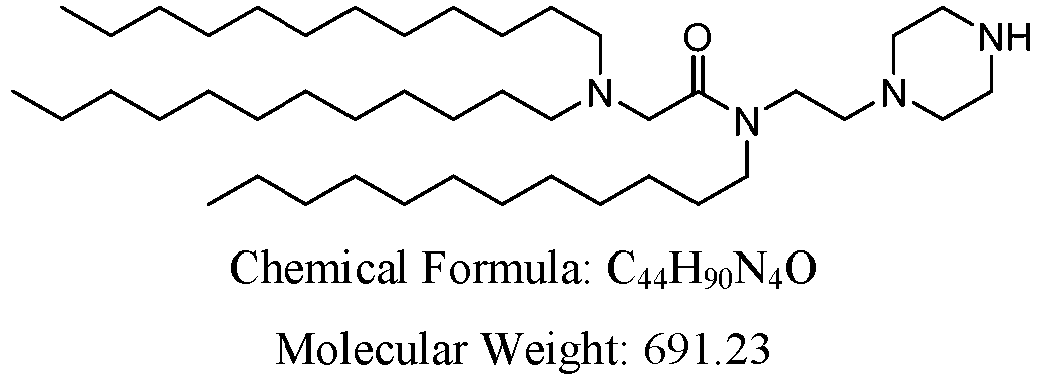
- In the same manner as
Step 4 forCompound 11, 2-(didodecylamino)-N-dodecyl-N-(2-(piperazin-1-yl)ethyl)acetamide was synthesized from tert-butyl 4-(2-(2-(didodecylamino)-N-dodecylacetamido)ethyl)piperazine-1-carboxylate (0.12 g, 0.16 mmol) and TFA (0.25 mL, 3.2 mmol) in 0.25 mL DCM. - UPLC/ELSD: RT = 3.06 min. MS (ES): m/z (MH+) 692.984 for C44H90N4O
-

- In the same manner as
Step 6 for Compound 18, 2-(didodecylamino)-N-(2-(4-(2-(didodecylamino)ethyl)piperazin-1-yl)ethyl)-N-dodecylacetamide was synthesized from 2-(didodecylamino)-N-dodecyl-N-(2-(piperazin-1-yl)ethyl)acetamide (65 mg, 0.094 mmol), N-(2-chloroethyl)-N-dodecyldodecan-1-amine (42 mg, 0.10 mmol), K2CO3 (13 mg, 0.094 mmol) and KI (2 mg, 0.0094 mmol) in 0.5 mL MeCN to afford 58.5 mg for 58% yield. UPLC/ELSD: RT = 3.75 min. MS (ES): m/z (MH+) 1072.585 for C70H143N5O - 1H NMR (300 MHz, CDCl3) δ: ppm 3.82-3.23 (br. m. 8H); 3.04-2.90 (br. m., 2H); 2.47 (m, 18H); 1.24 (m, 100H); 0.96 (m, 15H).
-

- A mixture of 1-bromododecane (1.1 mL, 4.6 mmol), 4-(2-aminoethyl)-1-boc-piperazine (1.0 g, 4.4 mmol), K2CO3 (0.61 g, 4.4 mmol), in 10 mL MeCN was allowed to stir at rt for 12 h. After this time the reaction was filtered and concentrated. The crude material was purified by silica gel chromatography (0-20% MeOH in DCM with 1% NH4OH to afford tert-butyl 4-(2-(didodecylamino)ethyl)piperazine-1-carboxylate (450 mg, 0.80 mmol, 18%). UPLC/ELSD: RT = 2.87 min. MS (ES): m/z (MH+) 566.655 for C35H71N3O2
- 1H NMR (400 MHz, CDCl3) δ: ppm 3.40 (m, 4H); 2.56 (m, 2H); 2.40 (m, 10H); 1.44 (s, 9H); 1.40-1.24 (m, 40H); 0.86 (t, 6H).
-

- In the same manner as
Step 5 for Compound 18, N-dodecyl-N-(2-(piperazin-1-yl)ethyl)dodecan-1-amine was synthesized from tert-butyl 4-(2-(didodecylamino)ethyl)piperazine-1-carboxylate (0.92 g, 1.63 mmol), TFA (6.2 mL, 82 mmol) in 6 mL DCM to afford 490 mg for 65% yield. UPLC/ELSD: RT = 2.10 min. MS (ES):m/z (MH+) 466.379 for C30H63N3 - 1H NMR (400 MHz, CDCl3) δ: ppm 2.88 (t, 4H); 2.61 (m, 2H); 2.45 (m, 10H); 1.43-1.24 (m, 40H); 0.86 (t, 6H).
-

- In the same manner as
Step 11 forCompound 11, 2-((2-(didodecylamino)ethyl)(dodecyl)amino)-1-(4-(2-(didodecylamino)ethyl)piperazin-1-yl)ethan-1-one was synthesized from N-dodecyl-N-(2-(piperazin-1-yl)ethyl)dodecan-1-amine (32 mg, 0.069 mmol), N-(2-(didodecylamino)ethyl)-N-dodecylglycine (43 mg, 0.069 mmol), propylphosphonic acid anhydride (50% EtOAc solution, 0.12 mL, 0.21 mmol) and i-Pr2EtN (0.024 mL, 0.14 mmol) in 0.5 mL THF to provide 17.7 mg (17%) . - UPLC: RT = 3.90 min. MS (ES): m/z (MH+) 1071.475 for C70H143N5O
- 1H NMR (400 MHz, CDCl3) δ: ppm 3.65 (m, 2H); 3.57 (m, 2H); 3.26 (s, 2H); 2.33-2.57 (m, 22H); 1.24-1.39 (m, 100H); 0.88 (t, 15H).
-

- In the same manner as
Step 4 for Compound 18, tert-butyl 4-(2-((2-(didodecylamino)ethyl)(dodecyl)amino)ethyl)piperazine-1-carboxylate was synthesized from tert-butyl 4-(2-(dodecylamino)ethyl)piperazine-1-carboxylate (700 mg, 1.76 mmol), N-(2-chloroethyl)-N-dodecyldodecan-1-amine (806 mg, 1.93 mmol), K2CO3 (486 mg, 3.52 mmol), and KI (29 mg, 0.176 mmol) in THF (15 mL). Yield (683 mg, 50%). - UPLC/ELSD: RT = 3.35 min. MS (ES): m/z (MH+) 778.16 for C49H100NaO2
- 1H-NMR (300 MHz, CDCl3) δ: ppm 3.44 (t, 4H); 3.11-2.86 (br. m, 4H); 2.78-2.32 (br. m, 14H); 1.80-1.05 (br. m, 69H); 0.91 (t, 9H).
-

- In the same manner as
Step 5 for Compound 18, N 1,N 1,N 2-tridodecyl-N 2-(2-(piperazin-1-yl)ethyl)ethane-1,2-diamine was synthesized from tert-butyl 4-(2-((2-(didodecylamino)ethyl)(dodecyl)amino)ethyl)piperazine-1-carboxylate (683 mg, 0.879 mmol), and TFA (3.4 mL, 43.9 mmol) in DCM (3.4 mL). Yield (595 mg, 99%). - UPLC/ELSD: RT = 2.94 min. MS (ES): m/z (MH+) 678.16 for C44H92N4
-
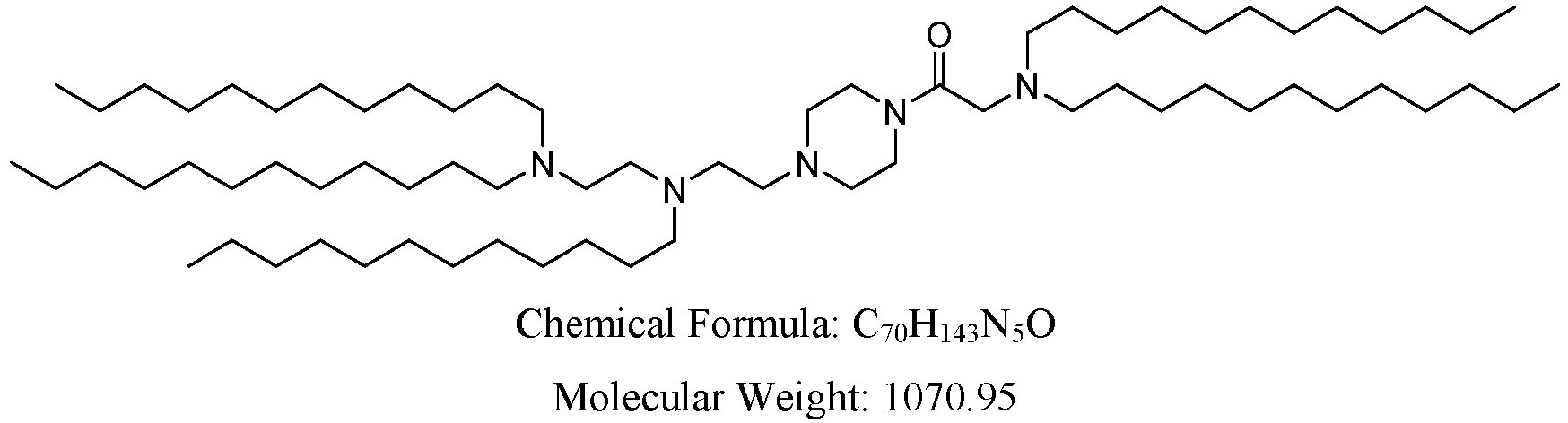
- In the same manner as
Step 11 forCompound 11, 2-(didodecylamino)-1-(4-(2-((2-(didodecylamino)ethyl)(dodecyl)amino)ethyl)piperazin-1-yl)ethan-1-one was from N 1,N 1,N 2-tridodecyl-N 2-(2-(piperazin-1-yl)ethyl)ethane-1,2-diamine (50 mg, 0.074 mmol), lithium didodecylglycine (33 mg, 0.078 mmol), propylphosphonic acid anhydride (50% in EtOAc, 0.13 mL, 0.22 mmol) and i-Pr2EtN (0.026 mL) in 0.5 mL THF to afford 33.9 mg (43%). - UPLC: RT = 3.90 min. MS (ES): m/z (MH+) 1071.475 for C70H143N5O
- 1H NMR (400 MHz, CDCl3) δ: ppm 3.65 (m, 2H); 3.57 (m, 2H); 3.26 (s, 2H); 2.33-2.57 (m, 22H); 1.24-1.39 (m, 100H); 0.88 (t, 15H).
-

- In the same manner as
Step 1 forCompound 11, methyl dinonylglycinate was synthesized from glycine methyl ester hydrochloride (5.0 g, 39.8 mmol), triethylamine (8.3 mL, 59.7 mmol), 95% nonanal (15.0 g, 99.6 mmol), sodium triacetoxyborohydride (21.1 g, 99.6 mmol), and acetic acid (5.7 mL, 99.6 mmol) in DCE (50 mL). Yield (3.5 g, 26%). UPLC/ELSD: RT = 1.82 min. MS (ES): m/z (MH+) 343.62 for C21H43NO2 - 1H-NMR (300 MHz, CDCl3) δ: ppm 3.72 (s, 3H); 3.35 (s, 2H); 2.57 (t, 4H); 1.46 (br. m, 4H); 1.29 (br. m, 24H); 0.90 (t, 6H).
-

- In the same manner as
Step 2 forCompound 11, lithium dinonylglycinate was synthesized from methyl dinonylglycinate (3.5 g, 10.2 mmol) and 1M LiOH (50 mL, 50 mmol) in THF (50 mL). Yield (3.0 g, 88%).
UPLC/ELSD: RT = 1.71 min. MS (ES): m/z (MH+) 328.37 for C20H41NO2 - 1H-NMR (300 MHz, CD3OD) δ: ppm 3.13 (s, 2H); 2.59 (t, 4H); 1.51 (br. m, 4H); 1.32 (br. m, 24H); 0.92 (t, 6H).
-

- In the same manner as
Step 3 forCompound 11, tert-butyl 4-(dinonylglycyl)piperazine-1-carboxylate was synthesized from lithium dinonylglycinate (2.0 g, 6.00 mmol), 1-boc-piperazine (1.23 g, 6.58 mmol), i-Pr2EtN (2.3 mL, 13.2 mmol), and propylphosphonic acid anhydride (50% EtOAc solution, 10.7 mL, 17.9 mmol). Yield (824 mg, 28%). - UPLC/ELSD: RT = 2.19 min. MS (ES): m/z (MH+) 496.72 for C29H57N3O3
-

- In the same manner as
Step 4 forCompound 11, 2-(dinonylamino)-1-(piperazin-1-yl)ethan-1-onewas synthesized from tert-butyl 4-(dinonylglycyl)piperazine-1-carboxylate (824 mg, 1.66 mmol) and TFA (6.4 mL, 83.1 mmol) in DCM (6.4 mL). Yield (246 mg, 37%). UPLC/ELSD: RT = 1.25 min. MS (ES): m/z (MH + ) 396.68 for C24H49N3O - 1H-NMR (300 MHz, CDCl3) δ: ppm 3.63 (br. m, 4H); 3.28 (s, 2H); 2.89 (br. m, 4H); 2.48 (t, 4H); 1.45 (br. m, 4H); 1.28 (br. m, 24H); 0.90 (t, 6H).
-
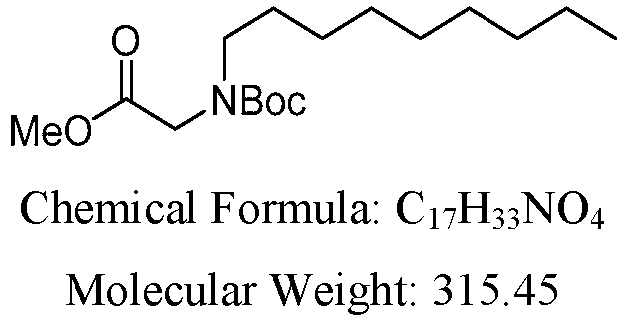
- In the same manner as
Step 5 forCompound 11, methyl N-(tert-butoxycarbonyl)-N-nonylglycinate was synthesized from N-(tert-butoxycarbonyl)glycine methyl ester (7.7 g, 40.7 mmol) and NaH (60%, 1.71 g, 42.7 mmol) in DMF (100 mL). Yield (3.32 g, 26%). - 1H-NMR (300 MHz, CDCl3) δ: ppm 4.02-3.84 (br. m, 2H); 3.75 (s, 3H); 3.26 (br. m, 2H); 1.65-1.39 (br. m, 11H); 1.28 (br. m, 12H); 0.90 (t, 3H).
-

- In the same manner as
Step 6 forCompound 11, methyl nonylglycinate was synthesized from methyl N-(tert-butoxycarbonyl)-N-nonylglycinate (3.32 g, 10.5 mmol) and TFA (16 mL, 210 mmol) in DCM (16 mL). Yield (2.23 g, 98%). - 1H-NMR (300 MHz, CDCl3) δ: ppm 3.75 (s, 3H); 3.44 (s, 2H); 2.61 (t, 2H); 1.69 (br. m, 1H); 1.51 (br. m, 2H); 1.28 (br. m, 12H); 0.90 (t, 3H).
-

- In the same manner as
Step 9 forCompound 11, methyl N-(2-(dinonylamino)ethyl)-N-nonylglycinate was synthesized from methyl nonylglycinate (449 mg, 2.08 mmol), N-(2-chloroethyl)-N-nonylnonan-1-amine (830 mg, 2.50 mmol), K2CO3 (576 mg, 4.16 mmol), and KI (35 mg, 0.208 mmol) in MeCN (13 mL). Yield (958 mg, 90%). UPLC/ELSD: RT = 3.11 min. MS (ES): m/z (MH+) 511.97 for C32H66N2O2 - 1H-NMR (300 MHz, CDCl3) δ: ppm 3.72 (s, 3H); 3.42 (s, 2H); 2.95-2.15 (br. m, 10H); 1.85-1.00 (br. m, 42H); 0.90 (t, 9H).
-

- In the same manner as
Step 10 forCompound 11, N-(2-(dinonylamino)ethyl)-N-nonylglycine was synthesized from methyl N-(2-(dinonylamino)ethyl)-N-nonylglycinate (958 mg, 1.88 mmol), and 1M LiOH (10 mL, 10 mmol) in THF (10 mL). Yield (514 mg, 55%). UPLC/ELSD: RT = 2.75 min. MS (ES): m/z (MH+) 497.95 for C31H64N2O2 - 1H-NMR (300 MHz, CDCl3) δ: ppm 3.92 (br. m, 6H); 3.14 (br. m, 6H); 1.77 (br. m, 6H); 1.45-1.13 (br. m, 36H); 0.90 (t, 9H).
-

- In the same manner as
Step 11 forCompound 11, 2-(dinonylamino)-1-(4-(N-(2-(dinonylamino)ethyl)-N-non-ylglycyl)piperazin-1-yl)ethan-1-one was synthesized from 2-(dinonylamino)-1-(piperazin-1-yl)ethan-1-one (61.5 mg, 0.155 mmol), N-(2-(dinonylamino)ethyl)-N-nonylglycine (85 mg, 0.171 mmol), i-Pr2EtN (60 µL, 0.342 mmol), and propylphosphonic acid anhydride (50% EtOAc solution, 0.278 mL, 0.466 mmol). Yield (38 mg, 28%). - UPLC/ELSD: RT = 3.13 min. MS (ES): m/z (MH+) 875.76 for C55H111N5O2
- 1H-NMR (300 MHz, CDCl3) δ: ppm 3.82-3.49 (br. m, 8H); 3.33 (s, 2H); 3.27 (s, 2H); 2.68-2.18 (br. m, 14H); 1.82-1.02 (br. m, 70H); 0.90 (t, 15H).
-

- In the same manner as
Step 9 forCompound 11, methyl N-(2-(dinonylamino)ethyl)-N-dodecylglycinate was synthesized from methyl dodecylglycinate (535 mg, 2.08 mmol), N-(2-chloroethyl)-N-nonylnonan-1-amine (830 mg, 2.50 mmol), K2CO3 (576 mg, 4.16 mmol), and KI (35 mg, 0.208 mmol) in MeCN (13 mL). Yield (385 mg, 34%). UPLC/ELSD: RT = 3.34 min. MS (ES): m/z (MH+) 553.96 for C35H72N2O2 - 1H-NMR (300 MHz, CDCl3) δ: ppm 3.72 (s, 3H); 3.41 (s, 2H); 2.90-2.20 (br. m, 10H); 1.85-1.05 (br. m, 48H); 0.90 (t, 9H).
-

- In the same manner as
Step 10 forCompound 11, N-(2-(dinonylamino)ethyl)-N-dodecylglycine was synthesized from methyl N-(2-(dinonylamino)ethyl)-N-dodecylglycinate (385 mg, 0.696 mmol), and 1M LiOH (3.5 mL, 3.5 mmol) in THF (3.5 mL). Yield (225 mg, 60%). - UPLC/ELSD: RT = 3.13 min. MS (ES): m/z (MH+) 539.93 for C34H70N2O2
- 1H-NMR (300 MHz, CDCl3) δ: ppm 3.73 (s, 2H); 3.62-3.39 (br. m, 4H); 3.09 (br. m, 6H); 1.76 (br. m, 6H); 1.28 (br, 42H); 0.90 (t, 9H).
-

- In the same manner as
Step 11 forCompound 11, 2-(dinonylamino)-1-(4-(N-(2-(dinonylamino)ethyl)-N-dodecylglycyl)piperazin-1-yl)ethan-1-one was synthesized from 2-(dinonylamino)-1-(piperazin-1-yl)ethan-1-one (62 mg, 0.155 mmol), N-(2-(dinonylamino)ethyl)-N-dodecylglycine (92 mg, 0.171 mmol), i-Pr2EtN (60 µL, 0.342 mmol), and propylphosphonic acid anhydride (50% EtOAc solution, 0.278 mL, 0.466 mmol). Yield (38 mg, 26%). - UPLC/ELSD: RT = 3.32 min. MS (ES): m/z (MH+) 917.67 for C58H117N5O2
- 1H-NMR (300 MHz, CDCl3) δ: ppm 3.86-3.45 (br. m, 8H); 3.33 (s, 2H); 3.28 (s, 2H); 2.73-2.27 (br. m, 14H); 1.86-1.00 (76H); 0.91 (t, 15H).
-

- In the same manner as
Step 9 forCompound 11, methyl N-(2-(didodecylamino)ethyl)-N-nonylglycinate was synthesized from methyl nonylglycinate (355 mg, 1.65 mmol), N-(2-chloroethyl)-N-dodecyldodecan-1-amine (825 mg, 1.98 mmol), K2CO3 (457 mg, 3.30 mmol), and KI (27 mg, 0.165 mmol) in MeCN (10 mL). Yield (460 mg, 47%). UPLC/ELSD: RT = 3.62 min. MS (ES): m/z (MH+) 596.03 for C38H78N2O2 - 1H-NMR (300 MHz, CDCl3) δ: ppm 3.72 (s, 3H); 3.42 (s, 2H); 2.80-2.24 (br. m, 10H); 1.56-1.00 (br. m, 54H); 0.90 (t, 9H).
-

- In the same manner as
Step 10 forCompound 11, N-(2-(didodecylamino)ethyl)-N-nonylglycine was synthesized from methyl N-(2-(didodecylamino)ethyl)-N-nonylglycinate (460 mg, 0.773 mmol), and 1M LiOH (3.9 mL, 3.9 mmol) in THF (3.9 mL). Yield (323 mg, 72%). - UPLC/ELSD: RT = 3.37 min. MS (ES): m/z (MH+) 582.00 for C37H76N2O2
- 1H-NMR (300 MHz, CDCl3) δ: ppm 4.17 (s, 2H); 4.00 (br. m, 2H); 3.84 (br. m, 2H); 3.34 (br. m, 2H); 3.18 (br. m, 4H); 1.82 (br. m, 6H); 1.27 (br. m, 48H); 0.91 (t, 9H).
-

- In the same manner as
Step 11 forCompound 11, 2-((2-(didodecylamino)ethyl)(nonyl)amino)-1-(4-(dinonylglycyl)piperazin-1-yl)ethan-1-one was synthesized from 2-(dinonylamino)-1-(piperazin-1-yl)ethan-1-one (62 mg, 0.155 mmol), N-(2-(didodecylamino)ethyl)-N-nonylglycine (99 mg, 0.171 mmol), i-Pr2EtN (60 µL, 0.342 mmol), and propylphosphonic acid anhydride (50% EtOAc solution, 0.278 mL, 0.466 mmol). Yield (45 mg, 30%). - UPLC/ELSD: RT = 3.46 min. MS (ES): m/z (MH+) 959.98 for C61H123N5O2
- 1H-NMR (300 MHz, CDCl3) δ: ppm 3.81-3.49 (br. m, 8H); 3.33 (s, 2H); 3.27 (s, 2H); 2.70-2.25 (br. m, 14H); 1.90-1.00 (br. m, 82H); 0.90 (t, 15H).
-

- In the same manner as
Step 11 forCompound 11, 2-((2-(didodecylamino)ethyl)(dodecyl)amino)-1-(4-(dinonylglycyl)piperazin-1-yl)ethan-1-one was synthesized from 2-(dinonylamino)-1-(piperazin-1-yl)ethan-1-one (62 mg, 0.155 mmol), N-(2-(didodecylamino)ethyl)-N-dodecylglycine (107 mg, 0.171 mmol), i-Pr2EtN (60 µL, 0.342 mmol), and propylphosphonic acid anhydride (50% EtOAc solution, 0.278 mL, 0.466 mmol). Yield (34 mg, 20%). - UPLC/ELSD: RT = 3.60 min. MS (ES): m/z (MH+) 1001.97 for C64H129N5O2
- 1H-NMR (300 MHz, CDCl3) δ: ppm 3.85-2.18 (br. m, 26H); 1.91-1.00 (br. m, 88H); 0.90 (t, 15H).
-

- In the same manner as
Step 11 forCompound 11, 2-(didodecylamino)-1-(4-(N-(2-(dinonylamino)ethyl)-N-nonylglycyl)piperazin-1-yl)ethan-1-one was synthesized from 2-(didodecylamino)-1-(piperazin-1-yl)ethan-1-one (202 mg, 0.421 mmol), N-(2-(dinonylamino)ethyl)-N-nonylglycine (230 mg, 0.463 mmol), i-Pr2EtN (0.162 mL, 0.926 mmol), and propylphosphonic acid anhydride (50% EtOAc solution, 0.752 mL, 1.26 mmol). Yield (148 mg, 37%). - UPLC/ELSD: RT = 3.41 min. MS (ES): m/z (MH+) 959.74 for C61H123N5O2
- 1H-NMR (300 MHz, CDCl3) δ: ppm 3.82-3.49 (br. m, 8H); 3.33 (s, 2H); 3.27 (s, 2H); 2.66-2.30 (br. m, 14H); 1.85-1.02 (br. m, 82H), 0.90 (t, 15H).
-

- In the same manner as
Step 11 forCompound 11, 2-(didodecylamino)-1-(4-(N-(2-(dinonylamino)ethyl)-N-dodecylglycyl)piperazin-1-yl)ethan-1-one was synthesized from (76 mg, 0.157 mmol), (93 mg, 0.173 mmol), i-Pr2EtN (60 µL, 0.342 mmol), and propylphosphonic acid anhydride (50% EtOAc solution, 0.278 mL, 0.466 mmol). Yield (59 mg, 37%). UPLC/ELSD: RT = 3.57 min. MS (ES): m/z (MH+) 1001.65 for C64H129N5O2 - 1H-NMR (300 MHz, CDCl3) δ: ppm 3.95-2.23 (br. m, 26H); 2.05-1.00 (br. m, 88H); 0.90 (t, 15H).
-

- In the same manner as
Step 11 forCompound 11, 2-(didodecylamino)-1-(4-(N-(2-(didodecylamino)ethyl)-N-nonylglycyl)piperazin-1-yl)ethan-1-one was synthesized from 2-(didodecylamino)-1-(piperazin-1-yl)ethan-1-one (76 mg, 0.157 mmol), N-(2-(didodecylamino)ethyl)-N-nonylglycine (101 mg, 0.173 mmol), i-Pr2EtN (60 µL, 0.342 mmol), and propylphosphonic acid anhydride (50% EtOAc solution, 0.278 mL, 0.466 mmol). Yield (56 mg, 34%). - UPLC/ELSD: RT = 3.72 min. MS (ES): m/z (MH+) 1043.88 for C67H135N5O2
- 1H-NMR (300 MHz, CDCl3) δ: ppm 3.95-2.15 (br. m, 26H); 1.90-1.05 (br. m, 94H); 0.90 (t, 15H).
-

- A solution of glycine methyl ester hydrochloride (5.0 g, 39.8 mmol) and triethylamine (8.3 mL, 59.7 mmol) in DCE (50 mL) was allowed to stir at room temperature for 15 minutes. A solution of 92% dodecanol (20.0 g, 99.6 mmol) in DCE (50 mL) was added and the mixture was cooled to 0 °C. Sodium triacetoxyborohydride (21.1 g, 99.6 mmol) and acetic acid (5.7 mL, 99.6 mmol) were added and the reaction was allowed to return to room temperature and stir for 16 hours. The reaction was quenched by slow addition of saturated sodium bicarbonate and extracted with DCM. The combined extracts were washed with brine, dried over anhydrous Na2SO4, filtered, and concentrated in vacuo. Purification by ISCO silica flash chromatography (0-30% EtOAc/hexanes) provided methyl didodecylglycinate (7.7 g, 45%).
- UPLC/ELSD: RT = 2.82 min. MS (ES): m/z (MH+) 426.69 for C27H55NO2
- 1H-NMR (300 MHz, CDCl3) δ: ppm 3.72 (s, 3H); 3.35 (s, 2H); 2.57 (t, 4H); 1.46 (m, 4H); 1.28 (br. m, 36H); 0.91 (t, 6H).
-

- A solution of methyl didodecylglycinate (7.7 g, 18.1 mmol) in THF (100 mL) and 1M LiOH (90.4 mL, 90.4 mmol) was allowed to stir at 65 °C for 16 hours. The reaction was cooled to room temperature and concentrated to a white powder. The powder was suspended in water, filtered, washed with water and diethyl ether, and dried under vacuum to provide lithium didodecylglycinate (7.0 g, 93%).
- UPLC/ELSD: RT = 2.74 min. MS (ES): m/z (MH+) 412.83 for C26H53NO2
- 1H-NMR (300 MHz, CD3OD) δ: ppm 3.14 (s, 2H); 2.60 (t, 4H); 1.51 (m, 4H); 1.31 (br. m, 36H); 0.92 (t, 6H).
-
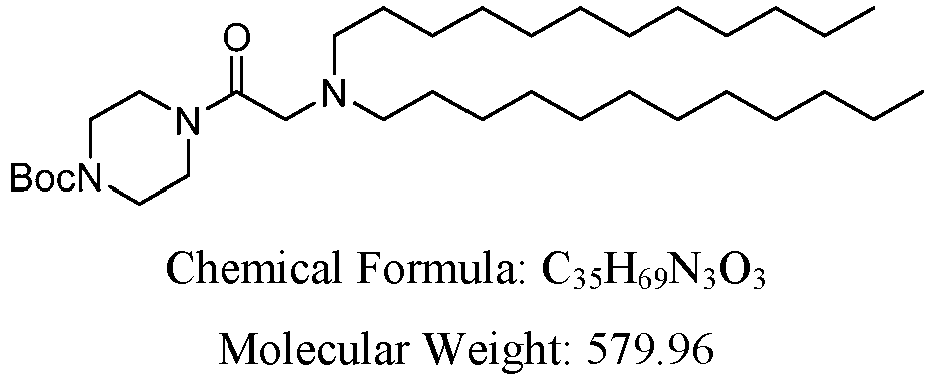
- A solution of lithium didodecylglycinate (2.0 g, 4.79 mmol), 1-boc-piperazine (978 mg, 5.25 mmol), i-Pr2EtN (1.84 mL, 10.5 mmol), and propylphosphonic acid anhydride (50% EtOAc solution, 8.53 mL, 14.3 mmol) in THF (24 mL) was allowed to stir at room temperature for 48 hours. The reaction was diluted with water and extracted with EtOAc. The organics were washed with brine, dried over anhydrous Na2SO4, filtered, and concentrated in vacuo. Purification by ISCO silica flash chromatography (0-20% MeOH/DCM) provided tert-butyl 4-(didodecylglycyl)piperazine-1-carboxylate (983 mg, 35%).
- UPLC/ELSD: RT = 3.06 min. MS (ES): m/z (MH+) 581.02 for C35H69N3O3
-

- To a 0 °C solution of tert-butyl 4-(didodecylglycyl)piperazine-1-carboxylate (983 mg, 1.69 mmol) in DCM (6.5 mL) was added dropwise TFA (6.5 mL, 84.7 mmol). The reaction was allowed to return to room temperature and stir for 16 hours. The reaction mixture was concentrated in vacuo and the crude material was dissolved in CHCl3. The solution was washed with 5% Na2CO3, brine, dried over anhydrous Na2SO4, filtered, and concentrated in vacuo to provide 2-(didodecylamino)-1-(piperazin-1-yl)ethan-1-one (163 mg, 20%).
- UPLC/ELSD: RT = 2.07 min. MS (ES): m/z (MH+) 480.89 for C30H61N3O
- 1H-NMR (300 MHz, CDCl3) δ: ppm 3.67 (br. m, 4H); 3.32 (s, 2H); 2.92 (br. m, 4H); 2.53 (br. m, 4H); 1.48 (br. m, 4H); 1.28 (br. m, 36H); 0.91 (t, 6H).
-
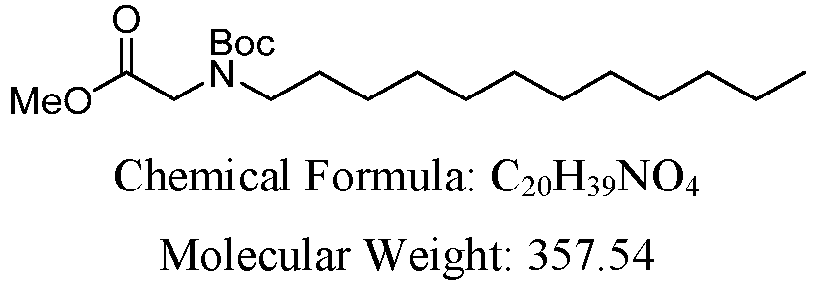
- A 0 °C solution of N-(tert-butoxycarbonyl)glycine methyl ester (7.7 g, 40.7 mmol) in DMF (100 mL) was treated with NaH (60%, 1.71 g, 42.7 mmol) and the mixture was allowed to stir for 30 minutes. The solution was allowed to return to room temperature before 1-bromododecane (15.2 g, 61.0 mmol) was added. The reaction was quenched with water and extracted with EtOAc. The organics were washed with brine, dried over anhydrous Na2SO4, filtered, and concentrated in vacuo. Purification by ISCO silica flash chromatography (0-20% EtOAc/hexanes) provided methyl N-(tert-butoxycarbonyl)-N-dodecylglycinate (4.03 g, 28%). 1H-NMR (300 MHz, CDCl3) δ: ppm 4.01-3.84 (br. m, 2H); 3.75 (s, 3H); 3.27 (br. m, 2H); 1.67-1.39 (br. m, 11H); 1.28 (br. m, 18H); 0.90 (t, 3H).
-

- To a 0 °C solution of methyl N-(tert-butoxycarbonyl)-N-dodecylglycinate (4.03 g, 11.3 mmol) in DCM (17 mL) was added dropwise TFA (17 mL, 226 mmol). The reaction was allowed to return to room temperature and stir for 6 hours. The reaction mixture was concentrated in vacuo and the crude material was dissolved in DCM. The solution was washed with 10% NaOH, brine, dried over anhydrous Na2SO4, filtered, and concentrated in vacuo to provide methyl dodecylglycinate (2.84 g, 98%).
- 1H-NMR (300 MHz, CDCl3) δ: ppm 3.75 (s, 3H); 3.44 (s, 2H); 2.62 (t, 2H); 1.70 (br, 1H); 1.51 (m, 2H); 1.29 (br. m, 18H); 0.90 (t, 3H).
-

- In the same manner as
Step 1 for Compound 18, 2-(didodecylamino)ethan-1-ol was synthesized from 1-bromododecane (10 g, 40.1 mmol), ethanolamine (1.10 mL, 18.2 mmol), K2CO3 (11.1 g, 80.1 mmol), and KI (302 mg, 1.82 mmol) in MeCN (84 mL). Yield (3.87 g, 53%). - UPLC/ELSD: RT = 2.69 min. MS (ES): m/z (MH+) 398.56 for C26H55NO
- 1H-NMR (300 MHz, CDCl3) δ: ppm 3.57 (t, 2H); 2.63 (t, 2H); 2.49 (br. m, 4H); 1.48 (br. m, 4H); 1.29 (br. m, 36H); 0.91 (t, 6H).
-

- In the same manner as
Step 2 for Compound 18, N-(2-chloroethyl)-N-dodecyldodecan-1-amine was synthesized from2-(didodecylamino)ethan-1-ol (3.87 g, 9.73 mmol), triethylamine (1.76 mL, 12.6 mmol), and methanesulfonyl chloride (0.941 mL, 12.2 mmol) in DCM (50 mL). Yield (1.92 g, 47%). - 1H-NMR (300 MHz, CDCl3) δ: ppm 3.51 (t, 2H); 2.78 (t, 2H); 2.47 (br. m, 4H); 1.44 (br. m, 4H); 1.28 (br. m, 36H); 0.90 (t, 6H).
-

- To a solution of methyl dodecylglycinate (425 mg, 1.65 mmol) in MeCN (10 mL) was added N-(2-chloroethyl)-N-dodecyldodecan-1-amine (825 mg, 1.98 mmol), K2CO3 (457 mg, 3.30 mmol), and KI (27 mg, 0.165 mmol). The reaction was allowed to stir at 82 °C for 72 hours. The reaction mixture was filtered and the solids were washed with hexanes. The filtrate was concentrated in vacuo to provide the crude product. Purification by ISCO silica flash chromatography (0-20% MeOH/DCM) provided methyl N-(2-(didodecylamino)ethyl)-N-dodecylglycinate (652 mg, 62%).
- UPLC/ELSD: RT = 3.77 min. MS (ES): m/z (MH+) 638.18 for C41H84N2O2
- 1H-NMR (300 MHz, CDCl3) δ: ppm 3.72 (s, 3H); 3.41 (s, 2H); 2.90-2.20 (br. m, 10H); 1.60-1.00 (br. m, 60H); 0.90 (t, 9H).
-

- A solution of methyl N-(2-(didodecylamino)ethyl)-N-dodecylglycinate (652 mg, 1.02 mmol) in THF (6 mL) and 1M LiOH (5 mL, 5 mmol) was allowed to stir at 65 °C for 16 hours. The reaction was cooled to room temperature and acidified with 10% HCl. The mixture was extracted with chloroform, and the organics were washed with brine, dried over anhydrous Na2SO4,filtered, and concentrated in vacuo. Purification by ISCO silica flash chromatography (0-20% MeOH/DCM) provided N-(2-(didodecylamino)ethyl)-N-dodecylglycine (153 mg, 24%). UPLC/ELSD: RT = 3.60 min. MS (ES): m/z (MH+) 624.07 for C40H82N2O2
- 1H-NMR (300 MHz, CDCl3) δ: ppm 4.02-3.40 (br. m, 6H); 3.16 (br. m, 6H); 1.78 (br. m, 6H); 1.46-1.01 (br. m, 54H); 0.90 (t, 9H).
-

- To a solution of N-(2-(didodecylamino)ethyl)-N-dodecylglycine (212 mg, 0.340 mmol) and 2-(didodecylamino)-1-(piperazin-1-yl)ethan-1-one (163 mg, 0.340 mmol) in THF (4 mL) was added i-Pr2EtN (0.119 mL, 0.680 mmol), and propylphosphonic acid anhydride (50% EtOAc solution, 0.606 mL, 1.02 mmol). The reaction was allowed to stir at room temperature overnight. The reaction mixture was diluted with water and extracted with EtOAc. The organics were washed with brine, dried over anhydrous Na2SO4, and concentrated in vacuo. Purification by ISCO silica flash chromatography (0-100% [DCM, 20% MeOH, 1% NH4OH]/MeOH) provided 2-(didodecylamino)-1-(4-(N-(2-(didodecylamino)ethyl)-N-dodecylglycyl)piperazin-1-yl)ethan-1-one (148 mg, 37%).
- UPLC/ELSD: RT = 3.81 min. MS (ES): m/z (MH+) 1086.94 for C70H141N5O2
- 1H-NMR (300 MHz, CDCl3) δ: ppm 4.00-2.20 (br. m, 26H); 1.77 (br. m, 6H); 1.54-1.02 (br. m, 94H); 0.90 (t, 15H).
-
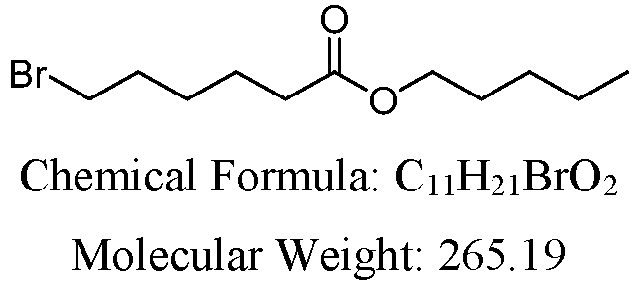
- To a solution of 6-bromohexanoic acid (2 g, 10.3 mmol) and pentan-1-ol (2.2 mL, 20.5 mmol) in 26 mL DCM, EDC·HCl (1.97 g, 10.3 mmol) and DMAP (0.26 g, 2.1 mmol) were added. The solution was allowed to stir at rt overnight. After this time the reaction was quenched by the addition of water. The mixture was extracted three times with DCM. The organics were pooled and washed with saturated NaHCO3, 10% citric acid and brine. The organics were then then dried over MgSO4, filtered and concentrated in vacuo. The crude material was purified via silica gel chromatography (0-30% EtOAc in hexanes) to afford the desired product (2.3 g, 8.67 mmol).
- 1H NMR (400 MHz, CDCl3) δ: ppm 4.06 (t, 2H); 3.39 (t, 2H); 2.30 (t, 2H); 1.84 (m, 2H); 1.62 (m, 4H); 1.46 (m, 2H); 1.31 (m, 4H); 0.88 (t, 3H).
-

- Methyl dodecylglycinate (3.4 g, 13.2 mmol) was dissolved in 2 mL THF under N2 atmosphere and the reaction flask was allowed to cool in an ice bath. To the solution LiAlH4 (0.55 g, 14.5 mmol) was slowly added. The reaction was allowed to stir at the same temperature for 1 h. After this time the reaction was quenched by the subsequent addition of 0.55 mL H2O, 0.55
mL 10% NaOH and then 1.65 mL of H2O. The reaction was then filtered and the filtrate was concentrated in vacuo. The crude material was purified via silica gel chromatography (0-20% MeOH in DCM, with 1% NaOH) to afford the desired alcohol (1.9 g, 8.28 mmol, 63% yield). - 1H NMR (400 MHz, CDCl3) δ: ppm 3.63 (t, 2H); 2.78 (t, 2H); 2.63 (t, 2H); 1.48 (m, 2H); 2.14 (m, 18H); 0.88 (t, 3H).
-

- In the same manner as
Step 1 for Compound 18, pentyl 6-(dodecyl(2-hydroxyethyl)amino)hexanoate was synthesized from pentyl6-bromohexanoate (0.87 g, 3.27 mmol), 2-(dodecylamino)ethan-1-ol (0.50 g, 2.18 mmol), K2CO3 (0.60 g, 4.36 mmol) and KI (36 mg, 0.22 mmol) in 10 mL THF to afford 0.30 g of the desired product (33%). - 1H NMR (400 MHz, CDCl3) δ: ppm 4.04 (t, 2H); 3.51 (m, 2H); 2.56 (m, 2H); 2.42 (m, 4H); 2.28 (t, 2H); 1.60 (m, 4H); 1.42 (m, 4H); 1.30-1.24 (m, 24); 0.87 (m, 6H).
-

- In the same manner as
Step 2 for Compound 18, pentyl 6-((2-chloroethyl)(dodecyl)amino)hexanoate was synthesized from pentyl 6-(dodecyl(2-hydroxyethyl)amino)hexanoate (300 mg, 0.73 mmol), methanesulfonyl chloride (0.062 mL, 0.80 mmol) and triethylamine (0.13 mL, 1.3 mmol) in 2 mL DCM to afford 285 mg of the desired product (66%). - 1H NMR (400 MHz, CDCl3) δ: ppm 4.04 (t, 2H); 3.45 (t, 2H); 2.74 (t, 2H); 2.43 (m, 4H); 2.28 (t, 2H); 1.65-1.59 (m, 4H); 1.31-1.24 (m, 32H); 0.88 (m, 6H).
-

- In the same manner as
Step 6 for Compound 18, pentyl 6-((2-(4-(2-((2-(didodecylamino)ethyl)(dodecyl)amino)ethyl)piperazin-1-yl)ethyl)(dodecyl)amino)hexanoate was synthesized from pentyl 6-((2-chloroethyl)(dodecyl)amino)hexanoate (75 mg, 0.17 mmol), N 1,N 1,N 2-tridodecyl-N 2-(2-(piperazin-1-yl)ethyl)ethane-1,2-diamine (107 mg, 0.16 mmol), K2CO3 (23 mg, 0.17 mmol) and KI (2.7 mg, 0.1 mmol) in 1 mL MeCN to afford 99 mg of the desired product (58%). - UPLC: RT = 3.53 min. MS (ES): m/z (MH+) 1073.325 for C69H141N5O2
- 1H NMR (400 MHz, CDCl3) δ: ppm 4.03 (t, 2H); 2.56-2.37 (br. m., 30H); 2.27 (t, 2H); 1.61 (m, 4H); 1.40-1.23 (br. m.; 90H); 0.87 (m, 15H).
-

- In the same manner as
Step 1 for Compound 18, 2-(ditetradecylamino)ethan-1-ol was synthesized from 1-bromotetradecane (21.6 mL, 72.8 mmol), ethanolamine (2 mL, 33.1 mmol), K2CO3 (20 g, 145.5 mmol), and KI (549 mg, 3.31 mmol) in MeCN (165 mL). Yield (12 g, 81%). - UPLC/ELSD: RT = 3.30 min. MS (ES): m/z (MH+) 454.46 for C30H63NO
- 1H-NMR (300 MHz, CDCl3) δ: ppm 3.54 (br. m, 2H); 2.59 (br. m, 2H); 2.46 (br. m, 4H); 1.56-1.17(br. m, 48H); 0.90 (br. m, 6H).
-

- In the same manner as
Step 2 for Compound 18, N-(2-chloroethyl)-N-tetradecyltetradecan-1-amine was synthesized from 2-(ditetradecylamino)ethan-1-ol (10g, 22.0 mmol), triethylamine (4.0 mL, 28.6 mmol), and methanesulfonyl chloride (2.75 mL, 27.5 mmol) in DCM (110 mL). Crude material was carried onto next step without purification. Yield (10.2 g, 98%). - UPLC/ELSD: RT = 3.37 min. MS (ES): m/z (MH+) 472.45 for C30H62ClN
- 1H-NMR (300 MHz, CDCl3) δ: ppm 4.27-2.20 (br. m, 8H); 1.96-1.17 (br. m, 48H); 0.90 (br. m, 6H).
-

- In the same manner as
Step 3 for Compound 18, tert-butyl4-(2-(tetradecylamino)ethyl)piperazine-1-carboxylate was synthesized from 1-bromotetradecane (3.63 g, 13.1 mmol), 4-(2-aminoethyl)-1-boc-piperazine (3.0 g, 13.1 mmol), K2CO3 (3.62 g, 26.2 mmol), and KI (217 mg, 1.31 mmol) in MeCN (60 mL). Yield (1.42 g, 27%). - UPLC/ELSD: RT = 1.58 min. MS (ES): m/z (MH+) 426.61 for C25H51N3O2
- 1H-NMR (300 MHz, CDCl3) δ: ppm 3.45 (t, 4H); 2.75 (t, 2H) 2.65 (t, 2H); 2.54 (t, 2H); 2.42 (t, 4H); 1.61-1.41 (br. m, 11H); 1.40-1.20 (br. m, 22H); 0.90 (t, 3H).
-

- In the same manner as
Step 4 for Compound 18, tert-butyl 4-(2-((2-(ditetradecylamino)ethyl)(tetradecyl)amino)ethyl)piperazine-1-carboxylate was synthesized from tert-butyl 4-(2-(tetradecylamino)ethyl)piperazine-1-carboxylate (700 mg, 1.64 mmol), N-(2-chloroethyl)-N-tetradecyltetradecan-1-amine (1.01 g, 2.14 mmol), K2CO3 (455 mg, 3.29 mmol), and KI (27 mg, 0.164 mmol) in THF (15 mL). Yield (740 mg, 52%). - UPLC/ELSD: RT = 3.81 min. MS (ES): m/z (MH+) 862.47 for C55H112N4O2
- 1H-NMR (300 MHz, CDCl3) δ: ppm 3.45 (br. m, 4H); 3.10-2.83 (br. m, 4H); 2.74-2.34 (br. m, 14H); 1.75-1.20 (br. m, 81H); 0.91 (t, 9H).
-

- In the same manner as
Step 5 for Compound 18, N 1-(2-(piperazin-1-yl)ethyl)-N 1,N 2,N 2-tritetradecylethane-1,2-diamine was synthesized from tert-butyl 4-(2-((2-(ditetradecylamino)ethyl)(tetradecyl)amino)ethyl)piperazine-1-carboxylate (740 mg, 0.859 mmol), and TFA (3.3 mL, 42.9 mmol) in DCM (3.3 mL). Yield (661 mg, 99%). UPLC/ELSD: RT = 3.38 min. MS (ES): m/z (MH+) 762.42 for C50H104N4 - 1H-NMR (300 MHz, CDCl3) δ: ppm 2.92 (t, 4H); 2.70-2.30 (br. m, 18H); 1.46 (br. m, 6H); 1.37-1.20 (br. m, 66H); 0.90 (t, 9H).
-

- In the same manner as
Step 6 for Compound 18, pentyl6-((2-(4-(2-((2-(ditetradecylamino)ethyl)(tetradecyl)amino)ethyl)piperazin-1-yl)ethyl)(dodecyl)amino)hexanoate was synthesized from N 1-(2-(piperazin-1-yl)ethyl)-N 1,N 2,N 2-tritetradecylethane-1,2-diamine (66 mg, 0.087 mmol), pentyl 6-((2-chloroethyl)(dodecyl)amino)hexanoate (42 mg, 0.095 mmol) K2CO3 (24 mg, 0.17 mmol), and KI (2 mg, 0.012 mmol) in THF (2 mL). Yield (38 mg, 38%). - UPLC/ELSD: RT = 3.81 min. MS (ES): m/z (MH+) 1157.70 for C75H153N5O2
- 1H-NMR (300 MHz, CDCl3) δ: ppm 4.08 (m, 2H); 3.16-2.15 (br. m, 32H); 1.65 (br. m, 4H); 1.54-1.00 (br. m, 100H); 0.91 (br. m, 15H).
-

- In the same manner as
Step 1 for Compound 18,dipentyl 6,6'-((2-hydroxyethyl)azanediyl)dihexanoate was synthesized from pentyl 6-bromohexanoate (0.50 g, 1.89 mmol), ethanolamine (0.052 mL, 0.86 mmol), K2CO3 (0.52 g, 3.77 mmol) and KI (14 mg, 0.098 mmol) in 4 mL MeCN to provide 234 mg (55%). - 1H NMR (400 MHz, CDCl3) δ: ppm 4.08(t, 4H); 3.62 (m, 2H); 2.68-2.56 (br. m., 6H); 2.33 (t, 4H); 1.64-1.54 (m, 13H); 1.35 (m, 12H); 0.93 (t, 6H).
-

- In the same manner as
Step 2 for Compound 18,dipentyl 6,6'-((2-chloroethyl)azanediyl)dihexanoate was synthesized fromdipentyl 6,6'-((2-hydroxyethyl)azanediyl)dihexanoate (124 mg, 0.29 mmol), methanesulfonyl chloride (0.025 mL, 0.32 mmol) and triethylamine (0.060 mL, 0.44 mmol) in 1.5 mL DCM to provide 84 mg (65%). - 1H NMR (400 MHz, CDCl3) δ: ppm 4.04 (t, 4H); 3.46 (t, 2H); 2.73 (t, 2H); 2.43 (t, 4H); 2.28 (t, 4H); 1.60 (m, 8H); 1.40 (m, 4H); 1.29 (m, 12H); 0.89 (t, 6H).
-

- In the same manner as
Step 6 for Compound 18,dipentyl 6,6'-((2-(4-(2-((2-(didodecylamino)ethyl)(dodecyl)amino)ethyl)piperazin-1-yl)ethyl)azanediyl)dihexanoate was synthesized from N 1,N 1,N 2-tridodecyl-N 2-(2-(piperazin-1-yl)ethyl)ethane-1,2-diamine (105 mg, 0.16 mmol),dipentyl 6,6'-((2-chloroethyl)azanediyl)dihexanoate (84 mg, 0.19 mmol) and K2CO3 (22 mg, 0.16 mmol) in 1 mL MeCN. Yield (53 mg, 0.049 mmol, 30%). - UPLC: RT = 3.47 min. MS (ES): m/z (MH+) 1089.53 for C68H137N5O4
- 1H NMR (400 MHz, CDCl3) δ: ppm 4.04 (t, 4H); 2.89-2.98 (m, 4H); 2.39-2.68 (m, 26H); 2.27 (t, 4H); 1.57-1.71 (m, 10H); 1.35 (m, 4H); 1.28-1.35 (m, 74H); 0.90 (m, 15H).
-

- To a solution of 12-bromododecanoic acid (2.5 g, 8.95 mmol) in THF (7 mL) was added methanol (7.2 mL, 179 mmol). Sulfuric acid (0.50 mL, 8.95 mmol) was added dropwise and the reaction was allowed to stir at 65 °C for two hours. The reaction mixture was washed with 5% NaHCO3 and brine. The organic layer was dried over anhydrous Na2SO4, filtered, and concentrated in vacuo. Purification by ISCO silica flash chromatography (0-20% EtOAc/hexanes) provided methyl 12-bromododecanoate (2.40 g, 92%).
- 1H-NMR (300 MHz, CDCl3) δ: ppm 3.69 (s, 3H); 3.44 (t, 2H); 2.33 (t, 2H); 1.88 (br. m, 2H); 1.64 (br. m, 2H); 1.45 (br. m, 2H); 1.31 (br. m, 12H).
-

- To a solution of methyl 12-((2-hydroxyethyl)amino)dodecanoate (413 mg, 1.51 mmol) in MeCN (5 mL) was added 1-bromododecane (452 mg, 1.81 mmol), K2CO3 (418 mg, 3.02 mmol), and KI (25 mg, 0.151 mmol). The reaction was allowed to stir at 82 °C for 16 hours. The reaction mixture was cooled to room temperature, diluted with H2O, and extracted with EtOAc. The combined organic layers were washed with brine, dried over anhydrous Na2SO4, filtered, and concentrated in vacuo. Purification by ISCO silica flash chromatography (0-100% [DCM, 20% MeOH, 1% NH4OH]/MeOH) provided methyl 12-(dodecyl(2-hydroxyethyl)amino)dodecanoate (409 mg, 61%).
- UPLC/ELSD: RT = 2.39 min. MS (ES): m/z (MH+) 442.60 for C27H55NO3
- 1H-NMR (300 MHz, CDCl3) δ: ppm 3.69 (s, 3H); 3.61 (t, 2H); 2.68 (t, 2H); 2.54 (t, 4H); 2.32 (t, 2H); 1.64 (m, 2H); 1.50 (br. m, 4H); 1.28 (br. m, 32H); 0.90 (t, 3H).
-
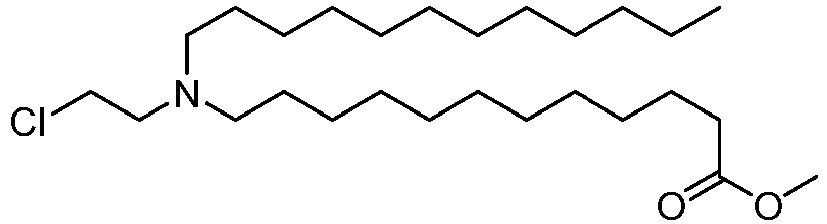
- In the same manner as
Step 2 for Compound 18, methyl 12-((2-chloroethyl)(dodecyl)amino)dodecanoate was synthesized from methyl 12-((2-hydroxyethyl)amino)dodecanoate (409 mg, 0.926 mmol), triethylamine (0.168 mL, 1.20 mmol), and methanesulfonyl chloride (0.090 mL, 1.16 mmol) in DCM (5 mL). Yield (307 mg, 72%). UPLC/ELSD: RT = 4.30 min. MS (ES): m/z (MH+) 460.80 for C27H54ClNO2 - 1H-NMR (300 MHz, CDCl3) δ: ppm 3.59 (s, 3H); 3.42 (br. m, 2H); 2.70 (br. m, 2H); 2.38 (br. m, 4H); 2.30 (t, 2H); 1.55 (m, 2H); 1.36 (br. m, 4H); 1.27-0.96 (br. m, 32H); 0.81 (t, 3H).
-
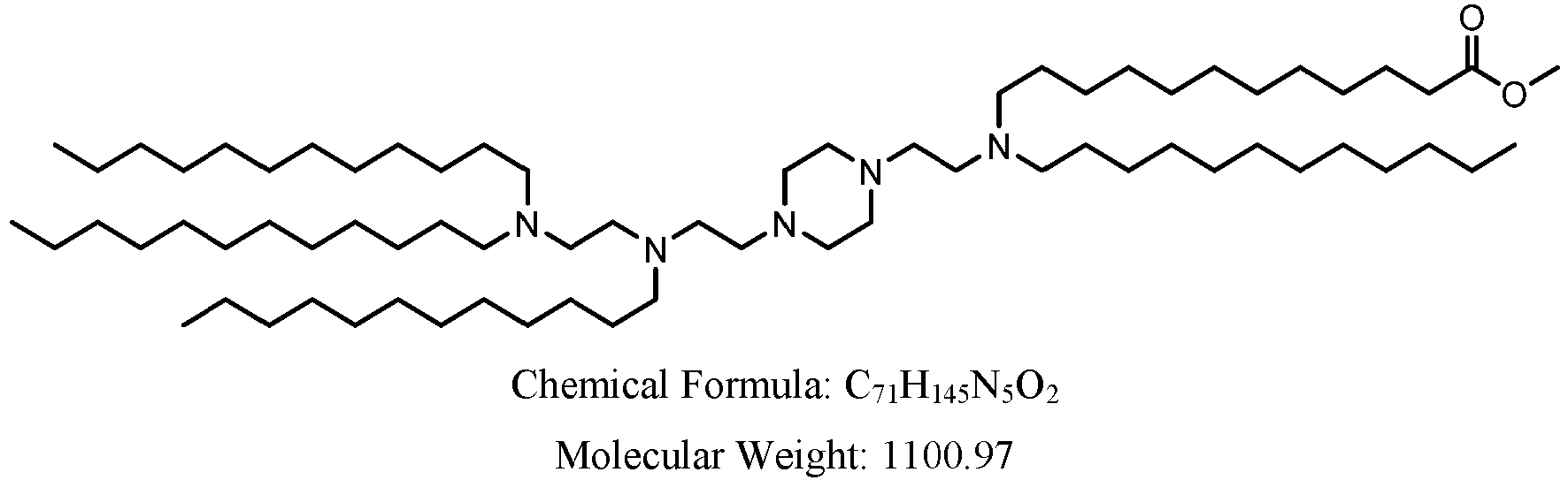
- In the same manner as
Step 6 for Compound 18, methyl 12-((2-(4-(2-((2-(didodecylamino)ethyl)(dodecyl)amino)ethyl)piperazin-1-yl)ethyl)(dodecyl)amino)dodecanoate was synthesized from N 1,N 1,N 2-tridodecyl-N 2-(2-(piperazin-1-yl)ethyl)ethane-1,2-diamine(150 mg, 0.221 mmol), methyl 12-((2-chloroethyl)(dodecyl)amino)dodecanoate (134 mg, 0.266 mmol) K2CO3 (61 mg, 0.443 mmol), and KI (4 mg, 0.024 mmol) in THF (5 mL). Yield (32 mg, 15%). - UPLC/ELSD: RT = 4.83 min. MS (ES): m/z (MH+) 1102.11 for C71H145N5O2
- 1H-NMR (300 MHz, CDCl3) δ: ppm 3.69 (s, 3H); 2.75-2.24 (br. m, 32H); 1.64 (m, 2H); 1.52-1.00 (br. m, 96H); 0.90 (t, 12H).
-

- In the same manner as
Step 1 for Compound 18,dimethyl 12,12'-((2-hydroxyethyl)azanediyl)didodecanoate was synthesized from methyl 12-bromododecanoate (1.5 g, 5.12 mmol), ethanolamine (0.310 mL, 5.12 mmol), K2CO3 (1.42 g, 10.2 mmol), and KI (85 mg, 0.512 mmol) in MeCN (11 mL). Yield (563 mg, 45%). - UPLC/ELSD: RT = 1.81 min. MS (ES): m/z (MH+) 486.63 for C28H55NO5
- 1H-NMR (300 MHz, CDCl3) δ: ppm 3.69 (s, 6H); 3.59 (br. m, 2H); 2.75-2.40 (br. m, 6H); 2.32 (t, 4H); 1.64 (m, 4H); 1.48 (br. m, 4H); 1.29 (br. m, 28H).
-

- In the same manner as
Step 2 for Compound 18,dimethyl 12,12'-((2-chloroethyl)azanediyl)didodecanoate was synthesized fromdimethyl 12,12'-((2-hydroxyethyl)azanediyl)didodecanoate (518 mg, 1.07 mmol), triethylamine (0.193 mL, 1.39 mmol), and methanesulfonyl chloride (0.103 mL, 1.33 mmol) in DCM (5.5mL). Yield (376 mg, 70%). - UPLC/ELSD: RT = 2.17 min. MS (ES): m/z (MH+) 504.75 for C28H54ClNO4
-

- In the same manner as
Step 6 for Compound 18,dimethyl 12,12'-((2-(4-(2-((2-(didodecylamino)ethyl)(dodecyl)amino)ethyl)piperazin-1-yl)ethyl)azanediyl)didodecanoate was synthesized from N 1,N 1,N 2-tridodecyl-N 2-(2-(piperazin-1-yl)ethyl)ethane-1,2-diamine (150 mg, 0.221 mmol),dimethyl 12,12'-((2-chloroethyl)azanediyl)didodecanoate (134 mg, 0.266 mmol) K2CO3 (61 mg, 0.443 mmol), and KI (4 mg, 0.024 mmol) in THF (5 mL). Yield (32 mg, 15%). UPLC/ELSD: RT = 3.46 min. MS (ES): m/z (MH+) 1146.07 for C72H145N5O4 - 1H-NMR (300 MHz, CDCl3) δ: ppm 3.69 (s, 6H); 2.75-2.24 (br. m, 34H); 1.64 (m, 4H); 1.52-1.00 (br. m, 92H); 0.90 (t, 9H).
-

- In the same manner as
Step 1 for Compound 18, 2-(dihexylamino)ethan-1-ol was synthesized from 1-bromohexane (5 g, 82 mmol), ethanolamine (11.5 mL, 82 mmol), K2CO3 (22.7 g, 164 mmol), and KI (1.36 g, 8.2 mmol) in MeCN (380mL). Yield (2.58g, 14%). UPLC/ELSD: RT = 0.41 min. MS (ES): m/z (MH+) 229.95 for C14H31NO - 1H-NMR (300 MHz, CDCl3) δ: ppm 3.62 (t, 2H); 2.70 (t, 2H), 2.57 (t, 4H); 1.50 (br. m, 4H); 1.30 (br, 12H); 0.91 (t, 6H).
-

- In the same manner as
Step 2 for Compound 18, N-(2-chloroethyl)-N-hexylhexan-1-amine was synthesized from 2-(dihexylamino)ethan-1-ol (2.50 g, 10.9 mmol), triethylamine (2.0 mL, 14.2 mmol), and methanesulfonyl chloride (1.0 mL, 13.6 mmol) in DCM (56 mL). Yield (1.93 g, 71%). - UPLC/ELSD: RT = 0.42 min. MS (ES): m/z (MH+) 247.86 for C14H30ClN
- 1H-NMR (300 MHz, CDCl3) δ: ppm 3.50 (t, 2H); 2.77 (t, 2H); 2.51 (t, 4H); 1.42 (br. m, 4H); 1.27 (br, 12H); 0.89 (t, 6H).
-

- In the same manner as
Step 3 for Compound 18, tert-butyl 4-(2-(hexylamino)ethyl)piperazine-1-carboxylate was synthesized from 1-bromohexane (1.44 g, 8.72 mmol), 4-(2-aminoethyl)-1-boc-piperazine (2.0 g, 8.72 mmol), K2CO3 (2.4 g, 17.4 mmol), and KI (145 mg, 0.872 mmol). Yield (446 mg, 16%). - 1H-NMR (300 MHz, CDCl3) δ: ppm 3.44 (br. m, 4H); 2.75 (br. m, 2H); 2.65 (br. m, 2H); 2.54 (br. m, 2H); 2.42 (br. m, 4H); 1.60-1.43 (br. m, 11H); 1.40-1.05 (br. m, 6H); 0.91 (br. m, 3H).
-
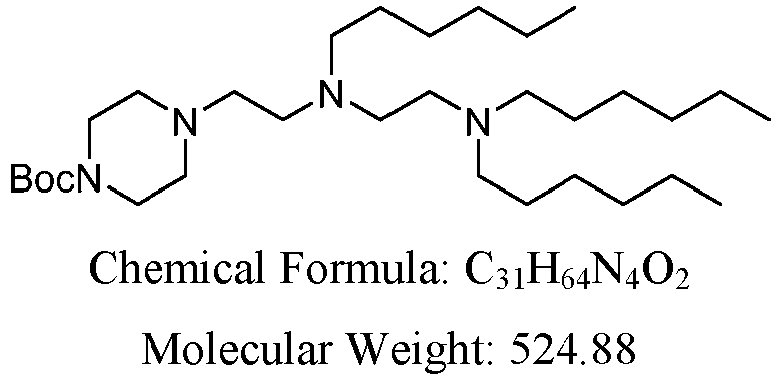
- In the same manner as
Step 4 for Compound 18, tert-butyl 4-(2-((2-(dihexylamino)ethyl)(hexyl)amino)ethyl)piperazine-1-carboxylate was synthesized from tert-butyl 4-(2-(hexylamino)ethyl)piperazine-1-carboxylate (250 mg, 0.797 mmol), N-(2-chloroethyl)-N-hexylhexan-1-amine (217 mg, 0.877 mmol), K2CO3 (220 mg, 1.59 mmol), and KI (13 mg, 0.0797 mmol) in THF (5 mL). Yield 308 mg, 74%). - UPLC/ELSD: RT = 1.40 min. MS (ES): m/z (MH+) 525.83 for C31H64N4O2
- 1H-NMR (300 MHz, CDCl3) δ: ppm 3.45 (br. m, 4H); 3.15-2.15 (br. m, 18H); 1.85-1.00 (br. m, 33H); 0.91 (9H).
-

- In the same manner as
Step 5 for Compound 18, N 1,N 1,N 2-trihexyl-N 2-(2-(piperazin-1-yl)ethyl)ethane-1,2-diamine was synthesized from tert-butyl 4-(2-((2-(dihexylamino)ethyl)(hexyl)amino)ethyl)piperazine-1-carboxylate (308 mg, 0.587 mmol), and TFA (2.25 ml, 29.3 mmol) in DCM (2.5 mL). Yield (220 mg, 88%). - 1H-NMR (300 MHz, CDCl3) δ: ppm 2.92 (br. m, 4H); 2.70-2.20 (br. m, 18H), 1.54-1.22 (br. m, 24H); 0.91 (br. m, 9H).
-

- In the same manner as
Step 6 for Compound 18, N 1-(2-(4-(2-(didodecylamino)ethyl)piperazin-1-yl)ethyl)-N 1,N 2,N 2-trihexylethane-1,2-diamine was synthesized from N 1,N 1,N 2-trihexyl-N 2-(2-(piperazin-1-yl)ethyl)ethane-1,2-diamine (110 mg, 0.259 mmol), N-(2-chloroethyl)-N-dodecyldodecan-1-amine(162 mg, 0.388 mmol), K2CO3 (72 mg, 0.518 mmol), and KI (5 mg, 0.0259 mmol) in THF (6 mL). Yield (81 mg, 39%). UPLC/ELSD: RT = 2.79 min. MS (ES): m/z (MH+) 806.30 for C52H109N5 - 1H-NMR (300 MHz, CDCl3) δ: ppm 3.05-2.10 (br. m, 30H); 1.80-1.05 (br. m, 64H); 0.91 (br. m, 15H).
-

- To a solution of 1-bromononane (8.31 g, 40.1 mmol) in MeCN (84 mL) was added ethanolamine (1.10 mL, 18.2 mmol), K2CO3 (11.1 g, 80.1 mmol), and KI (302 mg, 1.82 mmol). The reaction was allowed to stir at 82 °C for 48 hours. The reaction mixture was cooled to room temperature, filtered, and the solids were washed with hexanes. The filtrate was extracted with hexanes, and the combined extracts were concentrated in vacuo. Purification by ISCO silica flash chromatography (0-20% MeOH/DCM) provided 2-(dinonylamino)ethan-1-ol (4.06 g, 71%).
- 1H-NMR (300 MHz, CDCl3) δ: ppm 3.57 (t, 2H); 2.63 (t, 2H); 2.49 (br. m, 4H); 1.48 (br. m, 4H); 1.29 (br. m, 24H); 0.91 (t, 6H).
-

- To a 0 °C solution of 2-(dinonylamino)ethan-1-ol (4.06 g, 12.9 mmol) and triethylamine (2.35 ml, 16.8 mmol) in DCM (65 mL) was added dropwise a solution of methanesulfonyl chloride (1.25 mL, 16.18 mmol) in DCM (5 mL). The reaction was allowed to return to room temperature and stir for 16 hours. The mixture was quenched by the addition of water and extracted with DCM. The organic layer was washed with saturated NaHCO3, brine, dried over anhydrous Na2SO4, filtered, and concentrated in vacuo. Purification by ISCO silica flash chromatography (0-10% EtOAc/hexanes) provided N-(2-chloroethyl)-N-nonylnonan-1-amine (2.58 g, 60%).
- 1H-NMR (300 MHz, CDCl3) δ: ppm 3.51 (t, 2H); 2.78 (t, 2H); 2.47 (br. m, 4H); 1.44 (br. m, 4H); 1.28 (br. m, 24H); 0.90 (t, 6H).
-

- To a solution of 1-bromononane (1.81 g, 8.72 mmol) in MeCN (44 mL) was added 4-(2-aminoethyl)-1-boc-piperazine (2.0 g, 8.72 mmol), K2CO3 (2.4 g, 17.4 mmol), and KI (145 mg, 0.872 mmol). The reaction was allowed to stir at 65 °C for 16 hours. The reaction mixture was cooled to room temperature, filtered, and the solids were washed with hexanes. The filtrate was extracted with hexanes, and the combined extracts were concentrated in vacuo. Purification by ISCO silica flash chromatography (0-20% MeOH/DCM) provided tert-butyl 4-(2-(nonylamino)ethyl)piperazine-1-carboxylate (775 mg, 25%).
- UPLC/ELSD: RT = 0.47 min. MS (ES): m/z (MH+) 356.41 for C20H41N3O2
- 1H-NMR (300 MHz, CDCl3) δ: ppm 3.44 (br. m, 4H); 2.74 (t, 2H); 2.63 (t, 2H); 2.53 (t, 2H); 2.41 (br. m, 4H); 1.48 (br. m, 9H); 1.30 (br. m, 14H); 0.90 (t, 3H).
-

- To a solution of tert-butyl 4-(2-(nonylamino)ethyl)piperazine-1-carboxylate (500 mg, 1.41 mmol) in THF (9 mL) was added N-(2-chloroethyl)-N-nonylnonan-1-amine (514 mg, 1.55 mmol), K2CO3 (390 mg, 2.82 mmol), and KI (23 mg, 0.141 mmol). The reaction was allowed to stir at 65 °C for 72 hours. The reaction mixture was cooled to room temperature, diluted with water, and extracted with EtOAc. The combined extracts were washed with brine, dried over anhydrous Na2SO4, filtered, and concentrated in vacuo. Purification by ISCO silica flash chromatography (0-15% MeOH/DCM) provided tert-butyl 4-(2-((2-(dinonylamino)ethyl)(nonyl)amino)ethyl)piperazine-1-carboxylate (763 mg, 83%). UP-LC/ELSD: RT = 2.61 min. MS (ES): m/z (MH+) 651.91 for C40H82N4O2
- 1H-NMR (300 MHz, CDCl3) δ: ppm 3.45 (br. m, 4H); 2.75-2.30 (br. m, 18H); 1.55-1.20 (br. m, 51H); 0.91 (br. m, 9H).
-
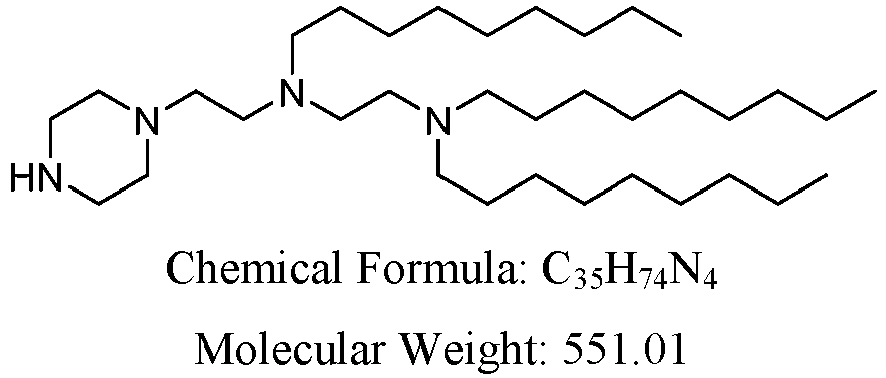
- To a 0 °C solution of tert-Butyl 4-(2-((2-(dinonylamino)ethyl)(nonyl)amino)ethyl)piperazine-1-carboxylate (763 mg, 1.17 mmol) in DCM (4.5 mL) was added dropwise TFA (4.5 mL, 58.5 mmol). The reaction was allowed to return to room temperature and stir for 16 hours. The reaction mixture was concentrated in vacuo and the crude material was dissolved in CHCl3. The solution was washed with 5% Na2CO3, brine, dried over anhydrous Na2SO4, filtered, and concentrated in vacuo. Purification by ISCO silica flash chromatography (0-100% [DCM, 20% MeOH, 1% NH4OH]/MeOH) provided N 1,N 1,N 2-trinonyl-N 2-(2-(piperazin-1-yl)ethyl)ethane-1,2-diamine (218 mg, 34%). UPLC/ELSD: RT = 1.81 min. MS (ES): m/z (MH+) 551.78 for C35H74N4
- 1H-NMR (300 MHz, CDCl3) δ: ppm 2.91 (br. m, 4H); 2.70-2.35 (br. m, 18H); 1.46 (br. m, 6H); 1.29 (br. m, 36H); 0.91 (br. m, 9H)
-

- To a solution of N 1,N 1,N 2-trinonyl-N 2-(2-(piperazin-1-yl)ethyl)ethane-1,2-diamine (74 mg, 0.134 mmol) and N-(2-chloroethyl)-N-nonylnonan-1-amine (58 mg, 0.175 mmol) in THF (4 mL) was added K2CO3 (37 mg, 0.269 mmol), and KI (3 mg, 0.0134 mmol). The reaction allowed to stir at 65 °C for 48 hours. The reaction mixture was cooled to room temperature, diluted with water, and extracted with EtOAc. The combined extracts were washed with brine, dried over anhydrous Na2SO4, filtered, and concentrated in vacuo. Purification by ISCO C18 flash chromatography (50-100% [MeCN 0.1% TFA]/[H2O 0.1% TFA]) afforded the desired product as a TFA salt. The salt was dissolved in CHCl3 and the solution was washed with 5% Na2CO3, brine, dried over anhydrous Na2SO4, filtered, and concentrated in vacuo to provide N 1-(2-(4-(2-(dinonylamino)ethyl)piperazin-1-yl)ethyl)-N 1,N 2,N 2-trinonylethane-1,2-diamine (66 mg, 58%).
- UPLC/ELSD: RT = 2.91 min. MS (ES): m/z (MH+) 847.30 for C55H115N5
- 1H-NMR (300 MHz, CDCl3) δ: ppm 3.10-2.25 (br. m, 30H); 1.90-1.35 (br. m, 10H); 1.29 (br. m, 60H); 0.91 (br. m, 15H).
-

- In the same manner as
Step 6 for Compound 18, N 1-(2-(4-(2-(didodecylamino)ethyl)piperazin-1-yl)ethyl)-N 1,N 2,N 2-trinonylethane-1,2-diamine was synthesized from N 1,N 1,N 2-trinonyl-N 2-(2-(piperazin-1-yl)ethyl)ethane-1,2-diamine (70 mg, 0.127 mmol), N-(2-chloroethyl)-N-dodecyldodecan-1-amine (79 mg, 0.191 mmol), K2CO3 (35 mg, 0.254 mmol), and KI (2 mg, 0.0127 mmol) in THF (3 mL). Yield (52 mg, 44%). UPLC/ELSD: RT = 3.35 min. MS (ES): m/z (MH+) 931.61 for C61H127N5 - 1H-NMR (300 MHz, CDCl3) δ: ppm 2.70 (br. m, 30H); 1.56-1.02 (br. m, 82H); 0.90 (t, 15H).
-
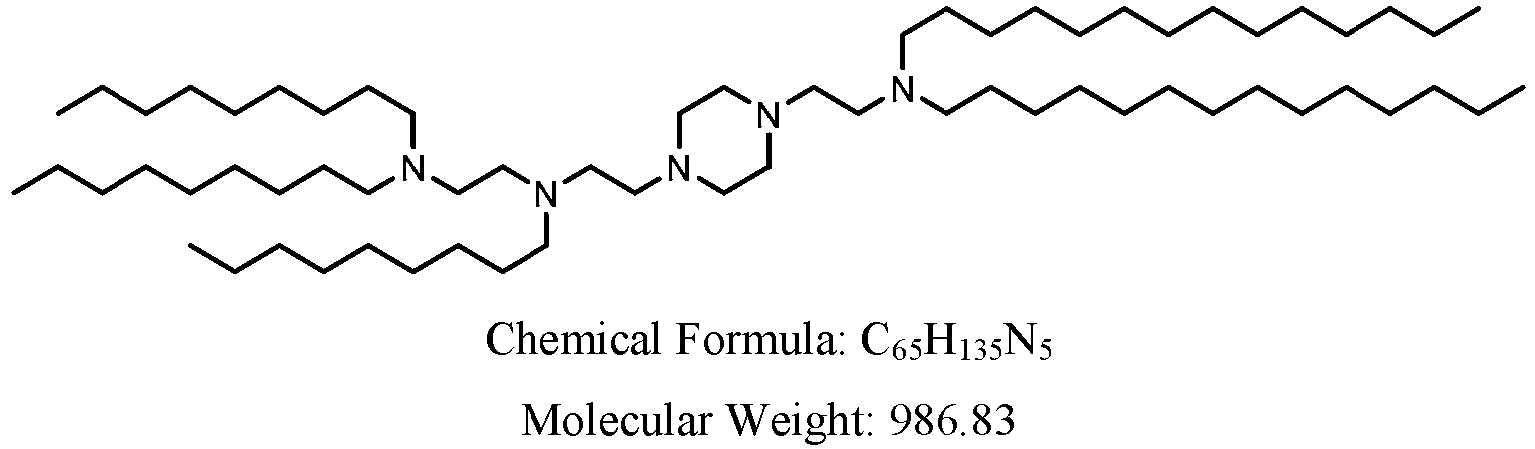
- Chemical Formula: C65H135N5
- Molecular Weight: 986.83
- In the same manner as
Step 6 for Compound 18, N 1-(2-(4-(2-(ditetradecylamino)ethyl)piperazin-1-yl)ethyl)-N 1,N 2,N 2-trinonylethane-1,2-diamine was synthesized from N 1,N 1,N 2-trinonyl-N 2-(2-(piperazin-1-yl)ethyl)ethane-1,2-diamine (74 mg, 0.134 mmol), N-(2-chloroethyl)-N-tetradecyltetradecan-1-amine (95 mg, 0.201 mmol), K2CO3 (37 mg, 0.269 mmol), and KI (3 mg, 0.0134 mmol) in THF (2 mL). Yield (50 mg, 38%) UPLC/ELSD: RT = 3.55 min. MS (ES): m/z (MH+) 987.87 for C65H135N5 - 1H-NMR (300 MHz, CDCl3) δ: ppm 3.20-2.25 (br. m, 30H); 1.85-1.00 (br. m, 90H); 0.91 (t, 15H).
-

- In the
same manner Step 6 for Compound 18, N 1-(2-(4-(2-(dihexylamino)ethyl)piperazin-1-yl)ethyl)-N 1,N 2,N2-tridodecylethane-1,2-diamine was synthesized from N 1,N 1,N 2-tridodecyl-N 2-(2-(piperazin-1-yl)ethyl)ethane-1,2-diamine (67 mg, 0.099 mmol), N-(2-chloroethyl)-N-hexylhexan-1-amine (32 mg, 0.129 mmol), K2CO3 (28 mg, 0.198 mmol), and KI (2 mg, 0.0099 mmol) in THF (2 mL). Yield (30 mg, 34%). UPLC/ELSD: RT = 3.24 min. MS (ES): m/z (MH+) 890.58 for C58H121N5 - 1H-NMR (300 MHz, CDCl3) δ: ppm 3.15-2.20 (br. m, 30H); 1.85-1.00 (br. m, 76H); 0.91 (br. m, 15H).
-

- In the same manner as
Step 1 for Compound 18, compound was synthesized from ethanolamine (5 g, 82 mmol), 1-bromooctane (14 mL, 82 mmol), and K2CO3 (11 g, 82 mmol) in 200 mL MeCN. Yield (3.13 g, 11 mmol, 13%). - UPLC/ELSD: RT = 1.78 min. MS (ES): m/z (MH+) 286.22 for C18H39NO
- 1H-NMR (300 MHz, CDCl3) δ: ppm 3.54 (m, 2H); 2.60-2.47 (m, 6H); 1.44 (m, 4H); 1.26 (m, 21H); 0.86 (t, 6H).
-

- In the same manner as
Step 2 for Compound 18, N-(2-chloroethyl)-N-octyloctan-1-amine was synthesized from 2-(dioctylamino)ethan-1-ol (3.13 g, 11 mmol), methanesulfonyl chloride (0.85 mL, 11 mmol) and Et3N (1.5 mL, 11 mmol) in 30 mL DCM. Yield (1.55 g, 5.1 mmol, 46%). - UPLC/ELSD: RT = 3.86 min. MS (ES): m/z (MH+) 304.43 for C18H38ClN
1H-NMR (300 MHz, CDCl3) δ: ppm 3.48 (2, 2H); 2.75 (t, 2H); 2.43 (t, 4H); 1.40-1.25 (m, 24H); 0.86 (t, 6H). -

- In the same manner as
Step 6 for Compound 18, N 1-(2-(4-(2-(dioctylamino)ethyl)piperazin-1-yl)ethyl)-N,N 2,N2 -tridodecylethane-1,2-diamine was synthesized from N 1,N 1,N 2-tridodecyl-N 2-(2-(piperazin-1-yl)ethyl)ethane-1,2-diamine (150 mg, 0.221 mmol), N-(2-chloroethyl)-N-octyloctan-1-amine 54 (81 mg, 0.266 mmol), K2CO3 (61 mg, 0.443 mmol), and KI (4 mg, 0.024 mmol) in THF (5 mL). Yield (200 mg, 96%). UPLC/ELSD: RT = 3.41 min. MS (ES): m/z (MH+) 945.96 for C62H129N5 - 1H-NMR (300 MHz, CDCl3) δ: ppm 2.76-2.10 (br. m, 30H); 1.56-1.00 (br. m, 84H); 0.90 (t, 15H).
-

- In the same manner as
Step 6 for Compound 18, N1 -(2-(4-(2-(dinonylamino)ethyl)piperazin-1-yl)ethyl)-N,N 2,N2 -tridodecylethane-1,2-diamine was synthesized from N1,N1 ,N2 -tridodecyl-N2 -(2-(piperazin-1-yl)ethyl)ethane-1,2-diamine (595 mg, 0.879 mg), N-(2-chloroethyl)-N-nonylnonan-1-amine (350 mg, 1.05 mmol), K2CO3 (243 mg, 1.76 mmol), and KI (15 mg, 0.0879 mmol) in THF (13 mL). Yield (534 mg, 62%). UPLC/ELSD: RT = 3.50 min. MS (ES): m/z (MH+) 973.60 for C64H133N5 - 1H-NMR (300 MHz, CDCl3)δ: ppm 2.70-2.30 (br. m, 30H); 1.56-1.37 (br.m, 10H); 1.28 (br. m, 78H); 0.90 (t, 15H).
-

- 6-Bromo-1-hexanol (4.89 g, 27 mmol) and triphenylphosphine (7.87 g, 30 mmol) and 50 mL MeCN were combined in a round bottomed flask. The flask was fitted with a condenser and placed in a heating mantel and the reaction was allowed to stir at 82 °C for 48 h. After this time the reaction was allowed to cool to rt and the solution was cannulated into 200 mL Et2O, producing a white precipitate. The solids were allowed to settle and the solvent was decanted off. 20 mL DCM was added to dissolve the solids and then 100 mL Et2O was slowly added to afford a white precipitate. The solvent was then removed in vacuo to afford clean (6-hydroxyhexyl)triphenylphosphonium bromide (9.4 g, 21.2 mmol, for 78% yield).
- 1H-NMR (300 MHz, CDCl3) δ: ppm 7.80 (m, 15H); 3.80 (m, 2H); 3.65 (m, 2H); 2.23 (m, 2H); 1.68 (m, 4H); 1.52 (m, 4H).
-

- A solution of (6-hydroxyhexyl)triphenylphosphonium bromide (3.0 g, 6.77 mmol) in 25 mL THF was allowed to cool in a -78 °C dry ice/acetone bath. Once cool n-BuLi (2.5 M in hexanes) (5.7 mL, 14.2 mmol) was added dropwise. After 1 h, an additional 10 mL THF and n-BuLi (1.35 mL) were added and stirring was continued at the same temperature for 1 h. After this time 1-hexanal (1.6 mL, 13.5 mmol) was added and the reaction was allowed to warm to rt and stir for 3 h. After this time the reaction was quenched by addition of excess saturated NH4Cl. The solution was extracted three times with EtOAc. The pooled organics were washed with brine, dried over MgSO4, filtered and concentrated in vacuo. The crude material was purified by silica gel chromatography (0-50% EtOAc in hexanes) to afford the desired product as a clear oil (0.76 g, 4.1 mmol, 61%).
- 1H-NMR (300 MHz, CDCl3) δ: ppm 5.34 (m, 2H); 3.62 (t, 2H); 2.01 (m, 4H); 1.56 (m, 2H); 1.35-1.27 (m, 11H); 0.87 (t, 3H).
-

- To a 0 °C solution of (Z)-dodec-6-en-1-ol (1.81 g, 9.3 mmol) in 20 mL DCM, was added Et3N (1.7 mL, 12.1 mmol) and methanesulfonyl chloride (0.80 mL, 10.2 mmol). The reaction was allowed to slowly warm to rt and stir overnight. The reaction was quenched by the addition of water and the mixture was extracted two times with DCM. The organics were pooled, washed with brine, dried over MgSO4, filtered and concentrated. The crude material was purified by silica gel chromatography (0-30% EtOAc in hexanes) to afford clean desired product (2.2 g, 8.4 mmol, 90%).
- 1H-NMR (300 MHz, CDCl3) δ: ppm 5.34 (m, 2H); 4.20 (t, 2H); 2.98 (s, 3H); 2.01 (m, 4H); 1.74 (m, 2H); 1.38-1.27 (m, 10H); 0.87 (t, 3H).
-

- In a round bottomed flask, under N2, (Z)-dodec-6-en-1-yl methanesulfonate (2.2 g, 8.3 mmol) was dissolved in 40 mL Et2O. MgBr2·Et2O (6.5 g, 25 mmol) was added and the reaction was allowed to stir for 48 h. After this time the reaction was quenched by the addition of ice. The mixture was then extracted with Et2O three times. The pooled organics were washed with brine, dried over MgSO4, filtered and concentrated. The crude material was purified by silica gel chromatography (0-30% EtOAc in hexanes) to afford the desired product (1.8 g, 7.28 mmol, 88%).
- 1H-NMR (300 MHz, CDCl3) δ: ppm 5.34 (m, 2H); 3.39 (t, 2H); 2.01-1.84 (m, 6H); 1.28 (m, 10H); 0.87 (t, 3H).
-

- In the same manner as
Step 1 for Compound 18, (Z)-2-(Dodec-6-en-1-yl(dodecyl)amino)ethan-1-ol was synthesized from (Z)-1-bromododec-6-ene (0.25 g, 1.0 mmol), 2-(dodecylamino)ethan-1-ol (0.23 g, 1.0 mmol), K2CO3 (0.14 g, 1.0 mmol) and KI (2 mg, 0.01 mmol) in 5 mL MeCN. - 1H-NMR (300 MHz, CDCl3) δ: ppm 5.34 (m, 2H); 3.65 (br. m., 2H); 2.64 (br. m, 6H); 2.00 (m, 4H); 1.55 (m, 6H); 1.24 (m, 26H); 0.86 (t, 6H).
-

- In the same manner as
Step 2 for Compound 18, (Z)-N-(2-chloroethyl)-N-dodecyldodec-6-en-1-amine was synthesized from (Z)-2-(dodec-6-en-1-yl(dodecyl)amino)ethan-1-ol (35 mg, 0.088 mmol), methanesulfonyl chloride (0.008 mL, 0.097 mmol) and triethylamine (0.018 mL, 0.13 mmol) in 0.5 mL DCM. Yield (17.3 mg, 47%). - 1H-NMR (300 MHz, CDCl3) δ: ppm 5.34 (m, 2H); 3.47 (t, 2H); 2.74 (t, 2H); 2.43 (t, 4H); 2.0 (m, 4H); 1.24 (m, 32H); 0.86 (t, 6H).
-

- In the same manner as
Step 6 for Compound 18, (Z)-N 1-(2-(4-(2-(dodec-6-en-1-yl(dodecyl)amino)ethyl)piperazin-1-yl)ethyl)-N 1 ,N 2 ,N 2-tridodecylethane-1,2-diamine was synthesized from N 1 ,N 1,N 2-tridodecyl-N 2-(2-(piperazin-1-yl)ethyl)ethane-1,2-diamine (27 mg, 0.040 mmol) and (Z)-N-(2-chloroethyl)-N-dodecyldodec-6-en-1-amine (17.3 mg, 0.042 mmol), K2CO3 (6 mg, 0.040 mmol) in 0.5 mL DCM. Yield (24 mg, 0.023 mmol, 57%). - UPLC: RT = 3.78 min. MS (ES): m/z (MH+) 1056.376 for C70H143N3
- 1H NMR (400 MHz, CDCl3) δ: ppm 5.36 (m, 2H); 2.53-2.35 (m, 30H); 2.00 (m, 4H); 1.39-1.24 (m, 92H); 0.86 (m, 15H).
-
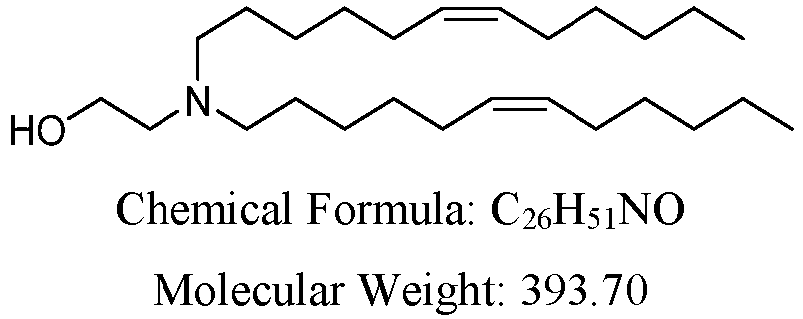
- In the same manner as
Step 1 for Compound 18, 2-(di((Z)-dodec-6-en-1-yl)amino)ethan-1-ol was synthesized from ethanolamine (60 mg, 1.0 mmol), (Z)-1-bromododec-6-ene (0.51 g, 2.1 mmol) and K2CO3 (0.14 g, 1.0 mmol) in 5 mL DCM. Yield (0.22 g, 0.56 mmol, 56%). - 1H NMR (400 MHz, CDCl3) δ: ppm 5.34 (m, 4H); 3.59 (m, 2H); 2.65-2.53 (m, 6H); 2.00 (m, 9H); 1.49 (m, 4H); 1.23 (m, 20H); 0.86 (t, 6H).
-

- In the same manner as
Step 2 for Compound 18, (Z)-N-(2-chloroethyl)-N-((Z)-dodec-6-en-1-yl)dodec-6-en-1-amine was synthesized from 2-(di((Z)-dodec-6-en-1-yl)amino)ethan-1-ol (0.22 g, 0.56 mmol), methanesulfonyl chloride (0.047 mL, 0.61 mmol) and triethylamine (0.12 mL, 0.84 mmol) in 3 mL DCM. (Yield (150 mg, 0.36 mmol, 65%). - 1H NMR (400 MHz, CDCl3) δ: ppm 5.34 (m, 4H); 3.47 (t, 2H); 2.74 (t, 2H); 2.43 (t, 4H); 2.00 (m, 8H); 1.41-1.27 (m, 24H); 0.87 (m, 6H).
-

- In the same manner as
Step 6 for Compound 18, N 1-(2-(4-(2-(di((Z)-dodec-6-en-1-yl)amino)ethyl)piperazin-1-yl)ethyl)-N 1,N 2 ,N 2-tridodecylethane-1,2-diamine was synthesized from (Z)-N-(2-chloroethyl)-N-((Z)-dodec-6-en-1-yl)dodec-6-en-1-amine(56 mg, 0.14 mmol), N 1,N 1 ,N 2-tridodecyl-N 2-(2-(piperazin-1-yl)ethyl)ethane-1,2-diamine(84 mg, 0.12 mmol) and K2CO3 (17 mg, 0.12 mmol) in 1 mL MeCN. Yield (41.9 mg, 0.040 mmol, 33%). - UPLC: RT = 3.74 min. MS (ES): m/z (MH+) 1053.564 for C70H141N5
- 1H NMR (400 MHz, CDCl3) δ: ppm 5.33 (m, 4H); 2.55-2.35 (br. m, 30H); 1.98 (m, 8H); 1.32-1.24 (m, 84H); 0.86 (m, 15H).
-

- In the same manner as
Step 6 for Compound 18, N 1-(2-(4-(2-(ditetradecylamino)ethyl)piperazin-1-yl)ethyl)-N 1 ,N 2,N2 -tridodecylethane-1,2-diamine was synthesized from N 1,N 1,N 2-tridodecyl-N 2-(2-(piperazin-1-yl)ethyl)ethane-1,2-diamine (75 mg, 0.111 mmol), N-(2-chloroethyl)-N-tetradecyltetradecan-1-amine (58 mg, 0.122 mmol), K2CO3 (31 mg, 0.221 mmol), and KI (3 mg, 0.0181 mmol) in THF (4 mL). Yield (17 mg, 7%). UPLC/ELSD: RT = 3.88 min. MS (ES): m/z (MH+) 1113.59 for C74H153N3 - 1H-NMR (300 MHz, CDCl3) δ: ppm 3.15-2.00 (br. m, 30H); 1.75-0.90 (br. m, 108H); 0.81 (t, 15H).
-

- To a 0 °C solution of linoleyl alcohol (10 mL, 31.2 mmol) and triethylamine (5.68 mL, 40.5 mmol)) in DCM (50 mL) was added dropwise a solution of methanesulfonyl chloride (2.66 mL, 34.3 mmol) in DCM (20 mL). The reaction was allowed to return to room temperature and let stir for 4 hours. The mixture was quenched by the addition of water and extracted with DCM. The organic layer was washed with saturated NaHCO3, brine, dried over anhydrous Na2SO4, filtered, and concentrated in vacuo. Purification by ISCO silica flash chromatography (0-40% EtOAc/hexanes) provided (6Z,9Z)-18-(methylsulfonyl)octadeca-6,9-diene (10.0 g, 93%).
- 1H-NMR (300 MHz, CDCl3) δ: ppm 5.35 (m, 4H); 4.22 (t, 2H); 2.99 (s, 3H); 2.77 (t, 2H); 2.04 (q, 4H); 1.74 (m, 2H); 1.30 (br. m, 16H); 0.89 (t, 3H).
-

- To a solution of (6Z,9Z)-18-(methylsulfonyl)octadeca-6,9-diene (10.0 g, 29.0 mmol) in diethyl ether (372 mL) was added magnesium bromide ethyl etherate (22.5 g, 87.1 mmol). The reaction was let stir at room temperature for 16 hours. The mixture was quenched by the addition of water and extracted with diethyl ether. The combined organic layers were washed with 1% K2CO3, brine, dried over anhydrous Na2SO4, filtered, and concentrated in vacuo. Purification by ISCO silica flash chromatography provided (6Z,9Z)-18-bromooctadeca-6,9-diene (8.9 g, 93%).
- 1H-NMR (300 MHz, CDCl3) δ: ppm 5.36 (m, 4H); 3.41 (t, 2H); 2.77 (t, 2H); 2.05 (q, 4H); 1.86 (m, 2H); 1.48-1.22 (br. m, 16H); 0.89 (t, 3H).
-
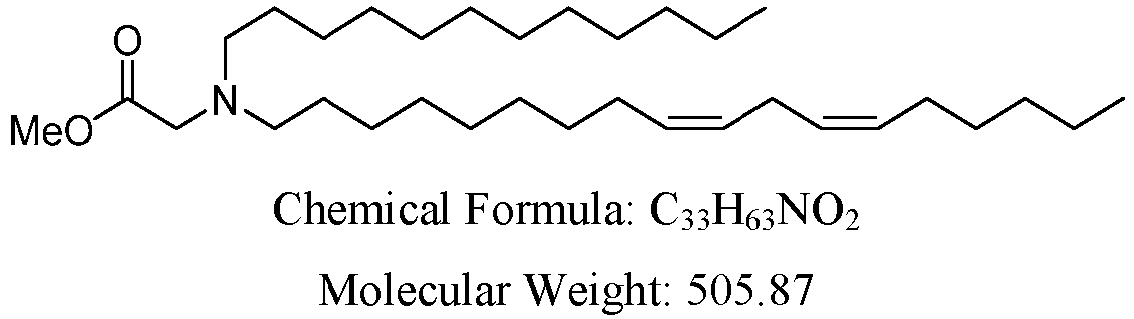
- To a solution of methyl dodecylglycinate·HCl (1 g, 3.4 mmol) in 8.5 mL DMF, (Z)-1-bromooctadec-9-ene (1.68 g, 5.1 mmol) and K2CO3 (1.4 g, 10.2 mmol) were added. The reaction was then allowed to stir at 85 °C for 12 h. After this time the reaction was allowed to cool to rt and was quenched by the addition of excess H2O. The mixture was extracted 3 times with EtOAc. The organics were pooled and washed with brine, dried over MgSO4, filtered and concentrated. The crude material was purified by silica gel chromatography (0-10% EtOAc in hexanes) to afford the desired product (0.87 g, 1.72 mmol, 50%).
- 1H-NMR (300 MHz, CDCl3) δ: ppm 5.33 (m, 4H); 3.68 (s, 3H); 3.30 (s, 2H); 2.74 (t, 2H); 2.52 (m, 4H); 2.02 (m, 4H); 1.23 (m, 38H); 0.86 (m, 6H).
-

- To a 0 °C solution of methyl N-dodecyl-N-((9Z,12Z)-octadeca-9,12-dien-1-yl)glycinate (980 mg, 1.94 mmol) in THF (10 mL) was added dropwise lithium aluminum hydride (184 mg, 4.85 mmol). The reaction was allowed to return to room temperature and let stir for 3 hours. The mixture was slowly quenched by the stepwise addition of water (0.184 mL), 10% NaOH (0.552 mL) and water (0.184 mL). The reaction mixture was filtered, washed with THF and concentrated in vacuo. Purification by ISCO silica flash chromatography (0-100% [DCM, 20% MeOH, 1% NH4OH]/MeOH) provided 2-(dodecyl((9Z,12Z)-octadeca-9,12-dien-1-yl)amino)ethan-1-ol (660 mg, 71%).
- UPLC/ELSD: RT = 3.13 min. MS (ES): m/z (MH+) 478.52 for C32H63NO
- 1H-NMR (300 MHz, CDCl3) δ: ppm 5.39 (br. m, 4H); 3.56 (br. m, 2H); 2.80 (br. m, 2H); 2.61 (br. m, 2H); 2.48 (br. m, 4H); 2.09 (br. m, 4H); 1.57-1.17 (br. m, 38H); 0.91 (br. m, 6H).
-

- In a same manner as
Step 2 for Compound 18, (9Z,12Z)-N-(2-chloroethyl)-N-dodecyloctadeca-9,12-dien-1-amine was synthesized from 2-(dodecyl((9Z,12Z)-octadeca-9,12-dien-1-yl)amino)ethan-1-ol (660 mg, 1.38 mmol), triethylamine (0.249 mL, 1.80 mmol), and methanesulfonyl chloride (0.172 mL, 1.73 mmol) in DCM (7 mL). Yield (123 mg, 18%). UPLC/ELSD: RT = 3.23 min. MS (ES): m/z (MH+) 496.72 for C32H62ClN - 1H-NMR (300 MHz, CDCl3) δ: ppm 5.29 (br. m, 4H); 3.43 (br. m, 2H); 2.71 (br. m, 4H); 2.38 (br. m, 4H); 1.98 (br. m, 4H); 1.45-1.07 (br. m, 38H); 0.82 (br. m, 6H).
-

- In the same manner as
Step 6 for Compound 18, N 1,N 1 ,N 2-tridodecyl-N 2-(2-(4-(2-(dodecyl((9Z,12Z)-octadeca-9,12-dien-1-yl)amino)ethyl)piperazin-1-yl)ethyl)ethane-1,2-diamine was synthesized from N 1,N 1,N 2-tridodecyl-N 2-(2-(piperazin-1-yl)ethyl)ethane-1,2-diamine (67 mg, 0.099 mmol), (9Z,12Z)-N-(2-chloroethyl)-N-dodecyloctadeca-9,12-dien-1-amine (64 mg, 0.129 mmol) K2CO3 (28 mg, 0.198 mmol), and KI (2 mg, 0.012 mmol) in THF (2 mL). Yield (48 mg, 43%). - UPLC/ELSD: RT = 3.90 min. MS (ES): m/z (MH+) 1137.95 for C76H153N5
- 1H-NMR (300 MHz, CDCl3) δ: ppm 5.48-5.29 (m, 4H); 3.15-2.15 (br. m, 32H); 2.07 (br. m, 4H); 1.83-1.00 (br. m, 98H); 0.91 (br. m, 15H).
-
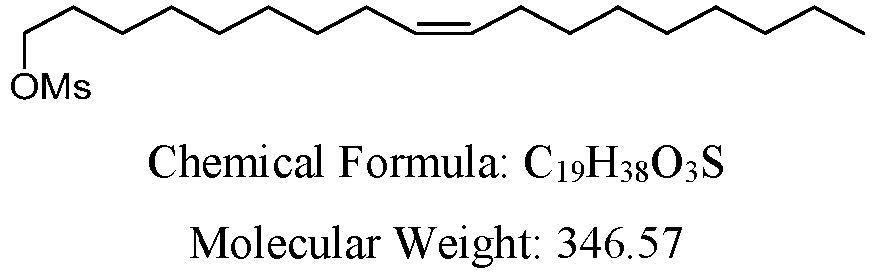
- In the same manner as
Step 1 for Compound 27, (Z)-1-(methylsulfonyl)octadec-9-ene was synthesized from oleyl alcohol (10 mL, 31.7 mmol), triethylamine (5.74 mL, 41.2 mmol), and methanesulfonyl chloride (2.70 mL, 34.9 mmol) in DCM (50 mL). Yield (8.55 g, 78%). - 1H-NMR (300 MHz, CDCl3) δ: ppm 5.33 (m, 2H); 4.20 (t, 2H); 2.98 (s, 3H); 2.00 (m, 4H); 1.73 (m, 2H); 1.44-1.16 (br. m, 22H); 0.87 (t, 3H).
-

- In the same manner as
Step 2 for Compound 27, (Z)-1-bromooctadec-9-ene was synthesized from (Z)-1-(methylsulfonyl)octadec-9-ene (8.55 g, 24.7 mmol), and magnesium bromide ethyl etherate (19.1 g, 74.1 mmol) in diethyl ether (317 mL). Yield (7.42 g, 91%). 1H-NMR (300 MHz, CDCl3) δ: ppm 5.35 (m, 2H); 3.41 (t, 2H); 2.01 (m, 4H); 1.85 (m, 2H); 1.48-1.14 (br. m, 22H); 0.88 (t, 3H). -

- In the same manner as
Step 1 for Compound 18,2-(di((Z)-octadec-9-en-1-yl)amino)ethan-1-ol was synthesized from (Z)-1-bromooctadec-9-ene (5 g, 15.1 mmol), ethanolamine, (0.414 mL, 6.86 mmol), K2CO3 (4.17 g, 30.2 mmol), and KI (114 mg, 0.686 mmol) in MeCN (32 mL). Yield (3.2 g, 83%). - UPLC/ELSD: RT = 7.325 min. MS (ES): m/z (MH+) 562.60 for C38H75NO
- 1H-NMR (300 MHz, CDCl3) δ: ppm 5.34 (m, 4H); 3.53 (t, 2H); 2.58 (t, 2H); 2.45 (t, 4H); 2.01 (m, 8H); 1.44 (m, 4H); 1.38-1.18 (br. m, 44H); 0.88 (t, 6H).
-

- In the same manner as
Step 2 for Compound 18, (Z)-N-(2-chloroethyl)-N-((Z)-octadec-9-en-1-yl)octadec-9-en-1-amine was synthesized from 2-(di((Z)-octadec-9-en-1-yl)amino)ethan-1-ol (1.64 g, 2.92 mmol) triethylamine (0.529 mL, 3.79mmol), and methanesulfonyl chloride (0.282 mL, 3.65 mmol) in DCM (15 mL). Yield (1.47 g, 87%). UPLC/ELSD: RT = 3.75 min. MS (ES): m/z (MH+) 580.64 for C38H74ClN - 1H-NMR (300 MHz, CDCl3) δ: ppm 5.35 (m, 4H); 3.48 (br. m, 2H); 2.77 (br. m, 2H); 2.45 (br. m, 4H); 2.02 (br. m, 8H); 1.62-1.05 (br. m, 48H); 0.89 (t, 6H).
-

- In the same manner as
Step 6 for Compound 18, N 1-(2-(4-(2-(di((Z)-octadec-9-en-1-yl)amino)ethyl)piperazin-1-yl)ethyl)-N 1,N2 ,N2-tridodecylethane-1,2-diamine was synthesized from N 1,N 1,N 2-tridodecyl-N 2-(2-(piperazin-1-yl)ethyl)ethane-1,2-diamine (75 mg, 0.111 mmol), (Z)-N-(2-chloroethyl)-N-(1-yl)octadec-9-en-1-amine (71 mg, 0.122 mmol) K2CO3 (31 mg, 0.222 mmol), and KI (3 mg, 0.018 mmol) in THF (1.5 mL). Yield (20 mg, 15%). - UPLC/ELSD: RT = 4.05 min. MS (ES): m/z (MH+) 1221.72 for C82H165N5
- 1H-NMR (300 MHz, CDCl3) δ: ppm 5.29-5.14 (br. m, 4H); 2.95-2.00 (br. m, 30H); 1.96-1.77 (br. m, 8H); 1.60-0.85 (br. m, 108H); 0.76 (br. m, 15H).
-

- In the same manner as
Step 1 for Compound 18, 2-(di((9Z,12Z)-octadeca-9,12-dien-1-yl)amino)ethan-1-ol was synthesized from (6Z,9Z)-18-bromooctadeca-6,9-diene (4 g, 12.1 mmol), ethanolamine, (0.334 mL, 5.52 mmol), K2CO3 (3.36 g, 24.3 mmol), and KI (92 mg, 0.552 mmol) in MeCN (26 mL). Yield (1.9 g, 62%). - UPLC/ELSD: RT = 6.80 min. MS (ES): m/z (MH+) 557.94 for C38H71NO
- 1H-NMR (300 MHz, CDCl3) δ: ppm 5.35 (m, 8H); 3.52 (t, 2H); 2.77 (t, 4H); 2.57 (t, 2H); 2.43 (t, 4H); 2.04 (q, 8H); 1.48-1.18 (br. m, 36H); 0.89 (t, 6H).
-

- In a same manner as
Step 2 for Compound 18, (9Z,12Z)-N-(2-chloroethyl)-N-((9Z,12Z)-octadeca-9,12-dien-1-yl)octadeca-9,12-dien-1-amine was synthesized from 2-(di((9Z,12Z)-octadeca-9,12-dien-1-yl)amino)ethan-1-ol (250 mg, 0.45 mmol), triethylamine (81 µL, 0.58 mmol), and methanesulfonyl chloride (38 µL, 0.49 mmol) in DCM (2 mL). Yield (134 mg, 52%). - 1H-NMR (300 MHz, CDCl3)δ: ppm 5.36 (m, 8H); 3.49 (t, 2H); 2.78 (m, 6H); 2.45 (t, 4H); 2.05 (q, 8H); 1.48-1.18 (br. m, 36H); 0.89 (t, 6H).
-

- In the same manner as
Step 6 for Compound 18, N 1-(2-(4-(2-(di((9Z,12Z)-octadeca-9,12-dien-1-yl)amino)ethyl)piperazin-1-yl)ethyl)-N 1,N 2,N 2-tridodecylethane-1,2-diamine was synthesized from N 1,N 1,N 2-tridodecyl-N 2-(2-(piperazin-1-yl)ethyl)ethane-1,2-diamine (75 mg, 0.111 mmol), (9Z,12Z)-N-(2-chloroethyl)-N-((9Z, 12Z)-octadeca-9,12-dien-1-yl)octadeca-9,12-dien-1-amine (71 mg, 0.122) K2CO3 (31 mg, 0.222 mmol), and KI (3 mg, 0.018 mmol) in THF (3 mL). Yield (20 mg, 15%) - UPLC/ELSD: RT = 3.97 min. MS (ES): m/z (MH+) 1217.95 for C82H161N5
1H-NMR (300 MHz, CDCl3) δ: ppm 5.48-5.28 (m, 12H); 3.30-2.20 (br. m, 36H); 2.17-1.92 (br. m, 12H); 1.90-1.00 (br. m, 94H); 0.87 (br. m, 15H). -

- In the same manner as
Step 6 for Compound 18, N 1-(2-(4-(2-(dinonylamino)ethyl)piperazin-1-yl)ethyl)-N 1,N 2,N 2-tritetradecylethane-1,2-diamine was synthesized from N 1-(2-(piperazin-1-yl)ethyl)-N 1,N 2,N 2-tritetradecylethane-1,2-diamine (150 mg, 0.197 mmol), N-(2-chloroethyl)-N-nonylnonan-1-amine (79 mg, 0.236 mmol), K2CO3 (54 mg, 0.394 mmol), and KI (3 mg, 0.0134 mmol) in THF (4 mL). Yield (50 mg, 24%). UPLC/ELSD: RT = 3.79 min. MS (ES): m/z (MH+) 1057.74 for C70H145N5 - 1H-NMR (300 MHz, CDCl3) δ: ppm 3.15-2.20 (br. m, 30H); 1.90-1.00 (br. m, 100H); 0.90 (t, 15H).
-
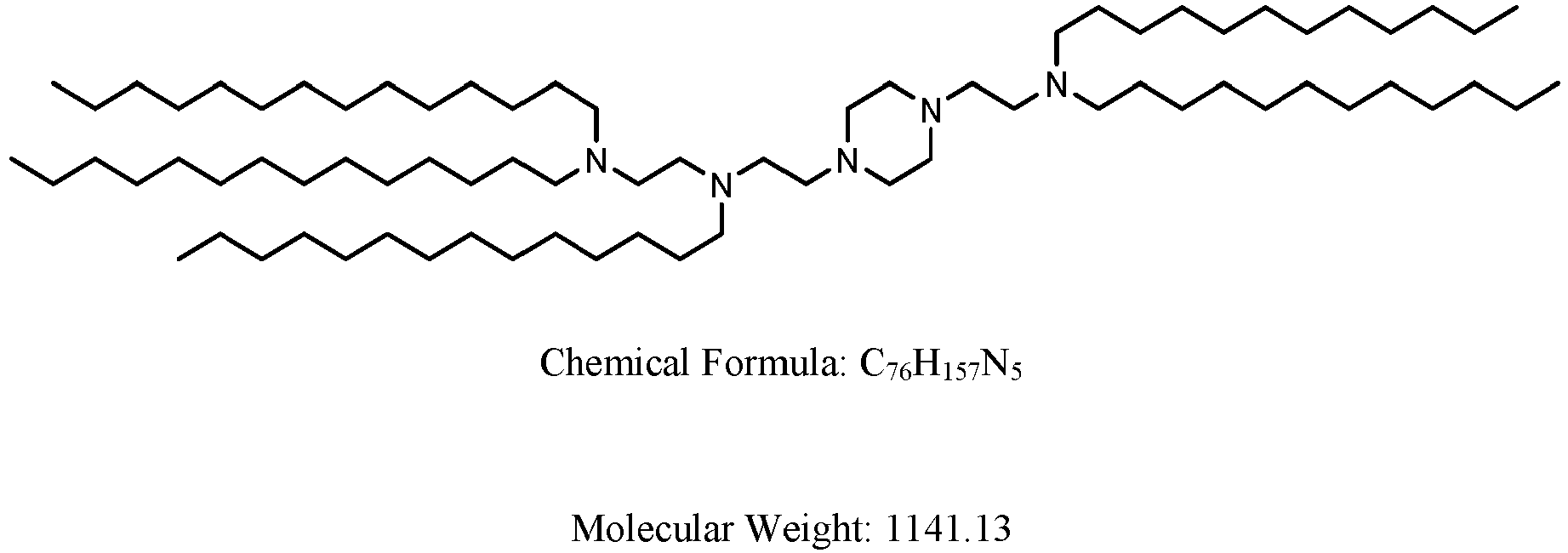
- In the same manner as
Step 6 for Compound 18, N 1-(2-(4-(2-(Didodecylamino)ethyl)piperazin-1-yl)ethyl)-N 1,N 2,N 2-tritetradecylethane-1,2-diamine was synthesized from N 1-(2-(piperazin-1-yl)ethyl)-N 1,N 2,N 2-tritetra-decylethane-1,2-diamine (150 mg, 0.197 mmol), N-(2-chloroethyl)-N-dodecyldodecan-1-amine (98 mg, 0.236 mmol), K2CO3 (54 mg, 0.394 mmol), and KI (3 mg, 0.0134 mmol) in THF (4 mL). Yield (42 mg, 19%). UPLC/ELSD: RT = 3.98 min. MS (ES): m/z (MH+) 1142.14 for C76H157N5 - 1H-NMR (300 MHz, CDCl3) δ: ppm 3.20-2.20 (br. m, 30H); 1.90-1.00 (br. m, 112H); 0.90 (t, 15H).
-

- In the same manner as
Step 6 for Compound 18, N 1-(2-(4-(2-(ditetradecylamino)ethyl)plperazin-1-yl)ethyl)-N 1,N 2,N 2-tritetradecylethane-1,2-diamine was synthesized from N 1-(2-(piperazin-1-yl)ethyl)-N 1,N 2,N 2-tritetra-decylethane-1,2-diamine (150 mg, 0.197 mmol), N-(2-chloroethyl)-N-tetradecyltetradecan-1-amine (130 mg, 0.276 mmol), K2CO3 (54 mg, 0.394 mmol), and KI (3 mg, 0.0134 mmol) in THF (4 mL). Yield (17 mg, 7%). UPLC/ELSD: RT = 4.11 min. MS (ES): m/z (MH+) 1198.32 for C80H165N5 - 1H-NMR (300 MHz, CDCl3) δ: ppm 3.20-2.15 (br. m, 30H); 1.90-1.00 (br. m, 120H); 0.90 (t, 15H).
-


- In the same manner as
Step 3 for Compound 18, tert-butyl (Z)-4-(2-(octadec-9-en-1-ylamino)ethyl)piperazine-1-carboxylate was synthesized from (Z)-1-bromooctadec-9-ene (1.95 g, 11.8 mmol), 4-(2-aminoethyl)-1-boc-piperazine (1.35 g, 5.89 mmol), K2CO3 (1.60 g, 11.8 mmol), and KI (98 mg, 0.689 mmol) in MeCN (30 mL). Yield (790 mg, 28%). - 1H-NMR (300 MHz, CDCl3) δ: ppm 5.32 (m, 2H); 3.45 (br, 4H); 2.75 (t, 2H); 2.65 (t, 2H); 2.57 (t, 2H); 2.40 (br, 4H); 2.09 (br, 4H); 1.48 (br. m, 11H); 1.41-1.10 (br, 22H); 0.89 (t, 3H).
-
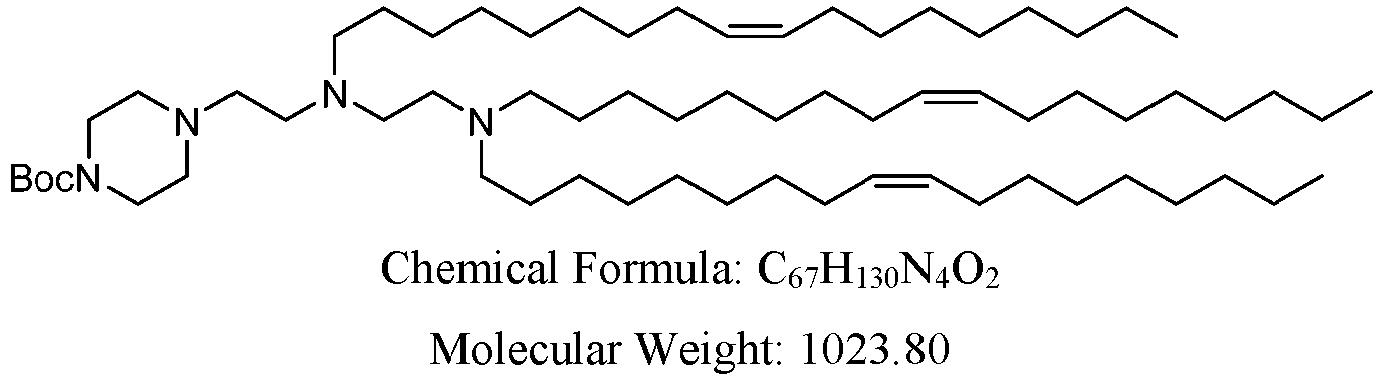
- In the same manner as
Step 4 for Compound 18, tert-butyl 4-(2-((2-(di((Z)-octadec-9-en-1-yl)amino)ethyl)((Z)-octadec-9-en-1-yl)amino)ethyl)piperazine-1-carboxylate was synthesized from tert-butyl (Z)-4-(2-(octadec-9-en-1-ylamino)ethyl)piperazine-1-carboxylate (573 mg, 1.19 mmol), (Z)-N-(2-chloroethyl)-N-((Z)-octadec-9-en-1-yl)octadec-9-en-1-amine (693 mg, 1.19 mmol), K2CO3 (329 mg, 2.38 mmol), and KI (20 mg, 0.119 mmol) in THF (6 mL). Yield (918 mg, 75%). - 1H-NMR (300 MHz, CDCl3) δ: ppm 5.37 (m, 6H); 3.45 (br. m, 4H); 2.72-2.18 (br. m, 18H); 2.04 (br. m, 12H); 1.65-1.05 (br. m, 81H) 0.91 (br. m, 9H).
-

- In the same manner as
Step 5 for Compound 18, N 1,N 1,N 2-tri((Z)-octadec-9-en-1-yl)-N 2-(2-(piperazin-1-yl)ethyl)ethane-1,2-diamine was synthesized from, tert-butyl 4-(2-((2-(di((Z)-octadec-9-en-1-yl)amino)ethyl)((Z)-octa-dec-9-en-1-yl)amino)ethyl)piperazine-1-carboxylate (740 mg, 0.859 mmol), and TFA (3.3 mL, 42.9 mmol) in DCM (3.3 mL). Yield (115 mg, 14%). - 1H-NMR (300 MHz, CDCl3) δ: ppm 5.36 (m, 6H); 2.91 (br, 4H); 2.74-2.34 (br. m, 18H); 2.03 (br. m, 12H); 1.54-1.04 (br. m, 72H); 0.90 (br. m, 9H).
-

- In the same manner as
Step 6 for Compound 18, N 1-(2-(4-(2-(didodecylamino)ethyl)piperazin-1-yl)ethyl)-N 1,N 2,N 2-tri((Z)-octadec-9-en-1-yl)ethane-1,2-diamine was synthesized from N1 ,N 1,N 2-tri((Z)-octadec-9-en-1-yl)-N 2-(2-(piperazin-1-yl)ethyl)ethane-1,2-diamine (58 mg, 0.063 mmol), N-(2-chloroethyl)-N-dodecyldodecan-1-amine (31 mg, 0.075 mmol), K2CO3 (17 mg, 0.13 mmol), and KI (1 mg, 0.006 mmol) in THF (1.5 mL). Yield (30 mg, 37%). - UPLC/ELSD: RT = 4.16 min. MS (ES): m/z (MH+) 1304.03 for C88H175N5
- 1H-NMR (300 MHz, CDCl3) δ: ppm 5.36-5.24 (br. m, 6H); 2.66-2.08 (br. m, 30H); 2.04-1.82 (br. m, 12H); 1.57-0.87 (br. m, 112H); 0.81 (br. m, 15H).
-

- In the same manner as
Step 3 for Compound 18, tert-butyl 4-(2-(((9Z,12Z)-octadeca-9,12-dien-1-yl)amino)ethyl)piperazine-1-carboxylate was synthesized from (6Z,9Z)-18-bromooctadeca-6,9-diene (3.0 g, 9.11 mmol), 4-(2-aminoethyl)-1-boc-piperazine (2.09 g, 9.11 mmol), K2CO3 (2.52 g, 18.22 mmol), and KI (151 mg, 0.911 mmol) in MeCN (44 mL). Yield (1.20 g, 27%). - 1H-NMR (300 MHz, CDCl3) δ: ppm 5.35 (m, 4H); 3.42 (t, 4H); 2.77 (t, 2H); 2.73 (t, 2H); 2.62 (t, 2H); 2.51 (t, 2H); 2.38 (t, 4H); 2.04 (q, 4H); 1.60-1.20 (br. m, 27H); 0.89 (t, 3H).
-
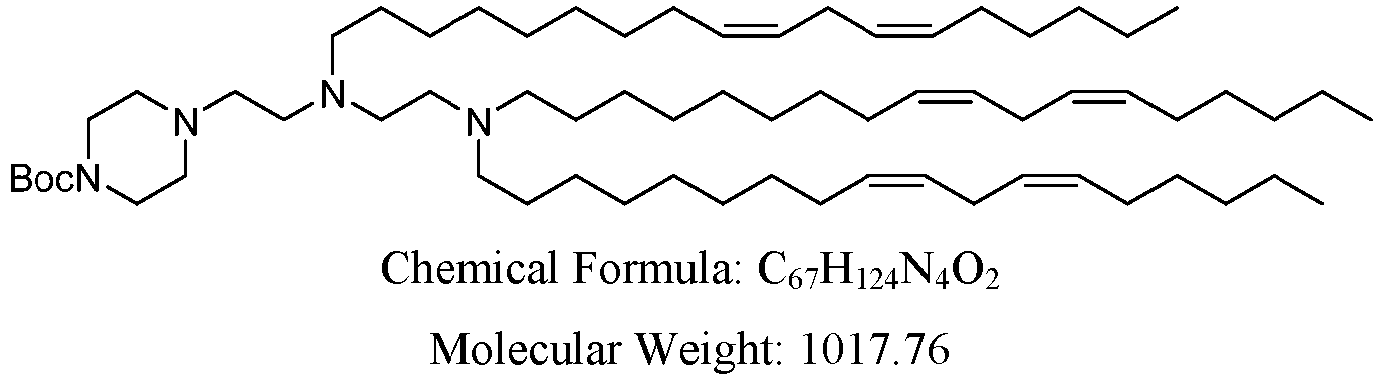
- In the same manner as
Step 4 for Compound 18, tert-butyl 4-(2-((2-(di((9Z,12Z)-octadeca-9,12-dien-1-yl)amino)ethyl)((9Z,12Z)-octadeca-9,12-dien-1-yl)amino)ethyl)piperazine-1-carboxylate was synthesized from tert-butyl 4-(2-(((9Z,12Z)-octadeca-9,12-dien-1-yl)amino)ethyl)piperazine-1-carboxylate (600 mg, 1.26 mmol), (9Z,12Z)-N-(2-chloroethyl)-N-((9Z, 12Z)-octadeca-9, 12-dien-1-yl)octadeca-9, 12-dien-1-amine (796 mg, 1.38 mmol), K2CO3 (347 mg, 2.51 mmol), and KI (21 mg, 0.126 mmol) in THF (8 mL). Yield (793 mg, 62%). - UPLC/ELSD: RT = 3.95 min. MS (ES): m/z (MH+) 1018.19 for C67H124N4O2
-
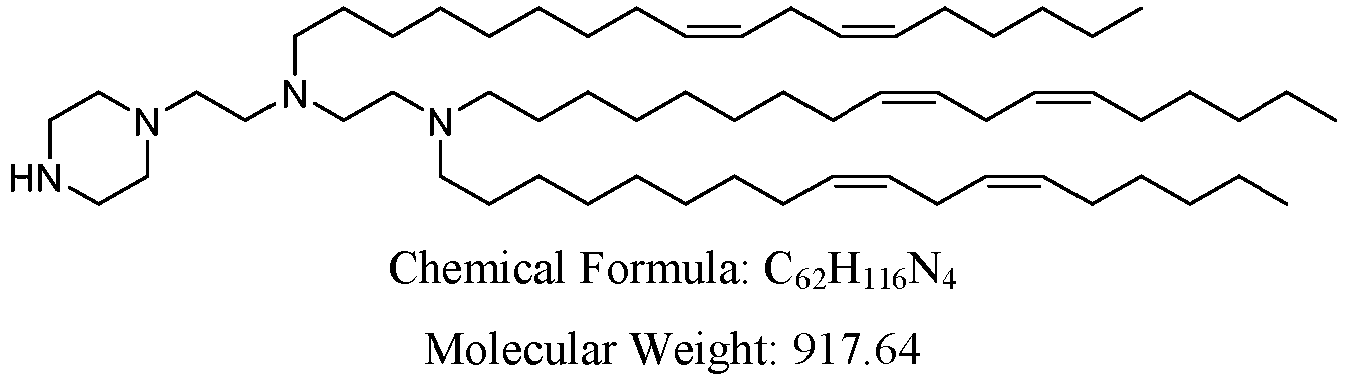
- In the same manner as
Step 5 for Compound 18, N 1,N 1,N 2-tri((9Z,12Z)-octadeca-9,12-dien-1-yl)-N 2-(2-(piper-azin-1-yl)ethyl)ethane-1,2-diamine was synthesized from tert-butyl 4-(2-((2-(di((9Z,12Z)-octadeca-9,12-dien-1-yl)amino)ethyl)((9Z,12Z)-octadeca-9,12-dien-1-yl)amino)ethyl)piperazine-1-carboxylate (793 mg, 0.779 mmol), and TFA (3.0 mL, 39.0 mmol) in DCM (3.0 mL). Yield (374 mg, 52%). - UPLC/ELSD: RT = 3.68 min. MS (ES): m/z (MH+) 918.84 for C62H116N4
- 1H-NMR (300 MHz, CDCl3) δ: ppm 5.36 (m, 12H); 4.12 (m, 6H); 3.30-2.55 (22H); 2.04 (q, 12H); 1.80-1.00 (br. m, 54H); 0.89 (t, 9H).
-

- In the same manner as
Step 6 for Compound 18, N 1-(2-(4-(2-(didodecylamino)ethyl)piperazin-1-yl)ethyl)-N 1,N 2,N 2-tri((9Z,12Z)-octadeca-9,12-dien-1-yl)ethane-1,2-diamine was synthesized from N 1,N 1,N 2-tri((9Z,12Z)-octadeca-9,12-dien-1-yl)-N 2-(2-(piperazin-1-yl)ethyl)ethane-1,2-diamine (75 mg, 0.082 mmol), N-(2-chloroethyl)-N-dodecyldodecan-1-amine (37 mg, 0.090) K2CO3 (23 mg, 0.163 mmol), and KI (2 mg, 0.012 mmol) in THF (3 mL). Yield (20 mg, 15%). - UPLC/ELSD: RT = 4.00 min. MS (ES): m/z (MH+) 1297.88 for C88H169N5
- 1H-NMR (300 MHz, CDCl3) δ: ppm 5.48-5.28 (Br, 12H); 3.30-2.20 (br. m, 36H); 2.17-1.92 (br. m, 12H); 1.90-1.00 (br. m, 94H); 0.87 (br. m., 15H).
-

-

-

- Compound 38 was synthesized according to Steps 1-5 for
Compound 13.
- Compound 39 was synthesized according to Steps 1-3 for
Compound 1.
-
Compound 40 was synthesized according to Steps 1-3 forCompound 33.
- Compound 41 was synthesized according to Steps 1-3 for Compound 34.

-

- In the same manner as
Step 6 for Compound 18, N 1-(2-(4-(2-(di((Z)-octadec-9-en-1-yl)amino)ethyl)piperazin-1-yl)ethyl)-N 1,N 2,N 2-tri((Z)-octadec-9-en-1-yl)ethane-1,2-diamine was synthesized from N 1,N 1,N 2-tri((Z)-octadec-9-en-1-yl)-N 2-(2-(piperazin-1-yl)ethyl)ethane-1,2-diamine (75 mg, 0.0812 mmol), (Z)-N-(2-chloroethyl)-N-((Z)-octadec-9-en-1-yl)octadec-9-en-1-amine (57 mg, 0.0974 mmol) K2CO3 (22 mg, 0.162 mmol), and KI (2 mg, 0.012 mmol) in THF (1.5 mL). Yield (30 mg, 25%) - UPLC/ELSD: RT = 4.41 min. MS (ES): m/z (MH+) 1469.08 for C100H195N5
- 1H-NMR (300 MHz, CDCl3) δ: ppm 5.40-5.27 (br. m, 10H); 3.18-2.22 (br. m, 30H);2.06-1.89 (m,20H); 1.80-0.97 (br. m, 120H); 0.88 (t, 15H).
-

- In the same manner as
Step 3 forCompound 11, tert-butyl 5-(dinonylglycyl)-2,5-diazabicyclo[2.2.1]heptane-2-carboxylate was synthesized from lithium dinonylglycinate (500 mg, 1.50 mmol), tert-butyl 2,5-diazabicyclo[2.2.1]heptane-2-carboxylate (357 mg, 1.80 mmol), iPr2EtN (628 µL, 3.60 mmol), and T3P (50% EtOAc solution, 2.68 mL, 4.50 mmol) in THF (15 mL). Yield (710 mg, 78%).
UPLC/ELSD: RT = 0.87 min. MS (ES): m/z (MH+) 508.44 for C30H57N3O3 - 1H-NMR (300 MHz, CDCl3) δ: ppm 4.98-4.46 (br. m, 2H); 4.30-3.15 (br. m, 10H); 2.14-1.60 (br. m, 6H); 1.49 (s, 9H); 1.40-1.00 (br. m, 24H); 0.89 (t, 6H).
-

- In the same manner as
Step 4 forCompound 11, 1-(2,5-diazabicyclo[2.2.1]heptan-2-yl)-2-(dinonylamino)ethan-1-one was synthesized from tert-butyl 5-(dinonylglycyl)-2,5-diazabicyclo[2.2.1]heptane-2-carboxylate (710 mg, 1.40 mmol) and TFA (5.4 mL, 70 mmol) in DCM (5 mL). Yield (446 mg, 78%) - UPLC/ELSD: RT = 0.67 min. MS (ES): m/z (MH+) 408.64 for C25H49N3O
1H-NMR (300 MHz, CDCl3) δ: ppm 4.90-3.00 (br. m, 8H); 2.49 (br. m, 4H); 1.79 (br. m, 2H); 1.58-1.08 (br. m, 28H); 0.90 (t, 6H). -

- In the same manner as
Step 11 forCompound 11, 2-(dinonylamino)-1-(5-(N-(2-(dinonylamino)ethyl)-N-non-ylglycyl)-2,5-diazabicyclo[2.2.1]heptan-2-yl)ethan-1-one was synthesized from 1-(2,5-diazabicyclo[2.2.1]heptan-2-yl)-2-(dinonylamino)ethan-1-one (100 mg, 0.25 mmol), N-(2-(dinonylamino)ethyl)-N-nonylglycine (134 mg, 0.27 mmol), iPr2EtN (94 µL, 0.54 mmol), and T3P (50% EtOAc solution, 438 µL, 0.74 mmol) in THF (20 mL). Yield (50 mg, 23%). - UPLC/ELSD: RT = 3.60 min. MS (ES): m/z (MH+) 887.12 for C56H111N5O2
1H-NMR (300 MHz, CDCl3) δ: ppm 5.15-2.28 (br. m, 26H); 2.16-1.00 (br. m, 70H); 0.90 (t, 15H). -

- In the same manner as
Step 11 forCompound 11, 2-((2-(didodecylamino)ethyl)(dodecyl)amino)-1-(5-(dinonylglycyl)-2,5-diazabicyclo[2.2.1]heptan-2-yl)ethan-1-one was synthesized from 1-(2,5-diazabicyclo[2.2.1]heptan-2-yl)-2-(dinonylamino)ethan-1-one (100 mg, 0.25 mmol), N-(2-(didodecylamino)ethyl)-N-dodecylglycine (168 mg, 0.27 mmol), iPr2EtN (94 µL, 0.54 mmol), and T3P (50% EtOAc solution, 438 µL, 0.74 mmol) in THF (20 mL). Yield (150 mg, 60%). - UPLC/ELSD: RT = 3.60 min. MS (ES): m/z (MH+) 1013.24 for C65H129N5O2
1H-NMR (300 MHz, CDCl3) δ: ppm 5.15-2.26 (br. m, 24H); 2.13-1.09 (br. m, 90H); 0.90 (t, 15H). -

- To a mixture of tert-butyl glycine (3.0 g, 23 mmol) and 1-bromononane (2.4 g, 11.5 mmol) in MeCN (100 mL) was added K2CO3 (3.2 g, 23 mmol) and KI (190 mg, 1.1 mmol) and the mixture was allowed to stir at 82 °C for 24 hours. The suspension was cooled to RT and filtered through a celite plug, rinsing with hexanes. The MeCN was extracted 3x with hexanes, and the combined extracts were concentrated in vacuo. Purification by ISCO silica flash chromatography (0-15% MeOH/DCM) provided tert-butyl nonylglycinate as a clear colorless oil (848 mg, 29%).
- 1H-NMR (300 MHz, CDCl3) δ: ppm 3.31 (s, 2H); 2.60 (t, 2H); 1.82-1.63 (br, 1H); 1.56-1.20 (br. m, 23H); 0.90 (t, 3H).
-

- In the same manner as
Step 1 forCompound 15, methyl 8-bromooctanoate was synthesized from 8-bromooctanoic acid (5.0 g, 22 mmol), methanol (20 mL, 450 mmol), and H2SO4 (1.2 mL, 22 mmol) in THF (20mL). Yield (5.0 g, 95%). - 1H-NMR (300 MHz, CDCl3) δ: ppm 3.69 (s, 3H); 3.42 (t, 2H); 2.33 (t, 2H); 1.88 (quint, 2H); 1.65 (quint, 2H); 1.54-1.27 (br. m, 6H).
-

- To a mixture of tert-butyl nonylglycinate (300 mg, 1.17 mmol) and methyl 8-bromooctanoate (290 mg, 1.22 mmol) in MeCN (12mL) was added K2CO3 (341 mg, 2.45 mmol) and KI (19 mg, 0.12 mmol) and the mixture was allowed to stir at 82 °C for 12 hours. The suspension was cooled to RT and filtered through a celite plug, rinsing with hexanes. The MeCN was extracted 3xwith hexanes, and the combined extracts were concentrated in vacuo. Purification by ISCO silica flash chromatography (0-10% EtOAc/Hexanes) provided methyl 8-((2-(tert-butoxy)-2-oxoethyl)(nonyl)amino)octanoate (353 mg, 73%).
- UPLC/ELSD: RT = 1.60 min. MS (ES): m/z (MH+) 414.51 for C24H47NO4
1H-NMR (300 MHz, CDCl3) δ: ppm 3.69 (s, 3H); 3.23 (s, 2H); 2.57 (t, 4H); 2.32 (t, 2H); 1.70-1.18 (br. m, 33H); 0.90 (t, 3H). -

- To a solution of methyl 8-((2-(tert-butoxy)-2-oxoethyl)(nonyl)amino)octanoate (353 mg, 0.85 mmol) in DCM (4mL) was added TFA (3.3 mL, 43 mmol) and the solution was allowed to stir at RT for 4 hours. The solution was concentrated in vacuo, taken up in DCM, and washed with 5% Na2CO3 and brine, dried over Na2SO4, filtered, and concentrated in vacuo to provide N-(8-methoxy-8-oxooctyl)-N-nonylglycine (305 mg, 99%).
- 1H-NMR (300 MHz, CDCl3) δ: ppm 3.69 (s, 3H); 3.49 (s, 2H); 3.06 (t, 4H); 2.32 (t, 2H); 1.79-1.14 (br. m, 24H); 0.90 (t, 3H).
-

- To a solution of N-(2-(dinonylamino)ethyl)-N-nonylglycine (1.0 g, 2.0 mmol) and 1-boc-piperazine (412 mg, 2.2 mmol) in THF (20 mL) was added iPr2EtN (773 µL, 4.4 mmol) and T3P (50% EtOAc solution, 3.6 mL, 6.0 mmol) and the solution was allowed to stir at RT for 12 hours. The reaction was quenched with water and extracted 3x with EtOAc. The combined organics were washed with brine, dried over Na2SO4, filtered, and concentrated in vacuo. Purification by ISCO silica flash chromatography (0-20% MeOH/DCM) provided tert-butyl 4-(N-(2-(dinonylamino)ethyl)-N-nonylglycyl)piperazine-1-carboxylate (961 mg, 72%). UPLC/ELSD: RT = 3.27 min. MS (ES): m/z (MH+) 665.79 for C40H80N4O3
- 1H-NMR (300 MHz, CDCl3) δ: ppm 4.43-2.90 (br. m, 20H); 2.04-0.99 (br. m, 51H); 0.90 (t, 9H).
-

- To a solution of tert-butyl 4-(N-(2-(dinonylamino)ethyl)-N-nonylglycyl)piperazine-1-carboxylate (961 mg, 1.44 mmol) in DCM (6 mL) was added TFA (5.5 mL, 72 mmol) and the solution was allowed to stir for 4 hours. The solution was concentrated in vacuo, taken up in DCM, and washed with 5% Na2CO3, brine, dried over Na2SO4, filtered, and concentrated in vacuo to provide 2-((2-(dinonylamino)ethyl)(nonyl)amino)-1-(piperazin-1-yl)ethan-1-one (743 mg, 91%). UPLC/ELSD: RT = 2.14 min. MS (ES): m/z (MH+) 565.82 for C35H72N4O
- 1H-NMR (300 MHz, CDCl3) δ: ppm 3.59 (br, 4H); 3.36 (br, 2H); 2.99-2.03 (br. m, 14H); 1.74-1.01 (br. m, 42H); 0.90 (t, 9H).
-

- To a solution of N-(8-methoxy-8-oxooctyl)-N-nonylglycine (100 mg, 0.28 mmol) and 2-((2-(dinonylamino)ethyl)(nonyl)amino)-1-(piperazin-1-yl)ethan-1-one (174 mg, 0.31 mmol) in THF (25 mL) was added), iPr2EtN (107 µL, 0.62 mmol), and T3P (50% EtOAc solution, 0.50 mL, 0.84 mmol) and the reaction was allowed to stir at room temperature overnight. The reaction mixture was diluted with water and extracted with EtOAc. The organics were dried over anhydrous Na2SO4, filtered, and concentrated in vacuo. Purification by ISCO silica flash chromatography (0-100% DCM/[
DCM 20% MeOH 1% NH4OH]) provided methyl 8-((2-(4-(N-(2-(dinonylamino)ethyl)-N-nonylglycyl)piperazin-1-yl)-2-oxoethyl)(nonyl)amino)octanoate (121 mg, 48%). - UPLC/ELSD: RT = 2.88 min. MS (ES): m/z (MH+) 905 for C55H109N5O4
- 1H-NMR (300 MHz, CDCl3) δ: ppm 3.64-3.36 (br. m, 11H); 3.18 (s, 2H); 3.13 (s, 2H); 2.54-2.09 (br. m, 16H); 1.55-0.88 (br. m, 66H); 0.76 (t, 12H).
-

- In the same manner as
Step 1 forCompound 15, pentyl 4-bromobutanoate was synthesized from 4-bromobutanoic acid (2.0 g, 12 mmol), pentanol (1.7 mL, 15.6 mmol), and H2SO4 (0.65 mL, 12 mmol) in THF (20mL). Yield (1.26 g, 44%). - 1H-NMR (300 MHz, CDCl3) δ: ppm 4.10 (t, 2H); 3.49 (t, 2H); 2.52 (t, 2H); 2.20 (quint, 2H); 1.65 (quint, 2H); 1.35 (m, 4H); 0.93 (t, 3H).
-

- In the same manner as
Step 3 forCompound 44, pentyl 4-((2-(tert-butoxy)-2-oxoethyl)(nonyl)amino)butanoate was synthesized from tert-butyl nonylglycinate (300 mg, 1.17 mmol) and pentyl 4-bromobutanoate (290 mg, 1.22 mmol) in MeCN (12 mL) was added K2CO3 (341 mg, 2.45 mmol) and KI (19 mg, 0.12 mmol). Yield (343 mg, 71%). - UPLC/ELSD: RT = 1.81 min. MS (ES): m/z (MH+) 415 for C24H47NO4
1H-NMR (300 MHz, CDCl3) δ: ppm 4.08 (t, 2H); 3.23 (s, 2H); 2.60 (br. m, 4H); 2.37 (t, 2H); 1.78 (m, 2H); 1.64 (m, 2H); 1.52-1.20 (br. m, 27H); 0.90 (m, 6H). -

- In the same manner as
Step 4 forCompound 44, N-nonyl-N-(4-oxo-4-(pentyloxy)butyl)glycine was synthesized from pentyl 4-((2-(tert-butoxy)-2-oxoethyl)(nonyl)amino)butanoate (343 mg, 0.83 mmol) and TFA (3.17 mL, 41.5 mmol) in DCM (4 mL). Yield (296 mg, 99%). - UPLC/ELSD: RT = 1.29 min. MS (ES): m/z (MH+) 358 for C20H39NO4
1H-NMR (300 MHz, CDCl3) δ: ppm 4.08 (t, 2H); 3.43 (br, 2H); 2.94 (br, 4H); 2.41 (t, 2H); 1.98 (br. m, 2H); 1.74-1.54 (br. m, 4H); 1.40-1.16 (br. m, 16H); 0.91 (m, 6H). -

- In the same manner as
Step 7 forCompound 44, pentyl 4-((2-(4-(N(2-(dinonylamino)ethyl)-N-nonylglycyl)piperazin-1-yl)-2-oxoethyl)(nonyl)amino)butanoate was synthesized from N-nonyl-N-(4-oxo-4-(pentyloxy)butyl)glycine (100 mg, 0.28 mmol), 2-((2-(dinonylamino)ethyl)(nonyl)amino)-1-(piperazin-1-yl)ethan-1-one (174 mg, 0.31 mmol), iPr2EtN (107 µL, 0.62 mmol), and T3P (50% EtOAc solution, 0.50 mL, 0.84 mmol) in THF (25 mL). Yield (121 mg, 48%). - UPLC/ELSD: RT = 3.01 min. MS (ES): m/z (MH+) 905 for C55H109N5O4
1H-NMR (300 MHz, CDCl3) δ: ppm 3.93 (t, 2H); 3.61-3.31 (br. m, 8H); 3.17 (m, 4H); 2.55-2.08 (br. m, 16H); 1.71-0.90 (br. m, 64H); 0.75 (m, 15H). -

- To a mixture of ethanolamine (4.4 mL, 72 mmol) and 1-bromononane (3.0g, 14.5 mmol) in MeCN (150 mL) was added K2CO3 (4.0 g, 29 mmol) and KI (240 mg, 1.5 mmol) and the mixture was allowed to stir at 82 °C for 12 hours. The suspension was cooled to RT and filtered over a pad of celite, rinsing with hexanes. The MeCN was extracted with hexanes 3x, and the combined hexanes were concentrated. Purification by ISCO silica flash chromatography (0-100% DCM/[
DCM 20% MeOH 1% NH4OH]) provided 2-(nonylamino)ethan-1-ol (1.0 g, 38%) - 1H-NMR (300 MHz, CDCl3) δ: ppm 3.66 (t, 2H); 2.80 (t, 2H); 2.62 (t, 2H); 1.96 (br. m, 2H); 1.50 (br. m, 2H); 1.28 (br. m, 12H); 0.90 (t, 3H).
-

- In the same manner as
Step 1 for Compound 18, methyl 8-((2-hydroxyethyl)(nonyl)amino)octanoate was synthesized from 2-(nonylamino)ethan-1-ol (500 mg, 2.67 mmol), methyl 8-bromooctanoate (665 mg, 2.8 mmol), K2CO3 (780 mg, 5.6 mmol), and KI (44 mg, 0.27 mmol) in MeCN (30 mL). Yield (578 mg, 63%). - UPLC/ELSD: RT = 1.01 min. MS (ES): m/z (MH+) 344.31 for C20H44NO3
1H-NMR (300 MHz, CDCl3) δ: ppm 3.69 (s, 3H); 3.59 (t, 2H), 2.65 (br, 2H); 2.51 (t, 4H); 2.32 (t, 2H); 1.65 (br. m, 2H); 1.49 (br. m, 4H); 1.30 (br. m, 18H); 0.90 (t, 3H). -

- In the same manner as
Step 2 for Compound 18, methyl 8-((2-chloroethyl)(nonyl)amino)octanoate was synthesized from methyl 8-((2-hydroxyethyl)(nonyl)amino)octanoate (578 mg, 1.68 mmol), methanesulfonyl chloride (163 µL, 2.10 mmol) and trimethylamine (305 µL, 2.20 mmol) in DCM (10 mL). Yield (418 mg, 69%). UPLC/ELSD: RT = 1.21 min. MS (ES): m/z (MH+) 363 for C20H40ClNO2 - 1H-NMR (300 MHz, CDCl3) δ: ppm 3.69 (br, 3H); 3.51 (br, 2H), 2.78 (br. m, 2H); 2.47 (br. m, 4H); 2.33 (t, 2H); 1.72-1.20 (br. m, 24H); 0.91 (t, 3H).
-

- To a mixture of tert-butyl nonylglycinate (218 mg, 0.85 mmol) and methyl 8-((2-chloroethyl)(nonyl)amino)octanoate (337 mg, 0.93 mmol) in MeCN (10 mL) was added K2CO3 (236 mg, 1.69 mmol) and KI (14 mg, 0.08 mmol) and the mixture was allowed to stir at 82 °C for 12 hours. The suspension was cooled to RT and filtered through a pad of celite, rinsing with hexanes. The mixture was extracted with hexanes 3x and the combined hexanes were concentrated. Purification by ISCO silica flash chromatography (0-10% MeOH/DCM) provided methyl 8-((2-((2-(tert-butoxy)-2-oxoethyl)(nonyl)amino)ethyl)(nonyl)amino)octanoate (283 mg, 57%).
- UPLC/ELSD: RT = 2.92 min. MS (ES): m/z (MH+) 584 for C35H70N2O4
1H-NMR (300 MHz, CDCl3) δ: ppm 3.69 (s, 3H); 3.28 (s, 2H); 2.80-2.20 (br. m, 12H); 1.85-1.10 (br. m, 47H); 0.91 (t, 6H). -

- In the same manner as
Step 4 forCompound 44, N-(2-((8-methoxy-8-oxooctyl)(nonyl)amino)ethyl)-N-nonylg-lycine was synthesized from methyl 8-((2-((2-(tert-butoxy)-2-oxoethyl)(nonyl)amino)ethyl)(nonyl)amino)octanoate (283 mg, 0.49 mmol) and TFA (1.86 mL, 24.3 mmol) in DCM (2 mL). Yield (255 mg, 99%). - UPLC/ELSD: RT = 2.18 min. MS (ES): m/z (MH+) 528 for C31H62N2O4
1H-NMR (300 MHz, CDCl3) δ: ppm 3.69 (s, 3H), 3.26 (s, 2H), 2.79 (br. m, 8H), 2.59 (t, 2H), 2.33 (t, 2H), 1.76-1.08 (br. m, 38H); 0.90 (t, 6H). -

- In the same manner as
Step 11 forCompound 11, methyl 8-((2-((2-(4-(dinonylglycyl)piperazin-1-yl)-2-oxoethyl)(nonyl)amino)ethyl)(nonyl)amino)octanoate was synthesized from 2-(dinonylamino)-1-(piperazin-1-yl)ethan-1-one (75 mg, 0.20 mmol), N-(2-((8-methoxy-8-oxooctyl)(nonyl)amino)ethyl)-N-nonylglycine (150 mg, 0.28 mmol), iPr2EtN (88 µL, 0.50 mmol) and T3P (50% EtOAc solution, 409 µL, 0.69 mmol). Yield (57 mg, 32%). UPLC/ELSD: RT = 2.88 min. MS (ES): m/z (MH+) 905 for C33H109N5O4 - 1H-NMR (300 MHz, CDCl3) δ: ppm 3.82-2.87 (br. m, 27H); 2.64 (m, 2H); 2.33 (t, 2H); 1.80-1.15 (br. m, 66H); 0.90 (t, 12H).
-

- In the same manner as
Step 1 forCompound 44, methyl 8-((2-(tert-butoxy)-2-oxoethyl)amino)octanoate was synthesized from tert-butyl glycine (2.0 g, 12 mmol), methyl 8-bromooctanoate (2.8 g, 12 mmol), K2CO3 (3.3 g, 24 mmol), and KI (198 mg, 1.2 mmol) in MeCN (100 mL). Yield (1.16 g, 34%). - 1H-NMR (300 MHz, CDCl3) δ: ppm 3.69 (s, 3H); 3.33 (s, 2H); 2.62 (t, 2H); 2.32 (s, 2H); 2.16-1.80 (br, 1H); 1.72-1.42 (br. m, 13H); 1.34 (br. m, 6H).
-

- In the same manner as
Step 4 forCompound 46, methyl 8-((2-(tert-butoxy)-2-oxoethyl)(2-(dinonylamino)ethyl)amino)octanoate was synthesized from methyl 8-((2-(tert-butoxy)-2-oxoethyl)amino)octanoate (300 mg, 1.0 mmol), N-(2-chloroethyl)-N-nonylnonan-1-amine (381 mg, 1.15 mmol), K2CO3 (320 mg, 2.3 mmol), and KI (17 mg, 0.10 mmol) in MeCN (10 mL). Yield (285 mg, 47%). - UPLC/ELSD: RT = 2.89 min. MS (ES): m/z (MH+) 584 for C35H70N2O4
1H-NMR (300 MHz, CDCl3) δ: ppm 3.69 (s, 3H); 3.29 (s, 2H); 3.10 (br. m, 8H); 2.59 (t, 2H); 2.32 (t, 2H); 1.82 (br. m, 4H); 1.74-1.16 (br. m, 43H); 0.91 (t, 6H). -

- In the same manner as
Step 5 forCompound 46, N-(2-(dinonylamino)ethyl)-N-(8-methoxy-8-oxooctyl)glycine was synthesized from methyl 8-((2-(tert-butoxy)-2-oxoethyl)(2-(dinonylamino)ethyl)amino)octanoate (285 mg, 0.50 mmol), and TFA (1.87 mL, 24.4 mmol) in DCM (2 mL). Yield (254 mg, 98%). - UPLC/ELSD: RT = 2.16 min. MS (ES): m/z (MH+) 528 for C31H62N2O4
1H-NMR (300 MHz, CDCl3) δ: ppm 3.69 (s, 3H); 3.25 (s, 2H); 2.90-2.72 (br. m, 8H); 2.59 (t, 2H); 2.32 (t, 2H); 1.66 (br. m, 6H); 1.48 (br. m, 2H); 1.40-1.20 (br. m, 30H); 0.91 (t, 6H). -
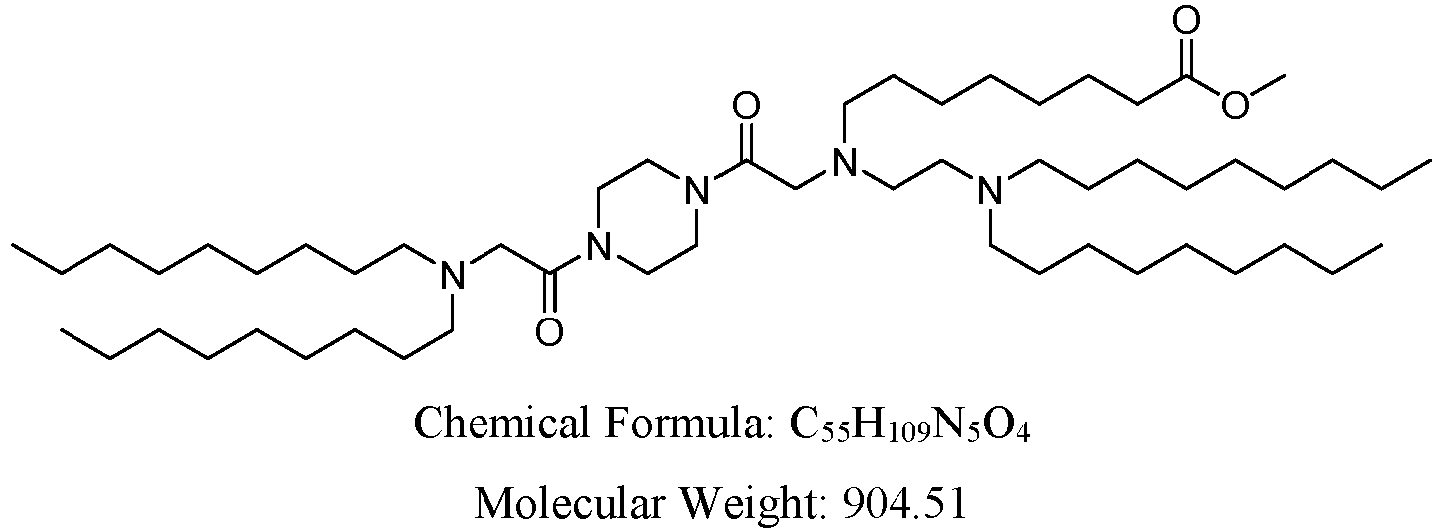
- In the same manner as
Step 11 forCompound 11, methyl 8-((2-(dinonylamino)ethyl)(2-(4-(dinonylglycyl)piperazin-1-yl)-2-oxoethyl)amino)octanoate was synthesized from 2-(dinonylamino)-1-(piperazin-1-yl)ethan-1-one (75 mg, 0.20 mmol), N-(2-(dinonylamino)ethyl)-N-(8-methoxy-8-oxooctyl)glycine (150 mg, 0.28 mmol), iPr2EtN (88 µL, 0.50 mmol) and T3P (50% EtOAc solution, 409 µL, 0.69 mmol). Yield (80 mg, 39%). UPLC/ELSD: RT = 2.87 min. MS (ES): m/z (MH+) 905 for C33H109N5O4 - 1H-NMR (300 MHz, CDCl3) δ: ppm 3.81-2.21 (br. m, 31H); 1.89-1.05 (br. m, 66H); 0.90 (t, 12H).
-
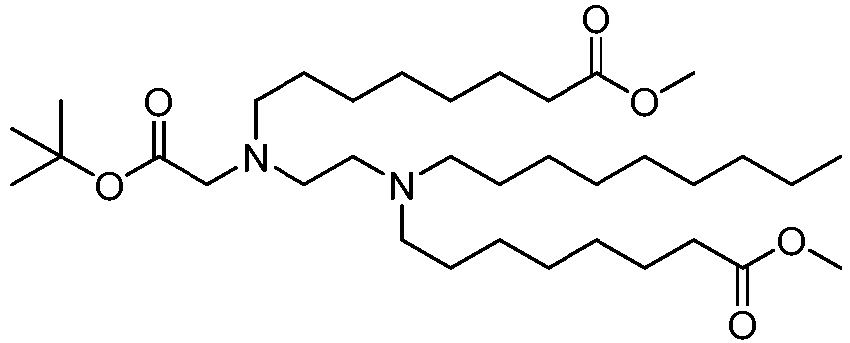
- In the same manner as
Step 4 forCompound 46, methyl 8-((2-(tert-butoxy)-2-oxoethyl)(2-((8-methoxy-8-oxooctyl)(nonyl)amino)ethyl)amino)octanoate was synthesized from methyl 8-((2-(tert-butoxy)-2-oxoethyl)amino)octanoate (65 mg, 0.23 mmol), methyl 8-((2-chloroethyl)(nonyl)amino)octanoate (86 mg, 0.24 mmol), K2CO3 (69 mg, 0.50 mmol), and KI (4 mg, 0.02 mmol) in MeCN (4 mL). Yield (60 mg, 43%). - UPLC/ELSD: RT = 2.42 min. MS (ES): m/z (MH+) 614 for C35H68N2O6
1H-NMR (300 MHz, CDCl3) δ: ppm 3.66 (s, 6H); 3.25 (s, 2H); 2.66 (m, 2H); 2.54 (m, 4H); 2.38 (m, 4H); 2.28 (t, 4H); 1.61 (m, 4H); 1.54-1.10 (br. m, 39H); 0.87 (t, 3H). -

- In the same manner as
Step 5 forCompound 46, N-(8-methoxy-8-oxooctyl)-N-(2-((8-methoxy-8-oxooctyl)(nonyl)amino)ethyl)glycine was synthesized from methyl 8-((2-( tert-butoxy)-2-oxoethyl)(2-((8-methoxy-8-oxooctyl)(nonyl)amino)ethyl)amino)octanoate (60 mg, 0.10 mmol), and TFA (0.37 mL, 4.9 mmol) in DCM (1 mL). Yield (54 mg, 99%). - 1H-NMR (300 MHz, CDCl3) δ: ppm 3.60 (s, 6H); 3.15 (s, 2H); 2.72 (br. m, 8H); 2.50 (t, 2H); 2.22 (t, 4H); 1.70-1.05 (br. m, 34H); 0.81 (t, 3H).
-
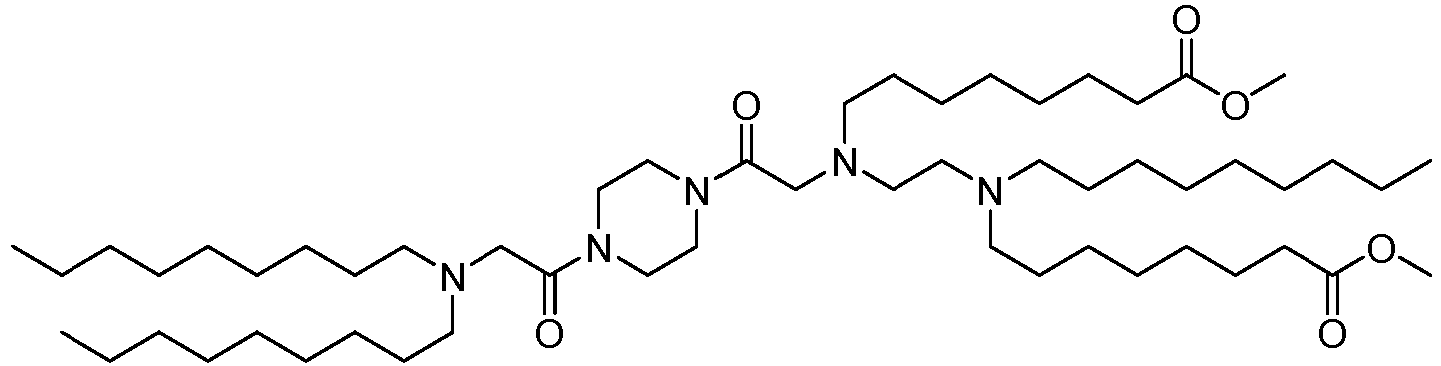
- In the same manner as
Step 11 forCompound 11, methyl 8-((2-(4-(dinonylglycyl)piperazin-1-yl)-2-oxoethyl)(2-((8-methoxy-8-oxooctyl)(nonyl)amino)ethyl)amino)octanoate was synthesized from 2-(dinonylamino)-1-(piperazin-1-yl)ethan-1-one (26 mg, 0.07 mmol), N-(8-methoxy-8-oxooctyl)-N-(2-((8-methoxy-8-oxooctyl)(nonyl)amino)ethyl)glycine (54 mg, 0.10 mmol), iPr2EtN (30 µL, 0.17 mmol) and T3P (50% EtOAc solution, 140 µL, 0.24 mmol). Yield (20 mg, 27%). - UPLC/ELSD: RT = 2.56 min. MS (ES): m/z (MH+) 935 for C33H107N3O6
1H-NMR (300 MHz, CDCl3) δ: ppm 3.70-3.00 (br. m, 18H); 2.55-2.05 (br. m, 18H); 1.70-0.95 (br. m, 62H); 0.76 (t, 9H). -

- To a mixture of tert-butyl 4-(2-aminoethyl)piperidine-1-carboxylate (1.50 g, 6.6 mmol) and 1-bromononane (1.36 g, 6.57 mmol) in MeCN (100 mL) was added K2CO3 (1.83 g, 13.1 mmol) and KI (109 mg, 0.66 mmol) and the mixture was allowed to stir at 82 °C for 12 hours. The suspension was cooled to RT, filtered over a pad of celite rinsing with hexanes, and concentrated in vacuo. Purification by ISCO silica flash chromatography (0-100% DCM/[
DCM 20% MeOH 1% NH4OH]) provided tert-butyl 4-(2-(dinonylamino)ethyl)piperidine-1-carboxylate (602 mg, 19%). - UPLC/ELSD: RT = 2.41 min. MS (ES): m/z (MH+) 482 for C30H60N2O2
1H-NMR (300 MHz, CDCl3) δ: ppm 4.20-2.26 (br. m, 10H); 1.77-1.10 (br. m, 44H); 0.91 (t, 6H). -

- In the same manner as
Step 4 forCompound 11, N-nonyl-N-(2-(piperidin-4-yl)ethyl)nonan-1-amine was synthesized from tert-butyl 4-(2-(dinonylamino)ethyl)piperidine-1-carboxylate (602 mg, 1.25 mmol) and TFA (4.8 mL, 63 mmol) in DCM (5 mL). Yield (406 mg, 85%). - UPLC/ELSD: RT = 1.27 min. MS (ES): m/z (MH+) 382 for C25H52N2
1H-NMR (300 MHz, CDCl3) δ: ppm 3.15 (br. m, 2H); 2.65 (br. m, 2H); 2.42 (br. m, 6H); 1.83-1.04 (br. m, 35H); 0.90 (t, 6H). -

- In the same manner as
Step 11 forCompound 11,2-((2-(dinonylamino)ethyl)(nonyl)amino)-1-(4-(2-(dinonylamino)ethyl)piperidin-1-yl)ethan-1-one was synthesized from N-nonyl-N-(2-(piperidin-4-yl)ethyl)nonan-1-amine (200 mg, 0.53 mmol), N-(2-(dinonylamino)ethyl)-N-nonylglycine (287 mg, 0.58 mmol), iPr2EtN (201 µL, 1.2 mmol), and T3P (50% EtOAc solution, 938 µL, 1.6 mmol) in THF (10 mL). Yield (90 mg, 20%). UPLC/ELSD: RT = 3.26 min. MS (ES): m/z (MH+) 860 for C56H114N4O - 1H-NMR (300 MHz, CDCl3) δ: ppm 4.62-4.09 (br. m, 2H); 3.55-2.21 (br. m, 20H); 1.94-1.00 (br. m, 77H); 0.91 (t, 15H).
-

- In the same manner as
Step 1 forCompound 49, tert-butyl 4-(2-(nonylamino)ethyl)piperidine-1-carboxylate was synthesized from tert-butyl 4-(2-aminoethyl)piperidine-1-carboxylate (1.50 g, 6.6 mmol), 1-bromononane (1.36 g, 6.57 mmol), K2CO3 (1.83 g, 13.1 mmol), and KI (109 mg, 0.66 mmol) in MeCN (100 mL). Yield (288 mg, 13%). - UPLC/ELSD: RT = 1.23 min. MS (ES): m/z (MH+) 356 for C21H42N2O2
1H-NMR (300 MHz, CDCl3) δ: ppm 4.08 (br. m, 2H); 2.67 (br. m, 6H); 1.80-0.98 (br. m, 30H); 0.90 (t, 3H). -

- To a mixture of tert-butyl 4-(2-(nonylamino)ethyl)piperidine-1-carboxylate (288 mg, 0.81 mmol) and N-(2-chloroethyl)-N-nonylnonan-1-amine (297 mg, 0.89 mmol) in MeCN (20 mL) was added K2CO3 (249 mg, 1.79 mmol), and KI (13 mg, 0.08 mmol) and the mixture was allowed to stir at 82 °C for 12 hours. The suspension was cooled to RT and filtered over a pad of celite rinsing with hexanes, and concentrated. Purification by ISCO silica flash chromatography (0-100% DCM/[
DCM 20% MeOH 1% NH4OH]) provided tert-butyl 4-(2-((2-(dinonylamino)ethyl)(nonyl)amino)ethyl)piperidine-1-carboxylate (216 mg, 41%) UPLC/ELSD: RT = 2.72 min. MS (ES): m/z (MH+) 651 for C41H83N3O2 - 1H-NMR (300 MHz, CDCl3) δ: ppm 4.08 (br, 2H); 2.83-2.29 (br. m, 14H); 1.75-1.00 (br. m, 58H); 0.90 (t, 9H).
-
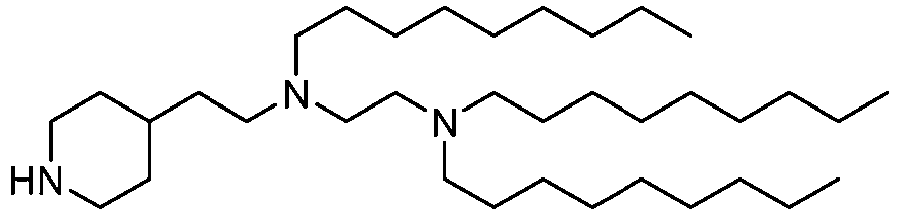
- In the same manner as
Step 6 forCompound 44, N 1,N 1 ,N 2-trinonyl-N2 -(2-(piperidin-4-yl)ethyl)ethane-1,2-diamine was synthesized from tert-butyl 4-(2-((2-(dinonylamino)ethyl)(nonyl)amino)ethyl)piperidine-1-carboxylate (216 mg, 0.33 mmol) and TFA (1.27 mL, 16.6 mmol) in DCM (2 mL). Yield (178 mg, 97%). - UPLC/ELSD: RT = 1.84 min. MS (ES): m/z (MH+) 551 for C36H75N3
1H-NMR (300 MHz, CDCl3) δ: ppm 3.08 (br. m, 2H); 2.70-2.25 (br. m, 14H); 2.0(br, 1H); 1.80-1.02 (br. m, 49H); 0.90 (t, 9H). -

- In the same manner as
Step 7 forCompound 44, 2-(dinonylamino)-1-(4-(2-((2-(dinonylamino)ethyl)(nonyl)amino)ethyl)piperidin-1-yl)ethan-1-one was synthesized from dinonylglycine (96 mg, 0.29 mmol), N 1,N 1,N 2-trinonyl-N 2-(2-(piperidin-4-yl)ethyl)ethane-1,2-diamine (178 mg, 0.32 mmol), iPr2EtN (112 µL, 0.65 mmol), and T3P (50% EtOAc solution, 525 µL, 0.88 mmol) in THF (6 mL). Yield (121 mg, 48%). - UPLC/ELSD: RT = 2.96 min. MS (ES): m/z (MH+) 860 for C56H114N4O
1H-NMR (300 MHz, CDCl3) δ: ppm 4.63-4.08 (br. m, 4H); 3.34-2.25 (br. m, 18H); 1.90-1.01 (br. m, 77H); 0.91 (t, 15H). -

- In the same manner as
Step 1 fromCompound 11, methyl 3-(ditetradecylamino)propanoate was synthesized from glycine methyl ester hydrochloride (564 mg, 4.49 mmol), tetradecanal (2.1 g, 9.89 mmol), sodium triacetoxyborohydride (2.1 g, 9.89 mmol), acetic acid (0.6 mL, 9.89 mmol), trimethylamine (0.93 mL, 6.74 mmol), in DCE (22 mL). Yield (1.93 g, 89%). - 1H-NMR (300 MHz, CDCl3) δ: ppm 3.72 (s, 3H); 3.34 (s, 2H); 1.56 (t, 4H); 1.60-1.03 (br. m, 48H); 0.91 (t, 6H).
-

- In the same manner as
Step 2 fromCompound 11, lithium ditetradecylglycinate was synthesized from methyl ditetradecylglycinate (1.93 g, 4.0 mmol) and 1M LiOH (20 mL, 20 mmol) in THF (20 mL). Yield (1.81 g, 97%). - 1H-NMR (300 MHz, CDCl3) δ: ppm 3.17 (s, 2H); 2.64 (t, 4H); 1.52 (br. m, 4H); 1.31 (br. m, 44H); 0.93 (t, 6H).
-

- In the same manner as
Step 7 forCompound 44, 2-((2-(dinonylamino)ethyl)(nonyl)amino)-1-(4-(ditetradecylglycyl)piperazin-1-yl)ethan-1-one was synthesized from lithium ditetradecylglycinate (126 mg, 0.26 mmol), 2-((2-(dinonylamino)ethyl)(nonyl)amino)-1-(piperazin-1-yl)ethan-1-one (134 mg, 0.24 mmol), iPr2EtN (91 µL, 0.52 mmol), and T3P (50% EtOAc solution, 424 µL, 0.71 mmol) in THF (4 mL) - UPLC/ELSD: RT = 3.64 min. MS (ES): m/z (MH+) 1016 for C63H131N3O2
1H-NMR (300 MHz, CDCl3) δ: ppm 3.84-2.34 (br. m, 26H); 1.88-0.99 (br. m, 90H); 0.90 (t, 15H). -

- To a mixture of methyl 3-aminopropanoate hydrochloride (2.0 g, 14 mmol) and 1-bromononane (2.7 mL, 14 mmol) in MeCN (100 mL) was added K2CO3 (4.0 g, 29 mmol) and KI (238 mg, 1.4 mmol) and the mixture was allowed to stir at 82 °C for 12 hours. The suspension was cooled to RT and filtered over a pad of celite washing with hexanes, and concentrated in vacuo. Purification by ISCO silica flash chromatography (0-10% MeOH/DCM) provided methyl 3-(dinonylamino)propanoate (663 mg, 13%).
- 1H-NMR(300 MHz, CDCl3) δ: ppm 3.69 (s, 3H); 2.80 (t, 2H); 2.41 (br. m, 6H); 1.70-1.10 (br. m, 28H); 0.90(t, 6H).
-
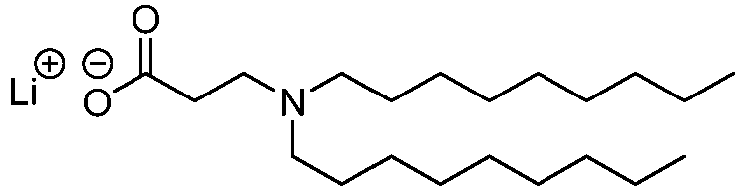
- In the same manner as
Step 2 fromCompound 11, lithium 3-(dinonylamino)propanoate was synthesized from methyl 3-(dinonylamino)propanoate (663 mg, 1.86 mmol) and 1M LiOH (9.32 mL, 9.32 mmol) in THF (10 mL). Yield (636 mg, 99%). - 1H-NMR (300 MHz, CDCl3) δ: ppm 2.94-1.65 (br. m, 8H); 1.65-1.04 (br. m, 28H); 0.90 (t, 6H). tert-Butyl 4-(3-(dinonylamino)propanoyl)piperazine-1-carboxylate

- In the same manner as
Step 3 forCompound 11, tert-butyl 4-(3-(dinonylamino)propanoyl)piperazine-1-carboxylate was synthesized from lithium 3-(dinonylamino)propanoate (636 mg, 1.83 mmol), 1-boc-piperazine (388 mg, 2.08 mmol), iPr2EtN (726 µL, 4.17 mmol), and T3P (50% EtOAc solution, 3.4 mL, 5.68 mmol) in THF (20 mL). Yield (839 mg, 87%). - UPLC/ELSD: RT = 2.26 min. MS (ES): m/z (MH+) 511 for C30H59N3O3
1H-NMR (300 MHz, CDCl3) δ: ppm 3.71-2.21 (br. m, 16H); 1.92-0.98 (br. m, 37H); 0.90 (t, 6H). -

- In the same manner as
Step 4 forCompound 11, 3-(dinonylamino)-1-(piperazin-1-yl)propan-1-one was synthesized from tert-butyl 4-(3-(dinonylamino)propanoyl)piperazine-1-carboxylate (839 mg, 1.65 mmol), and TFA (6.3 mL, 83 mmol) in DCM (7 mL). Yield (501 mg, 74%). - UPLC/ELSD: RT = 1.19 min. MS (ES): m/z (MH+) 411 for C25H51N3O
1H-NMR (300 MHz, CDCl3) δ: ppm 3.61 (t, 2H); 3.47 (t, 2H); 2.86 (br. m, 6H); 2.46 (br. m, 6H); 1.80 (br, 1H); 1.56-1.08 (br. m, 28H); 0.90 (t, 6H). -
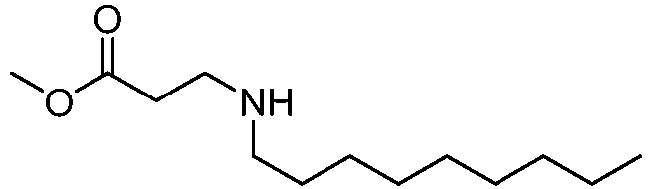
- In the same manner as
Step 1 forCompound 52, methyl 3-(nonylamino)propanoate was synthesized from methyl 3-aminopropanoate hydrochloride (2.0 g, 14 mmol), 1-bromononane (2.7 mL, 14 mmol), K2CO3 (4.0 g, 29 mmol) and KI (238 mg, 1.4 mmol) in MeCN (100 mL). Yield (300 mg, 9%) - 1H-NMR (300 MHz, CDCl3) δ: ppm 3.70 (s, 3H); 2.91 (t, 2H); 2.60 (br. m, 4H); 1.90 (br, 1H); 1.58-1.02 (br. m, 14H); 0.90 (t, 3H).
-

- In the same manner as
Step 9 fromCompound 10, methyl 3-((2-(dinonylamino)ethyl)(nonyl)amino)propanoate was synthesized from methyl 3-(nonylamino)propanoate (300 mg, 1.31 mmol), N-(2-chloroethyl)-N-nonylnonan-1-amine (478 mg, 1.44 mmol), K2CO3 (400 mg, 2.88 mmol), and KI (22 mg, 0.13 mmol) in MeCN (20 mL). Yield (348 mg, 51%). - UPLC/ELSD: RT = 2.66 min. MS (ES): m/z (MH+) 526 for C33H68N2O2
1H-NMR (300 MHz, CDCl3) δ: ppm 3.69 (s, 3H); 2.82 (t, 2H); 2.44 (br. m, 12H); 1.85-1.05 (br. m, 42H); 0.90 (t, 9H). -

- In the same manner as
Step 10 fromCompound 10, 3-((2-(dinonylamino)ethyl)(nonyl)amino)propanoic acid was synthesized from methyl 3-((2-(dinonylamino)ethyl)(nonyl)amino)propanoate (348 mg, 0.66 mmol) and 1M LiOH (3.3 mL, 3.3 mmol) in THF (3.3 mL). Yield (338 mg, 99%). - UPLC/ELSD: RT = 2.29 min. MS (ES): m/z (MH+) 512 for C32H66N2O2
-

- In the same manner as
Step 11 forCompound 11,3-(dinonylamino)-1-(4-(3-((2-(dinonylamino)ethyl)(nonyl)amino)propanoyl)piperazin-1-yl)propan-1-onewas synthesized from 3-(dinonylamino)-1-(piperazin-1-yl)propan-1-one (298 mg, 0.73 mmol), 3-((2-(dinonylamino)ethyl)(nonyl)amino)propanoic acid (338 mg, 0.68 mmol), iPr2EtN (254 µL, 1.46 mmol), and T3P (50% EtOAc solution, 1.18 mL, 1.98 mmol) in THF (10 mL). Yield (218 mg, 37%). - UPLC/ELSD: RT = 2.89 min. MS (ES): m/z (MH+) 903 for C57H115N5O2
1H-NMR (300 MHz, CDCl3) δ: ppm 3.65 (br. m, 4H); 3.50 (br. m, 4H); 2.82 (br. m, 4H); 2.66-2.30 (br. m, 18H); 1.61-1.02 (br. m, 70H); 0.90 (t, 15H). -
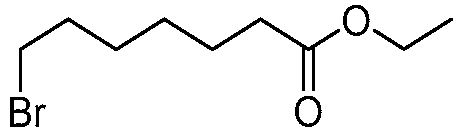
- In the same manner as
Step 1 forCompound 15, ethyl 7-bromoheptanoate was synthesized from 7-bromoheptanoic acid (1.0 g, 4.8 mmol), ethanol (5.6 mL, 96 mmol), and H2SO4 (0.25 mL, 4.8 mmol) in THF (6 mL). Yield (911 mg, 80%). - 1H-NMR (300 MHz, CDCl3) δ: ppm 4.15 (q, 2H); 3.42 (t, 2H); 2.33 (t, 2H); 1.87 (m, 2H); 1.66 (m, 2H); 1.57-1.14 (br. m, 7H).
-

- In the same manner as
Step 3 forCompound 44, ethyl 7-((2-(tert-butoxy)-2-oxoethyl)(nonyl)amino)heptanoate was synthesized from tert-butyl nonylglycinate (250 mg, 0.97 mmol), ethyl 7-bromoheptanoate (253 mg, 1.07 mmol), K2CO3 (270 mg, 1.94 mmol), and KI (16 mg, 0.10 mmol) in MeCN (10 mL). Yield (298 mg, 74%). - UPLC/ELSD: RT = 1.60 min. MS (ES): m/z (MH+) 414.68 for C24H47NO4
1H-NMR (300 MHz, CDCl3) δ: ppm 4.14 (q, 2H); 3.23 (s, 2H); 2.57 (t, 4H); 2.31 (t, 2H); 1.74-1.12 (br. m, 34H); 0.90 (t, 3H). -
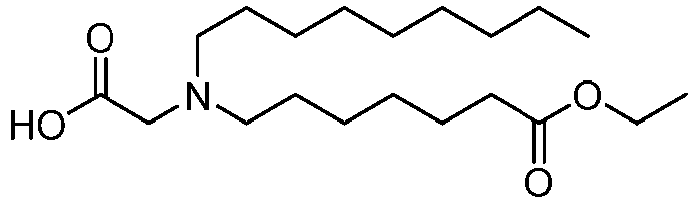
- In the same manner as
Step 4 forCompound 44, N-(7-ethoxy-7-oxoheptyl)-N-nonylglycine was synthesized from ethyl 7-((2-(tert-butoxy)-2-oxoethyl)(nonyl)amino)heptanoate (298 mg, 0.72 mmol), and TFA (2.8 mL, 36 mmol) in DCM (3 mL). Yield (244 mg, 95%). - UPLC/ELSD: RT = 1.07 min. MS (ES): m/z (MH+) 358.50 for C20H39NO4
1H-NMR (300 MHz, CDCl3) δ: ppm 4.15 (q, 2H); 3.46 (br, 2H); 3.01 (br, 4H); 2.31 (t, 2H); 1.86-1.10 (br. m, 25H); 0.91 (t, 3H). -

- In the same manner as
Step 7 forCompound 44, ethyl 7-((2-(4-(N-(2-(dinonylamino)ethyl)-N-nonylglycyl)piperazin-1-yl)-2-oxoethyl)(nonyl)amino)heptanoate was synthesized from N-(7-ethoxy-7-oxoheptyl)-N-nonylglycine (111 mg, 0.31 mmol), 2-((2-(dinonylamino)ethyl)(nonyl)amino)-1-(piperazin-1-yl)ethan-1-one (160 mg, 0.28 mmol), iPr2EtN (109 µL, 0.62 mmol), and T3P (50% EtOAc solution, 0.51 mL, 0.81 mmol) in THF (10 mL). Yield (70 mg, 27%). - UPLC/ELSD: RT = 2.88 min. MS (ES): m/z (MH+) 905.33 for C33H109N5O4
1H-NMR (300 MHz, CDCl3) δ: ppm 4.00 (q, 2H); 3.65-3.34 (br. m, 8H); 3.19 (s, 2H); 3.13 (s, 2H); 2.50-2.10 (br. m, 16H); 1.65-0.90 (br. m, 67H); 0.75 (t, 12H). -

- In the same manner as
Step 1 forCompound 15, propyl 6-bromohexanoate was synthesized from 6-bromohexanoic acid (1.0 g, 5.1 mmol), 1-propanol (1.5 g, 26 mmol), and H2SO4 (0.27 mL, 5.1 mmol) in THF (5 mL). Yield (1.14 g, 94%). - 1H-NMR (300 MHz, CDCl3) δ: ppm 4.05 (t, 2H); 3.43 (t, 2H); 2.34 (t, 2H); 1.90 (m, 2H); 1.68 (m, 4H); 1.50 (m, 2H); 0.96 (t, 3H).
-
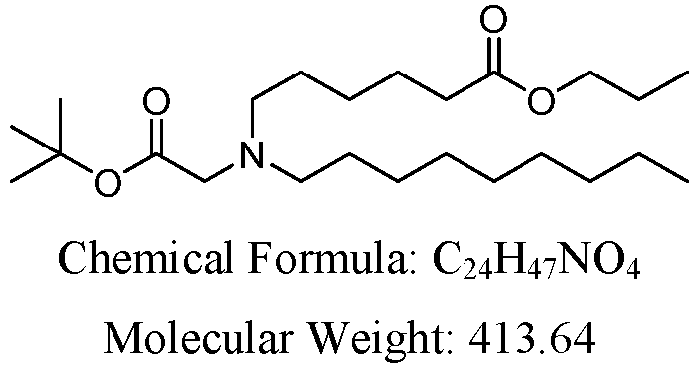
- In the same manner as
Step 3 forCompound 44, propyl 6-((2-(tert-butoxy)-2-oxoethyl)(nonyl)amino)hexanoate was synthesized from tert-butyl nonylglycinate (250 mg, 0.97 mmol), propyl 6-bromohexanoate (253 mg, 1.07 mmol), K2CO3 (270 mg, 1.94 mmol), and KI (16 mg, 0.10 mmol) in MeCN (10 mL). Yield (258 mg, 64%). - UPLC/ELSD: RT = 1.62 min. MS (ES): m/z (MH+) 414.59 for C24H47NO4
1H-NMR (300 MHz, CDCl3) δ: ppm 4.05 (t, 2H); 3.23 (s, 2H); 2.58 (br. m, 4H); 2.33 (t, 2H); 1.75-1.15 (br. m, 31H); 0.91 (m, 6H). -

- In the same manner as
Step 4 forCompound 44, N-nonyl-N-(6-oxo-6-propoxyhexyl)glycine was synthesized from propyl 6-((2-(tert-butoxy)-2-oxoethyl)(nonyl)amino)hexanoate (258 mg, 0.62 mmol), and TFA (2.4 mL, 31 mmol) in DCM (3 mL). Yield (223 mg, 99%). - UPLC/ELSD: RT = 1.13 min. MS (ES): m/z (MH+) 358.50 for C20H39NO4
1H-NMR (300 MHz, CDCl3) δ: ppm 4.09 (t, 2H); 3.34 (s, 2H); 2.87 (br. m, 4H); 2.36 (t, 2H); 1.77-1.10 (br. m, 22H); 0.92 (m, 6H). -

- In the same manner as
Step 7 forCompound 44, propyl 6-((2-(4-(N-(2-(dinonylamino)ethyl)-N-nonylglycyl)piperazin-1-yl)-2-oxoethyl)(nonyl)amino)hexanoate was synthesized from N-nonyl-N-(6-oxo-6-propoxyhexyl)glycine (111 mg, 0.31 mmol), 2-((2-(dinonylamino)ethyl)(nonyl)amino)-1-(piperazin-1-yl)ethan-1-one (160 mg, 0.28 mmol), iPr2EtN (109 µL, 0.62 mmol), and T3P (50% EtOAc solution, 0.51 mL, 0.81 mmol) in THF (10 mL). Yield (72 mg, 28%). - UPLC/ELSD: RT = 2.91 min. MS (ES): m/z (MH+) 905.33 for C33H109N5O4
1H-NMR (300 MHz, CDCl3) δ: ppm 4.09 (t, 2H); 3.78-3.46 (br. m, 8H); 3.34 (s, 2H); 3.28 (s, 2H); 2.68-2.24 (br. m, 16H); 1.85-1.10 (br. m, 64H); 0.92 (m, 15H). -

- In the same manner as
Step 1 forCompound 15, butyl 5-bromopentanoate was synthesized from 5-bromopentanoic acid (1.47 g, 8.1 mmol), 1-butanol (0.50 g, 6.8 mmol), and H2SO4 (0.36 mL, 6.8 mmol) in THF (7 mL). Yield (1.42 g, 0.89%). - 1H-NMR (300 MHz, CDCl3) δ: ppm 4.10 (t, 2H); 4.34 (t, 2H); 2.36 (t, 2H); 1.93 (m, 2H); 1.80 (m, 2H); 1.62 (m, 2H); 1.40 (m, 2H); 0.96 (t, 3H).
-

- In the same manner as
Step 3 forCompound 44, butyl 5-((2-(tert-butoxy)-2-oxoethyl)(nonyl)amino)pentanoate was synthesized from tert-butyl nonylglycinate (250 mg, 0.97 mmol), butyl 5-bromopentanoate (253 mg, 1.07 mmol), K2CO3 (270 mg, 1.94 mmol), and KI (16 mg, 0.10 mmol) in MeCN (10 mL). Yield (284 mg, 71%). - UPLC/ELSD: RT = 1.67 min. MS (ES): m/z (MH+) 414.59 for C24H47NO4
1H-NMR (300 MHz, CDCl3) δ: ppm 4.09 (t, 2H); 3.23 (s, 2H); 2.58 (m, 4H); 2.34 (t, 2H); 1.74-1.20 (br. m, 31H); 0.93 (m, 6H). -

- In the same manner as
Step 4 forCompound 44, N-(5-butoxy-5-oxopentyl)-N-nonylglycine was synthesized from butyl 5-((2-(tert-butoxy)-2-oxoethyl)(nonyl)amino)pentanoate (284 mg, 0.69 mmol), and TFA (2.6 mL, 34 mmol) in DCM (3 mL). Yield (245 mg, 99%). - UPLC/ELSD: RT= 1.09 min. MS (ES): m/z (MH+) 358.50 for C20H39NO4
1H-NMR (300 MHz, CDCl3) δ: ppm 4.05 (t, 2H); 3.48 (s, 2H); 3.03 (br. m, 4H); 2.34 (t, 2H); 1.85-1.15 (br. m, 22H); 0.93 (m, 6H). -

- In the same manner as
Step 7 forCompound 44, butyl 5-((2-(4-(N-(2-(dinonylamino)ethyl)-N-nonylglycyl)piperazin-1-yl)-2-oxoethyl)(nonyl)amino)pentanoate was synthesized from N-(5-butoxy-5-oxopentyl)-N-nonylglycine (111 mg, 0.31 mmol), 2-((2-(dinonylamino)ethyl)(nonyl)amino)-1-(piperazin-1-yl)ethan-1-one (160 mg, 0.28 mmol), iPr2EtN (109 µL, 0.62 mmol), and T3P (50% EtOAc solution, 0.51 mL, 0.81 mmol) in THF (10 mL). Yield (92 mg, 36%). - UPLC/ELSD: RT = 2.88 min. MS (ES): m/z (MH+) 905.33 for C33H109N5O4
1H-NMR (300 MHz, CDCl3) δ: ppm 3.90 (t, 2H); 3.65-3.35 (br. m, 8H); 3.19 (s, 2H); 3.13 (t, 2H); 2.52-2.06 (br. m, 16H); 1.65-0.95 (br. m, 64H); 0.77 (m, 15H). -
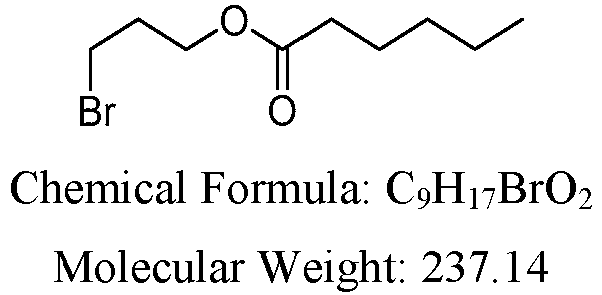
- In the same manner as
Step 1 forCompound 15, 3-bromopropyl hexanoate was synthesized from 3-bromopropan-1-ol (0.87 mL, 9.6 mmol), hexanoic acid (1.0 mL, 8.0 mmol), and H2SO4 (1.0 mL, 8.0 mmol) in THF (10 mL). Yield (823 mg, 44%). - 1H-NMR (300 MHz, CDCl3) δ: ppm 4.23 (t, 2H); 3.49 (t, 2H), 2.33 (t, 2H); 2.20 (m, 2H); 1.65 (m, 2H); 1.34 (m, 4H), 0.91 (t, 3H).
-
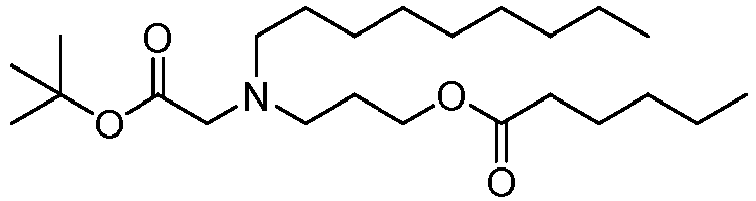
- In the same manner as
Step 3 forCompound 44, 3-((2-(tert-butoxy)-2-oxoethyl)(nonyl)amino)propyl hexanoate was synthesized from tert-butyl nonylglycinate (250 mg, 0.97 mmol), 3-bromopropyl hexanoate (253 mg, 1.07 mmol), K2CO3 (270 mg, 1.94 mmol), and KI (16 mg, 0.10 mmol) in MeCN (10 mL). Yield (335 mg, 83%). - UPLC/ELSD: RT = 1.78 min. MS (ES): m/z (MH+) 414.59 for C24H47NO4
1H-NMR (300 MHz, CDCl3) δ: ppm 4.14 (t, 2H); 3.23 (s, 2H); 2.68 (t, 2H); 2.58 (t, 2H); 2.30 (t, 2H); 1.79 (m, 2H); 1.64 (m, 2H); 1.55-1.20 (br. m, 27H); 0.91 (m, 6H). -

- In the same manner as
Step 4 forCompound 44, N-(3-(hexanoyloxy)propyl)-N-nonylglycine was synthesized from 3-((2-(tert-butoxy)-2-oxoethyl)(nonyl)amino)propyl hexanoate (335 mg, 0.81 mmol), and TFA (3.1 mL, 40 mmol) in DCM (4 mL). Yield (284 mg, 98%). - 1H-NMR (300 MHz, CDCl3) δ: ppm 4.11 (t, 2H); 3.17 (s, 2H); 2.68 (br. m, 4H); 2.30 (t, 2H); 1.87 (m, 2H); 1.63 (m, 2H); 1.48 (m, 2H); 1.28 (br. m, 16H); 0.91 (m, 6H).
-

- In the same manner as
Step 7 forCompound 44, 3-((2-(4-(N-(2-(dinonylamino)ethyl)-N-nonylglycyl)piperazin-1-yl)-2-oxoethyl)(nonyl)amino)propyl hexanoate was synthesized from N-(3-(hexanoyloxy)propyl)-N-nonylglycine (111 mg, 0.31 mmol), 2-((2-(dinonylamino)ethyl)(nonyl)amino)-1-(piperazin-1-yl)ethan-1-one (160 mg, 0.28 mmol), iPr2EtN (109 µL, 0.62 mmol), and T3P (50% EtOAc solution, 0.51 mL, 0.81 mmol) in THF (10 mL). Yield (55 mg, 21%). - UPLC/ELSD: RT = 2.94 min. MS (ES): m/z (MH+) 905.25 for C33H109N3O4
1H-NMR (300 MHz, CDCl3) δ: ppm 4.01 (t, 2H); 3.77-3.43 (br. m, 8H), 3.23 (m, 4H); 2.64-2.15 (m, 16H); 1.70 (m, 2H); 1.54 (m, 2H); 1.50-0.96 (br. m, 60H); 0.81 (m, 15H). -
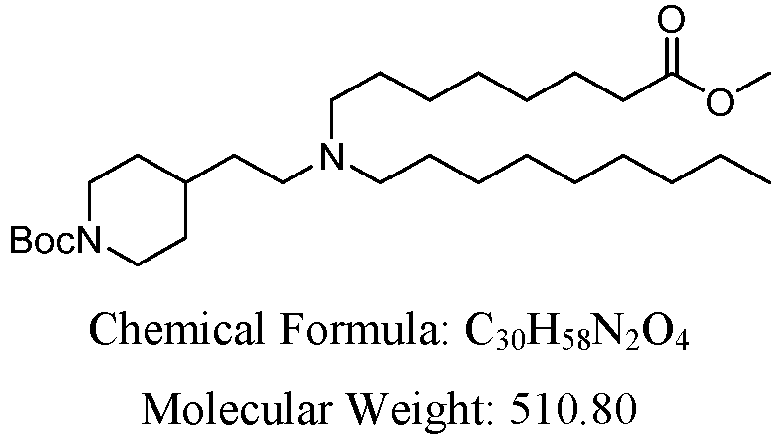
- To a mixture of tert-butyl 4-(2-(nonylamino)ethyl)piperidine-1-carboxylate (239 mg, 0.67 mmol) and methyl 8-bromooctanoate (192 mg, 0.81 mmol) in MeCN (10 mL) was added K2CO3 (188 mg, 1.35 mmol) and KI (11 mg, 0.07 mmol) and the mixture was allowed to stir at 82 °C for 12 hours. The suspension was cooled to RT and filtered over a pad of celite rinsing with EtOAc, and concentrated in vacuo. Purification by ISCO silica flash chromatography (0-80% EtOAc/hexanes) provided tert-butyl 4-(2-((8-methoxy-8-oxooctyl)(nonyl)amino)ethyl)piperidine-1-carboxylate (241 mg, 70%).
- UPLC/ELSD: RT = 1.87 min. MS (ES): m/z (MH+) 512.76 for C30H58N2O4
1H-NMR (300 MHz, CDCl3) δ: ppm 4.07 (br. m, 2H); 3.69 (s, 3H); 2.70 (m, 2H); 2.37 (br. m, 8H); 1.75-1.00 (br. m, 40H); 0.90 (t, 3H). -

- In the same manner as
Step 4 forCompound 11, methyl 8-(nonyl(2-(piperidin-4-yl)ethyl)amino)octanoate was synthesized from tert-butyl 4-(2-((8-methoxy-8-oxooctyl)(nonyl)amino)ethyl)piperidine-1-carboxylate (241 mg, 0.47 mmol), and TFA (1.8 mL, 24 mmol) in DCM (2 mL). Yield (193 mg, 99%). - 1H-NMR (300 MHz, CDCl3) δ: ppm 3.69 (s, 3H); 3.08 (m, 2H); 2.60 (m, 2H); 2.49-2.24 (br. m, 8H); 2.06 (br, 1H); 1.78-1.02 (br. m, 31H); 0.90 (t, 3H).
-

- In the same manner as
Step 11 forCompound 11, methyl 8-((2-(1-(N-(2-(dinonylamino)ethyl)-N-nonylglycyl)piperidin-4-yl)ethyl)(nonyl)amino)octanoate was synthesized from methyl 8-(nonyl(2-(piperidin-4-yl)ethyl)amino)octanoate (141 mg, 0.34 mmol), N-(2-(dinonylamino)ethyl)-N-nonylglycine (188 mg, 0.38 mmol), iPr2EtN (132 µL, 0.76 mmol), and T3P (50% EtOAc solution, 614 µL, 1.03 mmol) in THF (10 mL). Yield (70 mg, 23%). - UPLC/ELSD: RT = 2.97 min. MS (ES): m/z (MH+) 890.24 for C56H112N4O3
1H-NMR (300 MHz, CDCl3) δ: ppm 4.64-4.09 (br. m, 2H); 3.69 (s, 3H); 3.42-2.83 (br. m, 3H); 2.69-2.24 (br. m, 19H); 1.81-0.99 (br. m, 73H); 0.90 (t, 12H). -

- In the same manner as
Step 1 forCompound 57, tert-butyl 4-(2-((7-ethoxy-7-oxoheptyl)(nonyl)amino)ethyl)piperidine-1-carboxylate was synthesized from tert-butyl 4-(2-(nonylamino)ethyl)piperidine-1-carboxylate (239 mg, 0.67 mmol), ethyl 7-bromoheptanoate (192 mg, 0.81 mmol), K2CO3 (188 mg, 1.35 mmol) and KI (11 mg, 0.07 mmol) in MeCN (10 mL). Yield (247 mg, 72%). - UPLC/ELSD: RT = 1.91 min. MS (ES): m/z (MH+) 511.62 for C30H58N2O4
1H-NMR (300 MHz, CDCl3)δ: ppm 4.12 (br. m, 4H); 2.80-2.15 (br. m, 10H); 1.75-1.00 (br. m, 41H); 0.90 (t, 3H). -

- In the same manner as
Step 4 forCompound 11, ethyl 7-(nonyl(2-(piperidin-4-yl)ethyl)amino)heptanoate was synthesized from tert-butyl 4-(2-((7-ethoxy-7-oxoheptyl)(nonyl)amino)ethyl)piperidine-1-carboxylate (247 mg, 0.48 mmol), and TFA (1.9 mL, 24 mmol) in DCM (2 mL). Yield (194 mg, 98%). - 1H-NMR (300 MHz, CDCl3) δ: ppm 4.14 (t, 2H); 3.08 (m, 2H); 2.60 (m, 2H); 2.52-2.24 (br. m, 8H); 2.12 (br, 1H); 1.77-1.05 (br. m, 32H); 0.90 (t, 3H).
-

- In the same manner as
Step 11 forCompound 11, ethyl 7-((2-(1-(N-(2-(dinonylamino)ethyl)-N-nonylglycyl)piperidin-4-yl)ethyl)(nonyl)amino)heptanoate was synthesized from ethyl 7-(nonyl(2-(piperidin-4-yl)ethyl)amino)heptanoate (141 mg, 0.34 mmol), N-(2-(dinonylamino)ethyl)-N-nonylglycine (188 mg, 0.38 mmol), iPr2EtN (132 µL, 0.76 mmol), and T3P (50% EtOAc solution, 614 µL, 1.03 mmol) in THF (10 mL). Yield (42 mg, 14%). UPLC/ELSD: RT = 3.00 min. MS (ES): m/z (MH+) 890.32 for C56H112N4O3 - 1H-NMR (300 MHz, CDCl3)δ: ppm 4.55-3.95 (br. m, 4H); 3.38-2.72 (br. m, 4H); 2.66-2.10 (br. m, 18H); 1.72-0.91 (br. m, 74H); 0.81 (t, 12H).
-

- In the same manner as
Step 1 forCompound 57, tert-butyl 4-(2-(nonyl(6-oxo-6-propoxyhexyl)amino)ethyl)piperidine-1-carboxylate was synthesized from tert-butyl 4-(2-(nonylamino)ethyl)piperidine-1-carboxylate (239 mg, 0.67 mmol), propyl 6-bromohexanoate (192 mg, 0.81 mmol), K2CO3 (188 mg, 1.35 mmol) and KI (11 mg, 0.07 mmol) in MeCN (10 mL). Yield (240 mg, 70%). - UPLC/ELSD: RT = 1.93 min. MS (ES): m/z (MH+) 511.78 for C30H58N2O4
1H-NMR (300 MHz, CDCl3)δ: ppm 4.05 (br. m, 4H); 2.80-2.20 (br. m, 10H); 1.85-1.04 (br. m, 38H); 0.92 (t, 6H). -

- In the same manner as
Step 4 forCompound 11, propyl 6-(nonyl(2-(piperidin-4-yl)ethyl)amino)hexanoate was synthesized from tert-butyl 4-(2-(nonyl(6-oxo-6-propoxyhexyl)amino)ethyl)piperidine-1-carboxylate (240 mg, 0.47 mmol), and TFA (1.8 mL, 23 mmol) in DCM (2 mL). Yield (183 mg, 95%). - 1H-NMR (300 MHz, CDCl3) δ: ppm 4.04 (t, 2H); 3.08 (m, 2H); 2.60 (m, 2H); 2.35 (br. m, 8H); 1.95 (br, 1H); 1.75-1.00 (br. m, 29H); 0.92 (m, 6H).
-

- In the same manner as
Step 11 forCompound 11, propyl6-((2-(1-(N-(2-(dinonylamino)ethyl)-N-nonylglycyl)piperidin-4-yl)ethyl)(nonyl)amino)hexanoate was synthesized from propyl 6-(nonyl(2-(piperidin-4-yl)ethyl)amino)hexanoate (141 mg, 0.34 mmol), N-(2-(dinonylamino)ethyl)-N-nonylgly cine (188 mg, 0.38 mmol), iPr2EtN (132 µL, 0.76 mmol), and T3P (50% EtOAc solution, 614 µL, 1.03 mmol) in THF (10 mL). Yield (67 mg, 22%). - UPLC/ELSD: RT = 3.02 min. MS (ES): m/z (MH+) 890.32 for C56H112N4O3
1H-NMR (300 MHz, CDCl3) δ: ppm 4.65-4.13 (br. m, 2H); 4.05 (t, 2H); 3.50-2.81 (br. m, 4H); 2.69-2.18 (br. m, 18H); 1.98-1.02 (br. m, 71H); 0.92 (br. m, 15H). -

- In the same manner as
Step 1 forCompound 57, tert-butyl 4-(2-((5-butoxy-5-oxopentyl)(nonyl)amino)ethyl)piperidine-1-carboxylate was synthesized from tert-butyl 4-(2-(nonylamino)ethyl)piperidine-1-carboxylate (239 mg, 0.67 mmol), butyl 5-bromopentanoate (192 mg, 0.81 mmol), K2CO3 (188 mg, 1.35 mmol) and KI (11 mg, 0.07 mmol) in MeCN (10 mL). Yield (211 mg, 61%). - UPLC/ELSD: RT = 1.95 min. MS (ES): m/z (MH+) 511.78 for C30H58N2O4
1H-NMR (300 MHz, CDCl3) δ: ppm 4.09 (br. m, 4H); 2.70 (br. m, 2H); 2.38 (br. m, 8H); 1.73-1.02 (br. m, 38H); 0.93 (br. m, 6H). -
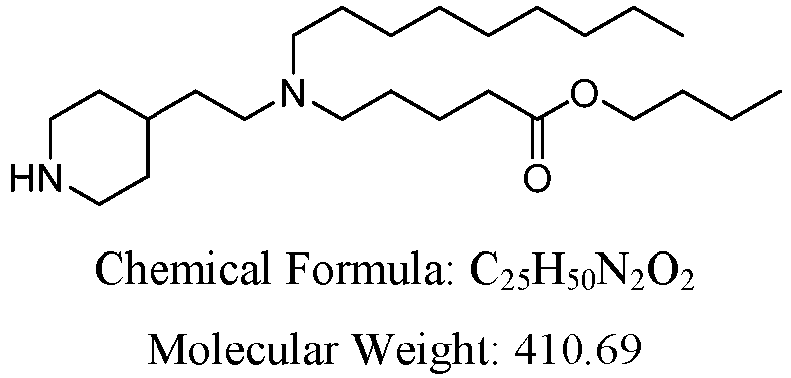
- In the same manner as
Step 4 forCompound 11, butyl 5-(nonyl(2-(piperidin-4-yl)ethyl)amino)pentanoate was synthesized from tert-butyl 4-(2-((5-butoxy-5-oxopentyl)(nonyl)amino)ethyl)piperidine-1-carboxylate (211 mg, 0.41 mmol), and TFA (1.6 mL, 21 mmol) in DCM (2 mL). Yield (169 mg, 99%). - 1H-NMR (300 MHz, CDCl3) δ: ppm 4.09 (t, 2H); 3.07 (m, 2H); 2.60 (m, 2H); 2.37 (br. m, 8H); 1.83 (br, 1H); 1.76-1.04 (br. m, 29H); 0.93 (br. m, 6H).
-

- In the same manner as
Step 11 forCompound 11, butyl 5-((2-(1-(N-(2-(dinonylamino)ethyl)-N-nonylglycyl)piperidin-4-yl)ethyl)(nonyl)amino)pentanoate was synthesized from butyl 5-(nonyl(2-(piperidin-4-yl)ethyl)amino)pentanoate (141 mg, 0.34 mmol), N-(2-(dinonylamino)ethyl)-N-nonylglycine (188 mg, 0.38 mmol), iPr2EtN (132 µL, 0.76 mmol), and T3P (50% EtOAc solution, 614 µL, 1.03 mmol) in THF (10 mL). Yield (46 mg, 15%). UPLC/ELSD: RT = 3.03 min. MS (ES): m/z (MH+) 890.32 for C56H112N4O3 - 1H-NMR (300 MHz, CDCl3) δ: ppm 4.62-4.13 (br. m, 2H); 4.09 (t, 2H); 3.41-2.84 (br. m, 4H); 2.72-2.25 (br. m, 18H); 1.82-1.02 (br. m, 71H); 0.91 (br. m, 15H).
-

- In the same manner as
Step 1 forCompound 57, tert-butyl 4-(2-((3-(hexanoyloxy)propyl)(nonyl)amino)ethyl)piperidine-1-carboxylate was synthesized from tert-butyl 4-(2-(nonylamino)ethyl)piperidine-1-carboxylate (239 mg, 0.67 mmol), 3-bromopropyl hexanoate (192 mg, 0.81 mmol), K2CO3 (188 mg, 1.35 mmol) and KI (11 mg, 0.07 mmol) in MeCN (10 mL). Yield (195 mg, 57%). - UPLC/ELSD: RT = 1.97 min. MS (ES): m/z (MH+) 511.86 for C30H58N2O4
1H-NMR (300 MHz, CDCl3) δ: ppm 4.11 (br. m, 4H); 2.69 (m, 2H); 2.56-2.22 (br. m, 8H); 1.76 (m, 2H); 1.65 (m, 4H); 1.55-1.05 (br. m, 32H); 0.91 (m, 6H). -

- In the same manner as
Step 4 forCompound 11, 3-(nonyl(2-(piperidin-4-yl)ethyl)amino)propyl hexanoate was synthesized from tert-butyl 4-(2-((3-(hexanoyloxy)propyl)(nonyl)amino)ethyl)piperidine-1-carboxylate (195 mg, 0.38 mmol), and TFA (1.5 mL, 19 mmol) in DCM (2 mL). Yield (149 mg, 95%). - 1H-NMR (300 MHz, CDCl3) δ: ppm 4.12 (t, 2H); 3.08 (m, 2H); 2.70-2.22 (br. m, 10H); 2.07 (br, 1H); 1.70 (br. m, 6H); 1.48-1.00 (br. m, 23H); 0.91 (m, 6H).
-

- In the same manner as
Step 11 forCompound 11, 3-((2-(1-(N-(2-(dinonylamino)ethy1)-N-nonylglycyl)piperidin-4-yl)ethyl)(nonyl)amino)propyl hexanoatewas synthesized from 3-(nonyl(2-(piperidin-4-yl)ethyl)amino)propyl hexanoate (141 mg, 0.34 mmol), N-(2-(dinonylarmino)ethyl)-N-nonylglycine (188 mg, 0.38 mmol), iPr2EtN (132 µL, 0.76 mmol), and T3P (50% EtOAc solution, 614 µL, 1.03 mmol) in THF (10 mL). Yield (64 mg, 21%). - UPLC/ELSD: RT = 3.02 min. MS (ES): m/z (MH+) 890.41 for C56H112N4O3
1H-NMR (300 MHz, CDCl3) δ: ppm 4.67 (br. m, 4H); 3.42-2.81 (br. m, 3H); 2.73-2.23 (br. m, 19H); 1.87-1.00 (br. m, 71H); 0.90 (t, 15H). -

- In the same manner as
Step 1 forCompound 44, tert-butyl 3-(nonylamino)propanoate was synthesized from tert-butyl 3-aminopropanoate hydrochloride (2.8 g, 15 mmol), 1-bromononane (3.2 g, 15 mmol), K2CO3 (4.3 g, 31 mmol), and KI (256 mg, 1.54 mmol) in MeCN (200 mL). Yield (1.74 g, 42%). - 1H-NMR (300 MHz, CDCl3) δ: ppm 2.86 (t, 2H); 2.63 (t, 2H); 2.46 (t, 2H); 1.65 (br, 1H); 1.47 (br. m, 11H); 1.29 (br. m, 12H); 0.90 (t, 3H).
-
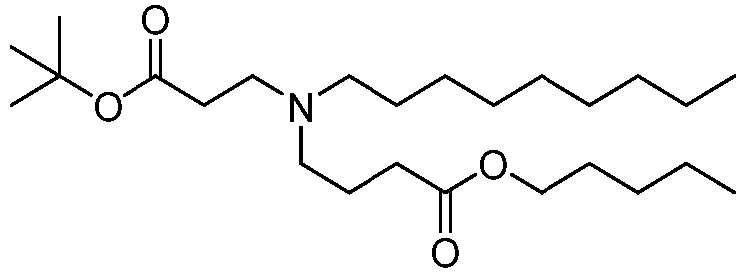
- In the same manner as
Step 3 forCompound 44, pentyl 4-((3-(tert-butoxy)-3-oxopropyl)(nonyl)amino)butanoate was synthesized from tert-butyl 3-(nonylamino)propanoate (750 mg, 2.76 mmol), pentyl 4-bromobutanoate (786 mg, 3.31 mmol), K2CO3 (764 mg, 5.52 mmol), and KI (46 mg, 0.28 mmol) in MeCN (30 mL). Yield (934 mg, 79%). UPLC/ELSD: RT= 1.82 min. MS (ES): m/z (MH+) 428.62 for C25H49NO4 - 1H-NMR (300 MHz, CDC13) δ: ppm 4.08 (t, 2H); 2.74 (t, 2H); 2.50-2.28 (br. m, 8H); 1.76 (m, 2H); 1.64 (m, 2H); 1.50-1.14 (br. m, 27H); 0.91 (m, 6H).
-
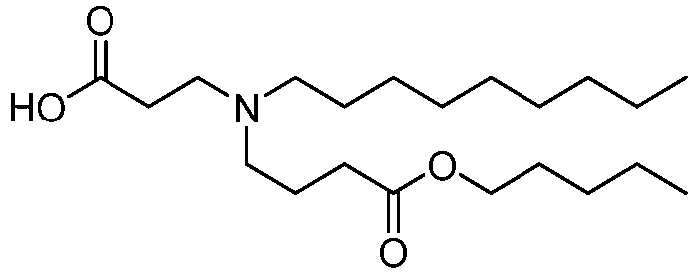
- In the same manner as
Step 4 forCompound 44, 3-(nonyl(4-oxo-4-(pentyloxy)butyl)amino)propanoic acid was synthesized from pentyl 4-((3-(tert-butoxy)-3-oxopropyl)(nonyl)amino)butanoate (934 mg, 2.18 mmol), and TFA (8.4 mL, 109 mmol) in DCM (10 mL). Yield (793 mg, 98%). - UPLC/ELSD: RT= 1.23 min. MS (ES): m/z (MH+) 372.52 for C21H41NO4
1H-NMR (300 MHz, CDC13) δ: ppm 4.10 (t, 2H); 2.88 (t, 2H); 2.70 (br. m, 4H); 2.52 (t, 2H); 2.38 (t, 2H); 1.90 (m, 2H); 1.73-1.49 (br. m, 4H); 1.47-1.17 (br. m, 16H); 0.92 (m, 6H). -
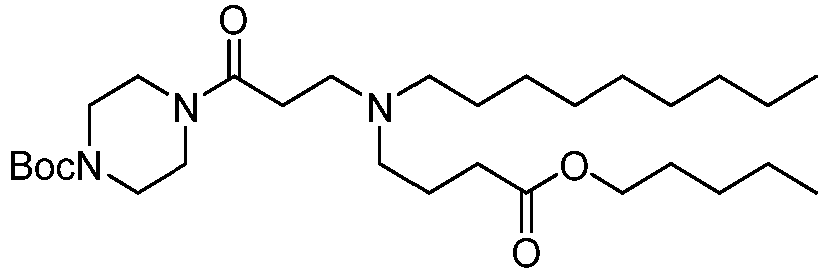
- In the same manner as
Step 3 forCompound 11, tert-butyl 4-(3-(nonyl(4-oxo-4-(pentyloxy)butyl)amino)propanoyl)piperazine-1-carboxylate was synthesized from 3-(nonyl(4-oxo-4-(pentyloxy)butyl)amino)propanoic acid (793 mg, 2.13 mmol), 1-boc-piperazine (477 mg, 2.56 mmol), iPr2EtN (0.82 mL, 4.7 mmol), and T3P (50% EtOAc solution, 3.8 mL, 6.4 mmol). Yield (1.15 g, 99%). - UPLC/ELSD: RT = 1.86 min. MS (ES): m/z (MH+) 540.65 for C30H37N3O5
-

- In the same manner as
Step 4 forCompound 44, pentyl 4-(nonyl(3-oxo-3-(piperazin-1-yl)propyl)amino)butanoate was synthesized from tert-butyl 4-(3-(nonyl(4-oxo-4-(pentyloxy)butyl)amino)propanoyl)piperazine-1-carboxylate (1.15 g, 2.13 mmol), and TFA (8.2 mL, 106 mmol) in DCM (10 mL). Yield (901 mg, 96%). - UPLC/ELSD: RT = 0.75 min. MS (ES): m/z (MH+) 440.47 for C25H49N3O4
1H-NMR (300 MHz, CDCl3) δ: ppm 4.08 (t, 2H); 3.70-3.40 (br. m, 4H); 2.88 (br. m, 6H); 2.57 (br. m, 6H); 2.36 (t, 2H); 1.83 (m, 2H); 1.64 (m, 2H); 1.49 (m, 2H); 1.41-1.18 (br. m, 17H); 0.91 (m, 6H). -

- In the same manner as
Step 4 forCompound 46, tert-butyl 3-((2-(dinonylamino)ethyl)(nonyl)amino)propanoate was synthesized from tert-butyl 3-(nonylamino)propanoate (1.13 mg, 4.14 mol), N-(2-chloroethyl)-N-nonylnonan-1-amine (1.65 g, 4.97 mmol), K2CO3 (1.15 g, 8.33 mmol), and KI (138 mg, 0.83 mmol) in MeCN (100 mL). Yield (1.41 g, 60%). - UPLC/ELSD: RT = 2.90 min. MS (ES): m/z (MH+) 567.79 for C36H74N2O2 1H-NMR (300 MHz, CDCl3) δ: ppm 2.78 (t, 2H); 2.69-2.29 (br. m, 12H); 1.55-1.15 (br. m, 51H); 0.90 (t, 9H).
-

- In the same manner as
Step 4 forCompound 44, 3-((2-(dinonylamino)ethyl)(nonyl)amino)propanoic acid was synthesized from tert-butyl 3-((2-(dinonylamino)ethyl)(nonyl)amino)propanoate (1.41 g, 2.49 mmol), and TFA (9.6 mL, 124 mmol) in DCM (10 mL). Yield (924 mg, 73%). - UPLC/ELSD: RT = 2.26 min. MS (ES): m/z (MH+) 511.78 for C32H66N2O2
1H-NMR (300 MHz, CDCl3) δ: ppm 2.76 (br. m, 6H); 2.61 (br. m, 6H); 2.47 (t, 2H); 1.52 (br. m, 6H); 1.40-1.10 (br. m, 36H); 0.90 (t, 9H). -

- In the same manner as
Step 11 forCompound 11, pentyl 4-((3-(4-(3-((2-(dinonylamino)ethyl)(nonyl)amino)propanoyl)piperazin-1-yl)-3-oxopropyl)(nonyl)amino)butanoate was synthesized from pentyl 4-(nonyl(3-oxo-3-(piperazin-1-yl)propyl)amino)butanoate (268 mg, 0.61 mmol), 3-((2-(dinonylamino)ethyl)(nonyl)amino)propanoic acid (343 mg, 0.67 mmol), iPr2EtN (234 µL, 1.34 mmol), and T3P (50% EtOAc solution, 1.09 mL, 1.83 mmol) in THF (20 mL). Yield (243 mg, 43%). - UPLC/ELSD: RT= 2.26 min. MS (ES): m/z (MH+) 933.10 for C57H113N5O4 1H-NMR (300 MHz, CDCl3) δ: ppm 4.07 (t, 2H); 3.72-3.40 (br. m, 8H); 2.81 (m, 4H); 2.66-2.28 (br. m, 20H); 1.77 (m, 2H); 1.64 (m, 2H); 1.54-1.08 (br. m, 60H); 0.90 (t, 15H).
-

- In the same manner as
Step 1 forCompound 49, tert-butyl 3-(2-(dinonylamino)ethyl)pyrrolidine-1-carboxylate was synthesized from tert-butyl 3-(2-aminoethyl)pyrrolidine-1-carboxylate (1.25 g, 5.47 mmol), 1-bromononane (1.13 g, 5.47 mmol), K2CO3 (757 mg, 5.47 mmol), and KI (91 mg, 0.55 mmol) in MeCN (100 mL). Yield (710 mg, 28%). - UPLC/ELSD: RT = 2.23 min. MS (ES): m/z (MH+) 467.74 for C29H55N2O2
1H-NMR (300 MHz, CDCl3)δ: ppm 3.67-3.34 (br. m, 2H); 3.34-2.75 (br. m 2H); 2.52-1.89 (br. m, 8H); 1.70-1.03 (br. m, 40H); 0.90 (t, 6H). -

- In the same manner as
Step 4 forCompound 11, N-nonyl-N-(2-(pyrrolidin-3-yl)ethyl)nonan-1-amine was synthesized from tert-butyl 3-(2-(dinonylamino)ethyl)pyrrolidine-1-carboxylate (710 mg, 1.52 mmol), and TFA (5.8 mL, 76 mmol) in DCM (6 mL). Yield (541 mg, 97%). - UPLC/ELSD: RT= 1.23 min. MS (ES): m/z (MH+) 367.70 for C24H50N2 1H-NMR (300 MHz, CDCl3) δ: ppm 3.32-1.90 (br. m, 11H); 1.66-1.14 (br. m, 33H); 0.90 (t, 6H).
-

- In the same manner as
Step 11 forCompound 11,2-((2-(dinonylamino)ethyl)(nonyl)amino)-1-(3-(2-(dinonylamino)ethyl)pyrrolidin-1-yl)ethan-1-one was synthesized from N-nonyl-N-(2-(pyrrolidin-3-yl)ethyl)nonan-1-amine (250 mg, 0.68 mmol), N-(2-(dinonylamino)ethyl)-N-nonylglycine (308 mg, 0.62 mmol), iPr2EtN (0.24 mL, 1.4 mmol), and T3P (50% EtOAc solution, 1.1 mL, 1.9 mmol) in THF (10 mL). Yield (100 mg, 19%). UPLC/ELSD: RT = 3.17 min. MS (ES): m/z (MH+) 846.20for C33H112N4O - 1H-NMR (300 MHz, CDCl3) δ: ppm 3.82-2.90 (br. m, 6H); 2.74-1.94 (br. m, 16H); 1.83-1.00 (br. m, 75H); 0.90 (t, 15H).
-

- In the same manner as
Step 1 forCompound 49, tert-butyl 3-((dinonylamino)methyl)pyrrolidine-1-carboxylate was synthesized from tert-butyl 3-(aminomethyl)pyrrolidine-1-carboxylate (2.0 g, 10.0 mmol), 1-bromononane (2.07 g, 10.0 mmol), K2CO3 (1.39 g, 10.0 mmol), and KI (166 mg, 1.00 mmol) in MeCN (100 mL). Yield (1.16 g, 26%). - UPLC/ELSD: RT = 2.17 min. MS (ES): m/z (MH+) 453.72 for C29H55N2O2
1H-NMR (300 MHz, CDCl3) δ: ppm 3.72-2.90 (br. m, 4H); 2.36 (br. m, 6H); 2.04-1.04 (br. m, 40H); 0.90 (t, 6H). -

- In the same manner as
Step 4 forCompound 11, N-nonyl-N-(pyrrolidin-3-ylmethyl)nonan-1-amine was synthesized from tert-butyl 3-((dinonylamino)methyl)pyrrolidine-1-carboxylate (1.16 g, 2.56 mmol), and TFA (9.8 mL, 128 mmol) in DCM (10 mL). Yield (900 mg, 99%). - UPLC/ELSD: RT = 1.17 min. MS (ES): m/z (MH+) 353.66 for C23H48N2
1H-NMR (300 MHz, CDCl3) δ: ppm 3.33-2.23 (br. m, 10H); 1.99 (br, 1H); 1.65-1.00 (br. m, 31H); 0.90 (t, 6H). -

- In the same manner as
Step 11 forCompound 11, 2-((2-(dinonylamino)ethyl)(nonyl)amino)-1-(3-((dinonylamino)methyl)pyrrolidin-1-yl)ethan-1-one was synthesized from N-nonyl-N-(pyrrolidin-3-ylmethyl)nonan-1-amine (200 mg, 0.57 mmol), N-(2-(dinonylamino)ethyl)-N-nonylglycine (256 mg, 0.52 mmol), iPr2EtN (0.198 mL, 1.14 mmol), and T3P (50% EtOAc solution, 0.92 mL, 1.56 mmol). Yield (114 mg, 27%). UPLC/ELSD: RT = 3.22 min. MS (ES): m/z (MH+) 832.26 for C54H110N4O - 1H-NMR (300 MHz, CDCl3) δ: ppm 3.79-2.96 (br. m, 6H); 2.75-2.18 (br. m, 16H); 2.12-1.01 (br. m, 73H); 0.90 (t, 15H).
-

- To a mixture of tert-butyl glycine (200 mg, 1.52 mmol) and pentyl 4-bromobutanoate (759 mg, 3.2 mmol) in MeCN (30 mL) was added K2CO3 (637 mg, 4.6 mmol) and KI (51 mg, 0.30 mmol) and the mixture was allowed to stir at 82 °C for 12 hours. The suspension was cooled to RT, filtered over a pad of celite rinsing with EtOAc, and concentrated in vacuo. Purification by ISCO silica flash chromatography (0-20% EtOAc/hexanes) provided
dipentyl 4,4'-((2-(tert-butoxy)-2-oxoethyl)azanediyl)dibutyrate (230 mg, 34%). - UPLC/ELSD: RT = 1.54 min. MS (ES): m/z (MH+) 444.61 for C24H45NO6
1H-NMR (300 MHz, CDCl3) δ: ppm 4.07 (t, 4H); 3.22 (s, 2H); 2.63 (t, 4H); 2.36 (t, 4H); 1.77 (m, 4H); 1.64 (m, 4H); 1.47 (s, 9H); 1.35 (br. m, 8H); 0.93 (t, 6H). -

- In the same manner as
Step 4 forCompound 44, bis(4-oxo-4-(pentyloxy)butyl)glycine was synthesized fromdipentyl 4,4'-((2-(tert-butoxy)-2-oxoethyl)azanediyl)dibutyrate (230 mg, 0.52 mmol), and TFA (2 mL, 26 mmol) in DCM (2 mL). Yield (200 mg, 99%). - UPLC/ELSD: RT = 0.80 min. MS (ES): m/z (MH+) 388.51 for C20H37NO6 1H-NMR (300 MHz, CDC13) δ: ppm 4.05 (t, 4H); 3.10 (s, 2H); 2.58 (m, 4H); 2.32 (t, 4H); 1.80 (br. m, 4H); 1.63 (br. m, 4H); 1.32 (br. m, 8H); 0.92 (t, 6H).
-
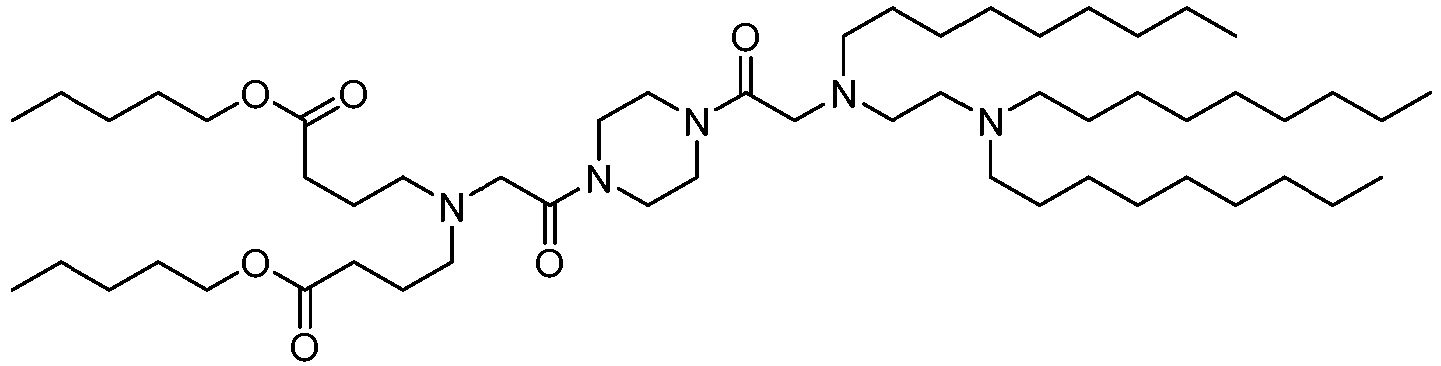
- In the same manner as
Step 7 forCompound 44,dipentyl 4,4'-((2-(4-(N-(2-(dinonylamino)ethyl)-N-nonylglycyl)piperazin-1-yl)-2-oxoethyl)azanediyl)dibutyrate was synthesized from bis(4-oxo-4-(pentyloxy)butyl)glycine (200 mg, 0.52 mmol), 2-((2-(dinonylamino)ethyl)(nonyl)amino)-1-(piperazin-1-yl)ethan-1-one (265 mg, 0.47 mmol), iPr2EtN (180 µL, 1.03 mmol) and T3P (50% EtOAc solution, 838 µL, 1.41 mmol) in THF (10 mL). Yield (250 mg, 57%). - UPLC/ELSD: RT = 2.85 min. MS (ES): m/z (MH+) 935.26 for C33H107N3O6
1H-NMR (300 MHz, CDCl3) δ: ppm 4.08 (t, 4H); 3.78-3.46 (br. m, 8H); 3.34 (br. m, 4H); 2.72-2.24 (br. m, 18H); 1.78 (m, 4H); 1.64 (m, 4H); 1.50-1.16 (br. m, 50H); 0.91 (m, 15H). -
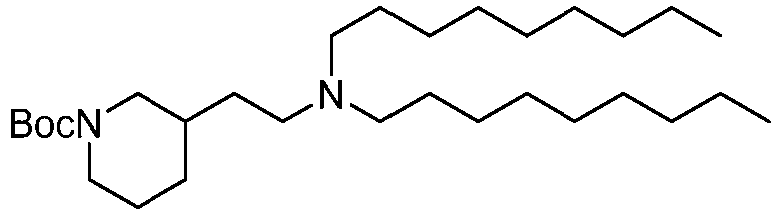
- In the same manner as
Step 1 forCompound 49, tert-butyl 3-(2-(dinonylamino)ethyl)piperidine-1-carboxylate was synthesized from tert-butyl 3-(2-aminoethyl)piperidine-1-carboxylate (1.00 g, 4.38 mmol), 1-bromononane (907 mg, 4.38 mmol), K2CO3 (610 mg, 4.38 mmol), and KI (73 mg, 0.44 mmol) in MeCN (50 mL). Yield (514 mg, 24%). 1H-NMR (300 MHz, CDC13) δ: ppm 4.12-2.24 (br. m, 10H); 1.92-1.00 (br. m, 44H); 0.90 (t, 6H). -

- In the same manner as
Step 4 forCompound 11, N-nonyl-N-(2-(piperidin-3-yl)ethyl)nonan-1-amine was synthesized from tert-butyl 3-(2-(dinonylamino)ethyl)piperidine-1-carboxylate (514 mg, 1.07 mmol), and TFA (4.1 mL, 53mmol) in DCM (4 mL). Yield (378 mg, 93%). - UPLC/ELSD: RT = 1.27 min. MS (ES): m/z (MH+) 381.62 for C25H52N2
1H-NMR (300 MHz, CDC13) δ: ppm 3.12-1.95 (br. m, 11H); 1.93-0.98 (br. m, 35H); 0.90 (t, 6H). -

- In the same manner as
Step 11 forCompound 11,2-((2-(dinonylamino)ethyl)(nonyl)amino)-1-(3-(2-(dinonylamino)ethyl)piperidin-1-yl)ethan-1-one was synthesized from N-nonyl-N-(2-(piperidin-3-yl)ethyl)nonan-1-amine (250 mg, 0.66 mmol), N-(2-(dinonylamino)ethyl)-N-nonylglycine (297 mg, 0.60 mmol), iPr2EtN (0.23 mL, 1.3 mmol), and T3P (50% EtOAc solution, 1.06 mL, 1.8 mmol) in THF (10 mL). Yield (136 mg, 27%). UPLC/ELSD: RT = 3.22 min. MS (ES): m/z (MH+) 860.39 for C56H114N4O - 1H-NMR (300 MHz, CDCl3) δ: ppm 4.56-4.01 (br. m, 2H); 3.48-2.20 (br. m, 20H), 1.99-1.00 (br. m, 77H); 0.90 (t. 15H).
-

- In the same manner as
Step 3 forCompound 11, tert-butyl 4-(N-nonyl-N-(4-oxo-4-(pentyloxy)butyl)glycyl)piperazine-1-carboxylate was synthesized from N-nonyl-N-(4-oxo-4-(pentyloxy)butyl)glycine (480 mg, 1.34 mmol), 1-bocpiperazine (275 mg, 1.48 mmol), iPr2EtN (5.14 µL, 2.95 mmol) and T3P (50% EtOAc solution, 2.40 mL, 4.03 mmol) in THF (15 mL). Yield (700 mg, 99%). - UPLC/ELSD: RT = 1.90 min. MS (ES): m/z (MH+) 526.79 for C29H55N3O;
1H-NMR (300 MHz, CDCl3)δ: ppm 4.08 (t, 2H); 3.70-3.10 (br. m, 14H); 2.45 (t, 2H); 2.13 (br. m, 2H); 2.00-1.00 (br. m, 29H); 0.91 (br. m, 6H). -

- In the same manner as
Step 4 forCompound 11, pentyl 4-(nonyl(2-oxo-2-(piperazin-1-yl)ethyl)amino)butanoate was synthesized from tert-butyl 4-(N-nonyl-N-(4-oxo-4-(pentyloxy)butyl)glycyl)piperazine-1-carboxylate (700 mg, 1.33 mmol), and TFA (5.1 mL, 66.6 mmol) in DCM (5 mL). Yield (560 mg, 99%). - UPLC/ELSD: RT = 0.77 min. MS (ES): m/z (MH+) 426.65 for C24H47N3O3
1H-NMR (300 MHz, CDCl3) δ: ppm 4.07 (t, 2H); 3.59 (br. m, 4H); 3.28 (s, 2H); 2.86 (br. m, 4H); 2.50 (br. m, 4H); 2.33 (t, 2H); 2.05 (br, 1H); 1.77 (m, 2H); 1.63 (m, 2H); 1.30 (br. m, 18H); 0.91 (m, 6H). -

- In the same manner as
Step 1 for Compound 18, pentyl 4-((2-hydroxyethyl)(nonyl)amino)butanoate was synthesized from2-(nonylamino)ethan-1-ol (350 mg, 1.87 mmol), pentyl 4-bromobutanoate (487 mg, 2.06 mmol), K2CO3 (572 mg, 4.11 mmol), and KI (31 mg, 0.19 mmol) in MeCN (40 mL). Yield (427 mg, 66%). - UPLC/ELSD: RT= 1.25 min. MS (ES): m/z (MH+) 344.55 for C20H41NO3
1H-NMR (300 MHz, CDCl3) δ: ppm 4.09 (t, 2H); 3.61 (t, 2H); 2.67 (t, 2H); 2.56 (m, 4H); 2.36 (t, 2H); 1.85 (m, 2H); 1.65 (m, 2H); 1.49 (m, 2H); 1.42-1.18 (br. m, 16H); 0.91 (m, 6H). -

- In the same manner as
Step 2 for Compound 18, pentyl 4-((2-chloroethyl)(nonyl)amino)butanoate was synthesized from pentyl 4-((2-hydroxyethyl)(nonyl)amino)butanoate (427 mg, 1.27 mmol), methanesulfonyl chloride (120 µL, 1.55 mmol), and triethylamine (225 µL, 1.62 mmol) in DCM (8 mL). Yield (448 mg, 99%). UPLC/ELSD: RT = 1.52 min. MS (ES): m/z (MH+) 362.51 for C20H40ClNO2 - 1H-NMR (300 MHz, CDCl3) δ: ppm 4.07-3.71 (br. m, 4H); 3.45-2.76 (br. m, 6H); 2.30 (br. m, 2H); 2.24-1.05 (br. m, 22H); 0.82 (br. m, 6H).
-

- In the same manner as
Step 4 forCompound 46, pentyl 4-((2-((2-(tert-butoxy)-2-oxoethyl)(nonyl)amino)ethyl)(nonyl)amino)butanoate was synthesized from tert-butyl nonylglycinate (338 mg, 1.31 mmol), pentyl 4-((2-chloroethyl)(nonyl)amino)butanoate (527 mg, 1.46 mmol), K2CO3 (402 mg, 2.89 mmol), and KI (22 mg, 0.13 mmol) in MeCN (30 mL). Yield (200 mg, 26%). - UPLC/ELSD: RT = 3.03 min. MS (ES): m/z (MH+) 583.95 for C35H70N2O4
1H-NMR (300 MHz, CDCl3) δ: ppm 4.07 (t, 2H); 3.27 (s, 2H); 2.76-2.24 (br. m, 12H); 1.85-1.10 (br. m, 45H); 0.90 (m, 9H). -

- In the same manner as
Step 5 forCompound 46, N-nonyl-N-(2-(nonyl(4-oxo-4-(pentyloxy)butyl)amino)ethyl)glycine was synthesized from pentyl 4-((2-((2-(tert-butoxy)-2-oxoethyl)(nonyl)amino)ethyl)(nonyl)amino)butanoate (200 mg, 0.34 mmol), and TFA (1.31 mL, 17.2 mmol), in DCM (2 mL). Yield (160 mg, 89%). - UPLC/ELSD: RT = 2.39 min. MS (ES): m/z (MH+) 527.77 for C31H62N2O4
1H-NMR (300 MHz, CDCl3) δ: ppm 4.09 (t, 2H); 3.27 (s, 2H); 2.94-2.74 (br. m, 6H); 2.61 (t, 2H); 2.37 (m, 2H); 2.15-1.90 (br. m, 2H); 1.80-1.05 (br. m, 36H); 0.90 (m, 9H). -

- In the same manner as
Step 11 forCompound 11, pentyl 4-(nonyl(2-(4-(N-nonyl-N-(2-(nonyl(4-oxo-4-(pentyloxy)butyl)amino)ethyl)glycyl)piperazin-1-yl)-2-oxoethyl)amino)butanoate was synthesized from pentyl 4-(nonyl(2-oxo-2-(piperazin-1-yl)ethyl)amino)butanoate (142 mg, 0.33 mmol), N-nonyl-N-(2-(nonyl(4-oxo-4-(pentyloxy)butyl)amino)ethyl)glycine (160 mg, 0.30 mmol), iPr2EtN (116 µL, 0.67 mmol), and T3P (50% EtOAc solution, 542 µL, 0.91 mmol). Yield (53 mg, 19%). - UPLC/ELSD: RT= 2.79 min. MS (ES): m/z (MH+) 935.34 for C33H107N3O6
1H-NMR (300 MHz, CDC13) δ: ppm 4.08 (t, 4H); 3.78-3.53 (br. m, 8H); 3.32 (br. m, 4H); 2.76-2.24 (br. m, 18H); 1.87-1.10 (br. m, 58H); 0.91 (br. m, 15H). -

- In the same manner as
Step 1 forCompound 49, tert-butyl 3-(2-(nonylamino)ethyl)piperidine-1-carboxylate was synthesized from tert-butyl 3-(2-aminoethyl)piperidine-1-carboxylate (1.00 g, 4.38 mmol), 1-bromononane (907 mg, 4.38 mmol), K2CO3 (610 mg, 4.38 mmol), and KI (73 mg, 0.44 mmol) in MeCN (50 mL). Yield (474 mg, 31%). - UPLC/ELSD: RT= 1.23 min. MS (ES): m/z (MH+) 355.58 for C21H42N2O2
1H-NMR (300 MHz, CDC13) δ: ppm 3.88 (br, 2H); 3.00-2.43 (br. m, 6H); 1.92-0.97 (br. m, 30H), 0.90 (t, 3H). -
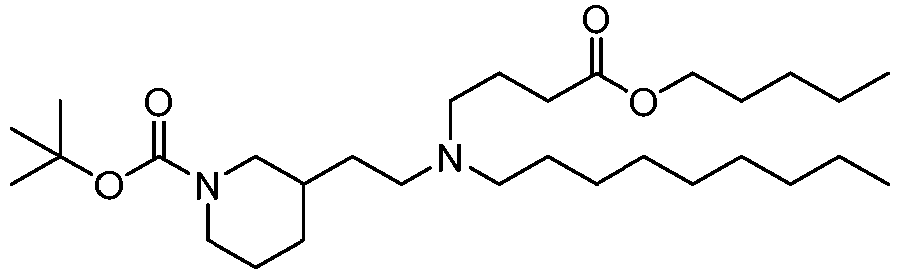
- In the same manner as
Step 1 forCompound 57,tert-butyl3-(2-(nonyl(4-oxo-4-(pentyloxy)butyl)amino)ethyl)piperidine-1-carboxylate was synthesized from tert-butyl 3-(2-(nonylamino)ethyl)piperidine-1-carboxylate (474 mg, 1.34 mmol), pentyl 4-bromobutanoate (380 mg, 1.6 mmol), K2CO3 (223 mg, 1.60 mmol) and KI (44 mg, 0.27 mmol) in MeCN (15 mL). Yield (492 mg, 72%). - UPLC/ELSD: RT = 2.09 min. MS (ES): m/z (MH+) 511.70 for C30H58N2O4
1H-NMR (300 MHz, CDCl3)δ: ppm 4.08 (t, 2H); 3.90 (br. m, 2H); 2.87-2.22 (br. m, 10H); 1.91-1.00 (br. m, 38H); 0.91 (m, 6H). -

- In the same manner as
Step 4 forCompound 11, pentyl 4-(nonyl(2-(piperidin-3-yl)ethyl)amino)butanoate was synthesized from tert-butyl 3-(2-(nonyl(4-oxo-4-(pentyloxy)butyl)amino)ethyl)piperidine-1-carboxylate (492 mg, 0.96 mmol), and TFA (3.7 mL, 48 mmol) in DCM (4 mL). Yield (390 mg, 99%). - UPLC/ELSD: RT = 0.85 min. MS (ES): m/z (MH+) 411.72 for C25H50N2O2 1H-NMR (300 MHz, CDCl3) δ: ppm 4.08 (t, 2H); 3.03 (br. m, 2H); 2.66-2.18 (br. m, 10H); 2.18-0.98 (br. m, 30H); 0.91 (m, 6H).
-

- In the same manner as
Step 11 forCompound 11, pentyl 4-((2-(1-(N-(2-(dinonylamino)ethyl)-N-nonylglycyl)piperidin-3-yl)ethyl)(nonyl)amino)butanoate was synthesized from pentyl 4-(nonyl(2-(piperidin-3-yl)ethyl)amino)butanoate (250 mg, 0.61 mmol), N-(2-(dinonylamino)ethyl)-N-nonylglycine (275 mg, 0.55 mmol), iPr2EtN (0.21 mL, 1.2 mmol), and T3P (50% EtOAc solution, 0.98 mL, 1.7 mmol). Yield (96 mg, 20%). - UPLC/ELSD: RT = 3.08 min. MS (ES): m/z (MH+) 890.32 for C56H112N4O3
1H-NMR (300 MHz, CDCl3) δ: ppm 4.55-4.01 (br. m, 4H); 3.48-2.21 (br. m, 22H); 1.95-1.00 (br. m, 71H); 0.90 (m, 15H). -

- In the same manner as
Step 1 forCompound 49, tert-butyl 3-(2-(nonylamino)ethyl)pyrrolidine-1-carboxylate was synthesized from tert-butyl 3-(2-aminoethyl)pyrrolidine-1-carboxylate (1.25 g, 5.47 mmol), 1-bromononane (1.13 g, 5.47 mmol), K2CO3 (757 mg, 5.47 mmol), and KI (91 mg, 0.55 mmol) in MeCN (100 mL). Yield (420 mg, 23%). - UPLC/ELSD: RT = 1.08 min. MS (ES): m/z (MH+) 341.52 for C20H40N2O2
1H-NMR (300 MHz, CDCl3) δ: ppm 3.68-1.91 (br. m, 9H); 1.71-1.12 (br. m, 28H); 0.90 (t, 3H). -

- In the same manner as
Step 1 forCompound 57, tert-butyl 3-(2-(nonyl(4-oxo-4-(pentyloxy)butyl)amino)ethyl)pyrrolidine-1-carboxylate was synthesized from tert-butyl 3-(2-(nonylamino)ethyl)pyrrolidine-1-carboxylate (420 mg, 1.23 mmol), pentyl 4-bromobutanoate (321 mg, 1.36 mmol), K2CO3 (187 mg, 1.36 mmol), and KI (41 mg, 0.25 mmol). Yield (390 mg, 64%). - UPLC/ELSD: RT = 1.98 min. MS (ES): m/z (MH+) 497.67 for C29H56N2O4
1H-NMR (300 MHz, CDCl3) δ: ppm 4.08 (t, 2H); 3.50 (br. m, 2H); 3.34-2.76 (br. m, 2H); 2.52-1.87 (br. m, 10H); 1.87-1.02 (br. m, 34H); 0.91 (t, 6H). -

- In the same manner as
Step 4 forCompound 11, pentyl 4-(nonyl(2-(pyrrolidin-3-yl)ethyl)amino)butanoate was synthesized from tert-butyl 3-(2-(nonyl(4-oxo-4-(pentyloxy)butyl)amino)ethyl)pyrrolidine-1-carboxylate (390 mg, 0.79 mmol), and TFA (3.0 mL, 40 mmol) in DCM (3 mL). Yield (298 mg, 96%). - UPLC/ELSD: RT = 0.81 min. MS (ES): m/z (MH+) 397.62 for C24H48N2O2
1H-NMR (300 MHz, CDCl3) δ: ppm 4.08 (t, 2H); 3.20-2.82 (br. m, 4H); 2.58-2.24 (br. m, 8H); 2.11-1.11 (br. m, 28H); 0.91 (m, 6H). -

- In the same manner as
Step 11 forCompound 11, pentyl 4-((2-(1-(N-(2-(dinonylamino)ethyl)-N-nonylglycyl)pyrrolidin-3-yl)ethyl)(nonyl)amino)butanoate was synthesized from pentyl 4-(nonyl(2-(pyrrolidin-3-yl)ethyl)amino)butanoate (202 mg, 0.51 mmol), N-(2-(dinonylamino)ethyl)-N-nonylglycine (230 mg, 0.46 mmol), iPr2EtN (0.177 mL, 1.0 mmol), and T3P (50% EtOAc solution, 0.82 mL, 1.4 mmol) in THF (10 mL). Yield (109 mg, 27%). - UPLC/ELSD: RT = 3.06 min. MS (ES): m/z (MH+) 876.30 for C33H110N4O3
1H-NMR (300 MHz, CDCl3) δ: ppm 4.08 (t, 2H); 3.83-2.85 (br. m, 7H); 2.78-1.88 (br. m, 19H); 1.83-1.14 (br. m, 67H); 0.90 (m, 15H). -

- In the same manner as
Step 1 forCompound 49, tert-butyl 3-((nonylamino)methyl)pyrrolidine-1-carboxylate was synthesized from tert-butyl 3-(aminomethyl)pyrrolidine-1-carboxylate (2.0 g, 10.0 mmol), 1-bromononane (2.07 g, 10.0 mmol), K2CO3 (1.39 g, 10.0 mmol), and KI (166 mg, 1.00 mmol) in MeCN (100 mL). Yield (1.53 g, 47%). - UPLC/ELSD: RT= 0.92 min. MS (ES): m/z (MH+) 327.54 for C19H38N2O2
1H-NMR (300 MHz, CDCl3) δ: ppm 3.69-1.79 (br. m, 9H); 1.74-1.13 (br. m, 26H); 0.89 (t, 3H). -

- In the same manner as
Step 1 forCompound 57,tert-butyl 3-((nonyl(4-oxo-4-(pentyloxy)butyl)amino)methyl)pyrrolidine-1-carboxylate was synthesized from tert-butyl 3-((nonylamino)methyl)pyrrolidine-1-carboxylate (500 mg, 1.53 mmol), pentyl 4-bromobutanoate (400 mg, 1.68 mmol), K2CO3 (423 mg, 3.07 mmol), and KI (51 mg, 0.31 mmol) in MeCN (100 mL). Yield (233 mg, 32%). - UPLC/ELSD: RT = 1.85 min. MS (ES): m/z (MH+) 483.65 for C28H54N2O4
1H-NMR (300 MHz, CDCl3) δ: ppm 4.08 (t, 2H); 3.59-2.91 (br. m, 4H); 2.49-1.83 (br. m, 10H); 1.83-1.13 (br. m, 32H); 0.91 (m, 6H). -

- In the same manner as
Step 4 forCompound 11, pentyl 4-(nonyl(pyrrolidin-3-ylmethyl)amino)butanoate was synthesized from tert-butyl 3-((nonyl(4-oxo-4-(pentyloxy)butyl)amino)methyl)pyrrolidine-1-carboxylate (233 mg, 0.48 mmol), and TFA (1.84 mL, 24 mmol) in DCM (2 mL). Yield (179 mg, 97%). - UPLC/ELSD: RT = 0.70 min. MS (ES): m/z (MH+) 383.51 for C23H46N2O2
1H-NMR (300 MHz, CDCl3) δ: ppm 4.08 (t, 2H); 3.11-2.81 (br. m, 3H); 2.67-1.51 (br. m, 16H); 1.51-1.03 (br. m, 19H); 0.91 (m, 6H). -

- In the same manner as
Step 11 forCompound 11, pentyl 4-(((1-(N-(2-(dinonylamino)ethyl)-N-nonylglycyl)pyrrolidin-3-yl)methyl)(nonyl)amino)butanoate was synthesized from pentyl 4-(nonyl(pyrrolidin-3-ylmethyl)amino)butanoate (179 mg, 0.47 mmol), N-(2-(dinonylamino)ethyl)-N-nonylglycine (211 mg, 0.43 mmol), iPr2EtN (163 µL, 0.95 mmol), and T3P (50% EtOAc solution, 0.76 mL, 1.1 mmol). Yield (88 mg, 24%). - UPLC/ELSD: RT = 3.05 min. MS (ES): m/z (MH+) 862.28 for C34H108N4O3
1H-NMR (300 MHz, CDCl3) δ: ppm 4.08 (t, 2H); 3.76-2.17 (br. m, 24H); 2.12-1.05 (br. m, 67H); 0.90 (m, 15H). -

- In the same manner as
Step 1 forCompound 57, tert-butyl 4-(2-(nonyl(4-oxo-4-(pentyloxy)butyl)amino)ethyl)piperidine-1-carboxylate was synthesized from tert-butyl 4-(2-(nonylamino)ethyl)piperidine-1-carboxylate (500 mg, 1.41 mmol), pentyl 4-bromobutanoate (368 mg, 1.55 mmol), K2CO3 (390 mg, 2.82 mmol), and KI (23 mg, 0.14 mmol) in MeCN (100 mL). Yield (487 mg, 68%). - UPLC/ELSD: RT = 2.03 min. MS (ES): m/z (MH+) 511.57 for C30H58N2O4
1H-NMR (300 MHz, CDCl3) δ: ppm 4.08 (m, 4H); 2.69 (m, 2H); 2.51-2.25 (br. m, 8H); 1.83-1.55 (br. m, 6H); 1.53-1.02 (br. m, 32H); 0.91 (m, 6H). -

- In the same manner as
Step 4 forCompound 11, pentyl 4-(nonyl(2-(piperidin-4-yl)ethyl)amino)butanoate was synthesized from tert-butyl 4-(2-(nonyl(4-oxo-4-(pentyloxy)butyl)amino)ethyl)piperidine-1-carboxylate (487 mg, 0.953 mmol), and TFA (3.6 mL, 48 mmol) in DCM (4 mL). Yield (386 mg, 98%). - UPLC/ELSD: RT = 0.87 min. MS (ES): m/z (MH+) 411.43 for C25H50N2O2
1H-NMR (300 MHz, CDCl3) δ: ppm 4.08 (t, 2H); 3.07 (m, 2H); 2.60 (m, 2H); 2.50-2.28 (br. m, 8H); 2.03 (br, 1H); 1.86-1.55 (br. m, 6H); 1.52-1.02 (br. m, 23H); 0.91 (m, 6H). -

- In the same manner as
Step 11 forCompound 11, pentyl 4-((2-(1-(N-(2-(dinonylamino)ethyl)-N-nonylglycyl)piperidin-4-yl)ethyl)(nonyl)amino)butanoate was synthesized from pentyl 4-(nonyl(2-(piperidin-4-yl)ethyl)amino)butanoate (351 mg, 0.855 mmol), N-(2-(dinonylamino)ethyl)-N-nonylglycine (467 mg, 0.941 mmol), iPr2EtN (328 µL, 1.88 mmol), and T3P (50% EtOAc solution, 1.53 mL, 2.56 mmol) in THF (15 mL). Yield (192 mg, 25%). - UPLC/ELSD: RT= 3.00 min. MS (ES): m/z (MH+) 890.13 for C56H112N4O3 1H-NMR (300 MHz, CDCl3) δ: ppm 4.61-4.14 (br. m, 2H); 4.08 (t, 2H); 3.40-2.24 (br. m, 22H); 1.86-0.99 (br. m, 71H); 0.90 (m, 15H).
-

- In the same manner as
Step 1 forCompound 49, tert-butyl 4-(3-(nonylamino)propyl)piperidine-1-carboxylate was synthesized from tert-butyl 4-(3-aminopropyl)piperidine-1-carboxylate (2.50 g, 10.3 mmol), 1-bromononane (2.14 g, 10.3 mmol), K2CO3 (2.85 g, 20.6 mmol), and KI (171 mg, 0.10 mmol) in MeCN (200 mL). Yield (1.27 g, 33%). - 1H-NMR (300 MHz, CDCl3) δ: ppm 4.08 (m, 2H), 2.69 (br. m, 6H); 1.79-0.98 (br. m, 32H); 0.89 (t, 3H).
-

- In the same manner as
Step 1 forCompound 57, tert-butyl 4-(3-(nonyl(4-oxo-4-(pentyloxy)butyl)amino)propyl)piperidine-1-carboxylate was synthesized from tert-butyl 4-(3-(nonylamino)propyl)piperidine-1-carboxylate (500 mg, 1.36 mmol), pentyl 4-bromobutanoate (354 mg, 1.49 mmol), K2CO3 (375 mg, 2.71 mmol), and KI (23 mg, 0.14 mmol) in MeCN (20 mL). Yield (624 mg, 88%). - UPLC/ELSD: RT= 2.12 min. MS (ES): m/z (MH+) 525.60 for C31H60N2O4 1H-NMR (300 MHz, CDCl3) δ: ppm 4.08 (br. m, 4H); 2.69 (m, 2H); 2.38 (br. m, 8H); 1.85-1.55 (br. m, 6H); 1.54-1.00 (br. m, 34H); 0.91 (m, 6H).
-

- In the same manner as
Step 4 forCompound 44, pentyl 4-(nonyl(3-(piperidin-4-yl)propyl)amino)butanoate was synthesized from tert-butyl 4-(3-(nonyl(4-oxo-4-(pentyloxy)butyl)amino)propyl)piperidine-1-carboxylate (624 mg, 1.19 mmol), and TFA (4.5 mL, 60 mmol) in DCM (5 mL). Yield (467 mg, 92%). - UPLC/ELSD: RT= 0.94 min. MS (ES): m/z (MH+) 424.62 for C26H52N2O2
1H-NMR (300 MHz, CDCl3) δ: ppm 4.08 (t, 2H); 3.16 (m, 2H); 2.65 (m, 2H); 2.39 (br. m, 8H); 1.84-1.57 (br. m, 6H); 1.52-1.04 (br. m, 26H); 0.91 (m, 6H). -

- In the same manner as
Step 11 forCompound 11, pentyl 4-((3-(1-(3-((2-(dinonylamino)ethyl)(nonyl)amino)propanoyl)piperidin-4-yl)propyl)(nonyl)amino)butanoate was synthesized from pentyl 4-(nonyl(3-(piperidin-4-yl)propyl)amino)butanoate (259 mg, 0.61 mmol), 3-((2-(dinonylamino)ethyl)(nonyl)amino)propanoic acid (343 mg, 0.67 mmol), iPr2EtN (234 µL, 1.34 mmol), and T3P (50% EtOAc solution, 1.09 mL, 1.83 mmol) in THF (20 mL). Yield (270 mg, 48%). - UPLC/ELSD: RT = 2.85 min. MS (ES): m/z (MH+) 918.18 for C58H116N4O3
1H-NMR (300 MHz, CDCl3) δ: ppm 4.61 (m, 1H); 4.08 (t, 2H); 4.08 (m, 1H); 3.08-2.72 (br. m, 4H); 2.63-2.26 (br. m, 20H); 1.87-1.57 (br. m, 6H); 1.54-1.00 (br. m, 67H); 0.90 (m, 15H). -

- In the same manner as
Step 1 forCompound 49 tert-butyl 4-(3-(dinonylamino)propyl)piperidine-1-carboxylate was synthesized from tert-butyl 4-(3-aminopropyl)piperidine-1-carboxylate (2.50 g, 10.3 mmol), 1-bromononane (2.14 g, 10.3 mmol), K2CO3 (2.85 g, 20.6 mmol), and KI (171 mg, 0.10 mmol) in MeCN (200 mL). Yield (1.03 g, 20%). - UPLC/ELSD: RT = 2.46 min. MS (ES): m/z (MH+) 495.66 for C31H62N2O2
1H-NMR (300 MHz, CDCl3) δ: ppm 4.09 (br. m, 2H); 2.69 (br. m, 2H); 2.39 (br. m, 6H); 1.75-1.00 (br. m, 46H); 0.90 (t, 6H). -

- In the same manner as
Step 4 forCompound 11, N-nonyl-N-(3-(piperidin-4-yl)propyl)nonan-1-amine was synthesized from tert-butyl 4-(3-(dinonylamino)propyl)piperidine-1-carboxylate (1.03 g, 2.08 mmol), and TFA (8.0 mL, 104 mmol) in DCM (10 mL). Yield (778 mg, 95%). - UPLC/ELSD: RT = 1.31 min. MS (ES): m/z (MH+) 395.61 for C26H34N2
1H-NMR (300 MHz, CDCl3)δ: ppm 3.18-2.50 (br. m, 4H); 2.40 (br. m, 6H); 1.70 (m, 2H); 1.58-1.03 (br. m, 36H); 0.90 (t, 6H). -

- In the same manner as
Step 11 forCompound 11,3-((2-(dinonylamino)ethyl)(nonyl)amino)-1-(4-(3-(dinonylamino)propyl)piperidin-1-yl)propan-1-one was synthesized from N-nonyl-N-(3-(piperidin-4-yl)propyl)nonan-1-amine (247 mg, 0.63 mmol), 3-((2-(dinonylamino)ethyl)(nonyl)amino)propanoic acid (352 mg, 0.69 mmol), iPr2EtN (240 µL, 1.4 mmol), and T3P (50% EtOAc solution, 1.1 mL, 1.9 mmol) in THF (20 mL). Yield (293 mg, 53%). - UPLC/ELSD: RT = 3.01 min. MS (ES): m/z (MH+) 888.08 for C58H118N4O
1H-NMR (300 MHz, CDCl3) δ: ppm 4.61 (m, 1H); 3.86 (m, 1H); 2.99 (m, 1H); 2.82 (m, 2H); 2.61-2.29 (br. m, 19H); 1.75 (m, 2H); 1.60-1.00 (br. m, 77H); 0.89 (t, 15H). -
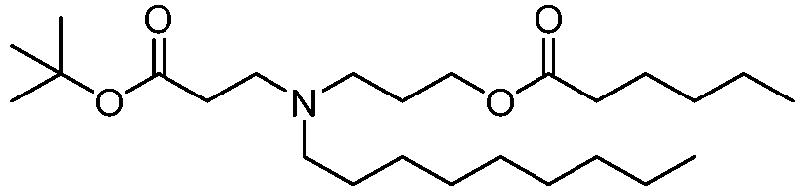
- In the same manner as
Step 3 forCompound 44, 2-((3-(tert-butoxy)-3-oxopropyl)(nonyl)amino)ethyl heptanoate was synthesized from tert-butyl 3-(nonylamino)propanoate (750 mg, 2.76 mmol), 3-bromopropyl hexanoate (786 mg, 3.32 mmol), K2CO3 (764 mg, 5.53 mmol), and KI (46 mg, 0.28 mmol) in MeCN (100 mL). Yield (661 mg, 56%). - UPLC/ELSD: RT = 1.80 min. MS (ES): m/z (MH+) 428.49 for C25H49NO4 1H-NMR (300 MHz, CDCl3) δ: ppm 4.12 (t, 2H); 2.73 (t, 2H); 2.56-2.24 (br. m, 8H); 1.77 (m, 2H); 1.64 (m, 2H); 1.55-1.10 (br. m, 27H); 0.91 (m, 6H).
-

- In the same manner as
Step 4 forCompound 44, 3-((3-(hexanoyloxy)propyl)(nonyl)amino)propanoic acid was synthesized from 3-((3-(tert-butoxy)-3-oxopropyl)(nonyl)amino)propyl hexanoate (661 mg, 1.55 mmol), and TFA (5.9 mL, 77 mmol) in DCM (6 mL). Yield (556 mg, 97%). - UPLC/ELSD: RT = 1.14 min. MS (ES): m/z (MH+) 372.31 for C21H41NO4
1H-NMR (300 MHz, CDCl3) δ: ppm 4.13 (t, 2H); 2.84 (t, 2H); 2.72 (t, 2H); 2.62 (t, 2H); 2.46 (t, 2H); 2.31 (t, 2H); 1.90 (m, 2H); 1.72-1.10 (br. m, 20H); 0.90 (M, 6H). -

- In the same manner as
Step 3 forCompound 11, tert-butyl 4-(3-((3-(hexanoyloxy)propyl)(nonyl)amino)propanoyl)piperazine-1-carboxylate was synthesized from 3-((3-(hexanoyloxy)propyl)(nonyl)amino)propanoic acid (570 mg, 1.49 mmol), 1-boc-piperazine (334 mg, 1.80 mmol), iPr2EtN (573 µL, 3.29 mmol), and T3P (50% EtOAc solution, 2.67 mL, 4.49 mmol) in THF (20 mL). Yield (635 mg, 79%). - UPLC/ELSD: RT = 1.85 min. MS (ES): m/z (MH+) 540.52 for C30H37N3O5
1H-NMR (300 MHz, CDCl3) δ: ppm 4.12 (t, 2H); 3.60 (m, 2H); 3.46 (br. m, 6H); 2.80 (m, 2H); 2.58-2.37 (br. m, 6H); 2.30 (t, 2H); 1.78 (m, 2H); 1.63 (m, 2H); 1.54-1.10 (br. m, 27H); 0.90 (m, 6H) . -
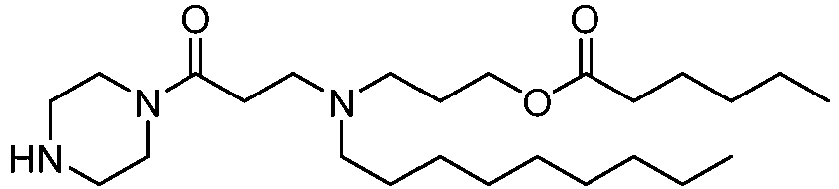
- In the same manner as
Step 4 forCompound 11, 3-(nonyl(3-oxo-3-(piperazin-1-yl)propyl)amino)propyl hexanoate was synthesized from tert-butyl 4-(3-((3-(hexanoyloxy)propyl)(nonyl)amino)propanoyl)piperazine-1-carboxylate (635 mg, 1.18 mmol), and TFA (4.5 mL, 59 mmol) in DCM (5 mL). Yield (510 mg, 99%). - UPLC/ELSD: RT = 0.72 min. MS (ES): m/z (MH+) 440.47 for C25H49N3O3
1H-NMR (300 MHz, CDCl3) δ: ppm 4.12 (t, 2H); 3.60 (m, 2H) 3.46 (m, 2H); 2.85 (br. m, 6H); 2.49 (br. m, 6H); 2.30 (t, 2H); 1.80 (m, 2H); 1.64 (m, 2H); 1.52-1.10 (br. m, 19H); 0.91 (m, 6H). -

- In the same manner as
Step 11 forCompound 11, 3-((3-(4-(3-((2-(dinonylamino)ethyl)(nonyl)amino)propanoyl)piperazin-1-yl)-3-oxopropyl)(nonyl)amino)propyl hexanoate was synthesized from 3-(nonyl(3-oxo-3-(piperazin-1-yl)propyl)amino)propyl hexanoate (154 mg, 0.351 mmol), 3-((2-(dinonylamino)ethyl)(nonyl)amino)propanoic acid (197 mg, 0.386 mmol), iPr2EtN (134 µL, 0.77 mmol), and T3P (50% EtOAc solution, 616 µL, 1.05 mmol) in THF (10 mL). Yield (69 mg, 21%). - UPLC/ELSD: RT = 2.70 min. MS (ES): m/z (MH+) 933.10 for C57H113N5O4
1H-NMR (300 MHz, CDCl3) δ: ppm 4.12 (t, 2H); 3.72-3.40 (br. m, 8H); 2.81 (br. m, 4H); 2.61-2.36 (br. m, 18H); 2.30 (t, 2H); 1.78 (m, 2H); 1.64 (m, 2H); 1.54-1.06 (br. m, 60H); 0.90 (m, 15H). -
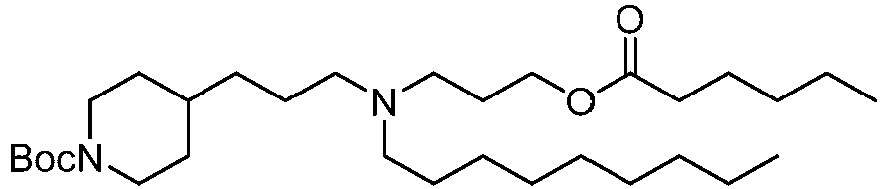
- In the same manner as
Step 1 forCompound 57, tert-butyl 4-(3-((3-(hexanoyloxy)propyl)(nonyl)amino)propyl)piperidine-1-carboxylate was synthesized from tert-butyl 4-(3-(nonylamino)propyl)piperidine-1-carboxylate (500 mg, 1.36 mmol), 3-bromopropyl hexanoate (386 mg, 1.63 mmol), K2CO3 (375 mg, 2.71 mmol), and KI (45 mg, 0.27 mmol) in MeCN (100 mL). Yield (322 mg, 45%). - UPLC/ELSD: RT = 2.09 min. MS (ES): m/z (MH+) 525.60 for C31H60N2O4
1H-NMR (300 MHz, CDCl3) δ: ppm 4.12 (br. m, 4H); 2.67 (m, 2H); 2.56-2.24 (br. m, 8H); 1.90-1.00 (br. m, 40H); 0.91 (m, 6H). -

- In the same manner as
Step 4 forCompound 11, 3-(nonyl(3-(piperidin-4-yl)propyl)amino)propyl hexanoate was synthesized from tert-butyl 4-(3-((3-(hexanoyloxy)propyl)(nonyl)amino)propyl)piperidine-1-carboxylate (322 mg, 0.614 mmol), and TFA (2.3 mL, 31 mmol) in DCM (2.5 mL). Yield (260 mg, 99%). - UPLC/ELSD: RT = 0.89 min. MS (ES): m/z (MH+) 425.54 for C26H52N2O2
1H-NMR (300 MHz, CDCl3) δ: ppm 4.12 (t, 2H); 3.12 (m, 2H); 2.75-2.24 (br. m, 10H); 1.84-1.54 (br. m, 6H); 1.54-1.02 (br. m, 26H); 0.90 (m, 6H). -

- In the same manner as
Step 11 forCompound 11, 3-((3-(1-(3-((2-(dinonylamino)ethyl)(nonyl)amino)propanoyl)piperidin-4-yl)propyl)(nonyl)amino)propyl hexanoate was synthesized from 3-(nonyl(3-(piperidin-4-yl)propyl)amino)propyl hexanoate (149 mg, 0.351 mmol), 3-((2-(dinonylamino)ethyl)(nonyl)amino)propanoic acid (197 mg, 0.386 mmol), iPr2EtN (134 µL, 0.77 mmol), and T3P (50% EtOAc solution, 616 µL, 1.05 mmol) in THF (10 mL). Yield (39 mg, 12%). - UPLC/ELSD: RT = 2.83 min. MS (ES): m/z (MH+) 918.01 for C58H116N4O3
1H-NMR (300 MHz, CDCl3) δ: ppm 4.61 (m, 1H); 4.12 (t, 2H); 3.87 (m, 1H); 3.08-2.74 (br. m, 4H); 2.70-2.23 (br. m, 20H); 1.82-1.56 (br. m, 6H); 1.56-1.00 (br. m, 67H); 0.90 (m, 15H). -

- To a solution of 1-bromohexane (5 g, 82 mmol) in MeCN (380 mL) was added ethanolamine (11.5 mL, 82 mmol), K2CO3 (22.7 g, 164 mmol), and KI (1.36 g, 8.2 mmol). The reaction was allowed to stir at 82 °C for 48 hours. The reaction mixture was cooled to room temperature, filtered, and the solids were washed with hexanes. The filtrate was extracted with hexanes, and the combined extracts were concentrated in vacuo. Purification by ISCO silica flash chromatography (0-20% MeOH/DCM) provided 2-(dihexylamino)ethan-1-ol (2.58 g, 14%).
- UPLC/ELSD: RT = 0.41 min. MS (ES): m/z (MH+) 229.95 for C14H31NO 1H NMR (300 MHz, CDCl3) δ: ppm 3.62 (t, 2H); 2.70 (t, 2H), 2.57 (t, 4H); 1.50 (br. m, 4H); 1.30 (br, 12H); 0.91 (t, 6H).
-

- 1H-NMR (300 MHz, CDCl3) δ: ppm 3.62 (t, 2H); 2.78 (t, 2H); 2.62 (t, 2H); 2.10-1.80 (br. m, 2H); 1.49 (m, 2H); 1.30 (br. m, 6H); 0.89 (t, 3H).
-

- To a solution of (6Z,9Z)-18-bromooctadeca-6,9-diene (0.2 g, 0.61 mmol) in MeCN (3.5 mL) was added 2-(hexylamino)ethan-1-ol (80 mg, 0.55 mmol), K2CO3 (76 mg, 0.55 mmol), and KI (9 mg, 0.06 mmol). The reaction was allowed to stir at room temperature for 18 hours. The reaction mixture was cooled to room temperature, added ethyl acetate and extracted with water. The combined extracts were dried with Na2SO4, filtered and concentrated in vacuo. Purification by ISCO silica flash chromatography (0-10% MeOH/DCM) provided 2-(Hexyl((9Z,12Z)-octadeca-9,12-dien-1-yl)amino)ethan-1-ol (23 mg, 11%).
- LC/ELSD: RT = 2.47 min. MS (ES): m/z (MH+) 394.60 for C26H51NO
1H NMR (300 MHz, CDCl3) δ: ppm 5.36 (m, 4H); 4.07 (m, 2H); 3.23-3.13 (m, 6H); 2.77 (m, 2H); 2.04 (m, 4H); 1.86 (m, 4H); 1.34 (m, 23H); 0.89 (m, 6H) -

- LC/ELSD: RT = 2.72 min. MS (ES): m/z (MH+) 436.63 for C29H57NO
1H NMR (300 MHz, CDCl3) δ: ppm 5.36 (m, 4H); 3.55 (t, 2H); 2.77 (t, 2H); 2.60 (t, 2H); 2.47 (m, 4H); 2.04 (m, 4H); 1.55-1.18 (br. m, 33H); 0.87 (m, 6H). - Compound 17-4 was synthesized according to the same procedure as Compound 17-2.

- UPLC: RT = 3.18 min. MS (ES): m/z (MH+) 478.516 for C32H63NO
1H NMR (400 MHz, CDCl3) δ: ppm 5.33 (m, 4H); 3.53 (s, 2H); 2.75 (t, 2H); 2.58 (m, 2H); 2.45 (m, 4H); 2.03 (dt, 4H); 1.43 (m, 4H); 1.24 (m, 34H); 0.86 (m, 6H). - Compound 17-5 was synthesized according to the same procedure as Compound 17-2.

- LC/ELSD: RT = 3.39 min. MS (ES): m/z (MH+) 506.56 for C34H67NO
1H NMR (300 MHz, CDCl3) δ: ppm 5.37 (m, 4H); 3.58 (m, 2H); 2.80 (m, 2H); 2.69 -2.42 (br. m, 5H); 2.07 (m, 4H); 1.56-1.18 (br. m, 44H); 0.91 (m, 6H). - Compound 17-6 was synthesized according to to the same procedure as Compound 17-2.

- LC/ELSD: RT = 3.68 min. MS (ES): m/z (MH+) 562.58 for C38H75NO
1H NMR (300 MHz, CDCl3) δ: ppm 5.39 (m, 4H); 3.58 (m, 2H); 2.80 (m, 2H); 2.68 -2.44 (br. m, 5H); 2.07 (m, 4H); 1.57-1.20 (br. m, 52H); 0.91 (m, 6H). - Compound 17-7 was synthesized according to the same procedure as Compound 17-1.

- UPLC/ELSD: RT = 3.30 min. MS (ES): m/z (MH+) 454.46 for C30H63NO
1H-NMR (300 MHz, CDCl3) δ: ppm 3.54 (br. m, 2H); 2.59 (br. m, 2H); 2.46 (br. m, 4H); 1.56-1.17(br. m, 48H); 0.90 (br. m, 6H). - Compound 17-8 was synthesized according to the same procedure as Compound 17-1.
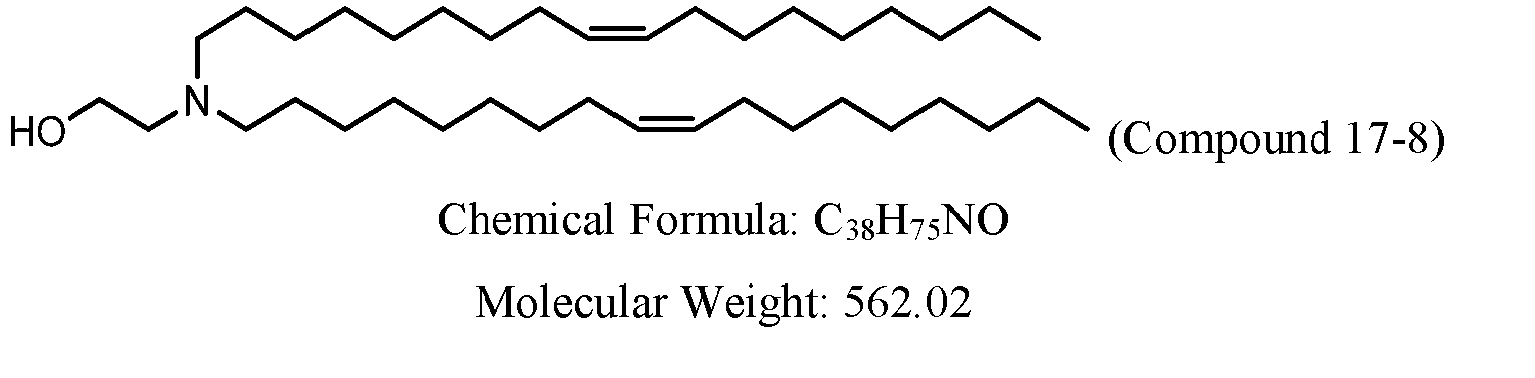
- UPLC/ELSD: RT = 7.325 min. MS (ES): m/z (MH+) 562.60 for C38H75NO 1H-NMR (300 MHz, CDCl3) δ: ppm 5.34 (m, 4H); 3.53 (t, 2H); 2.58 (t, 2H); 2.45 (t, 4H); 2.01 (m, 8H); 1.44 (m, 4H); 1.38-1.18 (br. m, 44H); 0.88 (t, 6H).
- Compound 17-9 was synthesized according to the same procedure as Compound 17-1.

- LC/ELSD: RT = 3.53 min. MS (ES): m/z (MH+) 572.72 for C39H73NO
1H NMR (300 MHz, CDCl3) δ: ppm 5.39 (m, 8H); 3.47 (m, 2H); 3.37 (s, 3H); 2.80 (m, 4H); 2.5 (m, 2H); 2.46 (m, 4H); 2.09 (m, 8H); 1.50-1.22 (m, 36H); 0.92 (m, 6H). - Compound 17-10 was synthesized according to the same procedure as Compound 17-1.

- 1H-NMR (300 MHz, CDCl3) δ: ppm 3.57 (t, 2H); 2.63 (t, 2H); 2.49 (br. m, 4H); 1.48 (br. m, 4H); 1.29 (br. m, 24H); 0.91 (t, 6H).
- Compound 17-11 was synthesized according to the same procedure as Compound 17-1.

- UPLC/ELSD: RT = 2.69 min. MS (ES): m/z (MH+) 398.56 for C26H33NO 1H-NMR (300 MHz, CDCl3) δ: ppm 3.57 (t, 2H); 2.63 (t, 2H); 2.49 (br. m, 4H); 1.48 (br. m, 4H); 1.29 (br. m, 36H); 0.91 (t, 6H).
- Compound 17-12 was synthesized according to the same procedure as
Compound 1.
- UPLC/ELSD: RT = 2.75 min. MS (ES): m/z (MH+) 412.36 for C27H37NO
1H-NMR (300 MHz, CDCl3) δ: ppm 3.79 (t, 2H); 2.66 (t, 2H); 2.43 (br. m, 4H); 1.69 (br. m, 2H); 1.47 (br. m, 4H) 1.25 (br. m, 36H); 0.87 (t, 6H). - Compound 17-13 was synthesized according to the same procedure as Compound 17-1.

- UPLC/ELSD: RT = 2.80 min. MS (ES): m/z (MH+) 426.42 for C28H39NO
1H-NMR (300 MHz, CDCl3) δ: ppm 3.56 (br. m, 2H); 2.46 (br. m, 6H); 1.66 (br. m, 4H); 1.48 (br. m, 4H); 1.26 (br. m, 36H); 0.88 (t, 6H). -

- A mixture of 1-bromononane (1.81 g, 8.72 mmol), 4-(2-aminoethyl)-1-boc-piperazine (2.0 g, 8.72 mmol), K2CO3 (2.4 g, 17.4 mmol), KI (145 mg, 0.872 mmol) in 44 mL MeCN was allowed to stir at 65 °C for 16 hours. The reaction mixture was cooled to room temperature, filtered, and the solids were washed with hexanes. The filtrate was extracted with hexanes, and the combined extracts were concentrated in vacuo. Purification by ISCO silica flash chromatography (0-20% MeOH/DCM) provided tert-butyl 4-(2-(dinonylamino)ethyl)piperazine-1-carboxylate (924 mg, 1.92 mmol, 44%).
- UPLC/ELSD: RT = 1.99 min. MS (ES): m/z (MH+) 482.36 for C29H39N3O2
1H NMR (400 MHz, CDCl3)δ: ppm 3.45 (br. m, 4H); 3.10 (br. m, 2H); 2.59 (br. m, 2H); 2.44 (br. m, 8H); 1.60-1.00 (br. m, 37H); 0.91 (t, 6H). -

- A solution of tert-butyl 4-(2-(dinonylamino)ethyl)piperazine-1-carboxylate (924 mg, 1.92 mmol) in 8 mL DCM was treated with TFA (7.4 mL, 96 mmol). The reaction was allowed to stir at room temperature for 16 hours. The reaction was concentrated, and the crude residue was taken up in chloroform and washed with 5% Na2CO3 and brine, dried over anhydrous Na2SO4, filtered, and concentrated in vacuo. Purification by ISCO silica flash chromatography (0-100% DCM/[DCM, 20% MeOH, 1% NH4OH]) provided N-nonyl-N-(2-(piperazin-1-yl)ethyl)nonan-1-amine (563 mg, 1.48 mmol, 77%).
- UPLC/ELSD: RT = 1.27 min. MS (ES): m/z (MH+) 382.54 for C24H51N3
1H NMR (400 MHz, CDCl3) δ: ppm 2.92 (br. m, 4H); 2.62 (br. m, 2H); 2.48 (br. m, 10H); 2.40-1.88 (br. m, 1H); 1.46 (br. m, 4H); 1.29 (br. m, 24H), 0.91 (t, 6H). -

- A mixture of 1-bromododecane (1.1 mL, 4.6 mmol), 4-(2-aminoethyl)-1-boc-piperazine (1.0 g, 4.4 mmol), K2CO3 (0.61 g, 4.4 mmol), in 10 mL MeCN was allowed to stir at room temperature for 12 h. After this time the reaction was filtered and concentrated. The crude material was purified by silica gel chromatography (0-20% MeOH in DCM with 1% NH4OH to afford tert-butyl 4-(2-(didodecylamino)ethyl)piperazine-1-carboxylate (450 mg, 0.80 mmol, 18%).
- UPLC/ELSD: RT = 2.87 min. MS (ES): m/z (MH+) 566.655 for C35H71N3O2
1H NMR (400 MHz, CDCl3)δ: ppm 3.40 (m, 4H); 2.56 (m, 2H); 2.40 (m, 10H); 1.44 (s, 9H); 1.40-1.24 (m, 40H); 0.86 (t, 6H). -

- A solution of tert-butyl 4-(2-(didodecylamino)ethyl)piperazine-1-carboxylate (154 mg, 0.27 mmol) in 1 mL DCM was treated with TFA (0.21 mL, 2.7 mmol). The reaction was allowed to stir overnight. After this time addition TFA (0.1 mL, 1.3 mmol) was added. After an additional 3 h the reaction was concentrated. The crude residue was taken up in DCM and washed with 5% K2CO3 and brine, dried over Na2SO4, filtered and concentrated. The crude material was purified by silica gel chromatography (0-20% MeOH in DCM with 1% NH4OH) to provide N-dodecyl-N-(2-(piperazin-1-yl)ethyl)dodecan-1-amine (109 mg, 87%).
- UPLC/ELSD: RT = 2.10 min. MS (ES): m/z (MH+) 466.379 for C30H63N3
1H NMR (400 MHz, CDCl3) δ: ppm 2.88 (t, 4H); 2.61 (m, 2H); 2.45 (m, 10H); 1.43-1.24 (m, 40H); 0.86 (t, 6H). -

- To a 0 °C solution of linoleyl alcohol (10 mL, 31.2 mmol) and trimethylamine (5.68 mL, 40.5 mmol) ) in DCM (50 mL) was added dropwise a solution of methanesulfonyl chloride (2.66 mL, 34.3 mmol) in DCM (20 mL). The reaction was allowed to return to room temperature and let stir for 4 hours. The mixture was quenched by the addition of water and extracted with DCM. The organic layer was washed with saturated NaHCO3, brine, dried over anhydrous Na2SO4, filtered, and concentrated in vacuo. Purification by ISCO silica flash chromatography (0-40% EtOAc/hexanes) provided (9Z,12Z)-octadeca-9,12-dien-1-yl methanesulfonate (10.0 g, 93%).
- 1H-NMR (300 MHz, CDCl3) δ: ppm 5.35 (m, 4H); 4.22 (t, 2H); 2.99 (s, 3H); 2.77 (t, 2H); 2.04 (q, 4H); 1.74 (m, 2H); 1.30 (br. m, 16H); 0.89 (t, 3H).
-

- To a solution of (9Z,12Z)-octadeca-9,12-dien-1-yl methanesulfonate (10.0 g, 29.0 mmol) in diethyl ether (372 mL) was added magnesium bromide ethyl etherate (22.5 g, 87.1 mmol). The reaction was let stir at room temperature for 16 hours. The mixture was quenched by the addition of water and extracted with diethyl ether. The combined organic layers were washed with 1% K2CO3, brine, dried over anhydrous Na2SO4, filtered, and concentrated in vacuo. Purification by ISCO silica flash chromatography provided (6Z,9Z)-18-bromooctadeca-6,9-diene (8.9 g, 93%).
- 1H-NMR (300 MHz, CDCl3) δ: ppm 5.36 (m, 4H); 3.41 (t, 2H); 2.77 (t, 2H); 2.05 (q, 4H); 1.86 (m, 2H); 1.48-1.22 (br. m, 16H); 0.89 (t, 3H).
-

- A mixture of (6Z,9Z)-18-bromooctadeca-6,9-diene (1.5 g, 4.55 mmol), 4-(2-aminoethyl)-1-boc-piperazine (1.04 g, 4.54 mmol), K2CO3 (1.27 g, 9.10 mmol), KI (75 mg, 0.452 mmol), in 22 mL MeCN was allowed to stir at room temperature for 48 hours. The reaction mixture was cooled to room temperature, filtered, and the solids were washed with hexanes. The filtrate was extracted with hexanes, and the combined extracts were concentrated in vacuo. Purification by ISCO silica flash chromatography (0-50% DCM/[DCM, 20% MeOH, 1% NH4OH]) provided tert-butyl 4-(2-(di((9Z,12Z)-octadeca-9,12-dien-1-yl)amino)ethyl)piperazine-1-carboxylate (1.08 g, 1.49 mmol, 65%).
- 1H NMR (400 MHz, CDCl3) δ: ppm 5.43-5.26 (br. m, 8H); 3.42 (t, 4H); 2.77 (m, 4H); 2.57 (m, 2H); 2.41 (br. m, 10H); 2.04 (br. m, 8H); 1.60-1.00 (br. m, 45H); 0.89 (t, 6H).
-

- A solution of tert-butyl 4-(2-(di((9Z,12Z)-octadeca-9,12-dien-1-yl)amino)ethyl)piperazine-1-carboxylate (1.06 g, 1.46 mmol) in 6 mL DCM was treated with TFA (5.6 mL, 73 mmol). After 4 hours the mixture was concentrated. The crude residue was taken up in chloroform, washed with 5% Na2CO3, brine, dried over anhydrous Na2SO4 and concentrated in vacuo. The residue was purification by ISCO silica flash chromatography (0-100% DCM/[DCM, 20% MeOH, 1% NH4OH]) and ISCO C18 flash chromatography (50-100% [
MeCN 1% TFA]/[H2O 1% TFA]). The desired fractions were washed with 5% Na2CO3 and extracted with hexanes. The hexanes were washed with brine, dried over anhydrous Na2SO4, and concentrated in vacuo to provide (9Z, 12Z)-N-((9Z, 12Z)-octadeca-9, 12-dien-1-yl)-N-(2-(piperazin-1-yl)ethyl)octadeca-9, 12-dien-1-amine (108 mg, 12%). - UPLC/ELSD: RT = 2.98 min. MS (ES): m/z (MH+) 626.75 for C42H79N3
1H NMR (400 MHz, CDCl3)δ: ppm 5.47-5.25 (br. m, 8H); 2.92 (m, 4H); 2.76 (m, 4H); 2.66 (br. m, 2H); 2.50 (br. m, 10H); 2.05 (m, 8H); 1.60-1.10 (br. m, 36H), 0.89 (t, 6H). -

- To a solution of 1-bromododecane (10 g, 40.1 mmol) in MeCN (84 mL) was added ethanolamine (1.10 mL, 18.2 mmol), K2CO3 (11.1 g, 80.1 mmol), and KI (302 mg, 1.82 mmol). The reaction was allowed to stir at 82 °C for 48 hours. The reaction mixture was cooled to room temperature, filtered, and the solids were washed with hexanes. The filtrate was extracted with hexanes, and the combined extracts were concentrated in vacuo. Purification by ISCO silica flash chromatography (0-20% MeOH/DCM) provided 2-(didodecylamino)ethan-1-ol (3.87 g, 53%).
- UPLC/ELSD: RT = 2.69 min. MS (ES): m/z (MH+) 398.56 for C26H55NO
1H-NMR (300 MHz, CDCl3) δ: ppm 3.57 (t, 2H); 2.63 (t, 2H); 2.49 (br. m, 4H); 1.48 (br. m, 4H); 1.29 (br. m, 36H); 0.91 (t, 6H). -

- To a 0 °C solution of 2-(didodecylamino)ethan-1-ol (3.87 g, 9.73 mmol) triethylamine (1.76 mL, 12.6 mmol) in DCM (50 mL) was added dropwise a solution of methanesulfonyl chloride (0.941 mL, 12.2 mmol) in DCM (5 mL). The reaction was allowed to return to room temperature and stir for 16 hours. The mixture was quenched by the addition of water and extracted with DCM. The organic layer was washed with saturated NaHCO3, brine, dried over anhydrous Na2SO4,filtered, and concentrated in vacuo. Purification by ISCO silica flash chromatography (0-10% EtOAc/hexanes) provided N-(2-chloroethyl)-N-dodecyldodecan-1-amine (1.92 g, 47%).
- 1H-NMR (300 MHz, CDCl3) δ: ppm 3.51 (t, 2H); 2.78 (t, 2H); 2.47 (br. m, 4H); 1.44 (br. m, 4H); 1.28 (br. m, 36H); 0.90 (t, 6H).
-

- A mixture of N-methylpiperazine (40 µL, 0.36 mmol), N-(2-chloroethyl)-N-dodecyldodecan-1-amine (166 mg, 0.4 mmol), and K2CO3 (50 mg, 0.36 mmol) in 2 mL MeCN was allowed to stir at 82 °C for 12 h. The reaction was allowed to cool room temperature, was filtered and concentrated. The crude material was purified by silica gel chromatography (0-20% MeOH in DCM with 1% NH4OH) to provide N-dodecyl-N-(2-(4-methylpiperazin-1-yl)ethyl)dodecan-1-amine (87.9 mg, 51%).
- UPLC: RT = 2.24 min. MS (ES): m/z (MH+) 480.662 for C31H65N3
1H NMR (400 MHz, CDCl3) δ: ppm 2.49 (m, 16H); 2.36 (s, 3H); 1.50 (m, 4H); 1.34 (m, 36H); 0.96 (t, 6H). -
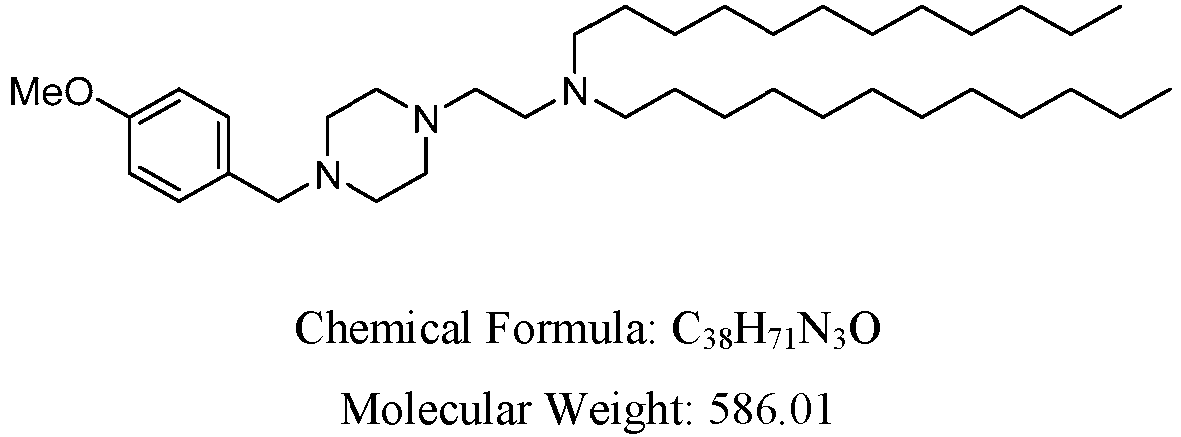
- A mixture of 1-(4-methoxybenzyl)piperazine (206 mg, 1.0 mmol), N-(2-chloroethyl)-N-dodecyldodecan-1-amine (289 mg, 0.69 mmol), K2CO3 (286 mg, 2.07 mmol) and KI (11 mg, 0.069 mmol) in 3.5 mL MeCN was allowed to stir at 80 C for 2 h. After this time the reaction was allowed to cool to room temperature and was quenched with water. The mixture was extracted with EtOAc three times. The pooled organics were washed with brine, dried over MgSO4, filtered and concentrated. The crude material was purified by silica gel chromatography (0-20% MeOH in DCM) for provide N-dodecyl-N-(2-(4-(4-methoxybenzyl)piperazin-1-yl)ethyl)dodecan-1-amine (0.24 g, 59%).
- UPLC: RT = 2.30 min. MS (ES): m/z (MH+) 586.92 for C38H71N3O
1H NMR (400 MHz, CDCl3)δ: ppm 7.19 (d, 2H); 6.83 (d, 2H); 3.78 (s, 3H); 3.42 (s, 2H); 2.99-2.45 (br. m, 16H); 1.71-1.24 (br. m, 40H); 0.86 (t, 6H). -

- A mixture of (9Z,12Z)-N-((9Z,12Z)-Octadeca-9,12-dien-1-yl)-N-(2-(piperazin-1-yl)ethyl)octadeca-9,12-dien-1-amine (54 mg, 0.086 mmol), 1-bromododecane (24 mg, 0.095 mmol), K2CO3 (24 mg, 0.172 mmol), KI (2 mg, 0.012 mmol), in 1.5 mL THF was allowed to stir at 65 °C for 16 hours. The reaction was cooled to room temperature, diluted with H2O, and extracted with EtOAc. The organics were washed with brine, dried over anhydrous MgSO4, filtered, and concentrated in vacuo. Purification by ISCO silica flash chromatography (0-100% DCM/[
DCM 20% MeOH 1% Et3N]) provided (9Z,12Z)-N-(2-(4-dodecylpiperazin-1-yl)ethyl)-N-((9Z,12Z)-octadeca-9,12-dien-1-yl)octadeca-9,12-dien-1-amine (51 mg, 0.064 mmol, 74%). UPLC: RT = 3.40 min. MS (ES): m/z (MH+) 795.12 for C54H103N3. -

- A 0 °C solution of N-(tert-butoxycarbonyl)glycine methyl ester (7.7 g, 40.7 mmol) in DMF (100 mL) was treated with NaH (60%, 1.71 g, 42.7 mmol) and the mixture was allowed to stir for 30 minutes. The solution was allowed to return to room temperature before 1-bromododecane (15.2 g, 61.0 mmol) was added and the rection was allowed to stir overnight. The reaction was quenched with water and extracted with EtOAc. The organics were washed with brine, dried over anhydrous Na2SO4,filtered, and concentrated in vacuo. Purification by ISCO silica flash chromatography (0-20% EtOAc/hexanes) provided methyl N-(tert-butoxycarbonyl)-N-dodecylglycinate (4.03 g, 28%).
- 1H-NMR (300 MHz, CDCl3)δ: ppm 4.01-3.84 (br. m, 2H); 3.75 (s, 3H); 3.27 (br. m, 2H); 1.67-1.39 (br. m, 11H); 1.28 (br, 18H); 0.90 (t, 3H).
-

- To a 0 °C solution of methyl N-(tert-butoxycarbonyl)-N-dodecylglycinate (4.03 g, 11.3 mmol) in DCM (17 mL) was added dropwise TFA (17 mL, 226 mmol). The reaction was allowed to return to room temperature and stir for 6 hours. The reaction mixture was concentrated in vacuo and the crude material was dissolved in DCM. The solution was washed with 10% NaOH, brine, dried over anhydrous Na2SO4,filtered, and concentrated in vacuo to provide methyl dodecylglycinate (2.84 g, 98%).
- 1H-NMR (300 MHz, CDCl3) δ: ppm 3.75 (s, 3H); 3.44 (s, 2H); 2.62 (t, 2H); 1.70 (br, 1H); 1.51 (m, 2H); 1.29 (br, 18H); 0.90 (t, 3H).
-

- To a solution of 1-bromododecane (10 g, 40.1 mmol) in MeCN (84 mL) was added ethanolamine (1.10 mL, 18.2 mmol), K2CO3 (11.1 g, 80.1 mmol), and KI (302 mg, 1.82 mmol). The reaction was allowed to stir at 82 °C for 48 hours. The reaction mixture was cooled to room temperature, filtered, and the solids were washed with hexanes. The filtrate was extracted with hexanes, and the combined extracts were concentrated in vacuo. Purification by ISCO silica flash chromatography (0-20% MeOH/DCM) provided 2-(didodecylamino)ethan-1-ol (3.87 g, 53%).
- UPLC/ELSD: RT = 2.69 min. MS (ES): m/z (MH+) 398.56 for C26H55NO
1H-NMR (300 MHz, CDCl3) δ: ppm 3.57 (t, 2H); 2.63 (t, 2H); 2.49 (br. m, 4H); 1.48 (br. m, 4H); 1.29 (br, 36H); 0.91 (t, 6H). -

- To a 0 °C solution of 2-(didodecylamino)ethan-1-ol (3.87 g, 9.73 mmol) and triethylamine (1.76 mL, 12.6 mmol) in DCM (50 mL) was added dropwise a solution of methanesulfonyl chloride (0.941 mL, 12.2 mmol) in DCM (5 mL). The reaction was allowed to return to room temperature and stir for 16 hours. The mixture was quenched by the addition of water and extracted with DCM. The organic layer was washed with saturated NaHCO3, brine, dried over anhydrous Na2SO4,filtered, and concentrated in vacuo. Purification by ISCO silica flash chromatography (0-10% EtOAc/hexanes) provided N-(2-chloroethyl)-N-dodecyldodecan-1-amine (1.92 g, 47%).
- 1H-NMR (300 MHz, CDCl3) δ: ppm 3.51 (t, 2H); 2.78 (t, 2H); 2.47 (br. m, 4H); 1.44 (br. m, 4H); 1.28 (br, 36H); 0.90 (t, 6H).
-

- To a solution of methyl dodecylglycinate (425 mg, 1.65 mmol) in MeCN (10 mL) was added N-(2-chloroethyl)-N-dodecyldodecan-1-amine (825 mg, 1.98 mmol), K2CO3 (457 mg, 3.30 mmol), and KI (27 mg, 0.165 mmol). The reaction was allowed to stir at 82 °C for 72 hours. The reaction mixture was filtered and the solids were washed with hexanes. The filtrate was concentrated in vacuo to provide the crude product. Purification by ISCO silica flash chromatography (0-20% MeOH/DCM) provided methyl N-(2-(didodecylamino)ethyl)-N-dodecylglycinate (652 mg, 62%).
- UPLC/ELSD: RT = 3.77 min. MS (ES): m/z (MH+) 638.18 for C41H84N2O2
1H-NMR (300 MHz, CDCl3) δ: ppm 3.72 (s, 3H); 3.41 (s, 2H); 2.90-2.20 (br. m, 10H); 1.60-1.00 (br. m, 60H); 0.90 (t, 9H). -

- A solution of methyl N-(2-(didodecylamino)ethyl)-N-dodecylglycinate (652 mg, 1.02 mmol) in THF (6 mL) and 1M LiOH (5 mL, 5 mmol) was allowed to stir at 65 °C for 16 hours. The reaction was cooled to room temperature and acidified with 10% HCl. The mixture was extracted with chloroform, and the organics were washed with brine, dried over anhydrous Na2SO4, filtered, and concentrated in vacuo. Purification by ISCO silica flash chromatography (0-20% MeOH/DCM) provided N-(2-(didodecylamino)ethyl)-N-dodecylglycine (153 mg, 24%).
- UPLC/ELSD: RT = 3.60 min. MS (ES): m/z (MH+) 624.07 for C40H82N2O2
1H-NMR (300 MHz, CDCl3) δ: ppm 4.02-3.40 (br. m, 6H); 3.16 (br, 6H); 1.78 (br, 6H); 1.46-1.01 (br. m, 54H); 0.90 (t, 9H). -

- Methyl dodecylglycinate (3.4 g, 13.2 mmol) was dissolved in 2 mL THF under N2 atmosphere and the reaction flask was allowed to cool in an ice bath. To the solution LiAlH4 (0.55 g, 14.5 mmol) was slowly added. The reaction was allowed to stir at the same temperature for 1 h. After this time the reaction was quenched by the subsequent addition of 0.55 mL H2O, 0.55
mL 10% NaOH and then 1.65 mL of H2O. The reaction was then filtered and the filtrate was concentrated in vacuo. The crude material was purified via silica gel chromatography (0-20% MeOH in DCM, with 1% NH4OH) to afford 2-(dodecylamino)ethan-1-ol (1.9 g, 8.28 mmol, 63% yield). - 1H NMR (400 MHz, CDCl3) δ: ppm 3.63 (t, 2H); 2.78 (t, 2H); 2.63 (t, 2H); 1.48 (m, 2H); 2.14 (m, 18H); 0.88 (t, 3H).
-

- To a solution of 6-bromohexanoic acid (2 g, 10.3 mmol) and pentan-1-ol (2.2 mL, 20.5 mmol) in 26 mL DCM, EDC·HCI (1.97 g, 10.3 mmol) and DMAP (0.26 g, 2.1 mmol) were added. The solution was allowed to stir at room temperature overnight. After this time the reaction was quenched by the addition of water. The mixture was extracted three times with DCM. The organics were pooled and washed with saturated NaHCO3, 10% citric acid and brine. The organics were then then dried over MgSO4, filtered and concentrated in vacuo. The crude material was purified via silica gel chromatography (0-30% EtOAc in hexanes) to afford the desired product (2.3 g, 8.67 mmol).
- 1H NMR (400 MHz, CDCl3) δ: ppm 4.06 (t, 2H); 3.39 (t, 2H); 2.30 (t, 2H); 1.84 (m, 2H); 1.62 (m, 4H); 1.46 (m, 2H); 1.31 (m, 4H); 0.88 (t, 3H).
-

- To a solution of 2-(dodecylamino)ethan-1-ol (0.50 g, 2.18 mmol) in 10 mL THF, pentyl 6-bromohexanoate (0.87 g, 3.27 mmol) was added followed by K2CO3 (0.60 g, 4.36 mmol) and KI (36 mg, 0.22 mmol). The reaction was allowed to stir under N2 at 65 °C for 24 h. After this time the reaction was allowed to cool to room temperature and the reaction was diluted with water. The mixture was extracted three times with EtOAc. The pooled organics were washed with brine, dried over MgSO4, filtered and concentrated. The crude material was purified by silica gel chromatography (0-20% EtOAc in hexanes) to afford pentyl 6-(dodecyl(2-hydroxyethyl)amino)hexanoate (300 mg, 33%).
- 1H NMR (400 MHz, CDCl3) δ: ppm 4.04 (t, 2H); 3.51 (m, 2H); 2.56 (m, 2H); 2.42 (m, 4H); 2.28 (t, 2H); 1.60 (m, 4H); 1.42 (m, 4H); 1.30-1.24 (m, 24); 0.87 (m, 6H).
-

- To a 0 °C solution of pentyl 6-(dodecyl(2-hydroxyethyl)amino)hexanoate (300 mg, 0.73 mmol) in 2 mL DCM, methanesulfonyl chloride (0.062 mL, 0.80 mmol) was added, followed by triethylamine (0.13 mL, 1.3 mmol). The reaction was allowed to slowly warm to room temperature and stir for 12 h under N2. The reaction was quenched by the addition of water and was extracted with DCM. The pooled organics were dried over MgSO4, filtered and concentrated. The aqueous layer was re-extracted with EtOAc three times. The organics were pooled and washed with brine, dried over MgSO4, filtered and concentrated. The crude material was combined and purification by silica gel chromatography (0-30% EtOAc in hexanes) afforded pentyl 6-((2-chloroethyl)(dodecyl)amino)hexanoate (285 mg, 66%).
- 1H NMR (400 MHz, CDCl3) δ: ppm 4.04 (t, 2H); 3.45 (t, 2H); 2.74 (t, 2H); 2.43 (m, 4H); 2.28 (t, 2H); 1.65-1.59 (m, 4H); 1.31-1.24 (m, 32H); 0.88 (m, 6H).
-

- To a solution of pentyl 6-((2-chloroethyl)(dodecyl)amino)hexanoate (94 mg, 0.22 mmol) in MeCN (2 mL) and THF (2 mL) was added 2-(dodecylamino)ethan-1-ol (50 mg, 0.22 mmol), K2CO3 (60 mg, 0.44 mmol), and KI (4 mg, 0.022 mmol). The reaction was allowed to stir at 65 °C for 18 hours. The reaction mixture was cooled to room temperature, filtered, and the solids were washed with hexanes and EtOAc. The filtrate was extracted with EtOAc three times. The pooled organics were washed with water and brine, dried over Na2SO4, filtered and concentrated in vacuo. Purification by ISCO silica flash chromatography (0-100% DCM, [20% MeOH, 1% NH4OH]/DCM) provided pentyl 6-(dodecyl(2-(dodecyl(2-hydroxyethyl)amino)ethyl)amino)hexanoate (21 mg, 15%).
- UPLC/ELSD: RT = 2.86 min. MS (ES): m/z (MH+) 625.86 for C39H80N2O3
1H NMR (300 MHz, CDCl3)δ: ppm 4.07-4.05 (m, 2H); 3.53 (m, 2H), 2.60-2.43 (br. m, 12H); 2.33-2.29 (m, 2H); 1.65-1.64 (m, 4H); 1.46 (m, 6H); 1.34-1.28 (br. m, 42H); 0.92-0.90 (m, 9H). -

- To a solution of pentyl 6-bromohexanoate (4.65 g, 17.5 mmol) in MeCN (88 mL) was added ethanolamine (1.10 mL, 17.5 mmol), K2CO3 (4.85 g, 35.1 mmol), and KI (291 mg, 1.75 mmol). The reaction was allowed to stir at 82 °C for 48 hours. The reaction mixture was cooled to room temperature, filtered, and the solids were washed with hexanes and EtOAc. The filtrate was extracted with EtOAc three times. The pooled organics were washed with water and brine, dried over Na2SO4, filtered and concentrated in vacuo. Purification by ISCO silica flash chromatography (0-100% DCM, [20% MeOH, 1% NH4OH]/DCM) provided pentyl 6-((2-hydroxyethyl)amino)hexanoate (1.74 g, 41%).
- UPLC/ELSD: RT = 0.30 min. MS (ES): m/z (MH+) 246.21 for C13H27NO3
1H NMR (300 MHz, CDCl3) δ: ppm 4.08 (t, 2H); 3.69 (t, 2H), 2.82 (t, 2H); 2.68 (t, 2H); 2.35-2.31 (m, 4H); 1.72-1.52 (br. m, 6H); 1.39-1.32 (br. m, 6H); 0.93 (t, 3H). -

- In the same manner as pentyl 6-(dodecyl(2-(dodecyl(2-hydroxyethyl)amino)ethyl)amino)hexanoate, pentyl 6-((2-(didodecylamino)ethyl)(2-hydroxyethyl)amino)hexanoate was synthesized from pentyl 6-((2-hydroxyethyl)amino)hexanoate (108 mg, 0.44 mmol), N-(2-chloroethyl)-N-dodecyldodecan-1-amine (183 mg, 0.44 mmol), K2CO3 (122 mg, 0.88 mmol), and KI (7.3 mg, 0.044 mmol) in MeCN (1 mL) and THF (1 mL). Yield (88 mg, 32%).
- UPLC/ELSD: RT = 2.92 min. MS (ES): m/z (MH+) 626.0 for C39H80N2O3
1H NMR (300 MHz, CDCl3) δ: ppm 4.07 (t, 2H); 3.53 (t, 2H), 2.62-2.40 (br. m, 12H); 2.31 (t, 2H); 1.70-1.60 (m, 4H); 1.53-1.43 (m, 6H); 1.27 (br. m, 42H); 0.91 (m, 9H). -

- In the same manner as pentyl-(dodecyl(2-(dodecyl(2-hydroxyethyl)amino)ethyl)amino)hexanoate,
dipentyl 6,6'-((2-(dodecyl(2-hydroxyethyl)amino)ethyl)azanediyl)dihexanoate was synthesized from 2-(dodecylamino)ethan-1-ol (60 mg, 0.26 mmol),dipentyl 6,6'-((2-chloroethyl)azanediyl)dihexanoate (118 mg, 0.26 mmol), K2CO3 (73 mg, 0.53 mmol), and KI (5 mg, 0.026 mmol) in MeCN (1 mL) and THF (1 mL). Yield (60 mg, 36%). - UPLC/ELSD: RT = 2.37 min. MS (ES): m/z (MH+) 641.95 for C38H76N2O5
1H NMR (300 MHz, CDCl3) δ: ppm 4.08 (t, 4H); 3.57 (m, 2H), 2.64-2.53 (br. m, 12H); 2.32 (t, 4H); 1.72-1.60 (m, 8H); 1.50 (m, 6H); 1.38-1.28 (br. m, 30H); 0.95-0.88 (m, 9H). -

- In the same manner as pentyl 6-(dodecyl(2-(dodecyl(2-hydroxyethyl)amino)ethyl)amino)hexanoate,
diheptyl 6,6'-((2-((6-(heptyloxy)-6-oxohexyl)(2-hydroxyethyl)amino)ethyl)azanediyl)dihexanoate was synthesized from heptyl 6-((2-hydroxyethyl)amino)hexanoate (100 mg, 0.37 mmol),diheptyl 6,6'-((2-chloroethyl)azanediyl)dihexanoate (184 mg, 0.37 mmol), K2CO3 (101 mg, 0.73 mmol), and KI (6 mg, 0.037 mmol) in MeCN (2 mL) and THF (2 mL). Yield (91 mg, 34%). - UPLC/ELSD: RT = 3.33 min. MS (ES): m/z (MH+) 742.08 for C43H34N2O7 1H NMR (300 MHz, CDCl3) δ: ppm 4.08 (t, 6H); 3.66 (m, 2H), 3.23-2.53 (br. m, 12H); 2.37-2.30 (m, 6H); 1.74-1.31 (br. m, 48H); 0.93-0.89 (m, 9H).
-

- In the same manner as pentyl 6-(dodecyl(2-(dodecyl(2-hydroxyethyl)amino)ethyl)amino)hexanoate, pentyl 6-((2-(dinonylamino)ethyl)(2-hydroxyethyl)amino)hexanoate was synthesized from pentyl 6-((2-hydroxyethyl)amino)hexanoate (100 mg, 0.41 mmol), N-(2-chloroethyl)-N-nonylnonan-1-amine (101 mg, 0.41 mmol), K2CO3 (108 mg, 0.82 mmol), and KI (7 mg, 0.041 mmol) in MeCN (1 mL) and THF (1 mL). Yield (25 mg, 13%).
- UPLC/ELSD: RT = 3.37 min. MS (ES): m/z (MH+) 541.90 for C33H68N2O3
1H NMR (300 MHz, CDCl3) δ: ppm 4.08 (t, 2H); 3.54 (t, 2H), 2.63-2.42 (br. m, 12H); 2.32 (t, 2H); 1.71-1.61 (m, 4H); 1.51-1.46 (m, 6H); 1.35-1.29 (br. m, 30H); 0.95-0.88 (m, 9H). -

- In the same manner as pentyl 6-(dodecyl(2-(dodecyl(2-hydroxyethyl)amino)ethyl)amino)hexanoate, heptyl 6-(dodecyl(2-(dodecyl(2-hydroxyethyl)amino)ethyl)amino)hexanoate was synthesized from 2-(dodecylamino)ethan-1-ol (100 mg, 0.37 mmol), heptyl 6-((2-chloroethyl)(dodecyl)amino)hexanoate (152 mg, 0.37 mmol), K2CO3 (101 mg, 0.73 mmol), and KI (6 mg, 0.037 mmol) in MeCN (2 mL) and THF (2 mL). Yield (41 mg, 17%).
- UPLC/ELSD: RT = 3.14 min. MS (ES): m/z (MH+) 654.0 for C41H84N2O3
1H NMR (300 MHz, CDCl3) δ: ppm 4.08 (t, 2H); 3.55 (t, 2H), 2.63-2.45 (br. m, 12H); 2.32 (t, 2H); 1.71-1.59 (m, 4H); 1.54-1.28 (br. m, 52H); 0.92-0.88 (m, 9H). -

- In the same manner as pentyl 6-(dodecyl(2-(dodecyl(2-hydroxyethyl)amino)ethyl)amino)hexanoate, nonyl 8-((2-(didodecylamino)ethyl)(2-hydroxyethyl)amino)octanoate was synthesized from nonyl 8-((2-hydroxyethyl)amino)octanoate (240 mg, 0.73 mmol), N-(2-chloroethyl)-N-dodecyldodecan-1-amine (335 mg, 0.80 mmol), K2CO3 (121 mg, 0.88 mmol), and KI (12 mg, 0.072 mmol) in MeCN (1.5 mL) and THF (1.5 mL). Yield (122 mg, 24%).
- UPLC/ELSD: RT = 3.41 min. MS (ES): m/z (MH+) 709.93 for C45H92N2O3
1H NMR (300 MHz, CDCl3) δ: ppm 4.08 (t, 2H); 3.56 (m, 2H), 2.91-2.37 (br. m, 12H); 2.31 (m, 2H); 1.64(br. m, 4H); 1.55-1.20(br. m, 60H); 0.91 (m, 9H). -

- To a solution of 8-bromooctanoic acid (1.04 g, 4.6 mmol) and heptadecan-9-ol (1.5 g, 5.8 mmol) in dichloromethane (20 mL) was added N-(3-dimethylaminopropyl)-N-ethylcarbodiimide hydrochloride (1.1 g, 5.8 mmol), N,N-diisopropylethylamine (3.3 mL, 18.7 mmol) and DMAP (114 mg, 0.9 mmol). The reaction was allowed to stir at room temperature for 18 h. The reaction was diluted with dichloromethane and extracted with saturated sodium bicarbonate. The organic layer was separated, washed with brine and dried over MgSO4. The organic layer was filtered and the filtrate was evaporated in vacuo. The residue was purified by silica gel chromatography (0-10% ethyl acetate in hexanes) to obtain heptadecan-9-yl 8-bromooctanoate (875 mg, 1.9 mmol, 41%).
- 1H NMR (300 MHz, CDCl3) δ: ppm 4.89 (m, 1H); 3.42 (m, 2H); 2.31 (m, 2H); 1.89 (m, 2H); 1.73-1.18 (br. m, 36H); 0.88 (m, 6H).
-

- In the same manner as pentyl 6-(dodecyl(2-(dodecyl(2-hydroxyethyl)amino)ethyl)amino)hexanoate, heptade-can-9-yl 8-((2-(didodecylamino)ethyl)(2-hydroxyethyl)amino)octanoate was synthesized from heptadecan-9-yl 8-((2-hydroxyethyl)amino)octanoate (100 mg, 0.23 mmol), N-(2-chloroethyl)-N-dodecyldodecan-1-amine (94 mg, 0.23 mmol), K2CO3 (63 mg, 0.45 mmol), and KI (4 mg, 0.023 mmol) in MeCN (1 mL) and THF (1 mL). Yield (107 mg, 57%).
- UPLC/ELSD: RT = 3.91 min. MS (ES): m/z (MH+) 822.3 for C53H108N2O3
1H NMR (300 MHz, CDCl3) δ: ppm 4.89 (p, 1H); 3.56 (m, 2H), 2.62-2.45 (br. m, 12H); 2.30 (t, 2H); 1.88-1.11 (br. m, 78H); 0.92-0.88 (m, 12H). -

- In the same manner as pentyl 6-(dodecyl(2-(dodecyl(2-hydroxyethyl)amino)ethyl)amino)hexanoate,
dinonyl 8,8'-((2-(dodecyl(2-hydroxyethyl)amino)ethyl)azanediyl)dioctanoate was synthesized from 2-(dodecylamino)ethan-1-ol (100 mg, 0.44 mmol),dinonyl 8,8'-((2-chloroethyl)azanediyl)dioctanoate (269 mg, 0.44 mmol), K2CO3 (121 mg, 0.87 mmol), and KI (72 mg, 0.044 mmol) in MeCN (2.5 mL) and THF (2.5 mL). Yield (172 mg, 49%). - UPLC/ELSD: RT = 4.09 min. MS (ES): m/z (MH+) 810.31 for C50H100N2O3
1H NMR (300 MHz, CDCl3) δ: ppm 4.07 (t, 4H); 3.55 (m, 2H), 2.64-2.47 (br. m, 12H); 2.31 (t, 4H); 1.66-1.59 (br. m, 8H); 1.46-1.28 (br. m, 60H); 0.92-0.88 (m, 9H). -

- In the same manner as pentyl 6-(dodecyl(2-(dodecyl(2-hydroxyethyl)amino)ethyl)amino)hexanoate, 3-((2-(ditetradecylamino)ethyl)(dodecyl)amino)propan-1-ol was synthesized from 3-(dodecylamino)propan-1-oloctanoate (50 mg, 0.21 mmol), N-(2-chloroethyl)-N-tetradecyltetradecan-1-amine (109 mg, 0.23 mmol), K2CO3 (57 mg, 0.41 mmol), and KI (3.4 mg, 0.021 mmol) in MeCN (1 mL) and THF (1 mL). Yield (65 mg, 46%).
- UPLC/ELSD: RT = 3.65 min. MS (ES): m/z (MH+) 679.81 for C45H94N2O
1H NMR (300 MHz, CDCl3) δ: ppm 3.76 (t, 2H); 2.63-2.42 (br. m, 12H), 1.66-1.26 (br. m, 70H); 0.90-0.86 (m, 9H). -

- In the same manner as pentyl 6-(dodecyl(2-(dodecyl(2-hydroxyethyl)amino)ethyl)amino)hexanoate, 2-((2-(ditetradecylamino)ethyl)(tetradecyl)amino)ethan-1-ol was synthesized from 2-(tetradecylamino)ethan-1-ol (100 mg, 0.39 mmol), N-(2-chloroethyl)-N-tetradecyltetradecan-1-amine (184 mg, 0.39 mmol), K2CO3 (107 mg, 0.78 mmol), and KI (6.5 mg, 0.039 mmol) in MeCN (2 mL) and THF (2 mL). Yield (87 mg, 32%).
- UPLC/ELSD: RT = 3.81 min. MS (ES): m/z (MH+) 694.02 for C46H96N2O
1H NMR (300 MHz, CDCl3) δ: ppm 3.56 (m, 2H); 2.61-2.45 (br. m, 12H), 1.47-1.29 (br. m, 72H); 0.91 (m, 9H). -

- To a 0 °C solution of linoleyl alcohol (10 mL, 31.2 mmol) and triethylamine (5.68 mL, 40.5 mmol) ) in DCM (50 mL) was added dropwise a solution of methanesulfonyl chloride (2.66 mL, 34.3 mmol) in DCM (20 mL). The reaction was allowed to return to room temperature and let stir for 4 hours. The mixture was quenched by the addition of water and extracted with DCM. The organic layer was washed with saturated NaHCO3, brine, dried over anhydrous Na2SO4, filtered, and concentrated in vacuo. Purification by ISCO silica flash chromatography (0-40% EtOAc/hexanes) provided (6Z,9Z)-18-(methylsulfonyl)octadeca-6,9-diene (10.0 g, 93%).
- 1H-NMR (300 MHz, CDCl3) δ: ppm 5.35 (m, 4H); 4.22 (t, 2H); 2.99 (s, 3H); 2.77 (t, 2H); 2.04 (q, 4H); 1.74 (m, 2H); 1.30 (br. m, 16H); 0.89 (t, 3H).
-

- To a solution of (6Z,9Z)-18-(methylsulfonyl)octadeca-6,9-diene (10.0 g, 29.0 mmol) in diethyl ether (372 mL) was added magnesium bromide ethyl etherate (22.5 g, 87.1 mmol). The reaction was let stir at room temperature for 16 hours. The mixture was quenched by the addition of water and extracted with diethyl ether. The combined organic layers were washed with 1% K2CO3, brine, dried over anhydrous Na2SO4, filtered, and concentrated in vacuo. Purification by ISCO silica flash chromatography provided (6Z,9Z)-18-bromooctadeca-6,9-diene (8.9 g, 93%).
- 1H-NMR (300 MHz, CDCl3) δ: ppm 5.36 (m, 4H); 3.41 (t, 2H); 2.77 (t, 2H); 2.05 (q, 4H); 1.86 (m, 2H); 1.48-1.22 (br. m, 16H); 0.89 (t, 3H).
-

- In the same manner as pentyl 6-(dodecyl(2-(dodecyl(2-hydroxyethyl)amino)ethyl)amino)hexanoate, 2-((2-(di((9Z,12Z)-octadeca-9,12-dien-1-yl)amino)ethyl)(dodecyl)amino)ethan-1-ol was synthesized from 2-(do-decylamino)ethan-1-ol (50 mg, 0.22 mmol), (9Z,12Z)-N-(2-chloroethyl)-N-((9Z,12Z)-octadeca-9,12-dien-1-yl)octadeca-9,12-dien-1-amine (126 mg, 0.22 mmol), K2CO3 (60 mg, 0.44 mmol), and KI (3.6 mg, 0.022 mmol) in MeCN (2 mL). Yield (33 mg, 20%).
- UPLC/ELSD: RT = 3.74 min. MS (ES): m/z (MH+) 770.20 for C52H100N2O
1H NMR (300 MHz, CDCl3) δ: ppm 5.39 (m, 8H); 3.55 (m, 2H), 2.80 (m, 4H); 2.61-2.44 (br. m, 12H); 2.07 (m, 8H); 1.46-1.29 (br. m, 56H); 0.92 (m, 9H). -
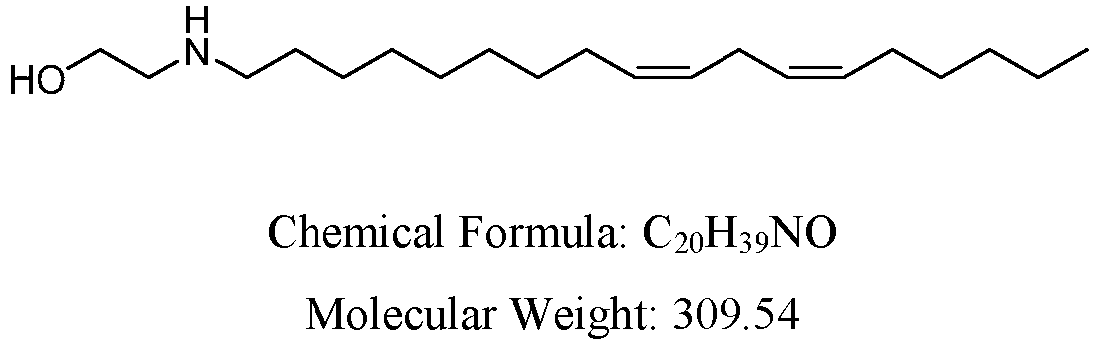
- In the same manner as 2-(dodecylamino)ethan-1-ol, 2-(((9Z,12Z)-octadeca-9,12-dien-1-yl)amino)ethan-1-ol was synthesized from ethanolamine (0.37 mL, 6.1 mmol), (6Z,9Z)-18-bromooctadeca-6,9-diene (2.0 g, 6.1 mmol), K2CO3 (1.67 g, 12.1 mmol), and KI (101 mg, 0.607 mmol) in MeCN (28 mL). Yield (453 mg, 24%).
- UPLC/ELSD: RT = 5.457 min. MS (ES): m/z (MH+) 311.38 for C20H39NO
1H-NMR (300 MHz, CDCl3) δ: ppm 5.36 (m, 4H); 3.62 (t, 2H); 2.78 (m, 4H); 2.61 (t, 2H); 2.05 (m, 4H); 1.49 (m, 2H); 1.30 (br. m, 16H); 0.89 (t, 3H). -

- In the same manner as 2-(didodecylamino)ethan-1-ol, 2-(di((9Z,12Z)-octadeca-9,12-dien-1-yl)amino)ethan-1-ol was synthesized from (6Z,9Z)-18-bromooctadeca-6,9-diene (4 g, 12.1 mmol), ethanolamine, (0.334 mL, 5.52 mmol), K2CO3 (3.36 g, 24.3 mmol), and KI (92 mg, 0.552 mmol) in MeCN (26 mL). Yield (1.9 g, 62%).
- UPLC/ELSD: RT = 6.80 min. MS (ES): m/z (MH+) 557.94 for C38H71NO
1H-NMR (300 MHz, CDCl3) δ: ppm 5.35 (m, 8H); 3.52 (t, 2H); 2.77 (t, 4H); 2.57 (t, 2H); 2.43 (t, 4H); 2.04 (q, 8H); 1.48-1.18 (br. m, 36H); 0.89 (t, 6H). -

- In a same manner as compound N-(2-chloroethyl)-N-dodecyldodecan-1-amine, (9Z,12Z)-N-(2-chloroethyl)-N-((9Z,12Z)-octadeca-9,12-dien-1-yl)octadeca-9,12-dien-1-amine was synthesized from 2-(di((9Z,12Z)-octadeca-9,12-dien-1-yl)amino)ethan-1-ol (250 mg, 0.45 mmol), triethylamine (81 µL, 0.58 mmol), and methanesulfonyl chloride (38 µL, 0.49 mmol) in DCM (2 mL). Yield (134 mg, 52%).
- 1H-NMR (300 MHz, CDCl3)δ: ppm 5.36 (m, 8H); 3.49 (t, 2H); 2.78 (m, 6H); 2.45 (t, 4H); 2.05 (q, 8H); 1.48-1.18 (br. m, 36H); 0.89 (t, 6H).
-

- In the same manner as pentyl 6-(dodecyl(2-(dodecyl(2-hydroxyethyl)amino)ethyl)amino)hexanoate, 2-((2-(di((9Z,12Z)-octadeca-9,12-dien-1-yl)amino)ethyl)((9Z,12Z)-octadeca-9,12-dien-1-yl)amino)ethan-1-ol was synthesized from 2-(((9Z,12Z)-octadeca-9,12-dien-1-yl)amino)ethan-1-ol (75 mg, 0.24 mmol), (9Z,12Z)-N-(2-chloroethyl)-N-((9Z,12Z)-octadeca-9, 12-dien-1-yl)octadeca-9, 12-dien-1-amine (154 mg, 0.27 mmol), K2CO3 (67 mg, 0.49 mmol), and KI (4 mg, 0.024 mmol) in MeCN (2 mL). Yield (35 mg, 17%).
- UPLC/ELSD: RT = 3.94 min. MS (ES): m/z (MH+) 850.03 for C33H108N2O
1H-NMR (300 MHz, CDCl3) δ: ppm 5.35 (br. m, 12H); 2.77 (t, 6H) 2.70-2.38 (br. m, 14H); 2.05 (m, 12H); 1.50-1.00 (br. m, 54H); 0.88 (t, 9H). -

- In the same manner as pentyl 6-(dodecyl(2-(dodecyl(2-hydroxyethyl)amino)ethyl)amino)hexanoate, 2-((2-(di-dodecylamino)ethyl)(hexyl)amino)ethan-1-ol was synthesized from 2-(hexylamino)ethan-1-ol (50 mg, 0.34 mmol), N-(2-chloroethyl)-N-dodecyldodecan-1-amine (143 mg, 0.34 mmol), K2CO3 (95 mg, 0.69 mmol), and KI (5.7 mg, 0.034 mmol) in MeCN (2 mL). Yield (145 mg, 80%).
- UPLC/ELSD: RT = 2.73min. MS (ES): m/z (MH+) 525.66 for C34H72N2O
1H NMR (300 MHz, CDCl3) δ: ppm 3.54 (m, 2H); 2.61-2.44 (br. m, 12H), 1.46-1.28 (br. m, 48H); 0.90 (m, 9H). -

- To a solution of 2-((2-aminoethyl)amino)ethan-1-ol (2.0 g, 18.6 mmol) and DCE (50 mL) at 0 °C was added nonanal (12.8 mL, 74.6 mmol), followed by AcOH (3.2 mL, 55.9 mmol). The reaction was allowed to stir at 0 °C for 20 min. Na(OAc)3BH (15.8 g, 74.6 mmol) was added and the reaction was allowed to warm to room temperature and stir for 18 hours at room temperature. The mixture was quenched by the slow addition of aqueous saturated NaHCO3 and extracted with DCM three times. The combined organic layers were dried over anhydrous Na2SO4, filtered, and concentrated in vacuo. Purification by ISCO silica flash chromatography provided 2-((2-(dinonylamino)ethyl)(nonyl)amino)ethan-1-ol. Yield (75 mg, 0.8%).
- UPLC/ELSD: RT = 2.28 min. MS (ES): m/z (MH+) 483.47 for C21H66N2O
1H NMR (300 MHz, CDCl3) δ: ppm 3.53 (m, 2H); 2.61-2.41 (br. m, 12H), 1.43-1.25 (br. m, 42H); 0.86 (m, 9H). -

- In the same manner as pentyl 6-(dodecyl(2-(dodecyl(2-hydroxyethyl)amino)ethyl)amino)hexanoate, 2-((2-(di-dodecylamino)ethyl)(nonyl)amino)ethan-1-ol was synthesized from 2-(nonylamino)ethan-1-ol (50 mg, 0.27 mmol), N-(2-chloroethyl)-N-dodecyldodecan-1-amine (111 mg, 0.27 mmol), K2CO3 (74 mg, 0.53 mmol), and KI (4.4 mg, 0.027 mmol) in 1,4-dioxane (1.5 mL). Yield (29 mg, 19%).
- UPLC/ELSD: RT = 3.05 min. MS (ES): m/z (MH+) 567.91 for C37H78N2O
1H NMR (300 MHz, CDCl3) δ: ppm 3.71 (m, 2H); 3.14-2.97 (br. m, 8H), 2.80 (m, 2H); 2.66 (m, 2H); 1.70 (m, 4H); 1.53 (m, 2H); 1.34-1.28 (br. m, 48H); 0.90 (m, 9H). -

- In the same manner as pentyl 6-(dodecyl(2-(dodecyl(2-hydroxyethyl)amino)ethyl)amino)hexanoate, 2-((2-(dinonylamino)ethyl)(dodecyl)amino)ethan-1-ol was synthesized from 2-(dodecylamino)ethan-1-ol (100 mg, 0.44 mmol), N-(2-chloroethyl)-N-nonylnonan-1-amine (145 mg, 0.44 mmol), K2CO3 (120 mg, 0.87 mmol), and KI (7.2 mg, 0.044 mmol) in MeCN (1 mL) and THF (1 mL). Yield (155 mg, 67%).
- UPLC/ELSD: RT = 2.78 min. MS (ES): m/z (MH+) 525.99 for C34H72N2O
1H NMR (300 MHz, CDCl3) δ: ppm 3.55 (m, 2H); 2.63-2.47 (br. m, 12H), 1.47-1.28 (br. m, 48H); 0.90 (m, 9H). -

- Ethanolamine (50 mg, 0.82 mmol), N-(2-chloroethyl)-N-dodecyldodecan-1-amine (0.75 g, 1.8 mmol), K2CO3 (0.25 g, 1.8 mmol) and KI (14 mg, 0.082) and 4 mL THF were combined in a round bottomed flask. The reaction was placed in a 65 °C heating mantle and was allowed to stir under N2 for 12 h. After this time the reaction was allowed to cool to room temperature and was filtered. The filtrate was washed with H2O and brine, dried over MgSO4, filtered and concentrated. The crude material was purified by C18 reverse phase chromatography (5-100% MeCN in H2O with 0.1% TFA). The fractions were pooled and concentrated. The isolated material was taken up in CHCl3, washed with 10% NaOH and brine, dried over MgSO4, filtered and concentrated. The product was then re-purified via silica gel chromatography (0-20% MeOH in DCM with 1% NH4OH) to afford 2-((2-(didodecylamino)ethyl)amino)ethan-1-ol (0.15 g, 41%).
- UPLC/ELSD: RT = 2.15 min. MS (ES): m/z (MH+) 441.37 for C28H60N2O
1H-NMR (400 MHz, CDCl3) δ: ppm 3.59 (t, 2H); 2.75 (t, 2H); 2.62 (t, 2H); 2.50 (t, 2H); 2.37 (t, 4H); 1.39 (m, 4H); 1.24 (m 38H); 0.86 (t, 6H). -

- A solution of 2-((2-aminoethyl)amino)ethan-1-ol (2 g, 19.2 mmol) in 50 mL DCE was allowed to cool under N2 in an ice bath. Dodecanal (26 mL, 76.8 mmol) was added followed by acetic acid (3.3 mL, 57.6 mmol). After 20 min., Na(OAc)3BH (16.3 g, 76.8 mmol) was added. The reaction was allowed to slowly warm to room temperature and stir for 48 h. After this time the reaction was quenched via portion wise addition of saturated NaHCO3. The mixture was extracted three times with DCM. The pooled organics were washed with brine, dried over MgSO4, filtered and concentrated. The crude material was purified by silica gel chromatography (0-100% EtOAc in hexanes) twice to afford clean 2-((2-(didodecylamino) ethyl)(dodecyl)amino)ethan-1-ol (7.4 g, 63%).
- UPLC/ELSD: RT = 3.20 min. MS (ES): m/z (MH+) 609.97 for C40H84N2O
1H-NMR (400 MHz, CDCl3) δ: ppm 3.51 (t, 2H); 2.57-2.40 (br. m, 12H); 1.41-1.23 (br. m., 60H); 0.86 (t, 9H). -

- In the same manner as pentyl 6-(dodecyl(2-(dodecyl(2-hydroxyethyl)amino)ethyl)amino)hexanoate, 3-((2-(di-dodecylamino)ethyl) (dodecyl)amino)propan-1-ol was synthesized from 3-(dodecylamino)propan-1-ol (39 mg, 0.16 mmol), N-(2-chloroethyl)-N-dodecyldodecan-1-amine (75 mg, 0.18 mmol), K2CO3 (44 mg, 0.32 mmol), and KI (2.7 mg, 0.016 mmol) in THF (1 mL). Yield (170 mg, >98%).
- UPLC/ELSD: RT = 3.29 min. MS (ES): m/z (MH+) 623.71 for C41H86N2O
1H NMR (300 MHz, CDCl3) δ: ppm 3.76 (m, 2H); 2.64-2.39 (br. m, 12H), 1.66 (m, 2H); 1.44-1.26 (br. m, 60H); 0.88 (m, 9H). -

- In the same manner as 2-(dodecylamino)ethan-1-ol, 4-(dodecylamino)butan-1-ol was synthesized from4-aminobutan-1-ol (2.5 mL, 27 mmol), 1-bromododecane (6.75 g, 27 mmol), K2CO3 (7.5 g, 54 mmol), and KI (450 mg, 2.7 mmol) in MeCN (125 mL). Yield (303 mg, 4%).
- UPLC/ELSD: RT = 1.09 min. MS (ES): m/z (MH+) 258.22 for C16H35NO
1H-NMR (300 MHz, CDCl3) δ: ppm 3.60 (t, 2H); 2.76-2.62 (br. m, 4H); 1.72-1.58 (br. m, 6H); 1.29 (br. m, 18H); 0.89 (t, 3H).
- In the same manner as pentyl 6-(dodecyl(2-(dodecyl(2-hydroxyethyl)amino)ethyl)amino)hexanoate, 4-((2-(di-dodecylamino)ethyl)(dodecyl)amino)butan-1-ol was synthesized from 4-(dodecylamino)butan-1-ol (75 mg, 0.29 mmol), N-(2-chloroethyl)-N-dodecyldodecan-1-amine (133 mg, 0.32 mmol), K2CO3 (80 mg, 0.58 mmol), and KI (5 mg, 0.029 mmol) in MeCN (2 mL). Yield (104 mg, 56%).
- UPLC/ELSD: RT = 3.27 min. MS (ES): m/z (MH+) 637.85 for C42H88N2O
1H-NMR (300 MHz, CDCl3) δ: ppm 3.56 (br. m, 2H); 2.58 (br. m, 4H); 2.45 (br. m, 8H); 1.65 (br. m, 4H); 1.45 (br. m, 6H); 1.25 (br. m, 54H); 0.88 (t, 9H). -

- 6-Bromo-1-hexanol (4.89 g, 27 mmol) and triphenylphosphine (7.87 g, 30 mmol) and 50 mL MeCN were combined in a round bottomed flask. The flask was fitted with a condenser and placed in a heating mantel and the reaction was allowed to stir at 82 °C for 48 h. After this time the reaction was allowed to cool to room temperature and the solultion was cannulated into 200 mL Et2O, producing a white precipitate. The solids were allowed to settle and the solvent was decanted off. 20 mL DCM was added to dissolve the solids and then 100 mL Et2O was slowly added to afford a white precipitate. The solvent was then removed in vacuo to afford clean (6-hydroxyhexyl)triphenylphosphonium bromide (9.4 g, 21.2 mmol, for 78% yield).
- 1H-NMR (300 MHz, CDCl3)δ: ppm 7.80 (m, 15H); 3.80 (m, 2H); 3.65 (m, 2H); 2.23 (m, 2H); 1.68 (m, 4H); 1.52 (m, 4H).
-

- A solution of (6-hydroxyhexyl)triphenylphosphonium bromide (3.0 g, 6.77 mmol) in 25 mL THF was allowed to cool in a -78 °C dry ice/acetone bath. Once cool n-BuLi (2.5 M in hexanes) (5.7 mL, 14.2 mmol) was added dropwise. After 1 h, an additional 10 mL THF and n-BuLi (1.35 mL) were added and stirring was continued at the same temperature for 1 h. After this time 1-hexanal (1.6 mL, 13.5 mmol) was added and the reaction was allowed to warm to rt and stir for 3 h. After this time the reaction was quenched by addition of excess sat'd NH4Cl. The solution was extracted three times with EtOAc. The pooled organics were washed with brine, dried over MgSO4, filtered and concentrated in vacuo. The crude material was purified by silica gel chromatography (0-50% EtOAc in hexanes) to afford the desired product as a clear oil (0.76 g, 4.1 mmol, 61%).
- 1H-NMR (300 MHz, CDCl3) δ: ppm 5.34 (m, 2H); 3.62 (t, 2H); 2.01 (m, 4H); 1.56 (m, 2H); 1.35-1.27 (m, 11H); 0.87 (t, 3H).
-

- To a 0 °C solution of (Z)-dodec-6-en-1-ol (1.81 g, 9.3 mmol) in 20 mL DCM, was added Et3N (1.7 mL, 12.1 mmol) and methanesulfonyl chloride (0.80 mL, 10.2 mmol). The reaction was allowed to slowly warm to room temperature and stir overnight. The reaction was quenched by the addition of water and the mixture was extracted two times with DCM. The organics were pooled, washed with brine, dried over MgSO4, filtered and concentrated. The crude material was purified by silica gel chromatography (0-30% EtOAc in hexanes) to afford clean desired product (2.2 g, 8.4 mmol, 90%).
- 1H-NMR (300 MHz, CDCl3) δ: ppm 5.34 (m, 2H); 4.20 (t, 2H); 2.98 (s, 3H); 2.01 (m, 4H); 1.74 (m, 2H); 1.38-1.27 (m, 10H); 0.87 (t, 3H).
-

- In a round bottomed flask, under N2, (Z)-dodec-6-en-1-yl methanesulfonate (2.2 g, 8.3 mmol) was dissolved in 40 mL Et2O. MgBr2·Et2O (6.5 g, 25 mmol) was added and the reaction was allowed to stir for 48 h. After this time the reaction was quenched by the addition of ice. The mixture was then extracted with Et2O three times. The pooled organics were washed with brine, dried over MgSO4, filtered and concentrated. The crude material was purified by silica gel chromatography (0-30% EtOAc in hexanes) to afford the desired product (1.8 g, 7.28 mmol, 88%).
- 1H-NMR (300 MHz, CDCl3) δ: ppm 5.34 (m, 2H); 3.39 (t, 2H); 2.01-1.84 (m, 6H); 1.28 (m, 10H); 0.87 (t, 3H).
-

- In the same manner as pentyl 6-(dodecyl(2-(dodecyl(2-hydroxyethyl)amino)ethyl)amino)hexanoate, (Z)-2-((2-(didodecylamino)ethyl)(dodec-6-en-1-yl)amino)ethan-1-ol was synthesized from (Z)-2-(dodec-6-en-1-ylamino)ethan-1-ol (100 mg, 0.44 mmol), N-(2-chloroethyl)-N-dodecyldodecan-1-amine (183 mg, 0.44 mmol), K2CO3 (122 mg, 0.88 mmol), and KI (7.3 mg, 0.044 mmol) in MeCN (1 mL) and THF (1 mL). Yield (90 mg, 34%).
- UPLC/ELSD: RT = 3.24 min. MS (ES): m/z (MH+) 608.08 for C40H82N2O
1H NMR (300 MHz, CDCl3) δ: ppm 5.42-5.35 (m, 2H); 3.55 (m, 2H), 2.62-2.45 (br. m, 12H); 2.06-2.00 (m, 4H); 1.48-1.28 (br. m, 52H); 0.91 (m, 9H). -

- In the same manner as pentyl 6-(dodecyl(2-(dodecyl(2-hydroxyethyl)amino)ethyl)amino)hexanoate, 2-((2-(di-dodecylamino)ethyl)(tetradecyl)amino)ethan-1-ol was synthesized from 2-(tetradecylamino)ethan-1-ol (100 mg, 0.39 mmol), N-(2-chloroethyl)-N-dodecyldodecan-1-amine (162 mg, 0.39 mmol), K2CO3 (107 mg, 0.78 mmol), and KI (6.5 mg, 0.039 mmol) in MeCN (3 mL). Yield (128 mg, 52%).
- UPLC/ELSD: RT = 3.47 min. MS (ES): m/z (MH+) 637.92 for C42H88N2O
1H NMR (300 MHz, CDCl3) δ: ppm 3.54 (m, 2H); 2.61-2.44 (br. m, 12H); 1.46-1.28 (br. m, 64H); 0.91 (m, 9H). -

- In the same manner as pentyl 6-(dodecyl(2-(dodecyl(2-hydroxyethyl)amino)ethyl) amino)hexanoate, 2-((2-(didodecylamino)ethyl)((9Z, 12Z)-octadeca-9,12-dien-1-yl)amino)ethan-1-ol was synthesized from 2-(((9Z,12Z)-octadeca-9,12-dien-1-yl)amino)ethan-1-ol (50 mg, 0.16 mmol), N-(2-chloroethyl)-N-dodecyldodecan-1-amine (67 mg, 0.16 mmol), K2CO3 (45 mg, 0.32 mmol), and KI (3 mg, 0.016 mmol) in MeCN (2 mL). Yield (45 mg, 41%).
- UPLC/ELSD: RT = 3.64 min. MS (ES): m/z (MH+) 689.95 for C46H92N2O
1H NMR (300 MHz, CDCl3) δ: ppm 5.39-5.32 (m, 4H); 3.56 (m, 2H), 2.80 (m, 2H); 2.62-2.52 (br. m, 12H); 2.08 (m, 4H); 1.48-1.28 (br. m, 58H); 0.91 (m, 9H). -

- At 0 °C, a solution of nonane-1,9-diol (96.16 g, 0.60 mol) in 100 mL DMF was slowly added into a suspension of NaH (24.0 g, 0.60 mol) in 800 mL DMF. After stirring for 1 h, a solution of benzyl bromide (71.4 mL, 0.60 mole) in 200 mL DMF was slowly added. After addition, the reaction mixture was warmed up to room temperature and stirred overnight. TLC showed starting material was almost consumed. The reaction mixture was poured onto ice, and then extracted with EtOAc (3 X). The combined organic layers were washed with water and brine, and then dried over sodium sulfate. After filtration and concentration, the crude was purified by flash column chromatography (SiO2: 0 to 100% EtOAc/hexanes then 0 to 5% MeOH/dichloromethane) to provide the product as a colorless oil (74.4 g, 50%).

- At 0 °C, to a solution of 9-(benzyloxy)nonan-1-ol (14.88 g, 61.5 mmol) in 150 mL dichloromethane, CBr4 (30.6 mmol, 92.2 mmol) was added. And then triphenylphosphine (27.4 g, 0.104 mole) was added portionwise. After stirring at room temperature overnight, TLC showed completed reaction. The reaction mixture was poured onto ice, and then extracted with dichloromethane (2 X). The combined organic layers were washed with water and brine, and then dried over magnesium sulfate. After filtration and concentration, the residue was purified by ISCO (SiO2: 0 to 10% EtOAc/hexanes) to provide the product as colorless oil (21.0 g, quant.).

- To a suspension of magnesium (3.23 g, 0.134 mole) in 80 mL THF, catalytic amount of iodine was added, and then stirred until the color disappeared. A solution of (((9-bromononyl)oxy)methyl)benzene (21.0 g, 67.2 mmol) in 40 mL THF was slowly added in 15 min at room temperature, and then the mixture was heated to reflux for 1 h. After cooling to room temperature, a solution of methyl formate (4.2 mL, 67.2 mmol) in 10 mL THF was added dropwise, and the mixture was stirred overnight. The reaction was quenched by addition of 5 N HCl and water, and the mixture was extracted with EtOAc (2 X). The combined organic layers were washed with brine and dried over sodium sulfate. After filtration and concentration, the residue was dissolved in EtOH, and then KOH and water were added. After stirring overnight, the reaction mixture was concentrated to dryness. Water was added, and then adjusted pH ~7 with 1 N HCl. The mixture was extracted with EtOAc (2 X), and the combined organic layer was dried over magnesium sulfate. After filtration and concentration, the crude was purified by ISCO (SiO2: 0 to 10% EtOAc/hexanes) to provide the product as colorless oil (6.64 g, 40%).

- At 0 °C, a solution of 1,19-bis(benzyloxy)nonadecan-10-ol (6.64 g, 13.4 mmol) in 30 mL dichloromethane was slowly added into a solution of Dess-Martin periodinane (7.94 g, 18.7 mmol) in 70 mL dichloromethane, and then the reaction mixture was stirred at this temperature for 3 h. TLC showed starting material was consumed. The reaction mixture was diluted with dichloromethane, and then 10% Na2S2O3 solution and saturated sodium bicarbonate solution were added. After extraction with dichloromethane (2 X), the combined organic layers were washed with brine and concentrated. The residue was dissolved in ether and washed with saturated sodium bicarbonate and brine. After drying over sodium sulfate, the solution was filtered and concentrated. The crude was purified by ISCO (SiO2: 0 to 20% EtOAc/hexanes) to provide the product as colorless oil (6.23 g, 94%).

- At 0 °C, potassium tert-butoxide (1.70 g, 15.1 mmol) was added into a solution of methylphosphonium bromide (5.40 g, 15.1 mmol) in 80 mL THF which was purged with
nitrogen 3 times. After 1 h, a solution of 1,19-bis(benzy-loxy)nonadecan-10-one (6.23 g, 12.6 mmol) in 20 mL THF (purged withnitrogen 3 times) was transferred via cannula into the reaction mixture, and then the reaction was allowed to warm up to room temperature overnight. TLC showed completed reaction, and the reaction mixture was filtered through Celite. After concentration, the crude was purified by ISCO (SiO2: 0 to 10% EtOAc/hexanes) to provide the product as colorless oil (6.0 g, 96%).
- To a refluxing solution of (((10-methylenenonadecane-1,19-diyl)bis(oxy))bis(methylene))dibenzene (2.99 g, 6.08 mmol) in 160 mL dichloromethane, a solution of Cu(acac)2 (180 mg, 0.69 mmol) in 40 mL dichloromethane was added. And then ethyl diazoacetate (contains 13% dichloromethane, 9 X 1.1 mL) was added every 30 min. MS showed the formation of product. The reaction was quenched with MeOH and stirred for 1 h at room temperature. After concentration, the crude was purified by flash column chromatography (SiO2: 0 to 10% EtOAc/hexanes) to provide the product as colorless oil (3.65 g, contains 1 equivalent of acetate by-product).

- A mixture of
ethyl 2,2-bis(9-(benzyloxy)nonyl)cyclopropane-1-carboxylate (2.8 g, 4.8 mmol) and Palladium on carbon (10wt%, 500 mg) in 500 mL EtOAc was stirred at room temperature under hydrogen balloon for 4.5 h. MS and TLC showed completed reaction. The reaction mixture was filtered through Celite and washed with EtOAc. The filtrate was concentrated to provide the product mixed with by-product, diethyl succinate (2.53 g, contains 0.94 equivalent of by-product, 94%).
- At 0 °C, a solution of
ethyl 2,2-bis(9-hydroxynonyl)cyclopropane-1-carboxylate (2.4 g, 6 mmol) in 100 mL dichloromethane was slowly added into a suspension of Dess-Martin periodinane (7.67 g, 18 mmol) in 100 mL dichloromethane, and then the reaction mixture was stirred at room temperature for 4 h. After quenching with 10% aqueous Na2S2O3 and saturated sodium bicarbonate, the mixture was extracted with dichloromethane (2 X). The combined organic layers were dried over sodium sulfate and concentrated to give the product as colorless oil (2.3 g, contains about 0.7 g by-product). - Preparation of (Z)-non-3-en-1-yltriphenylphosphonium iodide:

- A solution of (Z)-1-iodonon-3-ene (81 g, 0.321 mole) and triphenylphosphine (169 g, 0.643 mole) in acetonitrile (1.1 L) was refluxed overnight. After concentrated to dryness, the residue was triturated with hexanes. The white gum was dissolved in dichloromethane and purified by flash column chromatography (SiO2: 0 to 5% MeOH/CH2Cl2) to provide the product as colorless oil which then turned into white solid (114 g, 69%).

- At 0 °C, potassium tert-butoxide (1.98 g, 17.7 mmol) was added into a solution of (Z)-non-3-en-1-yltriphenyl-phosphonium iodide (9.2 g, 17.9 mmol) in 300 mL THF which was purged with
nitrogen 3 times. After 1 h, a solution ofethyl 2,2-bis(9-oxononyl)cyclopropane-1-carboxylate (2.05 g, 5.2 mmol) in 100 mL THF (purged withnitrogen 3 times) was transferred via cannula into the reaction mixture, and then the reaction was allowed to warm up to room temperature overnight. TLC showed completed reaction. The reaction was quenched with saturated ammonium chloride, and then extracted with hexanes (2 X). The combined organic layers were washed with brine and dried over sodium sulfate. After filtration and concentration, the residue was purified by ISCO (SiO2: 0 to 5% EtOAc/hexanes) to provide the product as a colorless oil (1.54 g, 48%).
- A solution of lithium aluminum hydride (2.0 M in THF, 1.9 mL, 3.8 mmol) was slowly added into a solution of
ethyl 2,2-di((9Z,12Z)-octadeca-9,12-dien-1-yl)cyclopropane-1-carboxylate (1.54 g, 2.52 mmol) in 150 mL THF, and then the reaction mixture was stirred at room temperature for 30 min. TLC showed completed reaction. The reaction was quenched by slow addition of Na2SO4·10H2O, then the mixture was filtered and washed with THF. The filtrate was concentrated and purified by flash column chromatography (SiO2: 0 to 15% EtOAc/Hexanes) to give the product as a colorless oil (1.2 g, 84%).
- At 0 °C, a solution of (2,2-di((9Z,12Z)-octadeca-9,12-dien-1-yl)cyclopropyl)methanol (1.04 g, 1.83 mmol) in 100 mL dichloromethane was slowly added into a suspension of Dess-Martin periodinane (1.18 g, 2.77 mmol) in 200 mL dichloromethane, and then the reaction mixture was stirred at room temperature for 3 h. After quenched with saturated sodium bicarbonate, the mixture was extracted with dichloromethane (2 X). The combined organic layer was dried over sodium sulfate and concentrated to give the product as a colorless oil (0.95 g, 91%).

- Chemical Formula: C42H77N
- Molecular Weight: 596.09
- To a solution of 2,2-di((9Z,12Z)-octadeca-9,12-dien-1-yl)cyclopropane-1-carbaldehyde (0.95 g, 1.68 mmol) in 300 mL THF, dimethylamine (2.0 M in THF, 2 mL, 4 mmol), sodium triacetoxyborohydride (840 mg, 4 mmol) and acetic acid (0.23 mL, 4 mmol) were added sequentially, and the reaction mixture was stirred at room temperature overnight. MS showed completed reaction, and saturated sodium bicarbonate was added to quench the reaction. The mixture was extracted with EtOAc (2 X), and the combined organic layers were washed with brine and dried over sodium sulfate. After filtration and concentration, the residue was purified by flash column chromatography (SiO2: 0 to 10% MeOH/dichloromethane) to give the product 1-(2,2-Di((9Z,12Z)-octadeca-9,12-dien-1-yl)cyclopropyl)-N,N-dimethylmethanamine as a colorless oil (0.56 g, 56%).
- 1H NMR (300 MHz, CDCl3) δ 5.27-5.42 (m, 8 H), 2.76 (t, 4 H, J= 6.2 Hz), 2.38 (bs, 8 H), 2.04 (q, 8 H, J = 6.6 Hz), 1.18-1.41 (m, 38 H), 0.96-1.17 (m, 2 H), 0.88 (t, 6 H, J = 6.6 Hz), 0.66-0.76 (m, 1 H), 0.48-0.56 (m, 1 H), 0.05-0.13 (m, 1 H).
- APCI: m/z = 596.6 [M+H]+.
-

- Preparation of Zn-Cu couple: A suspension of zinc dust (10 g) in 10 mL 4 M HCl was stirred for 10 min, and then the aqueous phase was decanted. After the solid was washed with water (2 × 20 mL), 20 mL water and copper sulfate (0.75 g) were added subsequently. After stirring overnight, water was decanted, and then the residue was washed with THF (2 × 10 mL). The black solid was dried under vacuum and store under nitrogen.
- To a suspension of Zn-Cu couple (1.295 g, 19.8 mmol) in 30 mL ether purged with
nitrogen 3 times, a solution of (((10-methylenenonadecane-1,19-diyl)bis(oxy))bis(methylene))dibenzene (2.96 g, 6.0 mmol) in 10 mL ether purged with nitrogen was added, and then a solution of POCl3 (1.85 mL, 19.8 mmol) and 2,2,2-trichloroacetyl chloride (2.23 mL, 19.8 mmol) in 15 mL ether purged with nitrogen was added dropwise. After the addition, the mixture was heated to reflux for 22 h. TLC showed trace amounts of starting material. The reaction mixture was cooled in ice bath, and then 8.0 g potassium carbonate was added. 30 mL MeOH was added dropwise and stirred until no gas evolution. EtOAc was added and the mixture was filtered through Celite. The filtrate was concentrated and the residue was purified by ISCO (SiO2: 0 to 10% EtOAc/hexanes) to provide the product as a colorless oil (3.02 g, 83%).
- To a solution of 3,3-bis(9-(benzyloxy)nonyl)-2,2-dichlorocyclobutan-1-one (3.02 g, 5.0 mmol) in 80 mL MeOH, Zn dust (1.96 g, 30 mmol) was added. After stirring for 15 min, ammonium chloride (1.6 g, 30 mmol) was added, and the reaction mixture was stirred at room temperature for 3 h. TLC showed completed reaction, and the mixture was concentrated to dryness. 100 mL water and 100 mL EtOAc were added, and the mixture was filtered through Celite. The filtrate was washed with brine and dried over magnesium sulfate. After filtration and concentration, the product was obtained (2.58 g, 97%), which was used for the next step without purification.

- At 0 °C, sodium borohydride (0.51 g, 13.51 mmol) was added into a solution of 3,3-bis(9-(benzyloxy)nonyl)cyclobutan-1-one (2.58 g, 4.82 mmol) in 48 mL MeOH/THF (5:1), and then the reaction was stirred at this temperature for 1 h. TLC showed completed reaction. The reaction was quenched with saturated sodium bicarbonate, and then extracted with EtOAc (2 X). The combined organic layers were washed with brine and dried over sodium sulfate. After filtration and concentration, the product was obtained as a colorless oil (2.68 g, quant.), which was used for the next step without purification.

- To a solution of 3,3-bis(9-(benzyloxy)nonyl)cyclobutan-1-ol (3.31 g, 6.17 mmol) and imidazole (0.92 g, 13.57 mmol) in 50 mL dichloromethane, tert-butyldimethylsilyl chloride (1.15 g, 7.28 mmol) was added and the reaction mixture was stirred at room temperature for 4 h. TLC showed completed reaction. Water was added to quench the reaction, and the mixture was extracted with dichloromethane (2 X). The combined organic layers were washed with brine and dried over sodium sulfate. After filtration and concentration, the residue was purified by ISCO (SiO2: 0 to 20% EtOAc/hexanes) to provide the product as a colorless oil (3.53g, 90%).

- A mixture of (3,3-bis(9-(benzyloxy)nonyl)cyclobutoxy)(tert-butyl)dimethylsilane (3.53 g, 5.42 mmol) and palladium on carbon (10wt%, 0.71g) in 350 mL EtOAc was purged with nitrogen and hydrogen, respectively. After stirring under hydrogen balloon overnight, TLC showed completed reaction, and then the reaction mixture was filtered through Celite. After concentration, the residue was purified by ISCO (SiO2: 0 to 70% EtOAc/hexanes) to provide the product as a colorless oil (2.35 g, 92%).

- At 0 °C, a solution of 9,9'-(3-((tert-butyldimethylsilyl)oxy)cyclobutane-1,1-diyl)bis(nonan-1-ol) (1.49 g, 3.16 mmol) in 20 mL dichloromethane was slowly added into a solution of Dess-Martin periodinane (2.68 g, 6.33 mmol) in 70 mL dichloromethane, and then the reaction mixture was stirred at this temperature for 3 h. After stirring at room temperature for 1 h, the reaction mixture was diluted with dichloromethane, and then 10% Na2S2O3 solution and saturated sodium bicarbonate solution were added. After extraction with dichloromethane (2 X), the combined organic layers were washed with saturated sodium bicarbonate and brine. The organic layer was dried over sodium sulfate and concentrated. The crude was purified by ISCO (SiO2: 0 to 10% EtOAc/hexanes) to provide the product as a colorless oil (0.88 g, 60%).

- At 0 °C, potassium tert-butoxide (0.51 g, 4.53 mmol) was added into a solution of (Z)-non-3-en-1-yltriphenyl-phosphonium iodide (2.33 g, 4.53 mmol) in 30 mL THF which was purged with
nitrogen 3 times. After 1 h, a solution of 9,9'-(3-((tert-butyldimethylsilyl)oxy)cyclobutane-1,1-diyl)dinonanal (0.88 g, 1.89 mmol) in 25 mL THF (purged withnitrogen 3 times) was transferred via cannula into the reaction mixture, and then the reaction was allowed to warm up to room temperature overnight. TLC showed complete reaction. The reaction was quenched with saturated ammonium chloride, and then extracted with EtOAc (2 X). The combined organic layers were washed with brine and dried over sodium sulfate. After filtration and concentration, the residue was purified by ISCO (SiO2: 0 to 20% EtOAc/hexanes) to provide the product as a colorless oil (543 mg, 42%).
- To a solution of tert-butyl(3,3-di((9Z,12Z)-octadeca-9,12-dien-1-yl)cyclobutoxy)dimethylsilane (0.67 g, 0.98 mmol) in 60 mL THF, a solution of TBAF (1.0 M in THF, 9.8 mL, 9.8 mmol) was added and the reaction mixture was stirred at room temperature for 3 h. TLC showed completed reaction. The solvent was removed under vacuum and the residue was purified by ISCO (SiO2: 0 to 20% EtOAc/hexanes) to provide the product as a colorless oil (0.64 g, Quant.).

- At 0 °C, pyridine (2.4 mL) and propylphosphonic anhydride solution (50wt% in DMF, 2.4 mL, 4.16 mmol) were added into a solution of 4-(dimethylamino)butanoic acid hydrochloride (564 mg, 3.37 mmol) in 6 mL DMF. After stirring for 10 min, a solution of 3,3-di((9Z,12Z)-octadeca-9,12-dien-1-yl)cyclobutan-1-ol (0.64 g, 1.12 mmol) in 4 mL DMF was added and the reaction mixture was stirred at room temperature overnight. MS and TLC showed the formation of product. Saturated sodium bicarbonate solution was added to quench the reaction, and then extracted with EtOAc (2 X). The combined organic layers were washed with water and brine. After dried over sodium sulfate and concentration, the residue was purified by ISCO (SiO2: 0 to 100% EtOAc/hexanes) to provide the
product 3,3-Di((9Z,12Z)-octadeca-9,12-dien-1-yl)cyclobutyl 4-(dimethylamino)butanoate as a slight yellow oil (479 mg, 63%). - 1H NMR (300 MHz, CDCl3) δ 5.28-5.42 (m, 8 H), 4.89-4.99 (m, 1 H), 2.76 (t, 4 H, J = 6.1 Hz), 2.30 (t, 4 H, J= 7.4 Hz), 2.23 (s, 6 H), 2.15-2.21 (m, 2H), 2.04 (q, 8 H, J = 6.6 Hz), 1.68-1.84 (m, 4 H), 1.08-1.40 (m, 40 H), 0.88 (t, 6 H, J= 6.6 Hz).
- APCI: m/z = 682.6 [M + H]+.
-

- At 0 °C, to a solution of 1,4-dibromobutan-2-ol (75.0 g, 0.328 mole) and imidazole (49.0 g, 0.72 mole) in 500 mL dichloromethane, a solution of tert-butyldimethylsilyl chloride (57.0 g, 0.36 mole) in 300 mL dichloromethane was added dropwise. After the addition, the reaction mixture was warmed up to room temperature and kept stirring overnight. TLC showed clean conversion. The reaction mixture was filtered and washed with dichloromethane. After concentration, the residue was taken up with dichloromethane and washed with water and brine. The organic layer was dried over Na2SO4. After filtration and concentration, the crude was purified by flash column chromatography (SiO2: 0 to 10% ether/hexanes) to provide pure product as a colorless liquid (83.05 g, 71%).

- A solution of tert-butyl((1,4-dibromobutan-2-yl)oxy)dimethylsilane (53.7 g, 0.152 mole), diethyl malonate (10.0 g, 0.138 mole), potassium carbonate (47.6 g, 0.345 mole) and tetrabutylammonium bromide (4.45 g, 13.8 mmol) in 700 mL DMF was stirred at room temperature for 3 days. TLC showed almost no starting material. The reaction mixture was diluted with water and extracted by EtOAc (3 X), and the combined organic layers were washed with saturated ammonium chloride and brine. After drying over sodium sulfate, the solution was filtered and concentrated. The residue was purified by flash column chromatography (SiO2: 0 to 10% EtOAc/hexanes) to give the desired product as a colorless oil (36.92 g, 77%).

- At 0 °C, a solution of lithium aluminium hydride (2.0 M in THF, 43.2 mL, 86.4 mmol) was added into a solution of diethyl 3-((tert-butyldimethylsilyl)oxy)cyclopentane-1,1-dicarboxylate (14.89 g, 43.2 mmol) in 60 mL THF, and then the reaction mixture was stirred at room temperature overnight. TLC showed clean conversion. The reaction was quenched by slowly adding of water (6 mL) and 1 N NaOH (20 mL), and then stirred for 30 min. The suspension was filtered through Celite and washed with EtOAc. After concentration, the residue was purified by flash column chromatography (SiO2: 0 to 90% EtOAc/hexanes) to provide the product as a colorless oil (9.86 g, 88%).

- At -78 °C, a solution of DMSO (2.15 mL, 30.3 mmol) in 10 mL dichloromethane was added dropwise into a solution of oxalyl chloride (1.35 mL, 15.2 mmol) in 15 mL dichloromethane, and then a solution of (3-((tert-butyldimethylsilyl)oxy)cyclopentane-1,1-diyl)dimethanol (1.88 g, 7.2 mmol) in 15 mL dichloromethane was added immediately. After stirring 30 min, triethylamine (7.25 mL, 52.0 mmol) was added and the reaction mixture was warmed up to room temperature. TLC showed clean conversion. The reaction was quenched with water and extracted with ether (2 X). The combined organic layers were washed with saturated ammonium chloride and brine. After drying over sodium sulfate, the solution was filtered and concentrated to give the product as a yellow oil (2.00 g, quant.), which was used for the next step without further purification.
-
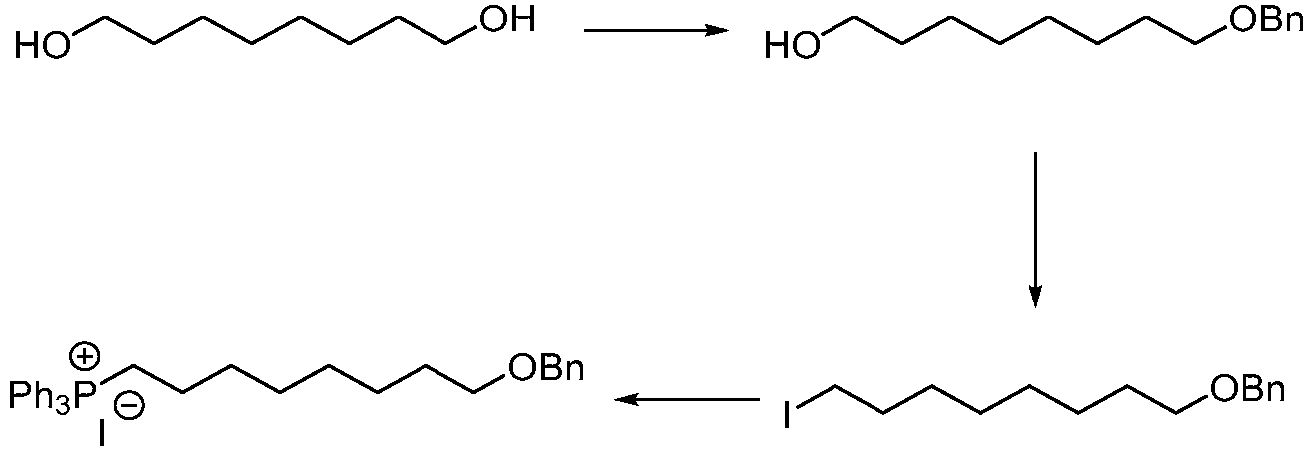
- At 0 °C, a solution of octane-1,8-diol (100 g, 0.684 mol) in 100 mL DMF was slowly added into a suspension of NaH (27.35 g, 0.684 mol) in 700 mL DMF. After stirring for 30 min, a solution of benzyl chloride (78.7 mL, 0.684 moles) in 200 mL DMF was slowly added. After addition, the reaction mixture was warmed up to room temperature and stirred overnight. TLC showed starting material was almost consumed. The reaction mixture was poured onto ice, and then extracted by EtOAc (2 X). The combined organic layers were washed with water and brine, and then dried over sodium sulfate. After filtration and concentration, the crude was purified by flash column chromatography (SiO2: 0 to 60% EtOAc/hexanes) to provide the product as a colorless oil (85.83 g, 53%).
- At 0 °C, a solution of triphenylphosphine (114.4 g, 0.436 mole) in 300 mL dichloromethane was slowly added into a solution of 8-(benzyloxy)octan-1-ol (85.83 g, 0.363 mole), imidazole (52 g, 0.76 mole) and iodine (129.1 g, 0.51 mole) in 1200 mL dichloromethane, and then the reaction mixture was allowed to equilibrate to room temperature over 3 days. After filtration, the filtrate was concentrated and the residue was triturated with hexanes. The solution was filtered through a plug of silica gel and eluted with 10% ether in hexanes to provide the product as a cloudy liquid (81.09 g). The gummy solid was dissolved in dichloromethane and passed through silica gel and eluted with 10% ether in hexanes to provide a cloudy liquid (20.0 g). Total yield: 101.1 g (80%).
- A solution of (((8-iodooctyl)oxy)methyl)benzene (101.1 g, 0.293 mole) and triphenylphosphine (154.1 g, 0.586 mole) in acetonitrile (1 L) was refluxed overnight. After concentrated to dryness, the residue was dissolved in dichloromethane and purified by flash column chromatography (SiO2: 0 to 10% MeOH/CH2Cl2) to provide the product as a yellow oil (144.1 g, 81%).

- At 0 °C, potassium tert-butoxide (2.42 g, 21.6 mmol) was added into a solution of (8-(benzyloxy)octyl)triphenylphosphonium iodide (14.2 g, 23.3 mmol) in 80 mL THF which was purged with
nitrogen 3 times. After 1 h, a solution of 3-((tert-butyldimethylsilyl)oxy)cyclopentane-1,1-dicarbaldehyde (2.00 g, 7.2 mmol) in 20 mL THF (purged withnitrogen 3 times) was transferred via cannula into the reaction mixture, and then the reaction was allowed to warm up to room temperature overnight. TLC showed completed reaction. The reaction was quenched with saturated ammonium chloride, and then extracted with ether (2 X). The combined organic layer was washed with brine and dried over sodium sulfate. After filtration and concentration, the residue was purified by flash column chromatography (SiO2: 0 to 6% ether/hexanes) to provide the product as a colorless oil (3.77 g, 79%).
- A mixture of ((3,3-bis((Z)-9-(benzyloxy)non-1-en-1-yl)cyclopentyl)oxy)(tert-butyl)dimethylsilane (3.04 g, 4.6 mmol) and palladium on carbon (10%, 600 mg) in 200 mL EtOAc was purged with nitrogen then hydrogen, and then stirred under hydrogen overnight. TLC and MS showed complete reaction. The reaction mixture was filtered through Celite and washed by EtOAc. The filtrate was concentrated to give the product as a colorless oil (2.32 g, Quant.).

- At 0 °C, a solution of 9,9'-(3-((tert-butyldimethylsilyl)oxy)cyclopentane-1,1-diyl)bis(nonan-1-ol) (2.32 g, 4.6 mmol) in 30 mL dichloromethane was slowly added into a solution of Dess-Martin periodinate (5.46 g, 12.88 mmol) in 70 mL dichloromethane, and then the reaction mixture was stirred at this temperature for 4 h. TLC showed starting material was consumed. The reaction mixture was diluted with dichloromethane, and then 10% Na2S2O3 solution and saturated sodium bicarbonate solution were added. After extraction with dichloromethane (2 X), the combined organic layers were washed with brine and concentrated. The residue was dissolved in ether and washed with saturated sodium bicarbonate and brine. After drying over sodium sulfate, the solution was filtered and concentrated. The crude was purified by ISCO (SiO2: 0 to 50% EtOAc/hexanes) to provide the product as a colorless oil (0.73 g, 16%).

- At 0 °C, potassium tert-butoxide (363 mg, 3.23 mmol) was added into a solution of (Z)-non-3-en-1-yltriphenyl-phosphonium iodide (1.66 g, 3.23 mmol) in 30 mL THF which was purged with
nitrogen 3 times. After 1 h, a solution of 9,9'-(3-((tert-butyldimethylsilyl)oxy)cyclopentane-1,1-diyl)dinonanal (0.52 g, 1.08 mmol) in 10 mL THF (purged withnitrogen 3 times) was transferred via cannula into the reaction mixture, and then the reaction was allowed to warm up to room temperature overnight. TLC showed complete reaction. The reaction was quenched with saturated ammonium chloride, and then extracted with ether (2 X). The combined organic layers were washed with brine and dried over sodium sulfate. After filtration and concentration, the residue was purified by ISCO (SiO2: 0 to 5% EtOAc/hexanes) to provide the product as a colorless oil (170 mg, 22%).
- To a solution of tert-butyl((3,3-di((9Z,12Z)-octadeca-9,12-dien-1-yl)cyclopentyl)oxy)dimethylsilane (170 mg, 0.24 mmol) in 20 mL THF, a solution of TBAF (1.0 M in THF, 2.4 mL, 2.4 mmol) was added and the reaction mixture was stirred at room temperature for 2 h. TLC showed complete reaction. The solvent was removed under vacuum and the residue was purified by ISCO (SiO2: 0 to 20% EtOAc/hexanes) to provide the product as a colorless oil (80 mg, 57%).

- At 0 °C, pyridine (0.1 mL) and propylphosphonic anhydride solution (50wt% in EtOAc, 0.51 mmol) were added into a solution of 3-(dimethylamino)propanoic acid hydrochloride (63 mg, 0.41 mmol) in 3 mL DMF. After stirring for 10 min, a solution of 3,3-di((9Z,12Z)-octadeca-9,12-dien-1-yl)cyclopentan-1-ol (80 mg, 0.14 mmol) in 2 mL DMF was added and the reaction mixture was stirred at room temperature overnight. MS and TLC showed the formation of product. Saturated sodium bicarbonate solution was added to quench the reaction, and then extracted by EtOAc (2 X). The combined organic layer was washed with water and brine. After drying over sodium sulfate and concentration, the residue was purified by ISCO (SiO2: 0 to 100% EtOAc/hexanes) to provide the
product 3,3-Di((9Z,12Z)-octadeca-9,12-dien-1-yl)cyclopentyl 3-(dimethylamino)propanoate as a colorless oil (59 mg, 62%). - 1H NMR (300 MHz, CDCl3) δ 5.28-5.42 (m, 8 H), 5.12-5.17 (m, 1 H), 2.76 (t, 4 H, J = 6.0 Hz), 2.59 (t, 2 H, J= 6.9 Hz), 2.42 (t, 2 H, J= 6.9 Hz), 2.23 (s, 6 H), 2.04 (q, 8 H, J= 6.9 Hz), 1.75-2.00 (m, 2 H), 1.38-1.72 (m, 5 H), 1.14-1.39 (m, 39 H), 0.88 (t, 6 H, J = 6.9 Hz).
- APCI: m/z = 682.6 [M+H]+
-

- At 0 °C, pyridine (0.6 mL) and propylphosphonic anhydride solution (50wt% in DMF, 2.4 mL, 4.16 mmol) were added into a solution of 4-(dimethylamino)butanoic acid hydrochloride (565 mg, 3.37 mmol) in 3 mL DMF. After stirring for 10 min, a solution of 3,3-di((9Z,12Z)-octadeca-9,12-dien-1-yl)cyclopentan-1-ol (0.65 g, 1.115 mmol) in 1 mL DMF was added and the reaction mixture was stirred at room temperature overnight. MS and TLC showed the formation of product. Saturated sodium bicarbonate solution was added to quench the reaction, and then extracted with EtOAc (2 X). The combined organic layer was washed with water and brine. After dried over sodium sulfate and concentration, the residue was purified by ISCO (SiO2: 0 to 100% EtOAc/hexanes) to provide the
product 3,3-Di((9Z,12Z)-octadeca-9,12-dien-1-yl)cyclopentyl 4-(dimethylamino)butanoate as colorless oil (556 mg, 72%). - 1H NMR (300 MHz, CDCl3) δ 5.28-5.42 (m, 8 H), 5.06-5.15 (m, 1 H), 2.76 (t, 4 H, J = 6.0 Hz), 2.29 (t, 4 H, J = 7.4 Hz), 2.23 (s, 6 H), 2.04 (q, 8 H, J= 6.6 Hz), 1.14-1.99 (m, 48 H), 0.88 (t, 6 H, J = 6.9 Hz).
- APCI: m/z =696.6 [M + H]+.
-

- At 0 °C, potassium tert-butoxide (10.03 g, 89.4 mmol) was added into a solution of (9-(benzyloxy)nonyl)triphenylphosphonium iodide (43.0 g, 69.0 mmol) in 160 mL THF which was purged with
nitrogen 3 times. After 1 h, a solution of 3-((tert-butyldimethylsilyl)oxy)cyclopentane-1,1-dicarbaldehyde (7.70 g, 29.8 mmol) in 60 mL THF (purged withnitrogen 3 times) was transferred via cannula into the reaction mixture, and then the reaction was allowed to warm up to room temperature overnight. TLC showed complete reaction. The reaction was quenched with saturated ammonium chloride, and then extracted with ether (2 X). The combined organic layer was washed with brine and dried over sodium sulfate. After filtration and concentration, the residue was purified by flash column chromatography (SiO2: 0 to 6% ether/hexanes) to provide the product as a colorless oil (6.52 g, 32%).
- A mixture of ((3,3-bis((Z)-10-(benzyloxy)dec-1-en-1-yl)cyclopentyl)oxy)(tert-butyl)dimethylsilane (6.52 g, 9.86 mmol) and palladium on carbon (10%, 1.30 g) in 400 mL EtOAc was purged with nitrogen then hydrogen, and then stirred under hydrogen overnight. TLC and MS showed complete reaction. The reaction mixture was filtered through Celite and washed with EtOAc. The filtrate was concentrated, and the residue was purified by flash column chromatography (SiO2: 0 to 80% EtOAc/hexanes) to give the product as a semi-solid (4.60 g, 96%).

- At 0 °C, a solution of 10,10'-(3-((tert-butyldimethylsilyl)oxy)cyclopentane-1,1-diyl)bis(decan-1-ol) (4.60 g, 9.49 mmol) in 100 mL dichloromethane was slowly added into a solution of Dess-Martin periodinane (11.276 g, 26.6 mmol) in 50 mL dichloromethane, and then the reaction mixture was stirred at this temperature for 2 h. The reaction mixture was diluted with dichloromethane, and then 10% Na2S2O3 solution and saturated sodium bicarbonate solution were added. After extracted with dichloromethane (2 X), the combined organic layer was washed with saturated sodium bicarbonate and brine. The organic layer was dried over sodium sulfate and concentrated. The crude was purified by ISCO (SiO2: 0 to 80% EtOAc/hexanes) to provide the product as a colorless oil (1.20 g, 26%).
- Preparation of (9-(benzyloxy)nonyl)triphenylphosphonium iodide:

- At 0 °C, a solution of nonane-1,9-diol (96.16 g, 0.60 mol) in 100 mL DMF was slowly added into a suspension of NaH (24.0 g, 0.60 mol) in 800 mL DMF. After stirring for 1 h, a solution of benzyl bromide (71.4 mL, 0.60 mole) in 200 mL DMF was slowly added. After addition, the reaction mixture was warmed up to room temperature and stirred overnight. TLC showed was almost consumed. The reaction mixture was poured onto ice, and then extracted with EtOAc (3 X). The combined organic layer was washed with water and brine, and then dried over sodium sulfate. After filtration and concentration, the crude was purified by flash column chromatography (SiO2: 0 to 100% EtOAc/hexanes then 0 to 5% MeOH/dichloromethane) to provide the product as a colorless oil (74.4 g, 50%).
- At 0 °C, a solution of triphenylphosphine (30.65 g, 0.117 mole) in 100 mL dichloromethane was slowly added into a solution of 9-(benzyloxy)nonan-1-ol (23.0 g, 0.097 mole), imidazole (13.93 g, 0.204 mole) and iodine (34.60 g, 0.136 mole) in 200 mL dichloromethane, and then the reaction mixture was allowed to room temperature overnight. After filtration, the filtrate was concentrated and the residue was triturated with hexanes. The solution was filtered through a plug of silica gel and eluted with 10% ether in hexanes to provide the product as a cloudy liquid (32.2 g, 95%).
- A solution of (((9-iodononyl)oxy)methyl)benzene (32.2 g, 0.093 mole) and triphenylphosphine (48.93 g, 0.186 mole) in acetonitrile (500 mL) was refluxed overnight. After concentrated to dryness, the residue was dissolved in dichloromethane and purified by flash column chromatography (SiO2: 0 to 10% MeOH/CH2Cl2) to provide the product as a yellow oil (44.4 g, 78%).

- At 0 °C, potassium tert-butoxide (587 mg, 5.23 mmol) was added into a solution of (Z)-non-3-en-1-yltriphenyl-phosphonium iodide (3.69 g, 7.17 mmol) in 70 mL THF which was purged with
nitrogen 3 times. After 1 h, a solution of 10,10'-(3-((tert-butyldimethylsilyl)oxy)cyclopentane-1,1-diyl)bis(decanal) 9' (838 mg, 1.65 mmol) in 30 mL THF (purged withnitrogen 3 times) was transferred via cannula into the reaction mixture, and then the reaction was allowed to warm up to room temperature overnight. TLC showed complete reaction. The reaction was quenched with saturated ammonium chloride, and then extracted with ether (2 X). The combined organic layer was washed with brine and dried over sodium sulfate. After filtration and concentration, the residue was purified by ISCO (SiO2: 0 to 5% EtOAc/hexanes) to provide the product as a colorless oil (926 mg, 77%).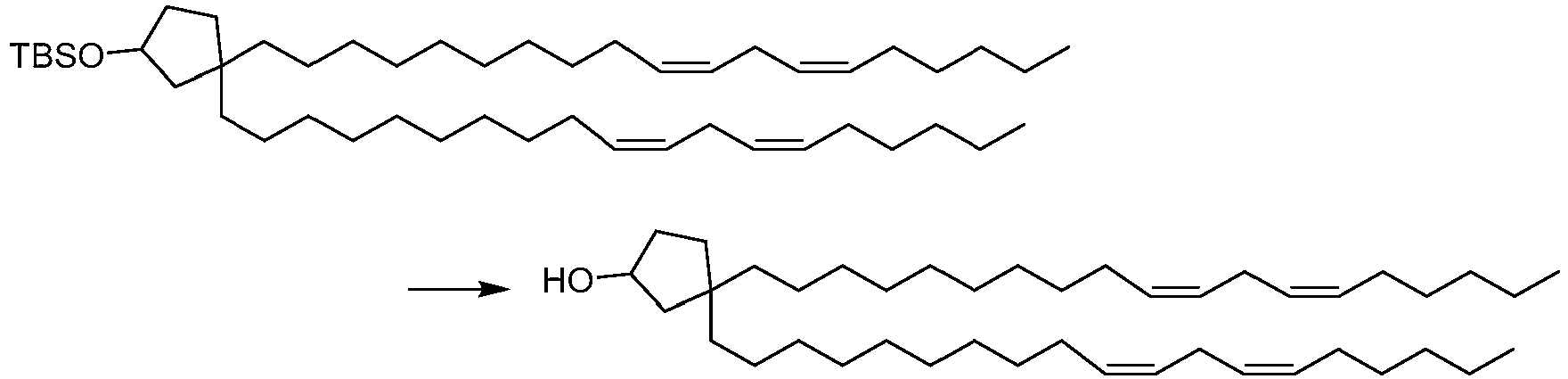
- To a solution of tert-butyl((3,3-di((10Z,13Z)-nonadeca-10,13-dien-1-yl)cyclopentyl)oxy)dimethylsilane (926 mg, 1.27 mmol) in 100 mL THF, a solution of TBAF (1.0 M in THF, 13.3 mL, 13.3 mmol) was added and the reaction mixture was stirred at room temperature for 2 h. TLC showed complete reaction. The solvent was removed under vacuum and the residue was purified by ISCO (SiO2: 0 to 20% EtOAc/hexanes) to provide the product as a colorless oil (830 mg, Quant.).

- At 0 °C, pyridine (0.35 mL) and propylphosphonic anhydride solution (50wt% in EtOAc, 0.7 mL, 1.21 mmol) were added into a solution of 3-(dimethylamino)propanoic acid hydrochloride (151 mg, 0.98 mmol) in 6 mL DMF. After stirring for 10 min, a solution of 3,3-di((10Z,13Z)-nonadeca-10,13-dien-1-yl)cyclopentan-1-ol (200 mg, 0.33 mmol) in 4 mL DMF was added and the reaction mixture was stirred at room temperature overnight. MS and TLC showed the formation of product. Saturated sodium bicarbonate solution was added to quench the reaction, and then extracted with EtOAc (2 X). The combined organic layers were washed with water and brine. After drying over sodium sulfate and concentration, the residue was purified by ISCO (SiO2: 0 to 100% EtOAc/hexanes) to provide the
product 3,3-Di((10Z,13Z)-nonadeca-10,13-dien-1-yl)cyclopentyl 3-(dimethylamino)propanoate as a colorless oil (135 mg, 58%). - 1H NMR (300 MHz, CDCl3) δ 5.28-5.42 (m, 8 H), 5.10-5.17 (m, 1 H), 2.76 (t, 4 H, J = 6.1 Hz), 2.59 (t, 2 H, J= 6.9 Hz), 2.42 (t, 2 H, J = 6.9 Hz), 2.23 (s, 6 H), 2.04 (q, 8 H, J = 6.9 Hz), 1.75-2.00 (m, 2 H), 1.38-1.72 (m, 5 H), 1.14-1.39 (m, 43 H), 0.88 (t, 6 H, J = 6.9 Hz).
- APCI: m/z = 710.7 [M + H]+
-

- At 0 °C, a solution of nonane-1,9-diol (96.16 g, 0.60 mol) in 100 mL DMF was slowly added into a suspension of NaH (24.0 g, 0.60 mol) in 800 mL DMF. After stirring for 1 h, a solution of benzyl bromide (71.4 mL, 0.60 mole) in 200 mL DMF was slowly added. After addition, the reaction mixture was warmed up to room temperature and stirred overnight. TLC showed starting material was almost consumed. The reaction mixture was poured onto ice, and then extracted with EtOAc (3 X). The combined organic layers were washed with water and brine, and then dried over sodium sulfate. After filtration and concentration, the crude was purified with flash column chromatography (SiO2: 0 to 100% EtOAc/hexanes then 0 to 5% MeOH/dichloromethane) to provide the product as a colorless oil (74.4 g, 50%).

- At 0 °C, a solution of triphenylphosphine (6.29 g, 24 mmol) in 100 mL dichloromethane was slowly added into a solution of 9-(benzyloxy)nonan-1-ol (5.0 g, 20 mmol), imidazole (2.9 g, 42 mmol) and iodine (8.5 g, 33.6 mmol) in 100 mL dichloromethane, and then the reaction mixture was allowed to room temperature overnight. After concentration, the residue was triturated with hexanes to provide the product as a cloudy liquid (5.38 g, 75%).

- A solution of (((9-iodononyl)oxy)methyl)benzene (5.38 g, 14.9 mmol) and triphenylphosphine (7.8 g, 29.8 mmol) in acetonitrile (100 mL) was refluxed overnight. After concentrated to dryness, the residue was dissolved in dichloromethane and purified with flash column chromatography (SiO2: 0 to 10% MeOH/CH2Cl2) to provide the product as a yellow oil (8.5 g, 92%).

- At 0 °C, a solution of 9-(benzyloxy)nonan-1-ol (5.0 g, 20 mmol) in 50 mL dichloromethane was slowly added into a suspension of Dess-Martin periodinane (12.5 g, 29.5 mmol) in 100 mL dichloromethane, and then the reaction mixture was stirred at room temperature overnight. After quenching with saturated sodium bicarbonate, the mixture was extracted with dichloromethane (2 X). The combined organic layer was dried over sodium sulfate and concentrated to give the product as a colorless oil (4.0 g, 80%).

- At 0 °C, potassium tert-butoxide (1.54 g, 13.7 mmol) was added into a suspension of (9-(benzyloxy)nonyl)triphenylphosphonium iodide (8.5 g, 13.6 mmol) in 150 mL THF. After 1 h, a solution of 9-(benzyloxy)nonanal (3.0 g, 12 mmol) in 50 mL THF was added dropwise into the reaction mixture, and then the reaction was allowed to warm up to room temperature for 4 h. TLC showed completed reaction. The reaction was quenched with saturated ammonium chloride, and then extracted with hexanes (2 X). The combined organic layers wwere dried over sodium sulfate. After filtration and concentration, the residue was purified with flash column chromatography (SiO2: 0 to 100% dichloromethane/hexanes) to provide the product as colorless oil (3.5 g, 63%).

- To a refluxing solution of (Z)-1,18-bis(benzyloxy)octadec-9-ene (3.5 g, 7.5 mmol) in 200 mL dichloromethane, a solution of Cu(acac)2 (200 mg, 0.76 mmol) in 40 mL dichloromethane was added. And then ethyl diazoacetate (contains 13% dichloromethane, 9 × 1.3 mL) was added every 30 min. MS showed the formation of product. The reaction was quenched with MeOH and stirred for 1 h at room temperature. After concentration, the crude was purified by flash column chromatography (SiO2: 0 to 10% EtOAc/hexanes) to provide the product as colorless oil (2.23 g, 82% pure mixed with acetate by-product).

- A mixture of
ethyl 2,3-bis(8-(benzyloxy)octyl)cyclopropane-I-carboxylate (2.23 g, 4.05 mmol) and Palladium on carbon (10wt%, 200 mg) in 200 mL EtOAc was stirred at room temperature under hydrogen balloon for 4.5 h. MS and TLC showed completed reaction. The reaction mixture was filtered through Celite and washed with EtOAc. The filtrate was concentrated to provide the product mixed with by-product, diethyl succinate (1.62 g, contains 0.55 equivalent of by-product, 84%).
- At 0 °C, a solution of
ethyl 2,3-bis(8-hydroxyoctyl)cyclopropane-1-carboxylate (1.43 g, 4.03 mmol) in 100 mL dichloromethane was slowly added into a suspension of Dess-Martin periodinane (3.63 g, 8.5 mmol) in 150 mL dichloromethane, and then the reaction mixture was stirred at room temperature for 2 h. After quenching with saturated sodium bicarbonate, the mixture was extracted with dichloromethane (2 X). The combined organic layer was dried over sodium sulfate and concentrated to give the product as colorless oil (1.2 g, 81%).
- At 0 °C, potassium tert-butoxide (1.7 g, 15.1 mmol) was added into a solution of (Z)-non-3-en-1-yltriphenyl-phosphonium iodide (5.8 g, 15.1 mmol) in 150 mL THF which was purged with
nitrogen 3 times. After 1 h, a solution ofethyl 2,3-bis(8-oxooctyl)cyclopropane-1-carboxylate (1.2 g, 3.28 mmol) in 50 mL THF (purged withnitrogen 3 times) was transferred via cannula into the reaction mixture, and then the reaction was allowed to warm up to room temperature overnight. TLC showed completed reaction. The reaction was quenched with saturated ammonium chloride, and then extracted with hexanes (2 X). The combined organic layers were washed with brine and dried over sodium sulfate. After filtration and concentration, the residue was purified by ISCO (SiO2: 0 to 3% EtOAc/hexanes) to provide the product as colorless oil (1.3 g, 68%).
- A solution of lithium aluminum hydride (2.0 M in THF, 1.7 mL, 3.35 mmol) was slowly added into a solution of
ethyl 2,3-di((8Z,11Z)-heptadeca-8,11-dien-1-yl)cyclopropane-1-carboxylate (1.3 g, 2.23 mmol) in 150 mL THF, and then the reaction mixture was stirred at room temperature for 30 min. TLC showed completed reaction. The reaction was quenched by slow addition of Na2SO4·10H2O, then the mixture was filtered and washed with THF. The filtrate was concentrated and purified by flash column chromatography (SiO2: 0 to 10% EtOAc/Hexanes) to give the product as colorless oil (1.1 g, 91%).
- At 0 °C, a solution of (2,3-di((8Z,11Z)-heptadeca-8,11-dien-1-yl)cyclopropyl)methanol (1.1 g, 2.03 mmol) in 50 mL dichloromethane was slowly added into a suspension of Dess-Martin periodinane (1.30 g, 3.05 mmol) in 150 mL dichloromethane, and then the reaction mixture was stirred at room temperature for 2 h. After quenching with saturated sodium bicarbonate, the mixture was extracted with dichloromethane (2 X). The combined organic layers were dried over sodium sulfate and concentrated to give the product as a colorless oil (0.87 g, 79%).
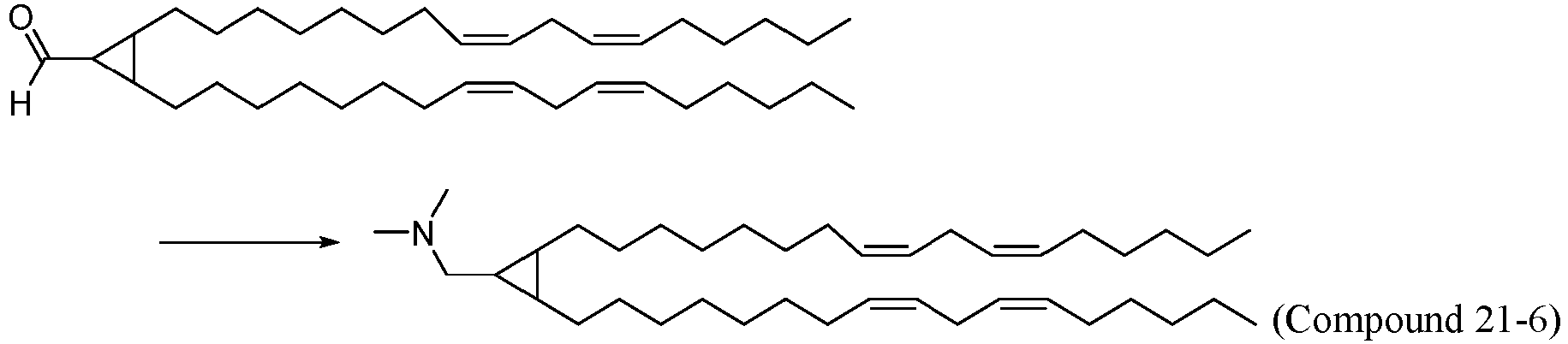
- To a solution of 2,3-di((8Z,11Z)-heptadeca-8,11-dien-1-yl)cyclopropane-1-carbaldehyde (0.87 g, 1.61 mmol) in 200 mL THF, dimethylamine (2.0 M in THF, 1.61 mL, 3.22 mmol), sodium triacetoxyborohydride (682 mg, 3.22 mmol) and acetic acid (0.19 mL, 3.22 mmol) were added subsequently, and the reaction mixture was stirred at room temperature overnight. MS showed completed reaction, and saturated sodium bicarbonate was added to quench the reaction. The mixture was extracted with EtOAc (2 X), and the combined organic layers were washed with brine and dried over sodium sulfate. After filtration and concentration, the residue was purified by flash column chromatography (SiO2: 0 to 10% MeOH/dichloromethane) to give the product 1-(2,3-di((8Z,11Z)-heptadeca-8,11-dien-1-yl)cyclopropyl)-N,N-dimethylmethanamine as a colorless oil (620 mg, 65%).
- 1H NMR (300 MHz, CDCl3) δ 5.27-5.42 (m, 8 H), 2.76 (t, 4 H, J = 6.0 Hz), 2.38 (bs, 8 H), 2.04 (q, 8 H, J = 6.6 Hz), 1.18-1.59 (m, 36 H), 0.88 (t, 6 H, J = 6.6 Hz), 0.52-0.58 (m, 2 H), 0.28-0.38 (m, 1 H).
- APCI: m/z = 568.6 [M + H]+.
- In order to investigate safe and efficacious nanoparticle compositions for use in the delivery of therapeutic and/or prophylactic agents to cells, a range of formulations are prepared and tested. Specifically, the particular elements and ratios thereof in the lipid component of nanoparticle compositions are optimized.
- Nanoparticles can be made with mixing processes such as microfluidics and T-junction mixing of two fluid streams, one of which contains the therapeutic and/or prophylactic agent and the other has the lipid components.
- Lipid compositions are prepared by combining a lipid according to one of formulae (I), (Ia1)-(Ia6), (Ib), (II), (IIa), (III), (IIIa), (IV), (17-1), (19-1), (19-11), (20-1) and (21-I) , a phospholipid (such as DOPE or DSPC, obtainable from Avanti Polar Lipids, Alabaster, AL), a PEG lipid (such as 1,2-dimyristoyl-sn-glycerol methoxypolyethylene glycol, also known as PEG-DMG, obtainable from Avanti Polar Lipids, Alabaster, AL), and a structural lipid (such as cholesterol, obtainable from Sigma-Aldrich, Taufkirchen, Germany) at concentrations of about 50 mM in ethanol. Solutions should be refrigeration for storage at, for example, -20° C. Lipids are combined to yield desired molar ratios (see, for example, Table 1) and diluted with water and ethanol to a final lipid concentration of between about 5.5 mM and about 25 mM
- Nanoparticle compositions including a therapeutic and/or prophylactic agent and a lipid component are prepared by combining the lipid solution with a solution including the therapeutic and/or prophylactic agent at lipid component to therapeutic and/or prophylactic agent wt:wt ratios between about 5:1 and about 50:1. The lipid solution is rapidly injected using a NanoAssemblr microfluidic based system at flow rates between about 10 ml/min and about 18 ml/min into the therapeutic and/or prophylactic agent solution to produce a suspension with a water to ethanol ratio between about 1:1 and about 4:1.
- For nanoparticle compositions including an RNA, solutions of the RNA at concentrations of 0.1 mg/ml in deionized water are diluted in 50 mM sodium citrate buffer at a pH between 3 and 4 to form a stock solution.
- Nanoparticle compositions can be processed by dialysis to remove ethanol and achieve buffer exchange. Formulations are dialyzed twice against phosphate buffered saline (PBS), pH 7.4, at
volumes 200 times that of the primary product using Slide-A-Lyzer cassettes (Thermo Fisher Scientific Inc., Rockford, IL) with a molecular weight cutoff of 10 kD. The first dialysis is carried out at room temperature for 3 hours. The formulations are then dialyzed overnight at 4° C. The resulting nanoparticle suspension is filtered through 0.2 µm sterile filters (Sarstedt, Nümbrecht, Germany) into glass vials and sealed with crimp closures. Nanoparticle composition solutions of 0.01 mg/ml to 0.10 mg/ml are generally obtained. - The method described above induces nano-precipitation and particle formation. Alternative processes including, but not limited to, T-junction and direct injection, may be used to achieve the same nano-precipitation.
- A Zetasizer Nano ZS (Malvern Instruments Ltd, Malvern, Worcestershire, UK) can be used to determine the particle size, the polydispersity index (PDI) and the zeta potential of the nanoparticle compositions in 1 xPBS in determining particle size and 15 mM PBS in determining zeta potential.
- Ultraviolet-visible spectroscopy can be used to determine the concentration of a therapeutic and/or prophylactic agent (e.g., RNA) in nanoparticle compositions. 100 µL of the diluted formulation in 1 ×PBS is added to 900 µL of a 4:1 (v/v) mixture of methanol and chloroform. After mixing, the absorbance spectrum of the solution is recorded, for example, between 230 nm and 330 nm on a DU 800 spectrophotometer (Beckman Coulter, Beckman Coulter, Inc., Brea, CA). The concentration of therapeutic and/or prophylactic agent in the nanoparticle composition can be calculated based on the extinction coefficient of the therapeutic and/or prophylactic agent used in the composition and on the difference between the absorbance at a wavelength of, for example, 260 nm and the baseline value at a wavelength of, for example, 330 nm.
- For nanoparticle compositions including an RNA, a QUANT-IT™ RIBOGREEN® RNA assay (Invitrogen Corporation Carlsbad, CA) can be used to evaluate the encapsulation of an RNA by the nanoparticle composition. The samples are diluted to a concentration of approximately 5 µg/mL in a TE buffer solution (10 mM Tris-HCl, 1 mM EDTA, pH 7.5). 50 µL of the diluted samples are transferred to a polystyrene 96 well plate and either 50 µL of TE buffer or 50 µL of a 2% Triton X-100 solution is added to the wells. The plate is incubated at a temperature of 37° C for 15 minutes. The RIBOGREEN® reagent is diluted 1:100 in TE buffer, and 100 µL of this solution is added to each well. The fluorescence intensity can be measured using a fluorescence plate reader (Wallac Victor 1420 Multilablel Counter; Perkin Elmer, Waltham, MA) at an excitation wavelength of, for example, about 480 nm and an emission wavelength of, for example, about 520 nm. The fluorescence values of the reagent blank are subtracted from that of each of the samples and the percentage of free RNA is determined by dividing the fluorescence intensity of the intact sample (without addition of Triton X-100) by the fluorescence value of the disrupted sample (caused by the addition of Triton X-100).
- In order to monitor how effectively various nanoparticle compositions deliver therapeutic and/or prophylactic agents to targeted cells, different nanoparticle compositions including a particular therapeutic and/or prophylactic agent (for example, a modified or naturally occurring RNA such as an mRNA) are prepared and administered to rodent populations. Mice are intravenously, intramuscularly, intraarterially, or intratumorally administered a single dose including a nanoparticle composition with a formulation such as those provided in Table 1. In some instances, mice may be made to inhale doses. Dose sizes may range from 0.001 mg/kg to 10 mg/kg, where 10 mg/kg describes a dose including 10 mg of a therapeutic and/or prophylactic agent in a nanoparticle composition for each 1 kg of body mass of the mouse. A control composition including PBS may also be employed.
- Upon administration of nanoparticle compositions to mice, dose delivery profiles, dose responses, and toxicity of particular formulations and doses thereof can be measured by enzyme-linked immunosorbent assays (ELISA), bio-luminescent imaging, or other methods. For nanoparticle compositions including mRNA, time courses of protein expression can also be evaluated. Samples collected from the rodents for evaluation may include blood, sera, and tissue (for example, muscle tissue from the site of an intramuscular injection and internal tissue); sample collection may involve sacrifice of the animals.
- Nanoparticle compositions including mRNA are useful in the evaluation of the efficacy and usefulness of various formulations for the delivery of therapeutic and/or prophylactic agents. Higher levels of protein expression induced by administration of a composition including an mRNA will be indicative of higher mRNA translation and/or nanoparticle composition mRNA delivery efficiencies. As the non-RNA components are not thought to affect translational machineries themselves, a higher level of protein expression is likely indicative of a higher efficiency of delivery of the therapeutic and/or prophylactic agent by a given nanoparticle composition relative to other nanoparticle compositions or the absence thereof.
- Nanoparticle compositions including a therapeutic and/or prophylactic agent can be optimized according to the selection of a compound according to one of formulae (I), (Ia1)-(Ia6), (Ib), (II), (IIa), (III), (IIIa), (IV), (17-I), (19-I), (19-II), (20-I) and (21-I) , the selection of additional lipids, the amount of each lipid in the lipid component, and the wt:wt ratio of the lipid component to the therapeutic and/or prophylactic agent, as described herein. Compounds 4-10, 42, 43, 49-52, 57-61, 63-66, 67, 69, 70, 73, 80-85, 87-100, 102, 104, 106, 108, and 109 are compounds of the invention.
- Initial studies were performed to compare the delivery efficiency of nanoparticle compositions including various compounds according to one of formulae (I), (Ia1)-(Ia6), (Ib), (II), (IIa), (III), (IIIa), (IV), (17-1), (19-1), (19-11), (20-1) and (21-1). The cationic lipid MC3 is a current standard in the art. Accordingly, the standard MC3 formulation including about 50 mol % MC3, about 10 mol % DSPC, about 38.5 mol % cholesterol, and about 1.5 mol % PEG-DMG was used as a basis for this study. Nanoparticle compositions including DOPE or DSPC as a phospholipid, cholesterol as a structural lipid, PEG-DMG as a PEG lipid, an RNA, and a compound according to one of formulae disclosed herein, e.g., selected from compounds of formulae (I), (Ia1)-(Ia6), (Ib), (II), (IIa), (III), (IIIa), (IV), (17-1), (19-1), (19-11), (20-1) and (21-1), were prepared according to Examples 1 and 2. The ratios of the lipids were 40:20:38.5:1.5 mol% for the lipid described herein:DOPE:cholesterol:PEG-DMG or 50:10:38.5:1.5 mol% for the lipid described herein:DSPC:cholesterol:PEG-DMG. The RNA used was an mRNA encoding G5 luciferase (Luc) or G5 hEPO. Tables 1, 1b, 17-1, 19-1, 20-1 and 21-1 summarize the content and characteristics of the formulations.
- As shown in Tables 1 and 1a, nanoparticle
compositions including Compound 1 produced the largest particles amongst those of Tables 1 and 1a, while those includingCompounds 34 and 50 produced the smallest particles amongst those of Tables 1 and Ida. Encapsulation efficiencies amongst those of Tables 1 and 1a were highest forcompositions including Compounds 36, 37, 40, and 41 and lowest for those includingCompounds Table 1. Characteristics of nanoparticle compositions including compounds of one of formulae (I), (Ia1)-(Ia6), (Ib), (II), (IIa), (III) and (IIIa). Compound No. Size (nm) PDI EE (%) pKa 1 203.2 46.2 5.95 2∗ 94.7 0.108 96 6.39 3 73.5 0.044 92.5 n.d. 4 89.7 0.120 96.78 7.12 5 85.1 0.140 98.1 7.01 6 81.4 0.160 98.9 6.62 7 85.1 0.130 99.1 6.94 8 83.3 0.110 98.5 6.87 9 78.0 0.170 99.5 6.76 10 81.3 0.130 99.2 6.58 11 87.4 0.099 99.5 6.54 12 87.8 0.096 96.9 5.44 13 97.7 0.080 64.2 6.30 14 88.7 0.008 96.6 6.31 15# 100.3 0.120 90.2 6.32 16# 77.4 0.140 98.2 6.28 17 82.3 0.180 96.6 6.67 18 767 0.120 98.4 6.17 19 76.1 0.100 97.2 6.29 20 106.4 0.150 84.2 6.12 21 98.3 0.239 98.6 6.29 22# 75.4 0.130 98.3 6.15 23 85.4 0.058 82.9 6.07 24∗ 110.4 0.131 36.4 6.01 25 90.0 0.186 97.0 6.20 26∗ 74.2 0.112 84.9 6.19 27 86.4 0.211 97.9 6.14 28 87.4 0.099 80.2 6.04 29 105.3 0.060 48.8 5.97 30 95.0 0.110 74.3 6.09 31 87.9 0.130 77.5 6.31 32 79.3 0.160 83.6 6.28 33 797 0.138 98.1 6.06 34∗ 66.0 0.077 98.1 5.74 36∗ 100.8 0.110 100.2 7.81 37∗ 86.6 0.107 99.9 6.45 40∗ 78.9 0.210 100.0 6.78 41∗ 69.0 0.239 99.9 7.02 42 116.4 0.190 97.1 6.77 43 99.0 0.220 99.1 6.72 44 94.9 0.190 89.5 6.82 45 100.2 0.200 94.9 6.77 46 81.8 0.160 97.5 6.77 47 89.8 0.180 53.1 6.82 48 111.4 0.099 79.3 6.99 49 95.8 0.200 98.8 6.4 50 65.6 0.190 98.7 5.55 51 766 0.190 98.4 6.44 52 94.4 0.100 97.5 6.77 Formula IV 94.2 97.6 6.25 MC3 86.2 0.117 97.70 n.d. n.d.=not determined *=Formulated with lipid:DSPC:Chol:PEG-DMG 50:10:38.5:1.5 #=Formulated with hEPO mRNA Table 1b. Characteristics of nanoparticle compositions including compounds of one of formulae (I), (Ia1)-(Ia6), (Ib), (II), (IIa), (III) and (IIIa). Compound No. Size (nm) PDI EE (%) 53 103.0 0.23 82.8 54 93.0 0.23 96.9 55 119.5 0.23 95.2 56 117.4 0.24 99.0 57 101.9 0.23 98.8 58 112.8 0.23 98.9 59 104.7 0.23 98.6 60 105.7 0.23 98.8 61 86.8 0.23 99.1 62 61.7 0.18 97.73 69 74.4 0.24 99.31 70 79.8 0.24 99.14 71 99.9 0.18 91.0 72 102.5 0.22 92.7 73 84.3 0.25 98.85 80 65.8 0.2 98.93 81 65.3 0.17 99.27 82 76.1 0.24 99.23 83 73.2 0.22 99.12 84 68.6 0.19 98.48 85 69.9 0.24 99.18 86 53.6 0.14 97.42 87 80.9 0.21 98.67 MC3 74.7 0.17 97.3 - As shown in Table 17-1, Compounds 17-7 and 17-12 produced the smallest particles amongst those of Table 17-1, while Compounds 17-2 and 17-10 produced the largest particles amongst those of Table 17-1. The encapsulation efficiencies for Compounds 17-6 and 17-8 were comparable to that for MC3. Compounds 17-2 and 17-10 did not encapsulate RNA with high efficiency.
Table 17-1. Characteristics of nanoparticle compositions including compounds according to formula (17-1). Compound No. Size (nm) PDI EE (%) pKa 17-2 136.9 0.104 57.2 6.92 17-3 117.9 0.095 82.1 6.69 17-4 95.6 0.154 94.5 6.34 17-5 88.4 0.137 94.2 6.92 17-6 80.2 0.117 97.3 6.73 17-7 68.5 0.110 95.6 5.68 17-8 86.4 0.20 96.9 6.16 17-9 87.1 0.138 95.0 4.93 17-10 165.0 0.239 30.3 2.85 17-11 87.3 0.24 88.7 6.76 17-12 76.1 0.148 95.04 6.83 17-13 90.4 0.176 89.22 6.89 MC3 83.8 0.138 98.0 n.d. n.d.=not determined - As shown in Table 19-1, compositions including Compound 19-6 produced the largest particles amongst those of Table 19-1 with the lowest encapsulation efficiency, while those including Compound 19-3 produced the smallest particles amongst those of Table 19-1 with the highest encapsulation efficiency.
Table 19-1. Characteristics of nanoparticle compositions including compounds according to formula (19-1) or (19-11). Compound No. Size (nm) PDI EE (%) pKa 19-1 98.0 0.071 83.4 6.76 19-2 72.0 0.239 98.8 7.32 19-3 47.9 0.076 99.7 7.24 19-4 111.4 0.071 95.2 7.09 19-5 106.9 0.204 93.6 6.32 19-6 137.7 0.088 16.9 5.89 MC3 83.3 0.122 97.6 n.d. n.d.=not determined - As shown in Table 20-1, compositions including Compound 20-12 produced the largest particles amongst those of Table 20-1, while compositions including Compounds 20-8, 20-9, and 20-15 produced the smallest particles amongst those of Table 20-1. Encapsulation efficiencies for the compounds of Table 20-1 were highest for compositions including Compound 20-19.
Table 20-1. Characteristics of nanoparticle compositions including compounds according to formula (20-1). Compound No. Size (nm) PDI EE (%) pKa 20-1∗ 87.8 0.078 90.7 4.48 20-2 71.8 0.130 91.6 6.60 20-3 76.4 0.110 95.8 6.82 20-4 82.1 0.160 91.3 6.86 20-5 119.3 0.210 78.1 6.79 20-6 82.5 0.220 94.7 6.73 20-7 73.6 0.170 92.4 6.66 20-8 67.9 0.141 96.6 6.43 20-9 64.5 0.130 95.9 6.22 20-10 85.7 0.130 91.4 6.42 20-11 96.1 0.118 97.5 5.38 20-12 147.1 0.217 82.3 6.58 20-13 74.3 0.057 97.7 5.83 20-14 124.0 0.215 94.5 5.89 20-15 67.4 0.118 97.4 6.48 20-16 73.5 0.225 97.2 6.62 20-17 71.2 0.092 98.2 6.25 20-18 70.1 0.150 91.1 6.31 20-19 74.9 0.145 99.5 4.73 20-20 86.8 0.159 95.2 6.41 20-21 78.6 0.238 84.7 5.78 20-22 73.8 0.146 95.3 5.90 20-23 88.1 0.080 95.3 6.56 20-24 90.6 0.038 96.9 6.06 20-25 71.7 0.171 98.4 6.23 MC3 84.0 0.117 97.4 n.d. n.d.=not determined *=Formulated with DOPE - As shown in Table 21-1, compositions including Compound 21-1 produced the largest particles, amongst those of Table 21-1 while those including Compound 21-2 produced the smallest particles amongst those of Table 21-1. The encapsulation efficiency for all compositions of Table 21-1 was greater than 98%.
Table 21-1. Characteristics of nanoparticle compositions including compounds according to formula (21-I). Compound No. Size (nm) PDI EE (%) pKa 21-1 119.9 0.237 98.4 6.07 21-2 83.0 0.200 99.4 6.98 21-4 94.9 0.193 98.8 7.01 21-6 86.8 0.110 98.9 6.99 MC3 91.4 0.1191 98.1 n.d. n.d.=not determined - The efficacy of the nanoparticle compositions presented in Tables 1, 1a, 17-1, 19-1, 20-1 and 21-1 was evaluated with a bioluminescence study. Formulations were administered intravenously to mice (n = 6) at a dosage of 0.5 mg/kg (mpk) and bioluminescence measured at 3, 6, and 24 hour time points. The standard MC3 formulation and a PBS control were evaluated for comparison. Compounds 4-10, 42, 43, 49-52, 57-61, 63-66, 67, 69, 70, 73, 80-85, 87-100, 102, 104, 106, 108, and 109 are compounds of the invention.
- As is evident in Table 2, the total flux for the compositions presented therein was generally comparable at 3 and 6 hours. The total flux after 24 hours was generally lower than that at earlier time points. Amongst the compositions of Table 2,
compositions including Compounds 18, 23, and 30 displayed the highest flux after 3 hours. Of the compositions of Table 2, compositions including Compounds 36 and 37 displayed the lowest flux after 24 hours. In general, these results suggest that the compounds described herein may be useful in transfection applications.Table 2. Expression of luciferase induced by administration of nanoparticle compositions including compounds according to one of formulae (I), (Ia1)-(Ia6), (Ib), (II), (IIa), (III) and (IIIa). Total Flux Compound No. 3 hours 6 hours 24 hours 2 6.01E+09 3.23E+09 3.23E+09 3 3.75E+08 1.12E+09 n.d. 11 1.23E+10 3.81E+09 8.20E+08 12 1.06E+ 10 1.38E+10 6.03E+08 13 3.59E+09 3.80E+09 3.11E+08 14 9.86E+08 1.56E+09 1.02E+08 17 7.55E+09 2.49E+09 7.61E+08 18 2.13E+10 1.76E+10 7.00E+08 19 1.06E+ 10 6.52E+09 2.65E+09 20 1.00E+11 1.11E+11 4.60E+09 21 1.13E+10 1.08E+10 1.18E+08 23 2.33E+10 3.40E+10 1.06E+09 25 1.06E+ 10 1.08E+10 2.72E+08 26 1.65E+07 1.04E+07 2.75E+06 27 4.56E+09 4.70E+09 1.36E+08 28 6.18E+09 7.28E+09 4.02E+08 29 1.22E+08 2.51E+08 2.69E+07 30 2.87E+10 1.59E+10 1.95E+09 31 1.43E+10 1.42E+10 3.07E+08 32 6.85E+08 5.88E+08 4.37E+07 33 1.64E+09 4.71E+09 1.54E+08 34 7.77E+06 1.88E+07 2.19E+06 36 6.90E+05 3.93E+05 1.68E+05 37 1.19E+07 6.66E+06 9.38E+05 40 1.24E+08 1.07E+07 5.62E+06 41 4.06E+07 2.04E+07 6.05E+07 42 n.d 4.99E+10 n.d 43 n.d 4.54E+09 n.d 44 n.d 1.07E+10 n.d 45 n.d 7.86E+10 n.d 46 n.d 5.26E+09 n.d 47 n.d 2.64E+09 n.d 48 n.d 1.05E+08 n.d 49 n.d 5.67E+10 n.d 50 n.d 1.48E+08 n.d 51 n.d 6.70E+10 n.d 52 n.d 9.85E+10 n.d MC3 1.63E+10 1.73E+10 1.16E+09 n.d.=not determined - As is evident in Table 17-2, nanoparticle compositions including MC3 displayed the highest total flux of Table 17-2, while those including Compounds 17-4 and 17-8 displayed substantially higher flux than compositions including Compounds 17-2, 17-3, and 17-7. The total flux at 6 hours was higher than that at 3 hours for some compositions of Table 17-2. Generally, for the compositions of Table 17-2, the total flux at 24 hours was lower than the total flux measured at 3 or 6 hours.
Table 17-2. Expression of luciferase induced by administration of nanoparticle compositions including compounds according to formula (17-1). Total Flux Compound No. 3 hours 6 hours 24 hours 17-2 2.83E+05 3.76E+05 2.64E+05 17-3 5.58E+05 1.38E+06 9.90E+05 17-4 1.22E+09 3.60E+08 6.05E+07 17-5 6.64E+08 8.54E+08 5.97E+07 17-6 6.27E+07 1.19E+08 1.27E+07 17-7 4.68E+05 6.82E+05 5.46E+05 17-8 1.02E+09 5.94E+08 3.79E+07 17-9 6.87E+06 9.97E+06 3.43E+05 17-10 6.61E+05 1.16E+06 4.06E+05 17-11 1.86E+06 2.82E+06 2.70E+05 17-12 2.94E+06 2.54E+06 4.66E+05 17-13 1.10E+06 1.80E+06 7.95E+05 MC3 1.63E+10 2.13E+10 1.01E+09 - As is evident in Table 19-2, compositions including MC3 induced the highest expression of the compositions of Table 19-2 at each time point. Compositions including Compounds 19-5 and 19-6 produced the next highest flux of Table 19-2 at each time point, while those including Compound 19-2 produced the lowest total flux of Table 19-2 at each time point.
Table 19-2. Expression of luciferase induced by administration of nanoparticle compositions including compounds according to formula (19-1) or (19-II). Total Flux Compound No. 3 hours 6 hours 24 hours 19-1 6.77E+05 1.85E+06 2.75E+05 19-2 1.96E+05 3.51E+05 2.29E+05 19-3 1.69E+06 1.21E+06 3.39E+05 19-4 6.61E+05 4.75E+05 3.44E+05 19-5 2.37E+07 1.44E+07 2.76E+06 19-6 1.07E+07 1.27E+07 1.29E+06 MC3 1.53E+10 1.73E+10 1.13E+09 - As is evident in Table 20-2, flux for the compositions of Table 20-2 was generally highest 3 hours after administration. Total flux for the compositions of Table 20-2 was highest after 3 hours for compositions including MC3, Compound 20-6, or Compound 20-7. Amongst the compositions of Table 20-2,
expression 24 hours after administration was lowest for compositions including Compounds 20-1, 20-6, and 20-16.Table 20-2. Expression of luciferase induced by administration of nanoparticle compositions including compounds according to formula (20-1). Total Flux Compound No. 3 hours 6 hours 24 hours 20-1 1.44E+06 8.30E+05 4.53E+05 20-2 1.35E+09 2.18E+09 6.49E+07 20-3 5.35E+09 3.00E+09 6.49E+07 20-4 3.01E+06 1.75E+06 6.82E+08 20-5 6.07E+07 1.99E+07 2.07E+06 20-6 3.39E+10 5.44E+06 5.48E+05 20-7 1.22E+10 8.94E+09 2.65E+08 20-8 2.76E+09 4.37E+09 1.30E+08 20-9 3.65E+08 6.91E+08 4.81E+07 20-10 5.05E+09 2.16E+09 2.54E+08 20-11 1.44E+09 8.83E+08 2.40E+07 20-12 1.57E+09 1.84E+09 1.24E+08 20-13 7.01E+08 1.82E+09 7.39E+07 20-14 1.76E+09 4.07E+08 8.10E+07 20-15 3.36E+08 2.25E+08 2.08E+07 20-16 7.88E+05 6.25E+05 2.16E+05 20-17 1.97E+07 1.44E+07 1.54E+06 20-18 5.80E+09 6.48E+09 1.54E+09 20-19 5.37E+05 7.60E+05 6.08E+05 20-20 4.56E+09 3.27E+09 3.56E+08 20-21 1.43E+09 1.02E+09 1.13E+08 20-22 4.00E+09 3.01E+09 2.20E+08 20-23 1.91E+09 1.42E+09 1.13E+08 20-24 7.47E+08 1.64E+08 9.72E+06 20-25 1.16E+09 1.78E+09 3.82E+07 MC3 1.73E+10 1.94E+10 8.48E+08 - As is evident in Table 21-2, compositions including MC3 produced the highest luciferase expression of Table 21-2 at each time point, while, amongst the compositions of Table 21-2, those including Compound 21-2 showed the least expression at 3 and 6 hours. Each composition of Table 21-2showed substantial expression. Flux generally decreased over time. These results suggest that the compounds described herein may be useful in transfection applications.
Table 21-2. Expression of luciferase induced by administration of nanoparticle compositions including compounds according to formula (21-1). Total Flux Compound No. 3 hours 6 hours 24 hours 21-1 3.66E+09 4.19E+09 4.19E+09 21-2 5.99E+08 8.09E+08 8.09E+08 21-4 1.15E+09 1.26E+09 1.26E+09 21-6 2.92E+09 4.54E+09 1.40E+08 MC3 1.69E+10 2.87E+10 2.23E+10 - The efficacy of the nanoparticle compositions presented in Tables 1, 1a, 17-1, 19-1, 20-1 and 21-1 was further evaluated by measuring the expression of modified luciferase in the liver, lung, spleen, and femur upon administration of a given composition. Compounds 4-10, 42, 43, 49-52, 57-61, 63-66, 67, 69, 70, 73, 80-85, 87-100, 102, 104, 106, 108, and 109 are compounds of the invention. Formulations were administered intravenously to mice (n = 3) at a dosage of 0.5 mpk and bioluminescence measured after 6 hours. The standard MC3 formulation and a PBS control were also tested.
- As is evident in Table 3, expression was highest in the liver for all formulations of Table 3. Of the compostions of Table 3, the highest total flux was measured for
compositions including Compound 20. Lung and spleen expression were generally comparable for compounds of Table 3, while expression in the femur, where measured, was somewhat lower. Table 3. Expression of luciferase invarious organs 6 hours after administration of nanoparticle compositions including compounds according to one of formulae (I), (Ia1)-(Ia6), (Ib), (II), (IIa), (III) and (IIIa).Total Flux Compound No. Liver Lung Spleen Femur 2 3.33E+08 4.76E+05 1.14E+07 n.d. 3 1.36E+08 8.47E+05 9.51E+05 n.d. 11 1.67E+09 2.21E+06 7.21E+06 1.47E+06 12 1.05E+09 6.76E+06 1.11E+07 n.d. 13 6.10E+08 2.89E+06 3.63E+07 1.99E+06 14 2.62E+08 3.56E+06 1.46E+07 n.d. 17 4.26E+08 7.26E+05 3.20E+06 6.71E+05 18 3.91E+09 1.87E+07 1.60E+07 3.31E+06 19 1.89E+09 2.27E+06 8.28E+06 2.75E+06 20 1.42E+10 1.46E+08 6.11E+07 8.91E+06 21 1.24E+09 2.51E+06 1.17E+07 n.d. 23 4.94E+09 1.51E+07 2.95E+07 3.17E+06 25 2.68E+09 5.88E+06 6.00E+06 n.d. 26 2.35E+06 3.49E+04 2.30E+05 n.d. 27 7.84E+08 3.56E+06 3.34E+06 n.d. 28 8.10E+08 5.73E+06 5.67E+06 1.16E+06 29 2.27E+07 4.70E+05 2.97E+06 n.d. 30 2.42E+09 1.61E+07 7.18E+06 2.22E+06 31 1.54E+09 9.81E+06 1.28E+07 9.89E+05 32 8.36E+07 6.75E+05 9.38E+05 1.02E+05 33 6.15E+08 2.84E+06 4.82E+06 1.18E+06 34 2.79E+06 5.63E+04 1.22E+06 n.d. 36 5.85E+04 2.74E+04 1.24E+05 n.d. 37 1.92E+06 6.90E+05 9.75E+05 n.d. 40 1.33E+06 1.42E+05 5.68E+05 n.d. 41 3.00E+06 1.34E+05 2.13E+06 n.d. 42 5.53E+09 n.d 2.29E+08 n.d 43 2.60E+08 n.d 4.52E+07 n.d 44 1.11E+09 n.d 1.19E+08 n.d 45 7.87E+09 n.d 1.70E+08 n.d 46 3.84E+08 n.d 4.35E+07 n.d 47 4.95E+08 n.d 1.42E+08 n.d 48 1.04E+07 n.d 1.50E+07 n.d 49 1.21E+10 n.d 6.65E+07 n.d 50 2.14E+07 n.d 1.94E+05 n.d 51 3.55E+09 n.d 2.24E+07 n.d 52 1.18E+10 n.d 8.74E+08 n.d IV 9.15E+08 n.d 6.15E+08 n.d MC3 2.31E+09 8.61E+06 1.95E+07 3.08E+06 n.d.=not determined - As is evident in Table 17-3, the total flux for compositions of Table 17-3 was generally higher in the liver than in other organs. The total flux in the liver for nanoparticle compositions of Table 17-3 including Compounds 17-5 and 17-8 was somewhat comparable to those including MC3, which displayed the highest total flux of Table 17-3 in each organ. For compositions of Table 17-3, the total flux in the spleen was generally higher than that in the lung and was highest for compositions including Compounds 17-4, 17-5, and 17-8.
Table 17-3. Expression of luciferase in various organs 6 hours after administration of nanoparticle compositions including compounds according to formula (17-1).Total Flux Compound No. Liver Lung Spleen Femur 17-2 6.42E+04 1.96E+04 4.16E+04 n.d. 17-3 2.51E+05 1.56E+04 1.02E+05 n.d. 17-4 8.00E+07 1.95E+05 2.30E+06 n.d. 17-5 1.17E+08 8.13E+05 2.13E+06 n.d. 17-6 2.16E+07 1.54E+05 9.06E+05 n.d. 17-7 7.44E+04 1.35E+04 3.46E+04 n.d. 17-8 2.27E+08 6.11E+05 4.25E+06 n.d. 17-9 1.39E+06 1.40E+04 3.72E+05 2.29E+04 17-10 2.00E+05 2.52E+04 1.74E+04 n.d. 17-11 5.06E+05 1.20E+04 3.37E+05 n.d. 17-12 4.94E+05 4.89E+04 7.81E+04 n.d. 17-13 3.56E+05 4.66E+04 1.90E+05 n.d. MC3 2.75E+09 7.25E+06 2.62E+07 6.03E+06 n.d.=not determined - As is evident in Table 19-3, total flux for the compositions of Table 19-3 was highest for compositions including MC3. For compositions of Table 19-3, expression in the liver was higher than expression in the lung and spleen for all compounds of Table 19-3 tested. Of the compositions of Table 19-3, compositions including Compound 19-2 yielded the lowest total flux in the liver.
Table 19-3. Expression of luciferase in various organs 6 hours after administration of nanoparticle compositions including compounds according to formula (19-1) or (19-11).Total Flux Compound No. Liver Lung Spleen 19-1 8.53E+05 1.06E+04 1.58E+04 19-2 5.73E+04 2.33E+04 3.56E+04 19-3 2.65E+05 3.00E+04 2.55E+05 19-4 1.46E+05 4.49E+04 3.69E+04 19-5 5.99E+06 3.46E+04 2.10E+05 19-6 3.27E+06 1.81E+05 3.47E+06 MC3 2.39E+09 5.83E+06 2.45E+07 - As is evident in Table 20-3, expression for the compounds therin was generally highest in the liver and lowest in the lung and femur. Total flux for the compounds of Table 20-3 in the liver was highest for compositions including MC3 or Compound 20-7 and lowest for those including Compound 20-16.
Table 20-3. Expression of luciferase in various organs 6 hours after administration of nanoparticle compositions including compounds according to formula (20-1).Total Flux Compound No. Liver Lung Spleen Femur 20-1 3.19E+05 3.79E+04 1.70E+05 n.d. 20-2 6.01E+08 4.52E+06 3.12E+07 1.07E+06 20-3 4.33E+08 6.08E+05 6.35E+06 1.73E+06 20-4 2.93E+05 1.11E+04 4.51E+04 2.09E+04 20-5 2.67E+06 5.80E+04 3.40E+06 9.53E+04 20-6 7.75E+05 2.32E+04 2.35E+05 n.d. 20-7 1.00E+09 1.38E+07 4.58E+07 n.d. 20-8 8.09E+08 3.45E+06 2.70E+07 1.62E+06 20-9 1.57E+08 1.30E+06 5.11E+06 2.89E+05 20-10 4.40E+08 5.01E+06 9.67E+07 3.09E+06 20-11 3.60E+08 5.86E+05 9.24E+06 n.d. 20-12 3.08E+08 3.58E+06 6.15E+07 1.37E+06 20-13 1.65E+08 9.09E+05 1.04E+07 3.11E+05 20-14 5.22E+07 1.08E+05 7.03E+05 n.d. 20-15 6.74E+07 5.56E+05 1.86E+06 n.d. 20-16 9.55E+04 1.44E+04 6.57E+04 n.d. 20-17 2.99E+06 2.79E+04 9.56E+04 n.d. 20-18 4.83E+08 1.84E+06 2.36E+06 3.78E+05 20-19 3.80E+05 1.96E+04 2.74E+04 n.d. 20-20 8.92E+08 1.12E+06 1.39E+07 n.d. 20-21 1.27E+08 1.98E+05 2.20E+06 n.d. 20-22 2.88E+08 5.04E+05 1.65E+06 n.d. 20-23 3.06E+08 1.28E+06 4.19E+06 5.10E+05 20-24 4.05E+07 1.08E+05 1.11E+06 n.d. 20-25 1.88E+08 7.85E+05 4.16E+06 3.13E+05 MC3 2.48E+09 1.28E+07 2.85E+07 2.60E+06 n.d.=not determined - As is evident in Table 21-3, expression was highest in the liver and lowest in the lung for all compositions of Table 21-3. Of the compositions of Table 21-3, compositions including MC3 produced the highest expression in each organ, while compositions including Compounds 21-2 and 21-4 produced the lowest expression in each organ.
Table 21-3. Expression of luciferase in various organs 6 hours after administration of nanoparticle compositions including compounds according to formula (21-1).Total Flux Compound No. Liver Lung Spleen 21-1 3.62E+08 5.44E+05 3.27E+07 21-2 5.50E+07 2.53E+05 1.56E+07 21-4 9.89E+07 2.13E+05 1.27E+07 21-6 4.79E+08 2.09E+06 1.94E+07 MC3 3.05E+09 6.60E+06 4.73E+07 - The introduction of foreign material into a mammalian body induces an innate immune response that promotes cytokine production. Such immune responses to, for example, nanoparticle compositions including therapeutic and/or prophylactic agents, are undesirable. The induction of certain cytokines is thus measured to evaluate the efficacy of nanoparticle compositions. The concentrations of various cytokines in mice upon intravenous administration of nanoparticle compositions presented in Tables 1, 1a, 17-1, 19-1, 20-1 and 21-1 at a dosage of 0.5 mpk was measured at 6 hours. The standard MC3 formulation and a PBS control were also tested. Compounds 4-10, 42, 43, 49-52, 57-61, 63-66, 67, 69, 70, 73, 80-85, 87-100, 102, 104, 106, 108, and 109 are compounds of the invention.
- As is evident in Table 4, IP-10 expression was lower than IL-6 expression for compositions of Table 4. Of the compositions of Table 4,
compositions including Compound 13 induced the highest expression of both IL-6 and IP-10, whilecompositions including Compound 3 induced the lowest IL-6 expression and those including Compound 36 induced the lowest IP-10 expression.Table 4. Cytokine induction 6 hours after administration of nanoparticle compositions including compounds according to one of formulae (I), (Ia1)-(Ia6), (Ib), (II), (IIa), (III) and (IIIa).Compound No. IL-6 IP-10 2 n.d. 3365 3 7 341 11 250 3305 12 31 2382 13 301 7266 14 17 209 17 164 545 18 263 655 19 70 2326 20 127 2080 21 48 652 23 259 3702 25 131 1823 26 17 175 27 42 2564 28 73 5364 29 108 3454 30 300 4235 31 188 2513 32 174 727 33 37 1577 34 28 159 36 41 118 37 n.d. 198 40 134 919 41 116 350 MC3 92 438 n.d.=not determined - As is evident in Table 17-4, nanoparticle compositions of Table 17-4 induced higher IP-10 levels than IL-6 levels. Of the nanoparticle compositions of Table 17-4, compositions including MC3 and Compound 17-4 induced the highest IL-6 and IP-10 levels while those including Compounds 17-2, 17-3, and 17-10 induced the lowest IL-6 levels and compositions including Compounds 17-2 and 17-3 induced the lowest IP-10 levels.
Table 17-4. Cytokine induction 6 hours after administration of nanoparticle compositions including compounds according to formula (17-1).Compound No. IL-6 IP-10 17-2 9.88 72.8 17-3 6.97 66.8 17-4 80.7 560 17-5 49.2 300 17-6 25.0 134 17-7 49.9 100 17-8 n.d. 135 17-9 35.2 112 17-10 7.33 243 17-11 n.d. n.d. 17-12 83.1 148 17-13 84.3 222 MC3 107 500 - As is evident in Table 19-4, of the nanoparticle compositions of Table 19-4, compositions including Compound 19-6 induced the highest IL-6 expression, while those including Compound 19-3 induced the lowest IL-6 expression. Of the nanoparticle compositions of Table 19-4, compositions including Compounds 19- 4 and 19-6 yielded the highest IP-10 expression, while those including Compound 19-1 induced the lowest IP-10 expression.
Table 19-4. Cytokine induction 6 hours after administration of nanoparticle compositions including compounds according to formula (19-1) or (19-11).Compound No. IL-6 IP-10 19-1 144.4 51.1 19-2 n.d. n.d. 19-3 5.4 177.5 19-4 129.2 430.9 19-5 n.d. n.d. 19-6 7571 433 MC3 65.7 323.9 n.d.=not determined - As is evident in Table 20-4, for nanoparticle compositions of Table 20-4, IP-10 induction was generally higher than IL-6 induction. For nanoparticle compositions of Table 20-4, IP-10 induction was highest for compositions including Compound 20-14 and lowest for compositions including Compound 20-6. IL-6 induction was highest for compositions including Compound 20-10 and lowest for compositions including Compound 20-6 for the nanoparticle compositions of Table 20-4.
Table 20-4. Cytokine induction 6 hours after administration of nanoparticle compositions including compounds according to formula (20-1).Compound No. IL-6 IP-10 20-1 62.4 2065.8 20-2 118.5 522.9 20-3 105.8 671.5 20-4 169.3 270.5 20-5 140.8 2012.3 20-6 0 25.3 20-7 24.5 696.3 20-8 18.4 134.0 20-9 152.1 271.1 20-10 739.0 2356.8 20-11 46.9 1700.5 20-12 445.7 3864.5 20-13 87.8 70.0 20-14 311.1 8436.6 20-15 49.4 136.3 20-16 n.d. 395.7 20-17 6.3 1207.0 20-18 102 572.7 20-19 n.d. 127.2 20-21 68.4 900.4 20-22 118.6 810.6 20-23 236.4 457.8 20-24 67.1 1678.6 20-25 20.6 188.0 MC3 119.5 499.1 - As is evident in Table 21-4, IP-10 induction by compositions therein was substantially higher than IL-6 induction.
Table 20-4. Cytokine induction 6 hours after administration of nanoparticle compositions including compounds according to formula (21-1).Compound No. IL-6 IP-10 21-1 n.d. 1265.1 21-2 n.d. 477.9 21-4 n.d. 577.2 21-6 10.2 641.3 MC3 31.1 304.5 - Formulations were prepared according to Table 5 and included mRNA encoding hEPO.
Table 5. Characteristics of nanoparticle compositions including compounds according to one of formulae (I), (Ia1)-(Ia6), (Ib), (II), (IIa), (III) and (IIIa). Compounds 4-10, 42, 43, 49-52, 57-61, 63-66, 67, 69, 70, 73, 80-85, 87-100, 102, 104, 106, 108, and 109 are compounds of the invention. Compound No. Composition (mol %) Components Size (nm) PDI EE (%) pKa Conc. (ug/ml) 12 40:20:38.5:1.5 Lipid:DOPE:Chol: PEG-DMG 87.5 0.13 93.79 5.444 320.14 14 40:20:38.5:1.5 Lipid:DOPE:Chol: PEG-DMG 76.8 0.14 98.91 6.308 603.76 15 40:20:38.5:1.5 Lipid:DOPE:Chol: PEG-DMG 100.3 0.12 90.15 6.323 713.00 20 40:20:38.5:1.5 Lipid:DOPE:Chol: PEG-DMG 114.5 0.14 94.39 n.d. 1264.28 22 40:20:38.5:1.5 Lipid:DOPE:Chol: PEG-DMG 75.4 0.13 98.29 6.153 564.97 23 40:20:38.5:1.5 Lipid:DOPE:Chol: PEG-DMG 98.5 0.16 77.19 6.070 438.20 23 50:10:38.5:1.5 Lipid:DSPC:Chol: PEG-DMG 95.2 0.11 51.46 6.164 454.58 MC3 50:10:38.5:1.5 Lipid:DSPC:Chol: PEG-DMG 76.5 0.11 97.37 n.d. 470.45 n.d.=not determined - Formulations were administered intravenously to rats (n=3 or 6) at a dosage of 0.2 mg/kg or 0.5 mg/kg (mpk) and hEPO levels measured at 3, 6, and 24 hour time points. After the 48 hour time point, livers and spleens were harvested and frozen. As is evident in Table 6, compositions including MC3 yielded the highest hEPO expression at each time point, while compositions including Compound 16 yielded the lowest hEPO expression at each time point.
Table 6. Expression of hEPO induced by administration of nanoparticle compositions including compounds according to one of formulae (I), (Ia1)-(Ia6), (Ib), (II), (IIa), (III) and (IIIa). hEPO (pg/mL) Compound No. 3 hours 6 hours 24 hours 12 592260 424740 165404 14 280973 158520 58805 15 103773 125320 67965 16 35387 41720 17184 20 n.d. 227420 n.d. 22 181627 267680 75571 23 (DOPE) 249213 275440 120104 23 (DSPC) 86627 71360 29008 MC3 1407947 1036013 436243 n.d.=not determined - As shown in Table 7a, hEPO expression in mice was substantially higher for
compositions including Compound 12 than those including MC3. In contrast, hEPO expression in rats induced by administration of a nanoparticle composition including a compound according to one of formulae (I), (Ia1)-(Ia6), (Ib), (II), (IIa), (III), and (IIIa) was substantially lower than that measured for MC3. Luc expression in mice was several fold higher for Compound 23 than for MC3 but significantly lower forCompounds Table 7a. Comparison of expression induced by administration of nanoparticle compositions including MC3 or compounds according to one of formulae (I), (Ia1)-(Ia6), (Ib), (II), (IIa), (III), and (IIIa). Compound No. Lipid/MC3 Luc CD-1 (mice) Lipid/MC3 hEPO CD-1 (mice) Lipid/MC3 hEPO S.D. (rats) %Dose remaining 6 h CD-1 mice %Dose remaining 24 h CD-1 mice 11 1.03 n.d. n.d. 12 0.21 2.3 0.32 14 0.070 n.d. 0.12 15 n.d. n.d. 0.095 16 n.d. n.d. 0.031 20 5.0 n.d. n.d. 22 n.d. n.d. 0.20 23 (DOPE) 5.2 2.4 0.21 42 3.99 n.d. n.d. 58 53 43 0.34 69 64 44 0.82 n.d. n.d. <1 <1 45 6.50 n.d. n.d. 33 24 46 0.46 1 <1 47 0.22 1 <1 48 0.01 <1 <1 49 5.23 n.d. n.d. 49 40 50 0.01 56 47 51 5.22 n.d. n.d. 54 41 52 7.46 n.d. n.d. 46 40 MC3 1 1 1 88 55 n.d.=not determined Table 7b. Comparison of Luc expression induced by administration of nanoparticle compositions including MC3 or compounds according to one of formulae (I), (Ia1)-(Ia6), (Ib), (II), (IIa), (III), and (IIIa) in CD-1 mice and LDLr-/- mice. Compound No. Lipid/MC3 AUC CD-1 mice 0.5 mpk Lipid/KL22 AUC LDLr-/- mice 0.5 mpk, LDLr LDL levels lipid/untreated LDLr-/-mice 0.5 mpk, LDLr 4 3.70 2.03 0.54 5 2.62 1.86 0.47 6 1.72 0.37 0.91 7 1.51 2.46 0.63 8 2.33 3.74 0.66 9 0.73 0.58 0.87 10 1.14 0.71 0.98 MC3 1 0.15 0.55 KL22 1 0.51 Table 7c. Comparison of expression induced by administration of nanoparticle compositions including MC3 or compounds according to one of formulae (I), (Ia1)-(Ia6), (Ib), (II), (IIa), (III), and (IIIa). Compound No. AUC (p/s*h) Lipid/MC3 AUC Liver/Spleen Ratio % Dose Remaining 6hr % Dose Remaining 24hr 53 9.22 E+09 0.07 17 1.35 0.77 54 1.89 E+10 0.13 32 5.18 4.77 55 2.00 E+10 0.14 9 2.58 1.60 56 1.77 E+11 1.25 29 1.21 0.16 57 1.21 E+11 0.85 15 0.88 0.24 58 1.38 E+11 0.97 11 1.37 0.61 59 1.19 E+11 0.84 5 6.99 5.03 60 2.84 E+11 2.00 15 21.18 15.98 61 4.65 E+11 3.27 30 1.31 0.13 71 1.77 E+11 1.25 25 12.39 9.25 72 6.53 E+10 0.46 6 7.06 6.40 MC3 1.42 E+11 - 55 55.70 55.43 Table 7d. Comparison of hEPO expression in S.D. rats induced by administration of nanoparticle compositions including MC3 or compounds according to one of formulae (I), (Ia1)-(Ia6), (Ib), (II), (IIa), (III), and (IIIa). Compound No AUC (0.1 mpk) AUC/MC3 0.1 mpk AUC (1 mpk) AUC/ MC3 1 mpk% dose remaining Rat liver (48 h) % dose remaining Mouse liver (24 h) 4 2.12 E+06 1.3 6.79 E+07 0.58 37.82 N.A. 45 1.45 E+06 0.90 2.00 E+08 1.7 8.57 23.7 49 5.98 E+06 3.7 1.44 E+08 1.2 38.45 40.3 MC3 1.62 E+06 - 1.17 E+08 - 43.11 55 Table 7e. Comparison of hEPO expression in CD-1 mice induced by administration of nanoparticle compositions including MC3 or compounds according to one of formulae (I), (Ia1)-(Ia6), (Ib), (II), (IIa), (III), and (IIIa) at a dose of 0.5 mpk. Compound No. AUC (p/s*h) CD-1 mice 0.5 mpk Lipid/MC3 AUC 62 3.46 E+7 0.97 69 2.33 E+8 6.52 70 6.34 E+7 1.77 73 1.41 E+8 3.93 80 6.24 E+7 1.74 81 1.08 E+8 3.01 82 1.29 E+8 3.62 83 5.21 E+7 1.46 84 5.10 E+7 1.43 85 1.27 E+8 3.54 86 1.75 E+7 0.49 87 2.86 E+7 0.80 - The amount of lipid in the liver and
spleen 48 hours after administration of a nanoparticle composition was also measured. As shown in Table 8, less than 6% ofdoses including Compounds Table 8. Lipids levels in the liver and spleen following administration of nanoparticle compositions including MC3 or compounds according to one of formulae (I), (Ia1)-(Ia6), (Ib), (II), (IIa), (III), and (IIIa). Compound No. Lipid in liver (ng/g) % remaining dose in liver Lipid in spleen (ng/g) % remaining dose in spleen 4 21950 38 5345 0.61 12 16850 23.8 2325 0.22 14 3990 5.54 1620 0.15 15 3070 4.22 971 0.089 16 597 0.79 293 0.026 22 36800 58.7 3887 0.41 23 (DOPE) 32900 51.4 26100 2.72 MC3 21750 51 2785 0.44 - The relative amounts of lipid component and therapeutic and/or prophylactic agent in a nanoparticle composition can be optimized according to considerations of efficacy and tolerability. For compositions including an RNA as a therapeutic and/or prophylactic agent, the N:P ratio can serves as a useful metric.
- As the N:P ratio of a nanoparticle composition controls both expression and tolerability, nanoparticle compositions with low N:P ratios and strong expression are desirable. N:P ratios vary according to the ratio of lipids to RNA in a nanoparticle composition. Thus, the wt/wt ratio of total lipid to RNA is varied between 10:1, 15:1, 20:1, 32:1, 40:1, 50:1, and 60:1 for a lipid formulation including about 50 mol % of a compound according to one of formulae (I), (Ia1)-(Ia6), (Ib), (II), (IIa), (III), (IIIa), (IV), (17-1), (19-1), (19-11), (20-1) and (21-1), about 10 mol % phospholipid (e.g., DOPE or DSPC), about 38.5 mol % structural lipid (e.g., cholesterol), and about 1.5 mol % PEG lipid (e.g., PEG-DMG). N:P ratios are calculated for each nanoparticle composition assuming a single protonated nitrogen atom. The encapsulation efficiency (EE), size, and polydispersity index of each composition are also measured.
- Generally, compositions with higher total lipid:RNA ratios yield smaller particles with higher encapsulation efficiencies, both of which are desirable. However, the N:P ratio for such formulations generally exceeds 4. Current standards in the art such as the MC3 formulation described above have N:P ratios of 5.67. Thus, a balance between the N:P ratio, size, and encapsulation efficiency should be struck.
- In order to explore the efficacy of nanoparticle compositions with different N:P ratios, the expression of luciferase (Luc) or human erythropoietin (hEPO) in mice after low (0.05 mg/kg) or high (0.5 mg/kg) doses of intravenously administered nanoparticle compositions is examined. The concentration of Luc or hEPO expressed is measured 3, 6, and/or 24 hours after administration.
- As smaller particles with higher encapsulation efficiencies are generally desirable, the relative amounts of various elements in lipid components of nanoparticle compositions are optimized according to these parameters.
- A compound according to one of formulae (I), (Ia1)-(Ia6), (Ib), (II), (IIa), (III), (IIIa), (IV), (17-1), (19-1), (19-11), (20-1) and (21-1) is selected for optimization. The relative amount of the compound according to one of formulae (I), (Ia1)-(Ia6), (Ib), (II), (IIa), (III), (IIIa), (IV), (17-1), (19-1), (19-11), (20-1) and (21-1) is varied between 30 mol % and 60 mol % in compositions including DOPE or DSPC as phospholipids to determine the optimal amount of the compound according to one of formulae (I), (Ia1)-(Ia6), (Ib), (II), (IIa), (III), (IIIa), (IV), (17-I), (19-I), (19-II), (20-I) and (21-I) in the formulations. Formulations are prepared using a standardized process with a water to ethanol ratio in the lipid-mRNA solution of 3:1 and a rate of injection of the lipid solution into the mRNA solution of 12 mL/min on a NanoAssemblr microfluidic based system. This method induces nano-precipitation and particle formation. Alternative processes including, but not limited to, T-junction or direct injection, may also be used to achieve the same nano-precipitation.
- Formulations producing the smallest particles with the highest encapsulation efficiencies are generally preferred, however larger or smaller particle sizes may be desirable based on a given application (e.g., based on the fenestration size of a target organ). Compositions are also evaluated for their Luc or hEPO expression levels and cytokine profiles.
- The relative amount of phospholipid in a lipid component of a nanoparticle composition is varied to further optimize the formulation. A compound according to one of formulae (I), (Ia1)-(Ia6), (Ib), (II), (IIa), (III), (IIIa), (IV), (17-I), (19-I), (19-II), (20-1) and (21-1) is selected for use in the nanoparticle composition and DOPE and DSPC are selected as phospholipids. Additional phospholipids can also be evaluated. Nanoparticle compositions are prepared with the relative phospholipid content varying between 0 mol % and 30 mol %. Compositions are evaluated for their size, encapsulation efficiency, Luc or hEPO expression levels, and cytokine profiles.
- The relative amount of structural lipid in a lipid component of a nanoparticle composition is varied to further optimize the formulation. A compound according to one of formulae (I), (Ia1)-(Ia6), (Ib), (II), (IIa), (III), (IIIa), (IV), (17-I), (19-1), (19-II), (20-1) and (21-1) is selected for use in the nanoparticle composition and cholesterol is selected as a structural lipid. Additional structural lipids can also be evaluated. Nanoparticle compositions are prepared with the relative structural lipid content varying between 18.5 mol % and 48.5 mol %. Compositions are evaluated for their size, encapsulation efficiency, Luc or hEPO expression levels, and cytokine profiles.
- The relative amount of PEG lipid in a lipid component of a nanoparticle composition is varied to further optimize the formulation. A compound according to one of formulae (I), (Ia1)-(Ia6), (Ib), (II), (IIa), (III), (IIIa), (IV), (17-I), (19-I), (19-II), (20-1) and (21-1) is selected for use in the nanoparticle composition and PEG-DMG is selected as a PEG lipid. Additional PEG lipids can also be evaluated. Nanoparticle compositions are prepared with the relative PEG lipid content varying between 0 mol % and 10 mol %. Compositions are evaluated for their size, encapsulation efficiency, Luc or hEPO expression levels, and cytokine profiles.
- Exemplary formulations useful in the optimization of nanoparticle composition formulations are presented in Table 9.
Table 9. Exemplary formulations including compounds according to one of formulae (I), (Ia1)-(Ia6), (Ib), (II), (IIa), (III), (IIIa), (IV), (17-I), (19-I), (19-II), (20-I) and (21-I). Composition (mol %) Components 40:20:38.5:1.5 Compound:Phospholipid:Chol:PEG-DMG 45:15:38.5:1.5 Compound:Phospholipid:Chol:PEG-DMG 50:10:38.5:1.5 Compound:Phospholipid:Chol:PEG-DMG 55:5:38.5:1.5 Compound:Phospholipid:Chol:PEG-DMG 60:5:33.5:1.5 Compound:Phospholipid:Chol:PEG-DMG 45:20:33.5:1.5 Compound:Phospholipid:Chol:PEG-DMG 50:20:28.5:1.5 Compound:Phospholipid:Chol:PEG-DMG 55:20:23.5:1.5 Compound:Phospholipid:Chol:PEG-DMG 60:20:18.5:1.5 Compound:Phospholipid:Chol:PEG-DMG 40:15:43.5:1.5 Compound:Phospholipid:Chol:PEG-DMG 50:15:33.5:1.5 Compound:Phospholipid:Chol:PEG-DMG 55:15:28.5:1.5 Compound:Phospholipid:Chol:PEG-DMG 60:15:23.5:1.5 Compound: Phospholipid: Chol:PEG-DMG 40:10:48.5:1.5 Compound:Phospholipid:Chol:PEG-DMG 45:10:43.5:1.5 Compound:Phospholipid:Chol:PEG-DMG 55:10:33.5:1.5 Compound:Phospholipid:Chol:PEG-DMG 60:10:28.5:1.5 Compound:Phospholipid:Chol:PEG-DMG 40:5:53.5:1.5 Compound:Phospholipid:Chol:PEG-DMG 45:5:48.5:1.5 Compound:Phospholipid: Chol:PEG-DMG 50:5:43.5:1.5 Compound:Phospholipid:Chol:PEG-DMG 40:20:40:0 Compound:Phospholipid:Chol:PEG-DMG 45:20:35:0 Compound:Phospholipid:Chol:PEG-DMG 50:20:30:0 Compound:Phospholipid:Chol:PEG-DMG 55:20:25:0 Compound:Phospholipid:Chol:PEG-DMG 60:20:20:0 Compound:Phospholipid:Chol:PEG-DMG 40:15:45:0 Compound:Phospholipid:Chol:PEG-DMG 45:15:40:0 Compound:Phospholipid:Chol:PEG-DMG 50:15:35:0 Compound:Phospholipid:Chol:PEG-DMG 55:15:30:0 Compound:Phospholipid:Chol:PEG-DMG 60:15:25:0 Compound: Phospholipid:Chol:PEG-DMG 40:10:50:0 Compound:Phospholipid:Chol:PEG-DMG 45: 10:45:0 Compound:Phospholipid:Chol:PEG-DMG 50:0:48.5: 1.5 Compound: Phospholipid: Chol:PEG-DMG 50:10:40:0 Compound:Phospholipid:Chol:PEG-DMG 55: 10:35:0 Compound:Phospholipid:Chol:PEG-DMG 60:10:30:0 Compound:Phospholipid:Chol:PEG-DMG - The fenestration sizes for different bodily organs often vary; for example, the kidney is known to have a smaller fenestration size than the liver. Thus, targeting delivery of a therapeutic and/or prophylactic agent (e.g., specifically delivering) to a particular organ or group of organs may require the administration of nanoparticle compositions with different particle sizes. In order to investigate this effect, nanoparticle compositions with formulations such as those included in Table 9 are prepared with a variety of particle sizes using a Nanoassemblr instrument. Nanoparticle compositions include an RNA encoding Luc. Each differently sized nanoparticle composition is subsequently administered to mice to evaluate the effect of particle size on delivery selectivity. Luc expression in two or more organs or groups of organs can be measured using bioluminescence to evaluate the relative expression in each organ.
- Administration of nanoparticle compositions to subjects can result in inflammation, infusion related reactions, and other undesirable effects indicative of low tolerability. These effects can be attributed to undesirable immunoactivity.
- In order to combat negative effects, nanoparticle compositions are co-administered with one or more substances (e.g., co-medications or additional therapeutic and/or prophylactic agents) to subjects. Potentially useful additional therapeutic and/or prophylactic agents include steroids (e.g., corticosteroids), anti-histamines, H1 receptor blockers, H2 receptor blockers, anti-inflammatory compounds, statins, BTK inhibitors, S1P1 agonists, glucocorticoid receptor modulators (GRMs), and estradiols. Non-human primates are pretreated with one or more additional therapeutic agents selected from dexamethasone and acetaminophen. The additional therapeutic agent is administered either 24 hours, 1 hour, or both 24 hours and 1 hour before administration of a nanoparticle composition. Sample protocol are summarized in Table 10. Cytokine profiles, inflammation, and other parameters are measured and compared to evaluate the effectiveness of pretreatment.
Table 10. Sample protocol for pretreatment study. Group Pretreatment Time Additional Therapeutic Agent(s) Administered 1 None None 2 24 hours Dexamethasone 3 24 hours Acetaminophen 4 24 hours Dexamethasone and Acetaminophen 5 1 hour Dexamethasone 6 1 hour Acetaminophen 7 1 hour Dexamethasone and Acetaminophen 8 24 hours and 1 hour Dexamethasone 9 24 hours and 1 hour Acetaminophen 10 24 hours and 1 hour Dexamethasone and Acetaminophen - For example, a useful therapeutic treatment course may involve administering an additional therapeutic and/or prophylactic agent both the day before and the day of (one hour prior) to administration of a nanoparticle composition at a dose level of 1.3 mpk. Additional therapeutic and/or prophylactic agents can be formulated for delivery by a variety of different routes. For example, dexamethasone may be delivered orally. In general, additional therapeutic and/or prophylactic agents are administered at clinically approved or typical dosage levels.
- The tolerability and efficacy of nanoparticle compositions to non-human primates is evaluated in Cynomolgus monkeys. Monkeys are administered an optimized nanoparticle composition including an mRNA encoding hEPO once weekly for four weeks. The levels of hEPO protein, mRNA, and cytokine profiles are measured using ELISA-based techniques before and 2, 6, 12, 24, 48, 72, and 120 hours after each administration.
- The effects of pretreatment to non-human primates are evaluated using a standard MC3 formulation including an mRNA encoding hEPO. The study design is summarized in Table 11. Male monkeys are administered the nanoparticle composition once weekly for four weeks at a dose rate of 5 ml/kg/h and are pretreated with either methotrexate or dexamethasone.
Table 11. Protocol for pretreatment study in Cynomolgus monkeys. Group Test Material Dose level (mg/kg) Additional Therapeutic Agent Administered Dose concentration (mg/ml) Number of monkeys 1 MC3 0 None 0 3 2 hEPO mRNA in MC3 0.3 None 0.06 3 3 hEPO mRNA in MC3 0.3 Methotrexate 0.06 3 4 hEPO mRNA in MC3 0.3 Dexamethasone 0.06 3 - A nanoparticle composition formulation having high tolerability (e.g., provoking a low immune response) and efficacy (e.g., facilitating efficient and effective encapsulation of a therapeutic and/or prophylactic agent and delivery of the agent to a desired target) is selected for use. A therapeutic and/or prophylactic agent for formulation with the nanoparticle composition is selected for use based on the condition of a subject. For example, an mRNA encoding a vascular endothelial growth factor A (VEGF-A) may be selected to promote angiogenesis to treat atherosclerotic renovascular disease, while an siRNA capable of knocking down apolipoprotein B (apoB) may be selected to treat a metabolic disease or disorder such as dyslipidemia.
- A subject in need of treatment is pretreated with a small dose of dexamethasone one or more hours prior to treatment with the nanoparticle composition. The nanoparticle composition is preferably administered to the subject intravenously, however intramuscular, intradermal, subcutaneous, intranasal, or inhalation administration routes are also acceptable. Treatment is provided in a dose of about 0.001 mg/kg to about 10 mg/kg of therapeutic and/or prophylactic agent and is repeated daily, weekly, biweekly, or monthly according to needs of the subj ect.
- Sample formulations including both modified luciferase (Luc) mRNA and H10 mRNA were prepared and administered intramuscularly at
day 1 and day 21 and the resulting expression and immunogenicity were evaluated simultaneously. Formulations including compounds according to formula (20-1) were prepared and administered at doses of 0.001 and 0.01 mpk (e.g., doses of 0.0005 mpk of a formulation including Luc mRNA and a formulation including H10 mRNA or doses of 0.005 mpk of a formulation including Luc mRNA and a formulation including H10 mRNA). As shown in Table 20-4, the total flux was higher upon administration of the second dose for each composition and at each dose level. Total flux was higher for the higher dose level.Table 12. Total flux (p/s) measured 6 hours after intramuscular administration of nanoparticle compositions including compounds according to formula (20-1). Compound 0.001 mpk Dose 10.001 mpk Dose 20.01 mpk Dose 10.01 mpk Dose 220-1 3.50E+05 1.99E+06 3.16E+06 1.04E+07 20-4 1.04E+06 n.d. 9.46E+06 n.d. 20-6 8.57E+05 9.79E+05 3.41E+06 6.04E+06 MC3 1.23E+06 1.09E+06 1.79E+07 3.13E+07 - It is to be understood that while the compounds and methods of the present disclosure have been described in conjunction with the detailed description thereof, the foregoing description is intended to illustrate and not limit the scope of the present disclosure, which is defined by the scope of the appended claims. Other aspects, advantages, and alterations are within the scope of the following claims.
Claims (18)
- A compound selected from:


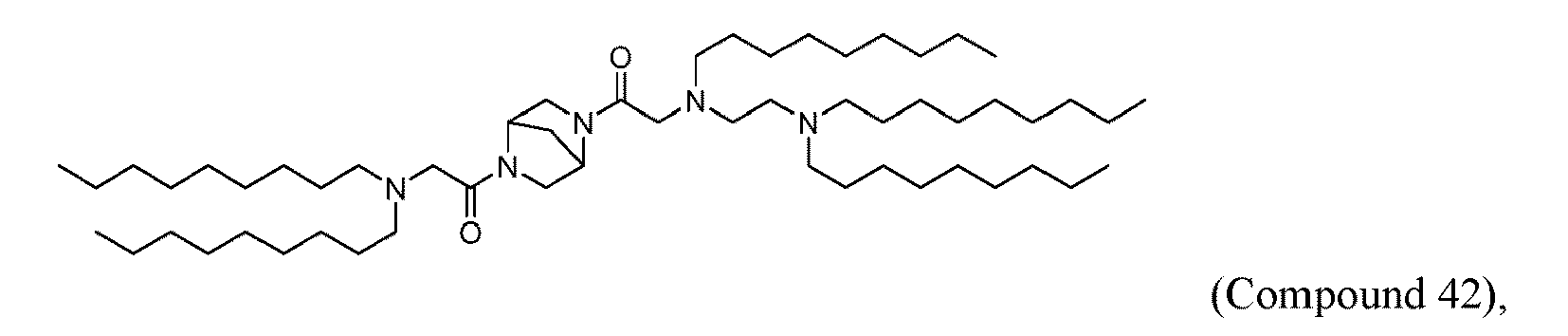


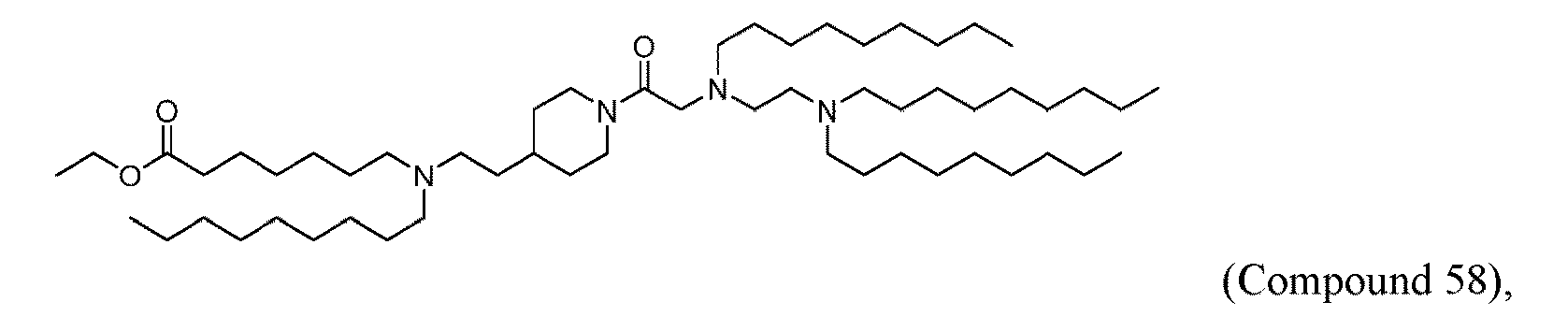


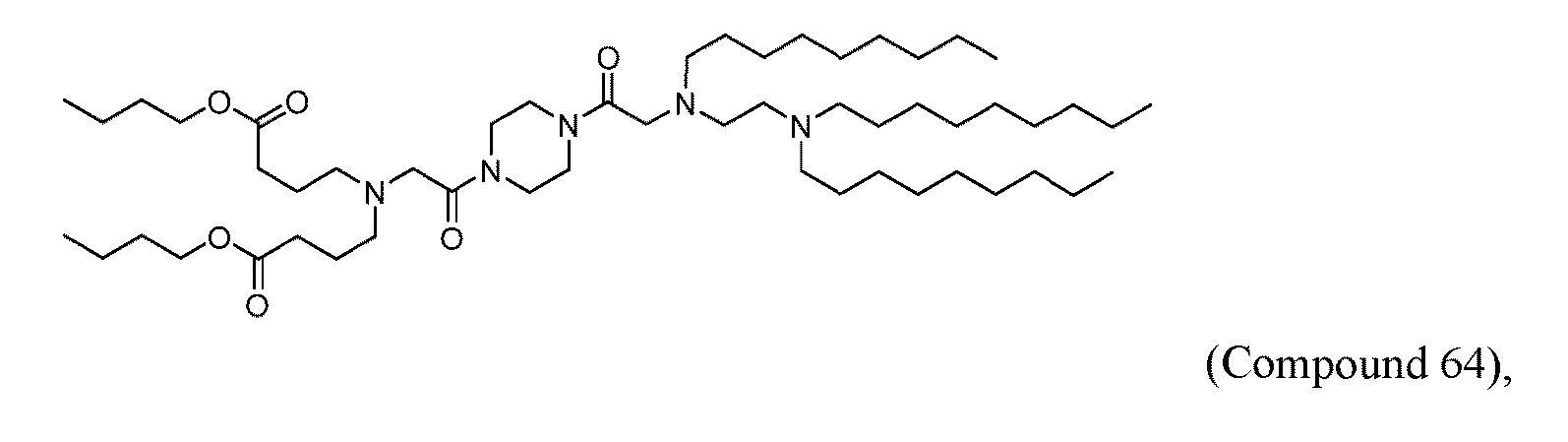







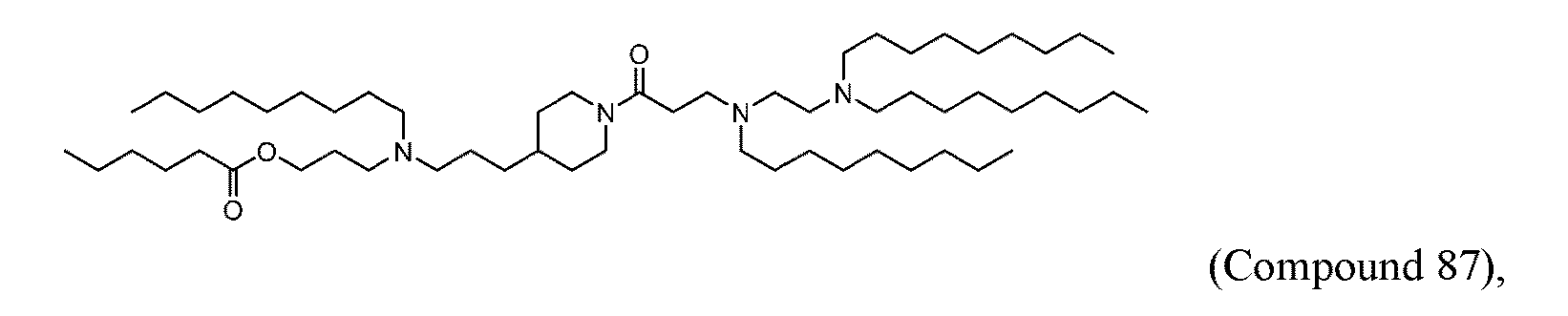
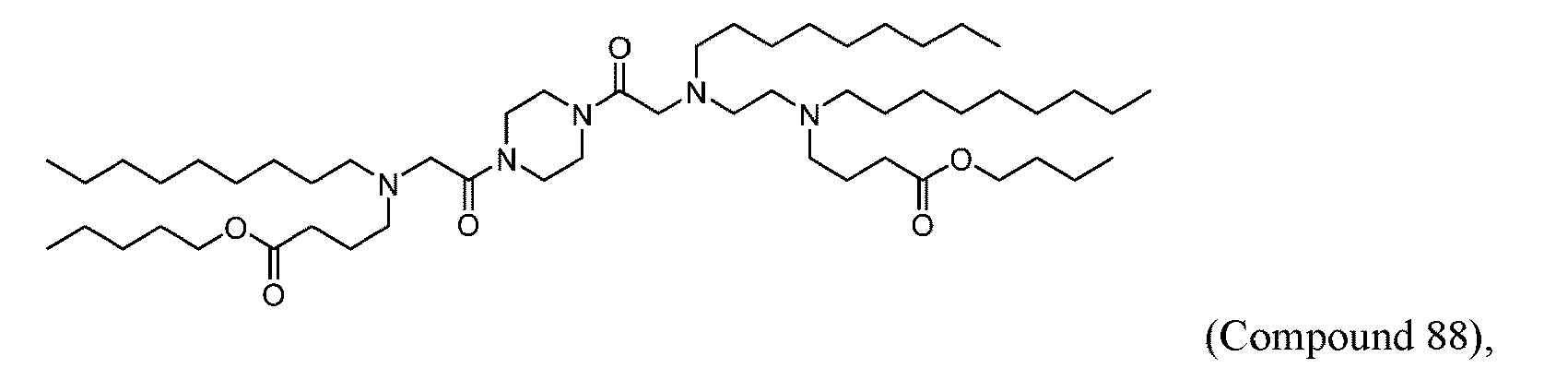










- The compound of claim 1, wherein the compound is selected from:


- A compound selected from Compound 67:

- The compound of claim 1, wherein the compound is selected from Compound 4:

- A nanoparticle composition comprising a lipid component comprising a compound according to any one of the preceding claims.
- The nanoparticle composition of claim 5, wherein the lipid component further comprises: (i) a phospholipid; (ii) a structural lipid, and/or (iii) a PEG lipid.
- The nanoparticle composition of any one of claims 5-6, wherein the structural lipid is selected from the group consisting of cholesterol, fecosterol, sitosterol, ergosterol, campesterol, stigmasterol, brassicasterol, tomatidine, ursolic acid, alpha-tocopherol, and mixtures thereof.
- The nanoparticle composition of any one of claims 5-7, further comprising a therapeutic and/or prophylactic agent; optionally wherein the therapeutic and/or prophylactic agent is(i) a vaccine or a compound capable of eliciting an immune response;(ii) a nucleic acid; or(iii) a ribonucleic acid (RNA), optionally wherein the RNA is selected from the group consisting of a small interfering RNA (siRNA), an asymmetrical interfering RNA (aiRNA), a microRNA (miRNA), a Dicer-substrate RNA (dsRNA), a small hairpin RNA (shRNA), a messenger RNA (mRNA), and mixtures thereof.
- A pharmaceutical composition comprising the nanoparticle composition of any one of claims 5-8 and a pharmaceutically acceptable carrier.
- The nanoparticle composition of any one of claims 5-8, for use in a method of treating a disease or disorder in a mammal in need thereof, optionally wherein the mammal is a human.
- The nanoparticle composition for use of claim 10, wherein the disease or disorder is characterized by dysfunctional or aberrant protein or polypeptide activity, or wherein the disease or disorder is selected from the group consisting of infectious diseases, cancer and proliferative diseases, genetic diseases, autoimmune diseases, diabetes, neurodegenerative diseases, cardio- and reno-vascular diseases, and metabolic diseases.
- The nanoparticle composition for use of any of claims 10-11, wherein the nanoparticle composition comprises Compound 4:

- The nanoparticle composition for use of any one of claims 10-12, wherein the nanoparticle composition is administered intravenously, intramuscularly, intradermally, subcutaneously, intranasally, or by inhalation.
- The nanoparticle composition for use of any one of claims 10-13, wherein a dose of about 0.01 mg/kg to about 10 mg/kg of the therapeutic and/or prophylactic agent is administered to the mammal.
- The nanoparticle composition for use of any one of claims 10-14, wherein the method further comprises, prior to the contacting or administering step, pretreating said mammal with one or more additional compounds, wherein pretreating comprises administering said one or more additional compounds to said mammal; optionally wherein said mammal is pretreated 24 or fewer hours prior to the contacting or administering step, optionally about one hour prior to the contacting or administering step.
- The nanoparticle composition for use of claim 15, wherein said one or more additional compounds are selected from the group consisting of anti-inflammatory compounds, steroids, statins, estradiols, BTK inhibitors, S1P1 agonists, glucocorticoid receptor modulators (GRMs), and anti-histamines; optionally wherein said one or more additional compounds are selected from the group consisting of dexamethasone, methotrexate, acetaminophen, an H1 receptor blocker, and an H2 receptor blocker.
- The nanoparticle composition for use of any one of claims 10-16, wherein the mammal- (a) is LDLR-deficient; (b) is apoE-deficient; and/or (c) has an abnormal LDLR-apoE interaction.
- The nanoparticle composition for use -of any one of claims 10-16, wherein the mammal (a) is not LDLR-deficient; (b) is not apoE-deficient; and/or (c) has a normal LDLR-apoE interaction.
Priority Applications (6)
| Application Number | Priority Date | Filing Date | Title |
|---|---|---|---|
| RS20220291A RS63051B1 (en) | 2015-12-22 | 2016-12-22 | Compounds and compositions for intracellular delivery of agents |
| SM20220252T SMT202200252T1 (en) | 2015-12-22 | 2016-12-22 | Compounds and compositions for intracellular delivery of agents |
| HRP20220268TT HRP20220268T1 (en) | 2015-12-22 | 2016-12-22 | Compounds and compositions for intracellular delivery of agents |
| EP21215940.4A EP4036079B1 (en) | 2015-12-22 | 2016-12-22 | Compounds and compositions for intracellular delivery of agents |
| PL16831870T PL3394030T3 (en) | 2015-12-22 | 2016-12-22 | Compounds and compositions for intracellular delivery of agents |
| SI201631493T SI3394030T1 (en) | 2015-12-22 | 2016-12-22 | Compounds and compositions for intracellular delivery of agents |
Applications Claiming Priority (8)
| Application Number | Priority Date | Filing Date | Title |
|---|---|---|---|
| US201562271160P | 2015-12-22 | 2015-12-22 | |
| US201562271200P | 2015-12-22 | 2015-12-22 | |
| US201562271146P | 2015-12-22 | 2015-12-22 | |
| US201562271179P | 2015-12-22 | 2015-12-22 | |
| US201562271137P | 2015-12-22 | 2015-12-22 | |
| US201662338474P | 2016-05-18 | 2016-05-18 | |
| US201662413345P | 2016-10-26 | 2016-10-26 | |
| PCT/US2016/068300 WO2017112865A1 (en) | 2015-12-22 | 2016-12-22 | Compounds and compositions for intracellular delivery of agents |
Related Child Applications (2)
| Application Number | Title | Priority Date | Filing Date |
|---|---|---|---|
| EP21215940.4A Division EP4036079B1 (en) | 2015-12-22 | 2016-12-22 | Compounds and compositions for intracellular delivery of agents |
| EP21215940.4A Division-Into EP4036079B1 (en) | 2015-12-22 | 2016-12-22 | Compounds and compositions for intracellular delivery of agents |
Publications (3)
| Publication Number | Publication Date |
|---|---|
| EP3394030A1 EP3394030A1 (en) | 2018-10-31 |
| EP3394030B1 EP3394030B1 (en) | 2021-12-22 |
| EP3394030B2 true EP3394030B2 (en) | 2025-02-12 |
Family
ID=57944500
Family Applications (2)
| Application Number | Title | Priority Date | Filing Date |
|---|---|---|---|
| EP21215940.4A Active EP4036079B1 (en) | 2015-12-22 | 2016-12-22 | Compounds and compositions for intracellular delivery of agents |
| EP16831870.7A Active EP3394030B2 (en) | 2015-12-22 | 2016-12-22 | Compounds and compositions for intracellular delivery of agents |
Family Applications Before (1)
| Application Number | Title | Priority Date | Filing Date |
|---|---|---|---|
| EP21215940.4A Active EP4036079B1 (en) | 2015-12-22 | 2016-12-22 | Compounds and compositions for intracellular delivery of agents |
Country Status (16)
| Country | Link |
|---|---|
| US (3) | US10799463B2 (en) |
| EP (2) | EP4036079B1 (en) |
| JP (2) | JP7114465B2 (en) |
| AU (2) | AU2016377681B2 (en) |
| CA (1) | CA3007297A1 (en) |
| CY (1) | CY1125087T1 (en) |
| DK (1) | DK3394030T3 (en) |
| ES (1) | ES2913626T5 (en) |
| HR (1) | HRP20220268T1 (en) |
| HU (1) | HUE057877T2 (en) |
| LT (1) | LT3394030T (en) |
| PL (1) | PL3394030T3 (en) |
| RS (1) | RS63051B1 (en) |
| SI (1) | SI3394030T1 (en) |
| SM (1) | SMT202200252T1 (en) |
| WO (1) | WO2017112865A1 (en) |
Families Citing this family (175)
| Publication number | Priority date | Publication date | Assignee | Title |
|---|---|---|---|---|
| KR20160067219A (en) | 2013-10-03 | 2016-06-13 | 모더나 세라퓨틱스, 인코포레이티드 | Polynucleotides encoding low density lipoprotein receptor |
| DK3134131T3 (en) | 2014-04-23 | 2022-02-07 | Modernatx Inc | Nucleic acid vaccines |
| IL316479A (en) | 2014-06-25 | 2024-12-01 | Acuitas Therapeutics Inc | Novel lipids and lipid nanoparticle formulations for delivery of nucleic acids |
| HUE067372T2 (en) | 2015-06-29 | 2024-10-28 | Acuitas Therapeutics Inc | Lipids and lipid nanoparticle formulations for delivery of nucleic acids |
| WO2017020026A1 (en) | 2015-07-30 | 2017-02-02 | Modernatx, Inc. | Concatemeric peptide epitopes rnas |
| RS63030B1 (en) | 2015-09-17 | 2022-04-29 | Modernatx Inc | Compounds and compositions for intracellular delivery of therapeutic agents |
| MD3718565T2 (en) | 2015-10-22 | 2022-09-30 | Modernatx Inc | Respiratory virus vaccines |
| CN108430456B (en) | 2015-10-22 | 2022-01-18 | 摩登纳特斯有限公司 | Cancer vaccine |
| RS63986B1 (en) | 2015-10-28 | 2023-03-31 | Acuitas Therapeutics Inc | Novel lipids and lipid nanoparticle formulations for delivery of nucleic acids |
| JP7114465B2 (en) | 2015-12-22 | 2022-08-08 | モデルナティエックス インコーポレイテッド | Compounds and compositions for intracellular delivery of drugs |
| JP6983455B2 (en) | 2016-09-14 | 2021-12-17 | モデルナティーエックス, インコーポレイテッド | High-purity RNA composition and methods for its preparation |
| US12491261B2 (en) | 2016-10-26 | 2025-12-09 | Acuitas Therapeutics, Inc. | Lipid nanoparticle formulations |
| US11583504B2 (en) | 2016-11-08 | 2023-02-21 | Modernatx, Inc. | Stabilized formulations of lipid nanoparticles |
| MA46762A (en) | 2016-11-10 | 2019-09-18 | Translate Bio Inc | IMPROVED PROCESS FOR PREPARING LIPID NANOPARTICLES LOADED WITH RNA |
| CN110167587A (en) | 2016-11-11 | 2019-08-23 | 摩登纳特斯有限公司 | Influenza vaccines |
| KR20190132405A (en) | 2017-03-15 | 2019-11-27 | 모더나티엑스, 인크. | Compounds and Compositions for Intracellular Delivery of Therapeutic Agents |
| CA3056133A1 (en) | 2017-03-15 | 2018-09-20 | Modernatx, Inc. | Crystal forms of amino lipids |
| ES3020935T3 (en) * | 2017-03-15 | 2025-05-23 | Modernatx Inc | Lipid nanoparticle formulation |
| WO2018170270A1 (en) | 2017-03-15 | 2018-09-20 | Modernatx, Inc. | Varicella zoster virus (vzv) vaccine |
| US20200085944A1 (en) | 2017-03-17 | 2020-03-19 | Curevac Ag | Rna vaccine and immune checkpoint inhibitors for combined anticancer therapy |
| WO2018187590A1 (en) | 2017-04-05 | 2018-10-11 | Modernatx, Inc. | Reduction or elimination of immune responses to non-intravenous, e.g., subcutaneously administered therapeutic proteins |
| WO2018191657A1 (en) | 2017-04-13 | 2018-10-18 | Acuitas Therapeutics, Inc. | Lipids for delivery of active agents |
| ES2981244T3 (en) | 2017-04-28 | 2024-10-07 | Acuitas Therapeutics Inc | Novel formulations of lipid carbonyl nanoparticles and lipids for nucleic acid delivery |
| US12077501B2 (en) | 2017-06-14 | 2024-09-03 | Modernatx, Inc. | Compounds and compositions for intracellular delivery of agents |
| WO2018232357A1 (en) | 2017-06-15 | 2018-12-20 | Modernatx, Inc. | Rna formulations |
| BR112019028280A2 (en) | 2017-07-04 | 2020-07-14 | Curevac Ag | nucleic acid molecules |
| US11639329B2 (en) | 2017-08-16 | 2023-05-02 | Acuitas Therapeutics, Inc. | Lipids for use in lipid nanoparticle formulations |
| EP4501322A3 (en) | 2017-08-17 | 2025-04-16 | Acuitas Therapeutics, Inc. | Lipids for use in lipid nanoparticle formulations |
| US11542225B2 (en) | 2017-08-17 | 2023-01-03 | Acuitas Therapeutics, Inc. | Lipids for use in lipid nanoparticle formulations |
| WO2019036030A1 (en) * | 2017-08-17 | 2019-02-21 | Acuitas Therapeutics, Inc. | Lipids for use in lipid nanoparticle formulations |
| CN111212905A (en) | 2017-08-18 | 2020-05-29 | 摩登纳特斯有限公司 | RNA polymerase variants |
| WO2019036683A1 (en) | 2017-08-18 | 2019-02-21 | Modernatx, Inc. | Analytical hplc methods |
| WO2019036685A1 (en) | 2017-08-18 | 2019-02-21 | Modernatx, Inc. | Methods for hplc analysis |
| EP3673069A1 (en) | 2017-08-22 | 2020-07-01 | CureVac AG | Bunyavirales vaccine |
| WO2019046809A1 (en) | 2017-08-31 | 2019-03-07 | Modernatx, Inc. | Methods of making lipid nanoparticles |
| MX2020002501A (en) * | 2017-09-08 | 2020-09-17 | Generation Bio Co | FORMULATIONS OF LIPID NANOPARTICLES OF DNA VECTORS FREE OF CAPSIDES, NOT VIRAL. |
| US11167043B2 (en) | 2017-12-20 | 2021-11-09 | Translate Bio, Inc. | Composition and methods for treatment of ornithine transcarbamylase deficiency |
| WO2019148101A1 (en) | 2018-01-29 | 2019-08-01 | Modernatx, Inc. | Rsv rna vaccines |
| WO2019193183A2 (en) | 2018-04-05 | 2019-10-10 | Curevac Ag | Novel yellow fever nucleic acid molecules for vaccination |
| DE202019006199U1 (en) | 2018-04-17 | 2026-01-12 | CureVac SE | New RSV RNA molecules and formulations for vaccination |
| US20210346306A1 (en) * | 2018-05-23 | 2021-11-11 | Modernatx, Inc. | Delivery of dna |
| US20210260178A1 (en) | 2018-06-27 | 2021-08-26 | Curevac Ag | Novel lassa virus rna molecules and compositions for vaccination |
| BR112020026432A2 (en) | 2018-07-13 | 2021-03-23 | Genmab A/S | antibody variant, isolated nucleic acid, expression vector, nucleic acid, combination of nucleic acids, dispensing vehicle, recombinant host cell, methods for producing an antibody variant, to increase at least one effector function of a parental antibody and to treat a disease, antibody, composition, pharmaceutical composition, and, antibody variant for use |
| MA53123A (en) | 2018-07-13 | 2021-05-19 | Genmab As | TROGOCYTOSIS MEDIATION THERAPY USING CD38 ANTIBODIES |
| KR20210091120A (en) | 2018-08-29 | 2021-07-21 | 트랜슬레이트 바이오 인코포레이티드 | Improved Process for Making mRNA-Loaded Lipid Nanoparticles |
| WO2020061367A1 (en) | 2018-09-19 | 2020-03-26 | Modernatx, Inc. | Compounds and compositions for intracellular delivery of therapeutic agents |
| US12151029B2 (en) | 2018-09-19 | 2024-11-26 | Modernatx, Inc. | PEG lipids and uses thereof |
| AU2019345067A1 (en) | 2018-09-19 | 2021-04-08 | Modernatx, Inc. | High-purity peg lipids and uses thereof |
| WO2020061457A1 (en) | 2018-09-20 | 2020-03-26 | Modernatx, Inc. | Preparation of lipid nanoparticles and methods of administration thereof |
| IL281615B2 (en) | 2018-09-21 | 2026-01-01 | Acuitas Therapeutics Inc | Systems and methods for manufacturing lipid nanoparticles and liposomes |
| CN113166783B (en) | 2018-10-09 | 2024-10-11 | 不列颠哥伦比亚大学 | Compositions and systems comprising organic solvent-free and detergent-free transfection-active vesicles and methods related thereto |
| US12583816B2 (en) | 2018-10-18 | 2026-03-24 | Acuitas Therapeutics, Inc. | Lipids for lipid nanoparticle delivery of active agents |
| CN109265359B (en) * | 2018-10-22 | 2021-09-03 | 大连百傲化学股份有限公司 | Side chain type water-soluble polyquaternary ammonium salt and preparation method thereof |
| CN113453707A (en) | 2018-12-21 | 2021-09-28 | 库瑞瓦格股份公司 | RNA for malaria vaccine |
| JP7523449B2 (en) | 2019-01-11 | 2024-07-26 | アクイタス セラピューティクス インコーポレイテッド | Lipids for lipid nanoparticle delivery of active agents |
| KR20210133218A (en) | 2019-01-31 | 2021-11-05 | 모더나티엑스, 인크. | Vortex mixer and associated method, system and apparatus thereof |
| MX2021009245A (en) | 2019-01-31 | 2021-11-12 | Modernatx Inc | METHODS FOR THE PREPARATION OF LIPID NANOPARTICLES. |
| EP4491229A3 (en) | 2019-02-08 | 2025-05-14 | CureVac SE | Coding rna administered into the suprachoroidal space in the treatment of ophtalmic diseases |
| CN113874502A (en) | 2019-03-11 | 2021-12-31 | 摩登纳特斯有限公司 | Fed-batch in vitro transcription method |
| WO2020190750A1 (en) | 2019-03-15 | 2020-09-24 | Modernatx, Inc. | Hiv rna vaccines |
| EP3968952A1 (en) | 2019-05-14 | 2022-03-23 | Translate Bio, Inc. | Improved process of preparing mrna-loaded lipid nanoparticles |
| EP3986452A1 (en) | 2019-06-18 | 2022-04-27 | CureVac AG | Rotavirus mrna vaccine |
| JP2022544412A (en) | 2019-08-14 | 2022-10-18 | キュアバック アーゲー | RNA combinations and compositions with reduced immunostimulatory properties |
| MX2022003269A (en) | 2019-09-19 | 2022-07-04 | Modernatx Inc | BRANCHED TAIL LIPID COMPOUNDS AND COMPOSITIONS FOR THE INTRACELLULAR ADMINISTRATION OF THERAPEUTIC AGENTS. |
| CA3155015A1 (en) | 2019-09-19 | 2021-03-25 | Modernatx, Inc. | Carbonate containing lipid compounds and compositions for intracellular delivery of therapeutic agents |
| WO2021077067A1 (en) * | 2019-10-18 | 2021-04-22 | The Trustees Of The University Of Pennsylvania | Lipid nanoparticles and formulations thereof for car mrna delivery |
| CN114901360A (en) | 2019-12-20 | 2022-08-12 | 库瑞瓦格股份公司 | Novel lipid nanoparticles for delivery of nucleic acids |
| CN116133652A (en) | 2020-01-31 | 2023-05-16 | 摩登纳特斯有限公司 | Method for preparing lipid nanoparticles |
| EP3886897A1 (en) | 2020-02-04 | 2021-10-06 | CureVac AG | Coronavirus vaccine |
| WO2021173840A1 (en) | 2020-02-25 | 2021-09-02 | Translate Bio, Inc. | Improved processes of preparing mrna-loaded lipid nanoparticles |
| KR102924173B1 (en) | 2020-04-09 | 2026-02-06 | 쑤저우 아보젠 바이오사이언시스 컴퍼니 리미티드 | Lipid nanoparticle composition |
| WO2021204179A1 (en) | 2020-04-09 | 2021-10-14 | Suzhou Abogen Biosciences Co., Ltd. | Nucleic acid vaccines for coronavirus |
| CN113521269A (en) | 2020-04-22 | 2021-10-22 | 生物技术Rna制药有限公司 | Coronavirus vaccine |
| CN116322758A (en) | 2020-05-29 | 2023-06-23 | 库尔维科欧洲股份公司 | Nucleic acid-based combination vaccines |
| AU2021301922A1 (en) | 2020-06-30 | 2023-02-02 | Suzhou Abogen Biosciences Co., Ltd. | Lipid compounds and lipid nanoparticle compositions |
| JP7798855B2 (en) | 2020-07-16 | 2026-01-14 | アクイタス セラピューティクス インコーポレイテッド | Cationic lipids for use in lipid nanoparticles - Patent Application 20070122999 |
| CN111718361B (en) * | 2020-07-23 | 2022-04-05 | 南京工业大学 | A kind of metallo-beta-lactamase inhibitor and preparation method and application thereof |
| EP4172194A1 (en) | 2020-07-31 | 2023-05-03 | CureVac SE | Nucleic acid encoded antibody mixtures |
| TW202220637A (en) | 2020-08-06 | 2022-06-01 | 美商現代公司 | Methods of preparing lipid nanoparticles |
| WO2022037652A1 (en) | 2020-08-20 | 2022-02-24 | Suzhou Abogen Biosciences Co., Ltd. | Lipid compounds and lipid nanoparticle compositions |
| CA3170743A1 (en) | 2020-08-31 | 2022-03-03 | Susanne RAUCH | Multivalent nucleic acid based coronavirus vaccines |
| KR20230118715A (en) | 2020-10-14 | 2023-08-11 | 조지 메이슨 리서치 파운데이션 인코포레이티드 | Ionizable lipids and methods of making and using the same |
| CA3200234A1 (en) | 2020-11-25 | 2022-06-02 | Daryl C. Drummond | Lipid nanoparticles for delivery of nucleic acids, and related methods of use |
| US20240050378A1 (en) * | 2020-12-02 | 2024-02-15 | Merck Sharp & Dohme Llc | Lipid nanoparticle compositions containing monoester cationic lipids |
| AR124267A1 (en) * | 2020-12-09 | 2023-03-01 | Genentech Inc | HIGH THROUGH METHODS FOR PREPARING LIPID NANOPARTICLES AND THEIR USES |
| US20240299309A1 (en) | 2020-12-22 | 2024-09-12 | CureVac SE | Pharmaceutical composition comprising lipid-based carriers encapsulating rna for multidose administration |
| US20240156946A1 (en) | 2020-12-22 | 2024-05-16 | CureVac SE | Rna vaccine against sars-cov-2 variants |
| CN112641942B (en) * | 2020-12-25 | 2023-05-19 | 深圳大学 | Near-infrared light-controlled nanometer gas diagnosis and treatment agent and its preparation method and application |
| WO2022150717A1 (en) | 2021-01-11 | 2022-07-14 | Modernatx, Inc. | Seasonal rna influenza virus vaccines |
| WO2022152109A2 (en) | 2021-01-14 | 2022-07-21 | Suzhou Abogen Biosciences Co., Ltd. | Lipid compounds and lipid nanoparticle compositions |
| WO2022152141A2 (en) | 2021-01-14 | 2022-07-21 | Suzhou Abogen Biosciences Co., Ltd. | Polymer conjugated lipid compounds and lipid nanoparticle compositions |
| KR20230121616A (en) * | 2021-01-14 | 2023-08-18 | 쑤저우 아보젠 바이오사이언시스 컴퍼니 리미티드 | Lipid Compounds and Lipid Nanoparticle Compositions |
| EP4087938A2 (en) | 2021-01-27 | 2022-11-16 | CureVac AG | Method of reducing the immunostimulatory properties of in vitro transcribed rna |
| JP2024506908A (en) | 2021-02-12 | 2024-02-15 | モデルナティエックス インコーポレイテッド | LNP compositions containing payloads for in vivo therapy |
| MX2023011400A (en) | 2021-03-26 | 2023-10-09 | Glaxosmithkline Biologicals Sa | Immunogenic compositions. |
| WO2022207862A2 (en) | 2021-03-31 | 2022-10-06 | Curevac Ag | Syringes containing pharmaceutical compositions comprising rna |
| EP4334446A1 (en) | 2021-05-03 | 2024-03-13 | CureVac SE | Improved nucleic acid sequence for cell type specific expression |
| WO2022234003A1 (en) | 2021-05-07 | 2022-11-10 | Avacta Life Sciences Limited | Cd33 binding polypeptides with stefin a protein |
| US20220363937A1 (en) | 2021-05-14 | 2022-11-17 | Armstrong World Industries, Inc. | Stabilization of antimicrobial coatings |
| WO2022247755A1 (en) | 2021-05-24 | 2022-12-01 | Suzhou Abogen Biosciences Co., Ltd. | Lipid compounds and lipid nanoparticle compositions |
| CN119137109A (en) * | 2021-08-12 | 2024-12-13 | 生命技术公司 | Lipids for nucleic acid delivery |
| IL309505A (en) | 2021-09-03 | 2024-02-01 | CureVac SE | Lipid nanoparticles for nucleic acid delivery |
| CN117940158A (en) | 2021-09-03 | 2024-04-26 | 库瑞瓦格欧洲公司 | Novel lipid nanoparticles comprising phosphatidylserine for nucleic acid delivery |
| US20230109496A1 (en) | 2021-09-06 | 2023-04-06 | Genmab B.V. | Antibodies capable of binding to cd27, variants thereof and uses thereof |
| JP2024535004A (en) * | 2021-09-10 | 2024-09-26 | 浙江吉量科技有限公司 | Ionizable lipids, their preparation and use in gene delivery. |
| TW202328067A (en) * | 2021-09-14 | 2023-07-16 | 美商雷納嘉德醫療管理公司 | Cyclic lipids and methods of use thereof |
| EP4412711A1 (en) | 2021-10-07 | 2024-08-14 | Avacta Life Sciences Limited | Serum half-life extended pd-l1 binding polypeptides |
| TW202334196A (en) | 2021-10-07 | 2023-09-01 | 英商阿法克塔生命科學有限公司 | Pd-l1 binding polypeptides |
| AR127312A1 (en) | 2021-10-08 | 2024-01-10 | Suzhou Abogen Biosciences Co Ltd | LIPID COMPOUNDS AND LIPID NANOPARTICLE COMPOSITIONS |
| AU2022358824A1 (en) | 2021-10-08 | 2024-04-11 | Suzhou Abogen Biosciences Co., Ltd. | Lipid compounds and lipid nanoparticle compositions |
| CN116064598B (en) | 2021-10-08 | 2024-03-12 | 苏州艾博生物科技有限公司 | Coronavirus nucleic acid vaccine |
| AR127298A1 (en) | 2021-10-08 | 2024-01-10 | Genmab As | ANTIBODIES THAT BIND CD30 AND CD3 |
| WO2023064469A1 (en) | 2021-10-13 | 2023-04-20 | Modernatx, Inc. | Compositions of mrna-encoded il15 fusion proteins and methods of use thereof |
| US20250027108A1 (en) | 2021-10-29 | 2025-01-23 | CureVac SE | Improved circular rna for expressing therapeutic proteins |
| WO2023086365A1 (en) * | 2021-11-11 | 2023-05-19 | Ohio State Innovation Foundation | Compositions comprising amino lipid compounds and methods of making and use thereof |
| US12186387B2 (en) | 2021-11-29 | 2025-01-07 | BioNTech SE | Coronavirus vaccine |
| CN118591372A (en) * | 2021-12-06 | 2024-09-03 | 俄亥俄州创新基金会 | Diamino lipid (DAL) compounds and pharmaceutical compositions containing immunotherapeutic agents |
| AR127892A1 (en) | 2021-12-10 | 2024-03-06 | Modernatx Inc | COMPOUNDS AND COMPOSITIONS FOR THE ADMINISTRATION OF THERAPEUTIC AGENTS |
| US20250049728A1 (en) | 2021-12-16 | 2025-02-13 | Modernatx, Inc. | Processes for preparing lipid nanoparticles |
| CA3242402A1 (en) | 2021-12-16 | 2023-06-22 | Acuitas Therapeutics, Inc. | Lipids for use in lipid nanoparticle formulations |
| CA3241492A1 (en) | 2021-12-23 | 2023-06-29 | Suzhou Abogen Biosciences Co., Ltd. | Lipid compound and lipid nanoparticle composition |
| US20250099614A1 (en) | 2022-01-28 | 2025-03-27 | CureVac SE | Nucleic acid encoded transcription factor inhibitors |
| WO2023154818A1 (en) | 2022-02-09 | 2023-08-17 | Modernatx, Inc. | Mucosal administration methods and formulations |
| KR102465349B1 (en) * | 2022-02-25 | 2022-11-11 | 주식회사 테르나테라퓨틱스 | Novel Ionizable Lipids and Lipid Nanoparticles Comprising Thereof |
| EP4499607A1 (en) * | 2022-03-25 | 2025-02-05 | Sail Biomedicines, Inc. | Novel ionizable lipids and lipid nanoparticles and methods of using the same |
| WO2023193002A1 (en) | 2022-04-01 | 2023-10-05 | Modernatx, Inc. | Cross mixers for lipid nanoparticle production, and methods of operating the same |
| CN119325466A (en) * | 2022-04-08 | 2025-01-17 | 尚威天成信使核糖核酸治疗公司 | Ionizable lipid compounds and lipid nanoparticle compositions |
| WO2023218243A1 (en) | 2022-05-12 | 2023-11-16 | Avacta Life Sciences Limited | Lag-3/pd-l1 binding fusion proteins |
| CA3248209A1 (en) | 2022-05-25 | 2023-11-30 | CureVac SE | Nucleic acid based vaccine encoding an escherichia coli fimh antigenic polypeptide |
| EP4531819A2 (en) | 2022-05-25 | 2025-04-09 | Akagera Medicines, Inc. | Lipid nanoparticles for delivery of nucleic acids and methods of use thereof |
| CN117534584B (en) * | 2022-06-06 | 2026-02-27 | 上海蓝鹊生物医药有限公司 | Nitrogen-containing chain compounds, preparation methods, compositions containing them, and applications. |
| CN116589435A (en) * | 2022-06-20 | 2023-08-15 | 成都威斯津生物医药科技有限公司 | Ionizable lipids and compositions thereof for nucleic acid delivery |
| US12297285B2 (en) | 2022-06-24 | 2025-05-13 | Orna Therapeutics, Inc. | Circular RNA encoding chimeric antigen receptors targeting BCMA |
| WO2024002985A1 (en) | 2022-06-26 | 2024-01-04 | BioNTech SE | Coronavirus vaccine |
| EP4342460A1 (en) | 2022-09-21 | 2024-03-27 | NovoArc GmbH | Lipid nanoparticle with nucleic acid cargo |
| CA3267272A1 (en) | 2022-09-26 | 2024-04-04 | Glaxosmithkline Biologicals Sa | Influenza virus vaccines |
| CN117917398A (en) * | 2022-10-21 | 2024-04-23 | 华中师范大学 | An ionizable lipid compound, nucleic acid drug molecule delivery system and application thereof |
| EP4608442A1 (en) | 2022-10-28 | 2025-09-03 | GlaxoSmithKline Biologicals S.A. | Nucleic acid based vaccine |
| EP4368626A1 (en) * | 2022-11-14 | 2024-05-15 | Industrial Technology Research Institute | Lipid compound or a derivative thereof and pharmaceutical composition employing the same |
| CN118125994A (en) * | 2022-11-25 | 2024-06-04 | 艾斯拓康医药科技(北京)有限公司 | Ionizable lipids and their applications |
| EP4630397A1 (en) | 2022-12-08 | 2025-10-15 | ModernaTX, Inc. | Ionizable lipids with malonate tails |
| AU2023414262B2 (en) | 2022-12-29 | 2025-08-14 | Rinuagene Biotechnology Co., Ltd. | Polynucleotide molecule for preventing or treating hpv infection-related diseases |
| EP4658239A1 (en) | 2023-02-03 | 2025-12-10 | GlaxoSmithKline Biologicals S.A. | Rna formulation |
| GB202302092D0 (en) | 2023-02-14 | 2023-03-29 | Glaxosmithkline Biologicals Sa | Analytical method |
| WO2024178305A1 (en) | 2023-02-24 | 2024-08-29 | Modernatx, Inc. | Compositions of mrna-encoded il-15 fusion proteins and methods of use thereof for treating cancer |
| JP2026509258A (en) | 2023-03-08 | 2026-03-17 | キュアバック エスイー | Novel lipid nanoparticle formulations for nucleic acid delivery |
| JP2026508928A (en) | 2023-03-09 | 2026-03-13 | 上海吉量医薬工程有限公司 | Ionizable lipid molecules, their preparation methods, and their use |
| WO2024197310A1 (en) | 2023-03-23 | 2024-09-26 | Modernatx, Inc. | Peg targeting compounds for delivery of therapeutics |
| EP4683665A1 (en) | 2023-03-23 | 2026-01-28 | ModernaTX, Inc. | Peg targeting compounds for delivery of therapeutics |
| EP4683666A1 (en) | 2023-03-23 | 2026-01-28 | ModernaTX, Inc. | Peg targeting compounds for delivery of therapeutics |
| JP2026512425A (en) | 2023-03-30 | 2026-04-16 | オーエスイー・イミュノセラピューティクス | Lipid-based nanoparticles targeted to activated immune cells for the expression of immune cell-enhancing molecules and their use |
| EP4687990A1 (en) | 2023-03-30 | 2026-02-11 | Ose Immunotherapeutics | Method of synthesis of targeted lipid nanoparticle and uses thereof |
| WO2024223728A1 (en) | 2023-04-27 | 2024-10-31 | Glaxosmithkline Biologicals Sa | Influenza virus vaccines |
| EP4701657A1 (en) | 2023-04-27 | 2026-03-04 | GlaxoSmithKline Biologicals S.A. | Influenza virus vaccines |
| WO2024230934A1 (en) | 2023-05-11 | 2024-11-14 | CureVac SE | Therapeutic nucleic acid for the treatment of ophthalmic diseases |
| US12410258B2 (en) | 2023-05-12 | 2025-09-09 | Ganmab A/S | Antibodies capable of binding to OX40, variants thereof and uses thereof |
| WO2024259373A1 (en) | 2023-06-14 | 2024-12-19 | Modernatx, Inc. | Compounds and compositions for delivery of therapeutic agents |
| CN116514696B (en) * | 2023-06-29 | 2023-12-01 | 艾斯拓康医药科技(北京)有限公司 | Ionizable lipids and uses thereof |
| WO2025003280A1 (en) | 2023-06-30 | 2025-01-02 | Genmab A/S | Antibodies binding to fibroblast activation protein alpha and death receptor 4 |
| CN121532514A (en) | 2023-07-07 | 2026-02-13 | 上海环码生物医药有限公司 | Circular RNA vaccines for seasonal influenza and their administration |
| CN121620589A (en) | 2023-08-01 | 2026-03-06 | 法国居里学院 | Nanoparticles comprising a nucleic acid sequence encoding cyclic GMP-AMP synthase |
| WO2025045142A1 (en) | 2023-08-29 | 2025-03-06 | Shanghai Circode Biomed Co., Ltd. | Circular rna encoding vegf polypeptides, formulations, and methods of uses |
| CN121752256A (en) | 2023-09-01 | 2026-03-27 | 诺沃阿克有限责任公司 | Lipid nanoparticles with nucleic acid supports and ionizable lipids |
| TW202525812A (en) * | 2023-10-24 | 2025-07-01 | 南韓商綠十字股份有限公司 | Ionizable lipids and uses thereof |
| WO2025133115A1 (en) | 2023-12-21 | 2025-06-26 | Ose Immunotherapeutics | Lipid-based nanoparticles comprising il-35 |
| WO2025132839A1 (en) | 2023-12-21 | 2025-06-26 | Glaxosmithkline Biologicals Sa | Influenza virus vaccines |
| WO2025140594A1 (en) * | 2023-12-29 | 2025-07-03 | 厦门赛诺邦格生物科技股份有限公司 | Asymmetric cationic lipid containing multiple tertiary amines |
| WO2025160381A1 (en) | 2024-01-26 | 2025-07-31 | Modernatx, Inc. | Methods of preparing lipid nanoparticles |
| GB202404607D0 (en) | 2024-03-29 | 2024-05-15 | Glaxosmithkline Biologicals Sa | RNA formulation |
| WO2026020171A2 (en) | 2024-07-19 | 2026-01-22 | Aera Therapeutics, Inc. | Chimeric antigen receptor constructs |
| WO2026068705A1 (en) | 2024-09-26 | 2026-04-02 | Ose Immunotherapeutics | Lipid-based nanoparticles comprising non-glycosylated fc domains and uses thereof |
| CN119661389A (en) * | 2024-10-15 | 2025-03-21 | 山东大学 | Ionizable lipid and lipid nanoparticles based on trans-1,4-cyclohexanedimethanol and preparation method and application thereof |
| WO2026093414A1 (en) | 2024-10-30 | 2026-05-07 | Ose Immunotherapeutics | Lipid-based nanoparticles comprising membrane il-35 |
| CN119528797B (en) * | 2025-01-13 | 2025-05-06 | 北京安龙生物医药有限公司 | Lipid compounds for delivery of therapeutics, oligonucleotide delivery systems, methods of making and uses thereof |
| CN120842107B (en) * | 2025-09-24 | 2025-12-30 | 北京悦康科创医药科技股份有限公司 | Spleen-targeted cationic lipid compounds of ethylenediamine structural type, compositions comprising same and uses thereof |
Citations (2)
| Publication number | Priority date | Publication date | Assignee | Title |
|---|---|---|---|---|
| WO2010053572A2 (en) † | 2008-11-07 | 2010-05-14 | Massachusetts Institute Of Technology | Aminoalcohol lipidoids and uses thereof |
| WO2011017548A1 (en) † | 2009-08-05 | 2011-02-10 | Alnylam Pharmaceuticals, Inc. | Lipid formulated compositions and methods for inhibiting expression of eg5 and vegf genes |
Family Cites Families (366)
| Publication number | Priority date | Publication date | Assignee | Title |
|---|---|---|---|---|
| US3324182A (en) | 1962-12-26 | 1967-06-06 | Monsanto Res Corp | Penta-alkyldialkylenetriamines |
| US3872171A (en) | 1971-05-24 | 1975-03-18 | Pfizer | Polyamines as antiviral agents in animals |
| US3799876A (en) * | 1970-12-11 | 1974-03-26 | Texaco Inc | Corrosion inhibiting lubrication method |
| US4125544A (en) | 1977-06-09 | 1978-11-14 | G. D. Searle | 20/22/23/24-Oxa-7-oxocholesterols and esters thereof |
| US4270537A (en) | 1979-11-19 | 1981-06-02 | Romaine Richard A | Automatic hypodermic syringe |
| US4957735A (en) | 1984-06-12 | 1990-09-18 | The University Of Tennessee Research Corporation | Target-sensitive immunoliposomes- preparation and characterization |
| US4596556A (en) | 1985-03-25 | 1986-06-24 | Bioject, Inc. | Hypodermic injection apparatus |
| US4886499A (en) | 1986-12-18 | 1989-12-12 | Hoffmann-La Roche Inc. | Portable injection appliance |
| GB8704027D0 (en) | 1987-02-20 | 1987-03-25 | Owen Mumford Ltd | Syringe needle combination |
| US4941880A (en) | 1987-06-19 | 1990-07-17 | Bioject, Inc. | Pre-filled ampule and non-invasive hypodermic injection device assembly |
| US4790824A (en) | 1987-06-19 | 1988-12-13 | Bioject, Inc. | Non-invasive hypodermic injection device |
| US4940460A (en) | 1987-06-19 | 1990-07-10 | Bioject, Inc. | Patient-fillable and non-invasive hypodermic injection device assembly |
| US5339163A (en) | 1988-03-16 | 1994-08-16 | Canon Kabushiki Kaisha | Automatic exposure control device using plural image plane detection areas |
| FR2638359A1 (en) | 1988-11-03 | 1990-05-04 | Tino Dalto | SYRINGE GUIDE WITH ADJUSTMENT OF DEPTH DEPTH OF NEEDLE IN SKIN |
| EP0737750B1 (en) | 1989-03-21 | 2003-05-14 | Vical, Inc. | Expression of exogenous polynucleotide sequences in a vertebrate |
| US5312335A (en) | 1989-11-09 | 1994-05-17 | Bioject Inc. | Needleless hypodermic injection device |
| US5064413A (en) | 1989-11-09 | 1991-11-12 | Bioject, Inc. | Needleless hypodermic injection device |
| US5190521A (en) | 1990-08-22 | 1993-03-02 | Tecnol Medical Products, Inc. | Apparatus and method for raising a skin wheal and anesthetizing skin |
| US5527288A (en) | 1990-12-13 | 1996-06-18 | Elan Medical Technologies Limited | Intradermal drug delivery device and method for intradermal delivery of drugs |
| FR2676072B1 (en) | 1991-05-03 | 1994-11-18 | Transgene Sa | RNA DELIVERY VECTOR. |
| GB9118204D0 (en) | 1991-08-23 | 1991-10-09 | Weston Terence E | Needle-less injector |
| SE9102652D0 (en) | 1991-09-13 | 1991-09-13 | Kabi Pharmacia Ab | INJECTION NEEDLE ARRANGEMENT |
| JPH07503372A (en) | 1992-01-23 | 1995-04-13 | バイカル・インコーポレイテッド | In vitro gene transfer |
| US5328483A (en) | 1992-02-27 | 1994-07-12 | Jacoby Richard M | Intradermal injection device with medication and needle guard |
| US5383851A (en) | 1992-07-24 | 1995-01-24 | Bioject Inc. | Needleless hypodermic injection device |
| US5569189A (en) | 1992-09-28 | 1996-10-29 | Equidyne Systems, Inc. | hypodermic jet injector |
| US5334144A (en) | 1992-10-30 | 1994-08-02 | Becton, Dickinson And Company | Single use disposable needleless injector |
| WO1995024176A1 (en) | 1994-03-07 | 1995-09-14 | Bioject, Inc. | Ampule filling device |
| US5466220A (en) | 1994-03-08 | 1995-11-14 | Bioject, Inc. | Drug vial mixing and transfer device |
| US5807861A (en) | 1994-03-24 | 1998-09-15 | Cell Therapeutics, Inc. | Amine substituted xanthinyl compounds |
| US5599302A (en) | 1995-01-09 | 1997-02-04 | Medi-Ject Corporation | Medical injection system and method, gas spring thereof and launching device using gas spring |
| US5795587A (en) | 1995-01-23 | 1998-08-18 | University Of Pittsburgh | Stable lipid-comprising drug delivery complexes and methods for their production |
| US5730723A (en) | 1995-10-10 | 1998-03-24 | Visionary Medical Products Corporation, Inc. | Gas pressured needle-less injection device and method |
| US5893397A (en) | 1996-01-12 | 1999-04-13 | Bioject Inc. | Medication vial/syringe liquid-transfer apparatus |
| GB9607549D0 (en) | 1996-04-11 | 1996-06-12 | Weston Medical Ltd | Spring-powered dispensing device |
| US7288266B2 (en) | 1996-08-19 | 2007-10-30 | United States Of America As Represented By The Secretary, Department Of Health And Human Services | Liposome complexes for increased systemic delivery |
| US6143276A (en) | 1997-03-21 | 2000-11-07 | Imarx Pharmaceutical Corp. | Methods for delivering bioactive agents to regions of elevated temperatures |
| US5993412A (en) | 1997-05-19 | 1999-11-30 | Bioject, Inc. | Injection apparatus |
| WO1999014346A2 (en) | 1997-09-19 | 1999-03-25 | Sequitur, Inc. | SENSE mRNA THERAPY |
| US6673192B1 (en) | 1997-09-25 | 2004-01-06 | Loctite Corporation | Multi-amine compound primers for bonding of polyolefins with cyanoacrylate adhesives |
| WO1999022009A1 (en) | 1997-10-24 | 1999-05-06 | Megabios Corporation | Methods for preparing polynucleotide transfection complexes |
| AU744755B2 (en) | 1997-11-12 | 2002-03-07 | Brigham And Women's Hospital | The translation enhancer element of the human amyloid precursor protein gene |
| CA2309766C (en) | 1997-11-20 | 2008-09-30 | Vical Incorporated | Treatment of cancer using cytokine-expressing polynucleotides and compositions therefor |
| IT1298087B1 (en) | 1998-01-08 | 1999-12-20 | Fiderm S R L | DEVICE FOR CHECKING THE PENETRATION DEPTH OF A NEEDLE, IN PARTICULAR APPLICABLE TO A SYRINGE FOR INJECTIONS |
| US6432925B1 (en) | 1998-04-16 | 2002-08-13 | John Wayne Cancer Institute | RNA cancer vaccine and methods for its use |
| GB9808268D0 (en) | 1998-04-17 | 1998-06-17 | Imp College Innovations Ltd | Compound |
| US6395253B2 (en) | 1998-04-23 | 2002-05-28 | The Regents Of The University Of Michigan | Microspheres containing condensed polyanionic bioactive agents and methods for their production |
| JP2000169864A (en) | 1998-12-07 | 2000-06-20 | New Japan Chem Co Ltd | Fuel composition for model engine |
| EP2286792A1 (en) | 1999-02-26 | 2011-02-23 | Novartis Vaccines and Diagnostics, Inc. | Microemulsions with an adsorbent surface, comprising a microdroplet emulsion |
| WO2001023002A1 (en) | 1999-09-30 | 2001-04-05 | National Jewish Medical And Research Center | Method for inhibition of pathogenic microorganisms |
| US7060291B1 (en) | 1999-11-24 | 2006-06-13 | Transave, Inc. | Modular targeted liposomal delivery system |
| US7468275B2 (en) | 2000-01-28 | 2008-12-23 | The Scripps Research Institute | Synthetic internal ribosome entry sites and methods of identifying same |
| EP1259602A1 (en) | 2000-01-28 | 2002-11-27 | The Scripps Research Institute | Methods of identifying synthetic transcriptional and translational regulatory elements, and compositions relating to same |
| US6696038B1 (en) | 2000-09-14 | 2004-02-24 | Expression Genetics, Inc. | Cationic lipopolymer as biocompatible gene delivery agent |
| US20040142474A1 (en) | 2000-09-14 | 2004-07-22 | Expression Genetics, Inc. | Novel cationic lipopolymer as a biocompatible gene delivery agent |
| US7708915B2 (en) | 2004-05-06 | 2010-05-04 | Castor Trevor P | Polymer microspheres/nanospheres and encapsulating therapeutic proteins therein |
| US6652886B2 (en) | 2001-02-16 | 2003-11-25 | Expression Genetics | Biodegradable cationic copolymers of poly (alkylenimine) and poly (ethylene glycol) for the delivery of bioactive agents |
| DE10109897A1 (en) | 2001-02-21 | 2002-11-07 | Novosom Ag | Optional cationic liposomes and their use |
| CA2449054C (en) | 2001-05-30 | 2011-01-04 | The Scripps Research Institute | Integrin targeting liposome for nucleic acid delivery |
| EP1903054A3 (en) | 2001-06-05 | 2008-07-23 | CureVac GmbH | Pharmaceutical compound containing a stabilised mRNA which is optimised for translation in its coded areas |
| DE10162480A1 (en) | 2001-12-19 | 2003-08-07 | Ingmar Hoerr | The application of mRNA for use as a therapeutic agent against tumor diseases |
| DE10207178A1 (en) | 2002-02-19 | 2003-09-04 | Novosom Ag | Components for the production of amphoteric liposomes |
| US20050222064A1 (en) | 2002-02-20 | 2005-10-06 | Sirna Therapeutics, Inc. | Polycationic compositions for cellular delivery of polynucleotides |
| WO2003075892A1 (en) | 2002-03-13 | 2003-09-18 | Novartis Ag | Pharmaceutical microparticles |
| CA2480775C (en) | 2002-04-04 | 2016-05-31 | Coley Pharmaceutical Gmbh | Immunostimulatory g,u-containing oligoribonucleotides |
| EP1519714B1 (en) | 2002-06-28 | 2010-10-20 | Protiva Biotherapeutics Inc. | Method and apparatus for producing liposomes |
| DE10229872A1 (en) | 2002-07-03 | 2004-01-29 | Curevac Gmbh | Immune stimulation through chemically modified RNA |
| DE10335833A1 (en) | 2003-08-05 | 2005-03-03 | Curevac Gmbh | Transfection of blood cells with mRNA for immune stimulation and gene therapy |
| US8668926B1 (en) | 2003-09-15 | 2014-03-11 | Shaker A. Mousa | Nanoparticle and polymer formulations for thyroid hormone analogs, antagonists, and formulations thereof |
| JP2007509040A (en) | 2003-10-11 | 2007-04-12 | イネックス ファーマシューティカルズ コーポレイション | Methods and compositions for enhancing innate immunity and antibody-dependent cytotoxicity |
| WO2005062854A2 (en) | 2003-12-19 | 2005-07-14 | University Of Cincinnati | Polyamides for nucleic acid delivery |
| WO2005120152A2 (en) | 2004-06-07 | 2005-12-22 | Protiva Biotherapeutics, Inc. | Cationic lipids and methods of use |
| ATE536418T1 (en) | 2004-06-07 | 2011-12-15 | Protiva Biotherapeutics Inc | LIPID ENCAPSULATED INTERFERENCE RNA |
| CA2571292C (en) | 2004-06-30 | 2013-05-21 | Nektar Therapeutics Al, Corporation | Polymer-factor ix moiety conjugates |
| DE102004042546A1 (en) | 2004-09-02 | 2006-03-09 | Curevac Gmbh | Combination therapy for immune stimulation |
| US8663599B1 (en) | 2004-10-05 | 2014-03-04 | Gp Medical, Inc. | Pharmaceutical composition of nanoparticles |
| ES2407979T3 (en) | 2004-12-10 | 2013-06-17 | Kala Pharmaceuticals, Inc. | Functionalized poly (ether-anhydride) block copolymers |
| DE102005023170A1 (en) | 2005-05-19 | 2006-11-23 | Curevac Gmbh | Optimized formulation for mRNA |
| EP2476756A1 (en) | 2005-06-15 | 2012-07-18 | Massachusetts Institute of Technology | Amine-containing lipids and uses thereof |
| CA2620420A1 (en) | 2005-08-24 | 2007-03-01 | The Scripps Research Institute | Translation enhancer-element dependent vector systems |
| DE102006007433A1 (en) | 2006-02-17 | 2007-08-23 | Curevac Gmbh | Adjuvant in the form of a lipid-modified nucleic acid |
| WO2007109244A2 (en) | 2006-03-21 | 2007-09-27 | Morehouse School Of Medicine | Novel nanoparticles for delivery of active agents |
| CA2648099C (en) | 2006-03-31 | 2012-05-29 | The Brigham And Women's Hospital, Inc | System for targeted delivery of therapeutic agents |
| EP2019691B1 (en) | 2006-05-15 | 2020-08-12 | Massachusetts Institute of Technology | Polymers for functional particles |
| WO2008013785A2 (en) | 2006-07-24 | 2008-01-31 | Singh-Broemer And Company, Inc. | Solid nanoparticle formulation of water insoluble pharmaceutical substances with reduced ostwald ripening |
| WO2008016473A2 (en) | 2006-07-28 | 2008-02-07 | Applera Corporation | Dinucleotide mrna cap analogs |
| JP2010507361A (en) | 2006-07-31 | 2010-03-11 | キュアバック ゲーエムベーハー | Specifically, a nucleic acid represented by the general formula (I): GlXmGn or the general formula (II): ClXmCn, as an immunostimulant/adjuvant. |
| WO2008042973A2 (en) | 2006-10-03 | 2008-04-10 | Alnylam Pharmaceuticals, Inc. | Lipid containing formulations |
| CA2665343C (en) | 2006-10-05 | 2014-12-16 | The Johns Hopkins University | Water-dispersible oral, parenteral, and topical formulations for poorly water soluble drugs using smart polymeric nanoparticles |
| DE102006051516A1 (en) | 2006-10-31 | 2008-05-08 | Curevac Gmbh | (Base) modified RNA to increase the expression of a protein |
| DE102006061015A1 (en) | 2006-12-22 | 2008-06-26 | Curevac Gmbh | Process for the purification of RNA on a preparative scale by HPLC |
| DE102007001370A1 (en) | 2007-01-09 | 2008-07-10 | Curevac Gmbh | RNA-encoded antibodies |
| EP2120876B1 (en) | 2007-03-05 | 2015-03-04 | Washington University | Nanoparticle delivery systems for membrane-integrating peptides |
| WO2008127688A1 (en) | 2007-04-13 | 2008-10-23 | Hart Communication Foundation | Synchronizing timeslots in a wireless communication protocol |
| US8703204B2 (en) | 2007-05-03 | 2014-04-22 | Bend Research, Inc. | Nanoparticles comprising a cholesteryl ester transfer protein inhibitor and anon-ionizable polymer |
| LT2494993T (en) | 2007-05-04 | 2018-12-27 | Marina Biotech, Inc. | Amino acid lipids and uses thereof |
| US9144546B2 (en) | 2007-08-06 | 2015-09-29 | Clsn Laboratories, Inc. | Nucleic acid-lipopolymer compositions |
| US20090042825A1 (en) | 2007-08-06 | 2009-02-12 | Majed Matar | Composition, method of preparation & application of concentrated formulations of condensed nucleic acids with a cationic lipopolymer |
| AU2008290545A1 (en) | 2007-08-23 | 2009-02-26 | Novartis Ag | Methods for detecting oligonucleotides |
| WO2009030254A1 (en) | 2007-09-04 | 2009-03-12 | Curevac Gmbh | Complexes of rna and cationic peptides for transfection and for immunostimulation |
| SI2644192T1 (en) | 2007-09-28 | 2017-08-31 | Pfizer Inc. | Cancer Cell Targeting Using Nanoparticles |
| CA2917512C (en) | 2007-10-12 | 2025-08-05 | President And Fellows Of Harvard College | Vaccine nanotechnology |
| TW200927915A (en) | 2007-10-25 | 2009-07-01 | Croda Int Plc | Laundry formulations and method of cleaning |
| CN103911378A (en) | 2007-12-11 | 2014-07-09 | 斯克利普斯研究所 | Compositions and methods related to mRNA translational enhancer elements |
| JP5749494B2 (en) * | 2008-01-02 | 2015-07-15 | テクミラ ファーマシューティカルズ コーポレイション | Improved compositions and methods for delivery of nucleic acids |
| CN101932707B (en) | 2008-01-31 | 2013-08-21 | 库瑞瓦格有限责任公司 | Nucleic acids of formula (I) (NuGlXmGnNv)a and derivatives thereof as immunostimulants/adjuvants |
| NZ588583A (en) | 2008-04-15 | 2012-08-31 | Protiva Biotherapeutics Inc | Novel lipid formulations for nucleic acid delivery |
| WO2009129395A1 (en) | 2008-04-16 | 2009-10-22 | Abbott Laboratories | Cationic lipids and uses thereof |
| WO2009127230A1 (en) | 2008-04-16 | 2009-10-22 | Curevac Gmbh | MODIFIED (m)RNA FOR SUPPRESSING OR AVOIDING AN IMMUNOSTIMULATORY RESPONSE AND IMMUNOSUPPRESSIVE COMPOSITION |
| WO2009129385A1 (en) | 2008-04-16 | 2009-10-22 | Abbott Laboratories | Cationic lipids and uses thereof |
| CN102036652B (en) | 2008-04-25 | 2016-04-13 | 西北大学 | Be suitable for the cholesteric nanostructured of chelating |
| US8697098B2 (en) | 2011-02-25 | 2014-04-15 | South Dakota State University | Polymer conjugated protein micelles |
| PL215513B1 (en) | 2008-06-06 | 2013-12-31 | Univ Warszawski | New borane phosphate analogs of dinucleotides, their application, RNA particle, method of obtaining RNA and method of obtaining peptides or protein |
| WO2010005726A2 (en) | 2008-06-16 | 2010-01-14 | Bind Biosciences Inc. | Therapeutic polymeric nanoparticles with mtor inhibitors and methods of making and using same |
| EA020954B1 (en) | 2008-06-16 | 2015-03-31 | Бинд Терапьютикс, Инк. | POLYMERIC NANOPARTICLES, PHARMACEUTICAL COMPOSITION AND CANCER TREATMENT |
| HUE035770T2 (en) | 2008-06-16 | 2018-05-28 | Pfizer | Methods for the preparation of targeting agent functionalized diblock copolymers for use in fabrication of therapeutic nanoparticles |
| WO2010030739A1 (en) | 2008-09-10 | 2010-03-18 | Abbott Laboratories | Polyethylene glycol lipid conjugates and uses thereof |
| WO2010037408A1 (en) | 2008-09-30 | 2010-04-08 | Curevac Gmbh | Composition comprising a complexed (m)rna and a naked mrna for providing or enhancing an immunostimulatory response in a mammal and uses thereof |
| JP5777519B2 (en) | 2008-10-09 | 2015-09-09 | テクミラ ファーマシューティカルズ コーポレイション | Improved aminolipid and nucleic acid delivery methods |
| EP4241767B1 (en) | 2008-11-10 | 2024-10-23 | Arbutus Biopharma Corporation | Novel lipids and compositions for the delivery of therapeutics |
| WO2010057203A2 (en) | 2008-11-17 | 2010-05-20 | The Board Of Regents Of The University Of Texas System | Hdl particles for delivery of nucleic acids |
| WO2010060818A1 (en) | 2008-11-25 | 2010-06-03 | Basf Se | Alkoxylated oligoamines or polyamines as oxidation stabilizers |
| WO2010068866A2 (en) | 2008-12-12 | 2010-06-17 | Bind Biosciences | Therapeutic particles suitable for parenteral administration and methods of making and using same |
| EP2379064B1 (en) | 2008-12-15 | 2020-02-26 | Pfizer Inc. | Long circulating nanoparticles for sustained release of therapeutic agents |
| US20120101148A1 (en) | 2009-01-29 | 2012-04-26 | Alnylam Pharmaceuticals, Inc. | lipid formulation |
| WO2010088927A1 (en) | 2009-02-09 | 2010-08-12 | Curevac Gmbh | Use of pei for the improvement of endosomal release and expression of transfected nucleic acids, complexed with cationic or polycationic compounds |
| US20140141089A1 (en) | 2009-02-11 | 2014-05-22 | Colorado School Of Mines | Nanoparticles, Compositions Thereof, and Methods of Use, and Methods of Making the Same |
| AU2010226434A1 (en) | 2009-03-20 | 2011-10-13 | Egen, Inc. | Polyamine derivatives |
| US8715736B2 (en) | 2009-04-30 | 2014-05-06 | Florida Agricultural And Mechanical University | Nanoparticle formulations for skin delivery |
| US8287910B2 (en) | 2009-04-30 | 2012-10-16 | Intezyne Technologies, Inc. | Polymeric micelles for polynucleotide encapsulation |
| CA2760706C (en) | 2009-05-05 | 2019-08-06 | Alnylam Pharmaceuticals, Inc. | Methods of delivering oligonucleotides to immune cells |
| SG176553A1 (en) | 2009-05-05 | 2012-01-30 | Muthiah Manoharan | Lipid compositions |
| WO2010135207A1 (en) | 2009-05-16 | 2010-11-25 | Agave Pharma, Incorporated | Compositions comprising cationic amphiphiles and colipids for delivering therapeutics molecules |
| TR201811076T4 (en) | 2009-06-10 | 2018-08-27 | Arbutus Biopharma Corp | Improved lipid formulation. |
| AU2010260148A1 (en) | 2009-06-15 | 2012-02-02 | Alnylam Pharmaceuticals, Inc. | Lipid formulated dsRNA targeting the PCSK9 gene |
| US8283333B2 (en) | 2009-07-01 | 2012-10-09 | Protiva Biotherapeutics, Inc. | Lipid formulations for nucleic acid delivery |
| US8569256B2 (en) | 2009-07-01 | 2013-10-29 | Protiva Biotherapeutics, Inc. | Cationic lipids and methods for the delivery of therapeutic agents |
| US9018187B2 (en) | 2009-07-01 | 2015-04-28 | Protiva Biotherapeutics, Inc. | Cationic lipids and methods for the delivery of therapeutic agents |
| EP2281579A1 (en) | 2009-08-05 | 2011-02-09 | BioNTech AG | Vaccine composition comprising 5'-Cap modified RNA |
| US20110053829A1 (en) | 2009-09-03 | 2011-03-03 | Curevac Gmbh | Disulfide-linked polyethyleneglycol/peptide conjugates for the transfection of nucleic acids |
| US8449916B1 (en) | 2009-11-06 | 2013-05-28 | Iowa State University Research Foundation, Inc. | Antimicrobial compositions and methods |
| PH12012500929A1 (en) | 2009-11-12 | 2012-11-26 | Kao Corp | Method for producing olefins |
| PL3338765T3 (en) | 2009-12-01 | 2019-06-28 | Translate Bio, Inc. | Steroid derivative for the delivery of mrna in human genetic diseases |
| WO2011071860A2 (en) | 2009-12-07 | 2011-06-16 | Alnylam Pharmaceuticals, Inc. | Compositions for nucleic acid delivery |
| WO2011069529A1 (en) | 2009-12-09 | 2011-06-16 | Curevac Gmbh | Mannose-containing solution for lyophilization, transfection and/or injection of nucleic acids |
| TR201906255T4 (en) | 2009-12-11 | 2019-05-21 | Pfizer | Stable formulations for lyophilizing therapeutic particles. |
| EP3494963A1 (en) | 2009-12-18 | 2019-06-12 | The University of British Columbia | Methods and compositions for delivery of nucleic acids |
| AU2010334911A1 (en) | 2009-12-23 | 2012-07-12 | Novartis Ag | Lipids, lipid compositions, and methods of using them |
| US9149432B2 (en) | 2010-03-19 | 2015-10-06 | Massachusetts Institute Of Technology | Lipid vesicle compositions and methods of use |
| WO2011119262A1 (en) | 2010-03-26 | 2011-09-29 | Cerulean Pharma Inc. | Methods and systems for generating nanoparticles |
| WO2011127255A1 (en) | 2010-04-08 | 2011-10-13 | Merck Sharp & Dohme Corp. | Preparation of lipid nanoparticles |
| WO2011127456A2 (en) | 2010-04-09 | 2011-10-13 | Pacira Pharmaceuticals, Inc. | Method for formulating large diameter synthetic membrane vesicles |
| US9408914B2 (en) | 2010-04-28 | 2016-08-09 | Kyowa Hakko Kirin Co., Ltd. | Cationic lipid |
| US20130156845A1 (en) | 2010-04-29 | 2013-06-20 | Alnylam Pharmaceuticals, Inc. | Lipid formulated single stranded rna |
| WO2011143230A1 (en) | 2010-05-10 | 2011-11-17 | Alnylam Pharmaceuticals | Methods and compositions for delivery of active agents |
| US20130123338A1 (en) | 2010-05-12 | 2013-05-16 | Protiva Biotherapeutics, Inc. | Novel cationic lipids and methods of use thereof |
| US10077232B2 (en) | 2010-05-12 | 2018-09-18 | Arbutus Biopharma Corporation | Cyclic cationic lipids and methods of use |
| EP2387999A1 (en) | 2010-05-21 | 2011-11-23 | CureVac GmbH | Histidine-containing solution for transfection and/or injection of nucleic acids and uses thereof |
| US8802863B2 (en) | 2010-05-24 | 2014-08-12 | Sirna Therapeutics, Inc. | Amino alcohol cationic lipids for oligonucleotide delivery |
| US8748667B2 (en) | 2010-06-04 | 2014-06-10 | Sirna Therapeutics, Inc. | Low molecular weight cationic lipids for oligonucleotide delivery |
| WO2012000104A1 (en) | 2010-06-30 | 2012-01-05 | Protiva Biotherapeutics, Inc. | Non-liposomal systems for nucleic acid delivery |
| WO2012002760A2 (en) | 2010-07-01 | 2012-01-05 | 포항공과대학교 산학협력단 | Method for treating and diagnosing cancer by using cell-derived microvesicles |
| US9192661B2 (en) | 2010-07-06 | 2015-11-24 | Novartis Ag | Delivery of self-replicating RNA using biodegradable polymer particles |
| AU2011276234B2 (en) | 2010-07-06 | 2016-02-25 | Glaxosmithkline Biologicals S.A. | Liposomes with lipids having an advantageous pKa- value for RNA delivery |
| US11291635B2 (en) | 2010-07-06 | 2022-04-05 | Glaxosmithkline Biological Sa | Virion-like delivery particles for self-replicating RNA molecules |
| US20130230884A1 (en) | 2010-07-16 | 2013-09-05 | John Chaput | Methods to Identify Synthetic and Natural RNA Elements that Enhance Protein Translation |
| US8968746B2 (en) | 2010-07-30 | 2015-03-03 | Curevac Gmbh | Complexation of nucleic acids with disulfide-crosslinked cationic components for transfection and immunostimulation |
| WO2012019630A1 (en) | 2010-08-13 | 2012-02-16 | Curevac Gmbh | Nucleic acid comprising or coding for a histone stem-loop and a poly(a) sequence or a polyadenylation signal for increasing the expression of an encoded protein |
| WO2012024595A2 (en) | 2010-08-20 | 2012-02-23 | University Of Washington | Circumferential aerosol device for delivering drugs to olfactory epithelium and brain |
| WO2012031043A1 (en) | 2010-08-31 | 2012-03-08 | Novartis Ag | Pegylated liposomes for delivery of immunogen-encoding rna |
| TR201908635T4 (en) | 2010-08-31 | 2019-07-22 | Glaxosmithkline Biologicals Sa | Lipids suitable for liposomal delivery of protein encoding rna. |
| BR112013004879A2 (en) | 2010-08-31 | 2018-04-24 | Novartis Ag | small liposomes for delivery of immunogen encoding RNA |
| WO2012031205A2 (en) | 2010-09-03 | 2012-03-08 | The Brigham And Women's Hospital, Inc. | Lipid-polymer hybrid particles |
| WO2012039979A2 (en) | 2010-09-10 | 2012-03-29 | The Johns Hopkins University | Rapid diffusion of large polymeric nanoparticles in the mammalian brain |
| MX349088B (en) | 2010-09-20 | 2017-07-10 | Merck Sharp & Dohme | Novel low molecular weight cationic lipids for oligonucleotide delivery. |
| EP2618821A4 (en) | 2010-09-24 | 2014-08-13 | Brigham & Womens Hospital | NANOSTRUCTURED GELS CAPABLE OF CONTROLLED RELEASE OF ENCAPSULATED AGENTS |
| KR20130114115A (en) | 2010-09-30 | 2013-10-16 | 머크 샤프 앤드 돔 코포레이션 | Low molecular weight cationic lipids for oligonucleotide delivery |
| CN103153347A (en) | 2010-10-21 | 2013-06-12 | 默沙东公司 | Novel low molecular weight cationic lipids for oligonucleotide delivery |
| JP2014508102A (en) | 2010-11-15 | 2014-04-03 | ライフ テクノロジーズ コーポレーション | Amine-containing transfection reagents and methods for producing and using the same |
| WO2012089225A1 (en) | 2010-12-29 | 2012-07-05 | Curevac Gmbh | Combination of vaccination and inhibition of mhc class i restricted antigen presentation |
| CN102068701B (en) | 2011-01-18 | 2012-11-07 | 沈阳药科大学 | Application of cleavable polyethylene glycol (PEG) lipid derivative in preparation |
| JP2014505064A (en) | 2011-01-26 | 2014-02-27 | セニックス バイオサイエンス ゲーエムベーハー | Delivery systems and conjugates for delivering compounds via naturally occurring intracellular transport pathways |
| US10363309B2 (en) | 2011-02-04 | 2019-07-30 | Case Western Reserve University | Targeted nanoparticle conjugates |
| WO2012116715A1 (en) | 2011-03-02 | 2012-09-07 | Curevac Gmbh | Vaccination in newborns and infants |
| WO2012112730A2 (en) | 2011-02-15 | 2012-08-23 | Merrimack Pharmaceuticals, Inc. | Compositions and methods for delivering nucleic acid to a cell |
| WO2012113413A1 (en) | 2011-02-21 | 2012-08-30 | Curevac Gmbh | Vaccine composition comprising complexed immunostimulatory nucleic acids and antigens packaged with disulfide-linked polyethyleneglycol/peptide conjugates |
| WO2012116714A1 (en) | 2011-03-02 | 2012-09-07 | Curevac Gmbh | Vaccination in elderly patients |
| CN102204920B (en) | 2011-03-18 | 2013-03-20 | 海南本创医药科技有限公司 | Solid preparation of sodium aspirin and sodium pravastatin medicinal composition |
| US10357568B2 (en) | 2011-03-24 | 2019-07-23 | Glaxosmithkline Biologicals S.A. | Adjuvant nanoemulsions with phospholipids |
| WO2012142132A1 (en) | 2011-04-11 | 2012-10-18 | Life Technologies Corporation | Polymer particles and methods of making and using same |
| WO2013158127A1 (en) | 2012-04-16 | 2013-10-24 | Molecular Transfer, Inc. | Agents for improved delivery of nucleic acids to eukaryotic cells |
| EP2701686A4 (en) | 2011-04-28 | 2014-11-05 | Stc Unm | Porous nanoparticle-supported lipid bilayers (protocells) for targeted delivery and methods of using same |
| KR20140041505A (en) | 2011-04-29 | 2014-04-04 | 셀렉타 바이오사이언시즈, 인크. | Tolerogenic Synthetic Nanocarriers for Regulatory B Cell Induction |
| DK2706988T3 (en) | 2011-05-12 | 2020-01-20 | Yissum Res Dev Co Of Hebrew Univ Jerusalem Ltd | LIPOSOMES COMPREHENSIVE POLYMER CONJUGATED LIPIDS AND RELATED USE |
| US8691750B2 (en) * | 2011-05-17 | 2014-04-08 | Axolabs Gmbh | Lipids and compositions for intracellular delivery of biologically active compounds |
| CN107115314B (en) | 2011-06-02 | 2022-04-29 | 加利福尼亚大学董事会 | Membrane-encapsulated nanoparticles and methods of use |
| DK3336082T3 (en) | 2011-06-08 | 2020-04-27 | Translate Bio Inc | SPLITLY LIPIDS |
| PT2717893T (en) | 2011-06-08 | 2019-08-20 | Translate Bio Inc | Lipid nanoparticle compositions and methods for mrna delivery |
| CN102813929B (en) | 2011-06-09 | 2014-04-09 | 沈阳药科大学 | Low-concentration polyethylene glycol-lipid (PEG-lipid) derivative and application thereof |
| EP3854413A1 (en) | 2011-07-06 | 2021-07-28 | GlaxoSmithKline Biologicals SA | Immunogenic combination compositions and uses thereof |
| CA2841047A1 (en) | 2011-07-06 | 2013-01-10 | Novartis Ag | Immunogenic compositions and uses thereof |
| AU2012280901B2 (en) | 2011-07-06 | 2016-11-10 | Glaxosmithkline Biologicals S.A. | Oil-in-water emulsions that contain nucleic acids |
| RU2649133C2 (en) | 2011-07-06 | 2018-03-29 | Новартис Аг | Cationic oil-in-water emulsions |
| EP4014966A1 (en) | 2011-07-06 | 2022-06-22 | GlaxoSmithKline Biologicals S.A. | Liposomes having useful n:p ratio for delivery of rna molecules |
| WO2013016058A1 (en) | 2011-07-22 | 2013-01-31 | Merck Sharp & Dohme Corp. | Novel bis-nitrogen containing cationic lipids for oligonucleotide delivery |
| US9126966B2 (en) | 2011-08-31 | 2015-09-08 | Protiva Biotherapeutics, Inc. | Cationic lipids and methods of use thereof |
| SG11201400250UA (en) | 2011-08-31 | 2014-03-28 | Novartis Ag | Pegylated liposomes for delivery of immunogen-encoding rna |
| US8889657B2 (en) | 2011-08-31 | 2014-11-18 | Mallinckrodt Llc | Nanoparticle PEG modification with H-phosphonates |
| FI2753632T3 (en) | 2011-09-08 | 2023-08-02 | Sage Therapeutics Inc | Neuroactive steroids, compositions, and uses thereof |
| US9375388B2 (en) | 2011-09-23 | 2016-06-28 | Indian Institute Of Technology, Bombay | Nanoparticle based cosmetic composition |
| EP2760477B1 (en) | 2011-09-27 | 2018-08-08 | Alnylam Pharmaceuticals, Inc. | Di-aliphatic substituted pegylated lipids |
| AU2012323937A1 (en) | 2011-10-14 | 2014-06-05 | Stc.Unm | Porous nanoparticle-supported lipid bilayers (protocells) for targeted delivery including transdermal delivery of cargo and methods thereof |
| ES2745373T3 (en) | 2011-10-18 | 2020-03-02 | Dicerna Pharmaceuticals Inc | Cationic amine lipids and their use |
| US20140248320A1 (en) | 2011-10-20 | 2014-09-04 | Novartis Ag | Adjuvanted influenza b virus vaccines for pediatric priming |
| US20140328759A1 (en) | 2011-10-25 | 2014-11-06 | The University Of British Columbia | Limit size lipid nanoparticles and related methods |
| WO2013066903A1 (en) | 2011-10-31 | 2013-05-10 | Mallinckrodt Llc | Combinational liposome compositions for cancer therapy |
| ES2721325T3 (en) | 2011-11-04 | 2019-07-31 | Nitto Denko Corp | Method for sterile production of lipid-nucleic acid particles |
| US9579338B2 (en) | 2011-11-04 | 2017-02-28 | Nitto Denko Corporation | Method of producing lipid nanoparticles for drug delivery |
| US9872870B2 (en) | 2011-11-04 | 2018-01-23 | University Of Notre Dame Du Lac | Multifunctional micellar nanoparticle-based drug and targeting agent system |
| US9849087B2 (en) | 2011-11-08 | 2017-12-26 | The Board Of Trustees Of The University Of Arkansas | Methods and compositions for X-ray induced release from pH sensitive liposomes |
| JP2015500241A (en) | 2011-12-02 | 2015-01-05 | ペガサス ラボラトリーズ インコーポレイテッド | Sustained release composition based on amphiphilic lipids |
| WO2013086373A1 (en) | 2011-12-07 | 2013-06-13 | Alnylam Pharmaceuticals, Inc. | Lipids for the delivery of active agents |
| ES3065854T3 (en) | 2011-12-07 | 2026-05-08 | Alnylam Pharmaceuticals Inc | Biodegradable lipids for the delivery of active agents |
| US9463247B2 (en) | 2011-12-07 | 2016-10-11 | Alnylam Pharmaceuticals, Inc. | Branched alkyl and cycloalkyl terminated biodegradable lipids for the delivery of active agents |
| WO2013086526A1 (en) | 2011-12-09 | 2013-06-13 | The Regents Of The University Of California | Liposomal drug encapsulation |
| JP6182457B2 (en) | 2011-12-12 | 2017-08-16 | 協和発酵キリン株式会社 | Lipid nanoparticles for drug delivery systems containing cationic lipids |
| AU2012353463B2 (en) | 2011-12-12 | 2017-08-24 | Kyowa Hakko Kirin Co., Ltd. | Lipid nanoparticles containing combinations of cationic lipids |
| EP2604253A1 (en) | 2011-12-13 | 2013-06-19 | Otto Glatter | Water-in-oil emulsions and methods for their preparation |
| WO2013087083A1 (en) | 2011-12-15 | 2013-06-20 | Biontech Ag | Particles comprising single stranded rna and double stranded rna for immunomodulation |
| JP2015501844A (en) | 2011-12-16 | 2015-01-19 | モデルナ セラピューティクス インコーポレイテッドModerna Therapeutics,Inc. | Modified nucleosides, nucleotides and nucleic acid compositions |
| WO2013103659A1 (en) | 2012-01-04 | 2013-07-11 | Board Of Supervisors Of Louisiana State University And Agricultural And Mechanical College | Stabilizing rna by incorporating chain-terminating nucleosides at the 3'-terminus |
| EP2623121A1 (en) | 2012-01-31 | 2013-08-07 | Bayer Innovation GmbH | Pharmaceutical composition comprising a polymeric carrier cargo complex and an antigen |
| WO2013113326A1 (en) | 2012-01-31 | 2013-08-08 | Curevac Gmbh | Pharmaceutical composition comprising a polymeric carrier cargo complex and at least one protein or peptide antigen |
| WO2013113325A1 (en) | 2012-01-31 | 2013-08-08 | Curevac Gmbh | Negatively charged nucleic acid comprising complexes for immunostimulation |
| KR102081560B1 (en) | 2012-02-09 | 2020-02-25 | 라이프 테크놀로지스 코포레이션 | Hydrophilic polymeric particles and methods for making same |
| WO2013120498A1 (en) | 2012-02-15 | 2013-08-22 | Curevac Gmbh | Nucleic acid comprising or coding for a histone stem-loop and a poly(a) sequence or a polyadenylation signal for increasing the expression of an encoded allergenic antigen or an autoimmune self-antigen |
| WO2013120500A1 (en) | 2012-02-15 | 2013-08-22 | Curevac Gmbh | Nucleic acid comprising or coding for a histone stem-loop and a poly(a) sequence or a polyadenylation signal for increasing the expression of an encoded tumour antigen |
| WO2013120497A1 (en) | 2012-02-15 | 2013-08-22 | Curevac Gmbh | Nucleic acid comprising or coding for a histone stem-loop and a poly(a) sequence or a polyadenylation signal for increasing the expression of an encoded therapeutic protein |
| WO2013120499A1 (en) | 2012-02-15 | 2013-08-22 | Curevac Gmbh | Nucleic acid comprising or coding for a histone stem-loop and a poly (a) sequence or a polyadenylation signal for increasing the expression of an encoded pathogenic antigen |
| US20140037573A1 (en) | 2012-02-22 | 2014-02-06 | Cerulean Pharma Inc. | Conjugates, particles, compositions, and related methods |
| US20130243867A1 (en) | 2012-02-23 | 2013-09-19 | University Of South Florida (A Florida Non-Profit Corporation) | Micelle compositions and methods for their use |
| DK2817287T3 (en) | 2012-02-24 | 2019-01-02 | Arbutus Biopharma Corp | TRIALKYL CATIONIC LIPID AND METHODS FOR USING IT |
| US10322089B2 (en) | 2012-03-14 | 2019-06-18 | The Board Of Trustees Of The Leland Stanford Junior University | Nanoparticles, nanoparticle delivery methods, and systems of delivery |
| NZ631034A (en) | 2012-03-16 | 2016-06-24 | Merck Patent Gmbh | Targeting aminoacid lipids |
| WO2013143555A1 (en) | 2012-03-26 | 2013-10-03 | Biontech Ag | Rna formulation for immunotherapy |
| EP2830991A1 (en) | 2012-03-26 | 2015-02-04 | President and Fellows of Harvard College | Lipid-coated nucleic acid nanostructures of defined shape |
| SG11201405545XA (en) | 2012-03-27 | 2014-11-27 | Curevac Gmbh | Artificial nucleic acid molecules comprising a 5'top utr |
| CA2859452C (en) | 2012-03-27 | 2021-12-21 | Curevac Gmbh | Artificial nucleic acid molecules for improved protein or peptide expression |
| MX357803B (en) | 2012-03-27 | 2018-07-24 | Curevac Ag | Artificial nucleic acid molecules. |
| CA2867323C (en) | 2012-03-27 | 2020-07-07 | Sirna Therapeutics, Inc. | Diether based biodegradable cationic lipids for sirna delivery |
| EP3865123A1 (en) | 2012-03-29 | 2021-08-18 | Translate Bio, Inc. | Lipid-derived neutral nanoparticles |
| WO2013151650A1 (en) | 2012-04-05 | 2013-10-10 | University Of Florida Research Foundation, Inc. | Neurophilic nanoparticles |
| WO2013155487A1 (en) | 2012-04-12 | 2013-10-17 | Yale University | Vehicles for controlled delivery of different pharmaceutical agents |
| US9402816B2 (en) | 2012-04-19 | 2016-08-02 | Sima Therapeutics, Inc. | Diester and triester based low molecular weight, biodegradeable cationic lipids for oligonucleotide delivery |
| EP2841056A4 (en) | 2012-04-23 | 2015-09-16 | Massachusetts Inst Technology | COATED PARTICLES LAYER BY LAYER STABLE |
| CA2872519C (en) | 2012-05-04 | 2017-09-05 | The Johns Hopkins University | Lipid-based drug carriers for rapid penetration through mucus linings |
| WO2013173693A1 (en) | 2012-05-18 | 2013-11-21 | The United States Of America, As Represented By The Secretary, Department Of Health And Human Services | Nanoparticles with enhanced entry into cancer cells |
| AU2013266238B2 (en) | 2012-05-23 | 2017-07-27 | The Ohio State University | Lipid-coated albumin nanoparticle compositions and methods of making and method of using the same |
| ES2719598T3 (en) | 2012-05-25 | 2019-07-11 | Curevac Ag | Reversible immobilization and / or controlled release of nucleic acids contained in nanoparticles by polymeric coatings (biodegradable) |
| EP2858974B9 (en) | 2012-06-08 | 2022-07-20 | Nitto Denko Corporation | Lipids for therapeutic agent delivery formulations |
| WO2013185069A1 (en) | 2012-06-08 | 2013-12-12 | Shire Human Genetic Therapies, Inc. | Pulmonary delivery of mrna to non-lung target cells |
| US9415109B2 (en) | 2012-07-06 | 2016-08-16 | Alnylam Pharmaceuticals, Inc. | Stable non-aggregating nucleic acid lipid particle formulations |
| TW201726599A (en) | 2012-07-06 | 2017-08-01 | 協和醱酵麒麟有限公司 | Cationic lipid |
| US9956291B2 (en) | 2012-07-10 | 2018-05-01 | Shaker A. Mousa | Nanoformulation and methods of use of thyroid receptor beta1 agonists for liver targeting |
| EP2882706A1 (en) | 2012-08-13 | 2015-06-17 | Massachusetts Institute of Technology | Amine-containing lipidoids and uses thereof |
| CA2881605A1 (en) | 2012-08-14 | 2014-02-20 | Aaron FROESE | Internal structured self assembling liposomes |
| WO2014028763A1 (en) | 2012-08-15 | 2014-02-20 | The University Of Chicago | Exosome-based therapeutics against neurodegenerative disorders |
| WO2014047649A1 (en) | 2012-09-24 | 2014-03-27 | The Regents Of The University Of California | Methods for arranging and packing nucleic acids for unusual resistance to nucleases and targeted delivery for gene therapy |
| US20150246137A1 (en) | 2012-09-27 | 2015-09-03 | The University Of North Carolina At Chapel Hill | Lipid coated nanoparticles containing agents having low aqueous and lipid solubilities and methods thereof |
| US20150240295A1 (en) | 2012-09-28 | 2015-08-27 | Ionovation Gmbh | Reactive, lipophilic nucleoside building blocks for the synthesis of hydrophobic nucleic acids |
| CN104812372A (en) | 2012-10-04 | 2015-07-29 | 约翰内斯堡金山大学 | Liposomal medicine delivery system |
| WO2014071072A2 (en) | 2012-11-02 | 2014-05-08 | Pungente Michael D | Novel cationic carotenoid-based lipids for cellular nucleic acid uptake |
| US9669104B2 (en) | 2012-11-07 | 2017-06-06 | Council Of Scientific And Industrial Research | Nanocomplex containing amphipathic peptide useful for efficient transfection of biomolecules |
| EP2929035A1 (en) | 2012-12-07 | 2015-10-14 | Shire Human Genetic Therapies, Inc. | Lipidic nanoparticles for mrna delivering |
| WO2014127917A1 (en) | 2013-02-22 | 2014-08-28 | Curevac Gmbh | Combination of vaccination and inhibition of the pd-1 pathway |
| US20160032316A1 (en) | 2013-03-14 | 2016-02-04 | The Trustees Of The University Of Pennsylvania | Purification and Purity Assessment of RNA Molecules Synthesized with Modified Nucleosides |
| WO2014172045A1 (en) | 2013-03-15 | 2014-10-23 | The University Of British Columbia | Lipid nanoparticles for transfection and related methods |
| EP4614148A3 (en) | 2013-03-15 | 2025-12-17 | Translate Bio, Inc. | Synergistic enhancement of the delivery of nucleic acids via blended formulations |
| TW201515650A (en) | 2013-05-06 | 2015-05-01 | 艾爾妮蘭製藥公司 | Dosages and methods for delivering lipid formulated nucleic acid molecules |
| US9895443B2 (en) | 2013-06-26 | 2018-02-20 | Massachusetts Institute Of Technology | Multi-tailed lipids and uses thereof |
| WO2015002667A1 (en) | 2013-07-01 | 2015-01-08 | Myq, Inc. | A location regulated point-of-sale system and enhancements |
| WO2015011633A1 (en) | 2013-07-23 | 2015-01-29 | Protiva Biotherapeutics, Inc. | Compositions and methods for delivering messenger rna |
| CA2915728A1 (en) | 2013-08-21 | 2015-02-26 | Thomas Kramps | Respiratory syncytial virus (rsv) vaccine |
| AU2014310933B2 (en) | 2013-08-21 | 2020-05-14 | CureVac SE | Method for increasing expression of RNA-encoded proteins |
| WO2015024669A1 (en) | 2013-08-21 | 2015-02-26 | Curevac Gmbh | Combination vaccine |
| CN105517566A (en) | 2013-08-21 | 2016-04-20 | 库瑞瓦格股份公司 | Compositions and vaccines for treating prostate cancer |
| JP6678582B2 (en) | 2013-08-21 | 2020-04-08 | キュアバック アーゲー | Compositions and vaccines, combinations and kits for treating lung cancer |
| CN105517569A (en) | 2013-08-21 | 2016-04-20 | 库瑞瓦格股份公司 | Rabies vaccine |
| ES2806575T3 (en) | 2013-11-01 | 2021-02-18 | Curevac Ag | Modified RNA with decreased immunostimulatory properties |
| US9365610B2 (en) | 2013-11-18 | 2016-06-14 | Arcturus Therapeutics, Inc. | Asymmetric ionizable cationic lipid for RNA delivery |
| WO2015095346A1 (en) | 2013-12-19 | 2015-06-25 | Novartis Ag | Lipids and lipid compositions for the delivery of active agents |
| WO2015101415A1 (en) | 2013-12-30 | 2015-07-09 | Curevac Gmbh | Artificial nucleic acid molecules |
| CN111304231A (en) | 2013-12-30 | 2020-06-19 | 库瑞瓦格股份公司 | artificial nucleic acid molecules |
| AU2014375404C1 (en) | 2013-12-30 | 2020-11-19 | CureVac Manufacturing GmbH | Methods for RNA analysis |
| WO2015130584A2 (en) | 2014-02-25 | 2015-09-03 | Merck Sharp & Dohme Corp. | Lipid nanoparticle vaccine adjuvants and antigen delivery systems |
| WO2015154002A1 (en) | 2014-04-04 | 2015-10-08 | Ohio State Innovation Foundation | Oligonucleotide lipid nanoparticle compositions, methods of making and methods of using the same |
| IL316479A (en) | 2014-06-25 | 2024-12-01 | Acuitas Therapeutics Inc | Novel lipids and lipid nanoparticle formulations for delivery of nucleic acids |
| WO2016004202A1 (en) | 2014-07-02 | 2016-01-07 | Massachusetts Institute Of Technology | Polyamine-fatty acid derived lipidoids and uses thereof |
| CA2953265C (en) | 2014-07-02 | 2023-09-26 | Shire Human Genetic Therapies, Inc. | Encapsulation of messenger rna |
| CN104644555A (en) | 2014-11-18 | 2015-05-27 | 中国科学院过程工程研究所 | Long-circulating liposome capable of avoiding accelerated blood clearance (ABC) phenomenon, and preparation method and application thereof |
| WO2016118724A1 (en) * | 2015-01-21 | 2016-07-28 | Moderna Therapeutics, Inc. | Lipid nanoparticle compositions |
| CN114642735A (en) | 2015-01-21 | 2022-06-21 | 菲泽尔克斯公司 | Methods, compositions and systems for delivering therapeutic and diagnostic agents into cells |
| JP2018526321A (en) | 2015-04-27 | 2018-09-13 | ザ・トラステイーズ・オブ・ザ・ユニバーシテイ・オブ・ペンシルベニア | Nucleoside-modified RNA for inducing an adaptive immune response |
| HUE067372T2 (en) | 2015-06-29 | 2024-10-28 | Acuitas Therapeutics Inc | Lipids and lipid nanoparticle formulations for delivery of nucleic acids |
| JP2018150239A (en) * | 2015-07-15 | 2018-09-27 | 協和発酵キリン株式会社 | β2GPI GENE SILENCING RNAi PHARMACEUTICAL COMPOSITION |
| US20190119357A1 (en) | 2015-07-23 | 2019-04-25 | Modernatx, Inc. | Messenger ribonucleic acids for the production of intracellular binding polypeptides and methods of use thereof |
| US11564893B2 (en) | 2015-08-17 | 2023-01-31 | Modernatx, Inc. | Methods for preparing particles and related compositions |
| RS63030B1 (en) | 2015-09-17 | 2022-04-29 | Modernatx Inc | Compounds and compositions for intracellular delivery of therapeutic agents |
| MD3718565T2 (en) | 2015-10-22 | 2022-09-30 | Modernatx Inc | Respiratory virus vaccines |
| AU2016342376A1 (en) | 2015-10-22 | 2018-06-07 | Modernatx, Inc. | Sexually transmitted disease vaccines |
| RS63986B1 (en) | 2015-10-28 | 2023-03-31 | Acuitas Therapeutics Inc | Novel lipids and lipid nanoparticle formulations for delivery of nucleic acids |
| CA3007955A1 (en) | 2015-12-10 | 2017-06-15 | Modernatx, Inc. | Lipid nanoparticles for delivery of therapeutic agents |
| WO2017100744A1 (en) * | 2015-12-11 | 2017-06-15 | Preceres Inc. | Aminolipidoids and uses thereof |
| EP3390630B1 (en) | 2015-12-17 | 2025-01-22 | ModernaTX, Inc. | Polynucleotides encoding methylmalonyl-coa mutase |
| JP7114465B2 (en) | 2015-12-22 | 2022-08-08 | モデルナティエックス インコーポレイテッド | Compounds and compositions for intracellular delivery of drugs |
| EP3397613A1 (en) | 2015-12-30 | 2018-11-07 | Acuitas Therapeutics Inc. | Lipids and lipid nanoparticle formulations for delivery of nucleic acids |
| EP3405579A1 (en) | 2016-01-22 | 2018-11-28 | Modernatx, Inc. | Messenger ribonucleic acids for the production of intracellular binding polypeptides and methods of use thereof |
| US10457631B2 (en) | 2016-04-06 | 2019-10-29 | Ohio State Innovation Foundation | Biodegradable amino-ester nanomaterials for nucleic acid delivery |
| US20190167811A1 (en) | 2016-04-13 | 2019-06-06 | Modernatx, Inc. | Lipid compositions and their uses for intratumoral polynucleotide delivery |
| WO2017192470A1 (en) | 2016-05-03 | 2017-11-09 | Merck Sharp & Dohme Corp. | Combination therapy of anti-il-10 antibody and compositions comprising lipid nanoparticles and tlr9 agonist cpg oligonucleotides |
| EP3896164A1 (en) | 2016-05-18 | 2021-10-20 | ModernaTX, Inc. | Polynucleotides encoding alpha-galactosidase a for the treatment of fabry disease |
| AU2017266948B2 (en) | 2016-05-18 | 2024-07-04 | Fundacion Para La Investigacion Medica Aplicada | Polynucleotides encoding porphobilinogen deaminase for the treatment of acute intermittent porphyria |
| MA45053A (en) | 2016-05-18 | 2019-03-27 | Modernatx Inc | POLYNUCLEOTIDES CODING FOR A CYSTIC FIBROSIS TRANSMEMBRANE CONDUCTANCE REGULATOR FOR THE TREATMENT OF CYSTIC FIBROSIS |
| US12128113B2 (en) | 2016-05-18 | 2024-10-29 | Modernatx, Inc. | Polynucleotides encoding JAGGED1 for the treatment of Alagille syndrome |
| US11001861B2 (en) | 2016-05-18 | 2021-05-11 | Modernatx, Inc. | Polynucleotides encoding galactose-1-phosphate uridylyltransferase for the treatment of galactosemia type 1 |
| EP3458092A1 (en) | 2016-05-18 | 2019-03-27 | Modernatx, Inc. | Mrna combination therapy for the treatment of cancer |
| JP7088911B2 (en) | 2016-05-18 | 2022-06-21 | モデルナティエックス インコーポレイテッド | Polynucleotide encoding relaxin |
| DK3458083T5 (en) | 2016-05-18 | 2024-10-21 | Modernatx Inc | POLYNUCLEOTIDES ENCODING INTERLEUKIN-12 (IL12) AND USES THEREOF |
| US12123030B2 (en) | 2016-05-18 | 2024-10-22 | Modernatx, Inc. | Polynucleotides encoding lipoprotein lipase for the treatment of hyperlipidemia |
| WO2017201325A1 (en) | 2016-05-18 | 2017-11-23 | Modernatx, Inc. | Combinations of mrnas encoding immune modulating polypeptides and uses thereof |
| WO2017201349A1 (en) * | 2016-05-18 | 2017-11-23 | Modernatx, Inc. | Polynucleotides encoding citrin for the treatment of citrullinemia type 2 |
| US20190298657A1 (en) | 2016-05-18 | 2019-10-03 | Modernatx, Inc. | Polynucleotides Encoding Acyl-CoA Dehydrogenase, Very Long-Chain for the Treatment of Very Long-Chain Acyl-CoA Dehydrogenase Deficiency |
| US20190382774A1 (en) | 2016-05-18 | 2019-12-19 | Modernatx, Inc. | Polyribonucleotides containing reduced uracil content and uses thereof |
| WO2017218704A1 (en) | 2016-06-14 | 2017-12-21 | Modernatx, Inc. | Stabilized formulations of lipid nanoparticles |
| EP4714454A2 (en) | 2016-10-26 | 2026-03-25 | Acuitas Therapeutics Inc. | Lipid nanoparticle formulations |
| MX2019004913A (en) | 2016-10-26 | 2019-09-16 | Curevac Ag | Lipid nanoparticle mrna vaccines. |
| EP3532097A1 (en) | 2016-10-27 | 2019-09-04 | The Trustees Of The University Of Pennsylvania | Nucleoside-modified rna for inducing an adaptive immune response |
| US11583504B2 (en) | 2016-11-08 | 2023-02-21 | Modernatx, Inc. | Stabilized formulations of lipid nanoparticles |
| EP3576780A1 (en) | 2017-02-01 | 2019-12-11 | Modernatx, Inc. | Immunomodulatory therapeutic mrna compositions encoding activating oncogene mutation peptides |
| CA3056133A1 (en) | 2017-03-15 | 2018-09-20 | Modernatx, Inc. | Crystal forms of amino lipids |
| KR20190132405A (en) | 2017-03-15 | 2019-11-27 | 모더나티엑스, 인크. | Compounds and Compositions for Intracellular Delivery of Therapeutic Agents |
| MA47787A (en) | 2017-03-15 | 2020-01-22 | Modernatx Inc | RESPIRATORY SYNCYTIAL VIRUS VACCINE |
| ES3020935T3 (en) | 2017-03-15 | 2025-05-23 | Modernatx Inc | Lipid nanoparticle formulation |
| WO2018170270A1 (en) | 2017-03-15 | 2018-09-20 | Modernatx, Inc. | Varicella zoster virus (vzv) vaccine |
| WO2018191719A1 (en) | 2017-04-13 | 2018-10-18 | Acuitas Therapeutics, Inc. | Lipid delivery of therapeutic agents to adipose tissue |
| ES2981244T3 (en) | 2017-04-28 | 2024-10-07 | Acuitas Therapeutics Inc | Novel formulations of lipid carbonyl nanoparticles and lipids for nucleic acid delivery |
| WO2018225871A1 (en) | 2017-06-09 | 2018-12-13 | 協和発酵キリン株式会社 | Compound serving as cationic lipid |
| US12077501B2 (en) | 2017-06-14 | 2024-09-03 | Modernatx, Inc. | Compounds and compositions for intracellular delivery of agents |
| US11639329B2 (en) | 2017-08-16 | 2023-05-02 | Acuitas Therapeutics, Inc. | Lipids for use in lipid nanoparticle formulations |
| WO2019036030A1 (en) | 2017-08-17 | 2019-02-21 | Acuitas Therapeutics, Inc. | Lipids for use in lipid nanoparticle formulations |
| WO2019046809A1 (en) | 2017-08-31 | 2019-03-07 | Modernatx, Inc. | Methods of making lipid nanoparticles |
| WO2019089828A1 (en) | 2017-10-31 | 2019-05-09 | Acuitas Therapeutics, Inc. | Lamellar lipid nanoparticles |
| US20190314291A1 (en) | 2018-01-30 | 2019-10-17 | Modernatx, Inc. | Compositions and methods for delivery of agents to immune cells |
| WO2019193183A2 (en) | 2018-04-05 | 2019-10-10 | Curevac Ag | Novel yellow fever nucleic acid molecules for vaccination |
| DE202019006199U1 (en) | 2018-04-17 | 2026-01-12 | CureVac SE | New RSV RNA molecules and formulations for vaccination |
| US20210260178A1 (en) | 2018-06-27 | 2021-08-26 | Curevac Ag | Novel lassa virus rna molecules and compositions for vaccination |
| WO2020061367A1 (en) | 2018-09-19 | 2020-03-26 | Modernatx, Inc. | Compounds and compositions for intracellular delivery of therapeutic agents |
| WO2020061457A1 (en) | 2018-09-20 | 2020-03-26 | Modernatx, Inc. | Preparation of lipid nanoparticles and methods of administration thereof |
| TW202039534A (en) | 2018-12-14 | 2020-11-01 | 美商美國禮來大藥廠 | Kras variant mrna molecules |
| CA3155015A1 (en) | 2019-09-19 | 2021-03-25 | Modernatx, Inc. | Carbonate containing lipid compounds and compositions for intracellular delivery of therapeutic agents |
| BR112022004771A2 (en) | 2019-09-19 | 2022-06-21 | Modernatx Inc | Headgroup lipid compounds and compositions for intracellular delivery of therapeutic agents |
| MX2022003269A (en) | 2019-09-19 | 2022-07-04 | Modernatx Inc | BRANCHED TAIL LIPID COMPOUNDS AND COMPOSITIONS FOR THE INTRACELLULAR ADMINISTRATION OF THERAPEUTIC AGENTS. |
| KR102924173B1 (en) | 2020-04-09 | 2026-02-06 | 쑤저우 아보젠 바이오사이언시스 컴퍼니 리미티드 | Lipid nanoparticle composition |
| AU2022245247A1 (en) | 2021-03-24 | 2023-10-05 | Modernatx, Inc. | Branched tail lipid compounds and compositions for intracellular delivery of therapeutic agents |
| AR127892A1 (en) | 2021-12-10 | 2024-03-06 | Modernatx Inc | COMPOUNDS AND COMPOSITIONS FOR THE ADMINISTRATION OF THERAPEUTIC AGENTS |
| CN116924923A (en) | 2022-04-02 | 2023-10-24 | 科镁信(上海)生物医药科技有限公司 | Cationic lipids, liposomes and their uses |
-
2016
- 2016-12-22 JP JP2018532573A patent/JP7114465B2/en active Active
- 2016-12-22 SM SM20220252T patent/SMT202200252T1/en unknown
- 2016-12-22 PL PL16831870T patent/PL3394030T3/en unknown
- 2016-12-22 SI SI201631493T patent/SI3394030T1/en unknown
- 2016-12-22 LT LTEPPCT/US2016/068300T patent/LT3394030T/en unknown
- 2016-12-22 RS RS20220291A patent/RS63051B1/en unknown
- 2016-12-22 HU HUE16831870A patent/HUE057877T2/en unknown
- 2016-12-22 HR HRP20220268TT patent/HRP20220268T1/en unknown
- 2016-12-22 US US16/065,067 patent/US10799463B2/en active Active
- 2016-12-22 DK DK16831870.7T patent/DK3394030T3/en active
- 2016-12-22 AU AU2016377681A patent/AU2016377681B2/en not_active Ceased
- 2016-12-22 EP EP21215940.4A patent/EP4036079B1/en active Active
- 2016-12-22 EP EP16831870.7A patent/EP3394030B2/en active Active
- 2016-12-22 CA CA3007297A patent/CA3007297A1/en active Pending
- 2016-12-22 WO PCT/US2016/068300 patent/WO2017112865A1/en not_active Ceased
- 2016-12-22 ES ES16831870T patent/ES2913626T5/en active Active
-
2018
- 2018-06-11 US US16/004,850 patent/US10195156B2/en active Active
-
2020
- 2020-08-12 US US16/991,196 patent/US12396961B2/en active Active
-
2021
- 2021-08-11 AU AU2021215174A patent/AU2021215174B2/en not_active Ceased
-
2022
- 2022-03-21 CY CY20221100225T patent/CY1125087T1/en unknown
- 2022-07-27 JP JP2022119505A patent/JP7367137B2/en active Active
Patent Citations (2)
| Publication number | Priority date | Publication date | Assignee | Title |
|---|---|---|---|---|
| WO2010053572A2 (en) † | 2008-11-07 | 2010-05-14 | Massachusetts Institute Of Technology | Aminoalcohol lipidoids and uses thereof |
| WO2011017548A1 (en) † | 2009-08-05 | 2011-02-10 | Alnylam Pharmaceuticals, Inc. | Lipid formulated compositions and methods for inhibiting expression of eg5 and vegf genes |
Also Published As
| Publication number | Publication date |
|---|---|
| EP4036079B1 (en) | 2025-11-19 |
| PL3394030T3 (en) | 2022-04-11 |
| CY1125087T1 (en) | 2023-06-09 |
| DK3394030T3 (en) | 2022-03-28 |
| US20210161829A1 (en) | 2021-06-03 |
| LT3394030T (en) | 2022-04-11 |
| AU2016377681A1 (en) | 2018-06-14 |
| WO2017112865A1 (en) | 2017-06-29 |
| ES2913626T5 (en) | 2025-05-12 |
| AU2016377681B2 (en) | 2021-05-13 |
| HUE057877T2 (en) | 2022-06-28 |
| ES2913626T3 (en) | 2022-06-03 |
| SMT202200252T1 (en) | 2022-07-21 |
| HRP20220268T1 (en) | 2022-05-13 |
| CA3007297A1 (en) | 2017-06-29 |
| AU2021215174B2 (en) | 2023-09-28 |
| EP3394030A1 (en) | 2018-10-31 |
| US20180369419A1 (en) | 2018-12-27 |
| US12396961B2 (en) | 2025-08-26 |
| EP4036079A2 (en) | 2022-08-03 |
| JP7367137B2 (en) | 2023-10-23 |
| US20180333366A1 (en) | 2018-11-22 |
| SI3394030T1 (en) | 2022-04-29 |
| US10195156B2 (en) | 2019-02-05 |
| US10799463B2 (en) | 2020-10-13 |
| RS63051B1 (en) | 2022-04-29 |
| EP3394030B1 (en) | 2021-12-22 |
| JP7114465B2 (en) | 2022-08-08 |
| EP4036079A3 (en) | 2022-09-28 |
| JP2019508371A (en) | 2019-03-28 |
| JP2022160523A (en) | 2022-10-19 |
| AU2021215174A1 (en) | 2021-09-02 |
Similar Documents
| Publication | Publication Date | Title |
|---|---|---|
| US12396961B2 (en) | Compounds and compositions for intracellular delivery of agents | |
| EP3638678B1 (en) | Compounds and compositions for intracellular delivery of agents | |
| JP7326395B2 (en) | Compounds and compositions for intracellular delivery of therapeutic agents | |
| EP4186888B1 (en) | Compound and compositions for intracellular delivery of therapeutic agents | |
| CA3113436A1 (en) | Compounds and compositions for intracellular delivery of therapeutic agents | |
| HK40078722A (en) | Compounds and compositions for intracellular delivery of agents | |
| HK40039825A (en) | Compounds and compositions for intracellular delivery of therapeutic agents | |
| HK40018040B (en) | Compound and compositions for intracellular delivery of therapeutic agents | |
| HK40018040A (en) | Compound and compositions for intracellular delivery of therapeutic agents |
Legal Events
| Date | Code | Title | Description |
|---|---|---|---|
| REG | Reference to a national code |
Ref country code: HR Ref legal event code: TUEP Ref document number: P20220268T Country of ref document: HR |
|
| STAA | Information on the status of an ep patent application or granted ep patent |
Free format text: STATUS: UNKNOWN |
|
| STAA | Information on the status of an ep patent application or granted ep patent |
Free format text: STATUS: THE INTERNATIONAL PUBLICATION HAS BEEN MADE |
|
| PUAI | Public reference made under article 153(3) epc to a published international application that has entered the european phase |
Free format text: ORIGINAL CODE: 0009012 |
|
| STAA | Information on the status of an ep patent application or granted ep patent |
Free format text: STATUS: REQUEST FOR EXAMINATION WAS MADE |
|
| 17P | Request for examination filed |
Effective date: 20180718 |
|
| AK | Designated contracting states |
Kind code of ref document: A1 Designated state(s): AL AT BE BG CH CY CZ DE DK EE ES FI FR GB GR HR HU IE IS IT LI LT LU LV MC MK MT NL NO PL PT RO RS SE SI SK SM TR |
|
| AX | Request for extension of the european patent |
Extension state: BA ME |
|
| DAV | Request for validation of the european patent (deleted) | ||
| DAX | Request for extension of the european patent (deleted) | ||
| STAA | Information on the status of an ep patent application or granted ep patent |
Free format text: STATUS: EXAMINATION IS IN PROGRESS |
|
| 17Q | First examination report despatched |
Effective date: 20190604 |
|
| GRAP | Despatch of communication of intention to grant a patent |
Free format text: ORIGINAL CODE: EPIDOSNIGR1 |
|
| STAA | Information on the status of an ep patent application or granted ep patent |
Free format text: STATUS: GRANT OF PATENT IS INTENDED |
|
| INTG | Intention to grant announced |
Effective date: 20210722 |
|
| GRAS | Grant fee paid |
Free format text: ORIGINAL CODE: EPIDOSNIGR3 |
|
| GRAA | (expected) grant |
Free format text: ORIGINAL CODE: 0009210 |
|
| STAA | Information on the status of an ep patent application or granted ep patent |
Free format text: STATUS: THE PATENT HAS BEEN GRANTED |
|
| AK | Designated contracting states |
Kind code of ref document: B1 Designated state(s): AL AT BE BG CH CY CZ DE DK EE ES FI FR GB GR HR HU IE IS IT LI LT LU LV MC MK MT NL NO PL PT RO RS SE SI SK SM TR |
|
| REG | Reference to a national code |
Ref country code: GB Ref legal event code: FG4D |
|
| REG | Reference to a national code |
Ref country code: CH Ref legal event code: EP |
|
| REG | Reference to a national code |
Ref country code: DE Ref legal event code: R096 Ref document number: 602016067682 Country of ref document: DE |
|
| REG | Reference to a national code |
Ref country code: AT Ref legal event code: REF Ref document number: 1456986 Country of ref document: AT Kind code of ref document: T Effective date: 20220115 |
|
| REG | Reference to a national code |
Ref country code: IE Ref legal event code: FG4D |
|
| REG | Reference to a national code |
Ref country code: NL Ref legal event code: FP |
|
| REG | Reference to a national code |
Ref country code: FI Ref legal event code: FGE |
|
| REG | Reference to a national code |
Ref country code: DK Ref legal event code: T3 Effective date: 20220321 Ref country code: NO Ref legal event code: T2 Effective date: 20211222 |
|
| REG | Reference to a national code |
Ref country code: SE Ref legal event code: TRGR |
|
| REG | Reference to a national code |
Ref country code: HR Ref legal event code: ODRP Ref document number: P20220268T Country of ref document: HR Payment date: 20220224 Year of fee payment: 6 |
|
| REG | Reference to a national code |
Ref country code: GR Ref legal event code: EP Ref document number: 20220400629 Country of ref document: GR Effective date: 20220418 |
|
| REG | Reference to a national code |
Ref country code: HR Ref legal event code: T1PR Ref document number: P20220268 Country of ref document: HR |
|
| REG | Reference to a national code |
Ref country code: RO Ref legal event code: EPE |
|
| REG | Reference to a national code |
Ref country code: ES Ref legal event code: FG2A Ref document number: 2913626 Country of ref document: ES Kind code of ref document: T3 Effective date: 20220603 |
|
| RAP4 | Party data changed (patent owner data changed or rights of a patent transferred) |
Owner name: MODERNATX, INC. |
|
| REG | Reference to a national code |
Ref country code: HU Ref legal event code: AG4A Ref document number: E057877 Country of ref document: HU |
|
| REG | Reference to a national code |
Ref country code: EE Ref legal event code: FG4A Ref document number: E022318 Country of ref document: EE Effective date: 20220520 |
|
| PG25 | Lapsed in a contracting state [announced via postgrant information from national office to epo] |
Ref country code: SK Free format text: LAPSE BECAUSE OF FAILURE TO SUBMIT A TRANSLATION OF THE DESCRIPTION OR TO PAY THE FEE WITHIN THE PRESCRIBED TIME-LIMIT Effective date: 20211222 |
|
| PG25 | Lapsed in a contracting state [announced via postgrant information from national office to epo] |
Ref country code: SK Free format text: LAPSE BECAUSE OF FAILURE TO SUBMIT A TRANSLATION OF THE DESCRIPTION OR TO PAY THE FEE WITHIN THE PRESCRIBED TIME-LIMIT Effective date: 20211222 |
|
| PGRI | Patent reinstated in contracting state [announced from national office to epo] |
Ref country code: SK Effective date: 20220101 |
|
| REG | Reference to a national code |
Ref country code: DE Ref legal event code: R026 Ref document number: 602016067682 Country of ref document: DE |
|
| PLBI | Opposition filed |
Free format text: ORIGINAL CODE: 0009260 |
|
| PLAX | Notice of opposition and request to file observation + time limit sent |
Free format text: ORIGINAL CODE: EPIDOSNOBS2 |
|
| REG | Reference to a national code |
Ref country code: HU Ref legal event code: HC9C Owner name: MODERNATX, INC., US |
|
| 26 | Opposition filed |
Opponent name: BOULT WADE TENNANT LLP Effective date: 20220922 |
|
| REG | Reference to a national code |
Ref country code: HR Ref legal event code: ODRP Ref document number: P20220268 Country of ref document: HR Payment date: 20221221 Year of fee payment: 7 |
|
| PLBB | Reply of patent proprietor to notice(s) of opposition received |
Free format text: ORIGINAL CODE: EPIDOSNOBS3 |
|
| P01 | Opt-out of the competence of the unified patent court (upc) registered |
Effective date: 20230418 |
|
| REG | Reference to a national code |
Ref country code: HR Ref legal event code: ODRP Ref document number: P20220268 Country of ref document: HR Payment date: 20231030 Year of fee payment: 8 |
|
| PGFP | Annual fee paid to national office [announced via postgrant information from national office to epo] |
Ref country code: SK Payment date: 20231113 Year of fee payment: 8 |
|
| PGFP | Annual fee paid to national office [announced via postgrant information from national office to epo] |
Ref country code: GR Payment date: 20231113 Year of fee payment: 8 |
|
| PGFP | Annual fee paid to national office [announced via postgrant information from national office to epo] |
Ref country code: MC Payment date: 20231128 Year of fee payment: 8 |
|
| PGFP | Annual fee paid to national office [announced via postgrant information from national office to epo] |
Ref country code: IS Payment date: 20231211 Year of fee payment: 8 |
|
| PGFP | Annual fee paid to national office [announced via postgrant information from national office to epo] |
Ref country code: SM Payment date: 20231218 Year of fee payment: 8 Ref country code: SI Payment date: 20231025 Year of fee payment: 8 Ref country code: SE Payment date: 20231110 Year of fee payment: 8 Ref country code: RS Payment date: 20231122 Year of fee payment: 8 Ref country code: RO Payment date: 20231127 Year of fee payment: 8 Ref country code: PT Payment date: 20231222 Year of fee payment: 8 Ref country code: NO Payment date: 20231212 Year of fee payment: 8 Ref country code: MT Payment date: 20231215 Year of fee payment: 8 Ref country code: LV Payment date: 20231019 Year of fee payment: 8 Ref country code: LU Payment date: 20231214 Year of fee payment: 8 Ref country code: LT Payment date: 20231130 Year of fee payment: 8 Ref country code: HU Payment date: 20231121 Year of fee payment: 8 Ref country code: HR Payment date: 20231030 Year of fee payment: 8 Ref country code: FI Payment date: 20231219 Year of fee payment: 8 Ref country code: EE Payment date: 20231107 Year of fee payment: 8 Ref country code: DK Payment date: 20231214 Year of fee payment: 8 Ref country code: CZ Payment date: 20231129 Year of fee payment: 8 Ref country code: CY Payment date: 20231107 Year of fee payment: 8 Ref country code: BG Payment date: 20231016 Year of fee payment: 8 Ref country code: AT Payment date: 20231127 Year of fee payment: 8 |
|
| PGFP | Annual fee paid to national office [announced via postgrant information from national office to epo] |
Ref country code: PL Payment date: 20231024 Year of fee payment: 8 |
|
| PGFP | Annual fee paid to national office [announced via postgrant information from national office to epo] |
Ref country code: MK Payment date: 20231024 Year of fee payment: 8 |
|
| PGFP | Annual fee paid to national office [announced via postgrant information from national office to epo] |
Ref country code: CH Payment date: 20240101 Year of fee payment: 8 |
|
| PGFP | Annual fee paid to national office [announced via postgrant information from national office to epo] |
Ref country code: TR Payment date: 20231221 Year of fee payment: 8 |
|
| REG | Reference to a national code |
Ref country code: AT Ref legal event code: UEP Ref document number: 1456986 Country of ref document: AT Kind code of ref document: T Effective date: 20211222 |
|
| PGFP | Annual fee paid to national office [announced via postgrant information from national office to epo] |
Ref country code: AL Payment date: 20231213 Year of fee payment: 8 |
|
| RAP4 | Party data changed (patent owner data changed or rights of a patent transferred) |
Owner name: MODERNATX, INC. |
|
| PGFP | Annual fee paid to national office [announced via postgrant information from national office to epo] |
Ref country code: NL Payment date: 20241004 Year of fee payment: 9 |
|
| PUAH | Patent maintained in amended form |
Free format text: ORIGINAL CODE: 0009272 |
|
| STAA | Information on the status of an ep patent application or granted ep patent |
Free format text: STATUS: PATENT MAINTAINED AS AMENDED |
|
| PGFP | Annual fee paid to national office [announced via postgrant information from national office to epo] |
Ref country code: BE Payment date: 20241007 Year of fee payment: 9 |
|
| PGFP | Annual fee paid to national office [announced via postgrant information from national office to epo] |
Ref country code: IE Payment date: 20241001 Year of fee payment: 9 |
|
| 27A | Patent maintained in amended form |
Effective date: 20250212 |
|
| AK | Designated contracting states |
Kind code of ref document: B2 Designated state(s): AL AT BE BG CH CY CZ DE DK EE ES FI FR GB GR HR HU IE IS IT LI LT LU LV MC MK MT NL NO PL PT RO RS SE SI SK SM TR |
|
| REG | Reference to a national code |
Ref country code: DE Ref legal event code: R102 Ref document number: 602016067682 Country of ref document: DE |
|
| REG | Reference to a national code |
Ref country code: ES Ref legal event code: DC2A Ref document number: 2913626 Country of ref document: ES Kind code of ref document: T5 Effective date: 20250512 |
|
| REG | Reference to a national code |
Ref country code: HR Ref legal event code: PBON Ref document number: P20220268 Country of ref document: HR Effective date: 20161222 |
|
| PG25 | Lapsed in a contracting state [announced via postgrant information from national office to epo] |
Ref country code: NL Free format text: LAPSE BECAUSE OF FAILURE TO SUBMIT A TRANSLATION OF THE DESCRIPTION OR TO PAY THE FEE WITHIN THE PRESCRIBED TIME-LIMIT Effective date: 20211222 |
|
| PG25 | Lapsed in a contracting state [announced via postgrant information from national office to epo] |
Ref country code: MC Free format text: LAPSE BECAUSE OF NON-PAYMENT OF DUE FEES Effective date: 20241231 |
|
| PG25 | Lapsed in a contracting state [announced via postgrant information from national office to epo] |
Ref country code: FI Free format text: LAPSE BECAUSE OF NON-PAYMENT OF DUE FEES Effective date: 20241222 |
|
| REG | Reference to a national code |
Ref country code: LT Ref legal event code: MM4D Effective date: 20241222 |
|
| PG25 | Lapsed in a contracting state [announced via postgrant information from national office to epo] |
Ref country code: NO Free format text: LAPSE BECAUSE OF FAILURE TO SUBMIT A TRANSLATION OF THE DESCRIPTION OR TO PAY THE FEE WITHIN THE PRESCRIBED TIME-LIMIT Effective date: 20250512 |
|
| PG25 | Lapsed in a contracting state [announced via postgrant information from national office to epo] |
Ref country code: HR Free format text: LAPSE BECAUSE OF FAILURE TO SUBMIT A TRANSLATION OF THE DESCRIPTION OR TO PAY THE FEE WITHIN THE PRESCRIBED TIME-LIMIT Effective date: 20241222 |
|
| PG25 | Lapsed in a contracting state [announced via postgrant information from national office to epo] |
Ref country code: LV Free format text: LAPSE BECAUSE OF NON-PAYMENT OF DUE FEES Effective date: 20241222 Ref country code: PT Free format text: LAPSE BECAUSE OF FAILURE TO SUBMIT A TRANSLATION OF THE DESCRIPTION OR TO PAY THE FEE WITHIN THE PRESCRIBED TIME-LIMIT Effective date: 20250625 |
|
| PG25 | Lapsed in a contracting state [announced via postgrant information from national office to epo] |
Ref country code: BG Free format text: LAPSE BECAUSE OF NON-PAYMENT OF DUE FEES Effective date: 20250513 Ref country code: GR Free format text: LAPSE BECAUSE OF FAILURE TO SUBMIT A TRANSLATION OF THE DESCRIPTION OR TO PAY THE FEE WITHIN THE PRESCRIBED TIME-LIMIT Effective date: 20250513 |
|
| PG25 | Lapsed in a contracting state [announced via postgrant information from national office to epo] |
Ref country code: RO Free format text: LAPSE BECAUSE OF NON-PAYMENT OF DUE FEES Effective date: 20241222 |
|
| PG25 | Lapsed in a contracting state [announced via postgrant information from national office to epo] |
Ref country code: SK Free format text: LAPSE BECAUSE OF FAILURE TO SUBMIT A TRANSLATION OF THE DESCRIPTION OR TO PAY THE FEE WITHIN THE PRESCRIBED TIME-LIMIT Effective date: 20250212 Ref country code: CY Free format text: LAPSE BECAUSE OF NON-PAYMENT OF DUE FEES Effective date: 20241222 |
|
| PG25 | Lapsed in a contracting state [announced via postgrant information from national office to epo] |
Ref country code: CZ Free format text: LAPSE BECAUSE OF FAILURE TO SUBMIT A TRANSLATION OF THE DESCRIPTION OR TO PAY THE FEE WITHIN THE PRESCRIBED TIME-LIMIT Effective date: 20211222 |
|
| REG | Reference to a national code |
Ref country code: SE Ref legal event code: EUG |
|
| REG | Reference to a national code |
Ref country code: CH Ref legal event code: PL |
|
| REG | Reference to a national code |
Ref country code: AT Ref legal event code: MK05 Ref document number: 1456986 Country of ref document: AT Kind code of ref document: T Effective date: 20211222 |
|
| PG25 | Lapsed in a contracting state [announced via postgrant information from national office to epo] |
Ref country code: LU Free format text: LAPSE BECAUSE OF NON-PAYMENT OF DUE FEES Effective date: 20241222 |
|
| PG25 | Lapsed in a contracting state [announced via postgrant information from national office to epo] |
Ref country code: HU Free format text: LAPSE BECAUSE OF NON-PAYMENT OF DUE FEES Effective date: 20241223 |
|
| PG25 | Lapsed in a contracting state [announced via postgrant information from national office to epo] |
Ref country code: SM Free format text: LAPSE BECAUSE OF NON-PAYMENT OF DUE FEES Effective date: 20250715 |
|
| PG25 | Lapsed in a contracting state [announced via postgrant information from national office to epo] |
Ref country code: LT Free format text: LAPSE BECAUSE OF NON-PAYMENT OF DUE FEES Effective date: 20241222 Ref country code: DK Free format text: LAPSE BECAUSE OF FAILURE TO SUBMIT A TRANSLATION OF THE DESCRIPTION OR TO PAY THE FEE WITHIN THE PRESCRIBED TIME-LIMIT Effective date: 20250212 |
|
| PG25 | Lapsed in a contracting state [announced via postgrant information from national office to epo] |
Ref country code: AT Free format text: LAPSE BECAUSE OF FAILURE TO SUBMIT A TRANSLATION OF THE DESCRIPTION OR TO PAY THE FEE WITHIN THE PRESCRIBED TIME-LIMIT Effective date: 20211222 |
|
| PG25 | Lapsed in a contracting state [announced via postgrant information from national office to epo] |
Ref country code: CH Free format text: LAPSE BECAUSE OF NON-PAYMENT OF DUE FEES Effective date: 20241231 |
|
| PG25 | Lapsed in a contracting state [announced via postgrant information from national office to epo] |
Ref country code: RS Free format text: LAPSE BECAUSE OF NON-PAYMENT OF DUE FEES Effective date: 20241222 Ref country code: EE Free format text: LAPSE BECAUSE OF NON-PAYMENT OF DUE FEES Effective date: 20241231 |
|
| REG | Reference to a national code |
Ref country code: SI Ref legal event code: KO00 Effective date: 20241223 |
|
| PGFP | Annual fee paid to national office [announced via postgrant information from national office to epo] |
Ref country code: DE Payment date: 20250930 Year of fee payment: 10 |
|
| PGFP | Annual fee paid to national office [announced via postgrant information from national office to epo] |
Ref country code: GB Payment date: 20251001 Year of fee payment: 10 |
|
| PGFP | Annual fee paid to national office [announced via postgrant information from national office to epo] |
Ref country code: IT Payment date: 20251121 Year of fee payment: 10 |
|
| PGFP | Annual fee paid to national office [announced via postgrant information from national office to epo] |
Ref country code: FR Payment date: 20251117 Year of fee payment: 10 |
|
| PGFP | Annual fee paid to national office [announced via postgrant information from national office to epo] |
Ref country code: ES Payment date: 20260114 Year of fee payment: 10 |