EP3392303A1 - Rubber additive, rubber composition and pneumatic tire using same - Google Patents
Rubber additive, rubber composition and pneumatic tire using same Download PDFInfo
- Publication number
- EP3392303A1 EP3392303A1 EP16875450.5A EP16875450A EP3392303A1 EP 3392303 A1 EP3392303 A1 EP 3392303A1 EP 16875450 A EP16875450 A EP 16875450A EP 3392303 A1 EP3392303 A1 EP 3392303A1
- Authority
- EP
- European Patent Office
- Prior art keywords
- rubber
- group
- rubber composition
- carbon atoms
- additive
- Prior art date
- Legal status (The legal status is an assumption and is not a legal conclusion. Google has not performed a legal analysis and makes no representation as to the accuracy of the status listed.)
- Withdrawn
Links
- 229920001971 elastomer Polymers 0.000 title claims abstract description 118
- 239000005060 rubber Substances 0.000 title claims abstract description 118
- 239000000203 mixture Substances 0.000 title claims abstract description 52
- 239000000654 additive Substances 0.000 title claims abstract description 35
- 230000000996 additive effect Effects 0.000 title claims abstract description 34
- 150000001875 compounds Chemical class 0.000 claims abstract description 50
- 125000004432 carbon atom Chemical group C* 0.000 claims abstract description 31
- 125000004450 alkenylene group Chemical group 0.000 claims abstract description 9
- 125000003545 alkoxy group Chemical group 0.000 claims abstract description 9
- 125000000217 alkyl group Chemical group 0.000 claims abstract description 8
- 125000002887 hydroxy group Chemical group [H]O* 0.000 claims abstract description 7
- 125000002947 alkylene group Chemical group 0.000 claims abstract description 6
- 150000001993 dienes Chemical class 0.000 claims description 20
- 239000006229 carbon black Substances 0.000 claims description 14
- 239000000945 filler Substances 0.000 claims description 13
- 230000003014 reinforcing effect Effects 0.000 claims description 6
- 244000043261 Hevea brasiliensis Species 0.000 claims description 4
- 239000003638 chemical reducing agent Substances 0.000 claims description 4
- 229920003052 natural elastomer Polymers 0.000 claims description 4
- 229920001194 natural rubber Polymers 0.000 claims description 4
- 239000011324 bead Substances 0.000 claims description 2
- 238000004519 manufacturing process Methods 0.000 abstract description 21
- 230000020169 heat generation Effects 0.000 abstract description 13
- 239000002904 solvent Substances 0.000 description 31
- 238000006243 chemical reaction Methods 0.000 description 28
- YXFVVABEGXRONW-UHFFFAOYSA-N Toluene Chemical compound CC1=CC=CC=C1 YXFVVABEGXRONW-UHFFFAOYSA-N 0.000 description 18
- ZMXDDKWLCZADIW-UHFFFAOYSA-N N,N-Dimethylformamide Chemical compound CN(C)C=O ZMXDDKWLCZADIW-UHFFFAOYSA-N 0.000 description 15
- WYURNTSHIVDZCO-UHFFFAOYSA-N Tetrahydrofuran Chemical compound C1CCOC1 WYURNTSHIVDZCO-UHFFFAOYSA-N 0.000 description 14
- VYPSYNLAJGMNEJ-UHFFFAOYSA-N Silicium dioxide Chemical compound O=[Si]=O VYPSYNLAJGMNEJ-UHFFFAOYSA-N 0.000 description 13
- UHOVQNZJYSORNB-UHFFFAOYSA-N Benzene Chemical compound C1=CC=CC=C1 UHOVQNZJYSORNB-UHFFFAOYSA-N 0.000 description 12
- YMWUJEATGCHHMB-UHFFFAOYSA-N Dichloromethane Chemical compound ClCCl YMWUJEATGCHHMB-UHFFFAOYSA-N 0.000 description 12
- RTZKZFJDLAIYFH-UHFFFAOYSA-N Diethyl ether Chemical compound CCOCC RTZKZFJDLAIYFH-UHFFFAOYSA-N 0.000 description 12
- -1 2-propenylene group Chemical group 0.000 description 10
- WEVYAHXRMPXWCK-UHFFFAOYSA-N Acetonitrile Chemical compound CC#N WEVYAHXRMPXWCK-UHFFFAOYSA-N 0.000 description 9
- OKKJLVBELUTLKV-UHFFFAOYSA-N Methanol Chemical compound OC OKKJLVBELUTLKV-UHFFFAOYSA-N 0.000 description 9
- VLKZOEOYAKHREP-UHFFFAOYSA-N n-Hexane Chemical compound CCCCCC VLKZOEOYAKHREP-UHFFFAOYSA-N 0.000 description 9
- XTHFKEDIFFGKHM-UHFFFAOYSA-N Dimethoxyethane Chemical compound COCCOC XTHFKEDIFFGKHM-UHFFFAOYSA-N 0.000 description 8
- LCGLNKUTAGEVQW-UHFFFAOYSA-N Dimethyl ether Chemical compound COC LCGLNKUTAGEVQW-UHFFFAOYSA-N 0.000 description 8
- IAZDPXIOMUYVGZ-UHFFFAOYSA-N Dimethylsulphoxide Chemical compound CS(C)=O IAZDPXIOMUYVGZ-UHFFFAOYSA-N 0.000 description 8
- LFQSCWFLJHTTHZ-UHFFFAOYSA-N Ethanol Chemical compound CCO LFQSCWFLJHTTHZ-UHFFFAOYSA-N 0.000 description 8
- VZGDMQKNWNREIO-UHFFFAOYSA-N tetrachloromethane Chemical compound ClC(Cl)(Cl)Cl VZGDMQKNWNREIO-UHFFFAOYSA-N 0.000 description 8
- YLQBMQCUIZJEEH-UHFFFAOYSA-N tetrahydrofuran Natural products C=1C=COC=1 YLQBMQCUIZJEEH-UHFFFAOYSA-N 0.000 description 7
- HEDRZPFGACZZDS-UHFFFAOYSA-N Chloroform Chemical compound ClC(Cl)Cl HEDRZPFGACZZDS-UHFFFAOYSA-N 0.000 description 6
- SECXISVLQFMRJM-UHFFFAOYSA-N N-Methylpyrrolidone Chemical compound CN1CCCC1=O SECXISVLQFMRJM-UHFFFAOYSA-N 0.000 description 6
- PPBRXRYQALVLMV-UHFFFAOYSA-N Styrene Chemical compound C=CC1=CC=CC=C1 PPBRXRYQALVLMV-UHFFFAOYSA-N 0.000 description 6
- ZMANZCXQSJIPKH-UHFFFAOYSA-N Triethylamine Chemical compound CCN(CC)CC ZMANZCXQSJIPKH-UHFFFAOYSA-N 0.000 description 6
- 239000011256 inorganic filler Substances 0.000 description 6
- 229910003475 inorganic filler Inorganic materials 0.000 description 6
- 239000000377 silicon dioxide Substances 0.000 description 6
- 230000000052 comparative effect Effects 0.000 description 5
- 125000002496 methyl group Chemical group [H]C([H])([H])* 0.000 description 5
- 239000007787 solid Substances 0.000 description 5
- 239000000126 substance Substances 0.000 description 5
- NWBTVQKEBZUVHD-WAYWQWQTSA-N (Z)-4-[2-(3-hydroxynaphthalene-2-carbonyl)hydrazinyl]-4-oxobut-2-enoic acid Chemical compound OC=1C(=CC2=CC=CC=C2C=1)C(=O)NNC(\C=C/C(=O)O)=O NWBTVQKEBZUVHD-WAYWQWQTSA-N 0.000 description 4
- RYHBNJHYFVUHQT-UHFFFAOYSA-N 1,4-Dioxane Chemical compound C1COCCO1 RYHBNJHYFVUHQT-UHFFFAOYSA-N 0.000 description 4
- CSCPPACGZOOCGX-UHFFFAOYSA-N Acetone Chemical compound CC(C)=O CSCPPACGZOOCGX-UHFFFAOYSA-N 0.000 description 4
- IJGRMHOSHXDMSA-UHFFFAOYSA-N Atomic nitrogen Chemical compound N#N IJGRMHOSHXDMSA-UHFFFAOYSA-N 0.000 description 4
- ZAFNJMIOTHYJRJ-UHFFFAOYSA-N Diisopropyl ether Chemical compound CC(C)OC(C)C ZAFNJMIOTHYJRJ-UHFFFAOYSA-N 0.000 description 4
- KFZMGEQAYNKOFK-UHFFFAOYSA-N Isopropanol Chemical compound CC(C)O KFZMGEQAYNKOFK-UHFFFAOYSA-N 0.000 description 4
- BZLVMXJERCGZMT-UHFFFAOYSA-N Methyl tert-butyl ether Chemical compound COC(C)(C)C BZLVMXJERCGZMT-UHFFFAOYSA-N 0.000 description 4
- FXHOOIRPVKKKFG-UHFFFAOYSA-N N,N-Dimethylacetamide Chemical compound CN(C)C(C)=O FXHOOIRPVKKKFG-UHFFFAOYSA-N 0.000 description 4
- LRHPLDYGYMQRHN-UHFFFAOYSA-N N-Butanol Chemical compound CCCCO LRHPLDYGYMQRHN-UHFFFAOYSA-N 0.000 description 4
- CTQNGGLPUBDAKN-UHFFFAOYSA-N O-Xylene Chemical compound CC1=CC=CC=C1C CTQNGGLPUBDAKN-UHFFFAOYSA-N 0.000 description 4
- QAOWNCQODCNURD-UHFFFAOYSA-N Sulfuric acid Chemical compound OS(O)(=O)=O QAOWNCQODCNURD-UHFFFAOYSA-N 0.000 description 4
- DKGAVHZHDRPRBM-UHFFFAOYSA-N Tert-Butanol Chemical compound CC(C)(C)O DKGAVHZHDRPRBM-UHFFFAOYSA-N 0.000 description 4
- DHXVGJBLRPWPCS-UHFFFAOYSA-N Tetrahydropyran Chemical compound C1CCOCC1 DHXVGJBLRPWPCS-UHFFFAOYSA-N 0.000 description 4
- 150000001408 amides Chemical class 0.000 description 4
- 229920001577 copolymer Polymers 0.000 description 4
- 125000005678 ethenylene group Chemical group [H]C([*:1])=C([H])[*:2] 0.000 description 4
- 229910052736 halogen Inorganic materials 0.000 description 4
- 150000002367 halogens Chemical class 0.000 description 4
- 125000001570 methylene group Chemical group [H]C([H])([*:1])[*:2] 0.000 description 4
- BDERNNFJNOPAEC-UHFFFAOYSA-N propan-1-ol Chemical compound CCCO BDERNNFJNOPAEC-UHFFFAOYSA-N 0.000 description 4
- 150000003462 sulfoxides Chemical class 0.000 description 4
- 238000004073 vulcanization Methods 0.000 description 4
- 239000008096 xylene Substances 0.000 description 4
- 238000005160 1H NMR spectroscopy Methods 0.000 description 3
- ZNRLMGFXSPUZNR-UHFFFAOYSA-N 2,2,4-trimethyl-1h-quinoline Chemical compound C1=CC=C2C(C)=CC(C)(C)NC2=C1 ZNRLMGFXSPUZNR-UHFFFAOYSA-N 0.000 description 3
- OISVCGZHLKNMSJ-UHFFFAOYSA-N 2,6-dimethylpyridine Chemical compound CC1=CC=CC(C)=N1 OISVCGZHLKNMSJ-UHFFFAOYSA-N 0.000 description 3
- XDTMQSROBMDMFD-UHFFFAOYSA-N Cyclohexane Chemical compound C1CCCCC1 XDTMQSROBMDMFD-UHFFFAOYSA-N 0.000 description 3
- IAZDPXIOMUYVGZ-WFGJKAKNSA-N Dimethyl sulfoxide Chemical compound [2H]C([2H])([2H])S(=O)C([2H])([2H])[2H] IAZDPXIOMUYVGZ-WFGJKAKNSA-N 0.000 description 3
- KWYUFKZDYYNOTN-UHFFFAOYSA-M Potassium hydroxide Chemical compound [OH-].[K+] KWYUFKZDYYNOTN-UHFFFAOYSA-M 0.000 description 3
- 239000006087 Silane Coupling Agent Substances 0.000 description 3
- HEMHJVSKTPXQMS-UHFFFAOYSA-M Sodium hydroxide Chemical compound [OH-].[Na+] HEMHJVSKTPXQMS-UHFFFAOYSA-M 0.000 description 3
- 239000003963 antioxidant agent Substances 0.000 description 3
- 150000004945 aromatic hydrocarbons Chemical class 0.000 description 3
- 238000009835 boiling Methods 0.000 description 3
- 229920005549 butyl rubber Polymers 0.000 description 3
- WASQWSOJHCZDFK-UHFFFAOYSA-N diketene Chemical compound C=C1CC(=O)O1 WASQWSOJHCZDFK-UHFFFAOYSA-N 0.000 description 3
- 150000002170 ethers Chemical class 0.000 description 3
- 229930195733 hydrocarbon Natural products 0.000 description 3
- 150000002430 hydrocarbons Chemical class 0.000 description 3
- 238000002844 melting Methods 0.000 description 3
- 230000008018 melting Effects 0.000 description 3
- 125000000956 methoxy group Chemical group [H]C([H])([H])O* 0.000 description 3
- 150000002825 nitriles Chemical class 0.000 description 3
- FVSKHRXBFJPNKK-UHFFFAOYSA-N propionitrile Chemical compound CCC#N FVSKHRXBFJPNKK-UHFFFAOYSA-N 0.000 description 3
- 230000035484 reaction time Effects 0.000 description 3
- HXJUTPCZVOIRIF-UHFFFAOYSA-N sulfolane Chemical compound O=S1(=O)CCCC1 HXJUTPCZVOIRIF-UHFFFAOYSA-N 0.000 description 3
- FDNAQCWUERCJBK-UHFFFAOYSA-N 3-hydroxynaphthalene-2-carbohydrazide Chemical compound C1=CC=C2C=C(O)C(C(=O)NN)=CC2=C1 FDNAQCWUERCJBK-UHFFFAOYSA-N 0.000 description 2
- JOOXCMJARBKPKM-UHFFFAOYSA-N 4-oxopentanoic acid Chemical compound CC(=O)CCC(O)=O JOOXCMJARBKPKM-UHFFFAOYSA-N 0.000 description 2
- XKRFYHLGVUSROY-UHFFFAOYSA-N Argon Chemical compound [Ar] XKRFYHLGVUSROY-UHFFFAOYSA-N 0.000 description 2
- VEXZGXHMUGYJMC-UHFFFAOYSA-N Hydrochloric acid Chemical compound Cl VEXZGXHMUGYJMC-UHFFFAOYSA-N 0.000 description 2
- 239000006237 Intermediate SAF Substances 0.000 description 2
- AFVFQIVMOAPDHO-UHFFFAOYSA-N Methanesulfonic acid Chemical compound CS(O)(=O)=O AFVFQIVMOAPDHO-UHFFFAOYSA-N 0.000 description 2
- JGFZNNIVVJXRND-UHFFFAOYSA-N N,N-Diisopropylethylamine (DIPEA) Chemical compound CCN(C(C)C)C(C)C JGFZNNIVVJXRND-UHFFFAOYSA-N 0.000 description 2
- NBIIXXVUZAFLBC-UHFFFAOYSA-N Phosphoric acid Chemical compound OP(O)(O)=O NBIIXXVUZAFLBC-UHFFFAOYSA-N 0.000 description 2
- KYQCOXFCLRTKLS-UHFFFAOYSA-N Pyrazine Chemical compound C1=CN=CC=N1 KYQCOXFCLRTKLS-UHFFFAOYSA-N 0.000 description 2
- JUJWROOIHBZHMG-UHFFFAOYSA-N Pyridine Chemical compound C1=CC=NC=C1 JUJWROOIHBZHMG-UHFFFAOYSA-N 0.000 description 2
- XLOMVQKBTHCTTD-UHFFFAOYSA-N Zinc monoxide Chemical compound [Zn]=O XLOMVQKBTHCTTD-UHFFFAOYSA-N 0.000 description 2
- 239000002253 acid Substances 0.000 description 2
- 230000003078 antioxidant effect Effects 0.000 description 2
- 150000001732 carboxylic acid derivatives Chemical group 0.000 description 2
- 239000003153 chemical reaction reagent Substances 0.000 description 2
- 239000003795 chemical substances by application Substances 0.000 description 2
- 238000013329 compounding Methods 0.000 description 2
- 239000013078 crystal Substances 0.000 description 2
- 239000006185 dispersion Substances 0.000 description 2
- 229920005558 epichlorohydrin rubber Polymers 0.000 description 2
- 238000005886 esterification reaction Methods 0.000 description 2
- 125000000816 ethylene group Chemical group [H]C([H])([*:1])C([H])([H])[*:2] 0.000 description 2
- 238000009472 formulation Methods 0.000 description 2
- 238000010438 heat treatment Methods 0.000 description 2
- FPYJFEHAWHCUMM-UHFFFAOYSA-N maleic anhydride Chemical compound O=C1OC(=O)C=C1 FPYJFEHAWHCUMM-UHFFFAOYSA-N 0.000 description 2
- 238000000034 method Methods 0.000 description 2
- 239000000178 monomer Substances 0.000 description 2
- 229910052757 nitrogen Inorganic materials 0.000 description 2
- 239000000047 product Substances 0.000 description 2
- 230000002829 reductive effect Effects 0.000 description 2
- 229920003048 styrene butadiene rubber Polymers 0.000 description 2
- 125000000383 tetramethylene group Chemical group [H]C([H])([*:1])C([H])([H])C([H])([H])C([H])([H])[*:2] 0.000 description 2
- JOXIMZWYDAKGHI-UHFFFAOYSA-N toluene-4-sulfonic acid Chemical compound CC1=CC=C(S(O)(=O)=O)C=C1 JOXIMZWYDAKGHI-UHFFFAOYSA-N 0.000 description 2
- GETQZCLCWQTVFV-UHFFFAOYSA-N trimethylamine Chemical compound CN(C)C GETQZCLCWQTVFV-UHFFFAOYSA-N 0.000 description 2
- AVFZOVWCLRSYKC-UHFFFAOYSA-N 1-methylpyrrolidine Chemical compound CN1CCCC1 AVFZOVWCLRSYKC-UHFFFAOYSA-N 0.000 description 1
- 125000006411 1-propenylene group Chemical group [H]\C(*)=C(\[H])C([H])([H])[H] 0.000 description 1
- JPSKCQCQZUGWNM-UHFFFAOYSA-N 2,7-Oxepanedione Chemical compound O=C1CCCCC(=O)O1 JPSKCQCQZUGWNM-UHFFFAOYSA-N 0.000 description 1
- FALRKNHUBBKYCC-UHFFFAOYSA-N 2-(chloromethyl)pyridine-3-carbonitrile Chemical compound ClCC1=NC=CC=C1C#N FALRKNHUBBKYCC-UHFFFAOYSA-N 0.000 description 1
- XWKFPIODWVPXLX-UHFFFAOYSA-N 2-methyl-5-methylpyridine Natural products CC1=CC=C(C)N=C1 XWKFPIODWVPXLX-UHFFFAOYSA-N 0.000 description 1
- ACHSNZNVVUIPJX-UHFFFAOYSA-N 3-Butyrl propionic acid Chemical compound CCCC(=O)CCC(O)=O ACHSNZNVVUIPJX-UHFFFAOYSA-N 0.000 description 1
- HPTJCEPNQHYWIH-UHFFFAOYSA-N 3-hydroxy-n-(4-methylpentan-2-ylideneamino)naphthalene-2-carboxamide Chemical compound C1=CC=C2C=C(O)C(C(=O)NN=C(C)CC(C)C)=CC2=C1 HPTJCEPNQHYWIH-UHFFFAOYSA-N 0.000 description 1
- BDCLDNALSPBWPQ-UHFFFAOYSA-N 3-oxohexanoic acid Chemical compound CCCC(=O)CC(O)=O BDCLDNALSPBWPQ-UHFFFAOYSA-N 0.000 description 1
- FHSUFDYFOHSYHI-UHFFFAOYSA-N 3-oxopentanoic acid Chemical compound CCC(=O)CC(O)=O FHSUFDYFOHSYHI-UHFFFAOYSA-N 0.000 description 1
- VHYFNPMBLIVWCW-UHFFFAOYSA-N 4-Dimethylaminopyridine Chemical compound CN(C)C1=CC=NC=C1 VHYFNPMBLIVWCW-UHFFFAOYSA-N 0.000 description 1
- CLJBDOUIEHLLEN-UHFFFAOYSA-N 4-keto-n-caproic acid Chemical compound CCC(=O)CCC(O)=O CLJBDOUIEHLLEN-UHFFFAOYSA-N 0.000 description 1
- ZZMVLMVFYMGSMY-UHFFFAOYSA-N 4-n-(4-methylpentan-2-yl)-1-n-phenylbenzene-1,4-diamine Chemical compound C1=CC(NC(C)CC(C)C)=CC=C1NC1=CC=CC=C1 ZZMVLMVFYMGSMY-UHFFFAOYSA-N 0.000 description 1
- MGTZCLMLSSAXLD-UHFFFAOYSA-N 5-oxohexanoic acid Chemical compound CC(=O)CCCC(O)=O MGTZCLMLSSAXLD-UHFFFAOYSA-N 0.000 description 1
- HPTJCEPNQHYWIH-LDADJPATSA-N CC(C)C/C(/C)=N/NC(c(cc(cccc1)c1c1)c1O)=O Chemical compound CC(C)C/C(/C)=N/NC(c(cc(cccc1)c1c1)c1O)=O HPTJCEPNQHYWIH-LDADJPATSA-N 0.000 description 1
- 241001441571 Hiodontidae Species 0.000 description 1
- AFCARXCZXQIEQB-UHFFFAOYSA-N N-[3-oxo-3-(2,4,6,7-tetrahydrotriazolo[4,5-c]pyridin-5-yl)propyl]-2-[[3-(trifluoromethoxy)phenyl]methylamino]pyrimidine-5-carboxamide Chemical compound O=C(CCNC(=O)C=1C=NC(=NC=1)NCC1=CC(=CC=C1)OC(F)(F)F)N1CC2=C(CC1)NN=N2 AFCARXCZXQIEQB-UHFFFAOYSA-N 0.000 description 1
- AHVYPIQETPWLSZ-UHFFFAOYSA-N N-methyl-pyrrolidine Natural products CN1CC=CC1 AHVYPIQETPWLSZ-UHFFFAOYSA-N 0.000 description 1
- GRYLNZFGIOXLOG-UHFFFAOYSA-N Nitric acid Chemical compound O[N+]([O-])=O GRYLNZFGIOXLOG-UHFFFAOYSA-N 0.000 description 1
- PCNDJXKNXGMECE-UHFFFAOYSA-N Phenazine Natural products C1=CC=CC2=NC3=CC=CC=C3N=C21 PCNDJXKNXGMECE-UHFFFAOYSA-N 0.000 description 1
- 239000005062 Polybutadiene Substances 0.000 description 1
- 239000004698 Polyethylene Substances 0.000 description 1
- 239000004902 Softening Agent Substances 0.000 description 1
- 235000021355 Stearic acid Nutrition 0.000 description 1
- 239000002174 Styrene-butadiene Substances 0.000 description 1
- NINIDFKCEFEMDL-UHFFFAOYSA-N Sulfur Chemical compound [S] NINIDFKCEFEMDL-UHFFFAOYSA-N 0.000 description 1
- 239000003377 acid catalyst Substances 0.000 description 1
- 150000007513 acids Chemical class 0.000 description 1
- 229920000800 acrylic rubber Polymers 0.000 description 1
- 230000002411 adverse Effects 0.000 description 1
- 150000001298 alcohols Chemical class 0.000 description 1
- 125000005233 alkylalcohol group Chemical group 0.000 description 1
- 229910000147 aluminium phosphate Inorganic materials 0.000 description 1
- 229910052786 argon Inorganic materials 0.000 description 1
- 150000004982 aromatic amines Chemical class 0.000 description 1
- 239000010692 aromatic oil Substances 0.000 description 1
- 239000003849 aromatic solvent Substances 0.000 description 1
- QVGXLLKOCUKJST-UHFFFAOYSA-N atomic oxygen Chemical compound [O] QVGXLLKOCUKJST-UHFFFAOYSA-N 0.000 description 1
- SRSXLGNVWSONIS-UHFFFAOYSA-N benzenesulfonic acid Chemical compound OS(=O)(=O)C1=CC=CC=C1 SRSXLGNVWSONIS-UHFFFAOYSA-N 0.000 description 1
- 229940092714 benzenesulfonic acid Drugs 0.000 description 1
- KGBXLFKZBHKPEV-UHFFFAOYSA-N boric acid Chemical compound OB(O)O KGBXLFKZBHKPEV-UHFFFAOYSA-N 0.000 description 1
- 239000004327 boric acid Substances 0.000 description 1
- 229920005557 bromobutyl Polymers 0.000 description 1
- 229910052799 carbon Inorganic materials 0.000 description 1
- 239000011203 carbon fibre reinforced carbon Substances 0.000 description 1
- 150000001735 carboxylic acids Chemical class 0.000 description 1
- 239000003054 catalyst Substances 0.000 description 1
- 239000003518 caustics Substances 0.000 description 1
- 229920005556 chlorobutyl Polymers 0.000 description 1
- 239000008119 colloidal silica Substances 0.000 description 1
- 238000007796 conventional method Methods 0.000 description 1
- 230000000694 effects Effects 0.000 description 1
- 239000012374 esterification agent Substances 0.000 description 1
- 239000004210 ether based solvent Substances 0.000 description 1
- 125000001301 ethoxy group Chemical group [H]C([H])([H])C([H])([H])O* 0.000 description 1
- 125000001495 ethyl group Chemical group [H]C([H])([H])C([H])([H])* 0.000 description 1
- 230000002349 favourable effect Effects 0.000 description 1
- 239000000706 filtrate Substances 0.000 description 1
- 238000001914 filtration Methods 0.000 description 1
- 239000000446 fuel Substances 0.000 description 1
- 239000007789 gas Substances 0.000 description 1
- VANNPISTIUFMLH-UHFFFAOYSA-N glutaric anhydride Chemical compound O=C1CCCC(=O)O1 VANNPISTIUFMLH-UHFFFAOYSA-N 0.000 description 1
- 229920005555 halobutyl Polymers 0.000 description 1
- 125000005843 halogen group Chemical group 0.000 description 1
- 230000026030 halogenation Effects 0.000 description 1
- 238000005658 halogenation reaction Methods 0.000 description 1
- 229910052734 helium Inorganic materials 0.000 description 1
- 239000001307 helium Substances 0.000 description 1
- SWQJXJOGLNCZEY-UHFFFAOYSA-N helium atom Chemical compound [He] SWQJXJOGLNCZEY-UHFFFAOYSA-N 0.000 description 1
- GNOIPBMMFNIUFM-UHFFFAOYSA-N hexamethylphosphoric triamide Chemical compound CN(C)P(=O)(N(C)C)N(C)C GNOIPBMMFNIUFM-UHFFFAOYSA-N 0.000 description 1
- 229920002681 hypalon Polymers 0.000 description 1
- 238000010348 incorporation Methods 0.000 description 1
- 239000011261 inert gas Substances 0.000 description 1
- 230000002401 inhibitory effect Effects 0.000 description 1
- 230000003993 interaction Effects 0.000 description 1
- 125000003253 isopropoxy group Chemical group [H]C([H])([H])C([H])(O*)C([H])([H])[H] 0.000 description 1
- 125000001449 isopropyl group Chemical group [H]C([H])([H])C([H])(*)C([H])([H])[H] 0.000 description 1
- 238000004898 kneading Methods 0.000 description 1
- 229940040102 levulinic acid Drugs 0.000 description 1
- 239000000463 material Substances 0.000 description 1
- 238000000691 measurement method Methods 0.000 description 1
- 229940098779 methanesulfonic acid Drugs 0.000 description 1
- AVJZFWFXGZQFLB-SREVYHEPSA-N methyl (Z)-4-[2-(3-hydroxynaphthalene-2-carbonyl)hydrazinyl]-4-oxobut-2-enoate Chemical compound OC=1C(=CC2=CC=CC=C2C=1)C(=O)NNC(\C=C/C(=O)OC)=O AVJZFWFXGZQFLB-SREVYHEPSA-N 0.000 description 1
- 150000007522 mineralic acids Chemical class 0.000 description 1
- DEQZTKGFXNUBJL-UHFFFAOYSA-N n-(1,3-benzothiazol-2-ylsulfanyl)cyclohexanamine Chemical compound C1CCCCC1NSC1=NC2=CC=CC=C2S1 DEQZTKGFXNUBJL-UHFFFAOYSA-N 0.000 description 1
- 125000006606 n-butoxy group Chemical group 0.000 description 1
- 125000004108 n-butyl group Chemical group [H]C([H])([H])C([H])([H])C([H])([H])C([H])([H])* 0.000 description 1
- 125000003506 n-propoxy group Chemical group [H]C([H])([H])C([H])([H])C([H])([H])O* 0.000 description 1
- 125000004123 n-propyl group Chemical group [H]C([H])([H])C([H])([H])C([H])([H])* 0.000 description 1
- PRRBQHNMYJRHFW-UHFFFAOYSA-N n-valeryl acetic acid Chemical compound CCCCC(=O)CC(O)=O PRRBQHNMYJRHFW-UHFFFAOYSA-N 0.000 description 1
- 229910017604 nitric acid Inorganic materials 0.000 description 1
- QIQXTHQIDYTFRH-UHFFFAOYSA-N octadecanoic acid Chemical compound CCCCCCCCCCCCCCCCCC(O)=O QIQXTHQIDYTFRH-UHFFFAOYSA-N 0.000 description 1
- OQCDKBAXFALNLD-UHFFFAOYSA-N octadecanoic acid Natural products CCCCCCCC(C)CCCCCCCCC(O)=O OQCDKBAXFALNLD-UHFFFAOYSA-N 0.000 description 1
- 239000001301 oxygen Substances 0.000 description 1
- 229910052760 oxygen Inorganic materials 0.000 description 1
- 230000036961 partial effect Effects 0.000 description 1
- 239000002245 particle Substances 0.000 description 1
- 230000000704 physical effect Effects 0.000 description 1
- 229920000058 polyacrylate Polymers 0.000 description 1
- 229920002857 polybutadiene Polymers 0.000 description 1
- 229920000573 polyethylene Polymers 0.000 description 1
- 229920001195 polyisoprene Polymers 0.000 description 1
- 229920000642 polymer Polymers 0.000 description 1
- 125000004805 propylene group Chemical group [H]C([H])([H])C([H])([*:1])C([H])([H])[*:2] 0.000 description 1
- UMJSCPRVCHMLSP-UHFFFAOYSA-N pyridine Natural products COC1=CC=CN=C1 UMJSCPRVCHMLSP-UHFFFAOYSA-N 0.000 description 1
- 238000010992 reflux Methods 0.000 description 1
- 238000005096 rolling process Methods 0.000 description 1
- 238000010057 rubber processing Methods 0.000 description 1
- 125000005920 sec-butoxy group Chemical group 0.000 description 1
- 125000002914 sec-butyl group Chemical group [H]C([H])([H])C([H])([H])C([H])(*)C([H])([H])[H] 0.000 description 1
- 238000001179 sorption measurement Methods 0.000 description 1
- 238000005507 spraying Methods 0.000 description 1
- 239000008117 stearic acid Substances 0.000 description 1
- 229940014800 succinic anhydride Drugs 0.000 description 1
- 150000003460 sulfonic acids Chemical class 0.000 description 1
- 229910052717 sulfur Inorganic materials 0.000 description 1
- 239000011593 sulfur Substances 0.000 description 1
- 229920006027 ternary co-polymer Polymers 0.000 description 1
- 125000004213 tert-butoxy group Chemical group [H]C([H])([H])C(O*)(C([H])([H])[H])C([H])([H])[H] 0.000 description 1
- 125000000999 tert-butyl group Chemical group [H]C([H])([H])C(*)(C([H])([H])[H])C([H])([H])[H] 0.000 description 1
- 150000003510 tertiary aliphatic amines Chemical class 0.000 description 1
- 238000012360 testing method Methods 0.000 description 1
- ITMCEJHCFYSIIV-UHFFFAOYSA-N triflic acid Chemical compound OS(=O)(=O)C(F)(F)F ITMCEJHCFYSIIV-UHFFFAOYSA-N 0.000 description 1
- 125000003258 trimethylene group Chemical group [H]C([H])([*:2])C([H])([H])C([H])([H])[*:1] 0.000 description 1
- XLYOFNOQVPJJNP-UHFFFAOYSA-N water Substances O XLYOFNOQVPJJNP-UHFFFAOYSA-N 0.000 description 1
- 239000011787 zinc oxide Substances 0.000 description 1
Classifications
-
- C—CHEMISTRY; METALLURGY
- C07—ORGANIC CHEMISTRY
- C07C—ACYCLIC OR CARBOCYCLIC COMPOUNDS
- C07C243/00—Compounds containing chains of nitrogen atoms singly-bound to each other, e.g. hydrazines, triazanes
- C07C243/24—Hydrazines having nitrogen atoms of hydrazine groups acylated by carboxylic acids
- C07C243/38—Hydrazines having nitrogen atoms of hydrazine groups acylated by carboxylic acids with acylating carboxyl groups bound to carbon atoms of six-membered aromatic rings
-
- B—PERFORMING OPERATIONS; TRANSPORTING
- B60—VEHICLES IN GENERAL
- B60C—VEHICLE TYRES; TYRE INFLATION; TYRE CHANGING; CONNECTING VALVES TO INFLATABLE ELASTIC BODIES IN GENERAL; DEVICES OR ARRANGEMENTS RELATED TO TYRES
- B60C1/00—Tyres characterised by the chemical composition or the physical arrangement or mixture of the composition
-
- B—PERFORMING OPERATIONS; TRANSPORTING
- B60—VEHICLES IN GENERAL
- B60C—VEHICLE TYRES; TYRE INFLATION; TYRE CHANGING; CONNECTING VALVES TO INFLATABLE ELASTIC BODIES IN GENERAL; DEVICES OR ARRANGEMENTS RELATED TO TYRES
- B60C1/00—Tyres characterised by the chemical composition or the physical arrangement or mixture of the composition
- B60C1/0008—Compositions of the inner liner
-
- B—PERFORMING OPERATIONS; TRANSPORTING
- B60—VEHICLES IN GENERAL
- B60C—VEHICLE TYRES; TYRE INFLATION; TYRE CHANGING; CONNECTING VALVES TO INFLATABLE ELASTIC BODIES IN GENERAL; DEVICES OR ARRANGEMENTS RELATED TO TYRES
- B60C1/00—Tyres characterised by the chemical composition or the physical arrangement or mixture of the composition
- B60C1/0016—Compositions of the tread
-
- B—PERFORMING OPERATIONS; TRANSPORTING
- B60—VEHICLES IN GENERAL
- B60C—VEHICLE TYRES; TYRE INFLATION; TYRE CHANGING; CONNECTING VALVES TO INFLATABLE ELASTIC BODIES IN GENERAL; DEVICES OR ARRANGEMENTS RELATED TO TYRES
- B60C1/00—Tyres characterised by the chemical composition or the physical arrangement or mixture of the composition
- B60C1/0025—Compositions of the sidewalls
-
- B—PERFORMING OPERATIONS; TRANSPORTING
- B60—VEHICLES IN GENERAL
- B60C—VEHICLE TYRES; TYRE INFLATION; TYRE CHANGING; CONNECTING VALVES TO INFLATABLE ELASTIC BODIES IN GENERAL; DEVICES OR ARRANGEMENTS RELATED TO TYRES
- B60C5/00—Inflatable pneumatic tyres or inner tubes
- B60C5/12—Inflatable pneumatic tyres or inner tubes without separate inflatable inserts, e.g. tubeless tyres with transverse section open to the rim
- B60C5/14—Inflatable pneumatic tyres or inner tubes without separate inflatable inserts, e.g. tubeless tyres with transverse section open to the rim with impervious liner or coating on the inner wall of the tyre
-
- C—CHEMISTRY; METALLURGY
- C08—ORGANIC MACROMOLECULAR COMPOUNDS; THEIR PREPARATION OR CHEMICAL WORKING-UP; COMPOSITIONS BASED THEREON
- C08K—Use of inorganic or non-macromolecular organic substances as compounding ingredients
- C08K3/00—Use of inorganic substances as compounding ingredients
- C08K3/02—Elements
- C08K3/04—Carbon
-
- C—CHEMISTRY; METALLURGY
- C08—ORGANIC MACROMOLECULAR COMPOUNDS; THEIR PREPARATION OR CHEMICAL WORKING-UP; COMPOSITIONS BASED THEREON
- C08K—Use of inorganic or non-macromolecular organic substances as compounding ingredients
- C08K5/00—Use of organic ingredients
- C08K5/16—Nitrogen-containing compounds
- C08K5/22—Compounds containing nitrogen bound to another nitrogen atom
- C08K5/24—Derivatives of hydrazine
- C08K5/25—Carboxylic acid hydrazides
-
- C—CHEMISTRY; METALLURGY
- C08—ORGANIC MACROMOLECULAR COMPOUNDS; THEIR PREPARATION OR CHEMICAL WORKING-UP; COMPOSITIONS BASED THEREON
- C08L—COMPOSITIONS OF MACROMOLECULAR COMPOUNDS
- C08L21/00—Compositions of unspecified rubbers
-
- C—CHEMISTRY; METALLURGY
- C08—ORGANIC MACROMOLECULAR COMPOUNDS; THEIR PREPARATION OR CHEMICAL WORKING-UP; COMPOSITIONS BASED THEREON
- C08L—COMPOSITIONS OF MACROMOLECULAR COMPOUNDS
- C08L7/00—Compositions of natural rubber
-
- B—PERFORMING OPERATIONS; TRANSPORTING
- B60—VEHICLES IN GENERAL
- B60C—VEHICLE TYRES; TYRE INFLATION; TYRE CHANGING; CONNECTING VALVES TO INFLATABLE ELASTIC BODIES IN GENERAL; DEVICES OR ARRANGEMENTS RELATED TO TYRES
- B60C1/00—Tyres characterised by the chemical composition or the physical arrangement or mixture of the composition
- B60C2001/005—Compositions of the bead portions, e.g. clinch or chafer rubber or cushion rubber
Definitions
- the present invention relates to a rubber additive, a rubber composition, and a pneumatic tire comprising the same. More particularly, the present invention relates to: a rubber additive that enables to provide a rubber composition having excellent low heat generation properties and manufacturing operability; a rubber composition; and a pneumatic tire comprising the rubber composition.
- Patent Document 1 proposes to incorporate a specific compound having a hydrazide group into a rubber composition so as to improve the manufacturing operability by inhibiting an increase in viscosity while maintaining the low heat generation properties.
- Patent Document 1 Japanese Unexamined Patent Application Publication No. H10-330549
- Patent Document 1 The tread rubber composition disclosed in Patent Document 1 made it possible to inhibit an increase in viscosity while maintaining the low heat generation properties; however, since this causes a reduction in scorch performance, there is still room for improvement in terms of manufacturing operability such as moldability.
- an object of the present invention is to provide: a rubber additive that enables to provide a rubber composition having excellent low heat generation properties and manufacturing operability; a rubber composition comprising the rubber additive; and a pneumatic tire comprising the same.
- the present inventors intensively studied to solve the above-described problems and consequently discovered that the above-described object can be achieved by incorporating a prescribed amount of a specific compound having a hydrazide group as a rubber additive along with a prescribed amount of a filler into a rubber composition, thereby completing the present invention.
- the rubber additive of the present invention is characterized by comprising a hydrazide compound represented by the following Formula (I): where R represents a hydroxyl group, an alkyl group having 1 to 4 carbon atoms, or an alkoxy group having 1 to 4 carbon atoms; and A represents an alkylene group having 1 to 4 carbon atoms or an alkenylene group having 2 to 4 carbon atoms.
- Formula (I) where R represents a hydroxyl group, an alkyl group having 1 to 4 carbon atoms, or an alkoxy group having 1 to 4 carbon atoms; and A represents an alkylene group having 1 to 4 carbon atoms or an alkenylene group having 2 to 4 carbon atoms.
- the rubber composition of the present invention is characterized by comprising, with respect to 100 parts by mass of a diene-based rubber component: 10 to 160 parts by mass of a filler; and 0.01 to 30 parts by mass of the above-described rubber additive of the present invention.
- the pneumatic tire of the present invention is characterized by comprising the above-described rubber composition of the present invention.
- the hydrazide compound of the present invention is characterized by being represented by the following Formula (I): where R represents an alkoxy group having 1 to 4 carbon atoms; and A represents an alkenylene group having 2 to 4 carbon atoms.
- a rubber additive that enables to provide a rubber composition having excellent low heat generation properties and manufacturing operability can be provided.
- a rubber composition having excellent low heat generation properties and manufacturing operability as well as a pneumatic tire comprising the same can be provided.
- the rubber additive of the present invention comprises a hydrazide compound represented by the following Formula (I): where R represents a hydroxyl group, an alkyl group having 1 to 4 carbon atoms, or an alkoxy group having 1 to 4 carbon atoms; and A represents an alkylene group having 1 to 4 carbon atoms or an alkenylene group having 2 to 4 carbon atoms.
- Formula (I) where R represents a hydroxyl group, an alkyl group having 1 to 4 carbon atoms, or an alkoxy group having 1 to 4 carbon atoms; and A represents an alkylene group having 1 to 4 carbon atoms or an alkenylene group having 2 to 4 carbon atoms.
- the rubber additive of the present invention can be used as a loss reducing agent; therefore, in other words, the rubber additive of the present invention encompasses a loss reducing agent comprising a hydrazide compound represented by the Formula (I), which loss reducing agent is characterized by being added to a diene-based rubber component.
- a loss reducing agent comprising a hydrazide compound represented by the Formula (I), which loss reducing agent is characterized by being added to a diene-based rubber component.
- alkyl group having 1 to 4 carbon atoms examples include linear or branched alkyl groups having 1 to 4 carbon atoms, such as a methyl group, an ethyl group, an n -propyl group, an isopropyl group, an n -butyl group, a sec-butyl group, and a tert -butyl group.
- alkoxy group having 1 to 4 carbon atoms examples include linear or branched alkoxy groups having 1 to 4 carbon atoms, such as a methoxy group, an ethoxy group, an n -propoxy group, an isopropoxy group, an n -butoxy group, a sec-butoxy group, and a tert-butoxy group.
- alkylene group having 1 to 4 carbon atoms examples include linear or branched alkylene groups having 1 to 4 carbon atoms, such as a methylene group, an ethylene group, a trimethylene group, a tetramethylene group, a propylene group, and an ethyl ethylene group.
- alkenylene group having 2 to 4 carbon atoms examples include linear or branched alkenylene groups having 2 to 4 carbon atoms, such as a vinylene group, a 1-propenylene group, a 2-propenylene group, a 1-butenylene group, and a 2-butenylene group.
- the hydrazide compound represented by the Formula (I) may include geometric isomers derived from a carbon-carbon double bond in its structural formula and, in such a case, the present invention encompasses the respective geometric isomers as well as mixtures containing them at any arbitrary ratio.
- hydrazide compounds represented by the Formula (I) one in which R represents an alkoxy group having 1 to 4 carbon atoms and A represents an alkenylene group having 2 to 4 carbon atoms is a novel compound that has not been described in any document.
- the rubber additive of the present invention is preferably a rubber additive that comprises, among hydrazide compounds represented by the Formula (I), one in which A is a methylene group, an ethylene group, or a vinylene group.
- the rubber additive of the present invention is preferably a rubber additive that comprises, among hydrazide compounds represented by the Formula (I), one in which R is a hydroxyl group, a methyl group, or a methoxy group.
- the rubber additive of the present invention is more preferably, among hydrazide compounds represented by the Formula (I), one in which A is a vinylene group and R is a hydroxyl group or a methoxy group, still more preferably a rubber additive that comprises a compound in which A is a vinylene group and R is a hydroxyl group.
- the rubber additive of the present invention is yet still more preferably a rubber additive that comprises, among hydrazide compounds represented by the Formula (I), one in which A is a methylene group and R is a methyl group.
- a hydrazide compound represented by the Formula (I) can be produced by, for example, a method represented by the below-described Reaction Formula-1 or 2. where A has the same meaning as described above; and R' represents an alkyl group having 1 to 4 carbon atoms.
- a hydrazide compound represented by the Formula (Ia) can be produced by allowing the compound represented by the Formula (1) and a cyclic acid anhydride represented by the Formula (2) to react with each other in a solvent (first step). Further, the carboxylic acid moiety of the thus obtained hydrazide compound represented by the Formula (Ia) is subjected to an ordinary esterification reaction, for example, reaction with an alcohol, whereby a hydrazide compound represented by the Formula (Ib) can be produced (second step).
- any known solvent can be widely used as long as it is inert to the reaction.
- a solvent include ethers, such as dimethyl ether, diethyl ether, diisopropyl ether, tert-butylmethyl ether, tetrahydrofuran, dioxane, tetrahydropyran, and 1,2-dimethoxyethane; halogens, such as dichloromethane, chloroform, and carbon tetrachloride; hydrocarbons, such as hexane and cyclohexane; aromatic hydrocarbons, such as benzene, toluene, xylene, and styrene; alcohols, such as methanol, ethanol, n -propanol, isopropanol, n -butanol, and tert-butanol; nitriles, such as acetonitrile and propionitrile; amides
- solvents may be used in an amount of usually 1 to 100 parts by mass or so, preferably 1 to 20 parts by mass or so, with respect to 1 part by mass of the compound represented by the Formula (1).
- Examples of the cyclic acid anhydride used in this step include succinic anhydride, glutaric anhydride, adipic anhydride, and maleic anhydride.
- cyclic acid anhydrides may be used in an amount of usually 1.0 to 10.0 equivalents, preferably 1.0 to 2.0 equivalents, with respect to the compound represented by the Formula (1).
- the reaction of this step can be performed in a temperature range of 0°C to the boiling point of a solvent in use; however, it is usually performed at a temperature of 25 to 100°C or so, and the reaction temperature may be adjusted in accordance with the solvent(s), reaction reagent(s) and the like that are used.
- reaction time varies depending on the reaction temperature and the like and thus cannot be generalized; however, this reaction is usually completed in 0.5 to 24 hours or so.
- an alkyl esterification reaction of a carboxylic acid that is normally performed may be applied and, for example, a method using an alkyl alcohol as an esterification agent can be employed.
- any known solvent can be widely used as long as it is inert to the reaction.
- a solvent include ethers, such as dimethyl ether, diethyl ether, diisopropyl ether, tert-butylmethyl ether, tetrahydrofuran, dioxane, tetrahydropyran, and 1,2-dimethoxyethane; halogens, such as dichloromethane, chloroform, and carbon tetrachloride; hydrocarbons, such as hexane and cyclohexane; aromatic hydrocarbons, such as benzene, toluene, xylene, and styrene; nitriles, such as acetonitrile and propionitrile; amides, such as N -methyl-2-pyrrolidone, N,N -dimethylformamide, and N,N -dimethylacetamide; and sulfoxides, such as dimethyl
- solvents may be used in an amount of usually 1 to 100 parts by mass or so, preferably 1 to 20 parts by mass or so, with respect to 1 part by mass of the hydrazide compound represented by the Formula (Ia).
- an acid is preferably used as a catalyst, and examples thereof include inorganic acids, such as hydrochloric acid, sulfuric acid, nitric acid, phosphoric acid, and boric acid; and sulfonic acids, such as methanesulfonic acid, benzenesulfonic acid, p -toluenesulfonic acid, and trifluoromethanesulfonic acid. These acids may be used individually or, as required, two or more thereof may be used in combination.
- inorganic acids such as hydrochloric acid, sulfuric acid, nitric acid, phosphoric acid, and boric acid
- sulfonic acids such as methanesulfonic acid, benzenesulfonic acid, p -toluenesulfonic acid, and trifluoromethanesulfonic acid. These acids may be used individually or, as required, two or more thereof may be used in combination.
- Such an acid catalyst may be used in an amount of usually 0.01 to 50 equivalents, preferably 0.01 to 1.0 equivalent, with respect to the hydrazide compound represented by the Formula (Ia).
- the reaction of this step can be performed in a temperature range of 0°C to the boiling point of a solvent in use; however, it is usually performed at a temperature of 20 to 100°C or so, and the reaction temperature may be adjusted taking into consideration the solvent(s) and reaction reagent(s) that are used.
- reaction time varies depending on the reaction temperature and the like and thus cannot be generalized; however, this reaction is usually completed in 0.5 to 24 hours or so.
- a and R' have the same meaning as described above; and X represents a halogen atom.
- a hydrazide compound represented by the Formula (Ic) can be produced by allowing a carboxylic acid halide represented by the Formula (3) to react with the compound represented by the Formula (1).
- ether-based solvents such as dimethyl ether, diethyl ether, diisopropyl ether, tert-butylmethyl ether, tetrahydrofuran, dioxane, tetrahydropyran, and 1,2-dimethoxyethane
- aromatic solvents such as toluene, xylene, and benzene
- halogen-based solvents such as dichloromethane and carbon tetrachloride
- amide-based solvents such as N,N -dimethylformamide, N,N-dimethylacetamide, and hexamethylphosphoric triamide
- sulfoxide-based solvents such as dimethyl sulfoxide.
- solvents may be used in an amount of usually 1 to 500 parts by mass or so, preferably 5 to 100 parts by mass or so, with respect to 1 part by mass of the compound represented by the Formula (1).
- Examples of the carboxylic acid halide represented by the Formula (3) include halogenation products of carboxylic acids, such as 3-oxohexanoic acid, 3-oxoheptanoic acid, levulinic acid, 3-oxopentanoic acid, 4-oxohexanoic acid, 4-oxoheptanoic acid, and 5-oxohexanoic acid.
- carboxylic acids such as 3-oxohexanoic acid, 3-oxoheptanoic acid, levulinic acid, 3-oxopentanoic acid, 4-oxohexanoic acid, 4-oxoheptanoic acid, and 5-oxohexanoic acid.
- the compound represented by the Formula (1) may be used in an amount of usually 0.8 to 5.0 equivalents, preferably 1.0 to 3.0 equivalents, more preferably 1.2 to 2.0 equivalents, with respect to the carboxylic acid halide represented by the Formula (3).
- This reaction is preferably performed in the presence of a base.
- a base examples include aromatic amines, such as pyridine, N,N -dimethyl-4-aminopyridine, pyrazine, and 2,6-lutidine; tertiary aliphatic amines, such as trimethylamine, triethylamine, diisopropylethylamine, and N -methylpyrrolidine; and caustic compounds, such as sodium hydroxide and potassium hydroxide.
- aromatic amines such as pyridine, N,N -dimethyl-4-aminopyridine, pyrazine, and 2,6-lutidine
- tertiary aliphatic amines such as trimethylamine, triethylamine, diisopropylethylamine, and N -methylpyrrolidine
- caustic compounds such as sodium hydroxide and potassium hydroxide.
- These bases may be used in an amount of usually 0.8 to 5.0 equivalents, preferably
- This reaction can be performed in a temperature range of -78°C to the boiling point of a solvent in use; however, it is usually performed at a temperature of -10 to 50°C or so, preferably around room temperature.
- reaction time varies depending on the reaction temperature and the like and thus cannot be generalized; however, this reaction is usually completed in 0.5 to 24 hours or so.
- the hydrazide compound represented by the Formula (Ic) can be produced by allowing 4-methyleneoxetan-2-one to react with the compound represented by the Formula (1).
- any known solvent can be widely used as long as it is inert to the reaction.
- a solvent include ethers, such as dimethyl ether, diethyl ether, diisopropyl ether, tert -butylmethyl ether, tetrahydrofuran, dioxane, tetrahydropyran, and 1,2-dimethoxyethane; halogens, such as dichloromethane, chloroform, and carbon tetrachloride; hydrocarbons, such as hexane and cyclohexane; aromatic hydrocarbons, such as benzene, toluene, xylene, and styrene; nitriles, such as acetonitrile and propionitrile; amides, such as N -methyl-2-pyrrolidone, N,N -dimethylformamide, and N,N -dimethylacetamide; and sulfoxides
- solvents may be used in an amount of usually 1 to 100 parts by mass or so, preferably 1 to 20 parts by mass or so, with respect to 1 part by mass of the compound represented by the Formula (1).
- 4-methyleneoxetan-2-one may be used in an amount of usually 1.0 to 10 equivalents, preferably 1.0 to 2.0 equivalents, with respect to the hydrazide compound represented by the Formula (1).
- the rubber additive of the present invention When the rubber additive of the present invention is added to a diene-based rubber component, the rubber additive of the present invention is added in an amount of preferably 0.01 to 30 parts by mass, more preferably 0.1 to 10 parts by mass, with respect to 100 parts by mass of the diene-based rubber component.
- the addition of the rubber additive of the present invention to the diene-based rubber component is preferably performed using a mixer, an extruder or a kneader, or by spraying.
- the rubber composition of the present invention comprises, with respect to 100 parts by mass of a diene-based rubber component: 10 to 160 parts by mass of a filler; and 0.01 to 30 parts by mass of the rubber additive of the present invention.
- the chemical interaction between the filler and the rubber component in the rubber composition is improved, so that the dispersion and the reinforcing effect of the filler are improved.
- the filler is a carbon black
- the dispersion and the reinforcing effect of the carbon black are improved and, in association with this, the hysteresis loss caused by friction of the filler particles is reduced, as a result of which a low tan ⁇ is attained.
- the scorch performance can be improved, that is, the scorch time can be extended than ever before, while maintaining a low tan ⁇ .
- the filler is incorporated in an amount of 10 to 160 parts by mass, preferably 30 to 100 parts by mass, with respect to 100 parts by mass of the diene-based rubber component.
- a carbon black is preferred; however, a carbon black and an inorganic filler may be used in combination as well.
- the inorganic filler is preferably used in an amount of 80 parts by mass or less with respect to 100 parts by mass of the diene-based rubber component.
- the carbon black as the filler used in the rubber composition of the present invention is not particularly restricted.
- a high-, medium- or low-structure carbon black of SAF, ISAF, IISAF, N339, HAF, FEF, GPF, or SRF grade is preferably used, and a carbon black of SAF, ISAF, IISAF, N339, HAF, or FEF grade is particularly preferably used.
- the carbon black preferably has a nitrogen adsorption specific surface area (N 2 SA, measured in accordance with JIS K 6217-2:2001) of 30 to 250 m 2 /g. Such a carbon black may be used individually, or two or more thereof may be used in combination.
- the inorganic filler other than the carbon black that is used in the rubber composition of the present invention is preferably silica.
- silica a variety of commercially available silicas can be used and, thereamong, wet silica, dry silica or colloidal silica is preferably used, and a wet silica is particularly preferably used.
- an inorganic filler such as silica
- a silane coupling agent from the standpoint of improving the reinforcing effect of the inorganic filler, and this not only imparts the rubber composition with superior manufacturing operability in rubber processing but also imparts more favorable wear resistance to the resulting pneumatic tire.
- the silane coupling agent used in the rubber composition of the present invention is not particularly restricted, and one which is generally and widely used can be employed.
- the rubber component used in the rubber composition of the present invention is required that 50% by mass or greater thereof be constituted by a diene-based rubber, and it is preferred that 100% by mass of the rubber component be constituted by a diene-based rubber.
- the diene-based rubber is preferably composed of at least one selected from natural rubbers and synthetic diene-based rubbers.
- the synthetic diene-based rubbers may be any rubbers that contain a diene monomer as at least one portion of the monomers constituting the respective rubbers, and there is no other particular restriction.
- SBR styrene-butadiene copolymer rubbers
- BR polybutadiene rubbers
- IR acrylonitrile-butadiene copolymer rubbers
- NBR butyl rubbers
- IIR halogenated butyl rubbers (e.g., chlorinated butyl rubber (CI-IIR) and brominated butyl rubber (Br-IIR)), ethylene-propylene-diene ternary copolymer rubbers (EPDM), ethylene-butadiene copolymer rubbers (EBR), propylene-butadiene copolymer rubbers (PBR) and the like
- natural rubbers and synthetic diene-based rubbers may be used individually, or two or more thereof may be used as a blend.
- Examples of a rubber component other than the diene-based rubber include ethylene-propylene copolymer rubbers (EPM), acrylic rubbers (ACM), chlorinated polyethylenes (CM), epichlorohydrin rubbers (CO, ECO), and chlorosulfonated polyethylenes (CSM).
- EPM ethylene-propylene copolymer rubbers
- ACM acrylic rubbers
- CM chlorinated polyethylenes
- CO, ECO epichlorohydrin rubbers
- CSM chlorosulfonated polyethylenes
- compounding agents that are normally used in the rubber industry, examples of which include softening agents, antioxidants, silane coupling agents, vulcanization accelerators, vulcanization accelerator aids and vulcanizers, may be selected and incorporated as appropriate within a range that does not adversely affect the object of the present invention.
- these additives commercially available products can be suitably used.
- the rubber composition of the present invention can be produced by, for example, kneading, heating, and extruding the materials using a Banbury mixer, a roll, an intensive mixer, a biaxial extruder or the like, with an addition of such various compounding agents.
- a pneumatic tire of the present invention comprises the rubber composition of the present invention, and the rubber composition of the present invention can be suitably used in at least one member of a tread portion, a side wall portion, a bead portion, an inner liner, and other reinforcing rubber part.
- the pneumatic tire of the present invention is not particularly restricted as long as it comprises the above-described rubber composition, and the pneumatic tire of the present invention can be produced in accordance with a conventional method.
- As a gas filled into the pneumatic tire air having normal or adjusted oxygen partial pressure as well as an inert gas, such as nitrogen, argon or helium, can be used.
- Test rubber compositions were prepared in accordance with the respective formulations shown in Table 1 below.
- the tan ⁇ , the scorch time and the Mooney viscosity were measured. The measurement methods were as follows.
- the tan ⁇ was measured at a temperature of 50°C, a distortion of 5% and a frequency of 15 Hz, and the thus measured tan ⁇ was shown as an index, taking the value of Comparative Example 1 as 100.
- the unvulcanized rubber viscosity and the scorch time were measured in accordance with JIS K6300-1:2001 (Mooney viscosity, Mooney scorch time). The thus measured values were each shown as an index, taking the value of Comparative Example 1 as 100.
- the scorch index the larger the index value, the better the scorch performance and the better the manufacturing operability.
- the Mooney viscosity index the smaller the index value, the lower the viscosity and the better the manufacturing operability.
Landscapes
- Chemical & Material Sciences (AREA)
- Organic Chemistry (AREA)
- Health & Medical Sciences (AREA)
- Chemical Kinetics & Catalysis (AREA)
- Medicinal Chemistry (AREA)
- Polymers & Plastics (AREA)
- Engineering & Computer Science (AREA)
- Mechanical Engineering (AREA)
- Compositions Of Macromolecular Compounds (AREA)
- Tires In General (AREA)
- Organic Low-Molecular-Weight Compounds And Preparation Thereof (AREA)
Abstract
Description
- The present invention relates to a rubber additive, a rubber composition, and a pneumatic tire comprising the same. More particularly, the present invention relates to: a rubber additive that enables to provide a rubber composition having excellent low heat generation properties and manufacturing operability; a rubber composition; and a pneumatic tire comprising the rubber composition.
- In pneumatic tires, for the purpose of reducing the rolling resistance and thereby achieving a reduction in fuel consumption, improvement in the low heat generation properties of rubber compositions used in pneumatic tires, that is, reduction in tan δ, has been studied for many years. However, incorporation of a specific compound into a rubber composition for an improvement in the low heat generation properties has problems in that, for example, it increases the pre-vulcanization viscosity of the rubber composition, impairing the manufacturing operability.
- In order to solve such problems, for example, Patent Document 1 proposes to incorporate a specific compound having a hydrazide group into a rubber composition so as to improve the manufacturing operability by inhibiting an increase in viscosity while maintaining the low heat generation properties.
- [Patent Document 1] Japanese Unexamined Patent Application Publication No.
H10-330549 - The tread rubber composition disclosed in Patent Document 1 made it possible to inhibit an increase in viscosity while maintaining the low heat generation properties; however, since this causes a reduction in scorch performance, there is still room for improvement in terms of manufacturing operability such as moldability.
- In view of the above, an object of the present invention is to provide: a rubber additive that enables to provide a rubber composition having excellent low heat generation properties and manufacturing operability; a rubber composition comprising the rubber additive; and a pneumatic tire comprising the same.
- The present inventors intensively studied to solve the above-described problems and consequently discovered that the above-described object can be achieved by incorporating a prescribed amount of a specific compound having a hydrazide group as a rubber additive along with a prescribed amount of a filler into a rubber composition, thereby completing the present invention.
- That is, the rubber additive of the present invention is characterized by comprising a hydrazide compound represented by the following Formula (I):

- Further, the rubber composition of the present invention is characterized by comprising, with respect to 100 parts by mass of a diene-based rubber component: 10 to 160 parts by mass of a filler; and 0.01 to 30 parts by mass of the above-described rubber additive of the present invention.
- Still further, the pneumatic tire of the present invention is characterized by comprising the above-described rubber composition of the present invention.
- Yet still further, the hydrazide compound of the present invention is characterized by being represented by the following Formula (I):

- According to the present invention, a rubber additive that enables to provide a rubber composition having excellent low heat generation properties and manufacturing operability can be provided. In addition, according to the present invention, a rubber composition having excellent low heat generation properties and manufacturing operability as well as a pneumatic tire comprising the same can be provided.
- Embodiments of the present invention will now be described concretely.
- The rubber additive of the present invention comprises a hydrazide compound represented by the following Formula (I):

- By adding the rubber additive comprising the hydrazide compound represented by the Formula (I) to a diene-based rubber component, excellent low heat generation properties and manufacturing operability can be imparted to the resulting rubber composition.
- That is, the rubber additive of the present invention can be used as a loss reducing agent; therefore, in other words, the rubber additive of the present invention encompasses a loss reducing agent comprising a hydrazide compound represented by the Formula (I), which loss reducing agent is characterized by being added to a diene-based rubber component.
- Examples of the alkyl group having 1 to 4 carbon atoms include linear or branched alkyl groups having 1 to 4 carbon atoms, such as a methyl group, an ethyl group, an n-propyl group, an isopropyl group, an n-butyl group, a sec-butyl group, and a tert-butyl group.
- Examples of the alkoxy group having 1 to 4 carbon atoms include linear or branched alkoxy groups having 1 to 4 carbon atoms, such as a methoxy group, an ethoxy group, an n-propoxy group, an isopropoxy group, an n-butoxy group, a sec-butoxy group, and a tert-butoxy group.
- Examples of the alkylene group having 1 to 4 carbon atoms include linear or branched alkylene groups having 1 to 4 carbon atoms, such as a methylene group, an ethylene group, a trimethylene group, a tetramethylene group, a propylene group, and an ethyl ethylene group.
- Examples of the alkenylene group having 2 to 4 carbon atoms include linear or branched alkenylene groups having 2 to 4 carbon atoms, such as a vinylene group, a 1-propenylene group, a 2-propenylene group, a 1-butenylene group, and a 2-butenylene group.
- The hydrazide compound represented by the Formula (I) may include geometric isomers derived from a carbon-carbon double bond in its structural formula and, in such a case, the present invention encompasses the respective geometric isomers as well as mixtures containing them at any arbitrary ratio.
- Among hydrazide compounds represented by the Formula (I), one in which R represents an alkoxy group having 1 to 4 carbon atoms and A represents an alkenylene group having 2 to 4 carbon atoms is a novel compound that has not been described in any document.
- The rubber additive of the present invention is preferably a rubber additive that comprises, among hydrazide compounds represented by the Formula (I), one in which A is a methylene group, an ethylene group, or a vinylene group.
- Further, the rubber additive of the present invention is preferably a rubber additive that comprises, among hydrazide compounds represented by the Formula (I), one in which R is a hydroxyl group, a methyl group, or a methoxy group.
- The rubber additive of the present invention is more preferably, among hydrazide compounds represented by the Formula (I), one in which A is a vinylene group and R is a hydroxyl group or a methoxy group, still more preferably a rubber additive that comprises a compound in which A is a vinylene group and R is a hydroxyl group.
- The rubber additive of the present invention is yet still more preferably a rubber additive that comprises, among hydrazide compounds represented by the Formula (I), one in which A is a methylene group and R is a methyl group.
- By adding or incorporating the rubber additive of the present invention to a diene-based rubber component, superior low heat generation properties and manufacturing operability can be imparted to the resulting rubber composition.
- Preferred concrete compounds of the present invention are enumerated below:
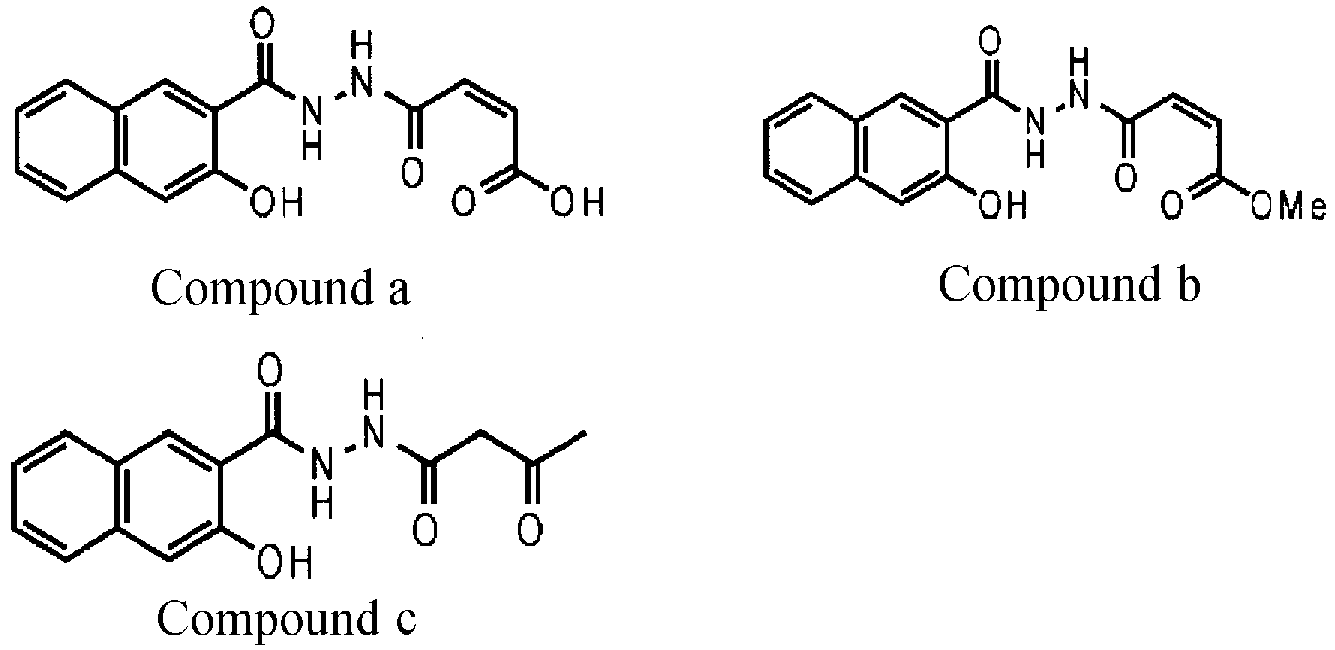
- A hydrazide compound represented by the Formula (I) can be produced by, for example, a method represented by the below-described Reaction Formula-1 or 2.

- According to the Reaction Formula-1, a hydrazide compound represented by the Formula (Ia) can be produced by allowing the compound represented by the Formula (1) and a cyclic acid anhydride represented by the Formula (2) to react with each other in a solvent (first step). Further, the carboxylic acid moiety of the thus obtained hydrazide compound represented by the Formula (Ia) is subjected to an ordinary esterification reaction, for example, reaction with an alcohol, whereby a hydrazide compound represented by the Formula (Ib) can be produced (second step).
- As the solvent used in this step, any known solvent can be widely used as long as it is inert to the reaction. Examples of such a solvent include ethers, such as dimethyl ether, diethyl ether, diisopropyl ether, tert-butylmethyl ether, tetrahydrofuran, dioxane, tetrahydropyran, and 1,2-dimethoxyethane; halogens, such as dichloromethane, chloroform, and carbon tetrachloride; hydrocarbons, such as hexane and cyclohexane; aromatic hydrocarbons, such as benzene, toluene, xylene, and styrene; alcohols, such as methanol, ethanol, n-propanol, isopropanol, n-butanol, and tert-butanol; nitriles, such as acetonitrile and propionitrile; amides, such as N-methyl-2-pyrrolidone, N,N-dimethylformamide, and N,N-dimethylacetamide; and sulfoxides, such as dimethyl sulfoxide and sulfolane. These solvents may be used individually or, as required, two or more thereof may be used in combination.
- These solvents may be used in an amount of usually 1 to 100 parts by mass or so, preferably 1 to 20 parts by mass or so, with respect to 1 part by mass of the compound represented by the Formula (1).
- Examples of the cyclic acid anhydride used in this step include succinic anhydride, glutaric anhydride, adipic anhydride, and maleic anhydride.
- These cyclic acid anhydrides may be used in an amount of usually 1.0 to 10.0 equivalents, preferably 1.0 to 2.0 equivalents, with respect to the compound represented by the Formula (1).
- The reaction of this step can be performed in a temperature range of 0°C to the boiling point of a solvent in use; however, it is usually performed at a temperature of 25 to 100°C or so, and the reaction temperature may be adjusted in accordance with the solvent(s), reaction reagent(s) and the like that are used.
- The reaction time varies depending on the reaction temperature and the like and thus cannot be generalized; however, this reaction is usually completed in 0.5 to 24 hours or so.
- In this step, an alkyl esterification reaction of a carboxylic acid that is normally performed may be applied and, for example, a method using an alkyl alcohol as an esterification agent can be employed.
- As a solvent, any known solvent can be widely used as long as it is inert to the reaction. Examples of such a solvent include ethers, such as dimethyl ether, diethyl ether, diisopropyl ether, tert-butylmethyl ether, tetrahydrofuran, dioxane, tetrahydropyran, and 1,2-dimethoxyethane; halogens, such as dichloromethane, chloroform, and carbon tetrachloride; hydrocarbons, such as hexane and cyclohexane; aromatic hydrocarbons, such as benzene, toluene, xylene, and styrene; nitriles, such as acetonitrile and propionitrile; amides, such as N-methyl-2-pyrrolidone, N,N-dimethylformamide, and N,N-dimethylacetamide; and sulfoxides, such as dimethyl sulfoxide and sulfolane. The alcohol to be reacted, such as methanol, ethanol, n-propanol, isopropanol, n-butanol or tert-butanol, may also be used a solvent.
- These solvents may be used in an amount of usually 1 to 100 parts by mass or so, preferably 1 to 20 parts by mass or so, with respect to 1 part by mass of the hydrazide compound represented by the Formula (Ia).
- In this step, an acid is preferably used as a catalyst, and examples thereof include inorganic acids, such as hydrochloric acid, sulfuric acid, nitric acid, phosphoric acid, and boric acid; and sulfonic acids, such as methanesulfonic acid, benzenesulfonic acid, p-toluenesulfonic acid, and trifluoromethanesulfonic acid. These acids may be used individually or, as required, two or more thereof may be used in combination.
- Such an acid catalyst may be used in an amount of usually 0.01 to 50 equivalents, preferably 0.01 to 1.0 equivalent, with respect to the hydrazide compound represented by the Formula (Ia).
- The reaction of this step can be performed in a temperature range of 0°C to the boiling point of a solvent in use; however, it is usually performed at a temperature of 20 to 100°C or so, and the reaction temperature may be adjusted taking into consideration the solvent(s) and reaction reagent(s) that are used.
- The reaction time varies depending on the reaction temperature and the like and thus cannot be generalized; however, this reaction is usually completed in 0.5 to 24 hours or so.

- According to the Reaction Formula-2, a hydrazide compound represented by the Formula (Ic) can be produced by allowing a carboxylic acid halide represented by the Formula (3) to react with the compound represented by the Formula (1).
- This reaction is performed in a solvent and, as the solvent, any known solvent can be widely used as long as it is inert to the reaction. Examples of such a solvent include ether-based solvents, such as dimethyl ether, diethyl ether, diisopropyl ether, tert-butylmethyl ether, tetrahydrofuran, dioxane, tetrahydropyran, and 1,2-dimethoxyethane; aromatic solvents, such as toluene, xylene, and benzene; halogen-based solvents, such as dichloromethane and carbon tetrachloride; amide-based solvents, such as N,N-dimethylformamide, N,N-dimethylacetamide, and hexamethylphosphoric triamide; and sulfoxide-based solvents, such as dimethyl sulfoxide. These solvents may be used individually or, as required, two or more thereof may be used in combination.
- These solvents may be used in an amount of usually 1 to 500 parts by mass or so, preferably 5 to 100 parts by mass or so, with respect to 1 part by mass of the compound represented by the Formula (1).
- Examples of the carboxylic acid halide represented by the Formula (3) include halogenation products of carboxylic acids, such as 3-oxohexanoic acid, 3-oxoheptanoic acid, levulinic acid, 3-oxopentanoic acid, 4-oxohexanoic acid, 4-oxoheptanoic acid, and 5-oxohexanoic acid.
- As for the amount of the compound represented by the Formula (1) to be used in this reaction, the compound represented by the Formula (1) may be used in an amount of usually 0.8 to 5.0 equivalents, preferably 1.0 to 3.0 equivalents, more preferably 1.2 to 2.0 equivalents, with respect to the carboxylic acid halide represented by the Formula (3).
- This reaction is preferably performed in the presence of a base. Examples of the base to be used include aromatic amines, such as pyridine, N,N-dimethyl-4-aminopyridine, pyrazine, and 2,6-lutidine; tertiary aliphatic amines, such as trimethylamine, triethylamine, diisopropylethylamine, and N-methylpyrrolidine; and caustic compounds, such as sodium hydroxide and potassium hydroxide. These bases may be used in an amount of usually 0.8 to 5.0 equivalents, preferably 1.0 to 3.0 equivalents, more preferably 1.2 to 2.0 equivalents, with respect to the compound represented by the Formula (1).
- This reaction can be performed in a temperature range of -78°C to the boiling point of a solvent in use; however, it is usually performed at a temperature of -10 to 50°C or so, preferably around room temperature.
- The reaction time varies depending on the reaction temperature and the like and thus cannot be generalized; however, this reaction is usually completed in 0.5 to 24 hours or so.
- In cases where A and R' of the hydrazide compound represented by the Formula (Ic) are a methylene group and a methyl group, respectively, the hydrazide compound represented by the Formula (Ic) can be produced by allowing 4-methyleneoxetan-2-one to react with the compound represented by the Formula (1).
- As a solvent used in this reaction, any known solvent can be widely used as long as it is inert to the reaction. Examples of such a solvent include ethers, such as dimethyl ether, diethyl ether, diisopropyl ether, tert-butylmethyl ether, tetrahydrofuran, dioxane, tetrahydropyran, and 1,2-dimethoxyethane; halogens, such as dichloromethane, chloroform, and carbon tetrachloride; hydrocarbons, such as hexane and cyclohexane; aromatic hydrocarbons, such as benzene, toluene, xylene, and styrene; nitriles, such as acetonitrile and propionitrile; amides, such as N-methyl-2-pyrrolidone, N,N-dimethylformamide, and N,N-dimethylacetamide; and sulfoxides, such as dimethyl sulfoxide and sulfolane. These solvents may be used individually or, as required, two or more thereof may be used in combination.
- These solvents may be used in an amount of usually 1 to 100 parts by mass or so, preferably 1 to 20 parts by mass or so, with respect to 1 part by mass of the compound represented by the Formula (1).
- In this reaction, 4-methyleneoxetan-2-one may be used in an amount of usually 1.0 to 10 equivalents, preferably 1.0 to 2.0 equivalents, with respect to the hydrazide compound represented by the Formula (1).
- When the rubber additive of the present invention is added to a diene-based rubber component, the rubber additive of the present invention is added in an amount of preferably 0.01 to 30 parts by mass, more preferably 0.1 to 10 parts by mass, with respect to 100 parts by mass of the diene-based rubber component.
- The addition of the rubber additive of the present invention to the diene-based rubber component is preferably performed using a mixer, an extruder or a kneader, or by spraying.
- It is noted here that the term "comprise" used herein encompasses concepts of "contain", "consist essentially of" and "consist only of".
- The rubber composition of the present invention comprises, with respect to 100 parts by mass of a diene-based rubber component: 10 to 160 parts by mass of a filler; and 0.01 to 30 parts by mass of the rubber additive of the present invention.
- By this constitution, the chemical interaction between the filler and the rubber component in the rubber composition is improved, so that the dispersion and the reinforcing effect of the filler are improved. Particularly, when the filler is a carbon black, the dispersion and the reinforcing effect of the carbon black are improved and, in association with this, the hysteresis loss caused by friction of the filler particles is reduced, as a result of which a low tan δ is attained. Further, the scorch performance can be improved, that is, the scorch time can be extended than ever before, while maintaining a low tan δ.
- Next, the filler incorporated into the rubber composition of the present invention will be described.
- In the rubber composition of the present invention, the filler is incorporated in an amount of 10 to 160 parts by mass, preferably 30 to 100 parts by mass, with respect to 100 parts by mass of the diene-based rubber component. As the filler, a carbon black is preferred; however, a carbon black and an inorganic filler may be used in combination as well. When an inorganic filler is used in combination, the inorganic filler is preferably used in an amount of 80 parts by mass or less with respect to 100 parts by mass of the diene-based rubber component. By incorporating a carbon black by itself, a stronger reinforcing effect of the carbon black can be obtained.
- The carbon black as the filler used in the rubber composition of the present invention is not particularly restricted. For example, a high-, medium- or low-structure carbon black of SAF, ISAF, IISAF, N339, HAF, FEF, GPF, or SRF grade is preferably used, and a carbon black of SAF, ISAF, IISAF, N339, HAF, or FEF grade is particularly preferably used. The carbon black preferably has a nitrogen adsorption specific surface area (N2SA, measured in accordance with JIS K 6217-2:2001) of 30 to 250 m2/g. Such a carbon black may be used individually, or two or more thereof may be used in combination.
- As the inorganic filler other than the carbon black that is used in the rubber composition of the present invention is preferably silica. As this silica, a variety of commercially available silicas can be used and, thereamong, wet silica, dry silica or colloidal silica is preferably used, and a wet silica is particularly preferably used.
- In cases where an inorganic filler such as silica is incorporated into the rubber composition of the present invention, it is preferred to incorporate a silane coupling agent from the standpoint of improving the reinforcing effect of the inorganic filler, and this not only imparts the rubber composition with superior manufacturing operability in rubber processing but also imparts more favorable wear resistance to the resulting pneumatic tire. The silane coupling agent used in the rubber composition of the present invention is not particularly restricted, and one which is generally and widely used can be employed.
- The rubber component used in the rubber composition of the present invention is required that 50% by mass or greater thereof be constituted by a diene-based rubber, and it is preferred that 100% by mass of the rubber component be constituted by a diene-based rubber. The diene-based rubber is preferably composed of at least one selected from natural rubbers and synthetic diene-based rubbers. The synthetic diene-based rubbers may be any rubbers that contain a diene monomer as at least one portion of the monomers constituting the respective rubbers, and there is no other particular restriction. Specifically, styrene-butadiene copolymer rubbers (SBR), polybutadiene rubbers (BR), polyisoprene rubbers (IR), acrylonitrile-butadiene copolymer rubbers (NBR), butyl rubbers (IIR), halogenated butyl rubbers (e.g., chlorinated butyl rubber (CI-IIR) and brominated butyl rubber (Br-IIR)), ethylene-propylene-diene ternary copolymer rubbers (EPDM), ethylene-butadiene copolymer rubbers (EBR), propylene-butadiene copolymer rubbers (PBR) and the like can be used, and natural rubbers and synthetic diene-based rubbers may be used individually, or two or more thereof may be used as a blend. Examples of a rubber component other than the diene-based rubber include ethylene-propylene copolymer rubbers (EPM), acrylic rubbers (ACM), chlorinated polyethylenes (CM), epichlorohydrin rubbers (CO, ECO), and chlorosulfonated polyethylenes (CSM).
- In the rubber composition of the present invention, as other optional components, compounding agents that are normally used in the rubber industry, examples of which include softening agents, antioxidants, silane coupling agents, vulcanization accelerators, vulcanization accelerator aids and vulcanizers, may be selected and incorporated as appropriate within a range that does not adversely affect the object of the present invention. As these additives, commercially available products can be suitably used. The rubber composition of the present invention can be produced by, for example, kneading, heating, and extruding the materials using a Banbury mixer, a roll, an intensive mixer, a biaxial extruder or the like, with an addition of such various compounding agents.
- A pneumatic tire of the present invention comprises the rubber composition of the present invention, and the rubber composition of the present invention can be suitably used in at least one member of a tread portion, a side wall portion, a bead portion, an inner liner, and other reinforcing rubber part. The pneumatic tire of the present invention is not particularly restricted as long as it comprises the above-described rubber composition, and the pneumatic tire of the present invention can be produced in accordance with a conventional method. As a gas filled into the pneumatic tire, air having normal or adjusted oxygen partial pressure as well as an inert gas, such as nitrogen, argon or helium, can be used.
- The present invention will now be described in more detail by way of examples thereof.
- After suspending 30 g of 3-hydroxy-2-naphthoic acid hydrazide in 300 mL of toluene, 16 g of maleic anhydride was added, and the resultant was stirred for 2 hours at 60°C. This reaction solution was filtered, and the thus obtained crystals were washed with toluene and thendried in vacuo, whereby 44.4 g (yield: 99%) of
-
- Property: yellow solid
- Melting point: 241°C
- 1H-NMR (300 MHz, DMSO-D6, δppm): 6.4(s,2H), 7.3(s,1H), 7.4(t,1H), 7.5(t,1H), 7.8(d,1H), 7.9(d,1H), 8.6(s,1H), 11.0(br-s,1H), 11.4(br-s,2H), 13.3(br-s,1H) Production Example 2: Production of methyl
- After suspending 10 g of (Z)-4-[N'-(3-hydroxy-2-naphthoyl)diazanyl]-4-oxobut-2-enoic acid produced in Production Example 1 in 150 mL of methanol, 0.44 mL of sulfuric acid was added, and the resultant was stirred under reflux for 7 hours. After further adding triethylamine thereto, the solvent was concentrated in reduced pressure, and acetone was added to the resulting residue, followed by filtration. The thus obtained solid was recrystallized using hot acetone, whereby 2.6 g (yield: 25%) of methyl (Z)-4-[N'-(3-hydroxy-2-naphthoyl)diazanyl]-4-oxobut-2-enoate was obtained.
- Property: white solid
- Melting point: 191°C
- 1H-NMR (300 MHz, DMSO-D6, δppm): 3.7(s,3H), 6.4(d,1H), 6.5(d,1H), 7.3(s,1H), 7.4(t,1H), 7.5(t,1H), 7.8(d,1H), 7.9(d,1H), 8.5(s,1H), 11.0(br-s,1H), 11.1(s,1H), 11.5(br-s,1H) Production Example 3: Production of N'-(3-hydroxy-2-naphthoyl)-N-(3-oxobutano)hydrazide
- After adding 350 mL of tetrahydrofuran to 17.5 g of 4-methyleneoxetan-2-one, 35 g of 3-hydroxy-2-naphthoic acid hydrazide was added thereto in small amounts at room temperature, and 210 mL of N,N-dimethylformamide was subsequently further added. The resultant was stirred for 2 hours and then stirred overnight under heating at 35°C. The resulting reaction solution was filtered, and solids recovered on a filter paper was washed with tetrahydrofuran (the desired substance was dissolved), followed by addition of 460 mL of water to the filtrate. Precipitated crystals were filterd off, washed with hydrated tetrahydrofuran, and then vacuum-dried, whereby 11.6 g (yield: 23%) of N'-(3-hydroxy-2-naphthoyl)-N-(3-oxobutano)hydrazide was obtained.
- Property: light brown solid
- Melting point: 210°C
- 1H-NMR (300 MHz, DMSO-D6, δppm): 2.2(s,3H), 3.5(s,2H), 7.3(t,2H), 7.5 (t,1H), 7.7(d,1H), 7.9(d,1H), 8.5(s,1H), 10.7(s,1H), 10.8(br-s,1H), 11.5(br-s,1H)
- Test rubber compositions were prepared in accordance with the respective formulations shown in Table 1 below. For the thus obtained rubber compositions, the tan δ, the scorch time and the Mooney viscosity were measured. The measurement methods were as follows.
- Using a viscoelasticity measuring apparatus (manufactured by Rheometric Scientific Inc.), the tan δ was measured at a temperature of 50°C, a distortion of 5% and a frequency of 15 Hz, and the thus measured tan δ was shown as an index, taking the value of Comparative Example 1 as 100. The smaller the index value, the better the low heat generation properties.
- The unvulcanized rubber viscosity and the scorch time were measured in accordance with JIS K6300-1:2001 (Mooney viscosity, Mooney scorch time). The thus measured values were each shown as an index, taking the value of Comparative Example 1 as 100. As for the scorch index, the larger the index value, the better the scorch performance and the better the manufacturing operability. As for the Mooney viscosity index, the smaller the index value, the lower the viscosity and the better the manufacturing operability.
[Table 1] Example Comparative Example 1 2 3 1 2 Natural rubber*1 100.0 100.0 100.0 100.0 100.0 Carbon black N220*2 50.0 50.0 50.0 50.0 50.0 Compound a 1.0 Compound b 1.0 Compound c 1.0 Compound d*3 1.0 Formulation (parts by mass) Compound e*4 1.0 Aromatic oil*5 2.0 2.0 2.0 2.0 2.0 Stearic acid 2.0 2.0 2.0 2.0 2.0 Antioxidant 6PPD*6 1.0 1.0 1.0 1.0 1.0 Antioxidant TMQ*7 1.0 1.0 1.0 1.0 1.0 Zinc oxide 3.0 3.0 3.0 3.0 3.0 Vulcanization accelerator CBS*8 0.8 0.8 0.8 0.8 0.8 Sulfur 1.5 1.5 1.5 1.5 1.5 Physical property Tan δ index 88 96 93 100 104 Scorch index 147 151 135 100 102 Mooney viscosity index 102 100 103 100 103 *1: RSS#1
*2: "#80", manufactured by Asahi Carbon Co., Ltd.
*3: 3-hydroxy-N'-(1,3-dimethylbutylidene)-2-naphthoic acid hydrazide
*4: the following compound described in Japanese Unexamined Patent Application Publication No.2014-84312 
*5: "AROMAX #3", manufactured by Fuji Kosan Co., Ltd.
*6: N-(1,3-dimethylbutyl)-N'-phenyl-p-phenylenediamine, manufactured by Ouchi Shinko Chemical Industrial Co., Ltd., trade name "NOCRAC 6C"
*7: 2,2,4-trimethyl-1,2-dihydroquinoline polymer, manufactured by Ouchi Shinko Chemical Industrial Co., Ltd., trade name "NOCRAC 224"
*8: N-cyclohexyl-2-benzothiazole sulfenamide, "SANCELER CM" manufactured by Sanshin Chemical Industry Co., Ltd. - As apparent from Table 1, all of the rubber compositions of Examples 1 to 3, in which the rubber additive of the present invention was incorporated, were superior in both manufacturing operability and low heat generation properties as compared to the rubber compositions of Comparative Examples 1 and 2.
Claims (8)
- A rubber additive comprising a hydrazide compound represented by the following

- The rubber additive according to claim 1, which is used as a loss reducing agent.
- A rubber composition comprising, with respect to 100 parts by mass of a diene-based rubber component:10 to 160 parts by mass of a filler; and0.01 to 30 parts by mass of the rubber additive according to claim 1.
- The rubber composition according to claim 3, wherein said diene-based rubber component contains a natural rubber.
- The rubber composition according to claim 3, wherein said filler contains a carbon black.
- A pneumatic tire comprising the rubber composition according to claim 3.
- The pneumatic tire according to claim 6, wherein said rubber composition is used in at least one member of a tread portion, a side wall portion, a bead portion, an inner liner, and other reinforcing rubber part.
- A hydrazide compound represented by the following Formula (I):
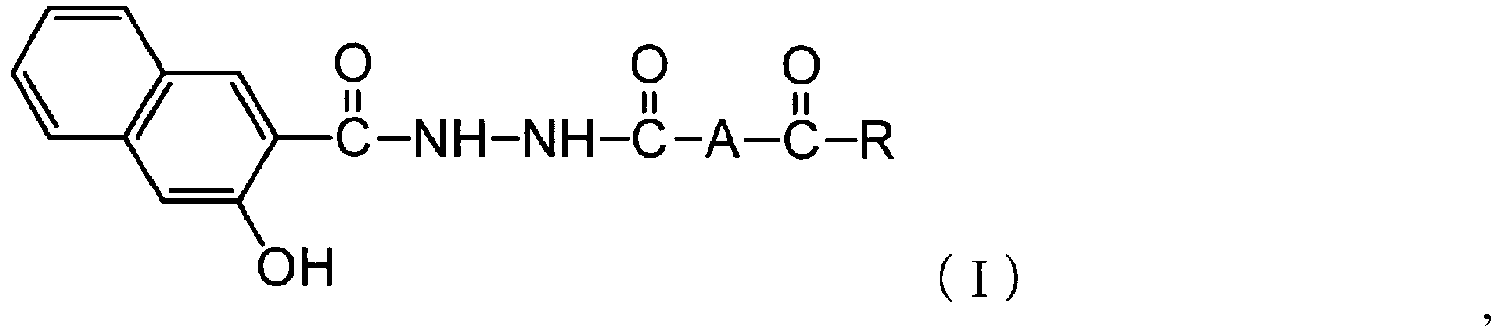
Applications Claiming Priority (2)
| Application Number | Priority Date | Filing Date | Title |
|---|---|---|---|
| JP2015243617A JP6560607B2 (en) | 2015-12-14 | 2015-12-14 | Rubber additive, rubber composition, and pneumatic tire using the same |
| PCT/JP2016/086071 WO2017104467A1 (en) | 2015-12-14 | 2016-12-05 | Rubber additive, rubber composition and pneumatic tire using same |
Publications (2)
| Publication Number | Publication Date |
|---|---|
| EP3392303A1 true EP3392303A1 (en) | 2018-10-24 |
| EP3392303A4 EP3392303A4 (en) | 2019-01-23 |
Family
ID=59056414
Family Applications (1)
| Application Number | Title | Priority Date | Filing Date |
|---|---|---|---|
| EP16875450.5A Withdrawn EP3392303A4 (en) | 2015-12-14 | 2016-12-05 | Rubber additive, rubber composition and pneumatic tire using same |
Country Status (5)
| Country | Link |
|---|---|
| US (1) | US20200263001A1 (en) |
| EP (1) | EP3392303A4 (en) |
| JP (1) | JP6560607B2 (en) |
| CN (1) | CN108368310B (en) |
| WO (1) | WO2017104467A1 (en) |
Cited By (1)
| Publication number | Priority date | Publication date | Assignee | Title |
|---|---|---|---|---|
| US11708480B2 (en) | 2016-08-04 | 2023-07-25 | Otsuka Chemical Co., Ltd. | Rubber composition, tire, additive and hydrazide compound |
Families Citing this family (3)
| Publication number | Priority date | Publication date | Assignee | Title |
|---|---|---|---|---|
| CN114929665A (en) * | 2019-12-20 | 2022-08-19 | 大塚化学株式会社 | Crystal and method for producing same |
| US12404233B2 (en) | 2019-12-20 | 2025-09-02 | Otsuka Chemical Co., Ltd. | Crystals of 3-hydroxy-N'-(1,3-dimethylbutylidene)-2-naphthoic acid hydrazide and production method for the same |
| CN114395116B (en) * | 2022-01-27 | 2024-03-12 | 江苏麒祥高新材料有限公司 | Polyester hydrazide, rubber composition, tire, preparation method and application thereof |
Family Cites Families (7)
| Publication number | Priority date | Publication date | Assignee | Title |
|---|---|---|---|---|
| JPH0827315A (en) * | 1994-07-15 | 1996-01-30 | Bridgestone Corp | Method for kneading rubber composition |
| DE69827906T2 (en) * | 1997-04-02 | 2005-05-19 | Bridgestone Corp. | RUBBER COMPOSITION AND TIRES |
| JP4086359B2 (en) * | 1997-04-02 | 2008-05-14 | 株式会社ブリヂストン | Pneumatic tire |
| JPH11231462A (en) * | 1998-02-12 | 1999-08-27 | Ricoh Co Ltd | Thermal development type diazo copy material |
| US20050103415A1 (en) * | 2003-11-18 | 2005-05-19 | Lukich Lewis T. | Tire with shock absorbing closed cell rubber tread of spaced apart lugs |
| JP5292023B2 (en) * | 2008-08-28 | 2013-09-18 | 精工化学株式会社 | Polymerization inhibiting method and polymerization inhibitor |
| CN101979255B (en) * | 2010-11-05 | 2012-07-25 | 张雨军 | Puncture-resistant safe tire for passenger vehicle |
-
2015
- 2015-12-14 JP JP2015243617A patent/JP6560607B2/en active Active
-
2016
- 2016-12-05 US US16/061,462 patent/US20200263001A1/en not_active Abandoned
- 2016-12-05 WO PCT/JP2016/086071 patent/WO2017104467A1/en not_active Ceased
- 2016-12-05 CN CN201680073660.XA patent/CN108368310B/en active Active
- 2016-12-05 EP EP16875450.5A patent/EP3392303A4/en not_active Withdrawn
Cited By (1)
| Publication number | Priority date | Publication date | Assignee | Title |
|---|---|---|---|---|
| US11708480B2 (en) | 2016-08-04 | 2023-07-25 | Otsuka Chemical Co., Ltd. | Rubber composition, tire, additive and hydrazide compound |
Also Published As
| Publication number | Publication date |
|---|---|
| JP6560607B2 (en) | 2019-08-14 |
| CN108368310A (en) | 2018-08-03 |
| CN108368310B (en) | 2020-12-01 |
| JP2017110052A (en) | 2017-06-22 |
| US20200263001A1 (en) | 2020-08-20 |
| EP3392303A4 (en) | 2019-01-23 |
| WO2017104467A1 (en) | 2017-06-22 |
Similar Documents
| Publication | Publication Date | Title |
|---|---|---|
| KR101960988B1 (en) | Coupling agent for rubber/carbon black, and rubber composition containing same for use in tires | |
| JP5347353B2 (en) | Method for producing silica-containing diene rubber composition | |
| EP1731560B1 (en) | Rubber composition for tread | |
| CN108368310B (en) | Additive for rubber, rubber composition, and pneumatic tire using the same | |
| KR20210132081A (en) | Vulcanized rubber composition | |
| JP2014152220A (en) | Co-condensation product and rubber composition containing the same | |
| EP3564300B1 (en) | Rubber composition and pneumatic tire | |
| KR20120101645A (en) | Rubber composition comprising a 1, 2, 4 -triazine | |
| JP5437695B2 (en) | Rubber composition for tire and pneumatic tire | |
| JP2010254857A (en) | Rubber composition and pneumatic tire for wing or rubber chafer | |
| JP6517620B2 (en) | Method of manufacturing rubber composition and method of manufacturing pneumatic tire | |
| US20250100972A1 (en) | Compound, rubber blend containing the compound, vehicle tire comprising the rubber blend in at least one component, process for producing the compound, and use of the compound as an ageing protectant and/or antiozonant and/or dye | |
| WO2012053572A1 (en) | Method for producing 2,2,4-trimethyl-1,2-dihydroquinoline polymer-containing compositions | |
| US20190177507A1 (en) | Additive for rubber | |
| JP2003176379A (en) | Rubber composition | |
| JP5437690B2 (en) | Rubber composition for inner liner and pneumatic tire | |
| WO2016186155A1 (en) | Process for producing rubber composition | |
| JP2010121082A (en) | Rubber composition | |
| JP6594189B2 (en) | Rubber additive, rubber composition, and pneumatic tire using the same | |
| JP6385655B2 (en) | Method for producing rubber composition | |
| JP2007238903A (en) | Rubber composition and pneumatic tire using the rubber composition | |
| US7671137B2 (en) | Rubber composition for tire | |
| JP2009035655A (en) | Rubber composition and pneumatic tire | |
| JP5399723B2 (en) | Cross-linking agent, rubber composition and tire | |
| JPH10195239A (en) | Rubber composition |
Legal Events
| Date | Code | Title | Description |
|---|---|---|---|
| PUAI | Public reference made under article 153(3) epc to a published international application that has entered the european phase |
Free format text: ORIGINAL CODE: 0009012 |
|
| 17P | Request for examination filed |
Effective date: 20180712 |
|
| AK | Designated contracting states |
Kind code of ref document: A1 Designated state(s): AL AT BE BG CH CY CZ DE DK EE ES FI FR GB GR HR HU IE IS IT LI LT LU LV MC MK MT NL NO PL PT RO RS SE SI SK SM TR |
|
| AX | Request for extension of the european patent |
Extension state: BA ME |
|
| A4 | Supplementary search report drawn up and despatched |
Effective date: 20181220 |
|
| RIC1 | Information provided on ipc code assigned before grant |
Ipc: C08K 5/25 20060101ALI20181214BHEP Ipc: C08L 21/00 20060101AFI20181214BHEP Ipc: B60C 1/00 20060101ALI20181214BHEP Ipc: C07C 243/30 20060101ALI20181214BHEP Ipc: C08K 3/04 20060101ALI20181214BHEP Ipc: B60C 5/14 20060101ALI20181214BHEP Ipc: C07C 243/38 20060101ALI20181214BHEP |
|
| DAV | Request for validation of the european patent (deleted) | ||
| DAX | Request for extension of the european patent (deleted) | ||
| GRAP | Despatch of communication of intention to grant a patent |
Free format text: ORIGINAL CODE: EPIDOSNIGR1 |
|
| RIC1 | Information provided on ipc code assigned before grant |
Ipc: B60C 1/00 20060101ALI20200214BHEP Ipc: C08K 5/25 20060101ALI20200214BHEP Ipc: C07C 243/30 20060101ALI20200214BHEP Ipc: B60C 5/14 20060101ALI20200214BHEP Ipc: C08K 3/04 20060101ALI20200214BHEP Ipc: C07C 243/38 20060101ALI20200214BHEP Ipc: C08L 21/00 20060101AFI20200214BHEP |
|
| INTG | Intention to grant announced |
Effective date: 20200320 |
|
| STAA | Information on the status of an ep patent application or granted ep patent |
Free format text: STATUS: THE APPLICATION IS DEEMED TO BE WITHDRAWN |
|
| 18D | Application deemed to be withdrawn |
Effective date: 20200731 |