EP3390472B1 - Mehrstufiges polymer als schleifzusatz und verfahren zur herstellung davon - Google Patents
Mehrstufiges polymer als schleifzusatz und verfahren zur herstellung davon Download PDFInfo
- Publication number
- EP3390472B1 EP3390472B1 EP15910466.0A EP15910466A EP3390472B1 EP 3390472 B1 EP3390472 B1 EP 3390472B1 EP 15910466 A EP15910466 A EP 15910466A EP 3390472 B1 EP3390472 B1 EP 3390472B1
- Authority
- EP
- European Patent Office
- Prior art keywords
- stage polymer
- monomer
- ethylenically unsaturated
- stage
- polymer
- Prior art date
- Legal status (The legal status is an assumption and is not a legal conclusion. Google has not performed a legal analysis and makes no representation as to the accuracy of the status listed.)
- Active
Links
Images
Classifications
-
- C—CHEMISTRY; METALLURGY
- C08—ORGANIC MACROMOLECULAR COMPOUNDS; THEIR PREPARATION OR CHEMICAL WORKING-UP; COMPOSITIONS BASED THEREON
- C08F—MACROMOLECULAR COMPOUNDS OBTAINED BY REACTIONS ONLY INVOLVING CARBON-TO-CARBON UNSATURATED BONDS
- C08F220/00—Copolymers of compounds having one or more unsaturated aliphatic radicals, each having only one carbon-to-carbon double bond, and only one being terminated by only one carboxyl radical or a salt, anhydride ester, amide, imide or nitrile thereof
- C08F220/02—Monocarboxylic acids having less than ten carbon atoms; Derivatives thereof
- C08F220/10—Esters
- C08F220/12—Esters of monohydric alcohols or phenols
- C08F220/16—Esters of monohydric alcohols or phenols of phenols or of alcohols containing two or more carbon atoms
- C08F220/18—Esters of monohydric alcohols or phenols of phenols or of alcohols containing two or more carbon atoms with acrylic or methacrylic acids
- C08F220/1802—C2-(meth)acrylate, e.g. ethyl (meth)acrylate
-
- C—CHEMISTRY; METALLURGY
- C08—ORGANIC MACROMOLECULAR COMPOUNDS; THEIR PREPARATION OR CHEMICAL WORKING-UP; COMPOSITIONS BASED THEREON
- C08F—MACROMOLECULAR COMPOUNDS OBTAINED BY REACTIONS ONLY INVOLVING CARBON-TO-CARBON UNSATURATED BONDS
- C08F220/00—Copolymers of compounds having one or more unsaturated aliphatic radicals, each having only one carbon-to-carbon double bond, and only one being terminated by only one carboxyl radical or a salt, anhydride ester, amide, imide or nitrile thereof
- C08F220/02—Monocarboxylic acids having less than ten carbon atoms; Derivatives thereof
- C08F220/10—Esters
- C08F220/12—Esters of monohydric alcohols or phenols
- C08F220/16—Esters of monohydric alcohols or phenols of phenols or of alcohols containing two or more carbon atoms
- C08F220/18—Esters of monohydric alcohols or phenols of phenols or of alcohols containing two or more carbon atoms with acrylic or methacrylic acids
- C08F220/1808—C8-(meth)acrylate, e.g. isooctyl (meth)acrylate or 2-ethylhexyl (meth)acrylate
-
- C—CHEMISTRY; METALLURGY
- C08—ORGANIC MACROMOLECULAR COMPOUNDS; THEIR PREPARATION OR CHEMICAL WORKING-UP; COMPOSITIONS BASED THEREON
- C08F—MACROMOLECULAR COMPOUNDS OBTAINED BY REACTIONS ONLY INVOLVING CARBON-TO-CARBON UNSATURATED BONDS
- C08F265/00—Macromolecular compounds obtained by polymerising monomers on to polymers of unsaturated monocarboxylic acids or derivatives thereof as defined in group C08F20/00
- C08F265/04—Macromolecular compounds obtained by polymerising monomers on to polymers of unsaturated monocarboxylic acids or derivatives thereof as defined in group C08F20/00 on to polymers of esters
-
- C—CHEMISTRY; METALLURGY
- C09—DYES; PAINTS; POLISHES; NATURAL RESINS; ADHESIVES; COMPOSITIONS NOT OTHERWISE PROVIDED FOR; APPLICATIONS OF MATERIALS NOT OTHERWISE PROVIDED FOR
- C09D—COATING COMPOSITIONS, e.g. PAINTS, VARNISHES OR LACQUERS; FILLING PASTES; CHEMICAL PAINT OR INK REMOVERS; INKS; CORRECTING FLUIDS; WOODSTAINS; PASTES OR SOLIDS FOR COLOURING OR PRINTING; USE OF MATERIALS THEREFOR
- C09D133/00—Coating compositions based on homopolymers or copolymers of compounds having one or more unsaturated aliphatic radicals, each having only one carbon-to-carbon double bond, and at least one being terminated by only one carboxyl radical, or of salts, anhydrides, esters, amides, imides, or nitriles thereof; Coating compositions based on derivatives of such polymers
- C09D133/04—Homopolymers or copolymers of esters
- C09D133/06—Homopolymers or copolymers of esters of esters containing only carbon, hydrogen and oxygen, the oxygen atom being present only as part of the carboxyl radical
-
- C—CHEMISTRY; METALLURGY
- C09—DYES; PAINTS; POLISHES; NATURAL RESINS; ADHESIVES; COMPOSITIONS NOT OTHERWISE PROVIDED FOR; APPLICATIONS OF MATERIALS NOT OTHERWISE PROVIDED FOR
- C09D—COATING COMPOSITIONS, e.g. PAINTS, VARNISHES OR LACQUERS; FILLING PASTES; CHEMICAL PAINT OR INK REMOVERS; INKS; CORRECTING FLUIDS; WOODSTAINS; PASTES OR SOLIDS FOR COLOURING OR PRINTING; USE OF MATERIALS THEREFOR
- C09D151/00—Coating compositions based on graft polymers in which the grafted component is obtained by reactions only involving carbon-to-carbon unsaturated bonds; Coating compositions based on derivatives of such polymers
- C09D151/003—Coating compositions based on graft polymers in which the grafted component is obtained by reactions only involving carbon-to-carbon unsaturated bonds; Coating compositions based on derivatives of such polymers grafted on to macromolecular compounds obtained by reactions only involving unsaturated carbon-to-carbon bonds
-
- C—CHEMISTRY; METALLURGY
- C09—DYES; PAINTS; POLISHES; NATURAL RESINS; ADHESIVES; COMPOSITIONS NOT OTHERWISE PROVIDED FOR; APPLICATIONS OF MATERIALS NOT OTHERWISE PROVIDED FOR
- C09D—COATING COMPOSITIONS, e.g. PAINTS, VARNISHES OR LACQUERS; FILLING PASTES; CHEMICAL PAINT OR INK REMOVERS; INKS; CORRECTING FLUIDS; WOODSTAINS; PASTES OR SOLIDS FOR COLOURING OR PRINTING; USE OF MATERIALS THEREFOR
- C09D5/00—Coating compositions, e.g. paints, varnishes or lacquers, characterised by their physical nature or the effects produced; Filling pastes
- C09D5/02—Emulsion paints including aerosols
- C09D5/024—Emulsion paints including aerosols characterised by the additives
-
- C—CHEMISTRY; METALLURGY
- C09—DYES; PAINTS; POLISHES; NATURAL RESINS; ADHESIVES; COMPOSITIONS NOT OTHERWISE PROVIDED FOR; APPLICATIONS OF MATERIALS NOT OTHERWISE PROVIDED FOR
- C09D—COATING COMPOSITIONS, e.g. PAINTS, VARNISHES OR LACQUERS; FILLING PASTES; CHEMICAL PAINT OR INK REMOVERS; INKS; CORRECTING FLUIDS; WOODSTAINS; PASTES OR SOLIDS FOR COLOURING OR PRINTING; USE OF MATERIALS THEREFOR
- C09D7/00—Features of coating compositions, not provided for in group C09D5/00; Processes for incorporating ingredients in coating compositions
- C09D7/40—Additives
- C09D7/41—Organic pigments; Organic dyes
-
- C—CHEMISTRY; METALLURGY
- C09—DYES; PAINTS; POLISHES; NATURAL RESINS; ADHESIVES; COMPOSITIONS NOT OTHERWISE PROVIDED FOR; APPLICATIONS OF MATERIALS NOT OTHERWISE PROVIDED FOR
- C09D—COATING COMPOSITIONS, e.g. PAINTS, VARNISHES OR LACQUERS; FILLING PASTES; CHEMICAL PAINT OR INK REMOVERS; INKS; CORRECTING FLUIDS; WOODSTAINS; PASTES OR SOLIDS FOR COLOURING OR PRINTING; USE OF MATERIALS THEREFOR
- C09D7/00—Features of coating compositions, not provided for in group C09D5/00; Processes for incorporating ingredients in coating compositions
- C09D7/40—Additives
- C09D7/43—Thickening agents
-
- C—CHEMISTRY; METALLURGY
- C09—DYES; PAINTS; POLISHES; NATURAL RESINS; ADHESIVES; COMPOSITIONS NOT OTHERWISE PROVIDED FOR; APPLICATIONS OF MATERIALS NOT OTHERWISE PROVIDED FOR
- C09D—COATING COMPOSITIONS, e.g. PAINTS, VARNISHES OR LACQUERS; FILLING PASTES; CHEMICAL PAINT OR INK REMOVERS; INKS; CORRECTING FLUIDS; WOODSTAINS; PASTES OR SOLIDS FOR COLOURING OR PRINTING; USE OF MATERIALS THEREFOR
- C09D7/00—Features of coating compositions, not provided for in group C09D5/00; Processes for incorporating ingredients in coating compositions
- C09D7/40—Additives
- C09D7/60—Additives non-macromolecular
- C09D7/61—Additives non-macromolecular inorganic
-
- C—CHEMISTRY; METALLURGY
- C09—DYES; PAINTS; POLISHES; NATURAL RESINS; ADHESIVES; COMPOSITIONS NOT OTHERWISE PROVIDED FOR; APPLICATIONS OF MATERIALS NOT OTHERWISE PROVIDED FOR
- C09D—COATING COMPOSITIONS, e.g. PAINTS, VARNISHES OR LACQUERS; FILLING PASTES; CHEMICAL PAINT OR INK REMOVERS; INKS; CORRECTING FLUIDS; WOODSTAINS; PASTES OR SOLIDS FOR COLOURING OR PRINTING; USE OF MATERIALS THEREFOR
- C09D7/00—Features of coating compositions, not provided for in group C09D5/00; Processes for incorporating ingredients in coating compositions
- C09D7/40—Additives
- C09D7/65—Additives macromolecular
Definitions
- the present invention generally relates to a multi-stage polymer suitable for a grinding additive, a method for producing the multi-stage polymer, a composition and a paint composition comprising the multi-stage polymer and a use of the multi-stage polymer for a grinding additive of a paint composition.
- a dispersant is added in the grinding stage to help pigments and extenders to stably disperse.
- Polyacid homopolymers or copolymers are commonly used as dispersants.
- thickeners are added to provide high enough viscosity to grind pigment/extender to fine sizes, as well as to deliver the proper viscosity for the final paint.
- Thickeners used in grinding stage typically, are Hydroxyethyl Cellulose (HEC).
- HEC Hydroxyethyl Cellulose
- HEC Hydroxyethyl Cellulose
- HEC Hydroxyethyl Cellulose
- Hydrophobically-modified Alkali Soluble Emulsion was added in the letdown stage to reach the target viscosity.
- HASE Hydrophobically-modified Alkali Soluble Emulsion
- this approach will make the paint film more hydrophilic and lead to significant loss on scrub resistance (washability).
- hydrophobic copolymer dispersant can be used to replace the polyacid dispersant in the grinding stage.
- the combination of hydrophobic dispersant with HASE provides insufficient dispersion of pigment in a painting composition as well as decreased long term viscosity stability.
- Some grinding additives are used in a paint formulation such as US8,883,880B , US8,158,714B , EP1302515 , AU2014200431 , WO2014/040290A and US5,266,646 . But it is still desirable to paint formulators a compatible composition of HASE and hydrophobic dispersant, which will provide improved dispersion of pigment in a painting composition as well as long term viscosity stability.
- CA2893386 discloses a composition comprising a stable aqueous dispersion of polymer particles having a core comprising structural units of: a) a phosphorus acid monomer, b) an acid monomer, c) a multiethylenically unsaturated monomer; and d) a polymerizable ethylenically unsaturated bulk monomer; and a shell comprising structural units of a1) a sulfur acid monomer, and b1) a polymerizable ethylenically unsaturated bulk monomer; wherein the core protuberates from the shell and the ratio of the structural units of the sulfur acid monomer to structural units of carboxylic acid monomer in shell is at least 0.2:1.
- WO2014040290 discloses a multi-stage polymer comprising a first stage and second stage polymer as a grinding additive and the preparation process thereof.
- JP2014132056 discloses an inkjet ink excellent in image density on plain paper and excellent in storage stability.
- One aspect of the present invention provides INSERT CLAIM 1
- the multi-stage polymer of the present invention preferably comprises a first stage polymer containing an absence of the phosphorus containing monomer.
- the first stage polymer of the present invention preferably has a weight average molecular weight of at least 50,000 Daltons, and the second stage polymer of the present invention preferably has a weight average molecular weight of from 500 to 20,000 Daltons.
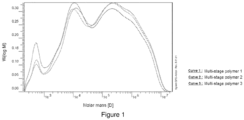
- Figure 1 is weight average molecular curve of Grinding Additives obtained by Examples 1 to 3 measured by Gel Permeation Chromatography
- multi-stage polymer means a composite polymer particle prepared by a sequential or staged polymerization process wherein first sequence or stage of monomer repeating units is polymerized before the subsequent or second sequence or stage of repeating units are polymerized.
- (meth)acrylic acid is meant to include both acrylic acid and methacrylic acid.
- the multi-stage polymer of the present invention includes a first stage polymer, and a second stage polymer.
- the first stage polymer is a Hydrophobically-modified Alkali Soluble Emulsion (HASE) polymer, and comprises, as polymerization units, based on the total weight of the first stage polymer:
- HASE Hydrophobically-modified Alkali Soluble Emulsion
- the first stage polymer further comprises, as polymerization units, based on the total weight of the first stage polymer, g) from 0.01 wt.% to 5 wt.%, preferably from 0.03 wt.% to 1 wt.%, and most preferably from 0.05 wt.% to 0.5 wt.%, of a polyethyenically unsaturated crosslinking monomer.
- the second stage polymer is a hydrophobic polymer dispersant, and comprises, as polymerization units, based on the total weight of the second stage polymer:
- Both the first stage polymer and the second stage polymer are ionically-soluble polymer.
- the proportions of the monomers in the first stage polymer can vary widely within above mentioned ranges to obtain thickening agents possessing a variety of rheological properties.
- the resulting first stage polymer upon neutralization of at least a portion of the carboxyl groups, can be soluble in water and thicken the paint.
- the proportions of the monomers in the second stage polymer can vary widely within the above mentioned ranges to achieve requested balance of dispersion efficiency and hydrophobicity.
- the resulting second stage polymer upon neutralization of at least a portion of the carboxyl groups, can be soluble in water and disperse pigment and extenders in the grinding stage of paint making process.
- the first stage polymer can vary from 1% to 99% by weight, and the second stage polymer can also vary from 1% to 99% by weight, based on the total weight of the multi-stage polymer composite. It is preferred for the first stage polymer being from 30% to 90% by weight, and the second stage polymer being from 10% to 70% by weight, while most preferably, the first stage polymer is from 40% to 65% by weight, and the second stage polymer is from 35% to 60% by weight.
- the first stage polymer has a weight average molecular weight of at least 50,000 Daltons as determined by gel permeation chromatography. To provide most effective thickening with polymers which are water-soluble when neutralized, molecular weight within the range of from 80,000 to 5,000,000 Daltons is preferred, while most preferably, it is from 100,000 to 1,000,000 Daltons.
- the second stage polymer has a weight average molecular weight of from 500 to 20,000 Daltons as determined by gel permeation chromatography. To provide most effective dispersing with polymers which are water-soluble when neutralized, molecular weights within the range of from 800 to 15,000 Daltons is preferred, while most preferably, it is from 1,000 to 10,000 Daltons.
- Weight average molecular weight, M w is measured by gel permeation chromatography (GPC) using polyacrylic acid standards, as is known in the art.
- GPC gel permeation chromatography
- the techniques of GPC are discussed in detail in " Modern Size Exclusion Chromatography", W. W. Yau, J. J. Kirkland, D. D. Bly; Wiley-Interscience, 1979 , and in “ A Guide to Materials Characterization and Chemical Analysis", J. P. Sibilia; VCH, 1988, p. 81-84 .
- the molecular weights reported herein are all in weight average molecular weights and are all in units of Dalton.
- Suitable examples of the macromonomer include, but are not limited to, SIPOMER TM BEM (50% active), SIPOMER TM SEM-25 (60% acitive), SIPOMER TM HPM-100 (50% active), SIPOMER TM HPM-200 (50% active), SIPOMER TM HPM-400 (50% active), available from Rhodia, and MA-20 (70% active), available from Dow Chemical Company.
- Preferably used examples are SIPOMER TM BEM (50% active), SIPOMER TM HPM-400 (50% active), and MA-20 (70% active).
- more macromonomers will lead to stronger associative thickening behavior with the binder particles.
- the phosphorus containing monomer comprising phosphorus acid group or phosphate group of the present invention does not include phosphonate.
- the phosphorus containing monomers are dihydrogen phosphate esters of an alcohol in which the alcohol contains or is substituted with a polymerizable vinyl or olefinic group.
- Suitable examples of the phosphorus-containing monomers include, but are not limited to, phosphoalkyl (meth)acrylates such as phosphoethyl (meth)acrylate, phosphopropyl (meth)acrylate, phosphobutyl (meth)acrylate, and salts thereof; phosphoalkoxy (meth)acrylates such as phospho ethylene glycol (meth)acrylate, phospho di-ethylene glycol (meth)acrylate, phospho tri-ethylene glycol (meth)acrylate, phospho propylene glycol (meth)acrylate, phospho dipropylene glycol (meth)acrylate, phospho tri-propylene glycol (meth)acrylate, and salts thereof; and any combinations thereof.
- phosphoalkyl (meth)acrylates such as phosphoethyl (meth)acrylate, phosphopropyl (meth)acrylate, phosphobutyl (meth)acrylate, and salts thereof
- phosphoalkoxy (meth)acrylates such
- the phosphorous-containing monomers preferably are selected from mono- or di-ester of phosphoalkyl (meth)acrylates, more preferably are mono- or di-ester of phosphoethyl methacrylate, and most preferably are phosphoethyl methacrylate (PEM).
- PEM phosphoethyl methacrylate
- the first stage polymer contains a substantial absence of the phosphorous containing monomer (i.e., less than 1 part by weight, preferably less than 0.1 part, more preferably less than 0.01 part, of the phosphorous containing monomer per 100 parts by weight of the phosphorous containing monomer in the second stage polymer). In a most preferred embodiment, the first stage polymer contains an absence of the phosphorous containing monomer.
- the ⁇ , ⁇ -ethylenically unsaturated carboxylic acid monomers are ⁇ , ⁇ -ethylenically unsaturated monomers containing at least one carboxylic acid group.
- ⁇ , ⁇ -ethylenically unsaturated carboxylic acid monomers suitably used in the present invention include, but are not limited to, monobasic acids, such as acrylic, methacrylic, crotonic, and acyloxypropionic acid; and dibasic acid monomers, such as maleic, fumaric, and itaconic acid.
- Dibasic acid monomers when applying, are used in place of a portion, e.g. up to about 10 weight percent, of the monobasic acid.
- Monomers which are monoesters of dibasic acids such as the monobutyl ester of maleic acid can also be used.
- Preferably used examples are acrylic acid, methacrylic acid, and a combination thereof.
- the higher level of acid monomers will provide stronger thickening to the aqueous phase.
- the ⁇ , ⁇ -ethylenically unsaturated monomers suitably used in the present invention include, but are not limited to, (meth)acrylic ester monomers, where (meth)acrylic ester designates methacrylic ester or acrylic ester, including methyl acrylate, ethyl acrylate, butyl acrylate, 2-ethylhexyl acrylate, decyl acrylate, lauryl acrylate, methyl methacrylate, butyl methacrylate, isodecyl methacrylate, lauryl methacrylate, hydroxyethyl methacrylate, hydroxypropyl methacrylate; (meth)acrylonitrile; (meth)acrylamide; amino-functional and ureido-functional monomers; monomers bearing acetoacetate-functional groups; styrene and substituted styrenes; butadiene; ethylene, propylene, ⁇ -olefins such as 1-dec
- the most preferably used examples are ethyl acrylate, methyl methacrylate, 2-hydroxybutyl acrylate, 2-hydroxyethyl methacrylate, 2-hydroxypropyl methacrylate, vinyl acetate and acrylonitrile and a combination thereof.
- Polyethylenically unsaturated cross-linking monomers are optional in the first stage polymer's polymerization. They work as crosslinkers that are utilized to generate a polymer having either a partially or substantially crosslinked three-dimensional network.
- Exemplary polyethylenically unsaturated cross-linking monomers include, but are not limited to, di(meth)acrylate compounds such as ethylene glycol di(meth)acrylate, polyethylene glycol di(meth)acrylate, triethylene glycol di(meth)acrylate, 1,3-butylene glycol di(meth)acrylate, 1,6-butylene glycol di(meth)acrylate, 1,6- hexanediol di(meth)acrylate, neopentyl glycol di(meth)acrylate, 1,9-nonanediol di(meth)acrylate, 2,2'-bis(4-(acryloxy-propyloxyphenyl)propane, 2,2'-bis(4-(
- the suitable examples of polyethylenically unsaturated cross-linking monomers are ethylene glycol di(meth)acrylate, ally (meth)acrylate, diallyphthalate, and the composition thereof.
- suitable polyethylenically unsaturated cross-linking monomers can be synthesized via an esterification reaction of a polyol made from ethylene oxide or propylene oxide or combinations thereof with unsaturated anhydride such as maleic anhydride, citraconic anhydride, itaconic anhydride, or an addition reaction with unsaturated isocyanate such as 3-isopropenyl- ⁇ - ⁇ -dimethylbenzene isocyanate.
- unsaturated anhydride such as maleic anhydride, citraconic anhydride, itaconic anhydride
- unsaturated isocyanate such as 3-isopropenyl- ⁇ - ⁇ -dimethylbenzene isocyanate.
- unsaturated compounds can be utilized as crosslinkers which are reactive with pendant carboxyl groups on the polymer backbone: polyhaloalkanols such as 1,3-dichloroisopropanol and 1,3-dibromoisopropanol; sulfonium zwitterions such as the tetrahydrothiophene adduct of novolac resins; haloepoxyalkanes such as epichlorohydrin, epibromohydrin, 2-methyl epichlorohydrin, and epiiodohydrin; polyglycidyl ethers such as 1,4-butanediol diglycidyl ether, glycerine-1,3-diglycidyl ether, ethylene glycol diglycidyl ether, propylene glycol diglycidyl ether, diethylene glycol diglycidyl ether, neopentyl glycol diglycidyl ether, polypropylene glycol
- the multi-stage grinding additive of the present invention can be conveniently prepared by using the above-described monomers and by conventional staged-or sequential-emulsion polymerization techniques at an acid pH lower than about 5.0 using free-radical producing initiators, usually in an amount from 0.01 percent to 3 percent based on the total weight of the monomers.
- Polymerization at an acid pH lower than about 5.0 permits direct preparation of an aqueous colloidal dispersion with relatively high solids content without problems of undue viscosity.
- the first stage polymer is synthesized in a first emulsion polymerization stage from a monomer mixture emulsified in an aqueous phase of a first monomer composition comprising a), b), c) , and optionally g), as disclosed above.
- the emulsified first monomers are polymerized in the presence of a suitable free radical forming initiator to provide an emulsion of a HASE stage polymer.
- a second stage polymer is formed in a second emulsion polymerization stage.
- an emulsified monomer mixture of a second monomer composition comprising d), e) and f), as previously disclosed, is polymerized in the presence of the previously prepared first stage polymer and additional free radical forming initiator.
- the end-product is a multi-stage polymer composite comprising a HASE surrounded or partially surrounded with a dispersant.
- a preformed HASE seed emulsion polymer can be utilized as the first stage polymer followed by the formation of the second stage polymer in a second stage as described above.
- the emulsified monomer mixture of the first monomer composition contains a substantial absence of the phosphorus containing monomer (i.e., less than 1 part by weight, preferably less than 0.1 part, more preferably less than 0.01 part, of the phosphorus containing monomer per 100 parts by weight of the phosphorus containing monomer in the second stage polymer).
- the first monomer composition contains an absence of the phosphorus containing monomer.
- Each stage of the multi-stage polymer of the invention can be prepared from a monomer mixture comprising one or more chain transfer agents.
- the chain transfer agent can be any chain transfer agent which reduces the molecular weight of the staged polymers of the invention.
- Suitable chain transfer agents include, but are not limited to, thio and disulfide containing compounds, such as C 1 -C 18 alkyl mercaptans, mercaptocarboxylic acids, mercaptocarboxylic esters, thioesters, C 1 -C 18 alkyl disulfides, aryldisulfides, polyfunctional thiols such as trimethylolpropane-tris-(3-mercaptopropionate), pentaerythritol-tetra-(3-mercaptopropionate), pentaerythritol-tetra-(thioglycolate), and pentaerythritol-tetra-(thiolactate), dipenta
- the chain transfer agent is selected from octyl mercaptan, n-dodecyl mercaptan, t-dodecyl mercaptan, hexadecyl mercaptan, octadecyl mercaptan (ODM), isooctyl 3-mercaptopropionate (IMP), butyl 3-mercaptopropionate, 3-mercaptopropionic acid, butyl thioglycolate, isooctyl thioglycolate, and dodecyl thioglycolate.
- the chain transfer agent can be present in an amount ranging from about 0.1 % to 10% by weight, based on the total monomer mixture weight.
- the emulsion polymerization can be carried out in a staged batch process, in a staged metered monomer addition process, or the polymerization can be initiated as a batch process and then the bulk of the monomers can be continuously staged into the reactor (seed process).
- the polymerization process is carried out at a reaction temperature in the range of about 20 to about 99°C, however, higher or lower temperatures can be used.
- the emulsion polymerization is carried out in the presence of at least one surfactant.
- the emulsion polymerization is carried out in the presence of surfactant ranging in the amount of about 1% to about 10% by weight in one aspect, from about 3% to about 8% in another aspect, and from about 3.5% to about 7% by weight in a further aspect, based on a total emulsion weight basis.
- the emulsion polymerization reaction mixture also includes one or more free radical initiators which are present in an amount ranging from about 0.01% to about 3% by weight based on total monomer weight.
- the polymerization can be performed in an aqueous or aqueous alcohol medium.
- Surfactants for facilitating emulsion polymerizations include anionic, nonionic, amphoteric, and cationic surfactants, as well as mixtures thereof. Most commonly, anionic and nonionic surfactants can be utilized as well as mixtures thereof.
- Suitable anionic surfactants for facilitating emulsion polymerizations include, but are not limited to, sodium lauryl sulfate, sodium dodecyl benzene sulfonate, sodium (C 6 -C 16 ) alkyl phenoxy benzene sulfonate, disodium (C 6 -C 16 ) alkyl phenoxy benzene sulfonate, disodium (C 6 -C 16 ) di-alkyl phenoxy benzene sulfonate, disodium laureth-3 sulfosuccinate, sodium dioctyl sulfosuccinate, sodium di-sec-butyl naphthalene sulfonate, disodium dodecyl diphenyl ether sulfonate, disodium n-octadecyl sulfosuccinate, phosphate esters of branched alcohol
- Nonionic surfactants suitable for facilitating emulsion polymerizations are well known in the polymer art, and include, without limitation, linear or branched C 8 -C 30 fatty alcohol ethoxylates, such as capryl alcohol ethoxylate, lauryl alcohol ethoxylate, myristyl alcohol ethoxylate, cetyl alcohol ethoxylate, stearyl alcohol ethoxylate, cetearyl alcohol ethoxylate, sterol ethoxylate, oleyl alcohol ethoxylate, and, behenyl alcohol ethoxylate; alkylphenol alkoxylates, such as octylphenol ethoxylates; and polyoxyethylene polyoxypropylene block copolymers, and the like.
- fatty alcohol ethoxylates such as capryl alcohol ethoxylate, lauryl alcohol ethoxylate, myristyl alcohol ethoxylate, cetyl alcohol ethoxylate, steary
- non-ionic surfactants suitable as non- ionic surfactants are described below.
- Other useful nonionic surfactants include C 8 -C 22 fatty acid esters of polyoxyethylene glycol, ethoxylated mono- and diglycerides, sorbitan esters and ethoxylated sorbitan esters, C 8 -C 22 fatty acid glycol esters, block copolymers of ethylene oxide and propylene oxide, and combinations thereof.
- the number of ethylene oxide units in each of the foregoing ethoxylates can range from 2 and above in one aspect, and from 2 to about 150 in another aspect.
- Exemplary free radical initiators include, but are not limited to, water-soluble inorganic persulfate compounds, such as ammonium persulfate, potassium persulfate, and sodium persulfate; peroxides such as hydrogen peroxide, benzoyl peroxide, acetyl peroxide, and lauryl peroxide; organic hydroperoxides, such as cumene hydroperoxide and t-butyl hydroperoxide; organic peracids, such as peracetic acid; and oil soluble, free radical producing agents, such as 2,2'-azobisisobutyronitrile, and the like, and mixtures thereof.
- water-soluble inorganic persulfate compounds such as ammonium persulfate, potassium persulfate, and sodium persulfate
- peroxides such as hydrogen peroxide, benzoyl peroxide, acetyl peroxide, and lauryl peroxide
- organic hydroperoxides such as cumene
- Peroxides and peracids can optionally be activated with reducing agents, such as sodium bisulfite, sodium formaldehyde, or ascorbic acid, transition metals, hydrazine, and the like.
- reducing agents such as sodium bisulfite, sodium formaldehyde, or ascorbic acid, transition metals, hydrazine, and the like.
- Particularly suitable free-radical polymerization initiators include water soluble azo polymerization initiators, such as 2,2'-azobis(tert-alkyl) compounds having a water solubilizing substituent on the alkyl group.
- Preferred azo polymerization catalysts include the Vazo ® free-radical polymerization initiators, available from DuPont, such as Vazo ® 44 (2,2'-azobis(2-(4,5- dihydroimidazolyl)propane), Vazo ® 56 (2,2'-azobis(2-methylpropionamidine) dihydrochloride), and Vazo ® 68 (4,4'-azobis(4-cyanovaleric acid)).
- emulsion polymerization additives and processing aids which are well known in the emulsion polymerization art, such as auxiliary emulsifiers, solvents, buffering agents, chelating agents, inorganic electrolytes, polymeric stabilizers, and pH adjusting agents can be included in the polymerization system.
- a mixture of first stage monomers is added to a first reactor under inert atmosphere to a solution of emulsifying surfactant (e.g., anionic surfactant) in water.
- emulsifying surfactant e.g., anionic surfactant
- processing aids can be added as desired (e.g., auxiliary emulsifier(s)).
- the contents of the reactor are agitated to prepare a monomer emulsion.
- an inert gas inlet, and feed pumps are added under inert atmosphere a desired amount of water and additional anionic surfactant and optional processing aids.
- the contents of the second reactor are heated with mixing agitation.
- a free radical initiator is injected into the so formed aqueous surfactant solution in the second reactor, and a portion of the monomer emulsion from the first reactor is gradually metered into the second reactor over a period typically ranging from about one half to about four hours.
- the reaction temperature is controlled in the range of about 45 to about 95°C.
- an additional quantity of free radical initiator can optionally be added to the second reactor, if desired, and the resulting reaction mixture is typically held at a temperature of about 45 to 95°C for a time period sufficient to accomplish the polymerization reaction and obtain a first stage polymer particle emulsion.
- multi-staged or multi-layered polymers can be formed through the sequential emulsion polymerization of monomer charges in the presence of polymer particles of a previously formed emulsion polymer.
- the polymer composite preferably comprises all the polymer stages which are base-soluble.
- Base-soluble as used herein means that the polymer is substantially soluble in aqueous medium which has been adjusted with base to a pH of about 5.0 or greater. This neutralization can occur in situ when the multi-stage polymer composite is blended with an aqueous solution containing a suitable base.
- the multi-stage polymer composite of the present invention can be added, as a grinding additive in the grinding stage at a content range of from 0.1% to 2%, preferably from 0.3% to 1.5%, and most preferably from 0.6% to 1.0% by weight based on the total weight of the coating composition, and binder and other additives can be added in the letdown stage, to make a coating formulation.
- Coating formulations include, but are not limited to, latex paint formulations, cosmetic formulations, dentifrices, hand lotions, automotive coatings formulations, architectural and industrial coatings formulations, caulks, adhesives, and sealants.
- binders include, but are not limited to, acrylic-, vinyl-acrylic-, styrene-acrylic, vinyl acetate/ethylene-, urethane-, melamine-, epoxy-, alkyd-, acrylonitrile-, styrene-, polybutadiene-, polyisoprene-, ethylene-propylene-, polyvinyl alcohol-, vinyl chloride-, vinylidene chloride-, epoxy-based homopolymers and copolymers, and blends of binders.
- the binder is typically present in the formulation at levels ranging from 2 to 50% by weight, based on the total weight of the coating formulation.
- the coating formulation may also include colorants containing colored pigments that provide tint to coating compositions such as paints and semitransparent stains.
- One factor affecting the amount of colorant added to a coating composition to obtain a desired color is the light scattering efficiency and the light absorbing efficiency of the colored pigments.
- the scattering and absorbing efficiencies of colored pigments are affected by the extent of dispersion of the colored pigments in the coating composition. Colored pigment particles that are well dispersed and separated from each other are believed to provide increased color and optionally, increased hiding.
- the coating formulation can be formulated to a desired color with lower levels of the colored pigments than compositions in which the colored pigments are poorly dispersed. Alternatively, a coating formulation having well dispersed colored pigments typically display more intense colors, and permit the preparation of colored coatings with a broader color palette.
- the coating composition according to the present invention may further include one or more of the following additives: Solvents; fillers; pigments, such as titanium dioxide, mica, calcium carbonate, silica, zinc oxide, milled glass, aluminum trihydrate, talc, antimony trioxide, fly ash, and clay; polymer encapsulated pigments, such as polymer-encapsulated or partially encapsulated opacifying pigment particles such as titanium dioxide, zinc oxide, or lithopone particles; polymers or polymer emulsions adsorbing or bonding to the surface of pigments such as titanium dioxide; hollow pigments, including pigments having one or more voids; dispersants, such as aminoalcohols and polycarboxylates; surfactants; defoamers; preservatives, such as biocides, mildewcides, fungicides, algaecides, and combinations thereof; flow agents; leveling agents; and additional neutralizing agents, such as hydroxides, amines, ammonia, and carbonates.
- the coatings composition may include polymer-encapsulated opacifying pigment particles comprising i) opacifying pigment particles, such as titanium dioxide particles, having a diameter in the range of 100 nm to 500 nm and an index of refraction of at least 1.8; ii) an encapsulating polymer, and iii) a polymeric dispersant for the encapsulated opacifying pigment particles and the polymer.
- opacifying pigment particles such as titanium dioxide particles, having a diameter in the range of 100 nm to 500 nm and an index of refraction of at least 1.8
- an encapsulating polymer e.g., polymeric dispersant for the encapsulated opacifying pigment particles and the polymer.
- a polymeric dispersant for the encapsulated opacifying pigment particles and the polymer e.g., polymeric dispersant for the encapsulated opacifying pigment particles and the polymer.
- the coating composition may include polymer-encapsulated
- a coating formulation that provides a colored coating having a higher degree of opacity, a measure of substrate covering power, may be desired.
- a formulation suitable for providing colored coatings having a higher degree of color saturation, a measure of color intensity, may also be desired.
- a formulation that can be tinted to a desired color with lower level of colorants than conventional coating formulations may also be desired.
- a coating formulation having less variation in the efficiencies of a range of different colorant particles, to provide consistent colors when mixtures of colorant particles are employed, may also be desired.
- the pigment particles contained in the formulation are white and nonwhite pigments.
- the colorant particles provide any color including white to the coating composition.
- Colorant particles include colored pigments, white pigments, black pigments, metal effect pigments, and luminescent pigments such as fluorescent pigments and phosphorescent pigments.
- the term "colorant particles”, as used herein includes white pigment particles such as titanium dioxide, zinc oxide, lead oxide, zinc sulfide, lithophone, zirconium oxide, and antimony oxide.
- Examples of colors for the pigmented polymer composition include black, magenta, yellow, and cyan, as well as combinations of these colors such as orange, blue, red, pink, green, and brown.
- Other suitable colors for the pigmented polymer composition include fluorescent colors; metallic colors such as silver, gold, bronze, and copper; and pearlescent pigments. These colors are obtained by employing one or more different types of colorant particles.
- the colorant particles include inorganic colorant particles and organic colorant particles.
- the colorant particles have average particle diameters in the range of from 10 nm to 50 ⁇ m, preferably in the range of from 40 nm to 2 ⁇ m.
- Suitable inorganic colorant particles include, but are not limited to, titanium dioxide pigments, iron oxide pigments such as goethite, lepidocrocite, hematite, maghemite, and magnetite; chromium oxide pigments; cadmium pigments such as cadmium yellow, cadmium red, and cadmium cinnabar; bismuth pigments such as bismuth vanadate and bismuth vanadate molybdate; mixed metal oxide pigments such as cobalt titanate green; chromate and molybdate pigments such as chromium yellow, molybdate red, and molybdate orange; ultramarine pigments; cobalt oxide pigments; nickel antimony titanates; lead chrome; blue iron pigments; carbon black; and metal effect pigments such as aluminum, copper, copper oxide, bronze, stainless steel, nickel, zinc, and brass.
- Suitable organic colorant particles include, but are not limited to, azo pigments, monoazo pigments, diazo pigments, azo pigment lakes, ⁇ -naphthol pigments, naphthol AS pigments, benzimidazolone pigments, diazo condensation pigment, metal complex pigments, isoindolinone, and isoindoline pigments, polycyclic pigments, phthalocyanine pigments, quinacridone pigments, perylene and perinone pigments, thioindigo pigments, anthrapyrimidone pigments, flavanthrone pigments, anthanthrone pigments, dioxazine pigments, triarylcarbonium pigments, quinophthalone pigments, and diketopyrrolo pyrrole pigments.
- Suitable extender include, but are not limited to a particulate inorganic material having a refractive index of less than or equal to 1.8 and greater than 1.3 and includes, for example, calcium carbonate, clay, calcium sulfate, aluminosilicates, silicates, zeolites, mica, diatomaceous earth, solid or hollow glass, and ceramic beads.
- the aqueous coating composition may optionally contain solid or hollow polymeric particles having a Tg of greater than 60°C, such polymeric particles are classified as extenders for purposes of PVC calculations herein.
- the details of hollow polymeric particles are described in EP22633 , EP915108 , EP959176 , EP404184 , US5360827 , WO 00/68304 , and US20100063171 .
- the solid polymeric particles have particle size from 1-50 microns, preferably from 5-20 microns.
- KU viscosity is a measure of the mid-shear viscosity as measured by a Krebs viscometer.
- the Krebs viscometer is a rotating paddle viscometer that is compliant with ASTM-D562.
- KU viscosity was measured on a Brookfield Krebs Unit Viscometer KU-1+ available from Brookfield Engineering Labs (Middleboro, MA, USA).
- KU shall mean Krebs unit.
- ICI is high shear viscosity, expressed in units of poise (P), and measured by the ICI cone-plate viscometer.
- Brookfield 4/6 is the low-shear viscosity, expressed in units of centipoises (cP), and measured on a Brookfield viscometer at a low-shear rate, 6 rpm, with spindle 4. The Brookfield viscosity of the paint typically correlates with the "in-can appearance" of the paint.
- the stability of paints after heat-age storage is determined by the following method: A paint is stored for certain days in 50 °C refrigerator. Then the paint is placed standing (no stirring) at constant temperature to recover to 25 °C. The appearances of paints before and after the freeze/thaw cycles are monitored and compared. The freeze/thaw cycles are tested parallel by five times in total.
- Example 1 (Comparative Example) - multi-stage polymer 1
- This example illustrates the preparation of a multi-stage polymer, without comprising phosphorus containing monomer (PEM) with weight composition: 70 (47 EA/48MAA/5MA-20 // 0.08 n-DDM)//30 (70 EHA/30 MAA/2.55 MMP).
- PEM phosphorus containing monomer
- a five-liter, four-necked flask equipped with a mechanical stirrer, nitrogen sweep, thermocouple, and condenser was charged with 720 grams of water and 34.32 grams of Disponil TM Fes32.
- the kettle solution was heated at 86 °C.
- An initiator 1.30 grams APS dissolved in 26 grams of water, was added.
- the first-stage monomer emulsion 408.60 grams of ethyl acrylate (EA), 405.10 grams of methacrylic acid (MAA), 62.10 grams of MA-20, 0.70 grams of nDDM and 24.03 grams of Disponil TM Fes32 in 630 grams of water were fed.
- an initiator 0.37 grams of APS dissolved in 77 grams of water, were co-fed over a period of 60 minutes while the kettle temperature was maintained at 86 °C.
- the second-stage monomer emulsion (244.95) grams of 2-ethylhexyl acrylate, (104.98) grams of methacrylic acid, (8.92) grams of MMP, and (19.19) grams of Disponil TM Fes32 in 225 grams of water
- an initiator 1.05 grams of APS, 2.19 grams of sodium acetate and 70 grams of water, were co-fed over a period of 30 minutes while the kettle temperature was maintained at 86 °C.
- the kettle temperature was held at 86 °C for 5 minutes after the end of the feeds and then cooled to 60 °C.
- a chaser system 4.00 grams of ferrous sulfate solution (0.2% aq), 1.66 grams of tert-butyl hydroperoxide (t-BHP) in 14 grams of water and 0.83 grams of isoascorbic acid (IAA) in 22 grams of water were then added.
- IAA isoascorbic acid
- the batch was cooled down to 40 °C, and a biocide solution of 7.41 grams of Kathon TM LX 1.5% in 28 grams of water was added over 10 minutes.
- the copolymer emulsion was cooled to ambient temperature and filtered through a 325 mesh size screen.
- the resulting emulsion polymer had total solids of 35.5 % at pH around 3 to 4.
- This example illustrates the preparation of a multi-stage polymer of the present invention for use as a grinding additive with weight composition: 70 (47 EA/48 MAA/5 MA-20 // 0.08 n-DDM)//30 (65 EHA/30 MAA/5 PEM//2.55 MMP).
- 70 47 EA/48 MAA/5 MA-20 // 0.08 n-DDM
- /30 65 EHA/30 MAA/5 PEM//2.55 MMP
- the first-stage monomer emulsion 286.02 grams of ethyl acrylate (EA), 283.57 grams of methacrylic acid (MAA), 43.47 grams of MA-20, 0.49 grams of nDDM and 16.82 grams of Disponil TM Fes32 in 350 grams of water was fed.
- an initiator 0.37 grams of APS dissolved in 70 grams of water, were co-fed over a period of 60 minutes while the kettle temperature was maintained at 86 °C.
- the second-stage monomer emulsion 159.23 grams of 2-ethylhexyl acrylate, 73.49 grams of methacrylic acid, 12.25 grams of PEM, 6.25 grams of MMP, and 13.43 grams of Disponil TM Fes32 in 130 grams of water, and an initiator, 1.05 grams of APS, 1.53 grams of sodium acetate and 80 grams of water, were co-fed over a period of 30 minutes while the kettle temperature was maintained at 86 °C. The kettle temperature was held at 86 °C for 5 minutes after the end of the feeds and then cooled to 60 °C.
- a chaser system 4.00 grams of ferrous sulfate solution (0.2% aq), 1.16 grams of tert-butyl hydroperoxide (t-BHP) in 10 grams of water and 0.58 grams of isoascorbic acid (IAA) in 10 grams of water were then added. After holding at 60 °C for 15 minutes, the same chaser system was charged again. The batch was cooled down to 40 °C, and a biocide solution of 7.41 grams of Kathon TM LX 1.5% in 28 grams of water was added over 10 minutes. After completion of the polymerization, the copolymer emulsion was cooled to ambient temperature and filtered through a 325 mesh size screen. The resulting emulsion polymer had total solids of 35.0 % at pH around 3 to 4.
- This example illustrates the preparation of a multi-stage polymer of the present invention for use as a grinding additive with weight composition: 70 (47 EA/48 MAA/5 MA-20 // 0.08 n-DDM)//30 (65 EHA/30 MAA/5 PEM//4.29 nDDM).
- 70 47 EA/48 MAA/5 MA-20 // 0.08 n-DDM
- /30 65 EHA/30 MAA/5 PEM//4.29 nDDM.
- the first-stage monomer emulsion 286.02 grams of ethyl acrylate (EA), 283.57 grams of methacrylic acid (MAA), 43.47 grams of MA-20, 0.49 grams of nDDM and 16.82 grams of Disponil TM Fes32 in 350 grams of water was fed.
- an initiator 0.37 grams of APS dissolved in 70 grams of water, were co-fed over a period of 60 minutes while the kettle temperature was maintained at 86 °C.
- the second-stage monomer emulsion (159.23) grams of 2-ethylhexyl acrylate, (73.49) grams of methacrylic acid, (12.25) grams of PEM, (10.51) grams of nDDM, and (13.43) grams of Disponil TM Fes32 in (130) grams of water, and an initiator, 1.05 grams of APS, 1.53 grams of sodium acetate and 80 grams of water, were co-fed over a period of 30 minutes while the kettle temperature was maintained at 86 °C. The kettle temperature was held at 86 °C for 5 minutes after the end of the feeds and then cooled to 60 °C.
- a chaser system 4.00 grams of ferrous sulfate solution (0.2% aq), 1.16 grams of tert-butyl hydroperoxide (t-BHP) in 10 grams of water and 0.58 grams of isoascorbic acid (IAA) in 10 grams of water were then added. After holding at 60 °C for 15 minutes, the same chaser system was charged again. The batch was cooled down to 40 °C, and a biocide solution of 7.41 grams of Kathon TM LX 1.5% in 28 grams of water was added over 10 minutes. After completion of the polymerization, the copolymer emulsion was cooled to ambient temperature and filtered through a 325 mesh size screen.
- Example 3 Grinding additive composition (Examples 1 to 3) No. Grinding additive HASE stage composition Dispersant stage composition
- Weight average molecular curve of obtained three compositions are shown in Figure 1 .
- the three multi-stage polymers are designed to have similar molecular weights, and are confirmed by aqueous Gel Permeation Chromatography (GPC) test.
- the peaks of the least molecular weight areas indicate some oligomers in the composition.
- the other bimodal of peaks indicate the dispersant and thickener part of Grinding Additive.
- Formulation series A is a conventional example.
- Formulation series B comprises multi-stage polymer 1, which does not comprise phosphorus containing monomer as polymerization unit.
- Formulation series C and D comprise multi-stage polymer 2 and 3 respectively, those comprise phosphorus containing monomer as polymerization unit.
- Grinding Additive was added mostly in the grinding stage as the dual functional additive of dispersant and thickener.
- multi-stage polymer 2 and 3 prevent KU viscosity increasing after heat-age storage for 90 days, comparing with multi-stage polymer 1 (comparative example B). Especially, multi-stage polymer 3 significantly improves KU viscosity for 10 days and 90 days comparable with the performance of original HEC/polyacid dispersant formulation (Conventional example A). The data after heat-age storage indicates that organic phosphate-containing Grinding Additive showed significant improvement on formulation stability.
- the paint viscosity data after heat-age storage showed the improved paint stability by using organic phosphate-containing Grinding Additive multi-stage polymer 2 (inventive example F) and multi-stage polymer 3 (inventive example G) comparing with multi-stage polymer 1 (comparative example E).
- Freeze/thaw stability were also tested to evaluate the formulation stability from a different perspective. Each of formulation was tested at -7 °C for five cycles. After each "freeze/thaw” cycle completed, the paint was placed standing (no stirring) at constant temperature to recover to 25 °C. The appearances of paints after each "freeze/thaw” cycle were monitored and compared.
- Table 8 summarized the evaluation results of full HEC and dispersant replacement formulation (in Table 4). It is obviously observed that the paint with multi-stage polymer 1 (comparative example B) exhibited synerisis since completion of the 2 nd cycle of test, and the appearance got even worse along with further cycles of test. In contrast, paints with multi-stage polymer 2 (inventive example C) and multi-stage polymer 3 (inventive example D) showed good appearance after all of 5 cycles of test, except for slight synerisis of multi-stage polymer 2 only after the 5 th cycle test.
Landscapes
- Chemical & Material Sciences (AREA)
- Organic Chemistry (AREA)
- Life Sciences & Earth Sciences (AREA)
- Engineering & Computer Science (AREA)
- Materials Engineering (AREA)
- Wood Science & Technology (AREA)
- Chemical Kinetics & Catalysis (AREA)
- Health & Medical Sciences (AREA)
- Medicinal Chemistry (AREA)
- Polymers & Plastics (AREA)
- Inorganic Chemistry (AREA)
- Dispersion Chemistry (AREA)
- Macromonomer-Based Addition Polymer (AREA)
- Addition Polymer Or Copolymer, Post-Treatments, Or Chemical Modifications (AREA)
- Paints Or Removers (AREA)
- Inks, Pencil-Leads, Or Crayons (AREA)
- Compositions Of Macromolecular Compounds (AREA)
- Processes Of Treating Macromolecular Substances (AREA)
Claims (10)
- Mehrstufiges Polymer, umfassend ein Polymer einer ersten Stufe und ein Polymer einer zweiten Stufe, wobei das Polymer der ersten Stufe, als Polymerisationseinheiten, basierend auf dem Gesamtgewicht des Polymers der ersten Stufe, umfasst:(a) von zu 35 Gew.-% bis 50 Gew.-% ein α,β-ethylenisch ungesättigtes Carbonsäuremonomer;(b) von zu 1 Gew.-% bis 30 Gew.-% ein Makromonomer,
gekennzeichnet durch die folgende Formel:
H2C=C(R1)-CO2-(CH2CH2-O)n-(CHR2CH2-O)m-R3
wobei R1 ein Wasserstoffatom oder eine Methylgruppe ist; R2 C1-C2-Alkyl ist; R3 C8-C30-Alkyl, C8-C16-Alkylphenyl oder C13-C36-Aralkylphenyl ist; n und m unabhängig ganze Zahlen von 6 bis 100 beziehungsweise 0 bis 50 sind, vorausgesetzt, dass n>=m und die Summe von m und n von 6 bis 100 beträgt, und(c) von zu 35 Gew.-% bis 60 Gew.-% ein α,β-ethylenisch ungesättigtes Monomer, ausgenommen das α,β-ethylenisch ungesättigte Carbonsäuremonomer und das Makromonomer; und
das Polymer der zweiten Stufe, als Polymerisationseinheiten, basierend auf dem Gesamtgewicht des Polymers der zweiten Stufe, umfasst;(d) von zu 25 bis 80 Gew.-% ein α,β-ethylenisch ungesättigtes Carbonsäuremonomer;(e) von zu 0,1 bis 50 Gew.-% ein phosphorhaltiges Monomer, umfassend eine Phosphorsäuregruppe oder eine Phosphatgruppe, und(f) von zu 20 Gew.-% bis 75 Gew.-% ein α,β-ethylenisch ungesättigtes Monomer, ausgenommen das α,β-ethylenisch ungesättigte Carbonsäuremonomer und das phosphorhaltige Monomer, wobei sowohl das Polymer der ersten Stufe als auch das Polymer der zweiten Stufe ionisch lösliche Polymere sind. - Mehrstufiges Polymer nach Anspruch 1, wobei das Polymer der ersten Stufe eine Abwesenheit des phosphorhaltigen Monomers enthält.
- Mehrstufiges Polymer nach Anspruch 1, wobei das Polymer der ersten Stufe ein Massenmittel von mindestens 50.000 Dalton aufweist und das Polymer der zweiten Stufe ein Massenmittel von 500 bis 20.000 Dalton aufweist.
- Mehrstufiges Polymer nach Anspruch 1, wobei das phosphorhaltige Monomer ein Mono- oder Diester von Phosphoalkyl(meth)acrylat ist.
- Verfahren zum Herstellen eines mehrstufigen Polymers, umfassend die Schritte:i) Polymerisieren eines Polymers der ersten Stufe aus einer ersten Monomerzusammensetzung, umfassend(a) von zu 35 Gew.-% bis 50 Gew.-% ein α,β-ethylenisch ungesättigtes Carbonsäuremonomer;(b) von zu 1 Gew.-% bis 30 Gew.-% ein Makromonomer,
gekennzeichnet durch die folgende Formel:
H2C=C(R1)-CO2-(CH2CH2-O)n-(CHR2CH2-O)m-R3
wobei R1 ein Wasserstoffatom oder eine Methylgruppe ist; R2 C1-C2-Alkyl ist; R3 C8-C30-Alkyl, C8-C16-Alkylphenyl oder C13-C36-Aralkylphenyl ist; n und m unabhängig ganze Zahlen von 6 bis 100 beziehungsweise 0 bis 50 sind, vorausgesetzt, dass n>=m und die Summe von m und n von 6 bis 100 beträgt, und(c) von zu 35 Gew.-% bis 60 Gew.-% ein α,β-ethylenisch ungesättigtes Monomer, ausgenommen das α,β-ethylenisch ungesättigte Carbonsäuremonomer und das Makromonomer; um ein Polymer der ersten Stufe zu erhalten;ii) Inkontaktbringen des Polymers der ersten Stufe mit einer zweiten Monomerzusammensetzung, umfassend, basierend auf dem Gewicht der zweiten Monomerzusammensetzung:(d) von zu 25 bis 80 Gew.-% ein α,β-ethylenisch ungesättigtes Carbonsäuremonomer;(e) von zu 0,1 bis 50 Gew.-% ein phosphorhaltiges Monomer, umfassend eine Phosphorsäuregruppe oder eine Phosphatgruppe, und(f) von zu 20 Gew.-% bis 75 Gew.-% ein α,β-ethylenisch ungesättigtes Monomer, ausgenommen das α,β-ethylenisch ungesättigte Carbonsäuremonomer und das phosphorhaltige Monomer, undiii) Polymerisieren der zweiten Monomerzusammensetzung, um ein Polymer der zweiten Stufe in der Gegenwart des Polymers der ersten Stufe zu erhalten. - Polymerzusammensetzung, das aus einem Verfahren ausgebildet ist, umfassend mindestens zwei Polymerisationsschritte, wobei das Verfahren die Schritte umfasst:i) Polymerisieren eines Polymers der ersten Stufe aus einer ersten Monomerzusammensetzung unter Emulsionspolymerisationsbedingungen, in denen die Monomerzusammensetzung der ersten Stufe umfasst(a) von zu 35 Gew.-% bis 50 Gew.-% ein α,β-ethylenisch ungesättigtes Carbonsäuremonomer;(b) von zu 1 Gew.-% bis 30 Gew.-% ein Makromonomer,
gekennzeichnet durch die folgende Formel:
H2C=C(R1)-CO2-(CH2CH2-O)n-(CHR2CH2-O)m-R3
wobei R1 ein Wasserstoffatom oder eine Methylgruppe ist; R2 C1-C2-Alkyl ist; R3 C8-C30-Alkyl, C8-C16-Alkylphenyl oder C13-C36-Aralkylphenyl ist; n und m unabhängig ganze Zahlen von 6 bis 100 beziehungsweise 0 bis 50 sind, vorausgesetzt, dass n>=m und die Summe von m und n von 6 bis 100 beträgt, und(c) von zu 35 Gew.-% bis 60 Gew.-% ein α,β-ethylenisch ungesättigtes Monomer, ausgenommen das α,β-ethylenisch ungesättigte Carbonsäuremonomer und das Makromonomer; um ein Polymer der ersten Stufe zu erhalten;ii) Inkontaktbringen des Polymers der ersten Stufe mit einer zweiten Monomerzusammensetzung, umfassend, basierend auf dem Gewicht der zweiten Monomerzusammensetzung:(d) von zu 25 bis 80 Gew.-% ein α,β-ethylenisch ungesättigtes Carbonsäuremonomer;(e) von zu 0,1 bis 50 Gew.-% ein phosphorhaltiges Monomer, umfassend eine Phosphorsäuregruppe oder eine Phosphatgruppe, und(f) von zu 20 Gew.-% bis 75 Gew.-% ein α,β-ethylenisch ungesättigtes Monomer, ausgenommen das α,β-ethylenisch ungesättigte Carbonsäuremonomer und das phosphorhaltige Monomer,wobei das Verhältnis des Polymers der ersten Stufe zu der zweiten Monomerzusammensetzung von 90 : 10 bis 50 : 50 beträgt, undiii) Polymerisieren der zweiten Monomerzusammensetzung unter Emulsionspolymerisationsbedingungen, um ein Polymer der zweiten Stufe in der Gegenwart des Polymers der ersten Stufe zu erhalten. - Zusammensetzung, umfassend das mehrstufige Polymer nach Anspruch 1 als einen Emulsionszustand.
- Farbzusammensetzung, umfassend das mehrstufige Polymer nach Anspruch 1, ein Bindemittel, ein Pigment und ein Streckmittel.
- Verfahren zum Verdicken einer Farbzusammensetzung durch Einarbeiten des mehrstufigen Polymers nach Anspruch 1 und Neutralisieren des mehrstufigen Polymers.
- Verfahren zum Dispergieren eines Pigments und eines Streckmittels in einer Farbzusammensetzung durch Einarbeiten des mehrstufigen Polymers nach Anspruch 1 und Neutralisieren des mehrstufigen Polymers.
Applications Claiming Priority (1)
| Application Number | Priority Date | Filing Date | Title |
|---|---|---|---|
| PCT/CN2015/097360 WO2017100993A1 (en) | 2015-12-15 | 2015-12-15 | Multi-stage polymer as grinding additive and method of producing the same |
Publications (3)
| Publication Number | Publication Date |
|---|---|
| EP3390472A1 EP3390472A1 (de) | 2018-10-24 |
| EP3390472A4 EP3390472A4 (de) | 2019-08-28 |
| EP3390472B1 true EP3390472B1 (de) | 2024-06-05 |
Family
ID=59055422
Family Applications (1)
| Application Number | Title | Priority Date | Filing Date |
|---|---|---|---|
| EP15910466.0A Active EP3390472B1 (de) | 2015-12-15 | 2015-12-15 | Mehrstufiges polymer als schleifzusatz und verfahren zur herstellung davon |
Country Status (8)
| Country | Link |
|---|---|
| US (1) | US10590290B2 (de) |
| EP (1) | EP3390472B1 (de) |
| CN (1) | CN108290988B (de) |
| AU (1) | AU2015417818B2 (de) |
| BR (1) | BR112018010715B1 (de) |
| CA (1) | CA3008275C (de) |
| MX (1) | MX2018007018A (de) |
| WO (1) | WO2017100993A1 (de) |
Families Citing this family (3)
| Publication number | Priority date | Publication date | Assignee | Title |
|---|---|---|---|---|
| US11479619B2 (en) * | 2017-11-10 | 2022-10-25 | Basf Se | Aqueous polymer dispersions |
| CA3104803A1 (en) * | 2018-07-10 | 2020-01-16 | Dow Global Technologies Llc | Aqueous dispersion of multistage polymer particles and process of making the same |
| US12116440B2 (en) | 2018-10-10 | 2024-10-15 | Rohm And Haas Company | Aqueous composition comprising multi-stage latex polymer particles |
Family Cites Families (23)
| Publication number | Priority date | Publication date | Assignee | Title |
|---|---|---|---|---|
| US815871A (en) | 1905-03-13 | 1906-03-20 | Datus C Smith | Wire-clamp. |
| CA1180474A (en) | 1979-06-26 | 1985-01-02 | Alexander Kowalski | Sequential heteropolymer dispersion and a particulate material obtainable therefrom useful in coating compositions as a thickening and/or opacifying agent |
| US5266646A (en) | 1989-05-15 | 1993-11-30 | Rohm And Haas Company | Multi-stage polymer particles having a hydrophobically-modified, ionically-soluble stage |
| JPH0791390B2 (ja) | 1989-06-23 | 1995-10-04 | 日本ゼオン株式会社 | 中空重合体粒子を含有するラテックス及びその製造方法 |
| US5360827A (en) | 1992-03-31 | 1994-11-01 | Nippon Zeon Co., Ltd. | Process for preparation of latex of hollow polymer |
| US6020435A (en) | 1997-11-05 | 2000-02-01 | Rohm And Haas Company | Process for preparing polymer core shell type emulsions and polymers formed therefrom |
| US6139961A (en) | 1998-05-18 | 2000-10-31 | Rohm And Haas Company | Hollow sphere organic pigment for paper or paper coatings |
| FI991051A7 (fi) | 1999-05-07 | 2000-11-08 | Neste Chemicals Oy | Huokosia sisältävien polymeerihiukkasten valmistamismenetelmä |
| EP1302515B1 (de) | 2001-10-01 | 2008-08-06 | Rohm And Haas Company | Beschichtungszusammensetzung auf Basis eines bimodalen Emulsionscopolymeren, Verfahren zur Fleckenbeseitigung, Deckkraftverbesserung, Blockneigungsreduzierung und Verbesserung der Scherstabilität |
| DE102005033516A1 (de) | 2005-07-14 | 2007-01-18 | Basf Ag | Verfahren zur Herstellung von Emulsionspolymerisaten |
| SG170774A1 (en) | 2006-04-03 | 2011-05-30 | Univ Sydney | Polymer product and interfacial polymerisation process using raft agent |
| FR2902103B1 (fr) * | 2006-06-09 | 2011-11-18 | Coatex Sas | Procede pour epaissir des compositions aqueuses notamment a ph acide, au moyen de polymeres organophosphates, et compositions aqueuses obtenues |
| AU2008261115B2 (en) | 2008-01-02 | 2014-10-09 | Rohm And Haas Company | Scrub and stain-resistant coating |
| US8916626B2 (en) | 2008-07-31 | 2014-12-23 | Lubrizol Specialty Products, Inc. | Drag reducing copolymers for cold fluid applications |
| EP2253677B1 (de) | 2009-05-19 | 2017-01-25 | Rohm and Haas Company | Trübender pigmentpartikel |
| JP5564295B2 (ja) * | 2010-03-15 | 2014-07-30 | 富士フイルム株式会社 | 下塗り層用インク、インクジェット記録方法、印刷物 |
| EP2567990B1 (de) | 2011-09-08 | 2014-03-19 | Rohm and Haas Company | Lösliche Hüllenpolymerzusammensetzung und Verfahren zu deren Herstellung |
| JP6008176B2 (ja) | 2012-08-02 | 2016-10-19 | 株式会社太平洋コンサルタント | 放射性廃棄物の貯蔵構造物、及びその貯蔵方法 |
| BR112015004735B8 (pt) * | 2012-09-17 | 2020-08-04 | Rohm & Haas | polímero de múltiplos estágios, método para preparar um polímero de múltiplos estágios, e, composição de revestimento |
| JP6020177B2 (ja) * | 2013-01-07 | 2016-11-02 | 株式会社リコー | インクジェットインク |
| EP2762502B1 (de) | 2013-02-04 | 2020-07-29 | Rohm and Haas Company | Acryllatexbindemittel und Verfahren zur Herstellung |
| US10466180B2 (en) | 2013-06-10 | 2019-11-05 | Nanyang Technological University | Alphabetical metamaterial gate/sensor device and its use to measure mercury |
| AU2015202748B9 (en) * | 2014-06-12 | 2019-04-04 | Rohm And Haas Company | Dispersion of adsorbing emulsion polymer particles |
-
2015
- 2015-12-15 EP EP15910466.0A patent/EP3390472B1/de active Active
- 2015-12-15 BR BR112018010715-8A patent/BR112018010715B1/pt active IP Right Grant
- 2015-12-15 CN CN201580085001.3A patent/CN108290988B/zh active Active
- 2015-12-15 AU AU2015417818A patent/AU2015417818B2/en active Active
- 2015-12-15 MX MX2018007018A patent/MX2018007018A/es unknown
- 2015-12-15 CA CA3008275A patent/CA3008275C/en active Active
- 2015-12-15 US US15/776,808 patent/US10590290B2/en active Active
- 2015-12-15 WO PCT/CN2015/097360 patent/WO2017100993A1/en not_active Ceased
Also Published As
| Publication number | Publication date |
|---|---|
| AU2015417818B2 (en) | 2020-09-03 |
| US20180371267A1 (en) | 2018-12-27 |
| EP3390472A1 (de) | 2018-10-24 |
| CN108290988A (zh) | 2018-07-17 |
| BR112018010715A2 (pt) | 2018-11-21 |
| CA3008275C (en) | 2023-03-21 |
| US10590290B2 (en) | 2020-03-17 |
| MX2018007018A (es) | 2018-08-15 |
| BR112018010715B1 (pt) | 2022-03-22 |
| WO2017100993A1 (en) | 2017-06-22 |
| BR112018010715A8 (pt) | 2019-02-26 |
| CN108290988B (zh) | 2020-11-24 |
| CA3008275A1 (en) | 2017-06-22 |
| AU2015417818A1 (en) | 2018-07-12 |
| EP3390472A4 (de) | 2019-08-28 |
Similar Documents
| Publication | Publication Date | Title |
|---|---|---|
| EP2877506B1 (de) | Mehrstufiges polymer als schleifadditiv und verfahren zu seiner herstellung | |
| EP1081169B1 (de) | Verzweigte, Imidazolgruppen enthaltende Polymere, sowie deren Herstellung und Verwendung | |
| EP2003152B1 (de) | Assoziative Verdickungsmittel für wässrige Emulsionspolymere | |
| AU2003266784B2 (en) | Pigmented polymer composition | |
| US8895658B2 (en) | Grafted pigment dispersing polymeric additive and paint employing the same with improved hiding | |
| AU4584102A (en) | Aqueous composite particle composition | |
| CN110612335B (zh) | 水性环氧涂料组合物 | |
| US10590290B2 (en) | Multi-stage polymer as grinding additive and method of producing the same | |
| KR20100014462A (ko) | 수성 안료 분산액 | |
| EP2617743B2 (de) | Wässrige polymerdispersionen | |
| EP3601456A1 (de) | Wässrige farbpigmentpasten enthaltend ein polymerisat und daraus hergestellte basislacke | |
| EP3523380B1 (de) | Latexfarbe mit titandioxidpigment | |
| CN104558431A (zh) | 水性胶乳以及包含该水性胶乳的无机颜料颗粒的分散体 | |
| JP2019131716A (ja) | 非水系印刷インキ用樹脂組成物 | |
| MX2007013050A (en) | Method to incorporate pigment into paint by formation of resin beads |
Legal Events
| Date | Code | Title | Description |
|---|---|---|---|
| STAA | Information on the status of an ep patent application or granted ep patent |
Free format text: STATUS: THE INTERNATIONAL PUBLICATION HAS BEEN MADE |
|
| PUAI | Public reference made under article 153(3) epc to a published international application that has entered the european phase |
Free format text: ORIGINAL CODE: 0009012 |
|
| STAA | Information on the status of an ep patent application or granted ep patent |
Free format text: STATUS: REQUEST FOR EXAMINATION WAS MADE |
|
| 17P | Request for examination filed |
Effective date: 20180711 |
|
| AK | Designated contracting states |
Kind code of ref document: A1 Designated state(s): AL AT BE BG CH CY CZ DE DK EE ES FI FR GB GR HR HU IE IS IT LI LT LU LV MC MK MT NL NO PL PT RO RS SE SI SK SM TR |
|
| AX | Request for extension of the european patent |
Extension state: BA ME |
|
| DAV | Request for validation of the european patent (deleted) | ||
| DAX | Request for extension of the european patent (deleted) | ||
| A4 | Supplementary search report drawn up and despatched |
Effective date: 20190731 |
|
| RIC1 | Information provided on ipc code assigned before grant |
Ipc: C08F 265/04 20060101ALI20190725BHEP Ipc: C08F 265/02 20060101AFI20190725BHEP Ipc: C09D 151/00 20060101ALI20190725BHEP |
|
| STAA | Information on the status of an ep patent application or granted ep patent |
Free format text: STATUS: EXAMINATION IS IN PROGRESS |
|
| 17Q | First examination report despatched |
Effective date: 20221115 |
|
| P01 | Opt-out of the competence of the unified patent court (upc) registered |
Effective date: 20230526 |
|
| GRAP | Despatch of communication of intention to grant a patent |
Free format text: ORIGINAL CODE: EPIDOSNIGR1 |
|
| STAA | Information on the status of an ep patent application or granted ep patent |
Free format text: STATUS: GRANT OF PATENT IS INTENDED |
|
| RIC1 | Information provided on ipc code assigned before grant |
Ipc: C09D 7/61 20180101ALI20231218BHEP Ipc: C09D 7/41 20180101ALI20231218BHEP Ipc: C09D 7/43 20180101ALI20231218BHEP Ipc: C09D 5/02 20060101ALI20231218BHEP Ipc: C08F 220/18 20060101ALI20231218BHEP Ipc: C09D 151/00 20060101ALI20231218BHEP Ipc: C08F 265/04 20060101ALI20231218BHEP Ipc: C08F 265/02 20060101AFI20231218BHEP |
|
| INTG | Intention to grant announced |
Effective date: 20240110 |
|
| GRAS | Grant fee paid |
Free format text: ORIGINAL CODE: EPIDOSNIGR3 |
|
| GRAA | (expected) grant |
Free format text: ORIGINAL CODE: 0009210 |
|
| STAA | Information on the status of an ep patent application or granted ep patent |
Free format text: STATUS: THE PATENT HAS BEEN GRANTED |
|
| AK | Designated contracting states |
Kind code of ref document: B1 Designated state(s): AL AT BE BG CH CY CZ DE DK EE ES FI FR GB GR HR HU IE IS IT LI LT LU LV MC MK MT NL NO PL PT RO RS SE SI SK SM TR |
|
| REG | Reference to a national code |
Ref country code: GB Ref legal event code: FG4D |
|
| REG | Reference to a national code |
Ref country code: CH Ref legal event code: EP |
|
| REG | Reference to a national code |
Ref country code: DE Ref legal event code: R096 Ref document number: 602015088932 Country of ref document: DE |
|
| REG | Reference to a national code |
Ref country code: IE Ref legal event code: FG4D |
|
| REG | Reference to a national code |
Ref country code: LT Ref legal event code: MG9D |
|
| PG25 | Lapsed in a contracting state [announced via postgrant information from national office to epo] |
Ref country code: BG Free format text: LAPSE BECAUSE OF FAILURE TO SUBMIT A TRANSLATION OF THE DESCRIPTION OR TO PAY THE FEE WITHIN THE PRESCRIBED TIME-LIMIT Effective date: 20240605 |
|
| REG | Reference to a national code |
Ref country code: NL Ref legal event code: MP Effective date: 20240605 |
|
| PG25 | Lapsed in a contracting state [announced via postgrant information from national office to epo] |
Ref country code: FI Free format text: LAPSE BECAUSE OF FAILURE TO SUBMIT A TRANSLATION OF THE DESCRIPTION OR TO PAY THE FEE WITHIN THE PRESCRIBED TIME-LIMIT Effective date: 20240605 Ref country code: HR Free format text: LAPSE BECAUSE OF FAILURE TO SUBMIT A TRANSLATION OF THE DESCRIPTION OR TO PAY THE FEE WITHIN THE PRESCRIBED TIME-LIMIT Effective date: 20240605 |
|
| PG25 | Lapsed in a contracting state [announced via postgrant information from national office to epo] |
Ref country code: GR Free format text: LAPSE BECAUSE OF FAILURE TO SUBMIT A TRANSLATION OF THE DESCRIPTION OR TO PAY THE FEE WITHIN THE PRESCRIBED TIME-LIMIT Effective date: 20240906 |
|
| PG25 | Lapsed in a contracting state [announced via postgrant information from national office to epo] |
Ref country code: ES Free format text: LAPSE BECAUSE OF FAILURE TO SUBMIT A TRANSLATION OF THE DESCRIPTION OR TO PAY THE FEE WITHIN THE PRESCRIBED TIME-LIMIT Effective date: 20240605 |
|
| PG25 | Lapsed in a contracting state [announced via postgrant information from national office to epo] |
Ref country code: LV Free format text: LAPSE BECAUSE OF FAILURE TO SUBMIT A TRANSLATION OF THE DESCRIPTION OR TO PAY THE FEE WITHIN THE PRESCRIBED TIME-LIMIT Effective date: 20240605 |
|
| PG25 | Lapsed in a contracting state [announced via postgrant information from national office to epo] |
Ref country code: NO Free format text: LAPSE BECAUSE OF FAILURE TO SUBMIT A TRANSLATION OF THE DESCRIPTION OR TO PAY THE FEE WITHIN THE PRESCRIBED TIME-LIMIT Effective date: 20240905 Ref country code: LV Free format text: LAPSE BECAUSE OF FAILURE TO SUBMIT A TRANSLATION OF THE DESCRIPTION OR TO PAY THE FEE WITHIN THE PRESCRIBED TIME-LIMIT Effective date: 20240605 Ref country code: HR Free format text: LAPSE BECAUSE OF FAILURE TO SUBMIT A TRANSLATION OF THE DESCRIPTION OR TO PAY THE FEE WITHIN THE PRESCRIBED TIME-LIMIT Effective date: 20240605 Ref country code: GR Free format text: LAPSE BECAUSE OF FAILURE TO SUBMIT A TRANSLATION OF THE DESCRIPTION OR TO PAY THE FEE WITHIN THE PRESCRIBED TIME-LIMIT Effective date: 20240906 Ref country code: FI Free format text: LAPSE BECAUSE OF FAILURE TO SUBMIT A TRANSLATION OF THE DESCRIPTION OR TO PAY THE FEE WITHIN THE PRESCRIBED TIME-LIMIT Effective date: 20240605 Ref country code: ES Free format text: LAPSE BECAUSE OF FAILURE TO SUBMIT A TRANSLATION OF THE DESCRIPTION OR TO PAY THE FEE WITHIN THE PRESCRIBED TIME-LIMIT Effective date: 20240605 Ref country code: BG Free format text: LAPSE BECAUSE OF FAILURE TO SUBMIT A TRANSLATION OF THE DESCRIPTION OR TO PAY THE FEE WITHIN THE PRESCRIBED TIME-LIMIT Effective date: 20240605 Ref country code: RS Free format text: LAPSE BECAUSE OF FAILURE TO SUBMIT A TRANSLATION OF THE DESCRIPTION OR TO PAY THE FEE WITHIN THE PRESCRIBED TIME-LIMIT Effective date: 20240905 |
|
| PG25 | Lapsed in a contracting state [announced via postgrant information from national office to epo] |
Ref country code: NL Free format text: LAPSE BECAUSE OF FAILURE TO SUBMIT A TRANSLATION OF THE DESCRIPTION OR TO PAY THE FEE WITHIN THE PRESCRIBED TIME-LIMIT Effective date: 20240605 |
|
| REG | Reference to a national code |
Ref country code: AT Ref legal event code: MK05 Ref document number: 1692412 Country of ref document: AT Kind code of ref document: T Effective date: 20240605 |
|
| PG25 | Lapsed in a contracting state [announced via postgrant information from national office to epo] |
Ref country code: NL Free format text: LAPSE BECAUSE OF FAILURE TO SUBMIT A TRANSLATION OF THE DESCRIPTION OR TO PAY THE FEE WITHIN THE PRESCRIBED TIME-LIMIT Effective date: 20240605 |
|
| PG25 | Lapsed in a contracting state [announced via postgrant information from national office to epo] |
Ref country code: PT Free format text: LAPSE BECAUSE OF FAILURE TO SUBMIT A TRANSLATION OF THE DESCRIPTION OR TO PAY THE FEE WITHIN THE PRESCRIBED TIME-LIMIT Effective date: 20241007 |
|
| PG25 | Lapsed in a contracting state [announced via postgrant information from national office to epo] |
Ref country code: PT Free format text: LAPSE BECAUSE OF FAILURE TO SUBMIT A TRANSLATION OF THE DESCRIPTION OR TO PAY THE FEE WITHIN THE PRESCRIBED TIME-LIMIT Effective date: 20241007 |
|
| PG25 | Lapsed in a contracting state [announced via postgrant information from national office to epo] |
Ref country code: PL Free format text: LAPSE BECAUSE OF FAILURE TO SUBMIT A TRANSLATION OF THE DESCRIPTION OR TO PAY THE FEE WITHIN THE PRESCRIBED TIME-LIMIT Effective date: 20240605 |
|
| PG25 | Lapsed in a contracting state [announced via postgrant information from national office to epo] |
Ref country code: EE Free format text: LAPSE BECAUSE OF FAILURE TO SUBMIT A TRANSLATION OF THE DESCRIPTION OR TO PAY THE FEE WITHIN THE PRESCRIBED TIME-LIMIT Effective date: 20240605 |
|
| PG25 | Lapsed in a contracting state [announced via postgrant information from national office to epo] |
Ref country code: IS Free format text: LAPSE BECAUSE OF FAILURE TO SUBMIT A TRANSLATION OF THE DESCRIPTION OR TO PAY THE FEE WITHIN THE PRESCRIBED TIME-LIMIT Effective date: 20241005 Ref country code: AT Free format text: LAPSE BECAUSE OF FAILURE TO SUBMIT A TRANSLATION OF THE DESCRIPTION OR TO PAY THE FEE WITHIN THE PRESCRIBED TIME-LIMIT Effective date: 20240605 |
|
| PG25 | Lapsed in a contracting state [announced via postgrant information from national office to epo] |
Ref country code: CZ Free format text: LAPSE BECAUSE OF FAILURE TO SUBMIT A TRANSLATION OF THE DESCRIPTION OR TO PAY THE FEE WITHIN THE PRESCRIBED TIME-LIMIT Effective date: 20240605 |
|
| PG25 | Lapsed in a contracting state [announced via postgrant information from national office to epo] |
Ref country code: SK Free format text: LAPSE BECAUSE OF FAILURE TO SUBMIT A TRANSLATION OF THE DESCRIPTION OR TO PAY THE FEE WITHIN THE PRESCRIBED TIME-LIMIT Effective date: 20240605 Ref country code: RO Free format text: LAPSE BECAUSE OF FAILURE TO SUBMIT A TRANSLATION OF THE DESCRIPTION OR TO PAY THE FEE WITHIN THE PRESCRIBED TIME-LIMIT Effective date: 20240605 |
|
| PG25 | Lapsed in a contracting state [announced via postgrant information from national office to epo] |
Ref country code: SM Free format text: LAPSE BECAUSE OF FAILURE TO SUBMIT A TRANSLATION OF THE DESCRIPTION OR TO PAY THE FEE WITHIN THE PRESCRIBED TIME-LIMIT Effective date: 20240605 |
|
| PG25 | Lapsed in a contracting state [announced via postgrant information from national office to epo] |
Ref country code: SM Free format text: LAPSE BECAUSE OF FAILURE TO SUBMIT A TRANSLATION OF THE DESCRIPTION OR TO PAY THE FEE WITHIN THE PRESCRIBED TIME-LIMIT Effective date: 20240605 Ref country code: SK Free format text: LAPSE BECAUSE OF FAILURE TO SUBMIT A TRANSLATION OF THE DESCRIPTION OR TO PAY THE FEE WITHIN THE PRESCRIBED TIME-LIMIT Effective date: 20240605 Ref country code: RO Free format text: LAPSE BECAUSE OF FAILURE TO SUBMIT A TRANSLATION OF THE DESCRIPTION OR TO PAY THE FEE WITHIN THE PRESCRIBED TIME-LIMIT Effective date: 20240605 Ref country code: PL Free format text: LAPSE BECAUSE OF FAILURE TO SUBMIT A TRANSLATION OF THE DESCRIPTION OR TO PAY THE FEE WITHIN THE PRESCRIBED TIME-LIMIT Effective date: 20240605 Ref country code: IS Free format text: LAPSE BECAUSE OF FAILURE TO SUBMIT A TRANSLATION OF THE DESCRIPTION OR TO PAY THE FEE WITHIN THE PRESCRIBED TIME-LIMIT Effective date: 20241005 Ref country code: EE Free format text: LAPSE BECAUSE OF FAILURE TO SUBMIT A TRANSLATION OF THE DESCRIPTION OR TO PAY THE FEE WITHIN THE PRESCRIBED TIME-LIMIT Effective date: 20240605 Ref country code: CZ Free format text: LAPSE BECAUSE OF FAILURE TO SUBMIT A TRANSLATION OF THE DESCRIPTION OR TO PAY THE FEE WITHIN THE PRESCRIBED TIME-LIMIT Effective date: 20240605 Ref country code: AT Free format text: LAPSE BECAUSE OF FAILURE TO SUBMIT A TRANSLATION OF THE DESCRIPTION OR TO PAY THE FEE WITHIN THE PRESCRIBED TIME-LIMIT Effective date: 20240605 |
|
| PG25 | Lapsed in a contracting state [announced via postgrant information from national office to epo] |
Ref country code: IT Free format text: LAPSE BECAUSE OF FAILURE TO SUBMIT A TRANSLATION OF THE DESCRIPTION OR TO PAY THE FEE WITHIN THE PRESCRIBED TIME-LIMIT Effective date: 20240605 |
|
| REG | Reference to a national code |
Ref country code: DE Ref legal event code: R097 Ref document number: 602015088932 Country of ref document: DE |
|
| PLBE | No opposition filed within time limit |
Free format text: ORIGINAL CODE: 0009261 |
|
| STAA | Information on the status of an ep patent application or granted ep patent |
Free format text: STATUS: NO OPPOSITION FILED WITHIN TIME LIMIT |
|
| PG25 | Lapsed in a contracting state [announced via postgrant information from national office to epo] |
Ref country code: DK Free format text: LAPSE BECAUSE OF FAILURE TO SUBMIT A TRANSLATION OF THE DESCRIPTION OR TO PAY THE FEE WITHIN THE PRESCRIBED TIME-LIMIT Effective date: 20240605 |
|
| 26N | No opposition filed |
Effective date: 20250306 |
|
| PG25 | Lapsed in a contracting state [announced via postgrant information from national office to epo] |
Ref country code: MC Free format text: LAPSE BECAUSE OF FAILURE TO SUBMIT A TRANSLATION OF THE DESCRIPTION OR TO PAY THE FEE WITHIN THE PRESCRIBED TIME-LIMIT Effective date: 20240605 |
|
| REG | Reference to a national code |
Ref country code: CH Ref legal event code: PL |
|
| PG25 | Lapsed in a contracting state [announced via postgrant information from national office to epo] |
Ref country code: LU Free format text: LAPSE BECAUSE OF NON-PAYMENT OF DUE FEES Effective date: 20241215 |
|
| PG25 | Lapsed in a contracting state [announced via postgrant information from national office to epo] |
Ref country code: SE Free format text: LAPSE BECAUSE OF FAILURE TO SUBMIT A TRANSLATION OF THE DESCRIPTION OR TO PAY THE FEE WITHIN THE PRESCRIBED TIME-LIMIT Effective date: 20240605 |
|
| REG | Reference to a national code |
Ref country code: BE Ref legal event code: MM Effective date: 20241231 |
|
| PG25 | Lapsed in a contracting state [announced via postgrant information from national office to epo] |
Ref country code: BE Free format text: LAPSE BECAUSE OF NON-PAYMENT OF DUE FEES Effective date: 20241231 |
|
| PG25 | Lapsed in a contracting state [announced via postgrant information from national office to epo] |
Ref country code: CH Free format text: LAPSE BECAUSE OF NON-PAYMENT OF DUE FEES Effective date: 20241231 |
|
| PG25 | Lapsed in a contracting state [announced via postgrant information from national office to epo] |
Ref country code: IE Free format text: LAPSE BECAUSE OF NON-PAYMENT OF DUE FEES Effective date: 20241215 |
|
| PGFP | Annual fee paid to national office [announced via postgrant information from national office to epo] |
Ref country code: DE Payment date: 20250930 Year of fee payment: 11 |
|
| PGFP | Annual fee paid to national office [announced via postgrant information from national office to epo] |
Ref country code: GB Payment date: 20251001 Year of fee payment: 11 |
|
| PGFP | Annual fee paid to national office [announced via postgrant information from national office to epo] |
Ref country code: FR Payment date: 20251008 Year of fee payment: 11 |