EP3388232A1 - Verfahren zur herstellung einer sandwichstruktur und nach dem verfahren hergestellte sandwichstruktur - Google Patents
Verfahren zur herstellung einer sandwichstruktur und nach dem verfahren hergestellte sandwichstruktur Download PDFInfo
- Publication number
- EP3388232A1 EP3388232A1 EP18000281.8A EP18000281A EP3388232A1 EP 3388232 A1 EP3388232 A1 EP 3388232A1 EP 18000281 A EP18000281 A EP 18000281A EP 3388232 A1 EP3388232 A1 EP 3388232A1
- Authority
- EP
- European Patent Office
- Prior art keywords
- honeycomb core
- thermoplastic material
- cover layer
- sandwich structure
- adhesive
- Prior art date
- Legal status (The legal status is an assumption and is not a legal conclusion. Google has not performed a legal analysis and makes no representation as to the accuracy of the status listed.)
- Granted
Links
Images

Classifications
-
- B—PERFORMING OPERATIONS; TRANSPORTING
- B32—LAYERED PRODUCTS
- B32B—LAYERED PRODUCTS, i.e. PRODUCTS BUILT-UP OF STRATA OF FLAT OR NON-FLAT, e.g. CELLULAR OR HONEYCOMB, FORM
- B32B3/00—Layered products comprising a layer with external or internal discontinuities or unevennesses, or a layer of non-planar shape; Layered products comprising a layer having particular features of form
- B32B3/10—Layered products comprising a layer with external or internal discontinuities or unevennesses, or a layer of non-planar shape; Layered products comprising a layer having particular features of form characterised by a discontinuous layer, i.e. formed of separate pieces of material
- B32B3/12—Layered products comprising a layer with external or internal discontinuities or unevennesses, or a layer of non-planar shape; Layered products comprising a layer having particular features of form characterised by a discontinuous layer, i.e. formed of separate pieces of material characterised by a layer of regularly- arranged cells, e.g. a honeycomb structure
-
- B—PERFORMING OPERATIONS; TRANSPORTING
- B32—LAYERED PRODUCTS
- B32B—LAYERED PRODUCTS, i.e. PRODUCTS BUILT-UP OF STRATA OF FLAT OR NON-FLAT, e.g. CELLULAR OR HONEYCOMB, FORM
- B32B15/00—Layered products comprising a layer of metal
- B32B15/04—Layered products comprising a layer of metal comprising metal as the main or only constituent of a layer, which is next to another layer of the same or of a different material
- B32B15/08—Layered products comprising a layer of metal comprising metal as the main or only constituent of a layer, which is next to another layer of the same or of a different material of synthetic resin
-
- B—PERFORMING OPERATIONS; TRANSPORTING
- B32—LAYERED PRODUCTS
- B32B—LAYERED PRODUCTS, i.e. PRODUCTS BUILT-UP OF STRATA OF FLAT OR NON-FLAT, e.g. CELLULAR OR HONEYCOMB, FORM
- B32B15/00—Layered products comprising a layer of metal
- B32B15/20—Layered products comprising a layer of metal comprising aluminium or copper
-
- B—PERFORMING OPERATIONS; TRANSPORTING
- B32—LAYERED PRODUCTS
- B32B—LAYERED PRODUCTS, i.e. PRODUCTS BUILT-UP OF STRATA OF FLAT OR NON-FLAT, e.g. CELLULAR OR HONEYCOMB, FORM
- B32B27/00—Layered products comprising a layer of synthetic resin
- B32B27/06—Layered products comprising a layer of synthetic resin as the main or only constituent of a layer, which is next to another layer of the same or of a different material
- B32B27/10—Layered products comprising a layer of synthetic resin as the main or only constituent of a layer, which is next to another layer of the same or of a different material of paper or cardboard
-
- B—PERFORMING OPERATIONS; TRANSPORTING
- B32—LAYERED PRODUCTS
- B32B—LAYERED PRODUCTS, i.e. PRODUCTS BUILT-UP OF STRATA OF FLAT OR NON-FLAT, e.g. CELLULAR OR HONEYCOMB, FORM
- B32B29/00—Layered products comprising a layer of paper or cardboard
- B32B29/002—Layered products comprising a layer of paper or cardboard as the main or only constituent of a layer, which is next to another layer of the same or of a different material
-
- B—PERFORMING OPERATIONS; TRANSPORTING
- B32—LAYERED PRODUCTS
- B32B—LAYERED PRODUCTS, i.e. PRODUCTS BUILT-UP OF STRATA OF FLAT OR NON-FLAT, e.g. CELLULAR OR HONEYCOMB, FORM
- B32B37/00—Methods or apparatus for laminating, e.g. by curing or by ultrasonic bonding
- B32B37/0038—Methods or apparatus for laminating, e.g. by curing or by ultrasonic bonding involving application of liquid to the layers prior to lamination, e.g. wet laminating
-
- B—PERFORMING OPERATIONS; TRANSPORTING
- B32—LAYERED PRODUCTS
- B32B—LAYERED PRODUCTS, i.e. PRODUCTS BUILT-UP OF STRATA OF FLAT OR NON-FLAT, e.g. CELLULAR OR HONEYCOMB, FORM
- B32B37/00—Methods or apparatus for laminating, e.g. by curing or by ultrasonic bonding
- B32B37/14—Methods or apparatus for laminating, e.g. by curing or by ultrasonic bonding characterised by the properties of the layers
- B32B37/146—Methods or apparatus for laminating, e.g. by curing or by ultrasonic bonding characterised by the properties of the layers whereby one or more of the layers is a honeycomb structure
-
- B—PERFORMING OPERATIONS; TRANSPORTING
- B32—LAYERED PRODUCTS
- B32B—LAYERED PRODUCTS, i.e. PRODUCTS BUILT-UP OF STRATA OF FLAT OR NON-FLAT, e.g. CELLULAR OR HONEYCOMB, FORM
- B32B7/00—Layered products characterised by the relation between layers; Layered products characterised by the relative orientation of features between layers, or by the relative values of a measurable parameter between layers, i.e. products comprising layers having different physical, chemical or physicochemical properties; Layered products characterised by the interconnection of layers
- B32B7/04—Interconnection of layers
- B32B7/12—Interconnection of layers using interposed adhesives or interposed materials with bonding properties
-
- B—PERFORMING OPERATIONS; TRANSPORTING
- B32—LAYERED PRODUCTS
- B32B—LAYERED PRODUCTS, i.e. PRODUCTS BUILT-UP OF STRATA OF FLAT OR NON-FLAT, e.g. CELLULAR OR HONEYCOMB, FORM
- B32B2250/00—Layers arrangement
- B32B2250/02—2 layers
-
- B—PERFORMING OPERATIONS; TRANSPORTING
- B32—LAYERED PRODUCTS
- B32B—LAYERED PRODUCTS, i.e. PRODUCTS BUILT-UP OF STRATA OF FLAT OR NON-FLAT, e.g. CELLULAR OR HONEYCOMB, FORM
- B32B2250/00—Layers arrangement
- B32B2250/03—3 layers
-
- B—PERFORMING OPERATIONS; TRANSPORTING
- B32—LAYERED PRODUCTS
- B32B—LAYERED PRODUCTS, i.e. PRODUCTS BUILT-UP OF STRATA OF FLAT OR NON-FLAT, e.g. CELLULAR OR HONEYCOMB, FORM
- B32B2250/00—Layers arrangement
- B32B2250/40—Symmetrical or sandwich layers, e.g. ABA, ABCBA, ABCCBA
-
- B—PERFORMING OPERATIONS; TRANSPORTING
- B32—LAYERED PRODUCTS
- B32B—LAYERED PRODUCTS, i.e. PRODUCTS BUILT-UP OF STRATA OF FLAT OR NON-FLAT, e.g. CELLULAR OR HONEYCOMB, FORM
- B32B2255/00—Coating on the layer surface
- B32B2255/06—Coating on the layer surface on metal layer
-
- B—PERFORMING OPERATIONS; TRANSPORTING
- B32—LAYERED PRODUCTS
- B32B—LAYERED PRODUCTS, i.e. PRODUCTS BUILT-UP OF STRATA OF FLAT OR NON-FLAT, e.g. CELLULAR OR HONEYCOMB, FORM
- B32B2255/00—Coating on the layer surface
- B32B2255/12—Coating on the layer surface on paper layer
-
- B—PERFORMING OPERATIONS; TRANSPORTING
- B32—LAYERED PRODUCTS
- B32B—LAYERED PRODUCTS, i.e. PRODUCTS BUILT-UP OF STRATA OF FLAT OR NON-FLAT, e.g. CELLULAR OR HONEYCOMB, FORM
- B32B2255/00—Coating on the layer surface
- B32B2255/26—Polymeric coating
-
- B—PERFORMING OPERATIONS; TRANSPORTING
- B32—LAYERED PRODUCTS
- B32B—LAYERED PRODUCTS, i.e. PRODUCTS BUILT-UP OF STRATA OF FLAT OR NON-FLAT, e.g. CELLULAR OR HONEYCOMB, FORM
- B32B2255/00—Coating on the layer surface
- B32B2255/28—Multiple coating on one surface
-
- B—PERFORMING OPERATIONS; TRANSPORTING
- B32—LAYERED PRODUCTS
- B32B—LAYERED PRODUCTS, i.e. PRODUCTS BUILT-UP OF STRATA OF FLAT OR NON-FLAT, e.g. CELLULAR OR HONEYCOMB, FORM
- B32B2262/00—Composition or structural features of fibres which form a fibrous or filamentary layer or are present as additives
- B32B2262/02—Synthetic macromolecular fibres
- B32B2262/0261—Polyamide fibres
- B32B2262/0269—Aromatic polyamide fibres
-
- B—PERFORMING OPERATIONS; TRANSPORTING
- B32—LAYERED PRODUCTS
- B32B—LAYERED PRODUCTS, i.e. PRODUCTS BUILT-UP OF STRATA OF FLAT OR NON-FLAT, e.g. CELLULAR OR HONEYCOMB, FORM
- B32B2307/00—Properties of the layers or laminate
- B32B2307/30—Properties of the layers or laminate having particular thermal properties
- B32B2307/306—Resistant to heat
- B32B2307/3065—Flame resistant or retardant, fire resistant or retardant
-
- B—PERFORMING OPERATIONS; TRANSPORTING
- B32—LAYERED PRODUCTS
- B32B—LAYERED PRODUCTS, i.e. PRODUCTS BUILT-UP OF STRATA OF FLAT OR NON-FLAT, e.g. CELLULAR OR HONEYCOMB, FORM
- B32B2605/00—Vehicles
-
- B—PERFORMING OPERATIONS; TRANSPORTING
- B32—LAYERED PRODUCTS
- B32B—LAYERED PRODUCTS, i.e. PRODUCTS BUILT-UP OF STRATA OF FLAT OR NON-FLAT, e.g. CELLULAR OR HONEYCOMB, FORM
- B32B2605/00—Vehicles
- B32B2605/08—Cars
-
- B—PERFORMING OPERATIONS; TRANSPORTING
- B32—LAYERED PRODUCTS
- B32B—LAYERED PRODUCTS, i.e. PRODUCTS BUILT-UP OF STRATA OF FLAT OR NON-FLAT, e.g. CELLULAR OR HONEYCOMB, FORM
- B32B2605/00—Vehicles
- B32B2605/18—Aircraft
Definitions
- the invention relates to a method for producing a sandwich structure with a honeycomb core and at least one cover layer.
- a sandwich structure may be a component of an interior trim, as well as a flap, a lid, a luggage compartment element, a galley or toilet, or a floorboard.
- sandwich structures consist of a honeycomb core, which is also referred to as honeycomb.
- the honeycomb core can be made of paper, which is made for example of aromatic polyamide (meta-aramid).
- the paper can z. B. be impregnated with a melamine resin or phenolic resin.
- the honeycomb core may have a hexagonal cell structure or sine honeycomb and allows the production of rigid components, which have a particularly low weight.
- the sandwich structure may also have folded cores.
- the sandwich structure is provided with a cover layer on at least one side.
- the cover layer may be formed by a woven, knitted or a combination of fabric and nonwoven. So far, predominantly thermoset cover layers have been used.
- a fiber material such as glass fiber or carbon fiber, is impregnated with a resin and pre-crosslinked, these semi-finished products are referred to as prepreg.
- the resin of the prepreg material flows during curing and forms a meniscus between webs of the honeycomb core and the cover layer. In this way, a good adhesion is possible.
- a method for producing a sandwich structure is known.
- a lightweight board which has a thermoplastic support core, connected to a fiber material by liquid thermoplastic material is supplied. Under pressure, the liquid thermoplastic material is rolled into the fiber material, infiltrated and then cooled.
- a honeycomb core is to be provided with a thermoplastic cover layer, it is not possible to use the production method customary for thermosetting resins, since the viscosity of the thermoplastic matrix is too high.
- adhesive films are usually used, which are introduced between the cover layer and the honeycomb core.
- Such adhesive films can be based on a reactive adhesive system, alternatively, a hot-melt system can be used.
- the adhesives can be used in the form of films, films or nonwovens. All such materials and methods of manufacture have the disadvantage that they are comparatively expensive, increase the weight of the sandwich structure and worsen the fire behavior.
- the invention is therefore based on the object to provide a method for producing a sandwich structure, which is suitable for a thermoplastic cover layer and allows sufficient adhesion between the honeycomb core and the cover layer.
- an adhesive is applied to the honeycomb core prior to the application of the powder also referred to below as powdered thermoplastic material.
- the adhesive serves to the powdered thermoplastic material temporarily to fix the honeycomb core until the top layer is placed and the compression of the honeycomb core is carried out under heating.
- an adhesive is used, which is only temporarily available and then z. B. is eliminated by evaporation.
- the adhesive which is also referred to as adhesion agent, is applied only in the region on the honeycomb core, on which then the powdered thermoplastic material is applied. Accordingly, the honeycomb core is not provided over its entire thickness with the adhesive, but only on its outer surface, optionally on both opposite outer surfaces and in directly adjacent areas.
- the invention is based on the recognition that in order to achieve a good adhesion between the honeycomb core and the cover layer, a thermoplastic material in powder form can be applied to at least one side of the honeycomb core. The powdery material is then located at the contact surface between the honeycomb core and the cover layer. After placing the cover layer of the honeycomb core provided with the powdery thermoplastic material, the assembly is heated so that the powdered thermoplastic material plasticizes. By pressing the composite of the honeycomb core and the at least one cover layer, a firm mechanical connection is created between the honeycomb core and the cover layer.
- the inventive method has the advantage that it can be dispensed with the attachment of separate adhesive films or other adhesive systems, which otherwise lead to an undesirable increase in weight.
- the powdered thermoplastic material is applied only in the areas in which a bonding is to take place, already satisfies a comparatively small amount of the powdery thermoplastic material. Another advantage is that the powdered thermoplastic material can be applied in an automated manufacturing process.
- a preferred variant of the method according to the invention provides that the powdered thermoplastic material is applied to both sides of the honeycomb core, which are each provided with a cover layer, heated and pressed.
- the powdered thermoplastic material is applied to both sides of the honeycomb core, which are each provided with a cover layer, heated and pressed.
- plate-shaped or three-dimensional sandwich structures can be produced.
- These may be, for example, components of the interior trim of a vehicle or aircraft, as well
- single or multiple curved structures such as flaps, lids or doors and the like can be produced.
- a liquid adhesive is used in the process of the invention.
- a liquid adhesive can be applied very sparingly.
- the adhesive is applied in the inventive method by a dipping process or by a spray process on the honeycomb core.
- a dipping process in which the honeycomb core is immersed in a controlled manner in an adhesive bath, the wetting with the adhesive can be controlled exactly.
- the honeycomb core can be guided, for example, past a stationary spraying device. It is also conceivable to arrange the honeycomb core in a holding device, which is designed so that only one area to be sprayed is exposed, while areas not to be sprayed are covered. In this way it is ensured that only those areas of the honeycomb core are provided with the adhesive, which are then provided with the powdery thermoplastic material.
- water is used as an adhesive. This has the advantage that the water evaporates during heating and melting of the thermoplastic material.
- an adhesive may also be used as the adhesive.
- the powdered thermoplastic material by pressing the honeycomb core into the powder or pasty mass containing the powder and / or by sprinkling with the powdery thermoplastic material and / or by powdering by means of compressed air on the honeycomb core, in particular by Swirling the powdered thermoplastic material is applied. If an adhesive has previously been applied, the powdered thermoplastic material only adheres to the wetted areas with the adhesive. This can ensure that only the outer contact surface of the honeycomb core, on which the cover layer is placed, and optionally a region directly adjacent thereto, is provided with the powdery thermoplastic material.
- the heating and plasticizing of the powdered thermoplastic material takes place, for. B. by infrared radiation or by means of a furnace.
- the heating and plasticizing can take place with a heatable press or by means of a hot air system or with an electrically conductive honeycomb core by means of inductive heating.
- an adhesive is used as an adhesive, it can be crosslinked by adding heat, UV light or air humidity. Infrared radiation can be generated by a heating field.
- An electrically conductive honeycomb core may be, for example, a honeycomb core made of aluminum honeycombs.
- the powdery thermoplastic material By heating the honeycomb core provided with the cover layer, the powdery thermoplastic material is plasticized. This means that it becomes fluid due to the increase in temperature, so that it combines with the cover layer during pressing. It is not necessary that the thermoplastic material be brought into a completely molten state.
- the temperature to which the overcoated honeycomb core is heated is set so that the thermoplastic material is sufficiently fluid to bond to the topsheet, yet it must not be so fluid that under the action of gravity the contact surface runs.
- the powdered thermoplastic material applied to the honeycomb core is cooled to a temperature below its melting point. This ensures adhesion of the thermoplastic material to the honeycomb core without the presence of an adhesive. If a liquid has previously been used as an adhesive, it will evaporate on heating. As the thermoplastic material cools below its melting point, it adheres to the honeycomb core.
- the compression of the honeycomb core can take place in a pressing process.
- individual pieces can be pressed in a hot press or there is a continuous pressing in a double belt press or a semi-continuous pressing in an interval press.
- the pressing of the honeycomb core in a furnace process or in an autoclave process or in a welding process or in a process with inductive heating respectively. All of the mentioned methods serve to ensure sufficient adhesion between the honeycomb core and the cover layer.
- the thermoplastic material forms a bond between the honeycomb core and the cover layer.
- the thermoplastic material is only at the contact points where it is needed to make the connection. However, it is not applied flat on the top layer, which results in a considerable weight savings and cost reduction.
- powdered polycarbonate is used as a thermoplastic material.
- powdered polycarbonate is used as a thermoplastic material.
- other powdered thermoplastic materials in question which allow good adhesion between the honeycomb core and the cover layer.
- thermoplastic material is used.
- the invention relates to a sandwich structure with a honeycomb core and at least one cover layer, which is produced by a method of the type described.
- Fig. 1 shows the first step of the process for producing a sandwich structure.
- the honeycomb core 1 shown schematically consists in this embodiment of a paper based on aromatic polyamide fibers (meta-aramid), which is impregnated with a melamine resin.
- an adhesive is applied to the honeycomb core 1.
- the adhesive is water 2 received in a container 3.
- the honeycomb core 1 is lowered parallel to its underside in the direction of the arrow 5, until the in the middle representation of Fig. 1 shown position is reached.
- the underside 4 of the honeycomb core 1 is wetted in this way with water 2 as an adhesive.
- Fig. 2 shows the next step of the process for producing the sandwich structure.
- a powdered thermoplastic material 7 is located in a container 8.
- the honeycomb core 1 is lowered parallel to its underside 4 in the direction of the arrow 5 and into the powdery thermoplastic material 7, which forms a powder bed, pressed.
- the honeycomb core 1 is lowered so far that its wetted with water 2 lower portion is completely pressed into the powder bed.
- the honeycomb core 1 as in the right representation of Fig. 2 is shown, raised in the direction of arrow 6. Since the lower portion of the honeycomb core 1 is wetted with water 2, the powdery thermoplastic material 7 is temporarily fixed to the honeycomb core 1.
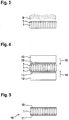
- a third process step which in Fig. 3 is shown, the fixed on the honeycomb core 1 powdered thermoplastic material 7 is melted.
- This will - as in Fig. 3 is shown - the honeycomb core 1 is reversed, so that the provided with the powdery thermoplastic material 7 side is up.
- the honeycomb core 1 provided with the powdery thermoplastic material 7 is heated by infrared radiation 9.
- the infrared radiation 9 causes the powdered thermoplastic material 7 is plasticized.
- the powdery thermoplastic material 7 is heated until it reaches its melting temperature.
- the temperature to which the powdery thermoplastic material 7 fixed to the honeycomb core 1 is heated is chosen so that it does not run down under the action of gravity. Following this, the honeycomb core 1 is allowed to cool.
- honeycomb core 1 is to be provided on both sides with a cover layer, which are in the FIGS. 1 to 3 shown process steps on the back of the honeycomb core 1 repeated.
- a fourth process step which in Fig. 4 1, the honeycomb core 1 provided with the thermoplastic material 7 is joined to cover layers 10, 11.
- cover layers 10, 11 are placed on both sides of the honeycomb core 1.
- the honeycomb core 1 provided with the cover layers 10, 11 is reheated.
- the heating takes place in this embodiment in a heated press.
- the thermoplastic material 7 plasticizes again.
- the press comprises two relatively adjustable press components 12, 13, which can be moved toward one another in the direction of the arrows 14, 15. To consolidate the press components 12, 13 are moved towards each other, so that the cover layers 10, 11 are pressed in the heated state with the provided with the thermoplastic material 7 honeycomb core 1.
- the sandwich structure 16 consists of the honeycomb core 1 and the cover layers 10, 11.
- the honeycomb core 1 is wetted with water as an adhesive. Subsequently, as in Fig. 2 is shown, the powdered thermoplastic material 7 is applied, which adheres to the moistened honeycomb core 1.
- the two cover layers 10, 11 are placed directly on the two sides of the honeycomb core 1. Subsequently, the heating of this arrangement is carried out to a temperature at which plasticizes the thermoplastic material. In this embodiment, consolidation takes place in an oven. By means of a suitable device, the cover layers 10, 11 are pressed against the honeycomb core 1, so that the cover layers 10, 11 abut the honeycomb core 1 over their entire surface. After cooling, the obtained in Fig. 5 shown sandwich structure 16.
- the powdered thermoplastic material 7 is applied by powdering the honeycomb core 1 by means of compressed air.
- the powdered thermoplastic material 7 is applied by means of a compressed air gun.
- the honeycomb core 1 is located in a holding device which covers those areas that are not to be provided with the powdery thermoplastic material 7. Accordingly, the device is designed such that only one side of the honeycomb core 1 and the region directly adjoining it are provided with the powdery thermoplastic material 7.
Landscapes
- Laminated Bodies (AREA)
Abstract
Description
- Die Erfindung betrifft ein Verfahren zur Herstellung einer Sandwichstruktur mit einem Wabenkern und wenigstens einer Decklage.
- Derartige Sandwichstrukturen werden bei Leichtbauanwendungen eingesetzt, beispielsweise bei Fährzeugen und Flugzeugen. Eine Sandwichstruktur kann beispielsweise eine Komponente einer Innenverkleidung sein, ebenso kann es sich um eine Klappe, einen Deckel, ein Element eines Gepäckfaches, einer Bordküche oder Toilette oder um eine Bodenplatte handeln. Im Allgemeinen bestehen derartige Sandwichstrukturen aus einem Wabenkern, der auch als Honeycomb bezeichnet wird. Der Wabenkern kann aus Papier bestehen, das beispielsweise aus aromatischem Polyamid (Meta-Aramid) hergestellt ist. Das Papier kann z. B. mit einem Melaminharz oder Phenolharz getränkt sein. Der Wabenkern kann eine sechseckige Zellstruktur oder Sinuswaben aufweisen und ermöglicht die Herstellung von steifen Bauteilen, die ein besonders geringes Gewicht aufweisen. Alternativ kann die Sandwichstruktur auch Faltkerne aufweisen.Die Sandwichstruktur ist wenigstens an einer Seite mit einer Decklage versehen. Die Decklage kann durch ein Gewebe, Gestrick oder eine Kombination von Gewebe und Vlies gebildet werden. Bisher wurden überwiegend duroplastische Decklagen verwendet. Ein Fasermaterial, beispielsweise Glasfaser oder Kohlefaser, wird dazu mit einem Harz imprägniert und vorvernetzt, diese Halbzeuge werden als Prepreg bezeichnet. Das Harz des Prepregmaterials fließt beim Aushärten und bildet einen Meniskus zwischen Stegen des Wabenkerns und der Decklage. Auf diese Weise wird eine gute Haftung ermöglicht.
- Aus der
DE 10 2004 041 454 A1 ist ein Verfahren zur Herstellung einer Sandwichstruktur bekannt. Dabei wird eine Leichtbauplatte, die einen thermoplastischen Stützkern aufweist, mit einem Fasermaterial verbunden, indem flüssiges thermoplastisches Material zugeführt wird. Unter Druckeinwirkung wird das flüssige thermoplastische Material in das Fasermaterial eingewalzt, eingewalkt und anschließend abgekühlt. - Wenn ein Wabenkern mit einer thermoplastischen Decklage versehen werden soll, ist es nicht möglich, das für duroplastische Harze übliche Herstellungsverfahren einzusetzen, da die Viskosität der Thermoplastmatrix zu hoch ist. In diesen Fällen werden üblicherweise Klebfilme eingesetzt, die zwischen der Decklage und dem Wabenkern eingebracht werden. Derartige Klebfilme können auf einem reaktiven Klebstoffsystem beruhen, alternativ kann ein Hot-Melt-System eingesetzt werden. Die Klebstoffe können in Form von Filmen, Folien oder Vliesen eingesetzt werden. Alle derartigen Materialien und Herstellungsverfahren weisen den Nachteil auf, dass sie vergleichsweise teuer sind, das Gewicht der Sandwichstruktur erhöhen und das Brandverhalten verschlechtern.
- Weitere Verfahren zur Herstellung von Sandwichstrukturen sind aus der
DE 2012518 A , derEP 2 133 197 A1 und derJP S-5521242 A - Der Erfindung liegt daher die Aufgabe zugrunde, ein Verfahren zur Herstellung einer Sandwichstruktur anzugeben, das für eine thermoplastische Decklage geeignet ist und eine ausreichende Haftung zwischen dem Wabenkern und der Decklage ermöglicht.
- Zur Lösung dieser Aufgabe ist ein Verfahren mit den folgenden Schritten vorgesehen:
- Aufbringen eines pulverförmigen thermoplastischen Materials auf eine Seite des Wabenkerns,
- Auflegen der Decklage auf die mit dem pulverförmigen thermoplastischen Material versehene Seite des Wabenkerns,
- Erwärmen des mit der Decklage versehenen Wabenkerns zum Plastifizieren des thermoplastischen Materials, und
- Verpressen des Wabenkerns und der Decklage in dem oder in einem erwärmten Zustand zur Herstellung der Sandwichstruktur.
- Erfindungsgemäß wird vor dem Aufbringen des im folgenden auch Pulver bezeichneten pulverförmigen thermoplastischen Materials ein Haftmittel auf den Wabenkern aufgebracht. Das Haftmittel dient dazu, das pulverförmige thermoplastische Material temporär an dem Wabenkern zu fixieren, bis die Decklage aufgelegt wird und das Verpressen des Wabenkerns unter Erwärmung erfolgt. Vorzugsweise wird ein Haftmittel verwendet, das lediglich temporär vorhanden ist und anschließend z. B. durch Verdunsten beseitigt wird. Das Haftmittel, das auch als Haftagens bezeichnet wird, wird lediglich in dem Bereich auf den Wabenkern aufgebracht, auf den anschließend das pulverförmige thermoplastische Material aufgebracht wird. Demnach wird der Wabenkern nicht über seine gesamte Dicke mit dem Haftmittel versehen, sondern lediglich an seiner Außenfläche, gegebenenfalls an beiden gegenüberliegenden Außenflächen und in daran direkt angrenzenden Bereichen.
- Die Erfindung beruht auf der Erkenntnis, dass zum Erzielen einer guten Haftung zwischen dem Wabenkern und der Decklage ein thermoplastisches Material in Pulverform auf wenigstens eine Seite des Wabenkerns aufgebracht werden kann. Das pulverförmige Material befindet sich dann an der Kontaktfläche zwischen dem Wabenkern und der Decklage. Nach dem Auflegen der Decklage des mit dem pulverförmigen thermoplastischen Material versehenen Wabenkerns wird die Anordnung erwärmt, sodass das pulverförmige thermoplastische Material plastifiziert. Durch das Verpressen des aus dem Wabenkern und der wenigstens einen Decklage bestehenden Verbunds wird eine feste mechanische Verbindung zwischen dem Wabenkern und der Decklage erzeugt. Das erfindungsgemäße Verfahren weist den Vorteil auf, dass auf die Anbringung separater Klebefilme oder anderer Klebstoffsysteme verzichtet werden kann, die ansonsten zu einer unerwünschten Gewichtserhöhung führen. Indem das pulverförmige thermoplastische Material lediglich in den Bereichen aufgebracht wird, in denen eine Verklebung stattfinden soll, genügt bereits eine vergleichsweise geringe Menge des pulverförmigen thermoplastischen Materials. Ein weiterer Vorteil ist darin zusehen, dass das Aufbringen des pulverförmigen thermoplastischen Materials in einem automatischen Fertigungsprozess erfolgen kann.
- Eine bevorzugte Variante des erfindungsgemäßen Verfahrens sieht vor, dass das pulverförmige thermoplastische Material auf beide Seiten des Wabenkerns aufgebracht wird, die jeweils mit einer Decklage versehen, erwärmt und verpresst werden. Auf diese Weise können beispielsweise plattenförmige oder dreidimensionale Sandwichichstrukturen hergestellt werden. Dabei kann es sich beispielsweise um Komponenten der Innenverkleidung eines Fahrzeugs oder Flugzeugs handeln, ebenso können auf diese Weise ein- oder mehrfach gekrümmte Strukturen wie Klappen, Deckel oder Türen und dergleichen hergestellt werden.
- Vorzugsweise wird bei dem erfindungsgemäßen Verfahren ein flüssiges Haftmittel verwendet. Ein flüssiges Haftmittel kann besonders sparsam aufgetragen werden. In diesem Zusammenhang wird es bevorzugt, dass das Haftmittel bei dem erfindungsgemäßen Verfahren durch einen Tauchprozess oder durch einen Sprühprozess auf den Wabenkern aufgetragen wird. Durch einen Tauchprozess, bei dem der Wabenkern kontrolliert in ein Haftmittelbad eingetaucht wird, kann die Benetzung mit dem Haftmittel exakt gesteuert werden. Bei einem Sprühprozess kann der Wabenkern beispielsweise an einer ortsfesten Sprüheinrichtung vorbeigeführt werden. Es ist auch denkbar, den Wabenkern in einer Haltevorrichtung anzuordnen, die so ausgebildet ist, dass lediglich ein zu besprühender Bereich frei liegt, während nicht zu besprühende Bereiche abgedeckt sind. Auf diese Weise wird sichergestellt, dass lediglich diejenigen Bereiche des Wabenkerns mit dem Haftmittel versehen werden, die anschließend mit dem pulverförmigen thermoplastischen Material versehen werden.
- Bei dem erfindungsgemäßen Verfahren kann es vorgesehen sein, dass Wasser als Haftmittel verwendet wird. Dadurch ergibt sich der Vorteil, dass das Wasser beim Erwärmen und Schmelzen des thermoplastischen Materials verdunstet. Alternativ kann auch ein Klebstoff als Haftmittel verwendet werden.
- Es liegt auch im Rahmen der Erfindung, dass das pulverförmige thermoplastische Material durch Eindrücken des Wabenkerns in das Pulver oder eine das Pulver enthaltende pastöse Masse und/oder durch Berieseln mit dem pulverförmigen thermoplastischen Material und/oder durch Bepulvern mittels Druckluft auf den Wabenkern, insbesondere durch Verwirbeln des pulverförmigen thermoplastischen Materials aufgebracht wird. Sofern zuvor ein Haftmittel aufgetragen wurde, haftet das pulverförmige thermoplastische Material lediglich an den mit dem Haftmittel benetzten Stellen. Dadurch kann sichergestellt werden, dass lediglich die äußere Kontaktfläche des Wabenkerns, auf die die Decklage aufgelegt wird, und gegebenenfalls ein direkt daran angrenzender Bereich, mit dem pulverförmigen thermoplastischen Material versehen wird.
- Bei einer bevorzugten Ausführunsgform erfolgt das Erwärmen und Plastifizieren des pulverförmigen thermoplastischen Materials z. B. mittels Infrarotstrahlung oder mittels eines Ofens. Alternativ kann das Erwärmen und Plastifizieren mit einer beheizbaren Presse oder mittels einer Heißluftanlage oder bei einem elektrisch leitfähigen Wabenkern mittels induktiver Erwärmung erfolgen. Sofern ein Klebstoff als Haftmittel verwendet wird, kann dieser durch Zufügen von Wärme, UV-Licht oder Luftfeuchte vernetzt werden. Infrarotstrahlung kann durch ein Heizfeld erzeugt werden. Ein elektrisch leitfähiger Wabenkern kann beispielsweise ein aus Aluminiumwaben bestehender Wabenkern sein.
- Durch das Erwärmen des mit der Decklage versehenen Wabenkerns wird das pulverförmige thermoplastische Material plastifiziert. Das bedeutet, dass es durch die Temperaturerhöhung fließfähig wird, sodass es sich während des Verpressens mit der Decklage verbindet. Es ist nicht erforderlich, dass das thermoplastische Material in einen vollständig geschmolzenen bzw. flüssigen Zustand gebracht wird. Die Temperatur, auf die der mit der Decklage versehene Wabenkern erwärmt wird, wird so festgelegt, dass das thermoplastische Material ausreichend fließfähig ist, sodass es sich mit der Decklage verbindet, anderseits darf es nicht so flüssig sein, dass es unter der Wirkung der Schwerkraft von der Kontaktfläche verläuft.
- Vorzugsweise ist es bei dem erfindungsgemäßen Verfahren vorgesehen, dass das auf den Wabenkern aufgebrachte pulverförmige thermoplastische Material auf eine Temperatur unterhalb seines Schmelzpunkts abgekühlt wird. Dadurch wird eine Haftung des thermoplastischen Materials auf bzw. an dem Wabenkern sichergestellt, ohne dass ein Haftmittel vorhanden ist. Sofern zuvor eine Flüssigkeit als Haftmittel verwendet wurde, verdunstet diese beim Erwärmen. Beim Abkühlen des thermoplastischen Materials unter seinen Schmelzpunkt haftet dieses an dem Wabenkern.
- Im Rahmen des erfindungsgemäßen Verfahrens kann das Verpressen des Wabenkerns in einem Pressprozess erfolgen. Hierbei können einzelne Stücke in einer Heißpresse gepresst werden oder es erfolgt ein kontinuierliches Pressen in einer Doppelbandpresse oder ein semi-kontinuierliches Pressen in einer Intervallpresse. Weiterhin kann das Verpressen des Wabenkerns in einem Ofenprozess oder in einem Autoklavprozess oder in einem Schweißprozess oder in einem Prozess mit induktiver Erwärmung erfolgen. Alle erwähnten Verfahren dienen dazu, eine ausreichende Haftung zwischen dem Wabenkern und der Decklage sicherzustellen. Nach dem Pressvorgang bildet das thermoplastische Material eine Verbindung zwischen dem Wabenkern und der Decklage. Vorteilhafter Weise befindet sich das thermoplastische Material lediglich an den Kontaktstellen, an denen es zur Herstellung der Verbindung benötigt wird. Es ist jedoch nicht flächig auf der Decklage aufgetragen, wodurch sich eine beträchtliche Gewichtsersparnis sowie Kostenreduktion ergibt.
- Mit besonderem Vorteil kann es bei dem erfindungsgemäßen Verfahren vorgesehen sein, dass pulverförmiges Polycarbonat als thermoplastisches Material verwendet wird. Es kommen jedoch auch andere pulverförmige thermoplastische Materialien in Frage, die eine gute Haftung zwischen dem Wabenkern und der Decklage ermöglichen.
- Besonders bevorzugt wird es bei dem erfindungsgemäßen Verfahren, dass ein mit einem Flammschutzmittel versehenes thermoplastisches Material verwendet wird.
- Daneben betrifft die Erfindung eine Sandwichstruktur mit einem Wabenkern und wenigstens einer Decklage, die durch ein Verfahren der beschriebenen Art hergestellt ist.
- Die Erfindung wird nachfolgend anhand von Ausführungsbeispielen unter Bezugnahme auf die Zeichnungen erläutert. Die Zeichnungen sind schematische Darstellungen und zeigen:
- Fig. 1
- das Aufbringen eines Haftmittels auf einen Wabenkern,
- Fig. 2
- das Aufbringen des Pulvers,
- Fig. 3
- das Erwärmen des Wabenkerns zum Fixieren des pulverförmigen Materials,
- Fig. 4
- das Verpressen des Wabenkerns mit Decklagen und
- Fig. 5
- eine durch das erfindungsgemäße Verfahren hergestellte Sandwichstruktur.
-
Fig. 1 zeigt den ersten Schritt des Verfahrens zur Herstellung einer Sandwichstruktur. Der schematisch dargestellte Wabenkern 1 besteht in diesem Ausführungsbeispiel aus einem Papier auf der Basis von aromatischen Polyamidfasern (Meta-Aramid), das mit einem Melaminharz durchtränkt ist. In dem inFig. 1 gezeigten ersten Verfahrensschritt wird ein Haftmittel auf den Wabenkern 1 aufgebracht. In diesem Ausführungsbeispiel handelt es sich bei dem Haftmittel um Wasser 2, das in einem Behälter 3 aufgenommen ist. In der linken Darstellung vonFig. 1 ist gezeigt, dass der Wabenkern 1 parallel zu seiner Unterseite in Richtung des Pfeils 5 abgesenkt wird, bis die in der mittleren Darstellung vonFig. 1 gezeigte Position erreicht ist. Die Unterseite 4 des Wabenkerns 1 wird auf diese Weise mit Wasser 2 als Haftmittel benetzt. Anschließend wird der Wabenkern 1 in Richtung des in der rechten Darstellung vonFig. 1 gezeigten Pfeils 6 angehoben. -
Fig. 2 zeigt den nächsten Schritt des Verfahrens zur Herstellung der Sandwichstruktur. Ein pulverförmiges thermoplastisches Material 7 befindet sich in einem Behälter 8. Um das pulverförmige thermoplastische Material 7 auf die Unterseite 4 des Wabenkerns 1 aufzubringen, wird der Wabenkern 1 parallel zu seiner Unterseite 4 in Richtung des Pfeils 5 abgesenkt und in das pulverförmige thermoplastische Material 7, das ein Pulverbett bildet, eingedrückt. In der mittleren Darstellung vonFig. 2 erkennt man, dass der Wabenkern 1 soweit abgesenkt wird, dass sein mit Wasser 2 benetzter unterer Bereich vollständig in das Pulverbett eingedrückt ist. Anschließend wird der Wabenkern 1 wie in der rechten Darstellung vonFig. 2 gezeigt ist, in Richtung des Pfeils 6 angehoben. Da der untere Bereich des Wabenkerns 1 mit Wasser 2 benetzt ist, ist das pulverförmige thermoplastische Material 7 temporär an dem Wabenkern 1 fixiert. - In einem dritten Verfahrensschritt, der in
Fig. 3 gezeigt ist, wird das auf dem Wabenkern 1 fixierte pulverförmige thermoplastische Material 7 aufgeschmolzen. Dazu wird - wie inFig. 3 gezeigt ist - der Wabenkern 1 umgedreht, sodass sich die mit dem pulverförmigen thermoplastischen Material 7 versehene Seite oben befindet. Anschließend wird der mit dem pulverförmigen thermoplastischen Material 7 versehene Wabenkern 1 durch Infrarotstrahlung 9 erwärmt. Die Infrarotstrahlung 9 bewirkt, dass das pulverförmige thermoplastische Material 7 plastifiziert wird. In Abhängigkeit der Materialeigenschaften des verwendeten Thermoplasts wird das pulverförmige thermoplastische Material 7 soweit erwärmt, bis es seine Schmelztemperatur erreicht. Die Temperatur, bis zu der das an dem Wabenkern 1 fixierte pulverförmige thermoplastische Material 7 erwärmt wird, wird so gewählt, dass es nicht unter der Wirkung der Schwerkraft herunterläuft. Im Anschluss daran lässt man den Wabenkern 1 abkühlen. - Sofern der Wabenkern 1 beidseitig mit einer Decklage versehen werden soll, werden die in den
Figuren 1 bis 3 gezeigten Verfahrensschritte an der Rückseite des Wabenkerns 1 wiederholt. - In einem vierten Verfahrensschritt, der in
Fig. 4 gezeigt ist, erfolgt das Verbinden des mit dem thermoplastischen Material 7 versehenen Wabenkerns 1 mit Decklagen 10, 11. Dazu werden auf beiden Seiten des Wabenkerns 1 Decklagen 10, 11 aufgelegt. Anschließend wird der mit den Decklagen 10, 11 versehene Wabenkern 1 erneut erwärmt. Die Erwärmung erfolgt in diesem Ausführungsbeispiel in einer beheizten Presse. Durch die Erwärmung plastifiziert das thermoplastische Material 7 erneut. Die Presse umfasst zwei relativ zueinander verstellbare Pressenkomponenten 12, 13, die in Richtung der Pfeile 14, 15 aufeinander zu bewegt werden können. Zum Konsolidieren werden die Pressenkomponenten 12, 13 aufeinander zu bewegt, sodass die Decklagen 10, 11 im erwärmten Zustand mit dem mit dem thermoplastischen Material 7 versehenen Wabenkern 1 verpresst werden. - Nach dem Abkühlen kann die in
Fig. 5 gezeigte Sandwichstruktur 16 aus der Presse entnommen werden. Die Sandwichstruktur 16 besteht aus dem Wabenkern 1 und den Decklagen 10, 11. - Nachfolgend wird ein zweites Ausführungsbeispiel des Verfahrens zur Herstellung einer Sandwichstruktur beschrieben. Diejenigen Verfahrensschritte, die mit denjenigen des ersten Ausführungsbeispiels übereinstimmen, werden nicht nochmals im Detail erläutert.
- In einem ersten Verfahrensschritt wird der Wabenkern 1 mit Wasser als Haftmittel benetzt. Anschließend wird, wie in
Fig. 2 gezeigt ist, das pulverförmige thermoplastische Material 7 aufgebracht, das an dem befeuchteten Wabenkern 1 haftet. - Abweichend von dem ersten Ausführungsbeispiel erfolgt kein Erwärmen und Aufschmelzen des an dem Wabenkern 1 fixierten pulverförmigen thermoplastischen Materials 7, stattdessen werden die beiden Decklagen 10, 11 unmittelbar auf die beiden Seiten des Wabenkerns 1 aufgelegt. Anschließend erfolgt das Erwärmen dieser Anordnung auf eine Temperatur, bei der das thermoplastische Material plastifiziert. In diesem Ausführungsbeispiel erfolgt das Konsolidieren in einem Ofen. Mittels einer geeigneten Vorrichtung werden die Decklagen 10, 11 gegen den Wabenkern 1 gepresst, sodass die Decklagen 10, 11 über ihre gesamte Fläche an dem Wabenkern 1 anliegen. Nach dem Abkühlen erhält man die in
Fig. 5 gezeigte Sandwichstruktur 16. - Gemäß einem weiteren alternativen Verfahren erfolgt das Aufbringen des pulverförmigen thermoplastischen Materials 7 durch Bepulvern des Wabenkerns 1 mittels Druckluft. Das pulverförmige thermoplastische Material 7 wird mittels einer Druckluftpistole aufgebracht. Der Wabenkern 1 befindet sich dabei in einer Haltevorrichtung, die diejenigen Bereiche abdeckt, die nicht mit dem pulverförmigen thermoplastischen Material 7 versehen werden sollen. Dementsprechend ist die Vorrichtung so ausgebildet, dass lediglich eine Seite des Wabenkerns 1 und der sich daran direkt anschließende Bereich mit dem pulverförmigen thermoplastischen Material 7 versehen werden. Die weiteren Verfahrensschritte entsprechen den in den
Fig. 3 bis Fig. 5 gezeigten Verfahrensschritten. -
- 1
- Wabenkern
- 2
- Wasser
- 3
- Behälter
- 4
- Unterseite
- 5
- Pfeil
- 6
- Pfeil
- 7
- pulverförmiges thermoplastisches Material
- 8
- Behälter
- 9
- Infrarotstrahlung
- 10, 11
- Decklage
- 12, 13
- Pressenkomponente
- 14, 15
- Pfeil
- 16
- Sandwichstruktur
Claims (12)
- Verfahren zur Herstellung einer Sandwichstruktur (16) mit einem Wabenkern (1) und wenigstens einer Decklage (10, 11), mit den folgenden Schritten:- Aufbringen eines pulverförmigen thermoplastischen Materials (7) auf eine Seite des Wabenkerns (1),- Auflegen der Decklage (10, 11) auf die mit dem pulverförmigen thermoplastischen Material (7) versehene Seite des Wabenkerns (1),- Erwärmen des mit der Decklage (10, 11) versehenen Wabenkerns (1) zum Plastifizieren des thermoplastischen Materials (7), und- Verpressen des Wabenkerns (1) und der Decklage (10, 11) in dem oder in einem erwärmten Zustand zur Herstellung der Sandwichstruktur (16), dadurch gekennzeichnet, dass vor dem Aufbringen des pulverförmigen thermoplastischen Materials (7) ein Haftmittel auf den Wabenkern (1) aufgebracht wird.
- Verfahren nach Anspruch 1, dadurch gekennzeichnet, dass das thermoplastische Material (7) auf beide Seiten des Wabenkerns (1) aufgebracht wird, die jeweils mit einer Decklage (10, 11) versehen, erwärmt und verpresst werden.
- Verfahren nach Anspruch 1 oder 2, dadurch gekennzeichnet, dass ein flüssiges Haftmittel verwendet wird.
- Verfahren nach einem der vorangehenden Ansprüche, dadurch gekennzeichnet, dass das Haftmittel durch einen Tauchprozess oder durch einen Sprühprozess auf den Wabenkern (1) aufgetragen wird.
- Verfahren nach einem der vorangehenden Ansprüche, dadurch gekennzeichnet, dass Wasser (2) oder ein Klebstoff als Haftmittel verwendet wird.
- Verfahren nach einem der vorangehenden Ansprüche, dadurch gekennzeichnet, dass das pulverförmige thermoplastische Material (7) durch Eindrücken des Wabenkerns (1) in das pulverförmige thermoplastische Material (7) oder eine das Pulver enthaltende pastöse Masse und/oder durch Berieseln mit dem Pulver und/oder durch Bepulvern mittels Druckluft auf den Wabenkern (1) aufgebracht wird.
- Verfahren nach einem der vorangehenden Ansprüche, dadurch gekennzeichnet, dass das Erwärmen und Plastifizieren des pulverförmigen thermoplastischen Materials mittels Infrarotstrahlung (9) oder eines Ofens oder einer beheizbaren Presse oder mittels einer Heißluftanlage oder bei einem elektrisch leitfähigen Wabenkern mittels induktiver Erwärmung erfolgt.
- Verfahren nach einem der vorangehenden Ansprüche, dadurch gekennzeichnet, dass das auf den Wabenkern (1) aufgebrachte pulverförmige thermoplastische Material (7) auf eine Temperatur unterhalb seines Schmelzpunkts abgekühlt wird.
- Verfahren nach einem der vorangehenden Ansprüche, dadurch gekennzeichnet, dass das Verpressen des Wabenkerns (1) in einem Pressprozess oder in einem Ofenprozess oder in einem Autoklavprozess oder in einem Schweißprozess oder in einem Prozess mit induktiver Erwärmung erfolgt.
- Verfahren nach einem der vorangehenden Ansprüche, dadurch gekennzeichnet, dass pulverförmiges Polycarbonat als thermoplastisches Material (7) verwendet wird.
- Verfahren nach einem der vorangehenden Ansprüche, dadurch gekennzeichnet, dass ein mit einem Flammschutzmittel versehenes pulverförmiges thermoplastisches Material (7) verwendet wird.
- Sandwichstruktur (16) mit einem Wabenkern (1) und wenigstens einer Decklage (10, 11), wobei die Sandwichstruktur (16) durch ein Verfahren nach einem der Ansprüche 1 bis 11 hergestellt ist.
Applications Claiming Priority (1)
| Application Number | Priority Date | Filing Date | Title |
|---|---|---|---|
| DE102017003471.0A DE102017003471A1 (de) | 2017-04-11 | 2017-04-11 | Verfahren zur Herstellung einer Sandwichstruktur und nach dem Verfahren hergestellte Sandwichstruktur |
Publications (2)
| Publication Number | Publication Date |
|---|---|
| EP3388232A1 true EP3388232A1 (de) | 2018-10-17 |
| EP3388232B1 EP3388232B1 (de) | 2020-05-20 |
Family
ID=61749931
Family Applications (1)
| Application Number | Title | Priority Date | Filing Date |
|---|---|---|---|
| EP18000281.8A Active EP3388232B1 (de) | 2017-04-11 | 2018-03-21 | Verfahren zur herstellung einer sandwichstruktur und nach dem verfahren hergestellte sandwichstruktur |
Country Status (2)
| Country | Link |
|---|---|
| EP (1) | EP3388232B1 (de) |
| DE (1) | DE102017003471A1 (de) |
Citations (6)
| Publication number | Priority date | Publication date | Assignee | Title |
|---|---|---|---|---|
| DE2012518A1 (de) * | 1969-03-28 | 1970-10-15 | Ransburg Electro-Coating Corp., Indianapolis, Ind. (V.St.A.) | Verfahren und Vorrichtung zum Niederschlagen von Partikeln einer pulverförmigen Substanz |
| JPS5521242A (en) * | 1978-08-01 | 1980-02-15 | Sumitomo Chemical Co | Preparation of compound body |
| US20060083892A1 (en) * | 2004-09-01 | 2006-04-20 | Hexcel Corporation | Edge coating for honeycomb used in panels with composite face sheets |
| CN101357522A (zh) * | 2008-09-25 | 2009-02-04 | 广州市鹿山化工材料有限公司 | 铝蜂窝复合板制造方法 |
| EP2133197A1 (de) * | 2008-06-11 | 2009-12-16 | Alcan Technology & Management Ltd. | Verbundplatte |
| KR20100020713A (ko) * | 2008-08-13 | 2010-02-23 | 한일이화주식회사 | 허니컴 구조물 및 그 제조방법 |
Family Cites Families (1)
| Publication number | Priority date | Publication date | Assignee | Title |
|---|---|---|---|---|
| DE102004041454A1 (de) | 2004-08-27 | 2006-03-02 | Bauer, Gerhard, Dipl.-Ing. | Verfahren und Vorrichtung zur Herstellung eines plattenförmigen Elementes aus einem Fasermaterial und aus thermoplastischem Material, sowie Verfahren und Vorrichtung zur Herstellung einer mehrschichtigen Sandwich-Leichtbauplatte |
-
2017
- 2017-04-11 DE DE102017003471.0A patent/DE102017003471A1/de active Pending
-
2018
- 2018-03-21 EP EP18000281.8A patent/EP3388232B1/de active Active
Patent Citations (6)
| Publication number | Priority date | Publication date | Assignee | Title |
|---|---|---|---|---|
| DE2012518A1 (de) * | 1969-03-28 | 1970-10-15 | Ransburg Electro-Coating Corp., Indianapolis, Ind. (V.St.A.) | Verfahren und Vorrichtung zum Niederschlagen von Partikeln einer pulverförmigen Substanz |
| JPS5521242A (en) * | 1978-08-01 | 1980-02-15 | Sumitomo Chemical Co | Preparation of compound body |
| US20060083892A1 (en) * | 2004-09-01 | 2006-04-20 | Hexcel Corporation | Edge coating for honeycomb used in panels with composite face sheets |
| EP2133197A1 (de) * | 2008-06-11 | 2009-12-16 | Alcan Technology & Management Ltd. | Verbundplatte |
| KR20100020713A (ko) * | 2008-08-13 | 2010-02-23 | 한일이화주식회사 | 허니컴 구조물 및 그 제조방법 |
| CN101357522A (zh) * | 2008-09-25 | 2009-02-04 | 广州市鹿山化工材料有限公司 | 铝蜂窝复合板制造方法 |
Non-Patent Citations (3)
| Title |
|---|
| DATABASE WPI Week 198013, Derwent World Patents Index; AN 1980-22651C, XP002783022 * |
| DATABASE WPI Week 200925, Derwent World Patents Index; AN 2009-F26361, XP002783023 * |
| DATABASE WPI Week 201022, Derwent World Patents Index; AN 2010-C39812, XP002783024 * |
Also Published As
| Publication number | Publication date |
|---|---|
| EP3388232B1 (de) | 2020-05-20 |
| DE102017003471A1 (de) | 2018-10-11 |
Similar Documents
| Publication | Publication Date | Title |
|---|---|---|
| DE102012006609B4 (de) | Verfahren zur Herstellung eines Sandwichverbundbauteils | |
| DE102014215935A1 (de) | Vorrichtung und Verfahren zur Fertigung von Bauteilen aus einem faserverstärkten Verbundmaterial | |
| DE69822483T3 (de) | Lasttragendes fahrzeugdach und verfahren zu seiner herstellung | |
| EP2463092B2 (de) | Innenraum-Verkleidungsbauteil für ein Kraftfahrzeug | |
| DE102011017767A1 (de) | Verkleidungskomponente und Verfahren zur Kantenfalzung | |
| WO2016102455A1 (de) | Verfahren und vorrichtung zur herstellung eines sandwichbauteiles und sandwichbauteil | |
| DE102015005407A1 (de) | Rührreibschweißen von Thermoplasten | |
| DE202015008932U1 (de) | Materialverbund zur Herstellung eines Versteifungselements für den Leichtbau sowie Versteifungselement für den Leichtbau | |
| DE102011109696A1 (de) | Funktionalisiertes Innenraumverkleidungsbauteil und Verfahren zu dessen Herstellung sowie Kraftfahrzeug mit dem Innenraumverkleidungsbauteil | |
| DE102012003731A1 (de) | Halbzeug für die Herstellung eines Faserverbund-Metallhybridlaminats und Verfahren zur Herstellung eines derartigen Halbzeuges | |
| DE102011006792B4 (de) | Verfahren zum Herstellen und Verbinden von faserverstärkten Bauteilen sowie Luft- oder Raumfahrzeug | |
| DE102019204460A1 (de) | Verfahren zur Herstellung eines Sandwichverbund-Bauteils mit eingepresster zwei- oder dreidimensionaler Form sowie ein derartiges Sandwichverbund-Bauteil | |
| DE102013107102A1 (de) | Faserhalbzeug-Temperiervorrichtung | |
| DE102013013419A1 (de) | Verfahren und Vorrichtung zur Herstellung eines Sandwichbauteils | |
| EP3527432B1 (de) | Verkleidungsbauteil zum verkleiden eines innenraums eines personentransportmittels sowie verfahren zum herstellen eines derartigen verkleidungsbauteils | |
| EP0803351A1 (de) | Laminat bestehend aus einer Basis- und Deckschicht sowie Verfahren zur Herstellung einer Dekoroberfläche an diesem Laminat | |
| EP3237183A2 (de) | Verfahren und vorrichtung zur herstellung eines sandwichbauteils | |
| DE102013021672A1 (de) | Verfahren zur Herstellung eines Hybridbauteils | |
| DE102011011387A1 (de) | Mehrschichtiges Faserkunststoffverbundhalbzeug und Verfahren zu dessen Herstellung | |
| EP1851036B1 (de) | Faserverbund-Bauelement und Verfahren zur Herstellung eines Faserverbund-Bauelements | |
| DE102018126624A1 (de) | Verfahren zur Herstellung eines Werkstücks aus Verbundmaterial | |
| EP3388232B1 (de) | Verfahren zur herstellung einer sandwichstruktur und nach dem verfahren hergestellte sandwichstruktur | |
| EP1727665B1 (de) | Verfahren und vorrichtung zur kontinuierlichen herstellung von faserverstärkten kunststoffplatten | |
| DE102016110586B3 (de) | Dachmodul für ein Fahrzeug sowie Verfahren zur Herstellung eines Dachmoduls | |
| DE102021117754A1 (de) | Thermoplastisches Unterbodenbauteil mit integriertem Sensordraht und Herstellverfahren |
Legal Events
| Date | Code | Title | Description |
|---|---|---|---|
| PUAI | Public reference made under article 153(3) epc to a published international application that has entered the european phase |
Free format text: ORIGINAL CODE: 0009012 |
|
| STAA | Information on the status of an ep patent application or granted ep patent |
Free format text: STATUS: THE APPLICATION HAS BEEN PUBLISHED |
|
| AK | Designated contracting states |
Kind code of ref document: A1 Designated state(s): AL AT BE BG CH CY CZ DE DK EE ES FI FR GB GR HR HU IE IS IT LI LT LU LV MC MK MT NL NO PL PT RO RS SE SI SK SM TR |
|
| AX | Request for extension of the european patent |
Extension state: BA ME |
|
| STAA | Information on the status of an ep patent application or granted ep patent |
Free format text: STATUS: REQUEST FOR EXAMINATION WAS MADE |
|
| STAA | Information on the status of an ep patent application or granted ep patent |
Free format text: STATUS: EXAMINATION IS IN PROGRESS |
|
| 17P | Request for examination filed |
Effective date: 20190415 |
|
| RBV | Designated contracting states (corrected) |
Designated state(s): AL AT BE BG CH CY CZ DE DK EE ES FI FR GB GR HR HU IE IS IT LI LT LU LV MC MK MT NL NO PL PT RO RS SE SI SK SM TR |
|
| 17Q | First examination report despatched |
Effective date: 20190528 |
|
| GRAP | Despatch of communication of intention to grant a patent |
Free format text: ORIGINAL CODE: EPIDOSNIGR1 |
|
| STAA | Information on the status of an ep patent application or granted ep patent |
Free format text: STATUS: GRANT OF PATENT IS INTENDED |
|
| INTG | Intention to grant announced |
Effective date: 20200312 |
|
| GRAS | Grant fee paid |
Free format text: ORIGINAL CODE: EPIDOSNIGR3 |
|
| GRAA | (expected) grant |
Free format text: ORIGINAL CODE: 0009210 |
|
| STAA | Information on the status of an ep patent application or granted ep patent |
Free format text: STATUS: THE PATENT HAS BEEN GRANTED |
|
| AK | Designated contracting states |
Kind code of ref document: B1 Designated state(s): AL AT BE BG CH CY CZ DE DK EE ES FI FR GB GR HR HU IE IS IT LI LT LU LV MC MK MT NL NO PL PT RO RS SE SI SK SM TR |
|
| REG | Reference to a national code |
Ref country code: GB Ref legal event code: FG4D Free format text: NOT ENGLISH |
|
| REG | Reference to a national code |
Ref country code: CH Ref legal event code: EP |
|
| REG | Reference to a national code |
Ref country code: DE Ref legal event code: R096 Ref document number: 502018001456 Country of ref document: DE |
|
| REG | Reference to a national code |
Ref country code: AT Ref legal event code: REF Ref document number: 1272344 Country of ref document: AT Kind code of ref document: T Effective date: 20200615 |
|
| REG | Reference to a national code |
Ref country code: LT Ref legal event code: MG4D |
|
| REG | Reference to a national code |
Ref country code: NL Ref legal event code: MP Effective date: 20200520 |
|
| PG25 | Lapsed in a contracting state [announced via postgrant information from national office to epo] |
Ref country code: SE Free format text: LAPSE BECAUSE OF FAILURE TO SUBMIT A TRANSLATION OF THE DESCRIPTION OR TO PAY THE FEE WITHIN THE PRESCRIBED TIME-LIMIT Effective date: 20200520 Ref country code: LT Free format text: LAPSE BECAUSE OF FAILURE TO SUBMIT A TRANSLATION OF THE DESCRIPTION OR TO PAY THE FEE WITHIN THE PRESCRIBED TIME-LIMIT Effective date: 20200520 Ref country code: GR Free format text: LAPSE BECAUSE OF FAILURE TO SUBMIT A TRANSLATION OF THE DESCRIPTION OR TO PAY THE FEE WITHIN THE PRESCRIBED TIME-LIMIT Effective date: 20200821 Ref country code: PT Free format text: LAPSE BECAUSE OF FAILURE TO SUBMIT A TRANSLATION OF THE DESCRIPTION OR TO PAY THE FEE WITHIN THE PRESCRIBED TIME-LIMIT Effective date: 20200921 Ref country code: IS Free format text: LAPSE BECAUSE OF FAILURE TO SUBMIT A TRANSLATION OF THE DESCRIPTION OR TO PAY THE FEE WITHIN THE PRESCRIBED TIME-LIMIT Effective date: 20200920 Ref country code: FI Free format text: LAPSE BECAUSE OF FAILURE TO SUBMIT A TRANSLATION OF THE DESCRIPTION OR TO PAY THE FEE WITHIN THE PRESCRIBED TIME-LIMIT Effective date: 20200520 Ref country code: NO Free format text: LAPSE BECAUSE OF FAILURE TO SUBMIT A TRANSLATION OF THE DESCRIPTION OR TO PAY THE FEE WITHIN THE PRESCRIBED TIME-LIMIT Effective date: 20200820 |
|
| PG25 | Lapsed in a contracting state [announced via postgrant information from national office to epo] |
Ref country code: LV Free format text: LAPSE BECAUSE OF FAILURE TO SUBMIT A TRANSLATION OF THE DESCRIPTION OR TO PAY THE FEE WITHIN THE PRESCRIBED TIME-LIMIT Effective date: 20200520 Ref country code: HR Free format text: LAPSE BECAUSE OF FAILURE TO SUBMIT A TRANSLATION OF THE DESCRIPTION OR TO PAY THE FEE WITHIN THE PRESCRIBED TIME-LIMIT Effective date: 20200520 Ref country code: BG Free format text: LAPSE BECAUSE OF FAILURE TO SUBMIT A TRANSLATION OF THE DESCRIPTION OR TO PAY THE FEE WITHIN THE PRESCRIBED TIME-LIMIT Effective date: 20200820 Ref country code: RS Free format text: LAPSE BECAUSE OF FAILURE TO SUBMIT A TRANSLATION OF THE DESCRIPTION OR TO PAY THE FEE WITHIN THE PRESCRIBED TIME-LIMIT Effective date: 20200520 |
|
| PG25 | Lapsed in a contracting state [announced via postgrant information from national office to epo] |
Ref country code: NL Free format text: LAPSE BECAUSE OF FAILURE TO SUBMIT A TRANSLATION OF THE DESCRIPTION OR TO PAY THE FEE WITHIN THE PRESCRIBED TIME-LIMIT Effective date: 20200520 Ref country code: AL Free format text: LAPSE BECAUSE OF FAILURE TO SUBMIT A TRANSLATION OF THE DESCRIPTION OR TO PAY THE FEE WITHIN THE PRESCRIBED TIME-LIMIT Effective date: 20200520 |
|
| PG25 | Lapsed in a contracting state [announced via postgrant information from national office to epo] |
Ref country code: DK Free format text: LAPSE BECAUSE OF FAILURE TO SUBMIT A TRANSLATION OF THE DESCRIPTION OR TO PAY THE FEE WITHIN THE PRESCRIBED TIME-LIMIT Effective date: 20200520 Ref country code: ES Free format text: LAPSE BECAUSE OF FAILURE TO SUBMIT A TRANSLATION OF THE DESCRIPTION OR TO PAY THE FEE WITHIN THE PRESCRIBED TIME-LIMIT Effective date: 20200520 Ref country code: SM Free format text: LAPSE BECAUSE OF FAILURE TO SUBMIT A TRANSLATION OF THE DESCRIPTION OR TO PAY THE FEE WITHIN THE PRESCRIBED TIME-LIMIT Effective date: 20200520 Ref country code: EE Free format text: LAPSE BECAUSE OF FAILURE TO SUBMIT A TRANSLATION OF THE DESCRIPTION OR TO PAY THE FEE WITHIN THE PRESCRIBED TIME-LIMIT Effective date: 20200520 Ref country code: IT Free format text: LAPSE BECAUSE OF FAILURE TO SUBMIT A TRANSLATION OF THE DESCRIPTION OR TO PAY THE FEE WITHIN THE PRESCRIBED TIME-LIMIT Effective date: 20200520 Ref country code: RO Free format text: LAPSE BECAUSE OF FAILURE TO SUBMIT A TRANSLATION OF THE DESCRIPTION OR TO PAY THE FEE WITHIN THE PRESCRIBED TIME-LIMIT Effective date: 20200520 Ref country code: CZ Free format text: LAPSE BECAUSE OF FAILURE TO SUBMIT A TRANSLATION OF THE DESCRIPTION OR TO PAY THE FEE WITHIN THE PRESCRIBED TIME-LIMIT Effective date: 20200520 |
|
| REG | Reference to a national code |
Ref country code: DE Ref legal event code: R097 Ref document number: 502018001456 Country of ref document: DE |
|
| PG25 | Lapsed in a contracting state [announced via postgrant information from national office to epo] |
Ref country code: PL Free format text: LAPSE BECAUSE OF FAILURE TO SUBMIT A TRANSLATION OF THE DESCRIPTION OR TO PAY THE FEE WITHIN THE PRESCRIBED TIME-LIMIT Effective date: 20200520 Ref country code: SK Free format text: LAPSE BECAUSE OF FAILURE TO SUBMIT A TRANSLATION OF THE DESCRIPTION OR TO PAY THE FEE WITHIN THE PRESCRIBED TIME-LIMIT Effective date: 20200520 |
|
| PLBE | No opposition filed within time limit |
Free format text: ORIGINAL CODE: 0009261 |
|
| STAA | Information on the status of an ep patent application or granted ep patent |
Free format text: STATUS: NO OPPOSITION FILED WITHIN TIME LIMIT |
|
| 26N | No opposition filed |
Effective date: 20210223 |
|
| PG25 | Lapsed in a contracting state [announced via postgrant information from national office to epo] |
Ref country code: SI Free format text: LAPSE BECAUSE OF FAILURE TO SUBMIT A TRANSLATION OF THE DESCRIPTION OR TO PAY THE FEE WITHIN THE PRESCRIBED TIME-LIMIT Effective date: 20200520 |
|
| PG25 | Lapsed in a contracting state [announced via postgrant information from national office to epo] |
Ref country code: MC Free format text: LAPSE BECAUSE OF FAILURE TO SUBMIT A TRANSLATION OF THE DESCRIPTION OR TO PAY THE FEE WITHIN THE PRESCRIBED TIME-LIMIT Effective date: 20200520 |
|
| REG | Reference to a national code |
Ref country code: CH Ref legal event code: PL |
|
| REG | Reference to a national code |
Ref country code: BE Ref legal event code: MM Effective date: 20210331 |
|
| PG25 | Lapsed in a contracting state [announced via postgrant information from national office to epo] |
Ref country code: IE Free format text: LAPSE BECAUSE OF NON-PAYMENT OF DUE FEES Effective date: 20210321 Ref country code: FR Free format text: LAPSE BECAUSE OF NON-PAYMENT OF DUE FEES Effective date: 20210331 Ref country code: CH Free format text: LAPSE BECAUSE OF NON-PAYMENT OF DUE FEES Effective date: 20210331 Ref country code: LI Free format text: LAPSE BECAUSE OF NON-PAYMENT OF DUE FEES Effective date: 20210331 Ref country code: LU Free format text: LAPSE BECAUSE OF NON-PAYMENT OF DUE FEES Effective date: 20210321 |
|
| PG25 | Lapsed in a contracting state [announced via postgrant information from national office to epo] |
Ref country code: BE Free format text: LAPSE BECAUSE OF NON-PAYMENT OF DUE FEES Effective date: 20210331 |
|
| GBPC | Gb: european patent ceased through non-payment of renewal fee |
Effective date: 20220321 |
|
| PG25 | Lapsed in a contracting state [announced via postgrant information from national office to epo] |
Ref country code: GB Free format text: LAPSE BECAUSE OF NON-PAYMENT OF DUE FEES Effective date: 20220321 |
|
| PG25 | Lapsed in a contracting state [announced via postgrant information from national office to epo] |
Ref country code: CY Free format text: LAPSE BECAUSE OF FAILURE TO SUBMIT A TRANSLATION OF THE DESCRIPTION OR TO PAY THE FEE WITHIN THE PRESCRIBED TIME-LIMIT Effective date: 20200520 |
|
| PG25 | Lapsed in a contracting state [announced via postgrant information from national office to epo] |
Ref country code: HU Free format text: LAPSE BECAUSE OF FAILURE TO SUBMIT A TRANSLATION OF THE DESCRIPTION OR TO PAY THE FEE WITHIN THE PRESCRIBED TIME-LIMIT; INVALID AB INITIO Effective date: 20180321 |
|
| PG25 | Lapsed in a contracting state [announced via postgrant information from national office to epo] |
Ref country code: MK Free format text: LAPSE BECAUSE OF FAILURE TO SUBMIT A TRANSLATION OF THE DESCRIPTION OR TO PAY THE FEE WITHIN THE PRESCRIBED TIME-LIMIT Effective date: 20200520 |
|
| REG | Reference to a national code |
Ref country code: AT Ref legal event code: MM01 Ref document number: 1272344 Country of ref document: AT Kind code of ref document: T Effective date: 20230321 |
|
| PG25 | Lapsed in a contracting state [announced via postgrant information from national office to epo] |
Ref country code: AT Free format text: LAPSE BECAUSE OF NON-PAYMENT OF DUE FEES Effective date: 20230321 |
|
| PG25 | Lapsed in a contracting state [announced via postgrant information from national office to epo] |
Ref country code: AT Free format text: LAPSE BECAUSE OF NON-PAYMENT OF DUE FEES Effective date: 20230321 |
|
| PG25 | Lapsed in a contracting state [announced via postgrant information from national office to epo] |
Ref country code: MT Free format text: LAPSE BECAUSE OF FAILURE TO SUBMIT A TRANSLATION OF THE DESCRIPTION OR TO PAY THE FEE WITHIN THE PRESCRIBED TIME-LIMIT Effective date: 20200520 |
|
| PGFP | Annual fee paid to national office [announced via postgrant information from national office to epo] |
Ref country code: DE Payment date: 20250515 Year of fee payment: 8 |
|
| PG25 | Lapsed in a contracting state [announced via postgrant information from national office to epo] |
Ref country code: TR Free format text: LAPSE BECAUSE OF FAILURE TO SUBMIT A TRANSLATION OF THE DESCRIPTION OR TO PAY THE FEE WITHIN THE PRESCRIBED TIME-LIMIT Effective date: 20200520 |