EP3382831A1 - Wear protection feature for corona igniter - Google Patents
Wear protection feature for corona igniter Download PDFInfo
- Publication number
- EP3382831A1 EP3382831A1 EP18167224.7A EP18167224A EP3382831A1 EP 3382831 A1 EP3382831 A1 EP 3382831A1 EP 18167224 A EP18167224 A EP 18167224A EP 3382831 A1 EP3382831 A1 EP 3382831A1
- Authority
- EP
- European Patent Office
- Prior art keywords
- central
- crown
- corona igniter
- firing
- extended member
- Prior art date
- Legal status (The legal status is an assumption and is not a legal conclusion. Google has not performed a legal analysis and makes no representation as to the accuracy of the status listed.)
- Withdrawn
Links
Images




Classifications
-
- F—MECHANICAL ENGINEERING; LIGHTING; HEATING; WEAPONS; BLASTING
- F02—COMBUSTION ENGINES; HOT-GAS OR COMBUSTION-PRODUCT ENGINE PLANTS
- F02P—IGNITION, OTHER THAN COMPRESSION IGNITION, FOR INTERNAL-COMBUSTION ENGINES; TESTING OF IGNITION TIMING IN COMPRESSION-IGNITION ENGINES
- F02P23/00—Other ignition
- F02P23/04—Other physical ignition means, e.g. using laser rays
-
- H—ELECTRICITY
- H01—ELECTRIC ELEMENTS
- H01T—SPARK GAPS; OVERVOLTAGE ARRESTERS USING SPARK GAPS; SPARKING PLUGS; CORONA DEVICES; GENERATING IONS TO BE INTRODUCED INTO NON-ENCLOSED GASES
- H01T13/00—Sparking plugs
- H01T13/50—Sparking plugs having means for ionisation of gap
-
- H—ELECTRICITY
- H01—ELECTRIC ELEMENTS
- H01T—SPARK GAPS; OVERVOLTAGE ARRESTERS USING SPARK GAPS; SPARKING PLUGS; CORONA DEVICES; GENERATING IONS TO BE INTRODUCED INTO NON-ENCLOSED GASES
- H01T19/00—Devices providing for corona discharge
-
- H—ELECTRICITY
- H01—ELECTRIC ELEMENTS
- H01T—SPARK GAPS; OVERVOLTAGE ARRESTERS USING SPARK GAPS; SPARKING PLUGS; CORONA DEVICES; GENERATING IONS TO BE INTRODUCED INTO NON-ENCLOSED GASES
- H01T19/00—Devices providing for corona discharge
- H01T19/02—Corona rings
-
- H—ELECTRICITY
- H01—ELECTRIC ELEMENTS
- H01T—SPARK GAPS; OVERVOLTAGE ARRESTERS USING SPARK GAPS; SPARKING PLUGS; CORONA DEVICES; GENERATING IONS TO BE INTRODUCED INTO NON-ENCLOSED GASES
- H01T19/00—Devices providing for corona discharge
- H01T19/04—Devices providing for corona discharge having pointed electrodes
-
- H—ELECTRICITY
- H01—ELECTRIC ELEMENTS
- H01T—SPARK GAPS; OVERVOLTAGE ARRESTERS USING SPARK GAPS; SPARKING PLUGS; CORONA DEVICES; GENERATING IONS TO BE INTRODUCED INTO NON-ENCLOSED GASES
- H01T13/00—Sparking plugs
- H01T13/46—Sparking plugs having two or more spark gaps
- H01T13/467—Sparking plugs having two or more spark gaps in parallel connection
-
- H—ELECTRICITY
- H01—ELECTRIC ELEMENTS
- H01T—SPARK GAPS; OVERVOLTAGE ARRESTERS USING SPARK GAPS; SPARKING PLUGS; CORONA DEVICES; GENERATING IONS TO BE INTRODUCED INTO NON-ENCLOSED GASES
- H01T21/00—Apparatus or processes specially adapted for the manufacture or maintenance of spark gaps or sparking plugs
-
- H—ELECTRICITY
- H01—ELECTRIC ELEMENTS
- H01T—SPARK GAPS; OVERVOLTAGE ARRESTERS USING SPARK GAPS; SPARKING PLUGS; CORONA DEVICES; GENERATING IONS TO BE INTRODUCED INTO NON-ENCLOSED GASES
- H01T21/00—Apparatus or processes specially adapted for the manufacture or maintenance of spark gaps or sparking plugs
- H01T21/02—Apparatus or processes specially adapted for the manufacture or maintenance of spark gaps or sparking plugs of sparking plugs
-
- Y—GENERAL TAGGING OF NEW TECHNOLOGICAL DEVELOPMENTS; GENERAL TAGGING OF CROSS-SECTIONAL TECHNOLOGIES SPANNING OVER SEVERAL SECTIONS OF THE IPC; TECHNICAL SUBJECTS COVERED BY FORMER USPC CROSS-REFERENCE ART COLLECTIONS [XRACs] AND DIGESTS
- Y10—TECHNICAL SUBJECTS COVERED BY FORMER USPC
- Y10T—TECHNICAL SUBJECTS COVERED BY FORMER US CLASSIFICATION
- Y10T29/00—Metal working
- Y10T29/49—Method of mechanical manufacture
- Y10T29/49002—Electrical device making
Definitions
- This invention relates generally to a corona igniter for emitting a radio frequency electric field to ionize a fuel-air mixture and provide a corona discharge, a corona discharge ignition system, and methods of manufacturing the same.
- a corona igniter of a corona discharge ignition system receives a voltage from a power source and emits an electrical field that forms a corona to ionize a mixture of fuel and air of an internal combustion engine.
- the igniter includes an electrode extending longitudinally form an electrode terminal end to an electrode firing end.
- An insulator is disposed along the center electrode, and a shell is disposed along the insulator.
- the electrode terminal end receives the voltage from the power source and the electrode firing end emits the electrical field that forms the corona.
- the electrode of the corona igniter may also include a crown at the firing end for emitting the electrical field.
- the electrical field includes at least one streamer, and typically a plurality of streamers forming the corona. The mixture of air and fuel is ignited along the entire length of the high electrical field generated from the electrode firing end.
- An example of a corona igniter is disclosed in U.S. Patent Application Publication No. US 2010/0083942 to Lykowski et al.
- the corrosion and/or erosion of the metallic parts of the corona igniter in the combustion chamber is low since a corona discharge does not have the high current and high temperatures associated with the discharge of a conventional spark.
- the corona igniter does not include any grounded electrode element in close proximity to the firing tips of the crown, in some applications, there are grounded engine components that come close to the firing tips. Accordingly, it is not always possible to avoid an arc formation, also referred to as arcing, between the corona igniter and grounded component. If an arc forms, the high current and temperatures associated with the arc formation could cause some erosion and/or corrosion damage to the firing tips of the crown. Overtime, the erosion and/or corrosion damage could decrease the quality of corona formation and combustion.
- One aspect of the invention provides a corona igniter according to Claim 1.
- Another aspect of the invention provides a corona discharge ignition system including the corona igniter of Claim 1.
- Yet another aspect of the invention provides a method of manufacturing the corona igniter of Claim 1.
- the corona igniter including the central extended member with the extended length greater than the crown length provides several advantages over comparative corona igniters without the central extended member.
- a grounded component such as the piston
- the corona igniter comes close to the central firing end of the central extended member and the firing tips of the crown, if any arc forms, it will preferentially form between the piston and central firing end of the central extended member due to the extended length of the central extended member, its proximity to the grounded component, and hence its higher field strength, compared to the firing tips of the crown. Therefore, if arcing does occur, corrosion and erosion damage to the firing tips of the crown is reduced.
- the central extended member tends to repel the corona streamers as they form, thereby providing a wider volume of corona discharge and reducing the tendency of the corona discharge to approach the piston and form an arc.
- a corona igniter 20 including a central extended member 22 which is capable of providing improved corona discharge 24 and improved combustion performance is generally shown.
- the corona igniter 20 includes an electrode extending along a central axis A for emitting an electrical field that forms the corona discharge 24 .
- a shell 32 formed of a metal material is disposed around the insulator 28 .
- the electrode includes the central extended member 22 and a crown 34 .
- the crown 34 of the electrode is disposed outwardly of the insulator firing end 30 .
- the crown 34 surrounds the central axis A and the central extended member 22 .
- the crown 34 of the electrode also includes at least one branch 36 extending radially outwardly of the central extended member 22 , but typically includes a plurality of branches 36 each extending radially outwardly from the central axis A and radially outwardly of the central extended member 22 .
- the crown 34 includes four branches 36 spaced an equal distance from one another around the central axis A , as shown in Figure 1A .
- Each of the branches 36 presents a firing tip 38 for emitting the electrical field that forms the corona discharge 24 .
- the crown 34 presents a crown diameter D c disposed perpendicular to the central axis A .
- the crown diameter D c is the distance between two points of the crown 34 disposed directly opposite one another, such as the radially outermost points of two opposing firing tips 38 .
- the crown 34 extends along the central axis A from a top surface 40 to the at least one firing tip 38 .
- a crown length l c is thus presented between the top surface 40 and the at least one firing tip 38 .
- the crown length l c is parallel to the central axis A and it is equal to the distance between a first plane 42 and a second plane 44 each extending perpendicular to the central axis A .
- the first plane 42 is disposed at the uppermost point of the top surface 40 of the crown 34 and the second plane 44 is disposed at the lowermost point of the lowermost firing tip 38 .
- Each branch 36 of the crown 34 also presents at least one first spherical radius r 1 located at or adjacent to the associated firing tip 38 .
- Figure 1C shows a portion of the crown 34 of Figure 1B including two of the first spherical radii r 1 at the firing tip 38 of the crown 34 .
- a spherical radius at a particular point along a surface is obtained from a sphere having a radius at that particular point.
- the spherical radius is the radius of the sphere in three-dimensions, specifically along an x-axis, a y-axis, and a z-axis.
- the crown 34 can be formed of various different metal materials.
- the crown 34 is formed of nickel, nickel alloy, or a precious metal, such as platinum or iridium. Due to the central extended member 22 of the electrode, the material of the crown 34 can be formed of a less wear resistant material and experiences less corrosion and erosion if arcing occurs during operation of the corona igniter 20 .
- the central extended member 22 of the electrode extends longitudinally along the central axis A to a central firing end 46 .
- the central extended member 22 presents an extended length l e extending from the top surface 40 of the crown 34 to the central firing end 46 , as best shown in Figure 1B .
- the extended length l e is parallel to the central axis A and it is equal to the distance between the first plane 42 and a third plane 48 extending perpendicular to the central axis A .
- the first plane 42 is disposed at the uppermost point of the top surface 40 of the crown 34
- the third plane 48 is disposed at the lowermost point of the central firing end 46 .
- the extended length l e provided by the central extended member 22 is greater than the crown length l c .
- the central extended member 22 approaches a grounded component, such as the piston, more closely than the firing tips 38 of the crown 34 .
- a grounded component such as the piston
- the arcing will preferentially form from the central firing end 46 of the central extended member 22 , rather than from the firing tips 38 of the crown 34 .
- the extended length l e of the central extended member 22 can also increase the size of the corona discharge 24 formed by the electrode.
- the central extended member 22 presents at least one second spherical radius r 2 located at or adjacent to the central firing end 46 .
- Figure 1D shows a second spherical radius r 2 at the central firing end 46 .
- Each of the second spherical radii r 2 at or adjacent to the central firing end 46 of the central extended member 22 are less than each of the first spherical radii r 1 along the firing tips 38 of the crown 34 .
- the firing tips 38 of the crown 34 are sharper than the central firing end 46 . Therefore, during operation, the electric field is higher at the firing tips 38 of the crown 34 , and corona discharge 24 is more likely to form from the firing tips 38 than from the central extended member 22 , which is preferred for best combustion performance.
- the central extended member 22 presents an extended diameter D e disposed perpendicular to the central axis A .
- the extended diameter D e may vary along the central axis A , but in the area located between the crown 34 and the central firing end 46 , the extended diameter D e is less than the crown diameter D c .
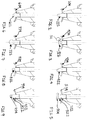
- Figures 2-11 illustrate other exemplary designs of the corona igniter 20 including the central extended member 22 .
- the designs may be selected to meet the requirements of the particular engine application and to provide the best possible thermal performance.
- the extended length l e of the central extended member 22 is greater than the crown length l c .
- each of the second spherical radii r 2 at or adjacent to the central firing end 46 of the central extended member 22 are greater than each of the first spherical radii r 1 at the firing tips 38 of the crown 34 .
- Figure 3A is an enlarged view of a portion of the design of Figure 3 , wherein the central extended member 322 includes a relatively small second spherical radius r 2 , but this second spherical radius r 2 is still greater than the first spherical radii r 1 of the crown 334 .
- the extended diameter D e of the central extended member 22 can decrease in a direction moving from the crown 34 toward the central firing end 46 , or increase in a direction moving from the crown 34 toward the central firing end 46 .
- the central extended member 22 does not need to be symmetrical.
- central extended member 22 Various different materials can be used to form the central extended member 22 , such as nickel, copper, precious metals, or alloys thereof. Portions of the central extended member 22 can also be formed of an insulating material.
- the central extended member 22 is typically formed of a first material and the crown 34 is typically formed of a second material different from the first material.
- the first material used to form the central extended member 22 is typically more resistant to erosion and corrosion than the second material used to form the crown 34 , since the central extended member 22 is more likely to be in contact with high current and temperature of the arc, if arcing does occur.
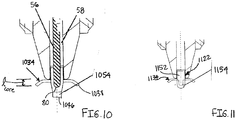
- the central extended member 22 is oftentimes formed of a plurality of separate pieces joined together, such as a body portion 52 and a wear element 54 , as shown in Figures 5, 9 , 10, and 11 .
- any of the shapes shown in Figures 2-11 could comprise a single piece, or a plurality of pieces joined together.
- the central extended member 522 includes a body portion 552 and a wear element 554 connected to one another.
- the wear element 554 is coaxial with the body portion 552 , but it does not need to be.
- the wear element 54 presents the central firing end 46 .
- the wear element 54 is typically formed of a material having good thermal characteristics and being more resistant to wear than the material of the body portion 52 .
- the wear element 54 is formed of a nickel-based alloy, a noble metal, or a precious metal, such as platinum, tungsten, or iridium.
- the wear element 54 is formed of an electrically insulating material preferably having a relative permittivity of greater than 2, and more preferably greater than 8, for example an alumina-based material.
- the wear element 54 can also comprise a coating of metal material or a coating of electrically insulating material.
- the wear element 54 may be applied to the body portion 52 of the central extended member 22 by any suitable means, for example PVD, co-extrusion, or co-sintering. Alternatively, the wear element 54 may be attached by brazing or a similar process. When the wear element 54 is a coating, the coating can be applied by plating, spraying, sintering, or another suitable method. The material of the body portion 52 and the material of the wear element 54 should be selected and joined to provide good bonding, no small gaps, good thermal contact, and to avoid problems with differential thermal expansion, for example.
- the central extended member 1022 in order to better withstand the effects of arc discharge, includes a core 56 formed of copper or a copper alloy, and the core 56 is surrounded by a cladding 58 formed of a nickel alloy.
- the wear element 1054 is attached to the cladding 58 and forms the central firing end 1046 .
- the cladding 58 of the nickel alloy could form the central firing end 1046 .
- the core 56 preferably has a core length l core extending from the top surface 1040 of the crown 1034 to a core firing end 80 .
- the core length l core is parallel to the central axis A and it is equal to the distance between the first plane 42 and a fourth plane 82 each extending perpendicular to the central axis A .
- the fourth plane 82 is disposed at the lowermost point of the core 56 .
- the core length l core is greater than the crown length l c .
- the cladding 58 of the central extended member 1022 still protects the copper core 56 . This design can significantly reduce the maximum temperature of the firing tips 1038 and can prolong the life of the firing tips 1038 and the central firing end 1046 .
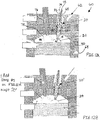
- FIG. 12A and 13A show a corona discharge ignition system 60 including the corona igniter 20 with the central extended member 22 to reduce corrosion and erosion at the firing tips 38 , as shown in Figures 12A and 13A .
- Figures 12B and 13B show s system with another type of corona igniter 20' , which does not include the extended length of the present invention.
- the system 60 includes components found in a conventional internal combustion engine, such as a cylinder head 62 , a cylinder block 64 , and a piston 50 .
- the piston 50 is disposed opposite the cylinder head 62 and presents a space therebetween, and the cylinder block 64 is connected to the cylinder head 62 and surrounds the piston 50 .
- the cylinder head 62 , cylinder block 64 , and piston 50 present a combustion chamber 66 therebetween.
- the cylinder head 62 presents an opening 68 for receiving the corona igniter 20 .
- the shell 32 of the corona igniter 20 is typically coupled to the cylinder head 62 , for example threaded into the opening 68 of the cylinder head 62 , as shown in Figures 12 and 13 .
- a gasket 70 is typically disposed between the shell 32 and the cylinder head 62 .
- the corona igniter 20 can include a terminal 72 for receiving the power from a power supply (now shown), and an insulation material 74 can be disposed between the terminal 72 and the electrode.
- a portion of the insulator 28 , as well as the central firing end 46 and the firing tips 38 are disposed in the combustion chamber 66 .
- a fuel injector 76 is also received in the cylinder head 62 for delivering fuel in the form of finely atomized spray 78 into the combustion chamber 66 .
- the piston 50 approaches the corona igniter 20 , 20' and arcing 25 does occur.
- the system 60 includes the inventive corona igniter 20 , such as in Figure 13A
- the arcing 25 does not occur from the firing tips 38 of the crown 34 , as it does when the comparative corona igniter 20' of Figure 13B is used. Rather, the arcing 25 occurs from the central firing end 46 of the central extension member 22 .
- the extended length l e of the central extended member 22 restricts the arcing 25 to only the central extended member 22 . Since the firing tips 38 of the crown 34 are less exposed to the high temperatures caused by the arcing 25 , they experience less corrosion and erosion. Thus, the firing tips 38 stay sharp and continue to provide a strong corona discharge 24 during future ignition cycles.
- the electrode of the corona igniter 20 of the present invention can also increase the size of the corona discharge 24 during operation.
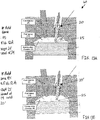
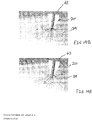
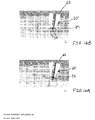
- Figures 14-16 each include a Finite Element Analysis (FEA) of an inventive corona igniter 20 or a comparative corona igniter 20' when power is supplied to the corona igniter 20 , 20' .
- the lines of the FEA images show the most likely direction and length of the corona discharge 24 .
- Figure 14A shows the inventive corona igniter 20 and associated corona discharge 24 when the piston 50 is spaced a significant distance from the central firing end 46 and firing tips 38 ;
- Figure 15A shows the inventive corona igniter 20 and the associated corona discharge 24 when the piston 50 is at the location of typical ignition;
- Figure 16A shows arcing 25 which occurs from the central firing end 46 of the inventive corona igniter 20 when the piston 50 comes very close to the corona igniter 20 .
- Figures 14B-16B each include a FEA of the corona discharge 24 provided by the comparative corona igniter 20' when the piston 50 is in the same positions as Figures 14A-16A .
- Figures 14A and 15A show that the corona igniter 20 of the present invention provides a stronger corona discharge 24 when the piston 50 is spaced from the corona igniter 20 , relative to the comparative corona igniter 20' of Figures 14B and 15B .
- the extended length l e of the central extended member 22 tends to repel the corona streamers as they form, thus providing a more open shape, giving a larger volume, and being less likely to encounter the piston 50 .
- Figure 16A shows that if arcing 25 occurs, the arcing will form from the central firing end 46 of the central extended member 22 , rather than from the firing tips 38 of the crown 34 . This is an advantage over the comparative corona igniter 20' of Figure 16B , wherein the arcing 25 forms from the firing tips 38' of the crown 34' .
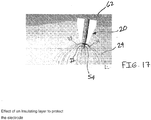
- Figure 17 is a FEA analysis of the inventive corona igniter 20 when the wear element 54 in the form of an insulating coating is applied over the central firing end 46 of the central extended member 22 . This analysis shows that the insulating coating does not detrimentally effect the operation of the corona igniter 20 or the benefits provided by the central extended member 22 .
- Another aspect of the invention provides a method of manufacturing the corona igniter 20 for use in the corona discharge ignition system 60 , which includes providing the central extended member 22 so that extended length l e of the central extended member 22 is greater than the crown length l c .
- the method first includes (a) identifying the firing tip 38 of the crown 34 which will be closest to the cylinder block 64 when the corona igniter 20 is received in the cylinder head 62 .
- method includes (b) determining a point during movement of the piston 50 where a distance from the firing tip 38 identified in step (a) to the cylinder block 64 is equal to a distance from the firing tip 38 identified in step (a) to the piston 50 .
- the method next includes (c) selecting the extended length l e of the central extended member 22 such that when power is provided to the electrode and when the firing tip 38 identified in step (a) is at the point identified in step (b), the peak electric field at the central firing end 46 of the central extended member 22 is equal to or greater than the peak electric field at the firing tip 38 identified in step (a).
- the peak electric field at the central firing end 46 of the central extended member 22 depends on the distance between the central firing end 46 and the piston 50 , and the distance between the central firing end 46 and the cylinder block 64 .
- the method can also include adjusting the extended length l e of the central extended member 22 to space the central firing end 46 of the central extended member 22 farther from the cylinder block 64 and/or the piston 50 during operation.
- the method also typically includes step (d): selecting the first spherical radii r 1 of the firing tips 38 and the second spherical radii r 2 of the central firing end 46 such that during operation, corona discharge will preferentially form from the firing tips 38 , and arcing, if any occurs, will preferentially form between the piston 50 and the central firing end 46 of the central extended member 22 .
- the step of selecting the spherical radii r 1 , r 2 can be conducted before or after selecting the extended length l e .
- the step of selecting the spherical radii r 1 , r 2 includes selecting the first spherical radii r 1 for each of the firing tips 38 of the crown 34 and selecting the second spherical radii r 2 for the central firing end 46 of the central extended member 22 such that each of the first spherical radii r 1 at the firing tips 38 of the crown 34 are smaller than the second spherical radii r 2 of the central extended member 22 .
- the spherical radii r 1 , r 2 are preferably selected so that when power is provided to the electrode, and the at least one firing tip 38 of the crown 34 and the central firing end 46 of the central extended member 22 are spaced from the cylinder block 64 and the piston 50 , and a corona discharge 24 is provided from the firing tips 38 , the peak electric field at the firing tip 38 closest to ground is at least 25% higher than the peak electric field at the central firing end 46 of the central extended member 22 .
- This may be achieved, for example, by using data of the form shown in Figure 18 .
- the first column of Figure 18 is the distance, in millimeters, from the central firing end 46 or the firing tip 38 to ground, also referred to as the gap to ground.
- the second column is the spherical radius, in millimeters, and it could be the spherical radius of either the central firing end 46 or the firing tip 38 .
- the third column is the peak electric field, in volts per meter, when 1 volt is applied.
- the values in Figure 18 are only examples. A dimensionless relationship between the spherical radii r 2 of the central firing end 46 of the central extended member 22 , the spherical radii r 1 of the firing tips 38 , and the extended length l e of the central extended member 22 could be obtained based on the data in Figure 18 .
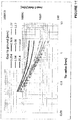
- Figure 19 is a graph providing the peak electric field for spherical radii ranging from about 0.05 mm to about 1.15 mm at various distances from the piston 50 and cylinder block 64 .
- Figure 19 specifically provides the peak electric field when the distance from the firing tip 38 to the piston 50 and to the cylinder block 64 is 0.254 mm, 0.508 mm, 1.27 mm, 2.54 mm, 5.08 mm, 12.7 mm, 24.5 mm, and 50.8 mm.
- the peak electric field at the firing tip 38 should be 25% higher than the peak electric field at the central firing end 46 of the central extended member 22 only at the larger distances, but this is not required at the shorter distances, for example only at 50.8 mm, but not at 0.254 mm.
- the method typically includes (e) determining the peak electric field of the firing tip 38 identified in step (a) at the distance identified in step (b).
- the data of Figure 18 can be used to determine this peak electric field.
- the firing tips 38 each have a spherical radius r 1 of 2.54 mm and a peak electric field of 330 V/m at a distance of 25.4 mm from the piston 50 .
- the method can further include adjusting the spherical radii r 1 , r 2 to meet all safety and operating conditions.
Landscapes
- Engineering & Computer Science (AREA)
- Physics & Mathematics (AREA)
- Plasma & Fusion (AREA)
- Optics & Photonics (AREA)
- Chemical & Material Sciences (AREA)
- Combustion & Propulsion (AREA)
- Mechanical Engineering (AREA)
- General Engineering & Computer Science (AREA)
- Spark Plugs (AREA)
- Ignition Installations For Internal Combustion Engines (AREA)
Applications Claiming Priority (3)
| Application Number | Priority Date | Filing Date | Title |
|---|---|---|---|
| US201361799117P | 2013-03-15 | 2013-03-15 | |
| PCT/US2014/029902 WO2014145184A1 (en) | 2013-03-15 | 2014-03-15 | Wear protection feature for corona igniter |
| EP14722890.2A EP2973900B1 (en) | 2013-03-15 | 2014-03-15 | Wear protection feature for corona igniter |
Related Parent Applications (2)
| Application Number | Title | Priority Date | Filing Date |
|---|---|---|---|
| EP14722890.2A Division EP2973900B1 (en) | 2013-03-15 | 2014-03-15 | Wear protection feature for corona igniter |
| EP14722890.2A Division-Into EP2973900B1 (en) | 2013-03-15 | 2014-03-15 | Wear protection feature for corona igniter |
Publications (1)
| Publication Number | Publication Date |
|---|---|
| EP3382831A1 true EP3382831A1 (en) | 2018-10-03 |
Family
ID=50686176
Family Applications (2)
| Application Number | Title | Priority Date | Filing Date |
|---|---|---|---|
| EP18167224.7A Withdrawn EP3382831A1 (en) | 2013-03-15 | 2014-03-15 | Wear protection feature for corona igniter |
| EP14722890.2A Not-in-force EP2973900B1 (en) | 2013-03-15 | 2014-03-15 | Wear protection feature for corona igniter |
Family Applications After (1)
| Application Number | Title | Priority Date | Filing Date |
|---|---|---|---|
| EP14722890.2A Not-in-force EP2973900B1 (en) | 2013-03-15 | 2014-03-15 | Wear protection feature for corona igniter |
Country Status (7)
| Country | Link |
|---|---|
| US (1) | US9945347B2 (enExample) |
| EP (2) | EP3382831A1 (enExample) |
| JP (2) | JP6370877B2 (enExample) |
| KR (1) | KR20150129036A (enExample) |
| CN (2) | CN105164878B (enExample) |
| BR (1) | BR112015023085A8 (enExample) |
| WO (1) | WO2014145184A1 (enExample) |
Families Citing this family (6)
| Publication number | Priority date | Publication date | Assignee | Title |
|---|---|---|---|---|
| DE102012111190B3 (de) * | 2012-10-29 | 2014-04-30 | Borgwarner Beru Systems Gmbh | Koronazündeinrichtung und Verfahren zum Herstellen eines Zündkopfes für eine Koronazündeinrichtung |
| WO2014145184A1 (en) * | 2013-03-15 | 2014-09-18 | Federal-Mogul Ignition Company | Wear protection feature for corona igniter |
| DE102015116332B4 (de) * | 2015-09-28 | 2023-12-28 | Tdk Electronics Ag | Ableiter, Verfahren zur Herstellung des Ableiters und Verfahren zum Betrieb des Ableiters |
| DE102018105941B4 (de) | 2018-03-14 | 2021-09-02 | Federal-Mogul Ignition Gmbh | Zündkerzen-Zündspitze, Zündkerzenanordnung und Verfahren zum Herstellen einer Zündkerzen-Zündspitze |
| JP6943229B2 (ja) * | 2018-09-03 | 2021-09-29 | マツダ株式会社 | 予混合圧縮着火式エンジン |
| JP6943228B2 (ja) * | 2018-09-03 | 2021-09-29 | マツダ株式会社 | 予混合圧縮着火式エンジン |
Citations (5)
| Publication number | Priority date | Publication date | Assignee | Title |
|---|---|---|---|---|
| US20100083942A1 (en) | 2008-10-03 | 2010-04-08 | James Lykowski | Ignitor for air/fuel mixture and engine therewith and method of assembly thereof into a cylinder head |
| US20110247579A1 (en) * | 2010-04-13 | 2011-10-13 | Keith Hampton | Igniter including a corona enhancing electrode tip |
| US20120055434A1 (en) * | 2010-09-04 | 2012-03-08 | Borgwarner Beru Systems Gmbh | Igniter for igniting a fuel-air-mixture using hf corona discharge and engine fitted with such igniters |
| US20120199088A1 (en) * | 2010-12-14 | 2012-08-09 | John Antony Burrows | Corona ignition device having asymmetric firing tip |
| WO2014145184A1 (en) * | 2013-03-15 | 2014-09-18 | Federal-Mogul Ignition Company | Wear protection feature for corona igniter |
Family Cites Families (31)
| Publication number | Priority date | Publication date | Assignee | Title |
|---|---|---|---|---|
| US4227234A (en) * | 1978-07-03 | 1980-10-07 | Xerox Corporation | Corona charging element |
| US4402036A (en) | 1980-02-08 | 1983-08-30 | Hensley George H | Method of producing a high energy plasma for igniting fuel |
| US4774914A (en) | 1985-09-24 | 1988-10-04 | Combustion Electromagnetics, Inc. | Electromagnetic ignition--an ignition system producing a large size and intense capacitive and inductive spark with an intense electromagnetic field feeding the spark |
| US4841925A (en) * | 1986-12-22 | 1989-06-27 | Combustion Electromagnetics, Inc. | Enhanced flame ignition for hydrocarbon fuels |
| US5019709A (en) * | 1990-01-05 | 1991-05-28 | Pfaff Ernest H | Electrode arrangement for cheating corona |
| JP2847681B2 (ja) * | 1991-12-03 | 1999-01-20 | 日本特殊陶業株式会社 | スパークプラグの中心電極の製造方法 |
| JP2853108B2 (ja) * | 1992-06-17 | 1999-02-03 | 日本特殊陶業 株式会社 | スパークプラグ |
| US5488222A (en) * | 1994-09-16 | 1996-01-30 | Gault; Michael J. | Electrode arrangement for creating corona and method of treating electrically-conductive surfaces |
| US6608430B1 (en) | 2001-12-07 | 2003-08-19 | Robert J. Schaus | Spark plug with multi-point firing cap |
| US20040100179A1 (en) | 2002-11-25 | 2004-05-27 | Boley William C. | Spark plug having an encapsulated electrode gap |
| JP4924275B2 (ja) | 2007-08-02 | 2012-04-25 | 日産自動車株式会社 | 非平衡プラズマ放電式の点火装置 |
| US8104444B2 (en) | 2007-10-31 | 2012-01-31 | Caterpillar Inc. | Pre-chamber igniter having RF-aided spark initiation |
| DE102009059649B4 (de) * | 2009-12-19 | 2011-11-24 | Borgwarner Beru Systems Gmbh | HF-Zündeinrichtung |
| JP5375711B2 (ja) * | 2010-03-30 | 2013-12-25 | 株式会社デンソー | 内燃機関用のスパークプラグ |
| WO2011135903A1 (ja) | 2010-04-26 | 2011-11-03 | 日本碍子株式会社 | 内燃機関の点火装置及び当該点火装置の電極構造 |
| US8701638B2 (en) * | 2010-05-07 | 2014-04-22 | Borgwarner Beru Systems Gmbh | Method for igniting a fuel-air mixture of a combustion chamber, particularly in an internal combustion engine by generating a corona discharge |
| JP5715705B2 (ja) | 2010-10-28 | 2015-05-13 | フェデラル−モーグル・イグニション・カンパニーFederal−Mogul Ignition Company | 非熱プラズマ点火アークの抑制 |
| US8839753B2 (en) | 2010-12-29 | 2014-09-23 | Federal-Mogul Ignition Company | Corona igniter having improved gap control |
| US8844490B2 (en) * | 2011-01-13 | 2014-09-30 | Federal-Mogul Ignition Company | Corona igniter having controlled location of corona formation |
| CN102900586A (zh) * | 2011-07-25 | 2013-01-30 | 何良智 | 多组高压与多头点火的一体火花塞 |
| WO2013028603A1 (en) * | 2011-08-19 | 2013-02-28 | Federal-Mogul Ignition Company | Corona igniter including temperature control features |
| US9088136B2 (en) * | 2012-03-23 | 2015-07-21 | Federal-Mogul Ignition Company | Corona ignition device with improved electrical performance |
| US10056737B2 (en) * | 2012-03-23 | 2018-08-21 | Federal-Mogul Llc | Corona ignition device and assembly method |
| US10056738B2 (en) * | 2012-03-23 | 2018-08-21 | Federal-Mogul Llc | Corona ignition device with improved electrical performance |
| EP3300193B1 (en) * | 2013-05-03 | 2020-10-07 | Federal-Mogul Ignition LLC | Corona ignition with hermetic combustion seal |
| US9484719B2 (en) * | 2014-07-11 | 2016-11-01 | Ming Zheng | Active-control resonant ignition system |
| JP6649359B2 (ja) * | 2014-08-10 | 2020-02-19 | フェデラル−モーグル・イグニション・リミテッド・ライアビリティ・カンパニーFederal−Mogul Ignition Llc | 改良されたシールを有するコロナ点火装置 |
| US9685767B2 (en) * | 2014-08-10 | 2017-06-20 | Federal-Mogul Ignition Company | Corona ignition device with improved seal |
| US9755405B2 (en) * | 2015-03-26 | 2017-09-05 | Federal-Mogul Llc | Corona suppression at the high voltage joint through introduction of a semi-conductive sleeve between the central electrode and the dissimilar insulating materials |
| US9941671B2 (en) * | 2015-09-24 | 2018-04-10 | Federal-Mogul Llc | Air-free cap end design for corona ignition system |
| US10211605B2 (en) * | 2016-01-22 | 2019-02-19 | Tenneco Inc. | Corona igniter with hermetic combustion seal on insulator inner diameter |
-
2014
- 2014-03-15 WO PCT/US2014/029902 patent/WO2014145184A1/en not_active Ceased
- 2014-03-15 EP EP18167224.7A patent/EP3382831A1/en not_active Withdrawn
- 2014-03-15 JP JP2016503277A patent/JP6370877B2/ja not_active Expired - Fee Related
- 2014-03-15 CN CN201480023216.8A patent/CN105164878B/zh not_active Expired - Fee Related
- 2014-03-15 KR KR1020157029728A patent/KR20150129036A/ko not_active Ceased
- 2014-03-15 EP EP14722890.2A patent/EP2973900B1/en not_active Not-in-force
- 2014-03-15 BR BR112015023085A patent/BR112015023085A8/pt not_active IP Right Cessation
- 2014-03-15 CN CN201710542762.8A patent/CN107453211B/zh not_active Expired - Fee Related
- 2014-03-17 US US14/215,540 patent/US9945347B2/en active Active
-
2018
- 2018-07-11 JP JP2018131614A patent/JP2018198209A/ja not_active Ceased
Patent Citations (5)
| Publication number | Priority date | Publication date | Assignee | Title |
|---|---|---|---|---|
| US20100083942A1 (en) | 2008-10-03 | 2010-04-08 | James Lykowski | Ignitor for air/fuel mixture and engine therewith and method of assembly thereof into a cylinder head |
| US20110247579A1 (en) * | 2010-04-13 | 2011-10-13 | Keith Hampton | Igniter including a corona enhancing electrode tip |
| US20120055434A1 (en) * | 2010-09-04 | 2012-03-08 | Borgwarner Beru Systems Gmbh | Igniter for igniting a fuel-air-mixture using hf corona discharge and engine fitted with such igniters |
| US20120199088A1 (en) * | 2010-12-14 | 2012-08-09 | John Antony Burrows | Corona ignition device having asymmetric firing tip |
| WO2014145184A1 (en) * | 2013-03-15 | 2014-09-18 | Federal-Mogul Ignition Company | Wear protection feature for corona igniter |
Also Published As
| Publication number | Publication date |
|---|---|
| CN107453211A (zh) | 2017-12-08 |
| US9945347B2 (en) | 2018-04-17 |
| EP2973900B1 (en) | 2018-12-19 |
| WO2014145184A1 (en) | 2014-09-18 |
| JP6370877B2 (ja) | 2018-08-15 |
| CN105164878B (zh) | 2017-07-28 |
| US20140261270A1 (en) | 2014-09-18 |
| JP2018198209A (ja) | 2018-12-13 |
| BR112015023085A8 (pt) | 2019-12-03 |
| BR112015023085A2 (pt) | 2017-07-18 |
| EP2973900A1 (en) | 2016-01-20 |
| CN105164878A (zh) | 2015-12-16 |
| KR20150129036A (ko) | 2015-11-18 |
| CN107453211B (zh) | 2019-06-14 |
| JP2016519391A (ja) | 2016-06-30 |
Similar Documents
| Publication | Publication Date | Title |
|---|---|---|
| EP2973900B1 (en) | Wear protection feature for corona igniter | |
| US9010294B2 (en) | Corona igniter including temperature control features | |
| EP2724430B2 (en) | Corona igniter assembly including corona enhancing insulator geometry | |
| EP2036173B1 (en) | Small diameter/long reach spark plug with improved insulator design | |
| US10056737B2 (en) | Corona ignition device and assembly method | |
| JP4829892B2 (ja) | 同軸ツイン点火プラグ | |
| US10784655B2 (en) | Corona igniter with hermetic combustion seal on insulator inner diameter | |
| JP2009158343A (ja) | スパークプラグ | |
| EP3338332B1 (en) | Corona ignition device and assembly method | |
| CN111247707A (zh) | 带双金属铆钉的电晕点火器点火端电极头及其制造方法 | |
| US20170025821A1 (en) | Spark plug |
Legal Events
| Date | Code | Title | Description |
|---|---|---|---|
| PUAI | Public reference made under article 153(3) epc to a published international application that has entered the european phase |
Free format text: ORIGINAL CODE: 0009012 |
|
| STAA | Information on the status of an ep patent application or granted ep patent |
Free format text: STATUS: THE APPLICATION HAS BEEN PUBLISHED |
|
| AC | Divisional application: reference to earlier application |
Ref document number: 2973900 Country of ref document: EP Kind code of ref document: P |
|
| AK | Designated contracting states |
Kind code of ref document: A1 Designated state(s): AL AT BE BG CH CY CZ DE DK EE ES FI FR GB GR HR HU IE IS IT LI LT LU LV MC MK MT NL NO PL PT RO RS SE SI SK SM TR |
|
| STAA | Information on the status of an ep patent application or granted ep patent |
Free format text: STATUS: REQUEST FOR EXAMINATION WAS MADE |
|
| 17P | Request for examination filed |
Effective date: 20181203 |
|
| RBV | Designated contracting states (corrected) |
Designated state(s): AL AT BE BG CH CY CZ DE DK EE ES FI FR GB GR HR HU IE IS IT LI LT LU LV MC MK MT NL NO PL PT RO RS SE SI SK SM TR |
|
| STAA | Information on the status of an ep patent application or granted ep patent |
Free format text: STATUS: EXAMINATION IS IN PROGRESS |
|
| 17Q | First examination report despatched |
Effective date: 20190613 |
|
| RAP1 | Party data changed (applicant data changed or rights of an application transferred) |
Owner name: FEDERAL-MOGUL IGNITION LLC |
|
| STAA | Information on the status of an ep patent application or granted ep patent |
Free format text: STATUS: THE APPLICATION IS DEEMED TO BE WITHDRAWN |
|
| 18D | Application deemed to be withdrawn |
Effective date: 20211001 |