EP3382326B1 - Apparatus and method for ascertaining the grip length of a fastener for use in a component - Google Patents
Apparatus and method for ascertaining the grip length of a fastener for use in a component Download PDFInfo
- Publication number
- EP3382326B1 EP3382326B1 EP18163492.4A EP18163492A EP3382326B1 EP 3382326 B1 EP3382326 B1 EP 3382326B1 EP 18163492 A EP18163492 A EP 18163492A EP 3382326 B1 EP3382326 B1 EP 3382326B1
- Authority
- EP
- European Patent Office
- Prior art keywords
- pin
- component
- flanges
- aperture
- grip length
- Prior art date
- Legal status (The legal status is an assumption and is not a legal conclusion. Google has not performed a legal analysis and makes no representation as to the accuracy of the status listed.)
- Active
Links
Images

Classifications
-
- G—PHYSICS
- G01—MEASURING; TESTING
- G01B—MEASURING LENGTH, THICKNESS OR SIMILAR LINEAR DIMENSIONS; MEASURING ANGLES; MEASURING AREAS; MEASURING IRREGULARITIES OF SURFACES OR CONTOURS
- G01B5/00—Measuring arrangements characterised by the use of mechanical techniques
- G01B5/02—Measuring arrangements characterised by the use of mechanical techniques for measuring length, width or thickness
- G01B5/06—Measuring arrangements characterised by the use of mechanical techniques for measuring length, width or thickness for measuring thickness
-
- G—PHYSICS
- G01—MEASURING; TESTING
- G01B—MEASURING LENGTH, THICKNESS OR SIMILAR LINEAR DIMENSIONS; MEASURING ANGLES; MEASURING AREAS; MEASURING IRREGULARITIES OF SURFACES OR CONTOURS
- G01B3/00—Measuring instruments characterised by the use of mechanical techniques
- G01B3/002—Details
-
- G—PHYSICS
- G01—MEASURING; TESTING
- G01B—MEASURING LENGTH, THICKNESS OR SIMILAR LINEAR DIMENSIONS; MEASURING ANGLES; MEASURING AREAS; MEASURING IRREGULARITIES OF SURFACES OR CONTOURS
- G01B3/00—Measuring instruments characterised by the use of mechanical techniques
- G01B3/22—Feeler-pin gauges, e.g. dial gauges
-
- G—PHYSICS
- G01—MEASURING; TESTING
- G01B—MEASURING LENGTH, THICKNESS OR SIMILAR LINEAR DIMENSIONS; MEASURING ANGLES; MEASURING AREAS; MEASURING IRREGULARITIES OF SURFACES OR CONTOURS
- G01B3/00—Measuring instruments characterised by the use of mechanical techniques
- G01B3/22—Feeler-pin gauges, e.g. dial gauges
- G01B3/28—Depth gauges
-
- G—PHYSICS
- G01—MEASURING; TESTING
- G01B—MEASURING LENGTH, THICKNESS OR SIMILAR LINEAR DIMENSIONS; MEASURING ANGLES; MEASURING AREAS; MEASURING IRREGULARITIES OF SURFACES OR CONTOURS
- G01B5/00—Measuring arrangements characterised by the use of mechanical techniques
- G01B5/18—Measuring arrangements characterised by the use of mechanical techniques for measuring depth
Definitions
- the present disclosure relates in general to measurement tools, and more particularly to a wireless fastener grip gauge.
- US 2008/104855 A1 discloses measuring the linear movement of a sleeve between a retracted position and an extended position by a sensor located inside the housing of the device.
- the distal end of the sleeve is provided with a flange to contact the surface whose distance from the device has to be measured.
- One existing approach for example, is a manual tool that consists of a hook and a slider. An operator hooks the gauge on the backside of the aperture and slides the slider up to the surface of the part. The location of the front end of the slider (as read by the operator) will indicate the length needed.
- Another existing approach consists of a depth gauge attached to a slider. An operator pulls back on a slider mechanism to reveal a hook. The hook is then placed on the backside of the aperture and the operator pushes the slide mechanism closed in order to clamp the hook to the part.
- the first solution is an entirely manual method that is susceptible to operator variation and misinterpretation, especially at the edges of the ranges for each value.
- the hooking operation can also lead to the gauge not being centered or perpendicular to the surface, which can cause measurements to be skewed.
- the second existing approach described above requires a number of motions and inputs from the operator in order to operate, and is very tiresome to operate due to poor ergonomic design. Similar to the first approach, the hooking operation can lead to the gauge not being centered or perpendicular to the surface, which can cause measurements to be skewed.
- an apparatus comprising a pin, a housing, a stop, a spring, one or more flanges, a linear displacement metrology device, and a transmitter.
- the pin comprises a first end configured for insertion in an aperture in a component.
- the housing is affixed proximate to a second end of the pin.
- the stop is slidably engaged with the pin and configured to contact a first surface of the component as the pin is inserted into the aperture in the component.
- the spring couples the stop to the housing. The spring is configured to compress when the stop contacts the first surface of the component as the pin is inserted in the aperture in the component.
- the one or more flanges are located proximate to the first end of the pin.
- the one or more flanges are configured to transition between a first retracted state during insertion of the pin and a second extended state when the first end of the pin passes through the aperture in the component.
- the one or more flanges are configured to contact a second surface of the component when in the second extended state.
- the linear displacement metrology device is coupled to the pin such that an axis of the linear displacement metrology device is substantially aligned with an axis of the pin.
- the transmitter is communicatively coupled to the linear displacement metrology device.
- the transmitter is located in the housing and configured to communicate to a receiver a value indicating a grip length of a fastener for use in the aperture in the component.
- a method comprises inserting a first end of the pin of the grip gauge into an aperture in a component.
- the method comprises determining a grip length for a fastener to be used in the aperture in the component, the grip length determined based on a measurement performed using a measurement device coupled to the pin of the grip gauge.
- the method comprises transmitting the determined grip length to a receiver.
- Certain embodiments may have one or more technical advantages. For example, certain embodiments may advantageously reduce the subjectivity of measurements due to variation among operators and reduce the number of operator motions required to operate the apparatus. For example, certain embodiments may only require the operator to insert the pin and then, due to the spring-flange mechanism and linear displacement metrology device (which may, in certain embodiments, include a timer), the apparatus measures the part and transmits the data on its own, thereby requiring the operator to simply move the pin from aperture to aperture. Other advantages may be readily apparent to one having skill in the art. Certain embodiments may have none, some, or all of the recited advantages.
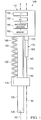
- FIGURE 1 illustrates an example apparatus 100, in accordance with certain embodiments.
- Apparatus 100 includes a pin 105, a housing 110, a stop 115, a spring 120, one or more flanges 125, and a measurement device 130.
- Pin 105 comprises a first end 135 and a second end 140.
- First end 135 is configured for insertion in an aperture in a component in which a fastener is intended to be used.
- Second end 140 is coupled to housing 110.
- pin 105 may be removably coupled to housing 110.
- Pin 105 may have any suitable shape and dimensions, and the shape and dimensions of pin 105 may vary according to different implementations of apparatus 100.
- pin 105 is sized to a specific diameter of the aperture being measured.
- pin 105 may be designed for use with different sized apertures, and the diameter of pin 105 may be slightly less than the diameter of the smallest aperture with which pin 105 may be used.
- pin 105 may have a shape and dimensions that correspond to the shape and dimensions of the aperture in which pin 105 is to be inserted. This may advantageously restrict movement of pin 105 as it moves in and out of the aperture in the component, thereby preventing differences in measurements due to variations in an amount of movement of pin 105 among operators.
- Pin 105 may be made from any suitable material.
- pin 105 may be made from metal (e.g., aluminum), rubber, or plastic (e.g., Delrin®), or any other suitable material or any suitable combination of materials.
- Stop 115 is slidably engaged with pin 105. Stop 115 is coupled to spring 120 and measurement device 130. Stop 115 is configured to contact a first surface of the component as pin 105 is inserted into the aperture in the component. Stop 115 may have any suitable dimensions and may be made of any suitable material. The dimensions and material forming stop 115 may vary according to different implementations of apparatus 100. As a particular example, stop 115 may be formed of rubber.
- Spring 120 couples stop 115 to housing 110. In its resting state, spring 120 is extended. In certain embodiments, in its resting state spring 120 may be extended such that stop 115 is substantially co-located with first end 135 of pin 105. In other words, spring 120 may have a substantially similar length as pin 105 when in its resting position. Spring 120 is configured to compress when stop 115 contacts the first surface of the component as pin 105 is inserted in the aperture in the component.
- One or more flanges 125 are located proximate to first end 135 of pin 105.
- One or more flanges 125 are configured to transition between a first retracted state during insertion of the pin and a second extended state when first end 135 of pin 105 passes through the aperture in the component.
- one or more flanges 125 are configured to contact a second surface of the component when in the second extended state.
- one or more flanges 125 are affixed to the exterior of pin 105 using one or more hinges.
- the hinges may be two-way spring-loaded hinges.
- one or more flanges 125 are located inside pin 105 when in the first retracted state.
- one or more flanges 125 may be configured to extend substantially perpendicular to an axis 190 of pin 105 such that they can contact the second surface of the component when in the second extended state.
- apparatus 100 may further comprise a mechanism for causing one or more flanges 125 to transition between the first retracted state and the second extended state.
- Measurement device 130 may be any suitable measurement device for determining a grip length of a fastener for use in the aperture of the component.
- measurement device 130 may be a linear displacement metrology device.
- measurement device 130 may be a capacitive displacement sensor.
- the grip length of a fastener refers to the length from the head of a fastener down to where the threads would start.
- grip length may be determined based at least in part on a depth of the aperture in the component.
- the grip length may be derived from a measurement of a distance from a first surface of the component through the aperture to a second surface of the component to obtain a stack thickness value.
- Further refinement of the stack thickness value may be performed to obtain the grip length.
- the refinement may be performed by software associated with measurement device 130 (e.g., circuitry 175), processing circuitry 145, or by another element on data received from apparatus 110 (e.g., receiving unit 605 described below in relation to FIGURE 6 ).
- measurement device 130 is a linear displacement metrology device.
- Linear displacement metrology device 130 includes a cylinder 165, a rod 170, and circuitry 175.
- Rod 170 has a first end 180 coupled to stop 115 and a second end 185 coupled to cylinder 165.
- Rod 170 is slidably engaged with cylinder 165.
- linear displacement metrology device (or, more generally, measurement device 130) may be oriented such that an axis 195 of measurement device 130 is parallel to axis 190 of pin 105.
- Circuitry 175 is configured to measure a distance that rod 170 has moved responsive to insertion of pin 105 into the aperture in the component. Circuitry 175 may be configured to translate a distance that rod 170 has moved relative to cylinder 165 into a measurement of the grip length of a fastener for use in the aperture in the component.
- Housing 110 is affixed proximate to second end 140 of pin 105.
- Housing 110 may be formed from any suitable material and may have any suitable shape.
- housing 110 may be formed of metal, plastic, any other suitable material or any suitable combination of materials.
- Housing 110 may include any suitable components.
- housing 110 includes processing circuitry 145, transmitter 150, receiver 155 and one or more memory devices 160.
- transmitter 150 is wireless.
- the functions of transmitter 150 and receiver 155 may be combined in a transceiver.
- processing circuitry 145, transmitter 150, receiver 155, and one or more memory devices 160 may be communicatively coupled to measurement device 130 or, more particularly with respect to the example embodiment illustrated in FIGURE 1 , to circuitry 175 of the linear displacement metrology device.
- Transmitter 150 may be configured to transmit a value indicating a determined grip length of a fastener for use in the aperture in the component.
- Processing circuitry 145, transmitter 150, receiver 155, and one or more memory devices 160 are described in more detail below in relation to FIGURE 6 .
- housing 110 may include additional components beyond those illustrated in FIGURE 1 .
- housing 110 may include an indicator light (such as an LED light) that provides an indication to an operator when a measurement has been completed.
- housing 110 may include a display (e.g., a digital readout or indicator light). The digital readout may, for example, display the determined grip length of the fastener for use in the component.
- the indicator light may provide an indication of whether measurement device 130 has obtained a successful measurement.
- pin 105 may be hollow and processing circuitry 145, transmitter 150, receiver 155, one or more memory devices 160 and the additional components described above may be included inside pin 105.
- an operator using apparatus 100 inserts first end 135 of pin 105 into an aperture in a component.
- stop 115 contacts a first surface of the component.
- one or more flanges 125 are in the first retracted state.
- pin 105 slides through stop 115, which remains pressed against the first surface of the component due to spring 120. More particularly, the movement of pin 105 while stop 115 is at rest against the first surface of the component causes compression of spring 120 (which applies force against stop 115 and causes stop 115 to remain in contact with the first surface of the component. The movement of pin 105 while stop 115 is at rest against the first surface of the component also causes rod 170 to move into cylinder 165 of measurement device 130.
- one or more flanges 125 are in a first retracted state.
- first end 135 of pin 105 exits the aperture in the component, one or more flanges 125 transition to a second extended state and contact a second surface of the component.
- the operator of apparatus 100 may release apparatus 100, and force applied by spring 120 causes apparatus 100 to claimp against the part due to a squeezing action between stop 115 at the first surface of the component and one or more flanges 125 at the second surface of the component.
- Measurement device 130 measures a grip length of a fastener for use in the aperture in the component based on the amount of movement of rod 170 relative to cylinder 165 when pin 105 was inserted into the aperture.
- apparatus 100 may include a timer.
- the measurement will be automatically recorded (e.g., in one or more memory devices 160) and transmitted by transmitter 150 toward a receiver (as described in more detail below in relation to FIGURE 6 ).
- a display may indicate whether a successful measurement has been performed (e.g., by displaying a digital readout of the measurement or illuminating an indicator light indicating a successful measurement). The operator may then remove pin 105 from the aperture.
- one or more flanges 125 will transition from the second extended state to a third retracted state (e.g., by collapsing outward when pin 105 is pulled back out of the aperture or by retracting into pin 105) to allow for removal.
- the third retracted state may be the same as the first retracted state.
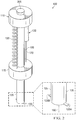
- FIGURE 2 illustrates another view of apparatus 100 of FIGURE 1 , in accordance with certain embodiments. More particularly, FIGURE 2 illustrates apparatus 100 and a close-up view of first end 135 of pin 105.
- apparatus 100 includes flanges 125A and 125B. As described above, flanges 125A and 125B may be configured to alternate between a first retracted state during insertion of pin 105 and a second extended state when first end 135 of pin 105 exits the aperture in the component. In the example of FIGURE 2 , flange 125A and flange 125B are shown in the second extended state.
- Flanges 125 may be coupled to pin 105 in any suitable manner.
- each of flange 125A and flange 125B may be coupled to pin 105 using a hinge, as described in more detail below in relation to FIGURE 3 .
- flanges 125A and 125B may be located inside pin 105 when in the first retracted state and configured to extend substantially perpendicular to axis 190 of pin 105 such that they can contact the second surface of the component when in the second extended state.
- apparatus 100 includes a mechanism 205 for causing flange 125A and flange 125B to transition from the first retracted state to the second extended state and from the second extended state to the first retracted state.
- Mechanism 205 may be any suitable mechanism.
- mechanism 205 may be a button, which when pressed a first time causes one or more flanges 125 to transition from the first retracted state to the second extended state.
- pressing the button a second time may cause one or more flanges 125 to transition to a third retracted state that is the same as the first retracted state.
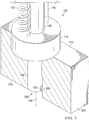
- FIGURE 3 illustrates apparatus 100 during a first stage of operation, in accordance with certain embodiments. More particularly, FIGURE 3 illustrates first end 135 of pin 105 of apparatus 100 in the initial stage of measuring a grip length of a fastener for use in a component 305.
- Component 305 has a first surface 310 and a second surface 315. Aperture 320 in component 305 runs through component 305 from first surface 310 to second surface 315.
- stop 115 contacts first surface 310. Because pin 105 is slidably engaged with stop 115, pin 105 continues to move through aperture 320 in component 305 toward second surface 315 while stop 115 remains in contact with first surface 310. This causes spring 120 to compress and apply force to stop 115, pressing stop 115 against first surface 310.
- flanges 125 are in the first retracted state as pin 105 moves through aperture 320 in component 305.
- flanges 125 are affixed to pin 105 using hinges 325 and, in the first retracted state, are flush against pin 105 and oriented substantially parallel to axis 190 of pin 105.
- flanges 125 may be located inside pin 105 when in the first retracted state.
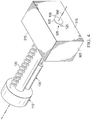
- FIGURE 4 illustrates apparatus 100 during a second stage of operation, in accordance with certain embodiments. More particularly, FIGURE 4 illustrates apparatus 100 after first end 135 of pin 105 has exited aperture 320 in component 305. As shown in the example embodiment of FIGURE 4 , as pin 105 passes through aperture 320 of component 305, flanges 125 transition from the first retracted state to a second extended state. In the second extended state, flanges 125 extend substantially perpendicular to axis 190 of pin 105 and contact second surface 315 of component 305.
- measurement device 130 may perform a measurement of the grip length of a fastener for use in aperture 320 of component 305.
- measurement device 130 may be a linear displacement metrology device.
- circuitry 175 of measurement device 130 may determine a grip length based on the movement of rod 170 relative to cylinder 165.
- measurement device 130 may send measurement information to processing circuitry in housing 110 (e.g., processing circuitry 145 described above in relation to FIGURE 1 ).
- the processing circuitry may utilize transmitter 150 to transmit a value indicating the measurement of the grip length of the fastener for use in aperture 320 (e.g., the actual measurement or any suitable indication thereof) to another component (e.g., a receiver in wireless communication with transmitter 150).
- measurement device 130 may wait to provide the measurement of grip length to the processing circuitry 145 until it reads a consistent measurement of the grip length for a certain period of time (e.g., as measured by a timer associated with measurement device 130).
- the period of time may be any suitable time period.
- the time period may be 0.5 seconds.
- the measurement information may be automatically provided upon expiration of the timer. This may advantageously require no additional action on the part of an operator of apparatus 100.
- apparatus 100 may provide an indication to the operator of apparatus 100 after successfully reading a measurement of the grip length.
- the indication may be provided in any suitable manner.
- the indication may be an LED light that indicates whether a measurement of the grip length has been successfully obtained (e.g., a green LED light may indicate a successful measurement).
- the indication may be an audible signal (e.g., a beep) that indicates to the operator of apparatus 100 that a measurement of the grip length has been successfully obtained.
- FIGURE 5 illustrates apparatus 100 during a third stage of operation, in accordance with certain embodiments. More particularly, FIGURE 5 illustrates pin 105 being removed from aperture 320 in component 305. The stage of operation illustrated in FIGURE 5 may, for example, occur after a successful measurement of the grip length of a fastener for use in aperture 320 in component 305 has been obtained.
- flanges 125 are shown in a third retracted state as pin 105 moves out of aperture 320 in component 305.
- flanges 125 are affixed to pin 105 using hinges 325.
- hinges 325 As pin 105 is removed from aperture 320 in component 305, flanges 125 transition to the third retracted state.
- flanges 125 In the third retracted state, flanges 125 are oriented toward second surface 315 of component 305 and substantially parallel to axis 190 of pin 105. This may advantageously enable pin 105 to be easily removed from aperture 320 in component 305.
- flanges 125 may be located inside pin 105 when in the third retracted state. Similar to the transition from the first retracted state to the second extended state described above in relation to FIGURE 2 , an operator may use a mechanism, such as mechanism 205 described above, to transition flanges 125 from the second extended state to the third retracted state.
- mechanism 205 is a button
- the operator may press the button a second time (the first time being when the button was depressed to cause the transition from the first retracted state to the second extended state, as described above in relation to FIGURE 2 ) in order to cause flanges 125 to transition from the second extended state to the third retracted state.
- the third retracted state may be the same as the first retracted state.
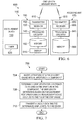
- FIGURE 6 is a schematic diagram of a system employing the example apparatus of FIGURE 1 , in accordance with certain embodiments.
- System 600 includes apparatus 100 and receiving unit 605.
- Apparatus 100 includes housing 110 and measurement device 130.
- housing 110 includes processing circuitry 145, transmitter 150, receiver 155, one or more memory devices 160, antenna 610 and display 615.
- Measurement device 130 includes timer 620. As described above, in certain embodiments the functions of transmitter 150 and receiver 155 may be combined into a transceiver. In some cases, housing 110 may not include receiver 155.
- measurement device 130 is communicatively coupled to processing circuitry 145 in housing 110. Although depicted in FIGURE 6 as located outside housing 110, in certain embodiments one or more components of measurement device 130 may be included in housing 110. For example, in certain embodiments circuitry 175 described above may be contained in housing 110. In addition, apparatus 100 may include the various additional elements of apparatus 100 described above in relation to FIGURES 1-5 .
- Receiving unit 605 includes antenna 615, processing circuitry 645, transmitter 650, receiver 655, and one or more memory devices 660. In certain embodiments, receiving unit 605 may not include transmitter 650. Receiving unit 605 may include additional elements beyond those shown in FIGURE 6 . For example, in certain embodiments receiving unit 605 may include an input device (e.g., a keyboard, touchscreen, or other suitable input device) and a display device.
- an input device e.g., a keyboard, touchscreen, or other suitable input device
- Processing circuitry 145 may be any electronic circuitry, including, but not limited to microprocessors, application specific integrated circuits (ASIC), application specific instruction set processor (ASIP), and/or state machines, that communicatively couples to one or more of measurement device 130, transmitter 150, receiver 155 (or, in some cases, a transceiver), one or more memory devices 160, display 615, and timer 620 and controls one or more operations of apparatus 100.
- Processing circuitry 145 may be 8-bit, 16-bit, 32-bit, 64-bit or of any other suitable architecture.
- Processing circuitry 145 may include an arithmetic logic unit (ALU) for performing arithmetic and logic operations, processor registers that supply operands to the ALU and store the results of ALU operations, and a control unit that fetches instructions from one or more memory devices 160 and executes them by directing the coordinated operations of the ALU, registers and other components.
- Processing circuitry 145 may include other hardware and software that operates to control and process information.
- Processing circuitry 145 executes software stored on one or more memory devices 160 to perform any of the functions described herein.
- Processing circuitry 145 controls one or more operations of apparatus 100 by processing information received by or from measurement device 130, transmitter 150, receiver 155, and one or more memory devices 160.
- Processing circuitry 145 may be a programmable logic device, a microcontroller, a microprocessor, any suitable processing device, or any suitable combination of the preceding. Processing circuitry 145 is not limited to a single processing device and may encompass multiple processing devices.
- Transmitter 150 and receiver 155 facilitate transmitting wireless signals from apparatus 100 to receiving unit 605 and receiving wireless signals at apparatus 100 from receiving unit 605, respectively.
- Transmitter 150 and receiver 155 may be any suitable devices operable to transmit and receive information, respectively. In some cases, transmitter 150 and receiver 155 may perform suitable processing of the information, communicate to other devices in addition to receiving unit 605, or any combination of the preceding. For example, transmitter 150 may transmit a value indicating a determined measurement of grip length of a fastener (e.g., the determined measurement or any suitable indication thereof) to a computing device, such as receiving unit 605 and/or any other suitable component. Receiver 155 may receive data from receiving unit 605 and/or any other suitable component. Transmitter 150 and receiver 155 may include any suitable hardware and/or software, including protocol conversion and data processing capabilities, to communicate through a LAN, WAN, or other communication systems that allows apparatus 100 to exchange information with other components.
- Transmitter 150 may be communicatively coupled to measurement device 130. Transmitter 150 is configured to communicate to receiving unit 605 a value indicating a determined grip length of a fastener for use in the aperture in the component.
- One or more memory devices 160 may store, either permanently or temporarily, data (e.g., determined measurements of grip length), operational software, or other information for processing circuitry 145.
- One or more memory devices 160 may include any one or a combination of volatile or non-volatile local or remote devices suitable for storing information.
- one or more memory devices 160 may include random access memory (RAM), read only memory (ROM), magnetic storage devices, optical storage devices, or any other suitable information storage device or a combination of these devices.
- the software represents any suitable set of instructions, logic, or code embodied in a computer-readable storage medium.
- the software may be embodied in memory 120, a disk, a compact disc (CD), or a flash drive.
- the software may include an application executable by processing circuitry 145 to perform one or more of the functions of apparatus 100 described herein.
- Display 615 may be any suitable display.
- display 615 may be a digital readout or an indicator light (e.g., an LED light).
- display 615 may indicate whether a successful measurement has been performed (e.g., by displaying a digital readout of the measurement or illuminating an indicator light indicating a successful measurement).
- the indication may be provided in any suitable manner.
- the indication may be an LED light that indicates whether a measurement of the grip length has been successfully obtained (e.g., a green LED light may indicate a successful measurement).
- apparatus 100 may include any suitable combination of hardware or software to provide an audible indication to an operator of apparatus 100.
- the indication may be an audible signal (e.g., a beep) that indicates to the operator of apparatus 100 that a measurement of the grip length has been successfully obtained.
- Measurement device 130 may use timer 620 to determine when to send measurement information.
- measurement device 130 may wait to provide a measurement of grip length to processing circuitry 145 until it reads a consistent measurement of the grip length for a certain period of time (e.g., as measured by timer 620 associated with measurement device 130).
- the period of time may be any suitable time period.
- the time period may be 0.5 seconds.
- the measurement information may be automatically provided upon expiration of timer 620.
- Processing circuitry 645, transmitter 650, receiver 655, and one or more memory devices 660 of receiving unit 605 may have analogous characteristics to processing circuitry 145, transmitter 150, receiver 155, and one or more memory devices 160 described above.
- these components of receiving unit 605 may be implemented using any of the hardware/software described above with respect to apparatus 100. Thus, for the sake of brevity, only differences will be described.
- processing circuitry 645 communicatively couples to one or more of transmitter 650, receiver 655 (or, in some cases, a transceiver), and one or more memory devices 660 and controls one or more operations of receiving unit 605.
- Processing circuitry 645 executes software stored on one or more memory devices 660 to perform any of the functions of receiving unit 605 described herein.
- Processing circuitry 645 controls one or more operations of receiving unit 605 by processing information received by or from transmitter 650, receiver 655, and one or more memory devices 660.
- Transmitter 650 and receiver 655 (or, in certain embodiments, a transceiver) facilitate transmitting wireless signals to apparatus 100 from receiving unit 605 and receiving wireless signals at receiving unit 605 from apparatus 100, respectively.
- receiver 655 may receive a value indicating a measurement of grip length of a fastener (e.g., the actual measurement or any suitable indication thereof) from apparatus 100.
- One or more memory devices 660 may store, either permanently or temporarily, data (e.g., received measurements of grip length), operational software, or other information for processing circuitry 645.
- FIGURE 7 is a flow diagram of a method 700, in accordance with certain embodiments.
- Method 700 begins at step 704, where a first end of a pin of a grip gauge is inserted into an aperture in a component.
- the grip gauge may comprise: a pin having a first end configured for insertion in the aperture in the component; a stop slidably engaged with the pin and configured to contact a first surface of the component as the pin is inserted into the aperture in the component; a spring coupling the stop to the housing; one or more flanges located proximate to the first end of the pin, the one or more flanges configured to contact a second surface of the component; and a transmitter communicatively coupled to the linear displacement metrology device and configured to transmit a value indicating the determined grip length to the receiver.
- the grip gauge may comprise one or more flanges located proximate to the first end of the pin.
- the one or more flanges may be configured to contact a second surface of the component, and the one or more flanges may be configured to transition between a first retracted state during insertion of the pin and a second extended state when the first end of the pin passes through the aperture in the component.
- the one or more flanges may be affixed to the exterior of the pin using one or more hinges.
- the one or more flanges may be located inside the pin when in the first retracted state, and the one or more flanges may be configured to extend perpendicular to the pin such that they can contact the second surface of the component when in the second extended state.
- the method may comprise causing the one or more flanges to transition between the first retracted state and the second extended state.
- a grip length for a fastener to be used in the aperture in the component is determined, the grip length determined based on a measurement performed using a measurement device coupled to the pin of the grip gauge.
- the measurement device may comprise a linear displacement metrology device.
- the linear displacement metrology device may comprise: a cylinder; a rod having a first end coupled to the stop and a second end coupled to the cylinder, wherein the rod is slidably engaged with the cylinder.
- the method may comprise measuring a distance that the rod has moved responsive to insertion of the pin into the aperture, the distance that the rod has moved corresponding to the grip length.
- an indication of the determined grip length is transmitted to a receiver.
- transmitting the determined grip length to the receiver may comprise wirelessly transmitting the determined grip length to the receiver.
Landscapes
- Physics & Mathematics (AREA)
- General Physics & Mathematics (AREA)
- A Measuring Device Byusing Mechanical Method (AREA)
Applications Claiming Priority (1)
| Application Number | Priority Date | Filing Date | Title |
|---|---|---|---|
| US15/472,784 US10330453B2 (en) | 2017-03-29 | 2017-03-29 | Wireless fastener grip gauge |
Publications (2)
| Publication Number | Publication Date |
|---|---|
| EP3382326A1 EP3382326A1 (en) | 2018-10-03 |
| EP3382326B1 true EP3382326B1 (en) | 2020-05-13 |
Family
ID=61763836
Family Applications (1)
| Application Number | Title | Priority Date | Filing Date |
|---|---|---|---|
| EP18163492.4A Active EP3382326B1 (en) | 2017-03-29 | 2018-03-22 | Apparatus and method for ascertaining the grip length of a fastener for use in a component |
Country Status (3)
| Country | Link |
|---|---|
| US (1) | US10330453B2 (enExample) |
| EP (1) | EP3382326B1 (enExample) |
| JP (1) | JP6817247B2 (enExample) |
Families Citing this family (4)
| Publication number | Priority date | Publication date | Assignee | Title |
|---|---|---|---|---|
| US10350759B2 (en) * | 2017-08-14 | 2019-07-16 | The Boeing Company | Alignment tool for fastener feed mechanism |
| US11313660B2 (en) | 2020-03-30 | 2022-04-26 | Lockheed Martin Corporation | Digital grip gauge with shaped tip |
| CN112729203B (zh) * | 2021-01-21 | 2024-04-05 | 镇安芯木田科技有限公司 | 一种探针孔深检测机构 |
| CN115014303B (zh) * | 2022-07-21 | 2023-08-01 | 湖南城建职业技术学院 | 一种建筑室内测绘装置 |
Family Cites Families (28)
| Publication number | Priority date | Publication date | Assignee | Title |
|---|---|---|---|---|
| US4112355A (en) | 1976-10-22 | 1978-09-05 | Lockheed Corporation | Quality and fit measuring apparatus for fasteners and their holes |
| US4216585A (en) * | 1978-09-26 | 1980-08-12 | Hi-Shear Corporation | Depth gage |
| US5013318A (en) | 1990-07-31 | 1991-05-07 | Special Devices Incorporated | Medical instrument for measuring depth of fastener hold in bone |
| US5095638A (en) * | 1990-10-05 | 1992-03-17 | Northrop Corporation | Method for assigning standard fasteners in accordance with a series of measurements |
| US5189808A (en) | 1991-06-03 | 1993-03-02 | The Boeing Company | Measurement gauge |
| US5588554A (en) | 1992-09-21 | 1996-12-31 | The Boeing Company | Feeding fasteners to a workpiece |
| IT1263452B (it) | 1993-07-01 | 1996-08-05 | Marposs Spa | Comparatore a tampone. |
| US5657550A (en) * | 1994-10-12 | 1997-08-19 | Js Research And Development, Inc. | Hand-held gap and contour measuring gauge |
| US5497560A (en) | 1995-01-27 | 1996-03-12 | Pasquerella; David | Depth finder |
| US5673839A (en) | 1995-11-29 | 1997-10-07 | The Boeing Company | Real-time fastener measurement system |
| US6494848B1 (en) | 1996-12-19 | 2002-12-17 | St. Jude Medical Puerto Rico B.V. | Measuring device for use with a hemostatic puncture closure device |
| AU7103298A (en) * | 1997-04-18 | 1998-11-13 | Huck International, Inc. | Control system for an assembly tool |
| CA2476208A1 (en) * | 2002-02-07 | 2003-08-14 | Synthes (U.S.A.) | Device for length and depth measurements in surgery |
| US6764453B2 (en) | 2002-05-08 | 2004-07-20 | Sherwood Services Ag | Stoma measuring device |
| US7065897B2 (en) | 2004-11-02 | 2006-06-27 | The Boeing Company | Fastener grip length selector |
| US20060116637A1 (en) | 2004-11-30 | 2006-06-01 | Kimberly-Clark Worldwide, Inc. | Tract measuring device having a unitary occluded tip and inflatable sock member and method of making the same |
| US7165336B2 (en) * | 2005-03-16 | 2007-01-23 | Eidosmed Llc | Surgical depth instrument |
| US7559150B2 (en) * | 2005-10-13 | 2009-07-14 | Synthes Usa, Llc | Depth gauge |
| US7665221B2 (en) | 2006-05-25 | 2010-02-23 | The Boeing Company | Method and apparatus for hole diameter profile measurement |
| US7607238B2 (en) * | 2006-11-07 | 2009-10-27 | Eidosmed Llc | Digital depth gauge |
| US8512349B2 (en) * | 2007-12-13 | 2013-08-20 | Richard A. Mengato | Apparatus for measuring depth of a bone opening and related method |
| US7895767B2 (en) | 2008-09-12 | 2011-03-01 | Eidosmed Llc | Electronic depth gauge with variable electrical resistance sensing |
| US7913414B2 (en) | 2009-03-18 | 2011-03-29 | The Boeing Company | Nut plate grip gage |
| US8606540B2 (en) | 2009-11-10 | 2013-12-10 | Projectionworks, Inc. | Hole measurement apparatuses |
| US8365428B2 (en) | 2010-12-15 | 2013-02-05 | Lockheed Martin Corporation | Hole grip length measurement apparatus |
| US8336222B1 (en) | 2011-06-27 | 2012-12-25 | The Boeing Company | Method and apparatus for measuring spaces with limited access |
| US9797707B2 (en) | 2014-01-08 | 2017-10-24 | The Boeing Company | Electronic gage apparatus |
| GB2533423A (en) | 2014-12-19 | 2016-06-22 | Airbus Operations Ltd | Method and apparatus for determining a hole depth |
-
2017
- 2017-03-29 US US15/472,784 patent/US10330453B2/en active Active
-
2018
- 2018-03-22 EP EP18163492.4A patent/EP3382326B1/en active Active
- 2018-03-29 JP JP2018063541A patent/JP6817247B2/ja active Active
Non-Patent Citations (1)
| Title |
|---|
| None * |
Also Published As
| Publication number | Publication date |
|---|---|
| US10330453B2 (en) | 2019-06-25 |
| JP6817247B2 (ja) | 2021-01-20 |
| JP2018185295A (ja) | 2018-11-22 |
| US20180283841A1 (en) | 2018-10-04 |
| EP3382326A1 (en) | 2018-10-03 |
Similar Documents
| Publication | Publication Date | Title |
|---|---|---|
| EP3382326B1 (en) | Apparatus and method for ascertaining the grip length of a fastener for use in a component | |
| KR101912000B1 (ko) | 디지털 틈새 게이지 및 그 이용 방법 | |
| GB2516378A (en) | Acquiring reliable data | |
| WO2017028213A1 (zh) | 可传输数据的游标卡尺及其使用方法 | |
| US9829298B2 (en) | Optical readout device to provide visual information | |
| US9255779B2 (en) | Wireless taper gauge and method of using same | |
| US20120330607A1 (en) | Digital readout measurement device | |
| JP2018185295A5 (enExample) | ||
| CN202066439U (zh) | 游标卡尺 | |
| US11313660B2 (en) | Digital grip gauge with shaped tip | |
| CN207923103U (zh) | 一种车门铰链同轴度测量仪 | |
| CN107421424B (zh) | ω型弹条对称度滑块式快速检具及检验方法 | |
| CN209230871U (zh) | 一种扭矩扳手校准装置 | |
| US11467045B2 (en) | Calibration structure for calibrating a temperature sensor and methods therefore | |
| CN207147371U (zh) | 一种阀体壁厚检测装置 | |
| CN205037847U (zh) | 一种轴类零件中心孔深度测量装置 | |
| CN204255210U (zh) | 一种弹性支撑测爪加长式卡尺 | |
| US2476713A (en) | Zeroizing means for dial indicators | |
| CN211452101U (zh) | 一种用于测量外管直径的卷尺 | |
| US7322121B1 (en) | Device for checking chamfers and radii | |
| CN208520739U (zh) | 贴合件牢固度的检测装置 | |
| WO2017028218A1 (zh) | 可自动读数的卡尺及其使用方法 | |
| CN219360571U (zh) | 菲林片网版定位装置 | |
| CN218524079U (zh) | 一种缸体曲轴测量站用直径测量工具 | |
| JP6510480B2 (ja) | 長さ測定装置 |
Legal Events
| Date | Code | Title | Description |
|---|---|---|---|
| PUAI | Public reference made under article 153(3) epc to a published international application that has entered the european phase |
Free format text: ORIGINAL CODE: 0009012 |
|
| STAA | Information on the status of an ep patent application or granted ep patent |
Free format text: STATUS: THE APPLICATION HAS BEEN PUBLISHED |
|
| AK | Designated contracting states |
Kind code of ref document: A1 Designated state(s): AL AT BE BG CH CY CZ DE DK EE ES FI FR GB GR HR HU IE IS IT LI LT LU LV MC MK MT NL NO PL PT RO RS SE SI SK SM TR |
|
| AX | Request for extension of the european patent |
Extension state: BA ME |
|
| STAA | Information on the status of an ep patent application or granted ep patent |
Free format text: STATUS: REQUEST FOR EXAMINATION WAS MADE |
|
| 17P | Request for examination filed |
Effective date: 20190404 |
|
| RBV | Designated contracting states (corrected) |
Designated state(s): AL AT BE BG CH CY CZ DE DK EE ES FI FR GB GR HR HU IE IS IT LI LT LU LV MC MK MT NL NO PL PT RO RS SE SI SK SM TR |
|
| GRAP | Despatch of communication of intention to grant a patent |
Free format text: ORIGINAL CODE: EPIDOSNIGR1 |
|
| STAA | Information on the status of an ep patent application or granted ep patent |
Free format text: STATUS: GRANT OF PATENT IS INTENDED |
|
| INTG | Intention to grant announced |
Effective date: 20191203 |
|
| GRAS | Grant fee paid |
Free format text: ORIGINAL CODE: EPIDOSNIGR3 |
|
| GRAA | (expected) grant |
Free format text: ORIGINAL CODE: 0009210 |
|
| STAA | Information on the status of an ep patent application or granted ep patent |
Free format text: STATUS: THE PATENT HAS BEEN GRANTED |
|
| AK | Designated contracting states |
Kind code of ref document: B1 Designated state(s): AL AT BE BG CH CY CZ DE DK EE ES FI FR GB GR HR HU IE IS IT LI LT LU LV MC MK MT NL NO PL PT RO RS SE SI SK SM TR |
|
| REG | Reference to a national code |
Ref country code: GB Ref legal event code: FG4D |
|
| REG | Reference to a national code |
Ref country code: CH Ref legal event code: EP |
|
| REG | Reference to a national code |
Ref country code: DE Ref legal event code: R096 Ref document number: 602018004349 Country of ref document: DE |
|
| REG | Reference to a national code |
Ref country code: AT Ref legal event code: REF Ref document number: 1270852 Country of ref document: AT Kind code of ref document: T Effective date: 20200615 |
|
| REG | Reference to a national code |
Ref country code: LT Ref legal event code: MG4D |
|
| REG | Reference to a national code |
Ref country code: NL Ref legal event code: MP Effective date: 20200513 |
|
| PG25 | Lapsed in a contracting state [announced via postgrant information from national office to epo] |
Ref country code: SE Free format text: LAPSE BECAUSE OF FAILURE TO SUBMIT A TRANSLATION OF THE DESCRIPTION OR TO PAY THE FEE WITHIN THE PRESCRIBED TIME-LIMIT Effective date: 20200513 Ref country code: PT Free format text: LAPSE BECAUSE OF FAILURE TO SUBMIT A TRANSLATION OF THE DESCRIPTION OR TO PAY THE FEE WITHIN THE PRESCRIBED TIME-LIMIT Effective date: 20200914 Ref country code: GR Free format text: LAPSE BECAUSE OF FAILURE TO SUBMIT A TRANSLATION OF THE DESCRIPTION OR TO PAY THE FEE WITHIN THE PRESCRIBED TIME-LIMIT Effective date: 20200814 Ref country code: NO Free format text: LAPSE BECAUSE OF FAILURE TO SUBMIT A TRANSLATION OF THE DESCRIPTION OR TO PAY THE FEE WITHIN THE PRESCRIBED TIME-LIMIT Effective date: 20200813 Ref country code: FI Free format text: LAPSE BECAUSE OF FAILURE TO SUBMIT A TRANSLATION OF THE DESCRIPTION OR TO PAY THE FEE WITHIN THE PRESCRIBED TIME-LIMIT Effective date: 20200513 Ref country code: IS Free format text: LAPSE BECAUSE OF FAILURE TO SUBMIT A TRANSLATION OF THE DESCRIPTION OR TO PAY THE FEE WITHIN THE PRESCRIBED TIME-LIMIT Effective date: 20200913 Ref country code: LT Free format text: LAPSE BECAUSE OF FAILURE TO SUBMIT A TRANSLATION OF THE DESCRIPTION OR TO PAY THE FEE WITHIN THE PRESCRIBED TIME-LIMIT Effective date: 20200513 |
|
| PG25 | Lapsed in a contracting state [announced via postgrant information from national office to epo] |
Ref country code: RS Free format text: LAPSE BECAUSE OF FAILURE TO SUBMIT A TRANSLATION OF THE DESCRIPTION OR TO PAY THE FEE WITHIN THE PRESCRIBED TIME-LIMIT Effective date: 20200513 Ref country code: BG Free format text: LAPSE BECAUSE OF FAILURE TO SUBMIT A TRANSLATION OF THE DESCRIPTION OR TO PAY THE FEE WITHIN THE PRESCRIBED TIME-LIMIT Effective date: 20200813 Ref country code: LV Free format text: LAPSE BECAUSE OF FAILURE TO SUBMIT A TRANSLATION OF THE DESCRIPTION OR TO PAY THE FEE WITHIN THE PRESCRIBED TIME-LIMIT Effective date: 20200513 Ref country code: HR Free format text: LAPSE BECAUSE OF FAILURE TO SUBMIT A TRANSLATION OF THE DESCRIPTION OR TO PAY THE FEE WITHIN THE PRESCRIBED TIME-LIMIT Effective date: 20200513 |
|
| REG | Reference to a national code |
Ref country code: AT Ref legal event code: MK05 Ref document number: 1270852 Country of ref document: AT Kind code of ref document: T Effective date: 20200513 |
|
| PG25 | Lapsed in a contracting state [announced via postgrant information from national office to epo] |
Ref country code: NL Free format text: LAPSE BECAUSE OF FAILURE TO SUBMIT A TRANSLATION OF THE DESCRIPTION OR TO PAY THE FEE WITHIN THE PRESCRIBED TIME-LIMIT Effective date: 20200513 Ref country code: AL Free format text: LAPSE BECAUSE OF FAILURE TO SUBMIT A TRANSLATION OF THE DESCRIPTION OR TO PAY THE FEE WITHIN THE PRESCRIBED TIME-LIMIT Effective date: 20200513 |
|
| PG25 | Lapsed in a contracting state [announced via postgrant information from national office to epo] |
Ref country code: RO Free format text: LAPSE BECAUSE OF FAILURE TO SUBMIT A TRANSLATION OF THE DESCRIPTION OR TO PAY THE FEE WITHIN THE PRESCRIBED TIME-LIMIT Effective date: 20200513 Ref country code: CZ Free format text: LAPSE BECAUSE OF FAILURE TO SUBMIT A TRANSLATION OF THE DESCRIPTION OR TO PAY THE FEE WITHIN THE PRESCRIBED TIME-LIMIT Effective date: 20200513 Ref country code: DK Free format text: LAPSE BECAUSE OF FAILURE TO SUBMIT A TRANSLATION OF THE DESCRIPTION OR TO PAY THE FEE WITHIN THE PRESCRIBED TIME-LIMIT Effective date: 20200513 Ref country code: AT Free format text: LAPSE BECAUSE OF FAILURE TO SUBMIT A TRANSLATION OF THE DESCRIPTION OR TO PAY THE FEE WITHIN THE PRESCRIBED TIME-LIMIT Effective date: 20200513 Ref country code: EE Free format text: LAPSE BECAUSE OF FAILURE TO SUBMIT A TRANSLATION OF THE DESCRIPTION OR TO PAY THE FEE WITHIN THE PRESCRIBED TIME-LIMIT Effective date: 20200513 Ref country code: SM Free format text: LAPSE BECAUSE OF FAILURE TO SUBMIT A TRANSLATION OF THE DESCRIPTION OR TO PAY THE FEE WITHIN THE PRESCRIBED TIME-LIMIT Effective date: 20200513 Ref country code: ES Free format text: LAPSE BECAUSE OF FAILURE TO SUBMIT A TRANSLATION OF THE DESCRIPTION OR TO PAY THE FEE WITHIN THE PRESCRIBED TIME-LIMIT Effective date: 20200513 |
|
| REG | Reference to a national code |
Ref country code: DE Ref legal event code: R097 Ref document number: 602018004349 Country of ref document: DE |
|
| PG25 | Lapsed in a contracting state [announced via postgrant information from national office to epo] |
Ref country code: PL Free format text: LAPSE BECAUSE OF FAILURE TO SUBMIT A TRANSLATION OF THE DESCRIPTION OR TO PAY THE FEE WITHIN THE PRESCRIBED TIME-LIMIT Effective date: 20200513 Ref country code: SK Free format text: LAPSE BECAUSE OF FAILURE TO SUBMIT A TRANSLATION OF THE DESCRIPTION OR TO PAY THE FEE WITHIN THE PRESCRIBED TIME-LIMIT Effective date: 20200513 |
|
| PLBE | No opposition filed within time limit |
Free format text: ORIGINAL CODE: 0009261 |
|
| STAA | Information on the status of an ep patent application or granted ep patent |
Free format text: STATUS: NO OPPOSITION FILED WITHIN TIME LIMIT |
|
| 26N | No opposition filed |
Effective date: 20210216 |
|
| PG25 | Lapsed in a contracting state [announced via postgrant information from national office to epo] |
Ref country code: SI Free format text: LAPSE BECAUSE OF FAILURE TO SUBMIT A TRANSLATION OF THE DESCRIPTION OR TO PAY THE FEE WITHIN THE PRESCRIBED TIME-LIMIT Effective date: 20200513 |
|
| PG25 | Lapsed in a contracting state [announced via postgrant information from national office to epo] |
Ref country code: MC Free format text: LAPSE BECAUSE OF FAILURE TO SUBMIT A TRANSLATION OF THE DESCRIPTION OR TO PAY THE FEE WITHIN THE PRESCRIBED TIME-LIMIT Effective date: 20200513 |
|
| REG | Reference to a national code |
Ref country code: CH Ref legal event code: PL |
|
| REG | Reference to a national code |
Ref country code: BE Ref legal event code: MM Effective date: 20210331 |
|
| PG25 | Lapsed in a contracting state [announced via postgrant information from national office to epo] |
Ref country code: CH Free format text: LAPSE BECAUSE OF NON-PAYMENT OF DUE FEES Effective date: 20210331 Ref country code: LU Free format text: LAPSE BECAUSE OF NON-PAYMENT OF DUE FEES Effective date: 20210322 Ref country code: LI Free format text: LAPSE BECAUSE OF NON-PAYMENT OF DUE FEES Effective date: 20210331 Ref country code: IE Free format text: LAPSE BECAUSE OF NON-PAYMENT OF DUE FEES Effective date: 20210322 |
|
| PG25 | Lapsed in a contracting state [announced via postgrant information from national office to epo] |
Ref country code: BE Free format text: LAPSE BECAUSE OF NON-PAYMENT OF DUE FEES Effective date: 20210331 |
|
| PG25 | Lapsed in a contracting state [announced via postgrant information from national office to epo] |
Ref country code: CY Free format text: LAPSE BECAUSE OF FAILURE TO SUBMIT A TRANSLATION OF THE DESCRIPTION OR TO PAY THE FEE WITHIN THE PRESCRIBED TIME-LIMIT Effective date: 20200513 |
|
| PG25 | Lapsed in a contracting state [announced via postgrant information from national office to epo] |
Ref country code: HU Free format text: LAPSE BECAUSE OF FAILURE TO SUBMIT A TRANSLATION OF THE DESCRIPTION OR TO PAY THE FEE WITHIN THE PRESCRIBED TIME-LIMIT; INVALID AB INITIO Effective date: 20180322 |
|
| P01 | Opt-out of the competence of the unified patent court (upc) registered |
Effective date: 20230701 |
|
| PG25 | Lapsed in a contracting state [announced via postgrant information from national office to epo] |
Ref country code: MK Free format text: LAPSE BECAUSE OF FAILURE TO SUBMIT A TRANSLATION OF THE DESCRIPTION OR TO PAY THE FEE WITHIN THE PRESCRIBED TIME-LIMIT Effective date: 20200513 |
|
| PG25 | Lapsed in a contracting state [announced via postgrant information from national office to epo] |
Ref country code: MT Free format text: LAPSE BECAUSE OF FAILURE TO SUBMIT A TRANSLATION OF THE DESCRIPTION OR TO PAY THE FEE WITHIN THE PRESCRIBED TIME-LIMIT Effective date: 20200513 |
|
| PGFP | Annual fee paid to national office [announced via postgrant information from national office to epo] |
Ref country code: DE Payment date: 20250327 Year of fee payment: 8 |
|
| PGFP | Annual fee paid to national office [announced via postgrant information from national office to epo] |
Ref country code: FR Payment date: 20250325 Year of fee payment: 8 |
|
| PGFP | Annual fee paid to national office [announced via postgrant information from national office to epo] |
Ref country code: IT Payment date: 20250319 Year of fee payment: 8 Ref country code: GB Payment date: 20250327 Year of fee payment: 8 |
|
| PG25 | Lapsed in a contracting state [announced via postgrant information from national office to epo] |
Ref country code: TR Free format text: LAPSE BECAUSE OF FAILURE TO SUBMIT A TRANSLATION OF THE DESCRIPTION OR TO PAY THE FEE WITHIN THE PRESCRIBED TIME-LIMIT Effective date: 20200513 |