EP3369226B1 - Verfahren und empfänger zur decodierung von symbolen, die über einen kanal gesendet wurden - Google Patents
Verfahren und empfänger zur decodierung von symbolen, die über einen kanal gesendet wurden Download PDFInfo
- Publication number
- EP3369226B1 EP3369226B1 EP16798830.2A EP16798830A EP3369226B1 EP 3369226 B1 EP3369226 B1 EP 3369226B1 EP 16798830 A EP16798830 A EP 16798830A EP 3369226 B1 EP3369226 B1 EP 3369226B1
- Authority
- EP
- European Patent Office
- Prior art keywords
- codeword
- codewords
- symbol
- data bit
- llr
- Prior art date
- Legal status (The legal status is an assumption and is not a legal conclusion. Google has not performed a legal analysis and makes no representation as to the accuracy of the status listed.)
- Active
Links
Images




Classifications
-
- H—ELECTRICITY
- H04—ELECTRIC COMMUNICATION TECHNIQUE
- H04L—TRANSMISSION OF DIGITAL INFORMATION, e.g. TELEGRAPHIC COMMUNICATION
- H04L1/00—Arrangements for detecting or preventing errors in the information received
- H04L1/004—Arrangements for detecting or preventing errors in the information received by using forward error control
- H04L1/0041—Arrangements at the transmitter end
- H04L1/0042—Encoding specially adapted to other signal generation operation, e.g. in order to reduce transmit distortions, jitter, or to improve signal shape
-
- H—ELECTRICITY
- H04—ELECTRIC COMMUNICATION TECHNIQUE
- H04L—TRANSMISSION OF DIGITAL INFORMATION, e.g. TELEGRAPHIC COMMUNICATION
- H04L1/00—Arrangements for detecting or preventing errors in the information received
- H04L1/004—Arrangements for detecting or preventing errors in the information received by using forward error control
- H04L1/0045—Arrangements at the receiver end
-
- H—ELECTRICITY
- H04—ELECTRIC COMMUNICATION TECHNIQUE
- H04L—TRANSMISSION OF DIGITAL INFORMATION, e.g. TELEGRAPHIC COMMUNICATION
- H04L1/00—Arrangements for detecting or preventing errors in the information received
- H04L1/004—Arrangements for detecting or preventing errors in the information received by using forward error control
- H04L1/0056—Systems characterized by the type of code used
- H04L1/0057—Block codes
-
- H—ELECTRICITY
- H04—ELECTRIC COMMUNICATION TECHNIQUE
- H04L—TRANSMISSION OF DIGITAL INFORMATION, e.g. TELEGRAPHIC COMMUNICATION
- H04L1/00—Arrangements for detecting or preventing errors in the information received
- H04L1/004—Arrangements for detecting or preventing errors in the information received by using forward error control
- H04L1/0056—Systems characterized by the type of code used
- H04L1/0061—Error detection codes
-
- H—ELECTRICITY
- H04—ELECTRIC COMMUNICATION TECHNIQUE
- H04L—TRANSMISSION OF DIGITAL INFORMATION, e.g. TELEGRAPHIC COMMUNICATION
- H04L25/00—Baseband systems
- H04L25/02—Details ; arrangements for supplying electrical power along data transmission lines
- H04L25/06—DC level restoring means; Bias distortion correction ; Decision circuits providing symbol by symbol detection
- H04L25/067—DC level restoring means; Bias distortion correction ; Decision circuits providing symbol by symbol detection providing soft decisions, i.e. decisions together with an estimate of reliability
-
- H—ELECTRICITY
- H04—ELECTRIC COMMUNICATION TECHNIQUE
- H04L—TRANSMISSION OF DIGITAL INFORMATION, e.g. TELEGRAPHIC COMMUNICATION
- H04L27/00—Modulated-carrier systems
- H04L27/32—Carrier systems characterised by combinations of two or more of the types covered by groups H04L27/02, H04L27/10, H04L27/18 or H04L27/26
- H04L27/34—Amplitude- and phase-modulated carrier systems, e.g. quadrature-amplitude modulated carrier systems
- H04L27/38—Demodulator circuits; Receiver circuits
Definitions
- the present invention relates generally to digital communications, and more specifically to computing log-likelihood ratio (LLRs) for decoding modulated symbols.
- LLRs log-likelihood ratio
- a transmitter In a digital communication system, a transmitter typically encodes traffic data based on a forward-error correction (FEC) coding scheme to obtain code bits and further maps the code bits to modulation symbols based on a modulation scheme. The transmitter then processes the modulation symbols to generate a modulated signal and transmits this signal via a communication channel. The communication channel distorts the transmitted signal with a channel response and further degrades the signal with noise and interference.
- FEC forward-error correction
- a receiver receives the transmitted signal and processes the received signal to obtain symbols, which can be distorted and noisy versions of the modulation symbols sent by the transmitter.
- the receiver can then compute log-likelihood ratio (LLRs) for the code bits based on the received symbols.
- LLRs are indicative of the confidence in zero ('0') or one ('1') being sent for each code bit. For a given code bit, a positive LLR value can indicate more confidence in '0' being sent for the code bit, a negative LLR value can indicate more confidence in '1' being sent for the code bit, and an LLR value of zero can indicate equal likelihood of '0' or '1' being sent for the code bit.
- the receiver can then decode the LLRs to obtain decoded data, which is an estimate of the traffic data sent by the transmitter.
- soft refers to the fact that the incoming and/or outgoing data can take on values other than 0 or 1, in order to indicate reliability.
- the soft output is the LLR for value of the bit, is used as the soft input to an outer decoder.
- the computation for the LLRs can be complex, leading to high power consumption.
- accurate LLRs can increase the decoding performance. There is therefore a need in the art for techniques to efficiently and accurately compute LLRs for code bits.
- any digital modulation scheme uses a finite number of distinct symbols to represent digital data.
- conventional dual-polarization binary phase-shift keying (DP-BPSK) transmits two bits on the four dimensions of the optical carrier. Two dimensions are modulated independently, and only two dimensions are utilized.
- DP-BPSK dual-polarization binary phase-shift keying
- the optical coherent communication systems are naturally suited for modulation with four-dimensional (4D) signal constellations.
- Four-dimensional modulation formats can achieve substantial gains compared with conventional modulation formats such as dual-polarization quaternary phase-shift keying (DP-QPSK) and 16-ary quadrature-amplitude modulation (DP-16QAM).
- Polarization-switched QPSK PS-QPSK
- SP-128QAM set-partitioned 128-ary QAM
- the achievable gain can be further improved by using higher dimensional modulation formats.
- 24D extended Golay code achieves 6.00 dB gain by producing the block of 24 bits including 12 data bits and 12 parity bits selected to increase distance between possible symbols, which makes the LLRs calculation computationally complex.
- US patent 8,644,433 B1 discusses reconstructing digital information in a multiple-input receiver from signals transmitted by a multiple-output transmitter.
- a first candidate signal value is determined for each signal stream and additional candidates are also determined.
- a log-likelihood ratio is computed based on the selected candidate signal values, based on which digital information is then estimated.
- a modulated symbol includes data bits and parity bits used for encoding the symbol.
- Some embodiments of the invention provide a system and a method for determining LLRs for modulated symbols in a computationally efficient manner. For example, some embodiments trade off accuracy of the LLR calculation against computational complexity by considering a subset of the most likely nearest neighbor codewords for each bit of transmitted symbol.
- some embodiments are based on recognition that the LLRs of all codewords can be calculated to determine the most likely codeword. However, the LLR can also be approximated by using the relative likelihood of the codewords with respect to another codeword. In addition, some embodiments are based on a realization that by considering only nearest neighbor codewords an almost exact LLR can be approximated while significantly reducing the number of calculations. For example, in one embodiment of the invention for 24D extended Golay code, the number of calculations for determining the LLRs of modulated symbols is reduced from 4096 to 759 by considering the likelihoods of only nearest neighbors.
- the LLR approximation is based on belief propagation over factor graph for block-coded high-dimensional modulations, which can be expressed by a parity-check matrix.
- the output of LLR values from the belief propagation can be further refined by a nonlinear filter, including artificial neural networks and Volterra filter.
- a nonlinear filter including artificial neural networks and Volterra filter.
- some minor edges over nonlinear filter are pruned.
- Stochastic back-propagation provides more accurate LLR approximation by reinforcement learning offline.
- one embodiment takes soft-decision feedback from the FEC decoder to refine LLRs as a bit-interleaved coded modulation with iterative demodulation.
- the offline learning is carried out for BICM-ID to provide more accurate LLR approximations over graph.
- Another embodiment of the invention uses nonbinary FEC coding.
- the method of the LLR approximation is generalized for any Galois field size, where multiple LLR values are treated as one LLR vector message.
- the method of the invention provides efficient high-dimensional modulation to maximize the mutual information of the approximated LLRs.
- the method projects N -dimensional hyper cubes onto M-dimensional subspace to achieve shaping gain for M -dimensional modulation formats.
- One embodiment uses an exponential mapping matrix for Grassmannian manifold.
- one embodiment of the invention discloses a method for decoding a symbol transmitted over a channel, wherein the symbol is encoded and modulated to include data bits and parity bits, including receiving the symbol transmitted over a channel, wherein the received symbol includes the transmitted symbol modified with noise of the channel; selecting, from a constellation of codewords, a first codeword neighboring the received symbol and a set of second codewords neighboring the first codeword; determining a relative likelihood of each second codeword being the transmitted symbol with respect to a likelihood of the first codeword being the transmitted symbol; determining an approximation of a log-likelihood ratio (LLR) of each data bit in the received symbol as a log of a ratio of a sum of the relative likelihoods of at least some of the second codewords having the same value of the data bit to a sum of the relative likelihoods of at least some of the second codewords having different value of the data bit; and decoding the received symbol using the LLR of each data bit.
- the steps of method are performed using a processor of
- a receiver decoding a symbol transmitted over a channel wherein the symbol is encoded and modulated to include data bits and parity bits, including: a demodulator connected to an antenna to receive the symbol transmitted over a channel, wherein the received symbol includes the transmitted symbol modified with noise of the channel; a memory to store a constellation of codewords; and a decoder connected to a processor to select, from the constellation of codewords, a first codeword neighboring the received symbol and a set of second codewords neighboring the first codeword, to determine a relative likelihood of each second codeword being the transmitted symbol with respect to a likelihood of the first codeword being the transmitted symbol, to determine an approximation of a log-likelihood ratio (LLR) of each data bit in the received symbol as a log of a ratio of a sum of the relative likelihoods of at least some of the second codewords having the same value of the data bit to a sum of the relative likelihoods of at least some of the second codewords having different value of the data
- LLR
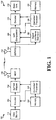
- Fig. 1 shows a block diagram of a design of a transmitter 100 and a receiver150 in a digital communication system.
- an encoder 120 receives a block of data from a data source 112, encodes the data block based on an FEC coding scheme, and provides code bits.
- a data block can also be referred to as a transport block, a packet, or a frame.
- An encoder 120 can perform rate matching and delete or repeat some or all of the code bits to obtain a desired number of code bits for the data block.
- the encoder 120 can also perform channel interleaving and reorder the code bits based on an interleaving scheme.
- a symbol mapper 130 maps the code bits to modulation symbols based on a modulation scheme, which may be QPSK, QAM, etc.
- a modulator (MOD) 132 can perform processing for code-division multiplexing (CDM), frequency-division multiplexing (FDM), orthogonal frequency-division multiplexing (OFDM), single-carrier FDM (SC-FDM), or single-carrier (SC).
- CDM code-division multiplexing
- FDM frequency-division multiplexing
- OFDM orthogonal frequency-division multiplexing
- SC-FDM single-carrier FDM
- SC single-carrier
- SC single-carrier
- SC single-carrier
- SC single-carrier
- an antenna 152 receives the modulated signal from transmitter 100 and provides a received signal.
- a demodulator (DEMOD) 154 processes, e.g., filters, amplifies, frequency down-converts, and digitizes, the received signals to obtain discrete samples. Demodulator 154 can further process the samples (e.g., for CDM, FDM, OFDM, SC-FDM, etc.) to obtain received symbols.
- a signal and noise estimator 162 can estimate signal and noise characteristics and/or the wireless/optical channel response based on the received symbols.
- An LLR computation unit 160 computes LLRs for code bits based on the received symbols and the signal, noise and/or channel estimates.
- a decoder 170 decodes the LLRs in a manner complementary to the encoding performed by transmitter 100 and provides decoded data. In general, the processing by demodulator 154, LLR computation unit 160, and decoder 170 at receiver 150 is complementary to the processing by modulator 132, symbol mapper 130, and encoder 120 at transmitter 100.
- Controllers/processors 140 and 180 direct the operation of various processing units at transmitter 100 and receiver 150, respectively.
- the memories 142 and 182 store data, e.g., a constellation of codewords, and program codes for transmitter 100 and receiver 150.
- encoder 120 can implement any FEC coding scheme, such as a turbo code, a convolutional code, a low-density parity-check (LDPC) code, a cyclic redundancy check (CRC) code, a block code, etc., or a combination thereof.
- the encoder 120 can generate and append a CRC value to a data block, which can be used by the receiver 150 to determine whether the data block decoded correctly or in error.
- Turbo code, convolutional code, and LDPC code are different FEC codes that allow the receiver 150 to correct errors caused by impairments in the wireless or optical channels.
- Fig. 2 shows a block diagram of the encoder 120 and the symbol mapper 130 at the transmitter 100 in Fig. 1 according to one embodiment of the invention.
- the encoder 120 implements a turbo code, which is also referred to as a parallel concatenated convolutional code.
- a code interleaver 222 receives a block of data bits (denoted as ⁇ d ⁇ ) and interleaves the data bits in accordance with a code interleaving scheme.
- a first constituent encoder 220 a encodes the data bits based on a first constituent code and provides first parity bits (denoted as ⁇ z ⁇ ).
- a second constituent encoder 220 b encodes the interleaved data bits from code interleaver 222 based on a second constituent code and provides second parity bits (denoted as ⁇ z' ⁇ ).
- the encoder 120 may implement a low density parity check (LDPC) code, a staircase code, a BCH code, a polar code, or any other channel coding scheme.
- LDPC low density parity check
- a multiplexer (Mux) 224 receives the data bits and the parity bits from constituent encoders 220 a and 220 b , multiplexes the data and parity bits, and provides code bits.
- Multiplexer 224 may cycle through its three inputs and provide one bit at a time to its output, or ⁇ d 1 , z 1 , z' 1 , d 2 , z 2 , z' 2 , ... ⁇ .
- a rate matching unit 226 receives the code bits from multiplexer 224 and may delete some of the code bits and/or repeat some or all of the code bits to obtain a desired number of code bits for the data block.
- encoder 120 may also perform channel interleaving on the code bits from rate matching unit 226.
- a demultiplexer (Demux) 230 receives the code bits from encoder 120 and demultiplexes the code bits into an in-phase (I) stream ⁇ i ⁇ and a quadrature (Q) stream ⁇ q ⁇ .
- Demultiplexer 230 can provide the first code bit to the I stream, then the next code bit to the Q stream, then the next code bit to the I stream, etc.
- Symbol mapper 130 provides modulation symbols ⁇ x ⁇ for the data block.
- Fig. 3 shows an example signal constellation for 16-QAM, which is used by some embodiments of the invention.
- This signal constellation includes 16 signal points corresponding to 16 possible modulation symbols for 16-QAM.
- Each modulation symbol is a complex value of the form x i +j x q , where x i is the real component, x q is the imaginary component, and j denotes imaginary unit.
- the real component x i can have a value of -3 ⁇ , - ⁇ , ⁇ or 3 ⁇
- the imaginary component x q can also have a value of -3 ⁇ , - ⁇ , ⁇ or 3 ⁇ , where ⁇ is typically 1/sqrt(10).
- the code bits in the I and Q streams from demultiplexer 230 can be grouped into sets of four bits, with each set being denoted as ⁇ i 1 q 1 i 2 q 2 ⁇ , where bits i 1 and i 2 are from the I stream and bits q 1 and q 2 are from the Q stream.
- the 16 modulation symbols in the signal constellation are associated with 16 possible 4-bit values for ⁇ i 1 q 1 i 2 q 2 ⁇ .
- Fig. 3 shows an example mapping of each possible 4-bit value to a specific modulation symbol.
- the real component x i of a modulation symbol is determined by the two in-phase bits i 1 and i 2
- the imaginary component x q is determined by the two quadrature bits q 1 and q 2 .
- Bit i 2 determines the magnitude of the real component x i , with
- Bit i 1 may thus be considered as a sign bit for x i
- bit i 2 may be considered as a magnitude bit for x i
- bit q 1 determines the sign of the imaginary component x q
- bit q 2 determines the magnitude of the imaginary component x q .
- the mapping is independent for the real and imaginary components. For each component, 2-bit values of '11', '10', '00' and '01' are mapped to -3 ⁇ , - ⁇ , ⁇ , and 3 ⁇ , respectively, based on pulse amplitude modulation (PAM). Two 4-PAM modulation symbols may thus be generated separately based on (i 1 i 2 ) and (q 1 q 2 ) and then quadrature combined to obtain a 16-QAM modulation symbol.
- PAM pulse amplitude modulation
- Higher-order modulation formats such as 64-QAM and 256-QAM receive more bits to generate modulated symbols.
- Increasing the modulation order usually requires more complicated demodulation to produce LLRs for the decoder because the number of constellation points is of an exponential order with respect of the number of bits.
- the modulator uses higher-dimensional modulation formats to improve resilience against channel noise. For such high-dimensional modulation, even more complex computation for demodulation is required.
- the method of the invention provides computationally efficient LLR calculations for low-power demodulation in particular for high-order and high-dimensional modulation formats.
- Fig. 4 shows a block diagram of a method for decoding a symbol transmitted over a channel according to some embodiments of the invention.
- the symbol is encoded and modulated to include data bits and parity bits, and can be transmitted over a wireless, wired, or fiber-optic channel.
- the method decodes the transmitted symbol by determining an approximation of LLR of each data bit as a logarithm of a ratio of a sum of the relative likelihoods of at least some of the second codewords having the same value of the data bit to a sum of the relative likelihoods of at least some of the second codewords having different value of the data bit.
- Steps of the method can be using a processor 401 of a decoder.
- the method receives 410 the symbol 415 transmitted over a channel.
- the received symbol includes the transmitted symbol modified with noise of the channel.
- the received symbol includes data bits modified with noise with known received values and unknown transmitted values selected from a predetermined constellation of codewords 460. Examples of such constellations include the constellation 310 of Fig. 3 .
- the method selects, from a constellation of codewords 460, a first codeword neighboring the received symbol and a set of second codewords 425 neighboring the first codeword.
- Fig. 5 shows a schematic of the constellation of codewords 460 including the received symbol 415 mapped to the constellation.
- Some embodiments of the invention determine the first codeword 520 as a codeword closest to the received symbol. For example, one embodiment determines the first codeword 520 using soft-in hard-out (SIHO) decoding of the symbol.
- SIHO soft-in hard-out
- An example of the SIHO decoding is minimum Euclidean distance decoding.
- Some embodiments are based on recognition that the LLR can be approximated using relative likelihood of the most likely nearest neighbor symbol 530 and the first codeword 520.
- some embodiments of the invention determine a plurality of the codewords having a distance to the first codeword less or equal a threshold to form the set of second codewords.
- the set of second codewords include not only the most likely nearest neighbor symbol 530, but also other symbols 510 with non-negligible likelihoods if the given bit is in error in the first codeword, and a plurality of symbols 515 other than the first codeword with non-negligible likelihood if the given bit is correct in the first codeword.
- some embodiments of the invention measure the distance to the first codeword as a Hamming distance or as a Lie distance.
- the embodiment is advantageous, because it is possible to design mappings such that there is a simple correspondence between Hamming or Lie distance and Euclidean distance. This enables selection of symbols which are neighboring in Euclidean distance without having to directly calculate Euclidean distance, which can be highly complex with large constellations in multiple dimensions.
- One embodiment of the invention determines the threshold as a minimal distance between the first codeword and any other codeword in the constellation. As a result, all codewords selected to the set of second codewords have the same distance, e.g., Hamming distance, to the first codeword.
- This embodiment is useful for decoding blocks of modulated symbols that provide sufficient number of second codewords with minimal distance to the first codeword. For example, for decoding a signal modulated with a 24-dimensional (24D) format over a 4D optical carrier, there can be 759 second codewords with minimum Hamming weight with respect to the first codeword.
- the method determines 430 a relative likelihood 435 of each second codeword being the transmitted symbol with respect to a likelihood of the first codeword being the transmitted symbol and determines 440 an approximation of a log-likelihood ratio (LLR) 445 of each data bit in the received symbol as a logarithm of a ratio of a sum of the relative likelihoods of at least some of the second codewords having the same value of the data bit to a sum of the relative likelihoods of at least some of the second codewords having different value of the data bit.
- LLR log-likelihood ratio
- some embodiments of the invention approximate the soft-information by considering only the nearest neighbors of the hard-decision codeword. Additionally, one embodiment considers only orthogonal dimensions in which the second codewords differ from the hard-decision first codeword. In this embodiment, the number of elements which comprise the soft-information is reduced.
- the number of second codewords comprising the nearest neighbors for which the soft information is considered can be varied, with the complexity of the soft-output decoder becoming higher as this number is increased.
- subsequent processing such as sorting or minimum searching is used to reduce the complexity of calculating the soft-information output.
- the calculation of LLR is then performed based on the most significant subset of symbol likelihoods, therefore reducing computational complexity.
- Figure 6A shows a block diagram of a method for determining an approximation of the LLR for each data bit of the received symbol according to one embodiment of the invention.
- the method forms, for each data bit of the received symbol, a group of the set of second codewords, such that there is one group for each data bit of the received symbol.
- the group is formed such that a value of the data bits in each codeword in the group on a position of the corresponding data bit of the received symbol equals a value of the corresponding data bit of the received symbol.
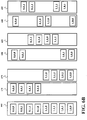
- Figure 6B shows the possible groupings of symbols 660 with three data bits. Two groupings are made with the first bit being 0 (670) and 1 (675) respectively. Two further groupings are made with the second bit being 0 (680) and 1 (685) respectively. Two final groupings are made with the third bit being 0 (690) and 1 (695) respectively.
- the method sorts 620 the second codewords in each group based on their corresponding relative likelihood. By sorting the possible symbols by likelihood, we are able to ignore symbols which have negligible likelihood from the bit LLR calculation. This is important, as most symbols have negligible likelihood.
- the method sums 630, for each group, a predetermined number of the most likely second codewords and adds 640 one to a summation of a group having the same data bit as in the first codeword.
- the predetermined number is chosen in the design phase as a tradeoff between computational complexity and performance-choosing more symbols from the list will improve the accuracy of the LLR approximation, while increasing computational complexity.
- the method determines 650 a logarithm of a ratio for a pair of groups corresponding to the same data bit (0 or 1) to produce 655 an approximation of the LLR for each data bit of the received symbol.
- the LLR is now approximated by a smaller number of subsets of symbol likelihoods, which give non-negligible likelihood values.
- Some embodiments of the invention determine the LLRs for optical communication using block-coded high-dimensional modulation formats, such as modulation with 24-dimensional (24D) signal constellations.
- the large number of signaling dimensions causes the number of possible symbols in the modulation format to become extremely large (2 12 ).
- this means that the number of symbol likelihoods that must be calculated is also extremely large (2 12 ).
- a large summation must also be calculated (2 11 ). Therefore, it is advantageous to reduce the complexity of this operation while maintaining accuracy at the given signal to noise ratio.
- Fig. 7 shows a block diagram of a system and/or a method for modulating an optical signal according to embodiments of the invention.
- the system includes a transmitter 710 connected to a receiver 720 by an optical fiber channel 750.
- data from a source 701 is outer encoded 711.
- the outer encoder adds FEC parity redundancy 712.
- a block encoder 713 is applied to an output of the outer encoder to produce encoded data 714.
- the block encoding is designed to increase the Hamming or Lie distances between constellation points that represent the data.
- a mapper 715 increases the Euclidian distances between constellation points to produce mapped data 716.
- the code, in the form of the mapped data can be modulated 717 to a modulated signal that is transmitted through the optical channel 750.
- the transmission can use dense wavelength-division multiplexing (WDM), multi-mode spatial multiplexing, multi-core spatial multiplexing, sub-carrier signaling, single-carrier signaling, and combination thereof.
- WDM dense wavelength-division multiplexing
- the steps of the transmitter 710 are performed in a reverse order, wherein the modulated signal is demodulated, demapped, block-decoding, and FEC decoded to recover the data.
- front-end processing 721 and channel equalization 722 are applied to the received optical modulated signal.
- a block decision 723 is made to feed the soft-decision information to outer decoding 724 to recover the data 725 for a data sink 702.
- 24D orthogonal signal vector To transmit the optical signal modulated with a 24-dimensional (24D) format over a 4D optical carrier, we map a 24D orthogonal signal vector to a 4D optical carrier. To do so, we consider in-phase, quadrature-phase, polarization, and time as orthogonal dimensions. In some embodiments, 24D orthogonal signal vector is mapped to additional orthogonal dimensions such as spatial modes and frequencies.
- Fig. 8 shows an example mapping of 24D basis vector (D 1, ... ,D 24) to the 4D carrier in a time domain, where E XI is the in-phase component of the optical carrier on the horizontal polarization, E XQ is the quadrature component of the optical carrier on the horizontal polarization, E YI is the in-phase component on the vertical polarization, and E Yq is the quadrature component on the vertical polarization.
- a hypercube constellation i.e., a constellation where each dimension has a value ⁇ 1 that is independent of all other dimensions and every dimension is bit-labeled independently; the squared Euclidean distance between constellation points is linearly proportional to the Hamming distance. Therefore, we use a code designed to increase the Hamming distance and the Euclidean distance between constellation points. Taking advantage of this effect, we use the extended Golay code to determine a subset of the 24D hypercube. Then, the subset determines our constellation.
- the extended Golay code encodes 12 bits of information into a 24-bit word with a minimum Hamming distance of 8. While this code has been used with an appropriate decoding matrix to correct for errors in wireless communication and memories, we take maximum-likelihood (ML) decisions in 24D to maintain soft information for an FEC decoder.
- ML maximum-likelihood
- the 2 12 points that correspond to valid extended Golay codewords are our constellation points, from a possible 2 24 points on the 24D hypercube.
- the minimum squared Euclidean distance increases by a factor of 8 compared with the 24D hypercube, which has identical performance to that of DP-QPSK, while the mean energy per bit is doubled. Therefore, asymptotic power efficiency is increased by 6 dB compared with the 24D hypercube.
- the transmitter and receiver can be similar those used with DP-QPSK modulation because the constellation is a subset of the hypercube.
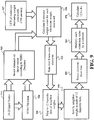
- Fig. 9 shows a block diagram of a method for approximating LLR calculation assuming Golay-coded 24-D modulation according to one embodiment of the invention.
- a 24-D input vector 910 is used to calculate an initial soft-input hard-output decision 920.
- a pre-determined list of minimum Hamming weight codewords 927 is used.
- the list of codewords 927 is denoted as L , which has 759 codewords of weight 8 in the case of the 24-D extended Golay code.
- the weight vector of each codeword in L is then calculated 930 by selecting the 8 elements M k from the manipulated vector, for which the corresponding bit l k in the codeword from L is 1.
- the weight vectors are then summed 935 over their 8 constituent elements, to create a single, scalar value for each of the 759 codewords.
- the list of codewords L is then formed 940 into 12 bipartite lists L j1 and L j0 . These lists are defined by the codewords on list L for which bit position j is 1, and 0 respectively.
- L j1 therefore has 506 elements, while L j0 has 253 elements, therefore each pair of lists contains a weight corresponding to all L codewords.
- Each list is then sorted by value 950, and arranged from minimum to maximum. A fixed number of elements is then selected from each list, starting with the minimum 955. Each element is then multiplied by a constant 960, such that the log-symbol-likelihood, relative to the SIHO decision is produced. The log-sum-exponential function is then used on both lists, with an additional element of '1' being appended to the lists drawn from L j0 , to produce log-likelihoods W j0 and W j1 .
- Another embodiment uses a single parity-check code to increase the Hamming distance for 8D hypercube lattice modulations.
- the 7-bit data are encoded by a block encoder to generate 8-bit coded word.
- Each bit is modulated by BPSK per dimension, and then 8-dimensional BPSK mapped to the 4D optical carrier.
- the decoder procedure is same as the previous embodiment.
- the benefit of the 8D modulation is lower complex in both the encoder and the decoder.
- Near-perfect block codes which offers the maximum possible Hamming distance over the hypercube lattice for a target data rate and dimensions.
- Near-perfect block codes include linear and nonlinear codes such as Nordstrom-Robinson code, or combinations of near-perfect codes.
- hypercube lattice the increase of the Hamming distance can lead to the increase of Euclidean distance.
- Higher-dimensional lattice modulation can achieve better decoding for signals subject to linear and nonlinear noise.
- An alternative embodiment maps the constellation to the 4D optical carrier using a densest hypersphere lattice.
- the block code is designed by greedy sphere cutting to sequentially select the closes points over high-dimensional lattice point.
- the block decision can be done using soft-information belief propagation over a graphical representation (factor graph) of the block codes.
- High-dimensional modulation based on block codes can be represented by a factor graph, in which parity-check equation is described by check nodes connecting to associated bit variable nodes.
- the LLR can be approximated.
- the factor graph is not well optimized for belief propagation because the parity-check matrix is usually not sparse and there are many cycles.
- the method of the invention uses the belief messages over one or two iterations over the factor graph as an initial estimate for the further processing to be more accurate.
- the initial estimate of the LLRs including second nearest neighbors is modified by means of artificial neural network for nonlinear filtering. The method uses a large number of simulated received symbols for varying noise variance to learn the neural networks in order to produce accurate LLR output.
- the reinforcement learning based on stochastic back-propagation or linear discriminant analysis can be used to approximate LLR.
- the learning phase can be done offline.
- some edges in the neural networks are pruned so that the LLR calculation can be low complex.
- another nonlinear filtering based on Volterra filter can be used to approximate the LLR.
- the LLR approximation can be performed for nonbinary FEC coding, by treating multiple LLR values as a vectorized belief message.
- the method can be used for bit-interleaved coded modulation (BICM) with iterative demodulation (ID), which employs iterative demodulation given soft-decision feedback from the FEC decoder.
- BICM bit-interleaved coded modulation
- ID iterative demodulation
- the demodulator can produce more accurate LLRs.
- the reinforcement learning is carried out offline by simulating noisy channels as well as various reliability levels of soft-decision information.
- the neural networks now use soft-decision information from the decoder in addition to the initial belief messages as input data. Given the true LLR values, the neural networks are stochastically learned by the back-propagation to approximate the LLR values over the network propagation.
- high-order and high-dimensional modulation formats are designed to maximize the mutual information of approximated LLR.
- the mutual information is calculated as follows: where L is the output of approximated LLRs, and E denotes the expectation.
- the method of the invention uses a parametric projection of block-coded hyper-cube onto a subspace. For example, the projection based on Grassmannian exponential mapping is used to generate M -dimensional modulation formats from N -bit codeword. Any M -dimensional subspace of N -dimensional signals can be represented by M ( N - M ) parameters in theory.
- Such manifold can be expressed by matrix exponential function as follows: I M ⁇ N ⁇ exp 0 M ⁇ ⁇ ⁇ 0 N ⁇ M where I MxN denotes the rectangular identity matrix of size M -by -N , 0 M denotes all-zero matrix of size M -by- M , and the theta matrix is a real-valued matrix of size M - by -( N - M ) .
- 2-bit onto 1-dimensional modulation can be obtained by one parameter, and the Grassmannian projection of Gray-coded 2D square can be any arbitrary shaping of 4-PAM.
- the four signal points of the parameterized 4-PAM become -cos(theta)-sin(theta), -cos(theta)+sin(theta), cos(theta)-sin(theta), and cos(theta)+sin(theta).
- the 4-PAM signal can be regular 4-PAM (i.e., -3 ⁇ , - ⁇ , ⁇ , and 3 ⁇ ) to generate 16-QAM, where two 4-PAM symbols are mapped onto in-phase and quadrature components independently.
- the method of invention can improve the mutual information by achieving shaping gain.
- the optimal theta can be obtained offline by evaluating the mutual information of the approximated LLR.
- the optimized theta is also different when nonbinary LLR approximation is used.
- the Grassmannian projection of block-coded hyper cube can be used to generate even higher-order modulations and also higher-dimensional modulations.
- the projection matrix is Stiefel manifold.
Landscapes
- Engineering & Computer Science (AREA)
- Computer Networks & Wireless Communication (AREA)
- Signal Processing (AREA)
- Power Engineering (AREA)
- Error Detection And Correction (AREA)
- Digital Transmission Methods That Use Modulated Carrier Waves (AREA)
Claims (9)
- Verfahren zum Decodieren eines über einen Kanal gesendeten Symbols, wobei das Symbol codiert und moduliert ist, um Datenbits und Paritätbits zu beinhalten, umfassend:Empfangen (410) des über einen Kanal gesendeten Symbols, wobei das empfangene Symbol das mit Rauschen des Kanals modifizierte gesendete Symbol beinhaltet;Auswählen (420), aus einer Konstellation von Codewörtern, eines ersten Codeworts, das dem empfangenen Symbol benachbart ist, und eines Satzes zweiter Codewörter, die dem ersten Codewort benachbart sind, wobei das Auswählen das Bestimmen des ersten Codeworts unter Verwendung von SIHO-Decodierung (SIHO: soft-in hard-out) des empfangenen Symbols und das Bestimmen einer Vielzahl von Codewörtern, die einen Abstand zum ersten Codewort aufweisen, der geringer als oder gleich einem Grenzwert ist, um den Satz zweiter Codewörter zu bilden, aufweist; wobei der Grenzwert als Mindestabstand zwischen dem ersten Codewort und beliebigen anderen Codewörtern in einer Konstellation von Codewörtern bestimmt wird;Bestimmen (430) einer relativen Wahrscheinlichkeit, dass jedes zweite Codewort in Bezug auf eine Wahrscheinlichkeit, dass das erste Codewort das gesendete Symbol ist, das gesendete Symbol ist;Bestimmen (440) einer Näherung eines Logarithmus-Wahrscheinlichkeits-Verhältnisses (LLR) jedes Datenbits in dem empfangenen Symbol als ein Logarithmus eines Verhältnisses einer Summe der relativen Wahrscheinlichkeiten mindestens einiger der zweiten Codewörter mit dem gleichen Wert des Datenbits zu einer Summe der relativen Wahrscheinlichkeiten mindestens einiger der zweiten Codewörter mit einem unterschiedlichen Wert des Datenbits; undDecodieren (450) des empfangenen Symbols unter Verwendung des LLR jedes Datenbits in dem empfangenen Symbol.
- Verfahren nach Anspruch 1, wobei das empfangene Symbol die mit Rauschen modifizierten Datenbits beinhaltet.
- Verfahren nach Anspruch 1, wobei der Abstand ein Hamming-Abstand ist.
- Verfahren nach Anspruch 1, wobei der Abstand ein Lie-Abstand ist.
- Verfahren nach Anspruch 1, weiter umfassend:Bilden, für jedes Datenbit des ersten Codeworts, ein Paar Gruppen des Satzes zweiter Codewörter dergestalt, dass es eine erste Gruppe für jedes Datenbit des ersten Codeworts gibt, wobei ein Wert der Datenbits in jedem Codewort in der ersten Gruppe auf einer Position eines entsprechenden Datenbits des ersten Codeworts einem Wert des entsprechenden Datenbits des ersten Codeworts gleicht, und dergestalt, dass es eine zweite Gruppe für jedes Datenbit des ersten Codeworts gibt, wobei ein Wert der Datenbits in jedem Codewort in der zweiten Gruppe auf einer Position eines entsprechenden Datenbits des ersten Codeworts einem Wert des entsprechenden Datenbits des ersten Codeworts nicht gleicht;Sortieren des Satzes zweiter Codewörter in jeder Gruppe basierend auf ihrer entsprechenden relativen Wahrscheinlichkeit;Summieren, für jede Gruppe, einer vorgegebenen Anzahl der relativen Wahrscheinlichkeiten der wahrscheinlichsten zweiten Codewörter;Addieren von eins zu einer Aufsummierung einer Gruppe mit dem gleichen Wert des jeweiligen Datenbits wie im ersten Codewort; undBestimmen eines Logarithmus eines Verhältnisses für das Paar Gruppen, entsprechend dem gleichen Datenbit, um die Näherung des LLR für jedes Datenbit des empfangenen Symbols zu erzeugen.
- Verfahren nach Anspruch 1, wobei das Nähern der LLR Belief Propagation über Faktorgraph verwendet, und weiter Präzisieren der LLR durch nichtlineare Filter, offline bestimmt durch Lernalgorithmen.
- Verfahren nach Anspruch 1, wobei die LLR zum nichtbinären Codieren und Decodieren vektorisiert wird.
- Verfahren nach Anspruch 6, wobei die nichtlinearen Filter durch empfangene Symbole und Soft-Decision-Rückmeldung vom Decoder gelernt werden, um LLR-Werte für die iterative Demodulation zu präzisieren.
- Empfänger (150) zum Decodieren eines über einen Kanal gesendeten Symbols, wobei das Symbol codiert und moduliert ist, um Datenbits und Paritätbits zu beinhalten, umfassend:einen Demodulator (154), der mit einer Antenne verbunden ist, um das über einen Kanal gesendete Symbol zu empfangen, wobei das empfangene Symbol das mit Rauschen des Kanals modifizierte gesendete Symbol beinhaltet;einen Speicher (182), um eine Konstellation von Codewörtern zu speichern;eine LLR-Berechnungseinheit (160), die mit einem Prozessor verbunden ist, um aus der Konstellation von Codewörtern ein erstes Codewort, das dem empfangenen Symbol benachbart ist, und einen Satz zweiter Codewörter, die dem ersten Codewort benachbart sind, auszuwählen, um eine relative Wahrscheinlichkeit, dass jedes zweite Codewort in Bezug auf eine Wahrscheinlichkeit, dass das erste Codewort das gesendete Symbol ist, das gesendete Symbol ist, zu bestimmen, um eine Näherung eines Logarithmus-Wahrscheinlichkeits-Verhältnisses (LLR) jedes Datenbits in dem empfangenen Symbol als einen Logarithmus eines Verhältnisses einer Summe der relativen Wahrscheinlichkeiten mindestens einiger der zweiten Codewörter mit dem gleichen Wert des Datenbits zu einer Summe der relativen Wahrscheinlichkeiten mindestens einiger der zweiten Codewörter mit einem unterschiedlichen Wert des Datenbits zu bestimmen; undeinen Decoder (170), um das empfangene Symbol unter Verwendung des LLR jedes Datenbits in dem empfangenen Symbol zu decodieren,wobei die Berechnungseinheit (160) das erste Codewort unter Verwendung einer SIHO-Decodierung (SIHO: soft-in hard-out) des empfangenen Symbols bestimmt und eine Vielzahl von Codewörtern mit einem Abstand zum ersten Codewort, der geringer als oder gleich einem Grenzwert ist, bestimmt, um den Satz zweiter Codewörter zu bilden; wobei der Grenzwert als Mindestabstand zwischen dem ersten Codewort und beliebigen anderen Codewörtern in einer Konstellation von Codewörtern bestimmt wird.
Applications Claiming Priority (2)
| Application Number | Priority Date | Filing Date | Title |
|---|---|---|---|
| US14/931,959 US9749089B2 (en) | 2015-11-04 | 2015-11-04 | Fast log-likelihood ratio (LLR) computation for decoding high-order and high-dimensional modulation schemes |
| PCT/JP2016/081972 WO2017077945A1 (en) | 2015-11-04 | 2016-10-21 | Method and receiver for decoding symbol transmitted over channel |
Publications (2)
| Publication Number | Publication Date |
|---|---|
| EP3369226A1 EP3369226A1 (de) | 2018-09-05 |
| EP3369226B1 true EP3369226B1 (de) | 2020-02-19 |
Family
ID=57389487
Family Applications (1)
| Application Number | Title | Priority Date | Filing Date |
|---|---|---|---|
| EP16798830.2A Active EP3369226B1 (de) | 2015-11-04 | 2016-10-21 | Verfahren und empfänger zur decodierung von symbolen, die über einen kanal gesendet wurden |
Country Status (5)
| Country | Link |
|---|---|
| US (1) | US9749089B2 (de) |
| EP (1) | EP3369226B1 (de) |
| JP (1) | JP2018518126A (de) |
| CN (1) | CN108353047B (de) |
| WO (1) | WO2017077945A1 (de) |
Families Citing this family (36)
| Publication number | Priority date | Publication date | Assignee | Title |
|---|---|---|---|---|
| US10367605B2 (en) * | 2015-07-02 | 2019-07-30 | Intel Corporation | High speed interconnect symbol stream forward error-correction |
| US10511328B2 (en) * | 2016-11-04 | 2019-12-17 | Qualcomm Incorporated | Efficient list decoding of LDPC codes |
| US10372532B2 (en) * | 2016-12-07 | 2019-08-06 | Taiwan Semiconductor Manufacturing Co., Ltd. | Memory array and measuring and testing methods for inter-hamming differences of memory array |
| JP6730215B2 (ja) * | 2017-03-22 | 2020-07-29 | キオクシア株式会社 | メモリコントローラ、メモリシステムおよび制御方法 |
| CN110612669B (zh) * | 2017-05-24 | 2021-07-09 | 华为技术有限公司 | 译码的方法和装置 |
| US10862646B2 (en) * | 2017-07-11 | 2020-12-08 | Nokia Technologies Oy | Polar coded broadcast channel |
| CN107483150A (zh) * | 2017-08-10 | 2017-12-15 | 北京信息科技大学 | 基于tsv传输的信道级联码编码方法和信号传输方法及装置 |
| CN108494523B (zh) * | 2018-01-31 | 2020-02-14 | 北京航空航天大学 | 一种Polar码的多CRC编码方法 |
| CN108777584A (zh) * | 2018-07-06 | 2018-11-09 | 中国石油大学(华东) | 一种极化码译码参数的快速优化方法 |
| CN108809522B (zh) * | 2018-07-09 | 2021-09-14 | 上海大学 | 多码的深度学习译码器的实现方法 |
| US10804938B2 (en) * | 2018-09-25 | 2020-10-13 | Western Digital Technologies, Inc. | Decoding data using decoders and neural networks |
| EP3648012B1 (de) * | 2018-10-29 | 2024-11-27 | Mitsubishi Electric R&D Centre Europe B.V. | Mehrstufige aktivierungsfunktion für tiefe neuronale netze |
| WO2020088743A1 (en) * | 2018-10-30 | 2020-05-07 | Huawei Technologies Co., Ltd. | Transmitter and receiver communication apparatus for non-coherent communication |
| KR102562314B1 (ko) | 2018-11-02 | 2023-08-01 | 삼성전자주식회사 | 후보 벡터 셋을 선택하는 mimo 수신기 및 이의 동작방법 |
| CN109728824B (zh) * | 2018-12-06 | 2023-03-28 | 杭州电子科技大学 | 一种基于深度学习的ldpc码迭代译码方法 |
| WO2020142059A1 (en) * | 2018-12-31 | 2020-07-09 | Nokia Technologies Oy | Demapping based on machine learning |
| US12119840B2 (en) * | 2019-03-13 | 2024-10-15 | Samsung Electronics Co., Ltd. | Machine-learning error-correcting code controller |
| US11742879B2 (en) * | 2019-03-13 | 2023-08-29 | Samsung Electronics Co., Ltd. | Machine-learning error-correcting code controller |
| US10931360B2 (en) | 2019-04-23 | 2021-02-23 | Samsung Electronics Co., Ltd | System and method for providing multiple input multiple output (MIMO) detector selection with reinforced learning neural network |
| WO2021101315A1 (en) * | 2019-11-22 | 2021-05-27 | Samsung Electronics Co., Ltd. | Method and apparatus to decode packets to compute log likelihood ratio in wireless network |
| CN113055319B (zh) * | 2019-12-27 | 2022-02-25 | 华为技术有限公司 | 一种信号均衡方法和装置 |
| US12450500B2 (en) | 2020-02-17 | 2025-10-21 | Nec Corporation | Communication system, transmission apparatus, reception apparatus, matrix generation apparatus, communication method, transmission method, reception method, matrix generation method and recording medium |
| JP7419113B2 (ja) | 2020-03-05 | 2024-01-22 | キオクシア株式会社 | メモリシステム |
| WO2021201651A1 (en) | 2020-04-02 | 2021-10-07 | Samsung Electronics Co., Ltd. | Methods and systems for optimizing computation of log-likelihood ratio (llr) for decoding modulated symbols |
| US11527299B2 (en) * | 2020-06-03 | 2022-12-13 | Samsung Electronics Co., Ltd. | Polar neural network decoder for memory devices |
| CN114389749B (zh) * | 2020-10-22 | 2024-09-03 | 南京中兴软件有限责任公司 | 对数似然比获取方法、装置、设备及存储介质 |
| CN112422195B (zh) * | 2020-11-18 | 2021-08-17 | 合肥工业大学 | 基于广义互信息的多维信号调制电路的设计方法及其应用 |
| CN114285524B (zh) * | 2021-12-24 | 2024-01-23 | 北京中科晶上科技股份有限公司 | Llr矢量量化的计算方法、装置与通信系统 |
| CN114363218B (zh) * | 2022-01-07 | 2023-07-28 | 合肥工业大学 | 一种基于端到端学习的通信可达速率检测方法 |
| CN114629595B (zh) * | 2022-03-18 | 2023-10-17 | 上海交通大学 | 适用于湍流信道的分布式整形极化码方法及系统 |
| US11968040B2 (en) * | 2022-06-14 | 2024-04-23 | Nvidia Corporation | Graph neural network for channel decoding |
| JP2024018655A (ja) | 2022-07-29 | 2024-02-08 | 日本電気株式会社 | 光信号状態推定装置、光信号状態推定方法、およびプログラム |
| US12587312B2 (en) * | 2022-10-13 | 2026-03-24 | Huawei Technologies Co., Ltd. | Hybrid product polar codes-based communication systems and methods |
| KR20240138842A (ko) | 2023-03-13 | 2024-09-20 | 삼성전자주식회사 | 전자 장치 및 그의 동작 방법 |
| CN116708842B (zh) * | 2023-08-01 | 2023-12-12 | 国网安徽省电力有限公司超高压分公司 | 用于高速视频传输的阶梯码编码调制方法、设备和介质 |
| CN116886202B (zh) * | 2023-08-24 | 2025-03-07 | 北京理工大学 | 一种高谱效低功耗联合信道编码调制光传输方法及系统 |
Family Cites Families (13)
| Publication number | Priority date | Publication date | Assignee | Title |
|---|---|---|---|---|
| CN101595700B (zh) * | 2006-03-14 | 2014-04-16 | 高通股份有限公司 | 使用llr函数的分段线性逼近的对数似然比(llr)计算 |
| US8793560B2 (en) | 2006-03-14 | 2014-07-29 | Qualcomm Incorporated | Log-likelihood ratio (LLR) computation using piecewise linear approximation of LLR functions |
| US7924933B2 (en) * | 2006-09-19 | 2011-04-12 | Nec Laboratories America, Inc. | Enhanced successive interference cancellation (SIC) receiver for multiple-input multiple-output (MIMO) systems |
| US8799742B1 (en) * | 2007-07-30 | 2014-08-05 | Marvell International Ltd. | QC-LDPC decoder with list-syndrome decoding |
| US9184874B2 (en) * | 2008-03-31 | 2015-11-10 | Qualcomm Incorporated | Storing log likelihood ratios in interleaved form to reduce hardware memory |
| US8428169B1 (en) * | 2008-07-30 | 2013-04-23 | Marvell International Ltd. | MIMO soft demodulation using hard-decision candidate selection |
| JP5489552B2 (ja) * | 2009-06-19 | 2014-05-14 | 三菱電機株式会社 | 復号方法及び復号装置 |
| US9112653B2 (en) * | 2013-06-19 | 2015-08-18 | Mitsubishi Electric Research Laboratories, Inc. | Method and system for modulating optical signals as high-dimensional lattice constellation points to increase tolerance to noise |
| WO2015006380A1 (en) * | 2013-07-08 | 2015-01-15 | Hughes Network Systems, Llc | System and method for iterative compensation for linear and nonlinear interference in system employing ftn symbol transmission rates |
| US9337868B2 (en) * | 2013-07-22 | 2016-05-10 | Nec Corporation | Iterative decoding for cascaded LDPC and TCM coding |
| US9246510B2 (en) * | 2013-10-01 | 2016-01-26 | Texas Instruments Incorporated | Apparatus and method for multilevel coding in communication systems |
| US9008240B1 (en) * | 2013-12-31 | 2015-04-14 | Cambridge Silicon Radio Limited | Near maximum likelihood spatial multiplexing receiver |
| US9473250B2 (en) * | 2014-09-03 | 2016-10-18 | Mitsubishi Electric Research Laboratories, Inc. | System and method for recovering carrier phase in optical communications |
-
2015
- 2015-11-04 US US14/931,959 patent/US9749089B2/en active Active
-
2016
- 2016-10-21 JP JP2017565867A patent/JP2018518126A/ja active Pending
- 2016-10-21 WO PCT/JP2016/081972 patent/WO2017077945A1/en not_active Ceased
- 2016-10-21 EP EP16798830.2A patent/EP3369226B1/de active Active
- 2016-10-21 CN CN201680063203.2A patent/CN108353047B/zh active Active
Non-Patent Citations (1)
| Title |
|---|
| None * |
Also Published As
| Publication number | Publication date |
|---|---|
| JP2018518126A (ja) | 2018-07-05 |
| US9749089B2 (en) | 2017-08-29 |
| WO2017077945A1 (en) | 2017-05-11 |
| US20170126360A1 (en) | 2017-05-04 |
| CN108353047A (zh) | 2018-07-31 |
| EP3369226A1 (de) | 2018-09-05 |
| CN108353047B (zh) | 2019-03-15 |
Similar Documents
| Publication | Publication Date | Title |
|---|---|---|
| EP3369226B1 (de) | Verfahren und empfänger zur decodierung von symbolen, die über einen kanal gesendet wurden | |
| Guillén i Fàbregas et al. | Bit-interleaved coded modulation | |
| Alvarado et al. | Achievable information rates for fiber optics: Applications and computations | |
| US10848270B2 (en) | Concatenated forward error correction | |
| JP6104405B2 (ja) | 光通信のためにデータを変調する方法およびシステム | |
| CN102710581B (zh) | 一种软解映射方法 | |
| WO2017086414A1 (en) | Quantized belief propagation decoding of ldpc codes with mutual information-maximizing lookup tables | |
| CN102752261A (zh) | 基于apsk星座图的星座映射方法、编码调制方法及系统 | |
| An et al. | Soft decoding without soft demapping with ORBGRAND | |
| CN102075487A (zh) | 基于多维星座映射的编码调制方法、解调解码方法及系统 | |
| CN112600568B (zh) | 结合非标准6阶调制与ldpc码的编码调制传输方法 | |
| CN107919944B (zh) | 用于生成经优化的编码调制的方法和设备 | |
| Motedayen-Aval et al. | Optimal joint detection/estimation in fading channels with polynomial complexity | |
| Salari et al. | NOMA joint channel estimation and signal detection using rotational invariant codes and GMM-based clustering | |
| EP3451539B1 (de) | Optischer empfänger, optische übertragungsvorrichtung und verfahren für einen optischen empfänger | |
| Nguyen et al. | Bit-interleaved coded modulation with mismatched decoding metrics | |
| US10355820B2 (en) | Decoding method and apparatus in system using sequentially connected binary codes | |
| Barbieri et al. | Soft-output decoding of rotationally invariant codes over channels with phase noise | |
| Jia et al. | A low-complexity tree search based quasi-ML receiver for SCMA system | |
| Ishimura et al. | 8-state trellis-coded optical modulation with 4-dimensional QAM constellations | |
| Nekuii et al. | Efficient soft demodulation of MIMO QPSK via semidefinite relaxation | |
| He et al. | Rethinking: Deep-learning-based demodulation and decoding | |
| Jacobsen et al. | Coded noncoherent communication with amplitude/phase modulation: from Shannon theory to practical architectures | |
| CN101197603B (zh) | 多天线系统基于球形译码的低复杂度分步检测系统及检测方法 | |
| US9917723B2 (en) | Efficient methods and recursive/scalable circuit architectures for QAM symbol mean and variance estimations |
Legal Events
| Date | Code | Title | Description |
|---|---|---|---|
| STAA | Information on the status of an ep patent application or granted ep patent |
Free format text: STATUS: UNKNOWN |
|
| STAA | Information on the status of an ep patent application or granted ep patent |
Free format text: STATUS: THE INTERNATIONAL PUBLICATION HAS BEEN MADE |
|
| PUAI | Public reference made under article 153(3) epc to a published international application that has entered the european phase |
Free format text: ORIGINAL CODE: 0009012 |
|
| STAA | Information on the status of an ep patent application or granted ep patent |
Free format text: STATUS: REQUEST FOR EXAMINATION WAS MADE |
|
| 17P | Request for examination filed |
Effective date: 20180531 |
|
| AK | Designated contracting states |
Kind code of ref document: A1 Designated state(s): AL AT BE BG CH CY CZ DE DK EE ES FI FR GB GR HR HU IE IS IT LI LT LU LV MC MK MT NL NO PL PT RO RS SE SI SK SM TR |
|
| AX | Request for extension of the european patent |
Extension state: BA ME |
|
| DAV | Request for validation of the european patent (deleted) | ||
| DAX | Request for extension of the european patent (deleted) | ||
| STAA | Information on the status of an ep patent application or granted ep patent |
Free format text: STATUS: EXAMINATION IS IN PROGRESS |
|
| 17Q | First examination report despatched |
Effective date: 20190218 |
|
| GRAP | Despatch of communication of intention to grant a patent |
Free format text: ORIGINAL CODE: EPIDOSNIGR1 |
|
| STAA | Information on the status of an ep patent application or granted ep patent |
Free format text: STATUS: GRANT OF PATENT IS INTENDED |
|
| INTG | Intention to grant announced |
Effective date: 20191029 |
|
| GRAS | Grant fee paid |
Free format text: ORIGINAL CODE: EPIDOSNIGR3 |
|
| GRAA | (expected) grant |
Free format text: ORIGINAL CODE: 0009210 |
|
| STAA | Information on the status of an ep patent application or granted ep patent |
Free format text: STATUS: THE PATENT HAS BEEN GRANTED |
|
| AK | Designated contracting states |
Kind code of ref document: B1 Designated state(s): AL AT BE BG CH CY CZ DE DK EE ES FI FR GB GR HR HU IE IS IT LI LT LU LV MC MK MT NL NO PL PT RO RS SE SI SK SM TR |
|
| REG | Reference to a national code |
Ref country code: CH Ref legal event code: EP |
|
| REG | Reference to a national code |
Ref country code: DE Ref legal event code: R096 Ref document number: 602016030216 Country of ref document: DE |
|
| REG | Reference to a national code |
Ref country code: AT Ref legal event code: REF Ref document number: 1236241 Country of ref document: AT Kind code of ref document: T Effective date: 20200315 |
|
| REG | Reference to a national code |
Ref country code: IE Ref legal event code: FG4D |
|
| REG | Reference to a national code |
Ref country code: NL Ref legal event code: MP Effective date: 20200219 |
|
| PG25 | Lapsed in a contracting state [announced via postgrant information from national office to epo] |
Ref country code: FI Free format text: LAPSE BECAUSE OF FAILURE TO SUBMIT A TRANSLATION OF THE DESCRIPTION OR TO PAY THE FEE WITHIN THE PRESCRIBED TIME-LIMIT Effective date: 20200219 Ref country code: NO Free format text: LAPSE BECAUSE OF FAILURE TO SUBMIT A TRANSLATION OF THE DESCRIPTION OR TO PAY THE FEE WITHIN THE PRESCRIBED TIME-LIMIT Effective date: 20200519 Ref country code: RS Free format text: LAPSE BECAUSE OF FAILURE TO SUBMIT A TRANSLATION OF THE DESCRIPTION OR TO PAY THE FEE WITHIN THE PRESCRIBED TIME-LIMIT Effective date: 20200219 |
|
| REG | Reference to a national code |
Ref country code: LT Ref legal event code: MG4D |
|
| PG25 | Lapsed in a contracting state [announced via postgrant information from national office to epo] |
Ref country code: BG Free format text: LAPSE BECAUSE OF FAILURE TO SUBMIT A TRANSLATION OF THE DESCRIPTION OR TO PAY THE FEE WITHIN THE PRESCRIBED TIME-LIMIT Effective date: 20200519 Ref country code: IS Free format text: LAPSE BECAUSE OF FAILURE TO SUBMIT A TRANSLATION OF THE DESCRIPTION OR TO PAY THE FEE WITHIN THE PRESCRIBED TIME-LIMIT Effective date: 20200619 Ref country code: HR Free format text: LAPSE BECAUSE OF FAILURE TO SUBMIT A TRANSLATION OF THE DESCRIPTION OR TO PAY THE FEE WITHIN THE PRESCRIBED TIME-LIMIT Effective date: 20200219 Ref country code: SE Free format text: LAPSE BECAUSE OF FAILURE TO SUBMIT A TRANSLATION OF THE DESCRIPTION OR TO PAY THE FEE WITHIN THE PRESCRIBED TIME-LIMIT Effective date: 20200219 Ref country code: LV Free format text: LAPSE BECAUSE OF FAILURE TO SUBMIT A TRANSLATION OF THE DESCRIPTION OR TO PAY THE FEE WITHIN THE PRESCRIBED TIME-LIMIT Effective date: 20200219 Ref country code: GR Free format text: LAPSE BECAUSE OF FAILURE TO SUBMIT A TRANSLATION OF THE DESCRIPTION OR TO PAY THE FEE WITHIN THE PRESCRIBED TIME-LIMIT Effective date: 20200520 |
|
| PG25 | Lapsed in a contracting state [announced via postgrant information from national office to epo] |
Ref country code: NL Free format text: LAPSE BECAUSE OF FAILURE TO SUBMIT A TRANSLATION OF THE DESCRIPTION OR TO PAY THE FEE WITHIN THE PRESCRIBED TIME-LIMIT Effective date: 20200219 |
|
| PG25 | Lapsed in a contracting state [announced via postgrant information from national office to epo] |
Ref country code: ES Free format text: LAPSE BECAUSE OF FAILURE TO SUBMIT A TRANSLATION OF THE DESCRIPTION OR TO PAY THE FEE WITHIN THE PRESCRIBED TIME-LIMIT Effective date: 20200219 Ref country code: CZ Free format text: LAPSE BECAUSE OF FAILURE TO SUBMIT A TRANSLATION OF THE DESCRIPTION OR TO PAY THE FEE WITHIN THE PRESCRIBED TIME-LIMIT Effective date: 20200219 Ref country code: LT Free format text: LAPSE BECAUSE OF FAILURE TO SUBMIT A TRANSLATION OF THE DESCRIPTION OR TO PAY THE FEE WITHIN THE PRESCRIBED TIME-LIMIT Effective date: 20200219 Ref country code: RO Free format text: LAPSE BECAUSE OF FAILURE TO SUBMIT A TRANSLATION OF THE DESCRIPTION OR TO PAY THE FEE WITHIN THE PRESCRIBED TIME-LIMIT Effective date: 20200219 Ref country code: EE Free format text: LAPSE BECAUSE OF FAILURE TO SUBMIT A TRANSLATION OF THE DESCRIPTION OR TO PAY THE FEE WITHIN THE PRESCRIBED TIME-LIMIT Effective date: 20200219 Ref country code: SM Free format text: LAPSE BECAUSE OF FAILURE TO SUBMIT A TRANSLATION OF THE DESCRIPTION OR TO PAY THE FEE WITHIN THE PRESCRIBED TIME-LIMIT Effective date: 20200219 Ref country code: DK Free format text: LAPSE BECAUSE OF FAILURE TO SUBMIT A TRANSLATION OF THE DESCRIPTION OR TO PAY THE FEE WITHIN THE PRESCRIBED TIME-LIMIT Effective date: 20200219 Ref country code: SK Free format text: LAPSE BECAUSE OF FAILURE TO SUBMIT A TRANSLATION OF THE DESCRIPTION OR TO PAY THE FEE WITHIN THE PRESCRIBED TIME-LIMIT Effective date: 20200219 Ref country code: PT Free format text: LAPSE BECAUSE OF FAILURE TO SUBMIT A TRANSLATION OF THE DESCRIPTION OR TO PAY THE FEE WITHIN THE PRESCRIBED TIME-LIMIT Effective date: 20200712 |
|
| REG | Reference to a national code |
Ref country code: AT Ref legal event code: MK05 Ref document number: 1236241 Country of ref document: AT Kind code of ref document: T Effective date: 20200219 |
|
| REG | Reference to a national code |
Ref country code: DE Ref legal event code: R097 Ref document number: 602016030216 Country of ref document: DE |
|
| PLBE | No opposition filed within time limit |
Free format text: ORIGINAL CODE: 0009261 |
|
| STAA | Information on the status of an ep patent application or granted ep patent |
Free format text: STATUS: NO OPPOSITION FILED WITHIN TIME LIMIT |
|
| 26N | No opposition filed |
Effective date: 20201120 |
|
| PG25 | Lapsed in a contracting state [announced via postgrant information from national office to epo] |
Ref country code: AT Free format text: LAPSE BECAUSE OF FAILURE TO SUBMIT A TRANSLATION OF THE DESCRIPTION OR TO PAY THE FEE WITHIN THE PRESCRIBED TIME-LIMIT Effective date: 20200219 Ref country code: IT Free format text: LAPSE BECAUSE OF FAILURE TO SUBMIT A TRANSLATION OF THE DESCRIPTION OR TO PAY THE FEE WITHIN THE PRESCRIBED TIME-LIMIT Effective date: 20200219 |
|
| PG25 | Lapsed in a contracting state [announced via postgrant information from national office to epo] |
Ref country code: SI Free format text: LAPSE BECAUSE OF FAILURE TO SUBMIT A TRANSLATION OF THE DESCRIPTION OR TO PAY THE FEE WITHIN THE PRESCRIBED TIME-LIMIT Effective date: 20200219 Ref country code: PL Free format text: LAPSE BECAUSE OF FAILURE TO SUBMIT A TRANSLATION OF THE DESCRIPTION OR TO PAY THE FEE WITHIN THE PRESCRIBED TIME-LIMIT Effective date: 20200219 |
|
| REG | Reference to a national code |
Ref country code: CH Ref legal event code: PL |
|
| GBPC | Gb: european patent ceased through non-payment of renewal fee |
Effective date: 20201021 |
|
| PG25 | Lapsed in a contracting state [announced via postgrant information from national office to epo] |
Ref country code: MC Free format text: LAPSE BECAUSE OF FAILURE TO SUBMIT A TRANSLATION OF THE DESCRIPTION OR TO PAY THE FEE WITHIN THE PRESCRIBED TIME-LIMIT Effective date: 20200219 Ref country code: LU Free format text: LAPSE BECAUSE OF NON-PAYMENT OF DUE FEES Effective date: 20201021 |
|
| REG | Reference to a national code |
Ref country code: BE Ref legal event code: MM Effective date: 20201031 |
|
| PG25 | Lapsed in a contracting state [announced via postgrant information from national office to epo] |
Ref country code: BE Free format text: LAPSE BECAUSE OF NON-PAYMENT OF DUE FEES Effective date: 20201031 Ref country code: CH Free format text: LAPSE BECAUSE OF NON-PAYMENT OF DUE FEES Effective date: 20201031 Ref country code: LI Free format text: LAPSE BECAUSE OF NON-PAYMENT OF DUE FEES Effective date: 20201031 Ref country code: GB Free format text: LAPSE BECAUSE OF NON-PAYMENT OF DUE FEES Effective date: 20201021 |
|
| PG25 | Lapsed in a contracting state [announced via postgrant information from national office to epo] |
Ref country code: IE Free format text: LAPSE BECAUSE OF NON-PAYMENT OF DUE FEES Effective date: 20201021 |
|
| PG25 | Lapsed in a contracting state [announced via postgrant information from national office to epo] |
Ref country code: TR Free format text: LAPSE BECAUSE OF FAILURE TO SUBMIT A TRANSLATION OF THE DESCRIPTION OR TO PAY THE FEE WITHIN THE PRESCRIBED TIME-LIMIT Effective date: 20200219 Ref country code: MT Free format text: LAPSE BECAUSE OF FAILURE TO SUBMIT A TRANSLATION OF THE DESCRIPTION OR TO PAY THE FEE WITHIN THE PRESCRIBED TIME-LIMIT Effective date: 20200219 Ref country code: CY Free format text: LAPSE BECAUSE OF FAILURE TO SUBMIT A TRANSLATION OF THE DESCRIPTION OR TO PAY THE FEE WITHIN THE PRESCRIBED TIME-LIMIT Effective date: 20200219 |
|
| PG25 | Lapsed in a contracting state [announced via postgrant information from national office to epo] |
Ref country code: MK Free format text: LAPSE BECAUSE OF FAILURE TO SUBMIT A TRANSLATION OF THE DESCRIPTION OR TO PAY THE FEE WITHIN THE PRESCRIBED TIME-LIMIT Effective date: 20200219 Ref country code: AL Free format text: LAPSE BECAUSE OF FAILURE TO SUBMIT A TRANSLATION OF THE DESCRIPTION OR TO PAY THE FEE WITHIN THE PRESCRIBED TIME-LIMIT Effective date: 20200219 |
|
| REG | Reference to a national code |
Ref country code: DE Ref legal event code: R084 Ref document number: 602016030216 Country of ref document: DE |
|
| P01 | Opt-out of the competence of the unified patent court (upc) registered |
Effective date: 20230512 |
|
| PGFP | Annual fee paid to national office [announced via postgrant information from national office to epo] |
Ref country code: FR Payment date: 20250908 Year of fee payment: 10 |
|
| PGFP | Annual fee paid to national office [announced via postgrant information from national office to epo] |
Ref country code: DE Payment date: 20250902 Year of fee payment: 10 |