EP3358019B1 - Methods for digital pcr - Google Patents
Methods for digital pcr Download PDFInfo
- Publication number
- EP3358019B1 EP3358019B1 EP17204051.1A EP17204051A EP3358019B1 EP 3358019 B1 EP3358019 B1 EP 3358019B1 EP 17204051 A EP17204051 A EP 17204051A EP 3358019 B1 EP3358019 B1 EP 3358019B1
- Authority
- EP
- European Patent Office
- Prior art keywords
- droplets
- sample
- nucleic acid
- target nucleic
- starting
- Prior art date
- Legal status (The legal status is an assumption and is not a legal conclusion. Google has not performed a legal analysis and makes no representation as to the accuracy of the status listed.)
- Active
Links
Images

Classifications
-
- C—CHEMISTRY; METALLURGY
- C12—BIOCHEMISTRY; BEER; SPIRITS; WINE; VINEGAR; MICROBIOLOGY; ENZYMOLOGY; MUTATION OR GENETIC ENGINEERING
- C12Q—MEASURING OR TESTING PROCESSES INVOLVING ENZYMES, NUCLEIC ACIDS OR MICROORGANISMS; COMPOSITIONS OR TEST PAPERS THEREFOR; PROCESSES OF PREPARING SUCH COMPOSITIONS; CONDITION-RESPONSIVE CONTROL IN MICROBIOLOGICAL OR ENZYMOLOGICAL PROCESSES
- C12Q1/00—Measuring or testing processes involving enzymes, nucleic acids or microorganisms; Compositions therefor; Processes of preparing such compositions
- C12Q1/68—Measuring or testing processes involving enzymes, nucleic acids or microorganisms; Compositions therefor; Processes of preparing such compositions involving nucleic acids
- C12Q1/6844—Nucleic acid amplification reactions
- C12Q1/6851—Quantitative amplification
-
- B—PERFORMING OPERATIONS; TRANSPORTING
- B01—PHYSICAL OR CHEMICAL PROCESSES OR APPARATUS IN GENERAL
- B01L—CHEMICAL OR PHYSICAL LABORATORY APPARATUS FOR GENERAL USE
- B01L3/00—Containers or dishes for laboratory use, e.g. laboratory glassware; Droppers
- B01L3/50—Containers for the purpose of retaining a material to be analysed, e.g. test tubes
- B01L3/502—Containers for the purpose of retaining a material to be analysed, e.g. test tubes with fluid transport, e.g. in multi-compartment structures
- B01L3/5027—Containers for the purpose of retaining a material to be analysed, e.g. test tubes with fluid transport, e.g. in multi-compartment structures by integrated microfluidic structures, i.e. dimensions of channels and chambers are such that surface tension forces are important, e.g. lab-on-a-chip
- B01L3/502769—Containers for the purpose of retaining a material to be analysed, e.g. test tubes with fluid transport, e.g. in multi-compartment structures by integrated microfluidic structures, i.e. dimensions of channels and chambers are such that surface tension forces are important, e.g. lab-on-a-chip characterised by multiphase flow arrangements
- B01L3/502784—Containers for the purpose of retaining a material to be analysed, e.g. test tubes with fluid transport, e.g. in multi-compartment structures by integrated microfluidic structures, i.e. dimensions of channels and chambers are such that surface tension forces are important, e.g. lab-on-a-chip characterised by multiphase flow arrangements specially adapted for droplet or plug flow, e.g. digital microfluidics
-
- B—PERFORMING OPERATIONS; TRANSPORTING
- B01—PHYSICAL OR CHEMICAL PROCESSES OR APPARATUS IN GENERAL
- B01L—CHEMICAL OR PHYSICAL LABORATORY APPARATUS FOR GENERAL USE
- B01L7/00—Heating or cooling apparatus; Heat insulating devices
- B01L7/52—Heating or cooling apparatus; Heat insulating devices with provision for submitting samples to a predetermined sequence of different temperatures, e.g. for treating nucleic acid samples
- B01L7/525—Heating or cooling apparatus; Heat insulating devices with provision for submitting samples to a predetermined sequence of different temperatures, e.g. for treating nucleic acid samples with physical movement of samples between temperature zones
-
- B—PERFORMING OPERATIONS; TRANSPORTING
- B01—PHYSICAL OR CHEMICAL PROCESSES OR APPARATUS IN GENERAL
- B01L—CHEMICAL OR PHYSICAL LABORATORY APPARATUS FOR GENERAL USE
- B01L2300/00—Additional constructional details
- B01L2300/08—Geometry, shape and general structure
- B01L2300/0832—Geometry, shape and general structure cylindrical, tube shaped
- B01L2300/0838—Capillaries
-
- B—PERFORMING OPERATIONS; TRANSPORTING
- B01—PHYSICAL OR CHEMICAL PROCESSES OR APPARATUS IN GENERAL
- B01L—CHEMICAL OR PHYSICAL LABORATORY APPARATUS FOR GENERAL USE
- B01L2300/00—Additional constructional details
- B01L2300/08—Geometry, shape and general structure
- B01L2300/0861—Configuration of multiple channels and/or chambers in a single devices
- B01L2300/0867—Multiple inlets and one sample wells, e.g. mixing, dilution
-
- B—PERFORMING OPERATIONS; TRANSPORTING
- B01—PHYSICAL OR CHEMICAL PROCESSES OR APPARATUS IN GENERAL
- B01L—CHEMICAL OR PHYSICAL LABORATORY APPARATUS FOR GENERAL USE
- B01L2400/00—Moving or stopping fluids
- B01L2400/04—Moving fluids with specific forces or mechanical means
- B01L2400/0475—Moving fluids with specific forces or mechanical means specific mechanical means and fluid pressure
- B01L2400/0487—Moving fluids with specific forces or mechanical means specific mechanical means and fluid pressure fluid pressure, pneumatics
Definitions
- the invention relates to methods for conducting nucleic acid amplification reactions, including the polymerase chain reaction (PCR).
- PCR polymerase chain reaction
- PCR is a molecular amplification method routinely practiced in medical and bioresearch settings for a variety of tasks, such as the detection of hereditary diseases, the identification of genetic fingerprints, the diagnosis of infectious diseases, the cloning of genes, paternity testing, and other types of nucleic acid analysis.
- PCR Protocols Methods in Molecular Biology
- eds. Humana Press
- PCR McPherson and Moller, Taylor & Francis
- Digital PCR is a technique that allows amplification of a single DNA template from a minimally diluted sample, thus, generating amplicons that are exclusively derived from one template and can be detected with different fluorophores or sequencing to discriminate different alleles (e.g., wild type vs. mutant or paternal vs. maternal alleles).
- alleles e.g., wild type vs. mutant or paternal vs. maternal alleles.
- the basic premise of the technique is to divide a large sample into a number of smaller subvolumes (segmented volumes), whereby the subvolumes contain on average a single copy of a target.
- the TaqMan® assay requires near-saturating amounts of PCR amplification product to detect fluorescence.
- PCR reactions normally saturate at about 10 11 product molecules/microliter due, in part, to reannealing of product strands.
- concentration of product after 30 cycles in a 10 ⁇ l PCR requires at least 10 3 starting template molecules. If the volume of the PCR were reduced to ⁇ 10 nanoliters, then a single molecule could generate the required product to be detected by the TaqMan® assay.
- the present disclosure relates to methods of conducting a nucleic acid reaction, including methods for performing digital PCR using "droplet-in-oil” technology, wherein a sample is segmented into droplets placed to a continuous flow of carrier fluid through a microfluidic channel.
- WO 2007/091228 corresponding U.S. Ser. No. 12/092,261
- WO 2007/091230 U.S. Ser. No. 12/093,132
- WO 2008/038259 WO.
- continuous flow PCR the droplets are fully wrapped in the carrier fluid throughout the reaction and detection.
- the disclosure is based, at least in part, on the realization that sample droplets of 10-500 nl provide advantages for a PCR analysis of lowly expressed targets. Various aspects are described below.
- the methods include:
- the sample droplets have volumes of 0.1 pl-500 nl, preferably, 10-500 nl, more preferably, 30-350 nl, while the starting sample volumes are 0.05-5000 ⁇ l, preferably, 5-3500 ⁇ l. These volumes may include volumes of reagents (e.g., primer solution) added prior to the detection step.
- the droplets are spherical.
- the droplets created by segmenting the starting sample are merged with a second set of droplets comprising one or more primers for the target nucleic acid, thereby producing the final droplets for the amplification reaction.
- the step of detecting or determining the amount is performed at multiple thermal cycles, thereby monitoring the amount of amplified target nucleic acid throughout the cycles, for example, in performing qPCR or real time PCR.
- the thermocycling is performed for at least a number of cycles required to reach the near-saturation level of the amplification. The number of cycles depends on the concentration of the target and other conditions and is typically between 20 and 40.
- the step of detecting or determining the amount is performed after the near-saturation point is reached.
- the starting copy number of the target nucleic acid may be determined by counting the number of positively amplified droplets in a given set of droplets.
- the number of droplets in a set being analyzed is such that their combined volume is representative of the starting sample.
- the set of droplets contain the entire starting sample or only its part, depending on the number of copies of the target nucleic acid present or suspected to be present in the starting sample.
- the starting concentration of a target nucleic acid may be adjusted by diluting or by concentrating the starting sample.
- the set of droplets contains a train of 10 droplets, and 0.005 ng/ ⁇ l cDNA in the starting sample.
- the disclosure further relates to methods of processing a plurality of starting samples in parallel, wherein at least some of the starting samples have a) a varying concentration of the target nucleic acid and/or b) varying target nucleic acids.
- sets of droplets from different starting samples form a train of alternating droplets in the continuous flow of the carrier fluid in the channel.
- the disclosure relates to methods of conducting a nucleic acid amplification reaction, such as PCR in a sample containing or suspected to contain a target nucleic acid to be detected.
- a nucleic acid amplification reaction such as PCR in a sample containing or suspected to contain a target nucleic acid to be detected.
- the methods described here employ the PCR as an amplification method of choice
- alternative techniques of nucleic acid amplification may similarly be used in place of the PCR.
- Such techniques include for example, the ligase chain reaction (LCR), the transcription based amplification system (TAS), the nucleic acid sequence-based amplification (NASBA), the strand displacement amplification (SDA), rolling circle amplification (RCA), hyper-branched RCA (HRCA), etc.
- the disclosure relates to the so-called "digital PCR” and similar methods that allow one to quantify the starting copy number of a nucleic acid template, by segmenting the starting sample to smaller reaction volumes, most of which contain one copy of the target or fewer.
- Methods may be used for determining the presence of the amount of a nucleic acid target, and for example, in gene expression analysis and is especially useful for lowly expressed genes.
- the methods include at least the following steps:
- the step of the detecting or determining the amount is performed at multiple thermal cycles, thereby monitoring the amount of amplified target nucleic acid throughout the cycles, for example, in performing qPCR or real time PCR.
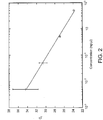
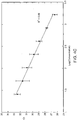
- the thermocycling is performed for at least a number of cycles required to reach the near-saturation level of the amplification. The number of cycles depends on the concentration of the target and other conditions and is typically between 20 and 40. The dependence of Ct on the target concentration is illustrated in Example 1.
- a Ct value for the target nucleic acid is determined by detecting the course of amplification at each cycle.
- the "real-time" detection may be used for constructing the standard curve as well as for quantifying targets in test samples.
- the step of the detecting or determining the amount is performed after the near-saturation point is reached.
- the starting copy number of the target nucleic acid may be determined by counting the number of positively amplified droplets in a given set of droplets.
- the starting sample contains (or is suspected to contain) at least one target nucleic acid.
- the term "starting sample” refers to the sample from which droplets are generated.
- the starting sample may be placed in a well in a conventional 384-well place, from which sample droplets are drawn.
- the starting sample volumes may vary, and may be, for example, 0.05-5000 ⁇ l, preferably, 5-3500 ⁇ l, e.g., 5-1000 ⁇ l, 50-500 ⁇ l, 100-350 ⁇ l.
- droplets created by segmenting the starting sample are merged with a second set of droplets comprising one more primers for the target nucleic acid to produce final droplets.
- the starting sample contains at least 2, 5, 10, 100, 500, 1000 or more copies of the target nucleic acid.
- sample droplets have volumes of 0.1 pl-500 nl, preferably, 1 pl-500 nl, 10 pl-500 nl, 100 pl-500 nl, 1-500 nl, or 10-500 nl, more preferably, 30-350 nl.
- sample droplets have volumes of 50-500, 100-500, 150-500, 200-500, 50-400, 100-400, 150-400, 200-400, 50-300, 100-300, 150-300, 200-300, or 150-250 nl. These volumes may include volumes of reagents (e.g., primer solution) added prior to the detection step.
- the droplets are spherical, while in other embodiments, the droplets are elongated along the axis of the channel.
- the number of droplets in a set being analyzed is such that their combined volume is representative of the starting sample.
- the set of droplets contain the entire starting sample or only its part, depending on the number of copies of the target nucleic acid present, or suspected to be present, in the starting sample. For example, a set of droplets containing, in total, 10% of the starting sample volume may be considered representative for a starting sample containing 100 copies of the target nucleic acid. Therefore, depending on the expected number of the set of analyzed droplets, the sets may contain several droplets to several thousand droplets.
- the set of droplets for a given target nucleic acid contains, e.g., 5-10000 droplets, e.g., 100-5000, 5-1000, 100-500, 5-50, 6-30, 10-25, 8 or more, or 10 or more droplets. In other embodiments, at least 10%, 20%, 30%, 40%, 50%, 60%, 70%, 80%, or 90% of the starting sample, or the entire starting sample, is segmented into droplets.
- the standard digital PCR aims at determining the dilution of the sample at which only half of segmented volumes are positive. This dilution indicates that the target nucleic acid is diluted on average to 1/2 per segmented volume.
- the present method allows one to analyze a much greater number of segmented volumes, many of which may be blank.
- at least 30%, 40%, 50% 60%, 70%, 80%, 90%, 95%, 99% or more droplets in a set do not contain a target nucleic acid.
- fewer than 50% (e.g., 30%, 20%, 10%, 5% or less) of droplets in the set of 10 or more (e.g., 20, 50, 100, 1000, 5000, or 10000) are positively amplified.
- the starting sample contains one genome equivalent of nucleic acid or less.
- the mass of DNA is ⁇ 3 pg per genome (e.g., 3.3 pg/genome).
- a sample may be divided into replicates (e.g., duplicates, triplicates, etc.), in which the expression levels are measured.
- the sample may be derived from the same source and split into replicates prior to amplification. Additionally, one may create serial dilutions of the sample.
- Replicate and dilution samples may be analyzed in a serial or a parallel manner.
- sets of droplets corresponding to separate starting samples form a sequence of alternating droplets which pass through a thermal cycler, where droplets are being amplified, for example, as described in WO 2008/038259 .
- a plurality of starting samples with varying concentrations of the target nucleic acid and/or varying target nucleic acids may be processed in this manner in parallel.
- a sample may contain material from obtained cells or tissues, e.g., a cell or tissue lysate or extract. Extracts may contain material enriched in sub-cellular elements such as that from the Golgi complex, mitochondria, lysosomes, the endoplasmic reticulum, cell membrane, and cytoskeleton, etc.
- the biological sample contains materials obtained from a single cell.
- Biological samples may come from a variety of sources. For example, biological samples may be obtained from whole organisms, organs, tissues, or cells from different stages of development, differentiation, or disease state, and from different species (human and non-human, including bacteria and virus).
- the samples may represent different treatment conditions (e.g., test compounds from a chemical library), tissue or cell types, or source (e.g., blood, urine, cerebrospinal fluid, seminal fluid, saliva, sputum, stool), etc.
- Various methods for extraction of nucleic acids from biological samples are known (see, e.g., Nucleic Acids Isolation Methods, Bowein (ed.), American Scientific Publishers (2002 ).
- genomic DNA is obtained from nuclear extracts that are subjected to mechanical shearing to generate random long fragments.
- genomic DNA may be extracted from tissue or cells using a Qiagen DNeasy Blood & Tissue Kit following the manufacturer's protocols.
- RNA analysis e.g., mRNA, siRNA, etc.
- the nucleic acid is initially reverse-transcribed into cDNA prior to conducing the PCR.
- This type of PCR is commonly referred to as "RT-PCR” and is illustrated in the Examples.
- a PCR device contains a sample preparation system, a thermocycler, and a detection unit.
- sample preparation the sample is segmented into droplets which are wrapped in immiscible fluid (e.g., silicone oil, mineral oil) which continuously flows through the channel, such as a capillary having a circular cross-section.
- immiscible fluid e.g., silicone oil, mineral oil
- the sample may be pre-mixed with the primer, or the primer may be added to the droplet.
- droplets created by segmenting the starting sample are merged with a second set of droplets comprising one or more primers for the target nucleic acid in order to produce final droplets.
- the merging of droplets can be accomplished using, for example, one or more liquid bridges as described in WO 2007/091230 ( U.S. Ser. No. 12/093,132 ) and WO 2008/038259 .
- a queue of droplets from the preparation system may be passed through the thermal cycler.
- the velocity of the sample through the device is defined by the control of the velocity of the carrier fluid is controlled by an external pumping system.
- the sample undergoes the same thermal cycling and chemical reaction as it passes through N amplification cycles of the complete thermal device. This results in a maximum two-fold amplification after each cycle and a total amplification of I(1+E) N where I is the initial product, E is the efficiency of the reaction and N is the number of cycles.
- Fluorescent probes are contained in each sample droplet. The fluorescence level is detected in each droplet at each cycle, e.g., in the case of real-time PCR.
- fluorescent probes such as Taqman® probes
- intercollating fluorescent dyes such as SYBR Green and LCGreen®, as described in, e.g., in U.S. Pat. Nos. 5,723,591 and 5,928,907 ; www.idahotech.com; Gudnason et al., Nucleic Acids Res., 35(19):e127 (2007 ); and in the Examples.
- Nucleic Acids Res. 35(13):4223-4237 (2007 ) and include those made by Fluidigm (www.fluidigm.com), RainDance Technologies (www.raindancetechnologies.com), Microfluidic Systems (www.microfluidicsystems.com); Nanostream (www.nanostream.com); and Caliper Life Sciences (www.caliperls.com).
- Fluidigm www.fluidigm.com
- RainDance Technologies www.raindancetechnologies.com
- Microfluidic Systems www.microfluidicsystems.com
- Nanostream www.nanostream.com
- Caliper Life Sciences www.caliperls.com
- Chem., 77:658-666 Chen et al., Analyst, 130:931-940 (2005 ); Munchow et al., Expert Rev. Mol. Diagn., 5:613-620 (2005 ); and Charbert et al., Anal. Chem., 78:7722-7728 (2006 ); and Dorfman et al., Anal. Chem, 77:3700-3704 (2005 ).
- RNA is extracted from cultured cells, reverse transcribed into cDNA and used as the template for the qPCR reaction.
- the starting concentration of the template is 5 ng/ ⁇ l which is then diluted 10-fold to 0.5 ng/ ⁇ l. This 10-fold dilution is repeated yielding samples with four concentrations of cDNA template: 5 ng/ ⁇ l, 0.5 ng/ ⁇ l , 0.05 ng/ ⁇ l , and 0.005 ng/ ⁇ l.
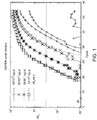
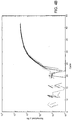
- the resulting amplification curves obtained using a Stokes Bio device (www.stokesbio.ie), are shown in FIG. 1 . As seen from the figure, for lower starting template concentrations, more cycles of PCR are necessary to bring the fluorescence signal to the threshold level.
- the fractional cycle at which the amplification curve reaches the threshold is called the Ct value: a measure of the gene expression of the sample.
- the threshold is set at 0.3 read off of the corresponding Ct values for each set of amplification curves in FIG. 1 .
- the Ct value is plotted against the cDNA concentration in FIG. 2 .
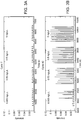
- FIG. 3A shows the fluorescence signal from cycle 7 of a 50 cycle amplification using the Stokes Bio device.
- Each of the small spikes represents a droplet passing.
- the far left spike represents the lead droplet.
- the concentrations of each set of droplets range from 0.005 to 5 ng/ ⁇ l , as indicated in the figure.
- Two aspects of the data are clearly shown--there is background fluorescence from the oil filled capillary, and background signal from each droplet--both are constant.
- FIG. 3B shows the same droplets at cycle 42 when amplification is complete. Note that the signal from each droplet in a set of ten varies from droplet-to-droplet. This is because the optical system for each channel is not identical. This effect is easily normalized out during data processing.
- qPCR-based expression profiling is the gold standard for the precise monitoring of selected genes.
- Gene expression relies upon the reverse transcription of mRNA to cDNA. It is, however, generally not possible to use cDNA as a standard for absolute quantification of mRNA because there is no control for the efficiency of the reverse transcription step.
- This Example presents Stokes Bio's amplification representative performance data from genomic DNA (gDNA), a commonly used in standard qPCR.
- a TaqMan® RNase P gene primer and probe set is used to evaluate instrument performance.
- the RNase P gene is a single-copy gene encoding the RNA moiety for the RNase P enzyme.
- Several two-fold dilutions are created from a stock of a known gDNA copy number. These dilutions were used to prepare complete qPCR reactions for amplification in the Stokes Bio instrument.
- Table 1 shows gDNA template concentrations with corresponding mean Cts and estimated starting copy numbers for each of the seven reaction sets.
- a no template control (NTC) is also included and showed no amplification.
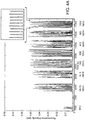
- FIG. 4A shows droplet fluorescence traces of three NTC reactions with seven sets of ten 300 nl droplets. Each 10 ⁇ replicate set was taken from a different concentration sample.
- FIG. 4B shows a normalized amplification plot of the most concentrated reaction set with a Ct of 26.4.
- FIG. 4B shows a standard curve taken from the Ct data in Table 1. Error bars indicate the Ct range in each of the 10 ⁇ replicate sets. Ct variability is attributable to Poisson noise or a variation in the number of starting copies from one droplet to another at a given concentration.
- the premise for this technique is to divide a large volume into a discreet number of smaller volumes reducing the number of copies in each sample, following the amplification process to perform fluorescence detection on the emerging droplets.
- the resulting total number of droplets with amplification can then be used to determine starting copy number. It also can be used for rare target detection wherein the statistic probability of amplification is increased for the rare target as the number of background molecules is reduced by the division.
- the probability of the distributed target molecules in the segment droplets can be generated. This is particularly of benefit for low concentration samples as it provides a prediction of the number of droplets containing molecules and thus the number of droplets expected to fluoresce.
- the binomial distribution model employed is a discrete probability distribution that arises in many common situations.
- the recognized example of binomial distribution is counting the number of heads in a fixed number of independent coin tosses, while in this case, it is counting the number of copies in a fixed known number of droplets created from the original sample.
- each trial or copy results in a success (the outcome that is counted) or failure.
- each copy has two possible outcomes, it enters the monitored droplet or not.
- p probability of success, 1 in 3000, for each monitored droplet.
- the binomial distribution model counts the number of successes in a fixed number of trials.
- Binomial distribution is completely determined by two parameters; n, the number of cDNA copies in the main volume, and p, the success probability common to each copy. As a consequence, knowing the number of copies and the number of droplets allows a binomial distribution to be used.
- FIG. 5 demonstrates a typical trace for a 0.005 ng/ ⁇ l sample.
- the data demonstrated here uses a 300 ⁇ l sample volume which is divided into ⁇ 3000 droplets of 100 nl droplet volumes.
- digital PCR involves amplifying a single DNA template from minimally diluted samples, generating amplicons that are exclusively derived from one template. It transforms an exponential, analog signal obtained from conventional PCR to linear, digital signals, thus allowing statistical analysis of the PCR product.
- n the number of base pairs
- m the mass of DNA
- N A is Avogadro's number (6.02 ⁇ 10 23 bp/mol)
- M the average molecular weight of a base pair.
- RNAse P gene which exists as a single copy per haploid genome. Based on the above formulae, the copy numbers of the RNAse P gene per 350 nl droplet are shown in Table 2. TABLE 2 Copy No gDNA Mass (pg) Rxn Vol. Cone.
- Mass DNA/genome was assumed to be 3.3 pg/genome.
- PCR amplification was carried out on the Stokes HTI on a series of 10 No Template Controls (NTCs) followed by 10 droplets of 350 nl volume at each copy number. Results indicate that at low copy numbers, discrete amplification of droplets occurred. S-curve analysis of this amplification seemed to indicate that threshold cycle (Ct) values clustered around distinct Ct values.
- NTCs No Template Controls
Landscapes
- Chemical & Material Sciences (AREA)
- Health & Medical Sciences (AREA)
- Life Sciences & Earth Sciences (AREA)
- Organic Chemistry (AREA)
- General Health & Medical Sciences (AREA)
- Chemical Kinetics & Catalysis (AREA)
- Wood Science & Technology (AREA)
- Engineering & Computer Science (AREA)
- Zoology (AREA)
- Molecular Biology (AREA)
- Proteomics, Peptides & Aminoacids (AREA)
- Biochemistry (AREA)
- Analytical Chemistry (AREA)
- Dispersion Chemistry (AREA)
- Clinical Laboratory Science (AREA)
- Biotechnology (AREA)
- Immunology (AREA)
- Microbiology (AREA)
- Bioinformatics & Cheminformatics (AREA)
- General Engineering & Computer Science (AREA)
- Genetics & Genomics (AREA)
- Physics & Mathematics (AREA)
- Biophysics (AREA)
- Hematology (AREA)
- Measuring Or Testing Involving Enzymes Or Micro-Organisms (AREA)
Priority Applications (4)
| Application Number | Priority Date | Filing Date | Title |
|---|---|---|---|
| PL19198901T PL3663411T3 (pl) | 2008-08-12 | 2009-08-11 | Sposoby do cyfrowego pcr |
| DK19198901.1T DK3663411T3 (da) | 2008-08-12 | 2009-08-11 | Fremgangsmåder til digital pcr |
| EP19198901.1A EP3663411B1 (en) | 2008-08-12 | 2009-08-11 | Methods for digital pcr |
| EP21208518.7A EP4008795A1 (en) | 2008-08-12 | 2009-08-11 | Methods for digital pcr |
Applications Claiming Priority (3)
| Application Number | Priority Date | Filing Date | Title |
|---|---|---|---|
| US8814208P | 2008-08-12 | 2008-08-12 | |
| PCT/IB2009/007568 WO2010018465A2 (en) | 2008-08-12 | 2009-08-11 | Methods and devices for digital pcr |
| EP09804312.8A EP2321427B1 (en) | 2008-08-12 | 2009-08-11 | Methods for digital pcr |
Related Parent Applications (1)
| Application Number | Title | Priority Date | Filing Date |
|---|---|---|---|
| EP09804312.8A Division EP2321427B1 (en) | 2008-08-12 | 2009-08-11 | Methods for digital pcr |
Related Child Applications (2)
| Application Number | Title | Priority Date | Filing Date |
|---|---|---|---|
| EP19198901.1A Division EP3663411B1 (en) | 2008-08-12 | 2009-08-11 | Methods for digital pcr |
| EP21208518.7A Division EP4008795A1 (en) | 2008-08-12 | 2009-08-11 | Methods for digital pcr |
Publications (2)
| Publication Number | Publication Date |
|---|---|
| EP3358019A1 EP3358019A1 (en) | 2018-08-08 |
| EP3358019B1 true EP3358019B1 (en) | 2019-09-25 |
Family
ID=41669400
Family Applications (4)
| Application Number | Title | Priority Date | Filing Date |
|---|---|---|---|
| EP17204051.1A Active EP3358019B1 (en) | 2008-08-12 | 2009-08-11 | Methods for digital pcr |
| EP21208518.7A Withdrawn EP4008795A1 (en) | 2008-08-12 | 2009-08-11 | Methods for digital pcr |
| EP09804312.8A Active EP2321427B1 (en) | 2008-08-12 | 2009-08-11 | Methods for digital pcr |
| EP19198901.1A Active EP3663411B1 (en) | 2008-08-12 | 2009-08-11 | Methods for digital pcr |
Family Applications After (3)
| Application Number | Title | Priority Date | Filing Date |
|---|---|---|---|
| EP21208518.7A Withdrawn EP4008795A1 (en) | 2008-08-12 | 2009-08-11 | Methods for digital pcr |
| EP09804312.8A Active EP2321427B1 (en) | 2008-08-12 | 2009-08-11 | Methods for digital pcr |
| EP19198901.1A Active EP3663411B1 (en) | 2008-08-12 | 2009-08-11 | Methods for digital pcr |
Country Status (9)
| Country | Link |
|---|---|
| US (4) | US9631230B2 (pl) |
| EP (4) | EP3358019B1 (pl) |
| JP (1) | JP2011530305A (pl) |
| CN (1) | CN102232114A (pl) |
| DK (1) | DK3663411T3 (pl) |
| ES (1) | ES2902894T3 (pl) |
| PL (1) | PL3663411T3 (pl) |
| PT (1) | PT3663411T (pl) |
| WO (1) | WO2010018465A2 (pl) |
Families Citing this family (78)
| Publication number | Priority date | Publication date | Assignee | Title |
|---|---|---|---|---|
| EP2364774A3 (en) | 2006-01-11 | 2014-06-04 | Raindance Technologies, Inc. | Microfluidic Devices And Methods Of Use In The Formation And Control Of Nanoreactors |
| US9562837B2 (en) | 2006-05-11 | 2017-02-07 | Raindance Technologies, Inc. | Systems for handling microfludic droplets |
| ATE540750T1 (de) | 2006-05-11 | 2012-01-15 | Raindance Technologies Inc | Mikrofluidische vorrichtung und verfahren |
| US8772046B2 (en) | 2007-02-06 | 2014-07-08 | Brandeis University | Manipulation of fluids and reactions in microfluidic systems |
| EP4047367A1 (en) | 2008-07-18 | 2022-08-24 | Bio-Rad Laboratories, Inc. | Method for detecting target analytes with droplet libraries |
| US12038438B2 (en) | 2008-07-18 | 2024-07-16 | Bio-Rad Laboratories, Inc. | Enzyme quantification |
| PL3663411T3 (pl) | 2008-08-12 | 2022-02-07 | Stokes Bio Limited | Sposoby do cyfrowego pcr |
| US9132394B2 (en) | 2008-09-23 | 2015-09-15 | Bio-Rad Laboratories, Inc. | System for detection of spaced droplets |
| US12162008B2 (en) | 2008-09-23 | 2024-12-10 | Bio-Rad Laboratories, Inc. | Partition-based method of analysis |
| US8633015B2 (en) * | 2008-09-23 | 2014-01-21 | Bio-Rad Laboratories, Inc. | Flow-based thermocycling system with thermoelectric cooler |
| WO2011120024A1 (en) | 2010-03-25 | 2011-09-29 | Quantalife, Inc. | Droplet generation for droplet-based assays |
| US20130059754A1 (en) * | 2011-09-01 | 2013-03-07 | Bio-Rad Laboratories, Inc. | Digital assays with reduced measurement uncertainty |
| CA3149293C (en) | 2008-09-23 | 2023-09-12 | Bio-Rad Laboratories, Inc. | Droplet-based assay system |
| US9156010B2 (en) | 2008-09-23 | 2015-10-13 | Bio-Rad Laboratories, Inc. | Droplet-based assay system |
| US8709762B2 (en) | 2010-03-02 | 2014-04-29 | Bio-Rad Laboratories, Inc. | System for hot-start amplification via a multiple emulsion |
| US9921154B2 (en) | 2011-03-18 | 2018-03-20 | Bio-Rad Laboratories, Inc. | Multiplexed digital assays |
| US12090480B2 (en) | 2008-09-23 | 2024-09-17 | Bio-Rad Laboratories, Inc. | Partition-based method of analysis |
| US11130128B2 (en) | 2008-09-23 | 2021-09-28 | Bio-Rad Laboratories, Inc. | Detection method for a target nucleic acid |
| US9417190B2 (en) | 2008-09-23 | 2016-08-16 | Bio-Rad Laboratories, Inc. | Calibrations and controls for droplet-based assays |
| US9492797B2 (en) | 2008-09-23 | 2016-11-15 | Bio-Rad Laboratories, Inc. | System for detection of spaced droplets |
| US9764322B2 (en) | 2008-09-23 | 2017-09-19 | Bio-Rad Laboratories, Inc. | System for generating droplets with pressure monitoring |
| US10512910B2 (en) | 2008-09-23 | 2019-12-24 | Bio-Rad Laboratories, Inc. | Droplet-based analysis method |
| US8951939B2 (en) | 2011-07-12 | 2015-02-10 | Bio-Rad Laboratories, Inc. | Digital assays with multiplexed detection of two or more targets in the same optical channel |
| JP6155418B2 (ja) | 2009-09-02 | 2017-07-05 | バイオ−ラッド・ラボラトリーズ・インコーポレーテッド | 多重エマルジョンの合体による、流体を混合するためのシステム |
| EP3392349A1 (en) | 2010-02-12 | 2018-10-24 | Raindance Technologies, Inc. | Digital analyte analysis |
| US9399797B2 (en) | 2010-02-12 | 2016-07-26 | Raindance Technologies, Inc. | Digital analyte analysis |
| US8399198B2 (en) | 2010-03-02 | 2013-03-19 | Bio-Rad Laboratories, Inc. | Assays with droplets transformed into capsules |
| JP2013524169A (ja) | 2010-03-25 | 2013-06-17 | クァンタライフ・インコーポレーテッド | 液滴によるアッセイ用の検出システム |
| EP2556170A4 (en) | 2010-03-25 | 2014-01-01 | Quantalife Inc | TRAPPING TRANSPORT AND DETECTION SYSTEM |
| EP2436444A1 (en) | 2010-10-01 | 2012-04-04 | Centre National de la Recherche Scientifique (C.N.R.S.) | Microfluidic device for production and collection of droplets of a fluid |
| SG190074A1 (en) | 2010-11-01 | 2013-06-28 | Bio Rad Laboratories | System for forming emulsions |
| EP2661507B1 (en) * | 2011-01-05 | 2020-04-08 | The Chinese University Of Hong Kong | Noninvasive prenatal genotyping of fetal sex chromosomes |
| EP3483285B1 (en) | 2011-02-09 | 2021-07-14 | Bio-Rad Laboratories, Inc. | Analysis of nucleic acids |
| EP2675819B1 (en) | 2011-02-18 | 2020-04-08 | Bio-Rad Laboratories, Inc. | Compositions and methods for molecular labeling |
| US12097495B2 (en) | 2011-02-18 | 2024-09-24 | Bio-Rad Laboratories, Inc. | Methods and compositions for detecting genetic material |
| JP2014509865A (ja) | 2011-03-18 | 2014-04-24 | バイオ−ラッド・ラボラトリーズ・インコーポレーテッド | シグナルの組合せ使用による多重化デジタルアッセイ |
| AU2012249759A1 (en) | 2011-04-25 | 2013-11-07 | Bio-Rad Laboratories, Inc. | Methods and compositions for nucleic acid analysis |
| EP3709018A1 (en) | 2011-06-02 | 2020-09-16 | Bio-Rad Laboratories, Inc. | Microfluidic apparatus for identifying components of a chemical reaction |
| US8658430B2 (en) | 2011-07-20 | 2014-02-25 | Raindance Technologies, Inc. | Manipulating droplet size |
| WO2013019751A1 (en) | 2011-07-29 | 2013-02-07 | Bio-Rad Laboratories, Inc., | Library characterization by digital assay |
| EP2872523B1 (en) | 2011-12-30 | 2018-01-17 | Abbott Molecular Inc. | Microorganism nucleic acid purification from host samples |
| WO2013155531A2 (en) | 2012-04-13 | 2013-10-17 | Bio-Rad Laboratories, Inc. | Sample holder with a well having a wicking promoter |
| EP2844768B1 (en) * | 2012-04-30 | 2019-03-13 | Raindance Technologies, Inc. | Digital analyte analysis |
| US9422602B2 (en) * | 2012-08-15 | 2016-08-23 | Bio-Rad Laboratories, Inc. | Methods and compositions for determining nucleic acid degradation |
| US9970052B2 (en) | 2012-08-23 | 2018-05-15 | Bio-Rad Laboratories, Inc. | Digital assays with a generic reporter |
| WO2014043581A1 (en) | 2012-09-14 | 2014-03-20 | Life Technologies Corporation | Methods and systems for a digital pcr experiment designer |
| US9347056B2 (en) * | 2012-10-26 | 2016-05-24 | Seiko Epson Corporation | Nucleic acid extraction device, and nucleic acid extraction method, nucleic acid extraction kit, and nucleic acid extraction apparatus, each using the same |
| EP2951320B1 (en) | 2013-02-01 | 2018-12-26 | Bio-Rad Laboratories, Inc. | Multiplexed digital assay with specific and generic reporters |
| CN110016495B (zh) * | 2013-03-15 | 2024-05-24 | 伯乐生命医学产品有限公司 | 利用通用报告物的数字测定 |
| US11952622B2 (en) * | 2013-07-18 | 2024-04-09 | The Johns Hopkins University | Analysis of DNA-containing samples and resolution of mixed contributor DNA samples |
| EP3024948B1 (en) * | 2013-07-25 | 2020-01-15 | Bio-rad Laboratories, Inc. | Genetic assays for detecting viral recombination rate |
| EP2878374B1 (en) * | 2013-11-29 | 2021-05-12 | IMEC vzw | Method for performing digital PCR |
| CN103911427A (zh) * | 2014-01-27 | 2014-07-09 | 上海涌泰生物医药科技有限公司 | 一种基于数字pcr平台检测基因点突变的方法和试剂盒 |
| CN106460066A (zh) | 2014-06-11 | 2017-02-22 | 赛普有限责任公司 | 通过液滴分选的核苷酸序列排除富集(needls) |
| US10081017B2 (en) * | 2014-10-08 | 2018-09-25 | The Regents Of The University Of California | Method and system for ultra-high dynamic range nucleic acid quantification |
| WO2016077750A1 (en) | 2014-11-14 | 2016-05-19 | Athena Diagnostics, Inc. | Methods to detect a silent carrier genotype |
| WO2016078340A1 (zh) | 2014-11-17 | 2016-05-26 | 中国科学院微生物研究所 | 微量液体分配/混合装置、系统及方法 |
| CN104450891B (zh) * | 2014-11-17 | 2017-06-06 | 中国科学院微生物研究所 | 基于微液滴的数字核酸扩增定量分析方法及系统 |
| WO2017059049A1 (en) * | 2015-09-29 | 2017-04-06 | Life Technologies Corporation | Systems and methods for performing digital pcr |
| JP6921638B2 (ja) | 2017-06-16 | 2021-08-18 | 株式会社東芝 | 核酸検出定量方法、チップ、アッセイキット、核酸検出定量装置及びプログラム |
| EP3697927B1 (en) | 2017-10-19 | 2022-12-14 | Bio-Rad Laboratories, Inc. | Digital amplification assays with unconventional and/or inverse changes in photoluminescence |
| CN110066857B (zh) * | 2018-01-24 | 2020-03-24 | 思纳福(北京)医疗科技有限公司 | 数字pcr定量检测方法 |
| CN110835645B (zh) * | 2018-08-16 | 2022-10-21 | 思纳福(北京)医疗科技有限公司 | 数字pcr检测方法 |
| JP7138301B2 (ja) | 2018-01-24 | 2022-09-16 | 思納福(北京)医療科技有限公司 | 微小液滴の容器、微小液滴の容器製造方法、微小液滴敷き詰め方法、微小液滴生成試薬キット、温度制御装置、微小液滴生成用の油相組成物及びその処理方法 |
| US11666900B2 (en) | 2018-01-24 | 2023-06-06 | Sniper (Suzhou) Life Technology Co. | Motion controlling mechanism, liquid discharging nozzle, microdroplet generating device and method, liquid driving mechanism and method, microdroplet generating method, and surface processing method of liquid discharging nozzle |
| CN110066856A (zh) * | 2018-01-24 | 2019-07-30 | 思纳福(北京)医疗科技有限公司 | 不同体积数字pcr定量分析方法 |
| EP3739059B1 (en) | 2018-01-24 | 2023-12-06 | Sniper (Suzhou) Life Technology Co., LTD | Detection instrument for digital pcr and quantitative detection method for digital pcr |
| TWI664292B (zh) * | 2018-02-21 | 2019-07-01 | 奎克生技光電股份有限公司 | 用於低濃度核酸樣品的測量方法 |
| US11471884B2 (en) | 2018-04-02 | 2022-10-18 | Dropworks, Inc. | Systems and methods for serial flow emulsion processes |
| US11884970B2 (en) | 2018-05-24 | 2024-01-30 | Dana-Farber Cancer Institute, Inc. | Denaturation-enhanced DNA mutation testing for limited biological specimens |
| CN113056551A (zh) | 2018-11-16 | 2021-06-29 | 普雷斯基因组有限公司 | 用于产生液滴、核酸扩增和检测的集成微流控系统 |
| TWI725686B (zh) | 2018-12-26 | 2021-04-21 | 財團法人工業技術研究院 | 用於產生液珠的管狀結構及液珠產生方法 |
| CN115516367B (zh) | 2019-12-10 | 2025-11-11 | 康泰博实验室公司 | 用于三维光片成像的方法和系统 |
| EP4301499A4 (en) | 2021-03-05 | 2025-01-22 | Enumerix, Inc. | SYSTEMS AND METHODS FOR GENERATING DROPLETS AND PERFORMING DIGITAL ANALYSES |
| US12252745B2 (en) | 2021-09-02 | 2025-03-18 | Enumerix, Inc. | Detection and digital quantitation of multiple targets |
| US20250129418A1 (en) | 2021-12-01 | 2025-04-24 | Vilnius University | Microcapsules comprising biological samples, and methods for use of same |
| EP4453246A4 (en) | 2021-12-20 | 2025-12-24 | Countable Labs Inc | DIGITAL DETECTION AND QUANTIFICATION OF MULTIPLE TARGETS |
| EP4549587A1 (en) | 2023-11-02 | 2025-05-07 | Institut Regional du Cancer de Montpellier | Method for the diagnosis of a cancer with chromatin-bound mdm2 |
Family Cites Families (16)
| Publication number | Priority date | Publication date | Assignee | Title |
|---|---|---|---|---|
| US5538848A (en) | 1994-11-16 | 1996-07-23 | Applied Biosystems Division, Perkin-Elmer Corp. | Method for detecting nucleic acid amplification using self-quenching fluorescence probe |
| ATE198511T1 (de) | 1994-04-29 | 2001-01-15 | Perkin Elmer Corp | Verfahren und vorrichtung zur echtzeiterfassung der produkte von nukleinsäureamplifikation |
| US6977145B2 (en) | 1999-07-28 | 2005-12-20 | Serono Genetics Institute S.A. | Method for carrying out a biochemical protocol in continuous flow in a microreactor |
| ES2269614T3 (es) * | 2001-08-31 | 2007-04-01 | The University Of Utah Research Foundation | Cuantificacion de genes en tiempo real con estandares internos. |
| JP4395133B2 (ja) * | 2002-12-20 | 2010-01-06 | カリパー・ライフ・サイエンシズ・インク. | Dnaの単一分子増幅および検出 |
| GB0315438D0 (en) | 2003-07-02 | 2003-08-06 | Univ Manchester | Analysis of mixed cell populations |
| KR100552706B1 (ko) * | 2004-03-12 | 2006-02-20 | 삼성전자주식회사 | 핵산 증폭 방법 및 장치 |
| KR101544351B1 (ko) * | 2005-02-18 | 2015-08-13 | 캐논 유.에스. 라이프 사이언시즈, 인크. | 유기체의 게놈 dna를 확인하기 위한 장치 및 방법 |
| EP3002338B1 (en) * | 2006-02-02 | 2019-05-08 | The Board of Trustees of The Leland Stanford Junior University | Non-invasive fetal genetic screening by digital analysis |
| US8298833B2 (en) | 2006-02-07 | 2012-10-30 | Stokes Bio Limited | Liquid bridge and system |
| US20080280331A1 (en) * | 2006-02-07 | 2008-11-13 | Stokes Bio Limited | Microfluidic Analysis System |
| ZA200902543B (en) * | 2006-09-28 | 2010-07-28 | Stokes Bio Ltd | A QPCR analysis apparatus |
| US8931057B2 (en) | 2006-10-24 | 2015-01-06 | Avatier Corporation | Apparatus and method for access validation |
| US9114398B2 (en) * | 2006-11-29 | 2015-08-25 | Canon U.S. Life Sciences, Inc. | Device and method for digital multiplex PCR assays |
| PL3663411T3 (pl) | 2008-08-12 | 2022-02-07 | Stokes Bio Limited | Sposoby do cyfrowego pcr |
| JP2014085228A (ja) | 2012-10-24 | 2014-05-12 | Fujitsu Ltd | 携帯端末装置の制御方法、制御プログラム、携帯端末装置 |
-
2009
- 2009-08-11 PL PL19198901T patent/PL3663411T3/pl unknown
- 2009-08-11 DK DK19198901.1T patent/DK3663411T3/da active
- 2009-08-11 EP EP17204051.1A patent/EP3358019B1/en active Active
- 2009-08-11 WO PCT/IB2009/007568 patent/WO2010018465A2/en not_active Ceased
- 2009-08-11 EP EP21208518.7A patent/EP4008795A1/en not_active Withdrawn
- 2009-08-11 ES ES19198901T patent/ES2902894T3/es active Active
- 2009-08-11 EP EP09804312.8A patent/EP2321427B1/en active Active
- 2009-08-11 JP JP2011522567A patent/JP2011530305A/ja active Pending
- 2009-08-11 PT PT191989011T patent/PT3663411T/pt unknown
- 2009-08-11 EP EP19198901.1A patent/EP3663411B1/en active Active
- 2009-08-11 CN CN2009801378240A patent/CN102232114A/zh active Pending
- 2009-08-11 US US12/539,343 patent/US9631230B2/en active Active
-
2017
- 2017-04-17 US US15/488,819 patent/US10626451B2/en active Active
-
2020
- 2020-03-09 US US16/812,987 patent/US20200283837A1/en not_active Abandoned
-
2023
- 2023-02-03 US US18/164,453 patent/US20230295703A1/en active Pending
Non-Patent Citations (1)
| Title |
|---|
| None * |
Also Published As
| Publication number | Publication date |
|---|---|
| EP3358019A1 (en) | 2018-08-08 |
| EP4008795A1 (en) | 2022-06-08 |
| PT3663411T (pt) | 2022-01-14 |
| WO2010018465A3 (en) | 2010-06-10 |
| US20100092973A1 (en) | 2010-04-15 |
| EP2321427A2 (en) | 2011-05-18 |
| US20200283837A1 (en) | 2020-09-10 |
| JP2011530305A (ja) | 2011-12-22 |
| DK3663411T3 (da) | 2022-01-10 |
| WO2010018465A2 (en) | 2010-02-18 |
| US20230295703A1 (en) | 2023-09-21 |
| EP2321427B1 (en) | 2017-11-29 |
| US9631230B2 (en) | 2017-04-25 |
| ES2902894T3 (es) | 2022-03-30 |
| EP3663411A1 (en) | 2020-06-10 |
| US10626451B2 (en) | 2020-04-21 |
| CN102232114A (zh) | 2011-11-02 |
| US20170356036A1 (en) | 2017-12-14 |
| PL3663411T3 (pl) | 2022-02-07 |
| EP3663411B1 (en) | 2021-11-24 |
Similar Documents
| Publication | Publication Date | Title |
|---|---|---|
| US20230295703A1 (en) | Methods and devices for digital pcr | |
| JP4443717B2 (ja) | 被験体の定量方法 | |
| EP2850211B1 (en) | Method for increasing accuracy in quantitative detection of polynucleotides | |
| US9617598B2 (en) | Methods of amplifying whole genome of a single cell | |
| EP2569453B1 (en) | Nucleic acid isolation methods | |
| US10767218B2 (en) | Method for reducing quantification errors caused by reaction volume deviations in digital polymerase chain reaction | |
| US10724089B2 (en) | Spatial molecular analysis of tissue | |
| EP3800469A1 (en) | Fractional abundance of polynucleotide sequences in a sample | |
| Wohlfahrt et al. | A bacterial signature-based method for the identification of seven forensically relevant human body fluids | |
| US20150322515A1 (en) | Methods and compositions for detecting target snp | |
| US20180247015A1 (en) | Multiple dataset analysis for determining the presence or absence of target analyte | |
| EP3353320B1 (en) | Improved detection of short homopolymeric repeats | |
| Mimmack et al. | Quantitative polymerase chain reaction: validation of microarray results from postmortem brain studies | |
| KR102165933B1 (ko) | 둘 이상의 데이터 세트를 이용한 비정상적인 시그널의 검출 | |
| EP3895170B1 (en) | Method for detecting a target analyte in a sample using an s-shaped function for a slope data set | |
| JP2018522588A (ja) | 最適化された臨床試料のシーケンシング | |
| CN106591425A (zh) | 基于连接反应的多重靶向检测核酸指标的方法 | |
| EP3453769B1 (en) | Multiplex nucleic acid detection method | |
| CN114566224A (zh) | 一种用于鉴别或区分不同海拔人群的模型及其应用 | |
| JP2006506605A (ja) | mRNAの絶対量を測定する方法及びシステム | |
| US9926589B2 (en) | Identification and quantification of multiple nucleic acid targets in complex mixtures | |
| WO2024091936A1 (en) | A fluidic device and methods for characterization of an infection or other condition |
Legal Events
| Date | Code | Title | Description |
|---|---|---|---|
| PUAI | Public reference made under article 153(3) epc to a published international application that has entered the european phase |
Free format text: ORIGINAL CODE: 0009012 |
|
| STAA | Information on the status of an ep patent application or granted ep patent |
Free format text: STATUS: THE APPLICATION HAS BEEN PUBLISHED |
|
| AC | Divisional application: reference to earlier application |
Ref document number: 2321427 Country of ref document: EP Kind code of ref document: P |
|
| AK | Designated contracting states |
Kind code of ref document: A1 Designated state(s): AT BE BG CH CY CZ DE DK EE ES FI FR GB GR HR HU IE IS IT LI LT LU LV MC MK MT NL NO PL PT RO SE SI SK SM TR |
|
| STAA | Information on the status of an ep patent application or granted ep patent |
Free format text: STATUS: REQUEST FOR EXAMINATION WAS MADE |
|
| 17P | Request for examination filed |
Effective date: 20190207 |
|
| RBV | Designated contracting states (corrected) |
Designated state(s): AT BE BG CH CY CZ DE DK EE ES FI FR GB GR HR HU IE IS IT LI LT LU LV MC MK MT NL NO PL PT RO SE SI SK SM TR |
|
| GRAP | Despatch of communication of intention to grant a patent |
Free format text: ORIGINAL CODE: EPIDOSNIGR1 |
|
| STAA | Information on the status of an ep patent application or granted ep patent |
Free format text: STATUS: GRANT OF PATENT IS INTENDED |
|
| INTG | Intention to grant announced |
Effective date: 20190529 |
|
| GRAS | Grant fee paid |
Free format text: ORIGINAL CODE: EPIDOSNIGR3 |
|
| GRAA | (expected) grant |
Free format text: ORIGINAL CODE: 0009210 |
|
| STAA | Information on the status of an ep patent application or granted ep patent |
Free format text: STATUS: THE PATENT HAS BEEN GRANTED |
|
| AC | Divisional application: reference to earlier application |
Ref document number: 2321427 Country of ref document: EP Kind code of ref document: P |
|
| AK | Designated contracting states |
Kind code of ref document: B1 Designated state(s): AT BE BG CH CY CZ DE DK EE ES FI FR GB GR HR HU IE IS IT LI LT LU LV MC MK MT NL NO PL PT RO SE SI SK SM TR |
|
| REG | Reference to a national code |
Ref country code: GB Ref legal event code: FG4D |
|
| REG | Reference to a national code |
Ref country code: CH Ref legal event code: EP |
|
| REG | Reference to a national code |
Ref country code: DE Ref legal event code: R096 Ref document number: 602009059988 Country of ref document: DE |
|
| REG | Reference to a national code |
Ref country code: AT Ref legal event code: REF Ref document number: 1183883 Country of ref document: AT Kind code of ref document: T Effective date: 20191015 |
|
| REG | Reference to a national code |
Ref country code: IE Ref legal event code: FG4D |
|
| REG | Reference to a national code |
Ref country code: NL Ref legal event code: MP Effective date: 20190925 |
|
| PG25 | Lapsed in a contracting state [announced via postgrant information from national office to epo] |
Ref country code: NO Free format text: LAPSE BECAUSE OF FAILURE TO SUBMIT A TRANSLATION OF THE DESCRIPTION OR TO PAY THE FEE WITHIN THE PRESCRIBED TIME-LIMIT Effective date: 20191225 Ref country code: SE Free format text: LAPSE BECAUSE OF FAILURE TO SUBMIT A TRANSLATION OF THE DESCRIPTION OR TO PAY THE FEE WITHIN THE PRESCRIBED TIME-LIMIT Effective date: 20190925 Ref country code: HR Free format text: LAPSE BECAUSE OF FAILURE TO SUBMIT A TRANSLATION OF THE DESCRIPTION OR TO PAY THE FEE WITHIN THE PRESCRIBED TIME-LIMIT Effective date: 20190925 Ref country code: LT Free format text: LAPSE BECAUSE OF FAILURE TO SUBMIT A TRANSLATION OF THE DESCRIPTION OR TO PAY THE FEE WITHIN THE PRESCRIBED TIME-LIMIT Effective date: 20190925 Ref country code: BG Free format text: LAPSE BECAUSE OF FAILURE TO SUBMIT A TRANSLATION OF THE DESCRIPTION OR TO PAY THE FEE WITHIN THE PRESCRIBED TIME-LIMIT Effective date: 20191225 Ref country code: FI Free format text: LAPSE BECAUSE OF FAILURE TO SUBMIT A TRANSLATION OF THE DESCRIPTION OR TO PAY THE FEE WITHIN THE PRESCRIBED TIME-LIMIT Effective date: 20190925 |
|
| REG | Reference to a national code |
Ref country code: LT Ref legal event code: MG4D |
|
| PG25 | Lapsed in a contracting state [announced via postgrant information from national office to epo] |
Ref country code: GR Free format text: LAPSE BECAUSE OF FAILURE TO SUBMIT A TRANSLATION OF THE DESCRIPTION OR TO PAY THE FEE WITHIN THE PRESCRIBED TIME-LIMIT Effective date: 20191226 Ref country code: LV Free format text: LAPSE BECAUSE OF FAILURE TO SUBMIT A TRANSLATION OF THE DESCRIPTION OR TO PAY THE FEE WITHIN THE PRESCRIBED TIME-LIMIT Effective date: 20190925 |
|
| REG | Reference to a national code |
Ref country code: AT Ref legal event code: MK05 Ref document number: 1183883 Country of ref document: AT Kind code of ref document: T Effective date: 20190925 |
|
| PG25 | Lapsed in a contracting state [announced via postgrant information from national office to epo] |
Ref country code: ES Free format text: LAPSE BECAUSE OF FAILURE TO SUBMIT A TRANSLATION OF THE DESCRIPTION OR TO PAY THE FEE WITHIN THE PRESCRIBED TIME-LIMIT Effective date: 20190925 Ref country code: AT Free format text: LAPSE BECAUSE OF FAILURE TO SUBMIT A TRANSLATION OF THE DESCRIPTION OR TO PAY THE FEE WITHIN THE PRESCRIBED TIME-LIMIT Effective date: 20190925 Ref country code: EE Free format text: LAPSE BECAUSE OF FAILURE TO SUBMIT A TRANSLATION OF THE DESCRIPTION OR TO PAY THE FEE WITHIN THE PRESCRIBED TIME-LIMIT Effective date: 20190925 Ref country code: IT Free format text: LAPSE BECAUSE OF FAILURE TO SUBMIT A TRANSLATION OF THE DESCRIPTION OR TO PAY THE FEE WITHIN THE PRESCRIBED TIME-LIMIT Effective date: 20190925 Ref country code: RO Free format text: LAPSE BECAUSE OF FAILURE TO SUBMIT A TRANSLATION OF THE DESCRIPTION OR TO PAY THE FEE WITHIN THE PRESCRIBED TIME-LIMIT Effective date: 20190925 Ref country code: NL Free format text: LAPSE BECAUSE OF FAILURE TO SUBMIT A TRANSLATION OF THE DESCRIPTION OR TO PAY THE FEE WITHIN THE PRESCRIBED TIME-LIMIT Effective date: 20190925 Ref country code: PL Free format text: LAPSE BECAUSE OF FAILURE TO SUBMIT A TRANSLATION OF THE DESCRIPTION OR TO PAY THE FEE WITHIN THE PRESCRIBED TIME-LIMIT Effective date: 20190925 Ref country code: PT Free format text: LAPSE BECAUSE OF FAILURE TO SUBMIT A TRANSLATION OF THE DESCRIPTION OR TO PAY THE FEE WITHIN THE PRESCRIBED TIME-LIMIT Effective date: 20200127 |
|
| PG25 | Lapsed in a contracting state [announced via postgrant information from national office to epo] |
Ref country code: IS Free format text: LAPSE BECAUSE OF FAILURE TO SUBMIT A TRANSLATION OF THE DESCRIPTION OR TO PAY THE FEE WITHIN THE PRESCRIBED TIME-LIMIT Effective date: 20200224 Ref country code: SK Free format text: LAPSE BECAUSE OF FAILURE TO SUBMIT A TRANSLATION OF THE DESCRIPTION OR TO PAY THE FEE WITHIN THE PRESCRIBED TIME-LIMIT Effective date: 20190925 Ref country code: CZ Free format text: LAPSE BECAUSE OF FAILURE TO SUBMIT A TRANSLATION OF THE DESCRIPTION OR TO PAY THE FEE WITHIN THE PRESCRIBED TIME-LIMIT Effective date: 20190925 Ref country code: SM Free format text: LAPSE BECAUSE OF FAILURE TO SUBMIT A TRANSLATION OF THE DESCRIPTION OR TO PAY THE FEE WITHIN THE PRESCRIBED TIME-LIMIT Effective date: 20190925 |
|
| REG | Reference to a national code |
Ref country code: DE Ref legal event code: R097 Ref document number: 602009059988 Country of ref document: DE |
|
| PG2D | Information on lapse in contracting state deleted |
Ref country code: IS |
|
| PG25 | Lapsed in a contracting state [announced via postgrant information from national office to epo] |
Ref country code: DK Free format text: LAPSE BECAUSE OF FAILURE TO SUBMIT A TRANSLATION OF THE DESCRIPTION OR TO PAY THE FEE WITHIN THE PRESCRIBED TIME-LIMIT Effective date: 20190925 Ref country code: IS Free format text: LAPSE BECAUSE OF FAILURE TO SUBMIT A TRANSLATION OF THE DESCRIPTION OR TO PAY THE FEE WITHIN THE PRESCRIBED TIME-LIMIT Effective date: 20200126 |
|
| PLBE | No opposition filed within time limit |
Free format text: ORIGINAL CODE: 0009261 |
|
| STAA | Information on the status of an ep patent application or granted ep patent |
Free format text: STATUS: NO OPPOSITION FILED WITHIN TIME LIMIT |
|
| 26N | No opposition filed |
Effective date: 20200626 |
|
| PG25 | Lapsed in a contracting state [announced via postgrant information from national office to epo] |
Ref country code: SI Free format text: LAPSE BECAUSE OF FAILURE TO SUBMIT A TRANSLATION OF THE DESCRIPTION OR TO PAY THE FEE WITHIN THE PRESCRIBED TIME-LIMIT Effective date: 20190925 |
|
| PG25 | Lapsed in a contracting state [announced via postgrant information from national office to epo] |
Ref country code: MC Free format text: LAPSE BECAUSE OF FAILURE TO SUBMIT A TRANSLATION OF THE DESCRIPTION OR TO PAY THE FEE WITHIN THE PRESCRIBED TIME-LIMIT Effective date: 20190925 |
|
| REG | Reference to a national code |
Ref country code: CH Ref legal event code: PL |
|
| PG25 | Lapsed in a contracting state [announced via postgrant information from national office to epo] |
Ref country code: CH Free format text: LAPSE BECAUSE OF NON-PAYMENT OF DUE FEES Effective date: 20200831 Ref country code: LU Free format text: LAPSE BECAUSE OF NON-PAYMENT OF DUE FEES Effective date: 20200811 Ref country code: LI Free format text: LAPSE BECAUSE OF NON-PAYMENT OF DUE FEES Effective date: 20200831 |
|
| REG | Reference to a national code |
Ref country code: BE Ref legal event code: MM Effective date: 20200831 |
|
| PG25 | Lapsed in a contracting state [announced via postgrant information from national office to epo] |
Ref country code: IE Free format text: LAPSE BECAUSE OF NON-PAYMENT OF DUE FEES Effective date: 20200811 Ref country code: BE Free format text: LAPSE BECAUSE OF NON-PAYMENT OF DUE FEES Effective date: 20200831 |
|
| PG25 | Lapsed in a contracting state [announced via postgrant information from national office to epo] |
Ref country code: TR Free format text: LAPSE BECAUSE OF FAILURE TO SUBMIT A TRANSLATION OF THE DESCRIPTION OR TO PAY THE FEE WITHIN THE PRESCRIBED TIME-LIMIT Effective date: 20190925 Ref country code: MT Free format text: LAPSE BECAUSE OF FAILURE TO SUBMIT A TRANSLATION OF THE DESCRIPTION OR TO PAY THE FEE WITHIN THE PRESCRIBED TIME-LIMIT Effective date: 20190925 Ref country code: CY Free format text: LAPSE BECAUSE OF FAILURE TO SUBMIT A TRANSLATION OF THE DESCRIPTION OR TO PAY THE FEE WITHIN THE PRESCRIBED TIME-LIMIT Effective date: 20190925 |
|
| PG25 | Lapsed in a contracting state [announced via postgrant information from national office to epo] |
Ref country code: MK Free format text: LAPSE BECAUSE OF FAILURE TO SUBMIT A TRANSLATION OF THE DESCRIPTION OR TO PAY THE FEE WITHIN THE PRESCRIBED TIME-LIMIT Effective date: 20190925 |
|
| P01 | Opt-out of the competence of the unified patent court (upc) registered |
Effective date: 20230520 |
|
| PGFP | Annual fee paid to national office [announced via postgrant information from national office to epo] |
Ref country code: DE Payment date: 20250714 Year of fee payment: 17 |
|
| PGFP | Annual fee paid to national office [announced via postgrant information from national office to epo] |
Ref country code: GB Payment date: 20250811 Year of fee payment: 17 |
|
| PGFP | Annual fee paid to national office [announced via postgrant information from national office to epo] |
Ref country code: FR Payment date: 20250808 Year of fee payment: 17 |