EP3355865B1 - Zusammensetzungen aus 4-aminopyridin mit verzögerter freisetzung - Google Patents
Zusammensetzungen aus 4-aminopyridin mit verzögerter freisetzung Download PDFInfo
- Publication number
- EP3355865B1 EP3355865B1 EP16778627.6A EP16778627A EP3355865B1 EP 3355865 B1 EP3355865 B1 EP 3355865B1 EP 16778627 A EP16778627 A EP 16778627A EP 3355865 B1 EP3355865 B1 EP 3355865B1
- Authority
- EP
- European Patent Office
- Prior art keywords
- compressed core
- amount
- aminopyridine
- range
- sustained release
- Prior art date
- Legal status (The legal status is an assumption and is not a legal conclusion. Google has not performed a legal analysis and makes no representation as to the accuracy of the status listed.)
- Active
Links
Images

Classifications
-
- A—HUMAN NECESSITIES
- A61—MEDICAL OR VETERINARY SCIENCE; HYGIENE
- A61K—PREPARATIONS FOR MEDICAL, DENTAL OR TOILETRY PURPOSES
- A61K9/00—Medicinal preparations characterised by special physical form
- A61K9/20—Pills, tablets, discs, rods
- A61K9/28—Dragees; Coated pills or tablets, e.g. with film or compression coating
- A61K9/2806—Coating materials
- A61K9/2833—Organic macromolecular compounds
- A61K9/286—Polysaccharides, e.g. gums; Cyclodextrin
- A61K9/2866—Cellulose; Cellulose derivatives, e.g. hydroxypropyl methylcellulose
-
- A—HUMAN NECESSITIES
- A61—MEDICAL OR VETERINARY SCIENCE; HYGIENE
- A61K—PREPARATIONS FOR MEDICAL, DENTAL OR TOILETRY PURPOSES
- A61K31/00—Medicinal preparations containing organic active ingredients
- A61K31/33—Heterocyclic compounds
- A61K31/395—Heterocyclic compounds having nitrogen as a ring hetero atom, e.g. guanethidine or rifamycins
- A61K31/435—Heterocyclic compounds having nitrogen as a ring hetero atom, e.g. guanethidine or rifamycins having six-membered rings with one nitrogen as the only ring hetero atom
- A61K31/44—Non condensed pyridines; Hydrogenated derivatives thereof
- A61K31/4409—Non condensed pyridines; Hydrogenated derivatives thereof only substituted in position 4, e.g. isoniazid, iproniazid
-
- A—HUMAN NECESSITIES
- A61—MEDICAL OR VETERINARY SCIENCE; HYGIENE
- A61K—PREPARATIONS FOR MEDICAL, DENTAL OR TOILETRY PURPOSES
- A61K9/00—Medicinal preparations characterised by special physical form
- A61K9/20—Pills, tablets, discs, rods
- A61K9/2004—Excipients; Inactive ingredients
- A61K9/2009—Inorganic compounds
-
- A—HUMAN NECESSITIES
- A61—MEDICAL OR VETERINARY SCIENCE; HYGIENE
- A61K—PREPARATIONS FOR MEDICAL, DENTAL OR TOILETRY PURPOSES
- A61K9/00—Medicinal preparations characterised by special physical form
- A61K9/20—Pills, tablets, discs, rods
- A61K9/2004—Excipients; Inactive ingredients
- A61K9/2013—Organic compounds, e.g. phospholipids, fats
-
- A—HUMAN NECESSITIES
- A61—MEDICAL OR VETERINARY SCIENCE; HYGIENE
- A61K—PREPARATIONS FOR MEDICAL, DENTAL OR TOILETRY PURPOSES
- A61K9/00—Medicinal preparations characterised by special physical form
- A61K9/20—Pills, tablets, discs, rods
- A61K9/2004—Excipients; Inactive ingredients
- A61K9/2022—Organic macromolecular compounds
- A61K9/2027—Organic macromolecular compounds obtained by reactions only involving carbon-to-carbon unsaturated bonds, e.g. polyvinyl pyrrolidone, poly(meth)acrylates
-
- A—HUMAN NECESSITIES
- A61—MEDICAL OR VETERINARY SCIENCE; HYGIENE
- A61K—PREPARATIONS FOR MEDICAL, DENTAL OR TOILETRY PURPOSES
- A61K9/00—Medicinal preparations characterised by special physical form
- A61K9/20—Pills, tablets, discs, rods
- A61K9/2004—Excipients; Inactive ingredients
- A61K9/2022—Organic macromolecular compounds
- A61K9/2031—Organic macromolecular compounds obtained otherwise than by reactions only involving carbon-to-carbon unsaturated bonds, e.g. polyethylene glycol, polyethylene oxide, poloxamers
-
- A—HUMAN NECESSITIES
- A61—MEDICAL OR VETERINARY SCIENCE; HYGIENE
- A61K—PREPARATIONS FOR MEDICAL, DENTAL OR TOILETRY PURPOSES
- A61K9/00—Medicinal preparations characterised by special physical form
- A61K9/20—Pills, tablets, discs, rods
- A61K9/2095—Tabletting processes; Dosage units made by direct compression of powders or specially processed granules, by eliminating solvents, by melt-extrusion, by injection molding, by 3D printing
-
- A—HUMAN NECESSITIES
- A61—MEDICAL OR VETERINARY SCIENCE; HYGIENE
- A61K—PREPARATIONS FOR MEDICAL, DENTAL OR TOILETRY PURPOSES
- A61K9/00—Medicinal preparations characterised by special physical form
- A61K9/20—Pills, tablets, discs, rods
- A61K9/28—Dragees; Coated pills or tablets, e.g. with film or compression coating
- A61K9/2893—Tablet coating processes
Definitions
- the present invention generally relates to sustained release 4-aminopyridine tablets, which include a core and a coating.
- the sustained release tablets of the invention are generally suitable for once daily oral administration for the treatment of neurological disorders.
- 4-Aminopyridine is a potassium (K+) channel blocker approved by the U.S. Food and Drug Administration as a treatment for patients with multiple sclerosis to improve walking.
- Dalfampridine is the United States Adopted Name (USAN) for the chemical 4-aminopyridine, which has a molecular formula of C 5 H 6 N 2 and molecular weight of 94.1; the former USAN name for this compound was fampridine (which remains the International Nonproprietary Name).
- the terms "dalfampridine”, “fampridine” and “4-aminopyridine” will be used throughout this specification to refer to the active drug substance.
- the sustained release matrix tablet showed improved stability and an appropriate pharmacokinetic profile for twice-daily dosing.
- Sustained release compositions of 4-aminopyridine and related use of such compositions are set forth, e.g., in US Patent 5,370,879 ; US Patent 5,540,938 ; US Patent 8,007,826 ; US Patent 8,354,437 ; US Patent 8,663,655 ; International Publication WO 2012/10347 , and International Publication WO 2014/093475 .
- suitable formulations, methods of manufacture, pharmacokinetic characteristics of sustained release aminopyridine compositions and methods of treating various neurological disorders are further described in U.S. Patent No.
- RU2536269 C1 describes tablets comprising 60% or more 4-aminopyridine.
- US8007826 B2 describes pharmaceutical compositions comprising aminopyridines, including 4-aminopyridine, dispersed in a release matrix, including, for example, a composition that can be formulated into a stable, sustained-release oral dosage formulation.
- sustained release tablet comprising:
- the ratio of the amount of the ethylcellulose coat to the amount of 4-aminopyridine in the compressed core is in the range of about 0.5: 1 to about 3:1 or about 0.1: 1 to about 0.7:1; wherein for calculating said ratio, the amount of the ethylcellulose coat is the weight percentage of the ethylcellulose coat by weight of the compressed core, and the amount of 4-aminopyridine is the weight percentage of 4-aminopyridine by weight of the compressed core.
- the ratio of the amount of the ethylcellulose coat to the amount of 4-aminopyridine in the compressed core is in the range of about 0.1: 1 to about 0.7:1; wherein for calculating said ratio, the amount of the ethylcellulose coat is the weight percentage of the ethylcellulose coat by weight of the compressed core, and the amount of 4-aminopyridine is the weight in milligrams of 4-aminopyridine.
- the sustained release tablet provided herein is the product of a process comprising a curing step after coating the compressed core with ethylcellulose, and wherein said curing step comprises heating the coated compressed core to a temperature above 23 °C for a period of time of at least 15 minutes.
- the curing step comprises exposing the coated compressed core to a temperature in the range of 40-70 °C for a period of time of at least 1 hour.
- the curing step comprises exposing the coated compressed core to a temperature in the range of 50-60 °C for a period of time of at least 1 hour.
- said amount of the ethylcellulose coat is in the range of about 8% w/w to about 10% w/w of the tablet, and wherein said tablet is the product of a process comprising a curing step after coating the compressed core with ethylcellulose, and wherein said curing step comprises heating the coated compressed core to a temperature above 23 °C for a period of time of at least 15 minutes.
- the mixture comprising polyvinyl acetate and polyvinyl pyrrolidone further comprises one or more pharmaceutically acceptable excipients.
- the mixture comprising polyvinyl acetate and polyvinyl pyrrolidone comprises 70-90% polyvinyl acetate and 15-20% polyvinyl pyrrolidone.
- the mixture comprising polyvinyl acetate and polyvinyl pyrrolidone further comprises a surfactant.
- the mixture comprising polyvinyl acetate and polyvinyl pyrrolidone further comprises silica.
- the mixture comprising polyvinyl acetate and polyvinyl pyrrolidone consists of about 80% polyvinyl acetate, about 19% polyvinyl pyrrolidone, about 0.8% sodium lauryl sulfate, and about 0.2% silica.
- the compressed core comprising 4-aminopyridine further comprises a filler and a lubricant.
- the filler is dibasic calcium phosphate dihydrate, and the lubricant is magnesium stearate.
- said mixture consists of about 80% polyvinyl acetate, about 19% polyvinyl pyrrolidone, about 0.8% sodium lauryl sulfate, and about 0.2% of silica, and the compressed core further comprises dibasic calcium phosphate dihydrate, and magnesium stearate; and the amount of 4-aminopyridine is in the range of about 4% w/w to about 6% w/w of the compressed core.
- the amount of the ethylcellulose coat surrounding the compressed core is about 9% w/w of the compressed core.
- said amount of the ethylcellulose coat is in the range of about 5% w/w to about 7% w/w of the compressed core.
- the amount of 4-aminopyridine is in the range of about 3% w/w to about 5% w/w of the compressed core and the amount of the ethylcellulose coat surrounding the compressed core is about 6% w/w of the compressed core.
- said compressed core comprises: (a) a mixture consisting of about 80% polyvinyl acetate, about 19% polyvinyl pyrrolidone, about 0.8% sodium lauryl sulfate, and about 0.2% of silica, (b) dibasic calcium phosphate dihydrate, and (c) magnesium stearate; and said amount of the ethylcellulose coat being in the range of about 8% w/w to about 10% w/w of the tablet,
- the polyethylene oxide in the sustained release tablet provided herein has a molecular weight of 7,000,000.
- the total amount of the 4-aminopyridine in the tablet provided herein is in the range of about 1% w/w to about 10% w/w of the sustained release tablet.
- the amount of 4-aminopyridine in the compressed core is in the range of about 12 mg to about 25 mg.
- the amount of 4-aminopyridine in the compressed core is in the range of about 20 mg to about 25 mg.
- the amount of 4-aminopyridine in the compressed core is about 22 mg.
- the amount of 4-aminopyridine in the compressed core is about 16.5 mg.
- the amount of 4-aminopyridine in the compressed core is in the range of about 5 mg to about 12 mg.
- sustained release tablet In one embodiment of the sustained release tablet provided herein, either:
- the sustained release tablet provided herein does not further comprise an immediate release drug overcoat containing 4-aminopyridine.
- the sustained release tablet provided herein provides a zero-order or near-zero-order release of the 4-aminopyridine. In one embodiment, the release is zero-order.
- the sustained release tablet provided herein is suitable for once daily oral administration.
- the sustained release tablet provided herein comprises an amount of 4-aminopyridine that is therapeutically effective over a period of 24 hours upon oral administration to a human patient.
- the release of the 4-aminopyridine from the sustained release tablet provided herein, upon subjecting the tablet to an in vitro dissolution test employing 50 mM Phosphate Buffer, pH 6.8 as dissolution medium, is as follows: within the first 2 hours after the start of the test at most 30% w/w of the total amount of the 4-aminopyridine contained in the sustained release tablet is released.
- the release of the 4-aminopyridine from the sustained release tablet provided herein, upon subjecting the tablet to an in vitro dissolution test employing 50 mM Phosphate Buffer, pH 6.8 as dissolution medium is as follows:
- the release of the 4-aminopyridine from the sustained release tablet provided herein, upon subjecting the tablet to an in vitro dissolution test employing 50 mM Phosphate Buffer, pH 6.8 as dissolution medium, is as follows: within the first 2 hours after the start of the test at most 20% w/w of the total amount of the 4-aminopyridine contained in the sustained release tablet is released.
- the release of the 4-aminopyridine from the sustained release tablet provided herein, upon subjecting the tablet to an in vitro dissolution test employing 50 mM Phosphate Buffer, pH 6.8 as dissolution medium is as follows:
- the sustained release tablet provided herein further comprises an immediate release drug overcoat containing 4-aminopyridine.
- a sustained release tablet comprising 4-aminopyridine which method comprises:
- said amount of the ethylcellulose coat is in the range of about 8% w/w to about 10% w/w of the sustained release tablet.
- forming the compressed core in the method of making provided herein comprises:
- the mixture comprising polyvinyl acetate and polyvinyl pyrrolidone consists of about 80% polyvinyl acetate, about 19% polyvinyl pyrrolidone, about 0.8% sodium lauryl sulfate, and about 0.2% silica.
- the polyethylene oxide has a molecular weight of 7,000,000.
- the coating comprises applying an aqueous ethylcellulose dispersion to the compressed core.
- the total amount of the 4-aminopyridine in the sustained release tablet is in the range of about 1% w/w to about 10% w/w of the sustained release tablet.
- the method comprises:
- the sustained release tablet is suitable for once daily oral administration.
- the sustained release tablet comprises an amount of 4-aminopyridine that is therapeutically effective over a period of 24 hours.
- sustained release tablet for use in a method of treating a neurological disorder in a patient in need thereof comprising orally administering to the patient, for instance a human patient, once daily the sustained release tabletprovided herein.
- sustained release tablet for use in a method of treating a neurological disorder in a patient in need thereof comprising orally administering to the patient a therapeutically effective amount of the sustained release tabletprovided herein, in combination with one or more additional medicaments.
- the neurological disorder is multiple sclerosis
- the one or more additional medicaments is a therapeutic agent effective for the treatment of multiple sclerosis.
- the one or more therapeutic agents effective for the treatment of multiple sclerosis is selected from the group consisting of interferon beta-1a, interferon beta-1b, glatiramer acetate, mitoxantrone, natalizumab, teriflunomide, fingolimod, alemtuzumab, peginterferon beta-1a, dimethyl fumarate, prednisone, prednisolone, methylprednisolone, betamethasone, and dexamethasone.
- the neurological disorder is multiple sclerosis or stroke.
- the neurological disorder is multiple sclerosis.
- the neurological disorder is a walking impairment associated with multiple sclerosis.
- the neurological disorder is a neurocognitive or neuropsychiatric impairment associated with multiple sclerosis.
- the neurological disorder is stroke.
- the neurological disorder is a sensorimotor impairment associated with stroke.
- the neurological disorder is a walking impairment associated with stroke.
- the patient is a human patient.
- the invention provides sustained release tablets comprising 4-aminopyridine as the active ingredient, preferably for once daily administration.
- sustained release tablet comprising:
- the ratio of the amount of the ethylcellulose coat to the amount of 4-aminopyridine in the compressed core is in the range of about 0.5: 1 to about 3:1; wherein for calculating said ratio, the amount of the ethylcellulose coat is the weight percentage of the ethylcellulose coat by weight of the compressed core, and the amount of 4-aminopyridine is the weight percentage of 4-aminopyridine by weight of the compressed core.
- the sustained release tablet is the product of a process comprising a curing step after coating the compressed core with ethylcellulose, and wherein said curing step comprises heating the coated compressed core to a temperature above 23 °C for a period of time of at least 15 minutes.
- the ratio of the amount of the ethylcellulose coat to the amount of 4-aminopyridine in the compressed core is in the range of about 0.1: 1 to about 0.7:1; wherein for calculating said ratio, the amount of the ethylcellulose coat is the weight percentage of the ethylcellulose coat by weight of the compressed core, and the amount of 4-aminopyridine is the weight in milligrams of 4-aminopyridine.
- the sustained release tablet is the product of a process comprising a curing step after coating the compressed core with ethylcellulose, and wherein said curing step comprises heating the coated compressed core to a temperature above 23 °C for a period of time of at least 15 minutes.
- the sustained release tablet is in the range of about 8% w/w to about 10% w/w of the tablet.
- the sustained release tablet is the product of a process comprising a curing step after coating the compressed core with ethylcellulose, and wherein said curing step comprises heating the coated compressed core to a temperature above 23 °C for a period of time of at least 15 minutes.
- the sustained release tablet is the product of a process comprising a curing step after coating the compressed core with ethylcellulose, and wherein said curing step comprises heating the coated compressed core to a temperature above 23 °C for a period of time of at least 15 minutes.
- the amount of 4-aminopyridine is in the range of about 4% w/w to about 6% w/w of the compressed core;
- the polyethylene oxide has a molecular weight of 7,000,000, wherein the amount of the polyethylene oxide is about 15% w/w of the compressed core;
- said mixture consists of about 80% polyvinyl acetate, about 19% polyvinyl pyrrolidone, about 0.8% sodium lauryl sulfate, and about 0.2% of silica, wherein the amount of the mixture is about 25% w/w of the compressed core;
- the compressed core further comprises (a) dibasic calcium phosphate dihydrate, wherein the amount of dibasic calcium phosphate dihydrate is about 54% w/w of the compressed core, and (b) magnesium stearate, wherein the amount of magnesium stearate is about 1% w/w of the compressed core; and the amount of the ethylcellulose coat is about 9% w/w of the compressed core
- the amount of 4-aminopyridine in the compressed core is about 22 mg.
- the sustained release tablet is the product of a process comprising a curing step after coating the compressed core with ethylcellulose, wherein said curing step comprises exposing the coated compressed core to a temperature in the range of 50-60 °C for a period of time of at least 1 hour.
- the amount of 4-aminopyridine is in the range of about 4% w/w to about 6% w/w of the compressed core;
- the polyethylene oxide has a molecular weight of 7,000,000, wherein the amount of the polyethylene oxide is about 15% w/w of the compressed core;
- said mixture consists of about 80% polyvinyl acetate, about 19% polyvinyl pyrrolidone, about 0.8% sodium lauryl sulfate, and about 0.2% of silica, wherein the amount of the mixture is about 25% w/w of the compressed core;
- the compressed core further comprises (a) dibasic calcium phosphate dihydrate, wherein the amount of dibasic calcium phosphate dihydrate is about 54% w/w of the compressed core, and (b) magnesium stearate, wherein the amount of magnesium stearate is about 1% w/w of the compressed core; and the amount of the ethylcellulose coat is about 5% w/w of the compressed core
- the amount of 4-aminopyridine in the compressed core is about 22 mg.
- the sustained release tablet is the product of a process comprising a curing step after coating the compressed core with ethylcellulose, wherein said curing step comprises exposing the coated compressed core to a temperature in the range of 50-60 °C for a period of time of at least 1 hour.
- the amount of the ethylcellulose coat is in the range of about 5% w/w to about 7% w/w of the compressed core.
- the sustained release tablet is the product of a process comprising a curing step after coating the compressed core with ethylcellulose, and wherein said curing step comprises heating the coated compressed core to a temperature above 23 °C for a period of time of at least 15 minutes.
- the amount of 4-aminopyridine is in the range of about 3% w/w to about 5% w/w of the compressed core;
- the polyethylene oxide has a molecular weight of 7,000,000, wherein the amount of the polyethylene oxide is about 15% w/w of the compressed core;
- said mixture consists of about 80% polyvinyl acetate, about 19% polyvinyl pyrrolidone, about 0.8% sodium lauryl sulfate, and about 0.2% of silica, wherein the amount of the mixture is about 25% w/w of the compressed core;
- the compressed core further comprises (a) dibasic calcium phosphate dihydrate, wherein the amount of dibasic calcium phosphate dihydrate is about 55% w/w of the compressed core, and (b) magnesium stearate, wherein the amount of magnesium stearate is about 1% w/w of the compressed core; and the amount of the ethylcellulose coat is about 6% w/w of the compressed core
- the amount of 4-aminopyridine in the compressed core is about 16.5 mg.
- the sustained release tablet is the product of a process comprising a curing step after coating the compressed core with ethylcellulose, wherein said curing step comprises exposing the coated compressed core to a temperature in the range of 50-60 °C for a period of time of at least 1 hour.
- the sustained release tablets comprise, or consist essentially of, or consist of, the components as described herein.
- the sustained release tablets are pharmaceutically acceptable.
- sustained release and extended release as used herein are generally synonymous unless the context clearly indicates otherwise.
- the amount of 4-aminopyridine in the sustained release tablet is in the range of about 1% w/w to about 10% w/w of the sustained release tablet. In some embodiments, the amount of 4-aminopyridine in the sustained release tablet is in range of about 1% w/w to about 7% w/w, about 1% w/w to about 5% w/w, about 1% w/w to about 3% w/w, about 1% w/w to about 2% w/w, about 2% w/w to about 10% w/w, about 2% w/w to about 7% w/w, about 2% w/w to about 5% w/w, about 2% w/w to about 3% w/w, about 3% w/w to about 10% w/w, about 3% w/w to about 7% w/w, about 3% w/w to about 5% w/w, about 3% w/w to about 4% w
- the amount of 4-aminopyridine in the compressed core is in the range of about 1% w/w to about 10% w/w of the compressed core. In some embodiments, the amount of 4-aminopyridine in the compressed core is in range of about 1% w/w to about 7% w/w, about 1% w/w to about 5% w/w, about 1% w/w to about 3% w/w, about 1% w/w to about 2% w/w, about 2% w/w to about 10% w/w, about 2% w/w to about 7% w/w, about 2% w/w to about 5% w/w, about 2% w/w to about 3% w/w, about 3% w/w to about 10% w/w, about 3% w/w to about 7% w/w, about 3% w/w to about 5% w/w, about 3% w/w to about 4% w/w, about 4% w
- the amount of 4-aminopyridine in the compressed core is about 2% w/w, about 2.25% w/w, about 2.5% w/w, about 2.75% w/w, about 3% w/w, about 3.25% w/w, about 3.5% w/w, about 3.75% w/w, about 4% w/w, about 4.25% w/w, about 4.5% w/w, about 4.75% w/w, or about 5% w/w of the compressed core.
- the amount of 4-aminopyridine in the compressed core is in the range of about 3% w/w to about 5% of the compressed core.
- the amount of 4-aminopyridine in the compressed core is in the range of about 4% w/w to about 6% w/w of the compressed core. In a specific embodiment, the amount of 4-aminopyridine in the compressed core is about 2.5% w/w of the compressed core. In a specific embodiment, the amount of 4-aminopyridine in the compressed core is about 3.75% w/w of the compressed core. In a specific embodiment, the amount of 4-aminopyridine in the compressed core is about 5% w/w of the compressed core.
- the amount of 4-aminopyridine in the compressed core is in the range of about 5 mg to about 40 mg. In some embodiments, the amount of 4-aminopyridine in the compressed core is in the range of about 5 mg to about 35 mg, about 5 mg to about 30 mg, about 5 mg to about 25 mg, about 5 mg to about 20 mg, about 5 mg to about 15 mg, about 5 mg to about 10 mg, about 10 mg to about 40 mg, about 10 mg to about 35 mg, about 10 mg to about 30 mg, about 10 mg to about 25 mg, about 10 mg to about 20 mg, about 10 mg to about 15 mg, about 15 mg to about 40 mg, about 15 mg to about 35 mg, about 15 mg to about 30 mg, about 15 mg to about 25 mg, about 15 mg to about 20 mg, about 20 mg to about 40 mg, about 20 mg to about 35 mg, about 20 mg to about 30 mg, about 20 mg to about 25 mg, about 25 mg to about 20 mg, about 20 mg to about 40 mg, about 20 mg to about 35 mg, about 20 mg to about 30 mg, about 20 mg to about
- the amount of 4-aminopyridine in the compressed core is about 16 mg, about 16.2 mg, about 16.4 mg, about 16.6 mg, about 16.8 mg, about 17 mg, about 17.2 mg, about 17.4 mg, about 17.6 mg, about 17.8 mg, about 18 mg, about 18.2 mg, about 18.4 mg, about 18.6 mg, about 18.8 mg, about 19 mg, about 19.2 mg, about 19.4 mg, about 19.6 mg, about 19.8 mg, about 20 mg, about 20.2 mg, about 20.4 mg, about 20.6 mg, about 20.8 mg, about 21 mg, about 21.2 mg, about 21.4 mg, about 21.6 mg, about 21.8 mg, about 22 mg, about 22.2 mg, about 22.4 mg, about 22.6 mg, about 22.8 mg, about 23 mg, about 23.2 mg, about 23.4 mg, about 23.6 mg, about 23.8 mg, about 24 mg, about 24.2 mg, about 24.4 mg, about 24.6 mg, about 24.8 mg, or about 25 mg.
- the amount of 4-aminopyridine in the compressed core is in the range of about 12 mg to about 40 mg. In one embodiment, the amount of 4-aminopyridine in the compressed core is in the range of about 12 mg to about 25 mg. In one embodiment, the amount of 4-aminopyridine in the compressed core is in the range of about 12 mg to about 15 mg. In one embodiment, the amount of 4-aminopyridine in the compressed core is in the range of about 5 mg to about 12 mg. In a specific embodiment, the amount of 4-aminopyridine in the compressed core is about 22 mg. In another specific embodiment, the amount of 4-aminopyridine in the compressed core is about 16.5 mg. In another specific embodiment, the amount of 4-aminopyridine in the compressed core is about 11 mg.
- 4-aminopyridine is present only in the compressed core (and thus the sustained release tablet does not have an immediate-release drug overcoat containing 4-aminopyridine). In an alternative specific embodiment, 4-aminopyridine is present only in: the compressed core and in an immediate-release drug overcoat of the sustained release tablet.
- the amount of 4-aminopyridine in the compressed core is about 5% w/w of the compressed core, said amount being equal to about 22 mg. In another specific embodiment, the amount of 4-aminopyridine in the sustained release tablet is about 3.75% w/w of the compressed core, said amount being equal to about 16.5 mg.
- the sustained release tablet comprises one or more polymers that are capable of modifying the release rate of the 4-aminopyridine from the sustained release tablet.
- release modifying polymers include, but are not limited to, polyethylene oxide, a mixture of polyvinyl acetate and polyvinyl pyrrolidone (e.g., KOLLIDON ® SR), hypromellose, ethylcellulose, povidone, and any combination thereof.
- the sustained release tablet comprises polyethylene oxide and a mixture of polyvinyl acetate and polyvinyl pyrrolidone (e.g., KOLLIDON ® SR).
- Polyethylene oxide is a hydrophilic, water soluble polymer with good binding, thickening, lubricity, water retention, and film forming properties. Polyethylene oxide also has beneficial effects in retarding the release rate of a drug from a suitable pharmaceutical composition.
- the polyethylene oxide present in the sustained release tablet disclosed herein has a molecular weight between 4,000,000 and 8,000,000. In another specific embodiment, the polyethylene oxide has a molecular weight of 7,000,000. In another specific embodiment, the polyethylene oxide is sold under the name POLYOX WSR-303 available from Dow Chemical Co.
- the amount of the polyethylene oxide in the compressed core is in the range of about 10% w/w to about 20% w/w of the compressed core. In some embodiments, the amount of the polyethylene oxide in the compressed core is in the range of about 10% w/w to about 15% w/w, about 12% w/w to about 20% w/w, about 12% w/w to about 15% w/w, or 15% w/w to about 20% w/w of the compressed core.
- the amount of the polyethylene oxide in the compressed core is about 10% w/w, about 10.5% w/w, about 11% w/w, about 11.5% w/w, about 12.5% w/w, about 13% w/w, about 13.5% w/w, about 14% w/w, about 14.5% w/w, about 15% w/w, about 15.5% w/w, about 16% w/w, about 16.5% w/w, or about 17% w/w of the compressed core.
- the amount of the polyethylene oxide in the compressed core is about 15% w/w of the compressed core.
- the polyethylene oxide in the compressed core is a polyethylene oxide having a molecular weight of about 7,000,000, which is present in an amount of about 15% w/w of the compressed core.
- the mixture of polyvinyl acetate and polyvinyl pyrrolidone present in the sustained release tablet disclosed herein further comprises a surfactant.
- the mixture further comprises silica.
- the mixture further comprises a surfactant and silica.
- the surfactants suitable for use in the mixture provided herein include, but are not limited to, sodium lauryl sulfate, polyethylene stearates, polyethylene sorbitan fatty acid esters, polyoxyethylene castor oil derivatives, polyoxyethylene alkyl ethers, benzyl benzoate, cetrimide, cetyl alcohol, docusate sodium, glyceryl monooleate, glyceryl monostearate, glyceryl palmitostearate, lecithin, medium chain triglycerides, monoethanolamine, oleic acid, poloxamers, polyvinyl alcohol and sorbitan fatty acid esters.
- the surfactant is sodium lauryl sulfate.
- the mixture of polyvinyl acetate and polyvinyl pyrrolidone comprises 70-90% polyvinyl acetate and 15-20% polyvinyl pyrrolidone. In a specific embodiment, the mixture consists of about 80% polyvinyl acetate, about 19% polyvinyl pyrrolidone, about 0.8% sodium lauryl sulfate, and about 0.2% of silica.
- the mixture comprising polyvinyl acetate and polyvinyl pyrrolidone is KOLLIDON ® SR polyvinyl acetate/polyvinyl pyrrolidone (BASF);
- KOLLIDON ® SR is a blend of 80% polyvinyl acetate and 19% povidone (also called polyvinyl pyrrolidone) along with small quantities of sodium lauryl sulfate and silica used as stabilizers (see Signet Chemical Corporation's website page for KOLLIDON ® SR).
- the amount of the mixture comprising polyvinyl acetate and polyvinyl pyrrolidone in the compressed core is in the range of about 20% w/w to about 30% w/w of the compressed core.
- the amount of the mixture comprising polyvinyl acetate and polyvinyl pyrrolidone in the compressed core is in the range of about 20% w/w to about 25% w/w, about 25% w/w to about 30% w/w of the compressed core.
- the amount of the mixture comprising polyvinyl acetate and polyvinyl pyrrolidone in the compressed core is about 20% w/w, about 20.5% w/w, about 21% w/w, about 21.5% w/w, about 22% w/w, about 22.5% w/w, about 23% w/w, about 23.5% w/w, about 24% w/w, about 24.5% w/w, about 25% w/w, about 25.5% w/w, about 26% w/w, about 26.5% w/w, about 27% w/w, about 27.5% w/w, about 28% w/w, about 28.5% w/w, about 29% w/w, about 29.5% w/w, or about 30% w/w of the compressed core.
- the amount of the mixture comprising polyvinyl acetate and polyvinyl pyrrolidone in the compressed core is about 25% w
- one or more fillers, binders, lubricants and the like may be used in the compressed core of the invention.
- Suitable fillers include, as described in US Patent 8,858,993 , but are not limited to, inorganic compounds such as the chloride, sulfate, and phosphate salts of potassium, sodium and magnesium as well as calcium citrate, phosphate, lactate, gluconate and succinate salts.
- the filler is dibasic calcium phosphate dihydrate.
- the concentration for the filler can be in the range of about 40% w/w to about 60% w/w of the sustained release tablet. In a specific embodiment, the amount of the filler in the compressed core is in the range of about 47% w/w to about 53% w/w of the sustained release tablet.
- the amount of the filler in the compressed core is in the range of about 40% w/w to about 65% w/w of the compressed core. In some embodiments, the amount of the filler in the compressed core is in the range of about 40% w/w to about 60% w/w about 40% w/w to about 55% w/w, about 40% w/w to about 50% w/w, about 40% w/w to about 45% w/w, about 45% w/w to about 65% w/w, about 45% w/w to about 60% w/w, about 45% w/w to about 55% w/w, about 45% w/w to about 50% w/w, about 50% w/w to about 65% w/w, about 50% w/w to about 60% w/w, about 50% w/w to about 55% w/w, about 55% w/w to about 65% w/w, about 55% w/w to about 60% w/w, or about
- the amount of the filler in the compressed core is in the range of about 50% w/w to about 60% w/w of the compressed core. In some embodiments, the amount of the filler in the compressed core is about 45% w/w, about 46% w/w, about 47% w/w, about 48% w/w, about 49% w/w, about 50% w/w, about 51% w/w, about 52% w/w, about 53% w/w, about 54% w/w, about 55% w/w, about 56% w/w, about 57% w/w, about 58% w/w, about 58% w/w, or about 60% w/w of the compressed core.
- the amount of the filler in the compressed core is about 54% w/w of the compressed core. In another specific embodiment, the amount of the filler in the compressed core is about 55% w/w of the compressed core. In a specific embodiment, the filler is dibasic calcium phosphate dihydrate in an amount of about 54% w/w of the compressed core. In another specific embodiment, the filler is dibasic calcium phosphate dihydrate in an amount of about 55% w/w of the compressed core.
- binders suitable for use in the compressed core of the present invention include, as described in US Patent 8,858,993 , but are not limited to, sucrose, gelatin, acacia, tragacanth, cellulose derivatives, povidone, and other binders known to those familiar with pharmaceutical formulations.
- the compressed core provided herein may further comprise one or more lubricants.
- lubricants include, but are not limited to, stearate salts; e.g., calcium stearate, magnesium stearate, zinc stearate, and sodium stearyl fumarate; stearic acid; mineral oil; vegetable oil derivatives; talc; and the like.
- the lubricant is magnesium stearate.
- the concentration ranges for lubricants can be up to about 5% by weight of the sustained release tablet. In general, lubricants are present at a concentration of 0.5-5% by weight of the sustained release tablet. In a specific embodiment, the amount of lubricant in the compressed core is in the range of about 0.7% w/w to about 1.3% w/w of the sustained release tablet. In some embodiments, the compressed core contains no lubricant.
- the amount of the lubricant in the compressed core is up to about 5% w/w of the compressed core. In some embodiments, the amount of lubricant in the compressed core is in the range of about 0.5% w/w to about 5% w/w of the compressed core. In a specific embodiment, the amount of lubricant in the compressed core is in the range of about 0.7% w/w to about 1.3% w/w of the compressed core. In a specific embodiment, the amount of the lubricant in the compressed core is about 1% w/w of the compressed core. In a specific embodiment, the lubricant is magnesium stearate in an amount of about 1% w/w of the compressed core.
- the core comprising the 4-aminopyridine, polyethylene oxide polymer, mixture of polyvinyl acetate and polyvinyl pyrrolidone, and optionally one or more fillers, binders and lubricants is compressed to form intermediate tablets by methods well known in the art.
- the compressed core as described herein refers to such intermediate tablets.
- the compressed core i.e., the intermediate tablets
- the compressed core is coated with a coating agent, and the resulting coated tablets are subjected to a curing step by exposing the coated tablets to a thermal treatment to yield the final sustained release tablets.
- the release profile of 4-aminopyridine from the tablet can be modulated by coating the compressed core (i.e., the intermediate tablet) with a suitable coating agent.
- the compressed core is coated with a solution of ethyl cellulose or other cellulosic materials.
- the compressed core is coated with a colloidal suspension or a dispersion of ethyl cellulose, optionally with additional components such as light silicic acid anhydrides.
- light silicic anhydrides are described in The Pharmacopoeia of Japan XII and are commercially available under the trade name of, for example, AEROSIL-200 (produced by Nippon Aerosil Co., Ltd.).
- an ethyl ether of cellulose having an ethoxy group content of 46 to 51 % is employed as a coating agent.
- This type of ethyl cellulose is commercially available under the trade name, for example, of ETHOCEL STANDARD (produced by Dow Chemical Co., Ltd.) and the like.
- the coating agent comprises a solution of ethyl cellulose in ethanol.
- the coating agent comprises pH independent ethylcellulose.
- a "pH independent" ethylcellulose provides for a pH independent release of the 4-aminopyridine from the tablet.
- the coating agent is an aqueous ethylcellulose dispersion.
- the coating agent is SURELEASE ® , commercially available from Colorcon.
- SURELEASE ® is a pH independent ethylcellulose provided as an aqueous ethylcellulose dispersion.
- Another aqueous ethylcellulose dispersion that can be used as the coating agent is AQUACOAT° ECD Ethylcellulose Aqueous Dispersion, commercially available from FMC BioPolymer.
- the ethylcellulose coat can contain other compounds in addition to ethylcellulose, but ethylcellulose will be the predominant component by weight of the ethylcellulose coat.
- the amount of the ethylcellulose coat surrounding the compressed core is 8-10% w/w of the final sustained release tablet.
- the amount of the ethylcellulose coat surrounding the compressed core is in the range of about 5% w/w to about 10% w/w of the compressed core. In a specific embodiment, the amount of the ethylcellulose coat surrounding the compressed core is above 8% w/w and up to about 10% w/w of the compressed core. In another specific embodiment, the amount of the ethylcellulose coat surrounding the compressed core is in the range of about 8% w/w to about 10% w/w of the compressed core.
- the amount of the ethylcellulose coat surrounding the compressed core is in the range of about 8% w/w to about 9.5% w/w, about 8% w/w to about 9% w/w, 8% w/w to about 8.5% w/w, about 9% w/w to about 10% w/w, about 9% w/w to about 9.5% w/w, or about 9.5% w/w to about 10% w/w of the compressed core.
- the amount of the ethylcellulose coat surrounding the compressed core is about 8% w/w, about 8.1% w/w, about 8.2% w/w, 8.3% w/w, about 8.4% w/w, about 8.5% w/w, about 8.6% w/w, about 8.7% w/w, about 8.8% w/w, about 8.9% w/w, about 9% w/w, about 9.1% w/w, about 9.2% w/w, about 9.3% w/w, about 9.4% w/w, about 9.5% w/w, about 9.6% w/w, about 9.7% w/w, about 9.8% w/w, about 9.9% w/w, or about 10% w/w of the compressed core.
- the amount of the ethylcellulose coat surrounding the compressed core is about 8% w/w of the compressed core. In a specific embodiment, the amount of the ethylcellulose coat surrounding the compressed core is about 9% w/w of the compressed core. In a specific embodiment, the amount of the ethylcellulose coat surrounding the compressed core is about 10% w/w of the compressed core.
- the amount of the ethylcellulose coat surrounding the compressed core is in the range of about 5% w/w to about 8% w/w of the compressed core. In some embodiments, the amount of the ethylcellulose coat surrounding the compressed core is in the range of about 5% w/w to about 7% w/w of the compressed core.
- the amount of the ethylcellulose coat surrounding the compressed core is in the range of about 5% w/w to about 7.5% w/w, about 5% w/w to about 7% w/w, about 5% w/w to about 6.5% w/w, about 5% w/w to about 6% w/w, 5% w/w to about 5.5% w/w, about 5.5% w/w to about 8% w/w, about 5.5% w/w to about 7.5% w/w, about 5.5% w/w to about 7% w/w, about 5.5% w/w to about 6.5% w/w, about 5.5% w/w to about 6% w/w, about 6% w/w to about 8% w/w, about 6% w/w to about 7.5% w/w, about 6% w/w to about 7% w/w, about 6.5% w/w to about 8% w/w, about 6.5% w/w/w, about
- the amount of the ethylcellulose coat surrounding the compressed core is about 5% w/w, about 5.1% w/w, about 5.2% w/w, 5.3% w/w, about 5.4% w/w, about 5.5% w/w, about 5.6% w/w, about 5.7% w/w, about 5.8% w/w, about 5.9% w/w, about 6% w/w, about 6.1% w/w, about 6.2% w/w, about 6.3% w/w, about 6.4% w/w, about 6.5% w/w, about 6.6% w/w, about 6.7% w/w, about 6.8% w/w, about 6.9% w/w, or about 7% w/w of the compressed core.
- the amount of the ethylcellulose coat surrounding the compressed core is about 5% w/w of the compressed core. In a specific embodiment, the amount of the ethylcellulose coat surrounding the compressed core is about 6% w/w of the compressed core. In a specific embodiment, the amount of the ethylcellulose coat surrounding the compressed core is about 7% w/w of the compressed core.
- the amount of the ethylcellulose coat expressed in terms of % w/w of the compressed core is equivalent to the amount of the ethylcellulose coat expressed in terms of % weight gain.
- a 10% weight gain after coating the compressed core with the ethylcellulose coat is an amount of the ethylcellulose coat that is equal to 10% w/w of the compressed core, which is 10 mg.
- the amount of the ethylcellulose coat surrounding the compressed core is in the range of about 5% w/w to about 10% w/w of the compressed core, and the amount of 4-aminopyridine in the compressed core is in the range of about 4% w/w to about 6% w/w of the compressed core. In a specific embodiment, the amount of the ethylcellulose coat surrounding the compressed core is in the range of about 5% w/w to about 10% w/w of the compressed core, and the amount of 4-aminopyridine in the compressed core is about 22 mg.
- the amount of the ethylcellulose coat surrounding the compressed core is about 5% w/w of the compressed core, and the amount of 4-aminopyridine in the compressed core is in the range of about 4% w/w to about 6% w/w of the compressed core. In another specific embodiment, the amount of the ethylcellulose coat surrounding the compressed core is about 5% w/w of the compressed core, and the amount of 4-aminopyridine in the compressed core is about 22 mg.
- the amount of the ethylcellulose coat surrounding the compressed core is in the range of about 8% w/w to about 10% w/w of the compressed core, and the amount of 4-aminopyridine in the compressed core is in the range of about 4% w/w to about 6% w/w of the compressed core. In another specific embodiment, the amount of the ethylcellulose coat surrounding the compressed core is in the range of about 8% w/w to about 10% w/w of the compressed core, and the amount of 4-aminopyridine in the compressed core is about 22 mg.
- the amount of the ethylcellulose coat surrounding the compressed core is about 9% w/w of the compressed core, and the amount of 4-aminopyridine in the compressed core is in the range of about 4% w/w to about 6% w/w of the compressed core. In another specific embodiment, the amount of the ethylcellulose coat surrounding the compressed core is about 9% w/w of the compressed core, and the amount of 4-aminopyridine in the compressed core is about 22 mg.
- the amount of the ethylcellulose coat surrounding the compressed core is in the range of about 5% w/w to about 7% w/w of the compressed core, and the amount of 4-aminopyridine in the compressed core is in the range of about 3% w/w to about 5% w/w of the compressed core. In another specific embodiment, the amount of the ethylcellulose coat surrounding the compressed core is about 6% w/w of the compressed core, and the amount of 4-aminopyridine in the compressed core is in the range of about 3% w/w to about 5% w/w of the compressed core.
- the amount of the ethylcellulose coat surrounding the compressed core is in the range of about 5% w/w to about 7% w/w of the compressed core, and the amount of 4-aminopyridine in the compressed core is about 16.5 mg.
- the amount of the ethylcellulose coat surrounding the compressed core is in the range of about 2% w/w to about 5% w/w of the compressed core, and the amount of 4-aminopyridine in the compressed core is about 16.5 mg. In another specific embodiment, the amount of the ethylcellulose coat surrounding the compressed core is about 3% w/w of the compressed core, and the amount of 4-aminopyridine in the compressed core is about 16.5 mg. In another specific embodiment, the amount of the ethylcellulose coat surrounding the compressed core is about 4% w/w of the compressed core, and the amount of 4-aminopyridine in the compressed core is about 16.5 mg. In another specific embodiment, the amount of the ethylcellulose coat surrounding the compressed core is about 5% w/w of the compressed core, and the amount of 4-aminopyridine in the compressed core is about 16.5 mg.
- the ratio of the amount of the ethylcellulose coat surrounding the compressed core to the amount of 4-aminopyridine in the compressed core is in the range of about 0.5: 1 to about 3:1; wherein for calculating said ratio, the amount of the ethylcellulose coat is the weight percentage of the ethylcellulose coat by weight of the compressed core, and the amount of 4-aminopyridine is the weight percentage of 4-aminopyridine by weight of the compressed core. In a preferred embodiment, this ratio of the amount of the ethylcellulose coat to 4-aminopyridine is in the range of about 1:1 to about 2:1. In a specific embodiment, the ratio of the amount of the ethylcellulose coat to 4-aminopyridine is about 1.6:1. In another specific embodiment, the ratio of the amount of the ethylcellulose coat to 4-aminopyridine is about 1.8:1.
- the ratio of the amount of the ethylcellulose coat surrounding the compressed core to the amount of 4-aminopyridine in the compressed core is in the range of about 0.1: 1 to about 0.7:1; wherein for calculating said ratio, the amount of the ethylcellulose coat is the weight percentage of the ethylcellulose coat by weight of the compressed core, and the amount of 4-aminopyridine is the weight in milligrams of 4-aminopyridine. In a preferred embodiment, this ratio of the amount of the ethylcellulose coat to 4-aminopyridine is in the range of about 0.2: 1 to about 0.5:1.
- the ratio of the amount of the ethylcellulose coat to 4-aminopyridine is about 0.35: 1. In another specific embodiment, the ratio of the amount of the ethylcellulose coat to 4-aminopyridine is about 0.4:1.
- the coated compressed core is subjected to a post coating thermal treatment, also referred to as a curing step.
- the curing step comprises heating the coated compressed core to a temperature above 23 °C for a period of time of at least 15 minutes.
- the curing step comprises exposing the coated compressed core to a temperature in the range of 40-70 °C for a period of time of at least 15 minutes, 30 minutes, 1 hour, 6 hours, 12 hours, 18 hours, 24 hours, 30 hours, 36 hours, 42 hours or 48 hours.
- the period of time is at least 1 hour.
- the period of time is at least 6 hours.
- the period of time is at least 12 hours.
- the period of time is at least 18 hours. In a specific embodiment, the period of time is at least 24 hours. In a specific embodiment, the period of time is at least 30 hours. In a specific embodiment, the period of time is at least 36 hours. In a specific embodiment, the period of time is at least 42 hours. In a specific embodiment, the period of time is at least 48 hours. In a specific embodiment, the period of time is at least one of the foregoing, but not more than 48 hours.
- the coated compressed core is exposed to a temperature in the range of 50-60 °C. In a specific embodiment, the curing step comprises exposing the coated compressed core to a temperature in the range of 40-70 °C for a period of time of at least 1 hour.
- the curing step comprises exposing the coated compressed core to a temperature in the range of 50-60 °C for a period of time of at least 1 hour. In a specific embodiment, the curing step comprises exposing the coated compressed core to a temperature in the range of 50-60 °C for a period of time in the range of 1-48 hours.
- the curing step of the present invention aims at stabilizing the drug release profile on storage.
- a sustained release tablet wherein the amount of the polyethylene oxide is in the range of about 12% w/w to about 20% w/w of the compressed core; said mixture consists of about 80% polyvinyl acetate, about 19% polyvinyl pyrrolidone, about 0.8% sodium lauryl sulfate, and about 0.2% of silica, wherein the amount of the mixture is in the range of about 20% w/w to about 30% w/w of the compressed core; the compressed core further comprises (a) dibasic calcium phosphate dihydrate, wherein the amount of dibasic calcium phosphate dihydrate is in the range of about 50% w/w to about 60% w/w of the compressed core, and (b) magnesium stearate, wherein the amount of magnesium stearate is in the range of about 0.7% w/w to about 1.3% w/w of the compressed core; and wherein the ratio of the amount of the ethylcellulose coat to the amount of 4-a
- the sustained release tablet is the product of a process comprising a curing step after coating the compressed core with ethylcellulose, wherein said curing step comprises exposing the coated compressed core to a temperature in the range of 50-60 °C for a period of time of at least 1 hour.
- a sustained release tablet wherein the amount of the polyethylene oxide is in the range of about 12% w/w to about 20% w/w of the compressed core; said mixture consists of about 80% polyvinyl acetate, about 19% polyvinyl pyrrolidone, about 0.8% sodium lauryl sulfate, and about 0.2% of silica, wherein the amount of the mixture is in the range of about 20% w/w to about 30% w/w of the compressed core; the compressed core further comprises (a) dibasic calcium phosphate dihydrate, wherein the amount of dibasic calcium phosphate dihydrate is in the range of about 50% w/w to about 60% w/w of the compressed core, and (b) magnesium stearate, wherein the amount of magnesium stearate is in the range of about 0.7% w/w to about 1.3% w/w of the compressed core; and wherein the ratio of the amount of the ethylcellulose coat to the amount of 4-a
- the sustained release tablet is the product of a process comprising a curing step after coating the compressed core with ethylcellulose, wherein said curing step comprises exposing the coated compressed core to a temperature in the range of 50-60 °C for a period of time of at least 1 hour.
- the sustained release tablet is the product of a process comprising a curing step after coating the compressed core with ethylcellulose, and wherein said curing step comprises heating the coated compressed core to a temperature above 23 °C for a period of time of at least 15 minutes
- a sustained release tablet wherein said mixture consists of about 80% polyvinyl acetate, about 19% polyvinyl pyrrolidone, about 0.8% sodium lauryl sulfate, and about 0.2% of silica; the compressed core further comprises (a) dibasic calcium phosphate dihydrate, and (b) magnesium stearate; and wherein the amount of 4-aminopyridine is in the range of about 4% w/w to about 6% w/w of the compressed core.
- the sustained release tablet is the product of a process comprising a curing step after coating the compressed core with ethylcellulose, and wherein said curing step comprises exposing the coated compressed core to a temperature in the range of 50-60 °C for a period of time of at least 1 hour
- a sustained release tablet wherein the amount of 4-aminopyridine is in the range of about 4% w/w to about 6% w/w of the compressed core; wherein the amount of the polyethylene oxide is in the range of about 12% w/w to about 20% w/w of the compressed core; said mixture consists of about 80% polyvinyl acetate, about 19% polyvinyl pyrrolidone, about 0.8% sodium lauryl sulfate, and about 0.2% of silica, wherein the amount of the mixture is in the range of about 20% w/w to about 30% w/w of the compressed core; the compressed core further comprises (a) dibasic calcium phosphate dihydrate, wherein the amount of dibasic calcium phosphate dihydrate is in the range of about 50% w/w to about 60% w/w of the compressed core, and (b) magnesium stearate, wherein the amount of magnesium stearate is in the range of about 0.7% w/w
- the sustained release tablet is the product of a process comprising a curing step after coating the compressed core with ethylcellulose, wherein said curing step comprises exposing the coated compressed core to a temperature in the range of 50-60 °C for a period of time of at least 1 hour.
- the amount of 4-aminopyridine is in the range of about 4% w/w to about 6% w/w of the compressed core
- the polyethylene oxide has a molecular weight of 7,000,000, wherein the amount of the polyethylene oxide is about 15% w/w of the compressed core
- said a mixture consists of about 80% polyvinyl acetate, about 19% polyvinyl pyrrolidone, about 0.8% sodium lauryl sulfate, and about 0.2% of silica, wherein the amount of the mixture is about 25% w/w of the compressed core
- the compressed core further comprises (a) dibasic calcium phosphate dihydrate in an amount of about 54% w/w of the compressed core, and (b) magnesium stearate in an amount of about 1%; and the amount of the ethylcellulose coat is about 9% w/w of the compressed core.
- the amount of 4-aminopyridine in the compressed core is about 5% w/w of the compressed core.
- the sustained release tablet is the product of a process comprising a curing step after coating the compressed core with ethylcellulose, and wherein said curing step comprises exposing the coated compressed core to a temperature in the range of 50-60 °C for a period of time of at least 1 hour.
- the amount of 4-aminopyridine is in the range of about 4% w/w to about 6% w/w of the compressed core
- the polyethylene oxide has a molecular weight of 7,000,000, wherein the amount of the polyethylene oxide is about 15% w/w of the compressed core
- said a mixture consists of about 80% polyvinyl acetate, about 19% polyvinyl pyrrolidone, about 0.8% sodium lauryl sulfate, and about 0.2% of silica, wherein the amount of the mixture is about 25% w/w of the compressed core
- the compressed core further comprises (a) dibasic calcium phosphate dihydrate in an amount of about 54% w/w of the compressed core, and (b) magnesium stearate in an amount of about 1%; and the amount of the ethylcellulose coat is about 5% w/w of the compressed core.
- the amount of 4-aminopyridine in the compressed core is about 5% w/w of the compressed core.
- the sustained release tablet is the product of a process comprising a curing step after coating the compressed core with ethylcellulose, and wherein said curing step comprises exposing the coated compressed core to a temperature in the range of 50-60 °C for a period of time of at least 1 hour.
- a sustained release tablet according to the invention wherein the amount of the ethylcellulose coat is in the range of about 5% w/w to about 7% w/w of the compressed core.
- the sustained release tablet is the product of a process comprising a curing step after coating the compressed core with ethylcellulose, and wherein said curing step comprises heating the coated compressed core to a temperature above 23 °C for a period of time of at least 15 minutes.
- a sustained release tablet according to the invention, wherein said mixture consists of about 80% polyvinyl acetate, about 19% polyvinyl pyrrolidone, about 0.8% sodium lauryl sulfate, and about 0.2% of silica; the compressed core further comprises (a) dibasic calcium phosphate dihydrate, and (b) magnesium stearate; and
- the sustained release tablet is the product of a process comprising a curing step after coating the compressed core with ethylcellulose, and wherein said curing step comprises exposing the coated compressed core to a temperature in the range of 50-60 °C for a period of time of at least 1 hour
- a sustained release tablet wherein the amount of 4-aminopyridine is about 3% w/w to about 5% w/w of the compressed core; wherein the amount of the polyethylene oxide is in the range of about 12% w/w to about 20% w/w of the compressed core; said mixture consists of about 80% polyvinyl acetate, about 19% polyvinyl pyrrolidone, about 0.8% sodium lauryl sulfate, and about 0.2% of silica, wherein the amount of the mixture is in the range of about 20% w/w to about 30% w/w of the compressed core; the compressed core further comprises (a) dibasic calcium phosphate dihydrate, wherein the amount of dibasic calcium phosphate dihydrate is in the range of about 50% w/w to about 60% w/w of the compressed core, and (b) magnesium stearate, wherein the amount of magnesium stearate is in the range of about 0.7% w/w to about 1.
- the sustained release tablet is the product of a process comprising a curing step after coating the compressed core with ethylcellulose, wherein said curing step comprises exposing the coated compressed core to a temperature in the range of 50-60 °C for a period of time of at least 1 hour.
- sustained release tablet according to the invention in a specific embodiment, in the sustained release tablet according to the invention:
- the amount of 4-aminopyridine in the compressed core is about 3.75% w/w of the compressed core.
- the sustained release tablet is the product of a process comprising a curing step after coating the compressed core with ethylcellulose, and wherein said curing step comprises exposing the coated compressed core to a temperature in the range of 50-60 °C for a period of time of at least 1 hour.
- the sustained release tablet provided herein is optionally coated further with an aqueous film coat containing a small quantity of 4-aminopyridine, referred to herein as the "4-AP drug overcoat" (or “immediate-release 4-AP drug overcoat”), which results in an initial burst (immediate release) of the 4-aminopyridine.
- This initial burst is preferably followed by a zero order or near zero order release of the drug from the remaining tablet over an extended period of time.
- the 4-AP drug overcoat comprises 4-aminopyridine and one or more coating agents.
- the coating agent in the 4-AP drug overcoat comprises hydroxypropylmethylcellulose.
- the coating agent in the 4-AP drug overcoat comprises polyvinylalcohol.
- the coating agent in the 4-AP drug overcoat is from OPADRY ® film coating system, commercially available from Colorcon.
- the coating agent in the 4-AP drug overcoat comprises polyvinyl alcohol, talc, polyethylene glycol, and polysorbate 80.
- the 4-AP drug overcoat further comprises a coloring agent.
- the amount of 4-aminopyridine in the 4-AP drug overcoat is in the range of about 0.1% w/w to 1.5% w/w of the compressed core.
- the amount of 4-aminopyridine in the 4-AP drug overcoat is in the range of about 0.1% w/w to about 1.25% w/w, about 0.1% w/w to about 1% w/w, about 0.1% w/w to about 0.75% w/w, about 0.1% w/w to about 0.50% w/w, about 0.1% w/w to about 0.25% w/w; about 0.25% w/w to about 1.5% w/w, about 0.25% w/w to about 1.25% w/w, about 0.25% w/w to about 1% w/w, about 0.25% w/w to about 0.75% w/w, about 0.25% w/w to about 0.5% w/w, about 0.5% w/w to about 1.5% w/w, about 0.5% w/w to about 1% w/w, about 0.5% w/w to about 0.75% w/w, about 1% w/w to about 1.5% w
- the amount of 4-aminopyridine in the 4-AP drug overcoat is about 0.1% w/w, about 0.15% w/w, about 0.2% w/w, about 0.25% w/w, about 0.3% w/w, about 0.35% w/w, about 0.4% w/w, about 0.45% w/w, about 0.5% w/w, about 0.55% w/w, about 0.6% w/w, about 0.65% w/w, about 0.7% w/w, about 0.75% w/w, about 0.8% w/w, about 0.85% w/w, about 0.9% w/w, about 1% w/w, about 1.05% w/w, about 1.1% w/w, about 1.15% w/w, about 1.2% w/w, about 1.25% w/w, about 1.3% w/w, about 1.35% w/w, about 1.4% w/w, about 1.45% w/w, or about 1.5% w/w/
- the amount of 4-aminopyridine in the 4-AP drug overcoat is in the range of about 0.5 mg to about 6.5 mg. In a specific embodiment, the amount of 4-aminopyridine in the 4-AP drug overcoat is in the range of about 0.5 mg to about 6 mg, about 0.5 mg to about 5 mg, about 0.5 mg to about 5 mg, about 0.5 mg to about 3 mg, about 0.5 mg to about 2 mg, about 0.5 mg to about 1 mg, about 1 mg to about 6.5 mg, about 1 mg to about 5 mg, about 1 mg to about 4 mg, about 1 mg to about 3 mg, about 1 mg to about 2 mg, about 2 mg to about 6.5 mg, about 2 mg to about 5 mg, about 2 mg to about 4 mg, about 2 mg to about 3 mg, about 3 mg to about 6.5 mg, about 3 mg to about 5 mg, about 3 mg to about 4 mg, about 4 mg to about 6.5 mg, or about 4 mg to about 5 mg.
- the amount of 4-aminopyridine in the 4-AP drug overcoat is about 0.5 mg, 1 mg, 1.5 mg, 2 mg, 2.5 mg, 3 mg, 3.5 mg, 4 mg, 4.5 mg, or 5 mg. In one embodiment, the amount of the coating agent in the 4-AP drug overcoat is in the range of about 3% w/w to about 15% w/w of the compressed core.
- the amount of the coating agent in the 4-AP drug overcoat is in the range of about 3% w/w to about 12% w/w, about 3% w/w to about 10% w/w, about 3% w/w to about 7.5% w/w, about 3% w/w to about 5% w/w, about 5% w/w to about 12% w/w, about 5% w/w to about 10% w/w, about 5% w/w to about 7.5% w/w, about 7.5% w/w to about 12% w/w, about 7.5% w/w to about 10% w/w, or about 10% w/w to about 12% w/w of the compressed core.
- the amount of the coating agent in the 4-AP drug overcoat is 7.1%, 7.2%, 7.3%, 7.4%, 7.5%, 7.6%, 7.7%, 7.8%, 7.9%, 8%, 8.1%, 8.2%, 8.3%, 8.4%, 8.5%, 8.6%, 8.7%, 8.8%, 8.9%, 9%, 9.1%, 9.2%, 9.3%, 9.4%, 9.5%, 9.6%, 9.7%, 9.8%, 9.9%, 10%, 10.1%, 10.2%, 10.3%, 10.4%, 10.5%, 10.6%, 10.7%, 10.8%, 10.9%, or 11%, w/w of the compressed core.
- the sustained release tablet provided herein is not coated with a 4-AP drug overcoat.
- the sustained release tablet provided herein is not coated with an immediate release drug overcoat (of any drug).
- the sustained release tablets described herein provide for the release of 4-aminopyridine at a sustained rate such that a therapeutically beneficial blood level of the 4-aminopyridine is maintained over a period of at least about 12 hours, preferably about 24 hours or more.
- the sustained release tablets described herein provide for the release of 4-aminopyridine at a sustained rate such that a therapeutically beneficial blood level of the 4-aminopyridine is maintained over a period of at least about 18 hours.
- the amount of the 4-aminopyridine in the sustained release tablets of the present invention establishes a therapeutically useful plasma concentration through once daily administration of the sustained release tablet.
- the sustained release tablet described herein releases an amount of 4-aminopyridine that is therapeutically effective over a period of 24 hours upon administration to a human patient or in physiological medium. In one embodiment, the sustained release tablet described herein releases an amount of 4-aminopyridine that is therapeutically effective over a period of 12 or 18 hours upon administration to a human patient or in physiological medium In one embodiment, the sustained release tablet is suitable for once daily oral administration; i.e., the sustained release tablet provides a therapeutically effective amount of 4-aminopyridine to a human patient upon once daily oral administration.
- sustained release tablets described herein provide sustained release of the active substance 4-aminopyridine when subjected to an in vitro dissolution test.
- the in vitro dissolution test can be carried out according to standard procedures published by USP NF,
- the dissolution profile of the sustained release tablets described herein is determined by subjecting the sustained release tablets to an in vitro dissolution test employing 0.1 N hydrochloric acid as dissolution medium. In another embodiment, the dissolution profile of the sustained release tablets described herein is determined by subjecting the sustained release tablets to an in vitro dissolution test employing 50 mM Phosphate Buffer, pH 6.8 as dissolution medium.
- sustained release tablets comprising 4-aminopyridine, wherein the release of the 4-aminopyridine, upon subjecting the sustained release tablet to an in vitro dissolution test employing 50 mM Phosphate Buffer, pH 6.8 as dissolution medium and the conditions described in Table 2, is as follows: (a) within the first 2 hours after the start of the test at most 30% w/w of the total amount of the 4-aminopyridine contained in the sustained release tablet is released.
- the sustained release tablet that is subjected to the dissolution test is a tablet in which 4-aminopyridine is present only in the compressed core (which tablet can be the final oral dosage form of a tablet that does not have an immediate release drug overcoat, or can be the tablet that has not yet been coated with the drug overcoat in an embodiment where the final oral dosage form will have a drug overcoat).
- the release of the 4-aminopyridine, upon subjecting the sustained release tablet to an in vitro dissolution test employing 50 mM Phosphate Buffer, pH 6.8 as dissolution medium and the conditions described in Table 2, is as follows: (a) within the first 2 hours after the start of the test at most 30% w/w of the total amount of the 4-aminopyridine contained in the sustained release tablet is released; and (b) within the first 24 hours after the start of the test at least 80% w/w of the total amount of the 4-aminopyridine contained in the sustained release tablet is released.
- the sustained release tablet that is subjected to the dissolution test is a tablet in which 4-aminopyridine is present only in the compressed core (which tablet can be the final oral dosage form of a tablet that does not have an immediate release drug overcoat, or can be the tablet that has not yet been coated with the drug overcoat in an embodiment where the final oral dosage form will have a drug overcoat).
- sustained release tablets comprising 4-aminopyridine, wherein the release of the 4-aminopyridine, upon subjecting the sustained release tablet to an in vitro dissolution test employing 50 mM Phosphate Buffer, pH 6.8 as dissolution medium and the conditions described in Table 2, is as follows: (a) within the first 2 hours after the start of the test at most 20% w/w of the total amount of the 4-aminopyridine contained in the sustained release tablet is released.
- the release of the 4-aminopyridine, upon subjecting the sustained release tablet to an in vitro dissolution test employing 50 mM Phosphate Buffer, pH 6.8 as dissolution medium and the conditions described in Table 2, is as follows: (a) within the first 2 hours after the start of the test at most 20% w/w of the total amount of the 4-aminopyridine contained in the sustained release tablet is released; and (b) within the first 24 hours after the start of the test at least 80% w/w of the total amount of the 4-aminopyridine contained in the sustained release tablet is released.
- the sustained release tablet that is subjected to the dissolution test is a tablet in which 4-aminopyridine is present only in the compressed core (which tablet can be the final oral dosage form of a tablet that does not have an immediate release drug overcoat, or can be the tablet that has not yet been coated with the drug overcoat in an embodiment where the final oral dosage form will have a drug overcoat).
- the release of the 4-aminopyridine, upon subjecting the sustained release tablet to an in vitro dissolution test employing 50 mM Phosphate Buffer, pH 6.8 as dissolution medium and the conditions described in Table 2, is as follows: (a) within the first 2 hours after the start of the test at most 30% w/w of the total amount of the 4-aminopyridine contained in the sustained release tablet is released; (b) within the first 10 hours after the start of the test at least 50% w/w of the total amount of the 4-aminopyridine contained in the sustained release tablet is released; and (c) within the first 18 hours after the start of the test at least 75% w/w of the total amount of the 4-aminopyridine contained in the sustained release tablet is released.
- the sustained release tablet that is subjected to the dissolution test is a tablet in which 4-aminopyridine is present only in the compressed core (which tablet can be the final oral dosage form of a tablet that does not have an immediate release drug overcoat, or can be the tablet that has not yet been coated with the drug overcoat in an embodiment where the final oral dosage form will have a drug overcoat).
- the release of the 4-aminopyridine, upon subjecting the sustained release tablet to an in vitro dissolution test employing 50 mM Phosphate Buffer, pH 6.8 as dissolution medium and the conditions described in Table 2, is as follows: (a) within the first 2 hours after the start of the test at most 30% w/w of the total amount of the 4-aminopyridine contained in the sustained release tablet is released; (b) within the first 10 hours after the start of the test at least 40% w/w of the total amount of the 4-aminopyridine contained in the sustained release tablet is released; and (c) within the first 24 hours after the start of the test at least 80% w/w of the total amount of the 4-aminopyridine contained in the sustained release tablet is released.
- the sustained release tablet that is subjected to the dissolution test is a tablet in which 4-aminopyridine is present only in the compressed core (which tablet can be the final oral dosage form of a tablet that does not have an immediate release drug overcoat, or can be the tablet that has not yet been coated with the drug overcoat in an embodiment where the final oral dosage form will have a drug overcoat).
- the release of the 4-aminopyridine, upon subjecting the sustained release tablet to an in vitro dissolution test employing 50 mM Phosphate Buffer, pH 6.8 as dissolution medium and the conditions described in Table 2, is as follows: (a) within the first 2 hours after the start of the test at most 30% w/w of the total amount of the 4-aminopyridine contained in the sustained release tablet is released; (b) within the first 10 hours after the start of the test at least 40% w/w and at most 85% w/w of the total amount of the 4-aminopyridine contained in the sustained release tablet is released; and (c) within the first 24 hours after the start of the test at least 80% w/w of the total amount of the 4-aminopyridine contained in the sustained release tablet is released.
- the sustained release tablet that is subjected to the dissolution test is a tablet in which 4-aminopyridine is present only in the compressed core (which tablet can be the final oral dosage form of a tablet that does not have an immediate release drug overcoat, or can be the tablet that has not yet been coated with the drug overcoat in an embodiment where the final oral dosage form will have a drug overcoat).
- the release of the 4-aminopyridine, upon subjecting the sustained release tablet to an in vitro dissolution test employing 50 mM Phosphate Buffer, pH 6.8 as dissolution medium and the conditions described in Table 2, is as follows: (a) within the first 2 hours after the start of the test at most 30% w/w of the total amount of the 4-aminopyridine contained in the sustained release tablet is released; (b) within the first 6 hours after the start of the test at least 10% w/w and at most 65% of the total amount of the 4-aminopyridine contained in the sustained release tablet is released; (c) within the first 10 hours after the start of the test at least 40% w/w and at most 85% w/w of the total amount of the 4-aminopyridine contained in the sustained release tablet is released; and (d) within the first 24 hours after the start of the test at least 80% w/w of the total amount of the 4-aminopyridine contained in the sustained release tablet is released.
- the sustained release tablet that is subjected to the dissolution test is a tablet in which 4-aminopyridine is present only in the compressed core (which tablet can be the final oral dosage form of a tablet that does not have an immediate release drug overcoat, or can be the tablet that has not yet been coated with the drug overcoat in an embodiment where the final oral dosage form will have a drug overcoat).
- the release of the 4-aminopyridine, upon subjecting the sustained release tablet to an in vitro dissolution test employing 50 mM Phosphate Buffer, pH 6.8 as dissolution medium and the conditions described in Table 2, is as follows: (a) within the first 2 hours after the start of the test at most 30% w/w of the total amount of the 4-aminopyridine contained in the sustained release tablet is released; (b) within the first 6 hours after the start of the test at most 60% w/w and at least 10% w/w of the total amount of the 4-aminopyridine contained in the sustained release tablet is released; (c) within the first 10 hours after the start of the test at most 80% w/w and at least 30% w/w of the total amount of the 4-aminopyridine contained in the sustained release tablet is released; and (d) within the first 24 hours after the start of the test at least 85% w/w of the total amount of the 4-aminopyridine contained in the sustained release tablet is released.
- the sustained release tablet that is subjected to the dissolution test is a tablet in which 4-aminopyridine is present only in the compressed core (which tablet can be the final oral dosage form of a tablet that does not have an immediate release drug overcoat, or can be the tablet that has not yet been coated with the drug overcoat in an embodiment where the final oral dosage form will have a drug overcoat).
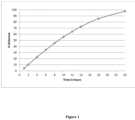
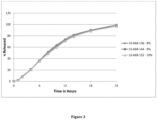
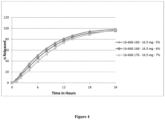
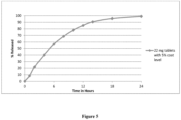
- the sustained release tablet described herein displays a release profile, when tested under the conditions described in Table 2, that when depicted as in Figure 1 , 3 , or 4 to graph % release versus time in hours is plus or minus 20% of the data plot depicted in Figure 1 , 3 or 4 .
- the sustained release tablet that is subjected to the dissolution test is a tablet in which 4-aminopyridine is present only in the compressed core (which tablet can be the final oral dosage form of a tablet that does not have an immediate release drug overcoat, or can be the tablet that has not yet been coated with the drug overcoat in an embodiment where the final oral dosage form will have a drug overcoat).
- the in vivo release mechanism of a drug from a sustained release tablet may be altered if the sustained release formulation is administered with alcohol, leading to dose dumping. See, Anand et al., 2011, AAPS J., 13(3):328-335 .
- the total amount of the 4-aminopyridine released, upon subjecting the sustained release tablet to an in vitro dissolution test employing 0.1 N hydrochloric acid containing 40% alcohol (ethanol) as a dissolution medium, within the first 2 hours of the in vitro dissolution test is not greater than the total amount of 4-aminopyridine released within the first 2 hours of an in vitro dissolution test employing 0.1 N hydrochloric acid as dissolution medium.
- a sustained release tablet provided herein exhibits substantially no dose dumping in the presence of food (i.e., there are not clinically relevant differences in one or more pharmacokinetic parameters) between fed and fasted states upon administration to patients.
- a sustained release tablet comprising 4-aminopyridine which method comprises:
- the ratio of the amount of the ethylcellulose coat to 4-aminopyridine is in the range of about 1:1 to about 2:1.
- a sustained release tablet comprising 4-aminopyridine which method comprises:
- the ratio of the amount of the ethylcellulose coat to 4-aminopyridine is in the range of about 0.2: 1 to about 0.5:1.
- a sustained release tablet comprising 4-aminopyridine which method comprises:
- a sustained release tablet comprising 4-aminopyridine which method comprises:
- the amount of the ethylcellulose coat is about 9% w/w of the compressed core and the amount of 4-aminopyridine is in the range of about 4% w/w to about 6% w/w of the compressed core. In another specific embodiment of the foregoing method of making, the amount of the ethylcellulose coat is about 5% w/w of the compressed core and the amount of 4-aminopyridine is in the range of about 4% w/w to about 6% w/w of the compressed core.
- a sustained release tablet comprising 4-aminopyridine which method comprises:
- the amount of the ethylcellulose coat is about 6% w/w of the compressed core and the amount of 4-aminopyridine is in the range of about 3% w/w to about 5% w/w of the compressed core.
- the curing step comprises exposing the coated compressed core to a temperature in the range of 40-70 °C for a period of time of at least 15 minutes, 30 minutes or 1 hour. In a specific embodiment, the curing step comprises exposing the coated compressed core to a temperature in the range of 40-70 °C for a period of time of at least 1 hour. Also provided herein is a method of making a sustained release tablet comprising 4-aminopyridine, which method comprises:
- a sustained release tablet comprising 4-aminopyridine which method comprises:
- the amount of 4-aminopyridine in the compressed core is about 22 mg.
- a sustained release tablet comprising 4-aminopyridine which method comprises:
- the amount of 4-aminopyridine in the compressed core is about 22 mg.
- a sustained release tablet comprising 4-aminopyridine which method comprises:
- the amount of 4-aminopyridine in the compressed core is about 16.5 mg.
- the methods of making a sustained release tablet comprise, or consist essentially, or consist of, the steps as described herein.
- the core is typically formed by first blending the active drug substance (4-aminopyridine), the polymeric components of the formulation, and additional excipients (e.g., filler or binder) for a brief period of time (e.g., 5-20 minutes). This is followed by addition of a suitable lubricant and further blending the mixture to a uniform new blend. The resulting blend is then compressed to intermediate tablets by methods known in the art.
- additional excipients e.g., filler or binder
- the method of forming the compressed core comprises:
- the polyethylene oxide has a molecular weight between 4,000,000 and 8,000,000. In another specific embodiment, the polyethylene oxide has a molecular weight of 7,000,000. In another specific embodiment, the polyethylene oxide is POLYOX WSR-303, commercially available from Dow Chemical Co.
- the amount of the polyethylene oxide in the compressed core is in the range of about 10% w/w to about 20% w/w of the compressed core.
- the mixture comprising polyvinyl acetate and polyvinyl pyrrolidone consists of about 80% polyvinyl acetate, about 19% polyvinyl pyrrolidone, about 0.8% sodium lauryl sulfate, and about 0.2% of silica.
- the mixture comprising polyvinyl acetate and polyvinyl pyrrolidone is KOLLIDON ® SR polyvinyl acetate/polyvinyl pyrrolidone (BASF);
- KOLLIDON ® SR is a blend of 80% polyvinyl acetate and 19% povidone (also called polyvinyl pyrrolidone) along with small quantities of sodium lauryl sulfate and silica used as stabilizers (see Signet Chemical Corporation's website page for KOLLIDON ® SR).
- the amount of the mixture comprising polyvinyl acetate and polyvinyl pyrrolidone in the compressed core is in the range of about 20% w/w to about 30% w/w of the compressed core.
- the amount of dibasic calcium phosphate dihydrate in the compressed core is in the range of about 47% w/w to about 53% w/w of the sustained release tablet. In another specific embodiment, the amount of dibasic calcium phosphate dihydrate in the compressed core is in the range of about 50% w/w to about 60% w/w of the compressed core.
- the amount of magnesium stearate in the compressed core is in the range of about 0.7% w/w to about 1.3% w/w of the sustained release tablet. In another specific embodiment, the amount of magnesium stearate in the compressed core is in the range of about 0.7% w/w to about 1.3% w/w of the compressed core.
- the coating of the compressed core is performed by using methods well known in the art, as described in US Patent 8,858,993 .
- the coating process described herein includes film coating.
- Tablet coating equipment may include spray guns, coating pans, polishing pans, solution tanks, blenders and mixers, homogenizers, mills, peristaltic pumps, fans, steam jackets, exhaust and heating pipes, scales and filters.
- the coating method involves spray coating.
- tablet coating typically takes place in a controlled atmosphere inside a perforated rotating drum. Angled baffles fitted into the drum and air flow inside the drum can provide means of mixing the tablet bed. As a result, the tablets are lifted and turned from the sides into the center of the drum, exposing each tablet surface to an even amount of deposited/sprayed coating. The liquid spray coating is then dried onto the tablets by heated air drawn through the tablet bed from an inlet fan. The air flow is typically regulated for temperature and volume to provide controlled drying and extracting rates, and at the same time, maintaining the drum pressure slightly negative relative to the room in order to provide a completely isolated process atmosphere for the operator.
- the coated compressed core is subjected to a post coating thermal treatment, also referred to as a curing step.
- the curing step comprises heating the coated compressed core to a temperature above 23 °C for a period of time of at least 15 minutes.
- the curing step comprises exposing the coated compressed core to a temperature in the range of 40-70 °C for a period of time of at least 15 minutes, 30 minutes, 1 hour, 6 hours, 12 hours, 18 hours, 24 hours, 30 hours, 36 hours, 42 hours or 48 hours.
- the period of time is at least 1 hour.
- the period of time is at least 6 hours.
- the period of time is at least 12 hours.
- the period of time is at least 18 hours. In a specific embodiment, the period of time is at least 24 hours. In a specific embodiment, the period of time is at least 30 hours. In a specific embodiment, the period of time is at least 36 hours. In a specific embodiment, the period of time is at least 42 hours. In a specific embodiment, the period of time is at least 48 hours.
- the coated compressed core is exposed to a temperature in the range of 50-60 °C. In a specific embodiment, the curing step comprises exposing the coated compressed core to a temperature in the range of 40-70 °C for a period of time of at least 1 hour.
- the curing step comprises exposing the coated compressed core to a temperature in the range of 50-60 °C for a period of time of at least 1 hour. In a specific embodiment, the curing step comprises exposing the coated compressed core to a temperature in the range of 50-60 °C for a period of time in the range of 1-48 hours.
- the curing step of the present invention aims at stabilizing the drug release profile on storage.
- the sustained release tablet is optionally coated further with an aqueous film coat containing a small quantity of 4-aminopyridine, referred to herein as the "4-AP drug overcoat" (or “immediate release 4-AP drug overcoat”), which results in an initial burst (immediate release) of the 4-aminopyridine.
- This initial burst is preferably followed by a zero order or near zero order release of the drug from the remaining tablet over an extended period of time.
- the 4-AP drug overcoat comprises 4-aminopyridine and one or more coating agents.
- the coating agent in the 4-AP drug overcoat comprises hydroxypropylmethylcellulose.
- the coating agent in the 4-AP drug overcoat comprises polyvinylalcohol.
- the coating agent in the 4-AP drug overcoat is from OPADRY ® film coating system, commercially available from Colorcon.
- the coating agent in the 4-AP drug overcoat comprises polyvinyl alcohol, talc, polyethylene glycol, and polysorbate 80.
- the 4-AP drug overcoat further comprises a coloring agent.
- a solution of the 4-AP drug overcoat is typically prepared by dissolving a coating agent in a suitable solvent (e.g., water), followed by adding 4-aminopyridine and stirring to obtain a clear solution.
- the solution of the 4-AP drug overcoat can be applied to the dried coated compressed cores by methods well known in the art to achieve the desired coat weight gain.
- the solution is applied by spray coating.
- the resulting tablets can be dried, e.g., for up to 1 h at a temperature of about 50-60 °C.
- the sustained release tablet of the present invention aside from any immediate release of 4-aminopyridine due to the presence of a 4-AP drug overcoat, provides a zero-order or near-zero-order release of the 4-aminopyridine. In a preferred embodiment, the release is zero-order.
- the sustained release tablets discussed herein provide for the release of 4-aminopyridine at a sustained rate such that a therapeutically beneficial blood level of the 4-aminopyridine is maintained over a period of at least about 12 hours, preferably about 24 hours or more.
- the sustained release tablets discussed herein provide for the release of 4-aminopyridine at a sustained rate such that a therapeutically beneficial blood level of the 4-aminopyridine is maintained over a period of at least about 18 hours.
- the amount of the 4-aminopyridine in the sustained release tablets of the present invention establish a therapeutically useful plasma concentration through once daily administration of the sustained release tablet.
- the sustained release tablet described herein comprises an amount of 4-aminopyridine that is therapeutically effective over a period of 24 hours.
- the sustained release tablet is suitable for once daily oral administration; i.e., the sustained release tablet provides a therapeutically effective of 4-aminopyridine to a human patient upon once daily oral administration.
- the term “about” or “approximately” means an acceptable error for a particular value as determined by one of ordinary skill in the art, which depends in part on how the value is measured or determined. In certain embodiments, the term “about” or “approximately” means within 1, 2, or 3 standard deviations. In certain embodiments, the term “about” or “approximately” means within 10%, 9%, 8%, 7%, 6%, 5%, 4%, 3%, 2%, 1%, 0.5%, 0.4%, 0.3%, 0.25%, 0.2%, 0.1% or 0.05% of a given value or range.
- the invention also provides sustained release tablets according to the invention for use in methods of treating a neurological disorder in a patient in need thereof comprising orally administering to the patient, for instance a human patient, once daily the sustained release 4-aminopyridine tablet as disclosed herein.
- sustained release tablets according to the invention for use in methods of treating a neurological disorder in a patient in need thereof comprising orally administering to the patient, for instance a human patient, once daily a sustained release tablet according to the invention, wherein the amount of 4-aminopyridine is in the range of about 4% w/w to about 6% w/w of the compressed core; the polyethylene oxide has a molecular weight of 7,000,000, wherein the amount of the polyethylene oxide is about 15% w/w of the compressed core; said mixture consists of about 80% polyvinyl acetate, about 19% polyvinyl pyrrolidone, about 0.8% sodium lauryl sulfate, and about 0.2% of silica, wherein the amount of the mixture is about 25% w/w of the compressed core; the compressed core further comprises (a) dibasic calcium phosphate dihydrate, wherein the amount of dibasic calcium phosphate dihydrate is about 54% w/w of the compressed core, and (b) magnesium
- the amount of 4-aminopyridine in the compressed core is about 17.5 mg, about 18 mg, about 18.5 mg, about 19 mg, about 19.5 mg, about 20 mg, about 20.5 mg, about 21 mg, about 21.5 mg, about 22 mg, about 22.5 mg, about 23 mg, about 23.5 mg, about 24 mg, about 24.5 mg, about 25 mg, about 25.5 mg, about 26 mg, or about 26.5 mg. In a specific embodiment of the foregoing embodiment, the amount of 4-aminopyridine in the compressed core is about 22 mg.
- the sustained release tablet is the product of a process comprising a curing step after coating the compressed core with ethylcellulose, wherein said curing step comprises exposing the coated compressed core to a temperature in the range of 50-60 °C for a period of time of at least 1 hour.
- sustained release tablets according to the invention for use in methods of treating a neurological disorder in a patient in need thereof comprising orally administering to the patient, for instance a human patient, once daily a sustained release tablet according to the invention, wherein the amount of 4-aminopyridine is in the range of about 4% w/w to about 6% w/w of the compressed core; the polyethylene oxide has a molecular weight of 7,000,000, wherein the amount of the polyethylene oxide is about 15% w/w of the compressed core; said mixture consists of about 80% polyvinyl acetate, about 19% polyvinyl pyrrolidone, about 0.8% sodium lauryl sulfate, and about 0.2% of silica, wherein the amount of the mixture is about 25% w/w of the compressed core; the compressed core further comprises (a) dibasic calcium phosphate dihydrate, wherein the amount of dibasic calcium phosphate dihydrate is about 54% w/w of the compressed core; and (b) magnesium
- the amount of 4-aminopyridine in the compressed core is about 17.5 mg, about 18 mg, about 18.5 mg, about 19 mg, about 19.5 mg, about 20 mg, about 20.5 mg, about 21 mg, about 21.5 mg, about 22 mg, about 22.5 mg, about 23 mg, about 23.5 mg, about 24 mg, about 24.5 mg, about 25 mg, about 25.5 mg, about 26 mg, or about 26.5 mg. In a specific embodiment of the foregoing embodiment, the amount of 4-aminopyridine in the compressed core is about 22 mg.
- the sustained release tablet is the product of a process comprising a curing step after coating the compressed core with ethylcellulose, wherein said curing step comprises exposing the coated compressed core to a temperature in the range of 50-60 °C for a period of time of at least 1 hour.
- sustained release tablets according to the invention for use in methods of treating a neurological disorder in a patient in need thereof comprising orally administering to the patient, for instance a human patient, once daily a sustained release tablet according to the invention, wherein the amount of 4-aminopyridine is in the range of about 3% w/w to about 5% w/w of the compressed core;
- the polyethylene oxide has a molecular weight of 7,000,000, wherein the amount of the polyethylene oxide is about 15% w/w of the compressed core; said mixture consists of about 80% polyvinyl acetate, about 19% polyvinyl pyrrolidone, about 0.8% sodium lauryl sulfate, and about 0.2% of silica, wherein the amount of the mixture is about 25% w/w of the compressed core;
- the compressed core further comprises (a) dibasic calcium phosphate dihydrate, wherein the amount of dibasic calcium phosphate dihydrate is about 55% w/w of the compressed core, and (b) magnesium
- the amount of 4-aminopyridine in the compressed core is about 13 mg, about 13.5 mg, about 14 mg, about 14.5 mg, about 15 mg, about 15.5 mg, about 16 mg, about 16.5 mg, about 17 mg, about 17.5 mg, about 18 mg, about 18.5 mg, about 19 mg, about 19.5 mg, about 20 mg, about 20.5 mg, about 21 mg, about 21.5 mg or about 22 mg. In a specific embodiment of the foregoing embodiment, the amount of 4-aminopyridine in the compressed core is about 16.5 mg.
- the sustained release tablet is the product of a process comprising a curing step after coating the compressed core with ethylcellulose, wherein said curing step comprises exposing the coated compressed core to a temperature in the range of 50-60 °C for a period of time of at least 1 hour.
- Patient is defined herein to include animals, such as mammals, including, but not limited to, primates (e.g., humans), cows, sheep, goats, horses, dogs, cats, rabbits, rats, mice, monkeys, chickens, turkeys, quails, or guinea pigs and the like.
- the patient is a mammal.
- the patient is a human patient.
- the human patient is an adult (e.g., greater than 16 years of age).
- the patient is a pediatric patient (e.g., age 2-16).
- the age of the pediatric patient is at least 6 years.
- the human patient is an adolescent (e.g., age 12-16).
- the patient is a child (e.g. age 2-12). In one embodiment, the age of the child is at least 6 years.
- the administering to the patient is performed once daily. In another embodiment, the administering to the patient is performed twice daily.
- the neurological disorder is a neurological disorder amenable to treatment by 4-aminopyridine.
- the neurological disorder is a neurological disease including, but not limited to, multiple sclerosis and stroke.
- the neurological disorder is multiple sclerosis.
- the neurological disorder is stroke.
- the neurological disorder is an impairment associated with a neurological disease.
- the neurological disorder is a walking impairment associated with multiple sclerosis.
- the sustained release tablet according to the invention is for use in a method of treatment, wherein the method of treatment is to improve walking or to increase walking speed in a multiple sclerosis patient.
- the method of treatment is to improve walking or to increase walking speed in a stroke patient.
- the neurological disorder is a neurocognitive or a neuropsychiatric impairment associated with multiple sclerosis. In one embodiment, the neurological disorder is a sensorimotor impairment associated with stroke. In one embodiment, the neurological disorder is a walking impairment associated with stroke.
- the invention provides a sustained release tablet according to the invention for use in a method of improving walking comprising administering once daily to a patient (e.g., a multiple sclerosis patient) a sustained release tablet provided herein.
- a patient e.g., a multiple sclerosis patient
- a sustained release tablet provided herein.
- the sustained release 4-aminopyridine tablet as disclosed herein is orally administered to a patient with renal impairment, for example, a patient who is mildly or moderately renally impaired.
- the renal impairment is mild renal impairment.
- the renal impairment is moderate renal impairment.
- the renal impairment is severe renal impairment.
- the renal impairment is moderate or severe renal impairment.
- the sustained release 4-aminopyridine tablet is orally administered to a patient who is not severely renal impaired.
- the patient is classified as having mild renal impairment when the patient has a creatinine clearance value in the range of 51-80 mL/min.
- the patient is classified as having mild renal impairment when the patient has a creatinine clearance value in the range of 60-89 mL/min. In yet another embodiment, the patient is classified as having mild renal impairment when the patient has an estimated glomerular filtration rate in the range of 60-89 mL/min/1.73m 2 . In one embodiment, the patient is classified as having moderate renal impairment when the patient has a creatinine clearance value in the range of 30-59 mL/min. In yet another embodiment, the patient is classified as having moderate renal impairment when the patient has an estimated glomerular filtration rate in the range of 30-59 mL/min/1.73m 2 .
- the patient is classified as having severe renal impairment when the patient has a creatinine clearance value in the range of 15-29 mL/min. In yet another embodiment, the patient is classified as having severe renal impairment when the patient has an estimated glomerular filtration rate in the range of 15-29 mL/min/1.73m 2 .
- the sustained release tablet as disclosed herein is orally administered once daily to an adult or adolescent patient, wherein the compressed core of the sustained release tablet comprises 4-aminopyridine in an amount in the range of about 5 mg to about 40 mg.
- the amount of 4-aminopyridine in the compressed core is in the range of about 5 mg to about 35 mg, about 5 mg to about 30 mg, about 5 mg to about 25 mg, about 5 mg to about 20 mg, about 5 mg to about 15 mg, about 5 mg to about 10 mg, about 10 mg to about 40 mg, about 10 mg to about 35 mg, about 10 mg to about 30 mg, about 10 mg to about 25 mg, about 10 mg to about 20 mg, about 10 mg to about 15 mg, about 15 mg to about 40 mg, about 15 mg to about 35 mg, about 15 mg to about 30 mg, about 15 mg to about 25 mg, about 15 mg to about 20 mg, about 20 mg to about 40 mg, about 20 mg to about 35 mg, about 20 mg to about 30 mg, about 20 mg to about 25 mg, about 25 mg to about 40 mg, about 25 mg to about 35 mg, about 25 mg to about 30 mg, about 30 mg to about 40 mg, about 30 mg to about 35 mg, or about 35 mg to about 40 mg.
- the amount of 4-aminopyridine in the compressed core is about 16 mg, about 16.2 mg, about 16.4 mg, about 16.6 mg, about 16.8 mg, about 17 mg, about 17.2 mg, about 17.4 mg, about 17.6 mg, about 17.8 mg, about 18 mg, about 18.2 mg, about 18.4 mg, about 18.6 mg, about 18.8 mg, about 19 mg, about 19.2 mg, about 19.4 mg, about 19.6 mg, about 19.8 mg, about 20 mg, about 20.2 mg, about 20.4 mg, about 20.6 mg, about 20.8 mg, about 21 mg, about 21.2 mg, about 21.4 mg, about 21.6 mg, about 21.8 mg, about 22 mg, about 22.2 mg, about 22.4 mg, about 22.6 mg, about 22.8 mg, about 23 mg, about 23.2 mg, about 23.4 mg, about 23.6 mg, about 23.8 mg, about 24 mg, about 24.2 mg, about 24.4 mg, about 24.6 mg, about 24.8 mg, or about 25 mg.
- the amount of 4-aminopyridine in the compressed core is in the range of about 12 mg to about 40 mg. In another embodiment of the foregoing, the amount of 4-aminopyridine in the compressed core is in the range of about 12 mg to about 25 mg. In another embodiment of the foregoing, the amount of 4-aminopyridine in the compressed core is in the range of about 12 mg to about 15 mg. In another embodiment of the foregoing, the amount of 4-aminopyridine in the compressed core is in the range of about 5 mg to about 12 mg. In a specific embodiment of the foregoing, the amount of 4-aminopyridine in the compressed core is about 22 mg.
- the amount of 4-aminopyridine in the compressed core is about 16.5 mg. In another specific embodiment of the foregoing, the amount of 4-aminopyridine in the compressed core is about 11 mg.
- the sustained release tablet as disclosed herein is orally administered once daily to an adult patient, wherein the compressed core of the sustained release tablet comprises 4-aminopyridine in an amount in the range of about 16 mg to about 22 mg. In another specific embodiment, the sustained release tablet as disclosed herein is orally administered once daily to an adolescent patient, wherein the compressed core of the sustained release tablet comprises 4-aminopyridine in an amount in the range of about 12 mg to about 22 mg. In another specific embodiment, the sustained release tablet as disclosed herein is orally administered once daily to a child patient of age 6-12, wherein the compressed core of the sustained release tablet comprises 4-aminopyridine in an amount in the range of about 4 mg to about 13 mg.
- the sustained release tablet as disclosed herein is orally administered once daily to a pediatric patient, wherein the compressed core of the sustained release tablet comprises 4-aminopyridine in an amount in the range of about 4 mg to about 13 mg.
- the amount of 4-aminopyridine in the compressed core is in the range of about 4 mg to about 11 mg, about 4 mg to about 9 mg, about 4 mg to about 7 mg, about 4 mg to about 5 mg, about 5 mg to about 13 mg, about 5 mg to about 11 mg, about 5 mg to about 9 mg, about 5 mg to about 7 mg, about 7 mg, to about 13 mg, about 7 mg to about 11 mg, about 7 mg to about 9 mg, about 9 mg to about 13 mg, about 9 mg to about 11 mg, or about 11 mg to about 13 mg.
- the amount of 4-aminopyridine in the compressed core is about 6 mg, about 6.5 mg, about 7 mg, about 7.5 mg, about 8 mg, about 8.5 mg, about 9 mg, about 9.5 mg, about 10 mg, about 10.5 mg, about 11 mg, about 11.5 mg, or about 12 mg. In another specific embodiment of the foregoing, the amount of 4-aminopyridine in the compressed core is about 11 mg. In another specific embodiment of the foregoing, the amount of 4-aminopyridine in the compressed core is about 8 mg. In one embodiment, the pediatric dose is half of the adult dose. For example, if the amount of 4-aminopyridine in the compressed core orally administered once daily to an adult patient is about 22 mg, the amount of 4-aminopyridine in the compressed core orally administered to a pediatric patient is about 11 mg.
- the sustained release tablet as disclosed herein is orally administered once daily to a patient with renal impairment, wherein the compressed core of the sustained release tablet comprises 4-aminopyridine in an amount in the range of about 4 mg to about 20 mg.
- the amount of 4-aminopyridine in the compressed core is about 6 mg to about 20 mg, about 6 mg to about 16 mg, about 6 mg to about 12 mg, about 6 mg to about 18 mg, about 8 mg to about 20 mg, about 8 mg to about 16 mg, about 8 mg to about 12 mg, about 10 mg to about 20 mg, about 10 mg to about 16 mg, about 10 mg to about 12 mg, about 12 mg to about 20 mg, about 12 mg to about 16 mg, about 14 mg to about 20 mg, about 14 mg to about 16 mg, or about 16 mg to about 20 mg.
- the amount of 4-aminopyridine in the compressed core is about 7 mg to about 9 mg. In another specific embodiment of the foregoing, the amount of 4-aminopyridine in the compressed core is about 11 mg to about 13 mg. In another specific embodiment of the foregoing, the amount of 4-aminopyridine in the compressed core is about 12 mg to about 15 mg. In another specific embodiment of the foregoing, the amount of 4-aminopyridine in the compressed core is about 15 mg to about 17 mg.
- the amount of 4-aminopyridine in the compressed core is about 7 mg, about 7.5 mg, about 8 mg, about 8.5 mg, about 9 mg, about 9.5 mg, about 10 mg, about 10.5 mg, about 11 mg, about 11.5 mg, about 12 mg, about 12.5 mg, about 13 mg, about 13.5 mg, about 14 mg, about 14.5 mg, about 15 mg, about 15.5 mg, about 16 mg, about 16.5 mg or about 17 mg.
- the sustained release tablet of any of the foregoing embodiments is orally administered once daily to a patient with mild or moderate renal impairment.
- the sustained release 4-aminopyridine tablet as disclosed herein is orally administered once daily to a patient with no renal impairment.
- the patient is classified as having no renal impairment when the patient has an estimated glomerular filtration rate of ⁇ 90 mL/min/1.73m 2 .
- the patient is classified as having no renal impairment when the patient has a creatinine clearance value of ⁇ 90 mL/min.
- a sustained release 4-aminopyridine tablet as disclosed herein upon oral administration to human subjects does not result in substantial dose dumping in the presence of food.
- the sustained release 4-aminopyridine tablet upon oral administration to human subjects does not result in clinically relevant differences in pharmacokinetic parameters such as AUC or C max between the fed or fasted conditions when administered to human subjects in fed and fasted conditions.
- a human subject having consumed a high-fat high-calorie meal before oral administration is considered to be in a fed state.
- a human subject observing an overnight fast of at least 10 h is considered to be in a fasted state.
- a sustained release 4-aminopyridine tablet as disclosed herein upon oral administration to human subjects in a fasted state, provides one or more of the following pharmacokinetic parameters: (a) a mean plasma 4-aminopyridine C max in the range of about 14.74 ng/mL to about 20.66 ng/mL; (b) a median plasma 4-aminopyridine T max in the range of about 3 h to about 14 h; (c) a mean plasma 4-aminopyridine AUC 0-36 in the range of about 232 ng ⁇ h/mL to about 434 ng ⁇ h/mL; and (d) a mean plasma 4-aminopyridine AUC 0- ⁇ in the range of about 230 ng h/mL to about 472 ng ⁇ h/mL.
- the amount of 4-aminopyridine in the sustained release tablet is about 22 mg.
- AUC 0-36 is the area under the curve for 0 - 36 h.
- the sustained release tablet which is characterized by the foregoing pharmacokinetic parameters is a tablet in which 4-aminopyridine is present only in the compressed core (which tablet can be the final oral dosage form of a tablet that does not have an immediate release drug overcoat, or can be the tablet that has not yet been coated with the drug overcoat in an embodiment where the final oral dosage form will have a drug overcoat).
- a sustained release 4-aminopyridine tablet as disclosed herein upon oral administration to human subjects in a fed state, provides one or more of the following pharmacokinetic parameters: (a) a mean plasma 4-aminopyridine C max in the range of about 13.73 ng/mL to about 24.07 ng/mL; (b) a median plasma 4-aminopyridine T max in the range of about 6 h to about 21 h; (c) a mean plasma 4-aminopyridine AUC 0-36 in the range of about 216 ng ⁇ h/mL to about 472 ng ⁇ h/mL; and (d) a mean plasma 4-aminopyridine AUC 0- ⁇ in the range of about 218 ng h/mL to about 490 ng ⁇ h/mL.
- the amount of 4-aminopyridine in the sustained release tablet is about 22 mg.
- the sustained release tablet which is characterized by the foregoing pharmacokinetic parameters is a tablet in which 4-aminopyridine is present only in the compressed core (which tablet can be the final oral dosage form of a tablet that does not have an immediate release drug overcoat, or can be the tablet that has not yet been coated with the drug overcoat in an embodiment where the final oral dosage form will have a drug overcoat).
- the sustained release 4-aminopyridine tablet as disclosed herein may be orally administered in combination with one or more additional medicaments.
- Such combination therapy may be achieved by way of the simultaneous, sequential, or separate dosing of the individual components of the treatment.
- the combination therapy is achieved by way of separate dosing of the sustained release 4-aminopyridine tablet and the other medicament.
- the other medicament is a therapeutic agent effective for the treatment of multiple sclerosis.
- the other medicament is selected from a group consisting of, but not limited to, AVONEX (interferon beta-1a), REBIF (interferon beta-1a), BETASERON and EXTAVIA (interferon beta-1b), COPAXONE (glatiramer acetate), NOVANTRONE (mitoxantrone), TYSABRI (natalizumab), AUBAGIO (teriflunomide), GILENYA (fingolimod), LEMTRADA (alemtuzumab), PLEGRIDY (peginterferon beta-1a), TECFIDERA (dimethyl fumarate), ocrelizumab, prednisone, prednisolone, methylprednisolone, betamethasone, and dexamethasone.
- the other medicament is a therapeutic agent intended for the prophylaxis of stroke.
- the other medicament is selected from the group consisting of, but not limited to, anti-coagulant agents (e.g. aspirin, clopidogrel, etc.) and antihypertensive agents.
- the completed blend from above was fed into a tablet press hopper.
- a rotary tablet press (power assisted) was set up with a tablet deduster and metal detector in-line. Batch set-up parameters were then determined to achieve tablets a target weight of 440 mg (individual range 407-473 mg).
- the blend was then compressed using a Compact-19 Tablet Press with Tooling Set No. 138 to furnish the desired core tablets, while performing checks on individual tablet weight, mean tablet weight, hardness, thickness, appearance and friability at defined times during the compression run.
- the weight of the desired tablets was within +/- 7.5% of theoretical tablet weight of 440 mg (i.e., within 407.0 - 473.0 mg).
- Purified Water (686.0 g) was weighed into a suitable solution tank.
- the Purified Water was mixed with Ethylcellulose Dispersion Type B, NF (Surelease E-7-19040, Clear) (1030 g) while stirring using an overhead mixer with a suitable impeller. Mixing was continued for at least 15 minutes with low to moderate agitation, while ensuring there are no visual signs for any lumps, foam, settling, etc. prior to coating.
- the core tablets prepared in Section 0 were loaded into a LabCoat MX tablet coater equipped with a 15" pan, a peristaltic pump with new tubing (Maserflex Pt/Si Size 14) and a single spray gun.
- the tablets were pre-warm for approximately 10 minutes by jogging the pan with the fan and heater on at 50 °C.
- the above prepared film-coat was applied in a controlled manner to the pre-warmed core tablets in the Labcoat MX to approximately 9% weight gain (i.e., 39.6 mg).
- the coated tablets thus formed were then subjected to a curing step by drying them at 55 °C for 1 hour and then allowed to cool for at least 5 minutes to a target exhaust temperature of approximately 25-30 °C while jogging the pan.
- the tablets were then discharged into a suitable container lined with two polyethylene bags to afford the final coated tablets.
- Table 1 provides the amounts and weight percentages of ingredients present in the sustained release tablet prepared using the method described above.
- Table 1 Composition of sustained release tablets containing 22 mg 4-aminopyridine and 9% ethylcellulose coat by weight of the compressed core Ingredient % w/w of compressed core Amount per tablet (mg) Compressed Core 4-aminopyridine 5.0 22.0 KOLLIDON ® SR 25.0 110.0 Polyethylene oxide (Sentry Polyox WSR 303) 15.0 66.0 Dibasic calcium phosphate dihydrate 54.0 237.6 Magnesium stearate 1.0 4.4 Weight of Compressed Core 100 440 Functional Coating Ethylcellulose Dispersion Type B 9 39.6
- the ratio of the amount of the ethylcellulose coat to the amount of 4-aminopyridine is 1.8:1; wherein for calculating said ratio, the amount of the ethylcellulose coat is the weight percentage of the ethylcellulose coat by weight of the compressed core (i.e., 9%), and the amount of 4-aminopyridine is the weight percentage of 4-aminopyridine by weight of the compressed core (i.e. 5%).
- the ratio of the amount of the ethylcellulose coat to the amount of 4-aminopyridine in the compressed core is about 0.4:1; wherein for calculating said ratio, the amount of the ethylcellulose coat is the weight percentage of the ethylcellulose coat by weight of the compressed core (i.e., 9%), and the amount of 4-aminopyridine is the weight in milligrams of 4-aminopyridine (i.e., 22 mg).
- Dissolution profile of the sustained release tablet in Example 1 is shown in Figure 1 .
- the dissolution profile was generated using the conditions shown in Table 2 below. Table 2.
- Dissolution profile parameters Apparatus USP Type II (Paddles) Paddle Speed 50 RPM Dissolution Medium 50 mM Phosphate Buffer, pH 6.8 Dissolution Medium Temperature 37.0 ⁇ 0.5° C Sampling Time Profile 1,2,4,6,8,10,12,14,18, and 24 hours Vessel Volume 900 mL UV Wavelength 262 nm Cell 1 mm, quartz Sinkers QLA, 2S
- Core tablets i.e., compressed cores containing 22 mg 4-aminopyridine were prepared using the formulation described in Table 1 and the method described in Example 1, Sections 0 and 0. These core tablets were coated with an aqueous Ethylcellulose Dispersion Type B (Surelease E-7-19040, Clear) coat to approximately 8% and 10% weight gain, following the procedure described in Example 1, Section 0.
- aqueous Ethylcellulose Dispersion Type B Sudrelease E-7-19040, Clear
- Sustained release tablets containing 16.5 mg 4-aminopyridine were prepared using the method described in Example 1, except using the amounts and weight percentages of ingredients shown in Table 4. Table 4. Composition of sustained release tablets containing 16.5 mg 4-aminopyridine and 6% ethylcellulose coat by weight of the compressed core Ingredient % w/w of compressed core Amount per tablet (mg) Compressed Core 4-aminopyridine 3.75 16.5 KOLLIDON ® SR 25.0 110.0 Polyethylene oxide (Sentry Polyox WSR 303) 15.0 66.0 Dibasic calcium phosphate dihydrate 55.25 243.1 Magnesium stearate 1.0 4.4 Weight of Compressed Core 100 440 Functional Coating Ethylcellulose Dispersion Type B 6 26.4
- the ratio of the amount of the ethylcellulose coat to the amount of 4-aminopyridine is 1.6:1; wherein for calculating said ratio, the amount of the ethylcellulose coat is the weight percentage of the ethylcellulose coat by weight of the compressed core (i.e., 6%), and the amount of 4-aminopyridine is the weight percentage of 4-aminopyridine by weight of the compressed core (i.e. 3.75%).
- the ratio of the amount of the ethylcellulose coat to the amount of 4-aminopyridine in the compressed core is about 0.35:1; wherein for calculating said ratio, the amount of the ethylcellulose coat is the weight percentage of the ethylcellulose coat by weight of the compressed core (i.e., 6%), and the amount of 4-aminopyridine is the weight in milligrams of 4-aminopyridine (i.e., 16.5 mg).
- the core tablets prepared using the formulation described in Table 4 were coated with an aqueous Ethylcellulose Dispersion Type B (Surelease E-7-19040, Clear) coat to approximately 5% and 7% weight gain.
- aqueous Ethylcellulose Dispersion Type B Sudrelease E-7-19040, Clear
- Table 5 A comparison of the dissolution profiles (generated using the parameters shown in Table 2) of the sustained release tablets containing 16.5 mg 4-aminopyridine, coated with an aqueous Ethylcellulose Dispersion Type B coat to approximately 5%, 6%, and 7% weight gain, is shown in Figure 4 and Table 5. Table 5.
- the completed blend from above was fed into a tablet press hopper.
- a single rotary tablet press (power assisted) was set up with a tablet deduster and metal detector in-line. Batch set-up parameters were then determined to achieve tablets a target weight of 440 mg (individual range 407-473 mg).
- the blend was then compressed using a Fette 1200i Tablet Press with Tooling Set No. 138 to furnish the desired core tablets, while performing checks on individual tablet weight, mean tablet weight, hardness, thickness, appearance and friability at defined times during the compression run.
- the weight of the desired tablets was within +/- 7.5% of theoretical tablet weight of 440 mg (i.e., within 407.0 - 473.0 mg).
- Purified Water (31200.0 g) was weighed into a suitable solution tank.
- the Purified Water was mixed with Ethylcellulose Dispersion Type B, NF (Surelease E-7-19040, Clear) (46800 g) while stirring using an overhead mixer with a suitable impeller. Mixing was continued for at least 15 minutes with low to moderate agitation, while ensuring there are no visual signs for any lumps, foam, settling, etc. prior to coating.
- the core tablets prepared in the above section were loaded into a O'Hara fastcoat48 tablet coater equipped with a 48" pan, a peristaltic pump with a new tubing (Maserflex Pt/Si Size 35) and 4 spray guns.
- the tablets were pre-warmed for approximately 10 minutes by jogging the pan with the fan and heater on at 50 °C.
- the above prepared film-coat was applied in a controlled manner to the pre-warmed core tablets in the O'Hara fastcoat48 tablet coater to approximately 5% weight gain (i.e., 22.0 mg).
- the coated tablets thus formed were then subjected to a curing step by drying them at 55 °C for 1 hour and then allowed to cool for at least 5 minutes to a target exhaust temperature of approximately 25-30 °C while jogging the pan.
- the tablets were then discharged into a suitable container lined with two polyethylene bags to afford the final coated tablets.
- Table 6 provides the amounts and weight percentages of ingredients present in the sustained release tablet prepared using the method described above: Table 6.
- Composition of sustained release tablets containing 22 mg 4-aminopyridine and 5% ethylcellulose coat by weight of the compressed core Ingredient % w/w of compressed core Amount per tablet (mg) Compressed Core 4-aminopyridine 5.0 22.0 KOLLIDON ® SR 25.0 110.0 Polyethylene oxide (Sentry Polyox WSR 303) 15.0 66.0 Dibasic calcium phosphate dihydrate 54.0 237.6
- Magnesium stearate 1.0 4.4 Weight of Compressed Core 100 440 Functional Coating Ethylcellulose Dispersion Type B 5 22.0
- the dissolution profile (generated using the conditions shown in Table 2) of the sustained release tablet in Example 4 is shown in Figure 5 .
Landscapes
- Health & Medical Sciences (AREA)
- Life Sciences & Earth Sciences (AREA)
- Chemical & Material Sciences (AREA)
- Public Health (AREA)
- Epidemiology (AREA)
- Pharmacology & Pharmacy (AREA)
- Animal Behavior & Ethology (AREA)
- General Health & Medical Sciences (AREA)
- Medicinal Chemistry (AREA)
- Veterinary Medicine (AREA)
- Engineering & Computer Science (AREA)
- Bioinformatics & Cheminformatics (AREA)
- Biophysics (AREA)
- Molecular Biology (AREA)
- Inorganic Chemistry (AREA)
- Medicinal Preparation (AREA)
Claims (21)
- Retardtablette, umfassend:(a) einen komprimierten Kern, wobei der komprimierte Kern Folgendes umfasst: (i) 4-Aminopyridin, wobei die Menge an 4-Aminopyridin in dem komprimierten Kern im Bereich von etwa 1 Gew.-% bis etwa 10 Gew.-% des komprimierten Kerns liegt, (ii) ein Polyethylenoxid mit einem Molekulargewicht zwischen etwa 4.000.000 und 8.000.000, wobei die Menge des Polyethylenoxids in dem komprimierten Kern im Bereich von etwa 10 Gew.-% bis etwa 20 Gew.-% des komprimierten Kerns liegt, und eine Mischung, die Polyvinylacetat und Polyvinylpyrrolidon umfasst, wobei die Menge der Mischung, die Polyvinylacetat und Polyvinylpyrrolidon umfasst, in dem komprimierten Kern im Bereich von etwa 20 Gew.-% bis etwa 30 Gew.-% des komprimierten Kerns liegt; und(b) eine Menge eines den komprimierten Kern umgebenden Ethylcelluloseüberzugs, wobei die Menge des Ethylcelluloseüberzugs im Bereich von etwa 5 Gew.-% bis etwa 10 Gew.-% des komprimierten Kerns liegt.
- Retardtablette nach Anspruch 1, wobei die Mischung ferner einen oder mehrere pharmazeutisch unbedenkliche Hilfsstoffe umfasst; oderdie Mischung 70-90 % Polyvinylacetat und 15-20 % Polyvinylpyrrolidon umfasst; und/oderdie Mischung ferner ein Tensid umfasst.
- Retardtablette nach Anspruch 1 oder 2, wobei die Mischung ferner Siliciumdioxid und ein Tensid umfasst.
- Retardtablette nach einem der Ansprüche 1-3, wobei die Mischung aus etwa 80 % Polyvinylacetat, etwa 19 % Polyvinylpyrrolidon, etwa 0,8 % Natriumlaurylsulfat und etwa 0,2 % Siliciumdioxid besteht; und/oderwobei der komprimierte Kern ferner einen Füllstoff und ein Schmiermittel umfasst; und/oderwobei der komprimierte Kern ferner einen Füllstoff und ein Schmiermittel umfasst und der Füllstoff Calciumhydrogenphosphatdihydrat ist und das Schmiermittel Magnesiumstearat ist; und/oder wobei das Polyethylenoxid ein Molekulargewicht von 7.000.000 aufweist.
- Retardtablette nach Anspruch 1, wobei die Mischung aus etwa 80 % Polyvinylacetat, etwa 19 % Polyvinylpyrrolidon, etwa 0,8 % Natriumlaurylsulfat und etwa 0,2 % Siliciumdioxid besteht und der komprimierte Kern ferner Calciumhydrogenphosphatdihydrat und Magnesiumstearat umfasst und wobei die Menge an 4-Aminopyridin im Bereich von etwa 4 Gew.-% bis etwa 6 Gew.-% des komprimierten Kerns liegt; und/oder
wobei die Menge des den komprimierten Kern umgebenden Ethylcelluloseüberzugs etwa 9 Gew.-% des komprimierten Kerns beträgt. - Retardtablette nach Anspruch 1, wobei die Menge des Ethylcelluloseüberzugs im Bereich von etwa 5 Gew.-% bis etwa 7 Gew.-% des komprimierten Kerns liegt; gegebenenfalls wobei die Menge an 4-Aminopyridin im Bereich von etwa 3 Gew.-% bis etwa 5 Gew.-% des komprimierten Kerns liegt und die Menge des den komprimierten Kern umgebenden Ethylcelluloseüberzugs etwa 6 Gew.-% des komprimierten Kerns beträgt.
- Retardtablette nach einem der Ansprüche 1-6, wobei die Menge an 4-Aminopyridin in dem komprimierten Kern im Bereich von etwa 12 mg bis etwa 25 mg oder etwa 20 mg bis etwa 25 mg oder etwa 22 mg oder etwa 16,5 mg oder etwa 5 mg bis etwa 12 mg liegt.
- Retardtablette nach Anspruch 1, wobei entweder:(A) die Menge an 4-Aminopyridin im Bereich von etwa 4 Gew.-% bis etwa 6 Gew.-% des komprimierten Kerns liegt; die Mischung aus etwa 80 % Polyvinylacetat, etwa 19 % Polyvinylpyrrolidon, etwa 0,8 % Natriumlaurylsulfat und etwa 0,2 % Siliciumdioxid besteht; der komprimierte Kern ferner (a) Calciumhydrogenphosphatdihydrat, wobei die Menge an Calciumhydrogenphosphatdihydrat im Bereich von etwa 50 Gew.-% bis etwa 60 Gew.-% des komprimierten Kerns liegt, und (b) Magnesiumstearat, wobei die Menge an Magnesiumstearat im Bereich von etwa 0,7 Gew.-% bis etwa 1,3 Gew.-% des komprimierten Kerns liegt, umfasst; oder(B) die Menge an 4-Aminopyridin im Bereich von etwa 4 Gew.-% bis etwa 6 Gew.-% des komprimierten Kerns liegt; das Polyethylenoxid ein Molekulargewicht von 7.000.000 aufweist, wobei die Menge des Polyethylenoxids etwa 15 Gew.-% des komprimierten Kerns beträgt; die Mischung aus etwa 80 % Polyvinylacetat, etwa 19 % Polyvinylpyrrolidon, etwa 0,8 % Natriumlaurylsulfat und etwa 0,2 % Kieselsäure besteht, wobei die Menge der Mischung etwa 25 Gew.-% des komprimierten Kerns beträgt; der komprimierte Kern ferner (a) Calciumhydrogenphosphatdihydrat, wobei die Menge des Calciumhydrogenphosphatdihydrats etwa 54 Gew.-% des komprimierten Kerns beträgt, und (b) Magnesiumstearat, wobei die Menge an Magnesiumstearat etwa 1 Gew.-% des komprimierten Kerns beträgt, umfasst und die Menge des Ethylcelluloseüberzugs etwa 9 Gew.-% des komprimierten Kerns beträgt; gegebenenfalls die Menge an 4-Aminopyridin etwa 22 mg beträgt; oder(C) die Menge an 4-Aminopyridin im Bereich von etwa 3 Gew.-% bis etwa 5 Gew.-% des komprimierten Kerns liegt; die Mischung aus etwa 80 % Polyvinylacetat, etwa 19 % Polyvinylpyrrolidon, etwa 0,8 % Natriumlaurylsulfat und etwa 0,2 % Siliciumdioxid besteht; der komprimierte Kern ferner (a) Calciumhydrogenphosphatdihydrat, wobei die Menge an Calciumhydrogenphosphatdihydrat im Bereich von etwa 50 Gew.-% bis etwa 60 Gew.-% des komprimierten Kerns liegt, und (b) Magnesiumstearat, wobei die Menge an Magnesiumstearat im Bereich von etwa 0,7 Gew.-% bis etwa 1,3 Gew.-% des komprimierten Kerns liegt, umfasst und die Menge des Ethylcelluloseüberzugs im Bereich von etwa 5 Gew.-% bis etwa 7 Gew.-% des komprimierten Kerns liegt; oder(D) die Menge an 4-Aminopyridin im Bereich von etwa 3 Gew.-% bis etwa 5 Gew.-% des komprimierten Kerns liegt; das Polyethylenoxid mit einem Molekulargewicht von 7.000.000, wobei die Menge des Polyethylenoxids etwa 15 Gew.-% des komprimierten Kerns beträgt; die Mischung aus etwa 80 % Polyvinylacetat, etwa 19 % Polyvinylpyrrolidon, etwa 0,8 % Natriumlaurylsulfat und etwa 0,2 % Kieselsäure besteht, wobei die Menge der Mischung etwa 25 Gew.-% des komprimierten Kerns beträgt; der komprimierte Kern ferner (a) Calciumhydrogenphosphatdihydrat, wobei die Menge des Calciumhydrogenphosphatdihydrats etwa 55 Gew.-% des komprimierten Kerns beträgt, und (b) Magnesiumstearat, wobei die Menge an Magnesiumstearat etwa 1 Gew.-% des komprimierten Kerns beträgt, umfasst und die Menge des Ethylcelluloseüberzugs etwa 6 Gew.-% des komprimierten Kerns beträgt; gegebenenfalls die Menge an 4-Aminopyridin etwa 16,5 mg beträgt.
- Retardtablette nach Anspruch 1,
wobei das Verhältnis der Menge des Ethylcelluloseüberzugs zur Menge an 4-Aminopyridin in dem komprimierten Kern im Bereich von etwa 0,5:1 bis etwa 3:1 oder etwa 0,1:1 bis etwa 0,7:1 liegt; wobei zur Berechnung des Verhältnisses die Menge des Ethylcelluloseüberzugs der Gewichtsprozentanteil des Ethylcelluloseüberzugs, bezogen auf das Gewicht des komprimierten Kerns ist und die Menge an 4-Aminopyridin der Gewichtsprozentanteil an 4-Aminopyridin, bezogen auf das Gewicht des komprimierten Kerns, ist. - Retardtablette nach einem der Ansprüche 1-9, wobei die Retardtablette das Produkt eines Verfahrens ist, das einen Härtungsschritt nach dem Überziehen des komprimierten Kerns mit Ethylcellulose umfasst, und wobei der Härtungsschritt das Erhitzen des überzogenen komprimierten Kerns auf eine Temperatur über 23 °C über einen Zeitraum von mindestens 15 Minuten umfasst; gegebenenfalls der Härtungsschritt das Einwirkenlassen einer Temperatur im Bereich von 40-70 °C über einen Zeitraum von mindestens 1 Stunde oder einer Temperatur im Bereich von 50-60 °C über einen Zeitraum von mindestens 1 Stunde auf den überzogenen komprimierten Kern umfasst.
- Retardtablette nach einem der Ansprüche 1-10, wobei die Retardtablette nicht ferner einen Arzneimitteldecküberzug mit sofortiger Freisetzung, der 4-Aminopyridin enthält, umfasst;
wobei die Freisetzung des 4-Aminopyridins nach einem invitro-Auflösungstest an der Tablette unter Verwendung von 50 mM Phosphatpuffer, pH 6,8, als Auflösungsmedium wie folgt ist:innerhalb der ersten 2 Stunden nach Beginn des Tests werden höchstens 30 Gew.-% oder 20 Gew.-% der Gesamtmenge des in der Retardtablette enthaltenen 4-Aminopyridins freigesetzt; und/oderwobei die Freisetzung des 4-Aminopyridins nach einem invitro-Auflösungstest an der Tablette unter Verwendung von 50 mM Phosphatpuffer, pH 6,8, als Auflösungsmedium wie folgt ist:
innerhalb der ersten 2 Stunden nach Beginn des Tests werden höchstens 30 Gew.-% oder 20 Gew.-% der Gesamtmenge des in der Retardtablette enthaltenen 4-Aminopyridins freigesetzt und innerhalb der ersten 24 Stunden nach Beginn des Tests werden mindestens 80 Gew.-% der Gesamtmenge des in der Retardtablette enthaltenen 4-Aminopyridins freigesetzt. - Retardtablette nach einem der Ansprüche 1-10, wobei die Retardtablette ferner einen Arzneimitteldecküberzug mit sofortiger Freisetzung, der 4-Aminopyridin enthält, umfasst.
- Verfahren zur Herstellung einer Retardtablette, die 4-Aminopyridin umfasst, wobei das Verfahren Folgendes umfasst:(a) Bilden eines komprimierten Kerns, der Folgendes umfasst: (i) 4-Aminopyridin, wobei die Menge an 4-Aminopyridin in dem komprimierten Kern im Bereich von etwa 1 Gew.-% bis etwa 10 Gew.-% des komprimierten Kerns liegt, (ii) ein Polyethylenoxid mit einem Molekulargewicht zwischen etwa 4.000.000 und 8.000.000, wobei die Menge des Polyethylenoxids in dem komprimierten Kern im Bereich von etwa 10 Gew.-% bis etwa 20 Gew.-% des komprimierten Kerns liegt, (iii) eine Mischung, die Polyvinylacetat und Polyvinylpyrrolidon umfasst, wobei die Menge der Mischung, die Polyvinylacetat und Polyvinylpyrrolidon umfasst, in dem komprimierten Kern im Bereich von etwa 20 Gew.-% bis etwa 30 Gew.-% des komprimierten Kerns liegt, (iv) Calciumhydrogenphosphatdihydrat und (v) Magnesiumstearat, wobei die Menge an Magnesiumstearat in dem komprimierten Kern im Bereich von etwa 0,7 Gew.-% bis etwa 1,3 Gew.-% des komprimierten Kerns liegt;(b) Überziehen des komprimierten Kerns mit einer Menge an Ethylcellulose zur Bildung eines überzogenen komprimierten Kerns, wobei die Menge des Ethylcelluloseüberzugs im Bereich von etwa 5 Gew.-% bis etwa 10 Gew.-% des komprimierten Kerns liegt; und(c) Härten des beschichteten komprimierten Kerns durch Einwirkenlassen einer Temperatur im Bereich von 40-70 °C über einen Zeitraum von mindestens 1 Stunde darauf.
- Verfahren nach Anspruch 13, wobei das Bilden des komprimierten Kerns Folgendes umfasst:(a) Mischen des 4-Aminopyridins, des Polyethylenoxids, der Mischung, die Polyvinylacetat und Polyvinylpyrrolidon umfasst, und des Calciumhydrogenphosphatdihydrats zur Bildung einer gemischten Mischung;(b) Zugeben von Magnesiumstearat zu der gemischten Mischung zur Bildung einer neuen Mischung; und(c) Komprimieren der neuen Mischung zur Bildung eines komprimierten Kerns.
- Verfahren nach Anspruch 13 oder 14, wobei die Mischung aus etwa 80 % Polyvinylacetat, etwa 19 % Polyvinylpyrrolidon, etwa 0,8 % Natriumlaurylsulfat und etwa 0,2 % Siliciumdioxid besteht; und/oderwobei das Polyethylenoxid ein Molekulargewicht von 7.000.000 aufweist; und/oderwobei das Überziehen das Aufbringen einer wässrigen Ethylcellulosedispersion auf den komprimierten Kern umfasst.
- Verfahren nach Anspruch 13, wobei das Verfahren Folgendes umfasst:(A) Bilden eines komprimierten Kerns, der Folgendes umfasst: (i) 4-Aminopyridin, (ii) ein Polyethylenoxid mit einem Molekulargewicht von 7.000.000, wobei die Menge des Polyethylenoxids etwa 15 Gew.-% des komprimierten Kerns beträgt, (iii) eine Mischung, die aus etwa 80 % Polyvinylacetat, etwa 19 % Polyvinylpyrrolidon, etwa 0,8 % Natriumlaurylsulfat und etwa 0,2 % Siliciumdioxid besteht, wobei die Menge der Mischung etwa 25 % des komprimierten Kerns beträgt; (iv) Calciumhydrogenphosphatdihydrat und (v) Magnesiumstearat, wobei die Menge an Magnesiumstearat etwa 1 Gew.-% des komprimierten Kerns beträgt;(b) Überziehen des komprimierten Kerns mit einer Menge Ethylcellulose zur Bildung eines überzogenen komprimierten Kerns; und(c) Härten des beschichteten komprimierten Kerns durch Einwirkenlassen einer Temperatur im Bereich von 50-60 °C über einen Zeitraum von mindestens 1 Stunde darauf; wobei entweder:(A) die Menge an 4-Aminopyridin im Bereich von etwa 4 Gew.-% bis etwa 6 Gew.-% des komprimierten Kerns liegt, die Menge an Calciumhydrogenphosphatdihydrat etwa 54 Gew.-% des komprimierten Kerns beträgt und die Menge des Ethylcelluloseüberzugs etwa 9 Gew.-% des komprimierten Kerns beträgt; gegebenenfalls wobei die Menge an 4-Aminopyridin im komprimierten Kern etwa 22 mg beträgt; oder(B) die Menge an 4-Aminopyridin im Bereich von etwa 3 Gew.-% bis etwa 5 Gew.-% des komprimierten Kerns liegt, die Menge an Calciumhydrogenphosphatdihydrat etwa 55 Gew.-% des komprimierten Kerns beträgt und die Menge des Ethylcelluloseüberzugs etwa 6 Gew.-% des komprimierten Kerns beträgt; gegebenenfalls wobei die Menge an 4-Aminopyridin im komprimierten Kern etwa 16,5 mg beträgt.
- Retardtablette nach Anspruch 1, wobeidie Menge des Ethylcelluloseüberzugs im Bereich von etwa 8 Gew.-% bis etwa 10 Gew.-% der Tablette liegt undwobei die Tablette das Produkt eines Verfahrens ist, das einen Härtungsschritt nach dem Überziehen des komprimierten Kerns mit Ethylcellulose umfasst, und wobei der Härtungsschritt das Erhitzen des überzogenen komprimierten Kerns auf eine Temperatur über 23 °C über einen Zeitraum von mindestens 15 Minuten umfasst.
- Retardtablette nach Anspruch 17:wobei der komprimierte Kern Folgendes umfasst: (a) eine Mischung, die aus etwa 80 % Polyvinylacetat, etwa 19 % Polyvinylpyrrolidon, etwa 0,8 % Natriumlaurylsulfat und etwa 0,2 % Kieselsäure besteht, (b) Calciumhydrogenphosphatdihydrat und (c) Magnesiumstearat; undwobei der Härtungsschritt das Einwirkenlassen einer Temperatur im Bereich von 50-60 °C auf den überzogenen komprimierten Kern über einen Zeitraum von mindestens 1 Stunde umfasst und wobei die Menge an 4-Aminopyridin im Bereich von etwa 4 Gew.-% bis etwa 6 Gew.-% der Retardtablette liegt.
- Retardtablette nach einem der Ansprüche 1-12, 17 und 18 zur Verwendung bei einem Verfahren zur Behandlung einer neurologischen Störung bei einem Patienten, umfassend die orale Verabreichung der Retardtablette einmal täglich an den Patienten, beispielsweise einen menschlichen Patienten.
- Retardtablette zur Verwendung nach Anspruch 19, wobei die neurologische Störung multiple Sklerose oder eine mit multipler Sklerose assoziierte Gehbehinderung oder eine mit multipler Sklerose assoziierte neurokognitive oder neuropsychiatrische Beeinträchtigung oder Schlaganfall oder eine mit Schlaganfall assoziierte sensomotorische Beeinträchtigung oder eine mit Schlaganfall assoziierte Gehbehinderung ist.
- Verfahren nach Anspruch 13, wobei die Menge des Ethylcelluloseüberzugs im Bereich von etwa 8 bis etwa 10 Gew.-% der Retardtablette liegt.
Applications Claiming Priority (2)
| Application Number | Priority Date | Filing Date | Title |
|---|---|---|---|
| US201562234455P | 2015-09-29 | 2015-09-29 | |
| PCT/US2016/054109 WO2017058869A1 (en) | 2015-09-29 | 2016-09-28 | Sustained release compositions of 4-aminopyridine |
Publications (4)
| Publication Number | Publication Date |
|---|---|
| EP3355865A1 EP3355865A1 (de) | 2018-08-08 |
| EP3355865C0 EP3355865C0 (de) | 2024-12-18 |
| EP3355865B1 true EP3355865B1 (de) | 2024-12-18 |
| EP3355865B8 EP3355865B8 (de) | 2025-02-19 |
Family
ID=57113786
Family Applications (1)
| Application Number | Title | Priority Date | Filing Date |
|---|---|---|---|
| EP16778627.6A Active EP3355865B8 (de) | 2015-09-29 | 2016-09-28 | Zusammensetzungen aus 4-aminopyridin mit verzögerter freisetzung |
Country Status (5)
| Country | Link |
|---|---|
| US (5) | US20180344649A1 (de) |
| EP (1) | EP3355865B8 (de) |
| CA (1) | CA2999990A1 (de) |
| ES (1) | ES3008933T3 (de) |
| WO (1) | WO2017058869A1 (de) |
Families Citing this family (3)
| Publication number | Priority date | Publication date | Assignee | Title |
|---|---|---|---|---|
| ES3008933T3 (en) | 2015-09-29 | 2025-03-25 | Merz Pharmaceuticals Llc | Sustained release compositions of 4-aminopyridine |
| WO2019058395A1 (en) * | 2017-09-25 | 2019-03-28 | Aizant Drug Research Solutions Private Limited | STABLE PHARMACEUTICAL COMPOSITIONS OF DALFAMPRIDINE |
| EP4659744A1 (de) | 2024-05-28 | 2025-12-10 | Sanovel Ilac Sanayi Ve Ticaret Anonim Sirketi | Tablette mit verlängerter freisetzung mit fampridin |
Family Cites Families (75)
| Publication number | Priority date | Publication date | Assignee | Title |
|---|---|---|---|---|
| US5254347A (en) | 1988-03-31 | 1993-10-19 | Tanabe Seiyaku Co., Ltd. | Controlled release pharmaceutical preparation and method for producing the same |
| FI101344B (fi) | 1988-03-31 | 1998-06-15 | Tanabe Seiyaku Co | Menetelmä valmistaa valmiste, josta kontrolloidusti vapautuu farmaseut tisesti aktiivista ainetta |
| IE82916B1 (en) | 1990-11-02 | 2003-06-11 | Elan Corp Plc | Formulations and their use in the treatment of neurological diseases |
| US5837379A (en) | 1997-01-31 | 1998-11-17 | Andrx Pharmaceuticals, Inc. | Once daily pharmaceutical tablet having a unitary core |
| TW477702B (en) | 1997-10-23 | 2002-03-01 | Dev Center Biotechnology | Controlled release tacrine dosage form |
| DE10015479A1 (de) | 2000-03-29 | 2001-10-11 | Basf Ag | Feste orale Darreichungsformen mit retardierter Wirkstofffreisetzung und hoher mechanischer Stabilität |
| US6500457B1 (en) | 2000-08-14 | 2002-12-31 | Peirce Management, Llc | Oral pharmaceutical dosage forms for pulsatile delivery of an antiarrhythmic agent |
| US6960357B2 (en) | 2001-05-25 | 2005-11-01 | Mistral Pharma Inc. | Chemical delivery device |
| GB0117619D0 (en) | 2001-07-19 | 2001-09-12 | Phoqus Ltd | Pharmaceutical dosage form |
| AU2002358270A1 (en) | 2001-12-20 | 2003-07-09 | Pharmacia Corporation | Zero-order sustained released dosage forms and method of making the same |
| NZ552513A (en) | 2001-12-24 | 2008-08-29 | Teva Pharma | Dosage form with a core tablet of active ingredient sheathed in a compressed annular body of powder or granular material, and process and tooling for producing it |
| WO2004037226A2 (en) | 2002-10-25 | 2004-05-06 | Dexcel Pharma Technologies Ltd. | Pharmaceutical compositions containing venlafaxine |
| US6703044B1 (en) | 2002-10-25 | 2004-03-09 | Dexcel Pharma Tech, Ltd | Venlafaxine formulations |
| WO2004082684A1 (en) | 2003-03-17 | 2004-09-30 | Acorda Therapeutics | Stable oral formulations of aminopyridines and uses thereof |
| AR046410A1 (es) | 2003-09-18 | 2005-12-07 | Cephalon Inc | Composiciones farmaceuticas para la liberacion modificada de modafinilo |
| EP1673073A4 (de) | 2003-09-29 | 2012-03-21 | Cj Cheiljedang Corp | Formulierungen mit verzögerter freisetzung |
| US20050112198A1 (en) | 2003-10-27 | 2005-05-26 | Challapalli Prasad V. | Bupropion formulation for sustained delivery |
| CA2545919A1 (en) | 2003-11-13 | 2005-06-02 | Alza Corporation | Melt blend dispersions comprising a low water solubility drug and an ethylene oxide-propylene oxide block copolymer |
| US8007826B2 (en) | 2003-12-11 | 2011-08-30 | Acorda Therapeutics, Inc. | Sustained release aminopyridine composition |
| US7632520B2 (en) | 2004-02-16 | 2009-12-15 | Sanjeev Khandelwal | Synergistic antibacterial formulation and to a method of making the same |
| WO2005107716A1 (en) | 2004-03-25 | 2005-11-17 | Cadila Healthcare Limited | Controlled release paroxetine-containing tablets based on a core and a coating |
| US8354437B2 (en) | 2004-04-09 | 2013-01-15 | Acorda Therapeutics, Inc. | Method of using sustained release aminopyridine compositions |
| US20050250838A1 (en) | 2004-05-04 | 2005-11-10 | Challapalli Prasad V | Formulation for sustained delivery |
| EP1811975A2 (de) | 2004-10-19 | 2007-08-01 | The State of Oregon Acting by and | Magensaftresistente zusammensetzungen, die wirkstoff(e) in magenflüssigkeit und darmflüssigkeit freisetzen |
| WO2006046256A1 (en) | 2004-10-27 | 2006-05-04 | Alembic Limited | Extended release formulation of pramipexole dihydrochloride |
| WO2006121521A2 (en) | 2005-05-10 | 2006-11-16 | Angiotech International Ag | Soft tissue implants, anti-scarring agents, and therapeutic compositions |
| US20070237818A1 (en) | 2005-06-02 | 2007-10-11 | Malcolm Bruce A | Controlled-release formulation of HCV protease inhibitor and methods using the same |
| US20060280795A1 (en) | 2005-06-08 | 2006-12-14 | Dexcel Pharma Technologies, Ltd. | Specific time-delayed burst profile delivery system |
| WO2007052289A2 (en) | 2005-07-22 | 2007-05-10 | Rubicon Research Pvt Ltd. | Novel dispersible tablet composition |
| US8858993B2 (en) | 2005-07-25 | 2014-10-14 | Metrics, Inc. | Coated tablet with zero-order or near zero-order release kinetics |
| NL2000281C2 (nl) | 2005-11-02 | 2007-08-07 | Pfizer Prod Inc | Vaste farmaceutische samenstellingen die pregabaline bevatten. |
| US20070184115A1 (en) | 2005-12-30 | 2007-08-09 | Biovail Laboratories International S.R.L. | Modified release formulations of tramadol and uses thereof |
| WO2007138557A2 (en) | 2006-05-30 | 2007-12-06 | Ranbaxy Laboratories Limited | Controlled-release multiple unit pharmaceutical compositions |
| WO2007150074A2 (en) | 2006-06-23 | 2007-12-27 | Elan Pharma International Limited | Compositions comprising nanoparticulate naproxen and controlled release hydrocodone |
| US20100008987A1 (en) | 2006-08-21 | 2010-01-14 | Pasula Basavaiah Chowdary | Modified Release Pharmaceutical Composition of Bupropion Hydrochloride |
| EP2079448A2 (de) | 2006-10-10 | 2009-07-22 | Dexcel Pharma Technologies Ltd. | Verbesserte freisetzung von statinen im darm |
| US20080187579A1 (en) | 2007-02-01 | 2008-08-07 | Pavan Bhat | Extended-release dosage form |
| US20090062264A1 (en) | 2007-07-02 | 2009-03-05 | Cowen Neil M | Salts of potassium atp channel openers and uses thereof |
| US8383151B2 (en) | 2007-07-06 | 2013-02-26 | Lupin Limited | Pharmaceutical compositions of rifaximin |
| US20100330172A1 (en) | 2007-10-16 | 2010-12-30 | Alphapharm Pty Ltd | Controlled-release pharmaceutical formulation |
| US7594035B2 (en) | 2008-02-22 | 2009-09-22 | Tactara, Llc | Methods of providing published content |
| WO2009118763A1 (en) | 2008-03-28 | 2009-10-01 | Panacea Biotec Limited | Multilayered pharmaceutical compositions and processes thereof |
| WO2010077927A1 (en) | 2008-12-16 | 2010-07-08 | Eurand, Inc. | Compositions comprising melperone and controlled-release dosage forms |
| KR20110099139A (ko) | 2008-12-23 | 2011-09-06 | 바스프 에스이 | 동물 해충의 퇴치를 위한 치환된 아미딘 화합물 |
| US20100247646A1 (en) | 2009-03-26 | 2010-09-30 | Ranbaxy Laboratories Limited | Extended release tablets of nisoldipine |
| EP2445929B1 (de) | 2009-06-23 | 2016-05-11 | DuPont Nutrition Biosciences ApS | Methode zur transformierung eines bakteriums des genus streptococcus durch natürliche genetische transformation |
| IL210279A0 (en) | 2009-12-25 | 2011-03-31 | Dexcel Pharma Technologies Ltd | Extended release compositions for high solubility, high permeability acdtive pharmaceutical ingredients |
| JP5662475B2 (ja) | 2009-12-30 | 2015-01-28 | ビーシーワールド ファーム. カンパニー リミテッド | メトホルミン及びロスバスチンを含む医薬組成物 |
| JP2013526522A (ja) | 2010-05-11 | 2013-06-24 | シマ ラブス インク. | ベンラファキシンを含むアルコール耐性持続放出性剤形 |
| JP2013526523A (ja) | 2010-05-11 | 2013-06-24 | シマ ラブス インク. | メトプロロールを含むアルコール耐性持続放出性経口剤形 |
| EP2568969A2 (de) | 2010-05-11 | 2013-03-20 | Cima Labs Inc. | Alkoholresistente formulierungen |
| EP2575798B1 (de) | 2010-06-01 | 2017-08-09 | Rubicon Research Private Limited | Gastroretentive dosierungszubereitung von gaba analoga |
| DE102010031641A1 (de) | 2010-07-22 | 2012-01-26 | Sb Limotive Company Ltd. | Batteriemodul mit einer federnden Anpressplatte |
| US20120201886A1 (en) | 2010-07-30 | 2012-08-09 | Micro Labs Limited | Coated Extended Release Pharmaceutical Compositions Containing Paliperidone |
| US20130251813A1 (en) | 2010-12-02 | 2013-09-26 | Ucb Pharma Gmbh | Formulation of lacosamide |
| WO2012139876A1 (en) | 2011-04-14 | 2012-10-18 | Merz Pharma Gmbh & Co. Kgaa | Enteric formulations of metabotropic glutamate receptor modulators |
| PT2709631T (pt) | 2011-05-20 | 2017-04-19 | Inserm - Inst Nat De La Santé Et De La Rech Médicale | Antagonistas de receptor de cb1 |
| KR101257918B1 (ko) | 2011-07-14 | 2013-04-30 | 주식회사 바이오파마티스 | 콜린 알포세레이트 또는 이의 약학적으로 허용되는 염을 포함하는 서방형 약학 조성물 및 이의 제조방법 |
| EP2819675A4 (de) | 2012-02-27 | 2015-07-22 | Essentialis Inc | Salze von kalium-atp-kanalöffnern und verwendungen davon |
| PL3725778T3 (pl) | 2012-09-11 | 2021-12-20 | Medivation Prostate Therapeutics Llc | Preparaty enzalutamidu |
| US9861585B2 (en) | 2012-10-16 | 2018-01-09 | Sun Pharmaceutical Industries Limited | Osmotic floating tablets |
| WO2014093475A1 (en) | 2012-12-11 | 2014-06-19 | Acorda Therapeutics, Inc. | Methods for treating parkinson's disease using aminopyridines |
| FR2999426B1 (fr) | 2012-12-13 | 2015-01-02 | Flamel Tech Sa | Forme orale multiparticulaire a liberation immediate d'au moins un compose actif, comprenant des particules enrobees resistantes au broyage. |
| EP2956142B1 (de) | 2013-02-18 | 2017-09-20 | Merck Sharp & Dohme Corp. | Inhibitoren des renalen kaliumkanals der äusseren medulla |
| US8652527B1 (en) | 2013-03-13 | 2014-02-18 | Upsher-Smith Laboratories, Inc | Extended-release topiramate capsules |
| US9101545B2 (en) | 2013-03-15 | 2015-08-11 | Upsher-Smith Laboratories, Inc. | Extended-release topiramate capsules |
| CA2901790A1 (en) | 2013-03-15 | 2014-09-25 | Mylan Inc. | Extended release formulations resistant to alcohol dose dumping |
| RU2536269C1 (ru) * | 2013-06-06 | 2014-12-20 | Ооо "Валента-Интеллект" | Композиция для лечения нарушений иннерваций (варианты) |
| US20150030676A1 (en) | 2013-07-29 | 2015-01-29 | Aptalis Pharmatech, Inc. | Stablized modified release folic acid derivative composition, its therapeutic use and methods of manufacture |
| WO2015063670A1 (en) | 2013-10-30 | 2015-05-07 | Wockhardt Limited | Solid oral modified-release composition comprising oxcarbazepine or a pharmaceutically acceptable salt thereof |
| WO2015189279A1 (en) | 2014-06-11 | 2015-12-17 | Sanovel Ilac Sanayi Ve Ticaret A.S. | Pharmaceutical combinations of controlled release flurbiprofen and diacerein |
| US10172842B2 (en) | 2015-09-11 | 2019-01-08 | PharmaDax Inc. | Sustained release oral dosage form containing dalfampridine |
| ES3008933T3 (en) | 2015-09-29 | 2025-03-25 | Merz Pharmaceuticals Llc | Sustained release compositions of 4-aminopyridine |
| US20200108016A1 (en) | 2015-09-29 | 2020-04-09 | Acorda Therapeutics, Inc. | Sustained release compositions of 4-aminopyridine |
| CA3059180C (en) | 2017-04-06 | 2023-10-17 | Acorda Therapeutics, Inc. | Sustained release compositions of 4-aminopyridine |
-
2016
- 2016-09-28 ES ES16778627T patent/ES3008933T3/es active Active
- 2016-09-28 WO PCT/US2016/054109 patent/WO2017058869A1/en not_active Ceased
- 2016-09-28 CA CA2999990A patent/CA2999990A1/en active Pending
- 2016-09-28 US US15/764,160 patent/US20180344649A1/en not_active Abandoned
- 2016-09-28 EP EP16778627.6A patent/EP3355865B8/de active Active
-
2020
- 2020-03-23 US US16/827,130 patent/US20200253880A1/en not_active Abandoned
- 2020-12-04 US US17/111,845 patent/US20210085614A1/en not_active Abandoned
-
2021
- 2021-07-13 US US17/374,285 patent/US12029820B2/en active Active
-
2025
- 2025-01-10 US US19/016,601 patent/US20250248942A1/en active Pending
Also Published As
| Publication number | Publication date |
|---|---|
| US20180344649A1 (en) | 2018-12-06 |
| US20210338590A1 (en) | 2021-11-04 |
| US20200253880A1 (en) | 2020-08-13 |
| EP3355865A1 (de) | 2018-08-08 |
| US20210085614A1 (en) | 2021-03-25 |
| US12029820B2 (en) | 2024-07-09 |
| EP3355865B8 (de) | 2025-02-19 |
| CA2999990A1 (en) | 2017-04-06 |
| EP3355865C0 (de) | 2024-12-18 |
| US20250248942A1 (en) | 2025-08-07 |
| WO2017058869A1 (en) | 2017-04-06 |
| ES3008933T3 (en) | 2025-03-25 |
Similar Documents
| Publication | Publication Date | Title |
|---|---|---|
| US20250248942A1 (en) | Sustained Release Compositions of 4-Aminopyridine | |
| JP5739080B2 (ja) | レベチラセタムの徐放性製剤 | |
| US7674479B2 (en) | Sustained-release bupropion and bupropion/mecamylamine tablets | |
| EP3067043B1 (de) | Pharmazeutische zusammensetzungen auf basis von superstrukturen aus einem angiotensinrezeptorantagonisten/-blocker (arb) und einem neutralendopeptidasehemmer (nep) | |
| JP2011513391A (ja) | ミコフェノラートを含有する徐放性医薬組成物およびその方法 | |
| EP2884967B1 (de) | Pharmazeutische zusammensetzungen aus memantin | |
| WO2005092336A1 (ja) | 溶出制御製剤とその製造方法 | |
| US20240050376A1 (en) | Sustained release compositions of 4-aminopyridine | |
| AU2015372434B2 (en) | Method of treatment | |
| EP3733167A1 (de) | Neuartige feinpartikelbeschichtung (wirkstoffhaltig hohlpartikel und verfahren zur herstellung davon) | |
| AU2014295098B2 (en) | Anti-tuberculosis stable pharmaceutical composition in a form of a coated tablet comprising granules of isoniazid and granules of rifapentine and its process of preparation | |
| EP3606510B1 (de) | Zusammensetzungen mit verlängerter freisetzung von 4-aminopyridine | |
| RU2613192C1 (ru) | Таблетки клозапина с пролонгированным высвобождением | |
| HK1260334B (en) | Sustained release compositions of 4-aminopyridine | |
| HK1260334A1 (en) | Sustained release compositions of 4-aminopyridine | |
| WO2006123213A1 (en) | Modified release formulations of gliclazide | |
| EP3184101A1 (de) | Modifizierte levodopa- und carbidopafreisetzungszusammensetzung | |
| EP2175855B1 (de) | Stabile pharmazeutische zusammensetzung eines wasserlöslichen vinorelbin-salzes | |
| EP3222279B1 (de) | Orale pharmazeutische formulierung von montelukast und levocetirizin und verfahren zu deren herstellung | |
| TW202313072A (zh) | 檸檬酸鐵之兒科調配物 | |
| CN120324437A (zh) | 低锌血症的治疗剂 | |
| HK1225281A1 (en) | Pharmaceutical dosage forms containing sodium-1-[6-(morpholin-4-yl)pyrimidin-4-yl]-4-(1h-1,2,3-triazol-1-yl)-1h-pyrazol-5-olate | |
| HK1196567B (en) | Pharmaceutical compositions comprising 40 - o - ( 2 - hydroxy) ethyl - rapamycin | |
| HK1196567A (en) | Pharmaceutical compositions comprising 40 - o - ( 2 - hydroxy) ethyl - rapamycin |
Legal Events
| Date | Code | Title | Description |
|---|---|---|---|
| STAA | Information on the status of an ep patent application or granted ep patent |
Free format text: STATUS: THE INTERNATIONAL PUBLICATION HAS BEEN MADE |
|
| PUAI | Public reference made under article 153(3) epc to a published international application that has entered the european phase |
Free format text: ORIGINAL CODE: 0009012 |
|
| STAA | Information on the status of an ep patent application or granted ep patent |
Free format text: STATUS: REQUEST FOR EXAMINATION WAS MADE |
|
| 17P | Request for examination filed |
Effective date: 20180427 |
|
| AK | Designated contracting states |
Kind code of ref document: A1 Designated state(s): AL AT BE BG CH CY CZ DE DK EE ES FI FR GB GR HR HU IE IS IT LI LT LU LV MC MK MT NL NO PL PT RO RS SE SI SK SM TR |
|
| AX | Request for extension of the european patent |
Extension state: BA ME |
|
| RAV | Requested validation state of the european patent: fee paid |
Extension state: MD Effective date: 20180427 |
|
| REG | Reference to a national code |
Ref country code: HK Ref legal event code: DE Ref document number: 1260334 Country of ref document: HK |
|
| STAA | Information on the status of an ep patent application or granted ep patent |
Free format text: STATUS: EXAMINATION IS IN PROGRESS |
|
| 17Q | First examination report despatched |
Effective date: 20200325 |
|
| GRAP | Despatch of communication of intention to grant a patent |
Free format text: ORIGINAL CODE: EPIDOSNIGR1 |
|
| STAA | Information on the status of an ep patent application or granted ep patent |
Free format text: STATUS: GRANT OF PATENT IS INTENDED |
|
| INTG | Intention to grant announced |
Effective date: 20240712 |
|
| GRAS | Grant fee paid |
Free format text: ORIGINAL CODE: EPIDOSNIGR3 |
|
| GRAA | (expected) grant |
Free format text: ORIGINAL CODE: 0009210 |
|
| STAA | Information on the status of an ep patent application or granted ep patent |
Free format text: STATUS: THE PATENT HAS BEEN GRANTED |
|
| AK | Designated contracting states |
Kind code of ref document: B1 Designated state(s): AL AT BE BG CH CY CZ DE DK EE ES FI FR GB GR HR HU IE IS IT LI LT LU LV MC MK MT NL NO PL PT RO RS SE SI SK SM TR |
|
| REG | Reference to a national code |
Ref country code: GB Ref legal event code: FG4D |
|
| REG | Reference to a national code |
Ref country code: CH Ref legal event code: EP |
|
| REG | Reference to a national code |
Ref country code: DE Ref legal event code: R096 Ref document number: 602016090672 Country of ref document: DE |
|
| REG | Reference to a national code |
Ref country code: IE Ref legal event code: FG4D |
|
| REG | Reference to a national code |
Ref country code: DE Ref legal event code: R081 Ref document number: 602016090672 Country of ref document: DE Owner name: MERZ PHARMACEUTICALS, LLC, RALEIGH, US Free format text: FORMER OWNER: ACORDA THERAPEUTICS, INC., ARDSLEY, NY, US |
|
| REG | Reference to a national code |
Ref country code: CH Ref legal event code: PK Free format text: BERICHTIGUNG B8 |
|
| RAP2 | Party data changed (patent owner data changed or rights of a patent transferred) |
Owner name: MERZ PHARMACEUTICALS, LLC |
|
| U01 | Request for unitary effect filed |
Effective date: 20250117 |
|
| U07 | Unitary effect registered |
Designated state(s): AT BE BG DE DK EE FI FR IT LT LU LV MT NL PT RO SE SI Effective date: 20250123 |
|
| REG | Reference to a national code |
Ref country code: ES Ref legal event code: FG2A Ref document number: 3008933 Country of ref document: ES Kind code of ref document: T3 Effective date: 20250325 |
|
| PG25 | Lapsed in a contracting state [announced via postgrant information from national office to epo] |
Ref country code: HR Free format text: LAPSE BECAUSE OF FAILURE TO SUBMIT A TRANSLATION OF THE DESCRIPTION OR TO PAY THE FEE WITHIN THE PRESCRIBED TIME-LIMIT Effective date: 20241218 |
|
| PG25 | Lapsed in a contracting state [announced via postgrant information from national office to epo] |
Ref country code: NO Free format text: LAPSE BECAUSE OF FAILURE TO SUBMIT A TRANSLATION OF THE DESCRIPTION OR TO PAY THE FEE WITHIN THE PRESCRIBED TIME-LIMIT Effective date: 20250318 |
|
| PG25 | Lapsed in a contracting state [announced via postgrant information from national office to epo] |
Ref country code: GR Free format text: LAPSE BECAUSE OF FAILURE TO SUBMIT A TRANSLATION OF THE DESCRIPTION OR TO PAY THE FEE WITHIN THE PRESCRIBED TIME-LIMIT Effective date: 20250319 |
|
| PG25 | Lapsed in a contracting state [announced via postgrant information from national office to epo] |
Ref country code: RS Free format text: LAPSE BECAUSE OF FAILURE TO SUBMIT A TRANSLATION OF THE DESCRIPTION OR TO PAY THE FEE WITHIN THE PRESCRIBED TIME-LIMIT Effective date: 20250318 |
|
| PG25 | Lapsed in a contracting state [announced via postgrant information from national office to epo] |
Ref country code: SM Free format text: LAPSE BECAUSE OF FAILURE TO SUBMIT A TRANSLATION OF THE DESCRIPTION OR TO PAY THE FEE WITHIN THE PRESCRIBED TIME-LIMIT Effective date: 20241218 |
|
| PG25 | Lapsed in a contracting state [announced via postgrant information from national office to epo] |
Ref country code: PL Free format text: LAPSE BECAUSE OF FAILURE TO SUBMIT A TRANSLATION OF THE DESCRIPTION OR TO PAY THE FEE WITHIN THE PRESCRIBED TIME-LIMIT Effective date: 20241218 |
|
| PG25 | Lapsed in a contracting state [announced via postgrant information from national office to epo] |
Ref country code: IS Free format text: LAPSE BECAUSE OF FAILURE TO SUBMIT A TRANSLATION OF THE DESCRIPTION OR TO PAY THE FEE WITHIN THE PRESCRIBED TIME-LIMIT Effective date: 20250418 |
|
| VS25 | Lapsed in a validation state [announced via postgrant information from nat. office to epo] |
Ref country code: MD Free format text: LAPSE BECAUSE OF FAILURE TO SUBMIT A TRANSLATION OF THE DESCRIPTION OR TO PAY THE FEE WITHIN THE PRESCRIBED TIME-LIMIT Effective date: 20241218 |
|
| PG25 | Lapsed in a contracting state [announced via postgrant information from national office to epo] |
Ref country code: SK Free format text: LAPSE BECAUSE OF FAILURE TO SUBMIT A TRANSLATION OF THE DESCRIPTION OR TO PAY THE FEE WITHIN THE PRESCRIBED TIME-LIMIT Effective date: 20241218 |
|
| PG25 | Lapsed in a contracting state [announced via postgrant information from national office to epo] |
Ref country code: CZ Free format text: LAPSE BECAUSE OF FAILURE TO SUBMIT A TRANSLATION OF THE DESCRIPTION OR TO PAY THE FEE WITHIN THE PRESCRIBED TIME-LIMIT Effective date: 20241218 |
|
| REG | Reference to a national code |
Ref country code: CH Ref legal event code: U11 Free format text: ST27 STATUS EVENT CODE: U-0-0-U10-U11 (AS PROVIDED BY THE NATIONAL OFFICE) Effective date: 20251001 |
|
| PGFP | Annual fee paid to national office [announced via postgrant information from national office to epo] |
Ref country code: GB Payment date: 20250923 Year of fee payment: 10 |
|
| PGFP | Annual fee paid to national office [announced via postgrant information from national office to epo] |
Ref country code: IE Payment date: 20250919 Year of fee payment: 10 |
|
| PLBE | No opposition filed within time limit |
Free format text: ORIGINAL CODE: 0009261 |
|
| STAA | Information on the status of an ep patent application or granted ep patent |
Free format text: STATUS: NO OPPOSITION FILED WITHIN TIME LIMIT |
|
| U20 | Renewal fee for the european patent with unitary effect paid |
Year of fee payment: 10 Effective date: 20250923 |
|
| 26N | No opposition filed |
Effective date: 20250919 |