EP3352644B2 - Verfahren und system zur bestimmung der subjektiven refraktionseigenschaften eines auges - Google Patents
Verfahren und system zur bestimmung der subjektiven refraktionseigenschaften eines auges Download PDFInfo
- Publication number
- EP3352644B2 EP3352644B2 EP16777577.4A EP16777577A EP3352644B2 EP 3352644 B2 EP3352644 B2 EP 3352644B2 EP 16777577 A EP16777577 A EP 16777577A EP 3352644 B2 EP3352644 B2 EP 3352644B2
- Authority
- EP
- European Patent Office
- Prior art keywords
- natural image
- eye
- subject
- natural
- image
- Prior art date
- Legal status (The legal status is an assumption and is not a legal conclusion. Google has not performed a legal analysis and makes no representation as to the accuracy of the status listed.)
- Active
Links
Images


Classifications
-
- A—HUMAN NECESSITIES
- A61—MEDICAL OR VETERINARY SCIENCE; HYGIENE
- A61B—DIAGNOSIS; SURGERY; IDENTIFICATION
- A61B3/00—Apparatus for testing the eyes; Instruments for examining the eyes
- A61B3/02—Subjective types, i.e. testing apparatus requiring the active assistance of the patient
- A61B3/028—Subjective types, i.e. testing apparatus requiring the active assistance of the patient for testing visual acuity; for determination of refraction, e.g. phoropters
- A61B3/0285—Phoropters
-
- A—HUMAN NECESSITIES
- A61—MEDICAL OR VETERINARY SCIENCE; HYGIENE
- A61B—DIAGNOSIS; SURGERY; IDENTIFICATION
- A61B3/00—Apparatus for testing the eyes; Instruments for examining the eyes
- A61B3/0016—Operational features thereof
- A61B3/0041—Operational features thereof characterised by display arrangements
-
- A—HUMAN NECESSITIES
- A61—MEDICAL OR VETERINARY SCIENCE; HYGIENE
- A61B—DIAGNOSIS; SURGERY; IDENTIFICATION
- A61B3/00—Apparatus for testing the eyes; Instruments for examining the eyes
- A61B3/02—Subjective types, i.e. testing apparatus requiring the active assistance of the patient
- A61B3/028—Subjective types, i.e. testing apparatus requiring the active assistance of the patient for testing visual acuity; for determination of refraction, e.g. phoropters
- A61B3/032—Devices for presenting test symbols or characters, e.g. test chart projectors
-
- A—HUMAN NECESSITIES
- A61—MEDICAL OR VETERINARY SCIENCE; HYGIENE
- A61B—DIAGNOSIS; SURGERY; IDENTIFICATION
- A61B3/00—Apparatus for testing the eyes; Instruments for examining the eyes
- A61B3/02—Subjective types, i.e. testing apparatus requiring the active assistance of the patient
- A61B3/028—Subjective types, i.e. testing apparatus requiring the active assistance of the patient for testing visual acuity; for determination of refraction, e.g. phoropters
- A61B3/04—Trial frames; Sets of lenses for use therewith
Definitions
- the present invention relates to a system for determining the subjective refractive properties of a subject's eye based on the use of a natural image.
- the present invention further relates to methods for determining the subjective refractive properties of a subject's eye based on the use of a natural image or a natural scene, as well as the use of a natural image for determining the subjective refractive properties of a subject's eye.
- examination devices such as trial glasses or phoropters are known, in which, for example, spherical or cylindrical trial lenses are swung in front of the eye of a test subject in order to determine his or her visual impairment based on the test subject's information.
- optotypes are always used for subjective refraction determination in accordance with national and international standards.
- the optotypes are shown in black on a white background with high contrast.
- the line width (1/5 of the type size) of the Landolt ring which is considered a standardized DIN optotype, is dimensioned so that it appears to the eye at an angle of 1 arc minute in a row intended for visual acuity 1.
- Other optotypes are the Snellen hook, also known as the E hook, which is often used to examine children.
- a text chart is often used when testing near vision, for example so-called Nieden reading samples.
- the optotypes are shown individually or in rows of 5 or 10 optotypes.
- optotypes of different sizes are presented to the test subject one after the other at a defined distance.
- the test subject sits at a predetermined distance from the displayed optotypes.
- the errors of the eyes are determined by approaching the threshold of the test subject's resolving power.
- the publication US$6,325,513 describes it as a disadvantage in the state of the art that the test person does not adopt a relaxed posture during such a measurement and a natural visual impression is distorted.
- the publication therefore proposes a type of compact measuring glasses in which the symbols for determining refraction are projected onto the retina.
- the solution proposed therein enables the generated measurement images to be superimposed on the surroundings while sitting in a comfortable, relaxed position.
- the subjective determination of refraction is carried out using the optotypes.
- the publication WO 2017/050935 A1 describes a multifunctional optometric or ophthalmological system for testing, diagnosing or treating the vision or eyes of a subject.
- the system further comprises a display device in the form of a micro-display and an optical arrangement.
- the publication EN 10 2004 055 754 A1 describes a method for conducting a contrast vision test on a test person to determine a contrast sensitivity function.
- the publication DE 4091126 C2 discloses a device for binocular vision testing with a display device on which vision test symbols for the left and right eye can be displayed alternately.
- a controllable shutter device is provided which is controlled in such a way that some of the displayed vision test symbols are only displayed to the left eye, some of the displayed vision test symbols are only displayed to the right eye and some of the vision test symbols are displayed to both eyes.
- the display device can be a television monitor with a sufficiently high refresh rate.
- a television monitor usually does not have a sufficiently high luminance to display the separate visual symbols for each individual eye with the required luminance (for example 250 cd/m 2 ).
- EP 2 842 479 A1 discloses means and methods for detecting the effects of cylinders with low astigmatism correction.
- a natural image for subjective refraction determination in particular a natural scene such as a landscape photograph.
- a natural image is preferably characterized by a spatial frequency distribution resulting from the edges of the objects shown in the image and preferably a spatial frequency-dependent contrast, wherein the contrast decreases in particular with increasing spatial frequency.
- the contrast range of a natural image used within the scope of the present invention i.e. the range of contrasts present in the natural image, when determining the contrast according to Michelson is preferably from 0.2 to 1 inclusive, preferably from 0.3 to 1 inclusive, preferably from 0.4 to 1 inclusive.
- the spatial frequency indicates how often sinusoidal components of an image repeat. If the distance between the sinusoidal components of an image is very large, this corresponds to a low spatial frequency and a coarse structure. In contrast, if the distance between the sinusoidal components is small, this corresponds to a high spatial frequency and a fine detail. If the distance to the display device is changed, the specific spatial frequencies of the image being viewed also change. It is therefore clear that a spatial frequency related to a length or pixel of a screen of a defined size depends on the observation distance d from the display device. The spatial frequency can, however, be converted and given as a distance-independent value in periods per degree, also known as cpd ('cycles per degree'). Spatial frequency can be understood as the number of edges per degree of viewing angle.
- an image can also be described by the spatial frequencies or spatial frequencies it contains.
- a small spatial frequency corresponds to a larger structure.
- a high spatial frequency corresponds to a smaller structure.
- the spatial frequency is therefore a measure of the size of a depicted structure.
- the test subject when optotypes are used, the test subject always wants to give the correct answer. This creates a kind of test situation in which the test subject may put himself under pressure.
- the solution space of the correct answers is limited for optotypes such as the Snellen hook with four possible orientations.
- the test subject can squint his eyes briefly in order to force the recognition of the correct result.
- test subject does not adopt his usual head and body posture, but sits unnaturally upright or tense. This can also result in visual impressions being perceived differently and, in the worst case, having a negative effect on the strength determined. This can result in deviations between the results of a subjective refraction determination and the habitual refraction errors of the test subject.
- the solution described here therefore proposes determining the subjective refractive properties of the subject's eye using natural images with defined characteristics.
- Natural images can correspond to photographs or images of a natural scene, in particular a typical environment in which one lives.
- the refraction determination can be tailored to the subject's everyday visual conditions based on the content shown in the natural images.
- Another advantage of this solution compared to optotypes is that the subject does not know in advance what answer is expected of him.
- the habitual refractive errors of the eyes can be determined by approaching the threshold of the resolving power.
- the natural image has various features of different structure sizes or spatial frequencies. Viewed from the specified distance from the display device, the features of different sizes correspond to different viewing angles, which in turn are used to determine the resolving power. For example, it can be tested whether the test subject can recognize a structure such as a tree or a rock formation, or with which light-refracting elements in the optical path the test subject can recognize. The same applies to a natural scene in a test environment.
- the optical arrangement serves to introduce various light-refracting elements such as spherical or cylindrical trial lenses into the optical path between the subject's eye and the display device.
- the optical arrangement can be, for example, a phoropter or trial glasses.
- refraction determination can be further improved by performing habitual refraction determination under conditions that more closely correspond to the subject's natural visual conditions.
- the natural image or an image region of the natural image may have a spatial frequency-dependent contrast, wherein the contrast decreases with increasing spatial frequency.
- At least one area of the natural image or image for determining the subjective refraction properties of the eye can have a contrast that is greater at low spatial frequencies than at high spatial frequencies.
- a low spatial frequency corresponds to a larger structure.
- a high spatial frequency corresponds to a smaller structure.
- the term natural image can refer to an image that has at least one image area with spatial frequency-dependent contrast, with the contrast decreasing with increasing spatial frequency.
- the optotypes in conventional vision test charts have a constant contrast in accordance with national and international standards, regardless of the structure size or spatial frequency. In conventional vision test charts, large and small optotypes are usually shown in black on a white background.
- the representation of an optotype on a conventional vision test chart therefore has a constant contrast according to Michelson, regardless of the spatial frequency, with a constant value between 0.9 and 1.
- the contrast range of a natural image used in the context of the present invention when determining the contrast according to Michelson is preferably from 0.2 to 1 inclusive, preferably from 0.3 to 1 inclusive, preferably from 0.4 to 1 inclusive.
- the contrast can be inversely proportional to the spatial frequency.
- conventional vision test charts with, for example, black vision test symbols on a white background, have a contrast that is constant with respect to the spatial frequency. This is intended to ensure maximum recognizability of the optotypes in conventional vision test charts.
- the inventors have recognized the unexpected effect that the use of natural images, a natural scenery or images to determine the subjective refraction properties of an eye, which at least in areas have a spatial frequency-dependent contrast that decreases with increasing spatial frequency, can lead to a result that surpasses a conventional refraction determination.
- a visual aid adapted based on such a result of the refraction determination can be perceived by test subjects as more pleasant in everyday life.
- the contrast or photometric contrast can be understood as the difference in luminance.
- the contrast can be determined between spatially more or less adjacent stimuli.
- the contrast varies at a fixed, average brightness by increasing or decreasing the brightness by the same amount.
- the definition of contrast is according to Weber.
- Information in this disclosure refers to the definition of contrast according to Michelson (see also Bex. et al. "Spatial frequency, phase, and the contrast of natural images", Journal of the Optical Society of America, Vol. 19, No. 6, 2002 ).
- a contrast of the natural image is increased for higher spatial frequencies, in particular to a contrast level of a natural scenery depicted by the natural image.
- An advantage of this design is that when viewing the natural image on a display device, a similar visual impression can be created as if the test subject were looking directly at a natural scene instead of an image of the natural scene.
- the natural image or the natural scenery depicted therein is a depiction of a typical environment.
- Natural images can preferably correspond to images, in particular photographs or photorealistic or rendered images, of the typical environment in which one lives.
- landscape images can be shown to a test subject.
- a natural image can be a photograph or photorealistic images of a landscape scene, in particular a coherent representation of a scene of a landscape, in particular with flora and fauna typical of the landscape.
- Natural images can therefore be a familiar environment for the test subject. This can sometimes lead to better results in habitual refraction determination, since a usual viewing situation forms the basis for the refraction determination.
- natural images can be chosen in such a way that they evoke positive associations in the test subject, such as images of a beach, forest or the like.
- the natural image has features for determining the subjective refraction properties.
- one embodiment of the system can provide that the natural image has at least two areas with different spatial frequencies. Areas of different spatial frequencies, i.e. different spatial frequencies, are used to test visual acuity. In order to be able to resolve small structures, i.e. structures with high spatial frequencies, a high level of visual acuity is required.
- ROIs regions of interest
- ROIs can thus represent areas in a natural image that contain a range of spatial frequencies to be tested. Eye defects are determined by approaching the natural threshold of the resolution. A high spatial frequency corresponds to a small structure size.
- the test subject can be asked to name features from areas with different, preferably with ever increasing spatial frequencies, i.e. smaller structure sizes or objects, until the threshold of his resolution is reached.
- the contrast decreases for areas with increasing spatial frequencies.
- the contrast can be inversely proportional to the spatial frequency.
- the natural image has a distribution of spatial frequencies which comprise a majority, preferably all, of the spatial frequencies required for determining subjective refractive properties of the subject's eye in a single image.
- the natural image preferably has a predetermined distribution of spatial frequencies, which is high depending on the level of detail or decreases with decreasing level of detail.
- all thresholds for determining the refractive errors can be presented simultaneously in one image.
- An advantage of this design is that only a single image is required to determine the refraction.
- a skyscraper scene can have the buildings as the largest elements, vehicles as the middle elements, and even advertising boards with individual characters as small elements. Of course, further intermediate stages are possible.
- a natural scene is shown with mountain ranges, leaves or pine needles.
- the natural image is not constructed in such a way that the size of the image elements becomes smaller and smaller in one direction, for example from top to bottom.
- a size sequence is not monotonically increasing or decreasing in one direction.
- the distribution of spatial frequencies in the image can be pseudorandom. The distribution is therefore not subject to any pattern that would be immediately apparent to the subject.
- Optotypes or individual optotypes can optionally be presented augmented, for example embedded in such a scene.
- the natural image shows structures with different spatial frequencies (f), wherein the spatial frequency distribution, when viewed from the predetermined distance, has at least one spatial frequency less than or equal to 0.3 and at least one spatial frequency greater than or equal to 60 periods per degree, preferably at least one spatial frequency less than or equal to 0.01 and at least one spatial frequency greater than or equal to 80 periods per degree.
- the spatial frequency distribution is preferably given in periods per degree, i.e. as a spatial frequency with respect to an angle, since the visual acuity of the test subject can be seen as a measure of the angular resolution.
- the angle in turn can be calculated from the specified distance from which the test subject views the display device and the size of the structure shown on the display device.
- the natural image can have a spatial frequency distribution of 0.009 to 85 periods per degree.
- the natural image can have a spatial frequency distribution of 0.02 to 70 periods per degree.
- the relationship lower value ⁇ specified range ⁇ upper value therefore applies.
- the structures in the interval in between can show any number of spatial frequencies.
- a structure with a spatial frequency is understood here to be a structure with a spatial size corresponding to the spatial frequency.
- system further comprises a selection device for selecting the natural image according to the preferences of the subject.
- the refraction determination can be tailored to the test subject's usual environment, for example in terms of lighting, contrast, color spectrum and the content displayed.
- the test subject's neuronal transfer function can therefore be taken into account when determining the refraction.
- a natural environment for the test subject such as a city, forest or beach can be selected.
- Another advantage can be that the test subject is more relaxed in the measurement situation and thus more realistic values of the subjective refraction properties of his eye can be obtained.
- the natural image has at least one alienation.
- an alienation can be a computer graphic change.
- One advantage of this design can be that it can counteract expectations of recognizing details in natural images. Unexpected details can be shown, such as a certain shape of a cloud, oak leaves on a maple tree, or an unexpected shape of a tree trunk.
- the preferences of the subject can be advantageously taken into account by playing with the subject's expectations and making unexpected alienations specifically for this subject.
- At least one optotype is at least partially integrated into the natural image.
- optotypes or their geometries which are shown in national or international standards for determining subjective refraction, can be included in the natural image in whole or in part.
- distances or line widths of features of the natural image can correspond to those of standardized optotypes.
- the display device has a curved display surface.
- a curved screen is advantageous because it corresponds to the anatomical conditions of the eye with a curved retina.
- the natural images are preferably displayed on a curved display unit, particularly with a screen diagonal of 55 inches or larger, in order to obtain an immersive feeling and thus a more natural visual impression when determining refraction.
- the use of conventional monitors is not excluded.
- Display via a projector on straight or curved surfaces in the room is also conceivable.
- the use of a virtual reality (VR) system with preferably a large field of view and adjustable focus area from close distances to virtual distances in the far range and optionally integrated phoropter or adaptive optics is also conceivable.
- VR virtual reality
- With a curved display surface the distance to the viewer's eye can be determined individually for each point on the display surface. To simplify things, the distance to the center of curvature can be considered. Holo glasses can also be used.
- the determination of the subjective refraction properties takes place monocularly in two-dimensional space or monocularly under binocular conditions.
- the refraction can therefore be determined under two-dimensional or three-dimensional conditions.
- polarization filters can be used, for example, to separate the contributions for the right and left eye.
- the system has means for detecting the subject’s eye movements.
- a means for measuring eye movements is integrated into the system as claimed, it is possible to determine which spatial frequencies are frequently looked at by analyzing the distribution of eye movements on the image seen, preferably in real time. From this it can be deduced which spatial frequencies are frequently recognized. This in turn can be used to precisely define the resolvable threshold of the eye with and without glasses.
- the subjective refraction properties of the eye can be determined by using the optical arrangement to successively introduce various light-refracting elements (e.g. spherical lenses, etc.) and determine the resolvable threshold of the eye in each case. This can be repeated until a correction of a visual impairment is achieved.
- One advantage of this design is that the determination of the subject's refraction parameters can be carried out without their explicit feedback.
- the system also has means for detecting the subject's head movement. Capturing the subject's head movements allows the viewed image to be adjusted to the subject's head movements in real time while determining the subject's refraction.
- the natural image can be a moving image or video.
- Moving images can be a two-dimensional or three-dimensional video, which is presented to the test subject during the habitual refraction determination.
- system further comprises an eccentric photorefractor.
- a continuous measurement of the refraction errors can preferably be carried out, for example by means of eccentric photorefraction.
- An examiner can, for example, follow the residual refraction of the eye on his screen and check the quality of his refraction during the determination.
- the eccentric photorefractor is preferably arranged at the same distance as the display device on which the natural image is presented.
- the photorefractor can be provided with or as part of the optical arrangement. The optical arrangement can thus have an eccentric photorefractor.
- the determination of habitual refractive errors using natural images can be integrated into a known subjective method, such as using trial glasses, a manual or digital phoropter.
- one or more of the following steps of refraction determination can be carried out using image content from natural images: determining the best spherical lens, determining astigmatism, axial alignment of astigmatism, strength alignment of astigmatism and monocular and/or binocular spherical fine adjustment (red/green).
- the test subject looks at the display device on which the natural image is shown.
- the test subject In order to measure habitual refractive error, the test subject must evaluate, read out or recognize image content, such as trees, branches or leaves in a landscape image, so that a spherical and possibly also astigmatic error of the eye can be determined and thus also corrected.
- the aim of the refraction determination can be the correction of the habitual subjective refraction properties with the maximum recognizable spatial frequency with maximum positive correction.
- Fig.1 shows an embodiment of a system for determining the subjective refractive properties of a subject's eye based on the use of a natural image.
- the system is designated in its entirety by reference numeral 10.
- the system 10 for determining the subjective refractive properties of the subject's eye 20 comprises the following: a storage device 11 in which at least one natural image 30 is stored; a display device 12 for displaying the at least one natural image 30 from the storage device 11; and an optical arrangement 13 for setting various light-refracting elements 14, 15 in an optical path between the subject's eye 20 and the display device 12, wherein the optical arrangement 13 is arranged at a predetermined distance d from the display device 12.
- the storage device 11 can be integrated into the display device 12 or can be arranged spatially separate from the display device 11 and connected to it wirelessly or by cable. It is only necessary that the natural image 30 stored in the storage device 11 can be displayed on the display device 12.
- the display device 12 is a flat screen television. This preferably has a screen diagonal of no less than 55 inches. Furthermore, the display surface of the display device can be curved to enable a more immersive display of the natural image 30. This means that the viewing situation when determining refraction corresponds more closely to the usual viewing conditions of the subject in his or her usual environment.
- the display device can be a 3D screen.
- One advantage of the three-dimensional display is that the subjective refraction properties can be determined not only monocularly in two-dimensional space, but optionally also monocularly under bidirectional conditions.
- the display of moving natural images in the form of video sequences is also possible. Known techniques such as shutter techniques or polarization filters can be used for the 3D display.
- the display device 12 is a holographic display.
- the optical arrangement is a phoropter, which is schematically shown in a simplified manner by two lens elements 14 and 15.
- a pair of trial glasses can be used, for example.
- the test subject sits on an examination chair opposite the display device 12 at a defined distance from the display device 12 and looks at the natural image 30, which is presented on the display device 12, through the optical arrangement 13.
- An exemplary process for determining refraction is described below with reference to Fig. 11 described in more detail.
- the system 10 has means 18 for detecting the head movement and/or eye movement of the subject.
- the system 10 has a camera 18 for this purpose, which is arranged on the display device 12.
- motion sensors can be used, for example.
- An electrooculographic (EOG) determination of the eye movement is also possible.
- the system 10 has an eccentric photorefractor 19.
- the eccentric photorefractor 19 can be arranged on the display device 12.
- a camera 18 is provided, which is part of the eccentric photorefractor 19 and also serves as a means for detecting the head movement and/or eye movement of the subject. A synergistic effect can thus be achieved.
- Fig. 2 an embodiment of a method for determining the subjective refractive properties of a subject's eye based on the use of a natural image is shown.
- the method is generally designated 100.
- the method 100 comprises the following steps:
- a system 10 is configured as described above with reference to Fig.1 described.
- step 120 at least one natural image 30, which is stored in a storage device 11, is displayed on a display device 12. It is also possible that an image with a plurality of image areas is stored in the storage device, wherein different image areas have different spatial frequencies and wherein the natural image depicts a natural scenery and this image is displayed on the display device 12.
- step 130 various light-refracting elements 14, 15 are inserted into an optical path between the eye 20 of the subject and the display device 12 is set by means of an optical arrangement 13, wherein the optical arrangement 13 is arranged at a predetermined distance d from the display device 12.
- Fig. 11 For an exemplary process of the refraction determination, reference is again made to Fig. 11 referred to.
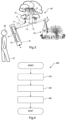
- Fig.3 shows an exemplary scenario for determining the subjective refractive properties of an eye 20 of a subject 21 based on a natural scene 40.
- Fig.4 shows a corresponding method 400 for determining the subjective refraction properties of an eye 20 of a subject 21 based on the use of a natural scenery 40, the method comprising the following steps:
- a test environment is provided which comprises the natural scenery 40, the natural scenery having different ranges of different spatial frequencies when viewed from a predetermined position P.
- an optical arrangement 13 is provided for setting various light-refracting elements 14, 15 in an optical path between the eye 20 of the subject and the natural scenery.
- various light-refracting elements 14, 15 are set in the optical path between the eye 20 of the subject and the natural scenery by means of the optical arrangement 13, the optical arrangement 13 being arranged at the predetermined position P.
- the natural scenery 40 like a natural image 30, has features of different structural size, which correspond to different viewing angles ⁇ 1 , ⁇ 2 of the subject 21.
- the natural scenery 40 comprises a group of trees of different sizes.
- the height h1 of the tree 41 viewed from the viewing distance d1 corresponds to a viewing angle ⁇ 1 .
- the test subject cannot see the tree 41, his eye is not able to resolve the angle ⁇ 1 without the aid of a light-refracting optical element 14, 15.
- Various light-refracting elements 14, 15 can be introduced into the optical path between the eye 20 of the test subject and the tree 41 for testing purposes. In this way, a refractive error of the eye of the test subject can be corrected and determined, and the test subject can possibly see the desired structure, here the tree 41. Further details can be found with reference to Fig. 11 described.
- the procedure can be repeated for other structures or elements of the natural scenery. Preferably, successively smaller structures are queried. This brings the resolution threshold of the test subject closer to the test subject.
- the test subject can be asked one after the other what type of building is shown, how many windows the tower has, or what is shown on the top of the tower. If the test subject can, for example, recognize the rooster on the top of the church tower, this corresponds to a resolution of at least the viewing angle ⁇ 2 with the height of the rooster h 2 from the viewing distance d 2 .
- the subjective refraction properties can be determined not only with a display device on which a natural image is shown, but directly by looking at a natural scene through the optical arrangement. The following explanations for natural images apply accordingly.
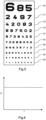
- Fig.5 shows an example of a conventional vision test chart. Numbers are used as vision test symbols. However, other vision test symbols, such as so-called Landolt rings or Snellen hooks, are also common.
- the vision test chart has ten lines L0 to L9 with numbers of different sizes. In practice, the complete individual optotypes are always used to determine visual acuity. In this example, individual numbers are queried one after the other and independently of one another.
- the visual test symbols are shown in black on a white background.
- a corresponding schematic diagram of contrast versus spatial frequency for conventional visual test charts is shown in Fig.6
- the contrast must be very high according to national and international standards, ideally equal to 1 according to Michelson, for all tested sizes of the optotypes and thus for all spatial frequencies used. As in Fig.6 As shown, the contrast is constant with respect to the spatial frequency and is the same for all vision test symbols, regardless of their size.
- the individual rows are used to define the refractive errors of the eye and thus the best spectacle strength that compensates for an existing refractive error.
- the visual acuity of the subject is tested using different light-refracting elements of the optical arrangement in the individual rows and the light-refracting elements are changed so that the subject is able to see the smallest possible row.
- the vision test chart is made of Fig.5 With an image size of 998 pixels high and 2120 pixels wide at a distance of 1 m on a screen with a pixel resolution of 0.0275 centimeters per pixel [cm/px], the following visual acuity values for the rows L1-L9 are obtained according to Table 1. In addition to information on the pixel dimension, the minimum resolution [logMAR] required to be able to recognize a detail is given.
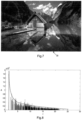
- Fig.7 an example of a natural image 30.
- the natural image 30 preferably corresponds to a photograph of a typical rural environment in which the subject lives. It shows a hut or boathouse on the edge of a lake against a background of mountains.
- the parameters of natural images follow certain laws.
- the spatial content of a natural image can be calculated mathematically using a Fourier transformation, for example.
- the FFT2 command can be used in the Matlab software.
- the spatial frequencies present in an image are determined.
- Fig.8 shows a spatial frequency diagram of the example image from Fig.7 .
- On the horizontal axis is the spatial frequency f in periods per degree and on the vertical axis the number of corresponding spatial frequencies A is given.
- the representation in Fig.8 corresponds to a spatial frequency analysis or Fourier transformation of the image from Fig.7 when viewed at a size of 1920 pixels wide and 1200 pixels high at a distance of 1 m at a pixel resolution of 0.0275 centimeters per pixel [cm/px].
- Fig.6 gives the number of different spatial frequencies for the y-direction, i.e.
- a natural image can sometimes be characterized by the fact that the number of spatial frequencies or an amplitude of the spatial frequency diagram decreases with increasing spatial frequency. This tendency is in Fig.8 represented by the dashed line.
- the amplitude of the spatial frequency diagram in a natural image is inversely proportional to the spatial frequency (see also Tolhurst et al. "Amplitude spectra of natural images", Ophthal. Physiol. Opt., Vol. 12, 1992 as well as Field et al. "Relations between the statistics of natural images and the response properties of cortical cells", Vol. 4, No. 12, Journal of the Optical Society of America, 1987 ).
- the individual lines with individual vision test symbols are used to determine the subjective refraction properties or the spectacle power.
- a natural image as in Fig.7 , different image areas or different image contents can be used.
- a spatial frequency analysis can be used to draw conclusions about the image content.
- the spatial frequency of features or image contents in the natural image can be used to transform the visual acuity.
- Fig.9 again the example image 30 from Fig.7 with marking of areas of different spatial frequencies.
- Different details of the image are defined by positions in the image P1 to P7.
- the corresponding pixel dimensions are also indicated by their number of pixels for the different exemplary details.
- the selected details can be so-called regions of interest (ROIs), which are used to question the test subject during habitual refraction determination.
- ROIs regions of interest
- the following example table indicates how high the visual acuity of the eye must be in order to be able to recognize the details for an image size of 1920 pixels wide and 1200 pixels high for a distance of one meter and a pixel resolution of the display device 12 of 0.0275 centimeters per pixel [cm/px].
- Fig.10 shows a schematic diagram of the contrast K versus the spatial frequency f for an image according to the present disclosure.
- the present disclosure proposes in particular the use of images for determining refraction in which the contrast decreases with increasing spatial frequency.
- the gray value of a pixel can be compared with the gray value of its neighboring pixel.
- the contrast can be inversely proportional to the spatial frequency.
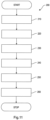
- Fig. 11 shows an exemplary embodiment of a method for determining the subjective refraction properties of an eye 20 of a subject.
- the refraction determination can be carried out using the natural image from Fig.7 or. Fig.9 , or in a scenario with a natural scenery such as in Fig.3 , as follows:
- a required sphere for the test subject can first be determined.
- the test subject does not wear his own correction and looks at the natural image 30 shown on the display device 12 through the optics 13, here through a phoropter.
- the test subject should first recognize detail according to position 1 (house). If he cannot do this, a plus lens (according to the grading table) is held up and asked whether it is getting worse. If not, further correction can be made with plus lenses until a satisfactory result is achieved. If yes, further correction can be made with minus lenses. Subsequently, lenses according to the grading table can now be used and increasingly smaller details from the image can be used. If the customer can recognize position 7 (door fittings) in the image, for example, the desired or best spherical lens has been found.
- the following table shows a grading table for spherical lenses.
- the grading table indicates a grading of the lenses to be kept in advance or placed in front when determining spherical corrections depending on the visual acuity.
- TABLE 3 Visual acuity Lens gradation in diopters (dpt) less than 0.05 2 dpt 0.05 to 0.2 1 dpt 0.2 to 0.5 0.5 dpt over 0.5 0.25 dpt
- an astigmatic correction can be determined. After the best spherical lens has been found, the astigmatism is tested. The test subject can be asked, for example, to look at position 5. Then a cross cylinder (gradation according to the gradation table) is introduced and asked whether it is getting better or worse. A further lead survey can therefore be carried out. Depending on the answer, astigmatism is determined and a corresponding correction is introduced (yes) or not (no). Another lead survey can be carried out until there is no improvement or a deterioration with the lead survey. It is important to ensure that the spherical error is corrected (according to the grading table).
- an axial position of the astigmatic correction can be determined.
- the exact axial position of the corrective cylinder lens can be found using a turning survey. The test subject is asked, for example, to look at position 3 (plant). The turning survey can be carried out until the customer sees no difference between the two axial positions in the turning survey.
- a monocular spherical fine adjustment can be carried out, in particular after performing steps 210 to 230.
- the subject can be asked to look at position 6. Plus lenses or minus lenses can be held in place until the highest visual acuity, i.e. the greatest visual acuity, with maximum plus is achieved.
- step 250 a refraction determination of the second eye can be carried out analogously to the steps 210 to 240 described above.
- step 260 a binocular spherical fine adjustment can be performed.
- step 240 can be carried out under binocular conditions.
- the customer can look at the clouds in the sky.
- a determination of measured values from a measurement and correction method according to Haase can be implemented with previously known tests following the determination of lower order refractive errors, such as sphere, astigmatism and cylinder.
Landscapes
- Life Sciences & Earth Sciences (AREA)
- Health & Medical Sciences (AREA)
- Medical Informatics (AREA)
- Biophysics (AREA)
- Ophthalmology & Optometry (AREA)
- Engineering & Computer Science (AREA)
- Biomedical Technology (AREA)
- Heart & Thoracic Surgery (AREA)
- Physics & Mathematics (AREA)
- Molecular Biology (AREA)
- Surgery (AREA)
- Animal Behavior & Ethology (AREA)
- General Health & Medical Sciences (AREA)
- Public Health (AREA)
- Veterinary Medicine (AREA)
- Eye Examination Apparatus (AREA)
Applications Claiming Priority (2)
| Application Number | Priority Date | Filing Date | Title |
|---|---|---|---|
| DE102015116110.9A DE102015116110A1 (de) | 2015-09-23 | 2015-09-23 | Verfahren und System zur Bestimmung der subjektiven Refraktionseigenschaften eines Auges |
| PCT/EP2016/072607 WO2017050935A1 (de) | 2015-09-23 | 2016-09-22 | Verfahren und system zur bestimmung der subjektiven refraktionseigenschaften eines auges |
Publications (3)
| Publication Number | Publication Date |
|---|---|
| EP3352644A1 EP3352644A1 (de) | 2018-08-01 |
| EP3352644B1 EP3352644B1 (de) | 2019-11-06 |
| EP3352644B2 true EP3352644B2 (de) | 2024-07-31 |
Family
ID=57083267
Family Applications (1)
| Application Number | Title | Priority Date | Filing Date |
|---|---|---|---|
| EP16777577.4A Active EP3352644B2 (de) | 2015-09-23 | 2016-09-22 | Verfahren und system zur bestimmung der subjektiven refraktionseigenschaften eines auges |
Country Status (10)
| Country | Link |
|---|---|
| US (1) | US10327630B2 (https=) |
| EP (1) | EP3352644B2 (https=) |
| JP (1) | JP6491798B2 (https=) |
| KR (1) | KR101942225B1 (https=) |
| CN (1) | CN108024704B (https=) |
| AU (1) | AU2016328761B2 (https=) |
| BR (1) | BR112018005577B1 (https=) |
| CA (1) | CA2999408C (https=) |
| DE (1) | DE102015116110A1 (https=) |
| WO (1) | WO2017050935A1 (https=) |
Families Citing this family (7)
| Publication number | Priority date | Publication date | Assignee | Title |
|---|---|---|---|---|
| DE102018102989C5 (de) | 2018-02-09 | 2024-10-10 | Polytec Pt Gmbh | Akkumulator-Anordnung mit einem thermischen Kontakt- und Füllmaterial |
| EP3730036A1 (de) * | 2019-04-23 | 2020-10-28 | Carl Zeiss Vision International GmbH | Bestimmung eines refraktionsfehlers eines auges |
| US11786694B2 (en) | 2019-05-24 | 2023-10-17 | NeuroLight, Inc. | Device, method, and app for facilitating sleep |
| JP7213492B2 (ja) * | 2019-06-24 | 2023-01-27 | 株式会社Qdレーザ | 視覚検査装置及び視覚検査方法 |
| KR102874168B1 (ko) | 2019-07-05 | 2025-10-21 | 에씰로 앙터나시오날 | 피검자의 눈에서 제어된 원근조절의 변경을 유도하기 위한 방법 |
| US12235461B2 (en) * | 2022-05-20 | 2025-02-25 | Meta Platforms Technologies, Llc | Controlling optical parameters at a user's eye |
| DE202023102914U1 (de) | 2023-05-25 | 2023-06-09 | Carl Zeiss Vision International Gmbh | Vorrichtungen zum Messen der objektiven Refraktionseigenschaften eines Auges |
Citations (4)
| Publication number | Priority date | Publication date | Assignee | Title |
|---|---|---|---|---|
| DE19633062A1 (de) † | 1996-08-16 | 1998-02-19 | Hennig Juergen | Verfahren und Vorrichtung zur Brillenbestimmung unter Anwendung eines Phoropters II |
| WO2007026368A2 (en) † | 2005-09-02 | 2007-03-08 | El-Vision Ltd. | Multi-functional optometric - ophthalmic system for testing, diagnosing, or treating, vision or eyes of a subject, and methodologies thereof |
| US20120154742A1 (en) † | 2009-08-28 | 2012-06-21 | Universidad De Murcia | Ophthalmic instrument for the measurement of ocular refraction and visual simulation, and associated methods of measurement of ocular refraction, simulation of ophthalmic elements, visual simulation and for obtaining optical parameters |
| EP2842479A1 (en) † | 2013-08-27 | 2015-03-04 | Johnson & Johnson Vision Care, Inc. | Means and method for demonstrating the effects of low cylinder astigmatism correction |
Family Cites Families (12)
| Publication number | Priority date | Publication date | Assignee | Title |
|---|---|---|---|---|
| US4929076A (en) * | 1983-06-13 | 1990-05-29 | Canon Kabushiki Kaisha | Ophthalmic measuring apparatus |
| US5026151A (en) | 1989-06-23 | 1991-06-25 | Mentor O & O, Inc. | Visual function tester with binocular vision testing |
| DE19516745A1 (de) * | 1995-05-06 | 1996-11-07 | Friedrich Rumohr | Verfahren zum Herstellen von optischen Sehhilfen für Golfspieler mit Sehproblemen und Vorrichtung zum Durchführen des Verfahrens |
| DE19537499C2 (de) * | 1995-09-25 | 2003-08-07 | Fraunhofer Ges Forschung | Autostereoskopisches Bildwiedergabegerät |
| DE19704197A1 (de) | 1997-02-05 | 1998-08-06 | Zeiss Carl Jena Gmbh | Anordnung zur subjektivem Refraktionsbestimmung und/oder zur Bestimmung anderer Sehfunktionen |
| JPH1128187A (ja) * | 1997-07-14 | 1999-02-02 | Topcon Corp | 自覚式検眼装置 |
| US6761454B2 (en) * | 2002-02-13 | 2004-07-13 | Ophthonix, Inc. | Apparatus and method for determining objective refraction using wavefront sensing |
| JP4133482B2 (ja) * | 2003-03-18 | 2008-08-13 | 株式会社トプコン | 検眼装置 |
| JP4125253B2 (ja) * | 2004-03-09 | 2008-07-30 | 株式会社感性デバイシーズ | 動体視力測定装置 |
| DE102004055754B4 (de) * | 2004-11-19 | 2012-09-13 | Carl Zeiss Vision Gmbh | Verfahren zur Durchführung eines Kontrastsehtests |
| FR2952517B1 (fr) * | 2009-11-13 | 2012-07-20 | Essilor Int | Procede et dispositif de mesure automatique d'au moins une caracteristique de refraction des deux yeux d'un individu |
| JP5417417B2 (ja) * | 2011-11-29 | 2014-02-12 | パナソニック株式会社 | 視機能検査装置 |
-
2015
- 2015-09-23 DE DE102015116110.9A patent/DE102015116110A1/de not_active Ceased
-
2016
- 2016-09-22 EP EP16777577.4A patent/EP3352644B2/de active Active
- 2016-09-22 CN CN201680055653.7A patent/CN108024704B/zh active Active
- 2016-09-22 BR BR112018005577-8A patent/BR112018005577B1/pt active IP Right Grant
- 2016-09-22 CA CA2999408A patent/CA2999408C/en active Active
- 2016-09-22 KR KR1020187011427A patent/KR101942225B1/ko active Active
- 2016-09-22 JP JP2018523797A patent/JP6491798B2/ja active Active
- 2016-09-22 WO PCT/EP2016/072607 patent/WO2017050935A1/de not_active Ceased
- 2016-09-22 AU AU2016328761A patent/AU2016328761B2/en active Active
-
2018
- 2018-03-23 US US15/934,263 patent/US10327630B2/en active Active
Patent Citations (4)
| Publication number | Priority date | Publication date | Assignee | Title |
|---|---|---|---|---|
| DE19633062A1 (de) † | 1996-08-16 | 1998-02-19 | Hennig Juergen | Verfahren und Vorrichtung zur Brillenbestimmung unter Anwendung eines Phoropters II |
| WO2007026368A2 (en) † | 2005-09-02 | 2007-03-08 | El-Vision Ltd. | Multi-functional optometric - ophthalmic system for testing, diagnosing, or treating, vision or eyes of a subject, and methodologies thereof |
| US20120154742A1 (en) † | 2009-08-28 | 2012-06-21 | Universidad De Murcia | Ophthalmic instrument for the measurement of ocular refraction and visual simulation, and associated methods of measurement of ocular refraction, simulation of ophthalmic elements, visual simulation and for obtaining optical parameters |
| EP2842479A1 (en) † | 2013-08-27 | 2015-03-04 | Johnson & Johnson Vision Care, Inc. | Means and method for demonstrating the effects of low cylinder astigmatism correction |
Non-Patent Citations (2)
| Title |
|---|
| HAUN A. M., PELI E.: "Perceived contrast in complex images", JOURNAL OF VISION, vol. 13, no. 13, 4 November 2013 (2013-11-04), pages 3 - 3, DOI: 10.1167/13.13.3 † |
| TOLHURST, D. J. ET AL.: "Amplitude spectra of natural images", OPHTHALMIC AND PHYSIOLOGICAL OPTICS, vol. 12, no. 2, 1992, pages 229 - 232, DOI: 10.1111/opo.12251 † |
Also Published As
| Publication number | Publication date |
|---|---|
| KR20180052764A (ko) | 2018-05-18 |
| US20180214020A1 (en) | 2018-08-02 |
| AU2016328761B2 (en) | 2018-06-14 |
| CA2999408A1 (en) | 2017-03-30 |
| WO2017050935A1 (de) | 2017-03-30 |
| DE102015116110A1 (de) | 2017-03-23 |
| KR101942225B1 (ko) | 2019-01-24 |
| BR112018005577B1 (pt) | 2023-01-10 |
| CN108024704A (zh) | 2018-05-11 |
| EP3352644A1 (de) | 2018-08-01 |
| US10327630B2 (en) | 2019-06-25 |
| BR112018005577A2 (https=) | 2018-10-02 |
| AU2016328761A1 (en) | 2018-04-26 |
| EP3352644B1 (de) | 2019-11-06 |
| JP6491798B2 (ja) | 2019-03-27 |
| JP2018531120A (ja) | 2018-10-25 |
| CN108024704B (zh) | 2019-11-05 |
| CA2999408C (en) | 2018-09-04 |
Similar Documents
| Publication | Publication Date | Title |
|---|---|---|
| EP3352644B2 (de) | Verfahren und system zur bestimmung der subjektiven refraktionseigenschaften eines auges | |
| DE102014223442B4 (de) | Verfahren zur Sehzeichendarstellung, Sehzeichendarstellung, dazugehörige Verwendung und Bildausgabegerät | |
| DE102019102373A1 (de) | Verfahren, Softwareprodukt und System zur Refraktionsbestimmung auf einem mobilen Endgerät | |
| EP3955800B1 (de) | Bestimmung eines refraktionsfehlers eines auges | |
| DE102021133152B4 (de) | Verfahren, Vorrichtung und Computerprogrammprodukt zum Bestimmen einer Sensitivität zumindest eines Auges eines Probanden | |
| EP0911792A2 (de) | Verfahren für die Bilderzeugung auf einem Farbbildschirm und ein dazu geeigneter Farbbildschirm | |
| DE102022209490B4 (de) | Verfahren, Verwenden von angepassten Sehzeichen und Vorrichtung zum Bestimmen von Sehschärfecharakteristika eines Probanden | |
| DE112017000024B4 (de) | Bildverarbeitungsvorrichtung und elektronisches Endoskopsystem | |
| EP3402386B1 (de) | Verfahren zur sehzeichendarstellung und sehzeichengerät | |
| DE102014113679B3 (de) | Vorrichtung zur Verbesserung des Sehvermögens | |
| DE102008041458B4 (de) | Verfahren und Vorrichtung zur Bestimmung der neuronalen Kontrastempfindlichkeit | |
| DE19519413C2 (de) | Vorrichtung zur Messung der Konvergenzstellung der Augen mit einem einfachen Schnell-Sehtest | |
| DE60205730T2 (de) | Verfahren und vorrichtung zur erfassung der sehschärfe | |
| DE202023102914U1 (de) | Vorrichtungen zum Messen der objektiven Refraktionseigenschaften eines Auges | |
| DE102015207911B3 (de) | Verfahren und Vorrichtung zur Bestimmung der Korrekturwerte der Augen einer Person | |
| WO2011113538A1 (de) | Differenzmessung der monokularen zur binokularen augenstellung | |
| DE102018114400A1 (de) | Verfahren und Vorrichtung zur Augenuntersuchung auf neovaskuläre, altersbedingte Makuladegeneration | |
| DE102024106838A1 (de) | Verfahren und optische Vorrichtung zum Bestimmen von Sehschärfecharakteristika und/oder Refraktionscharakteristika eines Probanden | |
| DE4318221A1 (de) | Gerät zur Messung der Konvergenzstellung der Augen beim Blick auf ein Bildschirmgerät | |
| WO2011107244A1 (de) | Simultane netzhautbilder unterschiedlicher bildweite zur subjektiven refraktion | |
| HK1250323A1 (en) | Method and system for determining the subjective refraction properties of an eye |
Legal Events
| Date | Code | Title | Description |
|---|---|---|---|
| STAA | Information on the status of an ep patent application or granted ep patent |
Free format text: STATUS: THE INTERNATIONAL PUBLICATION HAS BEEN MADE |
|
| PUAI | Public reference made under article 153(3) epc to a published international application that has entered the european phase |
Free format text: ORIGINAL CODE: 0009012 |
|
| STAA | Information on the status of an ep patent application or granted ep patent |
Free format text: STATUS: REQUEST FOR EXAMINATION WAS MADE |
|
| 17P | Request for examination filed |
Effective date: 20180423 |
|
| AK | Designated contracting states |
Kind code of ref document: A1 Designated state(s): AL AT BE BG CH CY CZ DE DK EE ES FI FR GB GR HR HU IE IS IT LI LT LU LV MC MK MT NL NO PL PT RO RS SE SI SK SM TR |
|
| AX | Request for extension of the european patent |
Extension state: BA ME |
|
| STAA | Information on the status of an ep patent application or granted ep patent |
Free format text: STATUS: EXAMINATION IS IN PROGRESS |
|
| 17Q | First examination report despatched |
Effective date: 20181018 |
|
| DAV | Request for validation of the european patent (deleted) | ||
| DAX | Request for extension of the european patent (deleted) | ||
| REG | Reference to a national code |
Ref country code: DE Ref legal event code: R079 Ref document number: 502016007491 Country of ref document: DE Free format text: PREVIOUS MAIN CLASS: A61B0003032000 Ipc: A61B0003028000 |
|
| GRAP | Despatch of communication of intention to grant a patent |
Free format text: ORIGINAL CODE: EPIDOSNIGR1 |
|
| STAA | Information on the status of an ep patent application or granted ep patent |
Free format text: STATUS: GRANT OF PATENT IS INTENDED |
|
| RIC1 | Information provided on ipc code assigned before grant |
Ipc: A61B 3/00 20060101ALI20190322BHEP Ipc: A61B 3/028 20060101AFI20190322BHEP Ipc: A61B 3/032 20060101ALI20190322BHEP Ipc: A61B 3/04 20060101ALI20190322BHEP |
|
| INTG | Intention to grant announced |
Effective date: 20190417 |
|
| GRAS | Grant fee paid |
Free format text: ORIGINAL CODE: EPIDOSNIGR3 |
|
| GRAJ | Information related to disapproval of communication of intention to grant by the applicant or resumption of examination proceedings by the epo deleted |
Free format text: ORIGINAL CODE: EPIDOSDIGR1 |
|
| GRAL | Information related to payment of fee for publishing/printing deleted |
Free format text: ORIGINAL CODE: EPIDOSDIGR3 |
|
| STAA | Information on the status of an ep patent application or granted ep patent |
Free format text: STATUS: EXAMINATION IS IN PROGRESS |
|
| INTC | Intention to grant announced (deleted) | ||
| GRAR | Information related to intention to grant a patent recorded |
Free format text: ORIGINAL CODE: EPIDOSNIGR71 |
|
| STAA | Information on the status of an ep patent application or granted ep patent |
Free format text: STATUS: GRANT OF PATENT IS INTENDED |
|
| GRAA | (expected) grant |
Free format text: ORIGINAL CODE: 0009210 |
|
| STAA | Information on the status of an ep patent application or granted ep patent |
Free format text: STATUS: THE PATENT HAS BEEN GRANTED |
|
| INTG | Intention to grant announced |
Effective date: 20190911 |
|
| TPAC | Observations filed by third parties |
Free format text: ORIGINAL CODE: EPIDOSNTIPA |
|
| AK | Designated contracting states |
Kind code of ref document: B1 Designated state(s): AL AT BE BG CH CY CZ DE DK EE ES FI FR GB GR HR HU IE IS IT LI LT LU LV MC MK MT NL NO PL PT RO RS SE SI SK SM TR |
|
| REG | Reference to a national code |
Ref country code: GB Ref legal event code: FG4D Free format text: NOT ENGLISH |
|
| REG | Reference to a national code |
Ref country code: CH Ref legal event code: EP Ref country code: AT Ref legal event code: REF Ref document number: 1197654 Country of ref document: AT Kind code of ref document: T Effective date: 20191115 |
|
| REG | Reference to a national code |
Ref country code: DE Ref legal event code: R096 Ref document number: 502016007491 Country of ref document: DE |
|
| REG | Reference to a national code |
Ref country code: IE Ref legal event code: FG4D Free format text: LANGUAGE OF EP DOCUMENT: GERMAN |
|
| REG | Reference to a national code |
Ref country code: NL Ref legal event code: MP Effective date: 20191106 |
|
| REG | Reference to a national code |
Ref country code: LT Ref legal event code: MG4D |
|
| PG25 | Lapsed in a contracting state [announced via postgrant information from national office to epo] |
Ref country code: BG Free format text: LAPSE BECAUSE OF FAILURE TO SUBMIT A TRANSLATION OF THE DESCRIPTION OR TO PAY THE FEE WITHIN THE PRESCRIBED TIME-LIMIT Effective date: 20200206 Ref country code: FI Free format text: LAPSE BECAUSE OF FAILURE TO SUBMIT A TRANSLATION OF THE DESCRIPTION OR TO PAY THE FEE WITHIN THE PRESCRIBED TIME-LIMIT Effective date: 20191106 Ref country code: GR Free format text: LAPSE BECAUSE OF FAILURE TO SUBMIT A TRANSLATION OF THE DESCRIPTION OR TO PAY THE FEE WITHIN THE PRESCRIBED TIME-LIMIT Effective date: 20200207 Ref country code: NO Free format text: LAPSE BECAUSE OF FAILURE TO SUBMIT A TRANSLATION OF THE DESCRIPTION OR TO PAY THE FEE WITHIN THE PRESCRIBED TIME-LIMIT Effective date: 20200206 Ref country code: PL Free format text: LAPSE BECAUSE OF FAILURE TO SUBMIT A TRANSLATION OF THE DESCRIPTION OR TO PAY THE FEE WITHIN THE PRESCRIBED TIME-LIMIT Effective date: 20191106 Ref country code: LT Free format text: LAPSE BECAUSE OF FAILURE TO SUBMIT A TRANSLATION OF THE DESCRIPTION OR TO PAY THE FEE WITHIN THE PRESCRIBED TIME-LIMIT Effective date: 20191106 Ref country code: NL Free format text: LAPSE BECAUSE OF FAILURE TO SUBMIT A TRANSLATION OF THE DESCRIPTION OR TO PAY THE FEE WITHIN THE PRESCRIBED TIME-LIMIT Effective date: 20191106 Ref country code: PT Free format text: LAPSE BECAUSE OF FAILURE TO SUBMIT A TRANSLATION OF THE DESCRIPTION OR TO PAY THE FEE WITHIN THE PRESCRIBED TIME-LIMIT Effective date: 20200306 Ref country code: LV Free format text: LAPSE BECAUSE OF FAILURE TO SUBMIT A TRANSLATION OF THE DESCRIPTION OR TO PAY THE FEE WITHIN THE PRESCRIBED TIME-LIMIT Effective date: 20191106 Ref country code: SE Free format text: LAPSE BECAUSE OF FAILURE TO SUBMIT A TRANSLATION OF THE DESCRIPTION OR TO PAY THE FEE WITHIN THE PRESCRIBED TIME-LIMIT Effective date: 20191106 |
|
| PG25 | Lapsed in a contracting state [announced via postgrant information from national office to epo] |
Ref country code: IS Free format text: LAPSE BECAUSE OF FAILURE TO SUBMIT A TRANSLATION OF THE DESCRIPTION OR TO PAY THE FEE WITHIN THE PRESCRIBED TIME-LIMIT Effective date: 20200306 Ref country code: RS Free format text: LAPSE BECAUSE OF FAILURE TO SUBMIT A TRANSLATION OF THE DESCRIPTION OR TO PAY THE FEE WITHIN THE PRESCRIBED TIME-LIMIT Effective date: 20191106 Ref country code: HR Free format text: LAPSE BECAUSE OF FAILURE TO SUBMIT A TRANSLATION OF THE DESCRIPTION OR TO PAY THE FEE WITHIN THE PRESCRIBED TIME-LIMIT Effective date: 20191106 |
|
| PG25 | Lapsed in a contracting state [announced via postgrant information from national office to epo] |
Ref country code: AL Free format text: LAPSE BECAUSE OF FAILURE TO SUBMIT A TRANSLATION OF THE DESCRIPTION OR TO PAY THE FEE WITHIN THE PRESCRIBED TIME-LIMIT Effective date: 20191106 |
|
| PG25 | Lapsed in a contracting state [announced via postgrant information from national office to epo] |
Ref country code: DK Free format text: LAPSE BECAUSE OF FAILURE TO SUBMIT A TRANSLATION OF THE DESCRIPTION OR TO PAY THE FEE WITHIN THE PRESCRIBED TIME-LIMIT Effective date: 20191106 Ref country code: ES Free format text: LAPSE BECAUSE OF FAILURE TO SUBMIT A TRANSLATION OF THE DESCRIPTION OR TO PAY THE FEE WITHIN THE PRESCRIBED TIME-LIMIT Effective date: 20191106 Ref country code: RO Free format text: LAPSE BECAUSE OF FAILURE TO SUBMIT A TRANSLATION OF THE DESCRIPTION OR TO PAY THE FEE WITHIN THE PRESCRIBED TIME-LIMIT Effective date: 20191106 Ref country code: EE Free format text: LAPSE BECAUSE OF FAILURE TO SUBMIT A TRANSLATION OF THE DESCRIPTION OR TO PAY THE FEE WITHIN THE PRESCRIBED TIME-LIMIT Effective date: 20191106 Ref country code: CZ Free format text: LAPSE BECAUSE OF FAILURE TO SUBMIT A TRANSLATION OF THE DESCRIPTION OR TO PAY THE FEE WITHIN THE PRESCRIBED TIME-LIMIT Effective date: 20191106 |
|
| REG | Reference to a national code |
Ref country code: DE Ref legal event code: R026 Ref document number: 502016007491 Country of ref document: DE |
|
| PLBI | Opposition filed |
Free format text: ORIGINAL CODE: 0009260 |
|
| PLAX | Notice of opposition and request to file observation + time limit sent |
Free format text: ORIGINAL CODE: EPIDOSNOBS2 |
|
| PG25 | Lapsed in a contracting state [announced via postgrant information from national office to epo] |
Ref country code: SK Free format text: LAPSE BECAUSE OF FAILURE TO SUBMIT A TRANSLATION OF THE DESCRIPTION OR TO PAY THE FEE WITHIN THE PRESCRIBED TIME-LIMIT Effective date: 20191106 Ref country code: SM Free format text: LAPSE BECAUSE OF FAILURE TO SUBMIT A TRANSLATION OF THE DESCRIPTION OR TO PAY THE FEE WITHIN THE PRESCRIBED TIME-LIMIT Effective date: 20191106 |
|
| 26 | Opposition filed |
Opponent name: ESSILOR INTERNATIONAL SAS Effective date: 20200806 |
|
| PG25 | Lapsed in a contracting state [announced via postgrant information from national office to epo] |
Ref country code: SI Free format text: LAPSE BECAUSE OF FAILURE TO SUBMIT A TRANSLATION OF THE DESCRIPTION OR TO PAY THE FEE WITHIN THE PRESCRIBED TIME-LIMIT Effective date: 20191106 |
|
| PLBB | Reply of patent proprietor to notice(s) of opposition received |
Free format text: ORIGINAL CODE: EPIDOSNOBS3 |
|
| PG25 | Lapsed in a contracting state [announced via postgrant information from national office to epo] |
Ref country code: IT Free format text: LAPSE BECAUSE OF FAILURE TO SUBMIT A TRANSLATION OF THE DESCRIPTION OR TO PAY THE FEE WITHIN THE PRESCRIBED TIME-LIMIT Effective date: 20191106 |
|
| REG | Reference to a national code |
Ref country code: CH Ref legal event code: PL |
|
| PG25 | Lapsed in a contracting state [announced via postgrant information from national office to epo] |
Ref country code: LU Free format text: LAPSE BECAUSE OF NON-PAYMENT OF DUE FEES Effective date: 20200922 |
|
| PG25 | Lapsed in a contracting state [announced via postgrant information from national office to epo] |
Ref country code: CH Free format text: LAPSE BECAUSE OF NON-PAYMENT OF DUE FEES Effective date: 20200930 Ref country code: LI Free format text: LAPSE BECAUSE OF NON-PAYMENT OF DUE FEES Effective date: 20200930 Ref country code: IE Free format text: LAPSE BECAUSE OF NON-PAYMENT OF DUE FEES Effective date: 20200922 |
|
| APAH | Appeal reference modified |
Free format text: ORIGINAL CODE: EPIDOSCREFNO |
|
| APBM | Appeal reference recorded |
Free format text: ORIGINAL CODE: EPIDOSNREFNO |
|
| APBP | Date of receipt of notice of appeal recorded |
Free format text: ORIGINAL CODE: EPIDOSNNOA2O |
|
| APBQ | Date of receipt of statement of grounds of appeal recorded |
Free format text: ORIGINAL CODE: EPIDOSNNOA3O |
|
| PG25 | Lapsed in a contracting state [announced via postgrant information from national office to epo] |
Ref country code: TR Free format text: LAPSE BECAUSE OF FAILURE TO SUBMIT A TRANSLATION OF THE DESCRIPTION OR TO PAY THE FEE WITHIN THE PRESCRIBED TIME-LIMIT Effective date: 20191106 Ref country code: MT Free format text: LAPSE BECAUSE OF FAILURE TO SUBMIT A TRANSLATION OF THE DESCRIPTION OR TO PAY THE FEE WITHIN THE PRESCRIBED TIME-LIMIT Effective date: 20191106 Ref country code: CY Free format text: LAPSE BECAUSE OF FAILURE TO SUBMIT A TRANSLATION OF THE DESCRIPTION OR TO PAY THE FEE WITHIN THE PRESCRIBED TIME-LIMIT Effective date: 20191106 |
|
| PG25 | Lapsed in a contracting state [announced via postgrant information from national office to epo] |
Ref country code: MK Free format text: LAPSE BECAUSE OF FAILURE TO SUBMIT A TRANSLATION OF THE DESCRIPTION OR TO PAY THE FEE WITHIN THE PRESCRIBED TIME-LIMIT Effective date: 20191106 Ref country code: MC Free format text: LAPSE BECAUSE OF FAILURE TO SUBMIT A TRANSLATION OF THE DESCRIPTION OR TO PAY THE FEE WITHIN THE PRESCRIBED TIME-LIMIT Effective date: 20191106 |
|
| REG | Reference to a national code |
Ref country code: AT Ref legal event code: MM01 Ref document number: 1197654 Country of ref document: AT Kind code of ref document: T Effective date: 20210922 |
|
| PG25 | Lapsed in a contracting state [announced via postgrant information from national office to epo] |
Ref country code: AT Free format text: LAPSE BECAUSE OF NON-PAYMENT OF DUE FEES Effective date: 20210922 |
|
| APBU | Appeal procedure closed |
Free format text: ORIGINAL CODE: EPIDOSNNOA9O |
|
| PUAH | Patent maintained in amended form |
Free format text: ORIGINAL CODE: 0009272 |
|
| STAA | Information on the status of an ep patent application or granted ep patent |
Free format text: STATUS: PATENT MAINTAINED AS AMENDED |
|
| 27A | Patent maintained in amended form |
Effective date: 20240731 |
|
| AK | Designated contracting states |
Kind code of ref document: B2 Designated state(s): AL AT BE BG CH CY CZ DE DK EE ES FI FR GB GR HR HU IE IS IT LI LT LU LV MC MK MT NL NO PL PT RO RS SE SI SK SM TR |
|
| REG | Reference to a national code |
Ref country code: DE Ref legal event code: R102 Ref document number: 502016007491 Country of ref document: DE |
|
| PGFP | Annual fee paid to national office [announced via postgrant information from national office to epo] |
Ref country code: DE Payment date: 20250919 Year of fee payment: 10 |
|
| PGFP | Annual fee paid to national office [announced via postgrant information from national office to epo] |
Ref country code: BE Payment date: 20250918 Year of fee payment: 10 Ref country code: GB Payment date: 20250919 Year of fee payment: 10 |
|
| PGFP | Annual fee paid to national office [announced via postgrant information from national office to epo] |
Ref country code: FR Payment date: 20250922 Year of fee payment: 10 |