EP3352605B1 - Schuh - Google Patents
Schuh Download PDFInfo
- Publication number
- EP3352605B1 EP3352605B1 EP16784378.8A EP16784378A EP3352605B1 EP 3352605 B1 EP3352605 B1 EP 3352605B1 EP 16784378 A EP16784378 A EP 16784378A EP 3352605 B1 EP3352605 B1 EP 3352605B1
- Authority
- EP
- European Patent Office
- Prior art keywords
- shell
- fibre structure
- film
- shoe according
- plastics material
- Prior art date
- Legal status (The legal status is an assumption and is not a legal conclusion. Google has not performed a legal analysis and makes no representation as to the accuracy of the status listed.)
- Active
Links
Images

Classifications
-
- A—HUMAN NECESSITIES
- A43—FOOTWEAR
- A43B—CHARACTERISTIC FEATURES OF FOOTWEAR; PARTS OF FOOTWEAR
- A43B5/00—Footwear for sporting purposes
- A43B5/04—Ski or like boots
- A43B5/0427—Ski or like boots characterised by type or construction details
- A43B5/0482—Ski or like boots characterised by type or construction details made from materials with different rigidities
-
- A—HUMAN NECESSITIES
- A43—FOOTWEAR
- A43B—CHARACTERISTIC FEATURES OF FOOTWEAR; PARTS OF FOOTWEAR
- A43B5/00—Footwear for sporting purposes
- A43B5/04—Ski or like boots
- A43B5/0486—Ski or like boots characterized by the material
- A43B5/049—Ski or like boots characterized by the material with an upper made of composite material, e.g. fibers or core embedded in a matrix
-
- B—PERFORMING OPERATIONS; TRANSPORTING
- B29—WORKING OF PLASTICS; WORKING OF SUBSTANCES IN A PLASTIC STATE IN GENERAL
- B29C—SHAPING OR JOINING OF PLASTICS; SHAPING OF MATERIAL IN A PLASTIC STATE, NOT OTHERWISE PROVIDED FOR; AFTER-TREATMENT OF THE SHAPED PRODUCTS, e.g. REPAIRING
- B29C45/00—Injection moulding, i.e. forcing the required volume of moulding material through a nozzle into a closed mould; Apparatus therefor
- B29C45/14—Injection moulding, i.e. forcing the required volume of moulding material through a nozzle into a closed mould; Apparatus therefor incorporating preformed parts or layers, e.g. injection moulding around inserts or for coating articles
- B29C45/14778—Injection moulding, i.e. forcing the required volume of moulding material through a nozzle into a closed mould; Apparatus therefor incorporating preformed parts or layers, e.g. injection moulding around inserts or for coating articles the article consisting of a material with particular properties, e.g. porous, brittle
- B29C45/14786—Fibrous material or fibre containing material, e.g. fibre mats or fibre reinforced material
-
- B—PERFORMING OPERATIONS; TRANSPORTING
- B29—WORKING OF PLASTICS; WORKING OF SUBSTANCES IN A PLASTIC STATE IN GENERAL
- B29D—PRODUCING PARTICULAR ARTICLES FROM PLASTICS OR FROM SUBSTANCES IN A PLASTIC STATE
- B29D35/00—Producing footwear
- B29D35/02—Producing footwear made in one piece using a moulding technique, e.g. by injection moulding or casting
- B29D35/04—Producing footwear made in one piece using a moulding technique, e.g. by injection moulding or casting having multilayered parts
-
- B—PERFORMING OPERATIONS; TRANSPORTING
- B29—WORKING OF PLASTICS; WORKING OF SUBSTANCES IN A PLASTIC STATE IN GENERAL
- B29D—PRODUCING PARTICULAR ARTICLES FROM PLASTICS OR FROM SUBSTANCES IN A PLASTIC STATE
- B29D35/00—Producing footwear
- B29D35/12—Producing parts thereof, e.g. soles, heels, uppers, by a moulding technique
- B29D35/14—Multilayered parts
- B29D35/146—Uppers
Definitions
- the invention relates to a shoe, in particular a ski boot, with a shell-shaped element which consists at least partially of a plastic material, the shell-shaped element having at least one section in which reinforcing fibers are provided.
- the invention further relates to a method for producing a shell-shaped element for a shoe, in particular a ski boot, from an injection-molded plastic material.
- shell-shaped elements of shoes in particular ski or ice skating shoes, are known from the prior art, which are at least partially equipped with reinforcing fibers.
- a ski boot shell in which a film-like fiber structure is provided at least in sections, which is injected behind by the plastic material of the shell-shaped element.
- the fiber structure consists of a resin matrix, in particular of epoxy or phenolic resins.
- a ski boot shell which has a very stiff material and a comparatively soft plastic material.
- the very rigid material has a thermoplastic matrix which is reinforced with glass, carbon, Kevlar or polypropylene fibers; Both the shell and the matrix of the fiber structure can also consist of polyurethane.
- ski boots with a shell-shaped element made of reinforcing fibers EP 1 62 019 A1 , the EP 903 87 A1 and the IT VI20 090 016 A1 known.
- a shell element made of a fiber composite material is known, here one or more layers of a composite material with carbon, glass or aramid fibers can be provided, which are combined in an epoxy, phenolic or polyester resin.
- this shoe it is also necessary to glue on a sole made of an elastomeric material, which in turn is expensive and very complex.
- the aim of the present invention is therefore to create a fiber-reinforced shell-shaped element from a shoe which can be produced simply and in particular without previous preforming steps.
- the reinforcing fibers which are combined to form the three-dimensional shell-shaped element in a flexible, film-like, essentially flat fiber structure, beforehand to form a three-dimensional structure.
- the previously essentially two-dimensional fiber structure is back-injected from the plastic material during the shaping of the shell-shaped element and is thus also molded, so that in In a single manufacturing step, the shell-shaped element is formed from the plastic material, the film-like fiber structure is shaped three-dimensionally and at the same time an intimate, ie particularly strong, connection is achieved between the plastic material of the shell-shaped element of the shoe and the film-like fiber structure provided in at least one section.
- the plastic material of the shell-shaped element and the fiber structure are thermoformable between 50 ° C and 130 ° C.
- the flat fiber structure is first inserted into the injection mold, and then the liquid plastic material is sprayed onto the fiber structure - with shaping -, resulting in a very firm connection between the plastic material and the fiber structure.
- the fiber structure is advantageously also shaped three-dimensionally and then, after the plastic material has hardened, is held in the configuration specified by the injection mold due to the connection with it.
- the shell-shaped element In order to achieve efficient reinforcement or stiffening of the shell-shaped element, it is particularly advantageous if carbon, glass or aramid fibers are provided as reinforcing fibers.
- the shell-shaped element As a fiber-plastic composite has, at least in sections, a direction-dependent elastic behavior.
- the reinforcing fibers in particular in the form of a woven fabric, knitted fabric, knitted fabric, fleece or a random fiber mat, are combined to form the film-like fiber structure together with a plastic matrix.
- Such fiber structures - which are essentially two-dimensional or mat-shaped prior to back-injection with the plastic material - are advantageously available on the market as pre-impregnated fiber matrix semi-finished products.
- the film-like, essentially flat fiber structure has a material thickness between 0.1 mm and 1.0 mm, it has a comparatively high flexibility transverse to its plane of longitudinal extent. This ensures that the fiber structure is easily deformable in the transverse direction to its longitudinal extension plane and accordingly adapts intimately to the injection mold, so that the desired shape is reliably achieved.
- the fiber structure is thermoformable between 60 ° C and 100 ° C. It is also advantageous for the above-mentioned purposes if plastic material is thermoformable between 60 ° C and 100 ° C.
- the plastic matrix is made of a thermoplastic Plastic, preferably polyethylene, especially low density polyethylene (LDPE), thermoplastic polyurethane elastomer or polyether block amide.
- LDPE low density polyethylene
- a polyurethane material is preferably used as the plastic material - Or polyamide-plastic compound, in particular thermoplastic polyether, polyurethane elastomer or polyamide elastomer is provided.
- film-like fiber structures with a matrix system made from polyethylene or polyether block amide ensure excellent material compatibility, while when using thermoplastic polyurethane elastomer film-like fiber structures with a matrix of thermoplastic polyurethane or polyether block amide result in high functionality. It is also possible to build up the film-like fiber structure in multiple layers, in particular in two layers, that is to say to coat the reinforcing fibers with a matrix system, for example made of polyethylene or polyamide 12 or thermoplastic polyurethane, and then to coat the side that comes to lie on the shell-shaped component with an adhesive layer, in particular to be coated from polyether block amide. This has the advantage that a very hard, scratch-resistant surface is achieved on one side, and a very intimate connection to the shell-shaped component on the other side.
- a lower shell element enclosing the foot has a film-like fiber structure at least in a zone in front of the ankle, in particular essentially at the level of the metatarsal bone, medially and / or laterally.
- the film-like fiber structure is in one ankle-near section extends from a lateral / medial outside towards an entry opening more than in a section away from the ankle.
- the film-like fiber structure has at least one incision.
- the method according to the invention of the type mentioned at the outset is characterized in that a flexible, film-like, essentially planar fiber structure comprising reinforcing fibers is inserted into an injection mold and the fiber structure is back-injected with a plastic material to form a three-dimensional, fiber-reinforced, shell-shaped element.
- FIG. 1 An alpine ski boot 1 is shown, which has a lower shell element 2 and an upper, essentially cuff-shaped shell element 3.
- the upper shell element 3 is connected to the lower shell element 2 via a joint 4.
- an inner shoe 5 made of a flexible material and at least partially padded is accommodated.
- zones 7 in particular in the lower shell element 2 are provided with a fiber-reinforced film structure 6.
- zones 7 in which the fiber structure 6 is provided in the exemplary embodiment shown i.e. Zones which are arranged laterally and medially in front of the ankle tend to lose their shape without stiffening fibers if the shell-shaped element 2 is heated in order to adapt to the individual foot of the user.
- the shell geometry i.e. three-dimensional design of the lower shell element 2
- the shell element 2 can be individually adapted to the foot of the user, that is to say in particular in the direction perpendicular to the plane of extension of the shell element 2, but at the same time by means of the fibers, which have a significantly higher rigidity, preferably aramid Fibers, the basic geometry of the lower shell element 2, even when the plastic material is heated above the softening temperature, ie the temperature at which the plastic material is thermoformable. In particular, expansion of the shell element 2 in the direction of the longitudinal extension plane of the fiber structures 6 is thus prevented.
- a plastic compound material which has hard segments made of polyamide (PA), in particular PA 11 or PA 12, or alternatively also made of polyurethane (PUR) can be used particularly advantageously as the plastic material, the plastic compound material preferably between 50 ° C. and 130 ° C is thermoformable to allow individual adaptation to the user's foot.
- a mixture of caprolactam polyamide and ionomers can preferably be compounded into the PA hard segment portion in order to achieve the desired thermoformability. This is in detail in the Austrian patent application AT 510 545 A. described, so that reference is made to this application with regard to preferred material compositions.
- the fibers of the film structure 6 are preferably embedded in a plastic matrix made of a low-density polyethylene (LDPE).
- LDPE low-density polyethylene
- Such a pre-impregnated fiber matrix semi-finished product is, for example, by E.I. du Pont de Nemours and Company with embedded aramid fibers sold under the product name AS 400 D 802.
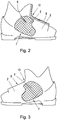
- the film-like fiber structures 6 are - as in FIG 2 and 3 can be seen - essentially L-shaped in view, the fiber structures 6 in a section near the ankle extending more from a lateral and medial outside of the shoe 1 in the direction of an entry opening 9 than in a section away from the ankle. Accordingly, the lower shell element 2 has the relatively largest portion in a transition region 10 from an essentially vertical to a substantially horizontal extension relative to the remaining section on fiber structures 6, so that this transition area 10 has comparatively little adaptability or expansion capacity during hot deformation of the shell part 2.
- the shell element 2 can thus expand more than in the adjacent zone 7 with the fiber structure 6.
- the basic geometry of the shell-shaped element 2 can advantageously be largely largely maintained in a simple manner even when the shell-shaped element 2 is adapted to the foot of a user ,
Landscapes
- Engineering & Computer Science (AREA)
- Chemical & Material Sciences (AREA)
- Materials Engineering (AREA)
- Health & Medical Sciences (AREA)
- General Health & Medical Sciences (AREA)
- Physical Education & Sports Medicine (AREA)
- Mechanical Engineering (AREA)
- Composite Materials (AREA)
- Manufacturing & Machinery (AREA)
- Footwear And Its Accessory, Manufacturing Method And Apparatuses (AREA)
- Injection Moulding Of Plastics Or The Like (AREA)
Description
- Die Erfindung betrifft einen Schuh, insbesondere Skischuh, mit einem schalenförmigen Element, das zumindest teilweise aus einem Kunststoffmaterial besteht, wobei das schalenförmige Element zumindest einen Abschnitt aufweist, in welchem Verstärkungsfasern vorgesehen sind. Weiters betrifft die Erfindung ein Verfahren zur Herstellung eines schalenförmigen Elements für einen Schuh, insbesondere Skischuh, aus einem gespritzten Kunststoffmaterial.
- Aus dem Stand der Technik sind grundsätzlich bereits schalenförmige Elemente von Schuhen, insbesondere Ski- oder Eislaufschuhen, bekannt, welche zumindest abschnittsweise mit Verstärkungsfasern ausgestattet sind.
- Aus der
EP 2 620 067 A1 ist eine Skischuhschale bekannt, bei welcher zumindest abschnittsweise ein folienartiges Fasergebilde vorgesehen ist, dass von dem Kunststoffmaterial des schalenförmigen Elements hinter spritzt ist. Das Fasergebilde besteht aus einer Harzmatrix, insbesondere aus Epoxid oder Phenolharzen. - Aus der
EP 1 642 706 A1 ist eine Skischuhschale bekannt, welche ein sehr steifes Material aufweist und ein vergleichsweise weiches Kunststoffmaterial. Das sehr steife Material weist eine thermoplastische Matrize auf, welche mit Glas-, Kohlenstoff, Kevlar- oder Polypropylenfasern verstärkt ist; es können auch sowohl die Schale als auch die Matrix des Fasergebildes aus Polyurethan bestehen. - Weiters sind Skischuhe mit einem schalenförmigen Element mit Verstärkungsfasern aus der
EP 1 62 019 A1 EP 903 87 A1 IT VI20 090 016 A1 - Aus der
GB 1 491 634 - Aus der
AT 510 266 B1 AT 510 836 A - Andererseits ist z.B. aus der
EP 2 881 004 A ein Schalenelement aus einem Faserkompositmaterial bekannt, wobei hier ein oder mehrere Lagen aus einem Kompositmaterial mit Kohlen-, Glas-oder Aramid-Fasern vorgesehen sein können, welche in einem Epoxid-, Phenol- oder Polyesterharz zusammengefasst sind. Bei diesem Schuh ist es weiters erforderlich eine Sohle aus einem elastomeren Werkstoff aufzukleben, was wiederum kostenintensiv und sehr aufwendig ist. - Ziel der vorliegenden Erfindung ist es demzufolge ein faserverstärktes schalenförmiges Element von einem Schuh zu schaffen, das einfach und insbesondere ohne vorhergehende Vorformschritte herstellbar ist.
- Dies wird bei dem erfindungsgemäßen Schuh der eingangs angeführte Art durch die Merkmale von Anspruch 1 erzielt.
- Demnach ist es erfindungsgemäß nicht erforderlich, die Verstärkungsfasern, welche zur Ausbildung des dreidimensionalen schalenförmigen Elements in einem flexiblen folienartigen, im Wesentlichen planen Fasergebilde, zusammengefasst sind, vorab zu einem dreidimensionalen Gebilde zu formen. Vielmehr wird erfindungsgemäß während der Formgebung des schalenförmigen Elements das zuvor im Wesentlichen zweidimensionale Fasergebilde vom Kunststoffmaterial hinterspritzt und somit mitgeformt, sodass in einem einzigen Herstellungsschritt das schalenförmige Element aus dem Kunststoffmaterial geformt wird, das folienartige Fasergebilde dreidimensional geformt wird und zugleich eine innige, d.h. besonders feste, Verbindung zwischen dem Kunststoffmaterial des schalenförmigen Elements des Schuhs und dem zumindest in einem Abschnitt vorgesehenen folienartigen Fasergebilde erzielt wird. Das Kunststoffmaterial des schalenförmigen Elements und das Fasergebilde sind zwischen 50°C und 130°C thermoverformbar.
- Unter Hinterspritzen wird demzufolge in Zusammenhang mit der vorliegenden Erfindung verstanden, dass das flächige Fasergebilde zunächst in die Spritzgussform eingelegt wird, und sodann das flüssige Kunststoffmaterial auf das Fasergebilde - unter Formgebung - gespritzt wird, wodurch sich eine sehr feste Verbindung zwischen Kunststoffmaterial und Fasergebilde ergibt. Zugleich wird während der Verbindung dieser beiden Materialien das Fasergebilde vorteilhafterweise auch dreidimensional geformt und nach Aushärten des Kunststoffmaterials sodann aufgrund der Verbindung mit diesem in der durch die Spritzgussform vorgegebenen Ausgestaltung gehalten.
- Um eine effiziente Verstärkung bzw. Versteifung des schalenförmigen Elements zu erzielen, ist es insbesondere vorteilhaft, wenn Carbon-, Glas-, oder Aramid-Fasern als Verstärkungsfasern vorgesehen sind. Durch die Verwendung von Verstärkungsfasern hat das schalenförmige Element als Faser-Kunststoff-Verbund zumindest abschnittsweise ein richtungsabhängiges Elastizitätsverhalten.
- Hinsichtlich einer einfachen Handhabung und innigen Verbindung mit dem Kunststoffmaterial des schalenförmigen Elements ist es günstig wenn, die Verstärkungsfasern insbesondere in Form eines Gewebes, Gewirkes, Gestrickes, eines Vlies oder einer Wirrfasermatte gemeinsam mit einer Kunststoffmatrix zu dem folienartigen Fasergebilde zusammengefasst sind. Derartige Fasergebilde - welche vor der Hinterspritzung mit dem Kunststoffmaterial im Wesentlichen zweidimensional bzw. mattenförmig ausgebildet sind - sind vorteilhafterweise als vorimprägnierte Fasermatrixhalbzeuge am Markt erhältlich.
- Wenn das folienartige im Wesentlichen plane Fasergebilde eine Materialstärke zwischen 0,1 mm und 1,0 mm aufweist, weist es eine vergleichsweise hohe Flexibilität quer zu seiner Längserstreckungsebene auf. Somit ist sichergestellt, dass das Fasergebilde in Querrichtung zu seiner Längserstreckungsebene gut verformbar ist und sich demnach innig an die Spritzgussform anpasst, sodass zuverlässig die gewünschte Formgebung erzielt wird.
- Um ein faserverstärktes, schalenförmiges Element eines Schuhs zu schaffen, welches im angezogenen Zustand des Schuhs - ohne für den Benutzter unangenehm zu werden - warmverformbar ist und zugleich jedoch bei den herkömmlichen Anwendungstemperaturen von Schuhen, insbesondere Skischuhen, d.h. bis zu 50°C ausreichend hohe Steifigkeit aufweist, ist es günstig, wenn das Fasergebilde zwischen 60°C und 100°C thermoverformbar ist. Ebenso ist es aus den vorstehend genannten Zwecken günstig, wenn Kunststoffmaterial zwischen 60°C und 100°C thermoverformbar ist.
- Um eine feste bzw. besonders innige Verbindung mit dem Kunststoffmaterial, welches üblicherweise für die Herstellung von Schuhen insbesondere Skischuhen verwendet wird, zu erzielen, und vorzugsweise auch eine Verformung des Foliengebildes unter Wärmeeinwirkung zu ermöglichen, ist es von Vorteil, wenn die Kunststoffmatrix aus einem thermoplastischen Kunststoff, vorzugsweise Polyethylen, insbesondere Polyethylen geringer Dichte (LDPE),thermoplastischem Polyurethanelastomer oder Polyether-Block-Amid besteht.
- Um die Anforderungen an das schalenförmigen Element insbesondere in Zusammenhang mit Skischuhen besonders gut zu erfüllen, d.h. eine ausreichende Steifigkeit zu erzielen, andererseits jedoch eine Warmverformbarkeit zwischen 50°C und 130°C zu ermöglichen, ist es von Vorteil, wenn als Kunststoffmaterial vorzugsweise ein Polyurethan- oder Polyamid-Kunststoff-Compound, insbesondere thermoplastisches Polyether, Polyurethanelastomer oder PolyamidElastomer vorgesehen ist. Tests haben gezeigt, dass bei Verwendung eines Polyamid-Compounds als Schalenmaterial folienartige Fasergebilde mit einem Matrixsystem aus Polyethylen oder Polyether-Block-Amid eine hervorragende Materialkompatibilität sicherstellen, während bei Verwendung von thermoplastischem Polyurethanelastomer folienartige Fasergebilde mit einer Matrix aus thermoplastischem Polyurethan oder Polyether-Block-Amid eine hohe Funktionalität ergeben. Es ist auch möglich das folienartige Fasergebilde mehrschichtig, insbesondere zweischichtig aufzubauen, d.h. die Verstärkungsfasern mit einem Matrixsystem, z.B. aus Polyethylen oder Polyamid 12 oder thermoplastischem Polyurethan, zu beschichten und anschließend die Seite, die zum schalenförmigen Bauteil zu liegen kommt, mit einer Haftvermittlerschicht, insbesondere aus Polyether-Block-Amid zu beschichten. Das hat den Vorteil, dass man auf der einen Seite eine sehr harte, kratzfeste Oberfläche erzielt, auf der anderen Seite eine sehr innige Verbindung zum schalenförmigen Bauteil.
- Um die ursprüngliche Form eines unteren Schalenelement des Schuhs, welche für die Krafteinleitung von maßgeblicher Bedeutung ist, auch bei der Erwärmung des Schalenelements über die Erweichungstemperatur, im Wesentlichen in der Längserstreckungsebene der Fasern beizubehalten, ist es günstig, wenn ein unteres, den Fuß umschließendes Schalenelement zumindest in einer Zone vor dem Knöchel, insbesondere im Wesentlichen auf Höhe der Mittelfußknochen, medial und/oder lateral, ein folienartiges Fasergebilde aufweist. In jenen Zonen, in welchen ein Fasergebilde vorgesehen ist, kann - bei Erwärmung über die Erweichungstemperatur der Kunststoffmatrix und des Kunststoffmaterials des Schalenelements - somit sehr wohl eine Anpassung der Schale in Richtung senkrecht zu einer Längserstreckungsebene der Fasern erzielt wird, um eine Individualisierung bzw. Anpassung des Schalenelements an den Fuß des Benutzer zu ermöglichen, zugleich jedoch wird eine Ausdehnung des Schalenelements in Richtung der Längserstreckungsebene des Fasergebildes weitgehend hintan gehalten. Somit wird vorteilhafterweise die (Grund-)Geometrie des Schalenelements auch während einer Warmverformung beibehalten. Demzufolge wird im Rahmen der Warmverformung eine Verbesserung des Passkomforts erzielt, ohne hierbei jedoch die hinsichtlich der Krafteinleitung bzw. -übertragung optimierte dreidimensionale Form des Schalenelements maßgeblich negativ zu beeinflussen.
- Um insbesondere eine Aufweitung des Schalenelements im Zuge einer Warmverformung in einem oberen Ristabschnitt zu vermeiden, ist es günstig, wenn sich das folienartige Fasergebilde in einem knöchelnahen Abschnitt von einer lateralen/medialen Außenseite stärker in Richtung einer Einstiegsöffnung erstreckt als in einem knöchelfernen Abschnitt.
- Um, sofern gewünscht, in jener Zone in welcher das folienartige Fasergebilde vorgesehen ist, teilweise eine Aufweitung des Schalenelements während einer Warmverformung auch in Richtung der Längserstreckungsebene der Fasern zu ermöglichen, ist es vorteilhaft, wenn das folienartige Fasergebilde zumindest einen Einschnitt aufweist.
- Das erfindungsgemäße Verfahren der eingangs angeführten Art ist dadurch gekennzeichnet, dass ein Verstärkungsfasern umfassendes flexibles, folienartiges, im Wesentlichen planes Fasergebilde in eine Spritzgussform eingelegt wird und das Fasergebilde von einem Kunststoffmaterial zur Ausbildung eines dreidimensionalen zumindest abschnittsweise faserverstärktem schalenförmigen Element hinterspritzt wird.
- Demzufolge ist bei dem erfindungsgemäßen Verfahren - wie bereits vorstehend erläutert - nur ein einziger Verfahrensschritt zur dreidimensionalen Formgebung und Verbindung von Fasergebilde und Kunststoffmaterial erforderlich, indem das flexible folienartige, im Wesentlichen planare Fasergebilde einfach in die Kunststoff-Spritzgussform eingelegt wird, bevor dieses Fasergebilde von dem Kunststoffmaterial hinterspritzt wird und im Rahmen dieser Verbindung mit dem Kunststoffmaterial auch zugleich einem dreidimensionalen Formgebungsprozess unterzogen wird, wobei das Kunststoffmaterial des schalenförmigen Elements und das Fasergebilde zwischen 50°C und 130°C thermoverformbar sind. Somit kann ein erster gesonderter Schritt, in welchem das Fasergebilde gesondert vom Kunststoffmaterial dreidimensional geformt wird, zweckmäßigerweise entfallen.
- Nachstehend wird die Erfindung anhand eines bevorzugten Ausführungsbeispiels, auf das die Erfindung jedoch keinesfalls beschränkt sein soll, noch näher erläutert. Im Einzelnen zeigen in den Zeichnungen:
-
Fig. 1 eine Seitenansicht eines Hartschalen-Alpinskischuhs mit einer faserverstärkten Zone; -
Fig. 2 eine Ansicht auf die laterale Seite eines untere Schalenelements eines Hartschalen-Alpinskischuhs; und -
Fig. 3 eine Ansicht auf die mediale Seite des unteren Schalenelements gemäßFig. 2 . - In
Fig. 1 ist ein Alpinskischuh 1 gezeigt, welcher ein unteres Schalenelement 2 sowie ein oberes, im Wesentlichen manschettenförmig ausgebildetes Schalenelement 3 aufweist. Das obere Schalenelement 3 ist über ein Gelenk 4 mit dem unteren Schalenelement 2 verbunden. - In diesen aus einem vergleichsweise harten Kunststoff bestehenden schalenförmigen Elementen 2 und 3 ist ein aus einem flexiblen Material bestehender, zumindest abschnittsweise gepolsterter Innenschuh 5 aufgenommen.
- Wie weiters in den Figuren ersichtlich sind insbesondere Zonen 7 im unteren Schalenelement 2 mit einem faserverstärkten Foliengebilde 6 versehen.
- Jene Bereiche bzw. Zonen 7, in welchen bei dem gezeigten Ausführungsbeispiel das Fasergebilde 6 vorgesehen ist, d.h. Zone welche lateral und medial jeweils vor dem Knöchel angeordnet sind, neigen - ohne Versteifungsfasern - dazu ihre Formgestaltung zu verlieren, wenn das schalenförmige Element 2 zwecks Anpassung an den individuellen Fuß des Benutzers erwärmt wird. Es hat sich aber gezeigt, dass für eine besonders gute Kraftübertragung vom Fuß des Benutzers auf einen mit dem Skischuh verbundenen Ski, insbesondere die Schalengeometrie, d.h. dreidimensionale Ausgestaltung des unteren Schalenelements 2, von herausragender Bedeutung ist.
- Demzufolge kann durch das Vorsehen von Fasergebilden 6, vorzugsweise in den in den
Fig. 2 bis 3 gezeigten Zonen 7, in vorteilhafter Weise erzielt werden, dass das Schalenelement 2 zwar individuell an den Fuß des Benutzers angepasst werden kann, d.h. insbesondere in Richtung senkrecht zur Erstreckungsebene des Schalenelements 2, zugleich wird jedoch mittels der eine deutlich höhere Steifigkeit aufweisenden Fasern, vorzugsweise Aramid-Fasern, die grundsätzliche Geometrie des unteren Schalenelements 2, auch bei Erwärmung des Kunststoffmaterials über die Erweichungstemperatur, d.h. jener Temperatur, bei welcher das Kunststoffmaterial warmverformbar ist, beibehalten. Insbesondere wird eine Aufweitung des Schalenelements 2 in Richtung der Längserstreckungsebene der Fasergebilde 6 somit verhindert. - Besonders vorteilhaft kann hierbei als Kunststoffmaterial ein Kunststoff-Compoundmaterial verwendet werden, welches Hartsegmente aus Polyamid (PA), insbesondere PA 11 oder PA 12, aufweist oder alternativ auch aus Polyurethan (PUR), wobei das Kunststoff-Compoundmaterial vorzugsweise zwischen 50°C und 130°C warmverformbar ist, um eine individuelle Anpassung an den Fuß des Benutzers zu ermöglichen. Dem PA-Hartsegmentanteil kann vorzugsweise eine Mischung aus Caprolactam-Polyamid und Ionomeren hinzu compoundiert werden, um die gewünschte Warmformbarkeit zu erzielen. Im Detail ist dies in der österr. Patentanmeldung
AT 510 545 A - Die Fasern des Foliengebildes 6 sind hierbei vorzugsweise in einer Kunststoffmatrix aus einem Polyethylen geringer Dichte (LDPE) eingebettet. Ein derartiges vorimprägniertes Faser-Matrix-Halbzeug wird beispielsweise von E.I. du Pont de Nemours and Company mit eingebetteten Aramid-Fasern unter der Produktbezeichnung AS 400 D 802 vertrieben.
- Tests haben gezeigt, dass sich ein derartiges Fasergebilde hervorragend mit einem PA-Kunststoff-Compound hinterspritzen lässt, und somit ein schalenförmiges Element, insbesondere ein unteres Schalenelement 2, einfach herstellen lässt, welches zwischen 50°C und 130°C warmverformbar ist, wobei das Schalenelement 2 während des Warmverformens aufgrund des Vorsehens der Foliengebilde 6 im oberen lateralen und medialen Ristbereich aber seine Grundgeometrie vorteilhafterweise weitgehend beibehält. In jenen Zonen 7, in welchen ein Fasergebilde 6 vorgesehen ist, kann nämlich - bei Erwärmung über die Erweichungstemperatur der Kunststoffmatrix des Foliengebildes 6 und des Kunststoffmaterials - somit sehr wohl eine Anpassung des Schalenelements 2 in Richtung senkrecht zu einer Längserstreckungsebene der Fasern erzielt werden, um eine Individualisierung bzw. Anpassung des Schalenelements 2 an den Fuß des Benutzer zu ermöglichen, zugleich jedoch wird ein Ausdehnung des unteren Schalenelements 2 in Richtung der Längserstreckungsebene des Fasergebildes 6 weitgehend unterbunden.
- Da insbesondere eine Aufweitung des untere Schalenelements 2 im Zuge einer Warmverformung in einem oberen Ristabschnitt vermieden werden soll, sind die folienartigen Fasergebilde 6 - wie in
Fig. 2 und 3 ersichtlich - in Ansicht im Wesentlichen L-förmig ausgebildet, wobei sich die Fasergebilde 6 in einem knöchelnahen Abschnitt von einer lateralen und medialen Außenseite des Schuhs 1 stärker in Richtung einer Einstiegsöffnung 9 erstrecken als in einem knöchelfernen Abschnitt. Demnach weist das untere Schalenelement 2 in einem Übergangsbereich 10 von einer im Wesentlichen vertikalen auf eine im Wesentlichen horizontale Erstreckung gegenüber den übrigen Abschnitt den verhältnismäßig größten Anteil an Fasergebilde 6 auf, sodass dieser Übergangsbereich 10 während einer Warmverformung des Schalenteils 2 vergleichsweise wenig Anpassungs- bzw. Ausweitungsvermögen aufweist. - Wie in
Fig. 1 und2 ersichtlich, kann teilweise eine lokale Aufweitung des Schalenelements 2 während einer Warmverformung auf einfache Weise zugelassen werden, indem das folienartige Fasergebilde 6 einen Einschnitt 8 aufweist. Bei Einlegen des zweidimensionalen Fasergebildes 6 in eine (nicht näher gezeigte) Spritzgussform können somit die äußeren Randabschnitte benachbart des Einschnitts 8 voneinander entfernt werden, sodass sich ein im Wesentlichen kreissegmentförmiger Abschnitt frei von dem Fasergebilde 6 ergibt. In diesem Fasergebilde-freien Abschnitt kann sich das Schalenelement 2 somit mehr aufweiten als in der angrenzenden Zone 7 mit dem Fasergebilde 6. - Durch das Vorsehen, von lokale in eine Spritzgussform eingelegten - vor der Formgebung - im Wesentlichen zweidimensionalen Fasergebilden 6, kann somit auf einfache Weise insbesondere die Grundgeometrie des schalenförmigen Elements 2 auch während einer Anpassung des schalenförmigen Elements 2 an den Fuß eines Benutzers vorteilhafterweise weitgehend beibehalten werden.
Claims (13)
- Schuh (1), insbesondere Skischuh, mit einem schalenförmigen Element (2, 3), das zumindest teilweise aus einem Kunststoffmaterial besteht, wobei das schalenförmige Element (2, 3) zumindest einen Abschnitt (7) aufweist, in welchem Verstärkungsfasern vorgesehen sind, dadurch gekennzeichnet, dass die Verstärkungsfasern vor Ausbildung des schalenförmigen Elements (2, 3) in einem flexiblen, folienartigen, im Wesentlichen planen Fasergebilde (6) zusammengefasst sind und das folienartige Fasergebilde (6) zur Ausbildung eines dreidimensional geformten, abschnittsweise faserverstärkten schalenförmigen Elements (2, 3) von dem Kunststoffmaterial hinterspritzt ist, wobei das Kunststoffmaterial des schalenförmigen Elements (2, 3) und das Fasergebilde (6) zwischen 50°C und 130°C thermoverformbar sind.
- Schuh nach Anspruch 1, dadurch gekennzeichnet, dass Carbon-, Glas-, oder Aramid-Fasern als Verstärkungsfasern vorgesehen sind.
- Schuh nach Anspruch 1 oder 2, dadurch gekennzeichnet, dass die Verstärkungsfasern insbesondere in Form eine Gewebes, Gewirkes, Gestrickes, eines Vlies oder einer Wirrfasermatte gemeinsam mit einer Kunststoffmatrix zu dem Fasergebilde (6) zusammengefasst sind.
- Schuh nach einem der Ansprüche 1 bis 3, dadurch gekennzeichnet, dass das folienartige im Wesentlichen plane Fasergebilde (6) eine Materialstärke zwischen 0,1 mm und 1,0 mm aufweist.
- Schuh nach einem der Ansprüche 1 bis 4, dadurch gekennzeichnet, dass das Fasergebilde (6) zwischen 60°C und 100°C thermoverformbar ist.
- Schuh nach einem der Ansprüche 1 bis 5, dadurch gekennzeichnet, dass das Kunststoffmaterial zwischen 60°C und 100°C thermoverformbar ist.
- Schuh nach einem der Ansprüche 3 bis 6, dadurch gekennzeichnet, dass die Kunststoffmatrix aus einem thermoplastischen Kunststoff, vorzugsweise Polyethylen, insbesondere Polyethylen geringer Dichte (LDPE), thermoplastischem Polyurethanelastomer oder Polyether-Block-Amid besteht.
- Schuh nach einem der Ansprüche 1 bis 7, dadurch gekennzeichnet, dass das folienartige Fasergebilde (6) mehrschichtig, insbesondere zweischichtig, ausgebildet ist.
- Schuh nach einem der Ansprüche 1 bis 8, dadurch gekennzeichnet, dass als Kunststoffmaterial vorzugsweise ein Polyurethan-oder Polyamid-Kunststoff-Compound, insbesondere thermoplastisches Polyether, Polyurethanelastomer oder Polyamidelastomer vorgesehen ist.
- Schuh nach einem der Ansprüche 1 bis 9, dadurch gekennzeichnet, dass ein unteres, den Fuß umschließendes Schalenelement (2) zumindest in einer Zone vor dem Knöchel, insbesondere im Wesentlichen auf Höhe der Mittelfußknochen, medial und/oder lateral, ein folienartiges Fasergebilde (6) aufweist.
- Schuh nach Anspruch 10, dadurch gekennzeichnet, dass sich das folienartige Fasergebilde (6) in einem knöchelnahen Abschnitt von einer lateralen/medialen Außenseite stärker in Richtung einer Einstiegsöffnung (9) erstreckt als in einem knöchelfernen Abschnitt.
- Schuh nach Anspruch 10 oder 11, dadurch gekennzeichnet, dass das folienartige Fasergebilde (6) zumindest einen Einschnitt (8) aufweist.
- Verfahren zur Herstellung eines schalenförmigen Elements (2, 3) für einen Schuh (1), insbesondere Skischuh, gemäß einem der Ansprüche 1 bis 12 aus einem gespritzten Kunststoffmaterial, dadurch gekennzeichnet, dass ein Verstärkungsfasern umfassendes flexibles, folienartiges, im Wesentlichen planes Fasergebilde (6) in eine Spritzgussform eingelegt wird und das Fasergebilde (6) von einem Kunststoffmaterial zur Ausbildung eines dreidimensionalen zumindest abschnittsweise faserverstärktem schalenförmigen Element (2, 3) hinterspritzt wird, wobei das Kunststoffmaterial des schalenförmigen Element (2, 3) und das Fasergebilde (6) zwischen 50°C und 130°C thermoverformbar sind.
Applications Claiming Priority (2)
| Application Number | Priority Date | Filing Date | Title |
|---|---|---|---|
| ATA50815/2015A AT517213B1 (de) | 2015-09-24 | 2015-09-24 | Schuh |
| PCT/AT2016/060070 WO2017049330A1 (de) | 2015-09-24 | 2016-09-23 | Schuh |
Publications (2)
| Publication Number | Publication Date |
|---|---|
| EP3352605A1 EP3352605A1 (de) | 2018-08-01 |
| EP3352605B1 true EP3352605B1 (de) | 2020-02-19 |
Family
ID=57178169
Family Applications (1)
| Application Number | Title | Priority Date | Filing Date |
|---|---|---|---|
| EP16784378.8A Active EP3352605B1 (de) | 2015-09-24 | 2016-09-23 | Schuh |
Country Status (3)
| Country | Link |
|---|---|
| EP (1) | EP3352605B1 (de) |
| AT (1) | AT517213B1 (de) |
| WO (1) | WO2017049330A1 (de) |
Family Cites Families (5)
| Publication number | Priority date | Publication date | Assignee | Title |
|---|---|---|---|---|
| CH691339A5 (fr) * | 1997-09-09 | 2001-07-13 | Lange Int Sa | Chaussure de sport. |
| CH696512A5 (fr) * | 2003-03-24 | 2007-07-31 | Lange Int Sa | Chaussure de sport, en particulier pour planche de glisse. |
| EP1642706B1 (de) * | 2004-09-29 | 2006-11-15 | Lange International S.A. | Sportschuh aus sehr hartem Material |
| IT1398588B1 (it) * | 2009-01-30 | 2013-03-01 | Sportiva S P A | Metodo per la realizzazione di una calzatura sportiva tecnica, nonche' calzatura sportiva tecnica realizzata con tale metodo |
| EP2620067A1 (de) * | 2012-01-25 | 2013-07-31 | Rossignol Lange S.R.L. | Sportschuh mit Teilen aus sehr steifem Material |
-
2015
- 2015-09-24 AT ATA50815/2015A patent/AT517213B1/de active
-
2016
- 2016-09-23 WO PCT/AT2016/060070 patent/WO2017049330A1/de not_active Ceased
- 2016-09-23 EP EP16784378.8A patent/EP3352605B1/de active Active
Non-Patent Citations (1)
| Title |
|---|
| None * |
Also Published As
| Publication number | Publication date |
|---|---|
| EP3352605A1 (de) | 2018-08-01 |
| AT517213B1 (de) | 2016-12-15 |
| AT517213A4 (de) | 2016-12-15 |
| WO2017049330A1 (de) | 2017-03-30 |
Similar Documents
| Publication | Publication Date | Title |
|---|---|---|
| DE102012207300B4 (de) | Verfahren zur Herstellung eines Schafts für einen Schuh und danach hergestellter Schaft und Schuh | |
| EP1294247B1 (de) | Als zwischensohle, innensohle oder einlegesohle ausgebildete sohle für einen schuh und schuh mit einer derartigen sohle | |
| DE102015204268B4 (de) | Sohlen für Sportschuhe, sowie deren Herstellung | |
| DE102012206094B4 (de) | Sohlen für Sportschuhe, Schuhe und Verfahren zur Herstellung einer Schuhsohle | |
| EP1090563B1 (de) | Orthopädische Schuheinlage | |
| EP2654481B1 (de) | Schuh, insbesondere sportschuh | |
| EP1602294B1 (de) | Polyurethan-Schaum-Einlegesohle und Verfahren zu ihrer Herstellung | |
| EP2540178B1 (de) | Verfahren zur Herstellung eines Schalenteils eines Sportschuhs und ein gemäß diesem Verfahren hergestellter Schalenteil | |
| DE10250330A1 (de) | Biegeelement mit drehsinnabhängigem Verhalten | |
| DE10114820B4 (de) | Verfahren zur Herstellung einer Sohle, eine Sohle und ein Schuh | |
| DE102018212760A1 (de) | Injection-molding method | |
| DE602004001357T2 (de) | Sportschuh für Gleitbrett | |
| AT401709B (de) | Formteil, insbesondere zuschnitt für einen innenschuh | |
| EP1041900A1 (de) | Hausschuh | |
| AT517213B1 (de) | Schuh | |
| EP0724952A1 (de) | Sohle für Sportschuhe und Verfahren zur Herstellung einer solchen | |
| EP3183983B1 (de) | Innenschuh mit einem knöchelverstärkungselement aus kunststoff-material | |
| EP2218349A1 (de) | Schuheinlage mit Gel | |
| DE102022210886A1 (de) | Verfahren zur Herstellung eines Schuhs, ein System zum Durchführen des Verfahrens und ein Schuh | |
| DE102015003952B4 (de) | Schuh mit Verbundsohle | |
| EP0962158B1 (de) | Innenschuh für einen Sportschuh | |
| DE102020117662B4 (de) | Schuheinlage | |
| EP2823956B1 (de) | Schaumkunststoff-Schuheinlegesohle mit textiler Lage und Verfahren zu deren Herstellung | |
| DE69700777T2 (de) | Wärmeaktivierendes verstärkungselement für schuhe und schuhe mit einem solchen element | |
| WO2024245780A1 (de) | Schienbeinschoner |
Legal Events
| Date | Code | Title | Description |
|---|---|---|---|
| STAA | Information on the status of an ep patent application or granted ep patent |
Free format text: STATUS: UNKNOWN |
|
| STAA | Information on the status of an ep patent application or granted ep patent |
Free format text: STATUS: THE INTERNATIONAL PUBLICATION HAS BEEN MADE |
|
| PUAI | Public reference made under article 153(3) epc to a published international application that has entered the european phase |
Free format text: ORIGINAL CODE: 0009012 |
|
| STAA | Information on the status of an ep patent application or granted ep patent |
Free format text: STATUS: REQUEST FOR EXAMINATION WAS MADE |
|
| 17P | Request for examination filed |
Effective date: 20180423 |
|
| AK | Designated contracting states |
Kind code of ref document: A1 Designated state(s): AL AT BE BG CH CY CZ DE DK EE ES FI FR GB GR HR HU IE IS IT LI LT LU LV MC MK MT NL NO PL PT RO RS SE SI SK SM TR |
|
| AX | Request for extension of the european patent |
Extension state: BA ME |
|
| DAV | Request for validation of the european patent (deleted) | ||
| DAX | Request for extension of the european patent (deleted) | ||
| GRAP | Despatch of communication of intention to grant a patent |
Free format text: ORIGINAL CODE: EPIDOSNIGR1 |
|
| STAA | Information on the status of an ep patent application or granted ep patent |
Free format text: STATUS: GRANT OF PATENT IS INTENDED |
|
| INTG | Intention to grant announced |
Effective date: 20191002 |
|
| GRAS | Grant fee paid |
Free format text: ORIGINAL CODE: EPIDOSNIGR3 |
|
| GRAA | (expected) grant |
Free format text: ORIGINAL CODE: 0009210 |
|
| STAA | Information on the status of an ep patent application or granted ep patent |
Free format text: STATUS: THE PATENT HAS BEEN GRANTED |
|
| AK | Designated contracting states |
Kind code of ref document: B1 Designated state(s): AL AT BE BG CH CY CZ DE DK EE ES FI FR GB GR HR HU IE IS IT LI LT LU LV MC MK MT NL NO PL PT RO RS SE SI SK SM TR |
|
| REG | Reference to a national code |
Ref country code: CH Ref legal event code: EP |
|
| REG | Reference to a national code |
Ref country code: DE Ref legal event code: R096 Ref document number: 502016008835 Country of ref document: DE |
|
| REG | Reference to a national code |
Ref country code: AT Ref legal event code: REF Ref document number: 1233951 Country of ref document: AT Kind code of ref document: T Effective date: 20200315 |
|
| REG | Reference to a national code |
Ref country code: IE Ref legal event code: FG4D Free format text: LANGUAGE OF EP DOCUMENT: GERMAN |
|
| REG | Reference to a national code |
Ref country code: NL Ref legal event code: MP Effective date: 20200219 |
|
| PG25 | Lapsed in a contracting state [announced via postgrant information from national office to epo] |
Ref country code: RS Free format text: LAPSE BECAUSE OF FAILURE TO SUBMIT A TRANSLATION OF THE DESCRIPTION OR TO PAY THE FEE WITHIN THE PRESCRIBED TIME-LIMIT Effective date: 20200219 Ref country code: FI Free format text: LAPSE BECAUSE OF FAILURE TO SUBMIT A TRANSLATION OF THE DESCRIPTION OR TO PAY THE FEE WITHIN THE PRESCRIBED TIME-LIMIT Effective date: 20200219 Ref country code: NO Free format text: LAPSE BECAUSE OF FAILURE TO SUBMIT A TRANSLATION OF THE DESCRIPTION OR TO PAY THE FEE WITHIN THE PRESCRIBED TIME-LIMIT Effective date: 20200519 |
|
| REG | Reference to a national code |
Ref country code: LT Ref legal event code: MG4D |
|
| PG25 | Lapsed in a contracting state [announced via postgrant information from national office to epo] |
Ref country code: GR Free format text: LAPSE BECAUSE OF FAILURE TO SUBMIT A TRANSLATION OF THE DESCRIPTION OR TO PAY THE FEE WITHIN THE PRESCRIBED TIME-LIMIT Effective date: 20200520 Ref country code: BG Free format text: LAPSE BECAUSE OF FAILURE TO SUBMIT A TRANSLATION OF THE DESCRIPTION OR TO PAY THE FEE WITHIN THE PRESCRIBED TIME-LIMIT Effective date: 20200519 Ref country code: SE Free format text: LAPSE BECAUSE OF FAILURE TO SUBMIT A TRANSLATION OF THE DESCRIPTION OR TO PAY THE FEE WITHIN THE PRESCRIBED TIME-LIMIT Effective date: 20200219 Ref country code: IS Free format text: LAPSE BECAUSE OF FAILURE TO SUBMIT A TRANSLATION OF THE DESCRIPTION OR TO PAY THE FEE WITHIN THE PRESCRIBED TIME-LIMIT Effective date: 20200619 Ref country code: LV Free format text: LAPSE BECAUSE OF FAILURE TO SUBMIT A TRANSLATION OF THE DESCRIPTION OR TO PAY THE FEE WITHIN THE PRESCRIBED TIME-LIMIT Effective date: 20200219 Ref country code: HR Free format text: LAPSE BECAUSE OF FAILURE TO SUBMIT A TRANSLATION OF THE DESCRIPTION OR TO PAY THE FEE WITHIN THE PRESCRIBED TIME-LIMIT Effective date: 20200219 |
|
| PG25 | Lapsed in a contracting state [announced via postgrant information from national office to epo] |
Ref country code: NL Free format text: LAPSE BECAUSE OF FAILURE TO SUBMIT A TRANSLATION OF THE DESCRIPTION OR TO PAY THE FEE WITHIN THE PRESCRIBED TIME-LIMIT Effective date: 20200219 |
|
| PG25 | Lapsed in a contracting state [announced via postgrant information from national office to epo] |
Ref country code: LT Free format text: LAPSE BECAUSE OF FAILURE TO SUBMIT A TRANSLATION OF THE DESCRIPTION OR TO PAY THE FEE WITHIN THE PRESCRIBED TIME-LIMIT Effective date: 20200219 Ref country code: SM Free format text: LAPSE BECAUSE OF FAILURE TO SUBMIT A TRANSLATION OF THE DESCRIPTION OR TO PAY THE FEE WITHIN THE PRESCRIBED TIME-LIMIT Effective date: 20200219 Ref country code: EE Free format text: LAPSE BECAUSE OF FAILURE TO SUBMIT A TRANSLATION OF THE DESCRIPTION OR TO PAY THE FEE WITHIN THE PRESCRIBED TIME-LIMIT Effective date: 20200219 Ref country code: SK Free format text: LAPSE BECAUSE OF FAILURE TO SUBMIT A TRANSLATION OF THE DESCRIPTION OR TO PAY THE FEE WITHIN THE PRESCRIBED TIME-LIMIT Effective date: 20200219 Ref country code: DK Free format text: LAPSE BECAUSE OF FAILURE TO SUBMIT A TRANSLATION OF THE DESCRIPTION OR TO PAY THE FEE WITHIN THE PRESCRIBED TIME-LIMIT Effective date: 20200219 Ref country code: PT Free format text: LAPSE BECAUSE OF FAILURE TO SUBMIT A TRANSLATION OF THE DESCRIPTION OR TO PAY THE FEE WITHIN THE PRESCRIBED TIME-LIMIT Effective date: 20200712 Ref country code: RO Free format text: LAPSE BECAUSE OF FAILURE TO SUBMIT A TRANSLATION OF THE DESCRIPTION OR TO PAY THE FEE WITHIN THE PRESCRIBED TIME-LIMIT Effective date: 20200219 Ref country code: CZ Free format text: LAPSE BECAUSE OF FAILURE TO SUBMIT A TRANSLATION OF THE DESCRIPTION OR TO PAY THE FEE WITHIN THE PRESCRIBED TIME-LIMIT Effective date: 20200219 Ref country code: ES Free format text: LAPSE BECAUSE OF FAILURE TO SUBMIT A TRANSLATION OF THE DESCRIPTION OR TO PAY THE FEE WITHIN THE PRESCRIBED TIME-LIMIT Effective date: 20200219 |
|
| REG | Reference to a national code |
Ref country code: DE Ref legal event code: R097 Ref document number: 502016008835 Country of ref document: DE |
|
| PLBE | No opposition filed within time limit |
Free format text: ORIGINAL CODE: 0009261 |
|
| STAA | Information on the status of an ep patent application or granted ep patent |
Free format text: STATUS: NO OPPOSITION FILED WITHIN TIME LIMIT |
|
| 26N | No opposition filed |
Effective date: 20201120 |
|
| PG25 | Lapsed in a contracting state [announced via postgrant information from national office to epo] |
Ref country code: SI Free format text: LAPSE BECAUSE OF FAILURE TO SUBMIT A TRANSLATION OF THE DESCRIPTION OR TO PAY THE FEE WITHIN THE PRESCRIBED TIME-LIMIT Effective date: 20200219 Ref country code: PL Free format text: LAPSE BECAUSE OF FAILURE TO SUBMIT A TRANSLATION OF THE DESCRIPTION OR TO PAY THE FEE WITHIN THE PRESCRIBED TIME-LIMIT Effective date: 20200219 |
|
| REG | Reference to a national code |
Ref country code: CH Ref legal event code: PL |
|
| GBPC | Gb: european patent ceased through non-payment of renewal fee |
Effective date: 20200923 |
|
| REG | Reference to a national code |
Ref country code: BE Ref legal event code: MM Effective date: 20200930 |
|
| PG25 | Lapsed in a contracting state [announced via postgrant information from national office to epo] |
Ref country code: LU Free format text: LAPSE BECAUSE OF NON-PAYMENT OF DUE FEES Effective date: 20200923 |
|
| PG25 | Lapsed in a contracting state [announced via postgrant information from national office to epo] |
Ref country code: LI Free format text: LAPSE BECAUSE OF NON-PAYMENT OF DUE FEES Effective date: 20200930 Ref country code: IE Free format text: LAPSE BECAUSE OF NON-PAYMENT OF DUE FEES Effective date: 20200923 Ref country code: GB Free format text: LAPSE BECAUSE OF NON-PAYMENT OF DUE FEES Effective date: 20200923 Ref country code: CH Free format text: LAPSE BECAUSE OF NON-PAYMENT OF DUE FEES Effective date: 20200930 Ref country code: BE Free format text: LAPSE BECAUSE OF NON-PAYMENT OF DUE FEES Effective date: 20200930 |
|
| PG25 | Lapsed in a contracting state [announced via postgrant information from national office to epo] |
Ref country code: TR Free format text: LAPSE BECAUSE OF FAILURE TO SUBMIT A TRANSLATION OF THE DESCRIPTION OR TO PAY THE FEE WITHIN THE PRESCRIBED TIME-LIMIT Effective date: 20200219 Ref country code: MT Free format text: LAPSE BECAUSE OF FAILURE TO SUBMIT A TRANSLATION OF THE DESCRIPTION OR TO PAY THE FEE WITHIN THE PRESCRIBED TIME-LIMIT Effective date: 20200219 Ref country code: CY Free format text: LAPSE BECAUSE OF FAILURE TO SUBMIT A TRANSLATION OF THE DESCRIPTION OR TO PAY THE FEE WITHIN THE PRESCRIBED TIME-LIMIT Effective date: 20200219 |
|
| PG25 | Lapsed in a contracting state [announced via postgrant information from national office to epo] |
Ref country code: MK Free format text: LAPSE BECAUSE OF FAILURE TO SUBMIT A TRANSLATION OF THE DESCRIPTION OR TO PAY THE FEE WITHIN THE PRESCRIBED TIME-LIMIT Effective date: 20200219 Ref country code: MC Free format text: LAPSE BECAUSE OF FAILURE TO SUBMIT A TRANSLATION OF THE DESCRIPTION OR TO PAY THE FEE WITHIN THE PRESCRIBED TIME-LIMIT Effective date: 20200219 Ref country code: AL Free format text: LAPSE BECAUSE OF FAILURE TO SUBMIT A TRANSLATION OF THE DESCRIPTION OR TO PAY THE FEE WITHIN THE PRESCRIBED TIME-LIMIT Effective date: 20200219 |
|
| REG | Reference to a national code |
Ref country code: AT Ref legal event code: MM01 Ref document number: 1233951 Country of ref document: AT Kind code of ref document: T Effective date: 20210923 |
|
| PG25 | Lapsed in a contracting state [announced via postgrant information from national office to epo] |
Ref country code: AT Free format text: LAPSE BECAUSE OF NON-PAYMENT OF DUE FEES Effective date: 20210923 |
|
| P01 | Opt-out of the competence of the unified patent court (upc) registered |
Effective date: 20230519 |
|
| PGFP | Annual fee paid to national office [announced via postgrant information from national office to epo] |
Ref country code: DE Payment date: 20250919 Year of fee payment: 10 |
|
| PGFP | Annual fee paid to national office [announced via postgrant information from national office to epo] |
Ref country code: FR Payment date: 20250925 Year of fee payment: 10 |
|
| PGFP | Annual fee paid to national office [announced via postgrant information from national office to epo] |
Ref country code: IT Payment date: 20250930 Year of fee payment: 10 |