EP3348012B1 - Übertragung von mehreren harq-ack-rückkopplungsbits entsprechend mehreren downlink-zellen und einem oder zwei transportblöcken pro zelle - Google Patents
Übertragung von mehreren harq-ack-rückkopplungsbits entsprechend mehreren downlink-zellen und einem oder zwei transportblöcken pro zelle Download PDFInfo
- Publication number
- EP3348012B1 EP3348012B1 EP15903708.4A EP15903708A EP3348012B1 EP 3348012 B1 EP3348012 B1 EP 3348012B1 EP 15903708 A EP15903708 A EP 15903708A EP 3348012 B1 EP3348012 B1 EP 3348012B1
- Authority
- EP
- European Patent Office
- Prior art keywords
- harq
- ack
- circuitry
- dai
- transmission
- Prior art date
- Legal status (The legal status is an assumption and is not a legal conclusion. Google has not performed a legal analysis and makes no representation as to the accuracy of the status listed.)
- Active
Links
Images




Classifications
-
- H—ELECTRICITY
- H04—ELECTRIC COMMUNICATION TECHNIQUE
- H04L—TRANSMISSION OF DIGITAL INFORMATION, e.g. TELEGRAPHIC COMMUNICATION
- H04L1/00—Arrangements for detecting or preventing errors in the information received
- H04L1/12—Arrangements for detecting or preventing errors in the information received by using return channel
- H04L1/16—Arrangements for detecting or preventing errors in the information received by using return channel in which the return channel carries supervisory signals, e.g. repetition request signals
- H04L1/1607—Details of the supervisory signal
- H04L1/1671—Details of the supervisory signal the supervisory signal being transmitted together with control information
-
- H—ELECTRICITY
- H04—ELECTRIC COMMUNICATION TECHNIQUE
- H04L—TRANSMISSION OF DIGITAL INFORMATION, e.g. TELEGRAPHIC COMMUNICATION
- H04L1/00—Arrangements for detecting or preventing errors in the information received
- H04L1/12—Arrangements for detecting or preventing errors in the information received by using return channel
- H04L1/16—Arrangements for detecting or preventing errors in the information received by using return channel in which the return channel carries supervisory signals, e.g. repetition request signals
- H04L1/18—Automatic repetition systems, e.g. Van Duuren systems
- H04L1/1829—Arrangements specially adapted for the receiver end
- H04L1/1861—Physical mapping arrangements
-
- H—ELECTRICITY
- H04—ELECTRIC COMMUNICATION TECHNIQUE
- H04L—TRANSMISSION OF DIGITAL INFORMATION, e.g. TELEGRAPHIC COMMUNICATION
- H04L1/00—Arrangements for detecting or preventing errors in the information received
- H04L1/12—Arrangements for detecting or preventing errors in the information received by using return channel
- H04L1/16—Arrangements for detecting or preventing errors in the information received by using return channel in which the return channel carries supervisory signals, e.g. repetition request signals
- H04L1/18—Automatic repetition systems, e.g. Van Duuren systems
- H04L1/1829—Arrangements specially adapted for the receiver end
- H04L1/1864—ARQ related signaling
-
- H—ELECTRICITY
- H04—ELECTRIC COMMUNICATION TECHNIQUE
- H04L—TRANSMISSION OF DIGITAL INFORMATION, e.g. TELEGRAPHIC COMMUNICATION
- H04L5/00—Arrangements affording multiple use of the transmission path
- H04L5/0001—Arrangements for dividing the transmission path
- H04L5/0003—Two-dimensional division
- H04L5/0005—Time-frequency
- H04L5/0007—Time-frequency the frequencies being orthogonal, e.g. OFDM(A) or DMT
- H04L5/001—Time-frequency the frequencies being orthogonal, e.g. OFDM(A) or DMT the frequencies being arranged in component carriers
-
- H—ELECTRICITY
- H04—ELECTRIC COMMUNICATION TECHNIQUE
- H04L—TRANSMISSION OF DIGITAL INFORMATION, e.g. TELEGRAPHIC COMMUNICATION
- H04L1/00—Arrangements for detecting or preventing errors in the information received
- H04L1/004—Arrangements for detecting or preventing errors in the information received by using forward error control
- H04L1/0056—Systems characterized by the type of code used
- H04L1/0071—Use of interleaving
-
- H—ELECTRICITY
- H04—ELECTRIC COMMUNICATION TECHNIQUE
- H04L—TRANSMISSION OF DIGITAL INFORMATION, e.g. TELEGRAPHIC COMMUNICATION
- H04L1/00—Arrangements for detecting or preventing errors in the information received
- H04L1/004—Arrangements for detecting or preventing errors in the information received by using forward error control
- H04L1/0072—Error control for data other than payload data, e.g. control data
- H04L1/0073—Special arrangements for feedback channel
-
- H—ELECTRICITY
- H04—ELECTRIC COMMUNICATION TECHNIQUE
- H04L—TRANSMISSION OF DIGITAL INFORMATION, e.g. TELEGRAPHIC COMMUNICATION
- H04L5/00—Arrangements affording multiple use of the transmission path
- H04L5/0001—Arrangements for dividing the transmission path
- H04L5/0003—Two-dimensional division
- H04L5/0005—Time-frequency
- H04L5/0007—Time-frequency the frequencies being orthogonal, e.g. OFDM(A) or DMT
- H04L5/0012—Hopping in multicarrier systems
-
- H—ELECTRICITY
- H04—ELECTRIC COMMUNICATION TECHNIQUE
- H04L—TRANSMISSION OF DIGITAL INFORMATION, e.g. TELEGRAPHIC COMMUNICATION
- H04L5/00—Arrangements affording multiple use of the transmission path
- H04L5/003—Arrangements for allocating sub-channels of the transmission path
- H04L5/0053—Allocation of signalling, i.e. of overhead other than pilot signals
- H04L5/0055—Physical resource allocation for ACK/NACK
Definitions
- Embodiments described herein relate generally to wireless networks and communications systems. Some embodiments relate to cellular communication networks including 3GPP (Third Generation Partnership Project) networks, 3GPP LTE (Long Term Evolution) networks, and 3GPP LTE-A (LTE Advanced) networks, although the scope of the embodiments is not limited in this respect.
- 3GPP Third Generation Partnership Project
- 3GPP LTE Long Term Evolution
- 3GPP LTE-A Long Term Evolution Advanced
- LTE Long Term Evolution
- a mobile terminal referred to as a User Equipment or UE
- a base station referred to as an evolved Node B or eNB
- eNB evolved Node B
- Previous releases of the LTE specifications supported communication between the UE and the eNB over either a single carrier for both the UL (uplink) and DL (downlink) in the case of TDD (time division duplex) mode or separate UL and DL carriers in the case of FDD (frequency division duplex) mode.
- LTE-Advanced extended the capabilities of LTE systems with support of carrier aggregation, where up to five CCs (component carriers) are aggregated in order to support wider transmission bandwidths up to 100 MHz.
- the CCs may also be referred to as serving cells.
- One CC is termed the Pcell (primary cell) and the other CCs are referred to as SCells.
- Pcell primary cell
- SCell SCells.
- a primary concern of the present disclosure is efficient transmission of data acknowledgement signals by a UE to an eNB in response to DL data transmissions over a large number of DL CCs.
- US2012039280 relates to techniques for acknowledging data transmissions in a multi-carrier wireless communication network.
- a UE determines a number of acknowledgement/negative acknowledgement (ACK/NACK) bits for a data transmission on one more component carriers (CCs) based on information obtained from a grant.
- ACK/NACK acknowledgement/negative acknowledgement
- the grant may be a downlink grant or an uplink grant, and the information obtained may include a number of CCs scheduled for data transmission and/or identifiers of the scheduled CCs.
- the UE may determine the number of ACK/NACK bits for acknowledging the data transmission based on the number of scheduled CCs and the identifier of each scheduled CC.
- HARQ-ACK codebook size determination for CA with up to 32 CCs discusses enhancements to HARQ-ACK codebook size determination for CA with up to 32 CCs.
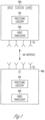
- Fig. 1 illustrates an example of the components of a UE 400 and a base station or eNB 300.
- the base station 300 includes processing circuitry 301 connected to a radio transceiver 302 for providing an air interface.
- the UE 400 includes processing circuitry 401 connected to a radio transceiver 402 for providing an interface.
- Each of the transceivers in the devices is connected to antennas 55.
- Hybrid ARQ uses forward error correction codes to correct some errors, but when uncorrected errors are detected, the corrupted transmissions are discarded and the receiver requests retransmission.
- a HARQ-ACK hybrid-ARQ acknowledgement
- NACK negative acknowledgement
- ACK positive acknowledgement
- HARQ-ACKs may be transmitted to the eNB by the UE either along with UL data over PUSCH (physical uplink shared channel) or over the PUCCH (physical uplink control channel).
- the different formats of the PUCCH previously defined by the LTE specifications i.e., formats 1, 2, and 3 are not capable of conveying the amount of UCI necessary for carrier aggregation (CA) with up to 32 CCs as described above.
- a new PUCCH format, referred to herein as PUCCH format X is designed to carry this amount of UCI and may be a PUSCH-like PUCCH structure with one demodulation reference signal (DMRS) per slot or a PUCCH-like structure with two DMRSs per slot.
- DMRS demodulation reference signal
- the total number of HARQ-ACK bits to be transmitted using PUCCH format X in a UL subframe is dynamically indicated to the UE by the eNB using an information element (IE) of a DCI (downlink control information) format used for DL scheduling assignments.
- the IE for this purpose is referred to as the downlink assignment index (DAI) indicating the total number of serving cell with DL transmission (T-DAI) and may be newly added to the existing DCI format(s) or may be a re-interpretion of an existing IE.
- the value of the T-DAI IE in subframe n may represent the total number of serving cells with PDSCH transmissions and with PDCCH/ EPDCCH indicating downlink SPS (semi-persistent scheduling) release to the UE up to the present DL subframe n.
- the techncial reason for this is to avoid mandating that the eNB make its scheduling decisions for all configured/activated serving cells and for all subframes in the HARQ-ACK feedback window at the same time instance before the first DL subframe in the HARQ-ACK feedback window.
- the total number of HARQ-ACK bits is signaled by the UE to the eNB in an explicit manner to ensure the same understanding between eNB and UE.
- a set of HARQ-ACK codebook size candidates is configured by higher layers for a given UE or predefined in the specification, denoted as ⁇ S1, S2, S3 ... ⁇ .
- the HARQ-ACK codebook size may be indicated in various manners to ensure the same understanding between the eNB and the UE.
- One way is that the codebook size determined by the UE based on scheduled CCs is used to modulate the second DMRS in each slot of the PUCCH format X resource if present.
- QPSK quadrature phase shift keying
- 2-bit information e.g. 4 states
- mapping between four states and codebook sizes may be further implemented as one to multiple. If only one DMRS is present in each slot of the PUCCH format X, the codebook size may be indicated by the DMRS cyclic shift (CS) used by PUCCH format X.
- CS DMRS cyclic shift
- Table 1 below lists examples of CS offset values corresponding to different HARQ-ACK codebook sizes. Table 1: Mapping between CS offset and HARQ-ACK codebook size Codebook size CS offset S1 or S5, CS1 S2 or S6 C52 S3 or S7 CS3 S4 or S8 CS4
- the HARQ-ACK codebook size is indicated as part of the payload of PUCCH format X.
- a HARQ-ACK bit sequence is constructed as follows: ⁇ b0, b1, b2, b3, ..., b(N), b(N+1)>
- a first part of the bit sequency such as ⁇ b0,b1> is designed to indicate the codebook size within a plurality of candidates predefined by specification.
- a secondd part of the bit sequence as ⁇ b2, b3, ..., b(N), b(N+1)> are the HARQ-ACK bits payload generated by the UE according to scheduled CCs/subframes.
- the first part of the bit sequence may be used to indicate the number of zero-bit padding with a given codebook size derived from a configured level (e.g.., transmission mode, CA, bundling window, etc)
- the encoding for [b0 b1] and [b2 b3 ... b(N+1)] can be by joint coding or separate coding.
- another IE referred to as the component carrier (CC)-domain downlink assignment index (DAI) or CC-domain DAI, is added to the DCI format(s) in order to denote the accumulative number of PDCCH/EPDCCH(s) with assigned PDSCH transmission(s) and PDCCH/EPDCCH indicating downlink SPS release up to present subframe and present serving cell, first in the increasing order of serving cell index and then in increasing order of subframe frames, in serving cells in a DL subframe or multiple DL subframes assocaited with one UL subframe for HARQ-ACK feedback (i.e. HARQ-ACK window).
- HARQ-ACK window i.e. HARQ-ACK window
- the UE determines the HARQ-ACK bits number for a missed PDSCH based on the transmission mode of the corresponding CC. As the UE cannot identify which CC the missed PDSCH is transmitted in, it may not know the number of TBs conveyed by the missed PDSCH reception (e.g. it could be 2 TBs if the eNB transmitted it on CC N-3 or could be 1 TB if transmittied on CC 4). Thus, how to determine the HARQ-ACK bits number for the missed PDSCHs is to be considered.
- the CC-domain DAI IE may denote the accumulative number of transmission blocks with assigned PDSCH transmission(s) and PDCCH/EPDCCH indicating downlink SPS release in serving cells in subframe (s) associated with one UL subframe for HARQ-ACK transmission.
- the UE assumes two ACK/NACK bits always for each CC in case at least there is at least one serving cell is configured with a transmission mode with two TBs.
- CCs configured with a transmission mode (TM) having two TBs and those configured with a TM with one TB are divided into two different CC groups (CGs).
- TM transmission mode
- CGs CC groups
- Another design consideration for DAI accumulation is to further divide conifgured CCs into different CGs based on licensed band or not in additon to TM configuration information. This is motivated due to the listen-before-talk mechanism being required before transmission on an unlicensed carrier so that DL control channel may be transmitted in the middle of one subframe.
- the value of of the CC-domain DAI IE in DCI formats on different CCs may be accumulated independently within each respective CG.
- the T-DAI IE indicating the total number of HARQ-ACK bits information in the DCI format may be set independently for each CG according to the total number of PDSCHs scheduled on CCs within a given CG.
- the value of the CC-domain DAI IE is accumulated within each CG, but the total number of HARQ-ACK bits information indicated by T-DAI IE is derived by counting all scheduled CCs/subframes of all CGs in a subframe.
- T-DAI IE the total number of HARQ-ACK bits information indicated by T-DAI IE is derived by counting all scheduled CCs/subframes of all CGs in a subframe.
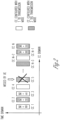
- HARQ-ACK bits are independently mapped per CG according to CG-specific DAI IEs where: a) the HARQ-ACK bit sequence of a first CG is denoted as ⁇ Q 0 0 , Q 1 0 , Q 2 0 , ... . > , b) the HARQ-ACK bit sequence of a second CG is denoted as ⁇ Q 0 1 , Q 1 1 , Q 2 1 , ... . > , and c) the output bit sequence is denoted as ⁇ e 0 , e 1 , e 2 ... e S -1 >.
- the HARQ-ACK bits concatenation is then performed by: a) sequentially mapping the HARQ-ACK bit sequence of a first CG starting from first bit of HARQ-ACK codebook (i.e. e 0 ), and b) sequentially mapping the HARQ-ACK bit sequence of a second CG from the end bit of HARQ-ACK codebook (i.e. bit e S -1 ).
- This procedure of HARQ-ACK bits concatenation is illustrated in Fig. 4 .
- One or a combination of other DAI schemes a described above may also be applied (e.g., as configured by higher layers).
- Another design consideration may be whether to introduce a bit-level channel interleaver for HARQ-ACK bits before applying the TBCC (tail-biting convolutional code) encoder.
- TBCC tail-biting convolutional code
- TBCC decoding performance is dependent on the number as well as the positions of known bits. For example, consecutive known bits in the HARQ-ACK codebook cannot help improve the decoding performance. This motivates consideration of a way to distribute the known bits evenly over the HARQ-ACK codebook to achieve a better TBCC performance.
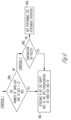
- a channel interleaver operates such that the sequence of HARQ-ACK bits is first obtained as result of the concatenation of multiple CGs HARQ-ACK bits according to the value of CG-specific DAI field for different CCs/subframes, denoting the sequence of bits ⁇ O 1 , O 2 , O 3 , ... O N >,
- N 10 bits
- S 32 bits
- Fig.5 illustrates an example of the HARQ-ACK bits channel interleaver 700 evenly distributing the known HARQ-ACK bits across the codebook.
- error detection for UCI(s) on PUCCH format X is provided through a cyclic redundancy check (CRC) for each UCI.
- CRC cyclic redundancy check
- Various schemes may be used to attach the CRC for UCI transmission which may include one or more of the following schemes.
- 8-bits CRC parity bits may be always attached to the HARQ-ACK bits information regardless of the number of HARQ-ACK bits.
- 8-bits CRC parity bits are attached to HARQ-ACK bits when O ACK > O 1 , where O ACK is the number of HARQ-ACK bits and SR bit, regardless of transmission on PUCCH or PUSCH channel.
- the modulation scheme of UCI on PUCCH format X is fixed to QPSK. Altenatively, it may be semi-statically configured by higher layers, e.g., according to a UE measurment report. Alternatively, the modulation scheme may be dynamically signaled by means of an IE in DCI formats.
- HARQ-ACK symbols may be mapped to REs in accordance with any of the following schemes.
- the mapping of the HARQ-ACK symbols to REs corresponding to the physical resource blocks assigned for transmission shall be in increasing order of first the symbol index in time domain and then frequency index, starting with the first slot in the subframe. Alternatively, it can be mapped in increasing order of first frequency index and then symobl index in time domain.
- the HARQ-ACK symbols are first mapped to consecutive SC-FDMA symbols close to RS as the channel estimates are of better quality close to the reference symbols.
- the maximum number of resources for HARQ-ACK symbols can be extended to more than four symbols.
- the mapping of HARQ-ACK symbols to REs depends on whether there is periodic CSI for at least one serving cell together with HARQ-ACK bits on PUCCH channel: 1) If there is simutaneous periodic CSI (P-CSI) and HARQ-ACK transmission, the second example scheme is used, and 2) Otherwise, the first example scheme is used (e.g., when sending HARQ-ACK bits themselves without P-CSI on PUCCH using PUCCH format X).
- P-CSI simutaneous periodic CSI
- frequency hopping is always implemented for PUCCH format X at the two edges of the total system bandwidth between slots, between subframes, between CCs or any combination of slots, subframes and CCs, to achieve maximum frequency diversity experienced by the UCI (which may including CQI/PMI/RI and/or HARQ-ACK information).
- frequency hopping of PUCCH format X can be enabled or disabled by means of a UE-specific parameter provided by higher layers.
- frequency hopping enabling for PUCCH format X is dynamically controlled by explicit information provided in the DCI formats.
- the UE may be configured with a set of PUCCH format X resources with each resource having frequency hopping semi-statically enabled or disabled by higher layer signaling.
- the UE may determine the PUCCH resource value from one of multiple resource values configured by higher layers according to the HARQ-ACK resource indication field (e.g., the TPC field) in the corresponding PDCCH.
- the HARQ-ACK resource indication field e.g., the TPC field
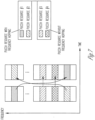
- a UE can be configured by higher layers with four PUCCH resources for UCI transmission on PUCCH format X, denoted as PUCCH resource RES1 through RES4. Frequency hopping is then independently set for each PUCCH resource to be enabled or disabled. As illustrated in FIG.7 , PUCCH resource RES1 and RES2 are enabled with frequency hopping (FH) by higher layers. FH for PUCCH resource RES3 and RES4 is disabled. The UE may then use PUCCH format X with a PUCCH resource value that is determined from one of the four PUCCH resource values configured by higher layers according to the HARQ-ACK resource offset field or the TPC field in the DCI format of the corresponding PDCCH assignment with mapping defined in Table 2 below.
- PUCCH resource RES1 through RES4 Frequency hopping is then independently set for each PUCCH resource to be enabled or disabled.
- PUCCH resource RES1 and RES2 are enabled with frequency hopping (FH) by higher layers. FH for PUC
- Table 2 PUCCH Resource Value for PUCCH format X Value of 'TPC command for PUCCH' or 'HARQ-ACK resource offset' PUCCH resource FH configuration '00' The 1st PUCCH resource value configured by the higher layers Enabled '01' The 2 nd PUCCH resource value configured by the higher layers Enabled '10' The 3 rd PUCCH resource value configured by the higher layers Disabled '11' The 4 th PUCCH resource value configured by the higher layers Disabled
- FH for PUCCH format X may be explicitly indicated by a single bit frequency hopping information field in the corresponding DCI formats used for DL assignments.
- a PUCCH resource is determined according to higher layer configuration and the value of the HARQ-ACK resource indication field in DCI format (e.g., by re-interpreting the TPC field).
- Multi-PRBs PUCCH resource(s) may be configured by the eNB through higher layer signaling with the one cyclic shift of one root sequence.
- One sequence of length 12N is generated for all of PRBs, where "N" is the number of RBs for PUCCH format X transmission.
- the UE might be assigned with one PUCCH resource with a set of RBs with more cyclic shifts of the same root sequence.
- the cyclic shifts assignment for respective PRBs may be preformed by L1 or L2/L3 signaling or may be pre-determined by an implicit mapping rule.
- circuitry may refer to, be part of, or include an Application Specific Integrated Circuit (ASIC), an electronic circuit, a processor (shared, dedicated, or group), and/or memory (shared, dedicated, or group) that execute one or more software or firmware programs, a combinational logic circuit, and/or other suitable hardware components that provide the described functionality.
- ASIC Application Specific Integrated Circuit
- the circuitry may be implemented in, or functions associated with the circuitry may be implemented by, one or more software or firmware modules.
- circuitry may include logic, at least partially operable in hardware.
- Fig. 8 illustrates, for one embodiment, example components of a User Equipment (UE) device 100.
- the UE device 100 may include application circuitry 102, baseband circuitry 104, Radio Frequency (RF) circuitry 106, front-end module (FEM) circuitry 108 and one or more antennas 110, coupled together at least as shown.
- RF Radio Frequency
- FEM front-end module
- the application circuitry 102 may include one or more application processors.
- the application circuitry 102 may include circuitry such as, but not limited to, one or more single-core or multi-core processors.
- the processor(s) may include any combination of general-purpose processors and dedicated processors (e.g., graphics processors, application processors, etc.).
- the processors may be coupled with and/or may include memory/storage and may be configured to execute instructions stored in the memory/storage to enable various applications and/or operating systems to run on the system.
- the baseband circuitry 104 may include circuitry such as, but not limited to, one or more single-core or multi-core processors.
- the baseband circuitry 104 may include one or more baseband processors and/or control logic to process baseband signals received from a receive signal path of the RF circuitry 106 and to generate baseband signals for a transmit signal path of the RF circuitry 106.
- Baseband processing circuity 104 may interface with the application circuitry 102 for generation and processing of the baseband signals and for controlling operations of the RF circuitry 106.
- the baseband circuitry 104 may include a second generation (2G) baseband processor 104a, third generation (3G) baseband processor 104b, fourth generation (4G) baseband processor 104c, and/or other baseband processor(s) 104d for other existing generations, generations in development or to be developed in the future (e.g., fifth generation (5G), 6G, etc.).
- the baseband circuitry 104 e.g., one or more of baseband processors 104a-d
- the radio control functions may include, but are not limited to, signal modulation/demodulation, encoding/decoding, radio frequency shifting, etc.
- modulation/demodulation circuitry of the baseband circuitry 104 may include Fast-Fourier Transform (FFT), precoding, and/or constellation mapping/demapping functionality.
- encoding/decoding circuitry of the baseband circuitry 104 may include convolution, tail-biting convolution, turbo, Viterbi, and/or Low Density Parity Check (LDPC) encoder/decoder functionality.
- LDPC Low Density Parity Check
- the baseband circuitry 104 may include elements of a protocol stack such as, for example, elements of an evolved universal terrestrial radio access network (EUTRAN) protocol including, for example, physical (PHY), media access control (MAC), radio link control (RLC), packet data convergence protocol (PDCP), and/or radio resource control (RRC) elements.
- EUTRAN evolved universal terrestrial radio access network
- a central processing unit (CPU) 104e of the baseband circuitry 104 may be configured to run elements of the protocol stack for signaling of the PHY, MAC, RLC, PDCP and/or RRC layers.
- the baseband circuitry may include one or more audio digital signal processor(s) (DSP) 104f.
- DSP audio digital signal processor
- the audio DSP(s) 104f may be include elements for compression/decompression and echo cancellation and may include other suitable processing elements in other embodiments.
- Components of the baseband circuitry may be suitably combined in a single chip, a single chipset, or disposed on a same circuit board in some embodiments.
- some or all of the constituent components of the baseband circuitry 104 and the application circuitry 102 may be implemented together such as, for example, on a system on a chip (SOC).
- SOC system on a chip
- the baseband circuitry 104 may provide for communication compatible with one or more radio technologies.
- the baseband circuitry 104 may support communication with an evolved universal terrestrial radio access network (EUTRAN) and/or other wireless metropolitan area networks (WMAN), a wireless local area network (WLAN), a wireless personal area network (WPAN).
- EUTRAN evolved universal terrestrial radio access network
- WMAN wireless metropolitan area networks
- WLAN wireless local area network
- WPAN wireless personal area network
- multi-mode baseband circuitry Embodiments in which the baseband circuitry 104 is configured to support radio communications of more than one wireless protocol.
- RF circuitry 106 may enable communication with wireless networks using modulated electromagnetic radiation through a non-solid medium.
- the RF circuitry 106 may include switches, filters, amplifiers, etc. to facilitate the communication with the wireless network.
- RF circuitry 106 may include a receive signal path which may include circuitry to down-convert RF signals received from the FEM circuitry 108 and provide baseband signals to the baseband circuitry 104.
- RF circuitry 106 may also include a transmit signal path which may include circuitry to up-convert baseband signals provided by the baseband circuitry 104 and provide RF output signals to the FEM circuitry 108 for transmission.
- the RF circuitry 106 may include a receive signal path and a transmit signal path.
- the receive signal path of the RF circuitry 106 may include mixer circuitry 106a, amplifier circuitry 106b and filter circuitry 106c.
- the transmit signal path of the RF circuitry 106 may include filter circuitry 106c and mixer circuitry 106a.
- RF circuitry 106 may also include synthesizer circuitry 106d for synthesizing a frequency for use by the mixer circuitry 106a of the receive signal path and the transmit signal path.
- the mixer circuitry 106a of the receive signal path may be configured to down-convert RF signals received from the FEM circuitry 108 based on the synthesized frequency provided by synthesizer circuitry 106d.
- the amplifier circuitry 106b may be configured to amplify the down-converted signals and the filter circuitry 106c may be a low-pass filter (LPF) or band-pass filter (BPF) configured to remove unwanted signals from the down-converted signals to generate output baseband signals.
- LPF low-pass filter
- BPF band-pass filter
- Output baseband signals may be provided to the baseband circuitry 104 for further processing.
- the output baseband signals may be zero-frequency baseband signals, although this is not a requirement.
- mixer circuitry 106a of the receive signal path may comprise passive mixers, although the scope of the embodiments is not limited in this respect.
- the mixer circuitry 106a of the transmit signal path may be configured to up-convert input baseband signals based on the synthesized frequency provided by the synthesizer circuitry 106d to generate RF output signals for the FEM circuitry 108.
- the baseband signals may be provided by the baseband circuitry 104 and may be filtered by filter circuitry 106c.
- the filter circuitry 106c may include a low-pass filter (LPF), although the scope of the embodiments is not limited in this respect.
- the mixer circuitry 106a of the receive signal path and the mixer circuitry 106a of the transmit signal path may include two or more mixers and may be arranged for quadrature downconversion and/or upconversion respectively.
- the mixer circuitry 106a of the receive signal path and the mixer circuitry 106a of the transmit signal path may include two or more mixers and may be arranged for image rejection (e.g., Hartley image rejection).
- the mixer circuitry 106a of the receive signal path and the mixer circuitry 106a may be arranged for direct downconversion and/or direct upconversion, respectively.
- the mixer circuitry 106a of the receive signal path and the mixer circuitry 106a of the transmit signal path may be configured for super-heterodyne operation.
- the output baseband signals and the input baseband signals may be analog baseband signals, although the scope of the embodiments is not limited in this respect.
- the output baseband signals and the input baseband signals may be digital baseband signals.
- the RF circuitry 106 may include analog-to-digital converter (ADC) and digital-to-analog converter (DAC) circuitry and the baseband circuitry 104 may include a digital baseband interface to communicate with the RF circuitry 106.
- ADC analog-to-digital converter
- DAC digital-to-analog converter
- a separate radio IC circuitry may be provided for processing signals for each spectrum, although the scope of the embodiments is not limited in this respect.
- the synthesizer circuitry 106d may be a fractional-N synthesizer or a fractional N/N+1 synthesizer, although the scope of the embodiments is not limited in this respect as other types of frequency synthesizers may be suitable.
- synthesizer circuitry 106d may be a delta-sigma synthesizer, a frequency multiplier, or a synthesizer comprising a phase-locked loop with a frequency divider.
- the synthesizer circuitry 106d may be configured to synthesize an output frequency for use by the mixer circuitry 106a of the RF circuitry 106 based on a frequency input and a divider control input. In some embodiments, the synthesizer circuitry 106d may be a fractional N/N+1 synthesizer.
- frequency input may be provided by a voltage controlled oscillator (VCO), although that is not a requirement.
- VCO voltage controlled oscillator
- Divider control input may be provided by either the baseband circuitry 104 or the applications processor 102 depending on the desired output frequency.
- a divider control input (e.g., N) may be determined from a look-up table based on a channel indicated by the applications processor 102.
- Synthesizer circuitry 106d of the RF circuitry 106 may include a divider, a delay-locked loop (DLL), a multiplexer and a phase accumulator.
- the divider may be a dual modulus divider (DMD) and the phase accumulator may be a digital phase accumulator (DPA).
- the DMD may be configured to divide the input signal by either N or N+1 (e.g., based on a carry out) to provide a fractional division ratio.
- the DLL may include a set of cascaded, tunable, delay elements, a phase detector, a charge pump and a D-type flip-flop.
- the delay elements may be configured to break a VCO period up into Nd equal packets of phase, where Nd is the number of delay elements in the delay line.
- Nd is the number of delay elements in the delay line.
- synthesizer circuitry 106d may be configured to generate a carrier frequency as the output frequency, while in other embodiments, the output frequency may be a multiple of the carrier frequency (e.g., twice the carrier frequency, four times the carrier frequency) and used in conjunction with quadrature generator and divider circuitry to generate multiple signals at the carrier frequency with multiple different phases with respect to each other.
- the output frequency may be a LO frequency (f LO ).
- the RF circuitry 106 may include an IQ/polar converter.
- FEM circuitry 108 may include a receive signal path which may include circuitry configured to operate on RF signals received from one or more antennas 110, amplify the received signals and provide the amplified versions of the received signals to the RF circuitry 106 for further processing.
- FEM circuitry 108 may also include a transmit signal path which may include circuitry configured to amplify signals for transmission provided by the RF circuitry 106 for transmission by one or more of the one or more antennas 110.
- the FEM circuitry 108 may include a TX/RX switch to switch between transmit mode and receive mode operation.
- the FEM circuitry may include a receive signal path and a transmit signal path.
- the receive signal path of the FEM circuitry may include a low-noise amplifier (LNA) to amplify received RF signals and provide the amplified received RF signals as an output (e.g., to the RF circuitry 106).
- the transmit signal path of the FEM circuitry 108 may include a power amplifier (PA) to amplify input RF signals (e.g., provided by RF circuitry 106), and one or more filters to generate RF signals for subsequent transmission (e.g., by one or more of the one or more antennas 110.
- PA power amplifier
- the UE device 100 may include additional elements such as, for example, memory/storage, display, camera, sensor, and/or input/output (I/O) interface.
- additional elements such as, for example, memory/storage, display, camera, sensor, and/or input/output (I/O) interface.
- Fig. 9 illustrates a block diagram of an example machine 500 upon which any one or more of the techniques (e.g., methodologies) discussed herein may perform.
- the machine 500 may operate as a standalone device or may be connected (e.g., networked) to other machines.
- the machine 500 may operate in the capacity of a server machine, a client machine, or both in server-client network environments.
- the machine 500 may act as a peer machine in peer-to-peer (P2P) (or other distributed) network environment.
- P2P peer-to-peer
- the machine 500 may be a user equipment (UE), evolved Node B (eNB), Wi-Fi access point (AP), Wi-Fi station (STA), personal computer (PC), a tablet PC, a set-top box (STB), a personal digital assistant (PDA), a mobile telephone, a smart phone, a web appliance, a network router, switch or bridge, or any machine capable of executing instructions (sequential or otherwise) that specify actions to be taken by that machine.
- UE user equipment
- eNB evolved Node B
- AP Wi-Fi access point
- STA Wi-Fi station
- PC personal computer
- PDA personal digital assistant
- STB set-top box
- mobile telephone a smart phone
- web appliance a web appliance
- network router switch or bridge
- Examples, as described herein, may include, or may operate on, logic or a number of components, modules, or mechanisms.
- Modules are tangible entities (e.g., hardware) capable of performing specified operations and may be configured or arranged in a certain manner.
- circuits may be arranged (e.g., internally or with respect to external entities such as other circuits) in a specified manner as a module.
- the whole or part of one or more computer systems e.g., a standalone, client or server computer system
- one or more hardware processors may be configured by firmware or software (e.g., instructions, an application portion, or an application) as a module that operates to perform specified operations.
- the software may reside on a machine readable medium.
- the software when executed by the underlying hardware of the module, causes the hardware to perform the specified operations.
- module is understood to encompass a tangible entity, be that an entity that is physically constructed, specifically configured (e.g., hardwired), or temporarily (e.g., transitorily) configured (e.g., programmed) to operate in a specified manner or to perform part or all of any operation described herein.
- each of the modules need not be instantiated at any one moment in time.
- the modules comprise a general-purpose hardware processor configured using software
- the general-purpose hardware processor may be configured as respective different modules at different times.
- Software may accordingly configure a hardware processor, for example, to constitute a particular module at one instance of time and to constitute a different module at a different instance of time.
- Machine 500 may include a hardware processor 502 (e.g., a central processing unit (CPU), a graphics processing unit (GPU), a hardware processor core, or any combination thereof), a main memory 504 and a static memory 506, some or all of which may communicate with each other via an interlink (e.g., bus) 508.
- the machine 500 may further include a display unit 510, an alphanumeric input device 512 (e.g., a keyboard), and a user interface (UI) navigation device 514 (e.g., a mouse).
- the display unit 510, input device 512 and UI navigation device 514 may be a touch screen display.
- the machine 500 may additionally include a storage device (e.g., drive unit) 516, a signal generation device 518 (e.g., a speaker), a network interface device 520, and one or more sensors 521, such as a global positioning system (GPS) sensor, compass, accelerometer, or other sensor.
- the machine 500 may include an output controller 528, such as a serial (e.g., universal serial bus (USB), parallel, or other wired or wireless (e.g., infrared (IR), near field communication (NFC), etc.) connection to communicate or control one or more peripheral devices (e.g., a printer, card reader, etc.).
- a serial e.g., universal serial bus (USB), parallel, or other wired or wireless (e.g., infrared (IR), near field communication (NFC), etc.) connection to communicate or control one or more peripheral devices (e.g., a printer, card reader, etc.).
- USB universal serial bus
- NFC near field
- the storage device 516 may include a machine readable medium 522 on which is stored one or more sets of data structures or instructions 524 (e.g., software) embodying or utilized by any one or more of the techniques or functions described herein.
- the instructions 524 may also reside, completely or at least partially, within the main memory 504, within static memory 506, or within the hardware processor 502 during execution thereof by the machine 500.
- one or any combination of the hardware processor 502, the main memory 504, the static memory 506, or the storage device 516 may constitute machine readable media.
- machine readable medium 522 is illustrated as a single medium, the term “machine readable medium” may include a single medium or multiple media (e.g., a centralized or distributed database, and/or associated caches and servers) configured to store the one or more instructions 524.
- machine readable medium may include a single medium or multiple media (e.g., a centralized or distributed database, and/or associated caches and servers) configured to store the one or more instructions 524.
- machine readable medium may include any medium that is capable of storing, encoding, or carrying instructions for execution by the machine 500 and that cause the machine 500 to perform any one or more of the techniques of the present disclosure, or that is capable of storing, encoding or carrying data structures used by or associated with such instructions.
- Nonlimiting machine readable medium examples may include solid-state memories, and optical and magnetic media.
- machine readable media may include: non-volatile memory, such as semiconductor memory devices (e.g., Electrically Programmable Read-Only Memory (EPROM), Electrically Erasable Programmable Read-Only Memory (EEPROM)) and flash memory devices; magnetic disks, such as internal hard disks and removable disks; magneto-optical disks; Random Access Memory (RAM); and CD-ROM and DVD-ROM disks.
- non-volatile memory such as semiconductor memory devices (e.g., Electrically Programmable Read-Only Memory (EPROM), Electrically Erasable Programmable Read-Only Memory (EEPROM)) and flash memory devices
- magnetic disks such as internal hard disks and removable disks
- magneto-optical disks such as internal hard disks and removable disks
- RAM Random Access Memory
- CD-ROM and DVD-ROM disks CD-ROM and DVD-ROM disks.
- machine readable media may include non-transitory machine readable media.
- machine readable media may include machine readable media that is not a transitory
- the instructions 524 may further be transmitted or received over a communications network 526 using a transmission medium via the network interface device 520 utilizing any one of a number of transfer protocols (e.g., frame relay, internet protocol (IP), transmission control protocol (TCP), user datagram protocol (UDP), hypertext transfer protocol (HTTP), etc.).
- transfer protocols e.g., frame relay, internet protocol (IP), transmission control protocol (TCP), user datagram protocol (UDP), hypertext transfer protocol (HTTP), etc.
- Example communication networks may include a local area network (LAN), a wide area network (WAN), a packet data network (e.g., the Internet), mobile telephone networks (e.g., cellular networks), Plain Old Telephone (POTS) networks, and wireless data networks (e.g., Institute of Electrical and Electronics Engineers (IEEE) 802.11 family of standards known as Wi-Fi ® , IEEE 802.16 family of standards known as WiMax ® ), IEEE 802.15.4 family of standards, a Long Term Evolution (LTE) family of standards, a Universal Mobile Telecommunications System (UMTS) family of standards, peer-to-peer (P2P) networks, among others.
- LAN local area network
- WAN wide area network
- POTS Plain Old Telephone
- wireless data networks e.g., Institute of Electrical and Electronics Engineers (IEEE) 802.11 family of standards known as Wi-Fi ® , IEEE 802.16 family of standards known as WiMax ®
- IEEE 802.15.4 family of standards e.g., a Long
- the network interface device 520 may include one or more physical jacks (e.g., Ethernet, coaxial, or phone jacks) or one or more antennas to connect to the communications network 526.
- the network interface device 520 may include a plurality of antennas to wirelessly communicate using at least one of single-input multiple-output (SIMO), multiple-input multiple-output (MIMO), or multiple-input single-output (MISO) techniques.
- SIMO single-input multiple-output
- MIMO multiple-input multiple-output
- MISO multiple-input single-output
- the network interface device 520 may wirelessly communicate using Multiple User MIMO techniques.
- transmission medium shall be taken to include any intangible medium that is capable of storing, encoding or carrying instructions for execution by the machine 500, and includes digital or analog communications signals or other intangible medium to facilitate communication of such software.
- the embodiments as described above may be implemented in various hardware configurations that may include a processor for executing instructions that perform the techniques described. Such instructions may be contained in a machine-readable medium such as a suitable storage medium or a memory or other processor-executable medium.
- the embodiments as described herein may be implemented in a number of environments such as part of a wireless local area network (WLAN), 3rd Generation Partnership Project (3GPP) Universal Terrestrial Radio Access Network (UTRAN), or Long-Term-Evolution (LTE) or a Long-Term-Evolution (LTE) communication system, although the scope of the invention is not limited in this respect.
- WLAN wireless local area network
- 3GPP 3rd Generation Partnership Project
- UTRAN Universal Terrestrial Radio Access Network
- LTE Long-Term-Evolution
- LTE Long-Term-Evolution
- LTE Long-Term-Evolution
- LTE Long-Term-Evolution
- Antennas referred to herein may comprise one or more directional or omnidirectional antennas, including, for example, dipole antennas, monopole antennas, patch antennas, loop antennas, microstrip antennas or other types of antennas suitable for transmission of RF signals.
- a single antenna with multiple apertures may be used instead of two or more antennas.
- each aperture may be considered a separate antenna.
- antennas may be effectively separated to take advantage of spatial diversity and the different channel characteristics that may result between each of antennas and the antennas of a transmitting station.
- antennas may be separated by up to 1/10 of a wavelength or more.
- a receiver as described herein may be configured to receive signals in accordance with specific communication standards, such as the Institute of Electrical and Electronics Engineers (IEEE) standards including IEEE 802.11 standards and/or proposed specifications for WLANs, although the scope of the invention is not limited in this respect as they may also be suitable to transmit and/or receive communications in accordance with other techniques and standards.
- the receiver may be configured to receive signals in accordance with the IEEE 802.16-2004, the IEEE 802.16(e) and/or IEEE 802.16(m) standards for wireless metropolitan area networks (WMANs) including variations and evolutions thereof, although the scope of the invention is not limited in this respect as they may also be suitable to transmit and/or receive communications in accordance with other techniques and standards.
- IEEE Institute of Electrical and Electronics Engineers
- the receiver may be configured to receive signals in accordance with the Universal Terrestrial Radio Access Network (UTRAN) LTE communication standards.
- UTRAN Universal Terrestrial Radio Access Network
- IEEE 802.11 and IEEE 802.16 standards please refer to "IEEE Standards for Information Technology -- Telecommunications and Information Exchange between Systems" - Local Area Networks - Specific Requirements - Part 11 "Wireless LAN Medium Access Control (MAC) and Physical Layer (PHY), ISO/IEC 8802-11: 1999", and Metropolitan Area Networks - Specific Requirements - Part 16: "Air Interface for Fixed Broadband Wireless Access Systems," May 2005 and related amendments/versions.
- 3GPP 3rd Generation Partnership Project
Landscapes
- Engineering & Computer Science (AREA)
- Signal Processing (AREA)
- Computer Networks & Wireless Communication (AREA)
- Mobile Radio Communication Systems (AREA)
Claims (5)
- Vorrichtung einer Benutzervorrichtung (engl. User Equipment), UE, (400), wobei die Vorrichtung Folgendes umfasst:eine Verarbeitungsschaltungsanordnung (401); und
einen Speicher,wobei die UE (400) mit mehr als einer versorgenden Zelle konfiguriert ist, die eine primäre Zelle, Pcell, und mindestens eine sekundäre Zelle, Scell, beinhaltet, wobei die UE (400) ferner mit einem Übertragungsmodus konfiguriert ist, der den Empfang von zwei Transportblöcken, TBs, in mindestens einer der versorgenden Zellen unterstützt, wobei die Verarbeitungsschaltungsanordnung (401) für Folgendes konfiguriert ist:Bestimmen einer Anzahl von HARQ-Bestätigungs-Rückmeldungsbits, die in einem Subframe zu übertragen sind, basierend auf einem Downlink-Zuweisungsindex, DAI, wobei ein Wert des DAI in einem Downlink-Steuerinformationsformat, DCI-Format, eine akkumulative Anzahl der versorgenden Zellen mit PDSCH-Übertragungen anzeigt, die mit einem PDCCH oder einem erweiterten PDCCH, EPDCCH, assoziiert sind, und versorgenden Zellen mit dem PDCCH oder dem EPDCCH, die eine semipersistente Downlink-Planungsfreigabe, SPS-Freigabe, anzeigen, bis zu einer gegenwärtigen versorgenden Zelle in aufsteigender Reihenfolge des Index der versorgenden Zelle;Berechnen der HARQ-ACK-Rückmeldungsbits basierend auf dem Decodieren von Transportblöcken eines empfangenen gemeinsam genutzten physikalischen Downlink-Kanals, PDSCH, der versorgenden Zellen, die die primäre Zelle und die mindestens eine sekundäre Zelle beinhalten, wobei zwei HARQ-ACK-Bits immer für jede PDSCH- oder SPS-Freigabe gemäß dem Wert des DAI in jeder versorgenden Zelle erzeugt werden, unabhängig davon, ob die UE (400) mit einem Übertragungsmodus konfiguriert ist, der zwei TBs oder einen TB in der versorgenden Zelle unterstützt; undCodieren eines PUCCH gemäß dem PUCCH-Format zur Übertragung von Uplink-Steuerinformationen, UCI. - Vorrichtung nach Anspruch 1, wobei die Verarbeitungsschaltungsanordnung (401) HARQ-ACK-Modulationssymbole aus den HARQ-ACK-Bits erzeugen soll und die HARQ-ACK-Symbole auf Ressourcenelemente des PUCCH in aufsteigender Reihenfolge eines Symbolindex abbilden soll.
- Vorrichtung nach Anspruch 1, wobei die Verarbeitungsschaltungsanordnung (401) einen Basisbandprozessor (104) umfasst.
- Vorrichtung nach Anspruch 3, die ferner eine Sendeempfängerschaltungsanordnung (302) umfasst, die mit dem Basisbandprozessor (104) gekoppelt ist, wobei die Sendeempfängerschaltungsanordnung (302) konfiguriert ist, um mit zwei oder mehr Antennen (55) gekoppelt zu werden.
- Nichtflüchtiges computerlesbares Speichermedium, das Anweisungen umfasst, die, wenn sie von einer Verarbeitungsschaltungsanordnung (401) einer Benutzervorrichtung (engl. User Equipment), UE, (400) ausgeführt werden, die mit mehr als einer versorgenden Zelle konfiguriert ist, die eine primäre Zelle, Pcell, und mindestens eine sekundäre Zelle, Scell, beinhaltet, und ferner mit einem Übertragungsmodus konfiguriert ist, der den Empfang von zwei Transportblöcken, TBs, in mindestens einer der versorgenden Zellen unterstützt, die Verarbeitungsschaltungsanordnung (401) veranlassen, die folgenden Schritte auszuführen:Bestimmen einer Anzahl von HARQ-Bestätigungs-Rückmeldungsbits, die in einem Subframe zu übertragen sind, basierend auf einem Downlink-Zuweisungsindex, DAI, wobei ein Wert des DAI in einem Downlink-Steuerinformationsformat, DCI-Format, eine akkumulative Anzahl der versorgenden Zellen mit PDSCH-Übertragungen anzeigt, die mit einem PDCCH oder einem erweiterten PDCCH, EPDCCH, assoziiert sind, und versorgenden Zellen mit dem PDCCH oder dem EPDCCH, die eine semipersistente Downlink-Planungsfreigabe, SPS-Freigabe, anzeigen, bis zu einer gegenwärtigen versorgenden Zelle in aufsteigender Reihenfolge des Index der versorgenden Zelle;Berechnen der HARQ-ACK-Rückmeldungsbits basierend auf dem Decodieren von Transportblöcken eines empfangenen gemeinsam genutzten physikalischen Downlink-Kanals, PDSCH, der versorgenden Zellen, die die primäre Zelle und die mindestens eine sekundäre Zelle beinhalten, wobei zwei HARQ-ACK-Bits immer für jede PDSCH- oder SPS-Freigabe gemäß dem Wert des DAI in jeder versorgenden Zelle erzeugt werden, unabhängig davon, ob die UE (400) mit einem Übertragungsmodus konfiguriert ist, der zwei TBs oder einen TB in der versorgenden Zelle unterstützt; und Codieren eines PUCCH gemäß dem PUCCH-Format zur Übertragung von Uplink-Steuerinformationen, UCI.
Applications Claiming Priority (2)
| Application Number | Priority Date | Filing Date | Title |
|---|---|---|---|
| US201562217532P | 2015-09-11 | 2015-09-11 | |
| PCT/US2015/000244 WO2017044066A1 (en) | 2015-09-11 | 2015-12-23 | Transmission of uplink control information in wireless systems |
Publications (3)
| Publication Number | Publication Date |
|---|---|
| EP3348012A1 EP3348012A1 (de) | 2018-07-18 |
| EP3348012A4 EP3348012A4 (de) | 2019-04-03 |
| EP3348012B1 true EP3348012B1 (de) | 2024-12-25 |
Family
ID=58240295
Family Applications (1)
| Application Number | Title | Priority Date | Filing Date |
|---|---|---|---|
| EP15903708.4A Active EP3348012B1 (de) | 2015-09-11 | 2015-12-23 | Übertragung von mehreren harq-ack-rückkopplungsbits entsprechend mehreren downlink-zellen und einem oder zwei transportblöcken pro zelle |
Country Status (4)
| Country | Link |
|---|---|
| US (1) | US10931425B2 (de) |
| EP (1) | EP3348012B1 (de) |
| CN (1) | CN107925523B (de) |
| WO (1) | WO2017044066A1 (de) |
Families Citing this family (65)
| Publication number | Priority date | Publication date | Assignee | Title |
|---|---|---|---|---|
| EP3348012B1 (de) | 2015-09-11 | 2024-12-25 | Apple Inc. | Übertragung von mehreren harq-ack-rückkopplungsbits entsprechend mehreren downlink-zellen und einem oder zwei transportblöcken pro zelle |
| WO2017089617A1 (en) * | 2015-11-27 | 2017-06-01 | Telefonaktiebolaget Lm Ericsson (Publ) | Method and devices employing retransmission schemes |
| CN108605030B (zh) * | 2016-01-27 | 2021-12-14 | 株式会社Ntt都科摩 | 用户终端、无线基站和无线通信方法 |
| US10462739B2 (en) * | 2016-06-21 | 2019-10-29 | Samsung Electronics Co., Ltd. | Transmissions of physical downlink control channels in a communication system |
| EP3512239A4 (de) * | 2016-09-09 | 2020-05-06 | Ntt Docomo, Inc. | Benutzerendgerät und funkkommunikationsverfahren |
| EP3531599A4 (de) * | 2016-11-04 | 2019-11-06 | Huawei Technologies Co., Ltd. | Verfahren zur übertragung von harq-ack-rückkopplungsinformationen und zugehörige vorrichtung |
| KR102603814B1 (ko) * | 2017-01-06 | 2023-11-17 | 한국전자통신연구원 | 상향링크 제어정보 전송 방법 및 장치 |
| CN115460705B (zh) | 2017-03-23 | 2026-03-10 | 苹果公司 | 基站和用户设备的基带处理器及方法 |
| US10405305B2 (en) * | 2017-03-24 | 2019-09-03 | Qualcomm Incorporated | Single slot short PUCCH with support for intra slot frequency hopping |
| US11496270B2 (en) | 2017-06-02 | 2022-11-08 | Telefonaktiebolaget Lm Ericsson (Publ) | Control signaling size |
| WO2018224493A1 (en) * | 2017-06-07 | 2018-12-13 | Telefonaktiebolaget Lm Ericsson (Publ) | Providing information on a control channel |
| US20180376473A1 (en) * | 2017-06-23 | 2018-12-27 | Qualcomm Incorporated | Long uplink burst channel design |
| WO2019004881A1 (en) | 2017-06-27 | 2019-01-03 | Telefonaktiebolaget Lm Ericsson (Publ) | FEEDBACK SIGNALING FORMAT SELECTION |
| WO2019031759A1 (ko) | 2017-08-10 | 2019-02-14 | 삼성전자 주식회사 | 무선 셀룰라 통신 시스템에서 상향 제어 채널 전송 방법 및 장치 |
| US11502805B2 (en) * | 2017-08-10 | 2022-11-15 | Apple Inc. | Resource mapping schemes for channel state information reporting on new radio physical uplink control channel |
| KR20190017612A (ko) * | 2017-08-10 | 2019-02-20 | 삼성전자주식회사 | 무선 셀룰라 통신 시스템에서 상향 제어 채널 전송 방법 및 장치 |
| CN111264040B (zh) * | 2017-08-11 | 2022-08-09 | 联想(北京)有限公司 | 用于下行链路时隙集合的多个载波组的harq-ack的装置和方法 |
| EP3665993B1 (de) * | 2017-08-11 | 2024-07-31 | Lenovo (Beijing) Limited | Auslösung von harq-ack-rückkopplung für einen downlink-schlitzsatz |
| CN115642992B (zh) * | 2017-08-11 | 2025-06-06 | 韦勒斯标准与技术协会公司 | 发送或接收上行链路控制信道的方法、设备和系统 |
| US20210152292A1 (en) | 2017-09-08 | 2021-05-20 | Samsung Electronics Co., Ltd. | Method, user equipment and base station for transmitting harq-ack information |
| CN109474373B (zh) * | 2017-09-08 | 2021-01-29 | 华为技术有限公司 | 交织方法和交织装置 |
| CN109586856B (zh) * | 2017-09-29 | 2024-03-29 | 北京三星通信技术研究有限公司 | 传输、配置harq-ack反馈信息的方法及相应的用户设备、基站 |
| CN117318905A (zh) * | 2017-09-29 | 2023-12-29 | 北京三星通信技术研究有限公司 | 上行传输方法和相应设备 |
| US11696288B2 (en) * | 2017-10-06 | 2023-07-04 | Ntt Docomo, Inc. | User terminal and radio communication method |
| JP7129741B2 (ja) * | 2017-11-16 | 2022-09-02 | 株式会社Nttドコモ | 端末、無線通信方法及びシステム |
| EP3897059B1 (de) * | 2017-11-17 | 2023-12-27 | Guangdong Oppo Mobile Telecommunications Corp., Ltd. | Verfahren und vorrichtung zur bestimmung von ressourcen |
| EP3726763B1 (de) | 2017-12-29 | 2026-01-21 | Beijing Xiaomi Mobile Software Co., Ltd. | Verfahren und vorrichtung zur konfiguration der rückkopplung von hybriden automatischen wiederholungsanfragen (harq) und datenempfangsvorrichtung |
| WO2019136205A1 (en) * | 2018-01-04 | 2019-07-11 | Ofinno, Llc | Semi-persistent channel state information report |
| US11032051B2 (en) * | 2018-01-12 | 2021-06-08 | Mediatek Singapore Pte. Ltd. | Method and apparatus for reducing uplink overhead in mobile communications |
| CN110324132B (zh) * | 2018-03-28 | 2022-03-01 | 华硕电脑股份有限公司 | 无线通信系统中确定码本大小的方法及设备 |
| CN110505697B (zh) * | 2018-05-18 | 2022-04-05 | 大唐移动通信设备有限公司 | 一种混合自动重传请求的传输方法、终端及基站 |
| CN112737738A (zh) * | 2018-05-21 | 2021-04-30 | 华为技术有限公司 | 上行控制信息的传输方法及设备 |
| EP3831008B1 (de) * | 2018-08-02 | 2025-04-30 | INTEL Corporation | Formate physikalischer uplink-steuerkanäle (pucch) in new radio (nr) für nr ohne lizenz |
| CN110831172A (zh) | 2018-08-07 | 2020-02-21 | 维沃移动通信有限公司 | 确定方法、终端及网络设备 |
| WO2020037624A1 (zh) * | 2018-08-23 | 2020-02-27 | 北京小米移动软件有限公司 | 传输重传码本的方法及装置 |
| US20200106569A1 (en) * | 2018-09-27 | 2020-04-02 | Mediatek Inc. | Mechanisms for postponing hybrid automatic repeat request acknowledgement (harq-ack) feedback |
| US11349609B2 (en) * | 2018-11-05 | 2022-05-31 | Qualcomm Incorporated | Hybrid automatic repeat request acknowledgement feedback enhancement for new radio-unlicensed |
| KR102770148B1 (ko) * | 2018-12-28 | 2025-02-21 | 삼성전자 주식회사 | 무선 통신 시스템에서 비승인 데이터 전송 방법 및 장치 |
| WO2020142985A1 (zh) * | 2019-01-10 | 2020-07-16 | 富士通株式会社 | 反馈信息的发送和接收方法以及装置 |
| EP3697013A1 (de) * | 2019-02-14 | 2020-08-19 | Panasonic Intellectual Property Corporation of America | Benutzergerät und system zur durchführung von sende- und empfangsoperationen |
| CN111277386B (zh) * | 2019-03-28 | 2021-09-17 | 维沃移动通信有限公司 | 下行分配索引确定方法、终端和网络设备 |
| CN111770572B (zh) * | 2019-03-30 | 2023-08-04 | 华为技术有限公司 | 确定反馈信息的方法和通信装置 |
| US12035326B2 (en) * | 2019-04-18 | 2024-07-09 | Apple Inc. | Enhanced signaling to support multiple configured grants |
| EP4510481A3 (de) * | 2019-05-02 | 2025-05-07 | Wilus Institute of Standards and Technology Inc. | Verfahren, vorrichtung und system für downlink-datenempfang und harq-ack übertragung in einem drahtlosen kommunikationssystem |
| CN114041316B (zh) * | 2019-05-09 | 2023-08-15 | 株式会社Ntt都科摩 | 用户终端以及无线通信方法 |
| US11317413B2 (en) * | 2019-06-11 | 2022-04-26 | Qualcomm Incorporated | Data packet grouping for traffic awareness in new radio |
| JP2022543731A (ja) * | 2019-06-17 | 2022-10-14 | 日本電気株式会社 | ハイブリッド自動再送要求フィードバックのための方法、デバイス及びコンピュータ可読媒体 |
| US11533738B2 (en) * | 2019-06-28 | 2022-12-20 | Qualcomm Incorporated | Joint activation and/or release for multiple configured grant and/or semi-persistent scheduling configurations |
| CN112243297B (zh) * | 2019-07-18 | 2023-11-17 | 财团法人资讯工业策进会 | 用于移动通信系统的用户装置及基站 |
| WO2021030947A1 (en) * | 2019-08-16 | 2021-02-25 | Qualcomm Incorporated | Bundling and timeline determination for multiple transport blocks scheduled by a single downlink control information message |
| CN110557227B (zh) * | 2019-08-16 | 2021-06-04 | 中国信息通信研究院 | 一种混合自动重传请求反馈方法和设备 |
| WO2021066013A1 (en) * | 2019-10-03 | 2021-04-08 | Sharp Kabushiki Kaisha | User equipments, base stations and methods for multiple active configured grants |
| CN112839379B (zh) * | 2019-11-22 | 2024-11-19 | 北京三星通信技术研究有限公司 | 发送上行链路信号的方法及设备 |
| US12289168B2 (en) | 2020-01-17 | 2025-04-29 | Qualcomm Incorporated | DAI and codebook updating for DCI scheduling multiple CCs |
| CN115428373A (zh) * | 2020-02-13 | 2022-12-02 | 瑞典爱立信有限公司 | 有条件地处理配置许可激活过程中的混合自动重传请求进程 |
| US11706768B2 (en) * | 2020-04-24 | 2023-07-18 | Qualcomm Incorporated | Uplink control channel transmission in high band operation |
| WO2021226968A1 (en) * | 2020-05-14 | 2021-11-18 | Apple Inc. | Uplink control information transmission in wireless communication |
| US12185148B2 (en) | 2020-05-26 | 2024-12-31 | Qualcomm Incorporated | Physical uplink control channel transmission for low latency communication deployments |
| US12047939B2 (en) * | 2020-06-01 | 2024-07-23 | Qualcomm Incorporated | Sequence partitioning for a multi-user uplink channel |
| US12068866B2 (en) * | 2021-01-18 | 2024-08-20 | Lg Electronics Inc. | Method and apparatus for transmitting/receiving wireless signal in wireless communication system |
| WO2022241632A1 (en) * | 2021-05-18 | 2022-11-24 | Qualcomm Incorporated | Harq codebook for multi-tb transmission |
| CN115412969A (zh) * | 2021-05-26 | 2022-11-29 | 华为技术有限公司 | 发送和接收数据的方法以及通信装置 |
| WO2022246825A1 (zh) * | 2021-05-28 | 2022-12-01 | Oppo广东移动通信有限公司 | 混合自动重传反馈码本的确定方法、装置及设备 |
| US20230107698A1 (en) * | 2021-09-20 | 2023-04-06 | Qualcomm Incorporated | Techniques for sidelink feedback channel resource determination |
| US12432745B2 (en) * | 2021-10-12 | 2025-09-30 | Samsung Electronics Co., Ltd. | Acknowledgement information reporting for multi-cell scheduling |
Family Cites Families (10)
| Publication number | Priority date | Publication date | Assignee | Title |
|---|---|---|---|---|
| CN101730245B (zh) | 2008-11-03 | 2012-10-10 | 电信科学技术研究院 | Pdcch丢失情况下sps激活的方法、系统及装置 |
| WO2011041623A1 (en) * | 2009-10-01 | 2011-04-07 | Interdigital Patent Holdings, Inc. | Uplink control data transmission |
| CN101795492B (zh) * | 2010-01-15 | 2015-01-28 | 中兴通讯股份有限公司 | 一种多载波系统中物理上行控制信道资源的确定方法 |
| CN101783718A (zh) * | 2010-02-10 | 2010-07-21 | 中兴通讯股份有限公司 | 调度请求消息和正确错误应答消息的复用方法 |
| EP2418901A3 (de) * | 2010-08-09 | 2012-02-29 | Samsung Electronics Co., Ltd. | Übertragung von Harq-Steuerungs-Informationen aus einem Benutzergerät zur Downlink-Träger-Aggregation |
| US9106419B2 (en) * | 2010-08-16 | 2015-08-11 | Qualcomm Incorporated | ACK/NACK transmission for multi-carrier operation with downlink assignment index |
| CN105827365B (zh) | 2010-09-30 | 2020-04-21 | Lg电子株式会社 | 发送控制信息的方法和装置 |
| US9294230B2 (en) * | 2012-07-02 | 2016-03-22 | Intel Corporation | Multiplexing of channel state information and hybrid automatic repeat request—acknowledgement information |
| US8811332B2 (en) * | 2012-10-31 | 2014-08-19 | Sharp Laboratories Of America, Inc. | Systems and methods for carrier aggregation |
| EP3348012B1 (de) | 2015-09-11 | 2024-12-25 | Apple Inc. | Übertragung von mehreren harq-ack-rückkopplungsbits entsprechend mehreren downlink-zellen und einem oder zwei transportblöcken pro zelle |
-
2015
- 2015-12-23 EP EP15903708.4A patent/EP3348012B1/de active Active
- 2015-12-23 US US15/759,034 patent/US10931425B2/en active Active
- 2015-12-23 CN CN201580082352.9A patent/CN107925523B/zh active Active
- 2015-12-23 WO PCT/US2015/000244 patent/WO2017044066A1/en not_active Ceased
Non-Patent Citations (2)
| Title |
|---|
| INSTITUTE FOR INFORMATION INDUSTRY (III): "HARQ-ACK codebook size determination for CA with up to 32 CCs", vol. RAN WG1, no. Beijing, China; 20150824 - 20150828, 23 August 2015 (2015-08-23), XP051039546, Retrieved from the Internet <URL:http://www.3gpp.org/ftp/Meetings_3GPP_SYNC/RAN1/Docs/> [retrieved on 20150823] * |
| INTEL CORPORATION: "HARQ-ACK feedback for CA with up to 32 CCs", vol. RAN WG1, no. Fukuoka, Japan; 20150525 - 20150529, 16 May 2015 (2015-05-16), XP050973842, Retrieved from the Internet <URL:http://www.3gpp.org/ftp/tsg_ran/WG1_RL1/TSGR1_81/Docs/> [retrieved on 20150516] * |
Also Published As
| Publication number | Publication date |
|---|---|
| CN107925523B (zh) | 2021-04-13 |
| CN107925523A (zh) | 2018-04-17 |
| EP3348012A1 (de) | 2018-07-18 |
| US10931425B2 (en) | 2021-02-23 |
| EP3348012A4 (de) | 2019-04-03 |
| HK1252882A1 (zh) | 2019-06-06 |
| WO2017044066A1 (en) | 2017-03-16 |
| US20200228289A1 (en) | 2020-07-16 |
Similar Documents
| Publication | Publication Date | Title |
|---|---|---|
| EP3348012B1 (de) | Übertragung von mehreren harq-ack-rückkopplungsbits entsprechend mehreren downlink-zellen und einem oder zwei transportblöcken pro zelle | |
| US11399366B2 (en) | Transmission of uplink control information in wireless systems | |
| US11251907B2 (en) | Contention window size adaptation | |
| EP3420659B1 (de) | Downlink-steuerungsinformationen für ungeplante uplink-übertragungen | |
| US20200252157A1 (en) | Grant-less pusch uplink | |
| EP3238359B1 (de) | Gemeinsame verarbeitung von transportblöcken auf mehrkomponententrägern für trägeraggregation und lizenzunterstützten zugang | |
| WO2017160350A1 (en) | User equipment (ue), evolved node-b (enb) and hybrid automatic repeat request (harq) methods for carrier aggregation arrangements | |
| CN108781124B (zh) | 用于用户设备的装置及操作方法、用于基站的装置及介质 | |
| TWI815792B (zh) | 混合開迴路和閉迴路波束成形 | |
| WO2018038758A1 (en) | Transmission of control information after uplink grant | |
| HK1252882B (zh) | 无线系统中的上行链路控制信息的传输 | |
| HK1252883B (zh) | 无线系统中的上行链路控制信息的传输 | |
| HK1261805B (zh) | 用於用户设备的装置及操作方法、用於基站的装置及介质 | |
| HK1237154A1 (en) | Joint processing of transport blocks on multiple component carriers for ca (carrier aggregation) and laa (license assisted access) |
Legal Events
| Date | Code | Title | Description |
|---|---|---|---|
| STAA | Information on the status of an ep patent application or granted ep patent |
Free format text: STATUS: THE INTERNATIONAL PUBLICATION HAS BEEN MADE |
|
| PUAI | Public reference made under article 153(3) epc to a published international application that has entered the european phase |
Free format text: ORIGINAL CODE: 0009012 |
|
| STAA | Information on the status of an ep patent application or granted ep patent |
Free format text: STATUS: REQUEST FOR EXAMINATION WAS MADE |
|
| 17P | Request for examination filed |
Effective date: 20180205 |
|
| AK | Designated contracting states |
Kind code of ref document: A1 Designated state(s): AL AT BE BG CH CY CZ DE DK EE ES FI FR GB GR HR HU IE IS IT LI LT LU LV MC MK MT NL NO PL PT RO RS SE SI SK SM TR |
|
| AX | Request for extension of the european patent |
Extension state: BA ME |
|
| DAV | Request for validation of the european patent (deleted) | ||
| DAX | Request for extension of the european patent (deleted) | ||
| A4 | Supplementary search report drawn up and despatched |
Effective date: 20190306 |
|
| RIC1 | Information provided on ipc code assigned before grant |
Ipc: H04L 1/00 20060101ALI20190227BHEP Ipc: H04L 5/00 20060101AFI20190227BHEP Ipc: H04L 1/18 20060101ALI20190227BHEP |
|
| STAA | Information on the status of an ep patent application or granted ep patent |
Free format text: STATUS: EXAMINATION IS IN PROGRESS |
|
| 17Q | First examination report despatched |
Effective date: 20191205 |
|
| RAP1 | Party data changed (applicant data changed or rights of an application transferred) |
Owner name: APPLE INC. |
|
| REG | Reference to a national code |
Ref country code: DE Ref legal event code: R079 Free format text: PREVIOUS MAIN CLASS: H04L0001180000 Ipc: H04L0001182900 Ref country code: DE Ref legal event code: R079 Ref document number: 602015090728 Country of ref document: DE Free format text: PREVIOUS MAIN CLASS: H04L0001180000 Ipc: H04L0001182900 |
|
| GRAP | Despatch of communication of intention to grant a patent |
Free format text: ORIGINAL CODE: EPIDOSNIGR1 |
|
| STAA | Information on the status of an ep patent application or granted ep patent |
Free format text: STATUS: GRANT OF PATENT IS INTENDED |
|
| RIC1 | Information provided on ipc code assigned before grant |
Ipc: H04L 5/00 20060101ALN20240715BHEP Ipc: H04L 1/00 20060101ALI20240715BHEP Ipc: H04L 1/1607 20230101ALI20240715BHEP Ipc: H04L 1/1829 20230101AFI20240715BHEP |
|
| RIC1 | Information provided on ipc code assigned before grant |
Ipc: H04L 5/00 20060101ALN20240805BHEP Ipc: H04L 1/00 20060101ALI20240805BHEP Ipc: H04L 1/1607 20230101ALI20240805BHEP Ipc: H04L 1/1829 20230101AFI20240805BHEP |
|
| INTG | Intention to grant announced |
Effective date: 20240814 |
|
| GRAS | Grant fee paid |
Free format text: ORIGINAL CODE: EPIDOSNIGR3 |
|
| GRAA | (expected) grant |
Free format text: ORIGINAL CODE: 0009210 |
|
| STAA | Information on the status of an ep patent application or granted ep patent |
Free format text: STATUS: THE PATENT HAS BEEN GRANTED |
|
| AK | Designated contracting states |
Kind code of ref document: B1 Designated state(s): AL AT BE BG CH CY CZ DE DK EE ES FI FR GB GR HR HU IE IS IT LI LT LU LV MC MK MT NL NO PL PT RO RS SE SI SK SM TR |
|
| REG | Reference to a national code |
Ref country code: GB Ref legal event code: FG4D |
|
| REG | Reference to a national code |
Ref country code: CH Ref legal event code: EP |
|
| REG | Reference to a national code |
Ref country code: DE Ref legal event code: R096 Ref document number: 602015090728 Country of ref document: DE |
|
| REG | Reference to a national code |
Ref country code: IE Ref legal event code: FG4D |
|
| P01 | Opt-out of the competence of the unified patent court (upc) registered |
Free format text: CASE NUMBER: APP_67173/2024 Effective date: 20241219 |
|
| REG | Reference to a national code |
Ref country code: LT Ref legal event code: MG9D |
|
| PG25 | Lapsed in a contracting state [announced via postgrant information from national office to epo] |
Ref country code: HR Free format text: LAPSE BECAUSE OF FAILURE TO SUBMIT A TRANSLATION OF THE DESCRIPTION OR TO PAY THE FEE WITHIN THE PRESCRIBED TIME-LIMIT Effective date: 20241225 |
|
| PG25 | Lapsed in a contracting state [announced via postgrant information from national office to epo] |
Ref country code: FI Free format text: LAPSE BECAUSE OF FAILURE TO SUBMIT A TRANSLATION OF THE DESCRIPTION OR TO PAY THE FEE WITHIN THE PRESCRIBED TIME-LIMIT Effective date: 20241225 |
|
| PG25 | Lapsed in a contracting state [announced via postgrant information from national office to epo] |
Ref country code: BG Free format text: LAPSE BECAUSE OF FAILURE TO SUBMIT A TRANSLATION OF THE DESCRIPTION OR TO PAY THE FEE WITHIN THE PRESCRIBED TIME-LIMIT Effective date: 20241225 |
|
| PG25 | Lapsed in a contracting state [announced via postgrant information from national office to epo] |
Ref country code: NO Free format text: LAPSE BECAUSE OF FAILURE TO SUBMIT A TRANSLATION OF THE DESCRIPTION OR TO PAY THE FEE WITHIN THE PRESCRIBED TIME-LIMIT Effective date: 20250325 |
|
| PG25 | Lapsed in a contracting state [announced via postgrant information from national office to epo] |
Ref country code: GR Free format text: LAPSE BECAUSE OF FAILURE TO SUBMIT A TRANSLATION OF THE DESCRIPTION OR TO PAY THE FEE WITHIN THE PRESCRIBED TIME-LIMIT Effective date: 20250326 Ref country code: LV Free format text: LAPSE BECAUSE OF FAILURE TO SUBMIT A TRANSLATION OF THE DESCRIPTION OR TO PAY THE FEE WITHIN THE PRESCRIBED TIME-LIMIT Effective date: 20241225 |
|
| PG25 | Lapsed in a contracting state [announced via postgrant information from national office to epo] |
Ref country code: RS Free format text: LAPSE BECAUSE OF FAILURE TO SUBMIT A TRANSLATION OF THE DESCRIPTION OR TO PAY THE FEE WITHIN THE PRESCRIBED TIME-LIMIT Effective date: 20250325 |
|
| REG | Reference to a national code |
Ref country code: NL Ref legal event code: MP Effective date: 20241225 |
|
| PG25 | Lapsed in a contracting state [announced via postgrant information from national office to epo] |
Ref country code: NL Free format text: LAPSE BECAUSE OF FAILURE TO SUBMIT A TRANSLATION OF THE DESCRIPTION OR TO PAY THE FEE WITHIN THE PRESCRIBED TIME-LIMIT Effective date: 20241225 |
|
| REG | Reference to a national code |
Ref country code: AT Ref legal event code: MK05 Ref document number: 1755070 Country of ref document: AT Kind code of ref document: T Effective date: 20241225 |
|
| PG25 | Lapsed in a contracting state [announced via postgrant information from national office to epo] |
Ref country code: SM Free format text: LAPSE BECAUSE OF FAILURE TO SUBMIT A TRANSLATION OF THE DESCRIPTION OR TO PAY THE FEE WITHIN THE PRESCRIBED TIME-LIMIT Effective date: 20241225 |
|
| PG25 | Lapsed in a contracting state [announced via postgrant information from national office to epo] |
Ref country code: PL Free format text: LAPSE BECAUSE OF FAILURE TO SUBMIT A TRANSLATION OF THE DESCRIPTION OR TO PAY THE FEE WITHIN THE PRESCRIBED TIME-LIMIT Effective date: 20241225 |
|
| PG25 | Lapsed in a contracting state [announced via postgrant information from national office to epo] |
Ref country code: ES Free format text: LAPSE BECAUSE OF FAILURE TO SUBMIT A TRANSLATION OF THE DESCRIPTION OR TO PAY THE FEE WITHIN THE PRESCRIBED TIME-LIMIT Effective date: 20241225 |
|
| PG25 | Lapsed in a contracting state [announced via postgrant information from national office to epo] |
Ref country code: IS Free format text: LAPSE BECAUSE OF FAILURE TO SUBMIT A TRANSLATION OF THE DESCRIPTION OR TO PAY THE FEE WITHIN THE PRESCRIBED TIME-LIMIT Effective date: 20250425 |
|
| PG25 | Lapsed in a contracting state [announced via postgrant information from national office to epo] |
Ref country code: PT Free format text: LAPSE BECAUSE OF FAILURE TO SUBMIT A TRANSLATION OF THE DESCRIPTION OR TO PAY THE FEE WITHIN THE PRESCRIBED TIME-LIMIT Effective date: 20250428 |
|
| PG25 | Lapsed in a contracting state [announced via postgrant information from national office to epo] |
Ref country code: EE Free format text: LAPSE BECAUSE OF FAILURE TO SUBMIT A TRANSLATION OF THE DESCRIPTION OR TO PAY THE FEE WITHIN THE PRESCRIBED TIME-LIMIT Effective date: 20241225 |
|
| PG25 | Lapsed in a contracting state [announced via postgrant information from national office to epo] |
Ref country code: AT Free format text: LAPSE BECAUSE OF FAILURE TO SUBMIT A TRANSLATION OF THE DESCRIPTION OR TO PAY THE FEE WITHIN THE PRESCRIBED TIME-LIMIT Effective date: 20241225 Ref country code: RO Free format text: LAPSE BECAUSE OF FAILURE TO SUBMIT A TRANSLATION OF THE DESCRIPTION OR TO PAY THE FEE WITHIN THE PRESCRIBED TIME-LIMIT Effective date: 20241225 |
|
| PG25 | Lapsed in a contracting state [announced via postgrant information from national office to epo] |
Ref country code: SK Free format text: LAPSE BECAUSE OF FAILURE TO SUBMIT A TRANSLATION OF THE DESCRIPTION OR TO PAY THE FEE WITHIN THE PRESCRIBED TIME-LIMIT Effective date: 20241225 |
|
| PG25 | Lapsed in a contracting state [announced via postgrant information from national office to epo] |
Ref country code: CZ Free format text: LAPSE BECAUSE OF FAILURE TO SUBMIT A TRANSLATION OF THE DESCRIPTION OR TO PAY THE FEE WITHIN THE PRESCRIBED TIME-LIMIT Effective date: 20241225 |
|
| PG25 | Lapsed in a contracting state [announced via postgrant information from national office to epo] |
Ref country code: IT Free format text: LAPSE BECAUSE OF FAILURE TO SUBMIT A TRANSLATION OF THE DESCRIPTION OR TO PAY THE FEE WITHIN THE PRESCRIBED TIME-LIMIT Effective date: 20241225 |
|
| PG25 | Lapsed in a contracting state [announced via postgrant information from national office to epo] |
Ref country code: SE Free format text: LAPSE BECAUSE OF FAILURE TO SUBMIT A TRANSLATION OF THE DESCRIPTION OR TO PAY THE FEE WITHIN THE PRESCRIBED TIME-LIMIT Effective date: 20241225 |
|
| REG | Reference to a national code |
Ref country code: DE Ref legal event code: R097 Ref document number: 602015090728 Country of ref document: DE |
|
| PG25 | Lapsed in a contracting state [announced via postgrant information from national office to epo] |
Ref country code: DK Free format text: LAPSE BECAUSE OF FAILURE TO SUBMIT A TRANSLATION OF THE DESCRIPTION OR TO PAY THE FEE WITHIN THE PRESCRIBED TIME-LIMIT Effective date: 20241225 |
|
| PLBE | No opposition filed within time limit |
Free format text: ORIGINAL CODE: 0009261 |
|
| STAA | Information on the status of an ep patent application or granted ep patent |
Free format text: STATUS: NO OPPOSITION FILED WITHIN TIME LIMIT |
|
| 26N | No opposition filed |
Effective date: 20250926 |
|
| PGFP | Annual fee paid to national office [announced via postgrant information from national office to epo] |
Ref country code: DE Payment date: 20250930 Year of fee payment: 11 |
|
| PGFP | Annual fee paid to national office [announced via postgrant information from national office to epo] |
Ref country code: GB Payment date: 20251001 Year of fee payment: 11 |