EP3339460A1 - VIBRATION-DAMPING FERRITIC STAINLESS STEEL MATERIAL HAVING HIGH Al CONTENT, AND PRODUCTION METHOD - Google Patents
VIBRATION-DAMPING FERRITIC STAINLESS STEEL MATERIAL HAVING HIGH Al CONTENT, AND PRODUCTION METHOD Download PDFInfo
- Publication number
- EP3339460A1 EP3339460A1 EP16837054.2A EP16837054A EP3339460A1 EP 3339460 A1 EP3339460 A1 EP 3339460A1 EP 16837054 A EP16837054 A EP 16837054A EP 3339460 A1 EP3339460 A1 EP 3339460A1
- Authority
- EP
- European Patent Office
- Prior art keywords
- steel material
- stainless steel
- ferritic stainless
- vibration
- final annealing
- Prior art date
- Legal status (The legal status is an assumption and is not a legal conclusion. Google has not performed a legal analysis and makes no representation as to the accuracy of the status listed.)
- Withdrawn
Links
Images
Classifications
-
- C—CHEMISTRY; METALLURGY
- C21—METALLURGY OF IRON
- C21D—MODIFYING THE PHYSICAL STRUCTURE OF FERROUS METALS; GENERAL DEVICES FOR HEAT TREATMENT OF FERROUS OR NON-FERROUS METALS OR ALLOYS; MAKING METAL MALLEABLE, e.g. BY DECARBURISATION OR TEMPERING
- C21D6/00—Heat treatment of ferrous alloys
- C21D6/004—Heat treatment of ferrous alloys containing Cr and Ni
-
- F—MECHANICAL ENGINEERING; LIGHTING; HEATING; WEAPONS; BLASTING
- F16—ENGINEERING ELEMENTS AND UNITS; GENERAL MEASURES FOR PRODUCING AND MAINTAINING EFFECTIVE FUNCTIONING OF MACHINES OR INSTALLATIONS; THERMAL INSULATION IN GENERAL
- F16F—SPRINGS; SHOCK-ABSORBERS; MEANS FOR DAMPING VIBRATION
- F16F7/00—Vibration-dampers; Shock-absorbers
-
- C—CHEMISTRY; METALLURGY
- C21—METALLURGY OF IRON
- C21D—MODIFYING THE PHYSICAL STRUCTURE OF FERROUS METALS; GENERAL DEVICES FOR HEAT TREATMENT OF FERROUS OR NON-FERROUS METALS OR ALLOYS; MAKING METAL MALLEABLE, e.g. BY DECARBURISATION OR TEMPERING
- C21D6/00—Heat treatment of ferrous alloys
-
- C—CHEMISTRY; METALLURGY
- C21—METALLURGY OF IRON
- C21D—MODIFYING THE PHYSICAL STRUCTURE OF FERROUS METALS; GENERAL DEVICES FOR HEAT TREATMENT OF FERROUS OR NON-FERROUS METALS OR ALLOYS; MAKING METAL MALLEABLE, e.g. BY DECARBURISATION OR TEMPERING
- C21D6/00—Heat treatment of ferrous alloys
- C21D6/007—Heat treatment of ferrous alloys containing Co
-
- C—CHEMISTRY; METALLURGY
- C21—METALLURGY OF IRON
- C21D—MODIFYING THE PHYSICAL STRUCTURE OF FERROUS METALS; GENERAL DEVICES FOR HEAT TREATMENT OF FERROUS OR NON-FERROUS METALS OR ALLOYS; MAKING METAL MALLEABLE, e.g. BY DECARBURISATION OR TEMPERING
- C21D6/00—Heat treatment of ferrous alloys
- C21D6/008—Heat treatment of ferrous alloys containing Si
-
- C—CHEMISTRY; METALLURGY
- C21—METALLURGY OF IRON
- C21D—MODIFYING THE PHYSICAL STRUCTURE OF FERROUS METALS; GENERAL DEVICES FOR HEAT TREATMENT OF FERROUS OR NON-FERROUS METALS OR ALLOYS; MAKING METAL MALLEABLE, e.g. BY DECARBURISATION OR TEMPERING
- C21D8/00—Modifying the physical properties of ferrous metals or ferrous alloys by deformation combined with, or followed by, heat treatment
- C21D8/02—Modifying the physical properties of ferrous metals or ferrous alloys by deformation combined with, or followed by, heat treatment during manufacturing of plates or strips
- C21D8/0247—Modifying the physical properties of ferrous metals or ferrous alloys by deformation combined with, or followed by, heat treatment during manufacturing of plates or strips characterised by the heat treatment
- C21D8/0273—Final recrystallisation annealing
-
- C—CHEMISTRY; METALLURGY
- C21—METALLURGY OF IRON
- C21D—MODIFYING THE PHYSICAL STRUCTURE OF FERROUS METALS; GENERAL DEVICES FOR HEAT TREATMENT OF FERROUS OR NON-FERROUS METALS OR ALLOYS; MAKING METAL MALLEABLE, e.g. BY DECARBURISATION OR TEMPERING
- C21D8/00—Modifying the physical properties of ferrous metals or ferrous alloys by deformation combined with, or followed by, heat treatment
- C21D8/02—Modifying the physical properties of ferrous metals or ferrous alloys by deformation combined with, or followed by, heat treatment during manufacturing of plates or strips
- C21D8/04—Modifying the physical properties of ferrous metals or ferrous alloys by deformation combined with, or followed by, heat treatment during manufacturing of plates or strips to produce plates or strips for drawing, e.g. for deep-drawing
- C21D8/0447—Modifying the physical properties of ferrous metals or ferrous alloys by deformation combined with, or followed by, heat treatment during manufacturing of plates or strips to produce plates or strips for drawing, e.g. for deep-drawing characterised by the heat treatment
- C21D8/0473—Final recrystallisation annealing
-
- C—CHEMISTRY; METALLURGY
- C22—METALLURGY; FERROUS OR NON-FERROUS ALLOYS; TREATMENT OF ALLOYS OR NON-FERROUS METALS
- C22C—ALLOYS
- C22C38/00—Ferrous alloys, e.g. steel alloys
-
- C—CHEMISTRY; METALLURGY
- C22—METALLURGY; FERROUS OR NON-FERROUS ALLOYS; TREATMENT OF ALLOYS OR NON-FERROUS METALS
- C22C—ALLOYS
- C22C38/00—Ferrous alloys, e.g. steel alloys
- C22C38/001—Ferrous alloys, e.g. steel alloys containing N
-
- C—CHEMISTRY; METALLURGY
- C22—METALLURGY; FERROUS OR NON-FERROUS ALLOYS; TREATMENT OF ALLOYS OR NON-FERROUS METALS
- C22C—ALLOYS
- C22C38/00—Ferrous alloys, e.g. steel alloys
- C22C38/005—Ferrous alloys, e.g. steel alloys containing rare earths, i.e. Sc, Y, Lanthanides
-
- C—CHEMISTRY; METALLURGY
- C22—METALLURGY; FERROUS OR NON-FERROUS ALLOYS; TREATMENT OF ALLOYS OR NON-FERROUS METALS
- C22C—ALLOYS
- C22C38/00—Ferrous alloys, e.g. steel alloys
- C22C38/02—Ferrous alloys, e.g. steel alloys containing silicon
-
- C—CHEMISTRY; METALLURGY
- C22—METALLURGY; FERROUS OR NON-FERROUS ALLOYS; TREATMENT OF ALLOYS OR NON-FERROUS METALS
- C22C—ALLOYS
- C22C38/00—Ferrous alloys, e.g. steel alloys
- C22C38/04—Ferrous alloys, e.g. steel alloys containing manganese
-
- C—CHEMISTRY; METALLURGY
- C22—METALLURGY; FERROUS OR NON-FERROUS ALLOYS; TREATMENT OF ALLOYS OR NON-FERROUS METALS
- C22C—ALLOYS
- C22C38/00—Ferrous alloys, e.g. steel alloys
- C22C38/06—Ferrous alloys, e.g. steel alloys containing aluminium
-
- C—CHEMISTRY; METALLURGY
- C22—METALLURGY; FERROUS OR NON-FERROUS ALLOYS; TREATMENT OF ALLOYS OR NON-FERROUS METALS
- C22C—ALLOYS
- C22C38/00—Ferrous alloys, e.g. steel alloys
- C22C38/18—Ferrous alloys, e.g. steel alloys containing chromium
- C22C38/40—Ferrous alloys, e.g. steel alloys containing chromium with nickel
- C22C38/42—Ferrous alloys, e.g. steel alloys containing chromium with nickel with copper
-
- C—CHEMISTRY; METALLURGY
- C22—METALLURGY; FERROUS OR NON-FERROUS ALLOYS; TREATMENT OF ALLOYS OR NON-FERROUS METALS
- C22C—ALLOYS
- C22C38/00—Ferrous alloys, e.g. steel alloys
- C22C38/18—Ferrous alloys, e.g. steel alloys containing chromium
- C22C38/40—Ferrous alloys, e.g. steel alloys containing chromium with nickel
- C22C38/44—Ferrous alloys, e.g. steel alloys containing chromium with nickel with molybdenum or tungsten
-
- C—CHEMISTRY; METALLURGY
- C22—METALLURGY; FERROUS OR NON-FERROUS ALLOYS; TREATMENT OF ALLOYS OR NON-FERROUS METALS
- C22C—ALLOYS
- C22C38/00—Ferrous alloys, e.g. steel alloys
- C22C38/18—Ferrous alloys, e.g. steel alloys containing chromium
- C22C38/40—Ferrous alloys, e.g. steel alloys containing chromium with nickel
- C22C38/46—Ferrous alloys, e.g. steel alloys containing chromium with nickel with vanadium
-
- C—CHEMISTRY; METALLURGY
- C22—METALLURGY; FERROUS OR NON-FERROUS ALLOYS; TREATMENT OF ALLOYS OR NON-FERROUS METALS
- C22C—ALLOYS
- C22C38/00—Ferrous alloys, e.g. steel alloys
- C22C38/18—Ferrous alloys, e.g. steel alloys containing chromium
- C22C38/40—Ferrous alloys, e.g. steel alloys containing chromium with nickel
- C22C38/48—Ferrous alloys, e.g. steel alloys containing chromium with nickel with niobium or tantalum
-
- C—CHEMISTRY; METALLURGY
- C22—METALLURGY; FERROUS OR NON-FERROUS ALLOYS; TREATMENT OF ALLOYS OR NON-FERROUS METALS
- C22C—ALLOYS
- C22C38/00—Ferrous alloys, e.g. steel alloys
- C22C38/18—Ferrous alloys, e.g. steel alloys containing chromium
- C22C38/40—Ferrous alloys, e.g. steel alloys containing chromium with nickel
- C22C38/50—Ferrous alloys, e.g. steel alloys containing chromium with nickel with titanium or zirconium
-
- C—CHEMISTRY; METALLURGY
- C22—METALLURGY; FERROUS OR NON-FERROUS ALLOYS; TREATMENT OF ALLOYS OR NON-FERROUS METALS
- C22C—ALLOYS
- C22C38/00—Ferrous alloys, e.g. steel alloys
- C22C38/18—Ferrous alloys, e.g. steel alloys containing chromium
- C22C38/40—Ferrous alloys, e.g. steel alloys containing chromium with nickel
- C22C38/52—Ferrous alloys, e.g. steel alloys containing chromium with nickel with cobalt
-
- C—CHEMISTRY; METALLURGY
- C22—METALLURGY; FERROUS OR NON-FERROUS ALLOYS; TREATMENT OF ALLOYS OR NON-FERROUS METALS
- C22C—ALLOYS
- C22C38/00—Ferrous alloys, e.g. steel alloys
- C22C38/18—Ferrous alloys, e.g. steel alloys containing chromium
- C22C38/40—Ferrous alloys, e.g. steel alloys containing chromium with nickel
- C22C38/58—Ferrous alloys, e.g. steel alloys containing chromium with nickel with more than 1.5% by weight of manganese
-
- C—CHEMISTRY; METALLURGY
- C21—METALLURGY OF IRON
- C21D—MODIFYING THE PHYSICAL STRUCTURE OF FERROUS METALS; GENERAL DEVICES FOR HEAT TREATMENT OF FERROUS OR NON-FERROUS METALS OR ALLOYS; MAKING METAL MALLEABLE, e.g. BY DECARBURISATION OR TEMPERING
- C21D2201/00—Treatment for obtaining particular effects
- C21D2201/04—Single or very large crystals
-
- C—CHEMISTRY; METALLURGY
- C21—METALLURGY OF IRON
- C21D—MODIFYING THE PHYSICAL STRUCTURE OF FERROUS METALS; GENERAL DEVICES FOR HEAT TREATMENT OF FERROUS OR NON-FERROUS METALS OR ALLOYS; MAKING METAL MALLEABLE, e.g. BY DECARBURISATION OR TEMPERING
- C21D2211/00—Microstructure comprising significant phases
- C21D2211/005—Ferrite
-
- C—CHEMISTRY; METALLURGY
- C21—METALLURGY OF IRON
- C21D—MODIFYING THE PHYSICAL STRUCTURE OF FERROUS METALS; GENERAL DEVICES FOR HEAT TREATMENT OF FERROUS OR NON-FERROUS METALS OR ALLOYS; MAKING METAL MALLEABLE, e.g. BY DECARBURISATION OR TEMPERING
- C21D6/00—Heat treatment of ferrous alloys
- C21D6/005—Heat treatment of ferrous alloys containing Mn
-
- C—CHEMISTRY; METALLURGY
- C21—METALLURGY OF IRON
- C21D—MODIFYING THE PHYSICAL STRUCTURE OF FERROUS METALS; GENERAL DEVICES FOR HEAT TREATMENT OF FERROUS OR NON-FERROUS METALS OR ALLOYS; MAKING METAL MALLEABLE, e.g. BY DECARBURISATION OR TEMPERING
- C21D9/00—Heat treatment, e.g. annealing, hardening, quenching or tempering, adapted for particular articles; Furnaces therefor
- C21D9/46—Heat treatment, e.g. annealing, hardening, quenching or tempering, adapted for particular articles; Furnaces therefor for sheet metals
-
- C—CHEMISTRY; METALLURGY
- C22—METALLURGY; FERROUS OR NON-FERROUS ALLOYS; TREATMENT OF ALLOYS OR NON-FERROUS METALS
- C22C—ALLOYS
- C22C38/00—Ferrous alloys, e.g. steel alloys
- C22C38/18—Ferrous alloys, e.g. steel alloys containing chromium
- C22C38/40—Ferrous alloys, e.g. steel alloys containing chromium with nickel
-
- Y—GENERAL TAGGING OF NEW TECHNOLOGICAL DEVELOPMENTS; GENERAL TAGGING OF CROSS-SECTIONAL TECHNOLOGIES SPANNING OVER SEVERAL SECTIONS OF THE IPC; TECHNICAL SUBJECTS COVERED BY FORMER USPC CROSS-REFERENCE ART COLLECTIONS [XRACs] AND DIGESTS
- Y02—TECHNOLOGIES OR APPLICATIONS FOR MITIGATION OR ADAPTATION AGAINST CLIMATE CHANGE
- Y02P—CLIMATE CHANGE MITIGATION TECHNOLOGIES IN THE PRODUCTION OR PROCESSING OF GOODS
- Y02P10/00—Technologies related to metal processing
- Y02P10/20—Recycling
-
- Y—GENERAL TAGGING OF NEW TECHNOLOGICAL DEVELOPMENTS; GENERAL TAGGING OF CROSS-SECTIONAL TECHNOLOGIES SPANNING OVER SEVERAL SECTIONS OF THE IPC; TECHNICAL SUBJECTS COVERED BY FORMER USPC CROSS-REFERENCE ART COLLECTIONS [XRACs] AND DIGESTS
- Y02—TECHNOLOGIES OR APPLICATIONS FOR MITIGATION OR ADAPTATION AGAINST CLIMATE CHANGE
- Y02T—CLIMATE CHANGE MITIGATION TECHNOLOGIES RELATED TO TRANSPORTATION
- Y02T10/00—Road transport of goods or passengers
- Y02T10/10—Internal combustion engine [ICE] based vehicles
- Y02T10/12—Improving ICE efficiencies
Definitions
- the present invention relates to a high Al-content vibration-damping ferritic stainless steel material that exhibits a ferromagnetic vibration damping mechanism, and a production method therefor.
- An exhaust gas flow pipe constituting an automobile exhaust gas flow path member, and a heat shield cover therefor are demanded to have salt corrosion resistance in addition to heat resistance, and therefore a ferritic stainless steel excellent in heat resistance has been frequently used. Vibrations from an engine reach the exhaust gas flow pipe, and noises caused by the vibrations may become a problem.
- members of an automobile are demanded to have light weights for improving the fuel efficiency.
- the reduction in thickness of the exhaust gas flow pipe for reducing the weight tends to further increase the noises due to the vibrations.
- the vibrations from the engine occurring in the heat shield cover may cause muffled sound, so as to be an offensive noise source in some cases.
- the mechanisms attenuating vibration energy applied externally to a metal single material are classified into a eutectic type, a dislocation type, a ferromagnetic type, a composite type, and others.
- a steel material having a ferrite phase as the matrix (metal basis material) is a ferromagnetic material, and thus various vibration damping materials utilizing a ferromagnetic vibration damping mechanism have been proposed.
- PTL 1 shows an example, in which a vibration damping capability is imparted to a steel material containing Cr.
- Cr has a function of enhancing the vibration damping characteristics, and the effect of the addition thereof is increased up to 20.0% by weight (paragraph 0026).
- the Cr content of the specific examples shown as the examples is 3.08% at most.
- PTL 2 shows a technique of imparting a vibration damping capability by using a steel material containing large amounts of Si and Co. It is taught that Cr has a significant effect of enhancing the magnetostrictive, but decreases the loss factor when the content thereof exceeds 9% (paragraph 0015).
- PTL 3 describes a technique of imparting a vibration damping capability by controlling the crystal grain diameter, the maximum specific magnetic permeability, and the residual magnetic flux density without addition of alloy elements, such as Al, Si, and Cr, in large amounts. There is described that the crystal grain diameter is 300 ⁇ m or less in consideration of the surface roughening in processing (paragraph 0023).
- PTL 4 describes that a vibration damping capability is imparted by using an iron alloy containing Cr and Ga in large amounts.
- the invention is to provide a ferritic stainless steel material having both excellent heat resistance capable of being used at a high temperature, such as several hundreds of degrees centigrade or more, and an excellent vibration damping capability.
- the object can be achieved by a vibration-damping ferritic stainless steel material having a chemical composition containing, in terms of percentage by mass, from 0.001 to 0.04% of C, from 0.1 to 2.0% of Si, from 0.1 to 1.0% of Mn, from 0.01 to 0.6% of Ni, from 10.5 to 20.0% of Cr, from 0.5 to 5.0% of Al, from 0.001 to 0.03% of N, from 0 to 0.8% of Nb, from 0 to 0.5% of Ti, from 0 to 0.3% of Cu, from 0 to 0.3% of Mo, from 0 to 0.3% of V, from 0 to 0.3% of Zr, from 0 to 0.6% of Co, from 0 to 0.1% of REM (rare earth element), from 0 to 0.1% of Ca, and the balance of Fe, with unavoidable impurities, having a metal structure containing a ferrite single phase as a matrix and ferrite crystal grains having an average crystal grain diameter of from 0.3 to 3.0 mm, and having a residual magnetic flux density of
- the elements Nb, Ti, Cu, Mo, V, Zr, Co, REM (rare earth element), and Ca, each are an element that is optionally added.
- the REM includes Sc, Y, and lanthanoid elements.
- a production method for the vibration-damping ferritic stainless steel material there is provided a production method containing subjecting a steel material having the chemical composition to final annealing in a non-oxidative atmosphere under a condition of retaining the steel material in a temperature range of from 900 to 1,250°C for 10 minutes or more, so as to make an average crystal grain diameter of ferrite crystal grains of from 0.3 to 3.0 mm.
- the atmosphere for the final annealing may be an air atmosphere instead of the non-oxidative atmosphere.
- the steel material is subjected to acid cleaning after the final annealing.
- the steel material subjected to the final annealing may be a steel material obtained by working a steel sheet material.
- the sheet thickness of the steel sheet used i.e., the thickness of the steel material subjected to the final annealing
- an excellent vibration damping capability utilizing a ferromagnetic vibration damping mechanism can be imparted to a ferritic stainless steel material.
- the level of the vibration damping capability is, for example, a loss factor ⁇ of 0.0070 or more at ordinary temperature by the central exciting method according to JIS K7391:2008 at the resonance peaks observed in a range of from 10 to 10,000 Hz, and the loss factor that is evaluated in terms of the average value of the values ⁇ at the resonance peaks can be a value of 0.01 or more. Due to the use of the high Al-content ferritic stainless steel, the steel material is excellent in high temperature oxidation resistance, and can exhibit a vibration damping capability at up to a high temperature range exceeding 700°C.
- Non-ferrous alloys such as a Cu-Mn-based alloy
- metal materials excellent in vibration dumping capability have been known for non-ferrous alloys, such as a Cu-Mn-based alloy, which however cannot be used at a high temperature.
- ordinarily known steel materials having a vibration damping capability imparted thereto are inferior in corrosion resistance and heat resistance to the steel material of the invention.
- the invention contributes, for example, to vibration damping of an automobile exhaust gas system.
- ferritic stainless steel capable of providing a matrix (metal basis material) formed of a ferrite single phase at ordinary temperature
- a high Al-content ferritic stainless steel having an Al content of from 0.5 to 5.0% by mass is applied.
- Cr and a large amount of Al can significantly enhance the level of the vibration damping capability.
- the mechanism of the enhancement of the vibration damping capability is not yet clarified at the present time.
- the contents of the alloy components may be determined within the aforementioned ranges. While P and S are unavoidable impurities, the P content may be allowed up to 0.040%, and the S content may be allowed up to 0.030%.
- Examples of the steel types having particularly high heat resistance include the following compositional range (A) .
- the average crystal grain diameter of the ferrite recrystallized grains constituting the matrix (metal basis material) is as extremely large as from 0.3 to 3.0 mm.
- the average crystal grain diameter is more preferably 0.35 mm or more.
- a ferromagnetic vibration damping material absorbs vibration energy through migration of magnetic domain walls.
- the crystal grain boundary becomes a barrier preventing the migration of magnetic domain walls, and therefore it is generally said that a large crystal grain diameter is advantageous for enhancing the vibration damping capability.
- a good vibration damping capability often cannot be obtained with an average crystal grain diameter of approximately 100 ⁇ m, and a measure for stably imparting a high vibration damping capability has not been clarified.
- the vibration damping capability of the ferritic stainless steel material is enhanced by extremely increasing the average crystal grain diameter thereof to 0.3 mm or more. While the mechanism thereof is not clear at the present time, it is considered that the ferrite recrystallized grains constituting the matrix of the ferritic stainless steel material include grains having large sizes and grains having small sizes mixed with each other, and the small grains among these disadvantageously affect the migration of the magnetic domain walls.
- the heat treatment is performed to make the average crystal grain diameter as extremely large as 0.3 mm or more, more preferably 0.35 mm or more, so as to grow the recrystallized grains having small sizes to sizes that do not prevent the migration of the magnetic domain walls, resulting in the enhancement of the vibration damping mechanism over the entire steel material.
- the average crystal grain diameter can be measured by the optical microscope observation of the cross section according to the intercept method. According to the method described in JIS G0551:2003, a straight line is drawn at an arbitrary position on the image of the optical micrograph, and the number of the intersection points of the straight line and the crystal grain boundaries is counted, from which an average segment length is calculated. The observation is performed for 20 or more in total of straight lines with plural observation view fields.
- the ferritic stainless steel material having an average crystal grain diameter measured in this method that is 0.3 mm or more exhibits an excellent vibration damping capability.
- the average crystal grain diameter is more preferably 1.0 mm or more.
- the steel material having been finished for the working to the shape of the member is subjected to the final annealing described later to grow the crystal grains, and thereby the adverse effect of the coarse crystal grains to the workability can be avoided.
- the large crystal grains are advantageous from the standpoint of the high temperature creep resistance.
- an excessive increase of the crystal grains may increase the load of the final annealing, which is economically disadvantageous.
- the average crystal grain diameter suffices to be in a range of 3.0 mm or less, and may be managed to 2.5 mm or less.
- the ferrite crystal lattice has a small strain.
- the extent of the strain in the crystal is reflected to the residual magnetic flux density in the magnetic characteristics. Specifically, assuming materials having the same composition, it can be evaluated that a material having a smaller residual magnetic flux density has a small strain of the crystal lattice.
- a good vibration damping capability can be obtained in a ferritic stainless steel material having a residual magnetic flux density that is 45 mT (450 G) or less at ordinary temperature.
- the residual magnetic flux density is more preferably 30 mT (300 G) or less.
- the lower limit thereof is not particularly determined, and is generally 12 mT (120 G) or more.
- the coercive force is desirably 400 A/m (approximately 5 Oe) or less.
- the maximum magnetic flux density is desirably 450 mT (4,500 G) or more, and more preferably 520 mT (5,200 G) or more.
- the ferrite recrystallized grains are grown in the final annealing of the ferritic stainless steel material, so as to impart a vibration damping capability thereto.
- the process used for providing the steel material for being subjected to the final annealing may be an ordinary production process.
- a cold rolled annealed acid-cleaned steel sheet or a temper rolling finished steel sheet of a ferritic stainless steel produced by an ordinary method as a raw material is worked into a prescribed member.
- the working to the member include various kinds of press work using a mold, bending work, welding work, and the like.
- the steel material having been worked into the member is subjected to the final annealing.
- the material is heated and retained in a temperature range of from 900 to 1,250°C, so as to grow the recrystallized grains to have an average crystal grain diameter of the ferrite crystal grains of from 0.3 to 3.0 mm, and more preferably from 0.35 to 3.0 mm.
- the retention time in the aforementioned temperature range i.e., the period of time where the material temperature is in the temperature range
- the retention time is preferably ensured to be 10 minutes or more.
- the retention time is more preferably 50 minutes or more, and further preferably 100 minutes or more.
- a too long retention time is economically disadvantageous.
- the retention time at the aforementioned temperature may be set in a range of 300 minutes or less, and may also be a range of 200 minutes or less. The appropriate retention temperature and retention time can be comprehended in advance by a preliminary experiment corresponding to the chemical composition and the degree of working of the steel material.
- quenching is preferably avoided to prevent strain in the crystal due to thermal contraction associated with cooling from being introduced.
- the maximum cooling rate of from the maximum attaining temperature which is in a range of from 900 to 1,250°C, to 200°C is controlled to 5°C/sec or less.
- the cooling rate is too slow, on the other hand, aging precipitation may occur in a temperature range during cooling in some cases, and the precipitated phase may be a factor impairing the migration of the magnetic domain walls through the formation of a strain field in the crystal. Therefore, it is preferred to avoid excessively slow cooling.
- the average cooling rate of from 850°C to 400°C is 0.3°C/sec or more.
- examples of the more preferred condition for the final annealing taking the cooling rate into consideration include a condition of retaining the steel material in a temperature range of from 900 to 1,250°C for 10 minutes or more, so as to make an average crystal grain diameter of ferrite crystal grains of from 0.5 to 3.0 mm, and then cooling to a temperature of 200°C or less at a maximum cooling rate of from a maximum attaining material temperature to 200°C of 5°C/sec or less and an average cooling rate of from 850°C to 400°C of 0.3°C/sec or more.
- the final annealing is desirably performed in a non-oxidative atmosphere.
- a non-oxidative atmosphere examples thereof include vacuum annealing.
- the interior of the furnace is vacuumed to a depressurized state (vacuum atmosphere), for example, of approximately 1 ⁇ 10 -2 Pa or less, and therein, the steel material is heated to and retained in the aforementioned temperature range.
- the cooling rate can be controlled, for example, by controlling the introduction amount of an inert gas, and the like.
- the final annealing may be performed in a reductive atmosphere containing hydrogen.
- the final annealing may be performed in an air atmosphere, and in this case, a post-treatment, such as acid cleaning, is necessarily performed for removing oxidized scale.
- a cold rolled annealed steel sheet in a coil form is directly placed in an annealing furnace and subjected to the final annealing, and then cut into a prescribed dimension.
- the steels shown in Table 1 were made, from which cold rolled annealed acid-cleaned steel sheets having a sheet thickness of 1.5 mm were obtained according to an ordinary method. Specimens collected from the steel sheets were subjected to final annealing under the conditions shown in Table 2 except for a part of Comparative Examples (Nos. 1 and 3). The method of the final annealing was vacuum annealing, and performed in the following manner. The specimen was placed in a sealable vessel, and in the state where the interior of the vessel was vacuumed to a pressure of approximately 1 ⁇ 10 -2 Pa or less, the specimen was heated and retained at the temperature (i.e., the maximum attaining temperature) shown in Table 2.
- the specimen was cooled to a temperature of 400°C or less by introducing argon gas to the vessel up to a pressure of approximately 90 kPa, and then exposed to the air after the temperature reached 200°C or less.
- the cooling rate in the final annealing was controlled in such a manner that the maximum cooling rate of from a maximum attaining temperature to 200°C was 5°C/sec or less, and the average cooling rate of from 850°C to 400°C was 0.3°C/sec or more.
- the specimens were evaluated as follows.
- the metal structure of the cross section in parallel to the rolling direction and the sheet thickness direction (L cross section) was observed with an optical microscope, and the average crystal grain diameter was measured by the intercept method described previously.
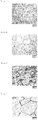
- micrographs of the metal structures of Nos. 1, 2, 3, and 4 are exemplified in Figs. 1, 2, 3, and 4 , respectively.
- a test piece of 250 mm ⁇ 20 mm ⁇ t (t: sheet thickness, 1.5 mm) with a longitudinal direction directed in the rolling direction was subjected to a magnetism measurement with a direct current magnetism measurement device (B-H Curve Tracer, produced by Riken Denshi Co., Ltd.).
- the coil used was a solenoidal coil of 62.5 mm in diameter ⁇ 160 mm and 100 turns.
- the maximum magnetic flux density Bm, the residual magnetic flux density Br, and the coercive force Hc were obtained from the resulting B-H curve.
- a test piece of 250 mm ⁇ 20 mm ⁇ t (t: sheet thickness, 1.5 mm) with a longitudinal direction directed in the rolling direction was measured for the frequency response function at ordinary temperature by the central exciting method according to JIS K7391:2008, the half value width was read at the position decreased by 3 dB from the resonance peak of the resulting frequency response function, from which the value ⁇ was calculated according to the expression (1) of JIS K7391:2008, and the average value of the values ⁇ obtained for at the resonance peaks observed in a range of from 10 to 10,000 Hz was designated as the loss factor ⁇ of the material.
- Example No. 4 seven resonance peaks were present in a frequency range of from 10 to 10,000 Hz, and assuming that the loss factors ⁇ at the resonance peaks were ⁇ 1 , ⁇ 2 , ..., ⁇ 7 in this order from the low frequency side, the measured values thereof were as follows.
- the average value of these values is the value of the loss factor ⁇ 0.0149 shown in Table 2.
- the values within the resonance frequency range of from 1,000 to 10,000 Hz are the five values ⁇ 3 to ⁇ 7 .
Landscapes
- Chemical & Material Sciences (AREA)
- Engineering & Computer Science (AREA)
- Mechanical Engineering (AREA)
- Materials Engineering (AREA)
- Metallurgy (AREA)
- Organic Chemistry (AREA)
- Crystallography & Structural Chemistry (AREA)
- Thermal Sciences (AREA)
- Physics & Mathematics (AREA)
- General Engineering & Computer Science (AREA)
- Heat Treatment Of Sheet Steel (AREA)
- Soft Magnetic Materials (AREA)
- Hard Magnetic Materials (AREA)
Abstract
Description
- The present invention relates to a high Al-content vibration-damping ferritic stainless steel material that exhibits a ferromagnetic vibration damping mechanism, and a production method therefor.
- An exhaust gas flow pipe constituting an automobile exhaust gas flow path member, and a heat shield cover therefor are demanded to have salt corrosion resistance in addition to heat resistance, and therefore a ferritic stainless steel excellent in heat resistance has been frequently used. Vibrations from an engine reach the exhaust gas flow pipe, and noises caused by the vibrations may become a problem. In recent years, members of an automobile are demanded to have light weights for improving the fuel efficiency. The reduction in thickness of the exhaust gas flow pipe for reducing the weight tends to further increase the noises due to the vibrations. Furthermore, the vibrations from the engine occurring in the heat shield cover may cause muffled sound, so as to be an offensive noise source in some cases. There is a demand of a heat resistant stainless steel material that is excellent in capability of suppressing vibrations and noises from an exhaust gas flow pipe. Furthermore, there is a large demand for improvement of the vibration damping capability of a ferritic stainless steel material not exclusively for the automobile heat resistant member.
- The mechanisms attenuating vibration energy applied externally to a metal single material are classified into a eutectic type, a dislocation type, a ferromagnetic type, a composite type, and others. A steel material having a ferrite phase as the matrix (metal basis material) is a ferromagnetic material, and thus various vibration damping materials utilizing a ferromagnetic vibration damping mechanism have been proposed.
- For example, PTL 1 shows an example, in which a vibration damping capability is imparted to a steel material containing Cr. There is described that Cr has a function of enhancing the vibration damping characteristics, and the effect of the addition thereof is increased up to 20.0% by weight (paragraph 0026). However, the Cr content of the specific examples shown as the examples is 3.08% at most.
- PTL 2 shows a technique of imparting a vibration damping capability by using a steel material containing large amounts of Si and Co. It is taught that Cr has a significant effect of enhancing the magnetostrictive, but decreases the loss factor when the content thereof exceeds 9% (paragraph 0015).
- PTL 3 describes a technique of imparting a vibration damping capability by controlling the crystal grain diameter, the maximum specific magnetic permeability, and the residual magnetic flux density without addition of alloy elements, such as Al, Si, and Cr, in large amounts. There is described that the crystal grain diameter is 300 µm or less in consideration of the surface roughening in processing (paragraph 0023).
- PTL 4 describes that a vibration damping capability is imparted by using an iron alloy containing Cr and Ga in large amounts.
-
- PTL 1:
JP-A-10-72643 - PTL 2:
JP-A-2002-294408 - PTL 3:
JP-A-2007-254880 - PTL 4:
JP-A-2011-241438 - As described in the patent literatures, it has been said that Cr is effective for enhancing the vibration damping capability of the steel material. However, no technique has been established for improving the vibration damping capability in a steel material using a high Cr content steel, such as a ferritic stainless steel. In particular, in steel materials having heat resistance capable of withstanding a long term use at a high temperature, such as several hundreds of degrees centigrade or more, such a material has not yet been found that is imparted with an excellent vibration damping capability providing a loss factor η of 0.0070 or more at ordinary temperature by the central exciting method according to JIS K7391:2008 at resonance peaks observed in a range of from 10 to 10,000 Hz.
- The invention is to provide a ferritic stainless steel material having both excellent heat resistance capable of being used at a high temperature, such as several hundreds of degrees centigrade or more, and an excellent vibration damping capability.
- According to the detailed investigations made by the present inventors, it has been found that for imparting an excellent vibration damping capability by the ferromagnetic vibration damping mechanism to a ferritic stainless steel material, it is significantly effective that the steel material is worked into a prescribed shape and then heated at a high temperature to provide an extremely large average crystal grain diameter of 0.3 mm or more in final annealing. It has also found that the vibration damping capability is significantly enhanced by the combined addition of Cr and Al. The invention has been accomplished based on the knowledge.
- The object can be achieved by a vibration-damping ferritic stainless steel material having a chemical composition containing, in terms of percentage by mass, from 0.001 to 0.04% of C, from 0.1 to 2.0% of Si, from 0.1 to 1.0% of Mn, from 0.01 to 0.6% of Ni, from 10.5 to 20.0% of Cr, from 0.5 to 5.0% of Al, from 0.001 to 0.03% of N, from 0 to 0.8% of Nb, from 0 to 0.5% of Ti, from 0 to 0.3% of Cu, from 0 to 0.3% of Mo, from 0 to 0.3% of V, from 0 to 0.3% of Zr, from 0 to 0.6% of Co, from 0 to 0.1% of REM (rare earth element), from 0 to 0.1% of Ca, and the balance of Fe, with unavoidable impurities, having a metal structure containing a ferrite single phase as a matrix and ferrite crystal grains having an average crystal grain diameter of from 0.3 to 3.0 mm, and having a residual magnetic flux density of 45 mT or less.
- Herein, the elements, Nb, Ti, Cu, Mo, V, Zr, Co, REM (rare earth element), and Ca, each are an element that is optionally added. The REM includes Sc, Y, and lanthanoid elements.
- As a production method for the vibration-damping ferritic stainless steel material, there is provided a production method containing subjecting a steel material having the chemical composition to final annealing in a non-oxidative atmosphere under a condition of retaining the steel material in a temperature range of from 900 to 1,250°C for 10 minutes or more, so as to make an average crystal grain diameter of ferrite crystal grains of from 0.3 to 3.0 mm.
- In the production method, the atmosphere for the final annealing may be an air atmosphere instead of the non-oxidative atmosphere. In this case, the steel material is subjected to acid cleaning after the final annealing. The steel material subjected to the final annealing may be a steel material obtained by working a steel sheet material. In this case, the sheet thickness of the steel sheet used (i.e., the thickness of the steel material subjected to the final annealing) may be, for example, from 0.2 to 3.0 mm.
- According to the invention, an excellent vibration damping capability utilizing a ferromagnetic vibration damping mechanism can be imparted to a ferritic stainless steel material. The level of the vibration damping capability is, for example, a loss factor η of 0.0070 or more at ordinary temperature by the central exciting method according to JIS K7391:2008 at the resonance peaks observed in a range of from 10 to 10,000 Hz, and the loss factor that is evaluated in terms of the average value of the values η at the resonance peaks can be a value of 0.01 or more. Due to the use of the high Al-content ferritic stainless steel, the steel material is excellent in high temperature oxidation resistance, and can exhibit a vibration damping capability at up to a high temperature range exceeding 700°C. Metal materials excellent in vibration dumping capability have been known for non-ferrous alloys, such as a Cu-Mn-based alloy, which however cannot be used at a high temperature. Furthermore, ordinarily known steel materials having a vibration damping capability imparted thereto are inferior in corrosion resistance and heat resistance to the steel material of the invention. The invention contributes, for example, to vibration damping of an automobile exhaust gas system.
-
-
Fig. 1 is the optical micrograph of the metal structure of Comparative Example No. 1. -
Fig. 2 is the optical micrograph of the metal structure of Comparative Example No. 2. -
Fig. 3 is the optical micrograph of the metal structure of Comparative Example No. 3. -
Fig. 4 is the optical micrograph of the metal structure of Example No. 4 of the invention. - In the invention, in ferritic stainless steel capable of providing a matrix (metal basis material) formed of a ferrite single phase at ordinary temperature, particularly a high Al-content ferritic stainless steel having an Al content of from 0.5 to 5.0% by mass is applied. The combined addition of Cr and a large amount of Al can significantly enhance the level of the vibration damping capability. The mechanism of the enhancement of the vibration damping capability is not yet clarified at the present time.
- The contents of the alloy components may be determined within the aforementioned ranges. While P and S are unavoidable impurities, the P content may be allowed up to 0.040%, and the S content may be allowed up to 0.030%.
- Examples of the steel types having particularly high heat resistance include the following compositional range (A) .
- (A) A steel containing, in terms of percentage by mass, from 0.001 to 0.03% of C, from 0.1 to 1.0% of Si, from 0.1 to 1.0% of Mn, from 0.01 to 0.6% of Ni, from 17.5 to 19.0% of Cr, from 2.5 to 4.0% of Al, from 0.001 to 0.03% of N, from 0 to 0.3% of Nb, from 0.1 to 0.3% of Ti, from 0 to 0.3% of Cu, from 0 to 0.3% of Mo, from 0 to 0.3% of V, from 0 to 0.3% of Zr, from 0 to 0.6% of Co, from 0 to 0.1% of REM (rare earth element), from 0 to 0.1% of Ca, and the balance of Fe, with unavoidable impurities.
- In the steel material according to the invention, it is important that the average crystal grain diameter of the ferrite recrystallized grains constituting the matrix (metal basis material) is as extremely large as from 0.3 to 3.0 mm. The average crystal grain diameter is more preferably 0.35 mm or more. A ferromagnetic vibration damping material absorbs vibration energy through migration of magnetic domain walls. The crystal grain boundary becomes a barrier preventing the migration of magnetic domain walls, and therefore it is generally said that a large crystal grain diameter is advantageous for enhancing the vibration damping capability. However, in the case of a ferritic stainless steel material, a good vibration damping capability often cannot be obtained with an average crystal grain diameter of approximately 100 µm, and a measure for stably imparting a high vibration damping capability has not been clarified. As a result of various investigations by the inventors, it has been found that the vibration damping capability of the ferritic stainless steel material is enhanced by extremely increasing the average crystal grain diameter thereof to 0.3 mm or more. While the mechanism thereof is not clear at the present time, it is considered that the ferrite recrystallized grains constituting the matrix of the ferritic stainless steel material include grains having large sizes and grains having small sizes mixed with each other, and the small grains among these disadvantageously affect the migration of the magnetic domain walls. It is estimated that the heat treatment is performed to make the average crystal grain diameter as extremely large as 0.3 mm or more, more preferably 0.35 mm or more, so as to grow the recrystallized grains having small sizes to sizes that do not prevent the migration of the magnetic domain walls, resulting in the enhancement of the vibration damping mechanism over the entire steel material.
- The average crystal grain diameter can be measured by the optical microscope observation of the cross section according to the intercept method. According to the method described in JIS G0551:2003, a straight line is drawn at an arbitrary position on the image of the optical micrograph, and the number of the intersection points of the straight line and the crystal grain boundaries is counted, from which an average segment length is calculated. The observation is performed for 20 or more in total of straight lines with plural observation view fields. The ferritic stainless steel material having an average crystal grain diameter measured in this method that is 0.3 mm or more exhibits an excellent vibration damping capability. The average crystal grain diameter is more preferably 1.0 mm or more. The steel material having been finished for the working to the shape of the member is subjected to the final annealing described later to grow the crystal grains, and thereby the adverse effect of the coarse crystal grains to the workability can be avoided. The large crystal grains are advantageous from the standpoint of the high temperature creep resistance. However, an excessive increase of the crystal grains may increase the load of the final annealing, which is economically disadvantageous. The average crystal grain diameter suffices to be in a range of 3.0 mm or less, and may be managed to 2.5 mm or less.
- For smoothly performing the migration of the magnetic domain walls, it is also important that the ferrite crystal lattice has a small strain. The extent of the strain in the crystal is reflected to the residual magnetic flux density in the magnetic characteristics. Specifically, assuming materials having the same composition, it can be evaluated that a material having a smaller residual magnetic flux density has a small strain of the crystal lattice. According to the studies by the inventors, a good vibration damping capability can be obtained in a ferritic stainless steel material having a residual magnetic flux density that is 45 mT (450 G) or less at ordinary temperature. The residual magnetic flux density is more preferably 30 mT (300 G) or less. The lower limit thereof is not particularly determined, and is generally 12 mT (120 G) or more.
- As other magnetic characteristics, the coercive force is desirably 400 A/m (approximately 5 Oe) or less. The maximum magnetic flux density is desirably 450 mT (4,500 G) or more, and more preferably 520 mT (5,200 G) or more.
- In the invention, the ferrite recrystallized grains are grown in the final annealing of the ferritic stainless steel material, so as to impart a vibration damping capability thereto.
- The process used for providing the steel material for being subjected to the final annealing may be an ordinary production process. For example, a cold rolled annealed acid-cleaned steel sheet or a temper rolling finished steel sheet of a ferritic stainless steel produced by an ordinary method as a raw material is worked into a prescribed member. Examples of the working to the member include various kinds of press work using a mold, bending work, welding work, and the like.
- The steel material having been worked into the member is subjected to the final annealing. The material is heated and retained in a temperature range of from 900 to 1,250°C, so as to grow the recrystallized grains to have an average crystal grain diameter of the ferrite crystal grains of from 0.3 to 3.0 mm, and more preferably from 0.35 to 3.0 mm. The retention time in the aforementioned temperature range (i.e., the period of time where the material temperature is in the temperature range) is ensured to be such a period of time that is capable of growing the ferrite crystal grains to the aforementioned average crystal grain diameter, corresponding to the chemical composition and the degree of working of the steel material subjected to the final annealing. However, when the retention time is too short, the enhancement of the vibration damping capability may be insufficient due to shortage in homogenization in some cases. As a result of various investigations, the retention time is preferably ensured to be 10 minutes or more. The retention time is more preferably 50 minutes or more, and further preferably 100 minutes or more. However, a too long retention time is economically disadvantageous. The retention time at the aforementioned temperature may be set in a range of 300 minutes or less, and may also be a range of 200 minutes or less. The appropriate retention temperature and retention time can be comprehended in advance by a preliminary experiment corresponding to the chemical composition and the degree of working of the steel material.
- In a cooling step after retaining in the aforementioned temperature range, quenching is preferably avoided to prevent strain in the crystal due to thermal contraction associated with cooling from being introduced. As a result of various investigations, it is effective that the maximum cooling rate of from the maximum attaining temperature, which is in a range of from 900 to 1,250°C, to 200°C is controlled to 5°C/sec or less. When the cooling rate is too slow, on the other hand, aging precipitation may occur in a temperature range during cooling in some cases, and the precipitated phase may be a factor impairing the migration of the magnetic domain walls through the formation of a strain field in the crystal. Therefore, it is preferred to avoid excessively slow cooling. For example, it is effective that the average cooling rate of from 850°C to 400°C is 0.3°C/sec or more.
- In view of the above, examples of the more preferred condition for the final annealing taking the cooling rate into consideration include a condition of retaining the steel material in a temperature range of from 900 to 1,250°C for 10 minutes or more, so as to make an average crystal grain diameter of ferrite crystal grains of from 0.5 to 3.0 mm, and then cooling to a temperature of 200°C or less at a maximum cooling rate of from a maximum attaining material temperature to 200°C of 5°C/sec or less and an average cooling rate of from 850°C to 400°C of 0.3°C/sec or more.
- The final annealing is desirably performed in a non-oxidative atmosphere. Examples thereof include vacuum annealing. In this case, the interior of the furnace is vacuumed to a depressurized state (vacuum atmosphere), for example, of approximately 1 × 10⁻² Pa or less, and therein, the steel material is heated to and retained in the aforementioned temperature range. In the cooling step, the cooling rate can be controlled, for example, by controlling the introduction amount of an inert gas, and the like. The final annealing may be performed in a reductive atmosphere containing hydrogen. The final annealing may be performed in an air atmosphere, and in this case, a post-treatment, such as acid cleaning, is necessarily performed for removing oxidized scale.
- In the case where a flat plate member is to be provided, such a method may be employed that a cold rolled annealed steel sheet in a coil form is directly placed in an annealing furnace and subjected to the final annealing, and then cut into a prescribed dimension.
- The steels shown in Table 1 were made, from which cold rolled annealed acid-cleaned steel sheets having a sheet thickness of 1.5 mm were obtained according to an ordinary method. Specimens collected from the steel sheets were subjected to final annealing under the conditions shown in Table 2 except for a part of Comparative Examples (Nos. 1 and 3). The method of the final annealing was vacuum annealing, and performed in the following manner. The specimen was placed in a sealable vessel, and in the state where the interior of the vessel was vacuumed to a pressure of approximately 1 × 10⁻² Pa or less, the specimen was heated and retained at the temperature (i.e., the maximum attaining temperature) shown in Table 2. Thereafter, after decreasing the temperature to 900°C, the specimen was cooled to a temperature of 400°C or less by introducing argon gas to the vessel up to a pressure of approximately 90 kPa, and then exposed to the air after the temperature reached 200°C or less. The cooling rate in the final annealing was controlled in such a manner that the maximum cooling rate of from a maximum attaining temperature to 200°C was 5°C/sec or less, and the average cooling rate of from 850°C to 400°C was 0.3°C/sec or more.
- The specimens were obtained in the aforementioned manners.
[Table 1] Steel Chemical composition (% by mass) Note C Si Mn Ni Cr Nb Ti Cu Mo Al N E 0.010 0.28 1.00 0.17 18.42 0.65 - 0.15 2.02 0.006 0.010 comparative steel N 0.007 0.33 0.24 0.16 18.17 - 0.15 0.08 0.06 3.07 0.010 steel for invention [Table 2] Class No. Steel Final annealing Atmosphere Temperature (°C) Time (min) Comparative Example 1 E - - - Comparative Example 2 E vacuum 1200 120 Comparative Example 3 N - - - Example of Invention 4 N vacuum 1100 60 - The specimens were evaluated as follows.
- The metal structure of the cross section in parallel to the rolling direction and the sheet thickness direction (L cross section) was observed with an optical microscope, and the average crystal grain diameter was measured by the intercept method described previously.
- The micrographs of the metal structures of Nos. 1, 2, 3, and 4 are exemplified in
Figs. 1, 2, 3, and 4 , respectively. - A test piece of 250 mm × 20 mm × t (t: sheet thickness, 1.5 mm) with a longitudinal direction directed in the rolling direction was subjected to a magnetism measurement with a direct current magnetism measurement device (B-H Curve Tracer, produced by Riken Denshi Co., Ltd.). The coil used was a solenoidal coil of 62.5 mm in diameter × 160 mm and 100 turns. The maximum magnetic flux density Bm, the residual magnetic flux density Br, and the coercive force Hc were obtained from the resulting B-H curve.
- A test piece of 250 mm × 20 mm × t (t: sheet thickness, 1.5 mm) with a longitudinal direction directed in the rolling direction was measured for the frequency response function at ordinary temperature by the central exciting method according to JIS K7391:2008, the half value width was read at the position decreased by 3 dB from the resonance peak of the resulting frequency response function, from which the value η was calculated according to the expression (1) of JIS K7391:2008, and the average value of the values η obtained for at the resonance peaks observed in a range of from 10 to 10,000 Hz was designated as the loss factor η of the material.
- The results are shown in Table 3.
[Table 3] Class No. Steel Average crystal grain diameter (mm) Magnetic characteristics Loss factor η Maximum magnetic flux density Bm (mT) Residual magnetic flux density Br (mT) Coercive force Hc (Oe) (A/m) Comparative Example 1 E 0.025 534.5 30.23 3.414 271.7 0.0008 Comparative Example 2 E 1.52 543.0 25.40 2.802 223.0 0.0023 Comparative Example 3 N 0.050 476.7 49.4 4.670 371.6 0.0006 Example of Invention 4 N 0.68 504.5 22.8 1.925 153.2 0.0192 - It is understood that the specimens of Comparative Example No. 2 and Example of Invention No. 4 obtained by performing the final annealing under the aforementioned appropriate condition have a small strain of the crystal lattice since the residual magnetic flux density is small. The average crystal grain diameter thereof is significantly large. For these specimens, enhancement of the loss factor η is observed as compared to the specimens not subjected to the final annealing (comparison between No. 1 and No. 2, and comparison between No. 3 and No. 4). Example of Invention No. 4, to which Cr and a large amount of Al are added in combination, exhibits considerably large enhancement of the loss factor η as compared to Comparative Example No. 2 having a small Al content.
- In Example No. 4, seven resonance peaks were present in a frequency range of from 10 to 10,000 Hz, and assuming that the loss factors η at the resonance peaks were η1, η2, ..., η7 in this order from the low frequency side, the measured values thereof were as follows.
- η1 = 0.0387, η2 = 0.0209, η3 = 0.0105, η4 = 0.0092, η5 = 0.0087, η6 = 0.0084, η7 = 0.0082
- The average value of these values is the value of the loss factor η 0.0149 shown in Table 2. In the values η1 to η7, the values within the resonance frequency range of from 1,000 to 10,000 Hz are the five values η3 to η7.
- Even in the case where Cr and a large amount of Al are added in combination, with the ordinary cold rolled annealed acid-cleaned material as it is, there is no tendency of increasing the vibration damping capability as compared to the steel types having a small Al content (comparison between Comparative Example No. 1 and Comparative Example No. 3). On the other hand, with the final annealing according to the invention performed, a large difference in enhancement of the vibration damping capability occurs, and the effect of the combined addition of Cr and a large amount of Al is manifested (comparison between Comparative Example No. 2 and Example of Invention No. 4). Furthermore, the combined addition of Cr and a large amount of Al provides a significant enhancement of the heat resistance (particularly the high temperature oxidation resistance).
Claims (4)
- A vibration-damping ferritic stainless steel material having a chemical composition containing, in terms of percentage by mass, from 0.001 to 0.04% of C, from 0.1 to 2.0% of Si, from 0.1 to 1.0% of Mn, from 0.01 to 0.6% of Ni, from 10.5 to 20.0% of Cr, from 0.5 to 5.0% of Al, from 0.001 to 0.03% of N, from 0 to 0.8% of Nb, from 0 to 0.5% of Ti, from 0 to 0.3% of Cu, from 0 to 0.3% of Mo, from 0 to 0.3% of V, from 0 to 0.3% of Zr, from 0 to 0.6% of Co, from 0 to 0.1% of REM (rare earth element), from 0 to 0.1% of Ca, and the balance of Fe, with unavoidable impurities, having a metal structure containing a ferrite single phase as a matrix and ferrite crystal grains having an average crystal grain diameter of from 0.3 to 3.0 mm, and having a residual magnetic flux density of 45 mT or less.
- A production method for a vibration-damping ferritic stainless steel material, comprising subjecting a steel material having a chemical composition containing, in terms of percentage by mass, from 0.001 to 0.04% of C, from 0.1 to 2.0% of Si, from 0.1 to 1.0% of Mn, from 0.01 to 0.6% of Ni, from 10.5 to 20.0% of Cr, from 0.5 to 5.0% of Al, from 0.001 to 0.03% of N, from 0 to 0.8% of Nb, from 0 to 0.5% of Ti, from 0 to 0.3% of Cu, from 0 to 0.3% of Mo, from 0 to 0.3% of V, from 0 to 0.3% of Zr, from 0 to 0.6% of Co, from 0 to 0.1% of REM (rare earth element), from 0 to 0.1% of Ca, and the balance of Fe, with unavoidable impurities, to final annealing in a non-oxidative atmosphere under a condition of retaining the steel material in a temperature range of from 900 to 1,250°C for 10 minutes or more, so as to make an average crystal grain diameter of ferrite crystal grains of from 0.3 to 3.0 mm.
- The production method for a vibration-damping ferritic stainless steel material according to claim 2, wherein the final annealing is performed in an air atmosphere instead of the non-oxidative atmosphere, and acid cleaning is performed after the final annealing.
- The production method for a vibration-damping ferritic stainless steel material according to claim 2 or 3, wherein the steel material subjected to the final annealing is a steel material obtained by working a steel sheet material.
Applications Claiming Priority (2)
| Application Number | Priority Date | Filing Date | Title |
|---|---|---|---|
| JP2015160307A JP6370276B2 (en) | 2015-08-17 | 2015-08-17 | High Al content damping ferritic stainless steel material and manufacturing method |
| PCT/JP2016/073547 WO2017030064A1 (en) | 2015-08-17 | 2016-08-10 | VIBRATION-DAMPING FERRITIC STAINLESS STEEL MATERIAL HAVING HIGH Al CONTENT, AND PRODUCTION METHOD |
Publications (2)
| Publication Number | Publication Date |
|---|---|
| EP3339460A1 true EP3339460A1 (en) | 2018-06-27 |
| EP3339460A4 EP3339460A4 (en) | 2019-03-20 |
Family
ID=58051730
Family Applications (1)
| Application Number | Title | Priority Date | Filing Date |
|---|---|---|---|
| EP16837054.2A Withdrawn EP3339460A4 (en) | 2015-08-17 | 2016-08-10 | HIGH AL CONTOUR FERRITE STAINLESS STEEL MATERIAL WITH DAMPING PROPERTIES, AND METHOD OF MANUFACTURING THE SAME |
Country Status (11)
| Country | Link |
|---|---|
| US (1) | US10570979B2 (en) |
| EP (1) | EP3339460A4 (en) |
| JP (1) | JP6370276B2 (en) |
| KR (1) | KR102512121B1 (en) |
| CN (1) | CN107923016A (en) |
| CA (1) | CA2993771C (en) |
| MX (1) | MX2018001371A (en) |
| MY (1) | MY186156A (en) |
| RU (1) | RU2725240C2 (en) |
| TW (1) | TWI698534B (en) |
| WO (1) | WO2017030064A1 (en) |
Cited By (3)
| Publication number | Priority date | Publication date | Assignee | Title |
|---|---|---|---|---|
| RU2721262C1 (en) * | 2019-10-22 | 2020-05-18 | Федеральное Государственное Унитарное Предприятие "Центральный научно-исследовательский институт черной металлургии им. И.П. Бардина" (ФГУП "ЦНИИчермет им. И.П. Бардина") | High-damping steel with the required level of damping properties and article made therefrom |
| EP3666918A1 (en) * | 2018-12-12 | 2020-06-17 | Hyundai Motor Company | Ferritic stainless steel excellent in corrosion resistance and impact resistance |
| CN112458369A (en) * | 2020-11-24 | 2021-03-09 | 华能国际电力股份有限公司 | Precipitation-strengthened ferritic heat-resistant steel and preparation method thereof |
Families Citing this family (12)
| Publication number | Priority date | Publication date | Assignee | Title |
|---|---|---|---|---|
| US10547127B2 (en) * | 2017-08-29 | 2020-01-28 | Hamilton Sundstrand Corporation | Electrical terminal device |
| JP6812956B2 (en) * | 2017-11-28 | 2021-01-13 | Jfeスチール株式会社 | Stainless steel plate for lamination and laminate |
| RU2685452C1 (en) * | 2018-08-09 | 2019-04-18 | Федеральное Государственное Унитарное Предприятие "Центральный научно-исследовательский институт черной металлургии им. И.П. Бардина" (ФГУП "ЦНИИчермет им. И.П. Бардина") | High damping steel with a specified level of damping properties and an article made from it |
| DE112020002548T5 (en) | 2019-05-31 | 2022-02-17 | Hitachi Metals Ltd. | VIBRATION-DAMPING COMPONENT MADE OF FE-Al-BASED ALLOY AND METHOD OF MANUFACTURE THEREOF |
| JP7716177B2 (en) * | 2020-01-14 | 2025-07-31 | 日本製鉄株式会社 | Ferritic stainless steel material and method for manufacturing vibration-damping member |
| JP7490407B2 (en) * | 2020-03-23 | 2024-05-27 | 日鉄ステンレス株式会社 | Ferritic stainless steel material, its manufacturing method, and vibration damping member |
| JP7688985B2 (en) * | 2021-03-01 | 2025-06-05 | 日鉄ステンレス株式会社 | Ferritic stainless steel material and its manufacturing method, welded member and its manufacturing method, and vibration damping member |
| JP7688986B2 (en) * | 2021-03-01 | 2025-06-05 | 日鉄ステンレス株式会社 | Ferritic stainless steel processed product, its manufacturing method, and vibration damping member |
| JP7775607B2 (en) * | 2021-09-22 | 2025-11-26 | 株式会社プロテリアル | Fe-Al alloy, Fe-Al alloy member, and method for producing the Fe-Al alloy. |
| KR20230072327A (en) * | 2021-11-17 | 2023-05-24 | 주식회사 포스코 | Ferritic stainless steel with improved corrosion resistance and magnetic properties and manufacturing method therefor |
| CN114480982B (en) * | 2022-01-12 | 2023-03-07 | 沈阳工业大学 | Fe-Al based thin ribbon with low cost and high magnetostriction coefficient and its preparation method |
| CN119372564B (en) * | 2024-09-19 | 2025-12-30 | 山西太钢不锈钢股份有限公司 | A medium-chromium heat-resistant ferritic stainless steel and its cold-rolled sheet preparation method and application |
Family Cites Families (25)
| Publication number | Priority date | Publication date | Assignee | Title |
|---|---|---|---|---|
| JPS521683B2 (en) * | 1973-10-29 | 1977-01-17 | ||
| JPS5817805B2 (en) * | 1974-07-05 | 1983-04-09 | 株式会社東芝 | Method of manufacturing vibration damping alloy |
| JPS51120921A (en) * | 1975-04-16 | 1976-10-22 | Daido Steel Co Ltd | High vibration preventive alloy |
| JPS5944383B2 (en) * | 1975-12-17 | 1984-10-29 | 株式会社東芝 | Shindougensuigoukin |
| JPS54141315A (en) * | 1978-04-27 | 1979-11-02 | Nippon Steel Corp | Manufacture of ferritic stainless steel plate with superior damping capacity |
| JPS6016489B2 (en) * | 1979-08-31 | 1985-04-25 | 住友金属工業株式会社 | Manufacturing method for hot-rolled steel with excellent vibration damping properties |
| SU1555391A1 (en) * | 1988-05-23 | 1990-04-07 | Предприятие П/Я А-3700 | Corrosion-resistant damping steel |
| JPH03183741A (en) * | 1989-12-12 | 1991-08-09 | Nkk Corp | Steel material with excellent vibration damping properties and its manufacturing method |
| SU1665711A1 (en) * | 1990-01-31 | 1996-02-10 | Производственное объединение "Ижорский завод" | Steel |
| JPH04110449A (en) * | 1990-08-30 | 1992-04-10 | Nippon Steel Corp | Ferromagnetic type high damping alloy |
| RU2040579C1 (en) * | 1992-12-18 | 1995-07-25 | Центральный научно-исследовательский институт конструкционных материалов "Прометей" | Stainless steel |
| JPH08176750A (en) * | 1994-12-28 | 1996-07-09 | Nippon Steel Corp | Ferritic stainless steel for bellows processing |
| WO1997003215A1 (en) * | 1995-07-11 | 1997-01-30 | Kari Martti Ullakko | Iron-based shape memory and vibration damping alloys containing nitrogen |
| JPH1072643A (en) | 1996-07-02 | 1998-03-17 | Nippon Steel Corp | Damping alloy and manufacturing method thereof |
| JPH10280102A (en) * | 1997-04-04 | 1998-10-20 | Nippon Steel Corp | Ferritic stainless steel seamless pipe for bellows and bellows thereby |
| US6855213B2 (en) * | 1998-09-15 | 2005-02-15 | Armco Inc. | Non-ridging ferritic chromium alloyed steel |
| JP2002275586A (en) * | 2001-03-19 | 2002-09-25 | Seiki Chin | Alloy steel |
| JP2002294408A (en) | 2001-03-30 | 2002-10-09 | Nippon Steel Corp | Iron-based damping alloy and method of manufacturing the same |
| JP3550132B2 (en) * | 2002-04-15 | 2004-08-04 | 東北特殊鋼株式会社 | Precipitation hardening type soft magnetic ferritic stainless steel |
| JP5186753B2 (en) | 2006-02-21 | 2013-04-24 | Jfeスチール株式会社 | Damping alloy sheet and manufacturing method thereof |
| US20080279712A1 (en) * | 2007-05-11 | 2008-11-13 | Manabu Oku | Ferritic stainless steel sheet with excellent thermal fatigue properties, and automotive exhaust-gas path member |
| JP5349153B2 (en) * | 2009-06-15 | 2013-11-20 | 日新製鋼株式会社 | Ferritic stainless steel for brazing and heat exchanger members |
| US20120111529A1 (en) * | 2009-07-27 | 2012-05-10 | Nisshin Steel Co., Ltd. | Ferritic stainless steel for egr cooler and egr cooler |
| RU2443795C2 (en) * | 2010-04-16 | 2012-02-27 | Тамара Федоровна Волынова | MULTI-FUNCTION ANTIFRICTION NANOSTRUCTURE WEAR-RESISTANT DAMPING ALLOYS WITH SHAPE MEMORY EFFECT ON METASTABLE BASIS OF IRON WITH STRUCTURE OF HEXAGONAL ε-MARTENSITE, AND ITEMS USING THESE ALLOYS WITH EFFECT OF SELF-ORGANISATION OF NANOSTRUCTURE COMPOSITIONS, SELF-STRENGTHENING AND SELF-LUBRICATION OF FRICTION SURFACES, WITH EFFECT OF SELF-DAMPING OF VIBRATIONS AND NOISES |
| JP2011241438A (en) | 2010-05-18 | 2011-12-01 | Toyota Industries Corp | Iron alloy, iron alloy member, and method for manufacturing the same |
-
2015
- 2015-08-17 JP JP2015160307A patent/JP6370276B2/en active Active
-
2016
- 2016-08-10 MY MYPI2018700554A patent/MY186156A/en unknown
- 2016-08-10 US US15/751,917 patent/US10570979B2/en active Active
- 2016-08-10 CN CN201680047911.7A patent/CN107923016A/en active Pending
- 2016-08-10 EP EP16837054.2A patent/EP3339460A4/en not_active Withdrawn
- 2016-08-10 KR KR1020187007691A patent/KR102512121B1/en active Active
- 2016-08-10 WO PCT/JP2016/073547 patent/WO2017030064A1/en not_active Ceased
- 2016-08-10 RU RU2018109356A patent/RU2725240C2/en active
- 2016-08-10 CA CA2993771A patent/CA2993771C/en active Active
- 2016-08-10 MX MX2018001371A patent/MX2018001371A/en unknown
- 2016-08-16 TW TW105126074A patent/TWI698534B/en active
Cited By (5)
| Publication number | Priority date | Publication date | Assignee | Title |
|---|---|---|---|---|
| EP3666918A1 (en) * | 2018-12-12 | 2020-06-17 | Hyundai Motor Company | Ferritic stainless steel excellent in corrosion resistance and impact resistance |
| CN111304528A (en) * | 2018-12-12 | 2020-06-19 | 现代自动车株式会社 | Ferritic stainless steel excellent in corrosion resistance and impact resistance |
| CN111304528B (en) * | 2018-12-12 | 2023-02-17 | 现代自动车株式会社 | Ferritic stainless steel excellent in corrosion resistance and impact resistance |
| RU2721262C1 (en) * | 2019-10-22 | 2020-05-18 | Федеральное Государственное Унитарное Предприятие "Центральный научно-исследовательский институт черной металлургии им. И.П. Бардина" (ФГУП "ЦНИИчермет им. И.П. Бардина") | High-damping steel with the required level of damping properties and article made therefrom |
| CN112458369A (en) * | 2020-11-24 | 2021-03-09 | 华能国际电力股份有限公司 | Precipitation-strengthened ferritic heat-resistant steel and preparation method thereof |
Also Published As
| Publication number | Publication date |
|---|---|
| RU2018109356A3 (en) | 2019-12-30 |
| RU2018109356A (en) | 2019-09-19 |
| TWI698534B (en) | 2020-07-11 |
| RU2725240C2 (en) | 2020-06-30 |
| WO2017030064A1 (en) | 2017-02-23 |
| TW201713782A (en) | 2017-04-16 |
| US10570979B2 (en) | 2020-02-25 |
| US20180238410A1 (en) | 2018-08-23 |
| MY186156A (en) | 2021-06-28 |
| CN107923016A (en) | 2018-04-17 |
| CA2993771A1 (en) | 2017-02-23 |
| MX2018001371A (en) | 2018-06-15 |
| EP3339460A4 (en) | 2019-03-20 |
| KR20180041219A (en) | 2018-04-23 |
| CA2993771C (en) | 2024-04-09 |
| KR102512121B1 (en) | 2023-03-22 |
| JP6370276B2 (en) | 2018-08-08 |
| JP2017039956A (en) | 2017-02-23 |
Similar Documents
| Publication | Publication Date | Title |
|---|---|---|
| US10570979B2 (en) | High Al-content vibration-damping ferritic stainless steel material, and production method | |
| EP3339459A1 (en) | Vibration-damping ferritic stainless steel material, and production method | |
| US12148555B2 (en) | Non-oriented electrical steel sheet | |
| KR102544884B1 (en) | High-strength hot-dip galvanized steel sheet and manufacturing method thereof | |
| KR102129846B1 (en) | Electronic steel sheet and its manufacturing method | |
| KR102656381B1 (en) | Non-oriented electromagnetic steel sheet | |
| EP2985360B1 (en) | Non-oriented magnetic steel sheet and method for producing same | |
| KR101692660B1 (en) | Ferritic stainless steel sheet having excellent heat resistance | |
| CA3018162A1 (en) | Nb-containing ferritic stainless steel sheet and manufacturing method therefor | |
| WO2020110843A1 (en) | Hot-rolled steel sheet | |
| CN107148488B (en) | Ultra-high strength plated steel sheet having tensile strength of 1300MPa or more and method for producing same | |
| KR20200130422A (en) | Martensitic stainless steel plate and its manufacturing method and spring member | |
| KR20220091571A (en) | hot stamped body | |
| JP5200376B2 (en) | Non-oriented electrical steel sheet and manufacturing method thereof | |
| JP7688985B2 (en) | Ferritic stainless steel material and its manufacturing method, welded member and its manufacturing method, and vibration damping member | |
| JP4258163B2 (en) | Non-oriented electrical steel sheet with excellent magnetic properties after strain relief annealing | |
| JPH03122237A (en) | Ni-fe serite high permeability magnetic alloy | |
| JP6796483B2 (en) | Soft magnetic steel sheet | |
| JPH05255817A (en) | Corrosion resistant soft magnetic material | |
| WO2022219742A1 (en) | Hot-rolled steel sheet for non-oriented electrical steel sheet and method for manufacturing same |
Legal Events
| Date | Code | Title | Description |
|---|---|---|---|
| PUAI | Public reference made under article 153(3) epc to a published international application that has entered the european phase |
Free format text: ORIGINAL CODE: 0009012 |
|
| 17P | Request for examination filed |
Effective date: 20180214 |
|
| AK | Designated contracting states |
Kind code of ref document: A1 Designated state(s): AL AT BE BG CH CY CZ DE DK EE ES FI FR GB GR HR HU IE IS IT LI LT LU LV MC MK MT NL NO PL PT RO RS SE SI SK SM TR |
|
| AX | Request for extension of the european patent |
Extension state: BA ME |
|
| DAV | Request for validation of the european patent (deleted) | ||
| DAX | Request for extension of the european patent (deleted) | ||
| A4 | Supplementary search report drawn up and despatched |
Effective date: 20190214 |
|
| RIC1 | Information provided on ipc code assigned before grant |
Ipc: C22C 38/58 20060101ALI20190208BHEP Ipc: C22C 38/06 20060101ALI20190208BHEP Ipc: C22C 38/42 20060101ALI20190208BHEP Ipc: C21D 9/46 20060101ALI20190208BHEP Ipc: C22C 38/02 20060101ALI20190208BHEP Ipc: C21D 6/00 20060101ALI20190208BHEP Ipc: C22C 38/44 20060101ALI20190208BHEP Ipc: C22C 38/00 20060101AFI20190208BHEP Ipc: C22C 38/46 20060101ALI20190208BHEP Ipc: C22C 38/52 20060101ALI20190208BHEP Ipc: C21D 8/02 20060101ALI20190208BHEP Ipc: C22C 38/48 20060101ALI20190208BHEP Ipc: C22C 38/50 20060101ALI20190208BHEP |
|
| RAP1 | Party data changed (applicant data changed or rights of an application transferred) |
Owner name: NIPPON STEEL NISSHIN CO., LTD. |
|
| STAA | Information on the status of an ep patent application or granted ep patent |
Free format text: STATUS: THE APPLICATION HAS BEEN WITHDRAWN |
|
| RAP1 | Party data changed (applicant data changed or rights of an application transferred) |
Owner name: NIPPON STEEL STAINLESS STEEL CORPORATION |
|
| 18W | Application withdrawn |
Effective date: 20190902 |