EP3330747B1 - Vorrichtung, methode und computerprogrammprodukt zur bereitstellung einer metocean-vorhersage - Google Patents
Vorrichtung, methode und computerprogrammprodukt zur bereitstellung einer metocean-vorhersage Download PDFInfo
- Publication number
- EP3330747B1 EP3330747B1 EP17204810.0A EP17204810A EP3330747B1 EP 3330747 B1 EP3330747 B1 EP 3330747B1 EP 17204810 A EP17204810 A EP 17204810A EP 3330747 B1 EP3330747 B1 EP 3330747B1
- Authority
- EP
- European Patent Office
- Prior art keywords
- forecast
- parameter
- weather
- parameters
- forecast parameter
- Prior art date
- Legal status (The legal status is an assumption and is not a legal conclusion. Google has not performed a legal analysis and makes no representation as to the accuracy of the status listed.)
- Active
Links
Images


Classifications
-
- G—PHYSICS
- G01—MEASURING; TESTING
- G01C—MEASURING DISTANCES, LEVELS OR BEARINGS; SURVEYING; NAVIGATION; GYROSCOPIC INSTRUMENTS; PHOTOGRAMMETRY OR VIDEOGRAMMETRY
- G01C21/00—Navigation; Navigational instruments not provided for in groups G01C1/00 - G01C19/00
- G01C21/20—Instruments for performing navigational calculations
- G01C21/203—Instruments for performing navigational calculations specially adapted for water-borne vessels
-
- B—PERFORMING OPERATIONS; TRANSPORTING
- B63—SHIPS OR OTHER WATERBORNE VESSELS; RELATED EQUIPMENT
- B63B—SHIPS OR OTHER WATERBORNE VESSELS; EQUIPMENT FOR SHIPPING
- B63B49/00—Arrangements of nautical instruments or navigational aids
-
- B—PERFORMING OPERATIONS; TRANSPORTING
- B63—SHIPS OR OTHER WATERBORNE VESSELS; RELATED EQUIPMENT
- B63B—SHIPS OR OTHER WATERBORNE VESSELS; EQUIPMENT FOR SHIPPING
- B63B79/00—Monitoring properties or operating parameters of vessels in operation
- B63B79/10—Monitoring properties or operating parameters of vessels in operation using sensors, e.g. pressure sensors, strain gauges or accelerometers
-
- B—PERFORMING OPERATIONS; TRANSPORTING
- B63—SHIPS OR OTHER WATERBORNE VESSELS; RELATED EQUIPMENT
- B63B—SHIPS OR OTHER WATERBORNE VESSELS; EQUIPMENT FOR SHIPPING
- B63B79/00—Monitoring properties or operating parameters of vessels in operation
- B63B79/20—Monitoring properties or operating parameters of vessels in operation using models or simulation, e.g. statistical models or stochastic models
-
- B—PERFORMING OPERATIONS; TRANSPORTING
- B63—SHIPS OR OTHER WATERBORNE VESSELS; RELATED EQUIPMENT
- B63B—SHIPS OR OTHER WATERBORNE VESSELS; EQUIPMENT FOR SHIPPING
- B63B79/00—Monitoring properties or operating parameters of vessels in operation
- B63B79/40—Monitoring properties or operating parameters of vessels in operation for controlling the operation of vessels, e.g. monitoring their speed, routing or maintenance schedules
-
- G—PHYSICS
- G01—MEASURING; TESTING
- G01W—METEOROLOGY
- G01W1/00—Meteorology
- G01W1/10—Devices for predicting weather conditions
-
- G—PHYSICS
- G01—MEASURING; TESTING
- G01W—METEOROLOGY
- G01W1/00—Meteorology
- G01W2001/006—Main server receiving weather information from several sub-stations
-
- G—PHYSICS
- G06—COMPUTING OR CALCULATING; COUNTING
- G06N—COMPUTING ARRANGEMENTS BASED ON SPECIFIC COMPUTATIONAL MODELS
- G06N20/00—Machine learning
-
- Y—GENERAL TAGGING OF NEW TECHNOLOGICAL DEVELOPMENTS; GENERAL TAGGING OF CROSS-SECTIONAL TECHNOLOGIES SPANNING OVER SEVERAL SECTIONS OF THE IPC; TECHNICAL SUBJECTS COVERED BY FORMER USPC CROSS-REFERENCE ART COLLECTIONS [XRACs] AND DIGESTS
- Y02—TECHNOLOGIES OR APPLICATIONS FOR MITIGATION OR ADAPTATION AGAINST CLIMATE CHANGE
- Y02T—CLIMATE CHANGE MITIGATION TECHNOLOGIES RELATED TO TRANSPORTATION
- Y02T70/00—Maritime or waterways transport
- Y02T70/10—Measures concerning design or construction of watercraft hulls
Definitions
- the invention relates to an oceanographic forecast, in particular to providing an apparatus for providing a weather forecast, a method for providing a weather forecast model and a computer program product.
- Maritime weather forecasts are useful for vessels, in particular ships, yachts or floating platforms to plan their route and to calculate their fuel consumption. Those weather predictions can be obtained from different weather prediction models.
- Those weather forecast models have uncertainties in weather prediction and/or ocean prediction. Those uncertainties are usually minimized by improving the underlying physics in the numerical weather prediction models. Another method for decreasing the uncertainties is to decrease the temporal and/or spatial extent of the weather forecast.
- Most production centers for weather forecast models are specialized in certain regions, for example a coastline of a country, an environment of a city or a specific area on sea.
- a global forecast may cover the complete globe, but at a coarse resolution and with a high forecast uncertainty. Therefore, a user of weather predictions has difficulties in knowing which forecast to utilize for the best possible result in a certain region.
- Document US 2004/0143396 A1 shows a method of generating short-, medium-range and seasonal-timescale weather or climate forecasts by running an ensemble of computer models on a distributed computing system or
- US 2008/0255760 A1 discloses a method of forecasting parameters related to industrial processes, in which outputs of different models are combined to form a weighted mean.
- the invention is based on the finding that a weather prediction can be provided in an advantageous way by weighting different weather forecasts from different sources and combining them into a combined forecast parameter.
- Such an improved combined weather forecast parameter may be used in a ship planning and/or weather routing systems of ships.
- the objective is solved by an apparatus for providing a weather forecast.
- the apparatus comprises an interface that is configured to receive a first forecast parameter of a first weather forecast model, to receive a second forecast parameter of a second weather forecast model different from the first weather forecast model and to receive measured reference data related to the first forecast parameter and the second forecast parameter.
- the apparatus further comprises a processor that is configured to assign a first weight factor to the first forecast parameter based on a comparison of the first forecast parameter with the measured reference data.
- the processor is configured to assign a second weight factor to the second forecast parameter based on a comparison of the second forecast parameter with the measured reference data and to combine the first forecast parameter and the second forecast parameter based on the first weight factor and the second weight factor to obtain a combined forecast parameter.
- the interface is configured to output the combined forecast parameter as a weather forecast.
- the weather forecast is a value that indicates a sea state including weather.
- weather in this context comprises climatology, meteorological and/or oceanic parameters.
- the weather parameters comprise metocean parameters.
- the weather forecast indicates a wind speed and/or a wave height.
- the weather forecast may comprise a vector comprising a plurality of parameters that describe the weather.
- the reference data may use a plurality of data sources, in particular raw data sources, wherein the plurality of sources include in general more sources than a single weather model uses for its weather prediction.
- the interface may be a data network interface, for transmitting and/or receiving data wirelessly or over cable.
- the processor may be a CPU of a computer system.
- the processor may also be a microcontroller.
- the processor may also be a virtual computer system running on a server or a plurality of servers.
- the first forecast parameter and/or the second forecast parameter comprise data related to at least one geophysical parameter of a weather forecast.
- a forecast parameter describes an ocean current speed or an ocean current direction or an absolute wave height or a significant wave height or a wave period or a wave direction or a wind speed or a wind direction or a wave spectrum comprising wind-generated waves and/or swell waves.
- the first forecast parameter and/or the second forecast parameter may also comprise two or more of these geophysical parameters, for example as a forecast parameter vector.
- the forecast parameters describe a weather forecast, i.e. a weather prediction.
- the first forecast parameter and the second forecast parameter therefore describe a possible weather in the future.
- the apparatus may be configured to receive a plurality of weather forecast parameters from a plurality of weather forecast models.
- the measured reference data relate to the forecast parameters and describe a weather in the past.
- the first forecast parameter and the second forecast parameter describe an ocean current for the next day while the measured reference data describes an ocean current that was measured in the past or the very recent past, i.e. a nowcast.
- the measured reference data may comprise remote sensing data from satellite imagery and data, for example with a resolution of about 1000 square kilometers, airborne data, for example with a higher accuracy but a resolution of about 100 square kilometers, costal station data, for example with an even higher accuracy but a resolution of about 10 square kilometers, and in-situ data from floating sensors, including buoys, gliders, drifters, external ships, for example with an even higher accuracy and a resolution of about meters.
- sensors on board of the ship measure the weather prediction as to determine geophysical parameters to check the differences between the measured reference data and/or the model data, for example from climatology data, meteorological data, oceanic data and/or metocean data. The check may be performed automatically by machines, later to eventually be utilized by machine learning.
- the apparatus can influence the forecast parameters utilized and therefore combine the forecast parameters in an advantageous way.
- the resulting combined forecast parameter therefore indicates the same type of forecast parameter and the same type of weather aspect as related to the first forecast parameter and also to the second forecast parameter, but may have an improved prediction accuracy.
- Using multiple forecasts from multiple sources and combining them in an optimal way based on a validation and comparison of the weather forecast services with reference data provides a weather forecast with an increased accuracy.
- the sources may comprise global, regional and/or local forecast models.
- the weather forecast may comprise a forecast in time for a fixed space but also a distance forecast for a future location and a fixed time of a moving vessel.
- the weather forecast may predict a weather for a space of a shipping route of a vessel for 12 days but also predicts a weather forecast for a space, the ship will reach in 12 days.
- the determination of the combined forecast parameter is dependent on the weight factors and may be performed by machine learning, in particular unsupervised machine learning in which the processor compares model data and measured reference data with historical data repetitively and therefore determines values during several repetitions that lead to a decreasing forecast error.
- machine learning in particular unsupervised machine learning in which the processor compares model data and measured reference data with historical data repetitively and therefore determines values during several repetitions that lead to a decreasing forecast error.
- unsupervised machine learning process all available sources are used to provide an optimal combined forecast parameter. This may comprise high-intensity computing intervals for the processor.
- boundary conditions, geophysical relations and constraints may be given to the processor to decrease the computing intensity and/or to improve the outcome.
- those kind of parameters are given to the processor that have a low variation, for example ocean current directions that are not changing noticeably in a space of several kilometers. This kind of machine learning determining the combined forecast parameter is faster and requires less intensive computing.
- the processor is configured to assign the weight factors on the basis of a skill score indicating the quality of the first forecast parameter and/or the second forecast parameter and/or the measured reference data.
- the skill score may be a predetermined value that indicates the quality of the forecast parameters and especially the quality of the source of the forecast parameters.
- the skill score therefore indicates the quality of the first weather forecast model or the second weather forecast model. For example, original weather data as a first forecast model may get a less score than weather data produced by a weather forecast model of another weather prediction service.
- the skill score may also indicate the quality of the measured reference data.
- the processor is configured to assign the weight factors on the basis of an error estimate indicating the mismatch between a measured weather parameter and the first forecast parameter or the second forecast parameter, respectively.
- the error estimate indicates the quality of the forecast itself.
- the error estimate describes a difference between a forecast parameter value and a measured reference data value.
- the processor is configured to determine the mismatch on the basis of at least one of the following parameters: an ocean current speed or an ocean current direction or an absolute wave height or a significant wave height or a wave direction or a wave period or a wind speed or a wind direction or a wave spectrum comprising wind-generated waves and/or swell waves, sea ice concentration, sea ice drift, sea ice edge, sea surface temperature, sea surface salinity.
- the named parameters characterize a maritime weather and therefore are particularly useful forecast parameters.
- the processor is configured to obtain the combined forecast parameter in predetermined time intervals, in particular after receiving new first forecast parameters and/or new second forecast parameters and/or new measured reference data; and/or the processor is configured to determine the first weight factor and/or the second weight factor in predetermined time intervals.
- the combined forecast parameter in time intervals keeps a combined forecast parameter actual.
- Weather is always changing and may be dependent from several factors like climate or geographical variations. Therefore, the weight factors can be redefined in predetermined time intervals, in particular every season or month or day or hour or minute.
- the processor is configured to adapt the received first forecast parameter and/or the received second forecast parameter and/or the received measured reference data to a common data format, in particular relating recording time, recording location, file format and/or naming.
- the processor is configured to obtain the combined forecast parameter by creating a statistical value based on the weighted first forecast parameter and the weighted second forecast parameter, in particular a first order statistics value or a second order statistics value.
- the statistical value may be a median value.
- a weighted statistical value is a value that takes into account which of the first forecast parameter or the second forecast parameter is more relevant for the weather forecast.
- the processor is configured to determine the weight factors dependent of a capturing method hierarchically, in particular dependent of in-situ observation of weather parameters and remote sensing weather parameters, wherein the processor is configured to prioritize the in-situ observation parameters over the remote sensing weather parameters; or in particular dependent of in-situ observation of weather parameters and weather forecast parameters, wherein the processor is configured to prioritize the in-situ observation parameters over the weather forecast parameters; or in particular dependent of remote sensing weather parameters and weather forecast parameters, wherein the processor is configured to prioritize the remote sensing parameters over the weather forecast parameters for any identical or similar time interval and/or distance interval and/or area interval.
- a hierarchy of capturing methods indicates the anticipated quality of the capturing methods and if those values can be trusted. Especially the age of the captured weather data and the distance of the source of the captured weather data to the vessel that is using the weather forecast is indicating the quality of the capturing method. For example, in situ observations, like from buoys, or ships, have a high ranking in the hierarchy and may be prioritized. On the other hand, remote sensing weather parameters, like from long-range remote observations or weather models do not show the accuracy of in-situ observations. These parameters may be given a weight factor that has a lower hierarchy as a weight factor compared to the in-situ observations.
- the reference data comprises observational data, in particular satellite data and/or airborne data and/or in-situ data from coastal stations and/or in-situ data from buoys and/or in-situ data from gliders and/or in-situ data from external ships; and/or the first weather forecast model and the second weather forecast model are based on model data, wherein the model data comprises in particular climatology data and/or seasonal forecast data and/or long term forecast data and/or short term forecast data.
- Observational data is data that is anticipated to have higher confidence, therefore these data may be used as reference data.
- the processor is configured to waive the first forecast parameter or the second forecast parameter if the weight factor between the two parameters differs for more than a predetermined value, wherein the forecast parameter with the lower weight factor is waived.
- the predetermined value in particular predetermined threshold value, may be defined and/or adapted by the processor or another machine. Therefore the predetermined value is based on unsupervised or supervised machine learning and is automatically adapting to increase the accuracy of the combined forecast parameter.
- the combined weather forecast may consist of only one forecast parameter of one of the forecast models.
- the predetermined value is based on machine learning and the processor is configured to determine the predetermined value by iterative execution of the comparison of the first forecast parameter with the measured reference data and/or by iterative execution of the comparison of the second forecast parameter with the measured reference data.
- Determining predetermined value, in particular a predetermined threshold value, of the weight factor by the processor ensures actual values and therefore an increase of confidence of the combined forecast parameter.
- the processor is configured to weight the forecast parameters in a way that the lowest mismatch between the combined forecast parameter and the reference data is given.
- the weight factors to the forecast parameters may be assigned incrementally to see if the mismatch between the combined forecast parameter and the reference data can be minimized. This allows the creation of a weather forecast model that provides weather forecast with a very low mismatch between the formerly observed reference data and the combined forecast parameter.
- the processor is configured to select the latest weather parameter from the reference data or to select the weather parameter from the reference data that was measured in a closest distance and/or time to a vessel that utilizes the combined forecast parameter.
- Weather parameters may come from so-called pilot charts or climate charts.
- the pilot charts combine the latest or weightable climate data from different producing climate observations; the climate charts from climate protections, seasonal forecasts and/or reanalysis data.
- the latest weather parameters for climate data may come from CMIMS, NUA, ECMWF, DWD, CORDC.
- One data set may be an RAAS5, IRA5, IRA-interim or the like.
- climate charts comprise for example three levels of parameters.
- Basic parameters comprise classic atmospheric and oceanic parameters like wind, waves, currents, sea surface temperature, air temperature, barometric pressure, precipitation, salinity or the like.
- Advanced parameters are parameters resulting from the above atmospheric and oceanic conditions like sea ice (limit line, thickness), icebergs (limit line), tropical storms (frequency and location of hurricane, cyclone, typhoon), extreme events (extreme waves, extreme precipitation, extreme tides).
- a third parameter are operational parameters which are not available in classic analogue pilot charts. These parameters are mostly derived from the above-described parameter levels, the basic parameters and advanced parameters, via combinations or the use of algorithms. They may comprise load line zones, cargo safety, sailing economy map, sailing economy cost, sailing economy emission, route availability, indicator for specialized or weather sensitive operations, ship structural fatigue, maintenance, bio-fouling, etc.
- a first time scale is a current climatology derived from observations over the past weather and gives a realistic estimation of what atmospheric and oceanic conditions to expect on average each month for the coming year.
- a second time scale is climatological predictions. These comprise climate models that are used to estimate long-term changes in the climate for the upcoming years and gives the probability of having certain changes of the atmospheric and oceanic conditions compared to "normal/today" climatology in those year.
- a third time scale is a seasonal prediction that comprises current atmospheric and oceanic conditions. These are taken into account to predict short-term variability of the climate patterns up to six months ahead and gives probabilities and quantities per month or quarter for how much climate parameters will deviate from "normal” climatology.
- Climatological models provide weather trends and projections. They base on weather data from about the last 30 years. They provide average values and probabilities of weather events. Seasonal forecast models provide weather predictions that relate to corrected climatological models and nowcasts and therefore provide weather forecasts that show an increased accuracy for the next season. Long term weather forecasts relate to a time interval of months or weeks wherein short term weather forecasts relate to days up to about 14 days.
- climate charts may be used by the processor to select the latest parameters from the reference data.
- the processor may also combine raw weather information, for example from a satellite, to create these climate charts itself.
- climate charts and seasonal forecasts may be used in sail planning for voyages with a duration longer then the long term weather forecasts.
- the objective is solved according to a second aspect by a method for providing a weather forecast.
- the method comprises:
- the objective is solved by a computer program product with a program code to execute the above-described method when the program code is being executed on a computer system.
- Fig. 1 shows an apparatus 100.
- the apparatus 100 is be embedded into a computer system of a maritime vessel, in particular a ship, a yacht or a floating platform.
- the apparatus 100 is a server computer system and is in communication with a computer system of a ship.
- the apparatus 100 is a computer system on shore.
- the apparatus 100 comprises a processor 101.
- the processor 101 is a CPU.
- the processor 101 is a microcontroller unit, a GPU or a combination thereof with a CPU and/or may comprise further devices like an internal memory.
- the apparatus 100 comprises an interface 102.
- the interface 102 is a radio interface that is configured to transmit and/or to receive a radio transmission.
- the interface 102 further comprises a wired connection to a memory 103.
- the connection between the interface 102 and the memory 103 is wireless.
- the memory 103 is additionally or alternatively arranged in the apparatus 100.
- the memory 103 is allocated on board of a vessel. In another embodiment, the memory 103 is not allocated on board of the vessel. In one embodiment the memory comprises an online storage, for example a cloud storage. The online storage may also comprise storage on servers from a company.
- the interface 102 is configured to receive a first forecast parameter of a first weather forecast model.
- the interface 102 is further configured to receive a second forecast parameter of a second weather forecast model, different from the first weather forecast model.
- the interface 102 receives the first and/or the second forecast parameter from the memory 103.
- the interface 102 receives the first and/or the second forecast parameter from another source like a server of a weather forecast provider.
- the interface 102 is further configured to receive measured reference data related to the first forecast parameter and the second forecast parameter.
- the received measured reference data describes the same geophysical parameter as the first forecast parameter and/or the second forecast parameter.
- the measured reference data are stored in the memory 103.
- the measured reference data are measured live or sent to the interface 102 from another computers system or are read out of another memory.
- Fig. 2 shows a schematic arrangement 200.
- the arrangement 200 comprises an ocean 201.
- a vessel 202 is allocated on the ocean 201 .
- the vessel 202 comprises sensors 203.
- On the ocean 201 is also an in-situ sensor 204, in particular a buoy, a glider, external ships, etc.
- the sensor 204 is a measuring sensor for measuring ocean parameters, in particular a water temperature and salinity, ocean currents, wave parameters, wind parameters, sea ice thickness, sea ice concentration.
- the arrangement comprises further sensors like ocean drifters or coastal measurement stations.
- the sensors 203, 204 are in particular configured to measure water parameters like an ocean current speed or an ocean current direction or an absolute wave height or a significant wave height or a wave direction or a wave period or a wind speed or a wind direction or a wave spectrum comprising wind-generated waves and/or swell waves, sea ice concentration, sea ice drift, sea ice edge, sea surface temperature, sea surface salinity.
- the sensors 203 and 204 are in-situ sensors. The sensors 203 and/or 204 measure the parameters directly.
- the arrangement 200 shows a satellite 205.
- the satellite 205 is configured to measure weather parameters remotely.
- the satellite 205 measures weather parameters by sending out electromagnetic wave signals and evaluating a reflection of these radio signals. Such a measurement is a remote measurement.
- the arrangement 200 shows a coastal station 206.
- the coastal station 206 is located on shore.
- the coastal station 206 also measures weather parameters related to maritime weather.
- the coastal station 206 on shore measures also remote weather parameters related to maritime weather.
- the weather parameters that are captured in the described way and other weather parameters are the basis for weather forecast models.
- State of the art weather forecast models calculate on a basis of measured weather data forecasts for maritime weather. These forecasts may be local or use only specific weather data, for example only weather data from satellites or only weather data from a coastal station 206.
- These weather forecast models i.e. a first weather forecast model and a second weather forecast model, provide a first forecast parameter and a second forecast parameter.
- the second forecast parameter is provided for a second forecast model that is different from a first weather forecast model. Therefore, it can be assumed that the second forecast parameter differs from the first forecast parameter.
- the apparatus 100 is configured to receive measured weather data from the memory 103.
- Fig. 3 shows a schematic flow diagram 300 of a method according to an embodiment of the invention.
- step 301 the interface receives measured reference data related to the first forecast parameter and/or the second forecast parameter.
- the received reference data is reference data to the received forecast parameters.
- the reference data is stored in the memory 103 by the processor 101 in a former or later reference data creation phase.
- the reference data creation phase is described according to Fig. 4 below.
- the interface 102 of the apparatus 100 receives first forecast parameters of the first weather forecast model.
- the interface 102 also receives second forecast parameters of the second weather forecast model that is different from the first weather forecast model.
- the interface 102 is in communication with a memory 103 and/or a computer system of a weather forecast provider.
- the first forecast parameter and the second forecast parameter comprise each a plurality or a single value of weather data.
- a first forecast parameter comprises a wind speed and an ocean current speed
- the second forecast parameter comprises the ocean current speed and ocean current direction and water temperature and wave height.
- the forecast parameter and the second forecast parameter are weather parameter vectors.
- steps 301 and 302 are performed in reverse order, so that the first forecast parameters and the second forecast parameters are received before the reference data.
- step 303 the processor 101 brings the first forecast parameter and the second forecast parameter and the reference data into a common data format, in particular the processor 101 assigns values of the first forecast parameter and the second forecast parameter and the reference data to a predetermined format, for example an array or a data vector or a data matrix.
- This format is the stored in the memory 103 in a predetermined way.
- the step 303 is optional.
- the process 101 assigns a first weight factor to the first forecast parameter.
- the processor 101 compares the first forecast parameter with respective reference data in the memory 103. A result of this comparison is a difference value that indicates an error of the first weather forecast parameter.
- the processor 101 assigns the first weight factor to the first forecast parameter. For example, if the difference between the first forecast parameter and the measured reference data is very low, the weight factor is high. On the other hand, if the difference between the first forecast parameter and the reference data is high, the weight factor is low.
- the predetermined value can be adapted by the processor 101 according to a machine learning process as described above.
- the processor 101 assigns a second weight factor to the second forecast parameter respectively in step 305.
- step 306 the processor 101 combines the first forecast parameter and the second forecast parameter.
- the combination of the forecast parameters is based on the weight factors.
- the first forecast parameter is of good quality and has a low difference to the reference data value and therefore a high weight factor.
- the second forecast parameter has a low quality and therefore a difference between the second forecast parameter and the measured reference data that is bigger than a predetermined value and therefore the processor 101 assigned a low second weight factor.
- the quality of the first forecast parameter and the second forecast parameter can differ in other embodiments.
- the combination of the first forecast parameter and the second forecast parameter in step 306 is a merging of the first weather forecast model and the second forecast model.
- the first weight factor and the second weight factor define the importance of the first weight forecast parameter and the second weight forecast parameter.
- the combined forecast parameter is a combination of the values of the first forecast parameter and the second forecast parameter.
- the combined forecast parameter is the statistical value of the first forecast parameter and the second forecast parameter. This statistical value is based on the weighted first forecast parameter and the weighted second forecast parameter. Therefore, as in the described embodiment, the first forecast parameter is taken more into account than the second forecast parameter. For example, the value of the second forecast parameter is only a third of the combined forecast parameter and the first forecast parameter is two thirds of the combined forecast parameter.
- the processor 101 combines only the first forecast parameter or the second forecast parameter to the combined forecast parameter.
- the other forecast parameter that has the weight factor under the predetermined threshold is not taken into account.
- the determination of the combined forecast parameter is dependent on the weight factors and may be performed by machine learning, in particular unsupervised machine learning in which the processor 101 compares model data and measured reference data with historical data repetitively and therefore determines values during several repetitions that lead to a decreasing forecast error.
- machine learning in particular unsupervised machine learning in which the processor 101 compares model data and measured reference data with historical data repetitively and therefore determines values during several repetitions that lead to a decreasing forecast error.
- unsupervised machine learning process all available sources are used to provide an optimal combined forecast parameter. This may comprise high-intensity computing intervals for the processor 101.
- boundary conditions, geophysical relations and constraints may be given to the processor 101 to decrease the computing intensity and/or to improve the outcome.
- those kind of parameters are given to the processor 101 that have a low variation, for example ocean current directions that are not changing noticeably in a space of several kilometers. This kind of machine learning determining the combined forecast parameter is faster and requires less intensive computing.
- the interface 102 outputs the combined forecast parameter as a weather forecast.
- the combined forecast parameter has a less total forecast uncertainty compared to the first forecast parameter alone and/or the second forecast parameter alone.
- the processor 101 repeats the combining of the combined forecast parameter in predefined intervals.
- the time interval one hour.
- the time interval has another value, for example a half-day, day, week or 10 days or 14 days.
- real-time observational data can also provide additional ocean and weather information for a specific vessel location or on a specific vessel route.
- This real-time observational data is measured in-situ and provided to the apparatus 100.
- Real-time in this context means that the time difference between measuring time and data receiving time is so small that the observed weather parameters (e.g. wind speed, wave height, ocean current) have not changed noticeably.
- the observed weather parameters e.g. wind speed, wave height, ocean current
- For wind real-time may be about 1 hour, for an ocean current real time may be several hours.
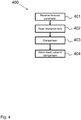
- Fig. 4 shows a schematic flowchart diagram 400 of a method for generating weight factors according to an embodiment of the invention.
- the processor 100 receives a first forecast parameter. Receiving the first forecast parameter may be performed in the above-described manner.
- step 402 the processor 101 reads reference data from memory 103.
- step 403 the processor 103 compares the received first forecast parameter and the read reference data. The difference between these parameters indicates the quality of the received first forecast parameter.
- the processor 101 can define weight factors.
- the processor 101 defines the first weight factor and the second weight factor.
- the processor 101 defines the first weight factor as a high-weight factor, if the first forecast parameter differs from the reference data for not more than a predetermined threshold value.
- the predetermined threshold value is also defined by the processor 101 and may be adapted by the processor 101. Therefore the predetermined threshold value is based on unsupervised or supervised machine learning and is automatically adapting to increase the accuracy of the method.
- the reference data comprises, with increasing accuracy, data from local/in-situ measurements, for example on board of a vessel, remote sensing data, for example from satellites, and forecast models, for example from a weather prediction provider.
- the processor 101 is configured to process these data dependent of their level of accuracy. By determining and assigning the weight factors and combining the data from the different sources, the accuracy of the combined forecast parameter can be improved in view of only using data with lower accuracy.
Landscapes
- Engineering & Computer Science (AREA)
- Radar, Positioning & Navigation (AREA)
- Ocean & Marine Engineering (AREA)
- Mechanical Engineering (AREA)
- Combustion & Propulsion (AREA)
- Chemical & Material Sciences (AREA)
- Remote Sensing (AREA)
- Physics & Mathematics (AREA)
- Environmental & Geological Engineering (AREA)
- Environmental Sciences (AREA)
- Automation & Control Theory (AREA)
- Ecology (AREA)
- General Physics & Mathematics (AREA)
- Biodiversity & Conservation Biology (AREA)
- Atmospheric Sciences (AREA)
- Life Sciences & Earth Sciences (AREA)
- Probability & Statistics with Applications (AREA)
- Management, Administration, Business Operations System, And Electronic Commerce (AREA)
- Navigation (AREA)
- Power Sources (AREA)
Claims (15)
- Vorrichtung (100) zum Bereitstellen einer Wettervorhersage, umfassend
eine Schnittstelle (102), die eingerichtet ist
einen ersten Vorhersageparameter eines ersten Wettervorhersagemodells zu empfangen;
eine zweiten Vorhersageparameter eines zweiten Wettervorhersagemodells zu empfangen, das sich vom ersten Wettervorhersagemodell unterscheidet; und
gemessene Referenzdaten betreffend den ersten Vorhersageparameter und den zweiten Vorhersageparameter zu empfangen;
einen Prozessor (101), der eingerichtet ist
einen ersten Gewichtungsfaktor dem ersten Vorhersageparameter basierend auf einem Vergleich des ersten Vorhersageparameters mit den gemessenen Referenzdaten zuzuweisen;
einen zweiten Gewichtungsfaktor dem zweiten Vorhersageparameter basierend auf einem Vergleich des zweiten Vorhersageparameters mit den gemessenen Referenzdaten zuzuweisen;
den ersten Vorhersageparameter und den zweiten Vorhersageparameter basierend auf dem ersten Gewichtungsfaktor und dem zweiten Gewichtungsfaktor zu kombinieren, um einen kombinierten Vorhersageparameter zu erhalten; und
wobei die Schnittstelle (102) eingerichtet ist, den kombinierten Vorhersageparameter als eine Wettervorhersage auszugeben. - Vorrichtung (100) nach Anspruch 1, wobei der Prozessor (101) eingerichtet ist, die Gewichtungsfaktoren auf Basis einer Fähigkeitsbewertung zuzuweisen, die die Qualität des ersten Vorhersageparameters und/oder des zweiten Vorhersageparameters und/oder der angemessenen Referenzdaten anzeigt.
- Vorrichtung (100) nach einem der vorhergehenden Ansprüche, wobei der Prozessor (101) eingerichtet ist, die Gewichtungsfaktoren auf Basis einer Fehlerschätzung zuzuweisen, die die fehlende Übereinstimmung zwischen einem gemessenen Wetterparameter und dem ersten Vorhersageparameter bzw. dem zweiten Vorhersageparameter anzeigt.
- Vorrichtung (100) nach Anspruch 3, wobei der Prozessor (101) eingerichtet ist, die fehlende Übereinstimmung auf Basis von mindestens einem der folgenden Parameter zu bestimmen: einer Ozeanströmungsgeschwindigkeit, einer Ozeanströmungsrichtung, einer absoluten Wellenhöhe, einer wesentlichen Wellenhöhe, einer Wellenrichtung, einer Wellenperiode, einer Windgeschwindigkeit, einer Windrichtung, eines Wellenspektrums, das von Wind erzeugte Wellen und/oder Wellengang umfasst, Meereseiskonzentration, Meereseisdrift, Meereseisrand, Meeresoberflächentemperatur, Meeresoberflächensalzgehalt.
- Vorrichtung (100) nach einem der vorhergehenden Ansprüche, wobei der Prozessor (101) eingerichtet ist, den kombinierten Vorhersageparameter in vorbestimmten Zeitintervallen zu erhalten, insbesondere nach Empfangen von neuen ersten Vorhersageparametern und/oder neuen zweiten Vorhersageparametern und/oder neuen gemessenen Referenzdaten; und/oder wobei der Prozessor (101) dazu ausgelegt ist, den ersten Gewichtungsfaktor und/oder den zweiten Gewichtungsfaktor in vorbestimmten Zeitintervallen zu bestimmen.
- Vorrichtung (100) nach einem der vorhergehenden Ansprüche, wobei der Prozessor (101) eingerichtet ist, den empfangenen ersten Vorhersageparameter und/oder den empfangenen zweiten Vorhersageparameter und/oder die empfangenen gemessenen Referenzdaten an ein gemeinsames Datenformat, insbesondere mit Bezug auf eine Aufzeichnungszeit, einen Aufzeichnungsort, ein Dateiformat und/oder eine Dateibenennung, anzupassen.
- Vorrichtung (100) nach einem der vorhergehenden Ansprüche, wobei der Prozessor (101) eingerichtet ist, den kombinierten Vorhersageparameter durch Erstellen eines statistischen Wertes auf Basis des gewichteten ersten Vorhersageparameters und des gewichteten zweiten Vorhersageparameters, insbesondere eines statistischen Wertes erster Ordnung oder eines statistischen Wertes zweiter Ordnung, zu erhalten.
- Vorrichtung (100) nach einem der vorhergehenden Ansprüche, wobei der Prozessor (101) eingerichtet ist, die Gewichtungsfaktoren in Abhängigkeit von einem Erfassungsverfahren hierarchisch zu bestimmen, insbesondere in Abhängigkeit von einer In-situ-Beobachtung von Wetterparametern und Fernabtastungswetterparametern, wobei der Prozessor (101) eingerichtet ist, die In-situ-Beobachtungsparameter gegenüber den Fernabtastungswetterparametern zu priorisieren; oder insbesondere in Abhängigkeit von einer In-situ-Beobachtung von Wetterparametern und Wettervorhersageparametern, wobei der Prozessor (101) eingerichtet ist, die In-situ-Beobachtungsparameter gegenüber den Wettervorhersageparametern zu priorisieren; oder
insbesondere in Abhängigkeit von Fernabtastungswetterparametern und Wettervorhersageparametern, wobei der Prozessor (101) eingerichtet ist, die Fernabtastungsparameter gegenüber den Wettervorhersageparametern zu priorisieren. - Vorrichtung (100) nach einem der vorhergehenden Ansprüche, wobei die Referenzdaten Beobachtungsdaten umfassen, insbesondere Satellitendaten und/oder luftgestützte Daten und/oder In-situ-Daten von Küstenstationen und/oder In-situ-Daten von Bojen und/oder In-situ-Daten von Gleitern und/oder In-situ-Daten von externen Schiffen; und/oder
wobei das erste Wettervorhersagemodell und das zweite Wettervorhersagemodell auf Modelldaten basieren, wobei die Modelldaten insbesondere Klimatologiedaten und/oder Saisonvorhersagedaten und/oder Langzeitvorhersagedaten und/oder Kurzzeitvorhersagedaten umfassen. - Vorrichtung (100) nach einem der vorhergehenden Ansprüche, wobei der Prozessor (101) eingerichtet ist, den ersten Vorhersageparameter oder den zweiten Vorhersageparameter außer Acht zu lassen, wenn sich der Gewichtungsfaktor zwischen den zwei Parametern um mehr als einen vorbestimmten Wert unterscheidet, wobei der Vorhersageparameter mit dem niedrigsten Gewichtungsfaktor außer Acht gelassen wird.
- Vorrichtung (100) nach Anspruch 10, wobei der vorbestimmte Wert auf Maschinenlernen basiert und wobei der Prozessor (101) eingerichtet ist, den vorbestimmten Wert durch iteratives Ausführen des Vergleichs des ersten Vorhersageparameters mit den gemessenen Referenzdaten und/oder durch iteratives Ausführen des Vergleichs des zweiten Vorhersageparameters mit den gemessenen Referenzdaten zu bestimmen.
- Vorrichtung (100) nach einem der vorhergehenden Ansprüche, wobei der Prozessor (101) eingerichtet ist, die Vorhersageparameter derart zu gewichten, dass die niedrigste fehlende Übereinstimmung zwischen dem kombinierten Vorhersageparameter und den Referenzdaten gegeben ist.
- Vorrichtung (100) nach einem der vorhergehenden Ansprüche, wobei der Prozessor (101) eingerichtet ist, den neuesten Wetterparameter aus den Referenzdaten auszuwählen oder den Wetterparameter aus den Referenzdaten auszuwählen, der in einem geringsten Abstand und/oder einer geringsten Zeit zu einem Fahrzeug, das den kombinierten Vorhersageparameter verwendet, gemessen wurde.
- Verfahren zum Bereitstellen einer Wettervorhersage, umfassend
Bereitstellen eines ersten Vorhersageparameters eines ersten Wettervorhersagemodells;
Bereitstellen eines zweiten Vorhersageparameters eines zweiten Wettervorhersagemodells, das sich vom ersten Wettervorhersagemodell unterscheidet; und
Bereitstellen von gemessenen Referenzdaten, die den ersten Vorhersageparameter und den zweiten Vorhersageparameter betreffen;
Zuweisen eines ersten Gewichtungsfaktors zum ersten Vorhersageparameter basierend auf einem Vergleich des ersten Vorhersageparameters mit den gemessenen Referenzdaten;
Zuweisen eines zweiten Gewichtungsfaktors zum zweiten Vorhersageparameter basierend auf einem Vergleich des zweiten Vorhersageparameters mit den gemessenen Referenzdaten;
Kombinieren des ersten Vorhersageparameters und des zweiten Vorhersageparameters basierend auf dem ersten Gewichtungsfaktor und dem zweiten Gewichtungsfaktor, um einen kombinierten Vorhersageparameter zu erhalten; und Ausgeben des kombinierten Vorhersageparameters als eine Wettervorhersage. - Computerprogrammprodukt mit einem Programmcode zum Ausführen des Verfahrens nach Anspruch 14, wenn der Programmcode auf einem Computersystem ausgeführt wird.
Applications Claiming Priority (1)
| Application Number | Priority Date | Filing Date | Title |
|---|---|---|---|
| EP16201572.1A EP3330666A1 (de) | 2016-11-30 | 2016-11-30 | Kommunikationsvorrichtung zur anpassung einer aktuellen route eines schiffs |
Publications (2)
| Publication Number | Publication Date |
|---|---|
| EP3330747A1 EP3330747A1 (de) | 2018-06-06 |
| EP3330747B1 true EP3330747B1 (de) | 2019-08-07 |
Family
ID=57681220
Family Applications (4)
| Application Number | Title | Priority Date | Filing Date |
|---|---|---|---|
| EP16201572.1A Ceased EP3330666A1 (de) | 2016-11-30 | 2016-11-30 | Kommunikationsvorrichtung zur anpassung einer aktuellen route eines schiffs |
| EP17204814.2A Active EP3330171B1 (de) | 2016-11-30 | 2017-11-30 | Vorrichtung zur vorhersage des stromverbrauchs eines seeschiffes |
| EP17204810.0A Active EP3330747B1 (de) | 2016-11-30 | 2017-11-30 | Vorrichtung, methode und computerprogrammprodukt zur bereitstellung einer metocean-vorhersage |
| EP20194982.3A Withdrawn EP3825651A1 (de) | 2016-11-30 | 2017-11-30 | Vorrichtung zur vorhersage des stromverbrauchs eines seeschiffes |
Family Applications Before (2)
| Application Number | Title | Priority Date | Filing Date |
|---|---|---|---|
| EP16201572.1A Ceased EP3330666A1 (de) | 2016-11-30 | 2016-11-30 | Kommunikationsvorrichtung zur anpassung einer aktuellen route eines schiffs |
| EP17204814.2A Active EP3330171B1 (de) | 2016-11-30 | 2017-11-30 | Vorrichtung zur vorhersage des stromverbrauchs eines seeschiffes |
Family Applications After (1)
| Application Number | Title | Priority Date | Filing Date |
|---|---|---|---|
| EP20194982.3A Withdrawn EP3825651A1 (de) | 2016-11-30 | 2017-11-30 | Vorrichtung zur vorhersage des stromverbrauchs eines seeschiffes |
Country Status (2)
| Country | Link |
|---|---|
| EP (4) | EP3330666A1 (de) |
| DK (1) | DK3330747T3 (de) |
Cited By (1)
| Publication number | Priority date | Publication date | Assignee | Title |
|---|---|---|---|---|
| US12429628B2 (en) | 2020-12-01 | 2025-09-30 | International Business Machines Corporation | Fractional ice cover predictions with machine learning, satellite, thermodynamics, and in-situ observations |
Families Citing this family (25)
| Publication number | Priority date | Publication date | Assignee | Title |
|---|---|---|---|---|
| US20200394744A1 (en) * | 2018-03-28 | 2020-12-17 | Agency For Science, Technology And Research | Method and system for predicting a port-stay duration of a vessel at a port |
| US10977605B2 (en) * | 2018-06-05 | 2021-04-13 | Signal Ocean Ltd | Carrier path prediction based on dynamic input data |
| CN108957451A (zh) * | 2018-07-19 | 2018-12-07 | 李熙 | 一种内陆架海区永久固定式数据网络平台的构建方法 |
| WO2020131187A2 (en) * | 2018-09-26 | 2020-06-25 | Sofar Ocean Technologies, Inc. | Ocean weather forecasting system |
| JP7189764B2 (ja) * | 2018-12-27 | 2022-12-14 | 川崎重工業株式会社 | 船舶性能推定装置及び船舶性能推定プログラム |
| SG11202107692WA (en) * | 2019-01-29 | 2021-08-30 | Alpha Ori Tech Pte Ltd | System and method for voyage consumption optimization |
| CN109947098A (zh) * | 2019-03-06 | 2019-06-28 | 天津理工大学 | 一种基于机器学习策略的距离优先最佳路径选择方法 |
| CN110887484B (zh) * | 2019-10-14 | 2022-12-27 | 重庆邮电大学 | 基于改进遗传算法的移动机器人路径规划方法及存储介质 |
| CN111709090B (zh) * | 2020-06-17 | 2023-04-07 | 上海船舶研究设计院(中国船舶工业集团公司第六0四研究院) | 模型构建方法、装置、电子设备及计算机可读存储介质 |
| CN112330482B (zh) * | 2020-10-23 | 2024-07-23 | 长沙理工大学 | 基于暂态信息融合的输电线路单端故障定位方法 |
| EP4122811A1 (de) * | 2021-07-23 | 2023-01-25 | Siemens Energy Global GmbH & Co. KG | Verfahren zur bereitstellung von informationen zur optimierten steuerung eines technischen systems |
| CN113553775B (zh) * | 2021-09-01 | 2022-03-08 | 交通运输部天津水运工程科学研究所 | 一种基于机器学习的港内码头系泊船舶运动量预报方法 |
| CN114910934B (zh) * | 2022-03-31 | 2023-02-07 | 北京卫星信息工程研究所 | 基于星载gnss-r/s一体化接收的海面矢量风场反演系统及方法 |
| CN115175247B (zh) * | 2022-06-24 | 2025-07-11 | 新诺北斗航科信息技术(厦门)股份有限公司 | Ais移动基站数据压缩算法及数据传输方法 |
| CN115268320B (zh) * | 2022-07-21 | 2024-10-18 | 西安热工研究院有限公司 | 一种智能控制算法模块的标准化封装方法 |
| CN115276913B (zh) * | 2022-09-29 | 2023-01-03 | 北京融为科技有限公司 | 一种星地激光通信的数据传输方法和设备 |
| US12571702B1 (en) | 2022-12-15 | 2026-03-10 | The United States Of America, As Represented By The Secretary Of The Navy | Apparatus and method for aerodynamic testing of moving ships |
| CN118225089B (zh) * | 2024-02-04 | 2026-03-10 | 北京全球气象导航技术有限公司 | 基于海浪状态分析的船舶航行线路规划方法及系统 |
| CN117910674B (zh) * | 2024-03-19 | 2024-05-31 | 平潭综合实验区智慧岛投资发展有限公司 | 一种基于机器学习的海上船舶指挥方法及系统 |
| EP4644226A1 (de) * | 2024-04-30 | 2025-11-05 | Abb Schweiz Ag | Bewegungsplanung für ein wasserfahrzeug |
| CN118348810B (zh) * | 2024-05-28 | 2024-10-15 | 安华海洋智能装备(深圳)有限公司 | 用于海洋探测设备的优化方法、系统及探测设备 |
| NO20240745A1 (en) * | 2024-07-10 | 2026-01-12 | Kongsberg Maritime As | Controlling vessel operation |
| CN120215394B (zh) * | 2025-05-27 | 2025-07-29 | 中船赛思亿(无锡)电气科技有限公司 | 一种基于人工智能的自动船舶驾驶控制方法及系统 |
| CN121232879B (zh) * | 2025-12-01 | 2026-02-24 | 西安辰航卓越科技有限公司 | 一种空地一体化的无人机集群协同控制方法 |
| CN121384045B (zh) * | 2025-12-25 | 2026-03-06 | 武汉大学 | 融合ais航速反馈的极地航线动态规划系统、装置及介质 |
Family Cites Families (7)
| Publication number | Priority date | Publication date | Assignee | Title |
|---|---|---|---|---|
| GB0110153D0 (en) * | 2001-04-25 | 2001-06-20 | Isis Innovation | Improvements in or relating to forecasting |
| WO2006136157A1 (en) * | 2005-06-24 | 2006-12-28 | A.P. Møller - Mærsk A/S | Maritime information system |
| US20080255760A1 (en) * | 2007-04-16 | 2008-10-16 | Honeywell International, Inc. | Forecasting system |
| US8935174B2 (en) * | 2009-01-16 | 2015-01-13 | The Boeing Company | Analyzing voyage efficiencies |
| US9157746B2 (en) * | 2011-11-16 | 2015-10-13 | The Boeing Company | Vessel routing system |
| EP2669630A1 (de) * | 2012-06-01 | 2013-12-04 | ABB Technology AG | Verfahren und System zur Bestimmung eines Schiffweges |
| JP6038094B2 (ja) * | 2014-10-17 | 2016-12-07 | 三菱重工業株式会社 | 船舶の推進性能予測装置及びその方法並びに船舶の運航支援システム |
-
2016
- 2016-11-30 EP EP16201572.1A patent/EP3330666A1/de not_active Ceased
-
2017
- 2017-11-30 DK DK17204810T patent/DK3330747T3/da active
- 2017-11-30 EP EP17204814.2A patent/EP3330171B1/de active Active
- 2017-11-30 EP EP17204810.0A patent/EP3330747B1/de active Active
- 2017-11-30 EP EP20194982.3A patent/EP3825651A1/de not_active Withdrawn
Non-Patent Citations (1)
| Title |
|---|
| None * |
Cited By (1)
| Publication number | Priority date | Publication date | Assignee | Title |
|---|---|---|---|---|
| US12429628B2 (en) | 2020-12-01 | 2025-09-30 | International Business Machines Corporation | Fractional ice cover predictions with machine learning, satellite, thermodynamics, and in-situ observations |
Also Published As
| Publication number | Publication date |
|---|---|
| EP3330747A1 (de) | 2018-06-06 |
| EP3330666A1 (de) | 2018-06-06 |
| EP3330171A3 (de) | 2018-08-08 |
| EP3825651A1 (de) | 2021-05-26 |
| EP3330171A2 (de) | 2018-06-06 |
| EP3330171B1 (de) | 2020-09-09 |
| DK3330747T3 (da) | 2019-10-28 |
Similar Documents
| Publication | Publication Date | Title |
|---|---|---|
| EP3330747B1 (de) | Vorrichtung, methode und computerprogrammprodukt zur bereitstellung einer metocean-vorhersage | |
| Müller et al. | AROME-MetCoOp: A Nordic convective-scale operational weather prediction model | |
| De Haan et al. | Assimilation of high-resolution Mode-S wind and temperature observations in a regional NWP model for nowcasting applications | |
| Davidson et al. | Applications of GODAE ocean current forecasts to search and rescue and ship routing | |
| Alvarez et al. | Comparison of different wind products and buoy wind data with seasonality and interannual climate variability in the southern Bay of Biscay (2000–2009) | |
| JP6867898B2 (ja) | 最適航路探索方法及び装置 | |
| JP2013134089A (ja) | 最適航路計算装置及び最適航路計算方法 | |
| Sánchez et al. | Wave resource characterization through in-situ measurement followed by artificial neural networks' modeling | |
| Życzkowski et al. | Review of weather forecast services for ship routing purposes | |
| KR102109571B1 (ko) | 선박의 최적항로 도출 시스템 및 방법, 동 방법을 컴퓨터에서 실행하기 위한 컴퓨터 프로그램이 기록된, 컴퓨터 판독 가능한 기록 매체 | |
| JP2010054460A (ja) | 波浪予測システム | |
| Collins III et al. | Doppler correction of wave frequency spectra measured by underway vessels | |
| Bentamy et al. | Spatial and temporal characteristics of wind and wind power off the coasts of Brittany | |
| CN114154658A (zh) | 一种基于海洋气象的风电场检修航线计算方法及系统 | |
| CN114325877B (zh) | 气象预报数据的评估方法和装置 | |
| Farkas et al. | Wave statistics for the middle Adriatic Sea | |
| Amaireh et al. | Atmospheric humidity estimation from wind profiler radar using a cascaded machine learning approach | |
| JP2020134315A (ja) | 波浪予測モデルの構築方法および波浪予測方法 | |
| HK1256374B (en) | Apparatus, method, and computer program product for providing a metocean forecast | |
| HK1256374A1 (en) | Apparatus, method, and computer program product for providing a metocean forecast | |
| CN119204649A (zh) | 一种基于冰山的航线避让方法及系统 | |
| Kako et al. | Effectiveness of using multisatellite wind speed estimates to construct hourly wind speed datasets with diurnal variations | |
| CN113988349B (zh) | 一种基于时空局部模型的数值模式预报产品客观释用方法 | |
| Harikumar et al. | Ocean state forecast along ship routes: Evaluation using ESSO-INCOIS real-time ship-mounted wave height meter and satellite observations | |
| Montoya et al. | Methodology to correct wind speed during average wind conditions: application to the Caribbean Sea |
Legal Events
| Date | Code | Title | Description |
|---|---|---|---|
| PUAI | Public reference made under article 153(3) epc to a published international application that has entered the european phase |
Free format text: ORIGINAL CODE: 0009012 |
|
| STAA | Information on the status of an ep patent application or granted ep patent |
Free format text: STATUS: THE APPLICATION HAS BEEN PUBLISHED |
|
| AK | Designated contracting states |
Kind code of ref document: A1 Designated state(s): AL AT BE BG CH CY CZ DE DK EE ES FI FR GB GR HR HU IE IS IT LI LT LU LV MC MK MT NL NO PL PT RO RS SE SI SK SM TR |
|
| AX | Request for extension of the european patent |
Extension state: BA ME |
|
| STAA | Information on the status of an ep patent application or granted ep patent |
Free format text: STATUS: REQUEST FOR EXAMINATION WAS MADE |
|
| RIN1 | Information on inventor provided before grant (corrected) |
Inventor name: DOKKEN, SVERRE Inventor name: ERIKSSON, LEIF Inventor name: JONASSON, LARS Inventor name: LEMMENS, KRIS |
|
| 17P | Request for examination filed |
Effective date: 20180702 |
|
| RBV | Designated contracting states (corrected) |
Designated state(s): AL AT BE BG CH CY CZ DE DK EE ES FI FR GB GR HR HU IE IS IT LI LT LU LV MC MK MT NL NO PL PT RO RS SE SI SK SM TR |
|
| RIC1 | Information provided on ipc code assigned before grant |
Ipc: G01W 1/10 20060101AFI20190118BHEP Ipc: G01W 1/00 20060101ALN20190118BHEP |
|
| GRAP | Despatch of communication of intention to grant a patent |
Free format text: ORIGINAL CODE: EPIDOSNIGR1 |
|
| STAA | Information on the status of an ep patent application or granted ep patent |
Free format text: STATUS: GRANT OF PATENT IS INTENDED |
|
| RIC1 | Information provided on ipc code assigned before grant |
Ipc: G01W 1/00 20060101ALN20190208BHEP Ipc: G01W 1/10 20060101AFI20190208BHEP |
|
| INTG | Intention to grant announced |
Effective date: 20190319 |
|
| GRAS | Grant fee paid |
Free format text: ORIGINAL CODE: EPIDOSNIGR3 |
|
| GRAA | (expected) grant |
Free format text: ORIGINAL CODE: 0009210 |
|
| STAA | Information on the status of an ep patent application or granted ep patent |
Free format text: STATUS: THE PATENT HAS BEEN GRANTED |
|
| AK | Designated contracting states |
Kind code of ref document: B1 Designated state(s): AL AT BE BG CH CY CZ DE DK EE ES FI FR GB GR HR HU IE IS IT LI LT LU LV MC MK MT NL NO PL PT RO RS SE SI SK SM TR |
|
| REG | Reference to a national code |
Ref country code: GB Ref legal event code: FG4D |
|
| REG | Reference to a national code |
Ref country code: CH Ref legal event code: EP Ref country code: AT Ref legal event code: REF Ref document number: 1164711 Country of ref document: AT Kind code of ref document: T Effective date: 20190815 |
|
| REG | Reference to a national code |
Ref country code: DE Ref legal event code: R096 Ref document number: 602017005932 Country of ref document: DE |
|
| REG | Reference to a national code |
Ref country code: IE Ref legal event code: FG4D |
|
| REG | Reference to a national code |
Ref country code: HK Ref legal event code: DE Ref document number: 1256374 Country of ref document: HK |
|
| REG | Reference to a national code |
Ref country code: NL Ref legal event code: FP |
|
| REG | Reference to a national code |
Ref country code: SE Ref legal event code: TRGR |
|
| REG | Reference to a national code |
Ref country code: NO Ref legal event code: T2 Effective date: 20190807 Ref country code: DK Ref legal event code: T3 Effective date: 20191024 |
|
| REG | Reference to a national code |
Ref country code: LT Ref legal event code: MG4D |
|
| PG25 | Lapsed in a contracting state [announced via postgrant information from national office to epo] |
Ref country code: PT Free format text: LAPSE BECAUSE OF FAILURE TO SUBMIT A TRANSLATION OF THE DESCRIPTION OR TO PAY THE FEE WITHIN THE PRESCRIBED TIME-LIMIT Effective date: 20191209 Ref country code: BG Free format text: LAPSE BECAUSE OF FAILURE TO SUBMIT A TRANSLATION OF THE DESCRIPTION OR TO PAY THE FEE WITHIN THE PRESCRIBED TIME-LIMIT Effective date: 20191107 Ref country code: LT Free format text: LAPSE BECAUSE OF FAILURE TO SUBMIT A TRANSLATION OF THE DESCRIPTION OR TO PAY THE FEE WITHIN THE PRESCRIBED TIME-LIMIT Effective date: 20190807 Ref country code: HR Free format text: LAPSE BECAUSE OF FAILURE TO SUBMIT A TRANSLATION OF THE DESCRIPTION OR TO PAY THE FEE WITHIN THE PRESCRIBED TIME-LIMIT Effective date: 20190807 |
|
| REG | Reference to a national code |
Ref country code: AT Ref legal event code: MK05 Ref document number: 1164711 Country of ref document: AT Kind code of ref document: T Effective date: 20190807 |
|
| PG25 | Lapsed in a contracting state [announced via postgrant information from national office to epo] |
Ref country code: AL Free format text: LAPSE BECAUSE OF FAILURE TO SUBMIT A TRANSLATION OF THE DESCRIPTION OR TO PAY THE FEE WITHIN THE PRESCRIBED TIME-LIMIT Effective date: 20190807 Ref country code: ES Free format text: LAPSE BECAUSE OF FAILURE TO SUBMIT A TRANSLATION OF THE DESCRIPTION OR TO PAY THE FEE WITHIN THE PRESCRIBED TIME-LIMIT Effective date: 20190807 Ref country code: LV Free format text: LAPSE BECAUSE OF FAILURE TO SUBMIT A TRANSLATION OF THE DESCRIPTION OR TO PAY THE FEE WITHIN THE PRESCRIBED TIME-LIMIT Effective date: 20190807 Ref country code: RS Free format text: LAPSE BECAUSE OF FAILURE TO SUBMIT A TRANSLATION OF THE DESCRIPTION OR TO PAY THE FEE WITHIN THE PRESCRIBED TIME-LIMIT Effective date: 20190807 Ref country code: IS Free format text: LAPSE BECAUSE OF FAILURE TO SUBMIT A TRANSLATION OF THE DESCRIPTION OR TO PAY THE FEE WITHIN THE PRESCRIBED TIME-LIMIT Effective date: 20191207 |
|
| REG | Reference to a national code |
Ref country code: GR Ref legal event code: EP Ref document number: 20190403183 Country of ref document: GR Effective date: 20200213 |
|
| PG25 | Lapsed in a contracting state [announced via postgrant information from national office to epo] |
Ref country code: TR Free format text: LAPSE BECAUSE OF FAILURE TO SUBMIT A TRANSLATION OF THE DESCRIPTION OR TO PAY THE FEE WITHIN THE PRESCRIBED TIME-LIMIT Effective date: 20190807 |
|
| PG25 | Lapsed in a contracting state [announced via postgrant information from national office to epo] |
Ref country code: EE Free format text: LAPSE BECAUSE OF FAILURE TO SUBMIT A TRANSLATION OF THE DESCRIPTION OR TO PAY THE FEE WITHIN THE PRESCRIBED TIME-LIMIT Effective date: 20190807 Ref country code: PL Free format text: LAPSE BECAUSE OF FAILURE TO SUBMIT A TRANSLATION OF THE DESCRIPTION OR TO PAY THE FEE WITHIN THE PRESCRIBED TIME-LIMIT Effective date: 20190807 Ref country code: IT Free format text: LAPSE BECAUSE OF FAILURE TO SUBMIT A TRANSLATION OF THE DESCRIPTION OR TO PAY THE FEE WITHIN THE PRESCRIBED TIME-LIMIT Effective date: 20190807 Ref country code: RO Free format text: LAPSE BECAUSE OF FAILURE TO SUBMIT A TRANSLATION OF THE DESCRIPTION OR TO PAY THE FEE WITHIN THE PRESCRIBED TIME-LIMIT Effective date: 20190807 Ref country code: AT Free format text: LAPSE BECAUSE OF FAILURE TO SUBMIT A TRANSLATION OF THE DESCRIPTION OR TO PAY THE FEE WITHIN THE PRESCRIBED TIME-LIMIT Effective date: 20190807 |
|
| PG25 | Lapsed in a contracting state [announced via postgrant information from national office to epo] |
Ref country code: CZ Free format text: LAPSE BECAUSE OF FAILURE TO SUBMIT A TRANSLATION OF THE DESCRIPTION OR TO PAY THE FEE WITHIN THE PRESCRIBED TIME-LIMIT Effective date: 20190807 Ref country code: SK Free format text: LAPSE BECAUSE OF FAILURE TO SUBMIT A TRANSLATION OF THE DESCRIPTION OR TO PAY THE FEE WITHIN THE PRESCRIBED TIME-LIMIT Effective date: 20190807 Ref country code: IS Free format text: LAPSE BECAUSE OF FAILURE TO SUBMIT A TRANSLATION OF THE DESCRIPTION OR TO PAY THE FEE WITHIN THE PRESCRIBED TIME-LIMIT Effective date: 20200224 Ref country code: SM Free format text: LAPSE BECAUSE OF FAILURE TO SUBMIT A TRANSLATION OF THE DESCRIPTION OR TO PAY THE FEE WITHIN THE PRESCRIBED TIME-LIMIT Effective date: 20190807 |
|
| REG | Reference to a national code |
Ref country code: DE Ref legal event code: R097 Ref document number: 602017005932 Country of ref document: DE |
|
| PLBE | No opposition filed within time limit |
Free format text: ORIGINAL CODE: 0009261 |
|
| STAA | Information on the status of an ep patent application or granted ep patent |
Free format text: STATUS: NO OPPOSITION FILED WITHIN TIME LIMIT |
|
| PG2D | Information on lapse in contracting state deleted |
Ref country code: IS |
|
| PG25 | Lapsed in a contracting state [announced via postgrant information from national office to epo] |
Ref country code: LU Free format text: LAPSE BECAUSE OF NON-PAYMENT OF DUE FEES Effective date: 20191130 Ref country code: MC Free format text: LAPSE BECAUSE OF FAILURE TO SUBMIT A TRANSLATION OF THE DESCRIPTION OR TO PAY THE FEE WITHIN THE PRESCRIBED TIME-LIMIT Effective date: 20190807 |
|
| 26N | No opposition filed |
Effective date: 20200603 |
|
| PG25 | Lapsed in a contracting state [announced via postgrant information from national office to epo] |
Ref country code: SI Free format text: LAPSE BECAUSE OF FAILURE TO SUBMIT A TRANSLATION OF THE DESCRIPTION OR TO PAY THE FEE WITHIN THE PRESCRIBED TIME-LIMIT Effective date: 20190807 |
|
| PG25 | Lapsed in a contracting state [announced via postgrant information from national office to epo] |
Ref country code: IE Free format text: LAPSE BECAUSE OF NON-PAYMENT OF DUE FEES Effective date: 20191130 |
|
| PG25 | Lapsed in a contracting state [announced via postgrant information from national office to epo] |
Ref country code: CY Free format text: LAPSE BECAUSE OF FAILURE TO SUBMIT A TRANSLATION OF THE DESCRIPTION OR TO PAY THE FEE WITHIN THE PRESCRIBED TIME-LIMIT Effective date: 20190807 |
|
| REG | Reference to a national code |
Ref country code: CH Ref legal event code: PL |
|
| PG25 | Lapsed in a contracting state [announced via postgrant information from national office to epo] |
Ref country code: HU Free format text: LAPSE BECAUSE OF FAILURE TO SUBMIT A TRANSLATION OF THE DESCRIPTION OR TO PAY THE FEE WITHIN THE PRESCRIBED TIME-LIMIT; INVALID AB INITIO Effective date: 20171130 Ref country code: MT Free format text: LAPSE BECAUSE OF FAILURE TO SUBMIT A TRANSLATION OF THE DESCRIPTION OR TO PAY THE FEE WITHIN THE PRESCRIBED TIME-LIMIT Effective date: 20190807 |
|
| PG25 | Lapsed in a contracting state [announced via postgrant information from national office to epo] |
Ref country code: CH Free format text: LAPSE BECAUSE OF NON-PAYMENT OF DUE FEES Effective date: 20201130 Ref country code: LI Free format text: LAPSE BECAUSE OF NON-PAYMENT OF DUE FEES Effective date: 20201130 |
|
| PG25 | Lapsed in a contracting state [announced via postgrant information from national office to epo] |
Ref country code: MK Free format text: LAPSE BECAUSE OF FAILURE TO SUBMIT A TRANSLATION OF THE DESCRIPTION OR TO PAY THE FEE WITHIN THE PRESCRIBED TIME-LIMIT Effective date: 20190807 |
|
| P01 | Opt-out of the competence of the unified patent court (upc) registered |
Effective date: 20230515 |
|
| PGFP | Annual fee paid to national office [announced via postgrant information from national office to epo] |
Ref country code: NL Payment date: 20251126 Year of fee payment: 9 |
|
| PGFP | Annual fee paid to national office [announced via postgrant information from national office to epo] |
Ref country code: DE Payment date: 20251128 Year of fee payment: 9 |
|
| PGFP | Annual fee paid to national office [announced via postgrant information from national office to epo] |
Ref country code: GB Payment date: 20251127 Year of fee payment: 9 |
|
| PGFP | Annual fee paid to national office [announced via postgrant information from national office to epo] |
Ref country code: NO Payment date: 20251128 Year of fee payment: 9 |
|
| PGFP | Annual fee paid to national office [announced via postgrant information from national office to epo] |
Ref country code: FI Payment date: 20251125 Year of fee payment: 9 Ref country code: DK Payment date: 20251125 Year of fee payment: 9 |
|
| PGFP | Annual fee paid to national office [announced via postgrant information from national office to epo] |
Ref country code: FR Payment date: 20251125 Year of fee payment: 9 |
|
| PGFP | Annual fee paid to national office [announced via postgrant information from national office to epo] |
Ref country code: GR Payment date: 20251126 Year of fee payment: 9 Ref country code: BE Payment date: 20251127 Year of fee payment: 9 |
|
| PGFP | Annual fee paid to national office [announced via postgrant information from national office to epo] |
Ref country code: SE Payment date: 20251127 Year of fee payment: 9 |