EP4122811A1 - Verfahren zur bereitstellung von informationen zur optimierten steuerung eines technischen systems - Google Patents
Verfahren zur bereitstellung von informationen zur optimierten steuerung eines technischen systems Download PDFInfo
- Publication number
- EP4122811A1 EP4122811A1 EP21187347.6A EP21187347A EP4122811A1 EP 4122811 A1 EP4122811 A1 EP 4122811A1 EP 21187347 A EP21187347 A EP 21187347A EP 4122811 A1 EP4122811 A1 EP 4122811A1
- Authority
- EP
- European Patent Office
- Prior art keywords
- actual
- datasets
- predefined
- value
- values
- Prior art date
- Legal status (The legal status is an assumption and is not a legal conclusion. Google has not performed a legal analysis and makes no representation as to the accuracy of the status listed.)
- Withdrawn
Links
Images

Classifications
-
- G—PHYSICS
- G05—CONTROLLING; REGULATING
- G05B—CONTROL OR REGULATING SYSTEMS IN GENERAL; FUNCTIONAL ELEMENTS OF SUCH SYSTEMS; MONITORING OR TESTING ARRANGEMENTS FOR SUCH SYSTEMS OR ELEMENTS
- G05B23/00—Testing or monitoring of control systems or parts thereof
- G05B23/02—Electric testing or monitoring
- G05B23/0205—Electric testing or monitoring by means of a monitoring system capable of detecting and responding to faults
- G05B23/0259—Electric testing or monitoring by means of a monitoring system capable of detecting and responding to faults characterized by the response to fault detection
- G05B23/0267—Fault communication, e.g. human machine interface [HMI]
- G05B23/0272—Presentation of monitored results, e.g. selection of status reports to be displayed; Filtering information to the user
-
- G—PHYSICS
- G05—CONTROLLING; REGULATING
- G05B—CONTROL OR REGULATING SYSTEMS IN GENERAL; FUNCTIONAL ELEMENTS OF SUCH SYSTEMS; MONITORING OR TESTING ARRANGEMENTS FOR SUCH SYSTEMS OR ELEMENTS
- G05B13/00—Adaptive control systems, i.e. systems automatically adjusting themselves to have a performance which is optimum according to some preassigned criterion
- G05B13/02—Adaptive control systems, i.e. systems automatically adjusting themselves to have a performance which is optimum according to some preassigned criterion electric
- G05B13/0265—Adaptive control systems, i.e. systems automatically adjusting themselves to have a performance which is optimum according to some preassigned criterion electric the criterion being a learning criterion
-
- G—PHYSICS
- G05—CONTROLLING; REGULATING
- G05B—CONTROL OR REGULATING SYSTEMS IN GENERAL; FUNCTIONAL ELEMENTS OF SUCH SYSTEMS; MONITORING OR TESTING ARRANGEMENTS FOR SUCH SYSTEMS OR ELEMENTS
- G05B23/00—Testing or monitoring of control systems or parts thereof
- G05B23/02—Electric testing or monitoring
- G05B23/0205—Electric testing or monitoring by means of a monitoring system capable of detecting and responding to faults
- G05B23/0208—Electric testing or monitoring by means of a monitoring system capable of detecting and responding to faults characterized by the configuration of the monitoring system
- G05B23/0216—Human interface functionality, e.g. monitoring system providing help to the user in the selection of tests or in its configuration
-
- B—PERFORMING OPERATIONS; TRANSPORTING
- B63—SHIPS OR OTHER WATERBORNE VESSELS; RELATED EQUIPMENT
- B63B—SHIPS OR OTHER WATERBORNE VESSELS; EQUIPMENT FOR SHIPPING
- B63B79/00—Monitoring properties or operating parameters of vessels in operation
- B63B79/10—Monitoring properties or operating parameters of vessels in operation using sensors, e.g. pressure sensors, strain gauges or accelerometers
-
- B—PERFORMING OPERATIONS; TRANSPORTING
- B63—SHIPS OR OTHER WATERBORNE VESSELS; RELATED EQUIPMENT
- B63B—SHIPS OR OTHER WATERBORNE VESSELS; EQUIPMENT FOR SHIPPING
- B63B79/00—Monitoring properties or operating parameters of vessels in operation
- B63B79/40—Monitoring properties or operating parameters of vessels in operation for controlling the operation of vessels, e.g. monitoring their speed, routing or maintenance schedules
Definitions
- the invention is about a method to provide information about the current status of a technical system with hints for deviation of current values from a status representing an optimized operation.
- a challenge is the operation of the technical system at the desired performance while avoiding negative impact as best as possible.
- An easy but less effective solution is the operation of the technical system based on the knowledge of the operator. In case of a simple technical system, this could be sufficient. But if the technical system comprises some complexity, it is difficult to determine the best operation setup to achieve the desired performance with the lowest impact. In some known use-cases a complex simulation of the technical system is done to predict a performance and the impact dependent on the chosen operational settings. While running the calculation in loops an optimisation could be achieved.
- the target of the invention is an optimized control of a technical system. Which kind of technical system it is, that must be controlled is less relevant, wherein the method is in particular useful for the control of a vehicle. As the control of a vessel with the target of an optimized operation is very complex, the method is in particular advantage in this case.
- a plausibility analysis is necessary at least for such kind of sources, where incorrect values could occur.
- a predefined limit and/or a calculated limit is necessary.
- the limit represents an allowable span between a minimum value and a maximum value. With the plausibility analysis it is guaranteed that all values are within the predefined and/or calculated limit or, if a certain value is not within the limit, this value is identified as invalid.
- the kind of values could be very different. Also, the frequency of new values could be very different from one source to another source. Here, it is the task to group all values so a further analyse of a current status of the technical system is possible. Therefore, the values from the different kind of sources are transferred into usable data.
- Each datum of the set of data is representing at least one value from at least one source.
- a determining parameter represents a requested performance of the technical system. It is assumed that when controlling the technical system, the requested performance of the technical system is a target for all operational settings. Therefore, it is necessary to determine the actual performance. Here, it is in particular advantageous if one datum represents the actual performance.
- This condition represents a measure of achievement of a technical target.
- the condition could be a value on a scale between a minimum and a maximum or a percentage for the attainment.
- the minimum value or lowest percentage or the maximum value or highest percentage could be the goal for the achievement of the technical target.
- the actual dataset is added to a database.
- These database enables with a sufficient number of datasets a further evaluation of the previous operation and status of the technical system.
- each category is a section of the parameter between the minimum and the maximum.
- the categories could be defined as shown in the following table: Table 1: Exemplary definition of categories Category from up to 1. 0 50 2. 50 80 3. 80 100 4. 100 110 5. 110 120 6. 120 125 7. 125 130 8. 130 140 9. 140 155 10. 155 180
- each range comprises all datasets with a parameter with falls into the respective category.
- a subset is determined.
- Each subset is therefore also representing a certain category and a collection of datasets.
- those datasets are of interest, which have a condition close to the desired target, and wherein those datasets are of no further interest, if the condition is far away from the desired target. Therefore, for each of the ranges the datasets of it are analysed in respect to the condition. Those datasets having the best conditions comprising to other datasets of the respective range are then selected for the respective subset.
- Table 2 Exemplary determination of a subset Dataset Range Parameter Condition Category / Subset 10589 R.4 102 56 - 10590 R.4 105 53 - 10591 R.4 101 72 S.4 10592 R.4 109 32 - 10593 R.4 107 68 - 10594 R.4 106 45 - 10595 R.4 105 73 S.4 10596 R.4 107 61 - 10597 R.4 108 70 S.4
- the Range with the identifier "R.4" represents those datasets where the parameter is classified in a section between 100 and 110 (see table 1).
- Each of the nine assigned datasets has a specific condition, in this example between 53 as lowest value up to 73 as highest value.
- those datasets having the best conditions are chosen, which are the three datasets no. 10591, no. 10595 and no. 10597.
- This method enables an advantage analysis of the status of a technical system compared to previous operation modes, where the desired target has been reached best.
- the new evaluation is done if a predefined number of datasets have been added to the database.
- the bigger size of the database comprises probably further datasets with a better condition, as defined in the subset before the new evaluation.
- the new evaluation could be repeated in a predefined period, e.g. after 1000 hours of usage of the technical system.
- the new evaluation is done repeating at a predefined time, e.g. at a certain time in the night without regular usage of the technical system.
- the major advantage is achieved, if the database with its ranges and subsets is used during the operation of the technical system to present information about previous operating states with preferable conditions.
- the classification is used. From the number of subsets that actual subset is chosen, where the actual parameter is within the respective classification.
- the value of the method is visible by providing also information about previous datasets of the identified actual subset. Here, it is necessary to provide information from the actual dataset in combination with the datasets of the actual subset. It must be noted that it is regularly not necessary to present each datum of the dataset with the corresponding data of the subset. It is rather useful to present the most relevant data, which are useful for the operator of the technical system.
- the values collected from different sources of the technical system could be of different kind.
- the values could represent switching states of the technical system. For example, thus switching states could be the information about engine on or off, or it could count a number of lights switched on.
- a second most relevant information are sensor values. For example, this could be the voltage within an electric grid or a torque at a shaft or a speed or a temperature.
- boundary conditions could be captured.
- weather conditions which are not captures by sensors, could be captured from external sources.
- information about the quality of a fuel could be entered by the operator or automatically from an external system.
- a number of values are preferably summarized. If a fix number of values are available for each time a datum is determined, a sum of all values could be used. In most cases an average of the values is preferred. It is also possible to use only the minimum value, or the maximum value form the sequence of values from one source.
- the respective datum should be marked as invalid (e.g., value zero if zero is regularly not possible).
- the frequency with which data is collected can vary depending on the technical system, the rate in which values change, the needs for precise or less precise information, etc.. As result different methods are possible to trigger the recording of data.
- the providing of a dataset with its recording in the database could be triggered, if a predefined number of values from a predefined source are available.
- Another case for the recording of actual data could be given if a value or a datum is within a predefined limit. For example, if something happens repeatedly like emptying and filling of a box a certain level within the box could be used as trigger for the recording of the actual data.
- a first easy solution is the recording of the dataset at a specific time, e.g. 3 o'clock and 5 o'clock every day.
- a second easy solution is the recording of the dataset in a predefined period, e.g. every minute.
- a minimum value or a maximum value must not be defined, as for example a first category can be defined to comprise all datasets with a parameter below a first boundary value and the last category can be defined to comprise all datasets with a parameter above a highest boundary.
- the parameter represents a desired feature of the technical system. It is expected that the priority for the operation of the technical system is the adherence to a desired target parameter. The operation should respect this target parameter and thereby optimize other features.
- a power output e.g. of an engine or from a powertrain
- a speed e.g. at the powertrain or of the vehicle, could be used advantageously as parameter.
- the condition representing an achievement of a target, is necessary to use the inventive method.
- the benefit of the inventive method is visible, if it is not possible to determine the condition by simple calculation depending on operational settings. At complex systems it is sometimes not possible to determine the grounds for the exact level of a condition.
- a very useful condition applicable to a variety of technical systems is the efficiency of the technical system. In most cases the main impacts for the efficiency are known. But in complex systems it is often not possible to determine why a certain higher efficiency is given at a certain operational status. Especially here, the process can be used with particular advantage.
- an advantage condition is the fuel or energy consumption relative to the parameter.
- a further notable condition is the quantity of at least one environmentally harmful substance relative to the parameter, in particular a low emission.
- the number of available datasets within the database could determine the definition of the categories and has an impact to the determination of the subsets to each range.
- the number of datasets with a range are more than at least necessary but less than the maximum number it is preferred, that a predefined share of the respective range with the datasets having the best conditions, are used for the respective subset.
- a trigger for the cleaning of the database could be the exceeding of a maximum number of datasets within a range.
- a further trigger could be the exceeding of datasets in total within the database.
- the datasets of the database for a self-learning process. This enables the proposal of a target dataset for the current requested parameter. If further knowledge about the operational settings is captured within the datasets it is further possible to present a proposal for a target operational setting for the requested parameter.
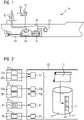
- a vessel 01 is shown. This comprises as a possible source for values, an engine 02, a powertrain 03, a fuel-tank 04 and an exhaust channel 05. Further used in this example is a clock 06 and a position detection unit 07. The method is implemented in a calculation unit 08. It is obvious, that this example shows just an exemplary, small selection of possible sources, where values could be gathered for the method.
- the inventive method to generate a database 11 for the technical system, which is in this example the vessel 01, will be explained by the figure 2 .
- a speed sensor At the powertrain 03 also two different kinds of sensors are installed, a speed sensor and a torque sensor. This leads to a value for the actual speed 33a and the actual torque 33b of the powertrain 03.
- the fuel-tank 04 comprises a sensor for the level within the tank with a value for this actual level 34.
- a temperature sensor is attached leading to a value for the actual temperature 35.
- an engine condition 22 is calculated as one datum of the actual dataset.
- both values are used directly as a datum for the actual speed 23a and as a datum for the actual torque 23b.
- this value 35 is also transferred into a datum presenting the actual temperature 25.
- the different actual data 22-25 are grouped as an actual dataset 15.
- This captured actual dataset 15 is stored into a database 11.
- each range 12 represents a certain category 14.
- the categories 14 are each a section of a parameter, for example the speed 23a of the powertrain.
- a part of each range 12 defines a respective subset 13.
- the actual dataset 15 has a datum with an actual parameter, e.g. the actual speed 23a. This is assigned to a respective category 14. From the database 11 that actual subset 13 with the same category 14 is chosen.
- the actual dataset 15 comprises an actual datum, for example with the actual temperature 25. All respective data of the actual subset 13 with its temperatures are selected.
- a graphic is shown with the actual temperature 17 at the actual condition and the temperatures 18 from the actual subset 13 representing the best conditions.
Landscapes
- Engineering & Computer Science (AREA)
- Physics & Mathematics (AREA)
- General Physics & Mathematics (AREA)
- Automation & Control Theory (AREA)
- Human Computer Interaction (AREA)
- Artificial Intelligence (AREA)
- Health & Medical Sciences (AREA)
- Computer Vision & Pattern Recognition (AREA)
- Evolutionary Computation (AREA)
- Medical Informatics (AREA)
- Software Systems (AREA)
- Testing And Monitoring For Control Systems (AREA)
Priority Applications (2)
| Application Number | Priority Date | Filing Date | Title |
|---|---|---|---|
| EP21187347.6A EP4122811A1 (de) | 2021-07-23 | 2021-07-23 | Verfahren zur bereitstellung von informationen zur optimierten steuerung eines technischen systems |
| PCT/EP2022/069045 WO2023001587A1 (en) | 2021-07-23 | 2022-07-08 | Method to provide information to enable an optimized control of a technical system |
Applications Claiming Priority (1)
| Application Number | Priority Date | Filing Date | Title |
|---|---|---|---|
| EP21187347.6A EP4122811A1 (de) | 2021-07-23 | 2021-07-23 | Verfahren zur bereitstellung von informationen zur optimierten steuerung eines technischen systems |
Publications (1)
| Publication Number | Publication Date |
|---|---|
| EP4122811A1 true EP4122811A1 (de) | 2023-01-25 |
Family
ID=77358079
Family Applications (1)
| Application Number | Title | Priority Date | Filing Date |
|---|---|---|---|
| EP21187347.6A Withdrawn EP4122811A1 (de) | 2021-07-23 | 2021-07-23 | Verfahren zur bereitstellung von informationen zur optimierten steuerung eines technischen systems |
Country Status (2)
| Country | Link |
|---|---|
| EP (1) | EP4122811A1 (de) |
| WO (1) | WO2023001587A1 (de) |
Citations (3)
| Publication number | Priority date | Publication date | Assignee | Title |
|---|---|---|---|---|
| US20140336853A1 (en) * | 2013-05-10 | 2014-11-13 | ESRG Technology Group, LLC | Methods for automatically optimizing ship performance and devices thereof |
| EP3330666A1 (de) * | 2016-11-30 | 2018-06-06 | Offshore Navigation Limited | Kommunikationsvorrichtung zur anpassung einer aktuellen route eines schiffs |
| US20180273144A1 (en) * | 2015-01-09 | 2018-09-27 | Bae Systems Plc | Monitoring energy usage of a surface maritime vessel |
-
2021
- 2021-07-23 EP EP21187347.6A patent/EP4122811A1/de not_active Withdrawn
-
2022
- 2022-07-08 WO PCT/EP2022/069045 patent/WO2023001587A1/en not_active Ceased
Patent Citations (3)
| Publication number | Priority date | Publication date | Assignee | Title |
|---|---|---|---|---|
| US20140336853A1 (en) * | 2013-05-10 | 2014-11-13 | ESRG Technology Group, LLC | Methods for automatically optimizing ship performance and devices thereof |
| US20180273144A1 (en) * | 2015-01-09 | 2018-09-27 | Bae Systems Plc | Monitoring energy usage of a surface maritime vessel |
| EP3330666A1 (de) * | 2016-11-30 | 2018-06-06 | Offshore Navigation Limited | Kommunikationsvorrichtung zur anpassung einer aktuellen route eines schiffs |
Also Published As
| Publication number | Publication date |
|---|---|
| WO2023001587A1 (en) | 2023-01-26 |
Similar Documents
| Publication | Publication Date | Title |
|---|---|---|
| US7457785B1 (en) | Method and apparatus to predict the remaining service life of an operating system | |
| CN113586239B (zh) | 发动机故障诊断方法、装置、控制器和存储介质 | |
| US9449274B2 (en) | Method and device for predicting the condition of a component or system, computer program product | |
| EP2287449A2 (de) | Überwachungssystem des Gasturbinenmotorölverbrauchs und Verfahren | |
| JPH08508103A (ja) | ガスタービンエンジン寿命を決定する装置と方法 | |
| CN109074066B (zh) | 优化过滤器寿命周期的方法和监测通风系统的系统 | |
| US9631568B2 (en) | Method for monitoring operational parameters in an internal combustion engine | |
| JPS623299B2 (de) | ||
| EP3206007A1 (de) | Verfahren zur durchführung einer testfahrt eines fahrzeugs | |
| JP2016128971A (ja) | 予兆診断システム及び予兆診断方法 | |
| CN105276687A (zh) | 空气净化器的清洗提示系统及清洗提示方法、空气净化器 | |
| CN119720047A (zh) | 针对大容量压缩空气储能的变频器突变处理装置与方法 | |
| WO2013191619A1 (en) | Diagnostics for a starter motor | |
| WO2017221923A1 (ja) | ガスタービンのタービン出口温度予測方法及び装置 | |
| CN113486953B (zh) | 变频器滤网更换时间的预测方法、装置及计算机可读介质 | |
| EP4122811A1 (de) | Verfahren zur bereitstellung von informationen zur optimierten steuerung eines technischen systems | |
| CN115800858A (zh) | 一种交流异步电机的自适应控制方法及系统 | |
| US11726469B2 (en) | Error-based method for calculating a remaining useful life of an apparatus | |
| CN107606750B (zh) | 空调净化滤芯更换提醒的方法及装置 | |
| CN121167207B (zh) | 基于知识图谱的压载水应急接收处理故障诊断方法及系统 | |
| JP2005063385A (ja) | 監視方法及び監視装置、並びにプログラム | |
| CN110309551B (zh) | 一种基于数据分析的风电机组发电机温度控制系统及方法 | |
| JPH10273920A (ja) | 機械の異常監視方法 | |
| KR102802257B1 (ko) | 산업용 보일러의 운전 효율을 높이기 위한 인공지능 기반 최적 대수 제어 시스템 및 방법 | |
| CN115826544B (zh) | 一种汽车配件的生产调参系统 |
Legal Events
| Date | Code | Title | Description |
|---|---|---|---|
| PUAI | Public reference made under article 153(3) epc to a published international application that has entered the european phase |
Free format text: ORIGINAL CODE: 0009012 |
|
| STAA | Information on the status of an ep patent application or granted ep patent |
Free format text: STATUS: THE APPLICATION HAS BEEN PUBLISHED |
|
| AK | Designated contracting states |
Kind code of ref document: A1 Designated state(s): AL AT BE BG CH CY CZ DE DK EE ES FI FR GB GR HR HU IE IS IT LI LT LU LV MC MK MT NL NO PL PT RO RS SE SI SK SM TR |
|
| STAA | Information on the status of an ep patent application or granted ep patent |
Free format text: STATUS: THE APPLICATION IS DEEMED TO BE WITHDRAWN |
|
| 18D | Application deemed to be withdrawn |
Effective date: 20230726 |