EP3330171A2 - Vorrichtung zur vorhersage des stromverbrauchs eines seeschiffes - Google Patents
Vorrichtung zur vorhersage des stromverbrauchs eines seeschiffes Download PDFInfo
- Publication number
- EP3330171A2 EP3330171A2 EP17204814.2A EP17204814A EP3330171A2 EP 3330171 A2 EP3330171 A2 EP 3330171A2 EP 17204814 A EP17204814 A EP 17204814A EP 3330171 A2 EP3330171 A2 EP 3330171A2
- Authority
- EP
- European Patent Office
- Prior art keywords
- power consumption
- maritime vessel
- model
- maritime
- parameter
- Prior art date
- Legal status (The legal status is an assumption and is not a legal conclusion. Google has not performed a legal analysis and makes no representation as to the accuracy of the status listed.)
- Granted
Links
Images



Classifications
-
- G—PHYSICS
- G01—MEASURING; TESTING
- G01C—MEASURING DISTANCES, LEVELS OR BEARINGS; SURVEYING; NAVIGATION; GYROSCOPIC INSTRUMENTS; PHOTOGRAMMETRY OR VIDEOGRAMMETRY
- G01C21/00—Navigation; Navigational instruments not provided for in groups G01C1/00 - G01C19/00
- G01C21/20—Instruments for performing navigational calculations
- G01C21/203—Instruments for performing navigational calculations specially adapted for water-borne vessels
-
- B—PERFORMING OPERATIONS; TRANSPORTING
- B63—SHIPS OR OTHER WATERBORNE VESSELS; RELATED EQUIPMENT
- B63B—SHIPS OR OTHER WATERBORNE VESSELS; EQUIPMENT FOR SHIPPING
- B63B49/00—Arrangements of nautical instruments or navigational aids
-
- B—PERFORMING OPERATIONS; TRANSPORTING
- B63—SHIPS OR OTHER WATERBORNE VESSELS; RELATED EQUIPMENT
- B63B—SHIPS OR OTHER WATERBORNE VESSELS; EQUIPMENT FOR SHIPPING
- B63B79/00—Monitoring properties or operating parameters of vessels in operation
- B63B79/10—Monitoring properties or operating parameters of vessels in operation using sensors, e.g. pressure sensors, strain gauges or accelerometers
-
- B—PERFORMING OPERATIONS; TRANSPORTING
- B63—SHIPS OR OTHER WATERBORNE VESSELS; RELATED EQUIPMENT
- B63B—SHIPS OR OTHER WATERBORNE VESSELS; EQUIPMENT FOR SHIPPING
- B63B79/00—Monitoring properties or operating parameters of vessels in operation
- B63B79/20—Monitoring properties or operating parameters of vessels in operation using models or simulation, e.g. statistical models or stochastic models
-
- B—PERFORMING OPERATIONS; TRANSPORTING
- B63—SHIPS OR OTHER WATERBORNE VESSELS; RELATED EQUIPMENT
- B63B—SHIPS OR OTHER WATERBORNE VESSELS; EQUIPMENT FOR SHIPPING
- B63B79/00—Monitoring properties or operating parameters of vessels in operation
- B63B79/40—Monitoring properties or operating parameters of vessels in operation for controlling the operation of vessels, e.g. monitoring their speed, routing or maintenance schedules
-
- G—PHYSICS
- G01—MEASURING; TESTING
- G01W—METEOROLOGY
- G01W1/00—Meteorology
- G01W1/10—Devices for predicting weather conditions
-
- G—PHYSICS
- G01—MEASURING; TESTING
- G01W—METEOROLOGY
- G01W1/00—Meteorology
- G01W2001/006—Main server receiving weather information from several sub-stations
-
- G—PHYSICS
- G06—COMPUTING OR CALCULATING; COUNTING
- G06N—COMPUTING ARRANGEMENTS BASED ON SPECIFIC COMPUTATIONAL MODELS
- G06N20/00—Machine learning
-
- Y—GENERAL TAGGING OF NEW TECHNOLOGICAL DEVELOPMENTS; GENERAL TAGGING OF CROSS-SECTIONAL TECHNOLOGIES SPANNING OVER SEVERAL SECTIONS OF THE IPC; TECHNICAL SUBJECTS COVERED BY FORMER USPC CROSS-REFERENCE ART COLLECTIONS [XRACs] AND DIGESTS
- Y02—TECHNOLOGIES OR APPLICATIONS FOR MITIGATION OR ADAPTATION AGAINST CLIMATE CHANGE
- Y02T—CLIMATE CHANGE MITIGATION TECHNOLOGIES RELATED TO TRANSPORTATION
- Y02T70/00—Maritime or waterways transport
- Y02T70/10—Measures concerning design or construction of watercraft hulls
Definitions
- the invention relates to an apparatus for predicting a power consumption of a maritime vessel, an apparatus for determining a model parameter of a power consumption correction model of a maritime vessel, a method for operating an apparatus for predicting a power consumption of a maritime vessel, a method for operating an apparatus for determining a model parameter of a power consumption correction model of a maritime vessel, and a computer program for performing the methods.
- route and performance optimization of a maritime vessel may be performed in order to increase the efficiency and reliability of shipping and reduce emissions.
- the prediction of a power consumption of the maritime vessel at a given speed is of particular interest.
- theoretical models are used to predict the power consumption of a maritime vessel.
- these theoretical models may have large uncertainties and prediction errors.
- An accurate prediction of the power consumption is, however, desirable for providing high-quality ship-related services, e.g. accurate sail planning or weather routing systems. This may also be desirable for fuel and/or emission and/or fatigue and/or time optimization.
- the invention is based on the finding that a predetermined power consumption model, e.g. a theoretical model, and a power consumption correction model representing a modeling error associated with the predetermined power consumption model, can be evaluated in parallel in order to improve the prediction of the power consumption of the maritime vessel.
- the power consumption correction model can be based on a machine-learning approach, e.g. a statistical regression, a neural network, an extreme gradient boosted tree, a Kalman filter, or the like, and may be trained in order to minimize an error of overall power consumption prediction.
- the training may be performed upon the basis of training sets stored in a database, which may continuously be updated; thus providing an updated model parameter of the power consumption correction model.
- the maritime vessel may e.g. be a ship or an off-shore platform. Based on the predicted power consumption, a fuel consumption may be predicted.
- the object is solved by an apparatus for predicting a power consumption of a maritime vessel.
- the apparatus comprises an input interface configured to receive a speed of the maritime vessel and a physical parameter of a maritime environment of the maritime vessel. The speed and the physical parameter influence the power consumption of the maritime vessel.
- the apparatus comprises a processor configured to determine a power consumption estimate based on the speed and the physical parameter using a predetermined power consumption model.
- the processor is configured to determine a power consumption correction based on the speed and the physical parameter using a power consumption correction model, the power consumption corrected model representing a modeling error associated with the predetermined power consumption model, the power consumption correction model depending on a model parameter associated with the physical parameter.
- the processor is further configured to combine the power consumption estimate with the power consumption correction in order to obtain a predicted power consumption of the maritime vessel.
- the apparatus comprises an output interface that is configured to provide the predicted power consumption of the maritime vessel.
- the apparatus may be allocated on board of the maritime vessel or may be allocated on shore and may be in communication with a computer system on board of the maritime vessel.
- the input interface and/or the output interface may be configured to transmit and/or receive radio signals or signals by cable.
- the processor may be a CPU and/or a GPU of a computer system, a microcontroller unit, or the like.
- the combination of the power consumption estimate with the power consumption correction may e.g. be performed by adding the power consumption estimate and the power consumption correction, or by subtracting the power consumption correction from the power consumption estimate.
- the predetermined power consumption model may be a predetermined theoretical model.
- the power consumption correction model may be based on a machine learning approach, e.g. using supervised learning or un-supervised learning.
- the power consumption correction model may be updated during operation of the apparatus.
- the predetermined power consumption model comprises a calm water resistance model of the maritime vessel and an added resistance model of the maritime vessel.
- the calm water resistance model can reflect the resistance of the maritime vessel in calm water, i.e. without the effects of waves and winds and other geophysical parameters affecting the resistance.
- the calm water resistance model can e.g. be based on the Holtrop-Mennen method or the like.
- the added resistance model can reflect the resistance of the maritime vessel due to waves and winds and other geophysical parameters affecting the resistance.
- the added resistance model can e.g. be based on potential flow panel methods or the like.
- the added resistance model can further reflect changes of the resistance over time, e.g. due to a varying friction.
- the calm water resistance model is independent of the physical parameter and the added resistance model is dependent of the physical parameter.
- the power consumption correction model is a statistical regression model, wherein the model parameter is a weight associated with the physical parameter; or wherein the power consumption correction model is a neural network model, wherein the model parameter is a weight of a neuron associated with the physical parameter; or wherein the power consumption correction model is an extreme gradient boosted tree model, wherein the model parameter is a score of a leaf associated with the physical parameter; or wherein the power consumption correction model is a Kalman filter model, wherein the model parameter is a coefficient associated with the physical parameter. Similar models may also be applied.
- the physical parameter is one of the following physical parameters: a rudder angle of the maritime vessel, a draft of the maritime vessel, a heading of the maritime vessel, a wind speed relative to the maritime vessel, a wind direction relative to the maritime vessel, a current speed relative to the maritime vessel, a current direction relative to the maritime vessel, a wave height around the maritime vessel, a wave period around the maritime vessel, a wave steepness around the maritime vessel, a wave spectrum around the maritime vessel, a water density around the maritime vessel, a water salinity around the maritime vessel, a water temperature around the maritime vessel, a wetted surface of the maritime vessel, a geometric parameter of a hull of the maritime vessel, a sea ice thickness around the maritime vessel, a sea ice concentration around the maritime vessel, a fouling intensity of a hull of the maritime vessel. Similar physical parameters may also be applied.
- the maritime vessel and/or the apparatus may comprise a respective sensor for detecting any one of the physical parameters.
- the input interface is configured to receive a category indicator indicating a category of the maritime vessel, wherein the processor is configured to select the predetermined power consumption model from a plurality of predetermined power consumption models upon the basis of the category indicator.
- Each predetermined power consumption model of the plurality of predetermined power consumption models can be associated with a respective category of a maritime vessel.
- the respective category can be indicative of a shape of a respective maritime vessel.
- different categories e.g. a category for small-sized maritime vessels, a category for medium-sized maritime vessels, and a category for large-sized maritime vessels, may be used.
- large container ships and large cruise-liner ships may be regarded as large-sized maritime vessels.
- the number of different categories may be large and may be increased to an arbitrary, e.g. unlimited, number.
- the object is solved by an apparatus for determining a model parameter of a power consumption correction model of a maritime vessel.
- the power consumption correction model represents a modeling error associated with a predetermined power consumption model.
- the apparatus comprises a database comprising a plurality of training sets, each training set comprising a speed of the maritime vessel, the physical parameter of a maritime environment of the maritime vessel and a power consumption of the maritime vessel.
- the apparatus further comprises a processor that is configured to determine, for each training set, a power consumption estimate based on the respective speed and the respective physical parameter using the predetermined power consumption model.
- the processor is further configured to determine, for each training set, a respective power consumption difference between the respective power consumption estimate and the respective power consumption.
- the processor is configured to append, for each training set, the respective power consumption difference to the respective training set in order to obtain a respective appended training set and to train the power consumption correction model upon the basis of the plurality of appended training sets in order to obtain the model parameter of the power consumption correction model.
- the apparatus comprises further an output interface configured to provide the model parameter.
- the apparatus provides a model parameter to be used in the power consumption correction model for predicting the power consumption of the maritime vessel.
- the determination of the model parameter is based on a machine-learning approach.
- the power consumption comprised by the respective training set represents an actual power consumption of the maritime vessel, which has previously been recorded and serves as a ground-truth value for the training of the power consumption correction model.
- the apparatus is thus configured to train the power consumption correction model by supervised learning using the plurality of appended training sets.
- the apparatus may also be configured to train the power consumption correction model by unsupervised learning using the plurality of appended training sets.
- the database can further comprise a plurality of test sets, each test set comprising a speed of the maritime vessel, a physical parameter of a maritime environment of the maritime vessel, and a power consumption of the maritime vessel, wherein the processor is configured to test the power consumption correction model upon the basis of the plurality of test sets.
- the apparatus further comprises an input interface configured to receive a training set, wherein the training set comprises a speed of the maritime vessel, a physical parameter of the maritime environment of the maritime vessel and a power consumption of the maritime vessel.
- the input interface is configured to store the received training set on the database.
- the training sets may comprise a plurality of physical parameters.
- new training sets can be added to the database. This allows for an automatic and/or manual updating of the training sets in the database.
- the input interface is configured to receive a category indicator indicating a category of the maritime vessel, wherein the processor is configured to select the predetermined power consumption model from a plurality of predetermined power consumption models upon the basis of the category indicator.
- the predetermined power consumption model comprises a calm water resistance model of the maritime vessel and an added resistance model of the maritime vessel.
- the calm water resistance model is independent of the physical parameters within the plurality of training sets and the added resistance model is dependent of the physical parameters within the plurality of training sets.
- the power consumption correction model is a statistical regression model, wherein the model parameter is a weight associated with a physical parameter; or wherein the power consumption correction model is a neural network model, wherein the model parameter is a weight of a neuron associated with the physical parameter; or wherein the power consumption correction model is an extreme gradient boosted tree model, wherein the model parameter is a score of a leaf associated with the physical parameters; or wherein the power consumption correction model is a Kalman filter model, wherein the model parameter is a coefficient associated with the physical parameter. Similar models may also be applied.
- the physical parameter is one of the following physical parameters: a rudder angle of the maritime vessel, a draft of the maritime vessel, a heading of the maritime vessel, a wind speed relative to the maritime vessel, a wind direction relative to the maritime vessel, a current speed relative to the maritime vessel, a current direction relative to the maritime vessel, a wave height around the maritime vessel, a wave period around the maritime vessel, a wave steepness around the maritime vessel, a wave spectrum around the maritime vessel, a water density around the maritime vessel, a water salinity around the maritime vessel, a water temperature around the maritime vessel, a wetted surface of the maritime vessel, a geometric parameter of a hull of the maritime vessel, a sea ice thickness around the maritime vessel, a sea ice concentration around the maritime vessel, a fouling intensity of a hull of the maritime vessel. Similar physical parameters may also be applied.
- the object is solved by the use of one of the apparatuses within a sail plan system for planning a sailing route of a maritime vessel.
- the sail plan system may comprise one or both apparatuses.
- the functionality of the respective components of the apparatuses may be implemented within the sail plan system, e.g. using software components.
- the sail plan system may perform an optimization.
- the apparatuses may analogously be used within a weather routing system for routing within the maritime environment.
- the weather routing system may comprise one or both apparatuses.
- the functionality of the respective components of the apparatuses may be implemented within the weather routing system, e.g. using software components.
- the weather routing system may perform an optimization.
- the object is solved by a method for operating an apparatus for predicting a power consumption of a maritime vessel, the apparatus comprising an input interface, a processor and an output interface.
- the method comprises: receiving, by the input interface, a speed of the maritime vessel and a physical parameter of a maritime environment of the maritime vessel, the speed and the physical parameter influencing the power consumption of the maritime vessel, determining, by the processor, a power consumption estimate based on the speed and the physical parameter using a predetermined power consumption model, determining, by the processor, a power consumption correction based on the speed and the physical parameter using a power consumption correction model, the power consumption correction model representing a modeling error associated with the predetermined power consumption model, the power consumption correction model depending on a model parameter associated with the physical parameter, combining, by the processor, the power consumption estimate with the power consumption correction in order to obtain a predicted power consumption of the maritime vessel, and providing, by the output interface, the predicted power consumption of the maritime vessel.
- the method may be performed by the apparatus for predicting the power consumption of the maritime vessel. Further features of the method directly result from the functionality of the apparatus for predicting the power consumption of the maritime vessel.
- the object is solved by a method for operating an apparatus for determining a model parameter of a power consumption correction model of a maritime vessel, the power consumption correction model representing a modeling error associated with a predetermined power consumption model.
- the apparatus comprises a database, a processor and an output interface, wherein the database comprises a plurality of training sets, each training set comprising a speed of the maritime vessel, a physical parameter of a maritime environment of the maritime vessel and a power consumption of the maritime vessel.
- the method comprises: determining, by the processor, for each training set, a power consumption estimate based on the respective speed and the respective physical parameter using the predetermined power consumption model, determining, by the processor, for each training set, a respective power consumption difference between the respective power consumption estimate and the respective power consumption, appending, by the processor, for each training set, the respective power consumption difference to the respective training set in order to obtain a respective appended training set, training, by the processor, the power consumption correction model upon the basis of the plurality of appended training sets in order to obtain the model parameter of the power consumption correction model, and providing, by the output interface, the model parameter.
- the method may be performed by the apparatus for determining the model parameter of the power consumption correction model. Further features of the method directly result from the functionality of the apparatus for determining the model parameter of the power consumption correction model.
- the object is solved by a computer program comprising a program code for performing one of the methods.
- the invention can be implemented in hardware and software.
- Fig. 1 shows an arrangement with an apparatus 100 for predicting a power consumption of a maritime vessel.
- the apparatus 100 comprises an input interface 101, a processor 102, and output interface 103, and a memory 104.
- the input interface 101 is configured to receive a measured physical parameter.
- the interface 101 is further configured to receive a measured speed of the maritime vessel.
- the processor 102 is a CPU or GPU of a computer system. In other embodiments, the processor 102 is a microcontroller unit.
- the output interface 103 is configured to provide the predicted power consumption of the maritime vessel e.g. to a computer system.
- the memory 104 may e.g. be realized as a solid-state disk, a hard-disk drive or a cloud storage or processing system.
- the memory 104 is in functional communication with the input interface 101, the processor 102 and the output interface 103.
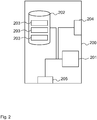
- Fig. 2 shows an embodiment of another apparatus 200.
- the apparatus 200 comprises a processor 201, a database 202 comprising a plurality of training sets 203, an input interface 204, and an output interface 205.
- the processor 201 is a CPU of a computer system.
- the input interface 204 is in functional communication with the database 202 and the processor 201.
- the input interface 204 is configured to receive a training set 203, and store the received training set 203 in the database 202.
- the output interface 205 may be connected to a display or a computer system and is configured to provide a model parameter.
- Fig. 3 shows an arrangement with a maritime vessel 300, in particular a ship.
- the maritime vessel 300 is moving within a maritime environment, e.g. on an ocean 301.
- the maritime vessel 300 comprises sensors 302.
- the sensors 302 are sensors to measure physical parameters of an environment of the maritime vessel 300.
- the sensors 302 are configured to measure or receive, e.g.
- a rudder angle of the maritime vessel 300 from an external device such as an AIS (Automatic Identification System), at least one of the following physical parameters: a rudder angle of the maritime vessel 300, a draft of the maritime vessel 300, a heading of the maritime vessel 300, a wind speed relative to the maritime vessel 300, a wind direction relative to the maritime vessel 300, a current speed relative to the maritime vessel 300, a current direction relative to the maritime vessel 300, a wave height around the maritime vessel 300, a wave period around the maritime vessel 300, a wave steepness around the maritime vessel 300, a wave spectrum around the maritime vessel 300, a water density around the maritime vessel 300, a water salinity around the maritime vessel 300, a water temperature around the maritime vessel 300, a wetted surface of the maritime vessel 300, a sea ice thickness around the maritime vessel 300, a sea ice concentration around the maritime vessel 300, a fouling intensity of a hull of the maritime vessel 300.
- AIS Automatic Identification System
- the sensors 302 may further measure a speed of the maritime vessel 300, in particular a speed over water of the maritime vessel 300.
- the sensors 302 may further measure an (actual) power consumption of the maritime vessel 300 to be used for training purposes, e.g. within training sets.
- a geometric parameter of a hull of the maritime vessel 300 as a physical parameter may be predetermined or may be provided to the apparatus 100 or the apparatus 200.
- the maritime vessel 300 may further comprise the apparatus 100.
- the apparatus 100 is in functional communication with the sensors 302 and/or external devices to receive identical or similar parameters.
- the input interface 101 of the apparatus 100 is configured to receive the physical parameters and/or the speed of the maritime vessel measured from the sensors 302. These parameters may also be received from an external device, e.g. an AIS system.
- the maritime vessel 300 may further comprise the apparatus 200.
- the apparatus 200 is in functional communication with the sensors 302.
- the input interface 204 is configured to receive training sets comprising a speed of the maritime vessel 300, a physical parameter of a maritime environment of the maritime vessel 300, and an (actual) power consumption of the maritime vessel 300, and to store the received training set in the database 202.
- the apparatus 100 and/or the apparatus 200 are arranged on-shore, and communicate with the respective sensors 302 of the maritime vessel 300 over a communication network, e.g. the Internet or a dedicated communication network.
- a communication network e.g. the Internet or a dedicated communication network.
- the model parameter can thus be updated and can be used for predicting the power consumption of the maritime vessel 300.
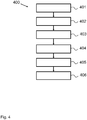
- Fig. 4 shows a schematic flow diagram 400 for a method according to an embodiment of the invention. The described method may be performed by the apparatus 100 on board of the maritime vessel 300.
- step 401 the speed of the maritime vessel 300 is received by the input interface 101.
- the speed of the maritime vessel 300 is measured by the sensors 302 of the maritime vessel 300 or received from an external device.
- the sensors 302 send the measured speed of the maritime vessel directly towards the input interface 101.
- the sensors 302 store the measured speed of the maritime vessel 300 in the memory 104 or another memory.
- the input interface 101 of the apparatus 100 can receive the speed value of the maritime vessel 300 by reading the stored value from the memory 104.
- the input interface 101 receives the physical parameter of the maritime environment of the maritime vessel 300.
- the physical parameter is measured by the sensors 302 of the maritime vessel 300 received from an external device, and is sent directly to the input interface 101 in the above-described way.
- the sensors 302 store the physical parameter in the memory 104 after the measurement or reception.
- the processor 102 determines a power consumption estimate.
- the power consumption estimate is based on the received speed of the maritime vessel 300 and the physical parameter of the maritime environment of the maritime vessel 300.
- the processor 102 uses a predetermined power consumption model.
- the predetermined power consumption model may be predefined.
- the predetermined power consumption model may also be updated according to a supervised or unsupervised machine-learning approach.
- the processor determines a power consumption correction.
- the power consumption correction is also based on the speed and the physical parameter.
- the processor uses for determining the power consumption correction a power consumption correction model.
- the power consumption correction model represents a modeling error of the predetermined power consumption model.
- the processor combines the determined power consumption estimate and the power consumption correction.
- the processor adds the power consumption estimate and the power consumption correction.
- the processor may alternatively subtract the power consumption correction from the power consumption estimate.
- other mathematical methods are used to combine the determined power consumption estimate and the power consumption correction.
- the output interface provides the predicted power consumption of the maritime vessel 300, e.g. to the memory 104.
- the predicted power consumption is output additionally or alternatively to a display or another computer system.
- Fig. 5 shows a schematic flow diagram 500 of a method according to another embodiment of the invention.
- the method is performed by the apparatus 200.
- the apparatus 200 may be allocated on board of a vessel, in particular in the maritime vessel 300, or on shore.
- the database 202 comprises a plurality of training sets 203.
- Each training set 203 comprises the speed of the maritime vessel 300 and a physical parameter of the maritime environment of the maritime vessel 300.
- each training set 203 comprises a wind speed relative to the maritime vessel 200 as a physical parameter.
- the physical parameter may be a vector comprising several single physical parameters.
- the training sets 203 comprise a plurality of physical parameters.
- the processor 201 is configured to read the training sets 203.
- the processor 201 determines in step 501 a power consumption estimate based on the respective speed and the physical parameter.
- the process 201 uses a predetermined power consumption model.
- the predetermined power consumption model in this embodiment correlates to the predetermined power consumption model described according to the method described with reference to Fig. 4 .
- Step 501 is repeated for each training set 203.
- the processor determines, for each training set 203, a difference between the determined power consumption estimate and the respective power consumption.
- the respective power consumption may have been measured during a previous voyage of the maritime vessel as a historical value and may serve as a reference to be compared with the determined power consumption estimate.
- step 503 the processor appends to each training set 203 the respective power consumption difference from the step 502. Therefore, the processor generates a respective appended training set.
- step 504 the processor trains the power consumption correction model on the basis of the plurality of appended training sets.
- a machine-learning approach e.g. based on a statistical regression, a neural network, an extreme gradient boosted tree, or a Kalman filter, may be used.
- Power prediction can be performed with empirical and semi-empirical methods according to the ITTC (International Towing Tank Conference) procedure aimed at meeting the IMO (International Maritime Organization) EEDI (Energy Efficiency Design Index) requirements.
- the total resistance here can be calculated as the sum of three terms: calm water resistance, wind added resistance and wave added resistance. Smaller terms that contribute to the resistance such as drifting, steering for course keeping, shallow water may not be considered as it is considered that their contribution may be very small and may be neglected.
- the required power is found and plotted to compare it to the actual propulsion taken from the data.
- the resistance of a ship at a given speed is the force needed to tow the ship at that speed through water.
- the total required resistance is the sum of more components, caused by different factors.
- the total resistance is broken down into three components:
- the calm water resistance is usually considered to be the sum of four components:
- the wave making resistance and the eddy resistance may often be considered together as residual resistance.
- the resistance and the required power for calm water are calculated following a specific method. The method can e.g. be based on the recommended procedures of ITTC '57, and the required power is found by regression analysis of model test results from different combinations of speed, draught and trim calibrated by full scale speed trials at delivery.
- the first part of eq. 2.3 accounts for the frictional coefficient, while the second part is an increment coefficient, also known as C A which accounts for the roughness of the hull computed according to Townsin's equation as reported by Watson.
- the residual power is founded on regression analysis of model test results from different combinations of speed, draught and trim calibrated by full scale speed trials at delivery.
- Fig. 2.1 shows the power prediction for calm water.
- the curves of P D and P R have been calculated through the regression analysis, while P F is calculated as shown in Eq. 2.1.
- the resistance also depends on the speed of the wind and its relative direction.
- the wind raises waves which are cause for further increase in resistance. The effects of waves are discussed later.
- true wind is intended to be the wind that exists independently from the ship's motion, and therefore, true wind equal to zero is still air.
- relative wind is the vectorial summation of the speed and the direction of the ship with the speed and direction of the true wind.
- the wind resistance coefficients derived by these tests shall be used to calculate the wind resistance of the ship.
- the wind resistance coefficients are based on the data derived from the performed model tests from the wind tunnel.
- the resulting required power for the wind for different wind directions is plotted in Fig. 2.2 .
- a relative wind speed in the range from 0 to 22 knots is shown, and the three wind directions are 0°, 45° and 90°.
- For 0° it is considered head wind.
- Fig. 2.2 it can be seen that the highest required power is for 0°, i.e. head wind, and it decreases as the angle becomes higher.
- the pattern of the curves is cubic, since the power has the term of the speed V 3 .
- the wind resistance coefficients have been calculated from the wind tunnel tests.
- the wave added resistance is defined as the mean force caused by the encountered waves.
- two methods for the evaluation of the added resistance due to waves are presented. The reason why two different methods are chosen is to see how well they perform in the end in the prediction of the power.
- the first method is the "Improved Formula for estimating Added resistance of Ships in Engineering applications" by Liu et al. and the second is a simplified method developed by Alexandersson.
- the method presented here to calculate added resistance is a further refined formula based on the semi-empirical formula introduced by the authors of "Fast approach to the estimation of the added resistance of ships in waves" by Liu and Papanikolaou.
- the formula is based on best fitting of available experimental data for different hull forms and is made to be easy to be used for engineering applications as it uses only the speed, the main characteristics of the ship and the wave environment as input. This paper lies within the framework of the IMO Marine Environment Protection Committee (MEPC).232(65) EEDI guidelines for estimating the minimum powering of ships in adverse weather conditions.
- the formula is suitable for both low and moderate speeds and thus it can be used in a procedure for determining the minimum power required in adverse conditions [Liu et al.].
- One of the limitations of this method is that it is to calculate the added resistance only for head waves.
- R AW R AWR + R AWM
- R AWR the added resistance in regular waves due to diffraction effect, caused from short waves
- R AWM the added resistance in regular waves due to motion effect, caused by long waves.
- Eq. 2.9 is a simplified expression using typical design data for a ship, based on the previous study of Liu et al. LE has been redefined as the distance from the forward perpendicular (F.P.) to the point where the ship breadth (beam) reaches 99%.
- R AW M 4 ⁇ g ⁇ ⁇ 2 B 2 / L pp ⁇ ⁇ b 1 exp b 1 d 1 1 ⁇ ⁇ ⁇ 1 d a 1 a 2
- a 1 and a 2 defined as shown in eq. 2.11 and 2.12 are the peak value factor and forward speed factor respectively.
- Alexandersson proposed a simplified method to calculate the wave added resistance based on the method proposed by Gerritsma and Beukelman's. Gerritsma and Beukelman's method considers the radiated energy to calculate the added resistance by utilizing strip theory and is calculated with eq.
- R AW ⁇ kcos ⁇ 2 2 ⁇ e ⁇ 0 L b ′ V Z b x b
- k is the wave number
- ⁇ is heading angle
- ⁇ e is encountered frequency
- L is the length of the waterline of the ship
- is the amplitude of the velocity of water relative to the strip
- b ' is the sectional damping coefficient for speed
- x b is the x coordinate on the ship.
- Gerritsma and Beukelman's method even though is one of the most widely used methods for calculating the added resistance, as it is regarded an accurate method for different ship types, results quite complex when calculating the ship's motions by strip theory and might result difficult or unnecessary for certain applications.
- Alexandersson proposed a simplified method by using Gerritsma and Beukelman's method. It was applied to a large series of case studies to determine the added resistance, then, by using linear regression, a series of simplified formulas were derived to determine the added resistance. This method is therefore considered semi-empirical.
- the limitations of this method are the following: the accuracy decreases in bow, beam, following waves, it only considers the added resistance from the ship motions and not considering the diffraction, and the trim of the ship is not included.
- Alexandersson has calculated all these parameters for 7 ships, and the ones most suitable for this study, are the ones for a Ro-Ro ship.
- Fig. 2.6 shows the curve for the added resistance with Alexandersson's method. The curve is commented in the following.
- JONSWAP Joint North Sea Wave Project
- the JONSWAP spectrum is valid for not fully developed sea states but it is also used to represent fully developed seas.
- the peakedness parameter y is generally 3.3, and it is also the value used here.
- Fig. 2.9 the three different components of the power can be seen.
- the calm water accounts for the highest contribution to the resistance as expected.
- the wave added power is computed here only for the improved formula by Liu et al., but later both methods are be computed.
- H s of 4 m is chosen, and a T p peak period of 7 s, just to provide an example.
- the first step consists in loading the raw data, which may be in the form of .csv (comma separeted values). Once the data is uploaded and interpreted the features and the target for creating the machine-learning models are selected. At this point, the subset of data that is selected is split between training set and test set data, that will serve to train and test the model created. The three selected models are at this point applied on the data and trained. The trained model is subsequently applied on the unseen test data, and the difference between the prediction and the actual data is computed.
- the aforementioned steps are explained in greater detail in the following sections.
- the sensors measure the fuel flow and temperature of the auxiliary engine, the electric power and the main engine fuel temperature and flow.
- the shaft power and torque, along with the RPM of the shaft and the electric power of the shaft generator are collected.
- the water temperature is measure, and also the rudder angle and the rate of turn of the rudder.
- the GPS tracker is positioned that measures the position of the ship, the speed over ground and the course of the ship.
- a gyroscope collects data regarding the heading of the ship and the roll and pitch motions.
- a motion sensor also records the six degrees of freedom (DOF) of the ship.
- DOF degrees of freedom
- anemometer records the wind speed and direction.
- the first step is to define what is expected to be predicted.
- the goal here is to predict the propulsive power when the ship is sailing in open sea, so the parts of voyage of the ship when it's maneuvering, accelerating and decelerating will not be considered.
- the data is divided by the voyages by port of arrival and port of departure.
- the target is the variable that is going to be predicted with the machine-learning, while for features, is meant the variables that form the data frame excluding the target and contribute to predict the selected target.
- a subset of the features may be chosen to build the model.
- various types of parameters can be chosen. Some of them are: hull performance, main engine performance, the ship's overall efficiency and fuel efficiency. Even though many variables may be available, the focus is on the performance of the hull.
- the variables, or features as called in machine-learning, that describe the performance of the hull are: the speed over ground, wind speed and direction, ship course and heading, draft forward and aft, rudder angle, and the motions of the ship.
- the target of a supervised machine-learning problem may be relevant for both the training and the testing as discussed in a following subsection.
- the data is split for the training of the model and the testing of the model. Since machine-learning works in a way that it learns properties of a data frame and then applying them to new data it is common to split the data in two sets. These two data sets are called: training set, which is used to learn the properties of the data, and test set, on which the learned properties may be tested.
- a random split of the data into training and test sets is computed according to Pedregosa et al.
- the splitting used is of 80 - 20, i.e. 80% of the data is used for training and 20% for testing. This may be a common split in machine-learning problems, but also not the only possible option.
- the models are applied on the training data. This way, the models learn the patterns of the data, the linearities and nonlinearities of the features depending on the model.
- the fit function of Pedregosa et al. is used to train the model. The theory on which the used models are based, is explained further below.
- the unseen test data is given to the trained model to predict a target variable, which in this case is the propulsion power.
- the test data therefore, that is given as input to the model, is uncoupled from the propulsion power.
- the model Once that the model has predicted the propulsive power, it is compared to the actual data of the propulsion to see how good or bad is the model at predicting.
- the approach of Pedregosa et al. uses a metrics module that has different functions to measure regression performance. For this case the R2 and the mean absolute error are used. Below a brief description of these metric functions is given.
- three different models may be used: one statistical and two further machine-learning models, making a so called hybrid analysis.
- linear regression can be used
- the machine-learning models can be the XGBoost, short for extreme gradient boosting, a model of ensemble trees, and multi-layer perceptron regression, part of neural network models. All of the aforementioned are regression models as the desired output is a continuous variable.
- the reason for using three models is to compare the results of a statistical model to more complex machine-learning models that take into account nonlinearities within data. Both XGBoost, and the multi-layer regression take into account non-linearities with different approaches.
Landscapes
- Engineering & Computer Science (AREA)
- Radar, Positioning & Navigation (AREA)
- Ocean & Marine Engineering (AREA)
- Mechanical Engineering (AREA)
- Combustion & Propulsion (AREA)
- Chemical & Material Sciences (AREA)
- Remote Sensing (AREA)
- Physics & Mathematics (AREA)
- Environmental & Geological Engineering (AREA)
- Environmental Sciences (AREA)
- Automation & Control Theory (AREA)
- Ecology (AREA)
- General Physics & Mathematics (AREA)
- Biodiversity & Conservation Biology (AREA)
- Atmospheric Sciences (AREA)
- Life Sciences & Earth Sciences (AREA)
- Probability & Statistics with Applications (AREA)
- Management, Administration, Business Operations System, And Electronic Commerce (AREA)
- Navigation (AREA)
- Power Sources (AREA)
Priority Applications (1)
| Application Number | Priority Date | Filing Date | Title |
|---|---|---|---|
| EP20194982.3A EP3825651A1 (de) | 2016-11-30 | 2017-11-30 | Vorrichtung zur vorhersage des stromverbrauchs eines seeschiffes |
Applications Claiming Priority (1)
| Application Number | Priority Date | Filing Date | Title |
|---|---|---|---|
| EP16201572.1A EP3330666A1 (de) | 2016-11-30 | 2016-11-30 | Kommunikationsvorrichtung zur anpassung einer aktuellen route eines schiffs |
Related Child Applications (1)
| Application Number | Title | Priority Date | Filing Date |
|---|---|---|---|
| EP20194982.3A Division EP3825651A1 (de) | 2016-11-30 | 2017-11-30 | Vorrichtung zur vorhersage des stromverbrauchs eines seeschiffes |
Publications (3)
| Publication Number | Publication Date |
|---|---|
| EP3330171A2 true EP3330171A2 (de) | 2018-06-06 |
| EP3330171A3 EP3330171A3 (de) | 2018-08-08 |
| EP3330171B1 EP3330171B1 (de) | 2020-09-09 |
Family
ID=57681220
Family Applications (4)
| Application Number | Title | Priority Date | Filing Date |
|---|---|---|---|
| EP16201572.1A Ceased EP3330666A1 (de) | 2016-11-30 | 2016-11-30 | Kommunikationsvorrichtung zur anpassung einer aktuellen route eines schiffs |
| EP17204814.2A Active EP3330171B1 (de) | 2016-11-30 | 2017-11-30 | Vorrichtung zur vorhersage des stromverbrauchs eines seeschiffes |
| EP17204810.0A Active EP3330747B1 (de) | 2016-11-30 | 2017-11-30 | Vorrichtung, methode und computerprogrammprodukt zur bereitstellung einer metocean-vorhersage |
| EP20194982.3A Withdrawn EP3825651A1 (de) | 2016-11-30 | 2017-11-30 | Vorrichtung zur vorhersage des stromverbrauchs eines seeschiffes |
Family Applications Before (1)
| Application Number | Title | Priority Date | Filing Date |
|---|---|---|---|
| EP16201572.1A Ceased EP3330666A1 (de) | 2016-11-30 | 2016-11-30 | Kommunikationsvorrichtung zur anpassung einer aktuellen route eines schiffs |
Family Applications After (2)
| Application Number | Title | Priority Date | Filing Date |
|---|---|---|---|
| EP17204810.0A Active EP3330747B1 (de) | 2016-11-30 | 2017-11-30 | Vorrichtung, methode und computerprogrammprodukt zur bereitstellung einer metocean-vorhersage |
| EP20194982.3A Withdrawn EP3825651A1 (de) | 2016-11-30 | 2017-11-30 | Vorrichtung zur vorhersage des stromverbrauchs eines seeschiffes |
Country Status (2)
| Country | Link |
|---|---|
| EP (4) | EP3330666A1 (de) |
| DK (1) | DK3330747T3 (de) |
Cited By (3)
| Publication number | Priority date | Publication date | Assignee | Title |
|---|---|---|---|---|
| CN108957451A (zh) * | 2018-07-19 | 2018-12-07 | 李熙 | 一种内陆架海区永久固定式数据网络平台的构建方法 |
| JP2020104699A (ja) * | 2018-12-27 | 2020-07-09 | 川崎重工業株式会社 | 船舶性能推定装置及び船舶性能推定プログラム |
| CN117910674A (zh) * | 2024-03-19 | 2024-04-19 | 平潭综合实验区智慧岛投资发展有限公司 | 一种基于机器学习的海上船舶指挥方法及系统 |
Families Citing this family (23)
| Publication number | Priority date | Publication date | Assignee | Title |
|---|---|---|---|---|
| US20200394744A1 (en) * | 2018-03-28 | 2020-12-17 | Agency For Science, Technology And Research | Method and system for predicting a port-stay duration of a vessel at a port |
| US10977605B2 (en) * | 2018-06-05 | 2021-04-13 | Signal Ocean Ltd | Carrier path prediction based on dynamic input data |
| WO2020131187A2 (en) * | 2018-09-26 | 2020-06-25 | Sofar Ocean Technologies, Inc. | Ocean weather forecasting system |
| SG11202107692WA (en) * | 2019-01-29 | 2021-08-30 | Alpha Ori Tech Pte Ltd | System and method for voyage consumption optimization |
| CN109947098A (zh) * | 2019-03-06 | 2019-06-28 | 天津理工大学 | 一种基于机器学习策略的距离优先最佳路径选择方法 |
| CN110887484B (zh) * | 2019-10-14 | 2022-12-27 | 重庆邮电大学 | 基于改进遗传算法的移动机器人路径规划方法及存储介质 |
| CN111709090B (zh) * | 2020-06-17 | 2023-04-07 | 上海船舶研究设计院(中国船舶工业集团公司第六0四研究院) | 模型构建方法、装置、电子设备及计算机可读存储介质 |
| CN112330482B (zh) * | 2020-10-23 | 2024-07-23 | 长沙理工大学 | 基于暂态信息融合的输电线路单端故障定位方法 |
| US12429628B2 (en) | 2020-12-01 | 2025-09-30 | International Business Machines Corporation | Fractional ice cover predictions with machine learning, satellite, thermodynamics, and in-situ observations |
| EP4122811A1 (de) * | 2021-07-23 | 2023-01-25 | Siemens Energy Global GmbH & Co. KG | Verfahren zur bereitstellung von informationen zur optimierten steuerung eines technischen systems |
| CN113553775B (zh) * | 2021-09-01 | 2022-03-08 | 交通运输部天津水运工程科学研究所 | 一种基于机器学习的港内码头系泊船舶运动量预报方法 |
| CN114910934B (zh) * | 2022-03-31 | 2023-02-07 | 北京卫星信息工程研究所 | 基于星载gnss-r/s一体化接收的海面矢量风场反演系统及方法 |
| CN115175247B (zh) * | 2022-06-24 | 2025-07-11 | 新诺北斗航科信息技术(厦门)股份有限公司 | Ais移动基站数据压缩算法及数据传输方法 |
| CN115268320B (zh) * | 2022-07-21 | 2024-10-18 | 西安热工研究院有限公司 | 一种智能控制算法模块的标准化封装方法 |
| CN115276913B (zh) * | 2022-09-29 | 2023-01-03 | 北京融为科技有限公司 | 一种星地激光通信的数据传输方法和设备 |
| US12571702B1 (en) | 2022-12-15 | 2026-03-10 | The United States Of America, As Represented By The Secretary Of The Navy | Apparatus and method for aerodynamic testing of moving ships |
| CN118225089B (zh) * | 2024-02-04 | 2026-03-10 | 北京全球气象导航技术有限公司 | 基于海浪状态分析的船舶航行线路规划方法及系统 |
| EP4644226A1 (de) * | 2024-04-30 | 2025-11-05 | Abb Schweiz Ag | Bewegungsplanung für ein wasserfahrzeug |
| CN118348810B (zh) * | 2024-05-28 | 2024-10-15 | 安华海洋智能装备(深圳)有限公司 | 用于海洋探测设备的优化方法、系统及探测设备 |
| NO20240745A1 (en) * | 2024-07-10 | 2026-01-12 | Kongsberg Maritime As | Controlling vessel operation |
| CN120215394B (zh) * | 2025-05-27 | 2025-07-29 | 中船赛思亿(无锡)电气科技有限公司 | 一种基于人工智能的自动船舶驾驶控制方法及系统 |
| CN121232879B (zh) * | 2025-12-01 | 2026-02-24 | 西安辰航卓越科技有限公司 | 一种空地一体化的无人机集群协同控制方法 |
| CN121384045B (zh) * | 2025-12-25 | 2026-03-06 | 武汉大学 | 融合ais航速反馈的极地航线动态规划系统、装置及介质 |
Family Cites Families (7)
| Publication number | Priority date | Publication date | Assignee | Title |
|---|---|---|---|---|
| GB0110153D0 (en) * | 2001-04-25 | 2001-06-20 | Isis Innovation | Improvements in or relating to forecasting |
| WO2006136157A1 (en) * | 2005-06-24 | 2006-12-28 | A.P. Møller - Mærsk A/S | Maritime information system |
| US20080255760A1 (en) * | 2007-04-16 | 2008-10-16 | Honeywell International, Inc. | Forecasting system |
| US8935174B2 (en) * | 2009-01-16 | 2015-01-13 | The Boeing Company | Analyzing voyage efficiencies |
| US9157746B2 (en) * | 2011-11-16 | 2015-10-13 | The Boeing Company | Vessel routing system |
| EP2669630A1 (de) * | 2012-06-01 | 2013-12-04 | ABB Technology AG | Verfahren und System zur Bestimmung eines Schiffweges |
| JP6038094B2 (ja) * | 2014-10-17 | 2016-12-07 | 三菱重工業株式会社 | 船舶の推進性能予測装置及びその方法並びに船舶の運航支援システム |
-
2016
- 2016-11-30 EP EP16201572.1A patent/EP3330666A1/de not_active Ceased
-
2017
- 2017-11-30 DK DK17204810T patent/DK3330747T3/da active
- 2017-11-30 EP EP17204814.2A patent/EP3330171B1/de active Active
- 2017-11-30 EP EP17204810.0A patent/EP3330747B1/de active Active
- 2017-11-30 EP EP20194982.3A patent/EP3825651A1/de not_active Withdrawn
Non-Patent Citations (1)
| Title |
|---|
| None |
Cited By (4)
| Publication number | Priority date | Publication date | Assignee | Title |
|---|---|---|---|---|
| CN108957451A (zh) * | 2018-07-19 | 2018-12-07 | 李熙 | 一种内陆架海区永久固定式数据网络平台的构建方法 |
| JP2020104699A (ja) * | 2018-12-27 | 2020-07-09 | 川崎重工業株式会社 | 船舶性能推定装置及び船舶性能推定プログラム |
| CN117910674A (zh) * | 2024-03-19 | 2024-04-19 | 平潭综合实验区智慧岛投资发展有限公司 | 一种基于机器学习的海上船舶指挥方法及系统 |
| CN117910674B (zh) * | 2024-03-19 | 2024-05-31 | 平潭综合实验区智慧岛投资发展有限公司 | 一种基于机器学习的海上船舶指挥方法及系统 |
Also Published As
| Publication number | Publication date |
|---|---|
| EP3330747A1 (de) | 2018-06-06 |
| EP3330666A1 (de) | 2018-06-06 |
| EP3330171A3 (de) | 2018-08-08 |
| EP3825651A1 (de) | 2021-05-26 |
| EP3330171B1 (de) | 2020-09-09 |
| EP3330747B1 (de) | 2019-08-07 |
| DK3330747T3 (da) | 2019-10-28 |
Similar Documents
| Publication | Publication Date | Title |
|---|---|---|
| EP3330171B1 (de) | Vorrichtung zur vorhersage des stromverbrauchs eines seeschiffes | |
| Perera et al. | Weather routing and safe ship handling in the future of shipping | |
| Tsujimoto et al. | Development of a calculation method for fuel consumption of ships in actual seas with performance evaluation | |
| Liu et al. | Rational processing of monitored ship voyage data for improved operation | |
| KR20200011125A (ko) | 환경 하중을 고려한 선박의 속도 증감량 도출 시스템 및 방법과, 동 방법을 컴퓨터에서 실행하기 위한 컴퓨터 프로그램이 기록된, 컴퓨터 판독 가능한 기록 매체 | |
| Tsujimoto et al. | Development of a ship performance simulator in actual seas | |
| Degiuli et al. | Experimental assessment of the hydrodynamic characteristics of a bulk carrier in off-design conditions | |
| Simić et al. | On energy efficiency of inland waterway self-propelled cargo vessels | |
| Degiuli et al. | Benchmark study on resistance and propulsion characteristics of a 6750-TEU container ship | |
| van den Boom et al. | Ship speed-power performance assessment | |
| KR102434772B1 (ko) | 선박의 시마진 도출 시스템 및 방법, 동 방법을 컴퓨터에서 실행하기 위한 컴퓨터 프로그램이 기록된, 컴퓨터 판독 가능한 기록 매체 | |
| Dhar et al. | Real-Time Ship Draft Measurement and Optimal Estimation Using Kalman Filter. | |
| HK1256375A1 (en) | Apparatus for predicting a power consumption of a maritime vessel | |
| HK1256375B (en) | Apparatus for predicting a power consumption of a maritime vessel | |
| Haranen et al. | The role of accurate now-cast data in shi p efficiency analysis | |
| Steen et al. | Model propulsion tests in head and following waves of a bulk carrier | |
| Ichinose et al. | Decrease of ship speed in actual seas of a bulk carrier in full load and ballast conditions-model test and onboard measurement | |
| Vettor et al. | The effect of wind loads on the attainable ship speed on seaways | |
| Day et al. | Measurement and prediction of the resistance of a laser sailing dinghy | |
| Kery et al. | On the creation of a safe operating envelope for ships | |
| Horel | Review of Existing Benchmarks and Databases for Sailing Vessels | |
| Sogihara et al. | Verification of calculation method on ship performance by onboard measurement | |
| Berg et al. | Manoeuvring Study--Norwegian Double-Ended Ferry. | |
| Skamagkas | An application of Delphi method on vessel performance monitoring & optimisation | |
| Zhang et al. | Experimental Research on Added Resistance of KVLCC2 in Short Wave Dominated Irregular Waves |
Legal Events
| Date | Code | Title | Description |
|---|---|---|---|
| PUAI | Public reference made under article 153(3) epc to a published international application that has entered the european phase |
Free format text: ORIGINAL CODE: 0009012 |
|
| STAA | Information on the status of an ep patent application or granted ep patent |
Free format text: STATUS: THE APPLICATION HAS BEEN PUBLISHED |
|
| AK | Designated contracting states |
Kind code of ref document: A2 Designated state(s): AL AT BE BG CH CY CZ DE DK EE ES FI FR GB GR HR HU IE IS IT LI LT LU LV MC MK MT NL NO PL PT RO RS SE SI SK SM TR |
|
| AX | Request for extension of the european patent |
Extension state: BA ME |
|
| PUAL | Search report despatched |
Free format text: ORIGINAL CODE: 0009013 |
|
| RIC1 | Information provided on ipc code assigned before grant |
Ipc: G01C 21/20 20060101ALI20180621BHEP Ipc: B63B 9/00 20060101ALI20180621BHEP Ipc: G01W 1/00 20060101ALI20180621BHEP Ipc: G01W 1/10 20060101ALI20180621BHEP Ipc: B63B 49/00 20060101AFI20180621BHEP |
|
| AK | Designated contracting states |
Kind code of ref document: A3 Designated state(s): AL AT BE BG CH CY CZ DE DK EE ES FI FR GB GR HR HU IE IS IT LI LT LU LV MC MK MT NL NO PL PT RO RS SE SI SK SM TR |
|
| AX | Request for extension of the european patent |
Extension state: BA ME |
|
| STAA | Information on the status of an ep patent application or granted ep patent |
Free format text: STATUS: REQUEST FOR EXAMINATION WAS MADE |
|
| 17P | Request for examination filed |
Effective date: 20181203 |
|
| RBV | Designated contracting states (corrected) |
Designated state(s): AL AT BE BG CH CY CZ DE DK EE ES FI FR GB GR HR HU IE IS IT LI LT LU LV MC MK MT NL NO PL PT RO RS SE SI SK SM TR |
|
| STAA | Information on the status of an ep patent application or granted ep patent |
Free format text: STATUS: EXAMINATION IS IN PROGRESS |
|
| 17Q | First examination report despatched |
Effective date: 20190128 |
|
| REG | Reference to a national code |
Ref country code: HK Ref legal event code: DE Ref document number: 1256375 Country of ref document: HK |
|
| REG | Reference to a national code |
Ref country code: DE Ref legal event code: R079 Ref document number: 602017023213 Country of ref document: DE Free format text: PREVIOUS MAIN CLASS: B63B0049000000 Ipc: G01C0021200000 |
|
| RIC1 | Information provided on ipc code assigned before grant |
Ipc: G01W 1/00 20060101ALI20200103BHEP Ipc: G01W 1/10 20060101ALI20200103BHEP Ipc: B63B 49/00 20060101ALI20200103BHEP Ipc: G01C 21/20 20060101AFI20200103BHEP |
|
| GRAP | Despatch of communication of intention to grant a patent |
Free format text: ORIGINAL CODE: EPIDOSNIGR1 |
|
| STAA | Information on the status of an ep patent application or granted ep patent |
Free format text: STATUS: GRANT OF PATENT IS INTENDED |
|
| RIN1 | Information on inventor provided before grant (corrected) |
Inventor name: MAO, WENGANG Inventor name: ANAGNOSTOPOULOS, ALEXIS Inventor name: DOKKEN, SVERRE |
|
| INTG | Intention to grant announced |
Effective date: 20200331 |
|
| GRAS | Grant fee paid |
Free format text: ORIGINAL CODE: EPIDOSNIGR3 |
|
| GRAA | (expected) grant |
Free format text: ORIGINAL CODE: 0009210 |
|
| STAA | Information on the status of an ep patent application or granted ep patent |
Free format text: STATUS: THE PATENT HAS BEEN GRANTED |
|
| AK | Designated contracting states |
Kind code of ref document: B1 Designated state(s): AL AT BE BG CH CY CZ DE DK EE ES FI FR GB GR HR HU IE IS IT LI LT LU LV MC MK MT NL NO PL PT RO RS SE SI SK SM TR |
|
| REG | Reference to a national code |
Ref country code: GB Ref legal event code: FG4D |
|
| REG | Reference to a national code |
Ref country code: AT Ref legal event code: REF Ref document number: 1312126 Country of ref document: AT Kind code of ref document: T Effective date: 20200915 Ref country code: CH Ref legal event code: EP |
|
| REG | Reference to a national code |
Ref country code: IE Ref legal event code: FG4D |
|
| REG | Reference to a national code |
Ref country code: DE Ref legal event code: R096 Ref document number: 602017023213 Country of ref document: DE |
|
| REG | Reference to a national code |
Ref country code: FI Ref legal event code: FGE |
|
| REG | Reference to a national code |
Ref country code: SE Ref legal event code: TRGR |
|
| REG | Reference to a national code |
Ref country code: LT Ref legal event code: MG4D |
|
| PG25 | Lapsed in a contracting state [announced via postgrant information from national office to epo] |
Ref country code: HR Free format text: LAPSE BECAUSE OF FAILURE TO SUBMIT A TRANSLATION OF THE DESCRIPTION OR TO PAY THE FEE WITHIN THE PRESCRIBED TIME-LIMIT Effective date: 20200909 Ref country code: GR Free format text: LAPSE BECAUSE OF FAILURE TO SUBMIT A TRANSLATION OF THE DESCRIPTION OR TO PAY THE FEE WITHIN THE PRESCRIBED TIME-LIMIT Effective date: 20201210 Ref country code: LT Free format text: LAPSE BECAUSE OF FAILURE TO SUBMIT A TRANSLATION OF THE DESCRIPTION OR TO PAY THE FEE WITHIN THE PRESCRIBED TIME-LIMIT Effective date: 20200909 Ref country code: BG Free format text: LAPSE BECAUSE OF FAILURE TO SUBMIT A TRANSLATION OF THE DESCRIPTION OR TO PAY THE FEE WITHIN THE PRESCRIBED TIME-LIMIT Effective date: 20201209 |
|
| REG | Reference to a national code |
Ref country code: NO Ref legal event code: T2 Effective date: 20200909 |
|
| REG | Reference to a national code |
Ref country code: AT Ref legal event code: MK05 Ref document number: 1312126 Country of ref document: AT Kind code of ref document: T Effective date: 20200909 |
|
| REG | Reference to a national code |
Ref country code: NL Ref legal event code: MP Effective date: 20200909 |
|
| PG25 | Lapsed in a contracting state [announced via postgrant information from national office to epo] |
Ref country code: LV Free format text: LAPSE BECAUSE OF FAILURE TO SUBMIT A TRANSLATION OF THE DESCRIPTION OR TO PAY THE FEE WITHIN THE PRESCRIBED TIME-LIMIT Effective date: 20200909 Ref country code: PL Free format text: LAPSE BECAUSE OF FAILURE TO SUBMIT A TRANSLATION OF THE DESCRIPTION OR TO PAY THE FEE WITHIN THE PRESCRIBED TIME-LIMIT Effective date: 20200909 Ref country code: RS Free format text: LAPSE BECAUSE OF FAILURE TO SUBMIT A TRANSLATION OF THE DESCRIPTION OR TO PAY THE FEE WITHIN THE PRESCRIBED TIME-LIMIT Effective date: 20200909 |
|
| PG25 | Lapsed in a contracting state [announced via postgrant information from national office to epo] |
Ref country code: EE Free format text: LAPSE BECAUSE OF FAILURE TO SUBMIT A TRANSLATION OF THE DESCRIPTION OR TO PAY THE FEE WITHIN THE PRESCRIBED TIME-LIMIT Effective date: 20200909 Ref country code: SM Free format text: LAPSE BECAUSE OF FAILURE TO SUBMIT A TRANSLATION OF THE DESCRIPTION OR TO PAY THE FEE WITHIN THE PRESCRIBED TIME-LIMIT Effective date: 20200909 Ref country code: RO Free format text: LAPSE BECAUSE OF FAILURE TO SUBMIT A TRANSLATION OF THE DESCRIPTION OR TO PAY THE FEE WITHIN THE PRESCRIBED TIME-LIMIT Effective date: 20200909 Ref country code: PT Free format text: LAPSE BECAUSE OF FAILURE TO SUBMIT A TRANSLATION OF THE DESCRIPTION OR TO PAY THE FEE WITHIN THE PRESCRIBED TIME-LIMIT Effective date: 20210111 Ref country code: CZ Free format text: LAPSE BECAUSE OF FAILURE TO SUBMIT A TRANSLATION OF THE DESCRIPTION OR TO PAY THE FEE WITHIN THE PRESCRIBED TIME-LIMIT Effective date: 20200909 |
|
| PG25 | Lapsed in a contracting state [announced via postgrant information from national office to epo] |
Ref country code: ES Free format text: LAPSE BECAUSE OF FAILURE TO SUBMIT A TRANSLATION OF THE DESCRIPTION OR TO PAY THE FEE WITHIN THE PRESCRIBED TIME-LIMIT Effective date: 20200909 Ref country code: AL Free format text: LAPSE BECAUSE OF FAILURE TO SUBMIT A TRANSLATION OF THE DESCRIPTION OR TO PAY THE FEE WITHIN THE PRESCRIBED TIME-LIMIT Effective date: 20200909 Ref country code: AT Free format text: LAPSE BECAUSE OF FAILURE TO SUBMIT A TRANSLATION OF THE DESCRIPTION OR TO PAY THE FEE WITHIN THE PRESCRIBED TIME-LIMIT Effective date: 20200909 Ref country code: IS Free format text: LAPSE BECAUSE OF FAILURE TO SUBMIT A TRANSLATION OF THE DESCRIPTION OR TO PAY THE FEE WITHIN THE PRESCRIBED TIME-LIMIT Effective date: 20210109 |
|
| REG | Reference to a national code |
Ref country code: DE Ref legal event code: R097 Ref document number: 602017023213 Country of ref document: DE |
|
| PG25 | Lapsed in a contracting state [announced via postgrant information from national office to epo] |
Ref country code: SK Free format text: LAPSE BECAUSE OF FAILURE TO SUBMIT A TRANSLATION OF THE DESCRIPTION OR TO PAY THE FEE WITHIN THE PRESCRIBED TIME-LIMIT Effective date: 20200909 Ref country code: MC Free format text: LAPSE BECAUSE OF FAILURE TO SUBMIT A TRANSLATION OF THE DESCRIPTION OR TO PAY THE FEE WITHIN THE PRESCRIBED TIME-LIMIT Effective date: 20200909 |
|
| REG | Reference to a national code |
Ref country code: CH Ref legal event code: PL |
|
| PLBE | No opposition filed within time limit |
Free format text: ORIGINAL CODE: 0009261 |
|
| STAA | Information on the status of an ep patent application or granted ep patent |
Free format text: STATUS: NO OPPOSITION FILED WITHIN TIME LIMIT |
|
| PG25 | Lapsed in a contracting state [announced via postgrant information from national office to epo] |
Ref country code: LU Free format text: LAPSE BECAUSE OF NON-PAYMENT OF DUE FEES Effective date: 20201130 |
|
| REG | Reference to a national code |
Ref country code: BE Ref legal event code: MM Effective date: 20201130 |
|
| 26N | No opposition filed |
Effective date: 20210610 |
|
| PG25 | Lapsed in a contracting state [announced via postgrant information from national office to epo] |
Ref country code: SI Free format text: LAPSE BECAUSE OF FAILURE TO SUBMIT A TRANSLATION OF THE DESCRIPTION OR TO PAY THE FEE WITHIN THE PRESCRIBED TIME-LIMIT Effective date: 20200909 Ref country code: LI Free format text: LAPSE BECAUSE OF NON-PAYMENT OF DUE FEES Effective date: 20201130 Ref country code: DK Free format text: LAPSE BECAUSE OF FAILURE TO SUBMIT A TRANSLATION OF THE DESCRIPTION OR TO PAY THE FEE WITHIN THE PRESCRIBED TIME-LIMIT Effective date: 20200909 Ref country code: CH Free format text: LAPSE BECAUSE OF NON-PAYMENT OF DUE FEES Effective date: 20201130 |
|
| REG | Reference to a national code |
Ref country code: IE Ref legal event code: MM4A |
|
| PG25 | Lapsed in a contracting state [announced via postgrant information from national office to epo] |
Ref country code: IE Free format text: LAPSE BECAUSE OF NON-PAYMENT OF DUE FEES Effective date: 20201130 Ref country code: IT Free format text: LAPSE BECAUSE OF FAILURE TO SUBMIT A TRANSLATION OF THE DESCRIPTION OR TO PAY THE FEE WITHIN THE PRESCRIBED TIME-LIMIT Effective date: 20200909 |
|
| PG25 | Lapsed in a contracting state [announced via postgrant information from national office to epo] |
Ref country code: TR Free format text: LAPSE BECAUSE OF FAILURE TO SUBMIT A TRANSLATION OF THE DESCRIPTION OR TO PAY THE FEE WITHIN THE PRESCRIBED TIME-LIMIT Effective date: 20200909 Ref country code: MT Free format text: LAPSE BECAUSE OF FAILURE TO SUBMIT A TRANSLATION OF THE DESCRIPTION OR TO PAY THE FEE WITHIN THE PRESCRIBED TIME-LIMIT Effective date: 20200909 Ref country code: CY Free format text: LAPSE BECAUSE OF FAILURE TO SUBMIT A TRANSLATION OF THE DESCRIPTION OR TO PAY THE FEE WITHIN THE PRESCRIBED TIME-LIMIT Effective date: 20200909 |
|
| PG25 | Lapsed in a contracting state [announced via postgrant information from national office to epo] |
Ref country code: MK Free format text: LAPSE BECAUSE OF FAILURE TO SUBMIT A TRANSLATION OF THE DESCRIPTION OR TO PAY THE FEE WITHIN THE PRESCRIBED TIME-LIMIT Effective date: 20200909 |
|
| PG25 | Lapsed in a contracting state [announced via postgrant information from national office to epo] |
Ref country code: BE Free format text: LAPSE BECAUSE OF NON-PAYMENT OF DUE FEES Effective date: 20201130 |
|
| P01 | Opt-out of the competence of the unified patent court (upc) registered |
Effective date: 20230515 |
|
| PG25 | Lapsed in a contracting state [announced via postgrant information from national office to epo] |
Ref country code: NL Free format text: LAPSE BECAUSE OF NON-PAYMENT OF DUE FEES Effective date: 20200923 |
|
| PGFP | Annual fee paid to national office [announced via postgrant information from national office to epo] |
Ref country code: DE Payment date: 20251128 Year of fee payment: 9 |
|
| PGFP | Annual fee paid to national office [announced via postgrant information from national office to epo] |
Ref country code: GB Payment date: 20251127 Year of fee payment: 9 |
|
| PGFP | Annual fee paid to national office [announced via postgrant information from national office to epo] |
Ref country code: NO Payment date: 20251128 Year of fee payment: 9 |
|
| PGFP | Annual fee paid to national office [announced via postgrant information from national office to epo] |
Ref country code: FI Payment date: 20251125 Year of fee payment: 9 |
|
| PGFP | Annual fee paid to national office [announced via postgrant information from national office to epo] |
Ref country code: FR Payment date: 20251125 Year of fee payment: 9 |
|
| PGFP | Annual fee paid to national office [announced via postgrant information from national office to epo] |
Ref country code: SE Payment date: 20251127 Year of fee payment: 9 |