EP3326632B1 - Combined anticancer drug sensitivity-determining marker - Google Patents
Combined anticancer drug sensitivity-determining marker Download PDFInfo
- Publication number
- EP3326632B1 EP3326632B1 EP17202053.9A EP17202053A EP3326632B1 EP 3326632 B1 EP3326632 B1 EP 3326632B1 EP 17202053 A EP17202053 A EP 17202053A EP 3326632 B1 EP3326632 B1 EP 3326632B1
- Authority
- EP
- European Patent Office
- Prior art keywords
- cancer agent
- cancer
- substance
- sensitivity
- level
- Prior art date
- Legal status (The legal status is an assumption and is not a legal conclusion. Google has not performed a legal analysis and makes no representation as to the accuracy of the status listed.)
- Active
Links
Images
Classifications
-
- G—PHYSICS
- G01—MEASURING; TESTING
- G01N—INVESTIGATING OR ANALYSING MATERIALS BY DETERMINING THEIR CHEMICAL OR PHYSICAL PROPERTIES
- G01N33/00—Investigating or analysing materials by specific methods not covered by groups G01N1/00 - G01N31/00
- G01N33/48—Biological material, e.g. blood, urine; Haemocytometers
- G01N33/50—Chemical analysis of biological material, e.g. blood, urine; Testing involving biospecific ligand binding methods; Immunological testing
- G01N33/53—Immunoassay; Biospecific binding assay; Materials therefor
- G01N33/574—Immunoassay; Biospecific binding assay; Materials therefor for cancer
- G01N33/57484—Immunoassay; Biospecific binding assay; Materials therefor for cancer involving compounds serving as markers for tumor, cancer, neoplasia, e.g. cellular determinants, receptors, heat shock/stress proteins, A-protein, oligosaccharides, metabolites
-
- A—HUMAN NECESSITIES
- A61—MEDICAL OR VETERINARY SCIENCE; HYGIENE
- A61K—PREPARATIONS FOR MEDICAL, DENTAL OR TOILETRY PURPOSES
- A61K31/00—Medicinal preparations containing organic active ingredients
- A61K31/28—Compounds containing heavy metals
- A61K31/282—Platinum compounds
-
- A—HUMAN NECESSITIES
- A61—MEDICAL OR VETERINARY SCIENCE; HYGIENE
- A61K—PREPARATIONS FOR MEDICAL, DENTAL OR TOILETRY PURPOSES
- A61K31/00—Medicinal preparations containing organic active ingredients
- A61K31/33—Heterocyclic compounds
- A61K31/395—Heterocyclic compounds having nitrogen as a ring hetero atom, e.g. guanethidine or rifamycins
- A61K31/495—Heterocyclic compounds having nitrogen as a ring hetero atom, e.g. guanethidine or rifamycins having six-membered rings with two or more nitrogen atoms as the only ring heteroatoms, e.g. piperazine or tetrazines
- A61K31/505—Pyrimidines; Hydrogenated pyrimidines, e.g. trimethoprim
- A61K31/513—Pyrimidines; Hydrogenated pyrimidines, e.g. trimethoprim having oxo groups directly attached to the heterocyclic ring, e.g. cytosine
-
- A—HUMAN NECESSITIES
- A61—MEDICAL OR VETERINARY SCIENCE; HYGIENE
- A61K—PREPARATIONS FOR MEDICAL, DENTAL OR TOILETRY PURPOSES
- A61K31/00—Medicinal preparations containing organic active ingredients
- A61K31/33—Heterocyclic compounds
- A61K31/555—Heterocyclic compounds containing heavy metals, e.g. hemin, hematin, melarsoprol
-
- A—HUMAN NECESSITIES
- A61—MEDICAL OR VETERINARY SCIENCE; HYGIENE
- A61K—PREPARATIONS FOR MEDICAL, DENTAL OR TOILETRY PURPOSES
- A61K45/00—Medicinal preparations containing active ingredients not provided for in groups A61K31/00 - A61K41/00
- A61K45/06—Mixtures of active ingredients without chemical characterisation, e.g. antiphlogistics and cardiaca
-
- A—HUMAN NECESSITIES
- A61—MEDICAL OR VETERINARY SCIENCE; HYGIENE
- A61K—PREPARATIONS FOR MEDICAL, DENTAL OR TOILETRY PURPOSES
- A61K47/00—Medicinal preparations characterised by the non-active ingredients used, e.g. carriers or inert additives; Targeting or modifying agents chemically bound to the active ingredient
- A61K47/06—Organic compounds, e.g. natural or synthetic hydrocarbons, polyolefins, mineral oil, petrolatum or ozokerite
- A61K47/16—Organic compounds, e.g. natural or synthetic hydrocarbons, polyolefins, mineral oil, petrolatum or ozokerite containing nitrogen, e.g. nitro-, nitroso-, azo-compounds, nitriles, cyanates
- A61K47/18—Amines; Amides; Ureas; Quaternary ammonium compounds; Amino acids; Oligopeptides having up to five amino acids
-
- A—HUMAN NECESSITIES
- A61—MEDICAL OR VETERINARY SCIENCE; HYGIENE
- A61K—PREPARATIONS FOR MEDICAL, DENTAL OR TOILETRY PURPOSES
- A61K47/00—Medicinal preparations characterised by the non-active ingredients used, e.g. carriers or inert additives; Targeting or modifying agents chemically bound to the active ingredient
- A61K47/06—Organic compounds, e.g. natural or synthetic hydrocarbons, polyolefins, mineral oil, petrolatum or ozokerite
- A61K47/26—Carbohydrates, e.g. sugar alcohols, amino sugars, nucleic acids, mono-, di- or oligo-saccharides; Derivatives thereof, e.g. polysorbates, sorbitan fatty acid esters or glycyrrhizin
-
- A—HUMAN NECESSITIES
- A61—MEDICAL OR VETERINARY SCIENCE; HYGIENE
- A61P—SPECIFIC THERAPEUTIC ACTIVITY OF CHEMICAL COMPOUNDS OR MEDICINAL PREPARATIONS
- A61P35/00—Antineoplastic agents
-
- A—HUMAN NECESSITIES
- A61—MEDICAL OR VETERINARY SCIENCE; HYGIENE
- A61P—SPECIFIC THERAPEUTIC ACTIVITY OF CHEMICAL COMPOUNDS OR MEDICINAL PREPARATIONS
- A61P43/00—Drugs for specific purposes, not provided for in groups A61P1/00-A61P41/00
-
- G—PHYSICS
- G01—MEASURING; TESTING
- G01N—INVESTIGATING OR ANALYSING MATERIALS BY DETERMINING THEIR CHEMICAL OR PHYSICAL PROPERTIES
- G01N33/00—Investigating or analysing materials by specific methods not covered by groups G01N1/00 - G01N31/00
- G01N33/48—Biological material, e.g. blood, urine; Haemocytometers
- G01N33/50—Chemical analysis of biological material, e.g. blood, urine; Testing involving biospecific ligand binding methods; Immunological testing
- G01N33/53—Immunoassay; Biospecific binding assay; Materials therefor
- G01N33/574—Immunoassay; Biospecific binding assay; Materials therefor for cancer
-
- G—PHYSICS
- G01—MEASURING; TESTING
- G01N—INVESTIGATING OR ANALYSING MATERIALS BY DETERMINING THEIR CHEMICAL OR PHYSICAL PROPERTIES
- G01N33/00—Investigating or analysing materials by specific methods not covered by groups G01N1/00 - G01N31/00
- G01N33/48—Biological material, e.g. blood, urine; Haemocytometers
- G01N33/50—Chemical analysis of biological material, e.g. blood, urine; Testing involving biospecific ligand binding methods; Immunological testing
- G01N33/68—Chemical analysis of biological material, e.g. blood, urine; Testing involving biospecific ligand binding methods; Immunological testing involving proteins, peptides or amino acids
- G01N33/6803—General methods of protein analysis not limited to specific proteins or families of proteins
- G01N33/6806—Determination of free amino acids
-
- G—PHYSICS
- G01—MEASURING; TESTING
- G01N—INVESTIGATING OR ANALYSING MATERIALS BY DETERMINING THEIR CHEMICAL OR PHYSICAL PROPERTIES
- G01N33/00—Investigating or analysing materials by specific methods not covered by groups G01N1/00 - G01N31/00
- G01N33/48—Biological material, e.g. blood, urine; Haemocytometers
- G01N33/50—Chemical analysis of biological material, e.g. blood, urine; Testing involving biospecific ligand binding methods; Immunological testing
- G01N33/68—Chemical analysis of biological material, e.g. blood, urine; Testing involving biospecific ligand binding methods; Immunological testing involving proteins, peptides or amino acids
- G01N33/6803—General methods of protein analysis not limited to specific proteins or families of proteins
- G01N33/6848—Methods of protein analysis involving mass spectrometry
-
- G—PHYSICS
- G01—MEASURING; TESTING
- G01N—INVESTIGATING OR ANALYSING MATERIALS BY DETERMINING THEIR CHEMICAL OR PHYSICAL PROPERTIES
- G01N2560/00—Chemical aspects of mass spectrometric analysis of biological material
-
- G—PHYSICS
- G01—MEASURING; TESTING
- G01N—INVESTIGATING OR ANALYSING MATERIALS BY DETERMINING THEIR CHEMICAL OR PHYSICAL PROPERTIES
- G01N2570/00—Omics, e.g. proteomics, glycomics or lipidomics; Methods of analysis focusing on the entire complement of classes of biological molecules or subsets thereof, i.e. focusing on proteomes, glycomes or lipidomes
-
- G—PHYSICS
- G01—MEASURING; TESTING
- G01N—INVESTIGATING OR ANALYSING MATERIALS BY DETERMINING THEIR CHEMICAL OR PHYSICAL PROPERTIES
- G01N2800/00—Detection or diagnosis of diseases
- G01N2800/52—Predicting or monitoring the response to treatment, e.g. for selection of therapy based on assay results in personalised medicine; Prognosis
-
- Y—GENERAL TAGGING OF NEW TECHNOLOGICAL DEVELOPMENTS; GENERAL TAGGING OF CROSS-SECTIONAL TECHNOLOGIES SPANNING OVER SEVERAL SECTIONS OF THE IPC; TECHNICAL SUBJECTS COVERED BY FORMER USPC CROSS-REFERENCE ART COLLECTIONS [XRACs] AND DIGESTS
- Y10—TECHNICAL SUBJECTS COVERED BY FORMER USPC
- Y10T—TECHNICAL SUBJECTS COVERED BY FORMER US CLASSIFICATION
- Y10T436/00—Chemistry: analytical and immunological testing
- Y10T436/14—Heterocyclic carbon compound [i.e., O, S, N, Se, Te, as only ring hetero atom]
- Y10T436/142222—Hetero-O [e.g., ascorbic acid, etc.]
- Y10T436/143333—Saccharide [e.g., DNA, etc.]
-
- Y—GENERAL TAGGING OF NEW TECHNOLOGICAL DEVELOPMENTS; GENERAL TAGGING OF CROSS-SECTIONAL TECHNOLOGIES SPANNING OVER SEVERAL SECTIONS OF THE IPC; TECHNICAL SUBJECTS COVERED BY FORMER USPC CROSS-REFERENCE ART COLLECTIONS [XRACs] AND DIGESTS
- Y10—TECHNICAL SUBJECTS COVERED BY FORMER USPC
- Y10T—TECHNICAL SUBJECTS COVERED BY FORMER US CLASSIFICATION
- Y10T436/00—Chemistry: analytical and immunological testing
- Y10T436/14—Heterocyclic carbon compound [i.e., O, S, N, Se, Te, as only ring hetero atom]
- Y10T436/145555—Hetero-N
- Y10T436/147777—Plural nitrogen in the same ring [e.g., barbituates, creatinine, etc.]
-
- Y—GENERAL TAGGING OF NEW TECHNOLOGICAL DEVELOPMENTS; GENERAL TAGGING OF CROSS-SECTIONAL TECHNOLOGIES SPANNING OVER SEVERAL SECTIONS OF THE IPC; TECHNICAL SUBJECTS COVERED BY FORMER USPC CROSS-REFERENCE ART COLLECTIONS [XRACs] AND DIGESTS
- Y10—TECHNICAL SUBJECTS COVERED BY FORMER USPC
- Y10T—TECHNICAL SUBJECTS COVERED BY FORMER US CLASSIFICATION
- Y10T436/00—Chemistry: analytical and immunological testing
- Y10T436/16—Phosphorus containing
- Y10T436/163333—Organic [e.g., chemical warfare agents, insecticides, etc.]
-
- Y—GENERAL TAGGING OF NEW TECHNOLOGICAL DEVELOPMENTS; GENERAL TAGGING OF CROSS-SECTIONAL TECHNOLOGIES SPANNING OVER SEVERAL SECTIONS OF THE IPC; TECHNICAL SUBJECTS COVERED BY FORMER USPC CROSS-REFERENCE ART COLLECTIONS [XRACs] AND DIGESTS
- Y10—TECHNICAL SUBJECTS COVERED BY FORMER USPC
- Y10T—TECHNICAL SUBJECTS COVERED BY FORMER US CLASSIFICATION
- Y10T436/00—Chemistry: analytical and immunological testing
- Y10T436/17—Nitrogen containing
- Y10T436/173845—Amine and quaternary ammonium
-
- Y—GENERAL TAGGING OF NEW TECHNOLOGICAL DEVELOPMENTS; GENERAL TAGGING OF CROSS-SECTIONAL TECHNOLOGIES SPANNING OVER SEVERAL SECTIONS OF THE IPC; TECHNICAL SUBJECTS COVERED BY FORMER USPC CROSS-REFERENCE ART COLLECTIONS [XRACs] AND DIGESTS
- Y10—TECHNICAL SUBJECTS COVERED BY FORMER USPC
- Y10T—TECHNICAL SUBJECTS COVERED BY FORMER US CLASSIFICATION
- Y10T436/00—Chemistry: analytical and immunological testing
- Y10T436/20—Oxygen containing
- Y10T436/200833—Carbonyl, ether, aldehyde or ketone containing
- Y10T436/201666—Carboxylic acid
Definitions
- the present invention relates to a marker for use in determination of the sensitivity of a cancer patient to an anti-cancer agent to be administered thereto, which marker can determine whether or not the cancer of the patient has a therapeutic response to the anti-cancer agent, and to application of the marker.
- Anti-cancer agents have various types such as an alkylating agent, a platinum agent, an antimetabolite, an antitumor antibiotic, and an antitumor plant alkaloid. These anti-cancer agents are effective for some cancers but not effective for other cancers. Even when an anti-cancer agent has been confirmed to be effective for a certain cancer, the anti-cancer agent is effective for some patients and not effective for other patients, leading to interindividual differences. Whether or not a cancer of a specific patient has response to an anti-cancer agent is designated as sensitivity to the anti-cancer agent.
- Oxaliplatin is a platinum-based complex anti-cancer agent. Similar to cisplatin (CDDP) and carboplatin (CBDCA), which are other platinum-based complex anti-cancer agents, the action mechanism thereof is thought to be based on inhibition of DNA synthesis or protein synthesis via cross-linking with DNA bases. L-OHP exhibits anti-tumor effect on colorectal cancer, to which CDDP or CBDCA is ineffective, and shows different spectrum of anti-tumor activity from that of a precedent platinum-based complex anti-cancer agent.
- CDDP cisplatin
- CBDCA carboplatin
- L-OHP for use in combination with fluorouracil (5-FU)/levofolinate (LV) was approved as a first line therapy for metastatic colorectal cancer in January, 2004.
- L-OHP was listed in the National Health Insurance price list in the case of combination use thereof with continuous infusional LV and 5-FU (FOLFOX4 regimen) for "advanced/recurrent colorectal cancer not amenable to curative surgical resection" in April, 2005.
- 5-FU/LV regimen to advanced/recurrent colorectal cancer has provided a survival of 10 to 12 months.
- L-OHP is a promising drug having an efficacy in an increased number of colorectal cancer patients.
- 5-FU is a fluoro-pyrimidine anti-cancer agent developed in 1957 and even now serves as a basic drug for use in the chemotherapy of gastrointestinal cancer.
- 5-FU exerts cytotoxic effect through a principle action mechanism of DNA synthesis inhibition induced by inhibition of thymidylate synthase (TS) by an active metabolite, fluorodeoxyuridine-5'-monophosphate (FdUMP), and another mechanism of RNA function inhibition by another active metabolite, 5-fluorouridine triphosphate (FUTP).
- TS thymidylate synthase
- FdUMP fluorodeoxyuridine-5'-monophosphate
- FUTP 5-fluorouridine triphosphate
- the therapy schedule of cancer chemotherapy requires a long period of time. After repetition of several courses of chemotherapy while emergence of adverse events is monitored, attainment of a therapeutic effect and continuation of the therapy are assessed. The assessment requires a long period of time and high medical cost, and the adverse events have actually been observed to a certain degree. Thus, if there were means for predicting whether or not individual patients can receive the effect of chemotherapy before or in an early stage of the therapy, the burden of the patients and emergence of adverse events can be reduced or mitigated, leading to reduction in medical cost.
- Non-Patent Document 1 Large-scale prospective clinical trial (FOCUS trial) for investigating biomarkers that predict therapeutic response of advanced colorectal cancer patients to chemotherapy has revealed that only topoisomerase-1 (Topo1) exhibits weak relationship with the 5-FU/L-OHP combination therapy as an effect predicting factor. This indicates that there has been established no technique that can reliably select a patient who is expected to be effectively treated through the 5-FU/L-OHP combination therapy. Therefore, there is keen demand for establishment of a biomarker that can predict the effect of the FOLFOX regimen employing a triplet combination of L-OHP/5-FU/LV or that can diagnose the therapeutic response to the FOLFOX regimen in an early stage.
- Non-Patent Document 1 J. Clin. Oncol. 26, 2690-2698 (2008 )
- An object of the present invention is to provide an anti-cancer agent sensitivity determination marker, which the marker can determine whether or not the patient has a therapeutic response to the anti-cancer agent.
- the present inventors have searched for an anti-cancer agent sensitivity determination marker by culturing human cancer cells, and comprehensively analyzing the intracellular metabolism behavior after exposure to 5-FU/L-OHP by means of a capillary electrophoresis time-of-flight mass spectrometer (CE-TOFMS).
- CE-TOFMS capillary electrophoresis time-of-flight mass spectrometer
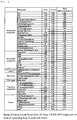
- peaks attributed to substances which exhibit, after exposure to 5-FU/L-OHP, a considerable rise in intracellular level in 5-FU/L-OHP-high-sensitivity cells the peaks being amino-acid-metabolism-related substances (Asp, Gly, Arg, N-acetyl- ⁇ -alanine, N-acetylornithine, cadaverine, cysteic acid, 2-aminoadipic acid, GABA (y-aminobutyric acid), ⁇ -Glu-Cys, ⁇ -Ala-Lys, Glu-Glu, and S-lactoylglutathione), nucleic-acid-metabolism-related substances (guanosine, CMP, UMP, 1-methyladenosine, UDP, and CTP), a substance in the pentose phosphate pathway (sedoheptulose 7-phosphate), a substance in the glycolytic pathway (dihydroxyacetone phosphate, 2,3
- peaks attributed to substances which exhibit, after exposure to 5-FU/L-OHP, a considerable rise in intracellular level in 5-FU/L-OHP-low-sensitivity cells the peaks being amino-acid-metabolism-related substances (N,N-dimethylglycine, 3-methylhistidine, N 5 -ethylglutamine, and glutathione), a nucleic-acid-metabolism-related substance (dATP), butyric acid, triethanolamine, and 1-methylnicotinamide.
- amino-acid-metabolism-related substances N,N-dimethylglycine, 3-methylhistidine, N 5 -ethylglutamine, and glutathione
- dATP nucleic-acid-metabolism-related substance
- butyric acid triethanolamine
- 1-methylnicotinamide 1-methylnicotinamide
- the inventors have found peaks attributed to a substance which exhibits, after exposure to 5-FU/L-OHP, a considerable drop in intracellular level in 5-FU/L-OHP-high-sensitivity cells, the peak being an amino-acid-metabolism-related substance (cysteine-glutathione), a nucleic-acid-metabolism-related substance (adenine), and a substance in the pentose phosphate pathway (PRPP). Also, the inventors have found peaks attributed to a substance which exhibits, after exposure to 5-FU/L-OHP, a considerable drop in intracellular level in 5-FU/L-OHP-low-sensitivity cells, the peak being NADH and NAD + . The inventors have also found that intracellular GABA level before the treatment with the drug is higher in low-sensitivity cells than in high-sensitivity cells.
- the present inventors have comprehensively analyzed, by means of a CE-TOFMS, blood metabolites in blood samples of colorectal cancer patients. As a result, the inventors have found that a high blood GABA level is observed in patients who have poor therapeutic response to the mFOLFOX6-bevacizumab combination therapy.
- a cancer of a target cancer patient has a sensitivity to an anti-cancer agent can be determined through measuring, as an index, the levels of any of the metabolites contained in a bio-sample derived from the cancer patient; that screening of an anti-cancer agent sensitivity enhancer can be accomplished through employment of the levels (or variation in level) as an index; and that the therapeutic effect of the relevant anti-cancer agent can be drastically enhanced by use, in combination, of the anti-cancer agent sensitivity enhancer and the anti-cancer agent which is a sensitivity enhancement target of the enhancer.
- the present invention has been accomplished on the basis of these findings.
- the present invention relates to the subject matter of claims 1 to 5. Accordingly, the present invention provides the use of a marker for determining sensitivity to an anti-cancer agent, the anti-cancer agent including oxaliplatin or a salt thereof and fluorouracil or a salt thereof, said marker being or comprising cysteine-glutathione.
- the present invention also provides an in vitro method for determining sensitivity of a subject to an anti-cancer agent, the anti-cancer agent including oxaliplatin or a salt thereof and fluorouracil or a salt thereof, according to claim 2.
- the present invention also provides a use of a kit for carrying out the in vitro determination method as recited in claim 2 for determining sensitivity of a specimen to an anti-cancer agent according to claim 3.
- the present invention also provides an anti-cancer agent sensitivity enhancer screening method according to claim 4 and the respective use of claim 5.
- the therapeutic response of a patient to an anti-cancer agent can be correctly appropriately determined before the therapy or in an early stage after start of the therapy.
- an anti-cancer agent having higher therapeutic effect can be selected, and progression of cancer and aggravation of side effects, which would otherwise result from continuous administration of an anti-cancer agent exerting no expected therapeutic effect, can be prevented.
- reductions can be expected in suffering of the patient and medical cost.
- a drug which can promote anti-cancer agent sensitivity can be selected through screening.
- the assay reagent containing the anti-cancer agent sensitivity determination marker is useful as an anti-cancer agent sensitivity determination reagent.
- the anti-cancer agent sensitivity determination marker used in the present invention is or comprises a substance involved in amino acid metabolism (also called an amino-acid-metabolism-related substance), namely cysteine-glutathione. Further described herein are substances that can vary the amino-acid-metabolism-related substance level in a metabolic system. Examples of such metabolism-related substances include a substance which promotes metabolism to the amino-acid-metabolism-related substance, a substance which inhibits metabolism to the amino-acid-metabolism-related substance, a substance which promotes metabolism from the amino-acid-metabolism-related substance, and a substance which inhibits metabolism from the amino-acid-metabolism-related substance.
- the anti-cancer agent sensitivity determination marker as described herein may also comprise a substance involved in nucleic acid metabolism (also called a nucleic-acid-metabolism-related substance).
- the substance encompasses all the substances that can vary the nucleic-acid-metabolism-related substance level.
- metabolism-related substances include a substance which promotes metabolism to the nucleic-acid-metabolism-related substance, a substance which inhibits metabolism to the nucleic-acid-metabolism-related substance, a substance which promotes metabolism from the nucleic-acid-metabolism-related substance, and a substance which inhibits metabolism from the nucleic-acid-metabolism-related substance.
- guanosine, CMP, UMP, 1-methyladenosine, UDP, CTP, dATP, and adenine are preferred, with guanosine, UMP, UDP, and CTP being particularly relevant.
- the anti-cancer agent sensitivity determination marker as described herein may also comprise a substance involved in the pentose phosphate pathway (also called a substance in the pentose phosphate pathway).
- the substance encompasses all the substances that can vary the substance in the pentose phosphate pathway level. Examples of such substances include a substance which promotes metabolism to a substance in the pentose phosphate pathway, a substance which inhibits metabolism to a substance in the pentose phosphate pathway, a substance which promotes metabolism from a substance in the pentose phosphate pathway, and a substance which inhibits metabolism from a substance in the pentose phosphate pathway. Of these, sedoheptulose 7-phosphate and PRPP are particularly relevant.
- the anti-cancer agent sensitivity determination marker as described herein may also comprise a substance involved in glycolytic pathway (also called a substance in the glycolytic pathway).
- the substance encompasses all the substances that can vary the substance in the glycolytic pathway level. Examples of such substances include a substance which promotes metabolism to a substance in the glycolytic pathway, a substance which inhibits metabolism to a substance in the glycolytic pathway, a substance which promotes metabolism from a substance in the glycolytic pathway, and a substance which inhibits metabolism from a substance in the glycolytic pathway.
- dihydroxyacetone phosphate, 2,3-diphosphoglyceric acid, and pyruvic acid are preferred, with dihydroxyacetone phosphate being particularly relevant.
- the anti-cancer agent sensitivity determination marker as described herein may also comprise a substance involved in TCA cycle (also called a substance in the TCA cycle).
- the substance encompasses all the substances that can vary the substance in the TCA cycle level. Examples of such substances include a substance which promotes metabolism to a substance in the TCA cycle, a substance which inhibits metabolism to a substance in the TCA cycle, a substance which promotes metabolism from a substance in the TCA cycle, and a substance which inhibits metabolism from a substance in the TCA cycle. Of these, malic acid is particularly relevant.
- the anti-cancer agent sensitivity determination marker as described herein may also comprise a substance involved in polyamine metabolism (also called a polyamine-metabolism-related substance).
- the substance encompasses all the substances that can vary the polyamine-metabolism-related substance level.
- metabolism-related substances include a substance which promotes metabolism to a polyamine-metabolism-related substance, a substance which inhibits metabolism to a polyamine-metabolism-related substance, a substance which promotes metabolism from a polyamine-metabolism-related substance, and a substance which inhibits metabolism from a polyamine-metabolism-related substance.
- N 1 -acetylspermine, N-acetylputrescine, N 8 -acetylspermidine, putrescine, spermine, and spermidine are particularly relevant.
- the anti-cancer agent sensitivity determination marker as described herein may also comprise 7,8-dihydrobiopterin or a substance involved in 7,8-dihydrobiopterin metabolism (also called a 7,8-dihydrobiopterin-metabolism-related substance).
- the substance encompasses 7,8-dihydrobiopterin and all the substances that can vary the 7,8-dihydrobiopterin level in the metabolism thereof.
- metabolism-related substances include a substance which promotes metabolism to 7,8-dihydrobiopterin, a substance which inhibits metabolism to 7,8-dihydrobiopterin, a substance which promotes metabolism from 7,8-dihydrobiopterin, and a substance which inhibits metabolism from 7,8-dihydrobiopterin. Of these, 7,8-dihydrobiopterin is particularly relevant.
- the anti-cancer agent sensitivity determination marker as described herein may also comprise 6-phosphogluconic acid or a substance involved in 6-phosphogluconic acid metabolism (also called a 6-phosphogluconic-acid-metabolism-related substance).
- the substance encompasses 6-phosphogluconic acid and all the substances that can vary the 6-phosphogluconic acid level in the metabolism thereof.
- metabolism-related substances include a substance which promotes metabolism to 6-phosphogluconic acid, a substance which inhibits metabolism to 6-phosphogluconic acid, a substance which promotes metabolism from 6-phosphogluconic acid, and a substance which inhibits metabolism from 6-phosphogluconic acid. Of these, 6-phosphogluconic acid is particularly relevant.
- the anti-cancer agent sensitivity determination marker as described herein may also comprise butyric acid or a substance involved in butyric acid metabolism (also called a butyric-acid-metabolism-related substance).
- the substance encompasses butyric acid and all the substances that can vary the butyric acid level in the metabolism thereof.
- metabolism-related substances include a substance which promotes metabolism to butyric acid, a substance which inhibits metabolism to butyric acid, a substance which promotes metabolism from butyric acid, and a substance which inhibits metabolism from butyric acid. Of these, butyric acid is particularly relevant.
- the anti-cancer agent sensitivity determination marker as described herein may also comprise triethanolamine or a substance involved in triethanolamine metabolism (also called a triethanolamine-metabolism-related substance).
- the substance encompasses triethanolamine and all the substances that can vary the triethanolamine level in the metabolism thereof.
- metabolism-related substances include a substance which promotes metabolism to triethanolamine, a substance which inhibits metabolism to triethanolamine, a substance which promotes metabolism from triethanolamine, and a substance which inhibits metabolism from triethanolamine. Of these, triethanolamine is particularly relevant.
- the anti-cancer agent sensitivity determination marker as described herein may also comprise 1-methylnicotinamide or a substance involved in 1-methylnicotinamide metabolism (also called a 1-methylnicotinamide-metabolism-related substance).
- the substance encompasses 1-methylnicotinamide and all the substances that can vary the 1-methylnicotinamide level in the metabolism thereof.
- metabolism-related substances include a substance which promotes metabolism to 1-methylnicotinamide, a substance which inhibits metabolism to 1-methylnicotinamide, a substance which promotes metabolism from 1-methylnicotinamide, and a substance which inhibits metabolism from 1-methylnicotinamide. Of these, 1-methylnicotinamide is particularly relevant.
- the anti-cancer agent sensitivity determination marker as described herein may also comprise NADH or a substance involved in NADH metabolism (also called an NADH-metabolism-related substance).
- the substance encompasses NADH and all the substances that can vary the NADH level in the metabolism thereof.
- metabolism-related substances include a substance which promotes metabolism to NADH, a substance which inhibits metabolism to NADH, a substance which promotes metabolism from NADH, and a substance which inhibits metabolism from NADH. Of these, NADH is particularly relevant.
- the anti-cancer agent sensitivity determination marker as described herein may also comprise NAD + or a substance involved in NAD + metabolism (also called an NAD + -metabolism-related substance).
- the substance encompasses NAD + and all the substances that can vary the NAD + level in the metabolism thereof.
- metabolism-related substances include a substance which promotes metabolism to NAD + , a substance which inhibits metabolism to NAD + , a substance which promotes metabolism from NAD + , and a substance which inhibits metabolism from NAD + . Of these, NAD + is particularly relevant.
- anti-cancer agent sensitivity determination markers Asp, N,N-dimethylglycine, ⁇ -Glu-Cys, glutathione, GABA, 1-methyladenosine, spermine, spermidine, 7,8-dihydrobiopterin, and 1-methylnicotinamide were previously confirmed, by the present inventors, to serve as markers that can determine sensitivity of a cancer patient to irinotecan or SN-38.
- the present inventors have newly found that these compounds can serve as markers that can determine sensitivity of a cancer patient to anti-cancer agents including 5-FU and L-OHP.
- DLD-1 cells which are low sensitivity cells
- these substances exhibited an intracellular level variation that was not so considerable, as compared with the case of HCT116 cells, or exhibited a drop in intracellular level as compared with a control group. Therefore, these substances are useful as markers for determining sensitivity of a cancer patient to an anti-cancer agent including 5-FU and L-OHP.
- N,N-dimethylglycine, 3-methylhistidine, N 5 -ethylglutamine, glutathione, dATP, butyric acid, triethanolamine, and 1-methylnicotinamide exhibited a considerable intracellular level increase in DLD-1 cells, which are low sensitivity cells, after exposure to 5-FU/L-OHP.
- DLD-1 cells which are low sensitivity cells
- HCT116 cells which are high sensitivity cells
- these substances exhibited an intracellular level variation that was not so considerable, as compared with the case of DLD-1 cells, or exhibited a drop in intracellular level as compared with a control group. Therefore, these substances are useful as markers for determining sensitivity of a cancer patient to an anti-cancer agent including 5-FU and L-OHP.
- cysteine-glutathione, adenine, and PRPP exhibited a considerable intracellular level drop in HCT116 cells, which are high sensitivity cells, after exposure to 5-FU/L-OHP.
- DLD-1 cells which are low sensitivity cells
- these substances exhibited an intracellular level variation that was not so considerable, as compared with the case of HCT116 cells, or exhibited an intracellular level increase, as compared with a control group. Therefore, these substances are useful as markers for determining sensitivity of a cancer patient to an anti-cancer agent including 5-FU and L-OHP.
- NADH and NAD + exhibited a considerable intracellular level drop in DLD-1 cells, which are low sensitivity cells, after exposure to 5-FU/L-OHP.
- HCT116 cells which are high sensitivity cells
- these substances exhibited an intracellular level variation that was not so considerable, as compared with the case of DLD-1 cells. Therefore, these substances are useful as markers for determining sensitivity of a cancer patient to an anti-cancer agent including 5-FU and L-OHP.
- GABA exhibited a considerable intracellular level increase in HCT116 cells, which are high sensitivity cells, after exposure to 5-FU/L-OHP.
- DLD-1 cells which are low sensitivity cells
- GABA exhibited an intracellular level variation that was not so considerable, as compared with the case of HCT116 cells.
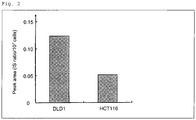
- the GABA level before drug treatment was found to be higher in low-sensitivity DLD-1 cells than in high-sensitivity HCT116 cells.
- the blood GABA level was found to be high in colorectal patients who have poor therapeutic response to the mFOLFOX6-bevacizumab combination therapy. Therefore, GABA is useful as a marker for determining sensitivity of a cancer patient to an anti-cancer agent including 5-FU and L-OHP.
- oxaliplatin and a salt thereof, and fluorouracil and a salt thereof are examples of the anti-cancer agent to which the sensitivity determination marker used in the present invention is applied.
- an anti-cancer agent that is metabolized in the body, to thereby being transformed to oxaliplatin or fluorouracil may be the anti-cancer agent to which the sensitivity determination marker is applied.
- tegaful and capecitabine are known to be metabolized in the body, to thereby form fluorouracil.
- tegaful or capecitabine may be used as a target of the anti-cancer agent to which the sensitivity determination marker is applied.
- an anti-cancer agent including oxaliplatin or a salt thereof and tegaful or a salt thereof and an anti-cancer agent including oxaliplatin or a salt thereof and capecitabine or a salt thereof are targets of the anti-cancer agent sensitivity determination marker as described herein.
- the anti-cancer agent to which the anti-cancer agent sensitivity determination marker used in the present invention is applied is an anti-cancer agent including oxaliplatin or a salt thereof and fluorouracil or a salt thereof. No particular limitation is imposed on the additional anti-cancer agent used in combination with the target anti-cancer agent.
- additional anti-cancer agent examples include cyclophosphamide, ifosfamide, thiotepa, melphalan, busulfan, nimustine, ranimustine, dacarbazine, procarbazine, temozolomide, cisplatin, carboplatin, nedaplatin, methotrexate, pemetrexed, uracil, doxifluridine, gimeracil/oteracil, cytarabine, enocitabine, gemcitabine, 6-mercaptopurine, fuludarabin, pentostatin, cladribine, hydroxyurea, doxorubicin, epirubicin, daunorubicin, idarubicine, pirarubicin, mitoxantrone, amurubicin, actinomycin D, bleomycine, pepleomycin, mytomycin C, aclarubicin, zinostatin, vin
- combinations of the target anti-cancer agent with one or more members selected from among irinotecan, SN-38, cetuximab, bevacizumab, dasatinib, panitumumab, folinate, and levofolinate are preferred, with combinations of the target anti-cancer agent with one or more members selected from among irinotecan, cetuximab, bevacizumab, folinate, and levofolinate being particularly preferred.
- examples of the anti-cancer agent include levofolinate, folinate, levofolinate and bevacizumab, folinate and bevacizumab, levofolinate and cetuximab, folinate and cetuximab, and irinotecan.
- the level present in the specimen can be measured.
- the specimen include bio-samples derived from subjects having cancer (i.e., cancer patients) such as blood, serum, plasma, urine, tumor tissue and cells, ascites, pleural effusion, cerebrospinal fluid, feces, and sputum. Of these, serum is particularly preferred.
- Examples of the target cancer of the present invention include lip, oral, pharyngeal cancers such as pharyngeal cancer; gastrointestinal tract cancers such as esophageal cancer, gastric cancer, and colorectal cancer; respiratory and pleural organ cancers such as lung cancer; bone cancer and articular cartilage cancer; skin melanoma, squamous cell cancer, and other skin cancers; mesothelial and soft tissue cancer such as mesothelioma; female venereal cancers such as breast cancer, uterine cancer, and ovarian cancer; male venereal cancers such as prostatic cancer; urinary tract cancer such as bladder cancer; eye, brain, and central nerve cancers such as brain tumor; thyroid and endocrine cancer; lymphoid tissue, hematogeneous tissue, and related tissue cancers such as non-Hodgkin lymphoma and lymphocytic leukemia; and metastatic cancers from these cancers as primary lesions.
- the present invention is particularly preferably applied to non-
- the means for determining these metabolism-related substances present in a specimen may be appropriately selected in accordance with the substance to be determined.
- the determination means include mass spectrometers (e.g., CE-TOFMS and gas chromatography-mass spectrometry (GC-MS)), HPLC, immunological assay, and biological assay.
- the level of any of these metabolism-related substances present in a bio-sample derived from the cancer patient is measured before and after administration of the anti-cancer agent.
- the metabolism-related substance level increases or exceeds a predetermined standard level, after administration of the anti-cancer agent, the cancer is determined to have sensitivity to the anti-cancer agent, whereas when the substance level is constant or below a specific standard level, after administration of the anti-cancer agent, the cancer is determined to have no sensitivity to the anti-cancer agent.
- the anti-cancer agent sensitivity determination marker may be employed not only to determine therapeutic response to the anti-cancer agent, but also to greatly contribute to prevention of aggravation of side effects, which would otherwise be caused by continuous administration of a pharmaceutically impotent anti-cancer agent.
- the sensitivity of a cancer patient to the anti-cancer agent is determined as follows. The level of any of these metabolism-related substances present in a bio-sample derived from the cancer patient is measured before and after administration of the anti-cancer agent.
- the cancer When the metabolism-related substance level increases or exceeds a predetermined standard level, after administration of the anti-cancer agent, the cancer is determined to have no sensitivity to the anti-cancer agent, whereas when the substance level is constant or below a specific standard level, after administration of the anti-cancer agent, the cancer is determined to have sensitivity to the anti-cancer agent.
- the anti-cancer agent sensitivity determination marker may be employed not only to determine therapeutic response to the anti-cancer agent, but also to greatly contribute to prevention of aggravation of side effects, which would otherwise be caused by continuous administration of a pharmaceutically impotent anti-cancer agent.
- the sensitivity of a cancer patient to the anti-cancer agent is determined as follows.
- the level of any of these metabolism-related substances present in a bio-sample derived from the cancer patient is measured before and after administration of the anti-cancer agent.
- the metabolism-related substance level decreases or is below a predetermined standard level, after administration of the anti-cancer agent, the cancer is determined to have sensitivity to the anti-cancer agent, whereas when the substance level is constant or exceeds a specific standard level, after administration of the anti-cancer agent, the cancer is determined to have no sensitivity to the anti-cancer agent.
- the anti-cancer agent sensitivity determination marker used in the present invention i.e. cysteine-glutathione, may be employed not only to determine therapeutic response to the anti-cancer agent, but also to greatly contribute to prevention of aggravation of side effects, which would otherwise be caused by continuous administration of a pharmaceutically impotent anti-cancer agent.
- the sensitivity of a cancer patient to the anti-cancer agent is determined as follows.
- the level of any of these metabolism-related substances present in a bio-sample derived from the cancer patient is measured before and after administration of the anti-cancer agent.
- the metabolism-related substance level decreases or is below a predetermined standard level, after administration of the anti-cancer agent, the cancer is determined to have no sensitivity to the anti-cancer agent, whereas when the substance level is constant or exceeds a specific standard level, after administration of the anti-cancer agent, the cancer is determined to have sensitivity to the anti-cancer agent.
- the anti-cancer agent sensitivity determination marker used may be employed not only to determine therapeutic response to the anti-cancer agent, but also to greatly contribute to prevention of progression of cancer and aggravation of side effects, which would otherwise be caused by continuous administration of a pharmaceutically impotent anti-cancer agent.
- the sensitivity of a cancer patient to the anti-cancer agent is determined as follows.
- the GABA level of a bio-sample derived from the cancer patient is measured before and after administration of the anti-cancer agent.
- the cancer is determined to have sensitivity to the anti-cancer agent, whereas when the substance level is constant or below a specific standard level, after administration of the anti-cancer agent, the cancer is determined to have no sensitivity to the anti-cancer agent.
- the GABA level is higher than a predetermined standard level
- the cancer is determined to have no sensitivity to the anti-cancer agent.
- the anti-cancer agent sensitivity determination marker may be employed not only to determine therapeutic response to the anti-cancer agent, but also to greatly contribute to prevention of aggravation of side effects, which would otherwise be caused by continuous administration of a pharmaceutically impotent anti-cancer agent.
- kits containing a protocol for measuring any of the metabolism-related substances present in the specimen contains a reagent for measuring any of these metabolism-related substances, an indication of an instruction manual for use of the reagent, standards for determining the presence or absence of sensitivity to the anti-cancer agent, etc.
- the standards include (relative) standard levels of these metabolism-related substances, a (relative) high threshold level, a (relative) low threshold level, factors affecting the measurements, the degree of the effects, etc. These substance levels may be set so as to suit the target anti-cancer agent selected.
- the sensitivity determination may be performed in the same manner on the basis of the standards.
- screening of an anti-cancer agent sensitivity enhancer can be performed through employment, as an index, of variation in expression of any of the substances after exposure to the anti-cancer agent.
- a substance which suppresses variation in expression of N,N-dimethylglycine, 3-methylhistidine, N 5 -ethylglutamine, glutathione, dATP, butyric acid, triethanolamine, and 1-methylnicotinamide present in cells after exposure to an anti-cancer agent can serve as a substance which enhances the sensitivity to the anti-cancer agent (i.e., anti-cancer agent sensitivity enhancer).
- a substance which suppresses variation in expression of N,N-dimethylglycine, 3-methylhistidine, N 5 -ethylglutamine, glutathione, dATP, butyric acid, triethanolamine, and 1-methylnicotinamide present in a cancer-bearing animal, after exposure to an anti-cancer agent can serve as a substance which enhances the sensitivity to the anti-cancer agent (i.e., anti-cancer agent sensitivity enhancer).
- screening of an anti-cancer agent sensitivity enhancer can be performed through employment, as an index, of variation in expression of any of the substances after exposure to the anti-cancer agent, specifically, promotion of the variation or decrease in the substance level. That is, a substance which promotes the variation of cysteine-glutathione, adenine, and PRPP or which decreases the substance level, in vitro or in vivo after exposure to the anti-cancer agent, enhances the sensitivity to the anti-cancer agent.
- a substance which promotes the variation of cysteine-glutathione, adenine, and PRPP or which decreases the substance level in cells after exposure to an anti-cancer agent can serve as a substance which enhances the sensitivity to the anti-cancer agent (i.e., anti-cancer agent sensitivity enhancer).
- a substance which promotes the variation cysteine-glutathione level, adenine level, and PRPP level of a cancer-bearing animal or a substance which decreases the substance level, after exposure to an anti-cancer agent can serve as a substance which enhances the sensitivity to the anti-cancer agent (i.e., anti-cancer agent sensitivity enhancer). Screening using cysteine-glutathione as marker is performed as detailed in the appended claims.
- any of NADH and NAD + is used, screening of an anti-cancer agent sensitivity enhancer can be performed through employment, as an index, of variation in expression of any of the substances after exposure to the anti-cancer agent. That is, a substance which suppresses variation in expression of NADH and NAD + , in vitro or in vivo after exposure to the anti-cancer agent, enhances the sensitivity to the anti-cancer agent.
- a substance which suppresses variation in expression of NADH and NAD + in cells after exposure to an anti-cancer agent can serve as a substance which enhances the sensitivity to the anti-cancer agent (i.e., anti-cancer agent sensitivity enhancer).
- a substance which suppresses variation in expression of NADH and NAD + present in a cancer-bearing animal, after exposure to an anti-cancer agent can serve as a substance which enhances the sensitivity to the anti-cancer agent (i.e., anti-cancer agent sensitivity enhancer).
- screening of an anti-cancer agent sensitivity enhancer can be performed through employment, as an index, of variation in expression of GABA after exposure to the anti-cancer agent. That is, a substance which decreases the GABA level before exposure to the anti-cancer agent or which promotes variation in the expression or elevates the level after exposure to the anti-cancer agent, in vitro or in vivo, enhances the sensitivity to the anti-cancer agent.
- a substance which decreases the intracellular GABA level after exposure to the anti-cancer agent in the case where cancer cells have been treated with a substance before exposure to the anti-cancer agent, can serve as a substance which enhances the sensitivity to the anti-cancer agent (i.e., anti-cancer agent sensitivity enhancer).
- a substance which promotes variation in the expression or elevates the level after exposure to the anti-cancer agent corresponding to the target cancer cells can serve as a substance which enhances the sensitivity to the anti-cancer agent (i.e., anti-cancer agent sensitivity enhancer).
- a substance which decreases the GABA level of a cancer-bearing animal before exposure to the anti-cancer agent or which promotes variation in the GABA expression or elevates the GABA level after exposure to the anti-cancer agent can serve as a substance which enhances the sensitivity to the anti-cancer agent (i.e., anti-cancer agent sensitivity enhancer).
- Screening of an anti-cancer agent can be performed by means of the anti-cancer agent sensitivity determination marker used in the present invention as an index. That is, a substance which can vary the level of the anti-cancer agent sensitivity determination marker in vitro or in vivo is evaluated as an anti-cancer agent. For example, in an in vitro case, a substance which varies the anti-cancer agent sensitivity determination marker level in various cancer cells after exposure to the substance can serve as an anti-cancer agent. Also, when the anti-cancer agent sensitivity determination marker level in a cancer-bearing animal is varied after administration of a substance thereto, the substance can serve as an anti-cancer agent.
- the anti-cancer agent is expected to exhibit a pharmacological effect, the increase in anti-cancer agent sensitivity determination marker level is observed before occurrence of tumor shrinkage or attaining cytocidal effect. Therefore, screening based on the anti-cancer agent sensitivity determination marker level as an index can realize, for a shorter period of time, determination whether or not the test substance serves as a useful anti-cancer agent, whereby efforts and cost involved in the development of anti-cancer agents are greatly expected to be reduced.
- the combination of the anti-cancer agent sensitivity enhancer and the anti-cancer agent which is a sensitivity enhancement target of the enhancer may be a composition containing both ingredients, or a combined drug of preparations containing individual ingredients. These two ingredients may be administered through different routes.
- the anti-cancer agent to which the anti-cancer agent sensitivity determination marker is applied is an anti-cancer agent including oxaliplatin or a salt thereof and fluorouracil or a salt thereof.
- the additional anti-cancer agent used in combination with the target anti-cancer agent examples include cyclophosphamide, ifosfamide, thiotepa, melphalan, busulfan, nimustine, ranimustine, dacarbazine, procarbazine, temozolomide, cisplatin, carboplatin, nedaplatin, methotrexate, pemetrexed, uracil, doxifluridine, gimeracil/oteracil, cytarabine, enocitabine, gemcitabine, 6-mercaptopurine, fuludarabin, pentostatin, cladribine, hydroxyurea, doxorubicin, epirubicin, daunorubicin, idarubicine, pirarubicin, mitoxantrone, amurubicin, actinomycin D, bleomycin
- combinations of the target anti-cancer agent with one or more members selected from among irinotecan, SN-38, cetuximab, bevacizumab, dasatinib, panitumumab, folinate, and levofolinate are preferred, with combinations of the target anti-cancer agent with one or more members selected from among irinotecan, cetuximab, bevacizumab, folinate, and levofolinate being particularly relevant.
- examples of the anti-cancer agent include levofolinate, folinate, levofolinate and bevacizumab, folinate and bevacizumab, levofolinate and cetuximab, folinate and cetuximab, and irinotecan.
- HCT116 high-sensitivity: HCT116, low-sensitivity: DLD-1
- HCT116 was obtained from Kabushiki Kaisha Yakult Honsha
- DLD-1 was obtained from Dainippon Sumitomo Pharma Co., Ltd.
- Cell culturing was performed by means of a ⁇ 100 mm/Tissue Culture Dish (IWAKI) with a Dulbecco's modified Eagle's Medium (DMEM) containing 10% fetal bovine serum (product of Invitrogen) at 37°C under 5%CO 2 conditions.
- DMEM Dulbecco's modified Eagle's Medium
- L-OHP powder was obtained from Kabushiki Kaisha Yakult Honsha.
- 5-FU powder was obtained from Sigma Aldrich Japan K.K.
- the two colorectal cancer cells were exposed to L-OHP by changing the culture medium to a medium containing 100 ⁇ mol/L 5-FU and 10 ⁇ mol/L L-OHP (employing an anti-cancer agent-free medium as a control group).
- 5-FU/L-OHP hr, 4 hr, 12 hr, 24 hr, and 48 hr
- the cells were washed on ice with 5% mannitol (4°C).
- methanol 4°C, containing an internal standard
- cells for cell count were provided in addition to the cells from which metabolites were extracted, and then subjected to the same treatment before performing cell count. The data were employed in correction of the cell counts.
- Chloroform and Milli-Q water were added to the methanol solution stored at -80°C, and liquid-liquid extraction was performed, to thereby removed miscellaneous matters.
- a water-methanol layer containing metabolites was recovered and filtered through an ultrafiltration membrane (fraction molecular weight: 5,000 Da), to thereby remove protein.
- the filtrate was dried under reduced pressure and then stored at -80°C.
- the filtrate was dissolved in Milli-Q water, and immediately after, the solution was subjected to metabolomic analysis.
- the peaks of each sample detected through CE-TOFMS were identified with reference to about 500 sample data sets whose m/z values and migration times had been known.
- the metabolite level was obtained by dividing the peak area of the metabolite by that of the internal standard, and the value was corrected by subtracting therefrom reference sample data.
- the intracellular GABA level before drug treatment was higher in low-sensitivity cells than in high-sensitivity cells ( Fig. 2 ).
- the tested human subjects were cancer patients who had received a cancer chemotherapy (mFOLFOX6-bevacizumab combination therapy) involving administration, in combination, fluorouracil (400 mg/m 2 ) (via rapid intravenous injection), levofolinate (200 mg/m 2 ), fluorouracil (2,400 mg/m 2 ) (via continuous intravenous infusion), oxaliplatin (85 mg/m 2 ), and bevacizumab (5 mg/kg). Second phase clinical tests were carried out in order to investigate efficacy and safety of the cancer chemotherapy and causes for difference therein between individual patients. The tested patients were inoperable advanced/recurrent cancer patients who had received none of chemotherapy, immunotherapy, and radiotherapy.
- mFOLFOX6-bevacizumab combination therapy involving administration, in combination, fluorouracil (400 mg/m 2 ) (via rapid intravenous injection), levofolinate (200 mg/m 2 ), fluorouracil (2,400 mg/m 2 ) (via continuous
- the human subjects were selected on the basis of the following standards: (1) a case having a histopathologically identified colorectal cancer; (2) a case of an inoperable advanced/recurrent cancer; (3) a case having a detectable lesion; (4) a case who had received none of chemotherapy, immunotherapy, and radiotherapy (but there can be registered a case who had received a post-operative adjuvant therapy by a fluorouracil completed within 6 months from the recurrence-identified day); (5) a case having an age of ⁇ 20; (6) a case having a performance status (ECOG scale) of 0 or 1; (7) a case which is expected to have a predicted survival period of 3 months or longer; (8) a case who has no severe disorder in main functions (bone marrow, liver, kidney, heart, lung, etc.) and who has clinical test results within 14 days before registration (excluding registration day) falling within the following reference ranges: WBC: 4,000/mm 3 to 12,000/mm 3 , Neutro: ⁇
- CRE ⁇ 1.5 mg/dL
- urine protein ⁇ 1+ (qualitative), and PT international ratio: ⁇ 1.5
- PT international ratio ⁇ 1.5
- bevacizumab, oxaliplatin, fluorouracil (via rapid intravenous injection), and levofolinate were administered on day 1 of each cycle, and also fluorouracil was administered via continuous intravenous infusion from day 1 to day 3.
- Each cycle consisted of two weeks (14 days), and the cycle was repeated to 24 cycles, so long as a patient deviated from the acceptable standards.
- tumor shrinkage effect in the target lesion could be assessed in 68 cases.
- a sample required for the retrieval of a drug-reactive biomarker was recovered.
- 13 of them, whose test therapy had been terminated were simultaneously subjected to a metabolomic analysis through CE-TOFMS, wherein the metabolomes were contained in serum samples of the patients before drug administration. Extraction and assay of metabolomes, and data analysis were performed in the same manner as employed in Example 1.
- Therapeutic response of a patient was evaluated on the basis of best overall response (the best effect recorded in a period from start of therapy to aggravati on/recurrence).
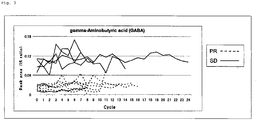
- the tested patients were evaluated in terms of therapeutic response on the basis of best overall response. As a result, among 13 tested cases, there were 6 stable disease (SD) cases and 7 partial response (PR) cases. In each cycle, metabolomes contained in the serum of each patient were comprehensively analyzed through CE-TOFMS before administration of the anti-cancer drug. In all partial response (PR) cases, the blood GABA level was low, whereas in 4 of 6 stable disease (SD) cases, the blood GABA level was high ( Fig. 3 ).
Landscapes
- Health & Medical Sciences (AREA)
- Life Sciences & Earth Sciences (AREA)
- Chemical & Material Sciences (AREA)
- Engineering & Computer Science (AREA)
- Medicinal Chemistry (AREA)
- General Health & Medical Sciences (AREA)
- Molecular Biology (AREA)
- Immunology (AREA)
- Public Health (AREA)
- Pharmacology & Pharmacy (AREA)
- Animal Behavior & Ethology (AREA)
- Veterinary Medicine (AREA)
- Epidemiology (AREA)
- Biomedical Technology (AREA)
- Urology & Nephrology (AREA)
- Hematology (AREA)
- Physics & Mathematics (AREA)
- Cell Biology (AREA)
- Biochemistry (AREA)
- Pathology (AREA)
- Analytical Chemistry (AREA)
- General Physics & Mathematics (AREA)
- Biotechnology (AREA)
- Microbiology (AREA)
- Food Science & Technology (AREA)
- General Chemical & Material Sciences (AREA)
- Chemical Kinetics & Catalysis (AREA)
- Bioinformatics & Cheminformatics (AREA)
- Hospice & Palliative Care (AREA)
- Oncology (AREA)
- Proteomics, Peptides & Aminoacids (AREA)
- Bioinformatics & Computational Biology (AREA)
- Oil, Petroleum & Natural Gas (AREA)
- Biophysics (AREA)
- Organic Chemistry (AREA)
- Nuclear Medicine, Radiotherapy & Molecular Imaging (AREA)
- Spectroscopy & Molecular Physics (AREA)
- Acyclic And Carbocyclic Compounds In Medicinal Compositions (AREA)
- Pharmaceuticals Containing Other Organic And Inorganic Compounds (AREA)
- Investigating Or Analysing Biological Materials (AREA)
Priority Applications (1)
| Application Number | Priority Date | Filing Date | Title |
|---|---|---|---|
| EP20214606.4A EP3812009A1 (en) | 2012-02-23 | 2013-02-22 | Combined anticancer drug sensitivity-determining marker |
Applications Claiming Priority (3)
| Application Number | Priority Date | Filing Date | Title |
|---|---|---|---|
| JP2012037448 | 2012-02-23 | ||
| PCT/JP2013/054488 WO2013125675A1 (ja) | 2012-02-23 | 2013-02-22 | 併用抗がん剤の感受性判定マーカー |
| EP13752246.2A EP2818870A4 (en) | 2012-02-23 | 2013-02-22 | COMBINED MARKER FOR DETERMINING THE SENSITIVITY TO ANTICREMENT |
Related Parent Applications (1)
| Application Number | Title | Priority Date | Filing Date |
|---|---|---|---|
| EP13752246.2A Division EP2818870A4 (en) | 2012-02-23 | 2013-02-22 | COMBINED MARKER FOR DETERMINING THE SENSITIVITY TO ANTICREMENT |
Related Child Applications (2)
| Application Number | Title | Priority Date | Filing Date |
|---|---|---|---|
| EP20214606.4A Division EP3812009A1 (en) | 2012-02-23 | 2013-02-22 | Combined anticancer drug sensitivity-determining marker |
| EP20214606.4A Division-Into EP3812009A1 (en) | 2012-02-23 | 2013-02-22 | Combined anticancer drug sensitivity-determining marker |
Publications (2)
| Publication Number | Publication Date |
|---|---|
| EP3326632A1 EP3326632A1 (en) | 2018-05-30 |
| EP3326632B1 true EP3326632B1 (en) | 2021-04-07 |
Family
ID=49005852
Family Applications (3)
| Application Number | Title | Priority Date | Filing Date |
|---|---|---|---|
| EP20214606.4A Withdrawn EP3812009A1 (en) | 2012-02-23 | 2013-02-22 | Combined anticancer drug sensitivity-determining marker |
| EP13752246.2A Withdrawn EP2818870A4 (en) | 2012-02-23 | 2013-02-22 | COMBINED MARKER FOR DETERMINING THE SENSITIVITY TO ANTICREMENT |
| EP17202053.9A Active EP3326632B1 (en) | 2012-02-23 | 2013-02-22 | Combined anticancer drug sensitivity-determining marker |
Family Applications Before (2)
| Application Number | Title | Priority Date | Filing Date |
|---|---|---|---|
| EP20214606.4A Withdrawn EP3812009A1 (en) | 2012-02-23 | 2013-02-22 | Combined anticancer drug sensitivity-determining marker |
| EP13752246.2A Withdrawn EP2818870A4 (en) | 2012-02-23 | 2013-02-22 | COMBINED MARKER FOR DETERMINING THE SENSITIVITY TO ANTICREMENT |
Country Status (5)
| Country | Link |
|---|---|
| US (2) | US9733256B2 (enExample) |
| EP (3) | EP3812009A1 (enExample) |
| JP (4) | JP6141824B2 (enExample) |
| CN (2) | CN108508168B (enExample) |
| WO (1) | WO2013125675A1 (enExample) |
Families Citing this family (6)
| Publication number | Priority date | Publication date | Assignee | Title |
|---|---|---|---|---|
| EP3320900A3 (en) * | 2011-03-24 | 2018-06-13 | Keio University | Marker for determination of sensitivity to anticancer agent |
| WO2013125675A1 (ja) | 2012-02-23 | 2013-08-29 | 学校法人慶應義塾 | 併用抗がん剤の感受性判定マーカー |
| WO2016031816A1 (ja) * | 2014-08-26 | 2016-03-03 | 学校法人慶應義塾 | 抗がん剤の感受性の判定マーカー |
| EP3605103A4 (en) * | 2017-03-31 | 2021-04-14 | Keio University | MARKER FOR DETERMINING SENSITIVITY TO A COMBINED ANTI-CANCER MEDICINE |
| CN111919120A (zh) * | 2018-03-29 | 2020-11-10 | 学校法人庆应义塾 | 包含伊立替康的抗癌剂疗法的敏感性判定标志物 |
| JPWO2020067228A1 (ja) * | 2018-09-28 | 2021-09-24 | 学校法人慶應義塾 | 併用抗がん剤の感受性の判定マーカー |
Family Cites Families (10)
| Publication number | Priority date | Publication date | Assignee | Title |
|---|---|---|---|---|
| CN100569288C (zh) * | 2005-04-06 | 2009-12-16 | 山东蓝金生物工程有限公司 | 一种抗实体肿瘤药物组合物 |
| DE102005051976B4 (de) * | 2005-10-31 | 2009-04-30 | Forschungszentrum Borstel Zentrum für Medizin und Biowissenschaften | Kit für hoch-sensitive Nachweisassays |
| CA2662655A1 (en) * | 2006-09-19 | 2008-03-27 | Metabolon, Inc. | Biomarkers for prostate cancer and methods using the same |
| US9089540B2 (en) * | 2008-01-31 | 2015-07-28 | Keio University | Method for determination of sensitivity to anti-cancer agent |
| JP5461200B2 (ja) * | 2008-01-31 | 2014-04-02 | 学校法人慶應義塾 | 抗がん剤感受性判定マーカー |
| JP2010038796A (ja) * | 2008-08-06 | 2010-02-18 | Human Metabolome Technologies Inc | 疾患マーカー、および、疾患マーカーの測定方法 |
| CN105699638B (zh) * | 2009-10-30 | 2018-05-22 | 学校法人庆应义塾 | 抗癌剂感受性的判定方法 |
| CN102597762B (zh) * | 2009-10-30 | 2016-08-03 | 学校法人庆应义塾 | 抗癌剂感受性判定标记 |
| EP2517022A4 (en) * | 2009-12-22 | 2013-07-10 | Univ Michigan | METABOLOMIC PROFILING OF PROSTATE CANCER |
| WO2013125675A1 (ja) | 2012-02-23 | 2013-08-29 | 学校法人慶應義塾 | 併用抗がん剤の感受性判定マーカー |
-
2013
- 2013-02-22 WO PCT/JP2013/054488 patent/WO2013125675A1/ja not_active Ceased
- 2013-02-22 CN CN201810228371.3A patent/CN108508168B/zh not_active Expired - Fee Related
- 2013-02-22 EP EP20214606.4A patent/EP3812009A1/en not_active Withdrawn
- 2013-02-22 EP EP13752246.2A patent/EP2818870A4/en not_active Withdrawn
- 2013-02-22 US US14/379,945 patent/US9733256B2/en not_active Expired - Fee Related
- 2013-02-22 JP JP2014500945A patent/JP6141824B2/ja not_active Expired - Fee Related
- 2013-02-22 EP EP17202053.9A patent/EP3326632B1/en active Active
- 2013-02-22 CN CN201380010388.7A patent/CN104169721A/zh active Pending
-
2017
- 2017-05-08 JP JP2017092161A patent/JP6381735B2/ja not_active Expired - Fee Related
- 2017-06-28 US US15/635,293 patent/US10481160B2/en active Active
-
2018
- 2018-07-27 JP JP2018140928A patent/JP6527994B2/ja not_active Expired - Fee Related
- 2018-07-27 JP JP2018140929A patent/JP2018169409A/ja not_active Ceased
Non-Patent Citations (5)
| Title |
|---|
| DEAN P JONES ET AL: "Redox analysis of human plasma allows separation of pro-oxidant events of aging from decline in antioxidant defenses", FREE RADICAL BIOLOGY MEDICINE, vol. 33, 1 November 2002 (2002-11-01), pages 1290 - 30, XP055712973 * |
| KLEINMAN W A ET AL: "Status of glutathione and other thiols and disulfides in human plasma", BIOCHEMICAL PHARMACOLOGY, ELSEVIER, US, vol. 60, no. 1, 1 July 2000 (2000-07-01), pages 19 - 29, XP002343366, ISSN: 0006-2952, DOI: 10.1016/S0006-2952(00)00293-8 * |
| S MORIARTY: "Oxidation of glutathione and cysteine in human plasma associated with smoking", FREE RADICAL BIOLOGY AND MEDICINE, vol. 35, no. 12, 15 December 2003 (2003-12-15), US, pages 1582 - 1588, XP055712964, ISSN: 0891-5849, DOI: 10.1016/j.freeradbiomed.2003.09.006 * |
| SALMAN ASHFAQ ET AL: "Endothelial Function and Aminothiol Biomarkers of Oxidative Stress in Healthy Adults", HYPERTENSION, vol. 52, 1 July 2008 (2008-07-01), pages 80 - 85, XP055712952 * |
| SHARON L WALMSLEY ET AL: "Oxidative stress and thiol depletion in plasma and peripheral blood lymphocytes from HIV-infected patients: toxicological and pathological implications.", AIDS, vol. 11, 1 November 1997 (1997-11-01), pages 1689 - 1697, XP055712958 * |
Also Published As
| Publication number | Publication date |
|---|---|
| CN104169721A (zh) | 2014-11-26 |
| JP2017173334A (ja) | 2017-09-28 |
| JP2018169409A (ja) | 2018-11-01 |
| CN108508168B (zh) | 2021-08-17 |
| US20150038522A1 (en) | 2015-02-05 |
| JP6381735B2 (ja) | 2018-08-29 |
| US10481160B2 (en) | 2019-11-19 |
| JPWO2013125675A1 (ja) | 2015-07-30 |
| US9733256B2 (en) | 2017-08-15 |
| WO2013125675A1 (ja) | 2013-08-29 |
| US20170299597A1 (en) | 2017-10-19 |
| JP6141824B2 (ja) | 2017-06-07 |
| EP3812009A1 (en) | 2021-04-28 |
| EP2818870A1 (en) | 2014-12-31 |
| JP6527994B2 (ja) | 2019-06-12 |
| JP2018194556A (ja) | 2018-12-06 |
| CN108508168A (zh) | 2018-09-07 |
| EP3326632A1 (en) | 2018-05-30 |
| EP2818870A4 (en) | 2016-02-10 |
Similar Documents
| Publication | Publication Date | Title |
|---|---|---|
| US10309957B2 (en) | Method for determining sensitivity to fluorouracil in a subject having colorectal cancer | |
| US10481160B2 (en) | Combined anticancer drug sensitivity-determining marker | |
| US8809362B2 (en) | Anticancer agent sensitivity-determining marker | |
| US8945929B2 (en) | Marker for determination of sensitivity to anti-cancer agent | |
| EP3605103A1 (en) | Combined anticancer agent sensitivity determination marker | |
| KR20200110452A (ko) | 담도암을 치료하기 위한 방법 및 조합 요법 |
Legal Events
| Date | Code | Title | Description |
|---|---|---|---|
| PUAI | Public reference made under article 153(3) epc to a published international application that has entered the european phase |
Free format text: ORIGINAL CODE: 0009012 |
|
| STAA | Information on the status of an ep patent application or granted ep patent |
Free format text: STATUS: THE APPLICATION HAS BEEN PUBLISHED |
|
| AC | Divisional application: reference to earlier application |
Ref document number: 2818870 Country of ref document: EP Kind code of ref document: P |
|
| AK | Designated contracting states |
Kind code of ref document: A1 Designated state(s): AL AT BE BG CH CY CZ DE DK EE ES FI FR GB GR HR HU IE IS IT LI LT LU LV MC MK MT NL NO PL PT RO RS SE SI SK SM TR |
|
| STAA | Information on the status of an ep patent application or granted ep patent |
Free format text: STATUS: REQUEST FOR EXAMINATION WAS MADE |
|
| 17P | Request for examination filed |
Effective date: 20181122 |
|
| RBV | Designated contracting states (corrected) |
Designated state(s): AL AT BE BG CH CY CZ DE DK EE ES FI FR GB GR HR HU IE IS IT LI LT LU LV MC MK MT NL NO PL PT RO RS SE SI SK SM TR |
|
| STAA | Information on the status of an ep patent application or granted ep patent |
Free format text: STATUS: EXAMINATION IS IN PROGRESS |
|
| 17Q | First examination report despatched |
Effective date: 20200211 |
|
| REG | Reference to a national code |
Ref country code: DE Ref legal event code: R079 Ref document number: 602013076837 Country of ref document: DE Free format text: PREVIOUS MAIN CLASS: A61K0031513000 Ipc: A61P0035000000 |
|
| RIC1 | Information provided on ipc code assigned before grant |
Ipc: A61K 31/513 20060101ALI20200709BHEP Ipc: A61P 35/00 20060101AFI20200709BHEP Ipc: A61K 45/06 20060101ALI20200709BHEP Ipc: G01N 33/574 20060101ALI20200709BHEP Ipc: A61K 31/555 20060101ALI20200709BHEP Ipc: A61P 43/00 20060101ALI20200709BHEP |
|
| GRAP | Despatch of communication of intention to grant a patent |
Free format text: ORIGINAL CODE: EPIDOSNIGR1 |
|
| STAA | Information on the status of an ep patent application or granted ep patent |
Free format text: STATUS: GRANT OF PATENT IS INTENDED |
|
| INTG | Intention to grant announced |
Effective date: 20200826 |
|
| GRAS | Grant fee paid |
Free format text: ORIGINAL CODE: EPIDOSNIGR3 |
|
| RIN1 | Information on inventor provided before grant (corrected) |
Inventor name: TSUZAKI, JUNYA Inventor name: NISHIMUTA, AKITO Inventor name: TAKAHASHI, HIROYUKI Inventor name: TANIGAWARA, YUSUKE |
|
| RAP1 | Party data changed (applicant data changed or rights of an application transferred) |
Owner name: KEIO UNIVERSITY Owner name: KABUSHIKI KAISHA YAKULT HONSHA |
|
| GRAA | (expected) grant |
Free format text: ORIGINAL CODE: 0009210 |
|
| STAA | Information on the status of an ep patent application or granted ep patent |
Free format text: STATUS: THE PATENT HAS BEEN GRANTED |
|
| AC | Divisional application: reference to earlier application |
Ref document number: 2818870 Country of ref document: EP Kind code of ref document: P |
|
| AK | Designated contracting states |
Kind code of ref document: B1 Designated state(s): AL AT BE BG CH CY CZ DE DK EE ES FI FR GB GR HR HU IE IS IT LI LT LU LV MC MK MT NL NO PL PT RO RS SE SI SK SM TR |
|
| REG | Reference to a national code |
Ref country code: GB Ref legal event code: FG4D |
|
| REG | Reference to a national code |
Ref country code: AT Ref legal event code: REF Ref document number: 1378902 Country of ref document: AT Kind code of ref document: T Effective date: 20210415 Ref country code: CH Ref legal event code: EP |
|
| REG | Reference to a national code |
Ref country code: DE Ref legal event code: R096 Ref document number: 602013076837 Country of ref document: DE |
|
| REG | Reference to a national code |
Ref country code: IE Ref legal event code: FG4D |
|
| REG | Reference to a national code |
Ref country code: LT Ref legal event code: MG9D |
|
| REG | Reference to a national code |
Ref country code: NL Ref legal event code: MP Effective date: 20210407 Ref country code: AT Ref legal event code: MK05 Ref document number: 1378902 Country of ref document: AT Kind code of ref document: T Effective date: 20210407 |
|
| PG25 | Lapsed in a contracting state [announced via postgrant information from national office to epo] |
Ref country code: FI Free format text: LAPSE BECAUSE OF FAILURE TO SUBMIT A TRANSLATION OF THE DESCRIPTION OR TO PAY THE FEE WITHIN THE PRESCRIBED TIME-LIMIT Effective date: 20210407 Ref country code: LT Free format text: LAPSE BECAUSE OF FAILURE TO SUBMIT A TRANSLATION OF THE DESCRIPTION OR TO PAY THE FEE WITHIN THE PRESCRIBED TIME-LIMIT Effective date: 20210407 Ref country code: NL Free format text: LAPSE BECAUSE OF FAILURE TO SUBMIT A TRANSLATION OF THE DESCRIPTION OR TO PAY THE FEE WITHIN THE PRESCRIBED TIME-LIMIT Effective date: 20210407 Ref country code: HR Free format text: LAPSE BECAUSE OF FAILURE TO SUBMIT A TRANSLATION OF THE DESCRIPTION OR TO PAY THE FEE WITHIN THE PRESCRIBED TIME-LIMIT Effective date: 20210407 Ref country code: BG Free format text: LAPSE BECAUSE OF FAILURE TO SUBMIT A TRANSLATION OF THE DESCRIPTION OR TO PAY THE FEE WITHIN THE PRESCRIBED TIME-LIMIT Effective date: 20210707 Ref country code: AT Free format text: LAPSE BECAUSE OF FAILURE TO SUBMIT A TRANSLATION OF THE DESCRIPTION OR TO PAY THE FEE WITHIN THE PRESCRIBED TIME-LIMIT Effective date: 20210407 |
|
| PG25 | Lapsed in a contracting state [announced via postgrant information from national office to epo] |
Ref country code: LV Free format text: LAPSE BECAUSE OF FAILURE TO SUBMIT A TRANSLATION OF THE DESCRIPTION OR TO PAY THE FEE WITHIN THE PRESCRIBED TIME-LIMIT Effective date: 20210407 Ref country code: GR Free format text: LAPSE BECAUSE OF FAILURE TO SUBMIT A TRANSLATION OF THE DESCRIPTION OR TO PAY THE FEE WITHIN THE PRESCRIBED TIME-LIMIT Effective date: 20210708 Ref country code: IS Free format text: LAPSE BECAUSE OF FAILURE TO SUBMIT A TRANSLATION OF THE DESCRIPTION OR TO PAY THE FEE WITHIN THE PRESCRIBED TIME-LIMIT Effective date: 20210807 Ref country code: PT Free format text: LAPSE BECAUSE OF FAILURE TO SUBMIT A TRANSLATION OF THE DESCRIPTION OR TO PAY THE FEE WITHIN THE PRESCRIBED TIME-LIMIT Effective date: 20210809 Ref country code: PL Free format text: LAPSE BECAUSE OF FAILURE TO SUBMIT A TRANSLATION OF THE DESCRIPTION OR TO PAY THE FEE WITHIN THE PRESCRIBED TIME-LIMIT Effective date: 20210407 Ref country code: NO Free format text: LAPSE BECAUSE OF FAILURE TO SUBMIT A TRANSLATION OF THE DESCRIPTION OR TO PAY THE FEE WITHIN THE PRESCRIBED TIME-LIMIT Effective date: 20210707 Ref country code: SE Free format text: LAPSE BECAUSE OF FAILURE TO SUBMIT A TRANSLATION OF THE DESCRIPTION OR TO PAY THE FEE WITHIN THE PRESCRIBED TIME-LIMIT Effective date: 20210407 Ref country code: RS Free format text: LAPSE BECAUSE OF FAILURE TO SUBMIT A TRANSLATION OF THE DESCRIPTION OR TO PAY THE FEE WITHIN THE PRESCRIBED TIME-LIMIT Effective date: 20210407 |
|
| REG | Reference to a national code |
Ref country code: DE Ref legal event code: R097 Ref document number: 602013076837 Country of ref document: DE |
|
| PG25 | Lapsed in a contracting state [announced via postgrant information from national office to epo] |
Ref country code: EE Free format text: LAPSE BECAUSE OF FAILURE TO SUBMIT A TRANSLATION OF THE DESCRIPTION OR TO PAY THE FEE WITHIN THE PRESCRIBED TIME-LIMIT Effective date: 20210407 Ref country code: DK Free format text: LAPSE BECAUSE OF FAILURE TO SUBMIT A TRANSLATION OF THE DESCRIPTION OR TO PAY THE FEE WITHIN THE PRESCRIBED TIME-LIMIT Effective date: 20210407 Ref country code: CZ Free format text: LAPSE BECAUSE OF FAILURE TO SUBMIT A TRANSLATION OF THE DESCRIPTION OR TO PAY THE FEE WITHIN THE PRESCRIBED TIME-LIMIT Effective date: 20210407 Ref country code: RO Free format text: LAPSE BECAUSE OF FAILURE TO SUBMIT A TRANSLATION OF THE DESCRIPTION OR TO PAY THE FEE WITHIN THE PRESCRIBED TIME-LIMIT Effective date: 20210407 Ref country code: ES Free format text: LAPSE BECAUSE OF FAILURE TO SUBMIT A TRANSLATION OF THE DESCRIPTION OR TO PAY THE FEE WITHIN THE PRESCRIBED TIME-LIMIT Effective date: 20210407 Ref country code: SM Free format text: LAPSE BECAUSE OF FAILURE TO SUBMIT A TRANSLATION OF THE DESCRIPTION OR TO PAY THE FEE WITHIN THE PRESCRIBED TIME-LIMIT Effective date: 20210407 Ref country code: SK Free format text: LAPSE BECAUSE OF FAILURE TO SUBMIT A TRANSLATION OF THE DESCRIPTION OR TO PAY THE FEE WITHIN THE PRESCRIBED TIME-LIMIT Effective date: 20210407 |
|
| PLBE | No opposition filed within time limit |
Free format text: ORIGINAL CODE: 0009261 |
|
| STAA | Information on the status of an ep patent application or granted ep patent |
Free format text: STATUS: NO OPPOSITION FILED WITHIN TIME LIMIT |
|
| 26N | No opposition filed |
Effective date: 20220110 |
|
| PG25 | Lapsed in a contracting state [announced via postgrant information from national office to epo] |
Ref country code: IS Free format text: LAPSE BECAUSE OF FAILURE TO SUBMIT A TRANSLATION OF THE DESCRIPTION OR TO PAY THE FEE WITHIN THE PRESCRIBED TIME-LIMIT Effective date: 20210807 Ref country code: AL Free format text: LAPSE BECAUSE OF FAILURE TO SUBMIT A TRANSLATION OF THE DESCRIPTION OR TO PAY THE FEE WITHIN THE PRESCRIBED TIME-LIMIT Effective date: 20210407 |
|
| PG25 | Lapsed in a contracting state [announced via postgrant information from national office to epo] |
Ref country code: IT Free format text: LAPSE BECAUSE OF FAILURE TO SUBMIT A TRANSLATION OF THE DESCRIPTION OR TO PAY THE FEE WITHIN THE PRESCRIBED TIME-LIMIT Effective date: 20210407 |
|
| PG25 | Lapsed in a contracting state [announced via postgrant information from national office to epo] |
Ref country code: MC Free format text: LAPSE BECAUSE OF FAILURE TO SUBMIT A TRANSLATION OF THE DESCRIPTION OR TO PAY THE FEE WITHIN THE PRESCRIBED TIME-LIMIT Effective date: 20210407 |
|
| REG | Reference to a national code |
Ref country code: CH Ref legal event code: PL |
|
| REG | Reference to a national code |
Ref country code: BE Ref legal event code: MM Effective date: 20220228 |
|
| PG25 | Lapsed in a contracting state [announced via postgrant information from national office to epo] |
Ref country code: LU Free format text: LAPSE BECAUSE OF NON-PAYMENT OF DUE FEES Effective date: 20220222 |
|
| PG25 | Lapsed in a contracting state [announced via postgrant information from national office to epo] |
Ref country code: LI Free format text: LAPSE BECAUSE OF NON-PAYMENT OF DUE FEES Effective date: 20220228 Ref country code: IE Free format text: LAPSE BECAUSE OF NON-PAYMENT OF DUE FEES Effective date: 20220222 Ref country code: CH Free format text: LAPSE BECAUSE OF NON-PAYMENT OF DUE FEES Effective date: 20220228 |
|
| PG25 | Lapsed in a contracting state [announced via postgrant information from national office to epo] |
Ref country code: BE Free format text: LAPSE BECAUSE OF NON-PAYMENT OF DUE FEES Effective date: 20220228 |
|
| PGFP | Annual fee paid to national office [announced via postgrant information from national office to epo] |
Ref country code: FR Payment date: 20230221 Year of fee payment: 11 |
|
| PGFP | Annual fee paid to national office [announced via postgrant information from national office to epo] |
Ref country code: GB Payment date: 20230221 Year of fee payment: 11 Ref country code: DE Payment date: 20220620 Year of fee payment: 11 |
|
| PG25 | Lapsed in a contracting state [announced via postgrant information from national office to epo] |
Ref country code: HU Free format text: LAPSE BECAUSE OF FAILURE TO SUBMIT A TRANSLATION OF THE DESCRIPTION OR TO PAY THE FEE WITHIN THE PRESCRIBED TIME-LIMIT; INVALID AB INITIO Effective date: 20130222 |
|
| PG25 | Lapsed in a contracting state [announced via postgrant information from national office to epo] |
Ref country code: MK Free format text: LAPSE BECAUSE OF FAILURE TO SUBMIT A TRANSLATION OF THE DESCRIPTION OR TO PAY THE FEE WITHIN THE PRESCRIBED TIME-LIMIT Effective date: 20210407 Ref country code: CY Free format text: LAPSE BECAUSE OF FAILURE TO SUBMIT A TRANSLATION OF THE DESCRIPTION OR TO PAY THE FEE WITHIN THE PRESCRIBED TIME-LIMIT Effective date: 20210407 |
|
| PG25 | Lapsed in a contracting state [announced via postgrant information from national office to epo] |
Ref country code: TR Free format text: LAPSE BECAUSE OF FAILURE TO SUBMIT A TRANSLATION OF THE DESCRIPTION OR TO PAY THE FEE WITHIN THE PRESCRIBED TIME-LIMIT Effective date: 20210407 |
|
| REG | Reference to a national code |
Ref country code: DE Ref legal event code: R119 Ref document number: 602013076837 Country of ref document: DE |
|
| PG25 | Lapsed in a contracting state [announced via postgrant information from national office to epo] |
Ref country code: MT Free format text: LAPSE BECAUSE OF FAILURE TO SUBMIT A TRANSLATION OF THE DESCRIPTION OR TO PAY THE FEE WITHIN THE PRESCRIBED TIME-LIMIT Effective date: 20210407 |
|
| GBPC | Gb: european patent ceased through non-payment of renewal fee |
Effective date: 20240222 |
|
| PG25 | Lapsed in a contracting state [announced via postgrant information from national office to epo] |
Ref country code: DE Free format text: LAPSE BECAUSE OF NON-PAYMENT OF DUE FEES Effective date: 20240903 |
|
| PG25 | Lapsed in a contracting state [announced via postgrant information from national office to epo] |
Ref country code: GB Free format text: LAPSE BECAUSE OF NON-PAYMENT OF DUE FEES Effective date: 20240222 |
|
| PG25 | Lapsed in a contracting state [announced via postgrant information from national office to epo] |
Ref country code: FR Free format text: LAPSE BECAUSE OF NON-PAYMENT OF DUE FEES Effective date: 20240229 |
|
| PG25 | Lapsed in a contracting state [announced via postgrant information from national office to epo] |
Ref country code: GB Free format text: LAPSE BECAUSE OF NON-PAYMENT OF DUE FEES Effective date: 20240222 Ref country code: FR Free format text: LAPSE BECAUSE OF NON-PAYMENT OF DUE FEES Effective date: 20240229 Ref country code: DE Free format text: LAPSE BECAUSE OF NON-PAYMENT OF DUE FEES Effective date: 20240903 |