EP3324745B1 - Backstabile füllungen zur lang anhaltenden energiefreisetzung, sowie damit hergestellte backwaren - Google Patents
Backstabile füllungen zur lang anhaltenden energiefreisetzung, sowie damit hergestellte backwaren Download PDFInfo
- Publication number
- EP3324745B1 EP3324745B1 EP16744632.7A EP16744632A EP3324745B1 EP 3324745 B1 EP3324745 B1 EP 3324745B1 EP 16744632 A EP16744632 A EP 16744632A EP 3324745 B1 EP3324745 B1 EP 3324745B1
- Authority
- EP
- European Patent Office
- Prior art keywords
- starch
- filling
- plasticizer
- percent
- dough
- Prior art date
- Legal status (The legal status is an assumption and is not a legal conclusion. Google has not performed a legal analysis and makes no representation as to the accuracy of the status listed.)
- Active
Links
Images


Classifications
-
- A—HUMAN NECESSITIES
- A21—BAKING; EDIBLE DOUGHS
- A21D—TREATMENT OF FLOUR OR DOUGH FOR BAKING, e.g. BY ADDITION OF MATERIALS; BAKING; BAKERY PRODUCTS
- A21D13/00—Finished or partly finished bakery products
- A21D13/30—Filled, to be filled or stuffed products
- A21D13/38—Filled, to be filled or stuffed products characterised by the filling composition
-
- A—HUMAN NECESSITIES
- A21—BAKING; EDIBLE DOUGHS
- A21D—TREATMENT OF FLOUR OR DOUGH FOR BAKING, e.g. BY ADDITION OF MATERIALS; BAKING; BAKERY PRODUCTS
- A21D13/00—Finished or partly finished bakery products
- A21D13/30—Filled, to be filled or stuffed products
- A21D13/31—Filled, to be filled or stuffed products filled before baking
-
- A—HUMAN NECESSITIES
- A21—BAKING; EDIBLE DOUGHS
- A21D—TREATMENT OF FLOUR OR DOUGH FOR BAKING, e.g. BY ADDITION OF MATERIALS; BAKING; BAKERY PRODUCTS
- A21D2/00—Treatment of flour or dough by adding materials thereto before or during baking
- A21D2/08—Treatment of flour or dough by adding materials thereto before or during baking by adding organic substances
- A21D2/36—Vegetable material
-
- A—HUMAN NECESSITIES
- A23—FOODS OR FOODSTUFFS; TREATMENT THEREOF, NOT COVERED BY OTHER CLASSES
- A23L—FOODS, FOODSTUFFS OR NON-ALCOHOLIC BEVERAGES, NOT OTHERWISE PROVIDED FOR; PREPARATION OR TREATMENT THEREOF
- A23L19/00—Products from fruits or vegetables; Preparation or treatment thereof
- A23L19/09—Mashed or comminuted products, e.g. pulp, purée, sauce, or products made therefrom, e.g. snacks
-
- A—HUMAN NECESSITIES
- A23—FOODS OR FOODSTUFFS; TREATMENT THEREOF, NOT COVERED BY OTHER CLASSES
- A23L—FOODS, FOODSTUFFS OR NON-ALCOHOLIC BEVERAGES, NOT OTHERWISE PROVIDED FOR; PREPARATION OR TREATMENT THEREOF
- A23L29/00—Foods or foodstuffs containing additives; Preparation or treatment thereof
- A23L29/20—Foods or foodstuffs containing additives; Preparation or treatment thereof containing gelling or thickening agents
- A23L29/206—Foods or foodstuffs containing additives; Preparation or treatment thereof containing gelling or thickening agents of vegetable origin
- A23L29/212—Starch; Modified starch; Starch derivatives, e.g. esters or ethers
- A23L29/219—Chemically modified starch; Reaction or complexation products of starch with other chemicals
-
- A—HUMAN NECESSITIES
- A23—FOODS OR FOODSTUFFS; TREATMENT THEREOF, NOT COVERED BY OTHER CLASSES
- A23L—FOODS, FOODSTUFFS OR NON-ALCOHOLIC BEVERAGES, NOT OTHERWISE PROVIDED FOR; PREPARATION OR TREATMENT THEREOF
- A23L29/00—Foods or foodstuffs containing additives; Preparation or treatment thereof
- A23L29/20—Foods or foodstuffs containing additives; Preparation or treatment thereof containing gelling or thickening agents
- A23L29/206—Foods or foodstuffs containing additives; Preparation or treatment thereof containing gelling or thickening agents of vegetable origin
- A23L29/212—Starch; Modified starch; Starch derivatives, e.g. esters or ethers
- A23L29/225—Farinaceous thickening agents other than isolated starch or derivatives
-
- A—HUMAN NECESSITIES
- A23—FOODS OR FOODSTUFFS; TREATMENT THEREOF, NOT COVERED BY OTHER CLASSES
- A23V—INDEXING SCHEME RELATING TO FOODS, FOODSTUFFS OR NON-ALCOHOLIC BEVERAGES AND LACTIC OR PROPIONIC ACID BACTERIA USED IN FOODSTUFFS OR FOOD PREPARATION
- A23V2002/00—Food compositions, function of food ingredients or processes for food or foodstuffs
Definitions
- the field relates to fruit-based fillings for use in dough, batter, and the like to form baked products and methods of preparing thereof, and in particular, methods and compositions of such fruit-based fillings that retain high levels of slowly digestible starches.
- a rapid digestion of starch to glucose can lead to high levels of glucose in the blood followed by a rapid drop in blood glucose levels. In some instances, prolonged and elevated high blood glucose levels are undesired.
- a constant and moderate blood glucose level can be more preferred, which contributes to a sustained and stable energy source.
- Prior food products have recognized slowly digestible starches that are capable of providing a sustained energy source, but none have achieved high levels of the slowly digestible starches in aqueous based foods and fillings.
- water tends to negatively affect the slowly digestible starch by swelling and hydrating the amorphous regions of the starch that tend to degrade the slowly digestible nature of the starch.
- Attempting to increase slowly digestible starch levels by increasing the loading of starch negatively affects the organoleptic characteristics of the food by changing the textures, flavors, and mouthfeel of the product.
- merely increasing starch levels is often not a favorable approach to achieving higher levels of slowly digestible starch.
- a filling composition comprising non-gelatinised starch, which may be used for bakery products, is disclosed in US 2009/0269446 .
- a dough for producing biscuits comprising slowly available starch and the production of such biscuits in disclosed in US 2014/0220186 .
- the invention relates to a method of preparing a baked dough product including a bake-stable filling, and to baked dough products comprising a dough component and a filling applied thereto, which are defined by the claims.
- the method of preparing a baked dough product including a bake-stable filling (such as, but not limited to, fruit-based fillings, savory filings like vegetable or cheese-based fillings or chocolate-based filings) for retaining high levels of slowly digestible starch (SDS) therein includes first blending a filling component (such as a fruit component, a vegetable component a cheese component, or a chocolate component), a non-gelatinized grain starch (which may be a native starch or a non-native starch), a starch plasticizer, and a starch anti-plasticizer to form an aqueous filling.
- a filling component such as a fruit component, a vegetable component a cheese component, or a chocolate component
- a non-gelatinized grain starch
- the filling has about 10 to about 24 percent moisture, preferably about 12 percent to about 20 percent, and a ratio of starch anti-plasticizer to starch plasticizer from about 0.25 to about 3.00.
- the filling is added to a raw dough component prior to baking to form a dough-filler composition.
- Said dough-filler composition is baked at temperatures no greater than about 10°C below the starch gelatinisation temperature so that the grain starch remains unswelled to form a baked dough product including at least about 10 grams of slowly digestible starch per 100grams of the filling component.
- the starch anti-plasticizer includes a select molecular weight from about 90 to about 3600.
- the starch has an increased gelatinization temperature, relative to the native starch gelatinization temperature, selected form about 50°C to about 95°C and, in some approaches, defined by and between the formulas A and B ⁇ 0.0003 x 2 + 0.2199 x + 63.721 ⁇ 0.0001 x 2 + 0.1251 x + 63.605 wherein (x) is the molecular weight of the starch anti-plasticizer.
- Such composition of starch is effective to retain high levels of the SDS in the filling after baking.
- the filling is combined with or added to a raw dough or batter component prior to baking to form a dough-filler composition.
- significant loss of SDS can occur without gelation of the starch due to hydration and swelling of amorphous regions of granule. As much as 40 percent of SDS can be lost at temperatures 25°C below the gelatinization temperautre of starch in filler.
- the dough-filler composition is then baked or heated at temperatures no greater than about.
- a baked dough product including a bake-stable aqueous filling that retains high levels of slowly digestible starch therein after baking is also provided.
- the filling may, but not limited to, fruit-based fillings, savory filings like vegetable or cheese-based fillings or chocolate-based filings.
- the baked dough product includes a dough component and a filling applied to the dough component.
- the filling including a filling component (such as a fruit component, a vegetable component, a cheese component, or a chocolate component), a non-gelatinized grain starch (such as a native or a non-native starch), a starch plasticizer, and a starch anti-plasticizer which has a molecular weight from about 90 to about 3600.
- the filling has about 10 to about 25 percent moisture, preferably about 12 percent to about 20 percent, and a ratio of the starch anti-plasticizer to the starch plasticizer from about 0.25 to about 3.0.
- the filling is a low fat filling and has fat, but generally no more than about 5 percent fat.
- the filling comprises at least about 10 grams of slowly digestible starch par about 100 grams of filling, and said baked dough-filling composition is obtainable by baking at a temperature no greater than about 10°C below the starch gelatinization temperature so that the grain starch remains unswelled to form a baked dough product including at least about 10 grams of slowly digestible starch per 100 grams of the filling component.
- the filling has an increased starch gelatinization temperature, relative to the native starch, and defined by and between the formulas A and B ⁇ 0.0003 x 2 + 0.2199 x + 63.721 ⁇ 0.0001 x 2 + 0.1251 x + 63.605 wherein (x) is the molecular weight of the anti-plasticizer.
- Such composition of filling even being aqueous based, retains at least about 15 grams of slowly digestible starch/100 grams of fruit based filling.
- a bake-stable, aqueous filling ingredient and baked, dough based products including such filling ingredient are described herein.
- the filling ingredient is a fruit-based filling ingredient.
- the filling may be savory filings like vegetable or cheese-based fillings or, in other approaches, chocolate-based filings.
- the bake-stable filling ingredient is an aqueous, in some approaches, low-fat composition that retains very high levels of slowly digestible starch (SDS) after baking even though the filling includes only moderate levels of starch.
- SDS slowly digestible starch
- the filling not only provides high levels of SDS, but also retains the organoleptic qualities of fruit-based fillings commonly used in baked dough products.
- the filling is bake stable, it can advantageously be applied to a dough product prior to baking, be baked along with the dough, and still retain very high levels of slowly digestible starch therein without significantly changing the organoleptic characteristics of the fruit-based filling.
- Such high levels of SDS are achieved by controlling the swelling of the amorphous regions of the starches, reflected in elevated starch gelatinization temperature, through moisture content, filler composition, baking conditions and/or anti-plasticizing components of the filling. Select relationships between such filler characteristics are important to achieve high levels of SDS and even small deviations from the filler characteristics and, in some cases, the baking conditions discovered herein have a dramatic effect at the retention of SDS in the final, baked product.
- the fillings herein include at least about 10g of SDS/100 grams of product and, in other approaches, about 10 to about 15g of SDS/100 grams of product, and in yet other approaches, about 15 to about 25g of SDS/100 grams of product.
- such levels of SDS retained are at least about 100%, and in other approaches, at least about 20% of the SDS in the native starch is retained. In yet other approaches, the fillings herein retain about 50 to about 100% SDS, and in other approaches, about 80 to about 100% SDS.
- the fillings are low fat, aqueous-based fillings that include, among other ingredients, a fruit component, a non-gelatinized, native grain starch, a starch plasticizer, and a starch anti-plasticizer.
- the fillings may include fat, but generally not more than about 5 percent fat
- the fat may be liquid or solid at room temperature and include canola, soy, palm and blends thereof. Other components may also be included so long as they do not negatively affect the levels of SDS.
- high levels of SDS are retained in the products through careful management of the filler moisture content, select ratios of a starch plasticizer to starch anti-plasticizer, and in some cases, management of a temperature differential between the starch gelatinization temperature, which may be increased over the starches native gelatinization temperature, and the baking temperature.
- starch gelatinization temperature it is desirable to increase the starch gelatinization temperature to help maximize SDS by providing a greater temperature differential over the baking temperature.
- increasing starch gelatinization temperature while maintaining consistent organoleptic characteristics can be challenging.
- high levels of SDS are retained by increasing the starch gelatinization temperature (relative to the gelatinization temperature of the native starch) by maintaining the levels of starch plasticizer, starch anti-plasticizer, and molecular weight of the starch anti-plasticizer within a specifically defined relationship. In some cases, this relationship is a quasi-linier or a second order polynomial association between anti-plasticizer molecular weight relative to the desired starch gelatinization temperature at specific ratios of starch plasticizer to starch anti-plasticizer.
- doubling the ratio of the anti-plasticizer to plasticizer tends to increase the starch gelatinization temperature by about 10° C and doubling the molecular weight of the starch anti-plasticizer, such as increasing the molecular weight of the starch anti-plasticizer from about 150 to about 400 tends to increase the starch gelatinization temperature about 10° C to about 15° C.
- a specific window of starch gelatinization temperature can be selected to maximize gels temps to help retain high levels of the SDS.
- the filling component is a bake-stable, fruit-based, aqueous filler suitable for use as a filling ingredient added in or to batters, dough, and the like before baking to form baked goods, such as (but not limited to) a biscuit, cracker, cookie, cake, bars, cereal, and the like to retain high levels of SDS in the filling after baking.
- the filling component may include about 1 to about 50 percent of a fruit component, in other approaches, about 5 to about 30 percent of the fruit component, and in yet other approaches, about 10 to about 20 percent of the fruit component.
- the fruit component may include any fruit-based ingredient suitable for a filler effective for baked goods and may include juice, puree, powder, dried fruit, restructured fruit, concentrates, fruit fiber, fruit pomace and combinations thereof.
- the fruit component includes at least about 0 percent to 10 percent pectin and in other approaches, about 2 percent to about 5 percent pectin.
- the filling is a vegetable or cheese based filling and, in yet other approaches the filling is a chocolate-based filling.
- the filler is low fat and, in some cases, may include fat, but generally not more than about 5 percent fat. In other approaches, the filler may include about 0 percent to about 2 percent fat.
- the fat may be provided by the grain, or seed, and combinations thereof and the fat may be canola, soy, palm, sunflower, cottonseed, cocoa butter, etc.
- the filling component also includes a non-gelatinized grain starch that is intended to remain as a non-gelatinized grain starch in the final product.
- This starch may be a native grain starch or a non-native grain starch. The starch is carefully selected and controlled to maintain high levels of SDS in the finished filling.
- the starches herein retain their native starch crystal form and the amorphous regions of the starch (approximately 80 to 90% of the starch granule is amorphous, measured via X-ray crystallography, where the percentage of the amorphous region is based on the ratio of non-crystalline area-i.e., the area between peak baseline and linear baseline-to the total diffraction area) remain unswelled and non-gelatinized even in an aqueous system.
- the filling component includes about 10 percent to about 50 percent of the starch, in other approaches, about 20 percent to about 40 percent of the starch, and in yet other approaches, about 30 percent to about 40 percent of the starch.
- the starch may be selected from wheat, corn, rice, tapioca, potato, oat, buckwheat, rye, barley, sorghum, millet, flour, teff, and combinations thereof.
- suitable starches include, but are not limited to, native wheat starch, high amylose starch, and resistant wheat starches. High amylose starches are as result of inhibiting two isoforms of starch branching enzyme to below 1% of the wild-type activities. Starch granule morphology and composition were noticeably altered.
- the filling component also includes a starch plasticizer.
- the filling may include about 10 to about 25 percent of the starch plasticizer, in other cases, about 12 to about 22 percent of the starch plasticizer, and in yet other cases, about 16 to about 20 percent of the starch plasticizer.
- a starch plasticizer as used herein means an additive that increase the plasticity or fluidity of starch. Water is a powerful plasticizer of the water compatible, semicrystalline food polymer starch. Plasticization by water depresses Tg (thermal glass transition) (see, e.g., Water in Foods, ed by P. Fito, A. Mulet and B. McKenna1994, Elsevier Science, New York p.
- the starch plasticizer is added water, but it may also be added glycerin, xylitol, sorbitol, polyethylene glycol and combinations thereof. As discussed more below, water percent and relative relationships of the starch plasticizer to the starch anti-plasticizer are one helpful factor in achieving the high retentions of SDS.
- the filling component also includes a starch anti-plasticizer, which is an ingredient that, in general, counteracts the plasticizing effect of the starch plasticizer.
- a starch anti-plasticizer which is an ingredient that, in general, counteracts the plasticizing effect of the starch plasticizer.
- the filler may include about 5 percent to about 60 percent of the starch anti-plasticizer, in other approaches, about 20 to about 50 percent of the starch anti-plasticizer, and in yet other approaches, about 35 to about 45 percent of the starch anti-plasticizer.
- the starch anti-plasticizer is any ingredient that behaves as a cosolvent with water and has a higher average molecular weight than water alone and the afore mentioned "plasticizers", depresses starch Tg less than plasticizers or water, such that the gelatinization temperature in the presence of the antiplasticizer is elevated relative to the plasticizers.)
- plasticizers depresses starch Tg less than plasticizers or water, such that the gelatinization temperature in the presence of the antiplasticizer is elevated relative to the plasticizers.
- starch anti-plasticizer not only is the amount of starch anti-plasticizer helpful in retention of high levels of SDS in aqueous systems, but the relationship to the starch plasticizer and selected molecular weight of the starch anti-plasticizer.
- the starch anti-plasticizer has a molecular weight of about 180 to about 3600, in other approaches, about 300 to about 1100, and in yet other approaches, about 340 to about 500.
- the starch anti-plasticizer include, but is not limited to sugars such as monosaccharides like glucose (MW of 180.16), fructose (MW of 180.16) and galactose (MW of 180.16) or disaccharides like sucrose (MW of 342.3); maltose (MW of 342.2), and lactose (MW 342.2) or starch polysaccharides like polydextrose and maltodextrin.
- preferred anti-plasticizers are carbohydrate based anti-plasticizers.
- the starch anti-plasticizer may also be polydextrose, maltodextrin, glucose syrup, corn syrup, brown sugar, molasses, fruit sugar, fruit juice, fruit paste.
- Moisture content of the filler is one factor that has an effect on the retention of high levels of SDS in an aqueous system. Select moisture levels are desired to retain the SDS. By one approach, the moisture content is about 10 to about 20 percent in other approaches, about 12 to about 18 percent, in yet other approaches, about 12 to about 16 percent.
- the filler may also have a water activity of about 0.500 to about 0.750. As moisture content increases, the level of retained SDS decreases, dramatically in some aspects. In general, there is an inverse relationship between moisture and SDS retention. The negative effects of increased moisture on SDS loss can be counteracted by including the anti-plasticizer in the specific ratios discussed herein, but there are still limits to the effects the anti-plasticizer. Above the moisture range herein, the anti-plasticizer has little to no effect at aiding SDS retention at baking temperatures.
- the level of moisture in the filler alone generally does not ensure retention of high levels of SDS, but also the correct selection of the starch anti-plasticizer relative to the moisture levels.
- select levels of the starch anti-plasticizer in the ranges noted above and in a ratio of starch anti-plasticizer to starch plasticizer from about 1 to about 2 helps achieve the high levels of SDS retention within the called for moisture ranges.
- the starch anti-plasticizer, and these ratios cannot prevent plasticization of the starch in aqueous based, low fat systems enough to retain high levels of SDS.
- starch anti-plasticizer molecular weight needs to generally be within a certain range in order to act as an efficient cosolvent. In some approaches and as discussed previously, the molecular weight is 180 to about 500, and in other approaches, about 500 to about 3600.
- Starch gelatinization temperature is also preferably increased from the starches' native gelatinization temperature to aid in SDS retention.
- the starch anti-plasticizer amount is also a unique relationship of the starch anti-plasticizer amount, the starch anti-plasticizer molecular weight, and the starch plasticizer amount to define desired increased starch gelatinization temperatures for retention of high levels of SDS.
- the starch gelatinization temperature may be between about 60°C and about 130°C and also defined by and between the relationships (A) and (B): ⁇ 0.0003 x 2 + 0.2199 x + 63.721 ⁇ 0.0001 x 2 + 0.1251 x + 63.605 wherein (x) is the molecular weight of the anti-plasticizer.
- Relationship (A) is for the starch anti-plasticizer to the starch plasticizer at a ratio of about 1.8 to 2.0.
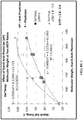
- Relationship (B) is for a ratio of about 1.0. This relationship is illustrated graphically in FIG.
- FIG. 1 shows a window that includes the curves (A) and (B) as well as the space between these curves to define increased starch gelatinization temperatures in the context of aqueous, fruit-based fillings as a function of starch anti-plasticizer, starch plasticizer, and starch anti-plasticizer molecular weight to retain the high levels of SDS as described herein.
- the crystalline melting profile of the starch was determined by standard differential scanning calorimetry.
- the instrument and method used to characterize the starch in the bran are:
- DSC Differential Scanning Calorimeter
- Sample Pans Perkin-Elmer stainless steel high pressure capsules with o-ring.
- Sample preparation The ingredients are mixed with solvent at a 1:1. solids to solvent ratio.
- Instrument calibration the DSC is calibrated for baseline, cell constant, temperature and heat capacity in a known manner:
- Baseline calibration using two empty sample pans the baseline slope and baseline offset are determined over a temperature range from 10°C to 150°C, with a heating rate of 5°C/min.
- the DSC calibration data analysis software program is used to make the proper DSC calibration corrections with the instrument in the calibration mode.
- Heat capacity is calibrated using sapphire, in a known manner.
- the sample is characterized with the DSC in the standard mode using a ramp rate of 5°C from 20°C to 140°C.
- the total heat flow curve is integrated from baseline to measure the gelatinization temperature of the crystalline starch in the sample. Samples are run at least in duplicate.
- FIG. 2 shows another relationship between the filler moisture and percentage of sugar (sucrose, MW of 342) as an anti-plasticizer that may, independently or in combination with other factors herein, affect SDS retention.
- This graph shows that filler moisture is another factor that helps aid in retention of high levels of SDS and that there is an inverse relationship between filler moisture content and retention of SDS. For example, as filler moisture increases, then the level of SDS generally decreases. As shown in the chart, within a given moisture range, increases of the anti-plasticizer can counteract the increase in moisture and aid in the retention of SDS by 3 to 4 points.
- FIG. 3 illustrates yet another relationship that may, independently or in combination with the other factors identified herein, aid in retention of high levels of SDS.
- FIG. 3 shows the temperature differential between the starch gelatinization temperature and the baking temperature as another factor that may influence high SDS retention.
- the baking temperature was 90°C, but it will be appreciated such temperature differential will generally apply at other commercial baking temperatures as well depending on the particular application.
- the maximum internal product temperature is about 20°C below the starch gelatinization temperature to ensure retention of high levels of SDS. In other approaches, the maximum internal product temperature is about 15°C below the starch gelatinization temperature, and in yet other approaches, maximum internal product temperature is about 10°C below the starch gelatinization temperature.
- slowly digestible starch generally means that portion of starch carbohydrate, measured as glucose, released between 20min and 120 min during enzyme digestion.
- the rate and extent of starch digestion in starch-containing foods may be estimated by an in vitro method developed by Englyst et al. (1996; 1999) (Incorporated herein by reference). Briefly, food samples are analyzed for free-sugar glucose (FSG) and fructose following in vivo chewing or mechanical mincing/crushing. Then, food samples are incubated with pancreatic enzymes (invertase, amylase, amyloglucosidase), and the amount of free glucose is measured at 20 minutes (G20) and 120 (G120) minutes.
- pancreatic enzymes invertase, amylase, amyloglucosidase
- the dough portion of the products herein may be a cookie, cracker, biscuit, bread, cake, bar, cereal and combinations thereof.
- the dough portion may include sweeteners, fat, protein, leavening, emulsifiers, flavor, fibers and grain based ingredients such as flours, seeds, particulates.
- the final product may include about 40 to about 90 percent of the dough portion, in other approaches, about 40 to about 60 percent of the dough.
- the dough portions herein also provide high levels of SDS, such as at least about 15g of the SDS/100g and in some cases, about 15 to about 20g of the SDS/100 grams of dough.
- the filler compositions herein are preferably applied to raw dough prior to the dough being baked. In some approaches, about 10 to about 60 percent of the filler is applied to or in the raw dough, in other approaches, about 40 to about 60 percent of the filler is applied to or in the raw dough, and in yet other approaches, about 40 to about 50 percent of the filler is applied to or in the raw dough.
- the filler When combined with the raw dough and then baked at the same time as the dough (at the select baking conditions and with the other factors selected of the filling compositions discussed herein), the filler retains high levels of SDS so that the overall final baked product also includes high levels of SDS provided from both the filler and the dough portion. To this end, by addition of the fillers described herein, the filler portion does not dilute the level of SDS provided in the final, baked product because both the filler portion and the dough portion provide high levels of SDS.
- the filler compositions herein are also bake stable meaning that the fillers do not spread excessively nor "boil-out” during baking.
- the bake stability is measured by the "ring test” as follows: Bake Spread Test Method: Use a 1.6" diameter ring by .75" in height.
- the bake spread may vary depending on the finished product application.
- the fillers herein also include additional ingredients to render them bake stable such as starch, modified starch, flours, pectin, fruit solids, sugar solids and additional hydrocolloids including but not limited xanthan gum and alginate and the like.
- the speed and the extent of enzymatic digestion of a starch depends upon the integrity of the granule as it swells and/or breaks down when it is subjected to heat, in particular a moist heat.
- Three methods are used to assess the condition of starch granule as it is subjected to moist heat, and these methods are complimentary to one another. These methods include (1) amylose extraction and iodine binding, (2) alpha-amylase digestion (also known as the starch damage test), and (3) the differential scanning calorimetry ("DSC”) test.
- the starch granules will begin to soften and swell. This allows the starch to leach out of the granules and the digestion enzymes to diffuse into the granule.
- Each method can assess the extent of granule disruption which would relate to in vivo digestibility.
- Method no. 1 uses iodine binding to measures how much amylose comes out of a starch granule during heating.
- the process involves the suspension and/or extraction of solids in 0.1 N of NaOH at room temperature.
- This method can illuminate changes that occur to the starch granule porosity, and the mobility of the lower molecular weight of starch out of the granule. That is, the greater the increase in granule porosity, the more starch will be available.
- Method no. 2 involves measuring the amylase digestible starch that is made accessible to enzymes as a result of physical damage to the starch granule when subjected to various treatments, such as milling, heat moisture, and the like.
- the technique uses an enzyme to digest the starch and measures the resulting amount of free glucose. In this technique, the more the granule swells, they more of the enzyme can get into the granule.
- This method is commonly identified as AACC (American Association of Cereal Chemists) method 76-31.01.
- Method no. 3, or DSC involves measuring the heat capacity of the starch granule as a percent of gelatinization. This method measures the "as is" DSC gelatinization profile indicated by the onset temperature of the softening and the swelling of the amorphous starch in the filler, followed by melting of the starch crystallites without added moisture. In this method, water is added to the filler (e.g., about 1 part filler to 1 part water) to provide excess water needed to fully gelatinize the starch in the filler. When compared to untreated filler, this technique can measure the percent of starch gelatinized during moist heat treatment.
- the gelatinization onset temperature measured by DSC measures the change in heat capacity of the amorphous regions of the starch as they soften and become rubbery. Subsequently, the starch crystallites melt and complete the disruption of the starch granule. As the granule softens, the digestive enzymes are able to access the starch and begin digestion. Increasing the sugar concentration can increase gelatinization onset temperature, however, it has been discovered (as will be discussed in the examples below), that moisture is an important driver of gelatinization onset temperature and digestibility.
- the amount of starch that gelatinizes in fruit fillers is correlated with the amount of water in the filler.
- the in vitro digestibility of the starch in the fruit filler also correlates with the amount of moisture in the filler. Water without sugars and 63C heating instead of 90C produced a different degree of gelation, confirming that the gelation and moisture relationship identified is unique to the sugars concentration and amount of heat used.
- FIG. 1 illustrates a relationship of starch antiplasticizer molecular weight, antiplasticizer concentrate expressed as an antiplasticizer /water ratio and the resultant gelatinization temperature of wheat starch (Aytex P, ADM) in excess solution (i.e., starch solids about 50%, 1part starch to 1 part sugar-water cosolvent) in excess solution (i.e., starch solids greater than or equal to 50%).
- ADM wheat starch
- starch plasticizer was added water, and the starch anti-plasticizer were the sugars of fructose, glucose, sucrose, and polydextrose.
- the gelatinization temperature increases as the molecular weight and concentration of the sugar increases indicating the anti-plasticizing function of sugars as they increase in molecular weight and water is displaced by increasing concentrations of sugar.
- the relationship is quasilinear with best fit as a second order polynomial.
- increasing the S/W ratio from 1 to 2 tends to increase starch gelatinization temperatures by about 10° C and increasing molecular weight from about 180 to about 380 increases gelatinization temperature by about 10° C to about 15° C.
- Starch gelatinization temperature was measured as described previously.
- FIG. 2 illustrates the effect of SDS retention based on the filler moisture content and the percentage of the starch anti-plasticizer in the filler.
- the starch was wheat starch (Aytex P, ADM)
- the starch plasticizer was water and/or glycerin
- the starch anti-plasticizer was a combination of fructose, glucose, and sucrose with 60% of the antiplasticizer of molecular weight 180 and 40% molecular weight 342 ranging down to 33% antiplasticizer molecular weight of 180 and 67% of molecular weight 342.
- the above Table includes Sugars composition of the "Apple Filler” ingredient used to make SDS Fruit Fillers in the Table below... shown here is the sugar type, % composition, sugar g/100g apple filler ingredient and moisture content of the apple filler ingredient.
- composition of SDS Fillers including apple filler ingredient, wheat starch, water, sugar (liquid and dry), glycerin, total filler moisture, SDS content before and after heating to 90C, SDS content normalized to 36% wt/wt, % SDS retention after heating, total sugars and % sugar type.
- SDS retention increases as the amount of antiplasticizer increases for a given formula moisture.
- This map describes the different ways to get to a given SDS retention. For example, to retain 15gSDS/100g formulate with 10% moisture and 37% AP. Alternatively, higher sugars, 42% AP and higher (16%) moisture would also alllow a SDS of 15g/100g filler.
- FIG. 3 illustrates retention of slowly digestible starch as gelatinization temperature of the starch, influenced by concentration of sugars and antiplasticizers, exceeds processing temperature of the filler, aiding in retention of high levels of SDS.
- Baking temperature was approximately 90°C.
- the table below shows the SDS fruit filler composition, including apple filler ingredient, wheat starch, water, sugar (liquid and dry), glycerin, total filler moisture, SDS content before and after heating to 90C, SDS content normalized to 36% wt/wt, % SDS retention after heating, total sugars and starch gelatinization temperature in the filler measured by DSC.
Landscapes
- Chemical & Material Sciences (AREA)
- Life Sciences & Earth Sciences (AREA)
- Engineering & Computer Science (AREA)
- Food Science & Technology (AREA)
- Health & Medical Sciences (AREA)
- Nutrition Science (AREA)
- Polymers & Plastics (AREA)
- Dispersion Chemistry (AREA)
- Chemical Kinetics & Catalysis (AREA)
- Confectionery (AREA)
- Bakery Products And Manufacturing Methods Therefor (AREA)
Claims (16)
- Verfahren zur Herstellung eines gebackenen Teigprodukts einschließlich einer backstabilen Füllung zum Zurückhalten hoher Mengen langsam verdaulicher Stärke darin, wobei das Verfahren umfasst:Mischen einer Füllkomponente, einer nicht gelatinierten Kornstärke, eines Stärke-Weichmachers und eines Stärke-Antiweichmachers, um eine Füllung mit ungefähr 10 bis ungefähr 24 Prozent Feuchtigkeit und einem Verhältnis von Stärke-Antiweichmacher zu Stärke-Weichmacher von ungefähr 0,25 bis ungefähr 3,00 zu bilden und mit einem Molekulargewicht des Stärke-Antiweichmachers von ungefähr 90 bis ungefähr 3600;Hinzufügen der Füllung zu einer rohen Teigkomponente vor dem Backen, um eine Teigfüllstoff-Zusammensetzung zu bilden;Backen der Teigfüllstoff-Zusammensetzung bei Temperaturen von nicht mehr als ungefähr 10 °C unter der Stärkegelatinierungstemperatur, sodass die Kornstärke unversehrt bleibt, um ein gebackenes Teigprodukt zu bilden, das mindestens ungefähr 10 g langsam verdauliche Stärke pro 100 g der Füllkomponente einschließt.
- Verfahren nach Anspruch 1, wobei die Füllung zu ungefähr 5 bis ungefähr 60 Prozent Antiweichmacher einschließt.
- Verfahren nach Anspruch 1, wobei die Füllkomponente eine Fruchtkomponente umfasst und wobei die Füllung ungefähr 1 bis ungefähr 50 Prozent der Fruchtkomponente, ungefähr 10 bis ungefähr 50 Prozent der nicht gelatinierten Kornstärke; ungefähr 10 bis ungefähr 25 Prozent des Stärke-Weichmachers und ungefähr 5 bis ungefähr 60 Prozent des Stärke-Antiweichmachers einschließt.
- Verfahren nach Anspruch 3, wobei die Fruchtkomponente ausgewählt ist aus der Gruppe, bestehend aus Saft, Trester, Pulver, Paste und Trockenfruchtstücken.
- Verfahren nach Anspruch 1, wobei die nicht gelatinierte Kornstärke ausgewählt ist aus der Gruppe, bestehend aus Weizen, Buchweizen, Mais, Reis, Hafer, Hirse, Teff, Roggen, Sorghum, Gerste und Mischungen davon.
- Verfahren nach Anspruch 1, wobei die Stärkegelatinierungstemperatur der nicht gelatinierten Kornstärke ungefähr 60 °C bis ungefähr 130 °C beträgt.
- Verfahren nach Anspruch 1, wobei die Teigfüllstoff-Zusammensetzung bei Temperaturen von ungefähr 10 bis ungefähr 20 °C unterhalb der Stärkegelatinierungstemperatur in dem Füllstoff gebacken wird.
- Verfahren nach Anspruch 1, wobei die Füllung Fett aufweist und wobei das Gesamtfett der Füllung nicht mehr als ungefähr 5 Gewichtsprozent beträgt.
- Gebackenes Teigprodukt einschließlich einer brennstabilen wässrigen Füllung, die nach dem Backen hohe Mengen an langsam verdaulicher Stärke darin zurückhält, wobei das gebackene Teigprodukt umfasst:eine Teigkomponente;eine Füllung, die auf die Teigkomponente aufgebracht wird, wobei die Füllung eine Füllungskomponente, eine nicht gelatinierte Kornstärke, einen Stärke-Weichmacher und einen Stärke-Antiweichmacher mit einem Molekulargewicht von ungefähr 180 bis ungefähr 3600 einschließt, wobei die Füllung ungefähr 10 bis ungefähr 25 Prozent Feuchtigkeit aufweist und ein Verhältnis zwischen dem Stärke-Antiweichmacher und dem Stärke-Weichmacher von ungefähr 0,25 bis ungefähr 3,00 beträgt; undmindestens ungefähr 10 g langsam verdauliche Stärke pro ungefähr 100 g Füllung, wobei das gebackene Teigprodukt durch Backen der Teigfüllstoff-Zusammensetzung bei einer Temperatur von nicht mehr als ungefähr 10 °C unter der Stärkegelatinierungstemperatur erhalten werden kann, sodass die Kornstärke unversehrt bleibt, um ein gebackenes Teigprodukt zu bilden, das mindestens ungefähr 10 g langsam verdauliche Stärke pro 100 g der Füllkomponente einschließt.
- Verfahren nach Anspruch 9, ferner umfassend ungefähr zu 5 bis ungefähr 60 Prozent den Antiweichmacher.
- Produkt nach Anspruch 9, wobei die Füllkomponente eine Fruchtkomponente umfasst, die ausgewählt ist aus der Gruppe, bestehend aus Saft, Püree, Pulver, Trockenfrüchten, umstrukturierten Früchten, Konzentraten, Fruchtfaser, Fruchttrester und Kombinationen davon, und wobei die Füllung ungefähr 5 bis ungefähr 50 Prozent der Fruchtkomponente, ungefähr 10 bis ungefähr 50 Prozent der nicht gelatinierten Kornstärke; ungefähr 10 bis ungefähr 25 Prozent des Stärke-Weichmachers und ungefähr 5 bis ungefähr 60 Prozent des Stärke-Antiweichmachers einschließt.
- Produkt nach Anspruch 9, wobei die Stärkegelatinierungstemperatur der nicht gelatinierten Kornstärke ungefähr 60 °C bis ungefähr 130 °C beträgt.
- Produkt nach Anspruch 9, wobei die Teigfüllstoff-Zusammensetzung bei Temperaturen von ungefähr 90 bis ungefähr 150 °C gebacken wird.
- Produkt nach Anspruch 9, wobei die Füllung Fett aufweist und wobei das Gesamtfett der Füllung nicht mehr als ungefähr 5 Gewichtsprozent beträgt.
- Produkt nach Anspruch 9, wobei die Füllung ferner einen oder mehrere Bestandteile einschließt, um eine Backstabilität bereitzustellen, die ausgewählt ist aus der Gruppe, bestehend aus Stärke, Pektin, Fruchtfeststoffen und Zuckerfeststoffen.
- Produkt nach Anspruch 9, wobei die Füllung ausgewählt ist aus der Gruppe, bestehend aus Füllungen auf Fruchtbasis, herzhaften Füllungen, Füllungen auf Gemüsebasis, Füllungen auf Käsebasis und Füllungen auf Schokoladenbasis.
Applications Claiming Priority (2)
| Application Number | Priority Date | Filing Date | Title |
|---|---|---|---|
| US201562193665P | 2015-07-17 | 2015-07-17 | |
| PCT/US2016/042438 WO2017015092A1 (en) | 2015-07-17 | 2016-07-15 | Sustained energy bake stable fillers and baked products comprising these |
Publications (2)
| Publication Number | Publication Date |
|---|---|
| EP3324745A1 EP3324745A1 (de) | 2018-05-30 |
| EP3324745B1 true EP3324745B1 (de) | 2020-09-16 |
Family
ID=56551006
Family Applications (1)
| Application Number | Title | Priority Date | Filing Date |
|---|---|---|---|
| EP16744632.7A Active EP3324745B1 (de) | 2015-07-17 | 2016-07-15 | Backstabile füllungen zur lang anhaltenden energiefreisetzung, sowie damit hergestellte backwaren |
Country Status (5)
| Country | Link |
|---|---|
| US (1) | US20180206509A1 (de) |
| EP (1) | EP3324745B1 (de) |
| CN (1) | CN107846909B (de) |
| ES (1) | ES2830326T3 (de) |
| WO (1) | WO2017015092A1 (de) |
Families Citing this family (3)
| Publication number | Priority date | Publication date | Assignee | Title |
|---|---|---|---|---|
| CN106035475A (zh) * | 2016-08-23 | 2016-10-26 | 徐州工程学院 | 一种高纤维法式面包圈及其生产工艺 |
| WO2019071014A1 (en) | 2017-10-06 | 2019-04-11 | Corn Products Development, Inc. | STARCH MODIFIED IN ACID TO BE SLOWLY DIGESTIBLE |
| CN111165534B (zh) * | 2020-01-17 | 2023-03-21 | 广东省农业科学院蚕业与农产品加工研究所 | 一种慢消化型全谷物能量棒及其制备方法 |
Family Cites Families (7)
| Publication number | Priority date | Publication date | Assignee | Title |
|---|---|---|---|---|
| CA2394873A1 (en) * | 2000-01-12 | 2001-07-19 | Societe Des Produits Nestle S.A. | Low water activity flavoured filling for baked flour based products |
| US6905719B2 (en) * | 2001-02-02 | 2005-06-14 | Kraft Foods Holdings, Inc. | Shelf-stable, bakeable savory cheese product and process for preparing it |
| DE10359918A1 (de) * | 2003-12-18 | 2005-07-21 | Innogel Ag | Stärke aufweisende Lebensmittel mit programmierbarem Hydrolyseverlauf und resistentem Anteil |
| FR2905564B1 (fr) * | 2006-09-11 | 2008-12-05 | Gervais Danone Sa | Fourrages. |
| WO2010080872A1 (en) * | 2009-01-09 | 2010-07-15 | Kellogg Company | Bake-stable food filling and methods related thereto |
| CN102077849B (zh) * | 2010-12-07 | 2012-08-22 | 江南大学 | 一种对谷物食品缓释能量特性的调控方法 |
| AR086993A1 (es) * | 2011-06-20 | 2014-02-05 | Gen Biscuit | Masa de galletita |
-
2016
- 2016-07-15 US US15/743,628 patent/US20180206509A1/en not_active Abandoned
- 2016-07-15 EP EP16744632.7A patent/EP3324745B1/de active Active
- 2016-07-15 ES ES16744632T patent/ES2830326T3/es active Active
- 2016-07-15 CN CN201680039787.XA patent/CN107846909B/zh active Active
- 2016-07-15 WO PCT/US2016/042438 patent/WO2017015092A1/en not_active Ceased
Also Published As
| Publication number | Publication date |
|---|---|
| CN107846909B (zh) | 2021-09-10 |
| EP3324745A1 (de) | 2018-05-30 |
| US20180206509A1 (en) | 2018-07-26 |
| ES2830326T3 (es) | 2021-06-03 |
| CN107846909A (zh) | 2018-03-27 |
| WO2017015092A1 (en) | 2017-01-26 |
Similar Documents
| Publication | Publication Date | Title |
|---|---|---|
| KR101323521B1 (ko) | 고함량의 섬유를 갖는 저칼로리 압출 팽창 식품의 제조 | |
| JP6147688B2 (ja) | ベーカリー製品及びその製造方法 | |
| JP5166224B2 (ja) | 焼き菓子類 | |
| Moza et al. | Mixolab, retrogradation and digestibility behavior of chapatti made from hulless barley flours | |
| JP5981677B1 (ja) | シューパフ及びその製造方法 | |
| JP6176812B2 (ja) | スライス適性に優れたベーカリー製品及びその製造方法 | |
| EP1725588B1 (de) | Langsam verdauliches stärkeprodukt | |
| JP6592460B2 (ja) | ベーカリー食品用加工澱粉及びベーカリー食品用ミックス | |
| JP5166207B2 (ja) | 焼き菓子類 | |
| MXPA06001495A (es) | Composiciones de harina de arroz. | |
| KR20150095866A (ko) | 완효성 탄수화물을 포함하는 질감이 부드러운 식품 조성물 | |
| TW201515576A (zh) | 用於製作包含至少40重量分穀物材料及至多30重量分糖之軟蛋糕麵糊的方法 | |
| US11102987B2 (en) | Gluten-free compositions and methods for producing shelf-stable bakery products | |
| CN107846909B (zh) | 持续能量的烘焙稳定的填充物及包括这些的烘焙产品 | |
| US20210161155A1 (en) | Improver for baked confectionery | |
| EP3267798B1 (de) | Softe backware mit erhöhter menge an langsam freisetzbaren kohlenhydraten | |
| US20160366896A1 (en) | Food Product with Reduced RAG:SAG Ratio | |
| JP2009082108A (ja) | ケーキ類製造用澱粉組成物およびケーキ類 | |
| WO2021153391A1 (ja) | ベーカリー食品用生地の製造方法 | |
| EP2949217B1 (de) | Keks mit mehreren Texturen | |
| Hadnađev et al. | Functionality of starch derivatives in bakery and confectionery products | |
| CN120225070A (zh) | 热处理谷粉类的制造方法 | |
| JP6813171B2 (ja) | パン類及びその製造方法 | |
| JP2025095694A (ja) | 揚げ菓子及びその製造方法並びに揚げ菓子の食感評価方法 | |
| KR20250161734A (ko) | 파베이크 반죽용 노화지연 조성물, 이를 포함하는 파베이크 반죽, 빵 및 그 제조방법 |
Legal Events
| Date | Code | Title | Description |
|---|---|---|---|
| STAA | Information on the status of an ep patent application or granted ep patent |
Free format text: STATUS: THE INTERNATIONAL PUBLICATION HAS BEEN MADE |
|
| PUAI | Public reference made under article 153(3) epc to a published international application that has entered the european phase |
Free format text: ORIGINAL CODE: 0009012 |
|
| STAA | Information on the status of an ep patent application or granted ep patent |
Free format text: STATUS: REQUEST FOR EXAMINATION WAS MADE |
|
| 17P | Request for examination filed |
Effective date: 20180102 |
|
| AK | Designated contracting states |
Kind code of ref document: A1 Designated state(s): AL AT BE BG CH CY CZ DE DK EE ES FI FR GB GR HR HU IE IS IT LI LT LU LV MC MK MT NL NO PL PT RO RS SE SI SK SM TR |
|
| AX | Request for extension of the european patent |
Extension state: BA ME |
|
| DAV | Request for validation of the european patent (deleted) | ||
| DAX | Request for extension of the european patent (deleted) | ||
| GRAP | Despatch of communication of intention to grant a patent |
Free format text: ORIGINAL CODE: EPIDOSNIGR1 |
|
| STAA | Information on the status of an ep patent application or granted ep patent |
Free format text: STATUS: GRANT OF PATENT IS INTENDED |
|
| INTG | Intention to grant announced |
Effective date: 20200504 |
|
| GRAS | Grant fee paid |
Free format text: ORIGINAL CODE: EPIDOSNIGR3 |
|
| GRAA | (expected) grant |
Free format text: ORIGINAL CODE: 0009210 |
|
| STAA | Information on the status of an ep patent application or granted ep patent |
Free format text: STATUS: THE PATENT HAS BEEN GRANTED |
|
| AK | Designated contracting states |
Kind code of ref document: B1 Designated state(s): AL AT BE BG CH CY CZ DE DK EE ES FI FR GB GR HR HU IE IS IT LI LT LU LV MC MK MT NL NO PL PT RO RS SE SI SK SM TR |
|
| REG | Reference to a national code |
Ref country code: GB Ref legal event code: FG4D |
|
| REG | Reference to a national code |
Ref country code: CH Ref legal event code: EP |
|
| REG | Reference to a national code |
Ref country code: DE Ref legal event code: R096 Ref document number: 602016044126 Country of ref document: DE |
|
| REG | Reference to a national code |
Ref country code: IE Ref legal event code: FG4D |
|
| REG | Reference to a national code |
Ref country code: AT Ref legal event code: REF Ref document number: 1313282 Country of ref document: AT Kind code of ref document: T Effective date: 20201015 |
|
| PG25 | Lapsed in a contracting state [announced via postgrant information from national office to epo] |
Ref country code: SE Free format text: LAPSE BECAUSE OF FAILURE TO SUBMIT A TRANSLATION OF THE DESCRIPTION OR TO PAY THE FEE WITHIN THE PRESCRIBED TIME-LIMIT Effective date: 20200916 Ref country code: BG Free format text: LAPSE BECAUSE OF FAILURE TO SUBMIT A TRANSLATION OF THE DESCRIPTION OR TO PAY THE FEE WITHIN THE PRESCRIBED TIME-LIMIT Effective date: 20201216 Ref country code: NO Free format text: LAPSE BECAUSE OF FAILURE TO SUBMIT A TRANSLATION OF THE DESCRIPTION OR TO PAY THE FEE WITHIN THE PRESCRIBED TIME-LIMIT Effective date: 20201216 Ref country code: HR Free format text: LAPSE BECAUSE OF FAILURE TO SUBMIT A TRANSLATION OF THE DESCRIPTION OR TO PAY THE FEE WITHIN THE PRESCRIBED TIME-LIMIT Effective date: 20200916 Ref country code: GR Free format text: LAPSE BECAUSE OF FAILURE TO SUBMIT A TRANSLATION OF THE DESCRIPTION OR TO PAY THE FEE WITHIN THE PRESCRIBED TIME-LIMIT Effective date: 20201217 Ref country code: FI Free format text: LAPSE BECAUSE OF FAILURE TO SUBMIT A TRANSLATION OF THE DESCRIPTION OR TO PAY THE FEE WITHIN THE PRESCRIBED TIME-LIMIT Effective date: 20200916 |
|
| REG | Reference to a national code |
Ref country code: AT Ref legal event code: MK05 Ref document number: 1313282 Country of ref document: AT Kind code of ref document: T Effective date: 20200916 |
|
| REG | Reference to a national code |
Ref country code: NL Ref legal event code: MP Effective date: 20200916 |
|
| PG25 | Lapsed in a contracting state [announced via postgrant information from national office to epo] |
Ref country code: RS Free format text: LAPSE BECAUSE OF FAILURE TO SUBMIT A TRANSLATION OF THE DESCRIPTION OR TO PAY THE FEE WITHIN THE PRESCRIBED TIME-LIMIT Effective date: 20200916 Ref country code: LV Free format text: LAPSE BECAUSE OF FAILURE TO SUBMIT A TRANSLATION OF THE DESCRIPTION OR TO PAY THE FEE WITHIN THE PRESCRIBED TIME-LIMIT Effective date: 20200916 |
|
| REG | Reference to a national code |
Ref country code: LT Ref legal event code: MG4D |
|
| PG25 | Lapsed in a contracting state [announced via postgrant information from national office to epo] |
Ref country code: EE Free format text: LAPSE BECAUSE OF FAILURE TO SUBMIT A TRANSLATION OF THE DESCRIPTION OR TO PAY THE FEE WITHIN THE PRESCRIBED TIME-LIMIT Effective date: 20200916 Ref country code: CZ Free format text: LAPSE BECAUSE OF FAILURE TO SUBMIT A TRANSLATION OF THE DESCRIPTION OR TO PAY THE FEE WITHIN THE PRESCRIBED TIME-LIMIT Effective date: 20200916 Ref country code: SM Free format text: LAPSE BECAUSE OF FAILURE TO SUBMIT A TRANSLATION OF THE DESCRIPTION OR TO PAY THE FEE WITHIN THE PRESCRIBED TIME-LIMIT Effective date: 20200916 Ref country code: PT Free format text: LAPSE BECAUSE OF FAILURE TO SUBMIT A TRANSLATION OF THE DESCRIPTION OR TO PAY THE FEE WITHIN THE PRESCRIBED TIME-LIMIT Effective date: 20210118 Ref country code: RO Free format text: LAPSE BECAUSE OF FAILURE TO SUBMIT A TRANSLATION OF THE DESCRIPTION OR TO PAY THE FEE WITHIN THE PRESCRIBED TIME-LIMIT Effective date: 20200916 Ref country code: LT Free format text: LAPSE BECAUSE OF FAILURE TO SUBMIT A TRANSLATION OF THE DESCRIPTION OR TO PAY THE FEE WITHIN THE PRESCRIBED TIME-LIMIT Effective date: 20200916 |
|
| PG25 | Lapsed in a contracting state [announced via postgrant information from national office to epo] |
Ref country code: AT Free format text: LAPSE BECAUSE OF FAILURE TO SUBMIT A TRANSLATION OF THE DESCRIPTION OR TO PAY THE FEE WITHIN THE PRESCRIBED TIME-LIMIT Effective date: 20200916 Ref country code: AL Free format text: LAPSE BECAUSE OF FAILURE TO SUBMIT A TRANSLATION OF THE DESCRIPTION OR TO PAY THE FEE WITHIN THE PRESCRIBED TIME-LIMIT Effective date: 20200916 Ref country code: IS Free format text: LAPSE BECAUSE OF FAILURE TO SUBMIT A TRANSLATION OF THE DESCRIPTION OR TO PAY THE FEE WITHIN THE PRESCRIBED TIME-LIMIT Effective date: 20210116 Ref country code: PL Free format text: LAPSE BECAUSE OF FAILURE TO SUBMIT A TRANSLATION OF THE DESCRIPTION OR TO PAY THE FEE WITHIN THE PRESCRIBED TIME-LIMIT Effective date: 20200916 |
|
| REG | Reference to a national code |
Ref country code: ES Ref legal event code: FG2A Ref document number: 2830326 Country of ref document: ES Kind code of ref document: T3 Effective date: 20210603 |
|
| REG | Reference to a national code |
Ref country code: DE Ref legal event code: R097 Ref document number: 602016044126 Country of ref document: DE |
|
| PG25 | Lapsed in a contracting state [announced via postgrant information from national office to epo] |
Ref country code: SK Free format text: LAPSE BECAUSE OF FAILURE TO SUBMIT A TRANSLATION OF THE DESCRIPTION OR TO PAY THE FEE WITHIN THE PRESCRIBED TIME-LIMIT Effective date: 20200916 |
|
| PLBE | No opposition filed within time limit |
Free format text: ORIGINAL CODE: 0009261 |
|
| STAA | Information on the status of an ep patent application or granted ep patent |
Free format text: STATUS: NO OPPOSITION FILED WITHIN TIME LIMIT |
|
| 26N | No opposition filed |
Effective date: 20210617 |
|
| PG25 | Lapsed in a contracting state [announced via postgrant information from national office to epo] |
Ref country code: DK Free format text: LAPSE BECAUSE OF FAILURE TO SUBMIT A TRANSLATION OF THE DESCRIPTION OR TO PAY THE FEE WITHIN THE PRESCRIBED TIME-LIMIT Effective date: 20200916 Ref country code: SI Free format text: LAPSE BECAUSE OF FAILURE TO SUBMIT A TRANSLATION OF THE DESCRIPTION OR TO PAY THE FEE WITHIN THE PRESCRIBED TIME-LIMIT Effective date: 20200916 |
|
| REG | Reference to a national code |
Ref country code: CH Ref legal event code: PL |
|
| PG25 | Lapsed in a contracting state [announced via postgrant information from national office to epo] |
Ref country code: MC Free format text: LAPSE BECAUSE OF FAILURE TO SUBMIT A TRANSLATION OF THE DESCRIPTION OR TO PAY THE FEE WITHIN THE PRESCRIBED TIME-LIMIT Effective date: 20200916 |
|
| REG | Reference to a national code |
Ref country code: BE Ref legal event code: MM Effective date: 20210731 |
|
| PG25 | Lapsed in a contracting state [announced via postgrant information from national office to epo] |
Ref country code: LI Free format text: LAPSE BECAUSE OF NON-PAYMENT OF DUE FEES Effective date: 20210731 Ref country code: CH Free format text: LAPSE BECAUSE OF NON-PAYMENT OF DUE FEES Effective date: 20210731 |
|
| PG25 | Lapsed in a contracting state [announced via postgrant information from national office to epo] |
Ref country code: LU Free format text: LAPSE BECAUSE OF NON-PAYMENT OF DUE FEES Effective date: 20210715 |
|
| PG25 | Lapsed in a contracting state [announced via postgrant information from national office to epo] |
Ref country code: IE Free format text: LAPSE BECAUSE OF NON-PAYMENT OF DUE FEES Effective date: 20210715 Ref country code: BE Free format text: LAPSE BECAUSE OF NON-PAYMENT OF DUE FEES Effective date: 20210731 |
|
| PG25 | Lapsed in a contracting state [announced via postgrant information from national office to epo] |
Ref country code: HU Free format text: LAPSE BECAUSE OF FAILURE TO SUBMIT A TRANSLATION OF THE DESCRIPTION OR TO PAY THE FEE WITHIN THE PRESCRIBED TIME-LIMIT; INVALID AB INITIO Effective date: 20160715 |
|
| P01 | Opt-out of the competence of the unified patent court (upc) registered |
Effective date: 20230329 |
|
| PG25 | Lapsed in a contracting state [announced via postgrant information from national office to epo] |
Ref country code: NL Free format text: LAPSE BECAUSE OF NON-PAYMENT OF DUE FEES Effective date: 20200923 Ref country code: CY Free format text: LAPSE BECAUSE OF FAILURE TO SUBMIT A TRANSLATION OF THE DESCRIPTION OR TO PAY THE FEE WITHIN THE PRESCRIBED TIME-LIMIT Effective date: 20200916 |
|
| PG25 | Lapsed in a contracting state [announced via postgrant information from national office to epo] |
Ref country code: MK Free format text: LAPSE BECAUSE OF FAILURE TO SUBMIT A TRANSLATION OF THE DESCRIPTION OR TO PAY THE FEE WITHIN THE PRESCRIBED TIME-LIMIT Effective date: 20200916 |
|
| PG25 | Lapsed in a contracting state [announced via postgrant information from national office to epo] |
Ref country code: MT Free format text: LAPSE BECAUSE OF FAILURE TO SUBMIT A TRANSLATION OF THE DESCRIPTION OR TO PAY THE FEE WITHIN THE PRESCRIBED TIME-LIMIT Effective date: 20200916 |
|
| PGFP | Annual fee paid to national office [announced via postgrant information from national office to epo] |
Ref country code: ES Payment date: 20250801 Year of fee payment: 10 |
|
| PGFP | Annual fee paid to national office [announced via postgrant information from national office to epo] |
Ref country code: DE Payment date: 20250729 Year of fee payment: 10 |
|
| PGFP | Annual fee paid to national office [announced via postgrant information from national office to epo] |
Ref country code: IT Payment date: 20250721 Year of fee payment: 10 |
|
| PGFP | Annual fee paid to national office [announced via postgrant information from national office to epo] |
Ref country code: GB Payment date: 20250728 Year of fee payment: 10 |
|
| PGFP | Annual fee paid to national office [announced via postgrant information from national office to epo] |
Ref country code: FR Payment date: 20250725 Year of fee payment: 10 |
|
| PG25 | Lapsed in a contracting state [announced via postgrant information from national office to epo] |
Ref country code: TR Free format text: LAPSE BECAUSE OF FAILURE TO SUBMIT A TRANSLATION OF THE DESCRIPTION OR TO PAY THE FEE WITHIN THE PRESCRIBED TIME-LIMIT Effective date: 20200916 |