EP3313169B1 - Grain production - Google Patents
Grain production Download PDFInfo
- Publication number
- EP3313169B1 EP3313169B1 EP16738296.9A EP16738296A EP3313169B1 EP 3313169 B1 EP3313169 B1 EP 3313169B1 EP 16738296 A EP16738296 A EP 16738296A EP 3313169 B1 EP3313169 B1 EP 3313169B1
- Authority
- EP
- European Patent Office
- Prior art keywords
- pollen
- plant
- grain
- pollination
- plants
- Prior art date
- Legal status (The legal status is an assumption and is not a legal conclusion. Google has not performed a legal analysis and makes no representation as to the accuracy of the status listed.)
- Active
Links
Images
Classifications
-
- A—HUMAN NECESSITIES
- A01—AGRICULTURE; FORESTRY; ANIMAL HUSBANDRY; HUNTING; TRAPPING; FISHING
- A01H—NEW PLANTS OR NON-TRANSGENIC PROCESSES FOR OBTAINING THEM; PLANT REPRODUCTION BY TISSUE CULTURE TECHNIQUES
- A01H1/00—Processes for modifying genotypes ; Plants characterised by associated natural traits
- A01H1/02—Methods or apparatus for hybridisation; Artificial pollination ; Fertility
- A01H1/027—Apparatus for pollination
-
- A—HUMAN NECESSITIES
- A01—AGRICULTURE; FORESTRY; ANIMAL HUSBANDRY; HUNTING; TRAPPING; FISHING
- A01H—NEW PLANTS OR NON-TRANSGENIC PROCESSES FOR OBTAINING THEM; PLANT REPRODUCTION BY TISSUE CULTURE TECHNIQUES
- A01H1/00—Processes for modifying genotypes ; Plants characterised by associated natural traits
- A01H1/02—Methods or apparatus for hybridisation; Artificial pollination ; Fertility
-
- A—HUMAN NECESSITIES
- A01—AGRICULTURE; FORESTRY; ANIMAL HUSBANDRY; HUNTING; TRAPPING; FISHING
- A01H—NEW PLANTS OR NON-TRANSGENIC PROCESSES FOR OBTAINING THEM; PLANT REPRODUCTION BY TISSUE CULTURE TECHNIQUES
- A01H1/00—Processes for modifying genotypes ; Plants characterised by associated natural traits
- A01H1/02—Methods or apparatus for hybridisation; Artificial pollination ; Fertility
- A01H1/022—Genic fertility modification, e.g. apomixis
- A01H1/023—Male sterility
-
- A—HUMAN NECESSITIES
- A01—AGRICULTURE; FORESTRY; ANIMAL HUSBANDRY; HUNTING; TRAPPING; FISHING
- A01H—NEW PLANTS OR NON-TRANSGENIC PROCESSES FOR OBTAINING THEM; PLANT REPRODUCTION BY TISSUE CULTURE TECHNIQUES
- A01H6/00—Angiosperms, i.e. flowering plants, characterised by their botanic taxonomy
- A01H6/14—Asteraceae or Compositae, e.g. safflower, sunflower, artichoke or lettuce
- A01H6/1464—Helianthus annuus [sunflower]
-
- A—HUMAN NECESSITIES
- A01—AGRICULTURE; FORESTRY; ANIMAL HUSBANDRY; HUNTING; TRAPPING; FISHING
- A01H—NEW PLANTS OR NON-TRANSGENIC PROCESSES FOR OBTAINING THEM; PLANT REPRODUCTION BY TISSUE CULTURE TECHNIQUES
- A01H6/00—Angiosperms, i.e. flowering plants, characterised by their botanic taxonomy
- A01H6/20—Brassicaceae, e.g. canola, broccoli or rucola
- A01H6/202—Brassica napus [canola]
-
- A—HUMAN NECESSITIES
- A01—AGRICULTURE; FORESTRY; ANIMAL HUSBANDRY; HUNTING; TRAPPING; FISHING
- A01H—NEW PLANTS OR NON-TRANSGENIC PROCESSES FOR OBTAINING THEM; PLANT REPRODUCTION BY TISSUE CULTURE TECHNIQUES
- A01H6/00—Angiosperms, i.e. flowering plants, characterised by their botanic taxonomy
- A01H6/46—Gramineae or Poaceae, e.g. ryegrass, rice, wheat or maize
- A01H6/4624—Hordeum vulgarus [barley]
-
- A—HUMAN NECESSITIES
- A01—AGRICULTURE; FORESTRY; ANIMAL HUSBANDRY; HUNTING; TRAPPING; FISHING
- A01H—NEW PLANTS OR NON-TRANSGENIC PROCESSES FOR OBTAINING THEM; PLANT REPRODUCTION BY TISSUE CULTURE TECHNIQUES
- A01H6/00—Angiosperms, i.e. flowering plants, characterised by their botanic taxonomy
- A01H6/46—Gramineae or Poaceae, e.g. ryegrass, rice, wheat or maize
- A01H6/4636—Oryza sp. [rice]
-
- A—HUMAN NECESSITIES
- A01—AGRICULTURE; FORESTRY; ANIMAL HUSBANDRY; HUNTING; TRAPPING; FISHING
- A01H—NEW PLANTS OR NON-TRANSGENIC PROCESSES FOR OBTAINING THEM; PLANT REPRODUCTION BY TISSUE CULTURE TECHNIQUES
- A01H6/00—Angiosperms, i.e. flowering plants, characterised by their botanic taxonomy
- A01H6/46—Gramineae or Poaceae, e.g. ryegrass, rice, wheat or maize
- A01H6/4678—Triticum sp. [wheat]
-
- A—HUMAN NECESSITIES
- A01—AGRICULTURE; FORESTRY; ANIMAL HUSBANDRY; HUNTING; TRAPPING; FISHING
- A01H—NEW PLANTS OR NON-TRANSGENIC PROCESSES FOR OBTAINING THEM; PLANT REPRODUCTION BY TISSUE CULTURE TECHNIQUES
- A01H6/00—Angiosperms, i.e. flowering plants, characterised by their botanic taxonomy
- A01H6/54—Leguminosae or Fabaceae, e.g. soybean, alfalfa or peanut
- A01H6/542—Glycine max [soybean]
-
- A—HUMAN NECESSITIES
- A01—AGRICULTURE; FORESTRY; ANIMAL HUSBANDRY; HUNTING; TRAPPING; FISHING
- A01H—NEW PLANTS OR NON-TRANSGENIC PROCESSES FOR OBTAINING THEM; PLANT REPRODUCTION BY TISSUE CULTURE TECHNIQUES
- A01H6/00—Angiosperms, i.e. flowering plants, characterised by their botanic taxonomy
- A01H6/46—Gramineae or Poaceae, e.g. ryegrass, rice, wheat or maize
- A01H6/4684—Zea mays [maize]
Definitions
- This invention relates generally to novel methods of grain production, specifically intended to increase grain yields. More specifically, this invention relates to on-demand pollination technology applicable to grain-bearing plants which is not dependent on active pollen shed, neighboring plants, or seed mixes.
- the current invention has application to the field of grain production and plant pollination practices, in grain crops such as maize (also called corn), soybeans, wheat, rice, sunflower, canola, sorghum, barley, and pearl millet.
- grain production as used in this disclosure is intended to mean commercial-scale grain production, using a minimum field size of 0.8 hectares (2 acres) of land for the production of said grain.
- a conventionally grown grain field is typically predominantly F 1 plants that share genes in common from 2 inbred parents (although conventional grain will also have a small percentage of contaminant seed (not F 1) in a standard bag of seed.). In other situations, the "top-cross" method is used for grain production.
- top-cross grain uses a field that is a blend of a male sterile hybrid ( ⁇ 93%) and a male fertile high oil pollinator germplasm (7%).
- Commercial grain production often relies upon field production of hybrid plants.
- Hybrid plants are the result of fertilization occurring from a male pollen source of one genetic background being crossed to the female reproductive organs of a plant with a different genetic background.
- Hybridity among crop plants generally gives a yield advantage in commercial production.
- maize, rice, sorghum, sunflower, and canola are the primary crops which take advantage of hybrid seed.
- Other grains are less commonly grown as hybrids, as is the case with soybean, wheat, barley, pearl millet and others.
- self-pollen which is a single plant's own pollen
- sib-pollen which is pollen from sibling plants who share the same genetics.
- self-pollination includes “sib-pollination,” which is pollination occurring with pollen from a sibling plant, and which has the same effect in the resulting grain as self-pollination.
- all self-pollination and sib-pollination is effectively self-pollination in terms of the effect on the grain, which is a yield decrease (in comparison to outcrossing) and purity increase in the case of food corn.
- Cross pollination refers to genetic exchange between inbreds or hybrids in adjacent and surrounding fields, not from plants within the same field.
- cross pollination is the introduction of pollen that is derived or sourced from separate locations that is genetically distinct from the pollen which will be shed from the plants within the grain production field.
- hybrids are known to exhibit heterosis, which is expressed as hybrid vigour, meaning a stronger and more resilient plant. Heterosis also results in higher grain yields. This effect is sometimes referred to as xenia. ( Stamp et al. (2002) Crop Sci. 42:1848-1856 ; Stamp et al. (2002) Maydica 47:127-134 ). Heterosis also occurs when an existing hybrid plant (created from 2 different parent plants) is fertilized with pollen from yet another plant, providing a subsequent boost in yield. Hybrid grain crops substantially out yield non-hybrid cultivars and also exhibit better response to fertilizers. However, conditions during the growing season vary from year to year and pressures caused by environmental challenges, disease outbreaks and insect infestations can significantly impact grain yield.
- cross pollinating hybrids can provide a yield benefit by avoiding the inbreeding depression associated with self- or sib-pollination, or by creating new gene combinations that generate a heterotic response within the kernels. This response has been termed the ⁇ xenia effect.' "Xenia can be defined as the effect of the pollen genes on the development of the fruit or the seeds.” ( Bulant et al. ((2000) Crop Sci. 40: 182-188 )
- the additional nutrients translocated into developing kernels of P3732 cross-pollinated plants were mainly derived from increases in duration of dry matter production and N uptake by vegetative tissues ( Tsai et al. (1991) J. Sci. Food Agric. 57: 163-174 ). These well-established impacts on kernel composition are the basis for the top-cross method of producing high oil corn.
- the top-cross system for high oil corn grain production was a method used in the 1990s and early 2000s in which high oil was induced by planting a blend of a male sterile hybrid ( ⁇ 93%) and a male fertile high oil pollinator germplasm (7%). The result was an increase in oil from about 3-4% for normal commodity grain, to about 6% for the high oil top-cross grain.
- the high oil grain brought a premium price per bushel at the grain elevator. ( Thomison, P. R. et al. (2002) Agron. J. 94: 290-299 .)
- the extent of the xenia effect varies with the male and female genotype. The greater the genetic difference between the male pollen source and female, the greater the expected response to cross-pollination. ( Leng, E.R., (1949) Agron. J. 41:555-558 ; Bulant, C. and A. Gallais, (1998) Crop Sci. 38: 1517-1525 ).
- the cross fertilization advantage was less for single-cross hybrids than for their inbred parents, and the advantage varies with the male. For crosses between inbreds, the advantage of cross fertilization was 13.8 and 14.5 %, but only 2.5% for crosses made with their hybrid ( Bulant, C. and A. Gallais, (1998) Crop Sci. 38: 1517-1525 ).
- Grain yield is measured as the weight of grain per area of land measured at a given moisture content (for example, 15.5% moisture for corn). Low pollination rates result in poor grain yield. For this reason, grain producers typically rely upon self-pollination and pollination by neighboring plants in the field since they know that the pollination will occur during the correct window of time because the female components of the plant will be ready to receive the pollen. Unfortunately, self-pollination will not necessarily maximize grain yield and it is unable to account for changing conditions and stresses that may affect the plant during the growing season.
- the instant invention provides a method of selecting one or more times during which designated female plants are ready to receive intentionally applied designated male pollen an approach, as further defined in Claim 1.
- the instant invention also provides a method of enabling the production of grain for human consumption, or animal consumption, as further defined in Claim 2, and a method of producing grain for human consumption, or animal consumption, as further defined by Claim 3, said methods comprising using the grain for human or animal consumption.
- these methods can provide for the increase of grain size and the modification of grain constituents by means of specific cross-pollination with pollen from a different genetic background, and can also allows for real-time production decisions to address conditions at the time of pollination or to address production challenges. These methods can also reduce undesirable contamination in the grain harvested from the field. These methods can also provide for maximizing synchronous pollination with self- or sib-pollen, which provides for the reduction of contamination caused by undesirable cross-pollination, which is particularly applicable to the organic farming industry. These two methods can also be combined to both increase yield and modify grain size and constituents in the same grain field, while also reducing contamination.
- the invention described herein could enable a 5% grain yield increase in rice, which would have an annual value, with 10% adoption, mostly by larger farmers on highly productive land, of $1.5 billion globally.
- This is based on 2013 global rice production of 746MM metric tons (GeoHive (2016) [online] World: Rice Production in Metric Tonnes, retrieved on 2016-06-20. Retrieved from the internet: ⁇ http://www.geohive.com/charts/ag_rice.aspx>) and a rice commodity price of $408.91 per metric ton (May 2016 rough rice commodity price [online], retrieved from the internet on 2016-06-23.
- the present invention provides a method of selecting one or more times during which designated female plants are ready to receive intentionally applied designated male pollen (pollen M ), in a way that does not include natural pollination by wind, insect activity or other naturally-occurring conditions, in order to produce grain of interest
- the designated female plant is any one or more of: a corn plant, a soybean plant, a wheat plant, a rice plant, a sunflower plant, a canola plant, a sorghum plant, a barley plant, or a pearl millet plant
- the designated female plants include female components that are grown in a minimum field size of 8,000 m 2 (0.8 hectares) in conditions that can expose the female components to undesirable pollen (pollen U ), said pollen U being: a.
- a first time that is the time at which the designated female plants first become receptive to pollen; and/or ii.a second time that is a period of time that is at a time of day when pollen U is not being released and/or released pollen U is no longer viable, such that when the pollen M is intentionally applied, on one or more occasions, by means that do not include natural pollination by wind, insect activity or other naturally-occurring conditions, to the female components of the designated female plants during the period of the second time, then the selected designated female plants are already pollinated by pollen M by the time pollen U next begins to be shed.
- the present invention also provides a method of enabling the production of grain for human or animal consumption, the method comprising: a. growing designated female plants that include female components in a minimum field size of 8,000 m2 (0.8 hectares) in conditions that can expose the female components to undesirable pollen (pollenU), said pollen U being: self pollen produced by the male components of the designated female plants; and/or pollen produced by neighboring plants, which pollen is capable of pollination of the designated female plants; b.
- polyenU undesirable pollen
- the designated female plant is any one or more of: a corn plant, a soybean plant, a wheat plant, a rice plant, a sunflower plant, a canola plant, a sorghum plant, a barley plant, or a pearl millet plant.
- the present invention also provides a method of producing grain for human or animal consumption, the method comprising: a. growing designated female plants that include female components in a minimum field size of 8,000 m2 (0.8 hectares) in conditions that can expose the female components to undesirable pollen (pollen U ), said pollen U being: self pollen produced by the male components of the designated female plants; and/or pollen produced by neighboring plants, which pollen is capable of pollination of the designated female plants; b.
- the designated female plant is any one or more of: a corn plant, a soybean plant, a wheat plant, a rice plant, a sunflower plant, a canola plant, a sorghum plant, a barley plant, or a pearl millet plant.
- the methods of the present invention can provide for an improvement in commercial grain production by intentionally cross-pollinating grain plants with pollen from a different genetic background. This method provides a yield increase as a result of heterosis, or the xenia effect. This method has the additional benefit of providing for modification of grain characteristics, including grain content and grain constituents.
- the methods of the present invention can also provide for the enhancement of levels of self- and/or sib-pollination in commercial grain production, the method including the intentional application of designated male pollen (with the same genetic background as the designated female plant) to a designated female plant on one or more occasions.
- the designated female plant is in a state when the female components are ready to receive pollen.
- the male components of the designated female plant may or may not be releasing pollen at the time of the intentional application of designated male pollen.
- some female components will receive the intentionally applied designated male pollen while other components may receive self-pollen or sib-pollen from neighboring plants, resulting in an overall increase in successful pollination events, and thereby reducing contamination caused by undesirable outcrossings.
- the methods of the present invention can provide for an increase in grain size and modification in grain characteristics, including grain content and constituents, by means of specific cross-pollination.
- the oil, protein or starch content of the grain may be modified, and the specific oil, protein or starch constituents of the grain may also be modified.
- This provides for the use of real-time production decisions to address specific conditions at the time of pollination, and allows the grower to address specific production challenges in the field.
- the designated female plant is in a state when the female components are ready to receive pollen.
- the male components of the designated female plant may or may not be releasing pollen at the time of the intentional application of designated male pollen.
- the male components are releasing pollen, some female components will receive the intentionally applied designated male pollen while other components may receive self-pollen or sib-pollen from neighboring plants.
- the male components are not releasing pollen, the majority of the female components will receive the intentionally applied designated male pollen from a different genetic background, resulting in heterosis, or the xenia effect, and a concurrent increase in the size of grains or kernels, as well as intentional changes in grain content or constituents.
- Both these methods can also help to reduce contamination in the grain caused by undesirable pollination events.
- the methods may also be combined in order to achieve both a grain yield increase and an increase in grain size, along with the modification of grain characteristics.
- the methods are applicable to a wide range of plants in particular including, corn, soybean, wheat, rice, sunflower, canola, sorghum, cotton, barley, and pearl millet.
- the application of the designated male pollen may be conducted by automated means, mechanical means, positive pressure means, negative pressure means, manual means, semi-automated means, or combinations thereof.
- the designated male pollen source may be from previously preserved or freshly harvested pollen from male source material.
- the pollen may have been harvested from one or more of a field, a growth chamber, a greenhouse, a glasshouse, a shade house, a hoop house, a vertical farming facility or a hydroponic facility.
- Preserved pollen may have been preserved by any means that permits the pollen to retain viability, including but not limited to various forms of cooling or freezing including, but not limited to, chilling, cryopreservation, freeze drying, or storage in liquid nitrogen.
- the pollen, whether fresh or preserved may have been collected from a source with altered circadian rhythm or a source with normal circadian flowering, but wherein said male components of said designated female parent plants are delayed, or allowed to shed with no delay.
- the pollen, whether fresh or preserved may have been collected from one or more sources and may have been combined with pollen from other sources before application.
- the methods of the present invention can further provide for improvement in crop productivity.
- Intentionally applying specifically selected pollen from a genetically unrelated source allows the opportunity for making real-time, agronomic-specific decisions in selecting the unrelated pollen sources. This allows the maximization of seed characteristics for any given environmental condition or market needs for any given plant of interest.
- the specifically selected pollen is obtained from sources optimal for application based on environmental conditions, including abiotic and biotic conditions.
- the specifically selected pollen is obtained from a source optimal for application based on plant performance data (such as data obtained from yield trials, for example), or commodity and market price information.
- the specifically selected pollen influences the characteristics of the grain harvested from the female plant, impacting characteristics such as grain content and constituents, which include, but are not limited to, grain oil content and composition, grain starch content and composition, and grain protein content and composition.
- the designated female plants may be either male sterile or male fertile, and the pollen source may be applied prior to exposure from a designated female plant pollen, including self-pollen or it may be applied concurrently while the plant is receptive to self-pollen and/or sib-pollen.
- the method may include male-specific pollen sources which are optimal for application of pollen based on environmental conditions or on market trends which would make seeds with a specific composition (i.e., starch, oil, drought resistance, flood tolerance, etc.), more valuable.
- the pollen may be selected from a single source or a combination of sources in order to enable a combination of traits from seed to seed.
- the technology and methods may be used with any plants, and corn or other specifically named plants are discussed for illustration purposes only and are not intended to be limiting, although for the purposes of the presently-claimed invention the plant is selected from one or more of: a corn plant, a soybean plant, a wheat plant, a rice plant, a sunflower plant, a canola plant, a sorghum plant, a barley plant, or a pearl millet plant.
- the technology may be used in conjunction with any grain plant including those that are hybrids, non-hybrids, male fertile and male sterile.
- Grain is produced for a number of purposes, including human consumption, animal consumption, industrial use, re-planting, and for research purposes.
- the grain is produced and used for human consumption and/or animal consumption.
- the primary goal of grain production is the harvesting of a high-yielding, high quality grain. Seed companies devote billions of dollars to research in the pursuit of developing better plant genetics in order to improve grain yields. Regardless of the end use of the grain, the production of grain is dependent on the appropriate male pollen fertilizing the appropriate female plant at the appropriate time.
- reproductive synchrony The synchronization between the male pollen and the female receptivity is referred to herein as reproductive synchrony.
- Reproductive synchrony is easily achieved through self-pollination or pollination by neighboring plants of the same variety.
- reproductive synchrony is more difficult between different varieties which may mature at different times or as a result of different temperatures, as well as other environmental factors.
- a grain producer might have an interest in pollinating a crop with pollen from a variety that could impart specific characteristics to the resulting grain. Typically, this cannot be achieved unless the following circumstances exist: (1) the producer knows at the beginning of the growing season which variety they wish to pollinate with; (2) the varieties will be releasing pollen and receptive to pollen at the same time; and (3) the varieties are grown in close physical proximity to each other.
- a producer is experiencing a period of drought and would like to pollinate with a variety that shows strong grain yields even during drought periods, he will be unable to do so unless that is the variety that he has already chosen to plant and grow and it is already in his field, as well as releasing pollen at the appropriate time.
- This producer cannot typically pollinate a crop with pollen from a variety that might help overcome potential low grain yields due to drought if the variety is being grown elsewhere and has a different maturity period in comparison to his already planted variety.
- the present invention is able to overcome all three of these potential barriers to reproductive synchrony, thereby enabling a broader choice of pollen for the producer as well as the ability to make real-time production decisions.
- Synchronous pollination within and between corn ears is particularly important in maize because it has been shown to improve kernel set, which is a critical factor in grain yields.
- Carcova ( Carcova et al. (2000) Crop Sci. 40: 1056-1061 ) demonstrated that synchronous pollination of exposed silks on apical and sub-apical ears 5 days after silking showed an improvement in kernel number per plant.
- nick is a term used in hybrid seed production that refers to the synchrony of both male and female flower types (i.e. the peak of pollen shed by the male aligned with the peak of silk emergence in the female) developing at the ideal time such that pollen grains will successfully pollinate, resulting in fertilization.
- the perfect "nick" occurs when 50% of the male population begins to shed pollen on the same day when 50% of the female population begins to exert silks.
- a real-time production decision is a decision that is made during the pendency of the growth and maturation of the crop, rather than a decision that is made during the planning stage prior to the planting of the crop.
- Grain producers choose which grain variety to plant in any given production season based on characteristics that are optimal for their climate, land, growing conditions, and other factors. Once that decision has been made, and the crop has been planted, growers make real-time decisions during the growth of the crop, such as when to spray for weed control or treatment of disease or insect problems. These decisions occur as the crop grows in response to specific conditions and stresses that the crop is facing at any given time.
- the methods of the present invention can provide for improved grain production, using a method that includes collecting, storing, and delivering pollen from male plants to the female plants.
- Some methods of collecting pollen are known in the art.
- US Patent 4,922,651 discloses an apparatus for effecting or improving pollination of plants.
- the methods of the present invention can enable or result in pollinations which occur prior to the active period in which the plant might be subject to self-pollination and/or be exposed to other undesirable pollination, or during the active period in which the plant is subject to self-pollination and/or exposed to other pollination, thereby increasing pollination efficiency.
- the methods of the present invention can increase the heterosis effect, and allow for real-time production decisions.
- the invention does not require the use of male sterility or isolation, although one or both may be employed without departing from the scope of the invention.
- the current invention is applicable to the common practice of planting seed that will germinate and become seed bearing plants that will bear the grain to eventually be sold to grain elevators or other customers, or used as animal feed.
- this invention provides an improved alternative by increasing successful self- and/or sib-pollination, and/or by modifying the level of cross-pollination through the intentional application of male pollen to female plants at a specific time.
- Use of the term "intentional" with regard to pollen application means the specific application of pollen in a way that does not include natural pollination by wind, insect activity or other naturally-occurring conditions.
- Intentionally applied pollen is pollen that has been applied to a plant as a result of a deliberate human activity or decision, and may be applied by hand or by other means.
- intentional pollination is the "prescriptive" application of pollen, which is the use of pollen to solve a problem in order to address a specific need or condition in the field.
- the specific pollen to be used and the timing of the intentional application will depend upon the need or condition being addressed.
- a pollen bank is a source of stored pollen that has been collected from one or more pollen sources and stored in such a way that the pollen retains its viability.
- the plants that have been used as the pollen source for such a pollen bank may have been grown and harvested in any conditions, including but not limited to, a field, a growth chamber, a greenhouse, a glasshouse, a shade house, a hoop house, a vertical farming facility or a hydroponic facility. Pollen from a pollen bank may have been sourced in different ways.
- fresh pollen can be harvested from males grown in a controlled environment in which the circadian rhythm is 2-8 hours ahead of naturally growing female plants in the field.
- the pollen which is stored in the bank may be preserved pollen that was collected days, weeks, months or years prior to its eventual removal from the bank for pollinating purposes.
- Preserved pollen may have been preserved by any means that permits the pollen to retain viability, including but not limited to various forms of cooling or freezing including, but not limited to, chilling, cryopreservation, freeze drying, or storage in liquid nitrogen.
- the pollen may be harvested from an anther studio.
- the anther studio enables optimal growth conditions for male plant reproductive tissues for any species or variety of plant.
- the tissues (corn tassels for example) are cut from plants growing in standard outdoor conditions, such as in the field or those grown in controlled conditions, such as the greenhouse or a growth chamber.
- the tissues are preferably cut prior to the plant beginning to shed pollen and are placed into the anther studio.
- the tissue may then be cultured in a nutrient medium allowing for further growth. At least one of specialized lighting, temperature, and/or humidity may be cycled in the anther studio, allowing for continued growth of the tissue. Growth may be modulated to increase or slow the rate of growth and thus modulate the duration for availability of pollen.
- pollen may be shed prior to silk emergence (protandry), or silk emergence may be prior to pollen shed (protogyny).
- the silks will be receptive to pollen before pollen is shed on a given day.
- This invention is applicable to both situations.
- the silks are receptive to pollen all day for about seven days. Accordingly, pollen may be intentionally applied any number of times, including but not limited to, once per day, twice per day, or in a continuous application.
- pollen F typically will begin to shed in the mid-morning hours, and continue to late morning or early afternoon, after which all pollen F either finds a viable female and germinates, enabling a successful self-pollination, or dies within four hours or less if it does not land on a viable female ( Luna V. et al. (2001) Crop Sci. 41(5): 1551-1557 ).
- the female corn plant has a daily window of time during which male pollen can be delivered and during which pollen F is not shedding. This window will be repeated over several days.
- the current invention cross allows for the pollination of nearly all of the viable females during a window of time during which pollen F is not shedding or is not viable, or a combination of cross-pollination and self-pollination.
- the current invention has the capacity to cross pollinate nearly all of the viable females prior to pollen F becoming viable or after pollen F becomes viable, depending on the preference of the grain producer and the situation in the field.
- one aspect of the invention is the timing of pollen delivery to female plants.
- pollination window the time during which the female is receptive to pollen and during which a successful pollination event can occur
- females mature and grow relatively continuously
- males have a distinct cycle in which pollen becomes viable and sheds or is dehisced from the anthers beginning in mid-morning and ending in late morning or early afternoon.
- pollen F can become viable prior to the females being fertile, but there will always be a first morning upon which viable females become fertile prior to viable pollen F beginning to shed on that day.
- pollen F that may have shed the previous day has long since died and become inviable prior to females becoming viable the next morning.
- the early to mid-morning hours are therefore ideal for application of pollen M to fortuitously cross pollinate all viable females just prior to pollen F beginning to shed, although one may choose to apply pollen several days before pollen F beginning to shed or at several times of the day or in a continuous fashion even during the shed of pollen to increase the probability of successfully increasing heterosis effects, and maximizing the yield of grain.
- pollen may be delivered at 6:00 a.m. However, delivery of pollen may occur at any hour of the day, providing a great advantage over traditional methods.
- This invention enables for the first time effective grain production without solely relying upon self-pollination or pollination by neighboring plants which may, at the time of pollination, be an undesirable pollination option due to any number of biotic or abiotic stresses upon the crop.
- Undesirable biologically compatible sources can be referred to as pollen U .
- the present invention allows for designated pollination such that when pollen U begins to shed, all viable target females have already been pollinated by the selected pollen source and the pollen U dies after a short period of time depending on species and environmental conditions ( Luna V. et al. (2001) Crop Sci.
- the capacity to deliver viable pollen on demand to effect timely pollinations of receptive silks addresses a number of limitations common to grain production on a field scale. Specifically, prescriptive use of the invention overcomes low levels of pollen production and eliminates problems caused by poor reproductive synchrony between male and female flowers.
- Pollen M can be delivered in any number of ways, including, but not limited to, manual delivery, manual delivery with a small hand mechanical device for semi-automated dispersal, by field driven machinery containing pollen dispersal machinery or via fully automated dispersal by a self-propelled and/or human guided apparatus such as a drone that has a pollen dispersal device mounted to it, wherein the pollen dispersal is by automatic or semi-automatic means, including, but not limited to, positive pressure, negative pressure, mechanical or pneumatic means.
- Use of a drone would be especially novel and practical in this method. Small drones, which need not be regulated, can be used in the method, and can be guided using GPS coordinates to focus the pollen dispersal directly over the female plants.
- W.F. Sheridan ed.
- the timing of pollen delivery, amount of pollen required, and number of days of pollen delivery can be adjusted as necessary for circumstances such as crop type and weather patterns, (i.e. crop height, crop density, rain frequency or amount, wind speed and direction, etc.).
- the method can be adjusted for soybeans which have a longer pollination period than maize.
- the efficiency of these delivery methods will reduce the amount of pollen needed for successful pollination. It is estimated by the inventors that these more efficient methods may use 1/1000 of the amount of pollen currently produced for grain production.
- the methods described herein can operate in any crop plant to either improve or enable grain production, although for the purposes of the presently claimed invention, the plant is selected from one or more of: a corn plant, a soybean plant, a wheat plant, a rice plant, a sunflower plant, a canola plant, a sorghum plant, a barley plant, or a pearl millet plant. It can operate in any environment including, but not limited to, ideal or target growing environments, off-season environments, or controlled environments (e.g. shade/glass/green/hoop houses, growth chambers, vertical farming facilities, hydroponic facilities, aeroponic facilities etc.). Pollen M can be applied as soon as females are viable and irrespective of pollen F or other undesired pollen viability. This invention can also be used to improve current grain production practices even when all conventional components are present, thus improving grain yields in challenging production situations.
- a corn plant a soybean plant, a wheat plant, a rice plant, a sunflower plant, a canola plant, a
- the invention may be used to solve or reduce the loss caused by drought. This is advantageous for all in the industry, including producers and crop insurers. Specifically, in a drought, plants become stressed. When a plant is stressed it often produces male components only. Accordingly, the pollen is there, but there are no females to receive it. Sometimes the plant will produce the female components later, but at that point the pollen is no longer available for pollination. By employing the method of the present invention, pollen may be delivered from a pollen storage bank or controlled environment to the stressed plants after the females are available for pollination, thus rescuing the plants to at least some degree to produce harvestable yields of grain.
- real-time research or production decisions can be made with regard to the pollen intended to be used for pollination, such as the desire to produce grain with specific characteristics desired by the producer, including, but not limited to, increased oil production, decreased oil production, increased starch production, decreased starch production, improved drought resistance, improved resistance to flooding or other sources of excessive moisture, improved performance in high heat conditions, improved performance in low heat conditions, improved fungal resistance, improved insect resistance, increased yield, and improved pollination when the initial intended pollination is out of synchrony due to the male and female reproductive cycles being out of synchrony. All of these situations may be addressed by selecting pollen sources specifically optimized to maximize yields for any given condition for any given grain-producing crop of interest.
- pollen storage bank Having a variety of pollen sources stored within a pollen storage bank enables these type of research or production decisions to be made just prior to pollen application.
- the designated male pollen may be applied prior to, or during, self-pollination or exposure from the viable pollen from neighboring plants.
- the pollen storage bank from which the grower is sourcing their pollen may include male specific pollen sources optimal for application of pollen based on environmental conditions.
- any pollen used in the present invention, including this embodiment may include pollen from a single source or from multiple sources pooled together.
- An example of a real time production decision includes the use of performance data in order to decide which male to use in a given hybrid cross or in grain production.
- winter grain production is often practiced in the southern hemisphere outside of northern hemisphere growing seasons. Often, grain fields are planted in the southern hemisphere prior to complete performance data being collected in the northern hemisphere. Incomplete and/or delayed planting decisions are often made, resulting in poor decisions on the choice or volume of plants to be planted on the limited available land in the southern hemisphere.
- the current invention allows the producer to plant the female and then wait approximately 45 to 75 extra days in order to make a more informed decision about which male to use for pollinating female plants. This type of production decision would also apply for grain production in which a northern grain producer is waiting for more complete data from the southern hemisphere in order to decide which male to use.
- pollen vigor and viability are considerations, along with the various traits and characteristics that can be conferred by the pollen. There may be circumstances when using a pollen with lower vigor or viability is still a good choice because of the traits that it will confer upon the resulting grain. In such circumstances, when a pollen is known to have a lower vigor or viability, a more moderate resulting yield increase should be expected.
- Table 1 Example Benefits of Pollen Selection Production Problem Application of the Invention Expected Benefit Self Pollination, Cross Pollination or Both Yield is limited due to self or sib pollination in grain production Use of fresh or preserved pollen with a different genetic background applied to receptive silks on demand Yield increase Cross Poor pollen production by males, not suitable for grain production on a field scale Use of fresh or preserved pollen applied to receptive silks on demand thereby increasing pollination Yield increases resulting from improved pollination Both Poor reproductive synchrony between male and female Use of fresh or preserved pollen applied to receptive silks on Increased grain yield per acre, decreased self pollination of Both leading to low grain yield a demand thereby increasing pollination females, decreased out-crossing from adventitious sources Low yield in top-cross production of high value grain Use of fresh or preserved pollen applied to receptive silks on demand thereby increasing pollination Increased yield of high value grain ensured by directing required male pollen to receptive silks, and potential for
- the technology of this invention can be used to modify cross-pollination by increasing the level of cross-pollination (for example, in order to increase heterosis/xenia effect and thereby increase yield of a maize grain production field) but also can be used to reduce the level of cross-pollination and instead focus on self-pollination (for example, in an organic or non-GMO grain production scenario in order to increase successful self-pollination events and thereby reduce undesirable cross-pollination events).
- the instant invention can be used to specifically avoid cross-pollination by enhancing self-pollination and thereby ensuring lower levels of cross contamination from undesirable pollen from GMO sources.
- the current invention allows the producer to use a variety to pollinate the crop which would not normally be able to reach maturity or be a suitable pollinator in the producer's climate.
- a variety might have excellent characteristics that would make it a suitable cross-pollinator in order to maximize grain yield, but it cannot be grown in the producer's climate or will not be able to reach the stage at which it releases pollen in the producer's climate.
- the present invention overcomes this limitation and allows the producer a broader range of pollen types from which to select the ideal candidate for the particular crop and any particular stresses that may be present in the crop as the time for pollination approaches.
- Another real time production decision made possible by the current invention is the decision of which pollen to use based on market and commodity price information.
- a grain producer would have approximately 45 to 75 extra days to watch the markets and decide which male to use for a specialty grain market, such as waxy corn versus food grade corn versus #2 yellow dent (commodity grain market).
- Real time production decisions could also be made using environmental data.
- a grain producer may have experienced a dry pre-flowering period and therefore may choose a male to pollinate the female that is known to be drought resistant. This decision will reduce seed abortion during drought stress, thus increasing yields in comparison to allowing the hybrid to self-pollinate to produce grain.
- a similar situation would exist for a producer experiencing high pressure for seed-feeding pests.
- a male could be selected that includes a gene for resistance to seed-feeding pests which will protect the developing seed and thus increase the hybrid seed yield relative to the yields that would have been obtained by using a male that was originally planned to be used before the pest problem arose, or that would have been planted in the more conventional block system.
- Environmental data used in real time production decisions could include, but is not limited to, abiotic conditions such as drought, nitrogen or other nutrient availability, humidity variation, and extreme temperature conditions; as well as biotic environmental conditions including, but not limited to, insect and nematode pest pressure, weed pressure, and disease pressure.
- abiotic conditions such as drought, nitrogen or other nutrient availability, humidity variation, and extreme temperature conditions
- biotic environmental conditions including, but not limited to, insect and nematode pest pressure, weed pressure, and disease pressure.
- the invention described herein was practiced using a commercial hybrid (H1) as a female in one location in central Iowa. Blocks of 12 rows (width of 0.76 m (2.5 feet) per row for a total of 9.1 m (30 feet) in width) that were 13.7 m (45 feet) long of each hybrid were grown.
- One pollen donor inbred (P1) that was unrelated to H1 was grown at a distance of greater than 45.7 m (150 feet) away from the hybrid block.
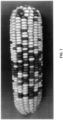
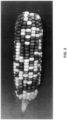
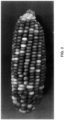
- the pollen donor was a publicly available line from the USDA-ARS National Plant Germplasm System, and carried a gene for expression of anthocyanin in the endosperm of the kernel. When P1 is used as a male pollen source to pollinate, successful pollination of kernels is quickly obvious to the naked eye by observing the purple color of the mature kernels on an ear.
- hybrid pollen such as that from H1
- P1 pollen had a competitive disadvantage in vigor and fitness compared to the H1 pollen.
- Table 2 The effect of the invention on self- versus cross pollination percent in H1 using P1 male.
- Open-pollinated On-demand invention Pollination type # of kernels % of total # of kernels % of total Hybrid self pollination (yellow kernels) 2452 100% 4530 69% Hybrid cross pollination (purple kernels) 2 0% 2034 31% Total: 2454 6564 Increase in cross pollination frequency 38021%
- Example 2 The invention was practiced using 2 commercial hybrids (H1 and H2) as females in one location in central Iowa. Blocks of 12 rows (width of 0.76 m (2.5 feet) per row for a total of 9.1 m (30 feet) in width) that were 13.7 m (45 feet) long of each hybrid were grown. Three pollen donor inbreds (P1, P2, and P3) that were unrelated to these commercial hybrids were grown at a distance of greater than 45.7 m (150 feet) away from the hybrid blocks. The three pollen donors were publicly available lines from the USDA-ARS National Plant Germplasm System, and carried a gene for expression of anthocyanin in the endosperm of the kernel. When used as a male pollen source to pollinate, successful pollination of kernels is quickly obvious to the naked eye by observing the purple color of the mature kernels on an ear.
- the invention was practiced by coercing pollen M from the tassels of the pollen donor (P1, P2, and P3) males and collecting the pollen in the bags.
- the pollen M was then immediately directed to the H1 and H2 silks by hand using techniques well known in the art involving gentle tapping on the bag of pollen to release the pollen grains onto the silks.
- H1 was early maturing, as was P1, so P1 was used to pollinate onto H1 silks.
- H1 ears in this experiment are comprised of 11 of the ears referred to in Example 1 above that fit the criteria to be included in this data set, and therefore were the result of the "spraying of water" to delay the males of H1 and were pollinations made prior to shedding of any H1 pollen.
- H2 was later maturing, as were P2 and P3. Therefore P2 and P3 were used to pollinate onto H2 silks. All pollinations onto H2 and the majority of the pollinations onto H1 occurred during the early onset of the pollination window in the morning, with the exception of the 11 pollinations onto H1 that occurred prior to the natural pollen window that were described in Example 1 above.
- H1 and H2 More than 75 hand pollinations were made into H1 and H2 by manually directing pollen onto the silks of the plants of H1 and H2 that were in the middle of the block during the early part of the natural pollination window.
- This method is a manifestation of the invention in which fresh pollen could be harvested in the early morning natural pollination window and immediately applied in a directed manner to a neighboring unrelated hybrid field. Further, this experiment imitated, although not exactly, a case where pollen may have been harvested by a nearby field of an unrelated corn hybrid, put into storage for a period of time, and then brought out of storage in the early morning hours before pollen begins to shed from the hybrids being used as females, and applied to those females.
- Pollinations were labelled with regard to which of the pollen donors was used for each pollinated ear. Yellow kernels that are on these ears at harvest can be assumed to be mostly, if not all, self-pollinations, while the purple kernels on these ears are the result of cross pollinations from the pollen donors. As noted in example 1 above, it can also be inferred that selfing in the middle of the blocks of hybrids in this experiment was also very near 100% when using conventional grain production methods.
- Example 3 An example of the invention described herein is the common situation in commercial corn grain production where there are large fields (20.2 - 40.5 hectares (50-100 acres) per field or more) of different and unrelated hybrids, in many case from different commercial vendors. These fields will largely self-pollinate and therefore will incur lower yield than if they were cross pollinated with an unrelated pollen source. On average, a pure stand of corn will contain greater than 95% grain at harvest that is the result of self-pollination. Goggi et al. ((2006) Field Crops Res. 99: 147-157 ) showed outcrossing between adjacent grain fields was far less than this: 0.4% at 35 m, less than 0.05% at 100 m.).
- the pollen from the earliest shedding field is collected and preserved/stored until the second unrelated hybrid field begins to flower, and then pollen from the first hybrid field is applied at an early morning hour (e.g. 5 am) to enhance cross pollination and minimize self-pollination in the second hybrid field.
- the application is conducted for two to three days in a row during the heaviest flowering days. The process is repeated by collecting, preserving, and storing the pollen from the second field and applying it to a third unrelated hybrid field when it begins to flower, and so on to a large number of fields until the flowering season ends.
- Example 4 Another example of the invention described herein is similar to example 2 above in which pollen from unrelated hybrid fields that flower at approximately the same time is harvested as soon as the first tassels begin to shed in each field. A portion of the pollen from each field is immediately applied in a directed fashion to exposed silks in the other field, while the rest of the pollen is preserved/stored. The hybrid fields will flower for approximately 3-4 days, and the stored pollen is used in the following 2-3 successive days to pollinate in the early morning prior to natural pollen shed to enhance cross pollination. In this way cross-pollination is increased and therefore yields in both fields will be increased by 5-10%.
- Example 5 In the specialty grain markets, it is very important that a field is allowed to entirely self-pollinate with very little cross pollination from other nearby corn.
- One example is "food grade" corn, in which there must be 99% selfing or more to meet the specifications ( Strayer, D. (2002) Preserved Systems: A reference handbook. CRC Press. ).
- the invention is utilized to decrease the amount of cross-pollination to enable a pure harvest of the target specialty grain that maintains the premium price with the end-user.
- pollen is harvested as soon as the first tassels begin to shed in the specialty grain field. A portion of the pollen is immediately intentionally applied in a directed fashion to exposed silks in the field.
- Example 6 This invention is applied to the corn grain industry in a way that allows for producer decisions to be made based on markets right up to the time of pollination (early to mid July) rather than making production decisions prior to planting, as is currently the case.
- a producer could watch the markets and decide among a specialty grain, such as high oil, or no 2 yellow dent commodity grain, and could place an order for the pollen that will deliver the grain desired.
- the hybrid that is planted is simply a female receiver for the pollen, and has generally desirable characteristics.
- the pollen contains the genes for the desired market and in this way a grain crop can be modified up until the time of pollination to match a market need.
- a pollen source could be used that minimizes kernel abortion during grain fill.
- a pollen source could be used that maximizes sink strength and grain yield.
- the characteristics could be achieved by utilizing naturally occurring, non-GMO pollen sources.
- the desired characteristic could be achieved via a GMO source of pollen.
- the current invention enables the delivery of GMO grain characteristics without the common concern of negative effects found in conventional GMO plants. In this way, this invention circumvents the massive hurdle that many beneficial GMOs have to get over to make it to market.
- a further example of the invention described herein is recovery of lost seed set under drought conditions that occur prior to or during the critical flowering period. Drought stress during this time is by far the greatest cause of lost grain production on an annual basis in the US. Under favorable conditions of adequate moisture and normal temperatures, there is close temporal synchrony between pollen shed from the male flowers in the tassels and emergence of the pollen receptive tissues of the female flowers (silks). Under drought conditions, however, three problems develop that disrupt the success of pollination. First, drought delays silk emergence relative to pollen shed. ( Basset, P. & M. Westgate (1993) Crop Sci.
- fresh pollen is harvested within the field, or a nearby field of an earlier maturing corn hybrid.
- the pollen is optionally stored for a period of time, and then applied directly to the female flowers as their silks emerge.
- This application overcomes all three of the referenced drought-based limitations on pollination and kernel set.
- the stored pollen can be applied on several successive days to enhance natural self/sib pollination. In situations where drought causes the ASI to increase to 4 days or more, application of the invention can increase yields by 25% or more.
Landscapes
- Life Sciences & Earth Sciences (AREA)
- Health & Medical Sciences (AREA)
- Botany (AREA)
- Developmental Biology & Embryology (AREA)
- Environmental Sciences (AREA)
- Natural Medicines & Medicinal Plants (AREA)
- Physiology (AREA)
- General Health & Medical Sciences (AREA)
- Genetics & Genomics (AREA)
- Breeding Of Plants And Reproduction By Means Of Culturing (AREA)
Priority Applications (1)
| Application Number | Priority Date | Filing Date | Title |
|---|---|---|---|
| EP24170270.3A EP4378304A3 (en) | 2015-06-25 | 2016-06-24 | Grain production |
Applications Claiming Priority (5)
| Application Number | Priority Date | Filing Date | Title |
|---|---|---|---|
| US201562184596P | 2015-06-25 | 2015-06-25 | |
| US201562269531P | 2015-12-18 | 2015-12-18 | |
| US201562269514P | 2015-12-18 | 2015-12-18 | |
| US201562269496P | 2015-12-18 | 2015-12-18 | |
| PCT/US2016/039355 WO2016210324A1 (en) | 2015-06-25 | 2016-06-24 | Grain production |
Related Child Applications (2)
| Application Number | Title | Priority Date | Filing Date |
|---|---|---|---|
| EP24170270.3A Division-Into EP4378304A3 (en) | 2015-06-25 | 2016-06-24 | Grain production |
| EP24170270.3A Division EP4378304A3 (en) | 2015-06-25 | 2016-06-24 | Grain production |
Publications (3)
| Publication Number | Publication Date |
|---|---|
| EP3313169A1 EP3313169A1 (en) | 2018-05-02 |
| EP3313169B1 true EP3313169B1 (en) | 2024-05-22 |
| EP3313169C0 EP3313169C0 (en) | 2024-05-22 |
Family
ID=56409192
Family Applications (5)
| Application Number | Title | Priority Date | Filing Date |
|---|---|---|---|
| EP16738296.9A Active EP3313169B1 (en) | 2015-06-25 | 2016-06-24 | Grain production |
| EP24170270.3A Pending EP4378304A3 (en) | 2015-06-25 | 2016-06-24 | Grain production |
| EP22197797.8A Active EP4169375B1 (en) | 2015-06-25 | 2016-06-24 | Seed production |
| EP24166493.7A Pending EP4374685A3 (en) | 2015-06-25 | 2016-06-24 | Seed production |
| EP16739302.4A Active EP3313170B1 (en) | 2015-06-25 | 2016-06-24 | Seed production |
Family Applications After (4)
| Application Number | Title | Priority Date | Filing Date |
|---|---|---|---|
| EP24170270.3A Pending EP4378304A3 (en) | 2015-06-25 | 2016-06-24 | Grain production |
| EP22197797.8A Active EP4169375B1 (en) | 2015-06-25 | 2016-06-24 | Seed production |
| EP24166493.7A Pending EP4374685A3 (en) | 2015-06-25 | 2016-06-24 | Seed production |
| EP16739302.4A Active EP3313170B1 (en) | 2015-06-25 | 2016-06-24 | Seed production |
Country Status (17)
| Country | Link |
|---|---|
| US (10) | US10905060B2 (enExample) |
| EP (5) | EP3313169B1 (enExample) |
| JP (1) | JP2018519854A (enExample) |
| CN (2) | CN107920484A (enExample) |
| AU (2) | AU2016284677A1 (enExample) |
| BR (1) | BR112017028054A8 (enExample) |
| CA (2) | CA2990423A1 (enExample) |
| CL (1) | CL2017003348A1 (enExample) |
| ES (3) | ES2933487T3 (enExample) |
| HR (1) | HRP20230099T1 (enExample) |
| HU (3) | HUE061039T2 (enExample) |
| MX (2) | MX2017017162A (enExample) |
| PL (3) | PL4169375T3 (enExample) |
| RS (1) | RS63905B1 (enExample) |
| UA (2) | UA126273C2 (enExample) |
| WO (2) | WO2016210315A1 (enExample) |
| ZA (1) | ZA201800394B (enExample) |
Cited By (1)
| Publication number | Priority date | Publication date | Assignee | Title |
|---|---|---|---|---|
| EP4378304A2 (en) | 2015-06-25 | 2024-06-05 | Accelerated AG Technologies, LLC | Grain production |
Families Citing this family (15)
| Publication number | Priority date | Publication date | Assignee | Title |
|---|---|---|---|---|
| US10575517B2 (en) * | 2015-06-25 | 2020-03-03 | Accelerated Ag Technologies, Llc | Pollen field conditioning and preservation method |
| US10993390B2 (en) | 2017-03-24 | 2021-05-04 | Accelerated Ag Technologies, Llc | Breeding methods to develop improved xenia pollinators |
| US20230132390A9 (en) * | 2017-03-24 | 2023-04-27 | Accelerated Ag Technologies, Llc | Breeding methods including both cross- and self-pollen to develop improved pollinators |
| JP2021512653A (ja) * | 2018-02-13 | 2021-05-20 | サンディープ・クマール・チンタラ | スマート授粉システム |
| BR112020015486A2 (pt) * | 2018-02-15 | 2020-12-08 | Monsanto Technology Llc | Métodos melhorados para a produção de semente de milho híbrido |
| US12096735B2 (en) | 2019-08-30 | 2024-09-24 | Powerpollen, Inc. | Method and system for time of pollinating cereal crops |
| CN110637719A (zh) * | 2019-10-16 | 2020-01-03 | 中国热带农业科学院南亚热带作物研究所 | 一种马铃薯杂交育种方法及工具 |
| WO2021250249A1 (en) | 2020-06-11 | 2021-12-16 | KWS SAAT SE & Co. KGaA | Method for controlling actions of a mobile entity on a field management unit |
| WO2022187054A1 (en) * | 2021-03-02 | 2022-09-09 | Monsanto Technology Llc | Compositions and methods for pollen storage |
| CN112931190A (zh) * | 2021-04-16 | 2021-06-11 | 西北农林科技大学 | 一种甜荞杂交种的制种方法 |
| WO2023129998A2 (en) * | 2022-01-03 | 2023-07-06 | Inari Agriculture Technology, Inc. | Pollen-mediated feed trait delivery in hybrid f2 progeny seed |
| AU2024210688A1 (en) | 2023-01-17 | 2025-07-31 | Powerpollen, Inc. | Poaceae pollen preservation and stabilization method |
| US20240365777A1 (en) * | 2023-05-01 | 2024-11-07 | Monsanto Technology Llc | Systems and methods for thawing pollen |
| US20250110096A1 (en) | 2023-09-28 | 2025-04-03 | Powerpollen, Inc. | Method of quantifying pollination efficiency |
| WO2025126856A1 (ja) * | 2023-12-11 | 2025-06-19 | オムロン株式会社 | 農業支援装置、農業支援方法、及びプログラム |
Citations (3)
| Publication number | Priority date | Publication date | Assignee | Title |
|---|---|---|---|---|
| US4677246A (en) | 1985-04-26 | 1987-06-30 | Dekalb-Pfizer Genetics | Protogyny in Zea mays |
| US6040500A (en) * | 1999-01-15 | 2000-03-21 | Dekalb Genetics Corporation | Soybean cultivar CX433RR |
| WO2013070846A1 (en) | 2011-11-11 | 2013-05-16 | Pioneer Hi-Bred International, Inc. | Large scale method for dispensing grains of pollen |
Family Cites Families (39)
| Publication number | Priority date | Publication date | Assignee | Title |
|---|---|---|---|---|
| SU106770A1 (ru) | 1955-11-04 | 1975-12-30 | Широкополосный радиочастотный трансформатор | |
| US3728817A (en) | 1971-05-28 | 1973-04-24 | Moews Seed Co | Preventing shedding of pollen by applying binder to corn tassels |
| US4087937A (en) * | 1977-06-30 | 1978-05-09 | Meador Lawrence Dean | Apparatus for pollenating plants |
| SU1061770A1 (ru) | 1982-01-06 | 1983-12-23 | Denisov Valentin F | Способ гибридизации блони |
| NZ220593A (en) | 1986-11-28 | 1990-03-27 | Dfc New Zealand Ltd Formerly D | Pollination by suction transfer of pollen from male to female flowers |
| SU1606037A1 (ru) * | 1989-04-07 | 1990-11-15 | В.А. Гриненко | Устройство дл сбора пыльцы растений |
| JP3090803B2 (ja) | 1992-11-30 | 2000-09-25 | 日本たばこ産業株式会社 | アブラナ科植物の花粉の貯蔵方法 |
| US6141904A (en) | 1994-06-15 | 2000-11-07 | Garst Seed Company | Method of hybrid crop production using dehydrated pollen from storage |
| US5689914A (en) | 1994-06-15 | 1997-11-25 | Zenco (No. 4) Limited | Method of hybrid crop production using dehydrated pollen from storage |
| US5596838A (en) | 1994-06-15 | 1997-01-28 | Zenco (No. 4) Limited | Method and instrument for the preparation of pollen for cryogenic storage |
| US5694700A (en) | 1994-06-15 | 1997-12-09 | Zenco (No.4) Limited | Method and instrument for the preparation of pollen for cryogenic storage |
| JP4177494B2 (ja) | 1997-10-24 | 2008-11-05 | 富士シリシア化学株式会社 | 花粉増量剤、人工受粉方法、および花粉の保存方法 |
| US6146884A (en) | 1998-10-05 | 2000-11-14 | Garst Seed Company | Apparatus for the preparation of multiple pollen samples for cryogenic preservation |
| US6865556B2 (en) | 2001-02-09 | 2005-03-08 | Monsanto Technology Llc | Identification of seeds or plants using phenotypic markers |
| US20050246788A1 (en) * | 2004-04-20 | 2005-11-03 | Shihshieh Huang | Self-incompatible transgenic plants |
| JP4487310B2 (ja) | 2004-11-26 | 2010-06-23 | 横河電機株式会社 | 出力レベル制御回路 |
| JP5228381B2 (ja) | 2007-06-25 | 2013-07-03 | 三菱電機株式会社 | 半導体装置の製造方法 |
| JP4998883B2 (ja) | 2007-08-07 | 2012-08-15 | 独立行政法人農業・食品産業技術総合研究機構 | 花粉の保存方法 |
| WO2009085982A1 (en) | 2007-12-19 | 2009-07-09 | Monsanto Technology Llc | Method to enhance yield and purity of hybrid crops |
| FR2948531B1 (fr) | 2009-07-31 | 2011-08-26 | Stallergenes Sa | Machine a recolter le pollen |
| MX358629B (es) * | 2009-11-23 | 2018-08-28 | Monsanto Technology Llc | Evento transgenico de maiz mon 87427 y la escala de desarrollo relativo. |
| GB201015791D0 (en) | 2010-09-20 | 2010-10-27 | Syngenta Ltd | Improved method and machine for use thereof |
| WO2012125593A2 (en) | 2011-03-11 | 2012-09-20 | Syngenta Participations Ag | Vacuum collection of pollen and anthers from haploid and doubled haploid plants |
| WO2012129199A2 (en) | 2011-03-22 | 2012-09-27 | Pioneer Hi-Bred International, Inc. | Apparatuses and methods for evaluating and sorting pollen and plants |
| EP2688394A4 (en) | 2011-03-23 | 2014-09-24 | Pioneer Hi Bred Int | DEVICE AND METHOD FOR DISPENSING BLOOD DUST GRAINS |
| US8943745B2 (en) | 2011-05-24 | 2015-02-03 | David Sexton | Handheld pollen sifter device |
| BR112014011427A2 (pt) | 2011-11-11 | 2017-05-16 | Pioneer Hi-Bred Int | método para dispensação de grãos de pólen |
| WO2014158912A1 (en) | 2013-03-14 | 2014-10-02 | Yamashita Thomas T | Compositions for enhancing pollination and methods for using same |
| EP2781151A1 (en) | 2013-03-18 | 2014-09-24 | Bayer CropScience AG | Methods of separating hybrid seed from a mixture of seeds |
| WO2014209903A1 (en) * | 2013-06-24 | 2014-12-31 | Pioneer Hi-Bred International, Inc. | Method for controlled growth and harvesting of pollen |
| EP2915423B1 (en) | 2014-03-06 | 2021-08-11 | Amphasys AG | Method for the determination of pollen viability and maturation grade of a pollen population |
| CN104145947B (zh) | 2014-07-31 | 2016-06-29 | 中国农业科学院油料作物研究所 | 一种大豆花粉的真空保存方法及其应用 |
| CN107205351B (zh) * | 2014-11-28 | 2020-04-14 | 大卫·霍伍德 | 花粉施用器 |
| CN104396946B (zh) | 2014-11-30 | 2016-02-10 | 河北省农林科学院旱作农业研究所 | 玉米花粉自扰动常温变压活性脱湿装置及用其脱湿的方法 |
| CN104957032A (zh) * | 2015-06-23 | 2015-10-07 | 潍坊友容实业有限公司 | 一种盐碱地温室大棚生物授粉中的花粉采集装置 |
| PL4169375T3 (pl) * | 2015-06-25 | 2025-04-28 | Powerpollen, Inc. | Produkcja materiału siewnego |
| US10051338B2 (en) * | 2015-10-21 | 2018-08-14 | At&T Intellectual Property I, L.P. | System and method for coordinating back-up services for land based content subscribers |
| CN205926293U (zh) * | 2016-08-20 | 2017-02-08 | 文山苗乡三七科技有限公司 | 一种花粉筛 |
| US11641817B2 (en) | 2017-01-06 | 2023-05-09 | Monsanto Technology Llc | Device and method for pollinating plants |
-
2016
- 2016-06-24 PL PL22197797.8T patent/PL4169375T3/pl unknown
- 2016-06-24 PL PL16738296.9T patent/PL3313169T3/pl unknown
- 2016-06-24 ES ES16739302T patent/ES2933487T3/es active Active
- 2016-06-24 CN CN201680049186.7A patent/CN107920484A/zh active Pending
- 2016-06-24 WO PCT/US2016/039339 patent/WO2016210315A1/en not_active Ceased
- 2016-06-24 HR HRP20230099TT patent/HRP20230099T1/hr unknown
- 2016-06-24 HU HUE16739302A patent/HUE061039T2/hu unknown
- 2016-06-24 EP EP16738296.9A patent/EP3313169B1/en active Active
- 2016-06-24 BR BR112017028054A patent/BR112017028054A8/pt not_active Application Discontinuation
- 2016-06-24 EP EP24170270.3A patent/EP4378304A3/en active Pending
- 2016-06-24 MX MX2017017162A patent/MX2017017162A/es unknown
- 2016-06-24 PL PL16739302.4T patent/PL3313170T3/pl unknown
- 2016-06-24 JP JP2018519265A patent/JP2018519854A/ja active Pending
- 2016-06-24 ES ES22197797T patent/ES3007010T3/es active Active
- 2016-06-24 AU AU2016284677A patent/AU2016284677A1/en not_active Abandoned
- 2016-06-24 CA CA2990423A patent/CA2990423A1/en active Pending
- 2016-06-24 CA CA2990424A patent/CA2990424A1/en active Pending
- 2016-06-24 EP EP22197797.8A patent/EP4169375B1/en active Active
- 2016-06-24 CN CN201680049357.6A patent/CN107920485A/zh active Pending
- 2016-06-24 MX MX2017017156A patent/MX395692B/es unknown
- 2016-06-24 US US15/192,485 patent/US10905060B2/en active Active
- 2016-06-24 HU HUE22197797A patent/HUE070237T2/hu unknown
- 2016-06-24 RS RS20230056A patent/RS63905B1/sr unknown
- 2016-06-24 AU AU2016283114A patent/AU2016283114A1/en not_active Abandoned
- 2016-06-24 ES ES16738296T patent/ES2984736T3/es active Active
- 2016-06-24 WO PCT/US2016/039355 patent/WO2016210324A1/en not_active Ceased
- 2016-06-24 UA UAA201800569A patent/UA126273C2/uk unknown
- 2016-06-24 UA UAA201800570A patent/UA126274C2/uk unknown
- 2016-06-24 EP EP24166493.7A patent/EP4374685A3/en active Pending
- 2016-06-24 US US15/192,519 patent/US10398099B2/en active Active
- 2016-06-24 EP EP16739302.4A patent/EP3313170B1/en active Active
- 2016-06-24 HU HUE16738296A patent/HUE068099T2/hu unknown
-
2017
- 2017-12-22 CL CL2017003348A patent/CL2017003348A1/es unknown
-
2018
- 2018-01-19 ZA ZA2018/00394A patent/ZA201800394B/en unknown
-
2019
- 2019-08-23 US US16/549,810 patent/US11166422B2/en active Active
- 2019-08-23 US US16/549,748 patent/US11166421B2/en active Active
-
2020
- 2020-11-24 US US17/102,805 patent/US11849686B2/en active Active
-
2021
- 2021-05-10 US US17/315,789 patent/US12302812B2/en active Active
- 2021-08-27 US US17/458,916 patent/US11844321B2/en active Active
-
2023
- 2023-10-09 US US18/377,946 patent/US12457950B2/en active Active
- 2023-10-09 US US18/377,954 patent/US12495748B2/en active Active
-
2024
- 2024-06-12 US US18/740,880 patent/US20240365735A1/en active Pending
Patent Citations (3)
| Publication number | Priority date | Publication date | Assignee | Title |
|---|---|---|---|---|
| US4677246A (en) | 1985-04-26 | 1987-06-30 | Dekalb-Pfizer Genetics | Protogyny in Zea mays |
| US6040500A (en) * | 1999-01-15 | 2000-03-21 | Dekalb Genetics Corporation | Soybean cultivar CX433RR |
| WO2013070846A1 (en) | 2011-11-11 | 2013-05-16 | Pioneer Hi-Bred International, Inc. | Large scale method for dispensing grains of pollen |
Non-Patent Citations (9)
| Title |
|---|
| "Doctoral Dissertation", vol. 12, 8 June 2011, COLLEGE OF RESOURCES AND ENVIRONMENTAL SCIENCES CHINA AGRICULTURAL UNIVERSITY, article WANG XIUJUAN: "A Probabilistic Model of Flower Fertility and Factors Influencing Seed Production in Winter Oilseed rape (Brassica napus L.)", pages: 1 - 8, XP093263707, DOI: 10.1140/epjti/s40485-024-00113-z |
| FRITZ S. E., LUKASZEWSKI A. J.: "Pollen Longevity in Wheat, Rye and Triticale", PLANT BREEDING, PAUL PAREY SCIENTIFIC PUBL., BERLIN., DE, vol. 102, no. 1, 1 January 1989 (1989-01-01), DE , pages 31 - 34, XP093263696, ISSN: 0179-9541, DOI: 10.1111/j.1439-0523.1989.tb00311.x |
| GUPTA RAMWANT, SUTRADHAR HRISHIKESH, CHAKRABARTY S K, ANSARI MOHHAMMED WAHID, SINGH YOGENDRA: "Stigmatic receptivity determines the seed set in Indian mustard, rice and wheat crops", COMMUNICATIVE & INTEGRATIVE BIOLOGY, LANDES BIOSCIENCE, UNITED STATES, vol. 8, no. 5, 3 September 2015 (2015-09-03), United States , pages e1042630, XP093263684, ISSN: 1942-0889, DOI: 10.1080/19420889.2015.1042630 |
| H. KAPPERT, W. RUDORF: "Manual of plant breeding: Volume 2: Breeding of Grain Species", 1 January 1959, VERLAG FÜR LANDWIRTSCHAFT, VETERINÄRMEDIZIN, GARTENBAU UND FORSTWESEN, Berlin, article H. KAPPERT, W. RUDORF: "Passages; Breeding of Grain Species", pages: 104, 188, 296 - 569, 582-583, XP009561365 |
| HASKELL GORDON: "The graphic evaluation of a breeding system", HEREDITY, SPRINGER INTERNATIONAL PUBLISHING, CHAM, vol. 7, no. 2, 1 August 1953 (1953-08-01), Cham, pages 239 - 245, XP093263677, ISSN: 0018-067X, DOI: 10.1038/hdy.1953.31 |
| IMPE DANIELA, REITZ JANKA, KÖPNICK CLAUDIA, ROLLETSCHEK HARDY, BÖRNER ANDREAS, SENULA ANGELIKA, NAGEL MANUELA: "Assessment of Pollen Viability for Wheat", FRONTIERS IN PLANT SCIENCE, FRONTIERS RESEARCH FOUNDATION, CH, vol. 10, CH , XP093263711, ISSN: 1664-462X, DOI: 10.3389/fpls.2019.01588 |
| KHAN IRUM, SAJJAD MUHAMMAD: "A simple method for preserving pollen viability and longevity in wheat", RESEARCH SQUARE, vol. 330, pages 125248, XP093263690, Retrieved from the Internet <URL:https://www.researchgate.net/publication/368612421_A_simple_method_for_preserving_pollen_viability_and_longevity_in_wheat/fulltext/63f0daed2958d64a5cde6d3a/A-simple-method-for-preserving-pollen-viability-and-longevity-in-wheat.pdf> DOI: 10.21203/rs.3.rs-2580944/v1 |
| R T WEILAND: "Cross-pollination effects on maize (Zea mays L.) hybrid yields", CAN. J. PLANT SCI, vol. 72, no. 1, 1 January 1992 (1992-01-01), pages 27 - 33, XP055292742 |
| TURUSPEKOV Y , ET AL: "Identification and mapping of cleistogamy genes in barley", THEORETICAL AND APPLIED GENETICS, SPRINGER BERLIN HEIDELBERG, BERLIN/HEIDELBERG, vol. 109, no. 3, 1 August 2004 (2004-08-01), Berlin/Heidelberg, pages 480 - 487, XP002486723, ISSN: 0040-5752, DOI: 10.1007/s00122-004-1673-1 |
Cited By (1)
| Publication number | Priority date | Publication date | Assignee | Title |
|---|---|---|---|---|
| EP4378304A2 (en) | 2015-06-25 | 2024-06-05 | Accelerated AG Technologies, LLC | Grain production |
Also Published As
Similar Documents
| Publication | Publication Date | Title |
|---|---|---|
| US11844321B2 (en) | Grain production with male-sterile female plants | |
| Blouet et al. | Possibilities for hybrid seed production in wheat | |
| US10993390B2 (en) | Breeding methods to develop improved xenia pollinators | |
| RU2815108C2 (ru) | Производство зерновой продукции | |
| Chetna et al. | Efficient Seed Production Systems in Soybean | |
| Rao et al. | Concepts of Seed Science and Technology | |
| US20230132390A9 (en) | Breeding methods including both cross- and self-pollen to develop improved pollinators | |
| CN104521746A (zh) | 条斑叶长柱头长穗颈光身两系不育系的选育方法 | |
| Streiff | Possibilities for Hybrid |
Legal Events
| Date | Code | Title | Description |
|---|---|---|---|
| STAA | Information on the status of an ep patent application or granted ep patent |
Free format text: STATUS: THE INTERNATIONAL PUBLICATION HAS BEEN MADE |
|
| PUAI | Public reference made under article 153(3) epc to a published international application that has entered the european phase |
Free format text: ORIGINAL CODE: 0009012 |
|
| STAA | Information on the status of an ep patent application or granted ep patent |
Free format text: STATUS: REQUEST FOR EXAMINATION WAS MADE |
|
| 17P | Request for examination filed |
Effective date: 20180123 |
|
| AK | Designated contracting states |
Kind code of ref document: A1 Designated state(s): AL AT BE BG CH CY CZ DE DK EE ES FI FR GB GR HR HU IE IS IT LI LT LU LV MC MK MT NL NO PL PT RO RS SE SI SK SM TR |
|
| AX | Request for extension of the european patent |
Extension state: BA ME |
|
| DAV | Request for validation of the european patent (deleted) | ||
| DAX | Request for extension of the european patent (deleted) | ||
| STAA | Information on the status of an ep patent application or granted ep patent |
Free format text: STATUS: EXAMINATION IS IN PROGRESS |
|
| 17Q | First examination report despatched |
Effective date: 20190218 |
|
| RAP3 | Party data changed (applicant data changed or rights of an application transferred) |
Owner name: ACCELERATED AG TECHNOLOGIES, LLC |
|
| P01 | Opt-out of the competence of the unified patent court (upc) registered |
Effective date: 20230530 |
|
| GRAP | Despatch of communication of intention to grant a patent |
Free format text: ORIGINAL CODE: EPIDOSNIGR1 |
|
| STAA | Information on the status of an ep patent application or granted ep patent |
Free format text: STATUS: GRANT OF PATENT IS INTENDED |
|
| INTG | Intention to grant announced |
Effective date: 20231215 |
|
| GRAS | Grant fee paid |
Free format text: ORIGINAL CODE: EPIDOSNIGR3 |
|
| GRAA | (expected) grant |
Free format text: ORIGINAL CODE: 0009210 |
|
| STAA | Information on the status of an ep patent application or granted ep patent |
Free format text: STATUS: THE PATENT HAS BEEN GRANTED |
|
| AK | Designated contracting states |
Kind code of ref document: B1 Designated state(s): AL AT BE BG CH CY CZ DE DK EE ES FI FR GB GR HR HU IE IS IT LI LT LU LV MC MK MT NL NO PL PT RO RS SE SI SK SM TR |
|
| REG | Reference to a national code |
Ref country code: GB Ref legal event code: FG4D |
|
| REG | Reference to a national code |
Ref country code: CH Ref legal event code: EP |
|
| REG | Reference to a national code |
Ref country code: DE Ref legal event code: R096 Ref document number: 602016087619 Country of ref document: DE |
|
| REG | Reference to a national code |
Ref country code: IE Ref legal event code: FG4D |
|
| U01 | Request for unitary effect filed |
Effective date: 20240619 |
|
| P04 | Withdrawal of opt-out of the competence of the unified patent court (upc) registered |
Free format text: CASE NUMBER: APP_37725/2024 Effective date: 20240624 |
|
| U07 | Unitary effect registered |
Designated state(s): AT BE BG DE DK EE FI FR IT LT LU LV MT NL PT SE SI Effective date: 20240627 |
|
| U20 | Renewal fee for the european patent with unitary effect paid |
Year of fee payment: 9 Effective date: 20240731 |
|
| PG25 | Lapsed in a contracting state [announced via postgrant information from national office to epo] |
Ref country code: IS Free format text: LAPSE BECAUSE OF FAILURE TO SUBMIT A TRANSLATION OF THE DESCRIPTION OR TO PAY THE FEE WITHIN THE PRESCRIBED TIME-LIMIT Effective date: 20240922 |
|
| PG25 | Lapsed in a contracting state [announced via postgrant information from national office to epo] |
Ref country code: HR Free format text: LAPSE BECAUSE OF FAILURE TO SUBMIT A TRANSLATION OF THE DESCRIPTION OR TO PAY THE FEE WITHIN THE PRESCRIBED TIME-LIMIT Effective date: 20240522 |
|
| PG25 | Lapsed in a contracting state [announced via postgrant information from national office to epo] |
Ref country code: GR Free format text: LAPSE BECAUSE OF FAILURE TO SUBMIT A TRANSLATION OF THE DESCRIPTION OR TO PAY THE FEE WITHIN THE PRESCRIBED TIME-LIMIT Effective date: 20240823 |
|
| RAP4 | Party data changed (patent owner data changed or rights of a patent transferred) |
Owner name: POWERPOLLEN, INC. |
|
| REG | Reference to a national code |
Ref country code: ES Ref legal event code: FG2A Ref document number: 2984736 Country of ref document: ES Kind code of ref document: T3 Effective date: 20241030 |
|
| U1H | Name or address of the proprietor changed after the registration of the unitary effect |
Owner name: POWERPOLLEN, INC.; US |
|
| PG25 | Lapsed in a contracting state [announced via postgrant information from national office to epo] |
Ref country code: NO Free format text: LAPSE BECAUSE OF FAILURE TO SUBMIT A TRANSLATION OF THE DESCRIPTION OR TO PAY THE FEE WITHIN THE PRESCRIBED TIME-LIMIT Effective date: 20240822 Ref country code: IS Free format text: LAPSE BECAUSE OF FAILURE TO SUBMIT A TRANSLATION OF THE DESCRIPTION OR TO PAY THE FEE WITHIN THE PRESCRIBED TIME-LIMIT Effective date: 20240922 Ref country code: HR Free format text: LAPSE BECAUSE OF FAILURE TO SUBMIT A TRANSLATION OF THE DESCRIPTION OR TO PAY THE FEE WITHIN THE PRESCRIBED TIME-LIMIT Effective date: 20240522 Ref country code: GR Free format text: LAPSE BECAUSE OF FAILURE TO SUBMIT A TRANSLATION OF THE DESCRIPTION OR TO PAY THE FEE WITHIN THE PRESCRIBED TIME-LIMIT Effective date: 20240823 Ref country code: RS Free format text: LAPSE BECAUSE OF FAILURE TO SUBMIT A TRANSLATION OF THE DESCRIPTION OR TO PAY THE FEE WITHIN THE PRESCRIBED TIME-LIMIT Effective date: 20240822 |
|
| REG | Reference to a national code |
Ref country code: HU Ref legal event code: AG4A Ref document number: E068099 Country of ref document: HU |
|
| P05 | Withdrawal of opt-out of the competence of the unified patent court (upc) changed |
Free format text: CASE NUMBER: APP_37725/2024 Effective date: 20240627 |
|
| PG25 | Lapsed in a contracting state [announced via postgrant information from national office to epo] |
Ref country code: SK Free format text: LAPSE BECAUSE OF FAILURE TO SUBMIT A TRANSLATION OF THE DESCRIPTION OR TO PAY THE FEE WITHIN THE PRESCRIBED TIME-LIMIT Effective date: 20240522 |
|
| PG25 | Lapsed in a contracting state [announced via postgrant information from national office to epo] |
Ref country code: SM Free format text: LAPSE BECAUSE OF FAILURE TO SUBMIT A TRANSLATION OF THE DESCRIPTION OR TO PAY THE FEE WITHIN THE PRESCRIBED TIME-LIMIT Effective date: 20240522 |
|
| PG25 | Lapsed in a contracting state [announced via postgrant information from national office to epo] |
Ref country code: SM Free format text: LAPSE BECAUSE OF FAILURE TO SUBMIT A TRANSLATION OF THE DESCRIPTION OR TO PAY THE FEE WITHIN THE PRESCRIBED TIME-LIMIT Effective date: 20240522 Ref country code: SK Free format text: LAPSE BECAUSE OF FAILURE TO SUBMIT A TRANSLATION OF THE DESCRIPTION OR TO PAY THE FEE WITHIN THE PRESCRIBED TIME-LIMIT Effective date: 20240522 |
|
| REG | Reference to a national code |
Ref country code: CH Ref legal event code: PL |
|
| PG25 | Lapsed in a contracting state [announced via postgrant information from national office to epo] |
Ref country code: MC Free format text: LAPSE BECAUSE OF FAILURE TO SUBMIT A TRANSLATION OF THE DESCRIPTION OR TO PAY THE FEE WITHIN THE PRESCRIBED TIME-LIMIT Effective date: 20240522 |
|
| REG | Reference to a national code |
Ref country code: DE Ref legal event code: R026 Ref document number: 602016087619 Country of ref document: DE |
|
| PLBI | Opposition filed |
Free format text: ORIGINAL CODE: 0009260 |
|
| PLAX | Notice of opposition and request to file observation + time limit sent |
Free format text: ORIGINAL CODE: EPIDOSNOBS2 |
|
| 26 | Opposition filed |
Opponent name: KWS SAAT SE & CO. KGAA Effective date: 20250221 |
|
| PG25 | Lapsed in a contracting state [announced via postgrant information from national office to epo] |
Ref country code: IE Free format text: LAPSE BECAUSE OF NON-PAYMENT OF DUE FEES Effective date: 20240624 |
|
| GBPC | Gb: european patent ceased through non-payment of renewal fee |
Effective date: 20240822 |
|
| PG25 | Lapsed in a contracting state [announced via postgrant information from national office to epo] |
Ref country code: CH Free format text: LAPSE BECAUSE OF NON-PAYMENT OF DUE FEES Effective date: 20240630 |
|
| PLAF | Information modified related to communication of a notice of opposition and request to file observations + time limit |
Free format text: ORIGINAL CODE: EPIDOSCOBS2 |
|
| PGFP | Annual fee paid to national office [announced via postgrant information from national office to epo] |
Ref country code: PL Payment date: 20250604 Year of fee payment: 10 |
|
| PG25 | Lapsed in a contracting state [announced via postgrant information from national office to epo] |
Ref country code: GB Free format text: LAPSE BECAUSE OF NON-PAYMENT OF DUE FEES Effective date: 20240822 |
|
| PGFP | Annual fee paid to national office [announced via postgrant information from national office to epo] |
Ref country code: HU Payment date: 20250626 Year of fee payment: 10 |
|
| U20 | Renewal fee for the european patent with unitary effect paid |
Year of fee payment: 10 Effective date: 20250616 |
|
| PGFP | Annual fee paid to national office [announced via postgrant information from national office to epo] |
Ref country code: RO Payment date: 20250613 Year of fee payment: 10 |
|
| PGFP | Annual fee paid to national office [announced via postgrant information from national office to epo] |
Ref country code: TR Payment date: 20250611 Year of fee payment: 10 |
|
| PGFP | Annual fee paid to national office [announced via postgrant information from national office to epo] |
Ref country code: CZ Payment date: 20250611 Year of fee payment: 10 |
|
| PLBB | Reply of patent proprietor to notice(s) of opposition received |
Free format text: ORIGINAL CODE: EPIDOSNOBS3 |
|
| PGFP | Annual fee paid to national office [announced via postgrant information from national office to epo] |
Ref country code: ES Payment date: 20250702 Year of fee payment: 10 |
|
| PG25 | Lapsed in a contracting state [announced via postgrant information from national office to epo] |
Ref country code: CY Free format text: LAPSE BECAUSE OF FAILURE TO SUBMIT A TRANSLATION OF THE DESCRIPTION OR TO PAY THE FEE WITHIN THE PRESCRIBED TIME-LIMIT; INVALID AB INITIO Effective date: 20160624 |