EP3311533B1 - Auswahl eines mesh-pfades - Google Patents
Auswahl eines mesh-pfades Download PDFInfo
- Publication number
- EP3311533B1 EP3311533B1 EP16730343.7A EP16730343A EP3311533B1 EP 3311533 B1 EP3311533 B1 EP 3311533B1 EP 16730343 A EP16730343 A EP 16730343A EP 3311533 B1 EP3311533 B1 EP 3311533B1
- Authority
- EP
- European Patent Office
- Prior art keywords
- path
- station
- target station
- data packet
- alternative
- Prior art date
- Legal status (The legal status is an assumption and is not a legal conclusion. Google has not performed a legal analysis and makes no representation as to the accuracy of the status listed.)
- Active
Links
- 238000000034 method Methods 0.000 claims description 65
- 230000015654 memory Effects 0.000 claims description 17
- 238000004590 computer program Methods 0.000 claims description 16
- 238000012545 processing Methods 0.000 claims description 12
- 230000007423 decrease Effects 0.000 claims description 8
- 230000006870 function Effects 0.000 description 10
- 238000004891 communication Methods 0.000 description 9
- 101001095266 Homo sapiens Prolyl endopeptidase Proteins 0.000 description 8
- 102100037838 Prolyl endopeptidase Human genes 0.000 description 8
- 238000005516 engineering process Methods 0.000 description 7
- 230000000737 periodic effect Effects 0.000 description 7
- 230000008901 benefit Effects 0.000 description 6
- 230000008859 change Effects 0.000 description 5
- 230000003247 decreasing effect Effects 0.000 description 5
- 238000012546 transfer Methods 0.000 description 5
- 238000010586 diagram Methods 0.000 description 4
- 238000009448 modified atmosphere packaging Methods 0.000 description 3
- 235000019837 monoammonium phosphate Nutrition 0.000 description 3
- 230000005540 biological transmission Effects 0.000 description 2
- 210000004027 cell Anatomy 0.000 description 2
- 238000006243 chemical reaction Methods 0.000 description 2
- 238000013461 design Methods 0.000 description 2
- 210000001357 hemopoietic progenitor cell Anatomy 0.000 description 2
- 238000001167 microscope projection photolithography Methods 0.000 description 2
- 238000005192 partition Methods 0.000 description 2
- 230000004044 response Effects 0.000 description 2
- 230000006399 behavior Effects 0.000 description 1
- 230000015572 biosynthetic process Effects 0.000 description 1
- 230000001413 cellular effect Effects 0.000 description 1
- 230000001419 dependent effect Effects 0.000 description 1
- 230000003993 interaction Effects 0.000 description 1
- 238000012423 maintenance Methods 0.000 description 1
- 238000012544 monitoring process Methods 0.000 description 1
- 230000008569 process Effects 0.000 description 1
- 230000035484 reaction time Effects 0.000 description 1
- 230000002441 reversible effect Effects 0.000 description 1
- 239000007787 solid Substances 0.000 description 1
- 230000001052 transient effect Effects 0.000 description 1
Images



Classifications
-
- H—ELECTRICITY
- H04—ELECTRIC COMMUNICATION TECHNIQUE
- H04W—WIRELESS COMMUNICATION NETWORKS
- H04W40/00—Communication routing or communication path finding
- H04W40/02—Communication route or path selection, e.g. power-based or shortest path routing
- H04W40/12—Communication route or path selection, e.g. power-based or shortest path routing based on transmission quality or channel quality
-
- H—ELECTRICITY
- H04—ELECTRIC COMMUNICATION TECHNIQUE
- H04L—TRANSMISSION OF DIGITAL INFORMATION, e.g. TELEGRAPHIC COMMUNICATION
- H04L45/00—Routing or path finding of packets in data switching networks
- H04L45/24—Multipath
- H04L45/247—Multipath using M:N active or standby paths
-
- H—ELECTRICITY
- H04—ELECTRIC COMMUNICATION TECHNIQUE
- H04W—WIRELESS COMMUNICATION NETWORKS
- H04W72/00—Local resource management
- H04W72/20—Control channels or signalling for resource management
-
- H—ELECTRICITY
- H04—ELECTRIC COMMUNICATION TECHNIQUE
- H04L—TRANSMISSION OF DIGITAL INFORMATION, e.g. TELEGRAPHIC COMMUNICATION
- H04L45/00—Routing or path finding of packets in data switching networks
- H04L45/02—Topology update or discovery
- H04L45/021—Ensuring consistency of routing table updates, e.g. by using epoch numbers
-
- H—ELECTRICITY
- H04—ELECTRIC COMMUNICATION TECHNIQUE
- H04L—TRANSMISSION OF DIGITAL INFORMATION, e.g. TELEGRAPHIC COMMUNICATION
- H04L45/00—Routing or path finding of packets in data switching networks
- H04L45/16—Multipoint routing
-
- H—ELECTRICITY
- H04—ELECTRIC COMMUNICATION TECHNIQUE
- H04L—TRANSMISSION OF DIGITAL INFORMATION, e.g. TELEGRAPHIC COMMUNICATION
- H04L45/00—Routing or path finding of packets in data switching networks
- H04L45/22—Alternate routing
-
- H—ELECTRICITY
- H04—ELECTRIC COMMUNICATION TECHNIQUE
- H04W—WIRELESS COMMUNICATION NETWORKS
- H04W40/00—Communication routing or communication path finding
- H04W40/24—Connectivity information management, e.g. connectivity discovery or connectivity update
- H04W40/246—Connectivity information discovery
-
- H—ELECTRICITY
- H04—ELECTRIC COMMUNICATION TECHNIQUE
- H04W—WIRELESS COMMUNICATION NETWORKS
- H04W84/00—Network topologies
- H04W84/18—Self-organising networks, e.g. ad-hoc networks or sensor networks
Definitions
- the present invention relates generally to mesh network communication. More particularly, it relates to updating a path in a mesh network.
- mesh network there is no base station to organize communication between network nodes. Instead, all nodes, or stations, typically use each other's knowledge about surrounding stations in order to communicate. For example if a first station wishes to communicate with a second station but does not know which path should be used to reach the second station, the first station will typically broadcast a data packet comprising a path request (PREQ) for the second station.
- PREQ path request
- the broadcasted data packet will be received by neighboring stations to the first station.
- the neighboring stations typically determine if the PREQ is addressed to them, and if such is not the case, broadcast it further to other neighboring stations.
- This procedure is typically repeated until the second station receives the PREQ and finds its own address in it.
- the second station replies by sending a unicast path reply (PREP) to the first station which follows the path the PREQ took to reach the second station in reverse.
- PREP unicast path reply
- the PREQ/PREP routine is periodically updated and new PREQs/PREPs are sent out.
- stations in the mesh network typically are mobile, stations that recently found themselves in areas with good signal quality may suddenly find themselves in areas with bad reception. This may typically lead to that a path using these stations as links may comprise one or more bad links which affects the overall throughput.
- path requests are broadcasted regularly (e.g. every 5 seconds), and as a PREP is received for each other station indicating a path to that station, that path is used until the next path request is issued.
- this path may not be the best path, packet loss may occur when using it.
- WO2013/000507 discloses a method for controlling, by a central control entity, a topology change in a network having a ring topology with a plurality of ring nodes via which data packets of various data transfers are transmitted to their corresponding destination nodes.
- the central control entity determines which of the data transfers are affected by the topology change, determines a new path through the network for each of the affected data transfers, determines new switching instructions for ring nodes that are affected by the new paths, and transmits the new switching instructions to the affected ring nodes.
- Each node contains a look-up table which, for each input port of the ring node and for each destination stores two output ports: a preferred output port through which traffic arriving an at input port should be switched, and a second output port the ring node may use in case of a link failure.
- a mesh network comprising an originator station and a target station.
- Each station comprises a controller and memory for storing a first path table for storing one or more paths to be used for sending data packets and a second path table for storing one or more alternative paths for sending data packets.
- the originator station is configured to broadcast a path request data packet for the target station and receive a first path reply data packet comprising a first alternative path to the target station. Then the originator station stores the first alternative path in the second path table of the originator station and receives at least one second path reply data packet comprising at least one second alternative path to the target station.
- the originator station retrieves a best path, based on one or more signal parameters pertaining to each path, to the target station from the second path table of the originator station, stores the best path to the target station in the first path table of the originator station and uses the best path for sending data packets to target station.
- the best path is determined by comparing the one or more signal parameters of the received second alternative path to the one or more signal parameters of the stored first alternative path to determine the best alternative path.
- the second alternative path is stored in the second table overwriting the first alternative path.
- said controller is further configured to store the at least one second alternative path to the target station in the second path table without overwriting the first alternative path.
- the best path is retrieved by comparing the one or more signal parameters of the stored second alternative path to the one or more signal parameters of the stored first alternative path to determine the best alternative path.
- the second alternative path is retrieved from the second table.
- the first alternative path is retrieved.
- the one or more signal parameters which is, or are, used for determining the best path to the target station may be one or more of a Signal to Noise Ratio (SNR), Received Signal Strength Indicator (RSSI) for peer mesh station, path delay time, packet loss and/or packet error rate.
- SNR Signal to Noise Ratio
- RSSI Received Signal Strength Indicator
- Jitter may also be used to determine the quality of the received paths to the target station.
- the mesh network further comprises one or more intermediate stations comprising a controller and a memory for storing a first path table for storing one or more paths to be used for sending data packets and a second path table for storing one or more alternative paths for sending data packets.
- the originator station is further configured to receive the first path reply data packet comprising a first alternative path to the target station via a first intermediate station and store the first alternative path to the target station in the second path table of the originator station. Then the originator station receives a second path reply data packet comprising a second alternative path to the target station via a second intermediate station and stores the second alternative path to the target station in the second path table of the originator station.
- the originator station retrieves a best path, based on one or more signal parameters, to the target station from the second path table of the originator station, stores the best path to the target station in the first path table of the originator station and uses the best path for sending data packets to the target station.
- the intermediate station pertaining to the best path is further configured to receive a path acknowledgement forward data packet, forward by unicast the path acknowledgement forward packet to the target station and receive a path acknowledgement return data packet from the target station.
- the intermediate station pertaining to the best path is then configured to update the first path table of the intermediate station to comprise the best path to the target station, forward the path acknowledgement return data packet to the originator station and use the best path stored in the first path table of the intermediate station to transmit data packets between the originator station and the target station.
- the first path table of the originator station is at least updated after a first time period (T), and wherein the first and second path request data packets are received and consequently where the second path table of the originator station is updated at least once during a second time period (t) at the end of and partly overlapping the first time period (T).
- the first path table may be updated periodically, triggering a new PREQ at least once shortly before each periodic update.
- the originator station is further configured to broadcast the second path request data packet for the target station.
- the path request data packet comprises a weak path indicator for indicating the condition of a link between two stations which the path request data packet transverse on its way from the originator station to the target station.
- the target station comprises a weak path indicator counter for evaluating if the path used by the path request data packet to reach the target station is suitable for the path reply data packet or if a second path request data packet should be issued from the target station to the originator station.
- the controller of the target station comprises a throttling element for throttling or increasing the path request data packet rate.
- the controller of the target station is further configured to compare the number of received weak path indicators indicating an integer greater than 1 to an upper throttle threshold value. If the number of received weak path indicators indicating an integer greater than 1 exceeds the upper threshold value, the controller is further configured to increase the path request data packet rate in a non linear fashion. If the number of received weak path indicators indicating an integer greater than 1 is less than a lower throttle threshold value, the controller of the target station is further configured to decrease the path request data packet rate in a non linear fashion.
- the non linear fashion may for example be exponential.
- the non linear fashion may for example be exponential. For example, if stations are rapidly entering and exiting the mesh network the risk of dropping data packets is high. A rapidly changing mesh network due to e.g. arriving and departing stations will typically lead to that several received packets at the target station indicates value 2 or worse.
- An exponential increase in the rate of which PREQs are transmitted ensures finding better paths quicker while still avoiding collisions due to increased network traffic. The exponential increase ensures that the rate of PREQs is only increased rapidly after it is determined that the network is subjected to substantial changes in topology (several received data packets indicates a value > 1) and not to single events.
- non linear fashion is stepwise.
- the weak path indicator may in some embodiments indicate integers from 0-3. Wherein 0 indicates a good path, 1 indicates a weak path, 2 indicates a bad path and 3 indicates an unreliable path.
- the weak path indicator counter of the target station is incremented with an integer number corresponding to the integer pertaining to the weak path indicator of the received path request data packet.
- the weak path indicator counter is decreased with 1.
- a mesh network station being an originator station comprising a controller and a memory for storing a first path table for storing one or more paths to be used for sending data packets and a second path table for storing one or more alternative paths for sending data packets is or are provided.
- the originator station is further configured to broadcast a first path request data packet for the target station and receive a first path reply data packet comprising a first alternative path to the target station.
- the originator station stores the first alternative path in the second path table of the originator station and receives at least one second path reply data packet comprising at least one second alternative path to the target station.
- the originator station retrieves a best path based on one or more signal parameters to the target station from the second path table of the originator station, stores the best path to the target station in the first path table of the originator station and uses the best path for sending data packets to target station.
- a third aspect is a mesh network station being a target station comprising a controller and a memory for storing a first path table for storing one or more paths for sending data packets and a second path table for storing one or more alternative paths to be used for sending data packets.
- the station is further configured to receiving a path request data packet from an originator station, transmitting by unicast a path reply data packet and receiving a path acknowledgement forward data packet comprising a best path based on one or more signal parameters for sending data packets between the originator station and the target station.
- the station is further configured to update the first path table of the target station to comprise the best path for sending data packets between the originator station and the target station and transmitting by unicast a path acknowledgement return data packet to the originator station.
- a forth aspect is a mesh network station being an intermediate station comprising a controller and a memory for storing first path table for storing one or more paths for sending data packets, and a second path table for storing one or more alternative paths for sending data packets.
- the station is further configured to relay by broadcast a path request data packet from an originator station to a target station, relay by unicast a path reply data packet from the target station to the originator station and receive a path acknowledgement forward data packet comprising a best path based on one or more signal parameters for sending data packets between the originator station and the target station.
- the intermediate station is further configured to transmit by unicast the path acknowledgement forward data packet to the target station, receive a path acknowledgement return data packet from the target station, update the first path table of the intermediate station to comprise the best path for sending data packets between the originator station and the target station and transmitting by unicast the path acknowledgement return data packet to the originator station.
- the originator station is then configured to use the best path stored in the first path table of the intermediate station to transmit data packets between the originator station and the target station.
- a fifth aspect is a method of a mesh network station in a mesh network comprising an originator station and a target station wherein each station comprises controller and a memory for storing a first path table for storing one or more paths for sending data packets and a second path table for storing one or more alternative paths for sending data.
- the method comprises broadcasting by the originator station a first path request data packet for the target station, receiving a first path reply data packet comprising a first alternative path to the target station.
- the method further comprises retrieving a best path based on one or more signal parameters to the target station from the second path table of the originator station, storing the best path to the target station in the first path table of the originator station and using the best path for sending data packets to target station.
- a sixth aspect is a computer program product comprising a computer readable medium, having thereon a computer program comprising program instructions, the computer program being loadable into a data-processing unit and adapted to cause the data-processing unit to execute the method according to the fifth aspect when the computer program is run by the data-processing unit.
- An advantage of some embodiments is that the risk of losing data packets due to inadequate path choices is mitigated.
- Another advantage of some embodiments is that the level of traffic in a mesh network is lowered.
- Another advantage of some of the embodiments is that reliable network traffic is achieved.
- Figs. 1a and 1b generally show a station 100 according to an embodiment herein.
- the station 100 is configured for wireless or radio frequency network communication for acting as a node in a mesh network.
- An example of a mesh network will be described with reference to Fig. 3 .
- Examples of such a station 100 are: a personal computer, desktop or laptop, a tablet computer, a mobile telephone, a smart phone and a personal digital assistant.
- Two embodiments will be exemplified and described as being a smartphone in Fig. 1a and a laptop computer 100 in Fig. 1b .
- a smartphone 100 comprises a housing 110 in which a display 120 is arranged.
- the display 120 is a touch display.
- the display 120 is a non-touch display.
- the smartphone 100 comprises two keys 130a, 130b. In this embodiment there are two keys 130, but any number of keys is possible and depends on the design of the smartphone 100.
- the smartphone 100 is configured to display and operate a virtual key 135 on the touch display 120. It should be noted that the number of virtual keys 135 are dependant on the design of the smartphone 100 and an application that is executed on the smartphone 100.
- a laptop computer 100 comprises a display 120 and a housing 110.
- the housing comprises a controller or CPU (not shown) and one or more computer-readable storage mediums (not shown), such as storage units and internal memory. Examples of storage units are disk drives or hard drives.
- the station 100 further comprises at least one data port. Data ports can be wired and/or wireless. Examples of data ports are USB (Universal Serial Bus) ports, Ethernet ports or WiFi (according to IEEE standard 802.11) ports. Data ports are configured to enable a station 100 to connect with other stations or a server.
- USB Universal Serial Bus
- Ethernet ports accordinging to IEEE standard 802.11
- the station 100 further comprises at least one input unit such as a keyboard 130.
- input units such as a keyboard 130.
- Other examples of input units are computer mouse, touch pads, touch screens or joysticks to name a few.
- Fig. 2 shows a schematic view of the general structure of a station according to Figs. 1a and 1b .
- the station 100 comprises a controller 210 which is responsible for the overall operation of the station 100 and is preferably implemented by any commercially available CPU ("Central Processing Unit"), DSP ("Digital Signal Processor") or any other electronic programmable logic device.
- the controller 210 may be implemented using instructions that enable hardware functionality, for example, by using executable computer program instructions in a general-purpose or special-purpose processor that may be stored on a computer readable storage medium (disk, memory etc) 240 to be executed by such a processor.
- the controller 210 is configured to read instructions from the memory 240 and execute these instructions to control the operation of the station 100.
- the memory 240 may be implemented using any commonly known technology for computer-readable memories such as ROM, RAM, SRAM, DRAM, CMOS, FLASH, DDR, SDRAM or some other memory technology.
- the memory 240 is used for various purposes by the controller 210, one of them being for storing application data and program instructions 250 for various software modules in the station 100.
- the software modules include a real-time operating system, drivers for a user interface, an application handler as well as various applications 250.
- the applications are sets of instructions that when executed by the controller 210 control the operation of the station 100.
- the applications 250 can include a messaging application such as electronic mail, a browsing application, a media player application, as well as various other applications 250, such as applications for voice calling, video calling, document reading and/or document editing, an instant messaging application, a calendar application, a control panel application, one or more video games, a notepad application, Short Message Service applications, location finding applications, electronic mailing and internet browsing applications.
- a messaging application such as electronic mail
- browsing application such as a browsing application
- a media player application such as various other applications 250, such as applications for voice calling, video calling, document reading and/or document editing, an instant messaging application, a calendar application, a control panel application, one or more video games, a notepad application, Short Message Service applications, location finding applications, electronic mailing and internet browsing applications.
- various other applications 250 such as applications for voice calling, video calling, document reading and/or document editing, an instant messaging application, a calendar application, a control panel application, one or more video games, a notepad application, Short Message Service applications, location finding applications
- the station 100 may further comprise a user interface 220, which in the station of Figs. 1a and 1b is comprised of the display 120 and the keys 130, 135.
- the station 100 further comprises a radio frequency interface 230, which is adapted to allow the station to communicate with other devices via a radio frequency band through the use of different radio frequency technologies.
- radio frequency technologies are IEEE 802.11, IEEE 802.11s, IEEE 802.11 Mesh and Bluetooth® to name a few.
- Other examples of radio technologies for example for communicating with devices outside the mesh network that may be implemented in a station 100 are W-CDMA, GSM, UTRAN, LTE, NMT to name a few.
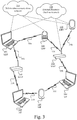
- a mesh network 300 comprises a plurality of nodes which may be a station 100 as in Figs. 1a, 1b and 2 .
- the mesh network 300 may also comprise at least one access point 330, referred to as a Mesh Access Point (MAP).
- MAP Mesh Access Point
- a network without any access points 330 is called an ad hoc network.
- a MAP 330 is also an example of a network node.
- each node 330, 100 is configured to capture and disseminate data that is aimed for the specific node.
- Each node 330, 100 is also configured to serve as a relay for other nodes 100, that is, the node 100 must collaborate to propagate data in the network 300.
- the mesh access points 330 are configured to serve as relays and routers for the other nodes 100.
- the nodes 330, 100 are configured to connect to one another through links or connections 350.
- the network shown in Fig. 3 is a wireless mesh network and the stations 100 and the access points 330 (if any) are configured to establish the wireless links 350 for communicating with one another.
- the mesh network is arranged to operate according to the IEEE 802.11 Mesh standard.
- MP Mesh Points
- MPP Mesh Portal Points
- MAP Mesh Access Points
- An MP is often a laptop, smartphone or other wireless device, such as has been disclosed in the above with reference to Figs. 1a and 1b , and supports a peer protocol for discovering neighboring nodes and maintaining an overview of them.
- this peer protocol is called Peer Link Management protocol.
- a beacon is a data package that is transmitted periodically and carries information identifying the node transmitting it.
- Other data carried in the beacon includes Path Selection Protocol ID, Path Selection metric, Congestion Control Mode, Synchronization Protocol ID, Authentication Protocol ID, Mesh Formation Info and Mesh Capability.
- Nodes 330, 100 in a mesh network receive this information and each node 330, 100 is thus aware of its surrounding network environment.
- the MPs also support a protocol for communicating with other nodes, nodes that are not necessarily neighbors to the MP.
- this peer protocol is called Hybrid Wireless Mesh Protocol (HWMP). It is hybrid because it supports two kinds of path selection protocols.
- IEEE 802.11 Mesh the protocols use the MAC addresses for addressing a data package correctly.
- Each node 330, 100 is configured to find a path from one node 330, 100 to another node 330, 100. This is referred to as path selection.
- An MPP is configured to provide gateway functionality to the mesh network.
- the MPP may for example be a portal to the internet 320 or a communication network 310, such as a mobile telecommunications network.
- An MPP must thus be configured to bridge at least two interface protocols.
- An MPP is often a laptop, a cell phone or other wireless device.
- a MAP is an access point that is configured to also communicate according to the mesh network standard and to operate as an access point.
- nodes 330 100 whereof three are laptops, three are smartphones and two are routers.
- Two nodes are MAPs, three nodes are MPs and at least two nodes are MPPs.
- a node may have the capability to act as both an MP and an MPP.
- the MPs of the example mesh network of Fig. 3 may actually also be MPPs.
- only three nodes are illustrated as having internet capability and three as having capabilities for mobile telecommunication.
- a mesh network can be designed using a flooding technique or a routing technique.
- a routing technique When using a routing technique, a message propagates from a sending node 100 to receiving node 100 along a path, by hopping from node 100 to node 100 until the receiving node 100 is reached.
- a routing network must allow for continuous connections and reconfiguration around broken or blocked paths, using self-healing algorithms. According to the standard IEEE 802.11 Mesh should a path be broken this will be discovered after a time period (e.g. 5 s) when a sending node detects that reception is not acknowledged. The system then performs a rerouting procedure by sending out path requests (PREQ) as has been discussed in the background section.
- PREQ path requests
- the self-healing capability enables a routing-based network to operate when one node breaks down or a connection goes bad.
- the network is typically quite reliable, as there is often more than one path between a source and a destination in the network.
- this concept is also applicable to wired networks and software interaction.
- a wireless mesh network is a communications network made up of radio nodes (laptops, cell phones and other wireless devices) while the mesh routers forward traffic to and from the gateways which may but need not connect to the Internet.
- the coverage area of the radio nodes working as a single network is sometimes called a mesh cloud. Access to this mesh cloud is dependent on the radio nodes working in harmony with each other to create a radio network.
- a mesh network is reliable and offers redundancy. When one node can no longer operate, the rest of the nodes can still communicate with each other, directly or through one or more intermediate nodes.
- Wireless mesh networks can be implemented with various wireless technology including 802.11, 802.15, 802.16, cellular technologies or combinations of more than one type.
- a wireless mesh network often has a more planned configuration, and may be deployed to provide dynamic and cost effective connectivity over a certain geographic area.
- An ad-hoc network is formed ad hoc when wireless devices come within communication range of each other.
- the MAPs may be mobile, and be moved according to specific demands arising in the network. Often the MAPs are not limited in terms of resources compared to other nodes in the network and thus can be exploited to perform more resource intensive functions. In this way, the wireless mesh network differs from an ad-hoc network, since these nodes are often constrained by resources.
- a path request, PREQ is sent out periodically with interval T. This ensures that the paths are updated regularly and kept valid in a network environment that otherwise dynamically changes when new stations enter the network and old stations leave, or when the stations move around within the mesh network resulting in a change of network topology.
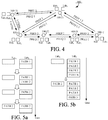
- Mesh network 400 comprises 6 different mesh stations 100-O, 100-I1, 100-I2, 100-I3, 100-I4, 100-T, the mesh network and mesh stations may for example correspond to the mesh network and mesh stations as described in conjunction with Fig. 1-3 .
- Each mesh station 100-O, 100-11, 100-12, 100-13, 100-14, 100-T comprises two path tables Tab 1 , Tab 2 .
- originator station 100-O needs to communicate with target station 100-T, originator station 100-O broadcasts a path request data packet PREQ 1, PREQ 2, PREQ 3 to adjacent stations 100-11, 100-12, 100-13.
- Each adjacent station 100-11, 100-12, 100-13, upon receiving the PREQ determines if the PREQ is addressed to itself. If the PREQ is addressed to another station the adjacent station 100-I1, 100-I2, 100-I3 broadcasts the PREQ further so it may reach its destination.
- PREQ 1 is relayed through intermediate station 100-11 to target station 100-T.
- PREQ 2 is relayed through intermediate stations 100-12 and 100-14 to target station 100-T.
- PREQ 3 is relayed through intermediate station 100-13 and 100-12 to target station 100-T.
- target station 100-T receives the PREQ from the different paths, it determines that the PREQ is addressed to itself and replies by transmitting by unicast a path reply data packet PREP 1, PREP 2, PREP 3 comprising the path which the PREQ traversed from the originator station 100-O to the target station 100-T.
- PREP 1, PREP 2 and PREP 2 are transmitted back to the originator station 100-O using the path that was traversed by the respective PREQ (and which path is also comprised in the PREP).
- the PREP having the shortest path will arrive at the originator station 100-O before the other PREPs.
- PREQ 1 will arrive before PREQ 2 and PREQ 3.
- the originator station 100-O receives PREP 1, and stores the path pertaining to it in its second path table Tab 2 . The originator station then waits for other PREPs to arrive, in this case PREP 2 and PREP 3 during a determined time period.
- the second time period may be predetermined by the originator station 100-O, or it may change dynamically depending on the quality of the mesh network. For example, a mesh network where low signal quality is experienced may require that the waiting period is as low as possible, whereas in a mesh network experiencing good signal quality the station may benefit from having a longer waiting period.
- the originator station 100-O may store the respective paths comprised in the PREPs in its second path table Tab 2 .
- each path comprised in each received second PREP is compared to a first path comprised in the first PREP stored in the second path table Tab 2 . If it is determined that the path pertaining to the received second PREP is better than the path pertaining to the first PREP, the path of the second PREP overwrites the path of the first PREP in the second path table Tab 2 .
- the originator station 100-O Before the expiration of the second time period t e.g. at a third time period t1 being less than the second time period t, the originator station 100-O compares the received paths stored in the second path table and determines a best path based on signal parameters. The best path is then copied from the second path table Tab 2 to the first path table Tab 1 . This may be done during the second time period, for example at the expiration of the third time period t1.
- the signal parameters may pertain to signal strength, Received Signal Strength Indication (RSSI) of a station link, jitter, Signal to Noise (SNR) ratio, etc.
- RSSI Received Signal Strength Indication
- SNR Signal to Noise
- the best path may not necessarily be the shortest path.
- a problem with the prior art is that upon sending a PREQ from an originator station, the first PREP to arrive back to the originator station is immediately used by the originator station to send data packets to a target station. That is, the first path table is updated directly with the first arrived PREP which thus represents the shortest path.
- the shortest path may for example experience interference or low signal strength on one or several links, which typically results in a high drop rate of data packets, whereas another longer path experiences good signal quality.
- the path comprising the best signal quality may be the longest path, however, choosing the longer path typically results in a more stable communication between the originator node and the target node. This leads to less packet loss in the mesh network.
- the best path is copied from the second path table Tab 2 to the first path table Tab 1 of the originator station at or during the end of the third time periodt1.
- the first table Tab 1 is updated.
- the originator station 100-O may use the best path for transmitting data to the target station 100-T. Then a new cycle is begun where a new PREQ is issued at T-t, paths are gathered in the second path table Tab 2 during a time period t1 shorter than the second time period t, e.g. t1 may be equal to t/2t. The best path is determined and moved to the first path table Tab 1 at the expiration of t1 and the first path table Tab 1 is updated at the expiration of time interval T.
- the intermediate station pertaining to the best path are updated on the path selection and may add to their first tables the best path for sending data packets between originator station 100-O and target station 100-T. This procedure will be described in more detail further on in this disclosure.
- Figs. 5a and 5b illustrates the first and second tables Tab 1 , Tab 2 .
- the first and second tables Tab 1 , Tab 2 may for example be the first and second tables of the originator station 100-O as described in conjunction with Fig. 4 .
- Fig. 5a the originator station has received a first path reply PREP 1 comprising a first alternative path to the target station.
- the first alternative path PATH 1 is stored in the second table Tab 2 .
- the second third time period t1 for receiving path replies has not yet expired, and as a second path reply PREP 2 is received comprising a second alternative path PATH 2 to the target station, the second alternative path is stored in the second table Tab 2 .
- the first alternative path PATH 1 is compared to the second alternative path PATH 2 based on signal parameters in order to establish the best path for transmitting data packets between the originator station and the target station.
- the second alternative path PATH 2 comprises better signal parameters (for example better signal strength or packet quality) than the first alternative path PATH 1, then the second alternative path PATH 2 is determined to be the best path.
- the second alternative path PATH 2 overwrites the first alternative path PATH 1 in the second path table.
- the best path (in this example, the second alternative path PATH 2) is copied from the second path table Tab 2 to the first path table Tab 1 which is updated at time interval T.
- the best path is stored in the first path table, and used for sending data packets between the originator station and the target station.
- Fig. 5b illustrates a first and second path table according to some embodiments.
- the first and second path table may for example be the same first and second path table comprised in the originator station 100-O as described in conjunction with Fig. 4 .
- all paths pertaining to returning PREPs are stored in the second path table Tab 2 .
- the originator station receives during a time period t1 a plurality of PREPS comprising a plurality of paths to a target station (for example, the target station 100-T as described in conjunction with Fig. 4 ), PATH 1-N.
- the paths PATH 1-N stored in the second path table are compared to each other based on signal parameters (the comparison may be carried out as described in conjunction with Fig. 5a ) in order to determine the best path.
- the first alternative path PATH 1 is the best path, then the first alternative path is copied to the first table.
- the second alternative path PATH 2 is copied to the first table.
- the shortest path is not always the best path. If for example, the mesh network of the originator station is the mesh network 400 as described in conjunction with Fig. 4 , then the alternative path comprised within PREP 2 does not represent the shortest path, but may instead represent the most stable path with best signal quality. Using this path thus leads to less dropped packets.
- PREP 2 comprising the best path is then copied to the first table Tab 1 , and used for transmitting data packets to the target station (which may for example be the target station 100-T as described in conjunction with Fig. 4 ).
- Fig. 6 illustrates an example method according to some embodiments.
- the method 600 may for example be carried out by the originator station 100-O as described in conjunction with Fig. 4 .
- the originator station receives a PREP comprising an alternative path to a target station (for example the target station 100-T as described in conjunction with Fig. 4 ).
- the originator station stores the received PREP comprising the path to the target station in its second table (compare with Fig. 5a ).
- 603 it is determined if a time period t1 for receiving path replies has expired. If the time period for receiving path replies has expired (yes-path out of 603), the method continues to 604, where the best path is copied from the second table to the first table (compare with Fig. 5b ). Alternatively, the best path is moved from the second table to the first table.
- the best path is used for transmitting data packets between the originator station and the target station.
- the method returns to 601 of the method 600.
- the originator station when the best path has been determined by the originator station, the originator station will transmit a path acknowledgement forward data packet (PANF) by a unicast transmission to the target station through the intermediate node pertaining to the best path (compare to Fig. 4 , wherein the PANF would be sent to intermediate station 100-12).
- PANF path acknowledgement forward data packet
- Fig. 7a illustrates an example method 700a according to some embodiments.
- the intermediate station receives the PANF from the originator.
- the intermediate station forwards by unicast the PANF along the best path to the target station (compare with Fig. 4 , wherein the PANF would traverse the path through intermediate station 100-14).
- the intermediate station forwards the PANF by unicast to the target station in 702a and then in 703a, the intermediate station moves the best path from its second table to its first table. In 704a the intermediate station uses the best path for transmitting data packets between the originator station and the target station.
- the PANF is received by the target station, which updates its own first table with the best path and transmits by unicast a path acknowledgement return data packet (PANR) following the best path back to the originator station.
- PANR path acknowledgement return data packet
- the intermediate station may update its path table with the best path when it receives the PANR from the target to the originator station. This is illustrated by method 700b in fig. 7b .
- the intermediate station receives the PANR and forwards it by unicast to the originator station. Then in 703b the intermediate station moves the best path from its second path table to its first path table. In 704b the best path is used by the intermediate station for transmitting data packets between the originator station and the target station.
- the intermediate station refrains from updating its path table until it has both received a PANF from the originator station and the corresponding PANR from the target station as is illustrated by method 700c in fig. 7c and as is indicated by the dashed arrow between 702a and 703a in fig. 7a indicating that the move to the other table does not need to be performed at that stage, but can be postponed to a later stage.
- the intermediate station updates its path table both when it receives a PANF from the originator station and when it receives the corresponding PANR from the target station as is also illustrated by method 700c in fig. 7c when taken in combination with method 700b of fig. 7b .
- the intermediate station receives a PANF from the target originator station.
- the intermediate station forwards the PANF by unicast to the target station.
- the target station accepts the PANF and answers by sending a PANR to the originator station through the same unicast path the PANF traveled.
- the intermediate station receives the PANR and before transmitting it by unicast to the originator station, moves in 704c the best path from its second path table to its first path table.
- the intermediate station starts using the best path for transmitting data packets between the originator station and the target station.
- Either of methods 700a, 700b and 700c may be utilized on their own, or combined with each other.
- the originator station will determine a second best path.
- the second best path is determined based on the second table Tab 2 .
- the second best path is determined by broadcasting a new PREQ in order to find another route.
- the periodic PREQ/PREP may be unnecessary and may instead inhibit the communication in the network. This is typically prominent in large mesh networks, where several station's periodic PREQ/PREPs typically results in large amounts of data traffic. This inhibits the efficiency of the network and typically leads to poor performance and packet loss.
- the inventors have after insightful reasoning discovered that by introducing a Weak Path Indicator (WPI) field, a quantitative value, in data packets to carry and relay information about the quality of the weakest links along the mesh path to the destination mesh station during data transfer, the need for periodic PREQs may be mitigated.
- WPI Weak Path Indicator
- the WPI field may be comprised in any type of data packet, both for control data as well as for application or other user data.
- the teachings herein relating to the WPI may also be used on its own and is not necessarily combined with the teachings of how to maintain shadow tables of the best path.
- a non linear path request throttle function further ensures that the destination mesh station does not flood the network with PREQs as a reaction to bad or broken links, while still guaranteeing low delay reaction time to bad or broken links.
- the data packets may be equipped with a Weak Path Indicator (WPI) field.
- WPI may be a quantitative value.
- the WPI carries information pertaining to the weakest links along the mesh path between the originator station and the target station during data transfer.
- This function may be based on several parameters such as RSSI of a peer link, packet loss, packet quality, packet error rate, jitter and delay time.
- delay time between each link along the mesh path, and/or delay time for the complete path can be quantified for usage in the weak path indication value.
- the maximum delay time can be calculated by either determining the traffic behavior live, or by negotiation between the originator station and the target station for a maximum path delay time.
- the target station may track the state of quality of the complete mesh path by monitoring the WPI field in all received data packets.
- Each received data packet comprises a quantitative WPI value (which also will be referred to herein as a WPI integer).
- the WPI integer indicates a good link.
- a WPI integer of 1 indicates a weak link
- a WPI integer of 2 indicated a bad link
- a WPI integer of 3 indicates a seriously unreliable link which might break at any time.
- the target station keeps a WPI counter for the originator station, wherein the counter is incremented for each received data packet with the WPI integer.
- the target station receives in 801 a data packet comprising a WPI integer.
- the target station adds the WPI integer to the WPI counter.
- the WPI counter equals or is greater than a WPI threshold (yes-path out of 803), then in 804 the target station issues a PREQ to the originator station, and the method continues to 805 where the WPI counter is reset.
- the WPI threshold may for example be set to 3.
- a data packet comprising a WPI integer of 3 will then immediately trigger the target station to issue a new PREQ to the originator station so that a new reliable path can be found.
- the target station checks if the WPI integer received in the data packet is equal to 0.
- the WPI counter of the target station is decreased by one, and the method continues to 801 where a new data packet comprising a WPI integer is received.
- the method continues to 801 wherein a new data packet comprising a WPI integer is received.
- a data packet when traversing a path from an originator station to a target station (for example the originator station 100-O and target station 100-T) as described in conjunction with Fig. 4 ), it may experience a link between for example the originator station and the first intermediate node (compare with Fig. 4 ) to be of good quality.
- the WPI integer is then set to 0.
- the link quality may be experienced as weak and the WPI integer will thus be set to 1. If the data packet traverses another link, where the link quality is experienced as bad then the WPI integer will be set to 2.
- the worst link determines how the target station will perceive the quality of the overall path. If one link of the path if deemed to be sufficiently bad (i.e. WPI integer indicates value 3), then the whole path will be replaced. Thus, the path is replaced proactively resulting in less risk of packet loss and problems due to delay. Furthermore, replacing the whole path ensures that all stations along a path always knows which path they belong to and where they should forward the data packets for them to reach the target station.
- the WPI threshold is, for example, set to 3, then two data packets in a row comprising a WPI integer of 2 (or one indicating 1, and another indicating 2) will trigger the target station to issue a new PREQ.
- the WPI indicates that the path is not in top condition and that the risk of loosing data packet is high.
- the issued PREQ acts as a precaution for losing data packets by abandoning a path which indicates low performance in favor of a new better path.
- a mesh network experience very low signal quality, it typically results in a majority of the sent data packets indicating a weak or worse path. This could lead to an abundance of issued PREQ which in turn would further congest the network and worsen its overall performance.
- the inventors have realized after insightful reasoning that if a PREQ throttle threshold together with a non-non linear path request throttle function is introduced the phenomena of flooding an already poorly performing mesh network with an abundance of PREQs is mitigated.
- the non linear path request throttle function ensures that the target station does not flood or congest the network with PREQs.
- the flooding may typically happen when several data packets arrives with a WPI integer indicating a weak or worse path during path discovery, or a transient fade out of the signal along the path.
- a target station for example the target station 100-T as described in conjunction with Fig. 4 , receives a data packet (for example a PREQ) comprising a WPI integer (compare with 801 of method 800). In 902 it is checked whether the WPI integer is equal to 0.
- the method 900 continues to 903 wherein the target station compares the number of received WPI integers indicating a good link to a lower throttle threshold value.
- the method continues to 905 wherein the target station decreases the PREQ rate limit non-linearly.
- the amount of time between issued PREQs is initially slowly decreased but will increase non-linearly as more data packets comprising a WPI integer equal to 0 arrive in a close succession.
- the non linear decrease of the PREQ rate limit down to 0 ensures that the mesh path really is in a good condition before allowing an increased amount of PREQs to be issued.
- the PREQ rate limit may be decreased exponentially, or stepwise.
- the method continues to 901, wherein the target station receives a new data packet comprising a WPI integer.
- the method 900 continues to 906 where the number of received WPI integers indicating a weak or worse link is compared to an upper throttle threshold value.
- the amount of time between each PREQ is rapidly increased if several packets arrives indicating a weak or worse link. This has the benefit that the amount of PREQs is reduced, which enhances the overall performance of the mesh network.
- the method 900 continues to 901 wherein a new data packet comprising a WPI integer is received.
- the non-linear path request throttle function ensures that the target station does not flood the network with PREQs.
- the non-linear path request throttling function will either increase or decrease the PREQ rate limit in a non-linear fashion.
- a low rate limit i.e. PREQs are issued at short time intervals, ensures fast responses to changing environments, which is a typical scenario for a mesh network, and this is the state that a mesh station will find itself in when the link quality has settled.
- a high rate limit will, on the other hand, avoid flooding the mesh network with PREQs while trying to find a new and better (based on link quality) end-to-end path.
- the WPI together with the non-linear path request throttle function ensures an optimal level of issued PREQs in a fast changing network environment, such as a mesh network.
- the WPI together with the non-linear path request throttle function also mitigates the need for periodic PREQs in the mesh network. Avoiding periodic PREQs typically provides a seamless path soft handover between mesh stations, resulting in a low packet loss and generation of less path maintenance traffic. This typically reduces noise in the wireless environment and therefore supports more stations in a mesh network.
- the PREQ rate may only be increased to a predetermined maximum which corresponds to the period path request standard of 802.11 Mesh.
- the non linear increase of the PREQ rate limit up to the maximum value ensures that the mesh path really is in an inferior condition before allowing an decreased amount of PREQs to be issued, so that PREQs are not broadcasted when not needed.
- the PREQ rate limit When the PREQ rate limit has reached its maximum, the risk of flooding the network while trying to find a new better path is minimized, which enhances the over all performance of the mesh network.
- the PREQ rate limit may be increased exponentially, or stepwise.
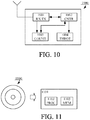
- FIG. 10 An example arrangement 1000 of a mesh network station (for example any of the stations as described in conjunction with Figs. 1, 2 , 3 , 4 ) according to some embodiments is illustrated in Fig. 10 .
- the example arrangement 1000 comprises a transceiver 1001 (RX/TX), a controller 1002 (CNTR), a counter 1003 (COUNT) and a throttling device 1004 (THROT).
- RX/TX transceiver 1001
- CNTR controller 1002
- COUNT counter 1003
- THROT throttling device 1004
- the transceiver 1001 (RX/TX) is a receiver separated from a sender.
- the transceiver 1001 (RX/TX) is configured to receive data packets, for example path request data packets.
- the transceiver 1001 may receive data packets as described in conjunction with Figs. 6-9 (compare with 601, 701, 703, 801 and 901).
- the transceiver 1001 may relay the received data packet the controller 1002 (CNTR).
- the controller 1002 is further configured to extract the first path comprised in the first data packet (if the data packet is a PREQ or PREP), and store it in a second path table (compare to Fig. 5a ).
- the controller 1002 is further configured to compare during a time period t each received second path with the first path that is stored in the second path table based on signal parameter.
- the controller 1002 (CNTR) determines if a newly received second path is better than the first path stored in the second path table by comparing signal parameters pertaining to respective path.
- the second path comprises better signal parameters, indicating a stronger path
- the second path will be stored in the second path table and replace the first path.
- the controller 1002 (CNTR) is configured to move the best path from the second table, and store it in the first table (compare with 604 of method 600).
- both the first and the second paths are stored in the second table (compare with Fig. 5b ) during the time period t.
- the example arrangement 1000 also comprises a counter 1003 (COUNT) which may for example comprise the WPI counter as described in connection with Fig. 8 .
- the counter 1003 (COUNT) may also comprise one or more means for counting and storing the number of data packets received indicating a good path or a weak or worse path (not shown).
- the counter 1003 (COUNT) is further configured to add the WPI integer comprised in the received data packet and increment the one or more means for counting and storing the number of WPI integers received indicating a good path or a weak or worse path by 1.
- the counter 1003 (COUNT) then relays the WPI counter value and the WPI integer to the controller 1002 (CNTR).
- the controller 1002 (CNTR) determines if the WPI counter is equal to or has exceeded a WPI threshold value (compare with 803 of method 800).
- the controller 1002 is further configured to issue a new PREQ to the station from which the received data packets originates (for example, originator station 100-O of Fig. 4 ) by using transceiver 1001 (TX/RX).
- the controller 1002 then resets the WPI counter comprised in the counter 1003 (COUNT) to 0.
- the controller 1002 is configured to decrease the WPI counter by 1 (compare to 807 of method 800).
- the counter 1003 also relays the number of data packets received indicating a good and/or a weak or worse link to the controller 1002 (CNTR).
- the controller 1002 determines if the WPI integer is equal to 0 (compare with 902 of method 900). If the WPI integer is equal to zero, the controller 1000 (CNTR) compares the number of received WPI integers indicating a good path to a lower throttle threshold (compare with 903 of method 900).
- the controller 1002 instructs throttling device 1004 (THROT) to decrease the PREQ rate limit in a non linear fashion (compare with 905 of the method 900).
- controller 1002 determines whether the WPI integer is not equal to 0 or not equal to 0 or whether the WPI integer is not equal to 0 or not equal to 0 or not equal to 0 or not equal to 0 or not equal to 0 or not equal to 0 or not equal to 0 or not equal to 0 or not equal to 0 or not equal to 0 or not equal to 0 or not equal to 0 or the controller 1002 (CNTR) will compare the number of received WPI integers indicating a weak or worse path to an upper throttling threshold (compare with 906 of method 900).
- the controller 1002 (CNTR) will instruct the throttling device 1004 (THROT) to increase the PREQ rate limit in a non linear fashion (compare with 908 of method 900).
- the rate at which PREQs are issued will decrease exponentially.
- Fig. 11 illustrates a computer program product 1100 according to some embodiments comprising a computer readable medium such as, for example, a diskette or a CD-ROM.
- the computer readable medium may have stored thereon a computer program comprising program instructions.
- the computer program may be loadable into a data-processing unit 1101, which may, for example, be comprised in a mobile terminal.
- the computer program When loaded into the data-processing unit, the computer program may be stored in a memory 1103 (MEM) associated with or integral to the data-processing unit.
- the computer program may, when loaded into and run by the data-processing unit, cause the data-processing 1102 (PROC) unit to execute method steps according to, for example, the methods shown in any of the Figs. 6, 7 , 8, 9 .
Landscapes
- Engineering & Computer Science (AREA)
- Computer Networks & Wireless Communication (AREA)
- Signal Processing (AREA)
- Data Exchanges In Wide-Area Networks (AREA)
- Mobile Radio Communication Systems (AREA)
Claims (15)
- Maschennetzwerkstation, die eine Quellstation ist, die eine Steuerung (210) und einen Speicher (240) zum Speichern einer ersten Pfadtabelle (Tab1) zum Speichern eines oder mehrerer Pfade, die zum Senden von Datenpaketen verwendet werden sollen, und einer zweiten Pfadtabelle (Tab2) zum Speichern eines oder mehrerer alternativer Pfade zum Senden von Datenpaketen umfasst, und wobei die Quellstation ferner konfiguriert ist zum:Senden per Broadcast eines ersten Pfadanforderungs-Datenpakets (PREQ1, PREQ2, PREQ3) für eine Zielstation (100-T);Empfangen eines ersten Pfadantwort-Datenpakets (PREP1), das einen ersten alternativen Pfad (PATH1) zur Zielstation (100-T) umfasst;Speichern des ersten alternativen Pfades (PATH1) in der zweiten Pfadtabelle (Tab2) der Quellstation;Empfangen mindestens eines zweiten Pfadantwort-Datenpakets (PREP2), das mindestens einen zweiten alternativen Pfad (PATH2) zur Zielstation (100-T) umfasst;Abrufen eines besten Pfades zur Zielstation (100-T) aus der zweiten Pfadtabelle (Tab2) der Quellstation basierend auf einem oder mehreren Signalparametern in Bezug auf jeden Pfad;Speichern des besten Pfades zur Zielstation (100-T) in der ersten Pfadtabelle (Tab1) der Quellstation; undVerwenden des besten Pfades zum Senden von Datenpaketen an die Zielstation (100-T).
- Maschennetzwerkstation nach Anspruch 1, wobei der beste Pfad bestimmt wird, indem der eine oder die mehreren Signalparameter des empfangenen zweiten alternativen Pfades (PATH2) mit dem einen oder den mehreren Signalparametern des gespeicherten ersten alternativen Pfades (PATH1) verglichen werden, um den besten alternativen Pfad zu bestimmen, und, wenn bestimmt wird, dass der zweite alternative Pfad (PATH2) der beste alternative Pfad ist, der zweite alternative Pfad (PATH2) in der zweiten Tabelle (Tab2) gespeichert wird, wobei der erste alternative Pfad (PATH1) überschrieben wird.
- Maschennetzwerkstation nach Anspruch 1, wobei die Steuerung (210) ferner konfiguriert ist zum:Speichern des mindestens einen zweiten alternativen Pfades (PATH2) zur Zielstation (100-T) in der zweiten Pfadtabelle (Tab2) ohne Überschreiben des ersten alternativen Pfades (PATH1); und wobeider beste Pfad abgerufen wird, indem der eine oder die mehreren Signalparameter des gespeicherten zweiten alternativen Pfades (PATH2) mit dem einen oder den mehreren Signalparametern des gespeicherten ersten alternativen Pfades (PATH1) verglichen werden, um den besten alternativen Pfad zu bestimmen, und, wenn bestimmt wird, dass der zweite alternative Pfad (PATH2) der beste alternative Pfad ist, der zweite alternative Pfad (PATH2) aus der zweiten Tabelle (Tab2) abgerufen wird, und, falls nicht, der erste alternative Pfad (PATH1) abgerufen wird.
- Maschennetzwerkstation nach Anspruch 2, wobei der eine oder die mehreren Signalparameter aus einer Gruppe genommen werden, die Signal-zu-Rausch-Verhältnis, Empfangssignalstärke-Indikator (RSSI) für Partner-Maschenstation, Pfadverzögerungszeit, Paketverlust und/oder Paketfehlerrate umfasst.
- Maschennetzwerkstation nach Anspruch 1, wobei die Quellstation ferner konfiguriert ist zum Senden eines Pfadbestätigungsweiterleitungs-Datenpakets (PANF) per Unicast über den besten Pfad an die Zielstation (100-T),
Empfangen eines Pfadbestätigungsrücksende-Datenpakets (PANR) per Unicast über den besten Pfad an die Zielstation (100-T) und
Verwenden des besten Pfades gemäß der ersten Pfadtabelle (Tab1) zum Senden von Datenpaketen an die Zielstation (100-T). - Maschennetzwerkstation nach Anspruch 1, wobei die erste Pfadtabelle (Tab1) der Quellstation mindestens einmal während einer ersten Zeitdauer (T) aktualisiert wird, und wobei die ersten und zweiten Paketanforderungs-Datenpakete empfangen werden, und wobei folglich die zweite Pfadtabelle (Tab2) der Quellstation mindestens einmal während einer zweiten Zeitdauer (t) am Ende und sich teilweise überlappend mit der ersten Zeitdauer (T) aktualisiert wird.
- Maschennetzwerkstation nach Anspruch 6, wobei die erste Zeitdauer (T) 5 Sekunden beträgt, und wobei die zweite Zeitdauer (t) 1 Sekunde beträgt.
- Maschennetzwerkstation nach Anspruch 6 oder 7, wobei die besten Pfade am Ende der ersten Zeitdauer (T) bestimmt und dann in der ersten Pfadtabelle (Tab1) gespeichert werden.
- Maschennetzwerkstation nach Anspruch 6, wobei die Quellstation ferner so konfiguriert ist, dass sie, wenn während der ersten Zeitdauer (T) vor Beginn der zweiten Zeitdauer (t) ein zur Zielstation (100-T) zu verwendender Pfad unterbrochen wird:
ein zweites Pfadanforderungs-Datenpaket für die Zielstation (100-T) per Broadcast sendet. - Maschennetzwerk, umfassend die Maschennetzwerkstation nach einem der vorhergehenden Ansprüche und eine Zielstation (100-T), die eine Steuerung (210) und einen Speicher (240) zum Speichern einer ersten Pfadtabelle (Tab1) zum Speichern eines oder mehrerer Pfade, die zum Senden von Datenpaketen verwendet werden sollen, und einer zweiten Pfadtabelle (Tab2) zum Speichern eines oder mehrerer alternativer Pfade zum Senden von Datenpaketen umfasst.
- Maschennetzwerk nach Anspruch 10, wobei das erste Pfadanforderungs-Datenpaket (PREQ1, PREQ2, PREQ3) einen Pfadschwäche-Indikator zum Anzeigen des Zustands einer Verbindung zwischen zwei Stationen umfasst, welche das erste Pfadanforderungs-Datenpaket (PREQ1, PREQ2, PREQ3) auf seinem Weg von der Quellstation zur Zielstation (100-T) durchläuft; wobei
die Zielstation (100-T) einen Pfadschwäche-Indikator-Zähler zum Beurteilen umfasst, ob der vom ersten Pfadanforderungs-Datenpaket (PREQ1, PREQ2, PREQ3) zum Erreichen der Zielstation (100-T) verwendete Pfad für das erste Pfadantwort-Datenpaket (PREP1) geeignet ist oder ob ein zweites Pfadanforderungs-Datenpaket von der Zielstation (100-T) an die Quellstation ausgegeben werden sollte; und wobei
die Steuerung (210) der Zielstation (100-T) ein Drosselungselement zum Drosseln oder Erhöhen der Pfadanforderungs-Datenpaketrate umfasst. - Maschennetzwerk nach Anspruch 11, wobei die Steuerung (210) der Zielstation (100-T) ferner konfiguriert ist zum:Vergleichen der Anzahl von empfangenen Pfadschwäche-Indikatoren, die eine ganze Zahl über 1 anzeigen, mit einem oberen Drosselschwellenwert, wobei die Steuerung (210) ferner so konfiguriert ist, dass sie, wenn die Anzahl von empfangenen Pfadschwäche-Indikatoren, die eine ganze Zahl über 1 anzeigen, den oberen Schwellenwert überschreitet, die Pfadanforderungs-Datenpaketrate nichtlinear erhöht; unddie Steuerung (210) der Zielstation (100-T) ferner so konfiguriert ist, dass sie, wenn die Anzahl von empfangenen Pfadschwäche-Indikatoren, die eine ganze Zahl über 1 anzeigen, unter einem unteren Drosselschwellenwert liegt, die Pfadanforderungs-Datenpaketrate nichtlinear verringert.
- Maschennetzwerk nach Anspruch 11, wobei der Pfadschwäche-Indikator ganze Zahlen von 0 bis 3 anzeigt, wobei 0 einen guten Pfad anzeigt, 1 einen schwachen Pfad anzeigt, 2 einen schlechten Pfad anzeigt, und 3 einen unzuverlässigen Pfad anzeigt, und wobei für jedes empfangene Pfadanforderungs-Datenpaket,
wenn die ganze Zahl in Bezug auf den Pfadschwäche-Indikator des empfangenen Pfadanforderungs-Datenpakets > 0 ist,
der Pfadschwäche-Indikator-Zähler der Zielstation (100-T) um eine ganze Zahl entsprechend der ganzen Zahl in Bezug auf den Pfadschwäche-Indikator des empfangenen Pfadanforderungs-Datenpakets inkrementiert wird. - Verfahren einer Maschennetzwerkstation in einem Maschennetzwerk (400), das eine Quellstation (100-0) und eine Zielstation (100-T) umfasst, wobei jede Station eine Steuerung (210) und einen Speicher (240) zum Speichern einer ersten Pfadtabelle (Tab1) zum Speichern eines oder mehrerer Pfade zum Senden von Datenpaketen und einer zweiten Pfadtabelle (Tab2) zum Speichern eines oder mehrerer alternativer Pfade zum Senden von Datenpaketen umfasst; wobei das Verfahren umfasst:Senden per Broadcast eines ersten Pfadanforderungs-Datenpakets (PREQ1, PREQ2, PREQ3) durch die Quellstation (100-0) für die Zielstation (100-T) ;Empfangen eines ersten Pfadantwort-Datenpakets (PREP1), das einen ersten alternativen Pfad (PATH1) zur Zielstation (100-T) umfasst;Speichern des ersten alternativen Pfades (PATH1) in der zweiten Pfadtabelle (Tab2) der Quellstation (100-0) ;Empfangen mindestens eines zweiten Pfadantwort-Datenpakets (PREP2), das mindestens einen zweiten alternativen Pfad (PATH2) zur Zielstation (100-T) umfasst;Abrufen eines besten Pfades zur Zielstation (100-T) aus der zweiten Pfadtabelle (Tab2) der Quellstation (100-O) basierend auf einem oder mehreren Signalparametern in Bezug auf jeden Pfad;Speichern des besten Pfades zur Zielstation (100-T) in der ersten Pfadtabelle (Tab1) der Quellstation (100-0); undVerwenden des besten Pfades zum Senden von Datenpaketen an die Zielstation (100-T).
- Computerprogrammprodukt, umfassend ein computerlesbares Medium, das ein Computerprogramm darauf aufweist, das Programmanweisungen umfasst, wobei das Computerprogramm in eine Datenverarbeitungseinheit (1101) geladen werden kann und so ausgelegt ist, dass es die Datenverarbeitungseinheit (1101) veranlasst, das Verfahren nach Anspruch 14 auszuführen, wenn das Computerprogramm durch die Datenverarbeitungseinheit (1101) ausgeführt wird.
Applications Claiming Priority (2)
| Application Number | Priority Date | Filing Date | Title |
|---|---|---|---|
| US14/744,367 US9913195B2 (en) | 2015-06-19 | 2015-06-19 | Mesh path selection |
| PCT/EP2016/063679 WO2016202822A1 (en) | 2015-06-19 | 2016-06-15 | Mesh path selection |
Publications (2)
| Publication Number | Publication Date |
|---|---|
| EP3311533A1 EP3311533A1 (de) | 2018-04-25 |
| EP3311533B1 true EP3311533B1 (de) | 2019-04-03 |
Family
ID=56137317
Family Applications (1)
| Application Number | Title | Priority Date | Filing Date |
|---|---|---|---|
| EP16730343.7A Active EP3311533B1 (de) | 2015-06-19 | 2016-06-15 | Auswahl eines mesh-pfades |
Country Status (4)
| Country | Link |
|---|---|
| US (2) | US9913195B2 (de) |
| EP (1) | EP3311533B1 (de) |
| CN (1) | CN107852362B (de) |
| WO (1) | WO2016202822A1 (de) |
Families Citing this family (40)
| Publication number | Priority date | Publication date | Assignee | Title |
|---|---|---|---|---|
| US20160028437A1 (en) | 2014-07-22 | 2016-01-28 | Hyperion Energy Group Llc | Methods, systems, and apparatus for the monitoring, controlling, and communicating of lighting systems |
| US9913195B2 (en) * | 2015-06-19 | 2018-03-06 | Terranet Ab | Mesh path selection |
| CA2922449C (en) * | 2015-09-25 | 2024-04-30 | Osram Sylvania Inc. | Route optimization using star-mesh hybrid topology in localized dense ad-hoc networks |
| US10230636B2 (en) * | 2016-06-21 | 2019-03-12 | Amazon Technologies, Inc. | Software interface layer of a mesh network device |
| US20180184351A1 (en) * | 2016-12-27 | 2018-06-28 | Timur Voloshin | Method, system, and program product for improving quality of electronic communications |
| DE102018210589A1 (de) * | 2018-06-28 | 2020-01-02 | Zf Friedrichshafen Ag | Verfahren, Vorrichtung und System zur Kommunikation selbstfahrender Arbeitsmaschinen |
| US10993164B1 (en) * | 2018-09-14 | 2021-04-27 | Amazon Technologies, Inc. | Path selection between wireless mesh network devices |
| EP3854039A1 (de) * | 2018-09-21 | 2021-07-28 | Telefonaktiebolaget LM Ericsson (publ) | Verfahren zum hinzufügen redundanter relaisknoten während der wegentdeckungsprozedur eines mesh-netzwerks |
| EP3895474A1 (de) * | 2018-12-14 | 2021-10-20 | Telefonaktiebolaget LM Ericsson (publ) | Verfahren und knotenvorrichtung zur unterstützung des aufbaus eines pfades von einem quellenknoten zu einem zielknoten in einem drahtlosen mesh-netzwerk |
| US11082344B2 (en) | 2019-03-08 | 2021-08-03 | GoTenna, Inc. | Method for utilization-based traffic throttling in a wireless mesh network |
| CN111756611B (zh) * | 2019-03-26 | 2022-05-03 | 瑞昱半导体股份有限公司 | 无线联机方法及主动确认候选节点是否为网状闸口的方法 |
| US10931570B1 (en) * | 2019-08-12 | 2021-02-23 | Rockwell Collins, Inc. | Flooding to routing |
| US12111406B2 (en) | 2019-11-27 | 2024-10-08 | Rockwell Collins, Inc. | Adaptive doppler-nulling digitization for high-resolution |
| US12498442B2 (en) | 2019-11-27 | 2025-12-16 | Rockwell Collins, Inc. | Robust addressing schema for spatial awareness via doppler null scanning (DNS) |
| US12474431B2 (en) | 2019-11-27 | 2025-11-18 | Rockwell Collins, Inc. | Doppler-nulling and two-way timing and ranging (spatial awareness) |
| US12407393B2 (en) | 2019-11-27 | 2025-09-02 | Rockwell Collins, Inc. | System and method for spatial awareness overlay onto mobile ad hoc network (MANET) frequent message preambles |
| US11665658B1 (en) | 2021-04-16 | 2023-05-30 | Rockwell Collins, Inc. | System and method for application of doppler corrections for time synchronized transmitter and receiver |
| US12153150B2 (en) | 2019-11-27 | 2024-11-26 | Rockwell Collins, Inc. | Doppler nulling scanning (DNS) security (spatial awareness) |
| US12050279B2 (en) | 2019-11-27 | 2024-07-30 | Rockwell Collins, Inc. | Doppler nulling spatial awareness (DNSA) solutions for non-terrestrial networks |
| US12316403B2 (en) | 2022-05-20 | 2025-05-27 | Rockwell Collins, Inc. | Situational awareness (SA) in radio silence (spatial awareness) |
| US12477583B2 (en) | 2022-06-22 | 2025-11-18 | Rockwell Collins, Inc. | Aliasing for cell-based manet |
| US11737121B2 (en) | 2021-08-20 | 2023-08-22 | Rockwell Collins, Inc. | System and method to compile and distribute spatial awareness information for network |
| US12504496B2 (en) | 2019-11-27 | 2025-12-23 | Rockwell Collins, Inc. | Station keeping using doppler null scanning |
| US11977173B2 (en) | 2019-11-27 | 2024-05-07 | Rockwell Collins, Inc. | Spoofing and denial of service detection and protection with doppler nulling (spatial awareness) |
| US11290942B2 (en) | 2020-08-07 | 2022-03-29 | Rockwell Collins, Inc. | System and method for independent dominating set (IDS) based routing in mobile AD hoc networks (MANET) |
| US12366625B2 (en) | 2019-11-27 | 2025-07-22 | Rockwell Collins, Inc. | System and method using passive spatial awareness for GEO network routing |
| US11726162B2 (en) | 2021-04-16 | 2023-08-15 | Rockwell Collins, Inc. | System and method for neighbor direction and relative velocity determination via doppler nulling techniques |
| US12335138B2 (en) | 2019-11-27 | 2025-06-17 | Rockwell Collins, Inc. | Spatial awareness navigation techniques on unmanned aerial vehicles (spatial awareness) |
| US12137048B2 (en) | 2019-11-27 | 2024-11-05 | Rockwell Collins, Inc. | System and method for spatial awareness network routing |
| US11296966B2 (en) | 2019-11-27 | 2022-04-05 | Rockwell Collins, Inc. | System and method for efficient information collection and distribution (EICD) via independent dominating sets |
| US12326506B2 (en) | 2019-11-27 | 2025-06-10 | Rockwell Collins, Inc. | DNS spatial discoveries with on-going traffic |
| IT202000000892A1 (it) * | 2020-01-17 | 2021-07-17 | St Microelectronics Srl | Procedimento per fare funzionare una rete di comunicazione, rete di comunicazione e dispositivi corrispondenti |
| CN112511436B (zh) * | 2020-03-03 | 2024-02-02 | 中兴通讯股份有限公司 | Bier网络的信令配置方法、装置和存储介质 |
| CN111200790B (zh) * | 2020-03-11 | 2022-02-18 | 杭州涂鸦信息技术有限公司 | 一种私有mesh转发控制方法及其系统和设备 |
| EP3890195B1 (de) | 2020-03-31 | 2024-05-15 | STMicroelectronics S.r.l. | Vorrichtung und verfahren für g3-plc-bootstrap in hybriden netzwerken |
| US11646962B1 (en) | 2020-10-23 | 2023-05-09 | Rockwell Collins, Inc. | Zero overhead efficient flooding (ZOEF) oriented hybrid any-cast routing for mobile ad hoc networks (MANET) |
| CN113645676B (zh) * | 2021-08-13 | 2023-12-15 | 中国人民解放军63620部队 | 一种业务数据的发送方法、装置、计算机设备及存储介质 |
| US12457155B2 (en) * | 2022-02-11 | 2025-10-28 | Ribbon Communications Operating Company, Inc. | Flow orchestration for network configuration |
| CN114786234B (zh) * | 2022-06-21 | 2022-11-18 | 广州慧睿思通科技股份有限公司 | 移动自组网路由请求方法、对讲装置、系统及存储介质 |
| CN116367363A (zh) * | 2023-03-27 | 2023-06-30 | 深圳市正浩创新科技股份有限公司 | 电源设备组网方法及计算机存储介质 |
Family Cites Families (36)
| Publication number | Priority date | Publication date | Assignee | Title |
|---|---|---|---|---|
| US6535504B1 (en) | 1999-01-15 | 2003-03-18 | Brian Weatherred Johnson | Link aggregation path selection method |
| US6856627B2 (en) * | 1999-01-15 | 2005-02-15 | Cisco Technology, Inc. | Method for routing information over a network |
| JP3737385B2 (ja) | 2001-06-07 | 2006-01-18 | 富士通株式会社 | 最適化パス設定方法及びそれを用いた網管理システム |
| CN100346618C (zh) * | 2003-12-10 | 2007-10-31 | 联想(北京)有限公司 | 无线网格的最佳路由选择方法 |
| JP4076022B2 (ja) | 2004-03-05 | 2008-04-16 | Kddi株式会社 | マルチホップ無線ネットワークの経路確立方法および無線端末 |
| US20060274760A1 (en) | 2005-06-07 | 2006-12-07 | Level 3 Communications, Inc. | Internet packet quality monitor |
| CN101674633B (zh) * | 2005-11-09 | 2013-06-12 | 汤姆森特许公司 | 无线网络中的路由选择 |
| US8738013B2 (en) * | 2006-04-24 | 2014-05-27 | Marvell World Trade Ltd. | 802.11 mesh architecture |
| FR2902256B1 (fr) | 2006-06-12 | 2009-09-25 | Airbus France Sa | Procede de routage de liens virtuels dans un reseau a commutation de trames |
| JP2008160385A (ja) * | 2006-12-22 | 2008-07-10 | Nec Corp | ネットワーク経路制御システム、経路制御装置および経路制御方法 |
| GB0800478D0 (en) | 2008-01-11 | 2008-02-20 | Nortel Networks Ltd | Improved loop avoidance for multicast transport networks |
| CN101494590B (zh) | 2008-01-23 | 2011-09-21 | 中兴通讯股份有限公司 | 一种通信网络中基于负载平衡的最优路径选择方法 |
| CN101242320A (zh) | 2008-03-13 | 2008-08-13 | 华为技术有限公司 | 监测网络路径的方法及装置 |
| US8208373B2 (en) * | 2008-07-31 | 2012-06-26 | Motorola Solutions, Inc. | Method for multi-band communication routing within a wireless communication system |
| WO2010044187A1 (ja) * | 2008-10-15 | 2010-04-22 | パナソニック株式会社 | 通信端末及び通信方法 |
| JP4682255B2 (ja) | 2009-03-11 | 2011-05-11 | 富士通株式会社 | 経路制御装置、経路制御方法及び経路制御プログラム |
| US8861398B2 (en) * | 2009-06-30 | 2014-10-14 | Mitsubishi Electric Research Laboratories, Inc. | Method for discovering multiple routes in sensor networks |
| US8199655B2 (en) | 2009-08-21 | 2012-06-12 | Verizon Patent And Licensing Inc. | Optimized layer-2 network switching systems and methods |
| JP5477896B2 (ja) * | 2009-08-28 | 2014-04-23 | 日本電気通信システム株式会社 | 無線通信端末 |
| EP2302840A1 (de) | 2009-09-29 | 2011-03-30 | Ceragon Networks LTD. | Pfadschutz durch gemeinsame Nutzung von Kontinuitätsprüfnachrichten |
| CN102056209A (zh) | 2011-01-14 | 2011-05-11 | 中国人民解放军理工大学 | 一种用弱多径覆盖提高路由顽存性的方法 |
| US8599759B2 (en) * | 2011-04-29 | 2013-12-03 | Cooper Technologies Company | Multi-path radio transmission input/output devices, network, systems and methods with on demand, prioritized routing protocol |
| CN103636172B (zh) * | 2011-06-28 | 2017-03-01 | 瑞典爱立信有限公司 | 具有环拓扑的网络中的拓扑改变 |
| US8654869B2 (en) * | 2011-10-27 | 2014-02-18 | Cooper Technologies Company | Multi-path radio transmission input/output devices, network, systems and methods with link suitability determination |
| US9059903B2 (en) | 2011-12-19 | 2015-06-16 | At&T Intellectual Property I, L.P. | Method and apparatus for monitoring connectivity in a long term evolution network |
| US8693322B2 (en) | 2012-02-21 | 2014-04-08 | Yikun Zhang | Routing method for a wireless multi-hop network |
| JP5919950B2 (ja) * | 2012-03-28 | 2016-05-18 | 富士通株式会社 | 経路探索方法、経路探索装置、及びプログラム |
| US9774527B2 (en) | 2012-08-31 | 2017-09-26 | Nasdaq Technology Ab | Resilient peer-to-peer application message routing |
| US9137144B2 (en) | 2012-09-28 | 2015-09-15 | Alcatel Lucent | Method and apparatus for communication path selection |
| US20140112171A1 (en) | 2012-10-23 | 2014-04-24 | Mr. Babak PASDAR | Network system and method for improving routing capability |
| CN104982070A (zh) * | 2013-02-07 | 2015-10-14 | 交互数字专利控股公司 | 用于在网状网络中选择路由路径的方法和装置 |
| CN103248571A (zh) | 2013-05-16 | 2013-08-14 | 湖北邮电规划设计有限公司 | 一种最优第二路由的计算方法 |
| GB2520231B (en) | 2013-07-23 | 2020-12-16 | Metaswitch Networks Ltd | Media sessions |
| CN104579967A (zh) | 2013-10-18 | 2015-04-29 | 宇宙互联有限公司 | 传输路径控制设备 |
| JP2016131298A (ja) * | 2015-01-13 | 2016-07-21 | 富士通株式会社 | パス計算装置およびパス計算方法 |
| US9913195B2 (en) * | 2015-06-19 | 2018-03-06 | Terranet Ab | Mesh path selection |
-
2015
- 2015-06-19 US US14/744,367 patent/US9913195B2/en active Active
-
2016
- 2016-06-15 CN CN201680045070.6A patent/CN107852362B/zh active Active
- 2016-06-15 WO PCT/EP2016/063679 patent/WO2016202822A1/en not_active Ceased
- 2016-06-15 EP EP16730343.7A patent/EP3311533B1/de active Active
-
2018
- 2018-01-23 US US15/877,575 patent/US10555237B2/en active Active
Non-Patent Citations (1)
| Title |
|---|
| None * |
Also Published As
| Publication number | Publication date |
|---|---|
| EP3311533A1 (de) | 2018-04-25 |
| WO2016202822A1 (en) | 2016-12-22 |
| US10555237B2 (en) | 2020-02-04 |
| US20160373997A1 (en) | 2016-12-22 |
| CN107852362B (zh) | 2020-12-15 |
| US9913195B2 (en) | 2018-03-06 |
| US20180152879A1 (en) | 2018-05-31 |
| CN107852362A (zh) | 2018-03-27 |
Similar Documents
| Publication | Publication Date | Title |
|---|---|---|
| EP3311533B1 (de) | Auswahl eines mesh-pfades | |
| US7570628B2 (en) | Methods and apparatus for providing a dynamic on-demand routing protocol | |
| JP4682249B2 (ja) | 無線通信ルートの品質を向上させる方法及びシステム | |
| Tran et al. | Congestion adaptive routing in mobile ad hoc networks | |
| KR101739436B1 (ko) | 멀티-홉 무선 홈 네트워크에서 대역폭 인식 라우팅을 채널 선택 및 채널 스위칭과 결합 | |
| JP5037120B2 (ja) | アドホック無線通信ネットワークにおける最適なルーティング | |
| EP2688342B1 (de) | Soft Topology Rekonfiguration mit verbesserter Robustheit in einem Maschennetzwerk | |
| US20160081005A1 (en) | Route formation and message transmission in a data link group over multiple channels | |
| US9930604B2 (en) | Path finding in a mesh network | |
| WO2015175118A2 (en) | Reducing broadcast duplication in hybrid wireless mesh protocol routing | |
| EP3381239B1 (de) | Interferenzabschwächung in dichten mesh-netzwerken | |
| US10305778B2 (en) | Enhanced peer discovery in a mesh network | |
| US10027572B2 (en) | Path finding in a mesh network with adaptive bitrate | |
| EP1773003B1 (de) | Verfahren und Vorrichtung zur Entdeckung von disjunkten Routen zu mehreren Dienstknoten | |
| WO2013133185A1 (ja) | 通信システム、及び通信方法 | |
| US11451469B2 (en) | On-demand table and route update after a node failure in a wireless network | |
| WO2015052249A1 (en) | Improved path finding in a mesh network |
Legal Events
| Date | Code | Title | Description |
|---|---|---|---|
| STAA | Information on the status of an ep patent application or granted ep patent |
Free format text: STATUS: THE INTERNATIONAL PUBLICATION HAS BEEN MADE |
|
| PUAI | Public reference made under article 153(3) epc to a published international application that has entered the european phase |
Free format text: ORIGINAL CODE: 0009012 |
|
| STAA | Information on the status of an ep patent application or granted ep patent |
Free format text: STATUS: REQUEST FOR EXAMINATION WAS MADE |
|
| 17P | Request for examination filed |
Effective date: 20180119 |
|
| AK | Designated contracting states |
Kind code of ref document: A1 Designated state(s): AL AT BE BG CH CY CZ DE DK EE ES FI FR GB GR HR HU IE IS IT LI LT LU LV MC MK MT NL NO PL PT RO RS SE SI SK SM TR |
|
| AX | Request for extension of the european patent |
Extension state: BA ME |
|
| DAV | Request for validation of the european patent (deleted) | ||
| DAX | Request for extension of the european patent (deleted) | ||
| GRAP | Despatch of communication of intention to grant a patent |
Free format text: ORIGINAL CODE: EPIDOSNIGR1 |
|
| STAA | Information on the status of an ep patent application or granted ep patent |
Free format text: STATUS: GRANT OF PATENT IS INTENDED |
|
| INTG | Intention to grant announced |
Effective date: 20181107 |
|
| RIC1 | Information provided on ipc code assigned before grant |
Ipc: H04L 12/707 20130101AFI20181019BHEP |
|
| GRAS | Grant fee paid |
Free format text: ORIGINAL CODE: EPIDOSNIGR3 |
|
| GRAA | (expected) grant |
Free format text: ORIGINAL CODE: 0009210 |
|
| STAA | Information on the status of an ep patent application or granted ep patent |
Free format text: STATUS: THE PATENT HAS BEEN GRANTED |
|
| AK | Designated contracting states |
Kind code of ref document: B1 Designated state(s): AL AT BE BG CH CY CZ DE DK EE ES FI FR GB GR HR HU IE IS IT LI LT LU LV MC MK MT NL NO PL PT RO RS SE SI SK SM TR |
|
| REG | Reference to a national code |
Ref country code: GB Ref legal event code: FG4D |
|
| REG | Reference to a national code |
Ref country code: CH Ref legal event code: EP Ref country code: AT Ref legal event code: REF Ref document number: 1117127 Country of ref document: AT Kind code of ref document: T Effective date: 20190415 |
|
| REG | Reference to a national code |
Ref country code: DE Ref legal event code: R096 Ref document number: 602016011947 Country of ref document: DE |
|
| REG | Reference to a national code |
Ref country code: IE Ref legal event code: FG4D |
|
| REG | Reference to a national code |
Ref country code: SE Ref legal event code: TRGR |
|
| REG | Reference to a national code |
Ref country code: NL Ref legal event code: MP Effective date: 20190403 |
|
| REG | Reference to a national code |
Ref country code: LT Ref legal event code: MG4D |
|
| REG | Reference to a national code |
Ref country code: AT Ref legal event code: MK05 Ref document number: 1117127 Country of ref document: AT Kind code of ref document: T Effective date: 20190403 |
|
| PG25 | Lapsed in a contracting state [announced via postgrant information from national office to epo] |
Ref country code: NL Free format text: LAPSE BECAUSE OF FAILURE TO SUBMIT A TRANSLATION OF THE DESCRIPTION OR TO PAY THE FEE WITHIN THE PRESCRIBED TIME-LIMIT Effective date: 20190403 |
|
| PG25 | Lapsed in a contracting state [announced via postgrant information from national office to epo] |
Ref country code: PT Free format text: LAPSE BECAUSE OF FAILURE TO SUBMIT A TRANSLATION OF THE DESCRIPTION OR TO PAY THE FEE WITHIN THE PRESCRIBED TIME-LIMIT Effective date: 20190803 Ref country code: CZ Free format text: LAPSE BECAUSE OF FAILURE TO SUBMIT A TRANSLATION OF THE DESCRIPTION OR TO PAY THE FEE WITHIN THE PRESCRIBED TIME-LIMIT Effective date: 20190403 Ref country code: AL Free format text: LAPSE BECAUSE OF FAILURE TO SUBMIT A TRANSLATION OF THE DESCRIPTION OR TO PAY THE FEE WITHIN THE PRESCRIBED TIME-LIMIT Effective date: 20190403 Ref country code: ES Free format text: LAPSE BECAUSE OF FAILURE TO SUBMIT A TRANSLATION OF THE DESCRIPTION OR TO PAY THE FEE WITHIN THE PRESCRIBED TIME-LIMIT Effective date: 20190403 Ref country code: HR Free format text: LAPSE BECAUSE OF FAILURE TO SUBMIT A TRANSLATION OF THE DESCRIPTION OR TO PAY THE FEE WITHIN THE PRESCRIBED TIME-LIMIT Effective date: 20190403 Ref country code: LT Free format text: LAPSE BECAUSE OF FAILURE TO SUBMIT A TRANSLATION OF THE DESCRIPTION OR TO PAY THE FEE WITHIN THE PRESCRIBED TIME-LIMIT Effective date: 20190403 Ref country code: FI Free format text: LAPSE BECAUSE OF FAILURE TO SUBMIT A TRANSLATION OF THE DESCRIPTION OR TO PAY THE FEE WITHIN THE PRESCRIBED TIME-LIMIT Effective date: 20190403 Ref country code: NO Free format text: LAPSE BECAUSE OF FAILURE TO SUBMIT A TRANSLATION OF THE DESCRIPTION OR TO PAY THE FEE WITHIN THE PRESCRIBED TIME-LIMIT Effective date: 20190703 |
|
| PG25 | Lapsed in a contracting state [announced via postgrant information from national office to epo] |
Ref country code: LV Free format text: LAPSE BECAUSE OF FAILURE TO SUBMIT A TRANSLATION OF THE DESCRIPTION OR TO PAY THE FEE WITHIN THE PRESCRIBED TIME-LIMIT Effective date: 20190403 Ref country code: RS Free format text: LAPSE BECAUSE OF FAILURE TO SUBMIT A TRANSLATION OF THE DESCRIPTION OR TO PAY THE FEE WITHIN THE PRESCRIBED TIME-LIMIT Effective date: 20190403 Ref country code: PL Free format text: LAPSE BECAUSE OF FAILURE TO SUBMIT A TRANSLATION OF THE DESCRIPTION OR TO PAY THE FEE WITHIN THE PRESCRIBED TIME-LIMIT Effective date: 20190403 Ref country code: GR Free format text: LAPSE BECAUSE OF FAILURE TO SUBMIT A TRANSLATION OF THE DESCRIPTION OR TO PAY THE FEE WITHIN THE PRESCRIBED TIME-LIMIT Effective date: 20190704 Ref country code: BG Free format text: LAPSE BECAUSE OF FAILURE TO SUBMIT A TRANSLATION OF THE DESCRIPTION OR TO PAY THE FEE WITHIN THE PRESCRIBED TIME-LIMIT Effective date: 20190703 |
|
| PG25 | Lapsed in a contracting state [announced via postgrant information from national office to epo] |
Ref country code: IS Free format text: LAPSE BECAUSE OF FAILURE TO SUBMIT A TRANSLATION OF THE DESCRIPTION OR TO PAY THE FEE WITHIN THE PRESCRIBED TIME-LIMIT Effective date: 20190803 Ref country code: AT Free format text: LAPSE BECAUSE OF FAILURE TO SUBMIT A TRANSLATION OF THE DESCRIPTION OR TO PAY THE FEE WITHIN THE PRESCRIBED TIME-LIMIT Effective date: 20190403 |
|
| REG | Reference to a national code |
Ref country code: DE Ref legal event code: R097 Ref document number: 602016011947 Country of ref document: DE |
|
| PG25 | Lapsed in a contracting state [announced via postgrant information from national office to epo] |
Ref country code: SK Free format text: LAPSE BECAUSE OF FAILURE TO SUBMIT A TRANSLATION OF THE DESCRIPTION OR TO PAY THE FEE WITHIN THE PRESCRIBED TIME-LIMIT Effective date: 20190403 Ref country code: MC Free format text: LAPSE BECAUSE OF FAILURE TO SUBMIT A TRANSLATION OF THE DESCRIPTION OR TO PAY THE FEE WITHIN THE PRESCRIBED TIME-LIMIT Effective date: 20190403 Ref country code: DK Free format text: LAPSE BECAUSE OF FAILURE TO SUBMIT A TRANSLATION OF THE DESCRIPTION OR TO PAY THE FEE WITHIN THE PRESCRIBED TIME-LIMIT Effective date: 20190403 Ref country code: RO Free format text: LAPSE BECAUSE OF FAILURE TO SUBMIT A TRANSLATION OF THE DESCRIPTION OR TO PAY THE FEE WITHIN THE PRESCRIBED TIME-LIMIT Effective date: 20190403 Ref country code: EE Free format text: LAPSE BECAUSE OF FAILURE TO SUBMIT A TRANSLATION OF THE DESCRIPTION OR TO PAY THE FEE WITHIN THE PRESCRIBED TIME-LIMIT Effective date: 20190403 |
|
| REG | Reference to a national code |
Ref country code: CH Ref legal event code: PL |
|
| PLBE | No opposition filed within time limit |
Free format text: ORIGINAL CODE: 0009261 |
|
| STAA | Information on the status of an ep patent application or granted ep patent |
Free format text: STATUS: NO OPPOSITION FILED WITHIN TIME LIMIT |
|
| PG25 | Lapsed in a contracting state [announced via postgrant information from national office to epo] |
Ref country code: SM Free format text: LAPSE BECAUSE OF FAILURE TO SUBMIT A TRANSLATION OF THE DESCRIPTION OR TO PAY THE FEE WITHIN THE PRESCRIBED TIME-LIMIT Effective date: 20190403 Ref country code: IT Free format text: LAPSE BECAUSE OF FAILURE TO SUBMIT A TRANSLATION OF THE DESCRIPTION OR TO PAY THE FEE WITHIN THE PRESCRIBED TIME-LIMIT Effective date: 20190403 |
|
| 26N | No opposition filed |
Effective date: 20200106 |
|
| REG | Reference to a national code |
Ref country code: BE Ref legal event code: MM Effective date: 20190630 |
|
| PG25 | Lapsed in a contracting state [announced via postgrant information from national office to epo] |
Ref country code: TR Free format text: LAPSE BECAUSE OF FAILURE TO SUBMIT A TRANSLATION OF THE DESCRIPTION OR TO PAY THE FEE WITHIN THE PRESCRIBED TIME-LIMIT Effective date: 20190403 |
|
| PG25 | Lapsed in a contracting state [announced via postgrant information from national office to epo] |
Ref country code: IE Free format text: LAPSE BECAUSE OF NON-PAYMENT OF DUE FEES Effective date: 20190615 |
|
| PG25 | Lapsed in a contracting state [announced via postgrant information from national office to epo] |
Ref country code: CH Free format text: LAPSE BECAUSE OF NON-PAYMENT OF DUE FEES Effective date: 20190630 Ref country code: BE Free format text: LAPSE BECAUSE OF NON-PAYMENT OF DUE FEES Effective date: 20190630 Ref country code: LI Free format text: LAPSE BECAUSE OF NON-PAYMENT OF DUE FEES Effective date: 20190630 Ref country code: LU Free format text: LAPSE BECAUSE OF NON-PAYMENT OF DUE FEES Effective date: 20190615 Ref country code: SI Free format text: LAPSE BECAUSE OF FAILURE TO SUBMIT A TRANSLATION OF THE DESCRIPTION OR TO PAY THE FEE WITHIN THE PRESCRIBED TIME-LIMIT Effective date: 20190403 |
|
| PG25 | Lapsed in a contracting state [announced via postgrant information from national office to epo] |
Ref country code: CY Free format text: LAPSE BECAUSE OF FAILURE TO SUBMIT A TRANSLATION OF THE DESCRIPTION OR TO PAY THE FEE WITHIN THE PRESCRIBED TIME-LIMIT Effective date: 20190403 |
|
| PG25 | Lapsed in a contracting state [announced via postgrant information from national office to epo] |
Ref country code: MT Free format text: LAPSE BECAUSE OF FAILURE TO SUBMIT A TRANSLATION OF THE DESCRIPTION OR TO PAY THE FEE WITHIN THE PRESCRIBED TIME-LIMIT Effective date: 20190403 Ref country code: HU Free format text: LAPSE BECAUSE OF FAILURE TO SUBMIT A TRANSLATION OF THE DESCRIPTION OR TO PAY THE FEE WITHIN THE PRESCRIBED TIME-LIMIT; INVALID AB INITIO Effective date: 20160615 |
|
| REG | Reference to a national code |
Ref country code: DE Ref legal event code: R079 Ref document number: 602016011947 Country of ref document: DE Free format text: PREVIOUS MAIN CLASS: H04L0012707000 Ipc: H04L0045240000 |
|
| PG25 | Lapsed in a contracting state [announced via postgrant information from national office to epo] |
Ref country code: MK Free format text: LAPSE BECAUSE OF FAILURE TO SUBMIT A TRANSLATION OF THE DESCRIPTION OR TO PAY THE FEE WITHIN THE PRESCRIBED TIME-LIMIT Effective date: 20190403 |
|
| PGFP | Annual fee paid to national office [announced via postgrant information from national office to epo] |
Ref country code: GB Payment date: 20240621 Year of fee payment: 9 |
|
| PGFP | Annual fee paid to national office [announced via postgrant information from national office to epo] |
Ref country code: DE Payment date: 20240619 Year of fee payment: 9 |
|
| PGFP | Annual fee paid to national office [announced via postgrant information from national office to epo] |
Ref country code: FR Payment date: 20240628 Year of fee payment: 9 |
|
| PGFP | Annual fee paid to national office [announced via postgrant information from national office to epo] |
Ref country code: SE Payment date: 20240619 Year of fee payment: 9 |