EP3290536A1 - Kornverfeinerung in in706 mit laves-phasenpräzipitation - Google Patents
Kornverfeinerung in in706 mit laves-phasenpräzipitation Download PDFInfo
- Publication number
- EP3290536A1 EP3290536A1 EP17188058.6A EP17188058A EP3290536A1 EP 3290536 A1 EP3290536 A1 EP 3290536A1 EP 17188058 A EP17188058 A EP 17188058A EP 3290536 A1 EP3290536 A1 EP 3290536A1
- Authority
- EP
- European Patent Office
- Prior art keywords
- weight percent
- nickel
- article
- laves phase
- forging
- Prior art date
- Legal status (The legal status is an assumption and is not a legal conclusion. Google has not performed a legal analysis and makes no representation as to the accuracy of the status listed.)
- Granted
Links
Images


Classifications
-
- C—CHEMISTRY; METALLURGY
- C22—METALLURGY; FERROUS OR NON-FERROUS ALLOYS; TREATMENT OF ALLOYS OR NON-FERROUS METALS
- C22F—CHANGING THE PHYSICAL STRUCTURE OF NON-FERROUS METALS AND NON-FERROUS ALLOYS
- C22F1/00—Changing the physical structure of non-ferrous metals or alloys by heat treatment or by hot or cold working
- C22F1/10—Changing the physical structure of non-ferrous metals or alloys by heat treatment or by hot or cold working of nickel or cobalt or alloys based thereon
-
- B—PERFORMING OPERATIONS; TRANSPORTING
- B22—CASTING; POWDER METALLURGY
- B22F—WORKING METALLIC POWDER; MANUFACTURE OF ARTICLES FROM METALLIC POWDER; MAKING METALLIC POWDER; APPARATUS OR DEVICES SPECIALLY ADAPTED FOR METALLIC POWDER
- B22F9/00—Making metallic powder or suspensions thereof
- B22F9/16—Making metallic powder or suspensions thereof using chemical processes
- B22F9/18—Making metallic powder or suspensions thereof using chemical processes with reduction of metal compounds
- B22F9/20—Making metallic powder or suspensions thereof using chemical processes with reduction of metal compounds starting from solid metal compounds
-
- B—PERFORMING OPERATIONS; TRANSPORTING
- B22—CASTING; POWDER METALLURGY
- B22F—WORKING METALLIC POWDER; MANUFACTURE OF ARTICLES FROM METALLIC POWDER; MAKING METALLIC POWDER; APPARATUS OR DEVICES SPECIALLY ADAPTED FOR METALLIC POWDER
- B22F1/00—Metallic powder; Treatment of metallic powder, e.g. to facilitate working or to improve properties
- B22F1/05—Metallic powder characterised by the size or surface area of the particles
-
- C—CHEMISTRY; METALLURGY
- C22—METALLURGY; FERROUS OR NON-FERROUS ALLOYS; TREATMENT OF ALLOYS OR NON-FERROUS METALS
- C22C—ALLOYS
- C22C19/00—Alloys based on nickel or cobalt
- C22C19/03—Alloys based on nickel or cobalt based on nickel
-
- C—CHEMISTRY; METALLURGY
- C22—METALLURGY; FERROUS OR NON-FERROUS ALLOYS; TREATMENT OF ALLOYS OR NON-FERROUS METALS
- C22C—ALLOYS
- C22C19/00—Alloys based on nickel or cobalt
- C22C19/03—Alloys based on nickel or cobalt based on nickel
- C22C19/05—Alloys based on nickel or cobalt based on nickel with chromium
-
- C—CHEMISTRY; METALLURGY
- C22—METALLURGY; FERROUS OR NON-FERROUS ALLOYS; TREATMENT OF ALLOYS OR NON-FERROUS METALS
- C22C—ALLOYS
- C22C19/00—Alloys based on nickel or cobalt
- C22C19/03—Alloys based on nickel or cobalt based on nickel
- C22C19/05—Alloys based on nickel or cobalt based on nickel with chromium
- C22C19/051—Alloys based on nickel or cobalt based on nickel with chromium and Mo or W
- C22C19/056—Alloys based on nickel or cobalt based on nickel with chromium and Mo or W with the maximum Cr content being at least 10% but less than 20%
-
- C—CHEMISTRY; METALLURGY
- C22—METALLURGY; FERROUS OR NON-FERROUS ALLOYS; TREATMENT OF ALLOYS OR NON-FERROUS METALS
- C22C—ALLOYS
- C22C19/00—Alloys based on nickel or cobalt
- C22C19/03—Alloys based on nickel or cobalt based on nickel
- C22C19/05—Alloys based on nickel or cobalt based on nickel with chromium
- C22C19/058—Alloys based on nickel or cobalt based on nickel with chromium without Mo and W
-
- C—CHEMISTRY; METALLURGY
- C22—METALLURGY; FERROUS OR NON-FERROUS ALLOYS; TREATMENT OF ALLOYS OR NON-FERROUS METALS
- C22C—ALLOYS
- C22C30/00—Alloys containing less than 50% by weight of each constituent
-
- F—MECHANICAL ENGINEERING; LIGHTING; HEATING; WEAPONS; BLASTING
- F01—MACHINES OR ENGINES IN GENERAL; ENGINE PLANTS IN GENERAL; STEAM ENGINES
- F01D—NON-POSITIVE DISPLACEMENT MACHINES OR ENGINES, e.g. STEAM TURBINES
- F01D5/00—Blades; Blade-carrying members; Heating, heat-insulating, cooling or antivibration means on the blades or the members
- F01D5/02—Blade-carrying members, e.g. rotors
-
- F—MECHANICAL ENGINEERING; LIGHTING; HEATING; WEAPONS; BLASTING
- F01—MACHINES OR ENGINES IN GENERAL; ENGINE PLANTS IN GENERAL; STEAM ENGINES
- F01D—NON-POSITIVE DISPLACEMENT MACHINES OR ENGINES, e.g. STEAM TURBINES
- F01D5/00—Blades; Blade-carrying members; Heating, heat-insulating, cooling or antivibration means on the blades or the members
- F01D5/12—Blades
- F01D5/28—Selecting particular materials; Particular measures relating thereto; Measures against erosion or corrosion
-
- B—PERFORMING OPERATIONS; TRANSPORTING
- B22—CASTING; POWDER METALLURGY
- B22F—WORKING METALLIC POWDER; MANUFACTURE OF ARTICLES FROM METALLIC POWDER; MAKING METALLIC POWDER; APPARATUS OR DEVICES SPECIALLY ADAPTED FOR METALLIC POWDER
- B22F2301/00—Metallic composition of the powder or its coating
- B22F2301/15—Nickel or cobalt
-
- C—CHEMISTRY; METALLURGY
- C21—METALLURGY OF IRON
- C21D—MODIFYING THE PHYSICAL STRUCTURE OF FERROUS METALS; GENERAL DEVICES FOR HEAT TREATMENT OF FERROUS OR NON-FERROUS METALS OR ALLOYS; MAKING METAL MALLEABLE, e.g. BY DECARBURISATION OR TEMPERING
- C21D2211/00—Microstructure comprising significant phases
- C21D2211/004—Dispersions; Precipitations
-
- F—MECHANICAL ENGINEERING; LIGHTING; HEATING; WEAPONS; BLASTING
- F05—INDEXING SCHEMES RELATING TO ENGINES OR PUMPS IN VARIOUS SUBCLASSES OF CLASSES F01-F04
- F05D—INDEXING SCHEME FOR ASPECTS RELATING TO NON-POSITIVE-DISPLACEMENT MACHINES OR ENGINES, GAS-TURBINES OR JET-PROPULSION PLANTS
- F05D2240/00—Components
- F05D2240/20—Rotors
- F05D2240/30—Characteristics of rotor blades, i.e. of any element transforming dynamic fluid energy to or from rotational energy and being attached to a rotor
-
- F—MECHANICAL ENGINEERING; LIGHTING; HEATING; WEAPONS; BLASTING
- F05—INDEXING SCHEMES RELATING TO ENGINES OR PUMPS IN VARIOUS SUBCLASSES OF CLASSES F01-F04
- F05D—INDEXING SCHEME FOR ASPECTS RELATING TO NON-POSITIVE-DISPLACEMENT MACHINES OR ENGINES, GAS-TURBINES OR JET-PROPULSION PLANTS
- F05D2300/00—Materials; Properties thereof
- F05D2300/10—Metals, alloys or intermetallic compounds
- F05D2300/17—Alloys
- F05D2300/175—Superalloys
-
- F—MECHANICAL ENGINEERING; LIGHTING; HEATING; WEAPONS; BLASTING
- F05—INDEXING SCHEMES RELATING TO ENGINES OR PUMPS IN VARIOUS SUBCLASSES OF CLASSES F01-F04
- F05D—INDEXING SCHEME FOR ASPECTS RELATING TO NON-POSITIVE-DISPLACEMENT MACHINES OR ENGINES, GAS-TURBINES OR JET-PROPULSION PLANTS
- F05D2300/00—Materials; Properties thereof
- F05D2300/60—Properties or characteristics given to material by treatment or manufacturing
- F05D2300/608—Microstructure
Definitions
- the invention relates generally to alloys for making articles with improved lifespan for use in extreme temperature and physical stress applications such as high efficiency gas turbine engines, and articles made by such methods.
- Nickel-based superalloys are alloys based on group VIII elements (nickel, cobalt, or iron) with a higher percentage of nickel compared to any other element to which a multiplicity of alloying elements is added.
- group VIII elements nickel, cobalt, or iron
- a defining feature of superalloys is that they demonstrate a combination of relatively high mechanical strength and surface stability at high temperature.
- Inconel Alloy 706 (IN706) is one example of a nickel-based superalloy known to skilled artisans that is used in a number of gas turbine components and other components exposed to similar extreme temperatures and other harsh conditions.
- Mechanical properties in use depend both on an alloy's intrinsic characteristics such as chemical composition and on a part's microstructure, grain size in particular. Grain size may govern characteristics such as low-cycle fatigue, strength, and creep.
- IN706 possesses relatively coarse grains, with grains usually larger than 60 ⁇ m in diameter on average after solutioning of a forged part. This is because, conventionally, processing of IN706 does not cause precipitation of second phase particles capable of controlling grain growth during final heat treatment, such as by a grain boundary pinning mechanism. By comparison, in finer-grained alloys where formation of second phase particles is attainable, second phase particles function to pin grain boundaries and thereby reduce grain boundary migration during forging and solution heat treatment.
- a method of fabricating an article including deforming an ingot of a nickel-based superalloy to form an intermediate article, forming a substantially homogeneous dispersion of Laves phase precipitates within the intermediate article, wherein the Laves phase precipitates are present in the intermediate article at a concentration of at least about 0.05 % by volume and wherein the precipitates have a mean diameter of less than one micron.
- a nickel-based superalloy including a substantially homogeneous dispersion of Laves phase precipitates, wherein the intergranular and trans granular Laves phase precipitates are present at a concentration of at least about 0.1 % by volume and wherein the precipitates have a mean diameter of less than one micron.
- a method of fabricating an article including deforming an ingot of a nickel-based superalloy to form an intermediate article, forming a substantially homogeneous dispersion of Laves phase precipitates within the intermediate article, wherein the Laves phase precipitates are present in the intermediate article at a concentration of at least about 0.05 % by volume and wherein the precipitates have a mean diameter of less than one micron.
- the Laves phase precipitates may be present in the intermediate article at a concentration of at least about 0.075 % by volume. In another example, the Laves phase precipitates may be present in the intermediate article at a concentration of at least about 0.1 % by volume.
- forming a substantially homogeneous dispersion of Laves phase precipitates may include holding a temperature range to which the intermediate article is exposed to a temperature range, such as, for example, between 700 °C and 1000 °C, for at least one hour.
- the intermediate article may be exposed to a temperature range for two hours or longer.
- the intermediate article may be cooled at or below a cooling rate such that the intermediate article is exposed to a temperature range of, for example, between 1000 °C and 700 °C for at least one hour, such as for two hours or more in some examples.
- Cooling the intermediate article at or below a cooling rate may be accomplished by, for example, contacting a surface of an ingot with an insulating material during forging, contacting the ingot with an insulating material after forging, submerging the ingot in a granular solid insulating material after forging, contacting the ingot with a heated substance after forging, or exposing the intermediate article after forging to an environment heated to within the temperature range.
- cooling the intermediate article at or below a cooling rate may include exposing the intermediate article after forging to an environment heated to within a desired temperature range.
- forming may include exposing the intermediate article to a desired temperature range for at least six hours, whereas in some examples it may include exposing the intermediate article to a desired temperature range for ten hours or less.
- deforming an ingot may include forging, extruding, rolling, or drawing.
- deforming may include forging, wherein forging includes exposing an ingot to a temperature below approximately 1010 °C, or extruding, wherein extruding includes exposing an ingot to a temperature above approximately 1010 °C.
- a nickel-based superalloy may have a composition comprising at least 20 weight percent iron, between 3.0 weight percent niobium and 3.5 weight percent niobium, below 0.20 weight percent silicon, carbon wherein a weight percent carbon is less than 0.02 percent, between 40 weight percent nickel and 43 weight percent nickel, between 15.5 weight percent chromium and 16.5 weight percent chromium, between 1.5 weight percent titanium and 1.8 weight percent titanium, and between 0.1 weight percent aluminum and 0.3 weight percent aluminum.
- a nickel-based superalloy may have a composition comprising at least 52 weight percent nickel, between 4.9 weight percent niobium and 5.55 weight percent niobium, less than 0.35 weight percent silicon, carbon wherein a weight percent carbon is less than 0.02 percent, between 17.0 weight percent chromium and 19.0 weight percent chromium, between 16.0 weight percent iron and 20.0 weight percent iron, between 0.75 weight percent titanium and 1.15 weight percent titanium, between 2.8 weight percent molybdenum and 3.3 weight percent molybdenum.
- an article including a nickel-based superalloy with a substantially homogeneous dispersion of Laves phase precipitates, wherein intergranular and transgranular Laves phase precipitates are present at a concentration of at least about 0.1 % by volume and wherein the precipitates have a mean diameter of less than one micron.
- the nickel-based superalloy may have a composition comprising at least 20 weight percent iron, between 3.0 weight percent niobium and 3.5 weight percent niobium, below 0.20 weight percent silicon, carbon wherein a weight percent carbon is less than 0.02 percent, between 40 weight percent nickel and 43 weight percent nickel, between 15.5 weight percent chromium and 16.5 weight percent chromium, between 1.5 weight percent titanium and 1.8 weight percent titanium, and between 0.1 weight percent aluminum and 0.3 weight percent aluminum.
- a nickel-based superalloy may have a composition comprising at least 52 weight percent nickel, between 4.9 weight percent niobium and 5.55 weight percent niobium, less than 0.35 weight percent silicon, carbon wherein a weight percent carbon is less than 0.02 percent, between 17.0 weight percent chromium and 19.0 weight percent chromium, between 16.0 weight percent iron and 20.0 weight percent chromium, between 0.75 weight percent titanium and 1.15 weight percent titanium, and between 2.8 weight percent molybdenum and 3.3 weight percent molybdenum.
- the article may include a part for a gas turbine engine, such as a turbine disk or other part.
- Niobium may be present at equal to or greater than 3 weight percent.
- Silicon may be present at below 0.2 weight percent. For example, silicon may be present at between 0.01 and 0.2 weight percent, 0.03 and 0.2 weight percent, or 0.05 to 0.2 weight percent. In other examples, silicon may be present at less than 0.35 weight percent. Carbon level may also be kept below 0.02 weight percent.
- an ingot of nickel-based is forged at a temperature below 1010 °C, although other well-known processes for deforming an ingot may also be employed such as extruding, rolling or drawing. Furthermore, a cooling rate after ingot deformation may be slowed, permitting the formation of Laves phase precipitates. A cooling rate may be, for example, less than 10°C/min. A nickel-based superalloy article thereby manufactured possesses reduced grain size.
- IN706 is a nickel-based superalloy well known to skilled artisans with desirable characteristics and affordability for use in high-efficiency gas turbines, including industrial gas turbines, and other machines. See Schilke & Schwant (1994), Alloy 706 Metallurgy and Turbine Wheel Application, in Superalloys 718, 625, 706 and Various Derivatives, Loria, Ed., The Minerals, Metals & Materials Society, pp 1-12 ; US Pat. No. 3,663,213 . IN706 alloys may possess various chemical constituents within a range of concentrations while still being considered characteristic of IN706.
- IN706 may conventionally contain approximately at least 20 weight percent iron, between 2.8 weight percent niobium and 3.5 weight percent niobium, below 0.1 weight percent silicon, carbon wherein a weight percent carbon is less than 0.02 percent, between 40 weight percent nickel and 43 weight percent nickel, between 15.5 weight percent chromium and 16.5 weight percent chromium, and between 1.5 weight percent titanium and 1.8 weight percent titanium, among other constituents.
- Related alloys such as Inconel Alloys 600, 718, and 625, which are also well known to skilled artisans, also contain some or all of these constituent elements, although one or more being in different weight percentages than their weight percentages in IN706, and modifications thereof that possess characteristics of alloys and processing steps thereof as explained below are included within the present disclosure.
- Second phase precipitates in some metal alloys and superalloys, have been shown to constrain grain boundary migration and corresponding grain size, resulting in articles made therewith possessing improved qualities related to, for example, resistance to cracking and repeated exposure to high temperature stress and other physical stresses, particularly in large parts and parts subjected to prolonged and strong centrifugal forces.
- prior attempts to effect such reduced grain size using second phase particles in IN706 alloys has been notoriously difficult by conventional metallurgical processes.
- formation of Laves phase in IN706 and some other related alloys, sometimes referred to as freckling is discouraged, with Laves phase precipitates considered defects and to confer disadvantageous properties on a resulting alloy such as an IN706 alloy.
- Laves phase precipitates are coarse (>1 ⁇ m) and have a cuboidal shape with straight edges. They also tend to be heterogeneously distributed and localized mostly at grain boundaries. These conventionally coarse (>1 um) blocky, globular, cuboidal or non-curved Laves phase particles, heterogeneously distributed along grain boundaries, are disadvantageous, resulting in embrittlement of the material and thus reduces ductility and increased susceptibility to cracking. See Thamboo (1994) Melt Related Defects In Alloy 706 And Their Effects on Mechanical Properties, in Superalloys 718, 625, 706 and Various Derivatives, Loria, Ed., The Minerals, Metals & Materials Society, pp 137-152 . Laves phase precipitates do not contribute significantly to the strength of the alloy and in fact compete for the elements forming the hardening gamma double prime precipitate. Because of this, literature conventionally supports the conclusion that Laves phase formation should be avoided.
- Laves phase precipitates may be homogeneously distributed, and may be distributed inter- and transgranularly and their shape may be more spherical with curved edges, and they may be finer in size ( ⁇ 1 ⁇ m), in comparison to conventional precipitates.
- Laves phase particles may have a mean diameter of less than one micron.
- Laves phase particles may have a mean diameter of 650 nm ⁇ 200 standard error of the mean (SEM), or of 650 nm ⁇ 500 nm SEM.
- SEM standard error of the mean
- the beneficial effects of Laves phase precipitation formed in accordance with the present disclosure are particularly surprising in view of conventional teaching that its formation is disadvantageous, and in view of the widely-known difficulty of constraining grain boundary migration and grain size in some superalloys, such as IN706.
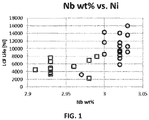
- FIG. 1 Shown in FIG. 1 is a comparison of low cycle fatigue of articles manufactured from different samples of IN706 alloys. The Y axis shows the number of cycles of applied stress before a crack appeared in the article. Lower numbers of cycles to cracking indicating articles with a shorter lifecycle. As can be seen there is variability between different samples, from approximately 3,000 to 16,000 cycles to crack formation.
- the X axis shows the weight concentration of Nb in each sample.
- Nb percent weight composition between samples from approximately 2.91% to approximately 3.03%.
- higher percent weight composition of Nb generally corresponds with higher resistance to cracking.
- higher concentrations of Nb in IN706 alloys also generally corresponded to increases cracking resistance (i.e., low cycle fatigue) in thicker samples.
- Resistance to cracking and improved low cycle fatigue generally is desirable because it allows for the creation of components that can withstand greater temperature and other physical stresses such as prolonged and high centrifugal forces for longer periods of time and more repeatedly, corresponding to longer component service life, as well as the construction of more efficient engines and their components at greater affordability and with improved service profiles.
- higher weight percentages of Si also corresponded to such effects.
- a Si weight percentage of between approximately 0.05%-0.1% corresponded to improved low cycle fatigue.
- Niobium naturally ties up with carbon and nickel to form carbides and gamma double prime in IN706.
- the gamma matrix becomes supersaturated with Nb which favors the formation of Laves phase.
- Nb also tends to segregate at grain boundaries, which decreases the recovery kinetics. Consequently, at high Nb concentrations, such as those that are shown here to lead to improved low cycle fatigue, fine spherical Laves phase formation is accelerated due to the higher energy stored during hot working.
- high Nb concentrations may promote formation of fine grain sizes as a result of promoting fine spherical Laves phase precipitates.
- Si also promotes fine spherical Laves phase precipitation. It reduces the solubility of Nb in gamma and thus the standard free energy of the fine spherical Laves phase precipitation. For these reasons, promotion of fine grain size may result from high levels of Nb and Si, with typical ranges of IN706 and related alloys, in accordance with the present disclosure. Carbon concentration may also be kept low, also promoting fine spherical Laves phase precipitation and fine rain size.
- Laves phase in IN706 is a hexagonal (Fe, Ni, Si) 2 (Nb, Ti) phase which may typically be precipitated after long time exposure at temperatures below 1010°C.
- a temperature between 700°C-1010°C For example, during forging an ingot may be exposed to a temperature between 700°C-1010°C.
- a temperature of between 800°C-1000°C, or between 850°C-950°C may also be employed.
- a temperature of between 871 °C - 927C° may be used. Since Laves phase remains stable at solution temperature (such as between approximately 950°C-1000°C), it can be used to reduce recrystallization (dynamic and static) grain size by reducing the migration of grain boundaries after deformation.
- fine spherical Laves phase As disclosed herein, if fine spherical Laves phase is forced to precipitate during hot working, with elemental constituents as disclosed herein, it may be produced in a uniform dispersion throughout the matrix, appearing metallographically as generally spheroidal particles 0.5 to 1 microns in size. If the alloy is then recrystallized with the uniform dispersion of fine spheroidal Laves phase present, the newly formed grain boundaries incorporate the Laves phase, effectively inhibiting grain growth. The result is a much finer, more uniform grain size than that achieved by conventional processing.
- Laves phase precipitation results from employing a slowed cooling rate after thermomechanical processing.
- slowing cooling such as by contacting a surface of or covering an ingot with an insulating material during and after forging, or simply after forging (such as para-aramid fiber blankets or other thermally protective coverings), submerging the ingot in a granular solid insulating material after forging, contacting the ingot with a heated substance after forging such as a heating element, or holding it in a heated environment such as a furnace or other heated environment for a desired duration at a controlled or otherwise elevated temperature, advantageously promotes Laves phase formation.
- thermomechanical processing e.g., forging, extruding, rolling, drawing, or other means of deformation under temperature conditions used in hot working of superalloys
- exposing an article to a temperature of between 700°C-1000°C, or slowing the cooling of the article such that is remains exposed to a temperature within such range for some prolonged duration of time after hot working advantageously promotes Laves phase formation.
- an article may be exposed to a temperature with such range for one hour or more, two hours or more, three hours or more, four hours or more, five hours or more, or six hours or more, seven hours or more, eight hours or more, nine hours or more, or ten hours or more, thereby advantageously promoting fine spherical Laves phase precipitation, in accordance with the present disclosure.
- a rate of cooling may be slowed to less than 6°C/minute. For example, it may be slowed to less than 1°C, less than 2°C, less than 3°C, less than 4°C, less than 5°C, or less than 6°C per minute.
- Slowing a cooling rate is one example disclosed herein of a method for promoting fine spherical Laves phase formation. Faster but still reduced cooling rates may also be employed, such as slower that 7°C, slower than 8°C, slower than 9°C, and slower than 10°C per minute. Maintaining an elevated temperature (meaning above ambient or room temperature within the ranges disclosed above) and/or slowing a cooling temperature to maintain an elevated temperature, according to the non-limiting examples disclosed herein represent different variations of embodiments presently described.
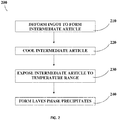
- Method 200 includes deforming an ingot to form an intermediate article 210, such as thermomechanical processing methods including forging, extruding, rolling, and drawing.
- the article may be a nickel-containing superalloy, including IN706, with Nb levels between 3%-3.5% weight Nb and 0.05%-0.1% weight Si.
- deforming 210 may include forging, including exposing an ingot to a temperature below approximately 1010°C, or extruding including exposing the ingot to a temperature above approximately 1010°C.
- method 200 may include, for example, cooling the intermediate article 220.
- Cooling 220 generally refers to any method for exposing the article to a temperature lower than a temperature at which it was deformed 210.
- cooling 220 can result from loss of heat from the article to the ambient environment which is at a lower temperature than a temperature at which deforming 210 occurred.
- Cooling 220 may include or be followed by exposing the intermediate article to temperature range 230.
- a temperature range during such exposure 230 may generally be within the ranges disclosed above for promoting formation of Laves phase 240.
- exposure to a temperature range 230 may occur without initially cooling the article 220.
- the article may initially be maintained, for some brief period of time, at a temperature to which it was exposed during deforming 210.
- cooling 220 may occur intermittently between alternating periods, or in alternation with a period, during which the article is maintained at a given temperature within a range without cooling during such period. Cooling 220 may occur at slowed rates such as the ranges of rates of cooling described above and exposure to a temperature 230 may occur within temperature ranges and duration of time described above.
- FIG. 3 is an SEM image showing fine spherical Laves phase randomly dispersed within an IN706 microstructure after forging and heat treatment.
- a TEM image shows that the size of Laves phase precipitates 300 is approximately 0.5-1 ⁇ m.
- FIG. 5A and FIG. 5B show differences in grain size in IN706 articles containing Nb levels in accordance with the present invention ( FIG. 5A , >3% weight Nb) and with lower Nb levels ( FIG. 5B , ⁇ 3% Nb weight).
- Higher Nb levels and Laves phase precipitation in this example lead to smaller grain size (53 ⁇ m diameter average) than lower Nb levels where Laves phase precipitates were not observed (125 ⁇ m average grain diameter). That is, in this example, Laves phase precipitation in accordance with the present invention was associated with a more than 55% decrease in grain size.
- FIG. 6A Comparing FIG. 6A to FIG. 6B reveals the effect of slowing cooling rate after deformation/thermomechanical processing may have on grain size in accordance with the present disclosure. Both show IN706 alloys with higher Nb levels and moderate-to-low Si levels (3.2wt% Nb, 0.08wt% Si and 0.005wt% C).
- FIG. 6A after thermomechanical processing the articles was cooled at a rate of 6°C/min. After solution treatment (982 °C/1hr.), average resulting grain size was 78 ⁇ m in diameter.
- the cooling rate is slowed down as shown to slower than 6°C/min as shown in FIG. 6B , grain growth during solution was reduced leading to an average grain diameter of 43 ⁇ m.
- fine spherical Laves phase may be produced in a uniform dispersion throughout the matrix, appearing metallographically as generally spheroidal particles 0.5 to 1 microns in size.
- Fine spherical Laves phase precipitates may also form homogeneously or substantially homogeneously throughout the article.
- fine spherical Laves phase precipitates may constitute at least about 0.05% by volume of any portion of an article tested, rather than low Laves phase and larger grain sizes in some portions of the article than other, increasing uniformity in characteristics of a component throughout its physical structure.
- fine spherical Laves phase precipitates may constitute at least about 0.075% by volume of any portion of an article tested, or 0.1% by volume of any portion of an article tested.
- a nickel -based superalloy including a substantially homogeneous dispersion of intergranular and transgranular Laves phase precipitates may be formed, wherein the intergranular and transgranular Laves phase precipitates may be present at a concentration of at least about 0.1 % by volume and wherein the precipitates have a mean diameter of less than one micron (including, as non-limiting examples, a mean diameter of 650 nm ⁇ 200 nm SEM or a mean diameter of 650 nm ⁇ 500 nm SEM).
- the nickel -based superalloy may have a composition comprising at least 20 weight percent iron, between 3 weight percent niobium and 3.5 weight percent niobium, below 0.2 weight percent silicon (including, as non-limiting examples, at least 0.01, 0.03, or 0.05 weight percent silicon up to 0.1 or 0.2 weight percent silicon), carbon wherein a weight percent carbon is less than 0.02 percent, between 40 weight percent nickel and 43 weight percent nickel, between 15.5 weight percent chromium and 16.5 weight percent chromium, and between 1.5 weight percent titanium and 1.8 weight percent titanium.
- the article may, for example, be a nickel -based superalloy with a composition of at least 53 weight percent Nickel, between 4.9 weight percent niobium and 5.2 weight percent niobium, between 0.01 weight percent silicon and 0.1 weight percent silicon, and carbon wherein a weight percent carbon is less than 0.2 percent.
- an article is a part for a gas turbine engine.
- an article may be a turbine blade.
Landscapes
- Chemical & Material Sciences (AREA)
- Engineering & Computer Science (AREA)
- Mechanical Engineering (AREA)
- Materials Engineering (AREA)
- Organic Chemistry (AREA)
- Metallurgy (AREA)
- Physics & Mathematics (AREA)
- Crystallography & Structural Chemistry (AREA)
- Thermal Sciences (AREA)
- General Engineering & Computer Science (AREA)
- Chemical Kinetics & Catalysis (AREA)
- General Chemical & Material Sciences (AREA)
- Forging (AREA)
- Turbine Rotor Nozzle Sealing (AREA)
Applications Claiming Priority (1)
| Application Number | Priority Date | Filing Date | Title |
|---|---|---|---|
| US15/252,783 US20180057920A1 (en) | 2016-08-31 | 2016-08-31 | Grain refinement in in706 using laves phase precipitation |
Publications (2)
| Publication Number | Publication Date |
|---|---|
| EP3290536A1 true EP3290536A1 (de) | 2018-03-07 |
| EP3290536B1 EP3290536B1 (de) | 2022-03-30 |
Family
ID=59772407
Family Applications (1)
| Application Number | Title | Priority Date | Filing Date |
|---|---|---|---|
| EP17188058.6A Active EP3290536B1 (de) | 2016-08-31 | 2017-08-28 | Kornverfeinerung in superlegierungen mit laves-phasenpräzipitation |
Country Status (5)
| Country | Link |
|---|---|
| US (1) | US20180057920A1 (de) |
| EP (1) | EP3290536B1 (de) |
| JP (1) | JP7134606B2 (de) |
| KR (1) | KR102325136B1 (de) |
| CN (1) | CN107794471B (de) |
Cited By (2)
| Publication number | Priority date | Publication date | Assignee | Title |
|---|---|---|---|---|
| EP4067526A4 (de) * | 2019-11-28 | 2022-12-21 | Hitachi Metals, Ltd. | Verfahren zur herstellung eines legierungsproduktes auf nickelbasis oder titanbasis |
| US12031190B2 (en) | 2019-11-28 | 2024-07-09 | Proterial, Ltd. | Method for producing nickel-based alloy product or titanium-based alloy product |
Families Citing this family (5)
| Publication number | Priority date | Publication date | Assignee | Title |
|---|---|---|---|---|
| RU2694098C1 (ru) * | 2018-08-15 | 2019-07-09 | Федеральное государственное унитарное предприятие "Всероссийский научно-исследовательский институт авиационных материалов" (ФГУП "ВИАМ") | Способ получения полуфабрикатов из высокопрочных никелевых сплавов |
| JP7112317B2 (ja) * | 2018-11-19 | 2022-08-03 | 三菱重工業株式会社 | オーステナイト鋼焼結材およびタービン部材 |
| CN113319468B (zh) * | 2021-06-16 | 2023-04-14 | 哈尔滨焊接研究院有限公司 | 一种防止焊接裂纹的核电用镍基合金焊丝的成分设计方法、核电用镍基合金焊丝 |
| CN114892042B (zh) * | 2022-04-20 | 2022-12-13 | 嘉兴鸷锐新材料科技有限公司 | 一种耐高温铁镍合金及其制备方法和应用 |
| CN118389869A (zh) * | 2024-05-07 | 2024-07-26 | 东北大学 | 一种基于薄带连铸的高性能Inconel 718合金板带材制备方法 |
Citations (6)
| Publication number | Priority date | Publication date | Assignee | Title |
|---|---|---|---|---|
| US3663213A (en) | 1970-05-11 | 1972-05-16 | Int Nickel Co | Nickel-chromium-iron alloy |
| EP1197570A2 (de) * | 2000-10-13 | 2002-04-17 | General Electric Company | Legierung auf Nickel-Basis und deren Verwendung bei Schmiede- oder Schweissvorgängen |
| EP1591548A1 (de) * | 2004-04-27 | 2005-11-02 | Daido Steel Co., Ltd. | Verfahren zur Herstellung einer wärmedehnungsarmen Superlegierung auf Ni-basis |
| USH2245H1 (en) * | 2007-03-12 | 2010-08-03 | Crs Holdings, Inc. | Age-hardenable, nickel-base superalloy with improved notch ductility |
| US20100329883A1 (en) * | 2009-06-30 | 2010-12-30 | General Electric Company | Method of controlling and refining final grain size in supersolvus heat treated nickel-base superalloys |
| JP2014070276A (ja) * | 2012-10-02 | 2014-04-21 | Hitachi Ltd | ニッケル基合金からなる大型鋳造部材およびその製造方法 |
Family Cites Families (10)
| Publication number | Priority date | Publication date | Assignee | Title |
|---|---|---|---|---|
| ZA824218B (en) * | 1981-06-29 | 1983-04-27 | Cetus Corp | Plasmid for producing human insulin |
| DE69326374T2 (de) * | 1992-04-13 | 2000-04-06 | Matsushita Electric Industrial Co., Ltd. | Wasserstoffspeicherlegierung Elektrode |
| DE19542919A1 (de) * | 1995-11-17 | 1997-05-22 | Asea Brown Boveri | Verfahren zur Herstellung eines hochtemperaturbeständigen Werkstoffkörpers aus einer Eisen-Nickel-Superlegierung vom Typ IN 706 |
| JP2004277829A (ja) * | 2003-03-17 | 2004-10-07 | Toyota Central Res & Dev Lab Inc | 水素吸蔵合金 |
| US7985304B2 (en) * | 2007-04-19 | 2011-07-26 | Ati Properties, Inc. | Nickel-base alloys and articles made therefrom |
| CN103276251B (zh) * | 2013-05-29 | 2015-04-29 | 钢铁研究总院 | 一种700℃蒸汽参数火电机组用锅炉管及其制备方法 |
| CN103993202B (zh) * | 2014-05-20 | 2016-03-30 | 太原钢铁(集团)有限公司 | 一种超超临界电站锅炉管材用镍基合金及制备方法 |
| CN104152827B (zh) * | 2014-08-06 | 2016-03-23 | 华能国际电力股份有限公司 | 一种冷轧态镍铁基高温合金晶界强化的热处理工艺 |
| CN105543747B (zh) * | 2015-12-21 | 2017-11-21 | 西北工业大学 | 一种保留有Laves相的增材制造镍基高温合金的制备方法 |
| CN105506390B (zh) * | 2015-12-30 | 2017-06-23 | 钢铁研究总院 | 一种含锆镍基高温合金及制备方法 |
-
2016
- 2016-08-31 US US15/252,783 patent/US20180057920A1/en not_active Abandoned
-
2017
- 2017-08-17 JP JP2017157295A patent/JP7134606B2/ja active Active
- 2017-08-23 KR KR1020170106789A patent/KR102325136B1/ko active Active
- 2017-08-28 EP EP17188058.6A patent/EP3290536B1/de active Active
- 2017-08-31 CN CN201710769624.3A patent/CN107794471B/zh active Active
Patent Citations (6)
| Publication number | Priority date | Publication date | Assignee | Title |
|---|---|---|---|---|
| US3663213A (en) | 1970-05-11 | 1972-05-16 | Int Nickel Co | Nickel-chromium-iron alloy |
| EP1197570A2 (de) * | 2000-10-13 | 2002-04-17 | General Electric Company | Legierung auf Nickel-Basis und deren Verwendung bei Schmiede- oder Schweissvorgängen |
| EP1591548A1 (de) * | 2004-04-27 | 2005-11-02 | Daido Steel Co., Ltd. | Verfahren zur Herstellung einer wärmedehnungsarmen Superlegierung auf Ni-basis |
| USH2245H1 (en) * | 2007-03-12 | 2010-08-03 | Crs Holdings, Inc. | Age-hardenable, nickel-base superalloy with improved notch ductility |
| US20100329883A1 (en) * | 2009-06-30 | 2010-12-30 | General Electric Company | Method of controlling and refining final grain size in supersolvus heat treated nickel-base superalloys |
| JP2014070276A (ja) * | 2012-10-02 | 2014-04-21 | Hitachi Ltd | ニッケル基合金からなる大型鋳造部材およびその製造方法 |
Non-Patent Citations (2)
| Title |
|---|
| SCHILKE; SCHWANT: "Alloy 706 Metallurgy and Turbine Wheel Application, in Superalloys 718, 625, 706 and Various Derivatives", 1994, THE MINERALS, METALS & MATERIALS SOCIETY, pages: 1 - 12 |
| THAMBOO: "Melt Related Defects In Alloy 706 And Their Effects on Mechanical Properties, in Superalloys 718, 625, 706 and Various Derivatives", 1994, THE MINERALS, METALS & MATERIALS SOCIETY, pages: 137 - 152 |
Cited By (3)
| Publication number | Priority date | Publication date | Assignee | Title |
|---|---|---|---|---|
| EP4067526A4 (de) * | 2019-11-28 | 2022-12-21 | Hitachi Metals, Ltd. | Verfahren zur herstellung eines legierungsproduktes auf nickelbasis oder titanbasis |
| US12031190B2 (en) | 2019-11-28 | 2024-07-09 | Proterial, Ltd. | Method for producing nickel-based alloy product or titanium-based alloy product |
| US12297525B2 (en) | 2019-11-28 | 2025-05-13 | Proterial, Ltd. | Manufacturing method for nickel-based alloy product or titanium-based alloy product |
Also Published As
| Publication number | Publication date |
|---|---|
| EP3290536B1 (de) | 2022-03-30 |
| JP2018059184A (ja) | 2018-04-12 |
| CN107794471B (zh) | 2021-11-30 |
| JP7134606B2 (ja) | 2022-09-12 |
| KR102325136B1 (ko) | 2021-11-15 |
| US20180057920A1 (en) | 2018-03-01 |
| CN107794471A (zh) | 2018-03-13 |
| KR20180025206A (ko) | 2018-03-08 |
Similar Documents
| Publication | Publication Date | Title |
|---|---|---|
| EP3290536B1 (de) | Kornverfeinerung in superlegierungen mit laves-phasenpräzipitation | |
| JP6826235B2 (ja) | Ni基合金軟化粉末および該軟化粉末の製造方法 | |
| EP2591135B1 (de) | Legierung auf nickel basis, verfahren und daraus resultierende produkte | |
| CA2957786C (en) | Enhanced superalloys by zirconium addition | |
| CN111051548B (zh) | 可沉淀硬化的钴-镍基高温合金和由其制造的制品 | |
| JP4498282B2 (ja) | 超合金組成物、物品及び製造方法 | |
| CN102816965B (zh) | 钴-镍基合金和由此制造物品的方法 | |
| EP1842934A1 (de) | Wärmebeständige superlegierung | |
| EP3263722A1 (de) | Verfahren zur herstellung von superlegierungsartikeln und zugehörige artikel | |
| JP6315319B2 (ja) | Fe−Ni基超耐熱合金の製造方法 | |
| WO2013089218A1 (ja) | ニッケル基耐熱超合金 | |
| JPWO2011062231A1 (ja) | 耐熱超合金 | |
| CN106661674A (zh) | Ni基超耐热合金 | |
| JP2018059184A5 (de) | ||
| CN107557614A (zh) | 制备超合金制品和相关制品的方法 | |
| Shajari et al. | Effect of solution temperature of rejuvenation heat treatment on the stability of γ′ precipitates in Ni-base superalloy IN738LC during long-term heating | |
| US8696980B2 (en) | Nickel-base superalloy with improved degradation behavior | |
| EP2837703B1 (de) | Nb-enthaltende Komposit-Superlegierungen | |
| JP2012107269A (ja) | ニッケル基耐熱超合金と耐熱超合金部材 |
Legal Events
| Date | Code | Title | Description |
|---|---|---|---|
| PUAI | Public reference made under article 153(3) epc to a published international application that has entered the european phase |
Free format text: ORIGINAL CODE: 0009012 |
|
| STAA | Information on the status of an ep patent application or granted ep patent |
Free format text: STATUS: THE APPLICATION HAS BEEN PUBLISHED |
|
| AK | Designated contracting states |
Kind code of ref document: A1 Designated state(s): AL AT BE BG CH CY CZ DE DK EE ES FI FR GB GR HR HU IE IS IT LI LT LU LV MC MK MT NL NO PL PT RO RS SE SI SK SM TR |
|
| AX | Request for extension of the european patent |
Extension state: BA ME |
|
| STAA | Information on the status of an ep patent application or granted ep patent |
Free format text: STATUS: REQUEST FOR EXAMINATION WAS MADE |
|
| 17P | Request for examination filed |
Effective date: 20180907 |
|
| RBV | Designated contracting states (corrected) |
Designated state(s): AL AT BE BG CH CY CZ DE DK EE ES FI FR GB GR HR HU IE IS IT LI LT LU LV MC MK MT NL NO PL PT RO RS SE SI SK SM TR |
|
| STAA | Information on the status of an ep patent application or granted ep patent |
Free format text: STATUS: EXAMINATION IS IN PROGRESS |
|
| 17Q | First examination report despatched |
Effective date: 20190717 |
|
| GRAP | Despatch of communication of intention to grant a patent |
Free format text: ORIGINAL CODE: EPIDOSNIGR1 |
|
| STAA | Information on the status of an ep patent application or granted ep patent |
Free format text: STATUS: GRANT OF PATENT IS INTENDED |
|
| INTG | Intention to grant announced |
Effective date: 20211111 |
|
| GRAS | Grant fee paid |
Free format text: ORIGINAL CODE: EPIDOSNIGR3 |
|
| GRAA | (expected) grant |
Free format text: ORIGINAL CODE: 0009210 |
|
| STAA | Information on the status of an ep patent application or granted ep patent |
Free format text: STATUS: THE PATENT HAS BEEN GRANTED |
|
| AK | Designated contracting states |
Kind code of ref document: B1 Designated state(s): AL AT BE BG CH CY CZ DE DK EE ES FI FR GB GR HR HU IE IS IT LI LT LU LV MC MK MT NL NO PL PT RO RS SE SI SK SM TR |
|
| REG | Reference to a national code |
Ref country code: GB Ref legal event code: FG4D |
|
| REG | Reference to a national code |
Ref country code: CH Ref legal event code: EP |
|
| REG | Reference to a national code |
Ref country code: DE Ref legal event code: R096 Ref document number: 602017055133 Country of ref document: DE |
|
| REG | Reference to a national code |
Ref country code: AT Ref legal event code: REF Ref document number: 1479244 Country of ref document: AT Kind code of ref document: T Effective date: 20220415 |
|
| REG | Reference to a national code |
Ref country code: IE Ref legal event code: FG4D |
|
| REG | Reference to a national code |
Ref country code: LT Ref legal event code: MG9D |
|
| PG25 | Lapsed in a contracting state [announced via postgrant information from national office to epo] |
Ref country code: SE Free format text: LAPSE BECAUSE OF FAILURE TO SUBMIT A TRANSLATION OF THE DESCRIPTION OR TO PAY THE FEE WITHIN THE PRESCRIBED TIME-LIMIT Effective date: 20220330 Ref country code: RS Free format text: LAPSE BECAUSE OF FAILURE TO SUBMIT A TRANSLATION OF THE DESCRIPTION OR TO PAY THE FEE WITHIN THE PRESCRIBED TIME-LIMIT Effective date: 20220330 Ref country code: NO Free format text: LAPSE BECAUSE OF FAILURE TO SUBMIT A TRANSLATION OF THE DESCRIPTION OR TO PAY THE FEE WITHIN THE PRESCRIBED TIME-LIMIT Effective date: 20220630 Ref country code: LT Free format text: LAPSE BECAUSE OF FAILURE TO SUBMIT A TRANSLATION OF THE DESCRIPTION OR TO PAY THE FEE WITHIN THE PRESCRIBED TIME-LIMIT Effective date: 20220330 Ref country code: HR Free format text: LAPSE BECAUSE OF FAILURE TO SUBMIT A TRANSLATION OF THE DESCRIPTION OR TO PAY THE FEE WITHIN THE PRESCRIBED TIME-LIMIT Effective date: 20220330 Ref country code: BG Free format text: LAPSE BECAUSE OF FAILURE TO SUBMIT A TRANSLATION OF THE DESCRIPTION OR TO PAY THE FEE WITHIN THE PRESCRIBED TIME-LIMIT Effective date: 20220630 |
|
| REG | Reference to a national code |
Ref country code: NL Ref legal event code: MP Effective date: 20220330 |
|
| REG | Reference to a national code |
Ref country code: AT Ref legal event code: MK05 Ref document number: 1479244 Country of ref document: AT Kind code of ref document: T Effective date: 20220330 |
|
| PG25 | Lapsed in a contracting state [announced via postgrant information from national office to epo] |
Ref country code: LV Free format text: LAPSE BECAUSE OF FAILURE TO SUBMIT A TRANSLATION OF THE DESCRIPTION OR TO PAY THE FEE WITHIN THE PRESCRIBED TIME-LIMIT Effective date: 20220330 Ref country code: GR Free format text: LAPSE BECAUSE OF FAILURE TO SUBMIT A TRANSLATION OF THE DESCRIPTION OR TO PAY THE FEE WITHIN THE PRESCRIBED TIME-LIMIT Effective date: 20220701 Ref country code: FI Free format text: LAPSE BECAUSE OF FAILURE TO SUBMIT A TRANSLATION OF THE DESCRIPTION OR TO PAY THE FEE WITHIN THE PRESCRIBED TIME-LIMIT Effective date: 20220330 |
|
| PG25 | Lapsed in a contracting state [announced via postgrant information from national office to epo] |
Ref country code: NL Free format text: LAPSE BECAUSE OF FAILURE TO SUBMIT A TRANSLATION OF THE DESCRIPTION OR TO PAY THE FEE WITHIN THE PRESCRIBED TIME-LIMIT Effective date: 20220330 |
|
| PG25 | Lapsed in a contracting state [announced via postgrant information from national office to epo] |
Ref country code: SM Free format text: LAPSE BECAUSE OF FAILURE TO SUBMIT A TRANSLATION OF THE DESCRIPTION OR TO PAY THE FEE WITHIN THE PRESCRIBED TIME-LIMIT Effective date: 20220330 Ref country code: SK Free format text: LAPSE BECAUSE OF FAILURE TO SUBMIT A TRANSLATION OF THE DESCRIPTION OR TO PAY THE FEE WITHIN THE PRESCRIBED TIME-LIMIT Effective date: 20220330 Ref country code: RO Free format text: LAPSE BECAUSE OF FAILURE TO SUBMIT A TRANSLATION OF THE DESCRIPTION OR TO PAY THE FEE WITHIN THE PRESCRIBED TIME-LIMIT Effective date: 20220330 Ref country code: PT Free format text: LAPSE BECAUSE OF FAILURE TO SUBMIT A TRANSLATION OF THE DESCRIPTION OR TO PAY THE FEE WITHIN THE PRESCRIBED TIME-LIMIT Effective date: 20220801 Ref country code: ES Free format text: LAPSE BECAUSE OF FAILURE TO SUBMIT A TRANSLATION OF THE DESCRIPTION OR TO PAY THE FEE WITHIN THE PRESCRIBED TIME-LIMIT Effective date: 20220330 Ref country code: EE Free format text: LAPSE BECAUSE OF FAILURE TO SUBMIT A TRANSLATION OF THE DESCRIPTION OR TO PAY THE FEE WITHIN THE PRESCRIBED TIME-LIMIT Effective date: 20220330 Ref country code: CZ Free format text: LAPSE BECAUSE OF FAILURE TO SUBMIT A TRANSLATION OF THE DESCRIPTION OR TO PAY THE FEE WITHIN THE PRESCRIBED TIME-LIMIT Effective date: 20220330 Ref country code: AT Free format text: LAPSE BECAUSE OF FAILURE TO SUBMIT A TRANSLATION OF THE DESCRIPTION OR TO PAY THE FEE WITHIN THE PRESCRIBED TIME-LIMIT Effective date: 20220330 |
|
| PG25 | Lapsed in a contracting state [announced via postgrant information from national office to epo] |
Ref country code: PL Free format text: LAPSE BECAUSE OF FAILURE TO SUBMIT A TRANSLATION OF THE DESCRIPTION OR TO PAY THE FEE WITHIN THE PRESCRIBED TIME-LIMIT Effective date: 20220330 Ref country code: IS Free format text: LAPSE BECAUSE OF FAILURE TO SUBMIT A TRANSLATION OF THE DESCRIPTION OR TO PAY THE FEE WITHIN THE PRESCRIBED TIME-LIMIT Effective date: 20220730 Ref country code: AL Free format text: LAPSE BECAUSE OF FAILURE TO SUBMIT A TRANSLATION OF THE DESCRIPTION OR TO PAY THE FEE WITHIN THE PRESCRIBED TIME-LIMIT Effective date: 20220330 |
|
| REG | Reference to a national code |
Ref country code: DE Ref legal event code: R097 Ref document number: 602017055133 Country of ref document: DE |
|
| PG25 | Lapsed in a contracting state [announced via postgrant information from national office to epo] |
Ref country code: DK Free format text: LAPSE BECAUSE OF FAILURE TO SUBMIT A TRANSLATION OF THE DESCRIPTION OR TO PAY THE FEE WITHIN THE PRESCRIBED TIME-LIMIT Effective date: 20220330 |
|
| PLBE | No opposition filed within time limit |
Free format text: ORIGINAL CODE: 0009261 |
|
| STAA | Information on the status of an ep patent application or granted ep patent |
Free format text: STATUS: NO OPPOSITION FILED WITHIN TIME LIMIT |
|
| REG | Reference to a national code |
Ref country code: DE Ref legal event code: R119 Ref document number: 602017055133 Country of ref document: DE |
|
| 26N | No opposition filed |
Effective date: 20230103 |
|
| PG25 | Lapsed in a contracting state [announced via postgrant information from national office to epo] |
Ref country code: MC Free format text: LAPSE BECAUSE OF FAILURE TO SUBMIT A TRANSLATION OF THE DESCRIPTION OR TO PAY THE FEE WITHIN THE PRESCRIBED TIME-LIMIT Effective date: 20220330 |
|
| REG | Reference to a national code |
Ref country code: CH Ref legal event code: PL |
|
| GBPC | Gb: european patent ceased through non-payment of renewal fee |
Effective date: 20220828 |
|
| PG25 | Lapsed in a contracting state [announced via postgrant information from national office to epo] |
Ref country code: LU Free format text: LAPSE BECAUSE OF NON-PAYMENT OF DUE FEES Effective date: 20220828 Ref country code: LI Free format text: LAPSE BECAUSE OF NON-PAYMENT OF DUE FEES Effective date: 20220831 Ref country code: CH Free format text: LAPSE BECAUSE OF NON-PAYMENT OF DUE FEES Effective date: 20220831 |
|
| REG | Reference to a national code |
Ref country code: BE Ref legal event code: MM Effective date: 20220831 |
|
| PG25 | Lapsed in a contracting state [announced via postgrant information from national office to epo] |
Ref country code: SI Free format text: LAPSE BECAUSE OF FAILURE TO SUBMIT A TRANSLATION OF THE DESCRIPTION OR TO PAY THE FEE WITHIN THE PRESCRIBED TIME-LIMIT Effective date: 20220330 |
|
| PG25 | Lapsed in a contracting state [announced via postgrant information from national office to epo] |
Ref country code: IE Free format text: LAPSE BECAUSE OF NON-PAYMENT OF DUE FEES Effective date: 20220828 Ref country code: DE Free format text: LAPSE BECAUSE OF NON-PAYMENT OF DUE FEES Effective date: 20230301 |
|
| PG25 | Lapsed in a contracting state [announced via postgrant information from national office to epo] |
Ref country code: BE Free format text: LAPSE BECAUSE OF NON-PAYMENT OF DUE FEES Effective date: 20220831 |
|
| PG25 | Lapsed in a contracting state [announced via postgrant information from national office to epo] |
Ref country code: GB Free format text: LAPSE BECAUSE OF NON-PAYMENT OF DUE FEES Effective date: 20220828 |
|
| PG25 | Lapsed in a contracting state [announced via postgrant information from national office to epo] |
Ref country code: HU Free format text: LAPSE BECAUSE OF FAILURE TO SUBMIT A TRANSLATION OF THE DESCRIPTION OR TO PAY THE FEE WITHIN THE PRESCRIBED TIME-LIMIT; INVALID AB INITIO Effective date: 20170828 |
|
| PG25 | Lapsed in a contracting state [announced via postgrant information from national office to epo] |
Ref country code: CY Free format text: LAPSE BECAUSE OF FAILURE TO SUBMIT A TRANSLATION OF THE DESCRIPTION OR TO PAY THE FEE WITHIN THE PRESCRIBED TIME-LIMIT Effective date: 20220330 |
|
| PG25 | Lapsed in a contracting state [announced via postgrant information from national office to epo] |
Ref country code: MK Free format text: LAPSE BECAUSE OF FAILURE TO SUBMIT A TRANSLATION OF THE DESCRIPTION OR TO PAY THE FEE WITHIN THE PRESCRIBED TIME-LIMIT Effective date: 20220330 |
|
| PG25 | Lapsed in a contracting state [announced via postgrant information from national office to epo] |
Ref country code: MT Free format text: LAPSE BECAUSE OF FAILURE TO SUBMIT A TRANSLATION OF THE DESCRIPTION OR TO PAY THE FEE WITHIN THE PRESCRIBED TIME-LIMIT Effective date: 20220330 |
|
| PGFP | Annual fee paid to national office [announced via postgrant information from national office to epo] |
Ref country code: IT Payment date: 20250723 Year of fee payment: 9 |
|
| PGFP | Annual fee paid to national office [announced via postgrant information from national office to epo] |
Ref country code: FR Payment date: 20250725 Year of fee payment: 9 |
|
| PG25 | Lapsed in a contracting state [announced via postgrant information from national office to epo] |
Ref country code: TR Free format text: LAPSE BECAUSE OF FAILURE TO SUBMIT A TRANSLATION OF THE DESCRIPTION OR TO PAY THE FEE WITHIN THE PRESCRIBED TIME-LIMIT Effective date: 20220330 |