EP3286349B1 - Acier, produit réalisé en cet acier, et son procédé de fabrication - Google Patents
Acier, produit réalisé en cet acier, et son procédé de fabrication Download PDFInfo
- Publication number
- EP3286349B1 EP3286349B1 EP16720569.9A EP16720569A EP3286349B1 EP 3286349 B1 EP3286349 B1 EP 3286349B1 EP 16720569 A EP16720569 A EP 16720569A EP 3286349 B1 EP3286349 B1 EP 3286349B1
- Authority
- EP
- European Patent Office
- Prior art keywords
- traces
- steel
- cold
- hot
- inv
- Prior art date
- Legal status (The legal status is an assumption and is not a legal conclusion. Google has not performed a legal analysis and makes no representation as to the accuracy of the status listed.)
- Active
Links
Images

Classifications
-
- C—CHEMISTRY; METALLURGY
- C21—METALLURGY OF IRON
- C21D—MODIFYING THE PHYSICAL STRUCTURE OF FERROUS METALS; GENERAL DEVICES FOR HEAT TREATMENT OF FERROUS OR NON-FERROUS METALS OR ALLOYS; MAKING METAL MALLEABLE, e.g. BY DECARBURISATION OR TEMPERING
- C21D9/00—Heat treatment, e.g. annealing, hardening, quenching or tempering, adapted for particular articles; Furnaces therefor
- C21D9/0068—Heat treatment, e.g. annealing, hardening, quenching or tempering, adapted for particular articles; Furnaces therefor for particular articles not mentioned below
-
- C—CHEMISTRY; METALLURGY
- C21—METALLURGY OF IRON
- C21D—MODIFYING THE PHYSICAL STRUCTURE OF FERROUS METALS; GENERAL DEVICES FOR HEAT TREATMENT OF FERROUS OR NON-FERROUS METALS OR ALLOYS; MAKING METAL MALLEABLE, e.g. BY DECARBURISATION OR TEMPERING
- C21D7/00—Modifying the physical properties of iron or steel by deformation
- C21D7/02—Modifying the physical properties of iron or steel by deformation by cold working
- C21D7/04—Modifying the physical properties of iron or steel by deformation by cold working of the surface
- C21D7/06—Modifying the physical properties of iron or steel by deformation by cold working of the surface by shot-peening or the like
-
- C—CHEMISTRY; METALLURGY
- C21—METALLURGY OF IRON
- C21D—MODIFYING THE PHYSICAL STRUCTURE OF FERROUS METALS; GENERAL DEVICES FOR HEAT TREATMENT OF FERROUS OR NON-FERROUS METALS OR ALLOYS; MAKING METAL MALLEABLE, e.g. BY DECARBURISATION OR TEMPERING
- C21D6/00—Heat treatment of ferrous alloys
- C21D6/001—Heat treatment of ferrous alloys containing Ni
-
- C—CHEMISTRY; METALLURGY
- C21—METALLURGY OF IRON
- C21D—MODIFYING THE PHYSICAL STRUCTURE OF FERROUS METALS; GENERAL DEVICES FOR HEAT TREATMENT OF FERROUS OR NON-FERROUS METALS OR ALLOYS; MAKING METAL MALLEABLE, e.g. BY DECARBURISATION OR TEMPERING
- C21D6/00—Heat treatment of ferrous alloys
- C21D6/004—Heat treatment of ferrous alloys containing Cr and Ni
-
- C—CHEMISTRY; METALLURGY
- C21—METALLURGY OF IRON
- C21D—MODIFYING THE PHYSICAL STRUCTURE OF FERROUS METALS; GENERAL DEVICES FOR HEAT TREATMENT OF FERROUS OR NON-FERROUS METALS OR ALLOYS; MAKING METAL MALLEABLE, e.g. BY DECARBURISATION OR TEMPERING
- C21D6/00—Heat treatment of ferrous alloys
- C21D6/005—Heat treatment of ferrous alloys containing Mn
-
- C—CHEMISTRY; METALLURGY
- C21—METALLURGY OF IRON
- C21D—MODIFYING THE PHYSICAL STRUCTURE OF FERROUS METALS; GENERAL DEVICES FOR HEAT TREATMENT OF FERROUS OR NON-FERROUS METALS OR ALLOYS; MAKING METAL MALLEABLE, e.g. BY DECARBURISATION OR TEMPERING
- C21D6/00—Heat treatment of ferrous alloys
- C21D6/007—Heat treatment of ferrous alloys containing Co
-
- C—CHEMISTRY; METALLURGY
- C21—METALLURGY OF IRON
- C21D—MODIFYING THE PHYSICAL STRUCTURE OF FERROUS METALS; GENERAL DEVICES FOR HEAT TREATMENT OF FERROUS OR NON-FERROUS METALS OR ALLOYS; MAKING METAL MALLEABLE, e.g. BY DECARBURISATION OR TEMPERING
- C21D6/00—Heat treatment of ferrous alloys
- C21D6/008—Heat treatment of ferrous alloys containing Si
-
- C—CHEMISTRY; METALLURGY
- C21—METALLURGY OF IRON
- C21D—MODIFYING THE PHYSICAL STRUCTURE OF FERROUS METALS; GENERAL DEVICES FOR HEAT TREATMENT OF FERROUS OR NON-FERROUS METALS OR ALLOYS; MAKING METAL MALLEABLE, e.g. BY DECARBURISATION OR TEMPERING
- C21D6/00—Heat treatment of ferrous alloys
- C21D6/02—Hardening by precipitation
-
- C—CHEMISTRY; METALLURGY
- C21—METALLURGY OF IRON
- C21D—MODIFYING THE PHYSICAL STRUCTURE OF FERROUS METALS; GENERAL DEVICES FOR HEAT TREATMENT OF FERROUS OR NON-FERROUS METALS OR ALLOYS; MAKING METAL MALLEABLE, e.g. BY DECARBURISATION OR TEMPERING
- C21D8/00—Modifying the physical properties of ferrous metals or ferrous alloys by deformation combined with, or followed by, heat treatment
-
- C—CHEMISTRY; METALLURGY
- C21—METALLURGY OF IRON
- C21D—MODIFYING THE PHYSICAL STRUCTURE OF FERROUS METALS; GENERAL DEVICES FOR HEAT TREATMENT OF FERROUS OR NON-FERROUS METALS OR ALLOYS; MAKING METAL MALLEABLE, e.g. BY DECARBURISATION OR TEMPERING
- C21D8/00—Modifying the physical properties of ferrous metals or ferrous alloys by deformation combined with, or followed by, heat treatment
- C21D8/02—Modifying the physical properties of ferrous metals or ferrous alloys by deformation combined with, or followed by, heat treatment during manufacturing of plates or strips
-
- C—CHEMISTRY; METALLURGY
- C21—METALLURGY OF IRON
- C21D—MODIFYING THE PHYSICAL STRUCTURE OF FERROUS METALS; GENERAL DEVICES FOR HEAT TREATMENT OF FERROUS OR NON-FERROUS METALS OR ALLOYS; MAKING METAL MALLEABLE, e.g. BY DECARBURISATION OR TEMPERING
- C21D8/00—Modifying the physical properties of ferrous metals or ferrous alloys by deformation combined with, or followed by, heat treatment
- C21D8/02—Modifying the physical properties of ferrous metals or ferrous alloys by deformation combined with, or followed by, heat treatment during manufacturing of plates or strips
- C21D8/021—Modifying the physical properties of ferrous metals or ferrous alloys by deformation combined with, or followed by, heat treatment during manufacturing of plates or strips involving particular fabrication steps or treatments of ingots or slabs
-
- C—CHEMISTRY; METALLURGY
- C21—METALLURGY OF IRON
- C21D—MODIFYING THE PHYSICAL STRUCTURE OF FERROUS METALS; GENERAL DEVICES FOR HEAT TREATMENT OF FERROUS OR NON-FERROUS METALS OR ALLOYS; MAKING METAL MALLEABLE, e.g. BY DECARBURISATION OR TEMPERING
- C21D8/00—Modifying the physical properties of ferrous metals or ferrous alloys by deformation combined with, or followed by, heat treatment
- C21D8/02—Modifying the physical properties of ferrous metals or ferrous alloys by deformation combined with, or followed by, heat treatment during manufacturing of plates or strips
- C21D8/0221—Modifying the physical properties of ferrous metals or ferrous alloys by deformation combined with, or followed by, heat treatment during manufacturing of plates or strips characterised by the working steps
- C21D8/0226—Hot rolling
-
- C—CHEMISTRY; METALLURGY
- C21—METALLURGY OF IRON
- C21D—MODIFYING THE PHYSICAL STRUCTURE OF FERROUS METALS; GENERAL DEVICES FOR HEAT TREATMENT OF FERROUS OR NON-FERROUS METALS OR ALLOYS; MAKING METAL MALLEABLE, e.g. BY DECARBURISATION OR TEMPERING
- C21D8/00—Modifying the physical properties of ferrous metals or ferrous alloys by deformation combined with, or followed by, heat treatment
- C21D8/02—Modifying the physical properties of ferrous metals or ferrous alloys by deformation combined with, or followed by, heat treatment during manufacturing of plates or strips
- C21D8/0221—Modifying the physical properties of ferrous metals or ferrous alloys by deformation combined with, or followed by, heat treatment during manufacturing of plates or strips characterised by the working steps
- C21D8/0236—Cold rolling
-
- C—CHEMISTRY; METALLURGY
- C21—METALLURGY OF IRON
- C21D—MODIFYING THE PHYSICAL STRUCTURE OF FERROUS METALS; GENERAL DEVICES FOR HEAT TREATMENT OF FERROUS OR NON-FERROUS METALS OR ALLOYS; MAKING METAL MALLEABLE, e.g. BY DECARBURISATION OR TEMPERING
- C21D8/00—Modifying the physical properties of ferrous metals or ferrous alloys by deformation combined with, or followed by, heat treatment
- C21D8/02—Modifying the physical properties of ferrous metals or ferrous alloys by deformation combined with, or followed by, heat treatment during manufacturing of plates or strips
- C21D8/0247—Modifying the physical properties of ferrous metals or ferrous alloys by deformation combined with, or followed by, heat treatment during manufacturing of plates or strips characterised by the heat treatment
-
- C—CHEMISTRY; METALLURGY
- C21—METALLURGY OF IRON
- C21D—MODIFYING THE PHYSICAL STRUCTURE OF FERROUS METALS; GENERAL DEVICES FOR HEAT TREATMENT OF FERROUS OR NON-FERROUS METALS OR ALLOYS; MAKING METAL MALLEABLE, e.g. BY DECARBURISATION OR TEMPERING
- C21D8/00—Modifying the physical properties of ferrous metals or ferrous alloys by deformation combined with, or followed by, heat treatment
- C21D8/02—Modifying the physical properties of ferrous metals or ferrous alloys by deformation combined with, or followed by, heat treatment during manufacturing of plates or strips
- C21D8/0278—Modifying the physical properties of ferrous metals or ferrous alloys by deformation combined with, or followed by, heat treatment during manufacturing of plates or strips involving a particular surface treatment
-
- C—CHEMISTRY; METALLURGY
- C21—METALLURGY OF IRON
- C21D—MODIFYING THE PHYSICAL STRUCTURE OF FERROUS METALS; GENERAL DEVICES FOR HEAT TREATMENT OF FERROUS OR NON-FERROUS METALS OR ALLOYS; MAKING METAL MALLEABLE, e.g. BY DECARBURISATION OR TEMPERING
- C21D9/00—Heat treatment, e.g. annealing, hardening, quenching or tempering, adapted for particular articles; Furnaces therefor
-
- C—CHEMISTRY; METALLURGY
- C21—METALLURGY OF IRON
- C21D—MODIFYING THE PHYSICAL STRUCTURE OF FERROUS METALS; GENERAL DEVICES FOR HEAT TREATMENT OF FERROUS OR NON-FERROUS METALS OR ALLOYS; MAKING METAL MALLEABLE, e.g. BY DECARBURISATION OR TEMPERING
- C21D9/00—Heat treatment, e.g. annealing, hardening, quenching or tempering, adapted for particular articles; Furnaces therefor
- C21D9/30—Heat treatment, e.g. annealing, hardening, quenching or tempering, adapted for particular articles; Furnaces therefor for crankshafts; for camshafts
-
- C—CHEMISTRY; METALLURGY
- C21—METALLURGY OF IRON
- C21D—MODIFYING THE PHYSICAL STRUCTURE OF FERROUS METALS; GENERAL DEVICES FOR HEAT TREATMENT OF FERROUS OR NON-FERROUS METALS OR ALLOYS; MAKING METAL MALLEABLE, e.g. BY DECARBURISATION OR TEMPERING
- C21D9/00—Heat treatment, e.g. annealing, hardening, quenching or tempering, adapted for particular articles; Furnaces therefor
- C21D9/46—Heat treatment, e.g. annealing, hardening, quenching or tempering, adapted for particular articles; Furnaces therefor for sheet metals
-
- C—CHEMISTRY; METALLURGY
- C22—METALLURGY; FERROUS OR NON-FERROUS ALLOYS; TREATMENT OF ALLOYS OR NON-FERROUS METALS
- C22B—PRODUCTION AND REFINING OF METALS; PRETREATMENT OF RAW MATERIALS
- C22B9/00—General processes of refining or remelting of metals; Apparatus for electroslag or arc remelting of metals
- C22B9/16—Remelting metals
- C22B9/18—Electroslag remelting
-
- C—CHEMISTRY; METALLURGY
- C22—METALLURGY; FERROUS OR NON-FERROUS ALLOYS; TREATMENT OF ALLOYS OR NON-FERROUS METALS
- C22B—PRODUCTION AND REFINING OF METALS; PRETREATMENT OF RAW MATERIALS
- C22B9/00—General processes of refining or remelting of metals; Apparatus for electroslag or arc remelting of metals
- C22B9/16—Remelting metals
- C22B9/20—Arc remelting
-
- C—CHEMISTRY; METALLURGY
- C22—METALLURGY; FERROUS OR NON-FERROUS ALLOYS; TREATMENT OF ALLOYS OR NON-FERROUS METALS
- C22C—ALLOYS
- C22C1/00—Making non-ferrous alloys
- C22C1/02—Making non-ferrous alloys by melting
-
- C—CHEMISTRY; METALLURGY
- C22—METALLURGY; FERROUS OR NON-FERROUS ALLOYS; TREATMENT OF ALLOYS OR NON-FERROUS METALS
- C22C—ALLOYS
- C22C30/00—Alloys containing less than 50% by weight of each constituent
-
- C—CHEMISTRY; METALLURGY
- C22—METALLURGY; FERROUS OR NON-FERROUS ALLOYS; TREATMENT OF ALLOYS OR NON-FERROUS METALS
- C22C—ALLOYS
- C22C38/00—Ferrous alloys, e.g. steel alloys
- C22C38/001—Ferrous alloys, e.g. steel alloys containing N
-
- C—CHEMISTRY; METALLURGY
- C22—METALLURGY; FERROUS OR NON-FERROUS ALLOYS; TREATMENT OF ALLOYS OR NON-FERROUS METALS
- C22C—ALLOYS
- C22C38/00—Ferrous alloys, e.g. steel alloys
- C22C38/002—Ferrous alloys, e.g. steel alloys containing In, Mg, or other elements not provided for in one single group C22C38/001 - C22C38/60
-
- C—CHEMISTRY; METALLURGY
- C22—METALLURGY; FERROUS OR NON-FERROUS ALLOYS; TREATMENT OF ALLOYS OR NON-FERROUS METALS
- C22C—ALLOYS
- C22C38/00—Ferrous alloys, e.g. steel alloys
- C22C38/004—Very low carbon steels, i.e. having a carbon content of less than 0,01%
-
- C—CHEMISTRY; METALLURGY
- C22—METALLURGY; FERROUS OR NON-FERROUS ALLOYS; TREATMENT OF ALLOYS OR NON-FERROUS METALS
- C22C—ALLOYS
- C22C38/00—Ferrous alloys, e.g. steel alloys
- C22C38/02—Ferrous alloys, e.g. steel alloys containing silicon
-
- C—CHEMISTRY; METALLURGY
- C22—METALLURGY; FERROUS OR NON-FERROUS ALLOYS; TREATMENT OF ALLOYS OR NON-FERROUS METALS
- C22C—ALLOYS
- C22C38/00—Ferrous alloys, e.g. steel alloys
- C22C38/04—Ferrous alloys, e.g. steel alloys containing manganese
-
- C—CHEMISTRY; METALLURGY
- C22—METALLURGY; FERROUS OR NON-FERROUS ALLOYS; TREATMENT OF ALLOYS OR NON-FERROUS METALS
- C22C—ALLOYS
- C22C38/00—Ferrous alloys, e.g. steel alloys
- C22C38/06—Ferrous alloys, e.g. steel alloys containing aluminium
-
- C—CHEMISTRY; METALLURGY
- C22—METALLURGY; FERROUS OR NON-FERROUS ALLOYS; TREATMENT OF ALLOYS OR NON-FERROUS METALS
- C22C—ALLOYS
- C22C38/00—Ferrous alloys, e.g. steel alloys
- C22C38/08—Ferrous alloys, e.g. steel alloys containing nickel
-
- C—CHEMISTRY; METALLURGY
- C22—METALLURGY; FERROUS OR NON-FERROUS ALLOYS; TREATMENT OF ALLOYS OR NON-FERROUS METALS
- C22C—ALLOYS
- C22C38/00—Ferrous alloys, e.g. steel alloys
- C22C38/10—Ferrous alloys, e.g. steel alloys containing cobalt
-
- C—CHEMISTRY; METALLURGY
- C22—METALLURGY; FERROUS OR NON-FERROUS ALLOYS; TREATMENT OF ALLOYS OR NON-FERROUS METALS
- C22C—ALLOYS
- C22C38/00—Ferrous alloys, e.g. steel alloys
- C22C38/10—Ferrous alloys, e.g. steel alloys containing cobalt
- C22C38/105—Ferrous alloys, e.g. steel alloys containing cobalt containing Co and Ni
-
- C—CHEMISTRY; METALLURGY
- C22—METALLURGY; FERROUS OR NON-FERROUS ALLOYS; TREATMENT OF ALLOYS OR NON-FERROUS METALS
- C22C—ALLOYS
- C22C38/00—Ferrous alloys, e.g. steel alloys
- C22C38/12—Ferrous alloys, e.g. steel alloys containing tungsten, tantalum, molybdenum, vanadium, or niobium
-
- C—CHEMISTRY; METALLURGY
- C22—METALLURGY; FERROUS OR NON-FERROUS ALLOYS; TREATMENT OF ALLOYS OR NON-FERROUS METALS
- C22C—ALLOYS
- C22C38/00—Ferrous alloys, e.g. steel alloys
- C22C38/14—Ferrous alloys, e.g. steel alloys containing titanium or zirconium
-
- C—CHEMISTRY; METALLURGY
- C22—METALLURGY; FERROUS OR NON-FERROUS ALLOYS; TREATMENT OF ALLOYS OR NON-FERROUS METALS
- C22C—ALLOYS
- C22C38/00—Ferrous alloys, e.g. steel alloys
- C22C38/16—Ferrous alloys, e.g. steel alloys containing copper
-
- C—CHEMISTRY; METALLURGY
- C22—METALLURGY; FERROUS OR NON-FERROUS ALLOYS; TREATMENT OF ALLOYS OR NON-FERROUS METALS
- C22C—ALLOYS
- C22C38/00—Ferrous alloys, e.g. steel alloys
- C22C38/18—Ferrous alloys, e.g. steel alloys containing chromium
-
- C—CHEMISTRY; METALLURGY
- C22—METALLURGY; FERROUS OR NON-FERROUS ALLOYS; TREATMENT OF ALLOYS OR NON-FERROUS METALS
- C22C—ALLOYS
- C22C38/00—Ferrous alloys, e.g. steel alloys
- C22C38/18—Ferrous alloys, e.g. steel alloys containing chromium
- C22C38/34—Ferrous alloys, e.g. steel alloys containing chromium with more than 1.5% by weight of silicon
-
- C—CHEMISTRY; METALLURGY
- C22—METALLURGY; FERROUS OR NON-FERROUS ALLOYS; TREATMENT OF ALLOYS OR NON-FERROUS METALS
- C22C—ALLOYS
- C22C38/00—Ferrous alloys, e.g. steel alloys
- C22C38/18—Ferrous alloys, e.g. steel alloys containing chromium
- C22C38/40—Ferrous alloys, e.g. steel alloys containing chromium with nickel
- C22C38/42—Ferrous alloys, e.g. steel alloys containing chromium with nickel with copper
-
- C—CHEMISTRY; METALLURGY
- C22—METALLURGY; FERROUS OR NON-FERROUS ALLOYS; TREATMENT OF ALLOYS OR NON-FERROUS METALS
- C22C—ALLOYS
- C22C38/00—Ferrous alloys, e.g. steel alloys
- C22C38/18—Ferrous alloys, e.g. steel alloys containing chromium
- C22C38/40—Ferrous alloys, e.g. steel alloys containing chromium with nickel
- C22C38/44—Ferrous alloys, e.g. steel alloys containing chromium with nickel with molybdenum or tungsten
-
- C—CHEMISTRY; METALLURGY
- C22—METALLURGY; FERROUS OR NON-FERROUS ALLOYS; TREATMENT OF ALLOYS OR NON-FERROUS METALS
- C22C—ALLOYS
- C22C38/00—Ferrous alloys, e.g. steel alloys
- C22C38/18—Ferrous alloys, e.g. steel alloys containing chromium
- C22C38/40—Ferrous alloys, e.g. steel alloys containing chromium with nickel
- C22C38/46—Ferrous alloys, e.g. steel alloys containing chromium with nickel with vanadium
-
- C—CHEMISTRY; METALLURGY
- C22—METALLURGY; FERROUS OR NON-FERROUS ALLOYS; TREATMENT OF ALLOYS OR NON-FERROUS METALS
- C22C—ALLOYS
- C22C38/00—Ferrous alloys, e.g. steel alloys
- C22C38/18—Ferrous alloys, e.g. steel alloys containing chromium
- C22C38/40—Ferrous alloys, e.g. steel alloys containing chromium with nickel
- C22C38/48—Ferrous alloys, e.g. steel alloys containing chromium with nickel with niobium or tantalum
-
- C—CHEMISTRY; METALLURGY
- C22—METALLURGY; FERROUS OR NON-FERROUS ALLOYS; TREATMENT OF ALLOYS OR NON-FERROUS METALS
- C22C—ALLOYS
- C22C38/00—Ferrous alloys, e.g. steel alloys
- C22C38/18—Ferrous alloys, e.g. steel alloys containing chromium
- C22C38/40—Ferrous alloys, e.g. steel alloys containing chromium with nickel
- C22C38/50—Ferrous alloys, e.g. steel alloys containing chromium with nickel with titanium or zirconium
-
- C—CHEMISTRY; METALLURGY
- C22—METALLURGY; FERROUS OR NON-FERROUS ALLOYS; TREATMENT OF ALLOYS OR NON-FERROUS METALS
- C22C—ALLOYS
- C22C38/00—Ferrous alloys, e.g. steel alloys
- C22C38/18—Ferrous alloys, e.g. steel alloys containing chromium
- C22C38/40—Ferrous alloys, e.g. steel alloys containing chromium with nickel
- C22C38/52—Ferrous alloys, e.g. steel alloys containing chromium with nickel with cobalt
-
- C—CHEMISTRY; METALLURGY
- C22—METALLURGY; FERROUS OR NON-FERROUS ALLOYS; TREATMENT OF ALLOYS OR NON-FERROUS METALS
- C22C—ALLOYS
- C22C38/00—Ferrous alloys, e.g. steel alloys
- C22C38/18—Ferrous alloys, e.g. steel alloys containing chromium
- C22C38/40—Ferrous alloys, e.g. steel alloys containing chromium with nickel
- C22C38/54—Ferrous alloys, e.g. steel alloys containing chromium with nickel with boron
-
- C—CHEMISTRY; METALLURGY
- C22—METALLURGY; FERROUS OR NON-FERROUS ALLOYS; TREATMENT OF ALLOYS OR NON-FERROUS METALS
- C22C—ALLOYS
- C22C38/00—Ferrous alloys, e.g. steel alloys
- C22C38/18—Ferrous alloys, e.g. steel alloys containing chromium
- C22C38/40—Ferrous alloys, e.g. steel alloys containing chromium with nickel
- C22C38/58—Ferrous alloys, e.g. steel alloys containing chromium with nickel with more than 1.5% by weight of manganese
-
- C—CHEMISTRY; METALLURGY
- C21—METALLURGY OF IRON
- C21D—MODIFYING THE PHYSICAL STRUCTURE OF FERROUS METALS; GENERAL DEVICES FOR HEAT TREATMENT OF FERROUS OR NON-FERROUS METALS OR ALLOYS; MAKING METAL MALLEABLE, e.g. BY DECARBURISATION OR TEMPERING
- C21D2211/00—Microstructure comprising significant phases
- C21D2211/004—Dispersions; Precipitations
-
- C—CHEMISTRY; METALLURGY
- C21—METALLURGY OF IRON
- C21D—MODIFYING THE PHYSICAL STRUCTURE OF FERROUS METALS; GENERAL DEVICES FOR HEAT TREATMENT OF FERROUS OR NON-FERROUS METALS OR ALLOYS; MAKING METAL MALLEABLE, e.g. BY DECARBURISATION OR TEMPERING
- C21D2211/00—Microstructure comprising significant phases
- C21D2211/008—Martensite
-
- F—MECHANICAL ENGINEERING; LIGHTING; HEATING; WEAPONS; BLASTING
- F16—ENGINEERING ELEMENTS AND UNITS; GENERAL MEASURES FOR PRODUCING AND MAINTAINING EFFECTIVE FUNCTIONING OF MACHINES OR INSTALLATIONS; THERMAL INSULATION IN GENERAL
- F16C—SHAFTS; FLEXIBLE SHAFTS; ELEMENTS OR CRANKSHAFT MECHANISMS; ROTARY BODIES OTHER THAN GEARING ELEMENTS; BEARINGS
- F16C3/00—Shafts; Axles; Cranks; Eccentrics
- F16C3/02—Shafts; Axles
-
- Y—GENERAL TAGGING OF NEW TECHNOLOGICAL DEVELOPMENTS; GENERAL TAGGING OF CROSS-SECTIONAL TECHNOLOGIES SPANNING OVER SEVERAL SECTIONS OF THE IPC; TECHNICAL SUBJECTS COVERED BY FORMER USPC CROSS-REFERENCE ART COLLECTIONS [XRACs] AND DIGESTS
- Y02—TECHNOLOGIES OR APPLICATIONS FOR MITIGATION OR ADAPTATION AGAINST CLIMATE CHANGE
- Y02P—CLIMATE CHANGE MITIGATION TECHNOLOGIES IN THE PRODUCTION OR PROCESSING OF GOODS
- Y02P10/00—Technologies related to metal processing
- Y02P10/20—Recycling
Definitions
- the invention relates to the field of so-called “maraging” steels, used in particular for applications requiring one or more of the following properties: excellent mechanical properties (very good fatigue resistance, high elastic limit and high breaking strength), simplicity of heat treatment and dimensional stability, ease of welding and good formability.
- maraging steels are characterized by a martensitic structure, which can be aged, so as to obtain, after aging of the steel, a hardening by precipitation of intermetallic phases favorable to obtaining high mechanical properties.
- these steels EP-B1-1 339 880 are distinguished by superior fatigue resistance, combined with controlled inclusion cleanliness and higher mechanical strength, greater than 2000 MPa (in the aged state).
- the mechanical properties on cold rolled products targeted are Ar > 2.5%, Rp 0.2 ⁇ 1140 MPa, Rm ⁇ 1480 MPa; in the aged state, Rp 0.2 > 1770 MPa, Rm > 1800 MPa; finally, in the nitrided state, the properties targeted are Ar >1%;Rm> 1930 MPA.
- the aim of the invention is to propose a new type of maraging steels which have better mechanical properties than, in particular, those which have just been described.
- This new type of steels would have properties optimized for various applications.
- An improved tensile strength and/or fatigue strength would be advantageous properties to seek, as well as an ability to form, during a surface treatment, a nitrided, carbonitrided, cemented, shot-peened or other layer, capable of introducing residual stresses on the surface making it possible to delay cracking under cyclic stress which would be due to compression of the surface layers.
- the effect of the surface treatments can also be evaluated through the hardness imparted to the product on the surface.
- the invention relates to a steel, a steel product, a cold-rolled sheet or strip, a steel product with surface treatment, a turbine shaft or transmission part and a transmission belt according to the claims.
- the invention consists in combining a specific maraging steel composition, providing a so-called “soft" martensite due to the low carbon content of the steel, with a population of non-metallic inclusions (essentially oxides, sulfides, nitrides) meeting precise criteria of number and, preferably, of composition, this population being able to be obtained after careful preparation of the liquid metal thanks to a combination of different preparation processes and conditions controlled by the operators.
- composition of steel (in weight percentages) is motivated by the following considerations.
- the Mo content is between 1.0 and 12.0%. This element enables structural hardening by forming, during aging, fine and dispersed intermetallics Fe 2 Mo, MoNi 3 and others. Optimally, the Mo content is 2.5 to 9.0% to obtain both a very significant effect of Mo and intermetallics of optimal size to ensure the homogeneity of mechanical properties.
- Mo also plays a role in the constitution and properties of nitrided layers which contain fine and dispersed precipitates of different natures depending on the nitriding conditions (precipitates of types Mo 2 N, Fe x Mo y N z ).
- the Ni + Mo content must be adjusted according to the martensitic transformation temperatures Ms (start of transformation), Mf (end of transformation) necessary to obtain and maintain a martensitic structure and dimensional stability, taking into account the applications envisaged for future products and the usage temperatures that they will impose. For example, for an application at low usage temperature, we aim for a temperature Ms greater than 100°C, and a Ni + Mo sum of 18.0 to 27.0% is favorable from this point of view.
- the Co content is between 1.0 and 25.0%. This element stabilizes the martensitic structure, raises solidus temperatures and indirectly participates in hardening by promoting the precipitation of intermetallics. If we put some too much, the properties of the steel and the conditions of its implementation can be significantly modified and the addition becomes costly.
- Co is relatively low, its action must be supplemented by the addition of one or more of the hardening elements Si, Mn, Cu, W, V, Nb, Zr, C.
- the lower limit of 20.0% is justified by obtaining a sufficient hardening effect. Beyond 29.0%, the magnetic properties and the conditions of implementation of the material are significantly modified. Preferably, the lower limit is 22.0%, better 22.5%, to obtain the maximum properties after aging and the usage values required by the most demanding applications envisaged.
- the Al content is between traces and 4.0%.
- AI is not necessarily added. Its presence can be reduced to that of a residual element, resulting from the quantity that it was, possibly, necessary to add for the initial deoxidation of the liquid metal at the beginning of the elaboration, or a voluntary addition of AI can be made to obtain specific properties. For a moderate cost, it increases the resilience and can participate in the structural hardening by forming intermetallic compounds. Also, it limits the oxidation during the elaboration of the liquid metal and the transformations of the solidified metal. However, it is necessary to avoid forming AI nitrides and large oxides containing AI so as not to degrade the fatigue resistance and toughness. Preferably, more than 0.01% and less than 1.0% of AI remains in the final steel.
- the Ti content is between trace and 0.1%.
- the aim is to prevent the formation of Ti nitrides during solidification of the liquid metal, which deteriorate the fatigue resistance of the final product.
- the desired structural hardening is achieved by other means.
- the N content is imposed at a low level, namely at most 0.0050% (50 ppm), to avoid the formation of nitrides as much as possible.
- the Si content ranges from 0.04% to 2.0%. It can be used for deoxidation of the liquid metal during smelting, but care must be taken to avoid retaining large Si-containing oxides (like other deoxidizers) in the final solidified steel, hence the upper limit of 2.0%. Si stabilizes martensite, increases the solubility of some elements and thus homogenizes the structure. It also improves the elastic limit.
- Mn a non-obligatory element
- Mn improves the mechanical properties and the possibilities of hot working.
- Mn is also itself an effective deoxidizer, and can act on this point in synergy with Si.
- its content must be limited to 4% to avoid forming large precipitates, fragile phases, or phases with a low melting point.
- it is gammagenic and can therefore hinder the martensitic transformation if it is present in excessive quantities.
- the C content is between traces and 0.03%. This is how we want to form soft martensite, because carbon martensite is fragile and does not allow the shape required for the product. We also want to avoid the formation of carbides which would degrade the mechanical properties.
- the S content is between traces and 0.0020%, preferably between traces and 0.0010%, to avoid forming sulfides that would degrade fatigue resistance if they were present in large numbers and sizes.
- S weakens grain boundaries by segregating, leading to the possible formation of cracks when the steel is stressed.
- the presence of dissolved S must therefore be avoided, through careful selection of raw materials and/or deep desulfurization.
- the precise maximum tolerable content must be adjusted according to the intended applications, in a known manner (within the limit of 0.002% at most, as specified above).
- the P content is between trace and 0.005%, preferably less, to limit the possibility of it segregating at grain boundaries, like S.
- B may be present only in trace amounts, but an addition is preferred, up to 0.01%. This element promotes the refinement of structures and reduces grain size. It is good for mechanical properties, but too much should not be added to avoid losing ductility.
- the H content is limited to 5 ppm to avoid hydrogen embrittlement problems. Carrying out one or more vacuum treatments during the production of the liquid metal and avoiding subsequent contamination of the liquid metal by ambient humidity, slag or any added materials generally makes it possible not to exceed this level.
- the tolerable O content would depend, strictly speaking, on the applications envisaged for the final product, as for the tolerable contents of S, B and other residuals or elements that can form precipitates. But the maximum tolerable content is set at 25 ppm, which results from the processes used during the production of the liquid metal. The aim is thus to avoid having oxides in the final product whose composition, distribution and size cannot be controlled.
- the Cr content is included only in trace amounts resulting from the elaboration. Its presence must be limited so as not to lower Ms and risk degrading the quality of the inclusion population. But it increases the resistance to oxidation, and helps nitriding, so that there may sometimes be reasons to add it voluntarily. In the invention, no Cr is added and it is left present only in trace amounts resulting from the elaboration. Such traces are usually considered to be contents of less than 0.10%, see for example the document EP-B1-1 339 880 , quoted in the introduction, who says that 0.06% are such "traces". The Cr level can be reduced to even lower values by very careful selection of raw materials.
- the Cu content is between trace and 2.0%.
- the W content is between traces and 4.0%. It is therefore not mandatory and can be added mainly when one wishes to impose a fairly low Co or even Mo content, as seen above.
- the Zr content ranges from trace to 4.0%. One may wish to add this element to contribute to deoxidation and the formation of fine nitrides.
- Ca and Mg can be found in the metal due to the wear of the refractories used in the production, in the form of oxides or sulfides. It may also be desired to voluntarily add these elements so that they contribute to deoxidation. The final content must be limited to 0.1% for each, in order to avoid the formation of oxides whose size and distribution cannot be controlled.
- Nb, Ta and V can be added up to 4.0% each, to supplement a relatively low content of Co and/or Mo, as seen.
- this inclusion population observed by image analysis on a polished surface of 650 mm 2 if the steel is in the form of a part or a hot-formed sheet, and of 800 mm 2 if the steel is in the form of a cold-rolled sheet, does not contain any non-metallic inclusions with an equivalent diameter greater than 10 ⁇ m, preferably no inclusions with a size greater than 8 ⁇ m, and, in the case of a hot-formed sheet, does not contain more than four non-metallic inclusions with an equivalent diameter of 5 to 10 ⁇ m on 100 mm 2 of the hot-formed sheet, the observation being carried out by image analysis on a polished surface of 650 mm 2 .
- the non-metallic inclusions considered are oxides, sulfides and nitrides.
- the population of oxides is controlled mainly by the choice of production methods (controlled deoxidation of the liquid metal, after which care is taken to eliminate large inclusions as best as possible, in particular by the use of processes for remelting the electrode initially cast from the liquid metal).
- the sulfide population is controlled by imposing very low S contents, requiring a careful choice of raw materials and/or desulfurization of the liquid metal.
- the nitride population is controlled by imposing low or very low N contents, for example by using reduced pressures during the production of the liquid metal and the remelting of the electrode, and by limiting the Ti content of the metal.
- the steels according to the invention are prepared, for example, by the following routes.
- VAR + VAR or ESR + VAR This is achieved either by simple remelting or by multiple remelting, for example VAR + VAR or ESR + VAR.
- VAR + VAR or ESR + VAR These remelts purify the metal and improve the quality of solidification by reducing segregations and refining its solidification structure.
- ESR remelting effectively reduces the sulfur content
- VAR remelting effectively reduces nitrogen contents.
- the ingots or slabs are then hot rolled, after reheating to between 1050 and 1300°C, typically around 1200°C, to obtain hot rolled sheets or strips a few millimetres thick, for example around 1.5 to 5 mm thick.
- Hot rolled products having this thickness may, in some cases, be used either in the as-hot-rolled state or in a controlled recrystallized state. Recrystallization may possibly already occur sufficiently during hot rolling and the stay of the hot-rolled strip in coil form, but in the event that it is insufficient to obtain the desired microstructure and/or mechanical properties, recrystallization annealing may be carried out subsequently to adjust this recrystallization. In the latter case, the person skilled in the art knows how to adjust the parameters of the recrystallization annealing (temperature, duration, etc.) to adjust the desired microstructure (in particular the grain size) and mechanical properties.
- the target is tensile strengths Rm of 1010 MPa or more, a Young's modulus E of at least 130 GPa and a distributed elongation Ar of 2% or more.
- hot-rolled strips may also not be intended for direct use, and it is then necessary to reduce their thickness by cold forming for the intended applications.
- they are pickled, then cold-rolled, with one or more intermediate anneals between the different passes of the cold rolling, and possibly one (or more) final anneal(s) for aging, recrystallization, or other types of heat treatments, or appropriate surface treatments depending on the intended application (which will be detailed below), to obtain cold-rolled strips with a thickness of less than 2 mm, preferably less than or equal to 1 mm, and for example 0.4 mm or 0.2 mm thick.
- the recrystallization treatment of the cold-rolled strip is preferably carried out at a thickness such that the cold-rolled strip has, at that time, a work hardening rate greater than 30%, better still, greater than 40%. It provides the strip with a grain size of ASTM 8 (average grain diameter of less than 20 ⁇ m) or finer, preferably ASTM 10 (average grain diameter of less than 10 ⁇ m) or finer (according to ASTM E112, for which it is recalled that the figure giving the grain size is all the higher as the grain is finer).
- the annealing treatment intended to obtain a fine grain is carried out in a protective atmosphere by suitably adjusting the temperature and duration parameters. These parameters depend on the particular conditions of carrying out the heat treatment, and the person skilled in the art knows how to determine these parameters in each particular case.
- the preferential requirements on the grain size of cold-rolled products, possibly heat-treated, are also, preferentially, valid for products intended to be used in the hot-rolled state, possibly after having been heat-treated.
- the strip can also be subjected to a light final cold rolling (skin-pass or planing) with a reduction rate of between 1 and 10%.
- the hardening (aging) treatments of the cold rolled strip are preferably carried out at a thickness such that the rolled strip has, at that time, a work hardening rate greater than 30%, more preferably greater than 40%.
- a piece can then be cut from the strip and this piece can be shaped, for example by folding, welding, etc., then a hardening treatment can be carried out on it, consisting of maintaining it between 400 and 600°C for 30 min to 5 h. (preferably at 420-550°C for 30 min to 2 h, for example 420°C for 30 min or 480°C for 2 h)
- Hot rolled products are also likely to undergo a hardening treatment, typical of maraging steels, with the benefits classically expected from such treatment on their mechanical properties.
- the cold rolled, and optionally heat treated, products according to the invention have a tensile strength Rm of at least 2270 MPa, a conventional elastic limit Rp 0.2 of at least 2250 MPa, and a distributed elongation Ar of at least 2%.
- the products can then be surface hardened (by nitriding, carburizing, carbonitriding, shot peening, etc.) in order to increase their fatigue performance.
- the products thus obtained can have fatigue lives 10,000 to 50,000 cycles longer than those of conventional grades, or, for an equal life, withstand an increased stress of more than 50 MPa.
- the extreme surface hardness Hv0.1 can typically be at least 1050 without the need for nitriding processes and conditions other than standard processes and conditions.
- VAR or ESR ingots were transformed into slabs, by blooming with a reduction in thickness bringing this thickness to between 200 and 100 mm (typically 160 mm).
- the slabs were hot rolled to a thickness of 3.5 mm, after reheating to about 1300 °C.
- the metal was then pickled, and was cold rolled to a thickness of 0.4 mm.
- Austenitizing or solution annealing, recrystallization annealing and aging annealing were carried out respectively between 800 and 1000 °C for 15 to 60 min, then between 350 and 600 °C for 30 min to 240 min, and between 420 and 510 °C for 30 to 90 min.
- Table 2 shows the inclusion densities of each sample in Table 1, after hot rolling. They were first evaluated according to DIN 50602-M, then refined by counting by image analysis in optical microscopy on areas of 650 mm 2 of samples of the 3.5 mm thick hot-rolled strips. Then these densities were reduced to a surface area of 100 mm 2 of sample. It should be understood that by “diameter” of the inclusions, we mean “equivalent diameter", i.e. that of an inclusion which would be of circular section and would have the same surface area as the inclusion observed, if the latter has a more complex section than that of a simple circle.
- the inclusions called "TiN" are the inclusions of orange colored contrast by experience of the person skilled in the art (which can be verified a posteriori by scanning electron microscopy).
- the inclusions noted “oxides” are the inclusions of gray contrasts in optical microscopy (these inclusions are indeed oxides, or even, in lesser proportions, sulfides, or mixed oxide-sulfide inclusions).
- Table 3 shows the maximum size of inclusions observed on 650 mm2 surfaces of previous hot rolled samples.
- Table 3: Maximum size of inclusions observed on 650mm ⁇ sup>2 ⁇ /sup> samples of the various hot-rolled samples tested Ech Size of largest inclusion ( ⁇ m) Nature of the largest inclusion Inv.1 6.18 oxide Inv.2 6.12 oxide Inv.3 5.71 oxide Inv.4 6.54 oxide Inv.5 7, 32 oxide Inv.6 6.12 oxide Inv.7 8.78 oxide Ref.1 7.76 oxide Ref.2 10.60 TiN
- the samples according to the invention therefore only contain inclusions of small diameter, and in very small numbers.
- there is no Ti nitride which is linked in particular to the absence of Ti and the very low N content.
- Reference sample 1 is in the same case, although the inclusion density and the diameter of its largest inclusions are slightly higher than in the case of the invention.
- reference sample 2 it is confirmed that the nitrides (mainly of Ti) are predominant and present in the form of inclusions that are not very ductile and are often excessive in size so that the objectives of excellent fatigue resistance can be met.
- the inclusion populations were more precisely characterized by automated counting and analysis in scanning electron microscopy with field emission gun (FEG SEM) on surfaces of 200 to 2 mm2 (by respective magnifications of x300, x1000, x10,000), and their surface densities evaluated.
- FEG SEM field emission gun
- the grades according to the invention have the advantage, due to their intrinsic chemical composition, of not forming nitrides during the elaborations, and of making it possible to control the size and nature of the residual inclusions, in particular oxides. Thanks to careful control of the raw materials used and the elaboration processes implemented, which provide low contents of residual elements N, S and P, and thanks to a deoxidation of the liquid metal, the oxide particles formed are of limited sizes, less than 10 ⁇ m, preferably less than 8 ⁇ m, and of suitable compositions obtained by the elaboration ranges described. Aluminium-based oxides are preferably formed, for example mixed oxides of Al and Mg (this element inevitably coming from the slags and refractories of the elaboration containers), and also, possibly, alumina in variable proportion.
- those mechanical properties which are most important for the preferred applications of the invention in cold-rolled products are much more favorable after aging than they are after simple rolling, and aging also serves to greatly attenuate the differences between the yield strengths, tensile strengths and elongation at break in the longitudinal and transverse directions observed in the cold-rolled condition.
- example Inv.6 does not have, after ageing, a tensile strength and a yield strength which would correspond to the aims sought at this stage. This is probably due to the fact that its Mo content is relatively low and that its Co content does not allow this weakness to be compensated for in order to obtain optimum properties after ageing. It should be compared with example Inv.2, for which the Mo content is also relatively low, but where the Co content, which is significantly higher than for Inv.6, allows this compensation to be obtained. Example Inv.6 must nevertheless be considered as falling within the invention, since its properties in the hot-rolled state comply with the requirements of the corresponding variant of the invention.
- the aging conditions were explored on cold rolled products with a view to their optimization (after standardization annealing or solution annealing).
- a solution annealing at 850°C for 30 minutes under argon was previously implemented on each grade (among several conditions explored between 800° and 1000°C under argon), allowing access to an austenitic and homogeneous structure.
- different couples time-temperature were tested on these annealed materials in order to specify aging conditions adapted to the targeted applications.
- the Inv.1 grade prefers aging conditions between 450° and 550°C for durations of 30 min to 5h, to achieve Hv hardnesses in the aged state of more than 675. 730 Hv is achieved for aging at 500°C for 1h.
- Grade Inv.2 can reach surface hardness levels greater than 600 Hv for aging at less than 550°C, for durations of 30 min to 5 h, preferably 500°C for 1 h to reach 630 to 640 Hv;
- the Inv.3 grade can reach surface hardness levels greater than 650 Hv for aging at temperatures above 550°C for 30 min to 5 h.
- grades Inv.4 and Inv.5 reached hardness levels higher than 650 Hv with treatment times of less than 2 h.
- hardnesses of 660 Hv were obtained for Inv.4, and 676 Hv for Inv.5, for treatments under Ar at 480°C for 3 h.
- grades Inv.6 and Inv.7 have respective hardnesses of 636 and 666 Hv with aging conditions of 3 h at 480°C.
- these grades according to the invention are compatible with aging conditions that allow increased mechanical characteristics, but that they also have ease of implementation both in terms of processes and associated costs. Indeed, the stability of the properties obtained, in particular the hardness, allows the implementation of short-term annealing (typically 30 minutes) to obtain properties identical or comparable to those obtained by treatments lasting 4 to 5 hours on conventional grades. These qualities of simplicity and economy of heat treatments are particularly advantageous for these grades according to the invention.
- These aging conditions are not optimized for all grades, but allow the grades to be compared with each other in the same aging condition).
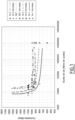
- the results of these fatigue tests are presented on the figure 1 . It shows, as a function of the number of cycles imposed, the stress level at which a rupture was observed on the various samples. For each sample, results of tests carried out for a very high number of cycles greater than 10 million (three tests for sample Inv.2, one test for the others) with stress levels which did not cause rupture of the sample have also been reported.
- the examples according to the invention Inv.1, Inv.2 and Inv.3 withstand in endurance stresses greater than reference 1, and at imposed stress, the endurance of the examples according to the invention is increased.
- Reference 2 was not tested, because in view of its nitride content it was assured that its fatigue tests would give results of lower quality in comparison with those of the other samples.
- nitriding conditions were tested for the grades according to the invention, including treatments between 420 and 510°C for 30 to 90 min in a gaseous atmosphere (under NH3 or under an atmosphere of cracked NH3 ), as well as by ionic nitriding.
- Nitrided layers are formed by the diffusion of nitrogen within the various matrices, constituting characteristic thicknesses of a few tens of ⁇ m, evaluated by chemical attack or profile by glow discharge spectrometry (GDS). They sometimes contain uniformly distributed fine precipitates, the chemical nature of which can possibly, if useful, be adjusted by adjusting the composition of the steel and the nitriding conditions.
- GDS glow discharge spectrometry
- the samples according to the invention have in particular better surface mechanical resistance and increased resistance to friction, thanks to an increase in surface hardness after nitriding compared to reference samples 1 and 2.
- gains of more than 50 Hv0.1 compared to references 1 and 2 can be easily expected, for reduced nitriding times. It is thus possible to achieve extreme surface hardnesses of more than 1050 Hv0.1 on the grades according to the invention, under suitable nitriding conditions that are not particularly demanding.
Landscapes
- Chemical & Material Sciences (AREA)
- Engineering & Computer Science (AREA)
- Materials Engineering (AREA)
- Mechanical Engineering (AREA)
- Metallurgy (AREA)
- Organic Chemistry (AREA)
- Crystallography & Structural Chemistry (AREA)
- Physics & Mathematics (AREA)
- Thermal Sciences (AREA)
- Manufacturing & Machinery (AREA)
- Plasma & Fusion (AREA)
- Heat Treatment Of Sheet Steel (AREA)
- Heat Treatment Of Steel (AREA)
- Solid-Phase Diffusion Into Metallic Material Surfaces (AREA)
Applications Claiming Priority (2)
| Application Number | Priority Date | Filing Date | Title |
|---|---|---|---|
| PCT/IB2015/052975 WO2016170397A1 (fr) | 2015-04-23 | 2015-04-23 | Acier, produit réalisé en cet acier, et son procédé de fabrication |
| PCT/IB2016/052331 WO2016170519A1 (fr) | 2015-04-23 | 2016-04-25 | Acier, produit réalisé en cet acier, et son procédé de fabrication |
Publications (2)
| Publication Number | Publication Date |
|---|---|
| EP3286349A1 EP3286349A1 (fr) | 2018-02-28 |
| EP3286349B1 true EP3286349B1 (fr) | 2024-08-21 |
Family
ID=53051864
Family Applications (1)
| Application Number | Title | Priority Date | Filing Date |
|---|---|---|---|
| EP16720569.9A Active EP3286349B1 (fr) | 2015-04-23 | 2016-04-25 | Acier, produit réalisé en cet acier, et son procédé de fabrication |
Country Status (11)
| Country | Link |
|---|---|
| US (2) | US11186886B2 (enExample) |
| EP (1) | EP3286349B1 (enExample) |
| JP (1) | JP7335680B2 (enExample) |
| KR (1) | KR102627212B1 (enExample) |
| CN (2) | CN114807776A (enExample) |
| BR (1) | BR112017022626A2 (enExample) |
| CA (2) | CA2983346A1 (enExample) |
| ES (1) | ES2999375T3 (enExample) |
| MX (1) | MX2017013468A (enExample) |
| RU (1) | RU2733612C2 (enExample) |
| WO (2) | WO2016170397A1 (enExample) |
Families Citing this family (16)
| Publication number | Priority date | Publication date | Assignee | Title |
|---|---|---|---|---|
| WO2017064537A1 (fr) * | 2015-10-15 | 2017-04-20 | Aperam | Acier, produit réalisé en cet acier, et son procédé de fabrication |
| NL1042208B1 (en) * | 2016-12-30 | 2018-07-23 | Bosch Gmbh Robert | Metal ring component of a drive belt for a continuously variable transmission and its manufacutring method |
| JP7053688B2 (ja) | 2017-06-30 | 2022-04-12 | アペラム | マルテンサイトステンレス鋼シートをスポット溶接する方法 |
| US11499203B2 (en) * | 2017-12-19 | 2022-11-15 | Compagnie Generale Des Etablissements Michelin | Method for the heat treatment of a part made from maraging steel |
| CN110066930B (zh) * | 2019-04-02 | 2021-05-04 | 安徽省金兰金盈铝业有限公司 | 利用稀土金属减轻铝合金材料磨损性能的方法 |
| US11938244B2 (en) | 2020-03-03 | 2024-03-26 | Hejie Li | Methods for improving mechanical property and biological stability of magnesium alloy and manufacturing material and applications |
| CN111534769A (zh) * | 2020-03-03 | 2020-08-14 | 李贺杰 | 提高镁合金力学性能及生物功能稳定性的热处理方法 |
| FR3113495B1 (fr) * | 2020-08-21 | 2022-10-14 | Nexter Munitions | Acier a hautes caracteristiques mecaniques et son procede de fabrication |
| CN114086031B (zh) * | 2021-10-20 | 2023-02-17 | 中国科学院金属研究所 | 一种高压氢压机膜片用耐疲劳耐氢脆板材的制备方法 |
| CN115948635B (zh) * | 2023-03-09 | 2023-05-09 | 太原科技大学 | 一种含铜抗菌不锈钢及其表面处理工艺 |
| CN116770194A (zh) * | 2023-03-27 | 2023-09-19 | 东南大学 | 一种铁基合金及其制备方法 |
| CN116516233A (zh) * | 2023-04-25 | 2023-08-01 | 成都先进金属材料产业技术研究院股份有限公司 | 一种高洁净度马氏体时效不锈钢冶炼方法 |
| CN119794361A (zh) * | 2023-06-12 | 2025-04-11 | 泉州天智合金材料科技有限公司 | 一种适用于mim注射成型超高强度钢用金属粉末的制备方法 |
| CN117230376B (zh) * | 2023-11-10 | 2024-03-05 | 钢铁研究总院有限公司 | 一种用于生产300m钢的电极及其制备方法和应用 |
| CN119433364B (zh) * | 2024-11-04 | 2025-06-10 | 西安钢研功能材料股份有限公司 | 一种可伐合金箔材的制备方法 |
| CN121428390A (zh) * | 2025-11-14 | 2026-01-30 | 钢铁研究总院有限公司 | 一种超高强度sf1900钢真空双自耗钢锭的制备方法 |
Family Cites Families (18)
| Publication number | Priority date | Publication date | Assignee | Title |
|---|---|---|---|---|
| JPS5214518A (en) * | 1975-07-25 | 1977-02-03 | Hitachi Ltd | Process for manufacturing a rotatable drum for the centrifugal separat or for concentrating uranium |
| SU1723186A1 (ru) * | 1990-03-11 | 1992-03-30 | Центральный научно-исследовательский институт черной металлургии им.И.П.Бардина | Сталь |
| FR2816959B1 (fr) * | 2000-11-17 | 2003-08-01 | Imphy Ugine Precision | Procede pour fabriquer une bande ou une piece decoupee dans une bande en acier maraging laminee a froid |
| AT410448B (de) * | 2001-04-11 | 2003-04-25 | Boehler Edelstahl | Kaltarbeitsstahllegierung zur pulvermetallurgischen herstellung von teilen |
| JP3821368B2 (ja) * | 2001-12-19 | 2006-09-13 | 日立金属株式会社 | 高清浄マルエージング鋼の製造方法 |
| EP1826282B1 (en) * | 2002-11-19 | 2010-01-20 | Hitachi Metals, Ltd. | Method of producing a maraging steel |
| JP4741175B2 (ja) * | 2003-02-07 | 2011-08-03 | 本田技研工業株式会社 | 金属ベルト用マルエージング鋼 |
| JP4374529B2 (ja) * | 2004-02-20 | 2009-12-02 | 日立金属株式会社 | マルエージング鋼及び薄帯 |
| JP5046363B2 (ja) * | 2005-12-13 | 2012-10-10 | 日立金属株式会社 | 高疲労強度を有する動力伝達用ベルト用マルエージング鋼ならびにそれを用いた動力伝達用ベルト用マルエージング鋼帯 |
| JP5007930B2 (ja) * | 2005-12-13 | 2012-08-22 | 日立金属株式会社 | 高疲労強度を有するマルエージング鋼ならびにそれを用いたマルエージング鋼帯、高疲労強度を有するマルエージング鋼の製造方法 |
| RU2334017C1 (ru) * | 2006-12-05 | 2008-09-20 | Федеральное государственное унитарное предприятие "Всероссийский научно-исследовательский институт авиационных материалов" (ФГУП "ВИАМ") | Высокопрочная мартенситностареющая сталь и изделие, выполенное из нее |
| JP2009013464A (ja) * | 2007-07-04 | 2009-01-22 | Hitachi Metals Ltd | 金属ベルト用マルエージング鋼 |
| EP2180073B1 (en) | 2007-07-11 | 2013-09-11 | Hitachi Metals, Ltd. | Maraging steel for metallic belt |
| CN101892437B (zh) * | 2009-05-22 | 2012-09-19 | 宝山钢铁股份有限公司 | 一种镜面抛光性良好的低磁奥氏体不锈钢及其制造方法 |
| WO2012052626A1 (fr) * | 2010-10-21 | 2012-04-26 | Arcelormittal Investigacion Y Desarrollo, S.L. | Tole d'acier laminee a chaud ou a froid, don procede de fabrication et son utilisation dans l'industrie automobile |
| UA109963C2 (uk) * | 2011-09-06 | 2015-10-26 | Катана сталь, яка затвердіває внаслідок виділення часток після гарячого формування і/або загартовування в інструменті, яка має високу міцність і пластичність, та спосіб її виробництва | |
| CN102383060A (zh) * | 2011-11-02 | 2012-03-21 | 永鑫精密材料(无锡)有限公司 | 一种电子产品壳体用奥氏体不锈钢薄带的制造方法 |
| JP6166953B2 (ja) * | 2012-06-06 | 2017-07-19 | 大同特殊鋼株式会社 | マルエージング鋼 |
-
2015
- 2015-04-23 WO PCT/IB2015/052975 patent/WO2016170397A1/fr not_active Ceased
- 2015-04-23 CA CA2983346A patent/CA2983346A1/fr not_active Withdrawn
-
2016
- 2016-04-25 CN CN202210216508.XA patent/CN114807776A/zh active Pending
- 2016-04-25 ES ES16720569T patent/ES2999375T3/es active Active
- 2016-04-25 US US15/567,688 patent/US11186886B2/en active Active
- 2016-04-25 RU RU2017136795A patent/RU2733612C2/ru active
- 2016-04-25 MX MX2017013468A patent/MX2017013468A/es unknown
- 2016-04-25 KR KR1020177033539A patent/KR102627212B1/ko active Active
- 2016-04-25 CN CN201680023553.6A patent/CN107532226A/zh active Pending
- 2016-04-25 JP JP2017555214A patent/JP7335680B2/ja active Active
- 2016-04-25 WO PCT/IB2016/052331 patent/WO2016170519A1/fr not_active Ceased
- 2016-04-25 EP EP16720569.9A patent/EP3286349B1/fr active Active
- 2016-04-25 BR BR112017022626-0A patent/BR112017022626A2/pt not_active Application Discontinuation
- 2016-04-25 CA CA2984131A patent/CA2984131C/fr active Active
-
2021
- 2021-11-01 US US17/453,093 patent/US20220056545A1/en not_active Abandoned
Also Published As
| Publication number | Publication date |
|---|---|
| ES2999375T3 (en) | 2025-02-25 |
| RU2017136795A3 (enExample) | 2019-10-21 |
| WO2016170519A1 (fr) | 2016-10-27 |
| EP3286349A1 (fr) | 2018-02-28 |
| JP7335680B2 (ja) | 2023-08-30 |
| JP2018516313A (ja) | 2018-06-21 |
| WO2016170397A1 (fr) | 2016-10-27 |
| US11186886B2 (en) | 2021-11-30 |
| CA2983346A1 (fr) | 2016-10-27 |
| BR112017022626A2 (pt) | 2018-07-10 |
| RU2017136795A (ru) | 2019-04-22 |
| US20220056545A1 (en) | 2022-02-24 |
| CA2984131C (fr) | 2023-05-09 |
| CA2984131A1 (fr) | 2016-10-27 |
| KR20170139111A (ko) | 2017-12-18 |
| KR102627212B1 (ko) | 2024-01-19 |
| CN107532226A (zh) | 2018-01-02 |
| US20180087123A1 (en) | 2018-03-29 |
| CN114807776A (zh) | 2022-07-29 |
| MX2017013468A (es) | 2017-12-07 |
| RU2733612C2 (ru) | 2020-10-05 |
Similar Documents
| Publication | Publication Date | Title |
|---|---|---|
| CA2984131C (fr) | Acier, produit realise en cet acier, et son procede de fabrication | |
| EP3362585B1 (fr) | Acier, produit réalisé en cet acier, et son procédé de fabrication | |
| EP2893047B1 (fr) | Procede de fabrication de pieces d'acier revêtues et durcies a la presse, et tôles prerevêtues permettant la fabrication de ces pieces | |
| EP2310546B1 (fr) | Acier martensitique durci à teneur faible en cobalt, procédé de fabrication d'une pièce à partir de cet acier, et pièce ainsi obtenue | |
| EP1426453B1 (fr) | Procédé de fabrication d'une pièce forgée en acier | |
| EP2164998B1 (fr) | Acier martensitique durci à teneur faible ou nulle en cobalt, procédé de fabrication d'une pièce à partir de cet acier, et pièce ainsi obtenue | |
| CA2627394C (fr) | Procede de fabrication d'une piece a tres hautes caracteristiques mecaniques a partir d'une tole laminee et revetue | |
| CA3022115A1 (fr) | Procede de fabrication d'une piece en acier inoxydable martensitique a partir d'une tole | |
| JP4964063B2 (ja) | 冷間鍛造性および結晶粒粗大化防止特性に優れた肌焼鋼およびそれから得られる機械部品 | |
| EP1954846A1 (fr) | Acier pour outillage a chaud, et piece realisee en cet acier, son procede de fabrication et ses utilisations. | |
| EP2134882B1 (fr) | Acier micro-allié à bonne tenue à l'hydrogène pour le formage à froid de pièces mécaniques à hautes caractéristiques | |
| EP2449137B1 (fr) | Procede d'elaboration d'un acier martensitique a durcissement mixte | |
| EP3378957B1 (fr) | Acier, procédé pour la fabrication de pièces mécaniques en cet acier, et pièces ainsi fabriquées | |
| CA2559562C (fr) | Acier pour pieces mecaniques, procede de fabrication de pieces mecaniques l'utilisant et pieces mecaniques ainsi realisees | |
| EP1228253B1 (fr) | Composition d'acier, procede de fabrication et pieces formees dans ces compositions, en particulier soupapes |
Legal Events
| Date | Code | Title | Description |
|---|---|---|---|
| STAA | Information on the status of an ep patent application or granted ep patent |
Free format text: STATUS: THE INTERNATIONAL PUBLICATION HAS BEEN MADE |
|
| PUAI | Public reference made under article 153(3) epc to a published international application that has entered the european phase |
Free format text: ORIGINAL CODE: 0009012 |
|
| STAA | Information on the status of an ep patent application or granted ep patent |
Free format text: STATUS: REQUEST FOR EXAMINATION WAS MADE |
|
| 17P | Request for examination filed |
Effective date: 20171020 |
|
| AK | Designated contracting states |
Kind code of ref document: A1 Designated state(s): AL AT BE BG CH CY CZ DE DK EE ES FI FR GB GR HR HU IE IS IT LI LT LU LV MC MK MT NL NO PL PT RO RS SE SI SK SM TR |
|
| AX | Request for extension of the european patent |
Extension state: BA ME |
|
| DAV | Request for validation of the european patent (deleted) | ||
| DAX | Request for extension of the european patent (deleted) | ||
| STAA | Information on the status of an ep patent application or granted ep patent |
Free format text: STATUS: EXAMINATION IS IN PROGRESS |
|
| 17Q | First examination report despatched |
Effective date: 20200930 |
|
| GRAP | Despatch of communication of intention to grant a patent |
Free format text: ORIGINAL CODE: EPIDOSNIGR1 |
|
| STAA | Information on the status of an ep patent application or granted ep patent |
Free format text: STATUS: GRANT OF PATENT IS INTENDED |
|
| RIC1 | Information provided on ipc code assigned before grant |
Ipc: C22C 30/00 20060101ALI20231030BHEP Ipc: C22C 1/02 20060101ALI20231030BHEP Ipc: C22B 9/20 20060101ALI20231030BHEP Ipc: C22B 9/18 20060101ALI20231030BHEP Ipc: C21D 9/46 20060101ALI20231030BHEP Ipc: C21D 9/30 20060101ALI20231030BHEP Ipc: C21D 9/00 20060101ALI20231030BHEP Ipc: C21D 8/02 20060101ALI20231030BHEP Ipc: C21D 8/00 20060101ALI20231030BHEP Ipc: C21D 7/06 20060101ALI20231030BHEP Ipc: C21D 6/02 20060101ALI20231030BHEP Ipc: C21D 6/00 20060101ALI20231030BHEP Ipc: C22C 38/14 20060101ALI20231030BHEP Ipc: C22C 38/16 20060101ALI20231030BHEP Ipc: C22C 38/18 20060101ALI20231030BHEP Ipc: C22C 38/02 20060101ALI20231030BHEP Ipc: C22C 38/06 20060101ALI20231030BHEP Ipc: C22C 38/00 20060101ALI20231030BHEP Ipc: C22C 38/10 20060101ALI20231030BHEP Ipc: C22C 38/12 20060101ALI20231030BHEP Ipc: C22C 38/08 20060101AFI20231030BHEP |
|
| INTG | Intention to grant announced |
Effective date: 20231128 |
|
| GRAJ | Information related to disapproval of communication of intention to grant by the applicant or resumption of examination proceedings by the epo deleted |
Free format text: ORIGINAL CODE: EPIDOSDIGR1 |
|
| STAA | Information on the status of an ep patent application or granted ep patent |
Free format text: STATUS: EXAMINATION IS IN PROGRESS |
|
| GRAP | Despatch of communication of intention to grant a patent |
Free format text: ORIGINAL CODE: EPIDOSNIGR1 |
|
| STAA | Information on the status of an ep patent application or granted ep patent |
Free format text: STATUS: GRANT OF PATENT IS INTENDED |
|
| INTC | Intention to grant announced (deleted) | ||
| INTG | Intention to grant announced |
Effective date: 20240410 |
|
| P01 | Opt-out of the competence of the unified patent court (upc) registered |
Effective date: 20240405 |
|
| GRAS | Grant fee paid |
Free format text: ORIGINAL CODE: EPIDOSNIGR3 |
|
| GRAA | (expected) grant |
Free format text: ORIGINAL CODE: 0009210 |
|
| STAA | Information on the status of an ep patent application or granted ep patent |
Free format text: STATUS: THE PATENT HAS BEEN GRANTED |
|
| AK | Designated contracting states |
Kind code of ref document: B1 Designated state(s): AL AT BE BG CH CY CZ DE DK EE ES FI FR GB GR HR HU IE IS IT LI LT LU LV MC MK MT NL NO PL PT RO RS SE SI SK SM TR |
|
| REG | Reference to a national code |
Ref country code: GB Ref legal event code: FG4D Free format text: NOT ENGLISH |
|
| REG | Reference to a national code |
Ref country code: CH Ref legal event code: EP |
|
| REG | Reference to a national code |
Ref country code: DE Ref legal event code: R096 Ref document number: 602016088988 Country of ref document: DE |
|
| REG | Reference to a national code |
Ref country code: IE Ref legal event code: FG4D Free format text: LANGUAGE OF EP DOCUMENT: FRENCH |
|
| REG | Reference to a national code |
Ref country code: NL Ref legal event code: FP |
|
| REG | Reference to a national code |
Ref country code: LT Ref legal event code: MG9D |
|
| PG25 | Lapsed in a contracting state [announced via postgrant information from national office to epo] |
Ref country code: NO Free format text: LAPSE BECAUSE OF FAILURE TO SUBMIT A TRANSLATION OF THE DESCRIPTION OR TO PAY THE FEE WITHIN THE PRESCRIBED TIME-LIMIT Effective date: 20241121 |
|
| REG | Reference to a national code |
Ref country code: AT Ref legal event code: MK05 Ref document number: 1715542 Country of ref document: AT Kind code of ref document: T Effective date: 20240821 |
|
| PG25 | Lapsed in a contracting state [announced via postgrant information from national office to epo] |
Ref country code: GR Free format text: LAPSE BECAUSE OF FAILURE TO SUBMIT A TRANSLATION OF THE DESCRIPTION OR TO PAY THE FEE WITHIN THE PRESCRIBED TIME-LIMIT Effective date: 20241122 Ref country code: FI Free format text: LAPSE BECAUSE OF FAILURE TO SUBMIT A TRANSLATION OF THE DESCRIPTION OR TO PAY THE FEE WITHIN THE PRESCRIBED TIME-LIMIT Effective date: 20240821 Ref country code: PT Free format text: LAPSE BECAUSE OF FAILURE TO SUBMIT A TRANSLATION OF THE DESCRIPTION OR TO PAY THE FEE WITHIN THE PRESCRIBED TIME-LIMIT Effective date: 20241223 Ref country code: PL Free format text: LAPSE BECAUSE OF FAILURE TO SUBMIT A TRANSLATION OF THE DESCRIPTION OR TO PAY THE FEE WITHIN THE PRESCRIBED TIME-LIMIT Effective date: 20240821 |
|
| PG25 | Lapsed in a contracting state [announced via postgrant information from national office to epo] |
Ref country code: BG Free format text: LAPSE BECAUSE OF FAILURE TO SUBMIT A TRANSLATION OF THE DESCRIPTION OR TO PAY THE FEE WITHIN THE PRESCRIBED TIME-LIMIT Effective date: 20240821 |
|
| PG25 | Lapsed in a contracting state [announced via postgrant information from national office to epo] |
Ref country code: LV Free format text: LAPSE BECAUSE OF FAILURE TO SUBMIT A TRANSLATION OF THE DESCRIPTION OR TO PAY THE FEE WITHIN THE PRESCRIBED TIME-LIMIT Effective date: 20240821 |
|
| PG25 | Lapsed in a contracting state [announced via postgrant information from national office to epo] |
Ref country code: AT Free format text: LAPSE BECAUSE OF FAILURE TO SUBMIT A TRANSLATION OF THE DESCRIPTION OR TO PAY THE FEE WITHIN THE PRESCRIBED TIME-LIMIT Effective date: 20240821 Ref country code: IS Free format text: LAPSE BECAUSE OF FAILURE TO SUBMIT A TRANSLATION OF THE DESCRIPTION OR TO PAY THE FEE WITHIN THE PRESCRIBED TIME-LIMIT Effective date: 20241221 |
|
| PG25 | Lapsed in a contracting state [announced via postgrant information from national office to epo] |
Ref country code: HR Free format text: LAPSE BECAUSE OF FAILURE TO SUBMIT A TRANSLATION OF THE DESCRIPTION OR TO PAY THE FEE WITHIN THE PRESCRIBED TIME-LIMIT Effective date: 20240821 |
|
| PG25 | Lapsed in a contracting state [announced via postgrant information from national office to epo] |
Ref country code: RS Free format text: LAPSE BECAUSE OF FAILURE TO SUBMIT A TRANSLATION OF THE DESCRIPTION OR TO PAY THE FEE WITHIN THE PRESCRIBED TIME-LIMIT Effective date: 20241121 |
|
| PG25 | Lapsed in a contracting state [announced via postgrant information from national office to epo] |
Ref country code: RS Free format text: LAPSE BECAUSE OF FAILURE TO SUBMIT A TRANSLATION OF THE DESCRIPTION OR TO PAY THE FEE WITHIN THE PRESCRIBED TIME-LIMIT Effective date: 20241121 Ref country code: PT Free format text: LAPSE BECAUSE OF FAILURE TO SUBMIT A TRANSLATION OF THE DESCRIPTION OR TO PAY THE FEE WITHIN THE PRESCRIBED TIME-LIMIT Effective date: 20241223 Ref country code: PL Free format text: LAPSE BECAUSE OF FAILURE TO SUBMIT A TRANSLATION OF THE DESCRIPTION OR TO PAY THE FEE WITHIN THE PRESCRIBED TIME-LIMIT Effective date: 20240821 Ref country code: NO Free format text: LAPSE BECAUSE OF FAILURE TO SUBMIT A TRANSLATION OF THE DESCRIPTION OR TO PAY THE FEE WITHIN THE PRESCRIBED TIME-LIMIT Effective date: 20241121 Ref country code: LV Free format text: LAPSE BECAUSE OF FAILURE TO SUBMIT A TRANSLATION OF THE DESCRIPTION OR TO PAY THE FEE WITHIN THE PRESCRIBED TIME-LIMIT Effective date: 20240821 Ref country code: IS Free format text: LAPSE BECAUSE OF FAILURE TO SUBMIT A TRANSLATION OF THE DESCRIPTION OR TO PAY THE FEE WITHIN THE PRESCRIBED TIME-LIMIT Effective date: 20241221 Ref country code: HR Free format text: LAPSE BECAUSE OF FAILURE TO SUBMIT A TRANSLATION OF THE DESCRIPTION OR TO PAY THE FEE WITHIN THE PRESCRIBED TIME-LIMIT Effective date: 20240821 Ref country code: GR Free format text: LAPSE BECAUSE OF FAILURE TO SUBMIT A TRANSLATION OF THE DESCRIPTION OR TO PAY THE FEE WITHIN THE PRESCRIBED TIME-LIMIT Effective date: 20241122 Ref country code: FI Free format text: LAPSE BECAUSE OF FAILURE TO SUBMIT A TRANSLATION OF THE DESCRIPTION OR TO PAY THE FEE WITHIN THE PRESCRIBED TIME-LIMIT Effective date: 20240821 Ref country code: BG Free format text: LAPSE BECAUSE OF FAILURE TO SUBMIT A TRANSLATION OF THE DESCRIPTION OR TO PAY THE FEE WITHIN THE PRESCRIBED TIME-LIMIT Effective date: 20240821 Ref country code: AT Free format text: LAPSE BECAUSE OF FAILURE TO SUBMIT A TRANSLATION OF THE DESCRIPTION OR TO PAY THE FEE WITHIN THE PRESCRIBED TIME-LIMIT Effective date: 20240821 |
|
| REG | Reference to a national code |
Ref country code: ES Ref legal event code: FG2A Ref document number: 2999375 Country of ref document: ES Kind code of ref document: T3 Effective date: 20250225 |
|
| PG25 | Lapsed in a contracting state [announced via postgrant information from national office to epo] |
Ref country code: SM Free format text: LAPSE BECAUSE OF FAILURE TO SUBMIT A TRANSLATION OF THE DESCRIPTION OR TO PAY THE FEE WITHIN THE PRESCRIBED TIME-LIMIT Effective date: 20240821 Ref country code: RO Free format text: LAPSE BECAUSE OF FAILURE TO SUBMIT A TRANSLATION OF THE DESCRIPTION OR TO PAY THE FEE WITHIN THE PRESCRIBED TIME-LIMIT Effective date: 20240821 Ref country code: DK Free format text: LAPSE BECAUSE OF FAILURE TO SUBMIT A TRANSLATION OF THE DESCRIPTION OR TO PAY THE FEE WITHIN THE PRESCRIBED TIME-LIMIT Effective date: 20240821 |
|
| PG25 | Lapsed in a contracting state [announced via postgrant information from national office to epo] |
Ref country code: EE Free format text: LAPSE BECAUSE OF FAILURE TO SUBMIT A TRANSLATION OF THE DESCRIPTION OR TO PAY THE FEE WITHIN THE PRESCRIBED TIME-LIMIT Effective date: 20240821 |
|
| PG25 | Lapsed in a contracting state [announced via postgrant information from national office to epo] |
Ref country code: SK Free format text: LAPSE BECAUSE OF FAILURE TO SUBMIT A TRANSLATION OF THE DESCRIPTION OR TO PAY THE FEE WITHIN THE PRESCRIBED TIME-LIMIT Effective date: 20240821 |
|
| REG | Reference to a national code |
Ref country code: DE Ref legal event code: R097 Ref document number: 602016088988 Country of ref document: DE |
|
| PLBE | No opposition filed within time limit |
Free format text: ORIGINAL CODE: 0009261 |
|
| STAA | Information on the status of an ep patent application or granted ep patent |
Free format text: STATUS: NO OPPOSITION FILED WITHIN TIME LIMIT |
|
| PGFP | Annual fee paid to national office [announced via postgrant information from national office to epo] |
Ref country code: DE Payment date: 20250411 Year of fee payment: 10 |
|
| PGFP | Annual fee paid to national office [announced via postgrant information from national office to epo] |
Ref country code: GB Payment date: 20250417 Year of fee payment: 10 Ref country code: ES Payment date: 20250512 Year of fee payment: 10 |
|
| PGFP | Annual fee paid to national office [announced via postgrant information from national office to epo] |
Ref country code: IT Payment date: 20250409 Year of fee payment: 10 |
|
| PGFP | Annual fee paid to national office [announced via postgrant information from national office to epo] |
Ref country code: CH Payment date: 20250501 Year of fee payment: 10 |
|
| 26N | No opposition filed |
Effective date: 20250522 |
|
| PG25 | Lapsed in a contracting state [announced via postgrant information from national office to epo] |
Ref country code: SE Free format text: LAPSE BECAUSE OF FAILURE TO SUBMIT A TRANSLATION OF THE DESCRIPTION OR TO PAY THE FEE WITHIN THE PRESCRIBED TIME-LIMIT Effective date: 20240821 |
|
| PG25 | Lapsed in a contracting state [announced via postgrant information from national office to epo] |
Ref country code: LU Free format text: LAPSE BECAUSE OF NON-PAYMENT OF DUE FEES Effective date: 20250425 |
|
| PG25 | Lapsed in a contracting state [announced via postgrant information from national office to epo] |
Ref country code: MC Free format text: LAPSE BECAUSE OF FAILURE TO SUBMIT A TRANSLATION OF THE DESCRIPTION OR TO PAY THE FEE WITHIN THE PRESCRIBED TIME-LIMIT Effective date: 20240821 |
|
| REG | Reference to a national code |
Ref country code: BE Ref legal event code: MM Effective date: 20250430 |
|
| REG | Reference to a national code |
Ref country code: CH Ref legal event code: R18 Free format text: ST27 STATUS EVENT CODE: U-0-0-R10-R18 (AS PROVIDED BY THE NATIONAL OFFICE) Effective date: 20260106 |
|
| PG25 | Lapsed in a contracting state [announced via postgrant information from national office to epo] |
Ref country code: BE Free format text: LAPSE BECAUSE OF NON-PAYMENT OF DUE FEES Effective date: 20250430 |
|
| PG25 | Lapsed in a contracting state [announced via postgrant information from national office to epo] |
Ref country code: IE Free format text: LAPSE BECAUSE OF NON-PAYMENT OF DUE FEES Effective date: 20250425 |
|
| PGFP | Annual fee paid to national office [announced via postgrant information from national office to epo] |
Ref country code: NL Payment date: 20260326 Year of fee payment: 11 |
|
| PGFP | Annual fee paid to national office [announced via postgrant information from national office to epo] |
Ref country code: FR Payment date: 20260310 Year of fee payment: 11 |
|
| PGFP | Annual fee paid to national office [announced via postgrant information from national office to epo] |
Ref country code: CZ Payment date: 20260327 Year of fee payment: 11 |
|
| REG | Reference to a national code |
Ref country code: CH Ref legal event code: U11 Free format text: ST27 STATUS EVENT CODE: U-0-0-U10-U11 (AS PROVIDED BY THE NATIONAL OFFICE) Effective date: 20260504 |