EP3273307B1 - Pièce pour mouvement d'horlogerie - Google Patents
Pièce pour mouvement d'horlogerie Download PDFInfo
- Publication number
- EP3273307B1 EP3273307B1 EP17157065.8A EP17157065A EP3273307B1 EP 3273307 B1 EP3273307 B1 EP 3273307B1 EP 17157065 A EP17157065 A EP 17157065A EP 3273307 B1 EP3273307 B1 EP 3273307B1
- Authority
- EP
- European Patent Office
- Prior art keywords
- layer
- copper
- pivot
- nickel
- chemical
- Prior art date
- Legal status (The legal status is an assumption and is not a legal conclusion. Google has not performed a legal analysis and makes no representation as to the accuracy of the status listed.)
- Active
Links
Images
Classifications
-
- G—PHYSICS
- G04—HOROLOGY
- G04B—MECHANICALLY-DRIVEN CLOCKS OR WATCHES; MECHANICAL PARTS OF CLOCKS OR WATCHES IN GENERAL; TIME PIECES USING THE POSITION OF THE SUN, MOON OR STARS
- G04B13/00—Gearwork
- G04B13/02—Wheels; Pinions; Spindles; Pivots
- G04B13/021—Wheels; Pinions; Spindles; Pivots elastic fitting with a spindle, axis or shaft
- G04B13/022—Wheels; Pinions; Spindles; Pivots elastic fitting with a spindle, axis or shaft with parts made of hard material, e.g. silicon, diamond, sapphire, quartz and the like
-
- G—PHYSICS
- G04—HOROLOGY
- G04B—MECHANICALLY-DRIVEN CLOCKS OR WATCHES; MECHANICAL PARTS OF CLOCKS OR WATCHES IN GENERAL; TIME PIECES USING THE POSITION OF THE SUN, MOON OR STARS
- G04B1/00—Driving mechanisms
- G04B1/10—Driving mechanisms with mainspring
- G04B1/16—Barrels; Arbors; Barrel axles
-
- G—PHYSICS
- G04—HOROLOGY
- G04B—MECHANICALLY-DRIVEN CLOCKS OR WATCHES; MECHANICAL PARTS OF CLOCKS OR WATCHES IN GENERAL; TIME PIECES USING THE POSITION OF THE SUN, MOON OR STARS
- G04B13/00—Gearwork
- G04B13/02—Wheels; Pinions; Spindles; Pivots
-
- G—PHYSICS
- G04—HOROLOGY
- G04B—MECHANICALLY-DRIVEN CLOCKS OR WATCHES; MECHANICAL PARTS OF CLOCKS OR WATCHES IN GENERAL; TIME PIECES USING THE POSITION OF THE SUN, MOON OR STARS
- G04B15/00—Escapements
- G04B15/14—Component parts or constructional details, e.g. construction of the lever or the escape wheel
-
- G—PHYSICS
- G04—HOROLOGY
- G04B—MECHANICALLY-DRIVEN CLOCKS OR WATCHES; MECHANICAL PARTS OF CLOCKS OR WATCHES IN GENERAL; TIME PIECES USING THE POSITION OF THE SUN, MOON OR STARS
- G04B17/00—Mechanisms for stabilising frequency
- G04B17/32—Component parts or constructional details, e.g. collet, stud, virole or piton
-
- G—PHYSICS
- G04—HOROLOGY
- G04B—MECHANICALLY-DRIVEN CLOCKS OR WATCHES; MECHANICAL PARTS OF CLOCKS OR WATCHES IN GENERAL; TIME PIECES USING THE POSITION OF THE SUN, MOON OR STARS
- G04B29/00—Frameworks
-
- G—PHYSICS
- G04—HOROLOGY
- G04B—MECHANICALLY-DRIVEN CLOCKS OR WATCHES; MECHANICAL PARTS OF CLOCKS OR WATCHES IN GENERAL; TIME PIECES USING THE POSITION OF THE SUN, MOON OR STARS
- G04B43/00—Protecting clockworks by shields or other means against external influences, e.g. magnetic fields
- G04B43/007—Antimagnetic alloys
Definitions
- the invention relates to a part for a watch movement and in particular to a non-magnetic pivot axis for a mechanical watch movement and more particularly to a non-magnetic balance shaft, anchor stem and escapement pinion.
- Pivot shafts such as balance shafts, typically used in mechanical watch movements are made from free-cutting steel grades, which are typically martensitic carbon steels containing lead and manganese sulfides to improve their machinability.
- This type of material has the advantage of being easily machinable, in particular of being suitable for turning and presents, after treatments of quenching and tempering, high mechanical properties very interesting for the production of watch pivot axes.
- These steels have, in particular, a high hardness after heat treatment, allowing very good shock resistance to be obtained.
- the hardness of the pivots of an axis made of 20 AP steel can reach a hardness exceeding 700 HV after heat treatment and rolling.
- this type of material has the disadvantage of being magnetic and of being able to disturb the running of a watch after being subjected to a magnetic field, particularly when this material is used for the production of a balance staff cooperating with a balance spring made of ferromagnetic material. This phenomenon is well known to those skilled in the art. It should also be noted that these martensitic steels are also sensitive to corrosion.
- austenitic stainless steels which have the particularity of being non-magnetic, i.e. of the paramagnetic or diamagnetic or antiferromagnetic type.
- these austenitic steels have a crystallographic structure which does not allow them to be hardened and to achieve hardnesses and therefore shock resistances compatible with the requirements for the production of watch pivot axes.
- the axes obtained then show marks or severe damage in the event of shocks which will then have a negative influence on the chronometry of the movement.
- One way to increase the hardness of these steels is work hardening, however this hardening operation does not allow hardnesses greater than 500 HV to be obtained. Consequently, in the context of parts requiring pivots with high shock resistance, the use of this type of steel remains limited.
- pivot pins are made of austenitic cobalt or nickel alloys and have a depth-hardened outer surface.
- such alloys can be difficult to machine for pivot pin manufacturing.
- they are relatively expensive due to the high price of nickel and cobalt.
- EP 1 237 058 describes a clockwork movement comprising a generator with magnetized masses, surrounded by non-magnetic rough parts covered with a non-magnetic coating, such as a nickel and phosphorus alloy, used here for its non-magnetic properties.
- non-magnetic material means a paramagnetic or diamagnetic or antiferromagnetic material, the magnetic permeability of which is less than or equal to 1.01.
- An alloy of an element is an alloy containing at least 50% by weight of said element.
- the invention relates to a part for a watch movement and in particular to a non-magnetic pivot axis for a mechanical watch movement.
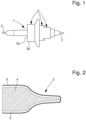
- a balance shaft 1 which comprises a plurality of sections 2 of different diameters, preferably formed by turning or any other machining technique by chip removal, and conventionally defining bearing surfaces 2a and shoulders 2b arranged between two end portions defining two pivots 3. These pivots are intended to each pivot in a bearing, typically in an orifice of a stone or ruby.
- the pivot 3 is made of a first non-magnetic metallic material 4 in order to advantageously limit its sensitivity to magnetic fields.
- the first non-magnetic metallic material 4 is chosen from the group comprising an austenitic type steel, preferably stainless steel, an austenitic type cobalt alloy, an austenitic type nickel alloy, a non-magnetic titanium alloy, a non-magnetic aluminium alloy, a brass (Cu-Zn) or a special brass (Cu-Zn with AI and/or Si and/or Mn), a copper-beryllium, a bronze (Cu-Sn), an aluminium bronze, a copper-aluminium (optionally comprising Ni and/or Fe), a copper-nickel, a nickel silver (Cu-Ni-Zn), a copper-nickel-tin, a copper-nickel-silicon, a copper-nickel-phosphorus, a copper-titanium, the proportions of the different elements of the alloys being chosen to give them non-magnetic properties as well as good machinability.
- an austenitic type steel preferably stainless steel, an austenitic type co
- austenitic steel is an HIS (High Interstitial Steels) austenitic stainless steel, such as Cr-Mn-N P2000 steel from Energytechnik Essen GmbH.
- the austenitic type cobalt alloy may comprise at least 39% cobalt, typically an alloy known as "Phynox” or the DIN designation K13C20N16Fe15D7 typically having 39% Co, 19% Cr, 15% Ni and 6% Mo, 1.5% Mn, 18% Fe and the balance of additives.
- the austenitic type nickel alloy may comprise at least 33% nickel typically an alloy known under the designation MP35N ® typically having 35% Ni 20% Cr, 10% Mo, 33% Co and the balance of additives.
- the titanium alloy preferably comprises at least 85% titanium.
- Brasses may include the alloys CuZn39Pb3, CuZn37Pb2, or CuZn37.
- Special brasses may include the alloys CuZn37Mn3Al2PbSi, CuZn23Al3Co or CuZn23Al6Mn4Fe3Pb.
- Nickel silver can include the alloys CuNi25Zn11Pb1Mn, CuNi7Zn39Pb3Mn2 or CuNi18Zn19Pb1.
- Bronzes may include CuSn9 or CuSn6 alloys.
- Aluminum bronzes can include CuAl9 or CuAl9Fe5Ni5 alloys.
- Copper-nickel alloys may include the CuNi30 alloy.
- Copper-nickel-tin alloys can include CuNi15Sn8, CuNi9Sn6 or CuNi7.5Sn5 alloys (marketed for example under the name Declafor).
- Copper-titanium alloys may include the CuTi3Fe alloy.
- Copper-nickel-silicon alloys may include the CuNi3Si alloy.
- the first non-magnetic metallic material generally has a hardness of less than 600 HV.
- At least the external surface of said pivot 3 is covered with a first layer 5 of a second material chosen from the group comprising Ni, NiB and NiP, in order to offer, advantageously, in particular mechanical properties at the level of said external surface making it possible to obtain the desired shock resistance.
- the phosphorus content may preferably be between 0% (in which case we have pure Ni) and 15%.
- the phosphorus content in the second NiP material may be an average content of between 6% and 9%, or a high content of between 9% and 12%. It is obvious, however, that the second NiP material may comprise a low content of phosphorus.
- a heat treatment may be carried out between steps b) and c) and/or after step c).
- the second material is NiB, or NiP with a medium or high phosphorus content
- the first layer of the second NiB or NiP material may be advantageously hardened by heat treatment.
- the first layer of the second material has a hardness preferably greater than 400 HV, more preferably greater than 500 HV.
- the first layer of the second unhardened Ni or NiP material has a hardness preferably greater than 500 HV, but less than 600 HV, i.e. preferably between 500 HV and 550 HV.
- the pivot axis according to the invention has excellent shock resistance although the layer of the second material may have a lower hardness (HV) than that of the first material.
- the first layer of the second NiP material can have a hardness between 900 HV and 1000 HV.
- the first layer of the second unhardened NiB material has a hardness preferably greater than 500 HV, and may have a hardness greater than 1000 HV when hardened by heat treatment.
- the first layer of the second material may have a thickness of between 0.5 ⁇ m and 10 ⁇ m, preferably between 1 ⁇ m and 5 ⁇ m, and more preferably between 1 ⁇ m and 2 ⁇ m.
- the first layer of the second material is a layer of NiP, and more particularly a layer of chemical NiP, i.e. deposited chemically.
- the first layer 5 of the second material is at least partially covered with a second layer 6 of a third material chosen from the group comprising gold, silver, copper, used in pure form or in alloy form.
- Said second layer 6 is of a thickness less than that of the first layer 5.
- the second layer 6 of the third material may have a thickness of between 0.1 ⁇ m and 1 ⁇ m, preferably between 0.1 ⁇ m and 0.5 ⁇ m.
- the third material is 24-carat gold, with possible traces of other elements.
- 99.7-99.8% gold and 0.02-0.03% Ni or Co are used.
- the outer surface of the pivot is hardened, i.e. the rest of the shaft can remain little or not modified without significant modification of the mechanical properties of the balance staff 1.
- This selective hardening of the pivots 3 of the balance staff 1 makes it possible to combine advantages such as low sensitivity to magnetic fields and mechanical properties making it possible to obtain very good shock resistance in the main stress zones.
- the second layer of the third material constitutes the outer layer of the pivot of the invention, and forms a protective layer. More particularly, the second layer of the third material makes it possible to make the surface of the pivot of the invention chemically inert and to limit the degradation of the first layer of the second material by the action of friction with stones and/or by chemical reaction with the lubricant used.
- the pivot axis may comprise at least one adhesion sub-layer deposited between the first material and the first layer of the second material.
- a gold sub-layer and/or a galvanic nickel sub-layer may be provided under the first layer of the second material.
- the first layer 5 of the second material is deposited according to step b) to have a thickness of between 0.5 ⁇ m and 10 ⁇ m, preferably between 1 ⁇ m and 5 ⁇ m, and more preferably between 1 ⁇ m and 2 ⁇ m.
- step b) of depositing the first layer 5 of the second material can be carried out according to a method chosen from the group comprising PVD, CVD, ALD, galvanic and chemical deposits, and preferably chemical.
- the second material is NiP and the step of depositing the NiP layer 5 is carried out according to a method of chemical nickel deposition from hypophosphite.
- the second material is NiB and the step of depositing the layer 5 of NiB is carried out according to a method of depositing chemical nickel from boron compounds.
- the second layer 6 of the third material is deposited on the first layer 5 to have a thickness of between 0.1 ⁇ m and 1 ⁇ m, preferably between 0.1 ⁇ m and 0.5 ⁇ m.
- step c) of depositing the second layer 6 of the third material is carried out according to a method chosen from the group comprising PVD (sputtering, evaporation or other), CVD, and galvanic deposition.
- the third material is gold and the step of depositing the gold layer 6 is carried out by galvanic means.
- the method according to the invention may further comprise, between steps b) and c) and/or after the deposition step c), a heat treatment step d).
- a heat treatment step d makes it possible to obtain a first layer 5 of the second material having a hardness preferably between 900 HV and 1000 HV.
- the heat treatment step d) is carried out after step c).
- a heat treatment step of the first material may also be provided before step a) or step b).
- the electroless nickel deposition process is particularly advantageous in that it allows for a conformal deposit to be obtained without any tip effect. It is thus possible to predict the dimension of the machined pivot axis to obtain the desired geometry after covering with the layer of the second material.
- the electroless nickel deposition process also has the advantage of being able to be applied in bulk.
- the method according to the invention may further comprise, before the deposition step b), a step e) of applying at least one adhesion sub-layer to the first material.
- a step e) of applying at least one adhesion sub-layer to the first material for example, in the case in particular of a pivot axis made of HIS stainless steel type material, it is possible to apply a gold sub-layer and/or a galvanic nickel sub-layer before the chemical deposition of nickel.
- the pivot axis according to the invention may comprise pivots treated according to the invention by applying steps b) and c) to the pivots only, the second layer 6 of the third material partially or completely coating the pivot by applying step c) on part or all of the surface of the pivot.
- the pivot axis according to the invention can also be made entirely of a first non-magnetic metallic material, its surface external being able to be entirely covered with a first layer of the second material by applying step b) on all the surfaces of the pivot axis, then said first layer of the second material being then partially or entirely covered with a second layer of a third material chosen from the group comprising gold, silver, copper, platinum, rhodium, palladium and their alloys, by applying step c) on part or all of the surfaces of the pivot axis.
- the pivots 3 may be rolled or polished before or after the deposition step b), in order to achieve the desired final dimensions and surface condition for the pivots 3.
- the pivot axis according to the invention combines the advantages of low sensitivity to magnetic fields, and at least in the main stress zones, excellent shock resistance. As a result, the pivot axis according to the invention does not exhibit, in the event of an impact, any marks or severe damage likely to impair the chronometry of the movement.
- axles according to the invention have better mechanical resistance, better tribological properties, but also better chemical resistance to the lubricants traditionally used for axle lubrication.
Landscapes
- Physics & Mathematics (AREA)
- General Physics & Mathematics (AREA)
- Engineering & Computer Science (AREA)
- Metallurgy (AREA)
- Electroplating Methods And Accessories (AREA)
- Other Surface Treatments For Metallic Materials (AREA)
- Manufacturing & Machinery (AREA)
- Chemically Coating (AREA)
- Heat Treatment Of Articles (AREA)
- Micromachines (AREA)
- Sliding-Contact Bearings (AREA)
- Electromechanical Clocks (AREA)
Priority Applications (18)
| Application Number | Priority Date | Filing Date | Title |
|---|---|---|---|
| EP17157065.8A EP3273307B1 (fr) | 2016-07-19 | 2017-02-21 | Pièce pour mouvement d'horlogerie |
| CN201710584247.6A CN107632510B (zh) | 2016-07-19 | 2017-07-18 | 用于钟表机芯的构件 |
| CN201710584243.8A CN107632507B (zh) | 2016-07-19 | 2017-07-18 | 用于钟表机芯的构件 |
| JP2017138777A JP6591497B2 (ja) | 2016-07-19 | 2017-07-18 | 時計ムーブメント用コンポーネント |
| RU2017125734A RU2767960C2 (ru) | 2016-07-19 | 2017-07-18 | Компонент для часового механизма |
| US15/652,287 US11092932B2 (en) | 2016-07-19 | 2017-07-18 | Component for a timepiece movement |
| CN201710584919.3A CN107632508B (zh) | 2016-07-19 | 2017-07-18 | 用于钟表机芯的构件 |
| RU2017125759A RU2752467C2 (ru) | 2016-07-19 | 2017-07-18 | Компонент для часового механизма |
| CN202110652156.8A CN113296382A (zh) | 2016-07-19 | 2017-07-18 | 用于钟表机芯的构件 |
| US15/652,283 US11237520B2 (en) | 2016-07-19 | 2017-07-18 | Component for a timepiece movement |
| JP2017138778A JP6591498B2 (ja) | 2016-07-19 | 2017-07-18 | 時計ムーブメント用コンポーネント |
| JP2017138776A JP6762275B2 (ja) | 2016-07-19 | 2017-07-18 | 時計ムーブメント用コンポーネント |
| US15/652,288 US10761482B2 (en) | 2016-07-19 | 2017-07-18 | Component for a timepiece movement |
| HK18107788.1A HK1248327B (zh) | 2016-07-19 | 2018-06-15 | 用於钟表机芯的构件 |
| HK18108135.9A HK1248836B (zh) | 2016-07-19 | 2018-06-25 | 用於钟表机芯的构件 |
| HK18108785.2A HK1249200B (zh) | 2016-07-19 | 2018-07-06 | 用於钟表机芯的构件 |
| JP2019118335A JP2019203899A (ja) | 2016-07-19 | 2019-06-26 | 時計ムーブメント用コンポーネント |
| JP2019118340A JP2019197061A (ja) | 2016-07-19 | 2019-06-26 | 時計ムーブメント用コンポーネント |
Applications Claiming Priority (3)
| Application Number | Priority Date | Filing Date | Title |
|---|---|---|---|
| EP16180226.9A EP3273304B1 (fr) | 2016-07-19 | 2016-07-19 | Pièce pour mouvement d'horlogerie |
| EP16190278.8A EP3273306B1 (fr) | 2016-07-19 | 2016-09-23 | Pièce pour mouvement d'horlogerie |
| EP17157065.8A EP3273307B1 (fr) | 2016-07-19 | 2017-02-21 | Pièce pour mouvement d'horlogerie |
Publications (2)
| Publication Number | Publication Date |
|---|---|
| EP3273307A1 EP3273307A1 (fr) | 2018-01-24 |
| EP3273307B1 true EP3273307B1 (fr) | 2025-04-30 |
Family
ID=81766831
Family Applications (1)
| Application Number | Title | Priority Date | Filing Date |
|---|---|---|---|
| EP17157065.8A Active EP3273307B1 (fr) | 2016-07-19 | 2017-02-21 | Pièce pour mouvement d'horlogerie |
Country Status (5)
| Country | Link |
|---|---|
| US (2) | US11237520B2 (enExample) |
| EP (1) | EP3273307B1 (enExample) |
| JP (5) | JP6591497B2 (enExample) |
| CN (1) | CN113296382A (enExample) |
| RU (1) | RU2767960C2 (enExample) |
Families Citing this family (9)
| Publication number | Priority date | Publication date | Assignee | Title |
|---|---|---|---|---|
| EP3339968B1 (fr) * | 2016-12-20 | 2025-07-02 | Nivarox-FAR S.A. | Pièce pour mouvement d'horlogerie |
| EP3594756B1 (fr) * | 2018-07-10 | 2021-05-12 | Blancpain SA | Composant d'horlogerie avec partie arbrée en alliage amagnétique |
| EP3800511B1 (fr) * | 2019-10-02 | 2022-05-18 | Nivarox-FAR S.A. | Axe de pivotement d'un organe réglant |
| EP3885842B1 (fr) * | 2020-03-26 | 2024-03-20 | Nivarox-FAR S.A. | Composant horloger amagnétique avec résistance à l'usure améliorée |
| EP3968097B1 (fr) * | 2020-09-09 | 2025-03-26 | Nivarox-FAR S.A. | Ensemble horloger et son procédé de fabrication |
| EP3968096A1 (fr) * | 2020-09-15 | 2022-03-16 | ETA SA Manufacture Horlogère Suisse | Composant de micromécanique, notamment un mobile d horlogerie, notamment un mobile d' échappement, avec surface de contact optimisée |
| EP3968095A1 (fr) * | 2020-09-15 | 2022-03-16 | ETA SA Manufacture Horlogère Suisse | Procédé de fabrication d'un composant de micromécanique, notamment d'un mobile d'horlogerie, avec surface de contact optimisee |
| EP4033307A1 (fr) * | 2021-01-22 | 2022-07-27 | ETA SA Manufacture Horlogère Suisse | Ensemble comprenant un mobile tournant en matériau amagnétique et un coussinet muni d'un cône |
| TWI866675B (zh) * | 2022-12-23 | 2024-12-11 | 瑞士商尼瓦克斯 法爾公司 | 用於時計機芯的擺輪 |
Citations (1)
| Publication number | Priority date | Publication date | Assignee | Title |
|---|---|---|---|---|
| FR2015873A1 (enExample) * | 1968-08-19 | 1970-04-30 | Inst Reinhard Straumann |
Family Cites Families (25)
| Publication number | Priority date | Publication date | Assignee | Title |
|---|---|---|---|---|
| US3099128A (en) | 1960-09-10 | 1963-07-30 | Straumann Inst Ag | Watchwork mechanisms |
| CH1060769A4 (enExample) | 1969-07-11 | 1971-07-15 | ||
| CH111672A4 (enExample) * | 1972-01-26 | 1973-09-28 | ||
| JPS6021229B2 (ja) * | 1977-12-20 | 1985-05-25 | セイコーエプソン株式会社 | 電子腕時計 |
| JPS55158245A (en) * | 1979-05-29 | 1980-12-09 | Tadao Kimura | High-tin lead bronze forge-rolled material |
| US5026577A (en) * | 1989-02-08 | 1991-06-25 | Aluminum Company Of America | Magnetic recording medium lubricated with a cholesteric liquid crystal |
| CH681370A5 (en) * | 1992-02-25 | 1993-03-15 | Estoppey Reber S A | Solid lubricant coating prodn. for reducing friction between soft parts - by applying nickel@-phosphorus@ layer and gold@ layer and then heat treating |
| JP3633621B2 (ja) * | 1993-12-28 | 2005-03-30 | シチズン時計株式会社 | 白色装飾部品およびその製造方法 |
| EP1237058A1 (fr) | 2001-02-28 | 2002-09-04 | Eta SA Fabriques d'Ebauches | Utilisation d'un revêtement amagnétique pour recouvrir des pièces dans un mouvement d'horlogerie |
| JP2002266078A (ja) * | 2001-03-12 | 2002-09-18 | Seiko Epson Corp | 摺動部品、スリップ機構および時計 |
| JP2004085434A (ja) | 2002-08-28 | 2004-03-18 | Seiko Instruments Inc | 時計 |
| WO2005108631A1 (fr) * | 2004-04-05 | 2005-11-17 | Swissmetal-Ums Usines Metallurgiques Suisses Sa | Alliage decolletable cu-ni-sn contenant du plomb et methode de production |
| US20080123475A1 (en) | 2006-11-28 | 2008-05-29 | Seiko Epson Corporation | Timepiece component and timepiece having the timepiece component |
| EP1986059A1 (fr) * | 2007-04-26 | 2008-10-29 | ETA SA Manufacture Horlogère Suisse | Dispositif de pivotement d'un arbre dans une pièce d'horlogerie |
| CN103476908B (zh) * | 2010-12-23 | 2015-12-16 | 劳力士有限公司 | 用于增加钟表制造元件的疏油性的组合物 |
| EP2557460A1 (fr) * | 2011-08-12 | 2013-02-13 | Nivarox-FAR S.A. | Ancre métallique avec cornes polymères |
| JP6147247B2 (ja) * | 2012-03-19 | 2017-06-14 | シチズン時計株式会社 | 白色硬質被膜層を有する硬質装飾部材およびその製造方法 |
| EP2672335B1 (fr) * | 2012-06-04 | 2016-11-02 | Omega SA | Roue à denture flexible |
| EP2717437B1 (fr) * | 2012-10-08 | 2018-08-01 | ETA SA Manufacture Horlogère Suisse | Moteur électromagnétique horloger et procédé de fabrication d'un tel moteur |
| EP2757424B1 (fr) * | 2013-01-17 | 2018-05-16 | Omega SA | Pièce pour mouvement d'horlogerie |
| EP2757423B1 (fr) * | 2013-01-17 | 2018-07-11 | Omega SA | Pièce pour mouvement d'horlogerie |
| CH707504B1 (fr) * | 2013-01-17 | 2017-05-15 | Omega Sa | Axe de pivotement en métal pour mouvement horloger et procédé de fabrication d'un tel axe. |
| KR102333721B1 (ko) * | 2013-03-14 | 2021-12-01 | 마테리온 코포레이션 | 초고강도 구리-니켈-주석계 합금 |
| EP2860591B1 (fr) * | 2013-10-09 | 2025-07-16 | Nivarox-FAR S.A. | Système d'assemblage utilisant un élément de blocage élastique conique |
| EP3208664B1 (de) | 2016-02-19 | 2023-08-16 | Omega SA | Uhrwerk oder uhr ohne magnetische signatur |
-
2017
- 2017-02-21 EP EP17157065.8A patent/EP3273307B1/fr active Active
- 2017-07-18 CN CN202110652156.8A patent/CN113296382A/zh active Pending
- 2017-07-18 US US15/652,283 patent/US11237520B2/en active Active
- 2017-07-18 JP JP2017138777A patent/JP6591497B2/ja active Active
- 2017-07-18 US US15/652,287 patent/US11092932B2/en active Active
- 2017-07-18 JP JP2017138776A patent/JP6762275B2/ja active Active
- 2017-07-18 JP JP2017138778A patent/JP6591498B2/ja active Active
- 2017-07-18 RU RU2017125734A patent/RU2767960C2/ru active
-
2019
- 2019-06-26 JP JP2019118340A patent/JP2019197061A/ja active Pending
- 2019-06-26 JP JP2019118335A patent/JP2019203899A/ja active Pending
Patent Citations (1)
| Publication number | Priority date | Publication date | Assignee | Title |
|---|---|---|---|---|
| FR2015873A1 (enExample) * | 1968-08-19 | 1970-04-30 | Inst Reinhard Straumann |
Also Published As
| Publication number | Publication date |
|---|---|
| HK1248327A1 (zh) | 2018-10-12 |
| HK1249200A1 (zh) | 2018-10-26 |
| HK1248836A1 (zh) | 2018-10-19 |
| JP6591497B2 (ja) | 2019-10-16 |
| CN113296382A (zh) | 2021-08-24 |
| US20180024502A1 (en) | 2018-01-25 |
| JP2019203899A (ja) | 2019-11-28 |
| JP6591498B2 (ja) | 2019-10-16 |
| JP2018013482A (ja) | 2018-01-25 |
| US20180024501A1 (en) | 2018-01-25 |
| EP3273307A1 (fr) | 2018-01-24 |
| RU2017125734A (ru) | 2019-01-21 |
| JP2018013484A (ja) | 2018-01-25 |
| JP2018013483A (ja) | 2018-01-25 |
| US11092932B2 (en) | 2021-08-17 |
| RU2017125734A3 (enExample) | 2020-11-12 |
| US11237520B2 (en) | 2022-02-01 |
| JP6762275B2 (ja) | 2020-09-30 |
| RU2767960C2 (ru) | 2022-03-22 |
| JP2019197061A (ja) | 2019-11-14 |
Similar Documents
| Publication | Publication Date | Title |
|---|---|---|
| EP3273307B1 (fr) | Pièce pour mouvement d'horlogerie | |
| EP3273306B1 (fr) | Pièce pour mouvement d'horlogerie | |
| EP3273303B1 (fr) | Pièce pour mouvement d'horlogerie | |
| EP2757423B1 (fr) | Pièce pour mouvement d'horlogerie | |
| EP3743538B1 (fr) | Axe de pivotement d'un organe reglant et son procédé de fabrication | |
| CH712762A2 (fr) | Axe de pivotement pour mouvement d'horlogerie. | |
| EP3273304B1 (fr) | Pièce pour mouvement d'horlogerie | |
| CH712718B1 (fr) | Axe de pivotement pour mouvement d'horlogerie. | |
| EP3800511B1 (fr) | Axe de pivotement d'un organe réglant | |
| EP3273305B1 (fr) | Pièce pour mouvement d'horlogerie | |
| EP3339968B1 (fr) | Pièce pour mouvement d'horlogerie | |
| CH716664A2 (fr) | Composant horloger amagnétique et dur, notamment axe de pivotement d'un organe réglant. | |
| CH717261B1 (fr) | Composant horloger amagnétique avec résistance à l'usure | |
| EP4258064A1 (fr) | Axe de pivotement amagnetique | |
| CH707505A2 (fr) | Axe de pivotement en métal pour mouvement horloger et procédé de fabrication d'un tel axe. | |
| EP3885842B1 (fr) | Composant horloger amagnétique avec résistance à l'usure améliorée | |
| CH719580A2 (fr) | Axe de pivotement amagnétique horloger. | |
| CH712720B1 (fr) | Axe de pivotement pour mouvement d'horlogerie. | |
| HK1248836B (zh) | 用於钟表机芯的构件 | |
| HK1249200B (zh) | 用於钟表机芯的构件 |
Legal Events
| Date | Code | Title | Description |
|---|---|---|---|
| PUAI | Public reference made under article 153(3) epc to a published international application that has entered the european phase |
Free format text: ORIGINAL CODE: 0009012 |
|
| STAA | Information on the status of an ep patent application or granted ep patent |
Free format text: STATUS: THE APPLICATION HAS BEEN PUBLISHED |
|
| AK | Designated contracting states |
Kind code of ref document: A1 Designated state(s): AL AT BE BG CH CY CZ DE DK EE ES FI FR GB GR HR HU IE IS IT LI LT LU LV MC MK MT NL NO PL PT RO RS SE SI SK SM TR |
|
| AX | Request for extension of the european patent |
Extension state: BA ME |
|
| STAA | Information on the status of an ep patent application or granted ep patent |
Free format text: STATUS: REQUEST FOR EXAMINATION WAS MADE |
|
| 17P | Request for examination filed |
Effective date: 20180724 |
|
| RBV | Designated contracting states (corrected) |
Designated state(s): AL AT BE BG CH CY CZ DE DK EE ES FI FR GB GR HR HU IE IS IT LI LT LU LV MC MK MT NL NO PL PT RO RS SE SI SK SM TR |
|
| STAA | Information on the status of an ep patent application or granted ep patent |
Free format text: STATUS: EXAMINATION IS IN PROGRESS |
|
| 17Q | First examination report despatched |
Effective date: 20210617 |
|
| P01 | Opt-out of the competence of the unified patent court (upc) registered |
Effective date: 20230611 |
|
| GRAP | Despatch of communication of intention to grant a patent |
Free format text: ORIGINAL CODE: EPIDOSNIGR1 |
|
| STAA | Information on the status of an ep patent application or granted ep patent |
Free format text: STATUS: GRANT OF PATENT IS INTENDED |
|
| INTG | Intention to grant announced |
Effective date: 20250127 |
|
| GRAS | Grant fee paid |
Free format text: ORIGINAL CODE: EPIDOSNIGR3 |
|
| GRAA | (expected) grant |
Free format text: ORIGINAL CODE: 0009210 |
|
| STAA | Information on the status of an ep patent application or granted ep patent |
Free format text: STATUS: THE PATENT HAS BEEN GRANTED |
|
| AK | Designated contracting states |
Kind code of ref document: B1 Designated state(s): AL AT BE BG CH CY CZ DE DK EE ES FI FR GB GR HR HU IE IS IT LI LT LU LV MC MK MT NL NO PL PT RO RS SE SI SK SM TR |
|
| REG | Reference to a national code |
Ref country code: CH Ref legal event code: EP Ref country code: GB Ref legal event code: FG4D Free format text: NOT ENGLISH |
|
| REG | Reference to a national code |
Ref country code: DE Ref legal event code: R096 Ref document number: 602017089152 Country of ref document: DE |
|
| REG | Reference to a national code |
Ref country code: IE Ref legal event code: FG4D Free format text: LANGUAGE OF EP DOCUMENT: FRENCH |
|
| REG | Reference to a national code |
Ref country code: NL Ref legal event code: MP Effective date: 20250430 |
|
| REG | Reference to a national code |
Ref country code: AT Ref legal event code: MK05 Ref document number: 1790578 Country of ref document: AT Kind code of ref document: T Effective date: 20250430 |
|
| PG25 | Lapsed in a contracting state [announced via postgrant information from national office to epo] |
Ref country code: PT Free format text: LAPSE BECAUSE OF FAILURE TO SUBMIT A TRANSLATION OF THE DESCRIPTION OR TO PAY THE FEE WITHIN THE PRESCRIBED TIME-LIMIT Effective date: 20250901 Ref country code: FI Free format text: LAPSE BECAUSE OF FAILURE TO SUBMIT A TRANSLATION OF THE DESCRIPTION OR TO PAY THE FEE WITHIN THE PRESCRIBED TIME-LIMIT Effective date: 20250430 Ref country code: ES Free format text: LAPSE BECAUSE OF FAILURE TO SUBMIT A TRANSLATION OF THE DESCRIPTION OR TO PAY THE FEE WITHIN THE PRESCRIBED TIME-LIMIT Effective date: 20250430 |
|
| REG | Reference to a national code |
Ref country code: LT Ref legal event code: MG9D |
|
| PG25 | Lapsed in a contracting state [announced via postgrant information from national office to epo] |
Ref country code: NO Free format text: LAPSE BECAUSE OF FAILURE TO SUBMIT A TRANSLATION OF THE DESCRIPTION OR TO PAY THE FEE WITHIN THE PRESCRIBED TIME-LIMIT Effective date: 20250730 Ref country code: GR Free format text: LAPSE BECAUSE OF FAILURE TO SUBMIT A TRANSLATION OF THE DESCRIPTION OR TO PAY THE FEE WITHIN THE PRESCRIBED TIME-LIMIT Effective date: 20250731 |
|
| PG25 | Lapsed in a contracting state [announced via postgrant information from national office to epo] |
Ref country code: NL Free format text: LAPSE BECAUSE OF FAILURE TO SUBMIT A TRANSLATION OF THE DESCRIPTION OR TO PAY THE FEE WITHIN THE PRESCRIBED TIME-LIMIT Effective date: 20250430 Ref country code: PL Free format text: LAPSE BECAUSE OF FAILURE TO SUBMIT A TRANSLATION OF THE DESCRIPTION OR TO PAY THE FEE WITHIN THE PRESCRIBED TIME-LIMIT Effective date: 20250430 |
|
| PG25 | Lapsed in a contracting state [announced via postgrant information from national office to epo] |
Ref country code: BG Free format text: LAPSE BECAUSE OF FAILURE TO SUBMIT A TRANSLATION OF THE DESCRIPTION OR TO PAY THE FEE WITHIN THE PRESCRIBED TIME-LIMIT Effective date: 20250430 |
|
| PG25 | Lapsed in a contracting state [announced via postgrant information from national office to epo] |
Ref country code: HR Free format text: LAPSE BECAUSE OF FAILURE TO SUBMIT A TRANSLATION OF THE DESCRIPTION OR TO PAY THE FEE WITHIN THE PRESCRIBED TIME-LIMIT Effective date: 20250430 |
|
| PG25 | Lapsed in a contracting state [announced via postgrant information from national office to epo] |
Ref country code: AT Free format text: LAPSE BECAUSE OF FAILURE TO SUBMIT A TRANSLATION OF THE DESCRIPTION OR TO PAY THE FEE WITHIN THE PRESCRIBED TIME-LIMIT Effective date: 20250430 |
|
| PG25 | Lapsed in a contracting state [announced via postgrant information from national office to epo] |
Ref country code: RS Free format text: LAPSE BECAUSE OF FAILURE TO SUBMIT A TRANSLATION OF THE DESCRIPTION OR TO PAY THE FEE WITHIN THE PRESCRIBED TIME-LIMIT Effective date: 20250731 |
|
| PG25 | Lapsed in a contracting state [announced via postgrant information from national office to epo] |
Ref country code: IS Free format text: LAPSE BECAUSE OF FAILURE TO SUBMIT A TRANSLATION OF THE DESCRIPTION OR TO PAY THE FEE WITHIN THE PRESCRIBED TIME-LIMIT Effective date: 20250830 |
|
| PG25 | Lapsed in a contracting state [announced via postgrant information from national office to epo] |
Ref country code: LV Free format text: LAPSE BECAUSE OF FAILURE TO SUBMIT A TRANSLATION OF THE DESCRIPTION OR TO PAY THE FEE WITHIN THE PRESCRIBED TIME-LIMIT Effective date: 20250430 |