EP3272432B1 - Debris removal from high aspect structures - Google Patents
Debris removal from high aspect structures Download PDFInfo
- Publication number
- EP3272432B1 EP3272432B1 EP17172136.8A EP17172136A EP3272432B1 EP 3272432 B1 EP3272432 B1 EP 3272432B1 EP 17172136 A EP17172136 A EP 17172136A EP 3272432 B1 EP3272432 B1 EP 3272432B1
- Authority
- EP
- European Patent Office
- Prior art keywords
- tip
- irradiation
- detector
- collection
- debris
- Prior art date
- Legal status (The legal status is an assumption and is not a legal conclusion. Google has not performed a legal analysis and makes no representation as to the accuracy of the status listed.)
- Active
Links
Images














Classifications
-
- G—PHYSICS
- G03—PHOTOGRAPHY; CINEMATOGRAPHY; ANALOGOUS TECHNIQUES USING WAVES OTHER THAN OPTICAL WAVES; ELECTROGRAPHY; HOLOGRAPHY
- G03F—PHOTOMECHANICAL PRODUCTION OF TEXTURED OR PATTERNED SURFACES, e.g. FOR PRINTING, FOR PROCESSING OF SEMICONDUCTOR DEVICES; MATERIALS THEREFOR; ORIGINALS THEREFOR; APPARATUS SPECIALLY ADAPTED THEREFOR
- G03F9/00—Registration or positioning of originals, masks, frames, photographic sheets or textured or patterned surfaces, e.g. automatically
- G03F9/70—Registration or positioning of originals, masks, frames, photographic sheets or textured or patterned surfaces, e.g. automatically for microlithography
- G03F9/7049—Technique, e.g. interferometric
- G03F9/7053—Non-optical, e.g. mechanical, capacitive, using an electron beam, acoustic or thermal waves
- G03F9/7061—Scanning probe microscopy, e.g. AFM, scanning tunneling microscopy
-
- G—PHYSICS
- G03—PHOTOGRAPHY; CINEMATOGRAPHY; ANALOGOUS TECHNIQUES USING WAVES OTHER THAN OPTICAL WAVES; ELECTROGRAPHY; HOLOGRAPHY
- G03F—PHOTOMECHANICAL PRODUCTION OF TEXTURED OR PATTERNED SURFACES, e.g. FOR PRINTING, FOR PROCESSING OF SEMICONDUCTOR DEVICES; MATERIALS THEREFOR; ORIGINALS THEREFOR; APPARATUS SPECIALLY ADAPTED THEREFOR
- G03F1/00—Originals for photomechanical production of textured or patterned surfaces, e.g., masks, photo-masks, reticles; Mask blanks or pellicles therefor; Containers specially adapted therefor; Preparation thereof
- G03F1/68—Preparation processes not covered by groups G03F1/20 - G03F1/50
- G03F1/72—Repair or correction of mask defects
-
- G—PHYSICS
- G01—MEASURING; TESTING
- G01N—INVESTIGATING OR ANALYSING MATERIALS BY DETERMINING THEIR CHEMICAL OR PHYSICAL PROPERTIES
- G01N15/00—Investigating characteristics of particles; Investigating permeability, pore-volume or surface-area of porous materials
- G01N15/10—Investigating individual particles
- G01N15/14—Optical investigation techniques, e.g. flow cytometry
- G01N15/1456—Optical investigation techniques, e.g. flow cytometry without spatial resolution of the texture or inner structure of the particle, e.g. processing of pulse signals
-
- G—PHYSICS
- G03—PHOTOGRAPHY; CINEMATOGRAPHY; ANALOGOUS TECHNIQUES USING WAVES OTHER THAN OPTICAL WAVES; ELECTROGRAPHY; HOLOGRAPHY
- G03F—PHOTOMECHANICAL PRODUCTION OF TEXTURED OR PATTERNED SURFACES, e.g. FOR PRINTING, FOR PROCESSING OF SEMICONDUCTOR DEVICES; MATERIALS THEREFOR; ORIGINALS THEREFOR; APPARATUS SPECIALLY ADAPTED THEREFOR
- G03F7/00—Photomechanical, e.g. photolithographic, production of textured or patterned surfaces, e.g. printing surfaces; Materials therefor, e.g. comprising photoresists; Apparatus specially adapted therefor
- G03F7/70—Microphotolithographic exposure; Apparatus therefor
- G03F7/708—Construction of apparatus, e.g. environment aspects, hygiene aspects or materials
- G03F7/70908—Hygiene, e.g. preventing apparatus pollution, mitigating effect of pollution or removing pollutants from apparatus
- G03F7/70933—Purge, e.g. exchanging fluid or gas to remove pollutants
-
- G—PHYSICS
- G03—PHOTOGRAPHY; CINEMATOGRAPHY; ANALOGOUS TECHNIQUES USING WAVES OTHER THAN OPTICAL WAVES; ELECTROGRAPHY; HOLOGRAPHY
- G03F—PHOTOMECHANICAL PRODUCTION OF TEXTURED OR PATTERNED SURFACES, e.g. FOR PRINTING, FOR PROCESSING OF SEMICONDUCTOR DEVICES; MATERIALS THEREFOR; ORIGINALS THEREFOR; APPARATUS SPECIALLY ADAPTED THEREFOR
- G03F7/00—Photomechanical, e.g. photolithographic, production of textured or patterned surfaces, e.g. printing surfaces; Materials therefor, e.g. comprising photoresists; Apparatus specially adapted therefor
- G03F7/70—Microphotolithographic exposure; Apparatus therefor
- G03F7/708—Construction of apparatus, e.g. environment aspects, hygiene aspects or materials
- G03F7/70991—Connection with other apparatus, e.g. multiple exposure stations, particular arrangement of exposure apparatus and pre-exposure and/or post-exposure apparatus; Shared apparatus, e.g. having shared radiation source, shared mask or workpiece stage, shared base-plate; Utilities, e.g. cable, pipe or wireless arrangements for data, power, fluids or vacuum
-
- H—ELECTRICITY
- H10—SEMICONDUCTOR DEVICES; ELECTRIC SOLID-STATE DEVICES NOT OTHERWISE PROVIDED FOR
- H10P—GENERIC PROCESSES OR APPARATUS FOR THE MANUFACTURE OR TREATMENT OF DEVICES COVERED BY CLASS H10
- H10P76/00—Manufacture or treatment of masks on semiconductor bodies, e.g. by lithography or photolithography
-
- G—PHYSICS
- G01—MEASURING; TESTING
- G01N—INVESTIGATING OR ANALYSING MATERIALS BY DETERMINING THEIR CHEMICAL OR PHYSICAL PROPERTIES
- G01N1/00—Sampling; Preparing specimens for investigation
- G01N1/02—Devices for withdrawing samples
- G01N1/04—Devices for withdrawing samples in the solid state, e.g. by cutting
-
- G—PHYSICS
- G01—MEASURING; TESTING
- G01Q—SCANNING-PROBE TECHNIQUES OR APPARATUS; APPLICATIONS OF SCANNING-PROBE TECHNIQUES, e.g. SCANNING PROBE MICROSCOPY [SPM]
- G01Q20/00—Monitoring the movement or position of the probe
- G01Q20/02—Monitoring the movement or position of the probe by optical means
-
- G—PHYSICS
- G01—MEASURING; TESTING
- G01Q—SCANNING-PROBE TECHNIQUES OR APPARATUS; APPLICATIONS OF SCANNING-PROBE TECHNIQUES, e.g. SCANNING PROBE MICROSCOPY [SPM]
- G01Q60/00—Particular types of SPM [Scanning Probe Microscopy] or microscopes; Essential components thereof
- G01Q60/24—AFM [Atomic Force Microscopy] or apparatus therefor, e.g. AFM probes
- G01Q60/38—Probes, their manufacture, or their related instrumentation, e.g. holders
- G01Q60/42—Functionalisation
-
- G—PHYSICS
- G01—MEASURING; TESTING
- G01Q—SCANNING-PROBE TECHNIQUES OR APPARATUS; APPLICATIONS OF SCANNING-PROBE TECHNIQUES, e.g. SCANNING PROBE MICROSCOPY [SPM]
- G01Q70/00—General aspects of SPM probes, their manufacture or their related instrumentation, insofar as they are not specially adapted to a single SPM technique covered by group G01Q60/00
- G01Q70/08—Probe characteristics
- G01Q70/10—Shape or taper
- G01Q70/12—Nanotube tips
-
- G—PHYSICS
- G01—MEASURING; TESTING
- G01Q—SCANNING-PROBE TECHNIQUES OR APPARATUS; APPLICATIONS OF SCANNING-PROBE TECHNIQUES, e.g. SCANNING PROBE MICROSCOPY [SPM]
- G01Q80/00—Applications, other than SPM, of scanning-probe techniques
Definitions
- the present disclosure relates to debris removal during and/or after to nanomachining processes.
- the debris removal processes of the present disclosure can be applied to removal of anything foreign to a substrate.
- Nanomachining by definition, involves mechanically removing nanometer-scaled volumes of material from, for example, a photolithography mask, a semiconductor substrate/wafer, or any surface on which scanning probe microscopy (SPM) can be performed.
- substrate will refer to any object upon which nanomachining may be performed.
- photolithography masks include: standard photomasks (193 nm wavelength, with or without immersion), next generation lithography mask (imprint, directed self-assembly, etc.), extreme ultraviolet lithography photomasks (EUV or EUVL), and any other viable or useful mask technology.
- substrates examples include membranes, pellicle films, micro-electronic/nano-electronic mechanical systems MEMS/NEMS.
- mask or “substrate” in the present disclosure include the above examples, although it will be appreciated by one skilled in the art that other photomasks or surfaces may also be applicable.
- Nanomachining in the related art may be performed by applying forces to a surface of a substrate with a tip (e.g., a diamond cutting bit) that is positioned on a cantilever arm of an atomic force microscope (AFM). More specifically, the tip may first be inserted into the surface of the substrate, and then the tip may be dragged through the substrate in a plane that is parallel to the surface (i.e., the xy-plane). This results in displacement and/or removal of material from the substrate as the tip is dragged along.
- a tip e.g., a diamond cutting bit
- AFM atomic force microscope
- debris (which includes anything foreign to the substrate surface) is generated on the substrate. More specifically, small particles may form during the nanomachining process as material is removed from the substrate. These particles, in some instances, remain on the substrate once the nanomachining process is complete. Such particles are often found, for example, in trenches and/or cavities present on the substrate.
- wet cleaning techniques have been used. More specifically, the use of chemicals in a liquid state and/or agitation of the overall mask or circuitry may be employed. However, both chemical methods and agitation methods such as, for example, megasonic agitation, can adversely alter or destroy both high-aspect ratio structures and mask optical proximity correction features (i.e., features that are generally so small that these features do not image, but rather form diffraction patterns that are used beneficially by mask designers to form patterns).
- shapes and structures are particularly susceptible to being destroyed by chemicals and agitation; one has to recall that such shapes and structures, by definition, include large amounts of surface area and are therefore very thermodynamically unstable. As such, these shapes and structures are highly susceptible to delamination and/or other forms of destruction when chemical and/or mechanical energy is applied.
- these technologies may be implemented with smaller feature sizes (1 to 300 nm), making them more susceptible to damage during standard wet clean practices which may typically be used.
- the technology may require the substrate be in a vacuum environment during use and likely during storage awaiting use. In order to use standard wet clean technologies, this vacuum would have to be broken which could easily lead to further particle contamination.
- the substrate containing the high-aspect shapes and/or structures may be effectively "sandblasted" using carbon dioxide particles instead of sand.
- cryogenic cleaning processes affect a relatively large area of a substrate (e.g., treated areas may be approximately 10 millimeters across or more in order to clean debris with dimensions on the order of nanometers). As a result, areas of the substrate that may not need to have debris removed therefrom are nonetheless exposed to the cryogenic cleaning process and to the potential structure-destroying energies associated therewith. It is noted that there are numerous physical differences between nano and micro regimes, for the purposes here, the focus will be on the differences related to nanoparticle cleaning processes. There are many similarities between nano and macro scale cleaning processes, but there are also many critical differences.
- the common definition of the nanoscale is of use: this defines a size range of 1 to 100 nm. This is a generalized range since many of processes reviewed here may occur below this range (into atomic scales) and be able to affect particles larger than this range (into the micro regime).
- Some physical differences between macro and nano particle cleaning processes include transport related properties including: surface area, mean free path, thermal, and field-effects. The first two in this list are more relevant to the thermo-mechanical-chemical behavior of particles while the last one is more concerned with particle interactions with electromagnetic fields. Thermal transport phenomenon intersects both of these regimes in that it is also the thermo-mechanical physical chemistry around particles and the interaction of particles with electromagnetic fields in the infrared wavelength regime.
- the energy required to remove the particle is approximately the same as the energy required to damage features or patterns on the substrate, thereby making it impossible to clean the high aspect line and space structure without damage.
- macro-scale cleaning processes Aqueous, Surfactant, Sonic Agitation, etc.
- the surrounding feature or pattern is also damaged.
- nano-sharp or nanoscale
- the energy required to remove the nanoparticle is applied only to the nanoparticle and not the surrounding features or patterns on the substrate.
- the next transport property examined here is the mean free path.
- fluids in both liquid, gaseous, and mixed states
- continuum flow When considering surfaces, such as the surface of an AFM tip and a nanoparticle, that are separated by gaps on the nanoscale or smaller, these fluids can't be considered continuum. This means that fluids do not move according to classical flow models, but can be more accurately related to the ballistic atomic motion of a rarefied gas or even a vacuum.
- the calculated mean free path i.e., distance in which a molecule will travel in a straight line before it will on average impact another atom or molecule
- the mean free path is approximately 94 nm, which is a large distance for an AFM scanning probe. Since fluids are much denser than gasses, they will have much smaller mean free paths, but it must be noted that the mean free path for any fluid can't be less than the atom or molecule's diameter.
- thermo-fluid processes behave in fundamentally different ways when scaled from the macro to nano scale. This affects the mechanisms and kinetics of various process aspects such as chemical reactions, removal of products such as loose particles to the environment, charging or charge neutralization, and the transport of heat or thermal energy.
- thermal transport differences from macro and nano to sub-nano scales has been found by studies using scanning thermal probe microscopy.
- One early difference seen is that the transport rate of thermal energy can be an order of magnitude less across nanoscale distances than the macro scale.
- This is how scanning thermal probe microscopy can work with a nano probe heated to a temperature difference of sometimes hundreds of degrees with respect to a surface it is scanning in non-contact mode with tip to surface separations as small as the nano or Angstrom scale.
- the reasons for this lower thermal transport are implied in the prior section about mean free path in fluids.
- One form of thermal transport is enhanced which is blackbody radiation. It has been experimentally shown that the Plank limit for blackbody spectral radiance at a given temperature can be exceeded at nanoscale distances.
- the primary type of transport from conduction/convection to blackbody which is in keeping with the rarefied to vacuum fluid behavior, changes.
- the near field behavior can affect the electromagnetic interaction of all nanoscale sized objects spaced nano-distances from each other.
- the next near-field behavior mentioned is quantum tunneling where a particle, in particular an electron, can be transported across a barrier it could not classically penetrate. This phenomenon allows for energy transport by a means not seen at macro scales, and is used in scanning tunneling microscopy (STM) and some solid-state electronic devices.
- STM scanning tunneling microscopy
- surface energy may be used to refer to the thermodynamic properties of surfaces which are available to perform work (in this case, the work of adhesion of debris to the surfaces of the substrate and the tip respectively).
- Gibb's free energy U + pV ⁇ TS
- JP 2008-209544 A deals with a method for analyzing the composition of a tiny foreign substance on a photomask, the composition that cannot be analyzed in a single state.
- a foreign substance 1 or a scraped residue 2 of the foreign substance deposited and accumulated on a foreign substance removal probe 3 to an amount analyzable for the composition is subjected to composition analysis by a laser microprobe mass spectrometry.
- a conductive foreign substance removal probe is used, the foreign substance or the scraped residue of the foreign substance is subjected to composition analysis by Auger electron spectroscopy or secondary ion mass spectrometry.
- a foreign substance 1 or a scraped residue 2 of the foreign substance is moved and gathered by a foreign substance removal probe 3 to an amount analyzable for the composition, which is then subjected to composition analysis by laser microprobe mass spectrometry.
- the foreign substance or the scraped residue of the foreign substance is subjected to composition analysis by Auger electron spectroscopy or secondary ion mass spectrometry.
- EP 2 017 610 A1 discloses an ionizing method and device by electrospray.
- the invention is about a method for determining a composition of a particle from an extreme ultraviolet lithography photomask using a debris and metrology apparatus according to claim 1 and about a a debris collection and metrology apparatus for determining a composition of a particle from an extreme ultraviolet lithography photomask according to claim 11.
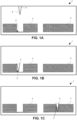
- FIGS. 1A to 1C illustrate cross-sectional views of a portion of a debris removal device 1 during a sequence of surface interactions in accordance with aspects of the present disclosure that are not part of the claims.
- a potential sequence of surface interactions that could selectively adhere a particle 2 from a substrate 3 and then relocate it to a soft patch 4 is shown in figures (moving from left to right).
- a particle 2 contaminates a (relatively) high surface energy substrate 3 which decreases its surface energy and increases the entropy in the whole system.
- a tip 5 with a diffusively mobile low surface energy coating is then driven to coat the (once again relatively) higher surface energy substrate 3 and particle 2, debonding them.
- the depletion of the low surface energy material may have slightly increased the surface energy of the tip 5 (closer to its normal, uncoated value) so that there is an energy gradient to adhere the now de-bonded particle 2 to a surface of the tip 6 (additionally, materials such a fluorocarbons typically have good cohesion).
- These interactions should also increase the entropy of the system especially if the tip surface 6 is cleaner than the substrate.
- the particle 2 is mechanically lodged into the soft patch material 4 and this mechanical action also recoats the tip surface 6 with the low surface energy material which should both decrease the energy and increase the entropy of the system.
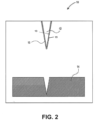
- FIG. 2 illustrates a cross-sectional view of a portion of a debris removal device 10 according to an aspect of the present disclosure that is not part of the claims.
- the device 10 includes a nanometer-scaled tip 12 positioned adjacent to a patch or reservoir 14 of low surface energy material.
- the low surface energy material in the reservoir may be solid, liquid, semi-liquid or semisolid.
- a coating 16 Formed on the tip 12 is a coating 16.
- tip 12 may be pre-coated or otherwise surface treated to modify the surface energy of the tip 12 (e.g., to modify the capillary, wetting, and/or surface tension effects).
- the coating 16 allows the tip 12 to remain sharper for a longer period of time than an uncoated tip.
- a PTFE-coated diamond tip can have a longer operating life than an uncoated diamond tip.
- the coating 16 may include the same low surface energy material found in the patch or reservoir of low energy material 14.
- the tip 12 may be in direct contact with the patch or reservoir of low energy material 14 and the coating 16 may be formed (or replenished) on the surface of tip 12 by rubbing or contacting the tip 12 against the patch or reservoir of low energy material 14. Furthermore, rubbing the tip 12 against the patch or reservoir of low energy material and/or scratching the pad 14 may enhance surface diffusion of the low surface energy material over the surface of tip 12.
- the coating 16 and the patch or reservoir of low energy material 14 may both be made from, or at least may include, chlorinated and fluorinated carbon-containing molecules such as Polytetrafluoroethylene (PTFE) or other similar materials such as Fluorinated ethylene propylene (FEP).
- PTFE Polytetrafluoroethylene
- FEP Fluorinated ethylene propylene
- an intermediate layer 15 of metallic material, oxide, metal oxide, or some other high surface energy material may be disposed between the surface of tip 12 and the low-surface energy material coating 16.
- Some representative examples of the intermediate layer may include, but is not limited to, cesium (Cs), iridium (Ir), and their oxides (as well as chlorides, fluorides, etc.).
- These two exemplary elemental metals are relatively soft metals with low and high surface energies respectively, and thus they represent the optimization of a surface energy gradient optimal for a given contaminate, substrate, and surrounding environment.
- the surface of tip 12 may be roughened or doped.
- the high surface energy material or tip treatment typically acts to bind the low-surface energy material coating 16 to the tip 12 more strongly. Since the shape of the tip also influences localized surface energy density variations (i.e., nanoscale sharpness will greatly increase surface energy density right at the apex), the shape of the tip 12 may also be modified to provide increased selective adhesion of particles to the tip.
- Roughening a tip surface 13 of the tip 12 may also provide greater adhesion due to the increase in surface area of contact with the particle and the number of potential binding sites (dA).
- the tip surface 13 may also be treated (possibly by chemical or plasma processes) so that the tip surface 13 contains highly unstable and chemically active dangling bonds that can react with a particle or some intermediary coating to increase adhesion.
- the tip surface 13 may also be coated with a high surface area material like high density carbon (HDC) or diamond like carbon (DLC) to increase the surface area of the tip 12 interacting with a particle.
- HDC high density carbon
- DLC diamond like carbon
- a high-surface energy pre-treatment is used without a low-surface energy coating 16 according to certain aspects of the present disclosure that are not part of the claims.
- the particles 20 discussed below may be embedded in some other soft targets (e.g., Au, Al) using similar methods to those discussed herein, or the tip 12 may be a consumable.
- other physical and/or environmental parameters may be modified (e.g., temperature, pressure, chemistry, humidity) to enhance tip treatment and/or particle pick-up/drop-off as will be appreciated by one skilled in the art in view of the present disclosure.
- the patch or reservoir of low energy material 14 is substantially flat and is attached to a stage that supports the substrate 18. Also, according to certain aspects of the present disclosure that are not part of the claims, the patch or reservoir of low energy material 14 is removable from the stage and may easily be replaced or easily refillable. For example, the patch or reservoir of low energy material 14 may be affixed to the AFM with an easily releasable clamp or magnetic mount (not illustrated).
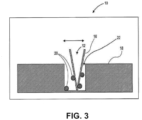
- FIG. 3 illustrates a cross-sectional view of another portion of the debris removal device 10 illustrated in FIG. 2 .
- a substrate 18 that may typically be positioned adjacent to the patch or reservoir of low energy material 14 illustrated in FIG. 2 .
- a plurality of particles 20 that may present in a trench 22 that is formed on the surface of the substrate 18.
- the particles 20 are typically attached to the surfaces of the trench 22 via Van der Waals short-range forces.
- the tip 12 may be moved and positioned adjacent to the substrate 18 to physically attach the particles 20 to the tip 12.
- the tip 12 as illustrated in FIGS. 2 and 3 may be a high aspect ratio tip.
- the particles 20 may be attached to or found on other structures to be cleaned.
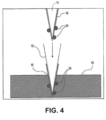
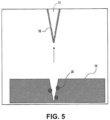
- FIG. 4 illustrates a cross-sectional view of the portion of the debris removal device 10 illustrated in FIG. 2 , wherein the particles 20 may be transferred from the tip 12 and may be imbedded in the patch or reservoir of low energy material 14 by extending the tip 12 into or against a surface of the patch or reservoir of low energy material 14. Subsequently, as shown in the cross-sectional view of FIG. 5 , the tip 12 may be retracted such that the tip 12 is no longer in contact with the patch or reservoir of low energy material 14. As the tip 12 is retracted or withdrawn from the patch or reservoir of low energy material 14, the particles 20 previously on the tip 12 remain with the patch or reservoir of low energy material 14.
- the device 10 illustrated in FIGS. 2-5 may be utilized to implement a method of debris removal. It should be noted that certain aspects of the present disclosure may be used in conjunction with other particle cleaning processes, either prior or pursuant to the method discussed herein. Further it should be noted that the terms particle, debris, or contaminate may be used interchangeable to describe anything foreign to the substrate surface. It should also be noted that, although only one tip 12 is discussed and shown in the figures, a plurality of tips may be used simultaneously to remove particles from multiple structures at the same time. Additionally, a plurality of tips could be used in the methods discussed herein in parallel and at the same time.
- the debris method mentioned above may include positioning the tip 12 adjacent to one or more of the particles 20 (i.e., the pieces of debris) illustrated as being on the substrate 18 in FIG. 3 .
- the method may further include physically adhering (as opposed to electrostatically adhering) the particles 20 to the tip 12 as also illustrated in FIG. 3 as well as some possible repetitive motion of the tip 12 when in contact with the particle(s) 20 and surrounding surfaces.
- the method may include removing the particles 20 from the substrate 18 by moving and/or withdrawing the tip 12 away from the substrate 18, and moving the tip 12 with the particles 20 to the patch or reservoir of low energy material 14, as illustrated in FIG. 4 .
- the method may include forming the coating 16 on at least a portion of the tip 12.
- the coating 16 may comprise a coating material that has a lower surface energy than a surface energy of the substrate 18. Additionally or alternatively, the coating 16 may comprise a coating material that has higher surface area than the surface area of the particle 20 that is in contact with the substrate 18.
- some aspects of the method may further include moving the tip 12 to at least a second location of the substrate 18 such that the tip 12 is adjacent to other pieces of particles or debris (not illustrated) such that the other pieces of particles or debris are physically attached to the tip 12.
- the other pieces of particles debris may then be removed from the substrate 18 by moving the tip 12 away from the substrate 18 in a manner analogous to what is shown in FIG. 4 .
- some methods according to the present disclosure may include a step of depositing the piece of debris in a piece of material positioned away from the substrate (e.g., the above-discussed patch or reservoir of low energy material 14).
- the method may include replenishing the coating 16 by plunging the tip 12 in the patch or reservoir of low energy material 14.
- Low surface energy material from the patch or reservoir of low energy material may coat any holes or gaps that may have developed in the coating 16 of the tip 12 over time.
- This replenishing may involve one or more of moving the tip 12 laterally within the patch or reservoir of low energy material 14 after plunging the tip 12 into the patch or reservoir of low energy material 14, rubbing a surface of the tip 12, or altering a physical parameter (e.g., temperature) of the tip 12 and/or the patch or reservoir of low energy material 14.
- certain methods according to the present disclosure may include exposing a small area around a defect or particle to a low surface energy material before a repair in order to reduce the likelihood that the removed material will lump together and strongly adhere again to the substrate after the repair is completed.
- a defect/particle and an approximately 1-2 micron area around the defect may be pre-coated with PTFE or FEP according to certain aspects of the present disclosure that are not part of the claims.
- a tip 12 coated or constructed from a low surface energy material can be used to apply a very generous amount of the low surface energy material to a repair area even when other repair tools (laser, e-beam) are being utilized.
- a portion or an entirety of the tip 12 may comprise a low energy material such as, but not limited to, chlorinated and fluorinated carbon-containing molecules. Examples of such materials may include PTFE or FEP. Additionally or alternatively, other materials such as metals and their compounds may be used. Some representative examples include Cs, Ir, and their oxides (as well as chlorides, fluorides, etc.).
- These two exemplary elemental metals are relatively soft metals with low and high surface energies respectively, and thus they represent the optimization of a surface energy gradient optimal for a given contaminate, substrate, and surrounding environment. Additionally or alternatively, other carbon based compounds may be used. Some representative examples include HDC or DLC.
- the method includes using the patch or reservoir of low energy material 14 to push the particles away from an apex of the tip 12 and toward an AFM cantilever arm (not illustrated) that is supporting the tip 12, above the apex. Such pushing up of the particles 20 may free up space near the apex of the tip 12 physically adhere more particles 20.
- the tip 12 is used to remove nanomachining debris from high aspect ratio structures such as, for example, the trench 22 of the substrate 18, by alternately, dipping, inserting, and/or indenting the tip 12 into a pallet of soft material which may be found in the patch or reservoir of low energy material 14.
- the soft material of the patch or reservoir of low energy material 14 may have a doughy or malleable consistency. This soft material may generally have a greater adherence to the tip 12 and/or debris material (e.g., in the particles 20) than to itself.
- the soft material may also be selected to have polar properties to electrostatically attract the nanomachining debris particles 20 to the tip 12.
- the patch or reservoir of low energy material 14 may comprise a mobile surfactant.
- the tip 12 may include one or more dielectric surfaces (i.e., electrically insulated surfaces). These surfaces may be rubbed on a similarly dielectric surface in certain environmental conditions (e.g., low humidity) to facilitate particle pick-up due to electrostatic surface charging.
- the coating 16 may attract particles by some other short-range mechanism, which may include, but is not limited to, hydrogen bonding, chemical reaction, enhanced surface diffusion.
- any tip that is strong and stiff enough to penetrate (i.e., indent) the soft pallet material of the patch or reservoir of low energy material 14 may be used.
- very high aspect tip geometries greater than 1:1 are within the scope of the present disclosure.
- high aspect ratio tips that are strong and flexible are generally selected over tips that are weaker and/or less flexible.
- the tip can be rubbed into the sides and corners of the repair trench 22 of the substrate 18 without damaging or altering the trench 22 or the substrate 18.
- the tip 12 may comprise a plurality of rigid or stiff nanofibrils bristles, as will be described in greater detail below.
- each bristle of the plurality of rigid or stiff nanofibrils bristles 30 may extended linearly from the tip 12.
- the plurality of rigid or stiff nanofibrils bristles 30 may be formed with carbon nanotubes, metal whiskers, etc.
- the tip 12 may additionally or alternatively comprise a plurality of flexible or wrap nanofibrils, as will be described in greater detail below.
- the plurality of flexible or wrap nanofibrils may be formed on the tip 12 using polymer materials, for example. Other materials and structures are of course contemplated.
- the detection of whether or not one or more particles have been picked up may be performed by employing a noncontact AFM scan of the region of interest (ROI) to detect particles.
- the tip 12 may then be retracted from the substrate 18 without rescanning until after treatment at the target.
- overall mass of debris material picked up by the tip 12 may also be monitored by relative shifts in the tip's resonant frequency.
- other dynamics may be used for the same function.
- the tip 12 may also be vectored into the patch or reservoir of low energy material 14 to remove the particles 20. As such, if the tip inadvertently picks up a particle 20, the particle 20 can be removed by doing another repair. Particularly when a different material is used for depositing the particles 20 by vectoring, then a soft metal such as a gold foil may be used.
- an ultra-violet (UV)-light-curable material may be used to coat the tip 12 and to form the coating 16.
- UV ultra-violet
- the material picks up particles 20 from the substrate 18.
- the tip 12 may be exposed to a UV source where the material's properties would be changed to make the particles 20 less adherent to the tip 12 and more adherent to the material in the patch or reservoir of low energy material 14, where the particles 20 may subsequently be removed from the tip 12 and deposited with the patch or reservoir of low energy material 14.
- Other nonreversible process which further enhances, or enables, the selectivity of particle pick up and removal are of course contemplated.
- Certain aspects of the present disclosure that are not part of the claims provide a variety of advantages. For example, certain aspects of the present disclosure that are not part of the claims allow for active removal of debris from high aspect trench structures using very high aspect AFM tip geometries (greater than 1:1). Also, certain aspects of the present disclosure that are not part of the claims may be implemented relatively easily by attaching a low surface energy or soft material pallet to an AFM, along with using a very high aspect tip and making relatively minor adjustments to the software repair sequences currently used by AFM operators. In addition, according to certain aspects of the present disclosure that are not part of the claims, a novel nanomachining tool may be implemented that could be used (like nano-tweezers) to selectively remove particles from the surface of a mask which could not be cleaned by any other method. This may be combined with a more traditional repair where the debris would first be dislodged from the surface with an uncoated tip, then picked up with a coated tip.
- a low surface energy material is used in the local clean methods discussed above, other possible variations are also within the scope of the present disclosure. Typically, these variations create a surface energy gradient (i.e., a Gibbs free energy gradient) that attracts the particle 20 to the tip 12 and may be subsequently reversed by some other treatment to release the particles 20 from the tip 12.
- a surface energy gradient i.e., a Gibbs free energy gradient
- One aspect of the present disclosure that is not part of the claims involves the attachment of at least one nanofibril to the working end of an AFM tip to provide enhanced capability in high aspect structures while also allowing for less mechanically aggressive process to the underlying substrate.
- These fibrils can be, according to their mechanical properties and application towards nanoparticle cleaning, classified under two different labels, "stiff' fibrils, and "wrap" fibrils.
- FIGS. 7A and 7B illustrate differences between these 2 types of fibrils, the stiff fibril 700 attached to a tip 710 and the wrap fibril 750 attached to a tip 760.
- the stiff fibril 700 relies more on the mechanical action, and mechanical strength, of the fibril itself to dislodge the nanoparticle. Thus, it also relies on the shear and bending strength and moduli of elasticity to accomplish the dislodgement successfully without breaking. This means there are very few materials which could exceed, or even meet, the strength and stiffness (typically referred to as its hardness) of single crystal diamond. Among these are carbon nanotubes and graphene, since both use the carbon-carbon sp3 hybrid orbital interatomic bonds (one of the strongest known) that are also found in diamond.
- contemplated materials include certain phases of boron-containing chemistries which possess properties that could possibly exceed the mechanical strength and stiffness of diamond so these materials could also be used.
- many materials including diamond can become intrinsically stronger and stiffer as their dimensionality is reduced (with stiffness decreasing as the structure approaches atomic scales and its shape is determined by thermal diffusive behaviors). This is a material phenomenon that was first observed in nanocrystalline metals but has also been confirmed in molecular simulation and some experiment to also occur with single crystal nanopillars.
- One leading hypothesis for this behavior leads into the defect diffusion mechanism of plastic deformation. At larger scales, these crystal defects (vacancies, dislocations, etc.) diffuse and interact in bulk-dominated kinetics.
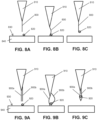
- FIGS. 8A to 8C illustrate an exemplary process of dislodging and removing a nanoparticle from a target substrate using a single stiff fibril 800 attached at or near the apex of an AFM tip 810.
- the tip 810 approaches the surface and scans using the same principles as an AFM scan without the stiff fibril. It will be appreciated by one skilled in the art that different operational parameters may be applied in view of the single stiff fibril 800 attached to the apex of the tip 810. Once the particle is located, the tip 810 is moved towards a surface 830 and the stiff fibril 800 is elastically deformed, as generally shown in FIG. 8B .
- the deformation of the stiff fibril 800 may be compressive, shear, bending, tensile or a combination thereof and can also be used to mechanically dislodge the nanoparticle 820 from the surface 830. Once the nanoparticle 820 is dislodged, the surface energy and area differences between the stiff fibril 800, substrate 840 and nanoparticle 820 surfaces govern whether the nanoparticle 820 adheres to the stiff fibril 800 when it is subsequently extracted from the substrate surface 830.
- the multi-fibril tip 910 may have more potential surface area for the particle 920 to adhere (i.e., wet) to. As the tip 910 is retracted from the substrate, as generally shown in FIG. 9C , another difference emerges if the length and spacing of the fibrils are within the correct range.
- the nanoparticle 920 with this setup has the possibility of becoming mechanically trapped within the spaces between the stiff nanofibrils 900a, 900b, which may result in greater adhesion to the multi-fibril 900a, 900b and a greater probably of extracting the nanoparticle 920 from the substrate surface 930.
- the tip 910 may be re-approached to a surface and the stiff fibrils 900a, 900b again stressed to relax their mechanical entrapment of the nanoparticle 920 thus increasing the probability the nanoparticle 920 will be deposited at the desired surface location.
- the length and spacing of the fibrils 900a, 900b are within the correct range, on the first order model, these ranges include a fibril spacing less than the minimum width of the nanoparticle 920 (assuming a strong nanoparticle that will not crumble), but large enough that the fibrils 900a, 900b will not be bent beyond their shear and bending strength limit (also determined by the relative length of the fibrils and assuming the adhesion strength of the fibril attachment is not less than this limit), as will be appreciated by those skilled in the art in view of the present disclosure.
- the two or more stiff fibrils may have different and unequal lengths.
- a stiff fibril is (as opposed to a wrap fibril), one must be able to define the anisotropic spring constants (related to the effective shear and bending moduli) for a specific material and nano-structure. Since this is very difficult to do in practice, it is assumed for our purposes here that these properties are roughly proportional to the tensile (a.k.a. Young's) elastic modulus and strength.
- the tensile modulus is a possible measure of the stiffness of a material within the stress range where it exhibits elastic (i.e., spring-like) mechanical properties. It is given as the stress divided by the strain, thus yielding units the same as stress (since stain is defined as deformation ratio of final versus initial dimension).
- tensile strength is also important since the fibril must be able to apply sufficient force to dislodge a nanoparticle without breaking-off itself and creating an additional contamination to the substrate surface.
- Strength is also given in units of stress (Pascals).
- the intrinsic tensile modulus is on the order of 1.22 terra-Pascals (TPa) with a tensile strength ranging from 8.7 to 16.5 giga-Pascals (GPa) and provides here our general reference measure for stiffness and strength (approaching within the value for tungsten of 0.5 TPa for tensile elastic modulus, or exceeding these values).
- a wrap fibril in contrast to a stiff fibril, will have much lower spring constants (specified here as elastic tensile moduli) with sufficiently high (comparable) tensile strength.
- elastic tensile moduli the spring constants
- the tensile strength is directly related to its performance since a tensile force is applied to both dislodge and extract the nanoparticle from the substrate surface.
- most mechanical properties quoted in the literature are for the bulk material which should, in principle, be almost completely unrelated to the tensile properties for mono-molecular fibrils (or nano-scale fibrils approaching mono-molecular scales).
- PTFE is typically quoted to have very low tensile elastic modulus and strength in the bulk material (0.5 GPa and maybe ⁇ 20 MPa respectively), but since the molecule's backbone is comprised of carbon-carbon sp-hybrid orbital chemical bonds, its mono-molecular tensile strength should be more comparable to diamond than many other materials, C-nanotubes, and graphene (all of which contain the same kind of chemical bonds). Since the bulk material mechanical properties is more related to the action of single-molecule strands interacting with their neighbors, it should be more comparable to both the cohesive and mono-molecular bending and shear moduli.
- FIGS. 10A to 10C show a nanoparticle cleaning sequence using a wrap (flexible) nanofibril 1000 attached to an AFM tip 1010 near or at the apex, in accordance with an aspect of the present disclosure that ia not part of the claims. Since there is no compression stress required to deform the wrap-type fibril 1000, the tip 1010 is brought into close proximity to the surface 1030 in order to bring the fibril 1000 into close enough proximity to the nanoparticle surface for short range surface energy forces to allow for the fibril 1000 to adhere to it.
- the relative surface energies of the fibril 1000, nanoparticle 1020, and substrate surfaces 1030 are targeted so that the fibril would preferentially adhere to the nanoparticle surface, once the fibril 1000 is brought into contact with enough slack given the fibril length, only time and applied agitation energies (possibly mechanical and/or thermal) are required to allow the fibril 1000 to wrap around the particle 1020. It is possible that mechanical energies (whether by the tip 1010 with the fibrils 1000 attached, or another tip in a prior processing pass) from a more rigid tip could be applied to initially dislodge the particle 1120. Once the fibril 1000 is sufficiently wrapped-around the nanoparticle 1020, as generally shown in FIG. 10B , the tip 1010 is then extracted from the substrate surface 1030.
- the nanoparticle 1020 will be extracted from the substrate 1040 with the tip 1010, as generally shown in FIG. 10C .
- RNA/DNA RNA/DNA
- Actin amyloid nanostructures
- Ionomers RNA/DNA
- DNA deoxyribonucleic acid
- AFM tip 1110 is immersed in the aqueous solution, or placed in AFM-contact to a surface, containing the DNA sequences so that the latter bind as designed.
- the tip 1110 may then be functionalized for particle removal from a substrate surface 1130, as shown in FIGS. 11A to 11D . Moving from left to right in the figures, the functionalized tip 1110 may be moved or actuated to approach near (closer than the length of the DNA strands 1100) the particle 1120 and substrate surfaces 1130, as shown in FIG. 11A .
- a higher temperature may be applied (possibly ⁇ 90°C) with an activating chemistry (either helper DNA strands, also available commercially, or some other ionic activator such as a magnesium salt) while the tip 1110 is near the dislodged particle 1120 as shown in FIG. 11B .
- the environment may then cooled (possibly to ⁇ 20°C) allowing the targeted sequences in the strands 1100 to link up as shown in FIG. 11C (the linking strands 1100 are at the opposite free ends of the molecules).
- the tip 1110 may then be extracted from the substrate surface 1130 as shown in FIG. 11D .
- this bonding between the nanoparticle and the tip it is possible to describe this bonding between the nanoparticle and the tip to be mechanical, however if the particle is on the molecular scale, it could also be described as a steric bond. Steric effects may be created by atomic repulsion at close enough proximity. If an atom or molecule is surrounded by atoms in all possible diffusion directions, it will be effectively trapped and unable to chemically of physically interact with any other atoms or molecules in its environment. RNA can similarly be manipulated as will be appreciated by those skilled in the art in view of the present disclosure
- the next possible wrap nano-fibril candidate is a family of similar globular multifunction proteins that forms filaments in eukaryotic cells, one of which is known as actin. Actin is used inside cells for scaffolding, anchoring, mechanical supports, and binding, which would indicate it is a highly adaptable and sufficiently strong protein filament. It would be applied and used in methods very similar to the DNA-origami related process discussed above. Experiments indicate that this protein can be crystalized to a molecule of dimensions of 6.7 ⁇ 4.0 ⁇ 3.7 nm.
- Fibrillar nanostructures like this have several advantages including: underwater adhesion, tolerance to environmental deterioration, self-healing from self-polymerization, and large fibril surface areas. As previously discussed, large fibril surface areas enhance adhesion by increasing the contact area in the adhesive plaques of barnacles. Amyloid nanostructures also have possible mechanical advantages such as cohesive strength associated with the generic amyloid intermolecular ⁇ -sheet structure and adhesive strength related to adhesive residues external to the amyloid core. These properties make amyloid structures a basis for a promising new generation of bio-inspired adhesives for a wide range of applications.
- a wrap fibril material is a class of polymers known as ionomers.
- these are long thermoplastic polymer molecules that strongly bind at targeted ionic charged sites along the molecular chain.
- a common example of an ionomer chemistry is poly(ethylene-co-methacrylic acid).
- the ionomer may be functionalized to the surface of a scanning thermal probe. The process for cleaning a nanoparticle would then be very similar to that shown for the DNA-origami process discussed above except that an aqueous environment would not necessarily be required especially when used with the scanning thermal probe.
- An ionomer functionalization coating may also be paired with an ionic surfactant for preferential conjugate bonding within an aqueous (or similar solvent) environment. It should be mentioned that these examples (especially DNA/RNA and actin) are highly biocompatible for removal and manipulation of nano-particulate entities inside living structures such as cells.
- one variation that may be used includes using a high surface energy tip coating.
- Another variation includes pretreating the particles with a low surface energy material to debond the particles and then contacting the particles with a high surface energy tip coating (sometimes on a different tip).
- Still another variation includes making use of a chemical energy gradient that corresponds to a chemical reaction occurring between a tip surface coating and the particle surface to bond the two. This may either be performed until a tip is exhausted or reversed with some other treatment.
- adhesives or sticky coatings are used in combination with one or more of the above-listed factors.
- the surface roughness or small scale (e.g., nanometer-scale) texture can be engineered to maximize particle clean process efficiency.
- mechanical bonding may be used, typically when the tip 12 includes fibrils that, analogously to a mop, are capable of mechanically entangling the particles 20.
- the mechanical entanglement is driven by and/or enhanced by surface energy or chemical changes with contact or environment.
- the tip 12 may be coated with molecular tweezers (i.e., molecular clips).
- molecular tweezers i.e., molecular clips
- These tweezers may comprise noncyclic compounds with open cavities capable of binding guests (e.g., the above-discussed particles 20).
- the open cavity of the tweezers typically binds guests using non-covalent bonding including hydrogen bonding, metal coordination, hydrophobic forces, van der Waals forces, ⁇ - ⁇ interactions, and/or electrostatic effects.
- These tweezers are sometimes analogous to macrocyclic molecular receptors except that the two arms that bind the guest molecules are typically only connected at one end.
- the particles 20 may be removed by the tip using diffusion bonding or Casmir effects.
- bristles or fibrils 30 can be attached to the end of the tip 12. Whether strategically or randomly placed, these bristles or fibrils 30 can enhance local clean in several ways. For example, an associated increase in surface area may be used for surface (short range) bonding to the particles.
- fibrils 30 are engineered to be molecules that selectively (e.g., by either surface or environment) coil around and entangle a particle 20, thus maximizing surface contact. Also, dislodging of the particles 20 occurs according to certain aspects of the present disclosure, typically when stiff bristles 30 are attached to the tip 12. However, fibrils 30 may also entangle a particle 20 and dislodge the particle 20 mechanically by pulling on the particle 20. In contrast, relatively rigid bristles 30 typically allow the tip 12 to extend into hard-to-reach crevices. Then, by impact deformation stress of the bristles 30, by surface-modification of the tip 12 to repel particles 20, or by some combination, the particle 20 is dislodged.
- certain aspects of the present disclosure mechanically bond the particles 20 to the tip 12.
- fibrils are on the tip 12, entanglement of one or more of either the whole or frayed fibrils may occur.
- the particle 20 may be wedged between (elastically) stressed bristles.
- methods of debris removal include changing the environment to facilitate local clean.
- gas or liquid media may be introduced or the chemistry and/or physical properties (e.g., pressure, temperature, and humidity) may be changed.
- a relatively soft cleaning tip is used to avoid unwanted damage to inside contours, walls, and/or bottom of a complex shape.
- a stronger force is used to bring the relatively soft tip into much stronger contact with the surface while also increasing the scan speed.
- a tip exposed to and/or coated with a low surface energy material may be used for other purposes besides removing debris (cleaning) of nanometer level structures.
- such tips can also be used, according to certain aspects of the present disclosure that are not part of the claims, to periodically lubricate micron level or smaller devices (like MEMS/NEMS) to contain chemical reactions.
- This method may be performed in a variety of environments according to the requirements of the application and to further enhance differential adhesion of the particle from the substrate surface to the patch or reservoir of low energy material.
- environments may include, but are not limited to, vacuum, shield gasses of various composition and pressure, and fluids of variable composition (including fluids with varying ionic strengths and/or pHs).
- the deformation of the tip material may also provide a mechanism of mechanical entrapment of the debris especially if it is roughened (or covered in nano-bristles) and/or if it has a high microstructural defect (i.e., void) density at the surface.
- the final factor that will be discussed will be chemical potential energy. It is possible to modify the chemical state of the tip and/or soft patch surfaces to create preferential chemical reactions to bond the debris material to the tip. These chemical bonds may be covalent or ionic in nature (with the sp3-hybid orbital covalent bond being the strongest).
- the debris may be coated with one component of a targeted lock-and-key chemically bonding pair of chemistries.
- the tip (or another tip) may be coated with the other chemical and brought in contact with the debris surface to bond it to the tip.
- One non-limiting example of a lock-and-key pair of chemistries is streptavidin and biotin which is often used in Chemical Force Microscopy (CFM) experiments.
- Another example using an ionic bond would be two surfactant polar molecular chemistries where the exposed polar ends of the molecules on the debris and tip surface are of opposite charge.
- CFM Chemical Force Microscopy
- Chemical changes to the tip surface would also allow for targeted changes to its surface energy as well as phase changes (in particular from fluid to solid) that may surround (to maximize surface area dA) and mechanically entrap the debris at the tip surface in order to bond it.
- These chemical changes may be catalyzed by external energy sources such as heat (temperature), ultraviolet light, and charged particle beams.
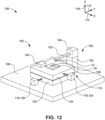
- FIG. 12 illustrates a perspective view of a debris collection apparatus 100 for extracting debris 20 from a substrate 18, according to an aspect of the disclosure that is not part of the claims.
- the apparatus 100 includes a substrate support assembly 102 and a tip support assembly 104, each being supported by or coupled to a base 106.
- the base 106 may be a unitary slab, such as a unitary metallic slab, a unitary stone slab, a unitary concrete slab, or any other unitary slab structure known in the art.
- the base 106 may include a plurality of slabs that are fixed relative to one another.
- the plurality of slabs may include a metal slab, a stone slab, a concrete slab, combinations thereof, or any other slab assembly known in the art.
- the base 106 may be a unitary stone slab, such as a unitary granite slab or a unitary marble slab, for example.
- the substrate support assembly 102 may include a fixture 108 configured to support the substrate 18, fix the substrate 18 to the substrate support assembly 102, or both.
- the substrate support assembly 102 may further include a substrate stage assembly 110 that is configured to move the fixture 108 relative to the base 106.
- the substrate stage assembly 110 may include one or more motion stages, such as linear translation stages, rotational motion stages, combinations thereof, or any other motion stage known in the art.
- the substrate stage assembly 110 may be configured to move the fixture 108 relative to the base 106 in translation along an x-direction 112, in translation along a y-direction 114, in translation along a z-direction 116, in rotation about the x-direction 112, in rotation about the y-direction 114, in rotation about the z-direction 116, or combinations thereof.
- the x-direction 112, the y-direction 114, and the z-direction 116 may be mutually orthogonal to one another, however, it will be appreciated that x-direction 112, the y-direction 114, and the z-direction 116 need not be mutually orthogonal to one another.
- the one or more motion stages of the substrate stage assembly 110 may include one or more actuators 118 that are configured to effect a desired relative motion between the fixture 108 and the base 106.
- the one or more actuators 118 may include a rotational motor coupled to the substrate stage assembly 110 via a threaded rod or a worm gear, a servo motor, a magnetic actuator configured to assert a force on the substrate stage assembly 110 via a magnetic field, a pneumatic or hydraulic piston coupled to the substrate stage assembly 110 via a piston rod, a piezoelectric actuator, or any other motion actuator known in the art.
- the one or more actuators 118 may be fixed to the base 106.
- the substrate stage assembly 110 may include a first stage 120 and a second stage 122, where the first stage 120 is configured to move the fixture 108 relative to the second stage 122 via a first actuator 124, and the second stage is configured to move the first stage 120 relative to the base via a second actuator 126.
- the first actuator 124 may be configured to translate the first stage 120 along the x-direction 112
- the second actuator 126 may be configured to translate the second stage 122 along the y-direction 114.
- the first stage 120 and the second stage 122 may be configured to move relative to the base 106 in translation along or rotation about other axes to suit other applications.
- the tip support assembly 104 may include a tip 12 coupled to a tip stage assembly 130 via a tip cantilever 132.
- the tip 12 may be a Scanning Probe Microscopy (SPM) tip, such as a tip for an AFM or a Scanning Tunneling Microscopy (STM). It will be appreciated that the tip 12 illustrated in FIG. 12 may embody any of the tip structures or attributes previously discussed herein. Accordingly, the tip stage assembly 130 may be an SPM scanner assembly.
- the tip stage assembly 130 may be fixed to the base 106, and configured to move the tip 12 relative to the base 106 in translation along the x-direction 112, in translation along the y-direction 114, in translation along the z-direction 116, in rotation about the x-direction 112, in rotation about the y-direction 114, in rotation about the z-direction 116, or combinations thereof.
- the tip stage assembly 130 may include one or more actuators 134 to effect the desired motion of the tip 12 relative to the base 106.
- the one or more actuators may include a rotary actuator system operatively coupled to the tip 12 in order to rotate the tip 12 about a first axis.
- the one or more actuators 134 may include one or more piezoelectric actuators, however, it will be appreciated that other actuator structures may be used for the one or more actuators 134 to meet the needs of a particular application, without departing from the scope of the present disclosure.
- the substrate stage assembly 110 may be configured to effect motions with greater magnitude and lower precision than motions effected by the tip stage assembly 130.
- the substrate stage assembly 110 may be tailored to effect coarse relative motion between the fixture 108 and the tip 12, and the tip stage assembly 130 may be tailored to effect finer relative motion between the fixture 108 and the tip 12.
- the apparatus 100 of FIG. 12 may include a first patch 142 disposed on the substrate support assembly 102, the base 106, or both.
- the apparatus 100 may include a first patch 142 and a second patch 144 disposed on the substrate support assembly 102, the base 106, or both.
- the first patch 142, the second patch 144, or both may embody any of the structures, materials, or attributes of the patch 14 previously discussed.
- the second patch 144 may embody structures and materials that are similar or identical to that of the first patch 142, where the second patch 144 is used predominately to receive and hold debris 20 collected from the substrate 18 via the tip 12, and the first patch is used predominately to treat or prepare the tip 12 for subsequent collection of debris 20 from the substrate 18.
- the second patch 144 may embody structures or materials different from the first patch 142, such that the first patch 142 may be better tailored to treating the tip 12 before collecting debris 20 from the substrate 18, and the second patch 144 may be better tailored to receive and hold debris 20 collected from the substrate 18 and deposited onto the second patch 144 via the tip 12.
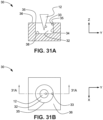
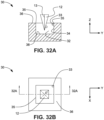
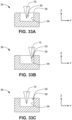
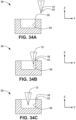
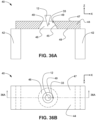
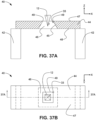
- the second patch 144 may be configured as a collection pocket or collection through-hole for collecting debris or contaminate from the tip 12, as will be described in further detail with reference to FIGS. 30-37 .
- the first patch 142 or the second patch 144 may be used alone to both treat the tip 12 prior to collecting debris 20 from the substrate 18 and to receive and hold debris 20 collected from the substrate 18 using the tip 12.
- the second patch 144 may be disposed or mounted to the first stage 120 opposite of the first patch 142.
- the second patch 144 may be located adjacent to the first patch 142, or may be located on any other location of the first stage 120 or on the debris collection apparatus 100 to promote capture of debris when configured as a collection pocket or collection through-hole.
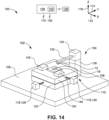
- any or all of the actuators 118 for the substrate stage assembly and the actuators 134 for the tip stage assembly from the debris collection apparatus 100 of FIGS. 12 or 13 , respectively, may operatively be coupled to a controller 136 for control thereof.
- the controller 136 may effect relative motion between the fixture 108 and the base 106, and the tip 12 and the base 106 through control of the actuators 118, 134, respectively.
- the controller 136 may effect relative motion between the tip 12 and the fixture 108 through control of the actuators 118, 134.
- controller 136 may effect relative motion between the fixture 108 and the base 106 in response to manual user inputs 138, procedures or algorithms pre-programmed into a memory 140 of the controller 136, combinations thereof, or any other control inputs known in the art. It will be appreciated that pre-programmed control algorithms for the controller 136 may include closed-loop algorithms, open-loop algorithms, or both.
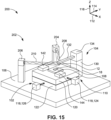
- FIG. 15 illustrates a perspective view of a debris collection and metrology apparatus 200 for extracting debris 10 from a substrate 18 and analyzing properties of the debris 20, according to an aspect of the disclosure that is not part of the claims.
- the debris collection and metrology apparatus 200 includes a substrate support assembly 102, a tip support assembly 104, and a base 106.
- the debris collection and metrology apparatus 200 further includes a metrology system 202.
- the metrology system 202 may be a nano-scale metrology system.
- the metrology system 202 includes an energy source 204 and an energy detector 206.
- the energy source 204 is an x-ray source, a visible light source, an infrared light source, an ultraviolet light source, an electron beam source, a laser source, combinations thereof. It will be appreciated that visible light sources may include a visible light laser, infrared light sources may include an infrared laser, and ultraviolet light sources may include an ultraviolet laser.
- the energy source 204 is directed towards and trained on the tip 12 such that an incident energy beam 208 generated by the energy source 204 is incident upon the tip 12. At least a portion of the incident energy beam 208 may be reflected, refracted, or absorbed and re-emitted by the tip 12 or debris 20 disposed on the tip 12.
- the energy source 204 is an irradiation source configured and arranged to direct an incident irradiation onto the tip 12, such as an SPM tip
- the energy detector 206 is an irradiation detector configured and arranged to receive a sample irradiation from the tip 12, the sample radiation being generated as a result of the incident irradiation being applied and reflected, refracted, or absorbed and re-emitted by the tip 12 or debris 20 disposed on the tip 12.
- the energy detector 206 is also directed towards and trained on the tip 12 such that a sample energy beam 210 is incident upon the energy detector 206.
- the sample energy beam 210 includes contributions from the incident energy beam 208 reflected by the tip 12 or debris 20 disposed on the tip 12, refracted by the tip 12 or debris 20 disposed on the tip 12, absorbed and re-emitted by the tip 12 or debris 20 disposed on the tip 12, combinations thereof, or any other energy beam that may result from an interaction between the incident energy beam 208 and either the tip 12 or debris 20 disposed on the tip 12.
- the energy detector 206 is a light detector, such as a photomultiplier tube or a photodiode, for example, an x-ray detector; an electron beam detector; combinations thereof.
- the energy source 204 includes an electron beam source, and the energy detector 206 includes an x-ray detector.
- the energy source 204 includes an x-ray source, and the energy detector 206 includes an electron beam detector.
- the energy source 204 includes a light source, including but not limited to, visible light and infrared light.
- the energy detector 206 may be configured to generate an output signal based on an intensity of the sample energy beam 210, a frequency of the sample energy beam 210, combinations thereof, or any other electromagnetic radiation property of the sample energy beam 210 known in the art. Further, in accordance with aspects of the present disclosure, the energy detector 206 is coupled to the controller 136, as shown in FIG. 16 , such that the controller 136 receives the output signal from the energy detector 206 in response to the sample energy beam. Accordingly, as described later herein, the controller 136 is configured to analyze the output signal from the energy detector 206 in response to the sample energy beam 210 and identify one or more material attributes of the tip 12 or debris 20 disposed on the tip 12.
- the energy source 204 may operatively be coupled to the controller 136 of FIG. 16 , such that the controller 136 may control attributes of the incident energy beam 208 that is generated by the energy source 204, such as, but not limited to an intensity of the incident energy beam 208, a frequency of the incident energy beam 208, or both.
- a direction of the energy source 204, the sample energy beam 210, and/or the energy detector 206 may be adjusted in response to the output signal from the energy detector 206.
- the controller 136 is operatively coupled to an actuator system including the one or more actuators 134 and the energy detector 206, the controller 136 being configured to receive a first signal based on a first response of the energy detector to a sample irradiation, such as the sample energy beam 210, and being configured to effect relative motion between the tip 12 and the at least one energy detector 206 via the one or more actuators 134 based on the first signal.
- the controller 136 may be configured to generate a first frequency domain spectrum of the sample irradiation based on a first response of the irradiation detector to a sample irradiation, and generate a second frequency domain spectrum by subtracting a background frequency domain spectrum from the first frequency domain spectrum.
- the controller 136 may effect relative motion between the tip 12 and at least one of the energy source 204 and the energy detector 206 via the one or more actuators 134. In one aspect, the controller 136 may further be configured to generate the background frequency domain based on a response of the energy detector 206 on the tip 12 when the tip 12 is free of or substantially free of contamination. In one aspect, the controller 136 may be configured to receive a second signal based on a second response of the energy detector 206 to the sample irradiation, and the controller 136 may be configured to effect relative motion between the tip 12 and at least one of the energy detector 206 and the energy source 204 via the one or more actuators 134 based on a difference between the first signal and the second signal. In one aspect, the controller 136 is configured to effect a magnitude of relative motion between the tip 12 and at least one of the energy detector 206 and the energy source 204 based on a difference between the first signal and the second signal.
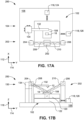
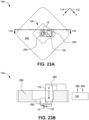
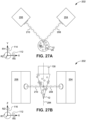
- FIGS. 17A, 17B , 18A and 18B illustrate top views of a debris collection and metrology apparatus 250
- FIGS. 17B and 18B illustrate side views of a debris collection and metrology apparatus 250, according to aspects of the disclosure that are not part of the claims.
- the debris collection and metrology apparatus 250 may include a substrate support assembly 102, a tip support assembly 104, a base 106, and a metrology system 202.
- the energy source 204 and the energy detector 206 may each be directed towards and trained on a patch 252 instead of the tip 12.
- the patch 252 may embody any of the structures or attributes of the first patch 142 or the second patch 144 previously discussed, or the patch 252 may include or be configured as a collection pocket or collection through-hole for collecting debris or contaminate from the tip 12, as will be described in further detail with reference to FIGS. 30-37 . Accordingly, the debris collection and metrology apparatus 250 may be configured to analyze a material property of the patch 252, debris 20 disposed on the patch 252, or combinations thereof, using the metrology system 202.
- Actuation and/or adjustment of the substrate stage assembly 110, the tip stage assembly 130, or both is capable of effecting at least three procedures using the debris collection and metrology apparatus 250.
- actuation and/or movement of the substrate stage assembly 110, the tip stage assembly 130, or both effects contact between the tip 12 and a substrate 18 disposed on the fixture 108, such that debris 20 is transferred from the substrate 18 to the tip 12.
- actuation and/or movement of the substrate stage assembly 110, the tip stage assembly 130, or both effects contact between the tip 12 and the patch 252 to transfer debris 20 from the tip 12 to the patch 252.
- actuation and/or movement of the substrate stage assembly 110 directs and trains each of the energy source 204 and the energy detector 206 onto the patch 252, such that an incident energy beam 208 from the energy source 204 is incident upon the patch 252, and a sample energy beam 210 emanating from the patch 252 is incident up on the energy detector 206.
- the energy detector 206 may be coupled to the controller 136, such that the controller 136 receives the output signal from the energy detector 206 in response to the sample energy beam. Accordingly, as described later herein, the controller 136 may be configured to analyze the output signal from the energy detector 206 in response to the sample energy beam 210 and identify one or more material attributes of the patch 252 or debris 20 disposed on the patch 252. Optionally, the energy source 204 may operatively be coupled to the controller 136 of FIGS.
- the controller 136 may control attributes of the incident energy beam 208 that is generated by the energy source 204, such as, but not limited to an intensity of the incident energy beam 208, a frequency of the incident energy beam 208, or both.
- a direction of the energy source 204, the sample energy beam 210, and/or the energy detector 206 may be adjusted in response to the output signal from the energy detector 206.
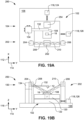
- FIGS. 19A, 19B , 20A and 20B illustrate top view of a debris collection and metrology apparatus 250
- FIGS. 19B and 20B illustrate side views of a debris collection and metrology apparatus 250, according to aspects of the disclosure that are not part of the claims.
- the debris collection and metrology apparatus 250 may include a substrate support assembly 102, a tip support assembly 104, a base 106, a metrology system 202, an energy source 204, and an energy detector 206.
- 17A, 17B , 18A and 18B may further include a first patch 252 and a second patch 254.
- the first patch 252 and the second patch 254 may be disposed on opposite sides of the substrate 18 and mounted to the fixture 108.
- the energy source 204 and the energy detector 206 may each be directed towards and trained on at least one of the first patch 252 and the second patch 254.
- the first patch 252 and the second patch 254 may embody any of the structures or attributes previously described.
- the first patch 252 and the second patch 254 may include or may be configured as a collection pocket or collection through-hole for collecting debris or contaminate from the tip 12, as will be described in further detail with reference to FIGS. 30-37 .
- the debris collection and metrology apparatus 250, the energy source 204 and the energy detector 206 may each be directed towards the collection pocket or collection through-hole to analyze a material property of debris or contaminate 20 collected on the collection pocket or collection through-hole using the metrology system 202.
- Actuation and/or adjustment of the substrate stage assembly 110, the tip stage assembly 130, or both, is capable of effecting at least three procedures using the debris collection and metrology apparatus 250.
- debris may be removed from the substrate 18 and collected using a collection pocket or a collection through-hole as will be described in further detail below.
- the collection pocket or the collection through-hole may be a part of the first patch 252 and the second patch 254, or may be mounted or positioned at a location of the first patch 252 and the second patch 254.
- actuation and/or movement of the substrate stage assembly 110, the tip stage assembly 130, or both effects contact between the tip 12 and a substrate 18 disposed on the fixture 108, such that debris 20 is transferred from the substrate 18 to the tip 12.
- actuation and/or movement of the substrate stage assembly 110, the tip stage assembly 130, or both effects contact between the tip 12 and the collection pocket or the collection through-hole of the first patch 252, thereby transferring debris 20 from the tip 12 to the collection pocket or the collection through-hole of the first patch 252.
- the actuation and/or movement of the tip 12 relative to the collection pocket or the collection through-hole of the first patch 252 may follow a predetermined trajectory as will be described in further detail below with references to FIGS. 33 and 34 .
- actuation and/or movement of the substrate stage assembly 110 directs and trains each of the energy source 204 and the energy detector 206 onto the collection through-hole of the first patch 252, such that an incident energy beam 208 from the energy source 204 is incident upon the patch 252, and a sample energy beam 210 emanating from the patch 252 is incident up on the energy detector 206.
- the energy detector 206 may be coupled to the controller 136, such that the controller 136 receives the output signal from the energy detector 206 in response to the sample energy beam.
- the controller 136 may be configured to analyze the output signal from the energy detector 206 in response to the sample energy beam 210 and identify one or more material attributes of the collection pocket or the collection through-hole of the first patch 252, or debris disposed on the collection pocket or the collection through-hole of the first patch 252.
- the energy source 204 may operative be coupled to the controller 136 of FIGS.
- the controller 136 may control attributes of the incident energy beam 208 that is generated by the energy source 204, such as, but not limited to an intensity of the incident energy beam 208, a frequency of the incident energy beam 208, or both.
- a direction of the energy source 204, the sample energy beam 210, and/or the energy detector 206 may be adjusted in response to the output signal from the energy detector 206.
- FIG. 21A illustrates a top view of a debris collection and metrology apparatus 260, according to an aspect of the disclosure that is not part of the claims
- FIG. 21B illustrates a side view of a debris collection and metrology apparatus 260, according to an aspect of the disclosure that is not part of the claims.
- the debris collection and metrology apparatus 260 includes a substrate support assembly 102, a tip support assembly 104, a base 106, and a metrology system 202.
- the tip support assembly 104 further includes a robot 262.
- the robot 262 may include a motor 264 and a robotic arm 266.
- a proximal end of the robotic arm 266 may operatively be coupled to the base 106 via a motor 264
- the tip stage assembly 130 may operatively be coupled to a distal end of the robotic arm 266, such that operation of the motor 264 effects relative motion between the tip 12 and the base 106.
- operation of the motor 264 effects rotational motion of the tip 12 relative to the base 106 about a rotational axis 268 of the robot 262.
- the metrology system 202 includes a patch 252 and may include a metrology stage assembly 270 to support the patch 252.
- the patch 252 may be supported directly on or by the base 106, absent a metrology stage assembly 270.
- the metrology stage assembly 270 may be configured to effect relative motion between the patch 252 and the base 106 in translation along the x-direction 112, in translation along the y-direction 114, in translation along the z-direction 116, in rotation about the x-direction 112, in rotation about the y-direction 114, in rotation about the z-direction 116, combinations thereof, or any other relative motion known in the art.
- the metrology stage assembly 270 may embody any of the structures or attributes described previously for the substrate stage assembly 110, the tip stage assembly 130, or both.
- the robotic arm 266 is shown in a first position, such that the tip 12 is located proximal to the fixture 108.
- the robotic arm 266 is located in the first position, motion of the substrate stage assembly 110, the tip stage assembly 130, or both, is sufficient to effect contact between the tip 12 and a substrate 18 mounted to the fixture 108.
- the debris collection and metrology apparatus 260 may effect a transfer of debris 20 from the substrate 18 to the tip 12.
- the robotic arm 266 is shown in a second position, such that the tip 12 is located proximal to a metrology system 202.
- the robotic arm 266 is located in its second position, motion of the tip stage assembly 130, or combined motion of the tip stage assembly 130 and the metrology stage assembly 270, is sufficient to effect contact between the tip 12 and the patch 252.
- the debris collection and metrology apparatus 270 may effect a transfer of debris 20 from the tip 12 to the patch 252.
- the patch 252 may include or be configured as a collection pocket or collection through-hole for collecting debris or contaminate from the tip 12, as will be described in further detail with reference to FIGS. 30-37 .
- the debris collection and metrology apparatus 270 may include an energy source 204 and an energy detector 206 directed towards and trained on the patch 252, similar or identical to those illustrated in FIGS. 17A and 17B to perform metrology analysis on the patch 252, debris 20 disposed on the patch 252, or both.
- any one or more of the robot 262, the substrate stage assembly 110, the tip stage assembly 130, and the metrology stage assembly 270 in the debris collection and metrology apparatus 260 may operatively be coupled to the controller 136 for control thereof. Accordingly, the controller 136 may be configured to actuate the robot 262 to switch configurations between the aforementioned first position shown in FIGS. 21A and 21B and the second position shown in FIGS. 22A and 22B .
- FIG. 23A illustrates a bottom view of a tip support assembly 104, according to an aspect of the disclosure that is not part of the claims
- FIG. 23B illustrates a partial cross-sectional side view of a tip support assembly 104 taken along section line 23B-23B according to an aspect of the disclosure that is not part of the claims.
- the tip support assembly 104 illustrated in FIGS. 23A and 23B may be especially suited for integration into the robotic arm 266, as shown in FIGS. 21A, 21B , 22A and 22B .
- the tip support assembly 104 may be advantageously incorporated into other debris collection and/or metrology systems to satisfy particular needs, as will be appreciated by one skilled in the art in view of the present disclosure.
- the tip support assembly 104 illustrated in FIGS. 23A and 23B includes a z-actuator 280, a camera 282, or both, however, it will be appreciated that the tip support assembly 104 may embody any other structures or attributes previously discussed for tip support assemblies, not limited to means for translational motion along the x-direction 112 or the y-direction 114, as well as rotational motion about any of the x-direction 112, the y-direction 114, and the z-direction 116.
- a proximal end of the z-actuator 280 may operatively be coupled to the robotic arm 266, and a distal end of the z-actuator 280 may operatively be coupled to the tip 12 via the tip cantilever 132, the camera 282, or both. Accordingly, operation of the z-actuator 280 effects relative motion between the tip 12, the camera 282, or both along the z-direction 116.
- the z-actuator 280 may include a rotary motor and a screw structure, a linear servo-motor structure, a pneumatic or hydraulic piston structure, a piezoelectric structure, or any other linear actuator structure known in the art.
- the z-actuator 280 may operatively be coupled to the controller 136 to control a relative motion between the robotic arm 266 and the tip 12, the camera 282, or both. Further the camera 282 may also be coupled to the controller 136 to provide images of a substrate proximate to the tip 12 to a user display, a machine vision algorithm for control of the tip 12, or both.
- FIG. 24A illustrates a bottom view of a metrology system 202, which may be the same or a similar the metrology system 202 previously described with reference to FIGS. 15-20 , although it will be appreciated by one skilled in the art that the metrology system 202 of FIGS. 24A and 24B may be representative of other systems that are not part of the claims including at least a tip 12, a tip stage assembly 13, an energy source 204, and an energy detector 206.
- FIG. 24B illustrates a side view of a metrology system 202, according to an aspect of the disclosure. The structure of the metrology system 202 illustrated in FIGS.
- the specific tip 12 shown in FIGS. 24A and 24B may include a tetrahedral shape. As shown in FIGS. 24A and 24B , the tip 12 with the tetrahedral shape is free of any debris 20. Accordingly, the metrology system 202 may be used to analyze attributes of the tip 12 absent any debris 20 attached to the tip 12.
- the energy source 204 is directed towards and trained on the tip 12, such that an incident energy beam 208 generated by the energy source 204 is incident upon the tip 12, and the energy detector 206 is directed towards and trained on the tip 12, such that a sample energy beam 210 generated in response to the incident energy beam 208 on the tip 12 is received by the energy detector 206.
- the tip stage assembly 130 may operatively be coupled to the tip 12, such that the tip stage assembly 130 may move the tip 12 relative to the energy source 204, the energy detector 206, or both, in translation along or rotation about any of the x-direction 112, the y-direction 114, and the z-direction 116.
- the tip stage assembly 130 is configured to at least rotate the tip 12 about a tip longitudinal axis 284 extending through the tip 12.
- the tip 12 specifically illustrated in FIGS. 24A and 24B includes a tetrahedral shape.
- the tip stage assembly 130, the energy source 204, the energy detector 206, or combinations thereof, are operatively coupled to the controller 136 for control thereof. Accordingly, the controller 136 may selectively direct the incident energy beam 208 onto different surfaces of the tip 12 by actuating the tip stage assembly 130, and the controller 136 may receive one or more signals from the energy detector 206 that are indicative of an attribute of the resulting sample energy beam 210. As shown in FIGS. 24A and 24B , the tip 12 may be free of any debris 20. Accordingly, the metrology system 202 may be used to analyze attributes of the tip 12 absent any debris 20 attached to the tip 12.
- FIG. 25A illustrates a bottom view of a metrology system 202
- FIG. 25B illustrates a side view of a metrology system 202, according to an aspect of the disclosure.
- the metrology system 202 illustrated in FIGS. 25A and 25B may embody any of the structures or attributes described for the metrology system 202 illustrated in FIGS. FIGS. 15-20 , 24A and 24B .
- the metrology system 202 illustrated in FIGS. 25A and 25B shows debris 20 attached to the tip 12 with the tetrahedral shape. Accordingly, the metrology system 202 may be used to analyze attributes of the tip 12, debris 20 attached to the tip 12, or both.
- FIG. 26A illustrates a bottom view of a metrology system 202
- FIG. 26B illustrates a side view of a metrology system 202, according to an aspect of the disclosure.
- the metrology system 202 illustrated in FIGS. 26A and 26B may embody any of the structures or attributes of the metrology system 202 illustrated in FIGS. 24A and 24B .
- the specific tip 12 illustrated in FIGS. 26A and 26B includes a circular conical shape. As shown in FIGS. 26A and 26B , the tip 12 with the circular conical shape is free of any debris 20. Accordingly, the metrology system 202 may be used to analyze attributes of the tip 12 absent any debris 20 attached to the tip 12.
- FIG. 27A illustrates a bottom view of a metrology system 202
- FIG. 27B illustrates a side view of a metrology system 202, according to an aspect of the disclosure.
- the metrology system 202 illustrated in FIGS. 27A and 27B may embody any of the structures or attributes described for the metrology system 202 illustrated in FIGS. 26A and 26B .
- the metrology system 202 illustrated in FIGS. 27A and 27B shows debris 20 attached to the tip 12 with the circular conical shape. Accordingly, the metrology system 202 may be used to analyze attributes of the tip 12, debris 20 attached to the tip 12, or both.
- FIG. 28A illustrates a bottom view of a metrology system 202, according to an aspect of the disclosure
- FIG. 28B illustrates a side view of a metrology system 202, according to an aspect of the disclosure.
- the metrology system 202 illustrated in FIGS. 28A and 28B may embody any of the structures or attributes of the metrology system 202 illustrated in FIGS. 24A and 24B .
- the specific tip 12 illustrated in FIGS. 28A and 28B includes a pyramidal shape. As shown in FIGS. 28A and 28B , the tip 12 with the pyramidal shape is free of any debris 20. Accordingly, the metrology system 202 may be used to analyze attributes of the tip 12 absent any debris 20 attached to the tip 12.
- FIG. 29A illustrates a bottom view of a metrology system 202, according to an aspect of the disclosure
- FIG. 29B illustrates a side view of a metrology system 202, according to an aspect of the disclosure.
- the metrology system 202 illustrated in FIGS. 29A and 29B may embody any of the structures or attributes described for the metrology system 202 illustrated in FIGS. 28A and 28B .
- the metrology system 202 illustrated in FIGS. 29A and 29B shows debris 20 attached to the tip 12 with the pyramidal shape. Accordingly, the metrology system 202 may be used to analyze attributes of the tip 12, debris 20 attached to the tip 12, or both.
- FIG. 30A illustrates a cross-sectional side view (taken at 30A-30A of FIG. 30B ) of a contaminate collector 30 for collecting contaminate samples 33 from a tip 12, and the tip 12 may be the same or similar to those previously described with respect to exemplary debris detection and collection systems.
- the contaminate samples 33 may include one or more pieces of debris or particles 20 described above.
- the contaminate collector 30 may define a collection pocket 32 including at least three sidewalls 34 extending from a first upper surface 36 to a second upper surface 38.
- the height (h) of the sidewalls 34 may be selected such that at least a portion of the tip 12 may be inserted into a depth of the collection pocket 32. In one aspect, the height (h) of the sidewalls 34, which defines the depth of the collection pocket 32, may be between 25% to 200% a length (L) of the tip 12. In one aspect, the height (h) of the sidewalls may be selected to promote refraction for spectroscopy to analyze the contaminate samples 33 that may be deposited in or on the contaminate collector 30.
- an intersection between the first upper surface 36 and the sidewalls 34 forms a first set of internal edges, and an intersection between the second upper surface 38 and the sidewalls 34 forms a second set of internal edges.
- the sidewalls 34 may define at least one internal surface extending from the first upper surface 36 to the second upper surface 38.
- an irradiation source such as the energy source 204 described above, may be configured and arranged to direct an incident irradiation onto the internal surface or surfaces of the contaminate collector 30.
- an irradiation detector such as the energy detector 206 described above, may be configured and arranged to receive a sample irradiation from the one or more internal surfaces of the contaminate collector 30, the sample irradiation being generated by the incident irradiation being directed onto and reflect back from onto the one or more internal surface or surfaces of the contaminate collector 30.
- the three sidewalls 34, and the corresponding first internal edge may form an equilateral triangle outline when viewed from the top.
- Each set of adjacent sidewalls 34 may form a set of contaminate collection edges 35.
- a tip 12 having a tetrahedral shape may be used with the contaminate collector 30 of FIGS. 30A and 30B .
- One or more edges 13 of the tip 12 may be maneuvered near, adjacent to, brushed against, or dragged against the one or more contaminate collection edges 35 of the collection pocket 32 such that contaminate samples 33 may be transferred from the tip 12 to the collection pocket 32.
- the contaminate collector 30 may include three sidewalls 34 that form a non-equilateral triangular outline (e.g., isosceles, scalene, acute-angled, right-angled, or obtuse-angled triangles) when viewed from the top.
- the non-equilateral triangular cross-section define the contaminate collection edges 35 that are non-equal and may therefore be adapted to extract contaminate samples 33 from tips of various sizes and/or shapes, as will be appreciated by one skilled in the art in view of the present disclosure.
- each edge of the contaminate collection edges 35 may have a length of less than or equal to 10 mm to reduce the amount of travel needed for the tip 12 to transfer contaminate samples 33 to the collection pocket 32, particularly when the contaminate samples 33 are nanometer level structures.
- FIG. 31A illustrates a cross-sectional side view (taken at 31A-31A of FIG. 31B ) of a contaminate collector 30 for collecting contaminate samples 33 from a tip 12, and the tip 12 may be the same or similar to those previously described with respect to exemplary debris detection and collection systems.
- the contaminate collector 30 may define a collection pocket 32 including sidewalls 34 extending from a first upper surface 36 to a second upper surface 38.
- the height (h) of the sidewalls 34 may be selected such that at least a portion of the tip 12 may be inserted into a depth of the collection pocket 32.
- the height (h) of the sidewalls 34 which defines the depth of the collection pocket, may be between 25% to 200% a length (L) of the tip 12. In one aspect that is not part of the claims, the height (h) of the sidewalls may be selected to promote refraction for spectroscopy to analyze the contaminate samples 33 that may be deposited in or on the contaminate collector 30.
- the contaminate collector 30 may include a cylindrical sidewall 34 forming a circular outline when view from the top.
- a contaminate collection internal edge 35 may be formed at an intersection between the first upper surface 36 and the sidewall 34.
- a tip 12 having a circular conical shape may be used with the contaminate collector 30 of FIGS. 31A and 31B .
- a surface of the conical tip 12 may be maneuvered near, adjacent to, brushed against, or dragged against the contaminate collection edge 35 of the collection pocket 32 such that contaminate samples 33 may be transferred from the tip 12 to the collection pocket 32.
- the contaminate collector 30 may include a sidewall 34 that defines an oval or elliptical outline when viewed from the top, and may therefore be adapted to extract contaminate samples 33 from tips of various sizes and/or shapes, as will be appreciated by one skilled in the art in view of the present disclosure.
- a diameter of the contaminate collection edge 35 may be less than 10 mm wide.
- the diameter of the contaminate collection edge 35 may be less than or equal to 500 microns wide to reduce the amount of travel needed for the tip 12 to transfer contaminate samples 33 to the collection pocket 32, particularly when the contaminate samples 33 are nanometer level structures.
- FIG. 32A illustrates a cross-sectional side view (taken at 32A-32A of FIG. 32B ) of a contaminate collector 30 for collecting contaminate samples 33 from a tip 12, and the tip 12 may be the same or similar to those previously described with respect to exemplary debris detection and collection systems.
- the contaminate collector 30 may define a collection pocket 32 including sidewalls 34 extending from a first upper surface 36 to a second upper surface 38.
- the height (h) of the sidewalls 34 may be selected such that at least a portion of the tip 12 may be inserted into a depth of the collection pocket 32.
- the height (h) of the sidewalls 34 which defines the depth of the collection pocket, may be between 25% to 200% a length (L) of the tip 12. In one aspect that is not part of the claims, the height (h) of the sidewalls may be selected to promote refraction for spectroscopy to analyze the contaminate samples 33 that may be deposited in or on the contaminate collector 30.
- the contaminate collector 30 may include four sidewalls 34 forming a rectangular or square outline when view from the top. Each set of adjacent sidewalls 34 may form a contaminate collection internal edge 35.
- a tip 12 having a pyramidal shape may be used with the contaminate collector 30 of FIGS. 32A and 32B .
- One or more edges 13 of the tip 12 may be maneuvered near, adjacent to, brushed against, or dragged against one or more collection internal edges 35 of the collection pocket 32 such that contaminate samples 33 may be transferred from the tip 12 to the collection pocket 32.
- each edge of the contaminate collection edges 35 may have a length of less than or equal to 10 mm to reduce the amount of travel needed for the tip 12 to transfer contaminate samples 33 to the collection pocket 32, particularly when the contaminate samples 33 are nanometer level structures.
- tip and collection pocket 32 shapes are discussed above in reference to FIGS. 30A, 30B , 31A, 31B , 32A and 32B , it will be appreciated that any combination of tips 12 and collection pocket 32 shapes may be utilized together or interchangeably.
- the conical tip 12 of FIGS. 31A and 31B may be used with the triangular collection pocket 32 of FIGS. 30A and 30B .
- exemplary triangular, rectangular and circular contaminate collectors are shown in FIGS. 30-32 , contaminate collectors with five or more sidewalls may also be used.
- FIGS. 33A to 33C an exemplary process of maneuvering the tip 12 and transferring contaminate samples 33 from a tip 12 to the contaminate collector 30, such as those described above with reference to FIGS. 30-32 , will now be described. It will be appreciated that similar step may also be applied for transferring contaminate samples to a contaminate collector 40, as generally described with reference FIGS. 35-37 .
- a tip 12 may first be positioned centrally above an opening of the collection pocket 32 in the x- and y-directions. The tip 12 may then be lowered at least partially in the z-direction into the collection pocket 32 without contacting the sidewalls 34 of the collection pocket 32.
- FIG. 33A a tip 12 may first be positioned centrally above an opening of the collection pocket 32 in the x- and y-directions. The tip 12 may then be lowered at least partially in the z-direction into the collection pocket 32 without contacting the sidewalls 34 of the collection pocket 32.
- FIG. 33A an exemplary process of maneuver
- the tip 12 may then be maneuvered towards one of the sidewalls 34 in the x- and/or y-directions.
- the tip 12 may simultaneously be maneuvered upward in the z-direction such that contaminate samples 33 may brush against or come in close contact with a contaminate collection edge 35 of the collection pocket 32, whereby contaminate samples 33 may be transferred from the tip 12 to at least a side portion of the contaminate collection edge 35.
- the travel of the tip 12 from the position shown in FIG. 33A to FIG. 33B may be defined as a quadratic function such that the tip 12 moves towards and past the contaminate collection edge 35 via a parabolic trajectory, a scraping motion and/or wiping motion.
- the tip 12 may continue to travel upward and to the right of the contaminate collection edge 35, from the position shown in FIG. 33B , before being maneuvered back to a starting position as shown in FIG. 33A .
- the travel of the tip 12 may be defined as a linear function depending on the size and shape of the tip 12 and the collection pocket 32. Other trajectories and travel paths for the tip 12 will be appreciated by those skilled in the art in view of the present disclosure.
- the tip 12 may initially be positioned above and offset from a center of the collection pocket 32 in the x- and y-directions. The tip 12 may then be moved downward in the z-direction while also being moved towards the center of the collection pocket 32 in the x- and/or y-directions until at least a portion of the tip 12 is located at least partially within the collection pocket 32. In moving the tip 12 into the collection pocket 32, contaminate samples 33 may brush against or come in close contact with the contaminate collection edge 35 of the collection pocket 32, whereby contaminate samples 33 are transferred from the tip 12 to at least a top portion of the contaminate collection edge 35.
- the travel of the tip 12 from the position shown in FIG. 34A to FIG. 34C may be defined as a quadratic function such that the tip 12 moves towards and past the contaminate collection edge 35 via a parabolic trajectory, a scraping motion and/or wiping motion.
- the travel of the tip 12 may be defined as a linear function depending on the size and shape of the tip 12 and the collection pocket 32. Other trajectories and travel paths for the tip 12 will be appreciated by those skilled in the art in view of the present disclosure.
- the above tip maneuvers of FIGS. 33A-33C and/or 34A-34C may be repeated such that the tip 12 contacts different portions of the contaminate collection edge 35.
- the tip 12 may be maneuvered to contact the 12 o'clock and 6 o'clock locations of the contaminate collection edge 35 (based on a top view orientation shown in FIG. 31B ) in order to transfer contaminate samples 33 from different corresponding portions of the tip 12.
- the tip maneuver may be repeated to contact additional portions or all portions of the contaminate collection edge 35.
- the tip 12 may be maneuvered to transfer contaminate samples 33 from the tip 12 to the contaminate collection edge 35 by brushing against or coming in close contact with a contaminate collection edge 35 at the 12 o'clock, 3 o'clock, 6 o'clock, and 9 o'clock locations.
- compositions of collected contaminate samples derived from different portions of the tip 12 can be determined by defining the metrology location at different corresponding portions of the contaminate collection edge 35.
- the above tip maneuvers of FIGS. 33A-33C and/or 34A-34C may be repeated such that different portions of the tip 12 may contact or come in close contact with a same location of the contaminate collection edge 35, thereby depositing all or most of the contaminate samples 33 from the tip 12 to the same location on the contaminate collection edge 35.
- the tip 12 may be rotated about the z-axis after transferring contaminate samples 33 to the contaminate collection edge 35, as shown in FIGS. 33B or 34B , and successively maneuvered to pass a same common location on the contaminate collection edge 35.
- the contaminate collection edge 35 as shown in FIGS.
- a collection edge or a set of collection edges that do not completely encircle the tip 12 may also be used.
- the collection edge may consist of a single linear edge or a single C-shaped edge.
- the collection edges together may encircle less than 75% of the tip 12, and in select aspects, the collection edges together may encircle less than 50% of the tip 12.
- the above tip maneuvers of FIGS. 33A-33 C and/or 34A-34C may be combined and used successively such that an upward and laterally outward motion may be followed by a downward and laterally inward motion, or vice versa, to transfer contaminate samples 33 from the tip 12 to the contaminate collection edge 35.
- the successive motions may assist in improving the speed of collecting contaminate samples 33 from the tip 12.
- FIG. 35A illustrates a cross-sectional view (taken at 35A-35A of FIG. 35B ) of a contaminate collector 40 for collecting contaminate samples 33 from a tip 12, and the tip 12 may be the same or similar to those previously described with respect to exemplary debris detection and collection systems of the present disclosure.
- the contaminate collector 40 may include at least a stand 42 and a platform 44, and the platform 44 may include an internal cut out having a sidewall 45 to define a collection through-hole 46.
- the platform 44 may include an upper surface 47 and a lower surface 48, and the sidewall 45 may extend from the upper surface 47 to the lower surface 48.
- a collection lip edge 49 may be defined at an intersection between the sidewall 45 and the upper surface 47.
- the contaminate collector 40 may be transported from one location to another, particularly when the collection and metrology systems are separate units, are not integrated together, and/or are not located in the same location.
- the contaminate collector 40, or the platform 44 individually, may be moved from the collection system to the metrology system for analysis of the collected contaminate samples 33.
- the sidewall 45 of the contaminate collector may be beveled such that the collection through-hole 46 narrows in a direction towards a tip entry location.
- the sidewall 45 may be beveled such that the through-hole 46 defines a truncated tetrahedron passage with a generally triangular outline when viewed from above, as shown in FIG. 35B .
- a tetrahedron shaped tip 12 may be positioned to enter the collection through-hole 46 of the contaminate collector 40 from above in the z-direction.
- the tip 12 may be maneuvered at least downwardly in the z-direction to enter into the collection through-hole 46. Once at least a portion of the tip 12 has entered into the through-hole 46, the tip 12 may then be maneuvered laterally in an x- and/or y-directions towards sidewall 45 and the collection lip edge 49 of the contaminate collector 40. While moving laterally, the tip 12 may simultaneously be maneuvered upward in the z-direction such that contaminate samples 33 may brush against or come in close contact with the collection lip edge 49 and/or the sidewall 45, whereby contaminate samples 33 are transferred from the tip 12 to the collection lip edge 49 and/or the sidewall 45.
- the trajectory and travel of the tip 12 may be the same or similar to those described above with reference to FIGS. 33A-33C .
- contaminate samples 33 may be removed from the tip 12 by initially positioning the tip 12 above the collection through-hole 46 of the contaminate collector 40 in the z-direction and offset from a center of the through-hole 46 in the x- and/or y-directions. The tip 12 may then be moved downward in the z-direction while also being moved towards the center of the through-hole 46 in the x- and/or y-directions until at least a portion of the tip 12 is located at least partially within the through-hole 46.
- contaminate samples 33 may brush against or come in close contact with the collection lip edge 49 of the through-hole 46, whereby contaminate samples 33 are transferred from the tip 12 to at least a top portion of the collection lip edge 49.
- the trajectory and travel of the tip 12 may be the same or similar to those described above with reference to FIGS. 34A-34C .
- the contaminate collector 40 of FIGS. 36A and 36B may include at least a stand 42 and a platform 44.
- the platform 44 of FIGS. 36A and 36B includes an internal cutout having a sidewall 45 that defines a truncated conical passage, including circular, oval, and elliptical conical passages.
- the removal of contaminate samples 33 from the tip 12 would follow the same procedure as described above with reference to FIGS. 35A and 35B , with the through-hole 46 being replaced with the truncated conical passage.
- the contaminate collector 40 of FIGS. 37A and 37B may include at least a stand 42 and a platform 44.
- the platform 44 of FIGS. 37A and 37B includes an internal cutout having a plurality of sidewalls 45 to define a collection through-hole 46.
- the platform 44 may be provided with four sidewalls 45 to define a through-hole 46 with a truncated pyramidal passage. In operation, the removal of contaminate samples 33 from the tip 12 would follow the same procedure as described above with reference to FIGS. 35A and 35B , with the through-hole 46 being replaced with the truncated pyramidal passage.
- passage shapes for the through-hole 46 are contemplated, and the passage shapes may be selected based on a corresponding shape of the tip 12, including non-uniform shapes and where the through-hole may have three or more sidewalls.
- the passage shapes may be selected based on a corresponding shape of the tip 12, including non-uniform shapes and where the through-hole may have three or more sidewalls.
- other shapes and sizes of tips may be utilized with the contaminate collectors 40 of FIGS. 35-37 .
- the collection pockets 32 of FIGS. 30-32 and/or the contaminate collectors 40 of FIGS. 35-37 may be usable together with the debris collection apparatus 100 of FIGS. 12-23 as described above, or they may be examined using a contamination analysis system 500 of FIG. 38 , separate from the tip 12 and the associated actuation and control mechanisms.
- the collection pockets 32 of FIGS. 30-32 and/or the contaminate collectors 40 of FIGS. 35-37 may be used to collect debris while mounted at a first location, removed, transported to a second location, analyzed in a debris detection process, cleaned, and reused, as will be appreciated by one skilled in the art in view of the present disclosure.
- the contamination analysis system 500 may include an energy source 50 and an energy detector 52.
- the contaminate collector 40 When a contaminate collector 40 is ready to be examined or analyzed, the contaminate collector 40 may be placed or mounted onto the stand 42.
- the energy source 50 and the energy detector 52 may be co-located in a single unit, or they may be provided in separate units.
- the energy source 50 and the energy detector 52 may each be coupled to one or more actuators in order to move the energy source 50 and the energy detector 52 in one or more of the x-, y-, and z-directions, and/or rotate the energy source 50 and the energy detector 52 about the x-, y-, and z-directions.
- the energy source 50 and the energy detector 52 may be located above, below, or side-by-side with the contaminate collector 40 such that the energy source 50 and the energy detector 52 are operable to be trained on the collection lip edge 49 or the sidewall 45 of the contaminate collector 40.
- the energy source 50 may be directed towards and trained on the collection lip edge 49 and/or the sidewall 45, such that an incident energy beam 51 generated by the energy source 50 is incident upon the lip edge 49 and/or the sidewall 45, and the energy detector 52 may be directed towards and trained on the lip edge 49 and/or the sidewall 45, such that a sample energy beam 53 generated in response to the incident energy beam 51 on the lip edge 49 and/or the sidewall 45 is received by the energy detector 52.
- the energy source 50, the energy detector 52, or combinations thereof may operatively be coupled to a controller 56 for control thereof.
- the controller 56 may selectively aim and direct the incident energy beam 51 from the energy source 50 onto different surfaces of the lip edge 49 and/or the sidewall 45 by one or more actuators associated with the energy source 50.
- the controller 56 may further selectively aim and the energy detector 52 towards the different surfaces being exposed by the incident energy beam 51 in order to receive the sample energy beam 53 generated in response to the incident energy beam 51.
- the controller 56 may receive one or more signals from the energy detector 52 that are indicative of an attribute of the resulting sample energy beam 53.
Landscapes
- Physics & Mathematics (AREA)
- General Physics & Mathematics (AREA)
- Health & Medical Sciences (AREA)
- Epidemiology (AREA)
- Public Health (AREA)
- Engineering & Computer Science (AREA)
- Environmental & Geological Engineering (AREA)
- Life Sciences & Earth Sciences (AREA)
- Chemical & Material Sciences (AREA)
- Atmospheric Sciences (AREA)
- Computer Networks & Wireless Communication (AREA)
- Biochemistry (AREA)
- Analytical Chemistry (AREA)
- General Health & Medical Sciences (AREA)
- Immunology (AREA)
- Pathology (AREA)
- Dispersion Chemistry (AREA)
- Sampling And Sample Adjustment (AREA)
- Preparing Plates And Mask In Photomechanical Process (AREA)
- Analysing Materials By The Use Of Radiation (AREA)
- Exposure Of Semiconductors, Excluding Electron Or Ion Beam Exposure (AREA)
- Investigating Or Analysing Materials By Optical Means (AREA)
- Solid-Sorbent Or Filter-Aiding Compositions (AREA)
- Filtering Materials (AREA)
- Cleaning In General (AREA)
- Cleaning Or Drying Semiconductors (AREA)
- Investigating, Analyzing Materials By Fluorescence Or Luminescence (AREA)
Priority Applications (1)
| Application Number | Priority Date | Filing Date | Title |
|---|---|---|---|
| EP23191761.8A EP4254065A3 (en) | 2016-05-20 | 2017-05-22 | Debris removal from high aspect structures |
Applications Claiming Priority (1)
| Application Number | Priority Date | Filing Date | Title |
|---|---|---|---|
| US15/160,302 US10330581B2 (en) | 2007-09-17 | 2016-05-20 | Debris removal from high aspect structures |
Related Child Applications (1)
| Application Number | Title | Priority Date | Filing Date |
|---|---|---|---|
| EP23191761.8A Division EP4254065A3 (en) | 2016-05-20 | 2017-05-22 | Debris removal from high aspect structures |
Publications (3)
| Publication Number | Publication Date |
|---|---|
| EP3272432A2 EP3272432A2 (en) | 2018-01-24 |
| EP3272432A3 EP3272432A3 (en) | 2018-04-25 |
| EP3272432B1 true EP3272432B1 (en) | 2023-08-23 |
Family
ID=58772396
Family Applications (2)
| Application Number | Title | Priority Date | Filing Date |
|---|---|---|---|
| EP17172136.8A Active EP3272432B1 (en) | 2016-05-20 | 2017-05-22 | Debris removal from high aspect structures |
| EP23191761.8A Pending EP4254065A3 (en) | 2016-05-20 | 2017-05-22 | Debris removal from high aspect structures |
Family Applications After (1)
| Application Number | Title | Priority Date | Filing Date |
|---|---|---|---|
| EP23191761.8A Pending EP4254065A3 (en) | 2016-05-20 | 2017-05-22 | Debris removal from high aspect structures |
Country Status (6)
| Country | Link |
|---|---|
| EP (2) | EP3272432B1 (enExample) |
| JP (3) | JP7244986B2 (enExample) |
| KR (1) | KR102448873B1 (enExample) |
| DE (1) | DE202017007361U1 (enExample) |
| PL (1) | PL3272432T3 (enExample) |
| TW (2) | TWI829197B (enExample) |
Families Citing this family (4)
| Publication number | Priority date | Publication date | Assignee | Title |
|---|---|---|---|---|
| CN107765038B (zh) * | 2017-09-13 | 2020-04-17 | 上海海洋大学 | 原子力显微镜基底功能化修饰的固定装置 |
| NL2021345A (en) | 2018-04-12 | 2018-08-22 | Asml Netherlands Bv | Lithographic apparatus |
| TW202212829A (zh) * | 2020-06-18 | 2022-04-01 | 美商布魯克奈米公司 | 用於從樣品表面機械性清除奈米尺度碎屑的裝置和製造方法 |
| DE102021201669B4 (de) | 2021-02-22 | 2023-08-17 | Carl Zeiss Smt Gmbh | Verfahren und vorrichtung zum bearbeiten einer probe |
Citations (4)
| Publication number | Priority date | Publication date | Assignee | Title |
|---|---|---|---|---|
| EP2017610A1 (en) * | 2006-04-28 | 2009-01-21 | University of Yamanashi | Ionizing method and device by electrospray |
| US20100242631A1 (en) | 2009-03-31 | 2010-09-30 | Petra Hetzer | Method and system for particles analysis in microstructure devices by isolating particles |
| US8819859B1 (en) | 2013-02-01 | 2014-08-26 | Taiwan Semiconductor Manufacturing Company, Ltd. | Apparatus of analyzing a sample and a method for the same |
| WO2015121603A1 (en) | 2014-02-11 | 2015-08-20 | Oxford Instruments Nanotechnology Tools Limited | Method of performing electron diffraction pattern analysis upon a sample |
Family Cites Families (29)
| Publication number | Priority date | Publication date | Assignee | Title |
|---|---|---|---|---|
| TW285721B (enExample) * | 1994-12-27 | 1996-09-11 | Siemens Ag | |
| JP3417721B2 (ja) * | 1995-04-04 | 2003-06-16 | 三菱電機株式会社 | 走査プローブ顕微鏡の使用方法 |
| US5824470A (en) * | 1995-05-30 | 1998-10-20 | California Institute Of Technology | Method of preparing probes for sensing and manipulating microscopic environments and structures |
| US6100051A (en) * | 1997-06-27 | 2000-08-08 | The United States Of America As Represented By The Department Of Health And Human Services | Method utilizing convex geometry for laser capture microdissection |
| US6827979B2 (en) * | 1999-01-07 | 2004-12-07 | Northwestern University | Methods utilizing scanning probe microscope tips and products therefor or produced thereby |
| US6353221B1 (en) * | 1999-01-29 | 2002-03-05 | Veeco Instruments Inc. | Method and apparatus for cleaning a tip of a probe of a probe-based measuring instrument |
| US6545492B1 (en) * | 1999-09-20 | 2003-04-08 | Europaisches Laboratorium Fur Molekularbiologie (Embl) | Multiple local probe measuring device and method |
| JP2002243594A (ja) * | 2001-02-14 | 2002-08-28 | Mitsubishi Electric Corp | サンプリング用治具及びそれを用いた赤外分光測定法 |
| US6840374B2 (en) * | 2002-01-18 | 2005-01-11 | Igor Y. Khandros | Apparatus and method for cleaning test probes |
| AU2003294586A1 (en) * | 2002-12-09 | 2004-06-30 | The University Of North Carolina At Chapel Hill | Methods for assembly and sorting of nanostructure-containing materials and related articles |
| US20050208304A1 (en) * | 2003-02-21 | 2005-09-22 | California Institute Of Technology | Coatings for carbon nanotubes |
| WO2005006347A1 (en) * | 2003-07-10 | 2005-01-20 | Yissum Research Development Company Of The Hebrew University Of Jerusalem | Nanoparticles functionalized probes and methods for preparing such probes |
| US6840668B1 (en) * | 2003-07-25 | 2005-01-11 | Waters Investment Limited | Thermogravimetrical analyzer autosampler sealed sample pan |
| US7785422B2 (en) * | 2004-01-05 | 2010-08-31 | Lewis & Clark College | Self-cleaning adhesive structure and methods |
| JP2005326250A (ja) * | 2004-05-14 | 2005-11-24 | Sumitomo Electric Ind Ltd | プローブ用クリーニングシート及びクリーニング方法 |
| CN100484867C (zh) * | 2004-10-22 | 2009-05-06 | 中国科学院上海应用物理研究所 | 分离并再放置纳米颗粒的方法 |
| JP2006339472A (ja) * | 2005-06-03 | 2006-12-14 | Matsushita Electric Ind Co Ltd | プローブカード触針のクリーニング装置およびクリーニング方法 |
| JP2007298858A (ja) * | 2006-05-02 | 2007-11-15 | Hoya Corp | マスクブランク用基板の製造方法、マスクブランクの製造方法、及び露光用マスクの製造方法、並びに、マスクブランク、及び露光用マスク |
| JP4820740B2 (ja) * | 2006-12-08 | 2011-11-24 | エスアイアイ・ナノテクノロジー株式会社 | 加工用ダイヤモンド探針の加工方法 |
| JP2008209544A (ja) * | 2007-02-26 | 2008-09-11 | Sii Nanotechnology Inc | フォトマスク上の異物の組成分析方法 |
| JP2009006378A (ja) * | 2007-06-29 | 2009-01-15 | Sii Nanotechnology Inc | 微細加工方法及び微細加工装置 |
| US7770231B2 (en) * | 2007-08-02 | 2010-08-03 | Veeco Instruments, Inc. | Fast-scanning SPM and method of operating same |
| US8287653B2 (en) * | 2007-09-17 | 2012-10-16 | Rave, Llc | Debris removal in high aspect structures |
| JP2009160689A (ja) * | 2008-01-07 | 2009-07-23 | Sii Nanotechnology Inc | 走査型プローブ顕微鏡を用いた異物除去方法 |
| US8003283B2 (en) * | 2008-06-18 | 2011-08-23 | Rave Llc | System and a method for improved crosshatch nanomachining of small high aspect three dimensional structures by creating alternating superficial surface channels |
| JP2010170019A (ja) * | 2009-01-26 | 2010-08-05 | Toshiba Corp | リソグラフィ原版の異物除去方法及びリソグラフィ原版の製造方法 |
| DE102011079382B4 (de) * | 2011-07-19 | 2020-11-12 | Carl Zeiss Smt Gmbh | Verfahren und Vorrichtung zum Analysieren und zum Beseitigen eines Defekts einer EUV Maske |
| JP2013068786A (ja) * | 2011-09-22 | 2013-04-18 | Toppan Printing Co Ltd | フォトマスクの洗浄方法 |
| JPWO2015033681A1 (ja) * | 2013-09-05 | 2017-03-02 | 株式会社日立製作所 | 走査プローブ顕微鏡およびこれを用いた試料の観察方法 |
-
2017
- 2017-05-10 TW TW111122279A patent/TWI829197B/zh active
- 2017-05-10 TW TW106115392A patent/TWI770024B/zh active
- 2017-05-19 KR KR1020170062373A patent/KR102448873B1/ko active Active
- 2017-05-22 EP EP17172136.8A patent/EP3272432B1/en active Active
- 2017-05-22 PL PL17172136.8T patent/PL3272432T3/pl unknown
- 2017-05-22 EP EP23191761.8A patent/EP4254065A3/en active Pending
- 2017-05-22 JP JP2017100802A patent/JP7244986B2/ja active Active
- 2017-05-22 DE DE202017007361.7U patent/DE202017007361U1/de active Active
-
2021
- 2021-12-27 JP JP2021211903A patent/JP7727155B2/ja active Active
-
2023
- 2023-11-10 JP JP2023192195A patent/JP2023184753A/ja active Pending
Patent Citations (4)
| Publication number | Priority date | Publication date | Assignee | Title |
|---|---|---|---|---|
| EP2017610A1 (en) * | 2006-04-28 | 2009-01-21 | University of Yamanashi | Ionizing method and device by electrospray |
| US20100242631A1 (en) | 2009-03-31 | 2010-09-30 | Petra Hetzer | Method and system for particles analysis in microstructure devices by isolating particles |
| US8819859B1 (en) | 2013-02-01 | 2014-08-26 | Taiwan Semiconductor Manufacturing Company, Ltd. | Apparatus of analyzing a sample and a method for the same |
| WO2015121603A1 (en) | 2014-02-11 | 2015-08-20 | Oxford Instruments Nanotechnology Tools Limited | Method of performing electron diffraction pattern analysis upon a sample |
Also Published As
| Publication number | Publication date |
|---|---|
| JP2017207492A (ja) | 2017-11-24 |
| JP2022050485A (ja) | 2022-03-30 |
| EP3272432A3 (en) | 2018-04-25 |
| PL3272432T3 (pl) | 2024-02-19 |
| KR20170131273A (ko) | 2017-11-29 |
| EP3272432A2 (en) | 2018-01-24 |
| TW202241597A (zh) | 2022-11-01 |
| EP4254065A2 (en) | 2023-10-04 |
| EP4254065A3 (en) | 2023-12-27 |
| JP2023184753A (ja) | 2023-12-28 |
| TWI829197B (zh) | 2024-01-11 |
| KR102448873B1 (ko) | 2022-09-30 |
| TWI770024B (zh) | 2022-07-11 |
| JP7244986B2 (ja) | 2023-03-23 |
| TW201808478A (zh) | 2018-03-16 |
| DE202017007361U1 (de) | 2020-12-08 |
| JP7727155B2 (ja) | 2025-08-21 |
Similar Documents
| Publication | Publication Date | Title |
|---|---|---|
| US11964310B2 (en) | Debris removal from high aspect structures | |
| US11391664B2 (en) | Debris removal from high aspect structures | |
| JP7727155B2 (ja) | 高アスペクト構造からのデブリ除去 | |
| US10618080B2 (en) | Debris removal from high aspect structures | |
| EP3251760B1 (en) | Debris removal from high aspect structures | |
| US20260124648A1 (en) | Debris removal from high aspect structures | |
| EP3748431B1 (en) | Debris removal from high aspect structures | |
| TWI922366B (zh) | 從高深寬比結構移除碎片 |
Legal Events
| Date | Code | Title | Description |
|---|---|---|---|
| PUAI | Public reference made under article 153(3) epc to a published international application that has entered the european phase |
Free format text: ORIGINAL CODE: 0009012 |
|
| STAA | Information on the status of an ep patent application or granted ep patent |
Free format text: STATUS: THE APPLICATION HAS BEEN PUBLISHED |
|
| AK | Designated contracting states |
Kind code of ref document: A2 Designated state(s): AL AT BE BG CH CY CZ DE DK EE ES FI FR GB GR HR HU IE IS IT LI LT LU LV MC MK MT NL NO PL PT RO RS SE SI SK SM TR |
|
| AX | Request for extension of the european patent |
Extension state: BA ME |
|
| PUAL | Search report despatched |
Free format text: ORIGINAL CODE: 0009013 |
|
| RIC1 | Information provided on ipc code assigned before grant |
Ipc: B08B 7/00 20060101AFI20180314BHEP Ipc: G03F 1/82 20120101ALI20180314BHEP |
|
| AK | Designated contracting states |
Kind code of ref document: A3 Designated state(s): AL AT BE BG CH CY CZ DE DK EE ES FI FR GB GR HR HU IE IS IT LI LT LU LV MC MK MT NL NO PL PT RO RS SE SI SK SM TR |
|
| AX | Request for extension of the european patent |
Extension state: BA ME |
|
| STAA | Information on the status of an ep patent application or granted ep patent |
Free format text: STATUS: REQUEST FOR EXAMINATION WAS MADE |
|
| 17P | Request for examination filed |
Effective date: 20181023 |
|
| RBV | Designated contracting states (corrected) |
Designated state(s): AL AT BE BG CH CY CZ DE DK EE ES FI FR GB GR HR HU IE IS IT LI LT LU LV MC MK MT NL NO PL PT RO RS SE SI SK SM TR |
|
| STAA | Information on the status of an ep patent application or granted ep patent |
Free format text: STATUS: EXAMINATION IS IN PROGRESS |
|
| 17Q | First examination report despatched |
Effective date: 20191104 |
|
| RAP1 | Party data changed (applicant data changed or rights of an application transferred) |
Owner name: BRUKER NANO, INC. |
|
| GRAP | Despatch of communication of intention to grant a patent |
Free format text: ORIGINAL CODE: EPIDOSNIGR1 |
|
| STAA | Information on the status of an ep patent application or granted ep patent |
Free format text: STATUS: GRANT OF PATENT IS INTENDED |
|
| INTG | Intention to grant announced |
Effective date: 20230307 |
|
| RIN1 | Information on inventor provided before grant (corrected) |
Inventor name: LECLAIRE, JEFFREY E. Inventor name: BRINKLEY, DAVID Inventor name: ROESSLER, KENNETH GILBERT Inventor name: ARRUZA, BERNABE J. Inventor name: ROBINSON, TOD EVAN |
|
| GRAS | Grant fee paid |
Free format text: ORIGINAL CODE: EPIDOSNIGR3 |
|
| GRAA | (expected) grant |
Free format text: ORIGINAL CODE: 0009210 |
|
| STAA | Information on the status of an ep patent application or granted ep patent |
Free format text: STATUS: THE PATENT HAS BEEN GRANTED |
|
| P01 | Opt-out of the competence of the unified patent court (upc) registered |
Effective date: 20230704 |
|
| AK | Designated contracting states |
Kind code of ref document: B1 Designated state(s): AL AT BE BG CH CY CZ DE DK EE ES FI FR GB GR HR HU IE IS IT LI LT LU LV MC MK MT NL NO PL PT RO RS SE SI SK SM TR |
|
| REG | Reference to a national code |
Ref country code: GB Ref legal event code: FG4D |
|
| REG | Reference to a national code |
Ref country code: CH Ref legal event code: EP |
|
| REG | Reference to a national code |
Ref country code: DE Ref legal event code: R096 Ref document number: 602017073007 Country of ref document: DE |
|
| REG | Reference to a national code |
Ref country code: IE Ref legal event code: FG4D |
|
| REG | Reference to a national code |
Ref country code: NL Ref legal event code: FP |
|
| REG | Reference to a national code |
Ref country code: LT Ref legal event code: MG9D |
|
| PG25 | Lapsed in a contracting state [announced via postgrant information from national office to epo] |
Ref country code: GR Free format text: LAPSE BECAUSE OF FAILURE TO SUBMIT A TRANSLATION OF THE DESCRIPTION OR TO PAY THE FEE WITHIN THE PRESCRIBED TIME-LIMIT Effective date: 20231124 |
|
| PG25 | Lapsed in a contracting state [announced via postgrant information from national office to epo] |
Ref country code: IS Free format text: LAPSE BECAUSE OF FAILURE TO SUBMIT A TRANSLATION OF THE DESCRIPTION OR TO PAY THE FEE WITHIN THE PRESCRIBED TIME-LIMIT Effective date: 20231223 |
|
| PG25 | Lapsed in a contracting state [announced via postgrant information from national office to epo] |
Ref country code: SE Free format text: LAPSE BECAUSE OF FAILURE TO SUBMIT A TRANSLATION OF THE DESCRIPTION OR TO PAY THE FEE WITHIN THE PRESCRIBED TIME-LIMIT Effective date: 20230823 Ref country code: RS Free format text: LAPSE BECAUSE OF FAILURE TO SUBMIT A TRANSLATION OF THE DESCRIPTION OR TO PAY THE FEE WITHIN THE PRESCRIBED TIME-LIMIT Effective date: 20230823 Ref country code: PT Free format text: LAPSE BECAUSE OF FAILURE TO SUBMIT A TRANSLATION OF THE DESCRIPTION OR TO PAY THE FEE WITHIN THE PRESCRIBED TIME-LIMIT Effective date: 20231226 Ref country code: NO Free format text: LAPSE BECAUSE OF FAILURE TO SUBMIT A TRANSLATION OF THE DESCRIPTION OR TO PAY THE FEE WITHIN THE PRESCRIBED TIME-LIMIT Effective date: 20231123 Ref country code: LV Free format text: LAPSE BECAUSE OF FAILURE TO SUBMIT A TRANSLATION OF THE DESCRIPTION OR TO PAY THE FEE WITHIN THE PRESCRIBED TIME-LIMIT Effective date: 20230823 Ref country code: LT Free format text: LAPSE BECAUSE OF FAILURE TO SUBMIT A TRANSLATION OF THE DESCRIPTION OR TO PAY THE FEE WITHIN THE PRESCRIBED TIME-LIMIT Effective date: 20230823 Ref country code: IS Free format text: LAPSE BECAUSE OF FAILURE TO SUBMIT A TRANSLATION OF THE DESCRIPTION OR TO PAY THE FEE WITHIN THE PRESCRIBED TIME-LIMIT Effective date: 20231223 Ref country code: HR Free format text: LAPSE BECAUSE OF FAILURE TO SUBMIT A TRANSLATION OF THE DESCRIPTION OR TO PAY THE FEE WITHIN THE PRESCRIBED TIME-LIMIT Effective date: 20230823 Ref country code: GR Free format text: LAPSE BECAUSE OF FAILURE TO SUBMIT A TRANSLATION OF THE DESCRIPTION OR TO PAY THE FEE WITHIN THE PRESCRIBED TIME-LIMIT Effective date: 20231124 Ref country code: FI Free format text: LAPSE BECAUSE OF FAILURE TO SUBMIT A TRANSLATION OF THE DESCRIPTION OR TO PAY THE FEE WITHIN THE PRESCRIBED TIME-LIMIT Effective date: 20230823 |
|
| REG | Reference to a national code |
Ref country code: AT Ref legal event code: UEP Ref document number: 1601968 Country of ref document: AT Kind code of ref document: T Effective date: 20230823 |
|
| PG25 | Lapsed in a contracting state [announced via postgrant information from national office to epo] |
Ref country code: ES Free format text: LAPSE BECAUSE OF FAILURE TO SUBMIT A TRANSLATION OF THE DESCRIPTION OR TO PAY THE FEE WITHIN THE PRESCRIBED TIME-LIMIT Effective date: 20230823 |
|
| PG25 | Lapsed in a contracting state [announced via postgrant information from national office to epo] |
Ref country code: SM Free format text: LAPSE BECAUSE OF FAILURE TO SUBMIT A TRANSLATION OF THE DESCRIPTION OR TO PAY THE FEE WITHIN THE PRESCRIBED TIME-LIMIT Effective date: 20230823 Ref country code: RO Free format text: LAPSE BECAUSE OF FAILURE TO SUBMIT A TRANSLATION OF THE DESCRIPTION OR TO PAY THE FEE WITHIN THE PRESCRIBED TIME-LIMIT Effective date: 20230823 Ref country code: ES Free format text: LAPSE BECAUSE OF FAILURE TO SUBMIT A TRANSLATION OF THE DESCRIPTION OR TO PAY THE FEE WITHIN THE PRESCRIBED TIME-LIMIT Effective date: 20230823 Ref country code: EE Free format text: LAPSE BECAUSE OF FAILURE TO SUBMIT A TRANSLATION OF THE DESCRIPTION OR TO PAY THE FEE WITHIN THE PRESCRIBED TIME-LIMIT Effective date: 20230823 Ref country code: DK Free format text: LAPSE BECAUSE OF FAILURE TO SUBMIT A TRANSLATION OF THE DESCRIPTION OR TO PAY THE FEE WITHIN THE PRESCRIBED TIME-LIMIT Effective date: 20230823 Ref country code: SK Free format text: LAPSE BECAUSE OF FAILURE TO SUBMIT A TRANSLATION OF THE DESCRIPTION OR TO PAY THE FEE WITHIN THE PRESCRIBED TIME-LIMIT Effective date: 20230823 |
|
| REG | Reference to a national code |
Ref country code: DE Ref legal event code: R026 Ref document number: 602017073007 Country of ref document: DE |
|
| PLBI | Opposition filed |
Free format text: ORIGINAL CODE: 0009260 |
|
| PLAX | Notice of opposition and request to file observation + time limit sent |
Free format text: ORIGINAL CODE: EPIDOSNOBS2 |
|
| 26 | Opposition filed |
Opponent name: CARL ZEISS SMT GMBH Effective date: 20240522 |
|
| PG25 | Lapsed in a contracting state [announced via postgrant information from national office to epo] |
Ref country code: SI Free format text: LAPSE BECAUSE OF FAILURE TO SUBMIT A TRANSLATION OF THE DESCRIPTION OR TO PAY THE FEE WITHIN THE PRESCRIBED TIME-LIMIT Effective date: 20230823 |
|
| PLBB | Reply of patent proprietor to notice(s) of opposition received |
Free format text: ORIGINAL CODE: EPIDOSNOBS3 |
|
| PG25 | Lapsed in a contracting state [announced via postgrant information from national office to epo] |
Ref country code: BG Free format text: LAPSE BECAUSE OF FAILURE TO SUBMIT A TRANSLATION OF THE DESCRIPTION OR TO PAY THE FEE WITHIN THE PRESCRIBED TIME-LIMIT Effective date: 20230823 |
|
| PG25 | Lapsed in a contracting state [announced via postgrant information from national office to epo] |
Ref country code: BG Free format text: LAPSE BECAUSE OF FAILURE TO SUBMIT A TRANSLATION OF THE DESCRIPTION OR TO PAY THE FEE WITHIN THE PRESCRIBED TIME-LIMIT Effective date: 20230823 |
|
| REG | Reference to a national code |
Ref country code: CH Ref legal event code: PL |
|
| PG25 | Lapsed in a contracting state [announced via postgrant information from national office to epo] |
Ref country code: MC Free format text: LAPSE BECAUSE OF FAILURE TO SUBMIT A TRANSLATION OF THE DESCRIPTION OR TO PAY THE FEE WITHIN THE PRESCRIBED TIME-LIMIT Effective date: 20230823 |
|
| PG25 | Lapsed in a contracting state [announced via postgrant information from national office to epo] |
Ref country code: LU Free format text: LAPSE BECAUSE OF NON-PAYMENT OF DUE FEES Effective date: 20240522 |
|
| PG25 | Lapsed in a contracting state [announced via postgrant information from national office to epo] |
Ref country code: MC Free format text: LAPSE BECAUSE OF FAILURE TO SUBMIT A TRANSLATION OF THE DESCRIPTION OR TO PAY THE FEE WITHIN THE PRESCRIBED TIME-LIMIT Effective date: 20230823 Ref country code: LU Free format text: LAPSE BECAUSE OF NON-PAYMENT OF DUE FEES Effective date: 20240522 Ref country code: CH Free format text: LAPSE BECAUSE OF NON-PAYMENT OF DUE FEES Effective date: 20240531 |
|
| PGFP | Annual fee paid to national office [announced via postgrant information from national office to epo] |
Ref country code: NL Payment date: 20250526 Year of fee payment: 9 |
|
| PGFP | Annual fee paid to national office [announced via postgrant information from national office to epo] |
Ref country code: DE Payment date: 20250529 Year of fee payment: 9 Ref country code: PL Payment date: 20250508 Year of fee payment: 9 |
|
| PGFP | Annual fee paid to national office [announced via postgrant information from national office to epo] |
Ref country code: BE Payment date: 20250527 Year of fee payment: 9 Ref country code: IT Payment date: 20250521 Year of fee payment: 9 |
|
| PGFP | Annual fee paid to national office [announced via postgrant information from national office to epo] |
Ref country code: FR Payment date: 20250526 Year of fee payment: 9 |
|
| PGFP | Annual fee paid to national office [announced via postgrant information from national office to epo] |
Ref country code: MT Payment date: 20250506 Year of fee payment: 9 |
|
| PGFP | Annual fee paid to national office [announced via postgrant information from national office to epo] |
Ref country code: AT Payment date: 20250505 Year of fee payment: 9 |
|
| PGFP | Annual fee paid to national office [announced via postgrant information from national office to epo] |
Ref country code: CZ Payment date: 20250507 Year of fee payment: 9 |
|
| PGFP | Annual fee paid to national office [announced via postgrant information from national office to epo] |
Ref country code: IE Payment date: 20250527 Year of fee payment: 9 |
|
| PG25 | Lapsed in a contracting state [announced via postgrant information from national office to epo] |
Ref country code: CY Free format text: LAPSE BECAUSE OF FAILURE TO SUBMIT A TRANSLATION OF THE DESCRIPTION OR TO PAY THE FEE WITHIN THE PRESCRIBED TIME-LIMIT; INVALID AB INITIO Effective date: 20170522 |
|
| PG25 | Lapsed in a contracting state [announced via postgrant information from national office to epo] |
Ref country code: HU Free format text: LAPSE BECAUSE OF FAILURE TO SUBMIT A TRANSLATION OF THE DESCRIPTION OR TO PAY THE FEE WITHIN THE PRESCRIBED TIME-LIMIT; INVALID AB INITIO Effective date: 20170522 |
|
| REG | Reference to a national code |
Ref country code: CH Ref legal event code: Y10 Free format text: ST27 STATUS EVENT CODE: U-0-0-Y10-Y00 (AS PROVIDED BY THE NATIONAL OFFICE) Effective date: 20251119 |
|
| RIC2 | Information provided on ipc code assigned after grant |
Ipc: B08B 7/00 20060101AFI20251110BHEP Ipc: G03F 1/82 20120101ALI20251110BHEP Ipc: G03F 1/72 20120101ALI20251110BHEP Ipc: G01N 15/14 20060101ALI20251110BHEP Ipc: G01Q 20/02 20100101ALN20251110BHEP Ipc: G01Q 60/42 20100101ALN20251110BHEP Ipc: G01Q 70/12 20100101ALN20251110BHEP Ipc: G01Q 80/00 20100101ALN20251110BHEP Ipc: G01N 1/04 20060101ALN20251110BHEP |
|
| APBP | Date of receipt of notice of appeal recorded |
Free format text: ORIGINAL CODE: EPIDOSNNOA2O |
|
| APAH | Appeal reference modified |
Free format text: ORIGINAL CODE: EPIDOSCREFNO |
|
| APBM | Appeal reference recorded |
Free format text: ORIGINAL CODE: EPIDOSNREFNO |
|
| APBP | Date of receipt of notice of appeal recorded |
Free format text: ORIGINAL CODE: EPIDOSNNOA2O |
|
| APBQ | Date of receipt of statement of grounds of appeal recorded |
Free format text: ORIGINAL CODE: EPIDOSNNOA3O |
|
| APAH | Appeal reference modified |
Free format text: ORIGINAL CODE: EPIDOSCREFNO |
|
| PGFP | Annual fee paid to national office [announced via postgrant information from national office to epo] |
Ref country code: GB Payment date: 20260304 Year of fee payment: 10 |