EP3271374B1 - Spezifisch a-beta-spezies bindende peptide für die therapie und/oder die diagnose der alzheimerschen demenz - Google Patents
Spezifisch a-beta-spezies bindende peptide für die therapie und/oder die diagnose der alzheimerschen demenz Download PDFInfo
- Publication number
- EP3271374B1 EP3271374B1 EP16716456.5A EP16716456A EP3271374B1 EP 3271374 B1 EP3271374 B1 EP 3271374B1 EP 16716456 A EP16716456 A EP 16716456A EP 3271374 B1 EP3271374 B1 EP 3271374B1
- Authority
- EP
- European Patent Office
- Prior art keywords
- seq
- beta
- peptide
- peptides
- oligomers
- Prior art date
- Legal status (The legal status is an assumption and is not a legal conclusion. Google has not performed a legal analysis and makes no representation as to the accuracy of the status listed.)
- Not-in-force
Links
Images


Classifications
-
- C—CHEMISTRY; METALLURGY
- C07—ORGANIC CHEMISTRY
- C07K—PEPTIDES
- C07K14/00—Peptides having more than 20 amino acids; Gastrins; Somatostatins; Melanotropins; Derivatives thereof
- C07K14/435—Peptides having more than 20 amino acids; Gastrins; Somatostatins; Melanotropins; Derivatives thereof from animals; from humans
- C07K14/46—Peptides having more than 20 amino acids; Gastrins; Somatostatins; Melanotropins; Derivatives thereof from animals; from humans from vertebrates
- C07K14/47—Peptides having more than 20 amino acids; Gastrins; Somatostatins; Melanotropins; Derivatives thereof from animals; from humans from vertebrates from mammals
- C07K14/4701—Peptides having more than 20 amino acids; Gastrins; Somatostatins; Melanotropins; Derivatives thereof from animals; from humans from vertebrates from mammals not used
- C07K14/4713—Autoimmune diseases, e.g. Insulin-dependent diabetes mellitus, multiple sclerosis, rheumathoid arthritis, systemic lupus erythematosus; Autoantigens
-
- C—CHEMISTRY; METALLURGY
- C07—ORGANIC CHEMISTRY
- C07K—PEPTIDES
- C07K14/00—Peptides having more than 20 amino acids; Gastrins; Somatostatins; Melanotropins; Derivatives thereof
- C07K14/435—Peptides having more than 20 amino acids; Gastrins; Somatostatins; Melanotropins; Derivatives thereof from animals; from humans
- C07K14/705—Receptors; Cell surface antigens; Cell surface determinants
-
- A—HUMAN NECESSITIES
- A61—MEDICAL OR VETERINARY SCIENCE; HYGIENE
- A61P—SPECIFIC THERAPEUTIC ACTIVITY OF CHEMICAL COMPOUNDS OR MEDICINAL PREPARATIONS
- A61P25/00—Drugs for disorders of the nervous system
- A61P25/28—Drugs for disorders of the nervous system for treating neurodegenerative disorders of the central nervous system, e.g. nootropic agents, cognition enhancers, drugs for treating Alzheimer's disease or other forms of dementia
-
- A—HUMAN NECESSITIES
- A61—MEDICAL OR VETERINARY SCIENCE; HYGIENE
- A61K—PREPARATIONS FOR MEDICAL, DENTAL OR TOILETRY PURPOSES
- A61K38/00—Medicinal preparations containing peptides
Definitions
- the invention relates to peptides specifically binding A-beta species for the therapy and / or diagnosis of Alzheimer's dementia.
- AD Alzheimer's dementia
- Aß beta-amyloid peptide
- Aß monomers are constantly produced in our body and are probably not toxic per se.
- Aß monomers depending on their concentration, which ultimately results from the rate of formation and breakdown in the body, coincide and thus more and more likely to spontaneously assemble into A ⁇ oligomers with increasing age. A ⁇ oligomers once formed could then multiply by a prion-like mechanism and ultimately lead to disease.
- the goal of a causal treatment should be to completely destroy toxic A ⁇ oligomers and / or to prevent their prion-like proliferation.
- Alzheimer's dementia there is no causal drug for the treatment of Alzheimer's dementia.
- the drugs used according to the state of the art are at best able to alleviate some symptoms, but cannot slow down, let alone stop, the progression of the disease.
- Aß oligomers In order to prevent the formation of the first A ⁇ oligomers, a little affine and effective Aß ligands may be sufficient. Since the formation of an A ⁇ oligomer from several Aß monomers is a very high-order reaction, it is to a high degree dependent on the Aß monomer concentration. Even a small decrease in the active Aß monomer concentration can prevent the formation of the first A ⁇ oligomers. This is the situation with prevention. However, if A ⁇ oligomers have already formed, these prions can multiply similarly, which is not a high-order reaction and is therefore hardly dependent on the Aß monomer concentration. This is the situation with therapy. If Aß oligomers have already been formed, the aim of treatment must be to address them with substances that have the highest possible affinity for A ⁇ oligomers. The corresponding dissociation constant would have to be in the pM range or even lower.
- Alzheimer's dementia is mainly recognized today by neuropsychological tests of the person already suffering from dementia symptoms. Furthermore, other diseases (trauma) can be ruled out using various examination methods.
- a ⁇ oligomers and subsequent plaques occur up to 20 years before the symptoms appear in the patient's brain and cause irreversible damage.
- Molecular probes that are injected intravenously into the patient and that bind to Aß oligomers and plaques after passage through the blood-brain barrier can be visualized using imaging methods and thus enable early diagnosis of AD.
- the WO 02/081505 A2 relates to a peptide that binds to the ⁇ -amyloid peptide with high binding affinity.
- the WO 2013/150126 A2 relates to a method for the treatment of blood, blood products and organs for the prevention of the transmission of Alzheimer's disease.
- the WO 2015/043566 A1 relates to cyclic, amyloid beta binding peptides and their use. Schumacher TN et al. ("Identification of D-peptide ligands through mirror-image phage display", Science, Vol. 271, March 29, 1996, pages 1854-1857 ) describe D-peptide ligands with resistance to proteolytic degradation.
- EP 1 379 546 B1 is a D-enantiomeric peptide known as "D3".
- the peptide was identified by mirror image phage display selection against predominantly monomeric Aß (1-42), with the plan to stabilize it by binding and to prevent its conversion into toxic Aß aggregates.
- D3 preferentially converts the particularly toxic Aß oligomers into non-toxic, non-amyloidogenic and ThT-negative, amorphous aggregates.
- even oral administration of D3 with the drinking water means that treated transgenic AD mice contain significantly fewer plaques and have significantly improved cognitive abilities.
- a disadvantage is that the existing A ⁇ oligomer-binding substances are not sufficiently affine to prevent the multiplication of A ⁇ oligomers.
- the specificity often also called selectivity, means that the ligand according to the invention or a peptide according to the invention can in principle bind different A-beta species, for example A-beta monomer or A-beta oligomer or A-beta fibrils.
- Each binding pair e.g. ligand to A-beta monomer and ligand to A-beta oligomer and ligand to A-beta fibrils
- K D dissociation constant
- K A 1 / K D
- the specificity of the ligand for the bait compared to the competitor is expressed by the largest possible ratio of the affinities for the A-beta monomer and for the A-beta oligomer or A-beta fibrils.
- quotients of the K A values of the ligand to the A-beta monomer and to the A-beta oligomer (or A-beta fibrils) are formed. The larger the quotient, the greater the specificity.
- the quotient of the K A values of the ligand to species A and the ligand to species B is at least greater than 1, preferably greater than 1.2, or 1.5, preferably greater than 2, 3, 4, 5, 6, 7, 8, 9, in particular 10, 11, 12, 13, 14, 15, 16, 17, 18, 19, 20, 21, 22, 23, 24, 25, 26 , 27, 28, 29, 30, 31, 32, 33, 34, 35, 36, 37, 38, 39, 40, 41, 42, 43, 44, 45, 46, 47, 48, 49, 50, 51 , 52, 53, 54, 55, 56, 57, 58, 59, 60, 61, 62, 63, 64, 65, 66, 67, 68, 69, 70, 71, 72, 73, 74, 75, 76 , 77, 78, 79, 80, 81, 82, 83, 84, 85, 86, 87, 88, 89, 90, 91, 92, 93, 94, 95, 96,
- the specificity or selectivity should not be confused with the affinity that results from the binding strength of ligands to one of the species. If different ligands compete for the same target molecule, the less specific or selective one can have the greater binding affinity.
- the one Ligand are determined, which binds particularly specifically to a species such as monomer or oligomer or fibrils.
- the biomolecules are said to be suitable as therapeutic agents and remedies.
- the ligands or peptides obtained in this way have the desired properties and achieve the object of the invention.
- peptides as ligands containing an amino acid sequence according to SEQ ID NO: 1, SEQ ID NO: 2, SEQ ID NO: 3, SEQ ID NO: 4, SEQ ID NO: 5, SEQ ID NO: 6, SEQ ID NO: 7, SEQ ID NO: 8, SEQ ID NO: 9, SEQ ID NO: 10 and SEQ ID NO: 11 and their homologues with an identity of the amino acid sequence of at least 80%, the homologues having a Kd value of 2 to Have 10 times lower than the peptide with the amino acid sequence rprtrlhthrnr, the peptide consisting essentially of D-amino acids, the object of the invention.
- the peptides containing one of the sequences mentioned bind specifically to amyloid beta monomer.
- specific binding to A-beta monomer means that the quotient of the binding signals from ligand monomer to ligand oligomer and / or ligand monomer to ligand fibrils is greater than 1, e.g. B. 1.8 and about a value up to 100, each intermediate value z. B.
- Specific binding to A-beta oligomer means that the quotient of the binding signals from ligand oligomer to ligand monomer or from ligand oligomer to ligand fibrils is greater than 1, e.g. B. 1.2, and can assume a value up to 100, each intermediate value z. B.
- the procedure for identifying peptides which bind specifically to amyloid beta monomer or specifically to amyloid beta oligomers and for determining the binding specificity of peptides within the meaning of the present invention can accordingly be carried out as follows.
- Peptide microarrays with various peptides immobilized on a surface e.g. B.
- Derivatives of D3 are each incubated with different species of A-beta (eg monomers, oligomers and fibrils), which is labeled with a fluorescent dye.
- A-beta eg monomers, oligomers and fibrils
- a peptide microarray is incubated with only the fluorescent dye.
- the peptide microarrays can be incubated at least 3 times per species.
- the binding of the fluorescence-labeled A-beta with the immobilized peptides is detected via the fluorescent dye.
- the measured fluorescence signals of the reproductions are normalized and the signal is subtracted from the control. This prevents the binding of the fluorescence-labeled A-beta via the dye.
- the binding signals from an A-beta species to a peptide are then averaged. For the determination of the binding specificity, the quotient from the species to which the peptide is to bind specifically is formed to another species.
- Binding specificity of peptide X to A-beta monomers binding signal of peptide X to monomers / binding signal of peptide X to oligomers (or fibrils). Analogously, peptides that bind specifically to A-beta oligomer are determined.
- Fragments and parts of the peptides according to the invention have a similar or identical effect as the peptides according to the invention.
- those peptides are determined and used which are particularly suitable for an A-beta monomer or A-beta oligomer or A-beta fibrils with a K D of at most 500 ⁇ M, preferably 250, 100, 50 ⁇ M preferably 25, 10, 6 ⁇ M, in particular 4, 2, 1 ⁇ M or sub- ⁇ M binds.
- the peptides according to SEQ ID NO: 1, SEQ ID NO: 2, SEQ ID NO: 3, SEQ ID NO: 4, SEQ ID NO: 5, SEQ ID NO: 6, SEQ ID NO: 7, SEQ ID NO: 8, SEQ ID NO: 9, SEQ ID NO. 10, and / or SEQ ID NO. 11 and their homologs consist essentially, preferably at least 60%, 75%, 80%, particularly preferably 85%, 90%, 95%, in particular 96%, 97%, 98%, 99%, 100% of D-amino acids.
- a polymer in the sense of the invention is formed from at least 2, or 3, 4, 5, 6, 7, 8, 9, 10, 11, 12, 13, 14, 15, 16, 17, 18, 19, 20 or more Monomers or monomer units selected from the group consisting of SEQ ID NO: 1, SEQ ID NO: 2, SEQ ID NO: 3, SEQ ID NO: 4, SEQ ID NO: 5, SEQ ID NO: 6, SEQ ID NO: 7 , SEQ ID NO: 8, SEQ ID NO: 9, SEQ ID NO. 10, and / or SEQ ID NO. 11 and their homologues, fragments or parts which already bind A-beta monomers or A-beta oligomers or A-beta fibrils.
- the polymers are constructed from identical monomer units or from a combination of 2, 3, 4, 5, 6, 7, 8, 9, 10 or 11 different, different of the above-mentioned monomers, as so-called combination polymers.
- the monomers can also be partially identical.
- the number of identical monomers in the combination polymers is freely selectable.
- the combination polymers contain at least one monomer selected from the group consisting of SEQ ID NO: 1, SEQ ID NO: 2, SEQ ID NO: 3, SEQ ID NO: 4, SEQ ID NO: 5, SEQ ID NO : 6, SEQ ID NO: 7, SEQ ID NO: 8, SEQ ID NO: 9, SEQ ID NO. 10 and / or SEQ ID NO.
- Polymers can be produced, for example, by chemical synthesis or peptide synthesis.
- the monomers are covalently linked to one another. In another embodiment of the invention, the monomers are not covalently linked to one another.
- a covalent connection or linkage of the monomer units is present if the peptides are linearly linked to one another head to head, tail to tail or head to tail, without the use of linker or linker groups in between.
- a non-covalent linkage in the sense of the invention exists if the monomers are linked to one another via biotin and streptavidin, in particular streptavidin tetramer.
- the monomers can be linearly linked to one another, in particular as described above.
- the monomers are linked to one another to form the polymer according to the invention.
- a branched polymer can be a dendrimer in which the monomers are linked to one another covalently or non-covalently.
- the monomers can also be linked to a platform molecule (such as PEG or sugar) and thus form a branched polymer.
- a platform molecule such as PEG or sugar
- polymers constructed according to the invention from peptides according to the invention which in turn bind to A-beta monomer or Abeta oligomer or A-beta fibrils, advantageously show synergetic effects with regard to their selectivity and affinity for the A-beta monomer to individual peptides.
- the polymers according to the invention are superior to the individual peptides from which they are constructed.
- Synergetic effects in the sense of the present invention are effects which show a higher selectivity or specificity and / or affinity with regard to the A-beta monomer or A-beta oligomer or A-beta fibrils, in particular the K D value relating to the Binding to A-beta monomer or A-beta oligomer or A-beta fibrils in comparison to the individual peptide units.
- the polymers and in particular dimers in animal model experiments advantageously work more efficiently than the individual peptide units.
- such peptides or polymers are used which are based on an A-beta monomer or A-beta oligomer or A-beta fibrils with a dissociation constant (K D value) of at most 500 ⁇ M, preferably 250, 100 , 50 ⁇ M, particularly preferably 25, 10, 1 ⁇ M, particularly preferably with a dissociation constant (K D value) of at most 500 nM, 250, 100, 50, particularly preferably 25, 10, 1 nM, 500 pm, 100, 50, 25, 20, 15, 10, 9, 8, 7, 6, 5, 4, 3, 2, 1 pM to sub-pM binds, whereby any intermediate value can be assumed.
- K D value dissociation constant
- the affinity is defined via the dissociation constant (K D value).
- the dissociation constant (K D value) of the peptide according to the invention is reduced. This means a higher affinity for the binding and a higher effectiveness of the degradation and / or the prevention of the formation of toxic amyloid beta oligomers. This applies in particular but not exclusively a lower K D value at the high affinity site of the A-beta monomer or A-beta oligomer.
- Fragments and parts advantageously show a similar or identical effect as the peptides according to the invention.
- Monomers and polymers are referred to below as peptides according to the invention.
- the peptides according to the invention are provided with an acid amide group at the free C-terminus.
- the peptides according to the invention for example the peptides according to SEQ ID NO: 1-11, are then amidated at position 12 on the free C-terminus. Dimers from this are amidated at position 24 at the free C-terminus and so on.
- the peptides according to the invention in particular the peptides according to SEQ ID NO: 1-11, are covalently linked to one another at the free C-terminus with the free N-terminus and are then correspondingly cyclized.
- the ring closure also advantageously has the effect that the carboxyl group is no longer present at the free C-terminus.
- the peptide according to the invention advantageously has an amino acid sequence in which the cyclization of the linear molecule z. B. by covalent attachment of the first to the last amino acid, e.g. via a condensation reaction.
- cyclization e.g. B. by linking other amino acids together.
- the linking of the second amino acid with the last amino acid may be mentioned merely by way of example. Any other possible link is also conceivable.
- the linear amino acid sequence of the known peptide D3 is rprtrlhthrnr.
- the corresponding cyclized peptide "cD3" linked by an amide bond between the N-terminal amino group and the C-terminal carboxyl group, can no longer be distinguished from the cyclized peptides prtrlhthrnrr, rtrlhthrnrrp, trlhthrnrrpr, rlhthrnrrprt, Ihthrnrrrrtrtrrrtrtrl , nrrprtrlhthr, or rrprtrlhthrn.
- the cD3 can also be derived from each of these sequences.
- Cyclization via the first and last amino acid of the peptide advantageously has the effect that there are no longer "open" ends of the peptide chain which are often targets for peptide-degrading activities in cells, animals or humans, e.g. B. by aminopeptidases and carboxypeptidases.
- cyclized peptides according to the invention such as. B. ANK6 according to SEQ ID NO: 1, it is additionally advantageously brought about that these cyclized peptides or polymers according to the invention may not be easily degraded as a side effect, although this effect is not decisive. It also applies, as has been shown, only in the case of a head-to-tail or tail-to-head cyclization, in which both ends of the linear peptide are linked accordingly.
- homologous sequences or “homologues” means that an amino acid sequence has an identity with one of the above-mentioned amino acid sequences of the monomers of at least 80, 81, 82, 83, 84, 85, 86, 87, 88, 89, 90 , 91, 92, 93, 94, 95, 96, 97, 98, 99.
- identity the terms “homologous” or “homology” are used interchangeably in the present description.
- the identity between two nucleic acid sequences or polypeptide sequences is determined by comparison using the BESTFIT program based on the algorithm of Smith, TF and Waterman, MS (Adv. Appl. Math.
- the identity between two nucleic acid sequences or polypeptide sequences is preferably defined by the identity of the nucleic acid sequence / polypeptide sequence over the respective total sequence length, as is determined by comparison using the GAP program based on the algorithm of Needleman, SB and Wunsch, CD (J. Mol. Biol. 48: 443-453 ) is calculated with the following parameters for amino acids: gap creation penalty: 8 and gap extension penalty: 2; and the following parameters for nucleic acids gap creation penalty: 50 and gap extension penalty: 3.
- two amino acid sequences are identical if they have the same amino acid sequence.
- homologs are understood to mean the corresponding retro-inverse sequences of the above-mentioned monomers.
- the peptides according to the invention bind to parts of the amyloid beta peptide.
- the peptides according to the invention have sequences which differ from the specified sequences by up to three amino acids.
- the peptides have fragments of the above-mentioned sequences or have homologous sequences to the above-mentioned sequences.
- it is a peptide for use in medicine, preferably for the treatment or diagnosis of Alzheimer's disease.
- the peptide consists essentially of D-amino acids.
- the term “essentially from D-amino acids” means that the monomers to be used according to the invention are at least 50%, 55%, 60%, 65%, 70%, preferably 75%, 80%, particularly preferably 85%, 90%, 95%, in particular 96%, 97%, 98%, 99%, 100% are made up of D-amino acids.
- the present invention also relates to an in vitro process for the detoxification of A-beta oligomers, and of the polymers or fibrils formed therefrom.
- the invention also relates to peptides according to the invention which are linked to a further substance.
- the linkage is a chemical bond as in Römpp Chemie Lexikon, 9th edition, volume 1, page 650 ff, Georg Thieme Verlag Stuttgart is defined, preferably around a main valence bond, in particular a covalent bond.
- the substances are drugs or active substances, defined in accordance with the Drugs Act ⁇ 2 or. ⁇ 4 (19), as of September 2012.
- active substances are therapeutically active substances that are used as active substances.
- Anti-inflammatories are preferred.
- the substances are compounds which enhance the action of the peptides.
- such compounds are aminopyrazole and / or aminopyrazole derivatives.
- Aminopyrazole derivatives in the sense of the invention is 3-aminopyrazole-5-carboxylic acid or 3-nitropyrazole-5-carboxylic acid and all descendants in which the heterocyclic CH group has been replaced by -CR- or -N- or -O- or -S- , as well as all derived peptide dimers, trimers or tetramers, preferably aminopyrazole trimer.
- the peptides according to the invention have any combination of at least two or more features of the variants, designs and / or alternatives described above.
- amidated and / or cyclized peptides in comparison with linear, binding peptides in which the free C-terminus, that is to say the C-terminal carboxyl group, are not modified and accordingly carry a negative charge bind higher affinity to Abeta monomer.
- the Ko value is lower for the modified peptides than for linear peptides in which the free C-terminus, i.e. the C-terminal carboxyl group, is not modified and accordingly carries a negative charge.
- the affinity for binding the peptides modified according to the invention without a negative charge at the C-terminus compared to linear peptides with a negative charge at the C-terminus but otherwise with the same amino acid sequence is 1%, 2, 3, 4, 5, 6, 7, 8, 9, in particular 10%, 11, 12, 13, 14, 15, 16, 17, 18, 19, 20, 21, 22, 23, 24, 25, 26, 27, 28, 29, 30, 31, 32, 33, 34, 35, 36, 37, 38, 39, 40, 41, 42, 43, 44, 45, 46, 47, 48, 49, 50, 51, 52, 53, 54, 55, 56, 57, 58, 59, 60, 61, 62, 63, 64, 65, 66, 67, 68, 69, 70, 71, 72, 73, 74, 75, 76, 77, 78, 79, 80, 81, 82, 83, 84, 85, 86, 87, 88, 89, 90, 91, 92, 93, 94, 95
- K D value as a measure of the affinity for the binding of a modified, in particular cyclized, peptide to amyloid beta monomer or to A beta oligomer is in comparison to a linear, binding peptide with negative charge at the free C-terminus 1%, 2, 3, 4, 5, 6, 7, 8, 9, in particular 10%, 11, 12, 13, 14, 15, 16, 17, 18, 19, 20, 21, 22, 23, 24 , 25, 26, 27, 28, 29, 30, 31, 32, 33, 34, 35, 36, 37, 38, 39, 40, 41, 42, 43, 44, 45, 46, 47, 48, 49 , 50, 51, 52, 53, 54, 55, 56, 57, 58, 59, 60, 61, 62, 63, 64, 65, 66, 67, 68, 69, 70, 71, 72, 73, 74 , 75, 76, 77, 78, 79, 80, 81, 82, 83, 84, 85, 86, 87,
- K D values advantageously relate particularly, but not exclusively, to the high affinity site of A-beta monomer or A-beta oligomer.
- modified peptides can then be used more efficiently as probes for diagnostic purposes than linear, binding peptides with negative charge at the free C-terminus, in particular also more efficiently than their linear peptide counterparts with an identical amino acid sequence.
- This effectiveness is in particular around 1%, 2, 3, 4, 5, 6, 7, 8, 9, in particular 10%, 11, 12, 13, 14, 15, 16, 17, 18, 19, 20, 21, 22, 23, 24, 25, 26, 27, 28, 29, 30, 31, 32, 33, 34, 35, 36, 37, 38, 39, 40, 41, 42, 43, 44, 45, 46, 47, 48, 49, 50, 51, 52, 53, 54, 55, 56, 57, 58, 59, 60, 61, 62, 63, 64, 65, 66, 67, 68, 69, 70, 71, 72, 73, 74, 75, 76, 77, 78, 79, 80, 81, 82, 83, 84, 85, 86, 87, 88, 89, 90, 91, 92, 93, 94, 95, 96, 97, 98, 99, 99.9, particularly advantageously even increased by 100%.
- the effects of increased affinity for A-beta monomer or A-beta oligomer or A-beta fibrils and associated simultaneous effectiveness of the elimination, final toxification of A-beta oligomers also in vitro and / or in vivo.
- the invention also relates to a peptide according to the invention for binding to aggregated A-beta peptides.
- the invention further relates to a method for producing the peptide according to the invention by peptide synthesis, as is known to the person skilled in the art, for example, organic synthesis methods for any low-molecular weight compounds and / or mutagenesis and recombinant production.
- the invention also relates to a composition containing the peptides according to the invention, in particular for the treatment and diagnosis of Alzheimer's disease.
- the present invention furthermore relates to a composition comprising the peptides according to the invention, in particular for preventing toxic A-beta oligomers, or for destroying polymers or fibrils formed therefrom.
- composition can e.g. B. a vaccine, a drug (z. B. in tablet form), a solution for injection, a food or nutritional supplement, containing the peptides according to the invention in a formulation to be prepared on the basis of specialist knowledge.
- the invention also relates to a KIT containing the peptides according to the invention.
- the peptides according to the invention can optionally be packaged in containers with / in buffers or solutions. All components of the KIT can be packed in the same container or separately.
- the KIT may also contain instructions for its use.
- Such a KIT can, for example, contain those according to the invention in an injection bottle with a stopper and / or septum.
- a disposable syringe can also be contained therein, for example.
- Another object of the present invention is the use of the peptide according to the invention in vitro as a probe for the identification, qualitative and / or quantitative determination of amyloid beta monomers, amyloid beta oligomers or A beta fibrils.
- the present invention also relates to a probe containing the peptides according to the invention for the identification, qualitative and / or quantitative determination of amyloid beta monomers or amyloid beta oligomers.
- Such probes are of great importance because they enable early diagnosis of Alzheimer's dementia. With early diagnosis, the disease can be counteracted at a very early stage.
- Such molecular probes contain the polymers according to the invention and optionally dyes, fluorescent dyes, radioactive isotopes, (PET etc.), gadolinium (MRI) and alternative substances suitable for imaging the probes and can be injected into the patient, for example intravenously. After passage through the blood-brain barrier, the probes can bind to A-beta monomers, A-beta oligomers and / or plaques.
- the labeled A-beta oligomers and / or plaques can be made visible using imaging methods such as SPECT, PET, CT, MRI, proton MR spectroscopy, etc.
- the invention also relates to the use of the peptide in vitro for the prevention of amyloid beta oligomers and / or amyloid beta peptide aggregates and / or amyloid beta fibrils.
- the peptide according to the invention is also used for the detoxification of toxic amyloid beta oligomers and / or aggregates.
- it is used to bind to amyloid beta oligomers and / or aggregates and thus to form amorphous, non-toxic aggregates.
- A-beta monomers as building blocks of the A-beta oligomers, are constantly produced in the human body and are presumably not toxic per se. There is even the possibility that monomers have a positive function.
- A-beta monomers can randomly accumulate depending on their concentration. The concentration depends on their rate of formation and breakdown in the body. If the concentration of A-beta monomers in the body increases with increasing age, spontaneous assembly of the monomers into A-beta oligomers is increasingly likely. The resulting A-beta oligomers could multiply analogously to the prions and ultimately lead to Alzheimer's disease.
- prevention can possibly be achieved simply by preventing the formation of the first A-beta oligomers.
- prevention can possibly be achieved simply by preventing the formation of the first A-beta oligomers.
- high-affinity A-beta monomer ligands are sufficient, which at the same time have little affinity and are selective (or specific) with regard to the A-beta oligomers.
- the peptides according to the invention bind the A-beta monomers or A-beta oligomers with a correspondingly low dissociation constant.
- Another subject is accordingly the use of the peptides according to the invention as a therapeutic agent for Alzheimer's disease.
- a particularly strong binding of the peptides according to the invention to the target molecules is brought about by a high specificity and / or affinity for the target molecule of the peptides according to the invention.
- the complexes formed have a low dissociation constant (K D value).
- the thioflavin T test showed that the peptides according to the invention very efficiently inhibit the fibril formation of A-beta peptides.
- Another object is the use of the peptides according to the invention in a method for the treatment (in vitro, ex vivo) of blood, blood products and / or organs, characterized in that the blood, blood products and / or organs are taken from the human or animal body and A- (amyloid) beta oligomers are removed and / or detoxified.
- binding affinity in the sense of the invention is the measure of the binding strength between the binding partners in protein-ligand interactions and the binding specificity towards A-beta monomer indicates that binding only to A-beta monomers, and none or only is weakly bound to other A-beta species.
- the quotient of the binding signal from A-beta monomers to A-beta oligomers or A-beta monomers to A-beta fibrils or equivalent for A-beta oligomers is specified as a specific value. Specific binding means that the quotient is greater than 1.
- binding specificity towards A-beta oligomer means that there is binding only to A-beta oligomers and no or only weak binding to other A-beta species.
- the quotient of the binding signal from A-beta oligomers to A-beta monomer or A-beta oligomers to A-beta fibrils or equivalent for A-beta monomers is specified as a specific value. Specific binding in turn means that the quotient is greater than 1.
- A-beta oligomers are already present, the aim of treatment should be to address them with substances that have the highest possible affinity and specificity for A-beta monomers in order to eliminate A-beta oligomers. This is achieved with the peptides according to the invention.
- the mechanism of action should remain similar or identical, but the substances should have more efficient properties.
- the properties include binding affinity and specificity for A-beta monomers or oligomers, the inhibition of A-beta fibril formation, the inhibition of A-beta cytotoxicity, the precipitation of A-beta oligomers, the conversion of A -Beta fibrils in non-toxic, non-amyloid species.
- the optimization was achieved by exchanging 4, 5, 6 or 7 amino acids from the original D3 peptide and a deletion.
- D3 was optimized with the help of peptide microarrays.
- each amino acid of the 12mer peptide was exchanged for 19 natural amino acids and 13 other amino acids in the D-enantiomeric form.
- the most promising exchanges were combined. 4, 5, 6 or 7 amino acids of the original D3 peptide were exchanged. Furthermore, 1 amino acid was deleted. Since the binding of the peptides is specifically directed against a species of A-beta (monomers, oligomers or fibrils), the microarrays were treated with the different species and arithmetically a binding of other species which may be present in the incubation batch was excluded.
- A-beta monomers, oligomers or fibrils
- all peptides are also used as double peptides and / or in cyclized form. This can further increase the effectiveness of the peptides.
- the peptides ANK1-7 and ANK15-18 can be used as a drug against Alzheimer's dementia by binding to A-beta monomer. Oligomer Due to their specific binding to A-beta oligomers, specific peptides can also be used as probes for diagnosis.
- the evaluation of the fluorescence signals takes place with the AIDA Metrix software from Raytest: Grid definition 1 st level Rows 1 Columns 1 2 nd level Rows 12 Columns 4th X spacing 0 Y spacing 0 3 rd level Rows 9 Columns 9 Diameter 80 ⁇ m Backround definition Local dot rings Inflate dots 150 ⁇ m Ring width 30 ⁇ m By area mean Aligment defaults (parameters) Diameter 100% Mobility Restricted Align grid, align dots Alignment defaults (process) Bkg deviation Threshold 2.0 * StdDev In order to ensure the reproducibility of the results, the peptide microarrays are incubated at least 3 times per species.
- the measured fluorescence signals of the reproductions are normalized with a median-based standardization and the control was subtracted from the signal. This prevented the binding of the fluorescence-labeled A-beta via the dye.
- binding signals from an A-beta species to a peptide were averaged.
- the quotient from the species to which the peptide is to bind specifically is formed to another species.
- Binding specificity of peptide X to A-beta monomers binding signal of peptide X to monomers / binding signal of peptide X to oligomers.
- the peptides ANK1-7 and ANK 15-18 according to the invention lead to an inhibition of A-beta fibrilization, inhibition of A-beta cell toxicity, elimination of A-beta oligomers as well as converting A-beta fibrils to non-toxic, non-amyloid species.
- the binding affinity and specificity to A-beta monomers is given.
- the binding affinity is the measure of the binding strength between the binding partners in protein-ligand interactions and the binding specificity indicates that there is binding only to A-beta monomers and no or only weak binding to other A-beta species .
- the quotient of the binding signal from A-beta monomers to A-beta oligomers or A-beta monomers to A-beta fibrils or equivalent for A-beta oligomers is specified here as a specific value. Specific binding means that the quotient is greater than 1.
- Binding signal to A-beta monomers Binding signal to A-beta oligomers Binding signal to A-Beta fibrils Binding specificity monomer to oligomer Binding specificity monomer to fibrils
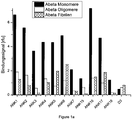
- Figure 1a shows the binding signals for ANK1-ANK7 and ANK15-18 compared to D3 on A-beta monomers, oligomers and fibrils.
- the peptides bind to A-beta monomers much more efficiently than to A-beta oligomers and to A-beta fibrils, which can be seen from a clear difference in the binding signal.
- a clear difference means at least a difference of 1.5 rfu between the binding signal of A-beta monomers and A-beta oligomers and / or A-beta fibrils.
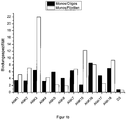
- Figure 1b shows the binding specificity for ANK1-7 and ANK 15-18. It is clear that the binding specificity for A-beta monomer is greater than 1 for all peptides according to the invention. D3, on the other hand, has a binding specificity for A-beta monomer of less than 1.
- the properties of the substances could be quantified using the QIAD method for the quantitative characterization of amyloid peptides and / or proteins in a sample.
- Pre-incubated A-beta was co-incubated with the peptides.
- the different A-beta species were separated using density gradient centrifugation and quantified in the individual fractions by RP-HPLC Abeta.
- the elimination of the A-beta oligomers in fraction 4-6 was analyzed.
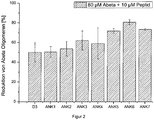
- ANK5, ANK6 and ANK7 eliminate A-beta oligomers more efficiently than D3, see the Figure 2 .
- the specific binding to monomers can prevent the formation of oligomers without leading to a reduction in the concentration of A-beta monomer and, on the other hand, can A-beta oligomers formed are removed from the dynamic equilibrium of the various aggregate species in accordance with the principle of Le Chatelier by treatment with an active ingredient stabilizing A-beta monomer and thus cause A-beta oligomers to degrade to A-beta monomers will.
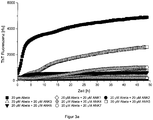
- the ThT assay shows a significant reduction in the ThT-positive A-beta fibrils after a co-incubation with the tested substances ( Figures 3a and 3b ). This indicates that aggregation is inhibited or amorphous aggregates are formed.
- Figure 2 shows that with an A-beta to peptide ratio of 8: 1, the peptides ANK5, ANK6 and ANK7 reduce A-beta oligomers significantly more efficiently than D3. At this concentration, the other peptides are as efficient as D3.
- D3 eliminates the A-beta oligomers by 50 ⁇ 10%, ANK1 by 51 ⁇ 6%, ANK2 by 54 ⁇ 7%, ANK3 by 62 ⁇ 10%, ANK4 by 59 ⁇ 16%, ANK5 by 72 ⁇ 2%, ANK6 by 81 ⁇ 3% and ANK7 by 73 ⁇ 1%.
- Peptides according to the invention thus show a reduction in A-beta oligomers which is increased by a factor of up to 1.6 compared to D3.
- FIG. 3 shows that ANK1-7 significantly reduces the formation of ThT-positive A-beta fibrils.
- the ThT fluorescence remains at the level of the first measured value for the peptides ANK1, ANK2 and ANK3 throughout the entire measurement period (48 h), whereas a slight increase can be seen for the peptides ANK4, ANK6 and ANK7 (corresponds to 13-21% of the ThT fluorescence from Abeta after 48 h) and for ANK5 an increase to 1029 rfu, which corresponds to 53% of the ThT fluorescence from the A-Beta control after 48 h.
- Figure 4a shows that ANK4, ANK5, ANK6 and ANK7 alone have no toxic effect on the cells.
- A-Beta with ANK4, ANK5, ANK6 and ANK7 in different concentrations, a reduction in A-beta toxicity could be achieved, see Figure 4b .
- This reduction is more efficient with the substances ANK4 and ANK6 than with D3.
- the significance is based on the respective concentration with D3 (* p ⁇ 0.05; ** p ⁇ 0.01; *** p ⁇ 0.001; ns not significant).
Landscapes
- Health & Medical Sciences (AREA)
- Chemical & Material Sciences (AREA)
- Life Sciences & Earth Sciences (AREA)
- Organic Chemistry (AREA)
- Medicinal Chemistry (AREA)
- General Health & Medical Sciences (AREA)
- Proteomics, Peptides & Aminoacids (AREA)
- Immunology (AREA)
- Gastroenterology & Hepatology (AREA)
- Toxicology (AREA)
- Biochemistry (AREA)
- Biophysics (AREA)
- Genetics & Genomics (AREA)
- Molecular Biology (AREA)
- Zoology (AREA)
- Rheumatology (AREA)
- Rehabilitation Therapy (AREA)
- Hematology (AREA)
- Diabetes (AREA)
- Bioinformatics & Cheminformatics (AREA)
- Engineering & Computer Science (AREA)
- Pharmacology & Pharmacy (AREA)
- Veterinary Medicine (AREA)
- Neurology (AREA)
- Neurosurgery (AREA)
- Biomedical Technology (AREA)
- Public Health (AREA)
- Animal Behavior & Ethology (AREA)
- Cell Biology (AREA)
- Psychiatry (AREA)
- Nuclear Medicine, Radiotherapy & Molecular Imaging (AREA)
- General Chemical & Material Sciences (AREA)
- Chemical Kinetics & Catalysis (AREA)
- Hospice & Palliative Care (AREA)
- Epidemiology (AREA)
- Peptides Or Proteins (AREA)
- Medicines That Contain Protein Lipid Enzymes And Other Medicines (AREA)
- Investigating Or Analysing Biological Materials (AREA)
Description
- Die Erfindung bezieht sich auf spezifisch A-Beta-Spezies bindende Peptide für die Therapie und/oder die Diagnose der Alzheimerschen Demenz.
- Noch immer existiert kein zugelassenes Medikament für eine ursächliche Behandlung der Alzheimerschen Demenz (AD). Typischerweise findet man in den Gehirnen von AD-Patienten post-mortem Ablagerungen des sogenannten Beta-Amyloid-Peptides (Aß) in Plaques. Deshalb werden schon lange verschiedene Formen des A-Beta (auch Aß genannt), z.B. Fibrillen, für die Entstehung und das Fortschreiten der Alzheimerschen Demenz verantwortlich gemacht.
- Seit wenigen Jahren werden besonders die kleinen, frei diffundierbaren Aß-Oligomere als hauptsächliche Verursacher für die Entstehung und den Fortschritt der Alzheimerschen Demenz verantwortlich gemacht.
- Aß-Monomere entstehen ständig in unserem Körper und sind vermutlich per se nicht toxisch.
- Es wird spekuliert, ob sich Aß-Monomere abhängig von ihrer Konzentration, die sich letztlich durch Bildungs- und Abbau-Raten im Körper ergibt, zufällig und damit mit zunehmendem Alter immer wahrscheinlicher spontan zu Aβ-Oligomeren zusammen lagern. Einmal entstandene Aβ-Oligomere könnten sich dann durch einen Prionähnlichen Mechanismus vermehren und letztlich zur Krankheit führen.
- Aufgrund dieser Überlegungen sollte es das Ziel einer ursächlichen Behandlung sein, toxische Aβ-Oligomere vollständig zu vernichten und/oder deren Prion-ähnliche Vermehrung zu verhindern.
- Allerdings existiert kein ursächlich wirkendes Medikament für die Behandlung der Alzheimerschen Demenz. Die eingesetzten Medikamente nach dem Stand der Technik sind bestenfalls in der Lage, einige Symptome zu mildern, können aber den Krankheitsfortschritt nicht verlangsamen, geschweige denn aufhalten.
- Es existieren eine Reihe von Substanzen, die in der Lage sind, im Tierversuch einige Erfolge bei der Prävention (nicht unbedingt die Behandlung) der Alzheimerschen Demenz zu erreichen.
- Ein wichtiger Unterschied zwischen der Prävention und der Behandlung liegt in folgender Überlegung: Um die Bildung der ersten Aβ-Oligomere zu verhindern, reichen eventuell schon wenig affine und effektive Aß-Liganden aus. Da die Bildung eines Aβ-Oligomers aus mehreren Aß-Monomeren eine Reaktion sehr hoher Ordnung ist, ist sie in hoher Potenz von der Aß-Monomer-Konzentration abhängig. Auch eine kleine Verringerung der aktiven Aß-Monomer-Konzentration kann so die Bildung der ersten Aβ-Oligomere verhindern. Dies ist die Situation bei der Prävention. Sind aber bereits Aβ-Oligomere entstanden, können sich diese Prion ähnlich vermehren, was keine Reaktion hoher Ordnung ist und damit kaum noch abhängig von der Aß-Monomer-Konzentration ist. Dies ist die Situation bei der Therapie. Sind also Aß-Oligomere bereits entstanden, muss es das Ziel einer Behandlung sein, diese durch Substanzen zu adressieren, die eine möglichst hohe Affinität zu Aβ-Oligomeren besitzen. Die entsprechende Dissoziationskonstante müsste dazu im pM-Bereich oder noch tiefer liegen.
- Derzeit existieren einige Substanzen, die auf verschiedenste Art und Weise die Konzentration von Aß-Monomeren verringern, z. B. durch gamma-Sekretase-Modulatoren, Aß-bindende Liganden, und so weiter. Dies reicht offensichtlich aus, um im Tierversuch präventiv erfolgreich zu wirken, wobei meist Tiere behandelt werden, bevor die Krankheit voll ausbricht.
- In klinischen Studien (Phasen II und III) am Menschen, hier dürfen nur klar mit der Alzheimerschen Demenz diagnostizierte Menschen behandelt werden, versagten bisher aber alle diese Substanzen, möglicherweise, weil hier also noch vor Beginn der Erkrankung eine geringe oder mäßige Verringerung der Aß-Monomer-Konzentration nicht mehr ausreicht, um die Entstehung immer größerer Mengen von Aβ-Oligomeren zu verhindern.
- Desweiteren gibt es bisher keine Möglichkeit, die Alzheimersche Demenz vor dem Ausbruch der Symptome sicher zu diagnostizieren. Die Alzheimersche Demenz wird heute hauptsächlich durch neuropsychologische Tests der bereits an Demenzsymptomen leidenden Person erkannt. Des Weiteren können andere Erkrankungen (Traumata) durch verschiedene Untersuchungsmethoden ausgeschlossen werden.
- Es ist jedoch bekannt, dass Aβ-Oligomere und zeitlich darauf folgend Plaques bis zu 20 Jahre vor dem Auftreten der Symptome im Gehirn der Patienten entstehen und irreversiblen Schaden anrichten. Molekulare Sonden, die dem Patienten intravenös injiziert werden und die nach der Passage über die Blut-Hirn-Schranke an Aß-Oligomere und Plaques binden, können mittels bildgebender Methoden sichtbar gemacht werden und somit eine früher Diagnose der AD ermöglichen.
- Die
WO 02/081505 A2 WO 2013/150126 A2 betrifft ein Verfahren zur Behandlung von Blut, Blutprodukten und Organen zur Prävention der Übertragung von Morbus-Alzheimer. DieWO 2015/043566 A1 bezieht sich auf zyklische, Amyloid-Betabindende Peptide und deren Verwendung. Schumacher T N et al. ("Identification of D-peptide ligands through mirror-image phage display", Science, Bd. 271, 29. März 1996, Seiten 1854-1857) beschreiben D-Peptidliganden mit Resistenz gegenüber proteolytischem Abbau. - Aus
EP 1 379 546 B1 ist ein D-enantiomeres Peptid mit dem Namen "D3" bekannt. Das Peptid wurde durch eine Spiegelbild-Phagendisplay-Selektion gegen überwiegend monomeres Aß(1-42) identifiziert, mit dem Plan, dieses durch die Bindung zu stabilisieren und seine Umwandlung in toxische Aß-Aggregate zu verhindern. Nach derzeitigem Kenntnisstand wandelt D3 bevorzugt die besonders toxischen Aß-Oligomere in nicht-toxische, nicht-amyloidogene und ThT-negative, amorphe Aggregate um. Im Tiermodell wird selbst durch eine orale Verabreichung von D3 mit dem Trinkwasser erreicht, dass behandelte transgene AD-Mäuse deutlich weniger Plaques enthalten und signifikant verbesserte kognitive Fähigkeiten besitzen. - Aus der Veröffentlichungsschrift
WO 2014/041115 A2 sind weitere von D3 abgeleitete Peptide bekannt. - Nachteilig sind die bestehenden Aβ-Oligomer-bindenden Substanzen nicht genügend affin, um eine Vermehrung von Aβ-Oligomeren zu verhindern.
- Es gibt nachteilig bisher keine Sonden für das in-vivo-Imaging-Verfahren, die speziell an Aβ-Oligomere hochaffin binden und diese sichtbar machen. Da Aβ-Oligomere in der Krankheitsgeschichte eine so wichtige und frühe Rolle spielen, ist genau dieses wünschenswert.
- Aufgabe der Erfindung ist es Peptide bereit zu stellen, für die
- A) Ursächliche Therapie von Morbus Alzheimer durch das Verhindern der Bildung von toxischen Amyloid-β (Aβ)-Oligomeren oder Aggregaten oder deren Enttoxifizierung.
- B) Diagnose der Alzheimerschen Demenz durch Anwendung der D-Peptide als Sonde für in vivo Imaging.
- Im Nachfolgenden werden die Begriffe "A-Beta", "Amyloid-Beta", "Amyloid-β" bzw. "Aβ" synonym zueinander gebraucht.
- Die Aufgabe der Erfindung wird gelöst durch die Peptide nach Patentanspruch 1, dem Kit und der Zusammensetzung gemäß der Hauptansprüche sowie den Verwendungen gemäß den Nebenansprüchen. Vorteilhafte Ausgestaltungen hierzu ergeben sich jeweils aus den hierauf rückbezogenen Patentansprüchen.
- Gelöst wird diese Aufgabe durch spezifisch Amyloid-Beta-Spezies bindende Peptide für die Therapie der Alzheimerschen Demenz. Die Spezifität, oft auch Selektivität genannt, bedeutet dabei, dass der erfindungsgemäße Ligand bzw. ein erfindungsgemäßes Peptid grundsätzlich verschiedene A-Beta-Spezies, z.B. A-Beta-Monomer oder A-Beta-Oligomer oder A-Beta-Fibrillen binden kann. Jedem Bindungspaar (z. B. Ligand zu A-Beta-Monomer und Ligand zu A-Beta-Oligomer und Ligand zu A-Beta-Fibrillen) wird unter der Annahme eines 1:1-Bindemodells jeweils eine Dissoziationskonstante (KD) oder eine Assoziationskonstane (KA=1/KD) zugeordnet. Je höher der KA-Wert ist, desto affiner ist die jeweilige Bindung.
- Die Spezifität des Liganden für den Köder gegenüber dem Kompetitor drückt sich durch einen möglichst großen Quotienten der Affinitäten zum A-Beta-Monomer und zum A-Beta-Oligomer bzw. A-Beta-Fibrillen aus.
- Erfindungsgemäß werden zur Ermittlung der Spezifität also Quotienten der KA-Werte des Liganden zum A-Beta-Monomer und zum A-Beta-Oligomer (bzw. A-Beta-Fibrillen) gebildet. Je größer der Quotient ist, umso größer ist die Spezifität.
- In erfindungsgemäßen Sinn ist von relativer Spezifität die Rede, wenn der Quotient der KA-Werte des Liganden zur Spezies A und des Liganden zur Spezies B mindestens größer als 1 ist, bevorzugt größer als 1,2, oder 1,5, bevorzugt größer als 2, 3, 4, 5, 6, 7, 8, 9, insbesondere 10, 11, 12, 13, 14, 15, 16, 17, 18, 19, 20, 21, 22, 23, 24, 25, 26, 27, 28, 29, 30, 31, 32, 33, 34, 35, 36, 37, 38, 39, 40, 41, 42, 43, 44, 45, 46, 47, 48, 49, 50, 51, 52, 53, 54, 55, 56, 57, 58, 59, 60, 61, 62, 63, 64, 65, 66, 67, 68, 69, 70, 71, 72, 73, 74, 75, 76, 77, 78, 79, 80, 81, 82, 83, 84, 85, 86, 87, 88, 89, 90, 91, 92, 93, 94, 95, 96, 97, 98, 99, insbesondere 100, wobei als Spezies A und Spezies B die verschiedenen A-Beta-Spezies Monomer, Oligomer und Fibrillen angenommen werden können.
- Die Spezifität oder Selektivität ist dabei nicht mit der Affinität zu verwechseln, die sich aus der Bindungsstärke von Liganden an eine der Spezies ergibt. Konkurrieren verschiedene Liganden um das gleiche Zielmolekül, so kann der weniger spezifische oder selektive die größere Bindungsaffinität besitzen. Erfindungsgemäß soll derjenige Ligand ermittelt werden, welcher besonders spezifisch an eine Spezies wie Monomer oder Oligomer oder Fibrillen bindet. Die Biomoleküle sollen als therapeutische Mittel und Heilmittel geeignet sein. Die auf diese Weise erhaltenen Liganden bzw. Peptide haben die gewünschten Eigenschaften und lösen die Aufgabe der Erfindung.
- Insbesondere lösen Peptide als Liganden enthaltend eine Aminosäuresequenz gemäß der SEQ ID NO: 1, SEQ ID NO: 2, SEQ ID NO: 3, SEQ ID NO: 4, SEQ ID NO: 5, SEQ ID NO: 6, SEQ ID NO: 7, SEQ ID NO: 8, SEQ ID NO: 9, SEQ ID NO: 10 und SEQ ID NO: 11 und deren Homologe mit einer Identität der Aminosäuresequenz von mindestens 80%, wobei die Homologe einen Kd-Wert von 2-fach bis 10-fach niedriger als das Peptid mit der Aminosäuresequenz rprtrlhthrnr aufweisen, wobei das Peptid im Wesentlichen aus D-Aminosäuren besteht, die Aufgabe der Erfindung.
- Gelöst wird diese Aufgabe auch durch Polymere enthaltend eine Aminosäuresequenz gemäß der SEQ ID NO: 1, SEQ ID NO: 2, SEQ ID NO: 3, SEQ ID NO: 4, SEQ ID NO: 5, SEQ ID NO: 6, SEQ ID NO: 7, SEQ ID NO: 8, SEQ ID NO: 9, SEQ ID NO: 10 oder SEQ ID NO: 11 und/oder deren Homologe mit einer Identität der Aminosäuresequenz von mindestens 80%, wobei die Homologe einen Kd-Wert von 2-fach bis 10-fach niedriger als das Peptid mit der Aminosäuresequenz rprtrlhthrnr aufweisen, wobei das Peptid im Wesentlichen aus D-Aminosäuren besteht.
- Die Peptide enthaltend eine der genannten Sequenzen binden spezifisch an Amyloid-Beta-Monomer.
- Spezifische Bindung zu A-Beta-Monomer bedeutet im Übrigen, dass der Quotient der Bindungssignale von Ligand-Monomer zu Ligand-Oligomer und/oder Ligand-Monomer zu Ligand-Fibrillen größer ist als 1, z. B. 1,8 und etwa einen Wert bis 100 annehmen kann, wobei jeder Zwischenwert z. B. 2, 3, 4, 5, 6, 7, 8, 9, insbesondere 10, 11, 12, 13, 14, 15, 16, 17, 18, 19, 20, 21, 22, 23, 24, 25, 26, 27, 28, 29, 30, 31, 32, 33, 34, 35, 36, 37, 38, 39, 40, 41, 42, 43, 44, 45, 46, 47, 48, 49, 50, 51, 52, 53, 54, 55, 56, 57, 58, 59, 60, 61, 62, 63, 64, 65, 66, 67, 68, 69, 70, 71, 72, 73, 74, 75, 76, 77, 78, 79, 80, 81, 82, 83, 84, 85, 86, 87, 88, 89, 90, 91, 92, 93, 94, 95, 96, 97, 98, 99, insbesondere 100 angenommen werden kann.
- Spezifische Bindung zu A-Beta-Oligomer bedeutet, dass der Quotient der Bindungssignale aus Ligand-Oligomer zu Ligand-Monomer bzw. aus Ligand-Oligomer zu Ligand-Fibrillen größer ist als 1, z. B. 1.2, und etwa einen Wert bis 100 annehmen kann, wobei jeder Zwischenwert z. B. 2, 3, 4, 5, 6, 7, 8, 9, insbesondere 10, 11, 12, 13, 14, 15, 16, 17, 18, 19, 20, 21, 22, 23, 24, 25, 26, 27, 28, 29, 30, 31, 32, 33, 34, 35, 36, 37, 38, 39, 40, 41, 42, 43, 44, 45, 46, 47, 48, 49, 50, 51, 52, 53, 54, 55, 56, 57, 58, 59, 60, 61, 62, 63, 64, 65, 66, 67, 68, 69, 70, 71, 72, 73, 74, 75, 76, 77, 78, 79, 80, 81, 82, 83, 84, 85, 86, 87, 88, 89, 90, 91, 92, 93, 94, 95, 96, 97, 98, 99, insbesondere 100 angenommen werden kann.
- Die in der wissenschaftlichen Praxis üblichen Rundungen ungerader Zahlenwerte führen zu den oben genannten Zahlenwerten.
- Als Ausgangspunkt dienen z. B. durch Peptide Microarray Experimente erhaltene Peptide. Diese können von dem bekannten Peptid "D3" abgeleitet werden.
- Für die Identifizierung von spezifisch an Amyloid-Beta-Monomer oder spezifisch an Amyloid-Beta-Oligomere bindenden Peptiden und Bestimmung der Bindungsspezifität von Peptiden im Sinne der vorliegenden Erfindung kann demnach man wie folgt vorgehen. Peptide Microarrays mit verschiedenen auf einer Oberfläche immobilisierten Peptiden, z. B. Derivate von D3, werden jeweils mit verschiedenen Spezies von A-Beta (z.B. Monomere, Oligomere und Fibrillen), welches mit einem Fluoreszenzfarbstoff gelabelt ist, inkubiert. Als Kontrolle wird ein Peptid Microarray mit nur dem Fluoreszenzfarbstoff inkubiert. Um die Reproduzierbarkeit der Ergebnisse zu gewährleisten, kann die Inkubation der Peptide Microarrays je Spezies mindestens 3 x durchgeführt werden. Die Bindung des Fluoreszenz gelabelten A-Beta mit den immobilisierten Peptiden wird über den Fluoreszenzfarbstoff detektiert. Je mehr A-Beta an dem Peptid bindet, umso höher ist das Fluoreszenzsignal. Die gemessenen Fluoreszenzsignale der Reproduktionen werden normiert und das Signal von der Kontrolle abgezogen. Damit wird verhindert, dass die Bindung des Fluoreszenz gelabelten A-Beta über den Farbstoff stattfindet. Sodann werden die Bindungssignale von einer A-Beta Spezies an ein Peptid gemittelt. Für die Bestimmung der Bindungsspezifität wird der Quotient von der Spezies, zu dem das Peptide spezifisch binden soll, zu einer anderen Spezies gebildet.
- Beispiel: Bindungsspezifität des Peptides X zu A-Beta-Monomeren = Bindungssignal von Peptid X an Monomere/Bindungssignal von Peptid X an Oligomere (oder Fibrillen). In analoger Weise werden spezifisch an A-Beta-Oligomer bindende Peptide ermittelt.
- Fragmente und Teile der erfindungsgemäßen Peptide zeigen eine ähnliche beziehungsweise identische Wirkung wie die erfindungsgemäßen Peptide.
- In einer Variante der Erfindung werden solche Peptide ermittelt und eingesetzt, die an ein A-Beta-Monomer oder A-Beta-Oligomer oder A-Beta-Fibrillen mit einem KD von höchstens 500 µM, bevorzugt 250, 100, 50 µM, besonders bevorzugt 25, 10, 6 µM, insbesondere 4, 2, 1 µM oder sub-µM bindet.
- Die Peptide gemäß der SEQ ID NO: 1, SEQ ID NO: 2, SEQ ID NO: 3, SEQ ID NO: 4, SEQ ID NO: 5, SEQ ID NO: 6, SEQ ID NO: 7, SEQ ID NO: 8, SEQ ID NO: 9, SEQ ID NO. 10, und/oder SEQ ID NO. 11 und deren Homologe bestehen im Wesentlichen, bevorzugt mindestens 60%, 75%, 80%, besonders bevorzugt 85%, 90%, 95%, insbesondere 96%, 97%, 98%, 99%, 100% aus D-Aminosäuren.
- Ein Polymer im Sinne der Erfindung ist gebildet aus mindestens 2, oder 3, 4, 5, 6, 7, 8, 9, 10, 11, 12, 13, 14, 15, 16, 17, 18, 19, 20 oder mehr Monomeren oder Monomereinheiten ausgewählt aus der Gruppe bestehend aus SEQ ID NO: 1, SEQ ID NO: 2, SEQ ID NO: 3, SEQ ID NO: 4, SEQ ID NO: 5, SEQ ID NO: 6, SEQ ID NO: 7, SEQ ID NO: 8, SEQ ID NO: 9, SEQ ID NO. 10, und/oder SEQ ID NO. 11 und deren Homologe, Fragmente oder Teile, die für sich bereits A-Beta-Monomere oder A-Beta-Oligomere oder A-Beta-Fibrillen binden.
- Erfindungsgemäß sind die Polymere aus identischen Monomereinheiten aufgebaut oder aus einer Kombination von 2, 3, 4, 5, 6, 7, 8, 9, 10 oder 11 unterschiedlichen, verschiedenen der oben genannten Monomeren, als sogenannte Kombinations-Polymere. Die Monomere können auch teilweise identisch sein. Die Anzahl der identischen Monomeren in den Kombinations-Polymeren ist frei wählbar.
- In einer Alternative enthalten die Kombinations-Polymere mindestens ein Monomer ausgewählt aus der Gruppe bestehend aus SEQ ID NO: 1, SEQ ID NO: 2, SEQ ID NO: 3, SEQ ID NO: 4, SEQ ID NO: 5, SEQ ID NO: 6, SEQ ID NO: 7, SEQ ID NO: 8, SEQ ID NO: 9, SEQ ID NO. 10 und/oder SEQ ID NO. 11 und deren Homologe und mindestens ein an A-Beta-Monomere oder an A-Beta-Oligomere oder A-Beta-Fibrillen bindendes Peptid, das sich von den Monomeren ausgewählt aus der Gruppe bestehend aus SEQ ID NO: 1, SEQ ID NO: 2, SEQ ID NO: 3, SEQ ID NO: 4, SEQ ID NO: 5, SEQ ID NO: 6, SEQ ID NO: 7, SEQ ID NO: 8, SEQ ID NO: 9, SEQ ID NO. 10 und/oder SEQ ID NO. 11 und deren Homologe unterscheidet, als weiteres Monomer.
- Polymere können beispielsweise über chemische Synthese bzw. Peptidsynthese hergestellt werden.
- In einer Ausführung der Erfindung sind die Monomere kovalent miteinander verknüpft. In einer anderen Ausführung der Erfindung sind die Monomere nicht kovalent miteinander verbunden.
- Eine kovalente Verbindung bzw. Verknüpfung der Monomer-Einheiten liegt im Sinne der Erfindung vor, falls die Peptide Kopf an Kopf, Schwanz an Schwanz oder Kopf an Schwanz linear miteinander verknüpft werden, ohne dass dazwischen Linker oder Linker-Gruppen eingesetzt werden.
- Eine nicht kovalente Verknüpfung im Sinne der Erfindung liegt vor, falls die Monomere über Biotin und Streptavidin, insbesondere Streptavidin-Tetramer miteinander verknüpft sind.
- In einer Variante der vorliegenden Erfindung können die Monomere linear miteinander verknüpft sein, insbesondere wie oben beschrieben. In einer anderen Variante sind die Monomere verzweigt miteinander zu dem erfindungsgemäßen Polymer verknüpft.
- Bei einem verzweigten Polymer kann es sich erfindungsgemäß um ein Dendrimer handeln, bei dem die Monomere kovalent oder nicht kovalent miteinander verknüpft sind.
- Alternativ können die Monomere auch mit einem Plattform-Molekül (wie z.B. PEG oder Zucker) verknüpft sein und so ein verzweigtes Polymer bilden.
- Alternativ sind auch Kombinationen dieser Optionen möglich.
- Die erfindungsgemäß aufgebauten Polymere aus erfindungsgemäß Peptiden, die ihrerseits an A-Beta-Monomer oder Abeta-Oligomer oder A-Beta-Fibrillen binden, zeigen vorteilhaft synergetische Effekte in Bezug auf ihre Selektivität und Affinität zu den A-Beta-Monomer zu einzelnen Peptiden. Mit anderen Worten: Die erfindungsgemäßen Polymere sind den Einzelpeptiden, aus denen sie aufgebaut sind, überlegen. Synergetische Effekte im Sinne der vorliegenden Erfindung sind Effekte, die eine höhere Selektivität bzw. Spezifität und / oder Affinität bezüglich des A-Beta-Monomer oder A-Beta-Oligomers oder A-Beta-Fibrillen zeigen, insbesondere des KD-Wertes betreffend die Bindung an A-Beta-Monomer oder A-Beta-Oligomer oder A-Beta-Fibrillen im Vergleich zu den einzelnen Peptid-Einheiten.
- In einer weiteren besonders vorteilhaften Ausgestaltung der Erfindung wirken die Polymere und insbesondere Dimere im Tiermodellversuch (in vitro bzw. in vivo) vorteilhaft effizienter als die einzelnen Peptid-Einheiten.
- In einer Variante der Erfindung werden solche Peptide oder Polymere eingesetzt, die an ein A-Beta-Monomer oder A-Beta-Oligomer oder A-Beta-Fibrillen mit einer Dissoziationskonstante (KD-Wert) von höchstens 500 µM, bevorzugt 250, 100, 50 µM, besonders bevorzugt 25, 10, 1 µM, besonders bevorzugt mit einer Dissoziationskonstante (KD-Wert) von höchstens 500 nM, 250, 100, 50, besonders bevorzugt 25, 10, 1 nM, 500pM, 100, 50, 25, 20, 15, 10, 9, 8, 7, 6, 5, 4, 3, 2, 1 pM bis sub-pM bindet, wobei jeder Zwischenwert angenommen werden kann.
- In einer Ausgestaltung der Erfindung ist die Affinität über die Dissoziationskonstante (KD-Wert) definiert. Die Dissoziationskonstante (KD-Wert) des erfindungsgemäßen Peptids ist dabei in einer Ausgestaltung der Erfindung erniedrigt. Damit ist eine höhere Affinität der Bindung und eine höhere Effektivität des Abbaus und / oder der Verhinderung der Bildung toxischer Amyloid-Beta-Oligomere. Dies betrifft insbesondere aber nicht ausschließlich einen niedrigeren KD-Wert an der high affinity site des A-Beta-Monomer oder A-Beta-Oligomer.
- Fragmente und Teile zeigen vorteilhaft eine ähnliche beziehungsweise identische Wirkung wie die erfindungsgemäßen Peptide.
- Monomere und Polymere werden im Folgenden als erfindungsgemäße Peptide bezeichnet.
- Die erfindungsgemäßen Peptide sind in einer Ausgestaltung der Erfindung am freien C-terminus mit einer Säureamidgruppe versehen. Die erfindungsgemäßen Peptide, beispielweise die Peptide gemäß SEQ ID NO: 1-11 sind dann an der Position 12 am freien C-terminus amidiert. Dimere hieraus sind an Position 24 am freien C-terminus amidiert und so weiter.
- Die erfindungsgemäßen Peptide, insbesondere die Peptide gemäß der SEQ ID NO: 1-11 sind in einer weiteren Ausgestaltung der Erfindung am freien C-terminus mit dem freien N-terminus kovalent miteinander verbunden und liegen dann entsprechend zyklisiert vor. Auch durch den Ringschluss wird vorteilhaft bewirkt, dass die Carboxylgruppe am freien C-terminus nicht mehr vorhanden ist.
- Das erfindungsgemäße Peptid weist vorteilhaft eine Aminosäuresequenz auf, bei der die Zyklisierung des linearen Moleküls z. B. durch eine kovalente Bindung der ersten mit der letzten Aminosäure, z.B. über eine Kondensationsreaktion, erfolgt ist. Selbstverständlich existieren weitere Möglichkeiten der Zyklisierung, z. B. indem andere Aminosäuren miteinander verknüpft werden. Lediglich beispielhaft sei die Verknüpfung der zweiten Aminosäure mit der letzten Aminosäure genannt. Genauso denkbar ist jede mögliche andere Verknüpfung.
- Im Falle, dass die erste und die letzte Aminosäure des Peptids miteinander verknüpft werden, wird vorteilhaft bewirkt, dass keine offenen Enden in der Peptidkette (Aminosäuresequenz) vorliegen.
- Diese Maßnahme bewirkt ferner, dass alle Peptide mit linearen Aminosäuresequenzen, die nach der Zyklisierung die gleiche, nicht mehr unterscheidbare Aminosäure-Reihenfolge ergeben, in diesem Sinne identisch sind.
- Beispiel: Die lineare Aminosäuresequenz des bekannten Peptids D3 ist rprtrlhthrnr. Das entsprechende durch eine Amidbindung zwischen der N-terminalen Aminogruppe und der C-terminalen Carboxylgruppe verknüpfte, zyklisierte Peptid "cD3" ist nicht mehr zu unterscheiden von den zyklisierten Peptiden prtrlhthrnrr, rtrlhthrnrrp, trlhthrnrrpr, rlhthrnrrprt, Ihthrnrrprtr, hthrnrrprtrl, thrnrrprtrlh, hrnrrprtrlht, rnrrprtrlhth, nrrprtrlhthr, oder rrprtrlhthrn. Aus jeder dieser Sequenzen lässt sich das cD3 weiterhin auch ableiten.
- Die erfindungsgemäß beanspruchten Effekte der höheren Affinität, Spezifität und Effektivität treten darüber hinaus gegenüber einem, vorzugsweise sogar jedem linearen, bindenden Peptid auf, aus dem sich ein zyklisiertes bzw. anderweitig modifiziertes, erfindungsgemäßes Peptid ableiten lässt.
- Die Herstellung zyklisierter Peptide ist im Übrigen Stand der Technik, und kann beispielweise nach dem Verfahren wie es in
DE 102005049537 A1 beschrieben ist, erfolgen. - Vorteilhaft bewirkt die Zyklisierung über die erste und letzte Aminosäure des Peptids, dass keine "offenen" Enden der Peptidkette mehr existieren, die oft Angriffspunkte für Peptid-abbauende Aktivitäten in Zellen, Tieren oder Menschen sind, z. B. durch Aminopeptidasen und Carboxypeptidasen.
- Mittels erfindungsgemäßer zyklisierter Peptide, wie z. B. ANK6 gemäß der SEQ ID NO: 1, wird zusätzlich vorteilhaft bewirkt, dass diese erfindungsgemäßen zyklisierten Peptide, bzw. Polymere als Seiteneffekt unter Umständen auch nicht leicht abgebaut werden, wenngleich dieser Effekt nicht ausschlaggebend ist. Er gilt im Übrigen, wie gezeigt wurde, auch nur für den Fall einer head-to-tail- oder tail-to-head-Zyklisierung, bei dem entsprechend beide Enden des linearen Peptids miteinander verknüpft werden.
- "Homologe Sequenzen" oder "Homologe" bedeutet im Sinne der Erfindung, dass eine Aminosäuresequenz eine Identität mit einer der oben genannten Aminosäuresequenz der Monomere von mindestens 80, 81, 82, 83, 84, 85, 86, 87, 88, 89, 90, 91, 92, 93, 94, 95, 96, 97, 98, 99, aufweist. Anstelle des Begriffs "Identität" werden in der vorliegenden Beschreibung die Begriffe "homolog" oder "Homologie" gleichbedeutend verwendet. Die Identität zwischen zwei Nukleinsäuresequenzen oder Polypeptidsequenzen wird durch Vergleich mit Hilfe des Programms BESTFIT basierend auf dem Algorithmus von Smith, T.F. und Waterman, M.S (Adv. Appl. Math. 2: 482-489 (1981)) berechnet unter Einstellung folgender Parameter für Aminosäuren: Gap creation penalty: 8 und Gap extension penalty: 2; und folgender Parameter für Nukleinsäuren: Gap creation penalty: 50 und Gap extension penalty: 3. Bevorzugt wird die Identität zwischen zwei Nukleinsäuresequenzen oder Polypeptidsequenzen durch die Identität der Nukleinsäuresequenz/ Polypeptidsequenz über die jeweils gesamte Sequenzlänge definiert, wie sie durch Vergleich mit Hilfe des Programms GAP basierend auf dem Algorithmus von Needleman, S.B. und Wunsch, C.D. (J. Mol. Biol. 48: 443-453) unter Einstellung folgender Parameter für Aminosäuren berechnet wird: Gap creation penalty: 8 und Gap extension penalty: 2; und die folgenden Parameter für Nukleinsäuren Gap creation penalty: 50 und Gap extension penalty: 3.
- Zwei Aminosäuresequenzen sind im Sinne der vorliegenden Erfindung identisch wenn sie dieselbe Aminosäuresequenz besitzen.
- Unter Homologe sind in einer Variante die entsprechenden retro-inversen Sequenzen der oben genannten Monomere zu verstehen. Mit dem Begriff "retro-inverse Sequenz" wird erfindungsgemäß eine Aminosäuresequenz bezeichnet, die sich aus Aminosäuren in der enantiomeren Form zusammensetzt (invers: Chiralität des alpha-C-Atoms invertiert) und bei der zusätzlich die Sequenzreihenfolge zur ursprünglichen Aminosäuresequenz umgekehrt wurde (retro = rückwärts).
- In einer weiteren Variante binden die erfindungsgemäßen Peptide an Teile des Amyloid Beta-Peptids.
- In einer weiteren Variante weisen die erfindungsgemäßen Peptide Sequenzen auf, die sich von den angegebenen Sequenzen um bis zu drei Aminosäuren unterscheiden.
- Ferner werden als Peptide auch Sequenzen eingesetzt, die die oben genannten Sequenzen enthalten.
- In einer weiteren Variante weisen die Peptide Fragmente der oben genannten Sequenzen auf oder weisen homologe Sequenzen zu den oben genannten Sequenzen auf.
- Erfindungsgemäß handelt es sich um ein Peptid zur Verwendung in der Medizin, bevorzugt zur Behandlung oder Diagnose von Morbus Alzheimer.
- Das Peptid besteht im Wesentlichen aus D-Aminosäuren.
- Im Sinne der vorliegenden Erfindung bedeutet der Begriff "im Wesentlichen aus D-Aminosäuren", dass die erfindungsgemäß einzusetzenden Monomere mindestens 50%, 55%, 60%, 65%, 70%, bevorzugt 75%, 80%, besonders bevorzugt 85%, 90%, 95%, insbesondere 96%, 97%, 98%, 99%, 100% aus D-Aminosäuren aufgebaut sind.
- In einer Ausführung der vorliegenden Erfindung handelt es sich bei den erfindungsgemäßen Peptiden um Derivate des D-enantiomeren D-Peptids D3. Derivate im Sinne der Erfindung sind von D3 abgeleitete Peptid-Sequenzen, die nach einem der drei folgenden Verfahren erzielt werden:
- a) Änderung der Reihenfolge und/oder Anzahl der Aminosäurebausteine in D3. Es werden dabei nur Aminosäuren eingesetzt, die in der D3-Sequenz vorhanden sind.
- b) Deletion von 1, 2, 3, 4, 5, 6, 7, 8, 9, 10 oder 11 Aminosäuren der D3-Sequenz.
- c) Austausch von 1, 2, 3, 4, 5 oder 6 Aminosäuren durch andere Aminosäuren, bevorzugt D-Enantiomere.
- In einer weiteren Variante handelt es sich um ein erfindungsgemäßes Peptid zur Hemmung der Fibrillenbildung von Amyloid-Beta-Peptiden. Die erfindungsgemäßen Peptide und/oder Polymere enttoxifizieren die A-Beta-Oligomere oder daraus gebildete Polymere, sowie Fibrillen, indem sie z. B. an A-Beta-Monomere binden und so in nicht toxische Verbindungen überführen. Demgemäß ist Gegenstand der vorliegenden Erfindung auch ein in-vitro Verfahren zur Enttoxifizierung von A-Beta-Oligomeren, sowie der daraus gebildeten Polymere oder Fibrillen.
- Gegenstand der Erfindung sind in einer Ausführung auch erfindungsgemäße Peptide, die mit einer weiteren Substanz verknüpft sind.
- Bei der Verknüpfung handelt es sich im Sinne der Erfindung um eine chemische Bindung wie sie in Römpp Chemie Lexikon, 9. Auflage, Band 1, Seite 650 ff, Georg Thieme Verlag Stuttgart definiert ist, bevorzugt um eine Hauptvalenz Bindung, insbesondere eine kovalente Bindung.
- Bei den Substanzen handelt es sich in einer Variante um Arzneimittel oder Wirkstoffe, definiert gemäß Arzneimittelgesetz §2 beziehungsweise. §4 (19), Stand September 2012. In einer Alternative sind Wirkstoffe therapeutisch aktive Stoffe die als arzneilich wirksame Stoffe verwendet werden. Bevorzugt werden Entzündungshemmer eingesetzt.
- Bei den Substanzen handelt es sich in einer weiteren Variante um Verbindungen die die Wirkung der Peptide verstärken.
- In einer Alternative sind solche Verbindungen Aminopyrazol und/oder Aminopyrazolderivate. Aminopyrazolderivate im Sinne der Erfindung ist 3-Aminopyrazol-5-carbonsäure oder 3-Nitropyrazol-5-carbonsäure sowie alle Abkömmlinge, in denen die heterocyclische CH-Gruppe gegen -CR- oder -N- oder -O- oder -S- ausgetauscht wurde, sowie alle daraus abgeleiteten peptidischen Dimere, Trimere oder-Tetramere, bevorzugt Aminopyrazol-Trimer.
- In einer weiteren Alternative handelt es sich um Verbindungen die die Löslichkeit der Peptide und/oder die Passage der Blut-Hirn-Schranke verbessern.
- In einer Alternative haben die Peptide erfindungsgemäß jede beliebige Kombination von mindestens zwei oder mehr Merkmalen der oben beschriebenen Varianten, Ausführungen und/oder Alternativen.
- Im Rahmen der Erfindung wurde weiterhin erkannt, dass amidierte und/oder zyklisierte Peptide im Vergleich zu linearen, bindenden Peptiden, bei denen der freie C-terminus, also die C-terminale Carboxylguppe, nicht modifiziert ist und entsprechend eine negative Ladung trägt, mit einer höheren Affinität an Abeta-Monomer binden. Das heißt, dass der Ko-Wert bei den modifizierten Peptiden niedriger ist, als bei linearen Peptiden, bei denen der freie C-terminus, also die C-terminale Carboxylguppe, nicht modifiziert ist und entsprechend eine negative Ladung trägt.
- In einer weiteren bevorzugten Ausgestaltung der Erfindung ist daher die Affinität der Bindung der erfindungsgemäß modifizierten Peptide ohne negative Ladung am C-terminus im Vergleich zu linearen Peptiden mit negativer Ladung am C-terminus aber im Übrigen gleicher Aminosäuresequenz, um 1%, 2, 3, 4, 5, 6, 7, 8, 9, insbesondere 10%, 11, 12, 13, 14, 15, 16, 17, 18, 19, 20, 21, 22, 23, 24, 25, 26, 27, 28, 29, 30, 31, 32, 33, 34, 35, 36, 37, 38, 39, 40, 41, 42, 43, 44, 45, 46, 47, 48, 49, 50, 51, 52, 53, 54, 55, 56, 57, 58, 59, 60, 61, 62, 63, 64, 65, 66, 67, 68, 69, 70, 71, 72, 73, 74, 75, 76, 77, 78, 79, 80, 81, 82, 83, 84, 85, 86, 87, 88, 89, 90, 91, 92, 93, 94, 95, 96, 97, 98, 99, insbesondere 100%, 101, 102, 103, 104, 105, 106, 107, 108, 109, 110, 111, 112, 113, 114, 115, 116, 117, 118, 119, 120, 121, 122, 123, 124, 125, 126, 127, 128, 129, 130, 131, 132, 133, 134, 135, 136, 137, 138, 139, 140, 141, 142, 143, 144, 145, 146, 147, 148, 149, 150, 151, 152, 153, 154, 155, 156, 157, 158, 159, 160, 161, 162, 163, 164, 165, 166, 167, 168, 169, 170, 171, 172, 173, 174, 175, 176, 177, 178, 179, 180, 181, 182, 183, 184, 185, 186, 187, 188, 189, 190, 191, 192, 193, 194, 195, 196, 197, 198, 199, insbesondere 200 %, 201, 202, 203, 204, 205, 206, 207, 208, 209, 210, 211, 212, 213, 214, 215, 216, 217, 218, 219, 220, 221, 222, 223, 224, 225, 226, 227, 228, 229, 230, 231, 232, 233, 234, 235, 236, 237, 238, 239, 240, 241, 242, 243, 244, 245, 246, 247, 248, 249, 250, 251, 252, 253, 254, 255, 256, 257, 258, 259, 260, 261, 262, 263, 264, 265, 266, 267, 268, 269, 270, 271, 272, 273, 274, 275, 276, 277, 278, 279, 280, 281, 282, 283, 284, 285, 286, 287, 288, 289, 290, 291, 292, 293, 294, 295, 296, 297, 298, 299, insbesondere 300%, 301, 302, 303, 304, 305, 306, 307, 308, 309, 310, 311, 312, 313, 314, 315, 316, 317, 318, 319, 320, 321, 322, 323, 324, 325, 326, 327, 328, 329, 330, 331, 332, 333, 334, 335, 336, 337, 338, 339, 340, 341, 342, 343, 344, 345, 346, 347, 348, 349, 350, 351, 352, 353, 354, 355, 356, 357, 358, 359, 360, 361, 362, 363, 364, 365, 366, 367, 368, 369, 370, 371, 372, 373, 374, 375, 376, 377, 378, 379, 380, 381, 382, 383, 384, 385, 386, 387, 388, 389, 390, 391, 392, 393, 394, 395, 396, 397, 398, 399, insbesondere 400%, 401, 402, 403, 404, 405, 406, 407, 408, 409, 410, 411, 412, 413, 414, 415, 416, 417, 418, 419, 420, 421, 422, 423, 424, 425, 426, 427, 428, 429, 430, 431, 432, 433, 434, 435, 436, 437, 438, 439, 440, 441, 442, 443, 444, 445, 446, 447, 448, 449, 450, 451, 452, 453, 454, 455, 456, 457, 458, 459, 460, 461, 462, 463, 464, 465, 466, 467, 468, 469, 470, 471, 472, 473, 474, 475, 476, 477, 478, 479, 480, 481, 482, 483, 484, 485, 486, 487, 488, 489, 490, 491, 492, 493, 494, 495, 496, 497, 498, 499, vorteilhaft sogar 500%, 501, 502, 503, 504, 505, 506, 507, 508, 509, 510, 511, 512, 513, 514, 515, 516, 517, 518, 519, 520, 521, 522, 523, 524, 525, 526, 527, 528, 529, 530, 531, 532, 533, 534, 535, 536, 537, 538, 539, 540, 541, 542, 543, 544, 545, 546, 547, 548, 549, 550, 551, 552, 553, 554, 555, 556, 557, 558, 559, 560, 561, 562, 563, 564, 565, 566, 567, 568, 569, 570, 571, 572, 573, 574, 575, 576, 577, 578, 579, 580, 581, 582, 583, 584, 585, 586, 587, 588, 589, 590, 591, 592, 593, 594, 595, 596, 597, 598, 599, besonders vorteilhaft 600%, 601, 602, 603, 604, 605, 606, 607, 608, 609, 610, 611, 612, 613, 614, 615, 616, 617, 618, 619, 620, 621, 622, 623, 624, 625, 626, 627, 628, 629, 630, 631, 632, 633, 634, 635, 636, 637, 638, 639, 640, 641, 642, 643, 644, 645, 646, 647, 648, 649, 650, 651, 652, 653, 654, 655, 656, 657, 658, 659, 660, 661, 662, 663, 664, 665, 666, 667, 668, 669, 670, 671, 672, 673, 674, 675, 676, 677, 678, 679, 680, 681, 682, 683, 684, 685, 686, 687, 688, 689, 690, 691, 692, 693, 694, 695, 696, 697, 698, 699, besonders vorteilhaft 700%, 701, 702, 703, 704, 705, 706, 707, 708, 709, 710, 711, 712, 713, 714, 715, 716, 717, 718, 719, 720, 721, 722, 723, 724, 725, 726, 727, 728, 729, 730, 731, 732, 733, 734, 735, 736, 737, 738, 739, 740, 741, 742, 743, 744, 745, 746, 747, 748, 749, 750, 751, 752, 753, 754, 755, 756, 757, 758, 759, 760, 761, 762, 763, 764, 765, 766, 767, 768, 769, 770, 771, 772, 773, 774, 775, 776, 777, 778, 779, 780, 781, 782, 783, 784, 785, 786, 787, 788, 789, 790, 791, 792, 793, 794, 795, 796, 797, 798, 799, ebenfalls besonders vorteilhaft 800%, 801, 802, 803, 804, 805, 806, 807, 808, 809, 810, 811, 812, 813, 814, 815, 816, 817, 818, 819, 820, 821, 822, 823, 824, 825, 826, 827, 828, 829, 830, 831, 832, 833, 834, 835, 836, 837, 838, 839, 840, 841, 842, 843, 844, 845, 846, 847, 848, 849, 850, 851, 852, 853, 854, 855, 856, 857, 858, 859, 860, 861, 862, 863, 864, 865, 866, 867, 868, 869, 870, 871, 872, 873, 874, 875, 876, 877, 878, 879, 880, 881, 882, 883, 884, 885, 886, 887, 888, 889, 890, 891, 892, 893, 894, 895, 896, 897, 898, 899, ebenfalls besonders vorteilhaft 900%, 901, 902, 903, 904, 905, 906, 907, 908, 909, 910, 911, 912, 913, 914, 915, 916, 917, 918, 919, 920, 921, 922, 923, 924, 925, 926, 927, 928, 929, 930, 931, 932, 933, 934, 935, 936, 937, 938, 939, 940, 941, 942, 943, 944, 945, 946, 947, 948, 949, 950, 951, 952, 953, 954, 955, 956, 957, 958, 959, 960, 961, 962, 963, 964, 965, 966, 967, 968, 969, 970, 971, 972, 973, 974, 975, 976, 977, 978, 979, 980, 981, 982, 983, 984, 985, 986, 987, 988, 989, 990, 991, 992, 993, 994, 995, 996, 997, 998, 999, oder sogar um 1000 %, oder sogar um 10000% oder sogar um bis zu 100000% oder 1000000% erhöht, wobei jeder Zwischenwert angenommen werden kann. Dies betrifft insbesondere die erhöhte Affinität zu der high affinity site des A-Beta-Monomer oder A-Beta-Oligomer.
- Dies wird durch einen entsprechend erniedrigten KD-Wert angezeigt. Der KD-Wert als Maß für die Affinität der Bindung eines modifizierten, insbesondere zyklisierten Peptids an Amyloid-Beta-Monomer oder an A-Beta-Oligomer ist im Vergleich zu einem linearen, bindenden Peptid mit negativer Ladung am freien C-terminus, um 1%, 2, 3, 4, 5, 6, 7, 8, 9, insbesondere 10%, 11, 12, 13, 14, 15, 16, 17, 18, 19, 20, 21, 22, 23, 24, 25, 26, 27, 28, 29, 30, 31, 32, 33, 34, 35, 36, 37, 38, 39, 40, 41, 42, 43, 44, 45, 46, 47, 48, 49, 50, 51, 52, 53, 54, 55, 56, 57, 58, 59, 60, 61, 62, 63, 64, 65, 66, 67, 68, 69, 70, 71, 72, 73, 74, 75, 76, 77, 78, 79, 80, 81, 82, 83, 84, 85, 86, 87, 88, 89, 90, 91, 92, 93, 94, 95, 96, 97, 98, 99, insbesondere 99,1, 99,2, 99,3, 99,4, 99,5%, 99,6, 99,7, 99,8, 99,9 bis zu 99,99 oder sogar 99,999% erniedrigt, wobei jeder Zwischenwert angenommen werden kann.
- Diese niedrigeren KD-Werte beziehen sich vorteilhaft insbesondere aber nicht ausschließlich auf die high affinity site von A-Beta-Monomer oder A-Beta-Oligomer.
- Die modifizierten Peptide können dann effizienter als Sonden für diagnostische Zwecke verwendet werden, als lineare, bindende Peptide mit negativer Ladung am freien C-terminus, insbesondere auch effizienter als ihre linearen Peptid-Pendants mit identischer Aminosäuresequenz verwendet werden.
- Sie können aber insbesondere auch effizienter als Therapeutika verwendet werden, als lineare, bindende Peptide mit negativer Ladung am freien C-terminus, insbesondere effizienter als ihre linearen Peptid-Pendants mit identischer Aminosäuresequenz.
- Im Rahmen der Erfindung wurde weiterhin erkannt, dass derartig modifizierte Peptide im Vergleich zu Peptiden mit negativer Ladung am freien C-terminus, insbesondere aber im Vergleich zu ihren Peptid-Pendants mit identischer Aminosäuresequenz, zusätzlich auch mit einer höheren Effektivität bzw. Effizienz die Bildung besonders toxischer Amyloid-Beta-Oligomere verhindern oder deren Zerstörung und / oder Endtoxifizierung bewirken. Diese Effektivität ist insbesondere um 1%, 2, 3, 4, 5, 6, 7, 8, 9, insbesondere 10%, 11, 12, 13, 14, 15, 16, 17, 18, 19, 20, 21, 22, 23, 24, 25, 26, 27, 28, 29, 30, 31, 32, 33, 34, 35, 36, 37, 38, 39, 40, 41, 42, 43, 44, 45, 46, 47, 48, 49, 50, 51, 52, 53, 54, 55, 56, 57, 58, 59, 60, 61, 62, 63, 64, 65, 66, 67, 68, 69, 70, 71, 72, 73, 74, 75, 76, 77, 78, 79, 80, 81, 82, 83, 84, 85, 86, 87, 88, 89, 90, 91, 92, 93, 94, 95, 96, 97, 98, 99, 99,9, besonders vorteilhaft sogar um 100% erhöht.
- In einer besonders bevorzugten Ausgestaltung der Erfindung treten die Effekte der gesteigerten Affinität gegenüber A-Beta-Monomer oder A-Beta-Oligomer oder A-Beta-Fibrillen und damit verbundene gleichzeitige Effektivität der Eliminierung, Endtoxifizierung von A-Beta-Oligomeren (bzw. der Bildung) auch in vitro und / oder in vivo auf.
- Gegenstand der Erfindung ist auch ein erfindungsgemäßes Peptid zur Bindung an aggregierte A-Beta-Peptide.
- Weiterer Gegenstand der Erfindung ist ein Verfahren zur Herstellung des erfindungsgemäßen Peptids durch Peptidsynthese, wie zum Beispiel dem Fachmann bekannt, organische Synthesemethoden für beliebige Verbindungen mit geringem Molekulargewicht (low-molecular weight compounds) und/oder Mutagenese und rekombinante Herstellung.
- Die Erfindung betrifft ferner auch eine Zusammensetzung enthaltend die erfindungsgemäßen Peptide, insbesondere zur Behandlung und Diagnose von Morbus Alzheimer.
- Gegenstand der vorliegenden Erfindung ist ferner eine Zusammensetzung enthaltend die erfindungsgemäßen Peptide, insbesondere zur Verhinderung von toxischen A-Beta-Oligomeren, oder zur Zerstörung von daraus gebildeten Polymere oder Fibrillen.
- Die erfindungsgemäße "Zusammensetzung" kann z. B. ein Impfstoff, ein Medikament (z. B. in Tablettenform), eine Injektionslösung, ein Nahrungs- oder Nahrungsergänzungsmittel sein, enthaltend die erfindungsgemäßen Peptide in einer aufgrund des Fachwissens herzustellenden Formulierung.
- Die Erfindung betrifft ferner auch ein KIT enthaltend die erfindungsgemäßen Peptide.
- In einem solchen KIT können die erfindungsgemäßen Peptide in Behältern ggf. mit/in Puffern oder Lösungen verpackt sein. Alle Komponenten des KITs können in demselben Behälter oder getrennt voneinander verpackt sein. Ferner kann das KIT Anweisungen für dessen Gebrauch enthalten. Ein solches KIT kann beispielsweise die erfindungsgemäßen in einer Injektionsflasche mit Stopfen und/oder Septum enthalten. Ferner kann darin beispielsweise auch eine Einmal-Spritze enthalten sein.
- Ein weiterer Gegenstand der vorliegenden Erfindung ist die Verwendung des erfindungsgemäßen Peptids in-vitro als Sonde zur Identifizierung, qualitativen und/oder quantitativen Bestimmung von Amyloid-Beta-Monomeren Amyloid-Beta-Oligomeren oder A-Beta-Fibrillen.
- Gegenstand der vorliegenden Erfindung ist auch eine Sonde, enthaltend die erfindungsgemäßen Peptide zur Identifizierung, qualitativen und/oder quantitativen Bestimmung von Amyloid-Beta-Monomeren oder Amyloid-Beta-Oligomeren.
- Solche Sonden sind von großer Bedeutung, da damit eine frühe Diagnose der Alzheimerschen Demenz möglich wird. Mit der Frühdiagnose kann der Krankheit schon in einem sehr frühen Stadium entgegengewirkt werden.
- Solche molekularen Sonden enthalten die erfindungsgemäßen Polymere und gegebenenfalls Farbstoffe, Fluoreszenzfarbstoffe, radioaktive Isotope, (PET etc.), Gadolinium (MRI), sowie alternative Stoffe geeignet für die Bildgebung der Sonden und können den Patienten z.B. intravenös injiziert werden. Nach Passage über die Bluthirnschranke können die Sonden an A-Beta-Monomere, A-Beta-Oligomere und/oder Plaques binden. Die so markierten A-Beta-Oligomere und/oder Plaques können mittels bildgebender Verfahren wie z.B. SPECT, PET, CT, MRT, Protonen-MR-Spektroskopie usw. sichtbar gemacht werden.
- Ferner betrifft die Erfindung auch die Verwendung des Peptids in-vitro zur Verhinderung von Amyloid-Beta-Oligomeren und/oder Amyloid-Beta-Peptid-Aggregaten und/oder Amyloid-Beta-Fibrillen.
- Das erfindungsgemäße Peptid wird auch zur Enttoxifizierung von toxischen Amyloid-Beta-Oligomeren und/oder Aggregaten verwendet. Insbesondere wird es verwendet, um an Amyloid-Beta-Oligomere und/oder Aggregate zu binden und so amorphe, nicht toxische Aggregate zu bilden.
- Es wurde erkannt, dass wenn bereits Aβ-Oligomere vorhanden sind, es das Ziel einer Behandlung sein muss, diese durch Substanzen zu adressieren, die eine möglichst hohe Affinität zu A-Beta-Monomer besitzen. De facto kann die Affinität gegenüber A-Beta-Monomer gar nicht groß genug sein und die entsprechende Dissoziationskonstante des erfindungsgemäßen Peptids liegt dann im sub-µM-Bereich, bzw. pM-Bereich oder noch tiefer.
- Es wurde im Rahmen der Erfindung erkannt, dass A-Beta-Monomere, als Bausteine der A-Beta-Oligomere, ständig im menschlichen Körper entstehen und vermutlich per se nicht toxisch sind. Es besteht sogar die Möglichkeit, dass Monomere eine positive Funktion besitzen. A-Beta-Monomere können sich in Abhängigkeit von ihrer Konzentration zufällig zusammen lagern. Die Konzentration ist abhängig von ihrer Bildungsund Abbaurate im Körper. Findet mit zunehmendem Alter eine Erhöhung der Konzentration an A-Beta-Monomeren im Körper statt, ist eine spontane Zusammenlagerung der Monomere zu A-Beta-Oligomeren immer wahrscheinlicher. Die so entstandenen A-Beta-Oligomere könnten sich analog zu den Prionen vermehren und letztendlich zur Morbus Alzheimer-Krankheit führen.
- Es wurde ferner erkannt, dass ein wichtiger Unterschied zwischen einer Prävention und einer Behandlung oder gar einer Heilung der Alzheimerschen Demenz in der Tatsache begründet liegt, dass eine Prävention möglicherweise schon durch die Verhinderung der Bildung der ersten A-Beta-Oligomere erreicht werden kann. Hierzu sind einige, wenige hochaffine A-Beta-Monomer Liganden ausreichend, die gleichzeitig wenig affin und selektiv (bzw. spezifisch) bezüglich der A-Beta-Oligomere sind.
- Diese Anforderungen in Hinblick auf Diagnose (Sonden) und auf die Therapie der Alzheimerschen Demenz sind mit der Bereitstellung der erfindungsgemäßen Peptide erfüllt. Die erfindungsgemäßen Peptide binden im Sinne der Diagnose und/oder Therapie die A-Beta-Monomere oder A-Beta Oligomere mit entsprechend niedriger Dissoziationskonstante. Weiterer Gegenstand ist entsprechend die Verwendung der erfindungsgemäßen Peptide als Therapeutikum von Morbus Alzheimer.
- Eine besonders starke Bindung der erfindungsgemäßen Peptide an die Zielmoleküle wird durch eine hohe Spezifität und/oder Affinität zu dem Zielmolekül der erfindungsgemäßen Peptide hervorgerufen. Die gebildeten Komplexe haben eine geringe Dissoziationskonstante (KD-Wert).
- Mittels des Thioflavin-T-Tests konnte gezeigt werden, dass die erfindungsgemäßen Peptide die Fibrillenbildung von A-Beta-Peptiden sehr effizient hemmen.
- Weiterer Gegenstand ist die Verwendung der erfindungsgemäßen Peptide in einem Verfahren zur Behandlung (in vitro, ex vivo) von Blut, Blutprodukten und/oder Organen, dadurch gekennzeichnet, dass das Blut, die Blutprodukte und/oder Organe dem menschlichen oder tierischen Körper entnommen werden und A-(Amyloid)-Beta-Oligomere entfernt und/oder enttoxifiziert werden.
- Der Begriff Bindungsaffinität ist im Sinne der Erfindung das Maß für die Bindungsstärke zwischen den Bindungspartnern bei Protein-Ligand-Wechselwirkungen und die Bindungsspezifität gegenüber A-Beta-Monomer zeigt an, dass eine Bindung nur an A-Beta-Monomere, und keine oder aber nur eine schwache Bindung an andere A-Beta Spezies vorliegt. Als spezifischen Wert wird der Quotient des Bindungssignals von A-Beta-Monomeren zu A-Beta-Oligomeren oder A-Beta-Monomeren zu A-Beta-Fibrillen oder äquivalent für A-Beta-Oligomere angegeben. Spezifische Bindung bedeutet, dass der Quotient größer als 1 ist.
- Analog hierzu bedeutet Bindungsspezifität gegenüber A-Beta-Oligomer, dass eine Bindung nur an A-Beta-Oligomere, und keine oder aber nur eine schwache Bindung an andere A-Beta Spezies vorliegt. Als spezifischen Wert wird der Quotient des Bindungssignals von A-Beta-Oligomeren zu A-Beta-Monomer oder A-Beta-Oligomeren zu A-Beta-Fibrillen oder äquivalent für A-Beta-Monomere angegeben. Spezifische Bindung bedeutet wiederum, dass der Quotient größer als 1 ist.
- Sind bereits A-Beta-Oligomere vorhanden, sollte es das Ziel einer Behandlung sein, diese durch Substanzen zu adressieren, die eine möglichst hohe Affinität und Spezifität zu A-Beta-Monomeren besitzen, um A-Beta-Oligomere zu eliminieren. Dies gelingt mit den erfindungsgemäßen Peptiden.
- Durch die Optimierung des bereits bekannten Peptides D3 soll der Wirkmechanismus ähnlich bzw. identisch bleiben, aber die Substanzen sollen effizientere Eigenschaften besitzen. Die Eigenschaften sind unter anderem Bindungsaffinität und -spezifität für A-Beta-Monomere oder -Oligomere, die Inhibition von A-Beta-Fibrillenbildung, die Inhibierung der A-Beta-Zytotoxizität, die Präzipitation von A-Beta-Oligomeren, die Umwandlung von A-Beta-Fibrillen in nicht-toxische, nicht-amyloide Spezies.
- Die Optimierung wurde durch den Austausch von 4, 5, 6 oder 7 Aminosäuren vom ursprünglichen D3 Peptid und einer Deletion erreicht.
- Mit Hilfe von Peptid Microarrays wurde D3 optimiert. Dazu wurde in einem ersten Schritt jede Aminosäure des 12mer Peptids gegen 19 natürliche Aminosäuren und 13 weiteren Aminosäuren in der D-enantiomeren Form ausgetauscht. In einem zweiten Schritt wurden die erfolgversprechendsten Austausche miteinander kombiniert. Dabei wurden 4, 5, 6 oder 7 Aminosäuren vom ursprünglichen D3 Peptide ausgetauscht. Des Weiteren wurde 1 Aminosäure deletiert. Da die Bindung der Peptide spezifisch gegen eine Spezies von A-Beta (Monomere, Oligomere oder Fibrillen) gerichtet sein soll, wurden die Microarrays mit den verschiedenen Spezies behandelt und rechnerisch eine Bindung von anderen Spezies, die eventuell im Inkubationsansatz vorhanden sind, ausgeschlossen.
- Es wurden 11 Peptide ermittelt, die spezifisch und hochaffin gegen A-Beta-Monomer binden. Dies sind die mit ANK1-7 sowie ANK 15-18 bezeichneten Peptide gemäß der SEQ ID NO: 1-11. Hochaffin heißt dabei mit KD-Werten von 2-fach bis 10-fach niedriger als D3.
D3 (Stand der Technik): rprtrlhthrnr a) "ANK1" (freier N-terminus, amidierter C-terminus): rkrirlvyhinr b) "ANK2" (freier N-terminus, amidierter C-terminus): rkrirl06yhinr c) "ANK3" (freier N-terminus, amidierter C-terminus): rkrirl06yhwnr d) "ANK4" (freier N-terminus, amidierter C-terminus): rkrirlvyhwnr e) "ANK5" (freier N-terminus, amidierter C-terminus): rkrvrlvyhkkr f) "ANK6" (freier N-terminus, amidierter C-terminus): rkrirlvtkkkr g) "ANK7" (freier N-terminus, amidierter C-terminus): rkrvrl02thikr h) "ANK15" (freier N-terminus, amidierter C-terminus): rprvrl06yhwnr i) "ANK16" (freier N-terminus, amidierter C-terminus): rkr07rlvtkrnr j) 'ANK17" (freier N-terminus, amidierter C-terminus): rkrirl06yhikr k) "ANK18" (freier N-terminus, amidierter C-terminus): rpr07rlhtkkkr - 02: 4-Fluoro-phenylalanin (D)
- 06: Phenylglycin (D)
- 07: D-Homoarginin
- Alle Peptide werden erfindungsgemäß auch als Doppelpeptide und/oder in zyklisierter Form genutzt. Dadurch kann die Effektivität der Peptide weiter gesteigert werden.
- Die Peptide ANK1-7 sowie ANK15-18 können durch die Bindung an A-Beta-Monomer als Medikament gegen die Alzheimersche Demenz genutzt werden. Oligomer spezifische Peptide können auf Grund ihrer spezifischen Bindung an A-Beta-Oligomere zusätzlich als Sonden zur Diagnose genutzt werden.
- Im Weiteren wird die Erfindung an Hand von Ausführungsbeispielen und der beigefügten Figuren näher erläutert, ohne dass es hierdurch zu einer Beschränkung der Erfindung kommen soll.
- Es zeigen:
- Figur 1:
-
- a) Bindungssignale der erfindungsgemäßen Peptide an A-Beta-Monomere, A-Beta-Oligomere und A-Beta-Fibrillen.
- b) Bindungsspezifität der erfindungsgemäßen Peptide.
- Figur 2:
- Reduktion von Amyloid-Beta-Oligomere durch die erfindungsgemäßen Peptide.
- Figur 3:
-
- a) THT-Assay erfindungsgemäßer Peptide,
- b) Ausgewerteter THT Assay mit THT Fluoreszenz bezogen auf Amyloid-Beta im Sättigungspunkt.
- Figur 4:
-
- a) MTT-Assay an SH-SY5 Zellen ohne A-Beta Coinkubation.
- b) MTT-Assay an SH-SY5 Zellen mit A-Beta Coinkubation.
- Für das Peptid Microarray mit D3 Derivaten wurde dieses über den C-Terminus auf Glasobjektträgern kovalent wie nachfolgend dargestellt verknüpft.
- ∘ 1ste Generation: D3 mit jeweils 1 Austausch gegen 19 natürliche Aminosäuren und gegen 13 unnatürliche Aminosäuren
- ∘ 2te Generation: Die Austausche, die einen effizientere Bindung der Peptide an A-Beta bewirken, wurden miteinander kombiniert.
- Vorbehandlung der Peptide Microarray Slides:
- ∘ 3x kurz in Ethanol (96%) tauchen und anschließend mit H2O waschen (30 min) ∘ kurz trocken zentrifugieren
- Präparation von Monomeren und Oligomeren:
- ∘ Größenausschlußchromatographie nach Johansson et al. 2006 (Johansson, A.-S. et al. Physiochemical characterization of the Alzheimer's disease-related peptides Aβ1-42Arctic and Aß1-42wt. FEBS Journal 273, 2618-2630 (2006)).
- ∘ Oligomere wurden bei 8-9 ml fraktioniert, Monomere bei 16-17 ml.
- Präparation von Fibrillen:
∘ Inkubation von A-Beta über 3 Tage, Zentrifugieren, Überstand verwerfen und in Puffer resuspendieren (3x-ige Wiederholung) - Durchführung Peptid Microarray:
- ∘ Inkubation mit FITC-A-Beta Monomeren, -Oligomeren, -Fibrillen und FITC für 1 h bei Raumtemperatur.
- ∘ Waschen: TBS-T 3 x kurz (nur TBS-T-Puffer gewechselt), 3x 10 min in einem Falcon, 3x H2O, 3x 10 min
- ∘ Trocknen durch Zentrifugation
- Die Bindung des Fluoreszenz gelabelten A-Beta mit den immobilisierten Peptiden wird über den Fluoreszenzfarbstoff mit dem Microarray Reader FLA800 von Fuji Film detektiert. Je mehr A-Beta an dem Peptid bindet, umso höher ist das Fluoreszenzsignal.
- Vorbehandlung der Peptide Microarray Slides:
- ∘ Carrier Set Mode: Slides
- ∘ Resolution: 10 µm
- ∘ Scan Mode: High Sensitivity (Slow): Scan pixel at 200 mm/s
- ∘ Laser: 473 nm
- ∘ Filter: 530 DF 20
- ∘ Photo-multiplier tube (PMT) HV (%): 100
- ∘ Bilder wurden als .tif-Dateien gespeichert
- Die Auswertung der Fluoreszenzsignale erfolgt mit der Software AIDA Metrix von Raytest:
Grid Definition 1st Level Rows 1 Columns 1 2nd level Rows 12 Columns 4 X Spacing 0 Y Spacing 0 3rd level Rows 9 Columns 9 Diameter 80 µm Backround definition Local Dot Rings Inflate Dots 150 µm Ring width 30 µm By area mean Aligment defaults (Parameter) Diameter 100 % Mobility Restricted Align grid, align dots Aligment defaults (Process) Bkg deviation Threshold 2.0*StdDev - Die gemessenen Fluoreszenzsignale der Reproduktionen werden normiert mit einer Median-basierten Normierung und die Kontrolle wurde vom Signal abgezogen. Damit wurde verhindert, dass die Bindung des Fluoreszenz-gelabelten A-Beta über den Farbstoff stattfindet.
- Die Bindungssignale von einer A-Beta Spezies an ein Peptid wurde gemittelt.
- Für die Bestimmung der Bindungsspezifität wird der Quotient von der Spezies, zu dem das Peptide spezifisch binden soll, zu einer anderen Spezies gebildet.
- Beispiel: Bindungsspezifität des Peptides X zu A-Beta Monomeren = Bindungssignal von Peptide X an Monomere/ Bindungssignal von Peptide X an Oligomere.
- Die erfindungsgemäßen Peptide ANK1-7 sowie ANK 15-18 führen zu einer Inhibition der A-Beta-Fibrilisierung, Inhibition der A-Beta-Zelltoxizität, Eliminierung von A-Beta-Oligomeren sowie zu einer Umwandlung von A-Beta-Fibrillen in nicht-toxische, nicht-amyloide Spezies. Die Bindungsaffinität und Spezifität zu A-Beta-Monomeren ist dabei gegeben.
- Die Bindungsaffinität ist dabei das Maß für die Bindungsstärke zwischen den Bindungspartnern bei Protein-Ligand-Wechselwirkungen und die Bindungsspezifität zeigt an, dass eine Bindung nur an A-Beta-Monomere, und keine oder aber nur eine schwache Bindung an andere A-Beta Spezies vorliegt. Als spezifischen Wert wird hier der Quotient des Bindungssignals von A-Beta-Monomeren zu A-Beta-Oligomeren oder A-Beta-Monomeren zu A-Beta-Fibrillen oder äquivalent für A-Beta-Oligomere angegeben. Spezifische Bindung bedeutet, dass der Quotient größer als 1 ist.
- Im Detail wurden folgende Daten ermittelt:
Bindungssignal an A-Beta Monomere Bindungssignal an A-Beta Oligomere Bindungssignal an A-Beta Fibrillen Bindungsspezifität Monomer zu Oligomer Bindungsspezifität Monomer zu Fibrillen ANK1 6.6 1.9 1.3 3.5 5.1 ANK2 5.6 1.6 0.8 3.4 7.1 ANK3 3.6 0.6 0.2 6.5 21.9 ANK4 4.4 1.3 1.0 3.3 4.3 ANK5 4.3 0.7 2.0 5.9 2.2 ANK6 4.9 1.2 2.5 4.1 1.9 ANK7 2.1 0.3 0.3 6.4 6.8 ANK15 1.3 0.6 0.1 2.2 12.2 ANK16 11.9 1.4 1.5 8.6 8.1 ANK1 7 4.7 1.0 1.9 4.8 2.5 ANK18 1.2 0.2 0.1 7.0 9.4 D3 0.5 0.6 0.8 0.8 0.6 -
Figur 1a zeigt die Bindungssignale für ANK1-ANK7 und ANK15-18 im Vergleich zu D3 an A-Beta Monomere, -Oligomere und -Fibrillen. Die Peptide binden an A-Beta-Monomere wesentlich effizienter als an A-Beta-Oligomere und an A-Beta-Fibrillen, was durch einen deutlichen Unterschied in dem Bindungssignal erkennbar ist. Deutlicher Unterschied heißt mindestens eine Differenz von 1,5 rfu zwischen dem Bindungssignal von A-Beta-Monomere und A-Beta-Oligomere und/oder A-Beta-Fibrillen. -
Figur 1b zeigt die Bindungsspezifität für ANK1-7 und ANK 15-18. Es wird deutlich, dass bei allen erfindungsgemäßen Peptiden die Bindungsspezifität gegenüber A-Beta-Monomer größer ist als 1. D3 besitzt hingegen eine Bindungsspezifität gegenüber A-Beta-Monomer von unter 1. - Mittels des QIAD-Verfahrens zur quantitativen Charakterisierung amyloider Peptide und/oder Proteine in einer Probe konnten die Eigenschaften der Substanzen quantifiziert werden. Vorinkubiertes A-Beta wurde mit den Peptiden coinkubiert. Mit Hilfe einer Dichtegradientenzentrifugation wurden die verschiedenen A-Beta Spezies getrennt und mittels RP-HPLC Abeta in den einzelnen Fraktionen quantifiziert. Es wurde die Eliminierung der A-Beta-Oligomere in Fraktion 4-6 analysiert.
- Es wird gezeigt, dass insbesondere ANK5, ANK6 und ANK7 A-Beta-Oligomere effizienter als D3 eliminieren, siehe die
Figur 2 . Zum einen kann die spezifische Bindung an Monomere, die Bildung von Oligomeren verhindern, ohne dabei zu einer Reduktion der Konzentration an A-Beta-Monomer zu führen und zum anderen können bereits entstandene A-Beta-Oligomere durch eine Behandlung mit einem A-Beta-Monomer stabilisierenden Wirkstoff aus dem dynamischen Gleichgewicht der verschiedenen Aggregatspezies entsprechend des Prinzips von Le Chatelier entfernt werden und damit bewirken, dass A-Beta-Oligomere zu A-Beta-Monomeren abgebaut werden. - Im ThT-Assay zeigt sich eine deutliche Reduktion der ThT-positiven A-Beta-Fibrillen nach einer Co-Inkubation mit den getesteten Substanzen (
Figuren 3a und3b ). Dies deutet darauf hin, dass die Aggregation inhibiert wird oder amorphe Aggregate gebildet werden. - Es konnte in therapeutisch relevanten Konzentrationen keine nennenswerte Toxizität der erfindungsgemäßen Peptide in dem, dem Fachmann bekannten, MTT-Assay an SH-SY5Y-Zellen festgestellt werden (
Figur 4 ). Dagegen konnte gezeigt werden, dass die durch A-Beta hervorgerufene Toxizität durch die Substanzen ANK4, ANK5, ANK6 und ANK7 reduziert wird. A-Beta-Oligomer ist nach dem aktuellen Wissenstand die toxische Spezies. Da mit den Peptiden die A-Beta-Oligomere eliminiert werden, wird auch die A-Beta-induzierte Toxizität reduziert. - Im Detail:
Figur 2 zeigt, dass bei einem Verhältnis von A-Beta zu Peptid von 8:1 die Peptide ANK5, ANK6 und ANK7 A-Beta-Oligomere signifikant effizienter reduzieren als D3. Die anderen Peptide sind in dieser Konzentration vergleichbar effizient wie D3. D3 eliminiert die A-Beta-Oligomere um 50 ± 10 %, ANK1 um 51 ± 6 %, ANK2 um 54 ± 7 %, ANK3 um 62 ± 10 %, ANK4 um 59 ± 16 %, ANK5 um 72 ± 2 %, ANK6 um 81 ± 3 % und ANK7 um 73 ± 1 %. - Erfindungsgemäße Peptide zeigen somit eine im Vergleich zu D3 um einen Faktor von bis zu 1,6 erhöhte Reduktion an A-Beta-Oligomeren.
-
Figur 3 zeigt, dass ANK1-7 deutlich die Bildung von ThT-positiven A-Beta-Fibrillen reduziert. Die ThT-Fluoreszenz bleibt während des gesamten Messzeitraums (48 h) für die Peptide ANK1, ANK2 und ANK3 auf dem Niveau des ersten Messwertes, für die Peptide ANK4, ANK6 und ANK7 ist hingegen ein leichter Anstieg zu erkennen (entspricht 13 - 21 % der ThT Fluoreszenz von Abeta nach 48 h) und für ANK5 ein Anstieg auf 1029 rfu, was 53 % der ThT Fluoreszenz von der A-Beta Kontrolle nach 48 h entspricht. -
Figur 4a zeigt, dass ANK4, ANK5, ANK6 und ANK7 alleine keinen toxischen Effekt auf die Zellen aufweist. Mit einer Coinkubation von A-Beta mit ANK4, ANK5, ANK6 und ANK7 in verschiedenen Konzentrationen konnte eine Reduktion der A-Beta-Toxizität erreicht werden, sieheFigur 4b . Diese Reduktion ist mit den Substanzen ANK4 und ANK6 effizienter als mit D3. Die Signifikanzen sind bezogen auf die jeweilige Konzentration mit D3 (* p ≤ 0.05; ** p ≤ 0.01; *** p ≤ 0.001; n. s. nicht signifikant). -
- <110> Forschungszentrum Juelich GmbH
- <120> Spezifisch A-Beta-Spezies bindende Peptide für die Therapie und/oder Diagnose der Alzheimerschen Demenz
- <130> PT 1.2695 PCT
- <160> 11
- <170> PatentIn version 3.5
- <210> 1
<211> 12
<212> PRT
<213> Artificial Sequence - <220>
<223> D-Peptide, ANK6 - <400> 1

- <210> 2
<211> 12
<212> PRT
<213> Artificial Sequence - <220>
<223> D-Peptide, ANK7 (mit 4-Fluoro-phenylalanin (D) an Position 7 an Stelle
von Phenylalanin) - <400> 2

- <210> 3
<211> 12
<212> PRT
<213> Artificial sequence - <220>
<223> D-Peptide, ANK5 - <400> 3

- <210> 4
<211> 12
<212> PRT
<213> Artificial sequence - <220>
<223> D-Peptide, ANK4 - <400> 4

- <210> 5
<211> 12
<212> PRT
<213> Artificial Sequence - <220>
<223> D-Peptide, ANK1 - <400> 5

- <210> 6
<211> 12
<212> PRT
<213> Artificial sequence - <220>
<223> D-Peptide, ANK2 (mit Phenylglycin (D) an Position 7 an Stelle von Glycin) - <400> 6

- <210> 7
<211> 12
<212> PRT
<213> Artificial sequence - <220>
<223> D-Peptide, ANK3 (mit Phenylglycin (D) an Position 7 an stelle von Glycin) - <400> 7

- <210> 8
<211> 12
<212> PRT
<213> Artificial Sequence - <220>
<223> D-Peptide, ANK15 (mit Phenylglycin (D) an Position 7 an Stelle von
Glycin) - <400> 8

- <210> 9
<211> 12
<212> PRT
<213> Artificial Sequence - <220>
<223> D-Peptide, ANK16 (mit Homoarginin (D) an Position 4 an stelle von
Arginin) - <400> 9

- <210> 10
<211> 12
<212> PRT
<213> Artificial Sequence - <220>
<223> D-Peptide, ANK17 (mit Phenylglycin (D) an Position 7 an Stelle von
Glycin) - <400> 10

- <210> 11
<211> 12
<212> PRT
<213> Artificial sequence - <220>
<223> D-Peptide, ANK18 (mit Homoarginin (D) an Position 4 an Stelle von
Arginin) - <400> 11

Claims (14)
- Spezifisch eine Amyloid-Beta-Spezies bindendes Peptid, das im Wesentlichen aus D-Aminosäuren besteht, enthaltend mindestens eine Aminosäuresequenz ausgewählt aus der Gruppe bestehend aus SEQ ID NO: 1, SEQ ID NO: 2, SEQ ID NO: 3, SEQ ID NO: 4, 'SEQ ID NO: 5, SEQ ID NO: 6, SEQ ID NO: 7, SEQ ID NO: 8, SEQ ID NO: 9, SEQ ID NO. 10 und/oder SEQ ID NO. 11 und deren Homologe mit einer Identität der Aminosäuresequenz von mindestens 80%, wobei die Homologe einen Kd-Wert von 2-fach bis 10-fach niedriger als das Peptid mit der Aminosäuresequenz rprtrlhthrnr aufweisen,
sowie Polymere der SEQ ID NO: 1, SEQ ID NO: 2, SEQ ID NO: 3, SEQ ID NO: 4, SEQ ID NO: 5, SEQ ID NO: 6, SEQ ID NO: 7, SEQ ID NO: 8, SEQ ID NO: 9, SEQ ID NO. 10, und/oder SEQ ID NO. 11 und deren Homologe, mit einer Identität der Aminosäuresequenz von mindestens 80%, wobei die Homologe einen Kd-Wert von 2-fach bis 10-fach niedriger als das Peptid mit der Aminosäuresequenz rprtrlhthrnr aufweisen. - Peptid nach Anspruch 1 zur Anwendung in der Medizin.
- Peptid nach Anspruch 1 zur Anwendung bei der Behandlung der Morbus Alzheimer.
- Peptid nach Anspruch 1 zur Anwendung bei der Diagnose der 'Morbus Alzheimer in Patienten.
- Peptid zur Anwendung nach einem der vorangehenden Ansprüche 2 bis 3 zur Hemmung der Bildung von A-Beta-Fibrillen.
- Peptid zur Anwendung nach einem der vorangehenden Ansprüche 2 bis 3 zur Bindung an aggregierte Amyloid-Beta-Spezies.
- KIT, enthaltend ein Peptid nach Anspruch 1 oder zur Verwendung gemäß einem der Ansprüche 2 bis 6.
- Zusammensetzung, enthaltend ein Peptid nach Anspruch 1.
- Verwendung eines Peptids nach Anspruch 1 in-vitro als Sonde zur spezifischen Identifizierung, quantitativen und/oder qualitativen Bestimmung von Amyloid-Beta-Monomeren, Amyloid-Beta-Fibrillen und/oder Amyloid-Beta-Oligomeren.
- Verwendung eines Peptids nach Anspruch 1 in-vitro zur Verhinderung von Amyloid-Beta-Oligomeren und/oder Amyloid-Beta-Peptidaggregaten.
- Verwendung eines Peptids nach Anspruch 1 in-vitro zur Enttoxifizierung von toxischen Amyloid-Beta-Oligomeren und/oder Aggregaten.
- Verwendung nach Anspruch 11 dadurch gekennzeichnet, dass Amyloid-Beta-Oligomere und/oder Aggregate mit dem Peptid nach Anspruch 1 amorphe, nicht toxische Aggregate bilden.
- Verwendung von mindestens einer Aminosäuresequenz, die im Wesentlichen aus D-Aminosäuren besteht, ausgewählt aus der Gruppe bestehend aus SEQ ID NO: 1, SEQ ID NO: 2, SEQ ID NO: 3, SEQ ID NO: 4, SEQ ID NO: 5, SEQ ID NO: 6, SEQ ID NO: 7, SEQ ID NO: 8, SEQ ID 15 NO: 9, SEQ ID NO. 10 und/oder SEQ ID NO. 11 und deren Homologe mit einer Identität der Aminosäuresequenz von mindestens 80%, wobei die Homologe einen Kd-Wert von 2-fach bis 10-fach niedriger als das Peptid mit der Aminosäuresequenz rprtrlhthrnr aufweisen,
sowie Polymere der SEQ ID NO: 1, SEQ ID NO: 2, SEQ ID NO: 3, SEQ ID NO: 4, SEQ ID NO: 5, SEQ ID NO: 6, SEQ ID NO: 7, SEQ ID NO: 8, SEQ ID NO: 9, SEQ ID NO. 10, und/oder SE. Q ID NO. 11 und deren Homologe, mit einer Identität der Aminosäuresequenz von mindestens 80%, wobei die Homologe einen Kd-Wert von 2-fach bis 10-fach niedriger als das Peptid mit der Aminosäuresequenz rprtrlhthrnr aufweisen,
zur spezifischen Bindung in-vitro an A-Beta-Monomer. - Peptid nach Anspruch 1 zur Anwendung bei der Prävention von Morbus Alzheimer.
Applications Claiming Priority (2)
| Application Number | Priority Date | Filing Date | Title |
|---|---|---|---|
| DE102015003676.9A DE102015003676A1 (de) | 2015-03-20 | 2015-03-20 | Spezifisch A-Beta Spezies bindende Peptide für die Therapie und/oder die Diagnose der Alzheimerschen Demenz |
| PCT/DE2016/000089 WO2016150415A1 (de) | 2015-03-20 | 2016-02-25 | Spezifisch a-beta-spezies bindende peptide für die therapie und/oder die diagnose der alzheimerschen demenz |
Publications (2)
| Publication Number | Publication Date |
|---|---|
| EP3271374A1 EP3271374A1 (de) | 2018-01-24 |
| EP3271374B1 true EP3271374B1 (de) | 2020-06-03 |
Family
ID=55754031
Family Applications (1)
| Application Number | Title | Priority Date | Filing Date |
|---|---|---|---|
| EP16716456.5A Not-in-force EP3271374B1 (de) | 2015-03-20 | 2016-02-25 | Spezifisch a-beta-spezies bindende peptide für die therapie und/oder die diagnose der alzheimerschen demenz |
Country Status (8)
| Country | Link |
|---|---|
| US (1) | US10174097B2 (de) |
| EP (1) | EP3271374B1 (de) |
| JP (1) | JP6714610B2 (de) |
| CN (1) | CN107428811B (de) |
| DE (1) | DE102015003676A1 (de) |
| DK (1) | DK3271374T3 (de) |
| ES (1) | ES2815699T3 (de) |
| WO (1) | WO2016150415A1 (de) |
Families Citing this family (3)
| Publication number | Priority date | Publication date | Assignee | Title |
|---|---|---|---|---|
| DE102016125645A1 (de) * | 2016-12-23 | 2018-06-28 | Forschungszentrum Jülich GmbH | D-enantiomere Peptide zur Therapie von chronischem und neuropathischem Schmerz |
| EP3802568A4 (de) * | 2018-06-08 | 2022-07-13 | The Board of Regents of the University of Oklahoma | Peptidtherapeutika zur behandlung von morbus alzheimer und verwandten erkrankungen |
| WO2020089912A1 (en) * | 2018-11-01 | 2020-05-07 | Technion Research & Development Foundation Limited | Anti-biofilm compositions |
Family Cites Families (11)
| Publication number | Priority date | Publication date | Assignee | Title |
|---|---|---|---|---|
| JP2004513873A (ja) * | 1999-11-05 | 2004-05-13 | アクソニックス,インコーポレイティド | アミロイド、アミロイド様沈着物またはそれらのβ−シートリッチな病理前駆体への異常タンパク質折り畳みに関係する疾患の治療における生体内使用に適するペプチド類似物および模倣物 |
| DE10117281A1 (de) | 2001-04-06 | 2002-10-24 | Inst Molekulare Biotechnologie | Peptid zur Diagnose und Therapie der Alzheimer-Demenz |
| WO2003001204A2 (en) * | 2001-06-22 | 2003-01-03 | The University Of British Columbia | Type 1 diabetes diagnostics and therapeutics |
| WO2004092197A2 (en) * | 2003-04-07 | 2004-10-28 | The Regents Of The University Of California | Amyloid-specific peptides and uses thereof |
| DE102005049537B4 (de) | 2005-10-17 | 2010-04-22 | Forschungszentrum Karlsruhe Gmbh | Verfahren zur Herstellung zyklischer Peptide und Verwendung der derart hergestellten zyklischen Peptide |
| DE102008037564A1 (de) * | 2008-11-19 | 2010-05-20 | Forschungszentrum Jülich GmbH | Zusammensetzung zur Herstellung von anti-Amyloid beta-Peptid-Antikörpern mit D-Peptiden |
| DE102012102998B4 (de) * | 2012-04-05 | 2013-12-05 | Forschungszentrum Jülich GmbH | Polymere, enthaltend multivalente Amyloid-Beta-bindende D-Peptide und deren Verwendung |
| CN108926749A (zh) * | 2012-04-05 | 2018-12-04 | 于利希研究中心有限公司 | 处理血液、血液产品和器官的方法 |
| DE102012108598A1 (de) | 2012-09-14 | 2014-04-10 | Forschungszentrum Jülich GmbH | Neue, von D3 abgeleitete D-enantiomere Peptide und deren Verwendung |
| DE102012022013A1 (de) | 2012-11-02 | 2014-05-08 | Forschungszentrum Jülich GmbH Fachbereich Patente | Peptide, die an amino-terminal verkürztes Amyloid-beta-Peptid binden und deren Verwendung |
| DE102013016002A1 (de) * | 2013-09-26 | 2015-03-26 | Forschungszentrum Jülich GmbH | Zyklische, Amyloid-Beta-bindende Peptide und deren Verwendung |
-
2015
- 2015-03-20 DE DE102015003676.9A patent/DE102015003676A1/de not_active Withdrawn
-
2016
- 2016-02-25 WO PCT/DE2016/000089 patent/WO2016150415A1/de not_active Ceased
- 2016-02-25 ES ES16716456T patent/ES2815699T3/es active Active
- 2016-02-25 DK DK16716456.5T patent/DK3271374T3/da active
- 2016-02-25 EP EP16716456.5A patent/EP3271374B1/de not_active Not-in-force
- 2016-02-25 US US15/549,725 patent/US10174097B2/en not_active Expired - Fee Related
- 2016-02-25 JP JP2017549267A patent/JP6714610B2/ja not_active Expired - Fee Related
- 2016-02-25 CN CN201680016927.1A patent/CN107428811B/zh not_active Expired - Fee Related
Non-Patent Citations (1)
| Title |
|---|
| None * |
Also Published As
| Publication number | Publication date |
|---|---|
| EP3271374A1 (de) | 2018-01-24 |
| US10174097B2 (en) | 2019-01-08 |
| US20180044398A1 (en) | 2018-02-15 |
| JP2018512411A (ja) | 2018-05-17 |
| WO2016150415A8 (de) | 2020-03-19 |
| CN107428811A (zh) | 2017-12-01 |
| DK3271374T3 (da) | 2020-09-07 |
| JP6714610B2 (ja) | 2020-06-24 |
| ES2815699T3 (es) | 2021-03-30 |
| WO2016150415A1 (de) | 2016-09-29 |
| CN107428811B (zh) | 2021-08-24 |
| DE102015003676A1 (de) | 2016-09-22 |
Similar Documents
| Publication | Publication Date | Title |
|---|---|---|
| EP2834644B1 (de) | Polymere, enthaltend multivalente amyloid-beta-bindende d-peptide und deren verwendung | |
| EP2834643B1 (de) | Verfahren zur behandlung von blut, blutprodukten und organen | |
| DE102015003503A1 (de) | Spezifisch Amyloid-Beta bindende Peptide und deren Verwendung für die Therapie und Diagnose der Alzheimerschen Demenz | |
| EP2895867B1 (de) | Neue, von d3 abgeleitete d-enantiomere peptide und deren verwendung | |
| EP3797787B9 (de) | Zyklische, amyloid-beta-bindende peptide und deren verwendung | |
| EP3747454B9 (de) | Amyloid-beta-bindende peptide und diese peptide zur verwendung für die therapie und die diagnose der alzheimerschen demenz | |
| DE102012102998B4 (de) | Polymere, enthaltend multivalente Amyloid-Beta-bindende D-Peptide und deren Verwendung | |
| EP3296316B1 (de) | Peptide zur behandlung und frühdiagnose von morbus alzheimer und anderer tauopathien | |
| EP3271374A1 (de) | Spezifisch a-beta-spezies bindende peptide für die therapie und/oder die diagnose der alzheimerschen demenz | |
| DE102010019336A1 (de) | Mittel zur Behandlung der Alzheimerschen Demenz | |
| EP2914616B1 (de) | Peptide, die an amino-terminal verkürztes amyloid-beta-peptid binden und deren verwendung | |
| DE102012108599B4 (de) | A-Beta-Oligomer-bindende Peptide und deren Verwendung | |
| DE102014003262A1 (de) | Amyloid-Beta-bindende Peptide und deren Verwendung für die Therapie und die Diagnose der Alzheimerschen Demenz | |
| DE102021121435A1 (de) | Aß-BINDENDE SUBSTANZEN |
Legal Events
| Date | Code | Title | Description |
|---|---|---|---|
| STAA | Information on the status of an ep patent application or granted ep patent |
Free format text: STATUS: THE INTERNATIONAL PUBLICATION HAS BEEN MADE |
|
| PUAI | Public reference made under article 153(3) epc to a published international application that has entered the european phase |
Free format text: ORIGINAL CODE: 0009012 |
|
| STAA | Information on the status of an ep patent application or granted ep patent |
Free format text: STATUS: REQUEST FOR EXAMINATION WAS MADE |
|
| 17P | Request for examination filed |
Effective date: 20170809 |
|
| AK | Designated contracting states |
Kind code of ref document: A1 Designated state(s): AL AT BE BG CH CY CZ DE DK EE ES FI FR GB GR HR HU IE IS IT LI LT LU LV MC MK MT NL NO PL PT RO RS SE SI SK SM TR |
|
| AX | Request for extension of the european patent |
Extension state: BA ME |
|
| DAV | Request for validation of the european patent (deleted) | ||
| DAX | Request for extension of the european patent (deleted) | ||
| STAA | Information on the status of an ep patent application or granted ep patent |
Free format text: STATUS: EXAMINATION IS IN PROGRESS |
|
| 17Q | First examination report despatched |
Effective date: 20181120 |
|
| GRAP | Despatch of communication of intention to grant a patent |
Free format text: ORIGINAL CODE: EPIDOSNIGR1 |
|
| STAA | Information on the status of an ep patent application or granted ep patent |
Free format text: STATUS: GRANT OF PATENT IS INTENDED |
|
| INTG | Intention to grant announced |
Effective date: 20200225 |
|
| GRAS | Grant fee paid |
Free format text: ORIGINAL CODE: EPIDOSNIGR3 |
|
| GRAA | (expected) grant |
Free format text: ORIGINAL CODE: 0009210 |
|
| STAA | Information on the status of an ep patent application or granted ep patent |
Free format text: STATUS: THE PATENT HAS BEEN GRANTED |
|
| AK | Designated contracting states |
Kind code of ref document: B1 Designated state(s): AL AT BE BG CH CY CZ DE DK EE ES FI FR GB GR HR HU IE IS IT LI LT LU LV MC MK MT NL NO PL PT RO RS SE SI SK SM TR |
|
| REG | Reference to a national code |
Ref country code: GB Ref legal event code: FG4D Free format text: NOT ENGLISH |
|
| REG | Reference to a national code |
Ref country code: AT Ref legal event code: REF Ref document number: 1276920 Country of ref document: AT Kind code of ref document: T Effective date: 20200615 Ref country code: CH Ref legal event code: EP |
|
| REG | Reference to a national code |
Ref country code: DE Ref legal event code: R096 Ref document number: 502016010115 Country of ref document: DE |
|
| REG | Reference to a national code |
Ref country code: FI Ref legal event code: FGE |
|
| REG | Reference to a national code |
Ref country code: DK Ref legal event code: T3 Effective date: 20200903 |
|
| REG | Reference to a national code |
Ref country code: NL Ref legal event code: FP |
|
| REG | Reference to a national code |
Ref country code: NL Ref legal event code: PD Owner name: PRIAVOID GMBH; DE Free format text: DETAILS ASSIGNMENT: CHANGE OF OWNER(S), ASSIGNMENT; FORMER OWNER NAME: FORSCHUNGSZENTRUM JUELICH GMBH Effective date: 20200903 |
|
| REG | Reference to a national code |
Ref country code: SE Ref legal event code: TRGR |
|
| RAP2 | Party data changed (patent owner data changed or rights of a patent transferred) |
Owner name: PRIAVOID GMBH |
|
| REG | Reference to a national code |
Ref country code: BE Ref legal event code: PD Owner name: PRIAVOID GMBH; DE Free format text: DETAILS ASSIGNMENT: CHANGE OF OWNER(S), CESSION, OEB; FORMER OWNER NAME: FORSCHUNGSZENTRUM JUELICH GMBH Effective date: 20200903 |
|
| REG | Reference to a national code |
Ref country code: NO Ref legal event code: T2 Effective date: 20200603 |
|
| REG | Reference to a national code |
Ref country code: LT Ref legal event code: MG4D |
|
| PG25 | Lapsed in a contracting state [announced via postgrant information from national office to epo] |
Ref country code: LT Free format text: LAPSE BECAUSE OF FAILURE TO SUBMIT A TRANSLATION OF THE DESCRIPTION OR TO PAY THE FEE WITHIN THE PRESCRIBED TIME-LIMIT Effective date: 20200603 Ref country code: GR Free format text: LAPSE BECAUSE OF FAILURE TO SUBMIT A TRANSLATION OF THE DESCRIPTION OR TO PAY THE FEE WITHIN THE PRESCRIBED TIME-LIMIT Effective date: 20200904 |
|
| PG25 | Lapsed in a contracting state [announced via postgrant information from national office to epo] |
Ref country code: HR Free format text: LAPSE BECAUSE OF FAILURE TO SUBMIT A TRANSLATION OF THE DESCRIPTION OR TO PAY THE FEE WITHIN THE PRESCRIBED TIME-LIMIT Effective date: 20200603 Ref country code: BG Free format text: LAPSE BECAUSE OF FAILURE TO SUBMIT A TRANSLATION OF THE DESCRIPTION OR TO PAY THE FEE WITHIN THE PRESCRIBED TIME-LIMIT Effective date: 20200903 Ref country code: RS Free format text: LAPSE BECAUSE OF FAILURE TO SUBMIT A TRANSLATION OF THE DESCRIPTION OR TO PAY THE FEE WITHIN THE PRESCRIBED TIME-LIMIT Effective date: 20200603 Ref country code: LV Free format text: LAPSE BECAUSE OF FAILURE TO SUBMIT A TRANSLATION OF THE DESCRIPTION OR TO PAY THE FEE WITHIN THE PRESCRIBED TIME-LIMIT Effective date: 20200603 |
|
| REG | Reference to a national code |
Ref country code: CH Ref legal event code: NV Representative=s name: VALIPAT S.A. C/O BOVARD SA NEUCHATEL, CH |
|
| PG25 | Lapsed in a contracting state [announced via postgrant information from national office to epo] |
Ref country code: AL Free format text: LAPSE BECAUSE OF FAILURE TO SUBMIT A TRANSLATION OF THE DESCRIPTION OR TO PAY THE FEE WITHIN THE PRESCRIBED TIME-LIMIT Effective date: 20200603 |
|
| REG | Reference to a national code |
Ref country code: GB Ref legal event code: 732E Free format text: REGISTERED BETWEEN 20201231 AND 20210106 |
|
| PG25 | Lapsed in a contracting state [announced via postgrant information from national office to epo] |
Ref country code: EE Free format text: LAPSE BECAUSE OF FAILURE TO SUBMIT A TRANSLATION OF THE DESCRIPTION OR TO PAY THE FEE WITHIN THE PRESCRIBED TIME-LIMIT Effective date: 20200603 Ref country code: SM Free format text: LAPSE BECAUSE OF FAILURE TO SUBMIT A TRANSLATION OF THE DESCRIPTION OR TO PAY THE FEE WITHIN THE PRESCRIBED TIME-LIMIT Effective date: 20200603 Ref country code: PT Free format text: LAPSE BECAUSE OF FAILURE TO SUBMIT A TRANSLATION OF THE DESCRIPTION OR TO PAY THE FEE WITHIN THE PRESCRIBED TIME-LIMIT Effective date: 20201006 Ref country code: CZ Free format text: LAPSE BECAUSE OF FAILURE TO SUBMIT A TRANSLATION OF THE DESCRIPTION OR TO PAY THE FEE WITHIN THE PRESCRIBED TIME-LIMIT Effective date: 20200603 Ref country code: RO Free format text: LAPSE BECAUSE OF FAILURE TO SUBMIT A TRANSLATION OF THE DESCRIPTION OR TO PAY THE FEE WITHIN THE PRESCRIBED TIME-LIMIT Effective date: 20200603 |
|
| REG | Reference to a national code |
Ref country code: DE Ref legal event code: R082 Ref document number: 502016010115 Country of ref document: DE Representative=s name: MEISSNER BOLTE PATENTANWAELTE RECHTSANWAELTE P, DE Ref country code: DE Ref legal event code: R081 Ref document number: 502016010115 Country of ref document: DE Owner name: PRIAVOID GMBH, DE Free format text: FORMER OWNER: FORSCHUNGSZENTRUM JUELICH GMBH, 52428 JUELICH, DE |
|
| PG25 | Lapsed in a contracting state [announced via postgrant information from national office to epo] |
Ref country code: IS Free format text: LAPSE BECAUSE OF FAILURE TO SUBMIT A TRANSLATION OF THE DESCRIPTION OR TO PAY THE FEE WITHIN THE PRESCRIBED TIME-LIMIT Effective date: 20201003 Ref country code: PL Free format text: LAPSE BECAUSE OF FAILURE TO SUBMIT A TRANSLATION OF THE DESCRIPTION OR TO PAY THE FEE WITHIN THE PRESCRIBED TIME-LIMIT Effective date: 20200603 Ref country code: SK Free format text: LAPSE BECAUSE OF FAILURE TO SUBMIT A TRANSLATION OF THE DESCRIPTION OR TO PAY THE FEE WITHIN THE PRESCRIBED TIME-LIMIT Effective date: 20200603 |
|
| REG | Reference to a national code |
Ref country code: DE Ref legal event code: R097 Ref document number: 502016010115 Country of ref document: DE |
|
| REG | Reference to a national code |
Ref country code: ES Ref legal event code: FG2A Ref document number: 2815699 Country of ref document: ES Kind code of ref document: T3 Effective date: 20210330 |
|
| PLBE | No opposition filed within time limit |
Free format text: ORIGINAL CODE: 0009261 |
|
| STAA | Information on the status of an ep patent application or granted ep patent |
Free format text: STATUS: NO OPPOSITION FILED WITHIN TIME LIMIT |
|
| 26N | No opposition filed |
Effective date: 20210304 |
|
| PG25 | Lapsed in a contracting state [announced via postgrant information from national office to epo] |
Ref country code: SI Free format text: LAPSE BECAUSE OF FAILURE TO SUBMIT A TRANSLATION OF THE DESCRIPTION OR TO PAY THE FEE WITHIN THE PRESCRIBED TIME-LIMIT Effective date: 20200603 |
|
| PG25 | Lapsed in a contracting state [announced via postgrant information from national office to epo] |
Ref country code: MC Free format text: LAPSE BECAUSE OF FAILURE TO SUBMIT A TRANSLATION OF THE DESCRIPTION OR TO PAY THE FEE WITHIN THE PRESCRIBED TIME-LIMIT Effective date: 20200603 |
|
| REG | Reference to a national code |
Ref country code: AT Ref legal event code: PC Ref document number: 1276920 Country of ref document: AT Kind code of ref document: T Owner name: PRIAVOID GMBH, DE Effective date: 20210913 |
|
| PG25 | Lapsed in a contracting state [announced via postgrant information from national office to epo] |
Ref country code: LU Free format text: LAPSE BECAUSE OF NON-PAYMENT OF DUE FEES Effective date: 20210225 |
|
| PG25 | Lapsed in a contracting state [announced via postgrant information from national office to epo] |
Ref country code: IE Free format text: LAPSE BECAUSE OF NON-PAYMENT OF DUE FEES Effective date: 20210225 |
|
| PGFP | Annual fee paid to national office [announced via postgrant information from national office to epo] |
Ref country code: GB Payment date: 20220222 Year of fee payment: 7 Ref country code: FI Payment date: 20220216 Year of fee payment: 7 Ref country code: DK Payment date: 20220218 Year of fee payment: 7 Ref country code: DE Payment date: 20220225 Year of fee payment: 7 Ref country code: AT Payment date: 20220216 Year of fee payment: 7 Ref country code: CH Payment date: 20220218 Year of fee payment: 7 |
|
| PGFP | Annual fee paid to national office [announced via postgrant information from national office to epo] |
Ref country code: SE Payment date: 20220218 Year of fee payment: 7 Ref country code: NO Payment date: 20220216 Year of fee payment: 7 Ref country code: NL Payment date: 20220224 Year of fee payment: 7 Ref country code: IT Payment date: 20220221 Year of fee payment: 7 Ref country code: FR Payment date: 20220224 Year of fee payment: 7 Ref country code: ES Payment date: 20220311 Year of fee payment: 7 Ref country code: BE Payment date: 20220224 Year of fee payment: 7 |
|
| PG25 | Lapsed in a contracting state [announced via postgrant information from national office to epo] |
Ref country code: CY Free format text: LAPSE BECAUSE OF FAILURE TO SUBMIT A TRANSLATION OF THE DESCRIPTION OR TO PAY THE FEE WITHIN THE PRESCRIBED TIME-LIMIT Effective date: 20200603 |
|
| PG25 | Lapsed in a contracting state [announced via postgrant information from national office to epo] |
Ref country code: HU Free format text: LAPSE BECAUSE OF FAILURE TO SUBMIT A TRANSLATION OF THE DESCRIPTION OR TO PAY THE FEE WITHIN THE PRESCRIBED TIME-LIMIT; INVALID AB INITIO Effective date: 20160225 |
|
| REG | Reference to a national code |
Ref country code: DE Ref legal event code: R119 Ref document number: 502016010115 Country of ref document: DE |
|
| REG | Reference to a national code |
Ref country code: NO Ref legal event code: MMEP Ref country code: DK Ref legal event code: EBP Effective date: 20230228 |
|
| REG | Reference to a national code |
Ref country code: CH Ref legal event code: PL |
|
| REG | Reference to a national code |
Ref country code: SE Ref legal event code: EUG |
|
| REG | Reference to a national code |
Ref country code: NL Ref legal event code: MM Effective date: 20230301 |
|
| REG | Reference to a national code |
Ref country code: AT Ref legal event code: MM01 Ref document number: 1276920 Country of ref document: AT Kind code of ref document: T Effective date: 20230225 |
|
| REG | Reference to a national code |
Ref country code: BE Ref legal event code: MM Effective date: 20230228 |
|
| GBPC | Gb: european patent ceased through non-payment of renewal fee |
Effective date: 20230225 |
|
| PG25 | Lapsed in a contracting state [announced via postgrant information from national office to epo] |
Ref country code: SE Free format text: LAPSE BECAUSE OF NON-PAYMENT OF DUE FEES Effective date: 20230226 Ref country code: NO Free format text: LAPSE BECAUSE OF NON-PAYMENT OF DUE FEES Effective date: 20230228 Ref country code: LI Free format text: LAPSE BECAUSE OF NON-PAYMENT OF DUE FEES Effective date: 20230228 Ref country code: FI Free format text: LAPSE BECAUSE OF NON-PAYMENT OF DUE FEES Effective date: 20230225 Ref country code: CH Free format text: LAPSE BECAUSE OF NON-PAYMENT OF DUE FEES Effective date: 20230228 Ref country code: AT Free format text: LAPSE BECAUSE OF NON-PAYMENT OF DUE FEES Effective date: 20230225 |
|
| PG25 | Lapsed in a contracting state [announced via postgrant information from national office to epo] |
Ref country code: NL Free format text: LAPSE BECAUSE OF NON-PAYMENT OF DUE FEES Effective date: 20230301 |
|
| PG25 | Lapsed in a contracting state [announced via postgrant information from national office to epo] |
Ref country code: GB Free format text: LAPSE BECAUSE OF NON-PAYMENT OF DUE FEES Effective date: 20230225 |
|
| PG25 | Lapsed in a contracting state [announced via postgrant information from national office to epo] |
Ref country code: IT Free format text: LAPSE BECAUSE OF NON-PAYMENT OF DUE FEES Effective date: 20230225 Ref country code: GB Free format text: LAPSE BECAUSE OF NON-PAYMENT OF DUE FEES Effective date: 20230225 Ref country code: FR Free format text: LAPSE BECAUSE OF NON-PAYMENT OF DUE FEES Effective date: 20230228 Ref country code: DK Free format text: LAPSE BECAUSE OF NON-PAYMENT OF DUE FEES Effective date: 20230228 Ref country code: DE Free format text: LAPSE BECAUSE OF NON-PAYMENT OF DUE FEES Effective date: 20230901 |
|
| PG25 | Lapsed in a contracting state [announced via postgrant information from national office to epo] |
Ref country code: BE Free format text: LAPSE BECAUSE OF NON-PAYMENT OF DUE FEES Effective date: 20230228 |
|
| PG25 | Lapsed in a contracting state [announced via postgrant information from national office to epo] |
Ref country code: ES Free format text: LAPSE BECAUSE OF NON-PAYMENT OF DUE FEES Effective date: 20230226 |
|
| REG | Reference to a national code |
Ref country code: ES Ref legal event code: FD2A Effective date: 20240426 |
|
| PG25 | Lapsed in a contracting state [announced via postgrant information from national office to epo] |
Ref country code: MK Free format text: LAPSE BECAUSE OF FAILURE TO SUBMIT A TRANSLATION OF THE DESCRIPTION OR TO PAY THE FEE WITHIN THE PRESCRIBED TIME-LIMIT Effective date: 20200603 Ref country code: ES Free format text: LAPSE BECAUSE OF NON-PAYMENT OF DUE FEES Effective date: 20230226 |
|
| PG25 | Lapsed in a contracting state [announced via postgrant information from national office to epo] |
Ref country code: MT Free format text: LAPSE BECAUSE OF FAILURE TO SUBMIT A TRANSLATION OF THE DESCRIPTION OR TO PAY THE FEE WITHIN THE PRESCRIBED TIME-LIMIT Effective date: 20200603 |
|
| PG25 | Lapsed in a contracting state [announced via postgrant information from national office to epo] |
Ref country code: TR Free format text: LAPSE BECAUSE OF FAILURE TO SUBMIT A TRANSLATION OF THE DESCRIPTION OR TO PAY THE FEE WITHIN THE PRESCRIBED TIME-LIMIT Effective date: 20200603 |