EP3270949B1 - Insulin analogues containing a glucose-regulated conformational switch - Google Patents
Insulin analogues containing a glucose-regulated conformational switch Download PDFInfo
- Publication number
- EP3270949B1 EP3270949B1 EP16765572.9A EP16765572A EP3270949B1 EP 3270949 B1 EP3270949 B1 EP 3270949B1 EP 16765572 A EP16765572 A EP 16765572A EP 3270949 B1 EP3270949 B1 EP 3270949B1
- Authority
- EP
- European Patent Office
- Prior art keywords
- xaa
- phe
- acid
- insulin
- chain
- Prior art date
- Legal status (The legal status is an assumption and is not a legal conclusion. Google has not performed a legal analysis and makes no representation as to the accuracy of the status listed.)
- Active
Links
Images



Classifications
-
- C—CHEMISTRY; METALLURGY
- C07—ORGANIC CHEMISTRY
- C07K—PEPTIDES
- C07K14/00—Peptides having more than 20 amino acids; Gastrins; Somatostatins; Melanotropins; Derivatives thereof
- C07K14/435—Peptides having more than 20 amino acids; Gastrins; Somatostatins; Melanotropins; Derivatives thereof from animals; from humans
- C07K14/575—Hormones
- C07K14/62—Insulins
-
- A—HUMAN NECESSITIES
- A61—MEDICAL OR VETERINARY SCIENCE; HYGIENE
- A61K—PREPARATIONS FOR MEDICAL, DENTAL OR TOILETRY PURPOSES
- A61K47/00—Medicinal preparations characterised by the non-active ingredients used, e.g. carriers or inert additives; Targeting or modifying agents chemically bound to the active ingredient
- A61K47/50—Medicinal preparations characterised by the non-active ingredients used, e.g. carriers or inert additives; Targeting or modifying agents chemically bound to the active ingredient the non-active ingredient being chemically bound to the active ingredient, e.g. polymer-drug conjugates
- A61K47/51—Medicinal preparations characterised by the non-active ingredients used, e.g. carriers or inert additives; Targeting or modifying agents chemically bound to the active ingredient the non-active ingredient being chemically bound to the active ingredient, e.g. polymer-drug conjugates the non-active ingredient being a modifying agent
- A61K47/54—Medicinal preparations characterised by the non-active ingredients used, e.g. carriers or inert additives; Targeting or modifying agents chemically bound to the active ingredient the non-active ingredient being chemically bound to the active ingredient, e.g. polymer-drug conjugates the non-active ingredient being a modifying agent the modifying agent being an organic compound
-
- A—HUMAN NECESSITIES
- A61—MEDICAL OR VETERINARY SCIENCE; HYGIENE
- A61P—SPECIFIC THERAPEUTIC ACTIVITY OF CHEMICAL COMPOUNDS OR MEDICINAL PREPARATIONS
- A61P3/00—Drugs for disorders of the metabolism
- A61P3/08—Drugs for disorders of the metabolism for glucose homeostasis
- A61P3/10—Drugs for disorders of the metabolism for glucose homeostasis for hyperglycaemia, e.g. antidiabetics
-
- C—CHEMISTRY; METALLURGY
- C07—ORGANIC CHEMISTRY
- C07K—PEPTIDES
- C07K14/00—Peptides having more than 20 amino acids; Gastrins; Somatostatins; Melanotropins; Derivatives thereof
- C07K14/435—Peptides having more than 20 amino acids; Gastrins; Somatostatins; Melanotropins; Derivatives thereof from animals; from humans
- C07K14/575—Hormones
- C07K14/62—Insulins
- C07K14/622—Insulins at least 1 amino acid in D-form
-
- A—HUMAN NECESSITIES
- A61—MEDICAL OR VETERINARY SCIENCE; HYGIENE
- A61K—PREPARATIONS FOR MEDICAL, DENTAL OR TOILETRY PURPOSES
- A61K38/00—Medicinal preparations containing peptides
-
- C—CHEMISTRY; METALLURGY
- C07—ORGANIC CHEMISTRY
- C07K—PEPTIDES
- C07K2319/00—Fusion polypeptide
- C07K2319/20—Fusion polypeptide containing a tag with affinity for a non-protein ligand
-
- C—CHEMISTRY; METALLURGY
- C07—ORGANIC CHEMISTRY
- C07K—PEPTIDES
- C07K2319/00—Fusion polypeptide
- C07K2319/70—Fusion polypeptide containing domain for protein-protein interaction
-
- Y—GENERAL TAGGING OF NEW TECHNOLOGICAL DEVELOPMENTS; GENERAL TAGGING OF CROSS-SECTIONAL TECHNOLOGIES SPANNING OVER SEVERAL SECTIONS OF THE IPC; TECHNICAL SUBJECTS COVERED BY FORMER USPC CROSS-REFERENCE ART COLLECTIONS [XRACs] AND DIGESTS
- Y02—TECHNOLOGIES OR APPLICATIONS FOR MITIGATION OR ADAPTATION AGAINST CLIMATE CHANGE
- Y02A—TECHNOLOGIES FOR ADAPTATION TO CLIMATE CHANGE
- Y02A50/00—TECHNOLOGIES FOR ADAPTATION TO CLIMATE CHANGE in human health protection, e.g. against extreme weather
- Y02A50/30—Against vector-borne diseases, e.g. mosquito-borne, fly-borne, tick-borne or waterborne diseases whose impact is exacerbated by climate change
Definitions
- This invention relates to polypeptide hormone analogues that contain a glucose-conformational switch and so exhibit glucose-responsive rates of hormone disassembly or glucose-responsive binding to cognate cellular receptors.
- Application to insulin is described in relation to the treatment of patients and non-human mammals with Type 1 or Type 2 diabetes mellitus by subcutaneous, intraperitoneal or intravenous injection.
- the insulin analogues of the present invention may also exhibit other enhanced pharmaceutical properties, such as increased thermodynamic stability, augmented resistance to thermal fibrillation above room temperature, decreased mitogenicity, and/or altered pharmacokinetic and pharmacodynamic properties.
- this invention relates to insulin analogues that confer either rapid action (relative to wild-type insulin in its regular soluble formuation), intermediate action (comparable to NPH insulin formulations known in the art) or protracted action (comparable to basal insulins known in the art as exemplified by insulin detemir and insulin glargine ) such that the affinity of the said analogues for the insulin receptor is higher when dissolved in a solution containing glucose at a concentration above the physiological range (> 140 mg/dl; hyperglycemia) than when dissolved in a solution containing glucose at a concentration below the physiological range ( ⁇ 80 mg/dl; hypoglycemia).
- non-standard proteins including therapeutic agents and vaccines
- Analogues of such proteins may exhibit improved biophysical, biochemical, or biological properties.
- a benefit of protein analogues would be to achieve enhanced activity (such as metabolic regulation of metabolism leading to reduction in blood-glucose concentration under conditions of hyperglycemia) with decreased unfavorable effects (such as induction of hypoglycemia or its exacerbation).
- An example of a therapeutic protein is provided by insulin.
- Wild-type human insulin and insulin molecules encoded in the genomes of other mammals bind to insulin receptors is multiple organs and diverse types of cells, irrespective of the receptor isoform generated by alternative modes of RNA splicing or by alternative patterns of post-translational glycosylation.
- An example of a medical benefit would be the non-standard design of a soluble insulin analogue whose intrinsic affinity for insulin receptors on the surface of target cells, and hence whose biological potency, would depend on the concentration of glucose in the blood stream.
- the insulin molecule contains two chains, an A chain, containing 21 residues, and a B chain containing 30 residues.
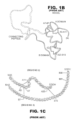
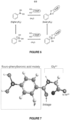
- the mature hormone is derived from a longer single-chain precursor, designated proinsulin, as outlined in Figure 1 .
- Specific residues in the insulin molecule are indicated by the amino-acid type (typically in standard three-letter code; e.g., Lys and Ala indicate Lysine and Alanine) and in superscript the chain (A or B) and position in that chain.
- Alanine at position 14 of the B chain of human insulin is indicated by Ala B14 ; and likewise Lysine at position B28 of insulin lispro (the active component of Humalog ® ; Eli Lilly and Co.) is indicated by Lys B28 .
- the hormone is stored in the pancreatic ⁇ -cell as a Zn 2+ -stabilized hexamer, it functions as a Zn 2+ -free monomer in the bloodstream.
- Administration of insulin has long been established as a treatment for diabetes mellitus.
- a major goal of conventional insulin replacement therapy in patients with diabetes mellitus is tight control of the blood glucose concentration to prevent its excursion above or below the normal range characteristic of healthy human subjects. Excursions above the normal range are associated with increased long-term risk of microvascular disease, including retinapathy, blindness, and renal failure.
- Hypoglycemia in patients with diabetes mellitus is a frequent complication of insulin replacement therapy and when severe can lead to significant morbidity (including altered mental status, loss of consciousness, seizures, and death).
- hypoglycemia increases the risk of maj or hypoglycemia and its associated morbidity and mortality.
- Multiple and recurrent episodes of hypoglycemia are also associated with chronic cognitive decline, a proposed mechanism underlying the increased prevalence of dementia in patients with longstanding diabetes mellitus.
- There is therefore an urgent need for new diabetes treatment technologies that would reduce the risk of hypoglycemia while preventing upward excursions in blood-glucose concentration above the normal range.
- Preparations of the counter-regulatory hormone glucagon have likewise been developed in a form amenable to rapid dissolution and subcutaneous injection as an emergency treatment of severe hypoglycemia.
- Insulin pumps have been linked to a continuous glucose monitor such that subcutaneous injection of insulin is halted and an alarm is sounded when hypoglycemic readings of the interstitial glucose concentration are encountered.
- Such a device-based approach has led to the experimental testing of closed-loop systems in which the pump and monitor are combined with a computer-based algorithm as an "artificial pancreas.”
- glucose-responsive materials for co-administration with an insulin analogue or modified insulin molecule such that the rate of release of the hormone from the subcutaneous depot depends on the interstitial glucose concentration.
- Such systems in general contain a glucose-responsive polymer, gel or other encapsulation material; and may also require a derivative of insulin containing a modification that enables binding of the hormone to the above material.
- An increase in the ambient concentration of glucose in the interstitial fluid at the site of subcutaneous injection may displace the bound insulin or insulin derivative either by competitive displacement of the hormone or by physical-chemical changes in the properties of the polymer, gel or other encapsulation material.
- the goal of such systems is to provide an intrinsic autoregulation feature to the encapsulated or gel-coated subcutaneous depot such that the risk of hypoglycemia is mitigated through delayed release of insulin when the ambient concentration of glucose is within or below the normal range. To date, no such glucose-responsive systems are in clinical use.
- a recent technology exploits the structure of a modified insulin molecule, optionally in conjuction with a carrier molecule such that the complex between the modified insulin molecule and the carrier is soluble and may enter into the bloodstream.
- This concept differs from glucose-responsive depots in which the polymer, gel or other encapsulation material remains in the subcutaneous depot as the free hormone enters into the bloodstream.
- the putative "closed" form of the above insulin analogues may not in fact be adequately constrained in conformation to provide significant impairment of receptor binding (relative to the modified insulin in the presence of exogenous glucose) and hence to provide useful or optimal glucose-dependent biological activity.
- the prescription of the above class of insulin analogues also overlooked the marked reduction in activity, irrespective of free glucose concentration, likely to arise on substitution of residues A2 or A3 (Ile A2 or Val A3 ) by other aliphatic or non-aliphatic amino acids (such as Lysine); these analogues would be expected to have negligible biological activity and thus not be useful as is long known in the art.
- Binding of an insulin analogue to the insulin receptor would also be impaired, but to a lesser degree, by substitution of Lysine at position A1. Also overlooked in the above class of insulin analogues is potential advantages of an alternative type of glucose-regulated conformational switch that may not only affect affinity of the analogue for the insulin receptor, but also the extent of insulin self-assembly and its rate of disassembly as might pertain to glucose-regulated pharmacokinetic properties of the subcutaneous depot.
- WO 2003/048195 purports to describe insulin derivatives having a built-in glucose sensor and a polyol moiety, capable to deliver insulin from an injected depot of an insulin derivative as a function of the glucose concentration in the surrounding tissue.
- WO 01/92334 purports to describe insulin derivatives having a built-in glucose sensor, capable to deliver insulin from a depot as a function of the glucose concentration in the surrounding medium (e.g. tissue).
- Hoeg-Jensen et al. JACS, 2005, 127, 6158-6109 ) purports to describe insulin self-assembly under control by D -sorbitol and D -glucose. Specifically, by equipping insulin with pairs of boronates and carbohydrates or other polyols, sufficient driving force can be provided for formation of soluble high molecular weight insulin hexamer-hexamer self-assemblies.
- Hoeg-Jensen et al. J. Pep. Sci.
- the insulin derivatives of WO 2014/093969 bind serum albumin or agglomerate in vivo, and effectively dissociate to release insulin in a hyperglycemic condition, where the complexation of glucose to a glucose-sensing element alters properties of the insulin derivative leading to the dissociation.
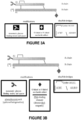
- the analogues of the present invention thus contain one or more saccharide modifications at or near the C-terminal end of the B chain rather than at or near the N-terminal end of the A chain ( Figures 3A and 3B ). Further, the analogues of the present invention avoid bulky glucose-binding agents at or near residue B1 and instead employ small chemical entities (phenylboronic acid derivatives; PBA) at residue A1.
- PBA phenylboronic acid derivatives
- the closed state tethered by an interaction (either non-covalent or covalent but reversible) between a saccharide modification (or non-saccharide analogue with similar functional groups) at or near the C-terminal end of the B chain and a small chemical entity at or near the N-terminal end of the A chain, is thus different from and unrelated to that disclosed previously.
- the closed state exploits a protective hinge in the insulin molecule that opens to engage the insulin receptor.
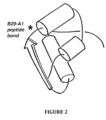
- Mini-proinsulins or single-chain insulin analogues in which a short covalent tether links the C-terminus of the B chain to the N-terminus of the A chain are known in the art to exhibit very low or undetectable activity ( Figure 2 ).
- the small size of the PBA moiety attached at or near the N-terminus of the A chain and its reversible binding to a cognate PBA-binding element at or near the C-terminus of the B chain would provide a conformational switch near to the classical dimerization surface of insulin and hence make possible glucose-regulation of insulin assembly and disassembly.
- the insulin analogues of the present invention whose biological availability (modulated by glucose-regulated rates of hexamer disassembly in the subcutaneous depot) and/or biological potency (modulated by glucose-dependent affinity for the insulin receptor) would be stronger under conditions of hyperglycemia than under conditions of hypoglycemia, would enhance the general safety, efficacy, simplicity and convenience of insulin replacement therapy.
- Such an insulin analogue formulation would be compatible with multiple devices (such as insulin vials, insulin pens, and insulin pumps) and could be integrated with modifications to the insulin molecule known in the art to confer rapid-, intermediate-, or prolonged insulin action.
- the present glucose-regulated conformational switch in the insulin molecule engineered between the C-terminus of the B chain and N-terminus of the A chain, could be combined with other glucose-responsive technologies (such as closed-loop systems or glucose-responsive polymers) to optimize their integrated properties.
- other glucose-responsive technologies such as closed-loop systems or glucose-responsive polymers
- the present invention provides an insulin analogue according to claim 1.
- the present invention further provides an insulin analogue for use according to claim 9.
- the present invention further provides a method of preparding an insulin analogue of the present invention, said method comprising the steps recited in claim 10.
- the analogues of the present invention contain two essential elements.
- the first element is a phenylboronic acid derivative (optionally including a spacer element) at the ⁇ -amino group of Glycine at position A1 (Gly A1 ) or optionally at either the ⁇ -amino group of D-Lysine as an amino-acid substitution well tolerated at position A1 (D-Lys A1 ).
- a phenylboronic acid derivative (optionally including a spacer element) at the ⁇ -amino group of L-Lysine as a substitution at position A4 (L-Lys A4 ).
- the modification may be found near the N-terminus of the A-chain, that is, within the first 5 amino acids of the Achain.
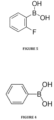
- the phenylboronic acid moiety ( Figure 4 ) may be modified within its aromatic ring by substitution of a hydrogen atom of a halogen atom, such as fluorine, chlorine, bromine or iodine ( Figure 5 ); the spacer element may contain a linear acyl chain of 1-16 carbon atoms ( Figure 6 ).
- the second element is a N-linked or O-linked monosaccharide, disaccharide, or oligosaccharide at one or near the C-terminus of the B-chain polypeptide, that is at one or more of the positions B27, B28, B29, B30, or as attached to a peptide extension of the B-chain containing one residue (B31) or two residues (B31-B32).
- a nonstandard diol-containing amino acid such as L-DOPA or D-DOPA may be substituted at any of B27-B30.
- O-linked saccharides are derivatives of Serine or Threonine
- examples of N-linked saccharides are derivatives of Asparagine or Glutamine.
- Examples of monosaccharides are glucose, mannose, and N-acetyl-galactose.
- the overall structure of insulin analogues of the present invention is shown in schematic form in Figures 3A and 3B . Whereas in this scheme a general monomeric glucose-binding element attached to the A chain might be expected to require a cognate glucose or saccharide moiety attached to the B chain ( Fig.
- the particular molecular embodiment of a monomeric glucose-binding element as a phenylboronic acid relaxes this requirement to a broad molecular diversity of diol-containing moieties (or adducts containing an ⁇ -hydroxycarboxylate group as an alternative PBA-binding function), whether a saccharide or a non-saccharide reagent ( Figure 3B ).
- the N-linked or O-linked saccharide may be substituted by any organic moiety of similar molecular mass that contains a diol function that mimics the diol function of a monosaccharide and hence confers reversible PBA-binding activity (or adducts containing an ⁇ -hydroxycarboxylate group as an alternative PBA-binding function).
- Such non-saccharide diol-containing organic compounds span a broad range of chemical classes, including acids, alcohols, thiol reagents containing aromatic and non-aromatic scaffolds; adducts containing an ⁇ -hydroxycarboxylate group may provide an alternative PBA-binding function.
- Such diol-containing and alpha-hydroxycarboxylate-containing adducts in general exhibit molecular masses between 80 and 600 Dalston and in general contain 3-30 carbon atoms.
- Convenient modes of attachment to the B chain also span a broad range of linkages in addition to the above N-linked and O-linked saccharide derivatives described above; these additional modes of attachment include (i) the side-chain amino function of Lysine, ornithine, diamino-butyric acid, diaminopropionic acid (with main-chain chirality L or D) and (ii) the side-chain thiol function of Cysteine or homocysteine (with main-chain chirality L or D).
- the analogues of the present invention may optionally contain an additional phenyboronic acid group (or halogenic derivative thereof) attached (together with a spacer element) to residue B1 as a mechanism intended to provide glucose-sensitive binding of the insulin analogue to surface lectins in the subcutaneous depot.
- analogues of the present invention may optionally contain substitutions known in the art to confer rapid action (such as Asp B28 , a substitution found in insulin aspart (the active component of Novolog ® ); [Lys B28 , Pro B29 ], pairwise substitutions found in insulin lispro (the active component of Humalog ® ); Glu B29 or the combination [Lys B3 , Glu B29 ] as the latter is found in insulin glulisine (the active component of Apridra ® ), or modifications at position B24 associated with accelerated disassembly of the insulin hexamer (e.g., substitution of Phe B24 by Cyclohexanylalanine or by a derivative of Phenylalanine containing a single halogen substitution within the aromatic ring).
- substitutions known in the art to confer rapid action such as Asp B28 , a substitution found in insulin aspart (the active component of Novolog ® ); [Lys B28 , Pro B
- the analogues of the present invention may optionally contain modifications known in the art to confer protracted action, such as modification of the ⁇ -amino group of Lys B29 by an acyl chain or acyl-glutamic acid adduct as respectively illustrated by insulin detemir (the active component of Levemir ® ) and insulin degludec (the active component of Tresiba ® ); or contain basic amino-acid substitutions or basic chain extensions designed to shift the isoelectric point (pI) to near neutrality as exemplified by the Arg B31 -Arg B32 extension of insulin glargine (the active component of Lantus ® ).
- modifications known in the art to confer protracted action such as modification of the ⁇ -amino group of Lys B29 by an acyl chain or acyl-glutamic acid adduct as respectively illustrated by insulin detemir (the active component of Levemir ® ) and insulin degludec (the active component of Tresiba ®
- Analogues of the present invention designed to exhibit such a shifted pI may also contain a substitution of Asn A21 , such as by Glycine, Alanine or Serine.
- Analogues of the present invention may optionally also contain non-beta-branched amino-acid substitutions of Thr A8 associated with increased affinity for the insulin receptor and/or increased thermodynamic stability as may be introduced to mitigate deleterious effects of the primary two above design elements (a phenylboronic acid derivative at or near the N-terminus of the A chain and one or more saccharide derivatives at or near the C-terminus of the B chain) on receptor-binding affinity and/or thermodynamic stability.
- A8 substitutions known in the art are His A8 , Lys A8 , Arg A8 , and Glu A8 .
- the two glucose-responsive mechanisms enabled by the present invention-glucose-dependent rate of insulin hexamer disassembly and glucose-dependent strength of binding to the insulin receptor- may coexist in some molecular embodiments whereas others may exhibit only one property or the other. Still other embodiments may exhibit a combination of the two properties in unequal properties. Either mechanism would be expected to confer a benefit to patients as glucose-dependent rate of insulin hexamer disassembly in the subcutaneous depot would reduce the bio-availability of the hormone under conditions of hypoglycemia whereas glucose-dependent receptor binding would reduce the potency of the hormone already in the blood stream under conditions of hypoglycemia. These two protective benefits would be expected to be independent or may even act in synergy to reduce the risk of or severity of hypoglycemic episodes.
- an innovative method of manufacture has been developed and demonstrated to the preparation of insulin analogs modified by a monomeric glucose-binding element at or near the N terminus of the A chain and modified by a saccharide or diol-containing moiety at or near the C terminus of the B chain; the latter may also containing an ⁇ -hydroxycarboxylate group as an alternative PBA-binding function.
- This method of manufacture exploits trypsin-mediated semi-synthesis of a pre-modified insulin fragment and a pre-modified synthetic peptide, thus simplifying the purification of the final product.
- the insulin fragment is a des -octapeptide[B23-B30] fragment of insulin or of a single-chain insulin precursor.
- the synthetic peptide contains an N-terminal glycine and is of length 6, 7, 8, 9 or 10 residues.
- the peptide may incorporate an N- or O-linked saccharide directly in the course of solid-phase synthesis or as a result of post-synthetic modification ( Fig. 3A ).
- the latter approach readily extends to derivitization of a basic side chain or thiol side chain by a diol-containing moiety to be used in combination with an A chain modified by phenylboronic acid as illustrated in Figure 3B .
- the insulin analogues of the present invention may exhibit an isoelectric point (pI) in the range 4.0-6.0 and thereby be amenable to pharmaceutical formulation in the pH range 6.8-7.8; alternatively, the analogues of the present invention may exhibit an isoelectric point in the range 6.8-7.8 and thereby be amenable to pharmaceutical formulation in the pH range 4.0-4.2.
- pI isoelectric point
- the latter conditions are known in the art to lead to isoelectric precipitation of such a pI-shifted insulin analogue in the subcutaneous depot as a mechanism of protracted action.
- an example of such a pI-shifted insulin analogue is provided by insulin glargine, in which a basic two-residue extension of the B chain (Arg B31 -Arg B32 ) shifts the pI to near-neutrality and thus enables prolonged pharmacokinetic absorption from the subcutaneous depot.
- the pI of an insulin analogue may be modified through the addition of basic or acidic chain extensions, through the substitution of basic residues by neutral or acidic residues, and through the substitution of acidic residues by neutral or basic residues; in this context we define acidic residues as Aspartic Acid and Glutamic Acid, and we define basic residues as Arginine, Lysine, and under some circumstances, Histidine.
- absolute in vitro affinities of the insulin analogue for insulin receptor are in the range 5-100% relative to wild-type human insulin and so unlikely to exhibit prolonged residence times in the hormone-receptor complex; such prolonged residence times are believed to be associated with enhanced risk of carcinogenesis in mammals or more rapid growth of cancer cell lines in culture.
- IGF-1R insulin-like growth factor receptor
- the insulin analogues of the present invention consist of two polypeptide chains that contain a novel combination of modifications in the A chain and B chain such that the analogue, in the absence of glucose or other exogenous saccharide, exhibits a reversible interaction (either covalent or non-covalent) between (a) one or more saccharide moieties or (b) one or more non-saccharide diol-containing moieties at or near the C-terminal end of the B chain to a monomeric glucose-binding moiety (optionally derived from phenylboronic acid) at or near the N-terminal end of the A chain.
- Examples are provided by O-linked derivatives of Thr B27 and/or Thr B30 by glucose, mannose, or N-acetyl-galactose and may alternatively be provided by analogous O-linked derivatives of insulin analogues containing substitution(s) of Thr B27 and/or Thr B30 by Serine. Further examples of monosaccarhide modifications are provided by N-linked modification of Asn or Gln when substituted at positions B26, B27, B28, B29, B30, or within a C-terminal extension of the B chain (B31 or B31-B32) up to two residues in length.
- C-terminal extended B chains enables use of an acidic residue at B31 and/or B32 to enhance solubility and to impair cross-binding to the mitogenic IGF-1R receptor.
- solid-phase peptide synthesis of a B-chain fragment (as employed in trypsin-mediated semi-synthesis) containing a glycosylated residue at B30 is facilitated by such an extended peptide so that the resin-bound C-terminal residue is not glycosylated.
- the N-linked or O-linked saccharide moiety may be replaced by any organic moiety of similar molecular mass that contains a diol function (or an ⁇ -hydroxycarboxylate group as an alternative PBA-binding function) conferring reversible binding to PBA or a PBA derivative attached at or near the N-terminus of the A chain.
- the diol may be 3-26 carbons long.
- the molecular weight of the diol may be between 90 and 570.
- non-saccharide diol-containing elements examples include organic acids (such as gluconic acid, threonic acid, glyceric acid, galactonic acid, and dihydroxycinnamic acid), thiol-containing compounds (such as 1-thioglycerol, and 1,2,3-butanetriol4-mercapto), and amino compounds (such as ( ⁇ )-3-amino-1,2-propanediol, ( ⁇ )-3-amino-1,2-propanediol, and glucosamine).
- organic acids such as gluconic acid, threonic acid, glyceric acid, galactonic acid, and dihydroxycinnamic acid
- thiol-containing compounds such as 1-thioglycerol, and 1,2,3-butanetriol4-mercapto
- amino compounds such as ( ⁇ )-3-amino-1,2-propanediol, ( ⁇ )-3-amino-1,2-propanediol, and
- the thiol-containing moiety 1-thio- ⁇ -D-glucose may also be employed on disulfide linkage to a Cysteine or Homocysteine in a suitably modified B chain. Additional reagents readily obtained from commercial sources and in principle amenable to attachment to a synthetic peptide are given in Table 1; such attachment may require activation of the compound or its derivitization to provide an appropriate "chemical handle.” This table is not exhaustive and is meant to provide an illustrative overview of the diversity of molecular entities (either diol-containing compounds or those containing an ⁇ -hydroxycarboxylate group). Table 1.
- the present invention is directed toward an insulin analogue that provides enhanced in vivo glycemic control through glucose-dependent rates of insulin hexamer disassembly in the subcutaneous depot and/or glucose-dependent binding to the insulin receptor in the blood stream and at target tissues.
- Six novel insulin analogues were prepared as listed in Table 2. Each employs fluoro-phenylboronic acid as the glucose-sensing element.
- the chemical linkage between the fluoro-PBA moiety and the ⁇ -amino group of Gly A1 is illustrated in Figure 7 ; the corresponding linkage was employed in analogues with simultaneous fluoro-PBA adduct at the ⁇ -amino group of Phe B1 (not shown).
- Two analogues contain one such adduct (at the ⁇ -amino group of the A chain; Table 2A) and three analogues contain two such adducts (at the ⁇ -amino groups of both the A- and B chains; Table 2B).
- the protocol for derivitization of an insulin fragment by an activare FPA reagent is provided below.
- These analogues contained O-linked ⁇ -D-mannopyranoside (mannose-O ⁇ -Thr) or ⁇ -D-glucopyranoside (glucose-O ⁇ -Thr) at positions of naturally occurring Threonine in human insulin (residues B27 and/or B30).
- Mannose-containing insulin analogues exhibited cobalt R 6 hexamer assembly properties similar to those of WT insulin (but with different disassembly kinetics; below) as illustrated in Figure 8 .
- the mannose-containing insulin analogues exhibited biological activities on IV bolus injection into male Lewis rats rendered diabetic by steptozotocin similar to that of insulin lispro, the active component of Humalog ® (Eli Lilly) as illustrated in Figure 9 .
- Table 2 Insulin Analogues A. Single PBA Modification (G1y A1 ) B.
- the affinity of the insulin analogue containing O-linked mannose-Thr B30 in the context of a [Glu, Glu]-extended lispro B chain was observed to be (i) in the range 50-75% (relative to Orn B29 -insulin) in the presence a fluoro-PBA adduct attached to the ⁇ -amino group of Gly A1 and (ii) in the range 10-30% (relative to Orn B29 -insulin) in the presence fluoro-PBA adducts attached to the ⁇ -amino groups of both Gly A1 and Phe B1 .
- Glucose-responsive rates of disassembly were investigated using a spectroscopy assay in which the visible absorption spectrum of a cobalt (Co 2+ )-substituted insulin hexamer was obtained in the presence of phenol as an R 6 hexamer.
- This assay (as described in Richard, J.P. et al. ("Self-association properties of monomeric insulin analogs under formulation conditions.” Pharm. Res. 15:1434-41; 1998 .) exploits the R-state-specific tetrahedral coordination of the metal ion, which gives rise to a blue absorption band.
- This band arises from the unfilled d-shell electrons of the cobalt ion and is a specific signature of a tetrahedral coordination environment.
- Addition of a large excess of the chelating agent ethylene-diamine-tetra-acetic acid (EDTA) leads to progressive sequestration of the metal ion (in a colorless octahedral complex) and so provides a rapid and convenient probe of the kinetics of hexamer disassembly.
- Wild-type insulin exhibits the same rate of loss of the the R-state-specific d-d signal in the presence of absence of glucose at a contration of 25 mM ( Fig. 8A ).
- the analogue listed in Table 2A (Mannose-Thr B30 -Lys B28 -Pro B29 -Glu B31 -Glu B32 ) exhibits a marked acceleration of disassembly under conditions of hyperglycemia ( Fig. 8B ).
- Such glucose-regulated disassembly does not occur in the presence of the mannose adduct in the B chain but absence of the PBA adduct at the N-terminus of the A chain ( Fig. 8C ).
- the claimed insulin analogues exhibit low affinities for the insulin receptor relative to wild-type insulin.
- this reduction in affinity is a consequence of a reversible interaction between a saccharide modification at or near the C-terminal end of the B chain and a phenylboronic acid derivative attached to the A chain at or near its N-terminal end.
- receptor-binding affinities in the presence of glucose at a concentration > 200 mg/ml that are in the range 5-100% would be sufficient to confer such native or near-native glycemic potency in an animal with diabetes mellitus. It is an additional feature of the present invention that these modifications are also likely to reduce the tendency of insulin to undergo fibrillation at or above room temperature and to attenuate the mitogenicity of insulin, a distinct signaling pathway that is undesirable from the perspective of cancer risk and cancer growth.
- insulin analogues may be made with A- and B chain sequences derived from animal insulins, such as porcine, bovine, equine, and canine insulins, by way of non-limiting examples, so long as the A-chain is modified by a phenylboronic acid derivative at or near its N-terminus, and one or more amino-acid side chains at or near the C-terminus of the B chain are modified by O-linked or N-linked monosaccarhides, disaccharides or oligosaccharides.
- animal insulins such as porcine, bovine, equine, and canine insulins
- Such variant B chains derived from human insulin or animal insulins may optionally contain a C-terminal dipeptide extension (with respective residue positions designated B31 and B32) wherein at least one of these C-terminal extended residues is a modified amino acid containing an O-linked or N-linked saccharide.
- the insulin analogue of the present invention may contain a deletion of residues B1-B3 or may be combined with a variant B chain lacking Proline at position B28 (e.g., [Lys B28 , Pro B29 ] as in Humalog; or Asp B28 or Glu B28 in combination with Lysine or Proline at position B29) or containing Glutamic Acid at position B29.
- Proline at position B28 e.g., [Lys B28 , Pro B29 ] as in Humalog; or Asp B28 or Glu B28 in combination with Lysine or Proline at position B29
- Glutamic Acid at position B29.
- At position A13 Leucine may optionally
- the insulin analogues of the present invention may be derived from Lys-directed proteolysis of a precursor polypeptide in yeast biosynthesis in Pichia pastoris, Saccharomyces cerevisciae, or other yeast expression species or strains. Such strains may be engineered to insert halogen-modified Phenylalanine at position B24 by means of an engineered tRNA synthetase and orthogonal nonsense suppression.
- the B-domain of the insulin analogues of the present invention may optionally contain non-standard substitutions, such as D-amino-acids at positions B20 and/or B23 (intended to augment thermodynamic stability, receptor-binding affinity, and resistance to fibrillation).
- the halogenic modification at position B24 may be at the 2-ring position of Phe B24 (i.e., ortho -F-Phe B24 , ortho -Cl-Phe B24 , or ortho -Br-Phe B24 .
- the analogues may contain iodo-substitutions within the aromatic ring of Tyr B16 and/or Tyr B26 (3- mono -iodo-Tyr or [3, 5]-di-iodo-Tyr); intended to augment thermodynamic stability and receptor-binding activity).
- Thr B27 , Thr B30 , or one or more Serine residues in the C-domain may be modified, singly or in combination, by a monosaccaride adduct; examples are provided by O-linked N-acetyl- ⁇ -D-galactopyranoside (designated GalNAc-O ⁇ -Ser or GalNAc-O ⁇ -Thr), O-linked ⁇ -D-mannopyranoside (mannose-O ⁇ -Ser or mannose-O ⁇ -Thr), and/or ⁇ -D-glucopyranoside (glucose-O ⁇ -Ser or glucose-O ⁇ -Thr).
- O-linked N-acetyl- ⁇ -D-galactopyranoside designated GalNAc-O ⁇ -Ser or GalNAc-O ⁇ -Thr
- O-linked ⁇ -D-mannopyranoside mannose-O ⁇ -Ser or mannose-O ⁇ -Thr
- additional substitutions of amino acids may be made within groups of amino acids with similar side chains, without departing from the present invention. These include the neutral hydrophobic amino acids: Alanine (Ala or A), Valine (Val or V), Leucine (Leu or L), Isoleucine (Ile or 1), Proline (Pro or P), Tryptophan (Trp or W), Phenylalanine (Phe or F) and Methionine (Met or M).
- the neutral polar amino acids may be substituted for each other within their group of Glycine (Gly or G), Serine (Ser or S), Threonine (Thr or T), Tyrosine (Tyr or Y), Cysteine (Cys or C), Glutamine (Glu or Q), and Asparagine (Asn or N).
- Acidic amino acids are Aspartic acid (Asp or D) and Glutamic acid (Glu or E).
- Introduction of basic amino-acid substitutions including Lysine (Lys or K), Arginine (Arg or R) and Histidine (His or H) are not preferred in order to maintain the enhanced net negative charge of this class of analogues.
- the amino acids noted herein should be considered to be L-amino acids.
- Standard amino acids may also be substituted by non-standard amino acids belonging to the same chemical class.
- the insulin analogues of the present invention include (but are not restricted to) insulin analogues whose variant B chain conforms to the polypeptide sequences given in SEQ ID NOs 7-50 below and whose variant A chain conforms to the polypeptide sequences given in SEQ ID NOs 51-53. It is understood that the variant B chains of the present invention may also include deletion of residue B1, deletion of residues B1 and B2, or deletion of residues B1-B3 such that the neo-C-terminal ⁇ -amino group may optionally be modified by a phenylboronic acid derivative.
- the amino-acid sequence of human proinsulin is provided, for comparative purposes, as SEQ ID NO: 1.
- amino-acid sequence of the human A chain is provided, for comparative purposes, as SEQ ID NO: 2.
- amino-acid sequences of the human B chain and B-chain analogues known in the art are provided, for comparative purposes, as SEQ ID NO: 3-6.
- amino-acid sequence of human proinsulin is provided, for comparative purposes, as SEQ ID NO: 1.
- amino-acid sequence of the A chain of human insulin is provided as SEQ ID NO: 2.
- amino-acid sequence of the B chain of human insulin is provided as SEQ ID NO: 3.
- the amino-acid sequence of the "KP" B chain of prandial insulin analogue KP-insulin contains substitutions Pro B28 ⁇ Lys and Lys B29 ⁇ Pro as provided in SEQ ID NO: 4.
- the 32-residue amino-acid sequence of an extended "KP" B chain of prandial insulin analogue KP-insulin is provided in SEQ ID NO: 5.
- the 30-residue amino-acid sequence of a variant B chain modified to contain Ornithine at position B29 is provided in SEQ ID NO: 6.
- Xaa 1 is either the native ⁇ -amino group of Phe B1 or optionally a phenylboronic-acid moiety or halogenic derivative of a phenylboronic-acid moiety connected by peptide linkage or optional acyl linker to the ⁇ -amino group of Phe B1 ;
- Xaa 2 is Phenylalanine, penta-fluoro-Phe, 2-chloro-Phe, 2-bromo-Phe, 4-chloro-Phe, 2-methyl-Phe, or Cyclohexanylalanine;
- Xaa 3 is an O ⁇ -Thr B27 -linked or O ⁇ -Ser B27 -linked monosaccaride pyranoside selected from a group consisting of ⁇ -D-mannopyranoside,
- Xaa 1 is either the native ⁇ -amino group of Phe B1 or optionally a phenylboronic-acid moiety or halogenic derivative of a phenylboronic-acid moiety connected by peptide linkage or optional acyl linker to the ⁇ -amino group of Phe B1 ;
- Xaa 2 is Phenylalanine, penta-fluoro-Phe, 2-chloro-Phe, 2-bromo-Phe, 4-chloro-Phe, 2-methyl-Phe, or Cyclohexanylalanine;
- Xaa 3 is an O ⁇ -Thr B27 -linked or O ⁇ -Ser B27 -linked monosaccaride pyranoside selected from a group consisting of ⁇ -D-mannopyran
- Xaa 1 is either the native ⁇ -amino group of Phe B1 or optionally a phenylboronic-acid moiety or halogenic derivative of a phenylboronic-acid moiety connected by peptide linkage or optional acyl linker to the ⁇ -amino group of Phe B1 ;
- Xaa 2 is Phenylalanine, penta-fluoro-Phe, 2-chloro-Phe, 2-bromo-Phe, 4-chloro-Phe, 2-methyl-Phe, or Cyclohexanylalanine;
- Xaa 3 is an N ⁇ -Asn B27 -linked or N ⁇ -Gln B27 -linked monosaccaride pyranoside selected from a group consisting of ⁇ -D-mannopyrano
- Xaa 1 is either the native ⁇ -amino group of Phe B1 or optionally a phenylboronic-acid moiety or halogenic derivative of a phenylboronic-acid moiety connected by peptide linkage or optional acyl linker to the ⁇ -amino group of Phe B1 ;
- Xaa 2 is Phenylalanine, penta-fluoro-Phe, 2-chloro-Phe, 2-bromo-Phe, 4-chloro-Phe, 2-methyl-Phe, or Cyclohexanylalanine;
- Xaa 3 is an N ⁇ -Asn B27 -linked or N ⁇ -Gln B27 -linked monosaccaride pyranoside selected from a group consisting of ⁇ -D-mann
- Xaa 1 is either the native ⁇ -amino group of Phe B1 or optionally a phenylboronic-acid moiety or halogenic derivative of a phenylboronic-acid moiety connected by peptide linkage or optional acyl linker to the ⁇ -amino group of Phe B1 ;
- Xaa 2 is Phenylalanine, penta-fluoro-Phe, 2-chloro-Phe, 2-bromo-Phe, 4-chloro-Phe, 2-methyl-Phe, or Cyclohexanylalanine;
- Xaa 3 is a derivative of the D or L stereoisomer of Lysine, Omithine, di-aminobutyric acid or di-aminopropionic acid whose side chain amino group is
- Xaa 1 is either the native ⁇ -amino group of Phe B1 or optionally a phenylboronic-acid moiety or halogenic derivative of a phenylboronic-acid moiety connected by peptide linkage or optional acyl linker to the ⁇ -amino group of Phe B1 ;
- Xaa 2 is Phenylalanine, penta-fluoro-Phe, 2-chloro-Phe, 2-bromo-Phe, 4-chloro-Phe, 2-methyl-Phe, or Cyclohexanylalanine;
- Xaa 3 is a derivative of the D or L stereoisomer of Lysine, Omithine, di-aminobutyric acid or di-aminopropionic acid whose side chain amino
- Xaa 1 is either the native ⁇ -amino group of Phe B1 or optionally a phenylboronic-acid moiety or halogenic derivative of a phenylboronic-acid moiety connected by peptide linkage or optional acyl linker to the ⁇ -amino group of Phe B1 ;
- Xaa 2 is Phenylalanine, penta-fluoro-Phe, 2-chloro-Phe, 2-bromo-Phe, 4-chloro-Phe, 2-methyl-Phe, or Cyclohexanylalanine;
- Xaa 3 is a derivative of the D or L stereoisomer of Cysteine or Homocysteine whose side-chain sulfur atom is linked to a diol-containing reagent;
- Xaa 1 is either the native ⁇ -amino group of Phe B1 or optionally a phenylboronic-acid moiety or halogenic derivative of a phenylboronic-acid moiety connected by peptide linkage or optional acyl linker to the ⁇ -amino group of Phe B1 ;
- Xaa 2 is Phenylalanine, penta-fluoro-Phe, 2-chloro-Phe, 2-bromo-Phe, 4-chloro-Phe, 2-methyl-Phe, or Cyclohexanylalanine;
- Xaa 3 is a derivative of the D or L stereoisomer of Cysteine or Homocysteine whose side-chain sulfur atom is linked to a diol-containing rea
- Xaa 1 is either the native ⁇ -amino group of Phe B1 or optionally a phenylboronic-acid moiety or halogenic derivative of a phenylboronic-acid moiety connected by peptide linkage or optional acyl linker to the ⁇ -amino group of Phe B1 ;
- Xaa 2 is Phenylalanine, penta-fluoro-Phe, 2-chloro-Phe, 2-bromo-Phe, 4-chloro-Phe, 2-methyl-Phe, or Cyclohexanylalanine;
- Xaa 3 is Lysine, Omithine, Arginine, di-amino-butyric acid, di-amino-propionic acid, Norleucine, aminobutyric acid, aminopropionic acid, Alanine,
- Xaa 1 is either the native ⁇ -amino group of Phe B1 or optionally a phenylboronic-acid moiety or halogenic derivative of a phenylboronic-acid moiety connected by peptide linkage or optional acyl linker to the ⁇ -amino group of Phe B1 ;
- Xaa 2 is Phenylalanine, penta-fluoro-Phe, 2-chloro-Phe, 2-bromo-Phe, 4-chloro-Phe, 2-methyl-Phe, or Cyclohexanylalanine;
- Xaa 3 is Lysine, Arginine, Omithine, di-aminobutyric acid, di-aminopropionic acid, Alanine, Aspartic Acid, or Glutamic Acid;
- Xaaa 1 is either the native ⁇ -amino group of Phe B1 or optionally a phenylboronic-acid moiety or halogenic derivative of
- Xaa 1 is either the native ⁇ -amino group of Phe B1 or optionally a phenylboronic-acid moiety or halogenic derivative of a phenylboronic-acid moiety connected by peptide linkage or optional acyl linker to the ⁇ -amino group of Phe B1 ;
- Xaa 2 is Phenylalanine, penta-fluoro-Phe, 2-chloro-Phe, 2-bromo-Phe, 4-chloro-Phe, 2-methyl-Phe, or Cyclohexanylalanine;
- Xaa 3 is Lysine, Omithine, Arginine, di-amino-butyric acid, di-amino-propionic acid, Norleucine, aminobutyric acid, aminopropionic acid, Alanine,
- Xaa 1 is either the native ⁇ -amino group of Phe B1 or optionally a phenylboronic-acid moiety or halogenic derivative of a phenylboronic-acid moiety connected by peptide linkage or optional acyl linker to the ⁇ -amino group of Phe B1 ;
- Xaa 2 is Phenylalanine, penta-fluoro-Phe, 2-chloro-Phe, 2-bromo-Phe, 4-chloro-Phe, 2-methyl-Phe, or Cyclohexanylalanine;
- Xaa 3 is Lysine, Arginine, Omithine, di-aminobutyric acid, di-aminopropionic acid, Alanine, Aspartic Acid, or Glutamic Acid;
- Xaa 3 is Lysine, Arginine, Omithine, di-aminobutyric acid, di-aminopropionic acid, Alanine, As
- Xaa 1 is either the native ⁇ -amino group of Phe B1 or optionally a phenylboronic-acid moiety or halogenic derivative of a phenylboronic-acid moiety connected by peptide linkage or optional acyl linker to the ⁇ -amino group of Phe B1 ;
- Xaa 2 is Phenylalanine, penta-fluoro-Phe, 2-chloro-Phe, 2-bromo-Phe, 4-chloro-Phe, 2-methyl-Phe, or Cyclohexanylalanine;
- Xaa 3 is Alanine, Arginine, Aspartic Acid or Glutamic Acid;
- Xaa 4 is a derivative of the D or L stereoisomer of Lysine, Omithine, di
- Xaa 1 is either the native ⁇ -amino group of Phe B1 or optionally a phenylboronic-acid moiety or halogenic derivative of a phenylboronic-acid moiety connected by peptide linkage or optional acyl linker to the ⁇ -amino group of Phe B1 ;
- Xaa 2 is Phenylalanine, penta-fluoro-Phe, 2-chloro-Phe, 2-bromo-Phe, 4-chloro-Phe, 2-methyl-Phe, or Cyclohexanylalanine;
- Xaa 3 is Alanine, Arginine, Aspartic Acid, or Glutamic Acid;
- Xaa 4 is a derivative of the D or L stereoisomer of Lysine, Omit
- Xaa 1 is either the native ⁇ -amino group of Phe B1 or optionally a phenylboronic-acid moiety or halogenic derivative of a phenylboronic-acid moiety connected by peptide linkage or optional acyl linker to the ⁇ -amino group of Phe B1 ;
- Xaa 2 is Phenylalanine, penta-fluoro-Phe, 2-chloro-Phe, 2-bromo-Phe, 4-chloro-Phe, 2-methyl-Phe, or Cyclohexanylalanine;
- Xaa 3 is Alanine, Arginine, Aspartic Acid or Glutamic Acid;
- Xaa 4 is a derivative of the D or L stereoisomer of Cysteine or Homo
- Xaa 1 is either the native ⁇ -amino group of Phe B1 or optionally a phenylboronic-acid moiety or halogenic derivative of a phenylboronic-acid moiety connected by peptide linkage or optional acyl linker to the ⁇ -amino group of Phe B1 ;
- Xaa 2 is Phenylalanine, penta-fluoro-Phe, 2-chloro-Phe, 2-bromo-Phe, 4-chloro-Phe, 2-methyl-Phe, or Cyclohexanylalanine;
- Xaa 3 is Alanine, Arginine, Aspartic Acid, or Glutamic Acid;
- Xaa 4 is a derivative of the D or L stereoisomer of Cysteine or
- Xaa 1 is either the native ⁇ -amino group of Phe B1 or optionally a phenylboronic-acid moiety or halogenic derivative of a phenylboronic-acid moiety connected by peptide linkage or optional acyl linker to the ⁇ -amino group of Phe B1 ;
- Xaa 2 is Phenylalanine, penta-fluoro-Phe, 2-chloro-Phe, 2-bromo-Phe, 4-chloro-Phe, 2-methyl-Phe, or Cyclohexanylalanine;
- Xaa 3 is Lysine, Omithine, Arginine, di-amino-butyric acid, di-amino-propionic acid, Norleucine, aminobutyric acid, aminopropionic acid, Alanine
- Xaa 1 is either the native ⁇ -amino group of Phe B1 or optionally a phenylboronic-acid moiety or halogenic derivative of a phenylboronic-acid moiety connected by peptide linkage or optional acyl linker to the ⁇ -amino group of Phe B1 ;
- Xaa 2 is Phenylalanine, penta-fluoro-Phe, 2-chloro-Phe, 2-bromo-Phe, 4-chloro-Phe, 2-methyl-Phe, or Cyclohexanylalanine;
- Xaa 3 is Lysine, Arginine, Omithine, di-aminobutyric acid, di-aminopropionic acid, Alanine, Aspartic Acid, or Glutamic Acid;
- Xaa 3 is Lysine, Arginine, Omithine, di-aminobutyric acid, di-aminopropionic acid, Alanine, As
- Xaa 1 is either the native ⁇ -amino group of Phe B1 or optionally a phenylboronic-acid moiety or halogenic derivative of a phenylboronic-acid moiety connected by peptide linkage or optional acyl linker to the ⁇ -amino group of Phe B1 ;
- Xaa 2 is Phenylalanine, penta-fluoro-Phe, 2-chloro-Phe, 2-bromo-Phe, 4-chloro-Phe, 2-methyl-Phe, or Cyclohexanylalanine;
- Xaa 3 is Lysine, Omithine, Arginine, di-amino-butyric acid, di-amino-propionic acid, Norleucine, aminobutyric acid, aminopropionic acid, Alanine
- Xaa 1 is either the native ⁇ -amino group of Phe B1 or optionally a phenylboronic-acid moiety or halogenic derivative of a phenylboronic-acid moiety connected by peptide linkage or optional acyl linker to the ⁇ -amino group of Phe B1 ;
- Xaa 2 is Phenylalanine, penta-fluoro-Phe, 2-chloro-Phe, 2-bromo-Phe, 4-chloro-Phe, 2-methyl-Phe, or Cyclohexanylalanine;
- Xaa 3 is Lysine, Omithine, Arginine, di-aminobutyric acid, di-amino-propionic acid, Norleucine, aminobutyric acid, aminopropionic acid
- Xaa 1 is either the native ⁇ -amino group of Phe B1 or optionally a phenylboronic-acid moiety or halogenic derivative of a phenylboronic-acid moiety connected by peptide linkage or optional acyl linker to the ⁇ -amino group of Phe B1 ;
- Xaa 2 is Phenylalanine, penta-fluoro-Phe, 2-chloro-Phe, 2-bromo-Phe, 4-chloro-Phe, 2-methyl-Phe, or Cyclohexanylalanine;
- Xaa 3 is Lysine, Omithine, Arginine, di-amino-butyric acid, di-amino-propionic acid, Norleucine, aminobutyric acid, aminopropionic acid
- Xaa 1 is either the native ⁇ -amino group of Phe B1 or optionally a phenylboronic-acid moiety or halogenic derivative of a phenylboronic-acid moiety connected by peptide linkage or optional acyl linker to the ⁇ -amino group of Phe B1 ;
- Xaa 2 is Phenylalanine, penta-fluoro-Phe, 2-chloro-Phe, 2-bromo-Phe, 4-chloro-Phe, 2-methyl-Phe, or Cyclohexanylalanine;
- Xaa 3 is Alanine, Arginine, Aspartic Acid, or Glutamic Acid;
- Xaa 4 is Alanine, Arginine, Aspartic Acid or Glutamic Acid;
- Xaa 5 is Alanine, Arginine, Aspartic Acid or Glutamic Acid;
- Xaa 1 is either the native ⁇ -amino group of Phe B1 or optionally a phenylboronic-acid moiety or halogenic derivative of a phenylboronic-acid moiety connected by peptide linkage or optional acyl linker to the ⁇ -amino group of Phe B1 ;
- Xaa 2 is Phenylalanine, penta-fluoro-Phe, 2-chloro-Phe, 2-bromo-Phe, 4-chloro-Phe, 2-methyl-Phe, or Cyclohexanylalanine;
- Xaa 3 is Arginine, Norleucine, aminobutyric acid, aminopropionic acid, Alanine, or Glutamic Acid;
- Xaa 4 is Alanine, Arginine, As
- Xaa 1 is either the native ⁇ -amino group of Phe B1 or optionally a phenylboronic-acid moiety or halogenic derivative of a phenylboronic-acid moiety connected by peptide linkage or optional acyl linker to the ⁇ -amino group of Phe B1 ;
- Xaa 2 is Phenylalanine, penta-fluoro-Phe, 2-chloro-Phe, 2-bromo-Phe, 4-chloro-Phe, 2-methyl-Phe, or Cyclohexanylalanine;
- Xaa 3 is Alanine, Arginine, Aspartic Acid, or Glutamic Acid;
- Xaa 4 is Alanine, Arginine, Aspartic Acid or Glutamic Acid; and where Xaa
- Xaa 1 is either the native ⁇ -amino group of Phe B1 or optionally a phenylboronic-acid moiety or halogenic derivative of a phenylboronic-acid moiety connected by peptide linkage or optional acyl linker to the ⁇ -amino group of Phe B1 ;
- Xaa 2 is Phenylalanine, penta-fluoro-Phe, 2-chloro-Phe, 2-bromo-Phe, 4-chloro-Phe, 2-methyl-Phe, or Cyclohexanylalanine;
- Xaa 3 is Lysine, Omithine, Arginine, di-amino-butyric acid, di-amino-propionic acid, Norleucine, aminobutyric
- Xaa 1 is either the native ⁇ -amino group of Phe B1 or optionally a phenylboronic-acid moiety or halogenic derivative of a phenylboronic-acid moiety connected by peptide linkage or optional acyl linker to the ⁇ -amino group of Phe B1 ;
- Xaa 2 is Phenylalanine, penta-fluoro-Phe, 2-chloro-Phe, 2-bromo-Phe, 4-chloro-Phe, 2-methyl-Phe, or Cyclohexanylalanine;
- Xaa 3 is Alanine, Arginine, Aspartic Acid, or Glutamic Acid;
- Xaa 4 is Alanine, Arginine, Aspartic Acid or Glutamic Acid
- Xaa 1 is either the native ⁇ -amino group of Phe B1 or optionally a phenylboronic-acid moiety or halogenic derivative of a phenylboronic-acid moiety connected by peptide linkage or optional acyl linker to the ⁇ -amino group of Phe B1 ;
- Xaa 2 is Phenylalanine, penta-fluoro-Phe, 2-chloro-Phe, 2-bromo-Phe, 4-chloro-Phe, 2-methyl-Phe, or Cyclohexanylalanine;
- Xaa 3 is Proline, Alanine, Arginine, Aspartic Acid, or Glutamic Acid;
- Xaa 4 is a derivative of the D or L stereoisomer of Lysine, Omithine, di-amin
- Xaa 1 is either the native ⁇ -amino group of Phe B1 or optionally a phenylboronic-acid moiety or halogenic derivative of a phenylboronic-acid moiety connected by peptide linkage or optional acyl linker to the ⁇ -amino group of Phe B1 ;
- Xaa 2 is Phenylalanine, penta-fluoro-Phe, 2-chloro-Phe, 2-bromo-Phe, 4-chloro-Phe, 2-methyl-Phe, or Cyclohexanylalanine;
- Xaa 3 is Proline, Alanine, Arginine, Aspartic Acid, or Glutamic Acid; and where Xaa 4 is a derivative of the D or L stereoisomer of Lysine, Omithin
- Xaa 1 is either the native ⁇ -amino group of Phe B1 or optionally a phenylboronic-acid moiety or halogenic derivative of a phenylboronic-acid moiety connected by peptide linkage or optional acyl linker to the ⁇ -amino group of Phe B1 ;
- Xaa 2 is Phenylalanine, penta-fluoro-Phe, 2-chloro-Phe, 2-bromo-Phe, 4-chloro-Phe, 2-methyl-Phe, or Cyclohexanylalanine;
- Xaa 3 is Proline, Lysine, Omithine, Arginine, di-amino-butyric acid, di-amino-propionic acid, Norleucine, aminobutyric acid, amino
- Xaa 1 is either the native ⁇ -amino group of Phe B1 or optionally a phenylboronic-acid moiety or halogenic derivative of a phenylboronic-acid moiety connected by peptide linkage or optional acyl linker to the ⁇ -amino group of Phe B1 ;
- Xaa 2 is Phenylalanine, penta-fluoro-Phe, 2-chloro-Phe, 2-bromo-Phe, 4-chloro-Phe, 2-methyl-Phe, or Cyclohexanylalanine;
- Xaa 3 is Proline, Lysine, Omithine, Arginine, di-amino-butyric acid, di-amino-propionic acid, Norleucine, aminobut
- Xaa 1 is either the native ⁇ -amino group of Phe B1 or optionally a phenylboronic-acid moiety or halogenic derivative of a phenylboronic-acid moiety connected by peptide linkage or optional acyl linker to the ⁇ -amino group of Phe B1 ;
- Xaa 2 is Phenylalanine, penta-fluoro-Phe, 2-chloro-Phe, 2-bromo-Phe, 4-chloro-Phe, 2-methyl-Phe, or Cyclohexanylalanine;
- Xaa 3 is a derivative of the D or L stereoisomer of Cysteine or Homocysteine whose side-chain sulfur atom is linked to a diol-containing reagent;
- Xaa 4 is
- Xaa 1 is either the native ⁇ -amino group of Phe B1 or optionally a phenylboronic-acid moiety or halogenic derivative of a phenylboronic-acid moiety connected by peptide linkage or optional acyl linker to the ⁇ -amino group of Phe B1 ;
- Xaa 2 is Phenylalanine, penta-fluoro-Phe, 2-chloro-Phe, 2-bromo-Phe, 4-chloro-Phe, 2-methyl-Phe, or Cyclohexanylalanine;
- Xaa 3 is a derivative of the D or L stereoisomer of Cysteine or Homocysteine whose side-chain sulfur atom is linked to a diol-containing reagent; and where
- Xaa 1 is either the native ⁇ -amino group of Phe B1 or optionally a phenylboronic-acid moiety or halogenic derivative of a phenylboronic-acid moiety connected by peptide linkage or optional acyl linker to the ⁇ -amino group of Phe B1 ;
- Xaa 2 is Phenylalanine, penta-fluoro-Phe, 2-chloro-Phe, 2-bromo-Phe, 4-chloro-Phe, 2-methyl-Phe, or Cyclohexanylalanine; and where Xaa 3 is a derivative of the D or L stereoisomer of Cysteine or Homocysteine whose side-chain sulfur atom is linked to a diol-containing
- Xaa 1 is either the native ⁇ -amino group of Phe B1 or optionally a phenylboronic-acid moiety or halogenic derivative of a phenylboronic-acid moiety connected by peptide linkage or optional acyl linker to the ⁇ -amino group of Phe B1 ;
- Xaa 2 is Phenylalanine, penta-fluoro-Phe, 2-chloro-Phe, 2-bromo-Phe, 4-chloro-Phe, 2-methyl-Phe, or Cyclohexanylalanine;
- Xaa 3 is a derivative of the D or L stereoisomer of Lysine, Omithine, di-aminobutyric acid or di-aminopropionic acid whose side chain amino group
- Xaa 1 is either the native ⁇ -amino group of Phe B1 or optionally a phenylboronic-acid moiety or halogenic derivative of a phenylboronic-acid moiety connected by peptide linkage or optional acyl linker to the ⁇ -amino group of Phe B1 ;
- Xaa 2 is Phenylalanine, penta-fluoro-Phe, 2-chloro-Phe, 2-bromo-Phe, 4-chloro-Phe, 2-methyl-Phe, or Cyclohexanylalanine;
- Xaa 3 is a derivative of the D or L stereoisomer of Lysine, Omithine, di-aminobutyric acid or di-aminopropionic acid
- Xaa 1 is either the native ⁇ -amino group of Phe B1 or optionally a phenylboronic-acid moiety or halogenic derivative of a phenylboronic-acid moiety connected by peptide linkage or optional acyl linker to the ⁇ -amino group of Phe B1 ;
- Xaa 2 is Phenylalanine, penta-fluoro-Phe, 2-chloro-Phe, 2-bromo-Phe, 4-chloro-Phe, 2-methyl-Phe, or Cyclohexanylalanine; and where Xaa 3 is a derivative of the D or L stereoisomer of Lysine, Omithine, di-aminobutyric acid or di-amin
- Xaa 1 is either the native ⁇ -amino group of Phe B1 or optionally a phenylboronic-acid moiety or halogenic derivative of a phenylboronic-acid moiety connected by peptide linkage or optional acyl linker to the ⁇ -amino group of Phe B1 ;
- Xaa 2 is Phenylalanine, penta-fluoro-Phe, 2-chloro-Phe, 2-bromo-Phe, 4-chloro-Phe, 2-methyl-Phe, or Cyclohexanylalanine;
- Xaa 3 is Proline, Alanine, Arginine, Aspartic Acid, or Glutamic Acid;
- Xaa 4 is a derivative of the D or L stereoisomer of Lysine, Omithine, di-amin
- Xaa 1 is either the native ⁇ -amino group of Phe B1 or optionally a phenylboronic-acid moiety or halogenic derivative of a phenylboronic-acid moiety connected by peptide linkage or optional acyl linker to the ⁇ -amino group of Phe B1 ;
- Xaa 2 is Phenylalanine, penta-fluoro-Phe, 2-chloro-Phe, 2-bromo-Phe, 4-chloro-Phe, 2-methyl-Phe, or Cyclohexanylalanine;
- Xaa 3 is Proline, Alanine, Arginine, Aspartic Acid, or Glutamic Acid; and where Xaa 4 is a derivative of the D or L stereoisomer of Lysine, Omithin
- Xaa 1 is either the native ⁇ -amino group of Phe B1 or optionally a phenylboronic-acid moiety or halogenic derivative of a phenylboronic-acid moiety connected by peptide linkage or optional acyl linker to the ⁇ -amino group of Phe B1 ;
- Xaa 2 is Phenylalanine, penta-fluoro-Phe, 2-chloro-Phe, 2-bromo-Phe, 4-chloro-Phe, 2-methyl-Phe, or Cyclohexanylalanine;
- Xaa 3 is Lysine, Omithine, Arginine, di-amino-butyric acid, di-amino-propionic acid, Norleucine, aminobutyric
- Xaa 3 is either the native ⁇ -amino group of Phe B1 or optionally a phenylboronic-acid moiety or halogenic derivative of a phenylboronic-acid moiety connected by peptide linkage or optional acyl linker to the ⁇ -amino group of Phe B1 ;
- Xaa 2 is Phenylalanine, penta-fluoro-Phe, 2-chloro-Phe, 2-bromo-Phe, 4-chloro-Phe, 2-methyl-Phe, or Cyclohexanylalanine;
- Xaa 3 is Lysine, Omithine, Arginine, di-amino-butyric acid, di-amino-propionic acid, Norleucine, aminobutyric acid
- Xaa 1 is either the native ⁇ -amino group of Phe B1 or optionally a phenylboronic-acid moiety or halogenic derivative of a phenylboronic-acid moiety connected by peptide linkage or optional acyl linker to the ⁇ -amino group of Phe B1 ;
- Xaa 2 is Phenylalanine, penta-fluoro-Phe, 2-chloro-Phe, 2-bromo-Phe, 4-chloro-Phe, 2-methyl-Phe, or Cyclohexanylalanine;
- Xaa 3 is an O ⁇ -Thr B28 -linked or O ⁇ -Ser B28 -linked monosaccaride pyranoside selected from a group consisting of ⁇ -D-mannopyranoside, ⁇ -D-glu
- Xaa 1 is either the native ⁇ -amino group of Phe B1 or optionally a phenylboronic-acid moiety or halogenic derivative of a phenylboronic-acid moiety connected by peptide linkage or optional acyl linker to the ⁇ -amino group of Phe B1 ;
- Xaa 2 is Phenylalanine, penta-fluoro-Phe, 2-chloro-Phe, 2-bromo-Phe, 4-chloro-Phe, 2-methyl-Phe, or Cyclohexanylalanine;
- Xaa 3 is an N ⁇ -Asn B28 -linked or N ⁇ -Gln B28 -linked monosaccaride pyranoside selected from a group consisting of ⁇ -D-mannopyranoside, ⁇ -
- Xaa 1 is either the native ⁇ -amino group of Phe B1 or optionally a phenylboronic-acid moiety or halogenic derivative of a phenylboronic-acid moiety connected by peptide linkage or optional acyl linker to the ⁇ -amino group of Phe B1 ;
- Xaa 2 is Phenylalanine, penta-fluoro-Phe, 2-chloro-Phe, 2-bromo-Phe, 4-chloro-Phe, 2-methyl-Phe, or Cyclohexanylalanine;
- Xaa 3 is Arginine, Omithine, di-aminobutyric acid, di-aminopropionic acid, Proline, Alanine, Aspartic Acid, Glutamine, or Glutamic Acid;
- Xaa 4 is an O
- Xaa 1 is either the native ⁇ -amino group of Phe B1 or optionally a phenylboronic-acid moiety or halogenic derivative of a phenylboronic-acid moiety connected by peptide linkage or optional acyl linker to the ⁇ -amino group of Phe B1 ;
- Xaa 2 is Phenylalanine, penta-fluoro-Phe, 2-chloro-Phe, 2-bromo-Phe, 4-chloro-Phe, 2-methyl-Phe, or Cyclohexanylalanine;
- Xaa 3 is Arginine, Omithine, di-aminobutyric acid, di-aminopropionic acid, Proline, Alanine, Aspartic Acid, Glutamine, or Glutamic Acid;
- Xaa 4 is an N
- the amino-acid sequence of variant A chain of human insulin modified by a phenylboronic acid at the ⁇ -amino group of Gly A1 is provided as SEQ ID NO: 51.
- Xaa 1 is a phenylboronic-acid moiety or halogenic derivative of a phenylboronic-acid moiety connected by peptide linkage or optional acyl linker to the ⁇ -amino group of Gly A1 ;
- Xaa 2 is Threonine, Alanine, Histidine, Glutamine, Arginine, or Glutamic Acid;
- Xaa 3 is Leu or Trp;
- Xaa 4 is Tyrosine, Alanine or Glutamic Acid;
- Xaa 5 is Glutamic Acid, Glutamine or Arginine; and where Xaa 6 is Asparagine, Aspartic Acid, Alanine or Glycine.
- the amino-acid sequence of variant A chain of human insulin modified by a phenylboronic acid at the side-chain amino group of a basic residue at position A4 is provided as SEQ ID NO: 52.
- Xaa 1 is a phenylboronic-acid moiety or halogenic derivative of a phenylboronic-acid moiety connected by to the side-chain amino group of Lysine, Omithine, di-aminobutyric acid or di-aminopropionic acid
- Xaa 2 is Threonine, Alanine, Histidine, Glutamine, Arginine, or Glutamic Acid
- Xaa 3 is Leu or Trp
- Xaa 4 is Tyrosine, Alanine or Glutamic Acid
- Xaa 5 is Glutamic Acid, Glutamine or Arginine
- Xaa 6 is Asparagine, Aspartic Acid, Alanine or Glycine.
- Xaa 1 is a basic residue selected from the group consisting of D-Lysine, L-Lysine, D-Omithine, L-Omithine, D-di-amino-propionic acid, L-di-aminopropionic acid whose side chain amino group is derivatized by a phenylboronic acid moiety optionally including a halogenic modification and optionally attached via an acyl linker;
- Xaa 2 is Threonine, Alanine, Histidine, Glutamine, Arginine, or Glutamic Acid;
- Xaa 3 is Leu or Trp;
- Xaa 4 is Tyrosine, Alanine or Glutamic Acid;
- Xaa 5 is Glutamic Acid, Glutamine or Arginine; and where Xaa 6 is Asparagine, Aspartic Acid, Alanine or Glycine.
- Analogues of insulin containing ⁇ -D-mannopyranoside, ⁇ -D-glucopyranoside, and/or N-acetyl- ⁇ -D-galactopyranoside as O ⁇ -linked adducts of Threonine were prepared by trypsin-mediated semi-synthesis.
- the protocol for semi-synthesis employed a des -octapeptide[B23-B30] fragment of human insulin or insulin analogue together with a synthetic peptide containing an N-terminal Glycine (octapeptide, nonapeptide, or decapeptide) and a monosaccaride adduct at Thr B27 and/or Thr B30 .
- the des -octapeptide[B23-B30] fragment contains the three native disulfide bridges of wild-type insulin; the protocol including purification of the fragment, peptide, and product by high-performance liquid chromatography was a modification of that described ( Mirmira, R.G., and Tager, H.S., 1989. J. Biol. Chem.
- This protocol employs (i) a synthetic peptide containing a monosaccaride pyranoside adduct (SEQ ID NO: 53-65) and (ii) truncated analogue des -tripeptide[B1-B3]- des -octapeptide[B23-B30]-insulin, or in the case of [HisA4, His A8 , Gly A21 ]-insulin analogues, [HisA4, His A8 , Gly A21 ]- des -tripeptide[B1-B3]- des- octapeptide[B23-B30]-insulin, or in the case of Gln B13 -insulin analogues, Gln B13 - des- tripeptide[B1-B3]- des -octapeptide[B23-B30]-insulin, or in the case of His A8 -insulin analogues,
- Step 1 Activation of the PBA Reagent.
- PBA 4-carboxy-3-fluoro-phenylboronic acid pinacol ester
- NHS N-hydroxysuccinamide
- DCC dicyclohexyl carbodiimide
- Step 2 Coupling of Activated PBA to N-terminus or N-termini of an Insulin Fragment.
- Des[B23-B30]-octapeptide insulin (5 mg in 100 ⁇ l of 0.1 M sodium carbonate at pH 7.6) was combined with 100 ⁇ l of NHS-ester of PBA (30 mg/ml) in acetonitrile. The solution was agitated at 25 °C for 2 hours. The reaction was halted at a stage in which there were both single- and double-derivatized DOI molecules; these were resolved and individually purified by reverse-phase high-performance liquid chromatography (HPLC). A Waters ® 2535 quaternary-gradient chromatography system was used with a Higgins Analytical ® Proto 300 C4 column (10 ⁇ m, 250x20 mm).
- a two-buffer mobile phase was used for purification: aqueous 0.1% trifluoroacetic acid (TFA; buffer A) and 0.1% TFA in acetonitirile (buffer B) with a gradient of 5-95% buffer B over 40 minutes.
- Protein elution time was monitored by UV absorbance at 215 and 280 nm using a Waters 2489 UV/Vis detector. Single- and double-coupled molecules were eluted at 18 minutes and 19.5 minutes, respectively. Identities of protein products were confirmed by MALDI-TOF mass spectrometry using an Applied Biosystems ® 4700 Proteomics Analyzer.
- the desired insulin analogs were prepared by trypsin-mediated semi-synthesis as described above.
- visual absorption spectroscopy was employed as described by Richards, J.P., et al. ("Self-association properties of monomeric insulin analogs under formulation conditions.” Pharm. Res. 15:1434-41; 1998 .)
- visual absorption spectroscopy provides a convenient probe to monitor the formation and disassembly of phenol-stabilized R 6 Co 2+ -substituted insulin hexamers.
- insulin analogues were made 0.6 mM in a buffer containing 50 mM Tris-HCl (pH 7.4), 50 mM phenol, 0.2 mM CoCl2, and 2 mM NaSCN in the absence of glucose or in the presence of 25 mM glucose.
- the sample pH was in each case 7.4, and samples were incubated overnight at room temperature prior to the studies to ensure that a conformational equilibrium was reached.
- Spectra 400-750 nm were obtained to monitor tetrahedral Co 2+ coordination with its signature d-d absorption band at or near 574 nm.
- STZ streptozotocin
- protein solutions containing insulin analogs were constituted in a buffer composed of 16 mg glycerin, 1.6 mg meta -cresol, 0.65 mg phenol and 3.8 mg sodium phosphate (pH 7.4).
- Insulin analogs were injected intravenously (IV) into tail veins at a dose of 10 ⁇ g per 100 ⁇ l of buffer per 300 g rat.
- Rats studied on each date were obtained at random from a large colony (50 rats). Levels of mean glycemia at baseline were similar in each group and at each date; similar individual trends were observed at each date.
- the efficacy of insulin action in reducing blood-glucose concentration was calculated using (a) the change in concentration over the first hour ( d [glucose]/ d t); (b) the integrated area between the glucose time dependence and a near-horizontal line from the starting blood glucose concentration to the final concentration; and (c) the integrated area for the same curve in the first 0-80 min versus that observed in the 80-360 min interval (the latter representing the delayed "tail" of insulin action). Areas under the linear upper hyperglycemic baseline and above the curve representing observed blood-glucose concentrations were estimated by trapezoidal approximation and denoted AOC. Assessment of statistical significance was performed using Student's t -test.
- a dilution series of insulin analogue (11 dilutions, 5-fold each with a maximum final concentration of 2 ⁇ M) in 100 ⁇ l binding buffer (100 mM HEPES (pH 7.8), 100 mM NaCl, 10 mM MgSO 4 , 0.025% (v/v) Tween 20 and 0.5% (w/v) bovine serum albumin) was made in a 96-well plate (Costar).
- the assay was initiated by addition to the wells of 100 ⁇ l binding buffer and supplemented by (i) WGA scintillation-proximity-assay (SPA) beads (Perkin Elmer), (ii) solubilized receptor, and (iii) 125 I-Tyr A14 -insulin as a radiolabeled tracer.
- the final concentration of [ 125 I]-labeled ligand was 7.5 pM, and the amount of receptor added was adjusted so that the extent of labeled ligand binding in the absence of competitor was ⁇ 15% of the total added counts in order to avoid ligand-depletion artifacts.
Landscapes
- Health & Medical Sciences (AREA)
- Chemical & Material Sciences (AREA)
- Life Sciences & Earth Sciences (AREA)
- Organic Chemistry (AREA)
- Medicinal Chemistry (AREA)
- General Health & Medical Sciences (AREA)
- Diabetes (AREA)
- Proteomics, Peptides & Aminoacids (AREA)
- Endocrinology (AREA)
- Molecular Biology (AREA)
- Zoology (AREA)
- Gastroenterology & Hepatology (AREA)
- Toxicology (AREA)
- Biochemistry (AREA)
- Biophysics (AREA)
- Genetics & Genomics (AREA)
- Public Health (AREA)
- Bioinformatics & Cheminformatics (AREA)
- Pharmacology & Pharmacy (AREA)
- Veterinary Medicine (AREA)
- Animal Behavior & Ethology (AREA)
- Engineering & Computer Science (AREA)
- Epidemiology (AREA)
- Immunology (AREA)
- Emergency Medicine (AREA)
- Hematology (AREA)
- Obesity (AREA)
- Chemical Kinetics & Catalysis (AREA)
- General Chemical & Material Sciences (AREA)
- Nuclear Medicine, Radiotherapy & Molecular Imaging (AREA)
- Medicines That Contain Protein Lipid Enzymes And Other Medicines (AREA)
- Peptides Or Proteins (AREA)
- Medicines Containing Material From Animals Or Micro-Organisms (AREA)
- Medicines Containing Plant Substances (AREA)
- Preparation Of Compounds By Using Micro-Organisms (AREA)
- Micro-Organisms Or Cultivation Processes Thereof (AREA)
- Medicinal Preparation (AREA)
Applications Claiming Priority (3)
| Application Number | Priority Date | Filing Date | Title |
|---|---|---|---|
| US201562133251P | 2015-03-13 | 2015-03-13 | |
| US201562132704P | 2015-03-13 | 2015-03-13 | |
| PCT/US2016/022390 WO2016149222A2 (en) | 2015-03-13 | 2016-03-14 | Insulin analogues containing a glucose-regulated conformational switch |
Publications (3)
| Publication Number | Publication Date |
|---|---|
| EP3270949A2 EP3270949A2 (en) | 2018-01-24 |
| EP3270949A4 EP3270949A4 (en) | 2018-11-21 |
| EP3270949B1 true EP3270949B1 (en) | 2025-01-29 |
Family
ID=56920354
Family Applications (1)
| Application Number | Title | Priority Date | Filing Date |
|---|---|---|---|
| EP16765572.9A Active EP3270949B1 (en) | 2015-03-13 | 2016-03-14 | Insulin analogues containing a glucose-regulated conformational switch |
Country Status (11)
| Country | Link |
|---|---|
| US (1) | US10584156B2 (enExample) |
| EP (1) | EP3270949B1 (enExample) |
| JP (2) | JP6914844B2 (enExample) |
| KR (1) | KR102677852B1 (enExample) |
| CN (1) | CN107530405A (enExample) |
| AU (1) | AU2016233430B2 (enExample) |
| BR (1) | BR112017019515A2 (enExample) |
| CA (1) | CA2979055A1 (enExample) |
| HK (1) | HK1247836A1 (enExample) |
| IL (1) | IL254459B (enExample) |
| WO (1) | WO2016149222A2 (enExample) |
Families Citing this family (42)
| Publication number | Priority date | Publication date | Assignee | Title |
|---|---|---|---|---|
| US11052133B2 (en) | 2015-05-06 | 2021-07-06 | Protomer Technologies, Inc. | Glucose responsive insulins |
| WO2017070617A1 (en) * | 2015-10-21 | 2017-04-27 | Case Western Reserve University | Diol-modified insulin analogues containing a glucose-regulated conformational switch |
| WO2018187147A1 (en) * | 2017-04-03 | 2018-10-11 | Amidebio, Llc | Glucose-responsive insulin analogs and methods of use thereof |
| EP3707145B1 (en) | 2017-11-09 | 2023-06-21 | Novo Nordisk A/S | Glucose-sensitive albumin-binding derivatives |
| JP7439062B2 (ja) * | 2018-09-19 | 2024-02-27 | ノヴォ・ノルディスク・リサーチ・センター・オックスフォード・リミテッド | グルコース感受性インスリンおよびその使用 |
| WO2021022116A1 (en) * | 2019-07-31 | 2021-02-04 | Thermalin Inc. | Insulin analogues with glucose regulated conformational switch |
| CN115843257A (zh) | 2020-03-31 | 2023-03-24 | 原聚体科技公司 | 用于对邻位二醇的选择性响应性的缀合物 |
| WO2021212010A2 (en) | 2020-04-17 | 2021-10-21 | The Trustees Of Indiana University | Small molecule antiviral drug treatment for human papillomavirus infections |
| KR20200056361A (ko) | 2020-05-04 | 2020-05-22 | 김용원 | 발판보드에 설치하는 발전기 |
| KR20200060307A (ko) | 2020-05-06 | 2020-05-29 | 김용원 | 자전거와 리어 캐리어에 설치하는 발전장치들 |
| KR20200060308A (ko) | 2020-05-07 | 2020-05-29 | 김용원 | 수상보드에 설치하는 발전기 |
| KR20200060309A (ko) | 2020-05-08 | 2020-05-29 | 김용원 | 헬스차량에 설치하는 발전기 |
| KR20200061324A (ko) | 2020-05-11 | 2020-06-02 | 김용원 | 보트에 설치하는 발전기 |
| KR20200062092A (ko) | 2020-05-11 | 2020-06-03 | 김용원 | 수차와 공기 컴프레서를 이용한 공기 터빈구조 발전기와 바퀴구조 발전기를 합한 발전기 |
| KR20200068614A (ko) | 2020-05-26 | 2020-06-15 | 김용원 | 펠티어소자를 이용한 공기, 물 컨디션너 조절장치 내에 설치한 발전기 |
| KR20200083393A (ko) | 2020-06-16 | 2020-07-08 | 김용원 | "공기 터빈구조 발전기"와 "바퀴구조를 합한 발전기"를 "발열소자를 이용한 발전기"와 적용 양방향 모터(양방향 프로펠러)를 양방향공기추진기(Propullor)와 결합 장착한 드론 |
| KR20200088241A (ko) | 2020-06-30 | 2020-07-22 | 김용원 | 역방향 모터(양방향 프로펠러)의 추진에 맞는 관성을 이기는 팬이 없는 양방향공기추진기(Propullor)를 장착한 드론 |
| KR20200108392A (ko) | 2020-08-31 | 2020-09-18 | 김용원 | 전동 오토바이 모터의 정격에 맞는 오토바이바퀴에 회전자와 물받이 고정자 발전기를 설치한 오토바이에 모터가 장착된 항공기 공기추진기(Propulsor)와 장착한 드론의 프로퓰러(Propullor)를 장착하는 제조기술) |
| CN111973757B (zh) * | 2020-09-03 | 2023-02-10 | 华东理工大学 | 介孔氧化硅纳米粒子控释系统、其制备方法及其应用 |
| US20230399373A1 (en) * | 2020-10-22 | 2023-12-14 | The Trustees Of Indiana University | Molecular designs of glucose-responsive and glucose-cleavable insulin analogues |
| KR20210018367A (ko) | 2021-01-26 | 2021-02-17 | 김용원 | 전동 오토바이에 설치한 모터가 장착된 항공기 공기추진기와 장착한 프로퓰러(Propullor)로 구성한 오토에어크라프트(Autoaircraft) |
| KR20210029730A (ko) | 2021-02-22 | 2021-03-16 | 김용원 | 산사태에 대비, 대응하는 에어 레이어들 블록들이 형성된 거대장비들(에어 레이어들 블록들) |
| KR20210040852A (ko) | 2021-03-24 | 2021-04-14 | 김용원 | 전동에어버스 |
| KR20210043513A (ko) | 2021-03-26 | 2021-04-21 | 김용원 | 전동에어버스에 설치하는 연기(분연), 재 포집장치 |
| KR20210045369A (ko) | 2021-03-31 | 2021-04-26 | 김용원 | 전기 에어 카 |
| KR20210049046A (ko) | 2021-04-13 | 2021-05-04 | 김용원 | 전기에어버스를 강풍, 태풍에 구조하는 보조날개와 보조출입문 장치 |
| KR20210055643A (ko) | 2021-04-27 | 2021-05-17 | 김용원 | 모터가 장착된 회전축에 다량의 회전자바퀴와 다량의 고정자바퀴발전기를 설치한 전동보드 |
| CN117337299A (zh) * | 2021-05-03 | 2024-01-02 | 印地安纳大学理事会 | 葡萄糖响应性胰岛素类似物葡萄糖传感器的分子设计 |
| KR20210072739A (ko) | 2021-05-27 | 2021-06-17 | 김용원 | 의료용 전동보드 |
| KR20210080293A (ko) | 2021-06-11 | 2021-06-30 | 김용원 | 바퀴 사이 발전기 케이스 |
| KR20220016234A (ko) | 2022-01-14 | 2022-02-08 | 김용원 | 공기추진기(공기펌프와 공기터빈)를 장착한 3륜 자전거 |
| WO2023144240A1 (en) | 2022-01-26 | 2023-08-03 | Novo Nordisk Research Centre Oxford Limited | Glucose sensitive insulin derivatives and uses thereof |
| KR20220038026A (ko) | 2022-02-24 | 2022-03-25 | 김용원 | 4합 공기터빈 : 공기터빈 축에 1. 인너 팬들의 인너 실린더와 2. 아웃터 팬들의 아웃터 실린더와 3. 양쪽 1. 인너 실린더들과 2. 아웃터 실린더들의 사이에 아웃터 팬들에 덕트팬들과 덕트흡입구와 4 1. 인너 실린더들과 2. 아웃터 실린더들의 사이에 아웃터 팬들의 3. 덕트팬들에 블레이드와 블레이드 외부 형틀 |
| KR20220056159A (ko) | 2022-04-04 | 2022-05-04 | 김용원 | 물탱크 내의 스팀집 슈퍼히터에 전력공급한 스팀공급으로 스팀터빈을 구동하는 것과 슈퍼히터로 스팀을 공급하는 스팀청소기에 발전기들을 설치하는 것과 공기터빈의 흡입구들의 공기필터들 설치와 펠티에소자를 이용한 냉온 공기배출과 얼음제조기 시스템 |
| KR20220056835A (ko) | 2022-04-18 | 2022-05-06 | 김용원 | 공기추진기(공기펌프와 여러 공기터빈들)들을 장착한 수상 자전거 |
| KR20220076421A (ko) | 2022-05-11 | 2022-06-08 | 김용원 | 공기추진기(공기펌프와 공기터빈들)들을 장착한 페달자전차 |
| KR20250005573A (ko) | 2022-05-18 | 2025-01-09 | 프로토머 테크놀로지스 인크. | 방향족 붕소-함유 화합물 및 관련 인슐린 유사체 |
| KR20220080053A (ko) | 2022-05-27 | 2022-06-14 | 김용원 | 다중 에어 레이어 튜브보트 |
| EP4727553A2 (en) | 2023-06-13 | 2026-04-22 | The Trustees of Indiana University | Small molecule antiviral drug treatment for human papillomavirus infections |
| WO2025002419A1 (zh) * | 2023-06-30 | 2025-01-02 | 浙江大学 | 一种糖响应性分子连接器及其制备方法和应用 |
| WO2025096528A1 (en) * | 2023-10-30 | 2025-05-08 | The Trustees Of Indiana University | Cooperative glucose-binding element based glucose-responsive insulins |
| WO2026044685A1 (zh) * | 2024-08-30 | 2026-03-05 | 浙江大学 | 一种基于苯硼酸的胰岛素衍生物及其制备方法与应用 |
Family Cites Families (10)
| Publication number | Priority date | Publication date | Assignee | Title |
|---|---|---|---|---|
| EP1290024A1 (en) | 2000-06-02 | 2003-03-12 | Novo Nordisk A/S | Glucose dependent release of insulin from glucose sensing insulin derivatives |
| WO2003048195A2 (en) * | 2001-12-02 | 2003-06-12 | Novo Nordisk A/S | Glucose dependant release of insulin from glucose sensing insulin derivatives |
| US8569231B2 (en) * | 2009-03-20 | 2013-10-29 | Smartcells, Inc. | Soluble non-depot insulin conjugates and uses thereof |
| CN103068842B (zh) * | 2010-06-16 | 2016-10-19 | 印第安纳大学研究及科技有限公司 | 对胰岛素受体具有高活性的单链胰岛素激动剂 |
| EP2804621A4 (en) * | 2012-01-20 | 2015-11-18 | Univ Case Western Reserve | GLUTAMINE-SAFE STABILIZED INSULIN ANALOG |
| US9624287B2 (en) * | 2012-07-17 | 2017-04-18 | Case Western Reserve University | O-linked carbohydrate-modified insulin analogues |
| WO2014015078A1 (en) * | 2012-07-17 | 2014-01-23 | Michael Weiss | O-linked carbohydrate-modified insulin analogues |
| US9867869B2 (en) | 2012-12-12 | 2018-01-16 | Massachusetts Institute Of Technology | Insulin derivatives for diabetes treatment |
| US20150304151A1 (en) | 2012-12-14 | 2015-10-22 | Commscope Technologies Llc | System and Method for Determining Intermodulation Distortion of a Radio Frequency Product Signal |
| WO2014161835A1 (en) * | 2013-04-03 | 2014-10-09 | Sanofi | Modified blood glucose regulating proteins with altered pharmacological activity profile and preparation thereof |
-
2016
- 2016-03-14 WO PCT/US2016/022390 patent/WO2016149222A2/en not_active Ceased
- 2016-03-14 JP JP2017548008A patent/JP6914844B2/ja not_active Expired - Fee Related
- 2016-03-14 US US15/558,030 patent/US10584156B2/en active Active
- 2016-03-14 KR KR1020177026343A patent/KR102677852B1/ko active Active
- 2016-03-14 EP EP16765572.9A patent/EP3270949B1/en active Active
- 2016-03-14 BR BR112017019515-1A patent/BR112017019515A2/pt not_active IP Right Cessation
- 2016-03-14 HK HK18107356.3A patent/HK1247836A1/zh unknown
- 2016-03-14 CN CN201680027352.3A patent/CN107530405A/zh not_active Withdrawn
- 2016-03-14 AU AU2016233430A patent/AU2016233430B2/en not_active Ceased
- 2016-03-14 CA CA2979055A patent/CA2979055A1/en active Pending
-
2017
- 2017-09-12 IL IL254459A patent/IL254459B/en active IP Right Grant
-
2021
- 2021-07-14 JP JP2021116173A patent/JP2021178833A/ja active Pending
Also Published As
| Publication number | Publication date |
|---|---|
| BR112017019515A2 (pt) | 2018-04-24 |
| AU2016233430A1 (en) | 2017-10-05 |
| WO2016149222A2 (en) | 2016-09-22 |
| JP2021178833A (ja) | 2021-11-18 |
| CA2979055A1 (en) | 2016-09-22 |
| WO2016149222A3 (en) | 2016-11-03 |
| EP3270949A4 (en) | 2018-11-21 |
| US10584156B2 (en) | 2020-03-10 |
| JP6914844B2 (ja) | 2021-08-04 |
| KR20170125853A (ko) | 2017-11-15 |
| IL254459A0 (en) | 2017-11-30 |
| AU2016233430B2 (en) | 2020-06-04 |
| CN107530405A (zh) | 2018-01-02 |
| EP3270949A2 (en) | 2018-01-24 |
| KR102677852B1 (ko) | 2024-06-25 |
| IL254459B (en) | 2021-01-31 |
| HK1247836A1 (zh) | 2018-10-05 |
| JP2018513843A (ja) | 2018-05-31 |
| US20180057559A1 (en) | 2018-03-01 |
Similar Documents
| Publication | Publication Date | Title |
|---|---|---|
| US10584156B2 (en) | Insulin analogues with a glucose-regulated conformational switch | |
| US9758563B2 (en) | Insulin analogues with chlorinated amino acids and nucleic acids encoding the same | |
| US9388228B2 (en) | Halogen-stabilized insulin | |
| US20090304814A1 (en) | Fibrillation resistant proteins | |
| AU2009240636A1 (en) | Isoform-specific insulin analogues | |
| WO2017070617A1 (en) | Diol-modified insulin analogues containing a glucose-regulated conformational switch | |
| WO2011028813A2 (en) | Insulin analogues of enhanced receptor-binding specificity | |
| US9200053B2 (en) | Insulin analogues containing penta-fluoro-Phenylalanine at position B24 | |
| JP7834341B2 (ja) | グルコース調節型立体配座スイッチを有するインスリン類似体 | |
| US20170101456A1 (en) | Non-standard insulin analogues | |
| KR20250005573A (ko) | 방향족 붕소-함유 화합물 및 관련 인슐린 유사체 | |
| US9624287B2 (en) | O-linked carbohydrate-modified insulin analogues | |
| EP2877200B1 (en) | O-linked carbohydrate-modified insulin analogues | |
| US20240218041A1 (en) | Molecular design of glucose sensors in glucose-responsive insulin analogues | |
| AU2013237740B2 (en) | Insulin analogues containing penta-fluora-phenyalanine at position B24 | |
| NZ624493B2 (en) | Ultra-concentrated rapid-acting insulin analogue formulations |
Legal Events
| Date | Code | Title | Description |
|---|---|---|---|
| STAA | Information on the status of an ep patent application or granted ep patent |
Free format text: STATUS: THE INTERNATIONAL PUBLICATION HAS BEEN MADE |
|
| PUAI | Public reference made under article 153(3) epc to a published international application that has entered the european phase |
Free format text: ORIGINAL CODE: 0009012 |
|
| STAA | Information on the status of an ep patent application or granted ep patent |
Free format text: STATUS: REQUEST FOR EXAMINATION WAS MADE |
|
| 17P | Request for examination filed |
Effective date: 20171013 |
|
| AK | Designated contracting states |
Kind code of ref document: A2 Designated state(s): AL AT BE BG CH CY CZ DE DK EE ES FI FR GB GR HR HU IE IS IT LI LT LU LV MC MK MT NL NO PL PT RO RS SE SI SK SM TR |
|
| AX | Request for extension of the european patent |
Extension state: BA ME |
|
| DAV | Request for validation of the european patent (deleted) | ||
| DAX | Request for extension of the european patent (deleted) | ||
| REG | Reference to a national code |
Ref country code: HK Ref legal event code: DE Ref document number: 1247836 Country of ref document: HK |
|
| A4 | Supplementary search report drawn up and despatched |
Effective date: 20181022 |
|
| RIC1 | Information provided on ipc code assigned before grant |
Ipc: C07K 14/62 20060101ALI20181016BHEP Ipc: A61K 38/28 20060101AFI20181016BHEP |
|
| STAA | Information on the status of an ep patent application or granted ep patent |
Free format text: STATUS: EXAMINATION IS IN PROGRESS |
|
| 17Q | First examination report despatched |
Effective date: 20190705 |
|
| GRAP | Despatch of communication of intention to grant a patent |
Free format text: ORIGINAL CODE: EPIDOSNIGR1 |
|
| STAA | Information on the status of an ep patent application or granted ep patent |
Free format text: STATUS: GRANT OF PATENT IS INTENDED |
|
| INTG | Intention to grant announced |
Effective date: 20240819 |
|
| GRAS | Grant fee paid |
Free format text: ORIGINAL CODE: EPIDOSNIGR3 |
|
| GRAA | (expected) grant |
Free format text: ORIGINAL CODE: 0009210 |
|
| STAA | Information on the status of an ep patent application or granted ep patent |
Free format text: STATUS: THE PATENT HAS BEEN GRANTED |
|
| AK | Designated contracting states |
Kind code of ref document: B1 Designated state(s): AL AT BE BG CH CY CZ DE DK EE ES FI FR GB GR HR HU IE IS IT LI LT LU LV MC MK MT NL NO PL PT RO RS SE SI SK SM TR |
|
| REG | Reference to a national code |
Ref country code: GB Ref legal event code: FG4D |
|
| REG | Reference to a national code |
Ref country code: CH Ref legal event code: EP |
|
| REG | Reference to a national code |
Ref country code: DE Ref legal event code: R096 Ref document number: 602016091094 Country of ref document: DE |
|
| REG | Reference to a national code |
Ref country code: IE Ref legal event code: FG4D |
|
| REG | Reference to a national code |
Ref country code: NL Ref legal event code: MP Effective date: 20250129 |
|
| PG25 | Lapsed in a contracting state [announced via postgrant information from national office to epo] |
Ref country code: NL Free format text: LAPSE BECAUSE OF FAILURE TO SUBMIT A TRANSLATION OF THE DESCRIPTION OR TO PAY THE FEE WITHIN THE PRESCRIBED TIME-LIMIT Effective date: 20250129 |
|
| PG25 | Lapsed in a contracting state [announced via postgrant information from national office to epo] |
Ref country code: RS Free format text: LAPSE BECAUSE OF FAILURE TO SUBMIT A TRANSLATION OF THE DESCRIPTION OR TO PAY THE FEE WITHIN THE PRESCRIBED TIME-LIMIT Effective date: 20250429 |
|
| PG25 | Lapsed in a contracting state [announced via postgrant information from national office to epo] |
Ref country code: FI Free format text: LAPSE BECAUSE OF FAILURE TO SUBMIT A TRANSLATION OF THE DESCRIPTION OR TO PAY THE FEE WITHIN THE PRESCRIBED TIME-LIMIT Effective date: 20250129 |
|
| PG25 | Lapsed in a contracting state [announced via postgrant information from national office to epo] |
Ref country code: PL Free format text: LAPSE BECAUSE OF FAILURE TO SUBMIT A TRANSLATION OF THE DESCRIPTION OR TO PAY THE FEE WITHIN THE PRESCRIBED TIME-LIMIT Effective date: 20250129 |
|
| PG25 | Lapsed in a contracting state [announced via postgrant information from national office to epo] |
Ref country code: ES Free format text: LAPSE BECAUSE OF FAILURE TO SUBMIT A TRANSLATION OF THE DESCRIPTION OR TO PAY THE FEE WITHIN THE PRESCRIBED TIME-LIMIT Effective date: 20250129 |
|
| REG | Reference to a national code |
Ref country code: LT Ref legal event code: MG9D |
|
| PG25 | Lapsed in a contracting state [announced via postgrant information from national office to epo] |
Ref country code: IS Free format text: LAPSE BECAUSE OF FAILURE TO SUBMIT A TRANSLATION OF THE DESCRIPTION OR TO PAY THE FEE WITHIN THE PRESCRIBED TIME-LIMIT Effective date: 20250529 Ref country code: NO Free format text: LAPSE BECAUSE OF FAILURE TO SUBMIT A TRANSLATION OF THE DESCRIPTION OR TO PAY THE FEE WITHIN THE PRESCRIBED TIME-LIMIT Effective date: 20250429 |
|
| REG | Reference to a national code |
Ref country code: AT Ref legal event code: MK05 Ref document number: 1762806 Country of ref document: AT Kind code of ref document: T Effective date: 20250129 |
|
| PG25 | Lapsed in a contracting state [announced via postgrant information from national office to epo] |
Ref country code: HR Free format text: LAPSE BECAUSE OF FAILURE TO SUBMIT A TRANSLATION OF THE DESCRIPTION OR TO PAY THE FEE WITHIN THE PRESCRIBED TIME-LIMIT Effective date: 20250129 |
|
| PG25 | Lapsed in a contracting state [announced via postgrant information from national office to epo] |
Ref country code: PT Free format text: LAPSE BECAUSE OF FAILURE TO SUBMIT A TRANSLATION OF THE DESCRIPTION OR TO PAY THE FEE WITHIN THE PRESCRIBED TIME-LIMIT Effective date: 20250529 Ref country code: LV Free format text: LAPSE BECAUSE OF FAILURE TO SUBMIT A TRANSLATION OF THE DESCRIPTION OR TO PAY THE FEE WITHIN THE PRESCRIBED TIME-LIMIT Effective date: 20250129 |
|
| PG25 | Lapsed in a contracting state [announced via postgrant information from national office to epo] |
Ref country code: GR Free format text: LAPSE BECAUSE OF FAILURE TO SUBMIT A TRANSLATION OF THE DESCRIPTION OR TO PAY THE FEE WITHIN THE PRESCRIBED TIME-LIMIT Effective date: 20250430 Ref country code: BG Free format text: LAPSE BECAUSE OF FAILURE TO SUBMIT A TRANSLATION OF THE DESCRIPTION OR TO PAY THE FEE WITHIN THE PRESCRIBED TIME-LIMIT Effective date: 20250129 |
|
| PG25 | Lapsed in a contracting state [announced via postgrant information from national office to epo] |
Ref country code: AT Free format text: LAPSE BECAUSE OF FAILURE TO SUBMIT A TRANSLATION OF THE DESCRIPTION OR TO PAY THE FEE WITHIN THE PRESCRIBED TIME-LIMIT Effective date: 20250129 |
|
| PG25 | Lapsed in a contracting state [announced via postgrant information from national office to epo] |
Ref country code: SE Free format text: LAPSE BECAUSE OF FAILURE TO SUBMIT A TRANSLATION OF THE DESCRIPTION OR TO PAY THE FEE WITHIN THE PRESCRIBED TIME-LIMIT Effective date: 20250129 |
|
| REG | Reference to a national code |
Ref country code: DE Ref legal event code: R119 Ref document number: 602016091094 Country of ref document: DE |
|
| PG25 | Lapsed in a contracting state [announced via postgrant information from national office to epo] |
Ref country code: SM Free format text: LAPSE BECAUSE OF FAILURE TO SUBMIT A TRANSLATION OF THE DESCRIPTION OR TO PAY THE FEE WITHIN THE PRESCRIBED TIME-LIMIT Effective date: 20250129 |
|
| PG25 | Lapsed in a contracting state [announced via postgrant information from national office to epo] |
Ref country code: DK Free format text: LAPSE BECAUSE OF FAILURE TO SUBMIT A TRANSLATION OF THE DESCRIPTION OR TO PAY THE FEE WITHIN THE PRESCRIBED TIME-LIMIT Effective date: 20250129 |
|
| REG | Reference to a national code |
Ref country code: HK Ref legal event code: WD Ref document number: 1247836 Country of ref document: HK |
|
| PG25 | Lapsed in a contracting state [announced via postgrant information from national office to epo] |
Ref country code: MC Free format text: LAPSE BECAUSE OF FAILURE TO SUBMIT A TRANSLATION OF THE DESCRIPTION OR TO PAY THE FEE WITHIN THE PRESCRIBED TIME-LIMIT Effective date: 20250129 |
|
| PG25 | Lapsed in a contracting state [announced via postgrant information from national office to epo] |
Ref country code: IT Free format text: LAPSE BECAUSE OF FAILURE TO SUBMIT A TRANSLATION OF THE DESCRIPTION OR TO PAY THE FEE WITHIN THE PRESCRIBED TIME-LIMIT Effective date: 20250129 |
|
| PG25 | Lapsed in a contracting state [announced via postgrant information from national office to epo] |
Ref country code: EE Free format text: LAPSE BECAUSE OF FAILURE TO SUBMIT A TRANSLATION OF THE DESCRIPTION OR TO PAY THE FEE WITHIN THE PRESCRIBED TIME-LIMIT Effective date: 20250129 Ref country code: CZ Free format text: LAPSE BECAUSE OF FAILURE TO SUBMIT A TRANSLATION OF THE DESCRIPTION OR TO PAY THE FEE WITHIN THE PRESCRIBED TIME-LIMIT Effective date: 20250129 |
|
| REG | Reference to a national code |
Ref country code: CH Ref legal event code: H13 Free format text: ST27 STATUS EVENT CODE: U-0-0-H10-H13 (AS PROVIDED BY THE NATIONAL OFFICE) Effective date: 20251023 |
|
| PG25 | Lapsed in a contracting state [announced via postgrant information from national office to epo] |
Ref country code: RO Free format text: LAPSE BECAUSE OF FAILURE TO SUBMIT A TRANSLATION OF THE DESCRIPTION OR TO PAY THE FEE WITHIN THE PRESCRIBED TIME-LIMIT Effective date: 20250129 |
|
| PG25 | Lapsed in a contracting state [announced via postgrant information from national office to epo] |
Ref country code: SK Free format text: LAPSE BECAUSE OF FAILURE TO SUBMIT A TRANSLATION OF THE DESCRIPTION OR TO PAY THE FEE WITHIN THE PRESCRIBED TIME-LIMIT Effective date: 20250129 |
|
| PG25 | Lapsed in a contracting state [announced via postgrant information from national office to epo] |
Ref country code: LU Free format text: LAPSE BECAUSE OF NON-PAYMENT OF DUE FEES Effective date: 20250314 |
|
| PLBE | No opposition filed within time limit |
Free format text: ORIGINAL CODE: 0009261 |
|
| STAA | Information on the status of an ep patent application or granted ep patent |
Free format text: STATUS: NO OPPOSITION FILED WITHIN TIME LIMIT |
|
| REG | Reference to a national code |
Ref country code: BE Ref legal event code: MM Effective date: 20250331 |
|
| GBPC | Gb: european patent ceased through non-payment of renewal fee |
Effective date: 20250429 |
|
| 26N | No opposition filed |
Effective date: 20251030 |
|
| PG25 | Lapsed in a contracting state [announced via postgrant information from national office to epo] |
Ref country code: DE Free format text: LAPSE BECAUSE OF NON-PAYMENT OF DUE FEES Effective date: 20251001 |
|
| PG25 | Lapsed in a contracting state [announced via postgrant information from national office to epo] |
Ref country code: GB Free format text: LAPSE BECAUSE OF NON-PAYMENT OF DUE FEES Effective date: 20250429 |
|
| PG25 | Lapsed in a contracting state [announced via postgrant information from national office to epo] |
Ref country code: FR Free format text: LAPSE BECAUSE OF NON-PAYMENT OF DUE FEES Effective date: 20250329 |
|
| PG25 | Lapsed in a contracting state [announced via postgrant information from national office to epo] |
Ref country code: BE Free format text: LAPSE BECAUSE OF NON-PAYMENT OF DUE FEES Effective date: 20250331 |
|
| PG25 | Lapsed in a contracting state [announced via postgrant information from national office to epo] |
Ref country code: CH Free format text: LAPSE BECAUSE OF NON-PAYMENT OF DUE FEES Effective date: 20250331 |
|
| PG25 | Lapsed in a contracting state [announced via postgrant information from national office to epo] |
Ref country code: IE Free format text: LAPSE BECAUSE OF NON-PAYMENT OF DUE FEES Effective date: 20250314 |
|
| PG25 | Lapsed in a contracting state [announced via postgrant information from national office to epo] |
Ref country code: CY Free format text: LAPSE BECAUSE OF FAILURE TO SUBMIT A TRANSLATION OF THE DESCRIPTION OR TO PAY THE FEE WITHIN THE PRESCRIBED TIME-LIMIT Effective date: 20250129 |
|
| PG25 | Lapsed in a contracting state [announced via postgrant information from national office to epo] |
Ref country code: LT Free format text: LAPSE BECAUSE OF FAILURE TO SUBMIT A TRANSLATION OF THE DESCRIPTION OR TO PAY THE FEE WITHIN THE PRESCRIBED TIME-LIMIT Effective date: 20250129 |
|
| PG25 | Lapsed in a contracting state [announced via postgrant information from national office to epo] |
Ref country code: TR Free format text: LAPSE BECAUSE OF FAILURE TO SUBMIT A TRANSLATION OF THE DESCRIPTION OR TO PAY THE FEE WITHIN THE PRESCRIBED TIME-LIMIT Effective date: 20250129 |
|
| PG25 | Lapsed in a contracting state [announced via postgrant information from national office to epo] |
Ref country code: SI Free format text: LAPSE BECAUSE OF FAILURE TO SUBMIT A TRANSLATION OF THE DESCRIPTION OR TO PAY THE FEE WITHIN THE PRESCRIBED TIME-LIMIT Effective date: 20250129 |
|
| PG25 | Lapsed in a contracting state [announced via postgrant information from national office to epo] |
Ref country code: HU Free format text: LAPSE BECAUSE OF FAILURE TO SUBMIT A TRANSLATION OF THE DESCRIPTION OR TO PAY THE FEE WITHIN THE PRESCRIBED TIME-LIMIT; INVALID AB INITIO Effective date: 20160314 |