EP3266855A1 - Coal briquettes, method and apparatus for manufacturing the same, and method and apparatus for manufacturing molten iron - Google Patents
Coal briquettes, method and apparatus for manufacturing the same, and method and apparatus for manufacturing molten iron Download PDFInfo
- Publication number
- EP3266855A1 EP3266855A1 EP15884094.2A EP15884094A EP3266855A1 EP 3266855 A1 EP3266855 A1 EP 3266855A1 EP 15884094 A EP15884094 A EP 15884094A EP 3266855 A1 EP3266855 A1 EP 3266855A1
- Authority
- EP
- European Patent Office
- Prior art keywords
- coal
- briquette coal
- briquette
- mixture
- ether compound
- Prior art date
- Legal status (The legal status is an assumption and is not a legal conclusion. Google has not performed a legal analysis and makes no representation as to the accuracy of the status listed.)
- Withdrawn
Links
Images



Classifications
-
- C—CHEMISTRY; METALLURGY
- C10—PETROLEUM, GAS OR COKE INDUSTRIES; TECHNICAL GASES CONTAINING CARBON MONOXIDE; FUELS; LUBRICANTS; PEAT
- C10L—FUELS NOT OTHERWISE PROVIDED FOR; NATURAL GAS; SYNTHETIC NATURAL GAS OBTAINED BY PROCESSES NOT COVERED BY SUBCLASSES C10G OR C10K; LIQUIFIED PETROLEUM GAS; USE OF ADDITIVES TO FUELS OR FIRES; FIRE-LIGHTERS
- C10L5/00—Solid fuels
- C10L5/02—Solid fuels such as briquettes consisting mainly of carbonaceous materials of mineral or non-mineral origin
- C10L5/06—Methods of shaping, e.g. pelletizing or briquetting
- C10L5/10—Methods of shaping, e.g. pelletizing or briquetting with the aid of binders, e.g. pretreated binders
- C10L5/14—Methods of shaping, e.g. pelletizing or briquetting with the aid of binders, e.g. pretreated binders with organic binders
-
- C—CHEMISTRY; METALLURGY
- C10—PETROLEUM, GAS OR COKE INDUSTRIES; TECHNICAL GASES CONTAINING CARBON MONOXIDE; FUELS; LUBRICANTS; PEAT
- C10L—FUELS NOT OTHERWISE PROVIDED FOR; NATURAL GAS; SYNTHETIC NATURAL GAS OBTAINED BY PROCESSES NOT COVERED BY SUBCLASSES C10G OR C10K; LIQUIFIED PETROLEUM GAS; USE OF ADDITIVES TO FUELS OR FIRES; FIRE-LIGHTERS
- C10L5/00—Solid fuels
- C10L5/02—Solid fuels such as briquettes consisting mainly of carbonaceous materials of mineral or non-mineral origin
- C10L5/06—Methods of shaping, e.g. pelletizing or briquetting
- C10L5/10—Methods of shaping, e.g. pelletizing or briquetting with the aid of binders, e.g. pretreated binders
- C10L5/22—Methods of applying the binder to the other compounding ingredients; Apparatus therefor
-
- C—CHEMISTRY; METALLURGY
- C10—PETROLEUM, GAS OR COKE INDUSTRIES; TECHNICAL GASES CONTAINING CARBON MONOXIDE; FUELS; LUBRICANTS; PEAT
- C10L—FUELS NOT OTHERWISE PROVIDED FOR; NATURAL GAS; SYNTHETIC NATURAL GAS OBTAINED BY PROCESSES NOT COVERED BY SUBCLASSES C10G OR C10K; LIQUIFIED PETROLEUM GAS; USE OF ADDITIVES TO FUELS OR FIRES; FIRE-LIGHTERS
- C10L5/00—Solid fuels
- C10L5/02—Solid fuels such as briquettes consisting mainly of carbonaceous materials of mineral or non-mineral origin
- C10L5/26—After-treatment of the shaped fuels, e.g. briquettes
- C10L5/28—Heating the shaped fuels, e.g. briquettes; Coking the binders
-
- C—CHEMISTRY; METALLURGY
- C10—PETROLEUM, GAS OR COKE INDUSTRIES; TECHNICAL GASES CONTAINING CARBON MONOXIDE; FUELS; LUBRICANTS; PEAT
- C10L—FUELS NOT OTHERWISE PROVIDED FOR; NATURAL GAS; SYNTHETIC NATURAL GAS OBTAINED BY PROCESSES NOT COVERED BY SUBCLASSES C10G OR C10K; LIQUIFIED PETROLEUM GAS; USE OF ADDITIVES TO FUELS OR FIRES; FIRE-LIGHTERS
- C10L5/00—Solid fuels
- C10L5/02—Solid fuels such as briquettes consisting mainly of carbonaceous materials of mineral or non-mineral origin
- C10L5/34—Other details of the shaped fuels, e.g. briquettes
- C10L5/36—Shape
- C10L5/361—Briquettes
-
- C—CHEMISTRY; METALLURGY
- C10—PETROLEUM, GAS OR COKE INDUSTRIES; TECHNICAL GASES CONTAINING CARBON MONOXIDE; FUELS; LUBRICANTS; PEAT
- C10L—FUELS NOT OTHERWISE PROVIDED FOR; NATURAL GAS; SYNTHETIC NATURAL GAS OBTAINED BY PROCESSES NOT COVERED BY SUBCLASSES C10G OR C10K; LIQUIFIED PETROLEUM GAS; USE OF ADDITIVES TO FUELS OR FIRES; FIRE-LIGHTERS
- C10L2290/00—Fuel preparation or upgrading, processes or apparatus therefore, comprising specific process steps or apparatus units
- C10L2290/02—Combustion or pyrolysis
-
- C—CHEMISTRY; METALLURGY
- C10—PETROLEUM, GAS OR COKE INDUSTRIES; TECHNICAL GASES CONTAINING CARBON MONOXIDE; FUELS; LUBRICANTS; PEAT
- C10L—FUELS NOT OTHERWISE PROVIDED FOR; NATURAL GAS; SYNTHETIC NATURAL GAS OBTAINED BY PROCESSES NOT COVERED BY SUBCLASSES C10G OR C10K; LIQUIFIED PETROLEUM GAS; USE OF ADDITIVES TO FUELS OR FIRES; FIRE-LIGHTERS
- C10L2290/00—Fuel preparation or upgrading, processes or apparatus therefore, comprising specific process steps or apparatus units
- C10L2290/06—Heat exchange, direct or indirect
-
- C—CHEMISTRY; METALLURGY
- C10—PETROLEUM, GAS OR COKE INDUSTRIES; TECHNICAL GASES CONTAINING CARBON MONOXIDE; FUELS; LUBRICANTS; PEAT
- C10L—FUELS NOT OTHERWISE PROVIDED FOR; NATURAL GAS; SYNTHETIC NATURAL GAS OBTAINED BY PROCESSES NOT COVERED BY SUBCLASSES C10G OR C10K; LIQUIFIED PETROLEUM GAS; USE OF ADDITIVES TO FUELS OR FIRES; FIRE-LIGHTERS
- C10L2290/00—Fuel preparation or upgrading, processes or apparatus therefore, comprising specific process steps or apparatus units
- C10L2290/08—Drying or removing water
-
- C—CHEMISTRY; METALLURGY
- C10—PETROLEUM, GAS OR COKE INDUSTRIES; TECHNICAL GASES CONTAINING CARBON MONOXIDE; FUELS; LUBRICANTS; PEAT
- C10L—FUELS NOT OTHERWISE PROVIDED FOR; NATURAL GAS; SYNTHETIC NATURAL GAS OBTAINED BY PROCESSES NOT COVERED BY SUBCLASSES C10G OR C10K; LIQUIFIED PETROLEUM GAS; USE OF ADDITIVES TO FUELS OR FIRES; FIRE-LIGHTERS
- C10L2290/00—Fuel preparation or upgrading, processes or apparatus therefore, comprising specific process steps or apparatus units
- C10L2290/14—Injection, e.g. in a reactor or a fuel stream during fuel production
- C10L2290/146—Injection, e.g. in a reactor or a fuel stream during fuel production of water
-
- C—CHEMISTRY; METALLURGY
- C10—PETROLEUM, GAS OR COKE INDUSTRIES; TECHNICAL GASES CONTAINING CARBON MONOXIDE; FUELS; LUBRICANTS; PEAT
- C10L—FUELS NOT OTHERWISE PROVIDED FOR; NATURAL GAS; SYNTHETIC NATURAL GAS OBTAINED BY PROCESSES NOT COVERED BY SUBCLASSES C10G OR C10K; LIQUIFIED PETROLEUM GAS; USE OF ADDITIVES TO FUELS OR FIRES; FIRE-LIGHTERS
- C10L2290/00—Fuel preparation or upgrading, processes or apparatus therefore, comprising specific process steps or apparatus units
- C10L2290/24—Mixing, stirring of fuel components
-
- C—CHEMISTRY; METALLURGY
- C10—PETROLEUM, GAS OR COKE INDUSTRIES; TECHNICAL GASES CONTAINING CARBON MONOXIDE; FUELS; LUBRICANTS; PEAT
- C10L—FUELS NOT OTHERWISE PROVIDED FOR; NATURAL GAS; SYNTHETIC NATURAL GAS OBTAINED BY PROCESSES NOT COVERED BY SUBCLASSES C10G OR C10K; LIQUIFIED PETROLEUM GAS; USE OF ADDITIVES TO FUELS OR FIRES; FIRE-LIGHTERS
- C10L2290/00—Fuel preparation or upgrading, processes or apparatus therefore, comprising specific process steps or apparatus units
- C10L2290/32—Molding or moulds
-
- C—CHEMISTRY; METALLURGY
- C10—PETROLEUM, GAS OR COKE INDUSTRIES; TECHNICAL GASES CONTAINING CARBON MONOXIDE; FUELS; LUBRICANTS; PEAT
- C10L—FUELS NOT OTHERWISE PROVIDED FOR; NATURAL GAS; SYNTHETIC NATURAL GAS OBTAINED BY PROCESSES NOT COVERED BY SUBCLASSES C10G OR C10K; LIQUIFIED PETROLEUM GAS; USE OF ADDITIVES TO FUELS OR FIRES; FIRE-LIGHTERS
- C10L2290/00—Fuel preparation or upgrading, processes or apparatus therefore, comprising specific process steps or apparatus units
- C10L2290/36—Applying radiation such as microwave, IR, UV
-
- C—CHEMISTRY; METALLURGY
- C10—PETROLEUM, GAS OR COKE INDUSTRIES; TECHNICAL GASES CONTAINING CARBON MONOXIDE; FUELS; LUBRICANTS; PEAT
- C10L—FUELS NOT OTHERWISE PROVIDED FOR; NATURAL GAS; SYNTHETIC NATURAL GAS OBTAINED BY PROCESSES NOT COVERED BY SUBCLASSES C10G OR C10K; LIQUIFIED PETROLEUM GAS; USE OF ADDITIVES TO FUELS OR FIRES; FIRE-LIGHTERS
- C10L2290/00—Fuel preparation or upgrading, processes or apparatus therefore, comprising specific process steps or apparatus units
- C10L2290/52—Hoppers
Definitions
- the present invention relates to briquette coal, a method of manufacturing briquette coal, an apparatus for manufacturing briquette coal, a method of manufacturing molten iron, and an apparatus for manufacturing molten iron. More particularly, the present invention relates to briquette coal, a method of manufacturing briquette coal, an apparatus for manufacturing briquette coal, a method of manufacturing molten iron, and an apparatus for manufacturing molten iron, which use a powdered cellulose ether compound as a binder.
- a reducing furnace for reducing iron ore and a melting and gasifying furnace for melting the reduced iron ore are used.
- the melting and gasifying furnace melts the iron ore
- briquette coal as a heat source for melting the iron ore
- the briquette coal inputted into the melting and gasifying furnace forms a coal-packed bed.
- Oxygen is injected through a tuyere installed in the melting and gasifying furnace, and then combusts the coal-packed bed to generate combustion gas.
- the combustion gas is converted into high-temperature reducing gas while moving upward through the coal-packed bed.
- the high-temperature reducing gas is discharged to the outside of the melting and gasifying furnace and supplied as reducing gas to a reducing furnace.
- the briquette coal is manufactured by mixing and then compressing powdered coal and a binder. It is necessary to manufacture the briquette coal with excellent cold strength and excellent hot strength so that the briquette coal is used to manufacture molten iron. Therefore, the briquette coal is manufactured by using a binder, such as molasses, having excellent viscosity.
- the present invention has been made in an effort to provide briquette coal which has excellent hot strength and excellent cold strength by using a cellulose ether compound as a binder.
- the present invention has also been made in an effort to provide a method of manufacturing the briquette coal.
- the present invention has also been made in an effort to provide a method of manufacturing molten iron including the method of manufacturing briquette coal.
- Briquette coal according to an exemplary embodiment of the present invention is inputted into and quickly heated in a dome portion of a melting and gasifying furnace in an apparatus for manufacturing molten iron that includes i) a melting and gasifying furnace into which reduced iron is inputted, and ii) a reducing furnace connected to the melting and gasifying furnace to provide the reduced iron.
- the method of manufacturing briquette coal may include i) providing powdered coal; ii) mixing a powdered cellulose ether compound with the powdered coal and providing a mixture; iii) adding water to the mixture and mixing the mixture with the water; and iv) molding the mixture and providing briquette coal.
- the amount of cellulose ether compound contained in the briquette coal may be 0.7 wt% to 2.0 wt%.
- the amount of cellulose ether compound may be 0.8 wt% to 1.5 wt%.
- the amount of moisture contained in the briquette coal may be 5 wt% to 15 wt%. More particularly, the amount of moisture contained in the briquette coal may be 7 wt% to 12 wt%.
- a ratio of the amount of moisture contained in the briquette coal to the amount of cellulose ether compound contained in the briquette coal may be 5 to 40.
- a ratio of the amount of moisture contained in the briquette coal to the amount of cellulose ether compound contained in the briquette coal may be 7 to 20.
- an average grain size of the cellulose ether compound may be 50 ⁇ m to 100 ⁇ m. More particularly, in the providing of the mixture, a ratio of an average grain size of the powdered coal to an average grain size of the cellulose ether compound may be 7 to 30. A ratio of the average grain size of the powdered coal to the average grain size of the cellulose ether compound may be 10 to 20.
- a mixing time in the providing of the mixture may be smaller than a mixing time in the adding of the water to the mixture and the mixing of the mixture with the water, and a ratio of the mixing time in the providing of the mixture to the mixing time in the adding of the water to the mixture and the mixing of the mixture with the water may be 2 to 5.
- the cellulose ether compound may include at least one compound selected from a group consisting of methyl cellulose (MC), hydroxyethyl cellulose (HEC), hydroxypropyl cellulose (HPC), hydroxypropylmethyl cellulose (HPMC), and hydroxyethylmethyl cellulose (HEMC).
- the cellulose ether compound may include no carboxymethyl cellulose (CMC).
- the viscosity of the cellulose ether compound may be 4,000 cps to 80,000 cps.
- the method of manufacturing briquette coal according to the exemplary embodiment of the present invention may further include drying the mixture after the adding of the water to the mixture and the mixing of the mixture with the water.
- the powdered coal may be further mixed with one or more binders selected from a group consisting of polyvinyl alcohol (PVA), lignin, and starch.
- PVA polyvinyl alcohol
- the amount of moisture contained in the briquette coal may be 5 wt% to 15 wt%.
- the method of manufacturing briquette coal according to the exemplary embodiment of the present invention may further include adjusting the amount of moisture contained in the briquette coal to 5 wt% or less by heating the briquette coal at 80°C to 150°C for one to twenty-four hours, and adjusting a compressive load of the briquette coal to 100 kgf or more.
- the briquette coal may be heated by one or more heat sources selected from a group consisting of hot blast, steam, near infrared rays, microwaves, liquefied natural gas (LNG), liquefied propane gas (LPG), exhaust gas (finex off gas (FOG)) for manufacturing molten iron, cokes oven gas (COG), and blast furnace gas (BFG).
- a method of manufacturing molten iron according to another exemplary embodiment of the present invention may include i) providing briquette coal manufactured according to the aforementioned method; ii) providing reduced iron made by reducing iron ore in a reducing furnace; and iii) providing molten iron by inputting the briquette coal and the reduced iron into the melting and gasifying furnace.
- the reducing furnace may be a fluidized-bed reducing furnace or a packed-bed reducing furnace.
- Briquette coal may be inputted into and quickly heated in a dome portion of a melting and gasifying furnace in an apparatus for manufacturing molten iron that includes i) a melting and gasifying furnace into which reduced iron is inputted, and ii) a reducing furnace connected to the melting and gasifying furnace to provide the reduced iron.
- the briquette coal may include: a cellulose ether compound of 0.7 wt% to 2.0 wt%, moisture of 5 wt% to 15 wt%, and the remaining powdered coal. More particularly, the amount of cellulose ether compound may be 0.8 wt% to 1.5 wt%.
- Still another exemplary embodiment of the present invention provides an apparatus for manufacturing briquette coal, the apparatus including: i) a powdered coal hopper which stores powdered coal; ii) a binder hopper which stores a water-soluble binder; iii) a mixer which is supplied with the powdered coal from the powdered coal hopper, is supplied with the water-soluble binder from the binder hopper, and mixes the powdered coal and the water-soluble binder to manufacture a mixture; iv) a water supply unit which supplies water to the mixer; v) a molding device which manufactures briquette coal by being supplied with the mixture from the mixer; vi) a storage bin which is supplied with the briquette coal from the molding device, heats and dries the briquette coal, and has a diameter that is gradually decreased from a lower side to an upper side; and vii) a heat source which supplies a hot blast for drying the briquette coal at the lower side of the storage bin.
- Still yet another exemplary embodiment of the present invention provides an apparatus for manufacturing molten iron, the apparatus including: i) the apparatus for manufacturing briquette coal; ii) a reducing furnace which provides reduced iron; and iii) a melting and gasifying furnace which is connected to the reducing furnace so as to be supplied with the reduced iron, and connected to the apparatus for manufacturing briquette coal so as to be supplied with the briquette coal to manufacture molten iron.
- the reducing furnace may be a fluidized-bed reducing furnace or a packed-bed reducing furnace.
- the cellulose ether compound is used as a binder, and as a result, it is possible to greatly improve hot strength and cold strength of the briquette coal.
- the cellulose ether compound since the cellulose ether compound is used, it is possible to prevent alkalis from being deposited in the fluidized-bed reducing furnace.
- the briquette coal is subjected to the heat treatment such that a compressive load of the briquette coal is increased, thereby greatly improving hot strength and cold strength of the briquette coal manufactured by using a water-soluble binder or water. Further, it is possible to increase the compressive load of the briquette coal within a short period of time through the quick and efficient heat treatment. In addition, it is possible to efficiently perform the heat treatment on the briquette coal while minimizing costs by using the existing storage bin and the heat source in a steel mill.
- first, second, third, and the like are used to describe various portions, components, regions, layers, and/or sections, but the present invention is not limited thereto. These terms are used only to distinguish any portion, component, region, layer, or section from other portions, components, regions, layers, or sections. Therefore, a first portion, component, region, layer, or section to be described below may be referred to as a second portion, component, region, layer, or section without departing from the scope of the present invention.
- FIG. 1 schematically illustrates a flowchart of a method of manufacturing briquette coal according to an exemplary embodiment of the present invention.
- the flowchart of the method of manufacturing briquette coal as illustrated in FIG. 1 is merely for exemplifying the present invention, and the present invention is not limited thereto. Therefore, the method of manufacturing briquette coal may be variously changed. Meanwhile, because a structure of an apparatus for manufacturing briquette coal for implementing the method of manufacturing briquette coal of FIG. 1 can be easily understood by those skilled in the art to which the present invention pertains, a detailed description thereof will be omitted.
- the method of manufacturing briquette coal includes providing powdered coal (S10), mixing the powdered coal with a powdered cellulose ether compound and providing a mixture thereof (S20), adding water to the mixture and mixing the water and the mixture (S30), and molding the mixture and providing briquette coal (S40).
- the method of manufacturing briquette coal may further include other steps, as necessary.
- the powdered coal is provided.
- Raw materials containing carbon such as bituminous coal, subbituminous coal, anthracite, or cokes, may be used as the powdered coal.
- a grain size of the powdered coal may be adjusted to 4 mm or less.
- step S20 the powdered coal is mixed with a cellulose ether compound, such that a mixture thereof is provided. That is, the cellulose ether compound is added to the powdered coal, and then the cellulose ether compound and the powdered coal are appropriately stirred to be uniformly mixed.
- the powdered cellulose ether compound is used instead of a liquid-phase cellulose ether compound.
- a binder solution a carboxymethyl cellulose (CMC) solution having a binder with low viscosity may be used to improve fluidity.
- CMC carboxymethyl cellulose
- strength of the briquette coal deteriorates.
- a special transporting vehicle such as tank lorry is required to transport the binder solution, and transportation costs are increased.
- the powdered cellulose ether compound is used as the binder, it is possible to manufacture the briquette coal with excellent strength because viscosity of the cellulose ether compound itself is high.
- the powdered cellulose ether compound is used, the volume of the cellulose ether compound is minimized, such that the cellulose ether compound is easily stored and also conveniently transported. Further, there is no need to worry about freezing in the winter season. Therefore, the powdered cellulose ether compound is suitable to be used.
- the viscosity of the cellulose ether compound may be 4,000 cps to 80,000 cps.
- the viscosity of the cellulose ether compound means a value made by measuring viscosity of an aqueous solution of the cellulose ether compound having concentration of 2% by weight at 20 ⁇ 0.1°C by using DV-II+Pro spindle HA from Brookfield. If the viscosity of the cellulose ether compound is too low, viscosity of a solution containing the cellulose ether compound, for example, viscosity of the aqueous solution is too low, such that coupling force with respect to the powdered coal deteriorates. As a result, strength of the briquette coal may deteriorate.
- the cellulose ether compound may include methyl cellulose (MC), hydroxyethyl cellulose (HEC), hydroxypropyl cellulose (HPC), hydroxypropylmethyl cellulose (HPMC), hydroxyethylmethyl cellulose (HEMC), or the like.
- the methyl cellulose (MC) has a degree of substitution of a methyl group of 18 to 32 wt%
- the hydroxyethyl cellulose (HEC) has a degree of substitution of a hydroxyethyl group of 20 to 80 wt%.
- the hydroxypropyl cellulose has a degree of substitution of a hydroxypropyl group of 20 to 80 wt%
- the hydroxypropylmethyl cellulose HPMC
- the hydroxyethylmethyl cellulose HEMC
- an average grain size of the powdered cellulose ether compound may be 50 ⁇ m to 100 ⁇ m. If the grain size of the powdered cellulose ether compound is too small, manufacturing process costs are increased. In addition, if the grain size of the cellulose ether compound is too large, a specific surface area of the cellulose ether compound is decreased, and water solubility deteriorates, such that strength of the briquette coal manufactured by using the cellulose ether compound may deteriorate. Therefore, it is necessary to adjust the grain size of the powdered cellulose ether compound to the aforementioned range. Meanwhile, more specifically, the average grain size of the powdered cellulose ether compound may be 78 ⁇ m. In this case, the grain size of 97% or more of the powdered cellulose ether compounds may be 0.18 mm or less.
- a ratio of the average grain size of the powdered coal to the average grain size of the cellulose ether compound may be 7 to 30. More specifically, a ratio of the average grain size of the powdered coal to the average grain size of the cellulose ether compound may be 10 to 20. If the ratio between the average grain sizes is too large or small, a coupling ability of the cellulose ether compound as the binder in the powdered coal cannot be sufficiently exhibited. Therefore, it is necessary to maintain the ratio between the average grain sizes in the aforementioned range.
- step S30 water is added to the mixture and the water and the mixture are mixed.
- the cellulose ether compounds dispersed in the powdered coal are dissolved in the water.
- the dissolved cellulose ether compound exhibits coupling force with the powdered coal, such that it is possible to greatly improve strength of the briquette coal manufactured by subsequent processes.
- the processes are divided by mixing the powdered coal with the powdered cellulose ether compound first and then mixing the mixture with water instead of directly mixing the powdered coal with a liquid-phase binder, and as a result, it is possible to manufacture the briquette coal having excellent strength and minimized process costs.
- a mixing time in step S30 is longer than a mixing time in step S20. That is, since the powdered coal and the powdered cellulose ether compound are used in step S20, a uniform mix is enabled even for a short period of time because of the mix of solids.
- the mixing may be performed for a longer period of time in step S30 than in step S20 in consideration of process efficiency because in step S30, the liquid-phase water needs to be inputted to come into contact with the powdered cellulose ether compound mixed with the powdered coal and the powdered coal needs to be uniformly and appropriately dissolved in the water. More particularly, a ratio of the mixing time in step S30 to the mixing time in step S20 may be 2 to 5.
- the ratio is too low, the powdered cellulose ether compound mixed with the powdered coal cannot sufficiently be in contact with the water, such that strength of the briquette coal may deteriorate. On the contrary, the case in which the ratio is too high is not advantageous in terms of process efficiency. Therefore, the ratio needs to be appropriately adjusted.
- drying the mixture may be added after step S30. That is, if it is necessary to adjust formability of the mixture of the powdered coal, the powdered cellulose ether compound, and the added water, the mixture may be dried to partially remove moisture. As a result, strength of the briquette coal manufactured during the subsequent processes may be greatly improved.
- the mixture is molded to provide the briquette coal.
- the briquette coal in the form of a pocket or a strip may be manufactured by inserting the mixture between a pair of rollers and compressing the mixture.
- the amount of cellulose ether compound contained in the briquette coal may be 0.7 wt% to 2.0 wt%. More particularly, the amount of cellulose ether compound may be 0.8 wt% to 1.5 wt%. If the amount of cellulose ether compound is too large, manufacturing costs of the briquette coal are increased. In addition, if the amount of cellulose ether compound is too small, strength of the briquette coal deteriorates because sufficient coupling force cannot be exhibited. Therefore, it is necessary to adjust the amount of cellulose ether compound to the aforementioned range.
- the amount of moisture contained in the briquette coal may be 5wt % to 15 wt%. More particularly, the amount of moisture may be 7 wt% to 12 wt%. If the amount of moisture is too large, there is a problem in that it is difficult to mold the mixture. In addition, if the amount of moisture is too small, cold strength of the briquette coal may deteriorate. Therefore, the amount of moisture is adjusted to the aforementioned range.
- the briquette coal manufactured by the aforementioned method includes the cellulose ether compound of 0.7 wt% to 2.0 wt%, the moisture of 5 wt% to 15 wt%, and the remaining powdered coal. More specifically, the amount of cellulose ether compound may be 0.8 wt% to 1.5 wt%.
- the amount of cellulose ether compound is too large, manufacturing costs of the briquette coal are greatly increased.
- the amount of cellulose ether compound is too small, strength of the briquette coal deteriorates. Therefore, it is necessary to adjust the amount of the cellulose ether compound to the aforementioned range.
- the amount of moisture is too large, formability of the briquette coal deteriorates.
- the amount of moisture is too small, cold strength of the briquette coal may deteriorate. Therefore, the amount of moisture of the briquette coal is adjusted to the aforementioned range.
- a binder such as polyvinyl alcohol (PVA), lignin, or starch may further be mixed in addition to the cellulose ether compound.
- the binders have water solubility like the cellulose ether compound.
- the amount of moisture contained in the briquette coal manufactured by using the binder may be 5 wt% to 15 wt%. Since the water soluble binder is used or water is added in step S30, the briquette coal is heated after the briquette coal is manufactured, such that the amount of moisture contained in the briquette coal may be decreased. That is, the briquette coal is heated at 80°C to 150°C for one to twenty-four hours, thereby adjusting the amount of moisture contained in the briquette coal to 5 wt% or less.
- a heat treatment condition may be enhanced or mitigated in accordance with a moisture content of the briquette coal. If a temperature for heating the briquette coal is too low, a heat treatment effect deteriorates because the moisture contained in the briquette coal is not appropriately evaporated, and productivity deteriorates because the time required for the heat treatment is increased. In addition, if the temperature for heating the briquette coal is too high, a loss of volatile components contained in the briquette coal may occur as a crack occurs in the briquette coal, and a compressive load is rather decreased because the briquette coal is exposed to a high temperature and only the moisture content is decreased. Therefore, the temperature for heating the briquette coal is adjusted to the aforementioned range.
- the heat treatment time may be decreased as the temperature for heating the briquette coal is increased, but a high-temperature hot blast needs to be applied to decrease the time for heating the briquette coal to less than one hour, which emits or loses even the volatile component contained in the briquette coal.
- the time for heating the briquette coal is adjusted to the aforementioned range.
- a compressive load of the briquette coal may be adjusted to 100 kgf or more.
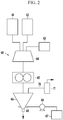
- FIG. 2 schematically illustrates an apparatus 60 for manufacturing briquette coal using the method of manufacturing briquette coal of FIG. 1 .
- a structure of the apparatus 60 for manufacturing briquette coal in FIG. 2 is merely for exemplifying the present invention, and the present invention is not limited thereto. Therefore, the apparatus for manufacturing briquette coal may be modified in other forms.
- the apparatus 60 for manufacturing briquette coal includes a powdered coal hopper 61, a binder hopper 62, a water supply unit 63, a mixer 64, a molding device 65, and a heat treatment unit 66.
- the apparatus 60 for manufacturing briquette coal may further include other devices, as necessary.
- the powdered coal hopper 61 stores the powdered coal
- the binder hopper 62 stores the binder.
- the binder may include the cellulose ether compound, polyvinyl alcohol (PVA), lignin, or starch.
- the mixer 64 mixes the powdered coal and the binder which are supplied from the powdered coal hopper 61 and the binder hopper 62, respectively, and manufactures the mixture.
- the water supply unit 63 is connected to the mixer 64 and supplies water to the mixer 64.
- the molding device 65 is supplied with the mixture from the mixer 64 and molds the mixture to manufacture the briquette coal.
- the molding device 65 uses the pair of rolls rotating in opposite directions to insert the mixture between the pair of rolls to compress the mixture, and discharge the mixture to a lower side.
- the heat treatment unit 66 dries the briquette coal to improve the compressive load of the briquette coal.
- the heat treatment unit 66 includes a storage bin 661, a blower 663, a heat source 665, and a dust collector 667.
- the heat treatment unit 66 may further include other devices.
- the storage bin 661 stores the briquette coal discharged to the lower side from the molding device 65, and discharges the dried briquette coal to the lower side.
- a level of the briquette coal stored in the storage bin 661 is maintained at an appropriate level so as to prevent the briquette coal from being destroyed by the heat treatment time or the compressive load.
- the storage bin 661 has a funnel shape to increase a contact area between the hot blast and the briquette coal.
- the blower 663 is supplied with heat from the heat source 667 for generating thermal energy and forcibly transfers the heat to the storage bin 661. It is possible to produce the hot blast by using steam, near infrared rays, microwaves, or the like as a heat source.
- the hot blast may be produced by using commercially available fuel such as liquefied natural gas (LNG) or liquefied propane gas (LPG). Exhaust gas (finex off gas (FOG)) for manufacturing molten iron, cokes oven gas (COG) or blast furnace gas (BFG) in a steel mill may be used. Meanwhile, the heat source 67 may directly heat the briquette coal like an electric heater, or may recover and use waste heat generated in the steel mill, such as slag sensible heat, or waste heat generated when powdered reduced iron is oxidized.
- LNG liquefied natural gas
- LPG liquefied propane gas
- Exhaust gas finex off gas
- COG cokes oven gas
- BFG blast furnace gas
- the storage bin 661 has a structure in which a cross-sectional area of the storage bin 661 is gradually increased from the lower side to the upper side. Therefore, the hot blast is moved upward from the lower side to the upper side of the storage bin 661, and as a result, it is possible to efficiently dry the briquette coal while removing moisture contained in the briquette coal. The dried briquette coal is discharged to the lower side of the storage bin 661.
- a discharge device may be installed at the lower side of the storage bin 661.
- the discharge device constantly discharges the briquette coal at a rate of less than 50t/h. Meanwhile, a vapor of the briquette coal discharged from the storage bin 661 passes through the dust collector 667 so that dust is removed, and then the vapor of the briquette coal is discharged to the outside. In a case in which a temperature of the vapor is lowed at a saturated vapor pressure or higher, condensate water may be produced. Therefore, although not illustrated in FIG. 2 , a thermal insulating device may be installed to prevent the condensate water from flowing back into the storage bin 661.
- the briquette coal is subjected to the heat treatment by using the storage bin 661 that functions as an intermediate buffer during the process of conveying the briquette coal, and as a result, it is possible to efficiently manufacture the briquette coal having sufficient strength within a short period of time without installing separate facilities. Therefore, it is possible to ensure cold strength of the briquette coal within a short period of time by heating the briquette coal even in the case of the briquette coal of which the strength is not sufficiently ensured at the initial time because the binder and the water are used together or the binder itself is water soluble and thus has a high moisture content.
- FIG. 3 schematically illustrates an apparatus 200 for manufacturing molten iron including the apparatus for manufacturing briquette coal of FIG. 2 .
- a structure of the apparatus 200 for manufacturing molten iron in FIG. 3 is merely for exemplifying the present invention, and the present invention is not limited thereto. Therefore, the apparatus 200 for manufacturing molten iron in FIG. 3 may be modified to various forms.
- the apparatus 200 for manufacturing molten iron includes a melting and gasifying furnace 60 and a packed-bed reducing furnace 20. Other devices may be included in addition to the furnaces, as necessary. Iron ore is inputted into and reduced in the packed-bed reducing furnace 20. The iron ore inputted into the packed-bed reducing furnace 20 is dried in advance, and then used to manufacture reduced iron while passing through the packed-bed reducing furnace 20. The packed-bed reducing furnace 20 forms a packed bed therein by being supplied with reducing gas from the melting and gasifying furnace 60.
- the briquette coal manufactured by the manufacturing method of FIG. 1 is inputted into the melting and gasifying furnace 60, a coal-packed bed is formed in the melting and gasifying furnace 60.
- a dome portion 601 is formed at an upper side of the melting and gasifying furnace 60. That is, the melting and gasifying furnace 60 has a space wider than the remaining portion of the melting and gasifying furnace 60, and high-temperature reducing gas is present in this space. Therefore, the briquette coal inputted into the dome portion 601 is converted into char by the high-temperature reducing gas by a thermal decomposition reaction.
- the char generated by the thermal decomposition reaction of the briquette coal is moved to the lower side of the melting and gasifying furnace 60 and exothermically reacts with oxygen supplied through the tuyere 30.
- the briquette coal may be used as a heat source for maintaining the melting and gasifying furnace 60 at a high temperature.
- the char provides breathability, and as a result, a large amount of gas generated at the lower side of the melting and gasifying furnace 60 and the reduced iron supplied from the packed-bed reducing furnace 20 may more easily and uniformly pass through the entire coal-packed bed in the melting and gasifying furnace 60.
- a lump carbon material or cokes may be inputted into the melting and gasifying furnace 60, as necessary.
- the tuyere 30 is installed in an outer wall of the melting and gasifying furnace 60, and oxygen is injected through the tuyere 30. The oxygen is injected to the coal-packed bed, and a combustion zone is formed.
- the briquette coal may be combusted in the combustion zone to generate reducing gas.
- FIG. 4 schematically illustrates another apparatus 300 for manufacturing molten iron including the apparatus for manufacturing briquette coal of FIG. 2 .
- a structure of the apparatus 300 for manufacturing molten iron in FIG. 4 is merely for exemplifying the present invention, and the present invention is not limited thereto. Therefore, the apparatus 300 for manufacturing molten iron in FIG. 4 may be modified to various forms. Because the structure of the apparatus 300 for manufacturing molten iron of FIG. 4 is similar to the structure of the apparatus 200 for manufacturing molten iron of FIG. 3 , the same constituent elements are designated by the same reference numerals, and a detailed description thereof will be omitted.
- the apparatus 300 for manufacturing molten iron includes a melting and gasifying furnace 60, a fluidized-bed reducing furnace 22, a reduced iron compression device 40, and a compressed and reduced iron storage tank 50.
- the compressed and reduced iron storage tank 50 may be omitted.
- the manufactured briquette coal is inputted into the melting and gasifying furnace 60.
- the briquette coal generates reducing gas in the melting and gasifying furnace 60, and the generated reducing gas is supplied to the fluidized-bed reducing furnace 22.
- Fine iron ore is supplied to a plurality of reducing furnaces 22 having fluidized beds, and flows by reducing gas supplied to the fluidized-bed reducing furnace 22 from the melting and gasifying furnace 60, such that the reduced iron is manufactured.
- the reduced iron is compressed by the reduced iron compression device 40, and then stored in the compressed and reduced iron storage tank 50.
- the compressed reduced iron, together with the briquette coal is inputted into the melting and gasifying furnace 60 from the compressed and reduced iron storage tank 50 and melted in the melting and gasifying furnace 60.
- the briquette coal is supplied to the melting and gasifying furnace 60 and converted into char having breathability, and as a result, a large amount of gas generated at a lower side of the melting and gasifying furnace 60 and the compressed reduced iron more easily and uniformly pass through a coal-packed bed in the melting and gasifying furnace 60, such that molten iron with high quality may be provided.
- the cellulose ether compound is used as a binder in the briquette coal instead of molasses, it is possible to innovatively reduce an alkali component. Therefore, it is possible to prevent a dispersing plate (not illustrated) or a cyclone (not illustrated) in the fluidized-bed reducing furnace 22 from being clogged due to the deposition of alkali substances such as potassium by the molasses containing a large amount of alkali components.
- a mixture was manufactured by uniformly mixing powdered coal of 3.4 mm or less and a powdered cellulose ether compound of 0.2 mm or less for one minute, and mixing the powdered coal and the powdered cellulose ether compound again for three minutes after adding water.
- a mixture of heavy coking coal, soft coking coal, and powdered cokes was used as the powdered coal, and a hydroxypropylmethyl cellulose (HPMC, MECELLOSE) product from Samsung Fine Chemical was used as the cellulose ether compound. Further, the mixture was inputted between the pair of rolls, such that the briquette coal was manufactured.
- the briquette coal having a pillow shape with a size of 64.5 mm ⁇ 25.4 mm ⁇ 19.1 mm was manufactured by compressing the mixture with pressure of 20 kN/cm by using the pair of rolls. Because the detailed remaining manufacturing process of the briquette coal can be easily understood by those skilled in the art to which the present invention pertains, a detailed description thereof will be omitted.
- a mixture was manufactured by mixing powdered coal of 100 g with a moisture content of 7.6% and an average grain size of 1.1 mm and HPMC powder of 1 g with an average grain size of 78 ⁇ m and viscosity of 28,000 cps, and then mixing again the powdered coal and the HPMC powder after adding water of 10 g. Further, the mixture was inputted between the pair of rolls, such that the briquette coal was manufactured.
- the remaining experimental processes were identical to those of the Experimental Example.
- a mixture was manufactured by mixing powdered coal of 100 g with a moisture content of 7.7% and an average grain size of 1.1 mm and HPMC powder of 0.8 g with an average grain size of 78 ⁇ m and viscosity of 28,000 cps, and then mixing again the powdered coal and the HPMC powder after adding water of 10 g. Further, the mixture was inputted between the pair of rolls, such that the briquette coal was manufactured.
- the remaining experimental processes were identical to those of Experimental Example 1.
- a mixture was manufactured by mixing powdered coal of 100 g with a moisture content of 1.4% and an average grain size of 1.1 mm and HPMC powder of 1 g with an average grain size of 78 ⁇ m and viscosity of 28,000 cps, and then mixing again the powdered coal and the HPMC powder after adding water of 10 g. Further, the mixture was inputted between the pair of rolls, such that the briquette coal was manufactured.
- the remaining experimental processes were identical to those of Experimental Example 1.
- a mixture was manufactured by mixing powdered coal of 100 g with a moisture content of 0.1% and an average grain size of 0.9 mm and HPMC powder of 1 g with an average grain size of 78 ⁇ m and viscosity of 28,000 cps, and then mixing again the powdered coal and the HPMC powder after adding water of 10 g. Further, the mixture was inputted between the pair of rolls, such that the briquette coal was manufactured.
- the remaining experimental processes were identical to those of Experimental Example 1.
- a mixture was manufactured by mixing powdered coal of 100 g with a moisture content of 5.7% and an average grain size of 1.0 mm and HPMC powder of 1 g with an average grain size of 82 ⁇ m and viscosity of 60,000 cps, and then mixing again the powdered coal and the HPMC powder after adding water of 10 g. Further, the mixture was inputted between the pair of rolls, such that the briquette coal was manufactured.
- the remaining experimental processes were identical to those of Experimental Example 1.
- a mixture was manufactured by mixing powdered coal of 100 g with a moisture content of 6.0% and an average grain size of 1.0 mm and HPMC powder of 1 g with an average grain size of 75 ⁇ m and viscosity of 12,200 cps, and then mixing again the powdered coal and the HPMC powder after adding water of 10 g. Further, the mixture was inputted between the pair of rolls, such that the briquette coal was manufactured.
- the remaining experimental processes were identical to those of Experimental Example 1.
- a mixture was manufactured by mixing powdered coal of 100 g with a moisture content of 6.1% and an average grain size of 1.0 mm and HPMC powder of 1 g with an average grain size of 77 ⁇ m and viscosity of 49,000 cps, and then mixing again the powdered coal and the HPMC powder after adding water of 10 g. Further, the mixture was inputted between the pair of rolls, such that the briquette coal was manufactured.
- the remaining experimental processes were identical to those of Experimental Example 1.
- a mixture was manufactured by mixing powdered coal of 100 g with a moisture content of 7.6% and an average grain size of 1.1 mm and HPMC powder of 0.6 g with an average grain size of 78 ⁇ m and viscosity of 28,000 cps, and then mixing again the powdered coal and the HPMC powder after adding water of 10 g. Further, the mixture was inputted between the pair of rolls, such that the briquette coal was manufactured.
- the remaining experimental processes were identical to those of Experimental Example 1.
- a mixture was manufactured by mixing powdered coal of 100 g with a moisture content of 5.7% and an average grain size of 1.0 mm and HPMC powder of 0.2 g with an average grain size of 82 ⁇ m and viscosity of 60,000 cps, and then mixing again the powdered coal and the HPMC powder after adding water of 10 g. Further, the mixture was inputted between the pair of rolls, such that the briquette coal was manufactured.
- the remaining experimental processes were identical to those of Experimental Example 1.
- a mixture was manufactured by mixing powdered coal of 100 g with a moisture content of 1.4% and an average grain size of 1.1 mm and HPMC powder of 1 g with an average grain size of 75 ⁇ m and viscosity of 2,080 cps, and then mixing again the powdered coal and the HPMC powder after adding water of 10 g. Further, the mixture was inputted between the pair of rolls, such that the briquette coal was manufactured.
- the remaining experimental processes were identical to those of Experimental Example 1.
- a mixture was manufactured by mixing powdered coal of 100 g with a moisture content of 0.1% and an average grain size of 1.0 mm and powdered carboxymethyl cellulose (CMC) (AQUALONTM from ASHILAND) of 1 g with an average grain size of 70 ⁇ m and viscosity of 6,000 cps, and then mixing again the powdered coal and the powdered carboxymethyl cellulose after adding water of 12 g. Further, the mixture was inputted between the pair of rolls, such that the briquette coal was manufactured. The remaining experimental processes were identical to those of Experimental Example 1.
- CMC carboxymethyl cellulose
- Shatter strength and compressive loads of the briquette coal manufactured according to Experimental Examples 1 to 6 were measured.
- the shatter strength of the briquette coal was obtained from a proportion of the briquette coal having a grain size of +20 mm or more after the briquette coal weighing 2kg freely fell four times from a height of 5 m.
- the compressive load of the briquette coal was measured from a maximum load until the briquette coal was destroyed after the pressure is applied to the briquette coal at a constant rate, and was measured from an average value of twenty samples of the briquette coal, and the results are shown in the following Table 1.
- the excellent shatter strength and the excellent compressive load of the briquette coal were obtained in the case in which 0.8 part by weight to 1.0 part by weight of the HPMC with viscosity 12,200 cps to 60,000 cps was used in Experimental Examples 1 to 7. Therefore, it could be seen that it is advantageous to adjust the viscosity of the HPMC to the aforementioned range.
- the shatter strength and the compressive load of the briquette coal manufactured according to Comparative Examples 1 to 4 are much smaller than the shatter strength and the compressive load of the briquette coal manufactured according to Experimental Examples 1 to 7. Therefore, it could be seen that the briquette coal manufactured by using the HPMC is much more excellent in terms of the shatter strength and the compressive load than the briquette coal manufactured by using the CMC.
- Powder was manufactured by crushing the briquette coal manufactured by Experimental Example 1, and the powdered briquette coal of about 7 g was inserted into a magnetic crucible of 30 ml, and then heated and combusted for ten hours in a box furnace at 850°C. Because the remaining experimental processes can be easily understood by those skilled in the art to which the present invention pertains, a detailed description thereof will be omitted.
- a mixture was manufactured by uniformly mixing the powdered coal with the HPMC and the CMC solution.
- Powdered coal 100 g with a moisture content of 0.1% and an average grain size of 1.0 mm, a 4% aqueous solution of hydroxypropylmethyl cellulose (HPMC, MECELLOSE from Samsung Fine Chemical, with viscosity of 28, 000 cps) of 7.5 g, and a 6% aqueous solution of carboxymethyl cellulose (CMC, AQUALONTM from ASHILAND, with viscosity of 6,000 cps) of 7.5 g were used. Further, the mixture was inputted between the pair of rolls, such that the briquette coal was manufactured.
- HPMC hydroxypropylmethyl cellulose
- CMC carboxymethyl cellulose
- the briquette coal having a pillow shape with a size of 64.5 mm ⁇ 25.4 mm ⁇ 19.1 mm was manufactured by compressing the mixture with pressure of 20 kN/cm by using the pair of rolls.
- Powder was manufactured by crushing the briquette coal manufactured as described above, and the powdered briquette coal of about 7 g was inserted into a magnetic crucible of 30 ml, and then heated and combusted for ten hours in a box furnace at 850°C.
- the remaining experimental processes were identical to those of Experimental Example 8.
- Powder was manufactured by crushing the briquette coal manufactured by Comparative Example 4, and the powdered briquette coal of about 7 g was inserted into a magnetic crucible of 30 ml, and then heated and combusted for ten hours in a box furnace at 850°C.
- the remaining experimental processes were identical to those of Experimental Example 8.
- a Na 2 O content of alkalis contained in the ash was as low as 0.39 in Experimental Example 8, but the Na 2 O content was as very high as 2.64 in Comparative Example 5.
- the Na 2 O content is 1.59, that is, somewhat high. It could be seen that the operation of the fluidized-bed reducing furnace may be adversely affected because Na ions are bonded to a functional group of the CMC and alkalis are contained in the reducing gas when the briquette coal is manufactured by using the CMC solution.
- a binder and powdered coal for briquette coal having average properties used for molten reduced iron were prepared and mixed.
- the powdered coal had a grain size of 3.4 mm or less.
- the powdered coal is additionally mixed with a carbon source additive.
- a FerrobineTM binder provided from Samsung Fine Chemical was used as the cellulose ether compound binder.
- the binder of 1 part by weight and the water of 7 part by weight are added to and uniformly mixed with respect to the powdered coal of 100 part by weight. Further, the mixture was inputted between the pair of rolls, such that the briquette coal was manufactured.
- the briquette coal having a pillow shape with a size of 64.5 mm ⁇ 25.4 mm ⁇ 19.1 mm was manufactured by compressing the mixture with pressure of 20 kN/cm by using the pair of rolls.
- the manufactured briquette coal was subjected to the heat treatment in a well ventilated heat treatment oven, thereby evaporating moisture. Further, the moisture and the compressive load were measured by using the twenty manufactured briquette coals.
- the compressive load of the briquette coal was measured from a maximum load until the briquette coal is destroyed by applying pressure at a constant rate, and the compressive load of the briquette coal was obtained from an average value of the twenty samples of the briquette coal. Because the remaining experimental processes can be easily understood by those skilled in the art to which the present invention pertains, a detailed description thereof will be omitted.
- Briquette coal with an initial moisture content of 8.8 wt% and a compressive load of 40 kgf was subjected to the heat treatment in a heat treatment oven at a temperature of 80°C for twenty-four hours, such that the briquette coal was dried.
- Briquette coal with an initial moisture content of 10.1 wt% and a compressive load of 51 kgf was subjected to the heat treatment in a heat treatment oven at a temperature of 100°C for five hours, such that the briquette coal was dried.
- Briquette coal with an initial moisture content of 9.7 wt% and a compressive load of 52 kgf was subjected to the heat treatment in a heat treatment oven at a temperature of 120°C for five hours, such that the briquette coal was dried.
- Briquette coal with an initial moisture content of 9.2 wt% and a compressive load of 51 kgf was subjected to the heat treatment in a heat treatment oven at a temperature of 150°C for five hours, such that the briquette coal was dried.
- Briquette coal manufactured by a method identical to the method of Comparative Example 6 was subjected to the heat treatment at 60°C.
- Briquette coal manufactured by a method identical to the method of Comparative Example 6 was subjected to the heat treatment at 200°C.
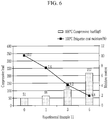
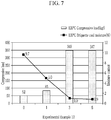
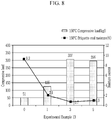
- FIGS. 5 to 8 illustrate experimental results of measuring compressive loads of the briquette coals according to Experimental Examples 10 to 13.
- the compressive load of the briquette coal was 294 kgf in Experimental Example 10, 217 kgf in Experimental Example 11, 3491 kgf in Experimental Example 12, and 307 kgf in Experimental Example 13, and as a result, the properties regarding the compressive loads of the briquette coal were excellent. It could be seen that the compressive loads of the briquette coal were somewhat decreased over time in Experimental Examples 11 to 13, but it is necessary to adjust the heat treatment condition of the briquette coal to the aforementioned range.
Landscapes
- Chemical & Material Sciences (AREA)
- Life Sciences & Earth Sciences (AREA)
- Environmental & Geological Engineering (AREA)
- General Life Sciences & Earth Sciences (AREA)
- Geochemistry & Mineralogy (AREA)
- Geology (AREA)
- Oil, Petroleum & Natural Gas (AREA)
- Organic Chemistry (AREA)
- Solid Fuels And Fuel-Associated Substances (AREA)
- Glanulating (AREA)
Abstract
Description
- The present invention relates to briquette coal, a method of manufacturing briquette coal, an apparatus for manufacturing briquette coal, a method of manufacturing molten iron, and an apparatus for manufacturing molten iron. More particularly, the present invention relates to briquette coal, a method of manufacturing briquette coal, an apparatus for manufacturing briquette coal, a method of manufacturing molten iron, and an apparatus for manufacturing molten iron, which use a powdered cellulose ether compound as a binder.
- In a smelting reduction process, a reducing furnace for reducing iron ore and a melting and gasifying furnace for melting the reduced iron ore are used. When the melting and gasifying furnace melts the iron ore, briquette coal, as a heat source for melting the iron ore, is inputted into the melting and gasifying furnace. Here, the reduced iron is melted in the melting and gasifying furnace, converted into molten iron and slag, and then discharged to the outside. The briquette coal inputted into the melting and gasifying furnace forms a coal-packed bed. Oxygen is injected through a tuyere installed in the melting and gasifying furnace, and then combusts the coal-packed bed to generate combustion gas. The combustion gas is converted into high-temperature reducing gas while moving upward through the coal-packed bed. The high-temperature reducing gas is discharged to the outside of the melting and gasifying furnace and supplied as reducing gas to a reducing furnace.
- The briquette coal is manufactured by mixing and then compressing powdered coal and a binder. It is necessary to manufacture the briquette coal with excellent cold strength and excellent hot strength so that the briquette coal is used to manufacture molten iron. Therefore, the briquette coal is manufactured by using a binder, such as molasses, having excellent viscosity.
- The present invention has been made in an effort to provide briquette coal which has excellent hot strength and excellent cold strength by using a cellulose ether compound as a binder. The present invention has also been made in an effort to provide a method of manufacturing the briquette coal. The present invention has also been made in an effort to provide a method of manufacturing molten iron including the method of manufacturing briquette coal.
- Briquette coal according to an exemplary embodiment of the present invention is inputted into and quickly heated in a dome portion of a melting and gasifying furnace in an apparatus for manufacturing molten iron that includes i) a melting and gasifying furnace into which reduced iron is inputted, and ii) a reducing furnace connected to the melting and gasifying furnace to provide the reduced iron. The method of manufacturing briquette coal may include i) providing powdered coal; ii) mixing a powdered cellulose ether compound with the powdered coal and providing a mixture; iii) adding water to the mixture and mixing the mixture with the water; and iv) molding the mixture and providing briquette coal. In the providing of the briquette coal, the amount of cellulose ether compound contained in the briquette coal may be 0.7 wt% to 2.0 wt%.
- More particularly, the amount of cellulose ether compound may be 0.8 wt% to 1.5 wt%. In the providing of the briquette coal, the amount of moisture contained in the briquette coal may be 5 wt% to 15 wt%. More particularly, the amount of moisture contained in the briquette coal may be 7 wt% to 12 wt%.
- A ratio of the amount of moisture contained in the briquette coal to the amount of cellulose ether compound contained in the briquette coal may be 5 to 40. A ratio of the amount of moisture contained in the briquette coal to the amount of cellulose ether compound contained in the briquette coal may be 7 to 20.
- In the providing of the mixture, an average grain size of the cellulose ether compound may be 50 µm to 100 µm. More particularly, in the providing of the mixture, a ratio of an average grain size of the powdered coal to an average grain size of the cellulose ether compound may be 7 to 30. A ratio of the average grain size of the powdered coal to the average grain size of the cellulose ether compound may be 10 to 20.
- A mixing time in the providing of the mixture may be smaller than a mixing time in the adding of the water to the mixture and the mixing of the mixture with the water, and a ratio of the mixing time in the providing of the mixture to the mixing time in the adding of the water to the mixture and the mixing of the mixture with the water may be 2 to 5. The cellulose ether compound may include at least one compound selected from a group consisting of methyl cellulose (MC), hydroxyethyl cellulose (HEC), hydroxypropyl cellulose (HPC), hydroxypropylmethyl cellulose (HPMC), and hydroxyethylmethyl cellulose (HEMC).
- The cellulose ether compound may include no carboxymethyl cellulose (CMC). The viscosity of the cellulose ether compound may be 4,000 cps to 80,000 cps. The method of manufacturing briquette coal according to the exemplary embodiment of the present invention may further include drying the mixture after the adding of the water to the mixture and the mixing of the mixture with the water.
- In the providing of the mixture, the powdered coal may be further mixed with one or more binders selected from a group consisting of polyvinyl alcohol (PVA), lignin, and starch. In the providing of the briquette coal, the amount of moisture contained in the briquette coal may be 5 wt% to 15 wt%.
- The method of manufacturing briquette coal according to the exemplary embodiment of the present invention may further include adjusting the amount of moisture contained in the briquette coal to 5 wt% or less by heating the briquette coal at 80°C to 150°C for one to twenty-four hours, and adjusting a compressive load of the briquette coal to 100 kgf or more. The briquette coal may be heated by one or more heat sources selected from a group consisting of hot blast, steam, near infrared rays, microwaves, liquefied natural gas (LNG), liquefied propane gas (LPG), exhaust gas (finex off gas (FOG)) for manufacturing molten iron, cokes oven gas (COG), and blast furnace gas (BFG).
- A method of manufacturing molten iron according to another exemplary embodiment of the present invention may include i) providing briquette coal manufactured according to the aforementioned method; ii) providing reduced iron made by reducing iron ore in a reducing furnace; and iii) providing molten iron by inputting the briquette coal and the reduced iron into the melting and gasifying furnace. In the providing of the reduced iron, the reducing furnace may be a fluidized-bed reducing furnace or a packed-bed reducing furnace.
- Briquette coal according to yet another exemplary embodiment of the present invention may be inputted into and quickly heated in a dome portion of a melting and gasifying furnace in an apparatus for manufacturing molten iron that includes i) a melting and gasifying furnace into which reduced iron is inputted, and ii) a reducing furnace connected to the melting and gasifying furnace to provide the reduced iron. The briquette coal may include: a cellulose ether compound of 0.7 wt% to 2.0 wt%, moisture of 5 wt% to 15 wt%, and the remaining powdered coal. More particularly, the amount of cellulose ether compound may be 0.8 wt% to 1.5 wt%.
- Still another exemplary embodiment of the present invention provides an apparatus for manufacturing briquette coal, the apparatus including: i) a powdered coal hopper which stores powdered coal; ii) a binder hopper which stores a water-soluble binder; iii) a mixer which is supplied with the powdered coal from the powdered coal hopper, is supplied with the water-soluble binder from the binder hopper, and mixes the powdered coal and the water-soluble binder to manufacture a mixture; iv) a water supply unit which supplies water to the mixer; v) a molding device which manufactures briquette coal by being supplied with the mixture from the mixer; vi) a storage bin which is supplied with the briquette coal from the molding device, heats and dries the briquette coal, and has a diameter that is gradually decreased from a lower side to an upper side; and vii) a heat source which supplies a hot blast for drying the briquette coal at the lower side of the storage bin.
- Still yet another exemplary embodiment of the present invention provides an apparatus for manufacturing molten iron, the apparatus including: i) the apparatus for manufacturing briquette coal; ii) a reducing furnace which provides reduced iron; and iii) a melting and gasifying furnace which is connected to the reducing furnace so as to be supplied with the reduced iron, and connected to the apparatus for manufacturing briquette coal so as to be supplied with the briquette coal to manufacture molten iron. The reducing furnace may be a fluidized-bed reducing furnace or a packed-bed reducing furnace.
- According to the exemplary embodiment of the present invention, the cellulose ether compound is used as a binder, and as a result, it is possible to greatly improve hot strength and cold strength of the briquette coal. In addition, since the cellulose ether compound is used, it is possible to prevent alkalis from being deposited in the fluidized-bed reducing furnace. The briquette coal is subjected to the heat treatment such that a compressive load of the briquette coal is increased, thereby greatly improving hot strength and cold strength of the briquette coal manufactured by using a water-soluble binder or water. Further, it is possible to increase the compressive load of the briquette coal within a short period of time through the quick and efficient heat treatment. In addition, it is possible to efficiently perform the heat treatment on the briquette coal while minimizing costs by using the existing storage bin and the heat source in a steel mill.
-
-
FIG. 1 is a schematic flowchart of a method of manufacturing briquette coal according to an exemplary embodiment of the present invention. -
FIG. 2 is a schematic view of an apparatus for manufacturing briquette coal using the method of manufacturing briquette coal ofFIG. 1 . -
FIG. 3 is a schematic view of an apparatus for manufacturing molten iron including the apparatus for manufacturing briquette coal ofFIG. 2 . -
FIG. 4 is a schematic view of another apparatus for manufacturing molten iron including the apparatus for manufacturing briquette coal ofFIG. 2 . -
FIGS. 5 to 8 are graphs each illustrating experimental results according to Experimental Examples 10 to 13 according to the present invention. - The terms first, second, third, and the like are used to describe various portions, components, regions, layers, and/or sections, but the present invention is not limited thereto. These terms are used only to distinguish any portion, component, region, layer, or section from other portions, components, regions, layers, or sections. Therefore, a first portion, component, region, layer, or section to be described below may be referred to as a second portion, component, region, layer, or section without departing from the scope of the present invention.
- The technical terms used herein are merely for the purpose of describing a specific exemplary embodiment, and not intended to limit the present invention. Singular expressions used herein include plural expressions unless they have definitely opposite meanings. The terms "comprises" and/or "comprising" used in the specification specify particular features, regions, integers, steps, operations, elements, components, but do not preclude the presence or addition of other features, regions integers, steps, operations, elements, and/or components thereof.
- Unless otherwise defined, all terms used herein including technical or scientific terms have the same meanings as meanings which are generally understood by those skilled in the art. Terms, which are usually used and defined in dictionaries, shall be construed that they have meanings matching those in the context of a related art, and shall not be construed in ideal or excessively formal meanings unless they are clearly defined in the present application.
- The present invention will be described more fully hereinafter with reference to the accompanying drawings, in which exemplary embodiments of the invention are shown. As those skilled in the art would realize, the described embodiments may be modified in various different ways, all without departing from the spirit or scope of the present invention.
-
FIG. 1 schematically illustrates a flowchart of a method of manufacturing briquette coal according to an exemplary embodiment of the present invention. The flowchart of the method of manufacturing briquette coal as illustrated inFIG. 1 is merely for exemplifying the present invention, and the present invention is not limited thereto. Therefore, the method of manufacturing briquette coal may be variously changed. Meanwhile, because a structure of an apparatus for manufacturing briquette coal for implementing the method of manufacturing briquette coal ofFIG. 1 can be easily understood by those skilled in the art to which the present invention pertains, a detailed description thereof will be omitted. - As illustrated in
FIG. 1 , the method of manufacturing briquette coal includes providing powdered coal (S10), mixing the powdered coal with a powdered cellulose ether compound and providing a mixture thereof (S20), adding water to the mixture and mixing the water and the mixture (S30), and molding the mixture and providing briquette coal (S40). In addition, the method of manufacturing briquette coal may further include other steps, as necessary. - First, in step S10, the powdered coal is provided. Raw materials containing carbon, such as bituminous coal, subbituminous coal, anthracite, or cokes, may be used as the powdered coal. A grain size of the powdered coal may be adjusted to 4 mm or less.
- Next, in step S20, the powdered coal is mixed with a cellulose ether compound, such that a mixture thereof is provided. That is, the cellulose ether compound is added to the powdered coal, and then the cellulose ether compound and the powdered coal are appropriately stirred to be uniformly mixed.
- Here, the powdered cellulose ether compound is used instead of a liquid-phase cellulose ether compound. In a case in which a binder solution is used, a carboxymethyl cellulose (CMC) solution having a binder with low viscosity may be used to improve fluidity. However, since the binder with low viscosity is used, there is a problem in that strength of the briquette coal deteriorates. In addition, in the case of the binder in the form of a solution, there are problems in that it is difficult to uniformly maintain a component of the binder due to layer separation, a special transporting vehicle such as tank lorry is required to transport the binder solution, and transportation costs are increased. In addition, it is not easy to store the binder solution because the binder solution is frozen in the winter season.
- In contrast, in the case in which the powdered cellulose ether compound is used as the binder, it is possible to manufacture the briquette coal with excellent strength because viscosity of the cellulose ether compound itself is high. In addition, since the powdered cellulose ether compound is used, the volume of the cellulose ether compound is minimized, such that the cellulose ether compound is easily stored and also conveniently transported. Further, there is no need to worry about freezing in the winter season. Therefore, the powdered cellulose ether compound is suitable to be used.
- The viscosity of the cellulose ether compound may be 4,000 cps to 80,000 cps. The viscosity of the cellulose ether compound means a value made by measuring viscosity of an aqueous solution of the cellulose ether compound having concentration of 2% by weight at 20 ± 0.1°C by using DV-II+Pro spindle HA from Brookfield. If the viscosity of the cellulose ether compound is too low, viscosity of a solution containing the cellulose ether compound, for example, viscosity of the aqueous solution is too low, such that coupling force with respect to the powdered coal deteriorates. As a result, strength of the briquette coal may deteriorate. Meanwhile, if the viscosity of the cellulose ether compound is too high, a molecular weight of the cellulose ether compound is too large, such that water solubility deteriorates, and as a result, coupling force with respect to the powdered coal is not sufficient. Therefore, it is necessary to adjust the viscosity of the cellulose ether compound to the aforementioned range.
- The cellulose ether compound may include methyl cellulose (MC), hydroxyethyl cellulose (HEC), hydroxypropyl cellulose (HPC), hydroxypropylmethyl cellulose (HPMC), hydroxyethylmethyl cellulose (HEMC), or the like. The methyl cellulose (MC) has a degree of substitution of a methyl group of 18 to 32 wt%, and the hydroxyethyl cellulose (HEC) has a degree of substitution of a hydroxyethyl group of 20 to 80 wt%. Further, the hydroxypropyl cellulose (HPC) has a degree of substitution of a hydroxypropyl group of 20 to 80 wt%, and the hydroxypropylmethyl cellulose (HPMC) has a degree of substitution of a methyl group of 18 to 32 wt% and a degree of substitution of a hydroxypropyl group of 2 to 14 wt%. In addition, the hydroxyethylmethyl cellulose (HEMC) may have a degree of substitution of a methyl group of 18 to 32 wt% and a degree of substitution of a hydroxyethyl group of 2 to 14 wt%.
- Meanwhile, an average grain size of the powdered cellulose ether compound may be 50 µm to 100 µm. If the grain size of the powdered cellulose ether compound is too small, manufacturing process costs are increased. In addition, if the grain size of the cellulose ether compound is too large, a specific surface area of the cellulose ether compound is decreased, and water solubility deteriorates, such that strength of the briquette coal manufactured by using the cellulose ether compound may deteriorate. Therefore, it is necessary to adjust the grain size of the powdered cellulose ether compound to the aforementioned range. Meanwhile, more specifically, the average grain size of the powdered cellulose ether compound may be 78 µm. In this case, the grain size of 97% or more of the powdered cellulose ether compounds may be 0.18 mm or less.
- A ratio of the average grain size of the powdered coal to the average grain size of the cellulose ether compound may be 7 to 30. More specifically, a ratio of the average grain size of the powdered coal to the average grain size of the cellulose ether compound may be 10 to 20. If the ratio between the average grain sizes is too large or small, a coupling ability of the cellulose ether compound as the binder in the powdered coal cannot be sufficiently exhibited. Therefore, it is necessary to maintain the ratio between the average grain sizes in the aforementioned range.
- Next, in step S30, water is added to the mixture and the water and the mixture are mixed. In a case in which water is added to the mixture in which the powdered cellulose ether compounds are uniformly distributed, the cellulose ether compounds dispersed in the powdered coal are dissolved in the water. As a result, the dissolved cellulose ether compound exhibits coupling force with the powdered coal, such that it is possible to greatly improve strength of the briquette coal manufactured by subsequent processes. As described above, the processes are divided by mixing the powdered coal with the powdered cellulose ether compound first and then mixing the mixture with water instead of directly mixing the powdered coal with a liquid-phase binder, and as a result, it is possible to manufacture the briquette coal having excellent strength and minimized process costs.
- Meanwhile, a mixing time in step S30 is longer than a mixing time in step S20. That is, since the powdered coal and the powdered cellulose ether compound are used in step S20, a uniform mix is enabled even for a short period of time because of the mix of solids. In contrast, the mixing may be performed for a longer period of time in step S30 than in step S20 in consideration of process efficiency because in step S30, the liquid-phase water needs to be inputted to come into contact with the powdered cellulose ether compound mixed with the powdered coal and the powdered coal needs to be uniformly and appropriately dissolved in the water. More particularly, a ratio of the mixing time in step S30 to the mixing time in step S20 may be 2 to 5. If the ratio is too low, the powdered cellulose ether compound mixed with the powdered coal cannot sufficiently be in contact with the water, such that strength of the briquette coal may deteriorate. On the contrary, the case in which the ratio is too high is not advantageous in terms of process efficiency. Therefore, the ratio needs to be appropriately adjusted.
- Meanwhile, although not illustrated in
FIG. 1 , drying the mixture may be added after step S30. That is, if it is necessary to adjust formability of the mixture of the powdered coal, the powdered cellulose ether compound, and the added water, the mixture may be dried to partially remove moisture. As a result, strength of the briquette coal manufactured during the subsequent processes may be greatly improved. - Finally, in step S40, the mixture is molded to provide the briquette coal. For example, the briquette coal in the form of a pocket or a strip may be manufactured by inserting the mixture between a pair of rollers and compressing the mixture. As a result, it is possible to manufacture the briquette coal having excellent hot strength and excellent cold strength. Here, the amount of cellulose ether compound contained in the briquette coal may be 0.7 wt% to 2.0 wt%. More particularly, the amount of cellulose ether compound may be 0.8 wt% to 1.5 wt%. If the amount of cellulose ether compound is too large, manufacturing costs of the briquette coal are increased. In addition, if the amount of cellulose ether compound is too small, strength of the briquette coal deteriorates because sufficient coupling force cannot be exhibited. Therefore, it is necessary to adjust the amount of cellulose ether compound to the aforementioned range.
- Meanwhile, the amount of moisture contained in the briquette coal may be 5wt % to 15 wt%. More particularly, the amount of moisture may be 7 wt% to 12 wt%. If the amount of moisture is too large, there is a problem in that it is difficult to mold the mixture. In addition, if the amount of moisture is too small, cold strength of the briquette coal may deteriorate. Therefore, the amount of moisture is adjusted to the aforementioned range.
- The briquette coal manufactured by the aforementioned method includes the cellulose ether compound of 0.7 wt% to 2.0 wt%, the moisture of 5 wt% to 15 wt%, and the remaining powdered coal. More specifically, the amount of cellulose ether compound may be 0.8 wt% to 1.5 wt%. Here, if the amount of cellulose ether compound is too large, manufacturing costs of the briquette coal are greatly increased. In addition, if the amount of cellulose ether compound is too small, strength of the briquette coal deteriorates. Therefore, it is necessary to adjust the amount of the cellulose ether compound to the aforementioned range. In addition, if the amount of moisture is too large, formability of the briquette coal deteriorates. In addition, if the amount of moisture is too small, cold strength of the briquette coal may deteriorate. Therefore, the amount of moisture of the briquette coal is adjusted to the aforementioned range.
- Meanwhile, although not illustrated in
FIG. 1 , in step S20, a binder such as polyvinyl alcohol (PVA), lignin, or starch may further be mixed in addition to the cellulose ether compound. The binders have water solubility like the cellulose ether compound. The amount of moisture contained in the briquette coal manufactured by using the binder may be 5 wt% to 15 wt%. Since the water soluble binder is used or water is added in step S30, the briquette coal is heated after the briquette coal is manufactured, such that the amount of moisture contained in the briquette coal may be decreased. That is, the briquette coal is heated at 80°C to 150°C for one to twenty-four hours, thereby adjusting the amount of moisture contained in the briquette coal to 5 wt% or less. - A heat treatment condition may be enhanced or mitigated in accordance with a moisture content of the briquette coal. If a temperature for heating the briquette coal is too low, a heat treatment effect deteriorates because the moisture contained in the briquette coal is not appropriately evaporated, and productivity deteriorates because the time required for the heat treatment is increased. In addition, if the temperature for heating the briquette coal is too high, a loss of volatile components contained in the briquette coal may occur as a crack occurs in the briquette coal, and a compressive load is rather decreased because the briquette coal is exposed to a high temperature and only the moisture content is decreased. Therefore, the temperature for heating the briquette coal is adjusted to the aforementioned range. Meanwhile, the heat treatment time may be decreased as the temperature for heating the briquette coal is increased, but a high-temperature hot blast needs to be applied to decrease the time for heating the briquette coal to less than one hour, which emits or loses even the volatile component contained in the briquette coal. In addition, if the heat treatment time is too long, productivity deteriorates. Therefore, the time for heating the briquette coal is adjusted to the aforementioned range. Meanwhile, a compressive load of the briquette coal may be adjusted to 100 kgf or more. Hereinafter, a heating unit for the briquette coal will be described in more detail with reference to
FIG. 2 . -
FIG. 2 schematically illustrates anapparatus 60 for manufacturing briquette coal using the method of manufacturing briquette coal ofFIG. 1 . A structure of theapparatus 60 for manufacturing briquette coal inFIG. 2 is merely for exemplifying the present invention, and the present invention is not limited thereto. Therefore, the apparatus for manufacturing briquette coal may be modified in other forms. - As illustrated in
FIG. 2 , theapparatus 60 for manufacturing briquette coal includes apowdered coal hopper 61, abinder hopper 62, awater supply unit 63, amixer 64, amolding device 65, and aheat treatment unit 66. In addition, theapparatus 60 for manufacturing briquette coal may further include other devices, as necessary. Thepowdered coal hopper 61 stores the powdered coal, and thebinder hopper 62 stores the binder. Examples of the binder may include the cellulose ether compound, polyvinyl alcohol (PVA), lignin, or starch. Themixer 64 mixes the powdered coal and the binder which are supplied from thepowdered coal hopper 61 and thebinder hopper 62, respectively, and manufactures the mixture. Thewater supply unit 63 is connected to themixer 64 and supplies water to themixer 64. Themolding device 65 is supplied with the mixture from themixer 64 and molds the mixture to manufacture the briquette coal. Themolding device 65 uses the pair of rolls rotating in opposite directions to insert the mixture between the pair of rolls to compress the mixture, and discharge the mixture to a lower side. Theheat treatment unit 66 dries the briquette coal to improve the compressive load of the briquette coal. - More specifically, the
heat treatment unit 66 includes a storage bin 661, a blower 663, a heat source 665, and a dust collector 667. In addition, theheat treatment unit 66 may further include other devices. The storage bin 661 stores the briquette coal discharged to the lower side from themolding device 65, and discharges the dried briquette coal to the lower side. A level of the briquette coal stored in the storage bin 661 is maintained at an appropriate level so as to prevent the briquette coal from being destroyed by the heat treatment time or the compressive load. The storage bin 661 has a funnel shape to increase a contact area between the hot blast and the briquette coal. - As illustrated in
FIG. 2 , the blower 663 is supplied with heat from the heat source 667 for generating thermal energy and forcibly transfers the heat to the storage bin 661. It is possible to produce the hot blast by using steam, near infrared rays, microwaves, or the like as a heat source. - The hot blast may be produced by using commercially available fuel such as liquefied natural gas (LNG) or liquefied propane gas (LPG). Exhaust gas (finex off gas (FOG)) for manufacturing molten iron, cokes oven gas (COG) or blast furnace gas (BFG) in a steel mill may be used. Meanwhile, the
heat source 67 may directly heat the briquette coal like an electric heater, or may recover and use waste heat generated in the steel mill, such as slag sensible heat, or waste heat generated when powdered reduced iron is oxidized. - The storage bin 661 has a structure in which a cross-sectional area of the storage bin 661 is gradually increased from the lower side to the upper side. Therefore, the hot blast is moved upward from the lower side to the upper side of the storage bin 661, and as a result, it is possible to efficiently dry the briquette coal while removing moisture contained in the briquette coal. The dried briquette coal is discharged to the lower side of the storage bin 661.
- Although not illustrated in
FIG. 2 , a discharge device may be installed at the lower side of the storage bin 661. The discharge device constantly discharges the briquette coal at a rate of less than 50t/h. Meanwhile, a vapor of the briquette coal discharged from the storage bin 661 passes through the dust collector 667 so that dust is removed, and then the vapor of the briquette coal is discharged to the outside. In a case in which a temperature of the vapor is lowed at a saturated vapor pressure or higher, condensate water may be produced. Therefore, although not illustrated inFIG. 2 , a thermal insulating device may be installed to prevent the condensate water from flowing back into the storage bin 661. - As described above, the briquette coal is subjected to the heat treatment by using the storage bin 661 that functions as an intermediate buffer during the process of conveying the briquette coal, and as a result, it is possible to efficiently manufacture the briquette coal having sufficient strength within a short period of time without installing separate facilities. Therefore, it is possible to ensure cold strength of the briquette coal within a short period of time by heating the briquette coal even in the case of the briquette coal of which the strength is not sufficiently ensured at the initial time because the binder and the water are used together or the binder itself is water soluble and thus has a high moisture content.
-
FIG. 3 schematically illustrates anapparatus 200 for manufacturing molten iron including the apparatus for manufacturing briquette coal ofFIG. 2 . A structure of theapparatus 200 for manufacturing molten iron inFIG. 3 is merely for exemplifying the present invention, and the present invention is not limited thereto. Therefore, theapparatus 200 for manufacturing molten iron inFIG. 3 may be modified to various forms. - As illustrated in
FIG. 3 , theapparatus 200 for manufacturing molten iron includes a melting and gasifyingfurnace 60 and a packed-bed reducing furnace 20. Other devices may be included in addition to the furnaces, as necessary. Iron ore is inputted into and reduced in the packed-bed reducing furnace 20. The iron ore inputted into the packed-bed reducing furnace 20 is dried in advance, and then used to manufacture reduced iron while passing through the packed-bed reducing furnace 20. The packed-bed reducing furnace 20 forms a packed bed therein by being supplied with reducing gas from the melting and gasifyingfurnace 60. - Since the briquette coal manufactured by the manufacturing method of
FIG. 1 is inputted into the melting and gasifyingfurnace 60, a coal-packed bed is formed in the melting and gasifyingfurnace 60. A dome portion 601 is formed at an upper side of the melting and gasifyingfurnace 60. That is, the melting and gasifyingfurnace 60 has a space wider than the remaining portion of the melting and gasifyingfurnace 60, and high-temperature reducing gas is present in this space. Therefore, the briquette coal inputted into the dome portion 601 is converted into char by the high-temperature reducing gas by a thermal decomposition reaction. The char generated by the thermal decomposition reaction of the briquette coal is moved to the lower side of the melting and gasifyingfurnace 60 and exothermically reacts with oxygen supplied through thetuyere 30. As a result, the briquette coal may be used as a heat source for maintaining the melting and gasifyingfurnace 60 at a high temperature. Meanwhile, the char provides breathability, and as a result, a large amount of gas generated at the lower side of the melting and gasifyingfurnace 60 and the reduced iron supplied from the packed-bed reducing furnace 20 may more easily and uniformly pass through the entire coal-packed bed in the melting and gasifyingfurnace 60. - In addition to the briquette coal, a lump carbon material or cokes may be inputted into the melting and gasifying
furnace 60, as necessary. Thetuyere 30 is installed in an outer wall of the melting and gasifyingfurnace 60, and oxygen is injected through thetuyere 30. The oxygen is injected to the coal-packed bed, and a combustion zone is formed. The briquette coal may be combusted in the combustion zone to generate reducing gas. -
FIG. 4 schematically illustrates anotherapparatus 300 for manufacturing molten iron including the apparatus for manufacturing briquette coal ofFIG. 2 . A structure of theapparatus 300 for manufacturing molten iron inFIG. 4 is merely for exemplifying the present invention, and the present invention is not limited thereto. Therefore, theapparatus 300 for manufacturing molten iron inFIG. 4 may be modified to various forms. Because the structure of theapparatus 300 for manufacturing molten iron ofFIG. 4 is similar to the structure of theapparatus 200 for manufacturing molten iron ofFIG. 3 , the same constituent elements are designated by the same reference numerals, and a detailed description thereof will be omitted. - As illustrated in
FIG. 4 , theapparatus 300 for manufacturing molten iron includes a melting and gasifyingfurnace 60, a fluidized-bed reducing furnace 22, a reducediron compression device 40, and a compressed and reducediron storage tank 50. Here, the compressed and reducediron storage tank 50 may be omitted. - The manufactured briquette coal is inputted into the melting and gasifying
furnace 60. Here, the briquette coal generates reducing gas in the melting and gasifyingfurnace 60, and the generated reducing gas is supplied to the fluidized-bed reducing furnace 22. Fine iron ore is supplied to a plurality of reducingfurnaces 22 having fluidized beds, and flows by reducing gas supplied to the fluidized-bed reducing furnace 22 from the melting and gasifyingfurnace 60, such that the reduced iron is manufactured. The reduced iron is compressed by the reducediron compression device 40, and then stored in the compressed and reducediron storage tank 50. The compressed reduced iron, together with the briquette coal, is inputted into the melting and gasifyingfurnace 60 from the compressed and reducediron storage tank 50 and melted in the melting and gasifyingfurnace 60. The briquette coal is supplied to the melting and gasifyingfurnace 60 and converted into char having breathability, and as a result, a large amount of gas generated at a lower side of the melting and gasifyingfurnace 60 and the compressed reduced iron more easily and uniformly pass through a coal-packed bed in the melting and gasifyingfurnace 60, such that molten iron with high quality may be provided. - Meanwhile, since the cellulose ether compound is used as a binder in the briquette coal instead of molasses, it is possible to innovatively reduce an alkali component. Therefore, it is possible to prevent a dispersing plate (not illustrated) or a cyclone (not illustrated) in the fluidized-
bed reducing furnace 22 from being clogged due to the deposition of alkali substances such as potassium by the molasses containing a large amount of alkali components. - Hereinafter, the present invention will be described in more detail through Experimental Examples. These Experimental Examples are merely for exemplifying the present invention, and the present invention is not limited thereto.
- A mixture was manufactured by uniformly mixing powdered coal of 3.4 mm or less and a powdered cellulose ether compound of 0.2 mm or less for one minute, and mixing the powdered coal and the powdered cellulose ether compound again for three minutes after adding water. A mixture of heavy coking coal, soft coking coal, and powdered cokes was used as the powdered coal, and a hydroxypropylmethyl cellulose (HPMC, MECELLOSE) product from Samsung Fine Chemical was used as the cellulose ether compound. Further, the mixture was inputted between the pair of rolls, such that the briquette coal was manufactured. In this case, the briquette coal having a pillow shape with a size of 64.5 mm × 25.4 mm × 19.1 mm was manufactured by compressing the mixture with pressure of 20 kN/cm by using the pair of rolls. Because the detailed remaining manufacturing process of the briquette coal can be easily understood by those skilled in the art to which the present invention pertains, a detailed description thereof will be omitted.
- A mixture was manufactured by mixing powdered coal of 100 g with a moisture content of 7.6% and an average grain size of 1.1 mm and HPMC powder of 1 g with an average grain size of 78 µm and viscosity of 28,000 cps, and then mixing again the powdered coal and the HPMC powder after adding water of 10 g. Further, the mixture was inputted between the pair of rolls, such that the briquette coal was manufactured. The remaining experimental processes were identical to those of the Experimental Example.
- A mixture was manufactured by mixing powdered coal of 100 g with a moisture content of 7.7% and an average grain size of 1.1 mm and HPMC powder of 0.8 g with an average grain size of 78 µm and viscosity of 28,000 cps, and then mixing again the powdered coal and the HPMC powder after adding water of 10 g. Further, the mixture was inputted between the pair of rolls, such that the briquette coal was manufactured. The remaining experimental processes were identical to those of Experimental Example 1.
- A mixture was manufactured by mixing powdered coal of 100 g with a moisture content of 1.4% and an average grain size of 1.1 mm and HPMC powder of 1 g with an average grain size of 78 µm and viscosity of 28,000 cps, and then mixing again the powdered coal and the HPMC powder after adding water of 10 g. Further, the mixture was inputted between the pair of rolls, such that the briquette coal was manufactured. The remaining experimental processes were identical to those of Experimental Example 1.
- A mixture was manufactured by mixing powdered coal of 100 g with a moisture content of 0.1% and an average grain size of 0.9 mm and HPMC powder of 1 g with an average grain size of 78 µm and viscosity of 28,000 cps, and then mixing again the powdered coal and the HPMC powder after adding water of 10 g. Further, the mixture was inputted between the pair of rolls, such that the briquette coal was manufactured. The remaining experimental processes were identical to those of Experimental Example 1.
- A mixture was manufactured by mixing powdered coal of 100 g with a moisture content of 5.7% and an average grain size of 1.0 mm and HPMC powder of 1 g with an average grain size of 82 µm and viscosity of 60,000 cps, and then mixing again the powdered coal and the HPMC powder after adding water of 10 g. Further, the mixture was inputted between the pair of rolls, such that the briquette coal was manufactured. The remaining experimental processes were identical to those of Experimental Example 1.
- A mixture was manufactured by mixing powdered coal of 100 g with a moisture content of 6.0% and an average grain size of 1.0 mm and HPMC powder of 1 g with an average grain size of 75 µm and viscosity of 12,200 cps, and then mixing again the powdered coal and the HPMC powder after adding water of 10 g. Further, the mixture was inputted between the pair of rolls, such that the briquette coal was manufactured. The remaining experimental processes were identical to those of Experimental Example 1.
- A mixture was manufactured by mixing powdered coal of 100 g with a moisture content of 6.1% and an average grain size of 1.0 mm and HPMC powder of 1 g with an average grain size of 77 µm and viscosity of 49,000 cps, and then mixing again the powdered coal and the HPMC powder after adding water of 10 g. Further, the mixture was inputted between the pair of rolls, such that the briquette coal was manufactured. The remaining experimental processes were identical to those of Experimental Example 1.
- A mixture was manufactured by mixing powdered coal of 100 g with a moisture content of 7.6% and an average grain size of 1.1 mm and HPMC powder of 0.6 g with an average grain size of 78 µm and viscosity of 28,000 cps, and then mixing again the powdered coal and the HPMC powder after adding water of 10 g. Further, the mixture was inputted between the pair of rolls, such that the briquette coal was manufactured. The remaining experimental processes were identical to those of Experimental Example 1.
- A mixture was manufactured by mixing powdered coal of 100 g with a moisture content of 5.7% and an average grain size of 1.0 mm and HPMC powder of 0.2 g with an average grain size of 82 µm and viscosity of 60,000 cps, and then mixing again the powdered coal and the HPMC powder after adding water of 10 g. Further, the mixture was inputted between the pair of rolls, such that the briquette coal was manufactured. The remaining experimental processes were identical to those of Experimental Example 1.
- A mixture was manufactured by mixing powdered coal of 100 g with a moisture content of 1.4% and an average grain size of 1.1 mm and HPMC powder of 1 g with an average grain size of 75 µm and viscosity of 2,080 cps, and then mixing again the powdered coal and the HPMC powder after adding water of 10 g. Further, the mixture was inputted between the pair of rolls, such that the briquette coal was manufactured. The remaining experimental processes were identical to those of Experimental Example 1.
- A mixture was manufactured by mixing powdered coal of 100 g with a moisture content of 0.1% and an average grain size of 1.0 mm and powdered carboxymethyl cellulose (CMC) (AQUALONTM from ASHILAND) of 1 g with an average grain size of 70 µm and viscosity of 6,000 cps, and then mixing again the powdered coal and the powdered carboxymethyl cellulose after adding water of 12 g. Further, the mixture was inputted between the pair of rolls, such that the briquette coal was manufactured. The remaining experimental processes were identical to those of Experimental Example 1.
- Shatter strength and compressive loads of the briquette coal manufactured according to Experimental Examples 1 to 6 were measured. The shatter strength of the briquette coal was obtained from a proportion of the briquette coal having a grain size of +20 mm or more after the briquette coal weighing 2kg freely fell four times from a height of 5 m. In addition, the compressive load of the briquette coal was measured from a maximum load until the briquette coal was destroyed after the pressure is applied to the briquette coal at a constant rate, and was measured from an average value of twenty samples of the briquette coal, and the results are shown in the following Table 1.
(Table 1) Experimental Example Powdered Coal HPMC Amount of CMC (g) Moisture (g) Briquette Coal Amount (g) Moisture (g) Amount (g) Viscosity (cps) Moisture (%) Shatter Strength (%) Compressive Load (Kgf) Experimental Example 1 100 7.6 1 28,000 - 10 14.3 98.1 24.1 Experimental Example 2 100 7.7 0.8 28,000 - 10 15.0 93.4 20.2 Experimental Example 3 100 1.4 1 28,000 - 10 10.3 97.9 30.3 Experimental Example 4 100 0.1 1 28,000 - 10 8.9 79.7 30.9 Experimental Example 5 100 5.7 1 60,000 - 10 13.7 99.1 28.3 Experimental Example 6 100 6.0 1 12,200 - 10 14.4 99.0 27.0 Experimental Example 7 100 6.1 1 49,000 - 10 14.3 98.6 25.3 Comparative Example 1 100 7.6 0.6 28,000 - 10 14.4 65.9 14.3 Comparative Example 2 100 5.7 0.2 60,000 - 10 13.6 11.5 8.4 Comparative Example 3 100 1.4 1 2,080 - 10 10.2 48.1 13.2 Comparative Example 4 100 0.1 - - 1 12 12.1 10.5 5.5 - As shown in Table 1, the excellent shatter strength and the excellent compressive load of the briquette coal were obtained in the case in which 0.8 part by weight to 1.0 part by weight of the HPMC with viscosity 12,200 cps to 60,000 cps was used in Experimental Examples 1 to 7. Therefore, it could be seen that it is advantageous to adjust the viscosity of the HPMC to the aforementioned range. In contrast, it could be seen that the shatter strength and the compressive load of the briquette coal manufactured according to Comparative Examples 1 to 4 are much smaller than the shatter strength and the compressive load of the briquette coal manufactured according to Experimental Examples 1 to 7. Therefore, it could be seen that the briquette coal manufactured by using the HPMC is much more excellent in terms of the shatter strength and the compressive load than the briquette coal manufactured by using the CMC.
- Powder was manufactured by crushing the briquette coal manufactured by Experimental Example 1, and the powdered briquette coal of about 7 g was inserted into a magnetic crucible of 30 ml, and then heated and combusted for ten hours in a box furnace at 850°C. Because the remaining experimental processes can be easily understood by those skilled in the art to which the present invention pertains, a detailed description thereof will be omitted.
- A mixture was manufactured by uniformly mixing the powdered coal with the HPMC and the CMC solution. Powdered coal of 100 g with a moisture content of 0.1% and an average grain size of 1.0 mm, a 4% aqueous solution of hydroxypropylmethyl cellulose (HPMC, MECELLOSE from Samsung Fine Chemical, with viscosity of 28, 000 cps) of 7.5 g, and a 6% aqueous solution of carboxymethyl cellulose (CMC, AQUALONTM from ASHILAND, with viscosity of 6,000 cps) of 7.5 g were used. Further, the mixture was inputted between the pair of rolls, such that the briquette coal was manufactured. In this case, the briquette coal having a pillow shape with a size of 64.5 mm × 25.4 mm × 19.1 mm was manufactured by compressing the mixture with pressure of 20 kN/cm by using the pair of rolls. Powder was manufactured by crushing the briquette coal manufactured as described above, and the powdered briquette coal of about 7 g was inserted into a magnetic crucible of 30 ml, and then heated and combusted for ten hours in a box furnace at 850°C. The remaining experimental processes were identical to those of Experimental Example 8.
- Powder was manufactured by crushing the briquette coal manufactured by Comparative Example 4, and the powdered briquette coal of about 7 g was inserted into a magnetic crucible of 30 ml, and then heated and combusted for ten hours in a box furnace at 850°C. The remaining experimental processes were identical to those of Experimental Example 8.
- Ash components remaining after operations according to Experimental Examples 8 and 9 and Comparative Example 5 were analyzed. The experimental results of Experimental Examples 8 and 9 and Comparative Example 5 are shown in the following Table 2. Table 2 shows the ash components contained in the briquette coal manufactured according to Experimental Examples 8 and 9 and Comparative Example 5.
(Table 2) Classification Ash Component of Briquette Coal (wt%) SiO2 CaO Al2O3 MgO TiO2 Fe2O3 K2O Na2O Experimental Example 8 49.29 6.44 26.91 1.26 1.39 7.05 2.91 0.39 Experimental Example 9 48.80 6.64 26.89 1.24 1.39 7.30 2.87 1.59 Comparative Example 5 48.09 6.51 26.05 1.20 1.35 7.13 2.85 2.64 - As shown in Table 2, a Na2O content of alkalis contained in the ash was as low as 0.39 in Experimental Example 8, but the Na2O content was as very high as 2.64 in Comparative Example 5. In addition, in Experimental Example 9, the Na2O content is 1.59, that is, somewhat high. It could be seen that the operation of the fluidized-bed reducing furnace may be adversely affected because Na ions are bonded to a functional group of the CMC and alkalis are contained in the reducing gas when the briquette coal is manufactured by using the CMC solution.
- A binder and powdered coal for briquette coal having average properties used for molten reduced iron were prepared and mixed. The powdered coal had a grain size of 3.4 mm or less. The powdered coal is additionally mixed with a carbon source additive. As the cellulose ether compound binder, a Ferrobine™ binder provided from Samsung Fine Chemical was used. The binder of 1 part by weight and the water of 7 part by weight are added to and uniformly mixed with respect to the powdered coal of 100 part by weight. Further, the mixture was inputted between the pair of rolls, such that the briquette coal was manufactured. In this case, the briquette coal having a pillow shape with a size of 64.5 mm × 25.4 mm × 19.1 mm was manufactured by compressing the mixture with pressure of 20 kN/cm by using the pair of rolls. The manufactured briquette coal was subjected to the heat treatment in a well ventilated heat treatment oven, thereby evaporating moisture. Further, the moisture and the compressive load were measured by using the twenty manufactured briquette coals. The compressive load of the briquette coal was measured from a maximum load until the briquette coal is destroyed by applying pressure at a constant rate, and the compressive load of the briquette coal was obtained from an average value of the twenty samples of the briquette coal. Because the remaining experimental processes can be easily understood by those skilled in the art to which the present invention pertains, a detailed description thereof will be omitted.
- Briquette coal with an initial moisture content of 8.8 wt% and a compressive load of 40 kgf was subjected to the heat treatment in a heat treatment oven at a temperature of 80°C for twenty-four hours, such that the briquette coal was dried.
- Briquette coal with an initial moisture content of 10.1 wt% and a compressive load of 51 kgf was subjected to the heat treatment in a heat treatment oven at a temperature of 100°C for five hours, such that the briquette coal was dried.
- Briquette coal with an initial moisture content of 9.7 wt% and a compressive load of 52 kgf was subjected to the heat treatment in a heat treatment oven at a temperature of 120°C for five hours, such that the briquette coal was dried.
- Briquette coal with an initial moisture content of 9.2 wt% and a compressive load of 51 kgf was subjected to the heat treatment in a heat treatment oven at a temperature of 150°C for five hours, such that the briquette coal was dried.
- Briquette coal manufactured by a method identical to the method of Experimental Example 10 was stored at room temperature for twenty-four hours.
- Briquette coal manufactured by a method identical to the method of Comparative Example 6 was subjected to the heat treatment at 60°C.
- Briquette coal manufactured by a method identical to the method of Comparative Example 6 was subjected to the heat treatment at 200°C.
- According to the experimental results,DeletedTextsin the case of Comparative Example 6 in which no heat treatment is performed, a compressive load of the briquette coal was 40 kgf at the initial time, and the compressive load was about 70 kgf after the twenty-four hours had passed at room temperature, and as a result, there is no effect of sufficiently improving strength. A sufficient compressive load could not be obtained even in the case in which the briquette coal was subjected to the heat treatment at 60°C like in Comparative Example 7. Even in the case of Comparative Example 8 in which the heat treatment was performed at a high temperature of 200°C, a crack occurred and an external shape of the briquette coal could not be maintained.
-
FIGS. 5 to 8 illustrate experimental results of measuring compressive loads of the briquette coals according to Experimental Examples 10 to 13. - As illustrated in
FIGS. 5 to 8 , the compressive load of the briquette coal was 294 kgf in Experimental Example 10, 217 kgf in Experimental Example 11, 3491 kgf in Experimental Example 12, and 307 kgf in Experimental Example 13, and as a result, the properties regarding the compressive loads of the briquette coal were excellent. It could be seen that the compressive loads of the briquette coal were somewhat decreased over time in Experimental Examples 11 to 13, but it is necessary to adjust the heat treatment condition of the briquette coal to the aforementioned range. - In contrast, it could be seen that the compressive load of the briquette coal manufactured according to Comparative Examples 6 to 8 is much smaller than the compressive load of the briquette coal manufactured according to Experimental Examples 10 to 13. Therefore, it could be seen that the compressive load of the briquette coal varies in accordance with whether to perform the heat treatment.
- While this invention has been described in connection with what is presently considered to be practical exemplary embodiments, it is to be understood that the invention is not limited to the disclosed embodiments, but, on the contrary, is intended to cover various modifications and equivalent arrangements included within the spirit and scope of the appended claims.
Claims (24)
- A method of manufacturing briquette coal which is inputted into and quickly heated in a dome portion of a melting and gasifying furnace in an apparatus for manufacturing molten iron that includes a melting and gasifying furnace into which reduced iron is inputted, and a reducing furnace connected to the melting and gasifying furnace to provide the reduced iron, the method comprising:providing powdered coal;mixing a powdered cellulose ether compound with the powdered coal and providing a mixture;adding water to the mixture and mixing the mixture with the water; andmolding the mixture and providing briquette coal,wherein in the providing of the briquette coal, the amount of cellulose ether compound contained in the briquette coal is 0.7 wt% to 2.0 wt%.
- The method of claim 1, wherein:the amount of cellulose ether compound is 0.8 wt% to 1.5 wt%.
- The method of claim 1, wherein:in the providing of the briquette coal, the amount of moisture contained in the briquette coal is 5 wt% to 15 wt%.
- The method of claim 3, wherein:the amount of moisture contained in the briquette coal is 7 wt% to 12 wt%.
- The method of claim 1, wherein:a ratio of the amount of moisture contained in the briquette coal to the amount of cellulose ether compound contained in the briquette coal is 5 to 40.
- The method of claim 1, wherein:a ratio of the amount of moisture contained in the briquette coal to the amount of cellulose ether compound contained in the briquette coal is 7 to 20.
- The method of claim 1, wherein:in the providing of the mixture, an average grain size of the cellulose ether compound is 50 µm to 100 µm.
- The method of claim 1, wherein:in the providing of the mixture, a ratio of an average grain size of the powdered coal to an average grain size of the cellulose ether compound is 7 to 30.
- The method of claim 1, wherein:a ratio of an average grain size of the powdered coal to an average grain size of the cellulose ether compound is 10 to 20.
- The method of claim 1, wherein:a mixing time in the providing of the mixture is smaller than a mixing time in the adding of the water to the mixture and the mixing of the mixture with the water, and a ratio of the mixing time in the providing of the mixture to the mixing time in the adding of the water to the mixture and the mixing of the mixture with the water is 2 to 5.
- The method of claim 1, wherein:the cellulose ether compound includes at least one compound selected from a group consisting of methyl cellulose (MC), hydroxyethyl cellulose (HEC), hydroxypropyl cellulose (HPC), hydroxypropylmethyl cellulose (HPMC), and hydroxyethylmethyl cellulose (HEMC).
- The method of claim 1, wherein:the cellulose ether compound includes no carboxymethyl cellulose (CMC).
- The method of claim 1, wherein:viscosity of the cellulose ether compound is 4,000 cps to 80,000 cps.
- The method of claim 1, further comprising:drying the mixture after the adding of the water to the mixture and the mixing of the mixture with the water.
- The method of claim 1, wherein:in the providing of the mixture, the powdered coal is further mixed with one or more binders selected from a group consisting of polyvinyl alcohol (PVA), lignin, and starch.
- The method of claim 15, wherein:in the providing of the briquette coal, the amount of moisture contained in the briquette coal is 5 wt% to 15 wt%.
- The method of claim 1, further comprising:adjusting the amount of moisture contained in the briquette coal to 5 wt% or less by heating the briquette coal at 80°C to 150°C for one to twenty-four hours, and adjusting a compressive load of the briquette coal to 100 kgf or more.
- The method of claim 17, wherein:the briquette coal is heated by one or more heat sources selected from a group consisting of steam, near infrared rays, microwaves, liquefied natural gas (LNG), liquefied propane gas (LPG), exhaust gas (Finex off gas (FOG)) for manufacturing molten iron, cokes oven gas (COG), and blast furnace gas (BFG).
- A method of manufacturing molten iron, the method comprising:providing briquette coal manufactured according to claim 1;providing reduced iron made by reducing iron ore in a reducing furnace; andproviding molten iron by inputting the briquette coal and the reduced iron into the melting and gasifying furnace.
- The method of claim 19, wherein:in the providing of the reduced iron, the reducing furnace is a fluidized-bed reducing furnace or a packed-bed reducing furnace.
- A briquette coal which is inputted into and quickly heated in a dome portion of a melting and gasifying furnace in an apparatus for manufacturing molten iron that includes a melting and gasifying furnace into which reduced iron is inputted, and a reducing furnace connected to the melting and gasifying furnace to provide the reduced iron,
the briquette coal comprising: a cellulose ether compound of 0.7 wt% to 2.0 wt%, moisture of 5 wt% to 15 wt%, and the remaining powdered coal. - The briquette coal of claim 21, wherein:the amount of cellulose ether compound is 0.8 wt% to 1.5 wt%.
- An apparatus for manufacturing briquette coal, the apparatus comprising:a powdered coal hopper which stores powdered coal;a binder hopper which stores a water-soluble binder;a mixer which is supplied with the powdered coal from the powdered coal hopper, is supplied with the water-soluble binder from the binder hopper, and mixes the powdered coal and the water-soluble binder to manufacture a mixture;a water supply unit which supplies water to the mixer;a molding device which manufactures briquette coal by being supplied with the mixture from the mixer;a storage bin which is supplied with the briquette coal from the molding device, heats and dries the briquette coal, and has a diameter that is gradually decreased from a lower side to an upper side; anda heat source which supplies a hot blast for drying the briquette coal at the lower side of the storage bin.
- An apparatus for manufacturing molten iron, the apparatus comprising:the apparatus for manufacturing briquette coal according to claim 23;a reducing furnace which provides reduced iron; anda melting and gasifying furnace which is connected to the reducing furnace so as to be supplied with the reduced iron, and connected to the apparatus for manufacturing briquette coal so as to be supplied with the briquette coal to manufacture molten iron,wherein the reducing furnace is a fluidized-bed reducing furnace or a packed-bed reducing furnace.
Applications Claiming Priority (3)
| Application Number | Priority Date | Filing Date | Title |
|---|---|---|---|
| KR1020150030614A KR101739859B1 (en) | 2015-03-04 | 2015-03-04 | Coal briquettes, method for manufacturing the same and method for manufacturing molten iron |
| KR1020150137117A KR101696628B1 (en) | 2015-09-25 | 2015-09-25 | Coal briquettes, method and apparatus for manufacturing the same, and method for manufacturing molten iron |
| PCT/KR2015/014010 WO2016140428A1 (en) | 2015-03-04 | 2015-12-21 | Coal briquette, method for manufacturing same, device for manufacturing same, ingot iron manufacturing method, and ingot iron manufacturing device |
Publications (2)
| Publication Number | Publication Date |
|---|---|
| EP3266855A1 true EP3266855A1 (en) | 2018-01-10 |
| EP3266855A4 EP3266855A4 (en) | 2018-05-23 |
Family
ID=56848101
Family Applications (1)
| Application Number | Title | Priority Date | Filing Date |
|---|---|---|---|
| EP15884094.2A Withdrawn EP3266855A4 (en) | 2015-03-04 | 2015-12-21 | Coal briquettes, method and apparatus for manufacturing the same, and method and apparatus for manufacturing molten iron |
Country Status (3)
| Country | Link |
|---|---|
| EP (1) | EP3266855A4 (en) |
| CN (1) | CN107406782A (en) |
| WO (1) | WO2016140428A1 (en) |
Families Citing this family (3)
| Publication number | Priority date | Publication date | Assignee | Title |
|---|---|---|---|---|
| KR20180121151A (en) * | 2017-04-28 | 2018-11-07 | 롯데정밀화학 주식회사 | Composition of coal briquette and coal briquette comprising the same |
| KR101949704B1 (en) * | 2017-07-07 | 2019-02-19 | 주식회사 포스코 | Method for manufacturing coal briquettes and coal briquettes using the same |
| KR102439332B1 (en) * | 2017-07-31 | 2022-09-01 | 롯데정밀화학 주식회사 | Coal briquette composition, coal briquette comprising the same and manufacturing method thereof |
Family Cites Families (11)
| Publication number | Priority date | Publication date | Assignee | Title |
|---|---|---|---|---|
| DE3100727C2 (en) * | 1981-01-13 | 1983-07-07 | Verkaufsgesellschaft für Teererzeugnisse (VFT) mbH, 4300 Essen | "Process for the production of carburizing agents" |
| JPS62135594A (en) * | 1985-12-07 | 1987-06-18 | Norio Ohashi | Molded coal |
| JPH0635623B2 (en) * | 1989-04-12 | 1994-05-11 | 日本磁力選鉱株式会社 | How to make carbon powder |
| KR100314707B1 (en) * | 1999-11-10 | 2001-11-15 | 박찬구 | Massive method of the powder coal by using styrene-butadiene latex |
| JP4970256B2 (en) * | 2004-07-30 | 2012-07-04 | ポスコ | Molten iron manufacturing apparatus for injecting fine carbonaceous material into molten gasification furnace and molten iron manufacturing method |
| JP5128157B2 (en) * | 2006-03-29 | 2013-01-23 | 三菱重工環境・化学エンジニアリング株式会社 | Method and apparatus for producing sludge carbonized fuel |
| JP4926671B2 (en) * | 2006-11-30 | 2012-05-09 | 新日本製鐵株式会社 | Coal oven coal pretreatment method and apparatus |
| CN102746865B (en) * | 2011-04-21 | 2014-03-05 | 宝钢集团有限公司 | Preparation method of formed coke used for smelting-reduction ironmaking |
| CN102533374A (en) * | 2012-01-31 | 2012-07-04 | 宝山钢铁股份有限公司 | Molded coal produced by recycled steel factory dust and used for smelting melted iron and manufacture method thereof |
| KR101418053B1 (en) * | 2012-12-21 | 2014-07-09 | 주식회사 포스코 | Coal briquettes and method for manufacturing the same |
| JP6134567B2 (en) * | 2013-04-16 | 2017-05-24 | 株式会社知多リサイクル | Method and apparatus for producing solid fuel |
-
2015
- 2015-12-21 CN CN201580077215.6A patent/CN107406782A/en active Pending
- 2015-12-21 EP EP15884094.2A patent/EP3266855A4/en not_active Withdrawn
- 2015-12-21 WO PCT/KR2015/014010 patent/WO2016140428A1/en not_active Ceased
Also Published As
| Publication number | Publication date |
|---|---|
| WO2016140428A8 (en) | 2016-10-27 |
| EP3266855A4 (en) | 2018-05-23 |
| CN107406782A (en) | 2017-11-28 |
| WO2016140428A1 (en) | 2016-09-09 |
Similar Documents
| Publication | Publication Date | Title |
|---|---|---|
| JP4893136B2 (en) | Blast furnace operation method using woody biomass | |
| JP5403027B2 (en) | Blast furnace operating method and coke manufacturing method using woody biomass | |
| KR20120075179A (en) | Device and method for drying coal for coke oven | |
| CN103370396A (en) | Method for manufacturing partially carbonized coal briquettes, apparatus for manufacturing partially carbonized coal briquettes, and apparatus for manufacturing molten iron | |
| KR100797839B1 (en) | Briquettes and manufacturing method thereof | |
| EP3650520A1 (en) | Method for producing coal briquette, and coal briquette produced by same | |
| KR101739859B1 (en) | Coal briquettes, method for manufacturing the same and method for manufacturing molten iron | |
| EP3348627B1 (en) | Method for producing a coal briquette and method for producing molten iron | |
| EP3354712B1 (en) | Method for manufacturing coal briquettes and molten iron | |
| CN107406782A (en) | Moulded coal, the method and apparatus for preparing moulded coal, the method and apparatus for preparing molten iron | |
| JPH0635623B2 (en) | How to make carbon powder | |
| EP2980232B1 (en) | Method for recycling iron-containing by-products discharged from coal-based ironmaking process, system used therefor, and direct-reduced iron agglomeration system | |
| KR101262596B1 (en) | Method of producing ferro-coke through low temperature dry distillation | |
| CN104884588B (en) | Moulded coal manufacture method and coal manufacturing | |
| CN102822317B (en) | Process for production of solid fuel for use in sintering, solid fuel for use in sintering, and process for manufacturing sintered ore using same | |
| KR20090116377A (en) | Method for producing coke substitute using coke by-product and coke substitute. | |
| KR102288801B1 (en) | Method of manufacturing coke | |
| JP4532313B2 (en) | Manufacturing method of carbonized material agglomerates | |
| JP2013221187A (en) | Method for producing agglomerate | |
| KR20170054869A (en) | Coal briquettes, method for manufacturing the same and method for manufacturing molten iron | |
| KR101709204B1 (en) | Method for manufacturing coal briquettes and dryer | |
| KR101709202B1 (en) | Method and apparatus for manufacturing coal briquettes | |
| JP2003183670A (en) | Pretreatment of coal | |
| KR101245322B1 (en) | Device and method for manufacturing briquette by pulverized coke | |
| JP2013199701A (en) | Method for producing agglomerate |
Legal Events
| Date | Code | Title | Description |
|---|---|---|---|
| STAA | Information on the status of an ep patent application or granted ep patent |
Free format text: STATUS: THE INTERNATIONAL PUBLICATION HAS BEEN MADE |
|
| PUAI | Public reference made under article 153(3) epc to a published international application that has entered the european phase |
Free format text: ORIGINAL CODE: 0009012 |
|
| STAA | Information on the status of an ep patent application or granted ep patent |
Free format text: STATUS: REQUEST FOR EXAMINATION WAS MADE |
|
| 17P | Request for examination filed |
Effective date: 20170825 |
|
| AK | Designated contracting states |
Kind code of ref document: A1 Designated state(s): AL AT BE BG CH CY CZ DE DK EE ES FI FR GB GR HR HU IE IS IT LI LT LU LV MC MK MT NL NO PL PT RO RS SE SI SK SM TR |
|
| AX | Request for extension of the european patent |
Extension state: BA ME |
|
| RIC1 | Information provided on ipc code assigned before grant |
Ipc: C10L 5/36 20060101ALI20171215BHEP Ipc: C10L 5/22 20060101ALI20171215BHEP Ipc: C10L 5/28 20060101ALI20171215BHEP Ipc: C10L 5/14 20060101AFI20171215BHEP |
|
| A4 | Supplementary search report drawn up and despatched |
Effective date: 20180420 |
|
| RIC1 | Information provided on ipc code assigned before grant |
Ipc: C10L 5/28 20060101ALI20180416BHEP Ipc: C10L 5/14 20060101AFI20180416BHEP Ipc: C10L 5/36 20060101ALI20180416BHEP Ipc: C10L 5/22 20060101ALI20180416BHEP |
|
| DAV | Request for validation of the european patent (deleted) | ||
| DAX | Request for extension of the european patent (deleted) | ||
| STAA | Information on the status of an ep patent application or granted ep patent |
Free format text: STATUS: EXAMINATION IS IN PROGRESS |
|
| 17Q | First examination report despatched |
Effective date: 20210407 |
|
| STAA | Information on the status of an ep patent application or granted ep patent |
Free format text: STATUS: THE APPLICATION IS DEEMED TO BE WITHDRAWN |
|
| 18D | Application deemed to be withdrawn |
Effective date: 20210720 |