EP3264138B1 - Labr3-szintillationsdetektor und verfahren zur entfernung spezifischer ereignisse - Google Patents
Labr3-szintillationsdetektor und verfahren zur entfernung spezifischer ereignisse Download PDFInfo
- Publication number
- EP3264138B1 EP3264138B1 EP16755227.2A EP16755227A EP3264138B1 EP 3264138 B1 EP3264138 B1 EP 3264138B1 EP 16755227 A EP16755227 A EP 16755227A EP 3264138 B1 EP3264138 B1 EP 3264138B1
- Authority
- EP
- European Patent Office
- Prior art keywords
- total
- waveform signal
- event
- labr
- mev
- Prior art date
- Legal status (The legal status is an assumption and is not a legal conclusion. Google has not performed a legal analysis and makes no representation as to the accuracy of the status listed.)
- Active
Links
Images



Classifications
-
- G—PHYSICS
- G01—MEASURING; TESTING
- G01T—MEASUREMENT OF NUCLEAR OR X-RADIATION
- G01T1/00—Measuring X-radiation, gamma radiation, corpuscular radiation, or cosmic radiation
- G01T1/16—Measuring radiation intensity
- G01T1/20—Measuring radiation intensity with scintillation detectors
-
- C—CHEMISTRY; METALLURGY
- C09—DYES; PAINTS; POLISHES; NATURAL RESINS; ADHESIVES; COMPOSITIONS NOT OTHERWISE PROVIDED FOR; APPLICATIONS OF MATERIALS NOT OTHERWISE PROVIDED FOR
- C09K—MATERIALS FOR MISCELLANEOUS APPLICATIONS, NOT PROVIDED FOR ELSEWHERE
- C09K11/00—Luminescent materials, e.g. electroluminescent or chemiluminescent
- C09K11/08—Luminescent materials, e.g. electroluminescent or chemiluminescent containing inorganic luminescent materials
- C09K11/77—Luminescent materials, e.g. electroluminescent or chemiluminescent containing inorganic luminescent materials containing rare earth metals
- C09K11/7704—Halogenides
-
- G—PHYSICS
- G01—MEASURING; TESTING
- G01T—MEASUREMENT OF NUCLEAR OR X-RADIATION
- G01T1/00—Measuring X-radiation, gamma radiation, corpuscular radiation, or cosmic radiation
- G01T1/16—Measuring radiation intensity
- G01T1/17—Circuit arrangements not adapted to a particular type of detector
-
- C—CHEMISTRY; METALLURGY
- C09—DYES; PAINTS; POLISHES; NATURAL RESINS; ADHESIVES; COMPOSITIONS NOT OTHERWISE PROVIDED FOR; APPLICATIONS OF MATERIALS NOT OTHERWISE PROVIDED FOR
- C09K—MATERIALS FOR MISCELLANEOUS APPLICATIONS, NOT PROVIDED FOR ELSEWHERE
- C09K11/00—Luminescent materials, e.g. electroluminescent or chemiluminescent
Definitions
- the present disclosure relates to an LaBr3 scintillation detector and rejection of specific events such as an ⁇ decay event caused by the self-radioactivity of the scintillation detector itself.
- an LaBr3 scintillator is excellent not only in time resolution but also in energy resolution, and has characteristics of 3% or less with respect to ⁇ rays of Cs-137 (662 KeV).
- the effective atomic number of the LaBr3 scintillator is somewhat low.
- the LaBr3 scintillator is suitable for measurement of high energy ⁇ rays, and attracts attention as an alternative detector to a high purity Ge detector.
- the LaBr3 scintillator since the LaBr3 scintillator has ⁇ rays (1,436 keV) from138 La as self-radioactivity and residual radioactivity of227 Ac series (releasing ⁇ rays of 5 to 6 MeV), the self-radioactivity causes a large measurement error in the measurement of ⁇ rays of low activity. In particular, since there is a spectrum associated with ⁇ decay in a region corresponding to 1.7 to 2.4 MeV, the characteristics of the LaBr3 scintillator may not be fully utilized in the high energy ⁇ ray region.
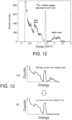
- FIG. 12 is a self-radioactivity spectrum of LaBr3 :Ce.
- the horizontal axis represents energy (MeV) and the vertical axis represents event frequency. It can be seen that there are many spectra associated with ⁇ decay at 1.7 to 2.4 MeV. When an event to be measured is other than 1.5 to 2.5 MeV, it is considered that the background (BG) of ⁇ decay is not a particular problem, but a large amount of environmental radiation or a large number of nuclear reactions are distributed, which may be problematic because they often have a low counting rate.
- BG background
- Non Patent Document 1 describes a method of rejecting ⁇ ray events by comparing a partial charge amount and a total charge amount using a difference in an emission signal of an LaBr3 scintillator between ⁇ ray events and the ⁇ ray events.
- Non Patent Document 2 describes a LaBr 3 scintillation detector comprising a LaBr 3 scintillator, a photoelectric converter that converts light emitted from the LaBr 3 scintillator into an electric signal, a waveform signal output unit that converts an output from the photoelectric converter into a voltage waveform signal, a detecting unit that detects a peak value V p and a total charge amount Q total of the voltage waveform signal, a calculating unit that calculates a ratio of the peak value V p and the total charge amount Q tolal in an energy range of 1.5 MeV or less.
- An object of the present disclosure is to provide a device capable of detecting mainly a spectrum (b) of only ⁇ ray events from a spectrum (a) detected including a specific event such as ⁇ decay events, as schematically illustrated in FIG. 13 , by identifying the specific events such as the ⁇ decay events using a measured value which may be actually measured in real time such as a signal peak voltage and a total charge amount in an LaBr3 scintillator.
- the present disclosure includes: an LaBr3 scintillation detector according to claim 1.
- the present inventors analyzed the ratio of the peak value Vp and the total charge amount (integrated charge amount) Qtotal of the voltage waveform signal for data of a predetermined number of events of emission signals attributable to self-radioactivity of the LaBr3 scintillator, and found that only ⁇ decay event exhibited a significantly different distribution. Therefore, an error propagation expression function of the ratio of Vp and Qtotal is calculated in an energy range of a predetermined value or less which does not include an event other than ⁇ rays in light emitted from the scintillator, and the function is used as a threshold function to identify data of a specific event such as an ⁇ decay event that exhibits a significantly different distribution. Then, the data of the specific event are rejected from the original data.
- An exemplary embodiment of the present disclosure further includes a low-pass filter that removes a high frequency component of the voltage waveform signal output from the waveform signal output unit.
- the processing unit uses an error propagation expression function of 3 ⁇ as the threshold function.
- the present disclosure includes a method of rejecting a specific event of an LaBr3 scintillator according to claim 4.
- a specific event e.g., an ⁇ decay event of self-radioactivity
- measured values measurable in real time such as a peak voltage and a total charge amount of a signal in an LaBr 3 scintillator. Therefore, according to the present disclosure, it is possible to perform detection with high accuracy by utilizing the characteristics of the LaBr 3 scintillator particularly in a high energy ⁇ ray region corresponding to 1.5 to 3 MeV.
- FIG. 1 is a configuration diagram of a scintillation detector of an exemplary embodiment.
- the scintillation detector includes an LaBr 3 :Ce scintillator 10, a photomultiplier 12, an oscilloscope 14, a hard disk drive 16, and a computer 18.
- the LaBr 3 :Ce scintillator 10 is a scintillator that converts ionizing radiation such as a ⁇ ray into light, and is formed, for example, in a cylindrical shape of 1.5 inch ⁇ ⁇ 1.5 inch.
- the LaBr 3 :Ce scintillator 10 is a scintillator that is excellent in stopping power, energy resolution, and time resolution, but as described above, it always outputs a background signal according to a radionuclide contained therein.
- the photomultiplier tube 12 is connected to the LaBr 3 :Ce scintillator 10 so as to convert the light of the LaBr 3 :Ce scintillator 10 into an electrical signal corresponding to the intensity and output the electrical signal.
- the oscilloscope 14 converts the detected electric signal into a voltage signal (waveform signal) along the time axis and outputs the voltage signal.
- the hard disk drive 16 is connected to the oscilloscope 14 via a USB interface or the like, and stores the waveform signal (raw waveform signal not subjected to waveform shaping or the like) output from the oscilloscope 14.
- the computer 18 functions as a detecting unit, a calculating unit, and a processing unit in the present exemplary embodiment, so that the waveform signal stored in the hard disk drive 16 is input to the computer 18 and the computer 18 analyzes the waveform signal and outputs the analysis result.
- the computer 18 has a CPU and a program memory, and a predetermined processing program is stored in the program memory.
- the computer 18 reads the processing program stored in the program memory and sequentially executes the processing program to analyze the waveform signal.
- the analysis of the waveform signal in the present exemplary embodiment includes the following processes:
- the hard disk drive 16 and the computer 18 may be implemented as one waveform analyzing device, and the oscilloscope 14, the hard disk drive 16, and the computer 18 may be implemented as one waveform analyzing device.
- the computer 18 may have a function of counting the number of events for data in which the ⁇ ray events have been rejected, converting the count value into a radiation dose, and outputting the radiation dose.
- this function is well known.
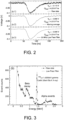
- FIG. 2 is a waveform signal diagram measured at events including a self-radioactive event of the LaBr3:Ce scintillator 10.
- the waveforms are obtained by the oscilloscope 14, and no external radiation source is used.
- the horizontal axis represents time (ns) and the vertical axis represents voltage (V).
- the peak value Vp and the total charge amount Q total may be detected with high accuracy by performing a moving average process or a low pass filter process, particularly a low pass filter process to shape the waveform.
- V p the same value is obtained in the moving average process and the low-pass filter process, and a value different from that value is obtained in the raw data.
- Q total substantially the same value is obtained in the three sets of data.
- Q total is the total charge amount and corresponds to energy, suggesting that there is no major change in the energy distribution between the three sets of data.
- FIG. 3 illustrates an energy spectrum of the lowest waveform signal in FIG. 2 ; that is, an energy spectrum when high-frequency noise is removed by the low-pass filter of FFT and IFFT.
- the solid line indicates an energy spectrum of the raw data, and the broken line indicates an energy spectrum when low-pass filtered. It can be seen from this figure that the energy spectrum does not change before and after noise removal. This means that data loss does not occur even when the low pass filter process is performed on the raw data.
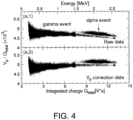
- FIG. 4 illustrates a plotted result of the ratio V p /Q total of the peak value Vp and the total charge amount Q total of the waveform signal (low-pass filtered) for the data of 100,000 events of light emission by the self-radioactivity of the LaBr 3 :Ce scintillator 10.
- the horizontal axis represents the total charge amount Q total and the corresponding energy (MeV)
- the vertical axis represents V p /Q total .
- part (a.1) in FIG. 4 two components are present in the energy range of 1.5 to 3 MeV. It is known that the peak value V p of the waveform signal of ⁇ ray events is larger than the peak value of the waveform signal of ⁇ ray events (see the related art). Accordingly, the upper component in part (a.1) of FIG. 4 corresponds to the ⁇ ray events and the lower component corresponds to the ⁇ ray events.
- the low energy portion is considered to be ⁇ ray events by 208 Tl 2.6 MeV, which is an environmental radionuclide.
- the ratio Vp/Q total should be constant in the entire energy range.
- the ratio Vp/Q total is not constant and tends to decrease with increasing energy. This is considered to be due to the saturation of the peak value V p .
- the present inventors have found that, when plotting the horizontal axis as Q total and the vertical axis as V p , the linearity of V p and Q total is maintained in the low energy region (1.5 MeV or less), whereas the linearity is not maintained in the high energy region, and V p tends to be saturated.
- V pCorr V p 1 ⁇ ⁇ / ⁇ V p
- the threshold function for identifying the ⁇ ray events and the ⁇ ray events may be determined by using the standard deviation ⁇ of pure ⁇ ray events of 1.5 MeV or less.
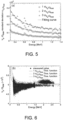
- FIG. 5 illustrates ⁇ , 2 ⁇ , and 3 ⁇ calculated for V p /Q total using the corrected V p , and its error propagation expression function.
- the horizontal axis represents energy, which is an energy range of 1.4 MeV or less ( i.e., an energy range of only the ⁇ ray events), and the vertical axis represents the standard deviation ⁇ of V p /Q total . From this figure, it can be seen that the variation of V p /Q total is very well reproduced by the error propagation expression function. Therefore, the ⁇ ray events present in the energy range of 1.5 MeV or more may be clearly identified by determining the threshold function from this error propagation expression function.
- FIG. 6 is a diagram in which the threshold function is applied to the plotting of V p /Q total using the corrected V p illustrated in part (a.2) of FIG. 4 .
- the threshold function is inversely proportional to Q total and represents energy dependence.
- the threshold functions of ⁇ , 2 ⁇ , and 3 ⁇ are illustrated in the figure, but the ⁇ ray events and the ⁇ ray events may be clearly identified, especially by using the threshold function of 3 ⁇ . Therefore, it is possible to reject the ⁇ ray events using the threshold function.
- threshold functions of ⁇ to 3 ⁇ are unambiguously and objectively determined from the data group of V p /Q total at 1.5 MeV or less.
- FIG. 7 is a diagram illustrating the result of rejecting the ⁇ ray events using three kinds of threshold functions (threshold functions of ⁇ , 2 ⁇ , and 3 ⁇ ).
- part (a.1) is a result when the threshold function of ⁇ is used
- part (a.2) is a result when the threshold function of 2 ⁇ is used
- part (a.3) is a result when the threshold function of 3 ⁇ is used.
- the horizontal axis represents energy (MeV)
- the vertical axis represents event counts.
- the solid line indicates event counts after the ⁇ ray events are rejected, and the ⁇ ray events are rejected in all the threshold functions.
- FIG. 8 is a diagram illustrating an accidental rejection rate of the ⁇ ray events; that is, a rejection rate of the ⁇ ray events that should not be rejected, in each of the three kinds of threshold functions.
- the horizontal axis represents energy in a range of 0.3 MeV to 1.5 MeV; that is, an energy range in which only the ⁇ ray events occur.
- the accidental rejection rate decreases drastically, so that only the ⁇ ray events are correctly rejected.
- the accidental rejection rate is approximately 1% or less in the whole region of 1.5 MeV or less, and as a whole, the accidental rejection rate of about 0.716% is obtained.
- the ⁇ ray events are not eliminated at all, but it is meant that the ⁇ ray events may be somewhat rejected.
- the threshold function has a mathematical basis and does not include parameters to be set artificially, it may be determined unambiguously and objectively. Specifically, when the threshold function is determined as a function of energy, it is possible to dramatically improve the accuracy of identifying the ⁇ ray events. Furthermore, the accidental rejection rate of the ⁇ ray events of 1.5 MeV or less may be set to about 0.7% by using the threshold function of 3 ⁇ .
- Ge/Ga-68 ( 68 Ga 1.883 MeV) is used as the external radiation source.
- contribution from environmental radiation 208 Tl 2.61 MeV, etc.
- the ⁇ ray events and the ⁇ ray events are mixed in at 1.5 MeV to 3 MeV. Therefore, after the ⁇ ray events are rejected using the 3 ⁇ threshold function in the above-described method, an evaluation is conducted in order to determine whether or not the correct number of ⁇ ray events ( 68 Ga 1.883 MeV), which is previously known, remains.
- a result obtained by the highly reliable background (BG) subtraction method is compared with the result obtained by the exemplary embodiment, and an evaluation is conducted as to whether or not there is a difference between the two results. That is, by comparing distribution of ⁇ rays of 1.883 MeV remaining after subtracting the measurement result in the absence of an external radiation source from the measurement result in the presence of an external radiation source (background BG subtraction method) and distribution of ⁇ rays of 1.883 MeV remaining after using V p /Q total and the threshold function of the exemplary embodiment in the presence of an external radiation source, it is evaluated whether the ⁇ ray events can be rejected correctly by the method of the exemplary embodiment.
- FIG. 9 also illustrates energy spectra with and without an external radiation source.
- the solid line indicates an energy spectrum in the case where an external radiation source is present
- the broken line indicates an energy spectrum in the case where an external radiation source is not present
- the vertical axis represents normalized event counts.
- the event counts of 68 Ga 1.883 MeV may be measured by subtracting the latter from the former.
- part (b) of FIG. 9 illustrates energy spectra in the state where an external radiation source is provided and after the ⁇ ray events are rejected by the method of the exemplary embodiment.
- the solid line indicates the energy spectrum in the state where an external radiation source is present
- the broken line indicates the energy spectrum after the ⁇ ray events are rejected by the threshold function of 3 ⁇ .
- 1.883 MeV components remain without being rejected.
- FIG. 10 is a diagram comparing the case of subtracting background (BG) with the case of the exemplary embodiment.
- the horizontal axis represents energy in the energy range around 1.883 MeV.
- the vertical axis represents normalized event counts.
- Part (C.1) is a result of the BG method which is obtained by subtracting the case of not setting an external radiation source from the case of setting an external radiation source
- part (c.2) is a result of the present exemplary embodiment
- part (c.3) is a result of comparing the two.
- the peak count numbers (including measured value and fitting value), average energy, full width at half maximum (FWHM), and difference in each case are as follows.
- a counting loss of a 215 Po short-lived daughter nucleus that decays in a cascade manner from 219 Rn and the like may be a counting loss of a 215 Po short-lived daughter nucleus that decays in a cascade manner from 219 Rn and the like.
- this counting loss does not contribute to the accuracy evaluation.
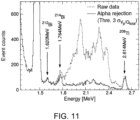
- FIG. 11 is a diagram illustrating a result when ⁇ ray events are rejected using V p /Q total and the threshold function of 3 ⁇ by further increasing the statistical number. Very few events of 212, 214 Bi have been identified. In this regard, the method of the exemplary embodiment also has the effect of being able to remarkably detect even a small number of ⁇ ray events.
- only ⁇ ray events may be collected by identifying ⁇ ray events using a measured value that can be actually measured in real time such as a peak voltage of the signal and a total charge amount, and rejecting the ⁇ ray events. Further, in the exemplary embodiment, it is possible to obtain the same result as that in the background (BG) subtraction method with higher accuracy. Further, in the exemplary embodiment, since measurement may be performed independently of the S/N ratio of the measurement target and the ⁇ decay background, it is also suitable for detection of very small signals.
- the exemplary embodiment attention is paid particularly to the ⁇ decay events included in the self-radioactivity, but it is applicable not only to self-radioactivity but also to ⁇ rays and heavy particle rays incident from the outside. That is, the exemplary embodiment is not necessarily limited to self-radioactivity and may be applied to the rejection of specific events that may exist in a specific energy range.
- the dead time tends to increase, but the dead time may be reduced by using a highspeed ADC for flash analog to digital converter (FADC) that acquires a signal waveform at high speed.
- FADC flash analog to digital converter
- ⁇ ray events are identified using V p /Q total , but it goes without saying that Q total /V p , which is the reciprocal thereof, may be used.
Landscapes
- Chemical & Material Sciences (AREA)
- Spectroscopy & Molecular Physics (AREA)
- Life Sciences & Earth Sciences (AREA)
- General Physics & Mathematics (AREA)
- High Energy & Nuclear Physics (AREA)
- Molecular Biology (AREA)
- Physics & Mathematics (AREA)
- Health & Medical Sciences (AREA)
- Inorganic Chemistry (AREA)
- Engineering & Computer Science (AREA)
- Materials Engineering (AREA)
- Organic Chemistry (AREA)
- Measurement Of Radiation (AREA)
Claims (4)
- LaBrs-Szintillationsdetektor, der aufweist:einen LaBr3-Szintillator (10);einen photoelektrischen Wandler (12), der vom LaBr3-Szintillator emittiertes Licht in ein elektrisches Signal umwandelt;eine Wellenformsignalausgabeeinheit (14), die eine Ausgabe vom photoelektrischen Wandler in ein Spannungswellenformsignal umwandelt;eine Detektionseinheit (18), die einen Spitzenwert Vp und eine Gesamtladungsmenge Qtotal des Spannungswellenformsignals detektiert;eine Berechnungseinheit (18), die eine Ausdrucksfunktion der statistischen Fehlerfortpflanzung eines Verhältnisses des Spitzenwerts Vp und der Gesamtladungsmenge Qtotal in einem Energiebereich von höchstens 1,5 MeV berechnet; wobei die Ausdrucksfunktion der statistischen Fehlerfortpflanzung die Funktion ist, die durch Auftragen der Standardabweichung von Vp/Qtotal oder eines Vielfachen der Standardabweichung für die im Energiebereich von höchstens 1,5 MeV erhaltenen Daten erhalten wird,und eine Verarbeitungseinheit (18), die die Ausdrucksfunktion der statistischen Fehlerfortpflanzung als Schwellenwertfunktion verwendet, um ein Ereignis mit Ausnahme von γ-Strahlen zu spezifizieren, und das Ereignis zurückweist, um ein γ-Strahlenereignis zu detektieren, und wobei die Berechnungseinheit eine Standardabweichung berechnet, indem sie den durch die Detektionseinheit detektierten Spitzenwert Vp so korrigiert, dass er im Hinblick auf die Gesamtladungsmenge Qtotal linear wird.
- LaBrs-Szintillationsdetektor nach Anspruch 1, der ferner aufweist:
ein Tiefpassfilter, das eine Hochfrequenzkomponente des von der Wellenformsignalausgabeeinheit ausgegebenen Spannungswellenformsignals entfernt. - LaBrs-Szintillationsdetektor nach Anspruch 1, wobei die Verarbeitungseinheit eine Ausdrucksfunktion der Fehlerfortpflanzung von 3σ als Schwellenwertfunktion verwendet.
- Verfahren zur Zurückweisung eines spezifischen Ereignisses und Detektion eines γ-Strahlenereignisses eines LaBr3-Szintillators, wobei das Verfahren aufweist:Umwandeln einer Emission des LaBr3-Szintillators in ein Spannungswellenformsignal und Ausgeben des Spannungswellenformsignals;Detektieren eines Spitzenwerts Vp und einer Gesamtladungsmenge Qtotal des Spannungswellenformsignals;Berechnen einer Ausdrucksfunktion der statistischen Fehlerfortpflanzung eines Verhältnisses des Spitzenwerts Vp und der Gesamtladungsmenge Qtotal in einem Energiebereich von höchstens 1,5 MeV, wobei die Ausdrucksfunktion der statistischen Fehlerfortpflanzung die Funktion ist, die durch Auftragen der Standardabweichung von Vp/Qtotal oder eines Vielfachen der Standardabweichung für die im Energiebereich von höchstens 1,5 MeV erhaltenen Daten erhalten wird,Verwenden der Ausdrucksfunktion der statistischen Fehlerfortpflanzung als Schwellenwertfunktion, um ein Ereignis mit Ausnahme von γ-Strahlen zu spezifizieren, undZurückweisen des Ereignisses, um ein γ-Strahlenereignis zu detektieren,wobei die Berechnungseinheit eine Standardabweichung berechnet, indem sie den durch den Detektor detektierten Spitzenwert Vp so korrigiert, dass er im Hinblick auf die Gesamtladungsmenge Qtotal linear wird.
Applications Claiming Priority (2)
| Application Number | Priority Date | Filing Date | Title |
|---|---|---|---|
| JP2015035788 | 2015-02-25 | ||
| PCT/JP2016/054017 WO2016136480A1 (ja) | 2015-02-25 | 2016-02-10 | LaBr3シンチレーション検出器及び特定イベント排除方法 |
Publications (3)
| Publication Number | Publication Date |
|---|---|
| EP3264138A1 EP3264138A1 (de) | 2018-01-03 |
| EP3264138A4 EP3264138A4 (de) | 2018-10-31 |
| EP3264138B1 true EP3264138B1 (de) | 2024-06-19 |
Family
ID=56788444
Family Applications (1)
| Application Number | Title | Priority Date | Filing Date |
|---|---|---|---|
| EP16755227.2A Active EP3264138B1 (de) | 2015-02-25 | 2016-02-10 | Labr3-szintillationsdetektor und verfahren zur entfernung spezifischer ereignisse |
Country Status (4)
| Country | Link |
|---|---|
| US (1) | US10578750B2 (de) |
| EP (1) | EP3264138B1 (de) |
| JP (1) | JP6675127B2 (de) |
| WO (1) | WO2016136480A1 (de) |
Families Citing this family (4)
| Publication number | Priority date | Publication date | Assignee | Title |
|---|---|---|---|---|
| JP6722952B2 (ja) * | 2015-09-02 | 2020-07-15 | 国立大学法人北海道大学 | シンチレーション光検出装置および放射線検出装置 |
| JP7236302B2 (ja) * | 2019-03-26 | 2023-03-09 | セイコー・イージーアンドジー株式会社 | 放射線測定装置、及び放射線測定方法 |
| JP7236301B2 (ja) * | 2019-03-26 | 2023-03-09 | セイコー・イージーアンドジー株式会社 | 放射線測定装置、及び放射線測定方法 |
| JP7701143B2 (ja) * | 2020-09-08 | 2025-07-01 | キヤノンメディカルシステムズ株式会社 | 核医学診断装置 |
Family Cites Families (7)
| Publication number | Priority date | Publication date | Assignee | Title |
|---|---|---|---|---|
| US4217496A (en) * | 1978-03-14 | 1980-08-12 | The United States Of America As Represented By The Secretary Of Health, Education And Welfare | Portable instrument for measuring neutron energy spectra and neutron dose in a mixed n-γ field |
| US6953937B2 (en) * | 2003-06-26 | 2005-10-11 | Battelle Energy Alliance, Llc | Method and apparatus for the detection of neutrons and gamma rays |
| US7388206B2 (en) * | 2006-06-16 | 2008-06-17 | Ge Homeland Protection, Inc. | Pulse shape discrimination method and apparatus for high-sensitivity radioisotope identification with an integrated neutron-gamma radiation detector |
| GB201016749D0 (en) * | 2010-10-05 | 2010-11-17 | Hybrid Instr Ltd | Apparatus and method for radiation analysis |
| US9309456B2 (en) * | 2011-04-15 | 2016-04-12 | Lawrence Livermore National Security, Llc | Plastic scintillator with effective pulse shape discrimination for neutron and gamma detection |
| WO2015171919A1 (en) * | 2014-05-09 | 2015-11-12 | Saint-Gobain Ceramics & Plastics, Inc. | Radiation detection apparatus having a doped scintillator and a pulse shape analysis module and a method of using the same |
| JP6722952B2 (ja) * | 2015-09-02 | 2020-07-15 | 国立大学法人北海道大学 | シンチレーション光検出装置および放射線検出装置 |
-
2016
- 2016-02-10 EP EP16755227.2A patent/EP3264138B1/de active Active
- 2016-02-10 WO PCT/JP2016/054017 patent/WO2016136480A1/ja not_active Ceased
- 2016-02-10 US US15/552,645 patent/US10578750B2/en active Active
- 2016-02-10 JP JP2017502057A patent/JP6675127B2/ja active Active
Non-Patent Citations (4)
| Title |
|---|
| AZAREE T. LINTEREUR ET AL: "Neutron and Gamma Ray Pulse Shape Discrimination with Polyvinyltoluene", USDOE, 1 March 2012 (2012-03-01), XP055640001, Retrieved from the Internet <URL:https://www.pnnl.gov/main/publications/external/technical_reports/PNNL-21609.pdf> [retrieved on 20191107], DOI: 10.2172/1059208 * |
| DAWSON J V ET AL: "A Study of the Scintillation Induced by Alpha Particles and Gamma Rays in Liquid Xenon in an Electric Field", ARXIV.ORG, CORNELL UNIVERSITY LIBRARY, 201 OLIN LIBRARY CORNELL UNIVERSITY ITHACA, NY 14853, 7 February 2005 (2005-02-07), XP080192114, DOI: 10.1016/J.NIMA.2005.01.343 * |
| QUARATI F.G.A: "LaBr3 gamma?ray spectrometers for space applications", 22 January 2013 (2013-01-22), XP055875518, Retrieved from the Internet <URL:https://repository.tudelft.nl/islandora/object/uuid%3A7d1f7672-5d97-4b32-9c44-ad0bcc259b82> [retrieved on 20211222] * |
| SHALIZI COSMA ROHILLA: "Lecture 11: Standard Error, Propagation of Error, Central Limit Theorem in the Real World", 5 October 2005 (2005-10-05), XP055875513, Retrieved from the Internet <URL:https://www.stat.cmu.edu/~cshalizi/36-220/lecture-11.pdf> [retrieved on 20211222] * |
Also Published As
| Publication number | Publication date |
|---|---|
| WO2016136480A1 (ja) | 2016-09-01 |
| JP6675127B2 (ja) | 2020-04-01 |
| US20180149760A1 (en) | 2018-05-31 |
| JPWO2016136480A1 (ja) | 2017-12-21 |
| EP3264138A4 (de) | 2018-10-31 |
| EP3264138A1 (de) | 2018-01-03 |
| US10578750B2 (en) | 2020-03-03 |
Similar Documents
| Publication | Publication Date | Title |
|---|---|---|
| JP5555660B2 (ja) | 放射線計測装置及びその方法 | |
| US20160076935A1 (en) | Pulse processing circuit with correction means | |
| EP3264138B1 (de) | Labr3-szintillationsdetektor und verfahren zur entfernung spezifischer ereignisse | |
| JP7026443B2 (ja) | 放射性ダストモニタ | |
| Khilkevitch et al. | Advanced algorithms for signal processing scintillation gamma ray detectors at high counting rates | |
| CN111123377A (zh) | 一种航空伽玛能谱仪器及放射性地球物理探测方法 | |
| US9817135B2 (en) | Performance stabilization for scintillator-based radiation detectors | |
| Oberstedt et al. | Identification of prompt fission γ-rays with lanthanum-chloride scintillation detectors | |
| Msebi et al. | A fast-timing array of 2” x 2” LaBr3: Ce detectors for lifetime measurements of excited nuclear states | |
| EP4198575A1 (de) | Vorrichtung zur analyse radioaktiver nuklide, verfahren zur analyse radioaktiver nuklide und programm zur analyse radioaktiver nuklide | |
| JP5487173B2 (ja) | 放射線核種分析装置及びその偶発同時計数抑制方法 | |
| US20120166120A1 (en) | Method Capable Of Discriminating Between A Gamma Component And A Neutron Component In An Electronic Signal | |
| US9921320B2 (en) | Radiation detecting apparatus, input-output calibration method, and computer program product | |
| EP3676640B1 (de) | Verfahren und systeme zur kalibrierung von partikeldetektoren | |
| JP7058564B2 (ja) | アルファ線用放射性ダストモニタ | |
| Flaska et al. | Optimization of an offline pulse-shape discrimination technique for the liquid scintillator BC-501A | |
| WO2016144403A9 (en) | Scintillator-based neutron and gamma-ray dosimeter | |
| Papp et al. | A robust digital signal processor: Determining the true input rate | |
| JP7378377B2 (ja) | 放射線分析装置およびダストモニタ装置 | |
| Paepen et al. | Use of a CAEN digitiser for nuclear safeguards and security applications with a scintillator detector | |
| Fang | Algorithms for nuclear data analysis applied to safety and materials | |
| WO2018061252A1 (ja) | 放射線測定装置 | |
| HK40085802A (en) | Radioactive nuclide analysis device, radioactive nuclide analysis method and radioactive nuclide analysis program | |
| Robert | An Analysis of Statistical Distributions for Particle Counting using 22Na | |
| Flaska et al. | Measurements of continuous-in-energy neutron sources using the BC-523A capture-gated liquid scintillator |
Legal Events
| Date | Code | Title | Description |
|---|---|---|---|
| STAA | Information on the status of an ep patent application or granted ep patent |
Free format text: STATUS: THE INTERNATIONAL PUBLICATION HAS BEEN MADE |
|
| PUAI | Public reference made under article 153(3) epc to a published international application that has entered the european phase |
Free format text: ORIGINAL CODE: 0009012 |
|
| STAA | Information on the status of an ep patent application or granted ep patent |
Free format text: STATUS: REQUEST FOR EXAMINATION WAS MADE |
|
| 17P | Request for examination filed |
Effective date: 20170921 |
|
| AK | Designated contracting states |
Kind code of ref document: A1 Designated state(s): AL AT BE BG CH CY CZ DE DK EE ES FI FR GB GR HR HU IE IS IT LI LT LU LV MC MK MT NL NO PL PT RO RS SE SI SK SM TR |
|
| AX | Request for extension of the european patent |
Extension state: BA ME |
|
| DAV | Request for validation of the european patent (deleted) | ||
| DAX | Request for extension of the european patent (deleted) | ||
| A4 | Supplementary search report drawn up and despatched |
Effective date: 20180927 |
|
| RIC1 | Information provided on ipc code assigned before grant |
Ipc: C09K 11/85 20060101ALI20180922BHEP Ipc: C09K 11/00 20060101ALI20180922BHEP Ipc: G01T 1/17 20060101ALI20180922BHEP Ipc: G01T 1/20 20060101AFI20180922BHEP |
|
| STAA | Information on the status of an ep patent application or granted ep patent |
Free format text: STATUS: EXAMINATION IS IN PROGRESS |
|
| 17Q | First examination report despatched |
Effective date: 20191115 |
|
| GRAP | Despatch of communication of intention to grant a patent |
Free format text: ORIGINAL CODE: EPIDOSNIGR1 |
|
| STAA | Information on the status of an ep patent application or granted ep patent |
Free format text: STATUS: GRANT OF PATENT IS INTENDED |
|
| INTG | Intention to grant announced |
Effective date: 20240216 |
|
| GRAS | Grant fee paid |
Free format text: ORIGINAL CODE: EPIDOSNIGR3 |
|
| GRAA | (expected) grant |
Free format text: ORIGINAL CODE: 0009210 |
|
| STAA | Information on the status of an ep patent application or granted ep patent |
Free format text: STATUS: THE PATENT HAS BEEN GRANTED |
|
| AK | Designated contracting states |
Kind code of ref document: B1 Designated state(s): AL AT BE BG CH CY CZ DE DK EE ES FI FR GB GR HR HU IE IS IT LI LT LU LV MC MK MT NL NO PL PT RO RS SE SI SK SM TR |
|
| REG | Reference to a national code |
Ref country code: GB Ref legal event code: FG4D |
|
| REG | Reference to a national code |
Ref country code: CH Ref legal event code: EP |
|
| REG | Reference to a national code |
Ref country code: DE Ref legal event code: R096 Ref document number: 602016088034 Country of ref document: DE |
|
| PG25 | Lapsed in a contracting state [announced via postgrant information from national office to epo] |
Ref country code: BG Free format text: LAPSE BECAUSE OF FAILURE TO SUBMIT A TRANSLATION OF THE DESCRIPTION OR TO PAY THE FEE WITHIN THE PRESCRIBED TIME-LIMIT Effective date: 20240619 |
|
| PG25 | Lapsed in a contracting state [announced via postgrant information from national office to epo] |
Ref country code: FI Free format text: LAPSE BECAUSE OF FAILURE TO SUBMIT A TRANSLATION OF THE DESCRIPTION OR TO PAY THE FEE WITHIN THE PRESCRIBED TIME-LIMIT Effective date: 20240619 Ref country code: HR Free format text: LAPSE BECAUSE OF FAILURE TO SUBMIT A TRANSLATION OF THE DESCRIPTION OR TO PAY THE FEE WITHIN THE PRESCRIBED TIME-LIMIT Effective date: 20240619 |
|
| REG | Reference to a national code |
Ref country code: LT Ref legal event code: MG9D |
|
| PG25 | Lapsed in a contracting state [announced via postgrant information from national office to epo] |
Ref country code: GR Free format text: LAPSE BECAUSE OF FAILURE TO SUBMIT A TRANSLATION OF THE DESCRIPTION OR TO PAY THE FEE WITHIN THE PRESCRIBED TIME-LIMIT Effective date: 20240920 |
|
| REG | Reference to a national code |
Ref country code: NL Ref legal event code: MP Effective date: 20240619 |
|
| PG25 | Lapsed in a contracting state [announced via postgrant information from national office to epo] |
Ref country code: LV Free format text: LAPSE BECAUSE OF FAILURE TO SUBMIT A TRANSLATION OF THE DESCRIPTION OR TO PAY THE FEE WITHIN THE PRESCRIBED TIME-LIMIT Effective date: 20240619 |
|
| PG25 | Lapsed in a contracting state [announced via postgrant information from national office to epo] |
Ref country code: NO Free format text: LAPSE BECAUSE OF FAILURE TO SUBMIT A TRANSLATION OF THE DESCRIPTION OR TO PAY THE FEE WITHIN THE PRESCRIBED TIME-LIMIT Effective date: 20240919 Ref country code: LV Free format text: LAPSE BECAUSE OF FAILURE TO SUBMIT A TRANSLATION OF THE DESCRIPTION OR TO PAY THE FEE WITHIN THE PRESCRIBED TIME-LIMIT Effective date: 20240619 Ref country code: HR Free format text: LAPSE BECAUSE OF FAILURE TO SUBMIT A TRANSLATION OF THE DESCRIPTION OR TO PAY THE FEE WITHIN THE PRESCRIBED TIME-LIMIT Effective date: 20240619 Ref country code: GR Free format text: LAPSE BECAUSE OF FAILURE TO SUBMIT A TRANSLATION OF THE DESCRIPTION OR TO PAY THE FEE WITHIN THE PRESCRIBED TIME-LIMIT Effective date: 20240920 Ref country code: FI Free format text: LAPSE BECAUSE OF FAILURE TO SUBMIT A TRANSLATION OF THE DESCRIPTION OR TO PAY THE FEE WITHIN THE PRESCRIBED TIME-LIMIT Effective date: 20240619 Ref country code: BG Free format text: LAPSE BECAUSE OF FAILURE TO SUBMIT A TRANSLATION OF THE DESCRIPTION OR TO PAY THE FEE WITHIN THE PRESCRIBED TIME-LIMIT Effective date: 20240619 Ref country code: RS Free format text: LAPSE BECAUSE OF FAILURE TO SUBMIT A TRANSLATION OF THE DESCRIPTION OR TO PAY THE FEE WITHIN THE PRESCRIBED TIME-LIMIT Effective date: 20240919 |
|
| PG25 | Lapsed in a contracting state [announced via postgrant information from national office to epo] |
Ref country code: NL Free format text: LAPSE BECAUSE OF FAILURE TO SUBMIT A TRANSLATION OF THE DESCRIPTION OR TO PAY THE FEE WITHIN THE PRESCRIBED TIME-LIMIT Effective date: 20240619 |
|
| REG | Reference to a national code |
Ref country code: AT Ref legal event code: MK05 Ref document number: 1696260 Country of ref document: AT Kind code of ref document: T Effective date: 20240619 |
|
| PG25 | Lapsed in a contracting state [announced via postgrant information from national office to epo] |
Ref country code: NL Free format text: LAPSE BECAUSE OF FAILURE TO SUBMIT A TRANSLATION OF THE DESCRIPTION OR TO PAY THE FEE WITHIN THE PRESCRIBED TIME-LIMIT Effective date: 20240619 |
|
| PG25 | Lapsed in a contracting state [announced via postgrant information from national office to epo] |
Ref country code: PT Free format text: LAPSE BECAUSE OF FAILURE TO SUBMIT A TRANSLATION OF THE DESCRIPTION OR TO PAY THE FEE WITHIN THE PRESCRIBED TIME-LIMIT Effective date: 20241021 |
|
| PG25 | Lapsed in a contracting state [announced via postgrant information from national office to epo] |
Ref country code: PT Free format text: LAPSE BECAUSE OF FAILURE TO SUBMIT A TRANSLATION OF THE DESCRIPTION OR TO PAY THE FEE WITHIN THE PRESCRIBED TIME-LIMIT Effective date: 20241021 |
|
| PG25 | Lapsed in a contracting state [announced via postgrant information from national office to epo] |
Ref country code: PL Free format text: LAPSE BECAUSE OF FAILURE TO SUBMIT A TRANSLATION OF THE DESCRIPTION OR TO PAY THE FEE WITHIN THE PRESCRIBED TIME-LIMIT Effective date: 20240619 |
|
| PG25 | Lapsed in a contracting state [announced via postgrant information from national office to epo] |
Ref country code: EE Free format text: LAPSE BECAUSE OF FAILURE TO SUBMIT A TRANSLATION OF THE DESCRIPTION OR TO PAY THE FEE WITHIN THE PRESCRIBED TIME-LIMIT Effective date: 20240619 |
|
| PG25 | Lapsed in a contracting state [announced via postgrant information from national office to epo] |
Ref country code: AT Free format text: LAPSE BECAUSE OF FAILURE TO SUBMIT A TRANSLATION OF THE DESCRIPTION OR TO PAY THE FEE WITHIN THE PRESCRIBED TIME-LIMIT Effective date: 20240619 Ref country code: IS Free format text: LAPSE BECAUSE OF FAILURE TO SUBMIT A TRANSLATION OF THE DESCRIPTION OR TO PAY THE FEE WITHIN THE PRESCRIBED TIME-LIMIT Effective date: 20241019 |
|
| PG25 | Lapsed in a contracting state [announced via postgrant information from national office to epo] |
Ref country code: CZ Free format text: LAPSE BECAUSE OF FAILURE TO SUBMIT A TRANSLATION OF THE DESCRIPTION OR TO PAY THE FEE WITHIN THE PRESCRIBED TIME-LIMIT Effective date: 20240619 |
|
| PG25 | Lapsed in a contracting state [announced via postgrant information from national office to epo] |
Ref country code: RO Free format text: LAPSE BECAUSE OF FAILURE TO SUBMIT A TRANSLATION OF THE DESCRIPTION OR TO PAY THE FEE WITHIN THE PRESCRIBED TIME-LIMIT Effective date: 20240619 Ref country code: SK Free format text: LAPSE BECAUSE OF FAILURE TO SUBMIT A TRANSLATION OF THE DESCRIPTION OR TO PAY THE FEE WITHIN THE PRESCRIBED TIME-LIMIT Effective date: 20240619 |
|
| PG25 | Lapsed in a contracting state [announced via postgrant information from national office to epo] |
Ref country code: ES Free format text: LAPSE BECAUSE OF FAILURE TO SUBMIT A TRANSLATION OF THE DESCRIPTION OR TO PAY THE FEE WITHIN THE PRESCRIBED TIME-LIMIT Effective date: 20240619 Ref country code: SM Free format text: LAPSE BECAUSE OF FAILURE TO SUBMIT A TRANSLATION OF THE DESCRIPTION OR TO PAY THE FEE WITHIN THE PRESCRIBED TIME-LIMIT Effective date: 20240619 |
|
| PG25 | Lapsed in a contracting state [announced via postgrant information from national office to epo] |
Ref country code: SM Free format text: LAPSE BECAUSE OF FAILURE TO SUBMIT A TRANSLATION OF THE DESCRIPTION OR TO PAY THE FEE WITHIN THE PRESCRIBED TIME-LIMIT Effective date: 20240619 Ref country code: SK Free format text: LAPSE BECAUSE OF FAILURE TO SUBMIT A TRANSLATION OF THE DESCRIPTION OR TO PAY THE FEE WITHIN THE PRESCRIBED TIME-LIMIT Effective date: 20240619 Ref country code: RO Free format text: LAPSE BECAUSE OF FAILURE TO SUBMIT A TRANSLATION OF THE DESCRIPTION OR TO PAY THE FEE WITHIN THE PRESCRIBED TIME-LIMIT Effective date: 20240619 Ref country code: PL Free format text: LAPSE BECAUSE OF FAILURE TO SUBMIT A TRANSLATION OF THE DESCRIPTION OR TO PAY THE FEE WITHIN THE PRESCRIBED TIME-LIMIT Effective date: 20240619 Ref country code: IS Free format text: LAPSE BECAUSE OF FAILURE TO SUBMIT A TRANSLATION OF THE DESCRIPTION OR TO PAY THE FEE WITHIN THE PRESCRIBED TIME-LIMIT Effective date: 20241019 Ref country code: ES Free format text: LAPSE BECAUSE OF FAILURE TO SUBMIT A TRANSLATION OF THE DESCRIPTION OR TO PAY THE FEE WITHIN THE PRESCRIBED TIME-LIMIT Effective date: 20240619 Ref country code: EE Free format text: LAPSE BECAUSE OF FAILURE TO SUBMIT A TRANSLATION OF THE DESCRIPTION OR TO PAY THE FEE WITHIN THE PRESCRIBED TIME-LIMIT Effective date: 20240619 Ref country code: CZ Free format text: LAPSE BECAUSE OF FAILURE TO SUBMIT A TRANSLATION OF THE DESCRIPTION OR TO PAY THE FEE WITHIN THE PRESCRIBED TIME-LIMIT Effective date: 20240619 Ref country code: AT Free format text: LAPSE BECAUSE OF FAILURE TO SUBMIT A TRANSLATION OF THE DESCRIPTION OR TO PAY THE FEE WITHIN THE PRESCRIBED TIME-LIMIT Effective date: 20240619 |
|
| PG25 | Lapsed in a contracting state [announced via postgrant information from national office to epo] |
Ref country code: IT Free format text: LAPSE BECAUSE OF FAILURE TO SUBMIT A TRANSLATION OF THE DESCRIPTION OR TO PAY THE FEE WITHIN THE PRESCRIBED TIME-LIMIT Effective date: 20240619 |
|
| REG | Reference to a national code |
Ref country code: DE Ref legal event code: R097 Ref document number: 602016088034 Country of ref document: DE |
|
| PG25 | Lapsed in a contracting state [announced via postgrant information from national office to epo] |
Ref country code: DK Free format text: LAPSE BECAUSE OF FAILURE TO SUBMIT A TRANSLATION OF THE DESCRIPTION OR TO PAY THE FEE WITHIN THE PRESCRIBED TIME-LIMIT Effective date: 20240619 |
|
| PLBE | No opposition filed within time limit |
Free format text: ORIGINAL CODE: 0009261 |
|
| STAA | Information on the status of an ep patent application or granted ep patent |
Free format text: STATUS: NO OPPOSITION FILED WITHIN TIME LIMIT |
|
| 26N | No opposition filed |
Effective date: 20250320 |
|
| REG | Reference to a national code |
Ref country code: DE Ref legal event code: R119 Ref document number: 602016088034 Country of ref document: DE |
|
| PG25 | Lapsed in a contracting state [announced via postgrant information from national office to epo] |
Ref country code: SE Free format text: LAPSE BECAUSE OF FAILURE TO SUBMIT A TRANSLATION OF THE DESCRIPTION OR TO PAY THE FEE WITHIN THE PRESCRIBED TIME-LIMIT Effective date: 20240619 |
|
| PG25 | Lapsed in a contracting state [announced via postgrant information from national office to epo] |
Ref country code: MC Free format text: LAPSE BECAUSE OF FAILURE TO SUBMIT A TRANSLATION OF THE DESCRIPTION OR TO PAY THE FEE WITHIN THE PRESCRIBED TIME-LIMIT Effective date: 20240619 |
|
| REG | Reference to a national code |
Ref country code: CH Ref legal event code: PL |
|
| PG25 | Lapsed in a contracting state [announced via postgrant information from national office to epo] |
Ref country code: LU Free format text: LAPSE BECAUSE OF NON-PAYMENT OF DUE FEES Effective date: 20250210 |
|
| PG25 | Lapsed in a contracting state [announced via postgrant information from national office to epo] |
Ref country code: CH Free format text: LAPSE BECAUSE OF NON-PAYMENT OF DUE FEES Effective date: 20250228 |
|
| GBPC | Gb: european patent ceased through non-payment of renewal fee |
Effective date: 20250210 |
|
| REG | Reference to a national code |
Ref country code: BE Ref legal event code: MM Effective date: 20250228 |
|
| PG25 | Lapsed in a contracting state [announced via postgrant information from national office to epo] |
Ref country code: DE Free format text: LAPSE BECAUSE OF NON-PAYMENT OF DUE FEES Effective date: 20250902 |
|
| PG25 | Lapsed in a contracting state [announced via postgrant information from national office to epo] |
Ref country code: GB Free format text: LAPSE BECAUSE OF NON-PAYMENT OF DUE FEES Effective date: 20250210 |
|
| PG25 | Lapsed in a contracting state [announced via postgrant information from national office to epo] |
Ref country code: BE Free format text: LAPSE BECAUSE OF NON-PAYMENT OF DUE FEES Effective date: 20250228 |
|
| PG25 | Lapsed in a contracting state [announced via postgrant information from national office to epo] |
Ref country code: IE Free format text: LAPSE BECAUSE OF NON-PAYMENT OF DUE FEES Effective date: 20250210 |
|
| PGFP | Annual fee paid to national office [announced via postgrant information from national office to epo] |
Ref country code: FR Payment date: 20260218 Year of fee payment: 11 |