EP3257853A1 - Condensed heterocyclic compound and noxious organism control agent - Google Patents
Condensed heterocyclic compound and noxious organism control agent Download PDFInfo
- Publication number
- EP3257853A1 EP3257853A1 EP16749327.9A EP16749327A EP3257853A1 EP 3257853 A1 EP3257853 A1 EP 3257853A1 EP 16749327 A EP16749327 A EP 16749327A EP 3257853 A1 EP3257853 A1 EP 3257853A1
- Authority
- EP
- European Patent Office
- Prior art keywords
- alkyl
- hydrogen atom
- haloalkyl
- atom
- optionally substituted
- Prior art date
- Legal status (The legal status is an assumption and is not a legal conclusion. Google has not performed a legal analysis and makes no representation as to the accuracy of the status listed.)
- Granted
Links
- 0 CC(C)S(*)c1c(-c(nc2c(*)c3*)c(*)[n]2c(**)c3I*)nc(/*=*(\*=I)/I)[n]1* Chemical compound CC(C)S(*)c1c(-c(nc2c(*)c3*)c(*)[n]2c(**)c3I*)nc(/*=*(\*=I)/I)[n]1* 0.000 description 11
- RTRVJYTVTCOSIA-UHFFFAOYSA-N CNC(c1ccccc1)O Chemical compound CNC(c1ccccc1)O RTRVJYTVTCOSIA-UHFFFAOYSA-N 0.000 description 1
Classifications
-
- A—HUMAN NECESSITIES
- A01—AGRICULTURE; FORESTRY; ANIMAL HUSBANDRY; HUNTING; TRAPPING; FISHING
- A01N—PRESERVATION OF BODIES OF HUMANS OR ANIMALS OR PLANTS OR PARTS THEREOF; BIOCIDES, e.g. AS DISINFECTANTS, AS PESTICIDES OR AS HERBICIDES; PEST REPELLANTS OR ATTRACTANTS; PLANT GROWTH REGULATORS
- A01N43/00—Biocides, pest repellants or attractants, or plant growth regulators containing heterocyclic compounds
- A01N43/90—Biocides, pest repellants or attractants, or plant growth regulators containing heterocyclic compounds having two or more relevant hetero rings, condensed among themselves or with a common carbocyclic ring system
-
- A—HUMAN NECESSITIES
- A61—MEDICAL OR VETERINARY SCIENCE; HYGIENE
- A61K—PREPARATIONS FOR MEDICAL, DENTAL OR TOILETRY PURPOSES
- A61K31/00—Medicinal preparations containing organic active ingredients
- A61K31/33—Heterocyclic compounds
- A61K31/395—Heterocyclic compounds having nitrogen as a ring hetero atom, e.g. guanethidine or rifamycins
- A61K31/435—Heterocyclic compounds having nitrogen as a ring hetero atom, e.g. guanethidine or rifamycins having six-membered rings with one nitrogen as the only ring hetero atom
- A61K31/4353—Heterocyclic compounds having nitrogen as a ring hetero atom, e.g. guanethidine or rifamycins having six-membered rings with one nitrogen as the only ring hetero atom ortho- or peri-condensed with heterocyclic ring systems
- A61K31/437—Heterocyclic compounds having nitrogen as a ring hetero atom, e.g. guanethidine or rifamycins having six-membered rings with one nitrogen as the only ring hetero atom ortho- or peri-condensed with heterocyclic ring systems the heterocyclic ring system containing a five-membered ring having nitrogen as a ring hetero atom, e.g. indolizine, beta-carboline
-
- A—HUMAN NECESSITIES
- A61—MEDICAL OR VETERINARY SCIENCE; HYGIENE
- A61K—PREPARATIONS FOR MEDICAL, DENTAL OR TOILETRY PURPOSES
- A61K31/00—Medicinal preparations containing organic active ingredients
- A61K31/33—Heterocyclic compounds
- A61K31/395—Heterocyclic compounds having nitrogen as a ring hetero atom, e.g. guanethidine or rifamycins
- A61K31/495—Heterocyclic compounds having nitrogen as a ring hetero atom, e.g. guanethidine or rifamycins having six-membered rings with two or more nitrogen atoms as the only ring heteroatoms, e.g. piperazine or tetrazines
- A61K31/50—Pyridazines; Hydrogenated pyridazines
- A61K31/5025—Pyridazines; Hydrogenated pyridazines ortho- or peri-condensed with heterocyclic ring systems
-
- A—HUMAN NECESSITIES
- A61—MEDICAL OR VETERINARY SCIENCE; HYGIENE
- A61K—PREPARATIONS FOR MEDICAL, DENTAL OR TOILETRY PURPOSES
- A61K31/00—Medicinal preparations containing organic active ingredients
- A61K31/33—Heterocyclic compounds
- A61K31/395—Heterocyclic compounds having nitrogen as a ring hetero atom, e.g. guanethidine or rifamycins
- A61K31/495—Heterocyclic compounds having nitrogen as a ring hetero atom, e.g. guanethidine or rifamycins having six-membered rings with two or more nitrogen atoms as the only ring heteroatoms, e.g. piperazine or tetrazines
- A61K31/505—Pyrimidines; Hydrogenated pyrimidines, e.g. trimethoprim
- A61K31/519—Pyrimidines; Hydrogenated pyrimidines, e.g. trimethoprim ortho- or peri-condensed with heterocyclic rings
-
- A—HUMAN NECESSITIES
- A61—MEDICAL OR VETERINARY SCIENCE; HYGIENE
- A61P—SPECIFIC THERAPEUTIC ACTIVITY OF CHEMICAL COMPOUNDS OR MEDICINAL PREPARATIONS
- A61P33/00—Antiparasitic agents
-
- A—HUMAN NECESSITIES
- A61—MEDICAL OR VETERINARY SCIENCE; HYGIENE
- A61P—SPECIFIC THERAPEUTIC ACTIVITY OF CHEMICAL COMPOUNDS OR MEDICINAL PREPARATIONS
- A61P33/00—Antiparasitic agents
- A61P33/14—Ectoparasiticides, e.g. scabicides
-
- C—CHEMISTRY; METALLURGY
- C07—ORGANIC CHEMISTRY
- C07D—HETEROCYCLIC COMPOUNDS
- C07D471/00—Heterocyclic compounds containing nitrogen atoms as the only ring hetero atoms in the condensed system, at least one ring being a six-membered ring with one nitrogen atom, not provided for by groups C07D451/00 - C07D463/00
- C07D471/02—Heterocyclic compounds containing nitrogen atoms as the only ring hetero atoms in the condensed system, at least one ring being a six-membered ring with one nitrogen atom, not provided for by groups C07D451/00 - C07D463/00 in which the condensed system contains two hetero rings
- C07D471/04—Ortho-condensed systems
-
- C—CHEMISTRY; METALLURGY
- C07—ORGANIC CHEMISTRY
- C07D—HETEROCYCLIC COMPOUNDS
- C07D513/00—Heterocyclic compounds containing in the condensed system at least one hetero ring having nitrogen and sulfur atoms as the only ring hetero atoms, not provided for in groups C07D463/00, C07D477/00 or C07D499/00 - C07D507/00
- C07D513/02—Heterocyclic compounds containing in the condensed system at least one hetero ring having nitrogen and sulfur atoms as the only ring hetero atoms, not provided for in groups C07D463/00, C07D477/00 or C07D499/00 - C07D507/00 in which the condensed system contains two hetero rings
- C07D513/04—Ortho-condensed systems
-
- C—CHEMISTRY; METALLURGY
- C07—ORGANIC CHEMISTRY
- C07D—HETEROCYCLIC COMPOUNDS
- C07D519/00—Heterocyclic compounds containing more than one system of two or more relevant hetero rings condensed among themselves or condensed with a common carbocyclic ring system not provided for in groups C07D453/00 or C07D455/00
Definitions
- the present invention relates to a novel condensed heterocyclic compound and its salt, and a pesticide containing the compound as an active ingredient.
- Patent Documents 1 to 31 disclose condensed heterocyclic compounds, however, they failed to disclose the condensed heterocyclic compounds of the present invention.
- Usefulness of the compounds as pesticides, especially, as insecticides, acaricides or parasiticides against internal or external parasites in or on a mammal or bird is not known at all.
- a novel condensed heterocyclic compound represented by the following formula (1) of the present invention is a very useful compound which has excellent pesticidal activities particularly insecticidal and acaricidal activities, and which has little harmful effect on non-target organisms such as mammals, fishes and useful insects, and accomplished the present invention.
- the present invention relates to the following [1] to [167].
- the compounds of the present invention have excellent insecticidal and acaricidal activities on many agricultural pest insects, spider mites, internal or external parasites in or on a mammal or bird and have sufficient controlling effect on pest insects which have acquired resistance to conventional insecticides.
- the compounds of the present invention have little harmful effect on mammals, fish and beneficial insects, show low persistence and are environmentally friendly. Thus, the present invention can provide useful novel pesticides.
- the compounds of the present invention can have geometrical isomers such as E-isomers and Z-isomers, depending on the types of substituents in them, and the present invention covers both E-isomers and Z-isomers and mixtures containing them in any ratios.
- the compounds of the present invention can have optically active isomers due to the presence of one or more asymmetric carbon atoms or asymmetric sulfur atoms, and the present invention covers any optically active isomers and any racemates.
- the compounds of the present invention can have tautomers depending on the type of substituents in them, and the present invention covers all tautomers and mixtures containing them in any ratios.
- Some of the compounds of the present invention can be converted, by ordinary methods, to salts with hydrogen halides such as hydrofluoric acid, hydrochloric acid, hydrobromic acid and hydroiodic acid, with inorganic acids such as nitric acid, sulfuric acid, phosphoric acid, chloric acid and perchloric acid, with sulfonic acids such as methanesulfonic acid, ethanesulfonic acid, trifluoromethanesulfonic acid, benzenesulfonic acid and p-toluenesulfonic acid, with carboxylic acids such as formic acid, acetic acid, propionic acid, trifluoroacetic acid, fumaric acid, tartaric acid, oxalic acid, maleic acid, malic acid, succinic acid, benzoic acid, mandelic acid, ascorbic acid, lactic acid, gluconic acid and citric acid, with amino acids such as glutamic acid and aspartic acid, with alkali metals
- the N-oxide is a compound having a nitrogen atom constituting the ring in the heterocyclic group oxidized.
- a heterocyclic group which may constitute an N-oxide may, for example, be a condensed ring containing a pyridine ring, a condensed ring containing a pyrazine ring, a condensed ring containing a pyridazine ring or a condensed ring containing a pyrimidine ring.
- n-de notes normal, i- iso, s- secondary, and tert- tertiary.
- halogen atom in the compounds of the present invention, a fluorine atom, a chlorine atom, a bromine atom or an iodine atom may be mentioned.
- halo also means such a halogen atom.
- C a -C b alkyl herein means a linear or branched hydrocarbon group containing from a to b carbon atoms such as methyl, ethyl, n-propyl, i-propyl, n-butyl, i-butyl, s-butyl, tert-butyl, n-pentyl, 1,1-dimethylpropyl or n-hexyl, and those within the designated carbon number range are selected.
- C a -C b haloalkyl herein means a linear or branched hydrocarbon group containing from a to b carbon atoms in which hydrogen atom(s) on carbon atom(s) are optionally substituted with halogen atom(s) which may be identical with or different from one another if two or more halogen atoms are present, such as fluoromethyl, chloromethyl, bromomethyl, iodomethyl, difluoromethyl, dichloromethyl, trifluoromethyl, chlorodifluoromethyl, trichloromethyl, bromodifluoromethyl, 1-fluoroethyl, 2-fluoroethyl, 2-chloroethyl, 2-bromoethyl, 2,2-difluoroethyl, 2,2,2-trifluoroethyl, 2-chloro-2,2-difluoroethyl, 2,2,2-trichloroethyl, 2-bromo-2,
- C a -C b alkenyl herein means a linear or branched unsaturated hydrocarbon group containing from a to b carbon atoms and having one or more double bonds in the molecule, such as vinyl, 1-propenyl, 2-propenyl, 1-methylethenyl, 2-butenyl, 2-methyl-2-propenyl, 3-methyl-2-butenyl or 1,1-dimethyl-2-propenyl, and those within the designated carbon number range are selected.
- C a -C b haloalkenyl herein means a linear or branched unsaturated hydrocarbon group containing from a to b carbon atoms and having one or more double bonds in the molecule, in which hydrogen atom(s) on carbon atom(s) are optionally substituted with halogen atom(s) which may be identical with or different from one another if two or more halogen atoms are present, such as 2,2-dichlorovinyl, 2-fluoro-2-propenyl, 2-chloro-2-propenyl, 3-chloro-2-propenyl, 2-bromo-2-propenyl, 3,3-difluoro-2-propenyl, 2,3-dichloro-2-propenyl, 3,3-dichloro-2-propenyl, 2,3,3-trifluoro-2-propenyl, 2,3,3-trichloro-2-propenyl, 1-(trifluoromethyl)ethenyl,
- C a -C b alkynyl herein means a linear or branched unsaturated hydrocarbon group containing from a to b carbon atoms and having one or more triple bonds in the molecule, such as ethynyl, propargyl, 2-butynyl, 3-butynyl, 1-pentynyl, 1-hexynyl or 4,4,4-trifluoro-2-butynyl, and those within the designated carbon number range are selected.
- C a -C b haloalkynyl herein means a linear or branched unsaturated hydrocarbon group containing from a to b carbon atoms and having one or more triple bonds in the molecule, in which hydrogen atom(s) on carbon atom(s) are optionally substituted with halogen atom(s) which may be identical with or different from one another if two or more halogen atoms are present, such as 2-chloroethynyl, 2-bromoethynyl, 2-iodoethynyl, 3-chloro-2-propynyl, 3-bromo-2-propynyl or 3-iodo-2-propynyl, and those within the designated carbon number range are selected.
- C a -C b cycloalkyl herein means a cyclic hydrocarbon group containing from a to b carbon atoms in the form of a 3- to 6-membered monocyclic or polycyclic ring which may optionally be substituted with an alkyl group as long as the number of carbon atoms does not exceed the designated carbon number range, such as cyclopropyl, 1-methylcyclopropyl, 2-methylcyclopropyl, 2,2-dimethylcyclopropyl, cyclobutyl, cyclopentyl or cyclohexyl, and those within the designated carbon number range are selected.
- C a -C b halocycloalkyl herein means a cyclic hydrocarbon group containing from a to b carbon atoms in the form of a 3- to 6-membered monocyclic or polycyclic ring which may optionally be substituted with an alkyl group as long as the number of carbon atoms does not exceed the designated carbon number range, in which hydrogen atom(s) on carbon atom(s) in a ring moiety and/or in a side chain are optionally substituted with halogen atom(s) which may be identical with or different from one another if two or more halogen atoms are present, such as 2,2-difluorocyclopropyl, 2,2-dichlorocyclopropyl, 2,2-dibromocyclopropyl, 2,2-difluoro-1-methylcyclopropyl, 2,2-dichloro-1-methylcyclopropyl, 2,2-dibromo-1-methylcyclopropyl or 2,2,3,3
- C a -C b alkoxy herein means an alkyl-O- group in which the alkyl is a previously mentioned alkyl group containing from a to b carbon atoms, such as methoxy, ethoxy, n-propyloxy, i-propyloxy, n-butyloxy, i-butyloxy, s-butyloxy, tert-butyloxy or 2-ethylhexyloxy, and those within the designated carbon number range are selected.
- C a -C b haloalkoxy herein means a haloalkyl-O- group in which the haloalkyl is a previously mentioned haloalkyl group containing from a to b carbon atoms, such as difluoromethoxy, trifluoromethoxy, chlorodifluoromethoxy, bromodifluoromethoxy, 2-fluoroethoxy, 2-chloroethoxy, 2,2,2-trifluoroethoxy, 1,1,2,2,-tetrafluoroethoxy, 2-chloro-1,1,2-trifluoroethoxy or 1,1,2,3,3,3-hexafluoropropyloxy, and those within the designated carbon number range are selected.
- C a -C b alkenyloxy herein means an alkenyl-O- group in which the alkenyl is a previously mentioned alkenyl group containing from a to b carbon atoms, such as 2-propenyloxy, 2-butenyloxy, 2-methyl-2-propenyloxy or 3-methyl-2-butenyloxy, and those within the designated carbon number range are selected.
- C a -C b haloalkenyloxy herein means a haloalkenyl-O- group in which the haloalkenyl is a previously mentioned haloalkenyl group containing from a to b carbon atoms, such as 3,3-difluoroallyloxy or 3,3-dichloroallyloxy, and those within the designated carbon number range are selected.
- C a -C b alkynyloxy herein means an alkynyl-O- group in which the alkynyl is a previously mentioned alkynyl group containing from a to b carbon atoms, such as ethynyloxy, propargyloxy, 2-butynyloxy, 1-pentynyloxy or 1-hexynyloxy, and those within the designated carbon number range are selected.
- C a -C b haloalkynyloxy herein means a haloalkynyl-O- group in which the haloalkynyl is a previously mentioned haloalkynyl group containing from a to b carbon atoms, such as 3-chloro-2-propynyloxy, 3-bromo-2-propynyloxy or 3-iodo-2-propynyloxy, and those within the designated carbon number range are selected.
- C a -C b alkylthio herein means an alkyl-S- group in which the alkyl is a previously mentioned alkyl group containing from a to b carbon atoms, such as methylthio, ethylthio, n-propylthio, i-propylthio, n-butylthio, i-butylthio, s-butylthio or tert-butylthio, and those within the designated carbon number range are selected.
- C a -C b haloalkylthio herein means a haloalkyl-S- group in which the haloalkyl is a previously mentioned haloalkyl group containing from a to b carbon atoms, such as difluoromethylthio, trifluoromethylthio, chlorodifluoromethylthio, bromodifluoromethylthio, 2,2,2-trifluoroethylthio, 1,1,2,2-tetrafluoroethylthio, 2-chloro-1,1,2-trifluoroethylthio, pentafluoroethylthio, 1,1,2,3,3,3-hexafluoropropylthio, heptafluoropropylthio, 1,2,2,2-tetrafluoro-1-(trifluoromethyl)ethylthio or nonafluorobutylthio, and those within the designated carbon number range are selected.
- C a -C b alkenylthio herein means an alkenyl-S- group in which the alkenyl is a previously mentioned alkenyl group containing from a to b carbon atoms, such as 2-propenylthio, 2-butenylthio, 2-methyl-2-propenylthio or 3-methyl-2-butenylthio, and those within the designated carbon number range are selected.
- C a -C b haloalkenylthio herein means a haloalkenyl-S- group in which the haloalkenyl is a previously mentioned haloalkenyl group containing from a to b carbon atoms, such as 2-fluoro-2-propenylthio, 2-chloro-2-propenylthio, 3,3-difluoro-2-propenylthio, 3,3-dichloro-2-propenylthio, 2,3,3-trifluoro-2-propenylthio, 4,4-difluoro-3-butenylthio or 3,4,4-trifluoro-3-butenylthio, and those within the designated carbon number range are selected.
- C a -C b alkynylthio herein means an alkynyl-S- group in which the alkynyl is a previously mentioned alkynyl group containing from a to b carbon atoms, such as propynylthio, butynylthio, pentynylthio or hexynylthio, and those within the designated carbon number range are selected.
- C a -C b haloalkynylthio herein means a haloalkynyl-S- group in which the haloalkynyl is a previously mentioned haloalkynyl group containing from a to b carbon atoms, such as 3-chloro-2-propynylthio, 3-bromo-2-propynylthio or 3-iodo-2-propynylthio, and those within the designated carbon number range are selected.
- C a -C b alkylsulfinyl herein means an alkyl-S(O)- group in which the alkyl is a previously mentioned alkyl group containing from a to b carbon atoms, such as methylsulfinyl, ethylsulfinyl, n-propylsulfinyl, i-propylsulfinyl, n-butylsulfinyl, i-butylsulfinyl, s-butylsulfinyl or tert-butylsulfinyl, and those within the designated carbon number range are selected.
- C a -C b haloalkylsulfinyl herein means a haloalkyl-S(O)- group in which the haloalkyl is a previously mentioned haloalkyl group containing from a to b carbon atoms, such as difluoromethylsulfinyl, trifluoromethylsulfinyl, chlorodifluoromethylsulfinyl, bromodifluoromethylsulfinyl, 2,2,2-trifluoroethylsulfinyl, 1,2,2,2-tetrafluoro-1-(trifluoromethyl)ethylsulfinyl or nonafluorobutylsulfinyl, and those within the designated carbon number range are selected.
- C a -C b alkenylsulfinyl herein means an alkenyl-S(O)- group in which the alkenyl is a previously mentioned alkenyl group containing from a to b carbon atoms, such as 2-propenylsulfinyl, 2-butenylsulfinyl, 2-methyl-2-propenylsulfinyl or 3-methyl-2-butenylsulfinyl, and those within the designated carbon number range are selected.
- C a -C b haloalkenylsulfinyl herein means a haloalkenyl-S(O)-group in which the haloalkenyl is a previously mentioned haloalkenyl group containing from a to b carbon atoms, such as 2-fluoro-2-propenylsulfinyl, 2-chloro-2-propenylsulfinyl, 3,3-difluoro-2-propenylsulfinyl, 3,3-dichloro-2-propenylsulfinyl, 4,4-difluoro-3-butenylsulfinyl or 3,4,4-trifluoro-3-butenylsulfinyl, and those within the designated carbon number range are selected.
- C a -C b alkynylsulfinyl herein means an alkynyl-S(O)- group in which the alkynyl is a previously mentioned alkynyl group containing from a to b carbon atoms, such as 2-propynylsulfinyl or 2-butynylsulfinyl, and those within the designated carbon number range are selected.
- C a -C b haloalkynylsulfinyl herein means a haloalkynyl-S(O)-group in which the haloalkynyl is a previously mentioned haloalkynyl group containing from a to b carbon atoms, such as 3-chloro-2-propynylsulfinyl, 3-bromo-2-propynylsulfinyl or 3-iodo-2-propynylsulfinyl, and those within the designated carbon number range are selected.
- C a -C b alkylsulfonyl herein means an alkyl-SO 2 - group in which the alkyl is a previously mentioned alkyl group containing from a to b carbon atoms, such as methylsulfonyl, ethylsulfonyl, n-propylsulfonyl, i-propylsulfonyl, n-butylsulfonyl, i-butylsulfonyl, s-butylsulfonyl or tert-butylsulfonyl, and those within the designated carbon number range are selected.
- C a -C b haloalkylsulfonyl herein means a haloalkyl-SO 2 - group in which the haloalkyl is a previously mentioned haloalkyl group containing from a to b carbon atoms, such as difluoromethylsulfonyl, trifluoromethylsulfonyl, chlorodifluoromethylsulfonyl, bromodifluoromethylsulfonyl, 2,2,2-trifluoroethylsulfonyl, 1,1,2,2-tetrafluoroethylsulfonyl or 2-chloro-1,1,2-trifluoroethylsulfonyl, and those within the designated carbon number range are selected.
- C a -C b alkenylsulfonyl herein means an alkenyl-SO 2 - group in which the alkenyl is a previously mentioned alkenyl group containing from a to b carbon atoms, such as 2-propenylsulfonyl, 2-butenylsulfonyl, 2-methyl-2-propenylsulfonyl or 3-methyl-2-butenylsulfonyl, and those within the designated carbon number range are selected.
- C a -C b haloalkenylsulfonyl herein means a haloalkenyl-SO 2 -group in which the haloalkenyl is a previously mentioned haloalkenyl group containing from a to b carbon atoms, such as 2-fluoro-2-propenylsulfonyl, 2-chloro-2-propenylsulfonyl, 3,3-difluoro-2-propenylsulfonyl, 3,3-dichloro-2-propenylsulfonyl, 4,4-difluoro-3-butenylsulfonyl or 3,4,4-trifluoro-3-butenylsulfonyl, and those within the designated carbon number range are selected.
- C a -C b alkynylsulfonyl herein means an alkynyl-SO 2 - group in which the alkynyl is a previously mentioned alkynyl group containing from a to b carbon atoms, such as 2-propynylsulfonyl or 2-butynylsulfonyl, and those within the designated carbon number range are selected.
- C a -C b haloalkynylsulfonyl herein means a haloalkynyl-SO 2 -group in which the haloalkynyl is a previously mentioned haloalkynyl group containing from a to b carbon atoms, such as 3-chloro-2-propynylsulfonyl, 3-bromo-2-propynylsulfonyl or 3-iodo-2-propynylsulfonyl, and those within the designated carbon number range are selected.
- C a -C b alkylamino herein means an amino group in which either hydrogen atom is replaced with a previously mentioned alkyl group containing from a to b carbon atoms, such as methylamino, ethylamino, n-propylamino, i-propylamino, n-butylamino, i-butylamino or tert-butylamino, and those within the designated carbon number range are selected.
- C a -C b haloalkylamino herein means an amino group in which either hydrogen atom is replaced with a previously mentioned haloalkyl group containing from a to b carbon atoms, such as 2,2,2-trifluoroethylamino, 2-chloro-2,2-difluoroethylamino or 3,3,3-trifluoropropylamino, and those within the designated carbon number range are selected.
- di(C a -C b ) alkylamino herein means an amino group in which both hydrogen atoms are replaced with previously mentioned alkyl groups containing from a to b carbon atoms which may be identical with or different from each other, such as dimethylamino, ethyl(methyl)amino, diethylamino, n-propyl(methyl)amino, i-propyl(methyl)amino, di(n-propyl)amino or di(n-butyl)amino, and those within the designated carbon number range are selected.
- di(C a -C b ) haloalkylamino herein means an amino group in which both hydrogen atoms are replaced with previously mentioned haloalkyl groups containing from a to b carbon atoms which may be identical with or different from each other, such as bis(2,2,2-trifluoroethyl)amino, and those within the designated carbon number range are selected.
- C a -C b alkylcarbonyl herein means an alkyl-C(O)- group in which the alkyl means a previously mentioned alkyl group containing from a to b carbon atoms, such as acetyl, propionyl, butyryl, isobutyryl, valeryl, isovaleryl, 2-methylbutanoyl, pivaloyl, hexanoyl or heptanoyl, and those within the designated carbon number range are selected.
- C a -C b haloalkylcarbonyl herein means a haloalkyl-C(O)- group in which the haloalkyl means a previously mentioned haloalkyl group containing from a to b carbon atoms, such as fluoroacetyl, chloroacetyl, difluoroacetyl, dichloroacetyl, trifluoroacetyl, chlorodifluoroacetyl, bromodifluoroacetyl, trichloroacetyl, pentafluoropropionyl, heptafluorobutanoyl or 3-chloro-2,2-dimethylpropanoyl, and those within the designated carbon number range are selected.
- C a -C b alkoxycarbonyl herein means an alkyl-O-C(O)- group in which the alkyl means a previously mentioned alkyl group containing from a to b carbon atoms, such as methoxycarbonyl, ethoxycarbonyl, n-propyloxycarbonyl, i-propyloxycarbonyl, n-butoxycarbonyl, i-butoxycarbonyl, s-butoxycarbonyl, tert-butoxycarbonyl or 2-ethylhexyloxycarbonyl, and those within the designated carbon number range are selected.
- C a -C b haloalkoxycarbonyl herein means a haloalkyl-O-C(O)-group in which the haloalkyl means a previously mentioned haloalkyl group containing from a to b carbon atoms, such as chloromethoxycarbonyl, 2-chloroethoxycarbonyl, 2,2-difluoroethoxycarbonyl, 2,2,2-trifluoroethoxycarbonyl or 2,2,2-trichloroethoxycarbonyl, and those within the designated carbon number range are selected.
- C a -C b alkylaminocarbonyl herein means a carbamoyl group in which either hydrogen atom is replaced with a previously mentioned alkyl group containing from a to b carbon atoms, such as methylcarbamoyl, ethylcarbamoyl, n-propylcarbamoyl, i-propylcarbamoyl, n-butylcarbamoyl, i-butylcarbamoyl, s-butylcarbamoyl or tert-butylcarbamoyl, and those within the designated carbon number range are selected.
- C a -C b haloalkylaminocarbonyl herein means a carbamoyl group in which either hydrogen atom is replaced with a previously mentioned haloalkyl group containing from a to b carbon atoms, such as 2-fluoroethylcarbamonyl, 2-chloroethylcarbamoyl, 2,2-difluoroethylcarbamoyl or 2-trifluoroethylcarbamoyl, and those within the designated carbon number range are selected.
- C a -C b alkylaminosulfonyl herein means a sulfamoyl group in which either hydrogen atom is replaced with a previously mentioned alkyl group containing from a to b carbon atoms, such as methylsulfamoyl, ethylsulfamoyl, n-propylsulfamoyl, i-propylsulfamoyl, n-butylsulfamoyl, i-butylsulfamoyl, s-butylsulfamoyl or tert-butylsulfamoyl, and those within the designated carbon number range are selected.
- di(C a -C b ) alkylaminosulfonyl herein means a sulfamoyl group in which both hydrogen atoms are replaced with previously mentioned alkyl groups containing from a to b carbon atoms which may be identical with or different from each other, such as N,N-dimethylsulfamoyl, N-ethyl-N-methylsulfamoyl, N,N-diethylsulfamoyl, N,N-di(n-propyl)sulfamoyl or N,N-di(n-butyl)sulfamoyl, and those within the designated carbon number range are selected.
- heterocyclyl herein may, for example, be specifically thiophen-2-yl, thiophen-3-yl, furan-2-yl, furan-3-yl, pyrrol-1-yl, pyrrol-2-yl, pyrrol-3-yl, oxazol-2-yl, oxazol-4-yl, oxazol-5-yl, isoxazol-3-yl, isoxazol-4-yl, isoxazol-5-yl, isoxazolin-3-yl, isoxazolin-4-yl, isoxazolin-5-yl, thiazol-2-yl, thiazol-4-yl, thiazol-5-yl, isothiazol-3-yl, isothiazol-4-yl, isothiazol-5-yl, pyrazol-1-yl, pyrazol-3-yl, pyrazol-4-yl, pyrazol-1-yl
- C a -C b cycloalkyl (C d -C e ) alkyl means a previously mentioned alkyl group containing from d to e carbon atoms in which hydrogen atom(s) on carbon atom(s) are optionally substituted with an optional previously mentioned C a -C b cycloalkyl, C a -C b halocycloalkyl or hydroxy, and those within the designated carbon number range are selected.
- each R 1a , A 1a-a or Y a may be identical with or different from one another.
- (C a -C b ) alkenyl optionally substituted with Y a herein means a previously mentioned alkenyl group having from a to b carbon atoms in which hydrogen atom(s) on carbon atom(s) are optionally substituted with optional Y a , and those within the designated carbon number range are selected.
- each Y a may be identical with or different from one another.
- (C a -C b ) alkynyl optionally substituted with Y b herein means a previously mentioned alkynyl group having from a to b carbon atoms in which hydrogen atom(s) on carbon atom(s) are optionally substituted with optional Y b , and those within the designated carbon number range are selected.
- each Y b may be identical with or different from one another.
- (C a -C b ) alkoxy optionally substituted with Y a herein means a previously mentioned alkoxy group having from a to b carbon atoms in which hydrogen atom(s) on carbon atom(s) are optionally substituted with optional Y a , and those within the designated carbon number range are selected.
- each Y a may be identical with or different from one another.
- (C a -C b ) alkenyloxy optionally substituted with Y a herein means a previously mentioned alkenyloxy group having from a to b carbon atoms in which hydrogen atom(s) on carbon atom(s) are optionally substituted with optional Y a , and those within the designated carbon number range are selected.
- each Y a may be identical with or different from one another.
- (C a -C b ) alkynyloxy optionally substituted with Y a herein means a previously mentioned alkynyloxy group having from a to b carbon atoms in which hydrogen atom(s) on carbon atom(s) are optionally substituted with optional Y a , and those within the designated carbon number range are selected.
- each Y a may be identical with or different from one another.
- each R 3a , R 4a or Y a may be identical with or different from one another.
- (C a -C b ) alkylsulfinyl optionally substituted with Y a herein means a previously mentioned alkylsulfinyl group having from a to b carbon atoms in which hydrogen atom(s) on carbon atom(s) are optionally substituted with optional Y a , and those within the designated carbon number range are selected.
- each Y a may be identical with or different from one another.
- (C a -C b ) alkylsulfonyl optionally substituted with Y a herein means a previously mentioned alkylsulfonyl group having from a to b carbon atoms in which hydrogen atom(s) on carbon atom(s) are optionally substituted with optional Y a , and those within the designated carbon number range are selected.
- each Y a may be identical with or different from one another.
- phenyl optionally substituted with R 3b means a previously mentioned phenyl in which hydrogen atom(s) on carbon atom(s) are optionally substituted with optional R 3b , R 4b or Y c .
- each R 3b , R 4b or Y c may be identical with or different from one another.
- heterocyclyl optionally substituted with R 3b means a heterocyclic group in which hydrogen atom(s) on carbon atom(s) or nitrogen atom(s) are optionally substituted with optional R 3b , R 4b or Y c .
- R 3b 's, R 4b 's or Y c 's each R 3b , R 4b or Y c may be identical with or different from one another.
- the compounds of the present invention may be produced, for example, by the following Processes 1 to 17.
- a compound represented by the formula (2Q1-a) (wherein A 1a , A 2 , A 3 , A 4 and A 5 are the same as defined above) and a compound represented by the formula (3D-a) (wherein R 1 , D and n are the same as defined above) are reacted in a solvent or without solvent, as the case requires, in the presence of a dehydration condensation agent, and as the case requires, in the presence of a catalyst to produce a compound represented by the formula (4-a) (wherein R 1 , A 1a , A 2 , A 3 , A 4 , A 5 , D and n are the same as defined above).
- the solvent used may be any solvent which is inert to the reaction, and for example, water, a lower alcohol such as methanol or ethanol, an ether such as diethyl ether, tetrahydrofuran, 1,4-dioxane or 1,2-dimethoxyethane, an aromatic hydrocarbon such as benzene, chlorobenzene, bromobenzene, xylene or toluene, an aliphatic hydrocarbon such as pentane, hexane or cyclohexane, a halogenated hydrocarbon such as dichloromethane, chloroform or 1,2-dichloroethane, a nitrile such as acetonitrile or propionitrile, an amide such as N,N-dimethylformamide, N,N-dimethylacetamide, N-methylpyrrolidone or N,N'-dimethylimidazolidinone, a sulfate, a sulfam
- the reaction may be carried out in the presence of a dehydration condensation agent.
- the dehydration condensation agent to be used may, for example, be 1 H-benzotriazol-1-yloxytris(dimethylamino)phosphonium hexafluorophosphate, N,N'-dicyclohexylcarbodiimide, 1-ethyl-3-(3-dimethylaminopropyl)carbodiimide hydrochloride or 2-chloro-1-methylpyridinium iodide.
- the equivalent amount of the hehydration condensation agent used is from 0.1 to 100 equivalent amount, preferably from 1 to 20 equivalent amount based on the compound represented by the formula (2Q1-a).
- the reaction may be carried out in the presence of a catalyst.
- the catalyst to be used may, for example, be 1-hydroxybenzotriazole or 4-(dimethylamino)pyridine.
- the equivalent amount of the catalyst used is from 0.005 to 20 quivalent amount, preferably from 0.1 to 5 equivalent amount based on the compound represented by the formula (2Q1-a).
- the reaction temperature may be set at an optional temperature of from -80°C to the refluxing temperature of the reaction mixture, and is preferably within a range of from 0°C to the refluxing temperature of the reaction mixture.
- the reaction time varies depending upon the concentration of the reaction substrate and the reaction temperature, and is optionally set usually within a range of from 5 minutes to 100 hours, and is preferably from 1 to 48 hours.
- the compound (3D-a) may be used in an amount of from 0.5 to 50 equivlant amount, preferably from 1 to 20 equivalent amount based on the compound (2Q1-a).
- the compound represented by the formula (4-a) may be produced by reacting the compound represented by the formula (2Q1-a) and a compound represented by the formula (3D-b) (wherein R 1 , D and n are the same as defined above) in a solvent or without solvent, and as the case requires, in the presence of a base.
- the solvent used may be any solvent which is inert to the reaction, and for example, water, a lower alcohol such as methanol or ethanol, an ether such as diethyl ether, tetrahydrofuran, 1,4-dioxane or 1,2-dimethoxyethane, an aromatic hydrocarbon such as benzene, chlorobenzene, bromobenzene, xylene or toluene, an aliphatic hydrocarbon such as pentane, hexane or cyclohexane, a halogenated hydrocarbon such as dichloromethane, chloroform or 1,2-dichloroethane, a nitrile such as acetonitrile or propionitrile, an amide such as N,N-dimethylformamide, N,N-dimethylacetamide, N-methylpyrrolidone or N,N'-dimethylimidazolidinone, a sulfate, a sulfam
- the reaction may be carried out in the presence of a base.
- the base to be used may, for example, be an organic base such as pyridine, 2,6-lutidine, 4-dimethylaminopyridine, triethylamine, diisopropylethylamine, tributylamine, 4-(dimethylamino)pyridine, 1,4-diazabicyclo[2.2.2]octane (DABCO), 1,8-diazabicyclo[5.4.0]-7-undecene (DBU) or 1,5-diazabicyclo[4.3.0]-5-nonene (DBN), or an inorganic base such as sodium hydroxide, potassium hydroxide, sodium hydride, sodium hydrogen carbonate, potassium carbonate or cesium carbonate.
- the equivalent amount of the base used is from 0.1 to 100 equivalent amount, preferably from 1 to 20 equivalent amount based on the compound represented by the formula (2Q1-a).
- the reaction temperature may be set at an optional temperature of from -80°C to the refluxing temperature of the reaction mixture, and is preferably within a range of from 0°C to the refluxing temperature of the reaction mixture.
- the reaction time varies depending upon the concentration of the reaction substrate and the reaction temperature, and is optionally set usually within a range of from 5 minutes to 100 hours, and is preferably from 1 to 48 hours.
- the compound (3D-b) may be used in an amount of from 0.5 to 50 equivalent amount, preferably from 1 to 20 equivalent amount based on the compound (2Q1-a).
- the compound represented by the formula (4-a) is subjected to dehydration condensation in a solvent or without solvent, as the case requires, in the presence of an acid, and as the case requires, in the presence of a dehydration agent to produce a compound represented by the formula (1-a) (wherein R 1 , A 1a , A 2 , A 3 , A 4 , A 5 , D and n are the same as defined above).
- the solvent used may be any solvent which is inert to the reaction, and for example, water, a lower alcohol such as methanol or ethanol, an ether such as diethyl ether, tetrahydrofuran, 1,4-dioxane or 1,2-dimethoxyethane, an aromatic hydrocarbon such as benzene, chlorobenzene, bromobenzene, xylene or toluene, an aliphatic hydrocarbon such as pentane, hexane or cyclohexane, a halogenated hydrocarbon such as dichloromethane, chloroform or 1,2-dichloroethane, a nitrile such as acetonitrile or propionitrile, an amide such as N,N-dimethylformamide, N,N-dimethylacetamide, N-methylpyrrolidone or N,N'-dimethylimidazolidinone, a sulfate, a sulfam
- the reaction may be carried out in the presence of an acid.
- the acid to be used may, for example, be p-toluenesulfonic acid, polyphosphoric acid, acetic acid or propionic acid.
- the equivalent amount of the acid used is from 0.1 to 1,000 equivelent amount, preferably from 1 to 500 equivalent amount based on the compound represented by the formula (4-a).
- the reaction may be carried out in the presence of a dehydration agent.
- the dehydration agent to be used may, for example, be phosphorus oxychloride or acetic anhydride.
- the equivalent amount of the dehydration agent used is from 0.5 to 50 equivalent amount, preferably from 1 to 20 equivalent amount based on the compound represented by the formula (4-a).
- the reaction temperature may be set at an optional temperature of from -80°C to the refluxing temperature of the reaction mixture, and is preferably within a range of from 0°C to the refluxing temperature of the reaction mixture.
- the reaction time varies depending upon the concentration of the reaction substrate and the reaction temperature, and is optionally set usually within a range of from 5 minutes to 100 hours, and is preferably from 1 to 48 hours.
- the compound represented by the formula (3D-a) may be prepared, for example, in accordance with the after-mentioned Reaction Scheme 1 or Reaction Scheme 2.
- the compound represented by the formula (3D-b) may be prepared, for example, in accordance with the after-mentioned Reaction Scheme 1.
- a compound represented by the formula (1-f) (wherein R 1 , A 2 , A 3 , A 4 , A 5 , D and n are the same as defined above) and a compound represented by the formula (16) (wherein A 1aa is C 1 -C 6 alkyl, and X 1 is a leaving group such as a halogen atom, C 1 -C 4 alkylsulfonate (such as methanesulfonyloxy), C 1 -C 4 haloalkylsulfonate (such as trifluoromethanesulfonyloxy) or arylsulfonate (such as benzenesulfonyloxy or p-toluenesulfonyloxy)) are reacted in a solvent or without solvent, and as the case requires, in the presence of a base, to produce a compound represented by the formula (1-g) (wherein R 1 , A 1aa , A 2 , A 3 ,
- the solvent used may be any solvent which is inert to the reaction, and for example, water, a lower alcohol such as methanol or ethanol, an ether such as diethyl ether, tetrahydrofuran, 1,4-dioxane or 1,2-dimethoxyethane, an aromatic hydrocarbon such as benzene, chlorobenzene, bromobenzene, xylene or toluene, an aliphatic hydrocarbon such as pentane, hexane or cyclohexane, a halogenated hydrocarbon such as dichloromethane, chloroform or 1,2-dichloroethane, a nitrile such as acetonitrile or propionitrile, an amide such as N,N-dimethylformamide, N,N-dimethylacetamide, N-methylpyrrolidone or N,N'-dimethylimidazolidinone, a sulfate, a sulfam
- the reaction may be carried out in the presence of a base.
- the base to be used may, for example, be an organic base such as pyridine, 2,6-lutidine, 4-dimethylaminopyridine, triethylamine, diisopropylethylamine, tributylamine, 4-(dimethylamino)pyridine, 1,4-diazabicyclo[2.2.2]octane (DABCO), 1,8-diazabicyclo[5.4.0]-7-undecene (DBU) or 1,5-diazabicyclo[4.3.0]-5-nonene (DBN), or an inorganic base such as sodium hydroxide, potassium hydroxide, sodium hydride, sodium hydrogen carbonate, potassium carbonate or cesium carbonate.
- the equivalent amount of the base used is from 0.1 to 100 equivalent amount, preferably from 1 to 20 equivalent amount based on the compound represented by the formula (1-f).
- the reaction temperature may be set at an optional temperature of from -80°C to the refluxing temperature of the reaction mixture, and is preferably within a range of from 0°C to the refluxing temperature of the reaction mixture.
- the reaction time varies depending upon the concentration of the reaction substrate and the reaction temperature, and is optionally set usually within a range of from 5 minutes to 100 hours, and is preferably from 1 to 48 hours.
- the compound (16) may be used in an amount of from 0.5 to 50 equivalent amount, preferably from 1 to 20 equivalent amount based on the compound (1-f).
- the compound represented by the formula (1-f) may be prepared in accordance with Process 1.
- the compound represented by the formula (18-a) may be produced by reacting the compound represented by the formula (2Q1-a) and a compound represented by the formula (17-b) (wherein G 1 , G 2 , G 3 and G 4 are the same as defined above) in accordance with the method disclosed in step [A] of Process 1.
- step [B] of Process 1 the compound represented by the formula (18-a) is subjected to dehydration condensation in accordance with the method disclosed in step [B] of Process 1 to produce a compound represented by the formula (19-a) (wherein A 1a , A 2 , A 3 , A 4 , A 5 , G 1 , G 2 , G 3 and G 4 are the same as defined above).
- the compound represented by the formula (19-a) is reacted with a compound represented by the formula (9) (wherein R 1 is the same as defined above) and a halogenating agent in a solvent or without solvent to produce a compound represented by the formula (1-h) (wherein R 1 , A 1a , A 2 , A 3 , A 4 , A 5 , G 1 , G 2 , G 3 and G 4 are the same as defined above).
- the solvent used may be any solvent which is inert to the reaction, and for example, water, a lower alcohol such as methanol or ethanol, an ether such as diethyl ether, tetrahydrofuran, 1,4-dioxane or 1,2-dimethoxyethane, an aromatic hydrocarbon such as benzene, chlorobenzene, bromobenzene, xylene or toluene, an aliphatic hydrocarbon such as pentane, hexane or cyclohexane, a halogenated hydrocarbon such as dichloromethane, chloroform or 1,2-dichloroethane, a nitrile such as acetonitrile or propionitrile, an amide such as N,N-dimethylformamide, N,N-dimethylacetamide, N-methylpyrrolidone or N,N'-dimethylimidazolidinone, a sulfate, a sulfam
- the halogenating agent may, for example, be chlorine, bromine, iodine, N-chlorosuccinimide, N-bromosuccinimide, N-iodosuccinimide, 1,3-dichloro-5,5-dimethylhydantoin, 1,3-dibromo-5,5-dimethylhydantoin or 1,3-diiodo-5,5-dimethylhydantoin.
- the equivalent amount of the halogenating agent used is from 0.5 to 50 equivalent amount, preferably from 1 to 20 equivalent amount based on the compound represented by the formula (19-a).
- the reaction temperature may be set at an optional temperature of from -80°C to the refluxing temperature of the reaction mixture, and is preferably within a range of from 0°C to the refluxing temperature of the reaction mixture.
- the reaction time varies depending upon the concentration of the reaction substrate and the reaction temperature, and is optionally set usually within a range of from 5 minutes to 100 hours, and is preferably from 1 to 48 hours.
- the compound (9) may be used in an amount of from 0.5 to 50 equivalent amount, preferably from 1 to 20 equivalent amount based on the compound (19-a).
- the compound represented by the formula (19-a) and a halogenating agent are reacted in a solvent or without solvent to produce a compound represented by the formula (23-a) (wherein A 1a , A 2 , A 3 , A 4 , A 5 , G 1 , G 2 , G 3 and G 4 are the same as defined above, and X 10 is a chlorine atom, a bromine atom or an iodine atom).
- the solvent used may be any solvent which is inert to the reaction, and for example, water, a lower alcohol such as methanol or ethanol, an ether such as diethyl ether, tetrahydrofuran, 1,4-dioxane or 1,2-dimethoxyethane, an aromatic hydrocarbon such as benzene, chlorobenzene, bromobenzene, xylene or toluene, an aliphatic hydrocarbon such as pentane, hexane or cyclohexane, a halogenated hydrocarbon such as dichloromethane, chloroform or 1,2-dichloroethane, a nitrile such as acetonitrile or propionitrile, an amide such as N,N-dimethylformamide, N,N-dimethylacetamide, N-methylpyrrolidone or N,N'-dimethylimidazolidinone, a sulfate, a sulfam
- the halogenating agent may, for example, be chlorine, bromine, iodine, N-chlorosuccinimide, N-bromosuccinimide, N-iodosuccinimide, 1,3-dichloro-5,5-dimethylhydantoin, 1,3-dibromo-5,5-dimethylhydantoin or 1,3-diiodo-5,5-dimethylhydantoin.
- the equivalent amount of the halogenating agent used is from 0.5 to 50 equivalent amount, preferably from 1 to 20 equivalent amount based on the compound represented by the formula (19-a).
- the reaction temperature may be set at an optional temperature of from -80°C to the refluxing temperature of the reaction mixture, and is preferably within a range of from 0°C to the refluxing temperature of the reaction mixture.
- the reaction time varies depending upon the concentration of the reaction substrate and the reaction temperature, and is optionally set usually within a range of from 5 minutes to 100 hours, and is preferably from 1 to 48 hours.
- the solvent used may be any solvent which is inert to the reaction, and for example, water, a lower alcohol such as methanol or ethanol, an ether such as diethyl ether, tetrahydrofuran, 1,4-dioxane or 1,2-dimethoxyethane, an aromatic hydrocarbon such as benzene, chlorobenzene, bromobenzene, xylene or toluene, an aliphatic hydrocarbon such as pentane, hexane or cyclohexane, a halogenated hydrocarbon such as dichloromethane, chloroform or 1,2-dichloroethane, a nitrile such as acetonitrile or propionitrile, an amide such as N,N-dimethylformamide, N,N-dimethylacetamide, N-methylpyrrolidone or N,N'-dimethylimidazolidinone, a sulfate, a sulfam
- the reaction may be carried out in the presence of a base.
- the base to be used may, for example, be an organic base such as pyridine, 2,6-lutidine, 4-dimethylaminopyridine, triethylamine, diisopropylethylamine, tributylamine, 4-(dimethylamino)pyridine, 1,4-diazabicyclo[2.2.2]octane (DABCO), 1,8-diazabicyclo[5.4.0]-7-undecene (DBU) or 1,5-diazabicyclo[4.3.0]-5-nonene (DBN), or an inorganic base such as sodium hydroxide, potassium hydroxide, sodium hydride, sodium hydrogen carbonate, potassium carbonate or cesium carbonate.
- the equivalent amount of the base used is from 0.1 to 100 equivalent amount, preferably from 1 to 20 equivalent amount based on the compound represented by the formula (23-a).
- the reaction temperature may be set at an optional temperature of from -80°C to the refluxing temperature of the reaction mixture, and is preferably within a range of from 0°C to the refluxing temperature of the reaction mixture.
- the reaction time varies depending upon the concentration of the reaction substrate and the reaction temperature, and is optionally set usually within a range of from 5 minutes to 100 hours, and is preferably from 1 to 48 hours.
- the compound (24) may be used in an amount of from 0.5 to 50 equivalent amount, preferably from 1 to 20 equivalent amount based on the compound (23-a).
- the compound represented by the formula (1-h) may be produced by reacting the compound represented by the formula (23-a) and the compound represented by the formula (9) in a solvent or without solvent, as the case requires, in the presence of a base, as the case requires, in the presence of a palladium catalyst, and as the case requires, in the presence of a ligand.
- the solvent used may be any solvent which is inert to the reaction, and for example, water, a lower alcohol such as methanol or ethanol, an ether such as diethyl ether, tetrahydrofuran, 1,4-dioxane or 1,2-dimethoxyethane, an aromatic hydrocarbon such as benzene, chlorobenzene, bromobenzene, xylene or toluene, an aliphatic hydrocarbon such as pentane, hexane or cyclohexane, a halogenated hydrocarbon such as dichloromethane, chloroform or 1,2-dichloroethane, a nitrile such as acetonitrile or propionitrile, an amide such as N,N-dimethylformamide, N,N-dimethylacetamide, N-methylpyrrolidone or N,N'-dimethylimidazolidinone, a sulfate, a sulfam
- the reaction may be carried out in the presence of a base.
- the base to be used may, for example, be an organic base such as pyridine, 2,6-lutidine, 4-dimethylaminopyridine, triethylamine, diisopropylethylamine, tributylamine, 4-(dimethylamino)pyridine, 1,4-diazabicyclo[2.2.2]octane (DABCO), 1,8-diazabicyclo[5.4.0]-7-undecene (DBU) or 1,5-diazabicyclo[4.3.0]-5-nonene (DBN), or an inorganic base such as sodium hydroxide, potassium hydroxide, sodium hydride, sodium hydrogen carbonate, potassium carbonate or cesium carbonate.
- the equivalent amount of the base used is from 0.1 to 100 equivalent amount, preferably from 1 to 20 equivalent amount based on the compound represented by the formula (23-a).
- the reaction may be carried out in the presence of a palladium catalyst.
- the palladium catalyst to be used may, for example, be palladium-carbon, palladium(II) chloride, palladium(II) acetate, bis(triphenylphosphine) palladium(II) dichloride, tetrakis(triphenylphosphine) palladium(0), bis(dibenzylideneacetone) palladium(0) or tris(dibenzylideneacetone) dipalladium(0).
- the equivalent amount of the palladium catalyst used may be from 0.005 to 20 equivalent amount, preferably from 0.01 to 5 equivalent amount based on the compouond (23-a).
- the reaction may be carried out in the presence of a ligand.
- the ligand to be used may, for example, be 4,5'-bis(diphenylphosphino)-9,9'-dimethylxanthene or 1,10-phenanthroline.
- the equivalent amount of the ligand used may be from 0.005 to 20 equivalent amount, preferably from 0.01 to 5 equivalent amount based on the compound (23-a).
- the reaction temperature may be set at an optional temperature of from -80°C to the refluxing temperature of the reaction mixture, and is preferably within a range of from 0°C to the refluxing temperature of the reaction mixture.
- the reaction time varies depending upon the concentration of the reaction substrate and the reaction temperature, and is optionally set usually within a range of from 5 minutes to 100 hours, and is preferably from 1 to 48 hours.
- the compound (9) may be used in an amount of from 0.5 to 50 equivalent amount, preferably from 1 to 20 equivalent amount based on the compound (23-a).
- the compound represented by the formula (2Q1-a) is reacted with a compound represented by the formula (20-a) (wherein T 1 , G 1 , G 2 , G 3 and G 4 are the same as defined above) in accordance with the method disclosed in step [A] of Process 1 to produce a compound represented by the formula (21-a) (wherein A 1a , A 2 , A 3 , A 4 , A 5 , T 1 , G 1 , G 2 , G 3 and G 4 are the same as defined above).
- the compound represented by the formula (21-a) may be produced by reacting the compound represented by the formula (2Q1-a) and a compound represented by the formula (20-b) (wherein T 1 , G 1 , G 2 , G 3 and G 4 are the same as defined above) in accordance with the method disclosed in step [A] of Process 1.
- step [B] of Process 1 the compound represented by the formula (21-a) is subjected to hydration condensation in accordance with the method disclosed in step [B] of Process 1 to produce a compound represented by the formula (22-a) (wherein A 1a , A 2 , A 3 , A 4 , A 5 , T 1 , G 1 , G 2 , G 3 and G 4 are the same as defined above).
- a compound represented by the formula (2Q1-b) (wherein A 2 , A 3 , A 4 and A 5 are the same as defined above, and A 1b is an oxygen atom or a sulfur atom) and a compound represented by the formula (3D-a) are reacted in accordance with the method disclosed in step [A] of Process 1 to produce a compound represented by the formula (4-b) (wherein A 1b , R 1 , A 2 , A 3 , A 4 , A 5 , D and n are the same as defined above).
- the compound represented by the formula (4-b) may be produced by reacting the compound represented by the formula (2Q1-b) and the compound represented by the formula (3D-b) in accordance with the method disclosed in step [A] of Process 1.
- the compound represented by the formula (4-b) is reacted in a solvent or without solvent, as the case requires, in the presence of an acid, and as the case requires, in the presence of a dehydration condensation agent to produce a compound represented by the formula (1-b) (wherein A 1b , R 1 , A 2 , A 3 , A 4 , A 5 , D and n are the same as defined above).
- the solvent used may be any solvent which is inert to the reaction, and for example, water, a lower alcohol such as methanol or ethanol, an ether such as diethyl ether, tetrahydrofuran, 1,4-dioxane or 1,2-dimethoxyethane, an aromatic hydrocarbon such as benzene, chlorobenzene, bromobenzene, xylene or toluene, an aliphatic hydrocarbon such as pentane, hexane or cyclohexane, a halogenated hydrocarbon such as dichloromethane, chloroform or 1,2-dichloroethane, a nitrile such as acetonitrile or propionitrile, an amide such as N,N-dimethylformamide, N,N-dimethylacetamide, N-methylpyrrolidone or N,N'-dimethylimidazolidinone, a sulfate, a sulfam
- the reaction may be carried out in the presence of an acid.
- the acid to be used may, for example, be p-toluenesulfonic acid, polyphosphoric acid, acetic acid or propionic acid.
- the equivalent amount of the acid used is from 0.1 to 1,000 equivelent amount, preferably from 1 to 500 equivalent amount based on the compound represented by the formula (4-b).
- the reaction may be carried out in the presence of a dehydration condensation agent.
- the dehydration condensation agent to be used may, for example, be a mixture of triphenylphosphine and bis(2-methoxyethyl) azodicarboxylate.
- the equivalent amount of triphenylphosphine used is from 0.5 to 50 equivalent amount, preferably from 1 to 20 equivalent amount based on the compound represented by the formula (4-b).
- the equivalent amount of bis(2-methoxyethyl) azodicarboxylate used is from 0.5 to 50 equivalent amount, preferably from 1 to 20 equivalent amount based on the compound represented by the formula (4-b).
- the reaction temperature may be set at an optional temperature of from -80°C to the refluxing temperature of the reaction mixture, and is preferably within a range of from 0°C to the refluxing temperature of the reaction mixture.
- the reaction time varies depending upon the concentration of the reaction substrate and the reaction temperature, and is optionally set usually within a range of from 5 minutes to 100 hours, and is preferably from 1 to 48 hours.
- a compound represented by the formula (2Q2-a) (wherein A 2 , A 3 , A 4 and A 5 are the same as defined above) and a compound represented by the formula (3D-c) (wherein R 1 , R 6 , D and n are the same as defined above, and X 2 is a chlorine atom, a bromine atom or an iodine atom) are reacted in the presence of a solvent or without solvent, and as the case requires, in the presence of a base to produce a compound represented by the formula (1-c) (wherein R 1 , R 6 , A 2 , A 3 , A 4 , A 5 , D and n are the same as defined above).
- the solvent used may be any solvent which is inert to the reaction, and for example, water, a lower alcohol such as methanol or ethanol, an ether such as diethyl ether, tetrahydrofuran, 1,4-dioxane or 1,2-dimethoxyethane, an aromatic hydrocarbon such as benzene, chlorobenzene, bromobenzene, xylene or toluene, an aliphatic hydrocarbon such as pentane, hexane or cyclohexane, a halogenated hydrocarbon such as dichloromethane, chloroform or 1,2-dichloroethane, a nitrile such as acetonitrile or propionitrile, an amide such as N,N-dimethylformamide, N,N-dimethylacetamide, N-methylpyrrolidone or N,N'-dimethylimidazolidinone, a sulfate, a sulfam
- the reaction may be carried out in the presence of a base.
- the base to be used may, for example, be an organic base such as pyridine, 2,6-lutidine, 4-dimethylaminopyridine, triethylamine, diisopropylethylamine, tributylamine, 4-(dimethylamino)pyridine, 1,4-diazabicyclo[2.2.2]octane (DABCO), 1,8-diazabicyclo[5.4.0]-7-undecene (DBU) or 1,5-diazabicyclo[4.3.0]-5-nonene (DBN), or an inorganic base such as sodium hydroxide, potassium hydroxide, sodium hydride, sodium hydrogen carbonate, potassium carbonate or cesium carbonate.
- the equivalent amount of the base used is from 0.1 to 100 equivalent amount, preferably from 1 to 20 equivalent amount based on the compound represented by the formula (2Q2-a).
- the reaction temperature may be set at an optional temperature of from -80°C to the refluxing temperature of the reaction mixture, and is preferably within a range of from 0°C to the refluxing temperature of the reaction mixture.
- the reaction time varies depending upon the concentration of the reaction substrate and the reaction temperature, and is optionally set usually within a range of from 5 minutes to 100 hours, and is preferably from 1 to 48 hours.
- the compound represented by the formula (3D-c) may be prepared, for example, in accordance with the after-mentioned Reaction Scheme 1.
- a compound represented by the formula (1-j) (wherein R 1 , A 2 , A 3 , A 4 , A 5 , D and n are the same as defined above) and a halogenating agent are reacted in a solvent or without solvent to produce a compound represented by the formula (1-k) (wherein R 1 , A 2 , A 3 , A 4 , A 5 , D and n are the same as defined above, and X 4 is a chlorine atom, a bromine atom or an iodine atom).
- the solvent used may be any solvent which is inert to the reaction, and for example, water, a lower alcohol such as methanol or ethanol, an ether such as diethyl ether, tetrahydrofuran, 1,4-dioxane or 1,2-dimethoxyethane, an aromatic hydrocarbon such as benzene, chlorobenzene, bromobenzene, xylene or toluene, an aliphatic hydrocarbon such as pentane, hexane or cyclohexane, a halogenated hydrocarbon such as dichloromethane, chloroform or 1,2-dichloroethane, a nitrile such as acetonitrile or propionitrile, an amide such as N,N-dimethylformamide, N,N-dimethylacetamide, N-methylpyrrolidone or N,N'-dimethylimidazolidinone, a sulfate, a sulfam
- the halogenating agent may, for example, be chlorine, bromine, iodine, N-chlorosuccinimide, N-bromosuccinimide, N-iodosuccinimide, 1,3-dichloro-5,5-dimethylhydantoin, 1,3-dibromo-5,5-dimethylhydantoin or 1,3-diiodo-5,5-dimethylhydantoin.
- the equivalent amount of the halogenating agent used is from 0.5 to 50 equivalent amount, preferably from 1 to 20 equivalent amount based on the compound represented by the formula (1-j).
- the reaction temperature may be set at an optional temperature of from -80°C to the refluxing temperature of the reaction mixture, and is preferably within a range of from 0°C to the refluxing temperature of the reaction mixture.
- the reaction time varies depending upon the concentration of the reaction substrate and the reaction temperature, and is optionally set usually within a range of from 5 minutes to 100 hours, and is preferably from 1 to 48 hours.
- the compound represented by the formula (1-j) may be prepared in accordance with the method disclosed in Process 6.
- a compound represented by the formula (2Q3-a) (wherein R 2 , R 3 , A 4 and A 5 are the same as defined above) and a compound represented by the formula (3D-d) (wherein R 1 , D and n are the same as defined above) are reacted in a solvent or without solvent, and as the case requires, in the presence of an acid to produce a compound represented by the formula (40) (wherein R 1 , R 2 , R 3 , A 4 , A 5 , D and n are the same as defined above).
- the solvent used may be any solvent which is inert to the reaction, and for example, water, a lower alcohol such as methanol or ethanol, an ether such as diethyl ether, tetrahydrofuran, 1,4-dioxane or 1,2-dimethoxyethane, an aromatic hydrocarbon such as benzene, chlorobenzene, bromobenzene, xylene or toluene, an aliphatic hydrocarbon such as pentane, hexane or cyclohexane, a halogenated hydrocarbon such as dichloromethane, chloroform or 1,2-dichloroethane, a nitrile such as acetonitrile or propionitrile, an amide such as N,N-dimethylformamide, N,N-dimethylacetamide, N-methylpyrrolidone or N,N'-dimethylimidazolidinone, a sulfate, a sulfam
- the reaction may be carried out in the presence of an acid.
- the acid to be used may, for example, be acetic acid, formic acid or p-toluenesulfonic acid.
- the equivalent amount of the acid used is from 0.1 to 100 equivalent amount, preferably from 1 to 20 equivalent amount based on the compound represented by the formula (2Q3-a).
- the reaction temperature may be set at an optional temperature of from -80°C to the refluxing temperature of the reaction mixture, and is preferably within a range of from 0°C to the refluxing temperature of the reaction mixture.
- the reaction time varies depending upon the concentration of the reaction substrate and the reaction temperature, and is optionally set usually within a range of from 5 minutes to 100 hours, and is preferably from 1 to 48 hours.
- the compound (3D-d) may be used in an amount of from 0.5 to 50 equivalent amount, preferably from 1 to 20 equivalent amount based on the compound (2Q3-a).
- the solvent used may be any solvent which is inert to the reaction, and for example, water, a lower alcohol such as methanol or ethanol, an ether such as diethyl ether, tetrahydrofuran, 1,4-dioxane or 1,2-dimethoxyethane, an aromatic hydrocarbon such as benzene, chlorobenzene, bromobenzene, xylene or toluene, an aliphatic hydrocarbon such as pentane, hexane or cyclohexane, a halogenated hydrocarbon such as dichloromethane, chloroform or 1,2-dichloroethane, a nitrile such as acetonitrile or propionitrile, an amide such as N,N-dimethylformamide, N,N-dimethylacetamide, N-methylpyrrolidone or N,N'-dimethylimidazolidinone, a sulfate, a sulfam
- the phosphite may, for example, be trimethyl phosphite or triethyl phosphite.
- the equivalent amount of the phophite used is from 0.5 to 50 equivalent amount, preferably from 1 to 20 equivalent amount based on the compound represented by the formula (40).
- the reaction temperature may be set at an optional temperature of from -80°C to the refluxing temperature of the reaction mixture, and is preferably within a range of from 0°C to the refluxing temperature of the reaction mixture.
- the reaction time varies depending upon the concentration of the reaction substrate and the reaction temperature, and is optionally set usually within a range of from 5 minutes to 100 hours, and is preferably from 1 to 48 hours.
- a compound represented by the formula (2Q3-b) (wherein R 2 , R 3 , A 4 and A 5 are the same as defined above, and X 3 is a fluorine atom, a chlorine atom, a bromine atom or an iodine atom) and sodium azide are reacted in a solvent or without solvent to produce a compound represented by the formula (2Q3-c) (wherein R 2 , R 3 , A 4 and A 5 are the same as defined above).
- the solvent used may be any solvent which is inert to the reaction, and for example, water, a lower alcohol such as methanol or ethanol, an ether such as diethyl ether, tetrahydrofuran, 1,4-dioxane or 1,2-dimethoxyethane, an aromatic hydrocarbon such as benzene, chlorobenzene, bromobenzene, xylene or toluene, an aliphatic hydrocarbon such as pentane, hexane or cyclohexane, a halogenated hydrocarbon such as dichloromethane, chloroform or 1,2-dichloroethane, a nitrile such as acetonitrile or propionitrile, an amide such as N,N-dimethylformamide, N,N-dimethylacetamide, N-methylpyrrolidone or N,N'-dimethylimidazolidinone, a sulfate, a sulfam
- the reaction temperature may be set at an optional temperature of from -80°C to the refluxing temperature of the reaction mixture, and is preferably within a range of from 0°C to the refluxing temperature of the reaction mixture.
- the reaction time varies depending upon the concentration of the reaction substrate and the reaction temperature, and is optionally set usually within a range of from 5 minutes to 100 hours, and is preferably from 1 to 48 hours.
- sodium azide may be used in an amount of from 0.5 to 50 equivalent amount, preferably from 1 to 20 equivalent amount based on the compound (2Q3-b).
- the solvent used may be any solvent which is inert to the reaction, and for example, water, a lower alcohol such as methanol or ethanol, an ether such as diethyl ether, tetrahydrofuran, 1,4-dioxane or 1,2-dimethoxyethane, an aromatic hydrocarbon such as benzene, chlorobenzene, bromobenzene, xylene or toluene, an aliphatic hydrocarbon such as pentane, hexane or cyclohexane, a halogenated hydrocarbon such as dichloromethane, chloroform or 1,2-dichloroethane, a nitrile such as acetonitrile or propionitrile, an amide such as N,N-dimethylformamide, N,N-dimethylacetamide, N-methylpyrrolidone or N,N'-dimethylimidazolidinone, a sulfate, a sulfam
- the reaction may be carried out in the presence of a base.
- the base to be used may, for example, be an organic base such as pyridine, 2,6-lutidine, 4-dimethylaminopyridine, triethylamine, diisopropylethylamine, tributylamine, 4-(dimethylamino)pyridine, 1,4-diazabicyclo[2.2.2]octane (DABCO), 1,8-diazabicyclo[5.4.0]-7-undecene (DBU) or 1,5-diazabicyclo[4.3.0]-5-nonene (DBN), or an inorganic base such as sodium hydroxide, potassium hydroxide, sodium hydride, sodium hydrogen carbonate, potassium carbonate or cesium carbonate.
- the equivalent amount of the base used is from 0.1 to 100 equivalent amount, preferably from 1 to 20 equivalent amount based on the compound represented by the formula (2Q3-c).
- the reaction may be carried out in the presence of a catalyst.
- the catalyst to be used may, for example, be titanium tetrachloride.
- the equivalent amount of the catalyst used is from 0.005 to 20 equivalent amount, preferably from 0.1 to 5 equivalent amount based on the compound represented by the formula (2Q3-c).
- the reaction temperature may be set at an optional temperature of from -80°C to the refluxing temperature of the reaction mixture, and is preferably within a range of from 0°C to the refluxing temperature of the reaction mixture.
- the reaction time varies depending upon the concentration of the reaction substrate and the reaction temperature, and is optionally set usually within a range of from 5 minutes to 100 hours, and is preferably from 1 to 48 hours.
- the compound (3D-d) may be used in an amount of from 0.5 to 50 equivalent amount, preferably from 1 to 20 equivalent amount based on the compound (2Q3-c).
- the compound represented by the formula (41) is cyclized in a solvent or without solvent to produce a compound represented by the formula (1-m) (wherein R 1 , R 2 , R 3 , A 4 , A 5 , D and n are the same as defined above).
- the solvent used may be any solvent which is inert to the reaction, and for example, water, a lower alcohol such as methanol or ethanol, an ether such as diethyl ether, tetrahydrofuran, 1,4-dioxane or 1,2-dimethoxyethane, an aromatic hydrocarbon such as benzene, chlorobenzene, bromobenzene, xylene or toluene, an aliphatic hydrocarbon such as pentane, hexane or cyclohexane, a halogenated hydrocarbon such as dichloromethane, chloroform or 1,2-dichloroethane, a nitrile such as acetonitrile or propionitrile, an amide such as N,N-dimethylformamide, N,N-dimethylacetamide, N-methylpyrrolidone or N,N'-dimethylimidazolidinone, a sulfate, a sulfam
- the reaction temperature may be set at an optional temperature of from -80°C to the refluxing temperature of the reaction mixture, and is preferably within a range of from 0°C to the refluxing temperature of the reaction mixture.
- the reaction time varies depending upon the concentration of the reaction substrate and the reaction temperature, and is optionally set usually within a range of from 5 minutes to 100 hours, and is preferably from 1 to 48 hours.
- a compound represented by the formula (2Q4-a) (wherein R 7 and A 8 are the same as defined above) is reacted with the compound represented by the formula (3D-c) in accordance with the method disclosed in Process 6 to produce a compound represented by the formula (1-n) (wherein R 1 , R 6 , R 7 , A 8 , D and n are the same as defined above).
- a compound represented by the formula (1-d) (wherein R 1 , Q and D are the same as defined above) and an oxidizing agent are reacted in a solvent or without solvent, and as the case requires, in the presence of a catalyst to produce a compound represented by the formula (1-e) (wherein R 1 , Q and D are the same as defined above, and n' is an integer of 1 or 2).
- the solvent used may be any solvent which is inert to the reaction, and for example, water, a lower alcohol such as methanol or ethanol, an ether such as diethyl ether, tetrahydrofuran, 1,4-dioxane or 1,2-dimethoxyethane, an aromatic hydrocarbon such as benzene, chlorobenzene, bromobenzene, xylene or toluene, an aliphatic hydrocarbon such as pentane, hexane or cyclohexane, a halogenated hydrocarbon such as dichloromethane, chloroform or 1,2-dichloroethane, a nitrile such as acetonitrile or propionitrile, an amide such as N,N-dimethylformamide, N,N-dimethylacetamide, N-methylpyrrolidone or N,N'-dimethylimidazolidinone, a sulfate, a sulfam
- the oxidizing agent may, for example, be a peracid such as m-chloroperbenzoic acid or peracetic acid, hydrogen peroxide or OXONE (registered trademark by E. I. duPont, potassium peroxymonosulfate).
- the equivalent amount of the oxidizing agent used is from 0.1 to 100 equivalent amount, preferably from 1 to 20 equivalent amount based on the compound represented by the formula (1-d).
- the reaction may be carried out in the presence of a catalyst.
- the catalyst used may, for example, be sodium tungstate.
- the equivalent amount of the catalyst used is from 0.005 to 20 equivalent amount, preferably from 0.1 to 5 equivalent amount based on the compound represented by the formula (1-d).
- the reaction temperature may be set at an optional temperature of from -80°C to the refluxing temperature of the reaction mixture, and is preferably within a range of from 0°C to the refluxing temperature of the reaction mixture.
- the reaction time varies depending upon the concentration of the reaction substrate and the reaction temperature, and is optionally set usually within a range of from 5 minutes to 100 hours, and is preferably from 1 to 48 hours.
- the compound represented by the formula (1-d) may be prepared in accordance with the methods in Processes 1 to 10 or the following Processes 14 to 17.
- Process 12 may be prepared in accordance with the methods in Processes 1 to 10 or the following Processes 14 to 17.
- a compound represented by the formula (1-o) (wherein R 1 , R 2 , R 3 , R 4 , A 1 , D and n are the same as defined above) is reacted with an oxidizing agent in accordance with the method disclosed in Process 11 to produce a compound represented by the formula (1-p) (wherein R 1 , R 2 , R 3 , R 4 , A 1 and D are the same as defined above).
- the compound represented by the formula (1-o) may be prepared in accordance with the method disclosed in Processes 1 to 5.
- a compound represented by the formula (1-q) (wherein R 1 , A 1 , A 2 , A 4 , A 5 , D and n are the same as defined above, and X 9 is a chlorine atom, a bromine atom or an iodine atom) is reacted with a thiolating agent such as 2-ethylhexyl 3-mercaptopropionate, sodium hydrogen sulfide or sodium sulfide, for example, in accordance with the method disclosed in Organic Lett. 2007, Vol. 9, p. 3687 , Tetrahedron 1998, Vol. 44, p. 1187 , WO2011/159839 or the like to produce a compound represented by the formula (1-r) (wherein R 1 , A 1 , A 2 , A 4 , A 5 , D and n are the same as defined above).
- a thiolating agent such as 2-ethylhexyl 3-mercaptopropionate, sodium hydrogen sulfide or sodium
- the compound represented by the formula (1-r) is reacted with a trifluoromethylating agent such as Umemoto reagent (5-(trifluoromethyl)dibenzothiophenium trifluoromethanesulfonate) orTogni reagent (1-trifluoromethyl-3,3-dimethyl-1,2-benziodoxole), for example, in accordance with the method disclosed in WO2013/043962 , WO2013/040863 , WO2012/082566 or the like, to produce a compound represented by the formula (1-s) (wherein R 1 , A 1 , A 2 , A 4 , A 5 , D and n are the same as defined above).
- a trifluoromethylating agent such as Umemoto reagent (5-(trifluoromethyl)dibenzothiophenium trifluoromethanesulfonate) orTogni reagent (1-trifluoromethyl-3,3-dimethyl-1,2-benziodoxole
- the compound represented by the formula (1-q) may be prepared in accordance with the method disclosed in Processes 1 to 5.
- a compound represented by the formula (2Q1-c) (wherein A 1a , A 4 , A 5 , R 2 and R 3 are the same as defined above, and X 11 is a chlorine atom, a bromine atom or an iodine atom) and a compound represented by the formula (3D-e) (wherein R 1 , D and n are the same as defined above) are reacted in a solvent or without solvent, as the case requires, in the presence of a copper catalyst, as the case requires, in the presence of a base, and as the case requires, in the presence of a ligand.
- the solvent used may be any solvent which is inert to the reaction, and for example, water, a lower alcohol such as methanol or ethanol, an ether such as diethyl ether, tetrahydrofuran, 1,4-dioxane or 1,2-dimethoxyethane, an aromatic hydrocarbon such as benzene, chlorobenzene, bromobenzene, xylene or toluene, an aliphatic hydrocarbon such as pentane, hexane or cyclohexane, a halogenated hydrocarbon such as dichloromethane, chloroform or 1,2-dichloroethane, a nitrile such as acetonitrile or propionitrile, an amide such as N,N-dimethylformamide, N,N-dimethylacetamide, N-methylpyrrolidone or N,N'-dimethylimidazolidinone, a sulfate, a sulfam
- the reaction may be carried out in the presence of a copper catalyst.
- the copper catalyst to be used may, for example, be copper(I) iodide.
- the equivalent amount of the copper catalyst used is from 0.005 to 20 equivalent amount, preferably from 0.01 to 5 equivalent amount based on the compound (2Q1-c).
- the reaction may be carried out in the presence of a base.
- the base to be used may, for example, be an organic base such as pyridine, 2,6-lutidine, 4-dimethylaminopyridine, triethylamine, diisopropylethylamine, tributylamine, 4-(dimethylamino)pyridine, 1,4-diazabicyclo[2.2.2]octane (DABCO), 1,8-diazabicyclo[5.4.0]-7-undecene (DBU) or 1,5-diazabicyclo[4.3.0]-5-nonene (DBN), or an inorganic base such as sodium hydroxide, potassium hydroxide, sodium hydride, sodium hydrogen carbonate, potassium carbonate, cesium carbonate or potassium phosphate.
- the equivalent amount of the base used is from 0.1 to 100 equivalent amount, preferably from 1 to 20 equivalent amount based on the compound represented by the formula (2Q1-c).
- the reaction may be carried out in the presence of a ligand.
- the ligand to be used may, for example, be 1,10-phenanthroline, 1,2-diaminoethane or N,N'-dimethylethylenediamine.
- the equivalent amount of the ligand used is from 0.005 to 20 equivalent amount, preferably from 0.01 to 5 equivalent amount based on the compound (2Q1-c).
- the reaction temperature may be set at an optional temperature of from -80°C to the refluxing temperature of the reaction mixture, and is preferably within a range of from 0°C to the refluxing temperature of the reaction mixture.
- the reaction time varies depending upon the concentration of the reaction substrate and the reaction temperature, and is optionally set usually within a range of from 5 minutes to 100 hours, and is preferably from 1 to 48 hours.
- the compound (3D-e) may be used in an amount of from 0.5 to 50 equivalent amount, preferably from 1 to 20 equivalent amount based on the compound (2Q1-c).
- step [B] of Process 1 the compound represented by the formula (4-c) is subjected to dehydration condensation in accordance with the method disclosed in step [B] of Process 1 to produce a compound represented by the formula (1-u) (wherein A 1a , A 4 , A 5 , R 1 , R 2 , R 3 , D and n are the same as defined above).
- the compound represented by the formula (3D-e) may be prepared, for example, in accordance with the after-mentioned Reaction Scheme 8.
- a compound represented by the formula (50) (wherein R 2 , R 3 , A 1a , A 4 and A 5 are the same as defined above, and X 12 is a chlorine atom, a bromine atom or an iodine atom) and a compound represented by the formula (5-a) (wherein G 1 , G 2 , G 3 and G 4 are the same as defined above) are reacted in accordance with the method disclosed in Process 6 to produce a compound represented by the formula (51) (wherein R 2 , R 3 , A 1a , A 4 , A 5 , G 1 , G 2 , G 3 and G 4 are the same as defined above).
- step [C] of Process 3 the compound represented by the formula (51) and the compound represented by the formula (9) are reacted in accordance with the method disclosed in step [C] of Process 3 to produce a compound represented by the formula (1-v) (wherein R 1 , R 2 , R 3 , A 1a , A 4 , A 5 , G 1 , G 2 , G 3 and G 4 are the same as defined above).
- step [D] of Process 3 the compound represented by the formula (51) and a halogenating agent are reacted in accordance with the method disclosed in step [D] of Process 3 to produce a compound represented by the formula (52) (wherein R 2 , R 3 , A 1a , A 4 , A 5 , G 1 , G 2 , G 3 , G 4 and X 10 are the same as defined above).
- the compound represented by the formula (1-v) may be produced by reacting the compound represented by the formula (52) and the compound represented by the formula (9) in accordance with the method disclosed in step [E] of Process 3.
- the compound represented by the formula (50) may be prepared, for example, in accordance with the after-mentioned Reaction Scheme 9.
- the solvent used may be any solvent which is inert to the reaction, and for example, water, a lower alcohol such as methanol or ethanol, an ether such as diethyl ether, tetrahydrofuran, 1,4-dioxane or 1,2-dimethoxyethane, an aromatic hydrocarbon such as benzene, chlorobenzene, bromobenzene, xylene or toluene, an aliphatic hydrocarbon such as pentane, hexane or cyclohexane, a halogenated hydrocarbon such as dichloromethane, chloroform or 1,2-dichloroethane, a nitrile such as acetonitrile or propionitrile, an amide such as N,N-dimethylformamide, N,N-dimethylacetamide, N-methylpyrrolidone or N,N'-dimethylimidazolidinone, a sulfate, a sulfam
- the reaction may be carried out in the presence of a base.
- the base to be used may, for example, be an organic base such as pyridine, 2,6-lutidine, 4-dimethylaminopyridine, triethylamine, diisopropylethylamine, tributylamine, 4-(dimethylamino)pyridine, 1,4-diazabicyclo[2.2.2]octane (DABCO), 1,8-diazabicyclo[5.4.0]-7-undecene (DBU) or 1,5-diazabicyclo[4.3.0]-5-nonene (DBN), or an inorganic base such as sodium hydroxide, potassium hydroxide, sodium hydride, sodium hydrogen carbonate, potassium carbonate or cesium carbonate.
- the equivalent amount of the base used is from 0.1 to 100 equivalent amount, preferably from 1 to 20 equivalent amount based on the compound represented by the formula (50).
- the reaction temperature may be set at an optional temperature of from -80°C to the refluxing temperature of the reaction mixture, and is preferably within a range of from 0°C to the refluxing temperature of the reaction mixture.
- the reaction time varies depending upon the concentration of the reaction substrate and the reaction temperature, and is optionally set usually within a range of from 5 minutes to 100 hours, and is preferably from 1 to 48 hours.
- the compound (9) may be used in an amount of from 0.5 to 50 equivalent amount, preferably from 1 to 20 equivalent amount based on the compound (50).
- the solvent used may be any solvent which is inert to the reaction, and for example, water, an aliphatic acid such as acetic acid, a lower alcohol such as methanol or ethanol, an ether such as diethyl ether, tetrahydrofuran, 1,4-dioxane or 1,2-dimethoxyethane, an aromatic hydrocarbon such as benzene, chlorobenzene, bromobenzene, xylene or toluene, an aliphatic hydrocarbon such as pentane, hexane or cyclohexane, a halogenated hydrocarbon such as dichloromethane, chloroform or 1,2-dichloroethane, a nitrile such as acetonitrile or propionitrile, an amide such as N,N-dimethylformamide, N,N-dimethylacetamide, N-methylpyrrolidone or N,N'-di
- the halogenating agent may, for example, be chlorine, bromine, iodine, N-chlorosuccinimide, N-bromosuccinimide, N-iodosuccinimide, 1,3-dichloro-5,5-dimethylhydantoin, 1,3-dibromo-5,5-dimethylhydantoin, 1,3-diiodo-5,5-dimethylhydantoin or trimethylphenylammonium tribromide.
- the equivalent amount of the halogenating agent used is from 0.5 to 50 equivalent amount, preferably from 1 to 20 equivalent amount based on the compound represented by the formula (53).
- the reaction may be carried out in the presence of a silylating agent.
- the silylating agent to be used may, for example, be trimethylsilyl trifluoromethanesulfonate.
- the equivalent amount of the silylating agent used is from 0.005 to 20 equivalent amount, preferably from 0.01 to 5 equivalent amount based on the compound represented by the formula (53).
- the reaction may be carried out in the presence of a base.
- the base to be used may, for example, be an organic base such as pyridine, 2,6-lutidine, 4-dimethylaminopyridine, triethylamine, diisopropylethylamine, tributylamine, 4-(dimethylamino)pyridine, 1,4-diazabicyclo[2.2.2]octane (DABCO), 1,8-diazabicyclo[5.4.0]-7-undecene (DBU) or 1,5-diazabicyclo[4.3.0]-5-nonene (DBN), or an inorganic base such as sodium hydroxide, potassium hydroxide, sodium hydride, sodium hydrogen carbonate, potassium carbonate, cesium carbonate or potassium phosphate.
- the equivalent amount of the base used is from 0.1 to 100 equivalent amount, preferably from 1 to 20 equivalent amount based on the compound represented by the formula (53).
- the reaction may be carried out in the presence of an acid.
- the acid to be used may, for example, be hydrobromic acid or an acetic acid solution of hydrogen bromide.
- the equivalent amount of the acid used is from 0.1 to 100 equivalent amount, preferably from 1 to 20 equivalent amount based on the compound represented by the formula (53).
- the reaction temperature may be set at an optional temperature of from -80°C to the refluxing temperature of the reaction mixture, and is preferably within a range of from 0°C to the refluxing temperature of the reaction mixture.
- the reaction time varies depending upon the concentration of the reaction substrate and the reaction temperature, and is optionally set usually within a range of from 5 minutes to 100 hours, and is preferably from 1 to 48 hours.
- the reaction mixture after the reaction can be worked up by an ordinary procedure such as direct concentration, concentration of a solution in an organic solvent after washing with water, pouring into ice-water or extraction with an organic solvent followed by concentration to obtain the desired compound of the present invention. Further, if necessary, the desired product may be isolated or purified by an optional purification method such as recrystallization, column chromatography, thin layer chromatography or liquid chromatography. Otherwise, the compound of the present invention may be subjected to the next step without isolation and purification.
- step [A] of Process 1 in step [A] of Process 3
- step [A] of Process 4 in step [A] of Process 5 and in step [A] of Process 14, and thus step [B] may be omitted.
- the compound represented by the formula (5-a) is reacted with a compound represented by the formula (6) (wherein Ra is C 1 -C 6 alkyl) in accordance with the method disclosed in Process 6 to produce a compound represented by the formula (7-a) (wherein G 1 , G 2 , G 3 and G 4 are the same as defined above, and Ra is C 1 -C 6 alkyl).
- the compound represented by the formula (10-a) is hydrolyzed in accordance with conventional methods disclosed in literature to produce a compound represented by the formula (3D-a1) (wherein G 1 , G 2 , G 3 , G 4 and R 1 are the same as defined above).
- step [B] of Process 16 the compound represented by the formula (15) is reacted with a halogenating agent in accordance with the method disclosed in step [B] of Process 16 to produce a compound represented by the formula (3D-c1) (wherein G 1 , G 2 , G 3 , G 4 , R 1 , R 6 , X 2 and n' are the same as defined above).
- step [B] of Process 16 the compound represented by the formula (14) is reacted with a halogenating agent in accordance with the method disclosed in step [B] of Process 16 to produce a compound represented by the formula (3D-c2) (wherein G 1 , G 2 , G 3 , G 4 , R 1 , R 6 and X 2 are the same as defined above).
- n is an integer of 0
- Reaction Scheme 2 a compound represented by the formula (3D-a2) wherein n is an integer of 0 may be produced, for example, in accordance with the following Reaction Scheme 2.
- the compound represented by the formula (10-a) used in Reaction Scheme 1 may be produced, for example, in accordance with the following Reaction Scheme 3.
- a compound represented by the formula (2Q1-a-1) may be produced, for example, in accordance with the following Reaction Scheme 4.
- a compound represented by the formula (25) (wherein R 2 , R 3 and A 5 are the same as defined above) is reacted with a brominating agent such as N-bromosuccinimide, for example, in accordance with the method disclosed in WO2007/093901 to produce a compound represented by the formula (26) (wherein R 2 , R 3 and A 5 are the same as defined above).
- a brominating agent such as N-bromosuccinimide
- the compound represented by the formula (27) is reacted with an aminating agent such as ammonia, aqueous ammonia or lithium amide in accordance with the method disclosed in e.g. WO2012/086848 to produce a compound represented by the formula (2Q1-a-1) (wherein R 2 , R 3 , A 1aa and A 5 are the same as defined above).
- an aminating agent such as ammonia, aqueous ammonia or lithium amide
- a compound represented by the formula (2Q2-a) used in Process 6 may be produced, for example, in accordance with the following Reaction Scheme 5.
- a compound represented by the formula (28) (wherein R 2 and R 3 are the same as defined above, and Rb is C 1 -C 6 alkyl) is reacted with a compound represented by the formula (29) (wherein Rc is C 1 -C 6 alkyl, and X 8 is a favorable leaving group such as a halogen atom, C 1 -C 4 alkylsulfonate (such as methanesulfonyloxy), C 1 -C 4 haloalkylsulfonate (such as trifluoromethanesulfonyloxy) or arylsulfonate (such as benzenesulfonyloxy or p-toluenesulfonyloxy)) for example in accordance with the method disclosed in e.g.
- the compound represented by the formula (32) is reacted with a chlorinating agent such as phosphorus oxychloride, thionyl chloride or oxalyl chloride for example in accordance with e.g. WO2012/061337 or WO2005/033084 to produce a compound represented by the formula (33) (wherein R 2 , R 3 and R 5 are the same as defined above).
- a chlorinating agent such as phosphorus oxychloride, thionyl chloride or oxalyl chloride for example in accordance with e.g. WO2012/061337 or WO2005/033084 to produce a compound represented by the formula (33) (wherein R 2 , R 3 and R 5 are the same as defined above).
- the compound represented by the formula (33) is reacted with aqueous ammonia for example in accordance with the method disclosed in e.g. WO2012/061337 or WO2005/033084 to produce a compound represented by the formula (2Q2-a-1).
- the compound represented by the formula (3D-d) used in Process 8 may be produced, for example, in accordance with the following Reaction Scheme 6.
- the compound represented by the formula (3D-a) is reacted with diphenylphosphoryl azide (DPPA) and a compound represented by the formula (34) (wherein Rd is C 1 -C 6 alkyl) for example in accordance with the method disclosed in e.g. WO2012/174312 or WO2013/018021 to produce a compound represented by the formula (3D-d-1) (wherein R 1 , Rd, D and n are the same as defined above).
- DPPA diphenylphosphoryl azide
- the compound represented by the formula (3D-d-1) is reacted with an acid for example in accordance with the method disclosed in e.g. WO2012/174312 or WO2003/018021 to produce a compound represented by the formula (3D-d).
- a compound represented by the formula (2Q3-b) used in Process 9 may be produced, for example, in accordance with the following Reaction Scheme 7.
- a compound represented by the formula (35) (wherein R 2 , R 3 and R 5 are the same as defined above) is halogenated by using a halogenating agent for example in accordance with the method disclosed in e.g. WO2013/064460 or WO2013/064461 to produce a compound represented by the formula (36) (wherein R 2 , R 3 , R 5 and X 3 are the same as defined above).
- the compound represented by the formula (36) is reduced for example in accordance with the method disclosed in e.g. WO2013/064460 or WO2013/064461 to produce a compound represented by the formula (37) (wherein R 2 , R 3 , R 5 and X 3 are the same as defined above).
- the compound represented by the formula (37) is oxidized for example in accordance with the method disclosed in e.g. WO2013/064460 or WO2013/064461 to produce a compound represented by the formula (2Q3-b-1) (wherein R 2 , R 3 , R 5 and X 3 are the same as defined above).
- n is an integer of 0
- Reaction Shceme 8 a compound represented by the formula (3D-e1) wherein n is an integer of 0
- the compound represented by the formula (3D-b1) is reacted with aqueous ammonia for example in accordance with the method disclosed in e.g. JP-A-2009-108046 to produce a compound represented by the formula (3D-e1) (wherein R 1 , G 1 , G 2 , G 3 and G 4 are the same as defined above).
- the compound represented by the formula (50) used in Processes 15 and 16 may be produced, for example, in accordance with the following Reaction Scheme 9.
- a compound represented by the formula (2Q1-d) is reacted with compound represented by the formula (55) in accordance with the method disclosed in step [A] of Process 1 to produce a compound represented by the formula (56) (wherein R 2 , R 3 , A 1a , A 4 and A 5 are the same as defined above).
- the compound represented by the formula (56) is subjected to deacetylation for example in accordance with the method disclosed in e.g. Synthesis, 1991, p. 465 to produce a compound represented by the formula (57) (wherein R 2 , R 3 , A 1a , A 4 and A 5 are the same as defined above).
- step [B] of Process 1 the compound represented by the formula (57) is subjected to dehydration condensation in accordance with the method disclosed in step [B] of Process 1 to produce a compound represented by the formula (58) (wherein R 2 , R 3 , A 1a , A 4 and A 5 are the same as defined above).
- step [B] of Process 16 the compound represented by the formula (59) and a halogenating agent are reacted in accordance with the method disclosed in step [B] of Process 16 or in accordance with the method disclosed in e.g. Journal of Medicinal Chemistry, 1988, Vol. 31, p. 656 or Journal of Medicinal Chemistry, 2005, Vol. 48, p. 7658 to produce a compound represented by the formula (50).
- the compound represented by the formula (55) is a known compound and is commercially available. Further, the compound represented by the formula (55) has optically active isomers due to the presence of an asymmetric carbon atom, and the present invention covers any optical isomers and any racemates.
- each production intermediate produced by the above methods may be used for the reaction in the subsequent step as it is without isolation nor purification.
- the dehydration condensation reaction as the subsequent step proceeds, in step [B] of Reaction Scheme 9, and thus step [C] may be omitted.
- the pesticides herein mean pesticides for controlling harmful arthropods in agricultural fields or in zootechnical/hygienic fields (internal/external parasites in or on mammals and birds as livestock and pets, and domestic or industrial hygienic insects/nuisance insects).
- the agricultural chemicals herein mean insecticides/acaricides, nematicides, herbicides and fungicides in agricultural fields.
- insects, mites, crustaceans, mollusks and nematodes that the compounds of the present invention can control specifically include the following organisms, but the present invention is not restricted thereto.
- Insects of the order Lepidoptera such as Adoxophyes honmai , Adoxophyes orana faciata , Archips breviplicanus , Archips fuscocupreanus , Grapholita molesta , Homona maqnanima , Leguminivora glycinivorella , Matsumuraeses phaseoli , Pandemis heparana , Bucculatrix pyrivorella , Lyonetia clerkella , Lyonetia prunifoliella malinella , Caloptilia theivora , Phyllonorycter ringoniella , Phyllocnistis citrella , Acrolepiopsis sapporensis , Acrolepiopsis suzukiella , Plutella xylostella , Stathmopoda candidssa , Helcystogramma triannulella , Pectinophora
- Thysanoptera such as Frankliniella intonsa, Frankliniella occidentalis , Heliothrips haemorrhoidalis , Scirtothrips dorsalis , Thrips palmi , Thrips tabaci and Ponticulothrips diospyrosi .
- Insects of the order Hemiptera such as Dolycoris baccarum , Eurydema rugosum , Eysarcoris aeneus , Eysarcoris lewisi , Eysarcoris v entralis , Glaucias subpunctatus , Halyomorpha halys , Nezara antennata , Nezara viridula , Piezodorus hybneri , Plautia crossota , Scotinophora lurida , Cletus punctiger , Leptocorisa chinensis , Riptortus clavatus , Rhopalus msculatus , Cavelerius saccharivorus , Togo hemipterus , Dysdercus cingulatus , Stephanitis pyrioides , Halticus insularis , Lygus lineolaris , Steno
- Insects of the order Coleoptera such as Anomala cuprea , Anomala rufocuprea , Gametis jucunda , Heptophylla picea , Popillia japonica , Lepinotarsa decemlineata, Melanotus fortnumi , Melanotus tamsuyensis , Lasioderma serricorne, Epuraea domina , Epilachna varivestis , Epilachna vigintioctopunctata , Tenebrio molitor , Tribolium castaneum , Anoplophora malasiaca , Monochamus alternatus , Psacothea hilaris , Xylotrechus pyrrhoderus , Callosobruchus chinensis , Aulacophora femoralis , Chaetocnema concinna , Diabrotica undecimp
- Insects of the order Diptera such as Asphondylia yushimai , Sitodiplosis mosellana , Bactrocera cucurbitae , Bactrocera dorsalis , Ceratitis capitata , Hydrellia g riseola , Drosophila suzukii , Agromyza oryzae , Chromatomyia horticola , Liriomyza bryoniae , Liriomyza chinensis , Liriomyza sativae , Liriomyza trifolii , Delia platura , Pegomya cunicularia , Rhagoletis pomonella , Mayetiola destructor , Musca domestica , Stomoxys calcitrans , Melophagus ovinus , Hypoderma bovis , Hypoderma lineatum , Oestrus ovis , Glossina palpalis , Gloss
- Insects of the order Hymenoptera such as Apethymus kuri , Athalia rosae, Arge pagana , Neodiprion sertifer , Dryocosmus kuriphilus , Eciton burchelli , Eciton schmitti , Camponotus japonicus , Vespa mandarina , Myrmecia spp., Solenopsis spp. and Monomorium pharaonis .
- Insects of the order Orthoptera such as Teleogryllus emma , Gryllotalpa orientalis , Locusta migratoria , Oxya yezoensis and Schistocerca gregaria .
- Insects of the order Dictyoptera such as Periplaneta fuliginosa , Periplaneta japonica and Blattella germanica .
- Insects of the order Isoptera such as Coptotermes formosanus , Reticulitermes speratus and Odontotermes formosanus.
- Insects of the order Siphonaptera such as Ctenocephalidae felis , Ctenocephalides canis , Echidnophaga gallinacea , Pulex irritans and Xenopsylla cheopis .
- Insects of the order Anoplura such as Haematopinus eurysternus , Haematopinus suis , Linognathus vituli and Solenopotes capillatus .
- Tarsonemidae mites such as Phytonemus pallidus , Polyphagotarsonemus latus and Tarsonemus bilobatus .
- Eupodidae mites such as Penthaleus erythrocephalus and Penthaleus major .
- Tetranychidae mites such as Oligonychus shinkajii , Panonychus citri , Panonychus mori , Panonychus ulmi , Tetranychus kanzawai and Tetranychus urticae .
- Eriophyidae mites such as Acaphylla theavagrans , Aceria tulipae , Aculops lycopersici , Aculops pelekassi , Aculus Leendali , Eriophyes chibaensis and Phyllocoptruta oleivora .
- Ticks such as Boophilus microplus , Rhipicephalus sanguineus , Haemaphysalis longicornis , Haemophysalis flava , Haemophysalis campanulata , Ixodes ovatus , Ixodes persulcatus , Amblyomma spp.and Dermacentor spp.
- Mites of the suborder Mesostigmata such as red mite (Dermanyssus gallinae), tropical rat mite (Ornithonyssus bacoti) and northern fowl mite (Ornithonyssus sylviarum).
- Cheyletidae mites such as Cheyletiella yasguri and Cheyletiella blakei .
- Demodicidae mites such as Demodex canis and Demodex cati .
- Psoroptidae mites such as Psoroptes ovis .
- Sarcoptidae mites such as Sarcoptes scabiei , Notoedres cati and Knemidocoptes spp.
- Crustaceans such as Armadillidium vulgare .
- Gastropods such as Pomacea canaliculata, Achatina fulica , Meghimatium bilineatum , Limax Valentiana, Acusta despecta sieboldiana and Euhadra peliomphala .
- Nematodes such as Prathylenchus coffeae , Prathylenchus penetrans , Prathylenchus vulnus , Globodera rostochiensis , Heterodera glycines , Meloidogyne hapla , Meloidogyne incognita , Aphelenchoides besseyi and Bursaphelenchus xylophilus .
- flies such as horn fly ( Haematobia irritans ), horse fly ( Tabanus spp.), Stomoxys calcitrans , blackfly ( Simulium spp.), deer fly ( Chrysops spp.), louse fly ( Melophagus ovinus ) and tsetse fly ( Glossina spp.).
- Parasitic worms such as sheep bot fly ( Oestrus ovis , Cuterebra spp.), blowfly ( Phaenicia spp.), screwworm ( Cochliomyia hominivorax ), warble fly (Hypoderma spp.), fleeceworm and Gastrophilus .
- Mosquitos such as Culex spp., Anopheles spp. and Aedes spp.
- the internal, livestock, poultry or pet parasites that the compounds of the present invention can control specifically include the following internal pests, but the present invention is not restricted thereto.
- Nematodes of the family Filariidae such as the genera Wuchereria , Brugia , Onchoceca, Dirofilaria, Loa , and the like.
- Nematodes of the family Dracunculidae such as the genus Dracunculus .
- Cestodes such as Dipylidium caninum , Taenia taeniaeformis , Taenia solium , Taenia saginata , Hymenolepis diminuta , Moniezia benedeni , Diphyllobothrium latum , Diphyllobothrium erinacei , Echinococcus granulosus and Echinococcus multilocularis .
- Trematodes such as Fasciola hepatica , F.gigantica , Paragonimus westermanii , Fasciolopsic bruski , Eurytrema pancreaticum , E.coelomaticum , Clonorchis sinensis , Schistosoma japonicum , Schistosoma haematobium and Schistosoma mansoni .
- Eimeria spp. such as Eimeria tenella , Eimeria acervulina , Eimeria brunetti , Eimeria maxima , Eimeria necatrix , Eimeria bovis and Eimeria ovinoidalis .
- Trypanosomsa cruzi Leishmania spp., Plasmodium spp., Babesis spp., Trichomonadidae spp., Histomanas spp., Giardia spp., Toxoplasma spp., Entamoeba histolytica and Theileria spp.
- the compounds of the present invention are effective against pests that have acquired resistance to conventional insecticides such as organic phosphorus compounds, carbamate compounds or pyrethroid compounds.
- the compounds of the present invention can effectively control pests such as insects of the order Collembola, the order Dictyoptera, the order Orthoptera, the order Isoptera, the order Thysanoptera, the order Hemiptera, the order Lepidoptera, the order Coleoptera, the order Hymenoptera, the order Diptera, the order Aphaniptera, the order Anoplura, Acari, gastropods and nematodes at low doses.
- pests such as insects of the order Collembola, the order Dictyoptera, the order Orthoptera, the order Isoptera, the order Thysanoptera, the order Hemiptera, the order Lepidoptera, the order Coleoptera, the order Hymenoptera, the order Diptera, the order Aphaniptera, the order Anoplura, Acari, gastropods and nematodes at low doses.
- the compounds of the present invention have a quite advantageous feature that they are almost harmless to mammals, fishes, crustaceans and beneficial insects (useful insects such as honey bees and bumblebees and natural enemies such as aphelinids, Aphidiinae, tachina flies, Orius spp., Phytoseiidae spp. etc.).
- the compounds of the present invention may be used in any dosage form such as a soluble concentrate, an emulsifiable concentrate, a wettable powder, a water soluble powder, a water dispersible granule, a water soluble granule, a suspension concentrate, a concentrated emulsion, a suspoemulsion, a microemulsion, a dustable powder, a granule, a tablet or an emulsifiable gel usually after mixed with an appropriate solid carrier or liquid carrier, and if necessary, with a surfactant, a penetrant, a spreader, a thickener, an anti-freezing agent, a binder, an anti-caking agent, a disintegrant, an antifoaming agent, a preservative, a stabilizer or the like.
- a formulation in an arbitrary dosage form may be sealed in water-soluble packaging such as a water-soluble capsule or a water-soluble film, for labor saving or improved safety.
- natural minerals such as quartz, calcite, meerschaum, dolomite, chalk, kaolinite, pyrophyllite, sericite, halloysite, methahalloysite, kibushi clay, gairome clay, pottery stone, zeeklite, allophane, Shirasu, mica, talc, bentonite, activated clay, acid clay, pumice, attapulgite, zeolite and diatomaceous earth; calcined natural minerals such as calcined clay, pearlite, Shirasu-balloons, vermiculite, attapulgus clay and calcined diatomaceous earth; inorganic salts such as magnesium carbonate, calcium carbonate, sodium carbonate, sodium hydrogen carbonate, ammonium sulfate, sodium sulfate, magnesium sulfate, diammonium hydrogen phosphate, ammonium dihydrogen phosphate and potassium chloride, saccharides such as glucose, fructos
- aromatic hydrocarbons such as xylene, alkyl (C 9 or C 10 etc.) benzene, phenylxylylethane and alkyl (C 1 or C 3 etc.) naphthalene; aliphatic hydrocarbons such as machine oil, normal paraffin, isoparaffin and naphthene; mixtures of aromatic hydrocarbons and aliphatic hydrocarbons such as kerosene; alcohols such as ethanol, isopropanol, cyclohexanol, phenoxyethanol and benzyl alcohol; polyhydric alcohols such as ethylene glycol, propylene glycol, diethylene glycol, hexylene glycol, polyethylene glycol and polypropylene glycol; ethers such as propyl cellosolve, butyl cellosolve, phenyl cellosolve, propylene glycol monomethyl ether, propylene glycol monoethyl ether, propylene glycol monopropyl ether, propylene glyco
- These solid and liquid carriers may be used alone or in combinations of two or more.
- nonionic surfactants such as polyoxyethylene alkyl ether, polyoxyethylene alkyl (mono or di) phenyl ether, polyoxyethylene(mono, di or tri)styrylphenyl ether, polyoxyethylenepolyoxypropylene block copolymers, polyoxyethylene fatty acid (mono or di) ester, sorbitan fatty acid ester, polyoxyethylene sorbitan fatty acid ester, ethylene oxide adducts of castor oil, acetylene glycol, acetylene alcohol, ethylene oxide adducts of acetylene glycol, ethylene oxide adducts of acetylene alcohol and alkyl glycosides; anionic surfactants such as alkyl sulfate salts, alkylbenzenesulfonic acid salts, lignin sulfonate, alkylsulfosuccinic acid salts, naphthalenesulfonic acid salts,
- the amount of these surfactants is usually preferably from 0.05 to 20 parts by weight per 100 parts by weight of the agent of the present invention, though there is no particular restrictions. These surfactants may be used alone or in combination of two or more.
- the suitable application dose of the compounds of the present invention is generally about from 0.005 to 50 kg per hectare (ha) in terms of the active ingredient, though it varies depending on the application situation, the application season, the application method and the cultivated crop.
- the compounds of the present invention When the compounds of the present invention are used to control external or internal parasites in or on mammals and birds as farm animals/poultry and pet animals, the compounds of the present invention may be administered in an effective amount together with pharmaceutically acceptable additives orally, parenterally by injection (intramuscular, subcutaneously, intravenously or intraperitoneally); percutaneously by dipping, spraying, bathing, washing, pouring-on and spotting-on and dusting, or intranasally.
- the compounds of the present invention may be administered through molded articles such as chips, plates, bands, collars, ear marks, limb bands and ID tags.
- the compounds of the present invention are administered in an arbitrary dosage form suitable for the administration route.
- the suitable application dose of the compound of the present invention represented by the formula (1) as an active ingredient is generally from 0.01 to 100 mg/kg body weight, preferably from 0.01 to 50 mg/kg body weight of a target animal, though it varies depending on e.g. the type of pests to be controlled, the type of the target animal, or the application method.
- the suitable application dose is generally from 1 to 5,000 mg/kg body weight, preferably from 1 to 100 mg/g body weight of a target dog, though it varies depending on the type or the age of the target dog, or the external parasites to be controlled.
- the application interval may be optionally set usually within a range of from daily to annually, though it varies dependeing on e.g. the type of pests to be controlled, the type of the target animal, or the application method.
- the application interval is preferably from once a week to every six months, more preferably daily (every 24 hours), monthly, once a month, every two months, or every three months.
- the compound of the present invention may be orally administered to the dog 30 minutes before start of feeding or 120 minutes after completion of feeding.
- “30 minutes before start of feeding or 120 minutes after completion of feeding” is based on an action of the dog to take nutritious food. For example, in a case where the dog feeding time is 20 minutes, the time specified is 30 minutes before start of feeding to 120 minutes after completion of feeding, that is, 170 minutes in total.
- feeding means an action of an animal to take food.
- the number of feeding of a dug is usually three to four times a day in the case of a dog of less than six months old, twice to three times a day in the case of a dog of six months to less than one year old, twice a day in the case of an adult dog of about one to five years old, and twice to three times a day in the case of an old dog of 6 years old or older, though it varies depending on the type or the age of the dog or the habit.
- feeding means an action of an animal to take nutritious food, and does not include an action to give food and the like to a dog for training or breeding.
- the dosage form may be a solid preparation such as dusts, granules, wettable powders, pellets, tablets, boluses, capsules and a molded article containing an active ingredient; a liquid preparation such as an injection fluid, an oral liquid, a liquid preparation applied to the skin or coelom; a solution preparation such as a pour-on preparation, a spot-on preparation, flowables and emulsions; and a semisolid preparation such as an ointment and gels.
- a solid preparation such as dusts, granules, wettable powders, pellets, tablets, boluses, capsules and a molded article containing an active ingredient
- a liquid preparation such as an injection fluid, an oral liquid, a liquid preparation applied to the skin or coelom
- a solution preparation such as a pour-on preparation, a spot-on preparation, flowables and emulsions
- a semisolid preparation such as an ointment and gels.
- the dosage form may, for example, be a solid preparation such as tablets, chewables, capsules, pills, boluses, granules and powders; a semisolid preparation such as pastes and gels; and a liquid preparation such as drinks.
- the dosage form may, for example, be a solid preparation such as powders; a semisolid preparation such as a cream, a salve and ointment, pastes and gels; and a liquid preparation such as a spary, aerosols, solutions and emulsions, suspensions, and lotions.
- the dosage form may, for example, be a liquid preparation such as solutions and emulsions, and suspensions, and in the case of intranasal administration, the dosage form may, for example, be a liquid preparation such as aerosols.
- the dosage form In the case of spraying over an environment where animals are bred, such as a stable, the dosage form may, for example, be a solid preparation such as wettale powders, dusts or granules; and a liquid preparation such as emulsions and suspension concentrates.
- the formulation to be used for parasiticides of the present invention is not limited to such dosage forms.
- the solid preparation may be orally administered as it is, or may be percutaneously administered or sprayed over an environment where animals are bred, such as a stable, after dilution with water.
- the solid preparation to be orally administered may be prepared by mixing the compound represented by the formula (1) or its salt and one or more vehicles or binders suitable for oral administration, and as the case requires, physiologically acceptable additives such as a lubricant, a disintegrant, a dye and a pigment, and forming the mixture into a desired shape.
- the vehicle and the binder may, for example, be a saccharide or saccharide derivative such as lactose, sucrose, mannitol or sorbitol; a starch such as corn starch, wheat startch, rice starch or potato starch; a cellulse or cellulose derivative such as methyl cellulose, carboxymethyl cellulose, hydroxyethyl cellulose, hydroxypropyl cellulose or hydroxypropylmethyl cellulose; a protein or protein derivative such as zein or gelatin; honey, gum arabic glue, or a synthetic polymer compound such as polyvinyl alcohol or polyvinyl pyrolidone.
- a saccharide or saccharide derivative such as lactose, sucrose, mannitol or sorbitol
- a starch such as corn starch, wheat startch, rice starch or potato starch
- a cellulse or cellulose derivative such as methyl cellulose, carboxymethyl cellulose, hydroxyethyl cellulose, hydroxy
- the lubricant may, for example, be magnesium stearate, and the disintegrant may, for example, be cellulose, agar, alginic acid, crosslinked polyvinyl pyrrolidone or a carbonate.
- solid preparations to be orally administered in the case of a solid formulation such as chewables, additives which impart a taste, texture or flavor desired by amimals to which the preparation is to be administered, may be used.
- the carriers and addtives to be used for the solid preparation of the parasiticidal composition of the present invention are not limited thereto.
- the liquid preparation may be administered percutaneously or by injection as it is, or may be administered orally by being mixed with food, percutaneously administered after being diluted with water, or sprayed to an enviorment where animals are bred, such as a stable.
- An injection fluid may be administered intravenously, intramuscularly or subcutaneously.
- An injection fluid can be prepared by dissolving an active ingredient in an appropriate solvent and, if necessary, adding additives such as a solubilizer, an acid, a base, a buffering salt, an antioxidant and a protectant.
- solvents water, ethanol, butanol, benzyl alcohol, glycerin, propylene glycol, polyethylene glycol, N-methylpyrrolidone and mixtures thereof, physiologically acceptable vegetable oils, and synthetic oils suitable for injection may be mentioned.
- polyvinylpyrrolidone polyoxyethylated castor oil, polyoxyethylated sorbitan ester and the like may be mentioned.
- benzyl alcohol trichlorobutanol, p-hydroxybenzoic acid esters, n-butanol and the like may be mentioned.
- An oral liquid may be administered directly or after dilution and can be prepared in the same manner as an injection fluid.
- a flowable, an emulsion or the like may be administered directly or after dilution percutaneously or by environmental application.
- a liquid preparation applied to the skin is administered by dripping, spreading, rubbing, spraying, sprinkling or dipping (soaking, bathing or washing) and can be prepared in the same manner as an injection fluid.
- a pour-on preparation and a spot-on preparation are dripped or sprayed to a limited area of the skin so that they permeate through the skin and act systemically.
- a pour-on preparation and a spot-on preparation can be prepared by dissolving, suspending or emulsifying an active ingredient in an appropriate skin-friendly solvent or solvent mixture. If necessary, additives such as a surfactant, a colorant, an absorbefacient, an antioxidant, a light stabilizer and an adhesive may be added.
- solvents water, alkanol, glycol, polyethylene glycol, polypropylene glycol, glycerin, benzyl alcohol, phenylethanol, phenoxyethanol, ethyl acetate, butyl acetate, benzyl benzoate, dipropylene glycol monomethyl ether, diethylene glycol monobutyl ether, acetone, methyl ethyl ketone, aromatic and/or aliphatic hydrocarbons, vegetable or synthetic oils, DMF (N,N-dimethylformamide), liquid paraffin, light liquid paraffin, silicone, dimethylacetamide, N-methylpyrrolidone or 2,2-dimethyl-4-oxymethylene-1,3-dioxolane may be mentioned.
- DMF N,N-dimethylformamide
- liquid paraffin light liquid paraffin
- silicone dimethylacetamide
- N-methylpyrrolidone 2,2-dimethyl-4-oxymethylene-1,3-dioxolane
- DMSO dimethyl sulfoxide
- isopropyl myristate pelargonic acid dipropylene glycol
- silicone oil fatty acid esters, triglycerides and aliphatic alcohols
- antioxidants sulfites, metabisulfites, ascorbic acid, butylhydroxytoluene, butylhydroxyanisole and tocopherol may be mentioned.
- An emulsion may be administered orally, percutaneously or by injection.
- An emulsion can be prepared by dissolving an active ingredient in a hydrophobic phase or a hydrophilic phase and homogenizing the resulting solution with another liquid phase together with an appropriate emulsifier, and further if necessary with additives such as a colorant, an absorbefacient, a protectant, an antioxidant, a light screen and a thickner.
- hydrophobic phases paraffin oil, silicone oil, sesame oil, almond oil, castor oil, synthetic triglycerides, ethyl stearate, di-n-butyryl adipate, hexyl laurate, pelargonic acid dipropylene glycol, esters of branched short-chain fatty acids with C 16 -C 18 saturated fatty acids, isopropyl myristate, isopropyl palmitate, esters of C 12 -C 18 saturated alcohols with caprylic/capric acid, isopropyl stearate, oleyl oleate, decyl oleate, ethyl oleate, ethyl lactate, fatty acid ester waxes, dibutyl phthalate, diisopropyl adipate, isotridecyl alcohol, 2-octyldodecanol, cetylstearyl alcohol and oleyl alcohol may be mentioned.
- hydrophilic phases water, propylene glycol, glycerin and sorbitol may be mentioned.
- nonionic surfactants such as polyoxyethylated castor oil, polyoxyethylated sorbitan monoolefinic acid, sorbitan monostearate, glycerin monostearate, polyoxyethyl stearate and alkyl phenol polyglycol ether; amphoteric surfactants such as disodium N-lauryl- ⁇ -iminodipropionate and lecithin; anionic surfactants such as sodium lauryl sulfate, aliphatic alcohol sulfate ether and mono/dialkylpolyglycol orthophosphate monoethanolamine salt; and cationic surfactants such as cetyltrimethylammonium chloride may, for example, be mentioned.
- carboxymethylcellulose, methylcellulose, polyacrylate, alginate, gelatin, gum arabic, polyvinylpyrrolidone, polyvinyl alcohol, methyl vinyl ether, maleic anhydride copolymers, polyethylene glycol, waxes and colloidal silica may be mentioned.
- a semisolid preparation is administered by applying or spreading onto the skin or introducing into the coelom.
- a gel can be prepared by adding a thickener to a solution prepared in the same manner as an injection fluid sufficiently to give a transparent viscous substance like an ointment.
- an anti-caking agent As the others, an anti-caking agent, a stabilizer and the like may be mentioned.
- an anti-freezing agent As the others, an anti-freezing agent, a thickener and the like may be mentioned.
- a binder, a stabilizer and the like may be mentioned.
- an anti-freezing agent As the others, an anti-freezing agent, a spreader and the like may be mentioned.
- a binder, a stabilizer and the like may be mentioned.
- an anti-drift agent As the others, an anti-drift agent, a stabilizer and the like may be mentioned.
- Compound No.1-1-001a of the present invention 20 parts Pyrophyllite 74 parts Sorpol 5039 4 parts (tradename for a mixture of a nonionic surfactant and an anionic surfactant: manufactured by TOHO Chemical Industry Co., Ltd.) CARPLEX #80D 2 parts (tradename for hydrous synthetic silicic acid: manufactured by Shionogi & Co., Ltd.)
- the above ingredients are mixed and pulverized homogenously to obtain a wettable powder.
- Compound No.1-1-001a of the present invention 5 parts Xylene 75 parts N-methylpyrrolidone 15 parts Sorpol 2680 5 parts (tradename for a mixture of a nonionic surfactant and an anionic surfactant: manufactured by TOHO Chemical Industry Co., Ltd.)
- the above ingredients are mixed homogenously and wet-pulverized to obtain a suspension concentration.
- Compound No. 1-1-001 a of the present invention 75 parts HITENOL NE-15 5 parts (tradename for an anionic surfactant: manufactured by DKS Co., Ltd.) VANILLEX N 10 parts (tradename for an anionic surfactant: manufactured by Nippon Paper Industries Co., Ltd.) CARPLEX #80D 10 parts (tradename for hydrous synthetic silicic acid: manufactured by Shionogi & Co., Ltd.)
- the above ingredients are mixed and pulverized homogenously, then kneaded with a small amount of water, granulated through an extrusion granulator and dried to obtain a water dispersible granule.
- the above ingredients are mixed and pulverized homogenously, then kneaded with a small amount of water, granulated through an extrusion granulator and dried to obtain a granule.
- Compound No. 1-1-001 a of the present invention 3 parts CARPLEX #80D 0.5 part (tradename for a hydrous synthetic silicic acid: manufactured by Shionogi & Co., Ltd.) Kaolinite 95 parts Diisopropyl phosphate 1.5 parts
- the above ingredients are mixed and pulverized homogeneously to obtain a dustable powder.
- Compound No. 1-1-001 a of the present invention 25 parts Sodium diisobutylnaphthalenesulfonate 1 part Calcium n-dodecylbenzenesulfonate 10 parts Alkyl aryl polyglycol ether 12 parts Naphthalenesulfonic acid-formalin condensate sodium salt 3 parts Silicone emulsion 1 part Silicon dioxide 3 parts Kaolin 45 parts
- the compounds of the present invention may be mixed with other herbicides, insecticides, acaricides, nematocides, fungicides, plant growth regulators, synergists, fertilizers, soil conditioners and the like at the time of formulation or application.
- the combined use with other agricultural chemicals or plant hormone is expected to reduce the cost by enabling control at lower doses, to broaden the insecticidal spectrum by the synergistic effect of the other agrochemicals, and to achieve a higher pesticidal effect.
- they may be combined with a plurality of known agricultural chemicals.
- the agricultural chemicals to be used in combination with the compounds of the present invention include, for example, the compounds disclosed in e.g. The Pesticide Manual, 15th edition, 2009 , having the generic names listed below, but are not necessarily restricted thereto.
- Fungicides acibenzolar-S-methyl, acylaminobenzamide, acypetacs, aldimorph, ametoctradin, amisulbrom, amobam, ampropyfos, anilazine, azaconazole, azithiram, azoxystrobin, barium polysulfide, benalaxyl, benalaxyl-M, benodanil, benomyl, benquinox, bentaluron, benthiavalicarb-isopropyl, benthiazole, benzamacril, benzamorf, benzovindiflupyr, bethoxazine, binapacryl, biphenyl, bitertanol, blasticidin-S, bixafen, bordeaux mixture, boscalid, bromuconazole, bupirimate, buthiobate, calcium polysulfide, calcium polysulfide, captafol,
- Fungicides (continued): diethofencarb, difenoconazole, diflumetorim, dimethirimol, dimethomorph, dimoxystrobin, diniconazole, diniconazole-M, dinobuton, dinocap, dinocap-4, dinocap-6, dinocton, dinosulfon, dinoterbon, diphenylamine, dipymetitrone, dipyrithione, ditalimfos, dithianon, dodemorph-acetate, dodine, drazoxolon, edifenphos, enestrobin, enoxastrobin, epoxiconazole, etaconazole, ethaboxam, etem, ethirimol, ethoxyquin, etridiazole, famoxadone, fenarimol, fenbuconazole, fenamidone, f
- Fungicides (continued): kasugamycin, kresoxim-methyl, laminarin, mancopper, mancozeb, mandestrobin, mandipropamid, maneb, mebenil, mecarbinzid, mepanipyrim, meptyldinocap, mepronil, metalaxyl, metalaxyl-M, metam, metazoxolon, metconazole, methasulfocarb, methfuroxam, methyl isothiocyanate, metiram, metominostrobin, metrafenone, metsulfovax, milneb, myclobutanil, myclozolin, nabam, natamycin, nickel bis(dimethyldithiocarbamate), nitrostyrene, nitrothal-isopropyl, nuarimol, OCH, octhilinone, ofurace, orysastrobin, oxathiapipro
- Fungicides (continued): sedaxane, sodium azide, sodium hydrogen carbonate, sodium hypochlorite, sulfur, spiroxamine, salycylanilide, silthiofam, simeconazole, tebuconazole, tebufloquin, tecnazene, tecoram, tetraconazole, thiabendazole, thiadifluor, thicyofen, thifluzamide, thiochlorfenphim, thiophanate, thiophanate-methyl, thioquinox, thiram, tiadinil, tioxymid, tolclofos-methyl, tolprocarb, tolylfluanid, triadimefon, toriadimenol, triamiphos, triarimol, triazoxide, triazbutil, tributyltin oxide, trichlamide, tricyclazole, tridemorph, tri
- Bactericides benzalkonium chloride, bithionol, bronopol, cresol, formaldehyde, nitrapyrin, oxolinic acid, oxyterracycline, streptomycin, tecloftalam, etc.
- Nematicides aldoxycarb, benclothiaz, cadusafos, DBCP, dichlofenthion, DSP, ethoprophos, fenamiphos, fensulfothion, fluazaindolizine, fluensulfone, fosthiazate, fosthietan, imicyafos, isamidofos, isazofos, oxamyl, thiaxazafen, thionazin, tioxazafen, BYI-1921 (test name), MAI-08015 (test name), etc.
- Acaricides acequinocyl, acrinathrin, amidoflumet, amitraz, azocyclotin, BCI-033 (test name), benzoximate, bifenazate, bromopropylate, chinomethionat, chlorobezilate, clofentezine, cyenopyrafen, cyflumetofen, cyhexatine, dicofol, dienochlor, diflovidazin, DNOC, etoxazole, fenazaquin, fenbutatin oxide, fenothiocarb, fenpropathrin, fenpyroximate, fluacrypyrim, halfenprox, hexythiazox, milbemectin, propargite, pyflubumide, pyridaben, pyrimidifen, S-1870 (test name), spirodiclofen, spyromesifen,
- Insecticides abamectin, acephate, acetamipirid, afidopyropen, afoxolaner, alanycarb, aldicarb, allethrin, azamethiphos, azinphos-ethyl, azinphos-methyl, bacillus thuringiensis, bendiocarb, benfluthrin, benfuracarb, bensultap, bifenthrin, bioallethrin, bioresmethrin, bistrifluron, broflanilide, buprofezin, butocarboxim, carbaryl, carbofuran, carbosulfan, cartap, chlorantraniliprole, chlorethxyfos, chlorfenapyr, chlorfenvinphos, chlorfluazuron, chlormephos, chloroprallethrin, chlorpyrifos, chlorpyrifos-methyl, chromafeno
- Insecticides (continued): gamma-cyhalothrin, halofenozide, heptafluthrin, hexaflumuron, hydramethylnon, imidacloprid, imiprothrin, isofenphos, indoxacarb, indoxacarb-MP, isoprocarb, isoxathion, kappa-bifenthrin, kappa-tefluthrin, lepimectin, lufenuron, malathion, meperfluthrin, metaflumizone, metaldehyde, methamidophos, methidathion, methacrifos, metalcarb, methomyl, methoprene, methoxychlor, methoxyfenozide, methyl bromide, epsilon-metofluthrin, metofluthrin, momfluorothrin, ep
- Solvents used for NMR measurement are represented in brackets in the chemical shift value data.
- Synthetic Example 1 Synthesis of 2-[3-(ethylsulfonyl)-7-(trifluoromethyl)imidazo[1,2-a]pyridin-2-yl]-7-(trifluoromethyl)imidazo[1,2-c]pyrimidine (compound No. 1-3-001 a of the present invention)
- the resulting organic layer was dehydrated with saturated aqueous sodium chloride and dried over anhydrous sodium sulfate, and the solvent was evaporated under reduced pressure.
- the resulting residue was purified by preparative medium pressure liquid chromatography using n-hexane/ethyl acetate [with a gradient of from 100:0 to 0:100 (volume ratio, the same applies hereinafter)] as the eluent to obtain 163.5 mg of the desired product as a flesh-colored solid.
- Synthetic Example 2 Synthesis of 2-[3-(ethylthio)-7-(trifluoromethyl)imidazo[1,2-a]pyridin-2-yl]-3-methyl-6-(trifluoromethyl)-3H-imidazo[4,5-b]pyridine (compound No. 1-1-002b of the present invention) and 2-[3-(ethylsulfonyl)-7-(trifluoromethyl)imidazo[1,2-a]pyridin-2-yl]-3-methyl-6-(trifluoromethyl)-3H-imidazo[4,5-b]pyridine (compound No. 1-1-002a of the present invention)
- Step 1 Synthesis of 3-(ethylthio)-N-[2-(methylamino)-5-(trifluoromethyl)pyridin-3-yl]-7-(trifluoromethyl)imidazo[1,2-a]pyridine-2-carboxamide
- the resulting residue was mixed with 10 ml of water and extracted with ethyl acetate (10 ml ⁇ 2).
- the resulting organic layer was washed with a 1 M hydrochloric acid aqueous solution, and dehydrated with saturated aqueous sodium chloride and dried over anhydrous sodium sulfate, and the solvent was evaporated under reduced pressure to obtain 1.40 g of the desired crude product.
- the crude product was used in the next step without further purification.
- Step 2 Synthesis of 2-[3-(ethylthio)-7-(trifluoromethyl)imidazo[1,2-a]pyridin-2-yl]-3-methyl-6-(trifluoromethyl)-3H-imidazo[4,5-b]pyridine (compound No. 1-1-002b of the present invention)
- Step 3 Synthesis of 2-[3-(ethylsulfonyl)-7-(trifluoromethyl)imidazo[1,2-a]pyridin-2-yl]-3-methyl-6-(trifluoromethyl)-3H-imidazo[4,5-b]pyridine (compound No. 1-1-002a of the present invention)
- the resulting organic layer was washed with a 1 M sodium hydroxide aqueous solution and dried over anhydrous sodium sulfate, and the solvent was evaporated under reduced pressure.
- the resulting residue was purified by preparative medium pressure liquid chromatograph using n-hexane/ethyl acetate (with a gradient of from 100:0 to 50:50) as the eluent to obtain 660 mg of the desired product as a white solid.
- Synthetic Example 3 Synthesis of 2-[3-(ethylthio)-6-(trifluoromethyl)imidazo[1,2-a]pyridin-2-yl]-5-[(trifluoromethyl)thio]benz[d]oxazole (compound No. 1-2-003b of the present invention), 2-[3-(ethylsulfonyl)-6-(trifluoromethyl)imidazo[1,2-a]pyridin-2-yl]-5-[(trifluoromethyl)sulfinyl]benz[d]oxazole (compound No.
- Step 1 Synthesis of 3-(ethylthio)-N- ⁇ 2-hydroxy-5-[(trifluoromethyl)thio]phenyl ⁇ -6-(trifluoromethyl)imidazo[1,2-a]pyridine-2-carboxamide
- the resulting residue was purified by preparative medium pressure liquid chromatography using n-hexane/ethyl acetate (with a gradient of from 100:0 to 0:100) as the eluent to obtain 100 mg of the desired product as a reddish brown solid.
- Step 2 Synthesis of 2-[3-(ethylthio)-6-(trifluoromethyl)imidazo[1,2-a]pyridin-2-yl]-5-[(trifluoromethyl)thio]benz[d]oxazole (compound No. 1-2-003b of the present invention)
- reaction mixture was stirred at 50°C for 3 hours. After the stirring, the reaction mixture was stirred at room temperature overnight. After the reaction, the reaction mixture was mixed with 10 ml of water and extracted with ethyl acetate (10 ml ⁇ 2). The resulting organic layer was dehydrated with saturated aqueous sodium chloride and dried over anhydrous sodium sulfate, and the solvent was evaporated under reduced pressure. The resulting residue was purified by preparative medium pressure liquid chromatography using n-hexane/ethyl acetate (with a gradient of from 85:15 to 0:100) as the eluent to obtain 21 mg of the desired product as a pale brown solid.
- Step 3 Synthesis of 2-[3-(ethylsulfonyl)-6-(trifluoromethyl)imidazo[1,2-a]pyridin-2-yl]-5-[(trifluoromethyl)sulfinyl]benz[d]oxazole (compound No. 1-2-002a of the present invention) and 2-[3-(ethylsulfonyl)-6-(trifluoromethyl)imidazo[1,2-a]pyridin-2-yl]-5-[(trifluoromethyl)sulfonyl]benz[d]oxazole (compound No. 1-2-001 a of the present invention)
- Step 1 Synthesis of 5-(ethylthio)-N-[2-(methylamino)-5-(trifluoromethyl)pyridin-3-yl]-2-(trifluoromethyl)imidazo[2,1-b]thiazole-6-carboxamide
- Step 2 Synthesis of 5-(ethylhio)-6-[3-methyl-6-(trifluoromethyl)-3H-imidazo[4,5-b]pyridin-2-yl]-2-(trifluoromethyl)imidazo[2,1-b]thiazole (compound No. 2-1-001b of the present invention)
- Step 3 Synthesis of 5-(ethylsulfonyl)-6-[3-methyl-6-(trifluoromethyl)-3H-imidazo[4,5-b]pyridin-2-yl]-2-(trifluoromethyl)imidazo[2,1-b]thiazole (compound No. 2-1-001 a of the present invention)
- the resulting organic layer was washed with a 1 M sodium hydroxide aqueous solution and dried over anhydrous sodium sulfate, and the solvent was evaporated under reduced pressure.
- the resulting residue was purified by preparative medium pressure liquid chromatography using n-hexane/ethyl acetate (with a gradient of from 100:0 to 50:50) as the eluent to obtain 110 mg of the desired product as a white solid.
- the obtained organic layer was dehydrated with saturated aqueous sodium chloride and dried over anhydrous sodium sulfate, and the solvent was evaporated under reduced pressure.
- the resulting residue was purified by preparative medium pressure liquid chromatography using n-hexane/ethyl acetate (with a gradient of from 100:0 to 0:100) as the eluent to obtain 142 mg of the desired product as a brown solid.
- Synthetic Example 6 Synthesis of 2-[3-(ethylthio)-6-(trifluoromethyl)imidazo[1,2-a]pyrazin-2-yl]-3-methyl-6-(trifluoromethyl)-3H-imidazo[4,5-b]pyridine (compound No. 1-1-029b of the present invention) and 2-[3-(ethylsulfonyl)-6-(trifluoromethyl)imidazo[1,2-a]pyrazin-2-yl]-3-methyl-6-(trifluoromethyl)-3H-imidazo[4,5-b]pyridine (compound No. 1-1-029a of the present invention)
- Step 1 Synthesis of 3-(ethylthio)-N-[2-(methylamino)-5-(trifluoromethyl)pyridin-3-yl]-6-(trifluoromethyl)imidazo[1,2-a]pyrazine-2-carboxamide
- Step 2 Synthesis of 2-[3-(ethylthio)-6-(trifluoromethyl)imidazo[1,2-a]pyrazin-2-yl]-3-methyl-6-(trifluoromethyl)-3H-imidazo[4,5-b]pyridine (compound No. 1-1-029b of the present invention)
- Step 3 Synthesis of 2-[3-(ethylsulfonyl)-6-(trifluoromethyl)imidazo[1,2-a]pyrazin-2-yl]-3-methyl-6-(trifluoromethyl)-3H-imidazo[4,5-b]pyridine (compound No. 1-1-029a of the present invention)
- Synthetic Example 7 Synthesis of 2-[6-bromo-3-(ethylthio)-7-(trifluoromethyl)imidazo[1,2-a]pyridin-2-yl]-3-methyl-6-(trifluoromethyl)-3H-imidazo[4,5-b]pyridine (compound No. 1-1-023b of the present invention) and 2-[6-bromo-3-(ethylsulfonyl)-7-(trifluoromethyl)imidazo[1,2-a]pyridin-2-yl]-3-methyl-6-(trifluoromethyl)-3H-imidazo[4,5-b]pyridine (compound No. 1-1-023a of the present invention)
- Step 1 Synthesis of 6-bromo-N-[2-(methylamino)-5-(trifluoromethyl)pyridin-3-yl]-7-(trifluoromethyl)imidazo[1,2-a]pyridine-2-carboxamide
- Step 2 Synthesis of 2-[6-bromo-7-(trifluoromethyl)imidazo[1,2-a]pyridin-2-yl]-3-methyl-6-(trifluoromethyl)-3H-imidazo[4,5-b]pyridine
- Step 3 Synthesis of 2-[6-bromo-3-(ethylthio)-7-(trifluoromethyl)imidazo[1,2-a]pyridin-2-yl]-3-methyl-6-(trifluoromethyl)-3H-imidazo[4,5-b]pyridine (compound No. 1-1-023b of the present invention)
- Step 4 Synthesis of 2-[6-bromo-3-(ethylsulfonyl)-7-(trifluoromethyl)imidazo[1,2-a]pyridin-2-yl]-3-methyl-6-(trifluoromethyl)-3H-imidazo[4,5-b]pyridine (compound No. 1-1-023a of the present invention)
- the resulting organic layer was washed with a 1M sodium hydroxide aqueous solution and dried over anhydrous sodium sulfate, and the solvent was evaporated under reduced pressure.
- the resulting residue was purified by preparative medium pressure liquid chromatography using n-hexane/ethyl acetate (with a gradient of from 100:0 to 0:100) as the eluent to obtain 142 mg of the desired product as a white solid.
- Synthetic Example 8 Synthesis of 2-[3-(ethylthio)-7-(trifluoromethyl)imidazo[1,2-a]pyridin-2-yl]-5-(trifluoromethyl)-3H-imidazo[4,5-b]pyridine (compound No. 1-1-031b of the present invention), 2-[3-(ethylthio)-7-(trifluoromethyl)imidazo[1,2-a]pyridin-2-yl]-1-methyl-5-(trifluoromethyl)-1H-imidazo[4,5-b]pyridine (compound No.
- Step 1 Synthesis of N-[2-amino-6-(trifluoromethyl)pyridin-3-yl]-3-ethylthio-7-(trifluoromethyl)imidazo[1,2-a]pyridine-2-carboxamide
- Step 2 Synthesis of 2-[3-(ethylthio)-7-(trifluoromethyl)imidazo[1,2-a]pyridin-2-yl]-5-(trifluoromethyl)-3H-imidazo[4,5-b]pyridine (compound No. 1-1-031b of the present invention)
- Step 3 Synthesis of 2-[3-(ethylthio)-7-(trifluoromethyl)imidazo[1,2-a]pyridin-2-yl]-1-methyl-5-(trifluoromethyl)-1 H-imidazo[4,5-b]pyridine (compound No. 1-7-001 b of the present invention) and 2-[3-(ethylthio)-7-(trifluoromethyl)imidazo[1,2-a]pyridin-2-yl]-3-methyl-5-(trifluoromethyl)-3H-imidazo[4,5-b]pyridine (compound No. 1-1-030b of the present invention)
- reaction mixture was stirred at room temperature for 1.5 hours. After the reaction, the reaction mixture was mixed with 10 ml of water and extracted with ethyl acetate (10 ml ⁇ 2). The resulting organic layer was dehydrated with saturated aqueous sodium chloride and dried over anhydrous sodium sulfate, and the solvent was evaporated under reduced pressure.
- the resulting residue was purified by preparative medium pressure liquid chromatography using n-hexane/ethyl acetate (with a gradient of from 100:0 to 50:50) as the eluent to obtain 150 mg of the desired 2-[3-(ethylthio)-7-(trifluoromethyl)imidazo[1,2-a]pyridin-2-yl]-1-methyl-5-(trifluoromethyl)-1 H-imidazo[4,5-b]pyridine and 218 mg of the desired 2-[3-(ethylthio)-7-(trifluoromethyl)imidazo[1,2-a]pyridin-2-yl]-3-methyl-5-(trifluoromethyl)-3H-imidazo[4,5-b]pyridine respectively as a brown solid and as a white solid.
- Step 1 Synthesis of 3-(ethylthio)-N-[5-(methylamino)-2-(trifluoromethyl)pyridin-4-yl]-7-(trifluoromethyl)imidazo[1,2-a]pyridine-2-carboxamide
- Step 2 Synthesis of 2-[3-(ethylthio)-7-(trifluoromethyl)imidazo[1,2-a]pyridin-2-yl]-3-methyl-6-(trifluoromethyl)-3H-imidazo[4,5-c]pyridine (compound No. 1-8-005b of the present invention)
- Step 3 Synthesis of 2-[3-(ethylsulfonyl)-7-(trifluoromethyl)imidazo[1,2-a]pyridin-2-yl]-3-methyl-6-(trifluoromethyl)-3H-imidazo[4,5-c]pyridine (compound No. 1-8-005a of the present invention)
- the resulting organic layer was washed with a saturated sodium hydrogen carbonate aqueous solution and dried over anhydrous sodium sulfate, and the solvent was evaporated under reduced pressure.
- the resulting residue was purified by preparative medium pressure liquid chromatography using n-hexane/ethyl acetate (with a gradient of from 100:0 to 50:50) as the eluent. 10 ml of diisopropyl ether was added to the obtained solid, follwed by filtration to obtain 200 mg of the desired product as a yellow solid.
- Synthetic Example 10 Synthesis of 2-[3-(ethylthio)-6-(trifluoromethyl)imidazo[1,2-a]pyridin-2-yl]-3,4-dimethyl-6-(trifluoromethyl)-3H-imidazo[4,5-c]pyridine (compound No. 1-8-003b of the present invention) and 2-[3-(ethylsulfonyl)-6-(trifluoromethyl)imidazo[1,2-a]pyridin-2-yl]-3,4-dimethyl-6-(trifluoromethyl)-3H-imidazo[4,5-c]pyridine (compound No. 1-8-003a of the present invention)
- Step 1 Synthesis of 3-(ethylthio)-N-[2-methyl-3-(methylamino)-6-(trifluoromethyl)pyridin-4-yl]-6-(trifluoromethyl)imidazo[1,2-a]pyridine-2-carboxamide
- Step 2 Synthesis of 2-[3-(ethylthio)-6-(trifluoromethyl)imidazo[1,2-a]pyridin-2-yl]-3,4-dimethyl-6-(trifluoromethyl)-3H-imidazo[4,5-c]pyridine (compound No. 1-8-003b of the present invention)
- Step 3 Synthesis of 2-[3-(ethylsulfonyl)-6-(trifluoromethyl)imidazo[1,2-a]pyridin-2-yl]-3,4-dimethyl-6-(trifluoromethyl)-3H-imidazo[4,5-c]pyridine (compound No. 1-8-003a of the present invention)
- the resulting organic layer was washed with a saturated sodium hydrogen carbonate aqueous solution and dried over anhydrous sodium sulfate, and the solvent was evaporated under reduced pressure.
- the resulting residue was purified by preparative medium pressure liquid chromatography using n-hexane/ethyl acetate (with a gradient of from 100:0 to 50:50) as the eluent to obtain 37 mg of the desired product as a white solid.
- the resulting organic layer was dehydrated with saturated aqueous sodium chloride and dried over anhydrous sodium sulfate, and the solvent was evaporated under reduced pressure.
- the resulting residue was purified by preparative medium pressure liquid chromatography using n-hexane/ethyl acetate (with a gradient of from 100:0 to 50:50) as the eluent to obtain 168 mg of the desired product as a white solid.
- Synthetic Example 12 Synthesis of 2-[3-(ethylsulfonyl)-6-(trifluoromethyl)imidazo[1,2-a]pyridin-2-yl]-7-(perfluoroethyl)imidazo[1,2-c]pyridine (compound No. 1-3-008a of the present invention) and 3-bromo-2-[3-(ethylsulfonyl)-6-(trifluoromethyl)imidazo[1,2-a]pyridin-2-yl]-7-(perfluoroethyl)imidazo[1,2-c]pyrimidine (compound No. 1-3-010a of the present invention)
- Step 1 Synthesis of 2-[3-(ethylsulfonyl)-6-(trifluoromethyl)imidazo[1,2-a]pyridin-2-yl]-7-(perfluoroethyl)imidazo[1,2-c]pyrimidine (compound No. 1-3-008a of the present invention)
- the resulting organic layer was dehydrated with saturated aqueous sodium chloride and dried over anhydrous sodium sulfate, and the solvent was evaporated under reduced pressure.
- the resulting residue was purified by preparative medium pressure liquid chromatography using n-hexane/ethyl acetate (with a gradient of from 100:0 to 50:50) as the eluent to obtain 926 mg of the desired product as a pale solid.
- Step 2 Synthesis of 3-bromo-2-[3-(ethylsulfonyl)-6-(trifluoromethyl)imidazo[1,2-a]pyridin-2-yl]-7-(perfluoroethyl)imidazo[1,2-c]pyrimidine (compound No. 1-3-010a of the present invention)
- the resulting organic layer was washed with a saturated sodium thiosulfate aqueous solution and then with saturated sodium hydrogen carbonate, dehydrated with saturated aqueous sodium chloride and dried over anhydrous sodium sulfate, and the solvent was evaporated under reduced pressure.
- the resulting residue was purified by preparative medium pressure liquid chromatography using n-hexane/ethyl acetate (with a gradient of from 100:0 to 0:100) as the eluent to obtain 127 mg of the desired product as a white solid.
- the resulting organic layer was dehydrated with saturated aqueous sodium chloride and dried over anhydrous sodium sulfate, and the solvent was evaporated under reduced pressure.
- the resulting residue was purified by preparative medium pressure liquid chromatography using n-hexane/ethyl acetate (with a gradient of from 100:0 to 50:50) as the eluent to obtain 82 mg of the desired product as a pale yellow solid.
- the resulting organic layer was dehydrated with saturated aqueous sodium chloride and dried over anhydrous sodium sulfate, and the solvent was evaporated under reduced pressure.
- the resulting residue was purified by preparative medium pressure liquid chromatography using n-hexane/ethyl acetate (with a gradient of from 100:0 to 50:50) as the eluent to obtain 153 mg of the desired product as a white solid.
- Synthetic Example 15 Synthesis of 2-[3-(ethylthio)-1-methyl-5-(trifluoromethyl)-1 H-indol-2-yl]-3-methyl-6-(trifluoromethyl)-3H-imidazo[4,5-b]pyridine (compound No. 3-1-001 b of the present invention) and 2-[3-(ethylsulfonyl)-1-methyl-5-(trifluoromethyl)-1H-indol-2-yl]-3-methyl-6-(trifluoromethyl)-3H-imidazo[4,5-b]pyridine (compound No. 3-1-001 a of the present invention)
- Step 1 Synthesis of 1-methyl-N-[2-(methylamino)-5-(trifluoromethyl)pyridin-3-yl]-5-(trifluoromethyl)-1H-indole-2-carboxamide
- Step 2 Synthesis of 3-methyl-2-[1-methyl-5-(trifluoromethyl)-1 H-indol-2-yl]-6-(trifluoromethyl)-3H-imidazo[4,5-b]pyridine
- Step 3 Synthesis of 2-[3-iodo-1-methyl-5-(trifluoromethyl)-1H-indol-2-yl]-3-methyl-6-(trifluoromethyl)-3H-imidazo[4,5-b]pyridine
- Step 4 Synthesis of 2-[3-(ethylthio)-1-methyl-5-(trifluoromethyl)-1 H-indol-2-yl]-3-methyl-6-(trifluoromethyl)-3H-imidazo[4,5-b]pyridine (compound No. 3-1-001 b of the present invention)
- reaction vessel was replaced by nitrogen gas, and the mixture was stirred under reflux with heating for 1.5 hours.
- reaction mixture was subjected to filtration through Celite, and the Celite was washed with chloroform.
- the resulting filtrate and washing solution were put together, and the solvent was evaporated under reduced pressure.
- the resulting residue was purified by preparative medium pressure liquid chromatography using n-hexane/ethyl acetate (with a gradient of from 100:0 to 50:50) as the eluent to obtain 545 mg of the desired product as a pale yellow solid.
- Step 5 Synthesis of 2-[3-(ethylsulfonyl)-1-methyl-5-(trifluoromethyl)-1 H-indol-2-yl]-3-methyl-6-(trifluoromethyl)-3H-imidazo[4,5-b]pyridine (compound No. 3-1-001 a of the present invention)
- the resulting organic layer was washed with a 1 M sodium hydroxide aqueous solution and dried over anhydrous sodium sulfate, and the solvent was evaporated under reduced pressure.
- the resulting residue was purified by preparative medium pressure liquid chromatography using n-hexane/ethyl acetate (with a gradient of from 100:0 to 0:100) as the eluent to obtain 245 mg of the desired product as a white solid.
- Synthetic Example 16 Synthesis of 2-[3-(ethylthio)-5-(trifluoromethyl)benzo[b]thiophen-2-yl]-3-methyl-6-(trifluoromethyl)-3H-imidazo[4,5-b]pyridine (compound No. 3-1-002b of the present invention) and 2-[3-(ethylsulfonyl)-5-(trifluoromethyl)benzo[b]thiophen-2-yl]-3-methyl-6-(trifluoromethyl)-3H-imidazo[4,5-b]pyridine (compound No. 3-1-002a of the present invention)
- Step 1 Synthesis of N-[2-(methylamino)-5-(trifluoromethyl)pyridin-3-yl]-5-(trifluoromethyl)benzo[b]thiophene-2-carboxamide
- Step 2 Synthesis of 3-methyl-6-(trifluoromethyl)-2-[5-(trifluoromethyl)benzo[b]thiophen-2-yl]-3H-imidazo[4,5-b]pyridine
- Step 3 Synthesis of 2-[3-chloro-5-(trifluoromethyl)benzo[b]thiophen-2-yl]-3-methyl-6-(trifluoromethyl)-3H-imidazo[4,5-b]pyridine
- Step 4 Synthesis of 2-[3-(ethylthio)-5-(trifluoromethyl)benzo[b]thiophen-2-yl]-3-methyl-6-(trifluoromethyl)-3H-imidazo[4,5-b]pyridine (compound No. 3-1-002b of the present invention)
- the resulting organic layer was dehydrated with saturated aqueous sodium chloride and dried over anhydrous sodium sulfate, and the solvent was evaporated under reduced pressure.
- the resulting residue was purified by silica gel column chromatography using n-hexane/ethyl acetate (with a gradient of from 100:0 to 0:100) as the eluent to obtain 186 mg of the desired product as a yellow solid.
- Step 5 Synthesis of 2-[3-(ethylsulfonyl)-5-(trifluoromethyl)benzo[b]thiophen-2-yl]-3-methyl-6-(trifluoromethyl)-3H-imidazo[4,5-b]pyridine (compound No. 3-1-002a of the present invention)
- the resulting organic layer was washed with a 1 M sodium hydorxide aqueous solution and dried over anhydrous sodium sulfate, and the solvent was evaporated under reduced pressure.
- the resulting residue was purified by preparative medium pressure liquid chromatography using n-hexane/ethyl acetate (with a gradient of from 100:0 to 0:100) as the eluent to obtain 104 mg of the desired product as a white solid.
- Synthetic Example 17 Synthesis of 2-[3-(ethylthio)-7-(trifluoromethyl)imidazo[1,2-a]pyridin-2-yl]-6-(trifluoromethyl)-2H-pyrazolo[4,3-b]pyridine (compound No. 1-10-002b of the present invention) and 2-[3-(ethylsulfonyl)-7-(trifluoromethyl)imidazo[1,2-a]pyridin-2-yl]-6-(trifluoromethyl)-2H-pyrazolo[4,3-b]pyridine (compound No. 1-10-002a of the present invention)
- Step 1 Synthesis of 2-[3-(ethylthio)-7-(trifluoromethyl)imidazo[1,2-a]pyridin-2-yl]-6-(trifluoromethyl)-2H-pyrazolo[4,3-b]pyridine (compound No. 1-10-002b)
- Step 2 Synthesis of 2-[3-(ethylsulfonyl)-7-(trifluoromethyl)imidazo[1,2-a]pyridin-2-yl]-6-(trifluoromethyl)-2H-pyrazolo[4,3-b]pyridine (compound No. 1-10-002a of the present invention)
- reaction mixture was mixed with 3 ml of a saturated sodium thiosulfate aqueous solution and extracted with chloroform (10 ml ⁇ 2).
- the resulting organic layer was washed with a 1 M sodium hydroxide aqueous solution and dried over anhydrous sodium sulfate, and the solvent was evaporated under reduced pressure.
- the resulting residue was purified by preparative medium pressure liquid chromatography using n-hexane/ethyl acetate (with a gradient of from 100:0 to 0:100) as the eluent to obtain 61 mg of the desired product as a white solid.
- Synthetic Example 18 Synthesis of 2-[3-(ethylthio)-7-(trifluoromethyl)imidazo[1,2-a]pyridin-2-yl]-6-(trifluoromethyl)-2H-pyrazolo[4,3-c]pyridine (compound No. 1-11-001b of the present invention) and 2-[3-(ethylsulfonyl)-7-(trifluoromethyl)imidazo[1,2-a]pyridin-2-yl]-6-(trifluoromethyl)-2H-pyrazolo[4,3-c]pyridine (compound No. 1-11-001 a of the present invention)
- Step 2 Synthesis of 2-[3-(ethylthio)-7-(trifluoromethyl)imidazo[1,2-a]pyridin-2-yl]-6-(trifluoromethyl)-2H-pyrazolo[4,3-c]pyridine (compound No. 1-11-001b of the present invention)
- the resulting washing solution was stirred under reflux with heating for 2 hours. After the reaction, the reaction mixture was mixed with 10 ml of water and extracted with ethyl acetate (20 ml ⁇ 2). The resulting organic layer was washed with saturated aqueous sodium chloride and dried over anhydrous sodium sulfate, and the solvent was evaporated under reduced pressure. The resulting residue was purified by silica gel chromatography using n-hexane/ethyl acetate (with a gradient of from 100:0 to 50:50) as the eluent to obtain 250 mg of the desired product as a pale yellow solid.
- Step 3 Synthesis of 2-[3-(ethylsulfonyl)-7-(trifluoromethyl)imidazo[1,2-a]pyridin-2-yl]-6-(trifluoromethyl)-2H-pyrazolo[4,3-c]pyridine (compound No. 1-11-001 a of the present invention)
- the resulting organic layer was washed with the saturated sodium hydrogen carbonate aqueous solution and dried over anhydrous sodium sulfate, and the solvent was evaporated under reduced pressure.
- the resulting residue was purified by preparative medium pressure liquid chromatography using n-hexane/ethyl acetate (with a gradient of from 100:0 to 0:100) as the eluent to obtain 63 mg of the desired product as a white solid.
- Synthetic Example 19 Synthesis of 2-[3-(ethylthio)-7-(trifluoromethyl)imidazo[1,2-a]pyridin-2-yl]-6-(trifluoromethyl)thiazolo[5,4-b]pyridine (compound No. 1-13-001 b of the present invention) and 2-[3-(ethylsulfonyl)-7-(trifluoromethyl)imidazo[1,2-a]pyridin-2-yl]-6-(trifluoromethyl)thiazolo[5,4-b]pyridine (compound No. 1-13-001 a of the present invention)
- Step 1 Synthesis of 3-(ethylthio)-N-[2-mercapto-5-(trifluoromethyl)pyridin-3-yl]-7-(trifluoromethyl)imidazo[1,2-a]pyridine-2-carboxamide
- Step 2 Synthesis of 2-[3-(ethylthio)-7-(trifluoromethyl)imidazo[1,2-a]pyridin-2-yl]-6-(trifluoromethyl)thiazolo[5,4-b]pyridine (compound No. 1-13-001 b of the present invention)
- Step 3 Synthesis of 2-[3-(ethylsulfonyl)-7-(trifluoromethyl)imidazo[1,2-a]pyridin-2-yl]-6-(trifluoromethyl)thiazolo[5,4-b]pyridine (compound No. 1-13-001 a of the present invention)
- the resulting organic layer was washed with a 1 M sodium hydroxide aqueous solution and dried over anhydrous sodium sulfate, and the solvent was evaporated under reduced pressure.
- the resulting residue was purified by preparative medium pressure liquid chromatography using n-hexane/ethyl acetate (with a gradient of from 100:0 to 50:50) as the eluent to obtain 15 mg of the desired product as a white solid.
- Synthetic Example 20 Synthesis of 2-[3-(ethylthio)-7-(trifluoromethyl)imidazo[1,2-a]pyridin-2-yl]-6-iodo-3-methyl-3H-imidazo[4,5-b]pyridine (compound No. 1-1-026b of the present invention), 2-ethylhexyl-3-((2-(3-(ethylthio)-7-(trifluoromethyl)imidazo[1,2-a]pyridin-2-yl)-3-methyl-3H-imidazo[4,5-b]pyridin-6-yl)thio)propanoate (compound No.
- Step 1 Synthesis of 3-(ethylthio)-N-[5-iodo-2-(methylamino)pyridin-3-yl]-7-(trifluoromethyl)imidazo[1,2-a]pyridine-2-carboxamide
- Step 2 Synthesis of 2-[3-(ethylthio)-7-(trifluoromethyl)imidazo[1,2-a]pyridin-2-yl]-6-iodo-3-methyl-3H-imidazo[4,5-b]pyridine (compound No. 1-1-026b of the present invention)
- Step 3 Synthesis of 2-ethylhexyl 3-((2-(3-(ethylthio)-7-(trifluoromethyl)imidazo[1,2-a]pyridin-2-yl)-3-methyl-3H-imidazo[4,5-b]pyridin-6-yl)thio)propanoate (compound No. 1-1-028b of the present invention)
- reaction vessel was replaced by nitrogen gas, and the mixture was stirred under reflux with heating for 4 hours.
- the reaction mixture was mixed with 10 ml of water and extracted with diethyl ether (10 ml ⁇ 2).
- the resulting organic layer was dehydrated with saturated aqueous sodium chloride and dried over anhydrous sodium sulfate, and the solvent was evaporated under reduced pressure.
- the resulting residue was purified by preparative medium pressure liquid chromatography using n-hexane/ethyl acetate (with a gradient of from 100:0 to 80:20) as the eluent to obtain 599 mg of the desired product as a yellow solid.
- Step 4 Synthesis of 2-[3-(ethylthio)-7-(trifluoromethyl)imidazo[1,2-a]pyridin-2-yl]-3-methyl-6-((trifluoromethyl)thio)-3H-imidazo[4,5-b]pyridine (compound No. 1-1-027b of the present invention)
- the resulting residue was purified by thin layer chromatography using n-hexane/ethyl acetate (with a gradient of from 100:0 to 80:20) as the eluent to obtain 69 mg of the desired product as a pale yellow solid.
- Step 5 Synthesis of 2-[3-(ethylsulfonyl)-7-(trifluoromethyl)imidazo[1,2-a]pyridin-2-yl]-3-methyl-6-((trifluoromethyl)thio)-3H-imidazo[4,5-b]pyridine (compound No. 1-1-027a of the present invention)
- the resulting organic layer was washed with a 1 M sodium hydroxide aqueous solution and dried over anhydrous sodium sulfate, and the solvent was evaporated under reduced pressure.
- the resulting residue was purified by preparative medium pressure liquid chromatography using n-hexane/ethyl acetate (with a gradient of from 100:0 to 50:50) as the eluent to obtain 34 mg of the desired product as a white solid.
- Synthetic Example 21 Synthesis of 2-[3-(ethylsulfonyl)-7-(trifluoromethyl)imidazo[1,2-a]pyridin-2-yl]-3-methyl-6-(trifluoromethyl)-3H-imidazo[4,5-b]pyridine 4-oxide (compound No. 1-14-001 a of the present invention)
- reaction mixture was stirred at 50°C for 20 hours. After the stirring, 418 mg of 65 weight% m-chloroperbenzoic acid (containing about 30 weight% of water) was added to the reaction mixture at room temperature. After the addition, the reaction mixture was stirred to 50°C for 20 hours. After the reaction, the reaction mixture was mixed with a saturated sodium thiosulfate aqueous solution and extracted with chloroform (20 ml ⁇ 2). The resulting organic layer was washed with a 1 M sodium hydroxide aqueous solution and dried over anhydrous sodium sulfate, and the solvent was evaporated under reduced pressure.
- Synthetic Example 22 Synthesis of 8-[3-(ethylthio)-6-(trifluoromethyl)imidazo[1,2-a]pyridin-2-yl]-9-methyl-(trifluoromethyl)-9H-imidazo[4,5-c]pyridazine (compound No. 1-16-001 b of the present invention) and 8-[3-(ethylsulfonyl)-6-(trifluoromethyl)imidazo[1,2-a]pyridin-2-yl]-9-methyl-(trifluoromethyl)-9H-imidazo[4,5-c]pyridazine (compound No. 1-16-001 a of the present invention)
- Step 1 Synthesis of 3-(ethylthio)-N-[3-(methylamino)-6-(trifluoromethyl)pyridazin-4-yl]-6-(trifluoromethyl)imidazo[1,2-a]pyridine-2-carboxamide
- Step 2 Synthesis of 8-[3-(ethylthio)-6-(trifluoromethyl)imidazo[1,2-a]pyridin-2-yl]-9-methyl-(trifluoromethyl)-9H-imidazo[4,5-c]pyridazine (compound No. 1-16-001 b of the present invention)
- the resulting organic layer was washed with a saturated sodium hydrogen carbonate aqueous solution and then with 28 weight% aqueous ammonia, dehydrated with saturated aqueous sodium chloride and dried over anhydrous sodium sulfate, and the solvent was evaporated under reduced pressure.
- the resulting residue was dehydrated with saturated aqueous sodium chloride and dried over anhydrous sodium sulfate, and the solvent was evaporated under reduced pressure.
- the resulting residue was purified by preparative medium pressure liquid chromatography using n-hexane/ethyl acetate (with a gradient of from 100:0 to 25:75) as the eluent to obtain 72 mg of the desired product as a pale yellow solid.
- Step 3 Synthesis of 8-[3-(ethylsulfonyl)-6-(trifluoromethyl)imidazo[1,2-a]pyridin-2-yl]-9-methyl-(trifluoromethyl)-9H-imidazo[4,5-c]pyridazine (compound No. 1-16-001 a of the present invention)
- the resulting organic layer was washed with a saturated sodium hydrogen carbonate aqueous solution and dried over anhydrous sodium sulfate, and the solvent was evaporated under reduced pressure.
- the resulting residue was purified by preparative medium pressure liquid chromatography using n-hexane/ethyl acetate (with a gradient of from 100:0 to 25:75) as the eluent to obtain 66 mg of the desired product as a pale yellow solid.
- Synthetic Example 23 Synthesis of 2-[3-(ethylthio)-6-(trifluoromethyl)imidazo[1,2-a]pyrimidin-2-yl]-3-methyl-6-(trifluoromethyl)-3H-imidazo[4,5-b]pyridine (compound No. 1-1-054b of the present invention) and 2-[3-(ethylsulfonyl)-6-(trifluoromethyl)imidazo[1,2-a]pyrimidin-2-yl]-3-methyl-6-(trifluoromethyl)-3H-imidazo[4,5-b]pyridine (compound No. 1-1-054a of the present invention)
- Step 1 Synthesis of 3-methyl-6-(trifluoromethyl)-2-[6-(trifluoromethyl)imidazo[1,2-a]pyrimidin-2-yl]-3H-imidazo[4,5-b]pyridine
- Step 2 Synthesis of 2-[3-iodo-6-(trifluoromethyl)imidazo[1,2-a]pyrimidin-2-yl]-3-methyl-6-(trifluoromethyl)-3H-imidazo[4,5-b]pyridine
- Step 3 Synthesis of 2-[3-(ethylthio)-6-(trifluoromethyl)imidazo[1,2-a]pyrimidin-2-yl]-3-methyl-6-(trifluoromethyl)-3H-imidazo[4,5-b]pyridine (compound No. 1-1-054b of the present invention)
- Step 4 Synthesis of 2-[3-(ethylsulfonyl)-6-(trifluoromethyl)imidazo[1,2-a]pyrimidin-2-yl]-3-methyl-6-(trifluoromethyl)-3H-imidazo[4,5-b]pyridine (compound No. 1-1-054a of the present invention)
- Synthetic Example 24 Synthesis of 2-[3-(ethylthio)-7-(trifluoromethyl)imidazo[1,2-c]pyrimidin-2-yl]-3-methyl-6-(trifluoromethyl)-3H-imidazo[4,5-b]pyridine (compound No. 1-1-055b of the present invention) and 2-[3-(ethylsulfonyl)-7-(trifluoromethyl)imidazo[1,2-c]pyrimidin-2-yl]-3-methyl-6-(trifluoromethyl)-3H-imidazo[4,5-b]pyridine (compound No. 1-1-055a of the present invention)
- Step 1 Synthesis of 3-methyl-6-(trifluoromethyl)-2-[7-(trifluoromethyl)imidazo[1,2-c]pyrimidin-2-yl]-3H-imidazo[4,5-b]pyridine
- Step 2 Synthesis of 2-[3-bromo-7-(trifluoromethyl)imidazo[1,2-c]pyrimidin-2-yl]-3-methyl-6-(trifluoromethyl)-3H-imidazo[4,5-b]pyridine
- Step 3 Synthesis of 2-[3-(ethylthio)-7-(trifluoromethyl)imidazo[1,2-c]pyrimidin-2-yl]-3-methyl-6-(trifluoromethyl)-3H-imidazo[4,5-b]pyridine (compound No. 1-1-055b of the present invention)
- Step 4 Synthesis of 2-[3-(ethylsulfonyl)-7-(trifluoromethyl)imidazo[1,2-c]pyrimidin-2-yl]-3-methyl-6-(trifluoromethyl)-3H-imidazo[4,5-b]pyridine (compound No. 1-1-055a of the present invention)
- reaction mixture was stirred at room temperature for 2 hours. After the reaction, the reaction mixture was mixed with a saturated sodium thiosulfate aqueous solution and extracted with chloroform (10 ml ⁇ 2). The resulting organic layer was washed with a saturated sodium hydrogen carbonate aqueous solution and dried over anhydrous sodium sulfate, and the solvent was evaporated under reduced pressure. The resulting residue was purified by preparative medium pressure liquid chromatography using n-hexane/ethyl acetate (with a gradient of from 100:0 to 50:50) as the eluent to obtain 139 mg of the desired product as a white solid.
- Synthetic Example 25 Synthesis of 2-[3-(ethylsulfonyl)-6-(trifluoromethyl)imidazo[1,2-a]pyridin-2-yl]-6-(trifluoromethyl)imidazo[1,2-a]pyrazine (compound No. 1-6-002a of the present invention)
- the resulting organic layer was dehydrated with saturated aqueous sodium chloride and dried over anhydrous sodium sulfate, and the solvent was evaporated under reduced pressure.
- the resulting residue was purified by preparative medium pressure liquid chromatography using n-hexane/ethyl acetate (with a gradient of from 100:0 to 0:100) as the eluent to obtain 38 mg of the desired product as a white solid.
- Synthetic Example 26 Synthesis of 2-[7-chloro-3-(ethylthio)imidazo[1,2-a]pyridin-2-yl]-6-(trifluoromethyl)-3H-imidazo[4,5-c]pyridine (compound No. 1-8-012b of the present invention), 2-[7-chloro-3-(ethylthio)imidazo[1,2-a]pyridin-2-yl]-3-methyl-6-(trifluoromethyl)-3H-imidazo[4,5-c]pyridine (compound No.
- Step 1 Synthesis of N-[5-amino-2-(trifluoromethyl)pyridin-4-yl]-7-chloro-3-(ethylthio)imidazo[1,2-a]pyridine-2-carboxamide
- Step 2 Synthesis of 2-[7-chloro-3-(ethylthio)imidazo[1,2-a]pyridin-2-yl]-6-(trifluoromethyl)-3H-imidazo[4,5-c]pyridine (compound No. 1-8-012b of the present invention)
- Step 3 Synthesis of 2-[7-chloro-3-(ethylthio)imidazo[1,2-a]pyridin-2-yl]-3-methyl-6-(trifluoromethyl)-3H-imidazo[4,5-c]pyridine (compound No. 1-8-006b of the present invention) and 2-[7-chloro-3-(ethylthio)imidazo[1,2-a]pyridin-2-yl]-1-methyl-6-(trifluoromethyl)-1H-imidazo[4,5-c]pyridine (compound No. 1-9-003b of the present invention)
- reaction mixture was stirred to room temperature for one hour. After the reaction, the reaction mixture was mixed with 20 ml of water and extracted with diethyl ether (20 ml ⁇ 2). The resulting organic layer was dehydrated with saturated aqueous sodium chloride and dried over anhydrous sodium sulfate, and the solvent was evaporated under reduced pressure.
- the resulting residue was purified by preparative medium pressure liquid chromatography using n-hexane/ethyl acetate (with a gradient of from 100:0 to 50:50) as the eluent to obtain 65 mg of the desired 2-[7-chloro-3-(ethylthio)imidazo[1,2-a]pyridin-2-yl]-3-methyl-6-(trifluoromethyl)-3H-imidazo[4,5-c]pyridine and 247 mg of the desired 2-[7-chloro-3-(ethylthio)imidazo[1,2-a]pyridin-2-yl]-1-methyl-6-(trifluoromethyl)-1H-imidazo[4,5-c]pyridine respectively as a white solid.
- Step 1 Synthesis of 2-(ethylthio)-1-[3-methyl-6-(trifluoromethyl)-3H-imidazo[4,5-b]pyridin-2-yl]ethanone
- the resulting organic layer was dehydrated with saturated aqueous sodium chloride and dried over anhydrous sodium sulfate, and the solvent was evaporated under reduced pressure.
- the resulting residue was purified by preparative medium pressure liquid chromatography using n-hecane/ethyl acetate (with a gradient of from 100:0 to 80:20) as the eluent to obtain 13.8 g of the desired product as a pale yellow solid.
- Step 3 Synthesis of 2-[3-(ethylthio)-6-iodo-8-(trifluoromethyl)imidazo[1,2-a]pyridin-2-yl]-3-methyl-6-(trifluoromethyl)-3H-imidazo[4,5-b]pyridine (compound No. 1-1-066b of the present invention)
- Synthetic Example 28 Synthesis of 2-[3-(ethylthio)-7-(trifluoromethyl)imidazo[1,2-b]pyridazin-2-yl]-3-methyl-6-(trifluoromethyl)-3H-imidazo[4,5-b]pyridine (compound No. 1-1-057b of the present invention), 2-[3-(ethylsulfonyl)-7-(trifluoromethyl)imidazo[1,2-b]pyridazin-2-yl]-3-methyl-6-(trifluoromethyl)-3H-imidazo[4,5-b]pyridine (compound No.
- Step 1 Synthesis of 2-[3-(ethylthio)-7-(trifluoromethyl)imidazo[1,2-b]pyridazin-2-yl]-3-methyl-6-(trifluoromethyl)-3H-imidazo[4,5-b]pyridine (compound No. 1-1-057b of the present invention)
- Step 2 Synthesis of 2-[3-(ethylsulfonyl)-7-(trifluoromethyl)imidazo[1,2-b]pyridazin-2-yl]-3-methyl-6-(trifluoromethyl)-3H-imidazo[4,5-b]pyridine (compound No. 1-1-057a of the present invention) and 2-[3-(ethylsulfinyl)-7-(trifluoromethyl)imidazo[1,2-b]pyridazin-2-yl]-3-methyl-6-(trifluoromethyl)-3H-imidazo[4,5-b]pyridine (compound No. 1-1-057c of the present invention)
- Step 1 Synthesis of 5-(ethylthio)-6-[3-methyl-6-(trifluoromethyl)-3H-imidazo[4,5-b]pyridin-2-yl]-2-(trifluoromethyl)imidazo[2,1-b][1,3,4]thiadiazole (compound No. 2-1-002b of the present invention)
- Step 2 Synthesis of 5-(ethylsulfonyl)-6-[3-methyl-6-(trifluoromethyl)-3H-imidazo[4,5-b]pyridin-2-yl]-2-(trifluoromethyl)imidazo[2,1-b][1,3,4]thiadiazole (compound No. 2-1-002a of the present invention)
- Step 3 Synthesis of 2-[3-(ethylthio)-8-fluoro-6-iodoimidazo[1,2-a]pyridin-2-yl]-3-methyl-6-(trifluoromethyl)-3H-imidazo[4,5-c]pyridine (compound No. 1-8-008b of the present invention)
- Step 1 Synthesis of ethyl 7-(trifluoromethyl)imidazo[1,2-a]pyridine-2-carboxylate
- the resulting residue was mixed with a 3M hydrochloric acid aqueous solution and washed with 10 ml of ethyl acetate.
- the aqueous layer was adjusted to have a pH of from 2 to 3 with a 10M sodium hydroxide aqueous solution and extracted with ethyl acetate (10 ml ⁇ 2).
- the resulting organic layer was dehydrated with saturated aqueous sodium chloride and dried over anhydrous sodium sulfate, and the solvent was evaporated under reduced pressure to obtain 3.94 g of the desired product as a yellow solid.
- Step 2 Synthesis of ethyl 3-iodo-7-(trifluoromethyl)imidazo[1,2-a]pyridine-2-carboxylate
- Step 3 Synthesis of ethyl 3-(ethylthio)-7-(trifluoromethyl)imidazo[1,2-a]pyridine-2-carboxylate
- reaction mixture was subjected to filtration through Celite, and the Celite was washed with 30 ml of chloroform.
- the resulting filtrate and washing solution were put together, and the solvent was evaporated under reduced pressure.
- the resulting residue was purified by preparative medium pressure liquid chromatography using n-hexane/ethyl acetate (with a gradient of from 100:0 to 50:50) as the eluent to obtain 5.58 g of the desired product as a brown solid.
- Step 5 Synthesis of 3-(ethylthio)-N-methoxy-N-methyl-7-(trifluoromethyl)imidazo[1,2-a]pyridine-2-carboxamide
- Step 7 Synthesis of 1-[3-(ethylsulfonyl)-7-(trifluoromethyl)imidazo[1,2-a]pyridin-2-yl]ethanone
- Step 8 Synthesis of 2-bromo-1-[3-(ethylsulfonyl)-7-(trifluoromethyl)imidazo[1,2-a]pyridin-2-yl]ethanone
- Step 1 Synthesis of ethyl 2-(trifluoromethyl)imidazo[2,1-b]thiazole-6-carboxylate
- Step 2 Synthesis of ethyl 5-iodo-2-(trifluoromethyl)imidazo[2,1-b]thiazole-6-carboxylate
- Step 3 Synthesis of ethyl 3-(ethylthio)-2-(trifluoromethyl)imidazo[2,1-b]thiazole-6-carboxylate
- reaction mixture was subjected to filtration through Celite, and the Celite was washed with 30 ml of chloroform.
- the resulting filtrate and washing solution were put together, and the solvent was evaporated under reduced pressure.
- the resulting residue was purified by preparative medium pressure liquid chromatography using n-hexane/ethyl acetate (with a gradient of from 100:0 to 50:50) as the eluent to obtain 1.11 g of the desired product as a yellow solid.
- Step 4 Synthesis of 5-(ethylthio)-2-(trifluoromethyl)imidazo[2,1-b]thiazole-6-carboxylic acid
- Reference Example 3 The following compounds were synthesized in the same manner as in Steps 1 to 4 in Reference Example 1.
- Step 3 Synthesis of N 3 ,2-dimethyl-6-(trifluoromethyl)pyridine-3,4-diamine
- reaction mixture was stirred at room temperature overnignt. After the reaction, the reaction mixture was mixed with 50 ml of water and extracted with diethyl ether (50 ml ⁇ 2). The resulting aqueous layer was mixed with concentrated hydrochloric acid to adjust the aqueous layer to have a pH of from 1 to 2, and extracted with chloroform (20 ml ⁇ 2). The resulting organic layer was dried over anhydrous sodium sulfate, and the solvent was evaporated under reduced pressure to obtain 7.0 g of the desired crude product as a white solid. Melting point: 135-138°C 1 H-NMR(CDCl 3 ): ⁇ 6.77(s, 1 H), 2.57(s, 3H) (no peak of proton of OH was observed).
- Reference Example 6 The following compound was synthesized in the same manner as in Steps 1 to 4 in Reference Example 5.
- reaction mixture was raised to -40°C, and the reaction mixture was stirred for 1.5 hours. After the stirring, the reaction mixture was cooled to -78°C, and 4.5 g of hexachloroethane was added. After the addition, the reaction mixture was stirred at -78°C for 1.5 hours. After the reaction, 25 ml of a saturated ammonium chloride aqueous solution was added at -78°C. After the addition, the reaction mixture was warmed to room temperature, mixed with an about 1.0M sodium hydroxide aqueous solution to adjust to have a pH of 9, and washed with diethyl ether (20 ml).
- the resulting aqueous layer was mixed with concentrated hydrochlorid acid to adjust the aqueous solution to have a pH of 2, and extracted with ethyl acetate (20 ml ⁇ 2).
- the resulting organic layer was dehydrated with saturated aqueous sodium chloride and dried over anhydrous sodium sulfate, and the solvent was evaporated under reduced pressure to obtain 1.08 g of the desired 4-chloro-6-(perfluoroethyl)nicotinic acid as a brown oil.
- 1 H-NMR(CDCl 3 ) ⁇ 9.25(s, 1 H), 7.84(s, 1 H) (no peak of proton of CO 2 H was observed).
- Reference Example 8 The following compound was synthesized in the same manner as in Steps 1 to 3 in Reference Example 7.
- Step 1 Synthesis of tert-butyl [3-(ethylthio)-7-(trifluoromethyl)imidazo[1,2-a]pyridin-2-yl]carbamate
- the resulting organic layer was washed with a saturated sodium hydrogen carbonate aqueous solution and dried over anhydrous sodium sulfate, and the solvent was evaporated under reduced pressure.
- the resulting residue was purified by preparative medium pressure liquid chromatography using n-hexane/ethyl acetate (50:50) as the eluent to obtain 2.12 g of the desired product as a pale yellow solid.
- reaction mixture was mixed with a 10M sodium hydroxide aqueous solution to have a pH of 3, and extracted with toluene (200 ml ⁇ 2).
- the resulting organic layer was washed with a saturated sodium hydrogen sulfite aqueous solution, dehydrated with saturated aqueous sodium chloride and dried over anhydrous sodium sulfate, and the solvent was evaporated under reduced pressure.
- the precipitated solid was collected by filtration.
- the resulting solid was washed with diisopropyl ether to obtain 36.6 g of the desired 2-bromo-1-[3-methyl-6-(trifluoromethyl)-3H-imidazo[4,5-b]pyridin-2-yl]ethanone as a white solid.
- the compounds of the present invention may be synthesized in accordance with the above Processes and Synthetic Examples. Examples of condensed heterocyclic compounds produced in the same manner as in Synthetic Examples 1 to 30 are shown in Tables 6 to 24, and examples of intermediates thereof are shown in Tables 25 to 32, however, the condensed heterocyclic compounds of the present invention and the intermediates thereof are not limited thereto.
Landscapes
- Health & Medical Sciences (AREA)
- Chemical & Material Sciences (AREA)
- Organic Chemistry (AREA)
- Life Sciences & Earth Sciences (AREA)
- General Health & Medical Sciences (AREA)
- Veterinary Medicine (AREA)
- Medicinal Chemistry (AREA)
- Pharmacology & Pharmacy (AREA)
- Animal Behavior & Ethology (AREA)
- Public Health (AREA)
- Epidemiology (AREA)
- Engineering & Computer Science (AREA)
- Pest Control & Pesticides (AREA)
- Plant Pathology (AREA)
- Agronomy & Crop Science (AREA)
- Dentistry (AREA)
- Wood Science & Technology (AREA)
- Zoology (AREA)
- Environmental Sciences (AREA)
- Chemical Kinetics & Catalysis (AREA)
- Tropical Medicine & Parasitology (AREA)
- General Chemical & Material Sciences (AREA)
- Nuclear Medicine, Radiotherapy & Molecular Imaging (AREA)
- Agricultural Chemicals And Associated Chemicals (AREA)
- Pharmaceuticals Containing Other Organic And Inorganic Compounds (AREA)
- Nitrogen Condensed Heterocyclic Rings (AREA)
- Plural Heterocyclic Compounds (AREA)
- Nitrogen And Oxygen Or Sulfur-Condensed Heterocyclic Ring Systems (AREA)
- Pretreatment Of Seeds And Plants (AREA)
- Catching Or Destruction (AREA)
Abstract

Description
- The present invention relates to a novel condensed heterocyclic compound and its salt, and a pesticide containing the compound as an active ingredient.
- For example, Patent Documents 1 to 31 disclose condensed heterocyclic compounds, however, they failed to disclose the condensed heterocyclic compounds of the present invention. Usefulness of the compounds as pesticides, especially, as insecticides, acaricides or parasiticides against internal or external parasites in or on a mammal or bird is not known at all.
-
- Patent Document 1:
WO2016/005263 - Patent Document 2:
WO2015/198859 - Patent Document 3:
WO2015/133603 - Patent Document 4:
WO2015/121136 - Patent Document 5:
WO2015/091945 - Patent Document 6:
WO2015/087458 - Patent Document 7:
WO2015/071180 - Patent Document 8:
WO2015/059088 - Patent Document 9:
WO2015/002211 - Patent Document 10:
WO2015/000715 - Patent Document 11:
WO2014/157600 - Patent Document 12:
WO2014/148451 - Patent Document 13:
WO2014/142292 - Patent Document 14:
WO2014/132972 - Patent Document 15:
WO2014/132971 - Patent Document 16:
WO2014/123206 - Patent Document 17:
WO2014/123205 - Patent Document 18:
WO2014/104407 - Patent Document 19:
WO2013/180194 - Patent Document 20:
WO2013/180193 - Patent Document 21:
WO2013/191113 - Patent Document 22:
WO2013/191189 - Patent Document 23:
WO2013/191112 - Patent Document 24:
WO2013/191188 - Patent Document 25:
WO2013/018928 - Patent Document 26:
WO2012/086848 - Patent Document 27:
WO2012/074135 - Patent Document 28:
WO2011/162364 - Patent Document 29:
WO2011/043404 - Patent Document 30:
WO2010/125985 - Patent Document 31:
WO2009/131237 - With the advance of development of pesticides targeted at various pest insects such as agricultural pest insects, forest pest insects or hygienic pest insects, various pesticides have been put into practical use.
- However, recently, control of pest insects with conventional insecticides or fungicides has become difficult in more and more cases, as pest insects acquire resistance to them over many years of their use. Problems of the high toxicity of some conventional pesticides and of the disturbance of the ecosystem by some conventional pesticides which remain in the environment for a long period are becoming apparent. Under these circumstances, development of novel pesticides with high pesticidal activity, low toxicity and low persistence is always expected.
- It is an object of the present invention to provide a novel pesticide which has excellent pesticidal activities, which has low toxicity, for example, which has little harmful effect on non-target organisms such as mammals, fishes and useful insects, and which has low persistence.
- The present inventors have conducted extensive studies to achieve the above object and as a result, found that a novel condensed heterocyclic compound represented by the following formula (1) of the present invention is a very useful compound which has excellent pesticidal activities particularly insecticidal and acaricidal activities, and which has little harmful effect on non-target organisms such as mammals, fishes and useful insects, and accomplished the present invention.
- That is, the present invention relates to the following [1] to [167].
- [1] A condensed heterocyclic compound represented by the formula (1) or its salt or an N-oxide thereof:

- wherein D substituted with -S(O)nR1 is a ring represented by any one of D1, D2 and D3:

- Q is a ring represented by any one of Q1, Q2, Q3 and Q4:

- G1 is a nitrogen atom or C(Y1),
- G2 is a nitrogen atom or C(Y2),
- G3 is a nitrogen atom or C(Y3),
- G4 is a nitrogen atom or C(Y4),
- G5 is a nitrogen atom or C(Y5),
- T1 is N(T1a), an oxygen atom or a sulfur atom,
- A1 is N(A1a), an oxygen atom or a sulfur atom,
- A2 is a nitrogen atom or C(R2),
- A3 is a nitrogen atom or C(R3),
- A4 is a nitrogen atom or C(R4),
- A5 is a nitrogen atom or C(R5),
- A8 is a nitrogen atom or C(R8),
- R1 is C1-C6 alkyl, C1-C6 haloalkyl, (C1-C6) alkyl optionally substituted with R1a, C2-C6 alkenyl, C2-C6 haloalkenyl, C2-C6 alkynyl, C2-C6 haloalkynyl, C3-C6 cycloalkyl, C3-C6 halocycloalkyl, C3-C6 cycloalkyl (C1-C6) alkyl, C3-C6 halocycloalkyl (C1-C6) alkyl or hydroxy (C1-C6) alkyl,
- R1a is C1-C8 alkoxy, C1-C8 haloalkoxy, C1-C8 alkoxycarbonyl, C1-C6 alkylthio, C1-C6 haloalkylthio, C1-C6 alkylsulfinyl, C1-C6 haloalkylsulfinyl, C1-C6 alkylsulfonyl, C1-C6 haloalkylsulfonyl or cyano,
- R2 is a hydrogen atom, a halogen atom, C1-C6 alkyl, C1-C6 haloalkyl, C1-C8 alkoxy, C1-C8 haloalkoxy, C3-C6 cycloalkyl, C3-C6 halocycloalkyl, C1-C6 alkylthio, C1-C6 haloalkylthio, C1-C6 alkylsulfinyl, C1-C6 haloalkylsulfinyl, C1-C6 alkylsulfonyl, C1-C6 haloalkylsulfonyl, -C(O)R20a, -C(O)OH, hydroxy, -NH2, -NHR20g, -N(R20h)R20g, mercapto, cyano or nitro,
- R3 is a hydrogen atom, a halogen atom, C1-C6 alkyl, C1-C6 haloalkyl, C2-C6 haloalkenyl, C2-C6 haloalkynyl, C1-C8 alkoxy, C1-C8 haloalkoxy, C3-C6 cycloalkyl, C3-C6 halocycloalkyl, C1-C6 alkylthio, C1-C6 haloalkylthio, (C1-C6) alkylthio optionally substituted with R3a, C1-C6 alkylsulfinyl, C1-C6 haloalkylsulfinyl, C1-C6 alkylsulfonyl, C1-C6 haloalkylsulfonyl, -C(O)R30a, -C(O)OH, hydroxy, -OC(O)R30e, -OS(O)2R30f, -NH2,-NHR30g, -N(R30h)R30g, mercapto, -SC(O)R30i, -SF5, cyano, nitro, phenyl, phenyl optionally substituted with R3b, heterocyclyl or heterocyclyl optionally substituted with R3b,
- R3a is C1-C8 alkoxycarbonyl,
- R3b is a halogen atom, C1-C6 alkyl, C1-C6 haloalkyl, C1-C8 alkoxy, C1-C8 haloalkoxy, cyano or nitro,
- R4 is a hydrogen atom, a halogen atom, C1-C6 alkyl, C1-C6 haloalkyl, C2-C6 haloalkenyl, C2-C6 haloalkynyl, C1-C8 alkoxy, C1-C8 haloalkoxy, C3-C6 cycloalkyl, C3-C6 halocycloalkyl, C1-C6 alkylthio, C1-C6 haloalkylthio, (C1-C6) alkylthio optionally substituted with R4a, C1-C6 alkylsulfinyl, C1-C6 haloalkylsulfinyl, C1-C6 alkylsulfonyl, C1-C6 haloalkylsulfonyl, -C(O)R40a, -C(O)OH, hydroxy, -OC(O)R40e, -OS(O)2R40f, -NH2,-NHR40g, -N(R40h)R40g, mercapto, -SC(O)R40i, -SF5, cyano, nitro, phenyl, phenyl optionally substituted with R4b, heterocyclyl or heterocyclyl optionally substituted with R4b,
- R4a is C1-C8 alkoxycarbonyl,
- R4b is a halogen atom, C1-C6 alkyl, C1-C6 haloalkyl, C1-C8 alkoxy, C1-C8 haloalkoxy, cyano or nitro,
- R5 is a hydrogen atom, a halogen atom, C1-C6 alkyl, C1-C6 haloalkyl, C1-C8 alkoxy, C1-C8 haloalkoxy, C3-C6 cycloalkyl, C3-C6 halocycloalkyl, C1-C6 alkylthio, C1-C6 haloalkylthio, C1-C6 alkylsulfinyl, C1-C6 haloalkylsulfinyl, C1-C6 alkylsulfonyl, C1-C6 haloalkylsulfonyl, -C(O)R50a, -C(O)OH, hydroxy, -NH2, -NHR50g, -N(R50h)R50g, mercapto, cyano or nitro,
- R6 is a hydrogen atom, a halogen atom, C1-C6 alkyl, C1-C6 haloalkyl, C1-C8 alkoxy, C1-C8 haloalkoxy, C3-C6 cycloalkyl, C3-C6 halocycloalkyl, C1-C6 alkylthio, C1-C6 haloalkylthio, C1-C6 alkylsulfinyl, C1-C6 haloalkylsulfinyl, C1-C6 alkylsulfonyl, C1-C6 haloalkylsulfonyl, -C(O)R60a, -C(O)OH, hydroxy, -NH2, -NHR60g, -N(R60h)R60g, mercapto, cyano or nitro,
- R7 is a hydrogen atom, a halogen atom, C1-C6 alkyl, C1-C6 haloalkyl, C1-C8 alkoxy, C1-C8 haloalkoxy, C1-C6 alkylthio, C1-C6 haloalkylthio, C1-C6 alkylsulfinyl, C1-C6 haloalkylsulfinyl, C1-C6 alkylsulfonyl, C1-C6 haloalkylsulfonyl, mercapto, -SF5, cyano or nitro,
- R8 is a hydrogen atom, a halogen atom, C1-C6 alkyl, C1-C6 haloalkyl, C1-C8 alkoxy, C1-C8 haloalkoxy or cyano,
- A1a is a hydrogen atom, C1-C6 alkyl, C1-C6 haloalkyl, (C1-C6) alkyl optionally substituted with A1a-a, (C1-C6) haloalkyl optionally substituted with A1a-a, C2-C6 alkenyl, C2-C6 haloalkenyl, C2-C6 alkynyl, C2-C6 haloalkynyl, C1-C8 alkoxy, C1-C8 haloalkoxy, C3-C6 cycloalkyl, C3-C6 halocycloalkyl, C3-C6 cycloalkyl (C1-C6) alkyl, C3-C6 halocycloalkyl (C1-C6) alkyl, C1-C6 alkylthio, C1-C6 haloalkylthio, C1-C6 alkylsulfinyl, C1-C6 haloalkylsulfinyl, C1-C6 alkylsulfonyl, C1-C6 haloalkylsulfonyl, C(O)R10a, hydroxy or cyano,
- A1a-a is C1-C8 alkoxy, C1-C8 haloalkoxy, C1-C8 alkoxycarbonyl, C1-C8 haloalkoxycarbonyl, C1-C6 alkylcarbonyl, C1-C6 haloalkylcarbonyl, C1-C6 alkylthio, C1-C6 haloalkylthio, C1-C6 alkylsulfinyl, C1-C6 haloalkylsulfinyl, C1-C6 alkylsulfonyl, C1-C6 haloalkylsulfonyl, hydroxy or cyano,
- T1a is a hydrogen atom, C1-C6 alkyl, C1-C6 haloalkyl, C2-C6 alkenyl, C2-C6 haloalkenyl, C2-C6 alkynyl, C2-C6 haloalkynyl, C1-C8 alkoxy, C1-C8 haloalkoxy, C3-C6 cycloalkyl, C3-C6 halocycloalkyl, C3-C6 cycloalkyl (C1-C6) alkyl or C3-C6 halocycloalkyl (C1-C6) alkyl,
- each of Y1, Y2, Y3 and Y4 is independently a hydrogen atom, a halogen atom, C1-C6 alkyl, C1-C6 haloalkyl, (C1-C6) alkyl optionally substituted with Ya, (C1-C6) haloalkyl optionally substituted with Ya, C2-C6 alkenyl, C2-C6 haloalkenyl, (C2-C6) alkenyl optionally substituted with Ya, C2-C6 alkynyl, C2-C6 haloalkynyl, (C2-C6) alkynyl optionally substituted with Yb, C1-C8 alkoxy, C1-C8 haloalkoxy, (C1-C8) alkoxy optionally substituted with Ya, C2-C6 alkenyloxy, C2-C6 haloalkenyloxy, (C2-C6) alkenyloxy optionally substituted with Ya, C2-C6 alkynyloxy, C2-C6 haloalkynyloxy, (C2-C6) alkynyloxy optionally substituted with Ya, C3-C6 cycloalkyl, C3-C6 halocycloalkyl, C3-C6 cycloalkyl (C1-C6) alkyl, C3-C6 halocycloalkyl (C1-C6) alkyl, C1-C6 alkylthio, C1-C6 haloalkylthio, (C1-C6) alkylthio optionally substituted with Ya, C2-C6 alkenylthio, C2-C6 haloalkenylthio, C2-C6 alkynylthio, C2-C6 haloalkynylthio, C1-C6 alkylsulfinyl, C1-C6 haloalkylsulfinyl, (C1-C6) alkylsulfinyl optionally substituted with Ya, C2-C6 alkenylsulfinyl, C2-C6 haloalkenylsulfinyl, C2-C6 alkynylsulfinyl, C2-C6 haloalkynylsulfinyl, C1-C6 alkylsulfonyl, C1-C6 haloalkylsulfonyl, (C1-C6) alkylsulfonyl optionally substituted with Ya, C2-C6 alkenylsulfonyl, C2-C6 haloalkenylsulfonyl, C2-C6 alkynylsulfonyl, C2-C6 haloalkynylsulfonyl, -C(O)R90a, -C(O)NHR90b, -C(O)N(R90c)R90b, -C(O)OH,-C(=NOR90d)R90a, -C(O)NH2, hydroxy, -OC(O)R90e, -OS(O)2R90f, -NH2, -NHR90g,-N(R90h)R90g, mercapto, -SC(O)R90i, -S(O)2NHR90j, -S(O)2N(R90k)R90j, -SF5, cyano, nitro, phenyl, phenyl optionally substituted with Yc, heterocyclyl or heterocyclyl optionally substituted with Yc,
- each of Y5 and Y6 is independently a hydrogen atom, a halogen atom, C1-C6 alkyl, C1-C6 haloalkyl, C1-C8 alkoxy, C1-C8 haloalkoxy, C1-C6 alkylthio, C1-C6 haloalkylthio, C1-C6 alkylsulfinyl, C1-C6 haloalkylsulfinyl, C1-C6 alkylsulfonyl, C1-C6 haloalkylsulfonyl, mercapto, -SF5, cyano or nitro,
- Ya is C1-C8 alkoxy, C1-C8 haloalkoxy, C1-C8 alkoxycarbonyl, C1-C8 haloalkoxycarbonyl, C1-C6 alkylcarbonyl, C1-C6 haloalkylcarbonyl, C1-C6 alkylthio, C1-C6 haloalkylthio, C1-C6 alkylsulfinyl, C1-C6 haloalkylsulfinyl, C1-C6 alkylsulfonyl, C1-C6 haloalkylsulfonyl, hydroxy or cyano,
- Yb is C1-C6 alkyl, C3-C6 cycloalkyl, trimethylsilyl or phenyl,
- Yc is a halogen atom, C1-C6 alkyl, C1-C6 haloalkyl, C1-C8 alkoxy, C1-C8 haloalkoxy, cyano or nitro,
- each of R10a, R20a, R30a, R30e, R40a, R40e, R50a, R60a and R90a is independently a hydrogen atom, C1-C6 alkyl, C1-C6 haloalkyl, C1-C8 alkoxy or C1-C8 haloalkoxy,
- each of R20g, R20h, R30f, R30g, R30h, R30i, R40f, R40g, R40h, R40i, R50g, R50h, R60g, R60h, R90b, R90c, R90i, R90j and R90k is independently C1-C6 alkyl or C1-C6 haloalkyl,
- R90d is a hydrogen atom, C1-C6 alkyl or C1-C6 haloalkyl,
- R90e is a hydrogen atom, C1-C6 alkyl, C1-C6 haloalkyl, C1-C8 alkoxy, C1-C8 haloalkoxy, C1-C6 alkylamino, C1-C6 haloalkylamino, di(C1-C6) alkylamino or di(C1-C6) haloalkylamino,
- R90f is C1-C6 alkyl, C1-C6 haloalkyl, C1-C6 alkylamino, C1-C6 haloalkylamino, di(C1-C6) alkylamino or di(C1-C6) haloalkylamino,
- each of R90g and R90h is independently C1-C6 alkyl, C1-C6 haloalkyl, C1-C6 alkylcarbonyl, C1-C6 haloalkylcarbonyl, C1-C8 alkoxycarbonyl, C1-C8 haloalkoxycarbonyl, C1-C6 alkylaminocarbonyl, C1-C6 haloalkylaminocarbonyl, C1-C6 alkylaminothiocarbonyl, C1-C6 haloalkylaminothiocarbonyl, phenylcarbonyl, C1-C6 alkylsulfonyl, C1-C6 haloalkylsulfonyl, C1-C6 alkylaminosulfonyl or di(C1-C6) alkylaminosulfonyl, and
- n is an integer of 0, 1 or 2.
- wherein D substituted with -S(O)nR1 is a ring represented by any one of D1, D2 and D3:
- [2] The condensed heterocyclic compound or its salt or an N-oxide thereof according to the above [1], wherein
D substituted with -S(O)nR1 is a ring represented by D1,
G1 is C(Y1),
G2 is C(Y2),
G3 is C(Y3),
G4 is C(Y4),
A2 is C(R2),
A3 is C(R3),
R1 is C1-C6 alkyl, C1-C6 haloalkyl, C2-C6 alkenyl, C2-C6 haloalkenyl, C2-C6 alkynyl, C2-C6 haloalkynyl, C3-C6 cycloalkyl (C1-C6) alkyl or C3-C6 halocycloalkyl (C1-C6) alkyl,
R2 is a hydrogen atom, a halogen atom, C1-C6 alkyl or C1-C6 haloalkyl,
R3 is a hydrogen atom, a halogen atom, C1-C6 alkyl, C1-C6 haloalkyl, C1-C8 alkoxy, C1-C8 haloalkoxy, C1-C6 alkylthio, C1-C6 haloalkylthio, (C1-C6) alkylthio optionally substituted with R3a, C1-C6 alkylsulfinyl, C1-C6 haloalkylsulfinyl, C1-C6 alkylsulfonyl or C1-C6 haloalkylsulfonyl,
R4 is a hydrogen atom, a halogen atom, C1-C6 alkyl, C1-C6 haloalkyl, C1-C8 alkoxy, C1-C8 haloalkoxy, C1-C6 alkylthio, C1-C6 haloalkylthio, (C1-C6) alkylthio optionally substituted with R4a, C1-C6 alkylsulfinyl, C1-C6 haloalkylsulfinyl, C1-C6 alkylsulfonyl or C1-C6 haloalkylsulfonyl,
each of R5, R6 and R8 is independently a hydrogen atom, a halogen atom, C1-C6 alkyl or C1-C6 haloalkyl,
R7 is a hydrogen atom, a halogen atom or C1-C6 haloalkyl,
A1a is a hydrogen atom, C1-C6 alkyl, (C1-C6) alkyl optionally substituted with A1a-a, C2-C6 alkenyl, C2-C6 alkynyl, C1-C8 alkoxy, C3-C6 cycloalkyl or C(O)R10a,
A1a-a is C1-C8 alkoxy, C1-C6 alkylthio, C1-C6 alkylsulfinyl, C1-C6 alkylsulfonyl or cyano,
R10a is a hydrogen atom, C1-C6 alkyl or C1-C8 alkoxy,
each of Y1, Y2, Y3 and Y4 is independently a hydrogen atom, a halogen atom, C1-C6 alkyl, C1-C6 haloalkyl, C2-C6 alkenyl, C2-C6 alkynyl, (C2-C6) alkynyl optionally substituted with Yb, C1-C8 alkoxy, C1-C8 haloalkoxy, C1-C6 alkylthio, C1-C6 haloalkylthio, (C1-C6) alkylthio optionally substituted with Ya, C1-C6 alkylsulfinyl, C1-C6 haloalkylsulfinyl, C1-C6 alkylsulfonyl, C1-C6 haloalkylsulfonyl, -C(O)R90a, -C(O)NHR90b, -C(O)N(R90c)R90b, -C(O)OH, hydroxy, -OC(O)R90e, -OS(O)2R90f, -NH2, -NHR90g, -N(R90h)R90g, mercapto,-SC(O)R90i, -S(O)2NHR90j, -S(O)2N(R90k)R90j, -SF5, cyano, nitro, phenyl, phenyl optionally substituted with Yc, heterocyclyl or heterocyclyl optionally substituted with Yc, and
Ya is C1-C8 alkoxycarbonyl. - [3] The condensed heterocyclic compound or its salt or an N-oxide thereof according to the above [1], wherein
D substituted with -S(O)nR1 is a ring represented by D2,
Q is a ring represented by Q1,
A1 is N(A1a),
A2 is C(R2),
A3 is C(R3),
A4 is C(R4),
A5 is a nitrogen atom,
R1 is C1-C6 alkyl, C1-C6 haloalkyl, C2-C6 alkenyl, C2-C6 haloalkenyl, C2-C6 alkynyl, C2-C6 haloalkynyl, C3-C6 cycloalkyl (C1-C6) alkyl or C3-C6 halocycloalkyl (C1-C6) alkyl,
R2 is a hydrogen atom, a halogen atom, C1-C6 alkyl or C1-C6 haloalkyl,
R3 is a hydrogen atom, a halogen atom, C1-C6 alkyl, C1-C6 haloalkyl, C1-C8 alkoxy, C1-C8 haloalkoxy, C1-C6 alkylthio, C1-C6 haloalkylthio, (C1-C6) alkylthio optionally substituted with R3a, C1-C6 alkylsulfinyl, C1-C6 haloalkylsulfinyl, C1-C6 alkylsulfonyl or C1-C6 haloalkylsulfonyl,
R4 is a hydrogen atom, a halogen atom, C1-C6 alkyl, C1-C6 haloalkyl, C1-C8 alkoxy, C1-C8 haloalkoxy, C1-C6 alkylthio, C1-C6 haloalkylthio, (C1-C6) alkylthio optionally substituted with R4a, C1-C6 alkylsulfinyl, C1-C6 haloalkylsulfinyl, C1-C6 alkylsulfonyl or C1-C6 haloalkylsulfonyl,
A1a is a hydrogen atom, C1-C6 alkyl, (C1-C6) alkyl optionally substituted with A1a-a, C2-C6 alkenyl, C2-C6 alkynyl, C1-C8 alkoxy, C3-C6 cycloalkyl or C(O)R10a,
A1a-a is C1-C8 alkoxy, C1-C6 alkylthio, C1-C6 alkylsulfinyl, C1-C6 alkylsulfonyl or cyano,
R10a is a hydrogen atom, C1-C6 alkyl or C1-C8 alkoxy,
Y5 is a hydrogen atom, a halogen atom, C1-C6 alkyl or C1-C6 haloalkyl, and
Y6 is a hydrogen atom, a halogen atom or C1-C6 haloalkyl. - [4] The condensed heterocyclic compound or its salt or an N-oxide thereof according to the above [1], wherein
D substituted with -S(O)nR1 is a ring represented by D3,
Q is a ring represented by Q1,
G1 is C(Y1),
G2 is C(Y2),
G3 is C(Y3),
G4 is C(Y4),
T1 is N(T1a) or a sulfur atom,
A1 is N(A1a)
A2 is C(R2),
A3 is C(R3),
A4 is C(R4),
A5 is a nitrogen atom,
R1 is C1-C6 alkyl, C1-C6 haloalkyl, C2-C6 alkenyl, C2-C6 haloalkenyl, C2-C6 alkynyl, C2-C6 haloalkynyl, C3-C6 cycloalkyl (C1-C6) alkyl or C3-C6 halocycloalkyl (C1-C6) alkyl,
R2 is a hydrogen atom, a halogen atom, C1-C6 alkyl or C1-C6 haloalkyl,
R3 is a hydrogen atom, a halogen atom, C1-C6 alkyl, C1-C6 haloalkyl, C1-C8 alkoxy, C1-C8 haloalkoxy, C1-C6 alkylthio, C1-C6 haloalkylthio, (C1-C6) alkylthio optionally substituted with R3a, C1-C6 alkylsulfinyl, C1-C6 haloalkylsulfinyl, C1-C6 alkylsulfonyl or C1-C6 haloalkylsulfonyl,
R4 is a hydrogen atom, a halogen atom, C1-C6 alkyl, C1-C6 haloalkyl, C1-C8 alkoxy, C1-C8 haloalkoxy, C1-C6 alkylthio, C1-C6 haloalkylthio, (C1-C6) alkylthio optionally substituted with R4a, C1-C6 alkylsulfinyl, C1-C6 haloalkylsulfinyl, C1-C6 alkylsulfonyl or C1-C6 haloalkylsulfonyl,
A1a is a hydrogen atom, C1-C6 alkyl, (C1-C6) alkyl optionally substituted with A1a-a, C2-C6 alkenyl, C2-C6 alkynyl, C1-C8 alkoxy, C3-C6 cycloalkyl or C(O)R10a,
A1a-a is C1-C8 alkoxy, C1-C6 alkylthio, C1-C6 alkylsulfinyl, C1-C6 alkylsulfonyl or cyano,
R10a is a hydrogen atom, C1-C6 alkyl or C1-C8 alkoxy,
T1a is a hydrogen atom or C1-C6 alkyl, and
each of Y1, Y2, Y3 and Y4 is independently a hydrogen atom, a halogen atom, C1-C6 alkyl, C1-C6 haloalkyl, C1-C8 alkoxy, C1-C8 haloalkoxy, C1-C6 alkylthio, C1-C6 haloalkylthio, C1-C6 alkylsulfinyl, C1-C6 haloalkylsulfinyl, C1-C6 alkylsulfonyl, C1-C6 haloalkylsulfonyl, cyano or nitro. - [5] The condensed heterocyclic compound or its salt or an N-oxide thereof according to the above [2], wherein
Q is a ring represented by Q1,
A1 is N(A1a),
R1 is C1-C6 alkyl,
R3 is a hydrogen atom, a halogen atom, C1-C6 haloalkyl, C1-C6 haloalkylthio, (C1-C6) alkylthio optionally substituted with R3a, C1-C6 haloalkylsulfinyl or C1-C6 haloalkylsulfonyl,
R4 is a hydrogen atom, a halogen atom, C1-C6 haloalkyl, C1-C6 haloalkylthio, (C1-C6) alkylthio optionally substituted with R4a, C1-C6 haloalkylsulfinyl or C1-C6 haloalkylsulfonyl, and
A1a is a hydrogen atom or C1-C6 alkyl. - [6] The condensed heterocyclic compound or its salt or an N-oxide thereof according to the above [5], wherein
A4 is C(R4), and
A5 is a nitrogen atom. - [7] The condensed heterocyclic compound or its salt or an N-oxide thereof according to the above [5] or [6], wherein
A4 is C(R4),
A5 is a nitrogen atom,
R2 is a hydrogen atom,
R4 is a hydrogen atom or C1-C6 haloalkyl,
Y1 is a hydrogen atom, C1-C6 alkyl or C1-C6 haloalkyl,
Y2 is a hydrogen atom, a halogen atom, C1-C6 alkyl, C1-C6 haloalkyl, C2-C6 alkenyl, (C2-C6) alkynyl optionally substituted with Yb, C1-C8 alkoxy, C1-C6 alkylthio, C1-C6 haloalkylthio, (C1-C6) alkylthio optionally substituted with Ya, C1-C6 alkylsulfinyl, C1-C6 alkylsulfonyl, -NH2, -NHR90g, nitro, phenyl, phenyl optionally substituted with Yc, thiophen-2-yl, pyridin-3-yl or pyridin-4-yl,
Y3 is a hydrogen atom, a halogen atom, C1-C6 alkyl, C1-C6 haloalkyl, C1-C8 alkoxy, C1-C6 alkylthio, (C1-C6) alkylthio optionally substituted with Ya, C1-C6 alkylsulfinyl, C1-C6 alkylsulfonyl, -C(O)R90a, -C(O)N(R90c)R90b, -C(O)OH, cyano or nitro,
Y4 is a hydrogen atom, a halogen atom, C1-C6 alkyl, C1-C6 haloalkyl, C1-C8 alkoxy, C1-C6 alkylthio, C1-C6 alkylsulfonyl, -N(R90h)R90g or cyano,
Ya is C1-C8 alkoxycarbonyl,
Yb is C3-C6 cycloalkyl or trimethylsilyl,
Yc is a halogen atom or C1-C6 haloalkyl,
R90a is C1-C8 alkoxy,
each of R90b and R90c is independently C1-C6 alkyl,
R90g is C1-C6 alkyl, C1-C6 haloalkylcarbonyl, C1-C8 alkoxycarbonyl or phenylcarbonyl, and
R90h is C1-C6 alkyl. - [8] The condensed heterocyclic compound or its salt or an N-oxide thereof according to the above [5], wherein
A4 is a nitrogen atom, and
A5 is C(R5). - [9] The condensed heterocyclic compound or its salt or an N-oxide thereof according to the above [5] or [8], wherein
A4 is a nitrogen atom,
A5 is C(R5),
R2 is a hydrogen atom,
R3 is C1-C6 haloalkyl,
R5 is a hydrogen atom or C1-C6 alkyl,
Y1 is a hydrogen atom,
Y2 is a hydrogen atom, a halogen atom or C1-C6 haloalkyl,
Y3 is a hydrogen atom, a halogen atom, C1-C6 haloalkyl or cyano, and
Y4 is a hydrogen atom, a halogen atom or C1-C8 alkoxy. - [10] The condensed heterocyclic compound or its salt or an N-oxide thereof according to the above [2], wherein
Q is a ring represented by Q2,
A4 is a nitrogen atom or C(R4),
A5 is a nitrogen atom or C(R5),
(excluding a case where both A4 and A5 are nitrogen atoms)
R1 is C1-C6 alkyl,
R2 is a hydrogen atom,
R3 is a hydrogen atom, a halogen atom, C1-C6 haloalkyl, C1-C6 haloalkylthio, (C1-C6) alkylthio optionally substituted with R3a, C1-C6 haloalkylsulfinyl or C1-C6 haloalkylsulfonyl, and
R4 is a hydrogen atom, a halogen atom, C1-C6 haloalkyl, C1-C6 haloalkylthio, (C1-C6) alkylthio optionally substituted with R4a, C1-C6 haloalkylsulfinyl or C1-C6 haloalkylsulfonyl. - [11] The condensed heterocyclic compound or its salt or an N-oxide thereof according to the above [10], wherein
A4 is C(R4), and
A5 is C(R5). - [12] The condensed heterocyclic compound or its salt or an N-oxide thereof according to the above [10], wherein
A4 is C(R4), and
A5 is a nitrogen atom. - [13] The condensed heterocyclic compound or its salt or an N-oxide thereof according to the above [10], wherein
A4 is a nitrogen atom, and
A5 is C(R5). - [14] The condensed heterocyclic compound or its salt or an N-oxide thereof according to the above [10] or [13], wherein
A4 is a nitrogen atom,
A5 is C(R5),
R3 is C1-C6 haloalkyl,
R5 is a hydrogen atom or C1-C6 alkyl,
R6 is a hydrogen atom, a halogen atom or C1-C6 alkyl,
each of Y1 and Y4 is a hydrogen atom,
Y2 is a hydrogen atom, a halogen atom or C1-C6 haloalkyl, and
Y3 is a hydrogen atom or C1-C6 haloalkyl. - [15] The condensed heterocyclic compound or its salt or an N-oxide thereof according to the above [2], wherein
Q is a ring represented by Q3,
A4 is a nitrogen atom or C(R4),
A5 is a nitrogen atom or C(R5),
(excluding a case where both A4 and A5 are nitrogen atoms),
R1 is C1-C6 alkyl,
R2 is a hydrogen atom,
R3 is a hydrogen atom, a halogen atom, C1-C6 haloalkyl, C1-C6 haloalkylthio, (C1-C6)alkylthio optionally substituted with R3a, C1-C6 haloalkylsulfinyl or C1-C6 haloalkylsulfonyl, and
R4 is a hydrogen atom, a halogen atom, C1-C6 haloalkyl, C1-C6 haloalkylthio, (C1-C6) alkylthio optionally substituted with R4a, C1-C6 haloalkylsulfinyl or C1-C6 haloalkylsulfonyl. - [16] The condensed heterocyclic compound or its salt or an N-oxide thereof according to the above [15], wherein
A4 is C(R4), and
A5 is C(R5). - [17] The condensed heterocyclic compound or its salt or an N-oxide thereof according to the above [15], wherein
A4 is C(R4), and
A5 is a nitrogen atom. - [18] The condensed heterocyclic compound or its salt or an N-oxide thereof according to the above [15], wherein
A4 is a nitrogen atom, and
A5 is C(R5). - [19] The condensed heterocyclic compound or its salt or an N-oxide thereof according to the above [15] or [18], wherein
A4 is a nitrogen atom,
A5 is C(R5),
R3 is C1-C6 haloalkyl,
R5 is a hydrogen atom,
R6 is a hydrogen atom,
Y1 is a hydrogen atom,
each of Y2 and Y3 is independently a hydrogen atom, a halogen atom or C1-C6 haloalkyl, and
Y4 is a hydrogen atom or a halogen atom. - [20] The condensed heterocyclic compound or its salt or an N-oxide thereof according to the above [2], wherein Q is a ring represented by Q4.
- [21] The condensed heterocyclic compound or its salt or an N-oxide thereof according to the above [20], wherein
A8 is a nitrogen atom. - [22] The condensed heterocyclic compound or its salt or an N-oxide thereof according to the above [20], wherein
A8 is C(R8). - [23] The condensed heterocyclic compound or its salt or an N-oxide thereof according to the above [20], [21] or [22], wherein
R1 is C1-C6 alkyl,
R6 is a hydrogen atom,
R7 is C1-C6 haloalkyl,
R8 is a hydrogen atom or C1-C6 alkyl,
each of Y1 and Y4 is a hydrogen atom,
Y2 is a hydrogen atom, a halogen atom or C1-C6 haloalkyl, and
Y3 is a hydrogen atom or C1-C6 haloalkyl. - [24] The condensed heterocyclic compound or its salt or an N-oxide thereof according to the above [3], wherein
R1 is C1-C6 alkyl,
R2 is a hydrogen atom,
R3 is C1-C6 haloalkyl,
R4 is a hydrogen atom,
A1a is C1-C6 alkyl,
Y5 is a hydrogen atom, and
Y6 is C1-C6 haloalkyl. - [25] The condensed heterocyclic compound or its salt or an N-oxide thereof according to the above [4], wherein
R1 is C1-C6 alkyl,
R2 is a hydrogen atom,
R3 is C1-C6 haloalkyl,
R4 is a hydrogen atom,
A1a is C1-C6 alkyl,
T1a is C1-C6 alkyl,
each of Y1, Y3 and Y4 is a hydrogen atom, and
Y2 is C1-C6 haloalkyl. - [26] The condensed heterocyclic compound or its salt or an N-oxide thereof according to the above [2], wherein
A1 is N(A1a) or an oxygen atom,
R2 is a hydrogen atom,
R3 is C1-C6 haloalkyl, C1-C6 haloalkylthio, C1-C6 haloalkylsulfinyl or C1-C6 haloalkylsulfonyl,
R4 is a hydrogen atom,
R5 is a hydrogen atom or C1-C6 alkyl,
R6 is a hydrogen atom,
A1a is C1-C6 alkyl,
each of Y1 and Y4 is a hydrogen atom, and
each of Y2 and Y3 is independently a hydrogen atom or C1-C6 haloalkyl. - [27] The condensed heterocyclic compound or its salt or an N-oxide thereof according to the above [1] or [2], wherein the formula (1) is the folloinwg formula (1-A-A1), (1-A-B1), (1-A-C1), (1-A-D1), (1-A-E1), (1-A-F1), (1-A-G1), (1-A-H1), (1-A-I1), (1-A-J1), (1-A-K1), (1-A-L1), (1-A-M1) or (1-A-N1):


- [28] The condensed heterocyclic compound or its salt or an N-oxide thereof according to the above [1] or [3], wherein the formula (1) is the folloinwg formula (1-B-A1):

- [29] The condensed heterocyclic compound or its salt or an N-oxide thereof according to the above [1] or [4], wherein the formula (1) is the folloinwg formula (1-C-A1):

- [30] The condensed heterocyclic compound or its salt or an N-oxide thereof according to the above [1], wherein the formula (1) is the folloinwg formula (1-d-A1):

- R1 is C1-C6 alkyl, C1-C6 haloalkyl, C2-C6 alkenyl, C2-C6 haloalkenyl, C2-C6 alkynyl or C2-C6 haloalkynyl,
- R3 is a hydrogen atom, a halogen atom, C1-C6 alkyl, C1-C6 haloalkyl, C1-C8 alkoxy, C1-C8 haloalkoxy, C1-C6 alkylthio, C1-C6 haloalkylthio, C1-C6 alkylsulfinyl, C1-C6 haloalkylsulfinyl, C1-C6 alkylsulfonyl or C1-C6 haloalkylsulfonyl,
- A1a is a hydrogen atom, C1-C6 alkyl, C2-C6 alkenyl or C2-C6 alkynyl, and
- each of R2, R4, Y2, Y3 and Y4 is independently a hydrogen atom, a halogen atom, C1-C6 alkyl or C1-C6 haloalkyl.
- [31] The condensed heterocyclic compound or its salt or an N-oxide thereof according to the above [30], wherein
each of R1 and A1a is independently C1-C6 alkyl,
each of R3 and Y3 is independently C1-C6 haloalkyl, and
each of R2, R4, Y2 and Y4 is a hydrogen atom. - [32] The condensed heterocyclic compound or its salt or an N-oxide thereof according to the above [1], wherein the formula (1) is the folloinwg formula (1-e-A1):

- R1 is C1-C6 alkyl, C1-C6 haloalkyl, C2-C6 alkenyl, C2-C6 haloalkenyl, C2-C6 alkynyl or C2-C6 haloalkynyl,
- R3 is a hydrogen atom, a halogen atom, C1-C6 alkyl, C1-C6 haloalkyl, C1-C8 alkoxy, C1-C6 haloalkoxy, C1-C6 alkylthio, C1-C6 haloalkylthio, C1-C6 alkylsulfinyl, C1-C6 haloalkylsulfinyl, C1-C6 alkylsulfonyl or C1-C6 haloalkylsulfonyl,
- A1a is a hydrogen atom, C1-C6 alkyl, C2-C6 alkenyl or C2-C6 alkynyl, and
- each of R2, R4, Y1, Y3 and Y4 is independently a hydrogen atom, a halogen atom, C1-C6 alkyl or C1-C6 haloalkyl.
- [33] The condensed heterocyclic compound or its salt or an N-oxide thereof according to the above [32], wherein
each of R1 and A1a is independently C1-C6 alkyl,
each of R3 and Y3 is independently C1-C6 haloalkyl, and
each of R2, R4, Y1 and Y4 is a hydrogen atom. - [34] The condensed heterocyclic compound or its salt or an N-oxide thereof according to the above [1], wherein the formula (1) is the folloinwg formula (1-f-A1):

- R1 is C1-C6 alkyl, C1-C6 haloalkyl, C2-C6 alkenyl, C2-C6 haloalkenyl, C2-C6 alkynyl or C2-C6 haloalkynyl,
- R3 is a hydrogen atom, a halogen atom, C1-C6 alkyl, C1-C6 haloalkyl, C1-C8 alkoxy, C1-C8 haloalkoxy, C1-C6 alkylthio, C1-C6 haloalkylthio, C1-C6 alkylsulfinyl, C1-C6 haloalkylsulfinyl, C1-C6 alkylsulfonyl or C1-C6 haloalkylsulfonyl,
- A1a is a hydrogen atom, C1-C6 alkyl, C2-C6 alkenyl or C2-C6 alkynyl, and
- each of R2, R4, Y1, Y2 and Y4 is independently a hydrogen atom, a halogen atom, C1-C6 alkyl or C1-C6 haloalkyl.
- [35] The condensed heterocyclic compound or its salt or an N-oxide thereof according to the above [34], wherein
each of R1 and A1a is independently C1-C6 alkyl,
R3 is C1-C6 haloalkyl,
each of R2, R4, Y1 and Y4 is a hydrogen atom, and
Y2 is a hydrogen atom or a halogen atom. - [36] The condensed heterocyclic compound or its salt or an N-oxide thereof according to the above [1], wherein the formula (1) is the folloinwg formula (1-g-A1):

- R1 is C1-C6 alkyl, C1-C6 haloalkyl, C2-C6 alkenyl, C2-C6 haloalkenyl, C2-C6 alkynyl or C2-C6 haloalkynyl,
- R3 is a hydrogen atom, a halogen atom, C1-C6 alkyl, C1-C6 haloalkyl, C1-C8 alkoxy, C1-C8 haloalkoxy, C1-C6 alkylthio, C1-C6 haloalkylthio, C1-C6 alkylsulfinyl, C1-C6 haloalkylsulfinyl, C1-C6 alkylsulfonyl or C1-C6 haloalkylsulfonyl,
- A1a is a hydrogen atom, C1-C6 alkyl, C2-C6 alkenyl or C2-C6 alkynyl, and
- each of R2, R4, Y1, Y2 and Y3 is independently a hydrogen atom, a halogen atom, C1-C6 alkyl or C1-C6 haloalkyl.
- [37] The condensed heterocyclic compound or its salt or an N-oxide thereof according to the above [36], wherein
each of R1 and A1a is independently C1-C6 alkyl,
R3 is C1-C6 haloalkyl,
each of R2, R4, Y1 and Y3 is a hydrogen atom, and
Y2 is a halogen atom or C1-C6 haloalkyl. - [38] The condensed heterocyclic compound or its salt or an N-oxide thereof according to the above [1], wherein the formula (1) is the folloinwg formula (1-a-G1):

- R1 is C1-C6 alkyl, C1-C6 haloalkyl, C2-C6 alkenyl, C2-C6 haloalkenyl, C2-C6 alkynyl or C2-C6 haloalkynyl,
- R3 is a hydrogen atom, a halogen atom, C1-C6 alkyl, C1-C6 haloalkyl, C1-C8 alkoxy, C1-C8 haloalkoxy, C1-C6 alkylthio, C1-C6 haloalkylthio, C1-C6 alkylsulfinyl, C1-C6 haloalkylsulfinyl, C1-C6 alkylsulfonyl or C1-C6 haloalkylsulfonyl,
- A1a is a hydrogen atom, C1-C6 alkyl, C2-C6 alkenyl or C2-C6 alkynyl, and
- each of R4, R5, Y1, Y2, Y3 and Y4 is independently a hydrogen atom, a halogen atom, C1-C6 alkyl or C1-C6 haloalkyl.
- [39] The condensed heterocyclic compound or its salt or an N-oxide thereof according to the above [38], wherein
each of R1 and A1a is independently C1-C6 alkyl,
each of R3 and Y3 is independently C1-C6 haloalkyl, and
each of R4, R5, Y1, Y2 and Y4 is a hydrogen atom. - [40] The condensed heterocyclic compound or its salt or an N-oxide thereof according to the above [1], wherein the formula (1) is the folloinwg formula (1-a-11):

- R1 is C1-C6 alkyl, C1-C6 haloalkyl, C2-C6 alkenyl, C2-C6 haloalkenyl, C2-C6 alkynyl or C2-C6 haloalkynyl,
- R4 is a hydrogen atom, a halogen atom, C1-C6 alkyl, C1-C6 haloalkyl, C1-C8 alkoxy, C1-C8 haloalkoxy, C1-C6 alkylthio, C1-C6 haloalkylthio, C1-C6 alkylsulfinyl, C1-C6 haloalkylsulfinyl, C1-C6 alkylsulfonyl or C1-C6 haloalkylsulfonyl,
- A1a is a hydrogen atom, C1-C6 alkyl, C2-C6 alkenyl or C2-C6 alkynyl, and
- each of R2, R5, Y1, Y2, Y3 and Y4 is independently a hydrogen atom, a halogen atom, C1-C6 alkyl or C1-C6 haloalkyl.
- [41] The condensed heterocyclic compound or its salt or an N-oxide thereof according to the above [40], wherein
each of R1 and A1a is independently C1-C6 alkyl,
R4 is C1-C6 haloalkyl,
Y2 is a hydrogen atom or C1-C6 haloalkyl,
Y3 is a hydrogen atom, a halogen atom or C1-C6 haloalkyl, and
each of R2, R5, Y1 and Y4 is a hydrogen atom. - [42] The condensed heterocyclic compound or its salt or an N-oxide thereof according to the above [1], wherein the formula (1) is the folloinwg formula (1-a-F1):
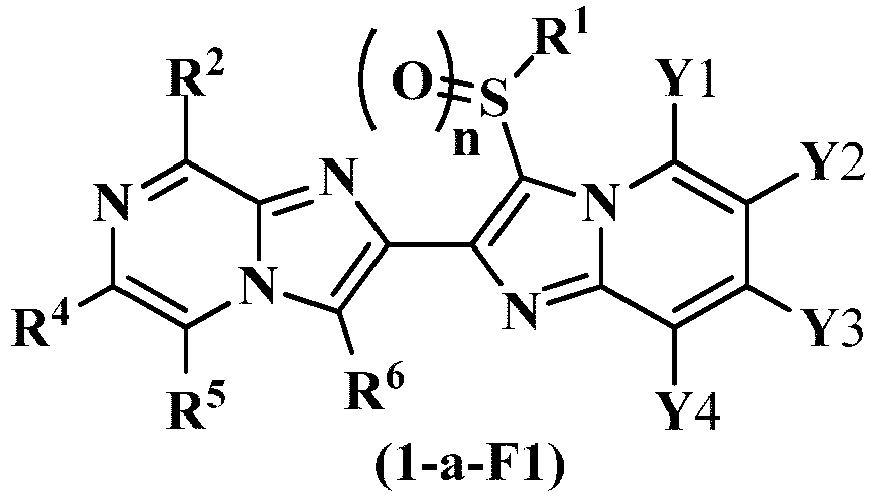
- R1 is C1-C6 alkyl, C1-C6 haloalkyl, C2-C6 alkenyl, C2-C6 haloalkenyl, C2-C6 alkynyl or C2-C6 haloalkynyl,
- R4 is a hydrogen atom, a halogen atom, C1-C6 alkyl, C1-C6 haloalkyl, C1-C8 alkoxy, C1-C8 haloalkoxy, C1-C6 alkylthio, C1-C6 haloalkylthio, C1-C6 alkylsulfinyl, C1-C6 haloalkylsulfinyl, C1-C6 alkylsulfonyl or C1-C6 haloalkylsulfonyl, and
- each of R2, R5, R6, Y1, Y2, Y3 and Y4 is independently a hydrogen atom, a halogen atom, C1-C6 alkyl or C1-C6 haloalkyl.
- [43] The condensed heterocyclic compound or its salt or an N-oxide thereof according to the above [42], wherein
R1 is C1-C6 alkyl,
R4 is C1-C6 haloalkyl,
each of Y2 and Y3 is independently a hydrogen atom or C1-C6 haloalkyl, and
each of R2, R5, R6, Y1 and Y4 is a hydrogen atom. - [44] The condensed heterocyclic compound or its salt or an N-oxide thereof according to the above [1], wherein the formula (1) is the folloinwg formula (1-a-O1):

- R1 is C1-C6 alkyl, C1-C6 haloalkyl, C2-C6 alkenyl, C2-C6 haloalkenyl, C2-C6 alkynyl or C2-C6 haloalkynyl,
- R4 is a hydrogen atom, a halogen atom, C1-C6 alkyl, C1-C6 haloalkyl, C1-C8 alkoxy, C1-C6 haloalkoxy, C1-C6 alkylthio, C1-C6 haloalkylthio, C1-C6 alkylsulfinyl, C1-C6 haloalkylsulfinyl, C1-C6 alkylsulfonyl or C1-C6 haloalkylsulfonyl, and
- each of R3, R5, R6, Y1, Y2, Y3 and Y4 is independently a hydrogen atom, a halogen atom, C1-C6 alkyl or C1-C6 haloalkyl.
- [45] The condensed heterocyclic compound or its salt or an N-oxide thereof according to the above [44], wherein
R1 is C1-C6 alkyl,
R4 is C1-C6 haloalkyl,
each of R6 and Y2 is independently a halogen atom, and
each of R3, R5, Y1, Y3 and Y4 is a hydrogen atom. - [46] The condensed heterocyclic compound or its salt or an N-oxide thereof according to the above [1] or [2], wherein the formula (1) is the folloinwg formula (1-a-b1):

- R1 is C1-C6 alkyl, C1-C6 haloalkyl, C2-C6 alkenyl, C2-C6 haloalkenyl, C2-C6 alkynyl or C2-C6 haloalkynyl,
- each of R3 and R4 is independently a hydrogen atom, a halogen atom, C1-C6 alkyl, C1-C6 haloalkyl, C1-C8 alkoxy, C1-C8 haloalkoxy, C1-C6 alkylthio, C1-C6 haloalkylthio, C1-C6 alkylsulfinyl, C1-C6 haloalkylsulfinyl, C1-C6 alkylsulfonyl or C1-C6 haloalkylsulfonyl, and
- each of R2, R5, Y1, Y2, Y3 and Y4 is independently a hydrogen atom, a halogen atom, C1-C6 alkyl or C1-C6 haloalkyl.
- [47] The condensed heterocyclic compound or its salt or an N-oxide thereof according to the above [46], wherein
R1 is C1-C6 alkyl,
R3 is C1-C6 haloalkylthio, C1-C6 haloalkylsulfinyl or C1-C6 haloalkylsulfonyl,
each of Y2 and Y3 is independently a hydrogen atom or C1-C6 haloalkyl, and
each of R2, R4, R5, Y1 and Y4 is a hydrogen atom. - [48] The condensed heterocyclic compound or its salt or an N-oxide thereof according to the above [1] or [2], wherein the formula (1) is the folloinwg formula (1-a-b2):

- R1 is C1-C6 alkyl, C1-C6 haloalkyl, C2-C6 alkenyl, C2-C6 haloalkenyl, C2-C6 alkynyl or C2-C6 haloalkynyl,
- each of R3 and R4 is independently a hydrogen atom, a halogen atom, C1-C6 alkyl, C1-C6 haloalkyl, C1-C8 alkoxy, C1-C8 haloalkoxy, C1-C6 alkylthio, C1-C6 haloalkylthio, C1-C6 alkylsulfinyl, C1-C6 haloalkylsulfinyl, C1-C6 alkylsulfonyl or C1-C6 haloalkylsulfonyl, and
- each of R2, Y1, Y2, Y3 and Y4 is independently a hydrogen atom, a halogen atom, C1-C6 alkyl or C1-C6 haloalkyl.
- [49] The condensed heterocyclic compound or its salt or an N-oxide thereof according to the above [48], wherein
R1 is C1-C6 alkyl,
each of R3 and Y3 is independently C1-C6 haloalkyl, and
each of R2, R4, Y1, Y2 and Y4 is a hydrogen atom. - [50] The condensed heterocyclic compound or its salt or an N-oxide thereof according to the above [1] or [2], wherein the formula (1) is the folloinwg formula (1-a-m2):

- R1 is C1-C6 alkyl, C1-C6 haloalkyl, C2-C6 alkenyl, C2-C6 haloalkenyl, C2-C6 alkynyl or C2-C6 haloalkynyl,
- R3 is a hydrogen atom, a halogen atom, C1-C6 alkyl, C1-C6 haloalkyl, C1-C8 alkoxy, C1-C8 haloalkoxy, C1-C6 alkylthio, C1-C6 haloalkylthio, C1-C6 alkylsulfinyl, C1-C6 haloalkylsulfinyl, C1-C6 alkylsulfonyl or C1-C6 haloalkylsulfonyl, and
- each of R2, R4, Y1, Y2, Y3 and Y4 is independently a hydrogen atom, a halogen atom, C1-C6 alkyl or C1-C6 haloalkyl.
- [51] The condensed heterocyclic compound or its salt or an N-oxide thereof according to the above [50], wherein
R1 is C1-C6 alkyl,
each of R3 and Y3 is independently C1-C6 haloalkyl, and
each of R2, R4, Y1, Y2 and Y4 is a hydrogen atom. - [52] The condensed heterocyclic compound or its salt or an N-oxide thereof according to the above [1], [2] or [5], wherein the formula (1) is the folloinwg formula (1-a-p1):

- R1 is C1-C6 alkyl,
- R3 is a hydrogen atom, a halogen atom, C1-C6 haloalkyl, C1-C6 haloalkylthio, C1-C6 haloalkylsulfinyl or C1-C6 haloalkylsulfonyl,
- R4 is a hydrogen atom, a halogen atom or C1-C6 haloalkyl,
- A1a is a hydrogen atom or C1-C6 alkyl, and
- each of R2, R5, Y1, Y2, Y3 and Y4 is independently a hydrogen atom, a halogen atom, C1-C6 alkyl or C1-C6 haloalkyl.
- [53] The condensed heterocyclic compound or its salt or an N-oxide thereof according to the above [52], wherein
each of R2 and R5 is independently a hydrogen atom or a halogen atom,
each of R3 and R4 is independently a hydrogen atom or C1-C6 haloalkyl,
Y3 is C1-C6 haloalkyl, and
each of Y1, Y2 and Y4 is a hydrogen atom. - [54] The condensed heterocyclic compound or its salt or an N-oxide thereof according to the above [1], [2] or [5], wherein the formula (1) is the folloinwg formula (1-a-q1):

- R1 is C1-C6 alkyl,
- R3 is a hydrogen atom, a halogen atom, C1-C6 haloalkyl, C1-C6 haloalkylthio, C1-C6 haloalkylsulfinyl or C1-C6 haloalkylsulfonyl,
- A1a is a hydrogen atom or C1-C6 alkyl, and
- each of R2, Y1, Y2, Y3 and Y4 is independently a hydrogen atom, a halogen atom, C1-C6 alkyl or C1-C6 haloalkyl.
- [55] The condensed heterocyclic compound or its salt or an N-oxide thereof according to the above [54], wherein
each of R3 and Y2 is independently C1-C6 haloalkyl,
A1a is C1-C6 alkyl, and
each of R2, Y1, Y3 and Y4 is a hydrogen atom. - [56] The condensed heterocyclic compound or its salt or an N-oxide thereof according to the above [1], [2], [10] or [11], wherein the formula (1) is the folloinwg formula (1-a-E1):

- R1 is C1-C6 alkyl,
- R2 is a hydrogen atom,
- R3 is a hydrogen atom, a halogen atom, C1-C6 haloalkyl, C1-C6 haloalkylthio, C1-C6 haloalkylsulfinyl or C1-C6 haloalkylsulfonyl,
- R4 is a hydrogen atom, a halogen atom or C1-C6 haloalkyl, and
- each of R5, R6, Y1, Y2, Y3 and Y4 is independently a hydrogen atom, a halogen atom, C1-C6 alkyl or C1-C6 haloalkyl.
- [57] The condensed heterocyclic compound or its salt or an N-oxide thereof according to the above [56], wherein
each of R3, R4, Y2 and Y3 is independently a hydrogen atom or C1-C6 haloalkyl, and
each of R5, R6, Y1 and Y4 is a hydrogen atom. - [58] The condensed heterocyclic compound or its salt or an N-oxide thereof according to the above [1], [2], [10] or [12], wherein the formula (1) is the folloinwg formula (1-a-D1):

- R1 is C1-C6 alkyl,
- R2 is a hydrogen atom,
- R3 is a hydrogen atom, a halogen atom, C1-C6 haloalkyl, C1-C6 haloalkylthio, C1-C6 haloalkylsulfinyl or C1-C6 haloalkylsulfonyl,
- R4 is a hydrogen atom, a halogen atom or C1-C6 haloalkyl, and
- each of R6, Y1, Y2, Y3 and Y4 is independently a hydrogen atom, a halogen atom, C1-C6 alkyl or C1-C6 haloalkyl.
- [59] The condensed heterocyclic compound or its salt or an N-oxide thereof according to the above [58], wherein
R3 is C1-C6 haloalkyl,
Y2 is a hydrogen atom, a halogen atom or C1-C6 haloalkyl,
Y3 is a hydrogen atom or C1-C6 haloalkyl, and
each of R4, R6, Y1 and Y4 is a hydrogen atom. - [60] The condensed heterocyclic compound or its salt or an N-oxide thereof according to the above [1], [2], [15] or [16], wherein the formula (1) is the folloinwg formula (1-a-j1):

- R1 is C1-C6 alkyl,
- R2 is a hydrogen atom,
- R3 is a hydrogen atom, a halogen atom, C1-C6 haloalkyl, C1-C6 haloalkylthio, C1-C6 haloalkylsulfinyl or C1-C6 haloalkylsulfonyl,
- R4 is a hydrogen atom, a halogen atom or C1-C6 haloalkyl, and
- each of R5, R6, Y1, Y2, Y3 and Y4 is independently a hydrogen atom, a halogen atom, C1-C6 alkyl or C1-C6 haloalkyl.
- [61] The condensed heterocyclic compound or its salt or an N-oxide thereof according to the above [60], wherein
each of R3 and Y3 is independently C1-C6 haloalkyl, and
each of R4, R5, R6, Y1, Y2 and Y4 is a hydrogen atom. - [62] The condensed heterocyclic compound or its salt or an N-oxide thereof according to the above [1], [2], [15] or [17], wherein the formula (1) is the folloinwg formula (1-a-j2):

- R1 is C1-C6 alkyl,
- R2 is a hydrogen atom,
- R3 is a hydrogen atom, a halogen atom, C1-C6 haloalkyl, C1-C6 haloalkylthio, C1-C6 haloalkylsulfinyl or C1-C6 haloalkylsulfonyl,
- R4 is a hydrogen atom, a halogen atom or C1-C6 haloalkyl, and
- each of R6, Y1, Y2, Y3 and Y4 is independently a hydrogen atom, a halogen atom, C1-C6 alkyl or C1-C6 haloalkyl.
- [63] The condensed heterocyclic compound or its salt or an N-oxide thereof according to the above [62], wherein
R3 is C1-C6 haloalkyl,
Y2 is a hydrogen atom or a halogen atom,
Y3 is a hydrogen atom or C1-C6 haloalkyl, and
each of R4, R6, Y1 and Y4 is a hydrogen atom. - [64] The condensed heterocyclic compound or its salt or an N-oxide thereof according to the above [1], wherein
D substituted with -S(O)nR1 is a ring represented by either D1 or D2,
Q is a ring represented by either Q1 or Q2,
R1a is C1-C6 alkoxycarbonyl,
R2 is a hydrogen atom, a halogen atom, C1-C6 alkyl, C1-C6 haloalkyl, C1-C8 alkoxy or C1-C8 haloalkoxy,
each of R3 and R4 is independently a hydrogen atom, a halogen atom, C1-C6 alkyl, C1-C6 haloalkyl, C1-C8 alkoxy, C1-C8 haloalkoxy, C1-C6 alkylthio, C1-C6 haloalkylthio, C1-C6 alkylsulfinyl, C1-C6 haloalkylsulfinyl, C1-C6 alkylsulfonyl, C1-C6 haloalkylsulfonyl, mercapto, cyano or nitro,
R5 is a hydrogen atom, a halogen atom, C1-C6 alkyl or C1-C6 haloalkyl,
R6 is a hydrogen atom, a halogen atom or C1-C6 alkyl,
A1a is a hydrogen atom, C1-C6 alkyl, C1-C6 haloalkyl, C2-C6 alkenyl, C2-C6 haloalkenyl, C2-C6 alkynyl, C2-C6 haloalkynyl, C3-C6 cycloalkyl (C1-C6) alkyl or C3-C6 halocycloalkyl (C1-C6) alkyl, and
each of Y1, Y2, Y3, Y4, Y5 and Y6 is independently a hydrogen atom, a halogen atom, C1-C6 alkyl, C1-C6 haloalkyl, C1-C8 alkoxy, C1-C8 haloalkoxy, cyano or nitro. - [65] The condensed heterocyclic compound or its salt or an N-oxide thereof according to the above [2], wherein
D substituted with -S(O)nR1 is a ring represented by D1,
G1 is C(Y1),
G2 is C(Y2),
G3 is C(Y3),
G4 is C(Y4),
A1 is N(A1a) or an oxygen atom,
A2 is C(R2),
A3 is C(R3),
each of R1 and A1a is independently C1-C6 alkyl,
R3 is C1-C6 haloalkyl, C1-C6 haloalkylthio, C1-C6 haloalkylsulfinyl or C1-C6 haloalkylsulfonyl,
R5 is a hydrogen atom or C1-C6 alkyl,
each of Y2 and Y3 is independently a hydrogen atom or C1-C6 haloalkyl, and
each of R2, R4, R6, Y1 and Y4 is a hydrogen atom. - [66] The condensed heterocyclic compound or its salt or an N-oxide thereof according to the above [3], wherein
D substituted with -S(O)nR1 is a ring represented by D2,
Q is a ring represented by Q1,
G5 is C(Y5),
A1 is N(A1a),
A2 is C(R2),
A3 is C(R3),
A4 is C(R4),
A5 is a nitrogen atom,
each of R1 and R1a is independently C1-C6 alkyl,
each of R2, R4 and Y5 is a hydrogen atom, and
each of R3 and Y6 is independently C1-C6 haloalkyl. - [67] The condensed heterocyclic compound or its salt or an N-oxide thereof according to any one of the above [1] to [66], wherein
R1 is C1-C6 alkyl, C1-C6 haloalkyl, C2-C6 alkenyl, C2-C6 haloalkenyl, C2-C6 alkynyl, C2-C6 haloalkynyl, C3-C6 cycloalkyl (C1-C6) alkyl or C3-C6 halocycloalkyl (C1-C6) alkyl. - [68] The condensed heterocyclic compound or its salt or an N-oxide thereof according to any one of the above [1] to [66], wherein
R1 is C1-C6 alkyl, C1-C6 haloalkyl or C3-C6 cycloalkyl (C1-C6) alkyl. - [69] The condensed heterocyclic compound or its salt or an N-oxide thereof according to any one of the above [1] to [66], wherein
R1 is C1-C6 alkyl or C1-C6 haloalkyl. - [70] The condensed heterocyclic compound or its salt or an N-oxide thereof according to any one of the above [1] to [66], wherein
R1 is C1-C6 alkyl. - [71] The condensed heterocyclic compound or its salt or an N-oxide thereof according to any one of the above [1] to [66], wherein
R1 is C1-C6 haloalkyl. - [72] The condensed heterocyclic compound or its salt or an N-oxide thereof according to any one of the above [1] to [71], wherein
R1a is C1-C6 alkoxy, C1-C6 alkoxycarbonyl or cyano. - [73] The condensed heterocyclic compound or its salt or an N-oxide thereof according to any one of the above [1] to [71], wherein
R1a is C1-C8 alkoxycarbonyl. - [74] The condensed heterocyclic compound or its salt or an N-oxide thereof according to any one of the above [1] to [73], wherein
R2 is a hydrogen atom, a halogen atom, C1-C6 alkyl or C1-C6 haloalkyl. - [75] The condensed heterocyclic compound or its salt or an N-oxide thereof according to any one of the above [1] to [73], wherein
R2 is a hydrogen atom. - [76] The condensed heterocyclic compound or its salt or an N-oxide thereof according to any one of the above [1] to [75], wherein
R3 is a hydrogen atom, a halogen atom, C1-C6 alkyl, C1-C6 haloalkyl, C1-C8 alkoxy, C1-C8 haloalkoxy, C1-C6 alkylthio, C1-C6 haloalkylthio, (C1-C6) alkylthio optionally substituted with R3a, C1-C6 alkylsulfinyl, C1-C6 haloalkylsulfinyl, C1-C6 alkylsulfonyl or C1-C6 haloalkylsulfonyl. - [77] The condensed heterocyclic compound or its salt or an N-oxide thereof according to any one of the above [1] to [75], wherein
R3 is a hydrogen atom, a halogen atom, C1-C6 haloalkyl, C1-C6 alkylthio, (C1-C6) alkylthio optionally substituted with R3a, C1-C6 haloalkylthio, C1-C6 haloalkylsulfinyl or C1-C6 haloalkylsulfonyl. - [78] The condensed heterocyclic compound or its salt or an N-oxide thereof according to any one of the above [1] to [75], wherein
R3 is a hydrogen atom, a halogen atom, C1-C6 haloalkyl, C1-C6 haloalkylthio, C1-C6 haloalkylsulfinyl or C1-C6 haloalkylsulfonyl. - [79] The condensed heterocyclic compound or its salt or an N-oxide thereof according to any one of the above [1] to [75], wherein
R3 is C1-C6 haloalkylthio, C1-C6 haloalkylsulfinyl or C1-C6 haloalkylsulfonyl. - [80] The condensed heterocyclic compound or its salt or an N-oxide thereof according to any one of the above [1] to [75], wherein
R3 is a halogen atom. - [81] The condensed heterocyclic compound or its salt or an N-oxide thereof according to any one of the above [1] to [75], wherein
R3 is C1-C6 haloalkyl. - [82] The condensed heterocyclic compound or its salt or an N-oxide thereof according to any one of the above [1] to [75], wherein
R3 is C1-C6 haloalkylthio. - [83] The condensed heterocyclic compound or its salt or an N-oxide thereof according to any one of the above [1] to [75], wherein
R3 is C1-C6 haloalkylsulfinyl. - [84] The condensed heterocyclic compound or its salt or an N-oxide thereof according to any one of the above [1] to [75], wherein
R3 is C1-C6 haloalkylsulfonyl. - [85] The condensed heterocyclic compound or its salt or an N-oxide thereof according to any one of the above [1] to [84], wherein
R4 is a hydrogen atom, a halogen atom, C1-C6 alkyl, C1-C6 haloalkyl, C1-C8 alkoxy, C1-C8 haloalkoxy, C1-C6 alkylthio, C1-C6 haloalkylthio, (C1-C6) alkylthio optionally substituted with R4a, C1-C6 alkylsulfinyl, C1-C6 haloalkylsulfinyl, C1-C6 alkylsulfonyl or C1-C6 haloalkylsulfonyl. - [86] The condensed heterocyclic compound or its salt or an N-oxide thereof according to any one of the above [1] to [84], wherein
R4 is a hydrogen atom, a halogen atom, C1-C6 haloalkyl, C1-C6 alkylthio, (C1-C6) alkylthio optionally substituted with R4a, C1-C6 haloalkylthio, C1-C6 haloalkylsulfinyl or C1-C6 haloalkylsulfonyl. - [87] The condensed heterocyclic compound or its salt or an N-oxide thereof according to any one of the above [1] to [84], wherein
R4 is a hydrogen atom, a halogen atom, C1-C6 haloalkyl, C1-C6 haloalkylthio, C1-C6 haloalkylsulfinyl or C1-C6 haloalkylsulfonyl. - [88] The condensed heterocyclic compound or its salt or an N-oxide thereof according to any one of the above [1] to [84], wherein
R4 is a hydrogen atom. - [89] The condensed heterocyclic compound or its salt or an N-oxide thereof according to any one of the above [1] to [84], wherein
R4 is a halogen atom. - [90] The condensed heterocyclic compound or its salt or an N-oxide thereof according to any one of the above [1] to [84], wherein
R4 is C1-C6 haloalkylthio, C1-C6 haloalkylsulfinyl or C1-C6 haloalkylsulfonyl. - [91] The condensed heterocyclic compound or its salt or an N-oxide thereof according to any one of the above [1] to [84], wherein
R4 is C1-C6 haloalkyl. - [92] The condensed heterocyclic compound or its salt or an N-oxide thereof according to any one of the above [1] to [91], wherein
R5 is a hydrogen atom, a halogen atom, C1-C6 alkyl or C1-C6 haloalkyl. - [93] The condensed heterocyclic compound or its salt or an N-oxide thereof according to any one of the above [1] to [91], wherein
R5 is a halogen atom. - [94] The condensed heterocyclic compound or its salt or an N-oxide thereof according to any one of the above [1] to [91], wherein
R5 is a hydrogen atom. - [95] The condensed heterocyclic compound or its salt or an N-oxide thereof according to any one of the above [1] to [91], wherein
R5 is C1-C6 alkyl. - [96] The condensed heterocyclic compound or its salt or an N-oxide thereof according to any one of the above [1] to [95], wherein
R6 is a hydrogen atom, a halogen atom, C1-C6 alkyl or C1-C6 haloalkyl. - [97] The condensed heterocyclic compound or its salt or an N-oxide thereof according to any one of the above [1] to [95], wherein
R6 is a hydrogen atom. - [98] The condensed heterocyclic compound or its salt or an N-oxide thereof according to any one of the above [1] to [95], wherein
R6 is a halogen atom. - [99] The condensed heterocyclic compound or its salt or an N-oxide thereof according to any one of the above [1] to [95], wherein
R6 is C1-C6 alkyl. - [100] The condensed heterocyclic compound or its salt or an N-oxide thereof according to any one of the above [1] to [99], wherein
R7 is a hydrogen atom, a halogen atom or C1-C6 haloalkyl. - [101] The condensed heterocyclic compound or its salt or an N-oxide thereof according to any one of the above [1] to [99], wherein
R7 is C1-C6 haloalkyl. - [102] The condensed heterocyclic compound or its salt or an N-oxide thereof according to any one of the above [1] to [101], wherein
R8 is a hydrogen atom, a halogen atom, C1-C6 alkyl or C1-C6 haloalkyl. - [103] The condensed heterocyclic compound or its salt or an N-oxide thereof according to any one of the above [1] to [101], wherein
R8 is C1-C6 alkyl. - [104] The condensed heterocyclic compound or its salt or an N-oxide thereof according to any one of the above [1] to [103], wherein
A1a is a hydrogen atom, C1-C6 alkyl, (C1-C6) alkyl optionally substituted with A1a-a, C2-C6 alkenyl, C2-C6 alkynyl, C1-C8 alkoxy, C3-C6 cycloalkyl or C(O)R10a. - [105] The condensed heterocyclic compound or its salt or an N-oxide thereof according to any one of the above [1] to [103], wherein
A1a is a hydrogen atom, C1-C6 alkyl, C2-C6 alkenyl, C2-C6 alkynyl or C3-C6 cycloalkyl. - [106] The condensed heterocyclic compound or its salt or an N-oxide thereof according to any one of the above [1] to [103], wherein
A1a is a hydrogen atom. - [107] The condensed heterocyclic compound or its salt or an N-oxide thereof according to any one of the above [1] to [103], wherein
A1a is C1-C6 alkyl. - [108] The condensed heterocyclic compound or its salt or an N-oxide thereof according to any one of the above [1] to [107], wherein
each of Y1, Y2, Y3 and Y4 is independently a hydrogen atom, a halogen atom, C1-C6 alkyl, C1-C6 haloalkyl, C2-C6 alkenyl, C2-C6 alkynyl, (C2-C6) alkynyl optionally substituted with Yb, C1-C8 alkoxy, C1-C8 haloalkoxy, C1-C6 alkylthio, C1-C6 haloalkylthio, (C1-C6) alkylthio optionally substituted with Ya, C1-C6 alkylsulfinyl, C1-C6 haloalkylsulfinyl, C1-C6 alkylsulfonyl, C1-C6 haloalkylsulfonyl, -C(O)R90a, - C(O)NHR90b, -C(O)N(R90c)R90b, -C(O)OH, hydroxy, -OC(O)R90e, -OS(O)2R90f, - NH2, -NHR90g, -N(R90h)R90g, mercapto, -SC(O)R90i, -S(O)2NHR90j, - S(O)2N(R90k)R90j, -SF5, cyano, nitro, phenyl, phenyl optionally substituted with Yc, heterocyclyl or heterocyclyl optionally substituted with Yc. - [109] The condensed heterocyclic compound or its salt or an N-oxide thereof according to any one of the above [1] to [107], wherein
each of Y1, Y2, Y3 and Y4 is independently a hydrogen atom, a halogen atom, C1-C6 alkyl, C1-C6 haloalkyl, C2-C6 alkenyl, (C2-C6) alkynyl optionally substituted with Yb, C1-C8 alkoxy, C1-C6 alkylthio, C1-C6 haloalkylthio, (C1-C6) alkylthio optionally substituted with Ya, C1-C6 alkylsulfinyl, C1-C6 alkylsulfonyl, -C(O)R90a, - C(O)N(R90c)R90b, -C(O)OH, -NH2, -NHR90g, -N(R90h)R90g, mercapto, cyano, nitro, phenyl, phenyl optionally substituted with Yc, heterocyclyl or heterocyclyl optionally substituted with Yc. - [110] The condensed heterocyclic compound or its salt or an N-oxide thereof according to any one of the above [1] to [109], wherein
Y1 is a hydrogen atom, a halogen atom, C1-C6 alkyl or C1-C6 haloalkyl. - [111] The condensed heterocyclic compound or its salt or an N-oxide thereof according to any one of the above [1] to [109], wherein
Y1 is a hydrogen atom. - [112] The condensed heterocyclic compound or its salt or an N-oxide thereof according to any one of the above [1] to [109], wherein
Y1 is a halogen atom. - [113] The condensed heterocyclic compound or its salt or an N-oxide thereof according to any one of the above [1] to [109], wherein
Y1 is C1-C6 alkyl. - [114] The condensed heterocyclic compound or its salt or an N-oxide thereof according to any one of the above [1] to [109], wherein
Y1 is C1-C6 haloalkyl. - [115] The condensed heterocyclic compound or its salt or an N-oxide thereof according to any one of the above [1] to [114], wherein
Y2 is a hydrogen atom, a halogen atom, C1-C6 alkyl, C1-C6 haloalkyl, C2-C6 alkenyl, (C2-C6) alkynyl optionally substituted with Yb, C1-C8 alkoxy, C1-C6 alkylthio, C1-C6 haloalkylthio, (C1-C6) alkylthio optionally substituted with Ya, C1-C6 alkylsulfinyl, C1-C6 alkylsulfonyl, -NH2, -NHR90g, nitro, phenyl, phenyl optionally substituted with Yc or heterocyclyl. - [116] The condensed heterocyclic compound or its salt or an N-oxide thereof according to any one of the above [1] to [114], wherein
Y2 is a hydrogen atom, a halogen atom, C1-C6 alkyl or C1-C6 haloalkyl. - [117] The condensed heterocyclic compound or its salt or an N-oxide thereof according to any one of the above [1] to [114], wherein
Y2 is a hydrogen atom. - [118] The condensed heterocyclic compound or its salt or an N-oxide thereof according to any one of the above [1] to [114], wherein
Y2 is a halogen atom. - [119] The condensed heterocyclic compound or its salt or an N-oxide thereof according to any one of the above [1] to [114], wherein
Y2 is C1-C6 alkyl. - [120] The condensed heterocyclic compound or its salt or an N-oxide thereof according to any one of the above [1] to [114], wherein
Y2 is C1-C6 haloalkyl. - [121] The condensed heterocyclic compound or its salt or an N-oxide thereof according to any one of the above [1] to [120], wherein
Y3 is a hydrogen atom, a halogen atom, C1-C6 alkyl, C1-C6 haloalkyl, C1-C8 alkoxy, C1-C6 alkylthio, (C1-C6) alkylthio optionally substituted with Ya, C1-C6 alkylsulfinyl, C1-C6 alkylsulfonyl, -C(O)R90a, -C(O)N(R90c)R90b, -C(O)OH, cyano or nitro. - [122] The condensed heterocyclic compound or its salt or an N-oxide thereof according to any one of the above [1] to [120], wherein
Y3 is a hydrogen atom, a halogen atom, C1-C6 alkyl or C1-C6 haloalkyl. - [123] The condensed heterocyclic compound or its salt or an N-oxide thereof according to any one of the above [1] to [120], wherein
Y3 is a hydrogen atom. - [124] The condensed heterocyclic compound or its salt or an N-oxide thereof according to any one of the above [1] to [120], wherein
Y3 is a halogen atom. - [125] The condensed heterocyclic compound or its salt or an N-oxide thereof according to any one of the above [1] to [120], wherein
Y3 is C1-C6 alkyl. - [126] The condensed heterocyclic compound or its salt or an N-oxide thereof according to any one of the above [1] to [120], wherein
Y3 is C1-C6 haloalkyl. - [127] The condensed heterocyclic compound or its salt or an N-oxide thereof according to any one of the above [1] to [126], wherein
Y4 is a hydrogen atom, a halogen atom, C1-C6 alkyl, C1-C6 haloalkyl, C1-C8 alkoxy, C1-C6 alkylthio, C1-C6 alkylsulfonyl, -N(R90h)R90g or cyano. - [128] The condensed heterocyclic compound or its salt or an N-oxide thereof according to any one of the above [1] to [126], wherein
Y4 is C1-C8 alkoxy, C1-C6 alkylthio, C1-C6 alkylsulfonyl, -N(R90h)R90g or cyano. - [129] The condensed heterocyclic compound or its salt or an N-oxide thereof according to any one of the above [1] to [126], wherein
Y4 is a hydrogen atom, a halogen atom, C1-C6 alkyl or C1-C6 haloalkyl. - [130] The condensed heterocyclic compound or its salt or an N-oxide thereof according to any one of the above [1] to [126], wherein
Y4 is a hydrogen atom. - [131] The condensed heterocyclic compound or its salt or an N-oxide thereof according to any one of the above [1] to [126], wherein
Y4 is a halogen atom. - [132] The condensed heterocyclic compound or its salt or an N-oxide thereof according to any one of the above [1] to [126], wherein
Y4 is C1-C6 alkyl. - [133] The condensed heterocyclic compound or its salt or an N-oxide thereof according to any one of the above [1] to [126], wherein
Y4 is C1-C6 haloalkyl. - [134] The condensed heterocyclic compound or its salt or an N-oxide thereof according to any one of the above [1] to [133], wherein
Ya is C1-C8 alkoxycarbonyl or C1-C6 alkylcarbonyl. - [135] The condensed heterocyclic compound or its salt or an N-oxide thereof according to any one of the above [1] to [133], wherein
Ya is C1-C8 alkoxycarbonyl. - [136] The condensed heterocyclic compound or its salt or an N-oxide thereof according to any one of the above [1] to [135], wherein
Yb is C1-C6 alkyl, C3-C6 cycloalkyl, trimethylsilyl or phenyl. - [137] The condensed heterocyclic compound or its salt or an N-oxide thereof according to any one of the above [1] to [135], wherein
Yb is C3-C6 cycloalkyl or trimethylsilyl. - [138] The condensed heterocyclic compound or its salt or an N-oxide thereof according to any one of the above [1] to [135], wherein
Yb is C3-C6 cycloalkyl. - [139] The condensed heterocyclic compound or its salt or an N-oxide thereof according to any one of the above [1] to [135], wherein
Yb is trimethylsilyl. - [140] The condensed heterocyclic compound or its salt or an N-oxide thereof according to any one of the above [1] to [139], wherein
Yc is a halogen atom, C1-C6 alkyl, C1-C6 haloalkyl, C1-C8 alkoxy, C1-C8 haloalkoxy, cyano or nitro. - [141] The condensed heterocyclic compound or its salt or an N-oxide thereof according to any one of the above [1] to [139], wherein
Yc is a halogen atom or C1-C6 haloalkyl. - [142] The condensed heterocyclic compound or its salt or an N-oxide thereof according to any one of the above [1] to [139], wherein
Yc is a halogen atom. - [143] The condensed heterocyclic compound or its salt or an N-oxide thereof according to any one of the above [1] to [139], wherein
Yc is C1-C6 haloalkyl. - [144] The condensed heterocyclic compound or its salt or an N-oxide thereof according to any one of the above [1] to [143], wherein
each of R10a, R20a, R30a, R30e, R40a, R40e, R50a, R60a and R90a is independently a hydrogen atom, C1-C6 alkyl, C1-C6 haloalkyl, C1-C8 alkoxy or C1-C8 haloalkoxy. - [145] The condensed heterocyclic compound or its salt or an N-oxide thereof according to any one of the above [1] to [143], wherein
each of R10a, R20a, R30a, R30e, R40a, R40e, R50a, R60a and R90a is independently a hydrogen atom, C1-C6 alkyl or C1-C8 alkoxy. - [146] The condensed heterocyclic compound or its salt or an N-oxide thereof according to any one of the above [1] to [143], wherein
each of R10a, R20a, R30a, R30e, R40a, R40e, R50a, R60a and R90a is a hydrogen atom. - [147] The condensed heterocyclic compound or its salt or an N-oxide thereof according to any one of the above [1] to [143], wherein
each of R10a, R20a, R30a, R30e, R40a, R40e, R50a, R60a and R90a is independently C1-C6 alkyl. - [148] The condensed heterocyclic compound or its salt or an N-oxide thereof according to any one of the above [1] to [143], wherein
each of R10a, R20a, R30a, R30e, R40a, R40e, R50a, R60a and R90a is independently C1-C8 alkoxy. - [149] The condensed heterocyclic compound or its salt or an N-oxide thereof according to any one of the above [1] to [148], wherein
each of R20g, R20h, R30f, R30g, R30h, R30i, R40f, R40g, R40h, R40i, R50g, R50h, R60g, R60h, R90b, R90c, R90i, R90j and R90k is independently C1-C6 alkyl or C1-C6 haloalkyl. - [150] The condensed heterocyclic compound or its salt or an N-oxide thereof according to any one of the above [1] to [148], wherein
each of R20g, R20h, R30f, R30g, R30h, R30i, R40f, R40g, R40h, R40i, R50g, R50h, R60g, R60h, R90b, R90c, R90i, R90j and R90k is independently C1-C6 alkyl. - [151] The condensed heterocyclic compound or its salt or an N-oxide thereof according to any one of the above [1] to [150], wherein
each of R90g and R90h is independently C1-C6 alkyl, C1-C6 haloalkyl, C1-C6 alkylcarbonyl, C1-C6 haloalkylcarbonyl, C1-C8 alkoxycarbonyl, C1-C8 haloalkoxycarbonyl, C1-C6 alkylaminocarbonyl, C1-C6 haloalkylaminocarbonyl, C1-C6 alkylaminothiocarbonyl, C1-C6 haloalkylaminothiocarbonyl, phenylcarbonyl, C1-C6 alkylsulfonyl, C1-C6 haloalkylsulfonyl, C1-C6 alkylaminosulfonyl or di(C1-C6) alkylaminosulfonyl. - [152] The condensed heterocyclic compound or its salt or an N-oxide thereof according to any one of the above [1] to [151], wherein
R90g is C1-C6 alkyl, C1-C6 haloalkylcarbonyl, C1-C8 alkoxycarbonyl or phenylcarbonyl. - [153] The condensed heterocyclic compound or its salt or an N-oxide thereof according to any one of the above [1] to [151], wherein
R90g is C1-C6 alkyl. - [154] The condensed heterocyclic compound or its salt or an N-oxide thereof according to any one of the above [1] to [151], wherein
R90g is C1-C6 haloalkylcarbonyl. - [155] The condensed heterocyclic compound or its salt or an N-oxide thereof according to any one of the above [1] to [151], wherein
R90g is C1-C8 alkoxycarbonyl. - [156] The condensed heterocyclic compound or its salt or an N-oxide thereof according to any one of the above [1] to [151], wherein
R90g is phenylcarbonyl. - [157] The condensed heterocyclic compound or its salt or an N-oxide thereof according to any one of the above [1] to [156], wherein
R90h is C1-C6 alkyl. - [158] The condensed heterocyclic compound or its salt or an N-oxide thereof according to any one of the above [1] to [157], wherein
T1 is a sulfur atom. - [159] The condensed heterocyclic compound or its salt or an N-oxide thereof according to any one of the above [1] to [157], wherein
T1 is N(T1a). - [160] The condensed heterocyclic compound or its salt or an N-oxide thereof according to any one of the above [1] to [159], wherein
T1a is a hydrogen atom. - [161] The condensed heterocyclic compound or its salt or an N-oxide thereof according to any one of the above [1] to [159], wherein
T1 a is C1-C6 alkyl. - [162] A pesticide containing one or more members selected from the condensed heterocyclic compounds and their salts as defined in the above [1] to [161] as active ingredient(s).
- [163] An agricultural chemical containing one or more members selected from the condensed heterocyclic compounds and their salts as defined in the above [1] to [161] as active ingredient(s).
- [164] A parasiticide against internal or external parasites in or on a mammal or bird, containing one or more members selected from the condensed heterocyclic compounds and their salts as defined in the above [1] to [161] as activie ingredient(s).
- [165] The parasiticide according to the above [164], wherein the external parasites are Siphonaptera or ticks.
- [166] An insecticide or acaricide containing one or more members selected from the condensed heterocyclic compounds and their salts as defined in the above [1] to [161] as active ingredient(s).
- [167] A seed treatment agent containing one or more members selected from the condensed heterocyclic compounds and their salts as defined in the above [1] to [161] as active ingredient(s).
- [168] The seed treatment agent according to the above [167], which is used to treat seeds by dipping.
- [169] A soil treatement agent containing one or more members selected from the condensed hetercyclic compounds as defined in the above [1] to [161] as active ingredient(s).
- [170] The soil treatment agent according to the above [169], which is used to treat soil by irrigation.
- The compounds of the present invention have excellent insecticidal and acaricidal activities on many agricultural pest insects, spider mites, internal or external parasites in or on a mammal or bird and have sufficient controlling effect on pest insects which have acquired resistance to conventional insecticides. The compounds of the present invention have little harmful effect on mammals, fish and beneficial insects, show low persistence and are environmentally friendly. Thus, the present invention can provide useful novel pesticides.
- The compounds of the present invention can have geometrical isomers such as E-isomers and Z-isomers, depending on the types of substituents in them, and the present invention covers both E-isomers and Z-isomers and mixtures containing them in any ratios.
- The compounds of the present invention can have optically active isomers due to the presence of one or more asymmetric carbon atoms or asymmetric sulfur atoms, and the present invention covers any optically active isomers and any racemates.
- Further, the compounds of the present invention can have tautomers depending on the type of substituents in them, and the present invention covers all tautomers and mixtures containing them in any ratios.
- Some of the compounds of the present invention can be converted, by ordinary methods, to salts with hydrogen halides such as hydrofluoric acid, hydrochloric acid, hydrobromic acid and hydroiodic acid, with inorganic acids such as nitric acid, sulfuric acid, phosphoric acid, chloric acid and perchloric acid, with sulfonic acids such as methanesulfonic acid, ethanesulfonic acid, trifluoromethanesulfonic acid, benzenesulfonic acid and p-toluenesulfonic acid, with carboxylic acids such as formic acid, acetic acid, propionic acid, trifluoroacetic acid, fumaric acid, tartaric acid, oxalic acid, maleic acid, malic acid, succinic acid, benzoic acid, mandelic acid, ascorbic acid, lactic acid, gluconic acid and citric acid, with amino acids such as glutamic acid and aspartic acid, with alkali metals such as lithium, sodium and potassium, with alkaline earth metals such as calcium, barium and magnesium, with aluminum, and with quaternary ammonium such as tetramethylammonium, tetrabutylammonium and benzyltrimethylammonium.
- In the present invention, the N-oxide is a compound having a nitrogen atom constituting the ring in the heterocyclic group oxidized. A heterocyclic group which may constitute an N-oxide may, for example, be a condensed ring containing a pyridine ring, a condensed ring containing a pyrazine ring, a condensed ring containing a pyridazine ring or a condensed ring containing a pyrimidine ring.
- Next, specific examples of each substituent used herein will be given below. n-denotes normal, i- iso, s- secondary, and tert- tertiary.
- As a "halogen atom" in the compounds of the present invention, a fluorine atom, a chlorine atom, a bromine atom or an iodine atom may be mentioned. Herein, the expression "halo" also means such a halogen atom.
- The expression "Ca-Cb alkyl" herein means a linear or branched hydrocarbon group containing from a to b carbon atoms such as methyl, ethyl, n-propyl, i-propyl, n-butyl, i-butyl, s-butyl, tert-butyl, n-pentyl, 1,1-dimethylpropyl or n-hexyl, and those within the designated carbon number range are selected.
- The expression "Ca-Cb haloalkyl" herein means a linear or branched hydrocarbon group containing from a to b carbon atoms in which hydrogen atom(s) on carbon atom(s) are optionally substituted with halogen atom(s) which may be identical with or different from one another if two or more halogen atoms are present, such as fluoromethyl, chloromethyl, bromomethyl, iodomethyl, difluoromethyl, dichloromethyl, trifluoromethyl, chlorodifluoromethyl, trichloromethyl, bromodifluoromethyl, 1-fluoroethyl, 2-fluoroethyl, 2-chloroethyl, 2-bromoethyl, 2,2-difluoroethyl, 2,2,2-trifluoroethyl, 2-chloro-2,2-difluoroethyl, 2,2,2-trichloroethyl, 2-bromo-2,2-difluoroethyl, 1,1,2,2-tetrafluoroethyl, 2-chloro-1,1,2-trifluoroethyl, 2-chloro-1,1,2,2-tetrafluoroethyl, pentafluoroethyl, 2,2-difluoropropyl, 3,3,3-trifluoropropyl, 3-bromo-3,3-difluoropropyl, 2,2,3,3-tetrafluoropropyl, 2,2,3,3,3-pentafluoropropyl, 1,1,2,3,3,3-hexafluoropropyl, heptafluoropropyl, 2,2,2-trifluoro-1-(methyl)ethyl, 2,2,2-trifluoro-1-(trifluoromethyl)ethyl, 1,2,2,2-tetrafluoro-1-(trifluoromethyl)ethyl, 2,2,3,4,4,4-hexafluorobutyl, 2,2,3,3,4,4,4-heptafluorobutyl and nonafluorobutyl, and those within the designated carbon number range are selected.
- The expression "Ca-Cb alkenyl" herein means a linear or branched unsaturated hydrocarbon group containing from a to b carbon atoms and having one or more double bonds in the molecule, such as vinyl, 1-propenyl, 2-propenyl, 1-methylethenyl, 2-butenyl, 2-methyl-2-propenyl, 3-methyl-2-butenyl or 1,1-dimethyl-2-propenyl, and those within the designated carbon number range are selected.
- The expression "Ca-Cb haloalkenyl" herein means a linear or branched unsaturated hydrocarbon group containing from a to b carbon atoms and having one or more double bonds in the molecule, in which hydrogen atom(s) on carbon atom(s) are optionally substituted with halogen atom(s) which may be identical with or different from one another if two or more halogen atoms are present, such as 2,2-dichlorovinyl, 2-fluoro-2-propenyl, 2-chloro-2-propenyl, 3-chloro-2-propenyl, 2-bromo-2-propenyl, 3,3-difluoro-2-propenyl, 2,3-dichloro-2-propenyl, 3,3-dichloro-2-propenyl, 2,3,3-trifluoro-2-propenyl, 2,3,3-trichloro-2-propenyl, 1-(trifluoromethyl)ethenyl, 4,4-difluoro-3-butenyl, 3,4,4-trifluoro-3-butenyl or 3-chloro-4,4,4-trifluoro-2-butenyl, and those within the designated carbon number range are selected.
- The expression "Ca-Cb alkynyl" herein means a linear or branched unsaturated hydrocarbon group containing from a to b carbon atoms and having one or more triple bonds in the molecule, such as ethynyl, propargyl, 2-butynyl, 3-butynyl, 1-pentynyl, 1-hexynyl or 4,4,4-trifluoro-2-butynyl, and those within the designated carbon number range are selected.
- The expression "Ca-Cb haloalkynyl" herein means a linear or branched unsaturated hydrocarbon group containing from a to b carbon atoms and having one or more triple bonds in the molecule, in which hydrogen atom(s) on carbon atom(s) are optionally substituted with halogen atom(s) which may be identical with or different from one another if two or more halogen atoms are present, such as 2-chloroethynyl, 2-bromoethynyl, 2-iodoethynyl, 3-chloro-2-propynyl, 3-bromo-2-propynyl or 3-iodo-2-propynyl, and those within the designated carbon number range are selected.
- The expression "Ca-Cb cycloalkyl" herein means a cyclic hydrocarbon group containing from a to b carbon atoms in the form of a 3- to 6-membered monocyclic or polycyclic ring which may optionally be substituted with an alkyl group as long as the number of carbon atoms does not exceed the designated carbon number range, such as cyclopropyl, 1-methylcyclopropyl, 2-methylcyclopropyl, 2,2-dimethylcyclopropyl, cyclobutyl, cyclopentyl or cyclohexyl, and those within the designated carbon number range are selected.
- The expression "Ca-Cb halocycloalkyl" herein means a cyclic hydrocarbon group containing from a to b carbon atoms in the form of a 3- to 6-membered monocyclic or polycyclic ring which may optionally be substituted with an alkyl group as long as the number of carbon atoms does not exceed the designated carbon number range, in which hydrogen atom(s) on carbon atom(s) in a ring moiety and/or in a side chain are optionally substituted with halogen atom(s) which may be identical with or different from one another if two or more halogen atoms are present, such as 2,2-difluorocyclopropyl, 2,2-dichlorocyclopropyl, 2,2-dibromocyclopropyl, 2,2-difluoro-1-methylcyclopropyl, 2,2-dichloro-1-methylcyclopropyl, 2,2-dibromo-1-methylcyclopropyl or 2,2,3,3-tetrafluorocyclobutyl, and those within the designated carbon number range are selected.
- The expression "Ca-Cb alkoxy" herein means an alkyl-O- group in which the alkyl is a previously mentioned alkyl group containing from a to b carbon atoms, such as methoxy, ethoxy, n-propyloxy, i-propyloxy, n-butyloxy, i-butyloxy, s-butyloxy, tert-butyloxy or 2-ethylhexyloxy, and those within the designated carbon number range are selected.
- The expression "Ca-Cb haloalkoxy" herein means a haloalkyl-O- group in which the haloalkyl is a previously mentioned haloalkyl group containing from a to b carbon atoms, such as difluoromethoxy, trifluoromethoxy, chlorodifluoromethoxy, bromodifluoromethoxy, 2-fluoroethoxy, 2-chloroethoxy, 2,2,2-trifluoroethoxy, 1,1,2,2,-tetrafluoroethoxy, 2-chloro-1,1,2-trifluoroethoxy or 1,1,2,3,3,3-hexafluoropropyloxy, and those within the designated carbon number range are selected.
- The expression "Ca-Cb alkenyloxy" herein means an alkenyl-O- group in which the alkenyl is a previously mentioned alkenyl group containing from a to b carbon atoms, such as 2-propenyloxy, 2-butenyloxy, 2-methyl-2-propenyloxy or 3-methyl-2-butenyloxy, and those within the designated carbon number range are selected.
- The expression "Ca-Cb haloalkenyloxy" herein means a haloalkenyl-O- group in which the haloalkenyl is a previously mentioned haloalkenyl group containing from a to b carbon atoms, such as 3,3-difluoroallyloxy or 3,3-dichloroallyloxy, and those within the designated carbon number range are selected.
- The expression "Ca-Cb alkynyloxy" herein means an alkynyl-O- group in which the alkynyl is a previously mentioned alkynyl group containing from a to b carbon atoms, such as ethynyloxy, propargyloxy, 2-butynyloxy, 1-pentynyloxy or 1-hexynyloxy, and those within the designated carbon number range are selected.
- The expression "Ca-Cb haloalkynyloxy" herein means a haloalkynyl-O- group in which the haloalkynyl is a previously mentioned haloalkynyl group containing from a to b carbon atoms, such as 3-chloro-2-propynyloxy, 3-bromo-2-propynyloxy or 3-iodo-2-propynyloxy, and those within the designated carbon number range are selected.
- The expression "Ca-Cb alkylthio" herein means an alkyl-S- group in which the alkyl is a previously mentioned alkyl group containing from a to b carbon atoms, such as methylthio, ethylthio, n-propylthio, i-propylthio, n-butylthio, i-butylthio, s-butylthio or tert-butylthio, and those within the designated carbon number range are selected.
- The expression "Ca-Cb haloalkylthio" herein means a haloalkyl-S- group in which the haloalkyl is a previously mentioned haloalkyl group containing from a to b carbon atoms, such as difluoromethylthio, trifluoromethylthio, chlorodifluoromethylthio, bromodifluoromethylthio, 2,2,2-trifluoroethylthio, 1,1,2,2-tetrafluoroethylthio, 2-chloro-1,1,2-trifluoroethylthio, pentafluoroethylthio, 1,1,2,3,3,3-hexafluoropropylthio, heptafluoropropylthio, 1,2,2,2-tetrafluoro-1-(trifluoromethyl)ethylthio or nonafluorobutylthio, and those within the designated carbon number range are selected.
- The expression "Ca-Cb alkenylthio" herein means an alkenyl-S- group in which the alkenyl is a previously mentioned alkenyl group containing from a to b carbon atoms, such as 2-propenylthio, 2-butenylthio, 2-methyl-2-propenylthio or 3-methyl-2-butenylthio, and those within the designated carbon number range are selected.
- The expression "Ca-Cb haloalkenylthio" herein means a haloalkenyl-S- group in which the haloalkenyl is a previously mentioned haloalkenyl group containing from a to b carbon atoms, such as 2-fluoro-2-propenylthio, 2-chloro-2-propenylthio, 3,3-difluoro-2-propenylthio, 3,3-dichloro-2-propenylthio, 2,3,3-trifluoro-2-propenylthio, 4,4-difluoro-3-butenylthio or 3,4,4-trifluoro-3-butenylthio, and those within the designated carbon number range are selected.
- The expression "Ca-Cb alkynylthio" herein means an alkynyl-S- group in which the alkynyl is a previously mentioned alkynyl group containing from a to b carbon atoms, such as propynylthio, butynylthio, pentynylthio or hexynylthio, and those within the designated carbon number range are selected.
- The expression "Ca-Cb haloalkynylthio" herein means a haloalkynyl-S- group in which the haloalkynyl is a previously mentioned haloalkynyl group containing from a to b carbon atoms, such as 3-chloro-2-propynylthio, 3-bromo-2-propynylthio or 3-iodo-2-propynylthio, and those within the designated carbon number range are selected.
- The expression "Ca-Cb alkylsulfinyl" herein means an alkyl-S(O)- group in which the alkyl is a previously mentioned alkyl group containing from a to b carbon atoms, such as methylsulfinyl, ethylsulfinyl, n-propylsulfinyl, i-propylsulfinyl, n-butylsulfinyl, i-butylsulfinyl, s-butylsulfinyl or tert-butylsulfinyl, and those within the designated carbon number range are selected.
- The expression "Ca-Cb haloalkylsulfinyl" herein means a haloalkyl-S(O)- group in which the haloalkyl is a previously mentioned haloalkyl group containing from a to b carbon atoms, such as difluoromethylsulfinyl, trifluoromethylsulfinyl, chlorodifluoromethylsulfinyl, bromodifluoromethylsulfinyl, 2,2,2-trifluoroethylsulfinyl, 1,2,2,2-tetrafluoro-1-(trifluoromethyl)ethylsulfinyl or nonafluorobutylsulfinyl, and those within the designated carbon number range are selected.
- The expression "Ca-Cb alkenylsulfinyl" herein means an alkenyl-S(O)- group in which the alkenyl is a previously mentioned alkenyl group containing from a to b carbon atoms, such as 2-propenylsulfinyl, 2-butenylsulfinyl, 2-methyl-2-propenylsulfinyl or 3-methyl-2-butenylsulfinyl, and those within the designated carbon number range are selected.
- The expression "Ca-Cb haloalkenylsulfinyl" herein means a haloalkenyl-S(O)-group in which the haloalkenyl is a previously mentioned haloalkenyl group containing from a to b carbon atoms, such as 2-fluoro-2-propenylsulfinyl, 2-chloro-2-propenylsulfinyl, 3,3-difluoro-2-propenylsulfinyl, 3,3-dichloro-2-propenylsulfinyl, 4,4-difluoro-3-butenylsulfinyl or 3,4,4-trifluoro-3-butenylsulfinyl, and those within the designated carbon number range are selected.
- The expression "Ca-Cb alkynylsulfinyl" herein means an alkynyl-S(O)- group in which the alkynyl is a previously mentioned alkynyl group containing from a to b carbon atoms, such as 2-propynylsulfinyl or 2-butynylsulfinyl, and those within the designated carbon number range are selected.
- The expression "Ca-Cb haloalkynylsulfinyl" herein means a haloalkynyl-S(O)-group in which the haloalkynyl is a previously mentioned haloalkynyl group containing from a to b carbon atoms, such as 3-chloro-2-propynylsulfinyl, 3-bromo-2-propynylsulfinyl or 3-iodo-2-propynylsulfinyl, and those within the designated carbon number range are selected.
- The expression "Ca-Cb alkylsulfonyl" herein means an alkyl-SO2- group in which the alkyl is a previously mentioned alkyl group containing from a to b carbon atoms, such as methylsulfonyl, ethylsulfonyl, n-propylsulfonyl, i-propylsulfonyl, n-butylsulfonyl, i-butylsulfonyl, s-butylsulfonyl or tert-butylsulfonyl, and those within the designated carbon number range are selected.
- The expression "Ca-Cb haloalkylsulfonyl" herein means a haloalkyl-SO2- group in which the haloalkyl is a previously mentioned haloalkyl group containing from a to b carbon atoms, such as difluoromethylsulfonyl, trifluoromethylsulfonyl, chlorodifluoromethylsulfonyl, bromodifluoromethylsulfonyl, 2,2,2-trifluoroethylsulfonyl, 1,1,2,2-tetrafluoroethylsulfonyl or 2-chloro-1,1,2-trifluoroethylsulfonyl, and those within the designated carbon number range are selected.
- The expression "Ca-Cb alkenylsulfonyl" herein means an alkenyl-SO2- group in which the alkenyl is a previously mentioned alkenyl group containing from a to b carbon atoms, such as 2-propenylsulfonyl, 2-butenylsulfonyl, 2-methyl-2-propenylsulfonyl or 3-methyl-2-butenylsulfonyl, and those within the designated carbon number range are selected.
- The expression "Ca-Cb haloalkenylsulfonyl" herein means a haloalkenyl-SO2-group in which the haloalkenyl is a previously mentioned haloalkenyl group containing from a to b carbon atoms, such as 2-fluoro-2-propenylsulfonyl, 2-chloro-2-propenylsulfonyl, 3,3-difluoro-2-propenylsulfonyl, 3,3-dichloro-2-propenylsulfonyl, 4,4-difluoro-3-butenylsulfonyl or 3,4,4-trifluoro-3-butenylsulfonyl, and those within the designated carbon number range are selected.
- The expression "Ca-Cb alkynylsulfonyl" herein means an alkynyl-SO2- group in which the alkynyl is a previously mentioned alkynyl group containing from a to b carbon atoms, such as 2-propynylsulfonyl or 2-butynylsulfonyl, and those within the designated carbon number range are selected.
- The expression "Ca-Cb haloalkynylsulfonyl" herein means a haloalkynyl-SO2-group in which the haloalkynyl is a previously mentioned haloalkynyl group containing from a to b carbon atoms, such as 3-chloro-2-propynylsulfonyl, 3-bromo-2-propynylsulfonyl or 3-iodo-2-propynylsulfonyl, and those within the designated carbon number range are selected.
- The expression "Ca-Cb alkylamino" herein means an amino group in which either hydrogen atom is replaced with a previously mentioned alkyl group containing from a to b carbon atoms, such as methylamino, ethylamino, n-propylamino, i-propylamino, n-butylamino, i-butylamino or tert-butylamino, and those within the designated carbon number range are selected.
- The expression "Ca-Cb haloalkylamino" herein means an amino group in which either hydrogen atom is replaced with a previously mentioned haloalkyl group containing from a to b carbon atoms, such as 2,2,2-trifluoroethylamino, 2-chloro-2,2-difluoroethylamino or 3,3,3-trifluoropropylamino, and those within the designated carbon number range are selected.
- The expression "di(Ca-Cb) alkylamino" herein means an amino group in which both hydrogen atoms are replaced with previously mentioned alkyl groups containing from a to b carbon atoms which may be identical with or different from each other, such as dimethylamino, ethyl(methyl)amino, diethylamino, n-propyl(methyl)amino, i-propyl(methyl)amino, di(n-propyl)amino or di(n-butyl)amino, and those within the designated carbon number range are selected.
- The expression "di(Ca-Cb) haloalkylamino" herein means an amino group in which both hydrogen atoms are replaced with previously mentioned haloalkyl groups containing from a to b carbon atoms which may be identical with or different from each other, such as bis(2,2,2-trifluoroethyl)amino, and those within the designated carbon number range are selected.
- The expression "Ca-Cb alkylcarbonyl" herein means an alkyl-C(O)- group in which the alkyl means a previously mentioned alkyl group containing from a to b carbon atoms, such as acetyl, propionyl, butyryl, isobutyryl, valeryl, isovaleryl, 2-methylbutanoyl, pivaloyl, hexanoyl or heptanoyl, and those within the designated carbon number range are selected.
- The expression "Ca-Cb haloalkylcarbonyl" herein means a haloalkyl-C(O)- group in which the haloalkyl means a previously mentioned haloalkyl group containing from a to b carbon atoms, such as fluoroacetyl, chloroacetyl, difluoroacetyl, dichloroacetyl, trifluoroacetyl, chlorodifluoroacetyl, bromodifluoroacetyl, trichloroacetyl, pentafluoropropionyl, heptafluorobutanoyl or 3-chloro-2,2-dimethylpropanoyl, and those within the designated carbon number range are selected.
- The expression "Ca-Cb alkoxycarbonyl" herein means an alkyl-O-C(O)- group in which the alkyl means a previously mentioned alkyl group containing from a to b carbon atoms, such as methoxycarbonyl, ethoxycarbonyl, n-propyloxycarbonyl, i-propyloxycarbonyl, n-butoxycarbonyl, i-butoxycarbonyl, s-butoxycarbonyl, tert-butoxycarbonyl or 2-ethylhexyloxycarbonyl, and those within the designated carbon number range are selected.
- The expression "Ca-Cb haloalkoxycarbonyl" herein means a haloalkyl-O-C(O)-group in which the haloalkyl means a previously mentioned haloalkyl group containing from a to b carbon atoms, such as chloromethoxycarbonyl, 2-chloroethoxycarbonyl, 2,2-difluoroethoxycarbonyl, 2,2,2-trifluoroethoxycarbonyl or 2,2,2-trichloroethoxycarbonyl, and those within the designated carbon number range are selected.
- The expression "Ca-Cb alkylaminocarbonyl" herein means a carbamoyl group in which either hydrogen atom is replaced with a previously mentioned alkyl group containing from a to b carbon atoms, such as methylcarbamoyl, ethylcarbamoyl, n-propylcarbamoyl, i-propylcarbamoyl, n-butylcarbamoyl, i-butylcarbamoyl, s-butylcarbamoyl or tert-butylcarbamoyl, and those within the designated carbon number range are selected.
- The expression "Ca-Cb haloalkylaminocarbonyl" herein means a carbamoyl group in which either hydrogen atom is replaced with a previously mentioned haloalkyl group containing from a to b carbon atoms, such as 2-fluoroethylcarbamonyl, 2-chloroethylcarbamoyl, 2,2-difluoroethylcarbamoyl or 2-trifluoroethylcarbamoyl, and those within the designated carbon number range are selected.
- The expression "Ca-Cb alkylaminothiocarbonyl" herein means an amino-C(=S)-group in which either hydrogen atom is replaced with a previously mentioned alkyl group containing from a to b carbon atoms, such as methylthiocarbamoyl, ethylthiocarbamoyl, n-propylthiocarbamoyl, i-propylthiocarbamoyl, n-butylthiocarbamoyl, i-butylthiocarbamoyl, s-butylthiocarbamoyl or tert-butylthiocarbamoyl, and those within the designated carbon number range are selected.
- The expression "Ca-Cb haloalkylaminothiocarbonyl" herein means an amino-C(=S)- group in which either hydrogen atom is replaced with a previously mentioned haloalkyl group containing from a to b carbon atoms, such as 2-fluoroethylthiocarbamoyl, 2-chloroethylthiocarbamoyl, 2,2-difluoroethylthiocarbamoyl or 2-trifluoroethylthiocarbamoyl, and those within the designated carbon number range are selected.
- The expression "Ca-Cb alkylaminosulfonyl" herein means a sulfamoyl group in which either hydrogen atom is replaced with a previously mentioned alkyl group containing from a to b carbon atoms, such as methylsulfamoyl, ethylsulfamoyl, n-propylsulfamoyl, i-propylsulfamoyl, n-butylsulfamoyl, i-butylsulfamoyl, s-butylsulfamoyl or tert-butylsulfamoyl, and those within the designated carbon number range are selected.
- The expression "di(Ca-Cb) alkylaminosulfonyl" herein means a sulfamoyl group in which both hydrogen atoms are replaced with previously mentioned alkyl groups containing from a to b carbon atoms which may be identical with or different from each other, such as N,N-dimethylsulfamoyl, N-ethyl-N-methylsulfamoyl, N,N-diethylsulfamoyl, N,N-di(n-propyl)sulfamoyl or N,N-di(n-butyl)sulfamoyl, and those within the designated carbon number range are selected.
- The expression "heterocyclyl" herein may, for example, be specifically thiophen-2-yl, thiophen-3-yl, furan-2-yl, furan-3-yl, pyrrol-1-yl, pyrrol-2-yl, pyrrol-3-yl, oxazol-2-yl, oxazol-4-yl, oxazol-5-yl, isoxazol-3-yl, isoxazol-4-yl, isoxazol-5-yl, isoxazolin-3-yl, isoxazolin-4-yl, isoxazolin-5-yl, thiazol-2-yl, thiazol-4-yl, thiazol-5-yl, isothiazol-3-yl, isothiazol-4-yl, isothiazol-5-yl, pyrazol-1-yl, pyrazol-3-yl, pyrazol-4-yl, pyrazol-5-yl, imidazol-1-yl, imidazol-2-yl, imidazol-4-yl, 1,3,4-oxadiazol-2-yl, 1,2,4-oxadiazol-3-yl, 1,2,4-oxadiazol-5-yl, 1,3,4-thiadiazol-2-yl, 1,2,4-thiadiazol-3-yl, 1,2,4-thiadiazol-5-yl, 1,2,4-triazol-1-yl, 1,2,4-triazol-3-yl, 1,2,4-triazol-5-yl, 1,2,3-thiadiazol-4-yl, 1,2,3-thiadiazol-5-yl, 1,2,3-triazol-1-yl, 1,2,3-triazol-2-yl, 1,2,3-triazol-4-yl, 1,2,3,4-tetrazol-1-yl, 1,2,3,4-tetrazol-2-yl, 1,2,3,4-tetrazol-5-yl, pyridin-2-yl, pyridin-3-yl, pyridin-4-yl, pyrimidin-2-yl, pyrimidin-4-yl, pyrimidin-5-yl, pyrazin-2-yl, pyridazin-3-yl, pyridazin-4-yl, 1,3,5-triazin-2-yl, 1,2,4-triazin-3-yl, 1,2,4-triazin-5-yl, 1,2,4-triazin-6-yl, benzothiophen-2-yl, benzothiophen-3-yl, benzothiophen-4-yl, benzothiophen-5-yl, benzothiophen-6-yl, benzothiophen-7-yl, benzofuran-2-yl, benzofuran-3-yl, benzofuran-4-yl, benzofuran-5-yl, benzofuran-6-yl, benzofuran-7-yl, indol-1-yl, indol-2-yl, indol-3-yl, indol-4-yl, indol-5-yl, indol-6-yl, indol-7-yl, benzothiazol-2-yl, benzothiazol-4-yl, benzothiazol-5-yl, benzothiazol-6-yl, benzothiazol-7-yl, benzimidazol-1-yl, benzimidazol-2-yl, benzimidazol-4-yl, benzimidazol-5-yl, benzimidazol-6-yl, benzimidazol-7-yl, benzisoxazol-3-yl, benzisoxazol-4-yl, benzisoxazol-5-yl, benzisoxazol-6-yl, benzisoxazol-7-yl, benzisothiazol-3-yl, benzisothiazol-4-yl, benzisothiazol-5-yl, benzisothiazol-6-yl, benzisothiazol-7-yl, indazol-1-yl, indazol-3-yl, indazol-4-yl, indazol-5-yl, indazol-6-yl, indazol-7-yl, benzoxazol-2-yl, benzoxazol-4-yl, benzoxazol-5-yl, benzoxazol-6-yl, benzoxazol-7-yl, quinolin-2-yl, quinolin-3-yl, quinolin-4-yl, quinolin-5-yl, quinolin-6-yl, quinolin-7-yl, quinolin-8-yl, isoquinolin-1-yl, isoquinolin-3-yl, isoquinolin-4-yl, isoquinolin-5-yl, isoquinolin-6-yl, isoquinolin-7-yl, isoquinolin-8-yl, quinoxalin-2-yl, quinoxalin-3-yl, quinoxalin-5-yl, quinoxalin-6-yl, quinoxalin-7-yl, quinoxalin-8-yl, phthalazin-1-yl, phthalazin-4-yl, phthalazin-5-yl, phthalazin-6-yl, phthalazin-7-yl, phthalazin-8-yl, cinnolin-3-yl, cinnolin-4-yl, cinnolin-5-yl, cinnolin-6-yl, cinnolin-7-yl, cinnolin-8-yl, quinazolin-2-yl, quinazolin-4-yl, quinazolin-5-yl, quinazolin-6-yl, quinazolin-7-yl or quinazolin-8-yl.
- The expression such as "Ca-Cb cycloalkyl (Cd-Ce) alkyl", "Ca-Cb halocycloalkyl (Cd-Ce) alkyl" or "hydroxy (Cd-Ce) alkyl" herein means a previously mentioned alkyl group containing from d to e carbon atoms in which hydrogen atom(s) on carbon atom(s) are optionally substituted with an optional previously mentioned Ca-Cb cycloalkyl, Ca-Cb halocycloalkyl or hydroxy, and those within the designated carbon number range are selected.
- The expression such as "(Ca-Cb) alkyl optionally substituted with R1a", "(C1-C6) alkyl optionally substituted with A1a-a" or "(C1-C6) alkyl optionally substituted with Ya" herein means a previously mentioned alkyl group having from a to b carbon atoms in which hydrogen atom(s) on carbon(s) are optionally substituted with optional R1a, A1a-a or Ya, and those within the designated carbon number range are selected. When there are two or more R1a's, A1a-a's or Ya's on (Ca-Cb) alkyl, each R1a, A1a-a or Ya may be identical with or different from one another.
- The expression such as "(Ca-Cb) haloalkyl optionally substituted with A1a-a" or "(Ca-Cb) haloalkyl optionally substituted with Ya" herein means a previously mentioned haloalkyl group having from a to b carbon atoms in which hydrogen atom(s) or halogen atom(s) on carbon atom(s) are optionally substituted with optional A1a-a or Ya, and those within the designated carbon number range are selected. When there are two or more A1a-a's or Ya's on (Ca-Cb) haloalkyl, each A1a-a or Ya may be identical with or different from one another.
- The expression such as "(Ca-Cb) alkenyl optionally substituted with Ya" herein means a previously mentioned alkenyl group having from a to b carbon atoms in which hydrogen atom(s) on carbon atom(s) are optionally substituted with optional Ya, and those within the designated carbon number range are selected. When there are two or more Ya's on (Ca-Cb) alkenyl, each Ya may be identical with or different from one another.
- The expression such as "(Ca-Cb) alkynyl optionally substituted with Yb" herein means a previously mentioned alkynyl group having from a to b carbon atoms in which hydrogen atom(s) on carbon atom(s) are optionally substituted with optional Yb, and those within the designated carbon number range are selected. When there are two or more Yb's on (Ca-Cb) alkynyl, each Yb may be identical with or different from one another.
- The expression such as "(Ca-Cb) alkoxy optionally substituted with Ya" herein means a previously mentioned alkoxy group having from a to b carbon atoms in which hydrogen atom(s) on carbon atom(s) are optionally substituted with optional Ya, and those within the designated carbon number range are selected. When there are two or more Ya's on (Ca-Cb) alkoxy, each Ya may be identical with or different from one another.
- The expression such as "(Ca-Cb) alkenyloxy optionally substituted with Ya" herein means a previously mentioned alkenyloxy group having from a to b carbon atoms in which hydrogen atom(s) on carbon atom(s) are optionally substituted with optional Ya, and those within the designated carbon number range are selected. When there are two or more Ya's on (Ca-Cb) alkenyloxy, each Ya may be identical with or different from one another.
- The expression such as "(Ca-Cb) alkynyloxy optionally substituted with Ya" herein means a previously mentioned alkynyloxy group having from a to b carbon atoms in which hydrogen atom(s) on carbon atom(s) are optionally substituted with optional Ya, and those within the designated carbon number range are selected. When there are two or more Ya's on (Ca-Cb) alkynyloxy, each Ya may be identical with or different from one another.
- The expression "(Ca-Cb) alkylthio optionally substituted with R3a", "(Ca-Cb) alkylthio optionally substituted with R4a" or "(Ca-Cb) alkylthio optionally substituted with Ya" herein means a previously mentioned alkylthio group having from a to b carbon atoms in which hydrogen atom(s) on carbon atom(s) are optionally substituted with optional R3a, R4a or Ya, and those within the designated carbon number range are selected. When there are two or more R3a's, R4a's or Ya's on (Ca-Cb) alkylthio, each R3a, R4a or Ya may be identical with or different from one another.
- The expression such as "(Ca-Cb) alkylsulfinyl optionally substituted with Ya" herein means a previously mentioned alkylsulfinyl group having from a to b carbon atoms in which hydrogen atom(s) on carbon atom(s) are optionally substituted with optional Ya, and those within the designated carbon number range are selected. When there are two or more Ya's on (Ca-Cb) alkylsulfinyl, each Ya may be identical with or different from one another.
- The expression such as "(Ca-Cb) alkylsulfonyl optionally substituted with Ya" herein means a previously mentioned alkylsulfonyl group having from a to b carbon atoms in which hydrogen atom(s) on carbon atom(s) are optionally substituted with optional Ya, and those within the designated carbon number range are selected. When there are two or more Ya's on (Ca-Cb) alkylsulfonyl, each Ya may be identical with or different from one another.
- The expression "phenyl optionally substituted with R3b", "phenyl optionally substituted with R4b" or "phenyl optionally substituted with Yc" herein means a previously mentioned phenyl in which hydrogen atom(s) on carbon atom(s) are optionally substituted with optional R3b, R4b or Yc. When there are two or more R3b's, R4b's or Yc's on phenyl, each R3b, R4b or Yc may be identical with or different from one another.
- The expression such as "heterocyclyl optionally substituted with R3b", "heterocyclyl optionally substituted with R4b" or "heterocyclyl optionally substituted with Yc" herein means a heterocyclic group in which hydrogen atom(s) on carbon atom(s) or nitrogen atom(s) are optionally substituted with optional R3b, R4b or Yc. When there are two or more R3b's, R4b's or Yc's, each R3b, R4b or Yc may be identical with or different from one another.
- Now, a process for producing the compound of the present invention represented by the above formula (1) will be described below.
- The compounds of the present invention may be produced, for example, by the following Processes 1 to 17.
-

- A compound represented by the formula (2Q1-a) (wherein A1a, A2, A3, A4 and A5 are the same as defined above) and a compound represented by the formula (3D-a) (wherein R1, D and n are the same as defined above) are reacted in a solvent or without solvent, as the case requires, in the presence of a dehydration condensation agent, and as the case requires, in the presence of a catalyst to produce a compound represented by the formula (4-a) (wherein R1, A1a, A2, A3, A4, A5, D and n are the same as defined above). In a case where a solvent is used, the solvent used may be any solvent which is inert to the reaction, and for example, water, a lower alcohol such as methanol or ethanol, an ether such as diethyl ether, tetrahydrofuran, 1,4-dioxane or 1,2-dimethoxyethane, an aromatic hydrocarbon such as benzene, chlorobenzene, bromobenzene, xylene or toluene, an aliphatic hydrocarbon such as pentane, hexane or cyclohexane, a halogenated hydrocarbon such as dichloromethane, chloroform or 1,2-dichloroethane, a nitrile such as acetonitrile or propionitrile, an amide such as N,N-dimethylformamide, N,N-dimethylacetamide, N-methylpyrrolidone or N,N'-dimethylimidazolidinone, a sulfoxide such as dimethyl sulfoxide, a nitrogen-containing aromatic compound such as pyridine or quinoline, or a mixture thereof may be mentioned.
- The reaction may be carried out in the presence of a dehydration condensation agent. The dehydration condensation agent to be used may, for example, be 1 H-benzotriazol-1-yloxytris(dimethylamino)phosphonium hexafluorophosphate, N,N'-dicyclohexylcarbodiimide, 1-ethyl-3-(3-dimethylaminopropyl)carbodiimide hydrochloride or 2-chloro-1-methylpyridinium iodide. The equivalent amount of the hehydration condensation agent used is from 0.1 to 100 equivalent amount, preferably from 1 to 20 equivalent amount based on the compound represented by the formula (2Q1-a).
- The reaction may be carried out in the presence of a catalyst. The catalyst to be used may, for example, be 1-hydroxybenzotriazole or 4-(dimethylamino)pyridine. The equivalent amount of the catalyst used is from 0.005 to 20 quivalent amount, preferably from 0.1 to 5 equivalent amount based on the compound represented by the formula (2Q1-a).
- The reaction temperature may be set at an optional temperature of from -80°C to the refluxing temperature of the reaction mixture, and is preferably within a range of from 0°C to the refluxing temperature of the reaction mixture.
- The reaction time varies depending upon the concentration of the reaction substrate and the reaction temperature, and is optionally set usually within a range of from 5 minutes to 100 hours, and is preferably from 1 to 48 hours.
- With respect to the equivalent amount of the reaction substrate, the compound (3D-a) may be used in an amount of from 0.5 to 50 equivlant amount, preferably from 1 to 20 equivalent amount based on the compound (2Q1-a).
- Further, the compound represented by the formula (4-a) may be produced by reacting the compound represented by the formula (2Q1-a) and a compound represented by the formula (3D-b) (wherein R1, D and n are the same as defined above) in a solvent or without solvent, and as the case requires, in the presence of a base. In a case where a solvent is used, the solvent used may be any solvent which is inert to the reaction, and for example, water, a lower alcohol such as methanol or ethanol, an ether such as diethyl ether, tetrahydrofuran, 1,4-dioxane or 1,2-dimethoxyethane, an aromatic hydrocarbon such as benzene, chlorobenzene, bromobenzene, xylene or toluene, an aliphatic hydrocarbon such as pentane, hexane or cyclohexane, a halogenated hydrocarbon such as dichloromethane, chloroform or 1,2-dichloroethane, a nitrile such as acetonitrile or propionitrile, an amide such as N,N-dimethylformamide, N,N-dimethylacetamide, N-methylpyrrolidone or N,N'-dimethylimidazolidinone, a sulfoxide such as dimethyl sulfoxide, a nitrogen-containing aromatic compound such as pyridine or quinoline, or a mixture thereof may be mentioned.
- The reaction may be carried out in the presence of a base. The base to be used may, for example, be an organic base such as pyridine, 2,6-lutidine, 4-dimethylaminopyridine, triethylamine, diisopropylethylamine, tributylamine, 4-(dimethylamino)pyridine, 1,4-diazabicyclo[2.2.2]octane (DABCO), 1,8-diazabicyclo[5.4.0]-7-undecene (DBU) or 1,5-diazabicyclo[4.3.0]-5-nonene (DBN), or an inorganic base such as sodium hydroxide, potassium hydroxide, sodium hydride, sodium hydrogen carbonate, potassium carbonate or cesium carbonate. The equivalent amount of the base used is from 0.1 to 100 equivalent amount, preferably from 1 to 20 equivalent amount based on the compound represented by the formula (2Q1-a).
- The reaction temperature may be set at an optional temperature of from -80°C to the refluxing temperature of the reaction mixture, and is preferably within a range of from 0°C to the refluxing temperature of the reaction mixture.
- The reaction time varies depending upon the concentration of the reaction substrate and the reaction temperature, and is optionally set usually within a range of from 5 minutes to 100 hours, and is preferably from 1 to 48 hours.
- With respect to the equivalent amount of the reaction substrate, the compound (3D-b) may be used in an amount of from 0.5 to 50 equivalent amount, preferably from 1 to 20 equivalent amount based on the compound (2Q1-a).
- Then, the compound represented by the formula (4-a) is subjected to dehydration condensation in a solvent or without solvent, as the case requires, in the presence of an acid, and as the case requires, in the presence of a dehydration agent to produce a compound represented by the formula (1-a) (wherein R1, A1a, A2, A3, A4, A5, D and n are the same as defined above). In a case where a solvent is used, the solvent used may be any solvent which is inert to the reaction, and for example, water, a lower alcohol such as methanol or ethanol, an ether such as diethyl ether, tetrahydrofuran, 1,4-dioxane or 1,2-dimethoxyethane, an aromatic hydrocarbon such as benzene, chlorobenzene, bromobenzene, xylene or toluene, an aliphatic hydrocarbon such as pentane, hexane or cyclohexane, a halogenated hydrocarbon such as dichloromethane, chloroform or 1,2-dichloroethane, a nitrile such as acetonitrile or propionitrile, an amide such as N,N-dimethylformamide, N,N-dimethylacetamide, N-methylpyrrolidone or N,N'-dimethylimidazolidinone, a sulfoxide such as dimethyl sulfoxide, a nitrogen-containing aromatic compound such as pyridine or quinoline, or a mixture thereof may be mentioned.
- The reaction may be carried out in the presence of an acid. The acid to be used may, for example, be p-toluenesulfonic acid, polyphosphoric acid, acetic acid or propionic acid. The equivalent amount of the acid used is from 0.1 to 1,000 equivelent amount, preferably from 1 to 500 equivalent amount based on the compound represented by the formula (4-a).
- The reaction may be carried out in the presence of a dehydration agent. The dehydration agent to be used may, for example, be phosphorus oxychloride or acetic anhydride. The equivalent amount of the dehydration agent used is from 0.5 to 50 equivalent amount, preferably from 1 to 20 equivalent amount based on the compound represented by the formula (4-a).
- The reaction temperature may be set at an optional temperature of from -80°C to the refluxing temperature of the reaction mixture, and is preferably within a range of from 0°C to the refluxing temperature of the reaction mixture.
- The reaction time varies depending upon the concentration of the reaction substrate and the reaction temperature, and is optionally set usually within a range of from 5 minutes to 100 hours, and is preferably from 1 to 48 hours.
- Some of compounds represented by the formula (2Q1-a) are known compounds, and some of them are commercially available. The rest of them may be prepared, for example, in accordance with the after-mentioned Reaction Scheme 4.
- The compound represented by the formula (3D-a) may be prepared, for example, in accordance with the after-mentioned Reaction Scheme 1 or Reaction Scheme 2.
- The compound represented by the formula (3D-b) may be prepared, for example, in accordance with the after-mentioned Reaction Scheme 1.
-

- A compound represented by the formula (1-f) (wherein R1, A2, A3, A4, A5, D and n are the same as defined above) and a compound represented by the formula (16) (wherein A1aa is C1-C6 alkyl, and X1 is a leaving group such as a halogen atom, C1-C4 alkylsulfonate (such as methanesulfonyloxy), C1-C4 haloalkylsulfonate (such as trifluoromethanesulfonyloxy) or arylsulfonate (such as benzenesulfonyloxy or p-toluenesulfonyloxy)) are reacted in a solvent or without solvent, and as the case requires, in the presence of a base, to produce a compound represented by the formula (1-g) (wherein R1, A1aa, A2, A3, A4, A5, D and n are the same as defined above). In a case where a solvent is used, the solvent used may be any solvent which is inert to the reaction, and for example, water, a lower alcohol such as methanol or ethanol, an ether such as diethyl ether, tetrahydrofuran, 1,4-dioxane or 1,2-dimethoxyethane, an aromatic hydrocarbon such as benzene, chlorobenzene, bromobenzene, xylene or toluene, an aliphatic hydrocarbon such as pentane, hexane or cyclohexane, a halogenated hydrocarbon such as dichloromethane, chloroform or 1,2-dichloroethane, a nitrile such as acetonitrile or propionitrile, an amide such as N,N-dimethylformamide, N,N-dimethylacetamide, N-methylpyrrolidone or N,N'-dimethylimidazolidinone, a sulfoxide such as dimethyl sulfoxide, a nitrogen-containing aromatic compound such as pyridine or quinoline, or a mixture thereof may be mentioned.
- The reaction may be carried out in the presence of a base. The base to be used may, for example, be an organic base such as pyridine, 2,6-lutidine, 4-dimethylaminopyridine, triethylamine, diisopropylethylamine, tributylamine, 4-(dimethylamino)pyridine, 1,4-diazabicyclo[2.2.2]octane (DABCO), 1,8-diazabicyclo[5.4.0]-7-undecene (DBU) or 1,5-diazabicyclo[4.3.0]-5-nonene (DBN), or an inorganic base such as sodium hydroxide, potassium hydroxide, sodium hydride, sodium hydrogen carbonate, potassium carbonate or cesium carbonate. The equivalent amount of the base used is from 0.1 to 100 equivalent amount, preferably from 1 to 20 equivalent amount based on the compound represented by the formula (1-f).
- The reaction temperature may be set at an optional temperature of from -80°C to the refluxing temperature of the reaction mixture, and is preferably within a range of from 0°C to the refluxing temperature of the reaction mixture.
- The reaction time varies depending upon the concentration of the reaction substrate and the reaction temperature, and is optionally set usually within a range of from 5 minutes to 100 hours, and is preferably from 1 to 48 hours.
- With respect to the equivalent amount of the reaction substrate, the compound (16) may be used in an amount of from 0.5 to 50 equivalent amount, preferably from 1 to 20 equivalent amount based on the compound (1-f).
- The compound represented by the formula (1-f) may be prepared in accordance with Process 1.
- Some of the compounds represented by the formula (16) are known compounds, and some of them are commercially available.
-

- The compound represented by the formula (2Q1-a) and a compound represented by the formula (17-a) (wherein G1, G2, G3 and G4 are the same as defined above) are reacted in accordance with the method disclosed in step [A] of Process 1 to produce a compound represented by the formula (18-a) (wherein A1a, A2, A3, A4, A5, G1, G2, G3 and G4 are the same as defined above).
- Further, the compound represented by the formula (18-a) may be produced by reacting the compound represented by the formula (2Q1-a) and a compound represented by the formula (17-b) (wherein G1, G2, G3 and G4 are the same as defined above) in accordance with the method disclosed in step [A] of Process 1.
- Then, the compound represented by the formula (18-a) is subjected to dehydration condensation in accordance with the method disclosed in step [B] of Process 1 to produce a compound represented by the formula (19-a) (wherein A1a, A2, A3, A4, A5, G1, G2, G3 and G4 are the same as defined above).
- Then, the compound represented by the formula (19-a) is reacted with a compound represented by the formula (9) (wherein R1 is the same as defined above) and a halogenating agent in a solvent or without solvent to produce a compound represented by the formula (1-h) (wherein R1, A1a, A2, A3, A4, A5, G1, G2, G3 and G4 are the same as defined above). In a case where a solvent is used, the solvent used may be any solvent which is inert to the reaction, and for example, water, a lower alcohol such as methanol or ethanol, an ether such as diethyl ether, tetrahydrofuran, 1,4-dioxane or 1,2-dimethoxyethane, an aromatic hydrocarbon such as benzene, chlorobenzene, bromobenzene, xylene or toluene, an aliphatic hydrocarbon such as pentane, hexane or cyclohexane, a halogenated hydrocarbon such as dichloromethane, chloroform or 1,2-dichloroethane, a nitrile such as acetonitrile or propionitrile, an amide such as N,N-dimethylformamide, N,N-dimethylacetamide, N-methylpyrrolidone or N,N'-dimethylimidazolidinone, a sulfoxide such as dimethyl sulfoxide, a nitrogen-containing aromatic compound such as pyridine or quinoline, or a mixture thereof may be mentioned.
- The halogenating agent may, for example, be chlorine, bromine, iodine, N-chlorosuccinimide, N-bromosuccinimide, N-iodosuccinimide, 1,3-dichloro-5,5-dimethylhydantoin, 1,3-dibromo-5,5-dimethylhydantoin or 1,3-diiodo-5,5-dimethylhydantoin. The equivalent amount of the halogenating agent used is from 0.5 to 50 equivalent amount, preferably from 1 to 20 equivalent amount based on the compound represented by the formula (19-a).
- The reaction temperature may be set at an optional temperature of from -80°C to the refluxing temperature of the reaction mixture, and is preferably within a range of from 0°C to the refluxing temperature of the reaction mixture.
- The reaction time varies depending upon the concentration of the reaction substrate and the reaction temperature, and is optionally set usually within a range of from 5 minutes to 100 hours, and is preferably from 1 to 48 hours.
- With respect to the equivalent amount of the reaction substrate, the compound (9) may be used in an amount of from 0.5 to 50 equivalent amount, preferably from 1 to 20 equivalent amount based on the compound (19-a).
- Further, the compound represented by the formula (19-a) and a halogenating agent are reacted in a solvent or without solvent to produce a compound represented by the formula (23-a) (wherein A1a, A2, A3, A4, A5, G1, G2, G3 and G4 are the same as defined above, and X10 is a chlorine atom, a bromine atom or an iodine atom). In a case where a solvent is used, the solvent used may be any solvent which is inert to the reaction, and for example, water, a lower alcohol such as methanol or ethanol, an ether such as diethyl ether, tetrahydrofuran, 1,4-dioxane or 1,2-dimethoxyethane, an aromatic hydrocarbon such as benzene, chlorobenzene, bromobenzene, xylene or toluene, an aliphatic hydrocarbon such as pentane, hexane or cyclohexane, a halogenated hydrocarbon such as dichloromethane, chloroform or 1,2-dichloroethane, a nitrile such as acetonitrile or propionitrile, an amide such as N,N-dimethylformamide, N,N-dimethylacetamide, N-methylpyrrolidone or N,N'-dimethylimidazolidinone, a sulfoxide such as dimethyl sulfoxide, a nitrogen-containing aromatic compound such as pyridine or quinoline, or a mixture thereof may be mentioned.
- The halogenating agent may, for example, be chlorine, bromine, iodine, N-chlorosuccinimide, N-bromosuccinimide, N-iodosuccinimide, 1,3-dichloro-5,5-dimethylhydantoin, 1,3-dibromo-5,5-dimethylhydantoin or 1,3-diiodo-5,5-dimethylhydantoin. The equivalent amount of the halogenating agent used is from 0.5 to 50 equivalent amount, preferably from 1 to 20 equivalent amount based on the compound represented by the formula (19-a).
- The reaction temperature may be set at an optional temperature of from -80°C to the refluxing temperature of the reaction mixture, and is preferably within a range of from 0°C to the refluxing temperature of the reaction mixture.
- The reaction time varies depending upon the concentration of the reaction substrate and the reaction temperature, and is optionally set usually within a range of from 5 minutes to 100 hours, and is preferably from 1 to 48 hours.
- Then, the compound represented by the formula (23-a) and a compound represented by the formula (24) (wherein R1 is the same as defined above) are reacted in a solvent or without solvent, and as the case requires, in the presence of a base, to produce a compound represented by the formula (1-h) (wherein R1, A1a, A2, A3, A4, A5, G1, G2, G3 and G4 are the same as defined above). In a case where a solvent is used, the solvent used may be any solvent which is inert to the reaction, and for example, water, a lower alcohol such as methanol or ethanol, an ether such as diethyl ether, tetrahydrofuran, 1,4-dioxane or 1,2-dimethoxyethane, an aromatic hydrocarbon such as benzene, chlorobenzene, bromobenzene, xylene or toluene, an aliphatic hydrocarbon such as pentane, hexane or cyclohexane, a halogenated hydrocarbon such as dichloromethane, chloroform or 1,2-dichloroethane, a nitrile such as acetonitrile or propionitrile, an amide such as N,N-dimethylformamide, N,N-dimethylacetamide, N-methylpyrrolidone or N,N'-dimethylimidazolidinone, a sulfoxide such as dimethyl sulfoxide, a nitrogen-containing aromatic compound such as pyridine or quinoline, or a mixture thereof may be mentioned.
- The reaction may be carried out in the presence of a base. The base to be used may, for example, be an organic base such as pyridine, 2,6-lutidine, 4-dimethylaminopyridine, triethylamine, diisopropylethylamine, tributylamine, 4-(dimethylamino)pyridine, 1,4-diazabicyclo[2.2.2]octane (DABCO), 1,8-diazabicyclo[5.4.0]-7-undecene (DBU) or 1,5-diazabicyclo[4.3.0]-5-nonene (DBN), or an inorganic base such as sodium hydroxide, potassium hydroxide, sodium hydride, sodium hydrogen carbonate, potassium carbonate or cesium carbonate. The equivalent amount of the base used is from 0.1 to 100 equivalent amount, preferably from 1 to 20 equivalent amount based on the compound represented by the formula (23-a).
- The reaction temperature may be set at an optional temperature of from -80°C to the refluxing temperature of the reaction mixture, and is preferably within a range of from 0°C to the refluxing temperature of the reaction mixture.
- The reaction time varies depending upon the concentration of the reaction substrate and the reaction temperature, and is optionally set usually within a range of from 5 minutes to 100 hours, and is preferably from 1 to 48 hours.
- With respect to the equivalent amount of the reaction substrate, the compound (24) may be used in an amount of from 0.5 to 50 equivalent amount, preferably from 1 to 20 equivalent amount based on the compound (23-a).
- Further, the compound represented by the formula (1-h) may be produced by reacting the compound represented by the formula (23-a) and the compound represented by the formula (9) in a solvent or without solvent, as the case requires, in the presence of a base, as the case requires, in the presence of a palladium catalyst, and as the case requires, in the presence of a ligand. In a case where a solvent is used, the solvent used may be any solvent which is inert to the reaction, and for example, water, a lower alcohol such as methanol or ethanol, an ether such as diethyl ether, tetrahydrofuran, 1,4-dioxane or 1,2-dimethoxyethane, an aromatic hydrocarbon such as benzene, chlorobenzene, bromobenzene, xylene or toluene, an aliphatic hydrocarbon such as pentane, hexane or cyclohexane, a halogenated hydrocarbon such as dichloromethane, chloroform or 1,2-dichloroethane, a nitrile such as acetonitrile or propionitrile, an amide such as N,N-dimethylformamide, N,N-dimethylacetamide, N-methylpyrrolidone or N,N'-dimethylimidazolidinone, a sulfoxide such as dimethyl sulfoxide, a nitrogen-containing aromatic compound such as pyridine or quinoline, or a mixture thereof may be mentioned.
- The reaction may be carried out in the presence of a base. The base to be used may, for example, be an organic base such as pyridine, 2,6-lutidine, 4-dimethylaminopyridine, triethylamine, diisopropylethylamine, tributylamine, 4-(dimethylamino)pyridine, 1,4-diazabicyclo[2.2.2]octane (DABCO), 1,8-diazabicyclo[5.4.0]-7-undecene (DBU) or 1,5-diazabicyclo[4.3.0]-5-nonene (DBN), or an inorganic base such as sodium hydroxide, potassium hydroxide, sodium hydride, sodium hydrogen carbonate, potassium carbonate or cesium carbonate. The equivalent amount of the base used is from 0.1 to 100 equivalent amount, preferably from 1 to 20 equivalent amount based on the compound represented by the formula (23-a).
- The reaction may be carried out in the presence of a palladium catalyst. The palladium catalyst to be used may, for example, be palladium-carbon, palladium(II) chloride, palladium(II) acetate, bis(triphenylphosphine) palladium(II) dichloride, tetrakis(triphenylphosphine) palladium(0), bis(dibenzylideneacetone) palladium(0) or tris(dibenzylideneacetone) dipalladium(0). The equivalent amount of the palladium catalyst used may be from 0.005 to 20 equivalent amount, preferably from 0.01 to 5 equivalent amount based on the compouond (23-a).
- The reaction may be carried out in the presence of a ligand. The ligand to be used may, for example, be 4,5'-bis(diphenylphosphino)-9,9'-dimethylxanthene or 1,10-phenanthroline. The equivalent amount of the ligand used may be from 0.005 to 20 equivalent amount, preferably from 0.01 to 5 equivalent amount based on the compound (23-a).
- The reaction temperature may be set at an optional temperature of from -80°C to the refluxing temperature of the reaction mixture, and is preferably within a range of from 0°C to the refluxing temperature of the reaction mixture.
- The reaction time varies depending upon the concentration of the reaction substrate and the reaction temperature, and is optionally set usually within a range of from 5 minutes to 100 hours, and is preferably from 1 to 48 hours.
- With respect to the equivalent amount of the reaction substrate, the compound (9) may be used in an amount of from 0.5 to 50 equivalent amount, preferably from 1 to 20 equivalent amount based on the compound (23-a).
- Some of the compounds represented by the formula (17-a) are known compounds, and some of them are commercially available.
- Some of the compounds represented by the formula (17-b) are known compounds, and some of them are commercially available.
- Some of the compounds represented by the formula (9) are known compounds, and some of them are commercially available.
- Some of the compounds represented by the formula (24) are known compounds, and some of them are commercially available.
-

- The compound represented by the formula (2Q1-a) is reacted with a compound represented by the formula (20-a) (wherein T1, G1, G2, G3 and G4 are the same as defined above) in accordance with the method disclosed in step [A] of Process 1 to produce a compound represented by the formula (21-a) (wherein A1a, A2, A3, A4, A5, T1, G1, G2, G3 and G4 are the same as defined above).
- Further, the compound represented by the formula (21-a) may be produced by reacting the compound represented by the formula (2Q1-a) and a compound represented by the formula (20-b) (wherein T1, G1, G2, G3 and G4 are the same as defined above) in accordance with the method disclosed in step [A] of Process 1.
- Then, the compound represented by the formula (21-a) is subjected to hydration condensation in accordance with the method disclosed in step [B] of Process 1 to produce a compound represented by the formula (22-a) (wherein A1a, A2, A3, A4, A5, T1, G1, G2, G3 and G4 are the same as defined above).
- Then, the compound represented by the formula (22-a) is reacted in accordance with the method disclosed in step [C] of Process 3 or the method disclosed in steps [D] and [E] of Process 3 to produce a compound represented by the formula (1-i) (wherein R1, A1a, A2, A3, A4, A5, T1, G1, G2, G3 and G4 are the same as defined above).
- Some of the compounds represented by the formula (20-a) are known compounds, and some of them are commercially available.
- Some of the compounds represented by the formula (20-b) are known compounds, and some of them are commercially available.
-

- A compound represented by the formula (2Q1-b) (wherein A2, A3, A4 and A5 are the same as defined above, and A1b is an oxygen atom or a sulfur atom) and a compound represented by the formula (3D-a) are reacted in accordance with the method disclosed in step [A] of Process 1 to produce a compound represented by the formula (4-b) (wherein A1b, R1, A2, A3, A4, A5, D and n are the same as defined above).
- Further, the compound represented by the formula (4-b) may be produced by reacting the compound represented by the formula (2Q1-b) and the compound represented by the formula (3D-b) in accordance with the method disclosed in step [A] of Process 1.
- Then, the compound represented by the formula (4-b) is reacted in a solvent or without solvent, as the case requires, in the presence of an acid, and as the case requires, in the presence of a dehydration condensation agent to produce a compound represented by the formula (1-b) (wherein A1b, R1, A2, A3, A4, A5, D and n are the same as defined above). In a case where a solvent is used, the solvent used may be any solvent which is inert to the reaction, and for example, water, a lower alcohol such as methanol or ethanol, an ether such as diethyl ether, tetrahydrofuran, 1,4-dioxane or 1,2-dimethoxyethane, an aromatic hydrocarbon such as benzene, chlorobenzene, bromobenzene, xylene or toluene, an aliphatic hydrocarbon such as pentane, hexane or cyclohexane, a halogenated hydrocarbon such as dichloromethane, chloroform or 1,2-dichloroethane, a nitrile such as acetonitrile or propionitrile, an amide such as N,N-dimethylformamide, N,N-dimethylacetamide, N-methylpyrrolidone or N,N'-dimethylimidazolidinone, a sulfoxide such as dimethyl sulfoxide, a nitrogen-containing aromatic compound such as pyridine or quinoline, or a mixture thereof may be mentioned.
- The reaction may be carried out in the presence of an acid. The acid to be used may, for example, be p-toluenesulfonic acid, polyphosphoric acid, acetic acid or propionic acid. The equivalent amount of the acid used is from 0.1 to 1,000 equivelent amount, preferably from 1 to 500 equivalent amount based on the compound represented by the formula (4-b).
- The reaction may be carried out in the presence of a dehydration condensation agent. The dehydration condensation agent to be used may, for example, be a mixture of triphenylphosphine and bis(2-methoxyethyl) azodicarboxylate.
- The equivalent amount of triphenylphosphine used is from 0.5 to 50 equivalent amount, preferably from 1 to 20 equivalent amount based on the compound represented by the formula (4-b).
- The equivalent amount of bis(2-methoxyethyl) azodicarboxylate used is from 0.5 to 50 equivalent amount, preferably from 1 to 20 equivalent amount based on the compound represented by the formula (4-b).
- The reaction temperature may be set at an optional temperature of from -80°C to the refluxing temperature of the reaction mixture, and is preferably within a range of from 0°C to the refluxing temperature of the reaction mixture.
- The reaction time varies depending upon the concentration of the reaction substrate and the reaction temperature, and is optionally set usually within a range of from 5 minutes to 100 hours, and is preferably from 1 to 48 hours.
- Some of the compounds represented by the formula (2Q1-b) are known compounds, and some of them are commercially available.
-

- A compound represented by the formula (2Q2-a) (wherein A2, A3, A4 and A5 are the same as defined above) and a compound represented by the formula (3D-c) (wherein R1, R6, D and n are the same as defined above, and X2 is a chlorine atom, a bromine atom or an iodine atom) are reacted in the presence of a solvent or without solvent, and as the case requires, in the presence of a base to produce a compound represented by the formula (1-c) (wherein R1, R6, A2, A3, A4, A5, D and n are the same as defined above). In a case where a solvent is used, the solvent used may be any solvent which is inert to the reaction, and for example, water, a lower alcohol such as methanol or ethanol, an ether such as diethyl ether, tetrahydrofuran, 1,4-dioxane or 1,2-dimethoxyethane, an aromatic hydrocarbon such as benzene, chlorobenzene, bromobenzene, xylene or toluene, an aliphatic hydrocarbon such as pentane, hexane or cyclohexane, a halogenated hydrocarbon such as dichloromethane, chloroform or 1,2-dichloroethane, a nitrile such as acetonitrile or propionitrile, an amide such as N,N-dimethylformamide, N,N-dimethylacetamide, N-methylpyrrolidone or N,N'-dimethylimidazolidinone, a sulfoxide such as dimethyl sulfoxide, a nitrogen-containing aromatic compound such as pyridine or quinoline, or a mixture thereof may be mentioned.
- The reaction may be carried out in the presence of a base. The base to be used may, for example, be an organic base such as pyridine, 2,6-lutidine, 4-dimethylaminopyridine, triethylamine, diisopropylethylamine, tributylamine, 4-(dimethylamino)pyridine, 1,4-diazabicyclo[2.2.2]octane (DABCO), 1,8-diazabicyclo[5.4.0]-7-undecene (DBU) or 1,5-diazabicyclo[4.3.0]-5-nonene (DBN), or an inorganic base such as sodium hydroxide, potassium hydroxide, sodium hydride, sodium hydrogen carbonate, potassium carbonate or cesium carbonate. The equivalent amount of the base used is from 0.1 to 100 equivalent amount, preferably from 1 to 20 equivalent amount based on the compound represented by the formula (2Q2-a).
- The reaction temperature may be set at an optional temperature of from -80°C to the refluxing temperature of the reaction mixture, and is preferably within a range of from 0°C to the refluxing temperature of the reaction mixture.
- The reaction time varies depending upon the concentration of the reaction substrate and the reaction temperature, and is optionally set usually within a range of from 5 minutes to 100 hours, and is preferably from 1 to 48 hours.
- Some of the compounds represented by the formula (2Q2-a) are known compounds, and some of them are commercially available. The rest of them may be prepared, for example, in accordance with the after-mentioned Reaction Scheme 5.
- The compound represented by the formula (3D-c) may be prepared, for example, in accordance with the after-mentioned Reaction Scheme 1.
-

- A compound represented by the formula (1-j) (wherein R1, A2, A3, A4, A5, D and n are the same as defined above) and a halogenating agent are reacted in a solvent or without solvent to produce a compound represented by the formula (1-k) (wherein R1, A2, A3, A4, A5, D and n are the same as defined above, and X4 is a chlorine atom, a bromine atom or an iodine atom). In a case where a solvent is used, the solvent used may be any solvent which is inert to the reaction, and for example, water, a lower alcohol such as methanol or ethanol, an ether such as diethyl ether, tetrahydrofuran, 1,4-dioxane or 1,2-dimethoxyethane, an aromatic hydrocarbon such as benzene, chlorobenzene, bromobenzene, xylene or toluene, an aliphatic hydrocarbon such as pentane, hexane or cyclohexane, a halogenated hydrocarbon such as dichloromethane, chloroform or 1,2-dichloroethane, a nitrile such as acetonitrile or propionitrile, an amide such as N,N-dimethylformamide, N,N-dimethylacetamide, N-methylpyrrolidone or N,N'-dimethylimidazolidinone, a sulfoxide such as dimethyl sulfoxide, a nitrogen-containing aromatic compound such as pyridine or quinoline, or a mixture thereof may be mentioned.
- The halogenating agent may, for example, be chlorine, bromine, iodine, N-chlorosuccinimide, N-bromosuccinimide, N-iodosuccinimide, 1,3-dichloro-5,5-dimethylhydantoin, 1,3-dibromo-5,5-dimethylhydantoin or 1,3-diiodo-5,5-dimethylhydantoin. The equivalent amount of the halogenating agent used is from 0.5 to 50 equivalent amount, preferably from 1 to 20 equivalent amount based on the compound represented by the formula (1-j).
- The reaction temperature may be set at an optional temperature of from -80°C to the refluxing temperature of the reaction mixture, and is preferably within a range of from 0°C to the refluxing temperature of the reaction mixture.
- The reaction time varies depending upon the concentration of the reaction substrate and the reaction temperature, and is optionally set usually within a range of from 5 minutes to 100 hours, and is preferably from 1 to 48 hours.
- The compound represented by the formula (1-j) may be prepared in accordance with the method disclosed in Process 6.
-

- A compound represented by the formula (2Q3-a) (wherein R2, R3, A4 and A5 are the same as defined above) and a compound represented by the formula (3D-d) (wherein R1, D and n are the same as defined above) are reacted in a solvent or without solvent, and as the case requires, in the presence of an acid to produce a compound represented by the formula (40) (wherein R1, R2, R3, A4, A5, D and n are the same as defined above). In a case where a solvent is used, the solvent used may be any solvent which is inert to the reaction, and for example, water, a lower alcohol such as methanol or ethanol, an ether such as diethyl ether, tetrahydrofuran, 1,4-dioxane or 1,2-dimethoxyethane, an aromatic hydrocarbon such as benzene, chlorobenzene, bromobenzene, xylene or toluene, an aliphatic hydrocarbon such as pentane, hexane or cyclohexane, a halogenated hydrocarbon such as dichloromethane, chloroform or 1,2-dichloroethane, a nitrile such as acetonitrile or propionitrile, an amide such as N,N-dimethylformamide, N,N-dimethylacetamide, N-methylpyrrolidone or N,N'-dimethylimidazolidinone, a sulfoxide such as dimethyl sulfoxide, a nitrogen-containing aromatic compound such as pyridine or quinoline, or a mixture thereof may be mentioned.
- The reaction may be carried out in the presence of an acid. The acid to be used may, for example, be acetic acid, formic acid or p-toluenesulfonic acid. The equivalent amount of the acid used is from 0.1 to 100 equivalent amount, preferably from 1 to 20 equivalent amount based on the compound represented by the formula (2Q3-a).
- The reaction temperature may be set at an optional temperature of from -80°C to the refluxing temperature of the reaction mixture, and is preferably within a range of from 0°C to the refluxing temperature of the reaction mixture.
- The reaction time varies depending upon the concentration of the reaction substrate and the reaction temperature, and is optionally set usually within a range of from 5 minutes to 100 hours, and is preferably from 1 to 48 hours.
- With respect to the equivalent amount of the reaction substrate, the compound (3D-d) may be used in an amount of from 0.5 to 50 equivalent amount, preferably from 1 to 20 equivalent amount based on the compound (2Q3-a).
- Then, the compound represented by the formula (40) and a phosphite are reacted in a solvent or without solvent to produce a compound represented by the formula (1-I) (wherein R1, R2, R3, A4, A5, D and n are the same as defined above). In a case where a solvent is used, the solvent used may be any solvent which is inert to the reaction, and for example, water, a lower alcohol such as methanol or ethanol, an ether such as diethyl ether, tetrahydrofuran, 1,4-dioxane or 1,2-dimethoxyethane, an aromatic hydrocarbon such as benzene, chlorobenzene, bromobenzene, xylene or toluene, an aliphatic hydrocarbon such as pentane, hexane or cyclohexane, a halogenated hydrocarbon such as dichloromethane, chloroform or 1,2-dichloroethane, a nitrile such as acetonitrile or propionitrile, an amide such as N,N-dimethylformamide, N,N-dimethylacetamide, N-methylpyrrolidone or N,N'-dimethylimidazolidinone, a sulfoxide such as dimethyl sulfoxide, a nitrogen-containing aromatic compound such as pyridine or quinoline, or a mixture thereof may be mentioned.
- The phosphite may, for example, be trimethyl phosphite or triethyl phosphite. The equivalent amount of the phophite used is from 0.5 to 50 equivalent amount, preferably from 1 to 20 equivalent amount based on the compound represented by the formula (40).
- The reaction temperature may be set at an optional temperature of from -80°C to the refluxing temperature of the reaction mixture, and is preferably within a range of from 0°C to the refluxing temperature of the reaction mixture.
- The reaction time varies depending upon the concentration of the reaction substrate and the reaction temperature, and is optionally set usually within a range of from 5 minutes to 100 hours, and is preferably from 1 to 48 hours.
- Some of the compounds represented by the formula (2Q3-a) are known compounds, and some of them are commercially available. The rest of them may be prepared from known compounds in accordance with conventional methods disclosed in literature, for example, in accordance with the reaction conditions disclosed in Journal of Medicinal Chemistry, 2008, Vol. 50, p. 2468,
WO2011/075628 or the like. - Some of the compounds represented by the formula (3D-d) are known compounds, and some of them are commercially available. The rest of them may be prepared, for example, in accordance with the after-mentioned Reaction Scheme 6. Process 9
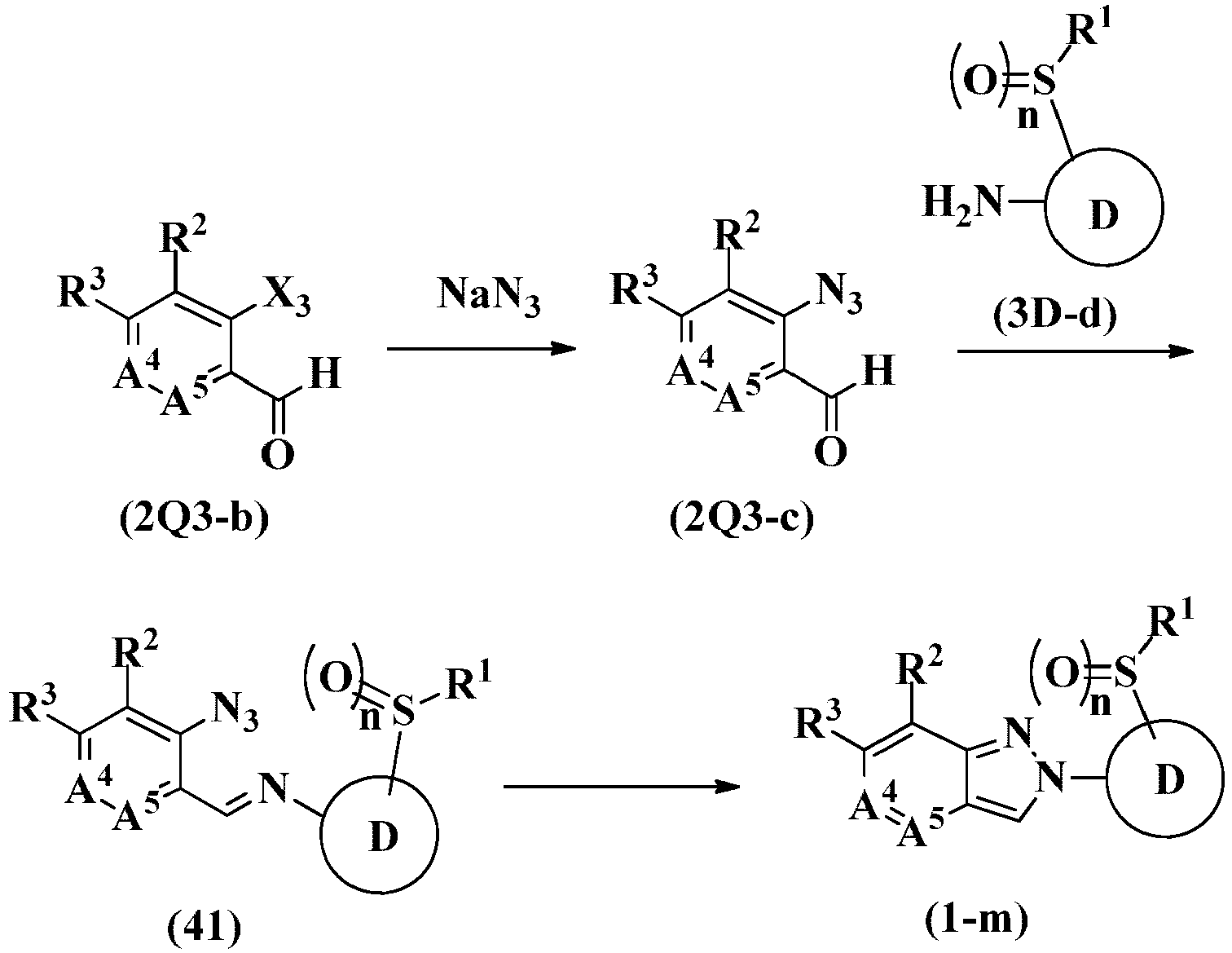
- A compound represented by the formula (2Q3-b) (wherein R2, R3, A4 and A5 are the same as defined above, and X3 is a fluorine atom, a chlorine atom, a bromine atom or an iodine atom) and sodium azide are reacted in a solvent or without solvent to produce a compound represented by the formula (2Q3-c) (wherein R2, R3, A4 and A5 are the same as defined above). In a case where a solvent is used, the solvent used may be any solvent which is inert to the reaction, and for example, water, a lower alcohol such as methanol or ethanol, an ether such as diethyl ether, tetrahydrofuran, 1,4-dioxane or 1,2-dimethoxyethane, an aromatic hydrocarbon such as benzene, chlorobenzene, bromobenzene, xylene or toluene, an aliphatic hydrocarbon such as pentane, hexane or cyclohexane, a halogenated hydrocarbon such as dichloromethane, chloroform or 1,2-dichloroethane, a nitrile such as acetonitrile or propionitrile, an amide such as N,N-dimethylformamide, N,N-dimethylacetamide, N-methylpyrrolidone or N,N'-dimethylimidazolidinone, a sulfoxide such as dimethyl sulfoxide, a nitrogen-containing aromatic compound such as pyridine or quinoline, or a mixture thereof may be mentioned.
- The reaction temperature may be set at an optional temperature of from -80°C to the refluxing temperature of the reaction mixture, and is preferably within a range of from 0°C to the refluxing temperature of the reaction mixture.
- The reaction time varies depending upon the concentration of the reaction substrate and the reaction temperature, and is optionally set usually within a range of from 5 minutes to 100 hours, and is preferably from 1 to 48 hours.
- With respect to the equivalent amount of the reaction substrate, sodium azide may be used in an amount of from 0.5 to 50 equivalent amount, preferably from 1 to 20 equivalent amount based on the compound (2Q3-b).
- Then, the compound represented by the formula (2Q3-c) and the compound represented by the formula (3D-d) are reacted in a solvent or without solvent, as the case requires, in the presence of a base, and as the case requires, in the presence of a catalyst to produce a compound represented by the formula (41) (wherein R1, R2, R3, A4, A5, D and n are the same as defined above). In a case where a solvent is used, the solvent used may be any solvent which is inert to the reaction, and for example, water, a lower alcohol such as methanol or ethanol, an ether such as diethyl ether, tetrahydrofuran, 1,4-dioxane or 1,2-dimethoxyethane, an aromatic hydrocarbon such as benzene, chlorobenzene, bromobenzene, xylene or toluene, an aliphatic hydrocarbon such as pentane, hexane or cyclohexane, a halogenated hydrocarbon such as dichloromethane, chloroform or 1,2-dichloroethane, a nitrile such as acetonitrile or propionitrile, an amide such as N,N-dimethylformamide, N,N-dimethylacetamide, N-methylpyrrolidone or N,N'-dimethylimidazolidinone, a sulfoxide such as dimethyl sulfoxide, a nitrogen-containing aromatic compound such as pyridine or quinoline, or a mixture thereof may be mentioned.
- The reaction may be carried out in the presence of a base. The base to be used may, for example, be an organic base such as pyridine, 2,6-lutidine, 4-dimethylaminopyridine, triethylamine, diisopropylethylamine, tributylamine, 4-(dimethylamino)pyridine, 1,4-diazabicyclo[2.2.2]octane (DABCO), 1,8-diazabicyclo[5.4.0]-7-undecene (DBU) or 1,5-diazabicyclo[4.3.0]-5-nonene (DBN), or an inorganic base such as sodium hydroxide, potassium hydroxide, sodium hydride, sodium hydrogen carbonate, potassium carbonate or cesium carbonate. The equivalent amount of the base used is from 0.1 to 100 equivalent amount, preferably from 1 to 20 equivalent amount based on the compound represented by the formula (2Q3-c).
- The reaction may be carried out in the presence of a catalyst. The catalyst to be used may, for example, be titanium tetrachloride. The equivalent amount of the catalyst used is from 0.005 to 20 equivalent amount, preferably from 0.1 to 5 equivalent amount based on the compound represented by the formula (2Q3-c).
- The reaction temperature may be set at an optional temperature of from -80°C to the refluxing temperature of the reaction mixture, and is preferably within a range of from 0°C to the refluxing temperature of the reaction mixture.
- The reaction time varies depending upon the concentration of the reaction substrate and the reaction temperature, and is optionally set usually within a range of from 5 minutes to 100 hours, and is preferably from 1 to 48 hours.
- With respect to the equivalent amount of the reaction substrate, the compound (3D-d) may be used in an amount of from 0.5 to 50 equivalent amount, preferably from 1 to 20 equivalent amount based on the compound (2Q3-c).
- Then, the compound represented by the formula (41) is cyclized in a solvent or without solvent to produce a compound represented by the formula (1-m) (wherein R1, R2, R3, A4, A5, D and n are the same as defined above).
- In a case where a solvent is used, the solvent used may be any solvent which is inert to the reaction, and for example, water, a lower alcohol such as methanol or ethanol, an ether such as diethyl ether, tetrahydrofuran, 1,4-dioxane or 1,2-dimethoxyethane, an aromatic hydrocarbon such as benzene, chlorobenzene, bromobenzene, xylene or toluene, an aliphatic hydrocarbon such as pentane, hexane or cyclohexane, a halogenated hydrocarbon such as dichloromethane, chloroform or 1,2-dichloroethane, a nitrile such as acetonitrile or propionitrile, an amide such as N,N-dimethylformamide, N,N-dimethylacetamide, N-methylpyrrolidone or N,N'-dimethylimidazolidinone, a sulfoxide such as dimethyl sulfoxide, a nitrogen-containing aromatic compound such as pyridine or quinoline, or a mixture thereof may be mentioned.
- The reaction temperature may be set at an optional temperature of from -80°C to the refluxing temperature of the reaction mixture, and is preferably within a range of from 0°C to the refluxing temperature of the reaction mixture.
- The reaction time varies depending upon the concentration of the reaction substrate and the reaction temperature, and is optionally set usually within a range of from 5 minutes to 100 hours, and is preferably from 1 to 48 hours.
- Some of the compounds represented by the formula (2Q3-b) are known compounds, and some of them are commercially available. The rest of them may be prepared, for example, in accordance with the after-mentioned Reaction Scheme 7.
-

- A compound represented by the formula (2Q4-a) (wherein R7 and A8 are the same as defined above) is reacted with the compound represented by the formula (3D-c) in accordance with the method disclosed in Process 6 to produce a compound represented by the formula (1-n) (wherein R1, R6, R7, A8, D and n are the same as defined above).
- Some of the compounds represented by the formula (2Q4-a) are known compounds, and some of them are commercially available. The rest of them may be prepared from known compounds in accordance with conventional methods disclosed in literature, for example, in accordance with the reaction conditions disclosed in Journal of Fluorine Chemistry, 2012, Vol. 133, p. 115,
CN101768135 ,CN101885708 or the like. -

- A compound represented by the formula (1-d) (wherein R1, Q and D are the same as defined above) and an oxidizing agent are reacted in a solvent or without solvent, and as the case requires, in the presence of a catalyst to produce a compound represented by the formula (1-e) (wherein R1, Q and D are the same as defined above, and n' is an integer of 1 or 2). In a case where a solvent is used, the solvent used may be any solvent which is inert to the reaction, and for example, water, a lower alcohol such as methanol or ethanol, an ether such as diethyl ether, tetrahydrofuran, 1,4-dioxane or 1,2-dimethoxyethane, an aromatic hydrocarbon such as benzene, chlorobenzene, bromobenzene, xylene or toluene, an aliphatic hydrocarbon such as pentane, hexane or cyclohexane, a halogenated hydrocarbon such as dichloromethane, chloroform or 1,2-dichloroethane, a nitrile such as acetonitrile or propionitrile, an amide such as N,N-dimethylformamide, N,N-dimethylacetamide, N-methylpyrrolidone or N,N'-dimethylimidazolidinone, a sulfoxide such as dimethyl sulfoxide, a nitrogen-containing aromatic compound such as pyridine or quinoline, acetic acid, or a mixture thereof may be mentioned.
- The oxidizing agent may, for example, be a peracid such as m-chloroperbenzoic acid or peracetic acid, hydrogen peroxide or OXONE (registered trademark by E. I. duPont, potassium peroxymonosulfate). The equivalent amount of the oxidizing agent used is from 0.1 to 100 equivalent amount, preferably from 1 to 20 equivalent amount based on the compound represented by the formula (1-d).
- The reaction may be carried out in the presence of a catalyst. The catalyst used may, for example, be sodium tungstate. The equivalent amount of the catalyst used is from 0.005 to 20 equivalent amount, preferably from 0.1 to 5 equivalent amount based on the compound represented by the formula (1-d).
- The reaction temperature may be set at an optional temperature of from -80°C to the refluxing temperature of the reaction mixture, and is preferably within a range of from 0°C to the refluxing temperature of the reaction mixture.
- The reaction time varies depending upon the concentration of the reaction substrate and the reaction temperature, and is optionally set usually within a range of from 5 minutes to 100 hours, and is preferably from 1 to 48 hours.
- The compound represented by the formula (1-d) may be prepared in accordance with the methods in Processes 1 to 10 or the following Processes 14 to 17. Process 12

- A compound represented by the formula (1-o) (wherein R1, R2, R3, R4, A1, D and n are the same as defined above) is reacted with an oxidizing agent in accordance with the method disclosed in Process 11 to produce a compound represented by the formula (1-p) (wherein R1, R2, R3, R4, A1 and D are the same as defined above).
- The compound represented by the formula (1-o) may be prepared in accordance with the method disclosed in Processes 1 to 5.
-

- A compound represented by the formula (1-q) (wherein R1, A1, A2, A4, A5, D and n are the same as defined above, and X9 is a chlorine atom, a bromine atom or an iodine atom) is reacted with a thiolating agent such as 2-ethylhexyl 3-mercaptopropionate, sodium hydrogen sulfide or sodium sulfide, for example, in accordance with the method disclosed in Organic Lett. 2007, Vol. 9, p. 3687, Tetrahedron 1998, Vol. 44, p. 1187,
WO2011/159839 or the like to produce a compound represented by the formula (1-r) (wherein R1, A1, A2, A4, A5, D and n are the same as defined above). - Then, the compound represented by the formula (1-r) is reacted with a trifluoromethylating agent such as Umemoto reagent (5-(trifluoromethyl)dibenzothiophenium trifluoromethanesulfonate) orTogni reagent (1-trifluoromethyl-3,3-dimethyl-1,2-benziodoxole), for example, in accordance with the method disclosed in
WO2013/043962 ,WO2013/040863 ,WO2012/082566 or the like, to produce a compound represented by the formula (1-s) (wherein R1, A1, A2, A4, A5, D and n are the same as defined above). - Then, the compound represented by the formula (1-s) is reacted with an oxidizing agent in accordance with the method disclosed in Process 11 to produce a compound represented by the formula (1-t) (wherein R1, A1, A2, A4, A5, D and n are the same as defined above, and n" is an integer of 1 or 2).
- The compound represented by the formula (1-q) may be prepared in accordance with the method disclosed in Processes 1 to 5.
-

- A compound represented by the formula (2Q1-c) (wherein A1a, A4, A5, R2 and R3 are the same as defined above, and X11 is a chlorine atom, a bromine atom or an iodine atom) and a compound represented by the formula (3D-e) (wherein R1, D and n are the same as defined above) are reacted in a solvent or without solvent, as the case requires, in the presence of a copper catalyst, as the case requires, in the presence of a base, and as the case requires, in the presence of a ligand. In a case where a solvent is used, the solvent used may be any solvent which is inert to the reaction, and for example, water, a lower alcohol such as methanol or ethanol, an ether such as diethyl ether, tetrahydrofuran, 1,4-dioxane or 1,2-dimethoxyethane, an aromatic hydrocarbon such as benzene, chlorobenzene, bromobenzene, xylene or toluene, an aliphatic hydrocarbon such as pentane, hexane or cyclohexane, a halogenated hydrocarbon such as dichloromethane, chloroform or 1,2-dichloroethane, a nitrile such as acetonitrile or propionitrile, an amide such as N,N-dimethylformamide, N,N-dimethylacetamide, N-methylpyrrolidone or N,N'-dimethylimidazolidinone, a sulfoxide such as dimethyl sulfoxide, a nitrogen-containing aromatic compound such as pyridine or quinoline, or a mixture thereof may be mentioned.
- The reaction may be carried out in the presence of a copper catalyst. The copper catalyst to be used may, for example, be copper(I) iodide. The equivalent amount of the copper catalyst used is from 0.005 to 20 equivalent amount, preferably from 0.01 to 5 equivalent amount based on the compound (2Q1-c).
- The reaction may be carried out in the presence of a base. The base to be used may, for example, be an organic base such as pyridine, 2,6-lutidine, 4-dimethylaminopyridine, triethylamine, diisopropylethylamine, tributylamine, 4-(dimethylamino)pyridine, 1,4-diazabicyclo[2.2.2]octane (DABCO), 1,8-diazabicyclo[5.4.0]-7-undecene (DBU) or 1,5-diazabicyclo[4.3.0]-5-nonene (DBN), or an inorganic base such as sodium hydroxide, potassium hydroxide, sodium hydride, sodium hydrogen carbonate, potassium carbonate, cesium carbonate or potassium phosphate. The equivalent amount of the base used is from 0.1 to 100 equivalent amount, preferably from 1 to 20 equivalent amount based on the compound represented by the formula (2Q1-c).
- The reaction may be carried out in the presence of a ligand. The ligand to be used may, for example, be 1,10-phenanthroline, 1,2-diaminoethane or N,N'-dimethylethylenediamine. The equivalent amount of the ligand used is from 0.005 to 20 equivalent amount, preferably from 0.01 to 5 equivalent amount based on the compound (2Q1-c).
- The reaction temperature may be set at an optional temperature of from -80°C to the refluxing temperature of the reaction mixture, and is preferably within a range of from 0°C to the refluxing temperature of the reaction mixture.
- The reaction time varies depending upon the concentration of the reaction substrate and the reaction temperature, and is optionally set usually within a range of from 5 minutes to 100 hours, and is preferably from 1 to 48 hours.
- With respect to the equivalent amount of the reaction substrate, the compound (3D-e) may be used in an amount of from 0.5 to 50 equivalent amount, preferably from 1 to 20 equivalent amount based on the compound (2Q1-c).
- Then, the compound represented by the formula (4-c) is subjected to dehydration condensation in accordance with the method disclosed in step [B] of Process 1 to produce a compound represented by the formula (1-u) (wherein A1a, A4, A5, R1, R2, R3, D and n are the same as defined above).
- Some of the compounds represented by the formula (2Q1-c) are known compounds, and some of them are commercially available. The rest of them may be prepared, for example, in accordance with the after-mentioned Reaction Scheme 4.
- The compound represented by the formula (3D-e) may be prepared, for example, in accordance with the after-mentioned Reaction Scheme 8.
-

- A compound represented by the formula (50) (wherein R2, R3, A1a, A4 and A5 are the same as defined above, and X12 is a chlorine atom, a bromine atom or an iodine atom) and a compound represented by the formula (5-a) (wherein G1, G2, G3 and G4 are the same as defined above) are reacted in accordance with the method disclosed in Process 6 to produce a compound represented by the formula (51) (wherein R2, R3, A1a, A4, A5, G1, G2, G3 and G4 are the same as defined above).
- Then, the compound represented by the formula (51) and the compound represented by the formula (9) are reacted in accordance with the method disclosed in step [C] of Process 3 to produce a compound represented by the formula (1-v) (wherein R1, R2, R3, A1a, A4, A5, G1, G2, G3 and G4 are the same as defined above).
- Further, the compound represented by the formula (51) and a halogenating agent are reacted in accordance with the method disclosed in step [D] of Process 3 to produce a compound represented by the formula (52) (wherein R2, R3, A1a, A4, A5, G1, G2, G3, G4 and X10 are the same as defined above).
- Then, the compound represented by the formula (52) and a compound represented by the formula (24) are reacted in accordance with the method disclosed in step [E] of Process 3 to produce a compound represented by the formula (1-v).
- Further, the compound represented by the formula (1-v) may be produced by reacting the compound represented by the formula (52) and the compound represented by the formula (9) in accordance with the method disclosed in step [E] of Process 3.
- The compound represented by the formula (50) may be prepared, for example, in accordance with the after-mentioned Reaction Scheme 9.
- Some of the compounds represented by the formula (5-a) are known compounds, and some of them are commercially available.
-

- The compound represented by the formula (50) and the compound represented by the formula (9) are reacted in a solvent or without solvent, and as the case requires, in the presence of a base to produce a compound represented by the formula (53) (wherein R1, R2, R3, A1a, A4 and A5 are the same as defined above). In a case where a solvent is used, the solvent used may be any solvent which is inert to the reaction, and for example, water, a lower alcohol such as methanol or ethanol, an ether such as diethyl ether, tetrahydrofuran, 1,4-dioxane or 1,2-dimethoxyethane, an aromatic hydrocarbon such as benzene, chlorobenzene, bromobenzene, xylene or toluene, an aliphatic hydrocarbon such as pentane, hexane or cyclohexane, a halogenated hydrocarbon such as dichloromethane, chloroform or 1,2-dichloroethane, a nitrile such as acetonitrile or propionitrile, an amide such as N,N-dimethylformamide, N,N-dimethylacetamide, N-methylpyrrolidone or N,N'-dimethylimidazolidinone, a sulfoxide such as dimethyl sulfoxide, a nitrogen-containing aromatic compound such as pyridine or quinoline, or a mixture thereof may be mentioned.
- The reaction may be carried out in the presence of a base. The base to be used may, for example, be an organic base such as pyridine, 2,6-lutidine, 4-dimethylaminopyridine, triethylamine, diisopropylethylamine, tributylamine, 4-(dimethylamino)pyridine, 1,4-diazabicyclo[2.2.2]octane (DABCO), 1,8-diazabicyclo[5.4.0]-7-undecene (DBU) or 1,5-diazabicyclo[4.3.0]-5-nonene (DBN), or an inorganic base such as sodium hydroxide, potassium hydroxide, sodium hydride, sodium hydrogen carbonate, potassium carbonate or cesium carbonate. The equivalent amount of the base used is from 0.1 to 100 equivalent amount, preferably from 1 to 20 equivalent amount based on the compound represented by the formula (50).
- The reaction temperature may be set at an optional temperature of from -80°C to the refluxing temperature of the reaction mixture, and is preferably within a range of from 0°C to the refluxing temperature of the reaction mixture.
- The reaction time varies depending upon the concentration of the reaction substrate and the reaction temperature, and is optionally set usually within a range of from 5 minutes to 100 hours, and is preferably from 1 to 48 hours.
- With respect to the equivalent amount of the reaction substrate, the compound (9) may be used in an amount of from 0.5 to 50 equivalent amount, preferably from 1 to 20 equivalent amount based on the compound (50).
- Then, the compound represented by the formula (53) and a halogenating agent are reacted in a solvent or without solvent, as the case requires, in the presence of a silylating agent, as the case requires, in the presence of a base, as the case requires, in the presence of an acid to produce a compound represented by the formula (54) (wherein R1, R2, R3, A1a, A4 and A5 are the same as defined above, and X13 is a chlorine atom, a bromine atom or an iodine atom). In a case where a solvent is used, the solvent used may be any solvent which is inert to the reaction, and for example, water, an aliphatic acid such as acetic acid, a lower alcohol such as methanol or ethanol, an ether such as diethyl ether, tetrahydrofuran, 1,4-dioxane or 1,2-dimethoxyethane, an aromatic hydrocarbon such as benzene, chlorobenzene, bromobenzene, xylene or toluene, an aliphatic hydrocarbon such as pentane, hexane or cyclohexane, a halogenated hydrocarbon such as dichloromethane, chloroform or 1,2-dichloroethane, a nitrile such as acetonitrile or propionitrile, an amide such as N,N-dimethylformamide, N,N-dimethylacetamide, N-methylpyrrolidone or N,N'-dimethylimidazolidinone, a sulfoxide such as dimethyl sulfoxide, a nitrogen-containing aromatic compound such as pyridine or quinoline, or a mixture thereof may be mentioned.
- The halogenating agent may, for example, be chlorine, bromine, iodine, N-chlorosuccinimide, N-bromosuccinimide, N-iodosuccinimide, 1,3-dichloro-5,5-dimethylhydantoin, 1,3-dibromo-5,5-dimethylhydantoin, 1,3-diiodo-5,5-dimethylhydantoin or trimethylphenylammonium tribromide. The equivalent amount of the halogenating agent used is from 0.5 to 50 equivalent amount, preferably from 1 to 20 equivalent amount based on the compound represented by the formula (53).
- The reaction may be carried out in the presence of a silylating agent. The silylating agent to be used may, for example, be trimethylsilyl trifluoromethanesulfonate. The equivalent amount of the silylating agent used is from 0.005 to 20 equivalent amount, preferably from 0.01 to 5 equivalent amount based on the compound represented by the formula (53).
- The reaction may be carried out in the presence of a base. The base to be used may, for example, be an organic base such as pyridine, 2,6-lutidine, 4-dimethylaminopyridine, triethylamine, diisopropylethylamine, tributylamine, 4-(dimethylamino)pyridine, 1,4-diazabicyclo[2.2.2]octane (DABCO), 1,8-diazabicyclo[5.4.0]-7-undecene (DBU) or 1,5-diazabicyclo[4.3.0]-5-nonene (DBN), or an inorganic base such as sodium hydroxide, potassium hydroxide, sodium hydride, sodium hydrogen carbonate, potassium carbonate, cesium carbonate or potassium phosphate. The equivalent amount of the base used is from 0.1 to 100 equivalent amount, preferably from 1 to 20 equivalent amount based on the compound represented by the formula (53).
- The reaction may be carried out in the presence of an acid. The acid to be used may, for example, be hydrobromic acid or an acetic acid solution of hydrogen bromide. The equivalent amount of the acid used is from 0.1 to 100 equivalent amount, preferably from 1 to 20 equivalent amount based on the compound represented by the formula (53).
- The reaction temperature may be set at an optional temperature of from -80°C to the refluxing temperature of the reaction mixture, and is preferably within a range of from 0°C to the refluxing temperature of the reaction mixture.
- The reaction time varies depending upon the concentration of the reaction substrate and the reaction temperature, and is optionally set usually within a range of from 5 minutes to 100 hours, and is preferably from 1 to 48 hours.
- Then, the compound represented by the formula (54) and the compound represented by the formula (5-a) are reacted in accordance with the method disclosed in Process 6 to produce a compound represented by the formula (1-v).
-

- The compound represented by the formula (54) and a compound represented by the formula (5-b) (wherein G5 and Y6 are the same as defined above) are reacted in accordance with the method disclosed in Process 6 to produce a compound represented by the formula (1-w) (wherein R1, R2, R3, A1a, A4, A5, G5 and Y6 are the same as defined above).
- In Processes 1 to 17, the reaction mixture after the reaction can be worked up by an ordinary procedure such as direct concentration, concentration of a solution in an organic solvent after washing with water, pouring into ice-water or extraction with an organic solvent followed by concentration to obtain the desired compound of the present invention. Further, if necessary, the desired product may be isolated or purified by an optional purification method such as recrystallization, column chromatography, thin layer chromatography or liquid chromatography. Otherwise, the compound of the present invention may be subjected to the next step without isolation and purification. In some cases, the dehydration condensation reaction as the subsequent step proceeds in step [A] of Process 1, in step [A] of Process 3, in step [A] of Process 4, in step [A] of Process 5 and in step [A] of Process 14, and thus step [B] may be omitted.
- Among the compounds represented by the formulae (3D-a) and (3D-b) used in Processes 1 and 5, compounds represented by the formulae (3D-a1) and (3D-b1) wherein n is an integer of O, and among the compounds represented by the formula (3D-c) used in Processes 6 and 10, a compound represented by the formula (3D-c1) wherein n is an integer of 1 or 2 and a compound represented by the formula (3D-c2) wherein n is an integer of 0, may be produced, for example, in accordance with the following Reaction Scheme 1.

- The compound represented by the formula (5-a) is reacted with a compound represented by the formula (6) (wherein Ra is C1-C6 alkyl) in accordance with the method disclosed in Process 6 to produce a compound represented by the formula (7-a) (wherein G1, G2, G3 and G4 are the same as defined above, and Ra is C1-C6 alkyl).
- Then, the compound represented by the formula (7-a) is reacted with a halogenating agent in accordance with the method disclosed in Process 7 to produce a compound represented by the formula (8-a) (wherein G1, G2, G3 and G4 are the same as defined above, Ra is C1-C6 alkyl, and X5 is a chlorine atom, a bromine atom or an iodine atom).
- Then, the compound represented by the formula (8-a) is reacted with a compound represented by the formula (9) (wherein R1 is the same as defined above) in accordance with the method disclosed in step [E] of Process 3 to produce a compound represented by the formula (10-a) (wherein G1, G2, G3, G4 and R1 are the same as defined above, and Ra is C1-C6 alkyl).
- Then, the compound represented by the formula (10-a) is hydrolyzed in accordance with conventional methods disclosed in literature to produce a compound represented by the formula (3D-a1) (wherein G1, G2, G3, G4 and R1 are the same as defined above).
- Then, the compound represented by the formula (3D-a1) is reacted with a chlorinating agent in accordance with conventional methods disclosed in literature to produce a compound represented by the formula (3D-b1) (wherein G1, G2, G3, G4 and R1 are the same as defined above).
- Then, the compound represented by the formula (3D-b1) and N,O-dimethylhydroxylamine represented by the formula (11) or its hydrochloride are reacted, as the case requires, in the presence of a base to produce a compound represented by the formula (12) (wherein G1, G2, G3, G4 and R1 are the same as defined above).
- Then, the compound represented by the formula (12) and a Grignard reagent represented by the formula (13) (wherein R6 is the same as defined above, and X7 is a chlorine atom, a bromine atom or an iodine atom) are reacted in accordance with conventional methods disclosed in literature to produce a compound represented by the formula (14) (wherein G1, G2, G3, G4, R1 and R6 are the same as defined above).
- Then, the compound represented by the formula (14) and an oxidizing agent are reacted in accordance with the method disclosed in Process 11 to produce a compound represented by the formula (15) (wherein G1, G2, G3, G4, R1, R6 and n' are the same as defined above).
- Then, the compound represented by the formula (15) is reacted with a halogenating agent in accordance with the method disclosed in step [B] of Process 16 to produce a compound represented by the formula (3D-c1) (wherein G1, G2, G3, G4, R1, R6, X2 and n' are the same as defined above).
- Further, the compound represented by the formula (14) is reacted with a halogenating agent in accordance with the method disclosed in step [B] of Process 16 to produce a compound represented by the formula (3D-c2) (wherein G1, G2, G3, G4, R1, R6 and X2 are the same as defined above).
- Some of the compounds represented by the formula (5-a) are known compounds, and some of them are commercially available.
- Some of the compounds represented by the formula (6) are known compounds, and some of them are commercially available.
- Some of the compounds represented by the formula (13) are known compounds, and some of them are commercially available.
- Among the compounds represented by the formula (3D-a) used in Process 1, a compound represented by the formula (3D-a2) wherein n is an integer of 0 may be produced, for example, in accordance with the following Reaction Scheme 2.

- The compound represented by the formula (5-b) is reacted with the compound represented by the formula (6) in accordance with the method disclosed in Process 6 to produce a compound represented by the formula (7-b) (wherein G5, Y6 and Ra are the same as defined above).
- Then, the compound represented by the formula (7-b) is reacted with a halogenating agent in accordance with the method disclosed in Process 7 to produce a compound represented by the formula (8-b) (wherein G5, Y6 and Ra are the same as defined above, and X6 is a chlorine atom, a bromine atom or an iodine atom).
- Then, the compound represented by the formula (8-b) is reacted with the compound represented by the formula (9) in accordance with the method disclosed in step [E] of Process 3 to produce a compound represented by the formula (10-b) (wherein G5, Y6, R1 and Ra are the same as defined above).
- Then, the compound represented by the formula (10-b) is hydrolyzed in accordance with conventional methods disclosed in literature to produce a compound represented by the formula (3D-a2) (wherein G5, Y6 and R1 are the same as defined above).
- Some of the compounds represented by the formula (5-b) are known compounds, and some of them are commercially available.
- The compound represented by the formula (10-a) used in Reaction Scheme 1 may be produced, for example, in accordance with the following Reaction Scheme 3.

- The compound represented by the formula (7-a) is reacted with the compound represented by the formula (9) and a halogenating agent in accordance with the method disclosed in step [C] of Process 3 to produce a compound represented by the formula (10-a).
- Among the compounds represented by the formula (2Q1-a) used in Process 1, a compound represented by the formula (2Q1-a-1) may be produced, for example, in accordance with the following Reaction Scheme 4.


- A compound represented by the formula (25) (wherein R2, R3 and A5 are the same as defined above) is reacted with a brominating agent such as N-bromosuccinimide, for example, in accordance with the method disclosed in
WO2007/093901 to produce a compound represented by the formula (26) (wherein R2, R3 and A5 are the same as defined above). - Then, the compound represented by the formula (26) is reacted with the compound represented by the formula (16) in accordance with the method disclosed in Process 2 to produce a compound represented by the formula (27) (wherein R2, R3, A1aa and A5 are the same as defined above).
- Then, the compound represented by the formula (27) is reacted with an aminating agent such as ammonia, aqueous ammonia or lithium amide in accordance with the method disclosed in e.g.
WO2012/086848 to produce a compound represented by the formula (2Q1-a-1) (wherein R2, R3, A1aa and A5 are the same as defined above). - Some of the compounds represented by the formula (25) are known compounds, and some of them are commercially available.
- Among the compounds represented by the formula (2Q2-a) used in Process 6, a compound represented by the formula (2Q2-a-1) may be produced, for example, in accordance with the following Reaction Scheme 5.


- A compound represented by the formula (28) (wherein R2 and R3 are the same as defined above, and Rb is C1-C6 alkyl) is reacted with a compound represented by the formula (29) (wherein Rc is C1-C6 alkyl, and X8 is a favorable leaving group such as a halogen atom, C1-C4 alkylsulfonate (such as methanesulfonyloxy), C1-C4 haloalkylsulfonate (such as trifluoromethanesulfonyloxy) or arylsulfonate (such as benzenesulfonyloxy or p-toluenesulfonyloxy)) for example in accordance with the method disclosed in e.g. Journal of Fluorine Chemistry, 1989, Vol. 44, p. 361, Journal of Heterocyclic Chemistry, 1993, Vol. 33, p. 49, or Synthesis 2000, p. 1078 to produce a compound represented by the formula (30) (wherein R2, R3, Rb and Rc are the same as defined above).
- Then, the compound represented by the formula (30) is reacted with a compound represented by the formula (31) (wherein R5 is the same as defined above) in accordance with e.g. Bioorganic & Medicinal Chemistry Letters, 2011, Vol. 21, p. 1601 to produce a compound represented by the formula (32) (wherein R2, R3 and R5 are the same as defined above).
- Then, the compound represented by the formula (32) is reacted with a chlorinating agent such as phosphorus oxychloride, thionyl chloride or oxalyl chloride for example in accordance with e.g.
WO2012/061337 orWO2005/033084 to produce a compound represented by the formula (33) (wherein R2, R3 and R5 are the same as defined above). - Then, the compound represented by the formula (33) is reacted with aqueous ammonia for example in accordance with the method disclosed in e.g.
WO2012/061337 orWO2005/033084 to produce a compound represented by the formula (2Q2-a-1). - Some of the compounds represented by the formula (28) are known compounds, and some of them are commercially available.
- Some of the compounds represented by the formula (29) are known compounds, and some of them are commercially available.
- Some of the compounds represented by the formula (31) are known compounds, and some of them are commercially available.
- The compound represented by the formula (3D-d) used in Process 8 may be produced, for example, in accordance with the following Reaction Scheme 6.
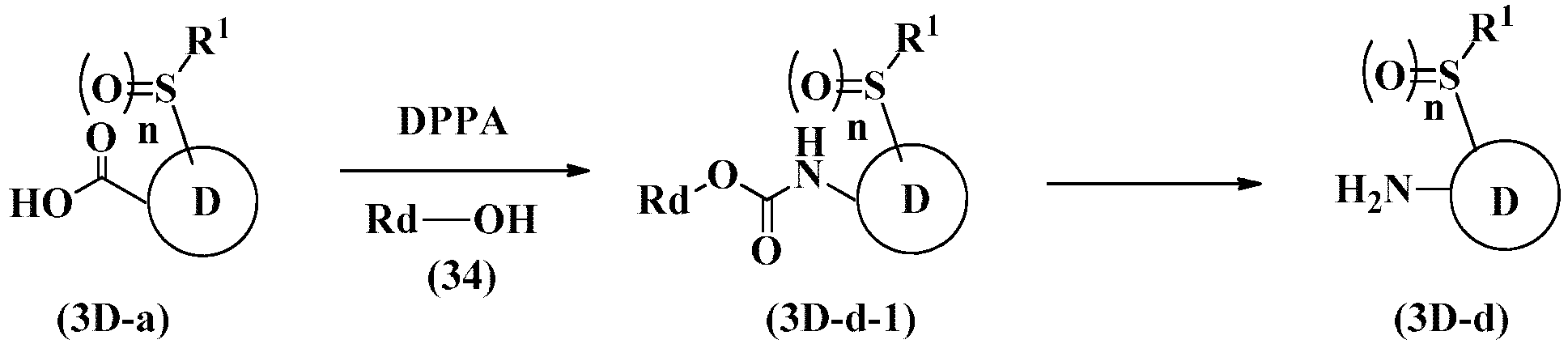
- The compound represented by the formula (3D-a) is reacted with diphenylphosphoryl azide (DPPA) and a compound represented by the formula (34) (wherein Rd is C1-C6 alkyl) for example in accordance with the method disclosed in e.g.
WO2012/174312 orWO2013/018021 to produce a compound represented by the formula (3D-d-1) (wherein R1, Rd, D and n are the same as defined above). - Then, the compound represented by the formula (3D-d-1) is reacted with an acid for example in accordance with the method disclosed in e.g.
WO2012/174312 orWO2003/018021 to produce a compound represented by the formula (3D-d). - Among the compounds represented by the formula (2Q3-b) used in Process 9, a compound represented by the formula (2Q3-b-1) may be produced, for example, in accordance with the following Reaction Scheme 7.


- A compound represented by the formula (35) (wherein R2, R3 and R5 are the same as defined above) is halogenated by using a halogenating agent for example in accordance with the method disclosed in e.g.
WO2013/064460 orWO2013/064461 to produce a compound represented by the formula (36) (wherein R2, R3, R5 and X3 are the same as defined above). - Then, the compound represented by the formula (36) is reduced for example in accordance with the method disclosed in e.g.
WO2013/064460 orWO2013/064461 to produce a compound represented by the formula (37) (wherein R2, R3, R5 and X3 are the same as defined above). - Then, the compound represented by the formula (37) is oxidized for example in accordance with the method disclosed in e.g.
WO2013/064460 orWO2013/064461 to produce a compound represented by the formula (2Q3-b-1) (wherein R2, R3, R5 and X3 are the same as defined above). - Some of the compounds represented by the formula (35) are known compounds, and some of them are commercially available. The rest of them may be prepared from known compounds in accordance with conventional methods disclosed in literature, for example, in accordance with the reaction conditions disclosed in e.g.
WO2000/039094 . - Among the compounds represented by the formula (3D-e) used in Process 14, a compound represented by the formula (3D-e1) wherein n is an integer of 0 may be produced, for example, in accordance with the following Reaction Shceme 8.


- The compound represented by the formula (3D-b1) is reacted with aqueous ammonia for example in accordance with the method disclosed in e.g.
JP-A-2009-108046 - The compound represented by the formula (50) used in Processes 15 and 16 may be produced, for example, in accordance with the following Reaction Scheme 9.

- A compound represented by the formula (2Q1-d) is reacted with compound represented by the formula (55) in accordance with the method disclosed in step [A] of Process 1 to produce a compound represented by the formula (56) (wherein R2, R3, A1a, A4 and A5 are the same as defined above).
- Then, the compound represented by the formula (56) is subjected to deacetylation for example in accordance with the method disclosed in e.g. Synthesis, 1991, p. 465 to produce a compound represented by the formula (57) (wherein R2, R3, A1a, A4 and A5 are the same as defined above).
- Then, the compound represented by the formula (57) is subjected to dehydration condensation in accordance with the method disclosed in step [B] of Process 1 to produce a compound represented by the formula (58) (wherein R2, R3, A1a, A4 and A5 are the same as defined above).
- Then, the compound represented by the formula (58) and an oxidizing agent are reacted for example in accordance with the method disclosed in e.g. Journal of Medicinal Chemistry, 1998, Vol. 31, p. 545 to produce a compound represented by the formula (59) (wherein R2, R3, A1a, A4 and A5 are the same as defined above).
- Then, the compound represented by the formula (59) and a halogenating agent are reacted in accordance with the method disclosed in step [B] of Process 16 or in accordance with the method disclosed in e.g. Journal of Medicinal Chemistry, 1988, Vol. 31, p. 656 or Journal of Medicinal Chemistry, 2005, Vol. 48, p. 7658 to produce a compound represented by the formula (50).
- The compound represented by the formula (55) is a known compound and is commercially available. Further, the compound represented by the formula (55) has optically active isomers due to the presence of an asymmetric carbon atom, and the present invention covers any optical isomers and any racemates.
- In each reaction, after the reaction, an ordinary post treatment is carried out to obtain respective production intermediates to be raw material compounds in Processes 1 to 17.
- Further, each production intermediate produced by the above methods may be used for the reaction in the subsequent step as it is without isolation nor purification. In some cases, the dehydration condensation reaction as the subsequent step proceeds, in step [B] of Reaction Scheme 9, and thus step [C] may be omitted.
- As the condensed heterocyclic compounds represented by the formula (1) of the present invention, which can be produced by the above methods, compounds represented by the following Tables 1 to 5 may be mentioned. However, the compounds shown in the following Tables 1 to 5 merely exemplify the present invention, and the present invention is by no means restricted thereto.
- In Tables, Me represents methyl, and similarly, Et represents ethyl, nPr represents normal propyl, and iPr represents isopropyl.


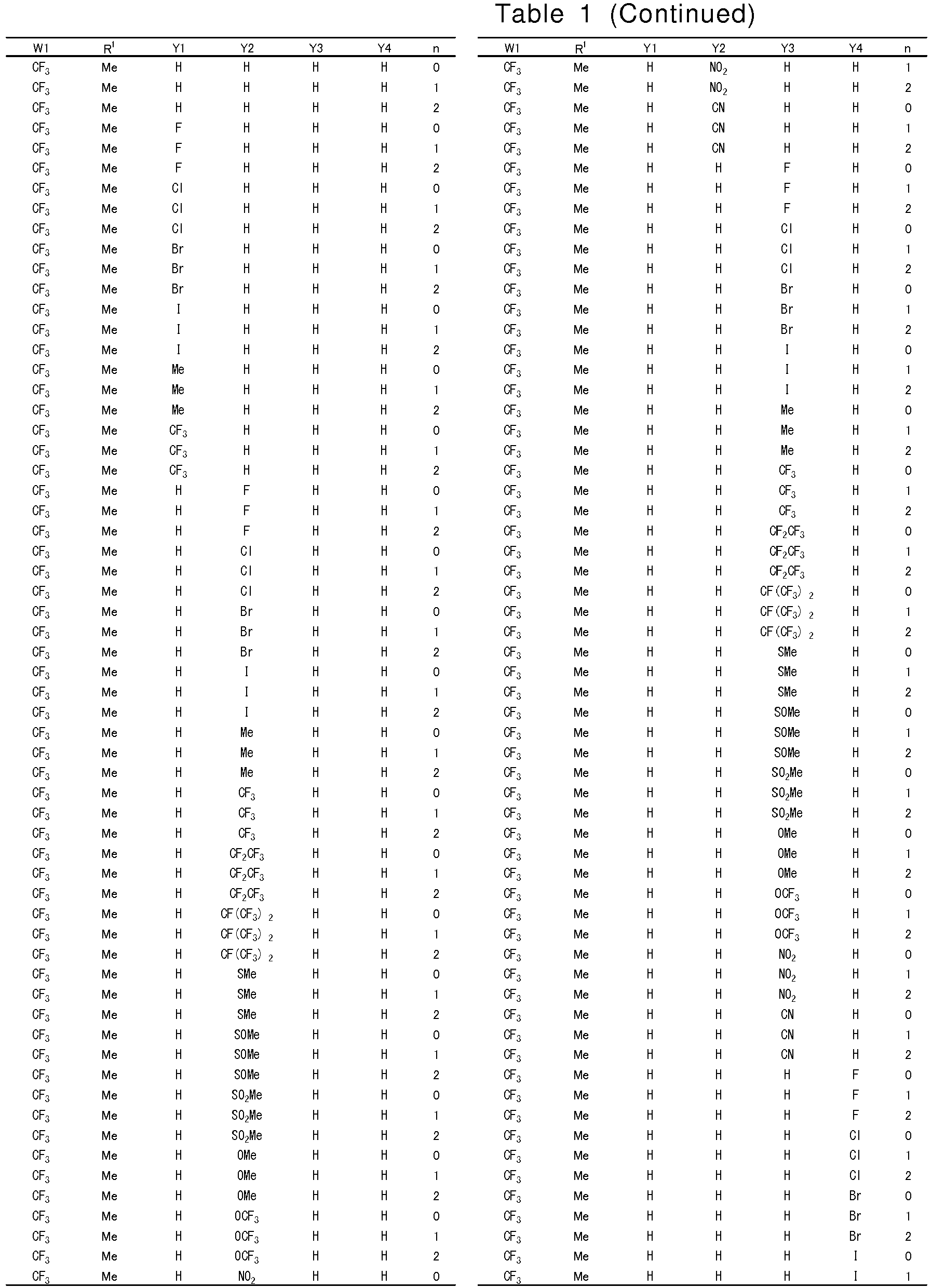


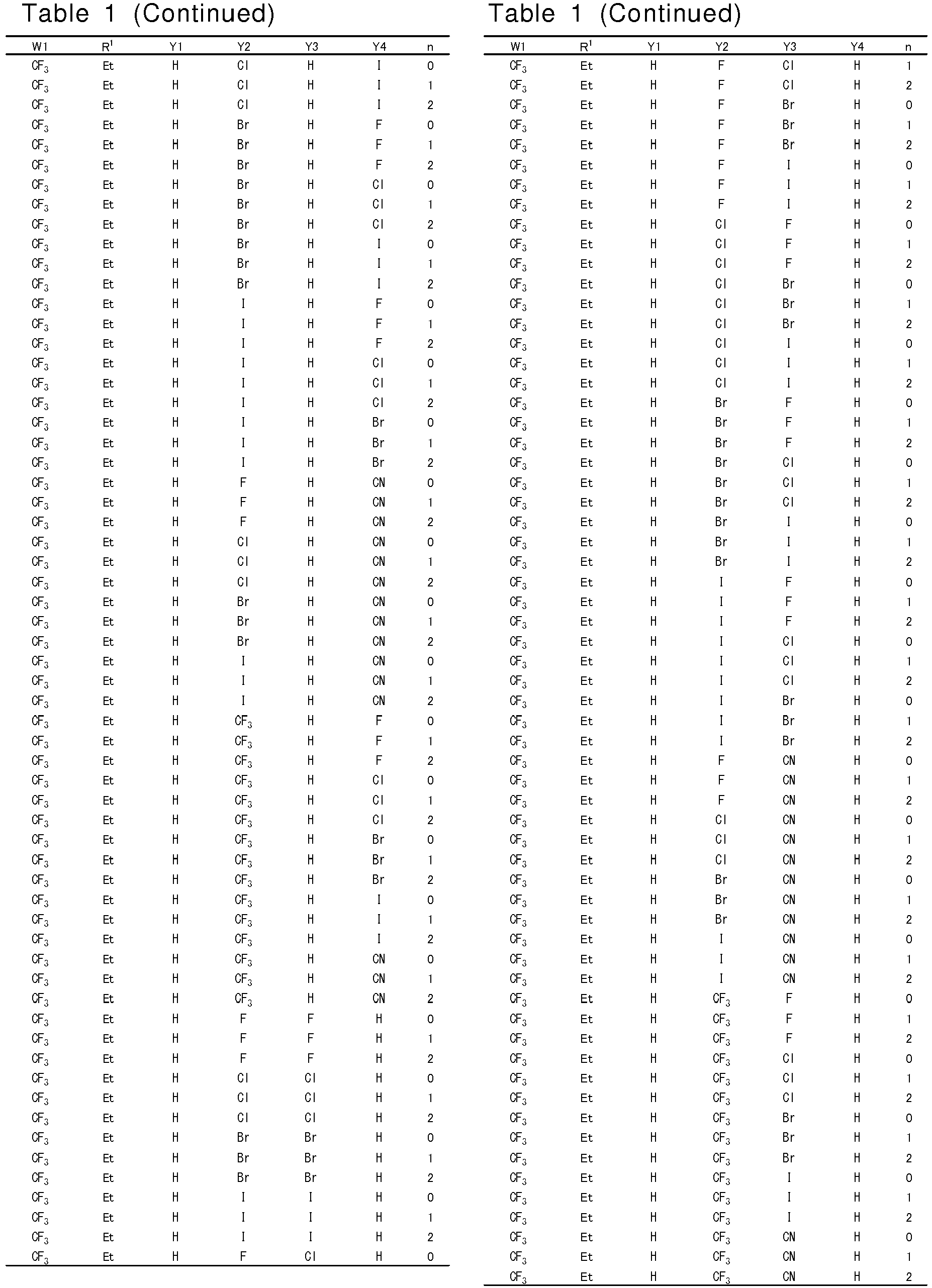


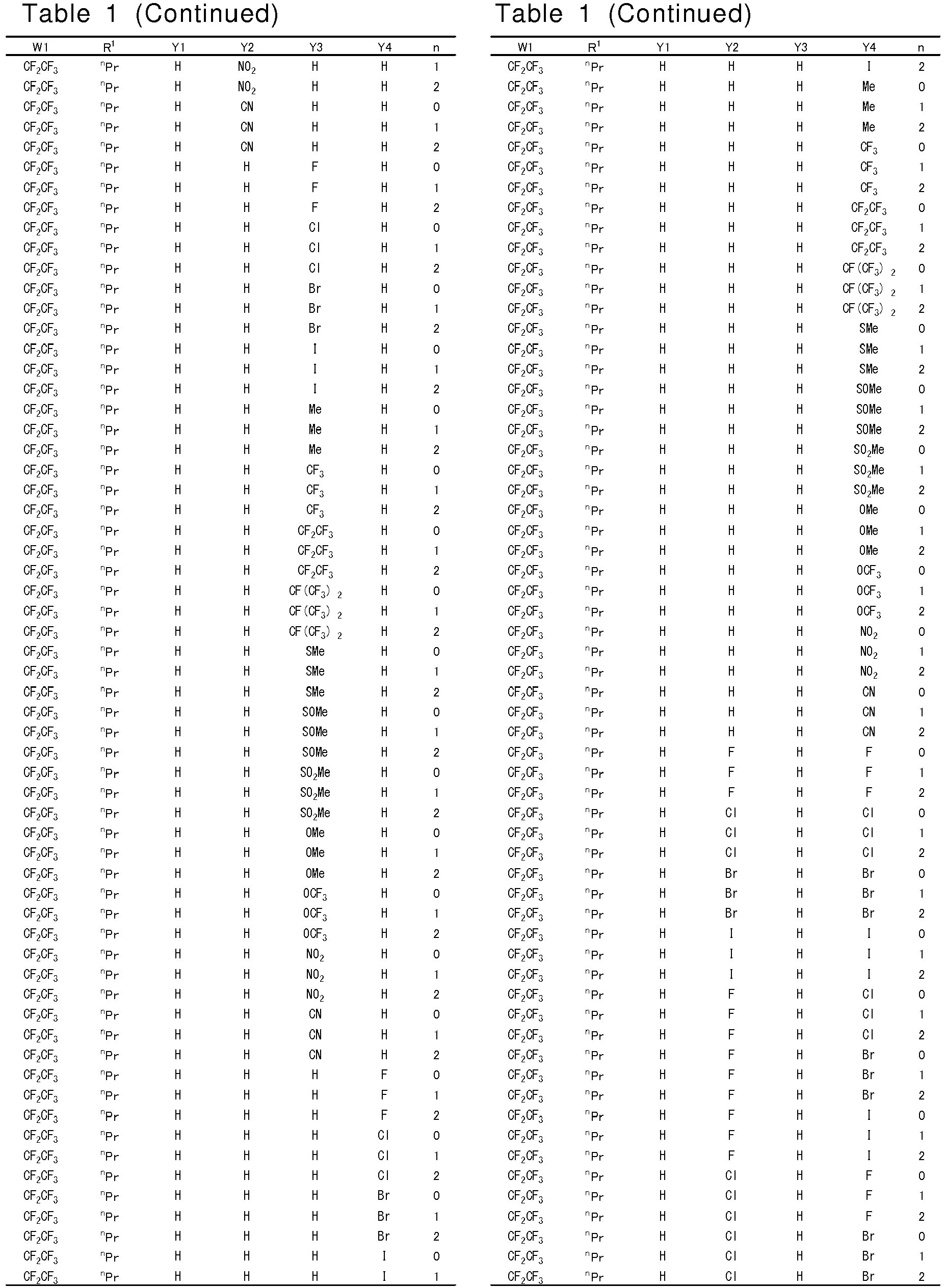


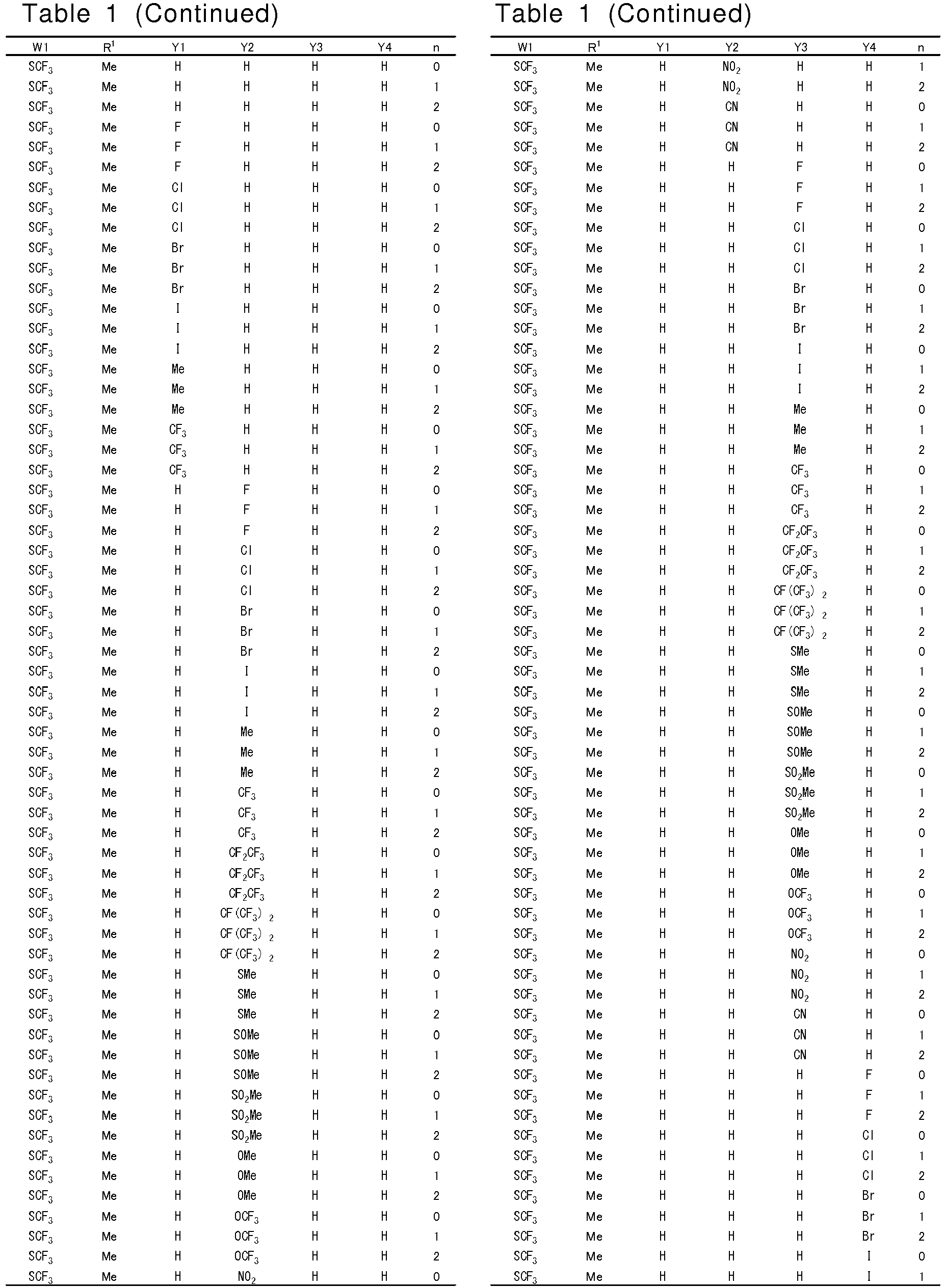

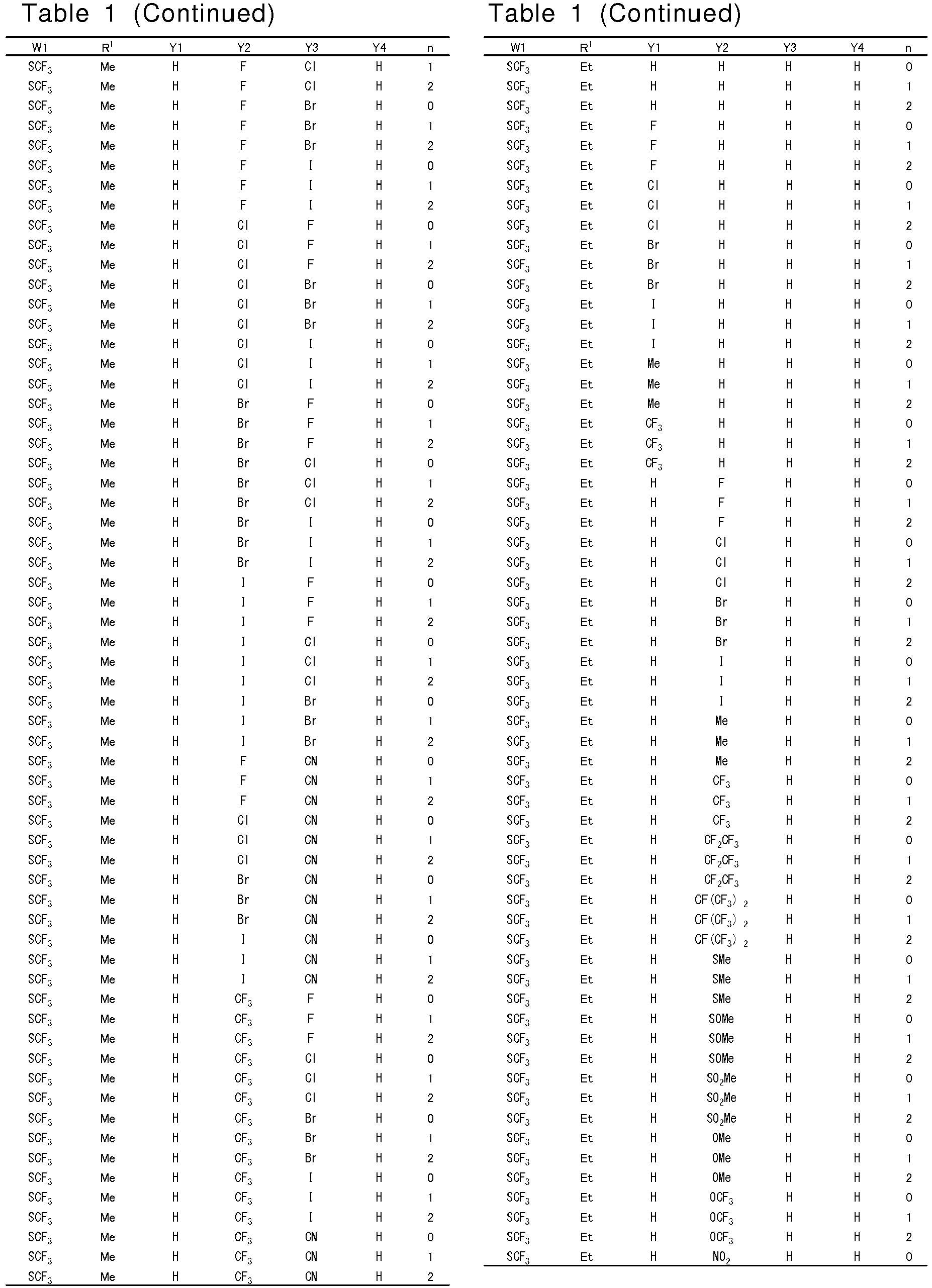


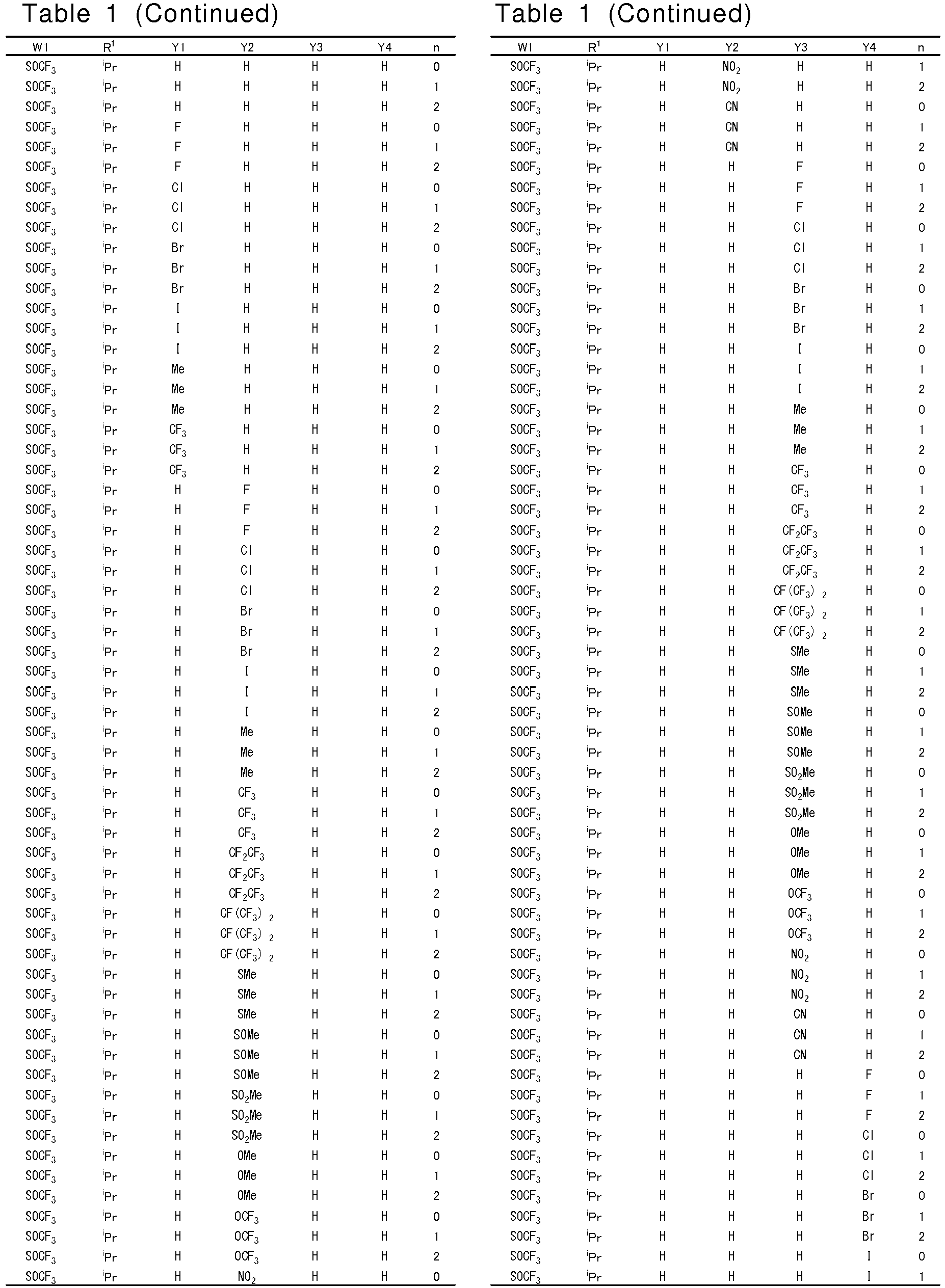


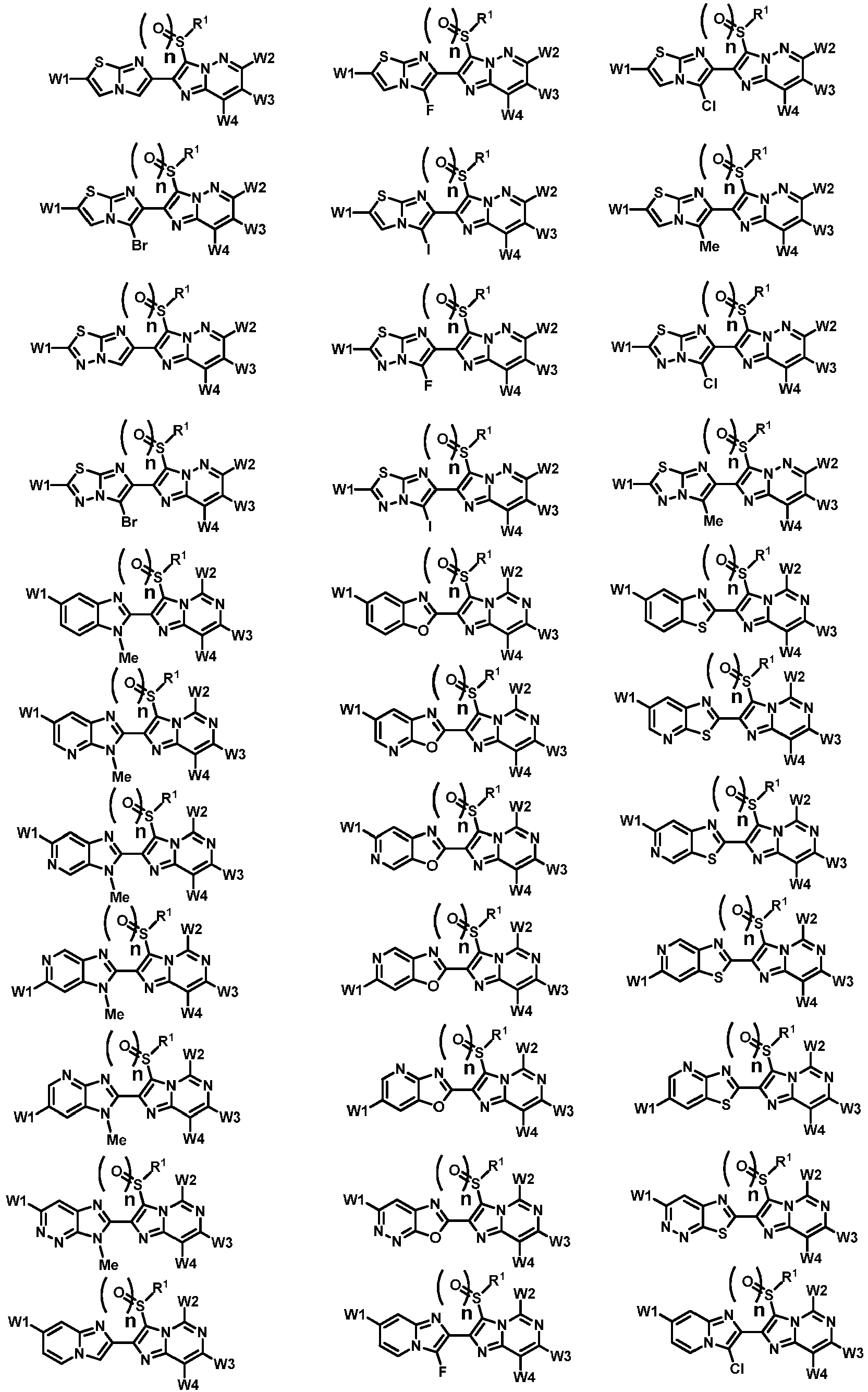


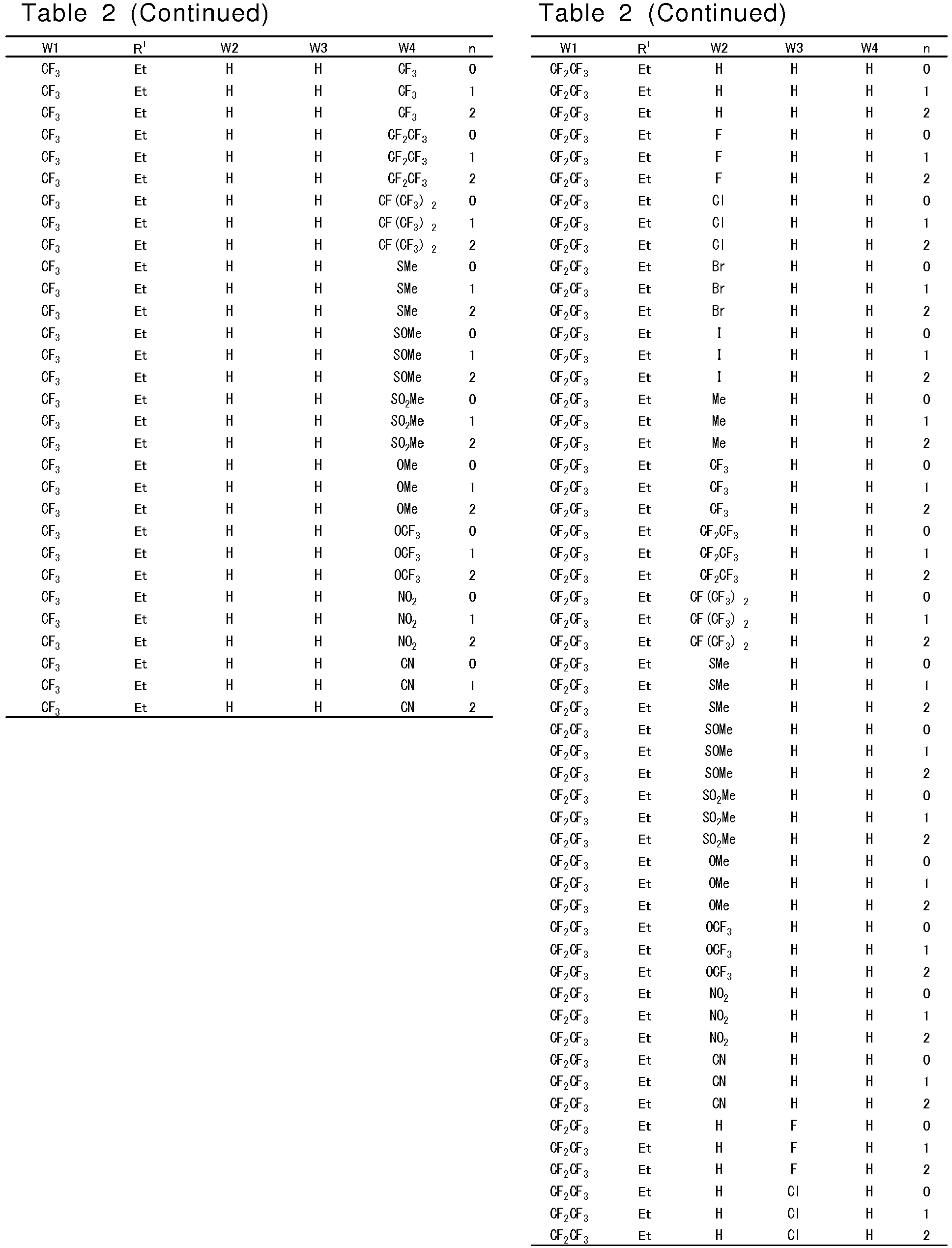

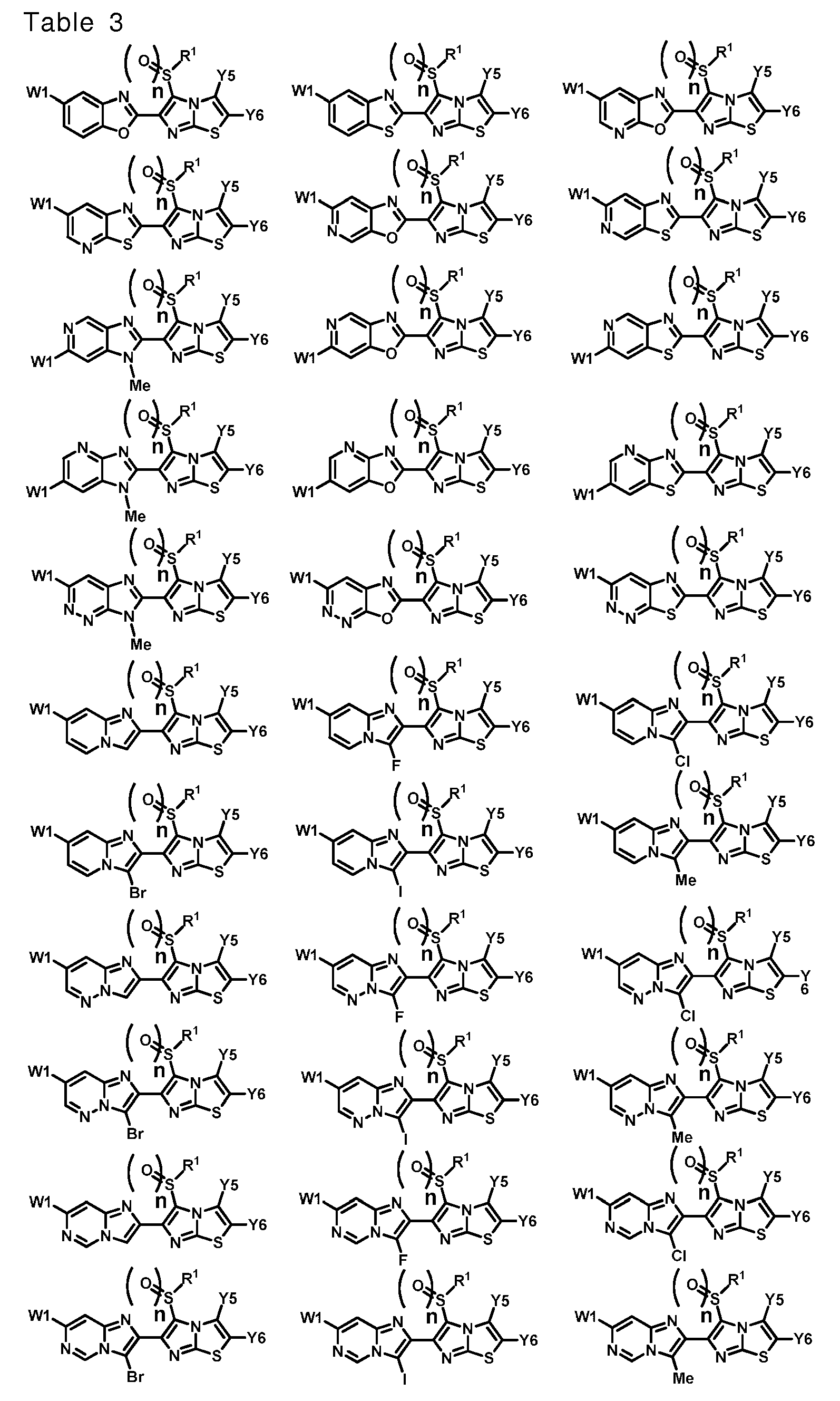
Table 3 


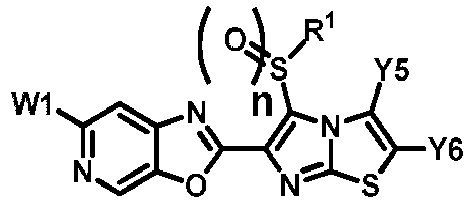


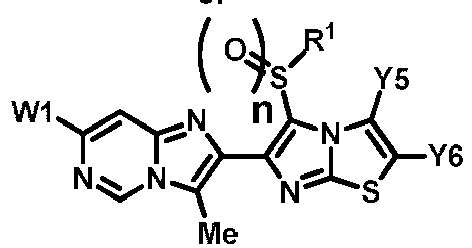


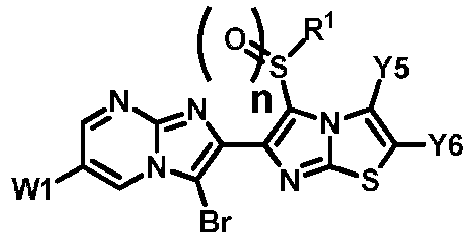


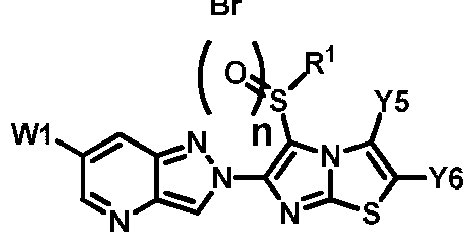


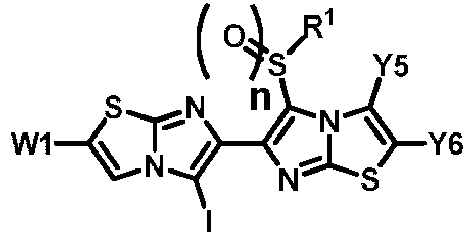

W1 R1 Y5 Y6 n CF3 Et H H 0 CF3 Et H H 1 CF3 Et H H 2 CF3 Et H F 0 CF3 Et H F 1 CF3 Et H F 2 CF3 Et H Cl 0 CF3 Et H Cl 1 CF3 Et H Cl 2 CF3 Et H Br 0 CF3 Et H Br 1 CF3 Et H Br 2 CF3 Et H I 0 CF3 Et H I 1 CF3 Et H I 2 CF3 Et H Me 0 CF3 Et H Me 1 CF3 Et H Me 2 CF3 Et H CF3 0 CF3 Et H CF3 1 CF3 Et H CF3 2 CF3 Et H CF2CF3 0 CF3 Et H CF2CF3 1 CF3 Et H CF2CF3 2 CF3 Et H CF(CF3)2 0 CF3 Et H CF(CF3)2 1 CF3 Et H CF(CF3)2 2 CF3 Et H SMe 0 CF3 Et H SMe 1 CF3 Et H SMe 2 CF3 Et H SOMe 0 CF3 Et H SOMe 1 CF3 Et H SOMe 2 CF3 Et H SO2Me 0 CF3 Et H SO2Me 1 CF3 Et H SO2Me 2 CF3 Et H OMe 0 CF3 Et H OMe 1 CF3 Et H OMe 2 CF3 Et H OCF3 0 CF3 Et H OCF3 1 CF3 Et H OCF3 2 CF3 Et H NO2 0 CF3 Et H NO2 1 CF3 Et H NO2 2 CF3 Et H CN 0 CF3 Et H CN 1 CF3 Et H CN 2 CF2CF3 Et H H 0 CF2CF3 Et H H 1 CF2CF3 Et H H 2 CF2CF3 Et H F 0 CF2CF3 Et H F 1 CF2CF3 Et H F 2 CF2CF3 Et H Cl 0 CF2CF3 Et H Cl 1 CF2CF3 Et H Cl 2 CF2CF3 Et H Br 0 CF2CF3 Et H Br 1 CF2CF3 Et H Br 2 CF2CF3 Et H I 0 CF2CF3 Et H I 1 CF2CF3 Et H I 2 CF2CF3 Et H Me 0 CF2CF3 Et H Me 1 CF2CF3 Et H Me 2 CF2CF3 Et H CF3 0 CF2CF3 Et H CF3 1 CF2CF3 Et H CF3 2 CF2CF3 Et H CF2CF3 0 CF2CF3 Et H CF2CF3 1 CF2CF3 Et H CF2CF3 2 CF2CF3 Et H CF(CF3)2 0 CF2CF3 Et H CF(CF3)2 1 CF2CF3 Et H CF(CF3)2 2 CF2CF3 Et H SMe 0 CF2CF3 Et H SMe 1 CF2CF3 Et H SMe 2 CF2CF3 Et H SOMe 0 CF2CF3 Et H SOMe 1 CF2CF3 Et H SOMe 2 CF2CF3 Et H SO2Me 0 CF2CF3 Et H SO2Me 1 CF2CF3 Et H SO2Me 2 CF2CF3 Et H OMe 0 CF2CF3 Et H OMe 1 CF2CF3 Et H OMe 2 CF2CF3 Et H OCF3 0 CF2CF3 Et H OCF3 1 CF2CF3 Et H OCF3 2 CF2CF3 Et H NO2 0 CF2CF3 Et H NO2 1 CF2CF3 Et H NO2 2 CF2CF3 Et H CN 0 CF2CF3 Et H CN 1 CF2CF3 Et H CN 2 Table 4 

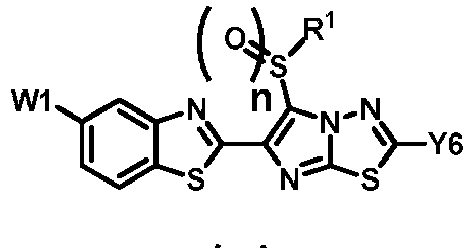


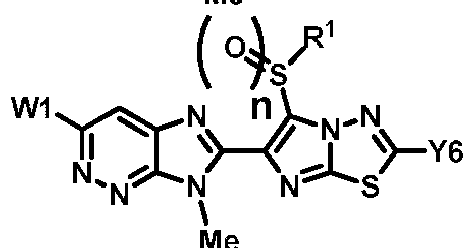


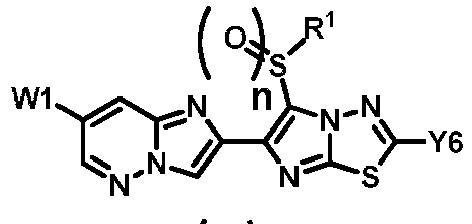


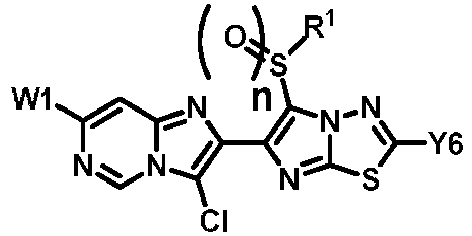


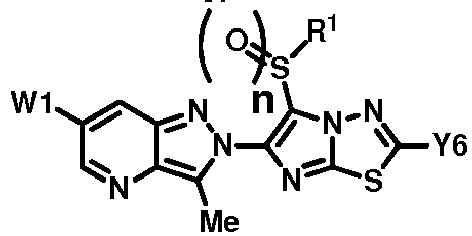
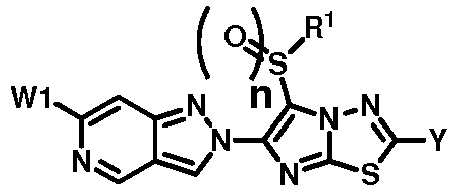


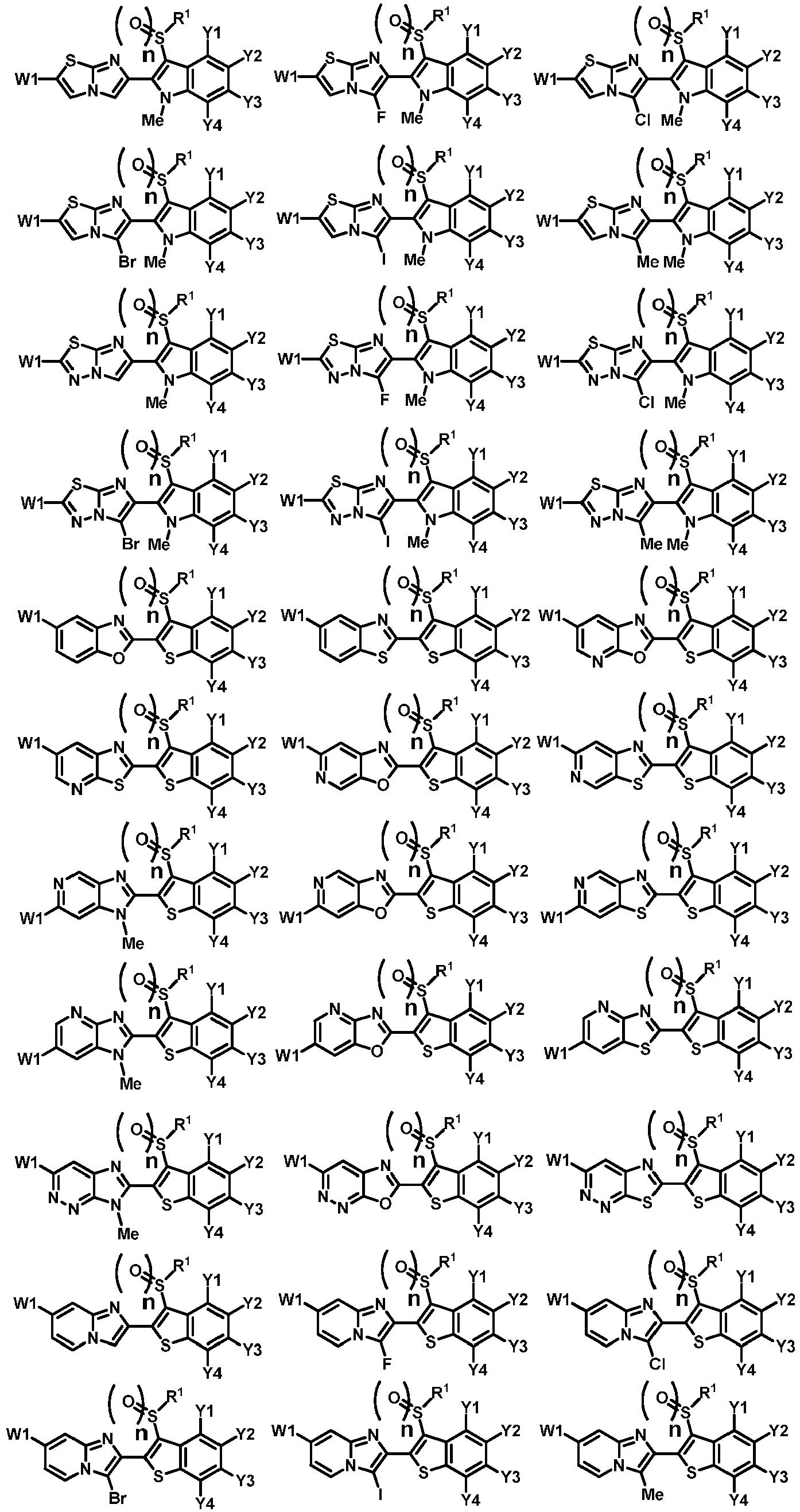

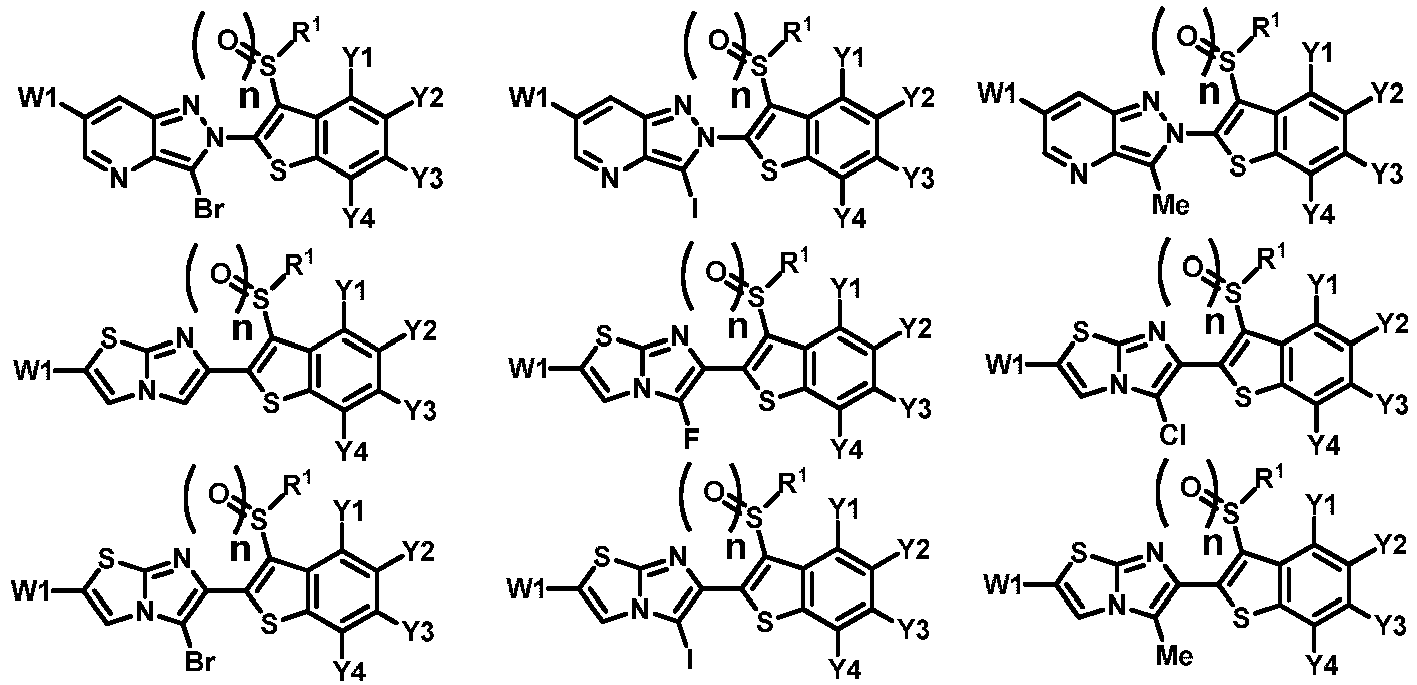


- The pesticides herein mean pesticides for controlling harmful arthropods in agricultural fields or in zootechnical/hygienic fields (internal/external parasites in or on mammals and birds as livestock and pets, and domestic or industrial hygienic insects/nuisance insects). Further, the agricultural chemicals herein mean insecticides/acaricides, nematicides, herbicides and fungicides in agricultural fields.
- The insects, mites, crustaceans, mollusks and nematodes that the compounds of the present invention can control specifically include the following organisms, but the present invention is not restricted thereto.
- Insects of the order Lepidoptera such as Adoxophyes honmai, Adoxophyes orana faciata, Archips breviplicanus, Archips fuscocupreanus, Grapholita molesta, Homona maqnanima, Leguminivora glycinivorella, Matsumuraeses phaseoli, Pandemis heparana, Bucculatrix pyrivorella, Lyonetia clerkella, Lyonetia prunifoliella malinella, Caloptilia theivora, Phyllonorycter ringoniella, Phyllocnistis citrella, Acrolepiopsis sapporensis, Acrolepiopsis suzukiella, Plutella xylostella, Stathmopoda masinissa, Helcystogramma triannulella, Pectinophora gossypiella, Carposina sasakii, Cydla pomonella, Chilo suppressalis, Cnaphalocrocis medinalis, Conogethes punctiferalis, Diaphania indica, Etiella zinckenella, Glyphodes pyloalis, Hellula undalis, Ostrinia furnacalis, Ostrinia scapulalis, Ostrinia nubilalis, Parapediasia teterrella, Parnara guttata, Pieris brassicae, Pieris rapae crucivora, Ascotis selenaria, Pseudoplusia includens, Euproctis pseudoconspersa, Lymantria dispar, Orgvia thyellina, Hyphantria cunea, Lemyra imparilis, Adris tyrannus, Aedia leucomelas, Agrotis isilon, Agrotis segetum, Autoarapha nigrisigna, Ctenoplusia agnata, Helicoverpa armigera, Helicoverpa assulta, Helicoverpa zea, Heliothis virescens, Mamestra brassicae, Mythimna separata, Naranga aenescens, Spodoptera eridania, Spodoptera exigua, Spodoptera frugiperda, Spodoptera littoralis, Spodoptera litura, Spodoptera depravata, Trichoplusia ni, Endopiza viteana, Manduca quinquemaculata and Manduca sexta.
- Insects of the order Thysanoptera such as Frankliniella intonsa, Frankliniella occidentalis, Heliothrips haemorrhoidalis, Scirtothrips dorsalis, Thrips palmi, Thrips tabaci and Ponticulothrips diospyrosi.
- Insects of the order Hemiptera such as Dolycoris baccarum, Eurydema rugosum, Eysarcoris aeneus, Eysarcoris lewisi, Eysarcoris ventralis, Glaucias subpunctatus, Halyomorpha halys, Nezara antennata, Nezara viridula, Piezodorus hybneri, Plautia crossota, Scotinophora lurida, Cletus punctiger, Leptocorisa chinensis, Riptortus clavatus, Rhopalus msculatus, Cavelerius saccharivorus, Togo hemipterus, Dysdercus cingulatus, Stephanitis pyrioides, Halticus insularis, Lygus lineolaris, Stenodema sibiricum, Stenotus rubrovittatus, Trigonotylus caelestialium, Arboridia apicalis, Balclutha saltuella, Epiacanthus stramineus, Empoasca fabae, Empoasca nipponica, Empoasca onukii, Empoasca sakaii, Macrosteles striifrons, Nephotettix cinctinceps, Psuedatomoscelis seriatus, Laodelphax striatella, Nilaparvata lugens, Sogatella furcifera, Diaphorina citri, Psylla pyrisuga, Aleurocanthus spiniferus, Bemisia argentifolii, Bemisia tabaci, Dialeurodes citri, Trialeurodes vaporariorum, Viteus vitifolii, Aphis ogssypii, Aphis spiraecola, Myzus persicae, Toxoptera aurantii, Drosicha corpulenta, Icerya purchasi, Phenacoccus solani, Planococcus citri, Planococcus kuraunhiae, Pseudococcus comstocki, Ceroplastes ceriferus, Ceroplastes rubens, Aonidiella aurantii, Comstockaspis perniciosa, Fiorinia theae, Pseudaonidia paeoniae, Pseudaulacaspis pentagona, Pseudaulacaspis prunicola, Unaspis euonymi, Unaspis yanonensis and Cimex lectularius.
- Insects of the order Coleoptera such as Anomala cuprea, Anomala rufocuprea, Gametis jucunda, Heptophylla picea, Popillia japonica, Lepinotarsa decemlineata, Melanotus fortnumi, Melanotus tamsuyensis, Lasioderma serricorne, Epuraea domina, Epilachna varivestis, Epilachna vigintioctopunctata, Tenebrio molitor, Tribolium castaneum, Anoplophora malasiaca, Monochamus alternatus, Psacothea hilaris, Xylotrechus pyrrhoderus, Callosobruchus chinensis, Aulacophora femoralis, Chaetocnema concinna, Diabrotica undecimpunctata, Diabrotica virgifera, Diabrotica barberi, Oulema oryzae, Phyllotreta striolata, Psylliodes angusticollis, Rhynchites heros, Cylas formicarius, Anthonomus grandis, Echinocnemus squameus, Euscepes postfasciatus, Hypera postica , Lissohoptrus oryzophilus, Otiorhynchus sulcatus, Sitophilus granarius, Sitophilus zeamais, Sphenophorus venatus vestitus and Paederus fuscipes.
- Insects of the order Diptera such as Asphondylia yushimai, Sitodiplosis mosellana, Bactrocera cucurbitae, Bactrocera dorsalis, Ceratitis capitata, Hydrellia griseola, Drosophila suzukii, Agromyza oryzae, Chromatomyia horticola, Liriomyza bryoniae, Liriomyza chinensis, Liriomyza sativae, Liriomyza trifolii, Delia platura, Pegomya cunicularia, Rhagoletis pomonella, Mayetiola destructor, Musca domestica, Stomoxys calcitrans, Melophagus ovinus, Hypoderma bovis, Hypoderma lineatum, Oestrus ovis, Glossina palpalis, Glossina morsitans, Prosimulium yezoensis, Tabanus trigonus, Telmatoscopus albipunctatus, Leptoconops nipponensis, Culex pipiens pallens, Aedes aegypti, Aedes albopicutus and Anopheles hyracanus sinesis.
- Insects of the order Hymenoptera such as Apethymus kuri, Athalia rosae, Arge pagana, Neodiprion sertifer, Dryocosmus kuriphilus, Eciton burchelli, Eciton schmitti, Camponotus japonicus, Vespa mandarina, Myrmecia spp., Solenopsis spp. and Monomorium pharaonis.
- Insects of the order Orthoptera such as Teleogryllus emma, Gryllotalpa orientalis, Locusta migratoria, Oxya yezoensis and Schistocerca gregaria.
- Insects of the order Collembola such as Onychiurus folsomi, Onychiurus sibiricus and Bourletiella hortensis.
- Insects of the order Dictyoptera such as Periplaneta fuliginosa, Periplaneta japonica and Blattella germanica.
- Insects of the order Isoptera such as Coptotermes formosanus, Reticulitermes speratus and Odontotermes formosanus.
- Insects of the order Siphonaptera such as Ctenocephalidae felis, Ctenocephalides canis, Echidnophaga gallinacea, Pulex irritans and Xenopsylla cheopis.
- Insects of the order Mallophaga such as Menacanthus stramineus and Bovicola bovis.
- Insects of the order Anoplura such as Haematopinus eurysternus, Haematopinus suis, Linognathus vituli and Solenopotes capillatus.
- Tarsonemidae mites such as Phytonemus pallidus, Polyphagotarsonemus latus and Tarsonemus bilobatus.
- Eupodidae mites such as Penthaleus erythrocephalus and Penthaleus major.
- Tetranychidae mites such as Oligonychus shinkajii, Panonychus citri, Panonychus mori, Panonychus ulmi, Tetranychus kanzawai and Tetranychus urticae.
- Eriophyidae mites such as Acaphylla theavagrans, Aceria tulipae, Aculops lycopersici, Aculops pelekassi, Aculus schlechtendali, Eriophyes chibaensis and Phyllocoptruta oleivora.
- Acaridae mites such as Rhizoglyphus robini , Tyrophagus putrescentiae and Tyrophagus similis.
- Bee mites such as Varroa jacobsoni.
- Ticks such as Boophilus microplus, Rhipicephalus sanguineus, Haemaphysalis longicornis, Haemophysalis flava, Haemophysalis campanulata, Ixodes ovatus, Ixodes persulcatus, Amblyomma spp.and Dermacentor spp.
- Mites of the suborder Mesostigmata such as red mite (Dermanyssus gallinae), tropical rat mite (Ornithonyssus bacoti) and northern fowl mite (Ornithonyssus sylviarum).
- Cheyletidae mites such as Cheyletiella yasguri and Cheyletiella blakei.
- Demodicidae mites such as Demodex canis and Demodex cati.
- Psoroptidae mites such as Psoroptes ovis.
- Sarcoptidae mites such as Sarcoptes scabiei, Notoedres cati and Knemidocoptes spp.
- Crustaceans such as Armadillidium vulgare.
- Gastropods such as Pomacea canaliculata, Achatina fulica, Meghimatium bilineatum, Limax Valentiana, Acusta despecta sieboldiana and Euhadra peliomphala.
- Nematodes such as Prathylenchus coffeae, Prathylenchus penetrans, Prathylenchus vulnus, Globodera rostochiensis, Heterodera glycines, Meloidogyne hapla, Meloidogyne incognita, Aphelenchoides besseyi and Bursaphelenchus xylophilus.
- Adult flies such as horn fly (Haematobia irritans), horse fly (Tabanus spp.), Stomoxys calcitrans, blackfly (Simulium spp.), deer fly (Chrysops spp.), louse fly (Melophagus ovinus) and tsetse fly (Glossina spp.).
- Parasitic worms such as sheep bot fly (Oestrus ovis, Cuterebra spp.), blowfly (Phaenicia spp.), screwworm (Cochliomyia hominivorax), warble fly (Hypoderma spp.), fleeceworm and Gastrophilus.
- Mosquitos such as Culex spp., Anopheles spp. and Aedes spp.
- The internal, livestock, poultry or pet parasites that the compounds of the present invention can control specifically include the following internal pests, but the present invention is not restricted thereto.
- Nematodes of the genera Haemonchus, Trichostronaylus, Ostertagia, Nematodirus, Cooperia, Ascaris, Bunostomum, Oesophagostomum, Chabertia, Trichuris, Storongylus, Trichonema, Dictyocaulus, Capillaria, Heterakis, Toxocara, Ascaridia, Oxyuris, Ancylostoma, Uncinaria, Toxascaris, Parascaris, and the like.
- Nematodes of the family Filariidae such as the genera Wuchereria, Brugia, Onchoceca, Dirofilaria, Loa, and the like.
- Nematodes of the family Dracunculidae such as the genus Dracunculus.
- Cestodes such as Dipylidium caninum, Taenia taeniaeformis, Taenia solium, Taenia saginata, Hymenolepis diminuta, Moniezia benedeni, Diphyllobothrium latum, Diphyllobothrium erinacei, Echinococcus granulosus and Echinococcus multilocularis.
- Trematodes such as Fasciola hepatica, F.gigantica, Paragonimus westermanii, Fasciolopsic bruski, Eurytrema pancreaticum, E.coelomaticum, Clonorchis sinensis, Schistosoma japonicum, Schistosoma haematobium and Schistosoma mansoni.
- Eimeria spp. such as Eimeria tenella, Eimeria acervulina, Eimeria brunetti, Eimeria maxima, Eimeria necatrix, Eimeria bovis and Eimeria ovinoidalis.
- Trypanosomsa cruzi, Leishmania spp., Plasmodium spp., Babesis spp., Trichomonadidae spp., Histomanas spp., Giardia spp., Toxoplasma spp., Entamoeba histolytica and Theileria spp.
- The compounds of the present invention are effective against pests that have acquired resistance to conventional insecticides such as organic phosphorus compounds, carbamate compounds or pyrethroid compounds.
- That is, the compounds of the present invention can effectively control pests such as insects of the order Collembola, the order Dictyoptera, the order Orthoptera, the order Isoptera, the order Thysanoptera, the order Hemiptera, the order Lepidoptera, the order Coleoptera, the order Hymenoptera, the order Diptera, the order Aphaniptera, the order Anoplura, Acari, gastropods and nematodes at low doses. On the other hand, the compounds of the present invention have a quite advantageous feature that they are almost harmless to mammals, fishes, crustaceans and beneficial insects (useful insects such as honey bees and bumblebees and natural enemies such as aphelinids, Aphidiinae, tachina flies, Orius spp., Phytoseiidae spp. etc.).
- The compounds of the present invention may be used in any dosage form such as a soluble concentrate, an emulsifiable concentrate, a wettable powder, a water soluble powder, a water dispersible granule, a water soluble granule, a suspension concentrate, a concentrated emulsion, a suspoemulsion, a microemulsion, a dustable powder, a granule, a tablet or an emulsifiable gel usually after mixed with an appropriate solid carrier or liquid carrier, and if necessary, with a surfactant, a penetrant, a spreader, a thickener, an anti-freezing agent, a binder, an anti-caking agent, a disintegrant, an antifoaming agent, a preservative, a stabilizer or the like. A formulation in an arbitrary dosage form may be sealed in water-soluble packaging such as a water-soluble capsule or a water-soluble film, for labor saving or improved safety.
- As solid carriers, natural minerals such as quartz, calcite, meerschaum, dolomite, chalk, kaolinite, pyrophyllite, sericite, halloysite, methahalloysite, kibushi clay, gairome clay, pottery stone, zeeklite, allophane, Shirasu, mica, talc, bentonite, activated clay, acid clay, pumice, attapulgite, zeolite and diatomaceous earth; calcined natural minerals such as calcined clay, pearlite, Shirasu-balloons, vermiculite, attapulgus clay and calcined diatomaceous earth; inorganic salts such as magnesium carbonate, calcium carbonate, sodium carbonate, sodium hydrogen carbonate, ammonium sulfate, sodium sulfate, magnesium sulfate, diammonium hydrogen phosphate, ammonium dihydrogen phosphate and potassium chloride, saccharides such as glucose, fructose, sucrose and lactose; polysaccharides such as starch, cellulose powder and dextrin; organic substances such as urea, urea derivatives, benzoic acid and benzoic acid salts; plants such as wood flour, powdered cork, corncob, walnut shell and tobacco stems, fly ash, white carbon (such as hydrated synthetic silica, anhydrous synthetic silica and hydrous synthetic silicate), fertilizers and the like may be mentioned.
- As liquid carriers, aromatic hydrocarbons such as xylene, alkyl (C9 or C10 etc.) benzene, phenylxylylethane and alkyl (C1 or C3 etc.) naphthalene; aliphatic hydrocarbons such as machine oil, normal paraffin, isoparaffin and naphthene; mixtures of aromatic hydrocarbons and aliphatic hydrocarbons such as kerosene; alcohols such as ethanol, isopropanol, cyclohexanol, phenoxyethanol and benzyl alcohol; polyhydric alcohols such as ethylene glycol, propylene glycol, diethylene glycol, hexylene glycol, polyethylene glycol and polypropylene glycol; ethers such as propyl cellosolve, butyl cellosolve, phenyl cellosolve, propylene glycol monomethyl ether, propylene glycol monoethyl ether, propylene glycol monopropyl ether, propylene glycol monobutyl ether and propylene glycol monophenyl ether; ketones such as acetophenone, cyclohexanone and γ-butyrolactone; esters such as fatty acid methyl esters, dialkyl succinates, dialkyl glutamate, dialkyl adipates and dialkyl phthalates; acid amides such as N- alkyl (C1, C8 or C12 etc.) pyrrolidone; fats and oils such as soybean oil, linseed oil, rapeseed oil, coconut oil, cottonseed oil and castor oil; dimethyl sulfoxide; water and the like may be mentioned.
- These solid and liquid carriers may be used alone or in combinations of two or more.
- As surfactants, nonionic surfactants such as polyoxyethylene alkyl ether, polyoxyethylene alkyl (mono or di) phenyl ether, polyoxyethylene(mono, di or tri)styrylphenyl ether, polyoxyethylenepolyoxypropylene block copolymers, polyoxyethylene fatty acid (mono or di) ester, sorbitan fatty acid ester, polyoxyethylene sorbitan fatty acid ester, ethylene oxide adducts of castor oil, acetylene glycol, acetylene alcohol, ethylene oxide adducts of acetylene glycol, ethylene oxide adducts of acetylene alcohol and alkyl glycosides; anionic surfactants such as alkyl sulfate salts, alkylbenzenesulfonic acid salts, lignin sulfonate, alkylsulfosuccinic acid salts, naphthalenesulfonic acid salts, alkylnaphthalenesulfonic acid salts, salts of naphthalenesulfonic acid-formalin condensates, salts of alkylnaphthalenesulfonic acid-formalin condensates, polyoxyethylene alkyl ether sulfate or phosphate salts, polyoxyethylene (mono or di) alkylphenyl ether sulfate or phosphate salts, polyoxyethylene (mono, di or tri) styrylphenyl ether sulfate or phosphate salts, polycarboxylic acid salts (such as polyacrylates, polymaleates and copolymers of maleic acid and an olefin) and polystyrenesulfonic acid salts; cationic surfactants such as alkylamine salts and alkyl quaternary ammonium salts; amphoteric surfactants such as amino acid types and betaine types, silicone surfactants; and fluorine surfactants may be mentioned.
- The amount of these surfactants is usually preferably from 0.05 to 20 parts by weight per 100 parts by weight of the agent of the present invention, though there is no particular restrictions. These surfactants may be used alone or in combination of two or more.
- The suitable application dose of the compounds of the present invention is generally about from 0.005 to 50 kg per hectare (ha) in terms of the active ingredient, though it varies depending on the application situation, the application season, the application method and the cultivated crop.
- When the compounds of the present invention are used to control external or internal parasites in or on mammals and birds as farm animals/poultry and pet animals, the compounds of the present invention may be administered in an effective amount together with pharmaceutically acceptable additives orally, parenterally by injection (intramuscular, subcutaneously, intravenously or intraperitoneally); percutaneously by dipping, spraying, bathing, washing, pouring-on and spotting-on and dusting, or intranasally. The compounds of the present invention may be administered through molded articles such as chips, plates, bands, collars, ear marks, limb bands and ID tags.
- The compounds of the present invention are administered in an arbitrary dosage form suitable for the administration route.
- In a case where the compounds of the present invention are used to control external or internal parasites, the suitable application dose of the compound of the present invention represented by the formula (1) as an active ingredient is generally from 0.01 to 100 mg/kg body weight, preferably from 0.01 to 50 mg/kg body weight of a target animal, though it varies depending on e.g. the type of pests to be controlled, the type of the target animal, or the application method. Particularly with respect to application to a dog, the suitable application dose is generally from 1 to 5,000 mg/kg body weight, preferably from 1 to 100 mg/g body weight of a target dog, though it varies depending on the type or the age of the target dog, or the external parasites to be controlled.
- In a case where the compounds of the present invention are used to control external or internal parasites, the application interval may be optionally set usually within a range of from daily to annually, though it varies dependeing on e.g. the type of pests to be controlled, the type of the target animal, or the application method. The application interval is preferably from once a week to every six months, more preferably daily (every 24 hours), monthly, once a month, every two months, or every three months.
- In a case where the compounds of the present invention are used to control external paracites on a dog, with respect to the timing of application of the compound of the present invention to the dog, the compound of the present invention may be orally administered to the dog 30 minutes before start of feeding or 120 minutes after completion of feeding. "30 minutes before start of feeding or 120 minutes after completion of feeding" here is based on an action of the dog to take nutritious food. For example, in a case where the dog feeding time is 20 minutes, the time specified is 30 minutes before start of feeding to 120 minutes after completion of feeding, that is, 170 minutes in total. A case where feeding is suspended, the compound of the present invention is orally administered and feeding is restarted, is included. In this specification, feeding means an action of an animal to take food.
- The number of feeding of a dug is usually three to four times a day in the case of a dog of less than six months old, twice to three times a day in the case of a dog of six months to less than one year old, twice a day in the case of an adult dog of about one to five years old, and twice to three times a day in the case of an old dog of 6 years old or older, though it varies depending on the type or the age of the dog or the habit. In the present invention, feeding means an action of an animal to take nutritious food, and does not include an action to give food and the like to a dog for training or breeding.
- The dosage form may be a solid preparation such as dusts, granules, wettable powders, pellets, tablets, boluses, capsules and a molded article containing an active ingredient; a liquid preparation such as an injection fluid, an oral liquid, a liquid preparation applied to the skin or coelom; a solution preparation such as a pour-on preparation, a spot-on preparation, flowables and emulsions; and a semisolid preparation such as an ointment and gels.
- In a case where the compounds of the present invention are orally administered, the dosage form may, for example, be a solid preparation such as tablets, chewables, capsules, pills, boluses, granules and powders; a semisolid preparation such as pastes and gels; and a liquid preparation such as drinks.
- In the case of percutaneous administeration, the dosage form may, for example, be a solid preparation such as powders; a semisolid preparation such as a cream, a salve and ointment, pastes and gels; and a liquid preparation such as a spary, aerosols, solutions and emulsions, suspensions, and lotions.
- Further, in the case of administration by injection, the dosage form may, for example, be a liquid preparation such as solutions and emulsions, and suspensions, and in the case of intranasal administration, the dosage form may, for example, be a liquid preparation such as aerosols. In the case of spraying over an environment where animals are bred, such as a stable, the dosage form may, for example, be a solid preparation such as wettale powders, dusts or granules; and a liquid preparation such as emulsions and suspension concentrates.
- The formulation to be used for parasiticides of the present invention is not limited to such dosage forms.
- The solid preparation may be orally administered as it is, or may be percutaneously administered or sprayed over an environment where animals are bred, such as a stable, after dilution with water.
- The solid preparation to be orally administered, may be prepared by mixing the compound represented by the formula (1) or its salt and one or more vehicles or binders suitable for oral administration, and as the case requires, physiologically acceptable additives such as a lubricant, a disintegrant, a dye and a pigment, and forming the mixture into a desired shape.
- The vehicle and the binder may, for example, be a saccharide or saccharide derivative such as lactose, sucrose, mannitol or sorbitol; a starch such as corn starch, wheat startch, rice starch or potato starch; a cellulse or cellulose derivative such as methyl cellulose, carboxymethyl cellulose, hydroxyethyl cellulose, hydroxypropyl cellulose or hydroxypropylmethyl cellulose; a protein or protein derivative such as zein or gelatin; honey, gum arabic glue, or a synthetic polymer compound such as polyvinyl alcohol or polyvinyl pyrolidone.
- The lubricant may, for example, be magnesium stearate, and the disintegrant may, for example, be cellulose, agar, alginic acid, crosslinked polyvinyl pyrrolidone or a carbonate.
- Among solid preparations to be orally administered, in the case of a solid formulation such as chewables, additives which impart a taste, texture or flavor desired by amimals to which the preparation is to be administered, may be used. The carriers and addtives to be used for the solid preparation of the parasiticidal composition of the present invention are not limited thereto.
- The liquid preparation may be administered percutaneously or by injection as it is, or may be administered orally by being mixed with food, percutaneously administered after being diluted with water, or sprayed to an enviorment where animals are bred, such as a stable.
- An injection fluid may be administered intravenously, intramuscularly or subcutaneously. An injection fluid can be prepared by dissolving an active ingredient in an appropriate solvent and, if necessary, adding additives such as a solubilizer, an acid, a base, a buffering salt, an antioxidant and a protectant.
- As appropriate solvents, water, ethanol, butanol, benzyl alcohol, glycerin, propylene glycol, polyethylene glycol, N-methylpyrrolidone and mixtures thereof, physiologically acceptable vegetable oils, and synthetic oils suitable for injection may be mentioned.
- As solubilizers, polyvinylpyrrolidone, polyoxyethylated castor oil, polyoxyethylated sorbitan ester and the like may be mentioned.
- As protectants, benzyl alcohol, trichlorobutanol, p-hydroxybenzoic acid esters, n-butanol and the like may be mentioned.
- An oral liquid may be administered directly or after dilution and can be prepared in the same manner as an injection fluid.
- A flowable, an emulsion or the like may be administered directly or after dilution percutaneously or by environmental application.
- A liquid preparation applied to the skin is administered by dripping, spreading, rubbing, spraying, sprinkling or dipping (soaking, bathing or washing) and can be prepared in the same manner as an injection fluid.
- A pour-on preparation and a spot-on preparation are dripped or sprayed to a limited area of the skin so that they permeate through the skin and act systemically. A pour-on preparation and a spot-on preparation can be prepared by dissolving, suspending or emulsifying an active ingredient in an appropriate skin-friendly solvent or solvent mixture. If necessary, additives such as a surfactant, a colorant, an absorbefacient, an antioxidant, a light stabilizer and an adhesive may be added.
- As appropriate solvents, water, alkanol, glycol, polyethylene glycol, polypropylene glycol, glycerin, benzyl alcohol, phenylethanol, phenoxyethanol, ethyl acetate, butyl acetate, benzyl benzoate, dipropylene glycol monomethyl ether, diethylene glycol monobutyl ether, acetone, methyl ethyl ketone, aromatic and/or aliphatic hydrocarbons, vegetable or synthetic oils, DMF (N,N-dimethylformamide), liquid paraffin, light liquid paraffin, silicone, dimethylacetamide, N-methylpyrrolidone or 2,2-dimethyl-4-oxymethylene-1,3-dioxolane may be mentioned.
- As absorbefacients, DMSO (dimethyl sulfoxide), isopropyl myristate, pelargonic acid dipropylene glycol, silicone oil, fatty acid esters, triglycerides and aliphatic alcohols may be mentioned.
- As antioxidants, sulfites, metabisulfites, ascorbic acid, butylhydroxytoluene, butylhydroxyanisole and tocopherol may be mentioned.
- An emulsion may be administered orally, percutaneously or by injection. An emulsion can be prepared by dissolving an active ingredient in a hydrophobic phase or a hydrophilic phase and homogenizing the resulting solution with another liquid phase together with an appropriate emulsifier, and further if necessary with additives such as a colorant, an absorbefacient, a protectant, an antioxidant, a light screen and a thickner.
- As hydrophobic phases (oils), paraffin oil, silicone oil, sesame oil, almond oil, castor oil, synthetic triglycerides, ethyl stearate, di-n-butyryl adipate, hexyl laurate, pelargonic acid dipropylene glycol, esters of branched short-chain fatty acids with C16-C18 saturated fatty acids, isopropyl myristate, isopropyl palmitate, esters of C12-C18 saturated alcohols with caprylic/capric acid, isopropyl stearate, oleyl oleate, decyl oleate, ethyl oleate, ethyl lactate, fatty acid ester waxes, dibutyl phthalate, diisopropyl adipate, isotridecyl alcohol, 2-octyldodecanol, cetylstearyl alcohol and oleyl alcohol may be mentioned.
- As hydrophilic phases, water, propylene glycol, glycerin and sorbitol may be mentioned.
- As emulsifiers, nonionic surfactants such as polyoxyethylated castor oil, polyoxyethylated sorbitan monoolefinic acid, sorbitan monostearate, glycerin monostearate, polyoxyethyl stearate and alkyl phenol polyglycol ether; amphoteric surfactants such as disodium N-lauryl-β-iminodipropionate and lecithin; anionic surfactants such as sodium lauryl sulfate, aliphatic alcohol sulfate ether and mono/dialkylpolyglycol orthophosphate monoethanolamine salt; and cationic surfactants such as cetyltrimethylammonium chloride may, for example, be mentioned.
- As other additives, carboxymethylcellulose, methylcellulose, polyacrylate, alginate, gelatin, gum arabic, polyvinylpyrrolidone, polyvinyl alcohol, methyl vinyl ether, maleic anhydride copolymers, polyethylene glycol, waxes and colloidal silica may be mentioned.
- A semisolid preparation is administered by applying or spreading onto the skin or introducing into the coelom. A gel can be prepared by adding a thickener to a solution prepared in the same manner as an injection fluid sufficiently to give a transparent viscous substance like an ointment.
- Next, Formulation Examples of preparations using the compounds of the present invention are given below. However, formulations of the present invention are by no means restricted thereto. In the following Formulation Examples, "parts" means parts by weight.
-
Compound of the present invention 0.1 to 80 parts Solid carrier 5 to 98.9 parts Surfactant 1 to 10 parts Others 0 to 5 parts - As the others, an anti-caking agent, a stabilizer and the like may be mentioned.
-
Compound of the present invention 0.1 to 30 parts Liquid carrier 45 to 95 parts Surfactant 4.9 to 15 parts Others 0 to 10 parts - As the others, a spreader, a stabilizer and the like may be mentioned.
-
Compound of the present invention 0.1 to 70 parts Liquid carrier 15 to 98.89 parts Surfactant 1 to 12 parts Others 0.01 to 30 parts - As the others, an anti-freezing agent, a thickener and the like may be mentioned.
-
Compound of the present invention 0.1 to 90 parts Solid carrier 0 to 98.9 parts Surfactant 1 to 20 parts Others 0 to 10 parts - As the others, a binder, a stabilizer and the like may be mentioned.
-
Compound of the present invention 0.01 to 70 parts Liquid carrier 20 to 99.99 parts Others 0 to 10 parts - As the others, an anti-freezing agent, a spreader and the like may be mentioned.
-
Compound of the present invention 0.01 to 80 parts Solid carrier 10 to 99.99 parts Others 0 to 10 parts - As the others, a binder, a stabilizer and the like may be mentioned.
-
Compound of the present invention 0.01 to 30 parts Solid carrier 65 to 99.99 parts Others 0 to 5 parts - As the others, an anti-drift agent, a stabilizer and the like may be mentioned.
- Next, more specific Formulation Examples of preparations containing the compounds of the present invention as an active ingredient are given below. However, the present invention is by no means restricted thereto.
- In the following Formulation Examples, "parts" means parts by weight.
-
Compound No.1-1-001a of the present invention 20 parts Pyrophyllite 74 parts Sorpol 5039 4 parts CARPLEX #80D 2 parts - The above ingredients are mixed and pulverized homogenously to obtain a wettable powder.
-
Compound No.1-1-001a of the present invention 5 parts Xylene 75 parts N-methylpyrrolidone 15 parts Sorpol 2680 5 parts - The above ingredients are mixed homogenously to obtain an emulsifiable concentrate.
-
Compound No.1-1-001a 25 parts AGRISOL S-710 10 parts Runox1000C 0.5 part Xanthan gum 0.2 part Water 64.3 parts - The above ingredients are mixed homogenously and wet-pulverized to obtain a suspension concentration.
-
Compound No. 1-1-001 a of the present invention 75 parts HITENOL NE-15 5 parts VANILLEX N 10 parts CARPLEX #80D 10 parts - The above ingredients are mixed and pulverized homogenously, then kneaded with a small amount of water, granulated through an extrusion granulator and dried to obtain a water dispersible granule.
-
Compound No. 1-1-001 a of the present invention 5 parts Bentonite 50 parts Talc 45 parts - The above ingredients are mixed and pulverized homogenously, then kneaded with a small amount of water, granulated through an extrusion granulator and dried to obtain a granule.
-
Compound No. 1-1-001 a of the present invention 3 parts CARPLEX #80D 0.5 part Kaolinite 95 parts Diisopropyl phosphate 1.5 parts - The above ingredients are mixed and pulverized homogeneously to obtain a dustable powder.
- It is applied after diluted with water by a factor of from 1 to 10000 or directly without dilution.
-
Compound No. 1-1-001 a of the present invention 25 parts Sodium diisobutylnaphthalenesulfonate 1 part Calcium n-dodecylbenzenesulfonate 10 parts Alkyl aryl polyglycol ether 12 parts Naphthalenesulfonic acid-formalin condensate sodium salt 3 parts Silicone emulsion 1 part Silicon dioxide 3 parts Kaolin 45 parts -
Compound No. 1-1-001 a of the present invention 20 parts Polyoxyethylenelauryl ether 3 parts Sodium dioctylsulfosuccinate 3.5 parts Dimethyl sulfoxide 37 parts 2-Propanol 36.5 parts -
Compound No. 1-1-001 a of the present invention 2 parts Dimethyl sulfoxide 10 parts 2-Propanol 35 parts Acetone 53 parts -
Compound No. 1-1-001 a of the present invention 5 parts Hexylene glycol 50 parts Isopropanol 45 parts -
Compound No. 1-1-001 a of the present invention 5 parts Propylene glycol monomethyl ether 50 parts Dipropylene glycol 45 parts -
Compound No. 1-1-001 a of the present invention 2 parts Light liquid paraffin 98 parts -
Compound No. 1-1-001 a of the present invention 2 parts Light liquid paraffin 58 parts Olive oil 30 parts ODO-H 9 parts Shin-etsu silicone 1 part - For use as agricultural chemicals, the compounds of the present invention may be mixed with other herbicides, insecticides, acaricides, nematocides, fungicides, plant growth regulators, synergists, fertilizers, soil conditioners and the like at the time of formulation or application.
- Particularly, the combined use with other agricultural chemicals or plant hormone is expected to reduce the cost by enabling control at lower doses, to broaden the insecticidal spectrum by the synergistic effect of the other agrochemicals, and to achieve a higher pesticidal effect. In such cases, they may be combined with a plurality of known agricultural chemicals.
- The agricultural chemicals to be used in combination with the compounds of the present invention include, for example, the compounds disclosed in e.g. The Pesticide Manual, 15th edition, 2009, having the generic names listed below, but are not necessarily restricted thereto.
- Fungicides: acibenzolar-S-methyl, acylaminobenzamide, acypetacs, aldimorph, ametoctradin, amisulbrom, amobam, ampropyfos, anilazine, azaconazole, azithiram, azoxystrobin, barium polysulfide, benalaxyl, benalaxyl-M, benodanil, benomyl, benquinox, bentaluron, benthiavalicarb-isopropyl, benthiazole, benzamacril, benzamorf, benzovindiflupyr, bethoxazine, binapacryl, biphenyl, bitertanol, blasticidin-S, bixafen, bordeaux mixture, boscalid, bromuconazole, bupirimate, buthiobate, calcium polysulfide, calcium polysulfide, captafol, captan, carpropamid, carbamorph, carbendazim, carboxin, carvone, cheshunt mixture, chinomethionat, chlobenthiazone, chloraniformethane, chloranil, chlorfenazol, chloroneb, chloropicrin, chlorothalonil, chlorquinox, chlozolinate, climbazole, clotrimazole, copper acetate, copper carbonate, basic, copper hydroxide, copper naphthenate, copper oleate, copper oxychloride, copper sulfate, copper sulfate, basic, copper zinc chromate, cufraneb, coumoxystrobin, cuprobam, cyazofamid, cyclafuramid, cycloheximide, cyflufenamid, cymoxanil, cypendazole, cyproconazol, cyprodinil, cyprofuram, dazomet, debacarb, decafentin, dehydroacetic acid, dichlofluanid, dichlone, dichlorophen, dichlozoline, diclobutrazol, diclocymet, diclomedine, dicloran, etc.
- Fungicides (continued): diethofencarb, difenoconazole, diflumetorim, dimethirimol, dimethomorph, dimoxystrobin, diniconazole, diniconazole-M, dinobuton, dinocap, dinocap-4, dinocap-6, dinocton, dinosulfon, dinoterbon, diphenylamine, dipymetitrone, dipyrithione, ditalimfos, dithianon, dodemorph-acetate, dodine, drazoxolon, edifenphos, enestrobin, enoxastrobin, epoxiconazole, etaconazole, ethaboxam, etem, ethirimol, ethoxyquin, etridiazole, famoxadone, fenarimol, fenbuconazole, fenamidone, fenaminosulf, fenaminstrobin, fenapanil, fendazosulam, fenfuram, fenhexamid, fenitropan, fenoxanil, fenpiclonil, fenpropidin, fenpyrazamine, fenpropimorph, fentin, ferbam, ferimzone, fluazinam, fludioxonil, flufenoxystrobin, flumetover, flumorph, fluopicolide, fluopyram, fluoroimide, fluotrimazole, fluoxastrobin, fluquinconazole, flusilazole, flusulfamide, flutianil, flutolanil, flutriafol, fluxapyroxad, folpet, fosetyl-aluminium, fuberidazole, furalaxyl, furametpyr, furcarbanil, furconazole, furconazole-cis, furmecyclox, furphanate, glyodin, griseofulvin, guazatine, halacrinate, hexachlorobenzene, hexaconazole, hexylthiofos, 8-hydroxyquinoline sulfate, hymexazol, imazalil, imibenconazole, iminoctadine-albesilate, iminoctadine-triacetate, ipconazole, iprobenfos, iprodione, iprovalicarb, isofetamid, isoprothiolane, isopyrazam, isotianil, isovaledione, etc.
- Fungicides (continued): kasugamycin, kresoxim-methyl, laminarin, mancopper, mancozeb, mandestrobin, mandipropamid, maneb, mebenil, mecarbinzid, mepanipyrim, meptyldinocap, mepronil, metalaxyl, metalaxyl-M, metam, metazoxolon, metconazole, methasulfocarb, methfuroxam, methyl isothiocyanate, metiram, metominostrobin, metrafenone, metsulfovax, milneb, myclobutanil, myclozolin, nabam, natamycin, nickel bis(dimethyldithiocarbamate), nitrostyrene, nitrothal-isopropyl, nuarimol, OCH, octhilinone, ofurace, orysastrobin, oxathiapiprolin, oxadixyl, oxine copper, oxycarboxin, oxpoconazole fumarate, pefurzoate, penconazole, penflufen, pencycuron, penthiopyrad, o-phenylphenol, phosdiphen, phthalide, picarbutrazox, picoxystrobin, piperalin, polycarbamate, polyoxins, polyoxorim, potassium azide, potassium hydrogen carbonate, proquinazid, probenazole, prochloraz, procymidone, propamocarb hydrochloride, propiconazole, propineb, prothiocarb, prothioconazole, pydiflumetofen, pyracarbolid, pyraclostrobin, pyrametostrobin, pyraoxystrobin, pyraziflumid, pyrazophos, pyribencarbmethyl, pyridinitril, pyrifenox, pyrimethanil, pyriminostrobin, pyrimorph, pyriofenone, pyrisoxazole, pyroquilon, pyroxychlor, pyroxyfur, quinomethionate, quinoxyfen, quintozene, quinacetol-sulfate, quinazamid, quinconazole, rabenzazole, Bacillus subtilis (Strain:D747, FZB24, GBO3, HAI0404, MBI600, QST713, Y1336, etc.), etc.
- Fungicides (continued): sedaxane, sodium azide, sodium hydrogen carbonate, sodium hypochlorite, sulfur, spiroxamine, salycylanilide, silthiofam, simeconazole, tebuconazole, tebufloquin, tecnazene, tecoram, tetraconazole, thiabendazole, thiadifluor, thicyofen, thifluzamide, thiochlorfenphim, thiophanate, thiophanate-methyl, thioquinox, thiram, tiadinil, tioxymid, tolclofos-methyl, tolprocarb, tolylfluanid, triadimefon, toriadimenol, triamiphos, triarimol, triazoxide, triazbutil, tributyltin oxide, trichlamide, tricyclazole, tridemorph, trifloxystrobin, triflumizole, triforine, triclopyricarb, triticonazole, validamycin, valifenalate, vinclozolin, zarilamide, zinc sulfate, zineb, ziram, zoxamide, shiitake mushroom mycelium extracts, shiitake mushroom fruiting body extracts, ZF-9646 (test name), NF-180 (test name), MIF-1002 (test name), S-2399 (test name), AKD-5195 (test name), NNF-0721 (test name), etc.
- Bactericides: benzalkonium chloride, bithionol, bronopol, cresol, formaldehyde, nitrapyrin, oxolinic acid, oxyterracycline, streptomycin, tecloftalam, etc.
- Nematicides: aldoxycarb, benclothiaz, cadusafos, DBCP, dichlofenthion, DSP, ethoprophos, fenamiphos, fensulfothion, fluazaindolizine, fluensulfone, fosthiazate, fosthietan, imicyafos, isamidofos, isazofos, oxamyl, thiaxazafen, thionazin, tioxazafen, BYI-1921 (test name), MAI-08015 (test name), etc.
- Acaricides: acequinocyl, acrinathrin, amidoflumet, amitraz, azocyclotin, BCI-033 (test name), benzoximate, bifenazate, bromopropylate, chinomethionat, chlorobezilate, clofentezine, cyenopyrafen, cyflumetofen, cyhexatine, dicofol, dienochlor, diflovidazin, DNOC, etoxazole, fenazaquin, fenbutatin oxide, fenothiocarb, fenpropathrin, fenpyroximate, fluacrypyrim, halfenprox, hexythiazox, milbemectin, propargite, pyflubumide, pyridaben, pyrimidifen, S-1870 (test name), spirodiclofen, spyromesifen, CL900167 (test name), tebufenpyrad, NA-89 (test name), etc.
- Insecticides: abamectin, acephate, acetamipirid, afidopyropen, afoxolaner, alanycarb, aldicarb, allethrin, azamethiphos, azinphos-ethyl, azinphos-methyl, bacillus thuringiensis, bendiocarb, benfluthrin, benfuracarb, bensultap, bifenthrin, bioallethrin, bioresmethrin, bistrifluron, broflanilide, buprofezin, butocarboxim, carbaryl, carbofuran, carbosulfan, cartap, chlorantraniliprole, chlorethxyfos, chlorfenapyr, chlorfenvinphos, chlorfluazuron, chlormephos, chloroprallethrin, chlorpyrifos, chlorpyrifos-methyl, chromafenozide, clothianidin, cyanophos, cyantraniliprole, cyclaniliprole, cycloprothrin, cyflumetofen, cyfluthrin, beta-cyfluthrin, cyhalodiamide, cyhalothrin, lambda-cyhalothrin, cypermethrin, alpha-cypermethrin, beta-cypermethrin, zeta-cypermethrin, cyphenothrin, cyromazine, deltamethrin, diacloden, diafenthiuron, diazinon, dicloromezotiaz, dichlorvos, diflubenzuron, dimefluthrin, dimethylvinphos, dinotefuran, diofenolan, disulfoton, dimethoate, emamectin-benzoate, empenthrin, endosulfan, alpha-endosulfan, EPN, esfenvalerate, ethiofencarb, ethiprole, etofenprox, etrimfos, fenitrothion, fenobucarb, fenoxycarb, fenpropathrin, fenthion, fenvalerate, fipronil, flonicamid, fluazuron, flubendiamide, flucycloxuron, flucythrinate, flufenerim, flufenoxuron, flufenprox, flumethrin, fluralaner, fluvalinate, tau-fluvalinate, fonophos, formetanate, formothion, furathiocarb, flufiprole, fluhexafon, flupyradifurone, flometoquin, etc.
- Insecticides (continued): gamma-cyhalothrin, halofenozide, heptafluthrin, hexaflumuron, hydramethylnon, imidacloprid, imiprothrin, isofenphos, indoxacarb, indoxacarb-MP, isoprocarb, isoxathion, kappa-bifenthrin, kappa-tefluthrin, lepimectin, lufenuron, malathion, meperfluthrin, metaflumizone, metaldehyde, methamidophos, methidathion, methacrifos, metalcarb, methomyl, methoprene, methoxychlor, methoxyfenozide, methyl bromide, epsilon-metofluthrin, metofluthrin, momfluorothrin, epsilon-momfluorothrin, monocrotophos, muscalure, nitenpyram, novaluron, noviflumuron, omethoate, oxamyl, oxydemeton-methyl, oxydeprofos, parathion, parathion-methyl, pentachlorophenol (PCP), permethrin, phenothrin, phenthoate, phoxim, phorate, phosalone, phosmet, phosphamidon, pirimicarb, pirimiphos-methyl, profenofos, profluthrin, prothiofos, propaphos, protrifenbute, pymetrozine, pyraclofos, pyrethrins, pyridalyl, pyrifluquinazon, pyriprole, pyrafluprole, pyriproxyfen, resmethrin, rotenone, SI-0405 (test name), sulprofos, silafluofen, spinetoram, spinosad, spiromesifen, spirotetramat, sulfoxaflor, sulfotep, SYJ-159 (test name), tebfenozide, teflubenzuron, tefluthorin, terbufos, tetrachlorvinphos, tetramethrin, d-tetramethrin, tetramethylfluthrin, tetraniliprole, thiacloprid, thiocyclam, thiodicarb, thiamethoxam, thiofanox, thiometon, tolfenpyrad, tralomethrin, transfluthrin, triazamate, trichlorfon, triazuron, triflumezopyrim, triflumuron, vamidothion, fluxametamide, MIE-1209 (test name), ME5382 (test name), etc.
- Now, the present invention will be described in further detail with reference to Examples of synthesis of and tests on the compounds of the present invention. However, the present invention is by no means restricted thereto.
- For the preparative medium pressure liquid chromatography described in Synthetic Examples and Reference Examples, a preparative medium pressure chromatograph YFLC-Wprep manufactured by Yamazen Science, Inc. (flow rate: 18 ml/min, 40-µm silica gel column) was used.
- Chemical shift values of proton nuclear magnetic resonance (NMR) in Synthetic Examples and Reference Examples were measured by using Me4Si (tetramethylsilane) as a standard substance at 300 MHz (ECX300 or ECP300 manufactured by JEOL Ltd.).
- Reference symbols in proton nuclear magnetic resonance chemical shift values have the following meanings.
- s: singlet, brs: broad singlet, d: doublet, dd: double doublet, t: triplet, q: quartet, and m: multiplet.
- Solvents used for NMR measurement are represented in brackets in the chemical shift value data.
- 82 mg of 6-(trifluoromethyl)pyrimidin-4-amine was dissolved in 5 ml of chlorobenzene, and 200 mg of 2-bromo-1-[3-(ethylsulfonyl)-7-(trifluoromethyl)imidazo[1,2-a]pyridin-2-yl]ethanone was added at room temperature. After the addition, the reaction mixture was stirred under reflux with heating for 9 hours. After the reaction, the reaction mixture was mixed with 10 ml of a 1 M sodium hydroxide aqueous solution and extracted with ethyl acetate (10 ml×2). The resulting organic layer was dehydrated with saturated aqueous sodium chloride and dried over anhydrous sodium sulfate, and the solvent was evaporated under reduced pressure. The resulting residue was purified by preparative medium pressure liquid chromatography using n-hexane/ethyl acetate [with a gradient of from 100:0 to 0:100 (volume ratio, the same applies hereinafter)] as the eluent to obtain 163.5 mg of the desired product as a flesh-colored solid.
Melting point: 235-237°C
1H-NMR(CDCl3) : δ9.38(d, J=7.5Hz, 1H), 9.19(s, 1H), 8.63(s, 1H), 8.12-8.09(m, 1H), 8.02-8.00(m, 1H), 7.28-7.23(m, 1H), 3.73(q, J=7.4Hz, 2H), 1.34(t, J=7.4Hz, 3H). - 856 mg of N2-methyl-5-(trifluoromethyl)pyridine-2,3-diamine was dissolved in 20 ml of pyridine, and 1.00 g of 3-(ethylthio)-7-(trifluoromethyl)imidazo[1,2-a]pyridine-2-carboxylic acid, 1.32 g of 1-ethyl-3-(3-dimethylaminopropyl)carbodiimide hydrochloride and 42 mg of 4-(dimethylamino)pyridine were added at room temperature. After the addition, the reaction mixture was stirred for 6 hours at room temperature. After the reaction, the solvent was evaporated under reduced pressure. The resulting residue was mixed with 10 ml of water and extracted with ethyl acetate (10 ml×2). The resulting organic layer was washed with a 1 M hydrochloric acid aqueous solution, and dehydrated with saturated aqueous sodium chloride and dried over anhydrous sodium sulfate, and the solvent was evaporated under reduced pressure to obtain 1.40 g of the desired crude product. The crude product was used in the next step without further purification.
- 1.40 g of the crude 3-(ethylthio)-N-[2-(methylamino)-5-(trifluoromethyl)pyridin-3-yl]-7-(trifluoromethyl)imidazo[1,2-a]pyridine-2-carboxamide obtained in Step 1 was dissolved in 15 ml of acetic acid, and the solution was stirred under reflux with heating for 2 hours. After the stirring, the reaction mixture was stirred at room temperature overnight. After the stirring, the solid precipitated in the reaction mixture was collected by filtration. The obtained solid was washed with diisopropyl ether to obtain 645 mg of the desired product as a white solid.
Melting point: 199-202°C
1H-NMR(CDCl3): δ8.78(d, J=7.2Hz, 1H), 8.73(d, J=1.5Hz, 1H), 8.40(d, J=2.0Hz, 1H), 8.06-8.04(m, 1H), 7.21 (dd, J=7.2, 1.5Hz, 1H), 4.33(s, 3H), 3.15(q, J=7.4Hz, 2H), 1.22(t, J=7.4Hz, 3H). - To a solution of 645 mg of 2-[3-(ethylthio)-7-(trifluoromethyl)imidazo[1,2-a]pyridin-2-yl]-3-methyl-6-(trifluoromethyl)-3H-imidazo[4,5-b]pyridine in 15 ml of chloroform, 961 mg of 65 weight% m-chloroperbenzoic acid (containing about 30 weight% of water) was added under cooling with ice. After the addition, the reaction mixture was stirred at room temperature for 2.5 hours. After the reaction, the reaction mixture was mixed with a saturated sodium thiosulfate aqueous solution and extracted with chloroform (10 ml). The resulting organic layer was washed with a 1 M sodium hydroxide aqueous solution and dried over anhydrous sodium sulfate, and the solvent was evaporated under reduced pressure. The resulting residue was purified by preparative medium pressure liquid chromatograph using n-hexane/ethyl acetate (with a gradient of from 100:0 to 50:50) as the eluent to obtain 660 mg of the desired product as a white solid.
Melting point: 203-205°C
1H-NMR(CDCl3) : δ9.42(d, J=7.5Hz, 1H), 8.77(s, 1H), 8.36(d, J=1.7Hz, 1H), 8.16(s, 1H), 7.32(dd, J=7.5, 1.7Hz, 1H), 4.18(s, 3H), 4.11 (q, J=7.5Hz, 2H), 1.47(t, J=7.5Hz, 3H). - 466 mg of 2-amino-4-[(trifluoromethyl)thio]phenol was dissolved in 10 ml of pyridine, and 356 mg of 3-(ethylthio)-6-(trifluoromethyl)imidazo[1,2-a]pyridine-2-carboxylic acid, 471 mg of 1-ethyl-3-(3-dimethylaminopropyl)carbodiimide hydrochloride and 75 mg of 4-(dimethylamino)pyridine were added. After the addition, the reaction mixture was stirred at room temperature overnight. After the reaction, the solvent was evapoarated under reduced pressure. The resulting residue was purified by preparative medium pressure liquid chromatography using n-hexane/ethyl acetate (with a gradient of from 100:0 to 0:100) as the eluent to obtain 100 mg of the desired product as a reddish brown solid.
- A solution of 89 mg of 3-(ethylthio)-N-{2-hydroxy-5-[(trifluoromethyl)thio]phenyl}-6-(trifluoromethyl)imidazo[1,2-a]pyridine-2-carboxamide in 5 ml of tetrahydrofuran was warmed to 50°C, and 65 mg of bis(2-methoxyethyl) azodicarboxylate and 73 mg of triphenylphosphine were added.
- After the addition, the reaction mixture was stirred at 50°C for 3 hours. After the stirring, the reaction mixture was stirred at room temperature overnight. After the reaction, the reaction mixture was mixed with 10 ml of water and extracted with ethyl acetate (10 ml×2). The resulting organic layer was dehydrated with saturated aqueous sodium chloride and dried over anhydrous sodium sulfate, and the solvent was evaporated under reduced pressure. The resulting residue was purified by preparative medium pressure liquid chromatography using n-hexane/ethyl acetate (with a gradient of from 85:15 to 0:100) as the eluent to obtain 21 mg of the desired product as a pale brown solid.
1H-NMR(CDCl3) : δ8.96(s, 1H), 8.23(s, 1H), 8.00-7.45(m, 4H), 3.11 (q, J=7.4Hz, 2H), 1.26(t, J=7.4Hz, 3H). - To a solution of 21 mg of 2-[3-(ethylthio)-6-(trifluoromethyl)imidazo[1,2-a]pyridin-2-yl]-5-[(trifluoromethyl)thio]benz[d]oxazole in 5 ml of chloroform, 67 mg of 65 weight% m-chloroperbenzoic acid (containing about 30 weight% of water) was added. After the addition, the reaction mixture was stirred at room temperature overnight. After the stirring, the reaction mixture was stirred under reflux with heating for another 2 hours. After the reaction, the reaction mixture was mixed with a saturated sodium thiosulfate aqueous solution and extracted with chloroform (10 ml). The resulting organic layer was washed with a satrated sodium hydrogen carbonate aqueous solution and dried over anhydrous sodium sulfate, and the solvent was evaporated under reduced pressure. The resulting residue was purified by preparative medium pressure liquid chromatography using n-hexane/ethyl acetate (with a gradient of from 100:0 to 50:50) as the eluent to obtain 5 mg of the desired 2-[3-(ethylsulfonyl)-6-(trifluoromethyl)imidazo[1,2-a]pyridin-2-yl]-5-[(trifluoromethyl)sulfinyl]benz[d]oxazole as a desired product and 13 mg of the desired 2-[3-(ethylsulfonyl)-6-(trifluoromethyl)imidazo[1,2-a]pyridin-2-yl]-5-[(trifluoromethyl)sulfonyl]benz[d]oxazole respectively as a pale brown solid.
1H-NMR (CDCl3) of 2-[3-(ethylsulfonyl)-6-(trifluoromethyl)imidazo[1,2-a]pyridin-2-yl]-5-[(trifluoromethyl)sulfinyl]benz[d]oxazole: δ9.75(s, 1 H), 8.37(s, 1 H), 8.05-7.35(m, 4H), 4.09(q, J=7.5Hz, 2H), 1.48(t, J=7.5Hz, 3H).
1H-NMR (CDCl3) of 2-[3-(ethylsulfonyl)-6-(trifluoromethyl)imidazo[1,2-a]pyridin-2-yl]-5-[(trifluoromethyl)sulfonyl]benz[d]oxazole: δ9.74(s, 1 H), 8.62(s, 1 H), 8.25-7.40(m, 4H), 4.07(q, J=7.5Hz, 2H), 1.50(t, J=7.5Hz, 3H). - 242 mg of N2-methyl-5-(trifluoromethyl)pyridine-2,3-diamine was dissolved in 10 ml of pyridine, and 250 mg of 5-(ethylthio)-2-(trifluoromethyl)imidazo[2,1-b]thiazole-6-carboxylic acid, 322 mg of 1-ethyl-3-(3-dimethylaminopropyl)carbodiimide hydrochloride and 10 mg of 4-(dimethylamino)pyridine were added at room temperature. After the addition, the reaction mixture was stirred at room temperature overnignt. After the reaction, the solvent was evaporated under reduced pressure. The resulting residue was mixed with 10 ml of water and extracted with ethyl acetate (10 ml×2). The resulting organic layer was washed with a 1 M hydrochloric acid aqueous solution, and dehydrated with saturated aqueous sodium chloride and dried over anhydrous sodium sulfate, and the solvent was evaporated under reduced pressure to obtain crude 5-(ethylthio)-N-[2-(methylamino)-5-(trifluoromethyl)pyridin-3-yl]-2-(trifluoromethyl)imidazo[2,1-b]thiazole-6-carboxamide as the desired product. The crude product was used in the next step without further purification.
- The crude 5-(ethylthio)-N-[2-(methylamino)-5-(trifluoromethyl)pyridin-3-yl]-2-(trifluoromethyl)imidazo[2,1-b]thiazole-6-carboxamide obtained in Step 1 was dissolved in 10 ml of acetic acid, and the solution was stirred under reflux with heating for 4.5 hours. After the reaction, the solvent was evaporated under reduced pressure. The resulting residue was mixed with 10 ml of a 1 M hydrochloric acid aqueous solution and extracted with ethyl acetate (10 ml×2). The resulting organic layer was dehydrated with saturated aqueous sodium chloride and dried over anhydrous sodium sulfate, and the solvent was evaporated under reduced pressure. The precipitated solid was collected by filtration. The obtained solid was washed with diisopropyl ether to obtain 332 mg of the desired product as a white solid.
Melting point: 200-203°C
1H-NMR(CDCl3): δ8.72-8.67(m, 1H), 8.37-8.33(m, 1H), 8.12-8.08(m, 1H), 4.25(s, 3H), 3.14(q, J=7.5Hz, 2H), 1.25(t, J=7.5Hz, 3H). - To a solution of 132 mg of 5-(ethylthio)-6-[3-methyl-6-(trifluoromethyl)-3H-imidazo[4,5-b]pyridin-2-yl]-2-(trifluoromethyl)imidazo[2,1-b]thiazole in 3 ml of chloroform, 155 mg of 65 weight% m-chloroperbenzoic acid (containing about 30 weight% of water) was added under cooling with ice. After the addition, the reaction mixture was stirred at room temperature for 1.5 hours. After the reaction, the reaction mixture was mixed with a saturated sodium thiosulfate aqueous solution and extracted with chloroform (10 ml). The resulting organic layer was washed with a 1 M sodium hydroxide aqueous solution and dried over anhydrous sodium sulfate, and the solvent was evaporated under reduced pressure. The resulting residue was purified by preparative medium pressure liquid chromatography using n-hexane/ethyl acetate (with a gradient of from 100:0 to 50:50) as the eluent to obtain 110 mg of the desired product as a white solid.
Melting point: 249-251°C
1H-NMR(CDCl3): δ8.76-8.71 (m, 1H), 8.71-8.66(m, 1H), 8.36-8.32(m, 1H), 4.23(s, 3H), 4.19(q, J=7.5Hz, 2H), 1.45(t, J=7.5Hz, 3H). - 82 mg of 5-(trifluoromethyl)pyridazin-3-amine was dissolved in 5 ml of chlorobenzene, and 200 mg of 2-bromo-1-[3-(ethylsulfonyl)-7-(trifluoromethyl)imidazo[1,2-a]pyridin-2-yl]ethanone was added at room temperature. After the addition, the reaction mixture was stirred under reflux with heating for 3 hours. After the reaction, the reaction mixture was mixed with 10 ml of a 1 M sodium hydroxide aqueous solution and extracted with ethyl acetate (10 ml×2). The obtained organic layer was dehydrated with saturated aqueous sodium chloride and dried over anhydrous sodium sulfate, and the solvent was evaporated under reduced pressure. The resulting residue was purified by preparative medium pressure liquid chromatography using n-hexane/ethyl acetate (with a gradient of from 100:0 to 0:100) as the eluent to obtain 142 mg of the desired product as a brown solid.
Melting point: 214-218°C
1H-NMR(CDCl3): δ9.40(d, J=7.5Hz, 1H), 8.94(s, 1H), 8.58(d, J=2.0Hz, 1H), 8.34-8.30(m, 1H), 8.11-8.09(m, 1H), 7.24(dd, J=7.5, 2.0Hz, 1H), 3.79(q, J=7.4Hz, 2H), 1.36(t, J=7.4Hz, 3H). - 271 mg of N2-methyl-5-(trifluoromethyl)pyridine-2,3-diamine was dissolved in 10 ml of pyridine, and 270 mg of 3-(ethylthio)-6-(trifluoromethyl)imidazo[1,2-a]pyrazine-2-carboxylic acid and 357 mg of 1-ethyl-3-(3-dimethylaminopropyl)carbodiimide hydroxhloride were added. After the addition, the reaction mixture was stirred at room temperature for 2 hours. After the reaction, the solvent was evaporated under reduced pressure. The resulting residue was mixed with 10 ml of water and extracted with ethyl acetate (10 ml×2). The resulting organic layer was dehydrated with saturated aqueous sodium chloride and dried over anhydrous sodium sulfate, and the solvent was evaporated under reduce pressure to obtain crude 3-(ethylthio)-N-[2-(methylamino)-5-(trifluoromethyl)pyridin-3-yl]-6-(trifluoromethyl)imidazo[1,2-a]pyrazine-2-carboxamide. The crude product was used in the next step without further purification.
- The crude 3-(ethylthio)-N-[2-(methylamino)-5-(trifluoromethyl)pyridin-3-yl]-6-(trifluoromethyl)imidazo[1,2-a]pyrazine-2-carboxamide obtained in Step 1 was dissolved in 10 ml of acetic acid, and the solution was stirred under reflux with heating for 17 hours. After the reaction, the solvent was evaporated under reduced pressure. The resulting residue was mixed with 10 ml of water and extracted with ethyl acetate (10 ml×2). The resulting organic layer was dehydrated with saturated aqueous sodium chloride and dried over anhydrous sodium sulfate, and the solvent was evaporated under reduced pressure. The resulting residue was purified by preparative medium pressure liquid chlromatography using n-hexane/ethyl acetate (with a gradient of from 100:0 to 80:20) as the eluent to obtain 257 mg of the desired product as a white solid.
Melting point: 220-222°C
1H-NMR(CDCl3): δ9.24(s, 1H), 8.99(s, 1H), 8.76(d, J=1.5Hz, 1H), 8.42(d, J=1.5Hz, 1 H), 4.37(s, 3H), 3.26(q, J=7.5Hz, 2H), 1.25(t, J=7.5Hz, 3H). - To a solution of 232 mg of 2-[3-(ethylthio)-6-(trifluoromethyl)imidazo[1,2-a]pyrazin-2-yl]-3-methyl-6-(trifluoromethyl)-3H-imidazo[4,5-b]pyridine in 5 ml of chloroform, 326 mg of 65 weight% m-chloroperbenzoic acid (containing about 30 weight% of water) was added under cooling with ice. After the addition, the reaction mixture was stirred at room temperature for 2 hours. After the reaction, the reaction mixture was mixed with a saturated sodium thiosulfate aqueous solution and extracted with chloroform (10 ml). The resulting organic layer was washed with a saturated sodium hydrogen carbonate aqueous solution and dried over anhydrous sodium sulfate, and the solvent was evaporated under reduced pressure. The obtained solid was mixed with 10 ml of diisopropyl ether, followed by filtration to obtain 203 mg of the desired product as a white solid.
Melting point: 234-236°C
1H-NMR(CDCl3): δ9.63(s, 1H), 9.39(s, 1H), 8.81-8.77(m, 1H), 8.39-8.36(m, 1H), 4.25(s, 3H), 4.23(q, J=7.5Hz, 2H), 1.49(t, J=7.5Hz, 3H). - 1.51 g of N2-methyl-5-(trifluoromethyl)pyridine-2,3-diamine was dissolved in 20 ml of pyridine, and 2.04 g of 6-bromo-7-(trifluoromethyl)imidazo[1,2-a]pyridine-2-carboxylic acid and 2.53 g of 1-ethyl-3-(3-dimethylaminopropyl)carbodiimide hydrochloride were added. After the addition, the reaction mixture was stirred at room temperature for 3 hours. After the reaction, 20 ml of water was added to the reaction mixture, and the precipitated solid was collected by filtration to obtain 2.98 g of desired product as a flesh-colored solid.
Melting point: 200-205°C
1H-NMR(CDCl3): δ8.77(brs, 1H), 8.54(s, 1H), 8.40-8.36(m, 1H), 8.28(s, 1H), 8.04(s, 1H), 7.85(d, J=2.0Hz, 1H), 5.20(brs, 1H), 3.10(d, J=4.8Hz, 3H). - 2.93 g of 6-bromo-N-[2-(methylamino)-5-(trifluoromethyl)pyridin-3-yl]-7-(trifluoromethyl)imidazo[1,2-a]pyridine-2-carboxamide was dissolved in 15 ml of acetic acid, and the solution was stirred under reflux with heating for 2 hours. After the reaction, the solvent was evaporated under reduced pressure. The resulting residue was mixed with 10 ml of water and extracted with chloroform (10 ml×2). The resulting organic layer was dried over anhydrous sodim sulfate, and the solvent was evaporated under reduced pressure. The resulting residue was purified by preparative medium pressure liquid chromatography using n-hexane/ethyl acetate (with a gradient of from 100:0 to 0:100) as the eluent to obtain 2.82 g of the desired product as a pale brown solid.
Melting point: 220-225°C
1H-NMR(CDCl3): δ8.71 (d, J=1.4Hz, 1H), 8.55(s, 1H), 8.51 (s, 1H), 8.27(d, J=1.4Hz, 1H), 8.14(s, 1H), 4.47(s, 3H). - 518 mg of N-chlorosuccinimide was dissolved in 5 ml of 1,2-dichloroethane, and 321 mg of ethanethiol was added at -40°C. After the addition, the reaction mixture was stirred at room temperature for 30 minutes. After the stirring, to the reaction mixture, a solution of 300 mg of 2-[6-bromo-7-(trifluoromethyl)imidazo[1,2-a]pyridin-2-yl]-3-methyl-6-(trifluoromethyl)-3H-imidazo[4,5-b]pyridine in 2 ml of 1,2-dichloroethane was added at room temperature. After the addition, the reaction mixture was stirred under reflux with heating for 3 hours. After the stirring, to the reaction mixture, a solution of 1.04 g of N-chlorosuccinimide and 642 mg of ethanethiol in 5 ml of 1,2-dichloroethane prepared in a separate container was added at room temperature. After the addition, the reaction mixture was stirred under reflux with heating for 3 hours. After the reaction, the reaction mixture was mixed with 10 ml of water and extracted with chloroform (10 ml×2). The resulting organic layer was dried over anhydrous sodium sulfate, and the solvent was evaporated under reduced pressure. The resulting residue was purified by preparative medium pressure liquid chromatography using n-hexane/ethyl acetate (with a gradient of from 100:0 to 0:100) as the eluent to obtain 212 mg of the desired product as a white solid.
Melting point: 214-215°C
1H-NMR(CDCl3): δ8.93(s, 1H), 8.74(d, J=1.4Hz, 1H), 8.40(d, J=1.4Hz, 1H), 8.13(s, 1H), 4.33(s, 3H), 3.18(q, J=7.4Hz, 2H), 1.24(t, J=7.4Hz, 3H). - To a solution of 150 mg of 2-[6-bromo-3-(ethylthio)-7-(trifluoromethyl)imidazo[1,2-a]pyridin-2-yl]-3-methyl-6-(trifluoromethyl)-3H-imidazo[4,5-b]pyridine in 5 ml of chloroform, 175 mg of 65 weight% m-chloroperbenzoic acid (containing about 30 weight% of water) was added under cooling with ice. After the addition, the reaction mixture was stirred at room temperature for 2 hours. After the reaction, the reaction mixture was mixed with a saturated sodium thiosulfate aqueous solution and extracted with chloroform (10 ml). The resulting organic layer was washed with a 1M sodium hydroxide aqueous solution and dried over anhydrous sodium sulfate, and the solvent was evaporated under reduced pressure. The resulting residue was purified by preparative medium pressure liquid chromatography using n-hexane/ethyl acetate (with a gradient of from 100:0 to 0:100) as the eluent to obtain 142 mg of the desired product as a white solid.
Melting point: 226-228°C
1H-NMR(CDCl3): δ9.60(s, 1H), 8.77(d, J=1.4Hz, 1H), 8.36(d, J=1.4Hz, 1H), 8.23(s, 1H), 4.19(s, 3H), 4.15(q, J=7.5Hz, 2H), 1.49(t, J=7.5Hz, 3H). - 712 mg of 6-(trifluoromethyl)pyridine-2,3-diamine was dissolved in 10 ml of pyridine, and 972 mg of 3-(ethylthio)-7-(trifluoromethyl)imidazo[1,2-a]pyridine-2-carboxylic acid and 1.32 g of 1-ethyl-3-(3-dimethylaminopropyl)carbodiimide hydrochloride were added at room temperature. After the addition, the reaction mixture was stirred at room temperature overnight. After the reaction, 20 ml of water was added to the reaction mixture, and the precipitated solid was collected by filtration to obtain 1.20 g of the desired crude product as a reddish brown solid. The crude product was used in the next step without further purification.
- 1.2 g of the crude N-[2-amino-6-(trifluoromethyl)pyridin-3-yl]-3-ethylthio-7-(trifluoromethyl)imidazo[1,2-a]pyridine-2-carboxamide obtained in Step 1 was dissolved in 10 ml of propionic acid, and the solution was stirred under reflux with heating for 3 hours. After the reaction, the solvent was evaporated under reduced pressure. The resulting residue was mixed with 10 ml of water and extracted with ethyl acetate (10 ml×2). The resulting organic layer was washed with a 1 M sodium hydroxide aqueous solution and dried over anhydrous sodium sulfate, and the solvent was evaporated under reduced pressure to obtain 1.0 g of the desired product as a brown solid. The product was used in the next step without further purification.
1H-NMR(CDCl3) : δ8.59(d, J=7.2Hz, 1H), 8.03(d, J=7.8Hz, 1H), 7.83(s, 1H), 7.36(d, J=7.8Hz, 1H), 7.04-6.98(m, 1H), 3.02(q, J=7.4Hz, 2H), 1.05(t, J=7.4Hz, 3H) (no peak of proton of NH was observed). - To a solution of 66 mg of 63 weight% sodium hydride (dispersed in mineral oil) in 3 ml of N,N-dimethylformamide, a solution of 500 mg of 2-[3-(ethylthio)-7-(trifluoromethyl)imidazo[1,2-a]pyridin-2-yl]-5-(trifluoromethyl)-3H-imidazo[4,5-b]pyridine in 7 ml of N,N-dimethylformamide was added under cooling with ice. After the addition, the reaction mixture was stirred under cooling with ice for 30 minutes. After the stirring, to the reaction mixture, 286 mg of methyl trifluoromethanesulfonate was added under cooling with ice. After the addition, the reaction mixture was stirred at room temperature for 1.5 hours. After the reaction, the reaction mixture was mixed with 10 ml of water and extracted with ethyl acetate (10 ml×2). The resulting organic layer was dehydrated with saturated aqueous sodium chloride and dried over anhydrous sodium sulfate, and the solvent was evaporated under reduced pressure. The resulting residue was purified by preparative medium pressure liquid chromatography using n-hexane/ethyl acetate (with a gradient of from 100:0 to 50:50) as the eluent to obtain 150 mg of the desired 2-[3-(ethylthio)-7-(trifluoromethyl)imidazo[1,2-a]pyridin-2-yl]-1-methyl-5-(trifluoromethyl)-1 H-imidazo[4,5-b]pyridine and 218 mg of the desired 2-[3-(ethylthio)-7-(trifluoromethyl)imidazo[1,2-a]pyridin-2-yl]-3-methyl-5-(trifluoromethyl)-3H-imidazo[4,5-b]pyridine respectively as a brown solid and as a white solid.
Melting point of 2-[3-(ethylthio)-7-(trifluoromethyl)imidazo[1,2-a]pyridin-2-yl]-1-methyl-5-(trifluoromethyl)-1H-imidazo[4,5-b]pyridine: 164-166°C
1H-NMR(CDCl3): δ8.81 (d, J=7.5Hz, 1H), 8.03(s, 1H), 7.91 (d, J=8.2Hz, 1H), 7.70(d, J=8.2Hz, 1H), 7.20(dd, J=7.5, 1.7Hz, 1H), 4.31 (s, 3H), 3.35(q, J=7.4Hz, 2H), 1.24(t, J=7.4Hz, 3H).
Melting point of 2-[3-(ethylthio)-7-(trifluoromethyl)imidazo[1,2-a]pyridin-2-yl]-3-methyl-5-(trifluoromethyl)-3H-imidazo[4,5-b]pyridine: 163-165°C
1H-NMR(CDCl3) : δ8.77(d, J=7.2Hz, 1H), 8.26(d, J=8.2Hz, 1H), 8.06(s, 1H), 7.68(d, J=8.2Hz, 1H), 7.21 (dd, J=7.2, 1.5Hz, 1H), 4.33(s, 3H), 3.12(q, J=7.4Hz, 2H), 1.20(t, J=7.4Hz, 3H). - 303 mg of N3-methyl-6-(trifluoromethyl)pyridine-3,4-diamine was dissolved in 15 ml of pyridine, and 552 mg of 3-(ethylthio)-7-(trifluoromethyl)imidazo[1,2-a]pyridine-2-carboxylic acid and 732 mg of 1-ethyl-3-(3-dimethylaminopropyl)carbodiimide hydrochloride were added at room temperature. After the addition, the reaction mixture was stirred at room temperature overnight. After the reaction, the solvent was evaporated under reduced pressure. The obtained residue was mixed with 10 ml of water and extracted with chloroform (10 ml×2). The resulting organic layer was dried over anhydrous sodium sulfate, and the solvent was evaporated under reduced pressure to obtain 986 mg of the desired crude product. The crude product was used in the next step without further purification.
- 986 mg of the crude 3-(ethylthio)-N-[5-(methylamino)-2-(trifluoromethyl)pyridin-4-yl]-7-(trifluoromethyl)imidazo[1,2-a]pyridine-2-carboxamide obtained in Step 1 was dissolved in 15 ml of acetic acid, and the solution was stirred under reflux with heating for 22 hours. After the stirring, the reaction mixture was stirred at room temperature overnight. After the reaction, the solvent was evaporated under reduced pressure. The resulting residue was mixed with 10 ml of water and extracted with chloroform (10 ml×2). The resulting organic layer was dried over anhydrous sodium sulfate, and the solvent was evaporated under reduced pressure. The resulting residue was purified by preparative medium pressure liquid chromatography using n-hexane/ethyl acetate (with a gradient of from 100:0 to 70:30) as the eluent to obtain 358 mg of the desired product as a yellow solid.
Melting point: 217-219°C
1H-NMR(CDCl3): δ8.97(s, 1H), 8.78(d, J=7.2Hz, 1H), 8.20(s, 1H), 8.05(s, 1H), 7.22(d, J=7.2Hz, 1H), 4.37(s, 3H), 3.15(q, J=7.5Hz, 2H), 1.22(t, J=7.5Hz, 3H). - To a solution of 258 mg of 2-[3-(ethylthio)-7-(trifluoromethyl)imidazo[1,2-a]pyridin-2-yl]-3-methyl-6-(trifluoromethyl)-3H-imidazo[4,5-c]pyridine in 8 ml of chloroform, 323 mg of 65 weight% m-chloroperbenzoic acid (containing about 30 weight% of water) was added under cooling with ice. After the addition, the reaction mixture was stirred at room temperature for one hour. After the reaction, the reaction mixture was mixed with a saturated sodium thiosulfate aqueous solution and extracted with chloroform (10 ml). The resulting organic layer was washed with a saturated sodium hydrogen carbonate aqueous solution and dried over anhydrous sodium sulfate, and the solvent was evaporated under reduced pressure. The resulting residue was purified by preparative medium pressure liquid chromatography using n-hexane/ethyl acetate (with a gradient of from 100:0 to 50:50) as the eluent. 10 ml of diisopropyl ether was added to the obtained solid, follwed by filtration to obtain 200 mg of the desired product as a yellow solid.
Melting point: 245-247°C
1H-NMR(CDCl3): δ9.39(d, J=7.2Hz, 1H), 9.00(s, 1H), 8.14(s, 2H), 7.33(d, J=7.2Hz, 1H), 4.20(s, 3H), 4.07(q, J=7.5Hz, 2H), 1.46(t, J=7.5Hz, 3H). - 212 mg of N3,2-dimethyl-6-(trifluoromethyl)pyridine-3,4-diamine was dissolved in 10 ml of pyridine, and 200 mg of 3-(ethylthio)-6-(trifluoromethyl)imidazo[1,2-a]pyridine-2-carboxylic acid, 264 mg of 1-ethyl-3-(3-dimethylaminopropyl)carbodiimide hydrochloride and 9 mg of 4-(dimethylamino)pyridine were added at room temperature. After the addition, the reaction mixture was stirred at room temperature overnight. After the reaction, the solvent was evaporated under reduced pressure. The resulting residue was mixed with 10 ml of water and extracted with ethyl acetate (10 ml×2). The resulting organic layer was dried over anhydrous sodium sulfate, and the solvent was evaporated under reduced pressure to obtain crude 3-(ethylthio)-N-[2-methyl-3-(methylamino)-6-(trifluoromethyl)pyridin-4-yl]-6-(trifluoromethyl)imidazo[1,2-a]pyridine-2-carboxamide. The crude product was used in the next step without further purification.
- The crude 3-(ethylthio)-N-[2-methyl-3-(methylamino)-6-(trifluoromethyl)pyridin-4-yl]-6-(trifluoromethyl)imidazo[1,2-a]pyridine-2-carboxamide obtained in Step 1 was dissolved in 10 ml of acetic acid, and the solution was stirred under reflux with heating for 3 hours. After the reaction, the solvent was evaporated under reduced pressure. The resulting residue was mixed with 10 ml of water and extracted with ethyl acetate (10 ml×2). The resulting organic layer was dehydrated with saturated aqueous sodium chloride and dried over anhydrous sodium sulfate, and the solvent was evaporated under reduced pressure. The resulting residue was purified by preparative medium pressure liquid chromatography using n-hexane/ethyl acetate (with a gradient of from 100:0 to 70:30) as the eluent to obtain 85 mg of the desired product as a white solid.
Melting point: 169-171°C
1H-NMR(CDCl3): δ9.01 (s, 1H), 8.03(s, 1H), 7.83(d, J=9.3Hz, 1H), 7.54(dd, J=9.3, 1.8Hz, 1H), 4.41 (s, 3H), 3.10(q, J=7.5Hz, 2H), 3.08(s, 3H), 1.22(t, J=7.5Hz, 3H). - To a solution of 49 mg of 2-[3-(ethylthio)-6-(trifluoromethyl)imidazo[1,2-a]pyridin-2-yl]-3,4-dimethyl-6-(trifluoromethyl)-3H-imidazo[4,5-c]pyridine in 3 ml of chloroform, 57 mg of 65 weight% m-chloroperbenzoic acid (containing about 30 weight% of water) was added under cooling with ice. After the addition, the reaction mixture was stirred at room temperature for 2 hours. After the reaction, the reaction mixture was mixed with a saturated sodium thiosulfate aqueous solution and extracted with chloroform (10 ml). The resulting organic layer was washed with a saturated sodium hydrogen carbonate aqueous solution and dried over anhydrous sodium sulfate, and the solvent was evaporated under reduced pressure. The resulting residue was purified by preparative medium pressure liquid chromatography using n-hexane/ethyl acetate (with a gradient of from 100:0 to 50:50) as the eluent to obtain 37 mg of the desired product as a white solid.
Melting point: 200-205°C
1H-NMR(CDCl3): δ9.59(s, 1 H), 7.97(s, 1 H), 7.96(d, J=9.6Hz, 1 H), 7.74(dd, J=9.6, 1.5Hz, 1 H), 4.25(s, 3H), 3.96(q, J=7.5Hz, 2H), 3.08(s, 3H), 1.45(t, J=7.5Hz, 3H). - 102 mg of 4-(trifluoromethyl)pyridin-2-amine was dissolved in 4 ml of bromobenzene, and 300 mg of 2-bromo-1-[3-(ethylsulfonyl)-6-(trifluoromethyl)imidazo[1,2-a]pyridin-2-yl]ethanone was added at room temperature. After the addition, the reaction mixture was stirred under reflux with heating for 5 hours. After the reaction, the reaction mixture was mixed with 10 ml of a 1 M sodium hydroxide aqueous solution and extracted with ethyl acetate (10 ml×2). The resulting organic layer was dehydrated with saturated aqueous sodium chloride and dried over anhydrous sodium sulfate, and the solvent was evaporated under reduced pressure. The resulting residue was purified by preparative medium pressure liquid chromatography using n-hexane/ethyl acetate (with a gradient of from 100:0 to 50:50) as the eluent to obtain 168 mg of the desired product as a white solid.
Melting point: 245-248°C
1H-NMR(CDCl3): δ9.65(s, 1H), 8.57(s, 1H), 8.30(d, J=7.2Hz, 1H), 8.01 (s, 1H), 7.90(d, J=9.6Hz, 1H), 7.63(dd, J=9.6, 1.8Hz, 1H), 7.03(dd, J=7.2, 1.8Hz, 1H), 3.73(q, J=7.5Hz, 2H), 1.33(t, J=7.5Hz, 3H). - 800 mg of 6-(perfluoroethyl)pyrimidin-4-amine was dissolved in 10 ml of chlorobenzene, and 1,780 mg of 2-bromo-1-[3-(ethylsulfonyl)-6-(trifluoromethyl)imidazo[1,2-a]pyridin-2-yl]ethanone was added at room temperature. After the addition, the reaction mixture was stirred under reflux with heating for 3 hours. After the reaction, the reaction mixture was mixed with 10 ml of a 1 M sodium hydroxide aqueous solution and extracted with ethyl acetate (10 ml×2). The resulting organic layer was dehydrated with saturated aqueous sodium chloride and dried over anhydrous sodium sulfate, and the solvent was evaporated under reduced pressure. The resulting residue was purified by preparative medium pressure liquid chromatography using n-hexane/ethyl acetate (with a gradient of from 100:0 to 50:50) as the eluent to obtain 926 mg of the desired product as a pale solid.
Melting point: 233-239°C
1H-NMR(CDCl3): δ9.63(s, 1H), 9.19(s, 1H), 8.64(s, 1H), 8.05(s, 1H), 7.92(d, J=9.6Hz, 1H), 7.66(dd, J=9.6, 1.5Hz, 1H), 3.72(q, J=7.5Hz, 2H), 1.35(t, J=7.5Hz, 3H). - To a solution of 150 mg of 2-[3-(ethylsulfonyl)-6-(trifluoromethyl)imidazo[1,2-a]pyridin-2-yl]-7-(perfluoroethyl)imidazo[1,2-c]pyrimidine in 2 ml of N,N-dimethylformamide, 57 mg of N-bromosuccinimide was added under cooling with ice. After the addition, the reaction mixture was stirred at room temperature for 2 hours. After the reaction, the reaction mixture was mixed with 10 ml of water and extracted with diethyl ether (10 ml×2). The resulting organic layer was washed with a saturated sodium thiosulfate aqueous solution and then with saturated sodium hydrogen carbonate, dehydrated with saturated aqueous sodium chloride and dried over anhydrous sodium sulfate, and the solvent was evaporated under reduced pressure. The resulting residue was purified by preparative medium pressure liquid chromatography using n-hexane/ethyl acetate (with a gradient of from 100:0 to 0:100) as the eluent to obtain 127 mg of the desired product as a white solid.
Melting point: 200-205°C
1H-NMR(CDCl3): δ9.61 (s, 1H), 9.20(s, 1H), 7.99(s, 1H), 7.96(d, J=9.6Hz, 1 H), 7.68(d, J=9.6Hz, 1 H), 4.00(q, J=7.5Hz, 2H), 1.46(t, J=7.5Hz, 3H). - 143 mg of 2-methyl-6-(perfluoroethyl)pyrimidin-4-amine was dissolved in 4 ml of bromobenzene, and 300 mg of 2-bromo-1-[3-(ethylsulfonyl)-6-(trifluoromethyl)imidazo[1,2-a]pyridin-2-yl]ethanone was added at room temperature. After the addition, the reaction mixture was stirred under reflux with heating for 5 hours. After the reaction, the reaction mixture was mixed with 10 ml of a 1 M sodium hydroxide aqueous solution and extracted with ethyl acetate (10 ml×2). The resulting organic layer was dehydrated with saturated aqueous sodium chloride and dried over anhydrous sodium sulfate, and the solvent was evaporated under reduced pressure. The resulting residue was purified by preparative medium pressure liquid chromatography using n-hexane/ethyl acetate (with a gradient of from 100:0 to 50:50) as the eluent to obtain 82 mg of the desired product as a pale yellow solid.
Melting point: 224-226°C
1H-NMR(CDCl3): δ9.66(s, 1 H), 8.46(s, 1 H), 7.94(s, 1 H), 7.90(d, J=9.6Hz, 1 H), 7.66(dd, J=9.6, 1.8Hz, 1 H), 3.85(q, J=7.5Hz, 2H), 2.97(s, 3H), 1.37(t, J=7.5Hz, 3H). - 106 mg of 5-(trifluoromethyl)thiazol-2-amine was dissolved in 4 ml of bromobenzene, and 300 mg of 2-bromo-1-[3-(ethylsulfonyl)-6-(trifluoromethyl)imidazo[1,2-a]pyridin-2-yl]ethanone was added at room temperature. After the addition, the reaction mixture was stirred under reflux with heating for 5 hours. After the reaction, the reaction mixture was mixed with 10 ml of a 1 M sodium hydroxide aqueous solution and extracted with ethyl acetate (10 ml×2). The resulting organic layer was dehydrated with saturated aqueous sodium chloride and dried over anhydrous sodium sulfate, and the solvent was evaporated under reduced pressure. The resulting residue was purified by preparative medium pressure liquid chromatography using n-hexane/ethyl acetate (with a gradient of from 100:0 to 50:50) as the eluent to obtain 153 mg of the desired product as a white solid.
Melting point:219-220°C
1H-NMR(CDCl3): δ9.60(s, 1H), 8.44(s, 1H), 7.97-7.94(m, 1H), 7.87(d, J=9.6Hz, 1H), 7.62(dd, J=9.6, 1.5Hz, 1H), 3.59(q, J=7.5Hz, 2H), 1.30(t, J=7.5Hz, 3H). - 573 mg of N2-methyl-5-(trifluoromethyl)pyridine-2,3-diamine was dissolved in 10 ml of pyridine, and 608 mg of 1-methyl-5-(trifluoromethyl)-1 H-indole-2-carboxylic acid, 959 mg of 1-ethyl-3-(3-dimethylaminopropyl)carbodiimide hydrochloride and 31 mg of 4-(dimethylamino)pyridine were added at room temperature. After the addition, the reaction mixture was stirred at room temperature overnight. After the reaction, 20 ml of water was added to the reaction mixture, and the precipitated solid was collected by filtration to obtain 1.02 g of the desired crude product as a gray solid. The crude product was used in the next step without further purification.
- 968 mg of the crude 1-methyl-N-[2-(methylamino)-5-(trifluoromethyl)pyridin-3-yl]-5-(trifluoromethyl)-1H-indole-2-carboxamide obtained in Step 1 was dissolved in 10 ml of acetic acid, and the solution was stirred under reflux with heating for 3 hours. After the reaction, the solvent was evaporated under reduced pressure. The resulting residue was mixed with 10 ml of water and extracted with ethyl acetate (10 ml×2). The resulting organic layer was dehydrated with saturated aqueous sodium chloride and dried over anhydrous sodium sulfate, and the solvent was evaporated under reduced pressure. The resulting residue was purified by preparative medium pressure liquid chromatography using n-hexane/ethyl acetate (with a gradient of from 100:0 to 0:100) as the eluent to obtain 638mg of the desired product as a flesh-colored solid.
Melting point: 200-202°C
1H-NMR(DMSO-d6): δ8.84(d, J=1.4Hz, 1H), 8.64(d, J=1.4Hz, 1H), 8.15(s, 1H), 7.86(d, J=8.9Hz, 1H), 7.63(dd, J=8.9, 1.4Hz, 1H), 7.46(s, 1H), 4.12(s, 3H), 4.06(s, 3H). - To a solution of 478 mg of 3-methyl-2-[1-methyl-5-(trifluoromethyl)-1 H-indol-2-yl]-6-(trifluoromethyl)-3H-imidazo[4,5-b]pyridine in 8 ml of N,N-dimethylformamide, 405 mg of N-iodosuccinimide was added at room temperature. After the addition, the reaction mixture was stirred under reflux with heating for 7 hours. After the reaction, a saturated sodium thiosulfate aqueous solution was added to the reaction mixture, and the precipitated solid was collected by filtration to obtain 675 mg of the desired product as a white solid.
Melting point: 165-167°C
1H-NMR(CDCl3): δ8.82(d, J=1.4Hz, 1H), 8.43(d, J=1.4Hz, 1H), 7.90-7.87(m, 1H), 7.66(dd, J=8.7, 1.4Hz, 1H), 7.52(d, J=8.7Hz, 1H), 3.97(s, 3H), 3.85(s, 3H). - To a solution of 626 mg of 2-[3-iodo-1-methyl-5-(trifluoromethyl)-1 H-indol-2-yl]-3-methyl-6-(trifluoromethyl)-3H-imidazo[4,5-b]pyridine in 10 ml of 1,4-dioxane, 154 mg of diisopropylethylamine, 69 mg of 4,5'-bis(diphenylphosphino)-9,9'-dimethylxanthene, 54 mg of tris(dibenzylideneacetone)dipalladium(0) and 111 mg of ethanethiol were successively added at room temperature. After the addition, the atmosphere in the reaction vessel was replaced by nitrogen gas, and the mixture was stirred under reflux with heating for 1.5 hours. After the reaction, the reaction mixture was subjected to filtration through Celite, and the Celite was washed with chloroform. The resulting filtrate and washing solution were put together, and the solvent was evaporated under reduced pressure. The resulting residue was purified by preparative medium pressure liquid chromatography using n-hexane/ethyl acetate (with a gradient of from 100:0 to 50:50) as the eluent to obtain 545 mg of the desired product as a pale yellow solid.
Melting point: 153-155°C
1H-NMR(CDCl3): δ8.80(s, 1H), 8.40(s, 1H), 8.19(s, 1H), 7.65(d, J=8.5Hz, 1H), 7.55(d, J=8.5Hz, 1H), 3.95(s, 3H), 3.85(s, 3H), 2.59(q, J=7.4Hz, 2H), 1.00(t, J=7.4Hz, 3H). - To a solution of 250 mg of 2-[3-(ethylthio)-1-methyl-5-(trifluoromethyl)-1 H-indol-2-yl]-3-methyl-6-(trifluoromethyl)-3H-imidazo[4,5-b]pyridine in 5 ml of chloroform, 333 mg of 65 weight% m-chloroperbenzoic acid (containing about 30 weight% of water) was added under cooling with ice. After the addition, the reaction mixture was stirred at room temperature for 2 hours. After the reaction, the reaction mixture was mixed with a saturated sodium thiosulfate aqueous solution and extracted with chloroform (10 ml). The resulting organic layer was washed with a 1 M sodium hydroxide aqueous solution and dried over anhydrous sodium sulfate, and the solvent was evaporated under reduced pressure. The resulting residue was purified by preparative medium pressure liquid chromatography using n-hexane/ethyl acetate (with a gradient of from 100:0 to 0:100) as the eluent to obtain 245 mg of the desired product as a white solid.
Melting point: 143-146°C
1H-NMR(CDCl3): δ8.83(s, 1H), 8.50(s, 1H), 8.40(d, =1.7Hz, 1H), 7.75(dd, J=8.5, 1.7Hz, 1H), 7.63(d, J=8.5Hz, 1H), 3.88(s, 3H), 3.73(s, 3H), 3.30-3.11 (m, 2H), 1.27(t, J=7.2Hz, 3H). - 573 mg of N2-methyl-5-(trifluoromethyl)pyridine-2,3-diamine was dissolved in 10 ml of pyridine, and 615 mg of 5-(trifluoromethyl)benzo[b]thiophene-2-carboxylic acid, 959 mg of 1-ethyl-3-(3-dimethylaminopropyl)carbodiimide hydrochloride and 31 mg of 4-(dimethylamino)pyridine were added at room temperature. After the addition, the reaction mixture was stirred at room temperature overnight. After the reaction, 20 ml of water was added to the reaction mixture, and the precipitated solid was collected by filtration to obtain 939 mg of the desired crude product as a gray solid. The crude product was used in the next step without further purification.
- 877 mg of the crude N-[2-(methylamino)-5-(trifluoromethyl)pyridin-3-yl]-5-(trifluoromethyl)benzo[b]thiophene-2-carboxamide obtained in Step 1 was dissolved in 10 ml of acetic acid, and the solution was stirred under reflux with heating for 3 hours. After the reaction, the solvent was evaporated under reduced pressure. The resulting residue was mixed with 10 ml of water and extracted with ethyl acetate (10 ml×2). The resulting organic layer was dehydrated with saturated aqueous sodium chloride and dried over anhydrous sodium sulfate, and the solvent was evaporated under reduced pressure. The resulting residue was purified by preparative medium pressure liquid chromatography using n-hexane/ethyl acetate (with a gradient of from 100:0 to 0:100) as the eluent to obtain 683 mg of the desired product as a flesh-colored solid.
Melting point: 191-193°C
1H-NMR(DMSO-d6): δ8.83-8.79(m, 1 H), 8.62-8.59(m, 1 H), 8.53(s, 1 H), 8.44(s, 1 H), 8.36(d, J=8.5Hz, 1 H), 7.80(d, J=8.5Hz, 1 H), 4.24(s, 3H). - To a solution of 400 mg of 3-methyl-6-(trifluoromethyl)-2-[5-(trifluoromethyl)benzo[b]thiophen-2-yl]-3H-imidazo[4,5-b]pyridine in 5 ml of N,N-dimethylformamide, 590 mg of 1,3-dichloro-5,5-dimethylhydantoin was added at 80°C. After the addition, the reaction mixture was stirred at 80°C for 1.5 hours. After the reaction, a saturated sodium thiosulfate aqueous solution was added to the reaction mixture, and the precipitated solid was collected by filtration to obtain 390 mg of the desired product as a white solid.
Melting point: 158-160°C
1H-NMR(CDCl3): δ8.81-8.77(m, 1 H), 8.41-8.38(m, 1 H), 8.29-8.26(m, 1 H), 8.06(d, J=8.5Hz, 1 H), 7.80(d, J=8.5Hz, 1 H), 4.04(s, 3H). - To a solution of 370 mg of 2-[3-chloro-5-(trifluoromethyl)benzo[b]thiophen-2-yl]-3-methyl-6-(trifluoromethyl)-3H-imidazo[4,5-b]pyridine in 5 ml of N,N-dimethylformamide, 119 mg of sodium ethanethiolate was added at 80°C. After the addition, the reaction mixture was stirred at 80°C for 1.5 hours. After the stirring, 159 mg of sodium ethanethiolate was added to the reaction mixture at 80°C. After the reaction, the reaction mixture was mixed with 20 ml of water and extracted with ethyl acetate (20 ml×2). The resulting organic layer was dehydrated with saturated aqueous sodium chloride and dried over anhydrous sodium sulfate, and the solvent was evaporated under reduced pressure. The resulting residue was purified by silica gel column chromatography using n-hexane/ethyl acetate (with a gradient of from 100:0 to 0:100) as the eluent to obtain 186 mg of the desired product as a yellow solid.
Melting point: 120-122°C
1H-NMR(CDCl3) : δ8.78(s, 1H), 8.41 (s, 1H), 8.38(d, J=1.8Hz, 1H), 8.06(d, J=8.6Hz, 1H), 7.77-7.74(m, 1H), 3.96(s, 3H), 2.69(q, J=7.4Hz, 2H), 1.05(t, J=7.4Hz, 3H). - To a solution of 147 mg of 2-[3-(ethylthio)-5-(trifluoromethyl)benzo[b]thiophen-2-yl]-3-methyl-6-(trifluoromethyl)-3H-imidazo[4,5-b]pyridine in 3 ml of chloroform, 195 mg of 65 weight% m-chloroperbenzoic acid (containing about 30 weight% of water) was added under cooling with ice. After the addtion, the reaction mixture was stirred at room temperature for 4 hours. After the reaction, the reaction mixture was mixed with a saturated sodium thiosulfate aqueous solution and extracted with chloroform (10 ml). The resulting organic layer was washed with a 1 M sodium hydorxide aqueous solution and dried over anhydrous sodium sulfate, and the solvent was evaporated under reduced pressure. The resulting residue was purified by preparative medium pressure liquid chromatography using n-hexane/ethyl acetate (with a gradient of from 100:0 to 0:100) as the eluent to obtain 104 mg of the desired product as a white solid.
Melting point: 70-75 °C
1H-NMR(CDCl3): δ8.85(s, 1H), 8.79(d, J=1.5Hz, 1H), 8.35(d, J=1.8Hz, 1H), 8.13(d, J=8.6Hz, 1H), 7.85(dd, J=8.6, 1.8Hz, 1H), 3.89(s, 3H), 3.38(q, J=7.5Hz, 2H), 1.32(t, J=7.5Hz, 3H). - A solution of 400 mg of 3-nitro-5-(trifluoromethyl)picolinaldehyde and 522 mg of 3-(ethylthio)-7-(trifluoromethyl)imidazo[1,2-a]pyridin-2-amine in 5 ml of xylene was stirred under reflux with heating for one hour. After the stirring, 1.50 g of triethyl phosphite was added to the reaction mixture at room temperature. After the addition, the reaction mixture was stirred under reflux with heating for one hour. After the reaction, the solvent was evaporated from the reaction mixture. The resulting residue was purified by preparative medium pressure liquid chromatography using n-hexane/ethyl acetate (with a gradient of from 100:0 to 50:50) as the eluent to obtain 613 mg of the desired product as a pale yellow solid.
Melting point: 161-163°C
1H-NMR(CDCl3): δ9.43-9.41(m, 1 H), 8.85(d, J=2.1 Hz, 1 H), 8.76(d, J=7.4Hz, 1 H), 8.53-8.49(m, 1 H), 8.05-8.00(m, 1 H), 7.30-7.20(m, 1 H), 2.99(q, J=7.5Hz, 2H), 1.21 (t, J=7.5Hz, 3H). - To a solution of 150 mg of 2-[3-(ethylthio)-7-(trifluoromethyl)imidazo[1,2-a]pyridin-2-yl]-6-(trifluoromethyl)-2H-pyrazolo[4,3-b]pyridine in 5 ml of chloroform, 204 mg of m-chloroperbenzoic acid (containing 35 weight% of water) was added under cooling with ice. After the addition, the reaction mixture was stirred at room temperature for 2 hours. After the stirring, 40 mg of m-chloroperbenzoic acid (containing 35 weight% of water) was added to the reaction mixture at room temperature. After the addition, the reaction mixture was stirred at room temeprature for 2 hours. After the reaction, the reaction mixture was mixed with 3 ml of a saturated sodium thiosulfate aqueous solution and extracted with chloroform (10 ml×2). The resulting organic layer was washed with a 1 M sodium hydroxide aqueous solution and dried over anhydrous sodium sulfate, and the solvent was evaporated under reduced pressure. The resulting residue was purified by preparative medium pressure liquid chromatography using n-hexane/ethyl acetate (with a gradient of from 100:0 to 0:100) as the eluent to obtain 61 mg of the desired product as a white solid.
Melting point: 245-247°C
1H-NMR(CDCl3) : δ9.44(d, J=7.2Hz, 1 H), 9.17-9.15(m, 1 H), 8.86(d, J=1.8Hz, 1 H), 8.48-8.43(m, 1 H), 8.13-8.09(m, 1 H), 7.35-7.30(m, 1 H), 4.04(q, J=7.5Hz, 2H), 1.48(t, J=7.5Hz, 3H). - To a solution of 1.50 g of 4-chloro-6-(trifluoromethyl)nicotinaldehyde in 10 ml of N,N-dimethylformamide, 511 mg of sodium azide was added under cooling with ice. After the addition, the reaction mixture was stirred at room temperature for 3 hours. After the reaction, the reaction mixture was mixed with 10 ml of water and extracted with diethyl ether (20 ml×2). The resulting organic layer was dehydrated with saturated aqueous sodium chloride and dried over anhydrous sodium sulfate, and the solvent was evaporated under reduced pressure. The resulting residue was purified by silica gel column chromatography using n-hexane/ethyl acetate (with a gradient of from 100:0 to 80:20) as the eluent to obtain 2.13 g of the desired product as a white solid.
Melting point: 54-56°C
1H-NMR(CDCl3): δ10.39(s, 1 H), 9.06(s, 1 H), 7.54(s, 1 H). - To a solution of 200 mg of 4-azido-6-(trifluoromethyl)nicotinaldehyde and 266 mg of 3-(ethylthio)-7-(trifluoromethyl)imidazo[1,2-a]pyridin-2-amine in 5 ml of dichloromethane, 282 mg of triethylamine and 1 ml of 0.56 ml of about 1 M titanium(IV) chloride in dichloromethane were successively added. After the addition, the reaction mixture was stirred at room temperature for one hour. After the reaction, the solvent was evaporated from the reaction mixture under reduced pressure. The resulting residue was subjected to filtration through Celite, and the Celite was washed with 20 ml of xylene. The resulting washing solution was stirred under reflux with heating for 2 hours. After the reaction, the reaction mixture was mixed with 10 ml of water and extracted with ethyl acetate (20 ml×2). The resulting organic layer was washed with saturated aqueous sodium chloride and dried over anhydrous sodium sulfate, and the solvent was evaporated under reduced pressure. The resulting residue was purified by silica gel chromatography using n-hexane/ethyl acetate (with a gradient of from 100:0 to 50:50) as the eluent to obtain 250 mg of the desired product as a pale yellow solid.
Melting point: 183-185°C
1H-NMR(CDCl3): δ9.40-9.37(m, 1H), 9.29(d, J=0.9Hz, 1H), 8.77(d, J=7.4Hz, 1H), 8.14(s, 1H), 8.04-7.99(m, 1H), 7.30-7.25(m, 1H), 3.02(q, J=7.4Hz, 2H), 1.21 (t, J=7.4Hz, 3H). - To a solution of 120 mg of 2-[3-(ethylthio)-7-(trifluoromethyl)imidazo[1,2-a]pyridin-2-yl]-6-(trifluoromethyl)-2H-pyrazolo[4,3-c]pyridine in 5 ml of chloroform, 164 mg of 65 weight% m-chloroperbenzoic acid (containing about 30 weight% of water) was added under cooling with ice. After the addition, the reaction mixture was stirred at room temperature overnight. After the reaction, the reaction mixture was mixed with a saturated sodium thiosulfate aqueous solution and extracted with chloroform (10 ml×2). The resulting organic layer was washed with the saturated sodium hydrogen carbonate aqueous solution and dried over anhydrous sodium sulfate, and the solvent was evaporated under reduced pressure. The resulting residue was purified by preparative medium pressure liquid chromatography using n-hexane/ethyl acetate (with a gradient of from 100:0 to 0:100) as the eluent to obtain 63 mg of the desired product as a white solid.
Melting point: 230-233°C
1H-NMR(CDCl3): δ9.43(d, J=7.4Hz, 1H), 9.41-9.37(m, 1H), 9.07(s, 1H), 8.12-8.06(m, 2H), 7.36(dd, J=7.4, 1.8Hz, 1 H), 4.03(q, J=7.4Hz, 2H), 1.48(t, J=7.4Hz, 3H). - 500 mg of 3-amino-5-(trifluoromethyl)pyridine-2-thiol was dissolved in 5 ml of pyridine, and 621 mg of 3-(ethylthio)-7-(trifluoromethyl)imidazo[1,2-a]pyridine-2-carboxylic acid, 820 mg of 1-ethyl-3-(3-dimethylaminopropyl)carbodiimide hydrochloride and 10 mg of 1-hydroxybenzotriazole were added at room temperature. After the addition, the reaction mixture was stirred at room temperature overnight. Afte the reaction, water was added to the reaction mixture, and the precipitated solid was collected by filtration to obtain 234 mg of the desired crude product as a brown solid. The crude product was used in the next step without further purification.
- 214 mg of the crude 3-(ethylthio)-N-[2-mercapto-5-(trifluoromethyl)pyridin-3-yl]-7-(trifluoromethyl)imidazo[1,2-a]pyridine-2-carboxamide obtained in Step 1 was dissolved in 5 ml of propionic acid, and the solution was stirred under reflux with heating for 4 hours. After the stirring, the reaction mixture was stirred at room temeprature overnignt. After the reaction, water was added to the reaction mixture and extracted with ethyl acetate (10 ml×2). The resulting organic layer was washed with a 1 M sodium hydroxide aqueous solution and dried over anhydrous sodium sulfate, and the solvent was evaporated under reduced pressure. The resulting residue was purified by preparative medium pressure liquid chromatography using n-hexane/ethyl acetate (with a gradient of from 100:0 to 0:100) as the eluent to obtain 20 mg of the desired product as a white solid.
Melting point: 150-160°C
1H-NMR(CDCl3): δ8.91-8.87(m, 1H), 8.71(d, J=7.5Hz, 1H), 8.65-8.61(m, 1H), 8.06(s, 1 H), 7.20(dd, J=7.5, 1.5Hz, 1 H), 3.08(q, J=7.4Hz, 2H), 1.27(t, J=7.4Hz, 3H). - To a solution of 20 mg of 2-[3-(ethylthio)-7-(trifluoromethyl)imidazo[1,2-a]pyridin-2-yl]-6-(trifluoromethyl)thiazolo[5,4-b]pyridine in 3 ml of chloroform, 27 mg of 65 weight% m-chloroperbenzoic acid (containing about 30 weight% of water) was added under cooling with ice. After the addition, the reaction mixture was stirred at room temperature for 2 hours. After the reaction, the reaction mixture was mixed with a saturated sodium thiosulfate aqueous solution and extracted with chloroform (10 ml×2). The resulting organic layer was washed with a 1 M sodium hydroxide aqueous solution and dried over anhydrous sodium sulfate, and the solvent was evaporated under reduced pressure. The resulting residue was purified by preparative medium pressure liquid chromatography using n-hexane/ethyl acetate (with a gradient of from 100:0 to 50:50) as the eluent to obtain 15 mg of the desired product as a white solid.
Melting point: 243-245°C
1H-NMR(CDCl3): δ9.53(d, J=7.5Hz, 1H), 8.95-8.93(m, 1H), 8.63-8.61(m, 1H), 8.17-8.14(m, 1H), 7.30(dd, J=7.5, 1.9Hz, 1H), 4.10(q, J=7.5Hz, 2H), 1.45(t, J=7.5Hz, 3H). - 1.59 g of 5-iodo-N2-methylpyridine-2,3-diamine was dissolved in 15 ml of pyridine, and 1.54 g of 3-(ethylthio)-7-(trifluoromethyl)imidazo[1,2-a]pyridine-2-carboxylic acid and 2.45 g of 1-ethyl-3-(3-dimethylaminopropyl)carbodiimide hydrochloride were added at room temperature. After the addition, the reaction mixture was stirred at room temperature overnight. After the reaction, water was added to the reaction mixture, and the precipitated solid was collected by filtration to obtain 2.49 g of the desired crude product as a gray solid. The crude product was used in the next step without further purification.
1H-NMR(CDCl3): δ8.97(brs, 1H), 8.71 (d, J=7.2Hz, 1H), 8.27(d, J=2.0Hz, 1H), 8.07(d, J=2.0Hz, 1H), 7.96(s, 1H), 7.19(dd, J=7.2, 2.0Hz, 1H), 4.78(brs, 1H), 3.08(q, J=7.4Hz, 2H), 3.03(d, J=4.8Hz, 3H), 1.22(t, J=7.4Hz, 3H). - 2.49 g of the crude 3-(ethylthio)-N-[5-iodo-2-(methylamino)pyridin-3-yl]-7-(trifluoromethyl)imidazo[1,2-a]pyridine-2-carboxamide obtained in Step 1 was dissolved in 15 ml of acetic acid, and the solution was stirred under reflux with heating for 3.5 hours. After the reaction, water was added to the reaction mixture, and the precipitated solid was collected by filtration. The resulting solid was washed with n-hexane to obtain 2.02 g of the desired product as a brown solid.
Melting point: 230-233°C
1H-NMR(CDCl3): δ8.76(d, J=7.2Hz, 1H), 8.62(d, J=1.7Hz, 1H), 8.47(d, J=1.7Hz, 1H), 8.03(s, 1H), 7.19(dd, J=7.2, 1.7Hz, 1H), 4.25(s, 3H), 3.11 (q, J=7.5Hz, 2H), 1.20(t, J=7.5Hz, 3H). - To a solution of 503 mg of 2-[3-(ethylthio)-7-(trifluoromethyl)imidazo[1,2-a]pyridin-2-yl]-6-iodo-3-methyl-3H-imidazo[4,5-b]pyridine in 10 ml of 1,4-dioxane, 387 mg of diisopropylethylamine, 58 mg of 4,5'-bis(diphenylphosphino)-9,9'-dimethylxanthene, 92 mg of tris(dibenzylideneacetone)dipalladium(0) and 262 mg of 2-ethylhexyl 3-mercaptopropionate were successively added at room temperature. After the addition, the atmosphere in the reaction vessel was replaced by nitrogen gas, and the mixture was stirred under reflux with heating for 4 hours. After the reaction, the reaction mixture was mixed with 10 ml of water and extracted with diethyl ether (10 ml×2). The resulting organic layer was dehydrated with saturated aqueous sodium chloride and dried over anhydrous sodium sulfate, and the solvent was evaporated under reduced pressure. The resulting residue was purified by preparative medium pressure liquid chromatography using n-hexane/ethyl acetate (with a gradient of from 100:0 to 80:20) as the eluent to obtain 599 mg of the desired product as a yellow solid.
Melting point: 94-96°C
1H-NMR(CDCl3): δ8.76(d, J=7.2Hz, 1H), 8.53(d, J=2.0Hz, 1H), 8.27(d, J=2.0Hz, 1H), 8.03(s, 1H), 7.18(dd, J=7.2, 1.9Hz, 1H), 4.27(s, 3H), 4.01 (dd, J=5.8, 1.7Hz, 2H), 3.20-3.05(m, 4H), 2.62(t, J=7.3Hz, 2H), 1.45-1.20(m, 12H), 0.89(t, J=7.5Hz, 6H). - Under a nitrogen atmosphere, to a solution of 560 mg of 2-ethylhexyl 3-((2-(3-(ethylthio)-7-(trifluoromethyl)imidazo[1,2-a]pyridin-2-yl)-3-methyl-3H-imidazo[4,5-b]pyridin-6-yl)thio)propanoate in 5 ml of tetrahydrofuran, 159 mg of potassium tert-butoxide was added under cooling with ice. After the addition, the reaction mixture was stirred under cooling with ice for 30 minutes. After the stirring, to the reaction mixture, 756 mg of S-(trifluoromethyl)dibenzothiophenium trifluoromethanesulfonate was added under cooling with ice. After the addition, the reaction mixture was stirred at room temperature overnight. After the reaction, the reaction mixture was mixed with water and extracted with chloroform (10 ml×2). The resulting organic layer was washed with a saturated sodium hydrogen carbonate aqueous solution and dried over anhydrous sodium sulfate, and the solvent was evaporated under reduced pressure. The resulting residue was purified by thin layer chromatography using n-hexane/ethyl acetate (with a gradient of from 100:0 to 80:20) as the eluent to obtain 69 mg of the desired product as a pale yellow solid.
Melting point: 209-210°C
1H-NMR(CDCl3): δ8.77(d, J=7.2Hz, 1H), 8.66(d, J=2.0Hz, 1H), 8.46(d, J=2.0Hz, 1H), 8.05-8.02(m, 1H), 7.20(dd, J=7.2, 1.9Hz, 1H), 4.31 (s, 3H), 3.14(q, J=7.4Hz, 2H), 1.21 (t, J=7.4Hz, 3H). - To a solution of 31 mg of 2-[3-(ethylthio)-7-(trifluoromethyl)imidazo[1,2-a]pyridin-2-yl]-3-methyl-6-((trifluoromethyl)thio)-3H-imidazo[4,5-b]pyridine in 3 ml of chloroform, 38 mg of 65 weight% m-chloroperbenzoic acid (containing about 30 weight% of water) was added under cooling with ice. After the addition, the reaction mixture was stirred at room temperature for 2 hours. After the reaction, the reaction mixture was mixed with a saturated sodium thiosulfate aqueous solution and extracted with chloroform (10 ml×2). The resulting organic layer was washed with a 1 M sodium hydroxide aqueous solution and dried over anhydrous sodium sulfate, and the solvent was evaporated under reduced pressure. The resulting residue was purified by preparative medium pressure liquid chromatography using n-hexane/ethyl acetate (with a gradient of from 100:0 to 50:50) as the eluent to obtain 34 mg of the desired product as a white solid.
Melting point: 220-223°C
1H-NMR(CDCl3): δ9.41 (d, J=7.4Hz, 1H), 8.70(d, J=2.0Hz, 1H), 8.41 (d.J=2.0Hz, 1H), 8.14(s, 1H), 7.31(dd, J=7.4, 1.6Hz, 1H), 4.16(s, 3H), 4.11 (q, J=7.4Hz, 2H), 1.45(t, J=7.4Hz, 3H). - To a solution of 500 mg of 2-[3-(ethylsulfonyl)-7-(trifluoromethyl)imidazo[1,2-a]pyridin-2-yl]-3-methyl-6-(trifluoromethyl)-3H-imidazo[4,5-b]pyridine in 15 ml of acetonitrile, 834 mg of 65 weight% m-chloroperbenzoic acid (containing about 30 weight% of water) was added under cooling with ice. After the addition, the reaction mixture was stirred at 50°C for 20 hours. After the stirring, 279 mg of 65 weight% m-chloroperbenzoic acid (containing about 30 weight% of water) was added to the reaction mixture at room temperature. After the addition, the reaction mixture was stirred at 50°C for 20 hours. After the stirring, 418 mg of 65 weight% m-chloroperbenzoic acid (containing about 30 weight% of water) was added to the reaction mixture at room temperature. After the addition, the reaction mixture was stirred to 50°C for 20 hours. After the reaction, the reaction mixture was mixed with a saturated sodium thiosulfate aqueous solution and extracted with chloroform (20 ml×2). The resulting organic layer was washed with a 1 M sodium hydroxide aqueous solution and dried over anhydrous sodium sulfate, and the solvent was evaporated under reduced pressure. The resulting residue was purified by preparative medium pressure liquid chromatography using n-hexane/ethyl acetate with a gradient of from 100:0 to 0:100) as the eluent to obtain 67 mg of the desired product as a white solid.
1H-NMR(CDCl3): δ9.35(d, J=7.2Hz, 1H), 8.48-8.46(m, 1H), 8.19-8.16(m, 1H), 7.96(s, 1H), 7.35(dd, J=7.2, 1.7Hz, 1H), 4.58(s, 3H), 3.94(q, J=7.4Hz, 2H), 1.46(t, J=7.4Hz, 3H). - 300 mg of 4-bromo-N-methyl-6-(trifluoromethyl)pyridazin-3-amine, 509 mg of 3-(ethylthio)-6-(trifluoromethyl)imidazo[1,2-a]pyridine-carboxamide, 497 mg of potassium phosphate and 52 mg of N,N'-dimethylethylenediamine were dissolved in 4 ml of N,N-dimethylformamide, and 56 mg of copper(I) iodide was added at room temperature. After the addition, the atmosphere in the reaction vessel was replaced by nitrogen gas, and the mixture was stirred at 90°C for 9 hours. After the reaction, the reaction mixture was mixed with 10 ml of water and extracted with ethyl acetate (10 ml×2). The resulting organic layer was dehydrated with saturated aqueous sodium chloride and dried over anhydrous sodium sulfate, and the solvent was evaporated under reduced pressure to obtain crude 3-(ethylthio)-N-[3-(methylamino)-6-(trifluoromethyl)pyridazin-4-yl]-6-(trifluoromethyl)imidazo[1,2-a]pyridine-2-carboxamide as the desired product. The crude product was used in the next step without further purification.
- The crude 3-(ethylthio)-N-[3-(methylamino)-6-(trifluoromethyl)pyridazin-4-yl]-7-(trifluoromethyl)imidazo[1,2-a]pyridine-2-carboxamide obtained in Step 1 was dissolved in 10 ml of acetic acid, and the solution was stirred under reflux with heating for 7 hours. After the reaction, the solvent was evaporated under reduced pressure. The resulting residue was mixed with 10 ml of water and extracted with ethyl acetate (10 ml×2). The resulting organic layer was washed with a saturated sodium hydrogen carbonate aqueous solution and then with 28 weight% aqueous ammonia, dehydrated with saturated aqueous sodium chloride and dried over anhydrous sodium sulfate, and the solvent was evaporated under reduced pressure. The resulting residue was dehydrated with saturated aqueous sodium chloride and dried over anhydrous sodium sulfate, and the solvent was evaporated under reduced pressure. The resulting residue was purified by preparative medium pressure liquid chromatography using n-hexane/ethyl acetate (with a gradient of from 100:0 to 25:75) as the eluent to obtain 72 mg of the desired product as a pale yellow solid.
Melting point: 240-242°C
1H-NMR(CDCl3): δ9.05-9.00(m, 1H), 8.23(s, 1H), 7.85(d, J=9.8Hz, 1H), 7.56(dd, J=9.4, 1.6Hz, 1H), 4.55(s, 3H), 3.16(q, J=7.4Hz, 2H), 1.25(t, J=7.4Hz, 3H). - To a solution of 62 mg of 8-[3-(ethylthio)-6-(trifluoromethyl)imidazo[1,2-a]pyridin-2-yl]-9-methyl-(trifluoromethyl)-9H-imidazo[4,5-c]pyridazine in 5 ml of chloroform, 81 mg of 65 weight% m-chloroperbenzoic acid (containing about 30 weight% of water) was added under cooling with ice. After the addition, the reaction mixture was stirred at room temperature for one hour. After the reaction, the reaction mixture was mixed with a saturated sodium thiosulfate aqueous solution and extracted with chloroform (10 ml). The resulting organic layer was washed with a saturated sodium hydrogen carbonate aqueous solution and dried over anhydrous sodium sulfate, and the solvent was evaporated under reduced pressure. The resulting residue was purified by preparative medium pressure liquid chromatography using n-hexane/ethyl acetate (with a gradient of from 100:0 to 25:75) as the eluent to obtain 66 mg of the desired product as a pale yellow solid.
Melting point: 274-276°C
1H-NMR(CDCl3): δ9.70-9.60(m, 1H), 8.22(s, 1H), 7.99(d, J=9.4Hz, 1H), 7.75(dd, J=9.4, 1.6Hz, 1 H), 4.38(s, 3H), 4.05(q, J=7.4Hz, 2H), 1.48(t, J=7.4Hz, 3H). - 250 mg of 5-(trifluoromethyl)pyrimidin-2-amine was dissolved in 10 ml of acetonitrile, and 550 mg of 2-bromo-1-[3-methyl-6-(trifluoromethyl)-3H-imidazo[4,5-b]pyridin-2-yl]ethanone was added at room temperature. After the addition, the reaction mixture was stirred under reflux with heating for 7.5 hours. After the reaction, 10 ml of water was added to the reaction mixture, and the precipitated solid was collected by filtration to obtain 445 mg of the desired product as a yellow solid.
Melting point: 283-285°C
1H-NMR(CDCl3): δ8.92-8.89(m, 1H), 8.84(d, J=2.4Hz, 1H), 8.73(s, 1H), 8.57(s, 1H), 8.29(s, 1H), 4.53(s, 3H). - To a solution of 415 mg of 3-methyl-6-(trifluoromethyl)-2-[6-(trifluoromethyl)imidazo[1,2-a]pyrimidin-2-yl]-3H-imidazo[4,5-b]pyridine in 4 ml of N,N-dimethylformamide, 408 mg of 1,3-diiodo-5,5-dimethylhydantoin was added at 80°C. After the addition, the reaction mixture was stirred at 80°C for 3 hours. After the reaction, a saturated sodium thiosulfate aqueous solution was added to the reaction mixture, and the precipitated solid was collected by filtration to obtain 468 mg of the desired product as a yellow solid.
Melting point: 260-265°C
1H-NMR(CDCl3): δ9.00-8.86(m, 1H), 8.81 (d, J=2.4Hz, 1H), 8.74(d, J=1.5Hz, 1H), 8.42(d, J=1.5Hz, 1H), 4.43(s, 3H). - To a solution of 438 mg of 2-[3-iodo-6-(trifluoromethyl)imidazo[1,2-a]pyrimidin-2-yl]-3-methyl-6-(trifluoromethyl)-3H-imidazo[4,5-b]pyridine in 10 ml of 1,4-dioxane, 334 mg of diisopropylethylamine, 50 mg of 4,5'-bis(diphenylphosphino)-9,9'-dimethylxathene, 39 mg of tris(dibenzylideneacetone)dipalladium(0) and 106 mg of ethanethiol were successively added at room temperature. After the addition, the atmosphere in the reaction vessel was replaced by nitrogen gas, and the mixture was stirred under reflux with heating for 3 hours. After the reaction, water was added to the reaction mixture, and the precipitated solid was collected by filtration. The resulting solid was washed with diisopropyl ether to obtain 337 mg of the desired product as a yellow solid.
Melting point: 220-222°C
1H-NMR(CDCl3): δ9.27-9.23(m, 1H), 8.88(d, J=2.1 Hz, 1H), 8.75(s, 1H), 8.42(s, 1H), 4.42(s, 3H), 3.25(q, J=7.5Hz, 2H), 1.26(t, J=7.5Hz, 3H). - To a solution of 297 mg of 2-[3-(ethylthio)-6-(trifluoromethyl)imidazo[1,2-a]pyrimidin-2-yl]-3-methyl-6-(trifluoromethyl)-3H-imidazo[4,5-b]pyridine in 7 ml of chloroform, 371 mg of 65 weight% m-chloroperbenzoic acid (containing about 30 weight% of water) was added under cooling with ice. After the addition, the reaction mixture was stirred at room temperature for 3.5 hours. After the stirring, m-chloroperbenzoic acid (containing 35 weight% of water) was added to the reaction mixture at room temperature. After the addition, the reaction mixture was stirred at room temperature for one hour. After the stirring, 50 mg of m-chloroperbenzoic acid (containing 35 weight% of water) was added to the reaction mixture at room temperature. After the addition, the reaction mixture was stirred at room temperature for one hour. After the reaction, the reaction mixture was mixed with a saturated sodium thiosulfate aqueous solution and extracted with chloroform (10 ml×2). The resulting organic layer was washed with a saturated sodium hydrogen carbonate aqueous solution and dried over anhydrous sodium sulfate, and the solvent was evaporated under reduced pressure. The resulting residue was purified by preparative medium pressure liquid chromatography using n-hexane/ethyl acetate (with a gradient of from 100:0 to 50:50) as the eluent to obtain 150 mg of the desired product as a white solid.
Melting point: 244-248°C
1H-NMR(CDCl3): δ10.00-9.95(m, 1H), 9.04(d, J=2.4Hz, 1H), 8.80(s, 1H), 8.41-8.37(m, 1H), 4.30(s, 3H), 4.27(q, J=7.5Hz, 2H), 1.49(t, J=7.5Hz, 3H). - 251 mg of 6-(trifluoromethyl)pyrimidin-4-amine was dissolved in 10 ml of acetonitrile, and 550 mg of 2-bromo-1-[3-methyl-6-(trifluoromethyl)-3H-imidazo[4,5-b]pyridin-2-yl]ethanone was added at room temperature. After the addition, the reaction mixture was stirred under reflux with heating for 7.5 hours. After the reaction, 10 ml of water was added to the reaction mixture, and the precipitated solid was collected by filtration to obtain 335 mg of the desired product as a yellow solid.
Melting point: 257-260°C
1H-NMR(CDCl3): δ9.22(s, 1 H), 8.73(d, J=1.2Hz, 1 H), 8.64(s, 1 H), 8.29(d, J=1.8Hz, 1H), 8.05(s, 1H), 4.47(s, 3H). - To a solution of 300 mg of 3-methyl-6-(trifluoromethyl)-2-[7-(trifluoromethyl)imidazo[1,2-c]pyrimidin-2-yl]-3H-imidazo[4,5-b]pyridine in 5 ml of N,N-dimethylformamide, 244 mg of 1,3-dibromo-5,5-dimethylhydantoin was added at 80°C. After the addition, the reaction mixture was stirred at 80°C for 30 minutes. After the reaction, a saturated sodium thiosulfate aqueous solution was added to the reaction mixture, and the precipitated solid was collected by filtration to obtain 468 mg of the desired crude product as a yellow solid. The crude product was used in the next step without further purification.
1H-NMR(CDCl3): δ9.27(s, 1H), 8.75(d, J=0.9Hz, 1H), 8.43(d, J=1.5Hz, 1H), 8.02(s, 1H), 4.37(s, 3H). - To a solution of 452 mg of the crude 2-[3-bromo-7-(trifluoromethyl)imidazo[1,2-c]pyrimidin-2-yl]-3-methyl-6-(trifluoromethyl)-3H-imidazo[4,5-b]pyridine obtained in Step 2 in 10 ml of 1,4-dioxane, 377 mg of diisopropylethylamine, 56 mg of 4,5'-bis(diphenylphosphino)-9,9'-dimethylxanthene, 44 mg of tris(dibenzylideneacetone)dipalladium(0) and 121 mg of ethanethiol were successively added at room temperature. After the addition, the atmosphere in the reaction vessel was replaced by nitrogen gas, and the mixture was stirred under reflux with heating for 6.5 hours. After the stirring, to the reaction mixture, 754 mg of diisopropylethylamine, 112 mg of 4,5'-bis(diphenylphosphino)-9,9'-dimethylxanthene, 88 mg of tris(dibenzylideneacetone)dipalladium(0) and 242 mg of ethanethiol were successively added at room temperature. After the addition, the atmosphere in the reaction vessel was replaced by nitrogen gas, and the mixture was stirred under reflux with heating for 5 hours. After the reaction, water was added to the reaction mixture, and the precipitated solid was collected by filtration. The resulting solid was washed with diisopropyl ether to obtain 371 mg of the desired product as a brown solid.
Melting point: 198-200°C
1H-NMR(CDCl3): δ9.54(s, 1 H), 8.77-8.73(m, 1 H), 8.41 (s, 1 H), 8.01 (s, 1 H), 4.32(s, 3H), 3.24(q, J=7.5Hz, 2H), 1.26(t, J=7.5Hz, 3H). - To a solution of 315 mg of 2-[3-(ethylthio)-7-(trifluoromethyl)imidazo[1,2-c]pyrimidin-2-yl]-3-methyl-6-(trifluoromethyl)-3H-imidazo[4,5-b]pyridine obtained in Step 3 in 10 ml of chloroform, 412 mg of 65 weight% m-chloroperbenzoic acid (containin about 30 weight% of water) was added under cooling with ice. After the addition, the reaction mixture was stirred at room temperature for 3 hours. After the stirring, 206 mg of m-chloroperbenzoic acid (containing 35 weight% of water) was added to the reaction mixture at room temperature. After the addition, the reaction mixture was stirred at room temperature for 2 hours. After the reaction, the reaction mixture was mixed with a saturated sodium thiosulfate aqueous solution and extracted with chloroform (10 ml×2). The resulting organic layer was washed with a saturated sodium hydrogen carbonate aqueous solution and dried over anhydrous sodium sulfate, and the solvent was evaporated under reduced pressure. The resulting residue was purified by preparative medium pressure liquid chromatography using n-hexane/ethyl acetate (with a gradient of from 100:0 to 50:50) as the eluent to obtain 139 mg of the desired product as a white solid.
Melting point: 238-240°C
1H-NMR(CDCl3): δ10.15(s, 1H), 8.80(s, 1H), 8.39(s, 1H), 8.15(s, 1H), 4.22(s, 3H), 4.22(q, J=7.5Hz, 2H), 1.50(t, J=7.5Hz, 3H). - 103 mg of 5-(trifluoromethyl)pyrazin-2-amine was dissolved in 4 ml of bromobenzene, and 300 mg of 2-bromo-1-[3-(ethylsulfonyl)-6-(trifluoromethyl)imidazo[1,2-a]pyridin-2-yl]ethanone was added at room temperature. After the addition, the reaction mixture was stirred under reflux with heating for 5 hours. After the reaction, the reaction mixture was mixed with 10 ml of a 1 M sodium hydroxide aqueous solution and extracted with ethyl acetate (10 ml×2). The resulting organic layer was dehydrated with saturated aqueous sodium chloride and dried over anhydrous sodium sulfate, and the solvent was evaporated under reduced pressure. The resulting residue was purified by preparative medium pressure liquid chromatography using n-hexane/ethyl acetate (with a gradient of from 100:0 to 0:100) as the eluent to obtain 38 mg of the desired product as a white solid.
Melting point: 266-270°C
1H-NMR(CDCl3): δ9.63(s, 1H), 9.24(s, 1H), 8.68(s, 1H), 8.62(s, 1H), 7.93(d, J=9.3Hz, 1H), 7.66(dd, J=9.3, 1.8Hz, 1H), 3.70(q, J=7.5Hz, 2H), 1.35(t, J=7.5Hz, 3H). - 470 mg of 6-(trifluoromethyl)pyridine-3,4-diamine was dissolved in 7 ml of pyridine, and 486 mg of 7-chloro-3-(ethylthio)imidazo[1,2-a]pyridine-2-carboxylic acid and 752 mg of 1-ethyl-3-(3-dimethylaminopropyl)carbodiimide hydrochloride were added at room temperature. After the addition, the reaction mixture was stirred at room temperature overnight. After the reaction, 20 ml of water was added to the reaction mixture, and the precipitated solid was collected by filtration to obtain 749 mg of the desired crude product as a pale solid. The crude product was used in the next step without further purification.
- 749 mg of the crude N-[5-amino-2-(trifluoromethyl)pyridin-4-yl]-7-chloro-3-(ethylthio)imidazo[1,2-a]pyridine-2-carboxamide obtained in Step 1 was dissolved in 7 ml of propionic acid, and the solution was stirred under reflux with heating for 20 hours. After the stirring, the solid precipitated in the reaction mixture was collected by filtration. The resulting solid was washed with water to obtain 761 mg of the desired product as a brown solid. The product was used in the next step without futher purification.
- To a solution of 219 mg of 63 weight% sodium hydroxide (dispersed in mineral oil) in 10 ml of N,N-dimethylformamide, a solution of 761 mg of 2-[7-chloro-3-(ethylthio)imidazo[1,2-a]pyridin-2-yl]-6-(trifluoromethyl)-3H-imidazo[4,5-c]pyridine in 10 ml of N,N-dimethylformamide was added under cooling with ice. After the addition, the reaction mixture was stirred under cooling with ice for 30 minutes. After the stirring, 940 mg of methyl trifluoromethanesulfonate was added to the reaction mixture under cooling with ice. After the addition, the reaction mixture was stirred to room temperature for one hour. After the reaction, the reaction mixture was mixed with 20 ml of water and extracted with diethyl ether (20 ml×2). The resulting organic layer was dehydrated with saturated aqueous sodium chloride and dried over anhydrous sodium sulfate, and the solvent was evaporated under reduced pressure. The resulting residue was purified by preparative medium pressure liquid chromatography using n-hexane/ethyl acetate (with a gradient of from 100:0 to 50:50) as the eluent to obtain 65 mg of the desired 2-[7-chloro-3-(ethylthio)imidazo[1,2-a]pyridin-2-yl]-3-methyl-6-(trifluoromethyl)-3H-imidazo[4,5-c]pyridine and 247 mg of the desired 2-[7-chloro-3-(ethylthio)imidazo[1,2-a]pyridin-2-yl]-1-methyl-6-(trifluoromethyl)-1H-imidazo[4,5-c]pyridine respectively as a white solid.
Melting point of 2-[7-chloro-3-(ethylthio)imidazo[1,2-a]pyridin-2-yl]-3-methyl-6-(trifluoromethyl)-3H-imidazo[4,5-c]pyridine: 215-217°C
1H-NMR(CDCl3) : δ8.95(s, 1H), 8.59(d, J=7.5Hz, 1H), 8.19(s, 1H), 7.74-7.71 (m, 1H), 7.03(dd, J=7.5, 2.1 Hz, 1H), 4.33(s, 3H), 3.09(q, J=7.5Hz, 2H), 1.19(t, J=7.5Hz, 3H).
Melting point of 2-[7-chloro-3-(ethylthio)imidazo[1,2-a]pyridin-2-yl]-1-methyl-6-(trifluoromethyl)-1H-imidazo[4,5-c]pyridine: 187-188°C
1H-NMR(CDCl3) : δ9.24(s, 1H), 8.59(dd, J=7.2, 0.6Hz, 1H), 7.81 (s, 1H), 7.73-7.69(m, 1H), 7.03(dd, J=7.2, 1.8Hz, 1H), 4.26(s, 3H), 3.10(q, J=7.5Hz, 2H), 1.20(t, J=7.5Hz, 3H). - To a solution of 20 g of 2-bromo-1-[3-methyl-6-(trifluoromethyl)-3H-imidazo[4,5-b]pyridin-2-yl]ethanone in 80 ml of N,N-dimethylformamide, 4.2 g of ethanethiol and 9.4 g of potassium carbonate were successively added under cooling with ice. After the addition, the reaction mixture was stirred under cooling with ice for 30 minutes. After the stirring, the reaction mixture was stirred at room temperature for one hour. After the reaction, the reaction mixture was mixed with 100 ml of water and extracted with ethyl acetate (100 ml×2). The resulting organic layer was dehydrated with saturated aqueous sodium chloride and dried over anhydrous sodium sulfate, and the solvent was evaporated under reduced pressure. The resulting residue was purified by preparative medium pressure liquid chromatography using n-hecane/ethyl acetate (with a gradient of from 100:0 to 80:20) as the eluent to obtain 13.8 g of the desired product as a pale yellow solid.
Melting point: 67-69 °C
1H-NMR(CDCl3): δ8.85-8.80(m, 1H), 8.45-8.40(m, 1H), 4.24(s, 3H), 4.07(s, 2H), 2.66(q, J=7.4Hz, 2H), 1.31 (t, J=7.4Hz, 3H). - To a solution of 11.4 g of 2-(ethylthio)-1-[3-methyl-6-(trifluoromethyl)-3H-imidazo[4,5-b]pyridin-2-yl]ethanone in 100 ml of dichloromethane, 4.2 g of triethylamine was added at room temperature. After the addition, the reaction mixture was cooled to -20°C, and 8.8 g of trimethylsilyl trifluoromethanesulfonate was added. After the addition, the reaction mixture was stirred under cooling with ice for 20 minutes. After the stirring, the reaction mixture was cooled to -20°C, and 14.1 g of trimethylphenylammonium tribromide was added. After the addition, the reaction mixture was stirred under cooling with ice for 30 minutes. After the reaction, the reaction mixture was added dropwise to 100 ml of water under cooling with ice, and the mixture was extracted with chloroform (100 ml×2). The resulting organic layer was dried over anhydrous sodium sulfate, and the solvent was evaporated under reduced pressure to obtain 13.4 g of the desired product as a reddish brown oil.
1H-NMR(CDCl3): δ8.90-8.80(m, 1H), 8.50-8.40(m, 1H), 7.14(s, 1H), 4.27(s, 3H), 3.05-2.80(m, 2H), 1.39(t, J=7.6Hz, 3H). - 300 mg of 5-iodo-3-(trifluoromethyl)pyridin-2-amine was dissolved in 8 ml of propionitrile, and 345 mg of 2-bromo-2-(ethylthio)-1-[3-methyl-6-(trifluoromethyl)-3H-imidazo[4,5-b]pyridin-2-yl]ethanone was added at room temperature. After the addition, the reaction mixture was stirred under reflux with heating for 1.5 hours. After the reaction, the reaction mixture was mixed with 20 ml of water and extracted with chloroform (20 ml×2). The resulting organic layer was dried over anhydrous sodium sulfate, and the solvent was evaporated under reduced pressure. 10 ml of diisopropyl ether was added to the precipitated solid, followed by filtration to obtain 294 mg of the desired product as an orange solid.
Melting point: 222-225°C
1H-NMR(CDCl3): δ9.10-9.00(m, 1H), 8.75-8.70(m, 1H), 8.40-8.35(m, 1H), 7.90-7.85(m, 1H), 4.35(s, 3H), 3.18(q, J=7.4Hz, 2H), 1.24(t, J=7.4Hz, 3H). - 42 mg of 5-(trifluoromethyl)pyridazin-3-amine was dissolved in 3 ml of acetonitrile, and 100 mg of 2-bromo-2-(ethylthio)-1-[3-methyl-6-(trifluoromethyl)-3H-imidazo[4,5-b]pyridin-2-yl]ethanone was added at room temperature. After the addition, the reaction mixture was stirred under reflux with heating for 2 hours. After the reaction, the reaction mixture was mixed with 10 ml of water and extracted with chloroform (10 ml×2). The resulting organic layer was dried over anhydrous sodium sulfate, and the solvent was evaporated under reduced pressure to obtain 130 mg of the desired crude product. The crude product was used in the next step without further purification.
- To a solution of 120 mg of the crude 2-[3-(ethylthio)-7-(trifluoromethyl)imidazo[1,2-b]pyridazin-2-yl]-3-methyl-6-(trifluoromethyl)-3H-imidazo[4,5-b]pyridine obtained in Step 1 in 10 ml of chloroform, 99 mg of 65 weight% m-chloroperbenzoic acid (containing about 30 weight% of water) was added under cooling with ice. After the addition, the reaction mixture was stirred at room temperature overnight. After the reaction, the reaction mixture was mixed with a saturated sodium thiosulfate aqueous solution and extracted with chloroform (10 ml×2). The resulting organic layer was washed with a saturated sodium hydrogen carbonate aqueous solution and dried over anhydrous sodium sulfate, and the solvent was evaporated under reduced pressure. The resulding residue was purified by preparative medium pressure liquid chromatography using n-hexane/ethyl acetate (with a gradient of from 100:0 to 50:50) as the eluent to obtain 70 mg of the desired 2-[3-(ethylsulfonyl)-7-(trifluoromethyl)imidazo[1,2-b]pyridazin-2-yl]-3-methyl-6-(trifluoromethyl)-3H-imidazo[4,5-b]pyridine and 41 mg of the desired 2-[3-(ethylsulfinyl)-7-(trifluoromethyl)imidazo[1,2-b]pyridazin-2-yl]-3-methyl-6-(trifluoromethyl)-3H-imidazo[4,5-b]pyridine respectively as a pale yellow oil.
1H-NMR of 2-[3-(ethylsulfonyl)-7-(trifluoromethyl)imidazo[1,2-b]pyridazin-2-yl]-3-methyl-6-(trifluoromethyl)-3H-imidazo[4,5-b]pyridine: δ8.90(d, J=1.8Hz, 1 H), 8.79(d, J=1.5Hz, 1 H), 8.55-8.50(m, 1 H), 8.42(d, J=2.1 Hz, 1 H), 4.02(s, 3H), 3.75(q, J=7.5Hz, 2H), 1.46(t, J=7.5Hz, 3H).
1H-NMR of 2-[3-(ethylsulfinyl)-7-(trifluoromethyl)imidazo[1,2-b]pyridazin-2-yl]-3-methyl-6-(trifluoromethyl)-3H-imidazo[4,5-b]pyridine: δ8.82(d, J=2.1 Hz, 1 H), 8.78-8.74(m, 1 H), 8.49-8.45(m, 1 H), 8.42-8.38(m, 1 H), 4.36(s, 3H), 4.18-4.00(m, 1 H), 3.85-3.70(m, 1 H), 1.55(t, J=7.5Hz, 3H). - 195 mg of 5-(trifluoromethyl)-1,3,4-thiadiazol-2-amine was dissolved in 5 ml of propionitrile, and 400 mg of 2-bromo-2-(ethylthio)-1-[3-methyl-6-(trifluoromethyl)-3H-imidazo[4,5-b]pyridin-2-yl]ethanone was added at room temperature. After the addition, the reaction mixture was stirred under reflux with heating for 3 hours. After the reaction, the reaction mixture was mixed with 10 ml of water and extracted with chloroform (10 ml×2). The resulting organic layer was dried over anhydrous sodium sulfate, and the solvent was evaporated under reduced pressure. The resulting residue was purified by preparative medium pressure liquid chromatography using n-hexane/ethyl acetate (with a gradient of from 100:0 to 0:100) as the eluent to obtain 130 mg of the desired product as a white solid.
1H-NMR(CDCl3): δ8.82(d, J=1.2Hz, 1H), 8.43(d, J=1.2Hz, 1H), 4.24(s, 3H), 2.66(q, J=7.5Hz, 2H), 1.31 (t, J=7.5Hz, 3H). - To a solution of 130 mg of 5-(ethylthio)-6-[3-methyl-6-(trifluoromethyl)-3H-imidazo[4,5-b]pyridin-2-yl]-2-(trifluoromethyl)imidazo[2,1-b][1,3,4]thiadiazole in 10 ml of chloroform, 191 mg of 65 weight% m-chloroperbenzoic acid (containing about 30 weight% of water) was added under cooling with ice. After the addition, the reaction mixture was stirred at room temperature overnight. After the reaction, the reaction mixture was mixed with a saturated sodium thiosulfate aqueous solution and extracted with chloroform (10 ml×2). The resulting organic layer was washed with a saturated sodium hydrogen carbonate aqueous solution and dried over anhydrous sodium sulfate, and the solvent was evaporated under reduced pressure. The resulting residue was purified by preparative medium pressure liquid chromatography using n-hexane/ethyl acetate (with a gradient of from 100:0 to 50:50) as the eluent to obtain 52 mg of the desired product as a white solid.
Melting point: 231-234°C
1H-NMR(CDCl3): δ8.76(s, 1H), 8.35(s, 1H), 4.11 (s, 3H), 3.92(q, J=7.5Hz, 2H), 1.51 (t, J=7.5Hz, 3H). - To 2.36 g of 2-bromo-1-[3-methyl-6-(trifluoromethyl)-3H-imidazo[4,5-c]pyridin-2-yl]ethanone in 25 ml of N,N-dimethylformamide, 546 mg of ethanethiol and 1.21 g of potassium carbonate were successively added under cooling with ice. After the addition, the reaction mixture was stirred at room temperature for one hour. After the reaction, the reaction mixture was mixed with 50 ml of water and extracted with ethyl acetate (50 ml×2). The resulting organic layer was dehydrated with saturated aqueous sodium chloride and dried over anhydrous sodium sulfate, and the solvent was evaporated under reduced pressure. The resulting residue was purified by preparative medium pressure liquid chromatography using n-hexane/ethyl acetate (with a gradient of from 100:0 to 80:20) as the eluent to obtain 1.70 g of the desired product as a white solid.
Melting point: 90-93°C
1H-NMR(CDCl3) : 9.03(s, 1 H), 8.19(d, J=1.0Hz, 1 H), 4.29(s, 3H), 4.08(s, 2H), 2.65(q, J=7.4Hz, 2H), 1.32(t, J=7.4Hz, 3H). - To a solution of 1.63 g of 2-(ethylthio)-1-[3-methyl-6-(trifluoromethyl)-3H-imidazo[4,5-c]pyridin-2-yl]ethanone in 15 ml of dichloromethane, 600 mg of triethylamine was added at room temperature. After the addition, 1.25 g of trimethylsilyl trifluoromethanesulfonate was added to the reaction mixture under cooling with ice. After the addition, the reaction mixture was stirred under cooling with ice for 30 minutes. After the stirring, 2.02 g of trimethylphenylammonium tribromide was added to the reaction mixture under cooling with ice. After the addition, the reaction mixture was stirred under cooling with ice for one hour. After the reaction, the reaction mixture was added dropwise to 20 ml of water under cooling with ice, and the mixture was extracted with chloroform (20 ml×2). The resulting organic layer was dried over anhydrous sodium sulfate, and the solvent was evaporated under reduced pressure to obtain 2.09 g of the desired product as a yellow oil.
1H-NMR(CDCl3): δ9.06(s, 1H), 8.19(s, 1H), 7.12(s, 1H), 4.31(s, 3H), 3.01-2.77(m, 2H), 1.39(t, J=7.5Hz, 3H). - 250 mg of 3-fluoro-5-iodopyridin-2-amine was dissolved in 5 ml of acetonitrile, and 400 mg of 2-bromo-2-(ethylthio)-1-[3-methyl-6-(trifluoromethyl)-3H-imidazo[4,5-c]pyridin-2-yl]ethanone was added at room temperature. After the addition, the reaction mixture was stirred unde reflux with heating for one hour. After the reaction, the reaction mixture was mixed with 10 ml of water and extracted with chloroform (10 ml×2). The resulting organic layer was dried over anhydrous sodium sulfate, and the solvent was evaporated under reduced pressure. The precipitated solid was collected by filtration to obtain 338 mg of the desired product as a brown solid.
1H-NMR(CDCl3) : δ8.96(s, 1H), 8.73(d, J=1.5Hz, 1H), 8.19(d, J=0.9Hz, 1H), 7.33(dd, J=9.0, 1.5Hz, 1H), 4.36(s, 3H), 3.15(q, J=7.5Hz, 2H), 1.23(t, J=7.5Hz, 3H). - 5.0 g of 4-(trifluoromethyl)pyridin-2-amine was dissolved in 50 ml of chlorobenzene, and 6.67 g of ethyl 3-bromo-2-oxopropanoate was added at room temperature. After the addition, the reaction mixture was stirred under reflux with heating for 6.5 hours. After the reaction, the reaction mixture was mixed with 20 ml of a 1 M sodium hydroxide aqueous solution and extracted with ethyl acetate (20 ml×2). The resulting organic layer was dehydrated with saturated aqueous sodium chloride and dried over anhydrous sodium sulfate, and the solvent was evaporated under reduced pressure. The resulting residue was mixed with a 3M hydrochloric acid aqueous solution and washed with 10 ml of ethyl acetate. The aqueous layer was adjusted to have a pH of from 2 to 3 with a 10M sodium hydroxide aqueous solution and extracted with ethyl acetate (10 ml×2). The resulting organic layer was dehydrated with saturated aqueous sodium chloride and dried over anhydrous sodium sulfate, and the solvent was evaporated under reduced pressure to obtain 3.94 g of the desired product as a yellow solid.
Melting point: 170-175°C
1H-NMR(CDCl3) : δ8.29(s, 1H), 8.27(d, J=7.2Hz, 1H), 8.01 (s, 1H), 7.07(dd, J=7.2, 1.7Hz, 1H), 4.49(q, J=7.2Hz, 2H), 1.46(t, J=7.2Hz, 3H). - To a solution of 3.73 g of ethyl 7-(trifluoromethyl)imidazo[1,2-a]pyridine-2-carboxylate in 20 ml of N,N-dimethylformamide, 6.5 g N-iodosuccinimide was added at room temperature. After the addition, the reaction mixture was stirred at 80°C for 5 hours. After the reaction, water was added to the reaction mixture, and the precipitated solid was collected by filtration. The resulting solid was dissolved in 20 ml of chloroform, and washed with a saturated sodium thiosulfate aqueous solution and then with saturated sodium hydrogen carbonate. The resulting organic layer was dried over anhydrous sodium sulfate, and the solvent was evaporated under reduced pressure to obtain 5.08 g of the desired product as a flesh-colored solid.
Melting point: 183-185°C
1H-NMR(CDCl3): δ8.40(d, J=7.2Hz, 1H), 7.99(s, 1H), 7.17(dd, J=7.2, 1.7Hz, 1H), 4.53(q, J=7.2Hz, 2H), 1.50(t, J=7.2Hz, 3H). - To a solution of 5.73 g of ethyl 3-iodo-7-(trifluoromethyl)imidazo[1,2-a]pyridine-2-carboxylate in 40 ml of 1,4-dioxane, 5.79 g of diisopropylethylamine, 862 mg of 4,5-bis(diphenylphosphino)-9,9-dimethylxanthene, 682 mg of tris(dibenzylideneacetone)dipalladium(0) and 1.85 g of ethanethiol were successively added at room temperature. After the addition, the atmosphere in the reaction vessel was replaced by nitrogen gas, and the mixture was stirred under reflux with heating for 2 hours. After the reaction, the reaction mixture was subjected to filtration through Celite, and the Celite was washed with 30 ml of chloroform. The resulting filtrate and washing solution were put together, and the solvent was evaporated under reduced pressure. The resulting residue was purified by preparative medium pressure liquid chromatography using n-hexane/ethyl acetate (with a gradient of from 100:0 to 50:50) as the eluent to obtain 5.58 g of the desired product as a brown solid.
Melting point: 50-52°C
1H-NMR(CDCl3): δ8.67(d, J=7.4Hz, 1H), 8.02-8.00(m, 1H), 7.15(dd, J=7.4, 1.8Hz, 1H), 4.52(q, J=7.0Hz, 2H), 2.98(q, J=7.5Hz, 2H), 1.48(t, J=7.0Hz, 3H), 1.20(t, J=7.5Hz, 3H). - To a solution of 5.58 g of ethyl 3-(ethylthio)-7-(trifluoromethyl)imidazo[1,2-a]pyridine-2-carboxylate in 60 ml of ethanol and 30 ml of tetrahydrofuran, 10 ml of a 3M sodium hydroxide aqueous solution was added at room temperature. After the addition, the reaction mixture was stirred at room temperature for 5 hours. After the reaction, the solvent was evaporated from the reaction mixture under reduced pressure. The resulting residue was mixed with a 1 M hydrochloric acid aqueous solution to adjust the aqueous layer to have a pH of 2, and extracted with ethyl acetate (20 ml×2). The resulting organic layer was dehydrated with saturated aqueous sodium chloride and dried over anhydrous sodium sulfate, and the solvent was evaporated under reduced pressure to obtain 3.40 g of the desired product as a yellow solid.
Melting point: 163-171°C
1H-NMR(CDCl3) : δ8.69(d, J=7.2Hz, 1H), 8.19(s, 1H), 7.22(dd, J=7.2, 1.4Hz, 1H), 3.06(q, J=7.4Hz, 2H), 1.23(t, J=7.4Hz, 3H) (no peak of proton of CO2H was observed). - To a solution of 2.52 g of 3-(ethylthio)-7-(trifluoromethyl)imidazo[1,2-a]pyridine-2-carboxylic acid in 30 ml of dichloromethane, 3.31 g of oxalyl chloride and 30 mg of N,N-dimethylformamide were added under cooling with ice. After the addition, the reaction mixture was stirred at room temperature for 3 hours. After the stirring, the solvent was evaporated from the reaction mixture under reduced pressure to obtain crude 3-(ethylthio)-7-(trifluoromethyl)imidazo[1,2-a]pyridine-2-carboxylic acid chloride. The obtained crude 3-(ethylthio)-7-(trifluoromethyl)imidazo[1,2-a]pyridine-2-carboxylic acid chloride was dissolved in 5 ml of dichloromethane, and the solution was added to a solution of 931 mg of N,O-dimethylhydroxylamine hydrochloride and 1.93 g of triethylamine in 15 ml of dichloromethane prepared in a separate container, under cooling with ice. After the addition, the reaction mixture was stirred at room temperature for 1.5 hours. After the reaction, the reaction mixture was mixed with 10 ml of water and extracted with chloroform (10 ml×2). The resulting organic layer was washed with dilute hydrochloric acid and then with a saturated sodium hydrogen carbonate aqueous solution and dried over anhydrous sodium sulfate, and the solvent was evaporated under reduced pressure to obtain 2.50 g of the desired product as a flesh-colored solid.
Melting point:82-84°C
1H-NMR(CDCl3): δ8.62(d, J=7.2Hz, 1H), 7.98-7.95(m, 1H), 7.14(dd, J=7.2, 1.7Hz, 1H), 3.80(s, 3H), 3.44(s, 3H), 2.91 (q, J=7.4Hz, 2H), 1.22(t, J=7.4Hz, 3H). - Under a nitrogen atmosphere, to a solution of 2.45 g of 3-(ethylthio)-N-methoxy-N-methyl-7-(trifluoromethyl)imidazo[1,2-a]pyridine-2-carboxamide in 25 ml of tetrahydrofuran, 2.7 ml of a solution of about 3M methylmagnesium bromide in diethyl ether was added under cooling with ice. After the addition, the reaction mixture was stirred under cooling with ice for one hour. After the reaction, the reaction mixture was added dropwise to 10 ml of a 4M hydrochloric acid aqueous solution under cooling with ice and extracted with ethyl acetate (20 ml×2). The resulting organic layer was washed with a saturated sodium hydrogen carbonate aqueous solution and dehydrated with saturated aqueous sodium chloride and dried over anhydrous sodium sulfate, and the solvent was evaporated under reduced pressure to obtain 2.08 g of the desired product as a brown solid.
Melting point: 60-64°C
1H-NMR(CDCl3) : δ8.67(d, J=7.2Hz, 1H), 8.03-7.99(m, 1H), 7.15(dd, J=7.2, 1.7Hz, 1 H), 3.01 (q, J=7.4Hz, 2H), 2.80(s, 3H), 1.18(t, J=7.4Hz, 3H). - To a solution of 2.08 g of 1-[3-(ethylthio)-7-(trifluoromethyl)imidazo[1,2-a]pyridin-2-yl]ethanone in 40 ml of methanol and 20 ml of water, 13.3 g of Oxone (registered trademark by DuPont) was added under cooling with ice. After the addition, the reaction mixture was stirred at room temperature overnight. After the reaction, to the reaction mixture, a solution of 2.28 g of sodium thiosulfate in 25 ml of water was added, and then a 10M sodium hydroxide aqueous solution was added to adjust the aqueous layer to be alkaline, and methanol was evaporated under reduced pressure. The resulting residue was extracted with ethyl acetate (40 ml×2). The resulting organic layer was dehydrated with saturated aqueous sodium chloride and dried over anhydrous sodium sulfate, and the solvent was evaporated under reduced pressure to obtain 2.11 g of the desired product as a yellow solid.
Melting point: 135-138°C
1H-NMR(CDCl3): δ9.44(d, J=7.5Hz, 1H), 8.12-8.09(m, 1H), 7.27-7.24(m, 1H), 3.80(q, J=7.5Hz, 2H), 2.80(s, 3H), 1.35(t, J=7.5Hz, 3H). - To a solution of 2.05 g 1-[3-(ethylsulfonyl)-7-(trifluoromethyl)imidazo[1,2-a]pyridin-2-yl]ethanone in 15 ml of toluene, 10.2 g of a solution of about 5.1 M hydrogen bromide in acetic acid and 1.13 g of bromine were successively added at 10°C. After the addition, the reaction mixture was stirred at room temperature for 2 hours. After the stirring, the reaction mixture was mixed with 205 mg of bromine and stirred at room temperature overnight. After the reaction, the reaction mixture was mixed with 10 ml of water and extracted with ethyl acetate (20 ml×2). The resulting organic layer was washed with a 5 weight% sodium hydrogen sulfite aqueous solution and dried over anhydrous sodium sulfate, and the solvent was evaporated under reduced pressure to obtain 2.48 g of the desired product as a yellow solid.
Melting point: 122-123°C
1H-NMR(CDCl3): δ9.45(d, J=7.5Hz, 1H), 8.14-8.11 (m, 1H), 7.33-7.27(m, 1H), 4.78(s, 2H), 3.78(q, J=7.4Hz, 2H), 1.37(t, J=7.4Hz, 3H). - 4.0 g of 5-(trifluoromethyl)thiazol-2-amine was dissolved in 80 ml of chlorobenzene, and 7.2 g of ethyl 3-bromo-2-oxopropanoate was added at room temperature. After the addition, the reaction mixture was stirred under reflux with heating for 3 hours. After the stirring, 3.09 g of ethyl 3-bromo-2-oxopropanoate was added to the reaction mixture. After the addition, the reaction mixture was stirred under reflux with heating for one hour. After the stirring, 2.4 g of ethyl 3-bromo-2-oxopropanoate was added to the reaction mixture. After the addition, the reaction mixture was stirred under reflux with heating for 2 hours. After the reaction, the solvent was evaporated from the reaction mixture under reduced pressure. The resulting residue was mixed with a 1 M sodium hydroxide aqueous solution to adjust the aqueous layer to have a pH of 8, and extracted with ethyl acetate (20 ml×3). The resulting organic layer was dehydrated with saturated aqueous sodium chloride and dried over anhydrous sodium sulfate, and the solvent was evaporated under reduced pressure. The precipitated solid was collected by filtration. The resulting solid was washed with diisopropyl ether to obtain 2.12 g of the desired product as a white solid.
1H-NMR(CDCl3): δ8.14(s, 1H), 7.92(s, 1H), 4.42(q, J=7.5Hz, 2H), 1.43(t, J=7.5Hz, 3H). - To a solution of 7.97 g of ethyl 2-(trifluoromethyl)imidazo[2,1-b]thiazole-6-carboxylate in 10 ml of N,N-dimethylformamide, 3.58 g of N-iodosuccinimide was added at room temperature. After the addition, the reaction mixture was stirred at 80°C for 4 hours. After the reaction, a saturated sodium thiosulfate aqueous solution was added to the reaction mixture, and the precipitated solid was collected by filtration to obtain 3.09 g of the desired product as a white solid.
1H-NMR(CDCl3): δ7.90-7.86(m, 1H), 4.44(q, J=7.5Hz, 2H), 1.45(t, J=7.5Hz, 3H). - To a solution of 2.00 g of ethyl 5-iodo-2-(trifluoromethyl)imidazo[2,1-b]thiazole-6-carboxylate in 20 ml of 1,4-dioxane, 1.98 g of diisopropylethylamine, 296 mg of 4,5-bis(diphenylphosphino)-9,9-dimethylxanthene, 234 mg of tris(dibenzylideneacetone)dipalladium(0) and 636 mg of ethanethiol were successively added at room temperature. After the addition, the atmosphere in the reaction vessel was replaced by nitrogen gas, and the mixture was stirred under reflux with heating for 4 hours. After the reaction, the reaction mixture was subjected to filtration through Celite, and the Celite was washed with 30 ml of chloroform. The resulting filtrate and washing solution were put together, and the solvent was evaporated under reduced pressure. The resulting residue was purified by preparative medium pressure liquid chromatography using n-hexane/ethyl acetate (with a gradient of from 100:0 to 50:50) as the eluent to obtain 1.11 g of the desired product as a yellow solid.
1H-NMR(CDCl3): δ8.04-7.98(m, 1H), 4.44(q, J=7.5Hz, 2H), 2.99(q, J=7.5Hz, 2H), 1.46(t, J=7.5Hz, 3H), 1.23(t, J=7.5Hz, 3H). - To a solution of 1.09 g of ethyl 3-(ethylthio)-2-(trifluoromethyl)imidazo[2,1-b]thiazole-6-carboxylate in 10 ml of ethanol and 10 ml of tetrahydrofuran, 6.8 ml of a 1M sodium hydroxide aqueous solution was added at room temperature. After the addition, the reaction mixture was stirred at room temperature overnight. After the reaction, the solvent was evaporated from the reaction mixture under reduced pressure. The resulting residue was mixed with a 1 M hydrochloric acid aqueous solution to adjust the aqueous layer to have a pH of from 2 to 3, and extracted with chloroform (20 ml×2). The resulting organic layer was dried over anhydrous sodium sulfate, and the solvent was evaporated under reduced pressure to obtain 896 mg of the desired product as a yellow solid.
1H-NMR(CDCl3) : 8.06-8.02(m, 1H), 3.04(q, J=7.5Hz, 2H), 1.25(t, J=7.5Hz, 3H) (no peak of proton of CO2H was observed). - Melting point: 200-201°C
1H-NMR(CDCl3): δ8.93(s, 1H), 8.20(d, J=9.6Hz, 1H), 7.56(dd, J=9.6, 1.8Hz, 1H), 3.06(q.J=7.4Hz, 2H), 1.23(t, J=7.4Hz, 3H) (no peak of proton of CO2H was observed). - Melting point: 175-178°C
1H-NMR(CDCl3): δ9.21(s, 1H), 8.84(s, 1H), 3.08(q, J=7.2Hz, 2H), 1.22(t, J=7.2Hz, 3H) (no peak of proton of CO2H was observed). - To a solution of 3.0 g of 2-methyl-6-(trifluoromethyl)pyridin-3-amine in 30 ml of acetonitrile, 3.03 g of N-bromosuccinimide was added at room temperature. After the addition, the reaction mixture was stirred at room temperature for 1.5 hours. After the reaction, the solvent was evaporated under reduced pressure. The resulting residue was purified by preparative medium pressure liquid chromatography using n-hexane/ethyl acetate (with a gradient of from 100:0 to 50:50) as the eluent to obtain 4.0 g of the desired product as a brown solid.
Melting point: 40-41 °C
1H-NMR(CDCl3) : δ7.61 (s, 1H), 4.40(brs, 2H), 2.52(s, 3H). - To a solution of 537 mg of 63 weight% sodium hydride (dispersed in mineral oil) in 5 ml of N,N-dimethylformamide, a solution of 3.0 g of 4-bromo-2-methyl-6-(trifluoromethyl)pyridin-3-amine in 12 ml of N,N-dimethylformamide was added under cooling with ice. After the addition, the reaction mixture was stirred at room temperature for one hour. After the stirring, 2.0 g of methyl iodide was added to the reaction mixture under cooling with ice. After the addition, the reaction mixture was stirred at room temperature for 30 minutes. After the reaction, the reaction mixture was mixed with 10 ml of water and extracted with ethyl acetate (10 ml×2). The resulting organic layer was dehydrated with saturated aqueous sodium chloride and dried over anhydrous sodium sulfate, and the solvent was evaporated under reduced pressure. The resulting residue was purified by preparative medium pressure liquid chromatography using n-hexane/ethyl acetate (with a gradient of from 100:0 to 50:50) as the eluent to obtain 2.82 g of the desired product as a yellow oil.
1H-NMR(CDCl3) : δ7.62(s, 1 H), 3.01 (s, 3H), 2.65(s, 3H) (no peak of proton of NH was observed). - To a solution of 1.0 g of 4-bromo-N,2-dimethyl-6-(trifluoromethyl)pyridin-3-amine, 186 mg of acetylacetone, 243 mg of copper(II) acetylacetonate and 1.81 g of cesium carbonate in 30 ml of N-methylpyrrolidone was added to an autoclave reactor. After the addition, 20 ml of 28 weight% aqueous ammonia was added to the reaction mixture at room temperature. After the addition, the reactor was closely sealed, and the reaction mixture was heated to 140°C and stirred for one hour. After the reaction, the reaction mixture was mixed with 20 ml of water and extracted with ethyl acetate (20 ml×2). The resulting organic layer was dehydrated with saturated aqueous sodium chloride and dried over anhydrous sodium sulfate, and the solvent was evaporated under reduced pressure. The resulting residue was purified by silica gel column chromatography using n-hexane/ethyl acetate (with a gradient of from 100:0 to 0:100) as the eluent to obtain 189 mg of the desired product as a white solid.
1H-NMR(CDCl3) : 6.84(s, 1 H), 4.53(brs, 2H), 2.69(s, 3H), 2.50(s, 3H) (no peak of proton of NH was observed). - To a solution of 20.7 g of ethyl 4,4,5,5,5-pentafluoro-3-oxovalerate in 150 ml of acetone, 24.4 g of potassium carbonate and 15.7 g of ethyl trifluoromethanesulfonate were successively added under cooling with ice. After the addition, the reaction mixture was stirred at room temperature for 30 minutes. After the reaction, the reaction mixture was subjected to filtration through Celite, and the Celite was washed with 50 ml of acetone. The resulting filtrate and washing solution were put together, and the solvent was evaporated under reduced pressure. The resulting residue was mixed with 30 ml of water and extracted with hexane (30 ml×2). The resulting organic layer was dehydrated with saturated aqueous sodium chloride and dried over anhydrous sodium sulfate, and the solvent was evaporated under reduced pressure to obtain 20.53 g of the desired crude product as a colorless and transparent oil.
1H-NMR(CDCl3) : δ5.80(s, 1 H), 4.33(q, J=7.0Hz, 2H), 4.22(q, J=7.0Hz, 2H), 1.36(t, J=7.0Hz, 3H), 1.32(t, J=7.0Hz, 3H). - To a solution of 6.49 g of acetamidine hydrochloride in 75 ml of dimethyl sulfoxide, 23.3 g of a solution of about 20 weight% sodium ethoxide in ethanol, and 15.0 g of (Z)-ethyl 3-ethoxy-4,4,5,5,5-pentafluoropent-2-enoate were successively added at 50°C. After the addition, the reaction mixture was stiired at 50°C for 2 hours. After the stirring, 5.84 g of a solution of about 20 weight% sodium ethoxide in ethanol was added to the reaction mixture at 50°C. After the addition, the reaction mixture was stirred at 50°C for 2.5 hours. After the stirring, the reaction mixture was stirred at room temperature overnignt. After the reaction, the reaction mixture was mixed with 50 ml of water and extracted with diethyl ether (50 ml×2). The resulting aqueous layer was mixed with concentrated hydrochloric acid to adjust the aqueous layer to have a pH of from 1 to 2, and extracted with chloroform (20 ml×2). The resulting organic layer was dried over anhydrous sodium sulfate, and the solvent was evaporated under reduced pressure to obtain 7.0 g of the desired crude product as a white solid.
Melting point: 135-138°C
1H-NMR(CDCl3): δ6.77(s, 1 H), 2.57(s, 3H) (no peak of proton of OH was observed). - To a solution of 8.7 g of 2-methyl-6-(perfluoroethyl)pyrimidin-4-ol in 20 ml of thionyl chloride, 30 mg of N,N-dimethylformamide was added at room temperature. After the addition, the reaction mixture was stirred under reflux with heating for one hour. After the reaction, the reaction mixture was allowed to cool to room temperature, added dropwise to ice water and extracted with diethyl ether (20 ml×2). The resulting organic layer was dehydrated with saturated aqueous sodium chloride and dried over anhydrous sodium sulfate, and the solvent was evaporated under reduced pressure to obtain 9.33 g of the desired crude product as a reddish brown oil.
1H-NMR(CDCl3) : δ7.54(s, 1 H), 2.82(s, 3H). - To a solution of 9.33 g of the crude 4-chloro-2-methyl-6-(perfluoroethyl)pyrimidine in 20 ml of acetonitrile, 20 ml of 28 weight% aqueous ammonia was added at room temperature. After the addition, the reaction mixture was stirred at room temperature for 3 days. After the reaction, the solvent was evaporated from the reaction mixture under reduced pressure. The resulting residue was mixed with 20 ml of water and extracted with ethyl acetate (20 ml×2). The resulting organic layer was dehydrated with saturated aqueous salt soluton and dried over anhydrous sodium sulfate, and the solvent was evaporated under reduced pressure to obtain 6.75 g of the desired product as a reddish brown solid.
Melting point: 95-105°C
1H-NMR(CDCl3) : δ6.61 (s, 1 H), 5.12(brs, 2H), 2.59(s, 3H). - 1H-NMR(CDCl3) : δ8.70(s, 1 H), 6.79(s, 1 H), 5.22(brs, 2H).
- Under a nitrogen atmosphere, to a solution of 4.04 g of 2,2,6,6-tetramethylpiperidine in 20 ml of tetrahydrofuran, 17.9 ml of a solution of about 1.6M n-butyllithium in n-hexane was added at -78°C. After the addition, the temperature of the reaction mixture was raised to 0°C, and the reaction mixture was stirred for 10 minutes. After the stirring, the reaction mixture was cooled to -78°C, and a solution of 2.3 g of 6-(perfluoroethyl)nicotinic acid in 20 ml of tetrahydrofuran was added. After the addition, the temperature of the reaction mixture was raised to -40°C, and the reaction mixture was stirred for 1.5 hours. After the stirring, the reaction mixture was cooled to -78°C, and 4.5 g of hexachloroethane was added. After the addition, the reaction mixture was stirred at -78°C for 1.5 hours. After the reaction, 25 ml of a saturated ammonium chloride aqueous solution was added at -78°C. After the addition, the reaction mixture was warmed to room temperature, mixed with an about 1.0M sodium hydroxide aqueous solution to adjust to have a pH of 9, and washed with diethyl ether (20 ml). The resulting aqueous layer was mixed with concentrated hydrochlorid acid to adjust the aqueous solution to have a pH of 2, and extracted with ethyl acetate (20 ml×2). The resulting organic layer was dehydrated with saturated aqueous sodium chloride and dried over anhydrous sodium sulfate, and the solvent was evaporated under reduced pressure to obtain 1.08 g of the desired 4-chloro-6-(perfluoroethyl)nicotinic acid as a brown oil.
1H-NMR(CDCl3) : δ9.25(s, 1 H), 7.84(s, 1 H) (no peak of proton of CO2H was observed). - To a solution of 1.0 g of 4-chloro-6-(perfluoroethyl)nicotinic acid in 10 ml of tetrahydrofuran, 8.5 ml of a solution of 0.85M borane-tetrahydrofuran complex in tetrahydrofuran was added at -50°C. After the addition, the reaction mixture was warmed to room temperature and stirred overnight. After the reaction, the reaction mixture was added dropwise to a 1 M hydrochloric acid aqueous solution under cooling with ice and extracted with ethyl acetate (20 ml×2). The resulting organic layer was dehydrated with saturated aqueous sodium chloride and dried over anhydrous sodium sulfate, and the solvent was evaporated under reduced pressure to obtain 950 mg of the desired [4-chloro-6-(perfluoroethyl)pyridin-3-yl]methanol as an orange oil.
1H-NMR(CDCl3) : δ8.87(s, 1 H), 7.71 (s, 1 H), 4.92(s, 2H) (no peak of proton of OH was observed). - To a solution of 930 mg of [4-chloro-6-(perfluoroethyl)pyridin-3-yl]methanol in 10 ml of dichloromethane, 3 g of silicon dioxide and 1.53 g of pyridinium chlorochromate were successively added at room temperature. After the addition, the reaction mixture was stirred at room temperature for one hour. After the stirring, 500 mg of pyridinium chlorochromate was added to the reaction mixture. After the addition, the reaction mixture was stirred at room temperature for 30 minutes. After the reaction, the reaction mixture was subjected to filtration through Celite, and the Celite was washed with 100 ml of n-hexane/ethyl acetate [2:1 (volume ratio)]. The resulting filtrate and washing solution were put together, and the solvent was evaporated under reduced pressure. The resulting residue was purified by preparative medium pressure liquid chromatography using n-hexane/ethyl acetate (with a gradient of from 100:0 to 30:70) as the eluent to obtain 154 mg of the desired product as a yellow oil.
1H-NMR(CDCl3) : δ10.54(s, 1 H), 9.14(s, 1 H), 7.84(s, 1 H). - 1H-NMR(CDCl3) : δ10.54(s, 1H), 9.12(s, 1H), 7.81 (s, 1H).
- A solution of 930 mg of selenium dioxide and 1.46 g of 2-methyl-3-nitro-5-(trifluoromethyl)pyridine in 10 ml of 1,4-dioxane was stirred under reflux with heating for 8 hours. After the stirring, the reaction mixture was subjected to filtration through Celite, and the Celite was washed with 10 ml of 1,4-dioxane. The resulting filtrate and washing solution were put together, and the solvent was evaporated under reduced pressure, and the resulting residue was mixed with 5 ml of saturated aqueous sodium bicarbonate and extracted with ethyl acetate (10 ml×2). The resulting organic layer was dehydrated with saturated aqueous sodium chloride and dried over anhydrous sodium sulfate, and the solvent was evaporated under reduced pressure. The resulting residue was purified by preparative medium pressure liquid chromatography using n-hexane/ethyl acetate (with a gradient of from 100:0 to 50:50) as the eluent. To the residue obtained by concentration, 10 ml of toluene was added, and the solvent was evaporated under reduced pressure. Then, 10 ml of toluene was added, and the solvent was evaporated under reduced pressure to obtain 1.07 g of the desired product as a brown liquid.
1H-NMR(CDCl3) : δ10.32(s, 1 H), 9.25-9.20(m, 1 H), 8.53-8.49(m, 1 H). - To a solution of 3.0 g of 3-(ethylthio)-7-(trifluoromethyl)imidazo[1,2-a]pyridine-2-carboxylic acid in 30 ml of 2-methyl-2-propanol, 3.14 g of triethylamine and 3.40 g of diphenylphosphoryl azide were added at room temperature. After the addition, the reaction mixture was stirred under reflux with heating for 2 hours. After the reaction, the solvent was evaporated from the reaction mixture. The resulting residue was mixed with 20 ml of water and extracted with ethyl acetate (20 ml×2). The resulting organic layer was washed with a saturated sodium hydrogen carbonate aqueous solution and dried over anhydrous sodium sulfate, and the solvent was evaporated under reduced pressure. The resulting residue was purified by preparative medium pressure liquid chromatography using n-hexane/ethyl acetate (50:50) as the eluent to obtain 2.12 g of the desired product as a pale yellow solid.
1H-NMR(CDCl3) : δ8.42(d, J=7.0Hz, 1 H), 7.93-7.88(m, 1 H), 7.13-7.01 (m, 2H), 2.68(q, J=7.4Hz, 2H), 1.56(s, 9H), 1.21 (t, J=7.4Hz, 3H). - To a solution of 2.0 g of tert-butyl [3-(ethylthio)-7-(trifluoromethyl)imidazo[1,2-a]pyridin-2-yl]carbamate in 10 ml of dichloromethane, 2.1 ml of trifluoroacetic acid was added under cooling with ice. After the addition, the reaction mixture was stirred at room temperature for 30 minutes. After the stirring, 10 ml of trifluoroacetic acid was added to the reaction mixture. After the addition, the reaction mixture was stirred at room temperature for 30 minutes. After the reaction, the solvent was evaporated from the reaction mixture. The resulting resiude was mixed with 20 ml of water and extracted with chloroform (20 ml×2). The resulting organic layer was washed with a 1 M sodium hydroxide aqueous solution and dried over anhydrous sodium sulfate, and the solvent was evaporated under reduced pressure to obtain 1.69 g of the desired product as a yellow oil.
1H-NMR(CDCl3) : δ8.31(d, J=7.0Hz, 1H), 7.63-7.58(m, 1H), 6.98(dd, J=7.0, 1.6Hz, 1 H), 4.41 (brs, 2H), 2.63(q, J=7.4Hz, 2H), 1.21(t, J=7.4Hz, 3H). - To a solution of 1.34 g of 3-(ethylthio)-6-(trifluoromethyl)imidazo[1,2-a]pyridine-2-carboxylic acid in 20 ml of dichloromethane, 882 mg of oxalyl chloride and 10 mg N,N-dimethylformamide were added under cooling with ice. After the addition, the reaction mixture was stirred at room temperature for 2.5 hours. After the stirring, the solvent was evaporated from the reaction mixture under reduced pressure to obtain crude 3-(ethylthio)-6-(trifluoromethyl)imidazo[1,2-a]pyridine-2-carboxylic acid chloride. The obtained crude 3-(ethylthio)-6-(trifluoromethyl)imidazo[1,2-a]pyridine-2-carboxylic acid chloride was dissolved in 2 ml of tetrahydrofuran and added to 20 ml of 28 weight% aqueous ammonia prepared in a separate container, under cooling with ice. After the addition, the reaction mixture was stirred under cooling with ice for 30 minutes. After the addition, the reaction mixture was mixed with 10 ml of water and extracted with chloroform (10ml×2). The resulting organic layer was dried over anhydrous sodium sulfate, and the solvent was evaporated under reduced pressure to obtain 1.8 g of the desired product as a pale yellow solid.
1H-NMR(CDCl3) : δ8.90(s, 1 H), 7.71 (d, J=9.4Hz 1 H), 7.47(dd, J=9.4, 2.0Hz, 1 H), 7.38(brs, 1 H), 5.66(brs, 1 H), 3.03(q, J=7.4Hz, 2H), 1.21 (t, J=7.4Hz, 3H). - 37.7 g of N2-methyl-5-(trifluoromethyl)pyridine-2,3-diamine was dissolved in 150 ml of pyridine, and 32.8 g of (S)-(-)-2-acetoxypropionyl chloride was added at -20°C. After the addition, the reaction mixture was stirred at room temperature for 30 minutes. After the stirring, the solvent was evaporated from the reaction mixture under reduced pressure. The resulting residue was dissolved in 150 ml of ethanol, and 39.4 ml of a 10M sodium hydroxide aqueous solution was added at room temperature. After the addition, the reaction mixture was stirred under reflux with heating for 2 hours. After the stirring, 20 ml of a 10M sodium hydroxide aqueous solution was added to the reaction mixture at room temperature. After the addition, the reaction mixture was stirred under reflux with heating for 4.5 hours. After the reaction, the solvent was evaporated from the reaction mixture under reduced pressure. The resulting residue was mixed with concentrated hydrochloric acid to adjust the aqueous solution to have a pH of 4, and extracted with ethyl acetate (100 ml×2). The resulting organic layer was dehydrated with saturated aqueous sodium chloride and dried over anhydrous sodium sulfate, and the solvent was evaporated under reduced pressure to obtain 59.8 g of the desired (S)-1-[3-methyl-6-(trifluoromethyl)-3H-imidazo[4,5-b]pyridin-2-yl]ethanol as a black solid.
1H-NMR(CDCl3) : δ8.65(s, 1 H), 8.23(s, 1 H), 5.20(brs, 1 H), 3.97(s, 3H), 2.99(brs, 1 H), 1.75(d, J=6.3Hz, 3H). - A solution of 48.3 g of (S)-1-[3-methyl-6-(trifluoromethyl)-3H-imidazo[4,5-b]pyridin-2-yl]ethanol in 200 ml of acetic acid was heated to 90°C, and a solution of 14.8 g of chromium(VI) oxide in 50 ml of water was added. After the addition, the reaction mixture was stirred under reflux with heating for 1.5 hours. After the stirring, a solution of 5 g of chromium(VI) oxide in 10 ml of water was added to the reaction mixture at 90°C. After the addition, the reaction mixture was stirred under reflux with heating for 1.5 hours. After the reaction, the reaction mixture was added dropwise to 800 ml of water at room temperature. The precipitated solid was collected by filtration. The resulting solid was washed with water to obtain 35.6 g of the desired 1-[3-methyl-6-(trifluoromethyl)-3H-imidazo[4,5-b]pyridin-2-yl]ethanone as a brown solid.
Melting point: 106-108°C
1H-NMR(CDCl3) : δ8.82(d, J=1.5Hz, 1 H), 8.43(d, J=1.5Hz, 1 H), 4.23(s, 3H), 2.86(s, 3H). - 35.6 g of 1-[3-methyl-6-(trifluoromethyl)-3H-imidazo[4,5-b]pyridin-2-yl]ethanone was dissolved in 300 ml of toluene and a solution of about 5.1 M hydrogen bromide in 150 ml of acetic acid, and 25.8 g of bromine was added under cooling with ice. After the addition, the reaction mixture was stirred at room temperature for 2 hours. After the stirring, 3.12 g of bromine was added to the reaction mixture at room temperature. After the addition, the reaction mixture was stirred at room temperature for one hour. After the stirring, 2.58 g of bromine was added to the reaction mixture at room temperature. After the addition, the reaction mixture was stirred at room temperature for 30 minutes. After the reaction, the reaction mixture was mixed with a 10M sodium hydroxide aqueous solution to have a pH of 3, and extracted with toluene (200 ml×2). The resulting organic layer was washed with a saturated sodium hydrogen sulfite aqueous solution, dehydrated with saturated aqueous sodium chloride and dried over anhydrous sodium sulfate, and the solvent was evaporated under reduced pressure. The precipitated solid was collected by filtration. The resulting solid was washed with diisopropyl ether to obtain 36.6 g of the desired 2-bromo-1-[3-methyl-6-(trifluoromethyl)-3H-imidazo[4,5-b]pyridin-2-yl]ethanone as a white solid.
Melting point: 90-91°C
1H-NMR(CDCl3) : δ8.86(d, J=1.8Hz, 1 H), 8.47(d, J=1.8Hz, 1 H), 4.85(s, 2H), 4.26(s, 3H). - 3.34 g of N3-methyl-6-(trifluoromethyl)pyridine-3,4-diamine was dissolved in 20 ml of pyridine, and 2.89 g of (S)-(-)-2-acetoxypropionyl chloride was added at -20°C. After the addition, the reaction mixture was stirred at room temperature for 20 minutes. After the stirring, the solvent was evaporated from the reaction mixture under reduced pressure. The resulting residue was dissolved in 20 ml of ethanol, and 3.5 ml of a 10M sodium hydroxide aqueous solution was added at room temperature. After the addition, the reaction mixture was stirred under reflux with heating for one hour. After the stirring, 1.8 ml of a 10M sodium hydroxide aquous solution was added to the reaction mixture at room temperature. After the addition, the reaction mixture was stirred under reflux with heating for 2 hours. After the reaction, the reaction mixture was mixed with 50 ml of water and extracted with ethyl acetate (50 ml×2). The resulting organic layer was dried over anhydrous sodium sulfate, and the solvent was evaporated under reduced pressure. The resulting residue was purified by preparative medium pressure liquid chromatography using n-hexane/ethyl acetate (with a gradient of 100:0 to 50:50) as the eluent to obtain 3.0 g of the desired product as a pale pink solid.
Melting point: 97-100°C
1H-NMR(CDCl3) : δ8.84(s, 1 H), 8.04(d, J=0.7Hz, 1 H), 5.31-5.14(m, 1 H), 4.02(s, 3H), 3.03(d, J=7.2Hz, 1 H), 1.78(d, J=6.5Hz, 3H). - A solution of 3.0 g of (S)-1-[3-methyl-6-(trifluoromethyl)-3H-imidazo[4,5-c]pyridin-2-yl]ethanol in 30 ml of acetic acid was heated to 90°C, and a solution of 1.22 g of chromium(VI) oxide in 10 ml of water was added. After the addition, the reaction mixture was stirred under reflux with heating for one hour. After the reaction, the reaction mixture was mixed with 50 ml of water and extracted with ethyl acetate (50 ml×2). The resulting organic layer was dried over anhydrous sodium sulfate, and the solvent was evaporated under reduced pressure to obtain 2.59 g of the desired 1-[3-methyl-6-(trifluoromethyl)-3H-imidazo[4,5-c]pyridin-2-yl]ethanone as a pale yellow solid.
Melting point: 136-140°C
1H-NMR(CDCl3) : δ9.03(s, 1 H), 8.19(d, J=0.9Hz, 1 H), 4.28(s, 3H), 2.89(s, 3H). - To a solution of 2.55 g of 1-[3-methyl-6-(trifluoromethyl)-3H-imidazo[4,5-c]pyridin-2-yl]ethanone in 30 ml of dichloromethane, 1.16 g of triethylamine was added at room temperature. After the addition, 2.44 g of trimethylsilyl trifluoromethanesulfonate was added to the reaction mixture under cooling with ice. After the addition, the reaction mixture was stirred under cooling with ice for 30 minutes. After the stirring, 3.95 g of trimethylphenylammonium tribromide was added to the reaction mixture under cooling with ice. After the addition, the reaction mixture was stirred under cooling with ice for 30 minutes. After the reaction, the reaction mixture was mixed with 50 ml of water and extracted with chloroform (30 ml×2). The resulting organic layer was dried over anhydrous sodium sulfate, and the solvent was evaporated under reduced pressure. The precipitated solid was collected by filtration. The resulting solid was washed with n-hexane to obtain 2.66 g of the desired 2-bromo-1-[3-methyl-6-(trifluoromethyl)-3H-imidazo[4,5-c]pyridin-2-yl]ethanone as a white solid.
Melting point: 127-131°C
1H-NMR(CDCl3) : δ9.07(s, 1 H), 8.21 (d, J=1.0Hz, 1 H), 4.87(s, 2H), 4.31 (s, 3H). - The compounds of the present invention may be synthesized in accordance with the above Processes and Synthetic Examples. Examples of condensed heterocyclic compounds produced in the same manner as in Synthetic Examples 1 to 30 are shown in Tables 6 to 24, and examples of intermediates thereof are shown in Tables 25 to 32, however, the condensed heterocyclic compounds of the present invention and the intermediates thereof are not limited thereto.
- In Tables, "Me" represents a methyl group, "Et" an ethyl group, and "Ph" a phenyl group. Substituents represented by Z1 to Z16 in Tables have the following structures. Further, in Tables, "*1" represents that the compound is a solid, "*2" represents that the compound is an oil, "*5" represents that the compound was decomposed when its melting point was measured, and "m.p." represents the melting point (unit: °C). Further, with respect to the description of the melting point in Tables, ">" represents that the melting point of the compound is higher than the described temperature, for example, ">250" means that the compound did not melt at 250°C.


Table 6 
No. R3 R4 A1a G1 G2 G3 G4 n m. p. 1-1-001a CF3 H Me C-H C-CF3 C-H C-H 2 212-213 1-1-001b CF3 H Me C-H C-CF3 C-H C-H 0 208-209 1-1-001c CF3 H Me C-H C-CF3 C-H C-H 1 202-203 1-1-002a CF3 H Me C-H C-H C-CF3 C-H 2 203-205 1-1-002b CF3 H Me C-H C-H C-CF3 C-H 0 199-202 1-1-003a CF3 H Me C-H C-Cl C-H C-H 2 217-218 1-1-003b CF3 H Me C-H C-Cl C-H C-H 0 228-230 1-1-003c CF3 H Me C-H C-Cl C-H C-H 1 217-219 1-1-004a CF3 H Me C-H C-F C-H C-H 2 187-189 1-1-004b CF3 H Me C-H C-F C-H C-H 0 190-195 1-1-004c CF3 H Me C-H C-F C-H C-H 1 195-200 1-1-005a CF3 H Me C-H C-I C-H C-H 2 215-218 1-1-005b CF3 H Me C-H C-I C-H C-H 0 260-263 1-1-005c CF3 H Me C-H C-I C-H C-H 1 239-241 1-1-006a CF3 H Me C-H C-Br C-H C-H 2 205-207 1-1-006b CF3 H Me C-H C-Br C-H C-H 0 233-236 1-1-007a CF3 H Me C-H C-OMe C-H C-H 2 186-188 1-1-007b CF3 H Me C-H C-OMe C-H C-H 0 209-211 1-1-008a CF3 H Me C-H C-NO2 C-H C-H 2 258-262 1-1-008b CF3 H Me C-H C-NO2 C-H C-H 0 218-221 1-1-009a CF3 H Me C-H C-Me C-H C-H 2 162-165 1-1-010a CF3 H Me C-H C-Z1 C-H C-H 2 *2 1-1-011a CF3 H Me C-H C-SCF3 C-H C-H 2 208-210 1-1-012a CF3 H Me C-H C-H C-H C-H 2 122-125 1-1-012b CF3 H Me C-H C-H C-H C-H 0 183-184 1-1-013a CF3 H Me C-H C-H C-C1 C-H 2 214-215 1-1-013b CF3 H Me C-H C-H C-C1 C-H 0 198-203 1-1-013c CF3 H Me C-H C-H C-C1 C-H 1 *1 1-1-014a CF3 H Me C-H C-H C-F C-H 2 170-171 1-1-014b CF3 H Me C-H C-H C-F C-H 0 210-212 1-1-014c CF3 H Me C-H C-H C-F C-H 1 *5 1-1-015a CF3 H Me C-H C-H C-I C-H 2 208-211 1-1-015b CF3 H Me C-H C-H C-I C-H 0 202-205 1-1-016a CF3 H Me C-H C-H C-Br C-H 2 205-206 1-1-016b CF3 H Me C-H C-H C-Br C-H 0 204-206 1-1-016c CF3 H Me C-H C-H C-Br C-H 1 *5 1-1-017a CF3 H Me C-H C-H C-Me C-H 2 136-138 1-1-018a CF3 H Me C-H C-H C-CN C-H 2 253-255 1-1-019a CF3 H Me C-H C-H C-CO2H C-H 2 210-214 1-1-020a CF3 H Me C-H C-CF3 C-H C-C1 2 192-195 1-1-020b CF3 H Me C-H C-CF3 C-H C-C1 0 138-144 1-1-021b CF3 H Me C-H C-CF3 C-H CC-SEt 0 190-192 1-1-022a CF3 H Me C-H C-CF3 C-H CC-SO2Et 2 *1 1-1-023a CF3 H Me C-H C-Br C-CF3 C-H 2 226-228 1-1-023b CF3 H Me C-H C-Br C-CF3 C-H 0 214-215 1-1-023c CF3 H Me C-H C-Br C-CF3 C-H 1 198-200 1-1-024a CF3 H Me C-H C-Me C-CF3 C-H 2 247-250 1-1-025b CF3 H Me C-Me C-H C-Me C-H 0 156-158 1-1-025c CF3 H Me C-Me C-H C-Me C-H 1 *2 1-1-026a I H Me C-H C-H C-CF3 C-H 2 202-205 1-1-026b I H Me C-H C-H C-CF3 C-H 0 230-233 1-1-027a SCF3 H Me C-H C-H C-CF3 C-H 2 220-223 1-1-027b SCF3 H Me C-H C-H C-CF3 C-H 0 209-210 1-1-028b Z1 H Me C-H C-H C-CF3 C-H 0 94-96 1-1-029a CF3 H Me C-H C-CF3 N C-H 2 234-236 1-1-029b CF3 H Me C-H C-CF3 N C-H 0 220-222 1-1-030a H CF3 Me C-H C-H C-CF3 C-H 2 217-219 1-1-030b H CF3 Me C-H C-H C-CF3 C-H 0 163-165 1-1-030c H CF3 Me C-H C-H C-CF3 C-H 1 190-200 1-1-031b H CF3 H C-H C-H C-CF3 C-H 0 *5 1-1-032a CF3 H Et C-H C-H C-CF3 C-H 2 215-217 1-1-032b CF3 H Et C-H C-H C-CF3 C-H 0 199-202 1-1-033a CF3 H Me C-H C-H C-CO2Me C-H 2 199-202 1-1-034a CF3 H Me C-H C-H C-CO2Et C-H 2 192-194 1-1-035a CF3 H Me C-H C-H C-CONMe2 C-H 2 155-157 1-1-036a CF3 H Me C-H C-SMe C-CF3 C-H 2 192-202 1-1-037a CF3 H Me C-H C-Z1 C-CF3 C-H 2 77-79 1-1-038a CF3 H Me C-H C-SO2Me C-CF3 C-H 2 *1 1-1-039a CF3 H Me C-H C-SOMe C-CF3 C-H 2 220-223 1-1-040a CF3 H Me C-CF3 C-H C-H C-H 2 196-200 1-1-040b CF3 H Me C-CF3 C-H C-H C-H 0 131-133 1-1-040c CF3 H Me C-CF3 C-H C-H C-H 1 175-178 1-1-041a CF3 H Me C-H C-H C-Z1 C-H 2 75-77 1-1-042a CF3 H Me C-H C-H C-SMe C-H 2 194-196 1-1-043a CF3 H Me C-H C-H C-SOMe C-H 2 226-228 1-1-044a CF3 H Me C-H C-H C-SO2Me C-H 2 290-292 1-1-045a CF3 H Me C-H C-CF2CF3 C-H C-H 2 208-210 1-1-045b CF3 H Me C-H C-CF2CF3 C-H C-H 0 165-167 1-1-046a CF3 H Me C-H C-C1 C-C1 C-H 2 224-225 1-1-047a CF3 H Me C-H C-I C-C1 C-H 2 268-270 1-1-047b CF3 H Me C-H C-I C-C1 C-H 0 239-243 1-1-048a CF3 H Me C-H C-I C-Me C-H 2 231-234 1-1-048b CF3 H Me C-H C-I C-Me C-H 0 *1 1-1-049a CF3 H Me C-H C-I C-CF3 C-H 2 240-243 1-1-049b CF3 H Me C-H C-I C-CF3 C-H 0 222-225 1-1-050a CF3 H Me C-H C-I C-CN C-H 2 290-297 1-1-050b CF3 H Me C-H C-I C-CN C-H 0 284-290 1-1-051a CF3 H Me C-H C-I C-F C-H 2 *1 1-1-051b CF3 H Me C-H C-I C-F C-H 0 *1 1-1-052a CF3 H Me C-H C-I C-OMe C-H 2 251-253 1-1-052b CF3 H Me C-H C-I C-OMe C-H 0 240-244 1-1-053a CF3 H Me C-H C-I C-H N 2 292-295 1-1-053b CF3 H Me C-H C-I C-H N 0 275-278 1-1-054a CF3 H Me C-H C-CF3 C-H N 2 244-248 1-1-054b CF3 H Me C-H C-CF3 C-H N 0 220-222 1-1-055a CF3 H Me C-H N C-CF3 C-H 2 238-240 1-1-055b CF3 H Me C-H N C-CF3 C-H 0 198-200 1-1-056a CF3 H Me C-H C-I N C-H 2 205-210 1-1-057a CF3 H Me N C-H C-CF3 C-H 2 *2 1-1-057b CF3 H Me N C-H C-CF3 C-H 0 *2 1-1-057c CF3 H Me N C-H C-CF3 C-H 1 *2 1-1-058a CF3 H Me C-H C-C1 C-H C-Me 2 198-200 1-1-058b CF3 H Me C-H C-C1 C-H C-Me 0 199-202 1-1-059a CF3 H Me C-H C-C1 C-H C-C1 2 220-224 1-1-059b CF3 H Me C-H C-C1 C-H C-C1 0 222-225 1-1-060a CF3 H Me C-H C-F C-H C-F 2 190-192 1-1-060b CF3 H Me C-H C-F C-H C-F 0 181-185 1-1-061a CF3 H Me C-H C-I C-H C-I 2 277-279 1-1-061b CF3 H Me C-H C-I C-H C-I 0 267-270 1-1-062a CF3 H Me C-H C-I C-H C-C1 2 240-243 1-1-062b CF3 H Me C-H C-I C-H C-C1 0 248-251 1-1-063a CF3 H Me C-H C-Br C-H C-F 2 229-231 1-1-063b CF3 H Me C-H C-Br C-H C-F 0 202-205 1-1-064a CF3 H Me C-H C-I C-H C-OMe 2 239-241 1-1-065a CF3 H Me C-H C-I C-H C-OEt 2 220-221 1-1-066a CF3 H Me C-H C-I C-H C-CF3 2 271-273 1-1-066b CF3 H Me C-H C-I C-H C-CF3 0 222-225 1-1-067a CF3 H Me C-H C-I C-H C-CN 2 253-256 1-1-067b CF3 H Me C-H C-I C-H C-CN 0 298-300 1-1-068a CF3 H Me C-H C-I C-H C-NMe2 2 202-203 1-1-069a CF3 H Me C-H C-Cl C-H C-CF3 2 218-220 1-1-069b CF3 H Me C-H C-Cl C-H C-CF3 0 201-203 1-1-070a CF3 H Me C-H C-CF3 C-H C-F 2 195-196 1-1-070b CF3 H Me C-H C-CF3 C-H C-F 0 169-171 1-1-071a CF3 H Me C-H C-CF3 C-H C-I 2 240-243 1-1-071b CF3 H Me C-H C-CF3 C-H C-I 0 227-229 1-1-072a CF3 H Me C-H C-I C-H C-Me 2 204-206 1-1-072b CF3 H Me C-H C-I C-H C-Me 0 214-216 1-1-072c CF3 H Me C-H C-I C-H C-Me 1 *5 1-1-073a CF3 H Me C-H C-Me C-H C-C1 2 233-236 1-1-073b CF3 H Me C-H C-Me C-H C-C1 0 213-218 1-1-074a CF3 H Me C-H C-I C-H C-F 2 222-226 1-1-074b CF3 H Me C-H C-I C-H C-F 0 232-236 1-1-075a CF3 H Me C-H C-SMe C-H C-SMe 2 205-214 1-1-0 76a CF3 H Me C-H C-CF3 C-H C-Br 2 219-220 1-1-077a CF3 H Me C-H C-H C-H C-CF3 2 199-202 1-1-077b CF3 H Me C-H C-H C-H C-CF3 0 195-197 1-1-078a CF3 H Me C-H C-Cl C-Cl C-Cl 2 *1 1-1-078b CF3 H Me C-H C-Cl C-Cl C-Cl 0 *1 1-1-079a CF3 H Me C-H C-Ph C-H C-H 2 220-221 1-1-080a CF3 H Me C-H C-Z2 C-H C-H 2 235-238 1-1-081a CF3 H Me C-H C-Z3 C-H C-H 2 204-207 1-1-082a CF3 H Me C-H C-Z4 C-H C-H 2 227-229 1-1-083a CF3 H Me C-H C-Z5 C-H C-H 2 187-189 1-1-084a CF3 H Me C-H C-Z6 C-H C-H 2 217-220 1-1-085a CF3 H Me C-H C-Z7 C-H C-H 2 213-215 1-1-086a CF3 H Me C-H C-Z8 C-H C-H 2 224-228 1-1-087a CF3 H Me C-H C-Z9 C-H C-H 2 231-233 1-1-088a CF3 H Me C-H C-Z10 C-H C-H 2 213-214 1-1-089a CF3 H Me C-H C-Z11 C-H C-H 2 175-178 1-1-090a CF3 H Me C-H C-Z12 C-H C-H 2 201-204 1-1-091a CF3 H Me C-H C-Z13 C-H C-H 2 197-200 1-1-092a C1 H Me C-H C-CF3 C-H C-H 2 181-183 1-1-092b C1 H Me C-H C-CF3 C-H C-H 0 224-228 1-1-093a CF2CF3 H Me C-H C-Cl C-H C-H 2 185-187 1-1-093b CF2CF3 H Me C-H C-Cl C-H C-H 0 169-171 1-1-094a CF2CF3 H Me C-H C-I C-H C-H 2 207-208 1-1-094b CF2CF3 H Me C-H C-I C-H C-H 0 225-230 1-1-094c CF2CF3 H Me C-H C-I C-H C-H 1 220-223 1-1-095a CF3 H Me C-H C-SMe C-H C-H 2 198-200 1-1-096a CF3 H Me C-H C-SOMe C-H C-H 2 230-232 1-1-097a CF3 H Me C-H C-SO2Me C-H C-H 2 225-230 1-1-098a CF3 H Me C-H C-SCH2CF3 C-H C-H 2 229-233 1-1-099a CF2CF3 H Me C-H C-SMe C-H C-H 2 175-181 1-1-100a CF3 H Me C-H C-Z14 C-H C-H 2 215-216 1-1-101a CF3 H Me C-H C-H C-NO2 C-H 2 230-232 1-1-101b CF3 H Me C-H C-H C-NO2 C-H 0 231-233 1-1-102a H H Me C-H C-H C-CF3 C-H 2 180-183 1-1-1026 H H Me C-H C-H C-CF3 C-H 0 182-184 1-1-103a CF2CF3 H Me C-H C-H C-CF3 C-H 2 229-232 1-1-103b CF2CF3 H Me C-H C-H C-CF3 C-H 0 186-188 1-1-104a CF3 H Me C-H C-Z15 C-CF3 C-H 2 *5 1-1-105a CF3 H Me C-H C-CF3 C-H C-CN 2 238-241 1-1-105a CF3 H Me C-H C-CF3 C-H C-CN 0 187-190 1-1-105a CF3 H Me C-H C-CF3 C-H C-CN 1 152-155 1-1-106a CF3 H Me C-H C-H C-CHF2 C-H 2 164-165 1-1-106b CF3 H Me C-H C-H C-CHF2 C-H 0 191-193 1-1-106c CF3 H Me C-H C-H C-CHF2 C-H 1 191-194 1-1-107a CF3 H Me C-H C-NH2 C-H C-H 2 *2 1-1-108a CF3 H Me C-H C-Z16 C-H C-H 2 *2 1-1-109a CF3 H Me C-H C-Br C-F C-H 2 240-242 l-l-109b CF3 H Me C-H C-Br C-F C-H 0 250-253 1-1-110a CF3 H Me C-H C-Br C-Cl C-H 2 238-242 1-1-110c CF3 H Me C-H C-Br C-Cl C-H 1 298-300 1-1-111a CF3 H Me C-H C-Br C-CN C-H 2 255-268 1-1-111b CF3 H Me C-H C-Br C-CN C-H 0 246-248 1-1-112a CF3 H Me C-H C-Br C-H C-C1 2 220-221 1-1-112b CF3 H Me C-H C-Br C-H C-Cl 0 223-226 1-1-113a CF3 H Me C-H C-F C-H C-Cl 2 171-175 1-1-113b CF3 H Me C-H C-F C-H C-C1 0 204-208 1-1-114a CF3 H Me C-H C-Cl C-I C-H 2 238-241 1-1-114b CF3 H Me C-H C-Cl C-I C-H 0 *1 1-1-115a CF3 H Me C-H C-Cl C-Br C-H 2 220-224 1-1-115b CF3 H Me C-H C-Cl C-Br C-H 0 *1 1-1-116a CF3 H Me C-H C-Cl C-SMe C-H 2 248-251 1-1-117a CF3 H Me C-H C-Cl C-SOMe C-H 2 254-256 1-1-118a CF3 H Me C-H C-Cl C-H C-Br 2 219-223 1-1-118b CF3 H Me C-H C-Cl C-H C-Br 0 233-235 1-1-118c CF3 H Me C-H C-Cl C-H C-Br 1 *5 1-1-119b CF3 H Me C-H C-Cl C-Me C-Cl 0 230-232 1-1-119c CF3 H Me C-H C-Cl C-Me C-Cl 1 *5 1-1--120c CF3 H Me C-H C-H N C-H 1 *5 1-1-121a CF3 H Me C-H C-F C-I C-H 2 243-245 1-1-122a SOCF3 H Me C-H C-H C-CF3 C-H 2 218-219 1-1-123a SO2CF3 H Me C-H C-H C-CF3 C-H 2 241-243 Table 7 
No. R3 A5 G1 G2 G3 G4 n m. p. 1-2-001a S02CF3 C-H C-H C-CF3 C-H C-H 2 *1 1-2-002a S0CF3 C-H C-H C-CF3 C-H C-H 2 *1 1-2-003b SCF3 C-H C-H C-CF3 C-H C-H 0 *1 1-2-004a CF3 N C-H C-H C-CF3 C-H 2 244-246 1-2-004b CF3 N C-H C-H C-CF3 C-H 0 159-161 1-2-004c CF3 N C-H C-H C-CF3 C-H 1 175-177 1-2-005a SCF3 C-H C-H C-H C-CF3 C-H 2 217-219 1-2-006a S02CF3 C-H C-H C-H C-CF3 C-H 2 198-199 Table 8 
No. R3 R5 R6 G1 G2 G3 G4 n m. p. 1-3-001a CF3 H H C-H C-H C-CF3 C-H 2 235-237 1-3-002a CF3 Me H C-H C-H C-CF3 C-H 2 218-223 1-3-003a CF2CF3 Me H C-H C-H C-CF3 C-H 2 218-222 1-3-004a CF2CF3 H H C-H C-H C-CF3 C-H 2 228-232 1-3-005a CF3 H H C-H C-CF3 C-H C-H 2 165-168 1-3-006a CF3 Me H C-H C-CF3 C-H C-H 2 207-213 1-3-007a CF2CF3 Me H C-H C-CF3 C-H C-H 2 224-226 1-3-008a CF2CF3 H H C-H C-CF3 C-H C-H 2 233-239 1-3-009a CF2CF3 H I C-H C-CF3 C-H C-H 2 196-198 1-3-010a CF2CF3 H Br C-H C-CF3 C-H C-H 2 200-205 1-3-011a CF2CF3 H Me C-H C-CF3 C-H C-H 2 223-225 1-3-012a CF3 H H C-H C-I C-H C-H 2 *1 1-3-013a CF2CF3 H I C-H C-H C-CF3 C-H 2 254-258 1-3-014a CF2CF3 H Me C-H C-H C-CF3 C-H 2 277-279 Table 9 
No. R3 G1 G2 G3 G4 n m. p. 1-4-001a CF3 C-H C-H C-CF3 C-H 2 214-218 1-4-002a CF3 C-H C-CF3 C-H C-H 2 235-238 1-4-003a CF3 C-H C-I C-H C-H 2 253-258 1-4-003b CF3 C-H C-I C-H C-H 0 220-225 Table 10 
No. R3 R4 G1 G2 G3 G4 n m. p. 1-5-001a CF3 H C-H C-H C-CF3 C-H 2 142-144 1-5-002a CF3 H C-H C-CF3 C-H C-H 2 245-248 1-5-003a H CF3 C-H C-H C-CF3 C-H 2 175-177 1-5-004a H CF3 C-H C-CF3 C-H C-H 2 138-143 Table 11 
No. R4 G1 G2 G3 G4 n m. p. 1-6-001a CF3 C-H C-H C-CF3 C-H 2 200-202 1-6-002a CF3 C-H C-CF3 C-H C-H 2 266-270 Table 12 
No. R3 R4 A1a G1 G2 G3 G4 n m. p. 1-7-001a CF3 H Me C-H C-H C-CF3 C-H 2 190-200 1-7-001b CF3 H Me C-H C-H C-CF3 C-H 0 164-166 Table 13 
No. R3 R5 A1a G1 G2 G3 G4 n m. p. 1-8-001b CF3 H H C-H C-CF3 C-H C-H 0 233-235 1-8-002a CF3 H Me C-H C-CF3 C-H C-H 2 253-256 1-8-002b CF3 H Me C-H C-CF3 C-H C-H 0 226-228 1-8-003a CF3 Me Me C-H C-CF3 C-H C-H 2 200-205 1-8-003b CF3 Me Me C-H C-CF3 C-H C-H 0 169-171 1-8-004b CF3 H H C-H C-H C-CF3 C-H 0 96-98 1-8-005a CF3 H Me C-H C-H C-CF3 C-H 2 245-247 1-8-005b CF3 H Me C-H C-H C-CF3 C-H 0 217-219 1-8-006a CF3 H Me C-H C-H C-C1 C-H 2 217-219 1-8-006b CF3 H Me C-H C-H C-Cl C-H 0 215-217 l-8-007a CF3 H Me C-H C-I C-H C-H 2 *1 1-8-007b CF3 H Me C-H C-I C-H C-H 0 280-282 1-8-008a GF3 H Me C-H C-I C-H C-F 2 294-298 1-8-008b CF3 H Me C-H C-I C-H C-F 0 *1 1-8-009a CF3 H Me C-H C-I C-H C-OEt 2 257-259 1-8-010a CF3 H Me C-H C-H C-I C-H 2 235-237 1-8-011a CF3 H Me C-H C-Br C-H C-F 2 266-2fi8 1-8-412b CF3 H H C-H C-H C-C1 C-H 0 *1 1-8-413a CF3 H Me C-H C-Br C-H C-H 2 270-272 1-8-013b CF3 H Me C-H C-Br C-H C-H 0 240-242 1-8-013c CF3 H Me C-H C-Br C-H C-H 1 238-240 1-8-014a CF3 H Me C-H C-I C-CN C-H 2 280-284 1-8-014b CF3 H Me C-H C-I C-CN C-H 0 248-253 1-8-015a CF3 H Me C-H C-I C-F C-H 2 294-297 1-8-015b CF3 H Me C-H C-I C-F C-H 0 259-263 1-8-016a CF3 H Me C-H C-Cl C-H C-H 2 239-241 1-8-016b CF3 H Me C-H C-Cl C-H C-H 0 238-242 Table 14 
No. R2 R4 A1a G1 G2 G3 G4 n m. p. 1-9-001a H CF3 Me C-H C-CF3 C-H C-H 2 269-271 1-9-001b H CF3 Me C-H C-CF3 C-H C-H 0 230-232 1-9-002a H CF3 Me C-H C-H C-CF3 C-H 2 185-187 1-9-002b H CF3 Me C-H C-H C-CF3 C-H 0 175-177 1-9-003a H CF3 Me C-H C-H C-C1 C-H 2 200-202 1-9-003b H CF3 Me C-H C-H C-Cl C-H 0 187-188 Table 15 
No. R3 A5 G1 G2 G3 G4 n m. p. 1-10-001a CF3 C-H C-H C-H C-CF3 C-H 2 206-209 1-10-001b CF3 C-H C-H C-H C-CF3 C-H 0 126-130 1-10-001c CF3 C-H C-H C-H C-CF3 C-H 1 184-188 1-10-002a CF3 N C-H C-H C-CF3 C-H 2 245-247 1-10-002b CF3 N C-H C-H C-CF3 C-H 0 161-163 1-10-002c CF3 N C-H C-H C-CF3 C-H 1 *1 1-10-003a CF3 N C-H C-I C-H C-H 2 260-265 1-10-003b CF3 N C-H C-I C-H C-H 0 249-251 Table 16 
No. R3 G1 G2 G3 G4 n m. p. 1-11-001a CF3 C-H C-H C-GF3 C-H 2 230-233 1-11-0016 CF3 C-H C-H C-CF3 C-H 0 183-185 1-11-001c CF3 C-H C-H C-CF3 C-H 1 189-192 1-11-002a CF3 C-H C-H C-I C-H 2 231-233 1-11-003a CF3 C-H C-I C-H C-H 2 276-283 1-11-003b CF3 C-H C-I C-H C-H 0 *5 1-11-004a CF3 C-H C-CF3 C-H C-H 2 225-227 1-11-004b CF3 C-H C-CF3 C-H C-H 0 185-187 1-11-004c CF3 C-H C-CF3 C-H C-H 1 195-198 1-11-005a CF3 C-H C-Br C-H C-F 2 254-256 1-11-005b CF3 C-H C-Br C-H C-F 0 199-201 1-11-006a CF3 C-H C-I C-H C-F 2 283-286 1-11-006b CF3 C-H C-I C-H C-F 0 258-260 1-11-007a CF3 C-H C-Br C-H C-H 2 250-255 1-11-007b CF3 C-H C-Br C-H C-H 0 249-251 1-11-007c CF3 C-H C-Br C-H C-H 1 198-202 Table 17 
No. R7 A8 G1 G2 G3 G4 n m. p. 1-12-001a CF3 C-H C-H C-CF3 C-H C-H 2 219-220 1-12-002a CF2CF3 C-H C-H C-CF3 C-H C-H 2 188-194 1-12-003a CF2CF3 C-Me C-H C-CF3 C-H C-H 2 182-186 1-12-004a CF3 C-H C-H C-H C-CF3 C-H 2 198-200 1-12-005a CF2CF3 C-Me C-H C-H C-CF3 C-H 2 233-236 1-12-006a CF3 N C-H C-CF3 C-H C-H 2 204-207 1-12-007a CF2CF3 N C-H C-CF3 C-H C-H 2 194-196 1-12-008a CF3 N C-H C-H C-CF3 C-H 2 153-155 1-12-009a CF3 N C-H C-I C-H C-H 2 *1 Table 18 
No. R3 A5 G1 G2 G3 G4 n m. p. 1-13-001a CF3 N C-H C-H C-CF3 C-H 2 243-245 1-13-001b CF3 N C-H C-H C-CF3 C-H 0 150-160 Table 19 
No. R3 R4 A1a G1 G2 G3 G4 n m. p. 1-14-001a CF3 H Me C-H C-H C-CF3 C-H 2 *5 Table 20 
No. R2 R3 P4 R6 A1a Y2 Y3 n m. p. 1-15-001b H CF3 H Br H H CF3 0 139-145 1-15-002a Br H CF3 H Me H CF3 2 236-239 1-15-002b Br H CF3 H Me H CF3 0 205-208 1-15-003a H CF3 H Br Me H CF3 2 206-209 Table 21 
No. R3 A1a G1 G2 G3 G4 n m. p. 1-16-001a CF3 Me C-H C-CF3 C-H C-H 2 274-276 1-16-001b CF3 Me C-H C-CF3 C-H C-H 0 240-242 Table 22 
No. R3 R4 R6 G1 G2 G3 G4 n m. p. 1-17-001a H CF3 Br C-H C-I C-H C-H 2 255-260 Table 23 
No. R3 A1a G5 Y6 n m. p. 2-1-001a CF3 Me C-H CF3 2 249-251 2-1-001b CF3 Me C-H CF3 0 200-203 2-1-002a CF3 Me N CF3 2 231-234 2-1-002b CF3 Me N CF3 0 *1 Table 24 
No. R3 A1a T1 G1 G2 G3 G4 n m. p. 3-1-001a CF3 Me N-Me C-H C-CF3 C-H C-H 2 143-146 3-1-001b CF3 Me N-Me C-H C-CF3 C-H C-H 0 153-155 3-1-001c CF3 Me N-Me C-H C-CF3 C-H C-H 1 123-126 3-1-002a CF3 Me S C-H C-CF3, C-H C-H 2 70-75 3-1-002b CF3 Me S C-H C-CF3 C-H C-H 0 120-122 3-1-002c CF3 Me S C-H C-CF3 C-H C-H 1 195-197 Table 25 
No. J1 G1 G2 G3 G4 n m. p. i-1-001 Et C-H C-CF3 C-H C-H 0 76-78 i-1-002 H C-H C-CF3 C-H C-H 0 200-201 i-1-003 Et C-H C-H C-CF3 C-H 0 50-52 i-1-004 H C-H C-H C-CF3 C-H 0 163-171 i-1-005 Et C-H C-Cl C-H C-H 0 63-64 i-1-006 H C-H C-Cl C-H C-H 0 178-170 i-1-007 Et C-H C-F C-H C-H 0 30-31 i-1-008 H C-H C-F C-H C-H 0 165-168 i-1-009 Et C-H C-I C-H C-H 0 110-112 i-1-010 H C-H C-I C-H C-H 0 214-215 i-1-011 H C-H C-Br C-H C-H 0 170-173 i-1-012 Et C-H C-OMe C-H C-H 0 *2 i-1-013 H C-H C-OMe C-H C-H 0 180-182 i-1-014 Et C-H C-NO2 C-H C-H 0 95-97 i-1-015 H C-H C-NO2 C-H C-H 0 188-190 i-1-016 Et C-H C-H C-Cl C-H 0 70-71 i-1-017 H C-H C-H C-Cl C-H 0 210-212 i-1-018 Et C-H C-H C-F C-H 0 74-76 i-1-019 H C-H C-H C-F C-H 0 243-244 i-1-020 Et C-H C-H C-I C-H 0 *2 i-1-021 H C-H C-H C-I C-H 0 175-178 i-1-022 H C-H C-H C-Br C-H 0 150-152 i-1-023 Et C-H C-CF3 C-H C-Cl 0 138-140 i-1-024 H C-H C-I C-Cl C-H 0 212-220 i-1-025 Et C-H C-I C-H C-Cl 0 *2 i-1-026 Et C-H C-I C-H C-F 0 173-175 i-1-027 H C-H C-I C-H C-F 0 189-190 i-1-028 H C-H C-CF3 N C-H 0 175-178 Table 26 
No. J1 G5 Y6 n m. p. i-2-001 Et C-H CF3 0 41-43 i-2-002 H C-H CF3 0 176-178 Table 27 
No. R3 J2 G1 G2 G3 G4 m. p. i-3-001 CF3 H C-H C-Br C-CF3 C-H 220-225 i-3-002 CF3 H C-Me C-H C-Me C-H 219-221 i-3-003 CF3 H C-CF3 C-H C-H C-H 180-183 i-3-004 CF3 H C-H C-CF2CF3 C-H C-H 208-210 i-3-005 CF3 H C-H C-Cl C-Cl C-H 245-248 i-3-006 CF3 I C-H C-Cl C-Cl C-H *5 i-3-007 CF3 H C-H C-I C-Me C-H >250 i-3-008 CF3 Cl C-H C-I C-Me C-H >250 i-3-009 CF3 H C-H C-I C-CF3 C-H 180-184 i-3-010 CF3 H C-H C-I C-CN C-H 284-285 i-3-011 CF3 H C-H C-I C-F C-H >250 i-3-012 CF3 H C-H C-I C-OMe C-H >300 i-3-013 CF3 H C-H C-Cl C-H C-Me 237-239 i-3-014 CF3 H C-H C-Cl C-H C-Cl 265-266 i-3-015 CF3 H C-H C-F C-H C-F >250 i-3-016 CF3 Cl C-H C-F C-H C-F 239-242 i-3-017 CF3 H C-H C-I C-H C-I >300 i-3-018 CF3 H C-H C-Br C-H C-F >300 i-3-019 CF3 Cl C-H C-Br C-H C-F 244-246 i-3-020 CF3 H C-H C-I C-H C-CN 284-285 i-3-021 CF3 H C-H C-Cl C-H C-CF3 252-257 i-3-022 CF3 H C-H C-CF3 C-H C-F 288-289 i-3-023 CF3 Cl C-H C-CF3 C-H C-F 255-256 i-3-024 CF3 H C-H C-CF3 C-H C-I >250 i-3-025 CF3 H C-H C-I C-H C-Me 257-260 i-3-026 CF3 H C-H C-Me C-H C-Cl >250 i-3-027 CF3 Cl C-H C-Me C-H C-Cl *5 i-3-028 CF3 H C-H C-I C-H C-F >250 i-3-029 CF3 H C-H C-H C-H C-CF3 198-201 i-3-030 CF3 H C-H C-Cl C-Cl C-Cl *5 i-3-031 CF3 Cl C-H C-Cl C-Cl C-Cl >250 i-3-032 CF3 H C-H C-H C-NO2 C-H 150-151 i-3-033 CF3 H C-H C-I C-H N 280-285 i-3-034 CF3 Cl C-H C-I C-H N 250-255 i-3-035 CF3 H C-H C-CF3 C-H N 283-285 i-3-036 CF3 I C-H C-CF3 C-H N 260-265 i-3-037 CF3 H C-H N C-CF3 C-H 257-260 i-3-038 CF3 Br C-H N C-CF3 C-H 254-259 i-3-039 CF3 H C-H C-I N C-H 256-259 Table 28 
No. R3 J3 T1 G1 G2 G3 G4 m. p. i-4-001 CF3 H N-Me C-H C-CF3 C-H C-H 200-202 i-4-002 CF3 I N-Me C-H C-CF3 C-H C-H 165-167 i-4-003 CF3 H S C-H C-CF3 C-H C-H 191-193 i-4-004 CF3 Cl S C-H C-CF3 C-H C-H 158-160 Table 29 
No. R3 A1a A4 A5 Y1 Y2 Y3 Y4 n m. p. i-5-001 CF3 Me C-H N H I H Cl 0 208-217 i-5-002 CF3 Me C-H N H I H OEt 2 230-239 i-5-003 CF3 Me C-H N H H CF3 H 0 135-140 i-5-004 I Me C-H N H H CF3 H 0 194-195 i-5-005 CF3 Me C-H N CF3 H H H 0 *2 i-5-006 CF3 Me C-H N H I H H 0 90-92 i-5-007 CF3 Me C-H N H I Cl H 0 203-205 i-5-008 H Me C-H N H H CF3 H 0 125-127 i-5-009 CF3 H C-H C-Br H H CF3 H 0 70-72 i-5-010 Cl Me C-H N H CF3 H H 0 75-80 Table 30 
No. J4 G1 G2 G3 G4 n m. p. i-6-001 H C-H C-H C-CF3 C-H 0 60-64 i-6-002 H C-H C-H C-CF3 C-H 2 135-138 i-6-003 Br C-H C-H C-CF3 C-H 2 122-123 i-6-004 H C-H C-CF3 C-H C-H 0 73-75 i-6-005 H C-H C-CF3 C-H C-H 2 125-127 i-6-006 Br C-H C-CF3 C-H C-H 2 83-85 i-6-007 H C-H C-I C-H C-H 0 147-149 i-6-008 H C-H C-I C-H C-H 2 110-133 i-6-009 Br C-H C-I C-H C-H 2 162-164 Table 31 
No. G1 G2 G3 G4 n m. p. i-7-001 C-H C-H C-CF3 C-H 0 *2 i-7-002 C-H C-I C-H C-H 0 123-129 i-7-003 C-H C-H C-I C-H 0 *2 i-7-004 C-H C-CF3 C-H C-H 0 *2 i-7-005 C-H C-Br C-H C-F 0 *2 i-7-006 C-H C-I C-H C-F 0 150-153 i-7-007 C-H C-Br C-H C-H 0 88-92 Table 32 
No. R3 A4 A5 J5 J6 m.p. i-8-001 CF3 C-H N H H 106-108 i-8-002 CF3 C-H N Br H 90-91 i-8-003 CF3 C-H N SEt H 67-69 i-8-004 CF3 C-H N SEt Br *2 i-8-005 CF3 N C-H H H 136-140 i-8-006 CF3 N C-H Br H 127-131 i-8-007 CF3 N C-H SEt H 90-93 i-8-008 CF3 N C-H SEt Br *2 - 1H-NMR data of the compounds of the present invention and intermediates thereof are shown in Table 33. The proton nuclear magnetic resonance chemical shift values were measured by using Me4Si (tetramethylsilane) as a standard substance in deuterated chloroform solvent at 300 MHz (ECX300 or ECP300, manufactured by JEOL Ltd.).
- Reference symbols in the proton nuclear magnetic resonance chemical shift values have the following meanings.
- s: Singlet, brs: broad singlet, d: doublet, dd: double doublet, t: triplet, q: quartet, m: multiplet.
Table 33 No. 1H NMR (CDCl3, Me4Si, 300MHz). 1-1-001a δ 9.68-9.63(m, 1H), 8.76(s, 1H), 8.35(s, 1H), 7.95(d, J=9.5Hz, 1H), 7.71(d, J=9. 5Hz, 1H), 4.17(s, 3H), 4.12(q, J=7.2Hz, 2H), 1.26(t, J=7.2Hz, 3H). 1-1-001b δ 9.05-8.95(m, 1H), 8.72(s, 1H), 8.40(s, 1H), 7.82(d, J=9.7Hz, 1H), 7.52(dd, J=9.7, 1.9Hz, 1H), 4.31(s, 3H), 3.14(q, J=7.4Hz, 2H), 1.22(t, J=7.4Hz, 3H). 1-1-001c δ 9.95-9.90(m, 1H), 8.72(d, J=1.4Hz, 1H), 8.31(d, J=1.4Hz, 1H), 7.86(d, J=9.5Hz, 1H), 7.57(dd, J=9.5, 2.0Hz, 1H), 4.44(s, 3H), 3.80-3.50(m, 2H), 1.57(t, J=7.5Hz, 3H). 1-1-003a δ 9.32 (s, 1H), 8.75(d, J=1.2Hz, 1H), 8.35(d, J=1.2Hz, 1H), 7.79(d, J=9.6Hz, 1H), 7.54(dd, J=9.6Hz, 1.8Hz, 1H), 4.15(s, 3H), 4.04(q, J=7.5Hz, 2H), 1.46(t, J=7.5Hz, 3H). 1-1-003b δ 8.71(s, 1H), 8.68(d, J=1.2Hz, 1H), 8.39(s, 1H), 7.66(d, J=9.6Hz, 1H), 7.35(d, J=9.6Hz, 1.8Hz, 1H), 4.29(s, 3H), 3.09(q, J=7.5Hz, 2H), 1.21(t, J=7.5Hz, 3H). 1-1-003c δ 9.53(d, J=1.2Hz, 1H), 8.71(d, J=1.2Hz, 1H), 8.30(d, J=1.2Hz, 1H), 7.70(d, J=9. 6Hz, 1H), 7.40(dd, J=9.6, 1.8Hz, 1H), 4.41(s, 3H), 3.80-3.50(m, 2H), 1.56(t, J=7.5Hz, 3H). 1-1-004a δ 9.26-9.22(m, 1H), 8.74(d, J=1.4Hz, 1H), 8.33(d, J=1.4Hz, 1H), 7.85-7.78(m, 1H), 7.57-7.44(m, 1H), 4.15(s, 3H), 4.04(q, J=7.5Hz, 2H), 1.45(t, J=7.5Hz, 3H). 1-1-004b δ 8.70(d, J=1.2Hz, 1H), 8.60-8.55(m, 1H), 8.37(d, J=1.2Hz, 1H), 7.73-7.65(m, 1H), 7.35-7.25(m, 1H), 4.29(s, 3H), 3.09(q, J=7.4Hz, 2H), 1.20(t, J=7.4Hz, 3H). 1-1-004c δ 9.47-9.43(m, 1H), 8.71(dd, J=1.8, 0.6Hz, 1H), 8.30(d, J=1.7Hz, 1H), 7.77-7.70(m, 1H), 7.40-7.32(m, 1H), 4.42(s, 3H), 3.80-3.45 (m, 2H), 1.55(t, J=7.5Hz, 3H). 1-1-005a δ 9.49(s, 1H), 8.75(s, 1H), 8.35(s, 1H), 7.75(dd, J=9. 3, 1.2Hz, 1H), 7.61(d, J=9. 3Hz, 1H), 4.13(s, 3H), 4.01(q, J=7. 2Hz, 2H), 1.46(t, J=7.2Hz, 3H). 1-1-005b δ 8.91-8.88(m, 1H), 8.73-8.70(m, 1H), 8.41-8.39(m, 1H), 7.56(dd, J=9.3, 1.8Hz, 1H), 7.50(d, J=9.3Hz, 1H), 4.29(s, 3H), 3.08(q, J=7.2Hz, 2H), 1.21(t, J=7.2Hz, 3H). 1-1-005c δ 9.72(s, 1H), 8.71(d, J=1.2Hz, 1H), 8.30(d, J=1.2Hz, 1H), 7.61(d, J=9.6Hz, 1H), 7.54(d, J=9.6Hz, 1H), 4.41(s, 3H), 3.75-3.49(m, 2H), 1.56(t, J=7.5Hz, 3H). 1-1-006a δ 9.41(s, 1H), 8.75(s, 1H), 8.34(s, 1H), 7.72(d, J=9.6Hz, 1H), 7.64(dd, J=9.6, 1.8Hz, 1H), 4.14(s, 3H), 4.04(q, J=7.5Hz, 2H), 1.46(t, J=7.5Hz, 3H). 1-1-006b δ 8.78(s, 1H), 8.71(s, 1H), 8.42-8.35(m, 1H), 7.70-7.55 (m, 1H), 7.50-7.40(m, 1H), 4.29(s, 3H), 3.09(q, J=7.5Hz, 2H), 1.21(t, J=7.5Hz, 3H). 1-1-007a δ 8.80(d, J=2.1Hz, 1H), 8.73(s, 1H), 8.33(d, J=0.9Hz, 1H), 7.70(d, J=9.9Hz, 1H), 7.33(dd, J=9.9, 2.1Hz, 1H), 4.12(s, 3H), 3.99(q, J=7.2Hz, 2H), 3.93(s, 3H), 1.44(t, J=7.2Hz, 3H). 1-1-007b δ 8.72-8.68(m, 1H), 8.37(d, J=2.1Hz, 1H), 8.16(d, J=2.1Hz, 1H), 7.60(d, J=9.6Hz, 1H), 7.16(dd, J=9.6, 2.1Hz, 1H), 4.29(s, 3H), 3.94(s, 3H), 3.06(q, J=7.2Hz, 2H), 1.20(t, J=7.2Hz, 3H). 1-1-008a δ 10.34 (dd, J=2.1, 0.6Hz, 1H), 8.77(d, J=1.2Hz, 1H), 8.36(d, J=1.2Hz, 1H), 8.33(dd, J=9.9, 2.1Hz, 1H), 7.93(dd, J=9.9, 0.6Hz, 1H), 4.20(s, 3H), 4.16(q, J=7.2Hz, 2H), 1.50(t, J=7.2Hz, 3H). 1-1-008b δ 9.73(d, J=2.4Hz, 1H), 8.73(d, J=2.4Hz, 1H), 8.40(d, J=2.4Hz, 1H), 8.14(dd, J=9.9, 2.4Hz, 1H), 7.79(d, J=9.9Hz, 1H), 4.33(s, 3H), 3.20(q, J=7.2Hz, 2H), 1.25(t, J=7.2Hz, 3H). 1-1-009a. δ 9.00(s, 1H), 8.74(d, J=1.2Hz, 1H), 8.33(d, J=1.2Hz, 1H), 7.73(d, J=9.3Hz, 1H), 7.42(dd, J=9.3, 1.2Hz, 1H), 4.11(s, 3H), 3. 94 (q, J=7.5Hz, 2H), 2.47(s, 3H), 1.44(t, J=7.5Hz, 3H). 1-1-010a δ 9.26(d, J=1.2Hz, 1H), 8.74(d, J=1.5Hz, 1H), 8.33(d, J=1.5Hz, 1H), 7.76(d, J=9.0Hz, 1H), 7.60(dd, J=9.0, 1.8Hz, 1H), 4.14(s, 3H), 4.07-3.96(m, 4H), 3.23(t, J=7.2Hz, 2H), 2.69(t, J=7.2Hz, 2H), 1.65-1.22(m, 12H), 0.90(t, J=77.5Hz, 6H). 1-1-011a δ 9.61(s, 1H), 8.75(d, J=1.2Hz, 1H), 8.35(d, J=1.2Hz, 1H), 7.87(dd, J=9.6, 0.9Hz, 1H), 7.74 (dd, J=9.6, 1.2Hz, 1H), 4.17(s, 3H), 4.08(q, J=7.5Hz, 2H), 1.46(t, J=7.5Hz, 3H). 1-1-012a δ 9.24(d, J=7.2Hz, 1H), 8.75(d, J=1.4Hz, 1H), 8.35(d, J=1.4Hz, 1H), 7.84(d, J=9.2Hz, 1H), 7.62-7.54(m, 1H), 7.21-7.13(m, 1H), 4.15(s, 3H), 3. 99(q, J=7.4Hz, 2H), 1.45(t, J=7.4Hz, 3H). 1-1-012b δ 8.71(s, 1H), 8.66 (d, J=6.8Hz, 1H), 8.39 (s, 1H), 7.72(d, J=8.9Hz, 1H), 7.43-7.35(m, 1H), 7.08-7.01(m. 1H), 4.31(s, 3H), 3.06(q, J=7.4Hz, 2H), 1.20(t, J=7.4Hz, 3H). 1-1-013a δ 9.18(d, J=7.4Hz, 1H), 8.74(s, 1H), 8.33(d, J=1.2Hz, 1H), 7.85-7.80(m, 1H), 7.15-7.10(m, 1H), 4.14(s, 3H), 4.03(q, J=7.4Hz, 2H), 1.43(t, J=7.4Hz, 3H). 1-1-013b δ 8.70(d, J=1.6Hz, 1H), 8.57(d, J=7.4Hz, 1H), 8.37(s, 1H), 7.71(d, J=1.6Hz, 1H), 7.02(dd, J=7.4, 1.6Hz, 1H), 4.28(s, 3H), 3.07(q, J=7.5Hz, 2H), 1.19(t, J=7.5Hz, 3H). 1-1-013c δ 9.40(dd, J=7.4, 0.8Hz, 1H), 8.75-8.65(m, 1H), 8.35-8.25(m, 1H), 7.76(dd, J=2.2, 0.8Hz, 1H), 6.97(dd. J=7. 4, 2.2Hz, 1H), 4.41(s, 3H), 3.75-3.45 (m, 2H), 1.53(t, J=7.4Hz, 3H). 1-1-014a δ 9.27-9.22(m, 1H), 8.75-8.73(m, 1H), 8.35-8.32(m, 1H), 7.48-7.42(m, 1H), 7.07-6.99(m, 1H), 4.14(s, 3H), 4.02(q, J=7.4Hz, 2H), 1.44(t, J=7.4Hz, 3H). 1-1-014b δ 8.70(dd, J=2.0, 1.2Hz, 1H), 8.66-8.58(m, 1H), 8.37(d, J=1.2Hz, 1H), 7.34(dd, J=8.9, 2. 4Hz, 1H), 6.95-6.87(m, 1H), 4.28(s, 3H), 3.06(q, J=7. 4Hz, 2H), 1.19(t, J=7.4Hz, 3H). 1-1-014c δ 9.50-9.43(m, 1H), 8.73-8.69(m, 1H), 8.30(d, J=1.4Hz, 1H), 7.38(dd, J=9.2, 2.4Hz, 1H), 6.93-6.83 (m, 1H), 4.41(s, 3H), 3.75-3.45 (m, 2H), 1.54 (t, J=7.3Hz, 3H). 1-1-015a δ 8.99(dd, J=7.5, 0.6Hz, 1H), 8.75(d, J=1.2Hz, 1H), 8.33(d, J=1.2Hz, 1H), 8.30-8.26(m, 1H), 7.38(dd, J=7.2, 1.2Hz, 1H), 4.13(s, 3H), 4.02(q, J=7.5Hz, 2H), 1.43(t, J=7.5Hz, 3H). 1-1-015b δ 8.87(d, J=1.2Hz, 1H), 8.82(s, 1H), 8.48(s, 1H), 8.41(d, J=7.2Hz, 1H), 7.51(d, J=7.2Hz, 1H), 4.38(s, 3H), 3.14(q, J=7.5Hz, 2H), 1.25(t, J=7.5Hz, 3H). 1-1-016a δ 9.11(dd, J=7.5, 0.9Hz, 1H), 8.75-8.72(m, 1H), 8.33(d, J=1.2Hz, 1H), 8.02-8.00(m, 1H), 7.24-7.22(m, 1H), 4.14(s, 3H), 4.03(q, J=7.5Hz, 2H), 1.43(t, J=7.5Hz, 3H). 1-1-016b δ 8.71(s, 1H), 8.52(d, J=7.5Hz, 1H), 8.39(s, 1H), 7.93-7.89(m, 1H), 7.13(dd. J=7.5, 1.8Hz, 1H), 4.29(s, 3H), 3.07(q, J=7.5Hz, 2H), 1.19(t, J=7.5Hz, 3H). 1-1-016c δ 9.35(d, J=7.5Hz, 1H), 8.72(s, 1H), 8.31(d, J=2.1Hz, 1H), 7.96(dd, J=2.1, 0.6Hz, 1H), 7.09(dd, J=7.5Hz, 2.1Hz, 1H), 4.41(s, 3H), 3.75-3.45(m, 2H), 1.53(t, J=7.5Hz, 3H). 1-1-017a δ 9.08(d, J=7.2Hz, 1H), 8.74(d, J=1.5Hz, 1H), 8.33(d, J=1.5Hz, 1H), 7.59(s, 1H), 6.99(dd, J=7.2, 1.8Hz, 1H), 4.12(s, 3H), 3.95(q, J=7.5Hz, 2H), 2.53(s, 3H), 1.42(t, J=7.5Hz, 3H). 1-1-018a δ 9.41(dd, J=7.5, 0.9Hz, 1H), 8.77(d, J=0. 9Hz, 1H), 8.36(d, J=0.9Hz, 1H), 8.25-8.22(m, 1H), 7.29(dd, J=7.5, 1.5Hz, 1H), 4.19(s, 3H), 4.14(q, J=7.5Hz, 2H), 1.46(t, J=7.5Hz, 3H). 1-1-020a δ 9.61-9.59(m, 1H), 8.78-8.75(m, 1H), 8.35(d, J=1.5Hz, 1H), 7.78(d, J=1.5Hz, 1H), 4.22(s, 3H), 4.14(q, J=7.4Hz, 2H), 1.47(t. J=7.4Hz, 3H). 1-1-020b δ 8.95(d, J=1.4Hz, 1H), 8.73(d, J=2.0Hz, 1H), 8.39(d, J=2.0Hz, 1H), 7.60(d, J=1.4Hz, 1H), 4.36(s, 3H), 3.18(q, J=7.4Hz, 2H), 1.23(t, J=7.4Hz, 3H). 1-1-021b δ 8.82-8.76(m, 1H), 8.71(d, J=2.0Hz, 1H), 8.38(d, J=2.0Hz, 1H), 7.19(d, J=1.4Hz, 1H), 4.35(s, 3H), 3.24(q, J=7.4Hz, 2H), 3.15(q.J=7.4Hz, 2H), 1.49(t, J=7.4Hz, 3H), 1.22(t, J=7.4Hz, 3H). 1-1-022a δ 9.92-9.87(m, 1H), 8.79(d, J=2.0Hz, 1H), 8.44(d, J=2.0Hz, 1H), 8.37(d, J=1.2Hz, 1H), 4.22(s, 3H), 4.22(q, J=7.4Hz, 2H), 3.79(q, J=7.5Hz, 2H), 1.50(t, J=7.4Hz, 3H), 1.40(t, J=7.5Hz, 3H). 1-1-023c δ 9.85(s, 1H), 8.74(d, J=1.4Hz, 1H), 8.32(d, J=1.4Hz, 1H), 8.17(s, 1H), 4.44(s, 3H), 3.82-3.51(m, 2H), 1.58(t, J=7.3Hz, 3H). 1-1-024a δ 9.16(s, 1H), 8.76(d, J=1.2Hz, 1H), 8.35(d, J=1.2Hz, 1H), 8.14(s, 1H), 4.15(s, 3H), 4.07(q, J=7.5Hz, 2H), 2.57(s, 3H), 1.46(t, J=7.5Hz, 3H). 1-1-025b δ 8.71(d, J=1.5Hz, 1H), 8.37(d, J=1.5Hz, 1H), 7.38(s, 2H), 6.55(s, 1H), 4.13(s, 3H), 3.15(s, 3H), 2.91(q, J=7.5Hz, 2H), 2.41(s, 3H), 1.11(t, J=7.5Hz, 3H). 1-1-025c δ 8.74-8.72(m, 1H), 8.34(d, J=1.2Hz, 1H), 7.45(s, 1H), 6.75(s, 1H), 4.10(s, 3H), 3.88-3.72(m, 1H), 3.67-3.52(m, 1H), 3.02(s, 3H), 2.48(s, 3H), 1.42 (t J=7.5Hz, 3H). 1-1-026a δ 9.41(d, J=7.5Hz, 1H), 8.66(d, J=1.7Hz, 1H), 8.43(d, J=1.7Hz, 1H), 8.16-8.12(m, 1H), 7.31(dd, J=7.5, 1.7Hz, 1H), 4.12(s, 3H), 4.10(q, J=7.4Hz, 2H), 1.45(t, J=7.4Hz, 3H). 1-1-030a δ 9.42(d, J=7.3Hz, 1H), 8.22(d, J=7. 8Hz, 1H), 8.17(s, 1H), 7.70(d, J=7.8Hz, 1H), 7.32(dd, J=7.3, 1.9Hz, 1H), 4.19(s, 3H), 4.11(q, J=7.4Hz, 2H), 1.46(t, J=7.4Hz, 3H). 1-1-030c δ 9.63(d, J=7.5Hz, 1H), 8.18(d, J=8.5Hz, 1H), 8.10(s, 1H), 7.68(d, J=8.5Hz, 1H), 7.16(dd, J=7.5, 1.7Hz, 1H), 4.45(s, 2H), 3.81-3.45(m, 2H), 1.56(t, J=7.5Hz, 3H). 1-1-032a δ 9.40(d, J=7.5Hz, 1H), 8.77-8.74(m, 1H), 8.35(d, J=1.8Hz, 1H), 8.18-8.14(m, 1H), 7.32(dd, J=7.5, 1.8Hz, 1H), 4.71(q, J=7.5Hz, 2H), 4.09(q, J=7.5Hz, 2H), 1.50(t, J=7.5Hz, 3H), 1.46(t, J=7.5Hz, 3H). 1-1-032b δ 8.77(d, J=7.5Hz, 1H), 8.73-8.70(m, 1H), 8.42-8.38(d, J=1.8Hz, 1H), 8.07-8.03(m, 1H), 7.20(dd, J=7.5, 1.5MHz, 1H), 4.96(q, J=7.5Hz, 2H), 3.13(q, J=7.5Hz, 2H), 1.50(t, J=7.5Hz, 3H), 1.20(t, J=7.5Hz, 3H). 1-1-033a δ 9.29(dd, J=7.2, 1.2Hz, 1H), 8.77-8.72(m, 1H), 8.53-8.48(m, 1H), 8.36-8.32(m, 1H), 7.71(dd, J=7.2, 1.8Hz, 1H), 4.17 (s, 3H), 4.06(q, J=7.5Hz, 2H), 4.03(s, 3H), 1.45(t, J=7.5Hz, 3H). 1-1-034a δ 9.30(dd, J=7.5, 1.2Hz, 1H), 8.78-8.74(m, 1H), 8.55-8.50(m, 1H), 8.36-8.34(m, 1H), 7.72(dd, J=7.5, 1.8Hz, 1H), 4.49(q, J=7.5Hz, 2H), 4.17(s, 3H), 4.07(q, J=7.5Hz, 2H), 1.47(t, J=7.5Hz, 3H), 1.45(t, J=7.5Hz, 3H). 1-1-035a δ 9.27(dd, J=7.5, 0.9Hz, 1H), 8.77-8.74(m, 1H), 8.36-8.32(m, 1H), 7.86-7.83(m, 1H), 7.22(dd, J=7.5, 1.8Hz, 1H), 4.15(s, 3H), 4.03(q, J=7.5Hz, 2H), 3.18(s, 3H), 3.13(s, 3H), 1.44(t, J=7.5Hz, 3H). 1-1-036a δ 9.26 (s, 1H), 8.77(d, J=1.4Hz, 1H), 8.36(d, J=1.4Hz, 1H), 8.17(s, 1H), 4.18(s. 3H), 4.14(q, J=7.5Hz, 2H), 2.63(s, 3H), 1.48(t, J=7.5Hz, 3H). 1-1-037a δ 9.46(s, 1H), 8.76(d, J=1.2Hz, 1H), 8.36(d, J=1.2Hz, 1H), 8.19(s, 1H), 4.18(s, 3H), 4.13(q, J=7.4Hz, 2H), 4.03(dd, J=5.7, 2.0Hz, 2H), 3.25(t, J=7.0Hz, 2H), 2.73(t, J=7.0Hz, 2H), 1.48(t, J=7.4Hz, 3H), 1.42-1.23(m, 9H), 0.89(t, J=7.4Hz, 6H). 1-1-038a δ 10.24(s, 1H), 8.80(s, 1H), 8.39(s, 1H), 8.36(s, 1H), 4.23(s, 3H), 4.20(q, J=7.5Hz, 2H), 3.36(s, 3H), 1.52(t, J=7.5Hz, 3H). 1-1-039a δ 10.02(s, 1H), 8.78 (d, J=1.4Hz, 1H), 8.38(s, 1H), 8.23 (s, 1H), 4.30-3.97(m, 2H), 4.20(s, 3H), 2.98(s, 3H), 1.51(t, J=7.5Hz, 3H). 1-1-040a δ 8.77(s, 1H), 8.34(s, 1H), 8.07(dd, J=7.7, 2.6Hz, 1H), 7.74-7.65(m, 2H), 4.11(s, 3H), 4.03(q, J=7.5Hz, 2H), 1.51(t, J=7.5Hz, 3H). 1-1-040b δ 8.76-8.73(m, 1H), 8.42-8.37(m, 1H), 7.96(d, J=9. 2Hz, 1H), 7.59(d, J=7.5Hz, 1H), 7.47-7.38(m, 1H), 4.15(s, 3H), 2.95(q, J=7.4Hz, 2H), 1.11(t, J=7.4Hz, 3H). 1-1-040c δ 8.74(d, J=1.4Hz, 1H), 8.36(d, J=1.4Hz, 1H), 8.05(d, J=8.5Hz, 1H), 7.64(d, J=7.5Hz, 1H), 7.59-7.52(m, 1H), 4.61-4.48(m, 1H), 3.95(s, 3H), 3.41-3.26(m, 1H), 1.48(t, J=7.5Hz, 3H). 1-1-041a δ 9.04 (d, J=7.5Hz, 1H), 8.74(s, 1H), 8.33(s, 1H), 7.52(d, J=1.5Hz, 1H), 6.97(dd, J=7.5, 1.5Hz, 1H), 4.13(s, 3H), 4.06(dd, J=5.7, 2.0Hz, 2H), 3.99(q, J=7.5Hz, 2H), 3.36(t, J=7.2Hz, 2H), 2.80(t, J=7.2Hz, 2H), 1.49-1.22(m, 12H), 0.89(t, J=7.5Hz, 6H). 1-1-042a δ 9.02(d, J=7.5Hz, 1H), 8.76-8.73(m, 1H), 8.35-8.32(m, 1H), 7.42-7.40(m 1H), 6.97(dd, J=7.5, 2.1Hz, 1H), 4.13 (s, 3H), 3.97(q, J=7.5Hz, 2H), 2.61(s, 3H), 1.42(t, J=7.5Hz, 3H). 1-1-043a δ 9.41(dd, J=7.5, 0.6Hz, 1H), 8.76(d, J=1.5Hz, 1H), 8.35(d, J=1.8Hz, 1H), 8.21(d, J=1.8Hz, 1H), 7.29(dd, J=7.5, 1.8Hz, 1H), 4.18(s, 3H), 4.10(q, J=7.5Hz, 2H), 2.88(s, 3H), 1.46(t, J=7.5Hz, 3H). 1-1-044a δ 9.49(dd, J=7.5, 1.2Hz, 1H), 8.77(d, J=1.5Hz, 1H), 8.50-8.46(m, 1H), 8.37-8.34(m, 1H), 7.57 (dd, J=7.5, 1.2Hz, 1H), 4.20(s, 3H), 4.14(q, J=7.5Hz, 2H), 3.20(s, 3H), 1.47(t, J=7.5Hz, 3H). 1-1-045a δ 9.63(d, J=0.6Hz, 1H), 8.75-8.79(m, 1H), 8.38-8.35(m, 1H), 7.96(dd, J=9.3, 0.6Hz, 1H), 7.69(dd, J=9.3, 1.2Hz, 1H), 4.18(s, 3H), 4.11(q, J=7.5Hz, 2H), 1.46(t, J=7.5Hz, 3H). 1-1-045b δ 8.99(s, 1H), 8.73(d, J=0.6Hz, 1H), 8.40(d, J=1.2Hz, 1H), 7.83(d, J=9.3Hz, 1H), 7.50(d, J=9.3Hz, 1H), 4.32(s, 3H), 3.14(q, J=7.5Hz, 2H), 1.22(t, J=7.5Hz, 3H). 1-1-046a δ 9.43(s, 1H), 8.77-8.74(m, 1H), 8.36-8.33(m, 1H), 7.96(s, 1H), 4.15(s, 3H), 4.08(q, J=7.4Hz, 2H), 1.46(t, J=7.4Hz, 3H). 1-1-047a δ 9.64(s, 1H), 8.76(s, 1H), 8.35(s, 1H), 7.98(s, 1H), 4.15(s, 3H), 4.07(q, J=7.4Hz, 2H), 1.47(t. J=7.4Hz, 3H). 1-1-047b δ 8.88(d, J=0.7Hz, 1H), 8. 57 (d, J=1.0Hz, 1H), 8.24(d, J=1.0Hz, 1H), 7.75(d, J=0.7Hz, 1H), 4.15 (s, 3H), 2.97(q, J=7.4Hz, 2H), 1.08(t, J=7.4Hz, 3H). 1-1-048a δ 9.55(s, 1H), 8.75(d, J=1.0Hz, 1H), 8.34(d, J=1.0Hz, 1H), 7.71(s, 1H), 4.13(s, 3H), 4.00(q, J=7.5Hz, 2H), 2.61(s, 3H), 1.45(t, J=7.5Hz, 3H). 1-1-048b δ 8.96(s, 1H), 8.70(s, 1H), 8.38(s, 1H), 7.60(s, 1H), 4.28 (s, 3H), 3.06(q, J=7.5Hz, 2H), 2.57(s, 3H), 1.20(t, J=7.5Hz, 3H). 1-1-049a δ 9.76(s, 1H), 8.77(s, 1H), 8.36(s, 1H), 8.20(s, 1H), 4.17(s, 3H), 4.13(q, J=7.5Hz, 2H), 1.48(t, J=7.5Hz, 3H). 1-1-049b δ 9.09(s, 1H), 8.72(s, 1H), 8.40(s, 1H), 8.09(s, 1H), 4.31(s, 3H), 3.16(q, J=7.5Hz, 2H), 1.23(t, J=7.5Hz, 3H). 1-1-050a δ 9.70(s, 1H), 8.79-8.76(m, 1H), 8.38-8.35(m, 1H), 8.20(s, 1H), 4.18(s, 3H), 4.16(q, J=7.4Hz, 2H), 1.48(t, J=7. 4Hz, 3H). 1-1-0506 δ 9.04(s, 1H), 8.76-8.73(m, 1H), 8.43-8.39 (m, 1H), 8.11(s, 1H), 4.33(s, 3H), 3.20(q, J=7.5Hz, 2H), 1.24(t, J=7.5Hz, 3H). 1-1-051a δ 9.58(d, J=5.8Hz, 1H), 8.76(d, J=1.0Hz, 1H), 8.35(d, J=1.0Hz, 1H), 7.50(dd, J=7.2, 0.7Hz, 1H), 4.15(s, 3H), 4.06(q, J=7.5Hz,2H), 1.47(t, J=7.5Hz, 3H). 1-1-051b δ 8.93(d, J=6.1Hz, 1H), 8.73-8.70(m, 1H), 8.40-8.38(m, 1H), 7.40(d, J=7.8Hz, 1H), 4.29(s, 3H), 3.09(q, J=7.4Hz, 2H), 1.22(t, J=7.4Hz, 3H). 1-1-052a δ 9.45(s, 1H), 8.74(d, J=1.0Hz, 1H), 8.34(d, J=1.0Hz, 1H), 7.04(s, 1H), 4.13(s, 3H), 4.05(s, 3H), 3.98(q, J=7.4Hz, 2H), 1.45(t, J=7.4Hz, 3H). 1-1-052b δ 8.86(s, 1H), 8.70(d, J=1.4Hz, 1H), 8.37(d, J=1.4Hz, 1H), 6.96(s, 1H), 4.28(s, 3H), 4.01(s, 3H), 3.05(q, J=7.5Hz, 2H), 1.20(t, J=7.5Hz, 3H). 1-1-053a δ 9.81(d, J=2.4Hz, 1H), 8.91(d, J=2.4Hz, 1H), 8.78-8.75(m, 1H), 8.35(d, J=1.5Hz, 1H), 4.26(s, 3H), 4.21(q, J=7.5Hz, 2H), 1.48(t, J=7.5Hz, 3H). 1-1-053b δ 9.14(d, J=2.4Hz, 1H), 8.76(d, J=2.4Hz, 1H), 8.75-8.71(m, 1H), 8.39(d, J=1.5Hz, 1H), 4.39(s, 3H), 3.19(q, J=7.5Hz, 2H), 1.24(t, J=7.5Hz, 3H). 1-1-056a 69.49(d, J=1.5Hz, 1H), 9.14(d, J=1.5Hz, 1H), 8.78(s, 1H), 8.37(s, 1H), 4.22(s, 3H), 4.18(q, J=7.5Hz, 2H), 1.48(t, J=7.5Hz, 3H). 1-1-058a δ 9.14(s, 1H), 8.74(s, 1H), 8.33(s, 1H), 7.35(s, 1H), 4.15(s, 3H), 3.96(q, J=7.4Hz, 2H), 2.70(s, 3H), 1.43(t, J=7.4Hz, 3H). 1-1-058b δ 8.75-8.65(m, 1H), 8.55-8.50(m, 1H), 8.40-8.35(m, 1H), 7.20-7.15(m, 1H), 4.30(s, 3H), 3.05(q, J=7.4Hz, 2H), 2.68(s, 3H), 1.19(t, J=7.4Hz, 3H). 1-1-059a δ 9.28(d, J=1.6Hz, 1H), 8.75(d, J=1.6Hz, 1H), 8.34(d, J=1.6Hz, 1H), 7.65(d, J=1.6Hz, 1H), 4.19(s, 3H), 4.08(q, J=7.4Hz, 2H), 1.46(t, J=7.4Hz, 3H). 1-1-059b δ 8.75-8.70(m, 1H), 8.63(d, J=1.6Hz, 1H), 8.40-8.35(m, 1H), 7.46(d, J=1.6Hz, 1H), 4.34(s, 3H), 3.13(q, J=7.4Hz, 2H), 1.22(t, J=7.4Hz, 3H). 1-1-060a δ 9.18-9.14(m, 1H), 8.78-8.75(m, 1H), 8.37-8.34(m, 1H), 7.33-7.24(m, 1H), 4.19(s, 3H), 4.11(q, J=7.4Hz, 2H), 1.47(t. J=7.4Hz, 3H). 1-1-060b δ 8.75-8.71(m, 1H), 8.50-8.46(m, 1H), 8.43-8.38(m, 1H), 7.15-7.05(m, 1H), 4.33(s, 3H), 3.14(q, J=7.4Hz, 2H), 1.22(t, J=7.4Hz, 3H). 1-1-061a δ 9.50(d, J=1.4Hz, 1H), 8.76(d, J=1.4Hz, 1H), 8.35(d, J=1.4Hz, 1H), 8.25(d, J=1.4Hz, 1H), 4.21(s, 3H), 4.08(q, J=7.4Hz, 2H), 1.46(t, J=7.4Hz, 3H). 1-1-061b δ 8.86(d, J=1.4Hz, 1H), 8.72(d, J=1.0Hz, 1H), 8.39(d, J=1.0Hz, 1H), 8.05(d, J=1.4Hz, 1H), 4.38(s, 3H), 3.14(q, J=7.4Hz, 2H), 1.22(t, J=7.4Hz, 3H). 1-1-062a δ9.45(d, J=1.4Hz, 1H), 8.78-8.75(m, 1H), 8.36-8.33(m, 1H), 7.85(d, J=1.4Hz, 1H), 4.19 (s, 3H), 4.07(q, J=7.5Hz, 2H), 1.47(t. J=7.5Hz, 3H). 1-1-0626 68.82(d, J=1.4Hz, 1H), 8.72(d, J=1.0Hz, 1H), 8.39(d, J=1.0Hz, 1H), 7.66(d, J=1.4Hz, 1H), 4.34(s, 3H), 3.13 (q, J=7.4Hz, 2H), 1.23(t, J=7.4Hz, 3H). 1-1-063a δ 9.30-9.25(m, 1H), 8.80-8.70(m, 1H), 8.40-8.30(m, 1H), 7.42(dd, J=8.9, 1.5MHz, 1H), 4.18(s, 3H), 4.10(q, J=7.4Hz, 2H), 1.47(t, J=7.4Hz, 3H). 1-1-063b δ 8.75-8.70(m, 1H), 8.65-8.60(m, 1H), 8.40-8.35(m, 1H), 7.23(dd, J=9.2, 1.5Hz, 1H), 4.33(s, 3H), 3.14(q, J=7.4Hz, 2H), 1.22(t, J=7.4Hz, 3H). 1-1-064at δ 9.08(d, J=1.2Hz, 1H), 8.74(d, J=1.2Hz, 1H), 8.33(d, J=1.2Hz, 1H), 7.03(d, J=1.2Hz, 1H), 4.11(s, 3H), 4.10(s, 3H), 3.97(q, J=7.4Hz, 2H), 1.45(t, J=7.4Hz, 3H). 1-1-065a δ 9.05(d, J=1.2Hz, 1H), 8.73(d, J=1.5Hz, 1H), 8.32(d, J=1.5Hz, 1H), 7.02(d, J=1.2Hz, 1H), 4.31(q, J=7.0Hz, 2H), 4.09(s, 3H), 3.93(q, J=7.4Hz, 2H), 1.60(t, J=7.0Hz, 3H), 1.43(t, J=7.4Hz, 3H). 1-1-066a δ 9.75-9.70(m, 1H), 8.80-8.70(m, 1H), 8.40-8.30(m, 1H), 8.10-8.00(m, 1H), 4.20(s, 3H), 4.17 (q, J=7.4Hz, 2H), 1.48(t, J=7.4Hz, 3H). 1-1-067a δ 9.74(d, J=1.5Hz, 1H), 8.78(d, J=1.8Hz, 1H), 8.36(d, J=1.8Hz, 1H), 8.14(d, J=1.5Hz, 1H), 4.25(s, 3H), 4.19(q, J=7.5Hz, 2H), 1.48(t, J=7.5Hz, 3H). 1-1-067b δ 9.08(d, J=1.7Hz, 1H), 8.76-8.73(m, 1H), 8.42-8.39(m, 1H), 7.96(d, J=1 7Hz, 1H), 4.40(s, 3H), 3.20(q, J=7.4Hz, 2H), 1.25(t, J=7.4Hz, 3H). 1-1-068a δ 8. 92-8. 89(m, 1H), 8.75-8.72(m, 1H), 8.34-8.32 (m, 1H), 6.74-6.71(m, 1H), 4.10(s, 3H), 3.93(q, J=7.2Hz, 2H), 3.30(s, 6H), 1.43(t, J=7.2Hz, 3H). 1-1-069a δ 9.60-9.50(m, 1H), 8.80-8.70(m, 1H), 8.40-8. 30 (m, 1H), 7.90-7.85 (m, 1H), 4.21(s, 3H), 4.18(q, J=7.4Hz, 2H), 1.48(t, J=7.4Hz, 3H). 1-1-069b δ 8.90-8.80(m, 1H), 8.75-8.70(m, 1H), 8.40-8. 35 (m, 1H), 7.70-7.65(m, 1H), 4.35(s, 3H), 3.19(q, J=7.4Hz, 2H), 1.24(t, J=7.4Hz, 3H). 1-1-070a δ 9.55-9.50(m, 1H), 8.80-8.75(m, 1H), 8.40-8.30(m, 1H), 7.43(dd, J=9.0, 1.6Hz, 1H), 4.21(s, 3H), 4.16(q, J=7.4Hz, 2H), 1.48(t, J=7.4Hz, 3H). 1-1-070b 58.90-8.85(m, 1H), 8.75-8.70(m, 1H), 8.45-8.35(m, 1H), 7.22(d, J=1.2Hz 1H). 4.35 (s, 3H), 3.19 (q, J=7.4Hz, 2H), 1.24(t, J=7.4Hz, 3H). 1-1-071a δ 9. 68 (s, 1H), 8.77(d, J=1.4Hz, 1H), 8.36(d. J=1.4Hz, 1H), 8.18(d, J=1.4Hz, 1H), 4.25(s, 3H), 4.15(q, J=7.3Hz, 2H), 1.48(t, J=7.3Hz, 3H). 1-1-071b δ 9.03-8.99 (m, 1H), 8.76-8.72 (m, 1H), 8.43-8.39 (m, 1H), 8.00(d, J=1.4Hz 1H), 4.40(s, 3H), 3.19(q, J=7.4Hz, 2H), 1.24(t, J=7.4Hz, 3H). 1-1-072a δ 9.33(s, 1H), 8.74(s, 1H), 8.34(s, 1H), 7.58(s, 1H), 4.13(s, 3H), 3.95(q, J=7.5Hz, 2H), 2.67(s, 3H), 1.43(t, J=7.5Hz, 3H). 1-1-072b δ 8.74(s, 1H), 8.73(s, 1H), 8.45(s, 1H), 7.40(s, 1H), 4.31(s, 3H), 3.05(q, J=7.5Hz, 2H), 2.65(s, 3H), 1.19(t, J=7.5Hz, 3H). 1-1-072c δ 9.57(s, 1H), 8.71(d, J=1.5Hz, 1H), 8.30(d, J=1.5Hz, 1H), 7.46-7.42 (m, 1H), 4.44(s, 3H), 3.75-3.40(m, 2H), 2.65(s, 3H), 1.54(t, J=7.5Hz, 3H). 1-1-073a δ 9.00-8.90(m, 1H), 8.75-8.70(m, 1H), 8.35-8.30 (m, 1H), 7.51(d, J=1.2Hz 1H), 4.15(s, 3H), 4.00(q, J=7.4Hz, 2H), 2.47(d, J=0.8Hz, 3H), 1.44(t, J=7. 4Hz, 3H). 1-1-073b δ 8.75-8. 65 (m, 1H), 8.40-8.30(m, 2H), 7. 33 (d, J=1.2Hz, 1H), 4.32(s, 3H) 3.07(q, J=7.4Hz, 2H), 2.45(d, J=0.8Hz, 3H), 1.19(t, J=7.4Hz, 3H). 1-1-074a δ 9.34(s, 1H), 8.77-8.75(m, 1H), 8.36-8.34(m, 1H), 7.52(dd, J=8.7, 1.2Hz, 1H), 4.18(s, 3H), 4.09(q, J=7.5Hz, 2H), 1.47(t, J=7.5Hz, 3H). 1-1-074b δ 8.74-8.71(m, 2H), 8.42-8.38(m, 1H), 7.36-7.30(m, 1H), 4. 33 (s, 3H), 3.14(q, J=7.4Hz, 2H), 1.23(t, J=7.4Hz, 3H). 1-1-075a δ 8.84(d. J=1.5Hz, 1H), 8.75-8.73(m, 1H), 8.34-8.32(m, 1H), 7.12(d, J=1.5Hz, 1H), 4.16(s, 3H), 4.02(q, J=7.5Hz, 2H), 2.65(s, 3H), 2.59(s, 3H), 1.44(t J=7.5Hz, 3H). 1-1-076a δ 9.70-9.60(m, 1H), 8.80-8.75(m, 1H), 8.40-8.30(m, 1H), 8.00-7.95(m, 1H), 4.22(s, 3H), 4.14(q, J=7.4Hz, 2H), 1.47 (t, J=7.4Hz, 3H). 1-1-077a δ 9. 47(d, J=7.2Hz, 1H), 8.76(d, J=1.2Hz, 1H), 8. 35(d, J=1.2Hz, 1H), 7.90(d, J=7.2Hz, 1H), 7.30-7.20(m, 1H), 4.21(s, 3H), 4.14(q, J=7.5Hz, 2H), 1.46(t J=7.5Hz, 3H). 1-1-077b δ 8.83(d, J=7.5Hz, 1H), 8.71(s, 1H), 8.39(s, 1H), 7.72(d, J=6.6Hz, 1H), 7.10(t, J=6.6Hz, 1H), 4.36(s, 3H), 3.15(q, J=7.5Hz, 2H), 1.22(t, J=7.5Hz, 3H). 1-1-078a δ 9.41(s, 1H), 8.78-8.76(m, 1H), 8.37-8.34(m, 1H), 4.21(s, 3H), 4.12(q, J=7.4Hz, 2H), 1.47(t, J=7.4Hz, 3H). 1-1-078b δ 8.74(d, J=0.7Hz, 1H), 8.74-8.72(m, 1H), 8.41-8.38(m, 1H), 4.36(s, 3H) 3.16(q, J=7.5Hz, 2H), 1.23(t, J=7.5Hz. 3H). 1-1-079a δ 9.41(s, 1H), 8.75(s, 1H), 8.34(s, 1H), 7.94-7.80(m, 2H), 7.68-7.60(m, 2H), 7.58-7.42(m, 3H), 4.15 (s, 3H), 3.99 (q, J=7.5Hz, 2H), 1.46(t, J=7.5Hz, 3H). 1-1-080a 9.41(s, 1H), 8.75(d, J=1.8Hz, 1H), 8.35 (d, J=1.8Hz, 1H), 7.95-7.75 (m, 2H), 7.70-7.25(m, 4H), 4.15 (s, 3H), 4.00(q, J=7.5Hz, 2H), 1.47 (t, J=7.5Hz, 3H). 1-1-081a δ 9.43(s, 1H), 8.75(d, J=1.8Hz, 1H), 8.35(d, J=1.8Hz, 1H), 7.95-7.75(m, 2H), 7.60-7.15(m, 4H), 4.16(s, 3H), 4.02(q, J=7.5Hz, 2H), 1.47(t, J=7.5Hz, 3H). 1-1-082a δ 9.40-9.36(m, 1H), 8.75(d, J=1.8Hz, 1H), 8.35(d, J=1.8Hz, 1H), 7.95-7.75(m, 2H), 7.70-7.55(m, 2H), 7.25-7.20(m, 2H), 4.16(s, 3H), 4.02(q, J=7.5Hz, 2H), 1.46 (t, J=7.5Hz, 3H). 1-1-083a δ 9.20(s, 1H), 8.75(s, 1H), 8.34(s, 1H), 8.01(s, 1H), 7.90-7.80(m, 2H), 7.70-7.30(m, 3H), 4.16(s, 3H), 3.98(q, J=7.5Hz, 2H), 1.43(t, J=7.5Hz, 3H). 1-1-084a δ 9.47(s, 1H), 8.76(s, 1H), 8.36(s, 1H), 7.95-7.30(m, 6H), 4.17(s, 3H), 4.05(q, J=7.5Hz, 2H), 1.47 (t, J=7.5Hz, 3H). 1-1-085a δ 9.49(s, 1H), 8.76(s, 1H), 8.36(s, 1H), 7.94 (d, J=9.6Hz, 1H), 7.85-7.35(m, 5H), 4.17 (s, 3H), 4.05(q, J=7.5Hz, 2H), 1.47 (t, J=7.5Hz, 3H). 1-1-086a δ 9.47(s, 1H), 8.92(s, 1H), 8.80-8.70(m, 2H), 8.36 (s, 1H), 7.97(s, 1H), 7. 94 (s, 1H), 7.80(dd, J=9.6, 1.8Hz, 1H), 7.55-7.43(m, 1H), 4.17 (s, 3H), 4.05(q, J=7.5Hz, 2H), 1.48(t, J=7.5Hz, 3H). 1-1-087a δ 9. 56 (s, 1H), 8.82-8.74 (m, 3H), 8.36(s, 1H), 7.96 (d, J=9.6Hz, 1H), 7.84(d, J=9.6Hz, 1H), 7.65-7.53 (m, 2H)4.18(s. 3H), 4.08(q, J=7.5Hz, 2H), 1.48(t, J=7.5Hz, 3H). 1-1-088a δ 9.45(s, 1H), 8.75(s, 1H), 8.34(s, 1H), 7.85-7.80(m, 2H), 7.65-7.40(m, 3H), 4.15 (s, 3H), 4.01(q, J=7.5Hz, 2H), 1.46(t, J=7.5Hz, 3H). 1-1-089a δ 9.34(d, J=0.9Hz, 1H), 8.75(s, 1H), 8.34(s, 1H), 7.74 (d, J=9.6Hz, 1H), 7.56(dd, J=9.6, 1.8MHz, 1H), 4.14(s, 3H), 4.01(q, J=7.5Hz, 2H), 1.46(t, J=7.5Hz, 3H), 0.30(s, 9H). 1-1-090a δ 9.22(s, 1H), 8.75-8.72(m, 1H), 8.34-8.31(m, 1H), 7.70(d, J=9.3Hz, 1H) 7.49 (dd, J=9.3, 1.8MHz, 1H), 4.12(s, 3H), 3. 97 (q, J=7.5Hz, 2H), 1.44 (t, J=7.5Hz, 3H), 1.00-0.80 (m, 5H). 1-1-091a δ 9.24(s, 1H), 8.74(s, 1H), 8.34(s, 1H), 7.77(d, J=1.5Hz, 2H), 5.56 (s, 1H), 5.32 (s, 1H), 4.13 (s, 3H), 3. 99 (q, J=7.5Hz, 2H), 2.24(s, 3H)1.45(t, J=7.5Hz, 3H). 1-1-092a δ 9.65(s, 1H), 8.45(d, J=2.0Hz, 1H), 8.10(d, J=2.0Hz, 1H), 7.94 (d, J=9.2Hz, 1H), 7.71 (d, J=9.2Hz, 1H), 4.13 (s, 3H), 4.10(q, J=7.3Hz, 2H), 1.47(t, J=7.3Hz, 3H). 1-1-092b δ 9. 03-8. 99 (m, 1H), 8.41 (d, J=2. 4Hz, 1H), 8.14 (d, J=2. 4Hz, 1H), 7.82 (d, J=9.5Hz, 1H), 7.52 (d, J=9.5Hz, 1H), 4.26(s, 3H), 3.11 (q, J=7.4Hz, 2H), 1.21(t, J=7.4Hz, 3H). 1-1-093a δ 9.34-9.32(m, 1H), 8.71-8.69(m, 1H), 8.33-8.31 (m, 1H), 7.79(dd, J=9.5, 1.0Hz, 1H), 7.55 (dd, J=9. 5, 1.9Hz, 1H), 4.16(s, 3H), 4.06(q, J=7.4Hz, 2H), 1.47 (t J=7.4Hz, 3H). 1-1-093b δ 8.69(dd, J=2.0, 1.0Hz, 1H), 8.66(d, J=1.7Hz, 1H), 8.37(d, J=1.7Hz, 1H), 7.67(dd, J=9.5, 1.0Hz, 1H), 7.36 (dd, J=9.5, 2.0Hz, 1H), 4.32 (s, 3H), 3.12(q, J=7.5Hz, 2H), 1.23(t, J=7.5Hz, 3H). 1-1-094a δ 9.50(dd, J=1.5, 0.9Hz, 1H), 8.70(d, J=2.0Hz, 1H), 8.32(d, J=2.0Hz, 1H), 7.76(dd, J=9.4, 1.5Hz, 1H), 7.61(dd, J=9.4, 0.9Hz, 1H), 4.15(s, 3H), 4.05(q, J=7.4Hz, 2H), 1.47 (t, J=7.4Hz, 3H). 1-1-094b δ 8.91-8.89(m, 1H), 8.67-8.65(m. 1H), 8.37-8.35(m. 1H), 7.56(dd, J=9.4, 1.5Hz, 1H), 7.50(dd. J=9.4, 0.9Hz, 1H), 4.31(s. 3H), 3.11(q, J=7.3Hz, 2H), 1.23(t J=7.3Hz, 3H). 1-1-094c δ 9.74-9.72(m, 1H), 8.68-8.66(m, 1H), 8.29-8.27(m, 1H), 7.62(dd, J=9.4, 1.7Hz, 1H), 7.55 (dd, J=9.4, 0.9Hz, 1H), 4.43(s, 3H), 3.75-3.64(m, 1H), 3.63-3.49(m, 1H), 1.57(t, J=7.5Hz, 3H). 1-1-095a δ 9.05 (d, J=1.2Hz, 1H), 8.74(d, J=0.9Hz, 1H), 8.33(d, J=1.5Hz, 1H), 7.73(dd, J=9.3, 0.6Hz, 1H), 7.50(dd, J=9.3, 1.5Hz, 1H), 4.13(s, 3H), 4.00(q, J=7.2Hz, 2H), 2. 59 (s, 3H), 1.45(t, J=7.2Hz, 3H). 1-1-096a δ 9.57(s, 1H), 8.77(s, 1H), 8.36(s, 1H), 8.00(d, J=9.6Hz, 1H), 7.81(dd, J=9.6, 1.8MHz, 1H), 4.18(s, 3H), 4.18-4.00(m, 2H), 2.91(s, 3H), 1.47(t, J=7.2Hz, 3H). 1-1-097a δ 9.93(s, 1H), 8.77(s, 1H), 8.37(s, 1H), 8.02-7.90(m, 2H), 4.19(s, 3H), 4.12(q, J=7.5Hz, 2H), 3.23(s, 3H), 1.49(t, J=7.5Hz, 3H). 1-1-098a δ 9.48-9.46(m, 1H), 8.76(d, J=1.4Hz, 1H), 8.35(d, J=1.4Hz, 1H), 7.81 (dd J=9.4, 0.9Hz, 1H), 7.67(dd, J=9.4, 1.7Hz, 1H), 4.15(s, 3H), 4.04(q, J=7.4Hz, 2H), 3.47(q, J=18.7Hz, 2H), 1.46(t, J=7.4Hz, 3H). 1-1-099a δ 9.07(dd, J=1.7, 0.9Hz, 1H), 8.69(d, J=1.7Hz, 1H), 8.31(d, J=1.7Hz, 1H), 7.74(dd, J=9.4, 0.9Hz, 1H), 7.51(dd, J=9.4, 1.7MHz, 1H), 4.15(s, 3H), 4.02(q, J=7.3Hz, 2H), 2.60(s, 3H), 1.46(t, J=7.3Hz, 3H). 1-1-100a δ 9.47(s, 1H), 8.73(d, J=1.5Hz, 1H), 8.33(d, J=1.5Hz, 1H), 7.74 (d, J=9.6Hz, 1H), 7.58 (d, J=9.6Hz, 1H), 6.60(brs, 1H), 4.11 (s, 3H), 3. 93 (q, J=7.5Hz, 2H), 1.56 (s, 9H)1.45(t, J=7.5Hz, 3H). 1-1-101a δ 9.47(d, J=2.1Hz, 1H), 8.80-8.77(m, 1H), 8.75(d, J=1.5Hz, 1H), 8.39-8.35(m, 1H), 7.95(dd, J=7.8, 2.4Hz, 1H), 4.21(s, 3H), 4.17(q, J=7.5Hz, 2H) 1.47 (t, J=7.5Hz, 3H). 1-1-101b δ 8.82-8.72(m, 2H), 8.70-8.66(m, 1H), 8.40(d, J=2.1Hz, 1H), 7.85(dd, J=7.5, 2.1Hz, 1H), 4.35 (s, 3H), 3.21(q, J=7.5Hz, 2H), 1.22 (t, J=7.5Hz, 3H). 1-1-102a δ 9.42(d, J=7.5Hz, 1H), 8.50(dd, J=4.8, 1.4Hz, 1H), 8.16-8.13(m, 1H), 8.10(dd, J=7.5, 1.4Hz, 1H), 7.33-7.28(m, 2H), 4.15 (s, 3H), 4.14 (q, J=7.3Hz, 2H), 1.45 (t, J=7.3Hz, 3H). 1-1-102b δ 8.76(d, J=7.2Hz, 1H), 8.47(dd, J=4.8, 1.4Hz, 1H), 8.16(dd, J=8.2, 1.4Hz, 1H), 8.04(s, 1H), 7.29(dd, J=8.2, 4.8Hz, 1H), 7.19(dd, J=7.2, 1.7Hz, 1H), 4.28(s, 3H), 3.11(q, J=7.4Hz, 2H), 1.19 (t, J=7.4Hz, 3H). 1-1-103a δ 9.42(d-7.5Hz, 1H), 8.72(d, J=1.7Hz, 1H), 8.33(d, J=1.7Hz, 1H), 8.17-8.15 (m, 1H), 7.33 (dd, J=7.5Hz, 1.7Hz, 1H), 4.19 (s, 3H), 4.13 (q, J=7.5Hz, 2H), 1.47 (t, J=7.5Hz, 3H). 1-1-103b δ 8.78(d, J=7.2Hz, 1H), 8.68(d, J=1.7Hz, 1H), 8.38(d, J=1.7Hz, 1H), 8.05(s, 1H), 7. 21 (dd, J=7.2, 1.7Hz, 1H), 4.34(s, 3H), 3. 16 (q, J=7.4Hz, 2H), 1.23(t, J=7.4Hz, 3H). 1-1-104a δ 10. 35 (s, 1H), 8.77(s, 1H), 8.39-8.35(m, 1H), 8.22(s, 1H), 8.06-8.02(m 1H), 7.96-7.90(m, 2H), 7.67-7.62(m, 1H), 7.62-7.54(m, 2H), 4.16(s, 3H), 4.06(q, J=7.7Hz, 2H), 1.54(t, J=7.7Hz, 3H). 1-1-105a δ 9.92-9.89(m, 1H), 8.81-8.78(m, 1H), 8.38(d, J=1.5Hz, 1H), 8.12(d, J=1.5Hz, 1H), 4.29(s, 3H), 4.12(q, J=7.1Hz, 2H), 1.26(t, J=7.1Hz, 3H). 1-1-1056 δ 9.22-9.19(m, 1H), 8.76(d, J=1.4Hz, 1H), 8.42(d, J=1.4Hz, 1H), 7.96(d, J=1.4Hz, 1H), 4.42 (s, 3H), 3.26(q, J=7.3Hz, 2H), 1.26(t, J=7.3Hz, 3H). 1-1-105c δ 10.22-10.19(m, 1H), 8.78-8. 76 (m, 1H), 8.34(d, J=1.7Hz, 1H), 8.00(d, J=1.7Hz, 1H), 4.51 (s, 3H), 3.81-3.57(m, 2H), 1.58(t, J=7.7Hz, 3H). 1-1-106a δ 9.36(dd, J=7.5, 0.7Hz, 1H), 8.76(d, J=1.0Hz, 1H), 8.36(d, J=1.7Hz, 1H), 8.00-7.97(m, 1H), 7.32-7.27(m, 1H), 6.79(t, J=55.5Hz, 1H), 4.17(s, 3H), 4.07(q, J=7.5Hz, 2H), 1.46 (t, J=7.5Hz, 3H). 1-1-106b δ 8.75 (dd, J=7.2, 0.7Hz, 1H), 8.72 (dd, J=2.0, 0.7Hz, 1H), 8.40 (d, J=2.0Hz, 1H), 7.88-7.85 (m, 1H), 7.18(dd, J=7.2, 2.0Hz. 1H), 6.76(t, J=55.7Hz, 1H), 4.32(s, 3H), 3. 12(q, J=7.4Hz, 2H), 1.21(t, J=7.4Hz, 3H). 1-1-106c δ 9.56(d, J=7.4Hz, 1H), 8.72(d, J=1.8Hz, 1H), 8.32(d, J=1.8Hz, 1H), 7.93 -7.90(m, 1H), 7.11(dd, J=7.4, 1.5Hz, 1H), 6.75(t, J=55.7Hz, 1H), 4.43(s, 3H), 3.80-3.64(m, 1H), 3.83-3.47(m, 1H), 1.55(t, J=7.5Hz, 3H). 1-1-107a δ 8.73(d, J=1.4Hz, 1H), 8.65-8.63(m, 1H), 8.32(d, J=2.0Hz, 1H), 7.64(d, J=9.5Hz, 1H), 7.13 (dd, J=9.5, 2.0Hz, 1H), 4.11(s, 3H), 3.92q, J=7.4Hz, 2H), 3.83(brs, 2H), 1.43(t, J=7.4Hz, 3H). 1-1-108a δ 9.72(s. 1H), 8.76(d, J=2.0Hz, 1H), 8.35(d, J=2.0Hz, 1H), 7.80(d J=9.5Hz, 1H), 7.71(d, J=9.5Hz, 1H), 4.14(s, 3H), 3.99(q, J=7.5Hz, 2H), 1.45(t, J=7.5Hz, 3H) (No peak of proton of NH was observed). 1-1-109a δ 9.49(dd, J=6.5, 0.7Hz, 1H), 8.80-8.70(m, 1H), 8.35-8.315(m, 1H) 7.53(dd, J=7.7, 0.7MHz, 1H), 4.14(s, 3H), 4.07(q, J=7.4Hz, 2H), 1.46(t, J=7.4Hz, 3H). 1-1-109b δ 8.83(d, J=6.5Hz, 1H), 8.75-8.65(m, 1H), 8.40-8.35(m, 1H), 7.44(d, J=8.5Hz, 1H), 4.28(s, 3H), 3.09(q, J=7.5Hz. 2H), 1.21(t, J=7.5Hz, 3H). 1-1-110a δ 9.52(s, 1H), 8.75(d, J=2.0Hz, 1H), 8.34(d, J=2.0Hz, 1H), 7.96(s 1H), 4.15(s, 3H), 4.07(q, J=7.4Hz, 2H), 1.46(t, J=7.4Hz, 3H). 1-1-110c δ 9.78(d, J=0.7Hz, 1H), 8.75-8.70(m, 1H), 8.35-8.25(m, 1H), 7.90(d, J=0.7Hz, 1H), 4.40(s, 3H), 3. 75-3.45(m, 2H), 1.55(t, J=7.3Hz, 3H). 1-1-111a δ 9.60(d, J=0.7Hz, 1H) 8.80-8.75(m, 1H), 8.40-8.30(m, 1H), 8.23(d, J=0.7Hz, 1H), 4.18(s, 3H), 4.17(q, J=7.5Hz, 2H), 1.48(t, J=7.5Hz, 3H). 1-1-111b δ 8.93(d, J=0.7Hz, 1H), 8.75 8.70(m, 1H), 8.40-8.35(m, 1H), 8.17(d, J=0.7Hz, 1H), 4.32(s, 3H), 3.20(q, J=7.4Hz, 2H), 1.23(t, J=7.4Hz, 3H). 1-1-112a δ 9.37(d, J=1.5Hz, 1H), 8.80-8.70(m, 1H), 8.40-8.30(m, 1H), 7.75(d, J=1.5Hz, 1H), 4.18(s, 3H), 4.07(q, J=7.4Hz, 2H), 1.46(t, J=7.4Hz, 3H). 1-1-112b δ 8.75-8.70(m, 2H), 8.45-8.30(m, 1H), 7.56(d, J=1.5Hz, 1H). 4.34(s, 3H), 3.13(q, J=7.5Hz, 2H), 1.22(t, J=7.5Hz, 3H). 1-1-113a δ 9.24(dd, J=4.4, 2.0Hz, 1H), 8.80-8.70 (m, 1H), 8.35-8.30(m, 1H) 7.61(dd, J=7.7, 2.0Hz, 1H), 4.19(s, 3H), 4.08(q, J=7.4Hz, 2H), 1.45(t, J=7.4Hz, 3H). 1-1-113b δ 8.75-8.65(m, 1H), 8.55(dd, J=3.7, 2.4Hz, 1H), 8.40-8.35(m, 1H) 7.43(dd, J=7.8, 2.4Hz, 1H), 4.34(s, 3H), 3.12(q, J=7.4Hz, 2H), 1.21(t, J=7.4Hz, 3H). 1-1-114a δ 9.39(s, 1H), 8.75(d, J=1.8Hz, 1H), 8.43(s, 1H), 8.34(d, J=1.8Hz 1H)4.14(s, 3H), 4.07 (q, J=7.5Hz, 2H), 1.45(t, J=7.5Hz, 3H). 1-1-114b δ 8.76(d, J=0.7Hz., 1H), 8.73-8.71 1(m, 1H), 8.40-8.38 (m, 1H), 8.31(d, J=0.7Hz, 1H), 4.29(s, 3H, 9, 3.12(d, J=7.4Hz, 2H, 1.21(t, J=7.4Hz, 3H). 1-1-115a δ 9.42(d, J=0.6Hz, 1H), 8.75(dd, J=1.8, 0.6Hz, 1H), 8.34(dd, J=1.8, 0.6Hz, 1H), 8.17(d, J=0.6Hz, 1H), 4.15(s, 3H), 4.08(q, J=7.5Hz, 2H), 1.46(t, J=7.5Hz, 3H). 1-1-115b δ 8.77(d, J=0.7Hz, 1H), 8.73-8. 71(m, 1H), 8.40-8.38(m, 1H), 8.06(d, J=0.7Hz, 1H), 4.30(s, 3H), 3.12(q, J=7.4Hz, 2H), 1.22(t, J=7.4Hz, 3H). 1-1-116a δ 9.24 (s, 1H), 8.75 (d, J=2.0Hz, 1H), 8.34 (d, J=2.0Hz, 1H), 7.40 (s, 1H), 4.15 (s, 3H), 4.03 (q, J=7.4Hz, 2H), 2.62 (s, 3H), 1.46 (t, J=7.4Hz, 3H). 1-1-117a δ 9.42 (s, 1H), 8.80-8.75 (m, 1H), 8.44 (s, 1H), 8.39-8.32 (m, 1H), 4.21 (s, 3H), 4.13 (q, J=7.3Hz, 2H), 3.00 (s, 3H), 1.49 (t, J=7.3 Hz, 3H). 1-1-118a δ 9.33 (d, J=1.7Hz, 1H), 8.80-8.70(m,1H), 8.35-8.30(m,1H), 7.83(d, J=1.7Hz, 1H), 4.19(s,3H), 4.07(q, J=7.4Hz, 2H), 1.45(t, J=7.4Hz, 3H). 1-1-118b δ 8.75-8.70(m, 1H), 8.67(d, J=1.7Hz,1H), 8.40-8.35(m, 1H), 7.64 (d, J=1.7Hz, 1H), 4. 35 (s, 3H), 3. 13 (q, J=7.4Hz, 2H), 1.21(t, J=7.4Hz, 3H). 1-1-118c δ 9.57(d, J=1.7Hz, 1H), δ 8.75-8.70(m, 1H), 8.35-8.25(m, 1H), 7.70(d, J=1.7Hz, 1H), 4.47(s, 3H), 3.75-3.50(m, 2H), 1.55 (t, J=7.5Hz, 3H). 1-1-119b δ 8.75-8.65(m, 1H), 8.63(s, 1H), 8.40-8.30(m, 1H), 4.33(s, 3H), 3.10(q, J=7.4Hz, 2H), 2.63(s, 3H), 1.20(t, J=7.4Hz, 3H). 1-1-119c δ 9.52(s, 1H), δ 8.75-8.70(m, 1H), 8.35-8.25(m, 1H), 4.46(s, 3H), 3.75-3.45(m, 2H), 2.63(s, 3H), 1. 54 (t, J=7.3Hz, 3H). 1-1-120c δ9.7(d, J=4.8Hz, 1H), 9.30-9.25(m, 1H), δ 8.75-8.70(m, 1H), 8.35-8.30(m, 1H), 8.04(d, J=4.8Hz, 1H), 4.46(s, 3H), 3.80-3.50(m, 2H), 1.55 (t, J=7.3Hz, 3H). 1-1-121a δ 9.22(d, J=3.7Hz, 1H), 8.80-8.70(m, 1H), 8.35-8.30(m, 2H), 4.15 (s, 3H), 4.07(q, J-7.4Hz, 2H), 1.44(t, J=7.4Hz, 3H). 1-1-122a δ 9.42 (d, J=7.5Hz, 1H), 8.79 (d, J=2.0Hz, 1H), 8.60 (d, J=2.0Hz, 1H), 8.19-8.15 (m, 1H), 7.34 (dd, J=7.5, 1.7Hz, 1H), 4.21 (s, 3H), 4.12 (q, J=7.5Hz, 2H), 1.48 (t, J=7.5Hz, 3H). 1-1-123a δ 9.42 (d, J=7.5Hz, 1H), 9.08 (d, J=2.0Hz, 1H), 8.72 (d, J=2.0Hz, 1H), 8.19-8.16 (m, 1H), 7.35 (dd, J=7.5, 1.7Hz, 1H), 4.24 (s, 3H), 4.10 (q, J=7.4Hz, 2H), 1.49 (t, J=7.4Hz, 3H). 1-2-004a δ 9.46(d, J=7.5Hz, 1H), 8.80(d, J=1.4Hz, 1H), 8.47(d, J=2.0Hz, 1H), 8.20(s, 1H), 7.35 (dd, J=7.5, 2.0Hz, 1H), 4.00(q, J=7.4Hz, 2H), 1.48(t J=7.4Hz, 3H). 1-2-004b δ 8.78-8.72(m, 2H), 8.43(d, J=2.0Hz, 1H), 8.09(s, 1H), 7.23(dd, J=7.3, 2.0Hz, 1H), 3.10(q, J=7.4Hz, 2H), 1.27(t, J=7.4Hz, 3H). 1-2-004c δ 9.54(d, J=7.5Hz, 1H), 8.75(d, J=1.4Hz, 1H), 8.40(d, J=1.4Hz, 1H), 8. 13 (s, 1H), 7.20(dd, J=7.5, 1.4Hz, 1H), 3. 66-3. 39 (m, 2H), 1.50(t, J=7.5Hz, 3H). 1-2-005a δ 9.50(d, J=7.4Hz, 1H), 8.25-8.20(m, 1H), 8.20-8.10(m, 1H), 7.80-7.70(m, 2H), 7.31 (dd, J=7.4, 1.8Hz, 1H), 4.08(q, J=7.4Hz, 2H), 1.45(t J=7.4Hz, 3H). 1-2-006a δ 9.49(d, J=7.4Hz, 1H), 8.65-8.60(m, 1H), 8.20-8.10(m, 2H), 7.98(d, J=8.6Hz, 1H), 7.34(dd, J=7.4, 1.8Hz, 1H), 4.06(q, J=7.4Hz, 2H), 1.47 (t, J=7.4Hz, 3H). 1-3-002a δ 9.41(d, J=7.5Hz, 1H), 8.44(s, 1H), 8.10-8.07(m, 1H), 7.91(s, 1H), 7.27-7.23(m, 1H), 3.84(q, J=7, 4Hz, 2H), 2.99(s, 3H), 1.36(t, J=7.4Hz 3H). 1-3-003a δ 9.41(d, J=7.5Hz, 1H), 8.44(s, 1H), 8.09-8.07(m, 1H), 7.95(s, 1H), 7.27-7.22(m, 1H), 3.87(q, J=7.4Hz, 2H), 2.98(s, 3H), 1.37 (t, J=7.4Hz, 3H). 1-3-004a δ 9.39(d, J=7.5Hz, 1H), 9.20(s, 1H), 8.63(s, 1H), 8.12-8.08(m 1H), 8.05(s, 1H), 7.25(dd, J=7.5, 1.8Hz, 1H), 3.75 (q, J=7.4Hz, 2H), 1.35( J=7.5Hz, 3H). 1-3-005a δ 9.63(s, 1H), 9.19(s, 1H), 8.65(s, 1H), 8.01(s, 1H), 7.93(d J=9.3Hz, 1H), 7.66(dd, J=9.3, 1.5Hz, 1H), 3.69(q, J=7.5Hz, 2H), 1.34(t J=7.5Hz, 3H). 1-3-006a δ 9.66(s, 1H), 8.46(s, 1H), 7.94-7.86(m, 2H), 7.65(dd, J=9.3 1.5Hz, 1H), 3.82(q, J=7.5Hz, 2H), 2.98(s, 3H), 1.37 (t, J=7.5Hz, 3H). 1-3-009a δ 9.61(s, 1H), 9.23(s, 1H), 7.96(d, J=9.6Hz, 1H), 7.94(s, 1H) 7.68(d, J=9.6Hz, 1H), 4.00(q, J=7.5Hz, 2H), 1.45(t, J=7.5Hz, 3H). 1-3-011a δ 9.65(s, 1H), 8.98(s, 1H), 7.96(d, J=1.5Hz, 1H), 7.88(d, J=9.3H 1H), 7.64(dd, J=9.3, 1.5Hz, 1H), 4.09(q, J=7.5Hz, 2H), 2.94(s, 3H), 1.44( J=7.5Hz, 3H). 1-3-012a δ 9.46-9.44(m, 1H), 9.24(d, J=0.7Hz, 1H), 8.67(s, 1H), 7.99(s 1H), 7.71(dd, J=9.5, 1.7Hz, 1H), 7.61(dd, J=9.5, 0.7Hz, 1H), 3.63(q J=7.3Hz, 2H), 1.33 (t, J=7.3Hz, 3H). 1-3-013a δ 9.40-9.30(m, 1H), 9. 25-9. 15 (m, 1H), 8.20-8.15(m, 1H) 7.95-7.90(m, 1H), 7.30-7.20(m, 1H), 3.99(q, J=7.5Hz, 2H), 1.43 (t, J=7.5H 3H). 1-3-014a δ 9.41(d, J=7.5Hz, 1H), 8.99(s, 1H), 8.09(s, 1H), 7.97(d, J=1.5H 1H), 7.30-7.20(m. 1H), 4.10(q, J=7.5Hz, 2H), 2.94(s, 3H), 1.43 (t, J=7.5Hz 3H). 1-4-002a δ 9.65(s, 1H), 8.94(s, 1H), 8.57(d, J=2.1Hz, 1H), 8.31(s, 1H) 7.91(d, J=9.3Hz, 1H), 7.64(dd, J=9.3, 2.1Hz, 1H), 3.76(q, J=7.5Hz, 2H) 1.36 (t, J=7.5Hz, 3H). 1-4-003a δ 9.48(dd, J=1.7, 1.0Hz, 1H), 8.94(s, 1H), 8.56(d, J=2.0Hz, 1H) 8.31-8.29(m, 1H), 7.69(dd, J=9.4, 1.7Hz, 1H), 7.60(dd, J=9.4, 1.0Hz, 1H) 3.69(q, J=7.4Hz, 2H), 1.34 (t, J=7.4Hz, 3H). 1-4-003b δ 9.05-9.00(m, 1H), 8.80-8.70(m, 1H), 8.55-8.50(m, 1H) 8.30-8.25 (m, 1H), 7.55-7.45(m, 2H), 2.86(q, J=7.4Hz, 2H), 1.20(t, J=7.4H 3H). 1-5-001a δ 9.39(d, J=7.4Hz, 1H), 8.54(s, 1H), 8.30(d, J=7.4Hz, 1H), 8.07( 1H), 8.01(s, 1H), 7.21(dd, J=7.4, 1.7Hz, 1H), 7.04(dd, J=7.4, 1.Hz, 1H) 3.75(q, J=7.5Hz, 2H), 1.31(t, J=7.5Hz, 3H). 1-5-003a δ 9.38(d, J=7.5Hz, 1H), 8.59(s, 2H), 8.10(s, 1H), 7.82(d, J=9.5H 1H), 7.40(dd, J=9.5, 2.0Hz, 1H), 7.22(dd, J=7.5, 2.0Hz, 1H), 3.66(q J=7.4Hz, 2H), 1.31(t, J=7.4Hz, 3H). 1-5-004a δ 9.64(s, 1H), 8.61(s, 1H), 8.59(s, 1H), 7. 91 (d, J=9.6Hz, 1H) 7.80(d, J=9.6Hz, 1H), 7.63(dd, J=9.6, 1. 8Hz, 1H), 7.39(dd, J=9.6, 1.8Hz 1H), 3.64(q, J=7.5Hz, 2H), 1.31 (t, J=7.5Hz, 3H). 1-6-001a δ 9.38(d, J=7.5Hz, 1H), 9.24(s, 1H), 8.66(s, 1H), 8.62(s, 1H) 8.13-8.08(m, 1H), 7.26(dd, J=7.5, 1. 9Hz, 1H), 3. 74 (q, J=7.4Hz, 2H), 1.35( J=7.4Hz, 3H). 1-6-002a δ 9.63(s, 1H), 9.24(s, 1H), 8.68(s, 1H), 8.62(s, 1H), 7.93(d J=9.3Hz, 1H), 7.66(dd, J=9.3, 1.8Hz, 1H), 3. 70 (q, J=7.5Hz, 2H), 1.35 (t J=7.5Hz, 3H). 1-7-001a δ 9.42(d, J=7.5Hz, 1H), 8.15(d, J=1.7Hz, 1H), 7.96(d, J=8.2Hz 1H), 7.75(d, J=8.2Hz, 1H), 7.32(dd, J=7.5, 1.7Hz, 1H), 4.23(q, J=7.4Hz 2H), 4.14(s, 3H), 1.46(t, J=7.4Hz, 3H). 1-8-002a δ 9.63(s, 1H), 9.00(s, 1H), 8.15(s, 1H), 7.95(d, J=9.6Hz, 1H), 7.73 (dd, J=9.6, 1.5Hz, 1H), 4.19(s, 3H), 4.06(q, J=7.5Hz, 2H), 1.47(t, J=7.5Hz, 3H). 1-8-002b δ 9.03(s, 1H), 8.97(s, 1H), 8.20(s, 1H), 7.82(d, J=9.6Hz, 1H), 7.54(dd, J=9.6, 1.5MHz, 1H), 4.36(s, 3H), 3.15(q, J=7.5Hz, 2H), 1.23(t, J=7.5Hz, 3H). 1-8-006a δ 9.17(d, J=7.5Hz, 1H), 8.99(s, 1H), 8.14(s, 1H), 7.84(d, J=2.4Hz 1H), 7.15 (dd, J=7.5, 2.4Hz, 1H), 4.17 (s, 3H), 3. 99 (q, J=7.5Hz, 2H), 1.43 (t J=7.5Hz, 3H). 1-8-006b δ 8.95(s, 1H), 8.59(d, J=7.5Hz, 1H), 8.19(s, 1H), 7.74-7. 71 (m, 1H), 7.03(dd, J=7.5, 2.1Hz, 1H), 4.33(s, 3H), 3.09(q, J=7.5Hz, 2H), 1.19 (t J=7.5Hz, 3H). 1-8-007a δ 9.47(s, 1H), 8.98(s, 1H), 8.14(s, 1H), 7.76 (dd, J=9.3, 1.2Hz, 1H), 7.61(d, J=9. 3Hz, 1H), 4.15(s, 3H), 3.98(q, J=7.5Hz, 2H), 1.45(t, J=7.5Hz, 3H). 1-8-007b δ 8.95(s, 1H), 8.90(s, 1H), 8.19(s, 1H), 7.57 (dd, J=9.3, 1.2Hz, 1H), 7.50(d, J=9.3, Hz, 1H), 4.33(s, 3H), 3.10(q, J=7.5Hz, 2H), 1.21(t, J=7.5Hz, 3H). 1-8-008a δ 9.32-9.31(m, 1H), 8.99(s, 1H), 8.14(d, J=1.2Hz, 1H), 7.53(dd, J=8.3, 1.2Hz, 1H), 4.19(s, 3H), 4.05(q, J=7.5Hz, 2H), 1.46(t, J=7.5Hz, 3H). 1-8-009a δ 8.88(d, J=1.4Hz, 1H), 8.85(s, 1H), 7.99-7.97(m, 1H), 6.94(d, J=1.4Hz, 1H), 4.20(q, J=7.0Hz, 2H), 3.99(s, 3H), 3.76(q, J=7.4Hz, 2H), 1.47 (t, J=7.0Hz, 3H), 1.30(t, J=7.4Hz, 3H). 1-8-010a δ 9.00-8.90(m, 2H), 8.30-8.25(m, 1H), 8.15-8.10(m, 1H), 7.40(dd, J=7.4, 1.6Hz, 1H), 4.15 (s, 3H), 3. 98 (q, J=7.4Hz, 2H), 1.43(t, J=7.4Hz, 3H). 1-8-011a δ 9.25-9.20(m, 1H), 9.00-8.95(m, 1H), 8.15-8.10(m, 1H), 7.43 (dd, J=8. 6, 1.6Hz, 1H), 4.20(s, 3H), 4.12(q, J=7.4Hz, 2H), 1.47(t, J=7.4Hz, 3H). 1-8-013a δ 9.39(dd, J=1.7.0.7Hz, 1H), 8.99(s, 1H), 8.14(d, J=0.7Hz, 1H), 7. 74 (dd, J=9. 5, 0.7Hz, 1H), 7.66(dd, J=9.5, 1.7Hz, 1Hz), 4.17(s, 3H), 4.01(q, J=7.5Hz, 2H), 1.47(t, J=7.5Hz, 3H). 1-8-013b δ 8.95(s, 1H), 8.80(dd, J=9.5, 2.0Hz, 1H), 8.19(d, J=0.9Hz, 1H), 7.62(dd, J=9.5, 0.9Hz, 1H), 7.46(dd, J=9.5, 2.0Hz, 1H), 4.35(s, 3H), 3.11 (q, J=7.4Hz, 2H), 1.22(t, J=7.4Hz, 3H). 1-8-013c δ 9.65(dd, J=1.9, 0.9Hz, 1H), 8.97(s, 1H), 8.10(d, J=0.9Hz, 1H), 7.66(dd, J=9.5, 0.9Hz, 1H), 7.52(dd, J=9.7, 1.9Hz, 1H), 4.49(s, 3H), 3.77-3.64(m, 1H), 3. 63-3. 52 (m, 1H), 1.58(t, J=7.3Hz, 3H). 1-8-014a δ 9.68 (s, 1H), 9.02 (s, 1H), 8.20 (s, 1H), 8.15 (s, 1H), 4.20 (s, 3H), 4.12 (q, J=7.2Hz, 2H), 1.48 (t, J=7.2Hz, 3H). 1-8-014b δ 9.04 (s, 1H), 9.00 (s, 1H), 8.18 (s, 1H), 8.13 (s, 1H), 4.37 (s, 3H), 3.19 (q, J=7.3 Hz, 2H), 1.23 (t, J=7.3 Hz, 3H). 1-8-015a δ 9.55 (d, J=6.1 Hz, 1H), 9.00 (s, 1H), 8.14 (s, 1H), 7.52 (d, J=7.4 Hz, 1H), 4.18 (s, 3H), 4.03 (q, J=7.4 Hz, 2H), 1.46 (t, J = 7.4 Hz, 3H). 1-8-015b δ 8.96-8.92 (m, 2H), 8.19-8.18 (m, 1H), 7.40 (d, J=8.2Hz, 1H), 4.34 (s, 3H), 3.11 (q, J=7.4Hz, 2H), 1.22 (t, J=7.3Hz, 3H). 1-8-016a δ 9.29(d, J=2.0Hz, 1H), 9.00-8.95(m, 1H), 8.15-8.10(m, 1H), 7.78(d, J=9.5Hz, 1H), 7.55(dd, J=9.5, 2.0Hz, 1H), 4.16(s, 3H), 4.00(q, J=7.4Hz, 2H), 1.45 (t, J=7.4Hz, 3H). 1-8-016b δ 8.95-8.90(m, 1H), 8.68(d, J=2.0Hz, 1H), 8.20-8.15(m, 1H), 7.66 (d, J=9.4Hz, 1H), 7.36(dd, J=9.4, 2.0Hz,1H), 4.34(s, 3H), 3.10(q, J=7.4Hz, 2H), 1.21(t, J=7.4Hz, 3H). 1-9-001a δ 9.63(s, 1H), 9.21(s, 1H), 7. 95 (d, J=9.6Hz, 1H), 7.85(s, 1H), 7.72 (d, J=9.6Hz, 1H), 4.11(s, 3H), 4.06(q, J=7.5Hz, 2H), 1.47(t, J=7.5Hz, 3H). 1-9-001b δ 9.26(s, 1H), 9.03(s, 1H), 7.83(s, 1H), 7.82(d, J=9.6Hz, 1H), 7.54(d, J=9.6Hz, 1H), 4.29(s, 3H), 3.16(q, J=7.5Hz, 2H), 1.23(t, J=7.5Hz, 3H). 1-9-002a δ 9.39(d, J=7.8Hz, 1H), 9.20(s, 1H), 8.14(s, 1H), 7.85(s, 1H), 7. 32 (dd, J=7.8, 1.5Hz, 1H), 4.12(s, 3H), 4.07(q, J=7.5Hz, 2H), 1.46(t, J=7.5Hz, 3H). 1-9-002b δ 9.25(s, 1H), 8.77(d, J=7.2Hz, 1H), 8.04(s, 1H), 7.82(s, 1H), 7.20(dd, J=7.2, 1.2Hz, 1H), 4.29(s, 3H), 3.16(q, J=7.5Hz, 2H), 1.22(t, J=7.5Hz, 3H). 1-9-003a δ 9.19(s, 1H), 9. 17 (d, J=7.5Hz, 1H), 7.85-7.81(m, 2H), 7.14(dd, J=7.5, 2.4Hz, 1H), 4.08(s, 3H), 4.00(q, J=7.5Hz, 2H), 1.44(t, J=7.5Hz, 3H). 1-9-003b δ 9.24(s, 1H), 8.59(dd, J=7.2, 0.6Hz, 1H), 7.81(s, 1H), 7.73-7.69(m, 1H), 7.03(dd, J=7.2, 1.8Hz, 1H), 4.26(s, 3H), 3.10(q, J=7.5Hz 2H), 1.20(t, J=7.5Hz, 3H). 1-10-001a δ 9.44(d, J=7.2Hz, 1H), 8.86(d, J=0.7Hz, 1H), 8.12-8.04(m, 2H), 7.87(d, J=8.9Hz, 1H), 7.33-7.28(m, 2H), 4.08(q, J=7.5Hz, 2H), 1.47 (t, J=7.5Hz, 3H). 1-10-001b δ 9.08(d, J=0.7Hz, 1H), 8.75(d, J=7.2Hz, 1H), 8.20-8.17(m, 1H), 8.00-7.97(m, 1H), 7.87(d, J=8.9Hz, 1H), 7.29(dd, J=8.9, 1.4Hz, 1H), 7.22(dd, J=7.2, 1.9Hz, 1H), 3.00(q, J=7.4Hz, 2H), 1.20(t, J=7.4Hz, 3H). 1-10-001c δ 9.57(d, J=7.2Hz, 1H), 8.99(d, J=1.0Hz, 1H), 8.09-8.05(m, 1H), 8.01-7.97(m, 1H), 7.87(d, J=8.9Hz, 1H), 7.31(dd, J=8.9, 1.4Hz, 1H), 7.16(dd, J=7.2, 1.9Hz, 1H), 3.73-3.46(m, 2H), 1.55(t, J=7.5Hz, 3H). 1-10-002c δ 9.57(d, J=7.4Hz, 1H), 9.30(d, J=0.9Hz, 1H), 8.85(d, J=1.5Hz, 1H), 8.44-8.41(m, 1H), 8.05-8.02(m, 1H), 7.19(dd, J=7.4, 2.3Hz, 1H), 3.70-3.43(m, 2H), 1.55(t, J=7.4Hz, 3H). 1-10-003a δ 9.52-9.50(m, 1H), 9.13-9.12(m, 1H), 8.86-8.84(m, 1H), 8.45-8.43(m, 1H), 7.80(dd, J=9.2, 1.5Hz, 1H), 7.58(dd, J=9.2, 0.9Hz, 1H), 3.97(q, J=7.5Hz, 2H), 1.48(t, J=7.5Hz, 3H). 1-10-003b δ 9.40(s, 1H), 8.86-8.85(m, 1H), 8.83(d, J=2.1Hz, 1H), 8.50-8.48(m, 1H), 7.62(dd, J=9.2, 1.5Hz, 1H), 7.51(d, J=9.2Hz, 1H), 2.94(q J=7.4Hz, 2H), 1.20(t, J=7.4Hz, 3H). 1-11-001c δ 9.58(d, J=7.4Hz, 1H), 9.38(s, 1H), 9.23(d, J=0.9Hz, 1H), 8.06(s, 1H), 8.04-8.01(m, 1H), 7.25-7.17(m, 1H), 3.75-3.45(m, 2H), 1.53(t J=7.4Hz, 3H). 1-11-002a δ 9.40-9.35(m, 1H), 9.05-9.00(m, 1H), 8.99(d, J=7.4Hz, 1H), 8.25-8.20(m, 1H), 8.10-8.05(m, 1H), 7. 43 (dd, J=7.4, 1.8Hz, 1H), 3.95(q, J=7.4Hz, 2H), 1.44(t, J=7.4Hz, 3H). 1-11-003a δ 9. 51-9. 48 (m, 1H), 9.38(s, 1H), 9. 03-9. 01(m, 1H), 8.07(s, 1H), 7.81(dd, J=9.3, 1.7Hz, 1H), 7.58(d, J=9.3Hz, 1H), 3.95(q, J=7.4Hz, 2H), 1.47(t, J=7.4Hz, 3H). 1-11-003b δ 9.36(s, 1H), 9.27(s, 1H), 8.87-8.85(m, 1H), 8.13(s, 1H), 7.62(dd, J=9.2, 0.9Hz, 1H), 7.49(d, J=9.2Hz, 1H), 2.97(q, J=7.4Hz, 2H), 1.20(t, J=7.4Hz, 3H). 1-11-004a δ 9.69-9.66(m, 1H), 9.40(d, J=1.0Hz, 1H), δ 9.08(d, J=1.0Hz, 1H), 8.09(s, 1H), 7.93 (d, J=9.5Hz, 1H), 7.78(dd, J=9.5, 1.7Hz, 1H), 4.03(q, J=7.5Hz, 2H), 1.50(t, J=7.5Hz, 3H). 1-11-004b δ 9.38(dd, J=1.4, 0.7Hz, 1H), 9.30(d, J=1.0Hz, 1H), 9.02-8.99(m 1H), 8.15(s, 1H), 7.85-7.80(m, 1H), 7.60(dd, J=9.3, 1.7Hz, 1H), 3.03(q, J=7.4Hz, 2H), 1.23(t, J=7.4Hz, 3H). 1-11-004c δ 9.87-9.85(m, 1H), 9.38(s, 1H), 9.23(d, J=1.0Hz, 1H), 8.05(s, 1H), 7.83(d, J=9.5Hz, 1H), 7.64(dd, J=9.5, 1.7Hz, 1H), 3.72-3.47(m, 2H), 1.57(t, J=7.5Hz, 3H). 1-11-005a δ 9.40-9.35(m, 1H), 9.30-9.25(m, 1H), 9.10-9.05(m, 1H), 8.06(s, 1H), 7.48 (dd, J=8.6, 1.6Hz, 1H), 4.02(q, J=7.4Hz, 2H), 1.49(t, J=7.4Hz, 3H). 1-11-005b δ 9.40-9.30(m, 1H), 9.25(d, J=1.0Hz, 1H), 8.65-8.60(m, 1H), 8.15-8.10(m, 1H), 7.30(dd, J=8.9, 1.7Hz, 1H), 3.04(q, J=7.4Hz, 2H), 1.23(t J=7.4Hz, 3H). 1-11-006a δ 9.39-9.37 (m, 1H), 9.35(s, 1H), δ 9.08(d, J=1.4Hz, 1H), 8.07(s, 1H), 7.58(dd, J=8.2, 1.4Hz, 1H), 4.03(q, J=7.5Hz, 2H), 1.50(t, J=7.5Hz, 3H). 1-11-006b δ 9.36(s, 1H), 9.27(s, 1H), 8.72(d, J=1.4Hz, 1H), 8.14(s, 1H), 7.40(dd, J=8.9, 1.4Hz, 1H), 3.05(q, J=7.5Hz, 2H), 1.23(t, J=7.5Hz, 3H). 1-11-007a δ 9.42-9.41(m, 1H), 9.39-9.37(m, 1H), 9.03(d, J=1.0Hz, 1H), 8.08(s, 1H), 7.71-7.69(m, 2H), 3.96 (q, J=7.5Hz, 2H), 1.48(t, J=7.5Hz, 3H). 1-11-007b δ 9.38-9.36(m, 1H), 9.27(d, J=1.0Hz, 1H), 8.77(d, J=1.0Hz, 1H), 8.14(s, 1H), 7.61(d, J=9.5Hz, 1H), 7.52(dd, J=9.5, 1.9Hz, 1H), 2.98(q, J=7.4Hz, 2H), 1.22(t, J=7.4Hz, 3H). 1-11-007c δ 9.58(d, J=1.0Hz, 1H), 9.37(s, 1H), 9.19(s, 1H), 8.05(s, 1H), 7.62 (d, J=9.5Hz, 1H), 7.56(dd, J=9.5, 1.4Hz, 1H), 3.71-3.44(m, 2H), 1.56(t J=7.3Hz, 3H). 1-12-002a δ 9.59(s, 1H), 8.45(s, 1H), 7.94-7.92(m, 1H), 7. 86 (d, J=9.6Hz, 1H), 7.61(dd, J=9.6, 2.1Hz, 1H), 3.60(q, J=7.5Hz, 2H), 1.31(t, J=7.5Hz, 3H) . 1-12-003a δ 9.62(s, 1H), 8.30(s, 1H), 7.85(d, J=9.6Hz, 1H), 7. 61(dd, J=9.6 1.5Hz, 1H), 3.69(q, J=7.5Hz, 2H), 2.61(s, 3H), 1.32 (t, J=7.5Hz, 3H). 1-12-004a δ 9.35(d, J=7.5Hz, 1H), 8.42(s, 1H), 8.04(s, 1H), 7.96(d, J=1.7Hz, 1H), 7.20(dd, J=7.5, 1.7Hz, 1H), 3. 62 (q, J=7.4Hz, 2H), 1.30(t, J=7.4Hz, 3H). 1-12-005a δ 9.37(d, J=7.5Hz, 1H), 8.28(s, 1H), 8.04-8.02(m, 1H), 7.20(dd, J=7.5, 1.9Hz, 1H), 3.72 (q, J=7.4Hz, 2H), 2.63(s, 3H), 1.32(t, J=7.4Hz, 3H). 1-12-006a δ 9.61(s, 1H), 8.78(s, 1H), 7.87(d, J=9.6Hz, 1H), 7.63(dd, J=9.6 1.8Hz, 1H), 3.63(q, J=7.5Hz, 2H), 1.33(t, J=7.5Hz, 3H). 1-12-007a δ 9.60(s, 1H), 8.81(s, 1H), 7.87(d, J=9.6Hz, 1H), 7.63(dd, J=9.6 1.8Hz, 1H), 3.62(q, J=7.5Hz, 2H), 1.33(t, J=7.5Hz, 3H). 1-12-008a δ 9.35(d, J=7.5Hz, 1H), 8.77(s, 1H), 8.08-8.04(m, 1H), 7.22(dd, J=7.5, 1.9Hz, 1H), 3.64(q, J=7.4Hz, 2H), 1.32(t, J=7.4Hz, 3H). 1-12-009a δ 9.43(dd, J=1.5, 0.9Hz, 1H), 8.77(s, 1H), 7.67(dd, J=9.4, 1.5Hz 1H), 7.56(dd, J=9.4, 0.9Hz, 1H), 3.56(q, J=7.5Hz, 2H), 1.32(t, J=7.5Hz, 3H). 1-15-002a δ 9.43(d, J=7.5Hz, 1H), 8.15-8.12(m, 1H), 7.79(s, 1H), 7.73(s, 1H), 7.31(dd, J=7.5, 1.9Hz, 1H), 4.27(q, J=7.4Hz, 2H), 4.14 (s, 3H), 1.50(t J=7.4Hz, 3H). 1-15-002b δ 8.79(d, J=7.4Hz, 1H), 8.02 (s, 1H), 7.77(s, 1H), 7.70(s, 1H), 7.19(dd, J=7.4, 1.7Hz, 1H), 4.26(s, 3H), 3.35(q, J=7.4Hz, 2H), 1.29(t, J=7.4Hz, 3H). 1-15-003a δ 9.35(d, J=7.5Hz, 1H), 8.15(s, 1H), 8.04(s, 1H), 7.76(s, 1H), 7.36-7.29(m, 1H), 4.31 (s, 3H), 3.98(q, J=7.4Hz, 2H), 1.44 (t, J=7.4Hz, 3H). 1-17-001a δ 9.46(s, 1H), 8.85-8.81(m, 1H), 8.78(d, J=2.Hz, 1H), 7.70(dd, J=9.6, 1.5Hz, 1H), 7.62(d, J=9.3Hz, 1H), 4.05(q, J=7.5Hz, 2H), 1.45(t, J=7.5Hz, 3H). 2-1-001a δ 8.76-8.73(m, 1H), 8.71-8.67(m, 1H), 8.35-8.32(m, 1H), 4.22 (s, 3H), 4.19 (q, J=7.4Hz, 2H), 1.45(t, J=7.4Hz, 3H). 2-1-001b δ 8.66-8.64(m, 1H), 8. 36-8.34(m, 1H), 8.11-8.09(m, 1H), 4.24(s, 3H), 3.14 (q, J=7.4Hz, 2H), 1.25(t, J=7.4Hz, 3H). 3-1-001c δ 8.83(d, J=1.4Hz, 1H), 8.57(brs, 1H), 8.41(d, J=1.7Hz, 1H), 7.72(dd, J=8.9, 1.4Hz, 1H), 7.63(d, J=8.9Hz, 1H), 4.00(s, 3H), 3.82(s, 3H), 3.41-3.09(m, 2H), 1.19(t,J=7.3Hz, 3H). 3-1-002c δ 9.16(s, 1H), 8.78(s, 1H), 8.36(s, 1H), 8.10(d, J=8.6Hz, 1H), 7.79 (d, J=8.6Hz, 1H), 4.12(s, 3H), 3.64-3.46(m, 2H), 1.49(t, J=7.5Hz, 3H). i-1-012 δ 8.03(d, J=1.8Hz, 1H), 7.58(d, J=9.9Hz, 1H), 7.40(d, J=2.4Hz, 1H), 4.48(q, J=7.2Hz, 2H), 3.89(s, 3H), 2.94(q, J=7.2Hz, 2H), 1.46(t, J=7.5Hz, 3H), 1.19(t, J=7.5Hz, 3H). i-1-020 δ 8.29(d, J=6.6Hz, 1H), 8.10(d, J=0.9Hz, 1H), 7.21(dd, J=7.2, 1.5MHz, 1H), 4.49(q, J=7.2Hz, 2H), 2.93(q, J=7.2Hz, 2H), 1.47(t, J=7.5Hz, 3H), 1.18 (t, J=7.5Hz, 3H). i-1-025 δ 8.73(d, J=1.4Hz, 1H), 7.62(d, J=1.4Hz, 1H), 4.51(q, J=7.0Hz, 2H), 2.97(q, J=7.4Hz, 2H), 1,37(t, J=7.0Hz, 3H), 1.21(t, J=7.4Hz, 3H). i-1-025 δ 9.13(brs, 1H), 8.37(s, 1H), 7.91 (s, 1H), 7.87(d, J=8.9Hz, 1H), 7.58(d, J=6.8Hz, 1H), 7.46-7.40(m, 1H), 5.24(brs, 1H), 3.10(d, J=4.8Hz, 3H), 3.06(q, J=7.5Hz, 2H), 1.27(t, J=7.5Hz, 3H). i-1-025 δ 7.95(d, J=7.0Hz, 1H), 7.69(s, 1H), 7.04(d, J=7.0Hz, 1H), 4.35(brs, 2H), 2.58(q, J=7.4Hz, 2H), 1.19 (t, J=7.4Hz, 3H). i-1-025 δ 8.56(s, 1H), 7.42(d, J=9.2Hz, 1H), 7.32(dd, J=9.2, 1.7MHz, 1H), 4.42(brs, 2H), 2.65(q, J=7.3Hz, 2H), 1.24(t, J=7.3Hz, 3H). i-7-005 δ 8.17(d, J=1.6Hz, 1H), 7.04(dd, J=9.4, 1.6Hz, 1H), 4.38 (brs, 2H), 2.63(q, J=7.4Hz, 2H), 1.22(t, J=7.4Hz, 3H). - Now, usefulness of the compounds of the present invention as pesticides will be described in detail by referring to the following Test Examples, but the present invention is by no means restricted thereto.
- 10% emulsifiable concentrates (or 10% wettable powders) of compounds of the present invention were diluted with water containing a spreader to obtain 500 ppm solutions. Rice sheaths were soaked in the solutions for about 10 seconds. After the soaking, the rice sheaths were dried in air and put in test tubes. In each tube, five 3rd-instar larvae of Nilaparvata lugens were released, and the tubes were capped with sponge and placed in an incubator at 25°C. 6 Days after, dead insects in the test tubes were counted, and the mortality (%) (the number of dead insects ÷ the number of released insects × 100) was calculated. The test was carried out in duplicate.
- Among the compounds tested, the following compounds showed a mortality of at least 90%.
Compounds Nos. 1-1-001 a, 1-1-002a, 1-1-005a, 1-1-006a, 1-1-009a, 1-1-015a, 1-1-020a, 1-1-023a, 1-1-024a, 1-1-035a, 1-1-036a, 1-1-038a, 1-1-039a, 1-1-040a, 1-1-042a, 1-1-043a, 1-1-044a, 1-1-049a, 1-1-052a, 1-1-057a, 1-1-057c, 1-1-058a, 1-1-064a, 1-1-072a, 1-1-074a, 1-1-095a, 1-1-096a, 1-1-097a, 1-1-099a, 1-1-100a, 1-1-105a, 1-1-106a, 1-1-116a, 1-1-117a, 1-1-122a, 1-1-123a, 1-2-001 a, 1-2-002a, 1-3-001 a, 1-3-003a, 1-3-005a, 1-3-007a, 1-4-002a, 1-5-002a, 1-8-002a, 1-8-005a, 1-8-010a, 1-9-002a, 1-11-001a, 1-11-001b, 1-11-002a, 1-11-003a, 1-11-004a, 1-11-004b, 1-12-003a, 1-12-004a, 1-12-006a, 1-12-007a, 1-12-008a, 1-12-009a, 1-14-001 a, 1-16-001 a, 1-16-001 b, 2-1-001 a and 3-1-002a of the present invention. - 10% emulsifiable concentrates (or 10% wettable powders) of compounds of the present invention were diluted with water containing a spreader to obtain 500 ppm solutions. Leaves of cabbage were soaked in the solutions for about 10 seconds. After the soaking, the leaves were dried in air and placed in dishes. In each dish, five 3rd-instar larvae of Plutella xylostella were released, and the dishes were covered with lids and placed in an incubator at 25°C. 6 Days after, dead insects in the dishes were counted, and the mortality was calculated by using the same equation as in Test Example 1. The test was carried out in duplicate.
- Among the compounds tested, the following compounds showed a mortality of at least 90%.
Compounds Nos. 1-1-001 a, 1-1-001b, 1-1-001c, 1-1-002a, 1-1-002b, 1-1-003a, 1-1-003c, 1-1-004a, 1-1-005a, 1-1-005c, 1-1-006a, 1-1-007a, 1-1-008a, 1-1-009a, 1-1-011a, 1-1-012a, 1-1-012b, 1-1-013a, 1-1-013b, 1-1-013c, 1-1-014a, 1-1-014b, 1-1-014c, 1-1-015a, 1-1-015b, 1-1-016a, 1-1-016b, 1-1-016c, 1-1-017a, 1-1-018a, 1-1-019a, 1-1-020a, 1-1-020b, 1-1-021 b, 1-1-022a, 1-1-023a, 1-1-023b, 1-1-023c, 1-1-024a, 1-1-026a, 1-1-027a, 1-1-027b, 1-1-029a, 1-1-030a, 1-1-030b, 1-1-030c, 1-1-032a, 1-1-033a, 1-1-034a, 1-1-035a, 1-1-036a, 1-1-037a, 1-1-038a, 1-1-039a, 1-1-040a, 1-1-040c, 1-1-041a, 1-1-042a, 1-1-043a, 1-1-044a, 1-1-045a, 1-1-045b, 1-1-046a, 1-1-047a, 1-1-048a, 1-1-049a, 1-1-049b, 1-1-050a, 1-1-050b, 1-1-051a, 1-1-051b, 1-1-052a, 1-1-052b, 1-1-053a, 1-1-054a, 1-1-055a, 1-1-056a, 1-1-057a, 1-1-057c, 1-1-058a, 1-1-058b, 1-1-059a, 1-1-060a, 1-1-060b, 1-1-061 a, 1-1-062a, 1-1-063a, 1-1-063b, 1-1-064a, 1-1-065a, 1-1-066a, 1-1-067a, 1-1-068a, 1-1-069a, 1-1-069b, 1-1-070a, 1-1-070b, 1-1-071a, 1-1-072a, 1-1-072b, 1-1-072c, 1-1-073b, 1-1-074a, 1-1-076a, 1-1-077a, 1-1-077b, 1-1-080a, 1-1-081a, 1-1-082a, 1-1-083a, 1-1-084a, 1-1-085a, 1-1-086a, 1-1-087a, 1-1-088a, 1-1-089a, 1-1-090a, 1-1-091a, 1-1-092a, 1-1-093a, 1-1-093b, 1-1-094a, 1-1-094b, 1-1-094c, 1-1-095a, 1-1-096a, 1-1-097a, 1-1-099a, 1-1-100a, 1-1-101 a, 1-1-101b, 1-1-103a, 1-1-103b, 1-1-104a, 1-1-105a, 1-1-105b, 1-1-105c, 1-1-106a, 1-1-106b, 1-1-106c, 1-1-107a, 1-1-108a, 1-1-109a, 1-1-109b, 1-1-110a, 1-1-110c, 1-1-111a, 1-1-112a, 1-1-112b, 1-1-113a, 1-1-113b, 1-1-114a, 1-1-114b, 1-1-115a, 1-1-115b, 1-1-116a, 1-1-117a, 1-1-118a, 1-1-118c, 1-1-120c, 1-1-121 a, 1-1-122a, 1-1-123a, 1-2-001a, 1-2-002a, 1-2-004a, 1-2-004b, 1-2-004c, 1-2-005a, 1-2-006a, 1-3-001 a, 1-3-002a, 1-3-003a, 1-3-004a, 1-3-005a, 1-3-006a, 1-3-007a, 1-3-008a, 1-3-009a, 1-3-010a, 1-3-011a, 1-3-012a, 1-3-013a, 1-3-014a, 1-4-001 a, 1-4-002a, 1-4-003a, 1-4-003b, 1-5-001 a, 1-5-002a, 1-5-003a, 1-5-004a, 1-6-001 a, 1-6-002a, 1-7-001a, 1-8-001b, 1-8-002a, 1-8-002b, 1-8-003a, 1-8-003b, 1-8-004b, 1-8-005a, 1-8-005b, 1-8-006a, 1-8-006b, 1-8-007a, 1-8-008a, 1-8-009a, 1-8-010a, 1-8-011a, 1-8-013a, 1-8-013b, 1-8-014a, 1-8-014b, 1-8-015a, 1-8-015b, 1-9-002a, 1-9-002b, 1-9-003a, 1-9-003b, 1-10-001 a, 1-10-001 b, 1-10-001 c, 1-10-002a, 1-10-002b, 1-10-002c, 1-10-003a, 1-11-001 a, 1-11-001b, 1-11-001c, 1-11-002a, 1-11-003a, 1-11-003b, 1-11-004a, 1-11-004b, 1-11-004c, 1-11-005a, 1-11-005b, 1-11-006a, 1-11-006b, 1-11-007a, 1-11-007b, 1-11-007c, 1-12-001 a, 1-12-002a, 1-12-003a, 1-12-004a, 1-12-005a, 1-12-006a, 1-12-007a, 1-12-008a, 1-12-009a, 1-13-001 a, 1-14-001 a, 1-15-002a, 1-15-003a, 1-16-001 a, 1-16-001 b, 2-1-001 a, 2-1-001b, 2-1-002a, 3-1-001 a, 3-1-001b, 3-1-001c, 3-1-002a, 3-1-002b and 3-1-002c of the present invention. - 10% emulsifiable concentrates (or 10% wettable powders) of compounds of the present invention were diluted with water containing a spreader to obtain 500 ppm solutions. Leaves of cabbage were soaked in the solutions for about 10 seconds. After the soaking, the leaves were dried in air and placed in dishes. In each dish, five 3rd-instar larvae of Spodoptera litura were released, and the dishes were covered with lids and placed in an incubator at 25°C. 6 Days after, dead insects in the dishes were counted, and the mortality was calculated by using the same equation as in Test Example 1. The test was carried out in duplicate.
- Among the compounds tested, the following compounds showed a mortality of at least 90%.
Compounds Nos. 1-1-001 a, 1-1-001b, 1-1-001c, 1-1-002a, 1-1-002b, 1-1-003a, 1-1-004a, 1-1-005a, 1-1-005c, 1-1-006a, 1-1-007a, 1-1-009a, 1-1-011a, 1-1-012a, 1-1-013a, 1-1-013b, 1-1-013c, 1-1-014a, 1-1-014c, 1-1-015a, 1-1-015b, 1-1-016a, 1-1-016b, 1-1-016c, 1-1-017a, 1-1-018a, 1-1-019a, 1-1-020a, 1-1-020b, 1-1-023a, 1-1-023b, 1-1-023c, 1-1-024a, 1-1-026a, 1-1-027a, 1-1-027b, 1-1-029a, 1-1-030a, 1-1-030b, 1-1-030c, 1-1-032a, 1-1-033a, 1-1-034a, 1-1-036a, 1-1-037a, 1-1-038a, 1-1-039a, 1-1-040a, 1-1-040c, 1-1-041a, 1-1-042a, 1-1-043a, 1-1-044a, 1-1-045a, 1-1-045b, 1-1-046a, 1-1-047a, 1-1-048a, 1-1-049a, 1-1-049b, 1-1-050a, 1-1-051a, 1-1-051b, 1-1-052a, 1-1-053a, 1-1-056a, 1-1-057a, 1-1-057c, 1-1-058a, 1-1-059a, 1-1-060a, 1-1-061a, 1-1-062a, 1-1-063a, 1-1-064a, 1-1-065a, 1-1-066a, 1-1-067a, 1-1-068a, 1-1-069a, 1-1-070a, 1-1-070b, 1-1-071a, 1-1-072a, 1-1-072b, 1-1-072c, 1-1-074a, 1-1-076a, 1-1-077a, 1-1-077b, 1-1-080a, 1-1-081a, 1-1-082a, 1-1-083a, 1-1-084a, 1-1-085a, 1-1-087a, 1-1-089a, 1-1-090a, 1-1-091a, 1-1-092a, 1-1-093a, 1-1-093b, 1-1-094a, 1-1-094b, 1-1-094c, 1-1-095a, 1-1-096a, 1-1-097a, 1-1-099a, 1-1-100a, 1-1-101 a, 1-1-103a, 1-1-103b, 1-1-104a, 1-1-105a, 1-1-105b, 1-1-106a, 1-1-109a, 1-1-110a, 1-1-110c, 1-1-111a, 1-1-112a, 1-1-113a, 1-1-114a, 1-1-114b, 1-1-115a, 1-1-115b, 1-1-118a, 1-1-122a, 1-1-123a, 1-2-001a, 1-2-002a, 1-2-004a, 1-2-004b, 1-2-004c, 1-2-005a, 1-2-006a, 1-3-001 a, 1-3-002a, 1-3-003a, 1-3-004a, 1-3-005a, 1-3-006a, 1-3-007a, 1-3-008a, 1-3-009a, 1-3-010a, 1-3-011a, 1-3-012a, 1-3-013a, 1-3-014a, 1-4-001 a, 1-4-002a, 1-4-003a, 1-4-003b, 1-5-001 a, 1-5-002a, 1-5-003a, 1-5-004a, 1-6-001a, 1-6-002a, 1-7-001a, 1-8-002a, 1-8-002b, 1-8-003a, 1-8-003b, 1-8-005a, 1-8-005b, 1-8-006a, 1-8-006b, 1-8-007a, 1-8-008a, 1-8-009a, 1-8-010a, 1-8-011a, 1-8-013a, 1-8-013b, 1-8-014a, 1-8-015a, 1-9-002a, 1-9-002b, 1-9-003a, 1-10-001a, 1-10-001 b, 1-10-001 c, 1-10-002a, 1-10-002b, 1-10-002c, 1-10-003a, 1-11-001 a, 1-11-001b, 1-11-001c, 1-11-002a, 1-11-003a, 1-11-004a, 1-11-004b, 1-11-004c, 1-11-005a, 1-11-005b, 1-11-006a, 1-11-007a, 1-11-007b, 1-11-007c, 1-12-001 a, 1-12-002a, 1-12-003a, 1-12-004a, 1-12-005a, 1-12-006a, 1-12-007a, 1-12-008a, 1-12-009a, 1-13-001 a, 1-14-001 a, 1-15-003a, 1-16-001 a, 2-1-001 a, 2-1-001 b, 3-1-001 a, 3-1-001 c, 3-1-002a, 3-1-002b and 3-1-002c of the present invention. - In styrol cups having an inner diameter of 7 cm, wet filter paper was laid, kidney bean leaves cut into a 3 cm square were laid on the paper, and each leaf was inoculated with 20 larvae of Frankliniella occidentalis. 10% emulsifiable concentrates (or 10% wettable powders) of compounds of the present invention were diluted with water containing a spreader to obtain 500 ppm solutions. 2.5 ml of the solutions were sprayed from a rotary spray tower into the styrol cups (2.5 mg/cm2).
- 2 Days after, dead insects were counted, and insect damage on kidney bean leaves was examined. The mortality was calculated by using the same equation as in Test Example 1.
- The insect damage degree was evaluated as follows. 1: 0 to 20% insect damage, 2: 20 to 50% insect damage, 3: 50 to 70% insect damage, and 4: 70% or higher insect damge. The test was carried out in duplicate.
- Among the compounds tested, the following compounds showed a mortality of at least 50% and an insect damage degree of 2 or higher.
Compounds Nos. 1-1-001 a, 1-1-002b, 1-1-003a, 1-1-005a, 1-1-006a, 1-1-023c, 1-1-035a, 1-1-036a, 1-1-038a, 1-1-039a, 1-1-042a, 1-1-043a, 1-1-049a, 1-1-050a, 1-1-051a, 1-1-052a, 1-1-052b, 1-1-053a, 1-1-054b, 1-1-055b, 1-1-056a, 1-1-057a, 1-1-057c, 1-1-061a, 1-1-062a, 1-1-063a, 1-1-064a, 1-1-067a, 1-1-068a, 1-1-069b, 1-1-070a, 1-1-071a, 1-1-072a, 1-1-074a, 1-1-076a, 1-1-080a, 1-1-081a, 1-1-082a, 1-1-087a, 1-1-089a, 1-1-090a, 1-1-093a, 1-1-095a, 1-1-096a, 1-1-097a, 1-1-099a, 1-1-105a, 1-1-106b, 1-1-109a, 1-1-110a, 1-1-112a, 1-1-114a, 1-1-115a, 1-1-117a, 1-1-120c, 1-1-122a, 1-1-123a, 1-2-006a, 1-3-012a, 1-4-003a, 1-8-007a, 1-8-008a, 1-8-011a, 1-8-013a, 1-8-014a, 1-8-015a, 1-9-002a, 1-9-003a, 1-10-003a, 1-11-003a, 1-11-004a, 1-11-006a, 1-11-007a, 1-11-007c, 1-12-009a, 2-1-002a, 3-1-001 a, 3-1-001 b, 3-1-001 c and 3-1-002a of the present invention. - Wet absorbent cotton was laid on glass dishes having an inner diameter of 3 cm, and covered with leaves of cabbage cut into circles of the same diameter, and 4 apterous adults of Myzus persicae were released. After a day, 10% emulsifiable concentrates (or 10%wettable powders) of compounds of the present invention were diluted with water containing a spreader to obtain 500 ppm solutions. The solutions were sprayed from a rotary spray tower (2.5 mg/cm2), and the dishes were covered with lids and placed in an incubator at 25°C. 6 Days after, dead insects were counted, and the mortality was calculated by using the same equation as in Test Example 1. The test was carried out in duplicate.
- Among the compounds tested, the following compounds showed a mortality of at least 90%.
Compounds Nos. 1-1-001 a, 1-1-002a, 1-1-002b, 1-1-003a, 1-1-004a, 1-1-004b, 1-1-004c, 1-1-005a, 1-1-006a, 1-1-007a, 1-1-009a, 1-1-011 a, 1-1-012a, 1-1-012b, 1-1-013a, 1-1-013c, 1-1-014a, 1-1-014c, 1-1-015a, 1-1-015b, 1-1-016c, 1-1-017a, 1-1-018a, 1-1-019a, 1-1-020a, 1-1-023a, 1-1-024a, 1-1-025c, 1-1-026a, 1-1-027a, 1-1-032a, 1-1-033a, 1-1-034a, 1-1-035a, 1-1-036a, 1-1-037a, 1-1-038a, 1-1-039a, 1-1-040b, 1-1-040c, 1-1-041a, 1-1-042a, 1-1-043a, 1-1-044a, 1-1-045b, 1-1-046a, 1-1-047a, 1-1-048a, 1-1-049a, 1-1-049b, 1-1-050a, 1-1-051a, 1-1-052a, 1-1-053a, 1-1-056a, 1-1-057a, 1-1-057c, 1-1-058a, 1-1-059a, 1-1-060a, 1-1-061 a, 1-1-062a, 1-1-063a, 1-1-064a, 1-1-065a, 1-1-066a, 1-1-067a, 1-1-068a, 1-1-071a, 1-1-072a, 1-1-073b, 1-1-074a, 1-1-077a, 1-1-077b, 1-1-080a, 1-1-082a, 1-1-086a, 1-1-087a, 1-1-090a, 1-1-091a, 1-1-093a, 1-1-093b, 1-1-095a, 1-1-096a, 1-1-097a, 1-1-099a, 1-1-100a, 1-1-101 a, 1-1-102a, 1-1-105a, 1-1-106a, 1-1-106b, 1-1-106c, 1-1-107a, 1-1-108a, 1-1-109a, 1-1-110a, 1-1-112a, 1-1-113a, 1-1-115a, 1-1-116a, 1-1-117a, 1-1-118a, 1-1-120c, 1-1-121a, 1-1-122a, 1-1-123a, 1-2-001a, 1-2-002a, 1-3-001 a, 1-3-002a, 1-3-003a, 1-3-004a, 1-3-005a, 1-3-006a, 1-3-007a, 1-3-009a, 1-3-010a, 1-3-011a, 1-3-012a, 1-4-001 a, 1-4-002a, 1-4-003a, 1-5-001 a, 1-5-002a, 1-5-003a, 1-5-004a, 1-6-001 a, 1-6-002a, 1-8-002a, 1-8-002b, 1-8-003a, 1-8-003b, 1-8-004b, 1-8-005a, 1-8-006a, 1-8-008a, 1-8-010a, 1-8-013a, 1-8-014a, 1-8-015b, 1-9-002a, 1-9-003a, 1-10-001 a, 1-10-001 b, 1-10-002a, 1-10-002b, 1-10-002c, 1-10-003a, 1-11-001 a, 1-11-001b, 1-11-002a, 1-11-003a, 1-11-004a, 1-11-007a, 1-11-007b, 1-11-007c, 1-12-001a, 1-12-002a, 1-12-003a, 1-12-004a, 1-12-005a, 1-12-006a, 1-12-007a, 1-12-008a, 1-14-001 a, 1-15-003a, 1-16-001 a, 1-17-001 a, 2-1-001 a, 2-1-002a, 3-1-001 a, 3-1-001 c and 3-1-002a of the present invention. - In styrol cups having an inner diameter of 7 cm, wet filter paper was laid, and kidney bean leaves cut to 3 cm were laid on the paper. 10% emulsifiable concentrates (or 10% wettable powders) of compounds of the present invention were diluted with water containing a spreader to obtain 500 ppm solutions, and 2.5 ml of the solutions were sprayed from a rotary spray tower into the styrol cups (2.5 mg/cm2). The leaves were dried in air, and adults of Bemisia argentifolii were released in the cups, and the cups were covered with lids and placed in an incubator at 25°C. 5 Days after, dead insects were counted, and the mortality was calculated by using the same equation as in Test Example 1. The test was carried out in duplicate.
- Among the compounds tested, the following compounds showed a mortality of at least 90%.
Compounds Nos. 1-1-035a, 1-1-036a, 1-1-043a, 1-1-049a, 1-1-047a, 1-1-094a, 1-1-095a, 1-1-096a, 1-1-099a, 1-3-001 a, 1-14-001 a and 3-1-002a of the present invention. - 10% emulsifiable concentrates of compounds of the present invention were diluted with tap water to obtain 500 ppm solutions.
- The soil around the bases of cabbage seedlings (at the 2.5-leaf stage) planted in plastic cups was irrigated with 10 ml of the solutions. After the irrigation, the cabbage seedlings were placed in a greenhouse. One day after the irrigation, adults of Myzus persicae were released at a ratio of 20 insects per seedling, and the seedlings were left in the greenhouse. 6 Days after the release of the insects, living insects were counted, and the control value was calculated from the following equation.

- Cb: the number of insects in a non-treated plot before treatment
- Cai: the final number of living insects in a non-treated plot
- Tb: the number of insects in a treated plot before treatment
- Tai: the final number of living insects in a treated plot
- Among the compounds tested, the following compounds showed a control value of at least 90%.
Compounds Nos. 1-1-001 a, 1-1-002a, 1-1-003a, 1-1-004a, 1-1-005a, 1-1-006a, 1-1-012a, 1-1-013a, 1-1-014a, 1-1-016a, 1-1-017a, 1-1-018a, 1-1-029a, 1-1-032a, 1-1-035a, 1-1-039a, 1-1-042a, 1-1-043a, 1-1-049a, 1-1-057a, 1-1-058a, 1-1-060a, 1-1-074a, 1-1-093a, 1-1-097a, 1-1-106a, 1-1-112a, 1-1-113a, 1-1-122a, 1-8-002a, 1-8-003a, 1-8-005a, 1-8-006a, 1-8-010a, 1-8-013a, 1-9-002a, 1-12-008a, 1-14-001 a, 1-16-001 a and 2-1-002a of the present invention. - 10% emulsifiable concentrates of compounds of the present invention were diluted with tap water to obtain 20 ppm solutions, and root of rice plug seedlings (at the 2-leaf stage) were dipped in the solutions. 7 Days after, the rice seedlings were picked and put in test tubes, and in each tube, five 3rd-instar larvae of Nilaparvata lugens were released, and the tubes were capped with sponge and placed in an incubator at 25°C. 6 Days after the release of the insects, dead insects were counted, and the mortality (%) (the number of dead insects ÷ the number of released insects × 100) was calculated. The test was carried out in duplicate.
- Among the compounds tested, the following compounds showed a mortality of at least 90%.
Compounds Nos. 1-1-001 a, 1-1-001b, 1-1-002a, 1-1-005a, 1-1-006a, 1-1-013a, 1-1-014a, 1-1-017a, 1-1-018a, 1-1-020a, 1-1-030a, 1-1-032a, 1-1-035a, 1-1-036a, 1-1-038a, 1-1-039a, 1-1-042a, 1-1-043a, 1-1-044a, 1-1-049a, 1-1-052a, 1-1-057a, 1-1-057c, 1-1-058a, 1-1-067a, 1-1-070a, 1-1-072a, 1-1-074a, 1-1-076a, 1-1-077a, 1-1-092a, 1-1-093a, 1-1-095a, 1-1-096a, 1-1-097a, 1-1-099a, 1-1-105a, 1-1-106a, 1-1-107a, 1-1-109a, 1-1-111a, 1-1-113a, 1-1-117a, 1-1-122a, 1-2-002a, 1-3-001 a, 1-3-005a, 1-3-007a, 1-8-002a, 1-8-005a, 1-8-006a, 1-8-008a, 1-8-010a, 1-8-013a, 1-9-002a, 1-11-001 a, 1-11-002a, 1-11-003a, 1-11-004a, 1-11-007a, 1-12-006a, 1-12-008a, 1-12-009a, 1-14-001 a, 1-16-001 a, 2-1-002a and 3-1-002b of the present invention. - 10% emulsifiable concentrates of compounds of the present invention were diluted with tap water to obtain 500 ppm solutions.
- The soil around the bases of cabbage seedlings (at the 2.5-leaf stage) planted in plastic cups was irrigated with 10 ml of the solutions. After the irrigation, the cabbage seedlings were placed in a greenhouse. 5 Days after the irrigation, leaves of cabbage were picked and placed in dishes. In each dish, five 3rd-instar larvae of Plutella xylostella were released, and the dishes were covered with lids and placed in an incubator at 25°C. 6 Days after, dead insects in the dishes were counted, and the mortality was calculated by using the same equation as in Test Example 1. The test was carried out in duplicate.
- Among the compounds tested, the following compounds showed a control value of at least 90%.
Compounds Nos. 1-1-001 a, 1-1-001c, 1-1-002a, 1-1-003a, 1-1-004a, 1-1-005a, 1-1-006a, 1-1-013a, 1-1-014a, 1-1-015a, 1-1-016a, 1-1-018a, 1-1-029a, 1-1-030a, 1-1-039a, 1-1-042a, 1-1-043a, 1-1-049a, 1-1-050a, 1-1-052a, 1-1-056a, 1-1-057a, 1-1-058a, 1-1-059a, 1-1-060a, 1-1-063a, 1-1-069a, 1-1-070a, 1-1-074a, 1-1-076a, 1-1-077a, 1-1-080a, 1-1-082a, 1-1-090a, 1-1-093a, 1-1-096a, 1-1-097a, 1-1-099a, 1-1-103a, 1-1-103b, 1-1-105a, 1-1-106a, 1-1-107a, 1-1-109a, 1-1-111a, 1-1-112a, 1-1-113a, 1-1-117a, 1-1-122a, 1-3-001 a, 1-3-004a, 1-3-013a, 1-3-014a, 1-4-001 a, 1-8-002a, 1-8-003a, 1-8-005a, 1-8-006a, 1-8-007a, 1-8-008a, 1-8-010a, 1-8-013a, 1-9-002a, 1-10-002a, 1-11-001 a, 1-11-002a, 1-11-003a, 1-11-004a, 1-11-007a, 1-12-008a, 1-12-009a, 1-14-001 a, 1-16-001 a and 2-1-002a of the present invention. - 2.4 mg of compounds of the present invention were diluted with 97.6 µl of acetone. Four soybean seeds were put in each 50 ml plastic tube, and the solutions of compounds of the present invention were poured onto the seeds and stirred until the acetone evaporated completely so that the seeds were evenly coated with the compounds. The treated seeds were sown in pots, 4 seeds per pot, and placed in a greenhouse. After the primary leaf folded out, two adults of Aphis glycines were released per seedling. 7 Days after the release of the insects, living insects were counted, and the control value was calculated from the following equation.

- Cb: the number of insects in a non-treated plot before treatment
- Cai: the final number of living insects in a non-treated plot
- Tb: the number of insects in a treated plot before treatment
- Tai: the final number of living insects in a treated plot
- Among the compounds tested, the following compounds showed a control value of at least 90%.
Compounds Nos. 1-1-001 a, 1-1-002a, 1-1-003a, 1-1-004a, 1-1-005a, 1-1-006a, 1-1-012a, 1-1-013a, 1-1-014a, 1-1-016a, 1-1-017a, 1-1-018a, 1-1-029a, 1-1-032a, 1-1-035a, 1-1-039a, 1-1-042a, 1-1-043a, 1-1-049a, 1-1-057a, 1-1-058a, 1-1-060a, 1-1-074a, 1-1-093a, 1-1-097a, 1-1-106a, 1-1-112a, 1-1-113a, 1-1-122a, 1-3-001 a, 1-8-002a, 1-8-003a, 1-8-005a, 1-8-006a, 1-8-010a, 1-8-013a, 1-9-002a, 1-12-008a, 1-14-001 a and 1-16-001 a of the present invention. - 3.5 mg of compounds of the present invention were diluted with 3.5 ml of acetone to obtain 1,000 ppm solutions. 350 µl of the solutions were applied to the bottoms and the side walls of glass containers with an inner wall surface area of 35 cm2, and acetone was volatilized to prepare thin films of the compounds on the inner walls of the glass containers. Since the inner wall surface area of each glass container was 35 cm2, the application dose was 10 µg/cm2.
- To each glass container, five protonymphs (male and female) of Rhipicephalus sanquineus were released, and the containers were covered with lids and placed in an incubator at 25°C. 4 Days after the release of the ticks, dead ticks were counted, and the mortality was calculated by using the same equation as in Test Example 1.
- Among the compounds tested, the following compounds showed a mortality of at least 50%.
Compounds Nos. 1-1-001 a, 1-1-001b, 1-1-002a, 1-1-003a, 1-1-003b, 1-1-003c, 1-1-004a, 1-1-004b, 1-1-004c, 1-1-005a, 1-1-005b, 1-1-006a, 1-1-006b, 1-1-010a, 1-1-011a, 1-1-012a, 1-1-013a, 1-1-014a, 1-1-014b, 1-1-016a, 1-1-016c, 1-1-017a, 1-1-018a, 1-1-020a, 1-1-022a, 1-1-023c, 1-1-026a, 1-1-023c, 1-1-027b, 1-1-035a, 1-1-039a, 1-1-040a, 1-1-042a, 1-1-043a, 1-1-045a, 1-1-046a, 1-1-047a, 1-1-049a, 1-1-051 a, 1-1-052b, 1-1-053a, 1-1-055a, 1-1-057a, 1-1-057c, 1-1-059b, 1-1-060a, 1-1-062a, 1-1-063a, 1-1-065a, 1-1-067a, 1-1-068a, 1-1-071 a, 1-1-072a, 1-1-072b, 1-1-075a, 1-1-080a, 1-1-083a, 1-1-088a, 1-1-093a, 1-1-093b, 1-1-094a, 1-1-094b, 1-1-095a, 1-1-096a, 1-1-099a, 1-1-103a, 1-1-105a, 1-1-105b, 1-1-105c, 1-1-106a, 1-1-106b, 1-1-106c, 1-1-107a, 1-1-108a, 1-1-109a, 1-1-110a, 1-1-110c, 1-1-111a, 1-1-111b, 1-1-112a, 1-1-113a, 1-1-114a, 1-1-114b, 1-1-115a, 1-1-115b, 1-1-116a, 1-1-118b, 1-1-118c, 1-1-120c, 1-3-004a, 1-3-005a, 1-3-011a, 1-3-013a, 1-3-014a, 1-5-001 a, 1-6-001 a, 1-8-002a, 1-8-005a, 1-8-006a, 1-8-006b, 1-8-008a, 1-8-010a, 1-8-011a, 1-8-013a, 1-8-014a, 1-8-014b, 1-8-015b, 1-9-002a, 1-9-002b, 1-9-003a, 1-10-002c, 1-11-004a, 1-11-004c, 1-11-005a, 1-11-006a, 1-11-007c, 1-12-004a, 1-12-007a, 1-15-003a, 1-16-001 a, 3-1-002a, 3-1-002b and 3-1-002c of the present invention. - 3.5 mg of compounds of the present invention were diluted with 3.5 ml of acetone to obtain 1,000 ppm solutions. 350 µl of the solutions were applied to the bottoms and the side walls of glass containers with an inner wall surface area of 35 cm2, and acetone was volatilized to prepare thin films of the compounds on the inner walls of the glass containers. Since the inner wall surface area of each glass container was 35 cm2, the application dose was 10 µg/cm2.
- To each glass container, five adults (male and female) of Ctenocephalides felis were released, and the containers were covered with lids and placed in an incubator at 25°C. 4 Days after the release of the fleas, dead fleas were counted, and the mortality was calculated by using the same equation as in Test Example 1.
- Among the compounds tested, the following compounds showed a mortality of at least 50%.
Compounds Nos. 1-1-001 a, 1-1-001b, 1-1-001c, 1-1-002a, 1-1-002b, 1-1-003a, 1-1-003b, 1-1-003c, 1-1-004a, 1-1-004b, 1-1-004c, 1-1-005a, 1-1-005b, 1-1-005c, 1-1-006a, 1-1-007a, 1-1-009a, 1-1-012a, 1-1-013a, 1-1-013b, 1-1-013c, 1-1-014a, 1-1-014c, 1-1-015a, 1-1-015b, 1-1-016a, 1-1-016b, 1-1-016c, 1-1-017a, 1-1-018a, 1-1-019a, 1-1-020a, 1-1-023a, 1-1-023b, 1-1-023c, 1-1-024a, 1-1-025c, 1-1-026a, 1-1-027a, 1-1-027b, 1-1-029a, 1-1-030a, 1-1-032a, 1-1-033a, 1-1-034a, 1-1-035a, 1-1-036a, 1-1-037a, 1-1-039a, 1-1-040c, 1-1-041a, 1-1-042a, 1-1-043a, 1-1-044a, 1-1-045a, 1-1-046a, 1-1-047a, 1-1-047b, 1-1-048a, 1-1-048b, 1-1-049a, 1-1-050a, 1-1-050b, 1-1-051a, 1-1-051b, 1-1-052a, 1-1-052b, 1-1-053a, 1-1-054b, 1-1-055a, 1-1-056a, 1-1-057a, 1-1-057c, 1-1-058a, 1-1-058b, 1-1-059b, 1-1-060a, 1-1-060b, 1-1-061a, 1-1-062a, 1-1-062b, 1-1-063a, 1-1-063b, 1-1-064a, 1-1-065a, 1-1-066a, 1-1-066b, 1-1-067a, 1-1-067b, 1-1-068a, 1-1-069a, 1-1-070a, 1-1-071a, 1-1-072a, 1-1-072b, 1-1-072c, 1-1-073b, 1-1-074a, 1-1-074b, 1-1-075a, 1-1-076a, 1-1-077a, 1-1-077b, 1-1-080a, 1-1-081a, 1-1-082a, 1-1-084a, 1-1-085a, 1-1-086a, 1-1-087a, 1-1-088a, 1-1-089a, 1-1-090a, 1-1-091a, 1-1-092a, 1-1-093a, 1-1-093b, 1-1-094a, 1-1-094b, 1-1-094c, 1-1-095a, 1-1-096a, 1-1-097a, 1-1-099a, 1-1-101 a, 1-1-102a, 1-1-103a, 1-1-103b, 1-1-104a, 1-1-105a, 1-1-105b, 1-1-105c, 1-1-106a, 1-1-106b, 1-1-106c, 1-1-107a, 1-1-108a, 1-1-109a, 1-1-110a, 1-1-110c, 1-1-111a, 1-1-111b, 1-1-112a, 1-1-113a, 1-1-114a, 1-1-114b, 1-1-115a, 1-1-115b, 1-1-116a, 1-1-117a, 1-1-118a, 1-1-118b, 1-1-119c, 1-1-122a, 1-1-123a, 1-2-001 a, 1-3-001 a, 1-3-002a, 1-3-003a, 1-3-004a, 1-3-005a, 1-3-006a, 1-3-007a, 1-3-008a, 1-3-009a, 1-3-010a, 1-3-011a, 1-3-012a, 1-3-013a, 1-3-014a, 1-4-001 a, 1-4-002a, 1-4-003a, 1-4-003b, 1-5-001 a, 1-5-002a, 1-5-003a, 1-5-004a, 1-8-002a, 1-8-002b, 1-8-003a, 1-8-004b, 1-8-005a, 1-8-006a, 1-8-006b, 1-8-007a, 1-8-007b, 1-8-008a, 1-8-009a, 1-8-010a, 1-8-011a, 1-8-013a, 1-8-013c, 1-8-014a, 1-8-014b, 1-9-002a, 1-9-002b, 1-9-003a, 1-9-003b, 1-10-001b, 1-10-002a, 1-10-002b, 1-10-002c, 1-10-003a, 1-11-001 a, 1-11-001b, 1-11-001c, 1-11-003a, 1-11-004a, 1-11-004c, 1-11-005b, 1-11-006a, 1-11-007b, 1-11-007c, 1-12-001 a, 1-12-002a, 1-12-003a, 1-12-006a, 1-12-007a, 1-12-008a, 1-12-009a, 1-14-001 a, 1-15-003a, 1-16-001 a, 1-16-001 b, 1-17-001 a, 2-1-001 a, 3-1-001 a, 3-1-001 b, 3-1-001 c, 3-1-002a, 3-1-002b and 3-1-002c of the present invention. - 5 mg of compounds of the present invention were dissolved in 5 ml of olive oil to prepare administration solutions. The solutions were orally administered to rats in a dose of 10 ml/kg body weight by a feeding tube. The oral administration was repeated twice in each group. 1 Hour after the administration, 50 protonymphs (male and female) of Rhipicephalus sanquineus were released for each rat. 3 Days after the release of the ticks, the number of ticks parasitic on the rats were counted, and the parasiticidal degree was calculated from the following equation.

- Among the compounds tested, the following compounds showed a parasiticidal deree of at least 70%.
Compounds Nos. 1-1-001 a, 1-1-002a, 1-1-003a, 1-1-006a, 1-1-016a, 1-1-096a, 1-1-103a, 1-3-011a and 1-9-002a of the present invention. - The compounds of the present invention are very useful compounds which are excellent in pesticidal activities and have little harmful effect on non-target organisms such as mammals, fishes and beneficial insects.
- The entire disclosures of Japanese Patent Application No.
2015-025604 filed on February 12, 2015 2015-133816 filed on July 2, 2015
Claims (25)
- A condensed heterocyclic compound represented by the formula (1) or its salt or an N-oxide thereof:
 wherein D substituted with -S(O)nR1 is a ring represented by any one of D1, D2 and D3:
 Q is a ring represented by any one of Q1, Q2, Q3 and Q4:
 G1 is a nitrogen atom or C(Y1),G2 is a nitrogen atom or C(Y2),G3 is a nitrogen atom or C(Y3),G4 is a nitrogen atom or C(Y4),G5 is a nitrogen atom or C(Y5),T1 is N(T1a), an oxygen atom or a sulfur atom,A1 is N(A1a), an oxygen atom or a sulfur atom,A2 is a nitrogen atom or C(R2),A3 is a nitrogen atom or C(R3),A4 is a nitrogen atom or C(R4),A5 is a nitrogen atom or C(R5),A8 is a nitrogen atom or C(R8),R1 is C1-C6 alkyl, C1-C6 haloalkyl, (C1-C6) alkyl optionally substituted with R1a, C2-C6 alkenyl, C2-C6 haloalkenyl, C2-C6 alkynyl, C2-C6 haloalkynyl, C3-C6 cycloalkyl, C3-C6 halocycloalkyl, C3-C6 cycloalkyl (C1-C6) alkyl, C3-C6 halocycloalkyl (C1-C6) alkyl or hydroxy (C1-C6) alkyl,R1a is C1-C8 alkoxy, C1-C8 haloalkoxy, C1-C8 alkoxycarbonyl, C1-C6 alkylthio, C1-C6 haloalkylthio, C1-C6 alkylsulfinyl, C1-C6 haloalkylsulfinyl, C1-C6 alkylsulfonyl, C1-C6 haloalkylsulfonyl or cyano,R2 is a hydrogen atom, a halogen atom, C1-C6 alkyl, C1-C6 haloalkyl, C1-C8 alkoxy, C1-C8 haloalkoxy, C3-C6 cycloalkyl, C3-C6 halocycloalkyl, C1-C6 alkylthio, C1-C6 haloalkylthio, C1-C6 alkylsulfinyl, C1-C6 haloalkylsulfinyl, C1-C6 alkylsulfonyl, C1-C6 haloalkylsulfonyl, -C(O)R20a, -C(O)OH, hydroxy, -NH2, -NHR20g, -N(R20h)R20g, mercapto, cyano or nitro,R3 is a hydrogen atom, a halogen atom, C1-C6 alkyl, C1-C6 haloalkyl, C2-C6 haloalkenyl, C2-C6 haloalkynyl, C1-C8 alkoxy, C1-C8 haloalkoxy, C3-C6 cycloalkyl, C3-C6 halocycloalkyl, C1-C6 alkylthio, C1-C6 haloalkylthio, (C1-C6) alkylthio optionally substituted with R3a, C1-C6 alkylsulfinyl, C1-C6 haloalkylsulfinyl, C1-C6 alkylsulfonyl, C1-C6 haloalkylsulfonyl, -C(O)R30a, -C(O)OH, hydroxy, -OC(O)R30e, -OS(O)2R30f, -NH2, - NHR30g, -N(R30h)R30g, mercapto, -SC(O)R30i, -SF5, cyano, nitro, phenyl, phenyl optionally substituted with R3b, heterocyclyl or heterocyclyl optionally substituted with R3b,R3a is C1-C8 alkoxycarbonyl,R3b is a halogen atom, a C1-C6 alkyl, C1-C6 haloalkyl, C1-C8 alkoxy, C1-C8 haloalkoxy, cyano or nitro,R4 is a hydrogen atom, a halogen atom, C1-C6 alkyl, C1-C6 haloalkyl, C2-C6 haloalkenyl, C2-C6 haloalkynyl, C1-C8 alkoxy, C1-C8 haloalkoxy, C3-C6 cycloalkyl, C3-C6 halocycloalkyl, C1-C6 alkylthio, C1-C6 haloalkylthio, (C1-C6) alkylthio optionally substituted with R4a, C1-C6 alkylsulfinyl, C1-C6 haloalkylsulfinyl, C1-C6 alkylsulfonyl, C1-C6 haloalkylsulfonyl, -C(O)R40a, -C(O)OH, hydroxy, -OC(O)R40e, -OS(O)2R40f, -NH2, - NHR40g, -N(R40h)R40g, mercapto, -SC(O)R40i, -SF5, cyano, nitro, phenyl, phenyl optionally substituted with R4b, heterocyclyl or heterocyclyl optionally substituted with R4b,R4a is C1-C8 alkoxycarbonyl,R4b is a halogen atom, C1-C6 alkyl, C1-C6 haloalkyl, C1-C8 alkoxy, C1-C8 haloalkoxy, cyano or nitro,R5 is a hydrogen atom, a halogen atom, C1-C6 alkyl, C1-C6 haloalkyl, C1-C8 alkoxy, C1-C8 haloalkoxy, C3-C6 cycloalkyl, C3-C6 halocycloalkyl, C1-C6 alkylthio, C1-C6 haloalkylthio, C1-C6 alkylsulfinyl, C1-C6 haloalkylsulfinyl, C1-C6 alkylsulfonyl, C1-C6 haloalkylsulfonyl, -C(O)R50a, -C(O)OH, hydroxy, -NH2, -NHR50g, -N(R50h)R50g, mercapto, cyano or nitro,R6 is a hydrogen atom, a halogen atom, C1-C6 alkyl, C1-C6 haloalkyl, C1-C8 alkoxy, C1-C8 haloalkoxy, C3-C6 cycloalkyl, C3-C6 halocycloalkyl, C1-C6 alkylthio, C1-C6 haloalkylthio, C1-C6 alkylsulfinyl, C1-C6 haloalkylsulfinyl, C1-C6 alkylsulfonyl, C1-C6 haloalkylsulfonyl, -C(O)R60a, -C(O)OH, hydroxy, -NH2, -NHR60g, -N(R60h)R60g, mercapto, cyano or nitro,R7 is a hydrogen atom, a halogen atom, C1-C6 alkyl, C1-C6 haloalkyl, C1-C8 alkoxy, C1-C8 haloalkoxy, C1-C6 alkylthio, C1-C6 haloalkylthio, C1-C6 alkylsulfinyl, C1-C6 haloalkylsulfinyl, C1-C6 alkylsulfonyl, C1-C6 haloalkylsulfonyl, mercapto, -SF5, cyano or nitro,R8 is a hydrogen atom, a halogen atom, C1-C6 alkyl, C1-C6 haloalkyl, C1-C8 alkoxy, C1-C8 haloalkoxy or cyano,A1a is a hydrogen atom, C1-C6 alkyl, C1-C6 haloalkyl, (C1-C6) alkyl optionally substituted with A1a-a, (C1-C6) haloalkyl optionally substituted with A1a-a, C2-C6 alkenyl, C2-C6 haloalkenyl, C2-C6 alkynyl, C2-C6 haloalkynyl, C1-C8 alkoxy, C1-C8 haloalkoxy, C3-C6 cycloalkyl, C3-C6 halocycloalkyl, C3-C6 cycloalkyl (C1-C6) alkyl, C3-C6 halocycloalkyl (C1-C6) alkyl, C1-C6 alkylthio, C1-C6 haloalkylthio, C1-C6 alkylsulfinyl, C1-C6 haloalkylsulfinyl, C1-C6 alkylsulfonyl, C1-C6 haloalkylsulfonyl, C(O)R10a, hydroxy or cyano,A1a-a is C1-C8 alkoxy, C1-C8 haloalkoxy, C1-C8 alkoxycarbonyl, C1-C8 haloalkoxycarbonyl, C1-C6 alkylcarbonyl, C1-C6 haloalkylcarbonyl, C1-C6 alkylthio, C1-C6 haloalkylthio, C1-C6 alkylsulfinyl, C1-C6 haloalkylsulfinyl, C1-C6 alkylsulfonyl, C1-C6 haloalkylsulfonyl, hydroxy or cyano,T1a is a hydrogen atom, C1-C6 alkyl, C1-C6 haloalkyl, C2-C6 alkenyl, C2-C6 haloalkenyl, C2-C6 alkynyl, C2-C6 haloalkynyl, C1-C8 alkoxy, C1-C8 haloalkoxy, C3-C6 cycloalkyl, C3-C6 halocycloalkyl, C3-C6 cycloalkyl (C1-C6) alkyl or C3-C6 halocycloalkyl (C1-C6) alkyl,each of Y1, Y2, Y3 and Y4 is independently a hydrogen atom, a halogen atom, C1-C6 alkyl, C1-C6 haloalkyl, (C1-C6) alkyl optionally substituted with Ya, (C1-C6) haloalkyl optionally substituted with Ya, C2-C6 alkenyl, C2-C6 haloalkenyl, (C2-C6) alkenyl optionally substituted with Ya, C2-C6 alkynyl, C2-C6 haloalkynyl, (C2-C6) alkynyl optionally substituted with Yb, C1-C8 alkoxy, C1-C8 haloalkoxy, (C1-C8) alkoxy optionally substituted with Ya, C2-C6 alkenyloxy, C2-C6 haloalkenyloxy, (C2-C6) alkenyloxy optionally substituted with Ya, C2-C6 alkynyloxy, C2-C6 haloalkynyloxy, (C2-C6) alkynyloxy optionally substituted with Ya, C3-C6 cycloalkyl, C3-C6 halocycloalkyl, C3-C6 cycloalkyl (C1-C6) alkyl, C3-C6 halocycloalkyl (C1-C6) alkyl, C1-C6 alkylthio, C1-C6 haloalkylthio, (C1-C6) alkylthio optionally substituted with Ya, C2-C6 alkenylthio, C2-C6 haloalkenylthio, C2-C6 alkynylthio, C2-C6 haloalkynylthio, C1-C6 alkylsulfinyl, C1-C6 haloalkylsulfinyl, (C1-C6) alkylsulfinyl optionally substituted with Ya, C2-C6 alkenylsulfinyl, C2-C6 haloalkenylsulfinyl, C2-C6 alkynylsulfinyl, C2-C6 haloalkynylsulfinyl, C1-C6 alkylsulfonyl, C1-C6 haloalkylsulfonyl, (C1-C6) alkylsulfonyl optionally substituted with Ya, C2-C6 alkenylsulfonyl, C2-C6 haloalkenylsulfonyl, C2-C6 alkynylsulfonyl, C2-C6 haloalkynylsulfonyl, -C(O)R90a, -C(O)NHR90b, -C(O)N(R90c)R90b, -C(O)OH, - C(=NOR90d)R90a, -C(O)NH2, hydroxy, -OC(O)R90e, -OS(O)2R90f, -NH2, -NHR90g, - N(R90h)R90g, mercapto, -SC(O)R90i, -S(O)2NHR90j, -S(O)2N(R90k)R90j, -SF5, cyano, nitro, phenyl, phenyl optionally substituted with Yc, heterocyclyl or heterocyclyl optionally substituted with Yc,each of Y5 and Y6 is independently a hydrogen atom, a halogen atom, C1-C6 alkyl, C1-C6 haloalkyl, C1-C8 alkoxy, C1-C8 haloalkoxy, C1-C6 alkylthio, C1-C6 haloalkylthio, C1-C6 alkylsulfinyl, C1-C6 haloalkylsulfinyl, C1-C6 alkylsulfonyl, C1-C6 haloalkylsulfonyl, mercapto, -SF5, cyano or nitro,Ya is C1-C8 alkoxy, C1-C8 haloalkoxy, C1-C8 alkoxycarbonyl, C1-C8 haloalkoxycarbonyl, C1-C6 alkylcarbonyl, C1-C6 haloalkylcarbonyl, C1-C6 alkylthio, C1-C6 haloalkylthio, C1-C6 alkylsulfinyl, C1-C6 haloalkylsulfinyl, C1-C6 alkylsulfonyl, C1-C6 haloalkylsulfonyl, hydroxy or cyano,Yb is C1-C6 alkyl, C3-C6 cycloalkyl, trimethylsilyl or phenyl,Yc is a halogen atom, C1-C6 alkyl, C1-C6 haloalkyl, C1-C8 alkoxy, C1-C8 haloalkoxy, cyano or nitro,each of R10a, R20a, R30a, R30e, R40a, R40e, R50a, R60a and R90a is independently a hydrogen atom, C1-C6 alkyl, C1-C6 haloalkyl, C1-C8 alkoxy or C1-C8 haloalkoxy,each of R20g, R20h, R30f, R30g, R30h, R30i, R40f, R40g, R40h, R40i, R50g, R50h, R60g, R60h, R90b, R90c, R90i, R90j and R90k is independently C1-C6 alkyl or C1-C6 haloalkyl,R90d is a hydrogen atom, C1-C6 alkyl or C1-C6 haloalkyl,R90e is a hydrogen atom, C1-C6 alkyl, C1-C6 haloalkyl, C1-C8 alkoxy, C1-C8 haloalkoxy, C1-C6 alkylamino, C1-C6 haloalkylamino, di(C1-C6) alkylamino or di(C1-C6) haloalkylamino,R90f is C1-C6 alkyl, C1-C6 haloalkyl, C1-C6 alkylamino, C1-C6 haloalkylamino, di(C1-C6) alkylamino or di(C1-C6) haloalkylamino,each of R90g and R90h is independently C1-C6 alkyl, C1-C6 haloalkyl, C1-C6 alkylcarbonyl, C1-C6 haloalkylcarbonyl, C1-C8 alkoxycarbonyl, C1-C8 haloalkoxycarbonyl, C1-C6 alkylaminocarbonyl, C1-C6 haloalkylaminocarbonyl, C1-C6 alkylaminothiocarbonyl, C1-C6 haloalkylaminothiocarbonyl, phenylcarbonyl, C1-C6 alkylsulfonyl, C1-C6 haloalkylsulfonyl, C1-C6 alkylaminosulfonyl or di(C1-C6) alkylaminosulfonyl, andn is an integer of 0, 1 or 2.
 - The condensed heterocyclic compound or its salt or an N-oxide thereof according to Claim 1, wherein
D substituted with -S(O)nR1 is a ring represented by D1,
G1 is C(Y1),
G2 is C(Y2),
G3 is C(Y3),
G4 is C(Y4),
A2 is C(R2),
A3 is C(R3),
R1 is C1-C6 alkyl, C1-C6 haloalkyl, C2-C6 alkenyl, C2-C6 haloalkenyl, C2-C6 alkynyl, C2-C6 haloalkynyl, C3-C6 cycloalkyl (C1-C6) alkyl or C3-C6 halocycloalkyl (C1-C6) alkyl,
R2 is a hydrogen atom, a halogen atom, C1-C6 alkyl or C1-C6 haloalkyl,
R3 is a hydrogen atom, a halogen atom, C1-C6 alkyl, C1-C6 haloalkyl, C1-C8 alkoxy, C1-C8 haloalkoxy, C1-C6 alkylthio, C1-C6 haloalkylthio, (C1-C6) alkylthio optionally substituted with R3a, C1-C6 alkylsulfinyl, C1-C6 haloalkylsulfinyl, C1-C6 alkylsulfonyl or C1-C6 haloalkylsulfonyl,
R4 is a hydrogen atom, a halogen atom, C1-C6 alkyl, C1-C6 haloalkyl, C1-C8 alkoxy, C1-C6 haloalkoxy, C1-C6 alkylthio, C1-C6 haloalkylthio, (C1-C6) alkylthio optionally substituted with R4a, C1-C6 alkylsulfinyl, C1-C6 haloalkylsulfinyl, C1-C6 alkylsulfonyl or C1-C6 haloalkylsulfonyl,
each of R5, R6 and R8 is independently a hydrogen atom, a halogen atom, C1-C6 alkyl or C1-C6 haloalkyl,
R7 is a hydrogen atom, a halogen atom or C1-C6 haloalkyl,
A1a is a hydrogen atom, C1-C6 alkyl, (C1-C6) alkyl optionally substituted with A1a-a, C2-C6 alkenyl, C2-C6 alkynyl, C1-C8 alkoxy, C3-C6 cycloalkyl or C(O)R10a,
A1a-a is C1-C8 alkoxy, C1-C6 alkylthio, C1-C6 alkylsulfinyl, C1-C6 alkylsulfonyl or cyano,
R10a is a hydrogen atom, C1-C6 alkyl or C1-C8 alkoxy,
each of Y1, Y2, Y3 and Y4 is independently a hydrogen atom, a halogen atom, C1-C6 alkyl, C1-C6 haloalkyl, C2-C6 alkenyl, C2-C6 alkynyl, (C2-C6) alkynyl optionally substituted with Yb, C1-C8 alkoxy, C1-C8 haloalkoxy, C1-C6 alkylthio, C1-C6 haloalkylthio, (C1-C6) alkylthio optionally substituted with Ya, C1-C6 alkylsulfinyl, C1-C6 haloalkylsulfinyl, C1-C6 alkylsulfonyl, C1-C6 haloalkylsulfonyl, -C(O)R90a, -C(O)NHR90b, -C(O)N(R90c)R90b, -C(O)OH, hydroxy, -OC(O)R90e, -OS(O)2R90f, -NH2, -NHR90g, -N(R90h)R90g, mercapto,-SC(O)R90i, -S(O)2NHR90j, -S(O)2N(R90k)R90j, -SF5, cyano, nitro, phenyl, phenyl optionally substituted with Yc, heterocyclyl or heterocyclyl optionally substituted with Yc, and
Ya is C1-C8 alkoxycarbonyl. - The condensed heterocyclic compound or its salt or an N-oxide thereof according to Claim 1, wherein
D substituted with -S(O)nR1 is a ring represented by D2,
Q is a ring represented by Q1,
A1 is N(A1a),
A2 is C(R2),
A3 is C(R3),
A4 is C(R4),
A5 is a nitrogen atom,
R1 is C1-C6 alkyl, C1-C6 haloalkyl, C2-C6 alkenyl, C2-C6 haloalkenyl, C2-C6 alkynyl, C2-C6 haloalkynyl, C3-C6 cycloalkyl (C1-C6) alkyl or C3-C6 halocycloalkyl (C1-C6) alkyl,
R2 is a hydrogen atom, a halogen atom, C1-C6 alkyl or C1-C6 haloalkyl,
R3 is a hydrogen atom, a halogen atom, C1-C6 alkyl, C1-C6 haloalkyl, C1-C8 alkoxy, C1-C8 haloalkoxy, C1-C6 alkylthio, C1-C6 haloalkylthio, (C1-C6) alkylthio optionally substituted with R3a, C1-C6 alkylsulfinyl, C1-C6 haloalkylsulfinyl, C1-C6 alkylsulfonyl or C1-C6 haloalkylsulfonyl,
R4 is a hydrogen atom, a halogen atom, C1-C6 alkyl, C1-C6 haloalkyl, C1-C8 alkoxy, C1-C8 haloalkoxy, C1-C6 alkylthio, C1-C6 haloalkylthio, (C1-C6) alkylthio optionally substituted with R4a, C1-C6 alkylsulfinyl, C1-C6 haloalkylsulfinyl, C1-C6 alkylsulfonyl or C1-C6 haloalkylsulfonyl,
A1a is a hydrogen atom, C1-C6 alkyl, (C1-C6) alkyl optionally substituted with A1a-a, C2-C6 alkenyl, C2-C6 alkynyl, C1-C8 alkoxy, C3-C6 cycloalkyl or C(O)R10a,
A1a-a is C1-C8 alkoxy, C1-C6 alkylthio, C1-C6 alkylsulfinyl, C1-C6 alkylsulfonyl or cyano,
R10a is a hydrogen atom, C1-C6 alkyl or C1-C8 alkoxy,
Y5 is a hydrogen atom, a halogen atom, C1-C6 alkyl or C1-C6 haloalkyl, and
Y6 is a hydrogen atom, a halogen atom or C1-C6 haloalkyl. - The condensed heterocyclic compound or its salt or an N-oxide thereof according to Claim 1, wherein
D substituted with -S(O)nR1 is a ring represented by D3,
Q is a ring represented by Q1,
G1 is C(Y1),
G2 is C(Y2),
G3 is C(Y3),
G4 is C(Y4),
T1 is N(T1a) or a sulfur atom,
A1 is N(A1a)
A2 is C(R2),
A3 is C(R3),
A4 is C(R4),
A5 is a nitrogen atom,
R1 is C1-C6 alkyl, C1-C6 haloalkyl, C2-C6 alkenyl, C2-C6 haloalkenyl, C2-C6 alkynyl, C2-C6 haloalkynyl, C3-C6 cycloalkyl (C1-C6) alkyl or C3-C6 halocycloalkyl (C1-C6) alkyl,
R2 is a hydrogen atom, a halogen atom, C1-C6 alkyl or C1-C6 haloalkyl,
R3 is a hydrogen atom, a halogen atom, C1-C6 alkyl, C1-C6 haloalkyl, C1-C8 alkoxy, C1-C8 haloalkoxy, C1-C6 alkylthio, C1-C6 haloalkylthio, (C1-C6) alkylthio optionally substituted with R3a, C1-C6 alkylsulfinyl, C1-C6 haloalkylsulfinyl, C1-C6 alkylsulfonyl or C1-C6 haloalkylsulfonyl,
R4 is a hydrogen atom, a halogen atom, C1-C6 alkyl, C1-C6 haloalkyl, C1-C8 alkoxy, C1-C8 haloalkoxy, C1-C6 alkylthio, C1-C6 haloalkylthio, (C1-C6) alkylthio optionally substituted with R4a, C1-C6 alkylsulfinyl, C1-C6 haloalkylsulfinyl, C1-C6 alkylsulfonyl or C1-C6 haloalkylsulfonyl,
A1a is a hydrogen atom, C1-C6 alkyl, (C1-C6) alkyl optionally substituted with A1a-a, C2-C6 alkenyl, C2-C6 alkynyl, C1-C8 alkoxy, C3-C6 cycloalkyl or C(O)R10a,
A1a-a is C1-C8 alkoxy, C1-C6 alkylthio, C1-C6 alkylsulfinyl, C1-C6 alkylsulfonyl or cyano,
R10a is a hydrogen atom, C1-C6 alkyl or C1-C8 alkoxy,
T1a is a hydrogen atom or C1-C6 alkyl, and
each of Y1, Y2, Y3 and Y4 is independently a hydrogen atom, a halogen atom, C1-C6 alkyl, C1-C6 haloalkyl, C1-C8 alkoxy, C1-C8 haloalkoxy, C1-C6 alkylthio, C1-C6 haloalkylthio, C1-C6 alkylsulfinyl, C1-C6 haloalkylsulfinyl, C1-C6 alkylsulfonyl, C1-C6 haloalkylsulfonyl, cyano or nitro. - The condensed heterocyclic compound or its salt or an N-oxide thereof according to Claim 2, wherein
Q is a ring represented by Q1,
A1 is N(A1a),
R1 is C1-C6 alkyl,
R3 is a hydrogen atom, a halogen atom, C1-C6 haloalkyl, C1-C6 haloalkylthio, (C1-C6) alkylthio optionally substituted with R3a, C1-C6 haloalkylsulfinyl or C1-C6 haloalkylsulfonyl,
R4 is a hydrogen atom, a halogen atom, C1-C6 haloalkyl, C1-C6 haloalkylthio, (C1-C6) alkylthio optionally substituted with R4a, C1-C6 haloalkylsulfinyl or C1-C6 haloalkylsulfonyl, and
A1a is a hydrogen atom or C1-C6 alkyl. - The condensed heterocyclic compound or its salt or an N-oxide thereof according to Claim 5, wherein
A4 is C(R4),
A5 is a nitrogen atom,
R2 is a hydrogen atom,
R4 is a hydrogen atom or C1-C6 haloalkyl,
Y1 is a hydrogen atom, C1-C6 alkyl or C1-C6 haloalkyl,
Y2 is a hydrogen atom, a halogen atom, C1-C6 alkyl, C1-C6 haloalkyl, C2-C6 alkenyl, (C2-C6) alkynyl optionally substituted with Yb, C1-C8 alkoxy, C1-C6 alkylthio, C1-C6 haloalkylthio, (C1-C6) alkylthio optionally substituted with Ya, C1-C6 alkylsulfinyl, C1-C6 alkylsulfonyl, -NH2, -NHR90g, nitro, phenyl, phenyl optionally substituted with Yc, thiophen-2-yl, pyridin-3-yl or pyridin-4-yl,
Y3 is a hydrogen atom, a halogen atom, C1-C6 alkyl, C1-C6 haloalkyl, C1-C8 alkoxy, C1-C6 alkylthio, (C1-C6) alkylthio optionally substituted with Ya, C1-C6 alkylsulfinyl, C1-C6 alkylsulfonyl, -C(O)R90a, -C(O)N(R90c)R90b, -C(O)OH, cyano or nitro,
Y4 is a hydrogen atom, a halogen atom, C1-C6 alkyl, C1-C6 haloalkyl, C1-C8 alkoxy, C1-C6 alkylthio, C1-C6 alkylsulfonyl, -N(R90h)R90g or cyano,
Ya is C1-C8 alkoxycarbonyl,
Yb is C3-C6 cycloalkyl or trimethylsilyl,
Yc is a halogen atom or C1-C6 haloalkyl,
R90a is C1-C8 alkoxy,
each of R90b and R90c is independently C1-C6 alkyl,
R90g is C1-C6 alkyl, C1-C6 haloalkylcarbonyl, C1-C8 alkoxycarbonyl or phenylcarbonyl, and
R90h is C1-C6 alkyl. - The condensed heterocyclic compound or its salt or an N-oxide thereof according to Claim 5, wherein
A4 is a nitrogen atom,
A5 is C(R5),
R2 is a hydrogen atom,
R3 is C1-C6 haloalkyl,
R5 is a hydrogen atom or C1-C6 alkyl,
Y1 is a hydrogen atom,
Y2 is a hydrogen atom, a halogen atom or C1-C6 haloalkyl,
Y3 is a hydrogen atom, a halogen atom, C1-C6 haloalkyl or cyano, and
Y4 is a hydrogen atom, a halogen atom or C1-C8 alkoxy. - The condensed heterocyclic compound or its salt or an N-oxide thereof according to Claim 2, wherein
Q is a ring represented by Q2,
A4 is a nitrogen atom or C(R4),
A5 is a nitrogen atom or C(R5),
(excluding a case where both A4 and A5 are nitrogen atoms)
R1 is C1-C6 alkyl,
R2 is a hydrogen atom,
R3 is a hydrogen atom, a halogen atom, C1-C6 haloalkyl, C1-C6 haloalkylthio, (C1-C6) alkylthio optionally substituted with R3a, C1-C6 haloalkylsulfinyl or C1-C6 haloalkylsulfonyl, and
R4 is a hydrogen atom, a halogen atom, C1-C6 haloalkyl, C1-C6 haloalkylthio, (C1-C6) alkylthio optionally substituted with R4a, C1-C6 haloalkylsulfinyl or C1-C6 haloalkylsulfonyl. - The condensed heterocyclic compound or its salt or an N-oxide thereof according to Claim 8, wherein
A4 is a nitrogen atom,
A5 is C(R5),
R3 is C1-C6 haloalkyl,
R5 is a hydrogen atom or C1-C6 alkyl,
R6 is a hydrogen atom, a halogen atom or C1-C6 alkyl,
each of Y1 and Y4 is a hydrogen atom,
Y2 is a hydrogen atom, a halogen atom or C1-C6 haloalkyl, and
Y3 is a hydrogen atom or C1-C6 haloalkyl. - The condensed heterocyclic compound or its salt or an N-oxide thereof according to Claim 2, wherein
Q is a ring represented by Q3,
A4 is a nitrogen atom or C(R4),
A5 is a nitrogen atom or C(R5),
(excluding a case where both A4 and A5 are nitrogen atoms),
R1 is C1-C6 alkyl,
R2 is a hydrogen atom,
R3 is a hydrogen atom, a halogen atom, C1-C6 haloalkyl, C1-C6 haloalkylthio, (C1-C6)alkylthio optionally substituted with R3a, C1-C6 haloalkylsulfinyl or C1-C6 haloalkylsulfonyl, and
R4 is a hydrogen atom, a halogen atom, C1-C6 haloalkyl, C1-C6 haloalkylthio, (C1-C6) alkylthio optionally substituted with R4a, C1-C6 haloalkylsulfinyl or C1-C6 haloalkylsulfonyl. - The condensed heterocyclic compound or its salt or an N-oxide thereof according to Claim 10, wherein
A4 is a nitrogen atom,
A5 is C(R5),
R3 is C1-C6 haloalkyl,
R5 is a hydrogen atom,
R6 is a hydrogen atom,
Y1 is a hydrogen atom,
each of Y2 and Y3 is independently a hydrogen atom, a halogen atom or C1-C6 haloalkyl, and
Y4 is a hydrogen atom or a halogen atom. - The condensed heterocyclic compound or its salt or an N-oxide thereof according to Claim 2, wherein Q is a ring represented by Q4.
- The condensed heterocyclic compound or its salt or an N-oxide thereof according to Claim 12, wherein
R1 is C1-C6 alkyl,
R6 is a hydrogen atom,
R7 is C1-C6 haloalkyl,
R8 is a hydrogen atom or C1-C6 alkyl,
each of Y1 and Y4 is a hydrogen atom,
Y2 is a hydrogen atom, a halogen atom or C1-C6 haloalkyl, and
Y3 is a hydrogen atom or C1-C6 haloalkyl. - The condensed heterocyclic compound or its salt or an N-oxide thereof according to Claim 3, wherein
R1 is C1-C6 alkyl,
R2 is a hydrogen atom,
R3 is C1-C6 haloalkyl,
R4 is a hydrogen atom,
A1a is C1-C6 alkyl,
Y5 is a hydrogen atom, and
Y6 is C1-C6 haloalkyl. - The condensed heterocyclic compound or its salt or an N-oxide thereof according to Claim 4, wherein
R1 is C1-C6 alkyl,
R2 is a hydrogen atom,
R3 is C1-C6 haloalkyl,
R4 is a hydrogen atom,
A1a is C1-C6 alkyl,
T1a is C1-C6 alkyl,
each of Y1, Y3 and Y4 is a hydrogen atom, and
Y2 is C1-C6 haloalkyl. - The condensed heterocyclic compound or its salt or an N-oxide thereof according to Claim 2, wherein
A1 is N(A1a) or an oxygen atom,
R2 is a hydrogen atom,
R3 is C1-C6 haloalkyl, C1-C6 haloalkylthio, C1-C6 haloalkylsulfinyl or C1-C6 haloalkylsulfonyl,
R4 is a hydrogen atom,
R5 is a hydrogen atom or C1-C6 alkyl,
R6 is a hydrogen atom,
A1a is C1-C6 alkyl,
each of Y1 and Y4 is a hydrogen atom, and
each of Y2 and Y3 is independently a hydrogen atom or C1-C6 haloalkyl. - A pesticide containing one or more members selected from the condensed heterocyclic compounds and their salts as defined in Claims 1 to 16 as active ingredient(s).
- An agricultural chemical containing one or more members selected from the condensed heterocyclic compounds and their salts as defined in Claims 1 to 16 as active ingredient(s).
- A parasiticide against internal or external parasites in or on a mammal or bird, containing one or more members selected from the condensed heterocyclic compounds and their salts as defined in Claims 1 to 16 as activie ingredient(s).
- The parasiticide according to Claim 19, wherein the external parasites are Siphonaptera or ticks.
- An insecticide or acaricide containing one or more members selected from the condensed heterocyclic compounds and their salts as defined in Claims 1 to 16 as active ingredient(s).
- A seed treatment agent containing one or more members selected from the condensed heterocyclic compounds and their salts as defined in Claims 1 to 16 as active ingredient(s).
- The seed treatment agent according to Claim 22, which is used to treat seeds by dipping.
- A soil treatement agent containg one or more members selected from the condensed hetercyclic compounds as defined in Claims 1 to 16 as active ingredient(s).
- The soil treatment agent according to Claim 24, which is used to treat soil by irrigation.
Priority Applications (1)
| Application Number | Priority Date | Filing Date | Title |
|---|---|---|---|
| PL16749327T PL3257853T3 (en) | 2015-02-12 | 2016-02-12 | Condensed heterocyclic compound and noxious organism control agent |
Applications Claiming Priority (3)
| Application Number | Priority Date | Filing Date | Title |
|---|---|---|---|
| JP2015025604 | 2015-02-12 | ||
| JP2015133816 | 2015-07-02 | ||
| PCT/JP2016/054171 WO2016129684A1 (en) | 2015-02-12 | 2016-02-12 | Condensed heterocyclic compound and noxious organism control agent |
Publications (3)
| Publication Number | Publication Date |
|---|---|
| EP3257853A1 true EP3257853A1 (en) | 2017-12-20 |
| EP3257853A4 EP3257853A4 (en) | 2018-10-10 |
| EP3257853B1 EP3257853B1 (en) | 2021-11-10 |
Family
ID=56614451
Family Applications (1)
| Application Number | Title | Priority Date | Filing Date |
|---|---|---|---|
| EP16749327.9A Active EP3257853B1 (en) | 2015-02-12 | 2016-02-12 | Condensed heterocyclic compound and noxious organism control agent |
Country Status (20)
| Country | Link |
|---|---|
| US (3) | US10464950B2 (en) |
| EP (1) | EP3257853B1 (en) |
| JP (1) | JP6781404B2 (en) |
| KR (1) | KR102129658B1 (en) |
| CN (1) | CN107207506B (en) |
| AU (1) | AU2016216963B2 (en) |
| BR (1) | BR112017015870B1 (en) |
| CA (1) | CA2973862C (en) |
| EA (1) | EA034278B1 (en) |
| ES (1) | ES2901127T3 (en) |
| HU (1) | HUE057027T2 (en) |
| IL (1) | IL253937B (en) |
| MX (1) | MX2017010420A (en) |
| MY (1) | MY183075A (en) |
| PH (1) | PH12017501395B1 (en) |
| PL (1) | PL3257853T3 (en) |
| PT (1) | PT3257853T (en) |
| SG (1) | SG11201706489YA (en) |
| WO (1) | WO2016129684A1 (en) |
| ZA (1) | ZA201706071B (en) |
Cited By (13)
| Publication number | Priority date | Publication date | Assignee | Title |
|---|---|---|---|---|
| WO2019175045A1 (en) * | 2018-03-12 | 2019-09-19 | Bayer Aktiengesellschaft | Condensed bicyclic heterocyclic derivatives as pest control agents |
| WO2019201921A1 (en) * | 2018-04-20 | 2019-10-24 | Bayer Aktiengesellschaft | Heterocyclene derivatives as pest control agents |
| WO2021099240A1 (en) | 2019-11-22 | 2021-05-27 | Basf Se | Pyrimidone derivatives containing two fused bicyclic rings |
| WO2021140122A1 (en) * | 2020-01-06 | 2021-07-15 | Syngenta Crop Protection Ag | Pesticidally active heterocyclic derivatives with sulfur containing substituents |
| WO2021204577A1 (en) | 2020-04-06 | 2021-10-14 | Basf Se | Imidazo-pyrimidone compounds as pesticides |
| WO2021209265A1 (en) | 2020-04-14 | 2021-10-21 | Basf Se | Tricyclic pesticidal compounds |
| EP3730494A4 (en) * | 2017-12-22 | 2021-11-03 | Sumitomo Chemical Company, Limited | HETEROCYCLIC COMPOUND AND AGENT CONTROL AGAINST HARMFUL ARTHROPODS CONTAINING IT |
| WO2022049144A1 (en) * | 2020-09-02 | 2022-03-10 | Syngenta Crop Protection Ag | Pesticidally active heterocyclic derivatives with sulfur containing substituents |
| WO2022128524A1 (en) | 2020-12-14 | 2022-06-23 | Basf Se | Sulfoximine pesticides |
| WO2022189191A1 (en) | 2021-03-09 | 2022-09-15 | Basf Se | Tricyclic pesticidal compounds |
| WO2022189189A1 (en) | 2021-03-09 | 2022-09-15 | Basf Se | Tricyclic pesticidal compounds |
| WO2023088718A1 (en) | 2021-11-19 | 2023-05-25 | Basf Se | Bicyclic compounds for the control of invertebrate pests |
| WO2025229111A1 (en) | 2024-05-01 | 2025-11-06 | Basf Se | Pyrimidinone derivatives as pesticidal compounds |
Families Citing this family (57)
| Publication number | Priority date | Publication date | Assignee | Title |
|---|---|---|---|---|
| JP6779225B2 (en) * | 2015-03-12 | 2020-11-04 | シンジェンタ パーティシペーションズ アーゲー | A tetracyclic derivative having a sulfur-containing substituent and active in controlling pests |
| BR112017021408B1 (en) | 2015-04-08 | 2022-05-17 | Bayer Cropscience Aktiengesellschaft | Condensed bicyclic heterocycle derivatives, method for controlling animal pests, and agrochemical formulation |
| WO2017061497A1 (en) * | 2015-10-06 | 2017-04-13 | 日本農薬株式会社 | Condensed heterocyclic compound or salts thereof, agricultural and horticultural insecticide containing said compound, and method for using same |
| CN108349970B (en) | 2015-11-05 | 2021-03-05 | 住友化学株式会社 | Fused heterocyclic compound |
| WO2017093180A1 (en) | 2015-12-01 | 2017-06-08 | Bayer Cropscience Aktiengesellschaft | Condensed bicyclic heterocycle derivatives as pest control agents |
| WO2017144341A1 (en) | 2016-02-23 | 2017-08-31 | Bayer Cropscience Aktiengesellschaft | Condensed bicyclic heterocycle derivatives as pest control agents |
| EA036621B1 (en) | 2016-03-10 | 2020-12-01 | Ниссан Кемикал Корпорейшн | Condensed heterocyclic compounds and pesticides |
| JP6630828B2 (en) * | 2016-07-01 | 2020-01-15 | 日本農薬株式会社 | N-alkylsulfonyl-fused heterocyclic compound or salts thereof, insecticide containing the compound, and method of using the same |
| TWI705066B (en) * | 2016-08-10 | 2020-09-21 | 日商日產化學工業股份有限公司 | Condensed heterocyclic compounds and pest control agents |
| EP3497102B1 (en) | 2016-08-15 | 2022-12-07 | Bayer CropScience Aktiengesellschaft | Condensed bicyclic heterocycle derivatives as pesticides |
| WO2018052136A1 (en) * | 2016-09-15 | 2018-03-22 | 日産化学工業株式会社 | Pest control agent composition and pest control method |
| EP3515921B1 (en) * | 2016-09-19 | 2021-10-27 | Bayer CropScience Aktiengesellschaft | Pyrazolo[1,5-a]pyridine derivatives and their use as pesticides |
| WO2018065288A1 (en) | 2016-10-07 | 2018-04-12 | Bayer Cropscience Aktiengesellschaft | 2-[2-phenyl-1-(sulfonyl-methyl)-vinyl]-imidazo-[4,5-b] pyridine derivatives and related compounds as pesticides in plant protection |
| BR112019008952A2 (en) | 2016-11-01 | 2019-07-09 | Nihon Nohyaku Co Ltd | n-alkylsulfonia indoline compound, agricultural and horticultural insecticide comprising the compound and method for using the insecticide |
| KR20190084310A (en) | 2016-11-23 | 2019-07-16 | 바이엘 크롭사이언스 악티엔게젤샤프트 | 2-yl] -3H-imidazo [4,5-b] pyridine derivatives as an insecticide and similar compounds |
| AU2018208422B2 (en) * | 2017-01-10 | 2021-11-11 | Bayer Aktiengesellschaft | Heterocyclene derivatives as pest control agents |
| UY37556A (en) | 2017-01-10 | 2018-07-31 | Bayer Ag | HETEROCYCLIC DERIVATIVES AS PESTICIDES |
| WO2018138050A1 (en) | 2017-01-26 | 2018-08-02 | Bayer Aktiengesellschaft | Condensed bicyclic heterocyclene derivatives as pest control agents |
| TW201833107A (en) | 2017-02-06 | 2018-09-16 | 德商拜耳廠股份有限公司 | 2-(het)aryl-substituted fused heterocycle derivatives as pesticides |
| TWI762568B (en) | 2017-02-06 | 2022-05-01 | 德商拜耳作物科學股份有限公司 | Method for preparing halogenated imidazopyridine derivatives |
| WO2018174170A1 (en) | 2017-03-23 | 2018-09-27 | 住友化学株式会社 | Fused heterocyclic compound and composition containing same |
| US20200128830A1 (en) * | 2017-04-24 | 2020-04-30 | Bayer Aktiengesellschaft | Fused bicyclic heterocycle derivatives as pesticides |
| ES2951425T3 (en) | 2017-04-27 | 2023-10-20 | Nihon Nohyaku Co Ltd | Condensed heterocyclic compound or salt thereof, agricultural and horticultural insecticide comprising the compound or salt, and method of using the insecticide |
| WO2019038195A1 (en) | 2017-08-22 | 2019-02-28 | Bayer Aktiengesellschaft | HETEROCYCLEN DERIVATIVES AS PESTICIDES |
| EP3689872B1 (en) * | 2017-09-26 | 2022-11-02 | Sumitomo Chemical Company, Limited | Heterocyclic compound and harmful arthropod controlling agent containing same |
| WO2019068572A1 (en) | 2017-10-04 | 2019-04-11 | Bayer Aktiengesellschaft | HETEROCYCLEN DERIVATIVES AS PESTICIDES |
| CN111741958A (en) | 2018-02-21 | 2020-10-02 | 拜耳公司 | Fused Bicyclic Heterocyclic Derivatives as Pest Control Agents |
| BR122023024273A2 (en) | 2018-02-27 | 2024-02-20 | Incyte Corporation | IMIDAZOPIRIMIDINE AND TRIAZOLOPYRIMIDIINE COMPOUNDS, THEIR USES, METHOD FOR INHIBITING AN ADENOSINE RECEPTOR ACTIVITY AND PHARMACEUTICAL COMPOSITION THEREOF |
| EP3810610A1 (en) | 2018-05-18 | 2021-04-28 | Incyte Corporation | Fused pyrimidine derivatives as a2a / a2b inhibitors |
| BR122023022434A2 (en) * | 2018-06-26 | 2024-02-20 | Bayer Aktiengesellschaft | HETEROCYCLENE DERIVATIVES AS PEST CONTROL AGENTS |
| AU2019297361B2 (en) | 2018-07-05 | 2024-06-27 | Incyte Corporation | Fused pyrazine derivatives as A2A / A2B inhibitors |
| JP2022500412A (en) | 2018-09-13 | 2022-01-04 | バイエル・アクチエンゲゼルシヤフト | Heterocyclic derivative as a pest control agent |
| WO2020058010A1 (en) | 2018-09-19 | 2020-03-26 | Basf Se | Pesticidal mixtures comprising a mesoionic compound |
| TWI820231B (en) * | 2018-10-11 | 2023-11-01 | 德商拜耳廠股份有限公司 | Process for preparing substituted imidazole derivatives |
| TWI829857B (en) | 2019-01-29 | 2024-01-21 | 美商英塞特公司 | Pyrazolopyridines and triazolopyridines as a2a / a2b inhibitors |
| EP3918896B1 (en) * | 2019-01-31 | 2024-11-27 | Sumitomo Chemical Company, Limited | Heterocyclic compound and harmful arthropod control composition containing same |
| US12234247B2 (en) | 2019-02-19 | 2025-02-25 | Sumitomo Chemical Company, Limited | Heterocyclic compound and harmful arthropod-controlling composition containing same |
| JP7535532B2 (en) | 2019-02-26 | 2024-08-16 | バイエル・アクチエンゲゼルシヤフト | Fused bicyclic heterocyclic derivatives as pest control agents. |
| WO2020182577A1 (en) * | 2019-03-08 | 2020-09-17 | Syngenta Crop Protection Ag | Pesticidally active heterocyclic derivatives with sulfur containing substituents |
| PH12021500043A1 (en) | 2019-03-29 | 2022-06-06 | Sumitomo Chemical Co | Heterocyclic compound and harmful arthropod pest control composition containing same |
| EP4089096A4 (en) | 2020-01-09 | 2024-01-03 | Sumitomo Chemical Company, Limited | Heterocyclic compound and harmful arthropod-controlling composition including same |
| US20230247994A1 (en) | 2020-07-02 | 2023-08-10 | Bayer Aktiengesellschaft | Heterocyclene derivatives as pest control agents |
| US12577244B2 (en) | 2020-09-30 | 2026-03-17 | Sumitomo Chemical Company, Limited | Heterocyclic compound and harmful arthropod-controlling composition containing same |
| US20240008488A1 (en) | 2020-09-30 | 2024-01-11 | Sumitomo Chemical Company, Limited | Heterocyclic compound and harmful arthropod-controlling composition including same |
| AR125239A1 (en) * | 2021-04-02 | 2023-06-28 | Kumiai Chemical Industry Co | HETEROCYCLIC COMPOUND AND USE THEREOF |
| KR102564484B1 (en) * | 2021-05-24 | 2023-08-04 | 서울대학교산학협력단 | Pesticidal composition and method comprising juvenile hormone antagonists of carbazomycin derivatives |
| EP4404753A1 (en) | 2021-09-23 | 2024-07-31 | Syngenta Crop Protection AG | Insect, acarina and nematode pest control |
| WO2023105065A1 (en) | 2021-12-10 | 2023-06-15 | Syngenta Crop Protection Ag | Insect, acarina and nematode pest control |
| WO2023105064A1 (en) | 2021-12-10 | 2023-06-15 | Syngenta Crop Protection Ag | Insect, acarina and nematode pest control |
| US20250143304A1 (en) | 2022-02-10 | 2025-05-08 | Syngenta Crop Protection Ag | Insect, acarina and nematode pest control |
| WO2023203038A1 (en) | 2022-04-19 | 2023-10-26 | Syngenta Crop Protection Ag | Insect, acarina and nematode pest control |
| WO2024071219A1 (en) * | 2022-09-28 | 2024-04-04 | 住友化学株式会社 | Sulfonamide compound, and harmful-arthropod extermination composition containing same |
| CN119948026A (en) | 2022-09-30 | 2025-05-06 | 住友化学株式会社 | Heterocyclic compound and harmful arthropod control composition containing the same |
| WO2024096093A1 (en) | 2022-11-04 | 2024-05-10 | 住友化学株式会社 | Heterocyclic compound and harmful arthropod control composition containing same |
| EP4680028A1 (en) | 2023-03-14 | 2026-01-21 | Syngenta Crop Protection AG | Control of pests resistant to insecticides |
| WO2025026738A1 (en) | 2023-07-31 | 2025-02-06 | Bayer Aktiengesellschaft | 6-[5-(ethylsulfonyl)-1-methyl-1h-imidazol-4-yl]-7-methyl-3-(pentafluoroethyl)-7h-imidazo[4,5-c]pyridazine derivatives as pesticides |
| WO2026046204A1 (en) * | 2024-08-27 | 2026-03-05 | 青岛清原化合物有限公司 | Substituted heterocyclic compound, preparation method therefor, insecticidal composition, and use thereof |
Family Cites Families (36)
| Publication number | Priority date | Publication date | Assignee | Title |
|---|---|---|---|---|
| GB2282808A (en) | 1993-10-14 | 1995-04-19 | Merck & Co Inc | 3-substituted heterocyclic indoles as inhibitors of HIV reverse transcriptase |
| JP5369854B2 (en) | 2008-04-21 | 2013-12-18 | 住友化学株式会社 | Harmful arthropod control composition and condensed heterocyclic compound |
| BRPI1015315B1 (en) | 2009-04-28 | 2020-02-04 | Sumitomo Chemical Co | fused heterocyclic compound, its use, composition and method of controlling a harmful arthropod |
| JP5540640B2 (en) | 2009-10-07 | 2014-07-02 | 住友化学株式会社 | Heterocyclic compounds and their use for controlling harmful arthropods |
| WO2011162364A1 (en) | 2010-06-23 | 2011-12-29 | 住友化学株式会社 | Noxious arthropod control composition, and heterocyclic compound |
| JP5790440B2 (en) | 2010-12-01 | 2015-10-07 | 住友化学株式会社 | Pyrimidine compounds and their use for pest control |
| BR112013016022B1 (en) | 2010-12-24 | 2019-05-07 | Sumitomo Chemical Company, Limited | Fused heterocyclic compound and use for same control. |
| TWI545119B (en) | 2011-08-04 | 2016-08-11 | 住友化學股份有限公司 | Fused heterocyclic compounds and their use in pest control |
| US20150166573A1 (en) | 2012-05-30 | 2015-06-18 | Sumitomo Chemical Company, Limited | Fused heterocyclic compound |
| WO2013180193A1 (en) * | 2012-05-31 | 2013-12-05 | 住友化学株式会社 | Fused heterocyclic compound |
| JP6168055B2 (en) | 2012-06-18 | 2017-07-26 | 住友化学株式会社 | Fused heterocyclic compounds |
| WO2013191189A1 (en) | 2012-06-21 | 2013-12-27 | 住友化学株式会社 | Fused heterocyclic compound |
| US9260436B2 (en) | 2012-06-22 | 2016-02-16 | Sumitomo Chemical Company, Limited | Fused heterocyclic compound |
| CN104395300A (en) | 2012-06-22 | 2015-03-04 | 住友化学株式会社 | Fused heterocyclic compound |
| RU2649388C2 (en) | 2012-12-27 | 2018-04-03 | Сумитомо Кемикал Компани, Лимитед | Fused oxazole compounds and use thereof for pest control |
| EP2955179A4 (en) | 2013-02-06 | 2016-09-28 | Sumitomo Chemical Co | CONDENSED HETEROCYCLIC COMPOUND |
| CN104968659A (en) | 2013-02-06 | 2015-10-07 | 住友化学株式会社 | Condensed heterocyclic compound |
| CN105164109A (en) | 2013-02-28 | 2015-12-16 | 住友化学株式会社 | Fused heterocyclic compound and pest control applications thereof |
| CN105246876B (en) | 2013-02-28 | 2017-06-16 | 住友化学株式会社 | Fused heterocyclic compounds and their use in pest control |
| UY35421A (en) | 2013-03-15 | 2014-10-31 | Nihon Nohyaku Co Ltd | CONDENSED HETEROCYCLIC COMPOUND OR ITS SALT, AGRICULTURAL OR HERITAGE INSECTICIDE THAT INCLUDES THE COMPOSITE AND METHOD OF USE OF THE INSECTICIDE |
| WO2014148451A1 (en) | 2013-03-19 | 2014-09-25 | 日本農薬株式会社 | Fused heterocyclic compound or salt thereof, pesticide for agricultural and horticultural use containing said compound, and usage method therefor |
| JP2016135742A (en) | 2013-03-29 | 2016-07-28 | 日本農薬株式会社 | Condensed heterocyclic compound or salt thereof and insecticide for agricultural and horticultural use comprising compound, and method for use thereof |
| JP2015003906A (en) * | 2013-05-24 | 2015-01-08 | 日本農薬株式会社 | Condensed heterocyclic compounds or salts thereof, agricultural and gardening pesticides containing said compounds and methods of using the same |
| JP6350528B2 (en) | 2013-07-01 | 2018-07-04 | 住友化学株式会社 | Fused heterocyclic compounds and their use for pest control |
| US10939682B2 (en) * | 2013-07-02 | 2021-03-09 | Syngenta Participations Ag | Pesticidally active bi- or tricyclic heterocycles with sulfur containing substituents |
| WO2015059088A1 (en) | 2013-10-23 | 2015-04-30 | Bayer Cropscience Ag | Substituted quinoxaline derivatives as pest control agent |
| EP2873668A1 (en) | 2013-11-13 | 2015-05-20 | Syngenta Participations AG. | Pesticidally active bicyclic heterocycles with sulphur containing substituents |
| WO2015087458A1 (en) | 2013-12-13 | 2015-06-18 | 住友化学株式会社 | Fused heterocyclic compound and pest control application thereof |
| US9706776B2 (en) | 2013-12-20 | 2017-07-18 | Syngenta Participations Ag | Pesticidally active substituted 5,5-bicyclic heterocycles with sulphur containing substituents |
| ES2987367T3 (en) | 2014-02-17 | 2024-11-14 | Bayer Cropscience Ag | 2-(het)aryl substituted fused bicyclic heterocycle derivatives as antiparasitic agents |
| AR099677A1 (en) | 2014-03-07 | 2016-08-10 | Sumitomo Chemical Co | FUSION HETEROCYCLIC COMPOUND AND ITS USE FOR PEST CONTROL |
| WO2015198859A1 (en) | 2014-06-26 | 2015-12-30 | 住友化学株式会社 | Condensed heterocyclic compound |
| CN106661021B (en) | 2014-07-08 | 2019-06-14 | 先正达参股股份有限公司 | Pesticide Active Heterocyclic Derivatives with Sulfur-Containing Substituents |
| JP6779225B2 (en) * | 2015-03-12 | 2020-11-04 | シンジェンタ パーティシペーションズ アーゲー | A tetracyclic derivative having a sulfur-containing substituent and active in controlling pests |
| BR112017021408B1 (en) * | 2015-04-08 | 2022-05-17 | Bayer Cropscience Aktiengesellschaft | Condensed bicyclic heterocycle derivatives, method for controlling animal pests, and agrochemical formulation |
| WO2017061497A1 (en) * | 2015-10-06 | 2017-04-13 | 日本農薬株式会社 | Condensed heterocyclic compound or salts thereof, agricultural and horticultural insecticide containing said compound, and method for using same |
-
2016
- 2016-02-12 MX MX2017010420A patent/MX2017010420A/en unknown
- 2016-02-12 HU HUE16749327A patent/HUE057027T2/en unknown
- 2016-02-12 MY MYPI2017702937A patent/MY183075A/en unknown
- 2016-02-12 KR KR1020177022619A patent/KR102129658B1/en active Active
- 2016-02-12 CA CA2973862A patent/CA2973862C/en active Active
- 2016-02-12 JP JP2016574867A patent/JP6781404B2/en active Active
- 2016-02-12 PT PT167493279T patent/PT3257853T/en unknown
- 2016-02-12 ES ES16749327T patent/ES2901127T3/en active Active
- 2016-02-12 EP EP16749327.9A patent/EP3257853B1/en active Active
- 2016-02-12 PL PL16749327T patent/PL3257853T3/en unknown
- 2016-02-12 CN CN201680009946.1A patent/CN107207506B/en active Active
- 2016-02-12 EA EA201791815A patent/EA034278B1/en not_active IP Right Cessation
- 2016-02-12 US US15/550,165 patent/US10464950B2/en active Active
- 2016-02-12 BR BR112017015870-1A patent/BR112017015870B1/en active IP Right Grant
- 2016-02-12 WO PCT/JP2016/054171 patent/WO2016129684A1/en not_active Ceased
- 2016-02-12 AU AU2016216963A patent/AU2016216963B2/en active Active
- 2016-02-12 SG SG11201706489YA patent/SG11201706489YA/en unknown
-
2017
- 2017-08-03 PH PH12017501395A patent/PH12017501395B1/en unknown
- 2017-08-10 IL IL25393717A patent/IL253937B/en active IP Right Grant
- 2017-09-06 ZA ZA2017/06071A patent/ZA201706071B/en unknown
-
2019
- 2019-08-20 US US16/545,594 patent/US10882869B2/en not_active Expired - Fee Related
-
2020
- 2020-09-30 US US17/037,817 patent/US20210017194A1/en not_active Abandoned
Cited By (16)
| Publication number | Priority date | Publication date | Assignee | Title |
|---|---|---|---|---|
| EP3730494A4 (en) * | 2017-12-22 | 2021-11-03 | Sumitomo Chemical Company, Limited | HETEROCYCLIC COMPOUND AND AGENT CONTROL AGAINST HARMFUL ARTHROPODS CONTAINING IT |
| US11490622B2 (en) | 2017-12-22 | 2022-11-08 | Sumitomo Chemical Company, Limited | Substituted heterocycles as harmful arthropod controlling agents |
| US11414432B2 (en) | 2018-03-12 | 2022-08-16 | Bayer Aktiengesellschaft | Condensed bicyclic heterocyclic derivatives as pest control agents |
| WO2019175046A1 (en) * | 2018-03-12 | 2019-09-19 | Bayer Aktiengesellschaft | Condensed bicyclic heterocyclic derivatives as pest control agents |
| WO2019175045A1 (en) * | 2018-03-12 | 2019-09-19 | Bayer Aktiengesellschaft | Condensed bicyclic heterocyclic derivatives as pest control agents |
| WO2019201921A1 (en) * | 2018-04-20 | 2019-10-24 | Bayer Aktiengesellschaft | Heterocyclene derivatives as pest control agents |
| WO2021099240A1 (en) | 2019-11-22 | 2021-05-27 | Basf Se | Pyrimidone derivatives containing two fused bicyclic rings |
| WO2021140122A1 (en) * | 2020-01-06 | 2021-07-15 | Syngenta Crop Protection Ag | Pesticidally active heterocyclic derivatives with sulfur containing substituents |
| WO2021204577A1 (en) | 2020-04-06 | 2021-10-14 | Basf Se | Imidazo-pyrimidone compounds as pesticides |
| WO2021209265A1 (en) | 2020-04-14 | 2021-10-21 | Basf Se | Tricyclic pesticidal compounds |
| WO2022049144A1 (en) * | 2020-09-02 | 2022-03-10 | Syngenta Crop Protection Ag | Pesticidally active heterocyclic derivatives with sulfur containing substituents |
| WO2022128524A1 (en) | 2020-12-14 | 2022-06-23 | Basf Se | Sulfoximine pesticides |
| WO2022189191A1 (en) | 2021-03-09 | 2022-09-15 | Basf Se | Tricyclic pesticidal compounds |
| WO2022189189A1 (en) | 2021-03-09 | 2022-09-15 | Basf Se | Tricyclic pesticidal compounds |
| WO2023088718A1 (en) | 2021-11-19 | 2023-05-25 | Basf Se | Bicyclic compounds for the control of invertebrate pests |
| WO2025229111A1 (en) | 2024-05-01 | 2025-11-06 | Basf Se | Pyrimidinone derivatives as pesticidal compounds |
Also Published As
Similar Documents
| Publication | Publication Date | Title |
|---|---|---|
| US10882869B2 (en) | Condensed heterocyclic compounds and pesticides | |
| US10640518B2 (en) | Condensed heterocyclic compounds and pesticides | |
| WO2012102387A1 (en) | Pyrazole derivative and pest control agent | |
| CN103347873A (en) | Pyrazole derivative and pest control agent | |
| CA2621228A1 (en) | Isoxazoline-substituted benzamide compound and pesticide | |
| TW202124378A (en) | Condensed heterocyclic compound and noxious organism control agent capable of effectively eliminating insects or mites | |
| JP2018070585A (en) | Condensed heterocyclic compound and pest control agent | |
| TWI705066B (en) | Condensed heterocyclic compounds and pest control agents | |
| JP2020111539A (en) | Condensed heterocyclic compound and pest control agent | |
| JP2019182855A (en) | Condensed heterocyclic compound and pest control agent | |
| JP2021102584A (en) | Condensed heterocyclic compound and pest control agent | |
| JP2014034539A (en) | Optically active pyrazole amide derivative and pest control agent | |
| JP2014043436A (en) | Pyrazole derivative, and pest controlling agent | |
| NZ734281B2 (en) | Condensed heterocyclic compounds and pesticides | |
| JP2014034540A (en) | Pyrazole amide derivative and pest control agent | |
| JP2014040411A (en) | Pyrazole derivative and pest controlling agent |
Legal Events
| Date | Code | Title | Description |
|---|---|---|---|
| STAA | Information on the status of an ep patent application or granted ep patent |
Free format text: STATUS: THE INTERNATIONAL PUBLICATION HAS BEEN MADE |
|
| PUAI | Public reference made under article 153(3) epc to a published international application that has entered the european phase |
Free format text: ORIGINAL CODE: 0009012 |
|
| STAA | Information on the status of an ep patent application or granted ep patent |
Free format text: STATUS: REQUEST FOR EXAMINATION WAS MADE |
|
| 17P | Request for examination filed |
Effective date: 20170801 |
|
| AK | Designated contracting states |
Kind code of ref document: A1 Designated state(s): AL AT BE BG CH CY CZ DE DK EE ES FI FR GB GR HR HU IE IS IT LI LT LU LV MC MK MT NL NO PL PT RO RS SE SI SK SM TR |
|
| AX | Request for extension of the european patent |
Extension state: BA ME |
|
| DAV | Request for validation of the european patent (deleted) | ||
| DAX | Request for extension of the european patent (deleted) | ||
| RAP1 | Party data changed (applicant data changed or rights of an application transferred) |
Owner name: NISSAN CHEMICAL CORPORATION |
|
| A4 | Supplementary search report drawn up and despatched |
Effective date: 20180910 |
|
| RIC1 | Information provided on ipc code assigned before grant |
Ipc: A01N 43/90 20060101ALI20180904BHEP Ipc: A61K 31/437 20060101ALI20180904BHEP Ipc: A01P 7/04 20060101ALI20180904BHEP Ipc: C07D 519/00 20060101ALI20180904BHEP Ipc: A61K 31/519 20060101ALI20180904BHEP Ipc: A61P 33/00 20060101ALI20180904BHEP Ipc: A61P 33/14 20060101ALI20180904BHEP Ipc: A01P 7/02 20060101ALI20180904BHEP Ipc: A61K 31/5025 20060101ALI20180904BHEP Ipc: C07D 471/04 20060101AFI20180904BHEP |
|
| STAA | Information on the status of an ep patent application or granted ep patent |
Free format text: STATUS: EXAMINATION IS IN PROGRESS |
|
| 17Q | First examination report despatched |
Effective date: 20201113 |
|
| GRAP | Despatch of communication of intention to grant a patent |
Free format text: ORIGINAL CODE: EPIDOSNIGR1 |
|
| STAA | Information on the status of an ep patent application or granted ep patent |
Free format text: STATUS: GRANT OF PATENT IS INTENDED |
|
| INTG | Intention to grant announced |
Effective date: 20210504 |
|
| GRAS | Grant fee paid |
Free format text: ORIGINAL CODE: EPIDOSNIGR3 |
|
| GRAA | (expected) grant |
Free format text: ORIGINAL CODE: 0009210 |
|
| STAA | Information on the status of an ep patent application or granted ep patent |
Free format text: STATUS: THE PATENT HAS BEEN GRANTED |
|
| RIN1 | Information on inventor provided before grant (corrected) |
Inventor name: KOBAYASHI, MASAKI Inventor name: MATSUI, HIROTO Inventor name: NOTO, KENKICHI Inventor name: TANAKA, AYANO Inventor name: MAIZURU, YUKIHIRO Inventor name: KUDO, TAKAO |
|
| AK | Designated contracting states |
Kind code of ref document: B1 Designated state(s): AL AT BE BG CH CY CZ DE DK EE ES FI FR GB GR HR HU IE IS IT LI LT LU LV MC MK MT NL NO PL PT RO RS SE SI SK SM TR |
|
| REG | Reference to a national code |
Ref country code: GB Ref legal event code: FG4D |
|
| REG | Reference to a national code |
Ref country code: AT Ref legal event code: REF Ref document number: 1445993 Country of ref document: AT Kind code of ref document: T Effective date: 20211115 Ref country code: CH Ref legal event code: EP |
|
| REG | Reference to a national code |
Ref country code: DK Ref legal event code: T3 Effective date: 20211123 |
|
| REG | Reference to a national code |
Ref country code: DE Ref legal event code: R096 Ref document number: 602016066020 Country of ref document: DE |
|
| REG | Reference to a national code |
Ref country code: IE Ref legal event code: FG4D |
|
| REG | Reference to a national code |
Ref country code: FI Ref legal event code: FGE |
|
| REG | Reference to a national code |
Ref country code: SE Ref legal event code: TRGR |
|
| REG | Reference to a national code |
Ref country code: PT Ref legal event code: SC4A Ref document number: 3257853 Country of ref document: PT Date of ref document: 20211223 Kind code of ref document: T Free format text: AVAILABILITY OF NATIONAL TRANSLATION Effective date: 20211216 |
|
| REG | Reference to a national code |
Ref country code: NL Ref legal event code: FP |
|
| REG | Reference to a national code |
Ref country code: GR Ref legal event code: EP Ref document number: 20220400136 Country of ref document: GR Effective date: 20220211 |
|
| REG | Reference to a national code |
Ref country code: NO Ref legal event code: T2 Effective date: 20211110 |
|
| REG | Reference to a national code |
Ref country code: LT Ref legal event code: MG9D |
|
| REG | Reference to a national code |
Ref country code: ES Ref legal event code: FG2A Ref document number: 2901127 Country of ref document: ES Kind code of ref document: T3 Effective date: 20220321 |
|
| REG | Reference to a national code |
Ref country code: HU Ref legal event code: AG4A Ref document number: E057027 Country of ref document: HU |
|
| PG25 | Lapsed in a contracting state [announced via postgrant information from national office to epo] |
Ref country code: RS Free format text: LAPSE BECAUSE OF FAILURE TO SUBMIT A TRANSLATION OF THE DESCRIPTION OR TO PAY THE FEE WITHIN THE PRESCRIBED TIME-LIMIT Effective date: 20211110 Ref country code: LT Free format text: LAPSE BECAUSE OF FAILURE TO SUBMIT A TRANSLATION OF THE DESCRIPTION OR TO PAY THE FEE WITHIN THE PRESCRIBED TIME-LIMIT Effective date: 20211110 Ref country code: BG Free format text: LAPSE BECAUSE OF FAILURE TO SUBMIT A TRANSLATION OF THE DESCRIPTION OR TO PAY THE FEE WITHIN THE PRESCRIBED TIME-LIMIT Effective date: 20220210 |
|
| REG | Reference to a national code |
Ref country code: SK Ref legal event code: T3 Ref document number: E 39126 Country of ref document: SK |
|
| PG25 | Lapsed in a contracting state [announced via postgrant information from national office to epo] |
Ref country code: IS Free format text: LAPSE BECAUSE OF FAILURE TO SUBMIT A TRANSLATION OF THE DESCRIPTION OR TO PAY THE FEE WITHIN THE PRESCRIBED TIME-LIMIT Effective date: 20220310 Ref country code: LV Free format text: LAPSE BECAUSE OF FAILURE TO SUBMIT A TRANSLATION OF THE DESCRIPTION OR TO PAY THE FEE WITHIN THE PRESCRIBED TIME-LIMIT Effective date: 20211110 Ref country code: HR Free format text: LAPSE BECAUSE OF FAILURE TO SUBMIT A TRANSLATION OF THE DESCRIPTION OR TO PAY THE FEE WITHIN THE PRESCRIBED TIME-LIMIT Effective date: 20211110 |
|
| PG25 | Lapsed in a contracting state [announced via postgrant information from national office to epo] |
Ref country code: SM Free format text: LAPSE BECAUSE OF FAILURE TO SUBMIT A TRANSLATION OF THE DESCRIPTION OR TO PAY THE FEE WITHIN THE PRESCRIBED TIME-LIMIT Effective date: 20211110 Ref country code: EE Free format text: LAPSE BECAUSE OF FAILURE TO SUBMIT A TRANSLATION OF THE DESCRIPTION OR TO PAY THE FEE WITHIN THE PRESCRIBED TIME-LIMIT Effective date: 20211110 |
|
| REG | Reference to a national code |
Ref country code: DE Ref legal event code: R097 Ref document number: 602016066020 Country of ref document: DE |
|
| PLBE | No opposition filed within time limit |
Free format text: ORIGINAL CODE: 0009261 |
|
| STAA | Information on the status of an ep patent application or granted ep patent |
Free format text: STATUS: NO OPPOSITION FILED WITHIN TIME LIMIT |
|
| PG25 | Lapsed in a contracting state [announced via postgrant information from national office to epo] |
Ref country code: MC Free format text: LAPSE BECAUSE OF FAILURE TO SUBMIT A TRANSLATION OF THE DESCRIPTION OR TO PAY THE FEE WITHIN THE PRESCRIBED TIME-LIMIT Effective date: 20211110 |
|
| 26N | No opposition filed |
Effective date: 20220811 |
|
| PG25 | Lapsed in a contracting state [announced via postgrant information from national office to epo] |
Ref country code: LU Free format text: LAPSE BECAUSE OF NON-PAYMENT OF DUE FEES Effective date: 20220212 Ref country code: AL Free format text: LAPSE BECAUSE OF FAILURE TO SUBMIT A TRANSLATION OF THE DESCRIPTION OR TO PAY THE FEE WITHIN THE PRESCRIBED TIME-LIMIT Effective date: 20211110 |
|
| PG25 | Lapsed in a contracting state [announced via postgrant information from national office to epo] |
Ref country code: SI Free format text: LAPSE BECAUSE OF FAILURE TO SUBMIT A TRANSLATION OF THE DESCRIPTION OR TO PAY THE FEE WITHIN THE PRESCRIBED TIME-LIMIT Effective date: 20211110 |
|
| REG | Reference to a national code |
Ref country code: AT Ref legal event code: UEP Ref document number: 1445993 Country of ref document: AT Kind code of ref document: T Effective date: 20211110 |
|
| P01 | Opt-out of the competence of the unified patent court (upc) registered |
Effective date: 20230522 |
|
| PG25 | Lapsed in a contracting state [announced via postgrant information from national office to epo] |
Ref country code: MK Free format text: LAPSE BECAUSE OF FAILURE TO SUBMIT A TRANSLATION OF THE DESCRIPTION OR TO PAY THE FEE WITHIN THE PRESCRIBED TIME-LIMIT Effective date: 20211110 Ref country code: CY Free format text: LAPSE BECAUSE OF FAILURE TO SUBMIT A TRANSLATION OF THE DESCRIPTION OR TO PAY THE FEE WITHIN THE PRESCRIBED TIME-LIMIT Effective date: 20211110 |
|
| PG25 | Lapsed in a contracting state [announced via postgrant information from national office to epo] |
Ref country code: MT Free format text: LAPSE BECAUSE OF FAILURE TO SUBMIT A TRANSLATION OF THE DESCRIPTION OR TO PAY THE FEE WITHIN THE PRESCRIBED TIME-LIMIT Effective date: 20211110 |
|
| PGFP | Annual fee paid to national office [announced via postgrant information from national office to epo] |
Ref country code: FR Payment date: 20251231 Year of fee payment: 11 |
|
| PGFP | Annual fee paid to national office [announced via postgrant information from national office to epo] |
Ref country code: NL Payment date: 20260106 Year of fee payment: 11 |
|
| REG | Reference to a national code |
Ref country code: CH Ref legal event code: U11 Free format text: ST27 STATUS EVENT CODE: U-0-0-U10-U11 (AS PROVIDED BY THE NATIONAL OFFICE) Effective date: 20260301 |
|
| PGFP | Annual fee paid to national office [announced via postgrant information from national office to epo] |
Ref country code: HU Payment date: 20260130 Year of fee payment: 11 |
|
| PGFP | Annual fee paid to national office [announced via postgrant information from national office to epo] |
Ref country code: SE Payment date: 20251230 Year of fee payment: 11 |
|
| PGFP | Annual fee paid to national office [announced via postgrant information from national office to epo] |
Ref country code: GB Payment date: 20260106 Year of fee payment: 11 |
|
| PGFP | Annual fee paid to national office [announced via postgrant information from national office to epo] |
Ref country code: ES Payment date: 20260304 Year of fee payment: 11 |
|
| PGFP | Annual fee paid to national office [announced via postgrant information from national office to epo] |
Ref country code: NO Payment date: 20260211 Year of fee payment: 11 Ref country code: DE Payment date: 20251230 Year of fee payment: 11 Ref country code: DK Payment date: 20260213 Year of fee payment: 11 Ref country code: IE Payment date: 20260102 Year of fee payment: 11 |
|
| PGFP | Annual fee paid to national office [announced via postgrant information from national office to epo] |
Ref country code: AT Payment date: 20260127 Year of fee payment: 11 |
|
| PGFP | Annual fee paid to national office [announced via postgrant information from national office to epo] |
Ref country code: RO Payment date: 20260127 Year of fee payment: 11 Ref country code: BE Payment date: 20260105 Year of fee payment: 11 Ref country code: FI Payment date: 20260213 Year of fee payment: 11 Ref country code: IT Payment date: 20260122 Year of fee payment: 11 |
|
| PGFP | Annual fee paid to national office [announced via postgrant information from national office to epo] |
Ref country code: TR Payment date: 20260210 Year of fee payment: 11 |
|
| PGFP | Annual fee paid to national office [announced via postgrant information from national office to epo] |
Ref country code: PT Payment date: 20260210 Year of fee payment: 11 Ref country code: CZ Payment date: 20260119 Year of fee payment: 11 Ref country code: CH Payment date: 20260301 Year of fee payment: 11 |
|
| PGFP | Annual fee paid to national office [announced via postgrant information from national office to epo] |
Ref country code: GR Payment date: 20260114 Year of fee payment: 11 Ref country code: PL Payment date: 20260120 Year of fee payment: 11 |
|
| PGFP | Annual fee paid to national office [announced via postgrant information from national office to epo] |
Ref country code: SK Payment date: 20260113 Year of fee payment: 11 |