EP3251364B1 - Enhanced multiple transforms for prediction residual - Google Patents
Enhanced multiple transforms for prediction residual Download PDFInfo
- Publication number
- EP3251364B1 EP3251364B1 EP16705365.1A EP16705365A EP3251364B1 EP 3251364 B1 EP3251364 B1 EP 3251364B1 EP 16705365 A EP16705365 A EP 16705365A EP 3251364 B1 EP3251364 B1 EP 3251364B1
- Authority
- EP
- European Patent Office
- Prior art keywords
- transform
- subset
- block
- transforms
- video
- Prior art date
- Legal status (The legal status is an assumption and is not a legal conclusion. Google has not performed a legal analysis and makes no representation as to the accuracy of the status listed.)
- Active
Links
Images





Classifications
-
- H—ELECTRICITY
- H04—ELECTRIC COMMUNICATION TECHNIQUE
- H04N—PICTORIAL COMMUNICATION, e.g. TELEVISION
- H04N19/00—Methods or arrangements for coding, decoding, compressing or decompressing digital video signals
- H04N19/10—Methods or arrangements for coding, decoding, compressing or decompressing digital video signals using adaptive coding
- H04N19/102—Methods or arrangements for coding, decoding, compressing or decompressing digital video signals using adaptive coding characterised by the element, parameter or selection affected or controlled by the adaptive coding
- H04N19/129—Scanning of coding units, e.g. zig-zag scan of transform coefficients or flexible macroblock ordering [FMO]
-
- H—ELECTRICITY
- H04—ELECTRIC COMMUNICATION TECHNIQUE
- H04N—PICTORIAL COMMUNICATION, e.g. TELEVISION
- H04N19/00—Methods or arrangements for coding, decoding, compressing or decompressing digital video signals
- H04N19/10—Methods or arrangements for coding, decoding, compressing or decompressing digital video signals using adaptive coding
- H04N19/102—Methods or arrangements for coding, decoding, compressing or decompressing digital video signals using adaptive coding characterised by the element, parameter or selection affected or controlled by the adaptive coding
- H04N19/103—Selection of coding mode or of prediction mode
-
- H—ELECTRICITY
- H04—ELECTRIC COMMUNICATION TECHNIQUE
- H04N—PICTORIAL COMMUNICATION, e.g. TELEVISION
- H04N19/00—Methods or arrangements for coding, decoding, compressing or decompressing digital video signals
- H04N19/10—Methods or arrangements for coding, decoding, compressing or decompressing digital video signals using adaptive coding
- H04N19/102—Methods or arrangements for coding, decoding, compressing or decompressing digital video signals using adaptive coding characterised by the element, parameter or selection affected or controlled by the adaptive coding
- H04N19/103—Selection of coding mode or of prediction mode
- H04N19/109—Selection of coding mode or of prediction mode among a plurality of temporal predictive coding modes
-
- H—ELECTRICITY
- H04—ELECTRIC COMMUNICATION TECHNIQUE
- H04N—PICTORIAL COMMUNICATION, e.g. TELEVISION
- H04N19/00—Methods or arrangements for coding, decoding, compressing or decompressing digital video signals
- H04N19/10—Methods or arrangements for coding, decoding, compressing or decompressing digital video signals using adaptive coding
- H04N19/102—Methods or arrangements for coding, decoding, compressing or decompressing digital video signals using adaptive coding characterised by the element, parameter or selection affected or controlled by the adaptive coding
- H04N19/103—Selection of coding mode or of prediction mode
- H04N19/112—Selection of coding mode or of prediction mode according to a given display mode, e.g. for interlaced or progressive display mode
-
- H—ELECTRICITY
- H04—ELECTRIC COMMUNICATION TECHNIQUE
- H04N—PICTORIAL COMMUNICATION, e.g. TELEVISION
- H04N19/00—Methods or arrangements for coding, decoding, compressing or decompressing digital video signals
- H04N19/10—Methods or arrangements for coding, decoding, compressing or decompressing digital video signals using adaptive coding
- H04N19/102—Methods or arrangements for coding, decoding, compressing or decompressing digital video signals using adaptive coding characterised by the element, parameter or selection affected or controlled by the adaptive coding
- H04N19/12—Selection from among a plurality of transforms or standards, e.g. selection between discrete cosine transform [DCT] and sub-band transform or selection between H.263 and H.264
-
- H—ELECTRICITY
- H04—ELECTRIC COMMUNICATION TECHNIQUE
- H04N—PICTORIAL COMMUNICATION, e.g. TELEVISION
- H04N19/00—Methods or arrangements for coding, decoding, compressing or decompressing digital video signals
- H04N19/10—Methods or arrangements for coding, decoding, compressing or decompressing digital video signals using adaptive coding
- H04N19/102—Methods or arrangements for coding, decoding, compressing or decompressing digital video signals using adaptive coding characterised by the element, parameter or selection affected or controlled by the adaptive coding
- H04N19/12—Selection from among a plurality of transforms or standards, e.g. selection between discrete cosine transform [DCT] and sub-band transform or selection between H.263 and H.264
- H04N19/122—Selection of transform size, e.g. 8x8 or 2x4x8 DCT; Selection of sub-band transforms of varying structure or type
-
- H—ELECTRICITY
- H04—ELECTRIC COMMUNICATION TECHNIQUE
- H04N—PICTORIAL COMMUNICATION, e.g. TELEVISION
- H04N19/00—Methods or arrangements for coding, decoding, compressing or decompressing digital video signals
- H04N19/10—Methods or arrangements for coding, decoding, compressing or decompressing digital video signals using adaptive coding
- H04N19/134—Methods or arrangements for coding, decoding, compressing or decompressing digital video signals using adaptive coding characterised by the element, parameter or criterion affecting or controlling the adaptive coding
- H04N19/136—Incoming video signal characteristics or properties
-
- H—ELECTRICITY
- H04—ELECTRIC COMMUNICATION TECHNIQUE
- H04N—PICTORIAL COMMUNICATION, e.g. TELEVISION
- H04N19/00—Methods or arrangements for coding, decoding, compressing or decompressing digital video signals
- H04N19/10—Methods or arrangements for coding, decoding, compressing or decompressing digital video signals using adaptive coding
- H04N19/134—Methods or arrangements for coding, decoding, compressing or decompressing digital video signals using adaptive coding characterised by the element, parameter or criterion affecting or controlling the adaptive coding
- H04N19/157—Assigned coding mode, i.e. the coding mode being predefined or preselected to be further used for selection of another element or parameter
-
- H—ELECTRICITY
- H04—ELECTRIC COMMUNICATION TECHNIQUE
- H04N—PICTORIAL COMMUNICATION, e.g. TELEVISION
- H04N19/00—Methods or arrangements for coding, decoding, compressing or decompressing digital video signals
- H04N19/10—Methods or arrangements for coding, decoding, compressing or decompressing digital video signals using adaptive coding
- H04N19/134—Methods or arrangements for coding, decoding, compressing or decompressing digital video signals using adaptive coding characterised by the element, parameter or criterion affecting or controlling the adaptive coding
- H04N19/157—Assigned coding mode, i.e. the coding mode being predefined or preselected to be further used for selection of another element or parameter
- H04N19/159—Prediction type, e.g. intra-frame, inter-frame or bidirectional frame prediction
-
- H—ELECTRICITY
- H04—ELECTRIC COMMUNICATION TECHNIQUE
- H04N—PICTORIAL COMMUNICATION, e.g. TELEVISION
- H04N19/00—Methods or arrangements for coding, decoding, compressing or decompressing digital video signals
- H04N19/10—Methods or arrangements for coding, decoding, compressing or decompressing digital video signals using adaptive coding
- H04N19/134—Methods or arrangements for coding, decoding, compressing or decompressing digital video signals using adaptive coding characterised by the element, parameter or criterion affecting or controlling the adaptive coding
- H04N19/167—Position within a video image, e.g. region of interest [ROI]
-
- H—ELECTRICITY
- H04—ELECTRIC COMMUNICATION TECHNIQUE
- H04N—PICTORIAL COMMUNICATION, e.g. TELEVISION
- H04N19/00—Methods or arrangements for coding, decoding, compressing or decompressing digital video signals
- H04N19/10—Methods or arrangements for coding, decoding, compressing or decompressing digital video signals using adaptive coding
- H04N19/169—Methods or arrangements for coding, decoding, compressing or decompressing digital video signals using adaptive coding characterised by the coding unit, i.e. the structural portion or semantic portion of the video signal being the object or the subject of the adaptive coding
- H04N19/17—Methods or arrangements for coding, decoding, compressing or decompressing digital video signals using adaptive coding characterised by the coding unit, i.e. the structural portion or semantic portion of the video signal being the object or the subject of the adaptive coding the unit being an image region, e.g. an object
- H04N19/176—Methods or arrangements for coding, decoding, compressing or decompressing digital video signals using adaptive coding characterised by the coding unit, i.e. the structural portion or semantic portion of the video signal being the object or the subject of the adaptive coding the unit being an image region, e.g. an object the region being a block, e.g. a macroblock
-
- H—ELECTRICITY
- H04—ELECTRIC COMMUNICATION TECHNIQUE
- H04N—PICTORIAL COMMUNICATION, e.g. TELEVISION
- H04N19/00—Methods or arrangements for coding, decoding, compressing or decompressing digital video signals
- H04N19/60—Methods or arrangements for coding, decoding, compressing or decompressing digital video signals using transform coding
-
- H—ELECTRICITY
- H04—ELECTRIC COMMUNICATION TECHNIQUE
- H04N—PICTORIAL COMMUNICATION, e.g. TELEVISION
- H04N19/00—Methods or arrangements for coding, decoding, compressing or decompressing digital video signals
- H04N19/70—Methods or arrangements for coding, decoding, compressing or decompressing digital video signals characterised by syntax aspects related to video coding, e.g. related to compression standards
Definitions
- This disclosure relates to video encoding and decoding.
- Digital video capabilities can be incorporated into a wide range of devices, including digital televisions, digital direct broadcast systems, wireless broadcast systems, personal digital assistants (PDAs), laptop or desktop computers, tablet computers, e-book readers, digital cameras, digital recording devices, digital media players, video gaming devices, video game consoles, cellular or satellite radio telephones, so-called "smart phones," video teleconferencing devices, video streaming devices, and the like.
- Digital video devices implement video compression techniques, such as those described in the standards defined by MPEG-2, MPEG-4, ITU-T H.263, ITU-T H.264/MPEG-4, Part 10, Advanced Video Coding (AVC), ITU-T H.265, High Efficiency Video Coding (HEVC), and extensions of such standards.
- the video devices may transmit, receive, encode, decode, and/or store digital video information more efficiently by implementing such video compression techniques.
- Video compression techniques perform spatial (intra-picture) prediction and/or temporal (inter-picture) prediction to reduce or remove redundancy inherent in video sequences.
- a video slice i.e., a video frame or a portion of a video frame
- Video blocks in an intra-coded (I) slice of a picture are encoded using spatial prediction with respect to reference samples in neighboring blocks in the same picture.
- Video blocks in an inter-coded (P or B) slice of a picture may use spatial prediction with respect to reference samples in neighboring blocks in the same picture or temporal prediction with respect to reference samples in other reference pictures. Spatial or temporal prediction results in a predictive block for a block to be coded.
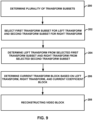
- the disclosure describes a device for encoding video data, the device comprising a video data memory configured to store the video data and transform subsets, each subset identifying one or more candidate transforms, wherein at least one transform subset identifies a plurality of candidate transforms, and a video encoder configured to determine a plurality of transform subsets from the stored transform subsets, select a first transform subset from the plurality of transform subsets for a left transform for a current transform block of a video block of the video data, select a second transform subset from the plurality of transform subsets for a right transform for the transform block of the video block of the video data, determine the left transform from the selected first transform subset, determine the right transform from the selected second transform subset, determine a current coefficient block based on the left transform, right transform, and the current transform block, and generate a video bitstream that includes information indicative of coefficients of the current coefficient block used for reconstruction of the video block.
- a non-transitory computer-readable storage medium storing instructions that when executed cause a video encoder of a device for video encoding to determine a plurality of transform subsets, each subset identifying one or more candidate transforms, wherein at least one transform subset identifies a plurality of candidate transforms, select a first transform subset from the plurality of transform subsets for a left transform for a current transform block of a video block of the video data, select a second transform subset from the plurality of transform subsets for a right transform for the transform block of the video block of the video data, determine the left transform from the selected first transform subset, determine the right transform from the selected second transform subset, determine a current coefficient block based on the left transform, right transform, and the current transform block, and generate a video bitstream that includes information indicative of coefficients of the current coefficient block used for reconstruction of the video block.
- This disclosure is related to multiple transforms applied for Intra or Inter prediction residual.
- the techniques may be used in the context of advanced video codecs, such as extensions of the high efficiency video coding (HEVC) standard or the next generation of video coding standards.
- HEVC high efficiency video coding
- a video encoder In video coding, a video encoder generates a residual block by subtracting sample values of a current block from sample values of a predictive block.
- the video encoder divides the residual block into one or more transform blocks and applies a transform (e.g., a discrete frequency transform such as a discrete cosine transform (DCT)) to the one or more transform blocks to transform the residual values in the one or more transform blocks from the pixel domain to the frequency domain.
- a transform e.g., a discrete frequency transform such as a discrete cosine transform (DCT)
- DCT discrete cosine transform
- the transformed blocks are referred to as coefficient blocks that include one or more transform coefficient values.
- a video decoder performs the reciprocal process. For instance, the video decoder applies an inverse-transform to a coefficient block to transform the coefficient block to a transform block (e.g., transform from frequency domain to pixel domain).
- the transform block is one block of a residual block, and the video decoder adds residual values of the residual block to the sample values of the predictive block to reconstruct the current block.
- this disclosure describes the video encoder and the video decoder as determining a transform used for the encoding and decoding process, respectively.
- the video encoder applies the transform to a transform block to generate a coefficient block and that the video decoder applies an inverse of the transform to the coefficient block to reconstruct the transform block.
- the transform that the video decoder applies is the inverse of the transform that the video encoder applies.
- the video decoder when the video decoder is described as determining a transform and/or applying a transform, it should be understood that the video decoder is determining a transform that is the inverse of the transform determined by the video encoder and/or that the video decoder is applying a transform that is the inverse of the transform applied by the video encoder.
- This disclosure describes example techniques for determining the transform that is applied to a transform block of residual values for encoding transform coefficients or applied to a coefficient block of transform coefficients for decoding residual values.
- the video encoder and the video decoder may each construct a plurality of transform subsets, each transform subset identifies a plurality of candidate transforms.
- Candidate transforms refer to different types of transforms such as different types of DCTs and different types of discrete sine transforms (DSTs).
- the video encoder and the video decoder select transform subset(s) and determine transforms from the selected transform subset(s) that are used for determining a coefficient block from a transform block for video encoding or a transform block from a coefficient block for video decoding.
- the video encoder and the video decoder may use a transform that provides better coding performance than would be possible with a limited set of transforms. Furthermore, as described in more detail, signaling overhead, used to indicate which transform is to be used, is kept low so that coding gains can be achieved while having more transforms available and keeping the impact on bandwidth low.
- Video coding standards include ITU-T H.261, ISO/IEC MPEG-1 Visual, ITU-T H.262 or ISO/IEC MPEG-2 Visual, ITU-T H.263, ISO/IEC MPEG-4 Visual and ITU-T H.264 (also known as ISO/IEC MPEG-4 AVC), including its Scalable Video Coding (SVC) and Multi-view Video Coding (MVC) extensions.
- HEVC High Efficiency Video Coding
- JCT-VC Joint Collaboration Team on Video Coding
- JCT-VC Joint Collaboration Team on Video Coding
- VCEG Video Coding Experts Group
- MPEG Motion Picture Experts Group
- N -point vector [ x 0 , x 1 ,..., x N-1 ] T
- y [ y 0 , y 1 ,..., y N-1 ] T by multiplying a matrix, the process of which can be further illustrated according to one of the following transform formulation, wherein k ranges from 0 through N-1, inclusive:
- the above provides examples of different DCT and DST types, all-in-all there are 16 transform types.
- the transform type is specified by the mathematical formulation of the transform basis function.
- the transform type and the transform size should not be confused.
- the transform type refers to basis function, whereas the transform size refers to the size of the transform. For instance, a 4-point DST-VII and 8-point DST-VII have the same transform type, regardless of the value of N (e.g., 4-point or 8-point).
- the video decoder may perform the inverse matrix multiplication to generate the transform vector from the transform coefficient vector.
- transforms as introduced above are applied on 1-D input data, and transforms can be also extended for 2-D input data sources.
- Supposing X is an input MxN data array.
- the typical methods of applying transform on 2-D input data include the separable and non-separable 2-D transforms.
- C applies 1-D transforms for the column vectors of X
- R applies 1-D transforms for the row vectors of X.
- C and R denote C and R as left (vertical) and right (horizontal) transforms and they both form a transform pair.
- C is equal to R and is an orthogonal matrix.
- the separable 2-D transform is determined by just one transform matrix.
- T' T ′ ⁇ X
- T' is an (M*N)x(M*N) transform matrix
- the video encoder and the video decoder may determine a plurality of transform subsets, each transform subset identifying a plurality of candidate transforms.
- the video encoder and the video decoder may determine three transform subsets and each of the transform subsets includes two or more of the 16 transforms.
- the video encoder and the video decoder may select one of the three transform subsets and determine the left transform (e.g., C) from the selected transform subset and select one of the three transform subsets and determine the right transform (e.g., R) from the selected transform subset.
- the selected transform subsets may be different subsets or the same subsets.
- Intra prediction residual refers to the residual from intra-prediction
- Inter prediction residual refers to the residual from inter-prediction.
- the residual, inter-predication, and intra-prediction are all described in more detail below.
- the residual block is divided into a plurality of transform blocks.
- the transforms are applied to each of the transform blocks to generate coefficient blocks.
- the transforms are applied to each of the coefficient blocks to generate the transform blocks and reconstruct the residual block.
- DST Discrete Sine Transform
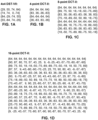
- FIG. 1A An integer approximation of 4-point DST Type-VII is applied only for 4x4 luma Intra prediction residual blocks (luma intra prediction residual blocks are described in more detail below).
- the 4-point DST-VII used in HEVC is shown in FIG. 1A .
- FIG. 1B illustrates an example of the 4-point DCT-II
- FIG. 1C illustrates an example of the 8-point DCT-II
- FIG. 1D illustrates an example of the 16-point DCT-II
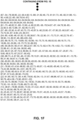
- FIGS. 1E and 1F illustrate an example of the 32-point DCT-II.
- FIGS. 1A-1F illustrate examples of differently sized DCTs of type II, and like FIGS. 1A-1F , there are examples of N-point DCTs and DSTs of different types.
- FIG. 2 is a block diagram illustrating an example video coding system 10 that may utilize the techniques of this disclosure.
- video coder refers generically to both video encoders and video decoders.
- video coding or “coding” may refer generically to video encoding or video decoding.
- Video encoder 20 and video decoder 30 of video coding system 10 represent examples of devices that may be configured to perform techniques for enhanced multiple transforms for prediction residual in accordance with various examples described in this disclosure.
- channel 16 may include a file server or another intermediate storage device that stores encoded video data generated by source device 12.
- destination device 14 may access encoded video data stored at the file server or other intermediate storage device via streaming or download.
- the file server may be a type of server capable of storing encoded video data and transmitting the encoded video data to destination device 14.
- Example file servers include web servers (e.g., for a website), file transfer protocol (FTP) servers, network attached storage (NAS) devices, and local disk drives.
- Destination device 14 may access the encoded video data through a standard data connection, such as an Internet connection.
- a standard data connection such as an Internet connection.
- Example types of data connections may include wireless channels (e.g., Wi-Fi connections), wired connections (e.g., DSL, cable modem, etc.), or combinations of both that are suitable for accessing encoded video data stored on a file server.
- the transmission of encoded video data from the file server may be a streaming transmission, a download transmission, or a combination of both.
- video coding system 10 may be configured to support one-way or two-way video transmission to support applications such as video streaming, video playback, video broadcasting, and/or video telephony.
- Video coding system 10 illustrated in FIG. 2 is merely an example and the techniques of this disclosure may apply to video coding settings (e.g., video encoding or video decoding) that do not necessarily include any data communication between the encoding and decoding devices.
- data is retrieved from a local memory, streamed over a network, or the like.
- a video encoding device may encode and store data to memory, and/or a video decoding device may retrieve and decode data from memory.
- the encoding and decoding is performed by devices that do not communicate with one another, but simply encode data to memory and/or retrieve and decode data from memory.
- source device 12 includes a video source 18, a video encoder 20, and an output interface 22.
- output interface 22 may include a modulator/demodulator (modem) and/or a transmitter.
- Video source 18 may include a video capture device (e.g., a video camera), a video archive containing previously-captured video data, a video feed interface to receive video data from a video content provider, and/or a computer graphics system for generating video data, or a combination of such sources of video data.
- Video encoder 20 may encode video data from video source 18.
- source device 12 directly transmits the encoded video data to destination device 14 via output interface 22.
- the encoded video data may also be stored onto a storage medium or a file server for later access by destination device 14 for decoding and/or playback.
- destination device 14 includes an input interface 28, a video decoder 30, and a display device 32.
- input interface 28 includes a receiver and/or a modem.
- Input interface 28 may receive encoded video data over channel 16.
- Display device 32 may be integrated with or may be external to destination device 14. In general, display device 32 displays decoded video data.
- Display device 32 may comprise a variety of display devices, such as a liquid crystal display (LCD), a plasma display, an organic light emitting diode (OLED) display, or another type of display device.
- LCD liquid crystal display
- OLED organic light emitting diode
- Video encoder 20 and video decoder 30 each may be implemented as any of a variety of suitable circuitry, such as one or more microprocessors, digital signal processors (DSPs), application-specific integrated circuits (ASICs), field-programmable gate arrays (FPGAs), discrete logic, hardware, or any combinations thereof. If the techniques are implemented partially in software, a device may store instructions for the software in a suitable, non-transitory computer-readable storage medium and may execute the instructions in hardware using one or more processors to perform the techniques of this disclosure. Any of the foregoing (including hardware, software, a combination of hardware and software, etc.) may be considered to be one or more processors. Each of video encoder 20 and video decoder 30 may be included in one or more encoders or decoders, either of which may be integrated as part of a combined encoder/decoder (CODEC) in a respective device.
- CODEC combined encoder/decoder
- video encoder 20 and video decoder 30 operate according to a video compression standard, such as HEVC standard mentioned above, extensions of HEVC, or possibly a next generation of video coding standards in development.
- a video compression standard such as HEVC standard mentioned above, extensions of HEVC, or possibly a next generation of video coding standards in development.
- HEVC standard mentioned above
- extensions of HEVC extensions of HEVC
- next generation of video coding standards in development for ease of understanding only, the following provides some information regarding the HEVC standard. However, the techniques described in this disclosure should not be considered limited to the HEVC standard.
- a video sequence typically includes a series of pictures. Pictures may also be referred to as "frames.”
- a picture may include three sample arrays, denoted S L , S Cb and S Cr .
- S L is a two-dimensional array (i.e., a block) of luma samples.
- S Cb is a two-dimensional array of Cb chrominance samples.
- S Cr is a two-dimensional array of Cr chrominance samples.
- Chrominance samples may also be referred to herein as "chroma" samples.
- a picture may be monochrome and may only include an array of luma samples.
- a prediction unit (PU) of a CU may be a prediction block of luma samples, two corresponding prediction blocks of chroma samples of a picture, and syntax structures used to predict the prediction block samples.
- Video encoder 20 may generate predictive luma, Cb and Cr blocks for luma, Cb and Cr prediction blocks of each PU of the CU.
- video encoder 20 may generate a luma residual block for the CU.
- Each sample in the CU's luma residual block indicates a difference between a luma sample in one of the CU's predictive luma blocks and a corresponding sample in the CU's original luma coding block.
- video encoder 20 may generate a Cb residual block for the CU.
- Each sample in the CU's Cb residual block may indicate a difference between a Cb sample in one of the CU's predictive Cb blocks and a corresponding sample in the CU's original Cb coding block.
- Video encoder 20 may output a bitstream that includes the entropy-encoded syntax elements.
- the bitstream may include a sequence of bits that forms a representation of coded pictures and associated data.
- the bitstream may comprise a sequence of network abstraction layer (NAL) units.
- NAL network abstraction layer
- Each of the NAL units includes a NAL unit header and encapsulates a raw byte sequence payload (RBSP).
- the NAL unit header may include a syntax element that indicates a NAL unit type code.
- the NAL unit type code specified by the NAL unit header of a NAL unit indicates the type of the NAL unit.
- a RBSP may be a syntax structure containing an integer number of bytes that is encapsulated within a NAL unit. In some instances, an RBSP includes zero bits.
- NAL units may encapsulate different types of RBSPs. For example, a first type of NAL unit may encapsulate an RBSP for a picture parameter set (PPS), a second type of NAL unit may encapsulate an RBSP for a coded slice, a third type of NAL unit may encapsulate an RBSP for SEI, and so on.
- NAL units that encapsulate RBSPs for video coding data (as opposed to RBSPs for parameter sets and SEI messages) may be referred to as video coding layer (VCL) NAL units.
- VCL video coding layer
- Video decoder 30 may receive a bitstream generated by video encoder 20.
- video decoder 30 may parse the bitstream to decode syntax elements from the bitstream.
- Video decoder 30 may reconstruct the pictures of the video data based at least in part on the syntax elements decoded from the bitstream.
- the process to reconstruct the video data may be generally reciprocal to the process performed by video encoder 20. For instance, video decoder 30 may use MVs of PUs to determine predictive blocks for the PUs of a current CU. In addition, video decoder 30 may inverse quantize transform coefficient blocks associated with TUs of the current CU.
- Video decoder 30 may perform inverse transforms on the transform coefficient blocks to reconstruct transform blocks associated with the TUs of the current CU. This disclosure describes example techniques for the way in which video decoder 30 determines the transforms that are used to perform the inverse transforms on the transform coefficient blocks.
- Video decoder 30 may reconstruct the coding blocks of the current CU by adding the samples of the predictive blocks for PUs of the current CU to corresponding samples of the transform blocks of the TUs of the current CU. By reconstructing the coding blocks for each CU of a picture, video decoder 30 may reconstruct the picture.
- a CU includes one or more TUs.
- the following describes transform scheme based on residual quadtree in HEVC.
- a transform coding structure using the residual quadtree (RQT) is applied in HEVC, which is briefly described in http://www.hhi.fraunhofer.de/fields-of-competence/image-processing/research-groups/image-video-coding/hevc-high-efficiency-video-coding/transform-coding-using-the-residual-quadtree-rqt.html.
- each picture is divided into CTUs, which are coded in raster scan order for a specific tile or slice.
- a CTU is a square block and represents the root of a quadtree, i.e., the coding tree.
- the CTU size may range from 8 ⁇ 8 to 64 ⁇ 64 luma samples, but typically 64 ⁇ 64 is used.
- Each CTU can be further split into smaller square blocks called coding units (CUs). After the CTU is split recursively into CUs, each CU is further divided into prediction units (PU) and transform units (TU).
- PU prediction units
- TU transform units
- the partitioning of a CU into TUs is carried out recursively based on a quadtree approach, therefore the residual signal of each CU is coded by a tree structure namely, the residual quadtree (RQT).
- the RQT allows TU sizes from 4 ⁇ 4 up to 32 ⁇ 32 luma samples.
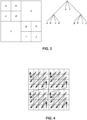
- FIG. 3 shows an example where a CU includes 10 TUs, labeled with the letters "a" to "j," and the corresponding block partitioning.
- Each node of the RQT is actually a transform unit (TU).
- the individual TUs are processed in depth-first tree traversal order, which is illustrated in FIG. 3 as alphabetical order, which follows a recursive Z-scan with depth-first traversal.
- the quadtree approach enables the adaptation of the transform to the varying space-frequency characteristics of the residual signal.
- larger transform block sizes which have larger spatial support, provide better frequency resolution.
- smaller transform block sizes, which have smaller spatial support provide better spatial resolution.
- the trade-off between the two, spatial and frequency resolutions, is chosen by the encoder mode decision (e.g., by video encoder 20), for example, based on rate-distortion optimization technique.
- the rate-distortion optimization technique calculates a weighted sum of coding bits and reconstruction distortion, i.e., the rate-distortion cost, for each coding mode (e.g., a specific RQT splitting structure), and select the coding mode with least rate-distortion cost as the best mode.
- the maximum depth of the tree Three parameters are defined in the RQT: the maximum depth of the tree, the minimum allowed transform size, and the maximum allowed transform size.
- the minimum and maximum transform sizes can vary within the range from 4 ⁇ 4 to 32 ⁇ 32 samples, which correspond to the supported block transforms mentioned in the previous paragraph.
- the maximum allowed depth of the RQT restricts the number of TUs. A maximum depth equal to zero means that a CB (coding block) cannot be split any further if each included TB (transform block) reaches the maximum allowed transform size, e.g., 32x32.
- the RQT parameters i.e., maximum RQT depth, minimum and maximum transform size, are transmitted in the bitstream at the sequence parameter set level.
- RQT depth different values can be specified and signaled for intra and inter coded CUs (i.e., intra-predicted encoded CUs or inter-predicted decoded CUs or intra-predicted encoded CUs or inter-predicted CUs).
- the quadtree transform is applied for both Intra and Inter residual blocks.
- the DCT-II transform of the same size of the current residual quadtree partition is applied for a residual block.
- the current residual quadtree block is 4x4 and is generated by Intra prediction, the above 4x4 DST-VII transform is applied.
- the residual of the transform unit is coded with non-overlapped coefficient groups (CG), and each contains the coefficients of a 4x4 block of a TU.
- CG non-overlapped coefficient groups
- each CG contains the coefficients of a 4x4 block of a TU.
- CGs inside a TU are coded according to a certain pre-defined scan order.
- FIG. 4 illustrates the coefficient scan for an 8x8 TU containing 4 CGs.
- one flag may be firstly signaled to indicate whether current transform unit has at least one non-zero coefficient. If there is at least one non-zero coefficient, the position of the last significant coefficient in the coefficient scan order in a transform unit is then explicitly coded with a coordination relative to the top-left corner of the transform unit.
- the vertical or horizontal component of the coordination is represented by its prefix and suffix, wherein prefix is binarized with truncated rice (TR) and suffix is binarized with fixed length.
- the techniques described in this disclosure describe ways to determine the transform that video encoder 20 applies to convert a transform block to a coefficient block and ways to determine the transform that video decoder 30 applies (e.g., as an inverse transform) to convert a coefficient block to a transform block.
- the following describes multiple transform for intra and inter prediction residual (e.g., different transform types for when the residual block is generated from intra-prediction and for when the residual block is generated from inter-prediction).
- DST Type-VII can efficiently improve the intra coding efficiency compared to the conventional DCT Type-II
- the transform efficiency is relatively limited because prediction residuals present various statistics, and fixed usage of DCT Type-II and DST Type-VII cannot efficiently adapt to all the possible cases.
- each Intra prediction direction may have its unique set of pairs of transforms.
- An index is signaled to specify which transform pair is chosen from the set. For example, there are up to four vertical KLT transforms and up to four horizontal KLT transforms for smallest block sizes 4x4; therefore 16 combinations may be chosen.
- Video coding with rate-distortion optimized transform applies to both Intra and Inter prediction residual.
- Inter prediction residual up to 16 combinations of KLT transforms can be chosen and the index to one of the combinations (four for 4x4 and sixteen for 8x8) is signaled for each block.
- DCT-II DCT-II
- DST-VII DCT-VII
- a transform unit with both left and right transforms (e.g., C and R) being the same) and which one to be used is determined by a signaled flag.
- DCT-II DCT-II
- DST-VII DST-VII
- F. Zou, O. C. Au, C. Pang, J. Dai, and F. Lu "Rate-Distortion Optimized Transforms Based on the Lloyd-Type Algorithm for Intra Block Coding ,” IEEE Journal of Selected Topics in Signal Processing, Volume:7 , Issue: 6, Nov. 2013 , several pre-defined KLT transform pairs are used, and an index to a transform pair is signaled (instead of derived) for a coding unit, so that each transform unit of the coding unit uses the same pair of transforms.
- one or more of the following techniques may address one or more of the above mentioned problems. However, it is not a requirement that the following techniques address one or more of the above mentioned problems.
- the following techniques may be applied individually. In some cases, any combination of the example techniques may be applied. For instance, video encoder 20 and video decoder 30 may apply the techniques individually, or, in some cases, apply any combination of the one or more techniques.
- video encoder 20 and video decoder 30 may select the transforms from two or more candidate transforms from DCT and DST families.
- the candidate transforms may belong to the total 16 transforms based on different types of the DCT and DST families, and may include, but are not limited to the DCT-I ⁇ DCT-VIII, DST-I ⁇ DST-VIII.
- video encoder 20 and video decoder 30 may use other sinusoidal unitary transforms, or even other KLT transforms may be used.
- the horizontal and vertical transforms e.g., right and left transforms
- the candidate transforms are DST-VII, DCT-VIII, DST-I and DST-V.
- the value of the first index may range from 0 to 15, and the value of the second index may range from 0 to 15.
- coding larger numbers requires signaling more bits than coding smaller numbers (e.g., indicating index value 15 requires more bits than indicating index value 2).
- the list includes all 16 transforms, there may be signaling overhead that consumes more bandwidth than desirable.
- limiting options as to which transforms can be used, as done in HEVC, may reduce signaling overhead but negatively impact coding efficiency as better transforms are not usable.
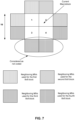
- video encoder 20 and video decoder 30 may store mapping between position of the transform block relative to the PU, CU, or LCU with which it is associated. For instance, the mapping may indicate that if the transform block is at left boundary of PU, CU, or LCU, a first group of the transform subsets is selected (e.g., one transform subset for the left transform and one transform subset for the right transform). If the transform block is at a right boundary of a PU, CU, or LCU, a second group of transform subsets is selected, and so forth for the top and bottom boundaries, where in each case, video encoder 20 and video decoder 30 select one transform subset for the left transform and one transform subset for the right transform.
- a first group of the transform subsets is selected (e.g., one transform subset for the left transform and one transform subset for the right transform). If the transform block is at a right boundary of a PU, CU, or LCU, a second group of transform subsets is selected, and
- video encoder 20 and video decoder 30 may determine respective transform subsets from which the left transform and right transform are to be determined without any increase in the amount of information that needs to be signaled.
- video encoder 20 may signal information (e.g., generate in the video bitstream information) indicating which transform in the selected transform subsets is for the left transform and which transform is for the right transform.
- Video decoder 30 receives the signaled information and determines the left and right transforms.
- video encoder 20 may signal (e.g., generate in the bitstream) an index into the transform subset selected for the left transform and signal (e.g., generate in the bitstream) an index into the transform subset selected for the right transform.
- Video decoder 30 may receive the respective indices into the respective transform subsets, and determine the left and right transform.
- video encoder 20 may use a particular transform from the selected transform subset (e.g., the first identified transform in the selected transform subset), and after the transform is applied, determine that the number of nonzero coefficients in the resulting coefficient block is less than the threshold.
- video decoder 30 may receive the information indicating the coefficient values of the coefficient block and similarly determine that the number of nonzero coefficients is less than the threshold.
- video decoder 30 may determine that video decoder 30 should use a particular transform from the selected transform subset (e.g., the first identified transform in the selected transform subset).
- video encoder 20 determines that the transform subset for the left transform is subset 0 and for the right transform is subset 1. In this case, video encoder 20 may determine that if the first identified transform in subset 0 is used as the left transform and if the first identified transform in subset 1 is used as the right transform, the number of nonzero coefficients in the resulting coefficient block is less than a threshold value. In this example, video encoder 20 may not signal information indicating that first identified transform in subset 0 and subset 1 is to be used as the left and right transforms, respectively.
- video encoder 20 adds a restriction that the identified transforms in subset 0 and subset 1 cannot be used as the left and right transform.
- Video decoder 30 may receive the intra-prediction mode and like video encoder 20 determine that transform subset 0 and transform subset 1 are to be selected for the left and right transforms, respectively, based on the intra-prediction mode. Also, after generating the coefficient block from the information indicating the coefficient values, video decoder 30 may also determine that the number of nonzero coefficients in the coefficient block is less than the threshold. Video decoder 30 may determine that a first identified transform in subset 0 and a first identified transform in subset 1 are to be used as the left and right transforms, respectively, without receiving this information from video encoder 20 because the number of nonzero coefficients is less than the threshold.
- the transforms subsets are formed from 16 transforms (i.e., eight DCTs and eight DSTs).
- additional examples of transforms include the KLT transforms.
- the transform subsets may include one or more transforms from the eight DCTs, eight DSTs, KLT transforms, and other transform examples. Solely for ease of description, the examples are described with respect to the eight DCTs and eight DSTs.
- a pre-selection from three or more candidate transforms is performed to formulate a subset of transforms, and the final transform to be used for a current TU is chosen from the subset of transforms.
- the subset of transforms may composite a subset of left transforms and/or a subset of right transforms.
- the pre-selection to formulate the subset of transforms may be determined by already decoded information such as Intra prediction modes, RQT depth, quantized coefficients, etc.
- the number of subsets of transform may be limited to a small integer, e.g., 1, 2, 3 or 4, and different subsets of transform contain different type of transforms.
- three subsets of transforms, each containing two transforms, are created. Based on a given Intra prediction mode, the subset of left transforms is set to one of the three subsets and the subset of right transforms is also set to one of the three subsets (may or may not be the same as the subset of left transforms).
- the three subsets of transforms are: ⁇ DST-VII, DCT-VIII ⁇ , ⁇ DST-VII, DST-I ⁇ and ⁇ DST-VII, DCT-V ⁇ .
- Either the subset of left transforms or the subset of right transforms can be one of the above three subsets. Therefore, various Intra prediction modes may correspond to up to 9 different combinations of the subsets for left and right transforms. Alternatively or additionally, the subset of left transforms or the subset of right transforms contain only one transform. Alternatively or additionally, both the subset of left transforms and the subset of right transforms may contain only one transform.
- the transform subsets and the transforms identified in the transform subsets may be the same regardless of the TU size and the number of transforms in the transform subsets may be the same for the different intra-prediction modes.
- the techniques described in this disclosure are not so limited.
- the number of transforms in a subset of left/right transforms can be different, a typical number of may be, but not limited to 2, 3 and 4.
- the number of transforms in a subset of left/right transforms can be different; a typical number of transforms may be, but is not limited to 2, 3 and 4.
- the final transform to be used may be signaled by an index to the subset of transforms.
- an index to a transform belonging to the subset of left transforms (or the subset of right transforms) is signaled. That means, when the number of the subset of left or right transforms is equal to 1, there is no need to signal the index of transforms.
- video encoder 20 may signal (e.g., generate in the bitstream) and video decoder 30 may receive in the bitstream an index to the subset of left transforms and an index to the subset of right transforms for each TU to determine the left and right transforms.
- a pre-selection from three or more candidate transforms is performed to formulate a subset of transforms and the final transform to be used for a current TU is chosen from the subset of transforms.
- the pre-selection to formulate the subset of transforms may be determined by the relative position of current TU to the belonging PU, i.e., whether the current TU is located at the top boundary, left boundary, right boundary, bottom boundary or other position of the belonging PU.
- three subsets of transforms are created. Based on the relative position of the current TU to the belonging PU, the subset of left transforms is set to one of the three subsets and the subset of right transforms is also set to one of the three subsets (may or may not be the same as the subset of left transforms). Alternatively or additionally, the subset of left transforms or the subset of right transforms contain only one transform. Alternatively or additionally, both the subset of left transforms and the subset of right transforms may contain only one transform.
- video encoder 20 may determine that the left and right transforms for each TU of a CU should be a same default transform (e.g., DCT-II as one example, but other transform types are possible as well). Also, there may be a default transform for the left transform and a default transform for the right transform, or the default transform for the left transform and the right transform may be the same. In the following description, the term "default transform" should be interpreted to include both the case where the default transform for the left and right transforms is different and where the default transform for the left and right transforms is the same. For instance, the default transform for the left and right transform (e.g., where different or same) may be pre-selected and be the same for video encoder 20 and video decoder 30.
- the default transform for the left and right transform e.g., where different or same
- video encoder 20 may signal (e.g., generate in the bitstream) a flag indicating whether each TU of the CU is to apply the same default transform. If the flag is of a first value (e.g., a digital high), then each TU of the CU was applied with the same default transform. If the flag is of a second value (e.g., a digital low), then at least one TU of the CU was applied with a transform other than the default transform. In the case where at least one TU of the CU was applied with a different transform, video encoder 20 may select transform subsets and signal indices in the transform subsets, if needed (e.g., nonzero coefficients greater than threshold), as described above. In the case where each TU of the CU was applied with the same default transform, video encoder 20 may not signal any indices in any of the transform subsets as video decoder 30 may already determine which transform to use.
- a flag indicating whether each TU of the CU is to apply the same
- Video decoder 30 may receive the flag indicating whether each TU of the CU is to apply the same default transform. If the flag is of the first value, video decoder 30 may determine that no transform subsets are to be selected and no indices into transform subsets are to be parsed (e.g., received) from the bitstream. In this case, video decoder 30 may apply the default transform to each coefficient block of the CU. If the flag is of the second value, video decoder 30 may determine that transform subsets are to be selected, determine whether indices are to be received (e.g., based on number of nonzero coefficients), and receive the indices in the selected transform subsets based on the determination that the indices are to be received.
- indices e.g., based on number of nonzero coefficients
- the flag indicating whether each TU is to use the same default transform is at the CU level (e.g., indicating that each TU of the CU use the same default transform).
- the flag may be at the CTU level or PU level.
- video encoder 20 may signal (e.g., generate in the bitstream) a flag indicating whether all transform blocks of a block are transformed using the same transform.
- video decoder 30 may select transform subsets and determine indices in the selected transforms as described above.
- video decoder 30 may use that transform for each of the transform block of the block.
- the "block" may be one of a CTU, a CU, or a PU, as a few examples.
- signaling of the transforms to be used for each TU can be done in TU level when the current CU utilizes the additional transforms are used, e.g., as described above.
- video encoder 20 may send one flag for each CU indicating whether the TUs within it are coded with additional transforms (e.g., using transforms other than those in HEVC).
- additional transforms e.g., using transforms other than those in HEVC.
- such indication may be signaled at LCU level (CTU level), CU level, PU level, TU or any other block level.
- the default transform is DCT-II.
- the default transform may depend on intra/inter modes, intra prediction mode, block size, TU position within a PU, or any other statistics of the current TU.
- video encoder 20 and video decoder 30 may determine the same default transform, and the condition for which default transform to use may be based on factors such as intra/inter modes, intra prediction mode, block size, TU position within a PU, or any other statistics of the current TU. In this way, by using default transforms, the amount of information that needs to be signaled may be reduced.
- video encoder 20 may first signal (e.g., generate in the bitstream) a one-bit flag at LCU (CTU) level, if the one-bit flag is 0, video encoder 20 and video decoder 30 may only apply DCT-II for each CU, otherwise if the one-bit flag is 1, video encoder 20 may signal another flag at CU level specifying whether TUs within the CU can use multiple transforms or just a default transform.
- CTU LCU
- video decoder 30 may determine at each hierarchical level whether all TUs within a particular hierarchical level use a default transform. For example, if the flag at the CTU level indicates that all TUs of the CTU are to use the same default transform, then video decoder 30 may use the same default transform for all TUs of the CTU. If the flag at the CTU level indicates that not all TUs of the CTU are to use the same default transform, then video decoder 30 may select transform subsets and determine transforms for each TU of the CTU as described above.
- video decoder 30 may receive a flag for each PU of the CU indicating whether all TUs of the PU use the same default transform or do not use the same default transform. If for a PU, video decoder 30 receives a flag indicating that all TUs of the PU use the same default transform, video decoder 30 may apply the default transform. If for a PU, video decoder 30 receives a flag indicating that not all TUs of the PU use the same default transform, video decoder 30 may select transform subsets and determine transforms for each TU of the PU as described above.
- video encoder 20 and video decoder 30 may use one set of context models for CABAC-encoding or CABAC-decoding the one-bit flag.
- the OBMC flag is false (i.e., equal to 0)
- another set of context models may be used for coding the one-bit flag.
- the initialized probabilities of the two sets of context models may be different.
- the CABAC context modeling of the one-bit flag of one block is dependent on the value of the corresponding one-bit flag of the spatial neighboring blocks (e.g., a left neighboring block and/or an above neighboring block) or the temporal neighboring blocks (e.g., the co-located block in a reference picture).
- the spatial neighboring blocks e.g., a left neighboring block and/or an above neighboring block
- the temporal neighboring blocks e.g., the co-located block in a reference picture.
- the indices into the transform subsets may be considered as more "global.”
- video encoder 20 may signal indices for the left transform and the right transform.
- the indices may be global in the sense that the indices are the same for each TU of a block regardless of the particular transform subsets that are selected, where the block is a CTU, CU, or PU.
- video decoder 30 may determine the left and right transforms from the selected transform subsets from these global indices.
- video encoder 20 may not signal indices into selected transform subsets. For example, for certain TUs, the signaling of the additional transforms may be skipped if the energy of the residual signal is limited, e.g., if there is no nonzero coefficient transmitted for the current TU. Similar skipping of additional transform signaling may apply to LCU, CU, PU or any other block level.
- video decoder 30 may determine that indices into the selected transforms subsets is not be received (e.g., parsed) from the bitstream.
- the threshold value of total number of nonzero coefficients is 2.
- the threshold value for total number of nonzero coefficients may be different for different block sizes or different Intra prediction modes.
- video encoder 20 may skip signaling of the indicator (e.g., indices into transform subsets) and video encoder 20 and video decoder 30 may apply only a default transform type.
- the default transform is DCT-II.
- video encoder 20 may not signal the indicator and video encoder 20 and video decoder 30 may only apply the DCT-II for each TU.
- Video encoder 20 and video decoder 30 may binarize the indicators (e.g., indices into the transform subsets) using, for example, fixed-length code, truncated unary code or exponential Golomb code.
- Video encoder 20 and video decoder 30 may entropy code (e.g., encode or decode, respectively) indicators using CABC with contexts, and for each bin, one context is applied.
- the context model is selected based on the bin index.
- the intra prediction mode or TU size or TU depth is also considered when selecting the context models.
- partial of bins are coded with context models and remaining bins are coded with bypass mode.
- indicators may be bypass coded, i.e., no context modeling is applied.
- video encoder 20 may signal various information in the bitstream and video decoder 30 may receive such information from the bitstream.
- Video encoder 20 may signal such information and video decoder 30 may receive such information from different locations.
- Video encoder 20 may signal (e.g., generate in the bitstream) and video decoder 30 may receive the number of candidate transforms, as described above with respect to the transforms being selected from two or more candidate transforms, to be used in the picture parameter set (PPS), sequence parameter set (SPS) or any other places, including even at the slice header.
- Video encoder 20 may signal (e.g., generate in the bitstream) and video decoder 30 may receive the number of candidate transforms in each subset, as described above with respect to the pre-selection from three or more candidate transforms, at slice header, picture parameter set (PPS), sequence parameter set (SPS) or any other places.
- a flag or index can be signaled at slice header, PPS, SPS or any other places to indicate whether the above mentioned multiple transform is applied at block level.
- one dedicated value of this flag or index may indicate that all the TUs are coded with one default transform. Additionally or alternatively, one dedicated value of this flag or index may indicate that a flag/index or flags/indexes may be signaled at block level for transform selection at block level.
- the size of the block for which multiple transforms do not apply may be present in a parameter set, e.g., picture parameter set or sequence parameter set.
- transform utilizes a transform to generate a transform block of transform coefficient values from a residual block.
- Video decoder 30, utilizes an inverse-transform to generate a residual block of residual values from the transform block. Accordingly, in the above description, it should be understood that the description of a transform is equally applicable to video decoder 30; however, video decoder 30 utilizes an inverse-transform.
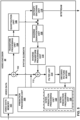
- FIG. 5 is a block diagram illustrating an example video encoder 20 that may implement the techniques of this disclosure.
- FIG. 5 is provided for purposes of explanation and should not be considered limiting of the techniques as broadly exemplified and described in this disclosure.
- this disclosure describes video encoder 20 in the context of HEVC coding.
- the techniques of this disclosure may be applicable to other coding standards or methods.
- video encoder 20 may be configured to apply more transforms to the transform block than the limited options provided in HEVC.
- video encoder 20 includes a prediction processing unit 100, video data memory 101, a residual generation unit 102, a transform processing unit 104, a quantization unit 106, an inverse quantization unit 108, an inverse transform processing unit 110, a reconstruction unit 112, a filter unit 114, a decoded picture buffer 116, and an entropy encoding unit 118.
- Prediction processing unit 100 includes an inter-prediction processing unit 120 and an intra-prediction processing unit 126.
- Inter-prediction processing unit 120 includes a motion estimation unit and a motion compensation unit (not shown).
- video encoder 20 may include more, fewer, or different functional components.
- Video data memory 101 may store video data to be encoded by the components of video encoder 20.
- the video data stored in video data memory 101 may be obtained, for example, from video source 18.
- Decoded picture buffer 116 may be a reference picture memory that stores reference video data for use in encoding video data by video encoder 20, e.g., in intra- or inter-coding modes.
- Video data memory 101 and decoded picture buffer 116 may be formed by any of a variety of memory devices, such as dynamic random access memory (DRAM), including synchronous DRAM (SDRAM), magnetoresistive RAM (MRAM), resistive RAM (RRAM), or other types of memory devices.
- Video data memory 101 and decoded picture buffer 116 may be provided by the same memory device or separate memory devices.
- video data memory 101 may be on-chip with other components of video encoder 20, or off-chip relative to those components.
- Video encoder 20 may receive video data. Video encoder 20 may encode each CTU in a slice of a picture of the video data. Each of the CTUs may be associated with equally-sized luma coding tree blocks (CTBs) and corresponding CTBs of the picture. As part of encoding a CTU, prediction processing unit 100 may perform quad-tree partitioning to divide the CTBs of the CTU into progressively-smaller blocks. The smaller block may be coding blocks of CUs. For example, prediction processing unit 100 may partition a CTB associated with a CTU into four equally-sized sub-blocks, partition one or more of the sub-blocks into four equally-sized sub-blocks, and so on.
- CTBs luma coding tree blocks
- Video encoder 20 may encode CUs of a CTU to generate encoded representations of the CUs (i.e., coded CUs).
- prediction processing unit 100 may partition the coding blocks associated with the CU among one or more PUs of the CU.
- each PU may be associated with a luma prediction block and corresponding chroma prediction blocks.
- Video encoder 20 and video decoder 30 may support PUs having various sizes. As indicated above, the size of a CU may refer to the size of the luma coding block of the CU and the size of a PU may refer to the size of a luma prediction block of the PU.
- video encoder 20 and video decoder 30 may support PU sizes of 2Nx2N or NxN for intra prediction, and symmetric PU sizes of 2Nx2N, 2NxN, Nx2N, NxN, or similar for inter prediction.
- Video encoder 20 and video decoder 30 may also support asymmetric partitioning for PU sizes of 2NxnU, 2NxnD, nLx2N, and nRx2N for inter prediction.
- Inter-prediction processing unit 120 may generate predictive data for a PU by performing inter prediction on each PU of a CU.
- the predictive data for the PU may include predictive blocks of the PU and motion information for the PU.
- Inter-prediction unit 121 may perform different operations for a PU of a CU depending on whether the PU is in an I slice, a P slice, or a B slice. In an I slice, all PUs are intra predicted. Hence, if the PU is in an I slice, inter-prediction unit 121 does not perform inter prediction on the PU. Thus, for blocks encoded in I-mode, the predicted block is formed using spatial prediction from previously-encoded neighboring blocks within the same frame.
- the motion estimation unit of inter-prediction processing unit 120 may search the reference pictures in a list of reference pictures (e.g., "RefPicList0") for a reference region for the PU.
- the reference region for the PU may be a region, within a reference picture, that contains sample blocks that most closely corresponds to the sample blocks of the PU.
- the motion estimation unit may generate a reference index that indicates a position in RefPicList0 of the reference picture containing the reference region for the PU.
- the motion estimation unit may generate an MV that indicates a spatial displacement between a coding block of the PU and a reference location associated with the reference region.
- the MV may be a two-dimensional vector that provides an offset from the coordinates in the current decoded picture to coordinates in a reference picture.
- the motion estimation unit may output the reference index and the MV as the motion information of the PU.
- the motion compensation unit of inter-prediction processing unit 120 may generate the predictive blocks of the PU based on actual or interpolated samples at the reference location indicated by the motion vector of the PU.
- prediction processing unit 100 may determine a plurality of transform subsets, each subset identifying one or more candidate transforms, where at least one transform subset identifies a plurality of candidate transforms.
- the candidate transforms are of different transform types, and in some examples, prediction processing unit 100 determines the plurality of transform subsets based on a size of a video block being encoded.
- Prediction processing unit 100 may select a first transform subset from the plurality of transform subsets for a left transform for a current transform block of a video block of the video data and select a second transform subset from the plurality of transform subsets for a right transform for the transform block of the video block of the video data.
- the current transform block may be the transform block that transform processing unit 104 generates and on which transform processing unit 104 is to apply the transforms.
- Prediction processing unit 100 may determine the left transform from the selected first transform subset and determine the right transform from the selected second transform subset. For instance, prediction processing unit 100 may test each of the transforms in the selected transform subsets and determine which transform provides the best video coding. Prediction processing unit 100 may determine the respective transforms that provide the best video coding as the left transform and the right transform.
- prediction processing unit 100 may determine the intra-prediction mode of the video block. Prediction processing unit 100 may select the first transform subset based on the determined intra-prediction mode, and select the second transform subset based on the determined intra-prediction mode.
- prediction processing unit 100 may determine a location of the current transform block in the video block (e.g., determine whether transform block is for the residual generated from a particular location in the video block). Prediction processing unit 100 may select the first transform subset based on the determined location of the current transform block, and select the second transform subset based on the determined location of the current transform block.
- prediction processing unit 100 may cause entropy encoding unit 118 to signal the first transform subset index based on the number of nonzero coefficients being greater than a threshold, and signal the second transform subset index based on the number of nonzero coefficients being greater than the threshold. If the number of nonzero coefficients is less than the threshold, prediction processing unit 100 may not cause entropy encoding unit 118 to signal indices in the first and second transform subsets.
- At least one of the first transform subset or the second transform subset includes a transform that is different than a discrete cosine transform (DCT)-II transform and a discrete sine transform (DST)-VII transform.
- the first transform subset and the second transform subset include different transforms (e.g., at least one transform in the first transform subset is not in the second transform subset or vice-versa).
- Inverse quantization unit 108 and inverse transform processing unit 110 may apply inverse quantization and inverse transforms to a coefficient block, respectively, to reconstruct a residual block from the coefficient block.
- Reconstruction unit 112 may add the reconstructed residual block to corresponding samples from one or more predictive blocks generated by prediction processing unit 100 to produce a reconstructed transform block associated with a TU. By reconstructing transform blocks for each TU of a CU in this way, video encoder 20 may reconstruct the coding blocks of the CU.
- entropy encoding unit 118 may perform a context-adaptive variable length coding (CAVLC) operation, a CABAC operation, a variable-to-variable (V2V) length coding operation, a syntax-based context-adaptive binary arithmetic coding (SBAC) operation, a Probability Interval Partitioning Entropy (PIPE) coding operation, an Exponential-Golomb encoding operation, or another type of entropy encoding operation on the data.
- Video encoder 20 may output a bitstream that includes entropy-encoded data generated by entropy encoding unit 118.
- the bitstream may include data that represents a RQT for a CU.
- prediction processing unit 100 determines a predictive block, and generates in the video bitstream, that entropy encoding unit 118 outputs, information indicative of a prediction mode of the video block based on the predictive block.
- the prediction mode indicates whether the video block is intra-predicted or inter-predicted.
- the predictive block is a block in the same picture as the video block based on the video block being intra-predicted or in a picture different than the picture that includes the video block based on the video block being inter-predicted.
- Residual generation unit 102 may determine the current transform block as a residual between the video block and the predictive block.
- FIG. 6 is a block diagram illustrating an example video decoder 30 that is configured to implement the techniques of this disclosure.
- FIG. 6 is provided for purposes of explanation and is not limiting on the techniques as broadly exemplified and described in this disclosure.
- this disclosure describes video decoder 30 in the context of HEVC coding.
- the techniques of this disclosure may be applicable to other coding standards or methods.
- Video decoder 30 represents an example of a device that may be configured to perform techniques in accordance with various examples described in this disclosure.
- video decoder 30 includes an entropy decoding unit 150, video data memory 151, a prediction processing unit 152, an inverse quantization unit 154, an inverse transform processing unit 156, a reconstruction unit 158, a filter unit 160, and a decoded picture buffer 162.
- Prediction processing unit 152 includes a motion compensation unit 164 and an intra-prediction processing unit 166.
- video decoder 30 may include more, fewer, or different functional components.
- Video data memory 151 may store video data, such as an encoded video bitstream, to be decoded by the components of video decoder 30.
- the video data stored in video data memory 151 may be obtained, for example, from computer-readable medium 16, e.g., from a local video source, such as a camera, via wired or wireless network communication of video data, or by accessing physical data storage media.
- Video data memory 151 may form a coded picture buffer (CPB) that stores encoded video data from an encoded video bitstream.
- Decoded picture buffer 162 may be a reference picture memory that stores reference video data for use in decoding video data by video decoder 30, e.g., in intra- or inter-coding modes.
- Video data memory 151 and decoded picture buffer 162 may be formed by any of a variety of memory devices, such as dynamic random access memory (DRAM), including synchronous DRAM (SDRAM), magnetoresistive RAM (MRAM), resistive RAM (RRAM), or other types of memory devices. Video data memory 151 and decoded picture buffer 162 may be provided by the same memory device or separate memory devices. In various examples, video data memory 151 may be on-chip with other components of video decoder 30, or off-chip relative to those components.
- DRAM dynamic random access memory
- SDRAM synchronous DRAM
- MRAM magnetoresistive RAM
- RRAM resistive RAM
- Video data memory 151 and decoded picture buffer 162 may be provided by the same memory device or separate memory devices. In various examples, video data memory 151 may be on-chip with other components of video decoder 30, or off-chip relative to those components.
- a coded picture buffer may receive and store encoded video data (e.g., NAL units) of a bitstream.
- Entropy decoding unit 150 may receive encoded video data (e.g., NAL units) from the CPB and parse the NAL units to decode syntax elements. Entropy decoding unit 150 may entropy decode entropy-encoded syntax elements in the NAL units.
- Prediction processing unit 152, inverse quantization unit 154, inverse transform processing unit 156, reconstruction unit 158, and filter unit 160 may generate decoded video data based on the syntax elements extracted from the bitstream.
- the NAL units of the bitstream may include coded slice NAL units.
- entropy decoding unit 150 may extract and entropy decode syntax elements from the coded slice NAL units.
- Each of the coded slices may include a slice header and slice data.
- the slice header may contain syntax elements pertaining to a slice.
- the syntax elements in the slice header may include a syntax element that identifies a PPS associated with a picture that contains the slice.
- video decoder 30 may perform a reconstruction operation on a non-partitioned CU. To perform the reconstruction operation on a non-partitioned CU, video decoder 30 may perform a reconstruction operation on each TU of the CU. By performing the reconstruction operation for each TU of the CU, video decoder 30 may reconstruct residual blocks of the CU.
- inverse quantization unit 154 may inverse quantize, i.e., de-quantize, coefficient blocks associated with the TU.
- Inverse quantization unit 154 may use a QP value associated with the CU of the TU to determine a degree of quantization and, likewise, a degree of inverse quantization for inverse quantization unit 154 to apply. That is, the compression ratio, i.e., the ratio of the number of bits used to represent original sequence and the compressed one, may be controlled by adjusting the value of the QP used when quantizing transform coefficients.
- the compression ratio may also depend on the method of entropy coding employed.
- inverse transform processing unit 156 may apply one or more inverse transforms to the coefficient block in order to generate a residual block associated with the TU.
- inverse transform processing unit 156 may apply an inverse DCT, an inverse integer transform, an inverse Karhunen-Loeve transform (KLT), an inverse rotational transform, an inverse directional transform, or another inverse transform to the coefficient block.
- KLT Karhunen-Loeve transform
- prediction processing unit 152 may determine the left and right transforms that inverse transform processing unit 156 is to apply. For example, prediction processing unit 152 may determine a plurality of transform subsets, each subset identifying one or more candidate transforms, where at least one transform subset identifies a plurality of candidate transforms. The candidate transforms are of different transform types, and in some examples, prediction processing unit 152 determines the plurality of transform subsets based on a size of a video block being decoded.
- video data memory 151 stores the plurality of transform subsets
- prediction processing unit 152 may determine the plurality of transform subsets from the stored transform subsets.
- video data memory 151 may store all of the transforms
- prediction processing unit 152 may construct the transform subsets in a predefined manner.
- prediction processing unit 152 may receive information identifying the transform subsets from the bitstream. Examples of the candidate transforms include DCT-I to DCT-VIII, DST-I to DST-VIII, KLT transforms, and the like.
- the plurality of transform subsets includes three or more transform subsets.
- Prediction processing unit 152 may select a first transform subset from the plurality of transform subsets for a left transform for a current coefficient block of the video data, and select a second transform subset from the plurality of transform subsets for a right transform for the current coefficient block of the video data. Prediction processing unit 152 may determine the left transform from the selected first transform subset, and determine the right transform from the selected second transform subset.
- Prediction processing unit 152 may construct a first reference picture list (RefPicList0) and a second reference picture list (RefPicList1) based on syntax elements extracted from the bitstream. Furthermore, if a PU is encoded using inter prediction, entropy decoding unit 150 may extract motion information for the PU. Motion compensation unit 164 may determine, based on the motion information of the PU, one or more reference regions for the PU. Motion compensation unit 164 may generate, based on samples blocks at the one or more reference blocks for the PU, predictive luma, Cb and Cr blocks for the PU.
- prediction processing unit 152 may determine an intra-prediction mode of the video block. Prediction processing unit 152 may select the first transform subset based on the determined intra-prediction mode, and select the second transform subset based on the determined intra-prediction mode.
- Transform Subset 0 ⁇ DST-VII, DCT-VIII ⁇
- Transform Subset 1 ⁇ DST-VII, DST-I ⁇
- Transform Subset 2 ⁇ DST-VII, DCT-V ⁇ .
- the candidate transform types for horizontal(right) transform are from transform set 0 including DST-VII and DCT-VIII
- the candidate transform types for vertical(left) transform are from transform set 2 including DST-VII and DCT-V. Therefore, the additional candidate transform list for intra mode 10 is finally constructed as shown in Table 3 in which totally four transform methods are generated Table 3:
- Example of four transform methods for Intra prediction mode 10 based on Table 2 Transform Method 1 Transform Method 2 Transform Method 3 Transform Method 4 Horizontal transform DST-VII DST-VII DCT-VIII DCT-VIII Vertical transform DST-VII DCT-V DST-VII DCT-V
- Table 2 For each TU, given an Intra prediction mode, totally four transform methods can be generated.
- the same transform set ⁇ DST-VII, DCT-VIII ⁇ is used for both horizontal and vertical transforms. Therefore, for each TU, the additional candidate transform list is constructed as shown in Table 4.
- Table 4 Four transform methods for Inter prediction residual Transform Method 1 Transform Method 2 Transform Method 3 Transform Method 4 Horizontal transform DST-VII DST-VII DCT-VIII DCT-VIII Vertical transform DST-VII DCT-VIII DST-VII DCT-VIII DST-VII DCT-VIII
- the following description is an example of indicator signaling.
- the CU-level indicator is a one-bit flag indicating whether the default DCT-II is applied for all the TUs included in the current CU. If the one-bit flag is 0, only the default DCT-II can applied for all the TUs included in the current CU; otherwise, a two-bit TU-level indicator may be further signaled for each TU, and the first bit specifies which transform type from the given transform set is applied as the horizontal transform, and the second bit specifies which transform type from the given transform set is applied as the vertical transform.
- the TU-level indicators are signaled after the coefficients, and the TU-level indicator is not signaled and derived as 0 when the total number of nonzero coefficients of the TU is no larger than 2. Otherwise, the TU-level indicator is explicitly signaled.
- the TU-level indicators can be signaled either before or after the coefficients, and the TU-level indicator is not signaled when there is no nonzero coefficients in the TU.
- add_multi_transform_flag may be signaled without dependency to cbf_luma.
- Residual coding semantics left_transform_flag [ x0 ][ y0 ] specifies the transform index applied for the left transform of the current TU, when not presented, left transform_flag[ x0 ][ y0 ] is transform of the current TU, when not presented, left_transform_flag[ x0 ][ y0 ] is infered as 0.
- right_transform_flag [ x0 ][ y0 ] specifies the transform index applied for the right transform of the current TU, when not presented, right_transform_flag[ x0 ][ y0 ] is infered as 0.
- each candidate R and L transform combination is tested using rate-distortion cost.
- RDcost_CU_EMT the rate-distortion cost for coding the whole CU is recorded as RDcost_CU_EMT. If RDcost_CU_DCT is smaller than RDcost_CU_EMT, then one flag add_multi_transform_flag is conditionally signaled as 0 as described in above example, and all the included TUs are encoded using DCT-II.
- add_multi_transform_flag is conditionally signaled as 1 as described in above example, and for each included TU, a flag left_transform_flag and another flag right_transform_flag is conditionally signaled after the coefficients are signaled as described in above example, to indicate which left transform and right transform are selected for encoding the current TU.
- one bit flag add_multi_transform_flag is conditionally signaled as described in above example. This flag is not signaled only when transform depth is 0 and the coded block flag (CBF) value of Luma component is 0, otherwise, the flag is always signaled.
- add_multi_transform_flag is 0, only DCT-2 is applied for all the included TUs, otherwise, the following is performed. For each TU, one bit flag left_transform_flag and another flag right_transform_flag is conditionally signaled after the coefficients are signaled as described in above example. The condition of whether left_transform_flag and right_transform_flag are signaled are described below.
- left_transform_flag and right_transform_flag are not signaled. Otherwise, left_transform_flag and right_transform_flag are signaled.
- left_transform_flag and right_transform_flag are not signaled. Otherwise, left_transform_flag and right_transform_flag are signaled.
- the left and right transforms are derived as described in above example.
- the transform is performed as described in more detail below with respect to examples for larger sized TUs.
- the above described example techniques for determining transforms to use The following describes examples for supporting larger sized transforms.
- supporting 64x64 transform is beneficial, especially for coding videos with larger resolutions, e.g., 1080p and 4K.
- To support 64x64 transform while constraining the complexity for both video encoder 20 and video decoder 30 is important, and although various ways can be done to achieve that, a better solution may be available.
- the actual applied NxN transform matrices may be an integer-point approximation after the scaling of the original floating-point transform matrices, and the scaling may be larger than 64*log 2 N ., including but not limited to s *log 2 N , where s can be 128 or 256.
- the resulting transform coefficients after the horizontal and vertical transforms are kept within the 16-bit representation by applying additional right shift operations.
- the additional right shifting operations include, but are not limited to, right shifting the resulting transform coefficients after vertical and horizontal inverse/forward transform by additional log 2 (s/64) bits.
- Transform sizes larger than 32-point transform may be applied, including but not limited to 64-point, 128-point, 256-point, on residual blocks.
- M -point and N- point transforms are applied for the horizontal and vertical transforms, respectively, where M and N are integers and M could be the same as or different from N, only the top-left X x Y lower frequency coefficients inside the resulting M x N coefficient block, where X ⁇ M and Y ⁇ N , are signaled and the remaining coefficients are not signaled and derived as 0.
- the position of the last nonzero coefficient inside the resulting M x N coefficient block can be coded by reusing the same logic of the last nonzero coefficient position coding used for SxT blocks, where X ⁇ S ⁇ M and Y ⁇ T ⁇ N, in terms of context modeling.
- a constraint may be introduced for LastSignificantCoeffY and LastSignificantCoeffX.
- the value of LastSignificantCoeffX(LastSignificantCoeffY) may be smaller than X ( Y ).
- a typical value of X and Y is 32 for 64-point transform.
- one or more CG (coding group) scan orders for MxN may be pre-defined and used. However, for CGs outside the top-left X x Y region of the resulting MxN coefficient block, the CG-level flags signaling whether there is at least one nonzero coefficient in the each CG are skipped and not coded. Alternatively or additionally, for all the WxH CGs, where a typical value of W and H is 4, the CGs are coded following the scan order for XxY regions which includes, but not limited to (M / W) x (N / H) diagonal, zigzag, horizontal or vertical scan order.
- all the CGs are grouped in units of W' x H', where W' is a multiples of W and H' is a multiples of H, the W' x H' units are coded following the scan order including, but not limited to (M / W') x (N / H') diagonal, zigzag, horizontal or vertical scan order, and the CGs inside each W x H unit are coded following the scan order including, but not limited to, ( W' / W )x( H' / H ) diagonal, zigzag, horizontal or vertical scan order.
- the CABAC contexts used for coding RQT splitting flags can be shared for RQT depth values corresponding to transform size larger than 32x32.
- the same CABAC context can be applied for coding the RQT splitting flag.
- Last_sig_coeff_x_suffix specifies the suffix of the column position of the last significant coefficient in scanning order within a transform block.
- the values of last_sig_coeff_x_suffix shall be in the range of 0 to (1 ⁇ ( ( last_sig_coeff_x_prefix >> 1 ) - 1 ) ) - 1, inclusive.
- the column position of the last significant coefficient in scanning order within a transform block LastSignificantCoeffX is derived as follows.
- last_sig_coeff_y_suffix specifies the suffix of the row position of the last significant coefficient in scanning order within a transform block.
- the values of last_sig_coeff_y_suffix shall be in the range of 0 to (1 ⁇ ( ( last_sig_coeff_prefix >> 1 ) - 1 ) ) - 1, inclusive.
- LastSignificantCoeffY is derived as follows.
- LastSignificantCoeffX, LastSignificantCoeffY Swap( LastSignificantCoeffX, LastSignificantCoeffY ).
- the value of LastSignificantCoeffX or LastSignificantCoeffY shall be smaller than 32
- OBMC overlapped block motion compensation
- video encoder 20 may signal (e.g., generate in the bitstream) a CU-level flag to indicate whether OBMC enabled or not for the current CU.
- this OBMC flag has been signaled as 1 (indicating OBMC is enabled for the current CU)
- only the default DCT-II is used for each TU, and therefore video encoder 20 may not signal anything for the transform selection, i.e., neither the CU-level flag nor the TU-level index is signaled.
- the encoder e.g., video encoder 20
- coefficients positioned at locations greater than M' and/or greater than N' may be considered as higher frequency coefficients.
- the coefficients further to the right of the TU and further to the bottom of the TU may be considered as higher frequency coefficients.
- the one-bit flag indicating whether only one default transform is applied, is still signaled as a default value (e.g., 0), which indicates the default transform (e.g., DCT-II) is applied, and the multiple transform candidates are not applied and are skipped for the current block.
- Video decoder 30 may determine the left transform from the selected first transform subset, and determine the right transform from the selected second transform subset (204). For example, prediction processing unit 152 may receive information in the bitstream such as indices into the selected transform subsets or may implicitly determine the transforms based on the number of nonzero coefficients. Video decoder 30 may determine a current transform block based on the left transform, right transform, and the current coefficient block (206). For example, inverse transform processing unit 156 may determine the current transform block by applying the left transform and right transform on the coefficient block outputted by inverse quantization unit 154.
- Video encoder 20 may determine the left transform from the selected first transform subset, and determine the right transform from the selected second transform subset (304). For example, prediction processing unit 100 may test the various determine transforms to identify the transform that provides good video coding quality. Video encoder 20 may determine a current coefficient block based on the left transform, right transform, and the current transform block (306). For example, transform processing unit 104 may determine the current coefficient block by applying the left transform and right transform on the transform block outputted by reconstruction unit 102. Video encoder 20 may generate a video bitstream with information (e.g., signal information) indicative of coefficients of the current coefficient block used for reconstruction of the video block (308). For example, entropy encoding unit 118 may output information that video decoder 30 uses to reconstruct the video block.
- information e.g., signal information
- the functions described may be implemented in hardware, software, firmware, or any combination thereof. If implemented in software, the functions may be stored on or transmitted over, as one or more instructions or code, a computer-readable medium and executed by a hardware-based processing unit.
- Computer-readable media may include computer-readable storage media, which corresponds to a tangible medium such as data storage media. In this manner, computer-readable media generally may correspond to tangible computer-readable storage media which is non-transitory.
- Data storage media may be any available media that can be accessed by one or more computers or one or more processors to retrieve instructions, code and/or data structures for implementation of the techniques described in this disclosure.
- a computer program product may include a computer-readable medium.
- Such computer-readable storage media can comprise RAM, ROM, EEPROM, CD-ROM or other optical disk storage, magnetic disk storage, or other magnetic storage devices, flash memory, or any other medium that can be used to store desired program code in the form of instructions or data structures and that can be accessed by a computer.
- computer-readable storage media and data storage media do not include connections, carrier waves, signals, or other transient media, but are instead directed to non-transient, tangible storage media.
- Disk and disc includes compact disc (CD), laser disc, optical disc, digital versatile disc (DVD), floppy disk and Blu-ray disc, where disks usually reproduce data magnetically, while discs reproduce data optically with lasers. Combinations of the above should also be included within the scope of computer-readable media.
- processors such as one or more digital signal processors (DSPs), general purpose microprocessors, application specific integrated circuits (ASICs), field programmable logic arrays (FPGAs), or other equivalent integrated or discrete logic circuitry.
- DSPs digital signal processors
- ASICs application specific integrated circuits
- FPGAs field programmable logic arrays
- processors may refer to any of the foregoing structure or any other structure suitable for implementation of the techniques described herein.
- the functionality described herein may be provided within dedicated hardware and/or software modules configured for encoding and decoding, or incorporated in a combined codec. Also, the techniques could be fully implemented in one or more circuits or logic elements.
- the techniques of this disclosure may be implemented in a wide variety of devices or apparatuses, including a wireless handset, an integrated circuit (IC) or a set of ICs (e.g., a chip set).
- IC integrated circuit
- a set of ICs e.g., a chip set.
- Various components, modules, or units are described in this disclosure to emphasize functional aspects of devices configured to perform the disclosed techniques, but do not necessarily require realization by different hardware units. Rather, as described above, various units may be combined in a codec hardware unit or provided by a collection of interoperative hardware units, including one or more processors as described above, in conjunction with suitable software and/or firmware.
Landscapes
- Engineering & Computer Science (AREA)
- Multimedia (AREA)
- Signal Processing (AREA)
- Physics & Mathematics (AREA)
- Discrete Mathematics (AREA)
- General Physics & Mathematics (AREA)
- Compression Or Coding Systems Of Tv Signals (AREA)
Applications Claiming Priority (4)
| Application Number | Priority Date | Filing Date | Title |
|---|---|---|---|
| US201562107996P | 2015-01-26 | 2015-01-26 | |
| US201562137038P | 2015-03-23 | 2015-03-23 | |
| US15/005,736 US10306229B2 (en) | 2015-01-26 | 2016-01-25 | Enhanced multiple transforms for prediction residual |
| PCT/US2016/014898 WO2016123091A1 (en) | 2015-01-26 | 2016-01-26 | Enhanced multiple transforms for prediction residual |
Publications (3)
| Publication Number | Publication Date |
|---|---|
| EP3251364A1 EP3251364A1 (en) | 2017-12-06 |
| EP3251364B1 true EP3251364B1 (en) | 2025-04-09 |
| EP3251364C0 EP3251364C0 (en) | 2025-04-09 |
Family
ID=56433544
Family Applications (1)
| Application Number | Title | Priority Date | Filing Date |
|---|---|---|---|
| EP16705365.1A Active EP3251364B1 (en) | 2015-01-26 | 2016-01-26 | Enhanced multiple transforms for prediction residual |
Country Status (11)
| Country | Link |
|---|---|
| US (1) | US10306229B2 (enExample) |
| EP (1) | EP3251364B1 (enExample) |
| JP (1) | JP6768675B2 (enExample) |
| KR (1) | KR102452745B1 (enExample) |
| CN (1) | CN107211144B (enExample) |
| CA (1) | CA2971880C (enExample) |
| EA (1) | EA038534B1 (enExample) |
| ES (1) | ES3023710T3 (enExample) |
| TN (1) | TN2017000286A1 (enExample) |
| TW (1) | TWI686076B (enExample) |
| WO (1) | WO2016123091A1 (enExample) |
Families Citing this family (181)
| Publication number | Priority date | Publication date | Assignee | Title |
|---|---|---|---|---|
| EP4216547A1 (en) | 2012-06-29 | 2023-07-26 | Electronics And Telecommunications Research Institute | Method for encoding/decoding images |
| WO2015172337A1 (en) * | 2014-05-14 | 2015-11-19 | Mediatek Singapore Pte. Ltd. | Alternative transforms for data compression |
| FR3038196A1 (fr) * | 2015-06-29 | 2016-12-30 | B<>Com | Procede de codage d'une image numerique, procede de decodage, dispositifs et programmes d'ordinateurs associes |
| US10681379B2 (en) | 2015-09-29 | 2020-06-09 | Qualcomm Incorporated | Non-separable secondary transform for video coding with reorganizing |
| US20170150176A1 (en) | 2015-11-25 | 2017-05-25 | Qualcomm Incorporated | Linear-model prediction with non-square prediction units in video coding |
| WO2017138393A1 (en) | 2016-02-08 | 2017-08-17 | Sharp Kabushiki Kaisha | Systems and methods for intra prediction coding |
| WO2017137312A1 (en) | 2016-02-12 | 2017-08-17 | Thomson, Licensing | A method and device for intra-predictive encoding/decoding a coding unit comprising picture data, said intra-predictive encoding depending on a prediction tree and a transform tree |
| US10623774B2 (en) | 2016-03-22 | 2020-04-14 | Qualcomm Incorporated | Constrained block-level optimization and signaling for video coding tools |
| ES2710807B1 (es) * | 2016-03-28 | 2020-03-27 | Kt Corp | Metodo y aparato para procesar senales de video |
| US10547854B2 (en) | 2016-05-13 | 2020-01-28 | Qualcomm Incorporated | Neighbor based signaling of intra prediction modes |
| EP3457691A1 (en) * | 2016-05-13 | 2019-03-20 | Sharp Kabushiki Kaisha | Image decoding device and image encoding device |
| ES2699691R1 (es) | 2016-06-24 | 2019-04-05 | Kt Corp | Método y aparato para procesar señales de vídeo |
| EP3985967B1 (en) * | 2016-07-05 | 2025-08-20 | KT Corporation | Method and apparatus for processing video signal |
| CN117412044A (zh) * | 2016-07-13 | 2024-01-16 | 韩国电子通信研究院 | 图像编码/解码方法和装置 |
| KR102357329B1 (ko) * | 2016-07-14 | 2022-02-03 | 프라운호퍼 게젤샤프트 쭈르 푀르데룽 데어 안겐반텐 포르슝 에. 베. | 변환 기반 잔차 코딩을 이용한 예측 화상 코딩 |
| CN113873243B (zh) * | 2016-08-31 | 2024-02-20 | 株式会社Kt | 用于对视频进行解码的方法和用于对视频进行编码的方法 |
| CN117014603A (zh) | 2016-08-31 | 2023-11-07 | 株式会社Kt | 用于处理视频信号的方法和设备 |
| US10743025B2 (en) | 2016-09-01 | 2020-08-11 | Lg Electronics Inc. | Method and apparatus for performing transformation using layered givens transform |
| US10880564B2 (en) | 2016-10-01 | 2020-12-29 | Qualcomm Incorporated | Transform selection for video coding |
| KR20190052129A (ko) * | 2016-10-04 | 2019-05-15 | 김기백 | 영상 데이터 부호화/복호화 방법 및 장치 |
| CN118945343A (zh) | 2016-10-04 | 2024-11-12 | 有限公司B1影像技术研究所 | 图像编码/解码方法、介质和传输比特流的方法 |
| FI3975559T3 (fi) * | 2016-10-04 | 2024-09-13 | B1 Institute Image Technology Inc | Menetelmä ja laitteisto kuvadatan koodaamiseksi/dekoodaamiseksi |
| WO2018066980A1 (ko) * | 2016-10-04 | 2018-04-12 | 김기백 | 영상 데이터 부호화/복호화 방법 및 장치 |
| US10506228B2 (en) | 2016-10-04 | 2019-12-10 | Qualcomm Incorporated | Variable number of intra modes for video coding |
| FR3057429A1 (fr) * | 2016-10-07 | 2018-04-13 | B<>Com | Procede de codage d'une image numerique, procede de decodage, dispositifs et programmes d'ordinateurs associes |
| US11095893B2 (en) | 2016-10-12 | 2021-08-17 | Qualcomm Incorporated | Primary transform and secondary transform in video coding |
| CN110100438B (zh) * | 2016-12-28 | 2022-04-15 | 索尼公司 | 图像处理装置和方法 |
| CA3288654A1 (en) | 2017-01-03 | 2025-11-29 | Guangdong Oppo Mobile Telecommunications Corp., Ltd. | Image processing method and apparatus therefor |
| EP3349451A1 (en) * | 2017-01-11 | 2018-07-18 | Thomson Licensing | Method and apparatus for selecting a coding mode used for encoding/decoding a residual block |
| KR20180089858A (ko) * | 2017-02-01 | 2018-08-09 | 엘지전자 주식회사 | 레이어드 기븐스 변환을 이용하여 변환을 수행하는 방법 및 장치 |
| US11405645B2 (en) * | 2017-02-28 | 2022-08-02 | Google Llc | Transform kernel selection and entropy coding |
| CN110419218B (zh) * | 2017-03-16 | 2021-02-26 | 联发科技股份有限公司 | 编码或解码视频数据的方法和装置 |
| US10701391B2 (en) | 2017-03-23 | 2020-06-30 | Qualcomm Incorporated | Motion vector difference (MVD) prediction |
| US20180288439A1 (en) * | 2017-03-31 | 2018-10-04 | Mediatek Inc. | Multiple Transform Prediction |
| FR3064870A1 (fr) * | 2017-03-31 | 2018-10-05 | B<>Com | Procede de decodage d'au moins une image numerique, procede de codage, dispositifs, equipement terminal et programmes d'ordinateurs associes |
| US10750181B2 (en) * | 2017-05-11 | 2020-08-18 | Mediatek Inc. | Method and apparatus of adaptive multiple transforms for video coding |
| US10630974B2 (en) * | 2017-05-30 | 2020-04-21 | Google Llc | Coding of intra-prediction modes |
| WO2018226067A1 (ko) * | 2017-06-08 | 2018-12-13 | 엘지전자 주식회사 | 비디오 압축을 위한 변환 커널의 저복잡도 연산을 수행하는 방법 및 장치 |
| WO2019004749A1 (ko) * | 2017-06-28 | 2019-01-03 | 엘지전자 주식회사 | 비디오 압축을 위한 변환 커널의 저복잡도 연산을 수행하는 방법 및 장치 |
| FR3068556A1 (fr) | 2017-06-29 | 2019-01-04 | B<>Com | Procede de decodage d'une image, procede de codage, dispositifs, equipement terminal et programmes d'ordinateurs associes |
| US20230308626A1 (en) * | 2017-07-17 | 2023-09-28 | B1 Institute Of Image Technology, Inc. | Image data encoding/decoding method and apparatus |
| CA3073674C (en) | 2017-08-04 | 2022-11-29 | Lg Electronics Inc. | Method and apparatus for configuring transform for video compression |
| EP3451663A1 (en) * | 2017-08-31 | 2019-03-06 | Thomson Licensing | Pools of transforms for local selection of a set of transforms in video coding |
| WO2019045544A1 (ko) * | 2017-09-03 | 2019-03-07 | 엘지전자 주식회사 | 레이어드 기븐스 변환을 이용하여 변환을 수행하는 방법 및 장치 |
| WO2019069782A1 (ja) * | 2017-10-06 | 2019-04-11 | パナソニック インテレクチュアル プロパティ コーポレーション オブ アメリカ | 符号化装置、復号装置、符号化方法及び復号方法 |
| WO2019076138A1 (en) | 2017-10-16 | 2019-04-25 | Huawei Technologies Co., Ltd. | Encoding method and apparatus |
| CN109922340B (zh) * | 2017-12-13 | 2021-10-15 | 华为技术有限公司 | 图像编解码方法、装置、系统及存储介质 |
| CN116886933A (zh) * | 2017-12-15 | 2023-10-13 | Lg电子株式会社 | 视频编解码方法、存储介质和数据发送方法 |
| BR122021019694B1 (pt) * | 2017-12-21 | 2022-05-17 | Lg Electronics Inc | Método de decodificação / codificação de imagem realizado por um aparelho de decodificação / codificação, aparelho de decodificação/codificação para decodificação/codificação de imagem, método e aparelho de transmissão de dados que compreende um fluxo de bits para uma imagem e mídia de armazenamento digital legível por computador não transitória |
| EP3729807A1 (en) * | 2017-12-22 | 2020-10-28 | InterDigital VC Holdings, Inc. | Method and apparatus for video compression using efficient multiple transforms |
| EP3503549A1 (en) * | 2017-12-22 | 2019-06-26 | Thomson Licensing | Method and apparatus for video compression using efficient multiple transforms |
| CN115278238B (zh) * | 2017-12-28 | 2025-05-20 | 松下电器(美国)知识产权公司 | 编码方法和解码方法 |
| WO2020035829A1 (en) | 2018-08-16 | 2020-02-20 | Beijing Bytedance Network Technology Co., Ltd. | Coefficient dependent coding of transform matrix selection |
| US10812797B2 (en) * | 2018-02-05 | 2020-10-20 | Tencent America LLC | Method, apparatus and medium for decoding or encoding using a low-complexity transform |
| KR102597838B1 (ko) | 2018-02-23 | 2023-11-02 | 후아웨이 테크놀러지 컴퍼니 리미티드 | 비디오 코딩을 위한 위치 종속 공간 가변 변환 |
| US10567801B2 (en) | 2018-03-07 | 2020-02-18 | Tencent America LLC | Method and apparatus for video coding with primary and secondary transforms |
| CN112106373A (zh) * | 2018-03-28 | 2020-12-18 | 韩国电子通信研究院 | 用于图像编/解码的方法和装置及存储比特流的记录介质 |
| WO2019190283A1 (ko) * | 2018-03-29 | 2019-10-03 | 엘지전자 주식회사 | 저복잡도 연산 dst7을 설계하는 방법 및 장치 |
| WO2019185883A1 (en) * | 2018-03-29 | 2019-10-03 | Fraunhofer-Gesellschaft zur Förderung der angewandten Forschung e.V. | Determination of set of candidate transforms for video encoding |
| US10491914B2 (en) * | 2018-03-29 | 2019-11-26 | Tencent America LLC | Transform information prediction |
| JP7334730B2 (ja) * | 2018-03-30 | 2023-08-29 | ソニーグループ株式会社 | 画像処理装置および方法 |
| WO2019194458A1 (ko) * | 2018-04-01 | 2019-10-10 | 엘지전자 주식회사 | Obmc를 이용한 영상 코딩 방법 및 그 장치 |
| FI3764649T3 (fi) * | 2018-04-01 | 2023-10-19 | Lg Electronics Inc | Videosignaalin prosessointi käyttämällä redusoitua sekundääristä muunnosta |
| WO2019194505A1 (ko) * | 2018-04-01 | 2019-10-10 | 엘지전자 주식회사 | 축소된 회전기반 변환을 이용하여 비디오 신호를 처리하는 방법 및 장치 |
| US11297348B2 (en) * | 2018-04-13 | 2022-04-05 | Mediatek Inc. | Implicit transform settings for coding a block of pixels |
| JP2021520698A (ja) * | 2018-05-02 | 2021-08-19 | インターデジタル ヴイシー ホールディングス, インコーポレイテッド | ビデオのコード化および復号。 |
| US10536720B2 (en) * | 2018-05-07 | 2020-01-14 | Tencent America LLC | Method, apparatus and medium for decoding or encoding |
| US10462486B1 (en) * | 2018-05-07 | 2019-10-29 | Tencent America, Llc | Fast method for implementing discrete sine transform type VII (DST 7) |
| PT3782361T (pt) | 2018-05-31 | 2023-11-17 | Huawei Tech Co Ltd | Transformada que varia espacialmente com um tipo de transformada adaptativa |
| US10986340B2 (en) * | 2018-06-01 | 2021-04-20 | Qualcomm Incorporated | Coding adaptive multiple transform information for video coding |
| US10645396B2 (en) * | 2018-06-04 | 2020-05-05 | Tencent America LLC | Method and apparatus for implicit transform splitting |
| US10687081B2 (en) | 2018-06-29 | 2020-06-16 | Tencent America LLC | Method, apparatus and medium for decoding or encoding |
| US10666981B2 (en) | 2018-06-29 | 2020-05-26 | Tencent America LLC | Method, apparatus and medium for decoding or encoding |
| CN116347076B (zh) * | 2018-07-02 | 2025-07-22 | Oppo广东移动通信有限公司 | 对视频信号进行编解码的设备和发送图像的数据的设备 |
| KR102602614B1 (ko) * | 2018-07-06 | 2023-11-14 | 엘지전자 주식회사 | 변환에 기반한 영상 코딩 방법 및 그 장치 |
| US11218716B2 (en) | 2018-07-13 | 2022-01-04 | Telefonaktiebolaget Lm Ericsson (Publ) | Transform selection in a video encoder and/or video decoder |
| US11259052B2 (en) * | 2018-07-16 | 2022-02-22 | Qualcomm Incorporated | Transform variations of multiple separable transform selection |
| CN112823524B (zh) * | 2018-08-08 | 2023-09-01 | Lg电子株式会社 | 图像编码/解码方法和用于图像编码/解码方法的装置 |
| CN112567754B (zh) | 2018-08-22 | 2022-09-20 | 寰发股份有限公司 | 转换系数编码或解码的方法与装置 |
| EP4210331A1 (en) | 2018-09-02 | 2023-07-12 | LG Electronics Inc. | Method and apparatus for processing image signal |
| KR20250133453A (ko) * | 2018-09-02 | 2025-09-05 | 엘지전자 주식회사 | 다중 변환 선택에 기반한 영상 코딩 방법 및 그 장치 |
| GB2577318B (en) | 2018-09-21 | 2021-03-10 | Canon Kk | Video coding and decoding |
| WO2020056760A1 (en) * | 2018-09-21 | 2020-03-26 | Alibaba Group Holding Limited | Transform selection for small size block |
| GB2579763B (en) | 2018-09-21 | 2021-06-09 | Canon Kk | Video coding and decoding |
| CN110944177B (zh) * | 2018-09-21 | 2024-03-01 | 华为技术有限公司 | 视频解码方法及视频解码器,视频编码方法及视频编码器 |
| AU2019345211B2 (en) * | 2018-09-23 | 2023-02-02 | Lg Electronics Inc. | Method for encoding/decoding video signals and apparatus therefor |
| CN111418206B (zh) * | 2018-10-05 | 2023-12-01 | Lg电子株式会社 | 使用mpm列表的基于帧内预测的视频编码方法及其装置 |
| WO2020073882A1 (en) * | 2018-10-08 | 2020-04-16 | Huawei Technologies Co., Ltd. | Video decoder and corresponding methods |
| US10893286B2 (en) * | 2018-10-09 | 2021-01-12 | Tencent America LLC | Methods and apparatus for low-complexity MTS |
| US11128866B2 (en) | 2018-10-18 | 2021-09-21 | Qualcomm Incorporated | Scans and last coefficient position coding for zero-out transforms |
| GB2595054B (en) | 2018-10-18 | 2022-07-06 | Canon Kk | Video coding and decoding |
| GB2595053B (en) | 2018-10-18 | 2022-07-06 | Canon Kk | Video coding and decoding |
| KR102365119B1 (ko) * | 2018-11-12 | 2022-02-18 | 엘지전자 주식회사 | 고주파 제로잉을 기반으로 변환 계수를 코딩하는 방법 및 그 장치 |
| WO2020106668A1 (en) * | 2018-11-22 | 2020-05-28 | Interdigital Vc Holdings, Inc. | Quantization for video encoding and decoding |
| US11102513B2 (en) * | 2018-12-06 | 2021-08-24 | Tencent America LLC | One-level transform split and adaptive sub-block transform |
| KR20250069985A (ko) * | 2018-12-06 | 2025-05-20 | 엘지전자 주식회사 | 이차 변환에 기반한 영상 코딩 방법 및 그 장치 |
| US11284112B2 (en) * | 2018-12-06 | 2022-03-22 | Tencent America LLC | Method and apparatus for a primary transform using an 8-bit transform core |
| CN115442608B (zh) * | 2018-12-17 | 2024-05-24 | Lg电子株式会社 | 图像编码/解码方法及发送数据的方法 |
| US11323748B2 (en) * | 2018-12-19 | 2022-05-03 | Qualcomm Incorporated | Tree-based transform unit (TU) partition for video coding |
| US10855992B2 (en) * | 2018-12-20 | 2020-12-01 | Alibaba Group Holding Limited | On block level bi-prediction with weighted averaging |
| MX2021007633A (es) * | 2018-12-28 | 2021-08-11 | Ericsson Telefon Ab L M | Metodo y aparato para seleccionar seleccion de transformacion en un codificador y decodificador. |
| CN111385584B (zh) * | 2018-12-28 | 2022-09-06 | 杭州海康威视数字技术股份有限公司 | 进行编码、解码的方法、装置和系统 |
| WO2020141855A1 (ko) * | 2019-01-01 | 2020-07-09 | 엘지전자 주식회사 | 영상 코딩 시스템에서 레지듀얼 부호 관련 정보를 사용하는 영상 디코딩 방법 및 그 장치 |
| KR102807907B1 (ko) * | 2019-01-01 | 2025-05-14 | 엘지전자 주식회사 | 이차 변환에 기반한 영상 코딩 방법 및 그 장치 |
| US10904563B2 (en) * | 2019-01-02 | 2021-01-26 | Tencent America LLC | Method and apparatus for improved zero out transform |
| MX2021008056A (es) * | 2019-01-02 | 2021-09-23 | Fraunhofer Ges Forschung | Señalización de tipo de transformada y codificación de nivel de coeficiente de transformada dependiente del tipo de transformada unificadas. |
| KR20250024125A (ko) * | 2019-01-07 | 2025-02-18 | 엘지전자 주식회사 | 이차 변환에 기반한 영상 코딩 방법 및 그 장치 |
| CN117915091B (zh) * | 2019-01-12 | 2026-03-31 | Oppo广东移动通信有限公司 | 在图像编译系统中使用残差信息的图像解码方法及其装置 |
| US11595663B2 (en) | 2019-02-01 | 2023-02-28 | Qualcomm Incorporated | Secondary transform designs for partitioned transform units in video coding |
| US10986339B2 (en) * | 2019-02-08 | 2021-04-20 | Tencent America LLC | Method and apparatus for harmonization between transform skip mode and multiple transform selection |
| KR102764505B1 (ko) * | 2019-02-21 | 2025-02-07 | 엘지전자 주식회사 | 영상 코딩 시스템에서 인트라 예측을 사용하는 영상 디코딩 방법 및 그 장치 |
| US11159795B2 (en) * | 2019-03-04 | 2021-10-26 | Tencent America LLC | Max transform size control |
| EP3918797A4 (en) * | 2019-03-10 | 2023-01-25 | HFI Innovation Inc. | METHOD AND DEVICE FOR CALCULATION AND REPRESENTATION OF QUANTIZATION MATRICES FOR VIDEO CODING |
| KR102461123B1 (ko) | 2019-03-11 | 2022-10-28 | 엘지전자 주식회사 | Ibc 모드를 이용한 영상 부호화/복호화 방법, 장치 및 비트스트림을 전송하는 방법 |
| US11470354B2 (en) | 2019-03-11 | 2022-10-11 | Tencent America LLC | Inter PDPC mode |
| CN113508586A (zh) * | 2019-03-11 | 2021-10-15 | 北京达佳互联信息技术有限公司 | 视频编解码中变换系数的编解码 |
| US11539952B2 (en) | 2019-03-12 | 2022-12-27 | Qualcomm Incorporated | Implicit transform selection in video coding |
| US11025937B2 (en) * | 2019-03-16 | 2021-06-01 | Tencent America LLC | Method and apparatus for video coding |
| US11172211B2 (en) * | 2019-04-04 | 2021-11-09 | Tencent America LLC | Method and apparatus for video coding |
| US11363306B2 (en) * | 2019-04-05 | 2022-06-14 | Comcast Cable Communications, Llc | Methods, systems, and apparatuses for processing video by adaptive rate distortion optimization |
| US11240534B2 (en) * | 2019-04-05 | 2022-02-01 | Qualcomm Incorporated | Extended multiple transform selection for video coding |
| JP7277608B2 (ja) | 2019-04-23 | 2023-05-19 | 北京字節跳動網絡技術有限公司 | 多重変換行列のコンテキストモデリングおよび選択 |
| CN117499641A (zh) | 2019-05-10 | 2024-02-02 | 北京字节跳动网络技术有限公司 | 用于视频处理的简化二次变换的有条件使用 |
| US11032572B2 (en) | 2019-05-17 | 2021-06-08 | Qualcomm Incorporated | Low-frequency non-separable transform signaling based on zero-out patterns for video coding |
| CN113853791B (zh) | 2019-05-19 | 2023-11-14 | 字节跳动有限公司 | 数字视频中的变换旁路编解码残差块 |
| WO2020244662A1 (en) | 2019-06-06 | 2020-12-10 | Beijing Bytedance Network Technology Co., Ltd. | Simplified transform coding tools |
| WO2020244661A1 (en) | 2019-06-06 | 2020-12-10 | Beijing Bytedance Network Technology Co., Ltd. | Implicit selection of transform candidates |
| CN113940076B (zh) * | 2019-06-06 | 2025-01-03 | 北京字节跳动网络技术有限公司 | 应用隐式变换选择 |
| KR102662603B1 (ko) | 2019-06-06 | 2024-04-30 | 베이징 바이트댄스 네트워크 테크놀로지 컴퍼니, 리미티드 | 비디오 코딩을 위한 움직임 후보 리스트 구성 |
| CN113940082B (zh) | 2019-06-06 | 2026-05-26 | 北京字节跳动网络技术有限公司 | 基于子块的帧内块复制和不同编解码工具之间的交互 |
| US11212545B2 (en) | 2019-06-07 | 2021-12-28 | Tencent America LLC | Method and apparatus for improved implicit transform selection |
| JP7277616B2 (ja) | 2019-06-07 | 2023-05-19 | 北京字節跳動網絡技術有限公司 | ビデオ・データを処理する方法、装置及び記憶媒体 |
| US11695960B2 (en) | 2019-06-14 | 2023-07-04 | Qualcomm Incorporated | Transform and last significant coefficient position signaling for low-frequency non-separable transform in video coding |
| US11949870B2 (en) | 2019-06-21 | 2024-04-02 | Qualcomm Incorporated | Context modeling for low-frequency non-separable transformation signaling for video coding |
| CN114009037B (zh) | 2019-06-22 | 2025-01-10 | 北京字节跳动网络技术有限公司 | 帧内块复制模式的运动候选列表构建 |
| CN114342393B (zh) | 2019-07-12 | 2024-11-29 | Lg电子株式会社 | 基于变换的图像编译方法及其设备 |
| KR102826512B1 (ko) * | 2019-07-12 | 2025-06-26 | 엘지전자 주식회사 | 변환에 기반한 영상 코딩 방법 및 그 장치 |
| EP3984215A4 (en) | 2019-07-14 | 2022-08-24 | Beijing Bytedance Network Technology Co., Ltd. | TRANSFORMATION BLOCK SIZE LIMITATION IN VIDEO ENCODING |
| JP7369273B2 (ja) | 2019-07-26 | 2023-10-25 | 北京字節跳動網絡技術有限公司 | ブロックサイズに基づくピクチャ分割モードの決定 |
| WO2021023152A1 (en) | 2019-08-03 | 2021-02-11 | Beijing Bytedance Network Technology Co., Ltd. | Selection of matrices for reduced secondary transform in video coding |
| CN118632034A (zh) | 2019-08-17 | 2024-09-10 | 北京字节跳动网络技术有限公司 | 为视频中的缩减二次变换的边信息的上下文建模 |
| EP4000266A4 (en) * | 2019-08-20 | 2022-10-26 | Beijing Bytedance Network Technology Co., Ltd. | Residual coding for transform skipped blocks |
| US11677984B2 (en) | 2019-08-20 | 2023-06-13 | Qualcomm Incorporated | Low-frequency non-separable transform (LFNST) signaling |
| CN118714307A (zh) | 2019-09-19 | 2024-09-27 | 数码士有限公司 | 使用缩放处理的视频信号处理方法及装置 |
| US11184617B2 (en) | 2019-09-19 | 2021-11-23 | Qualcomm Incorporated | Transform unit design for video coding |
| CN117596400A (zh) | 2019-09-20 | 2024-02-23 | 北京字节跳动网络技术有限公司 | 编解码块的缩放过程 |
| US11153576B2 (en) | 2019-09-20 | 2021-10-19 | Qualcomm Incorporated | Scaling matrices and signaling for video coding |
| EP4373094B1 (en) | 2019-09-21 | 2025-03-05 | LG Electronics Inc. | Image coding method based on transform, and device therefor |
| CN114731446B (zh) | 2019-09-24 | 2025-01-07 | 弗劳恩霍夫应用研究促进协会 | 用于信息值序列的编码概念 |
| US11206400B2 (en) | 2019-09-26 | 2021-12-21 | Qualcomm Incorporated | Low-frequency non-separable transform (LFNST) simplifications |
| JP7418561B2 (ja) * | 2019-10-04 | 2024-01-19 | エルジー エレクトロニクス インコーポレイティド | 変換に基づく映像コーディング方法及びその装置 |
| US11432014B2 (en) | 2019-10-25 | 2022-08-30 | Qualcomm Incorporated | Parametric graph-based separable transforms for video coding |
| US11284071B2 (en) * | 2019-12-12 | 2022-03-22 | Google Llc | Combination of mode-dependent and fixed transform types in video coding |
| US20210195192A1 (en) | 2019-12-20 | 2021-06-24 | Qualcomm Incorporated | Coefficient group based restriction on multiple transform selection signaling in video coding |
| US11470353B2 (en) | 2019-12-20 | 2022-10-11 | Qualcomm Incorporated | Low-frequency non-separable transform (LFNST) with reduced zero-out in video coding |
| US11457229B2 (en) | 2019-12-23 | 2022-09-27 | Qualcomm Incorporated | LFNST signaling for chroma based on chroma transform skip |
| US11706425B2 (en) | 2020-01-08 | 2023-07-18 | Qualcomm Incorporated | Multiple transform set signaling for video coding |
| US12395631B2 (en) * | 2020-02-21 | 2025-08-19 | Alibaba Group Holding Limited | Signaling of maximum transform size and residual coding method |
| CN111263158B (zh) * | 2020-02-28 | 2021-11-16 | 中南大学 | 一种基于空间相关度的多变换核快速处理方法 |
| CN115315944B (zh) * | 2020-03-07 | 2025-06-13 | 抖音视界有限公司 | 视频编解码中的隐式多变换集信令通知 |
| US12244812B2 (en) | 2020-03-24 | 2025-03-04 | Lg Electronics Inc. | Transform-based image coding method and device therefor |
| WO2021194221A1 (ko) * | 2020-03-26 | 2021-09-30 | 엘지전자 주식회사 | 변환에 기반한 영상 코딩 방법 및 그 장치 |
| US11582491B2 (en) | 2020-03-27 | 2023-02-14 | Qualcomm Incorporated | Low-frequency non-separable transform processing in video coding |
| US20210321137A1 (en) | 2020-03-30 | 2021-10-14 | Qualcomm Incorporated | Low-frequency non-separable transform index signaling in video coding |
| US11388401B2 (en) * | 2020-06-26 | 2022-07-12 | Google Llc | Extended transform partitions for video compression |
| CN116134814B (zh) | 2020-08-21 | 2026-05-26 | 抖音视界有限公司 | 视频编解码中的系数重新排序 |
| CN112565751B (zh) * | 2020-09-27 | 2021-09-10 | 腾讯科技(深圳)有限公司 | 视频解码方法、装置、计算机可读介质及电子设备 |
| CN114339217B (zh) * | 2020-09-30 | 2024-09-13 | 中国科学院深圳先进技术研究院 | 变换集合生成方法和装置、机器可读存储介质和机器设备 |
| US11871010B2 (en) | 2020-10-02 | 2024-01-09 | Qualcomm Incorporated | Extended low-frequency non-separable transform (LFNST) designs with worst-case complexity handling |
| US11924471B2 (en) | 2020-11-12 | 2024-03-05 | Qualcomm Incorporated | Context-based transform index signaling in video coding |
| CN116601953B (zh) | 2020-11-24 | 2026-06-09 | 抖音视界有限公司 | 编解码视频中的位置相关系数重新排序 |
| EP4252419A1 (en) * | 2021-01-25 | 2023-10-04 | Google LLC | Chroma transform type determination |
| US11800110B2 (en) * | 2021-04-20 | 2023-10-24 | Tencent America LLC | Adaptive scanning with multiple transform selection |
| EP4175296A1 (en) * | 2021-10-29 | 2023-05-03 | Ateme | Method for image processing and apparatus for implementing the same |
| WO2024080795A1 (ko) * | 2022-10-12 | 2024-04-18 | 엘지전자 주식회사 | 영상 인코딩/디코딩 방법 및 장치, 그리고 비트스트림을 저장한 기록 매체 |
| WO2024080798A1 (ko) * | 2022-10-12 | 2024-04-18 | 엘지전자 주식회사 | 영상 인코딩/디코딩 방법 및 장치, 그리고 비트스트림을 저장한 기록 매체 |
| EP4604545A1 (en) * | 2022-10-12 | 2025-08-20 | LG Electronics Inc. | Video encoding/decoding method and device, and recording medium for storing bitstream |
| CN119968850A (zh) * | 2022-10-16 | 2025-05-09 | Lg 电子株式会社 | 图像编码/解码方法和设备及其上存储比特流的记录介质 |
| CN119968849A (zh) * | 2022-10-16 | 2025-05-09 | Lg 电子株式会社 | 图像编码/解码方法和设备及其上存储比特流的记录介质 |
| WO2024085565A1 (ko) * | 2022-10-16 | 2024-04-25 | 엘지전자 주식회사 | 영상 인코딩/디코딩 방법 및 장치, 그리고 비트스트림을 저장한 기록 매체 |
| WO2025167806A1 (en) * | 2024-02-07 | 2025-08-14 | Beijing Dajia Internet Information Technology Co., Ltd. | Methods and apparatus for transform coding |
Family Cites Families (141)
| Publication number | Priority date | Publication date | Assignee | Title |
|---|---|---|---|---|
| BE1000643A5 (fr) | 1987-06-05 | 1989-02-28 | Belge Etat | Procede de codage de signaux d'image. |
| JPH0270127A (ja) | 1988-09-06 | 1990-03-09 | Toshiba Corp | 変換符号化方式 |
| US5136371A (en) | 1990-03-15 | 1992-08-04 | Thomson Consumer Electronics, Inc. | Digital image coding using random scanning |
| DE69322713T2 (de) | 1992-08-31 | 1999-05-06 | Victor Company Of Japan, Ltd., Yokohama, Kanagawa | Vorrichtung zur orthogonalen Transformationskodierung und -dekodierung |
| TW224553B (en) | 1993-03-01 | 1994-06-01 | Sony Co Ltd | Method and apparatus for inverse discrete consine transform and coding/decoding of moving picture |
| TW297202B (enExample) | 1993-10-13 | 1997-02-01 | Rca Thomson Licensing Corp | |
| WO1995014350A1 (en) | 1993-11-15 | 1995-05-26 | National Semiconductor Corporation | Quadtree-structured walsh transform coding |
| KR0183688B1 (ko) | 1994-01-12 | 1999-05-01 | 김광호 | 영상부호화방법 및 장치 |
| JP3086396B2 (ja) | 1995-03-10 | 2000-09-11 | シャープ株式会社 | 画像符号化装置及び画像復号装置 |
| KR0178198B1 (ko) | 1995-03-28 | 1999-05-01 | 배순훈 | 영상 신호 부호화 장치 |
| US5721822A (en) | 1995-07-21 | 1998-02-24 | Intel Corporation | Run-length encoding/decoding video signals using scan patterns explicitly encoded into bitstreams |
| US5790706A (en) | 1996-07-03 | 1998-08-04 | Motorola, Inc. | Method and apparatus for scanning of transform coefficients |
| KR100211050B1 (ko) | 1996-11-05 | 1999-07-15 | 이계철 | 선택적 양자화 계수 전송 장치 및 방법 |
| JP2002232887A (ja) | 1996-11-07 | 2002-08-16 | Matsushita Electric Ind Co Ltd | 画像符号化方法および画像符号化装置並びに画像復号化方法および画像復号化装置 |
| EP1689191A3 (en) | 1996-11-07 | 2008-12-10 | Panasonic Corporation | Image encoder and image decoder |
| US5974181A (en) | 1997-03-20 | 1999-10-26 | Motorola, Inc. | Data compression system, method, and apparatus |
| JPH10271505A (ja) | 1997-03-25 | 1998-10-09 | Oki Electric Ind Co Ltd | 信号処理装置、符号化回路および復号回路 |
| US5995055A (en) | 1997-06-30 | 1999-11-30 | Raytheon Company | Planar antenna radiating structure having quasi-scan, frequency-independent driving-point impedance |
| US6157676A (en) | 1997-07-31 | 2000-12-05 | Victor Company Of Japan | Digital video signal inter-block interpolative predictive encoding/decoding apparatus and method providing high efficiency of encoding |
| JP2900998B2 (ja) | 1997-07-31 | 1999-06-02 | 日本ビクター株式会社 | ブロック間内挿予測符号化装置、復号化装置、符号化方法及び復号化方法 |
| US6917711B1 (en) | 1998-08-10 | 2005-07-12 | Digital Accelerator Corporation | Embedded quadtree wavelets in image compression |
| EP0986026A1 (en) | 1998-09-07 | 2000-03-15 | STMicroelectronics S.r.l. | Fractal coding of data in the DCT domain |
| US6674910B1 (en) | 1998-11-24 | 2004-01-06 | Hyundai Electronics Industries Co., Ltd. | Apparatus and method for image-compression encoding and decoding using adaptive transform |
| BR0014954A (pt) | 1999-10-22 | 2002-07-30 | Activesky Inc | Sistema de vìdeo baseado em objetos |
| US6476805B1 (en) | 1999-12-23 | 2002-11-05 | Microsoft Corporation | Techniques for spatial displacement estimation and multi-resolution operations on light fields |
| US6654503B1 (en) | 2000-04-28 | 2003-11-25 | Sun Microsystems, Inc. | Block-based, adaptive, lossless image coder |
| US6724818B1 (en) | 2000-07-17 | 2004-04-20 | Telefonaktiebolaget Lm Ericsson (Publ) | Alternative block orders for better prediction |
| CN1142683C (zh) | 2000-10-13 | 2004-03-17 | 清华大学 | 无转置行列分离二维离散余弦正反变换电路及其方法 |
| JP2002135126A (ja) | 2000-10-26 | 2002-05-10 | Seiko Epson Corp | 半導体装置及びこれを用いた電子機器 |
| US7792390B2 (en) | 2000-12-19 | 2010-09-07 | Altera Corporation | Adaptive transforms |
| US6856701B2 (en) | 2001-09-14 | 2005-02-15 | Nokia Corporation | Method and system for context-based adaptive binary arithmetic coding |
| CN101448162B (zh) | 2001-12-17 | 2013-01-02 | 微软公司 | 处理视频图像的方法 |
| JP4610195B2 (ja) * | 2001-12-17 | 2011-01-12 | マイクロソフト コーポレーション | スキップマクロブロックコード化 |
| JP4447197B2 (ja) | 2002-01-07 | 2010-04-07 | 三菱電機株式会社 | 動画像符号化装置および動画像復号装置 |
| US7190840B2 (en) | 2002-01-07 | 2007-03-13 | Hewlett-Packard Development Company, L.P. | Transform coefficient compression using multiple scans |
| KR100468844B1 (ko) | 2002-01-07 | 2005-01-29 | 삼성전자주식회사 | 정지영상 및 동영상을 부호화/복호화하기 위한변환계수들의 최적주사방법 |
| WO2003058945A2 (en) | 2002-01-14 | 2003-07-17 | Nokia Corporation | Coding dynamic filters |
| MXPA04007053A (es) | 2002-01-22 | 2004-10-11 | Nokia Corp | Codificacion de coeficientes de transformacion en codificadores y/o decodificadores de imagenes y video. |
| US6757576B2 (en) | 2002-02-05 | 2004-06-29 | Gcc, Inc. | System and method for drawing and manufacturing bent pipes |
| KR100508798B1 (ko) | 2002-04-09 | 2005-08-19 | 엘지전자 주식회사 | 쌍방향 예측 블록 예측 방법 |
| US20060218482A1 (en) | 2002-04-19 | 2006-09-28 | Droplet Technology, Inc. | Mobile imaging application, device architecture, service platform architecture and services |
| US7170937B2 (en) | 2002-05-01 | 2007-01-30 | Texas Instruments Incorporated | Complexity-scalable intra-frame prediction technique |
| DE50305419D1 (de) | 2002-05-02 | 2006-11-30 | Fraunhofer Ges Forschung | Kodierung und Dekodierung von Transformationskoeffizienten in Bild- oder Videokodierern |
| ES2467696T3 (es) | 2002-05-28 | 2014-06-12 | Sharp Kabushiki Kaisha | Métodos y sistemas para la estimación, comunicación y organización de modos de intra-predicción de imágenes |
| US7145948B2 (en) | 2002-05-29 | 2006-12-05 | Koninklijke Philips Electronics N.V. | Entropy constrained scalar quantizer for a Laplace-Markov source |
| US20030231795A1 (en) | 2002-06-12 | 2003-12-18 | Nokia Corporation | Spatial prediction based intra-coding |
| RU2314656C2 (ru) | 2002-06-11 | 2008-01-10 | Нокиа Корпорейшн | Внутреннее кодирование, основанное на пространственном прогнозировании |
| US7289674B2 (en) | 2002-06-11 | 2007-10-30 | Nokia Corporation | Spatial prediction based intra coding |
| AU2003281133A1 (en) | 2002-07-15 | 2004-02-02 | Hitachi, Ltd. | Moving picture encoding method and decoding method |
| US6795584B2 (en) | 2002-10-03 | 2004-09-21 | Nokia Corporation | Context-based adaptive variable length coding for adaptive block transforms |
| US7463782B2 (en) | 2002-11-05 | 2008-12-09 | Canon Kabushiki Kaisha | Data encoding with an amplitude model and path between the data and corresponding decoding |
| US20040091047A1 (en) | 2002-11-11 | 2004-05-13 | Sony Corporation | Method and apparatus for nonlinear multiple motion model and moving boundary extraction |
| FI116710B (fi) | 2002-12-20 | 2006-01-31 | Oplayo Oy | Kuvien koodausmenetelmä ja -järjestely |
| US20070036215A1 (en) | 2003-03-03 | 2007-02-15 | Feng Pan | Fast mode decision algorithm for intra prediction for advanced video coding |
| KR100750110B1 (ko) | 2003-04-22 | 2007-08-17 | 삼성전자주식회사 | 4×4인트라 휘도 예측 모드 결정방법 및 장치 |
| JP3756897B2 (ja) | 2003-07-30 | 2006-03-15 | 株式会社東芝 | 動画像符号化装置及び動画像符号化方法 |
| US7289562B2 (en) | 2003-08-01 | 2007-10-30 | Polycom, Inc. | Adaptive filter to improve H-264 video quality |
| US20050036549A1 (en) | 2003-08-12 | 2005-02-17 | Yong He | Method and apparatus for selection of scanning mode in dual pass encoding |
| US7688894B2 (en) | 2003-09-07 | 2010-03-30 | Microsoft Corporation | Scan patterns for interlaced video content |
| US7782954B2 (en) | 2003-09-07 | 2010-08-24 | Microsoft Corporation | Scan patterns for progressive video content |
| US7379608B2 (en) | 2003-12-04 | 2008-05-27 | Fraunhofer-Gesellschaft Zur Foerderung Der Angewandten Forschung, E.V. | Arithmetic coding for transforming video and picture data units |
| JP4142563B2 (ja) | 2003-12-12 | 2008-09-03 | 株式会社エヌ・ティ・ティ・ドコモ | 動画像符号化装置、動画像符号化方法、及び動画像符号化プログラム |
| JP4127818B2 (ja) | 2003-12-24 | 2008-07-30 | 株式会社東芝 | 動画像符号化方法及びその装置 |
| US7142231B2 (en) | 2003-12-29 | 2006-11-28 | Nokia Corporation | Method and apparatus for improved handset multi-tasking, including pattern recognition and augmentation of camera images |
| EP1558039A1 (en) | 2004-01-21 | 2005-07-27 | Deutsche Thomson-Brandt Gmbh | Method and apparatus for generating/evaluating prediction information in picture signal encoding/decoding |
| CN100479527C (zh) | 2004-02-26 | 2009-04-15 | 联合信源数字音视频技术(北京)有限公司 | 一种帧内预测模式选取方法 |
| JP5037938B2 (ja) | 2004-04-28 | 2012-10-03 | 日立コンシューマエレクトロニクス株式会社 | 画像の符号化/復号化装置、符号化/復号化プログラム及び符号化/復号化方法 |
| JP4542447B2 (ja) | 2005-02-18 | 2010-09-15 | 株式会社日立製作所 | 画像の符号化/復号化装置、符号化/復号化プログラム及び符号化/復号化方法 |
| US8731054B2 (en) | 2004-05-04 | 2014-05-20 | Qualcomm Incorporated | Method and apparatus for weighted prediction in predictive frames |
| US8369402B2 (en) | 2004-06-17 | 2013-02-05 | Canon Kabushiki Kaisha | Apparatus and method for prediction modes selection based on image formation |
| US7664184B2 (en) | 2004-07-21 | 2010-02-16 | Amimon Ltd. | Interpolation image compression |
| WO2006052399A1 (en) | 2004-11-04 | 2006-05-18 | Thomson Licensing | Fast intra mode prediction for a video encoder |
| JP2006140758A (ja) | 2004-11-12 | 2006-06-01 | Toshiba Corp | 動画像符号化方法、動画像符号化装置および動画像符号化プログラム |
| JP4763422B2 (ja) | 2004-12-03 | 2011-08-31 | パナソニック株式会社 | イントラ予測装置 |
| US8311119B2 (en) | 2004-12-31 | 2012-11-13 | Microsoft Corporation | Adaptive coefficient scan order |
| US20060153295A1 (en) | 2005-01-12 | 2006-07-13 | Nokia Corporation | Method and system for inter-layer prediction mode coding in scalable video coding |
| US7751478B2 (en) | 2005-01-21 | 2010-07-06 | Seiko Epson Corporation | Prediction intra-mode selection in an encoder |
| US7706443B2 (en) | 2005-03-11 | 2010-04-27 | General Instrument Corporation | Method, article of manufacture, and apparatus for high quality, fast intra coding usable for creating digital video content |
| JP2006295408A (ja) | 2005-04-07 | 2006-10-26 | Matsushita Electric Ind Co Ltd | 画像符号化装置及び画像符号化プログラム |
| EP1711018A1 (en) | 2005-04-08 | 2006-10-11 | Thomson Licensing | Method and apparatus for encoding video pictures, and method and apparatus for decoding video pictures |
| TW200704202A (en) | 2005-04-12 | 2007-01-16 | Nokia Corp | Method and system for motion compensated fine granularity scalable video coding with drift control |
| EP1768415A1 (en) | 2005-09-27 | 2007-03-28 | Matsushita Electric Industrial Co., Ltd. | Adaptive scan order of DCT coefficients and its signaling |
| KR100703200B1 (ko) | 2005-06-29 | 2007-04-06 | 한국산업기술대학교산학협력단 | 인트라 부호화 장치 및 방법 |
| KR101088375B1 (ko) | 2005-07-21 | 2011-12-01 | 삼성전자주식회사 | 가변 블록 변환 장치 및 방법 및 이를 이용한 영상부호화/복호화 장치 및 방법 |
| CN101218830B (zh) | 2005-07-22 | 2011-10-12 | 三菱电机株式会社 | 图像编码装置和方法、以及图像解码装置和方法 |
| US20090123066A1 (en) | 2005-07-22 | 2009-05-14 | Mitsubishi Electric Corporation | Image encoding device, image decoding device, image encoding method, image decoding method, image encoding program, image decoding program, computer readable recording medium having image encoding program recorded therein, |
| US7933337B2 (en) | 2005-08-12 | 2011-04-26 | Microsoft Corporation | Prediction of transform coefficients for image compression |
| JP2007053561A (ja) | 2005-08-17 | 2007-03-01 | Matsushita Electric Ind Co Ltd | 画像符号化装置および画像符号化方法 |
| JP4650173B2 (ja) | 2005-09-05 | 2011-03-16 | ソニー株式会社 | 符号化装置、符号化方法、符号化方法のプログラム及び符号化方法のプログラムを記録した記録媒体 |
| US20070070082A1 (en) | 2005-09-27 | 2007-03-29 | Ati Technologies, Inc. | Sample-level screen-door transparency using programmable transparency sample masks |
| US8199819B2 (en) | 2005-10-21 | 2012-06-12 | Electronics And Telecommunications Research Institute | Apparatus and method for encoding and decoding moving picture using adaptive scanning |
| CN101317462B (zh) | 2005-11-30 | 2011-06-15 | 皇家飞利浦电子股份有限公司 | 应用系数重新排序的编码方法和装置 |
| US7529484B2 (en) | 2005-12-14 | 2009-05-05 | Nec Laboratories America, Inc. | Triplexer transceiver using parallel signal detection |
| CN1801940A (zh) | 2005-12-15 | 2006-07-12 | 清华大学 | 整型变换电路和整型变换方法 |
| US7944965B2 (en) | 2005-12-19 | 2011-05-17 | Seiko Epson Corporation | Transform domain based distortion cost estimation |
| US8000539B2 (en) | 2005-12-21 | 2011-08-16 | Ntt Docomo, Inc. | Geometrical image representation and compression |
| JP2007189276A (ja) | 2006-01-11 | 2007-07-26 | Victor Co Of Japan Ltd | 画像圧縮装置及び画像圧縮プログラム |
| KR101246294B1 (ko) | 2006-03-03 | 2013-03-21 | 삼성전자주식회사 | 영상의 인트라 예측 부호화, 복호화 방법 및 장치 |
| JP2007267123A (ja) | 2006-03-29 | 2007-10-11 | Victor Co Of Japan Ltd | 動画像符号化装置 |
| US8036264B2 (en) | 2006-05-23 | 2011-10-11 | Lsi Corporation | Memory management in video decoding systems |
| US20080008246A1 (en) | 2006-07-05 | 2008-01-10 | Debargha Mukherjee | Optimizing video coding |
| JP2008022405A (ja) | 2006-07-14 | 2008-01-31 | Sony Corp | 画像処理装置および方法、並びに、プログラム |
| KR100882949B1 (ko) | 2006-08-17 | 2009-02-10 | 한국전자통신연구원 | 화소 유사성에 따라 적응적인 이산 코사인 변환 계수스캐닝을 이용한 부호화/복호화 장치 및 그 방법 |
| WO2008044658A1 (fr) | 2006-10-10 | 2008-04-17 | Nippon Telegraph And Telephone Corporation | Procédé et dispositif d'encodage intra prévision, son programme et programme contenant un support de stockage |
| JP4908180B2 (ja) | 2006-12-20 | 2012-04-04 | 株式会社東芝 | 動画像符号化装置 |
| KR101366086B1 (ko) | 2007-01-03 | 2014-02-21 | 삼성전자주식회사 | 잔차 블록의 계수들에 대한 부호화 결정 방법, 장치,인코더 및 디코더 |
| WO2008084817A1 (ja) | 2007-01-09 | 2008-07-17 | Kabushiki Kaisha Toshiba | 画像符号化と復号化の方法及び装置 |
| JP2008193627A (ja) | 2007-01-12 | 2008-08-21 | Mitsubishi Electric Corp | 画像符号化装置、画像復号装置、および画像符号化方法、画像復号方法 |
| PT2123052E (pt) | 2007-01-18 | 2011-03-02 | Fraunhofer Ges Forschung | Corrente de dados de vídeo de qualidade escalonável |
| KR101365570B1 (ko) | 2007-01-18 | 2014-02-21 | 삼성전자주식회사 | 인트라 예측 부호화, 복호화 방법 및 장치 |
| US8488672B2 (en) | 2007-04-17 | 2013-07-16 | Qualcomm Incorporated | Mode uniformity signaling for intra-coding |
| US8428133B2 (en) | 2007-06-15 | 2013-04-23 | Qualcomm Incorporated | Adaptive coding of video block prediction mode |
| US8571104B2 (en) | 2007-06-15 | 2013-10-29 | Qualcomm, Incorporated | Adaptive coefficient scanning in video coding |
| CN103281542B (zh) | 2007-06-29 | 2017-07-14 | 夏普株式会社 | 图像编码装置、图像编码方法、图像译码装置、图像译码方法 |
| US8437564B2 (en) | 2007-08-07 | 2013-05-07 | Ntt Docomo, Inc. | Image and video compression using sparse orthonormal transforms |
| TW200910971A (en) | 2007-08-22 | 2009-03-01 | Univ Nat Cheng Kung | Direction detection algorithms for H.264 intra prediction |
| JP5004180B2 (ja) | 2007-11-07 | 2012-08-22 | Kddi株式会社 | 動画像符号化装置および復号装置 |
| CN101971631B (zh) | 2007-12-21 | 2013-03-27 | 艾利森电话股份有限公司 | 自适应帧内模式选择 |
| EP2081386A1 (en) | 2008-01-18 | 2009-07-22 | Panasonic Corporation | High precision edge prediction for intracoding |
| US8024121B2 (en) | 2008-01-25 | 2011-09-20 | Smith International, Inc. | Data compression method for use in downhole applications |
| CN101577605B (zh) * | 2008-05-08 | 2014-06-18 | 吴志军 | 基于滤波器相似度的语音lpc隐藏和提取算法 |
| KR101549823B1 (ko) | 2008-09-02 | 2015-09-04 | 삼성전자주식회사 | 적응적 이진화를 이용한 영상 부호화, 복호화 방법 및 장치 |
| KR20100027384A (ko) | 2008-09-02 | 2010-03-11 | 삼성전자주식회사 | 예측 모드 결정 방법 및 장치 |
| US20100172409A1 (en) | 2009-01-06 | 2010-07-08 | Qualcom Incorporated | Low-complexity transforms for data compression and decompression |
| WO2010123862A1 (en) | 2009-04-20 | 2010-10-28 | Dolby Laboratories Licensing Corporation | Adaptive interpolation filters for multi-layered video delivery |
| KR101735137B1 (ko) | 2009-09-14 | 2017-05-12 | 톰슨 라이센싱 | 인트라 예측 모드의 효율적인 비디오 인코딩 및 디코딩에 대한 방법 및 장치 |
| US20110116539A1 (en) | 2009-11-13 | 2011-05-19 | Freescale Semiconductor, Inc. | Method and apparatus for video decoding with reduced complexity inverse transform |
| US20110317757A1 (en) | 2010-06-25 | 2011-12-29 | Qualcomm Incorporated | Intra prediction mode signaling for finer spatial prediction directions |
| US9661338B2 (en) | 2010-07-09 | 2017-05-23 | Qualcomm Incorporated | Coding syntax elements for adaptive scans of transform coefficients for video coding |
| US9641846B2 (en) | 2010-10-22 | 2017-05-02 | Qualcomm Incorporated | Adaptive scanning of transform coefficients for video coding |
| US10992958B2 (en) * | 2010-12-29 | 2021-04-27 | Qualcomm Incorporated | Video coding using mapped transforms and scanning modes |
| US9807424B2 (en) | 2011-01-10 | 2017-10-31 | Qualcomm Incorporated | Adaptive selection of region size for identification of samples in a transition zone for overlapped block motion compensation |
| CA2852628C (en) * | 2011-10-17 | 2017-02-28 | Kt Corporation | Adaptive transform method based on in-screen prediction and apparatus using the method |
| KR20130049526A (ko) * | 2011-11-04 | 2013-05-14 | 오수미 | 복원 블록 생성 방법 |
| US9883203B2 (en) | 2011-11-18 | 2018-01-30 | Qualcomm Incorporated | Adaptive overlapped block motion compensation |
| US20130182772A1 (en) * | 2012-01-13 | 2013-07-18 | Qualcomm Incorporated | Determining contexts for coding transform coefficient data in video coding |
| WO2013190990A1 (ja) * | 2012-06-22 | 2013-12-27 | シャープ株式会社 | 算術復号装置、算術符号化装置、画像復号装置、および画像符号化装置 |
| US20140307780A1 (en) * | 2013-04-11 | 2014-10-16 | Mitsubishi Electric Research Laboratories, Inc. | Method for Video Coding Using Blocks Partitioned According to Edge Orientations |
| CN103402097B (zh) * | 2013-08-15 | 2016-08-10 | 清华大学深圳研究生院 | 一种自由视点视频深度图编码方法及其失真预测方法 |
| US10278767B2 (en) * | 2014-03-27 | 2019-05-07 | Endomedical Concepts, Inc. | Vaporization electrodes and electrosurgical devices equipped therewith |
| US10230980B2 (en) | 2015-01-26 | 2019-03-12 | Qualcomm Incorporated | Overlapped motion compensation for video coding |
-
2016
- 2016-01-25 US US15/005,736 patent/US10306229B2/en active Active
- 2016-01-26 ES ES16705365T patent/ES3023710T3/es active Active
- 2016-01-26 TW TW105102382A patent/TWI686076B/zh active
- 2016-01-26 EP EP16705365.1A patent/EP3251364B1/en active Active
- 2016-01-26 KR KR1020177020597A patent/KR102452745B1/ko active Active
- 2016-01-26 WO PCT/US2016/014898 patent/WO2016123091A1/en not_active Ceased
- 2016-01-26 EA EA201791457A patent/EA038534B1/ru unknown
- 2016-01-26 JP JP2017538635A patent/JP6768675B2/ja active Active
- 2016-01-26 TN TNP/2017/000286A patent/TN2017000286A1/en unknown
- 2016-01-26 CA CA2971880A patent/CA2971880C/en active Active
- 2016-01-26 CN CN201680006207.7A patent/CN107211144B/zh active Active
Also Published As
| Publication number | Publication date |
|---|---|
| KR20170107452A (ko) | 2017-09-25 |
| JP6768675B2 (ja) | 2020-10-14 |
| TW201637446A (zh) | 2016-10-16 |
| ES3023710T3 (en) | 2025-06-03 |
| EA038534B1 (ru) | 2021-09-10 |
| KR102452745B1 (ko) | 2022-10-07 |
| TWI686076B (zh) | 2020-02-21 |
| CN107211144A (zh) | 2017-09-26 |
| BR112017016012A2 (pt) | 2018-03-20 |
| CA2971880A1 (en) | 2016-08-04 |
| US20160219290A1 (en) | 2016-07-28 |
| EP3251364A1 (en) | 2017-12-06 |
| JP2018506905A (ja) | 2018-03-08 |
| WO2016123091A1 (en) | 2016-08-04 |
| CA2971880C (en) | 2023-12-19 |
| EA201791457A1 (ru) | 2017-12-29 |
| US10306229B2 (en) | 2019-05-28 |
| CN107211144B (zh) | 2020-01-03 |
| EP3251364C0 (en) | 2025-04-09 |
| TN2017000286A1 (en) | 2019-01-16 |
Similar Documents
| Publication | Publication Date | Title |
|---|---|---|
| US11647194B2 (en) | Look-up table for enhanced multiple transform | |
| CA2971880C (en) | Enhanced multiple transforms for prediction residual | |
| EP3639518B1 (en) | Intra filtering applied together with transform processing in video coding | |
| CN109716772B (zh) | 用于视频译码的变换选择 | |
| US10848788B2 (en) | Multi-type-tree framework for video coding | |
| CA3007664C (en) | Multi-type-tree framework for video coding | |
| EP3005698B1 (en) | Residual differential pulse code modulation (dpcm) extensions and harmonization with transform skip, rotation, and scans | |
| EP3090552B1 (en) | Quantization of the escape pixels of a video block in palette coding mode | |
| US9654806B2 (en) | Determining palette size, palette entries and filtering of palette coded blocks in video coding | |
| CN107211125A (zh) | 预测单元的灵活分割 | |
| OA18315A (en) | Enhanced multiple transforms for prediction residual. | |
| BR112017016012B1 (pt) | Múltiplas transformadas melhoradas para residual de predição |
Legal Events
| Date | Code | Title | Description |
|---|---|---|---|
| STAA | Information on the status of an ep patent application or granted ep patent |
Free format text: STATUS: THE INTERNATIONAL PUBLICATION HAS BEEN MADE |
|
| PUAI | Public reference made under article 153(3) epc to a published international application that has entered the european phase |
Free format text: ORIGINAL CODE: 0009012 |
|
| STAA | Information on the status of an ep patent application or granted ep patent |
Free format text: STATUS: REQUEST FOR EXAMINATION WAS MADE |
|
| 17P | Request for examination filed |
Effective date: 20170727 |
|
| AK | Designated contracting states |
Kind code of ref document: A1 Designated state(s): AL AT BE BG CH CY CZ DE DK EE ES FI FR GB GR HR HU IE IS IT LI LT LU LV MC MK MT NL NO PL PT RO RS SE SI SK SM TR |
|
| AX | Request for extension of the european patent |
Extension state: BA ME |
|
| DAV | Request for validation of the european patent (deleted) | ||
| DAX | Request for extension of the european patent (deleted) | ||
| STAA | Information on the status of an ep patent application or granted ep patent |
Free format text: STATUS: EXAMINATION IS IN PROGRESS |
|
| 17Q | First examination report despatched |
Effective date: 20200227 |
|
| GRAP | Despatch of communication of intention to grant a patent |
Free format text: ORIGINAL CODE: EPIDOSNIGR1 |
|
| STAA | Information on the status of an ep patent application or granted ep patent |
Free format text: STATUS: GRANT OF PATENT IS INTENDED |
|
| INTG | Intention to grant announced |
Effective date: 20241104 |
|
| GRAS | Grant fee paid |
Free format text: ORIGINAL CODE: EPIDOSNIGR3 |
|
| GRAA | (expected) grant |
Free format text: ORIGINAL CODE: 0009210 |
|
| STAA | Information on the status of an ep patent application or granted ep patent |
Free format text: STATUS: THE PATENT HAS BEEN GRANTED |
|
| AK | Designated contracting states |
Kind code of ref document: B1 Designated state(s): AL AT BE BG CH CY CZ DE DK EE ES FI FR GB GR HR HU IE IS IT LI LT LU LV MC MK MT NL NO PL PT RO RS SE SI SK SM TR |
|
| REG | Reference to a national code |
Ref country code: GB Ref legal event code: FG4D |
|
| REG | Reference to a national code |
Ref country code: CH Ref legal event code: EP |
|
| REG | Reference to a national code |
Ref country code: DE Ref legal event code: R096 Ref document number: 602016091823 Country of ref document: DE |
|
| REG | Reference to a national code |
Ref country code: IE Ref legal event code: FG4D |
|
| U01 | Request for unitary effect filed |
Effective date: 20250423 |
|
| U07 | Unitary effect registered |
Designated state(s): AT BE BG DE DK EE FI FR IT LT LU LV MT NL PT RO SE SI Effective date: 20250428 |
|
| REG | Reference to a national code |
Ref country code: ES Ref legal event code: FG2A Ref document number: 3023710 Country of ref document: ES Kind code of ref document: T3 Effective date: 20250603 |
|
| PG25 | Lapsed in a contracting state [announced via postgrant information from national office to epo] |
Ref country code: GR Free format text: LAPSE BECAUSE OF FAILURE TO SUBMIT A TRANSLATION OF THE DESCRIPTION OR TO PAY THE FEE WITHIN THE PRESCRIBED TIME-LIMIT Effective date: 20250710 |
|
| PG25 | Lapsed in a contracting state [announced via postgrant information from national office to epo] |
Ref country code: PL Free format text: LAPSE BECAUSE OF FAILURE TO SUBMIT A TRANSLATION OF THE DESCRIPTION OR TO PAY THE FEE WITHIN THE PRESCRIBED TIME-LIMIT Effective date: 20250409 |
|
| PG25 | Lapsed in a contracting state [announced via postgrant information from national office to epo] |
Ref country code: HR Free format text: LAPSE BECAUSE OF FAILURE TO SUBMIT A TRANSLATION OF THE DESCRIPTION OR TO PAY THE FEE WITHIN THE PRESCRIBED TIME-LIMIT Effective date: 20250409 |
|
| PG25 | Lapsed in a contracting state [announced via postgrant information from national office to epo] |
Ref country code: RS Free format text: LAPSE BECAUSE OF FAILURE TO SUBMIT A TRANSLATION OF THE DESCRIPTION OR TO PAY THE FEE WITHIN THE PRESCRIBED TIME-LIMIT Effective date: 20250709 |
|
| PG25 | Lapsed in a contracting state [announced via postgrant information from national office to epo] |
Ref country code: IS Free format text: LAPSE BECAUSE OF FAILURE TO SUBMIT A TRANSLATION OF THE DESCRIPTION OR TO PAY THE FEE WITHIN THE PRESCRIBED TIME-LIMIT Effective date: 20250809 |
|
| PGFP | Annual fee paid to national office [announced via postgrant information from national office to epo] |
Ref country code: GB Payment date: 20251211 Year of fee payment: 11 |
|
| PGFP | Annual fee paid to national office [announced via postgrant information from national office to epo] |
Ref country code: NO Payment date: 20251230 Year of fee payment: 11 |
|
| PG25 | Lapsed in a contracting state [announced via postgrant information from national office to epo] |
Ref country code: SM Free format text: LAPSE BECAUSE OF FAILURE TO SUBMIT A TRANSLATION OF THE DESCRIPTION OR TO PAY THE FEE WITHIN THE PRESCRIBED TIME-LIMIT Effective date: 20250409 |
|
| PG25 | Lapsed in a contracting state [announced via postgrant information from national office to epo] |
Ref country code: CZ Free format text: LAPSE BECAUSE OF FAILURE TO SUBMIT A TRANSLATION OF THE DESCRIPTION OR TO PAY THE FEE WITHIN THE PRESCRIBED TIME-LIMIT Effective date: 20250409 |
|
| PGFP | Annual fee paid to national office [announced via postgrant information from national office to epo] |
Ref country code: IE Payment date: 20251216 Year of fee payment: 11 |
|
| U20 | Renewal fee for the european patent with unitary effect paid |
Year of fee payment: 11 Effective date: 20251217 |
|
| PG25 | Lapsed in a contracting state [announced via postgrant information from national office to epo] |
Ref country code: SK Free format text: LAPSE BECAUSE OF FAILURE TO SUBMIT A TRANSLATION OF THE DESCRIPTION OR TO PAY THE FEE WITHIN THE PRESCRIBED TIME-LIMIT Effective date: 20250409 |
|
| REG | Reference to a national code |
Ref country code: CH Ref legal event code: U11 Free format text: ST27 STATUS EVENT CODE: U-0-0-U10-U11 (AS PROVIDED BY THE NATIONAL OFFICE) Effective date: 20260201 |
|
| PLBE | No opposition filed within time limit |
Free format text: ORIGINAL CODE: 0009261 |
|
| STAA | Information on the status of an ep patent application or granted ep patent |
Free format text: STATUS: NO OPPOSITION FILED WITHIN TIME LIMIT |
|
| REG | Reference to a national code |
Ref country code: CH Ref legal event code: L10 Free format text: ST27 STATUS EVENT CODE: U-0-0-L10-L00 (AS PROVIDED BY THE NATIONAL OFFICE) Effective date: 20260218 |
|
| 26N | No opposition filed |
Effective date: 20260112 |
|
| PGFP | Annual fee paid to national office [announced via postgrant information from national office to epo] |
Ref country code: ES Payment date: 20260205 Year of fee payment: 11 |
|
| PGFP | Annual fee paid to national office [announced via postgrant information from national office to epo] |
Ref country code: CH Payment date: 20260201 Year of fee payment: 11 |