EP3244987B1 - Trennungen mit ionischen flüssigen lösungsmitteln - Google Patents
Trennungen mit ionischen flüssigen lösungsmitteln Download PDFInfo
- Publication number
- EP3244987B1 EP3244987B1 EP15702329.2A EP15702329A EP3244987B1 EP 3244987 B1 EP3244987 B1 EP 3244987B1 EP 15702329 A EP15702329 A EP 15702329A EP 3244987 B1 EP3244987 B1 EP 3244987B1
- Authority
- EP
- European Patent Office
- Prior art keywords
- ionic liquid
- tetrafluoroborate
- tfo
- tfa
- nitrate
- Prior art date
- Legal status (The legal status is an assumption and is not a legal conclusion. Google has not performed a legal analysis and makes no representation as to the accuracy of the status listed.)
- Active
Links
Images

Classifications
-
- B—PERFORMING OPERATIONS; TRANSPORTING
- B01—PHYSICAL OR CHEMICAL PROCESSES OR APPARATUS IN GENERAL
- B01D—SEPARATION
- B01D53/00—Separation of gases or vapours; Recovering vapours of volatile solvents from gases; Chemical or biological purification of waste gases, e.g. engine exhaust gases, smoke, fumes, flue gases, aerosols
- B01D53/14—Separation of gases or vapours; Recovering vapours of volatile solvents from gases; Chemical or biological purification of waste gases, e.g. engine exhaust gases, smoke, fumes, flue gases, aerosols by absorption
- B01D53/1487—Removing organic compounds
-
- B—PERFORMING OPERATIONS; TRANSPORTING
- B01—PHYSICAL OR CHEMICAL PROCESSES OR APPARATUS IN GENERAL
- B01D—SEPARATION
- B01D53/00—Separation of gases or vapours; Recovering vapours of volatile solvents from gases; Chemical or biological purification of waste gases, e.g. engine exhaust gases, smoke, fumes, flue gases, aerosols
- B01D53/14—Separation of gases or vapours; Recovering vapours of volatile solvents from gases; Chemical or biological purification of waste gases, e.g. engine exhaust gases, smoke, fumes, flue gases, aerosols by absorption
- B01D53/1493—Selection of liquid materials for use as absorbents
-
- B—PERFORMING OPERATIONS; TRANSPORTING
- B01—PHYSICAL OR CHEMICAL PROCESSES OR APPARATUS IN GENERAL
- B01D—SEPARATION
- B01D2252/00—Absorbents, i.e. solvents and liquid materials for gas absorption
- B01D2252/30—Ionic liquids and zwitter-ions
-
- B—PERFORMING OPERATIONS; TRANSPORTING
- B01—PHYSICAL OR CHEMICAL PROCESSES OR APPARATUS IN GENERAL
- B01D—SEPARATION
- B01D2256/00—Main component in the product gas stream after treatment
- B01D2256/16—Hydrogen
-
- B—PERFORMING OPERATIONS; TRANSPORTING
- B01—PHYSICAL OR CHEMICAL PROCESSES OR APPARATUS IN GENERAL
- B01D—SEPARATION
- B01D2256/00—Main component in the product gas stream after treatment
- B01D2256/20—Carbon monoxide
-
- B—PERFORMING OPERATIONS; TRANSPORTING
- B01—PHYSICAL OR CHEMICAL PROCESSES OR APPARATUS IN GENERAL
- B01D—SEPARATION
- B01D2256/00—Main component in the product gas stream after treatment
- B01D2256/24—Hydrocarbons
-
- B—PERFORMING OPERATIONS; TRANSPORTING
- B01—PHYSICAL OR CHEMICAL PROCESSES OR APPARATUS IN GENERAL
- B01D—SEPARATION
- B01D2256/00—Main component in the product gas stream after treatment
- B01D2256/24—Hydrocarbons
- B01D2256/245—Methane
-
- B—PERFORMING OPERATIONS; TRANSPORTING
- B01—PHYSICAL OR CHEMICAL PROCESSES OR APPARATUS IN GENERAL
- B01D—SEPARATION
- B01D2257/00—Components to be removed
- B01D2257/30—Sulfur compounds
- B01D2257/304—Hydrogen sulfide
-
- B—PERFORMING OPERATIONS; TRANSPORTING
- B01—PHYSICAL OR CHEMICAL PROCESSES OR APPARATUS IN GENERAL
- B01D—SEPARATION
- B01D2257/00—Components to be removed
- B01D2257/50—Carbon oxides
- B01D2257/504—Carbon dioxide
-
- B—PERFORMING OPERATIONS; TRANSPORTING
- B01—PHYSICAL OR CHEMICAL PROCESSES OR APPARATUS IN GENERAL
- B01D—SEPARATION
- B01D2257/00—Components to be removed
- B01D2257/70—Organic compounds not provided for in groups B01D2257/00 - B01D2257/602
- B01D2257/702—Hydrocarbons
- B01D2257/7022—Aliphatic hydrocarbons
-
- B—PERFORMING OPERATIONS; TRANSPORTING
- B01—PHYSICAL OR CHEMICAL PROCESSES OR APPARATUS IN GENERAL
- B01D—SEPARATION
- B01D2258/00—Sources of waste gases
- B01D2258/05—Biogas
Definitions
- the disclosure relates to the separation of one or more gaseous components from a process stream using an ionic liquid solvent.
- process streams in commercial processing facilities including facilities in the chemical, petrochemical, polymerization, oil, and gas industries, which contain two or more fluid components.
- process streams containing two or more fluid components include: polymerization process streams, ethane cracker process streams, natural gas process streams, syngas process streams, biomass gasification process streams, Fischer-Tropsch process streams, alkane dehydrogenation process streams, and alcohol dehydration process streams.
- Separation techniques include conventional distillation, absorption using ionic liquid membranes, and absorption using aqueous solutions of metal salts.
- Distillation requires a large number of stages and/or high reflux ratios when fluid components have close boiling points and can be cost-prohibitive.
- Ionic liquid membranes are limited by membrane diffusion rates and can have poor flux or require significant capital expenditure for commercial applications.
- the water in an aqueous solution of metal salts has a significant vapor pressure which makes recovery of the separated component from the aqueous solution inefficient (e.g., water is typically carried with the component after the component is separated from the aqueous solution, requiring de-watering).
- US 2002/0063240 A1 describes separation of olefins from paraffins using ionic liquid solutions.
- EP 2 016 991 A1 describes processes for separation of gases using ionic liquids.
- the present invention provides a method as set out in claim 1.
- Desribed herein is a method comprising providing a process stream comprising a gaseous component; capturing at least a portion of the gaseous component from the process stream by an ionic liquid solvent; and recovering at least a portion of a captured gaseous component from the ionic liquid solvent.
- at least a portion of a second gaseous component from the process stream is captured by the ionic liquid solvent, and the method further comprises recovering at least a portion of the second gaseous component from the ionic liquid solvent.
- at least a portion of a second gaseous component from the process stream is uncaptured by the ionic liquid solvent, and the method further comprises recovering at least a portion of the uncaptured second gaseous component from a membrane unit.
- Also described herein is a system comprising a process stream comprising a gaseous component; a separator comprising an ionic liquid solvent, wherein the separator receives the process stream, wherein the ionic liquid solvent captures at least a portion of the gaseous component; a captured stream exiting the separator and comprising the captured gaseous component captured in the ionic liquid solvent; and a regenerator to receive the captured stream, wherein the regenerator regenerates the ionic liquid solvent and emits the recovered gaseous component.
- the ionic liquid solvent further captures at least a portion of a second gaseous component from the process stream, the captured stream further comprises the captured second gaseous component, and the regenerator emits the recovered second gaseous component.
- the ionic liquid solvent does not capture at least a portion of a second gaseous component from the process stream, and the system further comprises an uncaptured stream exiting the separator and comprising the uncaptured second gaseous component.
- the system may further comprise a membrane unit to recover the second gaseous component.
- Described herein are systems and methods related to the separation of one or more gaseous components from a process stream using an ionic liquid solvent, resulting in recovery of the gaseous component, for example, to improve process efficiency (e.g., to avoid recycle of the gaseous component) or for use of the gaseous component (e.g., to avoid wasteful flaring of a valuable gaseous component).
- the claimed method comprises providing a polymerization process stream comprising an olefin and an alkane, wherein the olefin is propylene and the alkane is propane.
- the embodiments disclosed herein are discussed in the context of a process stream comprising a gaseous component which includes i) an olefin and/or an alkane, or ii) an acid gas (e.g., CO 2 and/or H 2 S).
- a gaseous component which includes i) an olefin and/or an alkane, or ii) an acid gas (e.g., CO 2 and/or H 2 S).
- the polymerization process stream provided in the claimed method comprses an olefin and an alkane, wherein the olefin is propylene and the alkane is propane.
- Gaseous component may refer to an olefin, an alkane, an acid gas, one or more components of a natural gas process stream, one or more components of a syngas process stream, hydrogen, nitrogen, oxygen, water, carbon monoxide, oxygenates (e.g., alcohols), or combinations thereof.
- Olefin may refer to a C 2 -C 50 hydrocarbon having a carbon-carbon double bond. Suitable olefins may include other functional groups, such as hydroxy groups, carboxylic acid groups, heteroatoms, and the like, provided that such groups do not react with the ionic liquid solvent. Embodiments disclosed herein are described using ethylene as the olefin.
- Alkane may refer to C 2 -C 50 hydrocarbons which are saturated. Embodiments disclosed herein are described using ethane and/or isobutane.
- Acid gas may refer to CO 2 , H 2 S, RSH, CS 2 , COS, and SO 2 , or combinations thereof. Embodiments disclosed herein are described using CO 2 and H 2 S.
- FIG. 1 shows a process flow diagram of an embodiment of the disclosed system 100.
- the system 100 may comprise a separator 110 and a regenerator 120.
- a process stream 111 comprising a gaseous component (optionally, a second gaseous component) may feed to the separator 110, which receives the process stream 111.
- the separator 110 may comprise an ionic liquid solvent, and the ionic liquid solvent may capture at least a portion of the gaseous component (optionally, at least a portion of the second gaseous component).
- a captured stream 113 comprising the gaseous component (optionally, the second gaseous component) captured by the ionic liquid solvent may exit from the separator 110 and flow to the regenerator 120, and the regenerator 120 may receive the captured stream 113.
- a portion of the process stream 111 which is not captured by the ionic liquid solvent in the separator 110 may exit the separator 110 and flow through uncaptured stream 112 for further processing, use, sale, flare, etc.
- the regenerator 120 may regenerate the ionic liquid solvent and emit the recovered gaseous component (optionally, recovered second gaseous component).
- the recovered gaseous component (optionally, recovered second gaseous component) may flow via stream 121 from the regenerator 120 for further processing, use, sale, etc.
- the regenerated ionic liquid solvent may flow from the regenerator 120 to the separator 110 through solvent stream 122.
- the ionic liquid solvent may generally circulate through a solvent circulation system comprising the separator 110, captured stream 113, the regenerator 120, and the solvent stream 122.
- the captured stream 113 may comprise a heater 114 capable of heating the captured stream 113 as the captured gaseous component (optionally, captured second gaseous component) flows to the regenerator 120.
- the solvent stream 122 may comprise a cooler 123 capable of cooling the solvent stream as the regenerated ionic liquid solvent flows to the separator 110, and a pump 124 for providing a motive force for flowing the regenerated ionic liquid solvent.
- the system 100 may further comprise one or more compressors, pumps, heat exchangers, valves, control devices, safety devices, or similar apparatuses, not shown in Figure 1 . Such apparatuses may be included in system 100 according to techniques recognized by one skilled in the art with the aid of this disclosure.
- the polymerization process stream provided in the claimed method comprses an olefin and an alkane, wherein the olefin is propylene and the alkane is propane.
- the gaseous component of the process stream 111 may comprise ethylene, isobutane, or an acid gas (e.g., CO 2 and/or H 2 S).
- the second gaseous component of the process stream 111 may comprise ethylene, isobutane or an acid gas (e.g., CO 2 and/or H 2 S).
- the process stream 111 may comprise a second gaseous component, and the ionic liquid solvent may capture at least a portion of the second gaseous component.
- the capture of at least a portion of the second gaseous component is in addition to the capture of at least a portion of the gaseous component.
- the gaseous component comprises ethylene and the second gaseous component comprises isobutane.
- the gaseous component comprises carbon dioxide, and the second gaseous component comprises hydrogen sulfide.
- the ionic liquid solvent may capture at least a portion of the gaseous component; additionally or alternatively, the ionic liquid solvent may capture at least a portion of the second gaseous component; additionally or alternatively, the ionic liquid solvent may not capture at least a portion of the second gaseous component.
- the ionic liquid solvent may capture the gaseous component and/or the second gaseous component via various mechanisms of capture.
- at least a portion of the gaseous component is captured by the ionic liquid solvent via absorption, dissolution, adsorption, complexation, or combinations thereof.
- at least a portion of the second gaseous component is captured by the ionic liquid solvent via absorption, dissolution, adsorption, complexation, or combinations thereof.
- the mechanism of capture of the gaseous component is the same as the mechanism of capture for the second gaseous component.
- the gaseous component and the second gaseous component may both be captured via absorption, adsorption, dissolution, or complexation.
- the mechanism of capture of the gaseous component is different than the mechanism capture for the second gaseous component.
- the gaseous component may be captured via absorption and the second gaseous component may be captured via adsorption or dissolution.
- the gaseous component may be captured via absorption with complexation and the second gaseous component may be captured via absorption without complexation.
- the process stream 111 may further comprise other fluid components such as other gaseous components.
- Other gaseous components of the process streams 111 may include hydrogen, nitrogen, ethane, natural gas, syngas, or combinations thereof.
- the concentration of the gaseous component and/or the second gaseous component in the process stream 111 may comprise greater than about 10%, 20%, 30%, 40%, 50%, 60%, 70%, 80%, 90%, or greater by weight of the process stream 111.
- the separator 110 may comprise a vessel configured to flow the ionic liquid solvent therethrough so as to selectively capture (e.g., absorb, adsorb, dissolve, complex, or combinations thereof) at least a portion of the gaseous component (optionally, a second gaseous component) from the process stream 111 comprising the gaseous component (optionally, the second gaseous component) and one or more other fluid (e.g., gaseous) components.
- a vessel configured to flow the ionic liquid solvent therethrough so as to selectively capture (e.g., absorb, adsorb, dissolve, complex, or combinations thereof) at least a portion of the gaseous component (optionally, a second gaseous component) from the process stream 111 comprising the gaseous component (optionally, the second gaseous component) and one or more other fluid (e.g., gaseous) components.
- the separator 110 may be configured to dissipate a gas (e.g., gaseous component, optionally second gaseous component, of process stream 111) within the ionic liquid solvent, for example, by bubbling the gas through the liquid.
- the separator 110 may include a solvent circulation system configured to circulate the ionic liquid solvent through the separator 110.
- suitable separator configurations include an absorption tower; a pressure-swing absorber (PSA); a sparger tank; an agitation reactor; a vessel coupled with one or more compressors, one or more pumps 124, and one or more heat exchangers (e.g., heater 114, cooler 123); or combinations thereof.
- An example of a suitable separator is illustrated in Gas Processors Association, Engineering Data Book 10 th ed., at Figure 19-16.
- the separator 110 may comprise a packed bed or column configured to maintain smaller bubble sizes (e.g., of the gas being dissipated within the ionic liquid solvent), for example, so as to maintain a relatively large surface area of contact between the gas and the ionic liquid solvent, for example, so as to maintain an efficiency of mass transfer and/or capture of the gas into the liquid.
- the packing material of the packed bed or column may comprise a polymeric material, metallic material, or combinations thereof.
- the separator 110 may have multiple packed beds or columns.
- one or more sections of the separator 110 may have a packing material.
- the packing material may have a random packing or may have a structured packing.
- the separator 110 may comprise two or more sections.
- a first section may operate at a first set of conditions (e.g., temperature, pressure, flow rate, mass flow ratio)
- a second section may operate at a second set of conditions (e.g., temperature, pressure, flow rate, mass flow ratio).
- the separator 110 may function at times to capture, and at other times to uncapture, the gaseous component (optionally, second gaseous component). That is, the separator 110 may also function as a regenerator.
- the temperature and pressure at which the separator 110 operates may depend upon the function.
- the temperature and pressure of the separator 110 when operating to capture the gaseous component may be those disclosed herein for capturing the gaseous component (optionally, the second gaseous component).
- the temperature and pressure of the separator 110 when operating to liberate the gaseous component may be those disclosed herein for the regenerator 120.
- the separator 110 may additionally or alternatively be configured to evacuate one or more gases (e.g., a previously captured and then liberated gas, such as olefin, acid gas, alkane) and/or to facilitate the release of the captured gas via a pressure differential.
- gases e.g., a previously captured and then liberated gas, such as olefin, acid gas, alkane
- the separator 110 may be configured to provide or maintain a suitable partial pressure of a gaseous component of the process stream 111.
- a suitable partial pressure may be about 14.8 psia (102 kPa) to about 57.7 psia (398 kPa); alternatively, about 19.7 psia (136 kPa) to about 47.7 psia (329 kPa); alternatively, about 19.7 psia (136 kPa) to about 29.7 psia (205 kPa).
- the separator 110 may be configured to provide or maintain an ethylene partial pressure from about 0 psia (0 kPa) to about 100 psia (689 kPa).
- the separator 110 may be configured for batch and/or continuous operation.
- the system 100 may comprise two or more separators (e.g., separator 110 and one or more other separators).
- the system 100 may comprise two separators, each of which may be configured according to one of the embodiments disclosed herein.
- Embodiments having two or more separators may be configured for pressure swing absorption (PSA) of the gaseous component (optionally, the second gaseous component).
- PSA pressure swing absorption
- the system 100 may be configured to allow for continuous operation by absorbing the gaseous component (optionally, the second gaseous component) into a "first batch" in the first separator while a "second batch" is prepared for absorption in a second separator.
- the separator 110 may be configured to have a liquid-to-gas mass flow ratio from about 1 to about 350; alternatively, from about 1 to about 200; alternatively, from about 10 to about 200; alternatively, from about 10 to about 100.
- the liquid-to-gas mass flow ratio of the separator 110 may comprise a value such that at least a portion of the gaseous component is captured by the ionic liquid solvent.
- the liquid-to-gas mass flow ratio of the separator 110 may comprise a value such that at least a portion of the gaseous component and at least a portion of a second gaseous component are captured by the ionic liquid solvent.
- a mass flow ratio which captures at least a portion of the gaseous component and at least a portion of the second gaseous component is greater than a mass flow ratio which captures only at least a portion of the gaseous component.
- a mass flow ratio which captures at least a portion of the gaseous component and at least a portion of the second gaseous component is substantially greater (e.g., about 2 times, about 3 times, about 4 times, about 5 times, about 6 times, about 7 times, about 8 times, about 9 times, about 10 times, about 11 times, about 12 times, about 13 times, about 14 times, about 15 times, or more) than a mass flow ratio which captures only at least a portion of the gaseous component.
- the "liquid" of the liquid-to-gas mass flow ratio may comprise the ionic liquid solvent; alternatively, the "liquid" of the liquid-to-gas mass flow ratio may comprise the ionic liquid solvent and any combination of other liquids flowing in and/or through the separator 110; alternatively, the "liquid” of the liquid-to-gas mass flow ratio may comprise the ionic liquid solvent and any combination of other liquids flowing in and/or through the solvent circulation system.
- the "gas" of the liquid-to-gas mass flow ratio may comprise the gaseous component of the process stream 111; alternatively, the "gas" of the liquid-to-gas mass flow ratio may comprise the gaseous component and the second gaseous component of the process stream 111; alternatively, the "gas" of the liquid-to-gas mass flow ratio may comprise the any combination of gases flowing in and/or through the process stream 111 and/or the separator 110 (e.g., from the process stream 111, from all streams flowing into the separator 110, or from a combination of streams flowing into the separator 110).
- the two or more sections may operate at the same or different liquid-to-gas mass flow ratio.
- a first section of the separator 110 may operate at a first liquid-to-gas mass flow ratio and a second section may operate at a second liquid-to-gas mass flow ratio, wherein the first liquid-to-gas mass flow ratio is different than the second liquid-to-gas mass flow ratio.
- the separator 110 may be capable of selectively inducing thermal and/or pressure fluctuations, variations, or cycles.
- the separator 110 may cycle between temperatures and pressures for capturing the gaseous component (optionally, second gaseous component) and for uncapturing the gaseous component (optionally, second gaseous component).
- a temperature or temperatures at which the separator 110 operates may depend upon the function of the separator 110 at a given time.
- the separator 110 may be configured to provide or maintain a first temperature (e.g., one or more of those disclosed for operation of the separator 110) for the purpose of capturing the gaseous component (optionally, second gaseous component), and the separator 110 may be configured to provide or maintain a second temperature (e.g., one or more of those disclosed for operation of the regenerator 120) for the purpose of regenerating the ionic liquid solvent, recovering the recovered gaseous component (optionally, second recovered gaseous component), or both.
- a first temperature e.g., one or more of those disclosed for operation of the separator 110
- a second temperature e.g., one or more of those disclosed for operation of the regenerator 120
- the separator 110 may operate at a temperature from about 5°C to about 50 °C; alternatively, from about 20 °C to about 40 °C. In embodiments wherein the separator 110 operates to uncapture (i.e., liberate) the gaseous component (optionally, the second gaseous component), the separator 110 may operate at a temperature from about 60 °C to about 450 °C, at a temperature greater than the temperature of the separator 110 when functioning in the capturing mode, or both.
- a pressure or pressures at which the separator 110 operates may depend upon the function of the separator 110 at a given time.
- the separator 110 may be configured to provide or maintain a first pressure (e.g., one or more of those disclosed for operation of the separator 110) for the purpose of capturing the gaseous component (optionally, second gaseous component), and the separator 110 may be configured to provide or maintain a second pressure (e.g., one or more of those disclosed for operation of the regenerator 120) for the purpose of regenerating the ionic liquid solvent, recovering the recovered gaseous component (optionally, second recovered gaseous component), emitting the recovered gaseous component (optionally, second recovered gaseous component), or combinations thereof.
- a first pressure e.g., one or more of those disclosed for operation of the separator 110
- a second pressure e.g., one or more of those disclosed for operation of the regenerator 120
- the separator 110 may operate at a pressure from about 100 psia (689 kPa) to about 250 psia (1.7 MPa). In embodiments wherein the separator 110 operates to uncapture (i.e., liberate) the gaseous component (optionally, the second gaseous component), the separator 110 may operate at a pressure greater than or equal to about 14.7 psia (101 kPa), at a pressure less (e.g., 20 psi (140 kPa) less) than the pressure at which the separator 110 operates when capturing the gaseous component (optionally, second gaseous component), or both.
- a pressure from about 100 psia (689 kPa) to about 250 psia (1.7 MPa). In embodiments wherein the separator 110 operates to uncapture (i.e., liberate) the gaseous component (optionally, the second gaseous component), the separator 110 may operate at a pressure greater than or equal to about 14.7
- the ionic liquid solvent may generally comprise a cation, an anion, a Ag(I) salt, a Cu(I) salt, or combinations thereof.
- the ionic liquid solvent may be capable of reversibly complexing, may be capable of absorbing, may be capable of adsorbing, may be capable of dissolving, or combinations thereof, at least a portion of the gaseous component of the process stream 111.
- the ionic liquid solvent may be capable of reversibly complexing, may be capable of absorbing, may be capable of adsorbing, may be capable of dissolving, or combinations thereof, at least a portion of the second gaseous component of the process stream 111.
- the ionic liquid solvent may comprise a liquid phase at 14.7 psia (101 kPa) and 25 °C.
- the ionic liquid solvent may be referred to as a room temperature ionic liquid ("RTIL").
- RTIL room temperature ionic liquid
- Ionic liquid solvents disclosed herein may comprise a negligible vapor pressure at operating conditions of the disclosed systems, resulting in negligible loss of the ionic liquid solvent during operation. Moreover, use of the ionic liquid solvents disclosed herein reduces VOC emissions.
- the ionic liquid solvent may comprise a cation and an anion.
- the cation may comprise a butylethylimidazolium cation [ mecanic], a butylmethylimidazolium cation [bmim], a diethylimidazolium cation [eeim], dimethylimidazolium cation [mmim], an ethyl-2,4-dimethylimidazolium cation [e-2,4-mmim], an ethyldimethylimidazolium cation [emmim], an ethylmethylimidazolium [emim] cation, an ethylpropylimidazolium cation [epim], an ethoxyethylmethylimidazolium cation [etO-emim], an ethoxydimethylimidazolium cation [etO-mmim], a heptylmethylimidazolium cation [hpmim], a hexae
- the anion may comprise a bis(trifluoromethanesulfonyl)amide [Tf 2 N] anion, a hexafluorophosphate [PF 6 ] anion, a trifluoromethanesulfonate [TfO or CF 3 SO 3 ] anion, a tetrafluoroborate [BF 4 ] anion, a methylsulfate [CH 3 SO 4 ] anion, a methanesulfonate anion [CH 3 SO 3 ], a trifluoroacetate anion [TFA or CF 3 CO 2 ], an acetate anion [CH 3 CO 2 ], or combinations thereof.
- the ionic liquid solvent omprises butylethylimidazolium tetrafluoroborate ([ither] [BF 4 ]), butylethylimidazolium hexafluorophosphate ([ither][PF 6 ]), butylethylimidazolium trifluoromethanesulfonate ([ither] [TfO]), butylethylimidazolium nitrate ([ mecanic][NO 3 ]), butylmethylimidazolium trifluoroacetate ([bmim][TFA]), diethylimidazolium trifluoroacetate ([eeim][TFA]), diethylimidazolium trifluoromethanesulfonate ([eeim][TfO]), diethylimidazolium nitrate ([eeim][NO 3 ]), dimethylimidazolium nitrate ([mmim][NO
- pentylpyridinium trifluoromethanesulfonate [pnpy][TfO]), pentylpyridinium nitrate ([pnpy][NO 3 ]), propylpyridinium trifluoroacetate ([prpy][TFA]), propylpyridinium trifluoromethanesulfonate ([prpy][TfO]), propylpyridinium nitrate ([prpy][NO 3 ]), butylmethylpyrrolidinium tetrafluoroborate ([bmpyr][BF 4 ]), butylmethylpyrrolidinium hexafluorophosphate ([bmpyr][PF 6 ]), butylmethylpyrrolidinium trifluoromethanesulfonate ([bmpyr][TfO]), butylpyrrolidinium acetate ([bpyr][CH 3 CO 2 ]), hex
- the ionic liquid solvent has a total solubility of propylene greater than the total solubility of the propylene in [emim][Tf 2 N]-Ag, andthe ionic liquid solvent has a total selectivity to olefin (e.g., propylene) over alkane (e.g., propane) greater than the total selectivity of [emim][Tf 2 N]-Ag to olefin over alkane.
- olefin e.g., propylene
- alkane e.g. propane
- butylmethylimidazolium tetrafluoroborate may comprise 1-butyl-3-methylimidazolium tetrafluoroborate.
- the ionic liquid solvent may further comprise a Ag(I) salt, a Cu(I) salt, or combinations thereof.
- the Ag(I) salt may be dissolved, dispersed, suspended, or combinations thereof in the ionic liquid solvent.
- the Ag(I) salt may form a Ag(I) cation in the ionic liquid solvent.
- the Ag(I) salt may comprise silver(I) bis(trifluoromethanesulfonyl)amide ([Ag(I)][Tf 2 N]), silver(I) trifluoromethanesulfonate ([Ag(I)][TfO]), silver(I) nitrate ([Ag(I)][NO 3 ]), silver(I) tetrafluoroborate ([Ag(I)][BF 4 ]), silver (I) acetate ([Ag(1)][CH 3 CO 2 ]), silver(I) methanesulfonate ([Ag(I)][CH 3 SO 3 ]), silver(I) hexafluorophosphate ([Ag(I)][PF 6 ]), silver(I) trifluoroacetate ([Ag(I)][TFA]), silver(I) dicyanamide ([Ag(I)][DCA]), silver(I) thiocyanate ([Ag(I
- a concentration of silver (e.g., Ag(I)) in the ionic liquid solvent is from 0.1 N to about 5 N; alternatively, from about 0.45N to about 1.8 N.
- the disclosed embodiments also include ionic liquid solvents which have no silver salt and comprise one or more of the ionic liquids disclosed herein.
- the anion of the Ag(I) salt matches (e.g., has the same anion structure as) the anion (e.g., [Tf 2 N], [TfO], [NO 3 ], [BF 4 ], [CH 3 CO 2 ], [CH 3 SO 3 ], [PF 6 ], [TFA], [DCA], [SCN], [SO 3 ], [CH 3 SO 4 ], or combinations thereof) matches (e.g., has the same anion structure as) the anion (e.g., [Tf 2 N], [TfO], [NO 3 ], [BF 4 ], [CH 3 CO 2 ], [CH 3 SO 3 ], [PF 6 ], [TFA], [DCA], [SCN], [SO 3 ], [CH 3 SO 4 ], or combinations thereof) of the ionic liquid solvent.
- the anion of the ionic liquid solvent e.g., [Tf 2 N], [TfO], [NO 3 ], [BF 4 ], [CH 3 CO 2 ], [CH 3 SO 3
- matching anions can produce a homogenous ionic liquid mixture and improve the stability of the Ag(I) salt, e.g., stabilizes the silver ions in the Ag(I) from reduction to the metallic state.
- Examples of matching anions include a solution of silver(I) bis(trifluoromethanesulfonyl)amide ([Ag(I)][Tf 2 N]) in ethylmethylimidazolium bis(trifluoromethanesulfonyl)amide ([emim][Tf 2 N]), a solution of silver(I) ([Ag(I)][TfO]) in butylpyridinium bis(trifluoromethanesulfonyl)amide ([bpy][TfO]), a solution of silver(I) ([Ag(I)][TfO]) in butylmethylimidazolium bis(trifluoromethanesulfonyl)amide ([bmin][TfO]), a solution of silver(I) nitrate ([Ag(I)][NO 3 ]) in propylpyridinium nitrate ([ppy][NO 3 ]), a solution
- the Cu(I) salt may be dissolved, dispersed, suspended, or combinations thereof in the ionic liquid solvent.
- the Cu(I) salt may form a Cu(I) cation in the ionic liquid solvent.
- the Cu(I) salt may comprise copper(I) chloride ([Cu(I)][Cl]), copper(I) bromide ([Cu(I)][Br]), cuprous trifluoroacetate ([Cu(I)][TFA]), copper(I) nitrate ([Cu(I)][NO 3 ]), copper(I) trifluoromethanesulfonate ([Cu(I)][TfO]), copper(I) tetrafluoroborate ([Cu(I)][BF 4 ]), copper(I) acetate ([Cu(I)][CH 3 CO 2 ]), copper(I) methanesulfonate ([Cu(I)][CH 3 SO 3 ]), copper(I) hexafluorophosphate ([Cu(I)][PF 6 ]), copper(I) bis(trifluoromethanesulfonyl)amide ([Cu(I)] [TFA]), copper(I) dicyanamide (
- a concentration of copper (e.g., Cu(I)) in the ionic liquid solvent is from 0.1 N to about 5 N; alternatively, from about 0.45N to about 1.8 N.
- the disclosed embodiments also include ionic liquid solvents which have no copper salt and comprise one or more of the ionic liquids disclosed herein.
- the anion of the Cu(I) salt matches (e.g., has the same anion structure as) the anion (e.g., [Tf 2 N], [TfO], [NO 3 ], [BF 4 ], [CH 3 CO 2 ], [CH 3 SO 3 ], [PF 6 ], [TFA], [DCA], [SCN], [SO 3 ], [CH 3 SO 4 ], or combinations thereof) matches (e.g., has the same anion structure as) the anion (e.g., [Tf 2 N], [TfO], [NO 3 ], [BF 4 ], [CH 3 CO 2 ], [CH 3 SO 3 ], [PF 6 ], [TFA], [DCA], [SCN], [SO 3 ], [CH 3 SO 4 ], or combinations thereof) of the ionic liquid solvent.
- the anion of the ionic liquid solvent e.g., [Tf 2 N], [TfO], [NO 3 ], [BF 4 ], [CH 3 CO 2 ], [CH 3 SO 3
- matching anions can produce a homogenous ionic liquid mixture and improve the stability of the Cu(I) salt, e.g., stabilizes the copper ions in the Cu(I) salt from reduction to the metallic state.
- Examples of matching anions include a solution of copper(I) bis(trifluoromethanesulfonyl)amide ([Cu(I)][Tf 2 N]) in ethylmethylimidazolium bis(trifluoromethanesulfonyl)amide ([emim][Tf 2 N]), a solution of copper(I) ([Cu(I)][TfO]) in butylpyridinium bis(trifluoromethanesulfonyl)amide ([bpy][TfO]), a solution of copper(I) ([Cu(I)][TfO]) in butylmethylimidazolium bis(trifluoromethanesulfonyl)amide ([bmin][TfO]), a solution of copper(I) nitrate ([Cu(I)][NO 3 ]) in propylpyridinium nitrate ([ppy][NO 3 ]), a solution of copper(I
- embodiments of the ionic liquid solvent disclosed herein may interact with the double carbon bonds of a gaseous component (e.g., an olefin).
- a gaseous component e.g., an olefin
- capture of at least a portion of the gaseous component may comprise reversibly complexing, binding, linking, bonding, interacting, dissolving or combinations thereof the gaseous component (optionally, second gaseous component) with the ionic liquid solvent, for example, via the formation of a complex, a link, a bond, an attraction, an interaction, a solution or combinations thereof.
- an olefin e.g., ethylene
- a Ag(I) cation and/or a Cu(I) cation of an ionic liquid solvent may complex with a Ag(I) cation and/or a Cu(I) cation of an ionic liquid solvent to form a captured olefin (e.g., ethylene) complex.
- the ionic liquid solvents disclosed herein may be selective to the gaseous component (optionally, the second gaseous component) over one or more fluid components in the process stream 111.
- the ionic liquid solvents disclosed herein may be selective to olefin over alkane (e.g., to propylene over propane), may be selective to one alkane over another alkane (e.g., to isobutane over ethane), may be selective to CO 2 over natural gas, may be selective to CO 2 over syngas, may be selective to H 2 S over natural gas, or combinations thereof.
- the total solubility of the gaseous component in the ionic liquid solvent is about 0.01 to about 100 mol/L; alternatively, about 0.01 to about 10 mol/L;; alternatively, about .1 to about 10 mol/L; alternatively, about 1 to about 5 mol/L.
- the total solubility of a component refers to the sum of the chemical solubility of that component and the physical solubility of that component in an ionic liquid solvent.
- the total solubility, obtained similarly as described above for propylene, of the second gaseous component in the ionic liquid solvent is about 0.01 to about 10 mol/L; alternatively, about 0.01 to about 5 mol/L; alternatively, about 0.1 to about 5 mol/L; alternatively, about 1 to about 5 mol/L.
- the total selectivity of the ionic liquid solvent to the gaseous component over one or more fluid components (e.g., a second gaseous component or other fluid component) in the process stream 111 may be from about 8 to greater than about 300; alternatively, greater than from about 8 to about 300; alternatively, from about 8 to about 300; alternatively, from about 10 to about 200; alternatively, from about 15 to about 100; alternatively, from about 20 to about 60; based on the ratio of total solubility of the gaseous component in the ionic liquid solvent in mol/L to the total solubility of the one or more fluid components of the process stream 111 in the ionic liquid solvent in mol/L.
- the total selectivity of the ionic liquid solvent to the second gaseous component over one or more fluid components (e.g., a third gaseous component or other fluid component) in the process stream 111 may be from about 8 to greater than about 300; alternatively, greater than from about 8 to about 300; alternatively, from about 8 to about 300; alternatively, from about 10 to about 200; alternatively, from about 15 to about 100; alternatively, from about 20 to about 60; based on the ratio of total solubility of the second gaseous component in the ionic liquid solvent in mol/L to the total solubility of the one or more fluid components of the process stream 111 in the ionic liquid solvent in mol/L.
- the total selectivity of propylene to propane, ethylene to ethane, isobutane to ethane, CO 2 to natural gas or syngas, H 2 S to natural gas, or combinations thereof may be from about 8 to greater than about 300; alternatively, from about 8 to about 300; alternatively, from about 10 to about 200; alternatively, from about 15 to about 100; alternatively, from about 20 to about 60.
- the total solubility of the gaseous component in the ionic liquid solvent is about 0.01 to about 100 mol/L; the total solubility of the second gaseous component in the ionic liquid solvent is about 0.01 to about 10 mol/L; and the total selectivity of the ionic liquid solvent to the gaseous component over the second gaseous component is greater than from about 8 to about 300.
- the ionic liquid solvent may reversibly capture (e.g., absorb, adsorb, dissolve, complex or combinations thereof) and/or induce the capture of the gaseous component (e.g., ethylene, CO 2 ) from the process stream 111 comprising various other fluids (e.g., gases).
- the ionic liquid solvent may reversibly capture (e.g., absorb, adsorb, dissolve, complex or combinations thereof) and/or induce the capture of the second gaseous component (e.g., isobutane, H 2 S) from the process stream 111.
- the ionic liquid solvent may reversibly capture (e.g., absorb, adsorb, dissolve, complex or combinations thereof) and/or induce the capture of the second gaseous component (e.g., isobutane, H 2 S) in addition to the gaseous component (e.g., ethylene, CO 2 ) from the process stream 111.
- the second gaseous component e.g., isobutane, H 2 S
- the gaseous component e.g., ethylene, CO 2
- the flow of the process stream 111 components relative to the ionic liquid solvent in the separator 110 may be concurrent, countercurrent, or staged in sections of the separator 110.
- components and/or portions of components of process stream 111 which are not captured by the ionic liquid solvent may flow exit the separator 110 and flow through uncaptured stream 112.
- the uncaptured stream 112 may comprise hydrogen, nitrogen, ethane, isobutane, or combinations thereof.
- the uncaptured stream 112 may comprise syngas.
- the uncaptured stream 112 may comprise natural gas.
- One or more of the components in the uncaptured stream 112 be further processed according to techniques known in the art, one or more components of the uncaptured stream 112 may be flared, or combinations thereof.
- the uncaptured second gaseous component may be recovered via a membrane unit 130 (discussed in detail below).
- At least a portion of the gaseous component may exit from the separator 110 and flow to the regenerator 120 via captured stream 113.
- Captured stream 113 may comprise the ionic liquid solvent, captured portions of the gaseous component (e.g., ethylene, CO 2 ), captured portions of the second gaseous component (e.g., isobutane, H 2 S), or combinations thereof.
- the regenerator 120 may comprise one or more vessels (e.g., in series, in parallel, or both) configured to regenerate the ionic liquid solvent, to liberate at least a portion of the captured gaseous component, to liberate at least a portion of the captured second gaseous component, or combinations thereof.
- regenerator 120 may be heated to liberate the gaseous component (optionally, the second gaseous component) from the ionic liquid solvent so as to regenerate the ionic liquid solvent using one or more heat sources comprising cooling water, low-pressure steam, or combinations thereof.
- regenerator 120 may be configured to operate on the basis of a temperature suitable to liberate (e.g., change a solubility, vaporize, desorb) the captured gaseous component (optionally, second gaseous component) from the ionic liquid solvent in the regenerator 120.
- the regenerator 120 may operate at a temperature greater than a temperature of the separator 110, a temperature from about 60 °C to about 450 °C, or combinations thereof.
- the regenerator 120 may operate at a temperature from about 93 °C to about 204 °C; alternatively, from about 93 °C to about 149 °C; alternatively, from about 149 °C to about 204 °C.
- regenerator 120 may be configured such that the components of the captured stream 113 experience a pressure differential when entering the regenerator 120.
- the regenerator 120 may be configured to provide or maintain a suitable pressure suitable to liberate (e.g., change a solubility, vaporize, desorb) the captured gaseous component (optionally, second gaseous component) from the ionic liquid solvent in the regenerator 120.
- the regenerator 120 may operate at a pressure less than (e.g., about 20 psia (138 kPa) less than) a pressure at which the separator 110 operates, a pressure greater than or equal to about 14.7 psia (101 kPa), or combinations thereof.
- the regenerator 120 may operate at a pressure greater of about 16 psia (110 kPa) or about 50 psia (345 kPa).
- the regenerator 120 may comprise a series of vessel which operate via pressure differential, wherein each of the vessels in the series operates at the same or different pressures.
- the regenerator 120 may comprise two vessels in series in which the first vessel operates at a pressure disclosed herein for the regenerator 120, and the second vessel operates at a pressure disclosed herein for the regenerator 120 which is lower than the pressure of the first vessel.
- the regenerator 120 may be configured for batch and/or continuous processes.
- the regenerator 120 may operate in traditional batch or continuous operations.
- two or more regenerators may operate in batch mode and alternate in operation such that regeneration of the ionic liquid solvent in the system 100 is continuous.
- the captured gaseous component(s) e.g., gaseous component and, optionally, second gaseous component
- captured stream 113 may separate to form a recovered stream 121 comprising the recovered gaseous component (optionally, recovered second gaseous component) and a solvent stream 122 comprising the regenerated ionic liquid solvent.
- regenerated it is meant that at least a majority of the captured gaseous component (optionally, second gaseous component) is liberated from the ionic liquid solvent in the regenerator 120.
- Liberating may include reversing a complex, breaking a bond, reversing an interaction, reversing an attraction, reversing a dissolution, desorbing, or combinations thereof.
- the recovered gaseous component (optionally, the second recovered gaseous component) may be emitted from the regenerator 120 via recovered stream 121.
- the solvent stream 122 may comprise regenerated ionic liquid solvent which flows from the regenerator 120 to the separator 110.
- the regenerated ionic liquid solvent may be circulated for reuse in the separator 110.
- the regenerated ionic liquid solvent may be referred to as a "lean solvent.”
- the recovered stream 121 may comprise the recovered gaseous component (optionally, second gaseous component).
- the recovered stream 121 may be introduced into or reused in processes such as a polyethylene polymerization process; the recovered stream 121 may be collected for further processing (e.g., cracking, catalytic cracking, pyrolysis, dehydrogenating, deoxygenating, scrubbing, converting, treating, or combinations thereof); the recovered stream 121 may be used for distribution, sale, etc., of the gaseous component (optionally, second gaseous component); the recovered stream 121 may be used as fuel; or combinations thereof.
- the recovered stream 121 may comprise substantially (e.g., >90% by weight of the recovered stream 121) the recovered gaseous component (e.g., olefin, acid gas). In additional or alternative embodiments, the recovered stream 121 may comprise substantially (e.g., >90% by weight of the recovered stream 121) the recovered gaseous component (e.g., olefin, acid gas) and the recovered second gaseous component (e.g., alkane, acid gas).
- the recovered gaseous component e.g., olefin, acid gas
- the recovered second gaseous component e.g., alkane, acid gas
- the recovered stream 121 may comprise greater than about 50%, 60%, 70%, 80%, 85%, 90%, 95%, or more, of the gaseous component (e.g., olefin, acid gas) recovered from the process stream 111. In additional or alternative embodiments, the recovered stream 121 may comprise greater than about 50%, 60%, 70%, 80%, 85%, 90%, 95%, or more, of the second gaseous component (e.g., alkane, acid gas) recovered from the process stream 111.
- the gaseous component e.g., olefin, acid gas
- the recovered stream 121 may comprise greater than about 50%, 60%, 70%, 80%, 85%, 90%, 95%, or more, of the second gaseous component (e.g., alkane, acid gas) recovered from the process stream 111.
- the recovered stream 121 may comprise greater than about 85%, 90%, 95%, or more of the olefin (e.g., ethylene) recovered from the process stream 111. In additional or alternative embodiments, the recovered stream 121 may comprise greater than about 80%, 85%, 90%, 95%, or more, of the alkane recovered from the process stream 111. In alternative embodiments, the recovered stream 121 may comprise greater than about 50%, 60%, 70%, 80%, 90%, or more, of the CO 2 recovered from the process stream 111. In additional or alternative embodiments, the recovered stream 121 may comprise greater than about 50%, 60%, 70%, 80%, 90%, or more, of the H 2 S recovered from the process stream 111.
- the olefin e.g., ethylene
- the purity of the recovered gaseous component (e.g., olefin, acid gas) in the recovered stream 121 may be greater than about 50%, 60%, 70,%, 80%, 90%, 95%, 96%, 97,%, 98%, 99%, or more, by weight of the recovered stream 121.
- the purity of the recovered second gaseous component (e.g., alkane, acid gas) in the recovered stream 121 may be greater than 50%, 60%, 70,%, 80%, 90%, 95%, 96%, 97,%, 98%, 99%, or more, by weight of the recovered stream 121.
- the recovered stream 121 may comprise substantially (e.g., >90 wt% by weight of the recovered stream 121) olefin (e.g., ethylene); alternatively, the recovered stream 121 may comprise substantially (e.g., >90 wt% by weight of the recovered stream 121) olefin (e.g., ethylene) and alkane (e.g., isobutane); alternatively, the recovered stream 121 may comprise substantially (e.g., >90 wt% by weight of the recovered stream 121) CO 2 ; alternatively, the recovered stream 121 may comprises substantially (e.g., >90 wt% by weight of the recovered stream 121) of CO 2 and H 2 S.
- olefin e.g., ethylene
- alkane e.g., isobutane
- the recovered stream 121 may comprise substantially (e.g., >90 wt% by weight of the recovered stream 121) CO 2
- the recovered stream 121 may comprises substantially (e.g
- the recovered stream 121 may further comprise other fluid components such as hydrogen, nitrogen, methane, ethane, propylene, propane, heavier hydrocarbons, or combinations thereof. Such components may be present in recovered stream 121 in various amounts due to capture of the fluid component by the ionic liquid solvent; however, the presence of one or more other fluid components in the recovered stream 121 is at levels lower than the gaseous component (optionally, second gaseous component) disclosed herein such that the recovery and purity levels of the gaseous component (optionally, second gaseous component) are met.
- gaseous component optionally, second gaseous component
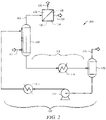
- Figure 2 shows a process flow diagram of another embodiment of the disclosed system 200.
- the system 200 of Figure 2 may comprise the same components (e.g., separator 110, regenerator 120, heater 114, cooler 123, pump 124, solvent circulation system, process stream 111, captured stream 113, solvent stream 122, recovered stream 121) as the system 100 of Figure 1 .
- System 200 further comprises a membrane unit 130 and associated streams 131 and 132. Uncaptured gaseous components which are not captured in the separator 110 by the ionic liquid solvent may exit from the separator 110 and flow through uncaptured stream 112 to the membrane unit 130 for further processing.
- the separator 110 may capture a gaseous component of the process stream 111 (as described for Figure 1 above), and uncaptured components of the process stream 111 (uncaptured in the separator 110) may exit from the separator 110 and flow to the membrane unit 130 via uncaptured stream 112 (as described for Figure 1 above).
- the membrane unit 130 may comprise a membrane 135 which is selective to one or more fluid components (e.g., a second gaseous component) of the process stream 111. Uncaptured stream 112 feeds uncaptured components to the membrane unit 130.
- Uncaptured stream 112 may comprise various equipment (e.g., compressor, pump, valve, heat exchanger, or combinations thereof) which may can alter the conditions (e.g., temperature, pressure, phase) of the uncaptured stream 112 for flow of uncaptured gaseous components to the membrane unit 130.
- One or more of the uncaptured components may selectively permeate through the membrane 135 to the permeate side 134 of the membrane 135.
- the portions of the uncaptured components which do not permeate through the membrane 135 may comprise the retentate of the membrane 135 on the retentate side 133 of the membrane 135.
- the permeate may flow from the permeate side 134 of the membrane 135 and through permeate stream 132 for further processing, use, flare, disposal, or sale.
- the retentate may flow from the retentate side 133 of the membrane 135 and through retentate stream 131 for further processing, use, flare, disposal, or sale.
- the membrane 135 of the membrane unit 130 is selective to alkanes (e.g., isobutane, ethane), H 2 S, nitrogen, hydrogen, or combinations thereof.
- alkanes e.g., isobutane, ethane
- Membrane units having membranes which are selective to one or more of the uncaptured components are known in the art.
- membrane units suitable for removal of H 2 S in system 200 are disclosed in U.S. Patent Nos. 5,556,449 ; 5,558,698 ; 5,407,467 ; 5,401,300 ; and 6,572,678 .
- Membrane units suitable for removal of hydrogen in system 200 are disclosed in U.S. Patent Nos. 6,555,316 and 5,980,609 .
- Membrane units suitable for removal of alkanes in system 200 are disclosed in U.S. Patent No. 5,980,609 .
- Membrane units suitable for removal of nitrogen in system 200 are disclosed in U.S. Patent No.
- the membrane unit 130 may comprise two or more membrane units which include two or more membranes having the same or different selectivity as one another.
- an alkane-selective membrane may be used to recover an uncaptured alkane in combination with a nitrogen-selective membrane.
- multiple membrane units may be used which are selective to H 2 S to achieve low levels of H 2 S.
- Operation of the system 200 shown in Figure 2 may include, but is not limited to, two operational embodiments.
- First, at least a portion of a gaseous component of the process stream 111 may be captured by the ionic liquid solvent in the separator 110 while at least a portion of a second gaseous component of the process stream 111 is not captured, exits from the separator 110, and flows to the membrane unit 130 via uncaptured stream 112.
- the uncaptured portion of the second gaseous component is then recovered from the membrane unit 130, and at least a portion of the captured gaseous component is recovered either from the separator 110 (e.g., in embodiments where the separator provides a dual function as a regenerator) or from the regenerator 120 of Figure 2 .
- At least a portion of a gaseous component and at least a portion of a second gaseous component of the process stream 111 may be captured by the ionic liquid solvent in the separator 110 while at least a portion of a third gaseous component of the process stream 111 is not captured, exits from the separator 110, and flows to the membrane unit 130 via uncaptured stream 112.
- the uncaptured portion of the third gaseous component is then recovered from the membrane unit 130, and the captured portion of the gaseous component and captured portion of the second gaseous component are recovered either from the separator 110 (e.g., in embodiments where the separator 110 provides a dual function as a regenerator) or from the regenerator 120 shown in Figure 2 .
- the process stream 111, captured stream 113, uncaptured stream 112, solvent stream 122, and recovered stream 121 may comprise embodiments of the process stream 111, captured stream 113, uncaptured stream 112, solvent stream 122, and recovered stream 121 described for the system 100 of Figure 1 .
- the separator 110 and regenerator 120 of system 200 may comprise embodiments of the separator 110 and regenerator 120 of system 100 described for Figure 1 .
- retentate stream 131 or permeate stream 132 may comprise the recovered second gaseous component or the recovered third gaseous component.
- the retentate stream 131 or permeate stream 132 may be introduced into or reused in processes such as a polyethylene polymerization process; retentate stream 131 and/or permeate stream 132 may be collected for further processing (e.g., cracking, catalytic cracking, pyrolysis, dehydrogenating, deoxygenating, scrubbing, converting, treating, or combinations thereof); retentate stream 131 or permeate stream 132 may be used for distribution, sale, etc., of the second gaseous component (optionally, third gaseous component); the retentate stream 131 or permeate stream 132 may be used as fuel; or combinations thereof.
- the retentate stream 131 or permeate stream 132 may comprise substantially (e.g., >90% by weight of the retentate stream 131 or permeate stream 132) the recovered second gaseous component (e.g., alkane, acid gas).
- the retentate stream 131 or permeate stream 132 may comprise substantially (e.g., >90% by weight of the retentate stream 131 or permeate stream 132) the recovered third gaseous component (e.g., alkane, nitrogen, hydrogen, acid gas).
- the retentate stream 131 or permeate stream 132 may comprise greater than about 50%, 60%, 70%, 80%, 85%, 90%, 95%, or more, of the second gaseous component (e.g., alkane, acid gas) recovered from the process stream 111.
- the retentate stream 131 or permeate stream 132 may comprise greater than about 50%, 60%, 70%, 80%, 85%, 90%, 95%, or more, of the third gaseous component (e.g., alkane, acid gas, hydrogen, nitrogen, natural gas, syngas) recovered from the process stream 111.
- the third gaseous component e.g., alkane, acid gas, hydrogen, nitrogen, natural gas, syngas
- the retentate stream 131 or permeate stream 132 may comprise greater than about 80%, 85%, 90%, 95%, or more, of the alkane recovered from the process stream 111. In alternative embodiments, the retentate stream 131 or permeate stream 132 may comprise greater than about 50%, 60%, 70%, 80%, 90%, or more, of the natural gas or syngas recovered from the process stream 111. In additional or alternative embodiments, the retentate stream 131 or permeate stream 132 may comprise greater than about 50%, 60%, 70%, 80%, 90%, or more, of the H 2 S recovered from the process stream 111.
- the purity of the recovered second gaseous component (e.g., alkane, acid gas) in the retentate stream 131 or permeate stream 132 may be greater than about 50%, 60%, 70,%, 80%, 90%, 95%, 96%, 97,%, 98%, 99%, or more, by weight of the retentate stream 131 or permeate stream 132.
- the purity of the recovered third gaseous component e.g., alkane, acid gas, hydrogen, nitrogen, natural gas, syngas
- the purity of the recovered third gaseous component may be greater than 50%, 60%, 70,%, 80%, 90%, 95%, 96%, 97,%, 98%, 99%, or more, by weight of the retentate stream 131 or permeate stream 132.
- the retentate stream 131 or permeate stream 132 may comprise substantially (e.g., >90 wt% by weight of the retentate stream 131 or permeate stream 132) alkane (e.g., isobutane, ethane, propane); alternatively, the retentate stream 131 or permeate stream 132 may comprise substantially (e.g., >90 wt% by weight of the retentate stream 131 or permeate stream 132) natural gas or syngas; alternatively, the retentate stream 131 or permeate stream 132 may comprise substantially (e.g., >90 wt% by weight of the retentate stream 131 or permeate stream 132) of CO 2 and/or H 2 S.
- alkane e.g., isobutane, ethane, propane
- the retentate stream 131 or permeate stream 132 may comprise substantially (e.g., >90 wt% by weight of the retentate stream 131
- the gaseous component may comprise an olefin (e.g., ethylene) or an acid gas (CO 2 or H 2 S); the second gaseous component may comprise an alkane (e.g., isobutane) or an acid gas (CO 2 or H 2 S); the third gaseous component may comprise an alkane (e.g., ethane), natural gas, syngas, hydrogen, or nitrogen.
- olefin e.g., ethylene
- CO 2 or H 2 S acid gas
- the third gaseous component may comprise an alkane (e.g., ethane), natural gas, syngas, hydrogen, or nitrogen.
- the disclosed embodiments include methods for recovering at least a portion of a gaseous component (e.g., the gaseous component, second gaseous component, third gaseous component, or combinations thereof, as described above).
- a gaseous component e.g., the gaseous component, second gaseous component, third gaseous component, or combinations thereof, as described above.
- a method comprises providing a process stream comprising a gaseous component, capturing at least a portion of the gaseous component from the process stream by the ionic liquid solvent, and recovering at least a portion of a captured gaseous component from the ionic liquid solvent.
- the process stream comprises a second gaseous component and at least a portion of the second gaseous component from the process stream is captured by the ionic liquid solvent, and the method further comprises recovering at least a portion of the second gaseous component from the ionic liquid solvent.
- the ionic liquid solvent may comprise a cation, an anion, a Ag(I) salt, a Cu(I) salt, or combinations thereof.
- the cation may comprise any of the cations described hereinabove in combination with any of the anions described herein.
- the Ag(I) salt may comprise any of the silver salts described herein.
- the concentration of silver in the ionic liquid solvent may comprise any of the concentrations described herein.
- the Cu(I) salt may any of the copper salts described herein.
- a concentration of copper (e.g., Cu(I)) in the ionic liquid solvent may comprise any of the concentrations described herein.
- the step of capturing may be performed at a liquid-to-gas mass flow ratio from about 1 to about 350; alternatively, from about 1 to about 200; alternatively, from about 10 to about 200; alternatively, from about 10 to about 100.
- the step of capturing may be performed at a liquid-to-gas mass flow ratio such that at least a portion of a second gaseous component is captured by the ionic liquid solvent in addition to the capture of the gaseous component.
- the liquid-to-gas mass flow ratio may comprise greater than about 10; alternatively, greater than about 15.
- the step of capturing may be performed at a liquid-to-gas mass flow ratio such that at least a portion of the second gaseous component is not captured by the ionic liquid solvent.
- the liquid-to-gas mass flow ratio may comprise less than about 200.
- the method may further comprise flowing the ionic liquid solvent at a mass flow rate from about 1,000 pounds per hour to about 300,000 pounds per hour. In additional or alternative embodiments, the method may further comprise flowing the ionic liquid solvent at a flow rate which captures at least a portion of the gaseous component, wherein the gaseous component comprises an acid gas.
- the gaseous component and/or are the second gaseous component are captured by absorption, adsorption, dissolution, complexation, or combinations thereof.
- the method may further comprise flowing an uncaptured portion of the second gaseous component to a membrane unit, and recovering at least a portion of the uncaptured portion of the second gaseous component from the membrane unit.
- the method may comprise flowing an uncaptured portion of a third gaseous component to the membrane unit, and recovering at least a portion of the uncaptured portion of the third gaseous component from the membrane unit.
- the step of capturing may be performed at a temperature from about 5 °C to about 50 °C; alternatively, about 20 °C to about 40 °C. In embodiments of the method, the step of capturing may be performed at a pressure from about 100 psia (689 kPa) to about 250 psia (1.7 MPa).
- recovering at least a portion of the captured gaseous component, the captured second gaseous component, or combinations thereof may be performed at a temperature greater than a temperature at which the gaseous component, the second gaseous component, or combinations thereof, is captured; additionally or alternatively, from about 60 °C to about 450 °C.
- recovering at least a portion of the captured gaseous component, the captured second gaseous component, or combinations thereof may be performed at a pressure less than a pressure at which the gaseous component, the second gaseous component, or combinations thereof, is captured; at a pressure greater than about 14.7 psia (101 kPa); at a pressure which is about 20 psia (138 kPa) less than the pressure at which the gaseous component, the second gaseous component, or combinations thereof, is captured; or combinations thereof.
- recovering at least a portion of the captured gaseous component, of the captured second gaseous component, or combinations thereof may comprise liberating at least a portion of the captured gaseous component, of the captured second gaseous component, or combinations thereof, from the ionic liquid solvent, and recovering the liberated gaseous component, the liberated second gaseous component, or combinations thereof.
- Liberating the captured gaseous component and/or the captured second gaseous component from the ionic liquid solvent may generally comprise any suitable means of reversing the various links, bonds, attractions, interactions, complexes, or combinations thereof by which the captured gaseous component (optionally, captured second gaseous component) is bound, linked, bonded or combinations thereof to the ionic liquid solvent.
- Nonlimiting examples of a suitable means by which to liberate the captured gaseous component include altering a solubility of a captured gaseous component(optionally, captured second gaseous component), altering absorption kinetics or the absorption equilibrium of the ionic liquid solvent, heating the ionic liquid solvent comprising a captured gaseous component (optionally, captured second gaseous component), depressurizing the ionic liquid solvent comprising a captured gaseous component (optionally, captured second gaseous component), altering the partial pressure of the captured gaseous component (optionally, captured second gaseous component), or combinations thereof.
- liberating the captured gaseous component may comprise depressurizing the ionic liquid solvent comprising the captured gaseous component (optionally, captured second gaseous component) to a suitable partial pressure.
- liberating the captured gaseous component may comprise heating the ionic liquid solvent comprising the captured gaseous component (optionally, captured second gaseous component) within a separator or regenerator to a suitable temperature.
- Such a suitable temperature may be at a temperature greater than a temperature at which the gaseous component, the second gaseous component, or combinations thereof, is captured; alternatively or additionally, at a temperature from about 60 °C to about 450 °C, to encourage release of the captured component from the ionic liquid solvent.
- the gaseous component may comprise an olefin or an acid gas
- the second gaseous component may comprise an alkane or an acid gas
- the olefin may comprise ethylene
- the alkane may comprise isobutane
- the acid gas may comprise CO 2 or H 2 S.
- a commercial process simulator was employed to generate models in accordance with the systems and/or methods disclosed herein.
- the models employed a system as shown in the figures.
- a process stream 111 feeds to the separator 110.
- using an ionic liquid solvent as disclosed herein for the capture of gaseous components provides for high selectivity of the gaseous component to other components in the process stream 111.
- Reference Example 1 utilizes the system 100 of Figure 1 .
- Process stream 111 of Figure 1 is fed to the bottom of the separator 110.
- the composition and conditions for the process stream 111 of Example 1 are given in Table 1 below: Table 1 Composition Mass flow (lb/hr) Molar flow (kmol/hr) Molar fraction Partial pressure (psia) Hydrogen 31.06 (68.41 kg/hr) 7.1 0.29 59.3 (409 kPa) Nitrogen 136.53 (301.00 kg/hr) 2.2 0.09 18.6 (128 kPa) Ethane 169.14 (372.89 kg/hr) 2.6 0.11 21.5 (148 kPa) Ethylene 728.54 (1606.16 kg/hr) 11.8 0.49 99.4 (685 kPa) I-Butane 62.04 (136.77 kg/hr) 0.5 0.02 4.1 (28 kPa) Total 1127.31 (2485.29 kg/hr) 24.2 1.00
- Solvent stream 122 comprising the ionic liquid solvent is fed to the top of the separator 110.
- the pressure of the separator 110 is about 186 psia (1.3 MPa), and the temperature is about 30°C.
- the ionic liquid solvent is a solution of silver(I) bis(trifluoromethanesulfonyl)amide ([Ag(I)][Tf 2 N]) in ethylmethylimidazolium bis(trifluoromethanesulfonyl)amide ([emim][Tf 2 N]), designated as [emim][Tf 2 N]-Ag, and the concentration of Ag(I) in the ionic liquid solvent is about 1.8 N.
- gaseous hydrogen, nitrogen, ethane, ethylene and isobutane rise through the ionic liquid solvent, and ethylene is captured (via absorption and complexing as described herein) into the [emim][Tf 2 N]-Ag while isobutane is physisorbed.
- the ethylene which is complexed with the [emim][Tf 2 N]-Ag and isobutane which is physisorbed in [emim][Tf 2 N] exits from the separator 110 and flows to a regenerator 120 via captured stream 113.
- Ethylene liberates (e.g., desorbs) and the isobutane liberates from the [emim][Tf 2 N]-Ag in the regenerator 120, where the pressure is about 16 psia (110 kPa) and temperature is about 93 °C, so as to regenerate the [emim][Tf 2 N]-Ag and provide a recovered stream 121 comprising ethylene and isobutane.
- the regenerated [emim][Tf 2 N]-Ag is recycled back to the separator 110 via solvent stream 122.
- ethylene recovery in recovered stream 121 is about 96.5% by weight of ethylene in the process stream 111 or by moles of ethylene in the process stream 111
- isobutane recovery is about 88% by weight of isobutane in the process stream 111 or by moles of isobutane in the process stream 111
- the purity of the recovered ethylene and isobutane is about 90% by moles of ethylene and isobutane in the recovered stream 121.
- Reference Example 1 demonstrates an ionic liquid solvent as disclosed herein can selectively capture two gaseous components of the process stream 111, i.e., in the case of Reference Example 1, ethylene and isobutane. Moreover, the recovery of the two gaseous components is about 96.5% for ethylene and about 88% for isobutane; and the purity of the two gaseous components is about 90%.
- the capture of two gaseous components may avoid the need for separation of the second gaseous component (i.e., isobutane) from the process stream 111 in other equipment (i.e., in a membrane unit or other separating device). Such cases may reduce capital cost for process stream component separations and/or provide recovery of two gaseous components which may complement one another in subsequent use or sale, separations, processing, or combinations thereof.
- Reference Example 2 utilizes the system 100 of Figure 1 .
- Process stream 111 of Figure 1 comprising gaseous hydrogen, nitrogen, ethane, ethylene and isobutane is fed to the bottom of the separator 110.
- the composition and conditions for the process stream 111 of Example 2 are given in Table 1 above.
- the solvent stream 122 comprising the ionic liquid solvent is fed to the top of the separator 110.
- the pressure of the separator 110 is about 186 psia (1.3 MPa), and the temperature is about 30 °C.
- the ionic liquid solvent is [emim][Tf 2 N]-Ag, and the concentration of Ag(I) in the ionic liquid solvent is about 1.8 N.
- gaseous ethane, ethylene and isobutane rise through the ionic liquid solvent, and ethylene is captured (via absorption and complexing as described herein) into the [emim][Tf 2 N]-Ag.
- the ethylene which is complexed with the [emim][Tf 2 N]-Ag exits from the separator 110 and flows to a regenerator 120 via captured stream 113.
- Ethylene liberates (e.g., desorbs) from the [emim] [Tf 2 N]-Ag in the regenerator 120, where the pressure is about 16 psia (110 kPa) and temperature is about 149 °C, so as to regenerate the [emim][Tf 2 N]-Ag.
- the regenerated [emim][Tf 2 N]-Ag is recycled back to the separator 110 via solvent stream 122.
- Recovered ethylene flows from the regenerator 120 into recovered stream 121.
- ethylene recovery in recovered stream 121 is about 97%, and the purity of the recovered ethylene is about 98.96%.
- Reference Example 2 demonstrates an ionic liquid solvent as disclosed herein can selectively capture one gaseous component of the process stream 111, i.e., in the case of Reference Example 2, ethylene. Moreover, the recovery of the gaseous component is about 97% by weight of ethylene in the process stream 111, and the purity of ethylene is about 98.96% by mole of ethylene in the recovered stream 121.
- the selective capture of one gaseous component may avoid the need for separation of the gaseous component (i.e., ethylene) from other gaseous components subsequent to the regenerator 120. Such cases may reduce capital cost for process stream component separations and/or provide selective recovery of a gaseous component which may otherwise be difficult, expensive, or inefficient to separate from the process stream 111.
- Example 3 utilizes the system 200 of Figure 2 .
- Process stream 111 of Figure 1 comprising gaseous hydrogen, nitrogen, ethane, ethylene and isobutane is fed to the bottom of the separator 110.
- the composition and conditions of the process stream 111 for Example 3 are shown in Table 2 below: Table 2 Composition Mass flow (lb/hr) Molar flow (kmol/hr) Molar fraction Partial pressure (psia) Hydrogen 29.7 (65.48 kg/hr) 6.8 0.46 88.0 (606 kPa) Nitrogen 92.7 (204 kg/hr) 1.5 0.10 19.6 (135 kPa) Ethane 66.7 (147 kg/hr) 1.0 0.07 13.2 (91 kPa) Ethylene 251.5 (554.5 kg/hr) 4.1 0.28 53.2 (367 kPa) I-Butane 165.4 (364.6 kg/hr) 1.3 0.09 16.9 (117 kPa) Total 606 (1340 kg/hr) 14.6 1
- Solvent stream 122 comprising the ionic liquid solvent is fed to the top of the separator 110.
- the pressure of the separator 110 is about 186 psia (1.3 MPa), and the temperature is about 30 °C.
- the ionic liquid solvent is [emim][Tf 2 N]-Ag, and the concentration of Ag(I) in the ionic liquid solvent is about 1.8 N.
- gaseous ethane, ethylene and isobutane rise through the ionic liquid solvent, and ethylene is absorbed (via complexing as described herein) into the [emim][Tf 2 N]-Ag.
- the ethylene which is complexed with the [emim][Tf 2 N]-Ag exits the separator 110 and flows to a regenerator 120 via captured stream 113.
- Ethylene desorbs from the [emim][Tf 2 N]-Ag in the regenerator 120, where the pressure is 16 psia (110 kPa) and the temperature is about 149 °C, so as to regenerate the [emim][Tf 2 N]-Ag.
- the regenerated [emim][Tf 2 N]-Ag is recycled back to the separator 110 via solvent stream 122.
- Isobutane which is not absorbed in the separator 110 flows via stream 112 to a membrane unit 130.
- Isobutane is recovered as permeate of an isobutane-selective membrane 135 in the membrane unit 130.
- Isobutane flows from the membrane unit 130 in stream 132. Ethane and any remaining gas are recovered in the retentate of the membrane via stream 131.
- ethylene recovery is about 92.6% by weight of ethylene in the process stream 111
- the purity of the recovered ethylene is about 98.3% by mole of ethylene in the recovered stream 121
- isobutane recovery is as high as about 98% by weight of isobutane in the process stream 111.
- Reference Example 3 demonstrates utilization of a membrane unit 130 to recover the second gaseous component (i.e., isobutane) can provide for a smaller solvent circulation system.
- the mass flow ratio of ionic liquid solvent in Reference Example 3 is about 10
- the mass flow ratio for Reference Example 1 is about 200
- the mass flow ratio of Reference Example 2 is about 15.
- Reference Example 3 provides for 92.6% recovery of ethylene in the separator 110 using a mass flow ratio of 10 and up to 98% recovery of isobutane in the membrane unit 130.
- Olefin solubility and olefin/alkane selectivity was evaluated for various embodiments of the disclosed silver-based ionic liquid solvent (AgIL).
- AgIL silver-based ionic liquid solvent
- Propylene was used as the olefin and propane was used as the alkane.
- propane was used as the alkane.
- the order of the following steps is not limited to that disclosed and the steps may be rearranged, combined, or omitted according to knowledge of one skilled in the art with the aid of this disclosure.
- the Henry's constant values shown in Table 4 above are in units of mol/L-Bar; whereas, the COSMO-RS methodology set forth in Marcos Fallanza et al., Screening of RTILs for propane/propylene separation using COSMO-RS methodology, 220 CHEM. ENG. J. 284, 284-293 (2013 ), provides Henry's constant values in units of MPa. Thus, the MPa units for the Henry's constant values were converted to mol/L-Bar for Table 4. To do so, the inverse of values in units of MPa was obtained (i.e., values in units of 1/MPa).
- H ′ 0.0577 * H 2 + 0.4977 * H where H' is Henry's law constant in units of mol/L-Bar and H is Henry's law constant in units of 1/MPa.
- ionic liquid solvents While certain ionic liquid solvents are disclosed as suitable based on use of Henry's constant values obtained using this correlation, it is within the scope of this disclosure that other ionic liquid solvents may also be suitable using correlations having a different assumption for ionic liquid solvent molarity and a different combination of partial pressures, such as an ionic liquid solvent molarity of 1, 2, 3, 4, 5, 6, 7, 8, 9, or 10 mol/L and partial pressures up to 10 Bar.
- Equations (1)-(20) disclosed above use Henry's constant in units of mol/L-Bar, the units of MPa for the values in Tables 5 and 6 need not be converted since they are used for calculation of physical selectivity, S p , which is unitless.
- the physical selectivity, S p , of propylene to propane was calculated by taking the ratio of the Henry's constant of propane in Table 5 to the Henry's constant of propylene in Table 6 for each of the cation/anion ionic liquid combinations.
- the physical selectivity values are shown in Table 7 below:
- Equations (14) and (20) assumed or calculated, the total solubility of propylene and the total selectivity of propylene over propane were calculated.
- the total solubility of propylene values are shown in Table 8 below, and the total selectivity values are shown in Table 9 below:
- Table 10 shows the anion/cation combinations, indicated with "W,” which have a total propylene solubility and total selectivity equal to or greater than the respective values for [emim] [Tf 2 N]-Ag:
- Figure 3 graphically illustrates these ionic liquid solvent anion/cation combinations which have total solubility and total selectivity values greater than those values of [emim][Tf 2 N]-Ag.
- Figure 3 there are various cation/anion combinations which have total solubility and total selectivity greater than those values of [emim] [Tf 2 N]-Ag.
- Reference Prophetic Example 1 utilizes the system 100 of Figure 1 .
- Process stream 111 of Figure 1 comprising natural gas, CO 2 and H 2 S is fed to the bottom of the separator 110, and solvent stream 122 comprising the ionic liquid solvent is fed to the top of the separator 110.
- the mass flow ratio of liquid to gas can be about 10 to about 100.
- the pressure of the separator 110 is about 100 psia (689 kPa) to about 250 psia (1.7 MPa), and the temperature is about 5 °C to about 50 °C.
- the ionic liquid solvent is [emim][Tf 2 N]-Ag, and the concentration of Ag(I) in the ionic liquid solvent can be 0 N to about 1.8 N.
- gaseous natural gas, CO 2 , and H 2 S rise through the ionic liquid solvent, and CO 2 and H 2 S are captured (e.g., physisorb) into the [emim][Tf 2 N]-Ag.
- the CO 2 and H 2 S which are captured (e.g., physically dissolved) in the [emim] [Tf 2 N]-Ag exits from the separator 110 and flows to a regenerator 120 via captured stream 113.
- CO 2 and H 2 S liberate (e.g., become insoluble) from the [emim][Tf 2 N]-Ag in the regenerator 120 so as to regenerate the [emim][Tf 2 N]-Ag.
- the regenerator 120 operates at a temperature from about 60 °C to about 450 °C, and a pressure greater than or equal to about 14.7 psia (101 kPa) where the pressure is less than about 20 psia (138 kPa) less than the pressure of the separator 110.
- the regenerated [emim] [Tf 2 N]-Ag is recycled back to the separator 110 via solvent stream 122.
- the CO 2 and H 2 S can be recovered in recovered stream 121.
- the CO 2 recovery can be greater than 50% by weight of CO 2 in the process stream 111 or by mole of CO 2 in the process stream 111
- the H 2 S recovery can be greater than 50% by weight of H 2 S in the process stream 111 or by mole H 2 S in the process stream 111.
- Purity of CO 2 in the recovered stream 121 can be greater than about 90% by mole of CO 2 in the recovered stream 121.
- Purity of H 2 S in the recovered stream 121 can be greater than about 90% by mole of H 2 S in the recovered stream 121.
- Reference Prophetic Example 1 demonstrates CO 2 and H 2 S may be removed from natural gas to provide a natural gas stream having reduced amounts of CO 2 and H 2 S.
- Reference Prophetic Example 2 utilizes the system 100 of Figure 1 .
- Process stream 111 of Figure 1 comprising syngas and CO 2 is fed to the bottom of the separator 110, and solvent stream 122 comprising the ionic liquid solvent is fed to the top of the separator 110.
- the mass flow ratio of liquid to gas can be about 10 to about 100.
- the pressure of the separator 110 is about 100 psia (689 kPa) to about 250 psia (1.7 MPa), and the temperature is about 5 °C to about 50 °C.
- the ionic liquid solvent is [emim][Tf 2 N]-Ag, and the concentration of Ag(I) in the ionic liquid solvent can be 0 N to about 1.8 N.
- gaseous syngas and CO 2 rise through the ionic liquid solvent, and CO 2 is captured into the [emim][Tf 2 N]-Ag.
- the CO 2 which is captured (e.g., physically dissolves) in the [emim][Tf 2 N]-Ag exits from the separator 110 and flows to a regenerator 120 via captured stream 113.
- CO 2 liberates (e.g., becomes insoluble) from the [emim][Tf 2 N]-Ag in the regenerator 120 so as to regenerate the [emim][Tf 2 N]-Ag.
- the regenerator 120 operates at a temperature from about 60 °C to about 450 °C, and a pressure greater than about 14.7 psia (101 kPa) and wherein the pressure is less than about 20 psia (138 kPa) less than the pressure of the separator 110.
- the regenerated [emim] [Tf 2 N]-Ag is recycled back to the separator 110 via solvent stream 122.
- the CO 2 can be recovered in recovered stream 121.
- the CO 2 recovery can be greater than 50% by weight of CO 2 in the process stream 111 or by mole of CO 2 in the process stream 111.
- Purity of CO 2 in the recovered stream 121 can be greater than about 90% by mole of CO 2 in the recovered stream 121.
- Reference Prophetic Example 2 demonstrates CO 2 may be removed from syngas to provide a syngas stream having reduced amounts of CO 2 .
- R R l +k ⁇ (R u -R l ), wherein k is a variable ranging from 1 percent to 100 percent with a 1 percent increment, i.e., k is 1 percent, 2 percent, 3 percent, 4 percent, 5 percent, whereas 50 percent, 51 percent, 52 percent... 95 percent, 96 percent, 97 percent, 98 percent, 99 percent, or 100 percent.
- any numerical range defined by two R numbers as defined in the above is also specifically disclosed.
- Use of the term "optionally" with respect to any element of a claim means that the element is required, or alternatively, the element is not required, both alternatives being within the scope of the claim.
Landscapes
- Chemical & Material Sciences (AREA)
- Engineering & Computer Science (AREA)
- Analytical Chemistry (AREA)
- General Chemical & Material Sciences (AREA)
- Oil, Petroleum & Natural Gas (AREA)
- Chemical Kinetics & Catalysis (AREA)
- Gas Separation By Absorption (AREA)
Claims (14)
- Verfahren, umfassend:Bereitstellen eines Polymerisationsprozesssstroms, umfassend ein Olefin und ein Alkan, wobei das Olefin Propylen und das Alkan Propan ist;Abfangen mindestens eines Teils des Olefins aus dem Prozessstrom durch ein ionisches flüssiges Lösungsmittel; undGewinnen mindestens eines Teils eines abgefangenen Olefins aus dem ionischen flüssigen Lösungsmittel,wobei das ionische flüssige Lösungsmittel eine Gesamtlöslichkeit des Olefins aufweist, die größer als die Gesamtlöslichkeit des Olefins in [emim] [Tf2N]-Ag ist,wobei das ionische flüssige Lösungsmittel eine Gesamtselektivität für das Olefin gegenüber dem Alkan aufweist, die größer als die Gesamtselektivität von [emim] [Tf2N]-Ag für das Olefin gegenüber dem Alkan ist, wobei die Ionenflüssigkeit Butylethylimidazoliumtetrafluoroborat ([beim][BF4]), Butylethylimidazoliumhexafluorophosphat ([beim][[PF6]), Butylethylimidazoliumtrifluormethansulfonat ([beim][TfO]), Butylethylimidazoliumnitrat ([beim][NO3]), Butylmethylimidazoliumtrifluoracetat ([bmim][TFA]), Diethylimidazoliumtrifluoracetat ([eeim][TFA]), Diethylimidazoliumtrifluormethansulfonat ([eeim][TfO]), Diethylimidazoliumnitrat ([eeim][NO3]), Dimethylimidazoliumnitrat ([mmim][NO3]), Ethyl-2,4-dimethylimidazoliumtrifluoracetat [e-2,4-mmim][TFA]), Ethyl-2,4-dimethylimidazoliumtrifluormethansulfonat ([e-2,4-mmim][TfO]), Ethyl-2,4-dimethylimidazoliumnitrat ([e-2,4-mmim][NO3]), Ethyldimethylimidazoliumtetrafluoroborat ([emmim][BF4]), Ethyldimethylimidazoliumtrifluoracetat ([emmim][TFA]), Ethyldimethylimidazoliumtrifluormethansulfonat ([emmim][TfO]), Ethylmethylimidazoliumtrifluoracetat ([emim] [TFA]), Ethylmethylimidazoliumnitrat ([emim][NO3]), Ethylpropylimidazoliumtetrafluoroborat ([eprim][BF4]), Ethylpropylimidazoliumhexafluorophosphat ([eprim][PF6]), Ethylpropylimidazoliumtrifluoracetat ([eprim][TFA]), Ethylpropylimidazoliumtrifluormethansulfonat ([eprim][TfO]), Ethylpropylimidazoliumnitrat ([eprim][NO3]), Ethoxyethylmethylimidazoliumtetrafluoroborat ([etO-emim][BF4]), Ethoxyethylmethylimidazoliumhexafluorophosphat ([etOemim][PF6]), Ethoxyethylmethylimidazoliumtrifluoracetat ([etOemim][TFA]), Ethoxyethylmethylimidazoliumtrifluormethansulfonat ([etO-emim][TfO]), Ethoxyethylmethylimidazoliumnitrat ([etOemim][NO3]), Ethoxydimethylimidazoliummethansulfonat ([etOmmim][CH3SO3]), Ethoxydimethylimidazoliumtrifluoracetat ([etOmmim][TFA]), Heptylmethylimidazoliumtetrafluoroborat ([hpmim][BF4]), Hexylethylimidazoliumtetrafluoroborat ([hxeim] [BF4]), Hexylmethylimidazoliumtetrafluoroborat ([hxmim] [BF4]), Hexylmethylimidazoliumhexafluorophosphat ([hxmim] [PF6]), Hexylmethylimidazoliumnitrat ([hxmim][NO3]), Hexyldimethylimidazoliumtetrafluoroborat ([hxmmim][BF4]), Methoxyethylmethylimidazoliumtetrafluoroborat ([meO-emim][BF4]), Methoxyethylmethylimidazoliumhexafluorophosphat ([meOemim][PF6]), Methoxyethylmethylimidazoliumtrifluoracetat ([meOemim][TFA]), Methoxyethylmethylimidazoliumtrifluormethansulfonat ([meO-emim][TfO]), Methoxyethylmethylimidazoliumnitrat ([meOemim][NO3]), Methoxypropylmethylimidazoliumtetrafluoroborat ([meO-prmim][BF4]), Methoxypropylmethylimidazoliumhexafluorophosphat ([meOprmim][PF6]), Methoxypropylmethylimidazoliumtrifluoracetat ([meO-prmim][TFA]), Methoxypropylmethylimidazoliumtrifluormethansulfonat ([meO-prmim][TfO]), Methylpropylimidazoliummethansulfonat ([mprim] [CH3SO3]), Methylpropylimidazoliumtrifluoracetat ([mprim][TFA]), Methylpropylimidazoliumnitrat ([mprim][NO3]), Hydroxylethylmethylimidazoliummethansulfonat ([OHemim][CH3SO3]), Hydroxyloctylmethylimidazoliumtetrafluoroborat ([OH-omim] [BF4]), Hydroxyloctylmethylimidazoliumhexafluorophosphat ([OH-omim][PF6]), Hydroxyloctylmethylimidazoliumnitrat ([OH-omim][NO3]), Hydroxylpropylmethylimidazoliummethansulfonat ([OH-prmim][CH3SO3]), Octylmethylimidazoliumtetrafluorborat ([omim][BF4]), Phenylethylmethylimidazoliummethansulfonat ([ph-emim][CH3SO3]), Phenylethylmethylimidazoliumhexafluorophosphat ([ph-emim] [PF6]), Phenylethylmethylimidazoliumtrifluoracetat ([ph-emim] [TFA]), Phenylethylmethylimidazoliumtrifluormethansulfonat ([ph-emim][TfO]), Phenylethylmethylimidazoliumnitrat ([ph-emim][NO3]), Phenylmethylimidazoliummethansulfonat ([phmim][CH3SO3]), Phenylmethylimidazoliumtrifluoracetat ([ph-mim][TFA]), Phenylmethylimidazoliumtrifluormethansulfonat ([ph-mim][TfO]), Phenylmethylimidazoliumnitrat ([ph-mim][NO3]), Phenyldimethylimidazoliummethansulfonat ([ph-mmim][CH3SO3]), Phenyldimethylimidazoliumhexafluorphosphat ([ph-mmim][PF6]), Phenyldimethylimidazoliumtrifluoracetat ([ph-mmim][TFA]), Phenyldimethylimidazoliumtrifluormethansulfonat ([phmmim][TfO]), Phenyldimethylimidazoliumnitrat ([ph-mmim][NO3]), Pentylmethylimidazoliumtetrafluoroborat ([pnmim][BF4]), Pentylmethylimidazoliumhexafluorophosphat ([pnmim][PF6]), Pentylmethylimidazoliumtrifluoracetat ([pnmim][TFA]), Pentylmethylimidazoliumtrifluormethansulfonat ([pnmim][TfO]), Pentylmethylimidazoliumnitrat ([pnmim][NO3]), Propylmethylimidazoliumtrifluoracetat ([prmim][TFA]), Propylmethylimidazoliumtrifluormethansulfonat ([prmim][TfO]), Propylmethylimidazoliumnitrat ([prmim][NO3]), 1-Butyl-2-methylpyridiniumtetrafluoroborat ([1-b-2-mpy][BF4]), 1-Butyl-2-methylpyridiniumhexafluorophosphat ([1-b-2-mpy][PF6]), 1-Butyl-2-methylpyridiniumtrifluormethansulfonat ([1-b-2-mpy][TfO]), 1-Butyl-3-methylpyridiniumtetrafluoroborat ([1-b-3-mpy][BF4]), 1-Butyl-3-methylpyridiniumhexafluorophosphat ([1-b-3-mpy][PF6]), 1-Butyl-4-methylpyridiniumtetrafluoroborat ([1-b-4-mpy][BF4]), 1-Butyl-4-methylpyridiniumhexafluorophosphat ([1-b-4-mpy][PF6]), 1-Ethyl-2-methylpyridiniumtetrafluorborat ([1-e-2-mpy][BF4]), 1-Ethyl-2-methylpyridiniumtrifluoracetat ([1-e-2-mpy][TFA]), 1-Ethyl-2-methylpyridiniumtrifluormethansulfonat ([1-e-2-mpy][TfO]), 1-Ethyl-3-methylpyridiniumtetrafluoroborat ([1-e-3-mpy] [BF4]), 1-Ethyl-3-methylpyridiniumtrifluoracetat ([1-e-3-mpy][TFA]), 1-Ethyl-3-methylpyridiniumtrifluormethansulfonat ([1-e-3-mpy][TfO]), 1-Ethyl-4-dimethylacetylpyridiniumtetrafluoroborat ([1-e-4-DMApy][BF4]), 1-Ethyl-4-dimethylacetylpyridiniumhexafluorophosphat ([1-e-4-DMApy][PF6]), 1-Ethyl-4-methylpyridiniumtetrafluoroborat ([1-e-4-mpy][BF4]), 1-Ethyl-4-methylpyridiniumtrifluoracetat ([1-e-4-mpy][TFA]), 1-Ethyl-4-methylpyridiniumtrifluormethansulfonat ([1-e-4-mpy][TfO]), 1-Ethyl-4-methylpyridiniumnitrat ([1-e-4-mpy] [NO3]), 1-Hexyl-4-methylpyridiniumtetrafluorborat ([1-hx-4-mpy] [BF4]), 1-Propyl-3-methylpyridiniumtetrafluoroborat ([1-pr-3-mpy][BF4]), 1-Propyl-3-methylpyridiniumhexafluorophosphat ([1-pr-3-mpy][PF6]), 1-Propyl-3-methylpyridiniumtrifluoracetat ([1-pr-3-mpy][TFA]), 1-Propyl-3-methylpyridiniumtrifluormethansulfonat ([1-pr-3-mpy][TfO]), 1-Propyl-4-methylpyridiniumtetrafluoroborat ([1-pr-4-mpy][BF4]), 1-Propyl-4-methylpyridiniumhexafluorophosphat ([1-pr-3-mpy][PF6]), 1-Propyl-4-methylpyridiniumtrifluoracetat ([1-pr-4-mpy][TFA]), 1-Propyl-4-methylpyridiniumtrifluormethansulfonat ([1-pr-4-mpy][TfO]), 1-Propyl-4-methylpyridiniumnitrat ([1-pr-4-mpy][NO3]), Butylpyridiniumhexafluorophosphat ([bpy] [PF6]), Butylpyridiniumtrifluoracetat ([bpy][TFA]), Butylpyridiniumtrifluormethansulfonat ([bpy][TfO]), Butylpyridiniumnitrat ([bpy] [NO3]), Ethylpyridiniumnitrat ([epy] [NO3]), Heptylpyridiniumtetrafluoroborat ([hppy] [BF4]), Heptylpyridiniumhexafluorophosphat ([hppy][PF6]), Heptylpyridiniumnitrat ([hppy][NO3]), Hexylpyridiniumtetrafluoroborat ([hxpy] [BF4]), Hexylpyridiniumhexalfluorphosphat ([hxpy][PF6]), Hexylpyridiniumtrifluormethansulfonat ([hxpy][TfO]), Hexylpyridiniumnitrat ([hxpy][NO3]), Hydroxypropylpyridiniummethansulfonat ([OH-prpy][CH3SO3]), Octylpyridiniumtetrafluoroborat ([opy][BF4]), Pentylpyridiniumtetrafluoroborat ([pnpy][BF4]), Pentylpyridiniumhexafluorophosphat ([pnpy][PF6]), Pentylpyridiniumtrifluoracetat ([pnpy][TFA]), Pentylpyridiniumtrifluormethansulfonat ([pnpy][TfO]), Pentylpyridiniumnitrat ([pnpy][NO3]), Propylpyridiniumtrifluoracetat ([prpy][TFA]), Propylpyridiniumtrifluormethansulfonat ([prpy][TfO]), Propylpyridiniumnitrat ([prpy][NO3]), Butylmethylpyrrolidiniumtetrafluoroborat ([bmpyr][BF4]), Butylmethylpyrrolidiniumhexafluorophosphat ([bmpyr][PF6]), Butylmethylpyrrolidiniumtrifluormethansulfonat ([bmpyr][TfO]), Butylpyrrolidiniumacetat ([bpyr] [CH3CO2]), Hexylmethylpyrrolidiniumtetrafluoroborat ([hxmpyr][BF4]), Hexylmethylpyrrolidiniumhexafluorophosphat ([hxmpyr][PF6]), Hexylpyrrolidiniumacetat ([hxpyr][CH3CO2]), Hexylpyrrolidiniumtrifluoracetat ([hxpyr][TFA]), Octylpyrrolidiniumtetrafluoroborat ([opyr][BF4]), Octylpyrrolidiniummethansulfonat ([opyr][CH3SO3]), Octylpyrrolidiniumhexafluorophosphat ([opyr][PF6]), Octylpyrrolidiniumnitrat ([opyr][NO3]), Propylmethylpyrrolidiniumtetrafluoroborat ([prmpyr][BF4]), Propylmethylpyrrolidiniumhexafluorophosphat ([prmpyr][PF6]), Propylmethylpyrrolidiniumtrifluoracetat ([prmpyr][TFA]), Propylmethylpyrrolidiniumtrifluormethansulfonat ([prmpyr][TfO]), Butylethyldimethylammoniumtetrafluoroborat ([bemm-N][BF4]), Butylethyldimethylammoniumhexafluorophosphat ([bemm-N][PF6]), Butylethyldimethylammoniumtrifluoracetat ([bemm-N][TFA]), Butylethyldimethylammoniumtrifluormethansulfonat ([bemm-N][TfO]), Butyl trimethylammoniumtrifluoracetat ([bmmm-N][TFA]), Butyltrimethylammoniumtrifluormethansulfonat ([bmmm-N][TfO]), Butyltrimethylammoniumnitrat ([bmmm-N]NO3]), N,N,N-Trimethylethanolammoniummethansulfonat ([Cholin][CH3SO3]), N,N,N-Trimethylethanolammoniumnitrat ([Cholin][NO3]), Ethylammoniumhexafluorophosphat ([e-N] [PF6]),Tetraethylammoniumtetrafluoroborat ([eeee-N] [BF4]),Tetraethylammoniumhexafluorophosphat ([eeee-N] [PF6]),Tetraethylammoniumtrifluormethansulfonat ([eeee-N][TfO]), Butyldimethylethanolammoniumtrifluoracetat ([OHe-bmm-N][TFA]), Butyldimethylethanolammoniumtrifluormethansulfonat ([OHe-bmm-N][TfO]), Butyldimethylethanolammoniumnitrat ([OHebmm-N][NO3]), Ethyldimethylethanolammoniumnitrat ([OHe-emm-N] [NO3]) oder Kombinationen davon umfasst.
- Verfahren nach Anspruch 1, wobei eine Gesamtlöslichkeit des Olefins in dem ionischen flüssigen Lösungsmittel etwa 0,01 bis etwa 100 mol/l beträgt; oder
wobei eine Gesamtlöslichkeit des Alkans in dem ionischen flüssigen Lösungsmittel etwa 0,01 bis etwa 10 mol/l beträgt. - Verfahren nach Anspruch 1, wobei eine Gesamtselektivität des ionischen flüssigen Lösungsmittels für das Olefin gegenüber Propan etwa 8 bis mehr als etwa 300 beträgt.
- Verfahren nach Anspruch 1, wobei das ionische flüssige Lösungsmittel ein Ag(I)-Salz, ein Cu(I)-Salz oder Kombinationen davon umfasst, und wobei wahlweise eine Konzentration von Silber, Kupfer oder beiden in dem ionischen flüssigen Lösungsmittel von etwa 0,1 N bis etwa 5 N oder von etwa 0,45 N bis etwa 1,8 N beträgt.
- Verfahren nach Anspruch 1, wobei das Abfangen bei einem Flüssigkeit-zu-Gas-Massenstromverhältnis von etwa 1 bis etwa 350 durchgeführt wird; oder
wobei das Verfahren ferner Folgendes umfasst: Strömenlassen des ionischen flüssigen Lösungsmittels mit einer Massenstromrate von etwa 1.000 Pfund pro Stunde bis etwa 300.000 Pfund pro Stunde. - Verfahren nach Anspruch 1, wobei das Abfangen bei einem Flüssigkeits-zu-Gas-Massenstromverhältnis durchgeführt wird, sodass zusätzlich zu dem Abfangen mindestens eines Teils des Olefins mindestens ein Teil des Alkans durch das ionische flüssige Lösungsmittel abgefangen wird.
- Verfahren nach Anspruch 6, wobei das Flüssigkeit-zu-Gas-Massenstromverhältnis größer als etwa 15 ist.
- Verfahren nach Anspruch 6, wobei mindestens ein Teil des Alkans durch Absorption, Auflösung, Adsorption, Komplexbildung oder Kombinationen davon abgefangen wird.
- Verfahren nach Anspruch 6, ferner umfassend ein Gewinnen mindestens eines Teils eines abgefangenen Olefins aus dem ionischen flüssigen Lösungsmittel und wahlweise wobei das Gewinnen mindestens eines Teils eines abgefangenen Alkans bei einer Temperatur durchgeführt wird, die höher als die Temperatur ist, bei der das Alkan abgefangen wird, und bei einem Druck, der geringer als der Druck ist, bei dem das Alkan abgefangen wird.
- Verfahren nach Anspruch 1, wobei das Abfangen bei einem Flüssigkeit-zu-Gas-Massenstromverhältnis durchgeführt wird, sodass mindestens ein Teil des Alkans aus dem Prozessstrom nicht durch das ionische flüssige Lösungsmittel abgefangen wird.
- Verfahren nach Anspruch 10, wobei ein Flüssigkeit-zu-Gas-Massenstromverhältnis kleiner als etwa 200 ist.
- Verfahren nach Anspruch 10, ferner umfassend:Strömenlassen eines nicht abgefangenen Teils des Alkans zu einer Membraneinheit; undGewinnen mindestens eines Teils des nicht abgefangenen Teils des Alkans aus der Membraneinheit.
- Verfahren nach Anspruch 1, wobei das Olefin durch das ionische flüssige Lösungsmittel bei einer Temperatur von etwa 20 °C bis etwa 40 °C abgefangen wird; oder wobei das Olefin durch das ionische flüssige Lösungsmittel bei einem Druck von etwa 100 psia bis etwa 250 psia abgefangen wird.
- Verfahren nach Anspruch 1, wobei das ionische flüssige Lösungsmittel ein Kation, ein Anion und ein Ag(I)-Salz umfasst, wobei das Ag(I)-Salz ein Anion umfasst, wobei das Anion des Ag(I)-Salzes das gleiche Anion wie das des ionischen flüssigen Lösungsmittels ist oder
wobei das ionische flüssige Lösungsmittel ein Kation, ein Anion und ein Cu(I)-Salz umfasst, wobei das Cu(I)-Salz ein Anion umfasst, wobei das Anion des Cu(I)-Salzes das gleiche Anion wie das des ionischen flüssigen Lösungsmittels ist.
Applications Claiming Priority (2)
| Application Number | Priority Date | Filing Date | Title |
|---|---|---|---|
| US14/597,415 US10227274B2 (en) | 2013-07-23 | 2015-01-15 | Separations with ionic liquid solvents |
| PCT/US2015/011558 WO2016114780A1 (en) | 2015-01-15 | 2015-01-15 | Separations with ionic liquid solvents |
Publications (2)
| Publication Number | Publication Date |
|---|---|
| EP3244987A1 EP3244987A1 (de) | 2017-11-22 |
| EP3244987B1 true EP3244987B1 (de) | 2022-06-22 |
Family
ID=56406177
Family Applications (1)
| Application Number | Title | Priority Date | Filing Date |
|---|---|---|---|
| EP15702329.2A Active EP3244987B1 (de) | 2015-01-15 | 2015-01-15 | Trennungen mit ionischen flüssigen lösungsmitteln |
Country Status (5)
| Country | Link |
|---|---|
| EP (1) | EP3244987B1 (de) |
| KR (1) | KR102279449B1 (de) |
| CN (1) | CN107427758B (de) |
| CA (1) | CA2973971C (de) |
| WO (1) | WO2016114780A1 (de) |
Families Citing this family (10)
| Publication number | Priority date | Publication date | Assignee | Title |
|---|---|---|---|---|
| CN108084118B (zh) * | 2016-11-22 | 2020-04-10 | 万华化学集团股份有限公司 | 一种共氧化法生产环氧丙烷联产异丁烯的精制工艺 |
| EP3950667B1 (de) * | 2020-01-13 | 2025-02-26 | Lg Chem, Ltd. | Verfahren zur herstellung von acrylnitril-dimer |
| CN111589271A (zh) * | 2020-06-01 | 2020-08-28 | 江苏蓝电环保股份有限公司 | 一种从烟气中回收so2的溶剂 |
| CN111871193A (zh) * | 2020-07-15 | 2020-11-03 | 中石化南京化工研究院有限公司 | 一种从酸性气体中脱除硫化氢和羰基硫的吸收剂 |
| CN113025371B (zh) * | 2021-03-11 | 2022-03-01 | 中国矿业大学(北京) | 从油中萃取酚类化合物的离子液体及其筛选方法 |
| CN115999320B (zh) * | 2021-10-22 | 2025-07-25 | 中国石油化工股份有限公司 | 一种利用熔盐溶剂回收环氧丙烷尾气方法 |
| KR102634991B1 (ko) * | 2021-11-18 | 2024-02-08 | 조선대학교산학협력단 | 이온성액체를 이용한 이산화탄소 포집시스템 |
| CN113925970B (zh) * | 2021-11-25 | 2023-01-03 | 中国科学院过程工程研究所 | 一种肿瘤光热制剂的应用 |
| CN117756596B (zh) * | 2022-09-19 | 2025-12-05 | 惠州市绿色能源与新材料研究院 | 一种双银盐离子液体及其制备方法与应用 |
| CN116351097B (zh) * | 2023-04-12 | 2024-01-23 | 浙江蓝德能源科技发展有限公司 | 一种用于超高分子量pe纤维和隔膜的萃取剂及其制备和应用方法 |
Family Cites Families (16)
| Publication number | Priority date | Publication date | Assignee | Title |
|---|---|---|---|---|
| US5558698A (en) | 1993-10-25 | 1996-09-24 | Membrane Technology And Research, Inc. | Acid gas fractionation process |
| US5401300A (en) | 1993-10-25 | 1995-03-28 | Membrane Technology And Research, Inc. | Sour gas treatment process including dehydration of the gas stream |
| US5407467A (en) | 1993-10-25 | 1995-04-18 | Membrane Technology And Research, Inc. | Sour gas treatment process |
| US5556449A (en) | 1993-10-25 | 1996-09-17 | Membrane Technology And Research, Inc. | Acid gas fractionation process for fossil fuel gasifiers |
| US5980609A (en) * | 1997-01-24 | 1999-11-09 | Membrane Technology And Research, Inc. | Hydrogen recovery process |
| US6555316B1 (en) | 1999-10-12 | 2003-04-29 | Genset S.A. | Schizophrenia associated gene, proteins and biallelic markers |
| US6339182B1 (en) * | 2000-06-20 | 2002-01-15 | Chevron U.S.A. Inc. | Separation of olefins from paraffins using ionic liquid solutions |
| US6579343B2 (en) * | 2001-03-30 | 2003-06-17 | University Of Notre Dame Du Lac | Purification of gas with liquid ionic compounds |
| US6572678B1 (en) | 2001-12-28 | 2003-06-03 | Membrane Technology And Research, Inc. | Natural gas separation using nitrogen-selective membranes of modest selectivity |
| JP4886967B2 (ja) * | 2002-04-05 | 2012-02-29 | ユニバーシティ オブ サウス アラバマ | 官能化されたイオン性液体およびこの使用方法 |
| US7479227B2 (en) | 2003-03-07 | 2009-01-20 | Membrane Technology And Research, Inc. | Liquid-phase separation of low molecular weight organic compounds |
| AU2004303526B2 (en) * | 2003-12-22 | 2007-10-25 | Shell Internationale Research Maatschappij B.V. | Process for the separation of olefins and paraffins |
| CN100453622C (zh) * | 2005-03-24 | 2009-01-21 | 北京化工大学 | 一种用离子液体萃取脱除汽柴油中硫化物的方法 |
| EP2016991A1 (de) * | 2007-07-16 | 2009-01-21 | Nederlandse Organisatie voor toegepast- natuurwetenschappelijk onderzoek TNO | Verfahren zur Trennung von Gasen mithilfe ionischer Flüssigkeiten |
| US9180405B2 (en) | 2010-10-15 | 2015-11-10 | Chevron Phillips Chemical Company Lp | Ethylene recovery by absorption |
| US9238193B2 (en) * | 2013-07-23 | 2016-01-19 | Chevron Phillips Chemical Company Lp | Separations with ionic liquid solvents |
-
2015
- 2015-01-15 EP EP15702329.2A patent/EP3244987B1/de active Active
- 2015-01-15 CA CA2973971A patent/CA2973971C/en active Active
- 2015-01-15 KR KR1020177022664A patent/KR102279449B1/ko active Active
- 2015-01-15 WO PCT/US2015/011558 patent/WO2016114780A1/en not_active Ceased
- 2015-01-15 CN CN201580075367.2A patent/CN107427758B/zh active Active
Also Published As
| Publication number | Publication date |
|---|---|
| EP3244987A1 (de) | 2017-11-22 |
| CA2973971C (en) | 2022-05-17 |
| CN107427758B (zh) | 2020-11-20 |
| CA2973971A1 (en) | 2016-07-21 |
| CN107427758A (zh) | 2017-12-01 |
| KR20170116045A (ko) | 2017-10-18 |
| KR102279449B1 (ko) | 2021-07-20 |
| WO2016114780A1 (en) | 2016-07-21 |
Similar Documents
| Publication | Publication Date | Title |
|---|---|---|
| US10131596B2 (en) | Separations with ionic liquid solvents | |
| EP3244987B1 (de) | Trennungen mit ionischen flüssigen lösungsmitteln | |
| US10227274B2 (en) | Separations with ionic liquid solvents | |
| US11001543B2 (en) | Separation methods and systems for oxidative coupling of methane | |
| US20200054983A1 (en) | Methods and systems for performing chemical separations | |
| JP6575050B2 (ja) | 二酸化炭素の回収方法及び回収装置 | |
| US3712027A (en) | Vapor adsorption process for recovering selected components from a multi-component gas stream | |
| US20140007768A1 (en) | Method and apparatus for separating mixed gas feed | |
| CA2826900A1 (en) | Swing adsorption processes utilizing controlled adsorption fronts | |
| JP2012510887A (ja) | 亜硫酸を用いたイオン交換樹脂の再生方法 | |
| JP5989916B2 (ja) | アンモニアベース触媒による炭酸カリウム水溶液中でのco2吸収の速度向上 | |
| CN110997879B (zh) | 用溶剂吸收剂分离气体的方法 | |
| Manan et al. | Optimization of High Content Sour Gas Treating Unit using Amine Solution | |
| BR0003080B1 (pt) | processo para separação de olefinas leves a partir de parafinas contidas em misturas. | |
| JP2001321630A (ja) | 硫化水素含有ガスの洗浄方法 |
Legal Events
| Date | Code | Title | Description |
|---|---|---|---|
| STAA | Information on the status of an ep patent application or granted ep patent |
Free format text: STATUS: THE INTERNATIONAL PUBLICATION HAS BEEN MADE |
|
| PUAI | Public reference made under article 153(3) epc to a published international application that has entered the european phase |
Free format text: ORIGINAL CODE: 0009012 |
|
| STAA | Information on the status of an ep patent application or granted ep patent |
Free format text: STATUS: REQUEST FOR EXAMINATION WAS MADE |
|
| 17P | Request for examination filed |
Effective date: 20170718 |
|
| AK | Designated contracting states |
Kind code of ref document: A1 Designated state(s): AL AT BE BG CH CY CZ DE DK EE ES FI FR GB GR HR HU IE IS IT LI LT LU LV MC MK MT NL NO PL PT RO RS SE SI SK SM TR |
|
| AX | Request for extension of the european patent |
Extension state: BA ME |
|
| DAX | Request for extension of the european patent (deleted) | ||
| STAA | Information on the status of an ep patent application or granted ep patent |
Free format text: STATUS: EXAMINATION IS IN PROGRESS |
|
| 17Q | First examination report despatched |
Effective date: 20191011 |
|
| GRAP | Despatch of communication of intention to grant a patent |
Free format text: ORIGINAL CODE: EPIDOSNIGR1 |
|
| STAA | Information on the status of an ep patent application or granted ep patent |
Free format text: STATUS: GRANT OF PATENT IS INTENDED |
|
| INTG | Intention to grant announced |
Effective date: 20220110 |
|
| GRAS | Grant fee paid |
Free format text: ORIGINAL CODE: EPIDOSNIGR3 |
|
| GRAA | (expected) grant |
Free format text: ORIGINAL CODE: 0009210 |
|
| STAA | Information on the status of an ep patent application or granted ep patent |
Free format text: STATUS: THE PATENT HAS BEEN GRANTED |
|
| AK | Designated contracting states |
Kind code of ref document: B1 Designated state(s): AL AT BE BG CH CY CZ DE DK EE ES FI FR GB GR HR HU IE IS IT LI LT LU LV MC MK MT NL NO PL PT RO RS SE SI SK SM TR |
|
| REG | Reference to a national code |
Ref country code: GB Ref legal event code: FG4D |
|
| REG | Reference to a national code |
Ref country code: CH Ref legal event code: EP |
|
| REG | Reference to a national code |
Ref country code: DE Ref legal event code: R096 Ref document number: 602015079532 Country of ref document: DE |
|
| REG | Reference to a national code |
Ref country code: AT Ref legal event code: REF Ref document number: 1499402 Country of ref document: AT Kind code of ref document: T Effective date: 20220715 |
|
| REG | Reference to a national code |
Ref country code: IE Ref legal event code: FG4D |
|
| REG | Reference to a national code |
Ref country code: NL Ref legal event code: FP |
|
| REG | Reference to a national code |
Ref country code: LT Ref legal event code: MG9D |
|
| PG25 | Lapsed in a contracting state [announced via postgrant information from national office to epo] |
Ref country code: SE Free format text: LAPSE BECAUSE OF FAILURE TO SUBMIT A TRANSLATION OF THE DESCRIPTION OR TO PAY THE FEE WITHIN THE PRESCRIBED TIME-LIMIT Effective date: 20220622 Ref country code: NO Free format text: LAPSE BECAUSE OF FAILURE TO SUBMIT A TRANSLATION OF THE DESCRIPTION OR TO PAY THE FEE WITHIN THE PRESCRIBED TIME-LIMIT Effective date: 20220922 Ref country code: LT Free format text: LAPSE BECAUSE OF FAILURE TO SUBMIT A TRANSLATION OF THE DESCRIPTION OR TO PAY THE FEE WITHIN THE PRESCRIBED TIME-LIMIT Effective date: 20220622 Ref country code: HR Free format text: LAPSE BECAUSE OF FAILURE TO SUBMIT A TRANSLATION OF THE DESCRIPTION OR TO PAY THE FEE WITHIN THE PRESCRIBED TIME-LIMIT Effective date: 20220622 Ref country code: GR Free format text: LAPSE BECAUSE OF FAILURE TO SUBMIT A TRANSLATION OF THE DESCRIPTION OR TO PAY THE FEE WITHIN THE PRESCRIBED TIME-LIMIT Effective date: 20220923 Ref country code: FI Free format text: LAPSE BECAUSE OF FAILURE TO SUBMIT A TRANSLATION OF THE DESCRIPTION OR TO PAY THE FEE WITHIN THE PRESCRIBED TIME-LIMIT Effective date: 20220622 Ref country code: BG Free format text: LAPSE BECAUSE OF FAILURE TO SUBMIT A TRANSLATION OF THE DESCRIPTION OR TO PAY THE FEE WITHIN THE PRESCRIBED TIME-LIMIT Effective date: 20220922 |
|
| REG | Reference to a national code |
Ref country code: AT Ref legal event code: MK05 Ref document number: 1499402 Country of ref document: AT Kind code of ref document: T Effective date: 20220622 |
|
| PG25 | Lapsed in a contracting state [announced via postgrant information from national office to epo] |
Ref country code: RS Free format text: LAPSE BECAUSE OF FAILURE TO SUBMIT A TRANSLATION OF THE DESCRIPTION OR TO PAY THE FEE WITHIN THE PRESCRIBED TIME-LIMIT Effective date: 20220622 Ref country code: LV Free format text: LAPSE BECAUSE OF FAILURE TO SUBMIT A TRANSLATION OF THE DESCRIPTION OR TO PAY THE FEE WITHIN THE PRESCRIBED TIME-LIMIT Effective date: 20220622 |
|
| PG25 | Lapsed in a contracting state [announced via postgrant information from national office to epo] |
Ref country code: SM Free format text: LAPSE BECAUSE OF FAILURE TO SUBMIT A TRANSLATION OF THE DESCRIPTION OR TO PAY THE FEE WITHIN THE PRESCRIBED TIME-LIMIT Effective date: 20220622 Ref country code: SK Free format text: LAPSE BECAUSE OF FAILURE TO SUBMIT A TRANSLATION OF THE DESCRIPTION OR TO PAY THE FEE WITHIN THE PRESCRIBED TIME-LIMIT Effective date: 20220622 Ref country code: RO Free format text: LAPSE BECAUSE OF FAILURE TO SUBMIT A TRANSLATION OF THE DESCRIPTION OR TO PAY THE FEE WITHIN THE PRESCRIBED TIME-LIMIT Effective date: 20220622 Ref country code: PT Free format text: LAPSE BECAUSE OF FAILURE TO SUBMIT A TRANSLATION OF THE DESCRIPTION OR TO PAY THE FEE WITHIN THE PRESCRIBED TIME-LIMIT Effective date: 20221024 Ref country code: ES Free format text: LAPSE BECAUSE OF FAILURE TO SUBMIT A TRANSLATION OF THE DESCRIPTION OR TO PAY THE FEE WITHIN THE PRESCRIBED TIME-LIMIT Effective date: 20220622 Ref country code: EE Free format text: LAPSE BECAUSE OF FAILURE TO SUBMIT A TRANSLATION OF THE DESCRIPTION OR TO PAY THE FEE WITHIN THE PRESCRIBED TIME-LIMIT Effective date: 20220622 Ref country code: CZ Free format text: LAPSE BECAUSE OF FAILURE TO SUBMIT A TRANSLATION OF THE DESCRIPTION OR TO PAY THE FEE WITHIN THE PRESCRIBED TIME-LIMIT Effective date: 20220622 Ref country code: AT Free format text: LAPSE BECAUSE OF FAILURE TO SUBMIT A TRANSLATION OF THE DESCRIPTION OR TO PAY THE FEE WITHIN THE PRESCRIBED TIME-LIMIT Effective date: 20220622 |
|
| PG25 | Lapsed in a contracting state [announced via postgrant information from national office to epo] |
Ref country code: PL Free format text: LAPSE BECAUSE OF FAILURE TO SUBMIT A TRANSLATION OF THE DESCRIPTION OR TO PAY THE FEE WITHIN THE PRESCRIBED TIME-LIMIT Effective date: 20220622 Ref country code: IS Free format text: LAPSE BECAUSE OF FAILURE TO SUBMIT A TRANSLATION OF THE DESCRIPTION OR TO PAY THE FEE WITHIN THE PRESCRIBED TIME-LIMIT Effective date: 20221022 |
|
| REG | Reference to a national code |
Ref country code: DE Ref legal event code: R097 Ref document number: 602015079532 Country of ref document: DE |
|
| PG25 | Lapsed in a contracting state [announced via postgrant information from national office to epo] |
Ref country code: AL Free format text: LAPSE BECAUSE OF FAILURE TO SUBMIT A TRANSLATION OF THE DESCRIPTION OR TO PAY THE FEE WITHIN THE PRESCRIBED TIME-LIMIT Effective date: 20220622 |
|
| PG25 | Lapsed in a contracting state [announced via postgrant information from national office to epo] |
Ref country code: DK Free format text: LAPSE BECAUSE OF FAILURE TO SUBMIT A TRANSLATION OF THE DESCRIPTION OR TO PAY THE FEE WITHIN THE PRESCRIBED TIME-LIMIT Effective date: 20220622 |
|
| PLBE | No opposition filed within time limit |
Free format text: ORIGINAL CODE: 0009261 |
|
| STAA | Information on the status of an ep patent application or granted ep patent |
Free format text: STATUS: NO OPPOSITION FILED WITHIN TIME LIMIT |
|
| 26N | No opposition filed |
Effective date: 20230323 |
|
| PG25 | Lapsed in a contracting state [announced via postgrant information from national office to epo] |
Ref country code: SI Free format text: LAPSE BECAUSE OF FAILURE TO SUBMIT A TRANSLATION OF THE DESCRIPTION OR TO PAY THE FEE WITHIN THE PRESCRIBED TIME-LIMIT Effective date: 20220622 |
|
| REG | Reference to a national code |
Ref country code: CH Ref legal event code: PL |
|
| PG25 | Lapsed in a contracting state [announced via postgrant information from national office to epo] |
Ref country code: LU Free format text: LAPSE BECAUSE OF NON-PAYMENT OF DUE FEES Effective date: 20230115 |
|
| PG25 | Lapsed in a contracting state [announced via postgrant information from national office to epo] |
Ref country code: LI Free format text: LAPSE BECAUSE OF NON-PAYMENT OF DUE FEES Effective date: 20230131 Ref country code: CH Free format text: LAPSE BECAUSE OF NON-PAYMENT OF DUE FEES Effective date: 20230131 |
|
| PG25 | Lapsed in a contracting state [announced via postgrant information from national office to epo] |
Ref country code: IT Free format text: LAPSE BECAUSE OF FAILURE TO SUBMIT A TRANSLATION OF THE DESCRIPTION OR TO PAY THE FEE WITHIN THE PRESCRIBED TIME-LIMIT Effective date: 20220622 Ref country code: IE Free format text: LAPSE BECAUSE OF NON-PAYMENT OF DUE FEES Effective date: 20230115 |
|
| PG25 | Lapsed in a contracting state [announced via postgrant information from national office to epo] |
Ref country code: MC Free format text: LAPSE BECAUSE OF FAILURE TO SUBMIT A TRANSLATION OF THE DESCRIPTION OR TO PAY THE FEE WITHIN THE PRESCRIBED TIME-LIMIT Effective date: 20220622 |
|
| PG25 | Lapsed in a contracting state [announced via postgrant information from national office to epo] |
Ref country code: MC Free format text: LAPSE BECAUSE OF FAILURE TO SUBMIT A TRANSLATION OF THE DESCRIPTION OR TO PAY THE FEE WITHIN THE PRESCRIBED TIME-LIMIT Effective date: 20220622 |
|
| PG25 | Lapsed in a contracting state [announced via postgrant information from national office to epo] |
Ref country code: BG Free format text: LAPSE BECAUSE OF FAILURE TO SUBMIT A TRANSLATION OF THE DESCRIPTION OR TO PAY THE FEE WITHIN THE PRESCRIBED TIME-LIMIT Effective date: 20220622 |
|
| PG25 | Lapsed in a contracting state [announced via postgrant information from national office to epo] |
Ref country code: BG Free format text: LAPSE BECAUSE OF FAILURE TO SUBMIT A TRANSLATION OF THE DESCRIPTION OR TO PAY THE FEE WITHIN THE PRESCRIBED TIME-LIMIT Effective date: 20220622 |
|
| PGFP | Annual fee paid to national office [announced via postgrant information from national office to epo] |
Ref country code: DE Payment date: 20241218 Year of fee payment: 11 |
|
| PG25 | Lapsed in a contracting state [announced via postgrant information from national office to epo] |
Ref country code: CY Free format text: LAPSE BECAUSE OF FAILURE TO SUBMIT A TRANSLATION OF THE DESCRIPTION OR TO PAY THE FEE WITHIN THE PRESCRIBED TIME-LIMIT; INVALID AB INITIO Effective date: 20150115 |
|
| PG25 | Lapsed in a contracting state [announced via postgrant information from national office to epo] |
Ref country code: HU Free format text: LAPSE BECAUSE OF FAILURE TO SUBMIT A TRANSLATION OF THE DESCRIPTION OR TO PAY THE FEE WITHIN THE PRESCRIBED TIME-LIMIT; INVALID AB INITIO Effective date: 20150115 |
|
| PG25 | Lapsed in a contracting state [announced via postgrant information from national office to epo] |
Ref country code: TR Free format text: LAPSE BECAUSE OF FAILURE TO SUBMIT A TRANSLATION OF THE DESCRIPTION OR TO PAY THE FEE WITHIN THE PRESCRIBED TIME-LIMIT Effective date: 20220622 |
|
| PGFP | Annual fee paid to national office [announced via postgrant information from national office to epo] |
Ref country code: GB Payment date: 20251220 Year of fee payment: 12 |
|
| PGFP | Annual fee paid to national office [announced via postgrant information from national office to epo] |
Ref country code: NL Payment date: 20251217 Year of fee payment: 12 Ref country code: FR Payment date: 20251217 Year of fee payment: 12 |
|
| PGFP | Annual fee paid to national office [announced via postgrant information from national office to epo] |
Ref country code: BE Payment date: 20251217 Year of fee payment: 12 |