EP3241925B1 - Procédé de production d'une structure porteuse de titane - Google Patents
Procédé de production d'une structure porteuse de titane Download PDFInfo
- Publication number
- EP3241925B1 EP3241925B1 EP17163656.6A EP17163656A EP3241925B1 EP 3241925 B1 EP3241925 B1 EP 3241925B1 EP 17163656 A EP17163656 A EP 17163656A EP 3241925 B1 EP3241925 B1 EP 3241925B1
- Authority
- EP
- European Patent Office
- Prior art keywords
- titanium
- load
- support member
- bearing structure
- titanium alloy
- Prior art date
- Legal status (The legal status is an assumption and is not a legal conclusion. Google has not performed a legal analysis and makes no representation as to the accuracy of the status listed.)
- Active
Links
Images
Classifications
-
- B—PERFORMING OPERATIONS; TRANSPORTING
- B05—SPRAYING OR ATOMISING IN GENERAL; APPLYING FLUENT MATERIALS TO SURFACES, IN GENERAL
- B05B—SPRAYING APPARATUS; ATOMISING APPARATUS; NOZZLES
- B05B7/00—Spraying apparatus for discharge of liquids or other fluent materials from two or more sources, e.g. of liquid and air, of powder and gas
- B05B7/16—Spraying apparatus for discharge of liquids or other fluent materials from two or more sources, e.g. of liquid and air, of powder and gas incorporating means for heating or cooling the material to be sprayed
-
- B—PERFORMING OPERATIONS; TRANSPORTING
- B05—SPRAYING OR ATOMISING IN GENERAL; APPLYING FLUENT MATERIALS TO SURFACES, IN GENERAL
- B05B—SPRAYING APPARATUS; ATOMISING APPARATUS; NOZZLES
- B05B7/00—Spraying apparatus for discharge of liquids or other fluent materials from two or more sources, e.g. of liquid and air, of powder and gas
- B05B7/14—Spraying apparatus for discharge of liquids or other fluent materials from two or more sources, e.g. of liquid and air, of powder and gas designed for spraying particulate materials
- B05B7/1481—Spray pistols or apparatus for discharging particulate material
- B05B7/1486—Spray pistols or apparatus for discharging particulate material for spraying particulate material in dry state
-
- B—PERFORMING OPERATIONS; TRANSPORTING
- B05—SPRAYING OR ATOMISING IN GENERAL; APPLYING FLUENT MATERIALS TO SURFACES, IN GENERAL
- B05B—SPRAYING APPARATUS; ATOMISING APPARATUS; NOZZLES
- B05B7/00—Spraying apparatus for discharge of liquids or other fluent materials from two or more sources, e.g. of liquid and air, of powder and gas
- B05B7/16—Spraying apparatus for discharge of liquids or other fluent materials from two or more sources, e.g. of liquid and air, of powder and gas incorporating means for heating or cooling the material to be sprayed
- B05B7/1606—Spraying apparatus for discharge of liquids or other fluent materials from two or more sources, e.g. of liquid and air, of powder and gas incorporating means for heating or cooling the material to be sprayed the spraying of the material involving the use of an atomising fluid, e.g. air
- B05B7/1613—Spraying apparatus for discharge of liquids or other fluent materials from two or more sources, e.g. of liquid and air, of powder and gas incorporating means for heating or cooling the material to be sprayed the spraying of the material involving the use of an atomising fluid, e.g. air comprising means for heating the atomising fluid before mixing with the material to be sprayed
-
- B—PERFORMING OPERATIONS; TRANSPORTING
- B05—SPRAYING OR ATOMISING IN GENERAL; APPLYING FLUENT MATERIALS TO SURFACES, IN GENERAL
- B05C—APPARATUS FOR APPLYING FLUENT MATERIALS TO SURFACES, IN GENERAL
- B05C5/00—Apparatus in which liquid or other fluent material is projected, poured or allowed to flow on to the surface of the work
-
- B—PERFORMING OPERATIONS; TRANSPORTING
- B05—SPRAYING OR ATOMISING IN GENERAL; APPLYING FLUENT MATERIALS TO SURFACES, IN GENERAL
- B05D—PROCESSES FOR APPLYING FLUENT MATERIALS TO SURFACES, IN GENERAL
- B05D1/00—Processes for applying liquids or other fluent materials
- B05D1/02—Processes for applying liquids or other fluent materials performed by spraying
- B05D1/12—Applying particulate materials
-
- B—PERFORMING OPERATIONS; TRANSPORTING
- B05—SPRAYING OR ATOMISING IN GENERAL; APPLYING FLUENT MATERIALS TO SURFACES, IN GENERAL
- B05D—PROCESSES FOR APPLYING FLUENT MATERIALS TO SURFACES, IN GENERAL
- B05D7/00—Processes, other than flocking, specially adapted for applying liquids or other fluent materials to particular surfaces or for applying particular liquids or other fluent materials
- B05D7/14—Processes, other than flocking, specially adapted for applying liquids or other fluent materials to particular surfaces or for applying particular liquids or other fluent materials to metal, e.g. car bodies
-
- B—PERFORMING OPERATIONS; TRANSPORTING
- B22—CASTING; POWDER METALLURGY
- B22F—WORKING METALLIC POWDER; MANUFACTURE OF ARTICLES FROM METALLIC POWDER; MAKING METALLIC POWDER; APPARATUS OR DEVICES SPECIALLY ADAPTED FOR METALLIC POWDER
- B22F3/00—Manufacture of workpieces or articles from metallic powder characterised by the manner of compacting or sintering; Apparatus specially adapted therefor ; Presses and furnaces
- B22F3/02—Compacting only
-
- C—CHEMISTRY; METALLURGY
- C23—COATING METALLIC MATERIAL; COATING MATERIAL WITH METALLIC MATERIAL; CHEMICAL SURFACE TREATMENT; DIFFUSION TREATMENT OF METALLIC MATERIAL; COATING BY VACUUM EVAPORATION, BY SPUTTERING, BY ION IMPLANTATION OR BY CHEMICAL VAPOUR DEPOSITION, IN GENERAL; INHIBITING CORROSION OF METALLIC MATERIAL OR INCRUSTATION IN GENERAL
- C23C—COATING METALLIC MATERIAL; COATING MATERIAL WITH METALLIC MATERIAL; SURFACE TREATMENT OF METALLIC MATERIAL BY DIFFUSION INTO THE SURFACE, BY CHEMICAL CONVERSION OR SUBSTITUTION; COATING BY VACUUM EVAPORATION, BY SPUTTERING, BY ION IMPLANTATION OR BY CHEMICAL VAPOUR DEPOSITION, IN GENERAL
- C23C24/00—Coating starting from inorganic powder
- C23C24/02—Coating starting from inorganic powder by application of pressure only
- C23C24/04—Impact or kinetic deposition of particles
-
- C—CHEMISTRY; METALLURGY
- C23—COATING METALLIC MATERIAL; COATING MATERIAL WITH METALLIC MATERIAL; CHEMICAL SURFACE TREATMENT; DIFFUSION TREATMENT OF METALLIC MATERIAL; COATING BY VACUUM EVAPORATION, BY SPUTTERING, BY ION IMPLANTATION OR BY CHEMICAL VAPOUR DEPOSITION, IN GENERAL; INHIBITING CORROSION OF METALLIC MATERIAL OR INCRUSTATION IN GENERAL
- C23C—COATING METALLIC MATERIAL; COATING MATERIAL WITH METALLIC MATERIAL; SURFACE TREATMENT OF METALLIC MATERIAL BY DIFFUSION INTO THE SURFACE, BY CHEMICAL CONVERSION OR SUBSTITUTION; COATING BY VACUUM EVAPORATION, BY SPUTTERING, BY ION IMPLANTATION OR BY CHEMICAL VAPOUR DEPOSITION, IN GENERAL
- C23C24/00—Coating starting from inorganic powder
- C23C24/08—Coating starting from inorganic powder by application of heat or pressure and heat
-
- C—CHEMISTRY; METALLURGY
- C23—COATING METALLIC MATERIAL; COATING MATERIAL WITH METALLIC MATERIAL; CHEMICAL SURFACE TREATMENT; DIFFUSION TREATMENT OF METALLIC MATERIAL; COATING BY VACUUM EVAPORATION, BY SPUTTERING, BY ION IMPLANTATION OR BY CHEMICAL VAPOUR DEPOSITION, IN GENERAL; INHIBITING CORROSION OF METALLIC MATERIAL OR INCRUSTATION IN GENERAL
- C23C—COATING METALLIC MATERIAL; COATING MATERIAL WITH METALLIC MATERIAL; SURFACE TREATMENT OF METALLIC MATERIAL BY DIFFUSION INTO THE SURFACE, BY CHEMICAL CONVERSION OR SUBSTITUTION; COATING BY VACUUM EVAPORATION, BY SPUTTERING, BY ION IMPLANTATION OR BY CHEMICAL VAPOUR DEPOSITION, IN GENERAL
- C23C30/00—Coating with metallic material characterised only by the composition of the metallic material, i.e. not characterised by the coating process
-
- C—CHEMISTRY; METALLURGY
- C23—COATING METALLIC MATERIAL; COATING MATERIAL WITH METALLIC MATERIAL; CHEMICAL SURFACE TREATMENT; DIFFUSION TREATMENT OF METALLIC MATERIAL; COATING BY VACUUM EVAPORATION, BY SPUTTERING, BY ION IMPLANTATION OR BY CHEMICAL VAPOUR DEPOSITION, IN GENERAL; INHIBITING CORROSION OF METALLIC MATERIAL OR INCRUSTATION IN GENERAL
- C23C—COATING METALLIC MATERIAL; COATING MATERIAL WITH METALLIC MATERIAL; SURFACE TREATMENT OF METALLIC MATERIAL BY DIFFUSION INTO THE SURFACE, BY CHEMICAL CONVERSION OR SUBSTITUTION; COATING BY VACUUM EVAPORATION, BY SPUTTERING, BY ION IMPLANTATION OR BY CHEMICAL VAPOUR DEPOSITION, IN GENERAL
- C23C4/00—Coating by spraying the coating material in the molten state, e.g. by flame, plasma or electric discharge
- C23C4/12—Coating by spraying the coating material in the molten state, e.g. by flame, plasma or electric discharge characterised by the method of spraying
-
- B—PERFORMING OPERATIONS; TRANSPORTING
- B22—CASTING; POWDER METALLURGY
- B22F—WORKING METALLIC POWDER; MANUFACTURE OF ARTICLES FROM METALLIC POWDER; MAKING METALLIC POWDER; APPARATUS OR DEVICES SPECIALLY ADAPTED FOR METALLIC POWDER
- B22F2301/00—Metallic composition of the powder or its coating
- B22F2301/20—Refractory metals
- B22F2301/205—Titanium, zirconium or hafnium
-
- Y—GENERAL TAGGING OF NEW TECHNOLOGICAL DEVELOPMENTS; GENERAL TAGGING OF CROSS-SECTIONAL TECHNOLOGIES SPANNING OVER SEVERAL SECTIONS OF THE IPC; TECHNICAL SUBJECTS COVERED BY FORMER USPC CROSS-REFERENCE ART COLLECTIONS [XRACs] AND DIGESTS
- Y02—TECHNOLOGIES OR APPLICATIONS FOR MITIGATION OR ADAPTATION AGAINST CLIMATE CHANGE
- Y02P—CLIMATE CHANGE MITIGATION TECHNOLOGIES IN THE PRODUCTION OR PROCESSING OF GOODS
- Y02P20/00—Technologies relating to chemical industry
- Y02P20/50—Improvements relating to the production of bulk chemicals
- Y02P20/54—Improvements relating to the production of bulk chemicals using solvents, e.g. supercritical solvents or ionic liquids
-
- Y—GENERAL TAGGING OF NEW TECHNOLOGICAL DEVELOPMENTS; GENERAL TAGGING OF CROSS-SECTIONAL TECHNOLOGIES SPANNING OVER SEVERAL SECTIONS OF THE IPC; TECHNICAL SUBJECTS COVERED BY FORMER USPC CROSS-REFERENCE ART COLLECTIONS [XRACs] AND DIGESTS
- Y10—TECHNICAL SUBJECTS COVERED BY FORMER USPC
- Y10T—TECHNICAL SUBJECTS COVERED BY FORMER US CLASSIFICATION
- Y10T428/00—Stock material or miscellaneous articles
- Y10T428/12—All metal or with adjacent metals
- Y10T428/12014—All metal or with adjacent metals having metal particles
- Y10T428/12028—Composite; i.e., plural, adjacent, spatially distinct metal components [e.g., layers, etc.]
- Y10T428/12063—Nonparticulate metal component
Definitions
- the present invention relates to the production of structures from titanium and titanium alloys.
- the present invention also relates to structures produced in accordance with the present invention.
- Titanium and titanium alloys have high strength to weight ratio, high stiffness and excellent corrosion resistance. For these reasons it is desirable to use such materials to produce load-bearing structures, such as bicycle frames.
- Current manufacturing methods for producing titanium/titanium alloy load-bearing structures, such as bicycle frames typically involve forming individual tubular frame components (by vacuum casting and deformation processes to produce the desired component profile) followed by assembly and welding of the various components to produce the frame.
- high temperature processing such as welding must take place in a protective (reducing) atmosphere.
- this conventional approach is time-consuming, energy and labour intensive, and thus costly.
- the use of titanium/titanium alloys has been somewhat limited to such things as aerospace, biomedical and high end sports products. The constraints associated with conventional manufacturing methodologies are impeding more widespread use of titanium and titanium alloys.
- EP 2336493 A2 discloses a method of making a turbine blade involving casting an internal skeleton having a plurality of internal ribs, which form a plurality of open cooling channels, applying a filler material to the open cooling channels and applying an outer wall about the internal skeleton.
- the internal skeleton and the outer wall are made of different super alloy materials.
- WO 2009/109016 A1 discloses a process for producing pipes comprising cold-gas dynamic spraying of particles onto a mandrel, and then removing the mandrel.
- the present invention provides a process for producing a titanium or titanium alloy load-bearing structure, which comprises cold-gas dynamic spraying of titanium or titanium alloy particles on to a support member to form the load-bearing structure as a unitary construction thereby avoiding the need to make and join together individual components, wherein the load-bearing structure is a frame for an aerospace vessel, nautical vessel, motor vehicle, bicycle, motorcycle, motor scooter, wheelchair, hang glider or luggage, wherein the shape and configuration of the support member reflects the intended shape and configuration of the load-bearing structure to be produced, and wherein after cold-gas dynamic spraying has been completed the support member is retained at specific locations and removed from other locations of the load-bearing structure.
- the present invention also provides a titanium or titanium alloy load-bearing structure produced in accordance with the present invention.
- the process of the present invention may be applied to produce titanium load-bearing structures and titanium alloy load-bearing structures.
- cold spray in accordance with the present invention enables titanium or titanium alloy particles to be deposited in the solid state and at extremely high speed on to a suitable support member (also referred to herein as a "scaffold").
- a suitable support member also referred to herein as a "scaffold”
- this eliminates many intermediate high temperature manufacturing process steps that might otherwise be required, such as melting, rolling and welding of titanium or titanium alloy. Such steps typically require a controlled atmosphere to prevent titanium or titanium alloy oxidation. The elimination of such process steps may also be beneficial in terms of energy consumption and carbon emissions.
- cold spray in accordance with the present invention may also lead to a reduction in materials input, elimination of mould and melting cost and/or reduction of reworking and finishing for titanium or titanium alloy products. Accordingly, the use of cold spray in accordance with the present invention may decrease manufacturing costs and enhance manufacturing efficiency and rate, with corresponding commercial benefits.
- Cold-gas dynamic spraying is a known process that has been used for applying coatings to surfaces.
- the process involves feeding (metallic and/or non-metallic) particles into a high pressure gas flow stream which is then passed through a converging/diverging nozzle that causes the gas stream to be accelerated to supersonic velocities (normally above 1000 m/s), or feeding particles into a supersonic gas stream after the nozzle throat.
- the particles are then directed to a surface to be deposited.
- the process is carried out at relatively low temperatures, below the melting point of the substrate and the particles to be deposited, with a coating being formed as a result of particle impingement on the substrate surface.
- thermodynamic, thermal and/or chemical effects on the surface being coated and the particles making up the coating, to be reduced or avoided.
- high temperature coating processes such as plasma, HVOF, arc, gas-flame spraying or other thermal spraying processes.
- cold spraying in the context of the present invention allows the production of titanium or titanium alloy load-bearing structures to be greatly simplified and made more economic.
- cold-gas dynamic spraying is used to deposit and build up a layer of titanium or titanium alloy on a shaped support member. This approach avoids the need to make and join together individual components in order to yield a final structure.
- cold spray avoids the need to weld titanium or titanium alloy components together.
- the process of the invention may be regarded as a process for producing a load-bearing structure that would otherwise (i.e. conventionally) have been produced by welding together of individual structure components.
- the load-bearing structure produced in accordance with the invention is formed as a unitary construction as opposed to having been assembled by making and joining together various components.
- the process of the invention is used to produce a load-bearing structure and in doing so seeks to leverage off the desirable material properties of titanium or titanium alloy noted above.
- the term "load-bearing structure" is used to denote a structure the function of which is to bear a load.
- the load-bearing structure is in the form of a frame that is a basic structure on to which other components are fitted.
- the frame is for an aerospace or nautical vessel or motor vehicle, or a frame for a bicycle, motorcycle, motor scooter, wheelchair, hang glider or luggage.
- the present invention is believed to be particularly well suited to making bicycle and motorcycle frames.
- the load-bearing structure may be a final product or it may be a component of a final product.
- the invention may be applied to produce the main frame.
- cold spraying is used to deposit and build-up a layer of titanium or titanium alloy on the surface of a support member.
- the shape and configuration of the support member will reflect the intended shape of the load-bearing structure to be produced.
- the support member may be regarded as a scaffold or skeleton.
- the material used for the support member must be one that is not deformed when titanium or titanium alloy is cold sprayed on to it. After all, the support member provides a foundation upon which titanium or titanium alloy is deposited and any deformation of it may lead to defects and/or departure in manufacturing tolerances in the structure being produced. The mechanical properties, cost and/or the ease with which the support member can itself be produced may influence material selection for the support member.
- the support member may be made up of individual components that are joined together or it may be a unitary structure, for example a moulded structure.
- the support member is retained at specific locations and removed from other locations within the titanium or titanium alloy structure that has been produced. For example, it may be desired to retain the support member in regions of the structure that in use will experience high load and remove the support member from lower load regions. In this way it is possible to tailor the properties of the load-bearing structure even further, whilst keeping weight down.
- the support member may be removed by a variety of methods.
- the support member may be removed by mechanical means. This may involve breaking or machining away of the support member.
- the support member may be formed of a material (such as a ceramic) that is suitably rigid and temperature resistant to allow formation of the load-bearing structure on a surface of the support member, but that is suitably fragile to allow the support member to be broken and removed when separation of the support member and structure is required.
- Separation of the titanium and support member may also be achieved by relying on differences in thermal expansion coefficients between the titanium and support member.
- separation of the structure from the support member may be achieved by heating or cooling the titanium structure and the support member.
- the thickness of the titanium or titanium alloy structure formed by cold spraying must be adequate to satisfy structural requirements in those regions where the support member has been removed. Thus, the thickness of the titanium or titanium alloy will be application driven.
- the titanium or titanium alloy thickness may range from 1-5 mm.
- the support member may be removed by being dissolved or melted.
- the support material is aluminium this can be removed by dissolution in sodium hydroxide.
- this should not adversely impact on the titanium or titanium alloy structure that has been produced.
- the material of the support member may be chosen based on properties that the support member will contribute to the load-bearing structure. Additionally, or alternatively, regions of the support member may vary in thickness and/or design based on the position those regions will occupy in the load-bearing structure that is produced. Additionally, or alternatively, regions of the support member may be made of different materials based on the position those regions will occupy in the load-bearing structure that is produced. It will be appreciated from this that the process of the invention provides significant design and outcome flexibility. In particular, more complex shapes of the titanium or titanium alloy structure may be produced than with current technologies.
- the surface of the support member to be coated with particles will influence the characteristics of the corresponding surface of the structure that is produced.
- the surface of the support member to be coated is smooth and defect-free.
- composition that is applied by cold spraying may be varied as cold spraying proceeds, and this may provide flexibility in terms of product characteristics. For example, it may be desirable to vary the grade of titanium (or type of titanium alloy) used in order to meet location specific load-bearing requirements in the structure being produced. Regions that are less load-sensitive may be formed of lower quality (or lower grade) and thus cheaper materials.
- the thickness of the titanium or titanium alloy deposited may be varied in order to meet location specific requirements of the structure being produced. For example, regions of the structure expected to experience high loads may be made thicker than regions likely to encounter lower loads. Of course, if the structure is to be produced using multiple materials, then the compatibility of the different materials must be considered. Should two or more of the proposed materials be incompatible in some way (e.g., coherence/bonding), it may be necessary to separate the incompatible materials by one or more regions of mutually compatible material(s).
- the average size of the titanium or titanium alloy particles that are cold sprayed is likely to influence the density of the resultant deposition on the support member.
- the deposition is dense and free from defects, connected micro-voids (leakage) and the like, since the presence of such can be detrimental to quality.
- the size of the particles applied by cold spraying is from 5 to 40 microns with an average particle size of about 25 microns.
- One skilled in the art will be able to determine the optimum particle size or particle size distribution to use based on the morphology of the powder and characteristics of the structure that is to be formed. Generally, the thickness of the titanium or titanium alloy layer will be developed gradually during the cold spray process.
- Useful grades of titanium include commercial purity titanium, especially grade 2 and 3.
- Useful titanium alloys are commercially available and include titanium, aluminium and vanadium alloys such as Titanium 64 (6% aluminium 4% vanadium).
- the cold spray apparatus used for implementation of the method of the present invention is likely to be of conventional form and such equipment is commercially available or individually built. In general terms, the basis of the equipment used for cold spraying will be as described and illustrated in US 5,302,414 . Such cold spraying apparatus may be combined with equipment for holding and manipulating the support member, as required. Multiple nozzles may be used in tandem for cold spraying.
- the structure that has been produced may be given a surface finish, for example it may be ground, machined or polished according to the end user specifications. It is possible that other components or parts will be secured to the structure, such as brackets and the like, and this may be done in conventional manner. That said, it is possible that cold spray may be used to form brackets and the like as an integral part of the structure.
- the present invention may have particular utility for producing bicycle or motorcycle frames.
- the invention may be applied to manufacture a frame directly from titanium or titanium alloy powder by deposition of titanium or titanium alloy particles onto an appropriately shaped support member.
- titanium or titanium alloy particles at velocities well above supersonic speeds impact on the support member to form a metallurgical bond and deposit on the surface to form a seamless titanium shell or titanium alloy, creating a monocoque structure over the support member. Melting is not involved in this process providing significant cost saving for implementation of protective atmosphere for titanium or titanium alloy manufacturing. Rapid deposition of material is achievable due to extremely fast deposition of particles, which makes the process a cost effective and less labour intensive. In fact, the process has potential to be fully automated.
- the present invention may find particular value in producing bicycle frames. Such frames tend to have a complex shape and are typically formed by welding of individual frame members together. The present invention therefore represents an attractive alternative manufacturing approach.
- the complex shape of a bicycle frame may require examination of nozzle configuration for successful deposition and development of a cold spray (direct) manufacturing system.
- a cold spray (direct) manufacturing system In this regard an important manufacturing consideration is how the nozzle can be positioned and possibly moved so that complex angles of the frame can be formed.
- a moveable (e.g. rotatable) stage to which the scaffold may be attached. Movement of the stage may be controlled using a programmable computer system. Cold spray operating parameters may also be varied in order to optimise deposition on the scaffold.
- the cold spray nozzle may be attached to a robot arm that is moveable under computer control.
- care must be taken to avoid or limit wear and tear in gas hose(s) and/or power cables attached associated with cold spray equipment as this may cause crack formation and attendant safety issues.
- it may be preferable to keep the cold spray nozzle stationary and to move the scaffold relative to the nozzle.
- the scaffold may therefore be attached to a robot arm that is moveable under computer control.
- Implementation of the invention may also involve design optimisation with respect to load-bearing, weight and cost estimation of the final product.
- Autodesk software may be used to develop CAD/CAM models to estimate stress distribution and deflection of the scaffold material. Following titanium or titanium alloy deposition relevant mechanical properties of the product may be measured and/or modelled. From such work a template may be developed providing the capability to estimate product weight and load-bearing capacity based on scaffold thickness and titanium or titanium alloy deposit thickness.
- An advanced robot system may be used to provide sophisticated movements necessary to achieve suitable cold spraying of a scaffold.
- the robot may use special software to demonstrate development and execution of the robot program in a virtual world. Transfer and execution of the developed program from virtual world to real deposition conditions may be applied to demonstrate a successful path that is extremely cost effective in relation to time required for direct manufacturing process, down time for the cold spray equipment, and personnel required. An example of a successful approach is given below.
- a program was developed in virtual environment for a sub-sized scaffold that was designed using commercially available CAD software.
- any 3D drawing software that can produce ".SAT" file should be acceptable.
- a sub-sized scaffold instead of full size scaffold was designed to achieve outcomes rapidly in respect of virtual programming.
- the final stage of the development of this type of direct manufacturing system is to examine the virtual robot program in real laboratory conditions.
- High precision robot movement may be tested by exposing a sub-size scaffold to a supersonic jet of cold sprayed titanium or titanium alloy particles.
- Predicting supersonic jet behaviour may be challenging due to generation of complex turbulence from interaction of the jet with curved and angled surfaces of the scaffold. This requires execution of virtual program under real conditions.
- the robot speed may be increased for faster production. It has been found however that the main effect of increased robot linear speed on deposition of titanium or titanium alloy was a decrease in titanium or titanium alloy deposit thickness. This thinning effect may be compensated by increasing the cold spray system feed rate (powder output). The robot linear speed does not have a significant effect on the efficacy of titanium or titanium alloy deposition due to the extremely rapid particle velocity involved (>1000m/s). This is almost 4 orders of magnitude faster than the typical robot speed. This presents a unique advantage for cold spray technology to achieve a consistent and rapid direct manufacturing process that eliminates production processes which involve time consuming welding and profile fabrication processes.
- the surface quality/surface finish of the cold sprayed product may be important for marketing of the product.
- a variety of surface finishes may be achieved, including mirror finish, anodizing of different colour and other market driven reflective surfaces.
- a highly reflective surface may be achieved by suitable polishing of deposited titanium or titanium alloy.
- the spray nozzle position may be optimised for a full size scaffold after positioning simulations to achieve the best robot arm reach for all scaffold components.
- a "home" position may be defined to bring the scaffold to its original position after execution of each program module.
- a scaffold may be divided into parts, for example two halves such as a front and mirror half. Each part then has its own module for programming targets.
- a calibration module may be required to set up the nozzle in relation to the robot arm and scaffold in real deposition conditions. This is important in order to ensure that scaffold and nozzle are in precisely the same positions in space as simulated in the virtual program.
- a series of modules may be developed in the virtual program to deposit titanium or titanium alloy on the whole scaffold structure. The key to success of the virtual programming is to achieve robot arm reach for all targets without any near miss and collisions for individual targets.
- the first step for titanium or titanium alloy deposition on a suitable scaffold involves calibration of the manufacturing system to achieve precise positions for scaffold and cold spray nozzle in space as per simulations in the robot virtual station. This is extremely important due to the fact that if nozzle and scaffold are out of alignment almost all of the programmed targets in virtual program would be out of position under real deposition conditions. This could lead to lack of deposition on certain areas and perhaps collisions of scaffold with nozzle. A calibration process may be devised to overcome these challenges.
- a shaft may be designed to attach the scaffold to a robot arm with a pin to hold the scaffold in position.
- the proposed calibration is fully automated, with the scaffold automatically adjusting its position with respect to the robot arm.
- a calibration program may be developed to examine accurate positioning of the scaffold in respect to the nozzle tip.
- angular calibration of the scaffold with respect to cold spray nozzle tip is possible.
- This calibration process for manufacturing is mainly developed for precise linear and angular positioning. This is particularly essential for future development of newly design scaffolds with potential for fully automated calibration system.
- the next step after calibration of the manufacturing system and alignment of cold spray nozzle and scaffold is deposition of titanium or titanium alloy. Execution of a developed robot program has led to successful production of the first directly manufactured titanium or titanium alloy bicycle frame by cold spraying of titanium or titanium alloy powder.
- the following detail is given by way of illustration and should not be taken as limiting.
- An aluminium scaffold in the desired shape of a bicycle frame, was constructed by joining (welding) aluminium tubing with a wall thickness of 0.5mm. On this scaffold was deposited an approximately 1 mm thick titanium layer in some 45 minutes. This time could be reduced by faster titanium feed rates and higher robot speeds. Notably, this compares with a production time of approximately 2 days using traditional welding processes.
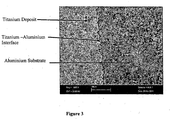
- the cold spray titanium deposit is in the form of a shell around the scaffold. This unique structure did not involve any joining and welding. This is believed to represent a paradigm shift in how such complicated structures are made.
- the scaffold material may be removed leaving a titanium shell by dissolution of the scaffold in a suitable solution, such as caustic soda.
- the scaffold structure may be kept as part of the titanium bicycle frame to exploit uniquely combined properties of titanium and aluminium in a low density composite structure.
- Titanium and titanium alloys contribute a number of desirable properties including strength, lightness and durability. Such properties are very beneficial in a high performance bicycle.
- light weight can be achieved using a combination of an aluminium scaffold (density 2.6 g/cm 3 ) and a cold sprayed titanium outer shell/layer (density 4.6 g/cm 3 ). This should be compared to a typical steel having a density of about 7 g/cm 3 .
- the cost of the frame may be controlled by varying the ratio of aluminium to titanium used. The resultant frame will still be less bulky than an all aluminium frame which must use mass to compensate for relatively low strength of aluminium (compared with the strength of titanium).
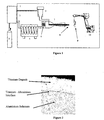
- FIG. 1 A schematic of cold spray system that is may be used to deposit titanium or titanium alloy powder on a suitably shaped scaffold is shown in Figure 1 .
- Nitrogen, helium gas or a mixture of them under high pressure passes through a heating system and a converging/diverging nozzle. Rapid expansion of gas at the nozzle exit leads to acceleration of the gas to well above supersonic speeds and significant decrease in gas temperature. Injection of titanium powder into the cold spray gas stream results in acceleration of the particles to supersonic speed. This results in titanium or titanium alloy particles to achieve the required kinetic energy for cold spray deposition and bonding with the scaffold.
- Table 1 below shows the optimised parameters for successful deposition of cold spray titanium on an aluminium scaffold. It is worth noting that successful deposition can be achieved using range of operational parameters. This is because variation of temperature and pressure of the gas can each create conditions that lead to a critical velocity for deposition of titanium or titanium alloy particles. Further, acceleration above this critical velocity contributes to densification of the titanium or titanium alloy deposit and a change in mechanical properties of the coating produced.
- Table 1 shows cold spray parameter ranges found to be useful for successful deposition of a grade 2 titanium powder on an aluminium scaffold in accordance with the present invention.
- Parameter number Cold spray parameters Range 1 Academic Gas type Nitrogen 2 Gas Pressure 2.5-3.5 MPa 3 Gas Temperature 450-850°C 4 Powder Feed Rate 1.5-10 kg/hour 5 Standoff Distance (Distance between nozzle exit and scaffold) 25-40 mm 6 Powder Type Titanium grade 2 irregular shape 7 Titanium Particle Size Range 5-40 microns
- a robot is used to manipulate the scaffold in front of the cold spray nozzle. Movement of the scaffold is controlled very accurately by a computer-controlled robot arm which is programmed to follow a programmed path at a defined speed.
- the scaffold is a thin structure (0.5mm or greater in thickness) on which titanium or titanium alloy can be deposited.
- titanium or titanium alloy forms a seamless shell over the scaffold.
- aluminium is preferably used as scaffold material due to its light weight, density (2.7 g/cm 3 ) and affordable price.
- any material that titanium or titanium alloy can be deposited using cold spray could be used for the scaffold.
- the present invention is believed to have particular utility in the manufacture of bicycle frames.
- This example details the steps and processes involved in making such a frame. It is to be appreciated however that the steps and processes described may be applied to produce other products in accordance with the present invention.
- Titanium or titanium alloy particles were applied by cold spraying to an unalloyed aluminium (1100 type) scaffold to produce a titanium or titanium alloy bicycle frame structure.
- the deposition was made on particularly designed tube shape samples with a dome shape at one end.
- the dome shape allowed for examination of deposition on curved surfaces.
- Some of the scaffold pieces were also machined in half to examine the effect of split line on titanium or titanium alloy deposition. Experimentation on split specimens is believed to be particularly important for future development of monocoque type structures.
- Results showed successful deposition on the edge, with dome shape, and middle sections of the specimens. Investigation of the cold spray nozzle angle showed that a 45° jet angle, perpendicular to the specimen axis, improved the filling effect of the deposit for the samples with split line. A similar improvement in titanium or titanium alloy deposit filling the split line was observed when the sample was rotated at 200 rpm with jet angle at 45°.
- Table 2 below shows cold spray parameters that were determined for deposition on this type of substrate.
Landscapes
- Chemical & Material Sciences (AREA)
- Engineering & Computer Science (AREA)
- Mechanical Engineering (AREA)
- Chemical Kinetics & Catalysis (AREA)
- Materials Engineering (AREA)
- Metallurgy (AREA)
- Organic Chemistry (AREA)
- Manufacturing & Machinery (AREA)
- Physics & Mathematics (AREA)
- Plasma & Fusion (AREA)
- Life Sciences & Earth Sciences (AREA)
- Wood Science & Technology (AREA)
- Other Surface Treatments For Metallic Materials (AREA)
- Coating By Spraying Or Casting (AREA)
- Sliding-Contact Bearings (AREA)
- Powder Metallurgy (AREA)
Claims (13)
- Procédé pour produire une structure de support de charge en titane ou en alliage de titane, lequel procédé comprend la pulvérisation dynamique par gaz froid de particules de titane ou d'alliage de titane sur un élément de support de manière à former la structure de support de charge en tant que construction d'un seul tenant de manière à ainsi éviter la nécessité de fabriquer et de joindre ensemble des composants individuels, dans lequel la structure de support de charge est un châssis pour un vaisseau aérospatial, un navire nautique, un véhicule à moteur, une bicyclette, une motocyclette, un scooter, une chaise roulante, un deltaplane ou des bagages, dans lequel la forme et la configuration de l'élément de support intègrent la forme et la configuration visées de la structure de support de charge destinée à être produite, et dans lequel, après qu'une pulvérisation dynamique par gaz froid a été terminée, l'élément de support est maintenu à des endroits spécifiques et enlevé d'autres endroits de la structure de support de charge.
- Procédé selon la revendication 1, dans lequel l'élément de support est maintenu dans des régions de la structure de support de charge qui lors de l'utilisation sont soumises à des charges élevées et enlevé des régions de la structure de support de charge qui lors de l'utilisation sont soumises à des charges relativement faibles.
- Procédé selon la revendication 1 ou la revendication 2, dans lequel l'élément de support est formé d'un matériau choisi sur la base de propriétés que l'élément de support apportera à la structure de support de charge.
- Procédé selon l'une quelconque des revendications précédentes, dans lequel les régions de l'élément de support varient en épaisseur et/ou en structure sur la base de la position que ces régions occuperont dans la structure de support de charge qui est produite.
- Procédé selon l'une quelconque des revendications précédentes dans lequel les régions de l'élément de support sont faites de différents matériaux sur la base de la position que ces régions occuperont dans la structure de support de charge qui est produite.
- Procédé selon l'une quelconque des revendications précédentes, dans lequel le titane ou l'alliage de titane qui est appliqué au moyen de la pulvérisation dynamique par gaz froid est d'une composition qui est modifiée au fil du déroulement de la pulvérisation dynamique par gaz froid, afin de satisfaire des exigences de support de charge spécifiques à la localisation au niveau de la structure de support de charge.
- Procédé selon l'une quelconque des revendications précédentes, dans lequel le titane ou l'alliage de titane est déposé sur l'élément de support selon une épaisseur qui varie sur la base d'exigences de support de charge spécifiques à la localisation de la structure de support de charge.
- Procédé selon l'une quelconque des revendications précédentes, dans lequel le titane est du titane de pureté commerciale.
- Procédé selon l'une quelconque des revendications 1 à 7, dans lequel l'alliage de titane est un alliage de titane, d'aluminium et de vanadium.
- Procédé selon l'une quelconque des revendications précédentes, dans lequel l'élément de support est déplacé par rapport à une buse de pulvérisation dynamique par gaz froid qui est utilisée pour la pulvérisation dynamique par gaz froid.
- Procédé selon l'une quelconque des revendications précédentes, dans lequel le châssis est un cadre de bicyclette.
- Procédé selon la revendication 11, dans lequel l'élément de support est formé d'aluminium ou d'un alliage d'aluminium.
- Structure de support de charge en titane ou en alliage de titane produit selon la procédé de la revendication 1.
Priority Applications (2)
| Application Number | Priority Date | Filing Date | Title |
|---|---|---|---|
| EP18211174.0A EP3473748B1 (fr) | 2012-04-04 | 2013-03-26 | Procédé de production d'une structure porteuse de titane |
| PL17163656T PL3241925T3 (pl) | 2012-04-04 | 2013-03-26 | Sposób wytwarzania konstrukcji nośnej z tytanu |
Applications Claiming Priority (3)
| Application Number | Priority Date | Filing Date | Title |
|---|---|---|---|
| AU2012901345A AU2012901345A0 (en) | 2012-04-04 | Manufacturing process | |
| EP13772931.5A EP2834014B1 (fr) | 2012-04-04 | 2013-03-26 | Structure portante en titane et procédé de fabrication associé |
| PCT/AU2013/000318 WO2013149291A1 (fr) | 2012-04-04 | 2013-03-26 | Procédé de fabrication d'une structure de support de charge en titane |
Related Parent Applications (2)
| Application Number | Title | Priority Date | Filing Date |
|---|---|---|---|
| EP13772931.5A Division-Into EP2834014B1 (fr) | 2012-04-04 | 2013-03-26 | Structure portante en titane et procédé de fabrication associé |
| EP13772931.5A Division EP2834014B1 (fr) | 2012-04-04 | 2013-03-26 | Structure portante en titane et procédé de fabrication associé |
Related Child Applications (1)
| Application Number | Title | Priority Date | Filing Date |
|---|---|---|---|
| EP18211174.0A Division EP3473748B1 (fr) | 2012-04-04 | 2013-03-26 | Procédé de production d'une structure porteuse de titane |
Publications (2)
| Publication Number | Publication Date |
|---|---|
| EP3241925A1 EP3241925A1 (fr) | 2017-11-08 |
| EP3241925B1 true EP3241925B1 (fr) | 2018-12-12 |
Family
ID=49299857
Family Applications (3)
| Application Number | Title | Priority Date | Filing Date |
|---|---|---|---|
| EP13772931.5A Active EP2834014B1 (fr) | 2012-04-04 | 2013-03-26 | Structure portante en titane et procédé de fabrication associé |
| EP17163656.6A Active EP3241925B1 (fr) | 2012-04-04 | 2013-03-26 | Procédé de production d'une structure porteuse de titane |
| EP18211174.0A Active EP3473748B1 (fr) | 2012-04-04 | 2013-03-26 | Procédé de production d'une structure porteuse de titane |
Family Applications Before (1)
| Application Number | Title | Priority Date | Filing Date |
|---|---|---|---|
| EP13772931.5A Active EP2834014B1 (fr) | 2012-04-04 | 2013-03-26 | Structure portante en titane et procédé de fabrication associé |
Family Applications After (1)
| Application Number | Title | Priority Date | Filing Date |
|---|---|---|---|
| EP18211174.0A Active EP3473748B1 (fr) | 2012-04-04 | 2013-03-26 | Procédé de production d'une structure porteuse de titane |
Country Status (14)
| Country | Link |
|---|---|
| US (2) | US9765435B2 (fr) |
| EP (3) | EP2834014B1 (fr) |
| JP (2) | JP6153600B2 (fr) |
| KR (1) | KR102131464B1 (fr) |
| CN (2) | CN104364018B (fr) |
| AU (2) | AU2013243224C1 (fr) |
| DK (2) | DK3241925T3 (fr) |
| ES (3) | ES2972550T3 (fr) |
| HK (1) | HK1246370B (fr) |
| NZ (1) | NZ630819A (fr) |
| PL (2) | PL2834014T3 (fr) |
| PT (2) | PT2834014T (fr) |
| TR (1) | TR201903714T4 (fr) |
| WO (1) | WO2013149291A1 (fr) |
Families Citing this family (17)
| Publication number | Priority date | Publication date | Assignee | Title |
|---|---|---|---|---|
| ITCO20130018A1 (it) * | 2013-05-17 | 2014-11-18 | Nuovo Pignone Srl | Metodo per il trattamento di un componente per prevenire l'erosione di tale componente |
| US9663870B2 (en) * | 2013-11-13 | 2017-05-30 | Applied Materials, Inc. | High purity metallic top coat for semiconductor manufacturing components |
| DE102014206073A1 (de) * | 2014-03-31 | 2015-10-01 | Siemens Aktiengesellschaft | Verfahren zum Herstellen eines Hohlkörpers mittels Kaltgasspritzen und zur Durchführung dieses Verfahrens geeigneter Formkern |
| WO2015157816A1 (fr) * | 2014-04-15 | 2015-10-22 | Commonwealth Scientific And Industrial Research Organisation | Procédé de production d'une préforme à l'aide d'une pulvérisation à froid |
| KR102472009B1 (ko) * | 2015-06-11 | 2022-11-30 | 에퓨전테크 아이피 피티와이 엘티디 | 3차원 객체들을 형성하기 위한 장치 및 방법 |
| WO2017143395A1 (fr) * | 2016-02-26 | 2017-08-31 | Coobowie Pty Ltd | Membrane en feuille plate |
| CN109476086B (zh) * | 2016-06-06 | 2022-03-15 | 易福仁科技知产私人有限公司 | 形成3d物体的装置 |
| WO2018067086A2 (fr) | 2016-08-12 | 2018-04-12 | Istanbul Teknik Universitesi | Procédé de production d'un revêtement épais à structure stratifiée |
| BR112019007190B1 (pt) * | 2016-10-11 | 2022-11-01 | Effusiontech IP Pty Ltd | Método para formar objetos 3d |
| JP7072005B2 (ja) * | 2017-05-31 | 2022-05-19 | テクノフォルム バウテック ホールディング ゲーエムベーハー | 窓、扉、ファサード、およびクラッディング要素用のプロファイル |
| EP3668666A4 (fr) * | 2017-08-15 | 2021-05-05 | Effusiontech Pty Ltd | Imprimante 3d |
| US11017819B1 (en) | 2019-05-08 | 2021-05-25 | Seagate Technology Llc | Data storage devices, and related components and methods of making |
| US10796727B1 (en) | 2019-05-08 | 2020-10-06 | Seagate Technology Llc | Using solid state deposition in the manufacture of data storage devices, and related devices and components thereof |
| US12397493B2 (en) | 2020-03-23 | 2025-08-26 | The Boeing Company | Apparatuses, methods, and products for cold spray additive manufacturing of multi curved and reinforced components |
| US12179269B2 (en) | 2020-06-25 | 2024-12-31 | The United States Of America As Represented By The Secretary Of The Army | Motion technique for deposition processes to manufacture leading edge protective sheaths |
| US11781437B2 (en) | 2021-05-04 | 2023-10-10 | General Electric Company | Cold spray duct for a gas turbine engine |
| USD1033279S1 (en) | 2022-08-22 | 2024-07-02 | Three Oceans, LLC | Scooter |
Family Cites Families (21)
| Publication number | Priority date | Publication date | Assignee | Title |
|---|---|---|---|---|
| EP0404017A1 (fr) * | 1989-06-19 | 1990-12-27 | Nippon Steel Corporation | Procédé pour la production d'un cadre de bicyclette en matière plastique renforcée par fibres |
| US4942778A (en) * | 1989-07-10 | 1990-07-24 | Bryne Richard M | Clipless bicycle pedal system |
| DE69016433T2 (de) * | 1990-05-19 | 1995-07-20 | Papyrin Anatolij Nikiforovic | Beschichtungsverfahren und -vorrichtung. |
| US5791673A (en) * | 1996-05-22 | 1998-08-11 | Cannondale Corporation | Frame having a central backbone and opposing skins |
| US6920916B2 (en) * | 2000-12-28 | 2005-07-26 | Showa Denko K.K. | Layered heat exchangers |
| JP4020643B2 (ja) | 2002-01-07 | 2007-12-12 | 松下電器産業株式会社 | 自転車フレーム用部材の製造方法および自転車 |
| JP2005104287A (ja) | 2003-09-30 | 2005-04-21 | Miyata Ind Co Ltd | 自転車フレーム用パイプおよびその加工方法 |
| US20060045785A1 (en) | 2004-08-30 | 2006-03-02 | Yiping Hu | Method for repairing titanium alloy components |
| US20060093736A1 (en) * | 2004-10-29 | 2006-05-04 | Derek Raybould | Aluminum articles with wear-resistant coatings and methods for applying the coatings onto the articles |
| US7320832B2 (en) * | 2004-12-17 | 2008-01-22 | Integran Technologies Inc. | Fine-grained metallic coatings having the coefficient of thermal expansion matched to the one of the substrate |
| US7354354B2 (en) * | 2004-12-17 | 2008-04-08 | Integran Technologies Inc. | Article comprising a fine-grained metallic material and a polymeric material |
| AU2006243448B2 (en) * | 2005-05-05 | 2011-09-01 | H.C. Starck Inc. | Coating process for manufacture or reprocessing of sputter targets and X-ray anodes |
| FR2899869B1 (fr) | 2006-04-18 | 2008-11-07 | Daniel Bernard | Pedales automatiques en plastique de cycles renforcees par un revetement anti-usure realise par projection thermique ou cold spray |
| US8113530B2 (en) * | 2007-08-29 | 2012-02-14 | Powermetal Technologies, Inc. | Nano-metal bicycle frame and related components |
| US7867626B2 (en) * | 2007-09-14 | 2011-01-11 | Siemens Energy, Inc. | Combustion turbine component having rare earth FeCrAI coating and associated methods |
| CN101983258B (zh) * | 2008-03-06 | 2013-01-30 | 国家科学和工业研究组织 | 管子的制造 |
| US20110146075A1 (en) * | 2009-12-18 | 2011-06-23 | Brian Thomas Hazel | Methods for making a turbine blade |
| GB201000399D0 (en) | 2010-01-11 | 2010-02-24 | Smith & Nephew | Medical device and method |
| US20110312860A1 (en) * | 2010-06-17 | 2011-12-22 | General Electric Company | Wear-resistant and low-friction coatings and articles coated therewith |
| US20110314791A1 (en) * | 2010-06-25 | 2011-12-29 | Haynes Jeffrey D | Method for combustion system |
| JP5642461B2 (ja) * | 2010-09-07 | 2014-12-17 | 三菱重工業株式会社 | ロケットエンジンの燃焼室及び中空構造体の製造方法 |
-
2013
- 2013-03-26 EP EP13772931.5A patent/EP2834014B1/fr active Active
- 2013-03-26 DK DK17163656.6T patent/DK3241925T3/en active
- 2013-03-26 US US14/390,545 patent/US9765435B2/en active Active
- 2013-03-26 DK DK13772931.5T patent/DK2834014T3/en active
- 2013-03-26 ES ES18211174T patent/ES2972550T3/es active Active
- 2013-03-26 PL PL13772931T patent/PL2834014T3/pl unknown
- 2013-03-26 EP EP17163656.6A patent/EP3241925B1/fr active Active
- 2013-03-26 EP EP18211174.0A patent/EP3473748B1/fr active Active
- 2013-03-26 AU AU2013243224A patent/AU2013243224C1/en active Active
- 2013-03-26 KR KR1020147030349A patent/KR102131464B1/ko active Active
- 2013-03-26 JP JP2015503714A patent/JP6153600B2/ja active Active
- 2013-03-26 PT PT13772931T patent/PT2834014T/pt unknown
- 2013-03-26 PT PT17163656T patent/PT3241925T/pt unknown
- 2013-03-26 TR TR2019/03714T patent/TR201903714T4/tr unknown
- 2013-03-26 ES ES17163656T patent/ES2718770T3/es active Active
- 2013-03-26 CN CN201380029219.8A patent/CN104364018B/zh not_active Expired - Fee Related
- 2013-03-26 CN CN201710198014.2A patent/CN107419260B/zh not_active Expired - Fee Related
- 2013-03-26 ES ES13772931T patent/ES2700175T3/es active Active
- 2013-03-26 PL PL17163656T patent/PL3241925T3/pl unknown
- 2013-03-26 NZ NZ630819A patent/NZ630819A/en not_active IP Right Cessation
- 2013-03-26 WO PCT/AU2013/000318 patent/WO2013149291A1/fr not_active Ceased
-
2017
- 2017-05-30 JP JP2017106368A patent/JP6370439B2/ja active Active
- 2017-08-22 US US15/682,772 patent/US10378112B2/en active Active
- 2017-11-03 AU AU2017254963A patent/AU2017254963B9/en active Active
-
2018
- 2018-05-07 HK HK18105815.2A patent/HK1246370B/en not_active IP Right Cessation
Non-Patent Citations (1)
| Title |
|---|
| None * |
Also Published As
Similar Documents
| Publication | Publication Date | Title |
|---|---|---|
| AU2017254963B9 (en) | A process for producing a titanium load-bearing structure | |
| HK1246370A1 (en) | A process for producing a titanium load-bearing structure | |
| JP7089662B2 (ja) | 積層造形と表面コーティングの複合成形システム及び方法 | |
| Wu et al. | Stable layer-building strategy to enhance cold-spray-based additive manufacturing | |
| JP2015120972A (ja) | 冷却チャネルを形成するための方法および製品 | |
| JP2006265732A (ja) | コールドスプレーを用いてエンジン部品に接合被覆を付与する方法 | |
| HK40001087A (en) | A process for producing a titanium load-bearing structure | |
| HK1206677B (en) | Titanium load-bearing structure and process for producing such | |
| Sun et al. | Cold spray additive manufacturing (CSAM) | |
| Wu | Process modeling and planning for robotic cold spray based additive manufacturing | |
| Yin et al. | Manufacturing Parameters for Cold Spray Additive Manufacturing | |
| Doblin et al. | Large Titanium Preforms Manufactured by Cold Spray | |
| Poulin | Modelisation et optimisation d'un procede robotise de vaporisation au plasma (French text) |
Legal Events
| Date | Code | Title | Description |
|---|---|---|---|
| PUAI | Public reference made under article 153(3) epc to a published international application that has entered the european phase |
Free format text: ORIGINAL CODE: 0009012 |
|
| STAA | Information on the status of an ep patent application or granted ep patent |
Free format text: STATUS: THE APPLICATION HAS BEEN PUBLISHED |
|
| AC | Divisional application: reference to earlier application |
Ref document number: 2834014 Country of ref document: EP Kind code of ref document: P |
|
| AK | Designated contracting states |
Kind code of ref document: A1 Designated state(s): AL AT BE BG CH CY CZ DE DK EE ES FI FR GB GR HR HU IE IS IT LI LT LU LV MC MK MT NL NO PL PT RO RS SE SI SK SM TR |
|
| RAP1 | Party data changed (applicant data changed or rights of an application transferred) |
Owner name: COMMONWEALTH SCIENTIFIC AND INDUSTRIAL RESEARCH OR |
|
| STAA | Information on the status of an ep patent application or granted ep patent |
Free format text: STATUS: REQUEST FOR EXAMINATION WAS MADE |
|
| 17P | Request for examination filed |
Effective date: 20180412 |
|
| RBV | Designated contracting states (corrected) |
Designated state(s): AL AT BE BG CH CY CZ DE DK EE ES FI FR GB GR HR HU IE IS IT LI LT LU LV MC MK MT NL NO PL PT RO RS SE SI SK SM TR |
|
| GRAP | Despatch of communication of intention to grant a patent |
Free format text: ORIGINAL CODE: EPIDOSNIGR1 |
|
| STAA | Information on the status of an ep patent application or granted ep patent |
Free format text: STATUS: GRANT OF PATENT IS INTENDED |
|
| RIC1 | Information provided on ipc code assigned before grant |
Ipc: B05B 7/14 20060101ALI20180710BHEP Ipc: B05B 7/16 20060101ALI20180710BHEP Ipc: B22F 3/02 20060101ALI20180710BHEP Ipc: C23C 24/04 20060101AFI20180710BHEP Ipc: C23C 30/00 20060101ALI20180710BHEP |
|
| INTG | Intention to grant announced |
Effective date: 20180806 |
|
| REG | Reference to a national code |
Ref country code: HK Ref legal event code: DE Ref document number: 1246370 Country of ref document: HK |
|
| GRAS | Grant fee paid |
Free format text: ORIGINAL CODE: EPIDOSNIGR3 |
|
| GRAA | (expected) grant |
Free format text: ORIGINAL CODE: 0009210 |
|
| STAA | Information on the status of an ep patent application or granted ep patent |
Free format text: STATUS: THE PATENT HAS BEEN GRANTED |
|
| AC | Divisional application: reference to earlier application |
Ref document number: 2834014 Country of ref document: EP Kind code of ref document: P |
|
| AK | Designated contracting states |
Kind code of ref document: B1 Designated state(s): AL AT BE BG CH CY CZ DE DK EE ES FI FR GB GR HR HU IE IS IT LI LT LU LV MC MK MT NL NO PL PT RO RS SE SI SK SM TR |
|
| REG | Reference to a national code |
Ref country code: GB Ref legal event code: FG4D |
|
| REG | Reference to a national code |
Ref country code: CH Ref legal event code: EP |
|
| REG | Reference to a national code |
Ref country code: AT Ref legal event code: REF Ref document number: 1076081 Country of ref document: AT Kind code of ref document: T Effective date: 20181215 |
|
| REG | Reference to a national code |
Ref country code: DE Ref legal event code: R096 Ref document number: 602013048302 Country of ref document: DE |
|
| REG | Reference to a national code |
Ref country code: IE Ref legal event code: FG4D |
|
| REG | Reference to a national code |
Ref country code: PT Ref legal event code: SC4A Ref document number: 3241925 Country of ref document: PT Date of ref document: 20190325 Kind code of ref document: T Free format text: AVAILABILITY OF NATIONAL TRANSLATION Effective date: 20190312 |
|
| REG | Reference to a national code |
Ref country code: DK Ref legal event code: T3 Effective date: 20190325 |
|
| REG | Reference to a national code |
Ref country code: SE Ref legal event code: TRGR |
|
| REG | Reference to a national code |
Ref country code: NL Ref legal event code: FP |
|
| REG | Reference to a national code |
Ref country code: LT Ref legal event code: MG4D |
|
| PG25 | Lapsed in a contracting state [announced via postgrant information from national office to epo] |
Ref country code: LV Free format text: LAPSE BECAUSE OF FAILURE TO SUBMIT A TRANSLATION OF THE DESCRIPTION OR TO PAY THE FEE WITHIN THE PRESCRIBED TIME-LIMIT Effective date: 20181212 Ref country code: HR Free format text: LAPSE BECAUSE OF FAILURE TO SUBMIT A TRANSLATION OF THE DESCRIPTION OR TO PAY THE FEE WITHIN THE PRESCRIBED TIME-LIMIT Effective date: 20181212 Ref country code: LT Free format text: LAPSE BECAUSE OF FAILURE TO SUBMIT A TRANSLATION OF THE DESCRIPTION OR TO PAY THE FEE WITHIN THE PRESCRIBED TIME-LIMIT Effective date: 20181212 |
|
| REG | Reference to a national code |
Ref country code: NO Ref legal event code: T2 Effective date: 20181212 |
|
| PG25 | Lapsed in a contracting state [announced via postgrant information from national office to epo] |
Ref country code: AL Free format text: LAPSE BECAUSE OF FAILURE TO SUBMIT A TRANSLATION OF THE DESCRIPTION OR TO PAY THE FEE WITHIN THE PRESCRIBED TIME-LIMIT Effective date: 20181212 Ref country code: GR Free format text: LAPSE BECAUSE OF FAILURE TO SUBMIT A TRANSLATION OF THE DESCRIPTION OR TO PAY THE FEE WITHIN THE PRESCRIBED TIME-LIMIT Effective date: 20190313 Ref country code: RS Free format text: LAPSE BECAUSE OF FAILURE TO SUBMIT A TRANSLATION OF THE DESCRIPTION OR TO PAY THE FEE WITHIN THE PRESCRIBED TIME-LIMIT Effective date: 20181212 |
|
| REG | Reference to a national code |
Ref country code: ES Ref legal event code: FG2A Ref document number: 2718770 Country of ref document: ES Kind code of ref document: T3 Effective date: 20190704 |
|
| PG25 | Lapsed in a contracting state [announced via postgrant information from national office to epo] |
Ref country code: CZ Free format text: LAPSE BECAUSE OF FAILURE TO SUBMIT A TRANSLATION OF THE DESCRIPTION OR TO PAY THE FEE WITHIN THE PRESCRIBED TIME-LIMIT Effective date: 20181212 |
|
| PG25 | Lapsed in a contracting state [announced via postgrant information from national office to epo] |
Ref country code: SM Free format text: LAPSE BECAUSE OF FAILURE TO SUBMIT A TRANSLATION OF THE DESCRIPTION OR TO PAY THE FEE WITHIN THE PRESCRIBED TIME-LIMIT Effective date: 20181212 Ref country code: IS Free format text: LAPSE BECAUSE OF FAILURE TO SUBMIT A TRANSLATION OF THE DESCRIPTION OR TO PAY THE FEE WITHIN THE PRESCRIBED TIME-LIMIT Effective date: 20190412 Ref country code: SK Free format text: LAPSE BECAUSE OF FAILURE TO SUBMIT A TRANSLATION OF THE DESCRIPTION OR TO PAY THE FEE WITHIN THE PRESCRIBED TIME-LIMIT Effective date: 20181212 Ref country code: RO Free format text: LAPSE BECAUSE OF FAILURE TO SUBMIT A TRANSLATION OF THE DESCRIPTION OR TO PAY THE FEE WITHIN THE PRESCRIBED TIME-LIMIT Effective date: 20181212 Ref country code: EE Free format text: LAPSE BECAUSE OF FAILURE TO SUBMIT A TRANSLATION OF THE DESCRIPTION OR TO PAY THE FEE WITHIN THE PRESCRIBED TIME-LIMIT Effective date: 20181212 |
|
| REG | Reference to a national code |
Ref country code: DE Ref legal event code: R097 Ref document number: 602013048302 Country of ref document: DE |
|
| PLBE | No opposition filed within time limit |
Free format text: ORIGINAL CODE: 0009261 |
|
| STAA | Information on the status of an ep patent application or granted ep patent |
Free format text: STATUS: NO OPPOSITION FILED WITHIN TIME LIMIT |
|
| PG25 | Lapsed in a contracting state [announced via postgrant information from national office to epo] |
Ref country code: SI Free format text: LAPSE BECAUSE OF FAILURE TO SUBMIT A TRANSLATION OF THE DESCRIPTION OR TO PAY THE FEE WITHIN THE PRESCRIBED TIME-LIMIT Effective date: 20181212 Ref country code: MC Free format text: LAPSE BECAUSE OF FAILURE TO SUBMIT A TRANSLATION OF THE DESCRIPTION OR TO PAY THE FEE WITHIN THE PRESCRIBED TIME-LIMIT Effective date: 20181212 |
|
| 26N | No opposition filed |
Effective date: 20190913 |
|
| PG25 | Lapsed in a contracting state [announced via postgrant information from national office to epo] |
Ref country code: LU Free format text: LAPSE BECAUSE OF NON-PAYMENT OF DUE FEES Effective date: 20190326 |
|
| PG25 | Lapsed in a contracting state [announced via postgrant information from national office to epo] |
Ref country code: PT Free format text: LAPSE BECAUSE OF NON-PAYMENT OF DUE FEES Effective date: 20191226 |
|
| REG | Reference to a national code |
Ref country code: AT Ref legal event code: UEP Ref document number: 1076081 Country of ref document: AT Kind code of ref document: T Effective date: 20181212 |
|
| PG25 | Lapsed in a contracting state [announced via postgrant information from national office to epo] |
Ref country code: PT Free format text: LAPSE BECAUSE OF NON-PAYMENT OF DUE FEES Effective date: 20191226 |
|
| PGRI | Patent reinstated in contracting state [announced from national office to epo] |
Ref country code: PT Effective date: 20200123 |
|
| PG25 | Lapsed in a contracting state [announced via postgrant information from national office to epo] |
Ref country code: MT Free format text: LAPSE BECAUSE OF NON-PAYMENT OF DUE FEES Effective date: 20190326 |
|
| PG25 | Lapsed in a contracting state [announced via postgrant information from national office to epo] |
Ref country code: CY Free format text: LAPSE BECAUSE OF FAILURE TO SUBMIT A TRANSLATION OF THE DESCRIPTION OR TO PAY THE FEE WITHIN THE PRESCRIBED TIME-LIMIT Effective date: 20181212 |
|
| PG25 | Lapsed in a contracting state [announced via postgrant information from national office to epo] |
Ref country code: HU Free format text: LAPSE BECAUSE OF FAILURE TO SUBMIT A TRANSLATION OF THE DESCRIPTION OR TO PAY THE FEE WITHIN THE PRESCRIBED TIME-LIMIT; INVALID AB INITIO Effective date: 20130326 |
|
| PGFP | Annual fee paid to national office [announced via postgrant information from national office to epo] |
Ref country code: IE Payment date: 20220225 Year of fee payment: 10 Ref country code: FI Payment date: 20220318 Year of fee payment: 10 Ref country code: CH Payment date: 20220324 Year of fee payment: 10 Ref country code: BG Payment date: 20220318 Year of fee payment: 10 |
|
| PGFP | Annual fee paid to national office [announced via postgrant information from national office to epo] |
Ref country code: SE Payment date: 20220311 Year of fee payment: 10 Ref country code: PT Payment date: 20220322 Year of fee payment: 10 Ref country code: NO Payment date: 20220317 Year of fee payment: 10 |
|
| PG25 | Lapsed in a contracting state [announced via postgrant information from national office to epo] |
Ref country code: MK Free format text: LAPSE BECAUSE OF FAILURE TO SUBMIT A TRANSLATION OF THE DESCRIPTION OR TO PAY THE FEE WITHIN THE PRESCRIBED TIME-LIMIT Effective date: 20181212 |
|
| P01 | Opt-out of the competence of the unified patent court (upc) registered |
Effective date: 20230524 |
|
| REG | Reference to a national code |
Ref country code: NO Ref legal event code: MMEP |
|
| PG25 | Lapsed in a contracting state [announced via postgrant information from national office to epo] |
Ref country code: PT Free format text: LAPSE BECAUSE OF NON-PAYMENT OF DUE FEES Effective date: 20230926 Ref country code: FI Free format text: LAPSE BECAUSE OF NON-PAYMENT OF DUE FEES Effective date: 20230326 |
|
| REG | Reference to a national code |
Ref country code: SE Ref legal event code: EUG Ref country code: CH Ref legal event code: PL |
|
| REG | Reference to a national code |
Ref country code: IE Ref legal event code: MM4A |
|
| PG25 | Lapsed in a contracting state [announced via postgrant information from national office to epo] |
Ref country code: SE Free format text: LAPSE BECAUSE OF NON-PAYMENT OF DUE FEES Effective date: 20230327 Ref country code: NO Free format text: LAPSE BECAUSE OF NON-PAYMENT OF DUE FEES Effective date: 20230331 Ref country code: LI Free format text: LAPSE BECAUSE OF NON-PAYMENT OF DUE FEES Effective date: 20230331 Ref country code: IE Free format text: LAPSE BECAUSE OF NON-PAYMENT OF DUE FEES Effective date: 20230326 Ref country code: CH Free format text: LAPSE BECAUSE OF NON-PAYMENT OF DUE FEES Effective date: 20230331 |
|
| PG25 | Lapsed in a contracting state [announced via postgrant information from national office to epo] |
Ref country code: BG Free format text: LAPSE BECAUSE OF NON-PAYMENT OF DUE FEES Effective date: 20230326 |
|
| PG25 | Lapsed in a contracting state [announced via postgrant information from national office to epo] |
Ref country code: BG Free format text: LAPSE BECAUSE OF NON-PAYMENT OF DUE FEES Effective date: 20230326 |
|
| PGFP | Annual fee paid to national office [announced via postgrant information from national office to epo] |
Ref country code: ES Payment date: 20250416 Year of fee payment: 13 |
|
| PGFP | Annual fee paid to national office [announced via postgrant information from national office to epo] |
Ref country code: IT Payment date: 20250331 Year of fee payment: 13 |
|
| PGFP | Annual fee paid to national office [announced via postgrant information from national office to epo] |
Ref country code: GB Payment date: 20260217 Year of fee payment: 14 |
|
| PGFP | Annual fee paid to national office [announced via postgrant information from national office to epo] |
Ref country code: DE Payment date: 20260320 Year of fee payment: 14 Ref country code: DK Payment date: 20260323 Year of fee payment: 14 |
|
| PGFP | Annual fee paid to national office [announced via postgrant information from national office to epo] |
Ref country code: AT Payment date: 20260319 Year of fee payment: 14 |
|
| PGFP | Annual fee paid to national office [announced via postgrant information from national office to epo] |
Ref country code: BE Payment date: 20260323 Year of fee payment: 14 |
|
| PGFP | Annual fee paid to national office [announced via postgrant information from national office to epo] |
Ref country code: NL Payment date: 20260323 Year of fee payment: 14 |
|
| PGFP | Annual fee paid to national office [announced via postgrant information from national office to epo] |
Ref country code: FR Payment date: 20260324 Year of fee payment: 14 |
|
| PGFP | Annual fee paid to national office [announced via postgrant information from national office to epo] |
Ref country code: TR Payment date: 20260325 Year of fee payment: 14 |
|
| PGFP | Annual fee paid to national office [announced via postgrant information from national office to epo] |
Ref country code: PL Payment date: 20260318 Year of fee payment: 14 |