EP3237274B1 - Fahrradrahmen und elektrofahrrad mit energiespeicher - Google Patents
Fahrradrahmen und elektrofahrrad mit energiespeicher Download PDFInfo
- Publication number
- EP3237274B1 EP3237274B1 EP15816192.7A EP15816192A EP3237274B1 EP 3237274 B1 EP3237274 B1 EP 3237274B1 EP 15816192 A EP15816192 A EP 15816192A EP 3237274 B1 EP3237274 B1 EP 3237274B1
- Authority
- EP
- European Patent Office
- Prior art keywords
- section
- frame
- cross
- battery pack
- bicycle
- Prior art date
- Legal status (The legal status is an assumption and is not a legal conclusion. Google has not performed a legal analysis and makes no representation as to the accuracy of the status listed.)
- Active
Links
Images




Classifications
-
- B—PERFORMING OPERATIONS; TRANSPORTING
- B62—LAND VEHICLES FOR TRAVELLING OTHERWISE THAN ON RAILS
- B62K—CYCLES; CYCLE FRAMES; CYCLE STEERING DEVICES; RIDER-OPERATED TERMINAL CONTROLS SPECIALLY ADAPTED FOR CYCLES; CYCLE AXLE SUSPENSIONS; CYCLE SIDECARS, FORECARS, OR THE LIKE
- B62K19/00—Cycle frames
- B62K19/30—Frame parts shaped to receive other cycle parts or accessories
-
- B—PERFORMING OPERATIONS; TRANSPORTING
- B62—LAND VEHICLES FOR TRAVELLING OTHERWISE THAN ON RAILS
- B62J—CYCLE SADDLES OR SEATS; AUXILIARY DEVICES OR ACCESSORIES SPECIALLY ADAPTED TO CYCLES AND NOT OTHERWISE PROVIDED FOR, e.g. ARTICLE CARRIERS OR CYCLE PROTECTORS
- B62J43/00—Arrangements of batteries
- B62J43/10—Arrangements of batteries for propulsion
- B62J43/13—Arrangements of batteries for propulsion on rider-propelled cycles with additional electric propulsion
-
- B—PERFORMING OPERATIONS; TRANSPORTING
- B62—LAND VEHICLES FOR TRAVELLING OTHERWISE THAN ON RAILS
- B62J—CYCLE SADDLES OR SEATS; AUXILIARY DEVICES OR ACCESSORIES SPECIALLY ADAPTED TO CYCLES AND NOT OTHERWISE PROVIDED FOR, e.g. ARTICLE CARRIERS OR CYCLE PROTECTORS
- B62J43/00—Arrangements of batteries
- B62J43/20—Arrangements of batteries characterised by the mounting
- B62J43/28—Arrangements of batteries characterised by the mounting hidden within the cycle frame
-
- B—PERFORMING OPERATIONS; TRANSPORTING
- B62—LAND VEHICLES FOR TRAVELLING OTHERWISE THAN ON RAILS
- B62K—CYCLES; CYCLE FRAMES; CYCLE STEERING DEVICES; RIDER-OPERATED TERMINAL CONTROLS SPECIALLY ADAPTED FOR CYCLES; CYCLE AXLE SUSPENSIONS; CYCLE SIDECARS, FORECARS, OR THE LIKE
- B62K11/00—Motorcycles, engine-assisted cycles or motor scooters with one or two wheels
- B62K11/02—Frames
-
- B—PERFORMING OPERATIONS; TRANSPORTING
- B62—LAND VEHICLES FOR TRAVELLING OTHERWISE THAN ON RAILS
- B62K—CYCLES; CYCLE FRAMES; CYCLE STEERING DEVICES; RIDER-OPERATED TERMINAL CONTROLS SPECIALLY ADAPTED FOR CYCLES; CYCLE AXLE SUSPENSIONS; CYCLE SIDECARS, FORECARS, OR THE LIKE
- B62K19/00—Cycle frames
- B62K19/02—Cycle frames characterised by material or cross-section of frame members
-
- B—PERFORMING OPERATIONS; TRANSPORTING
- B62—LAND VEHICLES FOR TRAVELLING OTHERWISE THAN ON RAILS
- B62K—CYCLES; CYCLE FRAMES; CYCLE STEERING DEVICES; RIDER-OPERATED TERMINAL CONTROLS SPECIALLY ADAPTED FOR CYCLES; CYCLE AXLE SUSPENSIONS; CYCLE SIDECARS, FORECARS, OR THE LIKE
- B62K19/00—Cycle frames
- B62K19/02—Cycle frames characterised by material or cross-section of frame members
- B62K19/04—Cycle frames characterised by material or cross-section of frame members the material being wholly or mainly metallic, e.g. of high elasticity
-
- B—PERFORMING OPERATIONS; TRANSPORTING
- B62—LAND VEHICLES FOR TRAVELLING OTHERWISE THAN ON RAILS
- B62K—CYCLES; CYCLE FRAMES; CYCLE STEERING DEVICES; RIDER-OPERATED TERMINAL CONTROLS SPECIALLY ADAPTED FOR CYCLES; CYCLE AXLE SUSPENSIONS; CYCLE SIDECARS, FORECARS, OR THE LIKE
- B62K19/00—Cycle frames
- B62K19/30—Frame parts shaped to receive other cycle parts or accessories
- B62K19/40—Frame parts shaped to receive other cycle parts or accessories for attaching accessories, e.g. article carriers, lamps
-
- B—PERFORMING OPERATIONS; TRANSPORTING
- B62—LAND VEHICLES FOR TRAVELLING OTHERWISE THAN ON RAILS
- B62M—RIDER PROPULSION OF WHEELED VEHICLES OR SLEDGES; POWERED PROPULSION OF SLEDGES OR SINGLE-TRACK CYCLES; TRANSMISSIONS SPECIALLY ADAPTED FOR SUCH VEHICLES
- B62M6/00—Rider propulsion of wheeled vehicles with additional source of power, e.g. combustion engine or electric motor
- B62M6/40—Rider propelled cycles with auxiliary electric motor
-
- B—PERFORMING OPERATIONS; TRANSPORTING
- B62—LAND VEHICLES FOR TRAVELLING OTHERWISE THAN ON RAILS
- B62M—RIDER PROPULSION OF WHEELED VEHICLES OR SLEDGES; POWERED PROPULSION OF SLEDGES OR SINGLE-TRACK CYCLES; TRANSMISSIONS SPECIALLY ADAPTED FOR SUCH VEHICLES
- B62M6/00—Rider propulsion of wheeled vehicles with additional source of power, e.g. combustion engine or electric motor
- B62M6/80—Accessories, e.g. power sources; Arrangements thereof
- B62M6/90—Batteries
Definitions
- the present invention relates to a bicycle frame according to the preamble of claim 1 and an electric bicycle according to the preamble of claim 8.
- Electric bicycles for example pedelecs or e-bikes, enjoy great popularity as easy-to-use, emission-free means of transport.
- Particularly suitable types of bicycles are available for different fields of application. These include, among other things, bicycles (e.g. city bikes or touring bikes) optimized for leisure use or the way to work on the street or in easy terrain and the various E-Mountainbikes (E-MTBs) developed for use off-road and especially mountainous terrain Executions.
- Electric bicycles offer the possibility of increasing the operating radius and increasing the average driving speed without overstraining the rider.
- the DE 20 2008 009933 U describes a frame tube for bicycles or electric bikes, which consists of at least two chambers, of which at least one of the chambers should be largely closed and should enclose approximately the same volume as a corresponding normal frame tube and of which at least one should have at least one opening.
- the EP 2 230 164 A describes a bicycle frame which has a tubular section with an interior space for receiving at least one battery unit which is suitable as an energy source for an electromotive bicycle drive, as well as a battery unit which can be inserted therein.
- the JP 2007 265855 A describes a battery pack having a plurality of battery blocks each consisting of batteries in a cell holder and connecting metal plates connected to the end face electrodes of the batteries of the battery blocks to linearly connect the plurality of battery blocks to form a battery bar.
- the invention is therefore based on the object of providing a novel bicycle concept, which electrically assisted mobility with the claims brings sporty and lifestyle-oriented cyclists into harmony.
- a bicycle frame according to the invention has an energy store and at least one frame section, which is designed to detachably hold the energy store, hereinafter referred to as a battery pack.
- the frame section designed for the removable mounting of the energy store has an asymmetrical cross section with respect to a frame center plane.
- the cross-section of the energy store with the highly rigid cross-section of the frame section can complement each other to form an overall cross-section that meets the highest technical and optical requirements. This also minimizes the installation space required, so that handiness and agility are improved.
- the asymmetrical cross section enables the battery pack to be removed from the side.
- the asymmetrical design looks atypical and therefore appealingly brand-oriented. The concept according to the invention therefore also meets the demands of a lifestyle emphasized, sporty ambitious driver.
- the frame section has an approximately L-shaped cross section, at least in sections.
- an extremely compact, homogeneous frame shape is achieved, which elegantly meets the strength requirements.
- the cross section of the frame section and the cross section of the battery pack complement each other to form an essentially rectangular overall cross section.
- the cross section can preferably be cuboid or square. This reduces the installation space requirement to a minimum.
- the down tube is designed to hold the energy store.
- the frame section can be provided to hold the energy store approximately in the middle of the down tube between the bottom bracket and the steering head bearing.
- the energy store can extend into an area of the bottom bracket drive receptacle.
- the energy store can be arranged in a visually appealing manner in the lower end region of the down tube.
- the battery pack has, at least in sections, an asymmetrical cross section with respect to an energy storage center plane. This achieves a highly integrated interaction between the frame section and the energy store.
- the frame section and the battery pack delimit a substantially diagonal dividing plane.
- a large contact area is provided here.
- the battery pack can advantageously be removed to one side of the bicycle frame, ie to the side.
- the battery pack is arranged above the frame section. This means that the user can easily insert the battery pack from above and lock it in the frame. That is to say, the battery pack is preferably placed onto the frame section from above. This arrangement also provides the best possible protection for the battery pack from damage, for example from falling rocks or contact with the ground.
- the battery pack is preferably arranged in a protected manner above the frame section.
- the battery pack can complement the frame section in a compact and elegant manner.
- the frame section and the energy store delimit an essentially diagonal dividing plane which, in one exemplary embodiment, extends from the bottom left to the top right of the cross section. It is particularly preferable for the energy store and frame section to complement one another to form a rectangular cross section.
- the cross-section here can be square.
- the battery pack also has an at least partially L-shaped cross section.
- the battery pack can have at least one rounded corner area. In a preferred embodiment, all corner areas are rounded.
- the frame section is provided with an at least partially step-shaped cross section.
- the battery pack is also preferably L-shaped, at least in sections.
- the dividing plane is step-shaped.
- the battery pack can be dimensioned in such a way that it ends approximately flush with the top side of the frame of the down tube in the area of the frame section.
- the frame section and the battery pack delimit an essentially diagonal dividing plane, which extends in a stepped manner from the bottom left to the top right of the cross section.
- the battery pack and frame section complement each other to form a rectangular cross section.
- the cross-section here can be square.
- the frame section is designed with an at least partially polygonal cross section.
- the frame section preferably has a support surface for the battery pack that encloses an obtuse support angle.
- the frame section has an approximately triangular cross-section with two bearing surfaces for the battery pack that enclose a support angle.
- the bearing surfaces form an approximately centrally arranged V-shaped saddle, the apex of which protrudes outward from the triangular base surface. This gives a centered battery pack holder of high strength. With this variant, a compact, homogeneous frame shape is also achieved.
- the frame section of a bicycle frame has a diagonally inclined, approximately W-shaped frame support surface for a likewise approximately W-shaped energy storage support surface.
- the frame support surface can consist of an approximately horizontal support surface and an approximately vertical support surface, which are connected via two outwardly inclined saddle surfaces which define a central apex.
- the battery pack preferably has a corresponding vertex angle.
- the frame section can have a faceted underside with a horizontal outer surface and a vertical outer surface, which are connected via an inclined outer surface.
- Frame section and battery pack can have rounded corner areas.
- the frame section has an at least partially triangular cross section.
- the frame section and the battery pack here preferably delimit an essentially diagonal dividing plane, which can extend from the bottom left to the top right of the cross section.
- Energy storage and frame section complement each other to form a square.
- the energy store and frame section are particularly preferable for the energy store and frame section to complement one another to form a rectangular cross section.
- the cross-section here can be square.
- the energy store protrudes upwards beyond the frame top of the down tube.
- the battery pack has a triangular cross-section at least in sections.
- the longer side of the triangle can serve as a contact surface.
- a compact, homogeneous frame shape of the highest strength is achieved with this variant.
- An electric bicycle according to the invention has a bicycle frame with an energy storage device, in particular a battery pack, and at least one frame section which is designed to detachably hold the energy storage device.
- the frame section designed for the removable mounting of the energy store has an asymmetrical cross section with respect to a frame center plane.
- the frame section has an approximately L-shaped cross section, at least in sections.
- the cross section of the frame section and the cross section of the battery pack complement each other to form an essentially rectangular overall cross section.
- the electric bike has an optimized frame cross-section with structurally and aesthetically the best properties with minimal space requirements.
- An energy store not according to the invention in particular a battery pack, has a battery housing for insertion into the frame section of the bicycle frame designed for this purpose.
- the energy store has an asymmetrical cross section with respect to an energy store center plane or housing center plane of the housing.
- the battery housing has at least one fastening device, such as latching means, and / or at least one recess for a fastening device.
- the battery pack has a battery housing, in particular made of plastic and with a moisture-proof structure, which is designed for secure attachment in the proposed bicycle frame, so it has suitable fastening means or openings for engaging fastening means provided on the frame.
- the fastening means are preferably latching means, such as snap or bolt locks, but, alternatively, easily manageable screw connections etc. can also be used.
- a set of energy stores for example as battery packs with different storage capacities, can be used in the bicycle frame.
- the battery packs can have connection dimensions that can be used in the frame despite different storage capacities. This means that the battery packs can be easily inserted into the bicycle frame and fixed there.
- the energy storage can be implemented universally in all types of bicycles, especially mountain bikes (both in hardtail or full suspension construction), but also in other bicycles, e.g. road bike frames and thus ultimately a touring, city or cross -Bike or other modern types of bicycles. Due to its compact, elegant design, it enables the construction of bicycles that largely combine the advantages of a classic bicycle and an electric bicycle.
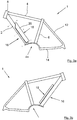
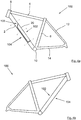
- Figure 1a shows a side view of a bicycle frame 1 according to the invention, exemplarily designed as a diamond frame, with a down tube 2, a top tube 4, a saddle tube 6, a head tube 8, a bottom bracket housing 10 as well as saddle struts 12 and struts 14.
- the bicycle frame 1 has a frame section 16 which is designed to detachably hold a separate energy store designed as a battery pack 18 with a battery housing 20.
- the frame section 16 for holding the battery pack 18 is provided somewhat below the center of the lower tube 2 between the bottom bracket housing 10 and the head tube 8.
- the battery pack 18 is arranged above the frame section 16. As a result, the battery pack 18 can easily be inserted from above by the user and locked in the frame 1. That is, the battery pack 18 is placed on the frame section 16 from above. With this arrangement, the best possible protection of the battery pack 18 from damage, for example from falling rocks or contact with the ground, is achieved.
- the frame portion 16 has a inclined end area. This inclined end area is preferably provided in the upper tube area. The inclination is selected such that it extends essentially perpendicularly.
- FIG. 3 shows the second side view of the bicycle frame 1 from FIG Figure 1a .
- the battery pack 18 protrudes in the area of the frame section 16 over the top of the frame of the down tube 2 upwards.
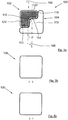
- the frame section 16 of the bicycle frame 1 which is designed for the removable mounting of the battery pack 18, has an asymmetrical cross section with respect to a frame center plane 24.
- the battery pack 18 with battery housing 20 and internal, schematically illustrated battery cells 22 has an asymmetrical cross section with respect to an energy storage center plane 26, the frame center plane 24 and the energy storage center plane 26 being arranged in a common plane.
- the cross-section of the battery pack 18 can complement the highly rigid cross-section of the frame section 16 to form an overall cross-section that meets the highest technical and optical requirements.
- the installation space requirement is minimized, so that handiness and agility are improved.
- an optimized interaction between frame section 16 and battery pack 18 is achieved.
- the battery pack 18 can optionally be removed or inserted upwards or to one side of the bicycle frame, that is to say to the side. This enables improved handling of the battery pack 18.
- the frame section 16 has an approximately L-shaped Cross-section on.
- a vertical leg 28 of the frame section 16 is arranged at right angles to a horizontal leg 30.
- the legs 28, 30 have an essentially rectangular basic shape with rounded corner areas.
- the battery pack 18 also has an approximately L-shaped cross section with rounded corner regions.
- An upper contact surface 32 of the battery pack 18 rests on an upper contact surface 34 of the frame section 16.
- a lower contact surface 36 of the battery pack 18 rests on a lower contact surface 38 of the frame section 16.
- the lower bearing surface 38 of the frame section 16 is wider than the upper bearing surface 34.
- the lower bearing surface 38 of the frame section 16 is arranged on the left in the figure.
- the upper contact surface 32 of the battery pack 18 is connected to the lower contact surface 36 via a side wall 40, the side wall 40 extending at right angles to the contact surfaces 32, 36.
- the upper support surface 34 of the frame section 16 is connected to the lower support surface 38 via a side wall 42, the side wall 42 extending at right angles to the support surfaces 34, 38.
- the frame section 16 and the battery pack 18 thereby delimit an essentially step-shaped, diagonal dividing plane, which extends from the bottom left to the top right of the cross section.
- Battery pack 18 and frame section 16 complement each other to form a rectangular overall cross-section.
- the cross section here is square or approximately square.
- the frame above and below the frame portion 16 has a substantially rectangular cross-section.
- the external dimensions of the cross section correspond approximately to the external dimensions of the frame section 16.
- FIGS 3a and 3b show side views of a variant according to the invention with a concavely curved bottom bracket drive receptacle 44 for a bottom bracket drive (not shown), for example a motor-gear unit.
- the battery pack 18 extends into an area of the bottom bracket drive receptacle 44.
- the battery pack 18 is arranged in the lower end area of the down tube in a visually appealing and optimized for a low overall center of gravity.
- the cross-sections of the bicycle frame correspond to the cross-sections according to Figures 2a to 2c .
- a frame section 104 is provided for receiving a battery pack 102.
- the battery pack 102 is received flush in the frame section 104.
- the frame section 104 has an inclined end region 105. This inclined end region 105 is preferably provided in the upper tube region. The inclination is selected such that it extends essentially perpendicularly.
- FIG. 5a is a sectional view along the line CD Figure 4a 8 shows, the frame section 104 of the bicycle frame 100, which is designed to detachably hold the battery pack 102, has an asymmetrical cross section with respect to a vertical frame center plane 106.
- the battery pack 102 has an asymmetrical cross section with respect to an energy storage center plane 108, the frame center plane 106 being arranged offset to the right of the energy storage center plane 108.
- the battery pack 102 is likewise L-shaped, at least in sections.
- the frame section 104 is provided with a step-shaped cross section.
- the dividing plane is diagonal and step-shaped.
- the frame section 104 has a step 110 with a first support surface 112 which is horizontal in the figure and a second support surface 114 which is horizontal in the figure, as well as a first wall surface 116 which is perpendicular in the figure and a second wall surface 118 which is perpendicular in the figure.
- the support surfaces 112, 114 are arranged at right angles to the wall surfaces 116, 118.
- the battery pack 102 has a horizontal first limb 120 and a vertical second limb 122 extending at right angles thereto.
- the limbs 120, 122 are approximately the same length.
- the second leg 122 is made wider than the first leg 120.
- the frame section 104 and the battery pack 102 delimit a substantially diagonal dividing plane, which extends from the lower left to the upper right of the cross section.
- the battery pack 102 closes in The area of the frame section 104 is approximately flush with the top side of the frame of the down tube.
- Frame section 104 and battery pack 102 have rounded corner areas.
- Battery pack 102 and frame section 104 complement each other to form a rectangular cross section.
- the cross-section here can be square. With this variant, a compact, homogeneous frame shape is also achieved.
- the battery pack 102 can optionally be removed or inserted upwards or to one side of the bicycle frame. This enables improved handling.
- the frame 100 above and below the frame portion has a substantially square cross-section of the same height and width.
- the external dimensions of the cross section correspond approximately to the external dimensions of the frame section 104.
- the Figures 6a and 6b show side views of a variant with a concavely curved bottom bracket drive receptacle 124 for a bottom bracket drive (not shown), for example a motor-gear unit.
- the battery pack 102 extends into an area of the bottom bracket drive receptacle 124.
- the battery pack 102 is arranged in the lower end area of the down tube in a visually appealing and optimized for a low overall center of gravity.
- the cross sections of the bicycle frame can be the cross sections according to the Figures 5a to 5c correspond.
- a frame section 200 for receiving a battery pack 202 with formed a polygonal cross-section like the Figure 7a can be found.
- the frame section 200 has an approximately triangular cross-section with two bearing surfaces 204, 206 for the battery pack 202, which include a bearing angle ⁇ .
- the bearing surfaces 204, 206 form an approximately centrally arranged V-shaped saddle whose apex protrudes outward from the triangular base.
- the amount of the support angle ⁇ is preferably in the range from about 120 ° to 170 °. In the particularly advantageous embodiment shown, the support angle ⁇ is approximately 160 °.
- a first frame section angle ⁇ is in the range from approximately 30 ° to 70 °. In the particularly advantageous embodiment shown, the frame section angle ⁇ is approximately 45 °.
- a second frame section angle ⁇ is in the range from approximately 30 ° to 80 °. In the particularly advantageous exemplary embodiment shown, the frame section angle ⁇ is approximately 65 °.
- the battery pack 202 accordingly has two contact surfaces 208, 210, which include a contact angle ⁇ , toward the frame section.
- the contact surfaces 208, 210 form an approximately centrally arranged concave depression, the apex of which protrudes inward.
- the angle ranges are adapted to the frame section angles.
- the frame section 200 and the battery pack 202 therefore delimit a substantially diagonal dividing plane, which extends from the lower left to the upper right of the cross section.
- the battery pack 202 is arranged above the frame section 200 and rests on it.
- the battery pack 202 complements the frame section 200 to form a compact, cuboid cross-section.
- the battery pack 202 can can be removed or inserted either upwards or to one side of the bicycle frame.
- the frame in this variant has a substantially rectangular cross section above and below the frame section 200.
- the width of the frame is greater than its height.
- the bicycle frame can also be provided with a concavely curved bottom bracket drive receptacle.
- the cross-sections of the bicycle frame correspond to the cross-sections according to Figures 7a to 7c .
- FIGS Figures 4a and 4b is a frame portion 300 for receiving a battery pack 302 formed with an approximately W-shaped cross section, like the Figure 8a can be found.
- the frame section 300 which is asymmetrical with respect to its frame center plane 303, has a diagonally inclined, approximately W-shaped frame support surface 304 for a likewise approximately W-shaped energy storage support surface 306.
- the frame support surface 304 consists of an approximately horizontal support surface 308 and an approximately vertical support surface 310, which are connected via two outwardly inclined saddle surfaces 312, 314 which define a central apex.
- the vertex angle ⁇ is in the range from approximately 90 ° to 170 °. Preferably at about 150 °.
- the Battery pack 302 has a corresponding vertex angle.
- the frame section 300 has a faceted underside with a first outer surface 316 that is horizontal in the figure and an outer surface 318 that is approximately vertical in the figure, which are connected via an inclined outer surface 320.
- the inclined outer surface 320 extends from the bottom left to the top right with respect to the frame cross section. It has an angle of inclination of approximately 10 ° to 70 °, preferably 30 °.
- the battery pack 302 has an upper outer surface 322 and a lateral outer surface 324 which enclose an angle 3 of approximately 60 to 140 °, preferably of approximately 100 °. This also enables the battery pack 320 to be removed from the side.
- Frame section 300 and battery pack 320 have rounded corner areas. In the area of the frame section, the battery pack 302 ends approximately flush with the top side of the frame of the down tube.
- the bicycle frame can also be provided with a concavely curved bottom bracket drive receptacle.
- the cross-sections of the bicycle frame correspond to the cross-sections according to Figures 8a to 8c .
- FIGs 9a and 9b a last variant of a bicycle frame 400 which is particularly preferred according to the invention is shown.
- the frame section 402 has an approximately triangular cross-section in the form of a right triangle, which is asymmetrical with respect to its frame center plane 403.
- the frame section 402 and the battery pack 404 delimit a diagonal dividing plane 406, which extends from the bottom left to the top right of the cross section.
- the longer side of the triangle serves as a support surface 408.
- the support surface 408 has an angle of inclination ⁇ in the range from approximately 20 ° to 70 °, preferably approximately 40 °.
- Battery pack 404 and frame section 402 complement each other to form an approximate square. Overall, a compact, homogeneous frame shape of the highest strength is also achieved with this variant.
- the battery pack 404 protrudes slightly upwards in the area of the frame section 402 beyond the frame top side of the down tube.
- the battery pack 404 rests on the frame section 402 from above and has a corresponding triangular cross section in the form of a right-angled triangle.
- the longer side of the triangle serves as a contact surface.
- the contact surface has an angle of inclination corresponding to the frame section in the range of approximately 20 ° to 70 °, preferably approximately 40 °.
- the battery pack 404 can be removed either upwards or to one side of the bicycle frame, so that ergonomic handling is made possible.
Landscapes
- Engineering & Computer Science (AREA)
- Mechanical Engineering (AREA)
- Chemical & Material Sciences (AREA)
- Combustion & Propulsion (AREA)
- Transportation (AREA)
- Battery Mounting, Suspending (AREA)
- Arrangement Or Mounting Of Propulsion Units For Vehicles (AREA)
Description
- Die vorliegende Erfindung betrifft einen Fahrradrahmen gemäß dem Oberbegriff des Anspruchs 1 sowie ein Elektrofahrrad gemäß dem Oberbegriff des Anspruchs 8.
- Elektrofahrräder, beispielsweise Pedelecs oder E-Bikes, erfreuen sich als leicht zu handhabendes, emissionsfreies Fortbewegungsmittel großer Beliebtheit. Für unterschiedliche Einsatzfelder sind besonders geeignete Fahrradtypen verfügbar. Hierzu gehören u.a. für den Freizeiteinsatz oder den Weg zur Arbeit auf der Straße oder im leichten Gelände optimierte Fahrräder (bspw. Citybikes oder Tourenbikes) und die für den Einsatz im Gelände und speziell auch bergigem Gelände entwickelten E-Mountainbikes (E-MTB) in verschiedenen Ausführungen. Elektrofahrräder bieten die Möglichkeit ohne Überbeanspruchung des Fahrers den Einsatzradius zu vergrößern und die durchschnittliche Fahrgeschwindigkeit zu erhöhen.
- Aus dem Stand der Technik sind Elektrofahrräder bekannt, welche an dem Fahrradrahmen montierte Energiespeicher, sogenannte Batteriepacks/Akkupacks aufweisen. Die Batteriepacks sind hierbei in den Fahrradrahmen einsetzbar oder umgreifen diesen abschnittsweise. In den Fahrradrahmen einsetzbare Lösungen führen zu einer verringerten Steifigkeit in diesem Bereich, so dass spezielle konstruktive Verstärkungen des Rahmens erforderlich sind. Batteriepacks, welche den Fahrradrahmen abschnittsweise umgreifen, benötigen relativ viel Bauraum und können dadurch die Handlichkeit verschlechtern sowie eine geringere Agilität verursachen. Bei beiden Varianten ist ferner die Entnahmemöglichkeit des Batteriepacks eingeschränkt, so kann dieser beispielsweise nur nach oben entnommen werden. Auch unter optischen Aspekten können derzeitige Elektrofahrräder insbesondere den Ansprüchen eines Lifestyle-betonten, sportlich ambitionierten Fahrers nicht gerecht werden.
- Die
DE 20 2008 009933 U beschreibt ein Rahmenrohr für Fahrräder oder Elektroräder, welches aus mindestens zwei Kammern besteht, von denen mindestens eine der Kammern weitestgehend geschlossen sein soll und ungefähr das gleiche Volumen umschließen soll wie ein entsprechendes normales Rahmenrohr und von denen mindestens eine mindestens eine Öffnung besitzen soll. - Die
EP 2 230 164 A beschreibt einen Fahrradrahmen, der einen Rohrabschnitt mit einem Innenraum zur Aufnahme mindestens einer Batterieeinheit aufweist, die als Energiequelle für einen elektromotorischen Fahrradantrieb geeignet ist, sowie eine darin einfügbare Batterieeinheit. - Die
JP 2007 265855 A - Der Erfindung liegt daher die Aufgabe zugrunde, ein neuartiges Fahrradkonzept bereitzustellen, welches elektrisch unterstützte Mobilität mit den Ansprüchen sportlich und Lifestyle-orientierter Radfahrer in Übereinstimmung bringt.
- Diese Aufgabe wird durch einen Fahrradrahmen für ein Elektrofahrrad mit der Merkmalskombination des Anspruchs 1 sowie ein Elektrofahrrad mit der Merkmalskombination des Anspruchs 8 gelöst.
- Ein erfindungsgemäßer Fahrradrahmen hat einen Energiespeicher und zumindest einen Rahmenabschnitt, der zur abnehmbaren Halterung des Energiespeichers, im Folgenden als Batteriepack bezeichnet, ausgebildet ist. Erfindungsgemäß weist der zur abnehmbaren Halterung des Energiespeichers ausgebildete Rahmenabschnitt einen bezüglich einer Rahmenmittenebene asymmetrischen Querschnitt auf. Dadurch kann sich der Querschnitt des Energiespeichers mit dem hochsteifen Querschnitt des Rahmenabschnitts zu einem technisch und optisch höchsten Ansprüchen genügenden Gesamtquerschnitt ergänzen. Dadurch wird ferner der Bauraumbedarf minimiert, so dass Handlichkeit und Agilität verbessert sind. Besonders vorteilhaft ist es weiterhin, wenn der asymmetrische Querschnitt eine seitliche Entnahme des Batteriepacks ermöglicht. Nicht zuletzt wirkt das asymmetrische Design untypisch und dadurch ansprechend markenbetont. Das erfindungsgemäße Konzept wird daher auch den Ansprüchen eines lifestyle betonten, sportlich ambitionierten Fahrers gerecht.
- Erfindungsgemäß weist der Rahmenabschnitt einen zumindest abschnittsweise etwa L-förmigen Querschnitt auf. Hierbei wird eine äußerst kompakte, homogene Rahmenform erreicht, welche die Festigkeitserfordernisse formschön erfüllt.
- Der Querschnitt des Rahmenabschnitts und der Querschnitt des Batteriepacks ergänzen sich erfindungsgemäß zu einem im Wesentlichen rechteckigen Gesamtquerschnitt. Der Querschnitt kann vorzugsweise quaderförmig oder quadratisch sein. Dadurch ist der Bauraumbedarf auf ein Minimum reduziert.
- Gemäß eines besonders bevorzugten Ausführungsbeispiels der Erfindung ist das Unterrohr zur Halterung des Energiespeichers ausgebildet. Der Rahmenabschnitt kann zur Halterung des Energiespeichers etwa mittig des Unterrohrs zwischen Tretlager und Lenkkopflager vorgesehen sein. Bei einer Variante mit Tretlagerantrieb (bspw. einer Motor-Getriebe-Einheit) kann sich der Energiespeicher bis in einen Bereich der Tretlagerantriebsaufnahme hin erstrecken. Optisch ansprechend kann der Energiespeicher bei dieser Ausführung im unteren Endbereich des Unterrohrs angeordnet sein. Dadurch wird insgesamt ein möglichst tiefer Schwerpunkt des Fahrrads mit optimiertem Fahrverhalten erreicht.
- Als besonders Vorteilhaft hat es sich erwiesen, wenn das Batteriepack zumindest abschnittsweise einen bezüglich einer Energiespeichermittenebene asymmetrischen Querschnitt aufweist. Dadurch wird eine hochintegrierte Interaktion zwischen Rahmenabschnitt und Energiespeicher erreicht.
- Bei einem Ausführungsbeispiel begrenzen Rahmenabschnitt und Batteriepack eine im Wesentlichen diagonale Teilungsebene. Hierbei ist eine große Auflagefläche gegeben. Das Batteriepack kann vorteilhafterweise zu einer Seite des Fahrradrahmens hin, d.h. seitlich, entnommen werden.
- Bei einem bevorzugten Fahrradrahmen ist das Batteriepack oberhalb des Rahmenabschnitts angeordnet. Dadurch ist das Batteriepack vom Benutzer leicht von oben einsetz- und im Rahmen verriegelbar. Das heißt, das Batteriepack ist vorzugsweise von oben auf den Rahmenabschnitt aufgesetzt. Mit dieser Anordnung wird ferner ein bestmöglicher Schutz des Batteriepacks vor Beschädigungen, beispielsweise durch Steinschlag oder Bodenberührungen, erreicht.
- Das Batteriepack ist hierbei vorzugsweise geschützt oberhalb des Rahmenabschnitts angeordnet. Das Batteriepack kann den Rahmenabschnitt kompakt und formschön ergänzen. Der Rahmenabschnitt und der Energiespeicher begrenzen eine im Wesentlichen diagonale Teilungsebene, welche sich bei einem Ausführungsbeispiel von links unten nach rechts oben des Querschnitts erstreckt. Besonders bevorzugt ergänzen sich Energiespeicher und Rahmenabschnitt zu einem rechteckigen Querschnitt. Der Querschnitt kann hierbei quadratisch sein.
- Entsprechend ist es vorteilhaft, wenn das Batteriepack ebenfalls einen zumindest abschnittsweise L-förmigen Querschnitt aufweist. Das Batteriepack kann zumindest einen abgerundeten Eckenbereich aufweisen. Bei einem bevorzugten Ausführungsbeispiel sind alle Eckenbereiche abgerundet.
- Bei einer zweiten, nicht erfindungsgemäßen Variante des Fahrradrahmens ist der Rahmenabschnitt mit einem zumindest abschnittsweise stufenförmigen Querschnitt vorgesehen. Vorzugsweise ist das Batteriepack bei dieser Variante ebenfalls zumindest abschnittsweise L-förmig. Die Teilungsebene ist bei diesem Ausführungsbeispiel stufenförmig. Bei dieser Variante wird ebenfalls eine kompakte, homogene Rahmenform erreicht. Der Rahmenabschnitt weist insbesondere eine einzige Stufe auf.
- Das Batteriepack kann derart dimensioniert sein, dass es im Bereich des Rahmenabschnitts etwa bündig mit der Rahmenoberseite des Unterrohrs abschließt. Der Rahmenabschnitt und das Batteriepack begrenzen eine im Wesentlichen diagonale Teilungsebene, welche sich von links unten nach rechts oben des Querschnitts stufenförmig erstreckt. Besonders bevorzugt ergänzen sich Batteriepack und Rahmenabschnitt zu einem rechteckigen Querschnitt. Der Querschnitt kann hierbei quadratisch sein.
- Bei einer dritten, nicht erfindungsgemäßen Variante des Fahrradrahmens ist der Rahmenabschnitt mit einem zumindest abschnittsweise polygonförmigen Querschnitt ausgebildet. Der Rahmenabschnitt hat vorzugsweise eine einen stumpfen Auflagewinkel einschließende Auflagefläche für das Batteriepack.
- Bei einem besonders bevorzugten Ausführungsbeispiel weist der Rahmenabschnitt einen etwa dreieckigen Querschnitt mit zwei einen Auflagewinkel einschließenden Auflageflächen für das Batteriepack auf. Die Auflageflächen bilden insbesondere einen etwa mittig angeordneten V-förmigen Sattel aus, dessen Scheitelpunkt von der dreieckigen Grundfläche nach außen ragt. Dadurch ist eine zentrierte Batteriepackhalterung hoher Festigkeit gegeben. Bei dieser Variante wird ebenfalls eine kompakte, homogene Rahmenform erreicht.
- Bei einer vierten, nicht erfindungsgemäßen Variante hat der Rahmenabschnitt eines Fahrradrahmens eine diagonal geneigte, etwa W-förmige Rahmenstützfläche für eine ebenfalls etwa W-förmige Energiespeicherstützfläche.
- Die Rahmenstützfläche kann aus einer etwa horizontalen Stützfläche und einer etwa senkrechten Stützfläche bestehen, welche über zwei nach außen geneigte Sattelflächen verbunden sind, welche einen mittigen Scheitel definieren. Das Batteriepack weist vorzugsweise einen entsprechenden Scheitelwinkel auf.
- Der Rahmenabschnitt kann hierbei eine facettierte Unterseite mit einer Horizontalaußenfläche und einer Vertikalaußenfläche aufweisen, welche über eine Schrägaußenfläche verbunden sind. Rahmenabschnitt und Batteriepack können abgerundete Eckenbereiche aufweisen.
- Gemäß einer fünften, nicht erfindungsgemäßen Variante des Fahrradrahmens weist der Rahmenabschnitt einen zumindest abschnittsweise dreieckigen Querschnitt auf. Der Rahmenabschnitt und das Batteriepack begrenzen hierbei vorzugsweise eine im Wesentlichen diagonale Teilungsebene, welche sich von links unten nach rechts oben des Querschnitts erstrecken kann. Energiespeicher und Rahmenabschnitt ergänzen sich zu einem Viereck.
- Besonders bevorzugt ergänzen sich Energiespeicher und Rahmenabschnitt zu einem rechteckigen Querschnitt. Der Querschnitt kann hierbei quadratisch sein. Der Energiespeicher ragt im Bereich des Rahmenabschnitts über die Rahmenoberseite des Unterrohrs nach oben hinaus.
- Als vorteilhaft hat es sich bei dieser Variante erwiesen, wenn das Batteriepack einen zumindest abschnittsweise dreieckigen Querschnitt aufweist. Die längere Dreieckseite kann als Anlagefläche dienen. Insgesamt wird bei dieser Variante eine kompakte, homogene Rahmenform höchster Festigkeit erreicht.
- Ein erfindungsgemäßes Elektrofahrrad hat einen Fahrradrahmen mit einem Energiespeicher, insbesondere einem Batteriepack, und zumindest einem Rahmenabschnitt, der zur abnehmbaren Halterung des Energiespeichers ausgebildet ist. Erfindungsgemäß hat der zur abnehmbaren Halterung des Energiespeichers ausgebildete Rahmenabschnitt einen bezüglich einer Rahmenmittenebene asymmetrischen Querschnitt. Der Rahmenabschnitt weist einen zumindest abschnittsweise etwa L-förmigen Querschnitt auf. Der Querschnitt des Rahmenabschnitts und der Querschnitt des Batteriepacks ergänzen sich zu einem im Wesentlichen rechteckigen Gesamtquerschnitt. Das Elektrofahrrad hat dadurch einen optimierten Rahmenquerschnitt mit konstruktiv und ästhetisch besten Eigenschaften bei minimiertem Bauraumbedarf.
- Ein nicht erfindungsgemäßer Energiespeicher, insbesondere ein Batteriepack, hat ein Batteriegehäuse zum Einsetzen in den hierfür ausgebildeten Rahmenabschnitt des Fahrradrahmens. Erfindungsgemäß weist der Energiespeicher einen bezüglich einer Energiespeichermittenebene bzw. Gehäusemittenebene des Gehäuses asymmetrischen Querschnitt auf. Das Batteriegehäuse weist zumindest eine Befestigungseinrichtung, wie exemplarisch Rastmittel, und/oder mindestens eine Ausnehmung für eine Befestigungseinrichtung auf.
- Das Batteriepack hat ein Batteriegehäuse, insbesondere aus Kunststoff und mit feuchtigkeitsdichtem Aufbau, das zur sicheren Anbringung im vorgeschlagenen Fahrradrahmen ausgebildet ist, also hierzu geeignete Befestigungsmittel oder aber Öffnungen zum Eingriff von am Rahmen vorgesehenen Befestigungsmitteln aufweist. Zur Erleichterung eines Nachladens oder eines Austauschs sind die Befestigungsmittel bevorzugt Rastmittel, wie Schnapp- oder Riegelverschlüsse, alternativ können aber auch leicht handhabbare Schraubverbindungen etc. eingesetzt werden.
- Gemäß einem nicht erfindungsgemäßen Ausführungsbeispiel ist ein Satz von Energiespeichern, beispielsweise als Batteriepacks mit unterschiedlicher Speicherkapazität in den Fahrradrahmen einsetzbar. Die Batteriepacks können hierbei trotz unterschiedlicher Speicherkapazität in den Rahmen einsetzbare Anschlussmaße aufweisen. Dadurch sind die Batteriepacks einfach in den Fahrradrahmen einsetzbar und können dort fixiert werden.
- Der Energiespeicher kann universell bei allen Typen von Fahrrädern, insbesondere bei Mountainbikes (sowohl in Hardtail- oder Full-Suspension-Bauweise), aber auch bei anderen Fahrrädern, bspw. Straßenrad-Rahmen realisiert werden und somit letztlich ein Touren-, City- oder Cross-Rad oder andere moderne Fahrradtypen ergeben. Sie ermöglicht aufgrund der kompakten, formschönen Bauweise den Aufbau von Rädern, die weitgehend die Vorzüge eines klassischen Fahrrads und eines Elektrofahrrads in sich vereinen.
- Da sich das erfindungsgemäße Fahrrad äußerlich kaum von sonstigen modern und sportlich gestalteten Rädern abhebt, wird die Konstruktion dem sportlichen und Lifestyle-Anspruch breiter Nutzergruppen gerecht. Die mögliche unauffällige Integration des Elektroantriebkonzepts ist formschön.
- Weitere bevorzugte Ausführungsformen sind Gegenstand der Unteransprüche.
- Im Folgenden werden bevorzugte Ausführungsformen der vorliegenden Erfindung unter Bezugnahme auf die beiliegenden Zeichnungen näher erläutert. Dabei zeigen die Zeichnungen im Einzelnen:
-
Figur 1a eine Seitenansicht eines erfindungsgemäßen Fahrradrahmens, -
Figur 1b die zweite Seitenansicht des Fahrradrahmens ausFigur 1a , -
Figur 2a eine Schnittdarstellung entlang der Linie C-D ausFigur 1a , -
Figur 2b eine Schnittdarstellung entlang der Linie A-B ausFigur 1a , -
Figur 2c eine Schnittdarstellung entlang der Linie E-F ausFigur 1a , -
Figur 3a eine Seitenansicht eines nicht erfindungsgemäßen Fahrradrahmens mit Tretlagermotoraufnahme, -
Figur 3b die zweite Seitenansicht des Fahrradrahmens ausFigur 3a , -
Figur 4a eine Seitenansicht eines Fahrradrahmens gemäß eines weiteren nicht erfindungsgemäßen Ausführungsbeispiels, -
Figur 4b die zweite Seitenansicht des Fahrradrahmens ausFigur 4a , -
Figur 5a eine Schnittdarstellung entlang der Linie C-D ausFigur 4a , -
Figur 5b eine Schnittdarstellung entlang der Linie A-B ausFigur 4a , -
Figur 5c eine Schnittdarstellung entlang der Linie E-F ausFigur 4a , -
Figur 6a eine Seitenansicht eines Fahrradrahmens mit Tretlagermotoraufnahme gemäß eines weiteren nicht erfindungsgemäßen Ausführungsbeispiels, -
Figur 6b die zweite Seitenansicht des Fahrradrahmens ausFigur 6a , -
Figur 7a eine alternative Schnittdarstellung entlang der Linie C-D ausFigur 1a , -
Figur 7b eine alternative Schnittdarstellung entlang der Linie A-B ausFigur 1a , -
Figur 7c eine alternative Schnittdarstellung entlang der Linie E-F ausFigur 1a , -
Figur 8a eine alternative Schnittdarstellung entlang der Linie C-D ausFigur 4a , -
Figur 8b eine alternative Schnittdarstellung entlang der Linie A-B ausFigur 4a , -
Figur 8c eine alternative Schnittdarstellung entlang der Linie E-F ausFigur 4a , -
Figur 9a eine Seitenansicht eines nicht erfindungsgemäßen Fahrradrahmens, -
Figur 9b die zweite Seitenansicht des Fahrradrahmens ausFigur 9a , -
Figur 10a eine Schnittdarstellung entlang der Linie C-D ausFigur 9a , -
Figur 10b eine Schnittdarstellung entlang der Linie A-B ausFigur 9a und -
Figur 10c eine Schnittdarstellung entlang der Linie E-F ausFigur 9a . -
Figur 1a zeigt eine Seitenansicht eines exemplarisch als Diamantrahmen ausgebildeten erfindungsgemäßen Fahrradrahmens 1 mit einem Unterrohr 2, einem Oberrohr 4, einem Sattelrohr 6, einem Steuerrohr 8, einem Tretlagergehäuse 10 sowie Sattelstreben 12 und Unterstreben 14. - Der erfindungsgemäße Fahrradrahmen 1 hat einen Rahmenabschnitt 16, der zur abnehmbaren Halterung eines als Batteriepack 18 mit Batteriegehäuse 20 ausgebildeten separaten Energiespeichers ausgebildet ist. Der Rahmenabschnitt 16 zur Halterung des Batteriepacks 18 ist etwas unterhalb der Mitte des Unterohrs 2 zwischen Tretlagergehäuse 10 und Steuerrohr 8 vorgesehen. Das Batteriepack 18 ist oberhalb des Rahmenabschnitts 16 angeordnet. Dadurch ist das Batteriepack 18 vom Benutzer leicht von oben einsetz- und im Rahmen 1 verriegelbar. Das heißt, das Batteriepack 18 ist von oben auf den Rahmenabschnitt 16 aufgesetzt. Mit dieser Anordnung wird ein bestmöglicher Schutz des Batteriepacks 18 vor Beschädigungen, beispielsweise durch Steinschlag oder Bodenberührungen, erreicht. Der Rahmenabschnitt 16 hat einen geneigt verlaufenden Endbereich. Dieser geneigte Endbereich ist vorzugsweise im oberen Rohrbereich vorgesehen. Die Neigung ist derart gewählt, dass sich diese im Wesentlichen senkrecht erstreckt.
-
Figur 1b zeigt die zweite Seitenansicht des Fahrradrahmens 1 ausFigur 1a . Gemäß denFiguren 1a und 1b ragt das Batteriepack 18 im Bereich des Rahmenabschnitts 16 über die Rahmenoberseite des Unterrohrs 2 nach oben hinaus. - Wie insbesondere
Figur 2a zu entnehmen ist, welche eine Schnittdarstellung entlang der Linie C-D ausFigur 1a zeigt, weist der zur abnehmbaren Halterung des Batteriepacks 18 ausgebildete Rahmenabschnitt 16 des Fahrradrahmens 1 einen bezüglich einer Rahmenmittenebene 24 asymmetrischen Querschnitt auf. Das Batteriepack 18 mit Batteriegehäuse 20 und innenliegenden, schematisch dargestellten Batteriezellen 22 hat einen bezüglich einer Energiespeichermittenebene 26 asymmetrischen Querschnitt, wobei die Rahmenmittenebene 24 und die Energiespeichermittenebene 26 in einer gemeinsamen Ebene angeordnet sind. Dadurch kann sich der Querschnitt des Batteriepacks 18 mit dem hochsteifen Querschnitt des Rahmenabschnitts 16 zu einem technisch und optisch höchsten Ansprüchen genügenden Gesamtquerschnitt ergänzen. Der Bauraumbedarf ist minimiert, so dass Handlichkeit und Agilität verbessert sind. Ferner ist eine optimierte Interaktion zwischen Rahmenabschnitt 16 und Batteriepack 18 erreicht. Das Batteriepack 18 kann wahlweise nach oben oder zu einer Seite des Fahrradrahmens hin, d.h. seitlich, entnommen bzw. eingesetzt werden. Dadurch ist eine verbesserte Handhabung des Batteriepacks 18 ermöglicht. - Gemäß dieser ersten erfindungsgemäßen Variante des Fahrradrahmens 1 weist der Rahmenabschnitt 16 einen etwa L-förmigen Querschnitt auf. Hierbei ist ein vertikaler Schenkel 28 des Rahmenabschnitts 16 rechtwinklig zu einem horizontalen Schenkel 30 angeordnet. Die Schenkel 28, 30 weisen eine im Wesentlichen rechteckige Grundform mit abgerundeten Eckenbereichen auf. Entsprechend hat das Batteriepack 18 ebenfalls einen etwa L-förmigen Querschnitt mit abgerundeten Eckenbereichen.
- Eine obere Anlagefläche 32 des Batteriepacks 18 liegt auf einer oberen Auflagefläche 34 des Rahmenabschnitts 16 auf. Eine untere Anlagefläche 36 des Batteriepacks 18 liegt auf einer unteren Auflagefläche 38 des Rahmenabschnitts 16 auf. Die untere Auflagefläche 38 des Rahmenabschnitts 16 ist breiter als die obere Auflagefläche 34. Die untere Auflagefläche 38 des Rahmenabschnitts 16 ist in der Figur links angeordnet. Die obere Anlagefläche 32 des Batteriepacks 18 ist über eine Seitenwandung 40 mit der unteren Anlagefläche 36 verbunden, wobei sich die Seitenwandung 40 rechtwinklig zu den Anlageflächen 32, 36 erstreckt.
- Die obere Auflagefläche 34 des Rahmenabschnitts 16 ist über eine Seitenwand 42 mit der unteren Auflagefläche 38 verbunden, wobei sich die Seitenwand 42 rechtwinklig zu den Auflageflächen 34, 38 erstreckt.
- Der Rahmenabschnitt 16 und das Batteriepack 18 begrenzen dadurch eine im Wesentlichen stufenförmige, diagonale Teilungsebene, welche sich von links unten nach rechts oben des Querschnitts erstreckt. Batteriepack 18 und Rahmenabschnitt 16 ergänzen sich zu einem rechteckigen Gesamtquerschnitt. Der Querschnitt ist hierbei quadratisch oder angenähert quadratisch.
- Hierbei wird eine äußerst kompakte, homogene Rahmenform erreicht, welche die Festigkeitsanforderungen formschön erfüllt.
- Wie die
Figuren 2b und 2c zeigen, welche eine Schnittdarstellung entlang der Linie A-B bzw. entlang der Linie E-F ausFigur 1a betreffen, hat der Rahmen oberhalb und unterhalb des Rahmenabschnitt 16 einen im Wesentlichen rechteckigen Querschnitt. Die Außenabmessungen des Querschnitts entsprechen etwa den Außenabmessungen des Rahmenabschnitts 16. - Die
Figuren 3a und 3b zeigen Seitenansichten einer erfindungsgemäßen Variante mit einer konkav gekrümmten Tretlagerantriebsaufnahme 44 für einen nicht dargestellten Tretlagerantrieb, beispielsweise einer Motor-GetriebeEinheit. Hierbei erstreckt sich das Batteriepack 18 bis in einen Bereich der Tretlagerantriebsaufnahme 44 hin. Optisch ansprechend und optimiert für einen tiefen Gesamtschwerpunkt ist das Batteriepack 18 bei dieser Ausführung im unteren Endbereich des Unterrohrs angeordnet. Die Querschnitte des Fahrradrahmens entsprechen den Querschnitten gemäß denFiguren 2a bis 2c . - Bei einer weiteren Variante gemäß der
Figuren 4a und 4b eines erfindungsgemäßen Fahrradrahmens 100 ist zur Aufnahme eines Batteriepacks 102 ein Rahmenabschnitt 104 vorgesehen. Das Batteriepack 102 ist bündig in dem Rahmenabschnitt 104 aufgenommen. Der Rahmenabschnitt 104 hat einen geneigt verlaufenden Endbereich 105. Dieser geneigte Endbereich 105 ist vorzugsweise im oberen Rohrbereich vorgesehen. Die Neigung ist derart gewählt, dass sich diese im Wesentlichen senkrecht erstreckt. - Wie
Figur 5a zu entnehmen ist, welche eine Schnittdarstellung entlang der Linie C-D ausFigur 4a zeigt, weist der zur abnehmbaren Halterung des Batteriepacks 102 ausgebildete Rahmenabschnitt 104 des Fahrradrahmens 100 einen bezüglich einer senkrechten Rahmenmittenebene 106 asymmetrischen Querschnitt auf. - Das Batteriepack 102 hat einen bezüglich einer Energiespeichermittenebene 108 asymmetrischen Querschnitt, wobei die Rahmenmittenebene 106 rechts versetzt von der Energiespeichermittenebene 108 angeordnet ist. Das Batteriepack 102 ist bei dieser Variante ebenfalls zumindest abschnittsweise L-förmig. Der Rahmenabschnitt 104 ist mit einem stufenförmigen Querschnitt vorgesehen. Die Teilungsebene ist bei diesem Ausführungsbeispiel diagonal und stufenförmig.
- Der Rahmenabschnitt 104 weist eine Stufe 110 mit einer ersten in der Figur horizontalen Auflagefläche 112 und einer zweiten in der Figur horizontalen Auflagefläche 114 sowie einer ersten in der Figur senkrechten Wandfläche 116 und einer zweiten in der Figur senkrechten Wandfläche 118 auf. Die Auflageflächen 112, 114 sind rechtwinklig zu den Wandflächen 116, 118 angeordnet. Das Batteriepack 102 hat einen horizontalen ersten Schenkel 120 und einen sich rechtwinklig zu diesem erstreckenden vertikalen zweiten Schenkel 122. Die Schenkel 120, 122 sind etwa gleich lang. Der zweite Schenkel 122 ist gegenüber dem ersten Schenkel 120 breiter ausgeführt.
- Der Rahmenabschnitt 104 und das Batteriepack 102 begrenzen eine im Wesentlichen diagonale Teilungsebene, welche sich von links unten nach rechts oben des Querschnitts erstreckt. Das Batteriepack 102 schließt im Bereich des Rahmenabschnitts 104 etwa bündig mit der Rahmenoberseite des Unterrohrs ab. Rahmenabschnitt 104 und Batteriepack 102 weisen abgerundete Eckenbereiche auf. Batteriepack 102 und Rahmenabschnitt 104 ergänzen sich zu einem rechteckigen Querschnitt. Der Querschnitt kann hierbei quadratisch sein. Bei dieser Variante wird ebenfalls eine kompakte, homogene Rahmenform erreicht. Das Batteriepack 102 kann wahlweise nach oben oder zu einer Seite des Fahrradrahmens hin entnommen bzw. eingesetzt werden. Dadurch ist eine verbesserte Handhabung ermöglicht.
- Wie die
Figuren 5b und 5c zeigen, welche eine Schnittdarstellung entlang der Linie A-B bzw. entlang der Linie E-F ausFigur 4a betreffen, hat der Rahmen 100 oberhalb und unterhalb des Rahmenabschnitts einen im Wesentlichen quadratischen Querschnitt gleicher Höhe und Breite. Die Außenabmessungen des Querschnitts entsprechen etwa den Außenabmessungen des Rahmenabschnitts 104. - Die
Figuren 6a und 6b zeigen Seitenansichten einer Variante mit einer konkav gekrümmten Tretlagerantriebsaufnahme 124 für einen nicht dargestellten Tretlagerantrieb, beispielsweise einer Motor-GetriebeEinheit. Hierbei erstreckt sich das Batteriepack 102 bis in einen Bereich der Tretlagerantriebsaufnahme 124 hin. Optisch ansprechend und optimiert für einen tiefen Gesamtschwerpunkt ist das Batteriepack 102 bei dieser Ausführung im unteren Endbereich des Unterrohrs angeordnet. Die Querschnitte des Fahrradrahmens können den Querschnitten gemäß denFiguren 5a bis 5c entsprechen. - Bei einer alternativen Variante eines erfindungsgemäßen Fahrradrahmens gemäß den
Figuren 1a und 1b ist ein Rahmenabschnitt 200 zur Aufnahme eines Batteriepacks 202 mit einem polygonförmigen Querschnitt ausgebildet, wie derFigur 7a zu entnehmen ist. Der Rahmenabschnitt 200 hat einen angenähert etwa dreieckigen Querschnitt mit zwei einen Auflagewinkel α einschließenden Auflageflächen 204, 206 für das Batteriepack 202. Die Auflageflächen 204, 206 bilden einen etwa mittig angeordneten V-förmigen Sattel aus, dessen Scheitelpunkt von der dreieckigen Grundfläche nach außen ragt. Der Betrag des Auflagewinkels α liegt vorzugsweise im Bereich von etwa 120° bis 170°. Im dargestellten besonders vorteilhaften Ausführungsbeispiel hat der Auflagewinkel α etwa 160°. Ein erster Rahmenabschnittswinkel β liegt im Bereich von etwa 30° bis 70°. Im dargestellten besonders vorteilhaften Ausführungsbeispiel hat der Rahmenabschnittswinkel β etwa 45°. Ein zweiter Rahmenabschnittswinkel γ liegt im Bereich von etwa 30° bis 80°. Im dargestellten besonders vorteilhaften Ausführungsbeispiel hat der Rahmenabschnittswinkel γ etwa 65°. - Das Batteriepack 202 hat entsprechend zwei einen Anlagewinkel Δ einschließende Anlageflächen 208, 210 zum Rahmenabschnitt hin. Die Anlageflächen 208, 210 bilden einen etwa mittig angeordnete konkave Tiefstelle aus, dessen Scheitelpunkt nach innen ragt. Die Winkelbereiche sind an die Rahmenabschnittswinkel angepasst. Der Rahmenabschnitt 200 und das Batteriepack 202 begrenzen daher eine im Wesentlichen diagonale Teilungsebene, welche sich von links unten nach rechts oben des Querschnitts erstreckt.
- Das Batteriepack 202 ist oberhalb des Rahmenabschnitts 200 angeordnet und liegt auf diesem auf. Das Batteriepack 202 ergänzt den Rahmenabschnitt 200 zu einem kompakten, quaderförmigen Querschnitt. Das Batteriepack 202 kann wahlweise nach oben oder zu einer Seite des Fahrradrahmens hin entnommen bzw. eingesetzt werden.
- Wie die
Figuren 7b und 7c zeigen, welche eine alternative Schnittdarstellung entlang der Linie A-B bzw. entlang der Linie E-F ausFigur 1a betreffen, hat der Rahmen bei dieser Variante oberhalb und unterhalb des Rahmenabschnitts 200 einen im Wesentlichen rechteckigen Querschnitt. Die Breite des Rahmens ist hierbei größer als dessen Höhe. - Ähnlich der
Figuren 3a, 3b kann der Fahrradrahmen auch bei dieser Querschnittsvariante mit einer konkav gekrümmten Tretlagerantriebsaufnahme versehen sein. Die Querschnitte des Fahrradrahmens entsprechen den Querschnitten gemäß denFiguren 7a bis 7c . - Bei einer weiteren alternativen Variante eines erfindungsgemäßen Fahrradrahmens gemäß den
Figuren 4a und 4b ist ein Rahmenabschnitt 300 zur Aufnahme eines Batteriepacks 302 mit einem etwa W-förmigen Querschnitt ausgebildet, wie derFigur 8a zu entnehmen ist. Der bezüglich seiner Rahmenmittenebene 303 asymmetrische Rahmenabschnitt 300 hat eine diagonal geneigte, etwa W-förmige Rahmenstützfläche 304 für eine ebenfalls etwa W-förmige Energiespeicherstützfläche 306. - Die Rahmenstützfläche 304 besteht aus einer etwa horizontalen Stützfläche 308 und einer etwa senkrechten Stützfläche 310, welche über zwei nach außen geneigte Sattelflächen 312, 314 verbunden sind, welche einen mittigen Scheitel definieren. Der Scheitelwinkel Π liegt im Bereich von etwa 90° bis 170°. Vorzugsweise bei etwa 150°. Das Batteriepack 302 weist einen entsprechenden Scheitelwinkel auf.
- Der Rahmenabschnitt 300 hat eine facettierte Unterseite mit einer in der Figur horizontalen ersten Außenfläche 316 und eine in der Figur etwa vertikale Außenfläche 318, welche über eine Schrägaußenfläche 320 verbunden sind. Die Schrägaußenfläche 320 erstreckt sich von links unten nach rechts oben bezüglich des Rahmenquerschnitts. Sie hat einen Neigungswinkel von etwa 10° bis 70°, vorzugsweise von 30°.
- Das Batteriepack 302 hat eine obere Außenfläche 322 und eine seitliche Außenfläche 324, welche einen Winkel 3 von etwa 60 bis 140°, vorzugsweise von etwa 100° einschließen. Hierbei ist ebenfalls eine seitliche Entnehmbarkeit des Batteriepacks 320 ermöglicht. Rahmenabschnitt 300 und Batteriepack 320 weisen abgerundete Eckenbereiche auf. Das Batteriepack 302 schließt im Bereich des Rahmenabschnitts etwa bündig mit der Rahmenoberseite des Unterrohrs ab.
- Wie die
Figuren 8b und 8c zeigen, welche eine alternative Schnittdarstellung entlang der Linie A-B bzw. entlang der Linie E-F ausFigur 4a betreffen, hat der Rahmen oberhalb und unterhalb des Rahmenabschnitts einen Querschnitt und Abmessungen, welche dem Gesamtquerschnitt gemäßFigur 8a entsprechen. - Ähnlich der
Figuren 6a, 6b kann der Fahrradrahmen auch bei dieser Querschnittsvariante mit einer konkav gekrümmten Tretlagerantriebsaufnahme versehen sein. Die Querschnitte des Fahrradrahmens entsprechen den Querschnitten gemäß denFiguren 8a bis 8c . - In den
Figuren 9a und 9b ist eine letzte Variante eines erfindungsgemäß besonders bevorzugten Fahrradrahmens 400 dargestellt. WieFigur 10a zu entnehmen ist, welche eine Querschnittsdarstellung entlang der Linie C-D ausFigur 9a zeigt, hat der Rahmenabschnitt 402 einen bezüglich seiner Rahmenmittenebene 403 asymmetrischen, etwa dreieckigen Querschnitt in Form eines rechtwinkligen Dreiecks. - Der Rahmenabschnitt 402 und das Batteriepack 404 begrenzen hierbei eine diagonale Teilungsebene 406, welche sich von links unten nach rechts oben des Querschnitts erstreckt. Die längere Dreieckseite dient als Auflagefläche 408. Die Auflagefläche 408 hat einen Neigungswinkel ε im Bereich von etwa 20° bis 70°, vorzugsweise von etwa 40°. Batteriepack 404 und Rahmenabschnitt 402 ergänzen sich hierbei zu einem angenäherten Quadrat. Insgesamt wird auch bei dieser Variante eine kompakte, homogene Rahmenform höchster Festigkeit erreicht. Das Batteriepack 404 ragt im Bereich des Rahmenabschnitts 402 über die Rahmenoberseite des Unterrohrs nach oben leicht hinaus.
- Das Batteriepack 404 liegt von oben auf dem Rahmenabschnitt 402 auf und hat einen entsprechenden dreieckigen Querschnitt in Form eines rechtwinkligen Dreiecks. Die längere Dreieckseite dient als Anlagefläche. Die Anlagefläche hat einen dem Rahmenabschnitt entsprechenden Neigungswinkel im Bereich von etwa 20° bis 70°, vorzugsweise von etwa 40°. Das Batteriepack 404 ist hierbei wahlweise nach oben oder zu einer Seite des Fahrradrahmens hin entnehmbar, so dass eine ergonomische Handhabung ermöglicht ist.
- Die Ausführung der Erfindung ist nicht auf die in den Figuren gezeigten und oben erläuterten Beispiele beschränkt, sondern ebenso in einer Vielzahl von Abwandlungen eines Fachmanns möglich.
-
- 1
- Fahrradrahmen
- 2
- Unterrohr
- 4
- Oberrohr
- 6
- Sattelrohr
- 8
- Steuerrohr
- 10
- Tretlagergehäuse
- 12
- Sattelstrebe
- 14
- Unterstrebe
- 16
- Rahmenabschnitt
- 18
- Batteriepack
- 20
- Batteriegehäuse
- 22
- Batteriezellen
- 24
- Rahmenmittenebene
- 26
- Energiespeichermittenebene
- 28
- vertikaler Schenkel
- 30
- horizontaler Schenkel
- 32
- Anlagefläche
- 34
- Auflagefläche
- 36
- Anlagefläche
- 38
- Auflagefläche
- 40
- Seitenwandung
- 42
- Seitenwand
- 44
- Tretlagerantriebsaufnahme
- 100
- Fahrradrahmen
- 102
- Batteriepack
- 104
- Rahmenabschnitt
- 105
- Endbereich
- 106
- Rahmenmittenebene
- 108
- Energiespeichermittenebene
- 110
- Stufe
- 112
- erste Auflagefläche
- 114
- zweite Auflagefläche
- 116
- erste Wandfläche
- 118
- zweite Wandfläche
- 120
- erster Schenkel
- 122
- zweiter Schenkel
- 124
- Tretlagerantriebsaufnahme
- 200
- Rahmenabschnitt
- 202
- Batteriepack
- 204
- Auflagefläche
- 206
- Auflagefläche
- 208
- Anlagefläche
- 210
- Anlagefläche
- 300
- Rahmenabschnitt
- 302
- Batteriepack
- 303
- Rahmenmittenebene
- 304
- Rahmenstützfläche
- 306
- Energiespeicherstützfläche
- 308
- Stützfläche
- 310
- Stützfläche
- 312
- Sattelfläche
- 314
- Sattelflächen
- 316
- Außenfläche
- 318
- Außenfläche
- 320
- Schrägaußenfläche
- 322
- Außenfläche
- 324
- Außenfläche
- 400
- Fahrradrahmen
- 402
- Rahmenabschnitt
- 403
- Rahmenmittenebene
- 404
- Batteriepack
- 406
- Teilungsebene
Claims (8)
- Fahrradrahmen (1, 100, 400) mit einem Energiespeicher (18, 102, 202, 302, 404), insbesondere einem Batteriepack, und zumindest einem Rahmenabschnitt (16, 104, 200, 300, 402) der zur abnehmbaren Halterung des Energiespeichers (18, 102, 202, 302, 404)ausgebildet ist, wobei der zur abnehmbaren Halterung des Energiespeichers (18, 102, 202, 302, 404) ausgebildete Rahmenabschnitt (16, 104, 200, 300, 402) einen bezüglich einer Rahmenmittenebene (24, 106, 303, 403) asymmetrischen Querschnitt aufweist, dadurch gekennzeichnet, dass der Rahmenabschnitt (16, 104, 200, 300, 402) einen zumindest abschnittsweise L-förmigen Querschnitt aufweist und dass sich der Querschnitt des Rahmenabschnitts (16, 104, 200, 300, 402) und der Querschnitt des Energiespeichers (18, 102, 202, 302, 404) zu einem rechteckigen Gesamtquerschnitt ergänzen.
- Fahrradrahmen nach Anspruch 1, wobei das Unterrohr (2) zur Halterung des Energiespeichers (18, 102, 202, 302, 404) ausgebildet ist.
- Fahrradrahmen nach Anspruch 1 oder 2, wobei der Energiespeicher (18, 102, 202, 302, 404) zumindest abschnittsweise einen bezüglich einer Energiespeichermittenebene (26, 108) asymmetrischen Querschnitt aufweist.
- Fahrradrahmen nach einem der vorhergehenden Ansprüche, wobei Rahmenabschnitt (16, 104, 200, 300, 402) und Energiespeicher (18, 102, 202, 302, 404) eine im Wesentlichen diagonale Teilungsebene begrenzen.
- Fahrradrahmen nach einem der vorhergehenden Ansprüche, wobei der Energiespeicher (18, 102, 202, 302, 404) oberhalb des Rahmenabschnitts (16, 104, 200, 300, 402) angeordnet ist.
- Fahrradrahmen nach einem der vorhergehenden Ansprüche, wobei der Energiespeicher (18, 102) einen zumindest abschnittsweise L-förmigen Querschnitt aufweist.
- Fahrradrahmen nach einem der Ansprüche 1 bis 5, wobei der Energiespeicher (404) einen zumindest abschnittsweise dreieckigen Querschnitt aufweist.
- Elektrofahrrad mit einem Fahrradrahmen (1, 100, 400) aufweisend zumindest einen Energiespeicher (18, 102, 202, 302, 404), insbesondere ein Batteriepack, und einen Rahmenabschnitt (16, 104, 200, 300, 402), der zur abnehmbaren Halterung des Energiespeichers (18, 102, 202, 302, 404) ausgebildet ist, wobei der zur abnehmbaren Halterung des Energiespeichers (18, 102, 202, 302, 404) ausgebildete Rahmenabschnitt (16, 104, 200, 300, 402) einen bezüglich einer Rahmenmittenebene (24, 106, 303, 403) asymmetrischen Querschnitt aufweist, dadurch gekennzeichnet, dass der Rahmenabschnitt (16, 104, 200, 300, 402) einen zumindest abschnittsweise L-förmigen Querschnitt aufweist und dass sich der Querschnitt des Rahmenabschnitts (16, 104, 200, 300, 402) und der Querschnitt des Energiespeichers (18, 102, 202, 302, 404) zu einem rechteckigen Gesamtquerschnitt ergänzen.
Applications Claiming Priority (2)
| Application Number | Priority Date | Filing Date | Title |
|---|---|---|---|
| DE102014226828.1A DE102014226828B4 (de) | 2014-12-22 | 2014-12-22 | Fahrradrahmen, Elektrofahrrad und Energiespeicher |
| PCT/EP2015/080996 WO2016102579A1 (de) | 2014-12-22 | 2015-12-22 | Fahrradrahmen, elektrofahrrad und energiespeicher |
Publications (3)
| Publication Number | Publication Date |
|---|---|
| EP3237274A1 EP3237274A1 (de) | 2017-11-01 |
| EP3237274B1 true EP3237274B1 (de) | 2021-07-07 |
| EP3237274B8 EP3237274B8 (de) | 2021-08-11 |
Family
ID=55022491
Family Applications (1)
| Application Number | Title | Priority Date | Filing Date |
|---|---|---|---|
| EP15816192.7A Active EP3237274B8 (de) | 2014-12-22 | 2015-12-22 | Fahrradrahmen und elektrofahrrad mit energiespeicher |
Country Status (7)
| Country | Link |
|---|---|
| US (1) | US10457352B2 (de) |
| EP (1) | EP3237274B8 (de) |
| JP (1) | JP2018504308A (de) |
| KR (1) | KR20170120573A (de) |
| CN (1) | CN107428392B (de) |
| DE (1) | DE102014226828B4 (de) |
| WO (1) | WO2016102579A1 (de) |
Families Citing this family (5)
| Publication number | Priority date | Publication date | Assignee | Title |
|---|---|---|---|---|
| DE102017200829B4 (de) * | 2017-01-19 | 2020-07-09 | Continental Bicycle Systems Gmbh & Co. Kg | Fahrzeugrahmen zur Aufnahme eines Energiespeichers |
| JP6731368B2 (ja) | 2017-03-17 | 2020-07-29 | 株式会社シマノ | 自転車用バッテリユニット |
| DE202018103384U1 (de) * | 2018-06-15 | 2019-07-18 | Zeg Zweirad-Einkaufs-Genossenschaft Eg | Rahmen für ein Elektrofahrrad |
| DE202020104966U1 (de) | 2020-08-27 | 2021-11-30 | Canyon Bicycles Gmbh | Batterieeinheit sowie Fahrradrahmen |
| CN115207540B (zh) * | 2022-08-18 | 2024-06-25 | 东风汽车集团股份有限公司 | 一种电动自行车的车架及电动自行车 |
Family Cites Families (23)
| Publication number | Priority date | Publication date | Assignee | Title |
|---|---|---|---|---|
| JP2922659B2 (ja) * | 1991-02-27 | 1999-07-26 | 東芝テック株式会社 | プリンタ装置 |
| JP3056640B2 (ja) * | 1994-06-11 | 2000-06-26 | 本田技研工業株式会社 | 電動補助自転車の電源用バッテリ収納構造 |
| JP2002193165A (ja) * | 1994-12-07 | 2002-07-10 | Honda Motor Co Ltd | 電動2輪車のバッテリケース取付構造 |
| JPH0966876A (ja) * | 1995-09-04 | 1997-03-11 | Tokyo R & D:Kk | 二輪または三輪電気自動車用メインフレーム |
| JP3378740B2 (ja) * | 1996-08-09 | 2003-02-17 | 三洋電機株式会社 | 電動自転車 |
| JP3363754B2 (ja) * | 1997-09-16 | 2003-01-08 | 三洋電機株式会社 | 電気自転車 |
| CA2246590A1 (en) * | 1997-09-16 | 1999-03-16 | Sanyo Electric Co., Ltd. | Electrically driven bicycle |
| JP2000238675A (ja) * | 1999-02-23 | 2000-09-05 | Yamaha Motor Co Ltd | 電動自転車 |
| JP4878890B2 (ja) * | 2006-03-29 | 2012-02-15 | 三洋電機株式会社 | パック電池 |
| DE202008009933U1 (de) | 2008-07-23 | 2008-09-18 | Markus Riese und Heiko Müller GbR (Vertretungsberechtigter Gesellschafter: Herr Heiko Müller, 64285 Darmstadt) | Rahmenrohr für Fahrräder |
| EP2177426A1 (de) * | 2008-10-17 | 2010-04-21 | Cicli Pinarello S.P.A. | Rohrrahmen für Fahrräder |
| DK2230164T3 (da) | 2009-03-20 | 2012-07-23 | Thoemus Veloshop Ag | Cykelstel til optagelse af en batterienhed og tilhørende batterienhed |
| ES1072110Y (es) | 2010-03-16 | 2010-08-16 | Bh Bikes Europ S L | Cuadro con bateria integrada para una bicicleta de pedaleo asistido |
| DE102011079094A1 (de) * | 2011-01-13 | 2012-07-19 | Johannes Biechele | Fahrradrahmen, Batteriepack und Fahrrad |
| JP5773412B2 (ja) * | 2011-03-31 | 2015-09-02 | Necエナジーデバイス株式会社 | 電池パックおよび電動自転車 |
| US8979110B2 (en) * | 2012-03-16 | 2015-03-17 | Specialized Bicycle Components, Inc. | Bicycle with battery mount |
| DK2653371T3 (da) * | 2012-04-17 | 2015-06-01 | Bhbikes Europ S L | Ramme med integreret batteri til pedal-assisteret cykel og fremgangsmåde til fremstilling af nævnte ramme |
| JP5183832B1 (ja) * | 2012-06-29 | 2013-04-17 | パナソニック株式会社 | バッテリ取付装置および電動自転車 |
| JP2014141166A (ja) * | 2013-01-23 | 2014-08-07 | Denso Corp | 自転車用電源装置および自転車 |
| DE202013008186U1 (de) * | 2013-09-17 | 2014-12-18 | Robert Bosch Gmbh | Energiespeicher zur Verwendung bei einem Zweirad |
| CN203780709U (zh) * | 2014-04-15 | 2014-08-20 | 昆山睿恩新机电有限公司 | 电动自行车电池组固定结构 |
| CN104097723B (zh) * | 2014-06-23 | 2017-10-03 | 苏州达方电子有限公司 | 适用于电动脚踏车的车架 |
| KR102327769B1 (ko) * | 2014-11-28 | 2021-11-18 | 삼성에스디아이 주식회사 | 자전거 프레임 및 이를 구비한 전기 자전거 |
-
2014
- 2014-12-22 DE DE102014226828.1A patent/DE102014226828B4/de active Active
-
2015
- 2015-12-22 EP EP15816192.7A patent/EP3237274B8/de active Active
- 2015-12-22 CN CN201580076364.0A patent/CN107428392B/zh not_active Expired - Fee Related
- 2015-12-22 KR KR1020177020527A patent/KR20170120573A/ko not_active Ceased
- 2015-12-22 JP JP2017534716A patent/JP2018504308A/ja active Pending
- 2015-12-22 US US15/538,265 patent/US10457352B2/en not_active Expired - Fee Related
- 2015-12-22 WO PCT/EP2015/080996 patent/WO2016102579A1/de not_active Ceased
Non-Patent Citations (1)
| Title |
|---|
| None * |
Also Published As
| Publication number | Publication date |
|---|---|
| WO2016102579A1 (de) | 2016-06-30 |
| CN107428392B (zh) | 2020-09-15 |
| JP2018504308A (ja) | 2018-02-15 |
| KR20170120573A (ko) | 2017-10-31 |
| EP3237274B8 (de) | 2021-08-11 |
| DE102014226828B4 (de) | 2019-02-07 |
| DE102014226828A1 (de) | 2016-06-23 |
| CN107428392A (zh) | 2017-12-01 |
| EP3237274A1 (de) | 2017-11-01 |
| US20180001959A1 (en) | 2018-01-04 |
| US10457352B2 (en) | 2019-10-29 |
Similar Documents
| Publication | Publication Date | Title |
|---|---|---|
| DE102014226828B4 (de) | Fahrradrahmen, Elektrofahrrad und Energiespeicher | |
| EP3762283B1 (de) | Neigefahrzeug | |
| DE60125009T2 (de) | Mehrzweckmontageelement für ein Fahrrad | |
| DE102011005520A1 (de) | Zweiradrahmen, insbesondere für Elektrofahrräder, mit eine Aufnahme aufspannendes Profilelement | |
| EP2763891A1 (de) | Rahmenelement und motor für ein fahrrad | |
| DE102017006574A1 (de) | Fahrradrahmen mit mindestens einem als Extrusionsprofil ausgebildeten Rahmenelement sowie Fahrrad mit einem derartigen Fahrradrahmen | |
| DE202017105339U1 (de) | Fahrradrahmen und ein Fahrrad mit einem solchen Fahrradrahmen | |
| DE202018005473U1 (de) | Fahrradrahmen und Elektrofahrrad | |
| DE102017200829B4 (de) | Fahrzeugrahmen zur Aufnahme eines Energiespeichers | |
| DE202018005475U1 (de) | Fahrradrahmen und Elektrofahrrad | |
| DE202018005474U1 (de) | Fahrradrahmen und Elektrofarrad | |
| EP3431379A1 (de) | Fahrrad-, zweirad- oder dreiradrahmen | |
| DE102016201392B4 (de) | Fahrradrahmen und Tiefeinsteigerfahrrad mit einem derartigen Fahrradrahmen | |
| DE102020118491B4 (de) | Elektrofahrräder mit Hinterradfederung | |
| DE102016201381B4 (de) | Fahrradrahmen und Tiefeinsteigerfahrrad mit einem derartigen Fahrradrahmen | |
| DE202018005476U1 (de) | Fahrradrahmen und Elektrofahrrad | |
| DE202019106165U1 (de) | Fahrradrahmen sowie zugehöriges Fahrrad | |
| DE202019102944U1 (de) | Fahrrad, insbesondere Lastenrad, und Lenksäule für ein Fahrrad | |
| DE102016106037A1 (de) | Antriebseinheit und Zweiradrahmen mit einer solchen | |
| DE102016201377B4 (de) | Fahrradrahmen und Tiefeinsteigerfahrrad mit einem derartigen Fahrradrahmen | |
| DE202018005479U1 (de) | Fahrradrahmen und Elektrofahrrad | |
| EP3418171B1 (de) | Fahradrahmen und fahrrad, insbesondere elektrofahrrad | |
| DE69718972T2 (de) | Vorrichtung zum Abstellen von Fahrzeugen, insbesondere von Fahrrädern | |
| EP3732094B1 (de) | Fahrradrahmen, elektrofahrrad und adapterset | |
| EP3587232B1 (de) | Rahmen für ein elektrofahrrad |
Legal Events
| Date | Code | Title | Description |
|---|---|---|---|
| STAA | Information on the status of an ep patent application or granted ep patent |
Free format text: STATUS: THE INTERNATIONAL PUBLICATION HAS BEEN MADE |
|
| PUAI | Public reference made under article 153(3) epc to a published international application that has entered the european phase |
Free format text: ORIGINAL CODE: 0009012 |
|
| STAA | Information on the status of an ep patent application or granted ep patent |
Free format text: STATUS: REQUEST FOR EXAMINATION WAS MADE |
|
| 17P | Request for examination filed |
Effective date: 20170628 |
|
| AK | Designated contracting states |
Kind code of ref document: A1 Designated state(s): AL AT BE BG CH CY CZ DE DK EE ES FI FR GB GR HR HU IE IS IT LI LT LU LV MC MK MT NL NO PL PT RO RS SE SI SK SM TR |
|
| AX | Request for extension of the european patent |
Extension state: BA ME |
|
| DAV | Request for validation of the european patent (deleted) | ||
| DAX | Request for extension of the european patent (deleted) | ||
| STAA | Information on the status of an ep patent application or granted ep patent |
Free format text: STATUS: EXAMINATION IS IN PROGRESS |
|
| 17Q | First examination report despatched |
Effective date: 20190917 |
|
| GRAP | Despatch of communication of intention to grant a patent |
Free format text: ORIGINAL CODE: EPIDOSNIGR1 |
|
| STAA | Information on the status of an ep patent application or granted ep patent |
Free format text: STATUS: GRANT OF PATENT IS INTENDED |
|
| RIC1 | Information provided on ipc code assigned before grant |
Ipc: B62M 6/90 20100101ALI20210113BHEP Ipc: B62K 19/30 20060101ALI20210113BHEP Ipc: B62K 19/04 20060101AFI20210113BHEP Ipc: B62K 19/40 20060101ALI20210113BHEP Ipc: B62M 6/40 20100101ALI20210113BHEP |
|
| INTG | Intention to grant announced |
Effective date: 20210216 |
|
| GRAS | Grant fee paid |
Free format text: ORIGINAL CODE: EPIDOSNIGR3 |
|
| GRAA | (expected) grant |
Free format text: ORIGINAL CODE: 0009210 |
|
| STAA | Information on the status of an ep patent application or granted ep patent |
Free format text: STATUS: THE PATENT HAS BEEN GRANTED |
|
| REG | Reference to a national code |
Ref country code: DE Ref legal event code: R108 Ref document number: 502015014926 Country of ref document: DE |
|
| AK | Designated contracting states |
Kind code of ref document: B1 Designated state(s): AL AT BE BG CH CY CZ DE DK EE ES FI FR GB GR HR HU IE IS IT LI LT LU LV MC MK MT NL NO PL PT RO RS SE SI SK SM TR |
|
| REG | Reference to a national code |
Ref country code: GB Ref legal event code: FG4D Free format text: NOT ENGLISH |
|
| REG | Reference to a national code |
Ref country code: AT Ref legal event code: REF Ref document number: 1408342 Country of ref document: AT Kind code of ref document: T Effective date: 20210715 |
|
| RBV | Designated contracting states (corrected) |
Designated state(s): AL AT BE BG CH CY CZ DK EE ES FI FR GB GR HR HU IE IS IT LI LT LU LV MC MK MT NL NO PL PT RO RS SE SI SK SM TR |
|
| REG | Reference to a national code |
Ref country code: IE Ref legal event code: FG4D Free format text: LANGUAGE OF EP DOCUMENT: GERMAN |
|
| REG | Reference to a national code |
Ref country code: DE Ref legal event code: R107 Ref document number: 502015014926 Country of ref document: DE |
|
| REG | Reference to a national code |
Ref country code: NL Ref legal event code: FP |
|
| REG | Reference to a national code |
Ref country code: LT Ref legal event code: MG9D |
|
| PG25 | Lapsed in a contracting state [announced via postgrant information from national office to epo] |
Ref country code: LT Free format text: LAPSE BECAUSE OF FAILURE TO SUBMIT A TRANSLATION OF THE DESCRIPTION OR TO PAY THE FEE WITHIN THE PRESCRIBED TIME-LIMIT Effective date: 20210707 Ref country code: BG Free format text: LAPSE BECAUSE OF FAILURE TO SUBMIT A TRANSLATION OF THE DESCRIPTION OR TO PAY THE FEE WITHIN THE PRESCRIBED TIME-LIMIT Effective date: 20211007 Ref country code: PT Free format text: LAPSE BECAUSE OF FAILURE TO SUBMIT A TRANSLATION OF THE DESCRIPTION OR TO PAY THE FEE WITHIN THE PRESCRIBED TIME-LIMIT Effective date: 20211108 Ref country code: NO Free format text: LAPSE BECAUSE OF FAILURE TO SUBMIT A TRANSLATION OF THE DESCRIPTION OR TO PAY THE FEE WITHIN THE PRESCRIBED TIME-LIMIT Effective date: 20211007 Ref country code: FI Free format text: LAPSE BECAUSE OF FAILURE TO SUBMIT A TRANSLATION OF THE DESCRIPTION OR TO PAY THE FEE WITHIN THE PRESCRIBED TIME-LIMIT Effective date: 20210707 Ref country code: ES Free format text: LAPSE BECAUSE OF FAILURE TO SUBMIT A TRANSLATION OF THE DESCRIPTION OR TO PAY THE FEE WITHIN THE PRESCRIBED TIME-LIMIT Effective date: 20210707 Ref country code: HR Free format text: LAPSE BECAUSE OF FAILURE TO SUBMIT A TRANSLATION OF THE DESCRIPTION OR TO PAY THE FEE WITHIN THE PRESCRIBED TIME-LIMIT Effective date: 20210707 Ref country code: RS Free format text: LAPSE BECAUSE OF FAILURE TO SUBMIT A TRANSLATION OF THE DESCRIPTION OR TO PAY THE FEE WITHIN THE PRESCRIBED TIME-LIMIT Effective date: 20210707 Ref country code: SE Free format text: LAPSE BECAUSE OF FAILURE TO SUBMIT A TRANSLATION OF THE DESCRIPTION OR TO PAY THE FEE WITHIN THE PRESCRIBED TIME-LIMIT Effective date: 20210707 |
|
| PG25 | Lapsed in a contracting state [announced via postgrant information from national office to epo] |
Ref country code: PL Free format text: LAPSE BECAUSE OF FAILURE TO SUBMIT A TRANSLATION OF THE DESCRIPTION OR TO PAY THE FEE WITHIN THE PRESCRIBED TIME-LIMIT Effective date: 20210707 Ref country code: LV Free format text: LAPSE BECAUSE OF FAILURE TO SUBMIT A TRANSLATION OF THE DESCRIPTION OR TO PAY THE FEE WITHIN THE PRESCRIBED TIME-LIMIT Effective date: 20210707 Ref country code: GR Free format text: LAPSE BECAUSE OF FAILURE TO SUBMIT A TRANSLATION OF THE DESCRIPTION OR TO PAY THE FEE WITHIN THE PRESCRIBED TIME-LIMIT Effective date: 20211008 |
|
| PG25 | Lapsed in a contracting state [announced via postgrant information from national office to epo] |
Ref country code: DK Free format text: LAPSE BECAUSE OF FAILURE TO SUBMIT A TRANSLATION OF THE DESCRIPTION OR TO PAY THE FEE WITHIN THE PRESCRIBED TIME-LIMIT Effective date: 20210707 |
|
| PLBE | No opposition filed within time limit |
Free format text: ORIGINAL CODE: 0009261 |
|
| STAA | Information on the status of an ep patent application or granted ep patent |
Free format text: STATUS: NO OPPOSITION FILED WITHIN TIME LIMIT |
|
| PG25 | Lapsed in a contracting state [announced via postgrant information from national office to epo] |
Ref country code: SM Free format text: LAPSE BECAUSE OF FAILURE TO SUBMIT A TRANSLATION OF THE DESCRIPTION OR TO PAY THE FEE WITHIN THE PRESCRIBED TIME-LIMIT Effective date: 20210707 Ref country code: SK Free format text: LAPSE BECAUSE OF FAILURE TO SUBMIT A TRANSLATION OF THE DESCRIPTION OR TO PAY THE FEE WITHIN THE PRESCRIBED TIME-LIMIT Effective date: 20210707 Ref country code: RO Free format text: LAPSE BECAUSE OF FAILURE TO SUBMIT A TRANSLATION OF THE DESCRIPTION OR TO PAY THE FEE WITHIN THE PRESCRIBED TIME-LIMIT Effective date: 20210707 Ref country code: EE Free format text: LAPSE BECAUSE OF FAILURE TO SUBMIT A TRANSLATION OF THE DESCRIPTION OR TO PAY THE FEE WITHIN THE PRESCRIBED TIME-LIMIT Effective date: 20210707 Ref country code: CZ Free format text: LAPSE BECAUSE OF FAILURE TO SUBMIT A TRANSLATION OF THE DESCRIPTION OR TO PAY THE FEE WITHIN THE PRESCRIBED TIME-LIMIT Effective date: 20210707 Ref country code: AL Free format text: LAPSE BECAUSE OF FAILURE TO SUBMIT A TRANSLATION OF THE DESCRIPTION OR TO PAY THE FEE WITHIN THE PRESCRIBED TIME-LIMIT Effective date: 20210707 |
|
| 26N | No opposition filed |
Effective date: 20220408 |
|
| PG25 | Lapsed in a contracting state [announced via postgrant information from national office to epo] |
Ref country code: MC Free format text: LAPSE BECAUSE OF FAILURE TO SUBMIT A TRANSLATION OF THE DESCRIPTION OR TO PAY THE FEE WITHIN THE PRESCRIBED TIME-LIMIT Effective date: 20210707 Ref country code: IT Free format text: LAPSE BECAUSE OF FAILURE TO SUBMIT A TRANSLATION OF THE DESCRIPTION OR TO PAY THE FEE WITHIN THE PRESCRIBED TIME-LIMIT Effective date: 20210707 |
|
| REG | Reference to a national code |
Ref country code: CH Ref legal event code: PL |
|
| GBPC | Gb: european patent ceased through non-payment of renewal fee |
Effective date: 20211222 |
|
| REG | Reference to a national code |
Ref country code: BE Ref legal event code: MM Effective date: 20211231 |
|
| PG25 | Lapsed in a contracting state [announced via postgrant information from national office to epo] |
Ref country code: LU Free format text: LAPSE BECAUSE OF NON-PAYMENT OF DUE FEES Effective date: 20211222 Ref country code: IE Free format text: LAPSE BECAUSE OF NON-PAYMENT OF DUE FEES Effective date: 20211222 Ref country code: GB Free format text: LAPSE BECAUSE OF NON-PAYMENT OF DUE FEES Effective date: 20211222 |
|
| PG25 | Lapsed in a contracting state [announced via postgrant information from national office to epo] |
Ref country code: FR Free format text: LAPSE BECAUSE OF NON-PAYMENT OF DUE FEES Effective date: 20211231 Ref country code: BE Free format text: LAPSE BECAUSE OF NON-PAYMENT OF DUE FEES Effective date: 20211231 |
|
| PG25 | Lapsed in a contracting state [announced via postgrant information from national office to epo] |
Ref country code: LI Free format text: LAPSE BECAUSE OF NON-PAYMENT OF DUE FEES Effective date: 20211231 Ref country code: CH Free format text: LAPSE BECAUSE OF NON-PAYMENT OF DUE FEES Effective date: 20211231 |
|
| REG | Reference to a national code |
Ref country code: AT Ref legal event code: MM01 Ref document number: 1408342 Country of ref document: AT Kind code of ref document: T Effective date: 20211222 |
|
| PG25 | Lapsed in a contracting state [announced via postgrant information from national office to epo] |
Ref country code: AT Free format text: LAPSE BECAUSE OF NON-PAYMENT OF DUE FEES Effective date: 20211222 |
|
| PG25 | Lapsed in a contracting state [announced via postgrant information from national office to epo] |
Ref country code: HU Free format text: LAPSE BECAUSE OF FAILURE TO SUBMIT A TRANSLATION OF THE DESCRIPTION OR TO PAY THE FEE WITHIN THE PRESCRIBED TIME-LIMIT; INVALID AB INITIO Effective date: 20151222 |
|
| PG25 | Lapsed in a contracting state [announced via postgrant information from national office to epo] |
Ref country code: CY Free format text: LAPSE BECAUSE OF FAILURE TO SUBMIT A TRANSLATION OF THE DESCRIPTION OR TO PAY THE FEE WITHIN THE PRESCRIBED TIME-LIMIT Effective date: 20210707 |
|
| PG25 | Lapsed in a contracting state [announced via postgrant information from national office to epo] |
Ref country code: MK Free format text: LAPSE BECAUSE OF FAILURE TO SUBMIT A TRANSLATION OF THE DESCRIPTION OR TO PAY THE FEE WITHIN THE PRESCRIBED TIME-LIMIT Effective date: 20210707 |
|
| PG25 | Lapsed in a contracting state [announced via postgrant information from national office to epo] |
Ref country code: TR Free format text: LAPSE BECAUSE OF FAILURE TO SUBMIT A TRANSLATION OF THE DESCRIPTION OR TO PAY THE FEE WITHIN THE PRESCRIBED TIME-LIMIT Effective date: 20210707 |
|
| PG25 | Lapsed in a contracting state [announced via postgrant information from national office to epo] |
Ref country code: MT Free format text: LAPSE BECAUSE OF FAILURE TO SUBMIT A TRANSLATION OF THE DESCRIPTION OR TO PAY THE FEE WITHIN THE PRESCRIBED TIME-LIMIT Effective date: 20210707 |
|
| PGFP | Annual fee paid to national office [announced via postgrant information from national office to epo] |
Ref country code: NL Payment date: 20251219 Year of fee payment: 11 |