EP3236939B2 - Mit botulinumtoxin vorgefüllte spritze - Google Patents
Mit botulinumtoxin vorgefüllte spritze Download PDFInfo
- Publication number
- EP3236939B2 EP3236939B2 EP15823134.0A EP15823134A EP3236939B2 EP 3236939 B2 EP3236939 B2 EP 3236939B2 EP 15823134 A EP15823134 A EP 15823134A EP 3236939 B2 EP3236939 B2 EP 3236939B2
- Authority
- EP
- European Patent Office
- Prior art keywords
- syringe
- botulinum toxin
- prefilled
- months
- barrel
- Prior art date
- Legal status (The legal status is an assumption and is not a legal conclusion. Google has not performed a legal analysis and makes no representation as to the accuracy of the status listed.)
- Active
Links
Images


Classifications
-
- C—CHEMISTRY; METALLURGY
- C07—ORGANIC CHEMISTRY
- C07C—ACYCLIC OR CARBOCYCLIC COMPOUNDS
- C07C1/00—Preparation of hydrocarbons from one or more compounds, none of them being a hydrocarbon
-
- A—HUMAN NECESSITIES
- A61—MEDICAL OR VETERINARY SCIENCE; HYGIENE
- A61K—PREPARATIONS FOR MEDICAL, DENTAL OR TOILETRY PURPOSES
- A61K9/00—Medicinal preparations characterised by special physical form
-
- A—HUMAN NECESSITIES
- A61—MEDICAL OR VETERINARY SCIENCE; HYGIENE
- A61K—PREPARATIONS FOR MEDICAL, DENTAL OR TOILETRY PURPOSES
- A61K38/00—Medicinal preparations containing peptides
- A61K38/16—Peptides having more than 20 amino acids; Gastrins; Somatostatins; Melanotropins; Derivatives thereof
- A61K38/43—Enzymes; Proenzymes; Derivatives thereof
- A61K38/46—Hydrolases (3)
- A61K38/48—Hydrolases (3) acting on peptide bonds (3.4)
-
- A—HUMAN NECESSITIES
- A61—MEDICAL OR VETERINARY SCIENCE; HYGIENE
- A61K—PREPARATIONS FOR MEDICAL, DENTAL OR TOILETRY PURPOSES
- A61K38/00—Medicinal preparations containing peptides
- A61K38/16—Peptides having more than 20 amino acids; Gastrins; Somatostatins; Melanotropins; Derivatives thereof
- A61K38/43—Enzymes; Proenzymes; Derivatives thereof
- A61K38/46—Hydrolases (3)
- A61K38/48—Hydrolases (3) acting on peptide bonds (3.4)
- A61K38/4886—Metalloendopeptidases (3.4.24), e.g. collagenase
- A61K38/4893—Botulinum neurotoxin (3.4.24.69)
-
- A—HUMAN NECESSITIES
- A61—MEDICAL OR VETERINARY SCIENCE; HYGIENE
- A61K—PREPARATIONS FOR MEDICAL, DENTAL OR TOILETRY PURPOSES
- A61K47/00—Medicinal preparations characterised by the non-active ingredients used, e.g. carriers or inert additives; Targeting or modifying agents chemically bound to the active ingredient
- A61K47/06—Organic compounds, e.g. natural or synthetic hydrocarbons, polyolefins, mineral oil, petrolatum or ozokerite
- A61K47/26—Carbohydrates, e.g. sugar alcohols, amino sugars, nucleic acids, mono-, di- or oligo-saccharides; Derivatives thereof, e.g. polysorbates, sorbitan fatty acid esters or glycyrrhizin
-
- A—HUMAN NECESSITIES
- A61—MEDICAL OR VETERINARY SCIENCE; HYGIENE
- A61K—PREPARATIONS FOR MEDICAL, DENTAL OR TOILETRY PURPOSES
- A61K47/00—Medicinal preparations characterised by the non-active ingredients used, e.g. carriers or inert additives; Targeting or modifying agents chemically bound to the active ingredient
- A61K47/30—Macromolecular organic or inorganic compounds, e.g. inorganic polyphosphates
- A61K47/42—Proteins; Polypeptides; Degradation products thereof; Derivatives thereof, e.g. albumin, gelatin or zein
-
- A—HUMAN NECESSITIES
- A61—MEDICAL OR VETERINARY SCIENCE; HYGIENE
- A61K—PREPARATIONS FOR MEDICAL, DENTAL OR TOILETRY PURPOSES
- A61K8/00—Cosmetics or similar toiletry preparations
- A61K8/18—Cosmetics or similar toiletry preparations characterised by the composition
- A61K8/30—Cosmetics or similar toiletry preparations characterised by the composition containing organic compounds
- A61K8/64—Proteins; Peptides; Derivatives or degradation products thereof
-
- A—HUMAN NECESSITIES
- A61—MEDICAL OR VETERINARY SCIENCE; HYGIENE
- A61K—PREPARATIONS FOR MEDICAL, DENTAL OR TOILETRY PURPOSES
- A61K9/00—Medicinal preparations characterised by special physical form
- A61K9/0012—Galenical forms characterised by the site of application
- A61K9/0019—Injectable compositions; Intramuscular, intravenous, arterial, subcutaneous administration; Compositions to be administered through the skin in an invasive manner
-
- A—HUMAN NECESSITIES
- A61—MEDICAL OR VETERINARY SCIENCE; HYGIENE
- A61M—DEVICES FOR INTRODUCING MEDIA INTO, OR ONTO, THE BODY; DEVICES FOR TRANSDUCING BODY MEDIA OR FOR TAKING MEDIA FROM THE BODY; DEVICES FOR PRODUCING OR ENDING SLEEP OR STUPOR
- A61M5/00—Devices for bringing media into the body in a subcutaneous, intra-vascular or intramuscular way; Accessories therefor, e.g. filling or cleaning devices, arm-rests
- A61M5/178—Syringes
- A61M5/31—Details
- A61M5/3129—Syringe barrels
-
- A—HUMAN NECESSITIES
- A61—MEDICAL OR VETERINARY SCIENCE; HYGIENE
- A61M—DEVICES FOR INTRODUCING MEDIA INTO, OR ONTO, THE BODY; DEVICES FOR TRANSDUCING BODY MEDIA OR FOR TAKING MEDIA FROM THE BODY; DEVICES FOR PRODUCING OR ENDING SLEEP OR STUPOR
- A61M5/00—Devices for bringing media into the body in a subcutaneous, intra-vascular or intramuscular way; Accessories therefor, e.g. filling or cleaning devices, arm-rests
- A61M5/178—Syringes
- A61M5/31—Details
- A61M5/315—Pistons; Piston-rods; Guiding, blocking or restricting the movement of the rod or piston; Appliances on the rod for facilitating dosing ; Dosing mechanisms
- A61M5/31511—Piston or piston-rod constructions, e.g. connection of piston with piston-rod
- A61M5/31513—Piston constructions to improve sealing or sliding
-
- A—HUMAN NECESSITIES
- A61—MEDICAL OR VETERINARY SCIENCE; HYGIENE
- A61P—SPECIFIC THERAPEUTIC ACTIVITY OF CHEMICAL COMPOUNDS OR MEDICINAL PREPARATIONS
- A61P17/00—Drugs for dermatological disorders
-
- A—HUMAN NECESSITIES
- A61—MEDICAL OR VETERINARY SCIENCE; HYGIENE
- A61P—SPECIFIC THERAPEUTIC ACTIVITY OF CHEMICAL COMPOUNDS OR MEDICINAL PREPARATIONS
- A61P31/00—Antiinfectives, i.e. antibiotics, antiseptics, chemotherapeutics
- A61P31/04—Antibacterial agents
-
- A—HUMAN NECESSITIES
- A61—MEDICAL OR VETERINARY SCIENCE; HYGIENE
- A61Q—SPECIFIC USE OF COSMETICS OR SIMILAR TOILETRY PREPARATIONS
- A61Q19/00—Preparations for care of the skin
- A61Q19/08—Anti-ageing preparations
-
- C—CHEMISTRY; METALLURGY
- C12—BIOCHEMISTRY; BEER; SPIRITS; WINE; VINEGAR; MICROBIOLOGY; ENZYMOLOGY; MUTATION OR GENETIC ENGINEERING
- C12Y—ENZYMES
- C12Y304/00—Hydrolases acting on peptide bonds, i.e. peptidases (3.4)
- C12Y304/24—Metalloendopeptidases (3.4.24)
- C12Y304/24069—Bontoxilysin (3.4.24.69), i.e. botulinum neurotoxin
-
- A—HUMAN NECESSITIES
- A61—MEDICAL OR VETERINARY SCIENCE; HYGIENE
- A61K—PREPARATIONS FOR MEDICAL, DENTAL OR TOILETRY PURPOSES
- A61K2800/00—Properties of cosmetic compositions or active ingredients thereof or formulation aids used therein and process related aspects
- A61K2800/80—Process related aspects concerning the preparation of the cosmetic composition or the storage or application thereof
- A61K2800/87—Application Devices; Containers; Packaging
-
- A—HUMAN NECESSITIES
- A61—MEDICAL OR VETERINARY SCIENCE; HYGIENE
- A61K—PREPARATIONS FOR MEDICAL, DENTAL OR TOILETRY PURPOSES
- A61K2800/00—Properties of cosmetic compositions or active ingredients thereof or formulation aids used therein and process related aspects
- A61K2800/80—Process related aspects concerning the preparation of the cosmetic composition or the storage or application thereof
- A61K2800/91—Injection
-
- A—HUMAN NECESSITIES
- A61—MEDICAL OR VETERINARY SCIENCE; HYGIENE
- A61M—DEVICES FOR INTRODUCING MEDIA INTO, OR ONTO, THE BODY; DEVICES FOR TRANSDUCING BODY MEDIA OR FOR TAKING MEDIA FROM THE BODY; DEVICES FOR PRODUCING OR ENDING SLEEP OR STUPOR
- A61M5/00—Devices for bringing media into the body in a subcutaneous, intra-vascular or intramuscular way; Accessories therefor, e.g. filling or cleaning devices, arm-rests
- A61M5/178—Syringes
- A61M5/31—Details
- A61M5/3129—Syringe barrels
- A61M2005/3131—Syringe barrels specially adapted for improving sealing or sliding
-
- A—HUMAN NECESSITIES
- A61—MEDICAL OR VETERINARY SCIENCE; HYGIENE
- A61M—DEVICES FOR INTRODUCING MEDIA INTO, OR ONTO, THE BODY; DEVICES FOR TRANSDUCING BODY MEDIA OR FOR TAKING MEDIA FROM THE BODY; DEVICES FOR PRODUCING OR ENDING SLEEP OR STUPOR
- A61M2205/00—General characteristics of the apparatus
- A61M2205/02—General characteristics of the apparatus characterised by a particular materials
- A61M2205/0222—Materials for reducing friction
-
- A—HUMAN NECESSITIES
- A61—MEDICAL OR VETERINARY SCIENCE; HYGIENE
- A61M—DEVICES FOR INTRODUCING MEDIA INTO, OR ONTO, THE BODY; DEVICES FOR TRANSDUCING BODY MEDIA OR FOR TAKING MEDIA FROM THE BODY; DEVICES FOR PRODUCING OR ENDING SLEEP OR STUPOR
- A61M2205/00—General characteristics of the apparatus
- A61M2205/02—General characteristics of the apparatus characterised by a particular materials
- A61M2205/0238—General characteristics of the apparatus characterised by a particular materials the material being a coating or protective layer
Definitions
- the present invention relates to a prefilled glass syringe comprising an aqueous botulinum toxin formulation.
- the aqueous botulinum toxin formulation in the prefilled glass syringe is stable at low to ambient temperature for a prolonged time period.
- the present invention relates to a kit comprising the botulinum toxin prefilled glass syringe, and to the use of the botulinum toxin prefilled glass syringe in cosmetic applications.
- the stability of pharmaceutical products is of paramount importance to ensure safe and efficacious use for a sufficiently long time period.
- the performance (safety, reliability, and efficacy) of most pharmaceutical products deteriorates over time.
- the causes of drug deterioration include chemical degradation (e.g., hydrolysis, oxidation, reduction and racemization), microbial contamination, and other mechanisms (e.g., precipitation).
- Proteinaceous active ingredients are often of a labile nature and inherently instable. This leads to loss of biological activity during production, reconstitution and/or storage of protein-containing pharmaceutical compositions. These problems observed with proteins may be due to chemical instability, resulting in bond formation or cleavage (e.g., hydrolysis, oxidation, racemization, ⁇ -elimination and disulfide exchange), and/or due to physical instability of the second or higher-order structure of proteins without covalent bond-breaking modification (e.g., denaturation, adsorption to surfaces, and non-covalent self-aggregation).
- chemical instability resulting in bond formation or cleavage
- oxidation oxidation, racemization, ⁇ -elimination and disulfide exchange
- physical instability of the second or higher-order structure of proteins without covalent bond-breaking modification e.g., denaturation, adsorption to surfaces, and non-covalent self-aggregation.
- lyophilized products Since degradation reactions are generally fastest in aqueous solutions and slowest in solid dosage forms, protein active ingredients are often formulated as lyophilized (i.e. freeze-dried) products.
- the lyophilized products have generally to be reconstituted with a pharmaceutically acceptable liquid (e.g., saline) prior to use. Therefore, lyophilized pharmaceutical products are considered less convenient than other dosage forms.
- lyophilized products are usually more expensive and time-consuming to manufacture.
- mismanagement can occur during the reconstitution process resulting in inaccurate dosing or sterility issues. All these disadvantageous can be overcome by the use of prefilled syringes. Therefore, prefilled syringes have been become increasingly popular as drug delivery devices.
- BoNT botulinum neurotoxin
- BoNT solutions are used in the treatment of a wide range of debilitating neuromuscular diseases (e.g., cervical dystonia, blepharospasm, spasticity, and hyperhidrosis) and in aesthetic medicine (e.g., treatment of facial wrinkles).
- debilitating neuromuscular diseases e.g., cervical dystonia, blepharospasm, spasticity, and hyperhidrosis
- aesthetic medicine e.g., treatment of facial wrinkles.
- A-G homologous serotypes
- botulinum in the form of a complex consisting of a neurotoxic polypeptide and other (non-toxic) clostridial proteins (i.e. different hemagglutinins and a nontoxic, non-hemagglutinating protein).
- the neurotoxic polypeptide has a molecular weight of about 150 kDa and is activated by selective proteolytic cleavage to yield the active two-chain form consisting of a heavy chain (HC; includes the translocation domain and receptor-binding domain) and a light chain (LC; includes the catalytic domain) linked by a disulfide bond and non-covalent interactions.
- Botulinum toxins are inherently instable and, in particular, are known to be highly unstable at alkaline pH and heat-labile. Additionally, it is known that dilution of the isolated toxin complex from milligram quantities to the much lower toxin concentrations used in solutions for injection (in the nanograms per milliliter range) presents significant difficulties because of the rapid loss of specific activity upon such great dilution.
- botulinum toxin often come as vacuum-dried or lyophilized material.
- examples include, for example, Botox ® (onabotulinumtoxinA; Allergan, Inc.) and Dysport ® (abobotulinumtoxinA; Ipsen Ltd.), which both contain the C. botulinum toxin complex of type A.
- Botox ® onabotulinumtoxinA; Allergan, Inc.
- Dysport ® abobotulinumtoxinA; Ipsen Ltd.
- Another example is Xeomin ® (incobotulinumtoxin; Merz Pharma GmbH & Co. KGaA), which contains the pure neurotoxic component of serotype A (i.e.
- the neurotoxic polypeptide of a molecular weight of about 150 kDa is devoid of any other proteins of the Clostridium botulinum toxin complex (i.e. the different hemagglutinins and the nontoxic, non-hemagglutinating protein).
- the lyophilized toxin products have a number of drawbacks including the need for reconstitution prior to use and concomitant sterility issues.
- the reconstituted toxin solution is often not entirely used in the clinical practice because not every patient and indication requires the same dosage.
- the unused amount of the reconstituted toxin solution can be stored at lower temperatures, but only for a short period of time. For example, after dilution with normal saline prior to use, Botox ® and Dysport ® are recommended to be used within 6 hours and 4 hours, respectively.
- the package leaflet of Xeomin ® specifies that after storage for more than 24 hours, the reconstituted Xeomin ® solution shall no longer be used than for 24 hours and is then to be discarded.
- stabilizing proteins such as human serum albumin (HSA) are often added in the art.
- Other stabilizing strategies involve the use of non-proteinaceous stabilizing agents, for example surfactants, polyvinylpyrrolidone (PVP), disaccharides, polyols and the like.
- PVP polyvinylpyrrolidone
- WO 00/15245 it was disclosed in WO 00/15245 that a liquid formulation of highly concentrated botulinum toxin type B (about 2500 U/ml) is stable for up to 30 months when stored in glass vials at 5°C. However, this prolonged stability requires buffering the pH of the formulation down to an acidic pH of between 5 and 6, which causes pain upon injection.
- the objective of the present invention is to provide a medical dosage form for the administration of botulinum toxin, which has a long shelf life and is convenient, safe and easy to use.
- the above object is solved by the provision of a botulinum toxin prefilled syringe which is characterized by a superior long-term stability of the liquid botulinum toxin formulation.
- the present invention provides a prefilled glass syringe comprising an aqueous botulinum toxin formulation, wherein the toxin activity is not reduced by more than 25%, preferably by not more than 20%, relative to the initial toxin activity, upon storage of the prefilled syringe for (a) 12 months at 5°Cor (b) 12 months at 25°C.
- the stability of the aqueous botulinum toxin formulation in the prefilled syringein terms of the count of subvisible particles equal to or greater than 10 ⁇ m is also excellent and generally below 1000/ml during storage for 6 to 24 months (e.g., 6, 9, 12, 15, 18 or 24 months) at 2-30°C (e.g., at 5°C, 25°C or 30°C).
- the aqueous botulinum toxin formulation exhibits an excellent pH stability as indicated by a pH value that is generally not increased or decreased by more than 10%, relative to the initial pH value, during storage of the prefilled syringe for 6 to 24 months (e.g., 6, 9, 12, 15, 18 or 24 months) at 2-30°C (e.g., at 5°C, 25°C or 30°C).
- the present invention provides a kit comprising a prefilled glass syringeaccording to the first aspect of the invention and, optionally, instructions for use of said prefilled glass syringe.
- the present invention relates to the use of the prefilled glass syringe according to the first aspect of the invention for use in cosmetic treatments, such as for treating wrinkles of the skin and facial asymmetries, e.g. glabellar frown line, crow's feet, upper facial rhytides and platysma bands.
- cosmetic treatments such as for treating wrinkles of the skin and facial asymmetries, e.g. glabellar frown line, crow's feet, upper facial rhytides and platysma bands.
- the present invention relates to a method for the cosmetic treatment of the skin, such as for treating wrinkles of the skin and facial asymmetries, the method comprising locally administering an effective amount of botulinum toxin to a patient by intradermal, subdermal or subcutaneous injection using the prefilled glass syringeaccording to the first aspect of the present invention.
- the present invention is based on the surprising finding that a liquid botulinum toxin formulation in a glass syringe is stable after storage for a prolonged period of time at reduced temperature (e.g., 2-8°C) and even at ambient temperature (e.g., 20-30°C, in particular 25°C).
- reduced temperature e.g. 2-8°C
- ambient temperature e.g. 20-30°C, in particular 25°C.
- the botulinum toxin prefilled syringe of the present invention therefore advantageously exhibits an extended shelf life.
- the high long-term stability provides tolerance against interruptions of the cool chain and may facilitate the approval procedure and/or the commercialization in all climate zones, including countries with hot climate.
- the prefilled glass syringe presents several additional advantages in comparison to other administration forms, such as easy and convenient use, reduced risk of medication errors, high dosing accuracy, low risk of contamination, improved sterility assurance, and/or high safety in administration.
- Prefilled syringes have two openings that are sealed to prevent leakage of the contents (e.g., aqueous formulations).
- the proximal end is sealed by a plunger stopper and the distal end is sealed by a capping device, as explained in detail herein below..
- the present invention relates to a prefilled glass syringe comprising botulinum toxin in an aqueous formulation, wherein the toxin activity is not reduced by more than 25%, relative to the initial toxin activity, upon storage of the prefilled syringe for (a) 12 months at standard refrigerator temperatures (i.e. 2-8°C, such as 5°C), or (b) 12 months at 25°C.
- the toxin activity is not reduced by more than 20% or 15%, relative to the initial toxin activity, upon storage of the prefilled syringe for (a) 12 months at 2-8°C (e.g., 5°C), or (b) 12 months at 25°C.
- the toxin activity is not reduced by more than 20% or 15%, relative to the initial toxin activity, upon storage of the prefilled syringe for (a) 6 months at 2-8°C (e.g., 5°C), (b) 6 months at 25°C.
- the toxin activity is not reduced by more than 10%, relative to the initial toxin activity, upon storage of the prefilled syringe for (a) 3 to 6 months at 2-8°C (e.g., 5°C) or (b) 3 to 6 months at 25°C.
- the toxin activity is not reduced by more than 5%, relative to the initial toxin activity, upon storage of the prefilled syringe for (a) 3 to 6 months at 2-8°C (e.g., 5°C) or (b) 3 to 6 months at 25°C.
- the aqueous botulinum toxin formulation in the prefilled syringe is also stable for even longer storage times of up to 24 months or even longer.
- the toxin activity is preferably not reduced by more than 30% or 25%, more preferably by no more than 20%, in particular by no more than 15%, particularly preferable by no more than 10%, and most preferable by no more than 5%, relative to the initial toxin activity.
- the toxin activity is preferably not reduced by more than 25%, 20%, 15%, 10% or 5%, relative to the initial toxin activity, upon storage of the prefilled syringe for 24 months at 2-8°.
- the toxin activity is preferably not reduced by more than 25%, 20%, 15%, 10% or 5%, relative to the initial toxin activity.
- the toxin activity is preferably not reduced by more than 35%, 30%, 25%, 20% or 15%, relative to the initial toxin activity, upon storage of the prefilled syringe for 24 months at 25°C.
- the toxin activity is preferably not reduced by more than 30%, 25%, 20%, 15% or 10%, relative to the initial toxin activity.
- toxin activity is intended to refer to the biological activity of the botulinum toxin.
- Biological activity may refer to (a) receptor binding, (b) internalization, (c) translocation across the endosomal membrane into the cytosol, and/or (d) endoproteolytic cleavage of proteins involved in synaptic vesicle membrane fusion.
- any LC (ligh chain) domain which shows proteolytic activity of more than 10%, 20%, 30%, 40%, 50%, 60%, 70%, 80%, 90% and up to 100% of the corresponding wild-type LC domain in a SNAP-25 assay may be considered “biological active” or "to exhibit proteolytic activity” within the scope of this invention.
- any HC (heavy chain) domain that is capable of binding to a cellular HC domain receptor, in particular to its native HC domain receptor, and is capable of translocating an LC domain attached to it, is considered “biologically active”.
- MU Mouse Units
- 1 MU is the amount of neurotoxic component, which kills 50% of a specified mouse population after intraperitoneal injection, i.e. the mouse i.p. LD 50 , as measured in accordance with the method of Schantz and Kauter ( Schantz and Kauter, J. Assoc. Off. Anal. Chem. 1978, 61:96-99 ).
- the terms "MU” and “Unit” or “U” are used interchangeable herein.
- Suitable assays for assessing the biological activity include the mouse hemidiaphragm assay (MHA) described by Pearce et al. (Toxicol. Appl. Pharmacol. 128:69-77, 1994 ), the hemidiaphragm assay (HDA) according to Goschel et al. (Experimental Neurology 147:96-102, 1997 ), the mouse diaphragm assay (MDA) according to Dressler et al. (Mov. Disord.
- MHA mouse hemidiaphragm assay
- HDA hemidiaphragm assay
- MDA mouse diaphragm assay
- the SNAP-25 protease assay e.g., the "GFP-SNAP25 fluorescence release assay” described in WO 2006/020748 or the "improved SNAP25 endopeptidase immuno-assay” described in Jones et al., 2008, J. Immunol. Methods 329:92-101
- the electrochemoluminescence (ECL) sandwich ELISA described in WO 2009/114748
- cell-based assays as those described in WO 2009/114748 , WO 2004/029576 , WO 2013/049508 and, in particular, WO 2014/207109 .
- the term "initial toxin activity” or “initial potency” generally refers to the activity of the botulinum toxin at the beginning of the storage period, i.e. after manufacture of the final, sterilized botulinum toxin prefilled syringe, in particular directly after manufacture or within one or two days after manufacture.
- the term “upon storage”, as used herein is intended to mean after storage for a certain time period.
- the term “during storage” generally means over the course of the entire storage period.
- the aqueous botulinum toxin formulation is highly stable in terms of the subvisible particle count.
- a "subvisible particle" within the meaning of the present invention is typically a particle with a diameter below 100 ⁇ m.
- the count (or number) of particles equal to or greater than 10 ⁇ m in the aqueous botulinum toxin formulation is typically below 1000/ml, preferably below 600/ml and more preferably below 200/ml during storage for 6 to 24 months (e.g., 6, 9, 12, 15, 18 or 24 months) at 2-30°C (e.g., at 5°C, 25°C or 30°C).
- Particle measurements may be conducted by different methods, such as Micro-Flow Imaging (MFI), Resonant Mass Measurement (RMM), and Nanoparticle Tracking Analysis (NTA).
- MFI Micro-Flow Imaging
- RRM Resonant Mass Measurement
- NTA Nanoparticle Tracking Analysis
- the particle measurements usually follow USP ⁇ 788>.
- the Micro-Flow Imaging measurement is preferably used. This measurement method may, for example, be conducted using a DPA-5200 particle analyzer system (ProteinSimple, Santa Clara, CA, USA) equipped with a silane coated high-resolution 100 ⁇ m flow cell. Generally, the samples are analyzed undiluted.
- Resonant Mass Measurements may be employed to determine the number of particles using, for example, the ARCHIMEDES Particle Metrology System (Affinity Biosensors, Santa Barbara, CA, USA) equipped with a microsensor (size range 0.3-4 ⁇ m) calibrated with 1 ⁇ m polystyrene standards. All samples are typically analyzed without dilution. The results may be analyzed using the ParticleLab software (v1.8.570) with a size bin step of 10 nm.
- Nanoparticle Tracking Analysis may be used, for example, using a NanoSight LM20 system (NanoSight, Amesbury, UK). The samples are typically measured undiluted. Movements of the particles in the samples may be recorded as videos for 60 seconds at ambient temperature and analyzed using suitable software (e.g., the NTA 2.3 Software).
- the aqueous botulinum toxin formulation shows high pH stability in that the pH value is essentially stable during storage of the prefilled syringe.
- the pH value is not increased or decreased by more than 10%, 8% or 6%, relative to the initial pH value, upon storage of the prefilled syringe for 6 to 24 months (e.g., 6, 9, 12, 15, 18 or 24 months) at 2-30 °C (e.g., at 5 °C, 25°C or 30°C), for example for 18 months at 25°C or for 24 months at 25°C.
- the pH may be measured in accordance with the US Pharmacopeia standardized test method USP ⁇ 791>, which outlines pH measurements for a multitude of pharmaceutical product. Any suitable pH meter may be used, for example the Lab 870 pH meter of Schott Instruments.
- prefilled syringe refers to a syringe which is filled with a drug composition (i.e. the aqueous botulinum toxin formulation) prior to distribution to the end user who will administer the drug to the patient.
- a prefilled syringe typically includes a drug containment container forming part of a syringe body (i.e.
- a syringe barrel a plunger to seal the proximal opening of the syringe and for expelling the drug
- a sealing device e.g., a tip cap or a needle shield
- the outlet end of the syringe e.g., the open end of the syringe tip or of a pre-mounted needle (cannula)
- prefilled glass syringe refers to a prefilled syringe, of which at least the barrel is made of glass.
- the prefilled syringe is preferably a Luer slip or Luer lock syringe equipped with a tip cap (if no needle is pre-mounted) or a needle shield (if the needle is pre-mounted).
- a "luer slip syringe” is a syringe that allows a needle to be pushed on to the end of the tip
- a “Luer-Lock syringe” is a syringe that allows a needle to be twisted onto the tip and then locked in place. This provides a secure connection and prevents accidental removal of the needles of the injection of fluids.
- the prefilled syringe according to the present invention is generally sterilized and, thus, ready-to-use. Further, the prefilled syringe described herein is usually intended for single use and intended to be disposable. Prior to sterilization, the syringe, more specifically the inner surface of the glass syringe barrel, is typically coated with a lubricant to ease gliding of the plunger stopper and extruding of the syringe content. Suitable methods for sterilization include, but are not limited to, gamma radiation, ethylene oxide (ETO) treatment and moist heat (e.g., autoclaving).
- ETO ethylene oxide
- moist heat e.g., autoclaving
- the aqueous botulinum toxin formulation in the prefilled syringe contains the botulinum toxin at a concentration of, for example, 1 U/ml to 3000 U/ml, 10 U/ml to 1000 U/ml.
- the botulinum toxin is present at a concentration of about 10 U/ml to 400 U/ml, more preferably about 25 U/ml to 200 U/ml, and most preferably about 40 U/ml to 150 U/ml (e.g., 50 U/ml, 75 U/ml or 100 U/ml).
- botulinum toxin broadly refers to any form and type of botulinum toxin.
- the botulinum toxin may be selected from botulinum toxin types A, B, C1, D, E, F, G, or mixtures thereof.
- the botulinum toxin is preferably of serotype A, B or C1, in particular serotype A.
- botulinum toxin is intended to include both the botulinum toxin complex (the “toxin complex”) and the "neurotoxic component" of a botulinum toxin complex.
- the term “botulinum toxin complex” or “toxin complex” refers to a high molecular weight complex comprising the neurotoxic component of approximately 150 kDa and, in addition, non-toxic proteins of Clostridium botulinum, including hemagglutinin and non-hemagglutinin proteins.
- the botulinum toxin serotype A complex is commercially available, for example, as Botox ® (Allergan, Inc.) or as Dysport ® (Ipsen, Ltd.).
- neurotoxic component relates to the neurotoxic polypeptide of the toxin complex (the "150 kDa" polypeptide) without any associated non-toxic proteins.
- the pure neurotoxic component is, for example, commercially available under the trade names Xeomin ® and Bocouture ® (Merz Pharmaceuticals GmbH).
- the botulinum toxin is preferably the neurotoxic component of a botulinum toxin complex of, e.g., serotype A, B, C1 , in particular of a botulinum toxin complex of serotype A.
- the aqueous botulinum toxin formulation contained in the prefilled glass syringe preferably contains (only) said neurotoxic component and is devoid of any other protein of the Clostridium botulinum toxin complex.
- the present invention encompasses isoforms, homologs, orthologs and paralogs of botulinum toxin that show at least 50%, at least 60%, at least 70%, at least 80%, at least 90% and up to 60%, up to 70%, up to 80%, up to 90%, up to 100% sequence identity to wild-type botulinum toxin, e.g. wild-type botulinum toxin A or the neurotoxic component of botulinum toxin of serotype A1 deposited with the GenBank database under the accession number AAA23262.
- the sequence identity can be calculated by any algorithm suitable to yield reliable results, for example by using the FASTA algorithm ( W.R. Pearson & D.J. Lipman PNAS (1988) 85:2444-2448 ). Sequence identity may be calculated by comparing two polypeptides or two domains such as two LC domains or fragments thereof.
- Modified and recombinant botulinum toxins are also within the scope of the present invention.
- suitable mutants reference is made to WO 2006/027207 , WO 2009/015840 , WO 2006/114308 , WO 2007/104567 , WO 2010/022979 , WO 2011/000929 and WO 2013/068476 .
- the present invention also refers to botulinum toxins, which are chemically modified, e.g. by pegylation, glycosylation, sulfatation, phosphorylation or any other modification, in particular of one or more surface or solvent exposed amino acid(s).
- the modified, recombinant, isoforms, homologs, orthologs, paralogs and mutants suitable for use in the present invention are biologically active, i.e. able to translocate into neurons and cleave proteins of the SNARE complex (e.g., VAMP/syntaxin, synaptobrevin, and SNAP-25) to exert its acetylcholine inhibitory effects, e.g., its muscle paralyzing effects.
- the SNARE complex e.g., VAMP/syntaxin, synaptobrevin, and SNAP-25
- the aqueous botulinum toxin formulation may comprise various other pharmaceutically acceptable substances, for example carbohydrate polymers (e.g., hyaluronic acid and polyvinylpyrollidone (PVP)), polyols (e.g. glycerol and sugar alcohols like mannitol, inositol, lactilol, isomalt, xylitol, erythritol, sorbitol), amino acids, vitamins (e.g. vitamin C), zinc, magnesium, anesthetic agents (e.g., local anesthetic agents like lidocaine), surfactants, tonicity modifiers, and the like.
- pharmaceutically acceptable refers to those compounds or substances which are suitable for contact with the tissues of mammals, especially humans.
- the pH of the aqueous botulinum toxin formulation in the prefilled syringe is between 6.1 to 7.3, preferably between 6.2 to 7.2, 6.3 to 7.1 and 6.5 to 7.0, during storage.
- a pH within the range of 6.1 to 7.3 is advantageous in that injections of such neutral or only slightly acidic solutions are much less painful upon injection than acidic solutions.
- aqueous formulation or "aqueous botulinum toxin formulation”, as used herein, is not particularly limited and may refer to an aqueous suspension, aqueous dispersion, aqueous emulsion and is preferably an aqueous solution.
- the aqueous botulinum toxin formulation does not contain a buffer substance like a phosphate buffer, a phosphate-citrate buffer, a lactate buffer, an acetate buffer and the like.
- buffer as used herein denotes a pharmaceutically acceptable excipient, which stabilizes the pH of a pharmaceutical preparation.
- the aqueous botulinum toxin formulation may be free of amino acids (e.g., methionine) and/or surfactants (e.g., polysorbates such as polysorbate 80).
- a preferred aqueous botulinum toxin formulation for use herein comprises water, botulinum toxin (e.g., the neurotoxic component of botulinum toxin, preferably of type A) at a concentration such as 10 to 150 U/ml, a salt which is sodium chloride in a concentration such as 0.5% to 1.5 % w/v, a sugar (e.g., a mono- or disaccharide, such as glucose, fructose, galactose, trehalose, sucrose and maltose) at a concentration such as 0.1% to 2% w/v, and a stabilizing protein which is albumin at a concentration such as 0.01% to 4% w/v, 0.1% to 3% w/v, or 0.1 % to 1% w/v.
- botulinum toxin e.g., the neurotoxic component of botulinum toxin, preferably of type A
- a salt which is sodium chloride in a concentration such as
- aqueous botulinum formulation for use herein essentially consists of water, botulinum toxin (e.g. the neurotoxic component of botulinum toxin type A), sodium chloride, sucrose, and albumin (e.g., human serum albumin; HSA).
- botulinum toxin e.g. the neurotoxic component of botulinum toxin type A
- sodium chloride e.g. the neurotoxic component of botulinum toxin type A
- sucrose e.g., human serum albumin; HSA
- the concentration of the mentioned components may be in the following ranges: 10 to 200 U/ml or 30 to 125 U/ml (botulinum toxin), 0.5% to 1.5% w/v or 0.7% to 1.1% w/v (sodium chloride), 0.1% to 2% w/v or 0.2% to 1% w/v (sucrose), 0.01% to 1% w/v, 0.05% to 0.5% w/v, 0.1% to 3% w/v or 0.5% to 1.5% w/v (HSA).
- a further preferred botulinum toxin formulation for use herein is a Xeomin ® solution, e.g., reconstituted with physiological saline (0.9% sodium chloride), including 20 to 150 U/ml of the neurotoxic component of botulinum toxin type A.
- the term "essentially consists of”, as used herein is intended to mean that substances other than those indicated are only contained in trace amounts, e.g. unavoidable impurities contained in the components used for formulating the aqueous botulinum toxin formulation, and low amounts of impurities included in the isolated botulinum toxin (e.g., the neurotoxic component of botulinum toxin type A) as a result of the purification procedure (e.g., very low residual amounts of buffers, chelating agents and the like).
- the configuration of the prefilled syringe is not particularly limited and commonly comprises a fluid-receiving barrel that, after filling, is removably capped by a capping device to sealingly close the distal end of the syringe (e.g., by a "cap” (or “tip cap”) that is removed and replaced by a needle prior to use, or a sealing means like a needle shield in case of a syringe with a removable or permanent needle), and is closed at the proximal end by its plunger or any other means that is in fluid-tight engagement with the inner wall of the barrel.
- a capping device to sealingly close the distal end of the syringe (e.g., by a "cap” (or “tip cap”) that is removed and replaced by a needle prior to use, or a sealing means like a needle shield in case of a syringe with a removable or permanent needle)
- the tip cap, needle shield or other type of capping device are removed, optionally a needle is attached (if not already present), and the plunger tip or piston is advanced in the barrel to inject the contents of the barrel into a patient.
- the prefilled glass syringe according to the present invention comprises:
- primary container closure systems including components such as syringe barrels, sealing devices (e.g., tip caps or needle shields) and plungers, have the potential to interact with the drug formulation in the prefilled syringe. This may lead to the release of extractables/leachables from the syringe materials that contact the aqueous botulinum toxin formulation.
- the extractables/leachables have the potential to contaminate the aqueous botulinum toxin formulation and to impair the stability or activity of the botulinum toxin. Therefore, the materials of the prefilled syringe are generally selected to minimize or limit the amount of extractables and leachables.
- extractable(s) and “leachable(s)” refer to chemical species that can be released from a container or component of material of the prefilled syringe and/or has migrated from syringe materials into the aqueous botulinum toxin formulation under normal conditions of use or storage.
- LC/MS Liquid Chromatography/Mass Spectrophotometry
- GC/MS Gas Chromatography Spectroscopy/Mass Spectrophotometry
- ICP Inductively Coupled Plasma
- IR Infrared
- the inside surface of the glass barrel is coated with a lubricant layer (herein also referred to, and interchangeably used with, the term “barrier layer” or “barrier coating”).
- a lubricant layer should not only provide high lubricity, enabling the plunger to easily glide through the barrel, but also be compatible with the aqueous botulinum toxin formulation and protect its shelf life.
- the lubricant layer is a silicone lubricant layer.
- a suitable silicone lubricant layer for use herein may be prepared by a siliconization method selected from, but not limited to, silicone oil-based methods (e.g., spray-on siliconization or baked-on siliconization) and vapor deposition methods (e.g., plasma enhanced chemical vapor deposition (PECVD)).
- a siliconization method selected from, but not limited to, silicone oil-based methods (e.g., spray-on siliconization or baked-on siliconization) and vapor deposition methods (e.g., plasma enhanced chemical vapor deposition (PECVD)).
- PECVD plasma enhanced chemical vapor deposition
- the silicone lubricant layer is formed by spray-on siliconization or, more preferably, by baked-on siliconization.
- a silicone oil e.g. DOW CORNING ® 360 with a viscosity of 1000 cSt
- silicone oil is an excellent lubricant
- excess silicone oil can lead to the formation of unwanted visual and subvisual silicone oil particles.
- these silicone oil particles may lead to undesirable interactions with protein drugs.
- subvisual silicone oil particles are thought to promote protein aggregation. Therefore, since it results in fewer sub-visual and visual silicone oil particles, the baked-on siliconization processes is particularly preferred for use herein. It involves the application of silicone oil as an emulsion (e.g., DOW CORNING ® 365 siliconization emulsion), which is then baked on the glass surface at a specific temperature and for a specific time.
- the design of the syringe barrel is not particularly limited and typically has an inside diameter adjusted to accommodate the desired fill volume of, e.g., 0.5 cm 3 , 1.0 cm 3 , 1.5 cm 3 or 2.0 cm 3 .
- the syringe barrel has graduated marks indicating the volume of fluid in the syringe.
- the syringe barrel may include a flange-style interface.
- the design of the flange may, for example, be compatible with ISO11040.
- the flange-style interface may further be compatible with an optionally present handle.
- the syringe may be equipped with a Luer-Lock adaptor of, e.g., polycarbonate.
- the syringe tip is usually integrally formed with the syringe barrel.
- the tip is formed with an integral passage extending axially through the tip and being in communication with the chamber for dispensing the contents of the syringe barrel.
- the tip may have a substantially frustoconical shape that converges from the distal outlet end of the syringe barrel towards the tip's outlet end.
- the tip may be characterized as divergent (i.e., expanding from a smaller diameter to a larger one).
- the tip is usually located centrally in relation to the body of the syringe (concentric syringe tip) but may also be located offset towards the edge of the body (eccentric syringe tip).
- the "capping device” within the meaning of the present invention broadly refers to any means for closing and sealing the open outlet end of a syringe.
- the term “open outlet end” refers to any distal open end of a syringe that is in fluid communication with the barrel lumen.
- the capping device generally has a channel with a closed end and an open end having a dimension for receiving and efficiently sealing the open outlet end of the syringe to prevent leakage.
- the capping device is a capping means commonly known as "tip cap".
- the tip cap forms a fluid-tight seal with the tip of the syringe to efficiently close the syringe barrel and to prevent leakage of the contents of the syringe barrel.
- the tip cap is usually removable coupled to the syringe tip or a luer collar.
- the luer collar surrounds the top of the syringe barrel (e.g., syringe tip).
- the luer collar has internal threads and the tip cap has external threads complementing said internal threads of said luer collar for coupling the tip cap to the syringe barrel.
- the luer collar is typically a separately molded luer collar that is mounted directly to the tip of the syringe barrel, e.g., by a snap or interference fit. Prior to use, the tip can be removed, and a needle cannula (or needle/needle assembly) can then be securely coupled to the syringe tip.
- the capping device may be referred to as "needle shield".
- Said needle shield generally has a channel with a closed end and an open end having a dimension for receiving and coupling with the cannula (needle) mounted on the tip of the syringe.
- the (sharpened) end of the cannula penetrates the closed end of the channel in the needle shield to seal the open end of the cannula.
- the capping device (e.g., tip cap or needle shield) may be a unitary member and is usually made from a flexible and/or resilient polymeric material (e.g., an elastomer), at least a portion of which contacts and seals the distal opening of the syringe (referred to as the "outlet engaging portion").
- the capping device may have an outer cap made of a rigid plastic material that is coupled to a flexible and/or resilient inner cap made of a flexible and resilient polymeric material (e.g., an elastomer), wherein at least a portion of the inner cap contacts and seals the distal opening of the syringe (referred to as the "outlet engaging portion").
- the outlet engaging portion contacts the aqueous botulinum toxin formulation during storage and/or use, it is preferably made of a material having a minimized potential for unwanted extractables/leachables. To this end, the outlet engaging portion may have a coating thereon to increase compatibility with the aqueous botulinum toxin formulation.
- Suitable flexible and/or resilient materials of the capping device, in particular of the outlet engaging portion include elastomers that do not interfere with the aqueous botulinum toxin formulation and enable long-term storage.
- the part of the sealing device that contacts the aqueous botulinum toxin formulation, i.e. the outlet engaging portion should exhibit low extractable/leachable levels during prolonged storage of the aqueous botulinum toxin formulation.
- the term "elastomeric” or “elastomeric material” refers primarily to crosslinked thermosetting rubbery polymers that are more easily deformable than plastics but that are approved for use with pharmaceutical grade fluids and are not readily susceptible to leaching or gas migration.
- the elastomeric material is selected from styrene-butadiene rubber free of 2-mercaptobenzothiazole (MBT) and a mixture of isoprene rubber (IS) and bromo butyl rubber.
- MBT 2-mercaptobenzothiazole
- IS isoprene rubber
- bromo butyl rubber The elastomeric material may also be reinforced with an inert mineral. Further, it may be cured (e.g., with organic peroxide, phenolic resins, etc.).
- Suitable coatings that may be optionally present on the elastomeric material are made of a material that does not undesirably interfere with the aqueous botulinum toxin formulation and exhibits low levels of extractables/leachables.
- a preferred example of such a coating is a coating made of a fluoropolymer, i.e. a fluorocarbon coating.
- Other suitable coatings for use herein include, for example, polypropylene, polyethylene, parylene (e.g., parylene N, parylene C and parylene HT), and crosslinked silicone (e.g., the the B2-coating (Daikyo Seiko) or XSi TM (Becton Dickinson)).
- the fluoropolymer coatings include, but are not limited to, fluorinated ethylene-propylene copolymers (e.g., tetrafluoroethylene-hexafluoropropylene copolymer (FEP)), fluorinated ethylene-ethylene copolymers (e.g., ethylene tetrafluoroethylene copolymer (ETFE), such as FluroTec ® ), PVA (a copolymer of tetrafluoroethylene (TFE) and perfluoropropylvinylether (PPVE)), tetrafluoroethylene-perfluoroethylene copolymers, polyvinylidene fluoride (PVDF), polyvinyl fluoride (PVF), polytetrafluoroethylene (PTFE), and mixtures thereof.
- the coating is made of ETFE and, particulary, is a FluroTec ® coating.
- the prefilled syringe commonly includes a plunger rod assembly, which extends into the proximal end of the syringe barrel.
- the plunger rod assembly may include a rod (also known as pushrod) with a plunger stopper at its tip (also known as “plunger") in sliding fluid-tight engagement with the cylindrical wall of the barrel lumen.
- the plunger forms the proximal seal and the dynamic seal that allows for extrusion of the liquid botulinum toxin formulation.
- the plunger stopper contacts the aqueous botulinum toxin formulation during storage and/or administration. Therefore, the plunger stopper should be compatible with the aqueous botulinum toxin formulation and not impair its long-term stability.
- the plunger stopper should preferably be designed to minimize the amount of extractables/leachables upon long-time storage.
- the plunger stopper is preferably made of an elastomeric material, which has a coating on at least a portion of the plunger stopper that contacts the aqueous botulinum toxin formulation during storage and/or use.
- a suitable plunger stopper elastomeric material for use herein is a bromo butyl rubber.
- the elastomeric material may also be reinforced with an inert mineral. Further, it may be cured (e.g., with organic peroxide, phenolic resins, etc.).
- the plunger stopper comprises a coating acting as a barrier film.
- the coating is usually applied to at least the seal surfaces, including the surface portion of the plunger stopper facing the barrel lumen and contacting the aqueous botulinum toxin formulation during storage and/or use.
- the coating serves the purpose of minimizing interaction between the plunger and the liquid botulinum toxin formulation and to provide good lubricity.
- Suitable coatings of the plunger stopper are generally made of a material that does not undesirably interfere with the aqueous botulinum toxin formulation and exhibits low levels of extractables/leachables.
- the coating of the plunger stopper is a fluorinated ethylene-ethylene copolymer (e.g., ethylene tetrafluoroethylene copolymer (ETFE), such as FluroTec ® ).
- the coating is a FluroTec ® coating.
- the design of the plunger stopper is not particularly limited and may be a nested or bagged stopper.
- the interface to the rod may be threaded to allow installation of the rod after sterilization.
- the interface to the rod may be designed with a snap-on design.
- the rod like the plunger stopper, is generally designed to withstand sterilization but is not otherwise limited in any particular way.
- the rod is made of a plastic material such as an ethylene vinyl acetate (EVA) copolymer or a polypropylene.
- EVA ethylene vinyl acetate
- the rubber stopper of the carpule of the present invention may be made of the same elastomeric materials as described above in connection with the plunger stopper of the glass syringe. Also, the rubber stopper of the carpule may have the same optional coating as defined above with respect to the coating on the plunger stopper. Further, the coating may be on at least a portion of the rubber stopper that contacts the aqueous botulinum toxin formulation during storage and/or use.
- the prefilled syringe of the present invention meets the industry standard with regard to extractables, such as defined by the foaming test, pH test, potassium permanganate-reducing substances test, UV spectrum test and residue on evaporation test according to The Japanese Pharmacopoeia, No. 61, Test Methods for Plastic Containers (2001 ). Furthermore, the prefilled syringe and the respective component before and after sterilization satisfy the standards of The Japanese Pharmacopoeia, 14thEdition, No. 59, Test for Rubber Closure for Aqueous Infusions .
- the present invention relates to a kit comprising a prefilled glass syringe according to the present invention and, optionally, instructions for use of said prefilled glass syringe.
- a prefilled glass syringe according to the present invention, which may be used in the treatment of a disease or condition caused by or associated with hyperactive cholinergic innervation of muscles or exocrine glands in a patient.
- the use of the prefilled glass syringe for therapeutic uses or in a therapeutic method is not according to the present invention.
- hypoactive cholinergic innervation relates to a synapse, which is characterized by an unusually high amount of acetylcholine release into the synaptic cleft. "Unusually high” relates to an increase of, e.g., up to 25%, up to 50% or more with respect to a reference activity which may be obtained, for example, by comparing the release with the release at a synapse of the same type but which is not in a hyperactive state, wherein muscle dystonia may be indicative of the hyperactive state. "Up to 25%” means, for example, about 1% to about 25%. Methods for performing the required measurements are known in the art.
- Diseases or conditions caused by or associated with hyperactive cholinergic innervation of muscles includes, but is not limited to, dystonias (e.g., blepharospasm, spasmodic torticollis, limb dystonia, and task-specifc dystonias such as writer's cramps), spasticities (e.g., post-stroke spasticity, spasticity caused by cerebral palsy), paratonia, diskinesias (e.g., tardive diskinesia) focal spasms (e.g., hemifacial spasm), (juvenile) cerebral palsy (e.g., spastic, dyskinetic or ataxic cerebral palsy), strabismus, pain (e.g. neuropathic pain), wound healing, tremors, tics, and migraine.
- dystonias e.g., blepharospasm, spasmodic torticollis, limb dystonia, and task-specifc dystonias
- the present invention relates to the use of the prefilled glass syringe of the present invention for cosmetic applications, such as for treating facial asymmetries and wrinkles and lines of the skin (e.g., facial lines and facial wrinkles), such as upper facial rhytides, platysma bands, glabellar frown lines, nasolabial folds, chin folds, marionette lines, buccal commissures, perioral wrinkles, crow's feet, and jawlines.
- facial lines and facial wrinkles e.g., facial lines and facial wrinkles
- the prefilled botulinum toxin syringe of the present invention is used for injection into glabellar frown lines, horizontal forehead lines, crow's feet, perioral folds, mental ceases, popply chin, and/or platysmal bands.
- the amounts of botulinum toxin administered for cosmetic application are usually in the range of 1 to 5 U, 5 to 10 U, 10 to 20 U or 20 to 50 U. Such total amounts may be administered on the same day or on a subsequent day of treatment.
- a first fraction of the dose may be administered.
- This first fraction is preferably a suboptimal fraction, i.e. a fraction, which does not remove the wrinkles or skin lines completely.
- the remaining fraction of the total dose may be administered.
- a method for the cosmetic treatment of the skin such as for treating wrinkles of the skin and facial asymmetries, the method comprising locally administering an effective amount of botulinum toxin to a patient by intradermal, subdermal or subcutaneous injection using the prefilled glass syringe according to the first aspect of the present invention.
- an aqueous botulinum toxin formulation stored in a prefilled syringe system is stable for a prolonged time period (e.g., up to 18 months) at standard refrigerator temperature (2-8°C) and is even stable when stored for about 9 months at an elevated temperature of 25°C.
- extrapolation of the measured stability data indicates that the prefilled botulinum toxin syringe allows the provision of a shelf life at 2-8°C of about 24 months and even longer.
- botulinum toxin can be conveniently used via prefilled syringes. This is an important contribution to the management of a wide variety of botulinum toxin-treated therapeutic and cosmetic indications since botulinum toxin prefilled syringes are safer and more convenient to use for clinicians and patients compared to conventional lyophilized botulinum toxin products, and offer flexibility and excellent shelf life.
- the liquid botulinum toxin formulation used in the following examples was prepared by dissolving 1.0 mg human albumin, 4.7 mg sucrose and incobotulinumtoxinA in 0.9% saline to a concentration of 50 U/ml.
- the botulinum toxin solution was then filled into a syringe glass barrel preassembled with a Luer-Lock-type closure comprising a Luer-Lock adaptor and a tip cap which, when fitted, contacts the opening of the distal syringe tip in order to seal the syringe barrel.
- a plunger stopper was inserted into the proximal end portion of the barrel in order to close the proximal opening.
- the resulting prefilled syringe was then stored at a temperature of about 5°C, 25°C, and 30°C.
- the stability of the botulinum toxin solution was determined initially and after a storage time of one month, three months, six months and nine months by measuring the remaining toxin potency, the pH value, and the subvisible particles level.
- the potency was determined using a hemidiaphragm assay.
- the assay is conducted using a murine nerve muscle preparation which is maintained in an organ bath containing 4 ml of medium. The muscle is attached to a force transducer and electrically stimulated via the phrenic nerve resulting in a isometric contraction force which remains constant for more than 180 min if no toxin is added.
- the contraction amplitude of the nerve-stimulated muscle gradually declines.
- the contraction amplitude of the diaphragm is monitored over time. As a read-out, the time at which half the initial contraction force is reached is determined and referred to as paralysis time.
- the paralysis time is proportional to the amount of active toxin added to the preparation.
- Micro-Flow Imaging Particle measurements were conducted using Micro-Flow Imaging.
- the Micro-Flow Imaging measurements were conducted using a DPA-5200 particle analyzer system (ProteinSimple, Santa Clara, CA, USA) equipped with a silane coated high-resolution 100 ⁇ m flow cell. The samples were analyzed undiluted.
- MFI View System Software (MVSS) version 2-R2-6.1.20.1915 was used to perform the measurements, and MFI View Analysis Suite (MVAS) software version 1.3.0.1007 was used to analyze the samples.
- MVSS MFI View System Software
- MVAS MFI View Analysis Suite
- syringe configurations Four different prefilled syringe systems (or "syringe configurations"), which differ from each other by the syringe barrel, tip cap and/or plunger stopper, were examined and are summarized in Table 1. Table 1. Syringe configurations A, B, G, and H studied CO-NF. CO-MP.
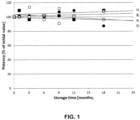
- the above stability data are, together with an extrapolation to a storage time of 24 months, graphically shown in FIG. 1 (stability at 2-8°C), FIG. 2 (stability at 25°C), and FIG. 3 (stability at 30°C).
- the maximum measured loss of biological activity is only 12%, 20%, and 20% for the temperature conditions 2-8°C (up to 18 months), 25°C (up to 12 months), and 30°C (up to 6 months), respectively.
- Extrapolations indicate that the loss in biological activity after a storage time of 24 months is less than 5% at 2-8°C for all configurations A, B, G, and H, and less than 10% at 25°C for configuration B.
- the botulinum toxin prefilled syringe according to the present invention therefore offers significant advantages over other ways to deliver botulinum toxin, including enhancing convenience and ease of handling, reducing medication errors, improving dosing accuracy, minimizing the risk of contamination, improving sterility assurance, and increasing safety in administration.
Landscapes
- Health & Medical Sciences (AREA)
- Life Sciences & Earth Sciences (AREA)
- Chemical & Material Sciences (AREA)
- General Health & Medical Sciences (AREA)
- Animal Behavior & Ethology (AREA)
- Public Health (AREA)
- Veterinary Medicine (AREA)
- Engineering & Computer Science (AREA)
- Epidemiology (AREA)
- Medicinal Chemistry (AREA)
- Pharmacology & Pharmacy (AREA)
- Organic Chemistry (AREA)
- Vascular Medicine (AREA)
- Biomedical Technology (AREA)
- Heart & Thoracic Surgery (AREA)
- Hematology (AREA)
- Anesthesiology (AREA)
- Proteomics, Peptides & Aminoacids (AREA)
- Dermatology (AREA)
- Bioinformatics & Cheminformatics (AREA)
- Biochemistry (AREA)
- General Chemical & Material Sciences (AREA)
- Chemical Kinetics & Catalysis (AREA)
- Oil, Petroleum & Natural Gas (AREA)
- Molecular Biology (AREA)
- Immunology (AREA)
- Gastroenterology & Hepatology (AREA)
- Inorganic Chemistry (AREA)
- Gerontology & Geriatric Medicine (AREA)
- Zoology (AREA)
- Toxicology (AREA)
- General Engineering & Computer Science (AREA)
- Genetics & Genomics (AREA)
- Wood Science & Technology (AREA)
- Birds (AREA)
- Nuclear Medicine, Radiotherapy & Molecular Imaging (AREA)
- Oncology (AREA)
- Communicable Diseases (AREA)
- Infusion, Injection, And Reservoir Apparatuses (AREA)
- Medicinal Preparation (AREA)
Claims (8)
- Vorgefüllte Glasspritze, umfassend eine wässrige Botulinumtoxinformulierung, wobei die Glasspritze Folgendes umfasst:(a) einen Spritzenzylinder aus Glas mit einem proximalen Ende und einem distalen Ende und einer allgemein zylindrischen Wand, die sich dazwischen erstreckt und ein Zylinderlumen definiert, wobei der Spritzenzylinder eine distal vorstehende Spitze mit einem Fluiddurchgang, der sich durch diesen erstreckt und mit dem Zylinderlumen in Verbindung steht, aufweist, wobei die allgemein zylindrische Wand eine Innenfläche aufweist, die mit einer Sperrschicht beschichtet ist,(b) eine Verschließvorrichtung mit einem Auslass-Eingriffsabschnitt, der das distale, offene Auslassende der Spritze versiegelt und schließt, wobei der Auslass-Eingriffsabschnitt aus einem Elastomermaterial besteht, und(c) eine Kolbenstangenanordnung, die sich in das proximale Ende des Spritzenzylinders erstreckt und einen Kolbenstopfen in gleitender, flüssigkeitsdichter Verbindung mit der zylindrischen Wand des Zylinderlumens umfasst, wobei der Kolbenstopfen aus einem elastomeren Material besteht, das eine Beschichtung auf mindestens einem Teil des Kolbenstopfens, der die wässrige Botulinumtoxinformulierung während der Lagerung und/oder Injektion berührt, aufweist;wobei die Barriereschicht des Spritzenzylinders eine Silikonschicht ist,wobei das Elastomermaterial des Auslass-Eingriffsabschnitts ausgewählt ist aus Styrol-Butadien-Kautschuk, der frei von 2-Mercaptobenzothiazol (MBT) ist, und einer Mischung aus Isopren-Kautschuk (IS) und Brombutylkautschuk,wobei das Elastomermaterial des Kolbenstopfens ein Brombutylkautschuk ist, wobei die Beschichtung auf dem Kolbenstopfen eine fluorierte Ethylen-Ethylen-Copolymerbeschichtung ist,wobei die in Mauseinheiten (Mouse Units) (MU) ausgedrückte biologische Aktivität des Botulinumtoxins bei einer Lagerung der Fertigspritze für 12 Monate bei 5 °C oder 12 Monate bei 25 °C gegenüber der anfänglichen Toxinaktivität um nicht mehr als 25 % verringert ist,wobei der pH-Wert der wässrigen Botulinumtoxinformulierung während der Lagerung zwischen 6,1 und 7,3 liegt undwobei die wässrige Botulinumtoxinformulierung menschliches Albumin, einen Zucker und Natriumchlorid umfasst.
- Vorgefüllte Glasspritze nach Anspruch 1, wobei die Anzahl von nicht sichtbaren Partikeln von 10 µm oder mehr während der Lagerung für 6 bis 24 Monate bei 2 °C bis 30 °C unter 1000/mL liegt.
- Vorgefüllte Glasspritze nach Anspruch 1 oder 2, wobei sich der pH-Wert bei Lagerung der vorgefüllten Spritze für 6 bis 12 Monate bei 5 °C oder 25 °C oder 30 °C um nicht mehr als 10 % gegenüber dem anfänglichen pH-Wert erhöht oder verringert.
- Vorgefüllte Glasspritze nach einem der Ansprüche 1 bis 3, wobei das Botulinumtoxin in der wässrigen Formulierung in einer Konzentration von 10 U/mL bis 1000 U/mL vorhanden ist.
- Vorgefüllte Glasspritze nach einem der Ansprüche 1 bis 4, wobei die wässrige Botulinumtoxinformulierung in der vorgefüllten Spritze keinen Puffer enthält.
- Kit, umfassend eine vorgefüllte Glasspritze nach einem der Ansprüche 1 bis 5 und gegebenenfalls Anweisungen zur Verwendung der vorgefüllten Glasspritze.
- Verwendung der vorgefüllten Glasspritze nach einem der Ansprüche 1 bis 5 zur Verwendung in kosmetischen Anwendungen.
- Verwendung nach Anspruch 7, wobei die vorgefüllte Glasspritze nach einem der Ansprüche 1 bis 5 zur Behandlung von Hautfalten und Gesichtsasymmetrien verwendet wird.
Priority Applications (1)
| Application Number | Priority Date | Filing Date | Title |
|---|---|---|---|
| EP19193112.0A EP3590500B1 (de) | 2014-12-23 | 2015-12-22 | Mit botulinumtoxin vorgefüllter behälter |
Applications Claiming Priority (2)
| Application Number | Priority Date | Filing Date | Title |
|---|---|---|---|
| EP14004394 | 2014-12-23 | ||
| PCT/EP2015/002602 WO2016102068A1 (en) | 2014-12-23 | 2015-12-22 | Botulinum toxin prefilled container |
Related Child Applications (2)
| Application Number | Title | Priority Date | Filing Date |
|---|---|---|---|
| EP19193112.0A Division EP3590500B1 (de) | 2014-12-23 | 2015-12-22 | Mit botulinumtoxin vorgefüllter behälter |
| EP19193112.0A Division-Into EP3590500B1 (de) | 2014-12-23 | 2015-12-22 | Mit botulinumtoxin vorgefüllter behälter |
Publications (3)
| Publication Number | Publication Date |
|---|---|
| EP3236939A1 EP3236939A1 (de) | 2017-11-01 |
| EP3236939B1 EP3236939B1 (de) | 2020-04-01 |
| EP3236939B2 true EP3236939B2 (de) | 2024-08-28 |
Family
ID=52302037
Family Applications (2)
| Application Number | Title | Priority Date | Filing Date |
|---|---|---|---|
| EP19193112.0A Active EP3590500B1 (de) | 2014-12-23 | 2015-12-22 | Mit botulinumtoxin vorgefüllter behälter |
| EP15823134.0A Active EP3236939B2 (de) | 2014-12-23 | 2015-12-22 | Mit botulinumtoxin vorgefüllte spritze |
Family Applications Before (1)
| Application Number | Title | Priority Date | Filing Date |
|---|---|---|---|
| EP19193112.0A Active EP3590500B1 (de) | 2014-12-23 | 2015-12-22 | Mit botulinumtoxin vorgefüllter behälter |
Country Status (15)
| Country | Link |
|---|---|
| US (3) | US10549042B2 (de) |
| EP (2) | EP3590500B1 (de) |
| JP (1) | JP6798993B2 (de) |
| KR (1) | KR102557798B1 (de) |
| CN (1) | CN107106780B (de) |
| AR (1) | AR103243A1 (de) |
| AU (1) | AU2015371726B2 (de) |
| CA (1) | CA2971238C (de) |
| ES (2) | ES2788999T5 (de) |
| IL (1) | IL252749B (de) |
| MX (1) | MX380066B (de) |
| RU (1) | RU2694820C9 (de) |
| SG (1) | SG11201705019PA (de) |
| TW (1) | TWI669129B (de) |
| WO (1) | WO2016102068A1 (de) |
Families Citing this family (13)
| Publication number | Priority date | Publication date | Assignee | Title |
|---|---|---|---|---|
| EP1861112A4 (de) * | 2005-03-03 | 2009-07-22 | Revance Therapeutics Inc | Zusammensetzungen und verfahren zur topischen anwendung und transdermalen abgabe von botulinumtoxinen |
| US8168206B1 (en) | 2005-10-06 | 2012-05-01 | Allergan, Inc. | Animal protein-free pharmaceutical compositions |
| LT2379104T (lt) | 2008-12-31 | 2018-04-10 | Revance Therapeutics, Inc. | Injekcinės botulino toksino vaisto formos |
| BRPI1015938A2 (pt) | 2009-06-25 | 2016-09-27 | Revance Therapeutics Inc | formulações da toxina botulínica livre de albumina |
| EP3590500B1 (de) * | 2014-12-23 | 2025-06-25 | Merz Pharma GmbH & Co. KGaA | Mit botulinumtoxin vorgefüllter behälter |
| JP6813492B2 (ja) | 2015-02-03 | 2021-01-13 | メルツ ファーマ ゲゼルシャフト ミット ベシュレンクテル ハフツング ウント コンパニー コマンディト ゲゼルシャフト アウフ アクティーン | ボツリヌス毒素充填済み容器 |
| KR102372106B1 (ko) | 2016-07-11 | 2022-03-08 | 벡톤 디킨슨 프랑스 | 약제 조성물 내의 육안 시인 불가능한 입자의 양을 감소시키기 위한 방법 |
| IL268688B2 (en) * | 2017-03-24 | 2024-01-01 | Merz Pharma Gmbh & Co Kgaa | Improved use of botulinum toxin to treat sialorrhea |
| KR102091452B1 (ko) * | 2017-12-19 | 2020-03-20 | 대화제약 주식회사 | 국소 마취제 및 히알루론산 하이드로겔을 포함하는 사전충전형 주사기의 제조방법 |
| IL285634B2 (en) | 2019-02-21 | 2025-06-01 | Merz Pharma Gmbh Co Kgaa | Novel uses of botulinum neurotoxin for the treatment of tremor |
| EP3851421A1 (de) * | 2020-01-16 | 2021-07-21 | Schott Ag | Glasbehälter für pharmazeutische, medizinische oder kosmetische anwendungen |
| US20230165946A1 (en) * | 2020-04-08 | 2023-06-01 | Medytox Inc. | Botulinum toxin pre-filled injectable formulation that facilitates discharge rate control and is stable |
| CN120379640A (zh) * | 2022-11-28 | 2025-07-25 | 莫茨药物股份两合公司 | 用于颈部年轻化的高浓度肉毒杆菌毒素治疗 |
Citations (5)
| Publication number | Priority date | Publication date | Assignee | Title |
|---|---|---|---|---|
| EP1491205A1 (de) † | 2002-03-29 | 2004-12-29 | Juridical Foundation, The Chemo-Sero-Therapeutic Research Institute | Mittel zur behandlung von hypermyotonie |
| WO2006005910A2 (en) † | 2004-07-12 | 2006-01-19 | Ipsen Limited | Pharmaceutical composition comprising botulinum, a non ionic surfactant, sodium chloride and sucrose |
| US20070134199A1 (en) † | 2003-07-22 | 2007-06-14 | Biotecon Therapeutics Gmbh | Formulation for a protein pharmaceutical without added human serum albumin (HSA) |
| WO2013066866A1 (en) † | 2011-10-31 | 2013-05-10 | Genentech, Inc. | Antibody formulations |
| WO2014052792A1 (en) † | 2012-09-28 | 2014-04-03 | Sio2 Medical Products, Inc. | Halogenated or parylene polymer coating |
Family Cites Families (62)
| Publication number | Priority date | Publication date | Assignee | Title |
|---|---|---|---|---|
| JP2604597Y2 (ja) * | 1993-03-02 | 2000-05-22 | 生化学工業株式会社 | 薬剤入り注射具 |
| JP3634560B2 (ja) * | 1997-05-20 | 2005-03-30 | テルモ株式会社 | 既充填薬液容器 |
| TW574036B (en) | 1998-09-11 | 2004-02-01 | Elan Pharm Inc | Stable liquid compositions of botulinum toxin |
| EP1514556B1 (de) * | 2000-02-08 | 2011-08-10 | Allergan, Inc. | Pharmazeutische Zusammensetzungen mit Botulinum-Toxin |
| US20060269575A1 (en) * | 2000-02-08 | 2006-11-30 | Allergan, Inc. | Botulinum toxin pharmaceutical compositions formulated with recombinant albumin |
| EP2275557A1 (de) * | 2000-04-12 | 2011-01-19 | Human Genome Sciences, Inc. | Albuminfusionsproteine |
| US7374896B2 (en) | 2001-08-28 | 2008-05-20 | Allergan, Inc. | GFP-SNAP25 fluorescence release assay for botulinum neurotoxin protease activity |
| US7183066B2 (en) | 2002-09-27 | 2007-02-27 | Allergan, Inc. | Cell-based fluorescence resonance energy transfer (FRET) assays for clostridial toxins |
| US20050075611A1 (en) | 2003-10-01 | 2005-04-07 | Hetzler Kevin G. | Low extractable, thermoplastic syringe and tip cap |
| US8379864B2 (en) | 2004-07-09 | 2013-02-19 | Nokia Corporation | Software plug-in framework to modify decryption methods in terminals |
| US20080045889A1 (en) | 2004-07-21 | 2008-02-21 | Gerondale Scott J | Botoxo Needle Injector |
| DE102004043009A1 (de) | 2004-09-06 | 2006-03-23 | Toxogen Gmbh | Transportprotein zum Einbringen chemischer Verbindungen in Nervenzellen |
| DE102005019302A1 (de) | 2005-04-26 | 2006-11-16 | Toxogen Gmbh | Carrier zum Targeting von Nervenzellen |
| US8137677B2 (en) | 2005-10-06 | 2012-03-20 | Allergan, Inc. | Non-protein stabilized clostridial toxin pharmaceutical compositions |
| EP1834962A1 (de) | 2006-03-15 | 2007-09-19 | Biotecon Therapeutics GmbH | PEGyliertes mutiertes Clostridium botulinum Toxin |
| EP2081964A4 (de) * | 2006-10-12 | 2012-07-11 | Univ Johns Hopkins | Alginat- und alginatlyase-zusammensetzungen und verwendungsverfahren |
| CN101675104A (zh) | 2006-12-22 | 2010-03-17 | 巴塞尔聚烯烃意大利有限责任公司 | 用于管道系统和片材的聚烯烃组合物 |
| GB0700523D0 (en) * | 2007-01-11 | 2007-02-21 | Insense Ltd | The Stabilisation Of Proteins |
| ES2441961T3 (es) * | 2007-02-15 | 2014-02-07 | Allergan, Inc. | Composiciones de toxina botulínica y métodos |
| EP2048156A1 (de) * | 2007-10-12 | 2009-04-15 | Merz Pharma GmbH & Co.KGaA | Prozess zur Bereitstellung eines temperaturstabilen Muskelrelaxans auf der Basis der neurotoxischen Komponente von Botulintoxin |
| MX2009012990A (es) | 2007-06-01 | 2010-04-01 | Merz Pharma Gmbh & Co Kgaa | Proceso para proporcionar un relajante muscular estable a la temperatura sobre la base del componente neurotoxico de toxina botulinica. |
| EP1997509A1 (de) * | 2007-06-01 | 2008-12-03 | Merz Pharma GmbH & Co.KGaA | Prozess zur Bereitstellung eines temperaturstabilen Muskelrelaxans auf der Basis der neurotoxischen Komponente von Botulintoxin |
| WO2009003010A2 (en) | 2007-06-25 | 2008-12-31 | Becton, Dickinson And Company | Methods for evaluating the aggregation of a protein in a suspension including organopolysiloxane and medical articles coated with organopolysiloxane containing a protein solution |
| CA2690773C (en) * | 2007-07-10 | 2013-09-17 | Medy-Tox, Inc. | Pharmaceutical liquid composition of botulinum toxin with improved stability |
| WO2009015840A2 (en) | 2007-07-27 | 2009-02-05 | Merz Pharma Gmbh & Co. Kgaa | Polypeptide for targeting of neural cells |
| EP4588519A3 (de) | 2008-03-14 | 2025-10-15 | Allergan, Inc. | Immunobasierte assays für botulinumtoxin-serotyp-a-aktivität |
| CA2733283A1 (en) | 2008-08-29 | 2010-03-04 | Merz Pharma Gmbh & Co. Kgaa | Clostridial neurotoxins with altered persistency |
| CA2745657C (en) | 2008-12-04 | 2022-06-21 | Botulinum Toxin Research Associates, Inc. | Extended length botulinum toxin formulation for human or mammalian use |
| US20100216667A1 (en) | 2008-12-17 | 2010-08-26 | Meyer Brian K | Method for determining compatibility of an active pharmaceutical ingredient with materials |
| US8535062B2 (en) * | 2008-12-23 | 2013-09-17 | Simskin, Llc | Cutaneous surgical training model of the head, neck and shoulders |
| LT2379104T (lt) * | 2008-12-31 | 2018-04-10 | Revance Therapeutics, Inc. | Injekcinės botulino toksino vaisto formos |
| EP2248518B1 (de) * | 2009-04-17 | 2013-01-16 | Merz Pharma GmbH & Co. KGaA | Formulierung zur Stabilisierung von Proteinen, Peptiden und deren Mischungen. |
| BRPI1015938A2 (pt) * | 2009-06-25 | 2016-09-27 | Revance Therapeutics Inc | formulações da toxina botulínica livre de albumina |
| MX2011013014A (es) | 2009-07-02 | 2012-01-27 | Merz Pharma Gmbh & Co Kgaa | Neurotoxinas que exhiben actividad biologica acortada. |
| EP2311512A3 (de) | 2009-10-19 | 2014-02-19 | Terumo Medical Corporation | Spritzenbausätze mit abnehmbaren Nadelanordnungen und geringem Eigenraum |
| US10471212B2 (en) * | 2009-10-29 | 2019-11-12 | W. L. Gore & Associates, Inc. | Silicone free drug delivery devices |
| EP2519291A1 (de) * | 2009-12-31 | 2012-11-07 | Becton Dickinson France | Medizinische zusammensetzungen mit beschichteten oberflächen mit geringer reibung und/oder geringer gas-/flüssigkeitsdurchlässigkeit |
| US20130078295A1 (en) * | 2010-06-09 | 2013-03-28 | Lipotec S.A. | Skin antiaging treatment |
| RU2013119297A (ru) | 2010-10-06 | 2014-11-20 | Аллерган, Инк. | Система для хранения и последующей обработки ботулотоксина |
| HUE037509T2 (hu) | 2011-09-29 | 2018-09-28 | Cellsnap Llc | Készítmények és eljárások toxigenicitás meghatározására |
| MX351012B (es) | 2011-11-09 | 2017-09-28 | Merz Pharma Gmbh & Co Kgaa | Neurotoxinas que exhiben actividad biologica acortada. |
| EP2776603B1 (de) * | 2011-11-11 | 2019-03-06 | SiO2 Medical Products, Inc. | Passivierungs-, ph-schutz- oder schmierbeschichtung für arzneimittelverpackung, beschichtungsverfahren und vorrichtung |
| US20150297800A1 (en) * | 2012-07-03 | 2015-10-22 | Sio2 Medical Products, Inc. | SiOx BARRIER FOR PHARMACEUTICAL PACKAGE AND COATING PROCESS |
| US9133412B2 (en) | 2012-07-09 | 2015-09-15 | Tribofilm Research, Inc. | Activated gaseous species for improved lubrication |
| WO2015020982A2 (en) * | 2013-08-04 | 2015-02-12 | Aquavit Pharmaceuticals, Inc. | Direct application system and method for the delivery of bioactive compositions and formulations |
| US10980865B2 (en) * | 2012-08-10 | 2021-04-20 | Aquavit Pharmaceuticals, Inc. | Direct application system and method for the delivery of bioactive compositions and formulations |
| US10894062B2 (en) | 2012-08-10 | 2021-01-19 | Aquavit Pharmaceuticals, Inc. | Vitamin supplement compositions for injection |
| US9662450B2 (en) | 2013-03-01 | 2017-05-30 | Sio2 Medical Products, Inc. | Plasma or CVD pre-treatment for lubricated pharmaceutical package, coating process and apparatus |
| EP4234753A3 (de) * | 2013-03-11 | 2023-11-01 | SiO2 Medical Products, Inc. | Beschichtete verpackung |
| US9937099B2 (en) * | 2013-03-11 | 2018-04-10 | Sio2 Medical Products, Inc. | Trilayer coated pharmaceutical packaging with low oxygen transmission rate |
| EP2971227B1 (de) * | 2013-03-15 | 2017-11-15 | Si02 Medical Products, Inc. | Beschichtungsverfahren. |
| CN105339790B (zh) | 2013-06-28 | 2018-04-17 | 莫茨制药有限及两合公司 | 用于确定神经毒素多肽在细胞中的生物活性的工具和方法 |
| KR102272580B1 (ko) * | 2013-07-30 | 2021-07-05 | 메르츠 파마 게엠베하 운트 코. 카가아 | 보툴리눔 독소의 고순도 신경독성 성분의 제조 방법 및 이의 용도 |
| DE102014101305A1 (de) * | 2014-02-03 | 2015-08-06 | Heraeus Medical Gmbh | Vorrichtung zum Lagern und Mischen von Knochenzement |
| CA2963325A1 (en) | 2014-10-30 | 2016-05-06 | F. Hoffmann-La Roche Ag | Syringe and method of preparing a syringe |
| EP3590500B1 (de) * | 2014-12-23 | 2025-06-25 | Merz Pharma GmbH & Co. KGaA | Mit botulinumtoxin vorgefüllter behälter |
| JP6813492B2 (ja) * | 2015-02-03 | 2021-01-13 | メルツ ファーマ ゲゼルシャフト ミット ベシュレンクテル ハフツング ウント コンパニー コマンディト ゲゼルシャフト アウフ アクティーン | ボツリヌス毒素充填済み容器 |
| US20180128133A1 (en) * | 2015-05-15 | 2018-05-10 | Eaton Corporation | Latch orientation mechanism |
| JP2018515271A (ja) * | 2015-05-15 | 2018-06-14 | カリリオン・クリニックCarilion Clinic | 過活動膀胱を処置するための注射器及びこれら注射器を使用する方法 |
| US9827282B2 (en) * | 2015-07-24 | 2017-11-28 | Bao Tran | Medication dispensing system |
| US10110405B2 (en) | 2015-11-05 | 2018-10-23 | Qualcomm Incorporated | System and method for narrowband uplink single tone transmissions |
| TWI737742B (zh) * | 2016-06-22 | 2021-09-01 | 德商梅茲製藥有限兩合公司 | 肉毒桿菌毒素的預填充式注射器系統、具有其之套組以及其之使用 |
-
2015
- 2015-12-22 EP EP19193112.0A patent/EP3590500B1/de active Active
- 2015-12-22 MX MX2017007476A patent/MX380066B/es unknown
- 2015-12-22 EP EP15823134.0A patent/EP3236939B2/de active Active
- 2015-12-22 TW TW104143035A patent/TWI669129B/zh active
- 2015-12-22 WO PCT/EP2015/002602 patent/WO2016102068A1/en not_active Ceased
- 2015-12-22 ES ES15823134T patent/ES2788999T5/es active Active
- 2015-12-22 US US15/536,503 patent/US10549042B2/en active Active
- 2015-12-22 ES ES19193112T patent/ES3035622T3/es active Active
- 2015-12-22 JP JP2017533920A patent/JP6798993B2/ja active Active
- 2015-12-22 SG SG11201705019PA patent/SG11201705019PA/en unknown
- 2015-12-22 AU AU2015371726A patent/AU2015371726B2/en active Active
- 2015-12-22 CA CA2971238A patent/CA2971238C/en active Active
- 2015-12-22 AR ARP150104253A patent/AR103243A1/es active IP Right Grant
- 2015-12-22 RU RU2017120836A patent/RU2694820C9/ru active
- 2015-12-22 KR KR1020177020499A patent/KR102557798B1/ko active Active
- 2015-12-22 CN CN201580069352.5A patent/CN107106780B/zh active Active
-
2017
- 2017-06-07 IL IL252749A patent/IL252749B/en active IP Right Grant
-
2019
- 2019-12-18 US US16/718,236 patent/US11167090B2/en active Active
-
2021
- 2021-06-23 US US17/356,300 patent/US12434002B2/en active Active
Patent Citations (5)
| Publication number | Priority date | Publication date | Assignee | Title |
|---|---|---|---|---|
| EP1491205A1 (de) † | 2002-03-29 | 2004-12-29 | Juridical Foundation, The Chemo-Sero-Therapeutic Research Institute | Mittel zur behandlung von hypermyotonie |
| US20070134199A1 (en) † | 2003-07-22 | 2007-06-14 | Biotecon Therapeutics Gmbh | Formulation for a protein pharmaceutical without added human serum albumin (HSA) |
| WO2006005910A2 (en) † | 2004-07-12 | 2006-01-19 | Ipsen Limited | Pharmaceutical composition comprising botulinum, a non ionic surfactant, sodium chloride and sucrose |
| WO2013066866A1 (en) † | 2011-10-31 | 2013-05-10 | Genentech, Inc. | Antibody formulations |
| WO2014052792A1 (en) † | 2012-09-28 | 2014-04-03 | Sio2 Medical Products, Inc. | Halogenated or parylene polymer coating |
Non-Patent Citations (2)
| Title |
|---|
| ANONYMOUS: "Gx® Syringe Systems", GERRESHEIMER BROCHURE, October 2014 (2014-10-01), pages 1 - 20 † |
| Dermatol Surg 2003; 29(5): 523-529 † |
Also Published As
Similar Documents
| Publication | Publication Date | Title |
|---|---|---|
| US12324903B2 (en) | Botulinum toxin prefilled plastic syringe | |
| US12434002B2 (en) | Botulinum toxin prefilled container | |
| EP3474931B1 (de) | Mit botulinumtoxin vorgefülltes spritzensystem | |
| HK1240862A1 (en) | Botulinum toxin prefilled container | |
| BR112017013764B1 (pt) | Seringa de vidro pré-carregada | |
| HK1240152A1 (en) | Botulinum toxin prefilled container | |
| HK1240862B (zh) | 肉毒杆菌毒素预填充式容器 |
Legal Events
| Date | Code | Title | Description |
|---|---|---|---|
| STAA | Information on the status of an ep patent application or granted ep patent |
Free format text: STATUS: THE INTERNATIONAL PUBLICATION HAS BEEN MADE |
|
| TPAC | Observations filed by third parties |
Free format text: ORIGINAL CODE: EPIDOSNTIPA |
|
| PUAI | Public reference made under article 153(3) epc to a published international application that has entered the european phase |
Free format text: ORIGINAL CODE: 0009012 |
|
| STAA | Information on the status of an ep patent application or granted ep patent |
Free format text: STATUS: REQUEST FOR EXAMINATION WAS MADE |
|
| 17P | Request for examination filed |
Effective date: 20170620 |
|
| AK | Designated contracting states |
Kind code of ref document: A1 Designated state(s): AL AT BE BG CH CY CZ DE DK EE ES FI FR GB GR HR HU IE IS IT LI LT LU LV MC MK MT NL NO PL PT RO RS SE SI SK SM TR |
|
| AX | Request for extension of the european patent |
Extension state: BA ME |
|
| DAV | Request for validation of the european patent (deleted) | ||
| DAX | Request for extension of the european patent (deleted) | ||
| STAA | Information on the status of an ep patent application or granted ep patent |
Free format text: STATUS: EXAMINATION IS IN PROGRESS |
|
| 17Q | First examination report despatched |
Effective date: 20180906 |
|
| TPAC | Observations filed by third parties |
Free format text: ORIGINAL CODE: EPIDOSNTIPA |
|
| TPAC | Observations filed by third parties |
Free format text: ORIGINAL CODE: EPIDOSNTIPA |
|
| GRAP | Despatch of communication of intention to grant a patent |
Free format text: ORIGINAL CODE: EPIDOSNIGR1 |
|
| STAA | Information on the status of an ep patent application or granted ep patent |
Free format text: STATUS: GRANT OF PATENT IS INTENDED |
|
| RAP1 | Party data changed (applicant data changed or rights of an application transferred) |
Owner name: MERZ PHARMA GMBH & CO. KGAA |
|
| INTG | Intention to grant announced |
Effective date: 20191125 |
|
| GRAS | Grant fee paid |
Free format text: ORIGINAL CODE: EPIDOSNIGR3 |
|
| GRAA | (expected) grant |
Free format text: ORIGINAL CODE: 0009210 |
|
| STAA | Information on the status of an ep patent application or granted ep patent |
Free format text: STATUS: THE PATENT HAS BEEN GRANTED |
|
| AK | Designated contracting states |
Kind code of ref document: B1 Designated state(s): AL AT BE BG CH CY CZ DE DK EE ES FI FR GB GR HR HU IE IS IT LI LT LU LV MC MK MT NL NO PL PT RO RS SE SI SK SM TR |
|
| REG | Reference to a national code |
Ref country code: GB Ref legal event code: FG4D |
|
| REG | Reference to a national code |
Ref country code: AT Ref legal event code: REF Ref document number: 1250442 Country of ref document: AT Kind code of ref document: T Effective date: 20200415 Ref country code: CH Ref legal event code: EP |
|
| REG | Reference to a national code |
Ref country code: DE Ref legal event code: R096 Ref document number: 602015049988 Country of ref document: DE |
|
| REG | Reference to a national code |
Ref country code: IE Ref legal event code: FG4D |
|
| REG | Reference to a national code |
Ref country code: CH Ref legal event code: NV Representative=s name: NOVAGRAAF INTERNATIONAL SA, CH |
|
| PG25 | Lapsed in a contracting state [announced via postgrant information from national office to epo] |
Ref country code: BG Free format text: LAPSE BECAUSE OF FAILURE TO SUBMIT A TRANSLATION OF THE DESCRIPTION OR TO PAY THE FEE WITHIN THE PRESCRIBED TIME-LIMIT Effective date: 20200701 |
|
| REG | Reference to a national code |
Ref country code: NL Ref legal event code: MP Effective date: 20200401 |
|
| REG | Reference to a national code |
Ref country code: LT Ref legal event code: MG4D |
|
| REG | Reference to a national code |
Ref country code: ES Ref legal event code: FG2A Ref document number: 2788999 Country of ref document: ES Kind code of ref document: T3 Effective date: 20201023 |
|
| PG25 | Lapsed in a contracting state [announced via postgrant information from national office to epo] |
Ref country code: NL Free format text: LAPSE BECAUSE OF FAILURE TO SUBMIT A TRANSLATION OF THE DESCRIPTION OR TO PAY THE FEE WITHIN THE PRESCRIBED TIME-LIMIT Effective date: 20200401 Ref country code: CZ Free format text: LAPSE BECAUSE OF FAILURE TO SUBMIT A TRANSLATION OF THE DESCRIPTION OR TO PAY THE FEE WITHIN THE PRESCRIBED TIME-LIMIT Effective date: 20200401 Ref country code: IS Free format text: LAPSE BECAUSE OF FAILURE TO SUBMIT A TRANSLATION OF THE DESCRIPTION OR TO PAY THE FEE WITHIN THE PRESCRIBED TIME-LIMIT Effective date: 20200801 Ref country code: NO Free format text: LAPSE BECAUSE OF FAILURE TO SUBMIT A TRANSLATION OF THE DESCRIPTION OR TO PAY THE FEE WITHIN THE PRESCRIBED TIME-LIMIT Effective date: 20200701 Ref country code: FI Free format text: LAPSE BECAUSE OF FAILURE TO SUBMIT A TRANSLATION OF THE DESCRIPTION OR TO PAY THE FEE WITHIN THE PRESCRIBED TIME-LIMIT Effective date: 20200401 Ref country code: SE Free format text: LAPSE BECAUSE OF FAILURE TO SUBMIT A TRANSLATION OF THE DESCRIPTION OR TO PAY THE FEE WITHIN THE PRESCRIBED TIME-LIMIT Effective date: 20200401 Ref country code: LT Free format text: LAPSE BECAUSE OF FAILURE TO SUBMIT A TRANSLATION OF THE DESCRIPTION OR TO PAY THE FEE WITHIN THE PRESCRIBED TIME-LIMIT Effective date: 20200401 Ref country code: GR Free format text: LAPSE BECAUSE OF FAILURE TO SUBMIT A TRANSLATION OF THE DESCRIPTION OR TO PAY THE FEE WITHIN THE PRESCRIBED TIME-LIMIT Effective date: 20200702 Ref country code: PT Free format text: LAPSE BECAUSE OF FAILURE TO SUBMIT A TRANSLATION OF THE DESCRIPTION OR TO PAY THE FEE WITHIN THE PRESCRIBED TIME-LIMIT Effective date: 20200817 |
|
| PG25 | Lapsed in a contracting state [announced via postgrant information from national office to epo] |
Ref country code: LV Free format text: LAPSE BECAUSE OF FAILURE TO SUBMIT A TRANSLATION OF THE DESCRIPTION OR TO PAY THE FEE WITHIN THE PRESCRIBED TIME-LIMIT Effective date: 20200401 Ref country code: HR Free format text: LAPSE BECAUSE OF FAILURE TO SUBMIT A TRANSLATION OF THE DESCRIPTION OR TO PAY THE FEE WITHIN THE PRESCRIBED TIME-LIMIT Effective date: 20200401 Ref country code: RS Free format text: LAPSE BECAUSE OF FAILURE TO SUBMIT A TRANSLATION OF THE DESCRIPTION OR TO PAY THE FEE WITHIN THE PRESCRIBED TIME-LIMIT Effective date: 20200401 |
|
| PG25 | Lapsed in a contracting state [announced via postgrant information from national office to epo] |
Ref country code: AL Free format text: LAPSE BECAUSE OF FAILURE TO SUBMIT A TRANSLATION OF THE DESCRIPTION OR TO PAY THE FEE WITHIN THE PRESCRIBED TIME-LIMIT Effective date: 20200401 |
|
| REG | Reference to a national code |
Ref country code: DE Ref legal event code: R026 Ref document number: 602015049988 Country of ref document: DE |
|
| PLBI | Opposition filed |
Free format text: ORIGINAL CODE: 0009260 |
|
| PG25 | Lapsed in a contracting state [announced via postgrant information from national office to epo] |
Ref country code: RO Free format text: LAPSE BECAUSE OF FAILURE TO SUBMIT A TRANSLATION OF THE DESCRIPTION OR TO PAY THE FEE WITHIN THE PRESCRIBED TIME-LIMIT Effective date: 20200401 Ref country code: EE Free format text: LAPSE BECAUSE OF FAILURE TO SUBMIT A TRANSLATION OF THE DESCRIPTION OR TO PAY THE FEE WITHIN THE PRESCRIBED TIME-LIMIT Effective date: 20200401 Ref country code: SM Free format text: LAPSE BECAUSE OF FAILURE TO SUBMIT A TRANSLATION OF THE DESCRIPTION OR TO PAY THE FEE WITHIN THE PRESCRIBED TIME-LIMIT Effective date: 20200401 Ref country code: DK Free format text: LAPSE BECAUSE OF FAILURE TO SUBMIT A TRANSLATION OF THE DESCRIPTION OR TO PAY THE FEE WITHIN THE PRESCRIBED TIME-LIMIT Effective date: 20200401 |
|
| 26 | Opposition filed |
Opponent name: ALLERGAN, INC. Effective date: 20201231 |
|
| PG25 | Lapsed in a contracting state [announced via postgrant information from national office to epo] |
Ref country code: PL Free format text: LAPSE BECAUSE OF FAILURE TO SUBMIT A TRANSLATION OF THE DESCRIPTION OR TO PAY THE FEE WITHIN THE PRESCRIBED TIME-LIMIT Effective date: 20200401 Ref country code: SK Free format text: LAPSE BECAUSE OF FAILURE TO SUBMIT A TRANSLATION OF THE DESCRIPTION OR TO PAY THE FEE WITHIN THE PRESCRIBED TIME-LIMIT Effective date: 20200401 |
|
| PLAX | Notice of opposition and request to file observation + time limit sent |
Free format text: ORIGINAL CODE: EPIDOSNOBS2 |
|
| PG25 | Lapsed in a contracting state [announced via postgrant information from national office to epo] |
Ref country code: SI Free format text: LAPSE BECAUSE OF FAILURE TO SUBMIT A TRANSLATION OF THE DESCRIPTION OR TO PAY THE FEE WITHIN THE PRESCRIBED TIME-LIMIT Effective date: 20200401 |
|
| PLBB | Reply of patent proprietor to notice(s) of opposition received |
Free format text: ORIGINAL CODE: EPIDOSNOBS3 |
|
| PG25 | Lapsed in a contracting state [announced via postgrant information from national office to epo] |
Ref country code: MC Free format text: LAPSE BECAUSE OF FAILURE TO SUBMIT A TRANSLATION OF THE DESCRIPTION OR TO PAY THE FEE WITHIN THE PRESCRIBED TIME-LIMIT Effective date: 20200401 |
|
| REG | Reference to a national code |
Ref country code: BE Ref legal event code: MM Effective date: 20201231 |
|
| PG25 | Lapsed in a contracting state [announced via postgrant information from national office to epo] |
Ref country code: LU Free format text: LAPSE BECAUSE OF NON-PAYMENT OF DUE FEES Effective date: 20201222 |
|
| REG | Reference to a national code |
Ref country code: AT Ref legal event code: UEP Ref document number: 1250442 Country of ref document: AT Kind code of ref document: T Effective date: 20200401 |
|
| PG25 | Lapsed in a contracting state [announced via postgrant information from national office to epo] |
Ref country code: TR Free format text: LAPSE BECAUSE OF FAILURE TO SUBMIT A TRANSLATION OF THE DESCRIPTION OR TO PAY THE FEE WITHIN THE PRESCRIBED TIME-LIMIT Effective date: 20200401 Ref country code: MT Free format text: LAPSE BECAUSE OF FAILURE TO SUBMIT A TRANSLATION OF THE DESCRIPTION OR TO PAY THE FEE WITHIN THE PRESCRIBED TIME-LIMIT Effective date: 20200401 Ref country code: CY Free format text: LAPSE BECAUSE OF FAILURE TO SUBMIT A TRANSLATION OF THE DESCRIPTION OR TO PAY THE FEE WITHIN THE PRESCRIBED TIME-LIMIT Effective date: 20200401 |
|
| PG25 | Lapsed in a contracting state [announced via postgrant information from national office to epo] |
Ref country code: MK Free format text: LAPSE BECAUSE OF FAILURE TO SUBMIT A TRANSLATION OF THE DESCRIPTION OR TO PAY THE FEE WITHIN THE PRESCRIBED TIME-LIMIT Effective date: 20200401 |
|
| PG25 | Lapsed in a contracting state [announced via postgrant information from national office to epo] |
Ref country code: BE Free format text: LAPSE BECAUSE OF NON-PAYMENT OF DUE FEES Effective date: 20201231 |
|
| APAH | Appeal reference modified |
Free format text: ORIGINAL CODE: EPIDOSCREFNO |
|
| APBM | Appeal reference recorded |
Free format text: ORIGINAL CODE: EPIDOSNREFNO |
|
| APBP | Date of receipt of notice of appeal recorded |
Free format text: ORIGINAL CODE: EPIDOSNNOA2O |
|
| APBM | Appeal reference recorded |
Free format text: ORIGINAL CODE: EPIDOSNREFNO |
|
| APBP | Date of receipt of notice of appeal recorded |
Free format text: ORIGINAL CODE: EPIDOSNNOA2O |
|
| PLAB | Opposition data, opponent's data or that of the opponent's representative modified |
Free format text: ORIGINAL CODE: 0009299OPPO |
|
| APBQ | Date of receipt of statement of grounds of appeal recorded |
Free format text: ORIGINAL CODE: EPIDOSNNOA3O |
|
| PLAB | Opposition data, opponent's data or that of the opponent's representative modified |
Free format text: ORIGINAL CODE: 0009299OPPO |
|
| R26 | Opposition filed (corrected) |
Opponent name: ALLERGAN, INC. Effective date: 20201231 |
|
| R26 | Opposition filed (corrected) |
Opponent name: ALLERGAN, INC. Effective date: 20201231 |
|
| P01 | Opt-out of the competence of the unified patent court (upc) registered |
Effective date: 20230506 |
|
| APBU | Appeal procedure closed |
Free format text: ORIGINAL CODE: EPIDOSNNOA9O |
|
| PUAH | Patent maintained in amended form |
Free format text: ORIGINAL CODE: 0009272 |
|
| STAA | Information on the status of an ep patent application or granted ep patent |
Free format text: STATUS: PATENT MAINTAINED AS AMENDED |
|
| 27A | Patent maintained in amended form |
Effective date: 20240828 |
|
| AK | Designated contracting states |
Kind code of ref document: B2 Designated state(s): AL AT BE BG CH CY CZ DE DK EE ES FI FR GB GR HR HU IE IS IT LI LT LU LV MC MK MT NL NO PL PT RO RS SE SI SK SM TR |
|
| REG | Reference to a national code |
Ref country code: DE Ref legal event code: R102 Ref document number: 602015049988 Country of ref document: DE |
|
| PGFP | Annual fee paid to national office [announced via postgrant information from national office to epo] |
Ref country code: DE Payment date: 20241216 Year of fee payment: 10 |
|
| PGFP | Annual fee paid to national office [announced via postgrant information from national office to epo] |
Ref country code: GB Payment date: 20241218 Year of fee payment: 10 |
|
| PGFP | Annual fee paid to national office [announced via postgrant information from national office to epo] |
Ref country code: FR Payment date: 20241217 Year of fee payment: 10 |
|
| PGFP | Annual fee paid to national office [announced via postgrant information from national office to epo] |
Ref country code: AT Payment date: 20241213 Year of fee payment: 10 |
|
| PGFP | Annual fee paid to national office [announced via postgrant information from national office to epo] |
Ref country code: IE Payment date: 20241212 Year of fee payment: 10 |
|
| PGFP | Annual fee paid to national office [announced via postgrant information from national office to epo] |
Ref country code: IT Payment date: 20241216 Year of fee payment: 10 |
|
| REG | Reference to a national code |
Ref country code: ES Ref legal event code: DC2A Ref document number: 2788999 Country of ref document: ES Kind code of ref document: T5 Effective date: 20250224 |
|
| PGFP | Annual fee paid to national office [announced via postgrant information from national office to epo] |
Ref country code: ES Payment date: 20250117 Year of fee payment: 10 |
|
| PGFP | Annual fee paid to national office [announced via postgrant information from national office to epo] |
Ref country code: CH Payment date: 20250101 Year of fee payment: 10 |