EP3233019B1 - Enzymatische umesterung von jojoba-wachsestern - Google Patents
Enzymatische umesterung von jojoba-wachsestern Download PDFInfo
- Publication number
- EP3233019B1 EP3233019B1 EP15871261.2A EP15871261A EP3233019B1 EP 3233019 B1 EP3233019 B1 EP 3233019B1 EP 15871261 A EP15871261 A EP 15871261A EP 3233019 B1 EP3233019 B1 EP 3233019B1
- Authority
- EP
- European Patent Office
- Prior art keywords
- feedstock
- wax esters
- lipase
- jojoba
- esters
- Prior art date
- Legal status (The legal status is an assumption and is not a legal conclusion. Google has not performed a legal analysis and makes no representation as to the accuracy of the status listed.)
- Active
Links
Images

Classifications
-
- C—CHEMISTRY; METALLURGY
- C12—BIOCHEMISTRY; BEER; SPIRITS; WINE; VINEGAR; MICROBIOLOGY; ENZYMOLOGY; MUTATION OR GENETIC ENGINEERING
- C12P—FERMENTATION OR ENZYME-USING PROCESSES TO SYNTHESISE A DESIRED CHEMICAL COMPOUND OR COMPOSITION OR TO SEPARATE OPTICAL ISOMERS FROM A RACEMIC MIXTURE
- C12P7/00—Preparation of oxygen-containing organic compounds
- C12P7/64—Fats; Fatty oils; Ester-type waxes; Higher fatty acids, i.e. having at least seven carbon atoms in an unbroken chain bound to a carboxyl group; Oxidised oils or fats
- C12P7/6436—Fatty acid esters
-
- C—CHEMISTRY; METALLURGY
- C11—ANIMAL OR VEGETABLE OILS, FATS, FATTY SUBSTANCES OR WAXES; FATTY ACIDS THEREFROM; DETERGENTS; CANDLES
- C11C—FATTY ACIDS FROM FATS, OILS OR WAXES; CANDLES; FATS, OILS OR FATTY ACIDS BY CHEMICAL MODIFICATION OF FATS, OILS, OR FATTY ACIDS OBTAINED THEREFROM
- C11C3/00—Fats, oils, or fatty acids by chemical modification of fats, oils, or fatty acids obtained therefrom
- C11C3/003—Fats, oils, or fatty acids by chemical modification of fats, oils, or fatty acids obtained therefrom by esterification of fatty acids with alcohols
-
- C—CHEMISTRY; METALLURGY
- C11—ANIMAL OR VEGETABLE OILS, FATS, FATTY SUBSTANCES OR WAXES; FATTY ACIDS THEREFROM; DETERGENTS; CANDLES
- C11C—FATTY ACIDS FROM FATS, OILS OR WAXES; CANDLES; FATS, OILS OR FATTY ACIDS BY CHEMICAL MODIFICATION OF FATS, OILS, OR FATTY ACIDS OBTAINED THEREFROM
- C11C3/00—Fats, oils, or fatty acids by chemical modification of fats, oils, or fatty acids obtained therefrom
- C11C3/04—Fats, oils, or fatty acids by chemical modification of fats, oils, or fatty acids obtained therefrom by esterification of fats or fatty oils
- C11C3/10—Ester interchange
Definitions
- the present invention relates to an enzymatic process for transesterifying wax esters, comprising jojoba wax esters.
- a wax ester is formed from the chemical reaction of a fatty acid and a fatty alcohol, which results in the formation of an ester group that links two carbon chains.
- Wax esters are found in various animals and plants, including the jojoba plant ( Simmondsia chinensis ). Wax esters are used in various applications, including in cosmetic and personal care Products.
- the patent application WO 01/72683 discloses lipase-catalyzed transesterification reactions yielding ferulyl- or coumaryl-substituted acylglycerols with properties suitable for use as sunscreen agents.
- exemplary oils include synthetic triglycerides such as triolein, but jojoba oil is mentioned as one of several alternatives.
- the present process for transesterifying wax esters comprises: providing a feedstock including jojoba wax esters, contacting the feedstock with a lipase, and catalytically transesterifying the wax esters in the feedstock with the lipase to form a transesterified product, wherein the oxidative stability index (OSI) of the transesterified product is greater than the OSI of the feedstock.
- OSI oxidative stability index
- Implementations of the process for transesterifying jojoba wax esters may include one, all, or any of the following:
- the transesterified product may include no methyl esters.
- the feedstock may further include an antioxidant and catalytically transesterifying the wax esters in the feedstock with the lipase may further include catalytically transesterifying without one of removing and degrading the antioxidant in the feedstock.
- the feedstock may further include a skin conditioning agent and a volatile compound and catalytically transesterifying the jojoba wax esters in the feedstock with the lipase may further include catalytically transesterifying without removing or degrading the skin conditioning agent and the volatile compound in the feedstock.
- the jojoba wax esters may further include hydrogenated jojoba wax esters.
- a dropping point of the transesterified product may be greater than a dropping point of the feedstock and the dropping point may increase as a percentage of hydrogenated jojoba wax esters in the feedstock increases.
- the catalytic transformation may take place at greater than or equal to 98% yield.
- the yield of the catalytic transesterification may be greater than 4001 kilograms of product per kilogram of immobilized lipase catalyst.
- Transesterification involves the process of exchanging acyl groups located on each side of a ester group with an alkyl group contained in an alcohol group, as illustrated below:
- Transesterification for naturally occurring or structured or synthetic esters permits altering of various physical properties of the transesterified product when compared to the original feedstock.
- physical properties such as viscosity, dropping point, oil (oxidative) stability index (OSI), carbon chain distribution, and other properties of the transesterified product may be greater, equal to, or less than the corresponding values of the original wax ester-containing feedstocks.
- OSI oil (oxidative) stability index
- carbon chain distribution and other properties of the transesterified product may be greater, equal to, or less than the corresponding values of the original wax ester-containing feedstocks.
- transesterification of wax esters is accomplished using several different methods.
- Methods and systems for transesterifying jojoba oil that include the use of an acidic bentonite-type clay at temperatures between 150 °C - 350 °C are disclosed in U.S. Patent No. 4,329,298 to Brown, et al. , entitled “Isomerization of Jojoba Oil and Products Thereof,” filed August 15, 1980 and issued May 11, 1982 and in U.S. Patent No. 4,360,387 to Brown, et al. , entitled “Isomorphous Jojoba Oil Compositions Containing Trans-Isomerized Jojoba Oil,” filed March 9, 1981, issued November 23, 1982.
- a 5%-10% loss of the original jojoba oil was observed.
- transesterification reactions use a chemical catalyst, such as sodium methylate (methoxide) or sodium hydroxide. While the reaction is catalytic, side reactions between the catalyst and components of the feedstock and/or reactants occur during transesterification process. These side reactions create byproducts that reduce the yield of the process and alter the properties of the transesterified product. Some of the property changes occur because of damage/changes to the feedstock esters caused by the high temperatures (100 °C - 230 °C) and low pressures ( ⁇ 7 mm Hg, about 933 Pa) required to carry out chemical catalytic transesterification.
- a chemical catalyst such as sodium methylate (methoxide) or sodium hydroxide.
- the wax ester feedstock is derived from a natural source, such as a jojoba wax ester according to the claimed process
- existing antioxidants, sterols, hydrocarbons, and other volatile compounds react with the chemical catalyst in side reactions.
- the resulting transesterified product may have little or none of any of these components remaining intact following chemical catalytic transesterification and/or may reduce the effectiveness of these components.
- the transesterified product may include artifacts of these components which are undesirable or have undesirable effects in the product or subsequent mixtures that include the product.
- FIG. 1 a process flow diagram for a conventional transesterification process is illustrated. As illustrated, the feedstock containing wax esters is processed in a batch catalytic reaction. Following batch processing, the reaction is stopped using an acid, such as citric acid, and/or water to neutralize the remaining catalyst. At this point, the reactor contents are then checked for the presence of free fatty acids, which, if present requires the use of a neutralization process for the free fatty acids.
- an acid such as citric acid
- the batch reactants are then moved into a waste separation step, in which the solution is washed with soft water to remove soaps and salts in the reactor material and separate them from the oil/lipid portion of the reactor material that contains the transesterified product to form a waste stream and a transesterified product stream.
- the transesterified product in the transesterified product stream is then bleached to remove remaining color bodies, soaps, and other undesirable byproducts formed during the chemically catalyzed transesterification reaction.
- the transesterified product stream is then deodorized and votated to produce a finished transesterified product.
- the process of votation is a controlled crystallization process or tempering process in which the transesterified product is agitated under controlled conditions to form a transesterified product with a desired consistency and crystalline structure for later use.
- Votation includes various heating, chilling, flash chilling, and other pressure adjustments to provide the desired consistency and/or structure.
- the enzymes are lipases, which are proteins that various biological organisms use to catalyze the hydrolysis and/or esterification of various compounds, such as lipids.
- lipase means any enzyme or protein capable of being used in a transesterification reaction of a wax ester.
- FIG. 2 a process flow diagram for an enzymatically catalyzed transesterification process is illustrated.
- the wax ester feedstock passes through one or more catalytic reactors that allow a continuous catalytic transesterification reaction to take place. While it is possible to batch process wax ester feedstocks using enzymes, continuous processing has many well-known advantages over batch processing.
- the transesterified product is deodorized and votated to produce a finished transesterified product stream. As can be observed, there are fewer process steps in an enzymatically catalyzed transesterification process.
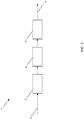
- FIG. 3 a process flow diagram of a continuous enzymatic reactor system 2 for enzymatic catalyzed transesterification of wax esters is illustrated.
- the system 2 includes three reactors 4, 6, 8 connected in series.
- Each reactor contains the enzyme and is designed to place the incoming wax ester feedstock 10 in contact with the enzyme.
- the transesterified product 12 exits the final reactor 8 for subsequent processing/collection.
- the enzyme is immobilized on a substrate material designed to facilitate interaction of the incoming wax ester feedstock.
- the enzyme is immobilized on the internal structure(s) of the reactor itself or is free flowing within the reactor system and recycled back to the reactor(s).
- the reactors are packed bed reactors.
- lipases may be employed in enzymatic catalytic transesterification reactions for jojoba wax esters, including those that are derived/obtained from biological organisms, those made synthetically, and those that are entirely artificial, whether made biologically and/or synthetically.
- the lipases may include, one, some, any, or any combination of lipases derived from the following organisms: Aspergillus niger, Aspergillus oryzae, Bacillus subtilis, Bacillus thermocatenulatus, Burkholderia cepacia, Burkholderia glumae, Candida rugosa , Candida antarctica A, Candida antarctica B, Candida cylindracea , Candida parapsilosis, Chromobacterium viscosum, Geotrichum candidum, Geotrichum sp., Mucor miehei, Humicola lanuginose, Penicillium camembertii, Penicillium chrysogenum, Penicillium roquefortii, Pseudomonas cepacia, Pseudomonas aeruginosa, Pseudomonas fluorenscens, Pseudomonas fragi, Pseu
- the lipase may be the following: a lipase from Thermomyces lanuginosus marketed under the tradenames LIPOZYME TL IM or LIPEX by Novozymes A/S of Bagsvaerd, Denmark and immobilized on a substrate also manufactured by Novozymes.
- a representative sequence listing of the lipase is included as SEQ ID NO: 1 herein.
- the lipase may be that marketed under the tradename NOVOZYM by Novozymes, A/S derived from Candida antarctica, a representative sequence listing for which is included as SEQ ID NO: 2 herein.
- the lipases may be any of the following: those marketed under the tradenames CALB L, NOVOZYME 435, NOVOCOR AD L, AND LIPOLASE 100L by Novozymes; those marketed under the tradenames CALB, CALA, and CRL by c-LEcta GmbH of Leipzig, Germany; those marketed under the tradenames LIPASE A AMANO 12, LIPASE AY AMANO 30SD, LIPASE G AMANO 50, LIPASE R AMANO, LIPASE DF AMANO 15, LIPASE MER AMANO, and NEWLASE F by Amano Enzyme Inc.
- the lipase may be a lipase from Candida antarctica A, a lipase from Candida antarctica B, Candida rugosa or any combination thereof.
- the lipases may be any disclosed in U.S. Patent Application Publication No. 20140017741 (the '741 publication) to Nielsen , et al., entitled “Esterification Process,” filed October 1, 2013 and published January 16, 2014. Those lipases disclosed in the sequence listings for the various patent applications listed in para. [0026] - [0029] in the '741 publication may also be those utilized in particular implementations.
- the lipases may be those have at least 60%, at least 70%, at least 80%, at least 90%, at least 95%, at least 96%, at least 97%, at least 98%, or even at least 99% identity to any of the lipases disclosed herein, in the '741 publication, and in the patent applications disclosed in the '741 publication.
- the feedstock comprises jojoba wax esters.
- wax esters contained in the following materials may be included in the wax ester feedstocks processed using the principles disclosed herein: beeswax, Chinese wax, shellac wax, whale spermaceti, lanolin, carnauba wax, ouricuri wax, jojoba oil, candelilla wax, esparto wax, Japan wax, rice bran oil, sunflower wax, ozocerite, ozokerite, and montan wax (also called lignite wax). Any other natural or synthetically produced wax esters may also be processed using the principles disclosed herein, together with the jojoba wax. Various examples are discussed in this document regarding wax esters in jojoba oil feedstocks.
- Jojoba oil derived from the seeds of the jojoba plant contains wax esters and other components that have been noted to be useful for various functions. These include steryl esters, sterols, and various hydrocarbons that can be useful as skin conditioning agents in cosmetics and personal care products. Antioxidants, like tocopherols, are also included, along with various volatile ingredients naturally present in the oil, which are volatile in comparison with the wax esters.
- the wax esters in jojoba oil generally vary between 34 and 48 carbons in length. A detailed analysis of the wax ester distribution, structural characteristics, and other components in jojoba oil may be found in the paper by Thomas K. Miwa, entitled “Structural Determination and Uses of Jojoba Oil," J. Amer. Oil Chem.
- Transesterification of jojoba oil has conventionally been done using the chemically catalyzed processes discussed herein.
- side reactions form various fatty acid methyl esters and leave various free fatty alcohols when sodium methoxide is used.
- the resulting transesterified product stream may include 5% or less by weight of these fatty acid methyl esters, which may function as an emollient, and the free fatty alcohols, which may function as an emollient and viscosity controller.
- the reaction of the chemical catalyst removes or degrades the steryl esters, sterols, tocopherols, hydrocarbons, and volatile ingredients in the jojoba oil.
- This degradation and/or removal of these components changes the functionality and physical properties of the transesterified product stream.
- the degradation and/or removal of the tocopherols and other naturally occurring antioxidants reduces the OSI of the transesterified product to below the OSI of the original jojoba oil.
- jojoba oil includes between about 0 to about 500 ppm of tocopherols with the major component being gamma-tocopherol, elimination of the natural tocopherols has a significant effect on the oxidative stability of the mixture.
- An addition of 500 ppm of tocopherols can enhance the oxidative stability of the material by about 50% to about 200% of the original oxidative stability.
- Table 1 lists some process parameters and some characteristics of the transesterified product stream for a chemically catalyzed transesterification process and those for an enzymatically catalyzed transesterification process.
- Table 1 Process Parameter Chemical Catalyst Enzymatic Catalyst Reaction Temperature 100C - 230C 10C - 70C Reaction Pressure ⁇ 7 mm Hg 760 mm Hg (ambient) Product Color Increased (changes color) No changes Soap Formation Yes No change Transesterification Yield 85% - 95% >98%
- Table 2 shows observed effect of the chemically catalyzed process and various enzymatically catalyzed processes on the various naturally present components in jojoba oil as well as side reaction byproducts.
- Table 2 Transesterified Product Component Skin Care Formula Function Chemical Catalyst Enzyme Catalyst Steryl Esters Skin Conditioning Agent Removed/Degraded Functionally Unaffected Sterols Skin Conditioning Agent Removed/Degraded Functionally Unaffected Tocopherols Antioxidant Removed/Degraded Functionally Unaffected Hydrocarbons Skin Conditioning Agent Removed/Degraded Unchanged Fatty Acid Methyl Esters Emollient Formed, ⁇ 5% Not formed Free Fatty Alcohols Emollient, Viscosity Controller Formed, ⁇ 5% Not formed Volatile Ingredients Sensory Attributes Removed/Degraded Functionally Unaffected
- the enzymatic transesterification process takes place at the melting point of the jojoba oil (and any hydrogenated jojoba oil included in the feedstock) under substantially atmospheric pressure.
- the reaction also proceeds without removing/degrading the tocopherols or volatiles naturally contained in the jojoba oil.
- the enzyme catalyzed process does not create methyl esters or free fatty alcohols which may limit the applications of the transesterified product as they affect the emollient and/or viscosity behavior of the product.
- the degradation/removal of the tocopherols in the chemically catalyzed process adversely affects the oxidative stability (measured by the OSI) and accordingly, the shelf life, of the transesterified product.
- the addition of fatty acid methyl esters creates different material spreading and refractive properties in the chemically transesterified product, even at levels up to about 5% by weight.
- a 1 liter 3-necked glass flask equipped with an agitating blade was loaded with 800 g of refined jojoba oil.
- the oil was heated to 110 °C and dried under vacuum for 30 minutes. After drying was completed, a small amount of sodium methylate (0.3% by weight) was added to the mixture.
- the transesterification reaction was agitated under vacuum at 120 °C for two hours.
- the catalyst was then neutralized with 1 g of citric acid and then treated with a silica and bleaching clay mixture to remove color induced by the reaction and other residual impurities.
- the transesterified product was a yellow liquid.
- a 2 liter jacketed glass reactor equipped with an agitating blade was loaded with 1.2 kg of refined jojoba oil and 48 g (4% by weight) of LIPOZYME TL IM ( Thermomyces lanuginosus lipase) from Novozymes.
- a layer of nitrogen was blanketed over the oil and the mixture was agitated at ambient temperature. After five hours, the lipase was removed from the mixture and the jojoba derivative was analyzed.
- the transesterified product was a slightly yellow liquid similar in texture and color to the initial feedstock.
- the concentration of tocopherols was measured using HPLC rather than the gas chromatograph.
- the equipment used was an Agilent LC 1100 series with an autosampler, quaternary pump, diode array detector (DAD), and an Alltech 2000 ELSD operating with a drift tube temperature of 40.0 °C with 1.7 mL/min Nitrogen.
- the column used was an Agilent RX-SIL 4.6 x 50 mm 1.8 ⁇ m normal phase silica column kept at 40.0 °C.
- the DAD was set to detect UV at wavelengths 210 nm and 295 nm to identify the optically active portion of the tocopherols as they eluted from the column.
- the mobile phase consisted of an isocratic flow of 98% hexane and 2% isopropanol at 0.5 mL/min with a total run time of 15.00 minutes.
- Table 3 summarizes the results of both experiments.
- Table 3 Components Feedstock Composition Chemical Catalyst % Change Enzyme Catalyst % Change Tocopherols 0.04% 0.00% -0.04% 0.04% 0.00% Fatty Acid Methyl Esters 0.00% 3.10% 3.10% 0.00% 0.00% Free Fatty Alcohols 0.00% 1.80% 1.80% 0.00% 0.00% OSI (hours) 26.5 21.5 -18.87% 38.6 45.66% Wax Ester Content 98.00% 93.10% -4.90% 98.00% 0.00% Wax Ester Distribution C36:1 1.12% 1.30% 0.180% 1.20% 0.080% C38:2 6.02% 4.90% -0.120% 4.80% -1.220% C40:2 27.95% 35.7
- the cream was prepared as follows: Step 1: Dissolve the VERSENE Na2 crystals into the deionized water with stirring at 75 °C to form phase A. Step 2: Mix the KELTROL CG-T in the glycerin USP to form phase B. Add phase A to phase B with rapid stirring to form phase AB. Step 3: Combine all ingredients of phase C at 75 °C using propeller agitation. Add phase C to phase AB at 75 °C using propeller agitation to form phase ABC. Step 4: Reduce the temperature of the cream to 50 °C and add phase D to phase ABC with propeller agitation. Cool the batch with moderate agitation to room temperature.
- Table 5 summarizes the viscosity and appearance differences between the two cream formulations. While a viscometer can be used to measure the viscosity of such materials, the test used to calculate the viscosities, a method of calculating the viscosity without a viscometer, includes placing a sample weighting 0.5 g on a piece of horizontally oriented paper and drawing a starting line immediately next to the sample. The paper is then oriented vertically for 30 seconds and then laid flat again. A line is then drawn at the edge of where the sample has finished flowing down the paper. A ruler is then used to measure the distance between the starting line and the ending line.
- Table 5 indicates that the use of enzymatically catalyzed transesterified jojoba oil created a cream formulation that had a viscosity drop of nearly 35% from the viscosity of the chemically catalyzed cream. This data indicates that the enzymatically catalyzed transesterified jojoba oil has the functional effect of lowering the resulting product viscosity compared to chemically catalyzed product. The difference in appearance between the two cream formulations (i.e., the enzymatically catalyzed product having less shine and gloss when applied to a surface) is due the relative abundance of fatty acid methyl esters in the chemically catalyzed product.
- a 10 cm X 100 cm stainless steel cylinder was filled with 0.5 kg of LIPOZYME TL IM immobilized on substrates.
- the cylinder was equipped with mesh screening material on both ends to secure the enzyme substrates and was sealed and conditioned by evacuating the catalyst of excess moisture and salts used in the enzyme manufacturing process.
- the cylinder was connected to a metering pump and a pressure gauge monitored by a solenoid that automatically shut down flow if the pressure at the entrance to the cylinder rose above 15 psi (103 kPa). Flow rate was calculated by the rate of conversion obtained from batch reactions using the same enzymatic catalyst and was 0.8 kg/hr.
- the continuous process created a fully randomized transesterified jojoba oil product that reached full conversion before exiting the reactor.
- the transesterified product in this example was included in a cream formulation like that in Table 4 and similar visual appearance and viscosity results to the enzymatically catalyzed cream in Table 5 were observed.
- Example 2 The same experimental system as in Example 2 was used but modified to operate at 70 °C in order to maintain a homogenous feedstock mixture of jojoba oil and hydrogenated jojoba oil entering the reactor in the feedstock.
- Various additional background information on the structure, use, and of transesterification reactions using hydrogenated jojoba wax esters may be found in the articles by James Brown and Robert Kleiman "Trans Isomers in Cosmetics", Parts 1 and 2, Soap & Cosmetics, May 2001, p. 33-36 and June 2001, as well as in Sessa et al., "Differential Scanning Calorimetry Index for Estimating Level of Saturation in Transesterified Wax Esters," J. Amer. Oil Chem. Soc., v.
- the percent conversion in Table 7 was calculated based on ideal monounsaturated wax ester values derived from the fatty acid and fatty alcohol proportions of the feedstock. These proportions (and the other wax ester distribution data in this document) were determined using the Hewlett Packard gas chromatograph disclosed herein and a solvent to solubilize the samples. During testing, approximately 1 drop of sample was diluted with 10 drops of solvent and 1.0 uL of the resulting mixture was injected into the gas chromatograph. Based on historical data for jojoba wax esters previously obtained and a theoretical randomization of the percentage of the various chain lengths (assuming all esters were transesterified), an ideal value for each wax ester species (i.e., C36:2, C42:2, etc.) can be determined.
- the C42:2 ester is the one that has the largest change from pre- to post-transesterification, it is the one used in Example 3 to monitor conversion of the reactants.
- HJW0 is a jojoba oil feedstock that does not contain any hydrogenated jojoba wax esters.
- the percent conversion is monitored by the formation of the monounsaturated species.
- the species monitored in these reactions include C38:1, C40:1, C42:1, C44:1, and C46:1.
- the same gas chromatographic procedures used in this document are used to monitor the various reactants during and following the transesterification reaction.
- Table 8 contains the ideal overall values for monounsaturated wax esters (representing all the individual species percentages added together) for a feedstock containing 20%, 30%, and 50% hydrogenated jojoba wax esters (HJW20, HJW30, and HJW50, respectively).
- Table 8 Product Ideal % of Monounsaturated Wax Esters HJW20 31.20 HJW30 40.00 HJW50 46.50
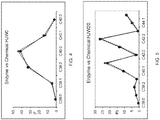
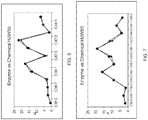
- FIGS. 4-7 various comparison graphs of wax ester distributions for chemically catalyzed transesterified and enzyme catalyzed transesterified jojoba wax esters are illustrated.
- FIG. 4 is for a pure jojoba oil product (HJW0).
- the solid line shows the wax ester distribution for the chemically catalyzed process and the dotted line shows the wax ester distribution for the enzymatically catalyzed process.
- Lipases like those disclosed herein are conventionally used for processing triglycerides, and some have been specifically selected for processing triglycerides in particular ways. For example, some lipases are known as 1,3-specific as they are capable of scissioning the alkyl esters in the 1 and 3 positions in a triglyceride while not affecting the alkyl ester at the 2 position. Such a lipase interacts with the triglyceride molecule on the exterior of the lipase surface. Other lipases operate when the alkyl ester is inserted into the lipase molecule itself.
- 1,3-lipases will differ in their ability to process various triglyceride molecules based on the structure of the alkyl esters and the triglyceride molecule due to various factors, including steric hindrance and other steric effects.
- both 1,3-lipases and lipases that operate using insertion of a triglyceride work equally well when used in jojoba ester transesterification reactions. This result is unexpected, as these lipases sterically interact quite differently with the molecules they are involved in catalyzing. Without being bound by any theory, it is possible that because a jojoba ester is primarily a long carbon chain without much molecular bending due to the ester group, both 1,3-lipases and lipases that operate using insertion are able to interact sterically with the jojoba esters in ways that produce substantially the same catalytic effect.
- the long chain jojoba ester can fit into the opening in an insertion lipase and also slide into the active areas of a 1,3-lipase.
- this processing characteristic for lipase catalytic processing of jojoba wax esters is not a predictable result, this illustrates a unique aspect of processing jojoba wax esters using lipases.
- the yield of an enzymatically transesterified wax ester reaction may yield least 4001 kg product/kg immobilized catalyst, at least 4100 kg product/kg immobilized catalyst, at least 4200 kg product/kg immobilized catalyst, at least 4300 kg product/kg immobilized catalyst, at least 4500 kg product/kg immobilized catalyst, at least 4700 kg product/kg immobilized catalyst, at least 48000 kg product/kg of immobilized catalyst, at least 4900 kg product/kg of immobilized catalyst, or even at least 5000 kg product/kg of immobilized catalyst.
Landscapes
- Chemical & Material Sciences (AREA)
- Organic Chemistry (AREA)
- Life Sciences & Earth Sciences (AREA)
- Engineering & Computer Science (AREA)
- Wood Science & Technology (AREA)
- Oil, Petroleum & Natural Gas (AREA)
- Chemical Kinetics & Catalysis (AREA)
- General Chemical & Material Sciences (AREA)
- Zoology (AREA)
- Microbiology (AREA)
- Biotechnology (AREA)
- Health & Medical Sciences (AREA)
- Biochemistry (AREA)
- Bioinformatics & Cheminformatics (AREA)
- General Engineering & Computer Science (AREA)
- General Health & Medical Sciences (AREA)
- Genetics & Genomics (AREA)
- Preparation Of Compounds By Using Micro-Organisms (AREA)
- Cosmetics (AREA)
- Enzymes And Modification Thereof (AREA)
Claims (9)
- Verfahren zur Umesterung von Wachsestern, wobei das Verfahren Folgendes beinhaltet:Bereitstellen eines Einsatzmaterials, das Jojobawachsester umfasst;Inkontaktbringen des Einsatzmaterials mit einer Lipase;katalytisches Umestern der Wachsester in dem Einsatzmaterial mit der Lipase, um ein umgeestertes Produkt zu bilden;wobei ein Oxidationsstabilitätsindex (OSI) des umgeesterten Produkts größer als ein OSI des Einsatzmaterials ist.
- Verfahren nach Anspruch 1, wobei das umgeesterte Produkt keine Methylester umfasst.
- Verfahren nach Anspruch 1, wobei das Einsatzmaterial ferner ein Antioxidationsmittel umfasst und die katalytische Umesterung der Wachsester im Einsatzmaterial mit der Lipase ferner die katalytische Umesterung ohne Entfernung oder Abbau des Antioxidationsmittels in dem Einsatzmaterial beinhaltet.
- Verfahren nach Anspruch 3, wobei das Einsatzmaterial ferner ein Hautkonditionierungsmittel und eine flüchtige Verbindung umfasst und die katalytische Umesterung der Wachsester in dem Einsatzmaterial mit der Lipase ferner die katalytische Umesterung ohne Entfernung oder Abbau des Hautkonditionierungsmittels und der flüchtigen Verbindung in dem Einsatzmaterial beinhaltet.
- Verfahren nach Anspruch 1, wobei die Jojobawachsester ferner hydrierte Jojobawachsester umfassen.
- Verfahren nach Anspruch 5, wobei ein Tropfpunkt des umgeesterten Produkts höher ist als ein Tropfpunkt des Einsatzmaterials und der Tropfpunkt des umgeesterten Produkts mit der Zunahme eines prozentualen Anteils der hydrierten Jojobawachsester im Einsatzmaterial zunimmt.
- Verfahren zum Umestern von Wachsestern nach einem der Ansprüche 1 bis 5, wobei die katalytische Umesterung mit einer Ausbeute von größer als oder gleich 98 % erfolgt.
- Verfahren nach einem der Ansprüche 1 bis 5, wobei die Ausbeute der katalytischen Umesterung größer als 4001 Kilogramm Produkt pro Kilogramm immobilisiertem Lipasekatalysator beträgt.
- Verfahren nach Anspruch 8, wobei die katalytische Umesterung mit einer Ausbeute von größer als oder gleich 98 % erfolgt.
Priority Applications (1)
| Application Number | Priority Date | Filing Date | Title |
|---|---|---|---|
| EP20199689.9A EP3786302A1 (de) | 2014-12-19 | 2015-12-19 | Verfahren und systeme zur katalytischen herstellung von wachsesterderivaten |
Applications Claiming Priority (2)
| Application Number | Priority Date | Filing Date | Title |
|---|---|---|---|
| US14/578,075 US11248245B2 (en) | 2014-12-19 | 2014-12-19 | Processes and systems for catalytic manufacture of wax ester derivatives |
| PCT/US2015/066953 WO2016100957A1 (en) | 2014-12-19 | 2015-12-19 | Processes and systems for catalytic manufacture of wax ester derivatives |
Related Child Applications (1)
| Application Number | Title | Priority Date | Filing Date |
|---|---|---|---|
| EP20199689.9A Division EP3786302A1 (de) | 2014-12-19 | 2015-12-19 | Verfahren und systeme zur katalytischen herstellung von wachsesterderivaten |
Publications (3)
| Publication Number | Publication Date |
|---|---|
| EP3233019A1 EP3233019A1 (de) | 2017-10-25 |
| EP3233019A4 EP3233019A4 (de) | 2018-07-11 |
| EP3233019B1 true EP3233019B1 (de) | 2020-10-14 |
Family
ID=56127755
Family Applications (2)
| Application Number | Title | Priority Date | Filing Date |
|---|---|---|---|
| EP15871261.2A Active EP3233019B1 (de) | 2014-12-19 | 2015-12-19 | Enzymatische umesterung von jojoba-wachsestern |
| EP20199689.9A Pending EP3786302A1 (de) | 2014-12-19 | 2015-12-19 | Verfahren und systeme zur katalytischen herstellung von wachsesterderivaten |
Family Applications After (1)
| Application Number | Title | Priority Date | Filing Date |
|---|---|---|---|
| EP20199689.9A Pending EP3786302A1 (de) | 2014-12-19 | 2015-12-19 | Verfahren und systeme zur katalytischen herstellung von wachsesterderivaten |
Country Status (7)
| Country | Link |
|---|---|
| US (6) | US11248245B2 (de) |
| EP (2) | EP3233019B1 (de) |
| JP (2) | JP7059004B2 (de) |
| CA (1) | CA2971429C (de) |
| ES (1) | ES2839218T3 (de) |
| IL (1) | IL252886B (de) |
| WO (1) | WO2016100957A1 (de) |
Families Citing this family (7)
| Publication number | Priority date | Publication date | Assignee | Title |
|---|---|---|---|---|
| US11248245B2 (en) | 2014-12-19 | 2022-02-15 | International Flora Technologies, Ltd. | Processes and systems for catalytic manufacture of wax ester derivatives |
| WO2017040720A1 (en) * | 2015-08-31 | 2017-03-09 | International Flora Technologies, Ltd. | Processes and systems for catalytic manufacture of wax ester derivatives |
| US10196481B2 (en) | 2016-06-03 | 2019-02-05 | Sirrus, Inc. | Polymer and other compounds functionalized with terminal 1,1-disubstituted alkene monomer(s) and methods thereof |
| WO2017210084A1 (en) | 2016-06-03 | 2017-12-07 | Sirrus, Inc. | Water absorbing or water soluble polymers, intermediate compounds, and methods thereof |
| US10428177B2 (en) | 2016-06-03 | 2019-10-01 | Sirrus, Inc. | Water absorbing or water soluble polymers, intermediate compounds, and methods thereof |
| US10364354B2 (en) | 2017-05-15 | 2019-07-30 | International Flora Technologies, Ltd. | Wax ester compositions and methods of manufacture |
| FR3154731A1 (fr) | 2023-10-26 | 2025-05-02 | Polymerexpert Sa | Agents filmogenes polyesters biosources |
Family Cites Families (42)
| Publication number | Priority date | Publication date | Assignee | Title |
|---|---|---|---|---|
| US4360387A (en) | 1980-08-15 | 1982-11-23 | Jojoba Growers & Processors Inc. | Isomorphous jojoba oil compositions containing trans-isomerized jojoba oil |
| US4329298A (en) | 1980-08-15 | 1982-05-11 | Jojoba Growers & Processors Inc. | Isomerization of jojoba oil and products thereof |
| JPS62262997A (ja) * | 1986-05-02 | 1987-11-16 | ノボ ノルディスク アクティーゼルスカブ | ワツクスの製造方法 |
| WO1990015127A1 (en) | 1989-06-09 | 1990-12-13 | Ag-Seed Pty Limited | Artificial jojoba oil |
| JPH0622690A (ja) | 1992-07-09 | 1994-02-01 | Kanegafuchi Chem Ind Co Ltd | 油脂組成物およびそれを用いたパンの製造方法 |
| JP2796925B2 (ja) | 1993-09-17 | 1998-09-10 | 日清製油株式会社 | リパーゼによるエステル交換法 |
| ATE194387T1 (de) | 1995-11-14 | 2000-07-15 | Loders Croklaan Bv | Prozess für die präparation von substanzen mit hohem gehalt an isomeren von konjugierte linölsäure |
| US5968530A (en) | 1997-10-17 | 1999-10-19 | International Flora Technologies, Inc. | Emollient compositions |
| USRE38141E1 (en) | 1997-10-17 | 2003-06-10 | International Flora Technologies Ltd. | Dry emollient compositions |
| US6280746B1 (en) | 1997-10-17 | 2001-08-28 | International Flora Technologies Ltd. | Dry emollient compositions |
| CA2249508A1 (en) | 1997-10-24 | 1999-04-24 | Unilever Plc | Wax ester compositions |
| US6278006B1 (en) | 1999-01-19 | 2001-08-21 | Cargill, Incorporated | Transesterified oils |
| EP1178731A4 (de) | 1999-05-18 | 2002-09-11 | Cargill Inc | Fettzusammensetzungen |
| US6346236B1 (en) | 2000-03-28 | 2002-02-12 | The United States Of America As Represented By The Secretary Of Agriculture | Sunscreens from vegetable oil and plant phenols |
| US6545052B2 (en) | 2000-05-10 | 2003-04-08 | Fan Tech, Ltd. | Methods and compositions for inhibiting free radical polymerization in skin and hair |
| CA2442488C (en) | 2001-03-30 | 2011-10-04 | Yissum Research Development Company Of The Hebrew University Of Jerusalem | Photoprotective compounds derived from jojoba wax/oil |
| US20030054509A1 (en) | 2001-04-06 | 2003-03-20 | Archer-Daniels-Midland Company | Method for producing fats or oils |
| US6559182B1 (en) | 2001-11-07 | 2003-05-06 | Purcell Jojoba International, Llc | Method for treatment of enveloped viruses using jojoba oil esters |
| TWI343418B (en) | 2002-09-13 | 2011-06-11 | Suntory Holdings Ltd | Process for production of transesterified oils/fats or triglycerides |
| CA2532672A1 (en) | 2003-07-16 | 2005-02-03 | Archer-Daniels-Midland Company | Method for producing fats or oils |
| JP2007521246A (ja) | 2003-11-20 | 2007-08-02 | インターナショナル フローラ テクノロジーズ,リミテッド | アルコキシル化脂肪エステル組成物 |
| MY148921A (en) | 2005-09-12 | 2013-06-14 | Novozymes North America Inc | Enzymatic oil interesterification |
| WO2007062304A2 (en) | 2005-11-23 | 2007-05-31 | Novus International, Inc. | Biodiesel fuel compositions having increased oxidative stability |
| US7695727B2 (en) | 2006-10-11 | 2010-04-13 | Wyeth Llc | Botanical butter stick lip balm |
| EP2118250A1 (de) | 2007-02-02 | 2009-11-18 | Dalriada Meat Pty Ltd | Herstellung von biodiesel |
| US8617866B2 (en) | 2007-11-28 | 2013-12-31 | Sobhi Basheer | Robust multi-enzyme preparation for the synthesis of fatty acid alkyl esters |
| US8623386B2 (en) | 2008-04-11 | 2014-01-07 | Kobo Products, Inc. | Natural ester, wax or oil treated pigment, process for production thereof, and cosmetic made therewith |
| US8343468B2 (en) | 2009-10-26 | 2013-01-01 | International Flora Technologies, Ltd. | Human sebum mimetics derived from botanical sources and methods for making the same |
| KR20130004286A (ko) | 2010-03-01 | 2013-01-09 | 트랜스 바이오디젤 엘티디. | 지방산 알킬 에스테르의 효소적 합성을 위한 방법 |
| US10000731B2 (en) | 2010-03-01 | 2018-06-19 | Trans Bio-Diesel Ltd. | Enzymatic transesterification/esterification processes employing lipases immobilized on hydrophobic resins in the presence of water solutions |
| DK2401923T3 (da) | 2010-06-30 | 2013-06-10 | Loders Croklaan Bv | Forarbejdning af vegetabilske olier |
| US8742148B1 (en) * | 2010-09-29 | 2014-06-03 | The United States Of America, As Represented By The Secretary Of Agriculture | Oligomerization of jojoba oil in super-critical CO2 for different applications |
| EP2670854A1 (de) * | 2011-02-04 | 2013-12-11 | Novozymes A/S | Fettsäureveresterungsverfahren |
| US20140017741A1 (en) | 2011-03-30 | 2014-01-16 | Novozymes A/S | Esterification Process |
| CA2856510A1 (en) | 2011-11-22 | 2013-05-30 | Archer Daniels Midland Company | Palm oil enriched in unsaturated fatty acids |
| BR102012001584A2 (pt) | 2012-01-24 | 2018-05-29 | Maria Aparecida Cirone Taboada - Me | Processo de produção de biodiesel de alto rendimento empregando triglicerídeos de alta acidez com geração de glicerina 90% isenta de sais |
| US9126922B2 (en) | 2012-03-26 | 2015-09-08 | Empire Technology Development Llc | Methods and systems for the production of diesters from triacylglyceride esters |
| US8545702B1 (en) | 2012-11-27 | 2013-10-01 | Menlo Energy Management, LLC | Production of biodiesel from feedstock |
| ES2494620B2 (es) | 2013-03-15 | 2015-04-16 | Universidad Complutense De Madrid | Proceso integrado de obtención de alcoholes monoinsaturados, biodiesel y productos biodegradables a partir de aceite de Jojoba |
| US11248245B2 (en) | 2014-12-19 | 2022-02-15 | International Flora Technologies, Ltd. | Processes and systems for catalytic manufacture of wax ester derivatives |
| US10435726B2 (en) | 2014-12-19 | 2019-10-08 | International Flora Technologies, Ltd. | Processes and systems for catalytic manufacture of wax ester derivatives |
| US11444709B2 (en) | 2019-08-22 | 2022-09-13 | Signify Holding B.V. | Method of detecting atmospheric conditions in an area via a plurality of devices |
-
2014
- 2014-12-19 US US14/578,075 patent/US11248245B2/en active Active
-
2015
- 2015-12-19 EP EP15871261.2A patent/EP3233019B1/de active Active
- 2015-12-19 ES ES15871261T patent/ES2839218T3/es active Active
- 2015-12-19 JP JP2017530584A patent/JP7059004B2/ja active Active
- 2015-12-19 WO PCT/US2015/066953 patent/WO2016100957A1/en not_active Ceased
- 2015-12-19 CA CA2971429A patent/CA2971429C/en active Active
- 2015-12-19 EP EP20199689.9A patent/EP3786302A1/de active Pending
-
2017
- 2017-06-13 IL IL252886A patent/IL252886B/en active IP Right Grant
-
2020
- 2020-10-12 JP JP2020171921A patent/JP2021003132A/ja active Pending
-
2021
- 2021-11-23 US US17/456,166 patent/US12674184B2/en active Active
-
2023
- 2023-01-26 US US18/159,747 patent/US12203122B2/en active Active
- 2023-01-26 US US18/159,735 patent/US12281350B2/en active Active
- 2023-01-26 US US18/159,745 patent/US12180530B2/en active Active
-
2026
- 2026-03-26 US US19/629,223 patent/US20260201428A1/en active Pending
Non-Patent Citations (1)
| Title |
|---|
| GUNAWAN ET AL: "Lipase-catalyzed synthesis of palm-based wax esters", JOURNAL OF OLEO SCIENCE, vol. 53, 2004, pages 471 - 477, XP055550215 * |
Also Published As
| Publication number | Publication date |
|---|---|
| US11248245B2 (en) | 2022-02-15 |
| US20230227869A1 (en) | 2023-07-20 |
| US20160177349A1 (en) | 2016-06-23 |
| ES2839218T3 (es) | 2021-07-05 |
| EP3786302A1 (de) | 2021-03-03 |
| IL252886A0 (en) | 2017-08-31 |
| EP3233019A1 (de) | 2017-10-25 |
| CA2971429A1 (en) | 2016-06-23 |
| JP7059004B2 (ja) | 2022-04-25 |
| CA2971429C (en) | 2022-09-06 |
| US20260201428A1 (en) | 2026-07-16 |
| US12674184B2 (en) | 2026-07-07 |
| US20230242950A1 (en) | 2023-08-03 |
| US12281350B2 (en) | 2025-04-22 |
| US12180530B2 (en) | 2024-12-31 |
| EP3233019A4 (de) | 2018-07-11 |
| US20230227867A1 (en) | 2023-07-20 |
| JP2021003132A (ja) | 2021-01-14 |
| IL252886B (en) | 2020-09-30 |
| JP2018505659A (ja) | 2018-03-01 |
| US20220073957A1 (en) | 2022-03-10 |
| WO2016100957A1 (en) | 2016-06-23 |
| US12203122B2 (en) | 2025-01-21 |
Similar Documents
| Publication | Publication Date | Title |
|---|---|---|
| US12281350B2 (en) | Processes and systems for catalytic manufacture of wax ester derivatives | |
| US8030352B2 (en) | Method of producing retinyl esters | |
| US11773418B2 (en) | Processes and systems for catalytic manufacture of wax ester derivatives | |
| EP3344777B1 (de) | Verfahren zur enzymatischen umesterung von wachsestern | |
| Alim et al. | Lipase-catalyzed production of solid fat stock from fractionated rice bran oil, palm stearin, and conjugated linoleic acid by response surface methodology | |
| Kurniasih et al. | Enzymatic synthesis of mono-diacylglycerides using off-grade crude palm kernel oil and waste glycerol from biodiesel production | |
| Farag et al. | Applied studies on application of capric/caprylic MCT oils in food industries | |
| Goswami | Lipase catalyzed modification of mustard oil: a review | |
| BR102024007414A2 (pt) | Processo para a fabricação de um óleo biotransformado, óleo biotransformado, seu uso e composições cosmética e alimentícia que o compreendem | |
| EP4119670A1 (de) | Verfahren zur herstellung von fett/öl | |
| KR20180033439A (ko) | 피부온도감응형 유지 조성물 및 화장료 조성물 | |
| HK40012802A (en) | Method for preparing fatty acid ethyl ester | |
| da Cruz Francisco et al. | Use of lipases in the synthesis of structured lipids in supercritical carbon dioxide | |
| HK40012802B (en) | Method for preparing fatty acid ethyl ester | |
| WO2010151104A1 (en) | An emulsion system derives from engkabang fat esters |
Legal Events
| Date | Code | Title | Description |
|---|---|---|---|
| STAA | Information on the status of an ep patent application or granted ep patent |
Free format text: STATUS: THE INTERNATIONAL PUBLICATION HAS BEEN MADE |
|
| PUAI | Public reference made under article 153(3) epc to a published international application that has entered the european phase |
Free format text: ORIGINAL CODE: 0009012 |
|
| STAA | Information on the status of an ep patent application or granted ep patent |
Free format text: STATUS: REQUEST FOR EXAMINATION WAS MADE |
|
| 17P | Request for examination filed |
Effective date: 20170706 |
|
| AK | Designated contracting states |
Kind code of ref document: A1 Designated state(s): AL AT BE BG CH CY CZ DE DK EE ES FI FR GB GR HR HU IE IS IT LI LT LU LV MC MK MT NL NO PL PT RO RS SE SI SK SM TR |
|
| AX | Request for extension of the european patent |
Extension state: BA ME |
|
| DAV | Request for validation of the european patent (deleted) | ||
| DAX | Request for extension of the european patent (deleted) | ||
| RIC1 | Information provided on ipc code assigned before grant |
Ipc: C12N 9/10 20060101ALI20180531BHEP Ipc: A61K 8/00 20060101ALI20180531BHEP Ipc: C12P 7/64 20060101AFI20180531BHEP |
|
| A4 | Supplementary search report drawn up and despatched |
Effective date: 20180608 |
|
| REG | Reference to a national code |
Ref country code: DE Ref legal event code: R079 Ref document number: 602015060624 Country of ref document: DE Free format text: PREVIOUS MAIN CLASS: A61K0008000000 Ipc: C12P0007640000 |
|
| STAA | Information on the status of an ep patent application or granted ep patent |
Free format text: STATUS: EXAMINATION IS IN PROGRESS |
|
| RIC1 | Information provided on ipc code assigned before grant |
Ipc: C12P 7/64 20060101AFI20190611BHEP Ipc: C12N 9/10 20060101ALI20190611BHEP Ipc: A61K 8/00 20060101ALI20190611BHEP Ipc: C11C 3/10 20060101ALI20190611BHEP |
|
| 17Q | First examination report despatched |
Effective date: 20190626 |
|
| GRAP | Despatch of communication of intention to grant a patent |
Free format text: ORIGINAL CODE: EPIDOSNIGR1 |
|
| STAA | Information on the status of an ep patent application or granted ep patent |
Free format text: STATUS: GRANT OF PATENT IS INTENDED |
|
| INTG | Intention to grant announced |
Effective date: 20200429 |
|
| RAP1 | Party data changed (applicant data changed or rights of an application transferred) |
Owner name: INTERNATIONAL FLORA TECHNOLOGIES, LTD. |
|
| RIN1 | Information on inventor provided before grant (corrected) |
Inventor name: ADDY, JEFF Inventor name: BROWN, JAMES, H. Inventor name: DALY, CLAY |
|
| GRAS | Grant fee paid |
Free format text: ORIGINAL CODE: EPIDOSNIGR3 |
|
| GRAA | (expected) grant |
Free format text: ORIGINAL CODE: 0009210 |
|
| STAA | Information on the status of an ep patent application or granted ep patent |
Free format text: STATUS: THE PATENT HAS BEEN GRANTED |
|
| AK | Designated contracting states |
Kind code of ref document: B1 Designated state(s): AL AT BE BG CH CY CZ DE DK EE ES FI FR GB GR HR HU IE IS IT LI LT LU LV MC MK MT NL NO PL PT RO RS SE SI SK SM TR |
|
| REG | Reference to a national code |
Ref country code: GB Ref legal event code: FG4D |
|
| REG | Reference to a national code |
Ref country code: AT Ref legal event code: REF Ref document number: 1323598 Country of ref document: AT Kind code of ref document: T Effective date: 20201015 Ref country code: CH Ref legal event code: EP |
|
| REG | Reference to a national code |
Ref country code: DE Ref legal event code: R096 Ref document number: 602015060624 Country of ref document: DE |
|
| REG | Reference to a national code |
Ref country code: IE Ref legal event code: FG4D |
|
| REG | Reference to a national code |
Ref country code: AT Ref legal event code: MK05 Ref document number: 1323598 Country of ref document: AT Kind code of ref document: T Effective date: 20201014 |
|
| PG25 | Lapsed in a contracting state [announced via postgrant information from national office to epo] |
Ref country code: NO Free format text: LAPSE BECAUSE OF FAILURE TO SUBMIT A TRANSLATION OF THE DESCRIPTION OR TO PAY THE FEE WITHIN THE PRESCRIBED TIME-LIMIT Effective date: 20210114 Ref country code: FI Free format text: LAPSE BECAUSE OF FAILURE TO SUBMIT A TRANSLATION OF THE DESCRIPTION OR TO PAY THE FEE WITHIN THE PRESCRIBED TIME-LIMIT Effective date: 20201014 Ref country code: PT Free format text: LAPSE BECAUSE OF FAILURE TO SUBMIT A TRANSLATION OF THE DESCRIPTION OR TO PAY THE FEE WITHIN THE PRESCRIBED TIME-LIMIT Effective date: 20210215 Ref country code: RS Free format text: LAPSE BECAUSE OF FAILURE TO SUBMIT A TRANSLATION OF THE DESCRIPTION OR TO PAY THE FEE WITHIN THE PRESCRIBED TIME-LIMIT Effective date: 20201014 Ref country code: GR Free format text: LAPSE BECAUSE OF FAILURE TO SUBMIT A TRANSLATION OF THE DESCRIPTION OR TO PAY THE FEE WITHIN THE PRESCRIBED TIME-LIMIT Effective date: 20210115 |
|
| REG | Reference to a national code |
Ref country code: LT Ref legal event code: MG4D |
|
| PG25 | Lapsed in a contracting state [announced via postgrant information from national office to epo] |
Ref country code: AT Free format text: LAPSE BECAUSE OF FAILURE TO SUBMIT A TRANSLATION OF THE DESCRIPTION OR TO PAY THE FEE WITHIN THE PRESCRIBED TIME-LIMIT Effective date: 20201014 Ref country code: BG Free format text: LAPSE BECAUSE OF FAILURE TO SUBMIT A TRANSLATION OF THE DESCRIPTION OR TO PAY THE FEE WITHIN THE PRESCRIBED TIME-LIMIT Effective date: 20210114 Ref country code: PL Free format text: LAPSE BECAUSE OF FAILURE TO SUBMIT A TRANSLATION OF THE DESCRIPTION OR TO PAY THE FEE WITHIN THE PRESCRIBED TIME-LIMIT Effective date: 20201014 Ref country code: SE Free format text: LAPSE BECAUSE OF FAILURE TO SUBMIT A TRANSLATION OF THE DESCRIPTION OR TO PAY THE FEE WITHIN THE PRESCRIBED TIME-LIMIT Effective date: 20201014 Ref country code: IS Free format text: LAPSE BECAUSE OF FAILURE TO SUBMIT A TRANSLATION OF THE DESCRIPTION OR TO PAY THE FEE WITHIN THE PRESCRIBED TIME-LIMIT Effective date: 20210214 Ref country code: LV Free format text: LAPSE BECAUSE OF FAILURE TO SUBMIT A TRANSLATION OF THE DESCRIPTION OR TO PAY THE FEE WITHIN THE PRESCRIBED TIME-LIMIT Effective date: 20201014 |
|
| PG25 | Lapsed in a contracting state [announced via postgrant information from national office to epo] |
Ref country code: HR Free format text: LAPSE BECAUSE OF FAILURE TO SUBMIT A TRANSLATION OF THE DESCRIPTION OR TO PAY THE FEE WITHIN THE PRESCRIBED TIME-LIMIT Effective date: 20201014 |
|
| REG | Reference to a national code |
Ref country code: ES Ref legal event code: FG2A Ref document number: 2839218 Country of ref document: ES Kind code of ref document: T3 Effective date: 20210705 |
|
| REG | Reference to a national code |
Ref country code: DE Ref legal event code: R097 Ref document number: 602015060624 Country of ref document: DE |
|
| PG25 | Lapsed in a contracting state [announced via postgrant information from national office to epo] |
Ref country code: RO Free format text: LAPSE BECAUSE OF FAILURE TO SUBMIT A TRANSLATION OF THE DESCRIPTION OR TO PAY THE FEE WITHIN THE PRESCRIBED TIME-LIMIT Effective date: 20201014 Ref country code: SK Free format text: LAPSE BECAUSE OF FAILURE TO SUBMIT A TRANSLATION OF THE DESCRIPTION OR TO PAY THE FEE WITHIN THE PRESCRIBED TIME-LIMIT Effective date: 20201014 Ref country code: SM Free format text: LAPSE BECAUSE OF FAILURE TO SUBMIT A TRANSLATION OF THE DESCRIPTION OR TO PAY THE FEE WITHIN THE PRESCRIBED TIME-LIMIT Effective date: 20201014 Ref country code: LT Free format text: LAPSE BECAUSE OF FAILURE TO SUBMIT A TRANSLATION OF THE DESCRIPTION OR TO PAY THE FEE WITHIN THE PRESCRIBED TIME-LIMIT Effective date: 20201014 Ref country code: EE Free format text: LAPSE BECAUSE OF FAILURE TO SUBMIT A TRANSLATION OF THE DESCRIPTION OR TO PAY THE FEE WITHIN THE PRESCRIBED TIME-LIMIT Effective date: 20201014 Ref country code: CZ Free format text: LAPSE BECAUSE OF FAILURE TO SUBMIT A TRANSLATION OF THE DESCRIPTION OR TO PAY THE FEE WITHIN THE PRESCRIBED TIME-LIMIT Effective date: 20201014 |
|
| REG | Reference to a national code |
Ref country code: CH Ref legal event code: PL |
|
| PLBE | No opposition filed within time limit |
Free format text: ORIGINAL CODE: 0009261 |
|
| STAA | Information on the status of an ep patent application or granted ep patent |
Free format text: STATUS: NO OPPOSITION FILED WITHIN TIME LIMIT |
|
| PG25 | Lapsed in a contracting state [announced via postgrant information from national office to epo] |
Ref country code: DK Free format text: LAPSE BECAUSE OF FAILURE TO SUBMIT A TRANSLATION OF THE DESCRIPTION OR TO PAY THE FEE WITHIN THE PRESCRIBED TIME-LIMIT Effective date: 20201014 Ref country code: MC Free format text: LAPSE BECAUSE OF FAILURE TO SUBMIT A TRANSLATION OF THE DESCRIPTION OR TO PAY THE FEE WITHIN THE PRESCRIBED TIME-LIMIT Effective date: 20201014 |
|
| 26N | No opposition filed |
Effective date: 20210715 |
|
| REG | Reference to a national code |
Ref country code: NL Ref legal event code: FP |
|
| PG25 | Lapsed in a contracting state [announced via postgrant information from national office to epo] |
Ref country code: LU Free format text: LAPSE BECAUSE OF NON-PAYMENT OF DUE FEES Effective date: 20201219 Ref country code: AL Free format text: LAPSE BECAUSE OF FAILURE TO SUBMIT A TRANSLATION OF THE DESCRIPTION OR TO PAY THE FEE WITHIN THE PRESCRIBED TIME-LIMIT Effective date: 20201014 Ref country code: IE Free format text: LAPSE BECAUSE OF NON-PAYMENT OF DUE FEES Effective date: 20201219 |
|
| PG25 | Lapsed in a contracting state [announced via postgrant information from national office to epo] |
Ref country code: LI Free format text: LAPSE BECAUSE OF NON-PAYMENT OF DUE FEES Effective date: 20201231 Ref country code: SI Free format text: LAPSE BECAUSE OF FAILURE TO SUBMIT A TRANSLATION OF THE DESCRIPTION OR TO PAY THE FEE WITHIN THE PRESCRIBED TIME-LIMIT Effective date: 20201014 Ref country code: CH Free format text: LAPSE BECAUSE OF NON-PAYMENT OF DUE FEES Effective date: 20201231 |
|
| PG25 | Lapsed in a contracting state [announced via postgrant information from national office to epo] |
Ref country code: IS Free format text: LAPSE BECAUSE OF FAILURE TO SUBMIT A TRANSLATION OF THE DESCRIPTION OR TO PAY THE FEE WITHIN THE PRESCRIBED TIME-LIMIT Effective date: 20210214 Ref country code: TR Free format text: LAPSE BECAUSE OF FAILURE TO SUBMIT A TRANSLATION OF THE DESCRIPTION OR TO PAY THE FEE WITHIN THE PRESCRIBED TIME-LIMIT Effective date: 20201014 Ref country code: MT Free format text: LAPSE BECAUSE OF FAILURE TO SUBMIT A TRANSLATION OF THE DESCRIPTION OR TO PAY THE FEE WITHIN THE PRESCRIBED TIME-LIMIT Effective date: 20201014 Ref country code: CY Free format text: LAPSE BECAUSE OF FAILURE TO SUBMIT A TRANSLATION OF THE DESCRIPTION OR TO PAY THE FEE WITHIN THE PRESCRIBED TIME-LIMIT Effective date: 20201014 |
|
| PG25 | Lapsed in a contracting state [announced via postgrant information from national office to epo] |
Ref country code: MK Free format text: LAPSE BECAUSE OF FAILURE TO SUBMIT A TRANSLATION OF THE DESCRIPTION OR TO PAY THE FEE WITHIN THE PRESCRIBED TIME-LIMIT Effective date: 20201014 |
|
| P01 | Opt-out of the competence of the unified patent court (upc) registered |
Effective date: 20230522 |
|
| PGFP | Annual fee paid to national office [announced via postgrant information from national office to epo] |
Ref country code: NL Payment date: 20251119 Year of fee payment: 11 |
|
| PGFP | Annual fee paid to national office [announced via postgrant information from national office to epo] |
Ref country code: DE Payment date: 20251126 Year of fee payment: 11 |
|
| PGFP | Annual fee paid to national office [announced via postgrant information from national office to epo] |
Ref country code: GB Payment date: 20251119 Year of fee payment: 11 |
|
| PGFP | Annual fee paid to national office [announced via postgrant information from national office to epo] |
Ref country code: IT Payment date: 20251119 Year of fee payment: 11 |
|
| PGFP | Annual fee paid to national office [announced via postgrant information from national office to epo] |
Ref country code: FR Payment date: 20251120 Year of fee payment: 11 |
|
| PGFP | Annual fee paid to national office [announced via postgrant information from national office to epo] |
Ref country code: BE Payment date: 20251119 Year of fee payment: 11 |
|
| PGFP | Annual fee paid to national office [announced via postgrant information from national office to epo] |
Ref country code: ES Payment date: 20260102 Year of fee payment: 11 |