EP3232402A1 - Bildverarbeitungsvorrichtung und bildverarbeitungsprogramm - Google Patents
Bildverarbeitungsvorrichtung und bildverarbeitungsprogramm Download PDFInfo
- Publication number
- EP3232402A1 EP3232402A1 EP15866919.2A EP15866919A EP3232402A1 EP 3232402 A1 EP3232402 A1 EP 3232402A1 EP 15866919 A EP15866919 A EP 15866919A EP 3232402 A1 EP3232402 A1 EP 3232402A1
- Authority
- EP
- European Patent Office
- Prior art keywords
- region
- fluorescent
- image
- interest
- cell
- Prior art date
- Legal status (The legal status is an assumption and is not a legal conclusion. Google has not performed a legal analysis and makes no representation as to the accuracy of the status listed.)
- Granted
Links
Images




Classifications
-
- G—PHYSICS
- G01—MEASURING; TESTING
- G01N—INVESTIGATING OR ANALYSING MATERIALS BY DETERMINING THEIR CHEMICAL OR PHYSICAL PROPERTIES
- G01N33/00—Investigating or analysing materials by specific methods not covered by groups G01N1/00 - G01N31/00
- G01N33/48—Biological material, e.g. blood, urine; Haemocytometers
- G01N33/483—Physical analysis of biological material
- G01N33/4833—Physical analysis of biological material of solid biological material, e.g. tissue samples, cell cultures
-
- G—PHYSICS
- G01—MEASURING; TESTING
- G01N—INVESTIGATING OR ANALYSING MATERIALS BY DETERMINING THEIR CHEMICAL OR PHYSICAL PROPERTIES
- G01N33/00—Investigating or analysing materials by specific methods not covered by groups G01N1/00 - G01N31/00
- G01N33/48—Biological material, e.g. blood, urine; Haemocytometers
-
- G—PHYSICS
- G01—MEASURING; TESTING
- G01N—INVESTIGATING OR ANALYSING MATERIALS BY DETERMINING THEIR CHEMICAL OR PHYSICAL PROPERTIES
- G01N33/00—Investigating or analysing materials by specific methods not covered by groups G01N1/00 - G01N31/00
- G01N33/48—Biological material, e.g. blood, urine; Haemocytometers
- G01N33/50—Chemical analysis of biological material, e.g. blood, urine; Testing involving biospecific ligand binding methods; Immunological testing
- G01N33/5005—Chemical analysis of biological material, e.g. blood, urine; Testing involving biospecific ligand binding methods; Immunological testing involving human or animal cells
- G01N33/5091—Chemical analysis of biological material, e.g. blood, urine; Testing involving biospecific ligand binding methods; Immunological testing involving human or animal cells for testing the pathological state of an organism
-
- G—PHYSICS
- G06—COMPUTING OR CALCULATING; COUNTING
- G06T—IMAGE DATA PROCESSING OR GENERATION, IN GENERAL
- G06T1/00—General purpose image data processing
-
- G—PHYSICS
- G06—COMPUTING OR CALCULATING; COUNTING
- G06T—IMAGE DATA PROCESSING OR GENERATION, IN GENERAL
- G06T7/00—Image analysis
-
- G—PHYSICS
- G06—COMPUTING OR CALCULATING; COUNTING
- G06T—IMAGE DATA PROCESSING OR GENERATION, IN GENERAL
- G06T7/00—Image analysis
- G06T7/0002—Inspection of images, e.g. flaw detection
- G06T7/0012—Biomedical image inspection
- G06T7/0014—Biomedical image inspection using an image reference approach
- G06T7/0016—Biomedical image inspection using an image reference approach involving temporal comparison
-
- G—PHYSICS
- G06—COMPUTING OR CALCULATING; COUNTING
- G06T—IMAGE DATA PROCESSING OR GENERATION, IN GENERAL
- G06T7/00—Image analysis
- G06T7/10—Segmentation; Edge detection
- G06T7/11—Region-based segmentation
-
- G—PHYSICS
- G06—COMPUTING OR CALCULATING; COUNTING
- G06T—IMAGE DATA PROCESSING OR GENERATION, IN GENERAL
- G06T7/00—Image analysis
- G06T7/10—Segmentation; Edge detection
- G06T7/12—Edge-based segmentation
-
- G—PHYSICS
- G06—COMPUTING OR CALCULATING; COUNTING
- G06T—IMAGE DATA PROCESSING OR GENERATION, IN GENERAL
- G06T7/00—Image analysis
- G06T7/10—Segmentation; Edge detection
- G06T7/174—Segmentation; Edge detection involving the use of two or more images
-
- G—PHYSICS
- G06—COMPUTING OR CALCULATING; COUNTING
- G06T—IMAGE DATA PROCESSING OR GENERATION, IN GENERAL
- G06T2207/00—Indexing scheme for image analysis or image enhancement
- G06T2207/10—Image acquisition modality
- G06T2207/10024—Color image
-
- G—PHYSICS
- G06—COMPUTING OR CALCULATING; COUNTING
- G06T—IMAGE DATA PROCESSING OR GENERATION, IN GENERAL
- G06T2207/00—Indexing scheme for image analysis or image enhancement
- G06T2207/10—Image acquisition modality
- G06T2207/10056—Microscopic image
-
- G—PHYSICS
- G06—COMPUTING OR CALCULATING; COUNTING
- G06T—IMAGE DATA PROCESSING OR GENERATION, IN GENERAL
- G06T2207/00—Indexing scheme for image analysis or image enhancement
- G06T2207/10—Image acquisition modality
- G06T2207/10064—Fluorescence image
-
- G—PHYSICS
- G06—COMPUTING OR CALCULATING; COUNTING
- G06T—IMAGE DATA PROCESSING OR GENERATION, IN GENERAL
- G06T2207/00—Indexing scheme for image analysis or image enhancement
- G06T2207/30—Subject of image; Context of image processing
- G06T2207/30004—Biomedical image processing
- G06T2207/30024—Cell structures in vitro; Tissue sections in vitro
Definitions
- the present invention relates to an image processing apparatus and image processing program, and particularly relates to an image processing used in the pathological diagnosis.
- pathological diagnosis first, a sampled tissue is dehydrated and blocked with paraffin to fix the tissue and cut into sections having a thickness of 2 to 8 ⁇ m, the paraffin is removed therefrom, and the sections are stained. Subsequently, an image data (a morphological image) is generated by microscopic observation. Diagnosis on the basis of the image data is performed by analyzing the changes in size and shape of a cell nucleus, morphological information such as change in tissue pattern, and staining information.
- a cell nucleus region is extracted from an image, and a cell region is estimated as a circular region including a region expressing a specific protein on a cell membrane and having a predetermined radius from the center of gravity of the cell nucleus region.
- the area and shape of one cell region in a tissue section can be different in morphological image according to the position to cut cells.
- the area of cell regions are largely different from cells to cells as in FIG. 22B , which is a schematic morphological image captured from the direction orthogonal to the cross section Z.
- the biological substances expressed on a cell membrane are observed near the contour of each cell region as shown by ⁇ (black circle) in FIG. 22B .
- a cell region is determined as a circular region having a certain area according to the technique described in patent document 1. Such circular region is largely different from the actual cell region observed in the morphological image, and is not suitable for normalization on the basis of cell area.
- the position of cell membrane is specified on the basis of the light emission from the fluorescent substance which is used for staining cell membrane.
- the area and perimeter of cells can be calculated by the method in Patent Document 2.
- An object of the present invention is to provide an image processing apparatus and an image processing program with which it is possible to automatically extract a region of interest from cell without increasing the number of conventional steps of pathological diagnosis.
- the present invention it is possible to provide an image processing apparatus and an image processing program with which it is possible to automatically extract a region of interest of a cell without increasing the number of steps of conventional pathological diagnosis.
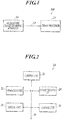
- FIG. 1 shows an example of an entire configuration of a pathological diagnosis assistance system 100.
- the pathological diagnostic assistance system 100 obtains a microscopic image of a tissue section of a human body stained with a predetermined staining reagent and outputs quantified feature amount of expression of a specific biological substance in the tissue section of the observation target by analyzing the obtained microscopic image.
- the pathological diagnosis assistance system 100 includes a microscopic image obtaining apparatus 1A and an image processing device 2A connected to each other through an interface such as a cable 3A so as to be able to transmit and receive data.
- the connecting system of the microscopic image obtaining apparatus 1A and the image processing device 2A is not particularly limited.
- the microscopic image obtaining apparatus 1A and the image processing device 2A can be connected by a LAN (Local Area Network) or can be connected wirelessly.
- LAN Local Area Network
- the microscopic image obtaining apparatus 1A is a publically-known microscope with a camera.
- the microscopic image obtaining apparatus 1A obtains the microscopic image of the tissue section placed on a slide on a slide fixing stage, and transmits the image to the image processing device 2A.
- the microscopic image obtaining apparatus 1A includes an irradiating unit, an image forming unit, an imaging unit, a communication I/F, etc.
- the irradiating unit includes a light source, filter, etc., and irradiates the tissue section placed on the slide on the slide fixing stage with light.
- the image forming unit includes an ocular lens, an object lens, etc. , and forms an image of transmitted light or reflected light from the tissue section on the slide due to the irradiated light.
- the imaging unit is a camera provided in a microscope which includes a CCD (Charge Coupled Device) sensor, etc. , and images an image formed on an image forming face by the image forming unit to generate digital image data of the microscopic image.
- the communication I/F transmits the generated image data of the microscopic image to the image processing device 2A.
- the microscopic image obtaining apparatus 1A includes a bright field unit combining the irradiating unit and the image forming unit suitable for bright field observation and a fluorescent unit combining the irradiating unit and the image forming unit suitable for fluorescence observation. Both bright field observation and fluorescence observation are possible by switching the bright field unit and the fluorescence unit.
- the microscopic image obtaining apparatus 1A may be any publically-known microscope (for example, phase contrast microscope, differential interference microscope, electron microscope, and the like) with a camera.
- a microscope for example, phase contrast microscope, differential interference microscope, electron microscope, and the like
- the microscopic image acquisition device 1A is not limited to a camera-attached microscope.
- an apparatus for creating a virtual microscope slide which scans a slide on a slide fixing stage of a microscope so as to acquire a microscopic image of the entire tissue section, can be used.
- the apparatus for creating a virtual microscope slide can acquire an image data with which an image of the entire tissue section on the slide can be viewed at one time on a display unit.
- the image processing device 2A analyzes the microscopic image sent from the microscopic image acquisition device 1A so as to obtain the distribution of the expressed specific biological substance in a tissue section of an observation target.
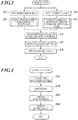
- FIG. 2 shows an example of the functional configuration of the image processing device 2A.
- the image processing device 2A includes a control unit 21, an operation unit 22, a display unit 23, a communication I/F 24 and a storage unit 25, and these units and the like are connected to each other through a bus 26.
- the control unit 21 includes a CPU (Central Processing Unit), a RAM (Random Access Memory), and the like.
- the control unit 21 performs a various types of processing by working together with various programs stored in the storage unit 25 and collectively controls operation of the image processing device 2A.
- control unit 21 performs an image analysis (shown in FIG. 3 ) by working together with a program (s) stored in the storage unit 25 and functions as a feature amount extraction unit, a bright point extraction unit, a discrimination unit, a region of interest determination unit, a calculation unit, and an overlapping region assignment determination unit.
- the operation unit 22 includes: a keyboard provided with character input keys; number input keys and various function keys; and a pointing device such as a mouse, and outputs press signals of the pressed keys on the keyboard and operation signals of the mouse to the control unit 21 as input signals.
- the display unit 23 includes a monitor such as a CRT (Cathode Ray Tube) or an LCD (Liquid Crystal Display), and displays thereon various screens in response to instructions of display signals input from the control unit 21.
- a monitor such as a CRT (Cathode Ray Tube) or an LCD (Liquid Crystal Display)
- the communication I/F 24 is an interface to send/receive data to/from external devices such as the microscopic image acquisition device 1A.
- the communication I/F 24 functions as an input unit to input a morphological image and a fluorescence image.
- the storage unit 25 includes an HDD (Hard Disk Drive) and a nonvolatile semiconductor memory.
- the storage unit 25 stores therein the above-described various programs, various data and so forth.
- the image processing device 2A may include a LAN adapter, a router and so forth and be connected to external devices through a communication network such as a LAN.
- the image processing device 2A analyzes a fluorescent image and a morphological image sent from the microscopic image acquisition device 1A.
- the fluorescent image represents, by fluorescent bright points, the expression of a specific biological substance which is expressed specifically at the first structure of a cell.
- the morphological image (for example, a bright field image) represents the second structure of a cell.
- first structure and the second structure is any specific structure of a cell, for example, a cell membrane, cytoplasm, cell nucleus, and any other cell organelle.
- the first structure and the second structure may be the same or different with each other.
- the fluorescent image shows fluorescent bright points which represent the specific biological substance expressed at the first structure of cells.
- a tissue section is stained by a fluorescent staining reagent including a fluorescent substance or a fluorescent substance-containing nanoparticle which specifically bonds and/or reacts with a target biological substance.
- the fluorescent image is a microscopic image obtained by, in the microscopic image acquisition device 1A, forming and capturing an enlarged image of the fluorescence from the fluorescent substance by irradiating an excitation light of a predetermined wavelength.
- the fluorescent substance-containing nanoparticle is a nanoparticle including fluorescent substance and detailed below.
- the bright field image is a microscopic image acquired by, in the microscopic image acquisition device 1A, forming and capturing an enlarged image of a tissue section stained with a reagent for hematoxylin staining (H-staining reagent) or a reagent for hematoxylin-eosin staining (HE-staining reagent) with a bright field.
- the bright field image represents the morphology of cell (s) in the tissue section.
- Hematoxylin (H) is a bluish violet dye and stains cell nuclei, bony tissue, a portion of cartilaginous tissue, serous components, etc. (basophilic tissue and the like).
- Eosin is a red to pink dye and stains cytoplasm, connective tissue of soft tissue, red blood cells, fibrin, endocrine granules etc. (acidophilic tissue and the like).
- Examples of the morphological image representing the morphology of the second structure of cell(s) can include, other than the bright field image, a fluorescent image obtained by capturing the fluorescence emitted from a fluorescent staining reagent which can specifically stain the second structure of cells and which is used to stain the tissue section.
- Examples of the fluorescent staining reagent used for obtaining morphological image include DAPI staining reagent for staining cell nuclei, Papanicolaou stainig reagent for staining cytoplasm, and the like.
- Examples of the morphological image also include a phase difference image, a differential interference image, an electron microscope image, and the like.
- the morphological image is preferably a bright field image of an HE-stained tissue section, which expresses the morphology of cell nucleus as the second structure.
- the fluorescent staining reagent is used for obtaining the fluorescent image representing the expression of a specific biological substance expressed specifically at the first structure of cells by fluorescent bright points.
- the fluorescent substance used in the fluorescent staining reagent examples include a fluorescent organic dye and a quantum dot (semiconductor particles).
- the substance exhibits emission of visible to near infrared rays having a wavelength within the range from 400 to 1100 nm when excited by ultraviolet to near infrared rays having a wavelength within the range from 200 to 700 nm.
- fluorescent organic dye examples include fluorescein dye molecules, rhodamine dye molecules, Alexa Fluor (manufactured by Invitrogen Corporation) dye molecules, BODIPY (manufactured by Invitrogen Corporation) dye molecules, cascade dye molecules, coumarin dye molecules, eosin dye molecules, NBD dye molecules, pyrene dye molecules, Texas Red dye molecules and cyanine dye molecules.
- 5-carboxy-fluorescein 6-carboxy-fluorescein, 5,6-dicarboxy-fluorescein, 6-carboxy-2',4,4',5',7,7'-hexachlorofluorescein, 6-carboxy-2',4,7,7'-tetrachlorofluorescein, 6-carboxy-4',5'-dichloro-2',7'-dimethoxyfluorescein, naphthofluorescein, 5-carboxy-rhodamine, 6-carboxy-rhodamine, 5,6-dicarboxy-rhodamine, rhodamine 6G, tetramethylrhodamine, X-rhodamine, and Alexa Fluor 350, Alexa Fluor 405, Alexa Fluor 430, Alexa Fluor 488, Alexa Fluor 500, Alexa Fluor 514, Alexa Fluor 532, Alexa Fluor 546, Alexa Fluor 555, Alexa Fluor 350
- quantum dot examples include quantum dots respectively containing, as a component, II-VI compounds, III-V compounds, and IV elements (called “II-VI quantum dot”, “III-V quantum dot” and “IV quantum dot”, respectively). These can be used individually, or multiple types thereof may be mixed to use.
- Specific examples thereof include but are not limited to CdSe, CdS, CdTe, ZnSe, ZnS, ZnTe, InP, InN, InAs, InGaP, GaP, GaAs, Si and Ge.
- a quantum dot having a core of any of the above quantum dots and a shell provided thereon can also be used.
- the quantum dot having a shell when the core is CdSe and the shell is ZnS, the quantum dot is noted as CdSe/ZnS.
- quantum dot examples include but are not limited to CdSe/ZnS, CdS/ZnS, InP/ZnS, InGaP/ZnS, Si/SiO 2 , Si/ZnS, Ge/GeO 2 , and Ge/ZnS.
- a quantum dot surface-treated with an organic polymer or the like may be used as needed.
- examples thereof include CdSe/ZnS having a surface carboxy group (manufactured by Invitrogen Corporation) and CdSe/ZnS having a surface amino group (manufactured by Invitrogen Corporation).
- the fluorescent substance-containing nanoparticles are nanoparticles in which a fluorescent substance is dispersed.
- the fluorescent substance and the nanoparticles may or may not be chemically bonded with each other.
- the materials composing the nanoparticles are not particularly limited, and examples thereof include silica, polystyrene, polyactate acid, melamine, and the like.
- the fluorescent substance-containing nanoparticles used in the embodiment can be produced by a publically-known method.
- fluorescent organic dye-containing silica nanoparticles can be synthesized by referring to the synthesis of FITC-containing silica nanoparticles described in Langmuir, vol. 8, page 2921 (1992 ).
- a variety of fluorescent organic dye-containing silica nanoparticles can be synthesized by using any desired fluorescent organic dye instead of FITC.
- Quantum dot-containing silica nanoparticles can be synthesized by referring to the synthesis of CdTe-containing silica nanoparticles described in New Journal of Chemistry, vol. 33, page 561 (2009 ).
- Fluorescent organic dye-containing polystyrene nanoparticles can be produced by using a copolymerization method using an organic dye having a polymerizable functional group described in U. S. Patent No. 4, 326, 008 (1982 ) or a method of impregnating a fluorescent organic dye into polystyrene nanoparticles described in U.S. Patent No. 5,326,692 (1992) .
- Quantum dot-containing polymer nanoparticles can be produced by using the method of impregnating a quantum dot into polystyrene nanoparticles described in Nature Biotechnology, vol. 19, page 631 (2001 ).
- the average particle diameter of the fluorescent substance-containing nanoparticle is not particularly limited, and preferably, the fluorescent substance-containing nanoparticle with an average particle diameter with about 30 to 800 nm can be used.
- the electronic microscope picture is captured using the scanning electron microscope (SEM), the cross sectional area of a sufficient number of particles is measured, and the diameter of a circle having the area of each measured value is obtained as a particle diameter.
- the average particle diameter is to be a calculated average of the particle diameters of 1000 particles.
- the coefficient of variation is also to be a value calculated from the particle diameter distribution of 1000 particles.
- the biological substance-recognizing portion of the embodiment is a portion which specifically bonds and/or reacts with a target biological substance.
- nanoparticles and the biological substance-recognizing portion are directly bonded with each other in advance and used as the fluorescent staining reagent which specifically bonds and/or reacts with a target biological substance.
- a "biological substance-recognizing portion” is a portion which specifically bonds and/ or reacts with a specific biological substance.
- the specific biological substance is not particularly limited as long as there is a substance specifically bonding with the specific biological substance present.
- Representative examples of the substance include protein (peptide), nucleic acid (oligonucleotide, polynucleotide), and the like.
- examples of the biological substance-recognizing portion include an antibody which recognizes the protein as an antigen, anoother protein which specifically bonds with the protein, nucleic acid including a base sequence which hybridizes with the nucleic acid, and the like.
- the biological substance recognition portion include anti-HER2 antibody which specifically bonds with the HER2 which is a protein on the surface of the cell, anti-ER antibody which specifically bonds with the estrogen receptor (ER) in the cell nucleus, anti-actin antibody which specifically bonds with the actin forming the cytoskeleton, and the like.
- anti-HER2 antibody and anti-ER antibody bonded to the fluorescent substance-containing nanoparticle are preferable because they can be used for selecting drug administration to treat breast cancer.
- the bonding form between the biological substance-recognizing portion and the fluorescent substance-containing nanoparticle is not particularly limited, and examples include, covalent bond, ionic bond, hydrogen bond, coordinate bond, physical adsorption, chemical adsorption, and the like. Bonding with strong bonding force such as covalent bond is preferable for the stability of bonding.
- SM polyethyleneglycol chain
- the fluorescent substance is the fluorescent organic dye or the quantum dot.
- a silane coupling agent which is a compound widely used for bonding inorganic material and organic material can be used.
- the silane coupling agent is a compound including an alkoxysilyl group providing a silanol group with hydrolysis in one end of the molecule and a functional group such as carboxy group, amino group, epoxy group, aldehyde group, etc. in the other end, and bonds with the inorganic material through an oxygen atom of the silanol group.
- Specific examples include mercaptopropyl triethoxysilane, glycidoxypropyl triethoxysilane, aminopropyl triethoxysilane, silane coupling agent including polyethylene glycol chain (for example, PEG-silane no. SIM6492.7 manufactured by Gelest Inc.), and the like.
- silane coupling agent When the silane coupling agent can be used, two or more types can be used together.
- the obtained fluorescent organic dye-containing silica nanoparticle can be dispersed in pure water, the aminopropyl triethoxysilane can be added, and the above reaction can be performed at room temperature for 12 hours. After the reaction ends, by centrifugal separation or filtration, it is possible to obtain a fluorescent organic dye-containing silica nanoparticle having a surface modified with the aminopropyl group. Next, the amino group is reacted with the carboxy group in the antibody so that the antibody can bond with the fluorescent organic dye-containing silica nanoparticle through amide bond.
- condensing agent such as EDC (1-Ethyl-3-[3-Dimethylaminopropyl] carbodiimide Hydrochloride: manufactured by Pierce (Registered Trademark) can also be used.
- a linker compound including a portion which can directly bond with the fluorescent organic dye-containing silica nanoparticle modified with the organic molecule and a portion which can bond with the molecular target substance can be used.
- sulfo-SMCC Sulfosuccinimidyl 4[N-maleimidomethyl]-cyclohexane-1-carboxylate:
- the fluorescent substance is the fluorescent organic dye or the quantum dot.
- the functional group such as the amino group, etc.
- biological substance-recognizing portion examples include the antibody which recognizes the following specific antigen, such as M. actin, M.S. actin, S.M. actin, ACTH, Alk-1, ⁇ 1-antichymotrypsin, ⁇ 1-antitrypsin, AFP, bcl-2, bcl-6, ⁇ -catenin, BCA225, CA19-9, CA125, calcitonin, calretinin, CD1a, CD3, CD4, CD5, CD8, CD10, CD15, CD20, CD21, CD23, CD30, CD31, CD34, CD43, CD45, CD45R, CD56, CD57, CD61, CD68, CD79a, "CD99, MIC2", CD138, chromogranin, c-KIT, C-MET, collagen type IV, Cox-2, cyclin D1, keratin, cytokeratin (high molecular mass), pankeratin, pankeratin, cytokeratin 5/6, cytokerat
- the fluorescent substance or the fluorescent substance-containing nanoparticle may be directly connected to the biological substance-recognizing portion as described above. Otherwise, as in the indirect method in publically-known immunological staining, the fluorescent substance or the fluorescent substance-containing nanoparticle may be bonded to the biological substance-recognizing portion indirectly in the staining step.
- the tissue sample is reacted with a biotinylated primary antibody with the specific biological substance as antigen, further reacted with a staining reagent including the fluorescent substance or the fluorescent substance-containing nanoparticle modified by streptavidin, so that the staining is performed by the specific bonding of streptavidin and biotin to form a complex.
- tissue sample may be reacted with a primary antibody with the specific protein as an antigen, further reacted with a secondary biotinylated antibody with the primary antibody as an antigen, reacted with the fluorescent substance or the fluorescent substance-containing nanoparticle modified by streptavidin for staining.
- the method of creating the tissue section is not particularly limited, and the tissue section which is made by publically-known methods can be used.
- the staining method described below is not limited to a pathological tissue section, and can be applied to cultured cells.
- a tissue section is immersed in a container with xylene, and paraffin is removed.
- the temperature is not particularly limited, and the processing can be performed at room temperature.
- the immersing time is 3 minutes or more and 30 minutes or less.
- the xylene can be changed during the immersion as necessary.
- the tissue section is immersed in a container with ethanol, and the xylene is removed.
- the temperature is not particularly limited, and the processing can be performed at room temperature.
- the immersing time is 3 minutes or more to 30 minutes or less.
- the ethanol can be changed during the immersion as necessary.
- the tissue section is immersed in a container with water to remove the ethanol.
- the temperature is not particularly limited, and the processing can be performed at room temperature.
- the immersing time is 3 minutes or more and 30 minutes or less.
- the water can be changed during the immersion as necessary.
- Activating process of the biological substance in the tissue section is performed according to publically-known methods.
- liquid for activation examples include, 0.01M citric acid buffered solution (pH6.0), 1mM EDTA solution (pH 8.0), 5% urea, 0.1M tris-hydrochloric acid buffered solution.
- the heating device examples include autoclave, microwave, pressure pan, water bath, etc.
- the temperature is not particularly limited, and the processing can be performed at room temperature. The processing can be performed at a temperature of 50 to 130°C and the amount of time that the processing is performed can be 5 to 30 minutes.
- the tissue section after activating processing is immersed in the container with PBS (Phosphate Buffered Saline), and cleaning is performed.
- PBS Phosphate Buffered Saline
- the temperature is not limited, and the processing can be performed at room temperature.
- the immersing time is 3 minutes or more to 30 minutes or less.
- the PBS can be changed during the immersion as necessary.
- the PBS dispersion liquid of the fluorescent staining reagent is placed on the tissue section and reacted with the biological substance in the tissue section.
- the fluorescent substance-containing nanoparticle bonded with plural types of biological substance-recognizing portion is used as the fluorescent staining reagent
- the fluorescent substance-containing nanoparticle PBS dispersion liquid of each of the above can be mixed in advance, or the liquid can be sequentially placed on the tissue section separately.
- the temperature is not particularly limited, and the processing can be performed at room temperature.
- the reacting time is 30 minutes or more to 24 hours or less.
- a publically-known blocking agent such as BSA included in PBS is dropped before staining with the fluorescent staining reagent.
- the tissue section after staining is immersed in the container with PBS, and the unreacted fluorescent substance-containing nanoparticle is removed.
- the temperature is not particularly limited, and the processing can be performed at room temperature.
- the immersing time is 3 minutes or more to 30 minutes or less.
- the PBS can be changed during the immersion as necessary.
- a cover glass is placed on the tissue section to be sealed. A commercially available sealing agent can be used as necessary.
- the HE staining with a HE staining reagent is performed before sealing with the cover glass.
- the microscopic image obtaining apparatus 1A is used to obtain the microscopic image (fluorescent image) of the stained tissue section with a wide visual field.
- the excitation light source and the fluorescence detecting optical filter are selected according to the absorption maximum wavelength and the fluorescent wavelength of the fluorescent substance used in the fluorescent staining reagent.
- the visual field of the fluorescent image is 3 mm 2 or more, more preferably 30 mm 2 or more, and even more preferably 300 mm 2 or more.
- the example of the observation target here is a tissue section of a breast cancer tissue.
- the specific biological substance expressing at the first structure is HER2 protein at the cell membrane.
- the tissue section is stained with a fluorescent staining reagent including fluorescent substance-containing nanoparticles to which anti-HER2 antibody is bonded.
- the morphological image which represents the second structure is a bright field image obtained by capturing HE-stained bluish violet cell nuclei. A cell region enclosed by the cell membrane is extracted as a region of interest.
- the operator stains the tissue section using two kinds of staining reagent, that is, a HE staining reagent and a fluorescent staining reagent (the fluorescent substance-containing nanoparticle bonded with anti-HER2 antibody).
- a bright field image and a fluorescent image are obtained with the microscopic image obtaining apparatus 1A by steps (a1) to (a5).
- the method of obtaining images is not limited to the above method, but is suitably changed according to the kind of the morphological image.
- the unit is changed to the fluorescent unit.
- a fluorescent image as a morphological image is obtained using the fluorescent unit in (a3).
- a fluorescent image showing the expression of specific biological substance with fluorescent bright points is obtained in (a5).
- the fluorescent image and the morphological image are obtained by capturing almost the same area of the tissue section According to the above method of obtaining images, however, the fluorescent image and the morphological image are not limited to the images of the same area, as long as at least a part of the captured area overlaps with each other. Specifically, a fluorescent image of a narrow area of the tissue section and a morphological image of a wide area including the area for fluorescent image can be obtained and may be used in the image analysis detailed below, after positioning of the fluorescent image and the morphological image by a publically-known method.
- image analysis is performed in the image processor 2A on the basis of the bright field image and the fluorescent image.
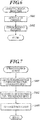
- FIG. 3 shows a flowchart of the image analysis in the image processor 2A.
- the image analysis shown in FIG. 3 is performed by the control section 21 in coordination with the image processing program stored in the storage section 25.
- the control section 21 performs the processing as described below in accordance with the image processing program.
- the feature amount of the second structure is extracted from the bright field image (step S20).
- step S20 as shown in FIG. 4 , the conversion of the bright field image to the monochrome image is performed (step S201), threshold processing is performed on the monochrome image using a predetermined threshold to binarize each pixel value (step S202), and noise processing is performed on the binary image (step S203).
- the noise processing can be performed by closing process on the binary image.
- the closing process includes dilation process and erosion process by the same number of times.
- the target pixel is replaced with a white pixel when any of the pixels within the range of n ⁇ n pixels (n is an integer of 2 or more) from the target pixel is white.
- the target pixel is replaced with a black pixel when any of the pixels within the range of n ⁇ n pixels from the target pixel is black. Small regions such as noise can be removed by the closing process.
- an image (a reference region image) with a reference region(s) extracted can be generated.
- the reference region is a region of the second structure (cell nucleus in the embodiment) extracted from the bright field image.
- a feature amount(s) of second structure is extracted from the bright field image on the basis of the extracted reference region (step S204: step of feature amount extraction).
- the examples of the feature amount of the second structure include information such as area, shape, and edge information of the reference region extracted from the bright field image, color (for example, hue, saturation, and luminance) of pixels inside and outside of the reference region in the bright field image, and the presence/absence of the structure (for example, cell nucleoli) in cell nucleus.
- FIG.5 shows examples of binary images (reference region images) generated by the step S203 and edge information of the reference region, respectively obtained from a bright field image 30 of a clearly-stained reference region (cell nucleus), a bright field image 40 of a single sparsely-stained cell nucleus, and a bright field image 50 of a plurality of stained cell nuclei contiguous with each other.
- Edge information includes, for example, edge intensity, edge angle, normal line direction of an edge, and curvature at an edge calculated by the method described in WO 2014/058721 .
- Step S30 when a fluorescence image is input from the microscopic image acquisition device 1A through the communication I/F 24 (Step S30), the control unit 21 extracts fluorescent bright points from the fluorescence image (Step S40 : step of extracting bright point).
- step S30 the control unit 21 extracts a color component(step S401) from the fluorescent image according to the wavelength of the fluorescent bright points and performs threshold processing(step S402) on the fluorescent image after color component extraction to generate a binary image (fluorescent bright point image) with fluorescent bright points extracted.
- step S401 when the emission wavelength of the fluorescent particle is 550nm, for example, only the fluorescent bright points having the emission wavelength of 550nm are extracted in the image.
- the image with the fluorescent bright points extracted (fluorescent bright point image) can be generated.
- noise removal processing can be performed to remove the autofluorescence of cells, other components due to unnecessary signals, and the like.
- control unit 21 After the process of steps S20 and S 40, the control unit 21 performs addition processing of the reference region (cell nucleus) image and the fluorescent bright point image, to overlay the reference region image and the fluorescent bright point image (step S50).
- step S60 step of determining the regions of interest.
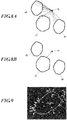
- FIG. 7 is a flowchart showing a process in step S60 in the first image analysis in detail.
- the distances between the reference regions (cell nuclei in the embodiment) and the fluorescent bright points are respectively calculated (step S601).
- the fluorescent bright points and the reference regions assigned to the same cell are associated with each other (step S602).
- step S601 the distances are calculated from the fluorescent bright point 30 to the surface of the cell nuclei 40, 42, and 44, as shown in FIG. 8A .
- the calculation of the distances is conducted to all pixels on the contour of the cell nuclei 40, 42, and 44.
- step S60 the control unit 21 determines the shortest distance from the fluorescent bright point 30 to the surface of the cell nuclei 40, 42, and 44 among the distances calculated in step S50.
- the control unit 21 specifies the cell nucleus 42 as the cell nucleus nearest to the fluorescent bright point 30 and associates the fluorescent bright point 30 and the cell nucleus 42 with each other, which are assigned to the same cell.
- the fluorescent bright point 30 may be determined as a noise, so that it is not be used after the process of step S60.
- FIG. 9 is a diagram showing examples of association of fluorescent bright points and reference regions, which are assigned to the same cell.
- the line segments respectively connect the contour of the reference regions and the fluorescent bright points associated with each other.
- control unit 21 determines the regions of interest in step S603.
- the fluorescent bright points associated with a cell nucleus shown in FIG. 10A are connected with straight lines shown in FIG. 10B , for example, to obtain a polygon 31 including the fluorescent bright points as its vertexes. Any fluorescent bright points may be connected with a straight line, however, all the fluorescent bright points preferably exist inside of the polygon 31. Subsequently, smoothing processing is performed on the polygon 31 to determine a cell region 50.
- the deviation between the actual cell region and the obtained polygon 31 is smaller. Accordingly, the polygon 31 itself may be determined as a cell region 50 without smoothing process when the number of the fluorescent bright points is larger than the predetermined range.
- Smoothing processing may be performed by any method.
- region 32 in FIG. 10C is prepared from the polygon 31 in FIG. 10B by opening processing.
- the region 32 is subtracted from the polygon 31 by TOPHAT transformation, so that the regions near vertexes are extracted from the polygon 3 land the pixel number X in the regions near vertexes extracted from the polygon 31 is calculated.
- dilation processing of the region 32 is performed so that the area after dilation is larger than the area before dilation processing by the area corresponding to X pixels.
- the region after dilation processing is determined as a cell region 50 (see FIG. 10D ).
- a predetermined shape for example, circle, ellipse, equilateral polygon, and the like inscribing or circumscribing the polygon may be prepared and determined as a cell region 50.
- cell region may be an ellipse 51 prepared by elliptical approximation of the coordinates of fluorescent bright points 30 associated with one cell nucleus, by least squares method using the equation of an ellipse.
- a cell region may be determined as a contour extracted by SNAKES processing, which is a publically-known Active Contour Model, applied to the fluorescent bright points associated with one cell nucleus.
- a cell region may be determined as a B-Spline curve prepared by a publically-known method on the basis of the distribution of the fluorescent bright points associated with one cell nucleus.
- a cell region may be determined on the basis of the shape of the cell nucleus. For example, a cell region may be prepared by dilation processing of the region of the cell nucleus.
- a cell region may be the shape 52.
- the shape 52 is prepared by magnifying the cell nucleus 40 shown in FIG. 12 , includes all the fluorescent bright points associated with the cell nucleus 40, and has a shape similar to the cell nucleus 40.
- the amount of dilation may be modified on the basis of the distances from each of the fluorescent bright points to the cell nucleus.
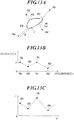
- FIG. 13A illustrates cell nucleus 40 and four fluorescent bright points 30a to 30d associated with the cell nucleus 40.
- the control unit 21 extracts points on the cell nucleus 40 closest to each of the fluorescent bright points 30a to 30d in order to calculate the distances (amounts of dilation) from each of the fluorescent bright points 30a to 30d to the respective closest points.
- the closest point 40a is the point closest to the fluorescent bright point 30a shown in FIG. 13A
- the amount of dilation p is the distance (the length of the dotted line in FIG. 13A ) between the fluorescent bright point 30a and the closest point 40a.
- the fluorescent bright points 30a to 30d are illustrated in FIG. 13B , for example.
- origin x is an arbitrarily defined point on the contour of the cell nucleus 40
- the length of the contour measured in a clockwise direction from the origin x to the closest points corresponding to each of the fluorescent bright points 30a to 30d is plotted on a horizontal axis
- the amount of dilation is plotted on a vertical axis.
- the dotted lines are prepared as shown in FIG. 13B , which interpolate between the adjacent fluorescent bright points. By reconversion to a normal orthogonal coordinate, the amount of dilation from each point on the contour of the cell nucleus 40 can be determined on the basis of the position of the observed fluorescent bright points.
- the dilation region thus prepared may be used as a cell region.
- the image of the cell nucleus 40 and the four fluorescent bright points 30a to 30d associated with the cell nucleus 40 may be shown on a polar coordinate as shown in FIG. 13C .
- the origin is the center of the cell nucleus 40
- the dotted lines in FIG. 13C shows the interpolation between the adjacent fluorescent bright points.
- the curve prepared by performing any smoothing processing on the dotted lines in FIG. 13B or FIG. 13C may be reconverted to a normal orthogonal coordinate and used as a cell region.
- any of the above methods (1) to (6) to determine cell regions in step S603 may be selected and used.
- the methods (1) to (5) are more preferable than the method (6), because the process is relatively simple and the deviation from the actual cell region is small. Meanwhile, when there are a small number of fluorescent bright points associated with one cell nucleus, the deviation from the actual cell region by the methods (1) to (5) would be larger than the deviation by the method (6), because of the insufficient clue to determine a cell region.
- step S603 after calculating the number of the fluorescent bright points at first, it is preferable to prepare a cell region by the methods (1) to (5) when the calculated value is larger than a predetermined value, and to prepare a cell region by the method (6) when the calculated value is smaller than a predetermined value.
- candidate regions of a cell region may be prepared by two or more of the methods (1) to (6), respectively.
- the feature amount (for example, area, color, the ratio between the long diameter and the short diameter, and the like) of the candidate regions are calculated and compared with the feature amount of a standard cell of the observation target, so that the candidate region which is most likely to be a cell region is determined as a cell region.
- step S603 After the process of step S603 is completed for all the fluorescent bright points and the cell nuclei associated with each other in step S602, the step returns to the process in FIG. 3 .
- post processing step S70 is performed in order to assign the overlapping region to one of the overlapping regions.
- Post processing may be performed by any process.
- the fluorescent bright points represent the expression of a specific biological substance on a cell membrane
- the overlapping region is assigned to one of the cells based on the fact that fluorescent bright points are observed near the contour of cells in a tissue section.
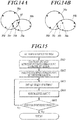
- FIG. 14A and FIG. 14B illustrates, for example, cell regions 50a and 50b overlap at the overlapping region 60.
- the fluorescent bright points 30a to 30d near the overlapping region 60 only the fluorescent bright point 30a is near the contour of the cell region 50a and the fluorescent bright points 30b to 30d are near the contour of the cell region 50b. Therefore, from the contours of the cell regions 50a and 50b surrounding the overlapping region 60, the contour of the cell region 50b is selected to be left as shown in FIG. 14B .
- the distances from the fluorescent bright points 30b to 30d to the cell regions 50a and 50b may be calculated and averaged for each cell region, to determine to leave the contour of the cell region having a smaller averaged value.
- the region of interest is extracted on the basis of the distribution of fluorescent bright points associated with reference region. Therefore, the region of interest can be automatically extracted even when the region of interest cannot be directly observed in the morphological image (that is, even when the reference region is different from the region of interest).
- examples of the first structure, the second structure, and the region of interest are respectively a cell membrane, a cell nucleus, and a cell region, however, they are not limited by the embodiment. Any structure of a cell can be selected as the first structure, the second structure, and the region of interest.
- a convex closure of the fluorescent bright points associated with a reference region is prepared as the polygon in step S602.
- the fluorescent bright points which form vertexes of the convex closure are used for extracting the region of the first structure by performing the methods (1) to (6) in step S603 to prepare a cell region.
- the first image analysis is easily and preferably applied when the region of interest is the region of the first structure, however, the region of interest may be different from the region of the first structure.
- the region of interest may be estimated and prepared on the basis of the shape of the reference region extracted in step S20 and the shape of the region of the first structure extracted in step S603. Any estimating method may be used.
- the image processing device 2A may include a learning unit as in the second image analysis detailed below, for estimation using the features of the first structure, the second structure, and the region of interest learned in advance.
- the image processing device 2A may include a learning unit to learn the features regarding the fluorescent bright points and the morphological image in the region of interest.
- the learning methods can include any methods, such as publically-known machine learning (for example, Support Vector Machine: SVM).
- the first structure is cell membrane
- the second structure is HE-stained cell nucleus
- the region of interest is cell region.
- the second image analysis includes a learning step to calculate a learning parameter on the basis of teacher images and a process of analyzing image using the learning parameter.
- the teacher images include a morphological image and a fluorescent image which are obtained by capturing a tissue sample stained in the same way as the tissue sample of the observation target.
- the region of interest is known in the teacher images.
- the kind of the captured tissue sample for example, the kind of cell, tissue, and animal
- the method of preparation, and the conditions to obtain the images are preferably the same between the teacher images and the morphological and fluorescent images for diagnosis.
- control unit 21 extracts feature amounts of the second structure from the morphological image input as a teacher image, as in the steps S10 to S20 in the first image analysis illustrated in the flowchart in FIG. 3 .
- a fluorescent bright point image is generated from the fluorescent image input as a teacher image and feature amounts are extracted regarding the distribution of fluorescent bright points (for example, the position and the number of the fluorescent bright points).
- the known regions of interest in the teacher images are input. Furthermore, at a random position in the teacher images is prepared "a comparative region", which is a circular region having the same area as the average area of the input regions of interest.
- the control unit 21 performs addition processing of the morphological image and the fluorescent bright point image, and extracts feature amounts of the morphological image and the fluorescent image in the region of interest and in the comparative region, respectively.
- the control unit 21 extracts the luminance, saturation, and edge intensity of the region of interest and the comparative region.
- the region of interest shows lower luminance, higher saturation, and stronger edge intensity than the comparative region, because the region of interest (cell region) in the morphological image includes a cell nucleus stained bluish violet cell nucleus in the embodiment.
- the control unit 21 calculates the minimum distance from each of the fluorescent bright points to the contour of the region of interest and to the contour of the comparative region. Many fluorescent bright points distribute at the contour of the region of interest in the fluorescent bright point image.
- the control unit 21 prepares "a learning parameter" on the basis of the extracted feature amounts and stores the parameter in the storage unit 25.
- the learning parameter is used for weighting according to the priority of the feature amounts.
- a feature amount which is largely different between the region of interest and the comparative region is heavily weighted, because it is considered to be an important clue for determining the region of interest.
- each feature amount is statistically tested between the region of interest and the comparative region to obtain significant probability (p value).
- the parameter is prepared so that the feature amount corresponding to small p-value is heavily weighed.
- the processes in the steps S10 to S50 illustrated in the flowchart in FIG. 3 are performed as in the first image analysis described above.
- the control unit 21 extracts the feature amounts used for preparation of parameter in the learning step (in the embodiment, luminance of the morphological image, saturation, edge intensity, and the distribution of fluorescent bright points).
- FIG. 15 is a flowchart showing a detailed flow of step S60 in the second image analysis.
- the region of interest is prepared as in the steps S601 to S603 of the first image analysis.
- the feature amounts (luminance, saturation, edge intensity, and the distribution of fluorescent bright points) of the region of interest prepared in the step S613 are scored (step S614). Any scoring method is used.
- the control unit 21 calculates the difference between the luminance of the region of interest prepared in step S613 and the average luminance of all the regions of interest in the teacher image.
- the luminance score of the region of interest prepared in step S613 is determined to be +10 when the difference is small (for example, the difference is smaller than the variance of the luminance of all the region of interest in the teacher image). When the difference is larger, the luminance score is determined to be smaller.
- control unit 21 After scoring all feature amounts, the control unit 21 reads out the learning parameter from the storage unit 25 to weigh the score of each feature amount with the learning parameter, and summarize the weighed score. On the basis of the summarized score weighed by the learning parameter, the control unit 21 determines whether the region of interest prepared in step S613 is correct or not (step S615).
- step S615 determines that the region of interest is correct (step S615: Yes), and advances to the process of step S70.
- control unit 21 determines that the region of interest is not correct (step S615: No), and returns to the process of step S613 to prepare another region of interest.
- step S70 post processing is performed as in the step S70 of the first image analysis, and image analysis is completed.
- the feature amount and the parameter are changed according to the combination of the first structure, the second structure, and the region of interest.
- the first structure is cytoplasm and the region of interest is a cell or a cell nucleus
- at least a part of the fluorescent bright points are considered to be within the region of interest and the region of interest requires inclusion of a fluorescent bright point therein.
- the region of interest requires to include no fluorescent bright point and to be within a region surrounded by fluorescent bright points close to each other within a predetermined distance or fluorescent bright points assigned to one cell.
- the region of interest is prepared as in the steps S601 to S603 of first image analysis, however, the method to prepare the region of interest is not limited thereto.
- the control unit 21 may prepare the candidate region on the basis of only the feature amount of the morphological image in steps S611 to S613, to discriminate whether or not correction is necessary according the fluorescent bright points in the image processing after step S614.
- the image processing device 2A may include a correction unit to divide or integrate the region of interest on the basis of the fluorescent bright points.
- the third image analysis using the image processing device 2A having a division unit or an integration unit is described in the case when the specific biological substance expressed at the first structure is Ki67 protein expressed at a cell nucleus, the second structure is an HE-stained cell nucleus, and the region of interest is a cell nucleus.
- step S10 to S50 is performed as in the above-described first image analysis.
- FIG. 16 is a detailed flowchart showing a flow of step S60 in the third image analysis.
- a region of interest (referred to as a "candidate region" of a region of interest in the third image analysis) is prepared as in the steps S601 to S603 of the first image analysis.
- control unit 21 judges whether or not to correct the candidate region on the basis of the shape of the candidate region (step S624).
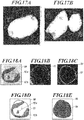
- the judgement is based on the ratio (convex area ratio) of the candidate region area and the convex region area of the candidate region. Because of the high circularity of cell nuclei and cells, the convex area ratio is considered to be close to 1. Accordingly, when the candidate region (white region in FIG. 17A ) almost corresponds to the convex region (dotted line) and the convex area ratio is close to 1, the control unit 21 judges that the correction of candidate region is not necessary (step S624: NO) because the candidate region is likely to be a region of interest, and determines the candidate region as a region of interest. Meanwhile, when the candidate region and the convex region is largely different as in FIG. 17A and the convex area ratio is not close to 1, the control unit 21 judges that the correction of the candidate region is necessary (step S624: YES) because the candidate region is not probably a region of interest, and moves to the process in step S625.
- step S624 YES
- control unit 21 may judge whether or not correction is necessary on the basis of not only the convex area ratio, but also the area of the candidate region.
- step S625 the control unit 21 discriminates how to correct the candidate region which is judged to be in need of correction in step S624.
- step S625 in the case of FIG. 18A for example, the control unit 21 extracts a region 80 within a certain range from the candidate region 82a, determines whether or not a plurality of small candidate regions (for example, 82a to 82b) are present in the region 80. If a plurality of small candidate regions are determined to be present in region 80, the area and/or the concentration of the candidate regions 82a to 82b in region 80 are calculated.
- a plurality of small candidate regions for example, 82a to 82b
- the processing may move to step S626 either when both of the conditions 1-1 and 1-2 are satisfied or when any one of the conditions 1-1 or 1-2 is satisfied.
- the control unit 21 extracts region 90 within a certain range from the candidate region 92, and determines whether or not one large candidate region 92 of cell nucleus is present in the region 90. If one large candidate region 92 of cell nucleus is determined to be present in region 90, the area and/or the circularity of candidate region 92 of cell nucleus in region 90 are calculated and the presence of a concave point and/or a plurality of nucleoli are detected.
- the processing may move to step S628 either when all of the conditions 2-1 to 2-4 are satisfied, when any three of the conditions are satisfied, when any two of the conditions are satisfied, or when any one of the conditions is satisfied.
- step S626 the control unit 21 judges whether or not to actually integrate the a plurality of small candidate regions of the cell nucleus based on the region information and the edge information of the candidate region (step S626).
- step S626 the control unit 21 calculates the area and/or the circularity of candidate regions 82a to 82b in the region 80.
- the continuity of normal line directions of the edge, the total value of angles of normal line directions of an edge, and/or curvature at the edge are calculated or detected from candidate regions 82a to 82c in the region 80, on the basis of the edge information of the candidate regions.
- the processing may move to step S627 either when all of the conditions 3-1Q to 3-5Q are satisfied, when any four of the conditions are satisfied, when any three of the conditions are satisfied, when any two of the conditions are satisfied, or when any one of the conditions is satisfied.
- condition 3-1Q when the area (the total area) of candidate regions 82a to 82b is small (i.e. less than the certain threshold value), it is considered that only a part of the region of interest is detected and therefore candidate regions 82a to 82b are to be integrated.
- the outlines of candidate regions 82a to 82b are connected and the presence of continuity of the normal line directions (for example, the directions in the order of 0°, 90°, 180°, 270°, and 0°) obtained from the connected outlines is determined. If continuity is determined to be present, it is considered that the candidate regions 82a to 82b surrounded by the outlines are to be integrated.
- the normal line directions for example, the directions in the order of 0°, 90°, 180°, 270°, and 0°
- the outlines of candidate regions 82a to 82b are connected and the rotation angle of the filter is changed from the range of 0° to 360° to the range of -180° to 0°, and further to 180°. It is determined whether the total value of angles of normal line directions of an edge goes away from 0° by the change of the rotation angle of the filter. When the total value of angles of normal line directions of an edge is determined to go away from 0°, it is considered that only a part of the region of interest is detected and therefore candidate regions 82a to 82b are to be integrated.
- step S627 from the fluorescent image shown in FIG 18B , the control unit 21 extracts fluorescent bright points which are close to each other within a predetermined distance and close to regions 82a and 82b.
- the fluorescent bright points are associated with one cell nuclei.
- the control unit 21 prepares a region 83 surrounding the extracted fluorescent bright points ( FIG. 18C ), integrates the region 83 surrounding the extracted fluorescent bright points and the candidate regions 82a and 82b ( FIG. 18D ), and prepares integrated candidate region 84 ( FIG. 18E ).
- control unite 21 discriminates whether the integrated candidate region 84 satisfies the following conditions, which are similar to the conditions 3-1Q to 3-5Q;
- the integrated candidate region 84 is determined as the region of interest.
- the region of interest may be determined either when all of the conditions 3-1A to 3-5A are satisfied, when any four of the conditions are satisfied, when any three of the conditions are satisfied, when any two of the conditions are satisfied, or when any one of the conditions is satisfied.
- step S628 the control unit 21 judges whether to actually divide the single large candidate region of the cell nucleus or not on the basis of the region information and the edge information of the candidate region (step S628).
- step S628 the control unit 21 calculates the area and/or the circularity of the candidate region 92, and the presence of a concave point and/or a plurality of nucleoli are detected in the candidate region 92 in the region 90 in FIG. 19A .
- the continuity of normal line directions of the edge, the total value of angles of normal line directions of an edge, and/or curvature at the edge are calculated or detected from the candidate region 92 in the region 90, on the basis of the edge information of the candidate region.
- the processing may move to step S629 either when all of the conditions 4-1Q to 4-7Q are satisfied, when any six of the conditions are satisfied, when any five of the conditions are satisfied, when any four of the conditions are satisfied, when any three of the conditions are satisfied, when any two of the conditions are satisfied, or when any one of the conditions is satisfied.
- condition 4-1Q when the area of candidate region 92 is large (i.e. more than the certain threshold value), it is considered that a plurality of cell nuclei are detected and therefore candidate region 92 is to be divided.
- condition 4-2Q when the circularity of candidate region 92 is low (i.e. lower than the certain threshold value) in spite of the high circularity of a general cell nucleus, it is considered that a plurality of cell nuclei are detected and therefore the candidate region 92 is to be divided.
- condition 4-3Q when a concave point is present in the candidate region 92, and especially when concave points are present in positions opposite to each other, it is considered that a plurality of cell nuclei are detected and therefore candidate region 92 is to be divided.
- condition 4-4Q when a plurality of nucleoli are present in the candidate region 92 although there is basically one nucleolus in one cell nucleus, it is considered that a plurality of cell nucleoli are detected and therefore candidate region 92 is to be divided.
- the outline of candidate region 92 is prepared and the absence of continuity of the normal line directions obtained from the connected outlines is determined, for example, the directions in the order of 0 °, 90 °, 180°, 270°, and 0°. If a continuity is determined to be absent, it is considered that the candidate region 92 surrounded by the outlines is to be divided.
- the candidate region 92 is to be divided, when there are normal lines having opposite directions in the image generated by extracting normal line directions from the cell image in determining the absence of continuity of the normal line directions generated from the connected outlines of candidate region 92.
- the outline of candidate region 92 is prepared and the rotation angle of the filter is changed from the range of 0° to 360° to the range of -180° to 0°, and further to 180°. It is determined whether the total value of angles of normal line directions of an edge goes away from 0° by the change of the rotation angle of the filter. When the total value of angles of normal line directions of an edge determined to go away from 0°, it is considered that a plurality of cell nuclei are detected and therefore candidate region 92 to be divided.
- condition 4-7Q when the curvatures at the edge of candidate region 92 are different from each other, it is considered that a plurality of cell nuclei are detected and therefore candidate region 92 is to be divided.
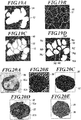
- step S47 as shown in FIG.19B , the control unit 21 prepares a line segment 93 which connects the fluorescent bright points within a predetermined distance from each other and close to the candidate region 92.
- the candidate region 92 is divided by the line segment 93, into divided candidate regions 94a to 94j ( FIG. 19C and 19D ).
- control unit 21 discriminates whether the divided candidate regions 94a to 94j satisfy the following conditions, which are similar to the conditions 4-1A to 4-7A;
- the region of interest may be determined either when all of the conditions 4-1Q to 4-7Q are satisfied, when any six of the conditions are satisfied, when any five of the conditions are satisfied, when any four of the conditions are satisfied, when any three of the conditions are satisfied, when any two of the conditions are satisfied, or when any one of the conditions is satisfied.
- the control unit 21 prepares a region 83 surrounding the fluorescent bright points, which are preferably associated with one cell nucleus and close to each other within a predetermined distance and close to (within a certain distance from) regions 82a and 82b.
- the control unit 21 prepares integrated candidate region 84 by integrating the region 83 and the candidate regions 82a and 82b.
- the method of integration is changed according to the combination of the first structure, the second structure, and the region of interest.
- the control unit 21 extracts a region 80 within a certain range from the candidate region 82a shown in FIG. 20B , and prepares a region 85 ( FIG. 20C ), which do not include fluorescent bright points and are surrounded by the fluorescent bright points close to each other (preferably, the fluorescent bright points are associated with one cell nucleus). Subsequently, the control unit 21 prepares an integrated candidate region 86 ( FIGs. 20D and 20E ) by integrating the region 85 and the regions of interest 82a and 82b, which overlap with the region 85.
- control unit 21 prepares the divided candidate regions 94a to 94j by a line segment 93, which connects the fluorescent bright points within a predetermined distance from each other and close to the candidate region 92.
- the method of division is changed according to the combination of the first structure, the second structure, and the region of interest.
- the control unit 21 extracts a region 90 within a certain range from the candidate region 92 as shown in FIG. 20A , groups the fluorescent bright points close to each other within a predetermined distance in the region 90 as shown in FIG. 21B , and prepares regions 95a o 95j surrounding the fluorescent bright points for each groups ( FIG. 21C ).
- the divided candidate regions 96a to 96j are determined as the overlapping regions of the candidate region 92 and each of the regions 95a to 95j ( FIG. 21D ).
- the candidate region is prepared as in the steps S601 to S603 of first image analysis, however, the method to prepare the region of interest is not limited thereto.
- the control unit may prepare candidate region on the basis of only the feature amount of morphological image in steps S621 to S623, and divides or integrates using the fluorescent bright points in the image processing after step S624.
- the region of interest is specified by associating the feature amount of the morphological image and the fluorescent bright points which represent the specific biological substances expressed at the first structure of cells. Therefore, even when different regions of interest are to be identified from one sample, it is not necessary to prepare morphological images for each region of interest.
- the region of interest can be accurately extracted even when there are a few fluorescent bright points corresponding to one cell.
- the region of interest can be determined by the most suitable method for each sample.
- the overlapping region is assigned to any one of the overlapping cells according to the positional relation of the fluorescent bright points and the overlapping region. This results in accurate pathological diagnosis.
- probable region of interest can be selected on the basis of the feature amount of morphological image and the image including the fluorescent bright points. Accordingly, the noise can be reduced and region of interest can be accurately extracted.
- the feature amount used as an important clue for determining the region of interest can be strongly reflected in determining whether the region of interest is correct or not.
- one region of interest is conventionally extracted from the morphological image as divided plural regions.
- the cells are present densely, overlapping and stained regions are conventionally extracted as one region. Therefore, enhancement of accuracy has been required in identifying region of interest on the basis of stained image according to the third image analysis, the candidate region can be modified by division or integration in spite of sparsely -stained or overlapping cells. Accordingly, the noise can be reduced and region of interest can be accurately extracted.
- HER2 protein or Ki67 protein in breast cancer is described as the specific biological substance according to the embodiments, however, the specific biological substance is not limited to the above. It is possible to provide the physician with the feature amount quantitatively showing the expression amount of the specific protein according to the type of lesion by changing the biological substance-recognizing portion used for obtaining the fluorescent image according to the type of lesion (cancer) which is to be the target of diagnosis.
- tissue section of a human body is described as the object of the pathological diagnosis.
- the tissue section includes tissue culture and can be replaced with separated cells from the tissue or cultured cells.
- a portable recording medium such as a CD-ROM, etc. can be applied as other computer readable media.
- a carrier wave can be applied as the medium which provides the data of the program of the present invention through a communication line.
- each device composing the pathological diagnosis assistance system 10 can be suitably changed within the scope of the present invention.
- the present invention can be preferably applied to image process for pathological diagnosis.
Landscapes
- Engineering & Computer Science (AREA)
- Health & Medical Sciences (AREA)
- Physics & Mathematics (AREA)
- Life Sciences & Earth Sciences (AREA)
- General Physics & Mathematics (AREA)
- Biomedical Technology (AREA)
- Chemical & Material Sciences (AREA)
- Theoretical Computer Science (AREA)
- Computer Vision & Pattern Recognition (AREA)
- Immunology (AREA)
- General Health & Medical Sciences (AREA)
- Urology & Nephrology (AREA)
- Molecular Biology (AREA)
- Hematology (AREA)
- Food Science & Technology (AREA)
- Medicinal Chemistry (AREA)
- Analytical Chemistry (AREA)
- Biochemistry (AREA)
- Pathology (AREA)
- Biophysics (AREA)
- Optics & Photonics (AREA)
- Radiology & Medical Imaging (AREA)
- Quality & Reliability (AREA)
- Nuclear Medicine, Radiotherapy & Molecular Imaging (AREA)
- Medical Informatics (AREA)
- Physiology (AREA)
- Tropical Medicine & Parasitology (AREA)
- Biotechnology (AREA)
- Cell Biology (AREA)
- Microbiology (AREA)
- Investigating Or Analysing Biological Materials (AREA)
- Investigating, Analyzing Materials By Fluorescence Or Luminescence (AREA)
- Image Analysis (AREA)
Applications Claiming Priority (3)
| Application Number | Priority Date | Filing Date | Title |
|---|---|---|---|
| JP2014248932 | 2014-12-09 | ||
| JP2015129678 | 2015-06-29 | ||
| PCT/JP2015/083541 WO2016093090A1 (ja) | 2014-12-09 | 2015-11-30 | 画像処理装置及び画像処理プログラム |
Publications (3)
| Publication Number | Publication Date |
|---|---|
| EP3232402A1 true EP3232402A1 (de) | 2017-10-18 |
| EP3232402A4 EP3232402A4 (de) | 2018-07-18 |
| EP3232402B1 EP3232402B1 (de) | 2020-05-06 |
Family
ID=56107280
Family Applications (1)
| Application Number | Title | Priority Date | Filing Date |
|---|---|---|---|
| EP15866919.2A Active EP3232402B1 (de) | 2014-12-09 | 2015-11-30 | Bildverarbeitungsvorrichtung und bildverarbeitungsprogramm |
Country Status (4)
| Country | Link |
|---|---|
| US (1) | US10509023B2 (de) |
| EP (1) | EP3232402B1 (de) |
| JP (1) | JP6763305B2 (de) |
| WO (1) | WO2016093090A1 (de) |
Cited By (4)
| Publication number | Priority date | Publication date | Assignee | Title |
|---|---|---|---|---|
| EP3702779A4 (de) * | 2017-10-26 | 2021-01-06 | Konica Minolta, Inc. | Bildverarbeitungsvorrichtung, verfahren zur bestimmung der scharfeinstellposition und programm zur bestimmung der scharfeinstellposition |
| EP3961563A1 (de) * | 2020-08-25 | 2022-03-02 | SCREEN Holdings Co., Ltd. | Probenanalyseverfahren und bildverarbeitungsverfahren |
| US12140545B2 (en) | 2019-07-09 | 2024-11-12 | Sony Group Corporation | Information processing device for analyzing a specimen |
| KR102730636B1 (ko) * | 2023-12-08 | 2024-11-15 | 주식회사 넥스트앤바이오 | 세포 집합체의 세포 특성 정보 생성 방법 및 장치 |
Families Citing this family (20)
| Publication number | Priority date | Publication date | Assignee | Title |
|---|---|---|---|---|
| EP3251052B1 (de) * | 2015-01-31 | 2024-07-17 | Ventana Medical Systems, Inc. | Qualitätskontrolle einer automatisierten vollschnittanalyse |
| US10591402B2 (en) * | 2015-05-22 | 2020-03-17 | Konica Minolta, Inc. | Image processing apparatus, image processing method, and image processing program |
| WO2017090741A1 (ja) * | 2015-11-25 | 2017-06-01 | 国立研究開発法人理化学研究所 | 細胞塊に関する領域検出方法及び領域検出装置 |
| CA3040518C (en) * | 2016-10-21 | 2023-05-23 | Nantomics, Llc | Digital histopathology and microdissection |
| JP6979278B2 (ja) | 2017-04-07 | 2021-12-08 | 株式会社日立ハイテク | 画像診断支援装置及び画像診断支援システム、並びに画像診断支援方法 |
| JP6977425B2 (ja) * | 2017-09-14 | 2021-12-08 | セイコーエプソン株式会社 | 画像処理装置、二値画像生産方法および画像処理プログラム |
| EP3698377A2 (de) * | 2017-10-20 | 2020-08-26 | Genfit | Automatisierte mustererkennung und bewertungsverfahren von histologischen bildern |
| CN115684569B (zh) | 2018-02-15 | 2026-02-13 | 国立大学法人新潟大学 | 超突变型癌的判别系统、程序及方法 |
| JP7593112B2 (ja) * | 2019-02-15 | 2024-12-03 | コニカミノルタ株式会社 | 情報提供方法、情報提供装置及びプログラム |
| JPWO2020262117A1 (de) * | 2019-06-28 | 2020-12-30 | ||
| WO2021062064A1 (en) * | 2019-09-24 | 2021-04-01 | Nuvasive, Inc. | Systems and methods for adjusting appearance of objects in medical images |
| JP7248139B2 (ja) * | 2019-10-11 | 2023-03-29 | 株式会社島津製作所 | 細胞画像解析方法及び細胞解析装置 |
| JP7423654B2 (ja) * | 2020-03-09 | 2024-01-29 | 株式会社エビデント | 計測方法、計測装置、および記録媒体 |
| JP7502055B2 (ja) * | 2020-03-18 | 2024-06-18 | キヤノン株式会社 | 画像処理装置、画像処理方法およびプログラム |
| JPWO2022059508A1 (de) * | 2020-09-18 | 2022-03-24 | ||
| TWI774120B (zh) * | 2020-11-10 | 2022-08-11 | 中國醫藥大學 | 生物組織影像分析方法及生物組織影像分析系統 |
| JP2022152980A (ja) * | 2021-03-29 | 2022-10-12 | ソニーグループ株式会社 | 医療用画像解析装置、医療用画像解析方法及び医療用画像解析システム |
| JP2024025182A (ja) * | 2022-08-10 | 2024-02-26 | 公益財団法人がん研究会 | 情報処理装置、情報処理方法、およびプログラム |
| CN115511868A (zh) * | 2022-10-18 | 2022-12-23 | 麦克奥迪实业集团有限公司 | 荧光数字切片扫描方法、装置、设备及介质 |
| JPWO2024247883A1 (de) * | 2023-05-30 | 2024-12-05 |
Family Cites Families (9)
| Publication number | Priority date | Publication date | Assignee | Title |
|---|---|---|---|---|
| JPH0212060A (ja) * | 1988-06-30 | 1990-01-17 | Sumitomo Electric Ind Ltd | 細胞の状態のモニター方法及びその装置 |
| US5162990A (en) * | 1990-06-15 | 1992-11-10 | The United States Of America As Represented By The United States Navy | System and method for quantifying macrophage phagocytosis by computer image analysis |
| JP3946590B2 (ja) | 2002-07-16 | 2007-07-18 | 富士通株式会社 | 画像処理方法、画像処理プログラムおよび画像処理装置 |
| JP4496860B2 (ja) * | 2004-06-30 | 2010-07-07 | 株式会社ニコン | 細胞識別装置、細胞識別方法、細胞識別用プログラム、および細胞解析装置 |
| JP4630106B2 (ja) * | 2005-03-31 | 2011-02-09 | 株式会社トプコン | 角膜内皮細胞画像処理装置 |
| US20110017076A1 (en) * | 2009-07-27 | 2011-01-27 | Arzum Elektrikli Ev Aletleri Sanayi Ve Ticaret Anonim Sirketi | Sliding toaster |
| US8351668B2 (en) | 2010-01-11 | 2013-01-08 | Utah State University | System and method for automated particle imaging analysis |
| JP5906623B2 (ja) | 2011-09-09 | 2016-04-20 | コニカミノルタ株式会社 | 生体物質発現レベル評価システム |
| WO2013146843A1 (ja) * | 2012-03-30 | 2013-10-03 | コニカミノルタ株式会社 | 医用画像処理装置及びプログラム |
-
2015
- 2015-11-30 EP EP15866919.2A patent/EP3232402B1/de active Active
- 2015-11-30 JP JP2016563620A patent/JP6763305B2/ja active Active
- 2015-11-30 WO PCT/JP2015/083541 patent/WO2016093090A1/ja not_active Ceased
- 2015-11-30 US US15/533,441 patent/US10509023B2/en active Active
Cited By (5)
| Publication number | Priority date | Publication date | Assignee | Title |
|---|---|---|---|---|
| EP3702779A4 (de) * | 2017-10-26 | 2021-01-06 | Konica Minolta, Inc. | Bildverarbeitungsvorrichtung, verfahren zur bestimmung der scharfeinstellposition und programm zur bestimmung der scharfeinstellposition |
| US12140545B2 (en) | 2019-07-09 | 2024-11-12 | Sony Group Corporation | Information processing device for analyzing a specimen |
| EP3961563A1 (de) * | 2020-08-25 | 2022-03-02 | SCREEN Holdings Co., Ltd. | Probenanalyseverfahren und bildverarbeitungsverfahren |
| US12333726B2 (en) | 2020-08-25 | 2025-06-17 | SCREEN Holdings Co., Ltd. | Specimen analysis method and image processing method |
| KR102730636B1 (ko) * | 2023-12-08 | 2024-11-15 | 주식회사 넥스트앤바이오 | 세포 집합체의 세포 특성 정보 생성 방법 및 장치 |
Also Published As
| Publication number | Publication date |
|---|---|
| JP6763305B2 (ja) | 2020-09-30 |
| US20170370901A1 (en) | 2017-12-28 |
| JPWO2016093090A1 (ja) | 2017-09-14 |
| EP3232402B1 (de) | 2020-05-06 |
| WO2016093090A1 (ja) | 2016-06-16 |
| US10509023B2 (en) | 2019-12-17 |
| EP3232402A4 (de) | 2018-07-18 |
Similar Documents
| Publication | Publication Date | Title |
|---|---|---|
| EP3232402B1 (de) | Bildverarbeitungsvorrichtung und bildverarbeitungsprogramm | |
| US9779500B2 (en) | Image processing device, pathological diagnosis support system, image processing program, and pathological diagnosis support method | |
| US10094767B2 (en) | Image processor, image processing method, and program | |
| JP5804194B2 (ja) | 医用画像処理装置及びプログラム | |
| US11035844B2 (en) | Image processing device, pathological diagnosis support system, storage medium for image processing, and image processing method | |
| US10451554B2 (en) | Image processing device, image processing method, and recording medium storing computer readable image processing program | |
| US10761027B2 (en) | Image processing apparatus and computer-readable recording medium storing program | |
| JP7173034B2 (ja) | 画像処理装置、合焦位置特定方法及び合焦位置特定プログラム | |
| EP3124956B1 (de) | Bildverarbeitungsvorrichtung und bildverarbeitungsprogramm | |
| EP3764096A1 (de) | Bildverarbeitungsverfahren, bildverarbeitungsvorrichtung und programm | |
| EP3396375B1 (de) | Bildverarbeitungsvorrichtung und -programm |
Legal Events
| Date | Code | Title | Description |
|---|---|---|---|
| STAA | Information on the status of an ep patent application or granted ep patent |
Free format text: STATUS: THE INTERNATIONAL PUBLICATION HAS BEEN MADE |
|
| PUAI | Public reference made under article 153(3) epc to a published international application that has entered the european phase |
Free format text: ORIGINAL CODE: 0009012 |
|
| STAA | Information on the status of an ep patent application or granted ep patent |
Free format text: STATUS: REQUEST FOR EXAMINATION WAS MADE |
|
| 17P | Request for examination filed |
Effective date: 20170522 |
|
| AK | Designated contracting states |
Kind code of ref document: A1 Designated state(s): AL AT BE BG CH CY CZ DE DK EE ES FI FR GB GR HR HU IE IS IT LI LT LU LV MC MK MT NL NO PL PT RO RS SE SI SK SM TR |
|
| AX | Request for extension of the european patent |
Extension state: BA ME |
|
| DAV | Request for validation of the european patent (deleted) | ||
| DAX | Request for extension of the european patent (deleted) | ||
| A4 | Supplementary search report drawn up and despatched |
Effective date: 20180615 |
|
| RIC1 | Information provided on ipc code assigned before grant |
Ipc: G01N 33/48 20060101ALI20180611BHEP Ipc: G06T 7/00 20170101AFI20180611BHEP Ipc: G06T 7/174 20170101ALI20180611BHEP Ipc: G06T 7/12 20170101ALI20180611BHEP Ipc: G06T 1/00 20060101ALI20180611BHEP |
|
| STAA | Information on the status of an ep patent application or granted ep patent |
Free format text: STATUS: EXAMINATION IS IN PROGRESS |
|
| 17Q | First examination report despatched |
Effective date: 20190315 |
|
| GRAP | Despatch of communication of intention to grant a patent |
Free format text: ORIGINAL CODE: EPIDOSNIGR1 |
|
| STAA | Information on the status of an ep patent application or granted ep patent |
Free format text: STATUS: GRANT OF PATENT IS INTENDED |
|
| INTG | Intention to grant announced |
Effective date: 20191219 |
|
| GRAS | Grant fee paid |
Free format text: ORIGINAL CODE: EPIDOSNIGR3 |
|
| GRAA | (expected) grant |
Free format text: ORIGINAL CODE: 0009210 |
|
| STAA | Information on the status of an ep patent application or granted ep patent |
Free format text: STATUS: THE PATENT HAS BEEN GRANTED |
|
| AK | Designated contracting states |
Kind code of ref document: B1 Designated state(s): AL AT BE BG CH CY CZ DE DK EE ES FI FR GB GR HR HU IE IS IT LI LT LU LV MC MK MT NL NO PL PT RO RS SE SI SK SM TR |
|
| REG | Reference to a national code |
Ref country code: GB Ref legal event code: FG4D |
|
| REG | Reference to a national code |
Ref country code: CH Ref legal event code: EP Ref country code: AT Ref legal event code: REF Ref document number: 1267997 Country of ref document: AT Kind code of ref document: T Effective date: 20200515 |
|
| REG | Reference to a national code |
Ref country code: IE Ref legal event code: FG4D |
|
| REG | Reference to a national code |
Ref country code: DE Ref legal event code: R096 Ref document number: 602015052533 Country of ref document: DE |
|
| REG | Reference to a national code |
Ref country code: LT Ref legal event code: MG4D |
|
| REG | Reference to a national code |
Ref country code: NL Ref legal event code: MP Effective date: 20200506 |
|
| PG25 | Lapsed in a contracting state [announced via postgrant information from national office to epo] |
Ref country code: GR Free format text: LAPSE BECAUSE OF FAILURE TO SUBMIT A TRANSLATION OF THE DESCRIPTION OR TO PAY THE FEE WITHIN THE PRESCRIBED TIME-LIMIT Effective date: 20200807 Ref country code: NO Free format text: LAPSE BECAUSE OF FAILURE TO SUBMIT A TRANSLATION OF THE DESCRIPTION OR TO PAY THE FEE WITHIN THE PRESCRIBED TIME-LIMIT Effective date: 20200806 Ref country code: LT Free format text: LAPSE BECAUSE OF FAILURE TO SUBMIT A TRANSLATION OF THE DESCRIPTION OR TO PAY THE FEE WITHIN THE PRESCRIBED TIME-LIMIT Effective date: 20200506 Ref country code: PT Free format text: LAPSE BECAUSE OF FAILURE TO SUBMIT A TRANSLATION OF THE DESCRIPTION OR TO PAY THE FEE WITHIN THE PRESCRIBED TIME-LIMIT Effective date: 20200907 Ref country code: IS Free format text: LAPSE BECAUSE OF FAILURE TO SUBMIT A TRANSLATION OF THE DESCRIPTION OR TO PAY THE FEE WITHIN THE PRESCRIBED TIME-LIMIT Effective date: 20200906 Ref country code: SE Free format text: LAPSE BECAUSE OF FAILURE TO SUBMIT A TRANSLATION OF THE DESCRIPTION OR TO PAY THE FEE WITHIN THE PRESCRIBED TIME-LIMIT Effective date: 20200506 Ref country code: FI Free format text: LAPSE BECAUSE OF FAILURE TO SUBMIT A TRANSLATION OF THE DESCRIPTION OR TO PAY THE FEE WITHIN THE PRESCRIBED TIME-LIMIT Effective date: 20200506 |
|
| PG25 | Lapsed in a contracting state [announced via postgrant information from national office to epo] |
Ref country code: HR Free format text: LAPSE BECAUSE OF FAILURE TO SUBMIT A TRANSLATION OF THE DESCRIPTION OR TO PAY THE FEE WITHIN THE PRESCRIBED TIME-LIMIT Effective date: 20200506 Ref country code: LV Free format text: LAPSE BECAUSE OF FAILURE TO SUBMIT A TRANSLATION OF THE DESCRIPTION OR TO PAY THE FEE WITHIN THE PRESCRIBED TIME-LIMIT Effective date: 20200506 Ref country code: RS Free format text: LAPSE BECAUSE OF FAILURE TO SUBMIT A TRANSLATION OF THE DESCRIPTION OR TO PAY THE FEE WITHIN THE PRESCRIBED TIME-LIMIT Effective date: 20200506 Ref country code: BG Free format text: LAPSE BECAUSE OF FAILURE TO SUBMIT A TRANSLATION OF THE DESCRIPTION OR TO PAY THE FEE WITHIN THE PRESCRIBED TIME-LIMIT Effective date: 20200806 |
|
| REG | Reference to a national code |
Ref country code: AT Ref legal event code: MK05 Ref document number: 1267997 Country of ref document: AT Kind code of ref document: T Effective date: 20200506 |
|
| PG25 | Lapsed in a contracting state [announced via postgrant information from national office to epo] |
Ref country code: AL Free format text: LAPSE BECAUSE OF FAILURE TO SUBMIT A TRANSLATION OF THE DESCRIPTION OR TO PAY THE FEE WITHIN THE PRESCRIBED TIME-LIMIT Effective date: 20200506 Ref country code: NL Free format text: LAPSE BECAUSE OF FAILURE TO SUBMIT A TRANSLATION OF THE DESCRIPTION OR TO PAY THE FEE WITHIN THE PRESCRIBED TIME-LIMIT Effective date: 20200506 |
|
| PG25 | Lapsed in a contracting state [announced via postgrant information from national office to epo] |
Ref country code: ES Free format text: LAPSE BECAUSE OF FAILURE TO SUBMIT A TRANSLATION OF THE DESCRIPTION OR TO PAY THE FEE WITHIN THE PRESCRIBED TIME-LIMIT Effective date: 20200506 Ref country code: CZ Free format text: LAPSE BECAUSE OF FAILURE TO SUBMIT A TRANSLATION OF THE DESCRIPTION OR TO PAY THE FEE WITHIN THE PRESCRIBED TIME-LIMIT Effective date: 20200506 Ref country code: SM Free format text: LAPSE BECAUSE OF FAILURE TO SUBMIT A TRANSLATION OF THE DESCRIPTION OR TO PAY THE FEE WITHIN THE PRESCRIBED TIME-LIMIT Effective date: 20200506 Ref country code: RO Free format text: LAPSE BECAUSE OF FAILURE TO SUBMIT A TRANSLATION OF THE DESCRIPTION OR TO PAY THE FEE WITHIN THE PRESCRIBED TIME-LIMIT Effective date: 20200506 Ref country code: EE Free format text: LAPSE BECAUSE OF FAILURE TO SUBMIT A TRANSLATION OF THE DESCRIPTION OR TO PAY THE FEE WITHIN THE PRESCRIBED TIME-LIMIT Effective date: 20200506 Ref country code: AT Free format text: LAPSE BECAUSE OF FAILURE TO SUBMIT A TRANSLATION OF THE DESCRIPTION OR TO PAY THE FEE WITHIN THE PRESCRIBED TIME-LIMIT Effective date: 20200506 Ref country code: IT Free format text: LAPSE BECAUSE OF FAILURE TO SUBMIT A TRANSLATION OF THE DESCRIPTION OR TO PAY THE FEE WITHIN THE PRESCRIBED TIME-LIMIT Effective date: 20200506 Ref country code: DK Free format text: LAPSE BECAUSE OF FAILURE TO SUBMIT A TRANSLATION OF THE DESCRIPTION OR TO PAY THE FEE WITHIN THE PRESCRIBED TIME-LIMIT Effective date: 20200506 |
|
| REG | Reference to a national code |
Ref country code: DE Ref legal event code: R097 Ref document number: 602015052533 Country of ref document: DE |
|
| PG25 | Lapsed in a contracting state [announced via postgrant information from national office to epo] |
Ref country code: SK Free format text: LAPSE BECAUSE OF FAILURE TO SUBMIT A TRANSLATION OF THE DESCRIPTION OR TO PAY THE FEE WITHIN THE PRESCRIBED TIME-LIMIT Effective date: 20200506 Ref country code: PL Free format text: LAPSE BECAUSE OF FAILURE TO SUBMIT A TRANSLATION OF THE DESCRIPTION OR TO PAY THE FEE WITHIN THE PRESCRIBED TIME-LIMIT Effective date: 20200506 |
|
| PLBE | No opposition filed within time limit |
Free format text: ORIGINAL CODE: 0009261 |
|
| STAA | Information on the status of an ep patent application or granted ep patent |
Free format text: STATUS: NO OPPOSITION FILED WITHIN TIME LIMIT |
|
| 26N | No opposition filed |
Effective date: 20210209 |
|
| PG25 | Lapsed in a contracting state [announced via postgrant information from national office to epo] |
Ref country code: SI Free format text: LAPSE BECAUSE OF FAILURE TO SUBMIT A TRANSLATION OF THE DESCRIPTION OR TO PAY THE FEE WITHIN THE PRESCRIBED TIME-LIMIT Effective date: 20200506 |
|
| PG25 | Lapsed in a contracting state [announced via postgrant information from national office to epo] |
Ref country code: MC Free format text: LAPSE BECAUSE OF FAILURE TO SUBMIT A TRANSLATION OF THE DESCRIPTION OR TO PAY THE FEE WITHIN THE PRESCRIBED TIME-LIMIT Effective date: 20200506 |
|
| REG | Reference to a national code |
Ref country code: CH Ref legal event code: PL |
|
| PG25 | Lapsed in a contracting state [announced via postgrant information from national office to epo] |
Ref country code: LU Free format text: LAPSE BECAUSE OF NON-PAYMENT OF DUE FEES Effective date: 20201130 |
|
| REG | Reference to a national code |
Ref country code: BE Ref legal event code: MM Effective date: 20201130 |
|
| PG25 | Lapsed in a contracting state [announced via postgrant information from national office to epo] |
Ref country code: CH Free format text: LAPSE BECAUSE OF NON-PAYMENT OF DUE FEES Effective date: 20201130 Ref country code: LI Free format text: LAPSE BECAUSE OF NON-PAYMENT OF DUE FEES Effective date: 20201130 |
|
| REG | Reference to a national code |
Ref country code: IE Ref legal event code: MM4A |
|
| PG25 | Lapsed in a contracting state [announced via postgrant information from national office to epo] |
Ref country code: IE Free format text: LAPSE BECAUSE OF NON-PAYMENT OF DUE FEES Effective date: 20201130 |
|
| PG25 | Lapsed in a contracting state [announced via postgrant information from national office to epo] |
Ref country code: TR Free format text: LAPSE BECAUSE OF FAILURE TO SUBMIT A TRANSLATION OF THE DESCRIPTION OR TO PAY THE FEE WITHIN THE PRESCRIBED TIME-LIMIT Effective date: 20200506 Ref country code: MT Free format text: LAPSE BECAUSE OF FAILURE TO SUBMIT A TRANSLATION OF THE DESCRIPTION OR TO PAY THE FEE WITHIN THE PRESCRIBED TIME-LIMIT Effective date: 20200506 Ref country code: CY Free format text: LAPSE BECAUSE OF FAILURE TO SUBMIT A TRANSLATION OF THE DESCRIPTION OR TO PAY THE FEE WITHIN THE PRESCRIBED TIME-LIMIT Effective date: 20200506 |
|
| PG25 | Lapsed in a contracting state [announced via postgrant information from national office to epo] |
Ref country code: MK Free format text: LAPSE BECAUSE OF FAILURE TO SUBMIT A TRANSLATION OF THE DESCRIPTION OR TO PAY THE FEE WITHIN THE PRESCRIBED TIME-LIMIT Effective date: 20200506 |
|
| PG25 | Lapsed in a contracting state [announced via postgrant information from national office to epo] |
Ref country code: BE Free format text: LAPSE BECAUSE OF NON-PAYMENT OF DUE FEES Effective date: 20201130 |
|
| PGFP | Annual fee paid to national office [announced via postgrant information from national office to epo] |
Ref country code: FR Payment date: 20230929 Year of fee payment: 9 |
|
| PGFP | Annual fee paid to national office [announced via postgrant information from national office to epo] |
Ref country code: GB Payment date: 20231012 Year of fee payment: 9 |
|
| PGFP | Annual fee paid to national office [announced via postgrant information from national office to epo] |
Ref country code: DE Payment date: 20231003 Year of fee payment: 9 |
|
| REG | Reference to a national code |
Ref country code: DE Ref legal event code: R119 Ref document number: 602015052533 Country of ref document: DE |
|
| GBPC | Gb: european patent ceased through non-payment of renewal fee |
Effective date: 20241130 |
|
| PG25 | Lapsed in a contracting state [announced via postgrant information from national office to epo] |
Ref country code: DE Free format text: LAPSE BECAUSE OF NON-PAYMENT OF DUE FEES Effective date: 20250603 |
|
| PG25 | Lapsed in a contracting state [announced via postgrant information from national office to epo] |
Ref country code: GB Free format text: LAPSE BECAUSE OF NON-PAYMENT OF DUE FEES Effective date: 20241130 |
|
| PG25 | Lapsed in a contracting state [announced via postgrant information from national office to epo] |
Ref country code: FR Free format text: LAPSE BECAUSE OF NON-PAYMENT OF DUE FEES Effective date: 20241130 |