EP3229848B1 - Targeted contrast agents comprising a hydrazide functional group - Google Patents
Targeted contrast agents comprising a hydrazide functional group Download PDFInfo
- Publication number
- EP3229848B1 EP3229848B1 EP15866520.8A EP15866520A EP3229848B1 EP 3229848 B1 EP3229848 B1 EP 3229848B1 EP 15866520 A EP15866520 A EP 15866520A EP 3229848 B1 EP3229848 B1 EP 3229848B1
- Authority
- EP
- European Patent Office
- Prior art keywords
- contrast agent
- mmol
- contrast agents
- metal
- mixture
- Prior art date
- Legal status (The legal status is an assumption and is not a legal conclusion. Google has not performed a legal analysis and makes no representation as to the accuracy of the status listed.)
- Active
Links
- 0 *c(cc1)ccc1C(NN)=O Chemical compound *c(cc1)ccc1C(NN)=O 0.000 description 6
- PNFVIAQUVKOSPX-UHFFFAOYSA-L CC(CN1CCN(CC(OC)=O)CCN(CC([O-])=O)CCN(CC([O-])=O)CC1)=O Chemical compound CC(CN1CCN(CC(OC)=O)CCN(CC([O-])=O)CCN(CC([O-])=O)CC1)=O PNFVIAQUVKOSPX-UHFFFAOYSA-L 0.000 description 1
- DPWOPOOQAGCDGE-UHFFFAOYSA-N Cc1c(C(c2c(C(NN)=O)[nH]c3ccccc23)c2ccccc2)c2ccccc2[nH]1 Chemical compound Cc1c(C(c2c(C(NN)=O)[nH]c3ccccc23)c2ccccc2)c2ccccc2[nH]1 DPWOPOOQAGCDGE-UHFFFAOYSA-N 0.000 description 1
- QADCQCGMGPHVAV-UHFFFAOYSA-M NNC(c1c(C(c2c(C(NNC(CN3CCN(CC(O)=O)CCN(CC([O-])=O)CCN(CC([O-])O)CC3)=O)=O)[nH]c3ccccc23)c2ccccc2)c(cccc2)c2[nH]1)=O Chemical compound NNC(c1c(C(c2c(C(NNC(CN3CCN(CC(O)=O)CCN(CC([O-])=O)CCN(CC([O-])O)CC3)=O)=O)[nH]c3ccccc23)c2ccccc2)c(cccc2)c2[nH]1)=O QADCQCGMGPHVAV-UHFFFAOYSA-M 0.000 description 1
Images
Classifications
-
- A—HUMAN NECESSITIES
- A61—MEDICAL OR VETERINARY SCIENCE; HYGIENE
- A61K—PREPARATIONS FOR MEDICAL, DENTAL OR TOILETRY PURPOSES
- A61K49/00—Preparations for testing in vivo
- A61K49/06—Nuclear magnetic resonance [NMR] contrast preparations; Magnetic resonance imaging [MRI] contrast preparations
- A61K49/08—Nuclear magnetic resonance [NMR] contrast preparations; Magnetic resonance imaging [MRI] contrast preparations characterised by the carrier
- A61K49/10—Organic compounds
- A61K49/101—Organic compounds the carrier being a complex-forming compound able to form MRI-active complexes with paramagnetic metals
-
- A—HUMAN NECESSITIES
- A61—MEDICAL OR VETERINARY SCIENCE; HYGIENE
- A61K—PREPARATIONS FOR MEDICAL, DENTAL OR TOILETRY PURPOSES
- A61K31/00—Medicinal preparations containing organic active ingredients
- A61K31/33—Heterocyclic compounds
- A61K31/395—Heterocyclic compounds having nitrogen as a ring hetero atom, e.g. guanethidine or rifamycins
-
- A—HUMAN NECESSITIES
- A61—MEDICAL OR VETERINARY SCIENCE; HYGIENE
- A61K—PREPARATIONS FOR MEDICAL, DENTAL OR TOILETRY PURPOSES
- A61K49/00—Preparations for testing in vivo
- A61K49/06—Nuclear magnetic resonance [NMR] contrast preparations; Magnetic resonance imaging [MRI] contrast preparations
- A61K49/08—Nuclear magnetic resonance [NMR] contrast preparations; Magnetic resonance imaging [MRI] contrast preparations characterised by the carrier
- A61K49/085—Nuclear magnetic resonance [NMR] contrast preparations; Magnetic resonance imaging [MRI] contrast preparations characterised by the carrier conjugated systems
-
- A—HUMAN NECESSITIES
- A61—MEDICAL OR VETERINARY SCIENCE; HYGIENE
- A61K—PREPARATIONS FOR MEDICAL, DENTAL OR TOILETRY PURPOSES
- A61K49/00—Preparations for testing in vivo
- A61K49/06—Nuclear magnetic resonance [NMR] contrast preparations; Magnetic resonance imaging [MRI] contrast preparations
- A61K49/08—Nuclear magnetic resonance [NMR] contrast preparations; Magnetic resonance imaging [MRI] contrast preparations characterised by the carrier
- A61K49/10—Organic compounds
-
- A—HUMAN NECESSITIES
- A61—MEDICAL OR VETERINARY SCIENCE; HYGIENE
- A61K—PREPARATIONS FOR MEDICAL, DENTAL OR TOILETRY PURPOSES
- A61K49/00—Preparations for testing in vivo
- A61K49/06—Nuclear magnetic resonance [NMR] contrast preparations; Magnetic resonance imaging [MRI] contrast preparations
- A61K49/08—Nuclear magnetic resonance [NMR] contrast preparations; Magnetic resonance imaging [MRI] contrast preparations characterised by the carrier
- A61K49/10—Organic compounds
- A61K49/101—Organic compounds the carrier being a complex-forming compound able to form MRI-active complexes with paramagnetic metals
- A61K49/106—Organic compounds the carrier being a complex-forming compound able to form MRI-active complexes with paramagnetic metals the complex-forming compound being cyclic, e.g. DOTA
- A61K49/108—Organic compounds the carrier being a complex-forming compound able to form MRI-active complexes with paramagnetic metals the complex-forming compound being cyclic, e.g. DOTA the metal complex being Gd-DOTA
-
- C—CHEMISTRY; METALLURGY
- C07—ORGANIC CHEMISTRY
- C07C—ACYCLIC OR CARBOCYCLIC COMPOUNDS
- C07C243/00—Compounds containing chains of nitrogen atoms singly-bound to each other, e.g. hydrazines, triazanes
- C07C243/24—Hydrazines having nitrogen atoms of hydrazine groups acylated by carboxylic acids
- C07C243/38—Hydrazines having nitrogen atoms of hydrazine groups acylated by carboxylic acids with acylating carboxyl groups bound to carbon atoms of six-membered aromatic rings
-
- C—CHEMISTRY; METALLURGY
- C07—ORGANIC CHEMISTRY
- C07D—HETEROCYCLIC COMPOUNDS
- C07D209/00—Heterocyclic compounds containing five-membered rings, condensed with other rings, with one nitrogen atom as the only ring hetero atom
- C07D209/02—Heterocyclic compounds containing five-membered rings, condensed with other rings, with one nitrogen atom as the only ring hetero atom condensed with one carbocyclic ring
- C07D209/04—Indoles; Hydrogenated indoles
- C07D209/30—Indoles; Hydrogenated indoles with hetero atoms or with carbon atoms having three bonds to hetero atoms with at the most one bond to halogen, directly attached to carbon atoms of the hetero ring
- C07D209/42—Carbon atoms having three bonds to hetero atoms with at the most one bond to halogen, e.g. ester or nitrile radicals
-
- C—CHEMISTRY; METALLURGY
- C07—ORGANIC CHEMISTRY
- C07D—HETEROCYCLIC COMPOUNDS
- C07D257/00—Heterocyclic compounds containing rings having four nitrogen atoms as the only ring hetero atoms
- C07D257/02—Heterocyclic compounds containing rings having four nitrogen atoms as the only ring hetero atoms not condensed with other rings
-
- C—CHEMISTRY; METALLURGY
- C07—ORGANIC CHEMISTRY
- C07D—HETEROCYCLIC COMPOUNDS
- C07D403/00—Heterocyclic compounds containing two or more hetero rings, having nitrogen atoms as the only ring hetero atoms, not provided for by group C07D401/00
- C07D403/02—Heterocyclic compounds containing two or more hetero rings, having nitrogen atoms as the only ring hetero atoms, not provided for by group C07D401/00 containing two hetero rings
- C07D403/12—Heterocyclic compounds containing two or more hetero rings, having nitrogen atoms as the only ring hetero atoms, not provided for by group C07D401/00 containing two hetero rings linked by a chain containing hetero atoms as chain links
-
- C—CHEMISTRY; METALLURGY
- C07—ORGANIC CHEMISTRY
- C07D—HETEROCYCLIC COMPOUNDS
- C07D403/00—Heterocyclic compounds containing two or more hetero rings, having nitrogen atoms as the only ring hetero atoms, not provided for by group C07D401/00
- C07D403/14—Heterocyclic compounds containing two or more hetero rings, having nitrogen atoms as the only ring hetero atoms, not provided for by group C07D401/00 containing three or more hetero rings
-
- C—CHEMISTRY; METALLURGY
- C07—ORGANIC CHEMISTRY
- C07D—HETEROCYCLIC COMPOUNDS
- C07D249/00—Heterocyclic compounds containing five-membered rings having three nitrogen atoms as the only ring hetero atoms
- C07D249/02—Heterocyclic compounds containing five-membered rings having three nitrogen atoms as the only ring hetero atoms not condensed with other rings
- C07D249/04—1,2,3-Triazoles; Hydrogenated 1,2,3-triazoles
Definitions
- the present disclosure relates generally to contrast agents and their methods of use.
- MRI Nuclear magnetic resonance imaging
- CT computerized tomography
- MRI generally relies on the relaxation properties of excited hydrogen nuclei in water.
- the spins of the hydrogen protons within the tissues or organs align along the axis of the magnetic field.
- Medical imaging technologies also include ultrasound, SPECT or positron emission technology (PET) scans.
- Imaging diagnosis plays an important role in medicine because it facilitates the accurate localization and characterization of disease that is critical for therapeutic decision-making and for the overall outcome of patient management. Due to technical innovations, imaging technologies have become much more powerful and versatile.
- Contrast agents are used to highlight specific areas to increase the visibility of the area being studied. Contrast agents for MRI technology alter the relaxation times of tissues and body cavities where they are located and work by shortening the relaxation time of protons located nearby.
- injectable contrast agents in conjunction with imaging techniques has increased dramatically over the last decade. These currently used contrast agents are generally safe, however, they are associated with some undesirable side effects. These side effects are divided into four major areas: systemic reactions, cardiac effects, renal effects, and general vascular effects. There have been many attempts to develop new contrast agents, with a primary aim of lessening the adverse effects.
- porphyrins over the past decades sparked an interest in the development of new compounds that exhibit targeting capabilities.
- problems related to many porphyrin based contrast agents include instability, discoloration, toxicity and slow clearance rates.
- WO 00/09169 and WO 02/38546 discuss various non-porphyrin contrast agents that exhibit some "targeting" abilities however, problems related the reproducibility of these compounds along with slow clearance rates and longevity of the compound within the patient continue to exist.
- WO 2012/142702A1 is directed to contrast agent compounds comprising a hydrazide functional group, a metal ion bound to a metal-complexable portion and a linker joining the targeting portion and the metal-complexable portion.
- UK 2 368 843 A refers to compounds comprising a nitrogen-containing heterocyclic ring system covalently bonded to a carbocyclic or heterocyclic ring system by a direct link or a substituted linking agent.
- US 6,146,615 relates to contrast agents for image enhancement in magnetic resonance imaging.
- the present disclosure is based, in part, on the unexpected discovery that a targeting portion including an hydrazide functional group is able to target necrotic tissue.
- the present disclosure provides a class of contrast agents comprising a targeting portion including a hydrazide functional group, a metal ion bound to a metal-complexable portion, and a linker joining the targeting portion and the metal-complexable portion of the contrast agent.
- the hydrazide functional group on administration of the chelating agent to a subject, localizes in necrotic tissue.
- the contrast agent of the present invention is selected from the group of: and
- a contrast agent comprising the structure X-L-Y ⁇ M, wherein X is the targeting portion, L is the linker, and Y ⁇ M is the metal ion (M) bound to the metal-complexable portion (Y) of the contrast agent, where X includes a hydrazide functional group.
- the contrast agents of the present invention are useful as therapeutic agents and/or diagnostic agents.
- the contrast agents of the present invention may be useful in medical applications involving necrosis and necrosis-related pathologies.
- the contrast agents of the present invention are useful for the manufacture of compositions and/or medicaments suitable for use in diagnostic imaging or imaging-aided applications, including for example MRI, CT, SPECT, PET, MRI-aided applications, CT-aided applications, SPECT-aided applications, or PET-aided applications.
- the contrast agents of the present invention are provided in combination with pharmaceutically acceptable carriers.
- the contrast agents of the present invention may be useful to monitor the effectiveness of an ongoing therapeutic treatment.
- contrast agents comprising, a targeting portion including a hydrazide functional group, a metal ion bound to a metal-complexable portion, and a linker joining the targeting portion and the metal-complexable portion of the contrast agent.
- the targeting portion localizes to necrotic tissue.
- the term 'subject' refers to an animal, such as a bird or a mammal. Specific animals include rat, mouse, dog, cat, cow, sheep, horse, pig or primate.
- a subject may further be a human, alternatively referred to as a patient.
- a subject may further be a transgenic animal.
- a subject may further be a rodent, such as a mouse or a rat.
- Chelation is commonly applied in many areas, for example metal complex chemistry, organic and inorganic chemistry, and biochemistry. Chelating agents are used to control metal ions in aqueous systems, thus their popularity in the area of contrast agents in binding metal ions for use in diagnostic imaging. Chelating agents form stable water soluble complexes with multivalent metal ions and prevent undesired interaction by blocking normal reactivity of metal ions. Contrast agents of the present disclosure are T1 relaxation agents comprising a metal ion that is bound into a chelate complex. The MRI signal intensity relates to the value of the relaxation rate of tissues.
- T1 relaxation agents act as a relaxation sink for water protons.
- Paramagnetic metal chelates for example, Gd(III), Fe(III), and Mn(II) complexes, may alter the relaxation rate of the surrounding water protons to allow for more effective MRI contrast enhancement.
- Chelate molecules are relatively large and have many bonds with the metal ion. There is a limited amount of free space within layer of atoms surrounding the metal ion, known as the coordination sphere. This lack of free space generally prevents the protons of the larger chelate molecule from getting sufficiently close to the metal ion for efficient energy transfer.
- the tissue water is able to diffuse into the coordination sphere of the metal ion and give up its energy, and then exchange with the tissue water in turn enabling additional water molecules to enter the coordination sphere.
- the diffusion exchange occurs very quickly and the result is that the tissue water near the contrast agent has a larger net magnetization than the water in the neighboring tissue and contributes a stronger signal in a T1-weighted image.
- contrast agents comprise: a targeting portion including a hydrazide functional group, a metal ion bound to a metal-complexable portion, and a linker joining the targeting portion and the metal-complexable portion.
- a metal ion bound to a metal-complexable portion may also be referred to as a metal chelate.
- the targeting portion localizes the contrast agent to necrotic tissue following administration of the contrast agent to a subject.
- the contrast agents described may be represented by the formula: X-L-Y ⁇ M, where X is the targeting portion, L is the linker, and Y ⁇ M is the metal ion (M) bound to the metal-complexable portion (Y).
- the targeting portion X includes a hydrazide functional group.
- the contrast agents described may be represented by the formula: X-L-(Y ⁇ M) 2 , where X is the targeting portion and includes a hydrazide functional group, L is the linker, and (Y ⁇ M) 2 represents two metal ions (M) bound to two metal-complexable portions (Y). As illustrated by this formula, there are two metal ions bound to the contrast agent and the metal ion and the contrast agent are in a 2:1 molar ratio. Contrast agents having (Y ⁇ M) n where n is 2, 3, 4 or 5 are also contemplated where the targeting portion is free to localize the contrast agent to necrotic tissue following administration of the contrast agent to a subject.
- the targeting portion may include a plurality of hydrazide functional groups.
- the targeting portion may include 2, 3, 4, 5, 6, or 7 hydrazide functional groups.
- the hydrazide functional groups do not need to be directly bonded to a common portion of the contrast agent.
- a contrast agent may include a single metal-complexable portion bonded to a plurality of linkers, where each linker is bonded to a chemical group that includes a hydrazide functional group.
- the targeting portion would be understood to include the plurality of chemical groups that include hydrazide functional groups.
- the metal complexable portion described may be an aminocarboxylate functional group.
- the aminocarboxylate functional group described may be a polyaminocarboxylate functional group.
- the contrast agent of the present invention is selected from the group of: and
- linker denotes a bond or chemical group that joins two or more other chemical groups.
- a linker may be a bond that links R and R' directly, or may be a chemical group that is linked to R and R' via, for example, amide, ester, ether, hydrazide, nitrogen, or sulfur functionalities.
- the linker may be alkyl, heteroalkyl, alkoxy, alkoxyalkyl, acyl, cycloalkyl, cycloalkylalkyl, aryl, heteroaryl, heterocycloalkyl, hydroxyalkyl, alkylthio, alkylcarbonylamino, alkylsulfinyl, alkylsulfonyl, alkylsulfonylamino, or heteroalkoxy.
- the linker is an alkyl, aryl, heteroalkyl or heteroaryl linker.
- the two ends of a compound that results in the linker group are preferably hydrazides. This allows the dihydrazide compound to be reacted with an acid or ester of a metal-complexable compound, thereby generating the contrast agent with a targeting portion that includes a hydrazide linked to a metal-complexable portion.
- linker groups described include, but are not limited to, R-R', R-C 6 H 4 -R', and R-CH 2 CH 2 -R', where R and R' represent the two chemical groups being linked together.
- Linker groups of the present invention include:
- the compound X-L-Y ⁇ M when L is a bond may be the product of the condensation of oxalyldihydrazide with an ester of a metal-complexable compound, such as 1,4,7,10-tetraazacyclododecane-1,4,7,10-tetraacetic acid (DOTA).
- a metal-complexable compound such as 1,4,7,10-tetraazacyclododecane-1,4,7,10-tetraacetic acid (DOTA).
- metal-complexable portion denotes a chemical group having ligands that can bond to a central metal atom to form a chelate complex.
- MRI magnetic resonance imaging
- the chelate complex provides the metal with a coordination site to coordinate with a water molecule.
- the relaxation time of the complexed water molecule is altered and can be more readily discerned in an MRI image
- Specific examples of metal-complexable portion include:
- 1,4,7,10-tetraazacyclododecane-1,4,7,10-tetraacetic acid (DOTA) and diethylene triamine pentaacetic acid (DTPA) are examples of metal-complexable portions that are particularly preferred.
- alkyl denotes an unbranched or branched chain, saturated, hydrocarbon residue containing 1 to 20 carbon atoms.
- lower alkyl denotes a straight or branched chain hydrocarbon residue containing 1 to 10 carbon atoms.
- C 1 - 10 alkyl refers to an alkyl composed of 1 to 10 carbons.
- alkyl groups include, but are not limited to, lower alkyl groups include methyl, ethyl, propyl, i -propyl, n -butyl, i -butyl, t -butyl or pentyl, isopentyl, neopentyl, hexyl, heptyl, and octyl.
- alkyl When the term “alkyl” is used as a suffix following another term, as in “phenylalkyl,” or “hydroxyalkyl,” this is intended to refer to an alkyl group, as defined above, being substituted with one to two substituents selected from the other specifically-named group.
- phenylalkyl denotes the radical R'R"-, wherein R' is a phenyl radical, and R" is an alkylene radical as defined herein with the understanding that the attachment point of the phenylalkyl moiety will be on the alkylene radical.
- arylalkyl radicals include, but are not limited to, benzyl, phenylethyl, 3-phenylpropyl.
- arylalkyl or “aralkyl” are interpreted similarly except R' is an aryl radical.
- (het)arylalkyl or “(het)aralkyl” are interpreted similarly except R' is optionally an aryl or a heteroaryl radical.
- Heteroalkyl means an alkyl moiety as defined herein, including a branched alkyl, which includes one or more heteroatoms.
- Exemplary heteroalkyl moieties can have one, two or three hydrogen atoms be replaced with a substituent independently selected from the group consisting of -OR a , -NR b R c , and -S(O) n R d (where n is an integer from 0 to 2), wherein R a is hydrogen, acyl, alkyl, cycloalkyl, or cycloalkylalkyl; R b and R c are independently of each other hydrogen, acyl, alkyl, cycloalkyl, or cycloalkylalkyl; and when n is 0, R d is hydrogen, alkyl, cycloalkyl, or cycloalkylalkyl; when n is 1, R d is alkyl, cycloalkyl, or cycloalkylalkyl
- heteroalkyl moieties can have one or more heteroatoms inserted between carbon atoms.
- Representative examples include, but are not limited to, 2-hydroxyethyl, 3-hydroxypropyl, 2-hydroxy-1-hydroxymethylethyl, 2,3-dihydroxypropyl, 1-hydroxymethylethyl, 3-hydroxybutyl, 2,3-dihydroxybutyl, 2-hydroxy-1-methylpropyl, 2-aminoethyl, 3-aminopropyl, 2-methylsulfonylethyl, aminosulfonylmethyl, aminosulfonylethyl, aminosulfonylpropyl, methylaminosulfonylmethyl, methylaminosulfonylethyl, methylaminosulfonylpropyl, methylethylether, dimethylamine, adipic acid dihydrazide, and the like.
- alkylene denotes a divalent saturated linear hydrocarbon radical of 1 to 20 carbon atoms ( e . g ., (CH 2 ) n ) or a branched saturated divalent hydrocarbon radical of 2 to 20 carbon atoms ( e . g ., -CHMe- or -CH 2 CH( i -Pr)CH 2 -), unless otherwise indicated. Except in the case of methylene, the open valences of an alkylene group are not attached to the same atom. Examples of alkylene radicals include, but are not limited to, methylene, ethylene, propylene, 2-methyl-propylene, 1,1-dimethyl-ethylene, butylene, 2-ethylbutylene.
- alkoxy as used herein means an -O-alkyl group, wherein alkyl is as defined above such as methoxy, ethoxy, n -propyloxy, i -propyloxy, n -butyloxy, i- butyloxy, t -butyloxy, pentyloxy, hexyloxy, including their isomers.
- “Lower alkoxy” as used herein denotes an alkoxy group with a "lower alkyl” group as previously defined.
- C 1 - 10 alkoxy as used herein refers to an -O-alkyl wherein alkyl is C 1-10 .
- alkoxyalkyl refers to the radical R'R"-, wherein R' is an alkoxy radical as defined herein, and R" is an alkylene radical as defined herein with the understanding that the attachment point of the alkoxyalkyl moiety will be on the alkylene radical.
- C 1-6 alkoxyalkyl denotes a group wherein the alkyl portion is comprised of 1-6 carbon atoms exclusive of carbon atoms in the alkoxy portion of the group.
- C 1-3 alkoxy-C 1-6 alkyl denotes a group wherein the alkyl portion is comprised of 1-6 carbon atoms and the alkoxy group is 1-3 carbons.
- Examples are methoxymethyl, methoxyethyl, methoxypropyl, ethoxymethyl, ethoxyethyl, ethoxypropyl, propyloxypropyl, methoxybutyl, ethoxybutyl, propyloxybutyl, butyloxybutyl, t -butyloxybutyl, methoxypentyl, ethoxypentyl, propyloxypentyl including their isomers.
- Cycloalkyl means a saturated carbocyclic moiety consisting of mono- or bicyclic rings. Cycloalkyl can optionally be substituted with one or more substituents, wherein each substituent is independently hydroxy, alkyl, alkoxy, halo, haloalkyl, amino, monoalkylamino, or dialkylamino, unless otherwise specifically indicated. Examples of cycloalkyl moieties include, but are not limited to, cyclopropyl, cyclobutyl, cyclopentyl, cyclohexyl, cycloheptyl, and the like, including partially unsaturated derivatives thereof.
- Cycloalkylalkyl mean a moiety of the formula -R a -R b , where R a is alkylene and R b is cycloalkyl as defined herein.
- Aryl means a cyclic aromatic hydrocarbon moiety consisting of a mono-, bi- or tricyclic aromatic ring.
- the aryl group can be optionally substituted as defined herein.
- aryl moieties include, but are not limited to, optionally substituted phenyl, naphthyl, phenanthryl, fluorenyl, indenyl, pentalenyl, azulenyl, oxydiphenyl, biphenyl, methylenediphenyl, aminodiphenyl, diphenylsulfidyl, diphenylsulfonyl, diphenylisopropylidenyl, benzodioxanyl, benzofuranyl, benzodioxylyl, benzopyranyl, benzoxazinyl, benzoxazinonyl, benzopiperadinyl, benzopiperazinyl, benzopyrrolidinyl, benzomorpholinyl, methylened
- heteroaryl or “heteroaromatic” as used herein means a monocyclic, bicyclic or tricyclic radical having at least one aromatic ring containing four to eight atoms per ring, incorporating one or more N, O, or S heteroatoms, the remaining ring atoms being carbon, with the understanding that the attachment point of the heteroaryl radical will be on an aromatic ring.
- heteroaryl rings have less aromatic character than their all-carbon counter parts. Thus, for the purposes of the application, a heteroaryl group need only have some degree of aromatic character.
- heteroaryl moieties include monocyclic aromatic heterocycles having 5 to 6 ring atoms and 1 to 3 heteroatoms include, but is not limited to, pyridinyl, pyrimidinyl, pyrazinyl, pyrrolyl, pyrazolyl, imidazolyl, oxazol, isoxazole, thiazole, isothiazole, triazoline, thiadiazole and oxadiaxoline which can optionally be substituted with one or more, preferably one or two substituents selected from hydroxy, cyano, alkyl, alkoxy, thio, lower haloalkoxy, alkylthio, halo, haloalkyl, alkylsulfinyl, alkylsulfonyl, halogen, amino, alkylamino,dialkylamino, aminoalkyl, alkylaminoalkyl, and dialkylaminoalkyl, nitro, alkoxycarbony
- bicyclic moieties include, but are not limited to, quinolinyl, isoquinolinyl, benzofuryl, benzothiophenyl, benzoxazole, benzisoxazole, benzothiazole and benzisothiazole.
- Bicyclic moieties can be optionally substituted on either ring; however the point of attachment is on a ring containing a heteroatom.
- heterocyclyl denotes a saturated cyclic radical, consisting of one or more rings, preferably one to two rings, of three to eight atoms per ring, incorporating one or more ring heteroatoms (chosen from N,O or S(O) 0-2 ), and which can optionally be independently substituted with one or more, preferably one or two substituents selected from hydroxy, oxo, cyano, lower alkyl, lower alkoxy, lower haloalkoxy, alkylthio, halo, haloalkyl, hydroxyalkyl, nitro, alkoxycarbonyl, amino, alkylamino, alkylsulfonyl, arylsulfonyl, alkylaminosulfonyl, arylaminosulfonyl, alkylsulfonylamino, arylsulfonylamin
- heterocyclic radicals include, but are not limited to, azetidinyl, pyrrolidinyl, hexahydroazepinyl, oxetanyl, tetrahydrofuranyl, tetrahydrothiophenyl, oxazolidinyl, thiazolidinyl, isoxazolidinyl, morpholinyl, piperazinyl, piperidinyl, tetrahydropyranyl, thiomorpholinyl, quinuclidinyl and imidazolinyl.
- heterocyclyl is a morpholinyl, pyrrolidinyl, piperidinyl or tetrahydrofuranyl.
- hydroxyalkyl denotes an alkyl radical as herein defined wherein one to three hydrogen atoms on different carbon atoms is/are replaced by hydroxyl groups.
- alkylthio or “alkylsulfanyl” refers to an -S-alkyl group, wherein alkyl is as defined above such as meththio, ethylthio, n -propylthio, i -propylthio, n -butylthio, hexylthio, including their isomers.
- “Lower alkylthio” as used herein denotes an alkylthio group with a “lower alkyl” group as previously defined.
- C 1 - 10 alkylthio as used herein refers to an-S-alkyl wherein alkyl is C 1-10 .
- Phhenylthio is an "arylthio" moiety wherein aryl is phenyl.
- heteroalkoxy as used herein means an -O-(heteroalkyl) group wherein heteroalkyl is defined herein.
- C 1 - 10 heteroalkoxy as used herein refers to an-O-(heteroalkyl) wherein alkyl is C 1-10 .
- Representative examples include, but are not limited to, 2-dimethylaminoethoxy and 3-sulfonamido-1-propoxy.
- Haloalkyl means alkyl as defined herein in which one or more hydrogen has been replaced with same or different halogen.
- exemplary haloalkyls include -CH 2 Cl, -CH 2 CF 3 , -CH 2 CCl 3 , -CF 2 CF 3 , -CF 3 , and the like.
- Optionally substituted means a substituent which is substituted independently with zero to three substituents selected from lower alkyl, halo, OH, cyano, amino, nitro, lower alkoxy, or halo-lower alkyl.
- alkylaryl haloalkylheteroaryl
- arylalkylheterocyclyl alkylcarbonyl
- alkoxyalkyl alkylcarbonyl
- phenylalkyl refers to an alkyl group having one to two phenyl substituents, and thus includes benzyl, phenylethyl, and biphenyl.
- An "alkylaminoalkyl” is an alkyl group having one to two alkylamino substituents.
- “Hydroxyalkyl” includes 2-hydroxyethyl, 2-hydroxypropyl, 1-(hydroxymethyl)-2-methylpropyl, 2-hydroxybutyl, 2,3-dihydroxybutyl, 2-(hydroxymethyl), 3-hydroxypropyl, and so forth. Accordingly, as used herein, the term "hydroxyalkyl” is used to define a subset of heteroalkyl groups defined below.
- - (ar)alkyl refers to either an unsubstituted alkyl or an aralkyl group.
- (hetero)aryl or (het)aryl refers to either an aryl or a heteroaryl group.
- the metal ion(s) of the present invention are bound by the contrast agent.
- the metal ion ("M") of the present invention is selected from the group consisting of is Gd, Fe, Mn, 99m Tc, 111 In , 64 CU, 67 Ga, 90 Y, 188 Re, 186 Re, or 163 Dy .
- the metal complexable portion of the contrast agent may be 1,4,7,10-tetraazacyclododecane tetraacetic acid (DOTA), diethylene triaminopentaacetic acid (DTPA), or variants thereof.
- Metal chelates are well known in the art and these compounds are often referred to as chelants, cheltors and chelating agents.
- the structure of the chelating agent is such that is forms a soluble, complex molecule with a metal ion and inactivates the metal ion from reacting with other elements or ions to produce precipitates.
- any chelating agent suitable for human administration would be suitable in the preparation of contrast agents according to present disclosure.
- the metal complexable portion is DOTA.
- the metal complexable portion is DTPA.
- contrast agent compounds of the present invention include:
- contrast agent compounds of the present disclosure may be prepared by any conventional means.
- the contrast agents may exhibit some quantitative differences with respect to their properties in medical applications, such as blood clearance (ranging from relatively fast to relatively slow), elimination from the body (predominantly by kidney or shifted to hepatobiliary secretion), and plasma protein binding (from low to high).
- Labeling/complexation of the contrast agents may be accomplished, using methods well known in the art, by chelation with radioactive or non-radioactive metal ions, preferably with ions of an element with an atomic number selected from 21 to 32, 37 to 39, 42 to 44, 49, 50 or 57 to 83 such as for example: -Mn, Fe or Gd (with respect to non-radioactive metals), and - 99mTc, 111 in, 64Cu, 67Ga, 90Y, 188Re, 186Re and 163Dy (with respect to radioactive metals).
- radioactive or non-radioactive metal ions preferably with ions of an element with an atomic number selected from 21 to 32, 37 to 39, 42 to 44, 49, 50 or 57 to 83 such as for example: -Mn, Fe or Gd (with respect to non-radioactive metals), and - 99mTc, 111 in, 64Cu, 67Ga, 90Y, 188Re, 186Re and 163D
- Chelation with metal ions may be performed by methods well documented in the literature, at any stage of the production of the contrast agents, although most often in the final step.
- protected functional groups When protected functional groups are present in the metal-complexable portion of the compound, they may be partly or completely deprotected prior to metal chelation.
- Ionizable groups not involved in metal complexation may be optionally neutralized by acidic or basic counter-ions or by (inorganic and/or organic) compounds bearing ionizable acidic and/or basic groups. Remaining acidic protons, for example those that have not been substituted by the metal ion, can optionally be completely or partially replaced by cations of inorganic or organic bases, basic amino-acids or amino-acid amides.
- Suitable inorganic counter ions are for example, the ammonium ion, the potassium ion, the calcium ion, the magnesium ion and, more preferably, the sodium ion.
- Suitable cations of organic bases are, among others, those of primary, secondary or tertiary amines, such as, for example, ethanolamine, diethanolamine, morpholine, glucamin, N, N-dimethylglucamine, tris (hydroxymethyl) aminomethane and especially N-methylglucamine.
- Suitable cations of amino-acids are, for example, those of lysine, arginine and ornithine as well as the amides of any other acidic or neutral amino-acid such as for example lysine methylamide, glycine ethylamide or serine methylamide.
- Contrast agents according to present invention localize to necrotic tissue, also referred to as dead tissue.
- the contrast agent acts similar to a blood pool agent (also referred to as intravascular contrast agents).
- a portion of the administered contrast agent localizes to necrotic tissue and a portion of the administered contrast agent remains in plasma.
- the portion of contrast agent in plasma is much greater that the portion localized to necrotic tissue.
- the contrast agents have a retention time, or half life, in plasma and a retention time, or half life, in necrotic tissue.
- the contrast agents according to the present disclosure demonstrate a similar retention time in plasma as compared to conventional contrast agents.
- contrast agents of the present disclosure have a half life of about 30 to about 90 minutes, with virtually complete elimination of these agents within about 24 hours.
- Contrast agents of the present disclosure have a half life in plasma between about 30 minutes to 120 minutes, preferably 30 to 60 minutes. The contrast agent remaining in the plasma is eliminated via the urine. The portion of contrast agent localized to the necrotic tissue remains associated with the necrotic tissue for a period up to about 72 hrs.
- Traditional untargeted contrast agents are substantially cleared from a subject over a period of between 90 minutes and are almost completely eliminated after 24 hours.
- the contrast agents of the present disclosure demonstrate a prolonged presence in necrotic tissue between about 48 to about 72 hours. The contrast agent localized to necrotic tissue highlights and improves visibility of necrotic tissue present.
- the presence of the contrast agent according to the present disclosure in necrotic tissue allows for the observation and identification of both the size and location of the necrotic tissue.
- the contrast agents of the present invention allow for observation and/or identification of the size and/or location of infarcted tissue and/or cancerous tissue.
- the contrast agents facilitate the monitoring of death of cancerous tissue over time.
- the contrast agents facilitate improved patient care and enable a more precise medical diagnoses.
- contrast agents of the present invention may be used in vitro, in vivo and/or ex vivo, and may be administered directly or in the form of pharmaceutical compositions comprising the contrast agents in combination with at least one pharmaceutical acceptable carrier, as diagnostic agents and/or therapeutic agents.
- the contrast agents of the present invention are useful for the manufacture of compositions and/or medicaments suitable for use in diagnostic imaging or imaging-aided applications, including for example MRI, CT, SPECT, PET, MRI-aided applications, CT-aided applications, SPECT-aided applications or PET-aided applications.
- the contrast agents of the present invention are useful for the manufacture of diagnostic imaging agents or imaging-aided agents for use in the diagnostic imaging applications noted above.
- the contrast agents may be used in vivo for visualizing and/or identifying organs, parts of organs, tissues, and parts of tissues for example necrotic tissue, and for visualizing and/or identifying diseases and pathologies.
- Contrast agents of the present invention may be useful in diagnosing diseases related to the presence of necrotic tissue.
- diseases that may be identified include ischemic insults for example myocardial or cerebral infarction, and space-occupying lesions for example tumors or inflammatory lesions that may be present in solid organs, for example the liver, kidney, spleen, and adrenal gland.
- Contrast agents of the present invention may be useful in differentiating between benign, pre-malignant or malignant tumors. These contrast agents may also be useful as a diagnostic tool in the evaluation of the effectiveness of a particular medical treatment, for instance in denoting the evolution or further evolution of necrosis.
- the contrast agents of the present invention may be useful in medical applications involving necrosis and necrosis-related pathologies, such as pathological or therapeutic necrosis caused by pathologic or therapeutically-induced ischemia or originating from trauma, radiation and/or chemicals, including therapeutic ablation, radiotherapy and/or chemotherapy, myocardial and cerebral infarctions.
- the contrast agents are generally administered to a subject, intravenously, enterally or parenterally, as therapeutic and/or diagnostic agents.
- the contrast agent may be administered for use in the application of tumor ablation therapies, for example ischemic damage (i.e. pulmonary embolism, ischemic stroke, liver damage, kidney damage) to detect the extent of damage occurring in the affected tissue.
- ischemic damage i.e. pulmonary embolism, ischemic stroke, liver damage, kidney damage
- the contrast agent localizes to the necrotic tissue of the tumor and indicates to a medical practitioner the tumor size and location and, in turn, allows for the continuous monitoring to track tumor size and indicate the effectiveness of a medical treatment method.
- the ability to monitor the effectiveness of an ongoing therapeutic treatment allows a subject to avoid undergoing ineffective medical treatment and, in turn, helps to develop patientspecific therapy. This is of particular value in fields where a wide variety of potential therapeutics are available, for example in cancer treatment a wide number of chemotherapeutics are available.
- Continually monitoring tumor size through the use of the contrast agents allows for an earlier assessment of the effectiveness of a particular chemotherapy and, in turn, allows a subject to avoid prolonged exposure to an ineffective line of treatment.
- the ability of the contrast agent to indicate the ineffectiveness of a medical treatment enables a medical practitioner to alter or change a course of medical treatment. Such a diagnostic tool allows for time saving measures and improvement of the overall patient outcome.
- a suitable formulation is a physiologically acceptable liquid formulation, preferably an aqueous solution or an emulsion or suspension including conventional surfactants such as polyethylene glycol.
- the contrast agents of the present invention are used in a method for generating a diagnostic image of at least a part of a body of a subject following systemically or locally administering to the subject an effective amount of a contrast agent of the present invention.
- the contrast agents of the present invention are used systemically as diagnostic agents by parenteral administration, including intravenous injection, at low doses.
- a dosage range from about 10 to about 500 ⁇ moles gadolinium per kg body weight, preferably from about 10 to about 200 ⁇ moles gadolinium per kg body weight, more preferably from about 10 to about 100 ⁇ moles gadolinium per kg body weight, and even more preferably from about 10 to about 50 ⁇ moles gadolinium per kg body weight of the subject to be treated, wherein the gadolinium is bound to the metal-complexable portion of the contrast agent and the targeting portion is free to localize the contrast agent to necrotic tissue following administration of the contrast agent to a subject.
- the dose may comprise from about 5 ⁇ moles/kg to about 1000 ⁇ moles/kg (based on the mass of the subject), for example 5, 6, 7, 8, 9, 10, 15, 20, 25, 30, 35, 40, 45, 50, 55, 60, 65, 70, 75, 80, 85, 90, 95, 100, 120, 140, 160 180, 200, 250, 300, 350, 400, 450, 500, 750, 1000, ⁇ moles/kg, or any amount therebetween; or from about 1 ⁇ moles /kg to about 500 ⁇ moles/kg or any amount therebetween, for example 1.0, 2.0, 5.0, 10.0, 15.0, 20.0, 25.0, 30.0, 35.0, 40.0, 45, 50.0, 55, 60.0, 65, 70.0, 75, 80.0, 85, 90.0, 95, 100, 120, 140, 160 180, 200, 250, 300, , 350, 400, 450 500 ⁇ moles/kg, or any amount therebetween; or from about 10 ⁇ moles/kg to about
- the contrast agents of the present invention may also be useful for local administration, for example intracoronary administration in the case of a subject with myocardial infarction.
- an effective local dose of the contrast agent of the present invention may be from about 0.1 to about 10 ⁇ moles gadolinium per kg body weight, preferably from about 0.5 to about 7.5 ⁇ moles gadolinium per kg body weight of the subject, more preferably from about 1 to about 5 ⁇ moles gadolinium per kg body weight to be treated, wherein the gadolinium is bound to the metal-complexable portion of the contrast agent and the targeting portion is free to localize the contrast agent to necrotic tissue following administration of the contrast agent to a subject.
- the dose may comprise from about 0.1 ⁇ moles/kg to about 10 ⁇ moles/kg (based on the mass of the subject), for example 0.1, 0.2, 0.3, 0.4, 0.5, 0.6, 0.7, 0.8, 0.9, 1.0, 1.1, 1.2, 1.3, 1.4, 1.5, 1.6, 1.7, 1.8, 1.9, 2.0, 2.1, 2.2, 2.3, 2.4, 2.5, 2.6, 2.7, 2.8, 2.9, 3.0, 3.1, 3.2, 3.3, 3.4, 3.5, 3.6, 3.7, 3.8, 3.9, 4.0, 4.1, 4.2, 4.3, 4.4, 4.5, 4.6, 4.7, 4.8, 4.9, 5.0, 5.1, 5.2, 5.3, 5.4, 5.5, 5.6, 5.7, 5.8, 5.9, 6.0, 6.1, 6.2, 6.3, 6.4, 6.5, 6.6, 6.7, 6.8, 6.9, 7.0, 7.1, 7.2, 7.3, 7.
- compositions of the invention may include an "effective amount”, “therapeutically effective amount” or a “prophylactically effective amount” of a contrast agent of the invention.
- a “therapeutically effective amount” refers to an amount effective, at dosages and for periods of time necessary, to achieve the desired therapeutic result.
- a therapeutically effective amount of the contrast agent may be determined by a person skilled in the art and may vary according to factors such as the disease state, age, sex, and weight of the individual, and the ability of the contrast agent to elicit a desired response in the individual.
- a therapeutically effective amount is also one in which any toxic or detrimental effects of the contrast agent are outweighed by the therapeutically beneficial effects.
- prophylactically effective amount refers to an amount effective, at dosages and for periods of time necessary, to achieve the desired prophylactic result. Typically, since a prophylactic dose is used in subjects prior to or at an earlier stage of disease, the prophylactically effective amount will be less than the therapeutically effective amount.
- the contrast agent when a radioactive complexing metal such as indium-111 is used, the contrast agent may be administered with a radioactivity in the range of about 20 to 200 MBq (megabecquerels). When a radioactive complexing metal such as technetium-99 is used, the contrast agent may be administered with a radioactivity in the range of about 350 to 1,000 MBq.
- the compounds of the present invention can be prepared by any conventional means. Suitable processes for synthesizing these compounds are provided in the Examples below.
- Reagents were purchased from Sigma Aldrich or other suppliers as indicated below. However, reagents may also be purchased from other suppliers. Reactions were conducted using the equipment detailed below. The purification of the compounds was conducted by methods known to those skilled in the art, such as elution of silica gel column. However, other methods may also be used. Compound identities were confirmed by mass spectrometry.
- Compound 3 was prepared according the modified procedures of Cresens, Erwin et al. (PCT/BE01/00192 ). 5.0 g (10.7mmol) of compound 2 and 10g hydrazine monohydrate were dissolved in a mixture of 60 ml pyridine and 30 ml methanol. After refluxing the mixture for 48 hours, solvents were removed under reduced pressure. The residue was treated by adding H 2 O, H 2 O/methanol and then acetonitrile; after each addition, the solvent was removed under reduced pressure. Finally, the hydrazide was washed with acetonitrile and the precipitate was collected by filtration and dried over P 2 O 5 , yielding 3.4 g of the desired product 3.
- Compound 4 was prepared according the modified procedures of Platzek, Johannes and Niedballa, Ulrich (PCT Int. Appl., 2002059076 ). 3.57 g (10 mmol) of DTPA-bisanhydride was dissolved in 35 ml of dimethyl sulfoxide under an addition of 2.6 g (30 mmol) of lithium bromide (under gentle heating). The mixture was allowed to cool to 40°C, 0.18 g (10 mmol) of water was added, and the mixture was stirred for 10 minutes. This solution was added dropwise to a mixture of 4.38 g (10 mmol) of compound 3 and 2.02 g (20 mmol) of triethylamine within 30 minutes. The reaction mixture was stirred for 8 hours at 40°C.
- RF1311 Compound 4 (1.0 mmol) was dissolved in water (60 ml) and Gadolium (III) acetate (1.0 mmol) was added slowly. During the addition the pH was maintained at 7.4 with sodium hydroxide. After addition the mixture was stirred at room temperature over night. For desalting the mixture was applied on a C18-silicagel column that was rinsed with distilled water. Solvents were removed in vacuo and product was obtained as a white solid. Identity of the product was confirmed by mass spectrometry.
- Compound 2 compound 1 (0.876 g, 2 mmol), DOTA-NHS-ester (1.0 g, 2 mmol, (made according to the procedures of Li, C.; Wong and W.-T. Tetrahedron, 2004, 60, 5595-5560 .) and DIPEA (0.284g, 2.2 mmol) were dissolved in dry DMF (40 mL) and the resulting mixture was stirred for 24 h at room temperature. After addition of water the solvents were removed under reduced pressure and the resulting white powder was dissolved in a mixture of acetonitrile/H2O (1:1, v/v) and purified by preparative RP-HPLC. Yield: 0.59g of white solid (0.72 mmol; 36%).
- 1H NMR (D2O) d 7.6 - 6.6, 14H, aromatic hydrogens and -CH; 3.7 -3.0, 24H, methylene hydrogens.
- RF1401 Compound 2 (0.5 mmol) was dissolved in water (30 ml) and Gadolium (III) acetate (0.5 mmol) was added slowly. During the addition the pH was maintained at 7.4 with sodium hydroxide. After addition the mixture was refluxed over night. For desalting the mixture was applied on a C18-silicagel column that was rinsed with distilled water. Solvents were removed in vacuo and product was obtained as a white solid. Identity of the product was confirmed by mass spectrometry.
- RF1402 was prepared as a control compound.
- RF1402 Compound 2 (1.0 mmol) was dissolved in water (60 ml) and Gadolium (III) acetate (1.0 mmol) was added slowly. During the addition the pH was maintained at 7.4 with sodium hydroxide. After addition the mixture was refluxed overnight. For desalting the mixture was applied on a C18-silicagel column that was rinsed with distilled water. Solvents were removed in vacuo and product was obtained as a white solid. Identity of the product was confirmed by mass spectrometry.
- RF1403 was prepared as a control compound.
- DTPA-di-anhydrade Diethylenetriaminepentaacetic acid (39.3g, 0.1 mole) was suspended in pyridine (50g), and acetic anhydride (40.8g. 0.4 mole) was added. The mixture was heated at 65°C for 24 hours. The product was filtered, washed with acetic anhydride and ether, and dried.
- RF1403 the compound 2 (1.0 mmol) was dissolved in water (60 ml) and Gadolium (III) acetate (1.0 mmol) was added slowly. During the addition the pH was maintained at 7.4 with sodium hydroxide. After addition the mixture was refluxed overnight. For desalting the mixture was applied on a C18-silicagel column that was rinsed with distilled water. Solvents were removed in vacuo and product was obtained as a white solid. Identity of the product was confirmed by mass spectrometry.
- RF1404 the compound 3 (1.0 mmol) was dissolved in water (60 ml) and Gadolium (III) acetate (1.0 mmol) was added slowly. During the addition the pH was maintained at 7.4 with sodium hydroxide. After addition the mixture was stirred at room temperature overnight. For desalting the mixture was applied on a C18-silicagel column that was rinsed with distilled water. Solvents were removed in vacuo and product was obtained as a white solid. Identity of the product was confirmed by mass spectrometry.
- 1,5-Diphthalimido-3-azapentane (2) Compound 2 was prepared by a previously published procedure ( J. AM. CHEM. SOC. 2004, 126, 823-833 ): a mixture of 1,5-diamino-3-azapentane (10.3 g, 0.10 mol) and phthalic anhydride (33.2 g, 0.20 mol) in 160 mL of glacial acetic acid was refluxed for 4 h. The solvent was removed under reduced pressure, and then 160 mL of hot ethanol was added with stirring until a solid appeared. The product was collected and washed with cold ethanol.
- t-Butyl-4-diethylenetriamine acetate (4) To a solution of t-butyl 1,7-dinaphthoyl-4-diethylenetriamine acetate ( 3 ) (4.19 mmol) in 95% acetonitrile/ water (40 ml), 4 mmol equivalent of hydrazine hydrate was added and the reaction mixture stirred at room temperature, until HPLC analysis showed no starting material to be present (40 h).
- Compound 7 A dispersion of the bis-hydrazide 1 (3.3 g, 7.5 mmol) in a mixture of DMF (50 mL) and triethylamine (5mmol) was sonicated for 15 min. TBTU (1.9 g, 6 mmol) was added and the mixture was sonicated again for 15 min. Product 6 (3.5 g, 6.9 mmol) was added and the mixture was stirred for 3 h. After removal of the solvent, the residue was dissolved in a concentrated solution of NaHCO 3 . The pH was adjusted to 12 with 5N NaOH and stirred for 2h.
- the resulting mixture was evaporated and placed on a C18 reversed-phase column, which was then eluted successively with 0.2L of a solution of ammonium acetate in distilled water (0.1m) containing 3% methanol, 0.2L of a solution containing 5% methanol, and finally with 0.5 L of a solution containing 10% methanol.
- the product was collected in 50 mL fractions and the purity was checked by conducting HPLC and monitoring the peak eluting at 11 min.
- RF1211 Compound 7 (0.5 mmol) was dissolved in water (30 ml) and Gadolium (III) acetate (0.5 mmol) was added slowly. During the addition the pH was maintained at 7.4 with sodium hydroxide. After addition the mixture was refluxed overnight. For desalting the mixture was applied on a C18-silicagel column that was rinsed with distilled water. Solvents were removed in vacuo and product was obtained as a white solid. Identity of the product was confirmed by mass spectrometry.
- RF1221 Compound 3 (0.5 mmol) was dissolved in water (30 ml) and Gadolium (III) acetate (0.5 mmol) was added slowly. During the addition the pH was maintained at 7.4 with sodium hydroxide. After addition the mixture was refluxed overnight. For desalting the mixture was applied on a C18-silicagel column that was rinsed with distilled water. Solvents were removed in vacuo and product was obtained as a white solid. Identity of the product was confirmed by mass spectrometry.
- Compound 2 was prepared according the modified procedures of Platzek, Johannes and Niedballa, Ulrich (PCT Int. Appl., 2002059076 ). 3.57 g (10 mmol) of DTPA-bisanhydride was dissolved in 35 ml of dimethyl sulfoxide under an addition of 2.6 g (30 mmol) of lithium bromide (under gentle heating). It was cooled to 40°C, and 0.18 g (10 mmol) of water was added, and the mixture was stirred for 10 minutes.
- RF1231 Compound 2 (0.5 mmol) was dissolved in water (30 ml) and Gadolium (III) acetate (0.5 mmol) was added slowly. During the addition the pH was maintained at 7.4 with sodium hydroxide. After addition the mixture was refluxed overnight. For desalting the mixture was applied on a C18-silicagel column that was rinsed with distilled water. Solvents were removed in vacuo and product was obtained as a white solid. Identity of the product was confirmed by mass spectrometry.
- RF1241 Compound 2 (0.5 mmol) was dissolved in water (30 ml) and Gadolium (III) acetate (0.5 mmol) was added slowly. During the addition the pH was maintained at 7.4 with sodium hydroxide. After addition the mixture was refluxed overnight. For desalting the mixture was applied on a C18-silicagel column that was rinsed with distilled water. Solvents were removed in vacuo and product was obtained as a white solid. Identity of the product was confirmed by mass spectrometry.
- Rats were anesthetized by administration of isoflurane (5% induction, 1-2% maintenance) and positioned in an animal holder. The blood pressure and heart rate of the rats were monitored prior to ligation to provide a baseline condition. The rats were subjected to ligation of the hepatic artery under aseptic conditions for a period of 2h. The ligature was then removed to allow for the reperfusion of the infarcted hepatic tissue. Following the ligation procedure, bupivacaine and Cicatrin were applied to the incision. The incision was closed in layers, and ketoprofen (5 mg/kg) was injected subcutaneously to treat inflammation.
- isoflurane 5% induction, 1-2% maintenance
- muscle necrosis was induced by bolus injection of ethanol into the lateral dorsal muscle. This was monitored at the same time as the hepatic necrosis.
- the contrast agent was intravenously injected 4 hours following the start of reperfusion.
- the blood pressure and heart rate were monitored during the ligation procedure and the administration of the contrast agent.
- the body temperature of the rats was monitored with a rectal probe and maintained at the physiological level by the circulating warm water.
- the rats were individually housed following their recovery from the anesthesia.
- the rats were anesthetized by an intramuscular injection of thiobutabarbital (100 mg/kg) and transported to the MRI facility in the University of Leuven
- Total imaging time was approximately 60 minutes.
- the rats were then immediately euthanized by administration of an overdose of pentobarbital (>120 mg/kg).
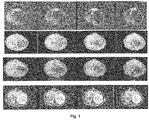
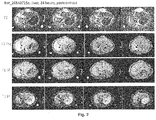
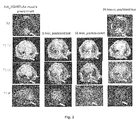
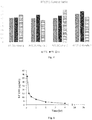
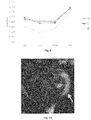
- Contrast agent RF1311 was prepared following the method outlined in Example 1 above. Following the above-noted procedure, two groups of rats were administered contrast agent RF1311 at a dose of 40mg/kg. The resultant MR image and corresponding tissue sample are shown in Figs. 1 , 2 and 3 . The summary of contrast ratios with respect to time is shown in Fig. 4 . This demonstrates the clear effect of RF1311 in differentiating necrotic from healthy tissue.
- results illustrate the necrotic tissue visible in the MR images. These results indicate that the contrast agent localized to the necrotic tissue portion of the tissue sample.
- Contrast agent RF1311 was prepared following the method outlined in Example 1 above. Rats were intravenously administered contrast agent RF1311 at a dose of 30 mg/kg. The plasma concentration of RF1311 was measured over time and is illustrated in Figure 5 . Each point is the mean +/- SE of the results from three different determinations.
- Table 1 Parameter Units Value AUC 0-tlast ⁇ g-hr/mL 27.0 AUC 0- ⁇ ⁇ g-hr/mL 30.6 C 0 ⁇ g/mL 58.8 C max ⁇ g/mL 37.4 T max hr 0.083 K e hr -1 0.50 t 1/2(e) hr 1.38 MRT hr 1.57 Cl L/hr/kg 0.98 Vz L/kg 1.96 Vss L/kg 1.54
- Example 12 Changes in contrast ratio over time between infarcted and normal tissues in RF1311 treated rats over a 24 hour period under three different MRI conditions
- Rats weighing 300-400 grams were anesthetized with intraperitoneal injection of pentobarbital (Nembutal; Sanofi Sante Animale, Brussels, Belgium) at a dose of 40 mg/kg.
- pentobarbital Nambutal; Sanofi Sante Animale, Brussels, Belgium
- RPLI reperfused partial liver infarction
- RF1311 was administered by single bolus injection via tail vein at a dose of 40 mg/kg.
- the contrast ratio was measured over a 24 hour period under three different MRI conditions: turbo spin-echo (TSE), spin echo (SE), and inversion recovery (IR).
- TSE turbo spin-echo
- SE spin echo
- IR inversion recovery
- MI Myocardial infarction
- CA coronary artery
- CA reperfused MI was induced by pulling the exteriorized suture end in the closed-chest condition, which re-opened the detachable knot.
- Compound RF1311 was administered by bolus injection at 40 mg/kg over a 5 minute period.
- MRI images (in vivo and ex vivo) and photographs of heart tissues were obtained, as described below.
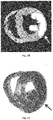
- Figs. 7A-7D The results of the testing of compound RF1311 are shown in Figs. 7A-7D .
- Fig. 7A is an MRI image showing a slice of a heart taken in vivo after 24 hours post injection with RF1311 . The heart was removed and dissected to give a slice of cardiac tissue corresponding to the image in Fig. 7A .
- Fig. 7B is an MRI image of the cardiac tissue taken ex vivo.
- Fig. 7C is a photograph of the cardiac tissue used for the MRI of Fig. 7B .
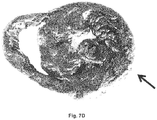
- Fig. 7D is a photograph of the cardiac tissue used in Figs.
- necrotic tissue was stained with triphenyltetrazolium chloride (TTC) to show necrotic tissue as a white area.
- TTC triphenyltetrazolium chloride
- the necrotic tissue is identified by the arrow, and the arrow in Figs. 7A to 7C point to the same location.
- the necrotic tissue is stained by RF1311 as shown in Fig. 7A and 7B .
Landscapes
- Chemical & Material Sciences (AREA)
- Health & Medical Sciences (AREA)
- Organic Chemistry (AREA)
- Nuclear Medicine, Radiotherapy & Molecular Imaging (AREA)
- Veterinary Medicine (AREA)
- Life Sciences & Earth Sciences (AREA)
- Animal Behavior & Ethology (AREA)
- General Health & Medical Sciences (AREA)
- Public Health (AREA)
- Epidemiology (AREA)
- Radiology & Medical Imaging (AREA)
- Medicinal Chemistry (AREA)
- Pharmacology & Pharmacy (AREA)
- Medicines Containing Antibodies Or Antigens For Use As Internal Diagnostic Agents (AREA)
- Magnetic Resonance Imaging Apparatus (AREA)
Applications Claiming Priority (3)
| Application Number | Priority Date | Filing Date | Title |
|---|---|---|---|
| US201462090519P | 2014-12-11 | 2014-12-11 | |
| US201562189414P | 2015-07-07 | 2015-07-07 | |
| PCT/CA2015/051304 WO2016090491A1 (en) | 2014-12-11 | 2015-12-10 | Targeted contrast agents comprising a hydrazide functional group |
Publications (3)
| Publication Number | Publication Date |
|---|---|
| EP3229848A1 EP3229848A1 (en) | 2017-10-18 |
| EP3229848A4 EP3229848A4 (en) | 2018-07-18 |
| EP3229848B1 true EP3229848B1 (en) | 2020-08-12 |
Family
ID=56106370
Family Applications (1)
| Application Number | Title | Priority Date | Filing Date |
|---|---|---|---|
| EP15866520.8A Active EP3229848B1 (en) | 2014-12-11 | 2015-12-10 | Targeted contrast agents comprising a hydrazide functional group |
Country Status (6)
| Country | Link |
|---|---|
| US (1) | US10286090B2 (enExample) |
| EP (1) | EP3229848B1 (enExample) |
| JP (1) | JP6796594B2 (enExample) |
| CN (1) | CN106999610A (enExample) |
| CA (1) | CA2968261C (enExample) |
| WO (1) | WO2016090491A1 (enExample) |
Families Citing this family (5)
| Publication number | Priority date | Publication date | Assignee | Title |
|---|---|---|---|---|
| KR101864992B1 (ko) * | 2017-03-09 | 2018-07-04 | 국립암센터 | Mri 노이즈 제거용 조성물 및 이를 이용한 패드 |
| CN107353258B (zh) * | 2017-06-19 | 2019-09-24 | 南京科技职业学院 | 两种二核含钆磁共振成像对比剂及其制备与应用 |
| CN110511176A (zh) * | 2019-09-12 | 2019-11-29 | 陕西科技大学 | 双(2-邻苯二甲酰亚胺)胺及其制备方法 |
| CN111606838B (zh) * | 2020-06-19 | 2023-06-30 | 宁夏大学 | 一种双吲哚基甲烷类化合物的制备方法 |
| CN111825703B (zh) * | 2020-08-04 | 2023-06-23 | 江西司太立制药有限公司 | 一种钆贝葡胺注射液杂质的制备方法 |
Family Cites Families (16)
| Publication number | Priority date | Publication date | Assignee | Title |
|---|---|---|---|---|
| US3621018A (en) | 1968-06-28 | 1971-11-16 | Hooker Chemical Corp | 2,6-diketo-n-carboxymethylmorpholine |
| US5679810A (en) | 1990-01-19 | 1997-10-21 | Salutar, Inc. | Linear oligomeric polychelant compounds |
| US6875864B2 (en) | 1991-08-01 | 2005-04-05 | Bracco International B.V. | Aminocarboxylate ligands having substituted aromatic amide moieties |
| DE19744003B4 (de) * | 1997-09-26 | 2004-07-08 | Schering Ag | Kontrastmittel für das Infarkt- und Nekroseimaging |
| US6093382A (en) | 1998-05-16 | 2000-07-25 | Bracco Research Usa Inc. | Metal complexes derivatized with folate for use in diagnostic and therapeutic applications |
| EP0998946A1 (en) | 1998-08-14 | 2000-05-10 | K.U. Leuven Research & Development | Non-porphyrin compound for use as a diagnosticum and/or pharmaceutical |
| US6146615A (en) | 1999-01-11 | 2000-11-14 | The University Of Toledo | Contrast agents for image enhancement in magnetic resonance imaging |
| US6641797B2 (en) | 2000-08-11 | 2003-11-04 | Schering Aktiengesellschaft | Perfluoroalkyl-containing complexes with sugar radicals, process for their production and their use |
| WO2002038546A1 (en) | 2000-11-08 | 2002-05-16 | K.U. Leuven Research & Development | Substituted bis-indole derivatives useful as contrast agents, pharmaceutical compositions containing them and intermediates for producing them |
| GB2368843A (en) * | 2000-11-08 | 2002-05-15 | Leuven K U Res & Dev | Non-porphyrin multipurpose contrast agents |
| DE10105014C2 (de) | 2001-01-26 | 2003-03-27 | Schering Ag | Neues Verfahren zur Herstellung von Monoamiden der DTPA |
| JP2006518727A (ja) * | 2003-02-17 | 2006-08-17 | アッパートン リミテッド | キャリヤー、ターゲッティング部分、および造影剤を含んでいる医療用イメージングのための接合体 |
| GB0317467D0 (en) * | 2003-07-25 | 2003-08-27 | Leuven K U Res & Dev | Tissue infraction and necrosis specific compounds |
| CN101568352B (zh) * | 2007-01-11 | 2013-08-21 | 免疫医学股份有限公司 | 用于蛋白质、肽和其他分子的改进的f-18标记的方法和组合物 |
| EP2651411B1 (en) | 2010-12-13 | 2020-09-16 | Immunomedics, Inc. | Methods and compositions for improved f-18 labeling of proteins, peptides and other molecules |
| CN103547290A (zh) * | 2011-04-20 | 2014-01-29 | Rf医疗公司 | 靶向造影剂及其用途 |
-
2015
- 2015-12-10 JP JP2017549559A patent/JP6796594B2/ja not_active Expired - Fee Related
- 2015-12-10 WO PCT/CA2015/051304 patent/WO2016090491A1/en not_active Ceased
- 2015-12-10 US US15/534,352 patent/US10286090B2/en active Active
- 2015-12-10 EP EP15866520.8A patent/EP3229848B1/en active Active
- 2015-12-10 CN CN201580066846.8A patent/CN106999610A/zh active Pending
- 2015-12-10 CA CA2968261A patent/CA2968261C/en active Active
Non-Patent Citations (1)
| Title |
|---|
| None * |
Also Published As
| Publication number | Publication date |
|---|---|
| WO2016090491A1 (en) | 2016-06-16 |
| CA2968261C (en) | 2021-08-17 |
| US20170340757A1 (en) | 2017-11-30 |
| US10286090B2 (en) | 2019-05-14 |
| CA2968261A1 (en) | 2016-06-16 |
| CN106999610A (zh) | 2017-08-01 |
| EP3229848A1 (en) | 2017-10-18 |
| JP6796594B2 (ja) | 2020-12-09 |
| JP2018502150A (ja) | 2018-01-25 |
| EP3229848A4 (en) | 2018-07-18 |
Similar Documents
| Publication | Publication Date | Title |
|---|---|---|
| US20140065075A1 (en) | Targeted contrast agents and uses thereof | |
| CN108368067B (zh) | 二聚造影剂 | |
| US10286090B2 (en) | Targeted contrast agents comprising a hydrazide functional group | |
| BRPI0617151B1 (pt) | Composto, multímero, composto vetorizado, complexo do referido composto, bem como composições farmacêutica, farmacêutica lipídica e de diagnóstico para imagiologia por ressonância magnética e processo para a preparação de um complexo metálico | |
| US10207013B2 (en) | Gadolinium-based contrast agents for sensitive detection of Zn2+ with MRI | |
| CN109963838B (zh) | 二聚造影剂 | |
| EP4076542A1 (en) | Highly efficient myeloperoxidase activatable imaging agents | |
| US20150297761A1 (en) | Peptidic structures incorporating an amino acid metal complex and applications in magnetic resonance imaging | |
| JP2004526671A (ja) | 診断および治療への適用において使用するための抗酸化剤の金属キレート配位子との結合体 | |
| JP2024520899A (ja) | アルデヒドのin vivo検出のための分子プローブ | |
| NL2033714B1 (en) | Multiplexing targeting and imaging agents | |
| ES2835065T3 (es) | Agentes de contraste | |
| BR112017026135B1 (pt) | Compostos de quelato de gadolínio, seus intermediários, seus usos e seu método de preparação, e método para geração de imagem de tecido corporal em um paciente | |
| HK1257515A1 (en) | Dimeric contrast agents | |
| HK1257515B (en) | Dimeric contrast agents | |
| CA2995210A1 (en) | Manganese-based chelate conjugates for molecular mr imaging |
Legal Events
| Date | Code | Title | Description |
|---|---|---|---|
| STAA | Information on the status of an ep patent application or granted ep patent |
Free format text: STATUS: THE INTERNATIONAL PUBLICATION HAS BEEN MADE |
|
| PUAI | Public reference made under article 153(3) epc to a published international application that has entered the european phase |
Free format text: ORIGINAL CODE: 0009012 |
|
| STAA | Information on the status of an ep patent application or granted ep patent |
Free format text: STATUS: REQUEST FOR EXAMINATION WAS MADE |
|
| 17P | Request for examination filed |
Effective date: 20170628 |
|
| AK | Designated contracting states |
Kind code of ref document: A1 Designated state(s): AL AT BE BG CH CY CZ DE DK EE ES FI FR GB GR HR HU IE IS IT LI LT LU LV MC MK MT NL NO PL PT RO RS SE SI SK SM TR |
|
| AX | Request for extension of the european patent |
Extension state: BA ME |
|
| DAV | Request for validation of the european patent (deleted) | ||
| DAX | Request for extension of the european patent (deleted) | ||
| REG | Reference to a national code |
Ref country code: DE Ref legal event code: R079 Ref document number: 602015057511 Country of ref document: DE Free format text: PREVIOUS MAIN CLASS: A61K0049000000 Ipc: A61K0049080000 |
|
| A4 | Supplementary search report drawn up and despatched |
Effective date: 20180619 |
|
| RIC1 | Information provided on ipc code assigned before grant |
Ipc: A61K 49/08 20060101AFI20180613BHEP Ipc: A61K 51/04 20060101ALI20180613BHEP Ipc: C07D 249/04 20060101ALI20180613BHEP Ipc: A61K 31/198 20060101ALI20180613BHEP Ipc: A61K 49/10 20060101ALI20180613BHEP Ipc: A61K 31/4192 20060101ALI20180613BHEP Ipc: C07D 403/12 20060101ALI20180613BHEP Ipc: A61K 31/395 20060101ALI20180613BHEP Ipc: C07D 209/42 20060101ALI20180613BHEP Ipc: C07D 403/14 20060101ALI20180613BHEP Ipc: C07D 257/02 20060101ALI20180613BHEP Ipc: C07C 243/38 20060101ALI20180613BHEP Ipc: A61K 31/404 20060101ALI20180613BHEP |
|
| STAA | Information on the status of an ep patent application or granted ep patent |
Free format text: STATUS: EXAMINATION IS IN PROGRESS |
|
| 17Q | First examination report despatched |
Effective date: 20190527 |
|
| GRAP | Despatch of communication of intention to grant a patent |
Free format text: ORIGINAL CODE: EPIDOSNIGR1 |
|
| STAA | Information on the status of an ep patent application or granted ep patent |
Free format text: STATUS: GRANT OF PATENT IS INTENDED |
|
| INTG | Intention to grant announced |
Effective date: 20200224 |
|
| GRAJ | Information related to disapproval of communication of intention to grant by the applicant or resumption of examination proceedings by the epo deleted |
Free format text: ORIGINAL CODE: EPIDOSDIGR1 |
|
| STAA | Information on the status of an ep patent application or granted ep patent |
Free format text: STATUS: EXAMINATION IS IN PROGRESS |
|
| GRAR | Information related to intention to grant a patent recorded |
Free format text: ORIGINAL CODE: EPIDOSNIGR71 |
|
| GRAS | Grant fee paid |
Free format text: ORIGINAL CODE: EPIDOSNIGR3 |
|
| STAA | Information on the status of an ep patent application or granted ep patent |
Free format text: STATUS: GRANT OF PATENT IS INTENDED |
|
| GRAA | (expected) grant |
Free format text: ORIGINAL CODE: 0009210 |
|
| STAA | Information on the status of an ep patent application or granted ep patent |
Free format text: STATUS: THE PATENT HAS BEEN GRANTED |
|
| INTC | Intention to grant announced (deleted) | ||
| AK | Designated contracting states |
Kind code of ref document: B1 Designated state(s): AL AT BE BG CH CY CZ DE DK EE ES FI FR GB GR HR HU IE IS IT LI LT LU LV MC MK MT NL NO PL PT RO RS SE SI SK SM TR |
|
| INTG | Intention to grant announced |
Effective date: 20200707 |
|
| REG | Reference to a national code |
Ref country code: CH Ref legal event code: EP |
|
| REG | Reference to a national code |
Ref country code: IE Ref legal event code: FG4D |
|
| REG | Reference to a national code |
Ref country code: DE Ref legal event code: R096 Ref document number: 602015057511 Country of ref document: DE |
|
| REG | Reference to a national code |
Ref country code: AT Ref legal event code: REF Ref document number: 1300879 Country of ref document: AT Kind code of ref document: T Effective date: 20200915 |
|
| REG | Reference to a national code |
Ref country code: LT Ref legal event code: MG4D |
|
| REG | Reference to a national code |
Ref country code: NL Ref legal event code: MP Effective date: 20200812 |
|
| PG25 | Lapsed in a contracting state [announced via postgrant information from national office to epo] |
Ref country code: NO Free format text: LAPSE BECAUSE OF FAILURE TO SUBMIT A TRANSLATION OF THE DESCRIPTION OR TO PAY THE FEE WITHIN THE PRESCRIBED TIME-LIMIT Effective date: 20201112 Ref country code: LT Free format text: LAPSE BECAUSE OF FAILURE TO SUBMIT A TRANSLATION OF THE DESCRIPTION OR TO PAY THE FEE WITHIN THE PRESCRIBED TIME-LIMIT Effective date: 20200812 Ref country code: GR Free format text: LAPSE BECAUSE OF FAILURE TO SUBMIT A TRANSLATION OF THE DESCRIPTION OR TO PAY THE FEE WITHIN THE PRESCRIBED TIME-LIMIT Effective date: 20201113 Ref country code: BG Free format text: LAPSE BECAUSE OF FAILURE TO SUBMIT A TRANSLATION OF THE DESCRIPTION OR TO PAY THE FEE WITHIN THE PRESCRIBED TIME-LIMIT Effective date: 20201112 Ref country code: SE Free format text: LAPSE BECAUSE OF FAILURE TO SUBMIT A TRANSLATION OF THE DESCRIPTION OR TO PAY THE FEE WITHIN THE PRESCRIBED TIME-LIMIT Effective date: 20200812 Ref country code: HR Free format text: LAPSE BECAUSE OF FAILURE TO SUBMIT A TRANSLATION OF THE DESCRIPTION OR TO PAY THE FEE WITHIN THE PRESCRIBED TIME-LIMIT Effective date: 20200812 Ref country code: FI Free format text: LAPSE BECAUSE OF FAILURE TO SUBMIT A TRANSLATION OF THE DESCRIPTION OR TO PAY THE FEE WITHIN THE PRESCRIBED TIME-LIMIT Effective date: 20200812 |
|
| REG | Reference to a national code |
Ref country code: AT Ref legal event code: MK05 Ref document number: 1300879 Country of ref document: AT Kind code of ref document: T Effective date: 20200812 |
|
| PG25 | Lapsed in a contracting state [announced via postgrant information from national office to epo] |
Ref country code: IS Free format text: LAPSE BECAUSE OF FAILURE TO SUBMIT A TRANSLATION OF THE DESCRIPTION OR TO PAY THE FEE WITHIN THE PRESCRIBED TIME-LIMIT Effective date: 20201212 Ref country code: LV Free format text: LAPSE BECAUSE OF FAILURE TO SUBMIT A TRANSLATION OF THE DESCRIPTION OR TO PAY THE FEE WITHIN THE PRESCRIBED TIME-LIMIT Effective date: 20200812 Ref country code: PL Free format text: LAPSE BECAUSE OF FAILURE TO SUBMIT A TRANSLATION OF THE DESCRIPTION OR TO PAY THE FEE WITHIN THE PRESCRIBED TIME-LIMIT Effective date: 20200812 Ref country code: RS Free format text: LAPSE BECAUSE OF FAILURE TO SUBMIT A TRANSLATION OF THE DESCRIPTION OR TO PAY THE FEE WITHIN THE PRESCRIBED TIME-LIMIT Effective date: 20200812 Ref country code: NL Free format text: LAPSE BECAUSE OF FAILURE TO SUBMIT A TRANSLATION OF THE DESCRIPTION OR TO PAY THE FEE WITHIN THE PRESCRIBED TIME-LIMIT Effective date: 20200812 |
|
| PG25 | Lapsed in a contracting state [announced via postgrant information from national office to epo] |
Ref country code: SM Free format text: LAPSE BECAUSE OF FAILURE TO SUBMIT A TRANSLATION OF THE DESCRIPTION OR TO PAY THE FEE WITHIN THE PRESCRIBED TIME-LIMIT Effective date: 20200812 Ref country code: RO Free format text: LAPSE BECAUSE OF FAILURE TO SUBMIT A TRANSLATION OF THE DESCRIPTION OR TO PAY THE FEE WITHIN THE PRESCRIBED TIME-LIMIT Effective date: 20200812 Ref country code: EE Free format text: LAPSE BECAUSE OF FAILURE TO SUBMIT A TRANSLATION OF THE DESCRIPTION OR TO PAY THE FEE WITHIN THE PRESCRIBED TIME-LIMIT Effective date: 20200812 Ref country code: CZ Free format text: LAPSE BECAUSE OF FAILURE TO SUBMIT A TRANSLATION OF THE DESCRIPTION OR TO PAY THE FEE WITHIN THE PRESCRIBED TIME-LIMIT Effective date: 20200812 Ref country code: DK Free format text: LAPSE BECAUSE OF FAILURE TO SUBMIT A TRANSLATION OF THE DESCRIPTION OR TO PAY THE FEE WITHIN THE PRESCRIBED TIME-LIMIT Effective date: 20200812 |
|
| REG | Reference to a national code |
Ref country code: DE Ref legal event code: R097 Ref document number: 602015057511 Country of ref document: DE |
|
| PG25 | Lapsed in a contracting state [announced via postgrant information from national office to epo] |
Ref country code: AL Free format text: LAPSE BECAUSE OF FAILURE TO SUBMIT A TRANSLATION OF THE DESCRIPTION OR TO PAY THE FEE WITHIN THE PRESCRIBED TIME-LIMIT Effective date: 20200812 Ref country code: AT Free format text: LAPSE BECAUSE OF FAILURE TO SUBMIT A TRANSLATION OF THE DESCRIPTION OR TO PAY THE FEE WITHIN THE PRESCRIBED TIME-LIMIT Effective date: 20200812 Ref country code: ES Free format text: LAPSE BECAUSE OF FAILURE TO SUBMIT A TRANSLATION OF THE DESCRIPTION OR TO PAY THE FEE WITHIN THE PRESCRIBED TIME-LIMIT Effective date: 20200812 |
|
| PLBE | No opposition filed within time limit |
Free format text: ORIGINAL CODE: 0009261 |
|
| STAA | Information on the status of an ep patent application or granted ep patent |
Free format text: STATUS: NO OPPOSITION FILED WITHIN TIME LIMIT |
|
| PG25 | Lapsed in a contracting state [announced via postgrant information from national office to epo] |
Ref country code: SK Free format text: LAPSE BECAUSE OF FAILURE TO SUBMIT A TRANSLATION OF THE DESCRIPTION OR TO PAY THE FEE WITHIN THE PRESCRIBED TIME-LIMIT Effective date: 20200812 |
|
| 26N | No opposition filed |
Effective date: 20210514 |
|
| REG | Reference to a national code |
Ref country code: CH Ref legal event code: PL |
|
| PG25 | Lapsed in a contracting state [announced via postgrant information from national office to epo] |
Ref country code: MC Free format text: LAPSE BECAUSE OF FAILURE TO SUBMIT A TRANSLATION OF THE DESCRIPTION OR TO PAY THE FEE WITHIN THE PRESCRIBED TIME-LIMIT Effective date: 20200812 Ref country code: SI Free format text: LAPSE BECAUSE OF FAILURE TO SUBMIT A TRANSLATION OF THE DESCRIPTION OR TO PAY THE FEE WITHIN THE PRESCRIBED TIME-LIMIT Effective date: 20200812 |
|
| REG | Reference to a national code |
Ref country code: BE Ref legal event code: MM Effective date: 20201231 |
|
| PG25 | Lapsed in a contracting state [announced via postgrant information from national office to epo] |
Ref country code: IE Free format text: LAPSE BECAUSE OF NON-PAYMENT OF DUE FEES Effective date: 20201210 Ref country code: LU Free format text: LAPSE BECAUSE OF NON-PAYMENT OF DUE FEES Effective date: 20201210 |
|
| PG25 | Lapsed in a contracting state [announced via postgrant information from national office to epo] |
Ref country code: CH Free format text: LAPSE BECAUSE OF NON-PAYMENT OF DUE FEES Effective date: 20201231 Ref country code: LI Free format text: LAPSE BECAUSE OF NON-PAYMENT OF DUE FEES Effective date: 20201231 |
|
| PG25 | Lapsed in a contracting state [announced via postgrant information from national office to epo] |
Ref country code: TR Free format text: LAPSE BECAUSE OF FAILURE TO SUBMIT A TRANSLATION OF THE DESCRIPTION OR TO PAY THE FEE WITHIN THE PRESCRIBED TIME-LIMIT Effective date: 20200812 Ref country code: MT Free format text: LAPSE BECAUSE OF FAILURE TO SUBMIT A TRANSLATION OF THE DESCRIPTION OR TO PAY THE FEE WITHIN THE PRESCRIBED TIME-LIMIT Effective date: 20200812 Ref country code: CY Free format text: LAPSE BECAUSE OF FAILURE TO SUBMIT A TRANSLATION OF THE DESCRIPTION OR TO PAY THE FEE WITHIN THE PRESCRIBED TIME-LIMIT Effective date: 20200812 |
|
| PG25 | Lapsed in a contracting state [announced via postgrant information from national office to epo] |
Ref country code: MK Free format text: LAPSE BECAUSE OF FAILURE TO SUBMIT A TRANSLATION OF THE DESCRIPTION OR TO PAY THE FEE WITHIN THE PRESCRIBED TIME-LIMIT Effective date: 20200812 |
|
| PG25 | Lapsed in a contracting state [announced via postgrant information from national office to epo] |
Ref country code: PT Free format text: LAPSE BECAUSE OF FAILURE TO SUBMIT A TRANSLATION OF THE DESCRIPTION OR TO PAY THE FEE WITHIN THE PRESCRIBED TIME-LIMIT Effective date: 20200812 Ref country code: BE Free format text: LAPSE BECAUSE OF NON-PAYMENT OF DUE FEES Effective date: 20201231 |
|
| PGFP | Annual fee paid to national office [announced via postgrant information from national office to epo] |
Ref country code: GB Payment date: 20241219 Year of fee payment: 10 |
|
| PGFP | Annual fee paid to national office [announced via postgrant information from national office to epo] |
Ref country code: FR Payment date: 20241223 Year of fee payment: 10 |
|
| PGFP | Annual fee paid to national office [announced via postgrant information from national office to epo] |
Ref country code: IT Payment date: 20241219 Year of fee payment: 10 |
|
| PGFP | Annual fee paid to national office [announced via postgrant information from national office to epo] |
Ref country code: DE Payment date: 20241227 Year of fee payment: 10 |