EP3224232B1 - Verfahren zur rückgewinnung von bernsteinsäurekristallen unter verwendung von tensiden während der kristallisation und daraus erhaltene kristalle - Google Patents
Verfahren zur rückgewinnung von bernsteinsäurekristallen unter verwendung von tensiden während der kristallisation und daraus erhaltene kristalle Download PDFInfo
- Publication number
- EP3224232B1 EP3224232B1 EP15808746.0A EP15808746A EP3224232B1 EP 3224232 B1 EP3224232 B1 EP 3224232B1 EP 15808746 A EP15808746 A EP 15808746A EP 3224232 B1 EP3224232 B1 EP 3224232B1
- Authority
- EP
- European Patent Office
- Prior art keywords
- succinic acid
- crystals
- preferentially
- crystallization
- acid crystals
- Prior art date
- Legal status (The legal status is an assumption and is not a legal conclusion. Google has not performed a legal analysis and makes no representation as to the accuracy of the status listed.)
- Active
Links
Images


Classifications
-
- C—CHEMISTRY; METALLURGY
- C07—ORGANIC CHEMISTRY
- C07C—ACYCLIC OR CARBOCYCLIC COMPOUNDS
- C07C51/00—Preparation of carboxylic acids or their salts, halides or anhydrides
- C07C51/42—Separation; Purification; Stabilisation; Use of additives
- C07C51/43—Separation; Purification; Stabilisation; Use of additives by change of the physical state, e.g. crystallisation
-
- C—CHEMISTRY; METALLURGY
- C07—ORGANIC CHEMISTRY
- C07C—ACYCLIC OR CARBOCYCLIC COMPOUNDS
- C07C55/00—Saturated compounds having more than one carboxyl group bound to acyclic carbon atoms
- C07C55/02—Dicarboxylic acids
- C07C55/10—Succinic acid
Definitions
- the subject of the present invention is an improved method for recovering succinic acid crystals, one of whose originalities is based on a double crystallization and the use of surfactants during the first crystallization step.
- crystals are finally obtained with a color number b in the reference frame (L, a, b) of less than or equal to 1.00, which is the guarantee of products of excellent stability, capable of be used to make polymeric materials without altering their color.
- Succinic acid is an organic acid with two carboxyl groups, of semi-developed formula COOH-CH 2 -CH 2 -COOH, which today has many applications in the cosmetics, food, pharmaceutical, textiles and in the plastics industry. As an example for this latter application, it can be used as synthesis intermediate in the manufacture of 1,4 butanediol, tetrahydrofuran and gamma-butyrolactone.
- succinic acid was produced synthesized by processes centered on raw materials of fossil origin. Alternatives to these methods were then developed, involving bio-sourced products. As such, succinic acid can today be produced from renewable raw materials: in this case through fermentation processes.
- Various microorganisms are known for their ability to produce succinic acid along this pathway such as Actinobacillus succinogenes, Mannheimia succiniciproducens, Escherichia coli, or Aspergillus niger and Saccharomyces cerevisiae.
- the fermentation products contain substantial quantities of impurities (biomass debris, sugars, amino acids, trace elements, salts, etc.) which are all precursors of coloration likely by their presence, even in the form of traces. in the final product, to influence the quality of the purified succinic acid, and consequently the quality of the polymer synthesized from the purified succinic acid.
- Nanofiltration is also a recognized technique for purifying succinic acid crystals: the document CN 101475464 is an example.
- any colorimetric measurement is based on the opposing color theory which specifies that the responses of the cones (cells of the retina of the human eye responsible for color vision) to the colors red, green and blue are recombined into opposite signals. "Black-white”, “red-green” and “yellow-blue” when transmitted to the brain by the optic nerve. This measure is based in particular on the color scales widely used in the food and polymer industries, called “L” scales, "a”, “b” by HUNTER. We also speak of "reference (L, a, b)".
- This process is based in particular on the introduction of surfactants during a first crystallization step. This is followed by subsequent steps of dissolution of the crystals formed, purification of the solution obtained in particular by treatment with activated carbon and / or ion exchange resins, by a second crystallization step, then by drying and cooling the crystals obtained.
- the process according to the present invention implements 2 crystallization steps.
- the first crystallization step leads to crystals in the form of "beads", which will be seen to improve certain aspects of the process in question.
- the "balls” are contrasted with the “needles” which are the other most common form according to which succinic acid crystals can be obtained.
- said beads may be positively defined through a so-called “sphericity” index.
- This index is throughout the present application determined visually from the standard definition of Rittenhouse shape ( “Agglomeration in Industry", W. Pietsch, p.600 vol. 2, 2005 Wiley-VCH ), which consists of associating a sphericity index with a visual appreciation of the shape of the particles observed.
- the figure 1 in particular, the grid for the evaluation and award of marks according to this test.
- the use of surfactant leads to the formation of beads in the form of beads in the first crystallization step, this form being retained subsequently in the process.
- crystal beads having a sphericity index, as measured by the Rittenhouse test, at least equal to 0.70, preferably at least 0.75, very preferably at least 0.85.
- this rinsing step consists of removing the residual mother liquors on the surface of the crystals.
- needle crystals tend to have more impurities in the form of mother liquors, that is, mother liquors that are physically trapped in the crystal. This results in a less good purification power that the surfactant can improve (" Handbook of Industrial Crystallization, 2nd Edition, Allan S. Myerson, p 259 ).
- the Applicant Company has also shown that the addition of surfactant makes it possible to recycle a portion of the mother liquors of crystallization and washing at the top of the first crystallization, which improves the yield of recovery of succinic acid and makes it possible to obtain a " b "according to the invention.
- the recovery yield is defined as the ratio of the mass of succinic acid crystals obtained after drying on the mass of succinic acid contained in the acidified fermentation juice (before step b). This return can also be expressed as a percentage.
- the surfactants should be used during the first crystallization step and not during the second crystallization step.
- the use of surfactants during the second crystallization step again generates needles and values of "b" unsatisfactory.
- the products obtained had an index "b" (in the reference L, a, b) lower than those obtained through the processes of the prior art involving only one crystallization and the combination of different steps based on ion exchange resins and activated carbon. It has shown that this index is less than or equal to 1.00 advantageously less than or equal to 0.90 and very preferably less than or equal to 0.80.
- surfactant means a compound that modifies the surface tension between two surfaces.
- Said surfactant is preferably chosen from nonionic surfactants, and preferably from polysorbates having an HLB greater than 15, for example of the Tween 20 type, from surfactants based on alkylene oxide block copolymers, for example of the Erol type. 18 (OPEN PMC) or Supra NS 1342 (HYPRO-Food), preferably block copolymers of propylene oxide and ethylene oxide and among those having in particular antifoam properties, without this list being exhaustive.
- the first step a) of the process according to the invention therefore consists in bringing the fermentation medium to a pH of between 1.0 and 4.0.
- the pH may especially be brought to a value of between 1.5 and 3.5 and preferably between 1.5 and 3.0.
- the fermentation medium typically contains bacteria selected from the bacterial strains of the genus Mannheimia, Anaerobiospirillum, Bacillus, or Escherichia, or among the fungal cells.
- the fungal strains may be chosen from Saccharomyces cervisiae, Saccharomyces uvarum, Saccharomyces bayanus, Schizosaccharomyces pombe, Aspergillus niger, Penicillium chrysogenum, P. symplissicum, Pichia stipidis, Kluyveromyces marxianus, K. lactis, K. thermotolerans, Yarrowia lipolytica and Candida sonorensis.
- the bacterial strains can be chosen from Mannheimia succiniciproducens, Anaerobiospirillum succiniciproducens Bacillus amylophyllus, B. ruminucola or col.
- the fermentation medium consists of any fermentation medium capable of generating succinic acid. It may include a carbon source such as glucose, fructose, galactose, xylose, arabinose, sucrose, lactose, raffinose or glycerol.
- a carbon source such as glucose, fructose, galactose, xylose, arabinose, sucrose, lactose, raffinose or glycerol.
- the fermentation may be aerobic or anobic in nature, or in particular conditions of oxygen deficiency, or results from a combination of these conditions, as described in the document WO 2009/083756 .
- a neutralization agent is then introduced into the fermentation medium, such as, for example, potassium or sodium hydroxide.
- the regulation of the pH in the desired zone can be carried out by all means accessible to those skilled in the art and likely to change the pH in this area.
- Dipolar electrodialysis can be mentioned in combination with strong or weak cationic resins (for example resins of the polystyrene divinylbenzene (DVB) type with sulphonic groups or resins based on maleic and fumaric acids), weak cationic resins or strong alone, or acidification by direct addition of hydrochloric acid or sulfuric acid.
- the second step b) of the process according to the invention consists in crystallizing the succinic acid from the fermentation medium resulting from step a) so as to form succinic acid crystals, and then separating the succinic acid crystals from the mother waters of crystallization and finally washing the acid crystals with water. Crystallization occurs according to all methods well known to those skilled in the art, either in batch or continuously and by cooling, in particular by direct contact with the crystallization medium or by flash cooling.
- washing it is carried out with water, preferably with deionized water, at a temperature of between 15 ° C. and 25 ° C., preferably at about 20 ° C.
- This recycling relates to at most 70% by weight of all the mother liquor and rinse, more preferably 20% to 60% more preferably 30% to 50% by weight thereof.
- This step is especially characterized in that at least one surfactant is introduced during this step and / or before this step, that is to say directly in the fermentation medium before crystallization.
- the surfactant or surfactants are introduced batchwise or continuously by pump via a metering pump.
- the amount of surfactant is preferably between 100 ppm to 5000 ppm, preferably between 500 ppm and 3000 ppm, more preferably between 1000 ppm and 2000 ppm, relative to the mass of succinic acid solution from step a) and arriving at the head of step b). From this step b), it should be noted that the succinic acid crystals obtained generally have a sphericity index, as measured according to the Rittenhouse test, of at least 0.70, preferably at least 0.75, and very preferably at least 0.85.
- the third step c) of the process according to the invention consists in dissolving the succinic acid crystals obtained following step b) in water, preferably deionized water, at a temperature of between 30 ° C. and 70 ° C to obtain a solution containing dissolved succinic acid.
- the succinic acid is dissolved so as to obtain a solids content of between 5% and 50% by weight of the total weight of said solution, preferably between 10% and 20%.
- the measurement is performed 10 times on the same sample which gives an uncertainty of +/- 0.05 on the result.
- Said measurement is performed on a spectrocolorimeter for measuring the reflection of the wavelength between 400 nm and 700 nm, such as for example the Dataflash 100 marketed by DATACOLOR. (Measuring aperture: 9 mm in diameter "Reading illuminant:” C2 Deg ").
- the composition according to the invention may comprise at least 50% by number of said succinic acid crystals, advantageously at least 70%, preferably at least 90%. Most preferably, the composition consists essentially of the crystals according to the invention.
- the crystals also have a reducing sugar content of less than 20 ppm, preferably less than 10 ppm, relative to the total weight of anhydrous crystals. This content is generally greater than 0.1 ppm.
- the sugars found are typically glucose, mannose, trehalose, isomaltose, maltose, maltulose, gentobiose and panose.
- Separation of biomass and fermentation juice and carried out by microfiltration is carried out at a temperature of 80 ° C in batch followed by a diafiltration step.
- the module is equipped with 2 casings of 25 m 2 , ceramic "Kerasep", with a porosity equal to 0.1 microns.
- the average permeate flow rate is about 2 m 3 / h with a transmembrane pressure of about 1 bar.
- the fermentation juice is treated with a weak cationic resin of AMBERLITE IRC 747 type at a rate of 2 BV / h at 60 ° C. in order to reach a divalent ion concentration of less than 5 ppm.
- the regeneration of the resins is carried out after having passed a volume of fermentation juice of between 30 and 40 times the volume of resin.
- the solution obtained is then acidified on an EDB (Electrolytic Electrodialysis bipolar) module Aqualyzer® EDBM EUR40 marketed by the EURODIA company at a pH of about 3.5.
- EDB Electrolytic Electrodialysis bipolar
- the solution is then treated with a strong cationic resin of the PUROLITE C150 type at a flow rate of 2 BV / h and a temperature of 40 ° C. in order to reach a pH of 2.0.
- the regeneration of the resins is carried out after having passed a volume of fermentation juice of between 15 and 20 times the volume of resin.
- the acidified solution is concentrated on a vacuum evaporator forced circulation plate sold by the company ALFA LAVAL at a concentration of 35% solids and at a temperature of 80 ° C. It is then crystallized continuously by flash cooling on two stages, each consisting of an external loop vacuum crystallizer marketed by GEA KESTNER.
- the vacuum in the crystallizers is set so as to obtain a temperature on the first stage of 40 ° C and on the second stage of 20 ° C.
- the residence time is about 5 hours.
- the surfactant In the case of the use of the surfactant, the latter is introduced continuously with the aid of a dosing pump at a flow rate equal to 1200 ppm with respect to the flow of solution which feeds the crystallizer.
- the surfactant chosen is EROL18 marketed by the company PMC OUVRIE.
- the crystallized mass is then separated on a SC 1200 batch centrifuge marketed by ROBATEL in order to recover the succinic acid crystals. During this step, the crystals are washed with deionized water at 20 ° C. with an amount equal to 1 kg / kg of crystals.
- the dissolution of the succinic acid crystals is carried out at a temperature of 45 ° C. with demineralized water so as to obtain a 10% solution of dry matter.
- the activated carbon treatment step is carried out with a CHEMVIRON CPG LF 12x40 granular coal on a column operating in a fixed bed.
- the solution flow rate in the column is set at 0.5 BV / h and the treated solution volume before bed renewal is variable depending on the desired operating conditions and quality. It is between 40 and 500 times the volume of coal in the column.
- the treatment step on ion exchange resins is carried out at a flow rate of 2 BV / h at 60 ° C on a strong cationic resin DOWEX 88 type and then on a weak anionic resin Lanxess Lewatit S4528.
- the regeneration of the resins is carried out after passing a volume of solution equal to 40 times the volume of resin.
- the purified succinic acid solution is concentrated on a falling film vacuum evaporator marketed by WIEGAND at a concentration of 30% solids and a temperature of 80 ° C. It is then crystallized continuously by flash cooling on two stages, each consisting of an external loop vacuum crystallizer marketed by GEA KESTNER.
- the vacuum in the crystallizers is set so as to obtain a temperature on the first stage of 40 ° C and on the second stage of 20 ° C.
- the residence time is approximately 7 hours.
- the crystallized mass is then separated on a SC 1200 batch centrifuge marketed by ROBATEL in order to recover the succinic acid crystals. During this step, the crystals are washed with deionized water at 20 ° C. with a quantity of crystals equal to 1 kg / kg.
- the product is dried on a rotary drier so as to obtain a residual moisture equal to 0.3% by weight of water relative to the total weight of product, then cooled on a fluidized bed at a temperature of 25 ° C.
- a fermentation medium is produced under the strict conditions of Example 5 of the document WO 2011/064151 . Only the devices used differ: the pre-culture stage is carried out on a Puntbus 6 L reactor, the growth phase on a 7 m 3 fermenter and the production phase on 2 fermenters of 70 m 3 .
- the separation of biomass and fermentation juice and carried out by microfiltration is carried out at a temperature of 80 ° C in batch followed by a diafiltration step.
- the module is equipped with 2 casings of 25 m 2 , ceramic "Kerasep", with a porosity equal to 0.1 microns.
- the average permeate flow rate is about 2 m 3 / h with a transmembrane pressure of about 1 bar.
- the fermentation juice is then treated on a strong cationic resin PUROLITE C150 type at a rate of 2 BV / h and a temperature of 40 ° C to reach a pH of 2.0.
- the regeneration of the resins is carried out after having passed a volume of fermentation juice between 15 and 20 times the volume of resin
- This example corresponds to carrying out tests according to or outside the invention (with or without surfactant), in a double crystallization process.
- Tests No. 1 to 3 are carried out according to the protocol given in Example 1 and without surfactant.
- Tests Nos. 4 to 6 are carried out according to the protocol given in Example 2 and without surfactant.
- Tests No. 7 and 8 are carried out according to the protocol given in Example 1, with 1200 ppm of EROL 18 as a surfactant.
- Tests Nos. 9 to 11 are carried out according to the protocol given in Example 2, with 1200 ppm of EROL 18 as a surfactant.
- the measurement of the index "b” is carried out on an average sample: a sample is taken every 12 hours for 15 days, then all of these samples are mixed together.
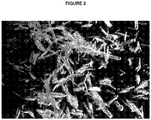
- figure 2 shows the morphology of the crystals obtained without surfactant (test n ° 1) which are needles whereas the figure 3 (Test No. 7) shows beads having an index well above 0.70.
- This example corresponds to carrying out tests outside the invention (with or without surfactant), in a single crystallization process.
Landscapes
- Chemical & Material Sciences (AREA)
- Organic Chemistry (AREA)
- Crystallography & Structural Chemistry (AREA)
- Engineering & Computer Science (AREA)
- Oil, Petroleum & Natural Gas (AREA)
- Organic Low-Molecular-Weight Compounds And Preparation Thereof (AREA)
- Preparation Of Compounds By Using Micro-Organisms (AREA)
Claims (15)
- Verfahren zur Herstellung von Bernsteinsäurekristallen basierend auf einem Bernsteinsäure enthaltenden Fermentationsmedium, welches die folgenden Schritte umfasst:a) Einstellung des Fermentationsmediums auf einen pH-Wert zwischen 1,0 und 4,0,b) Kristallisation der Bernsteinsäure des Fermentationsmediums aus Schritt a), so dass Bernsteinkristalle gebildet werden, anschließend Trennen der Bernsteinsäurekristalle von den Kristallisations-Mutterlaugen, dann Waschen der erhaltenen Kristalle mit Wasser,c) Lösen der nach Schritt b) erhaltenen Bernsteinsäurekristalle in Wasser bei einer Temperatur von 30-70 °C zum Erhalt einer Lösung, welche gelöste Bernsteinsäure enthält,d) Reinigung der in Schritt c) erhaltenen Bernsteinsäurelösung durch eine Behandlung auf Aktivkohle und auf Ionenaustauschharz,e) Kristallisation der in der in Schritt d) erhaltenen Lösung enthaltenen Bernsteinsäurelösung zur Bildung von Bernsteinsäurekristallen, anschließend Trennen der Bernsteinsäurekristalle von den Kristallisations-Mutterlaugen, dann Waschen der erhaltenen Kristalle mit Wasser,f) Trocknen der Bernsteinsäurekristalle bei einer Feuchtigkeit kleiner 0,5 % und Abkühlen auf eine Temperatur kleiner 30 °C,dadurch gekennzeichnet, dass vor und/oder während Schritt b) wenigstens ein oberflächenaktives Mittel eingeführt wird, bevorzugt während Schritt b).
- Verfahren nach Anspruch 1, dadurch gekennzeichnet, dass das oberflächenaktive Mittel gewählt ist aus nicht-ionischen oberflächenaktiven Mitteln, und bevorzugt aus Polysorbaten mit einem HLB größer 15 oder aus oberflächenaktiven Mitteln auf der Basis eines Alkylenoxid-Blockcopolymers.
- Verfahren nach einem der vorhergehenden Ansprüche, dadurch gekennzeichnet, dass der erste Schritt a) darin besteht, das Fermentationsmedium auf einen pH-Wert von 1,5 bis 3,5 einzustellen, bevorzugt von 2,0 bis 3,0.
- Verfahren nach einem der vorhergehenden Ansprüche, dadurch gekennzeichnet, dass das Fermentationsmedium Bakterien umfasst, die gewählt sind aus Bakterienstämmen der Gattungen Mannheimia, Anaerobiospirillum, Bacillus oder Escherichia oder aus Pilzstämmen.
- Verfahren nach einem der vorhergehenden Ansprüche, dadurch gekennzeichnet, dass im zweiten Schritt b) die Kristallisation als Batch oder fortlaufend und durch Kühlung erfolgt.
- Verfahren nach einem der vorhergehenden Ansprüche, dadurch gekennzeichnet, dass die Trennung der Kristalle von den Mutterlaugen durch Filtration oder Zentrifugieren erfolgt.
- Verfahren nach einem der vorhergehenden Ansprüche, dadurch gekennzeichnet, dass das Waschen mit Wasser erfolgt, bevorzugt mit demineralisiertem Wasser, bei einer Temperatur von 15 bis 25 °C, bevorzugt von ungefähr 20 °C.
- Verfahren nach einem der vorhergehenden Ansprüche, dadurch gekennzeichnet, dass ein Teil der Kristallisations- und Wasch-Mutterlaugen aus Schritt b) recycelt wird.
- Verfahren nach einem der vorhergehenden Ansprüche, dadurch gekennzeichnet, dass Schritt c) darin besteht, die Bernsteinsäurekristalle in Wasser zu lösen, um eine Trockensubstanz mit 5 bis 50 Gewichtsprozent des Gesamtgewichts der Lösung zu erhalten, bevorzugt zwischen 10 und 20 %.
- Verfahren nach einem der vorhergehenden Ansprüche, dadurch gekennzeichnet, dass im Verlauf von Schritt d) die Aktivkohle in Form von Pulver oder Granulat vorliegt, stärker bevorzugt als Granulat.
- Verfahren nach einem der vorhergehenden Ansprüche, dadurch gekennzeichnet, dass im Verlauf von Schritt e) die Gesamtheit der Kristallisations- und Wasch-Mutterlaugen aus Schritt b) recycelt wird.
- Verfahren nach einem der vorhergehenden Ansprüche, dadurch gekennzeichnet, dass Schritt f) darin besteht, die Bernsteinsäurekristalle bei einer Feuchtigkeit kleiner 0,5 %, bevorzugt kleiner 0,4 %, stark bevorzugt kleiner 0,3 Gewichtsprozent Wasser in Bezug auf das Trockengewicht der Bernsteinsäure zu trocknen und sie auf eine Temperatur kleiner 30 °C, bevorzugt kleiner 25 °C abzukühlen.
- Bernsteinsäurekristalle, welche basierend auf einem Bernsteinsäure enthaltenden Fermentationsmedium erhalten wurden, dadurch gekennzeichnet, dass sie einen Färbungsindex b aufweisen, gemessen im Bezugsrahmen L, a, b, kleiner gleich 1,00, bevorzugt kleiner gleich 0,90, stark bevorzugt kleiner gleich 0,80 und dass sie einen nach Rittenhouse gemessenen Sphärizitätsindex aufweisen, der wenigstens gleich 0,70, bevorzugt wenigstens gleich 0,75 und stark bevorzugt wenigstens gleich 0,85 ist.
- Bernsteinsäurekristalle nach dem vorhergehenden Anspruch, dadurch gekennzeichnet, dass sie einen Gehalt an reduzierenden Zuckern kleiner 20 ppm, bevorzugt kleiner 10 ppm, in Bezug auf das Gesamtgewicht an wasserfreien Kristallen aufweisen.
- Zusammensetzung, welche Bernsteinsäurekristalle nach einem der Ansprüche 13 oder 14 umfasst.
Applications Claiming Priority (2)
| Application Number | Priority Date | Filing Date | Title |
|---|---|---|---|
| FR1461470A FR3028864B1 (fr) | 2014-11-26 | 2014-11-26 | Procede de recuperation de cristaux d'acide succinique avec mise en œuvre de tensioactifs au cours de la cristallisation, cristaux obtenus et leurs utilisations |
| PCT/FR2015/053226 WO2016083749A1 (fr) | 2014-11-26 | 2015-11-26 | Procede de recuperation de cristaux d'acide succinique avec mise en œuvre de tensioactifs au cours de la cristallisation et cristaux obtenus |
Publications (2)
| Publication Number | Publication Date |
|---|---|
| EP3224232A1 EP3224232A1 (de) | 2017-10-04 |
| EP3224232B1 true EP3224232B1 (de) | 2018-09-26 |
Family
ID=52988148
Family Applications (1)
| Application Number | Title | Priority Date | Filing Date |
|---|---|---|---|
| EP15808746.0A Active EP3224232B1 (de) | 2014-11-26 | 2015-11-26 | Verfahren zur rückgewinnung von bernsteinsäurekristallen unter verwendung von tensiden während der kristallisation und daraus erhaltene kristalle |
Country Status (8)
| Country | Link |
|---|---|
| US (1) | US20170362157A1 (de) |
| EP (1) | EP3224232B1 (de) |
| CN (1) | CN107001224B (de) |
| BR (1) | BR112017010932B1 (de) |
| CA (1) | CA2968485C (de) |
| ES (1) | ES2703198T3 (de) |
| FR (1) | FR3028864B1 (de) |
| WO (1) | WO2016083749A1 (de) |
Families Citing this family (5)
| Publication number | Priority date | Publication date | Assignee | Title |
|---|---|---|---|---|
| KR102341902B1 (ko) | 2016-09-09 | 2021-12-21 | 카오카부시키가이샤 | 디카르복실산 결정 및 그 제조 방법 |
| JP6944746B2 (ja) * | 2016-09-09 | 2021-10-06 | 花王株式会社 | ジカルボン酸結晶及びその製造方法 |
| CN107245032B (zh) * | 2017-07-08 | 2020-06-05 | 桂林理工大学 | 一种从Bt发酵液中分离纯化琥珀酸的方法 |
| CN110396044A (zh) * | 2019-08-13 | 2019-11-01 | 广州怡和生物科技有限公司 | 一种丁二酸的提取方法 |
| CN117304019A (zh) * | 2022-06-22 | 2023-12-29 | 万华化学(四川)有限公司 | 一种晶体粒径均匀的丁二酸的制备方法 |
Family Cites Families (15)
| Publication number | Priority date | Publication date | Assignee | Title |
|---|---|---|---|---|
| US5168055A (en) | 1986-06-11 | 1992-12-01 | Rathin Datta | Fermentation and purification process for succinic acid |
| DE19705329A1 (de) * | 1997-02-12 | 1998-08-13 | Basf Ag | Dicarbonsäurekristallisate |
| US5958744A (en) | 1997-08-18 | 1999-09-28 | Applied Carbochemicals | Succinic acid production and purification |
| EP1198444A1 (de) * | 1999-07-23 | 2002-04-24 | Chemintel (India) Private Limited | Verfahren zur kristallisation von dicarbonsäuren |
| FR2910823B1 (fr) | 2006-12-29 | 2009-02-13 | Applexion | Procede de purification d'acides oroganiques |
| KR20090066958A (ko) | 2007-12-20 | 2009-06-24 | 한국과학기술원 | 배양액의 결정화에 의한 숙신산 정제방법 |
| KR20100109902A (ko) | 2007-12-28 | 2010-10-11 | 로께뜨프레르 | 대규모 미생물 배양 방법 |
| CN101215583B (zh) | 2008-01-18 | 2010-11-10 | 南京工业大学 | 一种发酵与膜分离单元耦合制备丁二酸的方法 |
| CN101475464B (zh) | 2009-02-09 | 2011-08-31 | 南京工业大学 | 一种利用纳滤从丁二酸发酵液中分离提取丁二酸的方法 |
| CN102051687B (zh) * | 2009-11-03 | 2012-07-25 | 中国科学院化学研究所 | 应用表面活性剂分子c18n3制备金晶体的方法 |
| US20120238722A1 (en) * | 2009-11-24 | 2012-09-20 | Roquette Freres Sa | Process for the crystallization of succinic acid |
| JP2013516180A (ja) | 2009-12-31 | 2013-05-13 | ミリアント・コーポレイション | コハク酸アンモニウムを含有する発酵ブロスからのコハク酸の精製 |
| FR2987678B1 (fr) * | 2012-03-02 | 2016-04-15 | Roquette Freres | Methode de mesure de la stabilite thermique d'un acide succinique cristallin destine a la fabrication de polymeres |
| EP2847342B1 (de) | 2012-05-07 | 2020-08-12 | Archer Daniels Midland Co. | Reinigung von bernsteinsäure |
| DE102013000027A1 (de) | 2013-01-03 | 2014-07-03 | Thyssenkrupp Industrial Solutions Ag | Verfahren zur Aufreinigung von Carbonsäuren aus Fermentationsbrühen |
-
2014
- 2014-11-26 FR FR1461470A patent/FR3028864B1/fr active Active
-
2015
- 2015-11-26 BR BR112017010932-8A patent/BR112017010932B1/pt not_active IP Right Cessation
- 2015-11-26 CN CN201580064285.8A patent/CN107001224B/zh active Active
- 2015-11-26 EP EP15808746.0A patent/EP3224232B1/de active Active
- 2015-11-26 WO PCT/FR2015/053226 patent/WO2016083749A1/fr not_active Ceased
- 2015-11-26 US US15/529,648 patent/US20170362157A1/en not_active Abandoned
- 2015-11-26 ES ES15808746T patent/ES2703198T3/es active Active
- 2015-11-26 CA CA2968485A patent/CA2968485C/fr active Active
Non-Patent Citations (1)
| Title |
|---|
| None * |
Also Published As
| Publication number | Publication date |
|---|---|
| CA2968485C (fr) | 2023-08-29 |
| CA2968485A1 (fr) | 2016-06-02 |
| US20170362157A1 (en) | 2017-12-21 |
| WO2016083749A1 (fr) | 2016-06-02 |
| EP3224232A1 (de) | 2017-10-04 |
| CN107001224A (zh) | 2017-08-01 |
| FR3028864A1 (fr) | 2016-05-27 |
| BR112017010932B1 (pt) | 2021-01-19 |
| ES2703198T3 (es) | 2019-03-07 |
| BR112017010932A2 (pt) | 2018-01-09 |
| CN107001224B (zh) | 2021-07-20 |
| FR3028864B1 (fr) | 2018-05-18 |
Similar Documents
| Publication | Publication Date | Title |
|---|---|---|
| EP3224232B1 (de) | Verfahren zur rückgewinnung von bernsteinsäurekristallen unter verwendung von tensiden während der kristallisation und daraus erhaltene kristalle | |
| EP3877458B1 (de) | Verfahren zur herstellung von terephthalsäure im industriellen massstab | |
| KR101768561B1 (ko) | 당액의 제조방법 | |
| BE1018561A3 (fr) | Procede de purification de l'acide lactique par cristallisation. | |
| EP3887532B1 (de) | Reinigung von magnesiumlactat aus fermentationsbrühen mit hohen mengen an verunreinigungen | |
| EP2820396B1 (de) | Verfahren zur messung der wärmestabilität eines bernsteinsäurekristalls zur herstellung von polymeren | |
| FR2974803A1 (fr) | Procede de preparation d'un acide glycolique partiellement purifie | |
| US10189767B2 (en) | Process for manufacturing succinic acid from a fermentation broth using nano filtration to purify recycled mother liquor | |
| EP1157980B1 (de) | Herstellung von Milchsäure durch Verdampfungs-Kristallisationsverfahren | |
| FR2974804A1 (fr) | Procede de preparation d'un acide glycolique de haute purete | |
| FR2974802A1 (fr) | Procede de purification de l'acide glycolique par distillation | |
| EP2921471A1 (de) | Extraktionsverfahren von aconitsäure aus produkten der zuckerrohrindustrie | |
| EP2275399B1 (de) | Flüssige Milchsäurezusammensetzung und Verfahren zu deren Herstellung | |
| FR3067350A1 (fr) | Procede d'obtention d'une solution d'acide glucarique libre et solution obtenue | |
| BE1019857A3 (fr) | Procede de separation des deux isomeres de l'acide lactique et utilisation des isomeres ainsi recuperes. | |
| FR3093517A1 (fr) | Procédé de décoloration de sucre avec recyclage des effluents | |
| WO2014118448A1 (fr) | Procede de purification de l'acide glycolique par traitement thermique |
Legal Events
| Date | Code | Title | Description |
|---|---|---|---|
| STAA | Information on the status of an ep patent application or granted ep patent |
Free format text: STATUS: THE INTERNATIONAL PUBLICATION HAS BEEN MADE |
|
| PUAI | Public reference made under article 153(3) epc to a published international application that has entered the european phase |
Free format text: ORIGINAL CODE: 0009012 |
|
| STAA | Information on the status of an ep patent application or granted ep patent |
Free format text: STATUS: REQUEST FOR EXAMINATION WAS MADE |
|
| 17P | Request for examination filed |
Effective date: 20170519 |
|
| AK | Designated contracting states |
Kind code of ref document: A1 Designated state(s): AL AT BE BG CH CY CZ DE DK EE ES FI FR GB GR HR HU IE IS IT LI LT LU LV MC MK MT NL NO PL PT RO RS SE SI SK SM TR |
|
| AX | Request for extension of the european patent |
Extension state: BA ME |
|
| DAV | Request for validation of the european patent (deleted) | ||
| DAX | Request for extension of the european patent (deleted) | ||
| GRAP | Despatch of communication of intention to grant a patent |
Free format text: ORIGINAL CODE: EPIDOSNIGR1 |
|
| STAA | Information on the status of an ep patent application or granted ep patent |
Free format text: STATUS: GRANT OF PATENT IS INTENDED |
|
| INTG | Intention to grant announced |
Effective date: 20180413 |
|
| GRAS | Grant fee paid |
Free format text: ORIGINAL CODE: EPIDOSNIGR3 |
|
| GRAA | (expected) grant |
Free format text: ORIGINAL CODE: 0009210 |
|
| STAA | Information on the status of an ep patent application or granted ep patent |
Free format text: STATUS: THE PATENT HAS BEEN GRANTED |
|
| AK | Designated contracting states |
Kind code of ref document: B1 Designated state(s): AL AT BE BG CH CY CZ DE DK EE ES FI FR GB GR HR HU IE IS IT LI LT LU LV MC MK MT NL NO PL PT RO RS SE SI SK SM TR |
|
| REG | Reference to a national code |
Ref country code: GB Ref legal event code: FG4D Free format text: NOT ENGLISH |
|
| REG | Reference to a national code |
Ref country code: CH Ref legal event code: EP |
|
| REG | Reference to a national code |
Ref country code: AT Ref legal event code: REF Ref document number: 1045840 Country of ref document: AT Kind code of ref document: T Effective date: 20181015 |
|
| REG | Reference to a national code |
Ref country code: IE Ref legal event code: FG4D Free format text: LANGUAGE OF EP DOCUMENT: FRENCH |
|
| REG | Reference to a national code |
Ref country code: DE Ref legal event code: R096 Ref document number: 602015017243 Country of ref document: DE |
|
| REG | Reference to a national code |
Ref country code: NL Ref legal event code: FP |
|
| PG25 | Lapsed in a contracting state [announced via postgrant information from national office to epo] |
Ref country code: FI Free format text: LAPSE BECAUSE OF FAILURE TO SUBMIT A TRANSLATION OF THE DESCRIPTION OR TO PAY THE FEE WITHIN THE PRESCRIBED TIME-LIMIT Effective date: 20180926 Ref country code: LT Free format text: LAPSE BECAUSE OF FAILURE TO SUBMIT A TRANSLATION OF THE DESCRIPTION OR TO PAY THE FEE WITHIN THE PRESCRIBED TIME-LIMIT Effective date: 20180926 Ref country code: SE Free format text: LAPSE BECAUSE OF FAILURE TO SUBMIT A TRANSLATION OF THE DESCRIPTION OR TO PAY THE FEE WITHIN THE PRESCRIBED TIME-LIMIT Effective date: 20180926 Ref country code: NO Free format text: LAPSE BECAUSE OF FAILURE TO SUBMIT A TRANSLATION OF THE DESCRIPTION OR TO PAY THE FEE WITHIN THE PRESCRIBED TIME-LIMIT Effective date: 20181226 Ref country code: GR Free format text: LAPSE BECAUSE OF FAILURE TO SUBMIT A TRANSLATION OF THE DESCRIPTION OR TO PAY THE FEE WITHIN THE PRESCRIBED TIME-LIMIT Effective date: 20181227 Ref country code: RS Free format text: LAPSE BECAUSE OF FAILURE TO SUBMIT A TRANSLATION OF THE DESCRIPTION OR TO PAY THE FEE WITHIN THE PRESCRIBED TIME-LIMIT Effective date: 20180926 Ref country code: BG Free format text: LAPSE BECAUSE OF FAILURE TO SUBMIT A TRANSLATION OF THE DESCRIPTION OR TO PAY THE FEE WITHIN THE PRESCRIBED TIME-LIMIT Effective date: 20181226 |
|
| REG | Reference to a national code |
Ref country code: LT Ref legal event code: MG4D |
|
| PG25 | Lapsed in a contracting state [announced via postgrant information from national office to epo] |
Ref country code: HR Free format text: LAPSE BECAUSE OF FAILURE TO SUBMIT A TRANSLATION OF THE DESCRIPTION OR TO PAY THE FEE WITHIN THE PRESCRIBED TIME-LIMIT Effective date: 20180926 Ref country code: AL Free format text: LAPSE BECAUSE OF FAILURE TO SUBMIT A TRANSLATION OF THE DESCRIPTION OR TO PAY THE FEE WITHIN THE PRESCRIBED TIME-LIMIT Effective date: 20180926 Ref country code: LV Free format text: LAPSE BECAUSE OF FAILURE TO SUBMIT A TRANSLATION OF THE DESCRIPTION OR TO PAY THE FEE WITHIN THE PRESCRIBED TIME-LIMIT Effective date: 20180926 |
|
| REG | Reference to a national code |
Ref country code: ES Ref legal event code: FG2A Ref document number: 2703198 Country of ref document: ES Kind code of ref document: T3 Effective date: 20190307 |
|
| REG | Reference to a national code |
Ref country code: AT Ref legal event code: MK05 Ref document number: 1045840 Country of ref document: AT Kind code of ref document: T Effective date: 20180926 |
|
| PG25 | Lapsed in a contracting state [announced via postgrant information from national office to epo] |
Ref country code: RO Free format text: LAPSE BECAUSE OF FAILURE TO SUBMIT A TRANSLATION OF THE DESCRIPTION OR TO PAY THE FEE WITHIN THE PRESCRIBED TIME-LIMIT Effective date: 20180926 Ref country code: AT Free format text: LAPSE BECAUSE OF FAILURE TO SUBMIT A TRANSLATION OF THE DESCRIPTION OR TO PAY THE FEE WITHIN THE PRESCRIBED TIME-LIMIT Effective date: 20180926 Ref country code: CZ Free format text: LAPSE BECAUSE OF FAILURE TO SUBMIT A TRANSLATION OF THE DESCRIPTION OR TO PAY THE FEE WITHIN THE PRESCRIBED TIME-LIMIT Effective date: 20180926 Ref country code: PL Free format text: LAPSE BECAUSE OF FAILURE TO SUBMIT A TRANSLATION OF THE DESCRIPTION OR TO PAY THE FEE WITHIN THE PRESCRIBED TIME-LIMIT Effective date: 20180926 Ref country code: EE Free format text: LAPSE BECAUSE OF FAILURE TO SUBMIT A TRANSLATION OF THE DESCRIPTION OR TO PAY THE FEE WITHIN THE PRESCRIBED TIME-LIMIT Effective date: 20180926 Ref country code: IS Free format text: LAPSE BECAUSE OF FAILURE TO SUBMIT A TRANSLATION OF THE DESCRIPTION OR TO PAY THE FEE WITHIN THE PRESCRIBED TIME-LIMIT Effective date: 20190126 |
|
| PG25 | Lapsed in a contracting state [announced via postgrant information from national office to epo] |
Ref country code: PT Free format text: LAPSE BECAUSE OF FAILURE TO SUBMIT A TRANSLATION OF THE DESCRIPTION OR TO PAY THE FEE WITHIN THE PRESCRIBED TIME-LIMIT Effective date: 20190126 Ref country code: SK Free format text: LAPSE BECAUSE OF FAILURE TO SUBMIT A TRANSLATION OF THE DESCRIPTION OR TO PAY THE FEE WITHIN THE PRESCRIBED TIME-LIMIT Effective date: 20180926 Ref country code: SM Free format text: LAPSE BECAUSE OF FAILURE TO SUBMIT A TRANSLATION OF THE DESCRIPTION OR TO PAY THE FEE WITHIN THE PRESCRIBED TIME-LIMIT Effective date: 20180926 |
|
| REG | Reference to a national code |
Ref country code: DE Ref legal event code: R097 Ref document number: 602015017243 Country of ref document: DE |
|
| REG | Reference to a national code |
Ref country code: CH Ref legal event code: PL |
|
| PG25 | Lapsed in a contracting state [announced via postgrant information from national office to epo] |
Ref country code: MC Free format text: LAPSE BECAUSE OF FAILURE TO SUBMIT A TRANSLATION OF THE DESCRIPTION OR TO PAY THE FEE WITHIN THE PRESCRIBED TIME-LIMIT Effective date: 20180926 Ref country code: DK Free format text: LAPSE BECAUSE OF FAILURE TO SUBMIT A TRANSLATION OF THE DESCRIPTION OR TO PAY THE FEE WITHIN THE PRESCRIBED TIME-LIMIT Effective date: 20180926 |
|
| PLBE | No opposition filed within time limit |
Free format text: ORIGINAL CODE: 0009261 |
|
| STAA | Information on the status of an ep patent application or granted ep patent |
Free format text: STATUS: NO OPPOSITION FILED WITHIN TIME LIMIT |
|
| REG | Reference to a national code |
Ref country code: IE Ref legal event code: MM4A |
|
| PG25 | Lapsed in a contracting state [announced via postgrant information from national office to epo] |
Ref country code: CH Free format text: LAPSE BECAUSE OF NON-PAYMENT OF DUE FEES Effective date: 20181130 Ref country code: LI Free format text: LAPSE BECAUSE OF NON-PAYMENT OF DUE FEES Effective date: 20181130 |
|
| 26N | No opposition filed |
Effective date: 20190627 |
|
| PG25 | Lapsed in a contracting state [announced via postgrant information from national office to epo] |
Ref country code: SI Free format text: LAPSE BECAUSE OF FAILURE TO SUBMIT A TRANSLATION OF THE DESCRIPTION OR TO PAY THE FEE WITHIN THE PRESCRIBED TIME-LIMIT Effective date: 20180926 Ref country code: IE Free format text: LAPSE BECAUSE OF NON-PAYMENT OF DUE FEES Effective date: 20181126 |
|
| PG25 | Lapsed in a contracting state [announced via postgrant information from national office to epo] |
Ref country code: MT Free format text: LAPSE BECAUSE OF FAILURE TO SUBMIT A TRANSLATION OF THE DESCRIPTION OR TO PAY THE FEE WITHIN THE PRESCRIBED TIME-LIMIT Effective date: 20180926 |
|
| PG25 | Lapsed in a contracting state [announced via postgrant information from national office to epo] |
Ref country code: TR Free format text: LAPSE BECAUSE OF FAILURE TO SUBMIT A TRANSLATION OF THE DESCRIPTION OR TO PAY THE FEE WITHIN THE PRESCRIBED TIME-LIMIT Effective date: 20180926 |
|
| PG25 | Lapsed in a contracting state [announced via postgrant information from national office to epo] |
Ref country code: HU Free format text: LAPSE BECAUSE OF FAILURE TO SUBMIT A TRANSLATION OF THE DESCRIPTION OR TO PAY THE FEE WITHIN THE PRESCRIBED TIME-LIMIT; INVALID AB INITIO Effective date: 20151126 Ref country code: CY Free format text: LAPSE BECAUSE OF FAILURE TO SUBMIT A TRANSLATION OF THE DESCRIPTION OR TO PAY THE FEE WITHIN THE PRESCRIBED TIME-LIMIT Effective date: 20180926 Ref country code: MK Free format text: LAPSE BECAUSE OF NON-PAYMENT OF DUE FEES Effective date: 20180926 |
|
| PGFP | Annual fee paid to national office [announced via postgrant information from national office to epo] |
Ref country code: NL Payment date: 20251126 Year of fee payment: 11 Ref country code: LU Payment date: 20251126 Year of fee payment: 11 |
|
| PGFP | Annual fee paid to national office [announced via postgrant information from national office to epo] |
Ref country code: DE Payment date: 20251128 Year of fee payment: 11 |
|
| PGFP | Annual fee paid to national office [announced via postgrant information from national office to epo] |
Ref country code: GB Payment date: 20251127 Year of fee payment: 11 |
|
| PGFP | Annual fee paid to national office [announced via postgrant information from national office to epo] |
Ref country code: IT Payment date: 20251119 Year of fee payment: 11 |
|
| PGFP | Annual fee paid to national office [announced via postgrant information from national office to epo] |
Ref country code: FR Payment date: 20251125 Year of fee payment: 11 |
|
| PGFP | Annual fee paid to national office [announced via postgrant information from national office to epo] |
Ref country code: BE Payment date: 20251127 Year of fee payment: 11 |
|
| PGFP | Annual fee paid to national office [announced via postgrant information from national office to epo] |
Ref country code: ES Payment date: 20251201 Year of fee payment: 11 |