EP3203218B1 - Bildanalysevorrichtung, bildanalyseverfahren und programm - Google Patents
Bildanalysevorrichtung, bildanalyseverfahren und programm Download PDFInfo
- Publication number
- EP3203218B1 EP3203218B1 EP15846683.9A EP15846683A EP3203218B1 EP 3203218 B1 EP3203218 B1 EP 3203218B1 EP 15846683 A EP15846683 A EP 15846683A EP 3203218 B1 EP3203218 B1 EP 3203218B1
- Authority
- EP
- European Patent Office
- Prior art keywords
- yarns
- image
- fiber bundles
- overlapping area
- processing
- Prior art date
- Legal status (The legal status is an assumption and is not a legal conclusion. Google has not performed a legal analysis and makes no representation as to the accuracy of the status listed.)
- Active
Links
Images









Classifications
-
- G—PHYSICS
- G06—COMPUTING OR CALCULATING; COUNTING
- G06T—IMAGE DATA PROCESSING OR GENERATION, IN GENERAL
- G06T7/00—Image analysis
- G06T7/60—Analysis of geometric attributes
-
- D—TEXTILES; PAPER
- D06—TREATMENT OF TEXTILES OR THE LIKE; LAUNDERING; FLEXIBLE MATERIALS NOT OTHERWISE PROVIDED FOR
- D06H—MARKING, INSPECTING, SEAMING OR SEVERING TEXTILE MATERIALS
- D06H3/00—Inspecting textile materials
- D06H3/08—Inspecting textile materials by photo-electric or television means
-
- G—PHYSICS
- G01—MEASURING; TESTING
- G01N—INVESTIGATING OR ANALYSING MATERIALS BY DETERMINING THEIR CHEMICAL OR PHYSICAL PROPERTIES
- G01N21/00—Investigating or analysing materials by the use of optical means, i.e. using sub-millimetre waves, infrared, visible or ultraviolet light
- G01N21/84—Systems specially adapted for particular applications
- G01N21/88—Investigating the presence of flaws or contamination
- G01N21/8851—Scan or image signal processing specially adapted therefor, e.g. for scan signal adjustment, for detecting different kinds of defects, for compensating for structures, markings, edges
-
- G—PHYSICS
- G01—MEASURING; TESTING
- G01N—INVESTIGATING OR ANALYSING MATERIALS BY DETERMINING THEIR CHEMICAL OR PHYSICAL PROPERTIES
- G01N23/00—Investigating or analysing materials by the use of wave or particle radiation, e.g. X-rays or neutrons, not covered by groups G01N3/00 – G01N17/00, G01N21/00 or G01N22/00
- G01N23/02—Investigating or analysing materials by the use of wave or particle radiation, e.g. X-rays or neutrons, not covered by groups G01N3/00 – G01N17/00, G01N21/00 or G01N22/00 by transmitting the radiation through the material
- G01N23/04—Investigating or analysing materials by the use of wave or particle radiation, e.g. X-rays or neutrons, not covered by groups G01N3/00 – G01N17/00, G01N21/00 or G01N22/00 by transmitting the radiation through the material and forming images of the material
-
- G—PHYSICS
- G01—MEASURING; TESTING
- G01N—INVESTIGATING OR ANALYSING MATERIALS BY DETERMINING THEIR CHEMICAL OR PHYSICAL PROPERTIES
- G01N23/00—Investigating or analysing materials by the use of wave or particle radiation, e.g. X-rays or neutrons, not covered by groups G01N3/00 – G01N17/00, G01N21/00 or G01N22/00
- G01N23/02—Investigating or analysing materials by the use of wave or particle radiation, e.g. X-rays or neutrons, not covered by groups G01N3/00 – G01N17/00, G01N21/00 or G01N22/00 by transmitting the radiation through the material
- G01N23/04—Investigating or analysing materials by the use of wave or particle radiation, e.g. X-rays or neutrons, not covered by groups G01N3/00 – G01N17/00, G01N21/00 or G01N22/00 by transmitting the radiation through the material and forming images of the material
- G01N23/046—Investigating or analysing materials by the use of wave or particle radiation, e.g. X-rays or neutrons, not covered by groups G01N3/00 – G01N17/00, G01N21/00 or G01N22/00 by transmitting the radiation through the material and forming images of the material using tomography, e.g. computed tomography [CT]
-
- G—PHYSICS
- G06—COMPUTING OR CALCULATING; COUNTING
- G06T—IMAGE DATA PROCESSING OR GENERATION, IN GENERAL
- G06T7/00—Image analysis
-
- G—PHYSICS
- G06—COMPUTING OR CALCULATING; COUNTING
- G06T—IMAGE DATA PROCESSING OR GENERATION, IN GENERAL
- G06T7/00—Image analysis
- G06T7/70—Determining position or orientation of objects or cameras
- G06T7/73—Determining position or orientation of objects or cameras using feature-based methods
-
- G—PHYSICS
- G01—MEASURING; TESTING
- G01N—INVESTIGATING OR ANALYSING MATERIALS BY DETERMINING THEIR CHEMICAL OR PHYSICAL PROPERTIES
- G01N21/00—Investigating or analysing materials by the use of optical means, i.e. using sub-millimetre waves, infrared, visible or ultraviolet light
- G01N21/84—Systems specially adapted for particular applications
- G01N2021/8444—Fibrous material
-
- G—PHYSICS
- G01—MEASURING; TESTING
- G01N—INVESTIGATING OR ANALYSING MATERIALS BY DETERMINING THEIR CHEMICAL OR PHYSICAL PROPERTIES
- G01N21/00—Investigating or analysing materials by the use of optical means, i.e. using sub-millimetre waves, infrared, visible or ultraviolet light
- G01N21/84—Systems specially adapted for particular applications
- G01N21/88—Investigating the presence of flaws or contamination
- G01N21/8851—Scan or image signal processing specially adapted therefor, e.g. for scan signal adjustment, for detecting different kinds of defects, for compensating for structures, markings, edges
- G01N2021/8887—Scan or image signal processing specially adapted therefor, e.g. for scan signal adjustment, for detecting different kinds of defects, for compensating for structures, markings, edges based on image processing techniques
-
- G—PHYSICS
- G06—COMPUTING OR CALCULATING; COUNTING
- G06T—IMAGE DATA PROCESSING OR GENERATION, IN GENERAL
- G06T2207/00—Indexing scheme for image analysis or image enhancement
- G06T2207/30—Subject of image; Context of image processing
- G06T2207/30108—Industrial image inspection
- G06T2207/30124—Fabrics; Textile; Paper
Definitions
- the present invention relates to an image analysis apparatus, an image analysis method, and a program.
- the invention is suited for use in an image analysis apparatus, image analysis method, and program for analyzing orientations of fiber bundles included in a fiber-reinforced composite material.
- a generic image analysis apparatus having the features defined in the preamble of claim 1 is for instance known from HRISHIKESH BALE ET AL: "Characterizing Three-Dimensional Textile Ceramic Composites Using Synchrotron X-Ray Micro-Computed-Tomography", JOURNAL OF THE AMERICAN CERAMIC SOCIETY. , vol.95, no. 1, 31 January 2012, pages 392-402 .
- CMC Ceramic Matrix Composites
- the CMC is a composite material which is ceramic fibers reinforced with a base material (matrix) and is characterized by light weight and excellent heat resistance.
- the use of the CMC as, for example, aircraft engine components by utilizing these characteristics is being examined and its practical use is currently being promoted. A significant improvement in fuel efficiency can be expected by using the CMC as the aircraft engine components.
- a general forming process of the CMC is described as follows. Firstly, about several hundreds of ceramic fibers are tied together to make fiber bundles and these fiber bundles are woven to manufacture a woven fabric.
- Methods for weaving the fiber bundles include, for example, three-dimensional weaving or plain weaving.
- the three-dimensional weaving is a method for manufacturing the woven fabric by weaving the fiber bundles in three directions, that is, XYZ-directions and the plain weaving is a method for manufacturing the woven fabric by weaving the fiber bundles in two directions, that is, XY-directions.
- PTL 1 discloses an orientation analysis method for acquiring a binary image by binarizing a slice image of a resin molded product, acquiring a power spectrum image by performing Fourier transformation of this binary image, and determining a main axial direction of an ellipse perpendicular to an ellipse drawn by this power spectrum image to be an orientation direction of a filler (fibers) contained in the resin molded product.
- NPL 1 discloses a technique that acquires an X-ray CT image of a woven fabric, in which fiber bundles are woven, by capturing the image using an X-ray CT scanner and performs calculation by using a special filter function on this X-ray CT image, thereby analyzing the orientation of each one of fibers constituting the fiber bundles.
- NPL 1 T. Shinohara, J. Takayama, S. Ohyama, and A. Kobayashi, "Extraction of Yarn Positional Information from a Three-dimensional CT Image of Textile Fabric using Yarn Tracing with a Filament Model for Structure Analysis", Textile Research Journal, Vol. 80, No. 7, pp.623-630 (2010 )
- the technique of PTL 1 can obtain only one direction as the analysis result with respect to the orientation of the filler (fibers) contained in the slice image. Therefore, when the fiber bundles are arranged in a plurality of directions as in, for example, the three-dimensional weaving or the plain weaving, the orientations of the respective fiber bundles cannot be obtained as the analysis results. It is also impossible to analyze whether or not the fiber bundles are properly arranged and aligned in certain directions without winding, deviating, or breaking.
- the present invention is disclosed in consideration of the above-described circumstances and proposes an image analysis apparatus, image analysis method, and program capable of easily analyzing the orientations of fiber bundles from a three-dimensional image of the CMC.
- the present invention provides an image analysis apparatus having the features defined in claim 1. Moreover, it is provided an image analysis method having the features defined in claim 10. Additionally it is provided a program for analyzing orientation of fiber bundles, which program has the feature defined in claim 11. Further preferred embodiments of the image analysis apparatus are defined in the dependent claims 2 to 9.
- the orientations of fiber bundles can be easily analyzed from a three-dimensional image of the CMC.
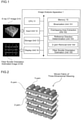
- Fig. 1 illustrates an overall configuration of an image analysis apparatus 1 according to this embodiment.
- the image analysis apparatus 1 is a computer configured by including a CPU (Central Processing Unit) 11, an input unit 12, a storage unit 13, a display unit 14, and a memory 15.
- CPU Central Processing Unit
- the CPU 11 is a processor for controlling the operation of the image analysis apparatus 1 in a supervisory manner in cooperation with various programs stored in the memory 15.
- the input unit 12 is an interface for accepting inputs from a user and is, for example, a keyboard and a mouse.
- the input unit 12 according to this embodiment is also an interface for inputting an X-ray CT image G10 of a woven fabric which constitutes a CMC (Ceramic Matrix Composite).
- the CMC herein used is a fiber-reinforced composite material formed by making fiber bundles by tying about several hundreds of ceramic fibers together, manufacturing a woven fabric by weaving these fiber bundles, then coating the surfaces of the fibers with carbons or the like, and then performing, for example, a CVI (Chemical Vapor Infiltration) process and a PIP (Polymer Impregnation and Pyrolysis) process to form matrixes.
- CVI Chemical Vapor Infiltration
- PIP Polymer Impregnation and Pyrolysis
- Weaving methods for manufacturing a woven fabric include those called three-dimensional weaving or plain weaving.
- the three-dimensional weaving is a method for manufacturing the woven fabric by weaving the fiber bundles in three directions, that is, XYZ-directions and the plain weaving is a method for manufacturing the woven fabric by weaving the fiber bundles in two directions, that is, XY-directions.
- Fig. 2 illustrates a conceptual diagram of a woven fabric of three-dimensional weaving.
- an image of the woven fabric manufactured by particularly complicated three-dimensional weaving or an image of a CMC formed from this woven fabric is captured by using an X-ray CT scanner and an attempt is made to automatically analyze orientations of fiber bundles from the obtained X-ray CT image G10.
- the woven fabric of three-dimensional weaving is formed as illustrated in Fig. 2 by alternately placing fiber layers, which are made of fiber bundles of X-yarns arranged at equal distances, and fiber layers, which are made of fiber bundles of Y-yarns arranged at equal distances, one on top of another and fixing the multiplicity of accumulated fiber layers with fiber bundles of Z-yarns so as to prevent the fiber layers from falling off during the CMC forming process.
- the CMC which is formed from this woven fabric is designed by assuming that it expands and contracts normally in the X-yarn direction or the Y-yarn direction. Therefore, the Z-yarns which are interlaced substantially perpendicularly with the X-yarns and the Y-yarns do not directly influence the strength of the CMC. On the other hand, the existence of the Z-yarns may cause poor accuracy when analyzing the orientations of the X-yarns and the Y-yarns.
- this embodiment is designed to remove the Z-yarns from the X-ray CT image G10 of the woven fabric of three-dimensional weaving and analyze the orientations of the fiber bundles of the X-yarns and the Y-yarns with good accuracy.
- the orientation(s) is a term that generally means arrangement aligned, or a state of being arranged, in a certain direction(s) and is used with the same meaning in this embodiment. Even if the fiber bundles are arranged in a state of winding, deviating, or breaking, the state of their arrangement will be called the "orientation(s)" as long as the fiber bundles are arranged in a state of being aligned in a certain direction(s).
- the storage unit 13 is a storage medium that stores the X-ray CT image G10 which is input from the input unit 12, and processed images obtained by executing various processing on this X-ray CT image G10.
- the display unit 14 is a display device such as an LCD (Liquid Crystal Display) that, for example, displays the X-ray CT image G10, images, and processed images. For example, the display unit 14 automatically analyzes the orientations of the fiber bundles from the X-ray CT image G10 and displays a fiber bundle orientation estimated image G100 on a display screen.
- LCD Liquid Crystal Display
- the memory 15 is a storage medium that stores various programs for executing image analysis processing in cooperation with the CPU 11.
- the various programs include a binarization unit 151, an overlapping area extraction unit 152, a reference direction determination unit 153, a Z-yarn removal unit 154, and a fiber bundle orientation estimation unit 155.
- the image analysis processing ( Fig. 3 ) executed by these various programs will be explained later.
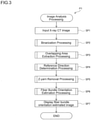
- FIG. 3 illustrates an entire flowchart of image analysis processing P1 according to this embodiment.
- This image analysis processing is executed in cooperation between the CPU 11 and the various programs stored in the memory 15 as triggered by the reception of an execution instruction from the user by the input unit 12.
- the following explanation will be given by referring to the various programs as processing subjects.
- the binarization unit 151 After the binarization unit 151 firstly inputs the X-ray CT image G10 via the input unit 12 (SP1), it binarizes the input X-ray CT image G10 on the basis of a specified threshold value and creates a binary image in which respective fiber bundles of the X-yarns, the Y-yarns, and the Z-yarns are indicated on the foreground (SP2).
- the overlapping area extraction unit 152 extracts an overlapping area in which the X-yarns and the Y-yarns perpendicularly and three-dimensionally intersect with each other (SP3); and the reference direction determination unit 153 determines an overlapping direction of the extracted overlapping area as a reference direction (SP4).
- the reason for extracting the overlapping area at this point is to estimate the overlapping direction by applying a normal directional distance method to the extracted overlapping area.
- the normal directional distance method will be explained later.
- the reason for determining the overlapping direction as the reference direction is to estimate the orientations of the fiber bundles by applying the two-dimensional normal directional distance method on a plane perpendicular to this reference direction.
- the plane perpendicular to the reference direction will be referred to as a "reference plane” and a method for applying the two-dimensional normal directional distance method on the reference plane will be referred to as a “referenced directional distance method.”
- the orientations of the fiber bundles of the X-yarns and the Y-yarns can be estimated with good accuracy by applying the referenced directional distance method.
- the referenced directional distance method will be explained later.
- the Z-yarn removal unit 154 estimates the orientations of the fiber bundles of the X-yarns, the Y-yarns, and the Z-yarns by applying the referenced directional distance method to the binary image. Then, the Z-yarn removal unit 154 removes the Z-yarns included in the binary image on the basis of the estimated orientations (SP5).
- the fiber bundle orientation estimation unit 155 estimates the orientations of the fiber bundles of the X-yarns and the Y-yarns by applying the referenced directional distance method again to the binary image from which the Z-yarns have been removed (SP6).
- the fiber bundle orientation estimation unit 155 creates the fiber bundle orientation estimated image G100, has the display unit 14 display the fiber bundle orientation estimated image G100 (SP7), and terminates this image analysis processing.
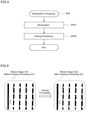
- Fig. 4 illustrates a detailed flowchart of binarization processing.
- the binarization unit 151 firstly creates a binary image by binarizing the X-ray CT image G10, which has been input via the input unit 12, on the basis of a specified threshold value (SP21). Black dot defects may sometimes occur in the created binary image due to uneven density of fibers in the fiber bundles. Specifically speaking, there are some voxels which should originally be the background and are made to become foreground voxels.
- the binarization unit 151 executes closing processing of morphology processing (SP22).
- SP22 morphology processing
- the black dot defects which have occurred in the binary image can be eliminated by executing the closing processing.
- the binarization unit 151 creates a binary image, from which the black dot defects have been eliminated and cleaned, and terminates this processing.
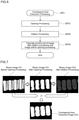
- Fig. 5 illustrates processed images created by the binarization processing. Specifically speaking, Fig. 5 illustrates a binary image G21 before the closing processing and a binary image G22 after the closing processing.
- the binary image G21 includes some voxels which should originally be the background and are made to become foreground voxels as illustrated in Fig. 5 .
- the binary image G22 after the closing processing, from which the black dot defects have been eliminated, can be obtained by executing the closing processing.
- Fig. 6 illustrates a detailed flowchart of the overlapping area extraction processing.
- the overlapping area extraction unit 152 executes opening processing of the morphology processing in order to extract the overlapping area in which the X-yarns and the Y-yarns three-dimensionally intersect with each other (SP31).
- a rough overlapping area can be extracted by executing the opening processing.
- the shape of the binary image after the opening processing has changed and there are some positions where the foreground voxels which should originally be located in the overlapping area are made to become the background voxels in areas that are not the overlapping area.
- the overlapping area extraction unit 152 executes the dilation processing of the morphology processing (SP32).
- the overlapping area extraction unit 152 extracts an accurate overlapping area by calculating a product set of the binary image after the dilation processing and the binary image before the opening processing (SP33).
- the overlapping area extraction unit 152 creates an overlapping area extracted image with the extracted overlapping area and terminates this processing.
- Fig. 7 illustrates processed images formed by the overlapping area extraction processing. Specifically speaking, Fig. 7 illustrates a binary image G3 before the opening processing, a binary image G31 after the opening processing, a binary image G32 after the dilation processing, and an overlapping area extracted image G33.
- the overlapping area extracted image G33 with the extracted accurate overlapping area can be obtained by calculating a product set of the binary image before the opening processing G3 and the binary image after the dilation processing G32 as illustrated in Fig. 7 .
- Fig. 8 illustrates a detailed flowchart of reference direction determination processing.
- the reference direction determination unit 153 applies the normal directional distance method to the overlapping area extracted image G33 ( Fig. 7 ) and estimates the overlapping direction with respect to each voxel in the overlapping area (SP41).
- Fig. 9 illustrates the outlines of processing for estimating a directional distance of a voxel of interest by applying the normal directional distance method.
- the directional distance to the background is calculated with respect to the voxel of interest.
- Directions to voxels close to the voxel of interest are eight directions in a case to the two dimensions or 26 directions in a case of the three dimensions.
- a directional distance d( ⁇ vs i ) in ⁇ vs i directions is expressed by Expression 1 below.
- a directional vector P i and a directional tensor M are defined by Expressions 2 and 3 below, respectively.
- an eigenvector for the maximum eigenvalue indicates the orientation of a fiber bundle.
- an eigenvector for the second largest eigenvalue indicates a widthwise direction of the fiber bundle.
- an eigenvector for the minimum eigenvalue indicates a thickness direction.
- the overlapping direction estimated in step SP41 is not calculated accurately with respect to voxels in a border region between the overlapping area and the background due to the properties of the directional distance method.
- the reference direction determination unit 153 executes erosion processing of the morphology processing and extracts a central area from the overlapping area (SP42).
- the reference direction determination unit 153 executes 6-neighbour labeling processing on each extracted central area to divide the area and separates the overlapping areas (SP43).
- the reference direction determination unit 153 averages the overlapping directions of the respective voxels in the central area from among the overlapping directions estimated in step SP41, determines the direction obtained by averaging as a reference direction (SP44), and terminates this processing.
- Fig. 10 illustrates processed images created by reference direction determination processing. Specifically speaking, Fig. 10 illustrates an overlapping direction estimated image G41, a central area extracted image G42, a labeling image G43, and a reference direction image G44.
- the overlapping direction estimated image G41 can be obtained by applying the normal directional distance method to the overlapping area extracted image G33 ( Fig. 7 ) as illustrated in Fig. 10 .
- the central area extracted image G42 can be obtained by executing the erosion processing on the overlapping direction estimated image G41.
- the labeling image G43 can be obtained by executing the labeling processing on the central area extracted image G42. Furthermore, the reference direction image G44 can be obtained by averaging the overlapping direction in the central area.
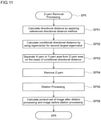
- Fig. 11 illustrates a detailed flowchart of Z-yarn removal processing.
- the Z-yarn removal unit 154 calculates the directional distance by applying a referenced directional distance method on the binary image G22 ( Fig. 5 ) obtained in step SP2 (SP51).
- the referenced directional distance method is a method for rotating the plane, on which the directional distance is to be calculated, to a plane perpendicular to the reference direction (a reference plane) and calculating the directional distance on this reference plane by the two-dimensional normal directional distance method.
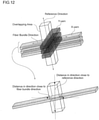
- Fig. 12 illustrates a conceptual diagram of a case where the directional distance is calculated by applying the normal directional distance method.
- the distance in a direction close to the orientation of a fiber bundle shortly reaches the background and becomes short because the thickness of the fiber bundles of the X-yarn and the Y-yarn is thin.
- the distance in a direction close to the reference direction hardly reaches the background and becomes long because a cross section of the overlapping area is thick.
- the distance in the direction close to the reference direction becomes longer than the distance in the direction close to the orientation of the fiber bundle.
- the problem is that the directional distance in the direction close to the reference direction is calculated as the directional distance in the overlapping area. So, in this embodiment, the directional distance is calculated by applying the referenced directional distance method.
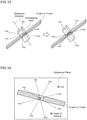
- Fig. 13 illustrates a conceptual diagram of the referenced directional distance method.
- the referenced directional distance method is a method for rotating the plane which is a target of calculation of the directional distance, and calculating the directional distance by applying the two-dimensional directional distance method on the plane which has been rotated.
- a direction ⁇ vs 0 is rotated so as to match the reference direction and other directions ⁇ vs 1 and ⁇ vs 2 perpendicular to ⁇ vs 0 are also rotated by the angle of rotation of ⁇ vs 0 .
- directions obtained after the rotations are expressed as ⁇ vs 0 ', ⁇ vs 1 ', and ⁇ vs 2 ' respectively, the X-yarns or the Y-yarns exist on a plane defined by ⁇ vs 1 ' and ⁇ vs 2 ' (reference plane).
- the orientations of the fiber bundles can be estimated without being influenced by the overlapping area by calculating the directional distance by applying the two-dimensional directional distance method on this reference plane.
- Fig. 14 illustrates a conceptual diagram in a case where the directional distance of the X-yarns or the Y-yarns on the reference plane is calculated by applying the referenced directional distance method.
- the directional distance is calculated by applying the referenced directional distance method.
- the direction ⁇ vs 0 is rotated so as to match the reference direction and other directions ⁇ vs 1 , ⁇ vs 2 , ⁇ vs 3 , and ⁇ vs 4 perpendicular to ⁇ vs 0 are also rotated by a similar angle as described above.
- the directional distance is calculated by applying the two-dimensional directional distance method on the reference plane defined by ⁇ vs 1 ', ⁇ vs 2 ', ⁇ vs 3 ', and ⁇ vs 4 '.
- the Z-yarn removal unit 154 calculates a conditional directional distance by using the eigenvector for the second largest eigenvalue obtained by the calculation of the referenced directional distance method (SP52). Then, the Z-yarn removal unit 154 separates the X-yarn or Y-yarn area from the Z-yarn area on the basis of the conditional directional distance (SP53).
- the conditional directional distance is a directional distance calculated under a condition that the processing stops proceeding when the processing proceeds from a voxel of interest on the image and reaches the background or when an angle formed by a direction indicated by an eigenvector of a voxel at a position, to which the processing will proceed next, and an advancing direction is larger than a specified threshold value.
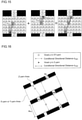
- Fig. 15 illustrates the outlines of processing for estimating the conditional directional distance.
- the processing starts at a voxel of interest at position x as a point of origin, proceeds on the image in a direction indicated by an eigenvector v 2 (x) for the voxel of interest, and stops proceeding when it reaches the background.
- the distance from the last reached voxel to the voxel of interest is expressed as x e1 .
- the processing also proceeds on the image in a direction of an opposite direction vector -v 2 (x) and stops proceeding when an angle formed by the direction indicated by an eigenvector v 2 (x') for a voxel located at position x', to which the processing will proceed next, and the direction indicated by -v 2 (x) is larger than a specified threshold value.
- the distance from the last reached voxel to the voxel of interest is expressed as x e2 .
- a total of absolute values of the distances x e1 and x e2 is the conditional directional distance d c (x).
- Fig. 16 illustrates a conceptual diagram in which the X-yarn or Y-yarn areas are separated from the Z-yarn areas on the basis of the conditional directional distance. Since the width Wxy of the X-yarn or the Y-yarn is larger than the diagonal distance Wz of the cross section of the Z-yarn, the conditional directional distance d c (p) of voxel p in the X-yarn or Y-yarn area is larger than the conditional directional distance d c (q) of voxel q in the Z-yarn area.
- a value larger than the diagonal distance Wz of the cross section of the Z-yarn and smaller than the width Wxy of the X-yarn or the Y-yarn can be set as the threshold value
- voxels with the conditional directional distance larger than this threshold value can be included in the X-yarn or Y-yarn area
- voxels with the conditional directional distance smaller than the threshold value can be included in the Z-yarn area.
- the Z-yarn removal unit 154 removes Z-yarns from the binary image G22 ( Fig. 5 ) by deleting voxels included in the Z-yarn area (SP54). If the Z-yarns are removed, part of the X-yarn or Y-yarn area may sometimes be removed.
- the Z-yarn removal unit 154 executes dilation processing of the morphology processing on the image from which the Z-yarns have been removed (SP55); extracts the X-yarns and the Y-yarns by calculating a product set of the image after the dilation processing and the image before the dilation processing (SP56); and terminates this processing.
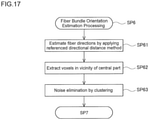
- Fig. 17 illustrates a detailed flowchart of fiber bundle orientation estimation processing.
- the fiber bundle orientation estimation unit 155 estimates the fiber directions of the X-yarns and the Y-yarns by applying the referenced directional distance method again on the image in which the X-yarns and the Y-yarns are extracted (SP61).
- the fiber bundle orientation estimation unit 155 deletes other voxels by leaving voxels in the vicinity of a central part with relatively better accuracy, from among the voxels with the estimated fiber directions, thereby extracting the voxels in the vicinity of the central part (SP62).
- the fiber bundle orientation estimation unit 155 executes clustering processing in order to connect voxels of similar directions with respect to the voxels in the vicinity of the central part, make the connected group of voxels belong to the same cluster, and make voxels whose vectors suddenly change in the middle of the fiber bundles belong to a different cluster.
- the orientation of a fiber bundle does not abruptly change in a short distance of several voxels. Therefore, it is possible to determine that a voxel whose vector abruptly changes in the middle of a fiber bundle is noise. So, the fiber bundle orientation estimation unit 155 eliminates the noise by deleting a cluster to which a small number of voxels belong (SP63), and terminates this processing.
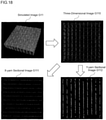
- Fig. 18 illustrates processed images obtained by executing the image analysis processing when the input image is a simulated image G11.
- the simulated image G11 is a three-dimensional image created by setting, for example, the length, width, and thickness of fiber bundles of the X-yarns and the Y-yarns, the number of accumulated X-yarn fiber layers and Y-yarn fiber layers, spaces between the fiber bundles, and a cross-sectional shape of the Z-yarn. In other words, it is an image regarding which various kinds of information are already known.
- the three-dimensional image G110 is a three-dimensional image indicating orientations of fiber bundles of the X-yarns and the Y-yarns.
- the X-yarn sectional image G111 is a two-dimensional image indicating the orientation of the fiber bundles of the X-yarns; and the Y-yarn sectional image G112 is a two-dimensional image indicating the orientation of the fiber bundles of the Y-yarns.
- Fig. 19 illustrates processed images obtained by executing the image analysis processing when the input image is an X-ray CT image G10.
- the X-ray CT image G10 is a three-dimensional image obtained by capturing an image of an actual woven fabric by using the X-ray CT scanner. Furthermore, the X-ray CT image G10 is of high definition quality as compared to an X-ray CT image G12 illustrated in Fig. 20 .
- a three-dimensional image G100 (fiber bundle orientation estimated image G100), an X-yarn sectional image G101, and a Y-yarn sectional image G102 can be obtained.
- the three-dimensional image G100 is a three-dimensional image indicating orientations of fiber bundles of the X-yarns and the Y-yarns.
- the X-yarn sectional image G101 is a two-dimensional image indicating the orientation of the fiber bundles of the X-yarns
- the Y-yarn sectional image G102 is a two-dimensional image indicating the orientation of the fiber bundles of the Y-yarns.
- the orientations of the fiber bundles of the X-yarns and the Y-yarns can be easily identified by referring to these processed image G100 to G102.
- calculation time was approximately 243.8 seconds. Conventionally, it takes about 20 times as long as the above-mentioned calculation time in order to analyze an image of approximately the same number of voxels. Therefore, the calculation time can be reduced by executing the image analysis processing according to this embodiment.
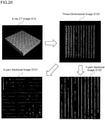
- Fig. 20 illustrates processed images obtained by executing the image analysis processing when the input image is the X-ray CT image G12.
- the difference between the X-ray CT image G12 and the X-ray CT image G10 illustrated in Fig. 19 is that the X-ray CT image G12 is of low definition quality as compared to the X-ray CT image G10.
- a three-dimensional image G120, an X-yarn sectional image G121, and a Y-yarn sectional image G122 can be obtained.
- the orientations of most of the fiber bundles can be easily identified with reference to these processed images G120 to G122 although some parts of the fiber bundles are missing.
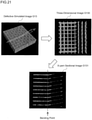
- Fig. 21 illustrates processed images obtained by executing the image analysis processing when the input image is a defective simulated image G13.
- the difference between the defective simulated image G13 and the simulated image G11 illustrated in Fig. 18 is that the defective simulated image G13 has a defect in fiber bundles of the X-yarns being bent by 10 degrees in the middle as compared to the simulated image G11.
- a three-dimensional image G130 and an X-yarn sectional image G131 can be obtained. It is possible to easily identify, with reference to these processed images G130 and G131, that fiber bundles of the X-yarns are bent at a bending point although there is some error.
- Fig. 22 illustrates processed images obtained by executing the image analysis processing when the input image is a curved surface simulated image G14.
- the difference between the curved surface simulated image G14 and the simulated image G11 illustrated in Fig. 18 is that the curved surface simulated image G14 has a curved surface portion deformed in an arc-like shape as compared to the simulated image G11.
- a three-dimensional image G140 and an X-yarn sectional image G141 can be obtained. It is possible to easily identify, with reference to these processed image G140 and G141, that the fiber bundles are oriented in an arc.
- the image analysis apparatus, the image analysis method, and the program according to this embodiment is designed as described above to remove the Z-yarns by applying the referenced directional distance method to the X-ray CT image of the woven fabric manufactured by the three-dimensional weaving and estimate the orientations of the fiber bundles of the X-yarns and the Y-yarns by applying the referenced directional distance method again to the image from which the Z-yarns have been removed, so that the orientations of the fiber bundles can be estimated with good accuracy and in a short amount of time by eliminating the influence of the Z-yarns. Furthermore, the orientations of the fiber bundles can be estimated also with respect to the X-ray CT image of the woven fabric having a curved surface shape. Therefore, the image analysis apparatus, the image analysis method, and the program according to this embodiment can be used for actual product examinations.
- Image analysis apparatus 2 includes, as illustrated in Fig. 23 , the CPU 11, the input unit 12, the storage unit 13, the display unit 14, and the memory 15 which are the same as those of the image analysis apparatus 1 in Fig. 1 ; and the memory 15 has the binarization unit 151 and the overlapping area extraction unit 152. Since these components are the same as those having the same names and reference numerals in Fig. 1 and are designed to execute the same processing, any redundant explanation is omitted. Under this circumstance, the image analysis apparatus 2 according to this example includes an overlapping area morphological analysis unit 253 in the memory 15. The overlapping area morphological analysis unit 253 analyzes the form of the "overlapping area"
- the form of the overlapping area includes not only the form of one overlapping area, but also the form of a combination of a plurality of overlapping areas which are dotted in the image.
- the image analysis apparatus 2 has the display unit 14 as illustrated
- Fig. 24 illustrates a flowchart of image analysis processing P2 executed by the image analysis apparatus 2.
- the image analysis processing P2 is designed as illustrated in this flowchart to firstly input an X-ray CT image (SP1) and execute binarization processing (SP2) and overlapping area extraction processing (SP3).
- SP1 X-ray CT image
- SP2 binarization processing
- SP3 overlapping area extraction processing
- the overlapping area morphological analysis unit 253 executes processing of morphological analysis of an overlapping area 21 by using the overlapping area extracted image G33 (see Fig. 7 ) obtained by the overlapping area extraction processing.
- pillars 21 individual overlapping areas 21 in the overlapping area extracted image G33 will be hereinafter referred to as "pillars 21".
- the overlapping area morphological analysis unit 253 may calculate the volume of each pillar 21 by, for example, counting the number of voxels included in a three-dimensional image of the pillar 21.
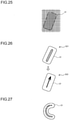
- Fig. 25 illustrates pixels in a pillar 21, which are indicated as black dots in the two-dimensional image; however, the number of voxels can be counted in the same manner with respect to a three-dimensional image.
- whether the volume of a certain pillar 21 is appropriate or not may be judged by, for example, using an average of the volume of a plurality of pillars 21 as a reference value and comparing it with the volume of the certain pillar 21.
- not only the average of the plurality of pillars 21, but also other values such as a reference value in designing may be used as the reference value of the volume.
- the volume of the pillar 21 is calculated; however, in a case of analysis by using a two-dimensional image, the area may be calculated. As a result of such processing for calculating the volume,
- the fiber bundles it is possible to provide useful information for detection of abnormal orientations of the fiber bundles, for example, information indicating that the volume of the certain pillar 21 is different from the volume of surrounding pillars 21. Furthermore, it is possible to detect the abnormal orientation of the fiber bundles, for example, to detect insufficiency in the number of the X-yarns or the Y-yarns which should three-dimensionally interest with each other, on the basis of the provided information.
- the overlapping area morphological analysis unit 253 may calculate a direction in which the pillar 21 extends.
- the extending direction of the pillar 21 may be made visible, for example, as illustrated in Fig. 26 (a shaded area in S21) by using erosion processing of the morphology image processing, and may be vectorized (S22), or the extending direction can be found by using other image processing.
- the overlapping area morphological analysis unit 253 can judge whether the extending direction of a specified pillar 21 is appropriate or not, by using an average of extending directions of a plurality of pillars 21 as a reference value and comparing it with the extending direction of the specified pillar 21.
- a neutral axial shape of the pillar 21 may be found separately from the extending direction of the pillar 21.
- the neutral axis can be extracted by, for example, using the erosion processing of the morphology image processing as illustrated in the shaded area in Fig. 27 .
- the overlapping area morphological analysis unit 253 may calculate centroid positions of a plurality of pillars 21. Since a line connecting centroid positions of adjacent pillars 21 ideally constitutes extending directions of the X-yarns and the Y-yarns, whether the centroid positions are appropriate or not can be judged by finding irregular centroid positions by, for example, detecting that such centroid positions are not aligned along a smooth line on the XY-plane.
- Fig. 28 illustrates a state where the center of gravity G of a pillar 21 indicated with diagonal lines is not aligned smoothly as compared to the centers of gravity G of surrounding pillars 21.
- a pillar 21 which is irregularly arranged exists or not may be judged by determining a certain area and finding whether an appropriate number of centers of gravity G exist in the area or not by, for example, counting the number of the centers of gravity G in that area.
- the aforementioned example of the overlapping area morphological analysis processing has described the case including the processing for detecting the abnormal orientations of the fiber bundles; however, the processing of the overlapping area morphological analysis unit 253 may be designed to execute only the morphological analysis of the overlapping area such as calculation of the volume of the pillars 21, calculation of the extending directions of the pillars 21, or calculation of the centroid positions of the pillars 21, and may only provide processed information by, for example, outputting the information to the display unit 14 or transmitting calculated data to another apparatus. As a result of such processing, it is possible to provide useful information to detect abnormal orientations of the fiber bundles.
- Figs. 29 to 46 Specific examples of abnormal orientations of the fiber bundles detected by the morphological analysis of the pillars 21 will be explained by using Figs. 29 to 46 .
- a case in which the overlapping area morphological analysis processing executed by the overlapping area morphological analysis unit 253 includes detection of abnormal orientations of the fiber bundles will be also described; however, the processing of the overlapping area morphological analysis unit 253 may not include such judgment, but may only provide information about the orientations of the fiber bundles as obtained by the morphological analysis of the pillars 21.
- Fig. 30 , 33 , 36 , 38 , 40, 41 , 43 , 44 , and 46 are illustrated with reference to a report "DOT/FAA/AR-06/10" issued by FAA (Federal Aviation Administration).
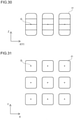
- Fig. 29 illustrates an example of an ideal arrangement of fiber bundles of the X-yarns and the Y-yarns on the XY-plane; and Figs. 30 and 31 respectively schematically illustrate overlapping area extracted images on the XZ-plane (or the YZ-plane) and the XY-plane with respect to the ideal fiber bundle arrangement as in Fig. 29 .
- a pillar 21 extends without any break in an accumulated direction (Z-direction) of the fiber bundles of the X-yarns and the Y-yarns in the ideal arrangement of the fiber bundles of the X-yarns and the Y-yarns; and referring to Fig. 31 , pillars 21 (or the centers of gravity G of the pillars 21) are arranged regularly.
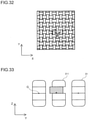
- Fig. 32 (-Y-direction) illustrates a state on the XY-plane where a portion of a fiber bundle extends in another direction, on the XY-plane, that is different from the direction to which it should extends.
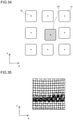
- Fig. 33 and 34 respectively schematically illustrate overlapping area extracted images on the YZ-plane and the XY-plane in the state of the fiber bundles in Fig. 32 .
- the centroid position G of a pillar 211 having a fiber bundle extending in the -Y-direction has moved to the -Y-direction due to the influence by that fiber bundle extending in the -Y-direction in the overlapping area extracted image in Fig. 33 .
- the centroid position G of the pillar 211 does not follow the regularity of the centroid positions of the vicinal pillars 21. Therefore, the overlapping area morphological analysis unit 253 can, for example, analyze the centroid positions G of the respective pillars 21 in the overlapping area extracted image and detects an area where a portion of the fiber bundles extends in another direction, on the XY-plane, different from the direction to which it should extend.
- Fig. 35 illustrates a state on the XY-plane where a portion of the fiber bundles extends in the Z-direction different from the direction to which it should extend.
- Fig. 36 schematically illustrates an overlapping area extracted image on the YZ-plane in the state of the fiber bundles in Fig. 35 .
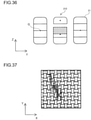
- a pillar 212 in the overlapping area extracted image in Fig. 36 is divided into a plurality of portions due to the influence of the fiber bundle extending in the Z-direction (shaded area). Therefore, the overlapping area morphological analysis unit 253 can detect the area in which a portion of the fiber bundles extends in the Z-direction different from the direction to which it should extend, by using the overlapping area extracted image.
- Fig. 37 illustrates a state on the XY-plane where a portion of the fiber bundles extends in a direction that is different from the direction, to which it should extends, and has both a directional component on the XY-plane and a Z-directional component.
- Fig. 38 schematically illustrates an overlapping area extracted image on the YZ-plane in the state of the fiber bundles in Fig. 37 .
- a pillar 213 in the overlapping area extracted image in Fig. 38 is divided into a plurality of portions due to the influence of the fiber bundle extending in the - Z-direction and the -Y-direction (shaded area).
- the centroid position G of one of the divided pillars 213 has moved to the +Y-direction. Therefore, the overlapping area morphological analysis unit 253 can detect the area in which a portion of the fiber bundles extends in the direction that is different from the direction, to which it should extend, and has both the directional component on the XY-plane and the Z-directional component, by using the overlapping area extracted image.
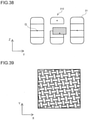
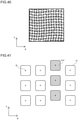
- Figs. 39 and 40 respectively illustrate a state on the XY-plane where the fiber bundles generally extend in inclined directions.
- Fig. 41 schematically illustrates an overlapping area extracted image on the XY-plane in the state of the fiber bundles illustrated in Fig. 39 or 40 .
- pillars 214 which constitute a row that is part of regularly arranged pillars 21 are misaligned in the overlapping area extracted image in Fig. 41 . Therefore, the overlapping area morphological analysis unit 253 can detect the area in which the fiber bundles generally extend in the inclined directions, by detecting, for example, that the centroid positions G of the pillars 214 do not follow specified regularity, by using the overlapping area extracted image.
- Fig. 42 illustrates a state on the XY-plane where a portion of the fiber bundles (for example, an X-yarn) is missing.
- Fig. 43 illustrates a case where the thickness of a portion of the fiber bundles is thicker or narrower than that of other fiber bundles on the XY-plane.
- Fig. 44 schematically illustrates an overlapping area extracted image of the YZ-plane in the state of the fiber bundles in Fig. 42 or Fig. 43 .
- some pillar 215 is divided into a plurality of portions and the total volume of a plurality of divided pillars 215 becomes smaller than the volume of a normal pillar 21.
- the overlapping area morphological analysis unit 253 can detect the case where a portion of the fiber bundle is missing, and the area where the thickness of a portion of the fiber bundles is thicker or narrower than that of other fiber bundles, by using the overlapping area extracted image.
- Fig. 45 illustrates a state on the XY-plane where a portion of a fiber bundle (for example, an X-yarn) is folded back.
- Fig. 46 schematically illustrates an overlapping area extracted image of the XY-plane in the state of the fiber bundles in Fig. 45 .
- pillars 216 surrounding the loop are pushed aside by the loop of the portion of the fiber bundle and the centroid positions G of the pillars 216 are disordered as compared to the centroid positions G of the surrounding regularly-arranged pillars 21. Therefore, the overlapping area morphological analysis unit 253 can detect the area in which a portion of the fiber bundle is looped, by analyzing the disordered arrangement of the centroid positions G by using the overlapping area extracted image.
- the image analysis apparatus 2 of this example is designed as described above so that: the binarization unit 151 binarizes the three-dimensional image of the woven fabric made of the fiber bundles of the X-yarns, the Y-yarns, and the Z-yarns; the overlapping area extraction unit 152 extracts the overlapping area, in which the X-yarns and the Y-yarns three-dimensionally intersect with each other, from the binarized image; and the overlapping area morphological analysis unit 253 analyzes the form of the extracted overlapping area.
- the analysis is performed by only a combination of image processing in a short amount of processing time, so that it is possible to provide information about the orientations of the fiber bundles of the X-yarns and the Y-yarns more easily and in a shorter amount of time.
- the overlapping area morphological analysis unit 253 further detects abnormal orientations of the fiber bundles, it is possible to find the abnormal orientations of the fiber bundles more easily and in a shorter amount of time. Furthermore, even when detailed analysis of the abnormal orientations of the fiber bundles is required, it is only necessary to separately perform the detailed analysis only with respect to the area including the detected abnormal orientations. So, analysis time can be shortened as a whole.
- the morphological analysis of the overlapping area can be employed regardless of whether the general shape of the entire fiber bundles is a flat surface or a curved surface. Since the overlapping area can be extracted no matter what general shape the fiber bundles is, the overlapping area morphological analysis processing can be applied. Furthermore, since the pillars 21 are arranged regularly over the general shape of the fiber bundles, for example, problems of the orientations of the fiber bundles can be also detected by analyzing the form of the overlapping area regardless of whether the general shape of the fiber bundles is a flat surface or a curved surface.
- the overlapping area morphological analysis unit 253 may calculate the volume of the overlapping area.
- the volume of the overlapping area can be compared with a "reference volume value" of the overlapping area; and furthermore, this "reference volume value" can be an average value of the volume of a plurality of overlapping areas.
- the overlapping area morphological analysis unit 253 may calculate the direction in which the overlapping area extends.
- the direction in which the overlapping area extends can be compared with a "reference direction value" of the overlapping area; and this "reference direction value" can be an average value of the directions of the plurality of overlapping areas.
- the overlapping area morphological analysis unit 253 may calculate centroid positions of the plurality of overlapping areas.
- the overlapping area morphological analysis unit 253 can detect an area where the centroid positions are arranged irregularly.
- the area where the centroid positions are arranged irregularly may be detected by, for example, finding a reference line where the centroid positions are aligned and calculating how much the relevant centroid position(s) is displaced from the reference line, or by calculating the number of centroid positions included in a certain area.
- the overlapping area morphological analysis unit 253 may calculate the neutral axis of the overlapping area and compare it with a reference shape. In this case, the erosion processing of the morphology can be used to calculate the neutral axis.
- this example image analysis method is characterized in that it includes: a step of binarizing a three-dimensional image of the woven fabric made of the fiber bundles of the X-yarns, the Y-yarns, and the Z-yarns; a step of extracting an overlapping area, in which the X-yarns and the Y-yarns three-dimensionally intersect with each other, from the binarized image; and a step of analyzing the form of the extracted overlapping area.
- the program according to this example is a program for causing a computer to execute: a step of binarizing a three-dimensional image of the woven fabric made of the fiber bundles of the X-yarns, the Y-yarns, and the Z-yarns; a step of extracting an overlapping area, in which the X-yarns and the Y-yarns three-dimensionally intersect with each other, from the binarized image; and a step of analyzing the form of the extracted overlapping area.
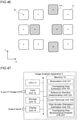
- FIG. 47 illustrates the configuration of an image analysis apparatus 3 which is an arrangement for executing these processing steps by combining them.
- the image analysis apparatus 3 includes the CPU 11, the input unit 12, the storage unit 13, the display unit 14, and the memory 15 in the same manner as the aforementioned image analysis apparatus 1 or 2; and the memory 15 has the binarization unit 151, the overlapping area extraction unit 152, the reference direction determination unit 153, the Z-yarn removal unit 154, the fiber bundle orientation estimation unit 155, and the overlapping area morphological analysis unit 253. Each component executes the same processing as that of the aforementioned corresponding component.
- Fig. 48 illustrates a flowchart of image analysis processing P3 by this image analysis apparatus 3.
- the image analysis processing P3 firstly inputs an X-ray CT image (SP1) and executes binarization processing (SP2), overlapping area extraction processing (SP3), and overlapping area morphological analysis processing (SP14).
- SP1 X-ray CT image
- SP3 overlapping area extraction processing
- SP14 overlapping area morphological analysis processing
- SP4 reference direction determination processing
- SP5 Z-yarn removal processing
- SP6 fiber bundle orientation estimation processing
- the problem in the orientation of the fiber bundles can be analyzed more efficiently and in detail by applying the image analysis processing P2, whose processing time is short, to, for example, the X-ray CT image which is the examination target, and applying the image analysis processing P1, whose processing time is relatively long and which performs detailed analysis, on the area including the abnormal orientation of the fiber bundles which is detected by the image analysis processing P2.
Landscapes
- Engineering & Computer Science (AREA)
- Physics & Mathematics (AREA)
- General Physics & Mathematics (AREA)
- Chemical & Material Sciences (AREA)
- Health & Medical Sciences (AREA)
- Computer Vision & Pattern Recognition (AREA)
- Theoretical Computer Science (AREA)
- Analytical Chemistry (AREA)
- Immunology (AREA)
- Pathology (AREA)
- Biochemistry (AREA)
- General Health & Medical Sciences (AREA)
- Life Sciences & Earth Sciences (AREA)
- Materials Engineering (AREA)
- Signal Processing (AREA)
- Textile Engineering (AREA)
- Geometry (AREA)
- Nuclear Medicine, Radiotherapy & Molecular Imaging (AREA)
- Pulmonology (AREA)
- Radiology & Medical Imaging (AREA)
- Image Analysis (AREA)
- Treatment Of Fiber Materials (AREA)
- Analysing Materials By The Use Of Radiation (AREA)
Claims (11)
- Bildanalysevorrichtung (1) zum Analysieren von Ausrichtungen von Faserbündeln von X-Fäden und Y-Fäden von einem dreidimensionalen Bild, das von einer Röntgencomputertomographie eines Gewebes abgeleitet ist, das aus Faserbündeln der X-Fäden, der Y-Fäden und der Z-Fäden hergestellt ist, wobei die Bildanalysevorrichtung (1) umfasst:eine Binarisierungseinheit (151), die das dreidimensionale Bild binarisiert; undeine Überlappungsbereichsextraktionseinheit (152), die einen Überlappungsbereich, in dem sich die X-Fäden unddie Y-Fäden senkrecht und dreidimensional miteinander schneiden, aus dem binarisierten Bild extrahiert;wobei die Bildanalysevorrichtung (1) dadurch gekennzeichnet ist, dass sie umfasst:eine Bezugsrichtungsbestimmungseinheit (153), die eine Überlappungsrichtung jedes Voxels, das in dem Überlappungsbereich enthalten ist, mittelt und die gemittelte Richtung als eine Bezugsrichtung bestimmt;eine Z-Faden-Entfernungseinheit (154), welche die Z-Fäden aus dem binarisierten Bild durch Anwenden eines Richtungsabstandsverfahrens auf einer Bezugsebene senkrecht zu der Bezugsrichtung entfernt; undeine Faserbündelausrichtungsschätzungseinheit (155) die das Richtungsabstandsverfahren erneut auf das Bild, von dem die Z-Fäden entfernt wurden, auf der Bezugsebene anwendet und die Ausrichtungen der Faserbündel der X-Fäden und der Y-Fäden basierend auf einem bei der Anwendung berechneten Richtungsabstand schätzt.
- Bildanalysevorrichtung (1) nach Anspruch 1,
wobei die Binarisierungseinheit (151):das dreidimensionale Bild basierend auf einem vorgegebenen Schwellenwert binarisiert; undnach der Binarisierung eine Schließverarbeitung an dem Bild ausführt. - Bildanalysevorrichtung (1) nach Anspruch 2,
wobei die Überlappungsbereichsextraktionseinheit (152) :nach der Schließverarbeitung eine Öffnungsverarbeitung an dem Bild ausführt;nach der Öffnungsverarbeitung eine Dilatationsverarbeitung an dem Bild ausführt; undden Überlappungsbereich durch Berechnen eines Produktsatzes von dem Bild nach der Dilatationsverarbeitung und dem Bild nach der Schließverarbeitung extrahiert. - Bildanalysevorrichtung (1) nach einem der Ansprüche 1 bis 3,
wobei die Bezugsrichtungsbestimmungseinheit (153):das Richtungsabstandsverfahren auf den Überlappungsbereich anwendet und die Überlappungsrichtung von jedem in dem Überlappungsbereich enthaltenen Voxel basierend auf dem bei der Anwendung berechneten Richtungsabstand jedes Voxels schätzt;einen zentralen Bereich durch Ausführen einer Erosionsverarbeitung an dem Überlappungsbereich extrahiert; unddie Überlappungsrichtung jedes Voxels, das in dem zentralen Bereich enthalten ist, mittelt und die gemittelte Richtung als die Bezugsrichtung bestimmt. - Bildanalysevorrichtung (1) nach einem der Ansprüche 1 bis 4,
wobei die Z-Faden-Entfernungseinheit (154):das Richtungsabstandsverfahren auf der Bezugsebene anwendet und einen Eigenvektor für einen zweitgrößten Eigenwert eines Richtungstensors basierend auf dem Richtungsabstand jedes Voxels berechnet, das bei der Anwendung berechnet wird;das binarisierte Bild basierend auf dem Eigenvektor in einen Bereich der X-Fäden oder der Y-Fäden und einen Bereich der Z-Fäden trennt; unddie Z-Fäden durch Entfernen von Voxeln, die in dem Z-Faden-Bereich enthalten sind, von dem binarisierten Bild entfernt. - Bildanalysevorrichtung (1) nach Anspruch 5,wobei die Z-Faden-Entfernungseinheit beim Berechnen eines Richtungsabstands eines Voxels von Interesse mit Voxeln in einer Richtung, die durch einen Eigenvektor des Voxels von Interesse angezeigt wird, und einer Richtung, die der durch den Eigenvektor angezeigten Richtung entgegengesetzt ist, fortfährt;und wenn die Z-Faden-Entfernungseinheit (154) einen Hintergrund oder einen Winkel erreicht, der mit einer Richtung gebildet ist, die durch einen Eigenvektor eines nächsten Voxels, mit dem Fortzufahren ist, angegeben wird, der größer ist als ein spezifizierter Schwellenwert, die Z-Faden-Entfernungseinheit (154) das Fortfahren stoppt und einen Abstand zwischen entsprechenden zuletzt erreichten Voxeln als einen bedingten Richtungsabstand berechnet; unddie Z-Faden-Entfernungseinheit (154) das binarisierte Bild basierend auf dem bedingten Richtungsabstand in den Bereich der X-Fäden oder der Y-Fäden und den Bereich der Z-Fäden trennt.
- Bildanalysevorrichtung (1) nach einem der Ansprüche 1 bis 6,
wobei die Z-Faden-Entfernungseinheit (154):nach dem Entfernen der Z-Fäden von dem binarisierten Bild eine Dilatationsverarbeitung ausführt;und einen Produktsatz von dem Bild nach der Dilatationsverarbeitung und dem Bild vor der Dilatationsverarbeitung berechnet. - Bildanalysevorrichtung (1) nach einem der Ansprüche 1 bis 7,
wobei die Faserbündelausrichtungsschätzungseinheit (155) :das Richtungsabstandsverfahren erneut auf das Bild, von dem die Z-Fäden entfernt wurden, auf der Bezugsebene anwendet und die Ausrichtungen der Faserbündel der X-Fäden und der Y-Fäden schätzt;aus den Voxeln, für welche die Ausrichtungen der Faserbündel geschätzt werden, Voxel in einer Umgebung eines zentralen Teils extrahiert;Clusterbildungsverarbeitung an den Voxeln in der Umgebung des zentralen Teils ausführt; und durch Löschen eines Clusters, in das ein minimales Voxel gehört, Rauschen eliminiert. - Bildanalysevorrichtung (1) nach einem der Ansprüche 1 bis 8,
umfassend eine Anzeigeeinheit (14), die ein Bild anzeigt, das die Ausrichtungen der Faserbündel der X-Fäden und der Y-Fäden zeigt. - Bildanalyseverfahren zum Analysieren von Ausrichtungen von Faserbündeln aus X-Fäden und Y-Fäden von einem dreidimensionalen Bild, das von einer Röntgencomputertomographie eines Gewebes abgeleitet ist, das aus Faserbündeln der X-Fäden, der Y-Fäden und der Z-Fäden hergestellt ist, wobei das Bildanalyseverfahren die folgenden Schritte umfasst, die von einem Computer (1) ausgeführt werden:einen ersten Schritt des Binarisierens des dreidimensionalen Bildes;einen zweiten Schritt des Extrahierens eines Überlappungsbereichs, in dem sich die X-Fäden und die Y-Fäden senkrecht und dreidimensional miteinander schneiden, aus dem binarisierten Bild;einen dritten Schritt des Mittelns einer Überlappungsrichtung jedes Voxels, das in dem Überlappungsbereich enthalten ist, und des Bestimmens der gemittelten Richtung als eine Bezugsrichtung;einen vierten Schritt des Entfernens der Z-Fäden von dem binarisierten Bild durch Anwenden eines Richtungsabstandsverfahrens auf einer zur Bezugsrichtung senkrechten Bezugsebene; undeinen fünften Schritt des erneuten Anwendens des Richtungsabstandsverfahrens auf das Bild, von dem die Z-Fäden entfernt wurden, auf der Bezugsebene und des Schätzens der Ausrichtungen der Faserbündel der X-Fäden und der Y-Fäden basierend auf einem bei der Anwendung berechneten Richtungsabstand.
- Programm zum Analysieren von Ausrichtungen von Faserbündeln von X-Fäden und Y-Fäden von einem dreidimensionalen Bild, das von einer Röntgencomputertomographie eines Gewebes abgeleitet ist, das aus Faserbündeln der X-Fäden, der Y-Fäden und der Z-Fäden hergestellt ist,
wobei das Programm einen Computer veranlasst, das Folgende auszuführen:einen ersten Schritt des Binarisierens des dreidimensionalen Bildes;einen zweiten Schritt des Extrahierens eines Überlappungsbereichs, in dem sich die X-Fäden und die Y-Fäden senkrecht und dreidimensional miteinander schneiden, aus dem binarisierten Bild;einen dritten Schritt des Mittelns einer Überlappungsrichtung jedes Voxels, das in dem Überlappungsbereich enthalten ist, und des Bestimmens der gemittelten Richtung als eine Bezugsrichtung;einen vierten Schritt des Entfernens der Z-Fäden von dem binarisierten Bild durch Anwenden eines Richtungsabstandsverfahrens auf einer zur Bezugsrichtung senkrechten Bezugsebene; undeinen fünften Schritt des erneuten Anwendens des Richtungsabstandsverfahrens auf das Bild, von dem die Z-Fäden entfernt wurden, auf der Bezugsebene und des Schätzens der Ausrichtungen der Faserbündel der X-Fäden und der Y-Fäden basierend auf einem bei der Anwendung berechneten Richtungsabstand.
Applications Claiming Priority (2)
| Application Number | Priority Date | Filing Date | Title |
|---|---|---|---|
| JP2014199406 | 2014-09-29 | ||
| PCT/JP2015/077472 WO2016052489A1 (ja) | 2014-09-29 | 2015-09-29 | 画像解析装置、画像解析方法及びプログラム |
Publications (3)
| Publication Number | Publication Date |
|---|---|
| EP3203218A1 EP3203218A1 (de) | 2017-08-09 |
| EP3203218A4 EP3203218A4 (de) | 2018-06-06 |
| EP3203218B1 true EP3203218B1 (de) | 2022-02-23 |
Family
ID=55630516
Family Applications (1)
| Application Number | Title | Priority Date | Filing Date |
|---|---|---|---|
| EP15846683.9A Active EP3203218B1 (de) | 2014-09-29 | 2015-09-29 | Bildanalysevorrichtung, bildanalyseverfahren und programm |
Country Status (6)
| Country | Link |
|---|---|
| US (1) | US10068349B2 (de) |
| EP (1) | EP3203218B1 (de) |
| JP (1) | JP6152488B2 (de) |
| CN (1) | CN107148569B (de) |
| CA (1) | CA2961455C (de) |
| WO (1) | WO2016052489A1 (de) |
Families Citing this family (13)
| Publication number | Priority date | Publication date | Assignee | Title |
|---|---|---|---|---|
| JP7154535B2 (ja) * | 2018-07-04 | 2022-10-18 | 国立大学法人 東京大学 | X線ct装置により得られる投影像を用いた寸法測定方法 |
| JP7230368B2 (ja) * | 2018-08-20 | 2023-03-01 | 富士フイルムビジネスイノベーション株式会社 | 符号化装置、復号装置及びプログラム |
| JP7157322B2 (ja) * | 2018-09-28 | 2022-10-20 | 澁谷工業株式会社 | 物品検査装置および物品検査方法 |
| IT201800009746A1 (it) * | 2018-10-24 | 2020-04-24 | Vision Device Srl | Metodo di riconoscimento di punti di riferimento in un tessuto |
| JP7530709B2 (ja) * | 2019-10-11 | 2024-08-08 | 株式会社島津製作所 | 細胞画像解析方法及び細胞解析装置 |
| CN111986143B (zh) * | 2020-07-06 | 2021-09-21 | 南京航空航天大学 | 一种陶瓷基复合材料的细观结构表征方法 |
| WO2022038825A1 (ja) | 2020-08-18 | 2022-02-24 | 株式会社Ihi | 繊維強化材において繊維束の分布を評価するシステム |
| JP7464150B2 (ja) * | 2020-12-28 | 2024-04-09 | 株式会社Ihi | 繊維強化材における繊維層を識別する、識別装置、識別方法、及び、識別プログラム |
| EP4276740A4 (de) * | 2021-01-06 | 2024-08-07 | Toyobo Co., Ltd. | Analyseverfahren für bilder von faserhaltigen produkten sowie programm und analysevorrichtung dafür |
| WO2023133416A1 (en) * | 2022-01-04 | 2023-07-13 | Ohio State Innovation Foundation | Detecting 3d model clones in mobile games |
| CN114693680A (zh) * | 2022-05-31 | 2022-07-01 | 季华实验室 | 织物纤维的检测方法、电子设备及计算机可读存储介质 |
| EP4618002A1 (de) | 2022-11-09 | 2025-09-17 | IHI Corporation | Identifikationsvorrichtung zur identifizierung eines strukturelements in einem verbundstoff, identifizierungsverfahren und identifikationsprogramm |
| CN118882188B (zh) * | 2024-09-30 | 2024-12-03 | 陕西帛宇纺织有限公司 | 一种纺纱车间空调温湿度调控方法 |
Family Cites Families (26)
| Publication number | Priority date | Publication date | Assignee | Title |
|---|---|---|---|---|
| US6526305B1 (en) * | 1998-11-25 | 2003-02-25 | The Johns Hopkins University | Method of fiber reconstruction employing data acquired by magnetic resonance imaging |
| CA2354301A1 (en) * | 2001-07-27 | 2003-01-27 | Djamel Yahia Meddah | Geometric hashing for model-based recognition of an object |
| JP4172941B2 (ja) * | 2002-03-01 | 2008-10-29 | 日立ソフトウエアエンジニアリング株式会社 | 土地区画データ作成方法および装置 |
| WO2006085254A1 (en) * | 2005-02-11 | 2006-08-17 | Koninklijke Philips Electronics N.V. | Method of automatic extraction of the pulmonary artery tree from 3d medical images |
| US7983462B2 (en) * | 2005-11-22 | 2011-07-19 | Purdue Research Foundation | Methods and systems for improving quality of an image |
| US7822254B2 (en) * | 2006-04-21 | 2010-10-26 | Siemens Medical Solutions Usa, Inc. | Automatic positioning of matching multi-planar image reformatting (MPR) views of multiple 3D medical images |
| US7639253B2 (en) * | 2006-07-13 | 2009-12-29 | Inus Technology, Inc. | System and method for automatic 3D scan data alignment |
| US7949162B2 (en) * | 2006-08-14 | 2011-05-24 | Siemens Medical Solutions Usa, Inc. | System and method for solid component evaluation in mixed ground glass nodules |
| JP4972751B2 (ja) * | 2006-11-27 | 2012-07-11 | 株式会社日立製作所 | 神経線維束計測システム及び画像処理システム |
| GB0708621D0 (en) * | 2007-05-04 | 2007-06-13 | Univ Manchester | Image processing method |
| US20090034810A1 (en) * | 2007-08-03 | 2009-02-05 | Fujifilm Corporation | Abnormal tissue pattern detection apparatus, method and program |
| US8275194B2 (en) * | 2008-02-15 | 2012-09-25 | Microsoft Corporation | Site modeling using image data fusion |
| EP2289046A4 (de) * | 2008-05-23 | 2016-03-30 | Fei Co | Bilddatenverarbeitung |
| US8885926B2 (en) * | 2009-04-15 | 2014-11-11 | Massachusetts Institute Of Technology | Image and data segmentation |
| JP5538868B2 (ja) * | 2009-12-22 | 2014-07-02 | キヤノン株式会社 | 画像処理装置、その画像処理方法及びプログラム |
| US20110304619A1 (en) * | 2010-06-10 | 2011-12-15 | Autodesk, Inc. | Primitive quadric surface extraction from unorganized point cloud data |
| JP5475561B2 (ja) | 2010-06-14 | 2014-04-16 | ポリプラスチックス株式会社 | 充填材の配向解析方法 |
| WO2013040673A1 (en) * | 2011-09-19 | 2013-03-28 | The University Of British Columbia | Method and systems for interactive 3d image segmentation |
| CN104066876A (zh) * | 2011-12-27 | 2014-09-24 | 昭和电工株式会社 | 碳纤维的制造方法 |
| US20130167374A1 (en) * | 2011-12-29 | 2013-07-04 | General Electric Company | Process of producing ceramic matrix composites and ceramic matrix composites formed thereby |
| EP2893511A1 (de) * | 2012-09-07 | 2015-07-15 | Region Nordjylland, Aalborg Sygehus | System zur erkennung von blutgefässstrukturen in medizinischen bildern |
| CN103903298B (zh) * | 2012-12-27 | 2017-03-01 | 同方威视技术股份有限公司 | 三维数据处理和识别方法 |
| CN103900503B (zh) * | 2012-12-27 | 2016-12-28 | 清华大学 | 提取形状特征的方法、安全检查方法以及设备 |
| US9443297B2 (en) * | 2013-07-10 | 2016-09-13 | Cognex Corporation | System and method for selective determination of point clouds |
| JP6118699B2 (ja) * | 2013-09-30 | 2017-04-19 | 株式会社Ihi | 画像解析装置及びプログラム |
| JP6118698B2 (ja) * | 2013-09-30 | 2017-04-19 | 株式会社Ihi | 画像解析装置及びプログラム |
-
2015
- 2015-09-29 US US15/514,712 patent/US10068349B2/en active Active
- 2015-09-29 CA CA2961455A patent/CA2961455C/en active Active
- 2015-09-29 JP JP2016552053A patent/JP6152488B2/ja active Active
- 2015-09-29 WO PCT/JP2015/077472 patent/WO2016052489A1/ja not_active Ceased
- 2015-09-29 CN CN201580051215.9A patent/CN107148569B/zh not_active Expired - Fee Related
- 2015-09-29 EP EP15846683.9A patent/EP3203218B1/de active Active
Also Published As
| Publication number | Publication date |
|---|---|
| EP3203218A4 (de) | 2018-06-06 |
| JPWO2016052489A1 (ja) | 2017-04-27 |
| CA2961455A1 (en) | 2016-04-07 |
| US10068349B2 (en) | 2018-09-04 |
| EP3203218A1 (de) | 2017-08-09 |
| CN107148569B (zh) | 2020-01-03 |
| US20170213357A1 (en) | 2017-07-27 |
| JP6152488B2 (ja) | 2017-06-21 |
| WO2016052489A1 (ja) | 2016-04-07 |
| CN107148569A (zh) | 2017-09-08 |
| CA2961455C (en) | 2019-09-24 |
Similar Documents
| Publication | Publication Date | Title |
|---|---|---|
| EP3203218B1 (de) | Bildanalysevorrichtung, bildanalyseverfahren und programm | |
| EP3054286B1 (de) | Bildanalysevorrichtung und -verfahren | |
| Blanc et al. | Fiber orientation measurements in composite materials | |
| US9943277B2 (en) | Detecting coronary stenosis through spatio-temporal tracking | |
| Chen et al. | Image‐based framework for concrete surface crack monitoring and quantification | |
| DE102008023283B4 (de) | Verfahren und System zur Segmentierung von schlauchförmigen Strukturen in 3D-Bildern | |
| US20080123958A1 (en) | Computer-implemented method for efficient image segmentation using automated saddle-point detection | |
| US8494239B2 (en) | Image processing device, method and program | |
| Wang et al. | Novel 4-D open-curve active contour and curve completion approach for automated tree structure extraction | |
| JP6681221B2 (ja) | 構造解析装置、構造解析方法及び三次元織繊維素材製造方法 | |
| Merveille et al. | Tubular structure filtering by ranking orientation responses of path operators | |
| EP2827298A1 (de) | Verfahren und Computerprogramm zum Filtern und insbesondere Segmentieren und/oder Analysieren von anatomischen Strukturen in einem digitalen Bild | |
| Maiorca et al. | Improving the quality of electron tomography image volumes using pre-reconstruction filtering | |
| Liu et al. | Deep learning and integrated approach to reconstruct meshes from tomograms of 3D braided composites | |
| Basu et al. | Localizing and extracting filament distributions from microscopy images | |
| Böning et al. | Erroneous cardiac ECG-gated PET list-mode trigger events can be retrospectively identified and replaced by an offline reprocessing approach: first results in rodents | |
| Huo et al. | Removing ring artefacts in CT images via unidirectional relative variation model | |
| CN115335858A (zh) | 用于在3d图像中使复合材料部件的股线骨架化的方法和系统 | |
| Yang et al. | Tomographic modeling and internal structure analysis of engineering textiles: A parametric approach | |
| Xiao et al. | A derivative of stick filter for pulmonary fissure detection in CT images | |
| JP5352303B2 (ja) | 画像処理装置および方法ならびにプログラム | |
| Bush et al. | Deconvolution filtering: Temporal smoothing revisited | |
| WO2017010119A1 (ja) | シンチグラフィー画像の正規化技術 | |
| WO2017098888A1 (ja) | 画像処理装置及び画像処理方法 | |
| Golparvar-Fard et al. | Model-based detection of progress using D4AR models generated by daily site photologs and building information models |
Legal Events
| Date | Code | Title | Description |
|---|---|---|---|
| STAA | Information on the status of an ep patent application or granted ep patent |
Free format text: STATUS: THE INTERNATIONAL PUBLICATION HAS BEEN MADE |
|
| PUAI | Public reference made under article 153(3) epc to a published international application that has entered the european phase |
Free format text: ORIGINAL CODE: 0009012 |
|
| STAA | Information on the status of an ep patent application or granted ep patent |
Free format text: STATUS: REQUEST FOR EXAMINATION WAS MADE |
|
| 17P | Request for examination filed |
Effective date: 20170502 |
|
| AK | Designated contracting states |
Kind code of ref document: A1 Designated state(s): AL AT BE BG CH CY CZ DE DK EE ES FI FR GB GR HR HU IE IS IT LI LT LU LV MC MK MT NL NO PL PT RO RS SE SI SK SM TR |
|
| AX | Request for extension of the european patent |
Extension state: BA ME |
|
| DAV | Request for validation of the european patent (deleted) | ||
| DAX | Request for extension of the european patent (deleted) | ||
| A4 | Supplementary search report drawn up and despatched |
Effective date: 20180508 |
|
| RIC1 | Information provided on ipc code assigned before grant |
Ipc: G01N 23/046 20180101ALI20180502BHEP Ipc: G01N 21/84 20060101ALI20180502BHEP Ipc: G06T 7/73 20170101ALI20180502BHEP Ipc: G06T 7/60 20170101ALI20180502BHEP Ipc: D06H 3/08 20060101AFI20180502BHEP Ipc: G01N 21/88 20060101ALI20180502BHEP |
|
| REG | Reference to a national code |
Ref country code: DE Ref legal event code: R079 Ref document number: 602015077141 Country of ref document: DE Free format text: PREVIOUS MAIN CLASS: G01N0023040000 Ipc: D06H0003080000 |
|
| RIC1 | Information provided on ipc code assigned before grant |
Ipc: D06H 3/08 20060101AFI20210705BHEP Ipc: G06T 7/60 20170101ALI20210705BHEP Ipc: G01N 23/046 20180101ALI20210705BHEP Ipc: G01N 21/84 20060101ALI20210705BHEP Ipc: G01N 21/88 20060101ALI20210705BHEP Ipc: G06T 7/73 20170101ALI20210705BHEP |
|
| GRAP | Despatch of communication of intention to grant a patent |
Free format text: ORIGINAL CODE: EPIDOSNIGR1 |
|
| STAA | Information on the status of an ep patent application or granted ep patent |
Free format text: STATUS: GRANT OF PATENT IS INTENDED |
|
| INTG | Intention to grant announced |
Effective date: 20210915 |
|
| GRAS | Grant fee paid |
Free format text: ORIGINAL CODE: EPIDOSNIGR3 |
|
| GRAA | (expected) grant |
Free format text: ORIGINAL CODE: 0009210 |
|
| STAA | Information on the status of an ep patent application or granted ep patent |
Free format text: STATUS: THE PATENT HAS BEEN GRANTED |
|
| AK | Designated contracting states |
Kind code of ref document: B1 Designated state(s): AL AT BE BG CH CY CZ DE DK EE ES FI FR GB GR HR HU IE IS IT LI LT LU LV MC MK MT NL NO PL PT RO RS SE SI SK SM TR |
|
| REG | Reference to a national code |
Ref country code: GB Ref legal event code: FG4D |
|
| REG | Reference to a national code |
Ref country code: CH Ref legal event code: EP |
|
| REG | Reference to a national code |
Ref country code: DE Ref legal event code: R096 Ref document number: 602015077141 Country of ref document: DE |
|
| REG | Reference to a national code |
Ref country code: AT Ref legal event code: REF Ref document number: 1470557 Country of ref document: AT Kind code of ref document: T Effective date: 20220315 |
|
| REG | Reference to a national code |
Ref country code: IE Ref legal event code: FG4D |
|
| REG | Reference to a national code |
Ref country code: LT Ref legal event code: MG9D |
|
| REG | Reference to a national code |
Ref country code: NL Ref legal event code: MP Effective date: 20220223 |
|
| REG | Reference to a national code |
Ref country code: AT Ref legal event code: MK05 Ref document number: 1470557 Country of ref document: AT Kind code of ref document: T Effective date: 20220223 |
|
| PG25 | Lapsed in a contracting state [announced via postgrant information from national office to epo] |
Ref country code: SE Free format text: LAPSE BECAUSE OF FAILURE TO SUBMIT A TRANSLATION OF THE DESCRIPTION OR TO PAY THE FEE WITHIN THE PRESCRIBED TIME-LIMIT Effective date: 20220223 Ref country code: RS Free format text: LAPSE BECAUSE OF FAILURE TO SUBMIT A TRANSLATION OF THE DESCRIPTION OR TO PAY THE FEE WITHIN THE PRESCRIBED TIME-LIMIT Effective date: 20220223 Ref country code: PT Free format text: LAPSE BECAUSE OF FAILURE TO SUBMIT A TRANSLATION OF THE DESCRIPTION OR TO PAY THE FEE WITHIN THE PRESCRIBED TIME-LIMIT Effective date: 20220623 Ref country code: NO Free format text: LAPSE BECAUSE OF FAILURE TO SUBMIT A TRANSLATION OF THE DESCRIPTION OR TO PAY THE FEE WITHIN THE PRESCRIBED TIME-LIMIT Effective date: 20220523 Ref country code: NL Free format text: LAPSE BECAUSE OF FAILURE TO SUBMIT A TRANSLATION OF THE DESCRIPTION OR TO PAY THE FEE WITHIN THE PRESCRIBED TIME-LIMIT Effective date: 20220223 Ref country code: LT Free format text: LAPSE BECAUSE OF FAILURE TO SUBMIT A TRANSLATION OF THE DESCRIPTION OR TO PAY THE FEE WITHIN THE PRESCRIBED TIME-LIMIT Effective date: 20220223 Ref country code: HR Free format text: LAPSE BECAUSE OF FAILURE TO SUBMIT A TRANSLATION OF THE DESCRIPTION OR TO PAY THE FEE WITHIN THE PRESCRIBED TIME-LIMIT Effective date: 20220223 Ref country code: ES Free format text: LAPSE BECAUSE OF FAILURE TO SUBMIT A TRANSLATION OF THE DESCRIPTION OR TO PAY THE FEE WITHIN THE PRESCRIBED TIME-LIMIT Effective date: 20220223 Ref country code: BG Free format text: LAPSE BECAUSE OF FAILURE TO SUBMIT A TRANSLATION OF THE DESCRIPTION OR TO PAY THE FEE WITHIN THE PRESCRIBED TIME-LIMIT Effective date: 20220523 |
|
| PG25 | Lapsed in a contracting state [announced via postgrant information from national office to epo] |
Ref country code: PL Free format text: LAPSE BECAUSE OF FAILURE TO SUBMIT A TRANSLATION OF THE DESCRIPTION OR TO PAY THE FEE WITHIN THE PRESCRIBED TIME-LIMIT Effective date: 20220223 Ref country code: LV Free format text: LAPSE BECAUSE OF FAILURE TO SUBMIT A TRANSLATION OF THE DESCRIPTION OR TO PAY THE FEE WITHIN THE PRESCRIBED TIME-LIMIT Effective date: 20220223 Ref country code: GR Free format text: LAPSE BECAUSE OF FAILURE TO SUBMIT A TRANSLATION OF THE DESCRIPTION OR TO PAY THE FEE WITHIN THE PRESCRIBED TIME-LIMIT Effective date: 20220524 Ref country code: FI Free format text: LAPSE BECAUSE OF FAILURE TO SUBMIT A TRANSLATION OF THE DESCRIPTION OR TO PAY THE FEE WITHIN THE PRESCRIBED TIME-LIMIT Effective date: 20220223 Ref country code: AT Free format text: LAPSE BECAUSE OF FAILURE TO SUBMIT A TRANSLATION OF THE DESCRIPTION OR TO PAY THE FEE WITHIN THE PRESCRIBED TIME-LIMIT Effective date: 20220223 |
|
| PG25 | Lapsed in a contracting state [announced via postgrant information from national office to epo] |
Ref country code: IS Free format text: LAPSE BECAUSE OF FAILURE TO SUBMIT A TRANSLATION OF THE DESCRIPTION OR TO PAY THE FEE WITHIN THE PRESCRIBED TIME-LIMIT Effective date: 20220623 |
|
| PG25 | Lapsed in a contracting state [announced via postgrant information from national office to epo] |
Ref country code: SM Free format text: LAPSE BECAUSE OF FAILURE TO SUBMIT A TRANSLATION OF THE DESCRIPTION OR TO PAY THE FEE WITHIN THE PRESCRIBED TIME-LIMIT Effective date: 20220223 Ref country code: SK Free format text: LAPSE BECAUSE OF FAILURE TO SUBMIT A TRANSLATION OF THE DESCRIPTION OR TO PAY THE FEE WITHIN THE PRESCRIBED TIME-LIMIT Effective date: 20220223 Ref country code: RO Free format text: LAPSE BECAUSE OF FAILURE TO SUBMIT A TRANSLATION OF THE DESCRIPTION OR TO PAY THE FEE WITHIN THE PRESCRIBED TIME-LIMIT Effective date: 20220223 Ref country code: EE Free format text: LAPSE BECAUSE OF FAILURE TO SUBMIT A TRANSLATION OF THE DESCRIPTION OR TO PAY THE FEE WITHIN THE PRESCRIBED TIME-LIMIT Effective date: 20220223 Ref country code: DK Free format text: LAPSE BECAUSE OF FAILURE TO SUBMIT A TRANSLATION OF THE DESCRIPTION OR TO PAY THE FEE WITHIN THE PRESCRIBED TIME-LIMIT Effective date: 20220223 Ref country code: CZ Free format text: LAPSE BECAUSE OF FAILURE TO SUBMIT A TRANSLATION OF THE DESCRIPTION OR TO PAY THE FEE WITHIN THE PRESCRIBED TIME-LIMIT Effective date: 20220223 |
|
| REG | Reference to a national code |
Ref country code: DE Ref legal event code: R097 Ref document number: 602015077141 Country of ref document: DE |
|
| PG25 | Lapsed in a contracting state [announced via postgrant information from national office to epo] |
Ref country code: AL Free format text: LAPSE BECAUSE OF FAILURE TO SUBMIT A TRANSLATION OF THE DESCRIPTION OR TO PAY THE FEE WITHIN THE PRESCRIBED TIME-LIMIT Effective date: 20220223 |
|
| PLBE | No opposition filed within time limit |
Free format text: ORIGINAL CODE: 0009261 |
|
| STAA | Information on the status of an ep patent application or granted ep patent |
Free format text: STATUS: NO OPPOSITION FILED WITHIN TIME LIMIT |
|
| 26N | No opposition filed |
Effective date: 20221124 |
|
| PG25 | Lapsed in a contracting state [announced via postgrant information from national office to epo] |
Ref country code: SI Free format text: LAPSE BECAUSE OF FAILURE TO SUBMIT A TRANSLATION OF THE DESCRIPTION OR TO PAY THE FEE WITHIN THE PRESCRIBED TIME-LIMIT Effective date: 20220223 |
|
| REG | Reference to a national code |
Ref country code: DE Ref legal event code: R119 Ref document number: 602015077141 Country of ref document: DE |
|
| PG25 | Lapsed in a contracting state [announced via postgrant information from national office to epo] |
Ref country code: MC Free format text: LAPSE BECAUSE OF FAILURE TO SUBMIT A TRANSLATION OF THE DESCRIPTION OR TO PAY THE FEE WITHIN THE PRESCRIBED TIME-LIMIT Effective date: 20220223 |
|
| REG | Reference to a national code |
Ref country code: CH Ref legal event code: PL |
|
| REG | Reference to a national code |
Ref country code: BE Ref legal event code: MM Effective date: 20220930 |
|
| PG25 | Lapsed in a contracting state [announced via postgrant information from national office to epo] |
Ref country code: LU Free format text: LAPSE BECAUSE OF NON-PAYMENT OF DUE FEES Effective date: 20220929 |
|
| PG25 | Lapsed in a contracting state [announced via postgrant information from national office to epo] |
Ref country code: LI Free format text: LAPSE BECAUSE OF NON-PAYMENT OF DUE FEES Effective date: 20220930 Ref country code: IT Free format text: LAPSE BECAUSE OF FAILURE TO SUBMIT A TRANSLATION OF THE DESCRIPTION OR TO PAY THE FEE WITHIN THE PRESCRIBED TIME-LIMIT Effective date: 20220223 Ref country code: IE Free format text: LAPSE BECAUSE OF NON-PAYMENT OF DUE FEES Effective date: 20220929 Ref country code: FR Free format text: LAPSE BECAUSE OF NON-PAYMENT OF DUE FEES Effective date: 20220930 Ref country code: DE Free format text: LAPSE BECAUSE OF NON-PAYMENT OF DUE FEES Effective date: 20230401 Ref country code: CH Free format text: LAPSE BECAUSE OF NON-PAYMENT OF DUE FEES Effective date: 20220930 |
|
| PG25 | Lapsed in a contracting state [announced via postgrant information from national office to epo] |
Ref country code: BE Free format text: LAPSE BECAUSE OF NON-PAYMENT OF DUE FEES Effective date: 20220930 |
|
| PG25 | Lapsed in a contracting state [announced via postgrant information from national office to epo] |
Ref country code: HU Free format text: LAPSE BECAUSE OF FAILURE TO SUBMIT A TRANSLATION OF THE DESCRIPTION OR TO PAY THE FEE WITHIN THE PRESCRIBED TIME-LIMIT; INVALID AB INITIO Effective date: 20150929 |
|
| PG25 | Lapsed in a contracting state [announced via postgrant information from national office to epo] |
Ref country code: CY Free format text: LAPSE BECAUSE OF FAILURE TO SUBMIT A TRANSLATION OF THE DESCRIPTION OR TO PAY THE FEE WITHIN THE PRESCRIBED TIME-LIMIT Effective date: 20220223 |
|
| PG25 | Lapsed in a contracting state [announced via postgrant information from national office to epo] |
Ref country code: MK Free format text: LAPSE BECAUSE OF FAILURE TO SUBMIT A TRANSLATION OF THE DESCRIPTION OR TO PAY THE FEE WITHIN THE PRESCRIBED TIME-LIMIT Effective date: 20220223 |
|
| PG25 | Lapsed in a contracting state [announced via postgrant information from national office to epo] |
Ref country code: MT Free format text: LAPSE BECAUSE OF FAILURE TO SUBMIT A TRANSLATION OF THE DESCRIPTION OR TO PAY THE FEE WITHIN THE PRESCRIBED TIME-LIMIT Effective date: 20220223 |
|
| PGFP | Annual fee paid to national office [announced via postgrant information from national office to epo] |
Ref country code: GB Payment date: 20250807 Year of fee payment: 11 |
|
| PG25 | Lapsed in a contracting state [announced via postgrant information from national office to epo] |
Ref country code: TR Free format text: LAPSE BECAUSE OF FAILURE TO SUBMIT A TRANSLATION OF THE DESCRIPTION OR TO PAY THE FEE WITHIN THE PRESCRIBED TIME-LIMIT Effective date: 20220223 |