EP3197115B1 - Verfahren, vorrichtung und system zum senden und empfangen einer präambelsequenz - Google Patents
Verfahren, vorrichtung und system zum senden und empfangen einer präambelsequenz Download PDFInfo
- Publication number
- EP3197115B1 EP3197115B1 EP14905134.4A EP14905134A EP3197115B1 EP 3197115 B1 EP3197115 B1 EP 3197115B1 EP 14905134 A EP14905134 A EP 14905134A EP 3197115 B1 EP3197115 B1 EP 3197115B1
- Authority
- EP
- European Patent Office
- Prior art keywords
- frequency offset
- sequence
- offset estimation
- subsequence
- estimation sequence
- Prior art date
- Legal status (The legal status is an assumption and is not a legal conclusion. Google has not performed a legal analysis and makes no representation as to the accuracy of the status listed.)
- Active
Links
Images





Classifications
-
- H—ELECTRICITY
- H04—ELECTRIC COMMUNICATION TECHNIQUE
- H04L—TRANSMISSION OF DIGITAL INFORMATION, e.g. TELEGRAPHIC COMMUNICATION
- H04L27/00—Modulated-carrier systems
- H04L27/26—Systems using multi-frequency codes
- H04L27/2601—Multicarrier modulation systems
- H04L27/2602—Signal structure
- H04L27/261—Details of reference signals
- H04L27/2613—Structure of the reference signals
-
- H—ELECTRICITY
- H04—ELECTRIC COMMUNICATION TECHNIQUE
- H04L—TRANSMISSION OF DIGITAL INFORMATION, e.g. TELEGRAPHIC COMMUNICATION
- H04L25/00—Baseband systems
- H04L25/02—Details ; arrangements for supplying electrical power along data transmission lines
- H04L25/0202—Channel estimation
- H04L25/022—Channel estimation of frequency response
-
- H—ELECTRICITY
- H04—ELECTRIC COMMUNICATION TECHNIQUE
- H04L—TRANSMISSION OF DIGITAL INFORMATION, e.g. TELEGRAPHIC COMMUNICATION
- H04L25/00—Baseband systems
- H04L25/02—Details ; arrangements for supplying electrical power along data transmission lines
- H04L25/08—Modifications for reducing interference; Modifications for reducing effects due to line faults ; Receiver end arrangements for detecting or overcoming line faults
- H04L25/085—Arrangements for reducing interference in line transmission systems, e.g. by differential transmission
-
- H—ELECTRICITY
- H04—ELECTRIC COMMUNICATION TECHNIQUE
- H04L—TRANSMISSION OF DIGITAL INFORMATION, e.g. TELEGRAPHIC COMMUNICATION
- H04L27/00—Modulated-carrier systems
- H04L27/26—Systems using multi-frequency codes
- H04L27/2601—Multicarrier modulation systems
- H04L27/2602—Signal structure
- H04L27/2605—Symbol extensions, e.g. Zero Tail, Unique Word [UW]
- H04L27/2607—Cyclic extensions
-
- H—ELECTRICITY
- H04—ELECTRIC COMMUNICATION TECHNIQUE
- H04L—TRANSMISSION OF DIGITAL INFORMATION, e.g. TELEGRAPHIC COMMUNICATION
- H04L27/00—Modulated-carrier systems
- H04L27/26—Systems using multi-frequency codes
- H04L27/2601—Multicarrier modulation systems
- H04L27/2647—Arrangements specific to the receiver only
- H04L27/2655—Synchronisation arrangements
- H04L27/2657—Carrier synchronisation
-
- H—ELECTRICITY
- H04—ELECTRIC COMMUNICATION TECHNIQUE
- H04L—TRANSMISSION OF DIGITAL INFORMATION, e.g. TELEGRAPHIC COMMUNICATION
- H04L27/00—Modulated-carrier systems
- H04L27/26—Systems using multi-frequency codes
- H04L27/2601—Multicarrier modulation systems
- H04L27/2647—Arrangements specific to the receiver only
- H04L27/2655—Synchronisation arrangements
- H04L27/2668—Details of algorithms
- H04L27/2673—Details of algorithms characterised by synchronisation parameters
- H04L27/2675—Pilot or known symbols
-
- H—ELECTRICITY
- H04—ELECTRIC COMMUNICATION TECHNIQUE
- H04L—TRANSMISSION OF DIGITAL INFORMATION, e.g. TELEGRAPHIC COMMUNICATION
- H04L69/00—Network arrangements, protocols or services independent of the application payload and not provided for in the other groups of this subclass
- H04L69/22—Parsing or analysis of headers
-
- H—ELECTRICITY
- H04—ELECTRIC COMMUNICATION TECHNIQUE
- H04L—TRANSMISSION OF DIGITAL INFORMATION, e.g. TELEGRAPHIC COMMUNICATION
- H04L45/00—Routing or path finding of packets in data switching networks
- H04L45/24—Multipath
Definitions
- the present invention relates to the field of communications technologies, and in particular, to a preamble sequence sending and receiving method and apparatus, and a system.
- FIG. 1 describes a higher layer architecture of a coaxial network.
- the coaxial network mainly includes two types of devices: a cable modem termination system (CMTS) and a cable modem (CM).
- CMTS cable modem termination system
- CMTS cable modem
- the CM is a cheap device deployed on a user side on a large scale and used by a user for accessing a network
- CMTS is an expensive and large device with a complex structure and deployed in a cable operator equipment room.
- a data link from the CMTS to the CM is referred to as a downlink
- a data link from the CM to the CMTS is referred to as an uplink.
- the following uses an uplink as an example for description.
- FIG. 2 describes a structure of an uplink burst packet in a DOCSIS single carrier modulation system.
- the burst packet includes two parts: a known preamble sequence and load.
- the CMTS uses the preamble sequence to perform synchronization to complete estimation of the symbol timing error, estimation of the carrier frequency error, and the like.
- the load after the preamble sequence is useful data sent by the CM.
- FIG. 3 describes a design manner of a preamble sequence used for frequency offset estimation in the prior art.
- the preamble sequence includes multiple repeated cycle subsequences, each with a length of M.
- micro-reflection also exists on uplink and downlink channels, and may result in a multipath effect for an uplink transmission signal and a downlink transmission signal.
- a preamble sequence in the prior art has no anti-multipath interference performance. This causes great difficulties for a receive end to estimate a carrier frequency error, and an obtained frequency offset estimation value has a relatively large error.
- CN 103 078 825 discloses a method and a device for generating a frame synchronizing sequence in a digital communication system.
- the method comprises the following steps of S1, generating two groups of known sequences with signaling information; S2, assembling the two groups of known sequences into a frequency domain sub-carrier sequence, and preprocessing the frequency domain sub-carrier sequence, so as to obtain a frequency domain data block; S3, carrying out inverse discrete Fourier conversion on the frequency domain data block, so as to obtain a domain data block; and S4, respectively inserting a prefix and a suffix generated by the time domain data block in front and at back of the domain data block, so as to obtain the frame synchronizing sequence.
- accurate frame synchronizing is realized in power line channels with severe disturbance of narrowband noise and in composite multipath channel environments.
- US 2014/161030 A1 discloses methods and devices for generating training symbols to be transmitted in a radio network are provided for a radio system where multiple users are sharing the same transmission slot.
- the method involves forming a sequence of training symbols by repeating an initial block of training symbols and for each user rotating the repeated block by a user specific rotation angle. A rotated block is periodically extended in both ends.
- Embodiments of the present invention provide a preamble sequence sending and receiving method and apparatus, and a system, so as to resolve a prior-art problem that an operation for estimating a carrier frequency error by a receive end is complex and a frequency offset estimation value has a relatively large error because a preamble sequence has no anti-multipath interference performance.
- an embodiment of the present invention provides a preamble sequence sending method according to claim 1.
- an embodiment of the present invention provides a preamble sequence receiving method according to claim 4.
- an embodiment of the present invention provides a preamble sequence sending apparatus according to claim 5.
- an embodiment of the present invention provides a preamble sequence receiving apparatus according to claim 8.
- a prefix and a suffix are added to a frequency offset estimation sequence at a transmit end, so as to provide a frequency offset estimation sequence with higher anti-multipath interference performance.
- Embodiments of the present invention provide a preamble sequence sending and receiving method and apparatus, and a system that are applied to a DOCSIS single carrier modulation system.
- a prefix and a suffix are added to a frequency offset estimation sequence at a transmit end, so as to improve performance of anti-multipath interference of the frequency offset estimation sequence, and reduce multipath channel impact on frequency offset estimation.
- An embodiment of the present invention provides a preamble sequence sending method.
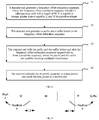
- an implementation procedure of the method is as follows: Step 41: A transmit end generates a frequency offset estimation sequence, where the frequency offset estimation sequence includes N subsequences each with a length of M, N is a positive integer greater than or equal to 2, and M is a positive integer.
- the transmit end may be a CMTS, or may be a CM.
- the transmit end generates the frequency offset estimation sequence in the following process:
- the transmit end first generates a bit stream, and the bit stream may be randomly designed, or may be specially designed, for example, in a form of ⁇ 1, -1, 1, -1... ⁇ .
- the transmit end modulates the bit stream to a preset data modulation format, such as binary phase shift keying (BPSK) or quadrature phase shift keying (QPSK).
- BPSK binary phase shift keying
- QPSK quadrature phase shift keying
- the bit stream is used as a basic subsequence, and a length of the basic subsequence is M.
- the transmit end replicates the basic subsequence to obtain a long sequence including N basic subsequences.
- the transmit end rotates each subsequence included in the long sequence by a phase of ⁇ relative to a previous subsequence adjacent to the subsequence, to obtain the frequency offset estimation sequence, where - ⁇ ⁇ ⁇ ⁇ ⁇ .
- the frequency offset estimation sequence is a cycle sequence; when ⁇ ⁇ 0, the frequency offset estimation sequence is a rotation sequence, and ⁇ is a rotation angle of the frequency offset estimation sequence.
- An absolute value of ⁇ cannot exceed ⁇ , so as to improve frequency offset estimation accuracy, and avoid an erroneous result when a receive end subsequently performs frequency offset estimation.
- Both the sampling rate f s and a sequence cycle M are known constants, and the frequency offset ⁇ f is unknown and to be calculated.
- the frequency offset estimation sequence is a cycle sequence with a cycle of M
- a n + M a n
- B 2 [ n ] B 1 [ n ]. Because a result obtained by conjugate-multiplying two same element values is definitely a real number, a product of B 2 [ n ] B 1 *[ n ] is a real number, and a phase introduced by the channel h n may be canceled.
- a frequency offset value can be calculated by using a phase of y [ n ] only.
- the frequency offset estimation sequence is a rotation sequence with a rotation angle of ⁇
- a n + M a n e j ⁇ and a product of B 2 [ n ] B 1 *[ n ] is a fixed complex number with a phase of ⁇ .
- a phase of y [ n ] is calculated, a value of ⁇ is canceled, so as to obtain a real phase and calculate a frequency offset value.
- the sampling rate f s is determinate.
- a length of a sequence M is limited.
- the sequence is a cycle sequence
- an estimation range of the frequency offset is as follows: ⁇ f s 2 ⁇ M ⁇ ⁇ ⁇ f ⁇ f s 2 ⁇ M .
- ⁇ is equal to ⁇ , that is, the sequence is a rotation sequence with a rotation angle of ⁇ , and an estimation range of the frequency offset is as follows: ⁇ f s M ⁇ ⁇ ⁇ f ⁇ 0 .
- ⁇ is equal to - ⁇ , that is, the sequence is a rotation sequence with a rotation angle of - ⁇ , and an estimation range of the frequency offset is as follows: 0 ⁇ ⁇ ⁇ f ⁇ f s M .
- a maximum value of a frequency offset that can be estimated is ⁇ f max
- an estimation range is - ⁇ f max to ⁇ f max
- a minimum estimation range is -2 ⁇ f max to 0, and a maximum estimation range is 0 to 2 ⁇ f max .
- an estimation range of the rotation sequence may be adjusted flexibly according to a characteristic of the system, for example, the system has a positive frequency offset range or a negative frequency offset range.
- an estimation range may be adjusted to 0 to 2 ⁇ f max , that is, the actual frequency offset of the system may be estimated accurately.
- a cycle sequence is used to calculate a frequency offset value
- a maximum frequency offset value can only be estimated as large as ⁇ f max .
- Step 42 The transmit end generates a prefix and a suffix based on the frequency offset estimation sequence.
- the transmit end generates the prefix and the suffix in the following process:
- the transmit end replicates last L1 element values included in the first subsequence of the frequency offset estimation sequence, and separately rotates the replicated L1 element values by a phase of - ⁇ to generate the prefix.
- the transmit end replicates first L2 element values included in the last subsequence of the frequency offset estimation sequence, and separately rotates the replicated L2 element values by a phase of ⁇ to generate the suffix.
- L1 and L2 are set by the transmit end according to a channel multipath feature, and L1 and L2 are integers not greater than M.
- Step 43 The transmit end adds the prefix and the suffix before and after the frequency offset estimation sequence respectively to form a preamble sequence, where the prefix and the suffix are used for canceling multipath interference.
- the transmit end adds the prefix and the suffix before and after the frequency offset estimation sequence respectively, that is, adds the prefix before the first subsequence of the frequency offset estimation sequence and adds the suffix after the last subsequence of the frequency offset estimation sequence.
- FIG. 5 describes a design manner of a preamble sequence based on a cycle sequence.
- FIG. 6 describes a design manner of a preamble sequence based on a rotation sequence.
- the transmit end adds the prefix and the suffix at start and end locations of the frequency offset estimation sequence, so as to enhance performance of anti-multipath interference of the frequency offset estimation sequence, cancel a delay feature of a multipath channel, and improve frequency offset estimation accuracy.
- the frequency offset estimation sequence can cancel multipath channel interference.
- h n is not a single value but a vector.
- Each element value of x [ n ] is related to L 2 data before a n and L 1 data after a n .
- y [ n ] calculated at all locations can cancel a phase of a channel h n .
- FIG. 7 describes a valid range of an element value that can cancel multipath interference and that is in a frequency offset estimation sequence in the prior art, that is, a valid range of a value of n.
- the calculated y [ n ] can really cancel interference from a multipath channel only when n is within the range.
- FIG. 8 describes a valid range of an element value that can cancel multipath interference and that is in a frequency offset estimation sequence according to this embodiment of the present invention.
- Step 44 The transmit end adds the preamble sequence to a data packet and sends the data packet to a receive end.
- a prefix and a suffix are added to a frequency offset estimation sequence at a transmit end, so as to provide a frequency offset estimation sequence with higher anti-multipath interference performance.
- the frequency offset estimation sequence may be a cycle sequence, or may be a rotation sequence.
- an estimation range of the frequency offset estimation sequence can be freely adjusted.
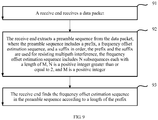
- an embodiment of the present invention further provides a preamble sequence receiving method, and an implementation procedure of the method is as follows: Step 91: A receive end receives a data packet.
- the receive end may be a CMTS, or may be a CM.
- Step 92 The receive end extracts a preamble sequence from the data packet, where the preamble sequence includes a prefix, a frequency offset estimation sequence, and a suffix in order, the prefix and the suffix are used for canceling multipath interference, the frequency offset estimation sequence includes N subsequences each with a length of M, N is a positive integer greater than or equal to 2, and M is a positive integer.
- the receive end may search for a start location of the data packet by using a data monitor algorithm, and find a specific location of the preamble sequence according to a pre-designed data packet structure.
- Step 93 The receive end finds the frequency offset estimation sequence in the preamble sequence according to a length of the prefix.
- a transmit end may send related information of the preamble sequence to the receive end together with the preamble sequence, for the receive end, the length of the prefix, M, N, ⁇ , and other information are known.
- the receive end may determine a location of the entire preamble sequence according to a detection algorithm, and find the frequency offset estimation sequence in the preamble sequence according to the length of the prefix.
- Each subsequence included in the frequency offset estimation sequence is rotated by a phase of ⁇ relative to a previous subsequence adjacent to the subsequence, where - ⁇ ⁇ ⁇ ⁇ ⁇ .
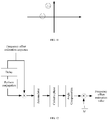
- the receive end may perform frequency offset estimation based on the frequency offset estimation sequence. As shown in FIG. 10 , a specific procedure is as follows:
- the receive end multiplies an element value in a subsequence in the processed sequence by a corresponding element value in a subsequence in the original frequency offset estimation sequence, and the processed sequence is obtained after the delay of the length of K subsequences and the conjugation.
- the first element value in the first subsequence in the processed sequence is multiplied by the first element value in a (K+1) th subsequence in the original frequency offset estimation sequence
- the second element value in the first subsequence in the processed sequence is multiplied by the second element value in a K th subsequence in the original frequency offset estimation sequence.
- Step 104 The receive end calculates a sum of the (N-K) ⁇ M complex numbers.
- Step 105 The receive end obtains a phase of the sum to obtain a phase value.
- the receive end usually obtains a phase value and then calculates a sum.
- the receive end calculates a sum and then obtains a phase value. This decreases a quantity of phase collection operations, reduces calculation complexity, and further improves frequency offset estimation accuracy.
- FIG. 11 describes a reason why a prior-art method for averaging multiple phase values reduces frequency offset estimation accuracy.
- the range is limited in one quadrant, for example, in the second quadrant, it has less impact on accuracy of a phase value. If the range crosses two quadrants, for example, crosses the second and the third quadrant, a phase value is transited from ⁇ to - ⁇ . In this embodiment of the present invention, a sum of complex-number product values is calculated first, and a phase of the sum is obtained. Though a range in which the complex-number product values are located crosses two quadrants, good frequency offset estimation accuracy can be ensured.
- the receive end performs phase compensation on the phase value by using the following specific operation: rotating the phase value by a phase of ⁇ .
- ⁇ is related to ⁇ , for example, ⁇ is equal to ⁇ + ⁇ , ⁇ - ⁇ , or the like.
- Step 106 The receive end divides the phase value by M to obtain a frequency offset estimation value.
- the receive end uses the correct start location to divide the frequency offset estimation sequence into two parts.
- One part is delayed by a length of one subsequence, then conjugated, and then input into a multiplier.
- the other part is directly input into the multiplier.
- FIG. 13 also describes the foregoing operation process.
- a left box indicates an element value that is directly input into a multiplier, and a right box indicates an element value that needs to be delayed, conjugated and then input into the multiplier.
- One complex number may be obtained in each multiplication.
- (N-1) ⁇ M complex numbers may be obtained in total.
- the receive end calculates a sum of the obtained (N-1) ⁇ M complex numbers, and then obtains a phase of the only one sum value.
- the receive end After obtaining a phase difference of M element values in the frequency offset estimation sequence, the receive end performs phase compensation on the phase difference, and divides a phase value obtained after compensation by M to obtain the frequency offset estimation value.
- a prefix and a suffix are added to improve anti-multipath interference performance at start and end locations of a frequency offset estimation sequence.
- an embodiment of the present invention provides a preamble sequence sending apparatus 14 that is configured to implement the preamble sequence sending method shown in FIG. 4 in the present invention.
- the preamble sequence sending apparatus 14 includes:
- the first generation unit 141 is specifically configured to generate a bit stream; modulate the bit stream to a preset data modulation format, where the bit stream is used as a basic subsequence, and a length of the basic subsequence is M; replicate the basic subsequence to obtain a long sequence including N basic subsequences; and rotate each subsequence included in the long sequence by a phase of ⁇ relative to a previous subsequence adjacent to the subsequence, to obtain the frequency offset estimation sequence, where - ⁇ ⁇ ⁇ ⁇ ⁇ .
- the second generation unit 142 is specifically configured to replicate last L1 element values included in the first subsequence of the frequency offset estimation sequence, and separately rotate the replicated L1 element values by a phase of - ⁇ to generate the prefix; and replicate first L2 element values included in the last subsequence of the frequency offset estimation sequence, and separately rotate the replicated L2 element values by a phase of ⁇ to generate the suffix, where L1 and L2 are set by the second generation unit 142 according to a channel multipath feature, and L1 and L2 are integers not greater than M.
- the adding unit 143 is specifically configured to add the prefix before the first subsequence of the frequency offset estimation sequence and add the suffix after the last subsequence of the frequency offset estimation sequence.
- an embodiment of the present invention provides a preamble sequence receiving apparatus 15 that is configured to implement the preamble sequence receiving method shown in FIG. 9 in the present invention.
- the preamble sequence receiving apparatus 15 includes:
- each subsequence included in the frequency offset estimation sequence is rotated by a phase of ⁇ relative to a previous subsequence adjacent to the subsequence, where - ⁇ ⁇ ⁇ ⁇ ⁇ .
- the preamble sequence receiving apparatus 15 may further include: a frequency offset estimation unit, configured to delay each subsequence included in the frequency offset estimation sequence by a length of K subsequences to obtain a new sequence, where K is a positive integer less than N; perform conjugation on the new sequence to obtain a processing sequence; multiply an element value in a subsequence in the processed sequence by a corresponding element value in a subsequence in the frequency offset estimation sequence to obtain (N-K) ⁇ M complex numbers; calculate a sum of the (N-K) ⁇ M complex numbers; obtain a phase of the sum to obtain a phase value; and divide the phase value by M to obtain a frequency offset estimation value.
- a frequency offset estimation unit configured to delay each subsequence included in the frequency offset estimation sequence by a length of K subsequences to obtain a new sequence, where K is a positive integer less than N; perform conjugation on the new sequence to obtain a processing sequence; multiply an element value in a subse
- the preamble sequence receiving apparatus 15 may further include: a phase compensation unit, configured to: when ⁇ ⁇ 0, before the frequency offset estimation unit divides the phase value by M, perform phase compensation on the phase value.
- a phase compensation unit configured to: when ⁇ ⁇ 0, before the frequency offset estimation unit divides the phase value by M, perform phase compensation on the phase value.
- the phase compensation unit is specifically configured to rotate the phase value by a phase of ⁇ , where ⁇ is related to ⁇ .
- an embodiment of the present invention further provides a preamble sequence processing system, and the system may include the sending apparatus 14 in any one of the foregoing cases and the receiving apparatus 15 in any one of the foregoing cases.
- the sending apparatus 14 is connected to the receiving apparatus 15.
- the sending apparatus 14 configured to generate a frequency offset estimation sequence, where the frequency offset estimation sequence includes N subsequences each with a length of M, N is a positive integer greater than or equal to 2, and M is a positive integer; generate a prefix and a suffix based on the frequency offset estimation sequence; add the prefix and the suffix before and after the frequency offset estimation sequence respectively to form a preamble sequence, where the prefix and the suffix are used for canceling multipath interference; and add the preamble sequence to a data packet and send the data packet to a receive end.
- the receiving apparatus 15 is configured to receive the data packet; extract the preamble sequence from the data packet, where the preamble sequence includes the prefix, the frequency offset estimation sequence, and the suffix in order, the prefix and the suffix are used for canceling multipath interference, the frequency offset estimation sequence includes N subsequences each with a length of M, N is a positive integer greater than or equal to 2, and M is a positive integer; and find the frequency offset estimation sequence from the preamble sequence according to the length of the prefix.
- the sending apparatus 14 is specifically configured to generate a bit stream; modulate the bit stream to a preset data modulation format, where the bit stream is used as a basic subsequence, and a length of the basic subsequence is M; replicate the basic subsequence to obtain a long sequence including N basic subsequences; and rotate each subsequence included in the long sequence by a phase of ⁇ relative to a previous subsequence adjacent to the subsequence, to obtain the frequency offset estimation sequence, where - ⁇ ⁇ ⁇ ⁇ ⁇ .
- the sending apparatus 14 is specifically configured to replicate last L1 element values included in the first subsequence of the frequency offset estimation sequence, and separately rotate the replicated L1 element values by a phase of - ⁇ to generate the prefix; and replicate first L2 element values included in the last subsequence of the frequency offset estimation sequence, and separately rotate the replicated L2 element values by a phase of ⁇ to generate the suffix, where L1 and L2 are set by the sending apparatus 14 according to a channel multipath feature, and L1 and L2 are integers not greater than M.
- the sending apparatus 14 is specifically configured to add the prefix before the first subsequence of the frequency offset estimation sequence and add the suffix after the last subsequence of the frequency offset estimation sequence.
- each subsequence included in the frequency offset estimation sequence extracted by the receiving apparatus 15 is rotated by a phase of ⁇ relative to a previous subsequence adjacent to the subsequence, where - ⁇ ⁇ ⁇ ⁇ ⁇ .
- the receiving apparatus 15 may be further configured to delay each subsequence included in the frequency offset estimation sequence by a length of K subsequences to obtain a new sequence, where K is a positive integer less than N; perform conjugation on the new sequence to obtain a processing sequence; multiply an element value in a subsequence in a processed sequence by a corresponding element value in a subsequence in the frequency offset estimation sequence to obtain (N-K) ⁇ M complex numbers; calculate a sum of the (N-K) ⁇ M complex numbers; obtain a phase of the sum to obtain a phase value; and divide the phase value by M to obtain a frequency offset estimation value.
- the receiving apparatus 15 may be further configured to: when ⁇ ⁇ 0, before the phase value is divided by M, perform phase compensation on the phase value.
- the receiving apparatus 15 when performing phase compensation on the phase value, is specifically configured to rotate the phase value by a phase of ⁇ , where ⁇ is related to ⁇ .
- the technical solutions provided in the embodiments of the present invention are applicable to a DOCSIS single carrier modulation system.
- a prefix and a suffix are added to a frequency offset estimation sequence at a transmit end, so as to improve performance of anti-multipath interference of the frequency offset estimation sequence.
- the frequency offset estimation sequence may be a cycle sequence or a rotation sequence.
- an estimation range of a frequency offset may be freely adjusted, and the rotation sequence has a wider estimation range and higher estimation accuracy.
- a receive end may perform more accurate frequency offset estimation based on the received frequency offset estimation sequence.
- the receive end multiples the original frequency offset estimation sequence by a frequency offset estimation sequence obtained after delay and conjugation, calculates a sum of obtained multiple complex-number product values, and then obtains a phase of the sum. This greatly decreases a quantity of phase collection operations, reduces calculation complexity, and ensures good frequency offset estimation accuracy.
- the embodiments of the present invention may be provided as a method, a system, or a computer program product. Therefore, the present invention may use a form of hardware only embodiments, software only embodiments, or embodiments with a combination of software and hardware. Moreover, the present invention may use a form of a computer program product that is implemented on one or more computer-usable storage media (including but not limited to a disk memory, a CD-ROM, an optical memory, and the like) that include computer-usable program code.
- computer-usable storage media including but not limited to a disk memory, a CD-ROM, an optical memory, and the like
- These computer program instructions may be provided for a general-purpose computer, a dedicated computer, an embedded processor, or a processor of any other programmable data processing device to generate a machine, so that the instructions executed by a computer or a processor of any other programmable data processing device generate an apparatus for implementing a specific function in one or more processes in the flowcharts and/or in one or more blocks in the block diagrams.
- These computer program instructions may be stored in a computer readable memory that can instruct the computer or any other programmable data processing device to work in a specific manner, so that the instructions stored in the computer readable memory generate an artifact that includes an instruction apparatus.
- the instruction apparatus implements a specific function in one or more processes in the flowcharts and/or in one or more blocks in the block diagrams.
- These computer program instructions may be loaded onto a computer or another programmable data processing device, so that a series of operations and steps are performed on the computer or the another programmable device, thereby generating computer-implemented processing. Therefore, the instructions executed on the computer or the another programmable device provide steps for implementing a specific function in one or more processes in the flowcharts and/or in one or more blocks in the block diagrams.
Landscapes
- Engineering & Computer Science (AREA)
- Computer Networks & Wireless Communication (AREA)
- Signal Processing (AREA)
- Power Engineering (AREA)
- Computer Security & Cryptography (AREA)
- Cable Transmission Systems, Equalization Of Radio And Reduction Of Echo (AREA)
Claims (9)
- Verfahren zum Senden einer Präambelsequenz, umfassend:Erzeugen (41) einer Frequenz-Offset-Schätzungssequenz durch ein Sendeende, wobei die Frequenz-Offset-Schätzungssequenz N Teilsequenzen jeweils mit einer Länge von M umfasst, wobei N eine positive ganze Zahl größer als oder gleich 2 ist, und M eine positive ganze Zahl ist;Erzeugen (42) eines Präfixes und eines Suffixes durch das Sendeende basierend auf der Frequenz-Offset-Schätzungssequenz, umfassend die folgenden Schritte:Wiederholen durch das Sendeende von L1 letzten Elementwerten, die in der ersten Teilsequenz der Frequenz-Offset-Schätzungssequenz umfasst sind, und separates Drehen der wiederholten L1 Elementwerte um eine Phase von -θ, um das Präfix zu erzeugen; undWiederholen durch das Sendeende von L2 ersten Elementwerten, die in der letzten Teilsequenz der Frequenz-Offset-Schätzungssequenz umfasst sind, und separates Drehen der wiederholten L2 Elementwerte um eine Phase von θ, um das Suffix zu erzeugen; wobeiL1 und L2 durch das Sendeende gemäß einem Kanal-Mehrwege-Merkmal festgelegt werden, und L1 und L2 ganze Zahlen sind, die nicht größer als M sind;Hinzufügen (43) des Präfixes und des Suffixes durch das Sendeende vor bzw. nach der Frequenz-Offset-Schätzungssequenz, um eine Präambelsequenz zu bilden, wobei das Präfix und das Suffix zum Aufheben von Mehrwege-Interferenz verwendet werden, wobei jede Teilsequenz, die in der Frequenz-Offset-Schätzungssequenz umfasst ist, um eine Phase von θ in Bezug auf eine vorherige Teilsequenz benachbart zur Teilsequenz gedreht wird und -π ≤ θ ≤ π und θ ≠ 0; undHinzufügen (44) der Präambelsequenz durch das Sendeende zu einem Datenpaket und Senden des Datenpakets an ein Empfangsende.
- Verfahren nach Anspruch 1, wobei das Erzeugen einer Frequenz-Offset-Schätzungssequenz durch ein Sendeende umfasst:Erzeugen eines Bitstroms durch das Sendeende;Modulieren des Bitstroms durch das Sendeende auf ein voreingestelltes Datenmodulationsformat, wobei der modulierte Bitstrom als eine Basisteilsequenz verwendet wird, und eine Länge der Basisteilsequenz M ist;Wiederholen der Basisteilsequenz durch das Sendeende, um eine lange Sequenz zu erhalten, die N Basisteilsequenzen umfasst;wobei das Hinzufügen des Präfixes und des Suffixes durch das Sendeende vor bzw. nach der Frequenz-Offset-Schätzungssequenz zum Bilden einer Präambelsequenz umfasst:
Drehen aller Punkte in jeder Teilsequenz, die in der Frequenz-Offset-Schätzungssequenz umfasst ist, durch das Sendeende um eine Phase von θ in Bezug auf eine vorherige Teilsequenz benachbart zur Teilsequenz und -π ≤ θ ≤ π and θ ≠ 0, um die Frequenz-Offset-Schätzungssequenz zu erhalten. - Verfahren nach Anspruch 1, wobei das Hinzufügen des Präfixes und des Suffixes durch das Sendeende vor bzw. nach der Frequenz-Offset-Schätzungssequenz umfasst:Hinzufügen des Präfixes durch das Sendeende vor der ersten Teilsequenz der Frequenz-Offset-Schätzungssequenz; undHinzufügen des Suffixes durch das Sendeende nach der letzten Teilsequenz der Frequenz-Offset-Schätzungssequenz.
- Verfahren zum Empfangen einer Präambelsequenz, umfassend:Empfangen (91) eines Datenpakets durch ein Empfangsende;Extrahieren (92) einer Präambelsequenz durch das Empfangsende aus dem Datenpaket, wobei die Präambelsequenz ein Präfix, eine Frequenz-Offset-Schätzungssequenz und ein Suffix in Reihenfolge umfasst, wobei das Präfix und das Suffix zum Aufheben von Mehrwege-Interferenz verwendet werden, die Frequenz-Offset-Schätzungssequenz N Teilsequenzen jeweils mit einer Länge von M umfasst, wobei N eine positive ganze Zahl größer als oder gleich 2 ist, und M eine positive ganze Zahl ist, wobei jede Teilsequenz, die in der Frequenz-Offset-Schätzungssequenz umfasst ist, um eine Phase von θ in Bezug auf eine vorherige Teilsequenz benachbart zur Teilsequenz gedreht wird, und -π ≤ θ ≤ π und θ ≠ 0, wobeiwobei das Präfix eine Wiederholung von L1 letzten Elementwerten umfasst, die in der ersten Teilsequenz der Frequenz-Offset-Schätzungssequenz umfasst sind, wobei die wiederholten L1 Elementwerte um eine Phase von -θ gedreht werden; undwobei das Suffix eine Wiederholung von L2 ersten Elementwerten umfasst, die in der letzten Teilsequenz der Frequenz-Offset-Schätzungssequenz umfasst sind, wobei die wiederholten L2 Elementwerte um eine Phase von θ gedreht werden; wobeiL1 und L2 durch ein Sendeende gemäß einem Kanal-Mehrwege-Merkmal festgelegt werden, und L1 und L2 ganze Zahlen sind, die nicht größer als M sind; und Ermitteln (93) der Frequenz-Offset-Schätzungssequenz durch das Empfangsende in der Präambelsequenz gemäß einer Länge des Präfixes.
- Vorrichtung (14) zum Senden einer Präambelsequenz, umfassend:eine erste Erzeugungseinheit (141), die so konfiguriert ist, dass sie eine Frequenz-Offset-Schätzungssequenz erzeugt, wobei die Frequenz-Offset-Schätzungssequenz N Teilsequenzen jeweils mit einer Länge von M umfasst, wobei N eine positive ganze Zahl größer als oder gleich 2 ist, und M eine positive ganze Zahl ist, wobei jede Teilsequenz, die in der Frequenz-Offset-Schätzungssequenz umfasst ist, um eine Phase von θ in Bezug auf eine vorherige Teilsequenz benachbart zur Teilsequenz gedreht wird, und -π ≤ θ ≤ π und θ ≠ 0;eine zweite Erzeugungseinheit (142), die zum Erzeugen eines Präfixes und eines Suffixes basierend auf der Frequenz-Offset-Schätzungssequenz konfiguriert ist,wobei die zweite Erzeugungseinheit insbesondere konfiguriert ist zum:Wiederholen von L1 letzten Elementwerten, die in der ersten Teilsequenz der Frequenz-Offset-Schätzungssequenz umfasst sind, und separaten Drehen der wiederholten L1 Elementwerte um eine Phase von -θ, um das Präfix zu erzeugen; undWiederholen von L2 ersten Elementwerten, die in der letzten Teilsequenz der Frequenz-Offset-Schätzungssequenz umfasst sind, und separaten Drehen der wiederholten L2 Elementwerte um eine Phase von θ, um das Präfix zu erzeugen; wobei L1 und L2 durch die zweite Erzeugungseinheit gemäß einem Kanal-Mehrwege-Merkmal festgelegt werden, und L1 und L2 ganze Zahlen sind, die nicht größer als M sind;eine Hinzufügungseinheit (143), die so konfiguriert ist, dass sie das Präfix und das Suffixes vor bzw. nach der Frequenz-Offset-Schätzungssequenz hinzufügt, um eine Präambelsequenz zu bilden, wobei das Präfix und das Suffix zum Aufheben von Mehrwege-Interferenz verwendet werden; undeine Sendeeinheit (144), die zum Hinzufügen der Präambelsequenz zu einem Datenpaket und Senden des Datenpakets an ein Empfangsende konfiguriert ist.
- Sendevorrichtung nach Anspruch 5, wobei die erste Erzeugungseinheit insbesondere konfiguriert ist zum:Erzeugen eines Bitstroms;Modulieren des Bitstroms auf ein voreingestelltes Datenmodulationsformat, wobei der modulierte Bitstrom als eine Basisteilsequenz verwendet wird, und eine Länge der Basisteilsequenz M ist;Wiederholen der Basisteilsequenz, um eine lange Sequenz zu erhalten, die N Basisteilsequenzen umfasst; undwobei jede gedrehte Teilsequenz in der langen Sequenz umfasst ist, um die Frequenz-Offset-Schätzungssequenz zu erhalten.
- Sendevorrichtung nach Anspruch 5, wobei die Hinzufügungseinheit insbesondere konfiguriert ist zum:Hinzufügen des Präfixes vor der ersten Teilsequenz der Frequenz-Offset-Schätzungssequenz; undHinzufügen des Suffixes nach der letzten Teilsequenz der Frequenz-Offset-Schätzungssequenz.
- Vorrichtung (15) zum Empfangen einer Präambelsequenz, umfassend:eine Empfangseinheit (151), die zum Empfangen eines Datenpakets konfiguriert ist;eine Extraktionseinheit (152), die zum Extrahieren einer Präambelsequenz aus dem Datenpaket konfiguriert ist, wobei die Präambelsequenz ein Präfix, eine Frequenz-Offset-Schätzungssequenz und ein Suffix in Reihenfolge umfasst, wobei das Präfix und das Suffix zum Aufheben von Mehrwege-Interferenz verwendet werden, die Frequenz-Offset-Schätzungssequenz N Teilsequenzen jeweils mit einer Länge von M umfasst, wobei N eine positive ganze Zahl größer als oder gleich 2 ist, und M eine positive ganze Zahl ist, wobei jede Teilsequenz der Frequenz-Offset-Schätzungssequenz um eine Phase von θ in Bezug auf eine vorherige Teilsequenz benachbart zur Teilsequenz gedreht wird und -π ≤ θ ≤ π und θ ≠ 0, wobeidas Präfix eine Wiederholung von L1 letzten Elementwerten umfasst, die in der ersten Teilsequenz der Frequenz-Offset-Schätzungssequenz umfasst sind, wobei die wiederholten L1 Elementwerte um eine Phase von -θ gedreht werden; undwobei das Suffix eine Wiederholung von L2 ersten Elementwerten umfasst, die in der letzten Teilsequenz der Frequenz-Offset-Schätzungssequenz umfasst sind, wobei die wiederholten L2 Elementwerte um eine Phase von θ gedreht werden; wobeiL1 und L2 durch ein Sendeende gemäß einem Kanal-Mehrwege-Merkmal festgelegt werden, und L1 und L2 ganze Zahlen sind, die nicht größer als M sind; undeine Positionierungseinheit (153), die zum Ermitteln der Frequenz-Offset-Schätzungssequenz durch das Empfangsende in der Präambelsequenz gemäß einer Länge des Präfixes konfiguriert ist.
- System zur Verarbeitung einer Präambelsequenz, umfassend die Sendevorrichtung (14) nach einem der Ansprüche 5 bis 7 und die Empfangsvorrichtung (15) nach Anspruch 8, wobei die Sendevorrichtung mit der Empfangsvorrichtung verbunden ist.
Applications Claiming Priority (1)
| Application Number | Priority Date | Filing Date | Title |
|---|---|---|---|
| PCT/CN2014/089791 WO2016065554A1 (zh) | 2014-10-29 | 2014-10-29 | 一种前导序列的发送和接收方法、装置及系统 |
Publications (3)
| Publication Number | Publication Date |
|---|---|
| EP3197115A1 EP3197115A1 (de) | 2017-07-26 |
| EP3197115A4 EP3197115A4 (de) | 2018-01-17 |
| EP3197115B1 true EP3197115B1 (de) | 2019-12-04 |
Family
ID=55856374
Family Applications (1)
| Application Number | Title | Priority Date | Filing Date |
|---|---|---|---|
| EP14905134.4A Active EP3197115B1 (de) | 2014-10-29 | 2014-10-29 | Verfahren, vorrichtung und system zum senden und empfangen einer präambelsequenz |
Country Status (4)
| Country | Link |
|---|---|
| US (1) | US9871680B2 (de) |
| EP (1) | EP3197115B1 (de) |
| CN (1) | CN105874762B (de) |
| WO (1) | WO2016065554A1 (de) |
Families Citing this family (4)
| Publication number | Priority date | Publication date | Assignee | Title |
|---|---|---|---|---|
| CN107347041B (zh) * | 2016-05-05 | 2020-03-20 | 华为技术有限公司 | 基于序列的信道估计方法及装置 |
| WO2018018515A1 (zh) | 2016-07-28 | 2018-02-01 | 华为技术有限公司 | 通信方法、电缆调制解调器终端系统和电缆调制解调器 |
| US10952084B2 (en) * | 2018-03-08 | 2021-03-16 | Qualcomm Incorporated | Interference management for spectrum sharing |
| US10997205B2 (en) * | 2019-01-22 | 2021-05-04 | International Business Machines Corporation | Data origin verification |
Family Cites Families (14)
| Publication number | Priority date | Publication date | Assignee | Title |
|---|---|---|---|---|
| WO2004064345A1 (en) * | 2003-01-15 | 2004-07-29 | Telefonaktiebolaget Lm Ericsson (Publ) | Correlation method for channel estimation for ofdm |
| US7639600B1 (en) * | 2003-02-12 | 2009-12-29 | Marvell International Ltd. | Low complexity channel estimation for orthogonal frequency division modulation systems |
| KR100594156B1 (ko) * | 2004-09-10 | 2006-06-28 | 삼성전자주식회사 | 다중 입력 다중 출력 방식을 사용하는 직교 주파수 분할다중 통신시스템에서 프리앰블 시퀀스 송/수신 방법 |
| US7738355B1 (en) * | 2004-12-03 | 2010-06-15 | Entropic Communications, Inc. | Packet data transmission with optimum preamble length |
| KR100899749B1 (ko) * | 2005-01-13 | 2009-05-27 | 삼성전자주식회사 | 다중 입력 다중 출력 방식을 사용하는 직교 주파수 분할 다중 통신시스템에서 프리앰블 시퀀스 송수신 방법 |
| CN100479445C (zh) * | 2005-01-28 | 2009-04-15 | 北京大学 | 使用了前后缀信号的正交频分复用通信方法 |
| KR20070103917A (ko) * | 2006-04-20 | 2007-10-25 | 엘지전자 주식회사 | 통신 시스템에서의 보호구간 삽입 방법 및 그를 위한 송신장치 |
| US8634496B2 (en) * | 2007-10-31 | 2014-01-21 | Imec | Method for determining and compensating transceiver non-idealities |
| CN101599938B (zh) * | 2009-04-28 | 2011-09-21 | 中国科学院国家授时中心 | 一种正交频分复用超宽带系统接收机时域联合同步方法 |
| CN101888360A (zh) * | 2009-05-15 | 2010-11-17 | 中兴通讯股份有限公司 | 一种随机接入信号的发射方法和装置及相关系统 |
| CN101997806B (zh) * | 2009-08-28 | 2013-03-20 | 清华大学 | 用于数字传输的物理层帧同步序列的生成方法及系统 |
| CN102075480B (zh) * | 2009-11-20 | 2013-05-08 | 清华大学 | 数字信息传输的帧同步序列生成方法及系统 |
| EP2834928A4 (de) * | 2012-04-02 | 2015-08-26 | Ericsson Telefon Ab L M | Verfahren und vorrichtung zur übertragung von signalen in einem telekommunikationssystem |
| CN103078825B (zh) * | 2013-01-30 | 2016-08-10 | 清华大学 | 数字通信系统中的帧同步序列生成方法及装置 |
-
2014
- 2014-10-29 EP EP14905134.4A patent/EP3197115B1/de active Active
- 2014-10-29 WO PCT/CN2014/089791 patent/WO2016065554A1/zh not_active Ceased
- 2014-10-29 CN CN201480006950.3A patent/CN105874762B/zh active Active
-
2017
- 2017-04-18 US US15/490,653 patent/US9871680B2/en active Active
Non-Patent Citations (1)
| Title |
|---|
| None * |
Also Published As
| Publication number | Publication date |
|---|---|
| EP3197115A4 (de) | 2018-01-17 |
| CN105874762B (zh) | 2019-01-15 |
| EP3197115A1 (de) | 2017-07-26 |
| CN105874762A (zh) | 2016-08-17 |
| WO2016065554A1 (zh) | 2016-05-06 |
| US9871680B2 (en) | 2018-01-16 |
| US20170222842A1 (en) | 2017-08-03 |
Similar Documents
| Publication | Publication Date | Title |
|---|---|---|
| CN107154908B (zh) | 前导符号的生成方法 | |
| CN103532899B (zh) | 时域ofdm同步符号生成及解调方法、数据帧传输方法 | |
| CN113518052A (zh) | 一种正交频分复用通信的鲁棒频率偏移估计方法及装置 | |
| CN101621491B (zh) | 用于接收数字信号的接收器和方法 | |
| CN106936554B (zh) | 物理帧中前导符号的生成方法 | |
| US9871680B2 (en) | Preamble sequence sending and receiving method and apparatus, and system | |
| CN112039810A (zh) | 频域ofdm符号的生成方法及前导符号的生成方法 | |
| CN105007146A (zh) | 物理帧中前导符号的生成方法 | |
| CN111131114A (zh) | 前导符号的接收方法及装置 | |
| CN106685878A (zh) | 前导符号的生成方法 | |
| EP3491795B1 (de) | Sender und verfahren zur formatierung von sendedaten in einer rahmenstruktur | |
| JP2008510362A (ja) | 残留周波数オフセットの決定方法、通信システム、メッセージの送信方法、送信機、メッセージの処理方法、及び受信機 | |
| CN109600334B (zh) | 带宽卫星通信系统ofdm同步方法、装置及可读存储介质 | |
| US9780975B1 (en) | Faster-Than-Nyquist (FTN) signal transmission apparatus and method thereof | |
| US9544114B2 (en) | Method and apparatus for channel estimation and equalization | |
| CN116132236B (zh) | 应用于5g nr系统的单符号自适应频偏估计与补偿方法 | |
| JP3558879B2 (ja) | ディジタル通信装置 | |
| Morris | Hardware design and implementation of the Schmidl-Cox synchronization algorithm for an OFDM transceiver | |
| CN106572041A (zh) | 采样频率偏差的计算方法及装置 | |
| US9800442B2 (en) | Estimating method, sampling frequency offset calculating method, and phase estimating method and device | |
| CN119788481B (zh) | 一种未知ofdm信号帧结构参数的识别方法和系统 | |
| KR101275693B1 (ko) | 무선 통신 시스템에서 블라인드 기반 주파수 오프셋 추정 방법 및 장치 | |
| Tamagno | OFDM Frame and Frequency Synchronization in IEEE 802.15. 4g: Algorithms and Hardware Implementation | |
| CN116232382A (zh) | 用于gmsk快跳频系统的通信方法、设备及存储介质 | |
| KR101190469B1 (ko) | 와이브로 시스템에서 저복잡도 소수배 주파수 오차 추정 장치 |
Legal Events
| Date | Code | Title | Description |
|---|---|---|---|
| STAA | Information on the status of an ep patent application or granted ep patent |
Free format text: STATUS: THE INTERNATIONAL PUBLICATION HAS BEEN MADE |
|
| PUAI | Public reference made under article 153(3) epc to a published international application that has entered the european phase |
Free format text: ORIGINAL CODE: 0009012 |
|
| STAA | Information on the status of an ep patent application or granted ep patent |
Free format text: STATUS: REQUEST FOR EXAMINATION WAS MADE |
|
| 17P | Request for examination filed |
Effective date: 20170421 |
|
| AK | Designated contracting states |
Kind code of ref document: A1 Designated state(s): AL AT BE BG CH CY CZ DE DK EE ES FI FR GB GR HR HU IE IS IT LI LT LU LV MC MK MT NL NO PL PT RO RS SE SI SK SM TR |
|
| AX | Request for extension of the european patent |
Extension state: BA ME |
|
| RIC1 | Information provided on ipc code assigned before grant |
Ipc: H04L 27/26 20060101AFI20170912BHEP |
|
| A4 | Supplementary search report drawn up and despatched |
Effective date: 20171219 |
|
| RIC1 | Information provided on ipc code assigned before grant |
Ipc: H04L 27/26 20060101AFI20171213BHEP |
|
| DAX | Request for extension of the european patent (deleted) | ||
| STAA | Information on the status of an ep patent application or granted ep patent |
Free format text: STATUS: EXAMINATION IS IN PROGRESS |
|
| 17Q | First examination report despatched |
Effective date: 20180820 |
|
| GRAJ | Information related to disapproval of communication of intention to grant by the applicant or resumption of examination proceedings by the epo deleted |
Free format text: ORIGINAL CODE: EPIDOSDIGR1 |
|
| STAA | Information on the status of an ep patent application or granted ep patent |
Free format text: STATUS: GRANT OF PATENT IS INTENDED |
|
| GRAP | Despatch of communication of intention to grant a patent |
Free format text: ORIGINAL CODE: EPIDOSNIGR1 |
|
| INTG | Intention to grant announced |
Effective date: 20190607 |
|
| GRAS | Grant fee paid |
Free format text: ORIGINAL CODE: EPIDOSNIGR3 |
|
| GRAA | (expected) grant |
Free format text: ORIGINAL CODE: 0009210 |
|
| STAA | Information on the status of an ep patent application or granted ep patent |
Free format text: STATUS: THE PATENT HAS BEEN GRANTED |
|
| AK | Designated contracting states |
Kind code of ref document: B1 Designated state(s): AL AT BE BG CH CY CZ DE DK EE ES FI FR GB GR HR HU IE IS IT LI LT LU LV MC MK MT NL NO PL PT RO RS SE SI SK SM TR |
|
| REG | Reference to a national code |
Ref country code: GB Ref legal event code: FG4D |
|
| REG | Reference to a national code |
Ref country code: CH Ref legal event code: EP |
|
| REG | Reference to a national code |
Ref country code: AT Ref legal event code: REF Ref document number: 1210880 Country of ref document: AT Kind code of ref document: T Effective date: 20191215 |
|
| REG | Reference to a national code |
Ref country code: DE Ref legal event code: R096 Ref document number: 602014058094 Country of ref document: DE |
|
| REG | Reference to a national code |
Ref country code: IE Ref legal event code: FG4D |
|
| REG | Reference to a national code |
Ref country code: NL Ref legal event code: MP Effective date: 20191204 |
|
| REG | Reference to a national code |
Ref country code: LT Ref legal event code: MG4D |
|
| PG25 | Lapsed in a contracting state [announced via postgrant information from national office to epo] |
Ref country code: LT Free format text: LAPSE BECAUSE OF FAILURE TO SUBMIT A TRANSLATION OF THE DESCRIPTION OR TO PAY THE FEE WITHIN THE PRESCRIBED TIME-LIMIT Effective date: 20191204 Ref country code: NO Free format text: LAPSE BECAUSE OF FAILURE TO SUBMIT A TRANSLATION OF THE DESCRIPTION OR TO PAY THE FEE WITHIN THE PRESCRIBED TIME-LIMIT Effective date: 20200304 Ref country code: SE Free format text: LAPSE BECAUSE OF FAILURE TO SUBMIT A TRANSLATION OF THE DESCRIPTION OR TO PAY THE FEE WITHIN THE PRESCRIBED TIME-LIMIT Effective date: 20191204 Ref country code: LV Free format text: LAPSE BECAUSE OF FAILURE TO SUBMIT A TRANSLATION OF THE DESCRIPTION OR TO PAY THE FEE WITHIN THE PRESCRIBED TIME-LIMIT Effective date: 20191204 Ref country code: GR Free format text: LAPSE BECAUSE OF FAILURE TO SUBMIT A TRANSLATION OF THE DESCRIPTION OR TO PAY THE FEE WITHIN THE PRESCRIBED TIME-LIMIT Effective date: 20200305 Ref country code: FI Free format text: LAPSE BECAUSE OF FAILURE TO SUBMIT A TRANSLATION OF THE DESCRIPTION OR TO PAY THE FEE WITHIN THE PRESCRIBED TIME-LIMIT Effective date: 20191204 Ref country code: BG Free format text: LAPSE BECAUSE OF FAILURE TO SUBMIT A TRANSLATION OF THE DESCRIPTION OR TO PAY THE FEE WITHIN THE PRESCRIBED TIME-LIMIT Effective date: 20200304 |
|
| PG25 | Lapsed in a contracting state [announced via postgrant information from national office to epo] |
Ref country code: RS Free format text: LAPSE BECAUSE OF FAILURE TO SUBMIT A TRANSLATION OF THE DESCRIPTION OR TO PAY THE FEE WITHIN THE PRESCRIBED TIME-LIMIT Effective date: 20191204 Ref country code: HR Free format text: LAPSE BECAUSE OF FAILURE TO SUBMIT A TRANSLATION OF THE DESCRIPTION OR TO PAY THE FEE WITHIN THE PRESCRIBED TIME-LIMIT Effective date: 20191204 |
|
| PG25 | Lapsed in a contracting state [announced via postgrant information from national office to epo] |
Ref country code: AL Free format text: LAPSE BECAUSE OF FAILURE TO SUBMIT A TRANSLATION OF THE DESCRIPTION OR TO PAY THE FEE WITHIN THE PRESCRIBED TIME-LIMIT Effective date: 20191204 |
|
| PG25 | Lapsed in a contracting state [announced via postgrant information from national office to epo] |
Ref country code: PT Free format text: LAPSE BECAUSE OF FAILURE TO SUBMIT A TRANSLATION OF THE DESCRIPTION OR TO PAY THE FEE WITHIN THE PRESCRIBED TIME-LIMIT Effective date: 20200429 Ref country code: EE Free format text: LAPSE BECAUSE OF FAILURE TO SUBMIT A TRANSLATION OF THE DESCRIPTION OR TO PAY THE FEE WITHIN THE PRESCRIBED TIME-LIMIT Effective date: 20191204 Ref country code: RO Free format text: LAPSE BECAUSE OF FAILURE TO SUBMIT A TRANSLATION OF THE DESCRIPTION OR TO PAY THE FEE WITHIN THE PRESCRIBED TIME-LIMIT Effective date: 20191204 Ref country code: NL Free format text: LAPSE BECAUSE OF FAILURE TO SUBMIT A TRANSLATION OF THE DESCRIPTION OR TO PAY THE FEE WITHIN THE PRESCRIBED TIME-LIMIT Effective date: 20191204 Ref country code: ES Free format text: LAPSE BECAUSE OF FAILURE TO SUBMIT A TRANSLATION OF THE DESCRIPTION OR TO PAY THE FEE WITHIN THE PRESCRIBED TIME-LIMIT Effective date: 20191204 Ref country code: CZ Free format text: LAPSE BECAUSE OF FAILURE TO SUBMIT A TRANSLATION OF THE DESCRIPTION OR TO PAY THE FEE WITHIN THE PRESCRIBED TIME-LIMIT Effective date: 20191204 |
|
| PG25 | Lapsed in a contracting state [announced via postgrant information from national office to epo] |
Ref country code: IS Free format text: LAPSE BECAUSE OF FAILURE TO SUBMIT A TRANSLATION OF THE DESCRIPTION OR TO PAY THE FEE WITHIN THE PRESCRIBED TIME-LIMIT Effective date: 20200404 Ref country code: SK Free format text: LAPSE BECAUSE OF FAILURE TO SUBMIT A TRANSLATION OF THE DESCRIPTION OR TO PAY THE FEE WITHIN THE PRESCRIBED TIME-LIMIT Effective date: 20191204 Ref country code: SM Free format text: LAPSE BECAUSE OF FAILURE TO SUBMIT A TRANSLATION OF THE DESCRIPTION OR TO PAY THE FEE WITHIN THE PRESCRIBED TIME-LIMIT Effective date: 20191204 |
|
| REG | Reference to a national code |
Ref country code: DE Ref legal event code: R097 Ref document number: 602014058094 Country of ref document: DE |
|
| REG | Reference to a national code |
Ref country code: AT Ref legal event code: MK05 Ref document number: 1210880 Country of ref document: AT Kind code of ref document: T Effective date: 20191204 |
|
| PLBE | No opposition filed within time limit |
Free format text: ORIGINAL CODE: 0009261 |
|
| STAA | Information on the status of an ep patent application or granted ep patent |
Free format text: STATUS: NO OPPOSITION FILED WITHIN TIME LIMIT |
|
| PG25 | Lapsed in a contracting state [announced via postgrant information from national office to epo] |
Ref country code: DK Free format text: LAPSE BECAUSE OF FAILURE TO SUBMIT A TRANSLATION OF THE DESCRIPTION OR TO PAY THE FEE WITHIN THE PRESCRIBED TIME-LIMIT Effective date: 20191204 |
|
| 26N | No opposition filed |
Effective date: 20200907 |
|
| PG25 | Lapsed in a contracting state [announced via postgrant information from national office to epo] |
Ref country code: AT Free format text: LAPSE BECAUSE OF FAILURE TO SUBMIT A TRANSLATION OF THE DESCRIPTION OR TO PAY THE FEE WITHIN THE PRESCRIBED TIME-LIMIT Effective date: 20191204 Ref country code: PL Free format text: LAPSE BECAUSE OF FAILURE TO SUBMIT A TRANSLATION OF THE DESCRIPTION OR TO PAY THE FEE WITHIN THE PRESCRIBED TIME-LIMIT Effective date: 20191204 Ref country code: SI Free format text: LAPSE BECAUSE OF FAILURE TO SUBMIT A TRANSLATION OF THE DESCRIPTION OR TO PAY THE FEE WITHIN THE PRESCRIBED TIME-LIMIT Effective date: 20191204 |
|
| PG25 | Lapsed in a contracting state [announced via postgrant information from national office to epo] |
Ref country code: IT Free format text: LAPSE BECAUSE OF FAILURE TO SUBMIT A TRANSLATION OF THE DESCRIPTION OR TO PAY THE FEE WITHIN THE PRESCRIBED TIME-LIMIT Effective date: 20191204 |
|
| REG | Reference to a national code |
Ref country code: CH Ref legal event code: PL |
|
| PG25 | Lapsed in a contracting state [announced via postgrant information from national office to epo] |
Ref country code: MC Free format text: LAPSE BECAUSE OF FAILURE TO SUBMIT A TRANSLATION OF THE DESCRIPTION OR TO PAY THE FEE WITHIN THE PRESCRIBED TIME-LIMIT Effective date: 20191204 Ref country code: LU Free format text: LAPSE BECAUSE OF NON-PAYMENT OF DUE FEES Effective date: 20201029 |
|
| REG | Reference to a national code |
Ref country code: BE Ref legal event code: MM Effective date: 20201031 |
|
| PG25 | Lapsed in a contracting state [announced via postgrant information from national office to epo] |
Ref country code: FR Free format text: LAPSE BECAUSE OF NON-PAYMENT OF DUE FEES Effective date: 20201031 |
|
| PG25 | Lapsed in a contracting state [announced via postgrant information from national office to epo] |
Ref country code: CH Free format text: LAPSE BECAUSE OF NON-PAYMENT OF DUE FEES Effective date: 20201031 Ref country code: BE Free format text: LAPSE BECAUSE OF NON-PAYMENT OF DUE FEES Effective date: 20201031 Ref country code: LI Free format text: LAPSE BECAUSE OF NON-PAYMENT OF DUE FEES Effective date: 20201031 |
|
| PG25 | Lapsed in a contracting state [announced via postgrant information from national office to epo] |
Ref country code: IE Free format text: LAPSE BECAUSE OF NON-PAYMENT OF DUE FEES Effective date: 20201029 |
|
| PG25 | Lapsed in a contracting state [announced via postgrant information from national office to epo] |
Ref country code: TR Free format text: LAPSE BECAUSE OF FAILURE TO SUBMIT A TRANSLATION OF THE DESCRIPTION OR TO PAY THE FEE WITHIN THE PRESCRIBED TIME-LIMIT Effective date: 20191204 Ref country code: MT Free format text: LAPSE BECAUSE OF FAILURE TO SUBMIT A TRANSLATION OF THE DESCRIPTION OR TO PAY THE FEE WITHIN THE PRESCRIBED TIME-LIMIT Effective date: 20191204 Ref country code: CY Free format text: LAPSE BECAUSE OF FAILURE TO SUBMIT A TRANSLATION OF THE DESCRIPTION OR TO PAY THE FEE WITHIN THE PRESCRIBED TIME-LIMIT Effective date: 20191204 |
|
| PG25 | Lapsed in a contracting state [announced via postgrant information from national office to epo] |
Ref country code: MK Free format text: LAPSE BECAUSE OF FAILURE TO SUBMIT A TRANSLATION OF THE DESCRIPTION OR TO PAY THE FEE WITHIN THE PRESCRIBED TIME-LIMIT Effective date: 20191204 |
|
| PGFP | Annual fee paid to national office [announced via postgrant information from national office to epo] |
Ref country code: GB Payment date: 20250904 Year of fee payment: 12 |
|
| PGFP | Annual fee paid to national office [announced via postgrant information from national office to epo] |
Ref country code: DE Payment date: 20250902 Year of fee payment: 12 |