EP3181317A1 - Verfahren zur herstellung von feststoffpartikeln - Google Patents
Verfahren zur herstellung von feststoffpartikeln Download PDFInfo
- Publication number
- EP3181317A1 EP3181317A1 EP15201214.2A EP15201214A EP3181317A1 EP 3181317 A1 EP3181317 A1 EP 3181317A1 EP 15201214 A EP15201214 A EP 15201214A EP 3181317 A1 EP3181317 A1 EP 3181317A1
- Authority
- EP
- European Patent Office
- Prior art keywords
- extruder
- component
- mixture
- caprolactam
- solid particles
- Prior art date
- Legal status (The legal status is an assumption and is not a legal conclusion. Google has not performed a legal analysis and makes no representation as to the accuracy of the status listed.)
- Withdrawn
Links
- 238000000034 method Methods 0.000 title claims abstract description 30
- 239000007787 solid Substances 0.000 title claims abstract description 23
- 239000002245 particle Substances 0.000 title claims abstract description 22
- 239000000463 material Substances 0.000 claims abstract description 36
- 239000000203 mixture Substances 0.000 claims abstract description 23
- 238000002844 melting Methods 0.000 claims abstract description 14
- 230000008018 melting Effects 0.000 claims abstract description 14
- 238000002360 preparation method Methods 0.000 claims abstract description 4
- JBKVHLHDHHXQEQ-UHFFFAOYSA-N epsilon-caprolactam Chemical compound O=C1CCCCCN1 JBKVHLHDHHXQEQ-UHFFFAOYSA-N 0.000 claims description 58
- 239000012190 activator Substances 0.000 claims description 15
- 150000003950 cyclic amides Chemical class 0.000 claims description 12
- 239000003054 catalyst Substances 0.000 claims description 9
- JHWNWJKBPDFINM-UHFFFAOYSA-N Laurolactam Chemical compound O=C1CCCCCCCCCCCN1 JHWNWJKBPDFINM-UHFFFAOYSA-N 0.000 claims description 6
- 238000001816 cooling Methods 0.000 claims description 4
- 238000010438 heat treatment Methods 0.000 claims description 3
- 238000010008 shearing Methods 0.000 claims description 2
- -1 enanthlactam Chemical compound 0.000 description 8
- RRAMGCGOFNQTLD-UHFFFAOYSA-N hexamethylene diisocyanate Chemical compound O=C=NCCCCCCN=C=O RRAMGCGOFNQTLD-UHFFFAOYSA-N 0.000 description 7
- IJGRMHOSHXDMSA-UHFFFAOYSA-N Atomic nitrogen Chemical compound N#N IJGRMHOSHXDMSA-UHFFFAOYSA-N 0.000 description 6
- 239000005057 Hexamethylene diisocyanate Substances 0.000 description 5
- 238000001125 extrusion Methods 0.000 description 5
- 239000000155 melt Substances 0.000 description 5
- 239000005056 polyisocyanate Substances 0.000 description 5
- 229920001228 polyisocyanate Polymers 0.000 description 5
- CPELXLSAUQHCOX-UHFFFAOYSA-M Bromide Chemical compound [Br-] CPELXLSAUQHCOX-UHFFFAOYSA-M 0.000 description 4
- 125000001931 aliphatic group Chemical group 0.000 description 4
- 150000001875 compounds Chemical class 0.000 description 4
- 150000004820 halides Chemical class 0.000 description 4
- 125000004836 hexamethylene group Chemical group [H]C([H])([*:2])C([H])([H])C([H])([H])C([H])([H])C([H])([H])C([H])([H])[*:1] 0.000 description 4
- 239000004615 ingredient Substances 0.000 description 4
- HJOVHMDZYOCNQW-UHFFFAOYSA-N isophorone Chemical compound CC1=CC(=O)CC(C)(C)C1 HJOVHMDZYOCNQW-UHFFFAOYSA-N 0.000 description 4
- 238000006116 polymerization reaction Methods 0.000 description 4
- MOMGDEWWZBKDDR-UHFFFAOYSA-M sodium;3,4,5,6-tetrahydro-2h-azepin-7-olate Chemical compound [Na+].O=C1CCCCC[N-]1 MOMGDEWWZBKDDR-UHFFFAOYSA-M 0.000 description 4
- VEXZGXHMUGYJMC-UHFFFAOYSA-M Chloride anion Chemical compound [Cl-] VEXZGXHMUGYJMC-UHFFFAOYSA-M 0.000 description 3
- KWYUFKZDYYNOTN-UHFFFAOYSA-M Potassium hydroxide Chemical compound [OH-].[K+] KWYUFKZDYYNOTN-UHFFFAOYSA-M 0.000 description 3
- HEMHJVSKTPXQMS-UHFFFAOYSA-M Sodium hydroxide Chemical compound [OH-].[Na+] HEMHJVSKTPXQMS-UHFFFAOYSA-M 0.000 description 3
- 125000000129 anionic group Chemical group 0.000 description 3
- 125000003118 aryl group Chemical group 0.000 description 3
- 125000005442 diisocyanate group Chemical group 0.000 description 3
- 239000012948 isocyanate Substances 0.000 description 3
- 150000002513 isocyanates Chemical class 0.000 description 3
- 238000002156 mixing Methods 0.000 description 3
- 229910052757 nitrogen Inorganic materials 0.000 description 3
- 229940008841 1,6-hexamethylene diisocyanate Drugs 0.000 description 2
- NGNBDVOYPDDBFK-UHFFFAOYSA-N 2-[2,4-di(pentan-2-yl)phenoxy]acetyl chloride Chemical compound CCCC(C)C1=CC=C(OCC(Cl)=O)C(C(C)CCC)=C1 NGNBDVOYPDDBFK-UHFFFAOYSA-N 0.000 description 2
- DGAQECJNVWCQMB-PUAWFVPOSA-M Ilexoside XXIX Chemical compound C[C@@H]1CC[C@@]2(CC[C@@]3(C(=CC[C@H]4[C@]3(CC[C@@H]5[C@@]4(CC[C@@H](C5(C)C)OS(=O)(=O)[O-])C)C)[C@@H]2[C@]1(C)O)C)C(=O)O[C@H]6[C@@H]([C@H]([C@@H]([C@H](O6)CO)O)O)O.[Na+] DGAQECJNVWCQMB-PUAWFVPOSA-M 0.000 description 2
- 239000005058 Isophorone diisocyanate Substances 0.000 description 2
- 229920002292 Nylon 6 Polymers 0.000 description 2
- KEAYESYHFKHZAL-UHFFFAOYSA-N Sodium Chemical compound [Na] KEAYESYHFKHZAL-UHFFFAOYSA-N 0.000 description 2
- WQDUMFSSJAZKTM-UHFFFAOYSA-N Sodium methoxide Chemical compound [Na+].[O-]C WQDUMFSSJAZKTM-UHFFFAOYSA-N 0.000 description 2
- 239000002253 acid Substances 0.000 description 2
- 238000010539 anionic addition polymerization reaction Methods 0.000 description 2
- WJTCGQSWYFHTAC-UHFFFAOYSA-N cyclooctane Chemical group C1CCCCCCC1 WJTCGQSWYFHTAC-UHFFFAOYSA-N 0.000 description 2
- 238000005469 granulation Methods 0.000 description 2
- 230000003179 granulation Effects 0.000 description 2
- NIMLQBUJDJZYEJ-UHFFFAOYSA-N isophorone diisocyanate Chemical compound CC1(C)CC(N=C=O)CC(C)(CN=C=O)C1 NIMLQBUJDJZYEJ-UHFFFAOYSA-N 0.000 description 2
- 239000007788 liquid Substances 0.000 description 2
- 238000004519 manufacturing process Methods 0.000 description 2
- 239000000178 monomer Substances 0.000 description 2
- 239000012071 phase Substances 0.000 description 2
- 239000011734 sodium Substances 0.000 description 2
- 229910052708 sodium Inorganic materials 0.000 description 2
- 239000012312 sodium hydride Substances 0.000 description 2
- 229910000104 sodium hydride Inorganic materials 0.000 description 2
- 238000003860 storage Methods 0.000 description 2
- 125000000383 tetramethylene group Chemical group [H]C([H])([*:1])C([H])([H])C([H])([H])C([H])([H])[*:2] 0.000 description 2
- VNMOIBZLSJDQEO-UHFFFAOYSA-N 1,10-diisocyanatodecane Chemical compound O=C=NCCCCCCCCCCN=C=O VNMOIBZLSJDQEO-UHFFFAOYSA-N 0.000 description 1
- GFNDFCFPJQPVQL-UHFFFAOYSA-N 1,12-diisocyanatododecane Chemical compound O=C=NCCCCCCCCCCCCN=C=O GFNDFCFPJQPVQL-UHFFFAOYSA-N 0.000 description 1
- OVBFMUAFNIIQAL-UHFFFAOYSA-N 1,4-diisocyanatobutane Chemical compound O=C=NCCCCN=C=O OVBFMUAFNIIQAL-UHFFFAOYSA-N 0.000 description 1
- QUPKOUOXSNGVLB-UHFFFAOYSA-N 1,8-diisocyanatooctane Chemical compound O=C=NCCCCCCCCN=C=O QUPKOUOXSNGVLB-UHFFFAOYSA-N 0.000 description 1
- UPMLOUAZCHDJJD-UHFFFAOYSA-N 4,4'-Diphenylmethane Diisocyanate Chemical compound C1=CC(N=C=O)=CC=C1CC1=CC=C(N=C=O)C=C1 UPMLOUAZCHDJJD-UHFFFAOYSA-N 0.000 description 1
- FYYHWMGAXLPEAU-UHFFFAOYSA-N Magnesium Chemical compound [Mg] FYYHWMGAXLPEAU-UHFFFAOYSA-N 0.000 description 1
- TWRXJAOTZQYOKJ-UHFFFAOYSA-L Magnesium chloride Chemical compound [Mg+2].[Cl-].[Cl-] TWRXJAOTZQYOKJ-UHFFFAOYSA-L 0.000 description 1
- ZLMJMSJWJFRBEC-UHFFFAOYSA-N Potassium Chemical compound [K] ZLMJMSJWJFRBEC-UHFFFAOYSA-N 0.000 description 1
- 239000000654 additive Substances 0.000 description 1
- 150000001408 amides Chemical class 0.000 description 1
- 238000013329 compounding Methods 0.000 description 1
- KORSJDCBLAPZEQ-UHFFFAOYSA-N dicyclohexylmethane-4,4'-diisocyanate Chemical compound C1CC(N=C=O)CCC1CC1CCC(N=C=O)CC1 KORSJDCBLAPZEQ-UHFFFAOYSA-N 0.000 description 1
- 150000002009 diols Chemical class 0.000 description 1
- 238000009826 distribution Methods 0.000 description 1
- PIHPSKJRLDSJPX-UHFFFAOYSA-N ethyl n-carbamoylcarbamate Chemical compound CCOC(=O)NC(N)=O PIHPSKJRLDSJPX-UHFFFAOYSA-N 0.000 description 1
- 239000011521 glass Substances 0.000 description 1
- 239000011261 inert gas Substances 0.000 description 1
- 150000003951 lactams Chemical class 0.000 description 1
- 239000011777 magnesium Substances 0.000 description 1
- 229910052749 magnesium Inorganic materials 0.000 description 1
- OTCKOJUMXQWKQG-UHFFFAOYSA-L magnesium bromide Chemical compound [Mg+2].[Br-].[Br-] OTCKOJUMXQWKQG-UHFFFAOYSA-L 0.000 description 1
- 239000012768 molten material Substances 0.000 description 1
- 238000004806 packaging method and process Methods 0.000 description 1
- LVEAYTYVOHMNSV-UHFFFAOYSA-N piperidin-2-one Chemical compound OC1=NCCCC1.O=C1CCCCN1 LVEAYTYVOHMNSV-UHFFFAOYSA-N 0.000 description 1
- 239000011591 potassium Substances 0.000 description 1
- 229910052700 potassium Inorganic materials 0.000 description 1
- RPDAUEIUDPHABB-UHFFFAOYSA-N potassium ethoxide Chemical compound [K+].CC[O-] RPDAUEIUDPHABB-UHFFFAOYSA-N 0.000 description 1
- NTTOTNSKUYCDAV-UHFFFAOYSA-N potassium hydride Chemical compound [KH] NTTOTNSKUYCDAV-UHFFFAOYSA-N 0.000 description 1
- 229910000105 potassium hydride Inorganic materials 0.000 description 1
- BDAWXSQJJCIFIK-UHFFFAOYSA-N potassium methoxide Chemical compound [K+].[O-]C BDAWXSQJJCIFIK-UHFFFAOYSA-N 0.000 description 1
- MKNZKCSKEUHUPM-UHFFFAOYSA-N potassium;butan-1-ol Chemical compound [K+].CCCCO MKNZKCSKEUHUPM-UHFFFAOYSA-N 0.000 description 1
- AWDMDDKZURRKFG-UHFFFAOYSA-N potassium;propan-1-olate Chemical compound [K+].CCC[O-] AWDMDDKZURRKFG-UHFFFAOYSA-N 0.000 description 1
- 230000002035 prolonged effect Effects 0.000 description 1
- DHERNFAJQNHYBM-UHFFFAOYSA-N pyrrolidin-2-one Chemical compound O=C1CCCN1.O=C1CCCN1 DHERNFAJQNHYBM-UHFFFAOYSA-N 0.000 description 1
- 150000003384 small molecules Chemical class 0.000 description 1
- QDRKDTQENPPHOJ-UHFFFAOYSA-N sodium ethoxide Chemical compound [Na+].CC[O-] QDRKDTQENPPHOJ-UHFFFAOYSA-N 0.000 description 1
- SYXYWTXQFUUWLP-UHFFFAOYSA-N sodium;butan-1-olate Chemical compound [Na+].CCCC[O-] SYXYWTXQFUUWLP-UHFFFAOYSA-N 0.000 description 1
- RCOSUMRTSQULBK-UHFFFAOYSA-N sodium;propan-1-olate Chemical compound [Na+].CCC[O-] RCOSUMRTSQULBK-UHFFFAOYSA-N 0.000 description 1
- 239000007790 solid phase Substances 0.000 description 1
- 239000012798 spherical particle Substances 0.000 description 1
- 239000002344 surface layer Substances 0.000 description 1
- XLYOFNOQVPJJNP-UHFFFAOYSA-N water Substances O XLYOFNOQVPJJNP-UHFFFAOYSA-N 0.000 description 1
Images
Classifications
-
- B—PERFORMING OPERATIONS; TRANSPORTING
- B01—PHYSICAL OR CHEMICAL PROCESSES OR APPARATUS IN GENERAL
- B01J—CHEMICAL OR PHYSICAL PROCESSES, e.g. CATALYSIS OR COLLOID CHEMISTRY; THEIR RELEVANT APPARATUS
- B01J2/00—Processes or devices for granulating materials, e.g. fertilisers in general; Rendering particulate materials free flowing in general, e.g. making them hydrophobic
- B01J2/20—Processes or devices for granulating materials, e.g. fertilisers in general; Rendering particulate materials free flowing in general, e.g. making them hydrophobic by expressing the material, e.g. through sieves and fragmenting the extruded length
-
- B—PERFORMING OPERATIONS; TRANSPORTING
- B29—WORKING OF PLASTICS; WORKING OF SUBSTANCES IN A PLASTIC STATE IN GENERAL
- B29B—PREPARATION OR PRETREATMENT OF THE MATERIAL TO BE SHAPED; MAKING GRANULES OR PREFORMS; RECOVERY OF PLASTICS OR OTHER CONSTITUENTS OF WASTE MATERIAL CONTAINING PLASTICS
- B29B9/00—Making granules
- B29B9/02—Making granules by dividing preformed material
- B29B9/06—Making granules by dividing preformed material in the form of filamentary material, e.g. combined with extrusion
-
- B—PERFORMING OPERATIONS; TRANSPORTING
- B29—WORKING OF PLASTICS; WORKING OF SUBSTANCES IN A PLASTIC STATE IN GENERAL
- B29B—PREPARATION OR PRETREATMENT OF THE MATERIAL TO BE SHAPED; MAKING GRANULES OR PREFORMS; RECOVERY OF PLASTICS OR OTHER CONSTITUENTS OF WASTE MATERIAL CONTAINING PLASTICS
- B29B9/00—Making granules
- B29B9/12—Making granules characterised by structure or composition
-
- B—PERFORMING OPERATIONS; TRANSPORTING
- B29—WORKING OF PLASTICS; WORKING OF SUBSTANCES IN A PLASTIC STATE IN GENERAL
- B29C—SHAPING OR JOINING OF PLASTICS; SHAPING OF MATERIAL IN A PLASTIC STATE, NOT OTHERWISE PROVIDED FOR; AFTER-TREATMENT OF THE SHAPED PRODUCTS, e.g. REPAIRING
- B29C48/00—Extrusion moulding, i.e. expressing the moulding material through a die or nozzle which imparts the desired form; Apparatus therefor
- B29C48/001—Combinations of extrusion moulding with other shaping operations
- B29C48/0022—Combinations of extrusion moulding with other shaping operations combined with cutting
-
- C—CHEMISTRY; METALLURGY
- C08—ORGANIC MACROMOLECULAR COMPOUNDS; THEIR PREPARATION OR CHEMICAL WORKING-UP; COMPOSITIONS BASED THEREON
- C08G—MACROMOLECULAR COMPOUNDS OBTAINED OTHERWISE THAN BY REACTIONS ONLY INVOLVING UNSATURATED CARBON-TO-CARBON BONDS
- C08G69/00—Macromolecular compounds obtained by reactions forming a carboxylic amide link in the main chain of the macromolecule
- C08G69/02—Polyamides derived from amino-carboxylic acids or from polyamines and polycarboxylic acids
- C08G69/08—Polyamides derived from amino-carboxylic acids or from polyamines and polycarboxylic acids derived from amino-carboxylic acids
- C08G69/14—Lactams
-
- C—CHEMISTRY; METALLURGY
- C08—ORGANIC MACROMOLECULAR COMPOUNDS; THEIR PREPARATION OR CHEMICAL WORKING-UP; COMPOSITIONS BASED THEREON
- C08G—MACROMOLECULAR COMPOUNDS OBTAINED OTHERWISE THAN BY REACTIONS ONLY INVOLVING UNSATURATED CARBON-TO-CARBON BONDS
- C08G69/00—Macromolecular compounds obtained by reactions forming a carboxylic amide link in the main chain of the macromolecule
- C08G69/02—Polyamides derived from amino-carboxylic acids or from polyamines and polycarboxylic acids
- C08G69/08—Polyamides derived from amino-carboxylic acids or from polyamines and polycarboxylic acids derived from amino-carboxylic acids
- C08G69/14—Lactams
- C08G69/16—Preparatory processes
- C08G69/18—Anionic polymerisation
-
- C—CHEMISTRY; METALLURGY
- C08—ORGANIC MACROMOLECULAR COMPOUNDS; THEIR PREPARATION OR CHEMICAL WORKING-UP; COMPOSITIONS BASED THEREON
- C08G—MACROMOLECULAR COMPOUNDS OBTAINED OTHERWISE THAN BY REACTIONS ONLY INVOLVING UNSATURATED CARBON-TO-CARBON BONDS
- C08G69/00—Macromolecular compounds obtained by reactions forming a carboxylic amide link in the main chain of the macromolecule
- C08G69/02—Polyamides derived from amino-carboxylic acids or from polyamines and polycarboxylic acids
- C08G69/08—Polyamides derived from amino-carboxylic acids or from polyamines and polycarboxylic acids derived from amino-carboxylic acids
- C08G69/14—Lactams
- C08G69/16—Preparatory processes
- C08G69/18—Anionic polymerisation
- C08G69/20—Anionic polymerisation characterised by the catalysts used
-
- B—PERFORMING OPERATIONS; TRANSPORTING
- B29—WORKING OF PLASTICS; WORKING OF SUBSTANCES IN A PLASTIC STATE IN GENERAL
- B29B—PREPARATION OR PRETREATMENT OF THE MATERIAL TO BE SHAPED; MAKING GRANULES OR PREFORMS; RECOVERY OF PLASTICS OR OTHER CONSTITUENTS OF WASTE MATERIAL CONTAINING PLASTICS
- B29B9/00—Making granules
- B29B9/02—Making granules by dividing preformed material
- B29B9/06—Making granules by dividing preformed material in the form of filamentary material, e.g. combined with extrusion
- B29B9/065—Making granules by dividing preformed material in the form of filamentary material, e.g. combined with extrusion under-water, e.g. underwater pelletizers
-
- B—PERFORMING OPERATIONS; TRANSPORTING
- B29—WORKING OF PLASTICS; WORKING OF SUBSTANCES IN A PLASTIC STATE IN GENERAL
- B29C—SHAPING OR JOINING OF PLASTICS; SHAPING OF MATERIAL IN A PLASTIC STATE, NOT OTHERWISE PROVIDED FOR; AFTER-TREATMENT OF THE SHAPED PRODUCTS, e.g. REPAIRING
- B29C48/00—Extrusion moulding, i.e. expressing the moulding material through a die or nozzle which imparts the desired form; Apparatus therefor
- B29C48/022—Extrusion moulding, i.e. expressing the moulding material through a die or nozzle which imparts the desired form; Apparatus therefor characterised by the choice of material
-
- B—PERFORMING OPERATIONS; TRANSPORTING
- B29—WORKING OF PLASTICS; WORKING OF SUBSTANCES IN A PLASTIC STATE IN GENERAL
- B29C—SHAPING OR JOINING OF PLASTICS; SHAPING OF MATERIAL IN A PLASTIC STATE, NOT OTHERWISE PROVIDED FOR; AFTER-TREATMENT OF THE SHAPED PRODUCTS, e.g. REPAIRING
- B29C48/00—Extrusion moulding, i.e. expressing the moulding material through a die or nozzle which imparts the desired form; Apparatus therefor
- B29C48/03—Extrusion moulding, i.e. expressing the moulding material through a die or nozzle which imparts the desired form; Apparatus therefor characterised by the shape of the extruded material at extrusion
- B29C48/04—Particle-shaped
-
- B—PERFORMING OPERATIONS; TRANSPORTING
- B29—WORKING OF PLASTICS; WORKING OF SUBSTANCES IN A PLASTIC STATE IN GENERAL
- B29C—SHAPING OR JOINING OF PLASTICS; SHAPING OF MATERIAL IN A PLASTIC STATE, NOT OTHERWISE PROVIDED FOR; AFTER-TREATMENT OF THE SHAPED PRODUCTS, e.g. REPAIRING
- B29C48/00—Extrusion moulding, i.e. expressing the moulding material through a die or nozzle which imparts the desired form; Apparatus therefor
- B29C48/03—Extrusion moulding, i.e. expressing the moulding material through a die or nozzle which imparts the desired form; Apparatus therefor characterised by the shape of the extruded material at extrusion
- B29C48/05—Filamentary, e.g. strands
-
- B—PERFORMING OPERATIONS; TRANSPORTING
- B29—WORKING OF PLASTICS; WORKING OF SUBSTANCES IN A PLASTIC STATE IN GENERAL
- B29K—INDEXING SCHEME ASSOCIATED WITH SUBCLASSES B29B, B29C OR B29D, RELATING TO MOULDING MATERIALS OR TO MATERIALS FOR MOULDS, REINFORCEMENTS, FILLERS OR PREFORMED PARTS, e.g. INSERTS
- B29K2077/00—Use of PA, i.e. polyamides, e.g. polyesteramides or derivatives thereof, as moulding material
-
- B—PERFORMING OPERATIONS; TRANSPORTING
- B29—WORKING OF PLASTICS; WORKING OF SUBSTANCES IN A PLASTIC STATE IN GENERAL
- B29K—INDEXING SCHEME ASSOCIATED WITH SUBCLASSES B29B, B29C OR B29D, RELATING TO MOULDING MATERIALS OR TO MATERIALS FOR MOULDS, REINFORCEMENTS, FILLERS OR PREFORMED PARTS, e.g. INSERTS
- B29K2105/00—Condition, form or state of moulded material or of the material to be shaped
- B29K2105/25—Solid
- B29K2105/251—Particles, powder or granules
Definitions
- the invention relates to a process for producing solid particles of a material having a specific melting point by extrusion of a two-phase mixture containing this material and subsequent comminution.
- low molecular weight compounds are distinguished by a defined melting point, in which the solid is converted into a low-viscosity melt ( ⁇ 1 ⁇ 10 4 Pa ⁇ s).
- Such a low-viscosity melt can not be processed on conventional compounding plants, which essentially consist of an extruder and a granulation unit.
- the solid is preferred.
- caprolactam polymerization it may be advantageous to incorporate into caprolactam solid particles already the activator and / or the catalyst in order to provide storable instant mixtures for the anionic caprolactam polymerization in this way.
- caprolactam flakes have the disadvantage of containing a relatively large amount of fines and the flat scales also tend to stick during transport.
- sheds after transport to the customer in the subsequent operational processing often problems in the use of suction conveyors or when moving into screw conveyors.
- BP 1390971 a process for the preparation of free-flowing caprolactam solid particles is described, which is based essentially on the fact that molten caprolactam is introduced via nozzles in a caprolactam solid fluidized bed. In this way, spherical particles with improved flowability can be produced, which less stick together during transport and can be processed better.
- the melting temperature of the material or a temperature which is up to 20, in particular up to 10 ° C. is preferably selected. If component a1) contains further ingredients which shift the melting temperature of component a1) below that of the material, this reduced melting temperature or a temperature which is up to 20, in particular up to 10 ° C., can also be selected. In this case, the temperature of the melt of the component a1) with the temperature of the solid phase of the component a2) should be selected in coordination with the temperature of the extruder and the internal frictional heat generated by the extruder so that the presence of both phases is ensured during the extrusion.
- a weight ratio of the liquid component a1) to the solid component a2) is selected from 1: 1 to 1: 2, in particular from 1: 1.4 to 1: 1.7.
- the temperature of the extruder can also be below the melting temperature of the material, since by the extrusion friction heat, in particular by the conveying and / or Scherlemente of the extruder, in particular of the screws, arises, which is preferably sufficient at least a portion of the material in the melt hold.
- twin-screw or planetary extruders can be used as extruders.
- the twin-screw extruders can be equipped with conveying elements as well as additional mixing elements.
- a preferred extruder is a twin screw extruder
- the resulting paste which preferably has the melting temperature of the mixture containing the components a1) and a2), is then pressed through a perforated plate into strands.
- the paste contains at least 80% by weight, preferably at least 90% by weight of the material.
- the perforated plate can have one or more openings (holes).
- the perforated plate has 1 to 20 openings, in particular round openings, preferably with a diameter of 0.1 to 20 mm, in particular from 0.3 to 0.8 mm.
- the forming strands are then crushed.
- the solid particles by the process according to the invention preferably have a particle size of 0.2 to 30 mm, in particular of 0.2 to 20 mm.
- the particles obtained are of spherical shape with an aspect ratio of 1 to 3, preferably from 1 to 1.8, in particular from 1 to 1.4. They may also have a cylindrical shape, preferably with a diameter of 0.2 to 30 mm, in particular 0.2 to 20 mm and a length of 0.3 to 30 mm.
- a so-called remplissigabschlag be used analogous to classical underwater granulation, with water for moisture-sensitive materials, such as cyclic amides, such as caprolactam is preferably not suitable.
- moisture-sensitive materials such as cyclic amides, such as caprolactam
- liquid media all media which are anhydrous and have no CH-acidic groups, for example, under pressure liquefied CO 2 .
- the material used is preferably one having a melting point at atmospheric pressure of 50 to 250 ° C, in particular from 50 to 160 ° C.
- a material that is non-polymeric is also preferred.
- Particularly preferred materials have in molten form at their melting temperature under normal pressure, a viscosity of less than 1x10 4 Pa ⁇ s.
- Very particularly preferred material is a cyclic amide of the component, preferably an amide of the general formula (I) used, where R is a C3-C13-alkylene group, in particular a C5-C11-alkylene group.
- Particularly suitable cyclic amides are lactams of the formula (I), such as ⁇ -caprolactam, 2-piperidone ( ⁇ -valerolactam), 2-pyrrolidone ( ⁇ -butyrolactam), enanthlactam, laurolactam, laurolactam or mixtures thereof.
- the cyclic amide is preferably caprolactam, laurolactam or mixtures thereof.
- the material used is preferably exclusively caprolactam or exclusively laurolactam.
- the components a1) and a2) can each independently contain, in addition to the material, further ingredients.
- Preferred ingredients in the event that the material is a cyclic amide, in particular caprolactam, laurolactam or mixtures thereof, are the catalysts and / or activators customary for anionic caprolactam polymerization.
- ingredients may also be added during extrusion via the process separately.
- Such an addition preferably takes place in the intake region of the extruder, for example via mixing elements, in order to preferably achieve a homogeneous distribution of these additives.
- the method is preferred in which in each case at least one activator or at least one catalyst is used.
- the catalyst for the polymerization of the cyclic amide is preferably selected from the group consisting of sodium caprolactamate, potassium caprolactamate, bromide magnesium caprolactamate, chloride magnesium caprolactamate, magnesium bis-caprolactamate, sodium hydride, sodium, sodium hydroxide, sodium methoxide, sodium ethanolate, Sodium propanolate, sodium butanolate, potassium hydride, potassium hydroxide, potassium methoxide, potassium ethoxide, potassium propoxide and potassium butanolate from the group consisting of sodium hydride, sodium and sodium caprolactamate, more preferably sodium caprolactamate.
- the molar ratio of cyclic amide to catalyst can be varied within wide limits; it is generally from 1: 1 to 10,000: 1, preferably from 5: 1 to 1000: 1, particularly preferably from 1: 1 to 500: 1.
- Suitable activators include aliphatic diisocyanates such as butylene diisocyanate, hexamethylene diisocyanate, octamethylene diisocyanate, decamethylene diisocyanate, undecamethylene diisocyanate, dodecamethylene diisocyanate, 4,4'-methylenebis (cyclohexyl isocyanate), isophorone diisocyanate, aromatic diisocyanates such as toluidine diisocyanate, 4,4'-methylenebis (phenyl) isocyanate or polyisocyanates (eg, isocyanates of hexamethylene diisocyanate), allophanates (eg, ethyl allophanate). In particular, mixtures of the compounds mentioned can be used as activators.
- activators are aliphatic diacid halides, such as butylene diol chloride, butylene diacid, hexamethylene diacid, hexamethylene diacid, octamethylene diacid, octamethylene diacid, decamethylene diacid, decamethylene diacid, dodecamethylene diacid, dodecamethylene diacid, 4,4'-methylene bis (cyclohexyl acid chloride), 4,4'-methylene bis (cyclohexylic acid bromide), isophorone diacid chloride, isophorone diacid bromide and aromatic diacid halides such as toluylmethylenedioic acid chloride, toluylmethylenedioic acid chloride, 4,4'-methylenebis (phenyl) acid chloride, 4,4'-methylenebis (phenyl) acid bromide.
- mixtures of the compounds mentioned can be used as activators.
- activator is at least one compound selected from the group consisting of aliphatic polyisocyanates, in particular diisocyanates, aromatic polyisocyanates, in particular diisocyanates, aliphatic diacid halides and aromatic diacid halides.
- the polyisocyanates, in particular aliphatic polyisocyanates, are preferably used as blocked isocyanates.
- the activator used is at least one compound selected from the group of hexamethylene diisocyanate, isophorone diisocyanate, hexamethylene diacid bromide, hexamethylene diacid chloride and mixtures thereof.
- Hexamethylene diisocyanate is particularly preferably used as activator of component a1), in particular as blocked isocyanate.
- Suitable activator is, for example, a caprolactam-blocked 1,6-hexamethylene diisocyanate.
- a solution of a caprolactam-blocked 1,6-hexa-methylene diisocyanate in caprolactam is commercially available under the name Brueggolen® C20 from Brueggemann or Addonyl® 8120 from Rhein Chemie Rheinau GmbH.
- the molar ratio of cyclic amide to activator can be varied within wide limits and is generally 1: 1 to 10,000: 1, preferably 5: 1 to 2,000: 1, more preferably 20: 1 to 1,000: 1.
- the method according to the invention can be solid particles with uniform mass and shape and produce very low fines.
- the solid particles obtained by the process according to the invention also have a very good flowability and also do not stick to prolonged storage.
- Used extruder Twin-screw extruder (Leistritz ZSE 27 Maxx-480) heating zones: 11 (L / D: 48)
- Perforated plate 1 conical holes with 3.2 mm diameter
- Machine parameters Screw speed: 80 rpm temperatures: All zones at 68 ° C except zone 1 (66 ° C) and zone 11 (67 ° C)
- the strands emerging through the perforated plate of the granulating unit were cut off by a mechanical stripping unit and collected after a flying time in dry air after 1 to 3 seconds. During this time, the particles were sufficiently cooled that they did not stick.
- the exiting caprolactam strands were beaten using a conventional hand mixer with a wire basket stirrer so that they landed in a parabolic trajectory in a receptacle 2 m away from the nozzle.
- the 3-4 mm large, largely spherical or cylindrical particles were cooled to room temperature and could be easily poured because of their good flowability. Also, after the packaging in bags and their mechanical stress during storage showed a very good stability with respect to bonding. There was also no fines.
- Example 1 but as a feedstock was a premix of 96 wt .-% caprolactam and 4 wt .-% addonyl Kat N1 the company Rhein Chemie Rheinau GmbH (Sodium caprolactamate 18 wt .-% in caprolactam) used. The feed zone of the extruder was rendered inert with nitrogen.
- Example 1 As a feedstock but a premix of 98 wt .-% caprolactam and 2 wt .-% addonyl 8120 the company Rhein Chemie Rheinau GmbH (caprolactam-blocked hexamethylene diisocyanate with a share of up to 2.5 wt .-% caprolactam) was used. The feed zone of the extruder was rendered inert with nitrogen.
- Example 1 As a feedstock but a premix of 93 wt .-% caprolactam, 2 wt .-% addonyl 8120 and 5% by weight of Addonyl 8112 (Kälteschlagzähmodifikator) from Rhein Chemie Rheinau GmbH was used. The feed zone of the extruder was rendered inert with nitrogen.
- the anionic polymerization started after about 1 minute and it was possible to produce a polyamide 6 having a residual monomer content of 1.2% by weight.
- the anionic polymerization started after about 1 minute and it was possible to produce a polyamide 6 having a residual monomer content of 1.4% by weight.
Landscapes
- Chemical & Material Sciences (AREA)
- Chemical Kinetics & Catalysis (AREA)
- Organic Chemistry (AREA)
- Engineering & Computer Science (AREA)
- Mechanical Engineering (AREA)
- Health & Medical Sciences (AREA)
- Medicinal Chemistry (AREA)
- Polymers & Plastics (AREA)
- Polyamides (AREA)
Abstract
Verfahren zur Herstellung von Feststoffpartikeln, enthaltend ein Material mit einem Schmelzpunkt bei Normaldruck von -20°C bis +300°C, dadurch gekennzeichnet, dass man eine Mischung enthaltend:
a1) das Material in geschmolzener Form und
a2) das Material in fester Form
mittels eines Extruders zu einer Paste vermischt, diese durch eine Lochplatte zu Strängen presst und die Stränge zerkleinert.
Description
- Die Erfindung betrifft ein Verfahren zur Herstellung von Feststoffpartikeln eines Materials mit speziellem Schmelzpunkt durch Extrusion einer zweiphasigen Mischung, enthaltend dieses Material und anschließender Zerkleinerung.
- Viele niedermolekulare Verbindungen zeichnen sich durch einen definierten Schmelzpunkt aus, bei dem der Feststoff in eine niedrigviskose Schmelze (< 1·104 Pa·s) übergeht.
- Eine derartige niedrigviskose Schmelze kann auf konventionellen Compoundieranlagen, die im Wesentlichen aus einem Extruder und einer Granuliereinheit bestehen, nicht verarbeitet werden.
- Diese Problematik wird am Beispiel von monomerem Caprolactam näher beschrieben:
- Monomeres Caprolactam wird heute sowohl im aufgeschmolzenen Zustand als auch als Feststoff ver-kauft.
- Für den Transport von kleineren Mengen an Caprolactam oder den Transport über längere Ent-fernungen wird der Feststoff bevorzugt.
- Insbesondere für die anionische Caprolactampolymerisation kann es vorteilhaft sein, in Caprolactam Feststoff-Partikeln bereits den Aktivator und/oder den Katalysator einzuarbeiten, um auf diese Weise lagerfähige Instantmischungen für die anionische Caprolactampolymerisation bereitzustellen.
- Ein derartiges Konzept beschreibt die
WO2013/034499 . - Ein etabliertes Verfahren zur Herstellung von erstarrtem Caprolactam, welches in Tüten abgepackt und auf Paletten transportiert werden kann, basiert auf gekühlten Walzen, deren Unterseite in einen Caprolactam Schmelzepool eintauchen. Während einer Umdrehung dieser gekühlten Walzen friert das Caprolactam als Oberflächenschicht aus, die dann von einem Messer abgeschabt wird. Es resultieren Caprolactam Schuppen, deren Dicke über die Temperatur des Schmelzepools, der Umdrehungsgeschwindigkeit und der Kühlleistung variiert werden kann.
- Derartige Caprolactam Schuppen haben den Nachteil, relativ viel Feinanteil zu enthalten und die flächigen Schuppen neigen darüber hinaus beim Transport zum Verkleben. Insbesondere zeigen derartige Schuppen nach dem Transport zum Kunden bei der sich anschließenden betrieblichen Weiterverarbeitung oft Probleme bei der Verwendung von Saugförderanlagen oder beim Einzug in Schneckenförderungen.
- Gleiche Nachteile gelten für die in
WO2013/034499 beschriebenen Instantmischungen, wenn diese als Schuppenware hergestellt wurden. - In der BP 1390971 wird ein Verfahren zur Herstellung gut rieselfähiger Caprolactam Feststoffpartikel beschrieben, welches im Wesentlichen darauf beruht, dass geschmolzenes Caprolactam über Düsen in eine Caprolactam-Feststoff-Wirbelschicht eingetragen wird. Auf diese Weise können sphärische Partikel mit verbesserter Rieselfähigkeit produziert werden, die beim Transport weniger verkleben und die besser weiterverarbeitet werden können.
- Nachteil an dem in der BP 1390971 beschriebenen Verfahren ist, dass dieses Verfahren einen hohen Aufwand in Bezug auf die Inertisierung der Wirbelschicht und in Bezug auf die Regelung von Durch-satz und Partikelgröße erfordert.
- Es wurde folglich nach einem Verfahren gesucht, das eine einfache, robuste, kostengünstige Herstellung von Feststoffpartikeln ermöglicht, bei dem die genannten Nachteile des Standes der Technik vermieden werden.
- Es wurde nun ein Verfahren zur Herstellung von Feststoffpartikeln, enthaltend ein Material mit einem Schmelzpunkt bei Normaldruck von -20 bis 300 °C gefunden, dadurch gekennzeichnet, dass man eine Mischung enthaltend:
- a1) das Material in geschmolzener Form und
- a2) das Material in fester Form
- Dabei kann die zu extrudierende, Mischung der Komponenten a1) und a2) durch
- i) separates Beschicken des Extruders mit den Komponenten a1) und a2) oder
- ii) Beschicken des Extruders mit der Komponente a2) und Erzeugen der Komponente a1) durch Erwärmung und/oder durch den Energieeintrag der Förder- und/oder Scherelemente, insbesondere Schnecken des Extruders auf eine Temperatur, bei der ein Teil der Komponente a2) geschmolzen ist oder
- iii) Beschicken des Extruders mit der Komponente a1) und Erzeugen der Komponente a2) durch Kühlung des Extruders auf eine Temperatur, bei der ein Teil der Komponente a1) erstarrt,
- Für die Beschickung des Extruders mit der festen Komponente a2) werden an die feste Komponente a2) keine weiteren Bedingungen gestellt.
- Für die Beschickung des Extruders mit dem geschmolzenen Material der Komponente a1) wird vorzugsweise die Schmelztemperatur des Materials oder eine bis zu 20, insbesondere eine bis zu 10 °C höhere Temperatur gewählt. Sofern die Komponente a1) weitere Inhaltsstoffe enthält, die die Schmelztemperatur der Komponente a1) unter die des Materials verschieben, kann auch diese verringerte Schmelztemperatur oder eine bis zu 20, insbesondere eine bis zu 10 °C höhere Temperatur gewählt werden. Dabei sollte die Temperatur der Schmelze der Komponente a1) mit der Temperatur der festen Phase der Komponente a2) in Abstimmung mit der Temperatur des Extruders und der inneren des Extruders erzeugten Reibungswärme so gewählt werden, dass während der Extrusion das Vorliegen beider Phasen sichergestellt ist.
- Bei dem erfindungsgemäßen Verfahren wird vorzugsweise ein Gewichtsverhältnis der flüssigen Komponente a1) zu der festen Komponente a2) von 1:1 bis 1:2, insbesondere von 1:1.4 bis 1:1.7 gewählt.
- Die Temperatur des Extruders kann dabei auch unterhalb der Schmelztemperatur des Materials liegen, da durch die Extrusion Reibungswärme, insbesondere durch die Förder- und/oder Scherlemente des Extruders, insbesondere der Schnecken, entsteht, die vorzugsweise ausreicht wenigstens einen Teil des Material in der Schmelze zu halten.
- Als Extruder können Einschnecken-, Doppelschnecken- oder Planetenextruder verwendet werden. Die Doppelschneckenextruder können mit Förderelementen als auch zusätzlichen Mischelementen ausgestattet sein.
- Am Ende des Plastifizierprozesses durch den Extruder wird die resultierende Paste, die vorzugsweise die Schmelztemperatur der Mischung, enthaltend die Komponenten a1) und a2) besitzt, dann durch eine Lochplatte zu Strängen gepresst.
- Bevorzugt, enthält die Paste wenigstens 80 Gew.-%, vorzugsweise wenigstens 90 Gew.-% des Materials.
- Die Lochplatte kann dabei ein oder mehrere Öffnungen (Löcher) aufweisen. Vorzugsweise besitzt die Lochplatte 1 bis 20 Öffnungen, insbesondere runde Öffnungen, vorzugsweise mit einem Durchmesser von 0.1 bis 20 mm, insbesondere von 0.3 bis 0.8 mm.
- Die sich bildenden Stränge werden im Anschluss zerkleinert.
- Besonders vorteilhaft ist es, den aus der Lochplatte austretenden Strang durch ein rotierendes Messer in kleine Partikel zu zerteilen und diese Teilstücke dann über einen trockenen Luftstrom oder ein Inertgas abzukühlen, bis die Oberflächen nicht mehr klebrig sind und die Einzelpartikel bei Kontakt untereinander nicht verkleben. Nach entsprechender Abkühlung ist es möglich, die Partikel in größeren Gebinden zu sammeln und abzusacken.
- Die Feststoffpartikel nach dem erfindungsgemäßen Verfahren haben bevorzugt eine Teilchengröße von 0.2 bis 30 mm, insbesondere von besitzen 0.2 bis 20 mm. Insbesondere sind die erhaltenen Partikel von sphärischer Gestalt mit einem Aspektverhältnis von 1 bis 3, vorzugsweise von 1 bis 1.8, insbesondere von 1 bis 1.4. Sie können auch eine zylindrische Form besitzen, vorzugsweise mit einem Durchmesser von 0.2 bis 30 mm, insbesondere 0.2 bis 20 mm und einer Länge von 0.3 bis 30 mm.
- Alternativ kann auch ein sogenannter Flüssigabschlag analog zur klassischen Unterwassergranulierung eingesetzt werden, wobei Wasser für feuchtigkeitsempfindliche Materialien, wie zyklische Amiden, wie Caprolactam vorzugsweise nicht in Frage kommt. Für derartige Materialien können als flüssige Medien alle Medien verwendet werden, die wasserfrei sind und keine CH-aciden Gruppen aufweisen, beispielsweise unter Druck verflüssigtes CO2.
- Als Material wird vorzugsweise eines mit einem Schmelzpunkt bei Normaldruck von 50 bis 250 °C, insbesondere von 50 bis 160 °C eingesetzt.
- Ebenfalls bevorzugt ist ein Material das nicht-polymer ist. Gleichfall bevorzugt ist ein Material mit einem Molekulargewicht von kleiner 1000 g/mol, vorzugsweise kleiner 500 g/mol.
- Besonders bevorzugte Materialien besitzen in geschmolzener Form bei ihrer Schmelztemperatur unter Normaldruck eine Viskosität von kleiner 1x10⁴ Pa·s.
- Ganz besonders bevorzugtes Material ist ein zyklisches Amid der Komponente, vorzugsweise ein Amid der allgemeinen Formel (I) eingesetzt,

- Als zyklische Amide eignen sich insbesondere Lactame der Formel (I), wie ε-Caprolactam, 2-Piperidon (δ-Valerolactam), 2-Pyrrolidon (y-Butyrolactam), Önanthlactam, Lauryllactam, Laurinlactam oder deren Mischungen. Bevorzugt steht das zyklisches Amid für Caprolactam, Lauryllactam oder deren Mischungen. Besonders bevorzugt wird als Material ausschließlich Caprolactam oder ausschließlich Lauryllactam eingesetzt.
- Bei dem erfindungsgemäßen Verfahren können die Komponenten a1) und a2) jeweils unabhängig voneinander neben dem Material weitere Inhaltsstoffe enthalten. Als bevorzugte Inhaltsstoffe für den Fall, dass das Material ein zyklisches Amid, insbesondere Caprolactam, Lauryllactam oder deren Mischungen ist, sind die für die anionische Caprolactampolymerisation üblichen Katalysatoren und/oder Aktivatoren zu nennen.
- Diese Inhaltsstoffe können auch während der Extrusion über separat dem Verfahren zugegeben. Eine solche Zugabe erfolgt bevorzugt im Einzugsbereich des Extruders beispielsweise über Mischelemente, um vorzugsweise eine homogene Verteilung dieser Additive zu erzielen.
- Im Hinblick auf die Mitverwendung von Aktivatoren oder Katalysatoren bei zyklischen Amiden als Material ist das Verfahren bevorzugt, bei dem jeweils wenigstens ein Aktivator oder wenigstens ein Katalysator eingesetzt wird.
- Der Katalysator zur Polymerisation des zyklischen Amids wird vorzugsweise ausgewählt aus der Gruppe, bestehend aus Natriumcaprolactamat, Kaliumcaprolactamat, Bromid-Magnesium-capro-lactamat, Chlorid-Magnesium-caprolactamat, Magnesium-bis-Caprolactamat, Natriumhydrid, Natrium, Natriumhydroxid, Natriummethanolat, Natriumethanolat, Natriumpropanolat, Natrium-butanolat, Kaliumhydrid, Kaliumhydroxid, Kaliummethanolat, Kalium-ethanolat, Kaliumpropanolat und Kaliumbutanolat, bevorzugt aus der Gruppe bestehend aus Natriumhydrid, Natrium und Natriumcaprolactamat, besonders bevorzugt Natriumcaprolactamat.
- Das Molverhältnis von zyklischem Amid zu Katalysator kann in weiten Grenzen variiert werden, es beträgt in der Regel 1: 1 bis 10000: 1, bevorzugt 5: 1 bis 1000: 1, besonders bevorzugt 1: 1 bis 500: 1.
- Bevorzugt enthält die zu extrudierende Mischung
- 96 bis 99,9 Gew.% wenigstens eines zyklischen Amids, insbesondere 97 bis 99,9 Gew.%, besonders bevorzugt 97,5 bis 99,5 Gew.-% und
- 0,1 bis 4,0 Gew.% mindestens eines Katalysators, bevorzugt 0,1 bis 3 Gew.-%, besonders bevorzugt 0,5 bis 2,5 Gewichtsteile mindestens eines Katalysators,
- Als Aktivatoren eignen sich unter anderem aliphatische Diisocyanate, wie Butylendiisocyanat, Hexamethylendiisocyanat, Octamethylendiisocyanat, Decamethylendiisocyanat, Undecamethylen-diisocyanat, Dodecamethylendiisocyanat, 4,4'-Methylenbis(cyclohexylisocyanat), Isophorondiiso-cyanat, aromatische Diisocyanate, wie Toluyidiisocyanat, 4,4'-Methylenbis(phenyl)-isocyanat oder Polyisocyanate (z. B. Isocyanate von Hexamethylendiisocyanat), Allophanate (z. B. Ethylallophanat). Insbesondere können Mischungen der genannten Verbindungen als Aktivatoren eingesetzt werden.
- Als Aktivatoren eignen sich weiterhin aliphatische Disäurehalogenide, wie Butylendisäurechlorid, Butylendisäurebromid, Hexamethylendisäurechlorid, Hexamethylendisäurebromid, Octamethylen-disäurechlorid, Octamethylendisäurebromid, Decamethylendisäurechlorid, Decamethylendi-säurebromid, Dodecamethylendisäurechlorid, Dodecamethylendisäurebromid, 4,4'-Methylenbis-(cyclohexylsäurechlorid), 4,4'-Methylenbis(cyclohexylsäurebromid), Isophoron-disäurechlorid, Isophorondisäurebromid als auch aromatische Disäurehalogenide, wie Toluylmethylendisäurechlorid, Toluylmethylendisäurechlorid, 4,4'-Methylen-bis(phenyl)säurechlorid, 4,4'-Methylenbis-(phenyl)-säurebromid. Insbesondere können Mischungen der genannten Verbindungen als Aktivatoren eingesetzt werden.
- Insbesondere bevorzugt ist als Aktivator mindestens eine Verbindung, ausgewählt aus der Gruppe bestehend aus aliphatischen Polyisocyanaten, insbesondere Diisocyanaten, aromatischen Polyisocyanaten, insbesondere Diisocyanaten, aliphatischen Disäurehalogeniden und aromatischen Disäurehalogeniden. Bevorzugt werden die Polyisocyanate, insbesondere aliphatische Polyisocyanate, als geblockte Isocyanate eingesetzt.
- In einer bevorzugten Ausführungsform wird als Aktivator mindestens eine Verbindung eingesetzt, die ausgewählt ist aus der Gruppe Hexamethylendiisocyanat, Isophorondiisocyanat, Hexamethylen-disäurebromid, Hexamethylendisäurechlorid und deren Mischungen. Besonders bevorzugt wird Hexamethylendiisocyanat als Aktivator der Komponente a1) eingesetzt, insbesondere als geblocktes Isocyanat. Geeignet als Aktivator ist beispielsweise ein Caprolactam-blockiertes 1,6-Hexamethylen-diisocyanat. Eine Lösung eines Caprolactam-blockierten 1,6-Hexa-methylendiisocyanats in Caprolactam ist kommerziell unter der Bezeichnung Brueggolen® C20 von der Firma Brueggemann oder Addonyl® 8120 der Firma Rhein Chemie Rheinau GmbH erhältlich.
- Das Molverhältnis von zyklischem Amid zu Aktivator kann in weiten Grenzen variiert werden und beträgt in der Regel 1: 1 bis 10000: 1, bevorzugt 5: 1 bis 2000: 1, besonders bevorzugt 20: 1 bis 1000: 1.
- Ebenfalls bevorzugt enthält die zu extrudierende Mischung
- 90 bis 99,8 Gew.% wenigstens eines zyklischen Amids, insbesondere 92 bis 99 Gew.%, besonders bevorzugt 97 bis 98,5 Gew.-% und
- 0,2 bis 10,0 Gew.% wenigstens eines Aktivators, insbesondere 1 bis 8 Gew.-%, besonders bevorzugt 1,5 bis 3 Gew.-%,
- Mit dem erfindungsgemäßen Verfahren lassen sich Feststoffpartikel mit einheitliche Masse und Form und mit sehr geringen Feinanteil herstellen. Die nach dem erfindungsgemäßen Verfahren erhaltenen Feststoffpartikel weisen zudem eine sehr gute Rieselfähigkeit auf und verkleben auch nicht bei längerer Lagerung.
-
Verwendeter Extruder: Doppelschneckenextruder (Leistritz ZSE 27 Maxx-480) Heizzonen: 11 (L/D: 48) Lochplatte: 1 konische Bohrungen mit 3.2 mm Durchmesser Maschinenparameter: Schneckendrehzahl: 80 UpM Temperaturen: Alle Zonen auf 68°C mit Ausnahme der Zone 1 (66°C) und Zone 11 (67°C) - Die durch die Lochplatte der Granuliereinheit austretenden Stränge wurden durch eine mechanische Abschlageinheit abgeschlagen und nach einer Flugzeit in trockener Luft nach 1 - 3 Sekunden aufgefangen. In dieser Zeit waren die Partikel hinreichend abgekühlt, dass sie nicht verklebten.
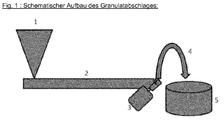
- Die Verfahrensweise ist schematisch in
Fig 1 dargestellt, wobei die einzelnen Komponenten folgende Bedeutung haben: - (1) Materialzuführung
- (2) Extruder
- (3) Handmixer mit Drahtkorb-Mischkopf
- (4) Flugbahn der abgeschlagenen Paste-Partikel
- (5) Auffangbehälter
- Konkret wurden die austretenden Caprolactam Stränge mit Hilfe eines konventionellen Handmixers mit einem Drahtkorb-Rührer so abgeschlagen, dass sie in einer parabolischen Flugbahn in einem 2 m von der Düse entfernten Auffangbehälter landeten. Die 3-4 mm großen, weitgehend sphärischen oder zylindrischen Partikel wurde auf Raumtemperatur abgekühlt und konnten sehr auf Grund ihrer guten Rieselfähigkeit leicht umgeschüttet werden. Auch zeigten sich nach der Verpackung in Säcken und deren mechanischen Beanspruchung während der Lagerung eine sehr gute Stabilität hinsichtlich Verklebung. Es entstand zudem keinerlei Feinanteil.
- Etwa 50 g jeder Mischung wurde in einem gasdichten Schraubglas verwahrt.
- Wie Beispiel 1, als Einsatzstoff wurde aber eine Vormischung aus 96 Gew.-% Caprolactam und 4 Gew.-% Addonyl Kat N1 der Firma Rhein Chemie Rheinau GmbH (Natriumcaprolactamat 18 Gew.-%ig in Caprolactam) eingesetzt. Der Einzugsbereich des Extruders wurde mit Stickstoff inertisiert.
- Wie Beispiel 1, als Einsatzstoff wurde aber eine Vormischung aus 98 Gew.-% Caprolactam und 2 Gew.-% Addonyl 8120 der Firma Rhein Chemie Rheinau GmbH (Caprolactam-geblocktes Hexamethylendiisocyanat mit einem Anteil von bis 2.5 Gew.-% Caprolactam) eingesetzt. Der Einzugsbereich des Extruders wurde mit Stickstoff inertisiert.
- Wie Beispiel 1, als Einsatzstoff wurde aber eine Vormischung aus 93 Gew.-% Caprolactam, 2 Gew.-% Addonyl 8120 und 5 Gew.- % Addonyl 8112 (Kälteschlagzähmodifikator) der Firma Rhein Chemie Rheinau GmbH eingesetzt. Der Einzugsbereich des Extruders wurde mit Stickstoff inertisiert.
- Nach einer Woche wurden die Behälter aus Beispiel 2 und 3 separat unter Vakuum aufgeschmolzen, die Schmelzen vereinigt und in ein auf 160°C temperiertes Becherglas gegossen.
- Die anionische Polymerisation startete nach etwa 1 Minute und es konnte ein Polyamid 6 mit einem Restmonomergehalt von 1.2 Gew.-% hergestellt werden.
- Nach einer Woche wurden die Behälter aus Beispiel 2 und 4 separat unter Vakuum aufgeschmolzen, die Schmelzen vereinigt und in ein auf 160°C temperiertes Becherglas gegossen.
- Die anionische Polymerisation startete nach etwa 1 Minute und es konnte ein Polyamid 6 mit einem Restmonomergehalt von 1.4 Gew.-% hergestellt werden.
Claims (12)
- Verfahren zur Herstellung von Feststoffpartikeln, enthaltend ein Material mit einem Schmelzpunkt bei Normaldruck von -20 bis 300 °C, dadurch gekennzeichnet, dass man eine Mischung enthaltend:a1) das Material in geschmolzener Form unda2) das Material in fester Formmittels eines Extruders zu einer Paste vermischt, diese durch eine Lochplatte zu Strängen presst und die Stränge zerkleinert.
- Verfahren gemäß Anspruch 1, dadurch gekennzeichnet, dass das Material einen Schmelz-punkt bei Normaldruck von 0 bis 300 °C , vorzugsweise von 50 bis 250 °C , insbesondere von 50 bis 160 °C besitzt.
- Verfahren gemäß wenigstens einem der Ansprüche 1 bis 2, dadurch gekennzeichnet, dass das Material ein Molekulargewicht von kleiner 1000 g/mol besitzt.
- Verfahren gemäß wenigstens einem der Ansprüche 1 bis 3, dadurch gekennzeichnet, dass das Material in geschmolzener Form bei der Schmelztemperatur unter Normaldruck eine Viskosität von kleiner 1x10⁴ Pa·s besitzt.
- Verfahren gemäß wenigstens einem der Ansprüche 1 bis 4, dadurch gekennzeichnet, dass das Material ein zyklisches Amid, vorzugsweise Lauryllactam, Caprolactam oder deren Mischung ist.
- Verfahren gemäß wenigstens einem der Ansprüche 1 bis 5, dadurch gekennzeichnet, dass die Paste wenigstens 80 Gew.-%, vorzugsweise wenigstens 90 Gew.-% Material enthält.
- Verfahren gemäß wenigstens einem der Ansprüche 1 bis 6, dadurch gekennzeichnet, dass die Feststoffpartikel eine sphärische oder zylindrische Form besitzen.
- Verfahren gemäß wenigstens einen der Ansprüche 1 bis 7, dadurch gekennzeichnet, dass die Feststoffpartikel eine Größe von 0.2 bis 20 mm besitzen.
- Verfahren gemäß wenigstens einem der Ansprüche 1 bis 8, dadurch gekennzeichnet, dass das Verhältnis von a1) zu a2) in der Mischung von 1 : 1 bis 1 : 4, insbesondere von 1: 1 bis 1 : 2 und insbesondere von 1: 1.4 bis 1 : 1.7 beträgt.
- Verfahren gemäß wenigstens einem der Ansprüche 1 bis 9, dadurch gekennzeichnet, dass die Zerkleinerung mittels mechanischer Kraft erfolgt.
- Verfahren gemäß wenigstens einem der Ansprüche 1 bis 10, dadurch gekennzeichnet, dass die Mischung einen Katalysator oder einen Aktivator enthält.
- Verfahren gemäß wenigstens einem der Ansprüche 1 bis 11, wobei man die Mischung von a1) und a2) durchi) separates Beschicken des Extruders mit den Komponenten a1) und a2) oderii) Beschicken des Extruders mit der Komponente a2) und Erzeugen der Komponente a1) durch Erwärmung und/oder durch den Energieeintrag der Förder- und/oder Scherelemente, insbesondere Schnecken des Extruders auf eine Temperatur, bei der ein Teil der Komponente a2) geschmolzen ist oderiii) Beschicken des Extruders mit der Komponente a1) und Erzeugen der Komponente a2) durch Kühlung des Extruders auf eine Temperatur, bei der ein Teil der Komponente a1) erstarrt,erhält.
Priority Applications (6)
| Application Number | Priority Date | Filing Date | Title |
|---|---|---|---|
| EP15201214.2A EP3181317A1 (de) | 2015-12-18 | 2015-12-18 | Verfahren zur herstellung von feststoffpartikeln |
| US16/063,348 US11253829B2 (en) | 2015-12-18 | 2016-11-29 | Process for producing solid particles |
| CN201680073638.5A CN108367456A (zh) | 2015-12-18 | 2016-11-29 | 用于生产固体颗粒的方法 |
| ES16802076T ES2910277T3 (es) | 2015-12-18 | 2016-11-29 | Procedimiento para la preparación de partículas sólidas |
| PCT/EP2016/079138 WO2017102311A1 (de) | 2015-12-18 | 2016-11-29 | Verfahren zur herstellung von feststoffpartikeln |
| EP16802076.6A EP3389969B1 (de) | 2015-12-18 | 2016-11-29 | Verfahren zur herstellung von feststoffpartikeln |
Applications Claiming Priority (1)
| Application Number | Priority Date | Filing Date | Title |
|---|---|---|---|
| EP15201214.2A EP3181317A1 (de) | 2015-12-18 | 2015-12-18 | Verfahren zur herstellung von feststoffpartikeln |
Publications (1)
| Publication Number | Publication Date |
|---|---|
| EP3181317A1 true EP3181317A1 (de) | 2017-06-21 |
Family
ID=55174507
Family Applications (2)
| Application Number | Title | Priority Date | Filing Date |
|---|---|---|---|
| EP15201214.2A Withdrawn EP3181317A1 (de) | 2015-12-18 | 2015-12-18 | Verfahren zur herstellung von feststoffpartikeln |
| EP16802076.6A Active EP3389969B1 (de) | 2015-12-18 | 2016-11-29 | Verfahren zur herstellung von feststoffpartikeln |
Family Applications After (1)
| Application Number | Title | Priority Date | Filing Date |
|---|---|---|---|
| EP16802076.6A Active EP3389969B1 (de) | 2015-12-18 | 2016-11-29 | Verfahren zur herstellung von feststoffpartikeln |
Country Status (5)
| Country | Link |
|---|---|
| US (1) | US11253829B2 (de) |
| EP (2) | EP3181317A1 (de) |
| CN (1) | CN108367456A (de) |
| ES (1) | ES2910277T3 (de) |
| WO (1) | WO2017102311A1 (de) |
Families Citing this family (1)
| Publication number | Priority date | Publication date | Assignee | Title |
|---|---|---|---|---|
| CN116532042A (zh) * | 2023-05-11 | 2023-08-04 | 贵州西洋实业有限公司 | 一种制造粒状复合肥料的方法 |
Citations (7)
| Publication number | Priority date | Publication date | Assignee | Title |
|---|---|---|---|---|
| EP0141314A2 (de) * | 1983-10-21 | 1985-05-15 | BASF Aktiengesellschaft | Verfahren zur Herstellung von trockenem Polycaprolactamgranulat |
| US5169582A (en) * | 1985-05-08 | 1992-12-08 | Ems-Inventa Ag | Method and apparatus for the production of thermoplastic caprolactam containing molding compositions |
| EP0786485A2 (de) * | 1996-01-25 | 1997-07-30 | Ems-Inventa Ag | Kontinuierliches Verfahren zur aktivierten anionischen Lactampolymerisation |
| JPH1158373A (ja) * | 1997-08-21 | 1999-03-02 | Mitsubishi Chem Corp | 樹脂ペレットの製造方法 |
| DE19913661A1 (de) * | 1999-03-25 | 2000-09-28 | Basf Ag | Verfahren zum Einarbeiten mindestens eines Feststoffpulvers A in die Schmelze mindestens eines thermoplastischen Polymeren B |
| EP1249465A1 (de) * | 2001-04-12 | 2002-10-16 | EMS-Chemie AG | Anionisch hergestelltes Polyamid und Verfahren zu seiner Herstellung sowie ein Verfahren zum Wiederaufbereiten von Polyamid |
| WO2013034499A1 (de) | 2011-09-08 | 2013-03-14 | Rhein Chemie Rheinau Gmbh | Neue zusammensetzungen zur herstellung von gusspolyamiden |
Family Cites Families (2)
| Publication number | Priority date | Publication date | Assignee | Title |
|---|---|---|---|---|
| BE787400A (fr) | 1971-08-11 | 1973-02-12 | Basf Ag | Procede pour la fabrication de pastilles de caprolactame ayant une bonne faculte d'ecoulement a partir de caprolactame en fusion |
| DE102007026550A1 (de) * | 2007-06-08 | 2008-12-11 | Bayer Healthcare Ag | Extrudate mit verbesserter Geschmacksmaskierung |
-
2015
- 2015-12-18 EP EP15201214.2A patent/EP3181317A1/de not_active Withdrawn
-
2016
- 2016-11-29 EP EP16802076.6A patent/EP3389969B1/de active Active
- 2016-11-29 ES ES16802076T patent/ES2910277T3/es active Active
- 2016-11-29 CN CN201680073638.5A patent/CN108367456A/zh not_active Withdrawn
- 2016-11-29 US US16/063,348 patent/US11253829B2/en not_active Expired - Fee Related
- 2016-11-29 WO PCT/EP2016/079138 patent/WO2017102311A1/de not_active Ceased
Patent Citations (7)
| Publication number | Priority date | Publication date | Assignee | Title |
|---|---|---|---|---|
| EP0141314A2 (de) * | 1983-10-21 | 1985-05-15 | BASF Aktiengesellschaft | Verfahren zur Herstellung von trockenem Polycaprolactamgranulat |
| US5169582A (en) * | 1985-05-08 | 1992-12-08 | Ems-Inventa Ag | Method and apparatus for the production of thermoplastic caprolactam containing molding compositions |
| EP0786485A2 (de) * | 1996-01-25 | 1997-07-30 | Ems-Inventa Ag | Kontinuierliches Verfahren zur aktivierten anionischen Lactampolymerisation |
| JPH1158373A (ja) * | 1997-08-21 | 1999-03-02 | Mitsubishi Chem Corp | 樹脂ペレットの製造方法 |
| DE19913661A1 (de) * | 1999-03-25 | 2000-09-28 | Basf Ag | Verfahren zum Einarbeiten mindestens eines Feststoffpulvers A in die Schmelze mindestens eines thermoplastischen Polymeren B |
| EP1249465A1 (de) * | 2001-04-12 | 2002-10-16 | EMS-Chemie AG | Anionisch hergestelltes Polyamid und Verfahren zu seiner Herstellung sowie ein Verfahren zum Wiederaufbereiten von Polyamid |
| WO2013034499A1 (de) | 2011-09-08 | 2013-03-14 | Rhein Chemie Rheinau Gmbh | Neue zusammensetzungen zur herstellung von gusspolyamiden |
Also Published As
| Publication number | Publication date |
|---|---|
| CN108367456A (zh) | 2018-08-03 |
| US11253829B2 (en) | 2022-02-22 |
| EP3389969B1 (de) | 2022-03-23 |
| ES2910277T3 (es) | 2022-05-12 |
| WO2017102311A1 (de) | 2017-06-22 |
| EP3389969A1 (de) | 2018-10-24 |
| US20180361336A1 (en) | 2018-12-20 |
Similar Documents
| Publication | Publication Date | Title |
|---|---|---|
| DE60006169T2 (de) | Festphasen-polymerisierte Polyamide und Verfahren zu deren Herstellung | |
| EP1505108B1 (de) | Polyamid-Laser-Sinter-Pulver mit einem Metallsalz und einem Fettsäurederivat, Verfahren zur Herstellung und daraus hergestellte Formkörper | |
| EP2729515B1 (de) | Feste partikel, enthaltend lactam, aktivator und katalysator, sowie verfahren zu deren herstellung und deren verwendung | |
| EP2447302B1 (de) | Verfahren zur Herstellung von Gusspolyamiden | |
| DE3049196C2 (de) | ||
| EP3294792B1 (de) | Caprolactam formulierungen | |
| DE2756605A1 (de) | Mischpolyamide und verfahren zu ihrer herstellung | |
| EP3389969B1 (de) | Verfahren zur herstellung von feststoffpartikeln | |
| EP3294791A1 (de) | Caprolactam formulierungen | |
| WO2018041642A1 (de) | Verfahren zur herstellung eines polyamids mit kaliumlactamat | |
| EP2933285B1 (de) | Hydrolysestabilisatorformulierungen | |
| WO2013182330A1 (de) | Verfahren zur stabilisierung von estergruppen-enthaltenden polymeren | |
| DE4202004C2 (de) | Verfahren zur Herstellung füllstoffhaltiger thermoplastischer Formmassen und derart erhältliche Formmassen und deren Verwendung | |
| DE2424681C3 (de) | Weichmacher enthaltende thermoplastische Polyamid- oder Copolyamidmassen | |
| EP2567997A1 (de) | Neue Zusammensetzungen zur Herstellung von Gusspolyamiden | |
| EP0696613A1 (de) | Geformte, paraffinhaltige Mastiziermittel | |
| EP2830844A1 (de) | Verfahren zur herstellung von polyamidformkörpern aus einer polymerisierbaren zusammensetzung mittels rotationsschmelzverfahren | |
| DE19959668A1 (de) | Rieselfähige Nicotinsäureamid-haltige Formlinge und Verfahren zu deren Herstellung | |
| EP2748228B1 (de) | Verfahren zur herstellung von formkörpern | |
| EP2748229A1 (de) | Verfahren zur herstellung von formkörpern | |
| EP3390038A1 (de) | Herstellung von faserverbundwerkstoffen | |
| EP0754651B1 (de) | Oberflächenbehandlung von kristallinen Natriumnitrit bzw. Natriumnitrat | |
| DE19628359A1 (de) | Verfahren zur Herstellung von Stabilisator-Konzentrat für Polyamide | |
| EP3670575A1 (de) | Verfahren zur herstellung eines katalysatorsystems, katalysatorsystem, und dessen verwendung für die herstellung von gusspolyamid | |
| EP0837059A1 (de) | Cyanurchlorid-Formlinge und Verfahren zu ihrer Herstellung |
Legal Events
| Date | Code | Title | Description |
|---|---|---|---|
| PUAI | Public reference made under article 153(3) epc to a published international application that has entered the european phase |
Free format text: ORIGINAL CODE: 0009012 |
|
| AK | Designated contracting states |
Kind code of ref document: A1 Designated state(s): AL AT BE BG CH CY CZ DE DK EE ES FI FR GB GR HR HU IE IS IT LI LT LU LV MC MK MT NL NO PL PT RO RS SE SI SK SM TR |
|
| AX | Request for extension of the european patent |
Extension state: BA ME |
|
| STAA | Information on the status of an ep patent application or granted ep patent |
Free format text: STATUS: THE APPLICATION IS DEEMED TO BE WITHDRAWN |
|
| 18D | Application deemed to be withdrawn |
Effective date: 20171222 |