EP3174573B1 - Vakuumunterstützte plasmatrennung - Google Patents
Vakuumunterstützte plasmatrennung Download PDFInfo
- Publication number
- EP3174573B1 EP3174573B1 EP15826556.1A EP15826556A EP3174573B1 EP 3174573 B1 EP3174573 B1 EP 3174573B1 EP 15826556 A EP15826556 A EP 15826556A EP 3174573 B1 EP3174573 B1 EP 3174573B1
- Authority
- EP
- European Patent Office
- Prior art keywords
- plasma
- filter
- blood
- channel
- recess
- Prior art date
- Legal status (The legal status is an assumption and is not a legal conclusion. Google has not performed a legal analysis and makes no representation as to the accuracy of the status listed.)
- Active
Links
Images




Classifications
-
- G—PHYSICS
- G01—MEASURING; TESTING
- G01N—INVESTIGATING OR ANALYSING MATERIALS BY DETERMINING THEIR CHEMICAL OR PHYSICAL PROPERTIES
- G01N33/00—Investigating or analysing materials by specific methods not covered by groups G01N1/00 - G01N31/00
- G01N33/48—Biological material, e.g. blood, urine; Haemocytometers
- G01N33/483—Physical analysis of biological material
- G01N33/487—Physical analysis of biological material of liquid biological material
- G01N33/49—Blood
- G01N33/491—Blood by separating the blood components
-
- A—HUMAN NECESSITIES
- A61—MEDICAL OR VETERINARY SCIENCE; HYGIENE
- A61B—DIAGNOSIS; SURGERY; IDENTIFICATION
- A61B5/00—Measuring for diagnostic purposes; Identification of persons
- A61B5/15—Devices for taking samples of blood
- A61B5/150007—Details
- A61B5/150015—Source of blood
- A61B5/150022—Source of blood for capillary blood or interstitial fluid
-
- A—HUMAN NECESSITIES
- A61—MEDICAL OR VETERINARY SCIENCE; HYGIENE
- A61M—DEVICES FOR INTRODUCING MEDIA INTO, OR ONTO, THE BODY; DEVICES FOR TRANSDUCING BODY MEDIA OR FOR TAKING MEDIA FROM THE BODY; DEVICES FOR PRODUCING OR ENDING SLEEP OR STUPOR
- A61M1/00—Suction or pumping devices for medical purposes; Devices for carrying-off, for treatment of, or for carrying-over, body-liquids; Drainage systems
- A61M1/34—Filtering material out of the blood by passing it through a membrane, i.e. hemofiltration or diafiltration
-
- B—PERFORMING OPERATIONS; TRANSPORTING
- B01—PHYSICAL OR CHEMICAL PROCESSES OR APPARATUS IN GENERAL
- B01L—CHEMICAL OR PHYSICAL LABORATORY APPARATUS FOR GENERAL USE
- B01L3/00—Containers or dishes for laboratory use, e.g. laboratory glassware; Droppers
- B01L3/50—Containers for the purpose of retaining a material to be analysed, e.g. test tubes
- B01L3/502—Containers for the purpose of retaining a material to be analysed, e.g. test tubes with fluid transport, e.g. in multi-compartment structures
Definitions
- Plasma rather than whole blood, is generally the preferred sample for many clinical diagnostic tests.
- plasma is separated from whole blood as hemoglobin and other hemolysis products may interfere with detection of viral RNA.
- hemoglobin and other hemolysis products may interfere with assay results, plasma may need to be non-hemolyzed.
- US 2012/0145619 A1 provides a method of collecting a plasma fraction, wherein the channel assembly includes a channel housing which is rotatably interconnected with a rotatable centrifuge rotor assembly.
- WO 2014/024066 A1 pertains to a system and method for separating plasma and/or serum from blood for bilirubin level estimation.
- Other separation methods including laminar-flow filtration or capillary-action based processes, however, are also expensive, complex, slow, require large volumes of blood, or may lead to unacceptable levels of hemolysis.
- a capillary device is disclosed for analyzing blood using minimal sample volumes, e.g., fingerstick application.
- the plasma separation membrane to separate plasma from a blood sample is provided in US 2012/0220047 .
- any reference to "one embodiment,” “an embodiment,” “some embodiments,” “one example,” “for example,” or “an example” means that a particular element, feature, structure or characteristic described in connection with the embodiment is included in at least one embodiment.
- the appearance of the phrase “in some embodiments” or “one example” in various places in the specification is not necessarily all referring to the same embodiment, for example.
- the plasma separation system 10 may provide separation of plasma from blood using a vacuum force, and without using centrifugation or laminar-flow filtration based filtration processes.
- the separation of plasma from blood may be with minimal hemolysis and within a relatively short amount of time (e.g., 10-90 seconds) as compared to processes used currently within the industry.
- the plasma may be further used in one or more point-of-care assays.
- the plasma separation system 10 includes a housing 12 supporting or encompassing a blood separation well 14 connected via a first channel 16 to a plasma collection vessel 18.
- the housing 12 supports or encompasses a second channel 22 connecting the plasma collection vessel 18 to an outlet port 24 downstream of the plasma collection vessel 18.
- the plasma separation system 10 may also include a negative pressure source 26 that can be attached to the outlet port 24.
- the outlet port 24 can be configured to allow for the negative pressure source 26 to be attached thereto assist in enabling the operation of the plasma separation system 10.
- Negative pressure e.g., vacuum pressure
- the negative pressure source 26 is applied by the negative pressure source 26 to the outlet port 24, which also causes a vacuum to form in the blood separation well 14.
- plasma is separated from the blood.
- the magnitude of the negative pressure may be controlled to prevent hemolysis and/or leakage of cellular material.
- the separated plasma is collected in the plasma collection vessel 18.
- the plasma separation system 10 may be a single-use system.
- one or more components of the plasma separation system 10 may be disposable such that the plasma separation system 10 may be a multi-use system.
- one or more channels 16 and 22 may be lined such that the plasma collection vessel 18 and components of the blood separation well 14 may be removed, disposed of, and replaced for use with a second blood sample.
- the housing 12 may be formed of materials including, but not limited to, glass, plastic, and/or the like.
- the shape and size of the housing 12 may be dependent on shape and/or size of the blood separation well 14, channels 16 and 22, and/or the plasma collection vessel18.
- the housing 12 that is shown in Fig. 1 is a unitary integral device that is shaped to form the blood separation well 14, channels 16 and 22 and the plasma collection vessel 18. It should be understood that the housing 12 can be constructed of separate components which are connected together so that the blood separation well 14, channels 16 and 22 and the plasma collection vessel 18 communicate with each other.
- the size of the housing 12 may be minimized and determinate on an amount of plasma that is desired (e.g., 10-20 ⁇ L) to be extracted from a blood sample.
- the housing 12 may include a surface 28.
- the blood separation well 14 is positioned to intersect the surface 28 of the housing 12 such that the surface 28 at least partially surrounds the blood separation well 14.
- the blood separation well 14 includes a recess 30 intersecting the surface 28 of the housing 12 as illustrated in FIGS. 1 and 2 and in this instance the surface 28 may form a rim surrounding the recess 30.
- the recess 30 may include a proximal end 32 and a distal end 34 with a wall 36 spanning the length of the proximal end 32 to the distal end 34.
- the proximal end 32 may include a capillary surface 38 in which microchannels are formed in the proximal end 32 as discussed in more detail below with respect to FIG. 3 .
- the plasma separation device 10 is also provided with a filter 40, a separation membrane 42, and an adhesive member 44.
- the filter 40, the separation membrane 42 and the adhesive member 44 are stacked on the capillary surface 38 and disposed within the recess 30 such that the filter 40 is below the surface 28 of the housing 12 and fully disposed within the recess 30.
- the adhesive member 44 may be positioned on the capillary surface 38 with the separation membrane 42 and the filter 40 positioned thereon, respectively.
- the filter 40 and separation membrane 42 are pressure fit (also known as a "press fit") within the recess 30.
- the size and shape of the recess 30 may be dependent on the size and shape of the filter 40, the separation membrane 42, and/or the adhesive member 44.
- the size and shape of the recess 30 may be circular as the filter 40, separation membrane 42, and adhesive member 44 are circular.
- the shape may be any shape including, but not limited to, rectangular, triangular, or any fanciful shape.
- the volume of the recess 30, including the height and/or length of wall 36 may be dependent on thicknesses and/or the widths of one or more of the filter 40, separation membrane 42, and adhesive member 44.
- the filter 40, separation membrane 42 and the adhesive member 44 may be positioned within the recess 30 such that each remains between the proximal end 32 and the distal end 34 of the recess 30.
- the wall 36 is depicted as a straight wall, it should be understood that in some embodiments, the wall 36 can be stepped.
- one or more additional layers may be positioned on a first side 48 of the filter 40 to hold the filter 40 and separation membrane 42 within the blood separation well 14.
- a plastic O-ring may be positioned on the first surface 48 of the filter 40 to hold the filter 40 and separation membrane 42 within the blood separation well 14.
- a cap e.g., plastic formed cap
- the cap may be vented to allow for escape of gas to the outside environment. The cap may serve to hold the filter 40 in close proximity to the separation membrane 42.
- the filter 40 may expand in size such that the cap retains the filter 40 within the blood separation well 14. To that end, the filter 40 may expand in the direction of the separation membrane 42 positioning the filter 40 in close proximity or even in contact with the separation membrane 42.
- the filter 40 is formed of one or more layers 46. Each layer 46 may include the first side 48 and a second side 50 generally opposite of the first side 48. Generally, blood is provided onto and contacts the first side 48 of the filter 40 and passes through the layer 46 of the filter 40 such that filtered blood emerges on the second side 50.
- the filtered blood may include plasma and a portion of red blood cells that managed to pass through the layer 46. Some of the red blood cells will be captured within the layer 46 of the filter 40.
- the filter 40 generally removes a portion of the red blood cells from the blood and also may reduce separation burden of the separation membrane 42.
- the filter 40 may remove red blood cells (e.g., up to 70% of red blood cells) within the blood sample. The removal of a significant portion of red blood cells may aid the flow of the filtered blood through the separation membrane 42 and also reduce clogging of the separation membrane 42.
- Each layer 46 may be formed of materials including, but not limited to, glass fibers, polyester fibers, cellulose fibers, and/or the like.
- one or more filters 40 may be a commercially available filter under the trade name designations of VF1, VF2 and GFB, manufactured and distributed by Whatman, having a location in Maidstone Kent.
- one or more filters 40 may be a 9.5 mm disc of Whatman VF2 glass fiber.
- the second side 50 of the filter 40 is in proximity to or contact the separation membrane 42.
- the separation membrane 42 may remove the remaining red blood cells from the filtered blood providing filtered plasma.
- the filtered plasma may be essentially cell-free in that the filtered plasma includes minimal cellular debris.
- hemoglobin content with the filtered plasma may be comparable to plasma obtained by centrifuge techniques currently known within the industry.
- the plasma separation system 10 may solely comprise the separation membrane 42 without the use of the filter 40.
- the blood may be filtered solely through the separation membrane 42 providing filtered plasma using the methods as described herein.
- the separation membrane 42 may be formed of one or more layers 52. Each layer 52 may have a first side 54 and a second side 56. Generally, the filtered blood contacts the first side 54 of the separation membrane 42 passing through the layer 52 of the separation membrane such that filtered plasma emerges on the second side 56.
- the separation membrane 42 may be formed of materials including, but not limited to, nylon, polysulfone, polycarbonate and/or the like.
- the separation membrane 42 may be an ion-tracked etched membrane.
- the separation membrane 42 may be an asymmetric membrane.
- the separation membrane 42 may be formed having at least a first set of pores and a second set of pores, with the first set of pores and the second set of pores being different sizes.
- larger pores may be formed on the first side 54 of the separation membrane 42 and smaller pores may be formed on the second side 56 of the separation membrane 42 such that the filtered blood flows through the larger pores to the small pores. This may reduce blockage of red blood cells within the separation membrane 42.
- one or both of the filter 40 and/or separation membrane 42 may be treated with one or more blocking agents and/or surfactants. Treatment with blocking agents and/or surfactant may enhance analyte recovery and/or plasma separation efficiency.
- Surfactants may include, but are not limited to, Tween-20, and/or the like.
- the filter 40 and/or separation membrane 42 may be made more or less hydrophilic, more or less hydrophobic, more or less susceptible to protein adsorption, more or less positively charged, more or less negatively charged and/or the like.
- the filter 40 and/or separation membrane 42 may be treated with PAMAM dendrimers, Merquat, or other polycations.
- Blocking agents may include, but are not limited to bovine serum albumin, Seablock, gelatin, and/or the like.
- the second surface 56 of the separation membrane 42 may contact the adhesive member 44.
- the adhesive member 44 may prevent leakage of blood cells around the perimeter of the separation membrane 42.
- the adhesive member 44 may include a first surface 58 and a second surface 60 with the first surface 58 contacting the second surface 56 of the separation membrane 42 and the second surface 60 adhered to at least a portion of the capillary surface 38 of the recess 30. Generally, the adhesive member 44 aids in holding the separation membrane 42 within the recess 30.
- each surface 58 and 60 of the adhesive member 44 may include an adhesive material.
- Adhesive material may include, but is not limited to, polyethylene terephthalate (PET) with silicone adhesive, and/or the like.
- PET polyethylene terephthalate
- the adhesive member 44 may be a double-sided PET adhesive O-ring as illustrated in FIGS. 2A and 2D .
- the adhesive member 44 may be integral to the blood separation well 14 or adhered to the wall 36 of the recess 30.
- Size and shape of the adhesive member 44 may be dependent on the size and shape of the separation membrane 42 such that the separation membrane 42 may be positioned within the blood separation well 14 and leakage of filtered blood about edges of the separation membrane 42 may be minimized or eliminated.
- the size and shape of the adhesive member 44 may be determined such that the separation membrane 42 is placed in close contact with the capillary surface 38 of the recess 30 of the blood separation well 14 while preventing leakage of blood within the blood separation well 14.
- the shape of the adhesive member 44 may include an opening 62.
- the opening 62 may provide for flow of the filtered plasma to flow from the second surface 56 of the separation membrane 42 to the capillary surface 38 of the recess 30.
- the adhesive member 44 may be formed as an O-ring, or any fanciful shape providing a direct opening 62 for flow of filtered plasma from the second surface 56 of the separation membrane 42 to the capillary surface 38 of the recess 30.
- the material of the adhesive member 44 may be formed of a mesh-type material.
- the capillary surface 38 of the recess 30 of the blood separation well 14 includes one or more microchannels 64.
- Microchannels 64 may encourage capillary flow of the filtered plasma.
- Microchannels 64 may form any pattern capable of enhancing capillary flow of the filtered plasma through the blood separation well 14.
- eight microchannels 64 are used to form a concentric pattern having a plurality of radial microchannels connecting at a central axis 66.
- eight microchannels 64 are illustrated in FIGS. 1 and 3 , it should be apparent to one skilled in the art that any number of microchannels 64 may be used so long as such microchannels 64 are positioned within the confines of the capillary surface 38. Additionally, one or more tributaries may be included within the concentric pattern.
- the capillary surface 38 in some embodiments not part of the invention, may not include microchannels 64 as capillary flow may still occur without such microchannels 64.
- one or more venting channels 68 may be positioned within the recess 30 of the blood separation well 14.
- four venting channels 68 are provided within the recess 30 of the blood separation well 14 extending from the capillary surface 38 to the surface 28. Venting channels 68 may provide for venting of gas (e.g., air) within the blood separation well 14.
- gas e.g., air
- gas entering the filter 40 and/or separation membrane 42 may exit the blood separation well 14 through the one or more venting channels 68.
- the filtered plasma may flow from the blood separation well 14 to the channel 16.
- the channel 16 may include a first outlet 70 connected to the plasma collection vessel 18.
- the channel 16 may also include a second outlet 72.
- the second outlet 72 may be blocked during operation of the plasma separation system 10 to cause the vacuum force to be directed into the blood separation well via the channel 16.
- the second outlet 72 may be capable of being selectively opened to provide for removal of any additional filtered blood and/or filtered plasma from within the blood separation well 14 and/or channel 16.
- the filtered plasma flows through the channel 16 and through the first outlet 70 to the plasma collection vessel 18.
- the plasma collection vessel 18 may have a proximal end 74 and a distal end 76 connected by a tapered wall 78.
- the width of the plasma collection vessel 18 may increase from the proximal end 74 to the distal end 76.
- the shape of the plasma collection vessel 18 is shown as conical, it should be apparent that the plasma collection vessel 18 may be formed in other shapes (e.g., cylindrical). Generally, the plasma collection vessel 18 may be formed such that the amount of volume where the filtered plasma collects reduces dead volume.
- the shape of the plasma collection vessel 18 may be formed such that the filtered plasma collects in an area wherein recovery of the filtered plasma by a pipette or other collection means may be maximized (e.g., collection of 10-20 ⁇ L of filtered plasma).
- the first outlet 70 may be positioned below the output port 24 and near the proximal end 74 of the plasma collection vessel 18. Collection of filtered plasma may be in a portion 79 positioned below the first outlet 70, e.g., between the first outlet 70 and the proximal end 74 of the plasma collection vessel 18 as illustrated in FIG. 2A .
- the plasma collection vessel 18 includes a seal 80.
- the seal 80 covers the distal end 76 of the plasma collection vessel 18 so that vacuum force applied to the output port 24 of the channel 22 is directed through the plasma collection vessel 18 and into the channel 16.
- the seal 80 is formed of pierceable material.
- the seal 80 may be formed of materials capable of being pierced by a pipet tip or similar mechanism for collection of plasma from the plasma collection vessel 18. Such materials may include, but are not limited to, acetate, polyethylene, foil and/or the like.
- the plasma collection vessel 18 is connected to the channel 22.
- the channel 22 is positioned above the channel 16, and in proximity to the distal end 76 of the plasma collection vessel 18, e.g., between the channel 16 and the distal end 76.
- the channel 22 connects the plasma collection vessel 18 to the negative pressure source 26 via the outlet port 24.
- the outlet port 24 of the channel 22 may include a fitted tube or luer connection at which the negative pressure source 26 is connected.
- the negative pressure source 26 may be any source capable of providing force between approximately 0,34-13,79 kPa (0.05-2 psi).
- the negative pressure source 26 may include, but is not limited to, a pump, a syringe pump, a vacuum pump, a suction pump, and/or the like.
- the negative pressure source 26 may be capable of being controlled such that plasma may be collected without hemolysis and/or free of cellular material from the blood. For example, by controlling the force of the negative pressure source 26 within the boundaries discussed above, the risks of damage to the plasma may be reduced such that the blood may not hemolyze and/or cells may not deform (i.e., pass through the separation membrane 42).
- Control of the negative pressure source 26 may provide for a fixed flow rate and volume.
- one or more pressure sensors or monitors may be used to control the negative pressure source 26.
- displacement speed of a syringe may control the rate and volume of the negative pressure source 26.
- FIG. 4 illustrates another exemplary embodiment of a plasma separation system 10a. Similar to the plasma separator system 10 of FIG. 1 , the plasma separation system 10a includes the housing 12 supporting or encompassing the blood separation well 14. The blood separation well 14 is connected via a first channel 16a to a plasma collection vessel 18a such that filtered plasma enters the plasma collection vessel 18a from a proximal end 94 of the plasma collection vessel 18a. A second channel 22 connects the plasma collection vessel 18a to an outlet port 24 downstream of the plasma collection vessel 18a. The outlet port 24 may allow for a negative pressure source 26 (e.g., vacuum source) to be attached to the plasma separator system 10a.
- a negative pressure source 26 e.g., vacuum source
- the channel 16a may be implemented in a variety of manners such that the channel 16a connects the plasma collection vessel 18a to the proximal end 94 of the plasma collection vessel 18a.
- the channel 16a may include a variety of linear segments that are interconnected as shown in FIG. 4 .
- the channel 16a includes a first portion 82 and a second portion 84 that may be in parallel alignment connected by a third portion 86 extending between the first portion 82 and the second portion 84.
- the third portion 86 extends normally to the first portion 82 and the second portion 84 and vertically within the housing 12.
- the channel 16a includes corners 88 and 90 formed by intersection of the first portion 82 and the second portion 84 with the third portion 86, it should be noted, the corners 88 may include rounded edges. Additionally, the third portion 86 may be positioned at an angle relative to the first portion 82 and the second portion 84 such that the third portion 86 provides a sloped connection between the first portion 82 and the second portion 84. A fourth portion 92 of the channel 16a may provide an inlet 94 into the proximal end 94 of the plasma collection vessel 18a.
- blood is added to the blood separation well 14.
- Vacuum pressure may be applied via the outlet port 24.
- plasma may be separated from the blood.
- the plasma may enter and collect at the proximal end 94 of the plasma collection vessel 18a.
- the vacuum pressure may be controlled to prevent hemolysis and/or leakage of cellular material.
- FIG. 5 illustrates another exemplary embodiment of a plasma separation system 10b which is similar in construction to the plasma separation systems 10 and 10a shown in FIGS. 1 and 4 with the exception that that plasma separation system 10b includes a plasma collection vessel 18b in the form of a serpentine channel 96, rather than a well. Since the volume of the serpentine may be controlled by the length of the serpentine channel 96, the system 10b can be used to meter the plasma.
- the serpentine channel 96 can be readily integrated with other standard microfluidic features such as valves and reaction wells for performing quantitative and qualitative assays. The number of curves, the configuration and/or the length of the serpentine channel 96 may be determined based on the assay of interest.
- FIGS. 6 and 7A-7C illustrate an exemplary method for operating the plasma separator system 10 of FIG. 1 .
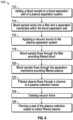
- FIG. 6 illustrates a flow chart 110 for operating the plasma separation system 10.
- the blood sample 130 (e.g., 100 ⁇ l) is added to the blood separation well 14 as illustrated in FIG. 7A .
- a pipet, or other similar device may be used to add the blood sample to the blood separation well 14.
- the blood sample wicks into the filter 40 and the separation membrane 42.
- the blood sample wicks into the filter 40 and the separation membrane 42 for a pre-determined time period.
- the blood sample may be allowed to wick into the filter 40 and the separation membrane 42 for approximately 5 - 45 seconds.
- the blood sample may wick into the filter 40 and the separation membrane 42 by capillary action.
- the presence of the one or more venting channels 68 may promote wicking of the blood sample by providing escape of gas from edges of the filter 40 and/or the separation membrane 42.
- the presence of microchannels 64 on the capillary surface 38 of the recess 30 may also promote capillary flow from the second side 56 of the separation membrane 42 into the channel 16 (shown in detail in FIG. 3 ).
- the negative pressure source 26 e.g., vacuum source
- the vacuum force assists the blood sample to proceed through the filter 40 providing filtered blood.
- the blood sample proceeds through the separation membrane 42 providing filtered plasma 132 as illustrated in FIG. 7B . It should be noted that prior to application of vacuum source to the blood separation well 14, a portion of the blood sample may proceed through the filter 40 and the separation membrane 42.
- the filtered plasma 132 may flow through the channel 16 and collect in the plasma collection vessel 18 as illustrated in FIG. 7C .
- the vacuum force may be maintained at a substantially constant level until all needed filtered plasma is collected in the plasma collection vessel 18 or may increase over time to a set-point.
- the vacuum force is caused to cease, such as by deactuating the negative pressure source 26 (e.g., vacuum source).
- the filtered plasma can be removed from the plasma collection vessel 18 such as by piercing the seal 80 of the plasma collection vessel 18.
- a pipet tip may pierce the seal 80 and filtered plasma may be removed from the plasma collection vessel 18.
- One or more assay may then be performed using the filtered plasma. Quantitative and/or qualitative assays may be performed using the filtered plasma. For example, as the pipet may be capable of collecting a determinate amount of filtered plasma, quantitative assays may be performed.
- a blood sample of 100 ⁇ L and 35% hematocrit (HCT) containing D-dimer at a concentration of 450 ng/ml may be added to the blood separation well 14 as illustrated in FIG. 7A .
- the filter 40 of the blood separation well 14 may be formed of VF2, and the separation membrane 42 may be formed of a polysulfone asymmetric membrane, for example.
- the blood sample may be allowed to wick into the filter 40 and separation membrane 42 for approximately 5-45 seconds.
- the negative pressure source 26 may be applied (e.g., between 0,34-13,79 kPa (0.05-2 psi) such that filtered plasma (e.g., approximately 20-25 ⁇ L) may be collected.
- the D-dimer concentration in the filtered plasma may then be measured (e.g., using a Siemens Stratus CS D-dimer immunoassay). In one example, the D-dimer concentration recovery for the filtered plasma, as compared to centrifugation was 100.8%.
- a blood sample of 100 ⁇ L and 42% HCT containing Tnl at a concentration of 100 pg/ml may be added to the blood separation well 14.
- the blood sample may be allowed to wick into the filter 40 and separation membrane 42 for approximately 5-45 seconds.
- the negative pressure source 26 is applied (e.g., between 0,34-13,79 kPa (0.05-2 psi) such that filter plasma (e.g., approximately 20 ⁇ L) may be collected.
- the Tnl concentration in the filtered plasma may then be measured (e.g., using Siemens Dimension EXL Tnl immunoassay).
- the Tnl concentration recovery for the filtered plasma, as compared to centrifugation was 86%.
- FIG. 8 illustrates another exemplary embodiment of a plasma separation system 10c.
- the plasma separation system 10c is similar to the plasma separation systems 10-10b illustrated in FIG. 1 , 4 and 5 respectively; however, the plasma separation system 10c applies positive force via a positive pressure source 140 upstream of the plasma collection vessel 18.
- the positive pressure source 140 is connected to a cap 142 positioned over the filter 40 within the blood separation well 14.
- the cap 142 is form fit over the filter 40 within the blood separation well 14.
- the cap 142 may include an outlet 144.
- the outlet 144 may connect to the positive pressure source 140.
- the positive pressure source 140 may provide between 0,34-13,79 kPa (0.05-2 psi) of positive pressure to the blood separation well 14 during use. The positive pressure may force the blood sample through the filter 40, separation membrane 42, and channel 16 into the plasma collection vessel 18.
- the positive pressure source 140 may be a syringe loaded with air. By forcing air through the outlet 144, positive pressure may be applied to the blood sample forcing the blood sample through the filter 40, separation membrane 42, and/or channel 16 to the plasma collection vessel 18.
- the outlet 24 downstream of the plasma collection vessel 18 may be used as a vent and opened as needed.
- inventive concept(s) disclosed herein are well adapted to carry out the objects and to attain the advantages mentioned herein, as well as those inherent in the inventive concept(s) disclosed herein. While the embodiments of the inventive concept(s) disclosed herein have been described for purposes of this disclosure, it will be understood that numerous changes may be made and readily suggested to those skilled in the art which are accomplished within the scope of the inventive concept(s) disclosed herein.
Landscapes
- Health & Medical Sciences (AREA)
- Life Sciences & Earth Sciences (AREA)
- Engineering & Computer Science (AREA)
- Biomedical Technology (AREA)
- Hematology (AREA)
- Physics & Mathematics (AREA)
- Chemical & Material Sciences (AREA)
- General Health & Medical Sciences (AREA)
- Pathology (AREA)
- Biophysics (AREA)
- Molecular Biology (AREA)
- Biochemistry (AREA)
- Medicinal Chemistry (AREA)
- Analytical Chemistry (AREA)
- Food Science & Technology (AREA)
- Urology & Nephrology (AREA)
- General Physics & Mathematics (AREA)
- Immunology (AREA)
- Ecology (AREA)
- Heart & Thoracic Surgery (AREA)
- Veterinary Medicine (AREA)
- Animal Behavior & Ethology (AREA)
- Public Health (AREA)
- Surgery (AREA)
- Medical Informatics (AREA)
- Vascular Medicine (AREA)
- Anesthesiology (AREA)
- Investigating Or Analysing Biological Materials (AREA)
- External Artificial Organs (AREA)
- Medicines Containing Material From Animals Or Micro-Organisms (AREA)
Claims (8)
- Vorrichtung, umfassend:ein Gehäuse (12), das eine Bluttrennschale (14) zum Sammeln einer Blutprobe (130) trägt oder umgibt, wobei die Bluttrennschale (14) eine Aussparung (30) hat, die eine Oberfläche (28) des Gehäuses (12) schneidet, wobei die Oberfläche der Aussparung ferner als eine Kapillaroberfläche (38) mit mindestens einem Mikrokanal definiert ist;eine Trennmembran (42), die zur Filtration der Blutprobe an der Oberfläche der Aussparung (30) positioniert ist, um gefiltertes Plasma (132) bereitzustellen;ein Plasmasammelgefäß (18), das dazu ausgelegt ist, gefiltertes Plasma zu sammeln; einen ersten Kanal (16), der die Bluttrennschale (14) mit dem Plasmasammelgefäß (18) nahe der Oberfläche der Aussparung (30) verbindet; undeinen zweiten Kanal (22), der das Plasmasammelgefäß (18) mit einem ersten Auslassport (24) verbindet, und einen Filter (40), der in der Aussparung (30) positioniert ist, wobei die zweite Seite (50) des Filters (40) in der Nähe zu oder in Kontakt mit der Trennmembran (42) ist, wobei der Filter (40) aus einer oder mehreren Schichten (46) gebildet ist,eine Dichtung (80) an einem distalen Ende (76) des Plasmasammelgefäßes (18) positioniert ist, wobei die Dichtung (80) aus einem durchstechbaren Material gebildet ist;der zweite Kanal (22) derart über dem ersten Kanal (16) und in der Nähe des distalen Endes (76) des Plasmasammelgefäßes (18) positioniert ist, dass, wenn eine Unterdruckkraft auf den ersten Auslassport (24) des zweiten Kanals (22) aufgebracht wird, gefiltertes Plasma (132) in das Sammelgefäß (18) gezogen wird, wobei der erste Kanal (16), das Plasmasammelgefäß (18) und der zweite Kanal (22) dazu ausgelegt sind, die auf den ersten Auslassport (24) aufgebrachte Unterdruckkraft auf die Oberfläche der Aussparung (30) zu übertragen,dadurch gekennzeichnet, dassein Klebeelement in der Aussparung angeordnet und auf der Kapillaroberfläche positioniert ist, mit der Trennmembran bzw.dem Filter darauf positioniert, wobei der Filter (40), die Trennmembran (42) und das Klebeelement (44) auf der Kapillaroberfläche (38) gestapelt sind und wobei der Filter (40) und die Trennmembran (42) per Presspassung in die Aussparung (30) passen.
- Vorrichtung nach Anspruch 1, wobei die Kapillaroberfläche (38) eine Vielzahl von Mikrokanälen (64) hat, die ein konzentrisches Muster in der Kapillaroberfläche (38) bilden, wobei das konzentrische Muster einen Satz aus radialen Mikrokanälen (64) hat, die von einer Position vorspringen.
- Vorrichtung nach Anspruch 1 oder 2, ferner umfassend eine Vakuumquelle, die mit dem zweiten Kanal (22) an der Auslassöffnung (24) verbunden ist, wobei die Vakuumquelle eine Spritzenpumpe ist, wobei die Spritzenpumpe eine Unterdruckkraft zwischen 0,34 bis 13,79 kPa bereitstellt.
- Vorrichtung, umfassend:ein Gehäuse (12), das ein Bluttrenngefäß (14) zum Sammeln einer Blutprobe (130) trägt oder umgibt, wobei das Bluttrenngefäß (14) eine Aussparung (30) hat, die eine Oberfläche (28) des Gehäuses (12) schneidet;eine Trennmembran (42), die an der Oberfläche der Aussparung (30) positioniert ist zur Filtration der Blutprobe, um gefiltertes Plasma (132) bereitzustellen, wobei die Oberfläche der Aussparung ferner als eine Kapillaroberfläche mit mindestens einem Mikrokanal definiert ist;ein Plasmasammelgefäß (18), das dazu ausgelegt ist, gefiltertes Plasma zu sammeln; einen ersten Kanal (16), der die Bluttrennschale (14) mit dem Plasmasammelgefäß (18) nahe der Oberfläche der Aussparung (30) verbindet; undeinen zweiten Kanal (22), der das Plasmasammelgefäß (18) mit einem ersten Auslassport (24) verbindet, und einen Filter (40), der in der Aussparung (30) positioniert ist, wobei die zweite Seite (50) des Filters (40) in der Nähe zu oder in Kontakt mit der Trennmembran (42) ist, wobei der Filter (40) aus einer oder mehreren Schichten (46) gebildet ist,dadurch gekennzeichnet, dassein Klebeelement in der Aussparung angeordnet und auf der Kapillaroberfläche positioniert ist, mit der Trennmembran bzw. dem Filter darauf positioniert, und wobei der Filter (40) und die Trennmembran (42) per Presspassung in die Aussparung (30) passen, undder zweite Kanal (22) über dem ersten Kanal (16) und in der Nähe eines distalen Endes (76) des Plasmasammelgefäßes (18) positioniert ist, eine Kappe (142) formschlüssig über dem Filter (40) in der Bluttrennschale (14) sitzt, so dass, wenn eine Überdruckkraft über eine Überdruckquelle (140), die mit der Kappe (142) verbunden ist, aufgebracht wird, die Blutprobe durch den Filter (40), die Trennmembran (42) und den Kanal (16) in das Plasmasammelgefäß (18) gezwungen wird.
- Vorrichtung nach Anspruch 4, wobei die Kapillaroberfläche (38) eine Vielzahl von Mikrokanälen (64) hat, die ein konzentrisches Muster in der Kapillaroberfläche (38) bilden, wobei das konzentrische Muster einen Satz aus radialen Mikrokanälen (64) hat, die von einer Position vorspringen.
- Vorrichtung nach Anspruch 4, ferner umfassend eine Dichtung (80), die an dem distalen Ende (76) des Plasmasammelgefäßes (18) positioniert ist, wobei die Dichtung (80) aus einem durchstechbaren Material gebildet ist.
- Kit, umfassend:die Vorrichtung nach einem der Ansprüche 1 bis 6;
undeine Vakuumquelle (26), die dazu ausgelegt ist, sich mit der Auslassöffnung (24) zu verbinden, wobei die Vakuumquelle dazu ausgelegt ist, einen Unterdruck zwischen 0,34-13,79 kPa an der Auslassöffnung (24) bereitzustellen, odereine Überdruckquelle (140), die dazu ausgelegt ist, sich mit einer Kappe (142) zu verbinden, die über dem Filter (40) in der Bluttrennschale (14) positioniert ist, wobei die Druckquelle dazu ausgelegt ist, einen Überdruck zwischen 0,34-13,79 kPa bereitzustellen. - Verfahren, umfassend:Hinzufügen einer Blutprobe (130) zu dem Bluttrenngefäß (14) einer Vorrichtung nach Anspruch 1, undBetätigen der Vakuumquelle, um ein Vakuum über die Auslassöffnung (24) auf das Bluttrenngefäß (14) aufzubringen, um den Plasmafluss von der Blutprobe (130) durch den Filter (40) und die Trennmembran (42) zu verbessern, die gefiltertes Plasma (132) bereitstellt, und das gefilterte Plasma (132) durch den ersten Kanal (16) in das Plasmasammelgefäß (18) zu ziehen,wobei die Vakuumquelle gesteuert wird, um Hämolyse und/oder ein Austreten von zellulärem Material zu verhindern.
Applications Claiming Priority (2)
| Application Number | Priority Date | Filing Date | Title |
|---|---|---|---|
| US201462031908P | 2014-08-01 | 2014-08-01 | |
| PCT/US2015/042838 WO2016019113A1 (en) | 2014-08-01 | 2015-07-30 | Vacuum-assisted plasma separation |
Publications (3)
| Publication Number | Publication Date |
|---|---|
| EP3174573A1 EP3174573A1 (de) | 2017-06-07 |
| EP3174573A4 EP3174573A4 (de) | 2017-10-04 |
| EP3174573B1 true EP3174573B1 (de) | 2025-02-19 |
Family
ID=55218307
Family Applications (1)
| Application Number | Title | Priority Date | Filing Date |
|---|---|---|---|
| EP15826556.1A Active EP3174573B1 (de) | 2014-08-01 | 2015-07-30 | Vakuumunterstützte plasmatrennung |
Country Status (7)
| Country | Link |
|---|---|
| US (3) | US10989706B2 (de) |
| EP (1) | EP3174573B1 (de) |
| JP (1) | JP6715236B2 (de) |
| CA (1) | CA2956710C (de) |
| IL (1) | IL249853B (de) |
| MX (1) | MX389321B (de) |
| WO (1) | WO2016019113A1 (de) |
Families Citing this family (15)
| Publication number | Priority date | Publication date | Assignee | Title |
|---|---|---|---|---|
| AU2018212006B2 (en) | 2017-01-30 | 2020-09-10 | Vivebio Scientific, Llc | Plasma separation device |
| AU2018355575A1 (en) | 2017-10-27 | 2020-05-21 | Juno Diagnostics, Inc. | Devices, systems and methods for ultra-low volume liquid biopsy |
| US12462935B2 (en) | 2018-03-30 | 2025-11-04 | Nucleix Ltd. | Deep learning-based methods, devices, and systems for prenatal testing |
| US11007526B2 (en) * | 2018-07-06 | 2021-05-18 | Qorvo Us, Inc. | Capless sample well port for a cartridge |
| EP3890871A4 (de) | 2018-12-07 | 2022-01-26 | Siemens Healthcare Diagnostics Inc. | Vorrichtung mit einer fluidkomponentenbeurteilungsfunktion |
| FI129091B (en) * | 2019-02-12 | 2021-06-30 | Magnasense Tech Oy | SAMPLE PROCESSING APPARATUS |
| CN109925884A (zh) * | 2019-04-27 | 2019-06-25 | 南京岚煜生物科技有限公司 | 一种全血过滤的方法及用于全血过滤的滤膜结构 |
| CA3147512C (en) | 2019-07-19 | 2024-04-02 | Siemens Healthcare Diagnostics Inc. | Tangent flow hemolysis detection blood testing device |
| US12097494B2 (en) * | 2020-09-17 | 2024-09-24 | Mayo Foundation For Medical Education And Research | Methods, devices, and systems for detecting two or more analytes within small volumes |
| KR102481011B1 (ko) * | 2022-04-08 | 2022-12-26 | 정대서 | 전혈을 이용하는 현장분석용 랩온어칩 |
| JP2025524528A (ja) * | 2022-06-30 | 2025-07-30 | シーメンス・ヘルスケア・ダイアグノスティックス・インコーポレイテッド | 音響泳動分析装置および方法 |
| KR102867058B1 (ko) * | 2022-09-26 | 2025-10-01 | (주)페블아이 | 현장진단을 위한 혈액 분리 바이오칩 |
| KR102938643B1 (ko) * | 2023-06-19 | 2026-03-13 | (주)페블아이 | 현장검사를 위한 휴대용 바이오칩 |
| US12584902B2 (en) | 2023-12-10 | 2026-03-24 | Instrumentation Laboratory Company | Acoustic separation of a test sample |
| KR20260029788A (ko) * | 2024-08-26 | 2026-03-05 | (주)페블아이 | 현장검사를 위한 일체형 구조의 휴대용 바이오칩 |
Citations (3)
| Publication number | Priority date | Publication date | Assignee | Title |
|---|---|---|---|---|
| US4872988A (en) * | 1988-02-02 | 1989-10-10 | Culkin Joseph B | Method and device for separation of colloidal suspensions |
| EP0785430A1 (de) * | 1996-01-19 | 1997-07-23 | Fuji Photo Film Co., Ltd. | Trennung von Plasma oder Serum von Vollblut |
| WO2007000986A1 (ja) * | 2005-06-27 | 2007-01-04 | Sekisui Chemical Co., Ltd. | 血液分離フィルタ装置、および真空検体採取管 |
Family Cites Families (13)
| Publication number | Priority date | Publication date | Assignee | Title |
|---|---|---|---|---|
| US5147606A (en) | 1990-08-06 | 1992-09-15 | Miles Inc. | Self-metering fluid analysis device |
| EP1476536B1 (de) | 2002-02-12 | 2011-07-20 | Cellectricon Ab | Systeme und verfahren zur schnellen änderung der lösungsumgebung von sensoren |
| US7927810B2 (en) | 2002-11-19 | 2011-04-19 | Katsuya Togawa | Plasma or serum separation membrane and filter apparatus including the plasma or serum separation membrane |
| GB0525997D0 (en) | 2005-12-21 | 2006-02-01 | Oxford Biosensors Ltd | Micro-fluidic structures |
| US8123713B2 (en) | 2008-08-12 | 2012-02-28 | Caridian Bct, Inc. | System and method for collecting plasma protein fractions from separated blood components |
| EP2473284A1 (de) | 2009-09-01 | 2012-07-11 | Koninklijke Philips Electronics N.V. | Flüssigkeitsfilterungsvorrichtung |
| WO2012015926A2 (en) | 2010-07-27 | 2012-02-02 | Northwestern University | Devices and methods for filtering blood plasma |
| EP2637788A1 (de) * | 2010-11-10 | 2013-09-18 | Boehringer Ingelheim Microparts GmbH | Vorrichtung zur filtration von blut |
| US9157903B2 (en) | 2011-02-25 | 2015-10-13 | Honeywell International Inc. | Microfluidic separation of plasma for colormetric assay |
| US9182326B2 (en) | 2011-03-24 | 2015-11-10 | Boehringer Ingelheim Microparts Gmbh | Device and method for filtering blood |
| KR20140034200A (ko) * | 2011-04-29 | 2014-03-19 | 세븐쓰 센스 바이오시스템즈, 인크. | 혈액 스폿들 또는 다른 신체 유체들을 수집 및/또는 조작하기 위한 시스템들 및 방법들 |
| BR112015002555A2 (pt) | 2012-08-08 | 2017-07-04 | Koninklijke Philips Nv | sistema para a separação de plasma e/ou soro do sangue e método para a separação de plasma e/ou do soro do sangue com um sistema de separação do plasma e/ou do soro |
| EP2695652A1 (de) | 2012-08-09 | 2014-02-12 | F. Hoffmann-La Roche AG | System zur Abtrennung von Plasma aus Vollblut |
-
2015
- 2015-07-30 JP JP2017505541A patent/JP6715236B2/ja active Active
- 2015-07-30 CA CA2956710A patent/CA2956710C/en active Active
- 2015-07-30 WO PCT/US2015/042838 patent/WO2016019113A1/en not_active Ceased
- 2015-07-30 EP EP15826556.1A patent/EP3174573B1/de active Active
- 2015-07-30 MX MX2017001368A patent/MX389321B/es unknown
- 2015-07-30 US US15/329,795 patent/US10989706B2/en active Active
-
2016
- 2016-12-29 IL IL249853A patent/IL249853B/en unknown
-
2021
- 2021-04-09 US US17/226,492 patent/US12487232B2/en active Active
- 2021-04-09 US US17/226,464 patent/US11371983B2/en active Active
Patent Citations (3)
| Publication number | Priority date | Publication date | Assignee | Title |
|---|---|---|---|---|
| US4872988A (en) * | 1988-02-02 | 1989-10-10 | Culkin Joseph B | Method and device for separation of colloidal suspensions |
| EP0785430A1 (de) * | 1996-01-19 | 1997-07-23 | Fuji Photo Film Co., Ltd. | Trennung von Plasma oder Serum von Vollblut |
| WO2007000986A1 (ja) * | 2005-06-27 | 2007-01-04 | Sekisui Chemical Co., Ltd. | 血液分離フィルタ装置、および真空検体採取管 |
Also Published As
| Publication number | Publication date |
|---|---|
| CA2956710C (en) | 2021-07-27 |
| US12487232B2 (en) | 2025-12-02 |
| WO2016019113A1 (en) | 2016-02-04 |
| US20210231642A1 (en) | 2021-07-29 |
| IL249853A0 (en) | 2017-03-30 |
| US10989706B2 (en) | 2021-04-27 |
| CA2956710A1 (en) | 2016-02-04 |
| IL249853B (en) | 2021-10-31 |
| JP2017522142A (ja) | 2017-08-10 |
| US20170241977A1 (en) | 2017-08-24 |
| EP3174573A1 (de) | 2017-06-07 |
| MX2017001368A (es) | 2017-05-11 |
| US11371983B2 (en) | 2022-06-28 |
| MX389321B (es) | 2025-03-20 |
| US20210231643A1 (en) | 2021-07-29 |
| EP3174573A4 (de) | 2017-10-04 |
| JP6715236B2 (ja) | 2020-07-01 |
Similar Documents
| Publication | Publication Date | Title |
|---|---|---|
| US11371983B2 (en) | Vacuum-assisted plasma separation | |
| US8889071B2 (en) | Apparatus and method for separating plasma | |
| JP6288274B2 (ja) | 遠心分離による定容量分取又はさらに保管のための器具 | |
| CN110740812B (zh) | 生物流体分离装置 | |
| JP2013521773A (ja) | 血球分離チップ | |
| EP3411709B1 (de) | Anordnung zum sammeln und trennen einer körperflüssigkeit zum zweck der analyse und zugehöriges verfahren | |
| JP2013011591A (ja) | 血漿分離 | |
| JP6366025B2 (ja) | 血漿分離装置及び血漿分離方法 | |
| JP4844318B2 (ja) | マイクロ流路デバイス | |
| WO2017122314A1 (ja) | 試料採取装置、その試料採取装置用ホルダ及びその試料採取装置を用いた試料前処理方法 | |
| JP2003194806A (ja) | 血球分離用チップ | |
| JP2005009888A (ja) | 血液検査用容器及び血液検査方法 | |
| CN113167785A (zh) | 微流体装置 | |
| JP2010256304A (ja) | 循環型血球分離フィルタチップ | |
| JP3774842B2 (ja) | 採血装置 | |
| US12403463B2 (en) | Sample transfer device | |
| JP6588602B2 (ja) | 血漿分離装置及び血漿分離方法 | |
| JP2001324501A (ja) | 血漿又は血清採取具 |
Legal Events
| Date | Code | Title | Description |
|---|---|---|---|
| STAA | Information on the status of an ep patent application or granted ep patent |
Free format text: STATUS: THE INTERNATIONAL PUBLICATION HAS BEEN MADE |
|
| 17P | Request for examination filed |
Effective date: 20170301 |
|
| AK | Designated contracting states |
Kind code of ref document: A1 Designated state(s): AL AT BE BG CH CY CZ DE DK EE ES FI FR GB GR HR HU IE IS IT LI LT LU LV MC MK MT NL NO PL PT RO RS SE SI SK SM TR |
|
| AX | Request for extension of the european patent |
Extension state: BA ME |
|
| PUAI | Public reference made under article 153(3) epc to a published international application that has entered the european phase |
Free format text: ORIGINAL CODE: 0009012 |
|
| STAA | Information on the status of an ep patent application or granted ep patent |
Free format text: STATUS: REQUEST FOR EXAMINATION WAS MADE |
|
| RIC1 | Information provided on ipc code assigned before grant |
Ipc: G01N 33/49 20060101ALI20170608BHEP Ipc: A61M 1/34 20060101AFI20170608BHEP |
|
| RIC1 | Information provided on ipc code assigned before grant |
Ipc: G01N 33/49 20060101ALI20170824BHEP Ipc: A61M 1/34 20060101AFI20170824BHEP |
|
| A4 | Supplementary search report drawn up and despatched |
Effective date: 20170904 |
|
| RIC1 | Information provided on ipc code assigned before grant |
Ipc: A61M 1/34 20060101AFI20170829BHEP Ipc: G01N 33/49 20060101ALI20170829BHEP |
|
| DAV | Request for validation of the european patent (deleted) | ||
| DAX | Request for extension of the european patent (deleted) | ||
| STAA | Information on the status of an ep patent application or granted ep patent |
Free format text: STATUS: EXAMINATION IS IN PROGRESS |
|
| 17Q | First examination report despatched |
Effective date: 20210208 |
|
| REG | Reference to a national code |
Ref country code: DE Ref legal event code: R079 Free format text: PREVIOUS MAIN CLASS: A61M0001340000 Ipc: B01L0003000000 Ref document number: 602015091055 Country of ref document: DE |
|
| GRAP | Despatch of communication of intention to grant a patent |
Free format text: ORIGINAL CODE: EPIDOSNIGR1 |
|
| STAA | Information on the status of an ep patent application or granted ep patent |
Free format text: STATUS: GRANT OF PATENT IS INTENDED |
|
| RIC1 | Information provided on ipc code assigned before grant |
Ipc: G01N 33/49 20060101ALI20240524BHEP Ipc: B01L 3/00 20060101AFI20240524BHEP |
|
| INTG | Intention to grant announced |
Effective date: 20240621 |
|
| GRAJ | Information related to disapproval of communication of intention to grant by the applicant or resumption of examination proceedings by the epo deleted |
Free format text: ORIGINAL CODE: EPIDOSDIGR1 |
|
| STAA | Information on the status of an ep patent application or granted ep patent |
Free format text: STATUS: EXAMINATION IS IN PROGRESS |
|
| GRAP | Despatch of communication of intention to grant a patent |
Free format text: ORIGINAL CODE: EPIDOSNIGR1 |
|
| STAA | Information on the status of an ep patent application or granted ep patent |
Free format text: STATUS: GRANT OF PATENT IS INTENDED |
|
| INTG | Intention to grant announced |
Effective date: 20240917 |
|
| GRAS | Grant fee paid |
Free format text: ORIGINAL CODE: EPIDOSNIGR3 |
|
| GRAA | (expected) grant |
Free format text: ORIGINAL CODE: 0009210 |
|
| STAA | Information on the status of an ep patent application or granted ep patent |
Free format text: STATUS: THE PATENT HAS BEEN GRANTED |
|
| AK | Designated contracting states |
Kind code of ref document: B1 Designated state(s): AL AT BE BG CH CY CZ DE DK EE ES FI FR GB GR HR HU IE IS IT LI LT LU LV MC MK MT NL NO PL PT RO RS SE SI SK SM TR |
|
| REG | Reference to a national code |
Ref country code: GB Ref legal event code: FG4D |
|
| REG | Reference to a national code |
Ref country code: CH Ref legal event code: EP |
|
| REG | Reference to a national code |
Ref country code: IE Ref legal event code: FG4D |
|
| REG | Reference to a national code |
Ref country code: DE Ref legal event code: R096 Ref document number: 602015091055 Country of ref document: DE |
|
| REG | Reference to a national code |
Ref country code: NL Ref legal event code: MP Effective date: 20250219 |
|
| PG25 | Lapsed in a contracting state [announced via postgrant information from national office to epo] |
Ref country code: RS Free format text: LAPSE BECAUSE OF FAILURE TO SUBMIT A TRANSLATION OF THE DESCRIPTION OR TO PAY THE FEE WITHIN THE PRESCRIBED TIME-LIMIT Effective date: 20250519 |
|
| PG25 | Lapsed in a contracting state [announced via postgrant information from national office to epo] |
Ref country code: FI Free format text: LAPSE BECAUSE OF FAILURE TO SUBMIT A TRANSLATION OF THE DESCRIPTION OR TO PAY THE FEE WITHIN THE PRESCRIBED TIME-LIMIT Effective date: 20250219 |
|
| PG25 | Lapsed in a contracting state [announced via postgrant information from national office to epo] |
Ref country code: PL Free format text: LAPSE BECAUSE OF FAILURE TO SUBMIT A TRANSLATION OF THE DESCRIPTION OR TO PAY THE FEE WITHIN THE PRESCRIBED TIME-LIMIT Effective date: 20250219 |
|
| PG25 | Lapsed in a contracting state [announced via postgrant information from national office to epo] |
Ref country code: ES Free format text: LAPSE BECAUSE OF FAILURE TO SUBMIT A TRANSLATION OF THE DESCRIPTION OR TO PAY THE FEE WITHIN THE PRESCRIBED TIME-LIMIT Effective date: 20250219 |
|
| REG | Reference to a national code |
Ref country code: LT Ref legal event code: MG9D |
|
| PG25 | Lapsed in a contracting state [announced via postgrant information from national office to epo] |
Ref country code: IS Free format text: LAPSE BECAUSE OF FAILURE TO SUBMIT A TRANSLATION OF THE DESCRIPTION OR TO PAY THE FEE WITHIN THE PRESCRIBED TIME-LIMIT Effective date: 20250619 Ref country code: NO Free format text: LAPSE BECAUSE OF FAILURE TO SUBMIT A TRANSLATION OF THE DESCRIPTION OR TO PAY THE FEE WITHIN THE PRESCRIBED TIME-LIMIT Effective date: 20250519 |
|
| PG25 | Lapsed in a contracting state [announced via postgrant information from national office to epo] |
Ref country code: NL Free format text: LAPSE BECAUSE OF FAILURE TO SUBMIT A TRANSLATION OF THE DESCRIPTION OR TO PAY THE FEE WITHIN THE PRESCRIBED TIME-LIMIT Effective date: 20250219 |
|
| PG25 | Lapsed in a contracting state [announced via postgrant information from national office to epo] |
Ref country code: HR Free format text: LAPSE BECAUSE OF FAILURE TO SUBMIT A TRANSLATION OF THE DESCRIPTION OR TO PAY THE FEE WITHIN THE PRESCRIBED TIME-LIMIT Effective date: 20250219 |
|
| PG25 | Lapsed in a contracting state [announced via postgrant information from national office to epo] |
Ref country code: PT Free format text: LAPSE BECAUSE OF FAILURE TO SUBMIT A TRANSLATION OF THE DESCRIPTION OR TO PAY THE FEE WITHIN THE PRESCRIBED TIME-LIMIT Effective date: 20250620 Ref country code: LV Free format text: LAPSE BECAUSE OF FAILURE TO SUBMIT A TRANSLATION OF THE DESCRIPTION OR TO PAY THE FEE WITHIN THE PRESCRIBED TIME-LIMIT Effective date: 20250219 |
|
| PG25 | Lapsed in a contracting state [announced via postgrant information from national office to epo] |
Ref country code: GR Free format text: LAPSE BECAUSE OF FAILURE TO SUBMIT A TRANSLATION OF THE DESCRIPTION OR TO PAY THE FEE WITHIN THE PRESCRIBED TIME-LIMIT Effective date: 20250520 Ref country code: BG Free format text: LAPSE BECAUSE OF FAILURE TO SUBMIT A TRANSLATION OF THE DESCRIPTION OR TO PAY THE FEE WITHIN THE PRESCRIBED TIME-LIMIT Effective date: 20250219 |
|
| REG | Reference to a national code |
Ref country code: DE Ref legal event code: R082 Ref document number: 602015091055 Country of ref document: DE |
|
| REG | Reference to a national code |
Ref country code: AT Ref legal event code: MK05 Ref document number: 1767805 Country of ref document: AT Kind code of ref document: T Effective date: 20250219 |
|
| PG25 | Lapsed in a contracting state [announced via postgrant information from national office to epo] |
Ref country code: SE Free format text: LAPSE BECAUSE OF FAILURE TO SUBMIT A TRANSLATION OF THE DESCRIPTION OR TO PAY THE FEE WITHIN THE PRESCRIBED TIME-LIMIT Effective date: 20250219 |
|
| PG25 | Lapsed in a contracting state [announced via postgrant information from national office to epo] |
Ref country code: SM Free format text: LAPSE BECAUSE OF FAILURE TO SUBMIT A TRANSLATION OF THE DESCRIPTION OR TO PAY THE FEE WITHIN THE PRESCRIBED TIME-LIMIT Effective date: 20250219 |
|
| PG25 | Lapsed in a contracting state [announced via postgrant information from national office to epo] |
Ref country code: DK Free format text: LAPSE BECAUSE OF FAILURE TO SUBMIT A TRANSLATION OF THE DESCRIPTION OR TO PAY THE FEE WITHIN THE PRESCRIBED TIME-LIMIT Effective date: 20250219 |
|
| PGFP | Annual fee paid to national office [announced via postgrant information from national office to epo] |
Ref country code: DE Payment date: 20250919 Year of fee payment: 11 |
|
| PG25 | Lapsed in a contracting state [announced via postgrant information from national office to epo] |
Ref country code: IT Free format text: LAPSE BECAUSE OF FAILURE TO SUBMIT A TRANSLATION OF THE DESCRIPTION OR TO PAY THE FEE WITHIN THE PRESCRIBED TIME-LIMIT Effective date: 20250219 |
|
| PGFP | Annual fee paid to national office [announced via postgrant information from national office to epo] |
Ref country code: GB Payment date: 20250811 Year of fee payment: 11 |
|
| PG25 | Lapsed in a contracting state [announced via postgrant information from national office to epo] |
Ref country code: AT Free format text: LAPSE BECAUSE OF FAILURE TO SUBMIT A TRANSLATION OF THE DESCRIPTION OR TO PAY THE FEE WITHIN THE PRESCRIBED TIME-LIMIT Effective date: 20250219 |
|
| PG25 | Lapsed in a contracting state [announced via postgrant information from national office to epo] |
Ref country code: CZ Free format text: LAPSE BECAUSE OF FAILURE TO SUBMIT A TRANSLATION OF THE DESCRIPTION OR TO PAY THE FEE WITHIN THE PRESCRIBED TIME-LIMIT Effective date: 20250219 Ref country code: EE Free format text: LAPSE BECAUSE OF FAILURE TO SUBMIT A TRANSLATION OF THE DESCRIPTION OR TO PAY THE FEE WITHIN THE PRESCRIBED TIME-LIMIT Effective date: 20250219 |
|
| PG25 | Lapsed in a contracting state [announced via postgrant information from national office to epo] |
Ref country code: RO Free format text: LAPSE BECAUSE OF FAILURE TO SUBMIT A TRANSLATION OF THE DESCRIPTION OR TO PAY THE FEE WITHIN THE PRESCRIBED TIME-LIMIT Effective date: 20250219 |
|
| PG25 | Lapsed in a contracting state [announced via postgrant information from national office to epo] |
Ref country code: SK Free format text: LAPSE BECAUSE OF FAILURE TO SUBMIT A TRANSLATION OF THE DESCRIPTION OR TO PAY THE FEE WITHIN THE PRESCRIBED TIME-LIMIT Effective date: 20250219 |
|
| REG | Reference to a national code |
Ref country code: DE Ref legal event code: R097 Ref document number: 602015091055 Country of ref document: DE |
|
| PLBE | No opposition filed within time limit |
Free format text: ORIGINAL CODE: 0009261 |
|
| STAA | Information on the status of an ep patent application or granted ep patent |
Free format text: STATUS: NO OPPOSITION FILED WITHIN TIME LIMIT |
|
| REG | Reference to a national code |
Ref country code: CH Ref legal event code: L10 Free format text: ST27 STATUS EVENT CODE: U-0-0-L10-L00 (AS PROVIDED BY THE NATIONAL OFFICE) Effective date: 20251231 |
|
| 26N | No opposition filed |
Effective date: 20251120 |
|
| REG | Reference to a national code |
Ref country code: CH Ref legal event code: H13 Free format text: ST27 STATUS EVENT CODE: U-0-0-H10-H13 (AS PROVIDED BY THE NATIONAL OFFICE) Effective date: 20260224 |
|
| PG25 | Lapsed in a contracting state [announced via postgrant information from national office to epo] |
Ref country code: LU Free format text: LAPSE BECAUSE OF NON-PAYMENT OF DUE FEES Effective date: 20250730 |
|
| REG | Reference to a national code |
Ref country code: BE Ref legal event code: MM Effective date: 20250731 |
|
| PG25 | Lapsed in a contracting state [announced via postgrant information from national office to epo] |
Ref country code: BE Free format text: LAPSE BECAUSE OF NON-PAYMENT OF DUE FEES Effective date: 20250731 |
|
| PG25 | Lapsed in a contracting state [announced via postgrant information from national office to epo] |
Ref country code: FR Free format text: LAPSE BECAUSE OF NON-PAYMENT OF DUE FEES Effective date: 20250731 |