EP3171945B1 - Sunscreen formulations optimized for the formation of vitamin d - Google Patents
Sunscreen formulations optimized for the formation of vitamin d Download PDFInfo
- Publication number
- EP3171945B1 EP3171945B1 EP15738952.9A EP15738952A EP3171945B1 EP 3171945 B1 EP3171945 B1 EP 3171945B1 EP 15738952 A EP15738952 A EP 15738952A EP 3171945 B1 EP3171945 B1 EP 3171945B1
- Authority
- EP
- European Patent Office
- Prior art keywords
- acid
- skin
- pvd
- bis
- formation
- Prior art date
- Legal status (The legal status is an assumption and is not a legal conclusion. Google has not performed a legal analysis and makes no representation as to the accuracy of the status listed.)
- Active
Links
Images


Classifications
-
- A—HUMAN NECESSITIES
- A61—MEDICAL OR VETERINARY SCIENCE; HYGIENE
- A61K—PREPARATIONS FOR MEDICAL, DENTAL OR TOILETRY PURPOSES
- A61K8/00—Cosmetics or similar toiletry preparations
- A61K8/18—Cosmetics or similar toiletry preparations characterised by the composition
- A61K8/30—Cosmetics or similar toiletry preparations characterised by the composition containing organic compounds
- A61K8/40—Cosmetics or similar toiletry preparations characterised by the composition containing organic compounds containing nitrogen
- A61K8/44—Aminocarboxylic acids or derivatives thereof, e.g. aminocarboxylic acids containing sulfur; Salts; Esters or N-acylated derivatives thereof
- A61K8/445—Aminocarboxylic acids or derivatives thereof, e.g. aminocarboxylic acids containing sulfur; Salts; Esters or N-acylated derivatives thereof aromatic, i.e. the carboxylic acid directly linked to the aromatic ring
-
- A—HUMAN NECESSITIES
- A61—MEDICAL OR VETERINARY SCIENCE; HYGIENE
- A61K—PREPARATIONS FOR MEDICAL, DENTAL OR TOILETRY PURPOSES
- A61K8/00—Cosmetics or similar toiletry preparations
- A61K8/18—Cosmetics or similar toiletry preparations characterised by the composition
- A61K8/19—Cosmetics or similar toiletry preparations characterised by the composition containing inorganic ingredients
- A61K8/29—Titanium; Compounds thereof
-
- A—HUMAN NECESSITIES
- A61—MEDICAL OR VETERINARY SCIENCE; HYGIENE
- A61K—PREPARATIONS FOR MEDICAL, DENTAL OR TOILETRY PURPOSES
- A61K8/00—Cosmetics or similar toiletry preparations
- A61K8/18—Cosmetics or similar toiletry preparations characterised by the composition
- A61K8/30—Cosmetics or similar toiletry preparations characterised by the composition containing organic compounds
- A61K8/33—Cosmetics or similar toiletry preparations characterised by the composition containing organic compounds containing oxygen
- A61K8/35—Ketones, e.g. benzophenone
-
- A—HUMAN NECESSITIES
- A61—MEDICAL OR VETERINARY SCIENCE; HYGIENE
- A61K—PREPARATIONS FOR MEDICAL, DENTAL OR TOILETRY PURPOSES
- A61K8/00—Cosmetics or similar toiletry preparations
- A61K8/18—Cosmetics or similar toiletry preparations characterised by the composition
- A61K8/30—Cosmetics or similar toiletry preparations characterised by the composition containing organic compounds
- A61K8/33—Cosmetics or similar toiletry preparations characterised by the composition containing organic compounds containing oxygen
- A61K8/37—Esters of carboxylic acids
-
- A—HUMAN NECESSITIES
- A61—MEDICAL OR VETERINARY SCIENCE; HYGIENE
- A61K—PREPARATIONS FOR MEDICAL, DENTAL OR TOILETRY PURPOSES
- A61K8/00—Cosmetics or similar toiletry preparations
- A61K8/18—Cosmetics or similar toiletry preparations characterised by the composition
- A61K8/30—Cosmetics or similar toiletry preparations characterised by the composition containing organic compounds
- A61K8/40—Cosmetics or similar toiletry preparations characterised by the composition containing organic compounds containing nitrogen
-
- A—HUMAN NECESSITIES
- A61—MEDICAL OR VETERINARY SCIENCE; HYGIENE
- A61K—PREPARATIONS FOR MEDICAL, DENTAL OR TOILETRY PURPOSES
- A61K8/00—Cosmetics or similar toiletry preparations
- A61K8/18—Cosmetics or similar toiletry preparations characterised by the composition
- A61K8/30—Cosmetics or similar toiletry preparations characterised by the composition containing organic compounds
- A61K8/40—Cosmetics or similar toiletry preparations characterised by the composition containing organic compounds containing nitrogen
- A61K8/41—Amines
- A61K8/415—Aminophenols
-
- A—HUMAN NECESSITIES
- A61—MEDICAL OR VETERINARY SCIENCE; HYGIENE
- A61K—PREPARATIONS FOR MEDICAL, DENTAL OR TOILETRY PURPOSES
- A61K8/00—Cosmetics or similar toiletry preparations
- A61K8/18—Cosmetics or similar toiletry preparations characterised by the composition
- A61K8/30—Cosmetics or similar toiletry preparations characterised by the composition containing organic compounds
- A61K8/49—Cosmetics or similar toiletry preparations characterised by the composition containing organic compounds containing heterocyclic compounds
- A61K8/4906—Cosmetics or similar toiletry preparations characterised by the composition containing organic compounds containing heterocyclic compounds with one nitrogen as the only hetero atom
- A61K8/4926—Cosmetics or similar toiletry preparations characterised by the composition containing organic compounds containing heterocyclic compounds with one nitrogen as the only hetero atom having six membered rings
-
- A—HUMAN NECESSITIES
- A61—MEDICAL OR VETERINARY SCIENCE; HYGIENE
- A61K—PREPARATIONS FOR MEDICAL, DENTAL OR TOILETRY PURPOSES
- A61K8/00—Cosmetics or similar toiletry preparations
- A61K8/18—Cosmetics or similar toiletry preparations characterised by the composition
- A61K8/30—Cosmetics or similar toiletry preparations characterised by the composition containing organic compounds
- A61K8/49—Cosmetics or similar toiletry preparations characterised by the composition containing organic compounds containing heterocyclic compounds
- A61K8/494—Cosmetics or similar toiletry preparations characterised by the composition containing organic compounds containing heterocyclic compounds with more than one nitrogen as the only hetero atom
- A61K8/4946—Imidazoles or their condensed derivatives, e.g. benzimidazoles
-
- A—HUMAN NECESSITIES
- A61—MEDICAL OR VETERINARY SCIENCE; HYGIENE
- A61K—PREPARATIONS FOR MEDICAL, DENTAL OR TOILETRY PURPOSES
- A61K8/00—Cosmetics or similar toiletry preparations
- A61K8/18—Cosmetics or similar toiletry preparations characterised by the composition
- A61K8/30—Cosmetics or similar toiletry preparations characterised by the composition containing organic compounds
- A61K8/49—Cosmetics or similar toiletry preparations characterised by the composition containing organic compounds containing heterocyclic compounds
- A61K8/494—Cosmetics or similar toiletry preparations characterised by the composition containing organic compounds containing heterocyclic compounds with more than one nitrogen as the only hetero atom
- A61K8/496—Triazoles or their condensed derivatives, e.g. benzotriazoles
-
- A—HUMAN NECESSITIES
- A61—MEDICAL OR VETERINARY SCIENCE; HYGIENE
- A61K—PREPARATIONS FOR MEDICAL, DENTAL OR TOILETRY PURPOSES
- A61K8/00—Cosmetics or similar toiletry preparations
- A61K8/18—Cosmetics or similar toiletry preparations characterised by the composition
- A61K8/30—Cosmetics or similar toiletry preparations characterised by the composition containing organic compounds
- A61K8/49—Cosmetics or similar toiletry preparations characterised by the composition containing organic compounds containing heterocyclic compounds
- A61K8/494—Cosmetics or similar toiletry preparations characterised by the composition containing organic compounds containing heterocyclic compounds with more than one nitrogen as the only hetero atom
- A61K8/4966—Triazines or their condensed derivatives
-
- A—HUMAN NECESSITIES
- A61—MEDICAL OR VETERINARY SCIENCE; HYGIENE
- A61Q—SPECIFIC USE OF COSMETICS OR SIMILAR TOILETRY PREPARATIONS
- A61Q17/00—Barrier preparations; Preparations brought into direct contact with the skin for affording protection against external influences, e.g. sunlight, X-rays or other harmful rays, corrosive materials, bacteria or insect stings
- A61Q17/04—Topical preparations for affording protection against sunlight or other radiation; Topical sun tanning preparations
Definitions
- the present invention relates to a method for increasing the transmittance of UV radiation for the production of cholecalciferol (vitamin D 3 ) on the human skin and simultaneously protecting the human skin against said UV radiation when exposed to the sun.
- UV radiation causes different types of skin damage.
- UV-B radiation (about 290 to about 320 nm) is responsible for sunburn and can cause skin cancer.
- UV-A radiation (about 320 to about 400 nm) while producing tanning of the skin contributes also to sunburn and the induction of skin cancers.
- UVA protection factor UVA protection factor
- UVB radiation Apart from the known damaging effects of UV radiation a certain amount of UVB radiation is necessary for the formation of vitamin D 3 and its precursors in the skin.
- the problem underlying the present invention is to find sunscreens which counteract the inhibition of vitamin D 3_ formation during sun exposure.
- the International Patent Application WO-A-2014/070266 discloses a band-pass therapeutic cream that selectively passes radiation in the region responsible for endogenous vitamin D synthesis and the transmittance profile of diethylamino hydroxybenzoyl hexyl benzoat .
- the International Patent Application WO-A-2010/076731 discloses an improved sunscreen promoting tanning and vitamin D generation while protecting the skin from damages.
- sunscreens comprising at least one specific UV filter will comply with these requirements.
- the present invention refers to a sunscreen formulation comprising particular mixtures of UV filters as claimed in claims 1, 2 and 4; wherein
- the UV filter classes as defined in claim 1 comprise different kinds of UV filters, i.e. UV-B filters (290 - 320 nm), UV-All filters (320 - 340 nm), and broad spectrum and UV-AI filters (340 - 400 nm).
- Suitable triazine derivatives (a) are selected from
- Suitable cinnamic acid derivatives (b) are selected from
- Suitable Bis-resorcinyl triazines (c) are selected from
- Suitable aminobenzophenone derivatives (d) are selected from (d 1 ) Diethylamino Hydroxybenzoyl Hexyl Benzoate.
- Suitable dibenzoylmethane derivatives (e) are selected from
- Suitable benzimidazole derivatives (f) are selected from
- Suitable ⁇ , ⁇ -Diphenylacrylate derivatives (g) are selected from
- Suitable benzoyl-piperazine derivatives (h) are selected from (h 1 ) 1,4-(2-(4-diethylamino-2-hydroxybenzoyl)benzoyl)piperazine.
- Suitable camphor derivatives (i) are selected from
- Suitable benzoxazole derivatives (j) are selected from (j 1 ) Ethylhexyl Bis-Isopentylbenzoxazolylphenyl Melamine.
- Suitable diarylbutadiene derivatives (k) are selected from (k 1 ) 1,1-dicarboxy(2,2'-dimethyl-propyl)-4,4-diphenylbutadiene.
- Suitable phenyl benzotriazole derivatives (I) are selected from
- Suitable malonic acid derivatives (n) are selected from
- Table 1 Examples of compounds of formula (BM) are listed in the Table 1 below: Table 1: Examples of monomeric benzylidene malonates according to the present invention R 1 R (BM1) methyl (BM2) methyl (BM3) methyl (BM4) methyl (BM5) methyl (BM6) methyl (BM7) methyl (BM8) methyl (BM9) methyl (BM10) ethyl (BM11) propyl (BM12) n-butyl (BM13) methyl
- malonates (n) refer to (n 2 ) Diethylhexyl Syringylidenemalonate corresponding to formula
- Suitable salicylate derivatives are selected from
- Suitable anthranilate derivatives (p) refer to (p 1 ) Menthyl Anthranilate.
- Suitable imidazoline derivatives (r) are selected from
- Suitable benzamalonate derivatives are selected from (s 1 ) Polysilicone-15.
- Suitable inorganic UV filters (u) are selected from
- Suitable naphthalates (v) are selected from (v 1 ) Diethylhexyl 2,6-Naphthalate.
- the sunscreen formulations according to the present invention achieve an SPF of > 15 by the use of the UV filter combinations of
- the sunscreen formulations according to the present invention achieve an SPF of > 30 by the use of the UV filter combinations of
- the ratio of the effective irradiance for vitamin D 3 formation E pvd to the effective irradiance for erythema formation E er on the skin of the sunscreen formulations according to the present invention is at least 1.8, preferably at least 1,85, more preferably at least 1,90 even more preferably > 1,95, most preferably at least 2,0 and upmost preferably at least 2,1.
- Sunscreen formulations wherein the ratio of the effective irradiance for vitamin D 3 formation E pvd to the effective irradiance for erythema formation E er on the skin is at least 1.8; and which contain the UV filter combinations CSF 1 - CSF 32 of Table 1 are described.
- Combination CSF 2 is according to the present invention.
- Table 1a UV filter combinations according to the present invention UV filter CSF 1 CSF 2 CSF 3 CSF 4 CSF 5 CSF 6 CSF 7 CSF 8 CSF 9 CSF 10 CSF 11 CSF 12 CSF 13 CSF 14 CSF 15 CSF 16 CSF 17 (a 1 ) X X (a 2 ) X (a 3 ) (c 1 ) X X X X X X X (c 2 ) X X (d 1 ) X X X (e 1 ) X X (f 1 ) X (g 1 ) X (h 1 ) X X X X X X X X X (i 1 ) X X X X (l 1 ) X X X X X X X X (l 2 ) (m) (n 1 ) (o 1 ) (u 1 ) (u 3 ) X X X X (l 6 ) X
- sunscreen compositions with optimized transparency for improved vitamin D 3 production in a huge range of SPFs up to > SPF60 can be provided, which include but are not limited to the sun protection factors (abbreviated as SPF) proposed by the European Commission Recommendation: SPF 6, 15, 30, 50 and 50+ (>60).
- SPF sun protection factors
- SPF 6 the European Commission Recommendation
- SPF 6 the sun protection factors proposed by the European Commission Recommendation: SPF 6, 15, 30, 50 and 50+ (>60).
- SPF 6 the sun protection factors proposed by the European Commission Recommendation: SPF 6, 15, 30, 50 and 50+ (>60).
- SPF 6 the sun protection factors proposed by the European Commission Recommendation: SPF 6, 15, 30, 50 and 50+ (>60).
- SPF 6 the sun protection factors proposed by the European Commission Recommendation: SPF 6, 15, 30, 50 and 50+ (>60).
- SPF 6 the European Commission Recommendation
- SPF 6 the European Commission Recommendation
- the EC recommendation says that the ratio of UVA-PF/SPF should at least be 1/3, and the critical wavelength (CW) at least 370 nm.
- the UVA-PF/SPF ratio is significantly lower, for high UVA-protection, it is far higher than 1/3.
- Sunscreens necessarily reduce both E er and E pvd on the skin.
- the ratio R E pvd /E er can be optimized by choosing an adequate UV filter combination. The higher the said ratio R , the better the sunscreen will perform concerning the vitamin D 3 production for a given protection against E er .
- the sun screen formulation according to the present invention is especially useful for the protection of organic materials that are sensitive to ultraviolet light, especially human and animal skin and hair, against the action of UV radiation and simultaneously for increasing the transmittance of UV radiation for the production of vitamin D 3 on the human ski.
- Such UV filter combinations are therefore suitable as light-protective agents in cosmetic and pharmaceutical preparations.
- the sun screen formulations according to the present invention can be prepared by physically mixing the UV filters with the adjuvant using customary methods, for example by simply stirring together the individual components, especially by making use of the dissolution properties of already known cosmetic UV absorbers, for example Ethylhexyl Methoxycinnamate (UV filter component (b 1 )).
- UV filter component (b 1 ) Ethylhexyl Methoxycinnamate
- the UV filters as defined in claim 1 can be used in the sunscreen formulation, for example, without further treatment.
- UV filters for example (l 1 ) Methylene Bis-Benzotriazolyl Tetramethylbutylphenol, (a 2 ) Tris-Biphenyl Triazine or (h 1 ) 1,4-(2-(4-diethylamino-2-hydroxybenzoyl)benzoyl)piperazine cane used in their micronized state (nanoscalar organic filters, particulate organic filters, UV-absorber pigments).
- any known process suitable for the preparation of microparticles can be used for the preparation of the micronised UV filters, for example wet-milling (low viscous micronization process for pumpable dispersions), with a hard grinding medium, for example zirconium silicate balls in a ball mill and a protective surfactant or a protective polymer in water or in a suitable organic solvent, wet-kneading (high viscous micronization process non pump-able pastes) using a continuous or discontinuous (batch) kneader, spray-drying from a suitable solvent, by the expansion according to the RESS process ( R apid E xpansion of S upercritical S olutions) of supercritical fluids (e.g. CO 2 ), or by precipitation from suitable solvents, including supercritical fluids.
- a hard grinding medium for example zirconium silicate balls in a ball mill and a protective surfactant or a protective polymer in water or in a suitable organic solvent
- Suitable milling apparatus for the preparation of the micronized organic UV filters are for example, a jet mill, ball mill, vibratory mill or hammer mill, preferably a high-speed mixing mill or ball mills.
- the grinding is preferably carried out with a grinding aid.
- the micronized UV filters so obtained usually have an average particle size from 0.02 to 2 micrometer, preferably from 0.05 to 1.5 micrometer and more especially from 0.1 to 1.0 micrometer.
- the micronized UV filters used in the present invention are preferably present as aqueous dispersions.
- the grinding of the sparingly soluble organic compounds used in the present invention is preferably carried out with a grinding aid.
- the dispersing agent is used as a low molecular weight grinding aid for all the above micronisation processes.
- Preferred useful grinding aids for an aqueous dispersion are anionic surfactants with a HLB value higher than 8, more preferably higher than 10. Any conventionally usable anionic, non-ionic or amphoteric surfactants can be used as dispersing agents (component (b)).
- Such surfactant systems may comprise for example: carboxylic acids and their salts: alkaline soap of sodium, potassium and ammonium, metallic soap of calcium or magnesium, organic basis soap such as Lauric, myristic, palmitic, stearic and oleic acid etc ... Alkyl phosphates or phosphoric acid esters, acid phosphate, diethanolamine phosphate, potassium cetyl phosphate. Ethoxylated carboxylic acids or polyethyleneglycol esters, PEG-n acylates. Fatty alcohol polyglycolether such as laureth-n, myreth-n, ceteareth-n, steareth-n, oleth-n.
- Fatty acid polyglycolether such as PEG-n-stearate, PEG-n oleate, PEG-n cocoate. Monoglycerides and polyol esters. C12-C22 fatty acid mono- and di-esters of addition products of from 1 to 100 mol of ethylene oxide with polyols.
- Fatty acid and polyglycerol ester such as monostearate glycerol, diisostearoyl polyglyceryl-3-diisostearates, polyglyceryl-3-diisostearates, triglyceryl diisostearates, polyglyceryl-2-sesquiisostearates or polyglyceryl dimerates. Mixtures of compounds from a plurality of those substance classes are also suitable.
- Fatty acid polyglycolesters such as monostearate diethylene glycol, fatty acid and polyethylene glycol esters, fatty acid and saccharose esters such as At esters, glycerol and saccharose esters such as
- Sorbitol and sorbitan sorbitan mono- and di-esters of saturated and unsaturated fatty acids having from 6 to 22 carbon atoms and ethylene oxide addition products.
- Polysorbate-n series, sorbitan esters such as sesquiisostearate, sorbitan, PEG-(6)isostearate sorbitan, PEG-(10)-sorbitan laurate, PEG-17- dioleate sorbitan.
- Glucose derivatives C8-C22 alkyl-mono and oligo-glycosides and ethoxylated analogues with glucose being preferred as the sugar component.
- 0/W emulsifiers such as methyl gluceth-sesquistearate, sorbitan stearate/sucrose cocoate, methyl glucose sesquistearate, cetearyl alcohol/cetearyl glucoside.
- W/0 emulsifiers such as methyl glucose dioleate/ methyl glucose isostearate.
- Sulfates and sulfonated derivatives dialkylsulfosuccinates, dioctyl succinate, alkyllauryl sulfonate, linear sulfonated parafins, sulfonated tetraproplyne sulfonate, sodium lauryl sulfates, amonium and ethanolamine lauryl sulfates, lauyl ether sulfates, sodium laureth sulfates or sodium myreth sulfates, sulfosuccinates, aceyl isothionates, alkanolamide sulfates, taurines, methyl taurines, imidazole sulfates.
- Zwitterionic or amphoteric surfactants that carry at least one quaternary ammonium group and at least one carboxylate and/or sulfonate group in the molecule.
- Zwitterionic surfactants that are especially suitable are betaines, such as N-alkyi-N,N-dimethylammonium glycinates, cocoalkyldimethylammonium glycinate, N-acylaminopropyi-N,N-dimethylammonium glycinates, cocoacylaminopropyldimethylammonium glycinate and 2-alkyl-3-carboxymethyl-3-hydroxyethylimidazolines each having from 8 to 18 carbon atoms in the alkyl or acyl group and also cocoacylaminoethylhydroxyethylcarboxymethylglycinate, N-alkylbetaine, Nalkylaminobetaines.
- Suitable mild surfactants as dispersing agents include fatty alcohol polyglycol ether sulfates, monoglyceride sulfates, mono- and/or di-alkyl sulfosuccinates, fatty acid isethionates, fatty acid sarcosinates, fatty acid taurides, fatty acid glutamates, a.-olefin sulfonates, ethercarboxylic acids, alkyl oligoglucosides, fatty acid glucamides, alkylamidobetaines and/or protein fatty acid condensation products, the latter preferably being based on wheat proteins.
- Non ionic surfactants such as PEG-6 beeswax (and) PEG-6 stearate (and) polyglyceryl-2-isostearate [Apifac], glyceryl stearate (and) PEG-1 00 stearate.
- cetearyl alcohol and PEG-40 castor oil [Emulgade F Special], cetearyl alcohol and PEG-40 castor oil and sodium cetearyl sulfate [Emulgade F], stearyl alcohol and steareth-7 and steareth-10 [Emulgator E 2155], cetearyl alcohol and szeareth-7 and steareth-10 [Emulsifying wax U.S.N.F], glyceryl stearate and PEG-75 stearate [Gelot 64], propylene glycol ceteth-3 acetate .[Hetester PCS), propylene glycol - 8- isoceth-3 acetate [Hetester PHA], cetearyl alcohol and ceteth-12 and oleth-12 [Lanbritol Wax N 21], PEG -6 stearate and PEG-32 stearate [Tefose 1500], PEG-6 stearate and ceteth-20 and steareth-20 [Tefo
- Anionic emulsifiers such as PEG-2 stearate SE, glyceryl stearate SE [Monelgine, Cutina KD], propylene glycol stearate [Tegin P], cetearyl Alcohol and Sodium cetearyl sulfate [Lanette N,Cutina LE, Crodacol GP], cetearyl alcohol and sodium lauryl sulfate [Lanette W], trilaneth-4 phopshate and glycol stearate and PEG-2 stearate [Sedefos 75], glyceryl stearate and sodium lauryl Sulfate [Teginacid Special].
- Cationic acid bases such as cetearyl alcohol and cetrimonium bromide.
- Most preferred dispersing agents (b) are sodium alkyl sulfates or sodium alkyl ether sulfates, such as sodium laureth sulfate [Texapon N70 from Cognis] or sodium myreth sulfate [Texapon K14 S from Cognis].
- the specific dispersing agents may be used in an amount of, for example, from 1 to 30 % by weight, especially from 2 to 20 % by weight and preferably from 3 to 10 % by weight, based on the total weight of the composition.
- Useful solvents are water, brine, (polyethylene glycol, glycerol or cosmetically acceptable oils.
- the formulations according to the present invention represent water- and oil-containing emulsions (e.g. W/O, O/W, O/W/O and W/O/W emulsions or microemulsions) they contain, for example, from 0.1 to 30 % by weight, preferably from 0.1 to 15 % by weight and especially from 0.5 to 10 % by weight, based on the total weight of the composition, of the UV filters selected from (a) - (x), from 1 to 60 % by weight, especially from 5 to 50 % by weight and preferably from 10 to 35 % by weight, based on the total weight of the composition, of at least one oil component, from 0 to 30 % by weight, especially from 1 to 30 % by weight and preferably from 4 to 20 % by weight, based on the total weight of the composition, of at least one emulsifier, from 10 to 90 % by weight, especially from 30 to 90 % by weight, based on the total weight of the composition, of water, and from 0 to
- Suitable oil components of oil-containing compositions are for example Guerbet alcohols based on fatty alcohols having from 6 to 18, preferably from 8 to 10, carbon atoms, esters of linear C 6 -C 24 fatty acids with linear C 3 -C 24 alcohols, esters of branched C 6 -C 13 carboxylic acids with linear C 6 -C 24 fatty alcohols, esters of linear C 6 -C 24 fatty acids with branched alcohols, especially 2-ethylhexanol, esters of hydroxycarboxylic acids with linear or branched C 6 -C 22 fatty alcohols, especially dioctyl malates, esters of linear and/or branched fatty acids with polyhydric alcohols (for example propylene glycol, dimer diol or trimer triol) and/or Guerbet alcohols, trigly
- Finsolv ® TN linear or branched, symmetric or asymmetric dialkyl ethers having a total of from 12 to 36 carbon atoms, especially from 12 to 24 carbon atoms, for example di-n-octyl ether, di-n-decyl ether, di-n-nonyl ether, di-n-undecyl ether, di-n-dodecyl ether, n-hexyl n-octyl ether, n-octyl n-decyl ether, n-decyl n-undecyl ether, n-undecyl n-dodecyl ether, n-hexyl n-undecyl ether, di-tert-butyl ether, diisopentyl ether, di-3-ethyldecyl ether, tert-butyl n-octyl ether, is
- That group of substances comprises the esterification products of fatty acids having from 8 to 24 carbon atoms, for example caproic acid, caprylic acid, 2-ethylhexanoic acid, capric acid, lauric acid, isotride-canoic acid, myristic acid, palmitic acid, palmitoleic acid, stearic acid, isostearic acid, oleic acid, elaidic acid, petroselinic acid, linoleic acid, linolenic acid, elaeostearic acid, arachidic acid, gadoleic acid, behenic acid and erucic acid and technical-grade mixtures thereof (obtained, for example, in the pressure removal of natural fats and oils, in the reduction of aldehydes from Roelen's oxosynthesis or in the dimerisation of unsaturated fatty acids) with alcohols, for example is
- isopropyl myristate isononanoic acid C 16 -C 18 alkyl esters
- stearic acid 2-ethylhexyl ester cetyl oleate
- glycerol tricaprylate coconut fatty alcohol caprinate/caprylate
- n-butyl stearate isopropyl myristate, isononanoic acid C 16 -C 18 alkyl esters, stearic acid 2-ethylhexyl ester, cetyl oleate, glycerol tricaprylate, coconut fatty alcohol caprinate/caprylate and n-butyl stearate.
- dicarboxylic acid esters such as di-n-butyl adipate, di(2-ethylhexyl) adipate, di(2-ethylhexyl) succinate and diisotridecyl acetate
- diol esters such as ethylene glycol dioleate, ethylene glycol diisotridecanoate, propylene glycol di(2-ethylhexanoate), propylene glycol diisostearate, propylene glycol dipelargonate, butanediol diisostearate and neopentyl glycol dicaprylate.
- Preferred mono- or poly-ols are ethanol, isopropanol, propylene glycol, hexylene glycol, glycerol and sorbitol. It is also possible to use di- and/or trivalent metal salts (alkaline earth metal, Al 3+ inter alia ) of one or more alkyl carboxylic acids.
- the oil components can be used in an amount of, for example, from 1 to 60 % by weight, especially from 5 to 50 % by weight and preferably from 10 to 35 % by weight, based on the total weight of the composition
- Any conventionally usable emulsifier can be used for the cosmetic compositions according to the present invention.
- Suitable emulsifiers are for example, non-ionic surfactants from the following groups:
- the addition products of ethylene oxide and/or of propylene oxide with fatty alcohols, fatty acids, alkylphenols, glycerol mono- and di-esters and also sorbitan mono- and di-esters of fatty acids, or with castor oil, are known, commercially available products. They are usually homologue mixtures, the average degree of alkoxylation of which corresponds to the ratio of the amounts of ethylene oxide and/or propylene oxide and substrate with which the addition reaction is carried out.
- C 12 -C 18 fatty acid mono- and di-esters of addition products of ethylene oxide with glycerol are known, for example, from DE-A-2 024 051 as fat-restoring substances for cosmetic preparations.
- C 8 -C 18 Alkyl-mono- and -oligo-glycosides their preparation and their use are known from the prior art. They are prepared especially by reacting glucose or oligosaccharides with primary alcohols having from 8 to 18 carbon atoms.
- Suitable glycoside radicals include monoglycosides in which a cyclic sugar radical is glycosidically bonded to the fatty alcohol and also oligomeric glycosides having a degree of oligomerisation of up to preferably about 8. The degree of oligomerisation is a statistical average value based on a homologue distribution customary for such technical-grade products.
- zwitterionic surfactants denotes especially surface-active compounds that carry at least one quaternary ammonium group and at least one carboxylate and/or sulfonate group in the molecule.
- Zwitterionic surfactants that are especially suitable are the so-called betaines, such as N-alkyl-N,N-dimethylammonium glycinates, for example cocoalkyldimethylammonium glycinate, N-acylamino-propyl-N,N-dimethylammonium glycinates, for example cocoacylaminopropyldimethylammonium glycinate, and 2-alkyl-3-carboxymethyl-3-hydroxyethylimidazolines each having from 8 to 18 carbon atoms in the alkyl or acyl group and also cocoacylaminoethylhydroxyethylcarboxymethylglycinate.
- betaines such as N-alkyl-N,N-dimethylammonium glycinates, for example cocoalkyldimethylammonium glycinate, N-acylamino-propyl-N,N-dimethylammonium glycinates, for example
- ampholytic surfactants are to be understood as meaning especially those which, in addition to containing a C 8 -C 18 -alkyl or -acyl group, contain at least one free amino group and at least one -COOH or -SO 3 H group in the molecule and are capable of forming internal salts.
- ampholytic surfactants include N-alkylglycines, N-alkylpropionic acids, N-al-kylaminobutyric acids, N-alkyliminodipropionic acids, N-hydroxyethyl-N-alkylamidopropyl-glycines, N-alkyltaurines, N-alkylsarcosines, 2-alkylaminopropionic acids and alkylaminoacetic acids, each having approximately from 8 to 18 carbon atoms in the alkyl group.
- Ampholytic surfactants to which special preference is given are N-cocoalkylamino-propionate, cocoacylaminoethylaminopropionate and C 12 C 18 acylsarcosine.
- ampholytic emulsifiers there also come into consideration quaternary emulsifiers, special preference is given to those of the esterquat type, preferably methyl-quaternised di-fatty acid triethanolamine ester salts.
- Non-ionic emulsifiers are preferred, preferably ethoxylated fatty alcohols having from 8 to 22 carbon atoms and from 4 to 30 EO units.
- the emulsifiers may be used in an amount of, for example, from 1 to 30 % by weight, especially from 4 to 20 % by weight and preferably from 5 to 10 % by weight, based on the total weight of the composition. It is, however, also possible in principle to dispense with the use of emulsifiers.
- compositions according to the invention may in addition contain, as further adjuvants and additives, mild surfactants, super-fatting agents, pearlescent waxes, consistency regulators, thickeners, polymers, silicone compounds, fats, waxes, stabilisers, biogenic active ingredients, deodorising active ingredients, antidandruff agents, film formers, swelling agents, antioxidants, hydrotropic agents, preservatives, insect repellents, self-tanning agents, solubilizers, perfume oils, colorants, bacteria-inhibiting agents and the like.
- mild surfactants super-fatting agents
- pearlescent waxes consistency regulators, thickeners, polymers, silicone compounds, fats, waxes, stabilisers, biogenic active ingredients, deodorising active ingredients, antidandruff agents, film formers, swelling agents, antioxidants, hydrotropic agents, preservatives, insect repellents, self-tanning agents, solubilizers, perfume oils, colorants, bacteria-inhibiting agents and the like.
- Substances suitable for use as super-fatting agents are, for example, lanolin and lecithin and also polyethoxylated or acrylated lanolin and lecithin derivatives, polyol fatty acid esters, monoglycerides and fatty acid alkanolamides, the latter simultaneously acting as foam stabilisers.
- Suitable mild surfactants include fatty alcohol polyglycol ether sulfates, monoglyceride sulfates, mono- and/or dialkyl sulfosuccinates, fatty acid isethionates, fatty acid sarcosinates, fatty acid taurides, fatty acid glutamates, ⁇ -olefin sulfonates, ether carboxylic acids, alkyl oligoglucosides, fatty acid glucamides, alkylamidobetaines and/or protein fatty acid condensation products, the latter preferably being based on wheat proteins.
- Suitable pearlescent are for example: alkylene glycol esters, especially ethylene glycol distearate; fatty acid alkanolamides, especially coco fatty acid diethanolamide; partial glycerides, especially stearic acid monoglyceride; esters of polyvalent, unsubstituted or hydroxy-substituted carboxylic acids with fatty alcohols having from 6 to 22 carbon atoms, especially long-chained esters of tartaric acid; fatty substances, for example fatty alcohols, fatty ketones, fatty aldehydes, fatty ethers and fatty carbonates, which in total have at least 24 carbon atoms, especially laurone and distearyl ether; fatty acids, such as stearic acid, hydroxystearic acid or behenic acid, ring-opening products of olefin epoxides having from 12 to 22 carbon atoms with fatty alcohols having from 12 to 22 carbon atoms and/or polyols having from 2 to 15
- Suitable consistency regulators are especially fatty alcohols or hydroxy fatty alcohols having from 12 to 22 carbon atoms and preferably from 16 to 18 carbon atoms, and in addition partial glycerides, fatty acids and hydroxy fatty acids. Preference is given to a combination of such substances with alkyl-oligoglucosides and/or fatty acid N-methylglucamides of identical chain length and/or polyglycerol poly-12-hydroxystearates.
- Suitable thickeners include, for example, Aerosil types (hydrophilic silicic acids), polysaccharides, especially xanthan gum, guar-guar, agar-agar, alginates and Tyloses, carboxymethyl cellulose and hydroxymethyl cellulose, also relatively high molecular weight polyethylene glycol mono- and di-esters of fatty acids, polyacrylates (e.g.
- surfactants for example ethoxylated fatty acid glycerides, esters of fatty acids with polyols, for example pentaerythritol or trimethylolpropane
- fatty alcohol ethoxylates with restricted homologue distribution and alkyl-oligoglucosides as well as electrolytes, such as sodium chloride or ammonium chloride.
- Suitable cationic polymers are, for example, cationic cellulose derivatives, for example a quarternised hydroxymethyl cellulose obtainable under the name Polymer JR 400 ® from Amerchol, cationic starch, copolymers of diallylammonium salts and acrylamides, quaternised vinylpyrrolidone/vinyl imidazole polymers, for example Luviquat ® (BASF), condensation products of polyglycols and amines, quaternised collagen polypeptides, for example lauryldimonium hydroxypropyl hydrolyzed collagen (Lamequat ® L/Grünau), quaternised wheat polypeptides, polyethyleneimine, cationic silicone polymers, for example amidomethicones, copolymers of adipic acid and dimethylaminohydroxypropyldiethylenetriamine (Cartaretin ® /Sandoz), copolymers of acrylic acid with dimethyldiallylammonium chloride (Mer
- Suitable anionic, zwitterionic, amphoteric and non-ionic polymers are for example, vinyl acetate/crotonic acid copolymers, vinylpyrrolidone/vinyl acrylate copolymers, vinyl acetate/butyl maleate/isobornyl acrylate copolymers, methyl vinyl ether/maleic anhydride copolymers and esters thereof, uncrosslinked polyacrylic acids and polyacrylic acids crosslinked with polyols, acrylamidopropyltrimethylammonium chloride/acrylate copolymers, octyl acrylamide/methyl methacrylate/tert-butylaminoethyl methacrylate/2-hydroxypropyl methacrylate copolymers, polyvinylpyrrolidone, vinylpyrrolidone/vinyl acetate copolymers, vinylpyrrolidone/dimethylaminoethyl methacrylate/vinyl caprolactam terpolymers
- Suitable silicone compounds are, for example, dimethylpolysiloxanes, methylphenylpolysiloxanes, cyclic silicones, and also amino-, fatty acid-, alcohol-, polyether-, epoxy-, fluorine-, glycoside- and/or alkyl-modified silicone compounds, which at room temperature may be in either liquid or resinous form.
- simethicones which are mixtures of dimethicones having an average chain length of from 200 to 300 dimethylsiloxane units with hydrogenated silicates.
- Typical examples of fats are glycerides, and as waxes there come into consideration, inter alia , beeswax, carnauba wax, candelilla wax, montan wax, paraffin wax, hydrogenated castor oils and fatty acid esters or microwaxes solid at room temperature optionally in combination with hydrophilic waxes, e.g. cetyl stearyl alcohol or partial glycerides.
- hydrophilic waxes e.g. cetyl stearyl alcohol or partial glycerides.
- Metal salts of fatty acids for example magnesium, aluminum and/or zinc stearate or ricinoleate, may be used as stabilizers.
- Biogenic active ingredients are to be understood as meaning, for example, tocopherol, tocopherol acetate, tocopherol palmitate, ascorbic acid, deoxyribonucleic acid, retinol, bisabolol, allantoin, phytantriol, panthenol, AHA acids, amino acids, ceramides, pseudoceramides, essential oils, plant extracts and vitamin complexes.
- Suitable deodorizing active ingredients are for example, antiperspirants like aluminum chlorohydrates (see J. Soc. Cosm. Chem. 24, 281 (1973 )).
- Beside the chlorohydrates it is also possible to use aluminium hydroxy-acetates and acidic aluminium/zirconium salts. Esterase inhibitors may be added as further deodorising active ingredients.
- Such inhibitors are preferably trialkyl citrates, such as trimethyl citrate, tripropyl citrate, triisopropyl citrate, tributyl citrate and especially triethyl citrate (Hydagen ® CAT, Henkel KGaA, Düsseldorf/FRG), which inhibit enzyme activity and hence reduce odor formation.
- trialkyl citrates such as trimethyl citrate, tripropyl citrate, triisopropyl citrate, tributyl citrate and especially triethyl citrate (Hydagen ® CAT, Henkel KGaA, Düsseldorf/FRG), which inhibit enzyme activity and hence reduce odor formation.
- esterase inhibitors are sterol sulfates or phosphates, for example lanosterol, cholesterol, campesterol, stigmasterol and sitosterol sulfate or phosphate, dicarboxylic acids and esters thereof, for example glutaric acid, glutaric acid monoethyl ester, glutaric acid diethyl ester, adipic acid, adipic acid monoethyl ester, adipic acid diethyl ester, malonic acid and malonic acid diethyl ester and hydroxycarboxylic acids and esters thereof, for example citric acid, malic acid, tartaric acid or tartaric acid diethyl ester.
- dicarboxylic acids and esters thereof for example glutaric acid, glutaric acid monoethyl ester, glutaric acid diethyl ester, adipic acid, adipic acid monoethyl ester, adipic acid diethyl ester, malonic acid and malonic
- Antibacterial active ingredients that influence the microbial flora and kill, or inhibit the growth of, sweat-decomposing bacteria can likewise be present in the preparations (especially in stick preparations). Examples include chitosan, phenoxyethanol and chlorhexidine gluconate. 5-Chloro-2-(2,4-dichlorophenoxy)-phenol (Irgasan ® , BASF has also proved especially effective.
- Customary film formers include, for example, chitosan, microcrystalline chitosan, quaternised chitosan, polyvinylpyrrolidone, vinylpyrrolidone/vinyl acetate copolymers, polymers of quaternary cellulose derivatives containing a high proportion of acrylic acid, collagen, hyaluronic acid and salts thereof and similar compounds.
- Suitable swelling agents for aqueous phases are montmorillonites, clay mineral substances, Pemulen and also alkyl-modified types of Carbopol (Goodrich). Further suitable polymers and swelling agents can be found in the review by R. Lochhead in Cosm. Toil. 108, 95 (1993 ).
- hydrotropic agents for example ethanol, isopropyl alcohol or polyols.
- Suitable polyols for that purpose comprise preferably from 2 to 15 carbon atoms and at least two hydroxy groups.
- the polyols may also contain further functional groups, especially amino groups, and/or may be modified with nitrogen. Typical examples are as follows:
- Suitable preservatives include, for example, phenoxyethanol, formaldehyde solution, Parabens, pentanediol or sorbic acid and the further substance classes listed in Schedule 6, Parts A and B of the Cosmetics Regulations.
- Suitable perfume oils are mixtures of natural and/or synthetic aromatic substances.
- Representatives of natural aromatic substances are, for example, extracts from blossom (lilies, lavender, roses, jasmine, neroli, ylang-ylang), from stems and leaves (geranium, patchouli, petitgrain), from fruit (aniseed, coriander, carraway, juniper), from fruit peel (bergamot, lemons, oranges), from roots (mace, angelica, celery, cardamom, costus, iris, calmus), from wood (pinewood, sandalwood, guaiacum wood, cedarwood, rosewood), from herbs and grasses (tarragon, lemon grass, sage, thyme), from needles and twigs (spruce, pine, Scots pine, mountain pine), from resins and balsams (galbanum, elemi, benzoin, myrrh, olibanum, opoponax).
- Animal raw materials also come into
- Aromatic substance compounds of the ester type are, for example, benzyl acetate, phenoxyethyl isobutyrate, p-tert-butylcyclohexyl acetate, linalyl acetate, dimethyl-benzylcarbinyl acetate, phenylethyl acetate, linalyl benzoate, benzyl formate, ethylmethylphenyl glycinate, allyl-cyclohexyl propionate, styrallyl propionate and benzyl salicylate.
- the ethers include, for example, benzyl ethyl ether;
- the aldehydes include, for example, the linear alkanals having from 8 to 18 hydrocarbon atoms, citral, citronellal, citronellyl oxyacetaldehyde, cyclamen aldehyde, hydroxycitronellal, lilial and bourgeonal;
- the ketones include, for example, the ionones, ⁇ -isomethylionone and methyl cedryl ketone;
- the alcohols include, for example, anethol, citronellol, eugenol, isoeugenol, geraniol, linalool, phenyl ethyl alcohol and terpinol; and
- the hydrocarbons include mainly the terpenes and balsams.
- Ethereal oils of relatively low volatility which are chiefly used as aroma components, are also suitable as perfume oils, e.g. sage oil, camomile oil, clove oil, melissa oil, oil of cinnamon leaves, lime blossom oil, juniper berry oil, vetiver oil, olibanum oil, galbanum oil, labolanum oil and lavandin oil.
- Suitable colorants that are permitted for cosmetic purposes are for example published in "Kosmetician Anlagenrbesch" of the Farbstoffkommission der Deutschen Deutschen Deutschen Deutschen Deutschen Deutschen Deutschen Deutschen Deutschen Deutschen Deutschen Deutschen Deutschen Deutschen Deutschen Deutschen Deutschen Deutschen Deutschen Deutschen Deutschen Deutschen Deutschen Deutschen Deutschen Deutschen Deutschen Deutschen Deutschen Deutschen Deutschen Deutschen Deutschen Deutschen Deutschen Deutschen Deutschen Deutschen Deutschen Deutschen Deutschen Deutschen Deutschen Deutschen Deutschen Deutschen Deutschen Deutschen Deutschen Deutschen Deutschen Deutschen Deutschen Deutschen Deutschen Deutschen Deutschen Deutschen Deutschen Deutschen Deutschen Deutschen Deutschen Deutschen Deutschen Deutschen Deutschen Anlagenstechnik, Verlag Chemie, Weinheim, 1984, pages 81 to 106 may be used.
- the colorants are generally used in concentrations of from 0.001 to 0.1 % by weight, based on the total mixture.
- bacteria-inhibiting agents are preservatives that have a specific action against gram-positive bacteria, such as 2,4,4'-trichloro-2'-hydroxydiphenyl ether, chlorhexidine (1,6-di(4-chlorophenyl-biguanido)hexane) or TCC (3,4,4'-trichlorocarbanilide).
- a large number of aromatic substances and ethereal oils also have antimicrobial properties. Typical examples are the active ingredients eugenol, menthol and thymol in clove oil, mint oil and thyme oil.
- a natural deodorizing agent of interest is the terpene alcohol farnesol (3,7,11-trimethyl-2,6,10-dodecatrien-1-ol), which is present in lime blossom oil. Glycerol monolaurate has also proved to be a bacteriostatic agent.
- the amount of the additional bacteria-inhibiting agents present is usually from 0.1 to 2 % by weight, based on the solids content of the cosmetic composition according to the present invention.
- the cosmetic compositions according to the present invention may furthermore contain as adjuvants anti-foams, such as silicones, structurants, such as maleic acid, solubilizers, such as ethylene glycol, propylene glycol, glycerol or diethylene glycol, opacifiers, such as latex, styrene/PVP or styrene/acrylamide copolymers, complexing agents, such as EDTA, NTA, ⁇ -alaninediacetic acid or phosphonic acids, propellants, such as propane/butane mixtures, N 2 O, dimethyl ether, CO 2 , N 2 or air, so-called coupler and developer components as oxidation dye precursors, thioglycolic acid and derivatives thereof, thiolactic acid, cysteamine, thiomalic acid or ⁇ -mercaptoethanesulfonic acid as reducing agents or hydrogen peroxide, potassium bromate or sodium bromate as oxidizing agents.
- Insect repellents are for example, N,N-diethyl-m-toluamide, 1,2-pentanediol or insect repellent 3535.
- Suitable self-tanning agents are dihydroxyacetone, erythrulose or mixtures of dihydroxyacetone and erythrulose.
- Cosmetic formulations according to the invention are contained in a wide variety of cosmetic preparations, especially the following preparations:
- the final formulations may exist in a wide variety of presentation forms, for example:
- Important cosmetic compositions for the skin are light-protective preparations, such as sun milks, lotions, creams, oils, sunblocks or tropicals, pretanning preparations or after-sun preparations, also skin-tanning preparations, for example self-tanning creams.
- light-protective preparations such as sun milks, lotions, creams, oils, sunblocks or tropicals
- pretanning preparations or after-sun preparations also skin-tanning preparations, for example self-tanning creams.
- sun protection creams, sun protection lotions, sun protection oils, sun protection milks and sun protection preparations in the form of a spray are particularly interested.
- a simulation tool For calculation of the spectral transmittance T( ⁇ ) of sunscreens with given filter compositions, a simulation tool is used.
- the tool is based on the following elements: a database with UV spectra of the relevant UV filters (given as decade molar extinction coefficients), a mathematical description of the irregularity profile of the sunscreen film on the skin, consideration of changes in UV filter concentration due to photo-instabilities, and consideration of formulation influences like the distribution of the UV filters in the oil and water phase of an emulsion.
- MED M inimum E rythema
- 1 IU 25 ng Vit D 3 .
- AF PVD ⁇ E ⁇ ⁇ s PVD ⁇ d ⁇ ⁇ E ⁇ ⁇ s PVD ⁇ T ⁇ d ⁇
- filter compositions are chosen to achieve sun protection factors (abbreviated as SPF) of 6, 15, and 30.
- SPF sun protection factors
- Table 1 shows the compositions as well as the calculated values of SPF, E pvd /E er ratio, UVA-PF, UVA-PF/SPF-ratio and critical wavelength CW for four SPF 6 sunscreens as explained above.
- Table 1 UV filter compositions for SPF 6 with different levels of E pvd /E er ratio and UVA protection Type filter composition SPF E pvd /E er UVA-PF UVA-PF/SPF CW [nm] F3 A1.3 0.6% EHMC 7.2 1.94 7.1 0.99 377 1% MBBT 1% BEMT 1% DHHB F4 A1.4 7,5% DHHB, 7.1 2.17 16.4 2.32 379 3% BMDBM
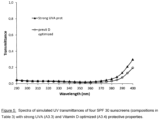
- Figure 3 shows the spectral transmittances of sunscreen films referring to the four different types of UV filter compositions leading to SPF 6.
- Table 2 shows the compositions as well as the calculated values of SPF, E Pvd /E er ratio, UVA-PF, UVA-PF/SPF-ratio and critical wavelength CW for four SPF 15 sunscreens.
- Composition A2.4 is arcording to the present invention.
- Table 2 UV filter compositions for SPF 15 with different levels of E pvd /E er ratio and UVA protection Type filter composition SPF E pvd /E er UVA-PF UVA-PF/SPF CW [nm] A2.3 2% MBBT, 15.7 1.91 15.6 0.99 378 2% BEMT, 2% BMDBM, 2.5% OCR A2.4 3% BMDBM, 15.5 2.11 30.2 1.95 380 3.1% MBBT, 10% DHHB
- Table 3 shows the compositions and the calculated values of SPF, E pvd /E er ratio, UVA-PF, UVA-PF/SPF-ratio and critical wavelength CW for four SPF 30 sunscreens .
- Composition A3.4 is arcording to the present invention.
- UV filter compositions for SPF 30 with different levels of E pvd/Epr ratio and UVA protection Type filter composition SPF E pvd /E er UVA-PF UVA-PF/SPF CW [nm] A3.3 2.2% PBSA, 33.2 1.84 33.5 1.01 378 3% BEMT, 4.5% MBBT, 4.5% DHHB A3.4 1.9% BEMT, 33.1 2.00 49.5 1.50 380 3% BMDBM, 7.4% MBBT, 10% DHHB
- Figure 5 shows the simulated spectral transmittances of sunscreen films referring to the four different types of UV filter compositions leading to SPF 30.
- the examples A3.3 and A3.4 demonstrate that the transmittance of sunscreens for vitamin D 3 -effective radiation can be optimized even if the SPF is the same.
- the attenuation factors AF PVD and the exposure times t PVD for the 4 examples of sunscreens are given in table 4.
- the formulation is prepared as follows: Parts A and B are prepared and separately heated to 80°C. Then part A is added to part B under stirring. After short homogenization part C is added under stirring. After cooling down to room temperature the ingredients of part D are added in the listed order.
- the formulation is prepared as follows: Part A is heated to 80°C, cooled down to room temperature and incorporated into part B under stirring. After homogenization (with an ultra-turrax type device) part C is added, again followed by homogenization. Finally the ingredients of part D are added and the formulation is homogenized again.
- the formulation is prepared as follows: Parts A and B are prepared and separately heated to 80°C. Then part A is added to part B under stirring. After short homogenization part C is added under stirring. After cooling down to room temperature the ingredients of part D are added in the listed order.
- the formulation is prepared as follows: Parts A and B are prepared and separately heated to 80°C. Then part A is added to part B under stirring. After short homogenization part C is added under stirring. After cooling down to room temperature the ingredients of part D are added in the listed order.
- the formulation is prepared as follows: Parts A and B are prepared and separately heated to 80°C. Then part A is added to part B under stirring. After short homogenization part C is added under stirring. After cooling down to room temperature the ingredients of part D are added in the listed order.
- the formulation is prepared as follows: Parts A and B are prepared and separately heated to 80°C. Then part A is added to part B under stirring. After short homogenization part C is added under stirring. After cooling down to room temperature the ingredients of part D are added in the listed order.
Landscapes
- Health & Medical Sciences (AREA)
- Life Sciences & Earth Sciences (AREA)
- Public Health (AREA)
- Veterinary Medicine (AREA)
- Animal Behavior & Ethology (AREA)
- General Health & Medical Sciences (AREA)
- Epidemiology (AREA)
- Birds (AREA)
- Emergency Medicine (AREA)
- Chemical & Material Sciences (AREA)
- Inorganic Chemistry (AREA)
- Dermatology (AREA)
- Cosmetics (AREA)
Applications Claiming Priority (2)
| Application Number | Priority Date | Filing Date | Title |
|---|---|---|---|
| EP14178458 | 2014-07-25 | ||
| PCT/EP2015/066985 WO2016012586A1 (en) | 2014-07-25 | 2015-07-24 | Sunscreen formulations optimized for the formation of vitamin d |
Publications (2)
| Publication Number | Publication Date |
|---|---|
| EP3171945A1 EP3171945A1 (en) | 2017-05-31 |
| EP3171945B1 true EP3171945B1 (en) | 2024-11-06 |
Family
ID=51292800
Family Applications (1)
| Application Number | Title | Priority Date | Filing Date |
|---|---|---|---|
| EP15738952.9A Active EP3171945B1 (en) | 2014-07-25 | 2015-07-24 | Sunscreen formulations optimized for the formation of vitamin d |
Country Status (8)
| Country | Link |
|---|---|
| US (1) | US11419804B2 (enExample) |
| EP (1) | EP3171945B1 (enExample) |
| JP (3) | JP2017521463A (enExample) |
| KR (1) | KR102483132B1 (enExample) |
| CN (2) | CN106659653B (enExample) |
| BR (1) | BR112017001490B1 (enExample) |
| ES (1) | ES3010209T3 (enExample) |
| WO (1) | WO2016012586A1 (enExample) |
Families Citing this family (19)
| Publication number | Priority date | Publication date | Assignee | Title |
|---|---|---|---|---|
| BR112017004652B1 (pt) * | 2014-09-09 | 2020-12-08 | Basf Se | uso de um derivado de benzotriazol |
| EP3458162B1 (en) * | 2016-05-19 | 2024-07-10 | Basf Se | Micro-particulate organic uv absorber composition |
| DE102017213219A1 (de) * | 2017-08-01 | 2019-02-07 | Beiersdorf Ag | Sonnenschutzmittel mit geringen Augenreizungspotential |
| CN108186389A (zh) * | 2018-03-01 | 2018-06-22 | 花安堂生物科技集团有限公司 | 一种复合防晒剂和由其组成的防晒组合物及其制备方法 |
| KR102849831B1 (ko) | 2018-10-05 | 2025-08-26 | 바스프 에스이 | 직물 착색 감소를 위한 메틸렌 비스-벤조트리아졸릴 테트라메틸부틸페놀 |
| BR112021017072A2 (pt) * | 2019-03-15 | 2021-11-09 | Basf Se | Composição de protetor solar ou cuidados diários, e, uso de hexil 2-[4-(dietilamino)-2-hidroxibenzoil]benzoato (inci dietilamino hidroxibenzoil hexil benzoato) e um filtro uv orgânico particulado |
| US20220151896A1 (en) * | 2019-03-15 | 2022-05-19 | Basf Se | Efficient sunscreen compositions with diethylamino hydroxybenzoyl hexyl benzoate and organic particulate uv filter |
| CN113573691A (zh) * | 2019-03-15 | 2021-10-29 | 巴斯夫欧洲公司 | 具有二乙氨基羟基苯甲酰基苯甲酸己酯和丁基甲氧基二苯甲酰基甲烷的有效防晒组合物 |
| CN113573690A (zh) * | 2019-03-15 | 2021-10-29 | 巴斯夫欧洲公司 | 具有二乙氨基羟基苯甲酰基苯甲酸己酯和丁基甲氧基二苯甲酰基甲烷且不含奥克立林的有效防晒组合物 |
| CN119700568A (zh) * | 2019-11-20 | 2025-03-28 | 科蒂公司 | 具有多种光防护uv滤光剂的防晒霜组合物 |
| KR102105137B1 (ko) * | 2020-02-13 | 2020-04-27 | 한국콜마주식회사 | 수분산 오일 프리 자외선 차단용 화장료 조성물 및 이의 제조방법 |
| BR102021002815A2 (pt) * | 2020-02-21 | 2021-09-08 | Nouryon Chemicals International B.V. | Polímero impermeabilizante, processo para preparação de um polímero impermeabilizante, composição, processo para preparação de uma composição, formulação de óleo em água, formulação de proteção solar de óleo em água, método de proteção de um usuário a ser exposto ou já exposto à luz solar dos efeitos prejudiciais da exposição à luz solar, e método para impermeabilização de uma formulação de proteção solar de óleo em água compreendendo pelo menos um agente ativo de proteção solar |
| KR20210107541A (ko) * | 2020-02-21 | 2021-09-01 | 누리온 케미칼즈 인터내셔널 비.브이. | 내수성 무수 선케어 제형을 위한 생분해성 폴리에스테르 |
| EP4117617A1 (en) * | 2020-03-13 | 2023-01-18 | Basf Se | Anti-aging care composition comprising perfumes |
| FR3115986B1 (fr) * | 2020-11-12 | 2023-04-07 | Fabre Pierre Dermo Cosmetique | Nouveau systeme solubilisant de filtres solaires organiques liposolubles |
| WO2022167320A1 (en) * | 2021-02-03 | 2022-08-11 | Dsm Ip Assets B.V. | Sunscreen composition based on bemt and two or more pigmentary uv-filters |
| CN117999059A (zh) * | 2021-10-13 | 2024-05-07 | 株式会社资生堂 | 紫外线吸收粉末、包含紫外线吸收粉末的化妆料、分散体和混合粉末及紫外线吸收粉末的制造方法 |
| CN116672277A (zh) * | 2023-03-13 | 2023-09-01 | 上海研绎科技发展有限公司 | 一种防晒组合物及其制备方法和应用 |
| FR3162629A1 (fr) * | 2024-05-31 | 2025-12-05 | L'oreal | Mélange translucide et homogène de filtres UV organiques lipophiles solides |
Family Cites Families (14)
| Publication number | Priority date | Publication date | Assignee | Title |
|---|---|---|---|---|
| DE1165574B (de) | 1960-08-08 | 1964-03-19 | Dehydag Gmbh | Verfahren zur Herstellung von als Emulgiermittel fuer Salbengrundlagen dienenden Mischestern |
| DE2024051C3 (de) | 1970-05-16 | 1986-05-07 | Henkel KGaA, 4000 Düsseldorf | Verwendung der Veresterungsprodukte von Glycerin-Äthylenoxid-Addukten mit Fettsäuren als Rückfettungsmittel in kosmetischen Zubereitungen |
| US4189468A (en) | 1973-11-30 | 1980-02-19 | L'oreal | Crosslinked polyamino-polyamide in hair conditioning compositions |
| LU68901A1 (enExample) | 1973-11-30 | 1975-08-20 | ||
| EP2328542B1 (en) | 2007-12-14 | 2018-04-25 | Basf Se | Sunscreen compositions comprising colour pigmens |
| US9724544B2 (en) * | 2009-01-05 | 2017-08-08 | Ernest T. Armstrong | Vitamin D promoting sunscreen |
| JPWO2010110020A1 (ja) * | 2009-03-26 | 2012-09-27 | 株式会社 資生堂 | 日焼け止め化粧料 |
| IT1393841B1 (it) | 2009-04-30 | 2012-05-11 | Giuliani Spa | Composizione farmaceutica o dermatologica o nutrizionale o cosmetica per combattere l'azione di immunosoppressione provocata sulla pelle da agenti aggressivi |
| BRPI1011916B1 (pt) * | 2009-07-07 | 2017-08-01 | Basf Se | Use of a uv filter combination, and, cosmetic preparation. |
| US8475774B2 (en) | 2010-02-08 | 2013-07-02 | Johnson & Johnson Consumer Companies, Inc. | Sunscreen compositions comprising an ultraviolet radiation-absorbing polymer |
| EP2407163A1 (en) | 2010-07-16 | 2012-01-18 | Giuliani S.p.A. | Compounds with a skin pigmenting activity and pharmaceutical or cosmetic compositions containing them |
| WO2012168275A2 (en) * | 2011-06-08 | 2012-12-13 | Dsm Ip Assets B.V. | Sunscreens |
| WO2014070266A1 (en) * | 2012-11-05 | 2014-05-08 | Global Life Science Partners Limited | Compositions for administering a specific wavelength phototherapy |
| KR102239036B1 (ko) | 2013-05-10 | 2021-04-13 | 바스프 에스이 | 다량의 uv 안정화제를 함유하는 작용제 |
-
2015
- 2015-07-24 ES ES15738952T patent/ES3010209T3/es active Active
- 2015-07-24 EP EP15738952.9A patent/EP3171945B1/en active Active
- 2015-07-24 KR KR1020177001802A patent/KR102483132B1/ko active Active
- 2015-07-24 WO PCT/EP2015/066985 patent/WO2016012586A1/en not_active Ceased
- 2015-07-24 BR BR112017001490-4A patent/BR112017001490B1/pt active IP Right Grant
- 2015-07-24 CN CN201580041053.0A patent/CN106659653B/zh active Active
- 2015-07-24 US US15/327,071 patent/US11419804B2/en active Active
- 2015-07-24 JP JP2017503845A patent/JP2017521463A/ja active Pending
- 2015-07-24 CN CN202210350723.9A patent/CN115227593A/zh active Pending
-
2020
- 2020-09-24 JP JP2020159309A patent/JP7204715B2/ja active Active
-
2022
- 2022-09-21 JP JP2022149638A patent/JP2022180512A/ja active Pending
Also Published As
| Publication number | Publication date |
|---|---|
| KR20170034891A (ko) | 2017-03-29 |
| JP2017521463A (ja) | 2017-08-03 |
| US11419804B2 (en) | 2022-08-23 |
| ES3010209T3 (en) | 2025-04-01 |
| JP2022180512A (ja) | 2022-12-06 |
| BR112017001490A2 (pt) | 2017-12-05 |
| CN106659653A (zh) | 2017-05-10 |
| KR102483132B1 (ko) | 2022-12-30 |
| JP2021001211A (ja) | 2021-01-07 |
| JP7204715B2 (ja) | 2023-01-16 |
| WO2016012586A1 (en) | 2016-01-28 |
| CN106659653B (zh) | 2022-04-05 |
| US20180200170A1 (en) | 2018-07-19 |
| BR112017001490B1 (pt) | 2020-12-08 |
| EP3171945A1 (en) | 2017-05-31 |
| CN115227593A (zh) | 2022-10-25 |
Similar Documents
| Publication | Publication Date | Title |
|---|---|---|
| US11419804B2 (en) | Sunscreen formulations optimized for the formation of vitamin D | |
| JP7139381B2 (ja) | 化粧品紫外線吸収体の混合物 | |
| EP3288525B1 (en) | Topical sunscreen emulsions | |
| EP2391334B1 (en) | Stabilization of cosmetic compositions | |
| KR102345271B1 (ko) | 미용 조성물의 안정화 | |
| AU2003205656A1 (en) | Micropigment mixtures | |
| WO2003063814A1 (en) | Micropigment mixtures | |
| EP3407862B1 (en) | Cosmetic or dermatological composition comprising a merocyanine and an oily phase comprising at least one polyalkylene glycol. | |
| EP3556748A1 (en) | Hydroxyphenyl-triazine uv absorbers | |
| US20170290756A1 (en) | Mixtures of cosmetic uv absorbers | |
| HK40094063A (en) | Topical vitamin c composition |
Legal Events
| Date | Code | Title | Description |
|---|---|---|---|
| STAA | Information on the status of an ep patent application or granted ep patent |
Free format text: STATUS: THE INTERNATIONAL PUBLICATION HAS BEEN MADE |
|
| PUAI | Public reference made under article 153(3) epc to a published international application that has entered the european phase |
Free format text: ORIGINAL CODE: 0009012 |
|
| STAA | Information on the status of an ep patent application or granted ep patent |
Free format text: STATUS: REQUEST FOR EXAMINATION WAS MADE |
|
| 17P | Request for examination filed |
Effective date: 20170227 |
|
| AK | Designated contracting states |
Kind code of ref document: A1 Designated state(s): AL AT BE BG CH CY CZ DE DK EE ES FI FR GB GR HR HU IE IS IT LI LT LU LV MC MK MT NL NO PL PT RO RS SE SI SK SM TR |
|
| AX | Request for extension of the european patent |
Extension state: BA ME |
|
| DAV | Request for validation of the european patent (deleted) | ||
| DAX | Request for extension of the european patent (deleted) | ||
| TPAC | Observations filed by third parties |
Free format text: ORIGINAL CODE: EPIDOSNTIPA |
|
| STAA | Information on the status of an ep patent application or granted ep patent |
Free format text: STATUS: EXAMINATION IS IN PROGRESS |
|
| 17Q | First examination report despatched |
Effective date: 20190510 |
|
| TPAC | Observations filed by third parties |
Free format text: ORIGINAL CODE: EPIDOSNTIPA |
|
| TPAC | Observations filed by third parties |
Free format text: ORIGINAL CODE: EPIDOSNTIPA |
|
| GRAP | Despatch of communication of intention to grant a patent |
Free format text: ORIGINAL CODE: EPIDOSNIGR1 |
|
| STAA | Information on the status of an ep patent application or granted ep patent |
Free format text: STATUS: GRANT OF PATENT IS INTENDED |
|
| INTG | Intention to grant announced |
Effective date: 20240619 |
|
| GRAS | Grant fee paid |
Free format text: ORIGINAL CODE: EPIDOSNIGR3 |
|
| GRAA | (expected) grant |
Free format text: ORIGINAL CODE: 0009210 |
|
| STAA | Information on the status of an ep patent application or granted ep patent |
Free format text: STATUS: THE PATENT HAS BEEN GRANTED |
|
| AK | Designated contracting states |
Kind code of ref document: B1 Designated state(s): AL AT BE BG CH CY CZ DE DK EE ES FI FR GB GR HR HU IE IS IT LI LT LU LV MC MK MT NL NO PL PT RO RS SE SI SK SM TR |
|
| REG | Reference to a national code |
Ref country code: GB Ref legal event code: FG4D |
|
| REG | Reference to a national code |
Ref country code: CH Ref legal event code: EP |
|
| REG | Reference to a national code |
Ref country code: DE Ref legal event code: R096 Ref document number: 602015090321 Country of ref document: DE |
|
| REG | Reference to a national code |
Ref country code: IE Ref legal event code: FG4D |
|
| REG | Reference to a national code |
Ref country code: LT Ref legal event code: MG9D |
|
| REG | Reference to a national code |
Ref country code: NL Ref legal event code: MP Effective date: 20241106 |
|
| REG | Reference to a national code |
Ref country code: ES Ref legal event code: FG2A Ref document number: 3010209 Country of ref document: ES Kind code of ref document: T3 Effective date: 20250401 |
|
| PG25 | Lapsed in a contracting state [announced via postgrant information from national office to epo] |
Ref country code: PT Free format text: LAPSE BECAUSE OF FAILURE TO SUBMIT A TRANSLATION OF THE DESCRIPTION OR TO PAY THE FEE WITHIN THE PRESCRIBED TIME-LIMIT Effective date: 20250306 Ref country code: HR Free format text: LAPSE BECAUSE OF FAILURE TO SUBMIT A TRANSLATION OF THE DESCRIPTION OR TO PAY THE FEE WITHIN THE PRESCRIBED TIME-LIMIT Effective date: 20241106 Ref country code: IS Free format text: LAPSE BECAUSE OF FAILURE TO SUBMIT A TRANSLATION OF THE DESCRIPTION OR TO PAY THE FEE WITHIN THE PRESCRIBED TIME-LIMIT Effective date: 20250306 |
|
| PG25 | Lapsed in a contracting state [announced via postgrant information from national office to epo] |
Ref country code: FI Free format text: LAPSE BECAUSE OF FAILURE TO SUBMIT A TRANSLATION OF THE DESCRIPTION OR TO PAY THE FEE WITHIN THE PRESCRIBED TIME-LIMIT Effective date: 20241106 Ref country code: NL Free format text: LAPSE BECAUSE OF FAILURE TO SUBMIT A TRANSLATION OF THE DESCRIPTION OR TO PAY THE FEE WITHIN THE PRESCRIBED TIME-LIMIT Effective date: 20241106 |
|
| REG | Reference to a national code |
Ref country code: AT Ref legal event code: MK05 Ref document number: 1738727 Country of ref document: AT Kind code of ref document: T Effective date: 20241106 |
|
| PG25 | Lapsed in a contracting state [announced via postgrant information from national office to epo] |
Ref country code: BG Free format text: LAPSE BECAUSE OF FAILURE TO SUBMIT A TRANSLATION OF THE DESCRIPTION OR TO PAY THE FEE WITHIN THE PRESCRIBED TIME-LIMIT Effective date: 20241106 |
|
| PG25 | Lapsed in a contracting state [announced via postgrant information from national office to epo] |
Ref country code: NO Free format text: LAPSE BECAUSE OF FAILURE TO SUBMIT A TRANSLATION OF THE DESCRIPTION OR TO PAY THE FEE WITHIN THE PRESCRIBED TIME-LIMIT Effective date: 20250206 |
|
| PG25 | Lapsed in a contracting state [announced via postgrant information from national office to epo] |
Ref country code: LV Free format text: LAPSE BECAUSE OF FAILURE TO SUBMIT A TRANSLATION OF THE DESCRIPTION OR TO PAY THE FEE WITHIN THE PRESCRIBED TIME-LIMIT Effective date: 20241106 Ref country code: GR Free format text: LAPSE BECAUSE OF FAILURE TO SUBMIT A TRANSLATION OF THE DESCRIPTION OR TO PAY THE FEE WITHIN THE PRESCRIBED TIME-LIMIT Effective date: 20250207 Ref country code: AT Free format text: LAPSE BECAUSE OF FAILURE TO SUBMIT A TRANSLATION OF THE DESCRIPTION OR TO PAY THE FEE WITHIN THE PRESCRIBED TIME-LIMIT Effective date: 20241106 |
|
| PG25 | Lapsed in a contracting state [announced via postgrant information from national office to epo] |
Ref country code: PL Free format text: LAPSE BECAUSE OF FAILURE TO SUBMIT A TRANSLATION OF THE DESCRIPTION OR TO PAY THE FEE WITHIN THE PRESCRIBED TIME-LIMIT Effective date: 20241106 |
|
| PG25 | Lapsed in a contracting state [announced via postgrant information from national office to epo] |
Ref country code: RS Free format text: LAPSE BECAUSE OF FAILURE TO SUBMIT A TRANSLATION OF THE DESCRIPTION OR TO PAY THE FEE WITHIN THE PRESCRIBED TIME-LIMIT Effective date: 20250206 |
|
| PG25 | Lapsed in a contracting state [announced via postgrant information from national office to epo] |
Ref country code: SM Free format text: LAPSE BECAUSE OF FAILURE TO SUBMIT A TRANSLATION OF THE DESCRIPTION OR TO PAY THE FEE WITHIN THE PRESCRIBED TIME-LIMIT Effective date: 20241106 |
|
| PG25 | Lapsed in a contracting state [announced via postgrant information from national office to epo] |
Ref country code: DK Free format text: LAPSE BECAUSE OF FAILURE TO SUBMIT A TRANSLATION OF THE DESCRIPTION OR TO PAY THE FEE WITHIN THE PRESCRIBED TIME-LIMIT Effective date: 20241106 |
|
| PG25 | Lapsed in a contracting state [announced via postgrant information from national office to epo] |
Ref country code: EE Free format text: LAPSE BECAUSE OF FAILURE TO SUBMIT A TRANSLATION OF THE DESCRIPTION OR TO PAY THE FEE WITHIN THE PRESCRIBED TIME-LIMIT Effective date: 20241106 |
|
| PG25 | Lapsed in a contracting state [announced via postgrant information from national office to epo] |
Ref country code: RO Free format text: LAPSE BECAUSE OF FAILURE TO SUBMIT A TRANSLATION OF THE DESCRIPTION OR TO PAY THE FEE WITHIN THE PRESCRIBED TIME-LIMIT Effective date: 20241106 |
|
| PG25 | Lapsed in a contracting state [announced via postgrant information from national office to epo] |
Ref country code: SK Free format text: LAPSE BECAUSE OF FAILURE TO SUBMIT A TRANSLATION OF THE DESCRIPTION OR TO PAY THE FEE WITHIN THE PRESCRIBED TIME-LIMIT Effective date: 20241106 |
|
| PG25 | Lapsed in a contracting state [announced via postgrant information from national office to epo] |
Ref country code: CZ Free format text: LAPSE BECAUSE OF FAILURE TO SUBMIT A TRANSLATION OF THE DESCRIPTION OR TO PAY THE FEE WITHIN THE PRESCRIBED TIME-LIMIT Effective date: 20241106 |
|
| REG | Reference to a national code |
Ref country code: DE Ref legal event code: R097 Ref document number: 602015090321 Country of ref document: DE |
|
| PG25 | Lapsed in a contracting state [announced via postgrant information from national office to epo] |
Ref country code: SE Free format text: LAPSE BECAUSE OF FAILURE TO SUBMIT A TRANSLATION OF THE DESCRIPTION OR TO PAY THE FEE WITHIN THE PRESCRIBED TIME-LIMIT Effective date: 20241106 |
|
| PLBE | No opposition filed within time limit |
Free format text: ORIGINAL CODE: 0009261 |
|
| STAA | Information on the status of an ep patent application or granted ep patent |
Free format text: STATUS: NO OPPOSITION FILED WITHIN TIME LIMIT |
|
| PGFP | Annual fee paid to national office [announced via postgrant information from national office to epo] |
Ref country code: ES Payment date: 20250811 Year of fee payment: 11 |
|
| PGFP | Annual fee paid to national office [announced via postgrant information from national office to epo] |
Ref country code: DE Payment date: 20250728 Year of fee payment: 11 |
|
| 26N | No opposition filed |
Effective date: 20250807 |
|
| PGFP | Annual fee paid to national office [announced via postgrant information from national office to epo] |
Ref country code: IT Payment date: 20250721 Year of fee payment: 11 |
|
| PGFP | Annual fee paid to national office [announced via postgrant information from national office to epo] |
Ref country code: GB Payment date: 20250722 Year of fee payment: 11 |
|
| PGFP | Annual fee paid to national office [announced via postgrant information from national office to epo] |
Ref country code: FR Payment date: 20250725 Year of fee payment: 11 |
|
| PGFP | Annual fee paid to national office [announced via postgrant information from national office to epo] |
Ref country code: CH Payment date: 20250801 Year of fee payment: 11 |
|
| PG25 | Lapsed in a contracting state [announced via postgrant information from national office to epo] |
Ref country code: LU Free format text: LAPSE BECAUSE OF NON-PAYMENT OF DUE FEES Effective date: 20250724 |
|
| REG | Reference to a national code |
Ref country code: BE Ref legal event code: MM Effective date: 20250731 |
|
| PG25 | Lapsed in a contracting state [announced via postgrant information from national office to epo] |
Ref country code: BE Free format text: LAPSE BECAUSE OF NON-PAYMENT OF DUE FEES Effective date: 20250731 |
|
| PG25 | Lapsed in a contracting state [announced via postgrant information from national office to epo] |
Ref country code: LT Free format text: LAPSE BECAUSE OF FAILURE TO SUBMIT A TRANSLATION OF THE DESCRIPTION OR TO PAY THE FEE WITHIN THE PRESCRIBED TIME-LIMIT Effective date: 20241106 |
|
| PG25 | Lapsed in a contracting state [announced via postgrant information from national office to epo] |
Ref country code: IE Free format text: LAPSE BECAUSE OF NON-PAYMENT OF DUE FEES Effective date: 20250724 |
|
| PG25 | Lapsed in a contracting state [announced via postgrant information from national office to epo] |
Ref country code: MC Free format text: LAPSE BECAUSE OF FAILURE TO SUBMIT A TRANSLATION OF THE DESCRIPTION OR TO PAY THE FEE WITHIN THE PRESCRIBED TIME-LIMIT Effective date: 20241106 |
|
| PG25 | Lapsed in a contracting state [announced via postgrant information from national office to epo] |
Ref country code: CY Free format text: LAPSE BECAUSE OF FAILURE TO SUBMIT A TRANSLATION OF THE DESCRIPTION OR TO PAY THE FEE WITHIN THE PRESCRIBED TIME-LIMIT Effective date: 20241106 |